WO2025006473A1 - Process and configuration for the dehydrogenation of alkanes to olefins - Google Patents
Process and configuration for the dehydrogenation of alkanes to olefins Download PDFInfo
- Publication number
- WO2025006473A1 WO2025006473A1 PCT/US2024/035422 US2024035422W WO2025006473A1 WO 2025006473 A1 WO2025006473 A1 WO 2025006473A1 US 2024035422 W US2024035422 W US 2024035422W WO 2025006473 A1 WO2025006473 A1 WO 2025006473A1
- Authority
- WO
- WIPO (PCT)
- Prior art keywords
- reactor
- catalyst
- downstream
- stream
- vol
- Prior art date
- Legal status (The legal status is an assumption and is not a legal conclusion. Google has not performed a legal analysis and makes no representation as to the accuracy of the status listed.)
- Ceased
Links
Classifications
-
- C—CHEMISTRY; METALLURGY
- C07—ORGANIC CHEMISTRY
- C07C—ACYCLIC OR CARBOCYCLIC COMPOUNDS
- C07C5/00—Preparation of hydrocarbons from hydrocarbons containing the same number of carbon atoms
- C07C5/42—Preparation of hydrocarbons from hydrocarbons containing the same number of carbon atoms by dehydrogenation with a hydrogen acceptor
- C07C5/48—Preparation of hydrocarbons from hydrocarbons containing the same number of carbon atoms by dehydrogenation with a hydrogen acceptor with oxygen as an acceptor
-
- C—CHEMISTRY; METALLURGY
- C07—ORGANIC CHEMISTRY
- C07C—ACYCLIC OR CARBOCYCLIC COMPOUNDS
- C07C7/00—Purification; Separation; Use of additives
- C07C7/09—Purification; Separation; Use of additives by fractional condensation
-
- C—CHEMISTRY; METALLURGY
- C07—ORGANIC CHEMISTRY
- C07C—ACYCLIC OR CARBOCYCLIC COMPOUNDS
- C07C7/00—Purification; Separation; Use of additives
- C07C7/10—Purification; Separation; Use of additives by extraction, i.e. purification or separation of liquid hydrocarbons with the aid of liquids
-
- C—CHEMISTRY; METALLURGY
- C07—ORGANIC CHEMISTRY
- C07C—ACYCLIC OR CARBOCYCLIC COMPOUNDS
- C07C7/00—Purification; Separation; Use of additives
- C07C7/12—Purification; Separation; Use of additives by adsorption, i.e. purification or separation of hydrocarbons with the aid of solids, e.g. with ion-exchangers
-
- C—CHEMISTRY; METALLURGY
- C07—ORGANIC CHEMISTRY
- C07C—ACYCLIC OR CARBOCYCLIC COMPOUNDS
- C07C2521/00—Catalysts comprising the elements, oxides or hydroxides of magnesium, boron, aluminium, carbon, silicon, titanium, zirconium or hafnium
- C07C2521/06—Silicon, titanium, zirconium or hafnium; Oxides or hydroxides thereof
-
- C—CHEMISTRY; METALLURGY
- C07—ORGANIC CHEMISTRY
- C07C—ACYCLIC OR CARBOCYCLIC COMPOUNDS
- C07C2521/00—Catalysts comprising the elements, oxides or hydroxides of magnesium, boron, aluminium, carbon, silicon, titanium, zirconium or hafnium
- C07C2521/06—Silicon, titanium, zirconium or hafnium; Oxides or hydroxides thereof
- C07C2521/08—Silica
-
- C—CHEMISTRY; METALLURGY
- C07—ORGANIC CHEMISTRY
- C07C—ACYCLIC OR CARBOCYCLIC COMPOUNDS
- C07C2523/00—Catalysts comprising metals or metal oxides or hydroxides, not provided for in group C07C2521/00
- C07C2523/16—Catalysts comprising metals or metal oxides or hydroxides, not provided for in group C07C2521/00 of arsenic, antimony, bismuth, vanadium, niobium, tantalum, polonium, chromium, molybdenum, tungsten, manganese, technetium or rhenium
- C07C2523/24—Chromium, molybdenum or tungsten
- C07C2523/26—Chromium
Definitions
- a selective hydrogen combustion material can be added to the reactor during dehydrogenation to combust hydrogen gas as it forms.
- This causes the formation of ethylene to be thermodynamically favored and, thus, increases the maximum potential ethylene yield.
- S UMMARY [0005] Disclosed herein is a process for the catalytic dehydrogenation of alkanes that may include several steps.
- a feed stream that can include alkanes may be passed through a first reactor, where it can be brought into contact with a catalyst and an SHCM in the first reactor to generate a first product stream.
- the first product stream may be transferred through any number of subsequent reactors, or through zero subsequent reactors, to form a subsequent stream.
- the subsequent stream may be transferred to a water removal unit and passed through the water removal unit to form a dewatered subsequent stream.
- the dewatered subsequent stream can be 85024-WO-PCT/DOW 85024 WO transferred from the water removal unit into a downstream reactor.
- the dewatered subsequent stream can be brought into contact with a catalyst in the downstream reactor to generate a downstream product stream.
- a system that includes a first reactor and a downstream reactor, fluidly connected in series.
- the first reactor and the downstream reactor may each comprise a dehydrogenation catalyst comprising chromium, iron, gallium, platinum, or combinations thereof.
- at least the first reactor further comprises an SHCM.
- the first reactor can include an inlet for introducing a feed stream and the downstream reactor can include an inlet for introducing a product stream.
- the system disclosed herein may also include a water removal unit fluidly connected to the downstream reactor and configured to remove water from a product stream before the product stream is introduced into the downstream reactor.
- FIG.1A is a schematic diagram of an embodiment of the process configuration in which a first reactor is fluidly connected to a downstream reactor and both reactors are fluidly connected to a water removal unit; 85024-WO-PCT/DOW 85024 WO
- FIG.1B is a schematic diagram of an embodiment of the process configuration in which a first reactor is fluidly connected to a second reactor and both reactors are fluidly connected to a water removal unit;
- FIG.1C is a schematic diagram of an embodiment of the process configuration in which a second reactor is fluidly connected to a first reactor and a downstream reactor, wherein the reactors are fluidly connected to more than one water removal unit;
- FIG.2A is a schematic diagram of an embodiment of the process configuration in which multiple reactors are fluidly connected to a single regenerator;
- FIG.2B is a schematic diagram of an embodiment of the process configuration in which multiple reactors are independently fluidly connected to a regenerator that is not shared by another reactor; and [
- SHCM oxygen-carrier materials such as those disclosed in U.S. App. No. 62/725,504, entitled “METHODS OF PRODUCING HYDROGEN-SELECTIVE OXYGEN-CARRIER MATERIALS,” filed on, August 31, 2018, and U.S. App. No.
- the SHCM may include those of U.S. Pat. No. 5,430,209, U.S. Pat. No. 7,122,495, and/or WO 2018/232133, each of which are incorporated by reference in their entireties.
- the combustion of hydrogen gas using an SHCM produces water in the reactor, which may have a detrimental effect on the performance of the dehydrogenation catalyst.
- the configuration described herein lowers the overall partial pressure of water in the reactors compared to a single, larger reactor. Accordingly, the configuration reduces product inhibition, minimizes unwanted side reactions, and decreases sintering effects.
- the series configuration of the reactors also lowers the required conversion per reactor and, hence, allows operation with less active but more selective steam tolerant dehydrogenation catalysts.
- the lower per reactor conversion requirement additionally allows for the use of more highly selective materials with a lower oxygen capacity.
- the present disclosure is directed to a process and a system for converting alkanes to olefins via catalytic dehydrogenation.
- Embodiments described and disclosed herein comprise a first reactor and a downstream reactor fluidly connected in series, wherein the first reactor and the downstream reactor each comprise a steam tolerant dehydrogenation catalyst comprising chromium, iron, gallium, platinum, or any combination thereof.
- the catalyst further comprises silicon, sulfur, phosphorous, boron, platinum, potassium, cesium, calcium, lithium, or any combination thereof.
- at least the first reactor also comprises an SHCM.
- the first reactor comprises an inlet for introducing a feed stream and the downstream reactor comprises an inlet for introducing a product stream.
- a water removal unit may be fluidly connected to the downstream reactor, the water removal unit being configured to remove water from a product stream before the product stream is introduced into the downstream reactor.
- a second reactor may be fluidly connected to the first reactor and the downstream reactor.
- the second reactor comprises an inlet for receiving the first product stream.
- the second reactor comprises a steam tolerant dehydrogenation catalyst comprising chromium, iron, gallium, platinum, or any combination thereof.
- the catalyst further comprises silicon, 85024-WO-PCT/DOW 85024 WO sulfur, phosphorous, boron, platinum, potassium, cesium, calcium, lithium, or any combination thereof.
- the second reactor also comprises an SHCM.
- one or more of the reactors disclosed herein is a circulating fluidized bed reactor.
- the catalysts and the SHCMs disclosed herein are fluidized.
- the system described herein comprises multiple reactors connected in series with one or more water removal units fluidly connected to one or more of the reactors.
- the one or more water removal units are configured to remove water from a gaseous stream through condensation, adsorption, extraction, or other drying processes known to one skilled in the art.
- the one or more water removal units in embodiments, are configured to remove water from a stream before the stream enters a reactor.
- the system disclosed herein further comprises at least one regenerator fluidly connected to one or more reactors.
- the at least one regenerator is configured to receive used catalyst and/or SHCM from one or more reactors, regenerate the used catalyst and/or SHCM to form regenerated catalyst and/or SHCM, and return the regenerated catalyst and/or SHCM to one or more reactors, where the catalyst will be used to dehydrogenate alkanes to olefins and the SHCM will be used to combust gaseous hydrogen.
- a stream comprising alkanes may be used to refer to any stream comprising one or more alkanes, such as a feed stream, a product stream, or a dewatered product stream. Such a stream may flow into or out of a reactor or a regenerator.
- dehydrogenation catalyst refers to any substance that increases the rate of a dehydrogenation reaction without itself undergoing any permanent chemical change.
- promoter As used herein, “promoted dehydrogenation catalyst” refers to a catalyst that has had an amount of activator (also commonly referred to as catalytic promoter), which increases the catalytic efficiency of the catalyst, added to the catalyst. As a non-limiting example, silicon might be added to a dehydrogenation catalyst to increase the dehydrogenation catalyst’s catalytic efficiency.
- activator also commonly referred to as catalytic promoter
- silicon might be added to a dehydrogenation catalyst to increase the dehydrogenation catalyst’s catalytic efficiency.
- the term “catalyst” may refer to a “dehydrogenation catalyst” or a “promoted dehydrogenation catalyst” unless specifically indicated otherwise.
- a “steam tolerant catalyst” is a dehydrogenation catalyst that operates well in the presence of water without the addition of oxidative gas and does not lose conversion or selectivity when the hydrogen is combusted and forms water.
- the systems disclosed herein may include a catalyst comprising zirconia (ZrO 2 ), where the zirconia acts as a metal oxide support.
- zirconia zirconia
- metal oxide support may refer to a support material that supports the other components of the catalyst, for example, chromium.
- the zirconia used in embodiments disclosed and described herein in the catalyst may be “phase pure zirconia”, which is defined herein as zirconia to which no other materials have intentionally been added during formation.
- phase pure zirconia includes zirconia with small amounts of components other than zirconium (including oxides other than zirconia) that are unintentionally present in the zirconia as a natural part of the zirconia formation process, such as, for example, hafnium (Hf). Accordingly, as used herein “zirconia” and “phase pure zirconia” are used interchangeably unless specifically indicated otherwise.
- the zirconia can be non-phase pure zirconia, such as zirconia doped with calcium (Ca), yttria (Y 2 O 3 ), lanthanum (La), cerium (Ce), or rare earth elements.
- the dehydrogenation catalysts disclosed herein comprise zirconia and a metal selected from the group consisting of chromium, gallium, iron, and combinations thereof.
- the catalysts comprise the formula M-Zr-Si-X-Y, wherein M is a metal selected from the group consisting of chromium, iron, gallium, and combinations thereof, X is selected from the group consisting of alkali metals, alkali earth metals, boron, and combinations thereof, and Y is selected from the group consisting of ruthenium, rhodium, palladium, platinum, and combinations thereof.
- Zr of the formula M-Zr-Si-X-Y comprises zirconia (ZrO2).
- the dehydrogenation catalyst may contain silicon as a promoter.
- the silicon-promoted catalyst may include silicon in any suitable oxidation state.
- the silicon may be in the form of silica.
- a promoted dehydrogenation catalyst may be prepared by first impregnating a zirconia support with a silicon-containing precursor and then impregnating the zirconia support with a metal-containing precursor.
- a promoted dehydrogenation catalyst may be prepared first impregnating a zirconia support with a metal-containing precursor and then 85024-WO-PCT/DOW 85024 WO impregnating the zirconia support with a silicon-containing precursor.
- silicon contacted with a metal-containing zirconia support may increase the catalyst efficiency of the metal contacted with the zirconia support by increasing the catalytic efficiency of the metal-containing zirconia support.
- the steam tolerant catalyst may have an alkene selectivity of greater than or equal to 40 carbon mole percent (Cmol%), greater than or equal to 45 Cmol%, greater than or equal to 50 Cmol%, greater than or equal to 55 Cmol %, greater than or equal to 65 Cmol%, greater than or equal to 75 Cmol%, greater than or equal to 85 Cmol%, greater than or equal to 95 Cmol %, greater than or equal to 97 Cmol%, greater than or equal to 98 Cmol%, or greater than or equal to 99 Cmol%.
- the steam tolerant catalyst comprises a dehydrogenation activity of greater than or equal to 1.5 times background dehydrogenation activity.
- the steam tolerant catalyst comprises a dehydrogenation activity of greater than or equal to 1.51.1 times, 2 times, 3 times, 4 times, 5 times, or 10 times background dehydrogenation activity.
- the steam tolerant catalyst retains at least some dehydrogenation activity above background dehydrogenation activity under greater than or equal to 5 volume percent (vol%) steam conditions based on a total volume of gaseous components in the reaction zone.
- the steam tolerant catalyst retains at least some dehydrogenation activity above background dehydrogenation activity under greater than or equal to 5 vol%, 10 vol%, 15 vol%, 20 vol%, 25 vol%, 30 vol%, 35 vol%, 40 vol%, 45 vol%, or 50 vol% steam conditions based on a total volume of gaseous components in the reaction zone.
- the catalytic dehydrogenation of alkanes in a reactor forms hydrogen gas.
- at least the first reactor houses an SHCM that combusts the hydrogen gas.
- the catalyst and the SHCM are both present in the reactor.
- the catalyst and the SHCM are in contact with each other.
- the catalyst and the SHCM are mixed or otherwise combined prior to being 85024-WO-PCT/DOW 85024 WO placed in the reactor. In embodiments, the catalyst and the SHCM are mixed or otherwise combined in the reactor. [0033] In embodiments, at least a portion of the hydrogen gas formed in a reactor from the catalytic dehydrogenation of alkanes is combusted by the SHCM in the reactor to yield a combustion product comprising water. In embodiments, the catalytic dehydrogenation of alkanes and the combustion of hydrogen gas take place in the reactor simultaneously. In embodiments, the water in the combustion product is in the form of steam. In embodiments, the steam comprises gaseous water, liquid water, aerosolized water, or combinations thereof.
- a feed stream 100 is fed into a first reactor 120.
- the first reactor 120 in one or more embodiments, is a circulating fluidized bed reactor.
- the first reactor 120 comprises a steam tolerant dehydrogenation catalyst comprising chromium, iron, gallium, platinum, or any combination thereof.
- the steam tolerant dehydrogenation catalyst further comprises silicon, sulfur, phosphorous, boron, platinum, potassium, cesium, calcium, lithium, or any combination thereof.
- the first reactor 120 further comprises an SHCM.
- the feed stream 100 comprises at least one alkane.
- the at least one alkane is selected from the group consisting of ethane, propane, butane, and combinations thereof.
- the at least one alkane comprises ethane.
- the feed stream 100 comprises from 30 vol% to 100 vol% alkane, from 40 vol% to 90 vol% alkane, from 50 vol% to 80 vol% alkane, or from 60 vol% to 70 vol% alkane.
- the feed stream 100 entering the first reactor 120 comprises less than 6 vol% of water.
- the feed stream 100 entering the first reactor 120 comprises less than 5 vol%, less than 4 vol%, less than 3 vol%, less than 2 vol%, or less than 1 vol% of water.
- the feed stream 100 entering the first reactor 120 contains an inert gas, such as nitrogen, carbon dioxide, or combinations thereof. [0036] According to embodiments, after being fed into the first reactor 120, feed stream 100, travels from a first end 120a of the first reactor 120 to a second end 120b of the first reactor 120 that is opposite to the first end 120a of the first reactor 120.
- the feed 85024-WO-PCT/DOW 85024 WO stream 100 is contacted with the catalyst and the SHCM.
- the catalyst and at the proper reaction conditions described in more detail below—the one or more alkanes present in the feed stream 100 are, in embodiments, converted to olefins.
- hydrogen gas formed from the catalytic dehydrogenation is combusted by the SHCM to form a combustion product comprising water.
- a first product stream 101 comprising unconverted alkanes, olefins, and water exits the first reactor 120 via an outlet.
- At least one reactor can be fluidly connected to a water removal unit 110 via one or more conduits.
- the configuration of the one or more conduits is not particularly limited, provided that the one or more conduits are capable of transferring a product stream from one reactor to the water removal unit, then transferring a dewatered product stream a subsequent reactor.
- a subsequent stream 102 is derived from the first product stream 101.
- the first product stream 101 passes through any number of subsequent reactors to form the subsequent stream 102, such that the subsequent stream 102 is derived from the first product stream 101.
- the subsequent stream 102 may comprise 40 vol% water, such as greater than 10 vol% water, greater than 20 vol% water, or greater than 30 vol% water.
- the subsequent stream 102 passes through the water removal unit 110 to form a dewatered subsequent stream 103.
- the dewatered subsequent stream 103 comprises water in a concentration of less than 10 vol%, such as from 0.2 vol% to 10.0 vol%.
- the dewatered subsequent stream 103 comprises water in a concentration from 0.5 vol% to 9.5 vol%, from 1.0 vol% to 9.0 vol%, from 1.5 vol% to 8.5 vol%, from 2.0 vol% to 8.0 vol%, from 2.5 vol% to 7.5 vol%, from 3.0 vol% to 7.0 vol%, from 3.5 vol% to 6.5 vol%, from 4.0 vol% to 6.0 vol%, or from 4.5 vol% to 5.5 vol%.
- the dewatered subsequent stream 103 in embodiments, is fed into a downstream reactor 130.
- the downstream reactor 130 in one or more embodiments, is a circulating fluidized bed reactor.
- the downstream reactor 130 comprises a steam tolerant dehydrogenation catalyst comprising chromium, iron, gallium, platinum, or any combination thereof.
- the steam tolerant dehydrogenation catalyst further comprises silicon, sulfur, phosphorous, boron, platinum, potassium, cesium, calcium, lithium, or any combination thereof.
- the downstream reactor 130 further comprises an SHCM. 85024-WO-PCT/DOW 85024 WO [0040]
- the dewatered subsequent stream 103 travels from a first end 130a of the downstream reactor 130 to a second end 130b of the downstream reactor 130 that is opposite to the first end 130a of the downstream reactor 130.
- the dewatered subsequent stream 103 traverses from the first end 130a of the downstream reactor 130 to the second end 130b of the downstream reactor 140, the dewatered subsequent stream 103, in embodiments, is contacted with the catalyst and/or the SHCM. According to embodiments, upon contact with the catalyst—and at the proper reaction conditions described in more detail below—unconverted alkanes present in the dewatered subsequent stream 103 are converted to olefins. In embodiments, hydrogen gas formed from the catalytic dehydrogenation is combusted by the SHCM in the reactor to form a combustion product comprising water.
- a downstream product stream 104 comprising unconverted alkanes, olefins, and water, exits the downstream reactor 130 via an outlet.
- the downstream reactor is a second reactor 140, where the first product stream 101 is transferred directly from the first reactor 120 to a water removal unit 110.
- the first product stream 101 may comprise 40 vol% water, such as greater than 10 vol% water, greater than 20 vol% water, or greater than 30 vol% water.
- the first product stream 101 passes through the water removal unit 110 to form a dewatered first product stream 105.
- the dewatered first product stream 105 comprises water in a concentration of less than 10 vol%, such as from 0.2 vol% to 10.0 vol%. In embodiments, the dewatered first product stream 105 comprises water in a concentration from 0.5 vol% to 9.5 vol%, from 1.0 vol% to 9.0 vol%, from 1.5 vol% to 8.5 vol%, from 2.0 vol% to 8.0 vol%, from 2.5 vol% to 7.5 vol%, from 3.0 vol% to 7.0 vol%, from 3.5 vol% to 6.5 vol%, from 4.0 vol% to 6.0 vol%, or from 4.5 vol% to 5.5 vol%. [0042] In embodiments, the dewatered first product stream 105 is transferred from the water removal unit 110 to the second reactor 140.
- the second reactor 140 in one or more embodiments, is a circulating fluidized bed reactor.
- the second reactor 140 comprises a steam tolerant dehydrogenation catalyst comprising chromium, iron, gallium, platinum, or any combination thereof.
- the steam tolerant dehydrogenation catalyst further comprises silicon, sulfur, phosphorous, boron, platinum, potassium, cesium, calcium, lithium, or any combination thereof.
- the second reactor 140 further comprises an SHCM.
- the dewatered first product stream 105 travels from a first end 140a of the second reactor 140 to a second end 140b of the second reactor 140 that is opposite to the first end 140a of the second reactor 140.
- the dewatered first product stream 105 traverses from the first end 140a of the downstream reactor 140 to the second end 140b of the second reactor 140, the dewatered first product stream 105, in embodiments, is contacted with a catalyst and/or the SHCM.
- unconverted alkanes present in the dewatered first product stream 105 are converted to olefins.
- hydrogen gas formed from the catalytic dehydrogenation is combusted by the SHCM to form a combustion product comprising water.
- a second product stream 106 comprising unconverted alkanes, olefins, and water, exits the second reactor 140 via an outlet.
- the second product stream 106 passes through any number of subsequent reactors to form the subsequent stream 102.
- the subsequent stream 102 passes through the water removal unit 110 to form the dewatered subsequent stream 103.
- the dewatered subsequent stream 103 enters into the downstream reactor 130.
- the mass-to-mass ratio of the catalyst in each reactor to the alkane content in each reactor is independently selected for each reactor and is from 5:1 to 200:1.
- the mass-to-mass ratio of the catalyst in each reactor to the alkane content in each reactor is from 10:1 to 200:1, from 25:1 to 200:1, from 50:1 to 200:1, from 75:1 to 200:1, from 100:1 to 200:1, from 150:1 to 200:1, from 5:1 to 150:1, from 10:1 to 150:1, from 25:1 to 150:1, from 50:1 to 150:1, from 75:1 to 150:1, from 100:1 to 150:1, from 5:1 to 100:1, from 10:1 to 100:1, from 25:1 to 100:1, from 50:1 to 100:1, from 75:1 to 100:1, from 5:1 to 75:1, from 10:1 to 75:1, from 25:1 to 75:1, from 50:1 to 75:1, from 5:1 to 50:1, from 10:1 to 50:1, from 25:1 to 50:1, from 5:1 to 25:1, from 10:1 to 25:1, or from 5:1 to 10:1.
- the weight hour space velocity (WHSV) of the catalyst and/or SHCM is independently selected for each reactor, where WHSV is defined as the weight of the incoming stream flow per weight of the catalyst or SHCM per hour.
- WHSV of the catalyst and/or SHCM is from 1 to 12 per hour (h -1 ).
- the WHSV of the catalyst and/or SHCM is from 1 to 10 h -1 , from 1 to 8 h -1 , from 1 to 5 h -1 , from 1 to 3 h -1 , or from 1 to 2 h -1 .
- the converting at least a portion of the alkanes to olefins occurs at a temperature that is independently selected for each reactor and is from 500°C to 900°C. In embodiments, the converting at least a portion of the alkanes to olefins occurs at a temperature that is from 550°C to 850°C, from 600°C to 800°C, or from 650°C to 750°C. [0048] In one or more embodiments, the converting at least a portion of the alkanes to olefins occurs at a pressure that is independently selected for each reactor and can be equal to atmospheric pressure.
- the interstage compressor is between a water removal unit and a reactor.
- the converting at least a portion of the alkanes to olefins occurs at an independently selected pressure in each reactor and is from 0 bar(g) to 20 bar(g) (from 0 kPa to 2000 kPa).
- the converting at least a portion of the alkanes to olefins occurs at an independently selected pressure in each reactor and is from 1 bar(g) (100 kPa) to 18 bar(g) (1800 kPa), from 2 bar(g) (200 kPa) to 16 bar(g) (1600 kPa), from 3 bar(g) (300 kPa) to 14 bar(g) (1400 kPa), from 4 bar(g) (400 kPa) to 12 bar(g) (1200 kPa), from 5 bar(g) (500 kPa) to 10 bar(g) (1000 kPa), or from 6 bar(g) (600 kPa) to 8 bar(g) (800 kPa).
- each reactor is fluidly connected to a single shared regenerator 150.
- the first reactor 120 and the second reactor 140 may be each fluidly connected to shared regenerator 150.
- each reactor is independently fluidly connected to a regenerator that is not shared with another reactor.
- the first reactor 120 may be fluidly connected to first regenerator 160 and the second reactor 140 may be fluidly connected to a second regenerator 170.
- FIGS. 2A and 2B are meant to be illustrative and non- limiting, as one or more regenerators can be incorporated into any of the embodiments disclosed herein.
- used catalyst and/or SHCM from a reactor is transferred to a regenerator and regenerated catalyst and/or SHCM is transferred from a regenerator to a reactor via one or more conduits.
- the configuration of the one or more conduits is not particularly limited, provided that the one or more conduits is capable of transferring used catalyst and/or SHCM from 85024-WO-PCT/DOW 85024 WO a reactor to the corresponding regenerator and transferring regenerated catalyst and/or SHCM from a regenerator to the corresponding reactor.
- used catalyst and/or SHCM passes through a regenerator at appropriate conditions of, for example, temperature, pressure, and flow rate, to regenerate the catalyst and replenish the oxygen content of the SHCM.
- an oxygen- containing gas stream is introduced into a regenerator.
- the oxygen-containing gas stream is diluted or undiluted air.
- the oxygen-containing gas stream comprises from 2 vol% to 22 vol% O 2 , from 5 vol% to 22 vol% O 2 , from 7 vol% to 22 vol% O 2 , from 10 vol% to 22 vol% O2, from 12 vol% to 22 vol% O2, from 15 vol% to 22 vol% O2, from 17 vol% to 22 vol% O2, from 20 vol% to 22 vol% O2, from 2 vol% to 20 vol% O2, from 5 vol% to 20 vol% O 2 , from 7 vol% to 20 vol% O 2 , from 10 vol% to 20 vol% O 2 , from 12 vol% to 20 vol% O2, from 15 vol% to 20 vol% O2, from 17 vol% to 20 vol% O2, from 2 vol% to 17 vol% O2, from 5 vol% to 17 vol% O2, from 7 vol% to 17 vol% O2, from 10 vol% to 17 vol% O2, from 12 vol%
- the oxygen-containing gas stream contacts the used catalyst and/or SHCM in the regenerator.
- contact with the oxygen- containing gas stream regenerates the used catalyst and causes the used catalyst to regain its activity and selectivity for converting alkanes to olefins.
- contact with the oxygen-containing gas stream regenerates the SHCM by replenishing the oxygen content of the SHCM and causing it to regain its activity and selectivity for combusting hydrogen.
- some carbon-containing deposits such as coke for example, may be removed from the catalyst and SHCM.
- the pressure in a regenerator during regeneration is from 0 bar(g) (0 kPa) to 20 bar(g) (2000 kPa), such as from 1 bar(g) (100 kPa) to 18 bar(g) (1800 kPa), from 2 bar(g) (200 kPa) to 16 bar(g) (1600 kPa), from 3 bar(g) (300 kPa) to 14 bar(g) (1400 kPa), 85024-WO-PCT/DOW 85024 WO from 4 bar(g) (400 kPa) to 12 bar(g) (1200 kPa), from 5 bar(g) (500 kPa) to 10 bar(g) (1000 kPa), or from 6 bar(g) (600 kPa) to 8 bar(g) (800 kPa).
- the temperature in the regenerator during the regeneration is from 500°C to 900°C, from 550°C to 850°C, from 600°C to 800°C, or from 650°C to 750°C.
- the catalyst and/or SHCM are regenerated in a regenerator for a time of greater than or equal to 1 minute (min), greater than 5 min, greater than 10 min, or greater than 30 min.
- the impregnated material was dried and calcined under air in the box oven using the following temperature program: room temperature to 120 degrees Celsius (°C) at 3 degrees per minute (deg/min), dwell 2 hours (h); 120 to 400 °C at 3 deg/min, dwell 4 h; cool down to room temperature.
- the support was sieved after calcination to remove fine particles smaller than 80 mesh.
- 2) Synthesis of Cr-Si ZrO 2 The Si-modified ZrO 2 support (2 g) was impregnated with 0.8 mL of 1 mole per liter (M) Cr (III) nitrate nonahydrate solution in deionized water until incipient wetness.
- the impregnated catalyst was dried and calcined under air in the box oven using the following temperature program: room temperature to 177 °C at 5 deg/min, dwell 2 h; 177 to 750 °C at 5 deg/min, dwell 1 h; cool down to room temperature.
- the catalyst was sieved after calcination to remove fine particles smaller than 80 mesh.
- the testing was performed in cyclic mode, where periods of ethane exposure, in the presence of steam, were followed by oxidative regeneration at the desired temperature. Co-feeding of steam was performed in the following concentration order, (i) 20 mol%, (ii) 33 mol%, (iii) 10 mol%; nitrogen was used to maintain a constant ethane pressure under different water concentrations. At the end of the experiment, steam co-feeding was reverted to 20 mol.% to assess reversibility. [0060] Catalytic testing was conducted under two different pressure conditions, as shown in Table 1. Table 1 [0061] As shown in Table 1, water was introduced into the feed stream of Examples 1 and 2 in the form of steam.
- the concentration of water in the feed stream for both Examples was 85024-WO-PCT/DOW 85024 WO increased over time. Ethane conversion, ethylene selectivity, methane selectivity, and CO selectivity were measured for each Example as a function of water concentration in the feed stream. Accordingly, the reactor effluent composition was obtained by gas chromatography at three different moments within the ethane pulse (e.g., time on stream (TOS)).
- TOS time on stream
- XC 2 H 6 is defined as the C 2 H 6 conversion (%)
- ⁇ , in is defined as the molar inlet flow of the component (mol/min)
- ⁇ , out is the molar outlet flow of the component (mol/min)
- Sj is defined as the carbon-based selectivity to product j (%), ⁇ j the number of carbon atoms for product j.
- Example 1 and Example 2 The results from Example 1 and Example 2 are shown in FIG.3 and the data is tabulated in Table 2.
- the catalytic performance data demonstrates the negative effect of water at the two different pressure conditions.
- the results highlight the strong activity and selectivity dependencies on water partial pressure, represented by the three levels of water concentrations at different total pressures (0.3 bar(g) and 2 bar(g)), where effects become more pronounced at higher total pressures.
- Table 2 85024-WO-PCT/DOW 85024 WO The effect demonstrated by the above data is, however, reversible as the conversion and selectivities return to baseline values upon reverting the water pressure to its initial value.
- the present disclosure includes one or more non-limiting aspects.
- a first aspect may include a process for the catalytic dehydrogenation of alkanes that includes: introducing a feed stream comprising one or more alkanes into a first reactor; contacting the feed stream with a steam tolerant catalyst and a selective hydrogen combustion material of the first reactor to generate a first product stream; passing a subsequent stream through a water removal unit, thereby forming a dewatered subsequent stream; transferring the dewatered subsequent stream from the water removal unit into a downstream reactor; contacting the dewatered subsequent stream with a steam tolerant catalyst of the downstream reactor and, optionally, with a selective hydrogen combustion material of the downstream reactor, to generate a downstream product stream, wherein the catalyst of the first reactor is regenerated in the presence of air or diluted air in between periods of exposure to the feed stream; the catalyst of the downstream reactor is regenerated in the presence of air or diluted air in between periods of exposure to the dewatered subsequent stream; and the subsequent stream is the first product stream or is derived from the first product stream.
- a second aspect may include the first aspect, wherein the subsequent stream is the first product stream.
- a third aspect may include any one of the first and second aspects, further including introducing the first product stream into a second reactor and contacting the first product stream with a steam tolerant catalyst of the second reactor and, optionally, with a selective hydrogen combustion material of the second reactor, to generate the subsequent stream.
- 85024-WO-PCT/DOW 85024 WO A fourth aspect may include any one of the first through third aspects, wherein the catalyst of at least one reactor includes chromium, iron, gallium, or platinum, or any combination of these.
- a fifth aspect may include any one of the first through fourth aspects, wherein the catalyst of at least one reactor includes a zirconia support, promoted with silicon, sulfur, phosphorous, boron, platinum, potassium, cesium, calcium, or lithium, or any combination thereof.
- a sixth aspect may include any one of the first through fifth aspects, wherein the catalysts and selective hydrogen combustion materials are fluidized and the reactors are circulating fluidized bed reactors.
- a seventh aspect may include any one of the first through sixth aspects, wherein the temperature of each reactor is between 500 °C and 900 °C; and the pressure of each reactor is between 0 bar(g) (0 kPa) to 20 bar(g) (2000 kPa).
- An eighth aspect may include a system including: a first reactor and a downstream reactor fluidly connected in series, wherein the first reactor and the downstream reactor each include a steam tolerant catalyst; at least the first reactor further includes a selective hydrogen combustion material; and the first reactor includes an inlet for introducing a feed stream and the downstream reactor includes an inlet for introducing a product stream; and a water removal unit fluidly connected to the downstream reactor, wherein the water removal unit is configured to remove water from a product stream before the product stream is introduced into the downstream reactor.
- a ninth aspect may include the eighth aspect, further including a second reactor fluidly connected to the first reactor and the downstream reactor, wherein the second reactor includes an inlet for receiving a first product stream from the first reactor; and the second reactor includes a steam tolerant catalyst.
- a tenth aspect may include the ninth aspect, further including a second water removal unit fluidly connected to the second reactor, wherein the second water removal unit is configured 85024-WO-PCT/DOW 85024 WO to remove water from the first product stream before the first product stream is introduced into the second reactor.
- An eleventh aspect may include the eighth aspect, wherein the downstream reactor is a second reactor fluidly connected to the first reactor; the second reactor includes an inlet for receiving a dewatered first product stream from the first reactor; and the second reactor includes a steam tolerant catalyst.
- a twelfth aspect may include any one of the eighth through eleventh aspects, further including a single regenerator fluidly connected to all reactors, wherein the single regenerator is configured to receive used catalyst from each reactor, to regenerate the used catalyst to form regenerated catalyst, and to return the regenerated catalyst to each reactor.
- a thirteenth aspect may include any one of the eighth through eleventh aspects, further including a first regenerator fluidly connected to the first reactor and a downstream regenerator fluidly connected to the downstream reactor, wherein the first regenerator is configured to receive used catalyst from the first reactor, to regenerate the used catalyst to form a regenerated catalyst, and to return the regenerated catalyst to the first reactor; and the downstream regenerator is configured to receive used catalyst from the downstream reactor, to regenerate the used catalyst to form a regenerated catalyst, and to return the regenerated catalyst to the downstream reactor.
- a fourteenth aspect may include any one of the ninth and tenth aspects, further including a first regenerator fluidly connected to the first reactor, a second regenerator fluidly connected to the second reactor, and a downstream regenerator fluidly connected to the downstream reactor, wherein the first regenerator is configured to receive used catalyst from the first reactor, to regenerate the used catalyst to form a regenerated catalyst, and to return the regenerated catalyst to the first reactor; the second regenerator is configured to receive used catalyst from the second reactor, to regenerate the used catalyst to form a regenerated catalyst, and to return the regenerated catalyst to the second reactor; and the downstream regenerator is configured to receive used catalyst from the downstream reactor, to regenerate the used catalyst to form a regenerated catalyst, and to return the regenerated catalyst to the downstream reactor.
- a fifteenth aspect may include any one of the eighth through fourteenth aspects, wherein the catalyst of at least one reactor includes chromium, iron, gallium, or platinum, or any combination of these.
- a sixteenth aspect may include any one of the eighth through fifteenth aspects, wherein the catalyst of at least one reactor includes a zirconia support, promoted with silicon, sulfur, phosphorous, boron, platinum, potassium, cesium, calcium, or lithium, or any combination thereof.
- a seventeenth aspect may include any one of the eighth through sixteenth aspects, wherein the catalyst of at least one reactor is fluidized.
- An eighteenth aspect may include any one of the eighth through seventeenth aspects, wherein at least one reactor besides the first reactor further includes a selective hydrogen combustion material.
- a nineteenth aspect may include the eighteenth aspect, wherein the selective hydrogen combustion material is fluidized.
- a twentieth aspect may include any one of the eighth through nineteenth aspects, wherein at least one of the reactors is a circulating fluidized bed reactor.
- first component comprises at least 10%, at least 20%, at least 30%, at least 40%, at least 50%, at least 60%, at least 70%, at least 80%, at least 90%, at least 95%, or even at least 99% that second component (where % can be weight % or molar %).
- second component where % can be weight % or molar %).
Landscapes
- Chemical & Material Sciences (AREA)
- Organic Chemistry (AREA)
- Engineering & Computer Science (AREA)
- Analytical Chemistry (AREA)
- Oil, Petroleum & Natural Gas (AREA)
- Water Supply & Treatment (AREA)
- Organic Low-Molecular-Weight Compounds And Preparation Thereof (AREA)
- Low-Molecular Organic Synthesis Reactions Using Catalysts (AREA)
Abstract
A process for the catalytic dehydrogenation of alkanes includes introducing a feed stream including one or more alkanes into a first reactor and contacting the feed stream with a steam tolerant catalyst and a selective hydrogen combustion material of the first reactor to generate a first product stream. The process further includes passing a subsequent stream through a water removal unit, thereby forming a dewatered subsequent stream, then transferring the dewatered subsequent stream from the water removal unit into a downstream reactor. Finally, the process includes contacting the dewatered subsequent stream with a steam tolerant catalyst of the downstream reactor and, optionally, with a selective hydrogen combustion material of the downstream reactor, to generate a downstream product stream. The catalyst of the first reactor is regenerated in the presence of air or diluted air in between periods of exposure to the feed stream. The catalyst of the downstream reactor is regenerated in the presence of air or diluted air in between periods of exposure to the dewatered subsequent stream. The subsequent stream is the first product stream or is derived from the first product stream.
Description
85024-WO-PCT/DOW 85024 WO PROCESS AND CONFIGURATION FOR THE DEHYDROGENATION OF ALKANES TO OLEFINS CROSS-REFERENCE TO RELATED APPLICATIONS [0001] This application claims the benefit of U.S. Provisional Application Serial No. 63/511,270 filed June 30, 2023, the contents of which are incorporated in their entirety herein. TECHNICAL FIELD [0002] The instant application relates to an improved process and configuration for the catalytic dehydrogenation of alkanes. BACKGROUND [0003] Ethylene is one of the most important chemical building blocks of the chemical industry. The annual production of approximately 1.9 x 10⁸ tons remains monopolized by non- catalytic steam cracking of ethane or liquid hydrocarbons, mainly due to its competitiveness originating from “economy of scale.” Depending on the feed, energy consumption varies from 15 to 27 MJ per kg of ethylene produced. [0004] The use of dehydrogenation catalysts is known in the field of hydrocarbon products, such as plastics, fuels, and various downstream chemicals. However, the catalytic dehydrogenation of ethane to ethylene is limited by thermodynamic equilibrium. That is, hydrogen gas formed as a by-product of dehydrogenation can drive the reverse reaction, leading to diminished ethylene production. For this reason, a selective hydrogen combustion material (SHCM) can be added to the reactor during dehydrogenation to combust hydrogen gas as it forms. This causes the formation of ethylene to be thermodynamically favored and, thus, increases the maximum potential ethylene yield. SUMMARY [0005] Disclosed herein is a process for the catalytic dehydrogenation of alkanes that may include several steps. A feed stream that can include alkanes may be passed through a first reactor, where it can be brought into contact with a catalyst and an SHCM in the first reactor to generate a first product stream. The first product stream may be transferred through any number of subsequent reactors, or through zero subsequent reactors, to form a subsequent stream. The subsequent stream may be transferred to a water removal unit and passed through the water removal unit to form a dewatered subsequent stream. The dewatered subsequent stream can be
85024-WO-PCT/DOW 85024 WO transferred from the water removal unit into a downstream reactor. In the downstream reactor, the dewatered subsequent stream can be brought into contact with a catalyst in the downstream reactor to generate a downstream product stream. [0006] Further disclosed is a system that includes a first reactor and a downstream reactor, fluidly connected in series. The first reactor and the downstream reactor may each comprise a dehydrogenation catalyst comprising chromium, iron, gallium, platinum, or combinations thereof. In embodiments described herein, at least the first reactor further comprises an SHCM. The first reactor can include an inlet for introducing a feed stream and the downstream reactor can include an inlet for introducing a product stream. The system disclosed herein may also include a water removal unit fluidly connected to the downstream reactor and configured to remove water from a product stream before the product stream is introduced into the downstream reactor. [0007] Additional features and advantages will be set forth in the detailed description which follows, and in part will be readily apparent to those skilled in the art from that description or recognized by practicing the embodiments described herein, including the detailed description which follows, the claims, as well as the appended drawings. [0008] It is to be understood that both the foregoing general description and the following detailed description describe various embodiments and are intended to provide an overview or framework for understanding the nature and character of the claimed subject matter. The accompanying drawings are included to provide a further understanding of the various embodiments and are incorporated into and constitute a part of this specification. The drawings illustrate the various embodiments described herein, and together with the description serve to explain the principles and operations of the claimed subject matter. BRIEF DESCRIPTION OF THE DRAWINGS [0009] For the purpose of illustrating the system described in the instant disclosure, there is shown in the drawings a form that is exemplary; it being understood, however, that the system is not limited to the precise arrangements and instrumentalities shown. [0010] FIG.1A is a schematic diagram of an embodiment of the process configuration in which a first reactor is fluidly connected to a downstream reactor and both reactors are fluidly connected to a water removal unit;
85024-WO-PCT/DOW 85024 WO [0011] FIG.1B is a schematic diagram of an embodiment of the process configuration in which a first reactor is fluidly connected to a second reactor and both reactors are fluidly connected to a water removal unit; [0012] FIG.1C is a schematic diagram of an embodiment of the process configuration in which a second reactor is fluidly connected to a first reactor and a downstream reactor, wherein the reactors are fluidly connected to more than one water removal unit; [0013] FIG.2A is a schematic diagram of an embodiment of the process configuration in which multiple reactors are fluidly connected to a single regenerator; [0014] FIG.2B is a schematic diagram of an embodiment of the process configuration in which multiple reactors are independently fluidly connected to a regenerator that is not shared by another reactor; and [0015] FIG. 3 graphically depicts catalytic performance data from the catalytic dehydrogenation of alkanes performed using the system described in this disclosure. DETAILED DESCRIPTION [0016] As noted hereinabove, the catalytic dehydrogenation of ethane to ethylene is limited by thermodynamic equilibrium. For this reason, an SHCM can be added to the reactor during dehydrogenation to combust hydrogen gas as it forms. SHCM according to embodiments are for example, oxygen-carrier materials such as those disclosed in U.S. App. No. 62/725,504, entitled “METHODS OF PRODUCING HYDROGEN-SELECTIVE OXYGEN-CARRIER MATERIALS,” filed on, August 31, 2018, and U.S. App. No. 62/725,508, entitled “HYDROGEN-SELECTIVE OXYGEN-CARRIER MATERIALS AND METHODS OF USE,” filed on, August 31, 2018, the teachings of these references are incorporated by reference herein. In one or more embodiments, the SHCM may include those of U.S. Pat. No. 5,430,209, U.S. Pat. No. 7,122,495, and/or WO 2018/232133, each of which are incorporated by reference in their entireties. The combustion of hydrogen gas using an SHCM produces water in the reactor, which may have a detrimental effect on the performance of the dehydrogenation catalyst. The formation of water can also lead to unwanted side reactions, such as the production of COx and methane at the expense of ethylene, and, thus, decreases the selectivity to ethylene. Additionally, at elevated reaction temperatures water is known to enhance metal sintering, leading to a loss of active surface
85024-WO-PCT/DOW 85024 WO area, which translates to lower activity. These undesirable effects are magnified as the partial pressure of water increases; hence performance is worse when operating the ethane dehydrogenation process at higher total pressures. [0017] To overcome the detrimental effects of water produced from hydrogen combustion, and in efforts to maximize both ethane conversion and ethylene yield, the instant disclosure describes a configuration for catalytic dehydrogenation in which multiple reactors are connected in series with intermediate water removal. Without being bound by any theory, it is believed that the configuration described herein lowers the overall partial pressure of water in the reactors compared to a single, larger reactor. Accordingly, the configuration reduces product inhibition, minimizes unwanted side reactions, and decreases sintering effects. The series configuration of the reactors also lowers the required conversion per reactor and, hence, allows operation with less active but more selective steam tolerant dehydrogenation catalysts. The lower per reactor conversion requirement additionally allows for the use of more highly selective materials with a lower oxygen capacity. [0018] The present disclosure is directed to a process and a system for converting alkanes to olefins via catalytic dehydrogenation. Embodiments described and disclosed herein comprise a first reactor and a downstream reactor fluidly connected in series, wherein the first reactor and the downstream reactor each comprise a steam tolerant dehydrogenation catalyst comprising chromium, iron, gallium, platinum, or any combination thereof. In embodiments, the catalyst further comprises silicon, sulfur, phosphorous, boron, platinum, potassium, cesium, calcium, lithium, or any combination thereof. In embodiments, at least the first reactor also comprises an SHCM. In embodiments, the first reactor comprises an inlet for introducing a feed stream and the downstream reactor comprises an inlet for introducing a product stream. In embodiments, a water removal unit may be fluidly connected to the downstream reactor, the water removal unit being configured to remove water from a product stream before the product stream is introduced into the downstream reactor. [0019] In embodiments of the configuration described herein, a second reactor may be fluidly connected to the first reactor and the downstream reactor. In embodiments, the second reactor comprises an inlet for receiving the first product stream. In some embodiments, the second reactor comprises a steam tolerant dehydrogenation catalyst comprising chromium, iron, gallium, platinum, or any combination thereof. In embodiments, the catalyst further comprises silicon,
85024-WO-PCT/DOW 85024 WO sulfur, phosphorous, boron, platinum, potassium, cesium, calcium, lithium, or any combination thereof. In embodiments, the second reactor also comprises an SHCM. [0020] In embodiments, one or more of the reactors disclosed herein is a circulating fluidized bed reactor. In embodiments, the catalysts and the SHCMs disclosed herein are fluidized. [0021] In embodiments, the system described herein comprises multiple reactors connected in series with one or more water removal units fluidly connected to one or more of the reactors. According to embodiments, the one or more water removal units are configured to remove water from a gaseous stream through condensation, adsorption, extraction, or other drying processes known to one skilled in the art. The one or more water removal units, in embodiments, are configured to remove water from a stream before the stream enters a reactor. [0022] It should be understood that catalytic and combustion activity may decrease over time, and, therefore, the catalysts and SHCMs disclosed herein may need to be replaced and/or regenerated. In various embodiments, the system disclosed herein further comprises at least one regenerator fluidly connected to one or more reactors. In embodiments, the at least one regenerator is configured to receive used catalyst and/or SHCM from one or more reactors, regenerate the used catalyst and/or SHCM to form regenerated catalyst and/or SHCM, and return the regenerated catalyst and/or SHCM to one or more reactors, where the catalyst will be used to dehydrogenate alkanes to olefins and the SHCM will be used to combust gaseous hydrogen. Processes according to embodiments disclosed and described herein will be provided in more detail below. [0023] As used herein, “a stream comprising alkanes” may be used to refer to any stream comprising one or more alkanes, such as a feed stream, a product stream, or a dewatered product stream. Such a stream may flow into or out of a reactor or a regenerator. [0024] As used herein, “dehydrogenation catalyst” refers to any substance that increases the rate of a dehydrogenation reaction without itself undergoing any permanent chemical change. As used herein, “promoted dehydrogenation catalyst” refers to a catalyst that has had an amount of activator (also commonly referred to as catalytic promoter), which increases the catalytic efficiency of the catalyst, added to the catalyst. As a non-limiting example, silicon might be added to a dehydrogenation catalyst to increase the dehydrogenation catalyst’s catalytic efficiency. Hereinafter, the term “catalyst” may refer to a “dehydrogenation catalyst” or a “promoted dehydrogenation catalyst” unless specifically indicated otherwise.
85024-WO-PCT/DOW 85024 WO [0025] As used herein, a “steam tolerant catalyst” is a dehydrogenation catalyst that operates well in the presence of water without the addition of oxidative gas and does not lose conversion or selectivity when the hydrogen is combusted and forms water. [0026] In one or more embodiments, the systems disclosed herein may include a catalyst comprising zirconia (ZrO2), where the zirconia acts as a metal oxide support. The term “metal oxide support” may refer to a support material that supports the other components of the catalyst, for example, chromium. As used herein, the zirconia used in embodiments disclosed and described herein in the catalyst may be “phase pure zirconia”, which is defined herein as zirconia to which no other materials have intentionally been added during formation. Thus, “phase pure zirconia” includes zirconia with small amounts of components other than zirconium (including oxides other than zirconia) that are unintentionally present in the zirconia as a natural part of the zirconia formation process, such as, for example, hafnium (Hf). Accordingly, as used herein “zirconia” and “phase pure zirconia” are used interchangeably unless specifically indicated otherwise. In other embodiments, the zirconia can be non-phase pure zirconia, such as zirconia doped with calcium (Ca), yttria (Y2O3), lanthanum (La), cerium (Ce), or rare earth elements. [0027] In one or more embodiments, the dehydrogenation catalysts disclosed herein comprise zirconia and a metal selected from the group consisting of chromium, gallium, iron, and combinations thereof. In embodiments, the catalysts comprise the formula M-Zr-Si-X-Y, wherein M is a metal selected from the group consisting of chromium, iron, gallium, and combinations thereof, X is selected from the group consisting of alkali metals, alkali earth metals, boron, and combinations thereof, and Y is selected from the group consisting of ruthenium, rhodium, palladium, platinum, and combinations thereof. In embodiments, Zr of the formula M-Zr-Si-X-Y comprises zirconia (ZrO2). [0028] In one or more embodiments, the dehydrogenation catalyst may contain silicon as a promoter. It should be understood that the silicon-promoted catalyst may include silicon in any suitable oxidation state. For example, the silicon may be in the form of silica. In some embodiments, a promoted dehydrogenation catalyst may be prepared by first impregnating a zirconia support with a silicon-containing precursor and then impregnating the zirconia support with a metal-containing precursor. In other embodiments, a promoted dehydrogenation catalyst may be prepared first impregnating a zirconia support with a metal-containing precursor and then
85024-WO-PCT/DOW 85024 WO impregnating the zirconia support with a silicon-containing precursor. In one or more embodiments, silicon contacted with a metal-containing zirconia support may increase the catalyst efficiency of the metal contacted with the zirconia support by increasing the catalytic efficiency of the metal-containing zirconia support. [0029] Embodiments of the systems and processes disclosed herein include a steam tolerant catalyst. In embodiments, the steam tolerant catalyst may have an alkene selectivity of greater than or equal to 40 carbon mole percent (Cmol%), greater than or equal to 45 Cmol%, greater than or equal to 50 Cmol%, greater than or equal to 55 Cmol %, greater than or equal to 65 Cmol%, greater than or equal to 75 Cmol%, greater than or equal to 85 Cmol%, greater than or equal to 95 Cmol %, greater than or equal to 97 Cmol%, greater than or equal to 98 Cmol%, or greater than or equal to 99 Cmol%. [0030] In one or more embodiments, the steam tolerant catalyst comprises a dehydrogenation activity of greater than or equal to 1.5 times background dehydrogenation activity. In embodiments, the steam tolerant catalyst comprises a dehydrogenation activity of greater than or equal to 1.51.1 times, 2 times, 3 times, 4 times, 5 times, or 10 times background dehydrogenation activity. [0031] In one or more embodiments, the steam tolerant catalyst retains at least some dehydrogenation activity above background dehydrogenation activity under greater than or equal to 5 volume percent (vol%) steam conditions based on a total volume of gaseous components in the reaction zone. In embodiments, the steam tolerant catalyst retains at least some dehydrogenation activity above background dehydrogenation activity under greater than or equal to 5 vol%, 10 vol%, 15 vol%, 20 vol%, 25 vol%, 30 vol%, 35 vol%, 40 vol%, 45 vol%, or 50 vol% steam conditions based on a total volume of gaseous components in the reaction zone. [0032] In embodiments of the methods disclosed herein, the catalytic dehydrogenation of alkanes in a reactor forms hydrogen gas. In embodiments, at least the first reactor houses an SHCM that combusts the hydrogen gas. In embodiments, the catalyst and the SHCM are both present in the reactor. In embodiments, the catalyst and the SHCM are in contact with each other. In embodiments, the catalyst and the SHCM are mixed or otherwise combined prior to being
85024-WO-PCT/DOW 85024 WO placed in the reactor. In embodiments, the catalyst and the SHCM are mixed or otherwise combined in the reactor. [0033] In embodiments, at least a portion of the hydrogen gas formed in a reactor from the catalytic dehydrogenation of alkanes is combusted by the SHCM in the reactor to yield a combustion product comprising water. In embodiments, the catalytic dehydrogenation of alkanes and the combustion of hydrogen gas take place in the reactor simultaneously. In embodiments, the water in the combustion product is in the form of steam. In embodiments, the steam comprises gaseous water, liquid water, aerosolized water, or combinations thereof. Because of the hydrogen combustion, water—such as steam—will be present in the reactor during dehydrogenation. [0034] With reference to FIG. 1A, in one or more embodiments, a feed stream 100, is fed into a first reactor 120. The first reactor 120, in one or more embodiments, is a circulating fluidized bed reactor. In embodiments, the first reactor 120 comprises a steam tolerant dehydrogenation catalyst comprising chromium, iron, gallium, platinum, or any combination thereof. In embodiments, the steam tolerant dehydrogenation catalyst further comprises silicon, sulfur, phosphorous, boron, platinum, potassium, cesium, calcium, lithium, or any combination thereof. In embodiments, the first reactor 120 further comprises an SHCM. [0035] In embodiments, the feed stream 100 comprises at least one alkane. In embodiments, the at least one alkane is selected from the group consisting of ethane, propane, butane, and combinations thereof. In embodiments, the at least one alkane comprises ethane. In embodiments, the feed stream 100 comprises from 30 vol% to 100 vol% alkane, from 40 vol% to 90 vol% alkane, from 50 vol% to 80 vol% alkane, or from 60 vol% to 70 vol% alkane. In embodiments, the feed stream 100 entering the first reactor 120 comprises less than 6 vol% of water. In embodiments, the feed stream 100 entering the first reactor 120 comprises less than 5 vol%, less than 4 vol%, less than 3 vol%, less than 2 vol%, or less than 1 vol% of water. In embodiments, the feed stream 100 entering the first reactor 120 contains an inert gas, such as nitrogen, carbon dioxide, or combinations thereof. [0036] According to embodiments, after being fed into the first reactor 120, feed stream 100, travels from a first end 120a of the first reactor 120 to a second end 120b of the first reactor 120 that is opposite to the first end 120a of the first reactor 120. As the feed stream 100 traverses from the first end 120a of the first reactor 120 to the second end 120b of the first reactor 120, the feed
85024-WO-PCT/DOW 85024 WO stream 100, in embodiments, is contacted with the catalyst and the SHCM. Upon contact with the catalyst—and at the proper reaction conditions described in more detail below—the one or more alkanes present in the feed stream 100 are, in embodiments, converted to olefins. In embodiments, hydrogen gas formed from the catalytic dehydrogenation is combusted by the SHCM to form a combustion product comprising water. According to embodiments, a first product stream 101, comprising unconverted alkanes, olefins, and water exits the first reactor 120 via an outlet. [0037] According to embodiments, at least one reactor can be fluidly connected to a water removal unit 110 via one or more conduits. The configuration of the one or more conduits is not particularly limited, provided that the one or more conduits are capable of transferring a product stream from one reactor to the water removal unit, then transferring a dewatered product stream a subsequent reactor. [0038] With further reference to FIG. 1A, in some embodiments, a subsequent stream 102 is derived from the first product stream 101. In embodiments, the first product stream 101 passes through any number of subsequent reactors to form the subsequent stream 102, such that the subsequent stream 102 is derived from the first product stream 101. The subsequent stream 102 may comprise 40 vol% water, such as greater than 10 vol% water, greater than 20 vol% water, or greater than 30 vol% water. In some embodiments, the subsequent stream 102 passes through the water removal unit 110 to form a dewatered subsequent stream 103. In embodiments, the dewatered subsequent stream 103 comprises water in a concentration of less than 10 vol%, such as from 0.2 vol% to 10.0 vol%. In embodiments, the dewatered subsequent stream 103 comprises water in a concentration from 0.5 vol% to 9.5 vol%, from 1.0 vol% to 9.0 vol%, from 1.5 vol% to 8.5 vol%, from 2.0 vol% to 8.0 vol%, from 2.5 vol% to 7.5 vol%, from 3.0 vol% to 7.0 vol%, from 3.5 vol% to 6.5 vol%, from 4.0 vol% to 6.0 vol%, or from 4.5 vol% to 5.5 vol%. [0039] The dewatered subsequent stream 103, in embodiments, is fed into a downstream reactor 130. The downstream reactor 130, in one or more embodiments, is a circulating fluidized bed reactor. In embodiments, the downstream reactor 130 comprises a steam tolerant dehydrogenation catalyst comprising chromium, iron, gallium, platinum, or any combination thereof. In embodiments, the steam tolerant dehydrogenation catalyst further comprises silicon, sulfur, phosphorous, boron, platinum, potassium, cesium, calcium, lithium, or any combination thereof. In embodiments, the downstream reactor 130 further comprises an SHCM.
85024-WO-PCT/DOW 85024 WO [0040] In embodiments, the dewatered subsequent stream 103, travels from a first end 130a of the downstream reactor 130 to a second end 130b of the downstream reactor 130 that is opposite to the first end 130a of the downstream reactor 130. As the dewatered subsequent stream 103 traverses from the first end 130a of the downstream reactor 130 to the second end 130b of the downstream reactor 140, the dewatered subsequent stream 103, in embodiments, is contacted with the catalyst and/or the SHCM. According to embodiments, upon contact with the catalyst—and at the proper reaction conditions described in more detail below—unconverted alkanes present in the dewatered subsequent stream 103 are converted to olefins. In embodiments, hydrogen gas formed from the catalytic dehydrogenation is combusted by the SHCM in the reactor to form a combustion product comprising water. In embodiments, a downstream product stream 104, comprising unconverted alkanes, olefins, and water, exits the downstream reactor 130 via an outlet. [0041] Referring now to FIG. 1B, in some embodiments, the downstream reactor is a second reactor 140, where the first product stream 101 is transferred directly from the first reactor 120 to a water removal unit 110. The first product stream 101 may comprise 40 vol% water, such as greater than 10 vol% water, greater than 20 vol% water, or greater than 30 vol% water. In embodiments, the first product stream 101 passes through the water removal unit 110 to form a dewatered first product stream 105. In embodiments, the dewatered first product stream 105 comprises water in a concentration of less than 10 vol%, such as from 0.2 vol% to 10.0 vol%. In embodiments, the dewatered first product stream 105 comprises water in a concentration from 0.5 vol% to 9.5 vol%, from 1.0 vol% to 9.0 vol%, from 1.5 vol% to 8.5 vol%, from 2.0 vol% to 8.0 vol%, from 2.5 vol% to 7.5 vol%, from 3.0 vol% to 7.0 vol%, from 3.5 vol% to 6.5 vol%, from 4.0 vol% to 6.0 vol%, or from 4.5 vol% to 5.5 vol%. [0042] In embodiments, the dewatered first product stream 105 is transferred from the water removal unit 110 to the second reactor 140. The second reactor 140, in one or more embodiments, is a circulating fluidized bed reactor. In embodiments, the second reactor 140 comprises a steam tolerant dehydrogenation catalyst comprising chromium, iron, gallium, platinum, or any combination thereof. In embodiments, the steam tolerant dehydrogenation catalyst further comprises silicon, sulfur, phosphorous, boron, platinum, potassium, cesium, calcium, lithium, or any combination thereof. In embodiments, the second reactor 140 further comprises an SHCM.
85024-WO-PCT/DOW 85024 WO [0043] In embodiments, the dewatered first product stream 105, travels from a first end 140a of the second reactor 140 to a second end 140b of the second reactor 140 that is opposite to the first end 140a of the second reactor 140. As the dewatered first product stream 105 traverses from the first end 140a of the downstream reactor 140 to the second end 140b of the second reactor 140, the dewatered first product stream 105, in embodiments, is contacted with a catalyst and/or the SHCM. In embodiments, upon contact with the catalyst–and at the proper reaction conditions described in more detail below–unconverted alkanes present in the dewatered first product stream 105 are converted to olefins. In embodiments, hydrogen gas formed from the catalytic dehydrogenation is combusted by the SHCM to form a combustion product comprising water. In embodiments, a second product stream 106, comprising unconverted alkanes, olefins, and water, exits the second reactor 140 via an outlet. [0044] Referring now to FIG.1C, in some embodiments, the second product stream 106 passes through any number of subsequent reactors to form the subsequent stream 102. In some embodiments, the subsequent stream 102 passes through the water removal unit 110 to form the dewatered subsequent stream 103. In embodiments, the dewatered subsequent stream 103 enters into the downstream reactor 130. [0045] According to one or more embodiments, the mass-to-mass ratio of the catalyst in each reactor to the alkane content in each reactor is independently selected for each reactor and is from 5:1 to 200:1. In embodiments, the mass-to-mass ratio of the catalyst in each reactor to the alkane content in each reactor is from 10:1 to 200:1, from 25:1 to 200:1, from 50:1 to 200:1, from 75:1 to 200:1, from 100:1 to 200:1, from 150:1 to 200:1, from 5:1 to 150:1, from 10:1 to 150:1, from 25:1 to 150:1, from 50:1 to 150:1, from 75:1 to 150:1, from 100:1 to 150:1, from 5:1 to 100:1, from 10:1 to 100:1, from 25:1 to 100:1, from 50:1 to 100:1, from 75:1 to 100:1, from 5:1 to 75:1, from 10:1 to 75:1, from 25:1 to 75:1, from 50:1 to 75:1, from 5:1 to 50:1, from 10:1 to 50:1, from 25:1 to 50:1, from 5:1 to 25:1, from 10:1 to 25:1, or from 5:1 to 10:1. [0046] According to embodiments, the weight hour space velocity (WHSV) of the catalyst and/or SHCM is independently selected for each reactor, where WHSV is defined as the weight of the incoming stream flow per weight of the catalyst or SHCM per hour. In embodiments, the WHSV of the catalyst and/or SHCM is from 1 to 12 per hour (h-1). In embodiments, the WHSV of the catalyst and/or SHCM is from 1 to 10 h-1, from 1 to 8 h-1, from 1 to 5 h-1, from 1 to 3 h-1, or from 1 to 2 h-1.
85024-WO-PCT/DOW 85024 WO [0047] In one or more embodiments, the converting at least a portion of the alkanes to olefins occurs at a temperature that is independently selected for each reactor and is from 500°C to 900°C. In embodiments, the converting at least a portion of the alkanes to olefins occurs at a temperature that is from 550°C to 850°C, from 600°C to 800°C, or from 650°C to 750°C. [0048] In one or more embodiments, the converting at least a portion of the alkanes to olefins occurs at a pressure that is independently selected for each reactor and can be equal to atmospheric pressure. To maintain proper pressure balance across the system, in embodiments, there is an interstage compressor between reactors. In embodiments, the interstage compressor is between a water removal unit and a reactor. [0049] In embodiments, the converting at least a portion of the alkanes to olefins occurs at an independently selected pressure in each reactor and is from 0 bar(g) to 20 bar(g) (from 0 kPa to 2000 kPa). In embodiments, the converting at least a portion of the alkanes to olefins occurs at an independently selected pressure in each reactor and is from 1 bar(g) (100 kPa) to 18 bar(g) (1800 kPa), from 2 bar(g) (200 kPa) to 16 bar(g) (1600 kPa), from 3 bar(g) (300 kPa) to 14 bar(g) (1400 kPa), from 4 bar(g) (400 kPa) to 12 bar(g) (1200 kPa), from 5 bar(g) (500 kPa) to 10 bar(g) (1000 kPa), or from 6 bar(g) (600 kPa) to 8 bar(g) (800 kPa). [0050] In some embodiments, each reactor is fluidly connected to a single shared regenerator 150. For example, as shown in FIG. 2A, the first reactor 120 and the second reactor 140 may be each fluidly connected to shared regenerator 150. In other embodiments, each reactor is independently fluidly connected to a regenerator that is not shared with another reactor. For example, as shown in FIG. 2B, the first reactor 120 may be fluidly connected to first regenerator 160 and the second reactor 140 may be fluidly connected to a second regenerator 170. It should be understood that the configurations in FIGS. 2A and 2B are meant to be illustrative and non- limiting, as one or more regenerators can be incorporated into any of the embodiments disclosed herein. [0051] In embodiments, used catalyst and/or SHCM from a reactor is transferred to a regenerator and regenerated catalyst and/or SHCM is transferred from a regenerator to a reactor via one or more conduits. The configuration of the one or more conduits is not particularly limited, provided that the one or more conduits is capable of transferring used catalyst and/or SHCM from
85024-WO-PCT/DOW 85024 WO a reactor to the corresponding regenerator and transferring regenerated catalyst and/or SHCM from a regenerator to the corresponding reactor. [0052] In embodiments, used catalyst and/or SHCM passes through a regenerator at appropriate conditions of, for example, temperature, pressure, and flow rate, to regenerate the catalyst and replenish the oxygen content of the SHCM. In some embodiments, an oxygen- containing gas stream is introduced into a regenerator. In embodiments, the oxygen-containing gas stream is diluted or undiluted air. In embodiments, the oxygen-containing gas stream comprises from 2 vol% to 22 vol% O2, from 5 vol% to 22 vol% O2, from 7 vol% to 22 vol% O2, from 10 vol% to 22 vol% O2, from 12 vol% to 22 vol% O2, from 15 vol% to 22 vol% O2, from 17 vol% to 22 vol% O2, from 20 vol% to 22 vol% O2, from 2 vol% to 20 vol% O2, from 5 vol% to 20 vol% O2, from 7 vol% to 20 vol% O2, from 10 vol% to 20 vol% O2, from 12 vol% to 20 vol% O2, from 15 vol% to 20 vol% O2, from 17 vol% to 20 vol% O2, from 2 vol% to 17 vol% O2, from 5 vol% to 17 vol% O2, from 7 vol% to 17 vol% O2, from 10 vol% to 17 vol% O2, from 12 vol% to 17 vol% O2, from 15 vol% to 17 vol% O2, from 2 vol% to 15 vol% O2, from 5 vol% to 15 vol% O2, from 7 vol% to 15 vol% O2, from 10 vol% to 15 vol% O2, from 12 vol% to 15 vol% O2, from 2 vol% to 12 vol% O2, from 5 vol% to 12 vol% O2, from 7 vol% to 12 vol% O2, from 10 vol% to 12 vol% O2, from 2 vol% to 10 vol% O2, from 5 vol% to 10 vol% O2, from 7 vol% to 10 vol% O2, from 2 vol% to 7 vol% O2, from 5 vol% to 7 vol% O2, or from 2 vol% to 5 vol% O2. [0053] According to embodiments, as the used catalyst and/or SHCM traverses from a inlet of the regenerator toward an outlet of the regenerator, the oxygen-containing gas stream contacts the used catalyst and/or SHCM in the regenerator. In embodiments, contact with the oxygen- containing gas stream regenerates the used catalyst and causes the used catalyst to regain its activity and selectivity for converting alkanes to olefins. In embodiments, contact with the oxygen-containing gas stream regenerates the SHCM by replenishing the oxygen content of the SHCM and causing it to regain its activity and selectivity for combusting hydrogen. In addition, some carbon-containing deposits, such as coke for example, may be removed from the catalyst and SHCM. [0054] According to embodiments, the pressure in a regenerator during regeneration is from 0 bar(g) (0 kPa) to 20 bar(g) (2000 kPa), such as from 1 bar(g) (100 kPa) to 18 bar(g) (1800 kPa), from 2 bar(g) (200 kPa) to 16 bar(g) (1600 kPa), from 3 bar(g) (300 kPa) to 14 bar(g) (1400 kPa),
85024-WO-PCT/DOW 85024 WO from 4 bar(g) (400 kPa) to 12 bar(g) (1200 kPa), from 5 bar(g) (500 kPa) to 10 bar(g) (1000 kPa), or from 6 bar(g) (600 kPa) to 8 bar(g) (800 kPa). [0055] According to embodiments, the temperature in the regenerator during the regeneration is from 500°C to 900°C, from 550°C to 850°C, from 600°C to 800°C, or from 650°C to 750°C. [0056] In one or more embodiments, the catalyst and/or SHCM are regenerated in a regenerator for a time of greater than or equal to 1 minute (min), greater than 5 min, greater than 10 min, or greater than 30 min. EXAMPLES [0055] The following examples illustrate the present invention but are not intended to limit the scope of the invention. EXAMPLE 1 [0056] Synthesis of Catalyst. The catalyst was prepared by incipient wetness impregnation method. [0057] 1) Synthesis of Si-modified ZrO2 Support. Monoclinic ZrO2 support (NORPRO SZ311643 mm extrudates, BET = 100 meters squared per gram (m2/g), pore volume determined by deionized water 0.4 milliliters per gram (mL/g)) was crushed and sieved to 40-80 mesh size. A ZrO2 support (5 g) was impregnated with a solution prepared by mixing 0.56 mL of tetraethylortho silicate (TEOS) and 0.24 mL of isopropanol. The impregnated material was dried and calcined under air in the box oven using the following temperature program: room temperature to 120 degrees Celsius (°C) at 3 degrees per minute (deg/min), dwell 2 hours (h); 120 to 400 °C at 3 deg/min, dwell 4 h; cool down to room temperature. The support was sieved after calcination to remove fine particles smaller than 80 mesh. [0058] 2) Synthesis of Cr-Si ZrO2. The Si-modified ZrO2 support (2 g) was impregnated with 0.8 mL of 1 mole per liter (M) Cr (III) nitrate nonahydrate solution in deionized water until incipient wetness. The impregnated catalyst was dried and calcined under air in the box oven using the following temperature program: room temperature to 177 °C at 5 deg/min, dwell 2 h; 177 to 750 °C at 5 deg/min, dwell 1 h; cool down to room temperature. The catalyst was sieved after calcination to remove fine particles smaller than 80 mesh.
85024-WO-PCT/DOW 85024 WO [0059] Performance Testing. Performance testing was performed in a fixed-bed reactor set-up from PIDEng (MicroActivity Reactor System), with a 4 millimeters (mm) I.D. Al2O3 reactor tube. Catalyst particles (0.2 g, 40-80 mesh) were loaded in the reactor. The testing was performed in cyclic mode, where periods of ethane exposure, in the presence of steam, were followed by oxidative regeneration at the desired temperature. Co-feeding of steam was performed in the following concentration order, (i) 20 mol%, (ii) 33 mol%, (iii) 10 mol%; nitrogen was used to maintain a constant ethane pressure under different water concentrations. At the end of the experiment, steam co-feeding was reverted to 20 mol.% to assess reversibility. [0060] Catalytic testing was conducted under two different pressure conditions, as shown in Table 1. Table 1
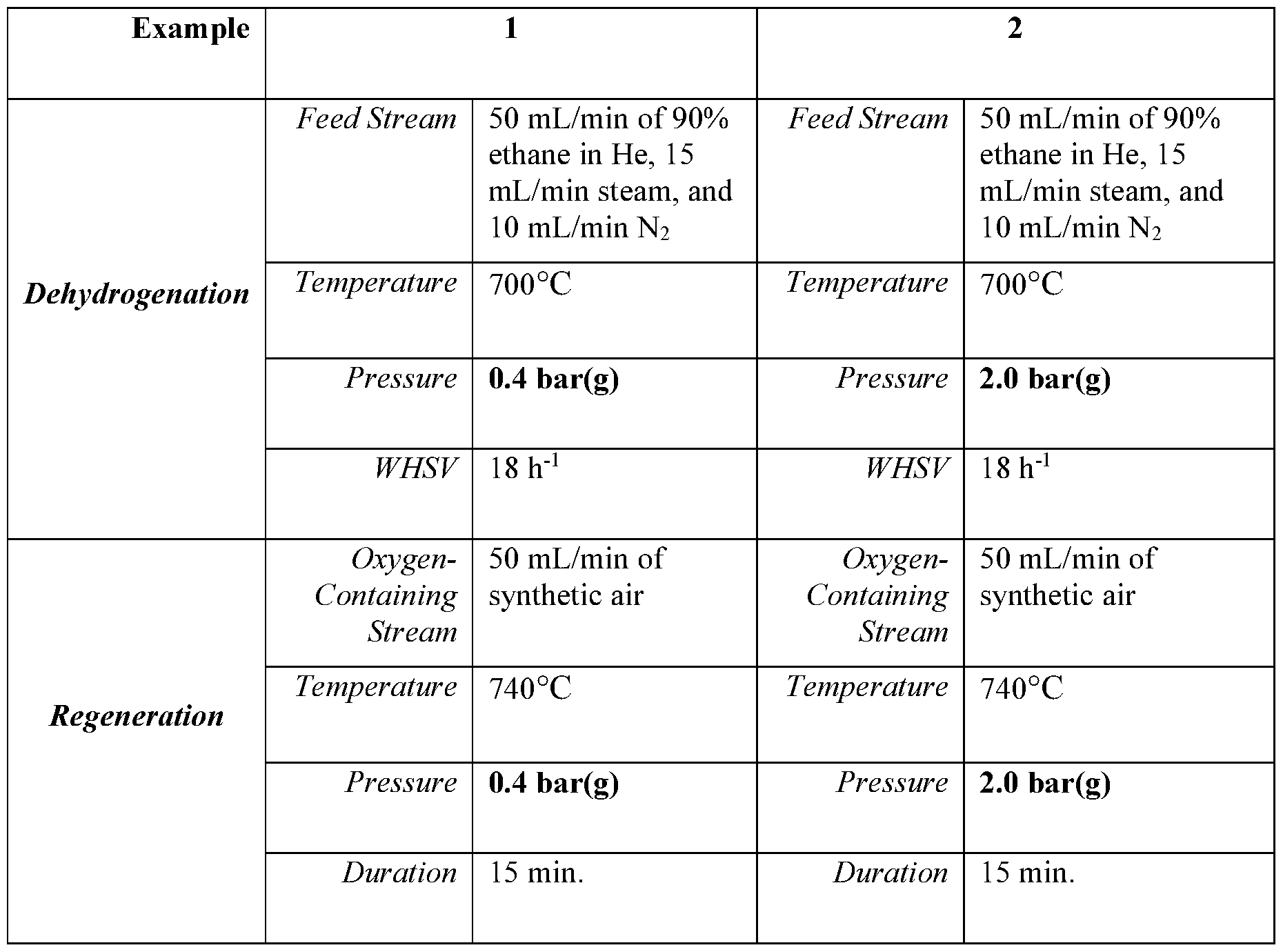 [0061] As shown in Table 1, water was introduced into the feed stream of Examples 1 and 2 in the form of steam. The concentration of water in the feed stream for both Examples was
85024-WO-PCT/DOW 85024 WO increased over time. Ethane conversion, ethylene selectivity, methane selectivity, and CO selectivity were measured for each Example as a function of water concentration in the feed stream. Accordingly, the reactor effluent composition was obtained by gas chromatography at three different moments within the ethane pulse (e.g., time on stream (TOS)). For each data point, the ethane (C2H6) conversion and carbon based selectivities were calculated using the following equations (1) and (2) XC2H6 (%) = [(ηC2H6, in – η C2H6, out)/ η C2H6, in] · 100; and (1) Sj (%) = [αj · ηj, out / ∑ [αj · ηj,ou] ] · 100 (2) where XC2H6 is defined as the C2H6 conversion (%), η, in is defined as the molar inlet flow of the component (mol/min), η, out is the molar outlet flow of the component (mol/min), Sj is defined as the carbon-based selectivity to product j (%), αj the number of carbon atoms for product j. [0062] The results from Example 1 and Example 2 are shown in FIG.3 and the data is tabulated in Table 2. The catalytic performance data demonstrates the negative effect of water at the two different pressure conditions. The results highlight the strong activity and selectivity dependencies on water partial pressure, represented by the three levels of water concentrations at different total pressures (0.3 bar(g) and 2 bar(g)), where effects become more pronounced at higher total pressures. Table 2
[0061] As shown in Table 1, water was introduced into the feed stream of Examples 1 and 2 in the form of steam. The concentration of water in the feed stream for both Examples was
85024-WO-PCT/DOW 85024 WO increased over time. Ethane conversion, ethylene selectivity, methane selectivity, and CO selectivity were measured for each Example as a function of water concentration in the feed stream. Accordingly, the reactor effluent composition was obtained by gas chromatography at three different moments within the ethane pulse (e.g., time on stream (TOS)). For each data point, the ethane (C2H6) conversion and carbon based selectivities were calculated using the following equations (1) and (2) XC2H6 (%) = [(ηC2H6, in – η C2H6, out)/ η C2H6, in] · 100; and (1) Sj (%) = [αj · ηj, out / ∑ [αj · ηj,ou] ] · 100 (2) where XC2H6 is defined as the C2H6 conversion (%), η, in is defined as the molar inlet flow of the component (mol/min), η, out is the molar outlet flow of the component (mol/min), Sj is defined as the carbon-based selectivity to product j (%), αj the number of carbon atoms for product j. [0062] The results from Example 1 and Example 2 are shown in FIG.3 and the data is tabulated in Table 2. The catalytic performance data demonstrates the negative effect of water at the two different pressure conditions. The results highlight the strong activity and selectivity dependencies on water partial pressure, represented by the three levels of water concentrations at different total pressures (0.3 bar(g) and 2 bar(g)), where effects become more pronounced at higher total pressures. Table 2
 85024-WO-PCT/DOW 85024 WO
 [0063] The effect demonstrated by the above data is, however, reversible as the conversion and selectivities return to baseline values upon reverting the water pressure to its initial value. [0064] The present disclosure includes one or more non-limiting aspects. [0065] A first aspect may include a process for the catalytic dehydrogenation of alkanes that includes: introducing a feed stream comprising one or more alkanes into a first reactor; contacting the feed stream with a steam tolerant catalyst and a selective hydrogen combustion material of the first reactor to generate a first product stream; passing a subsequent stream through a water removal unit, thereby forming a dewatered subsequent stream; transferring the dewatered subsequent stream from the water removal unit into a downstream reactor; contacting the dewatered subsequent stream with a steam tolerant catalyst of the downstream reactor and, optionally, with a selective hydrogen combustion material of the downstream reactor, to generate a downstream product stream, wherein the catalyst of the first reactor is regenerated in the presence of air or diluted air in between periods of exposure to the feed stream; the catalyst of the downstream reactor is regenerated in the presence of air or diluted air in between periods of exposure to the dewatered subsequent stream; and the subsequent stream is the first product stream or is derived from the first product stream. [0066] A second aspect may include the first aspect, wherein the subsequent stream is the first product stream. [0067] A third aspect may include any one of the first and second aspects, further including introducing the first product stream into a second reactor and contacting the first product stream with a steam tolerant catalyst of the second reactor and, optionally, with a selective hydrogen combustion material of the second reactor, to generate the subsequent stream.
85024-WO-PCT/DOW 85024 WO [0068] A fourth aspect may include any one of the first through third aspects, wherein the catalyst of at least one reactor includes chromium, iron, gallium, or platinum, or any combination of these. [0069] A fifth aspect may include any one of the first through fourth aspects, wherein the catalyst of at least one reactor includes a zirconia support, promoted with silicon, sulfur, phosphorous, boron, platinum, potassium, cesium, calcium, or lithium, or any combination thereof. [0070] A sixth aspect may include any one of the first through fifth aspects, wherein the catalysts and selective hydrogen combustion materials are fluidized and the reactors are circulating fluidized bed reactors. [0071] A seventh aspect may include any one of the first through sixth aspects, wherein the temperature of each reactor is between 500 ℃ and 900 ℃; and the pressure of each reactor is between 0 bar(g) (0 kPa) to 20 bar(g) (2000 kPa). [0072] An eighth aspect may include a system including: a first reactor and a downstream reactor fluidly connected in series, wherein the first reactor and the downstream reactor each include a steam tolerant catalyst; at least the first reactor further includes a selective hydrogen combustion material; and the first reactor includes an inlet for introducing a feed stream and the downstream reactor includes an inlet for introducing a product stream; and a water removal unit fluidly connected to the downstream reactor, wherein the water removal unit is configured to remove water from a product stream before the product stream is introduced into the downstream reactor. [0073] A ninth aspect may include the eighth aspect, further including a second reactor fluidly connected to the first reactor and the downstream reactor, wherein the second reactor includes an inlet for receiving a first product stream from the first reactor; and the second reactor includes a steam tolerant catalyst. [0074] A tenth aspect may include the ninth aspect, further including a second water removal unit fluidly connected to the second reactor, wherein the second water removal unit is configured
85024-WO-PCT/DOW 85024 WO to remove water from the first product stream before the first product stream is introduced into the second reactor. [0075] An eleventh aspect may include the eighth aspect, wherein the downstream reactor is a second reactor fluidly connected to the first reactor; the second reactor includes an inlet for receiving a dewatered first product stream from the first reactor; and the second reactor includes a steam tolerant catalyst. [0076] A twelfth aspect may include any one of the eighth through eleventh aspects, further including a single regenerator fluidly connected to all reactors, wherein the single regenerator is configured to receive used catalyst from each reactor, to regenerate the used catalyst to form regenerated catalyst, and to return the regenerated catalyst to each reactor. [0077] A thirteenth aspect may include any one of the eighth through eleventh aspects, further including a first regenerator fluidly connected to the first reactor and a downstream regenerator fluidly connected to the downstream reactor, wherein the first regenerator is configured to receive used catalyst from the first reactor, to regenerate the used catalyst to form a regenerated catalyst, and to return the regenerated catalyst to the first reactor; and the downstream regenerator is configured to receive used catalyst from the downstream reactor, to regenerate the used catalyst to form a regenerated catalyst, and to return the regenerated catalyst to the downstream reactor. [0078] A fourteenth aspect may include any one of the ninth and tenth aspects, further including a first regenerator fluidly connected to the first reactor, a second regenerator fluidly connected to the second reactor, and a downstream regenerator fluidly connected to the downstream reactor, wherein the first regenerator is configured to receive used catalyst from the first reactor, to regenerate the used catalyst to form a regenerated catalyst, and to return the regenerated catalyst to the first reactor; the second regenerator is configured to receive used catalyst from the second reactor, to regenerate the used catalyst to form a regenerated catalyst, and to return the regenerated catalyst to the second reactor; and the downstream regenerator is configured to receive used catalyst from the downstream reactor, to regenerate the used catalyst to form a regenerated catalyst, and to return the regenerated catalyst to the downstream reactor.
85024-WO-PCT/DOW 85024 WO [0079] A fifteenth aspect may include any one of the eighth through fourteenth aspects, wherein the catalyst of at least one reactor includes chromium, iron, gallium, or platinum, or any combination of these. [0080] A sixteenth aspect may include any one of the eighth through fifteenth aspects, wherein the catalyst of at least one reactor includes a zirconia support, promoted with silicon, sulfur, phosphorous, boron, platinum, potassium, cesium, calcium, or lithium, or any combination thereof. [0081] A seventeenth aspect may include any one of the eighth through sixteenth aspects, wherein the catalyst of at least one reactor is fluidized. [0082] An eighteenth aspect may include any one of the eighth through seventeenth aspects, wherein at least one reactor besides the first reactor further includes a selective hydrogen combustion material. [0083] A nineteenth aspect may include the eighteenth aspect, wherein the selective hydrogen combustion material is fluidized. [0084] A twentieth aspect may include any one of the eighth through nineteenth aspects, wherein at least one of the reactors is a circulating fluidized bed reactor. [0085] The subject matter of the present disclosure has been described in detail and by reference to specific embodiments. It should be understood that any detailed description of a component or feature of an embodiment does not necessarily imply that the component or feature is essential to the particular embodiment or to any other embodiment. Further, it should be apparent to those skilled in the art that various modifications and variations can be made to the described embodiments without departing from the spirit and scope of the claimed subject matter. [0086] It is noted that one or more of the following claims utilize the term “wherein” as a transitional phrase. For the purposes of defining the present technology, it is noted that this term is introduced in the claims as an open-ended transitional phrase that is used to introduce a recitation of a series of characteristics of the structure and should be interpreted in like manner as the more commonly used open-ended preamble term “comprising.”
85024-WO-PCT/DOW 85024 WO [0087] It should be understood that where a first component is described as “comprising” a second component, it is contemplated that, in embodiments, the first component “consists” or “consists essentially of” that second component. It should further be understood that where a first component is described as “comprising” a second component, it is contemplated that, in embodiments, the first component comprises at least 10%, at least 20%, at least 30%, at least 40%, at least 50%, at least 60%, at least 70%, at least 80%, at least 90%, at least 95%, or even at least 99% that second component (where % can be weight % or molar %). [0088] It is also noted that recitations herein of “at least one” component, element, etc., should not be used to create an inference that the alternative use of the articles “a” or “an” should be limited to a single component, element, etc.
[0063] The effect demonstrated by the above data is, however, reversible as the conversion and selectivities return to baseline values upon reverting the water pressure to its initial value. [0064] The present disclosure includes one or more non-limiting aspects. [0065] A first aspect may include a process for the catalytic dehydrogenation of alkanes that includes: introducing a feed stream comprising one or more alkanes into a first reactor; contacting the feed stream with a steam tolerant catalyst and a selective hydrogen combustion material of the first reactor to generate a first product stream; passing a subsequent stream through a water removal unit, thereby forming a dewatered subsequent stream; transferring the dewatered subsequent stream from the water removal unit into a downstream reactor; contacting the dewatered subsequent stream with a steam tolerant catalyst of the downstream reactor and, optionally, with a selective hydrogen combustion material of the downstream reactor, to generate a downstream product stream, wherein the catalyst of the first reactor is regenerated in the presence of air or diluted air in between periods of exposure to the feed stream; the catalyst of the downstream reactor is regenerated in the presence of air or diluted air in between periods of exposure to the dewatered subsequent stream; and the subsequent stream is the first product stream or is derived from the first product stream. [0066] A second aspect may include the first aspect, wherein the subsequent stream is the first product stream. [0067] A third aspect may include any one of the first and second aspects, further including introducing the first product stream into a second reactor and contacting the first product stream with a steam tolerant catalyst of the second reactor and, optionally, with a selective hydrogen combustion material of the second reactor, to generate the subsequent stream.
85024-WO-PCT/DOW 85024 WO [0068] A fourth aspect may include any one of the first through third aspects, wherein the catalyst of at least one reactor includes chromium, iron, gallium, or platinum, or any combination of these. [0069] A fifth aspect may include any one of the first through fourth aspects, wherein the catalyst of at least one reactor includes a zirconia support, promoted with silicon, sulfur, phosphorous, boron, platinum, potassium, cesium, calcium, or lithium, or any combination thereof. [0070] A sixth aspect may include any one of the first through fifth aspects, wherein the catalysts and selective hydrogen combustion materials are fluidized and the reactors are circulating fluidized bed reactors. [0071] A seventh aspect may include any one of the first through sixth aspects, wherein the temperature of each reactor is between 500 ℃ and 900 ℃; and the pressure of each reactor is between 0 bar(g) (0 kPa) to 20 bar(g) (2000 kPa). [0072] An eighth aspect may include a system including: a first reactor and a downstream reactor fluidly connected in series, wherein the first reactor and the downstream reactor each include a steam tolerant catalyst; at least the first reactor further includes a selective hydrogen combustion material; and the first reactor includes an inlet for introducing a feed stream and the downstream reactor includes an inlet for introducing a product stream; and a water removal unit fluidly connected to the downstream reactor, wherein the water removal unit is configured to remove water from a product stream before the product stream is introduced into the downstream reactor. [0073] A ninth aspect may include the eighth aspect, further including a second reactor fluidly connected to the first reactor and the downstream reactor, wherein the second reactor includes an inlet for receiving a first product stream from the first reactor; and the second reactor includes a steam tolerant catalyst. [0074] A tenth aspect may include the ninth aspect, further including a second water removal unit fluidly connected to the second reactor, wherein the second water removal unit is configured
85024-WO-PCT/DOW 85024 WO to remove water from the first product stream before the first product stream is introduced into the second reactor. [0075] An eleventh aspect may include the eighth aspect, wherein the downstream reactor is a second reactor fluidly connected to the first reactor; the second reactor includes an inlet for receiving a dewatered first product stream from the first reactor; and the second reactor includes a steam tolerant catalyst. [0076] A twelfth aspect may include any one of the eighth through eleventh aspects, further including a single regenerator fluidly connected to all reactors, wherein the single regenerator is configured to receive used catalyst from each reactor, to regenerate the used catalyst to form regenerated catalyst, and to return the regenerated catalyst to each reactor. [0077] A thirteenth aspect may include any one of the eighth through eleventh aspects, further including a first regenerator fluidly connected to the first reactor and a downstream regenerator fluidly connected to the downstream reactor, wherein the first regenerator is configured to receive used catalyst from the first reactor, to regenerate the used catalyst to form a regenerated catalyst, and to return the regenerated catalyst to the first reactor; and the downstream regenerator is configured to receive used catalyst from the downstream reactor, to regenerate the used catalyst to form a regenerated catalyst, and to return the regenerated catalyst to the downstream reactor. [0078] A fourteenth aspect may include any one of the ninth and tenth aspects, further including a first regenerator fluidly connected to the first reactor, a second regenerator fluidly connected to the second reactor, and a downstream regenerator fluidly connected to the downstream reactor, wherein the first regenerator is configured to receive used catalyst from the first reactor, to regenerate the used catalyst to form a regenerated catalyst, and to return the regenerated catalyst to the first reactor; the second regenerator is configured to receive used catalyst from the second reactor, to regenerate the used catalyst to form a regenerated catalyst, and to return the regenerated catalyst to the second reactor; and the downstream regenerator is configured to receive used catalyst from the downstream reactor, to regenerate the used catalyst to form a regenerated catalyst, and to return the regenerated catalyst to the downstream reactor.
85024-WO-PCT/DOW 85024 WO [0079] A fifteenth aspect may include any one of the eighth through fourteenth aspects, wherein the catalyst of at least one reactor includes chromium, iron, gallium, or platinum, or any combination of these. [0080] A sixteenth aspect may include any one of the eighth through fifteenth aspects, wherein the catalyst of at least one reactor includes a zirconia support, promoted with silicon, sulfur, phosphorous, boron, platinum, potassium, cesium, calcium, or lithium, or any combination thereof. [0081] A seventeenth aspect may include any one of the eighth through sixteenth aspects, wherein the catalyst of at least one reactor is fluidized. [0082] An eighteenth aspect may include any one of the eighth through seventeenth aspects, wherein at least one reactor besides the first reactor further includes a selective hydrogen combustion material. [0083] A nineteenth aspect may include the eighteenth aspect, wherein the selective hydrogen combustion material is fluidized. [0084] A twentieth aspect may include any one of the eighth through nineteenth aspects, wherein at least one of the reactors is a circulating fluidized bed reactor. [0085] The subject matter of the present disclosure has been described in detail and by reference to specific embodiments. It should be understood that any detailed description of a component or feature of an embodiment does not necessarily imply that the component or feature is essential to the particular embodiment or to any other embodiment. Further, it should be apparent to those skilled in the art that various modifications and variations can be made to the described embodiments without departing from the spirit and scope of the claimed subject matter. [0086] It is noted that one or more of the following claims utilize the term “wherein” as a transitional phrase. For the purposes of defining the present technology, it is noted that this term is introduced in the claims as an open-ended transitional phrase that is used to introduce a recitation of a series of characteristics of the structure and should be interpreted in like manner as the more commonly used open-ended preamble term “comprising.”
85024-WO-PCT/DOW 85024 WO [0087] It should be understood that where a first component is described as “comprising” a second component, it is contemplated that, in embodiments, the first component “consists” or “consists essentially of” that second component. It should further be understood that where a first component is described as “comprising” a second component, it is contemplated that, in embodiments, the first component comprises at least 10%, at least 20%, at least 30%, at least 40%, at least 50%, at least 60%, at least 70%, at least 80%, at least 90%, at least 95%, or even at least 99% that second component (where % can be weight % or molar %). [0088] It is also noted that recitations herein of “at least one” component, element, etc., should not be used to create an inference that the alternative use of the articles “a” or “an” should be limited to a single component, element, etc.
Claims
85024-WO-PCT/DOW 85024 WO CLAIMS 1. A process for the catalytic dehydrogenation of alkanes comprising: introducing a feed stream comprising one or more alkanes into a first reactor; contacting the feed stream with a steam tolerant catalyst and a selective hydrogen combustion material of the first reactor to generate a first product stream; passing a subsequent stream through a water removal unit, thereby forming a dewatered subsequent stream; transferring the dewatered subsequent stream from the water removal unit into a downstream reactor; contacting the dewatered subsequent stream with a steam tolerant catalyst of the downstream reactor and, optionally, with a selective hydrogen combustion material of the downstream reactor, to generate a downstream product stream, wherein the catalyst of the first reactor is regenerated in the presence of air or diluted air in between periods of exposure to the feed stream; the catalyst of the downstream reactor is regenerated in the presence of air or diluted air in between periods of exposure to the dewatered subsequent stream; and the subsequent stream is the first product stream or is derived from the first product stream. 2. The process of claim 1, wherein the subsequent stream is the first product stream. 3. The process of claim 1, further comprising introducing the first product stream into a second reactor and contacting the first product stream with a steam tolerant catalyst of the second reactor and, optionally, with a selective hydrogen combustion material of the second reactor, to generate the subsequent stream. 4. The process of any one of claims 1-3, wherein the catalyst of at least one reactor comprises chromium, iron, gallium, or platinum, or any combination of these. 5. The process of any one of claims 1-4, wherein the catalyst of at least one reactor comprises a zirconia support, promoted with silicon, sulfur, phosphorous, boron, platinum, potassium, cesium, calcium, or lithium, or any combination thereof.
85024-WO-PCT/DOW 85024 WO 6. The process of any of claims 1-5, wherein the catalysts and selective hydrogen combustion materials are fluidized and the reactors are circulating fluidized bed reactors. 7. The process of any of claims 1-6, wherein the temperature of each reactor is between 500 ℃ and 900 ℃; and the pressure of each reactor is between 0 bar(g) (0 kPa) to 20 bar(g) (2000 kPa). 8. A system comprising: a first reactor and a downstream reactor fluidly connected in series, wherein the first reactor and the downstream reactor each comprise a steam tolerant catalyst; at least the first reactor further comprises a selective hydrogen combustion material; and the first reactor comprises an inlet for introducing a feed stream and the downstream reactor comprises an inlet for introducing a product stream; a water removal unit fluidly connected to the downstream reactor, wherein the water removal unit is configured to remove water from a product stream before the product stream is introduced into the downstream reactor. 9. The system of claim 8, further comprising a second reactor fluidly connected to the first reactor and the downstream reactor, wherein the second reactor comprises an inlet for receiving a first product stream from the first reactor; and the second reactor comprises a steam tolerant catalyst. 10. The system of claim 9, further comprising a second water removal unit fluidly connected to the second reactor, wherein the second water removal unit is configured to remove water from the first product stream before the first product stream is introduced into the second reactor. 11. The system of claim 8, wherein the downstream reactor is a second reactor fluidly connected to the first reactor; the second reactor comprises an inlet for receiving a dewatered first product stream from the first reactor; and
85024-WO-PCT/DOW 85024 WO the second reactor comprises a steam tolerant catalyst. 12. The system of any claim 8-11, further comprising a single regenerator fluidly connected to all reactors, wherein the single regenerator is configured to receive used catalyst from each reactor, to regenerate the used catalyst to form regenerated catalyst, and to return the regenerated catalyst to each reactor. 13. The system of any claim 8-11, further comprising a first regenerator fluidly connected to the first reactor and a downstream regenerator fluidly connected to the downstream reactor, wherein the first regenerator is configured to receive used catalyst from the first reactor, to regenerate the used catalyst to form a regenerated catalyst, and to return the regenerated catalyst to the first reactor; and the downstream regenerator is configured to receive used catalyst from the downstream reactor, to regenerate the used catalyst to form a regenerated catalyst, and to return the regenerated catalyst to the downstream reactor. 14. The system of claim 9 or claim 10, further comprising a first regenerator fluidly connected to the first reactor, a second regenerator fluidly connected to the second reactor, and a downstream regenerator fluidly connected to the downstream reactor, wherein the first regenerator is configured to receive used catalyst from the first reactor, to regenerate the used catalyst to form a regenerated catalyst, and to return the regenerated catalyst to the first reactor; the second regenerator is configured to receive used catalyst from the second reactor, to regenerate the used catalyst to form a regenerated catalyst, and to return the regenerated catalyst to the second reactor; and the downstream regenerator is configured to receive used catalyst from the downstream reactor, to regenerate the used catalyst to form a regenerated catalyst, and to return the regenerated catalyst to the downstream reactor. 15. The system of any claim 8-14, wherein the catalyst of at least one reactor comprises chromium, iron, gallium, or platinum, or any combination of these.
Applications Claiming Priority (2)
| Application Number | Priority Date | Filing Date | Title |
|---|---|---|---|
| US202363511270P | 2023-06-30 | 2023-06-30 | |
| US63/511,270 | 2023-06-30 |
Publications (1)
| Publication Number | Publication Date |
|---|---|
| WO2025006473A1 true WO2025006473A1 (en) | 2025-01-02 |
Family
ID=91950090
Family Applications (1)
| Application Number | Title | Priority Date | Filing Date |
|---|---|---|---|
| PCT/US2024/035422 Ceased WO2025006473A1 (en) | 2023-06-30 | 2024-06-25 | Process and configuration for the dehydrogenation of alkanes to olefins |
Country Status (1)
| Country | Link |
|---|---|
| WO (1) | WO2025006473A1 (en) |
Citations (4)
| Publication number | Priority date | Publication date | Assignee | Title |
|---|---|---|---|---|
| US5430209A (en) | 1993-08-27 | 1995-07-04 | Mobil Oil Corp. | Process for the catalytic dehydrogenation of alkanes to alkenes with simultaneous combustion of hydrogen |
| US7122495B2 (en) | 2003-02-05 | 2006-10-17 | Exxonmobil Chemical Patents Inc. | Combined cracking and selective hydrogen combustion for catalytic cracking |
| WO2018232133A1 (en) | 2017-06-15 | 2018-12-20 | North Carolina State University | Oxygen carrying materials with surface modification for redox-based catalysis and methods of making and uses thereof |
| WO2020046978A1 (en) * | 2018-08-31 | 2020-03-05 | Dow Global Technologies Llc | Methods for dehydrogenating hydrocarbons |
-
2024
- 2024-06-25 WO PCT/US2024/035422 patent/WO2025006473A1/en not_active Ceased
Patent Citations (4)
| Publication number | Priority date | Publication date | Assignee | Title |
|---|---|---|---|---|
| US5430209A (en) | 1993-08-27 | 1995-07-04 | Mobil Oil Corp. | Process for the catalytic dehydrogenation of alkanes to alkenes with simultaneous combustion of hydrogen |
| US7122495B2 (en) | 2003-02-05 | 2006-10-17 | Exxonmobil Chemical Patents Inc. | Combined cracking and selective hydrogen combustion for catalytic cracking |
| WO2018232133A1 (en) | 2017-06-15 | 2018-12-20 | North Carolina State University | Oxygen carrying materials with surface modification for redox-based catalysis and methods of making and uses thereof |
| WO2020046978A1 (en) * | 2018-08-31 | 2020-03-05 | Dow Global Technologies Llc | Methods for dehydrogenating hydrocarbons |
Similar Documents
| Publication | Publication Date | Title |
|---|---|---|
| KR101644695B1 (en) | Dehydrogenation catalyst and manufacturing method same | |
| WO2019028014A1 (en) | Catalyst for dehydrogenation of light alkanes | |
| US12121887B2 (en) | Method of preparation of dehydrogenation catalyst with high chromium content | |
| CN104023841A (en) | Catalytic composition and method for dehydrogenation of butenes or a mixture of butanes and butenes to obtain 1,3-butadiene | |
| JP2020513304A (en) | Process for producing olefin in mixed metal oxide catalyst and oxidative dehydrogenation process | |
| KR20160094357A (en) | Dehydrogenation catalyst and manufacturing method same | |
| KR20180133696A (en) | Catalyst having enhanced stability, conversion ratio and selectivity for manufacturing olefin, and A method thereof | |
| WO2023056231A1 (en) | Pretreatment of porous metal oxide catalysts for use in dehydrogenation and other reactions | |
| CN116023212A (en) | Process for the selective hydrogenation of gas mixtures with high acetylene content | |
| US11724247B2 (en) | Bifunctional catalysts and systems and methods for oxidative dehydrogenation of alkanes to olefins and high-valued products | |
| CN105233818A (en) | Method for improving stability of low-carbon alkane dehydrogenation catalyst through acidity and alkalinity adjustment | |
| CN114728273A (en) | Dehydrogenation catalyst for producing olefin from alkane family gas and method for producing same | |
| JP6084126B2 (en) | Manufacturing method of high calorific value fuel gas | |
| KR20110099112A (en) | Oxidative dehydrogenation of paraffinic lower hydrocarbons | |
| Li et al. | Supported vanadia catalysts for dehydrogenation of ethylbenzene with CO2 | |
| JP2022120220A (en) | Method for oxidizing hydrocarbons to oxygenates | |
| Ren et al. | Oxidative dehydrogenation of ethylbenzene with carbon dioxide over metal-doped titanium oxides | |
| CA3239557A1 (en) | Catalyst compositions and processes for making and using same | |
| WO2018013097A1 (en) | Ceramic membrane assisted propane dehydrogenation | |
| WO2025006556A1 (en) | Methods for converting alkanes to alkenes and steam tolerant promoted dehydrogenation catalysts | |
| KR20170045189A (en) | Dehydrogenation catalyst and manufacturing method same | |
| CN112958066A (en) | Catalyst for preparing low-carbon olefin by catalyzing bioethanol and application thereof | |
| WO2025006558A1 (en) | Methods for converting alkanes to alkenes and environmentally safe steam tolerant dehydrogenation catalysts | |
| BR102022012723A2 (en) | CATALYTIC SYSTEM AND PROCESS FOR OBTAINING PROPYNE FROM ETHANOL IN A SINGLE REACTIONAL STAGE | |
| US20200353452A1 (en) | Catalyst and Method Related Thereto |
Legal Events
| Date | Code | Title | Description |
|---|---|---|---|
| 121 | Ep: the epo has been informed by wipo that ep was designated in this application |
Ref document number: 24743178 Country of ref document: EP Kind code of ref document: A1 |
|
| NENP | Non-entry into the national phase |
Ref country code: DE |