WO2025006396A1 - Polymer recyclate blend product and process - Google Patents
Polymer recyclate blend product and process Download PDFInfo
- Publication number
- WO2025006396A1 WO2025006396A1 PCT/US2024/035285 US2024035285W WO2025006396A1 WO 2025006396 A1 WO2025006396 A1 WO 2025006396A1 US 2024035285 W US2024035285 W US 2024035285W WO 2025006396 A1 WO2025006396 A1 WO 2025006396A1
- Authority
- WO
- WIPO (PCT)
- Prior art keywords
- polymer
- recyclate
- ppmw
- composition
- range
- Prior art date
- Legal status (The legal status is an assumption and is not a legal conclusion. Google has not performed a legal analysis and makes no representation as to the accuracy of the status listed.)
- Ceased
Links
Classifications
-
- C—CHEMISTRY; METALLURGY
- C08—ORGANIC MACROMOLECULAR COMPOUNDS; THEIR PREPARATION OR CHEMICAL WORKING-UP; COMPOSITIONS BASED THEREON
- C08K—Use of inorganic or non-macromolecular organic substances as compounding ingredients
- C08K5/00—Use of organic ingredients
- C08K5/49—Phosphorus-containing compounds
- C08K5/51—Phosphorus bound to oxygen
- C08K5/52—Phosphorus bound to oxygen only
- C08K5/524—Esters of phosphorous acids, e.g. of H3PO3
-
- C—CHEMISTRY; METALLURGY
- C08—ORGANIC MACROMOLECULAR COMPOUNDS; THEIR PREPARATION OR CHEMICAL WORKING-UP; COMPOSITIONS BASED THEREON
- C08K—Use of inorganic or non-macromolecular organic substances as compounding ingredients
- C08K3/00—Use of inorganic substances as compounding ingredients
- C08K3/34—Silicon-containing compounds
-
- C—CHEMISTRY; METALLURGY
- C08—ORGANIC MACROMOLECULAR COMPOUNDS; THEIR PREPARATION OR CHEMICAL WORKING-UP; COMPOSITIONS BASED THEREON
- C08K—Use of inorganic or non-macromolecular organic substances as compounding ingredients
- C08K5/00—Use of organic ingredients
- C08K5/0008—Organic ingredients according to more than one of the "one dot" groups of C08K5/01 - C08K5/59
- C08K5/005—Stabilisers against oxidation, heat, light, ozone
-
- C—CHEMISTRY; METALLURGY
- C08—ORGANIC MACROMOLECULAR COMPOUNDS; THEIR PREPARATION OR CHEMICAL WORKING-UP; COMPOSITIONS BASED THEREON
- C08K—Use of inorganic or non-macromolecular organic substances as compounding ingredients
- C08K5/00—Use of organic ingredients
- C08K5/04—Oxygen-containing compounds
- C08K5/13—Phenols; Phenolates
-
- C—CHEMISTRY; METALLURGY
- C08—ORGANIC MACROMOLECULAR COMPOUNDS; THEIR PREPARATION OR CHEMICAL WORKING-UP; COMPOSITIONS BASED THEREON
- C08K—Use of inorganic or non-macromolecular organic substances as compounding ingredients
- C08K5/00—Use of organic ingredients
- C08K5/49—Phosphorus-containing compounds
- C08K5/51—Phosphorus bound to oxygen
- C08K5/52—Phosphorus bound to oxygen only
- C08K5/524—Esters of phosphorous acids, e.g. of H3PO3
- C08K5/526—Esters of phosphorous acids, e.g. of H3PO3 with hydroxyaryl compounds
-
- C—CHEMISTRY; METALLURGY
- C08—ORGANIC MACROMOLECULAR COMPOUNDS; THEIR PREPARATION OR CHEMICAL WORKING-UP; COMPOSITIONS BASED THEREON
- C08L—COMPOSITIONS OF MACROMOLECULAR COMPOUNDS
- C08L23/00—Compositions of homopolymers or copolymers of unsaturated aliphatic hydrocarbons having only one carbon-to-carbon double bond; Compositions of derivatives of such polymers
- C08L23/02—Compositions of homopolymers or copolymers of unsaturated aliphatic hydrocarbons having only one carbon-to-carbon double bond; Compositions of derivatives of such polymers not modified by chemical after-treatment
- C08L23/04—Homopolymers or copolymers of ethene
- C08L23/06—Polyethylene
-
- C—CHEMISTRY; METALLURGY
- C08—ORGANIC MACROMOLECULAR COMPOUNDS; THEIR PREPARATION OR CHEMICAL WORKING-UP; COMPOSITIONS BASED THEREON
- C08L—COMPOSITIONS OF MACROMOLECULAR COMPOUNDS
- C08L2203/00—Applications
- C08L2203/10—Applications used for bottles
-
- C—CHEMISTRY; METALLURGY
- C08—ORGANIC MACROMOLECULAR COMPOUNDS; THEIR PREPARATION OR CHEMICAL WORKING-UP; COMPOSITIONS BASED THEREON
- C08L—COMPOSITIONS OF MACROMOLECULAR COMPOUNDS
- C08L2203/00—Applications
- C08L2203/30—Applications used for thermoforming
-
- C—CHEMISTRY; METALLURGY
- C08—ORGANIC MACROMOLECULAR COMPOUNDS; THEIR PREPARATION OR CHEMICAL WORKING-UP; COMPOSITIONS BASED THEREON
- C08L—COMPOSITIONS OF MACROMOLECULAR COMPOUNDS
- C08L2205/00—Polymer mixtures characterised by other features
- C08L2205/02—Polymer mixtures characterised by other features containing two or more polymers of the same C08L -group
- C08L2205/025—Polymer mixtures characterised by other features containing two or more polymers of the same C08L -group containing two or more polymers of the same hierarchy C08L, and differing only in parameters such as density, comonomer content, molecular weight, structure
-
- C—CHEMISTRY; METALLURGY
- C08—ORGANIC MACROMOLECULAR COMPOUNDS; THEIR PREPARATION OR CHEMICAL WORKING-UP; COMPOSITIONS BASED THEREON
- C08L—COMPOSITIONS OF MACROMOLECULAR COMPOUNDS
- C08L2207/00—Properties characterising the ingredient of the composition
- C08L2207/06—Properties of polyethylene
- C08L2207/062—HDPE
-
- C—CHEMISTRY; METALLURGY
- C08—ORGANIC MACROMOLECULAR COMPOUNDS; THEIR PREPARATION OR CHEMICAL WORKING-UP; COMPOSITIONS BASED THEREON
- C08L—COMPOSITIONS OF MACROMOLECULAR COMPOUNDS
- C08L2207/00—Properties characterising the ingredient of the composition
- C08L2207/20—Recycled plastic
Definitions
- the present disclosure relates to polymer recyclate blends having improved processability and/or organoleptic properties and methods for producing such products.
- Polyolefins in particular polyethylene, is increasingly consumed in large amounts for many applications, including packaging for food and other goods, electronics, automotive components, and a great variety of manufactured articles.
- Large amounts of waste plastic materials are presently coming from differential recovery of municipal plastic wastes, mainly constituted of flexible packaging (cast film, blown film and BOPP film), rigid packaging, blow molded bottles, and injection molded containers.
- recovery of polymer recyclate includes a step of separation of various types of polymers prior to further processing as post-consumer recycle (PCR) resins.
- PCR post-consumer recycle
- PCR resin suppliers carry a U.S. Food and Drug Administration (FDA) Noobjection Letter (NOL) for food contact applications, including liquid food applications such as dairy, water, and juice packaging.
- FDA Food and Drug Administration
- NOL Noobjection Letter
- Some such PCRs are advertised as recycled resin primarily comprising recycled homopolymer HDPE containers, such as gallon milk containers.
- LC ADDS Liquid Chromatography Additives
- the present disclosure relates to a composition
- a composition comprising a homogenous matrix of a mixture of a polymer recyclate blend and an additive.
- the additive comprises an organic phosphite antioxidant, a hindered phenol antioxidant, a hydrophobic synthetic zeolite, or a combination thereof.
- the mixture is subjected to compounding conditions sufficient to produce the homogenous matrix of the polymer recyclate blend and the additive, wherein the composition has improved processability and/or organoleptic properties when compared to the polymer recyclate blend alone.
- the polymer recyclate blend comprises a polymer recyclate in an amount in the range of from 5 wt. % to 65 wt. % and a virgin HDPE component is present in an amount in the range of from 35 wt. % to 95 wt. %, wherein wt. % is based on the total weight of the polymer recyclate and the virgin HDPE component.
- the disclosure further relates to a method for improving the processability and/or organoleptic properties of a first polymer recyclate blend.
- the method comprises forming a mixture of the first polymer recyclate blend with an additive.
- the additive comprises an organic phosphite antioxidant, a hindered phenol antioxidant, a hydrophobic synthetic zeolite, or combination thereof.
- the method further comprises subjecting the mixture to compounding conditions sufficient to form a second recyclate polymer blend, wherein the second recyclate polymer blend is a homogenous matrix of the first recyclate polymer blend and the additive.
- FIG. 1 shows a graphical representation of dairy mold processability and swell test results of polymer recyclate blends with additives according to embodiments of the present disclosure compared to virgin polymers and polymer recyclates without additives;
- FIG. 2 shows a graphical representation of OCS gel count test results of polymer recyclate blends with additives according to embodiments of the present disclosure compared to virgin polymers and polymer recyclates without additives;
- FIG. 3 shows a graphical representation of NIAS volatiles test results of polymer recyclate blends with additives according to embodiments of the present disclosure compared to virgin polymers and polymer recyclates without additives;
- FIG. 4 shows a graphical representation of NIAS volatiles test results of polymer recyclate blends with various amounts of synthetic zeolite additive according to embodiments of the present disclosure
- FIG. 5 shows a graphical representation of color index test results of polymer recyclate blends with additives according to embodiments of the present disclosure compared to virgin polymers and polymer recyclates without additives;
- FIG. 6 shows a spider chart of organoleptic attributes of various blends of virgin polymer, PCR, and synthetic zeolite additive
- FIG. 7 shows the position of various blends of virgin polymer, PCR, and synthetic zeolite additive on a plot of positive and negative organoleptic attributes.
- compounding conditions means temperature, pressure, and shear force conditions implemented in an extruder to provide intimate mixing of two or more polymers and optionally 7 additives to produce a substantially homogeneous polymer product.
- the compounding conditions will be such that the specific energy' from the compounder from shear and/or added heat are sufficient to melt the polymer components and homogenize them.
- HDPE means high density' polyethylene — i.e.. ethylene homopolymers and ethylene copolymers produced in a suspension, solution, slurry’, or gas phase polymerization process and having a density in the range of 0.940 g/cm 3 to 0.970 g/cm 3 .
- homogeneous with respect to the polymer blends, means a mixture in which the composition is uniform throughout the mixture. That is to say, that in a homogenous blend of two polymers, polymer chains of the two blend components are entangled and/or intertwined so as to form a blend composition having different properties than either of the blend constituents.
- the homogeneous blend of the two components can have a single phase structure and/or glass transition temperature.
- non-intentional added substances means trace substances present in polymer recy elate such as, but not limited to, cellulose, oxidized polymer, inks, coatings, dust, organic waste, and other substances not present in a corresponding virgin polymer.
- NIAS material is inherently present in polymer recyclate as complete removal of such contaminants would be cost prohibitive using current technologies for separating used polymers from other waste materials.
- organoleptic properties refers to one or more sensory properties related to a polymer product, including one or more of appearance, flavor, aroma, texture, and sound.
- appearance can relate to any unintended coloration of the polymer product.
- Flavor can relate to any unintended alteration of the taste of a food or liquid exposed to a polymer product.
- Aroma can relate to any unintended alteration of the smell of a food or liquid exposed to a polymer product and/or any unintended odor of the polymer product itself.
- polymer recyclate means post-consumer recycled (“PCR”) polyolefin and/or post-industrial recycled (“PIR”) polyolefin.
- PCR post-consumer recycled
- PIR post-industrial recycled
- Polyolefin recyclate is derived from an end product that has completed its life cycle as a consumer item and would otherwise be disposed of as waste (e.g.. a polyethylene water bottle) or from plastic scrap that is generated as waste from an industrial process.
- Post-consumer polymers include polymers that have been collected in commercial and residential recycling programs, including flexible packaging (cast film, blown film and BOPP film), rigid packaging, blow molded bottles, and injection molded containers.
- polyethylene recyclate including HOPE, MDPE, LDPE, and LLDPE
- polypropylene recyclate including homopolymers, random copolymers, and heterophasic copolymers.
- Polyethylene recyclate can be further separated to recover a portion having HDPE as the primary constituent.
- HDPE recyclate frequently contains other impurities such as PMMA, PC, wood, paper, textile, cellulose, food, and other organic wastes, many of which cause the HDPE recyclate to have an unpleasant odor before and after typical processing.
- processability refers to how well a polymer composition can be molded by blow molding, injection molding, and/or compression molding into a molded article of commercial quality at commercially acceptable rates using common equipment and conditions.
- homogenous matrix refers to the blend or mixture produced by subjecting the polymers and additives described herein to temperature, pressure, and shear force conditions implemented in the extruder or mixer sufficient to provide intimate mixing of a polymer recy elate blend and an additive component to produce a substantially homogeneous product. That is to say, that there is no chemical reaction or chemical alteration of the components of a compounded blend of polymers and additives other than minor amounts of polymer chain scission and/or crosslinking typical to a compounding process.
- virgin HDPE with respect to HDPE and/or other polymers, means preconsumer polymers.
- Pre-consumer polymers are obtained directly or indirectly from petrochemical feedstocks fed to a polymerization apparatus.
- Pre-consumer polyolefins can be subjected to post polymerization processes such as, but not limited to, extrusion, pelletization, visbreaking, and/or other processing completed before the product reaches the end-use consumer.
- virgin HDPE may have a single heat history’.
- a virgin HDPE has more than one heat history.
- a virgin HDPE comprises no additives.
- a virgin HDPE comprises additives.
- MWD Molecular weight distribution
- Mz/M w the molecular weight averages (number-average molecular weight, M n weight-average molecular weight.
- M w , z-average molecular weight, M z . and z+1 average molecular weight, M z +i) are determined using a high temperature Polymer Char gel permeation chromatography (“GPC”), also referred to as size exclusion chromatography (“SEC”), equipped with a filter-based infrared detector, IR5, a four-capillary differential bridge viscometer, and a Wyatt 18-angle light scattering detector.
- GPC Polymer Char gel permeation chromatography
- SEC size exclusion chromatography
- M w , M z , and MWD are reported using the IR detector.
- Three Agilent PLgel Olexis GPC columns are used at 145°C for the polymer fractionation based on the hydrodynamic size in 1 ,2, 4-tri chlorobenzene (TCB) with 300 ppm antioxidant butylated hydroxy toluene (BHT) as the mobile phase.
- TBC 4-tri chlorobenzene
- BHT butylated hydroxy toluene
- wt. % means weight percent
- a composition comprises a homogenous matrix of a mixture of a polymer recyclate blend and an additive.
- the additive comprises an organic phosphite antioxidant, a hindered phenol antioxidant, a hydrophobic synthetic zeolite, or a combination thereof.
- the mixture is subjected to compounding conditions sufficient to produce the homogenous matrix of the polymer recyclate blend and the additive, wherein the composition has improved processability and/or organoleptic properties when compared to the polymer recyclate blend alone.
- the polymer recyclate blend comprises a polymer recyclate and a virgin HDPE component.
- the polymer recyclate is present in the polymer recyclate blend in an amount in the range of from 5 wt. % to 65 wt. %, from 10 wt. % to 55 wt. %, from 15 wt. % to 45 wt. %, or from 20 wt. % to 35 wt. %.
- the virgin HDPE component is present in the polymer recyclate blend in an amount an amount in the range of from 35 wt. % to 95 wt. %, from 45 wt. % to 90 wt. %, 55 wt.
- the weight percentages are based on the weight of the polymer recyclate blend — i.e., the combined weight of the polymer recyclate and the virgin HDPE component.
- recyclate blends are produced by subjecting a mixture of a polymer recyclate and a virgin HDPE component to compounding conditions sufficient to form a homogeneous polymer blend product.
- compounding conditions are implemented in the compounding zone of an extruder or mixer and are tailored for mixtures of specific polymers and optionally additives. Temperature, pressure, and shear force conditions are implemented in the extruder or mixer sufficient to provide intimate mixing of a polymer recyclate and a virgin HDPE component to produce a substantially homogeneous polymer recyclate blend.
- the compounding conditions will be such that the specific energy from the compounder from shear and/or added heat are sufficient to melt the polymer components and homogenize them.
- compounding conditions comprise a temperature in the compounding zone of less than or equal to 300°C, less than or equal to 250°C or less than or equal to 200°C. In some embodiments, temperatures in the compounding zone can be in the range of from 125°C to 195°C, from 130°C to 180°C, or from 135°C to 165°C.
- the composition when compared to the same composition excluding the additive or the composition prior to compounding w ith the additive, exhibits one or more of: i) a reduced diameter swell (Ud) and/or weight swell (Uw), as measure by the UniloyTM 5630 Dairy Mold Processability and Swell Test; ii) a reduced gel content by a range of 1 to 99%, as measured by the Optical Controls System (OCS) Gel Count; iii) a reduction in volatile organic compounds (VOC) content from non-intentional added substances (NIAS) by a range of 1 to 99%, as measured by gas chromatography-mass spectrometry (GC-MS); and iv) a reduction in yellowness by a range of 1 to 99%, as measured by Color Index Testing (CIT, L*a*b*).
- OCS Optical Controls System
- VOC volatile organic compounds
- the composition when compared to the same composition excluding the additive or the composition prior to compounding with the additive, exhibits a reduction in yellowness.
- the composition when compared to the same composition excluding the additive or the composition prior to compounding with the additive, exhibits a reduction in VOC content.
- the polymer recyclate comprises HDPE in an amount greater than or equal to 80 wt. %, greater than or equal to 90 wt. %, greater than or equal to 95 wt. %. or greater than or equal to 99 wt. %, based on the polymeric portion of the polymer recyclate — i.e., excluding NIAS material.
- the polymeric component of the polymer recyclate is substantially all HDPE.
- the HDPE is all or substantially all HDPE homopolymer.
- HDPE recyclate is derived from ethylene homopolymers, copolymers of units derived from ethylene and units derived from one or more of C3-C12 ot-olefins, copolymers of units derived from ethylene and units derived from one or more of alpha monoolefins.
- Cs-C 12 a-olefins include, but are not limited to, substituted or unsubstituted Cs to C12 alpha olefins such as propylene, butene, pentene, hexene, heptene, octene, nonene, decene, undecene, dodecane, and isomers thereof.
- comonomers can be present in amounts up to 20 wt. %, 15 wt. %, 10 wt. %, or 5 wt. %.
- HDPE recyclate can be derived as a portion of postconsumer recycled polyolefin and/or post-industrial recycled polyolefin that is predominately comprised of HDPE recyclate, wherein ‘'predominately” means greater than or equal to 80 wt. %, greater than or equal to 85 wt. %, greater than or equal to 90 wt. %, or greater than or equal to 95 wt. %, and up to about 100 wt. %, based on the total weight of the HDPE recyclate.
- the balance of the HDPE recyclate can be one or more other polyethylene recy elates, including, but not limited to, MDPE, LDPE, LLDPE, or a combination thereof.
- Such ethylene homopolymers and/or copolymers can be produced in a suspension, solution, slurry, or gas phase process, using known equipment and reaction conditions.
- polymerization temperatures range from about 0°C to about 300°C at atmospheric, subatmospheric, or superatmospheric pressures.
- Slurry' or solution polymerization systems can utilize subatmospheric or superatmospheric pressures and temperatures in the range of about 40°C to about 300°C.
- An exemplary liquid phase polymerization system is described in U.S. Pat. No. 3,324.095, the disclosure of which is fully incorporated by reference herein.
- Liquid phase polymerization systems generally comprise a reactor to which olefin monomer and catalyst composition are added, and which contains a liquid reaction medium for dissolving or suspending the polyolefin.
- the liquid reaction medium may consist of the bulk liquid monomer or an inert liquid hydrocarbon that is nonreactive under the polymerization conditions employed.
- an inert liquid hydrocarbon need not function as a solvent for the catalyst composition or the polymer obtained by the process, it usually serves as solvent for the monomers employed in the polymerization.
- the inert liquid hydrocarbons suitable for this purpose are isopentane, hexane, cyclohexane, heptane, benzene, toluene, and the like. Reactive contact between the olefin monomer and the catalyst composition should be maintained by constant stirring or agitation.
- the reaction medium containing the olefin polymer product and unreacted olefin monomer is withdrawn from the reactor continuously.
- the olefin polymer product is separated, and the unreacted olefin monomer and liquid reaction medium are recycled into the reactor.
- Gas phase polymerization systems can utilize superatmospheric pressures in the range of from 1 psig (6.9 kPag) to 1,000 psig (6.9 MPag). 50 psig (344 kPag) to 400 psig (2.8 MPag), or 100 psig (689 kPag) to 300 psig (2.1 MPag), and temperatures in the range of from 30°C to 130°C or 65°C to 110°C.
- Gas phase polymerization systems can be stirred or fluidized bed systems.
- a gas phase, fluidized bed process is conducted by passing a stream containing one or more olefin monomers continuously through a fluidized bed reactor under reaction conditions and in the presence of catalyst composition at a velocity sufficient to maintain a bed of solid particles in a suspended condition.
- a stream containing unreacted monomer is withdrawn from the reactor continuously, compressed, cooled, optionally partially or fully condensed, and recycled into the reactor.
- Product is withdrawn from the reactor and make-up monomer is added to the recycle stream.
- any gas inert to the catalyst composition and reactants may also be present in the gas stream.
- a catalyst based on a Group V1B metal is used.
- the catalyst is a chromium-based catalyst.
- Such HDPE homopolymers and/or copolymers have some long-chain branching and a density in the range of from 0.940 g/cm 3 to 0.970 g/cm 3 .
- a Ziegler-Natta (ZN) catalyst is used.
- ZN catalysts are based on a Group IVB transition metal compound and an organoaluminum compound (cocatalyst).
- transition metals include, but not limited to, Ti, Zr, and Hf.
- Nonlimiting examples of ZN catalyst systems include TiCh + EbAI and TiCh + AlEt2Cl.
- Such HDPE homopolymers and/or copolymers have some long-chain branching and a density 7 in the range of from 0.940 g/cm 3 to 0.970 g/cm 3 .
- HDPE recy elate derived from all or substantially all HDPE, as described above, can be characterized by having: i) a density' in the range of from 0.940 g/cm 3 to 0.970 g/cm 3 (ASTM D4703); ii) a melt index (I2; 2. 16 kg, 190°C) in the range of from 0. 10 g/10 min. less than or equal to 1.0 g/10 min.
- a molecular weight distribution (M»/M n ) greater than 6.0, greater than 8.0, or greater than 10, and/or less than 25, less than 20, or less than 15; iv) a weight average molecular weight greater than or equal to 100.000 daltons, greater than or equal to 150.000 daltons, greater than or equal to 200,000 daltons, or greater than or equal to 250,000 daltons, and/or less than or equal to 600,000 daltons, less than or equal to 500,000 daltons, less than or equal to 400,000 daltons, or less than or equal to 300,000 daltons; v) a melt elasticity (ER) greater than or equal to 1.0. greater than or equal to 2.0, or greater than or equal to 3.0, and/or less than 8.0, less than 7.0, or less than 6.0; and vi) a first VOC content.
- M molecular weight distribution
- a virgin HDPE component comprises ethylene homopolymers or copolymers of units derived from ethylene and units derived from one or more of C3-C12 a-olefins, copolymers of units derived from ethylene and units derived from one or more of alpha mono-olefins.
- C3-C12 a-olefins include, but are not limited to, substituted or unsubstituted C3 to C12 alpha olefins such as propylene, butene, pentene, hexene, heptene, octene, nonene, decene, undecene. dodecane, and isomers thereof.
- comonomers can be present in amounts of greater than 0 wt. % and up to 20 wt. %, 15 wt. %, 10 wt. %, or 5 wt. %.
- the virgin HDPE component can be predominately comprised of HDPE. wherein ''predominately'’ means greater than or equal to 80 wt. %, greater than or equal to 85 wt . %, greater than or equal to 90 wt. %, or greater than or equal to 95 wt. %, and up to 100 wt. %, based on the total weight of the virgin HDPE component.
- the balance of the virgin HDPE component if any, can be one or more other virgin polyethylenes, including, but not limited to, MDPE, LDPE, LLDPE, or a combination thereof.
- Such ethylene homopolymers and/or copolymers can be produced in a suspension, solution, slurry, or gas phase process, using known equipment and reaction conditions.
- polymerization temperatures range from about 0°C to about 300°C at atmospheric, subatmospheric, or superatmospheric pressures.
- Slurry or solution polymerization systems can utilize subatmospheric or superatmospheric pressures and temperatures in the range of about 40°C to about 300°C.
- An exemplary liquid phase polymerization system is described in U.S. Pat. No. 3,324,095, the disclosure of which is fully incorporated by reference herein.
- Liquid phase polymerization systems generally comprise a reactor to which olefin monomer and catalyst composition are added, and which contains a liquid reaction medium for dissolving or suspending the polyolefin.
- the liquid reaction medium may consist of the bulk liquid monomer or an inert liquid hydrocarbon that is nonreactive under the polymerization conditions employed.
- an inert liquid hydrocarbon need not function as a solvent for the catalyst composition or the polymer obtained by the process, it usually serves as solvent for the monomers employed in the polymerization.
- the inert liquid hydrocarbons suitable for this purpose are isopentane, hexane, cyclohexane, heptane, benzene, toluene, and the like. Reactive contact between the olefin monomer and the catalyst composition should be maintained by constant stirring or agitation.
- the reaction medium containing the olefin polymer product and unreacted olefin monomer is withdrawn from the reactor continuously.
- the olefin polymer product is separated, and the unreacted olefin monomer and liquid reaction medium are recycled into the reactor.
- Gas phase polymerization systems can utilize superatmospheric pressures in the range of from 1 psig (6.9 kPag) to 1,000 psig (6.9 MPag). 50 psig (344 kPag) to 400 psig (2.8 MPag), or 100 psig (689 kPag) to 300 psig (2.1 MPag), and temperatures in the range of from 30°C to 130°C or 65°C to 110°C.
- Gas phase polymerization systems can be stirred or fluidized bed systems.
- a gas phase, fluidized bed process is conducted by passing a stream containing one or more olefin monomers continuously through a fluidized bed reactor under reaction conditions and in the presence of catalyst composition at a velocity sufficient to maintain a bed of solid particles in a suspended condition.
- a stream containing unreacted monomer is withdrawn from the reactor continuously, compressed, cooled, optionally partially or fully condensed, and recycled into the reactor.
- Product is withdrawn from the reactor and make-up monomer is added to the recycle stream.
- any gas inert to the catalyst composition and reactants may also be present in the gas stream.
- a catalyst based on a Group VIB metal is used.
- the catalyst is a chromium-based catalyst.
- Such HDPE homopolymers and/or copolymers have some long-chain branching and a density in the range of from 0.940 g/cm 3 to 0.970 g/cm 3 .
- Such HDPE homopolymers and/or copolymers have some long-chain branching and a density in the range of from 0.925 g/cm 3 to 0.940 g/cm 3 .
- a Ziegler-Natta (ZN) catalyst is used.
- ZN catalysts are based on a Group IVB transition metal compound and an organoaluminum compound (cocatalyst).
- transition metals include, but not limited to, Ti, Zr, and Hf.
- Nonlimiting examples of ZN catalyst systems include T1CI4 + EtsAl and TiCh + AlEt2Cl.
- HDPE homopolymers and/or copolymers have some long-chain branching and a density in the range of from 0.940 g/cm 3 to 0.970 g/cm 3 .
- Virgin HDPE can be characterized by having: i) a density in the range of from 0.940 g/cm 3 to 0.970 g/cm 3 (ASTM D4703); ii) a melt index (h; 2.16 kg, 190°C) in the range of from 1.0 g/10 min. to 100 g/10 min., from 2.0 g/10 min. to 80 g/10 min., or from 3.0 g/10 min. to 50 g/10 min.
- an additive comprises an organic phosphite antioxidant, a hindered phenol antioxidant, a hydrophobic synthetic zeolite, or a combination thereof. In some embodiments, an additive comprises a combination of an organic phosphite antioxidant and a hindered phenol antioxidant. In some embodiments, an additive comprises a hydrophobic synthetic zeolite. In some embodiments, an additive comprises a combination of an organic phosphite antioxidant, a hindered phenol antioxidant, and a hydrophobic synthetic zeolite.
- Organic phosphite antioxidant comprises an organic phosphite antioxidant, a hindered phenol antioxidant, a hydrophobic synthetic zeolite.
- the composition can include, but are not limited to, one or more organic phosphite antioxidants.
- suitable organic phosphites include one or more of tris(2,4-di-tert-butylphenyl)phosphite (IrgafosTM 168, available from BASF), di(2,4-di-tert-butylphenyl)pentaerithritol diphosphite (UltranoxTM 626, available from SI Group),
- the organic phosphite antioxidant is present in the mixture in an amount in the range of from 10 ppmw to 5000 ppmw, from 25 ppmw to 4000 ppmw, from 50 ppmw to 3000 ppmw, from 75 ppmw to 2000 ppmw, or from 100 ppmw to 1000 ppmw, wherein ppmw is based on the total weight of the polymer recyclate and the virgin HDPE component;
- the composition can include, but are not limited to, one or more hindered phenol antioxidants.
- hindered phenol antioxidants include alkyl-radical scavengers, such as vitamin E, other tocopherols, and/or tocotrienols.
- suitable hindered phenol antioxidant include one or more of triethylene glycol-bis [3-(3-tert-butyl-5-methyl-4-hydroxyphenyl)propionate] (IrganoxTM 245, available from BASF),
- N.N'-hexamethylenebis(3,5-di-tert-butyl-4-hy droxyhy drocinnamide) (IrganoxTM 1098, available from BASF), 3,5-ditert-butyl-4-hydroxy-benzylphosphonate-diethyl ester (IrgamodTM 295, available from BASF), l ,3,5-trimethyl-2,4,6-tris(3,5-di-tert-butyl-4- hydroxybenzyl)benzene(IrganoxTM 1330, available from BASF), tris-(3.5-di-tert-biityl-4- hydroxybenzyl)isocyanurate (IrganoxTM 3114.
- the hindered phenol antioxidant is present in the mixture in an amount in the range of from 1 ppmw to 100 ppmw, from 5 ppmw to 75 ppmw, from 10 ppmw to 50 ppmw, from 15 ppmw to 40 ppmw, or from 20 ppmw to 30 ppmw, wherein ppmw is based on the total weight of the polymer recyclate and the virgin HDPE component;
- the composition can include, but are not limited to, one or more hydrophobic synthetic zeolites.
- the one or more synthetic zeolites are built to selectively absorb ethylene. Unlike typical zeolites which readily absorb water, such synthetic zeolites only absorb ethylene and are impervious to water.
- the hydrophobic synthetic zeolite is present in the mixture in an amount in the range of from 0.1 wt. % to 6.0 wt. %, from 0.2 wt. % to 5.0 wt. %, from 0.3 wt. % to 4.0 wt. %, from 0.4 wt. % to 3.0 wt. %, or from 0.5 wt. % to 2.0 wt. %, wherein wt. % is based on the total weight of the polymer recyclate and the virgin HDPE component;
- compounding conditions will be such that the specific energy from the compounder from shear and/or added heat are sufficient to melt the polymer components and promote reaction of the additive component with the polymer melt.
- compounding conditions comprise a temperature in the compounding zone of less than or equal to 300°C, less than or equal to 250°C or less than or equal to 200°C.
- temperatures in the compounding zone can be in the range of from 125°C to 195°C, from 130°C to 180°C, or from 135°C to 165°C.
- a method for improving the processability and/or organoleptic properties of a first polymer recyclate blend comprises forming a mixture of the first polymer recyclate blend with an additive.
- the additive comprises an organic phosphite antioxidant, a hindered phenol antioxidant, a hydrophobic synthetic zeolite, or a combination thereof.
- the mixture is subjected to compounding conditions sufficient to form a second recyclate polymer blend, wherein the second recyclate polymer blend is a homogenous matrix of the first recyclate polymer blend and the additive, and the first recyclate polymer blend and the additive are as described above.
- the second recyclate polymer blend when compared to the first polymer recyclate blend, exhibits one or more of a) a reduced diameter swell (Ud) and/or weight swell (Uw), as measure by the UniloyTM 5630 Dairy Mold Processability and Swell Test; b) a reduced gel content by a range of 1 to 99%, as measured by the Optical Controls System (OCS) Gel Count; c) a reduction in volatile organic compounds (VOC) content from non-intentional added substances (NIAS) by a range of 1 to 99%, as measured by gas chromatography-mass spectrometry (GC-MS); and d) a reduction in yellowness by a range of 1 to 99%, as measured by Color Index Testing (CIT, L*a*b*).
- Ud reduced diameter swell
- Uw weight swell
- a composition comprises a homogenous matrix of a mixture of a polymer recyclate blend and an additive.
- the additive comprises an organic phosphite antioxidant, a hindered phenol antioxidant, a hydrophobic synthetic zeolite, or a combination thereof.
- the mixture is subjected to compounding conditions sufficient to produce the homogenous matrix of the polymer recyclate blend and the additive.
- a polymer recyclate in an amount in the range of from 5 wt. % to 65 wt %, from 10 wt. % to 55 wt. %, from 15 wt. % to 45 wt. %, or from 20 wt. % to 35 wt. %, wherein in further embodiments, the polymer recyclate comprises a first HDPE in an amount greater than or equal to 80 wt. %, greater than or equal to 90 wt. %, greater than or equal to 95 wt. %, or greater than or equal to 99 wt. %, based on the weight of the polymer recyclate, wherein in yet further embodiments, the first HDPE is a homopolymer; and
- the second HDPE is a homopolymer; wherein wt. % is based on the total weight of the polymer recyclate and the virgin HDPE component; b) the organic phosphite antioxidant is present in the mixture in an amount in the range of from 10 ppmw to 5000 ppmw, from 25 ppmw to 4000 ppmw. from 50 ppmw to 3000 ppmw.
- the hindered phenol antioxidant is present in the mixture in an amount in the range of from 1 ppmw to 100 ppmw; from 5 ppmw' to 75 ppmw; from 10 ppmw to 50 ppmw; from 15 ppmw to 40 ppmw, or from 20 ppmw to 30 ppmw, wherein ppmw 7 is based on the total weight of the polymer recyclate and the HDPE; d) the hydrophobic synthetic zeolite is present in the mixture in an amount in the range of from 0.
- the compounding conditions are implemented in a compounding zone of an extruder or mixer and include one or more of temperature, pressure, and shear force; f) the compounding conditions comprise a temperature less than or equal to 300°C.
- the organic phosphite antioxidant comprises di(2,4-di-tert-butylphenyl)pentaerithritol diphosphite; h) the hindered phenol antioxidant comprises 2,5,7,8-tetramethyl-2-(4,8,12- trimethyltridecyl)chroman-6-ol; i) the hydrophobic synthetic zeolite comprises a 30% Zeolite silica-rich, powder identified by CAS# 1318-02-1; and j) the composition, when compared to the same composition excluding the additive, exhibits one or more of:
- V OC volatile organic compounds
- the additive in addition to the above limitations of the composition: a) the additive is a combination of the hindered phenol antioxidant and the organic phosphite antioxidant; and b) the composition exhibits a reduction in yellowness.
- the additive in addition to the above limitations of the composition: a) the additive is the hydrophobic synthetic zeolite; and b) the composition exhibits a reduction in VOC content.
- a method for improving the processability and/or organoleptic properties of a first polymer recyclate blend comprises forming a mixture of the first polymer recyclate blend with an additive.
- the additive comprises an organic phosphite antioxidant, a hindered phenol antioxidant, a hydrophobic synthetic zeolite, or a combination thereof.
- the mixture is subj ected to compounding conditions sufficient to form a second recyclate polymer blend, wherein the second recyclate polymer blend is a homogenous matrix of the first recyclate polymer blend and the additive.
- a polymer recyclate in an amount in the range of from 5 wt. % to 65 wt. %, from 10 wt. % to 55 wt. %. from 15 wt. % to 45 wt. %, or from 20 wt. % to 35 wt. %, wherein in further embodiments, the polymer recyclate comprises a first HDPE in an amount greater than or equal to 80 wt. %, greater than or equal to 90 wt. %, greater than or equal to 95 wt. %, or greater than or equal to 99 wt. %, based on the weight of the polymer recyclate, wherein in yet further embodiments, the first HDPE is a homopolymer; and
- the virgin HDPE component comprises a second HDPE, which may be the same or different from the first HDPE, in an amount greater than or equal to 80 wt. %, greater than or equal to 90 wt. %, greater than or equal to 95 wt. %, or greater than or equal to 99 wt.
- the second HDPE is a homopolymer; wherein wt. % is based on the total weight of the polymer recyclate and the virgin HDPE component;
- the organic phosphite antioxidant is present in the mixture in an amount in the range of from 1 ppmw to 100 ppmw, from 5 ppmw to 75 ppmw, from 10 ppmw to 50 ppmw, from 15 ppmw to 40 ppmw, or from 20 ppmw to 30 ppmw, wherein ppmw is based on the total weight of the polymer recyclate and the virgin HDPE component;
- the hindered phenol is present in the mixture in an amount in the range of from 10 ppmw- to 5000 ppmw-, from 25 ppmw to 4000 ppmw, from 50 ppmw- to 3000 ppmw-, from 75 ppm
- the compounding conditions are implemented in a compounding zone of an extruder or mixer and include one or more of temperature, pressure, and shear force; f) the compounding conditions comprise a temperature less than or equal to 300°C.
- the organic phosphite antioxidant comprises di(2.4-di-tert-butylphenyl)pentaerithritol diphosphite; h) the hindered phenol antioxidant comprises 2,5,7,8-tetramethyl-2-(4,8,12- trimethyltridecyl)chroman-6-ol; i) the hydrophobic synthetic zeolite comprises a 30% Zeolite silica-rich, powder identified by CAS# 1318-02-1; and j) the second polymer recyclate blend, when compared to the first polymer recyclate blend, exhibits one or more of:
- VOC volatile organic compounds
- the additive in addition to the above limitations of the composition: a) the additive is a combination of the hindered phenol antioxidant and the organic phosphite antioxidant; and b) the composition exhibits a reduction in yellowness. [0076] In some embodiments of the composition, in addition to the above limitations of the composition: a) the additive is the hydrophobic synthetic zeolite; and b) the composition exhibits a reduction in VOC content.
- Gel count refers to the number of gel particles present in a material, which can affect its mechanical properties and performance.
- GC-MS can be used to analyze the chemical composition of these gel particles and identify their sources, which can help to improve the manufacturing process and reduce the occurrence of gels.
- Optical Control System (OCS) Gel Count is a method of determining polymer quality whereby a high-resolution camera takes pictures of the polymer and identifies and quantitates gels or imperfections. Gel count reported below was measured on a CollinTM Optical Control System (OCS) Cast Line with a FSA-100 film surface analyzer. The extruder was operated at a rate of 50 rpm, and melt temperatures for HDPE film were set to:
- the film analyzed was 2mm in thickness and 3m 2 in area.
- Software was configured to classify the gels and report out a composite gel count. Exemplary details of OCS and the composite gel count are provided in U.S. Pat. No. 7,393.916. the disclosure of which is fully incorporated by reference herein.
- Color Index
- Color Index Testing (C1T) L*a*b* is a method for measuring color differences between compositions and/or articles described herein using a standard defined by Commission Internationale d'Eclairage (CIE) L*a*b* color coordinates.
- L* indicates lightness
- a* is the red/green coordinate
- b* is the yellow/blue coordinate.
- the system was designed to be perceptually uniform with respect to human color vision.
- the standards used for the color difference can include virgin HDPE.
- the space itself is a 3-dimensional real-number space; therefore, any color variation can be expressed in L*a*b* coordinates.
- Deltas for L* (AL*), a* (Aa*) and b* (Ab*) may be positive (+) or negative (-):
- Color index was measured on a Hunter LabscanTM XE. Tests were performed by adding approximately 100 g of sample pellets to a small clear cup enclosed by a black cap. Each sample cup was placed in the instrument and the test was run.
- UniloyTM 5630 processability 7 Bottle swell properties were determined using one gallon bleach-type bottles produced using a reciprocating UniloyTM 5630 (single head) blow molder with the following heat settings as “standard conditions’”: [0085] The melt temperature under these conditions was 193°C. Screw speed was maintained at 26 rpm and the total cycle time was 15.4 seconds (10 seconds blow and 1.5 seconds parison drop). High-shear processability 7 and swell changes were determined from bottles produced on a UniloyTM 5630 intermittent extrusion blowmolder - 1-gal milk/water bottles from homopolymers. Swell was measured by two methods. Weight swell was determined by the initial weight change observed for a test resin after transitioning from the control. Diameter swell was determined by measuring on an inlaid centimeter scale the distance of the flash down the handle of the bottle after the bottle weight had been reset at the target weight.
- GC-MS for NIAS Volatiles are methods used to study the potential effects of reduced VOC emissions, yellowness, and gel count.
- Gas chromatography -mass spectrometry 7 (GC-MS) is a powerful analytical technique used for the identification and quantification of volatile organic compounds (VOCs) in complex mixtures.
- GC-MS has been widely used for the analysis of non-intentionally added substances (NIAS) volatiles, which are chemical compounds that can be released from materials and products during their production, use, and disposal.
- the sample is first injected into a gas chromatograph, which separates the different components of the sample based on their physical and chemical properties.
- the separated compounds are then directed to the mass spectrometer, where they are ionized and fragmented into smaller ions.
- the resulting mass spectra are used to identify the individual compounds based on their unique mass-to-charge ratios.
- Samples provided were in either powder or pellet form and were prepared and analyzed in duplicate. Each sample was subjected to a static headspace gas chromatography (HS-GC) and separated in the gas phase. The volatile organic components in the samples were identified via mass spectrometer (MS). A 1.00g+/-0.02g aliquot of each sample was weighed into a 10 mL headspace vial, and the vial was sealed with an aluminum crimp-cap and Teflon-lined silicone septum. The actual sample weight may be recorded but was not required for the calculation of results. The samples were conditioned at 125°C for 2 hours in a static headspace autosampler and analyzed via GC-MS.
- MS mass spectrometer
- GC-MS gas chromatography-mass spectrometry
- VOCs volatile organic compounds
- NAS non-intentionally added substances
- GC-MS can be used to identify the specific VOCs that are present in a sample and determine their concentrations. This information can be used to compare the VOC emissions of different materials or products and assess the effectiveness of strategies to reduce VOC emissions.
- GC-MS can also be used to study the properties of materials and products, such as yellowness and gel count. Yellowness is a measure of the degree of yellow coloration in a material, which can be caused by the presence of certain chemical compounds. GC-MS can be used to identify these compounds and determine their concentrations, which can help to understand the factors contributing to yellowness and develop strategies to reduce it.
- Al and A2 have been researched to have mutual benefits in polyethylene and polypropylene degradation by reducing the production of potentially volatile organic compounds (VOC’s) and other off-aroma and taste contaminates.
- VOC potentially volatile organic compounds
- the vitamin E component of A2 can produce a discoloration effect based on quinoidal byproducts. Therefore, Al can be used as a secondary antioxidant to decrease this effect.
- Examples 1-9
- the Uniloy 5630 Diameter (Ud) and Weight (Uw) swell testing results for Examples 1-8 are shown in Table 3, below, and in FIG. 1.
- Swell testing for diameter swell (Ud) and weight swell (Uw) were conducted by using control resin HD1 of known swell characteristics.
- the UniloyTM blow molder was operating at “standard conditions” as described above. 20 bottle measurements were taken with Ud sw ell averaging to 8.0 cm and Uw ? swell measuring 58.0g. Each sample resin was then introduced to the extruder and allowed to run for 20 minutes to allow purging of a previous resin sample. 5 bottle w eights were taken for Uw measurements. Mandrel die gap was adjusted to bottle weights at 58.0g.
- Examples 3-9 as compared to control Examples 1 and 2. Without wishing to bound by any particular theory, it is believed that the PCR1 component in Examples 2-9 is more contributes to higher swell characteristics than additives A1-A3. Variance in Ud and Uw values can range up to 0.2 cm and 0.5 g, respectively. Overall bottle production was considered good with no bottle blow outs or split parisons.
- PCS Optical Controls System
- Table 4, below, and FIG. 2 show a comparison of PCS gel count results for Examples 1-9.
- Examples 1-9 were prepared for PCS gel count testing using a >250 microns screen pack with an observed area of 3 m 2 for defects >250 microns.
- Examples 3-5 (A3 formulations) and Examples 6-9 (A1/A2 formulations) illustrate a trend of some gel count values greater than Example 1 (E1D1 control ) but similar to Example 2 (PCR1/ITD1 blend control), based on OCS Gel Count Total Defect ppm with a 250 micron screen pack.
- Tables 5 and 6, below, and FIG. 3 and FIG. 4, respectively, show a comparison of NIAS volatiles Examples 1-9.
- Examples 1-9 were conditioned at 120°C for 4 hours.
- VOC content was reported as content of decene, dodecene, and tetradecane (CIO-CH).
- Table 5 and FIG. 3 show GC-MS VOC results for inventive Examples 3-5 (A3 formulations), which indicate a reduction of VOC content with a greater reduction as A3 concentration was increased.
- Table 5 and FIG. 3 further show GC-MS VOC results for inventive Examples 6-9 (A1/A2 formulations), which show that increasing levels of A2 provided minimal to no improvement in VOC reduction for 25 ppm Al and up to 100 ppm A2.
- A3 additives are known to absorb small molecules that cause bad taste and odor, such as ethylene and acetaldehyde, at low concentrations.
- Table 6 and FIG. 4 show the reduction in C10-C14 NIAS volatiles as the amount of A3 is increased. Examples 3-5 are believed to show that A3-type additives are also useful for absorption of C10-C14 NIAS volatiles. It is further believed that A3-type additives may provide a reduction of NIAS volatiles when added to a PCR blend having a higher initial the NIAS volatile content.
- Table 7, below, and FIG. 5 show a comparison of b* blue-yellow for Examples 1- 9.
- Yellowness index is a primary concern for blow molded articles and can influence consumer purchasing for food packaging generally for association with potential poor food quality. Yellowness in HDPE can generally appear from excessive heat or multiple heat histories to oxidize polymer chains and degrade antioxidant additives.
- Examples 3-5 (A3 formulations) showed an increase in yellowness increased with concentrations up to 2% A3, but such increases may be negligible compared to control Example 2 (PCR blend.
- Examples 6-9 indicate the yellowness index may be reduced with increased loading of the A2 additive up to 500 ppm and 1000 ppm, respectively.
- the decrease in yellowness index with 500ppm and lOOOppm A2 is improved compared to the control Example 2 (PCR blend), but still significantly more yellow than control Example 1 (HD).
- Table 5 and FIG. 3 show GC-MS VOC results for inventive Examples 3-5 (A3 formulations), which indicate a reduction of VOC content with a greater reduction as A3 concentration was increased.
- VOC content reduction was achieved using additive A3, while color improvement was achieved using additives Al and A2 in combination.
- additives Al, A2, and A3 may reduce VOC content and improve color. It is further believed that the positive effects of Al, A2, and A3 may increase as the ratio of PCR1 to HD1 in the blend is further increased.
- sample samples were prepared by exposure of clean water to each of the four polymer compositions.
- the four polymer compositions included a control example of a virgin polymer, two comparative compositions of the virgin polymer/PCR blends, and an inventive example of a virgin polymer/PCR blend with an additive.
- Samples were conditioned for organoleptic analysis by pouring spring water from a 5 gallon polyethylene terephthalate (PET) container into 58g dairy style gallon samples and control containers. Each of the containers was approximately half filled with water and placed into an oven at 66°C for 16 hours. The containers were then removed from the oven and allowed to cool for 24 hours at ambient room temperature ( ⁇ 23°C). Conditioned water from the sample and control containers was then poured into 8-ounce LLDPE cups for analysis by the panel.
- PET polyethylene terephthalate
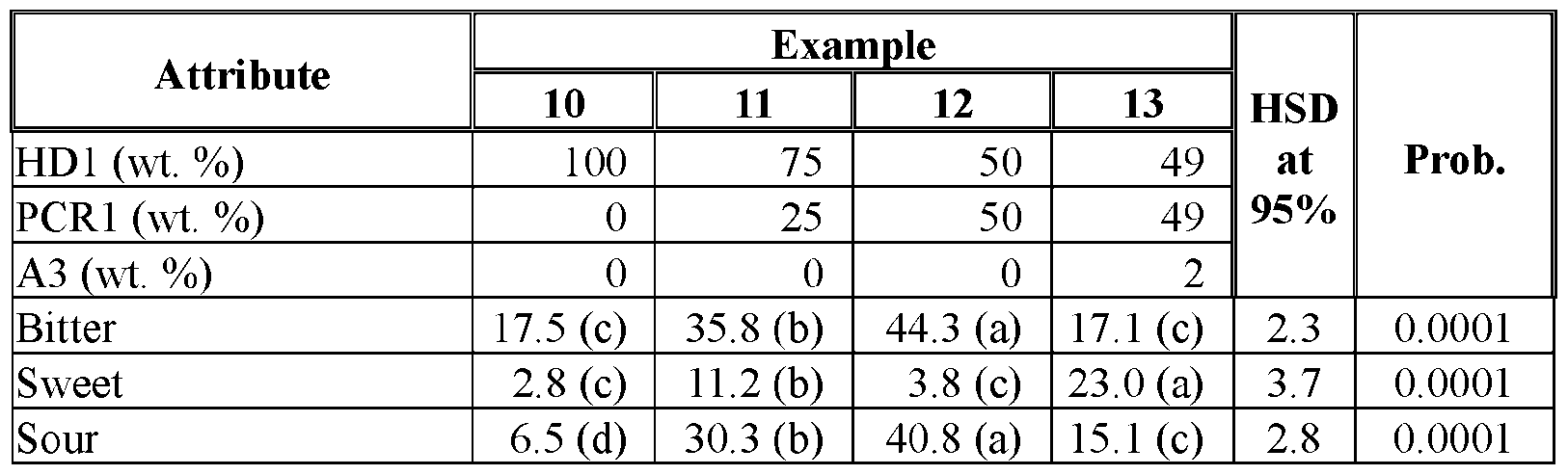
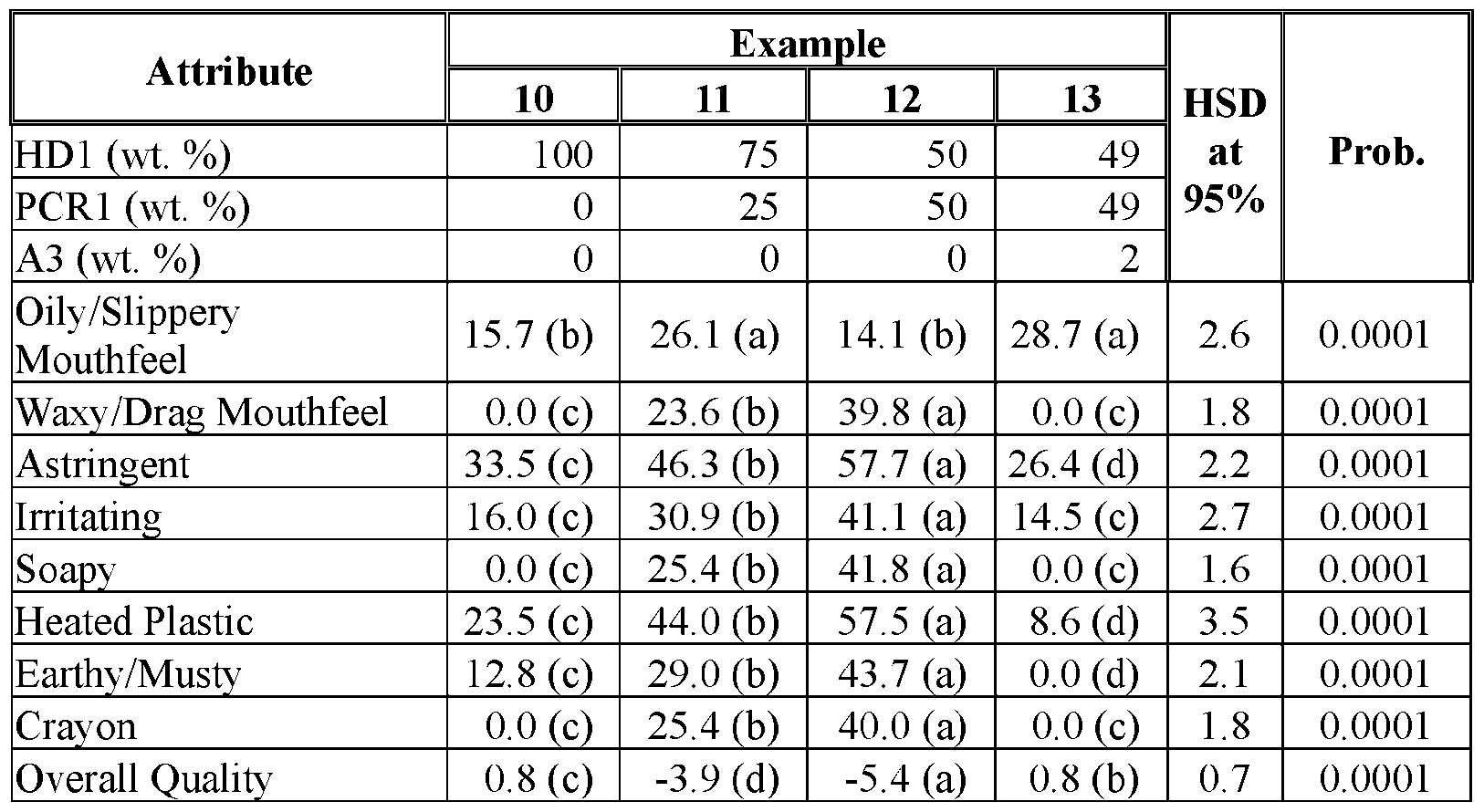
- FIG. 6 and FIG. 7 show a comparison of Examples 10-13 prepared and analyzed as described above.
- HSD Tukey's HSD (Tukey's Honestly Significant Difference) which is a statistical technique used to determine which sample means are different from each other. The statistical level was set at 95% confidence for this study which is indicated “at 95%”.
- Table 9 shows the attribute intensities of Examples 10-13 and shows significant differences between the examples for all flavor/mouthfeel/aroma attributes.
- Inventive Example 13 and control Example 10 are lowest in bitter and irritating with no waxy/drag mouthfeel, soapy, or crayon.
- Inventive Example 13 was the highest in sweet and lowest in astringent, heated plastic and earlhy/musty. while control Example 10 was the lowest in sour.
- Comparative Example 1 1 and inventive Example 13 were the highest in oily/slippery mouthfeel, while comparative Example 12 and control Example 10 were lowest in sweet and oily/slippery mouthfeel.
- Comparative Example 12 was the highest in bitter, sour, waxy/drag mouthfeel, astringent, irritating, soapy, heated plastic, earthy /musty and crayon, while comparative Example 11 is second highest in these attributes.
- FIG. 6 shows a spider chart comparing the flavor/mouthfeel/aroma attribute intensities of Examples 10-13. There were significant differences between samples for all attributes.
- Inventive Example 13 is the highest in sweet and the lowest in the negative notes of astringent, heated plastic and earlhy/musty. while control Example 10 is second lowest in these attributes. Inventive Example 13 and control Example 10 are lowest in bitter and irritating with no waxy/drag mouthfeel, soapy and crayon. Example 10 is lowest in sour.
- Comparative Example 11 and inventive Example 13 are highest in oily /slippery mouthfeel. Comparative Example 12 and control Example 10 are lowest in sweet and oily/slippery mouthfeel. Comparative Example 12 is highest in negative notes of bitter, sour, waxy/drag mouthfeel, astringent, irritating, soapy, heated plastic, earthy/musty and crayon. Comparative Example 11 is second highest in these attributes.
- FIG. 7 shows Principal Component Analysis (PCA) of the samples and organoleptic attributes.
- PCA is a technique for analyzing large datasets containing a high number of dimensions/features per observation. Interpretability of data is improved by enabling the visualization of multidimensional data, while preserving the maximum amount of information.
- PCA is a statistical technique for reducing the dimensionality 7 of a dataset by linearly transforming the data into a new coordinate system where (most of) the variation in the data can be described with fewer dimensions than the initial data.
- DI and D2 are the first two dimensions of PCA for the examples herein. The first dimension (DI) explains the most variation between the attributes and the products possible within one dimension while the second dimension (D2) explains the second most variation within dimensions.
- PCA allows a view of all the attributes and their relationships to the products simultaneously, which in this case is 12 attributes representing a 12- dimensional space. Only 2-3 dimensions of space at a time can be understood, so PCA allows for that representation to be communicated in two dimensions at a time. For example, plots could be made for overall quality 7 vs. heated plastic, overall quality vs. earthy/musty, etc., as well as heated plastic vs earthy/musty, etc. Therefore, PCA allows understanding of all of those relationships in a 2-D plot as shown.
- Inventive Example 13 and Control Example 10 are more similar in profile with each other than with either of the other two examples. They are higher in overall quality 7 and lower in negative attributes. Inventive Example 13 is highest overall quality 7 and sweet with higher oily/slippery mouthfeel and the lowest values for astringent, heated plastic and earthy/musty. Control Example 10 is second highest in overall quality and lowest in sour.
- Comparative Example 11 and Comparative Example 12 are more similar to each other than with either of the other two examples and have lower overall quality 7 and are higher in negative attributes. These samples are higher in bitter, sour, waxy/drag mouthfeel, astringent, irritating, soapy, heated plastic, earthy/musty 7 and crayon. Comparative Example 11 is higher in oily/slippery mouthfeel with second lowest overall quality 7 . Comparative Example 12 is highest in bitter, sour, waxy/drag mouthfeel, astringent, irritating, soapy, heated plastic, earthy/musty 7 and crayon and lowest in overall quality. [0124] In sum.
- Examples 10-12 show that the blends produced by the addition of PCR resin to virgin polymer have poorer organoleptic attributes relative to the virgin polymer alone.
- use of the hydrophobic synthetic zeolite as an additive in blends of virgin polymers and PCR resin produces a composition having organoleptic attributes competitive with virgin polymers.
- any lower limit may be combined with any upper limit to recite a range not explicitly recited, as well as, ranges from any lower limit may be combined with any other lower limit to recite a range not explicitly recited, in the same way, ranges from any upper limit may be combined with any other upper limit to recite a range not explicitly recited.
- ranges from any upper limit may be combined with any other upper limit to recite a range not explicitly recited.
- within a range includes every point or individual value between its end points even though not explicitly recited. Thus, every point or individual value may serve as its own lower or upper limit combined with any other point or individual value or any other lower or upper limit, to recite a range not explicitly recited.
Landscapes
- Chemical & Material Sciences (AREA)
- Health & Medical Sciences (AREA)
- Chemical Kinetics & Catalysis (AREA)
- Medicinal Chemistry (AREA)
- Polymers & Plastics (AREA)
- Organic Chemistry (AREA)
- Compositions Of Macromolecular Compounds (AREA)
Abstract
Description


Claims
Priority Applications (2)
| Application Number | Priority Date | Filing Date | Title |
|---|---|---|---|
| EP24739988.4A EP4735522A1 (en) | 2023-06-27 | 2024-06-24 | Polymer recyclate blend product and process |
| MX2025015679A MX2025015679A (en) | 2023-06-27 | 2025-12-19 | Polymer recyclate blend product and process |
Applications Claiming Priority (2)
| Application Number | Priority Date | Filing Date | Title |
|---|---|---|---|
| US202363523574P | 2023-06-27 | 2023-06-27 | |
| US63/523,574 | 2023-06-27 |
Publications (1)
| Publication Number | Publication Date |
|---|---|
| WO2025006396A1 true WO2025006396A1 (en) | 2025-01-02 |
Family
ID=91853862
Family Applications (1)
| Application Number | Title | Priority Date | Filing Date |
|---|---|---|---|
| PCT/US2024/035285 Ceased WO2025006396A1 (en) | 2023-06-27 | 2024-06-24 | Polymer recyclate blend product and process |
Country Status (4)
| Country | Link |
|---|---|
| US (1) | US20250002698A1 (en) |
| EP (1) | EP4735522A1 (en) |
| MX (1) | MX2025015679A (en) |
| WO (1) | WO2025006396A1 (en) |
Citations (6)
| Publication number | Priority date | Publication date | Assignee | Title |
|---|---|---|---|---|
| US3324095A (en) | 1965-05-14 | 1967-06-06 | Union Carbide Corp | Polymerization process |
| US7393916B2 (en) | 2005-11-01 | 2008-07-01 | Univation Technologies, Llc | Method of reducing gels in polyolefins |
| WO2022133008A1 (en) * | 2020-12-18 | 2022-06-23 | Eastman Chemical Company | Process for improving the viscosity of recycled polyethylene |
| WO2022260994A1 (en) * | 2021-06-07 | 2022-12-15 | Dow Global Technologies Llc | Compositions comprising post-consumer recycled resin and odor-active zeolite to mitigate taste and odor |
| EP4265677A1 (en) * | 2022-04-20 | 2023-10-25 | Kraton Polymers Nederland B.V. | Recycled polymer compositions |
| WO2024121189A1 (en) * | 2022-12-07 | 2024-06-13 | Borealis Ag | Polyolefin composition comprising polyethylene and recycled plastic material |
-
2024
- 2024-06-24 EP EP24739988.4A patent/EP4735522A1/en active Pending
- 2024-06-24 WO PCT/US2024/035285 patent/WO2025006396A1/en not_active Ceased
- 2024-06-24 US US18/752,450 patent/US20250002698A1/en active Pending
-
2025
- 2025-12-19 MX MX2025015679A patent/MX2025015679A/en unknown
Patent Citations (6)
| Publication number | Priority date | Publication date | Assignee | Title |
|---|---|---|---|---|
| US3324095A (en) | 1965-05-14 | 1967-06-06 | Union Carbide Corp | Polymerization process |
| US7393916B2 (en) | 2005-11-01 | 2008-07-01 | Univation Technologies, Llc | Method of reducing gels in polyolefins |
| WO2022133008A1 (en) * | 2020-12-18 | 2022-06-23 | Eastman Chemical Company | Process for improving the viscosity of recycled polyethylene |
| WO2022260994A1 (en) * | 2021-06-07 | 2022-12-15 | Dow Global Technologies Llc | Compositions comprising post-consumer recycled resin and odor-active zeolite to mitigate taste and odor |
| EP4265677A1 (en) * | 2022-04-20 | 2023-10-25 | Kraton Polymers Nederland B.V. | Recycled polymer compositions |
| WO2024121189A1 (en) * | 2022-12-07 | 2024-06-13 | Borealis Ag | Polyolefin composition comprising polyethylene and recycled plastic material |
Non-Patent Citations (1)
| Title |
|---|
| FRANK WELLE: "Develop a food grade HDPE recycling process", 4 June 2005 (2005-06-04), XP055585397, ISBN: 978-1-84405-225-7, Retrieved from the Internet <URL:http://www.wrap.org.uk/sites/files/wrap/Full%20wrap_HDPE_Recycling_final_reportV141205.pdf> [retrieved on 20190503] * |
Also Published As
| Publication number | Publication date |
|---|---|
| US20250002698A1 (en) | 2025-01-02 |
| EP4735522A1 (en) | 2026-05-06 |
| MX2025015679A (en) | 2026-02-03 |
Similar Documents
| Publication | Publication Date | Title |
|---|---|---|
| KR102944862B1 (en) | Mixed-plastic-polypropylene compound | |
| EP4063452A1 (en) | Mixed-plastics-polypropylene blend | |
| CA3246350A1 (en) | Post-consumer recyclated colored polyethylene composition, method for its preparation and articles made therefrom | |
| US20250002698A1 (en) | Polymer recyclate blend product and process | |
| WO2024184525A1 (en) | High-purity polypropylene recyclates | |
| WO2024184524A1 (en) | Process of preparing high-purity polypropylene recyclates | |
| WO2025128079A1 (en) | Method for modifying polymer recyclate and compositions therefrom | |
| EP4424767B1 (en) | Polypropylene composition suitable for automotive applications | |
| EP4677012A1 (en) | High-purity polypropylene recyclates | |
| WO2024184523A1 (en) | High-purity polypropylene recyclates | |
| WO2025049435A2 (en) | Extrusion visbreaking | |
| KR20260060358A (en) | Extrusion Viscosity Decomposition |
Legal Events
| Date | Code | Title | Description |
|---|---|---|---|
| 121 | Ep: the epo has been informed by wipo that ep was designated in this application |
Ref document number: 24739988 Country of ref document: EP Kind code of ref document: A1 |
|
| WWE | Wipo information: entry into national phase |
Ref document number: MX/A/2025/015679 Country of ref document: MX |
|
| WWE | Wipo information: entry into national phase |
Ref document number: 2024739988 Country of ref document: EP |
|
| NENP | Non-entry into the national phase |
Ref country code: DE |
|
| ENP | Entry into the national phase |
Ref document number: 2024739988 Country of ref document: EP Effective date: 20260127 |
|
| WWP | Wipo information: published in national office |
Ref document number: MX/A/2025/015679 Country of ref document: MX |
|
| ENP | Entry into the national phase |
Ref document number: 2024739988 Country of ref document: EP Effective date: 20260127 |