WO2025006239A1 - Methods of producing aluminum alloys from recycled aluminum materials having high electrical conductivity - Google Patents
Methods of producing aluminum alloys from recycled aluminum materials having high electrical conductivity Download PDFInfo
- Publication number
- WO2025006239A1 WO2025006239A1 PCT/US2024/034278 US2024034278W WO2025006239A1 WO 2025006239 A1 WO2025006239 A1 WO 2025006239A1 US 2024034278 W US2024034278 W US 2024034278W WO 2025006239 A1 WO2025006239 A1 WO 2025006239A1
- Authority
- WO
- WIPO (PCT)
- Prior art keywords
- aluminum alloy
- product
- aluminum
- hours
- scrap
- Prior art date
- Legal status (The legal status is an assumption and is not a legal conclusion. Google has not performed a legal analysis and makes no representation as to the accuracy of the status listed.)
- Ceased
Links
Classifications
-
- C—CHEMISTRY; METALLURGY
- C22—METALLURGY; FERROUS OR NON-FERROUS ALLOYS; TREATMENT OF ALLOYS OR NON-FERROUS METALS
- C22C—ALLOYS
- C22C21/00—Alloys based on aluminium
-
- C—CHEMISTRY; METALLURGY
- C22—METALLURGY; FERROUS OR NON-FERROUS ALLOYS; TREATMENT OF ALLOYS OR NON-FERROUS METALS
- C22C—ALLOYS
- C22C21/00—Alloys based on aluminium
- C22C21/02—Alloys based on aluminium with silicon as the next major constituent
-
- C—CHEMISTRY; METALLURGY
- C22—METALLURGY; FERROUS OR NON-FERROUS ALLOYS; TREATMENT OF ALLOYS OR NON-FERROUS METALS
- C22C—ALLOYS
- C22C21/00—Alloys based on aluminium
- C22C21/06—Alloys based on aluminium with magnesium as the next major constituent
- C22C21/08—Alloys based on aluminium with magnesium as the next major constituent with silicon
-
- C—CHEMISTRY; METALLURGY
- C22—METALLURGY; FERROUS OR NON-FERROUS ALLOYS; TREATMENT OF ALLOYS OR NON-FERROUS METALS
- C22F—CHANGING THE PHYSICAL STRUCTURE OF NON-FERROUS METALS AND NON-FERROUS ALLOYS
- C22F1/00—Changing the physical structure of non-ferrous metals or alloys by heat treatment or by hot or cold working
- C22F1/04—Changing the physical structure of non-ferrous metals or alloys by heat treatment or by hot or cold working of aluminium or alloys based thereon
-
- C—CHEMISTRY; METALLURGY
- C22—METALLURGY; FERROUS OR NON-FERROUS ALLOYS; TREATMENT OF ALLOYS OR NON-FERROUS METALS
- C22F—CHANGING THE PHYSICAL STRUCTURE OF NON-FERROUS METALS AND NON-FERROUS ALLOYS
- C22F1/00—Changing the physical structure of non-ferrous metals or alloys by heat treatment or by hot or cold working
- C22F1/04—Changing the physical structure of non-ferrous metals or alloys by heat treatment or by hot or cold working of aluminium or alloys based thereon
- C22F1/043—Changing the physical structure of non-ferrous metals or alloys by heat treatment or by hot or cold working of aluminium or alloys based thereon of alloys with silicon as the next major constituent
-
- C—CHEMISTRY; METALLURGY
- C22—METALLURGY; FERROUS OR NON-FERROUS ALLOYS; TREATMENT OF ALLOYS OR NON-FERROUS METALS
- C22F—CHANGING THE PHYSICAL STRUCTURE OF NON-FERROUS METALS AND NON-FERROUS ALLOYS
- C22F1/00—Changing the physical structure of non-ferrous metals or alloys by heat treatment or by hot or cold working
- C22F1/04—Changing the physical structure of non-ferrous metals or alloys by heat treatment or by hot or cold working of aluminium or alloys based thereon
- C22F1/047—Changing the physical structure of non-ferrous metals or alloys by heat treatment or by hot or cold working of aluminium or alloys based thereon of alloys with magnesium as the next major constituent
-
- C—CHEMISTRY; METALLURGY
- C22—METALLURGY; FERROUS OR NON-FERROUS ALLOYS; TREATMENT OF ALLOYS OR NON-FERROUS METALS
- C22F—CHANGING THE PHYSICAL STRUCTURE OF NON-FERROUS METALS AND NON-FERROUS ALLOYS
- C22F1/00—Changing the physical structure of non-ferrous metals or alloys by heat treatment or by hot or cold working
- C22F1/04—Changing the physical structure of non-ferrous metals or alloys by heat treatment or by hot or cold working of aluminium or alloys based thereon
- C22F1/05—Changing the physical structure of non-ferrous metals or alloys by heat treatment or by hot or cold working of aluminium or alloys based thereon of alloys of the Al-Si-Mg type, i.e. containing silicon and magnesium in approximately equal proportions
-
- H—ELECTRICITY
- H01—ELECTRIC ELEMENTS
- H01M—PROCESSES OR MEANS, e.g. BATTERIES, FOR THE DIRECT CONVERSION OF CHEMICAL ENERGY INTO ELECTRICAL ENERGY
- H01M4/00—Electrodes
- H01M4/02—Electrodes composed of, or comprising, active material
- H01M4/64—Carriers or collectors
- H01M4/66—Selection of materials
- H01M4/661—Metal or alloys, e.g. alloy coatings
- H01M4/662—Alloys
-
- Y—GENERAL TAGGING OF NEW TECHNOLOGICAL DEVELOPMENTS; GENERAL TAGGING OF CROSS-SECTIONAL TECHNOLOGIES SPANNING OVER SEVERAL SECTIONS OF THE IPC; TECHNICAL SUBJECTS COVERED BY FORMER USPC CROSS-REFERENCE ART COLLECTIONS [XRACs] AND DIGESTS
- Y02—TECHNOLOGIES OR APPLICATIONS FOR MITIGATION OR ADAPTATION AGAINST CLIMATE CHANGE
- Y02P—CLIMATE CHANGE MITIGATION TECHNOLOGIES IN THE PRODUCTION OR PROCESSING OF GOODS
- Y02P10/00—Technologies related to metal processing
- Y02P10/20—Recycling
Definitions
- This disclosure relates to the fields of material science, material chemistry, metallurgy, aluminum alloys, aluminum alloy products, aluminum fabrication, and related fields. More specifically, the disclosure relates to recycle-friendly aluminum alloys having high-electrical conductivity that can replace aluminum alloys including a high content of prime aluminum.
- the recycle-friendly aluminum alloys having high-electrical conductivity can be used to produce, for example, electrode current collectors used in battery applications.
- an electrode member of a lithium-ion battery includes a positive electrode plate, a separator, and a negative electrode plate.
- the positive electrode plate may be produced from an aluminum alloy having excellent electrical conductivity and less heat generation without affecting electrical efficiency of the battery.
- Prime aluminum has a high electrical conductivity thereby providing good conductivity properties. The higher the electrical conductivity, the more easily the electricity is conducted.
- Aluminum alloys that include high amounts of prime aluminum have higher electrical conductivity values than aluminum alloys that have less prime aluminum. Therefore, Ixxx series or 3xxx series aluminum alloys are generally used to produce electrode current collectors.
- aluminum alloys that include high amounts of solute elements typically have lower electrical conductivity than aluminum alloys that include less solute elements.
- aluminum alloys used for producing parts in battery applications are often produced from aluminum alloys including a high content of prime aluminum (e.g., greater than 99 % prime aluminum) due to the high amounts of prime aluminum that provide good electrical conductivity and corrosion resistance properties.
- prime aluminum e.g., greater than 99 % prime aluminum
- recycled aluminum alloy materials may be unsuitable for use in preparing high performance aluminum alloys as the recycled aluminum alloy materials may contain high levels of certain undesirable elements.
- recycled aluminum alloy materials may include certain alloying elements (e.g., Si, Fe, and/or Mn) in amounts that adversely affect the electrical conductivity properties or corrosion resistance of an aluminum alloy. For these reasons, it is not practical to use high amounts of recycled aluminum alloy materials for producing aluminum alloys for use as electrode current collectors, without negatively impacting desirable alloy properties.
- certain alloying elements e.g., Si, Fe, and/or Mn
- the aluminum alloys described herein comprise 0.50 - 2.00 wt. % Si, 0.05 - 0.80 wt. % Fe, 0.01 - 0.35 wt. % Cu, 0.01 - 1.00 wt. % Mn, 0.50 - 2.00 wt. % Mg, up to 0.70 wt. % Zn, up to 0.15 wt. % Cr, up to 0.10 wt. % Ti, up to 0.15 wt. % impurities, and Al.
- the aluminum alloy comprises 0.50 - 1.80 wt.
- the aluminum alloy comprises 0.60 - 1.75 wt. % Si, 0.10 - 0.60 wt. % Fe, 0.01 - 0.25 wt. % Cu, 0.25 - 0.75 wt. % Mn, 0.75 - 1.80 wt.
- the aluminum alloy comprises 0.70 - 2.00 wt. % Si, 0.05 - 0.80 wt. % Fe, 0.01 - 0.35 wt. % Cu, 0.10 - 1.00 wt. % Mn, 0.50 - 2.00 wt. % Mg, up to 0.70 wt. % Zn, up to 0.15 wt. % Cr, up to 0.10 wt. % Ti, up to 0.15 wt.
- the aluminum alloy comprises 0.75 - 1.75 wt. % Si, 0.10 - 0.60 wt. % Fe, 0.01 - 0.25 wt. % Cu, 0.25 - 0.75 wt. % Mn, 0.75 - 1.80 wt. % Mg, up to 0.25 wt. % Zn, up to 0.05 wt. % Cr, up to 0.05 wt. % Ti, up to 0.15 wt. % impurities, and Al.
- the aluminum alloy comprises 0.80 - 1.25 wt. % Si, 0.20 - 0.50 wt. % Fe, 0.05 - 0.20 wt.
- the aluminum alloy comprises 0.70 - 1.20 wt. % Si, 0.10 - 0.80 wt. % Fe, 0.01 - 0.35 wt. % Cu, 0.01 - 0.80 wt. % Mn, 0.50 - 1.10 wt. % Mg, 0.05 - 0.25 wt. % Zn, up to 0.15 wt.
- the aluminum alloy comprises 0.70 - 1.25 wt. % Si, 0.30 - 0.40 wt. % Fe, 0.05
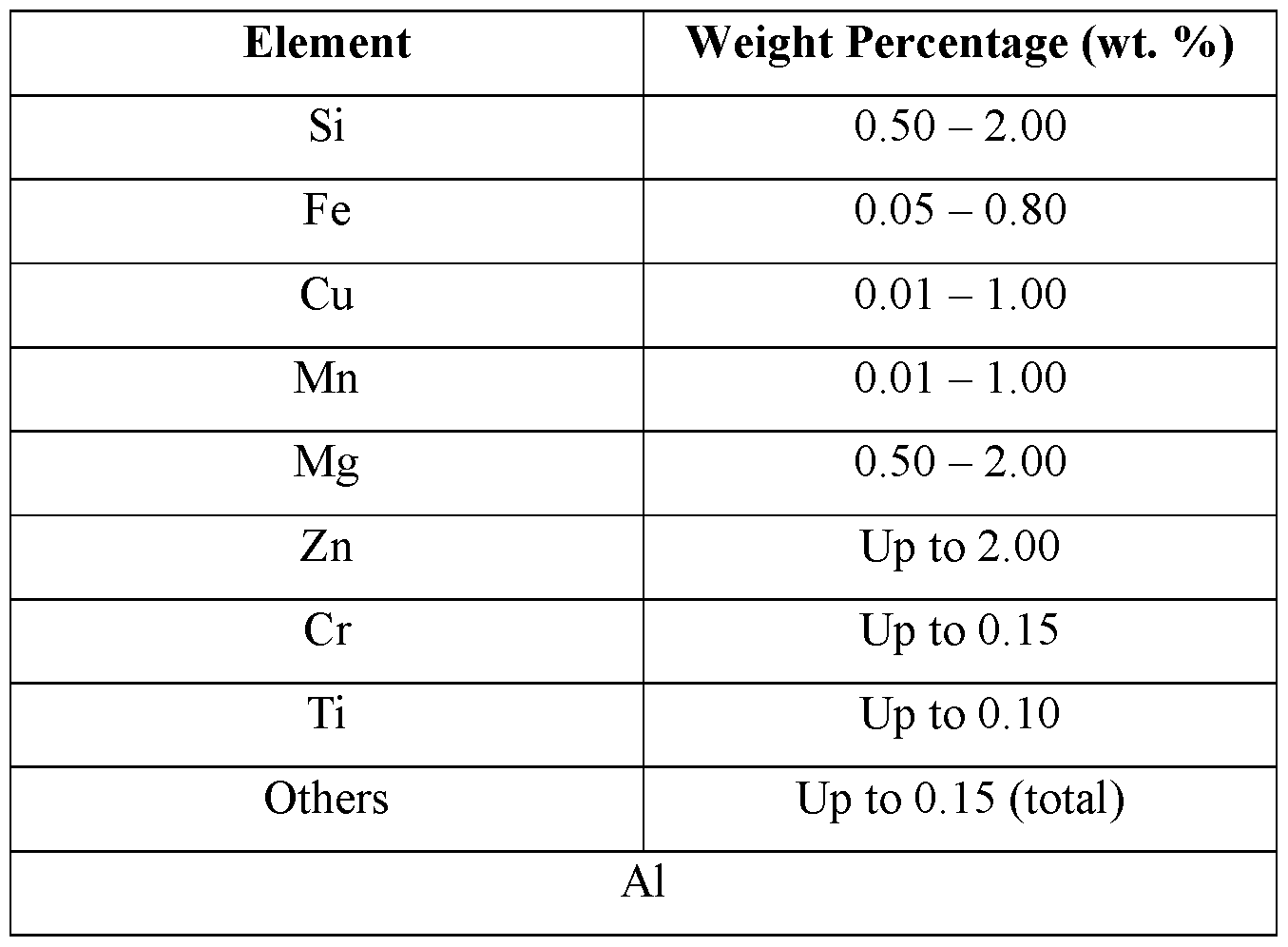
- the aluminum alloys described herein comprise 0.50 - 2.00 wt. % Si, 0.05 - 0.80 wt. % Fe, 0.01 - 1.00 wt. % Cu, 0.01 - 1.00 wt. % Mn, 0.50 - 2.00 wt. % Mg, up to 2.00 wt. % Zn, up to 0.15 wt. % Cr, up to 0.10 wt. % Ti, up to 0.15 wt. % impurities, and Al.
- the aluminum alloy comprises 0.50 - 1.80 wt. % Si, 0.10 - 0.70 wt. % Fe, 0.01 - 1.00 wt.
- the aluminum alloy comprises 0.60 - 1.75 wt. % Si, 0.10 - 0.60 wt. % Fe, 0.01 - 1.00 wt. % Cu, 0.25 - 0.75 wt. % Mn, 0.75 - 2.00 wt. % Mg, up to 0.25 wt. % Zn, up to 0.05 wt.
- the aluminum alloy comprises 0.80 - 1.25 wt. % Si, 0.20 - 0.50 wt. % Fe, 0.01 - 1.00 wt. % Cu, 0.50 - 0.75 wt. % Mn, 1.00 - 1.80 wt. % Mg, up to 2.00 wt. % Zn, up to 0.02 wt. % Cr, up to 0.03 wt. % Ti, up to 0.15 wt. % impurities, and Al.
- the aluminum alloy comprises 0.70 - 1.20 wt. % Si, 0.10 - 0.80 wt. % Fe, 0.01
- the aluminum alloy comprises 0.70 - 1.25 wt. % Si, 0.30 - 0.40 wt. % Fe, 0.01
- a method of producing an aluminum alloy product includes: casting an aluminum alloy to form a cast product, wherein the aluminum alloy comprises 0.50 - 2.00 wt. % Si, 0.05 - 0.80 wt. % Fe, 0.01 - 0.35 wt. % Cu, 0.01 - 1.00 wt. % Mn, 0.50 - 2.00 wt. % Mg, up to 0.70 wt. % Zn, up to 0.15 wt. % Cr, up to 0.10 wt. % Ti, up to 0.15 wt.
- the homogenization step comprises soaking the cast product at a homogenization temperature from 450° C to 600° C for 10 hours to 24 hours.
- the method further comprises annealing the hot rolled product to produce an annealed hot rolled product.
- the annealing step comprises heating the hot rolled product to an annealing temperature from 300° C to 450° C for 0.5 hour to 30 hours.
- the method further comprises solution heat treating the aluminum alloy product.
- the solution heat treatment step comprises heating the aluminum alloy product at a solution heat treatment temperature from 500 °C to 600 °C for 5 seconds to 10 hours prior to the artificial aging step.
- an aluminum current collector is prepared by the method described herein.
- the artificial aging step comprises aging the aluminum alloy product at a temperature from 300 °C to 350 °C for 10 minutes to 30 hours.
- the artificial aging step removes Mg and Si from solid solution to produce Mg2Si precipitates.
- the artificial aging step is configured to remove at least one or more of Mg, Si, Zn, Mn, Cr, and Cu from solid solution.
- the artificial aging step produces at least a 5 % increase in size or distribution of one or more of Mg2Si precipitates, AUC ⁇ MgsSi? precipitates, or MgZn2 precipitates compared to the aluminum alloy product prior to artificial aging.
- the artificial aging step produces a precipitate comprising one or more of Mg, Si, Cu, Cr, or Zn.
- the aluminum alloy comprises a total solute content of at least 2.5 wt. %. In some embodiments, the aluminum alloy comprises a combined content of Mg, Si, Cu, Zn, Cr, Fe, and Mn of at least 2.5 wt. %. In some embodiments, the aluminum alloy comprises at least 60 wt. % recycled aluminum materials, based on the total weight of the aluminum alloy. In some embodiments, the recycled aluminum materials comprise used beverage scrap. In some embodiments, the recycled aluminum materials comprise at least one of used beverage scrap, casting scrap, brazing scrap, automotive scrap, electronics scrap, or architectural scrap.
- a method of producing an aluminum alloy product includes: casting an aluminum alloy to form a cast product, wherein the aluminum alloy comprises a 3xxx series aluminum alloy, a 5xxx series aluminum alloy, or a 6xxx series aluminum alloy; homogenizing the cast product; hot rolling the cast product to produce a hot rolled product; cold rolling the hot rolled product to produce an aluminum alloy product; optionally aging the aluminum alloy product to a temper condition; and artificially aging the aluminum alloy product at a temperature from 250 °C to 450 °C for 10 minutes to 30 hours; wherein the aluminum alloy product has an electrical conductivity greater than 45 % based on the international annealed copper standard (IACS).
- IACS international annealed copper standard
- the aluminum alloy exhibits an electrical conductivity greater than 45 % based on the international annealed copper standard (IACS) when subjected to artificial aging at a temperature greater than 300 °C for at least 10 minutes.
- the aluminum alloy comprises a combined content of Mg, Si, Cu, Zn, Cr, Fe, and Mn of at least 2.5 wt. %.
- the aluminum alloy comprises precipitates comprising one or more of Mg, Si, Zn, Mn, Cr, and Cu.
- the aluminum alloy comprises one or more of Mg2Si precipitates, AUC ⁇ MgsSi?
- the aluminum alloy comprises at least 60 wt. % of recycled aluminum materials and less than 40 wt. % prime aluminum.
- the recycled aluminum materials comprise used beverage can scrap.
- the recycled aluminum materials comprise at least one of used beverage scrap, casting scrap, brazing scrap, automotive scrap, electronic scrap, or architectural scrap.
- a method of producing an aluminum alloy product includes: casting an aluminum alloy to form a cast product, wherein the aluminum alloy comprises 0.50 - 2.00 wt. % Si, 0.05 - 0.80 wt. % Fe, 0.01 - 1.00 wt. % Cu, 0.01 - 1.00 wt. % Mn, 0.50 - 2.00 wt. % Mg, up to 2.00 wt. % Zn, up to 0.15 wt. % Cr, up to 0.10 wt. % Ti, up to 0.15 wt.
- aluminum alloy products e.g., current collectors for energy storage applications comprising the aluminum alloys described herein.
- FIG. l is a graph showing the influence of aluminum alloy composition on the electrical conductivity of the example aluminum alloys in Table 13 as measured on the international annealed copper standard (IACS) standard.
- FIG. 2 is a plot depicting the electrical conductivity of example aluminum alloys before and after heat treatment as measured on the international annealed copper (IACS) standard.
- IACS international annealed copper
- FIG. 3 is a bar graph comparing the electrical conductivity of three example aluminum alloys as measured on the international annealed copper (IACS) standard.
- FIG. 4 is a plot of element addition in wt. % versus conductivity index with the elements including Si, Fe, Cu, Mn, Cr, Zn, and Ti.
- FIG. 5 is a microstructure image of an example aluminum alloy after aging in F temper with the example aluminum alloy including added Si.
- FIG. 6 is a microstructure image of an example aluminum alloy after aging with the example aluminum alloy including added Si.
- the aluminum alloys described herein incorporate high amounts of recycled aluminum alloy materials and low amounts of primary aluminum (e.g., less than 40 wt. % of primary aluminum), and still exhibit high electrical conductivity for battery applications.
- the aluminum alloys described herein include a careful balance of alloying elements that provide good electrical conductivity and corrosion resistance properties in an electrochemical environment despite including relatively lower prime aluminum and relatively higher content of solute elements that are alloying elements present in recycled aluminum alloy materials.
- the solute elements can include Mg, Si, Fe, Cr, Cu, Zn, or Mn. Conventionally, higher amounts of solute elements and less prime aluminum in an aluminum alloy composition would result in poor electrical conductivity properties.
- recycled aluminum alloy materials may include Si, Fe, and other impurities in relatively high quantities. Due to the discrepancy between the aluminum alloy composition of conventional aluminum alloys for battery applications and recycled aluminum alloy materials, little or no recycled aluminum alloy materials can be used to produce these conventional aluminum alloys which in turn limits the amount of the recycled aluminum alloy materials that can be used for battery applications.
- the aluminum alloys described herein can utilize higher amounts of recycled aluminum alloy materials and achieve a combination of desirable properties that are useful for battery or electrochemical applications. Specifically, the aluminum alloys described herein can tolerate higher amounts of Si, Fe, Mg, Mn, Zn, and/or Cu compared to conventional aluminum alloys used in battery applications and still achieve good electrical conductivity and adequate corrosion resistance properties. Additionally, the aluminum alloys described herein can include additional Si to improve electrical conductivity through a formation of intermetallic particles or dispersoids. The composition of the aluminum alloys described herein reduces the compositional gap between conventional aluminum alloys for battery applications and recycled aluminum alloy materials to lower the amount of primary aluminum.
- a plate generally has a thickness of greater than 15 mm.
- a plate may refer to an aluminum product having a thickness of greater than 15 mm, greater than 20 mm, greater than 25 mm, greater than 30 mm, greater than 35 mm, greater than 40 mm, greater than 45 mm, greater than 50 mm, or greater than 100 mm.
- a shate (also referred to as a sheet plate) generally has a thickness of from 4 mm to 15 mm.
- a shate may have a thickness of 4 mm, 5 mm, 6 mm, 7 mm, 8 mm, 9 mm, 10 mm, 11 mm, 12 mm, 13 mm, 14 mm, or 15 mm.
- a sheet generally refers to an aluminum product having a thickness of less than 4 mm.
- a sheet may have a thickness of less than 4 mm, less than 3 mm, less than 2 mm, less than 1 mm, less than 0.5 mm, less than 0.3 mm, or less than 0.1 mm.
- An F condition or temper refers to an aluminum alloy as fabricated.
- An O condition or temper refers to an aluminum alloy after annealing.
- An Hxx condition or temper also referred to herein as an H temper, refers to an aluminum alloy after cold rolling with or without thermal treatment (e.g., annealing).
- Suitable H tempers include HX1, HX2, HX3 HX4, HX5, HX6, HX7, HX8, or HX9 tempers.
- the aluminum alloy can be strain hardened to various tempers, for example, H16, H18, or other HIX tempers.
- the following aluminum alloys are described in terms of their elemental composition in weight percentage (wt. %) based on the total weight of the alloy. In certain examples of each alloy, the remainder is aluminum, with a maximum wt. % of 0.15 % for the sum of the impurities.
- Electrochemical potential refers to a material’s amenability to a redox reaction. Electrochemical potential can be employed to evaluate resistance to corrosion of aluminum alloys described herein. A negative value can describe a material that is easier to oxidize (e.g., lose electrons or increase in oxidation state) when compared to a material with a positive electrochemical potential. A positive value can describe a material that is easier to reduce (e.g., gain electrons or decrease in oxidation state) when compared to a material with a negative electrochemical potential. Electrochemical potential, as used herein, is a vector quantity expressing magnitude and direction.
- cast aluminum alloy As used herein, terms such as “cast aluminum alloy,” “cast article,” and the like are interchangeable and refer to a product produced by direct chill casting (including direct chill co-casting) or semi-continuous casting, continuous casting (including, for example, by use of a twin belt caster, a twin roll caster, a block caster, or any other continuous caster), electromagnetic casting, hot top casting, or any other casting method.
- room temperature can include a temperature of from 15° C to 30° C, for example 15° C, 16° C, 17° C, 18° C, 19° C, 20° C, 21° C, 22° C, 23° C, 24° C, 25° C, 26° C, 27° C, 28° C, 29° C, or 30° C.
- novel aluminum alloy compositions that can be produced from recycled aluminum alloy materials.
- the aluminum alloys described herein exhibit electrical conductivity that is significantly improved in comparison to 3xxx series aluminum alloys, and therefore can be used for battery applications.
- the properties of the alloys are achieved due to the elemental compositions of the alloys, and, in some cases, also the methods of processing the alloys to produce the described sheets, plates, and shates.
- the aluminum alloys can have the following elemental composition as provided in Table 1.
- the aluminum alloys can include a total solute content (e.g., a combined content of alloying elements present in recycled aluminum alloy materials) of at least 2.5 wt. %.
- a combined content of Mg, Si, Cu, Zn, Cr, Fe, and Mn can be at least 2.5 wt. %.
- the aluminum alloys can have the following elemental composition as provided in Table 2.
- the aluminum alloys can have the following elemental composition as provided in Table 3.
- the aluminum alloys can have the following elemental composition as provided in Table 4.
- the aluminum alloys can have the following elemental composition as provided in Table 5.
- the aluminum alloys can have the following elemental composition as provided in Table 6.
- the aluminum alloys can have the following elemental composition as provided in Table 7.
- the aluminum alloys can have the following elemental composition as provided in Table 8.
- the aluminum alloys can have the following elemental composition as provided in Table 9.
- the aluminum alloys can have the following elemental composition as provided in Table 10.
- the aluminum alloys can have the following elemental composition as provided in Table 11.
- the aluminum alloys can have the following elemental composition as provided in Table 12.
- the alloy includes silicon (Si) in an amount from 0.50 % to 2.00 % (e.g., 0.60 % to 2.00 % from 0.50 % to 1.50 %, from 0.80 % to 1.90 %, from 0.90 % to 1.80 %, from 0.75 % to 1.75 %, from 0.80 % to 1.25 %, from 0.70 % to 1.20 %, or from 0.70 % to 1.25 %) based on the total weight of the alloy.
- the alloy can include 0.50
- the alloy also includes iron (Fe) in an amount from 0.05 % to 0.80 % (e.g., from 0.05 % to 0.70 %, from 0.05 % to 0.60 %, from 0.06 % to 0.80 %, from 0.10 % to 0.80 %, from 0.10 % to 0.60 %, from 0.20 % to 0.50 %, or from 0.30 % to 0.40 %) based on the total weight of the alloy.
- iron Fe in an amount from 0.05 % to 0.80 % (e.g., from 0.05 % to 0.70 %, from 0.05 % to 0.60 %, from 0.06 % to 0.80 %, from 0.10 % to 0.80 %, from 0.10 % to 0.60 %, from 0.20 % to 0.50 %, or from 0.30 % to 0.40 %) based on the total weight of the alloy.
- the alloy can include 0.05 %, 0.06 %, 0.07 %, 0.08 %, 0.09 %, 0.10 %, 0.11 %, 0.12 %, 0.13 %, 0.14 %, 0.15 %, 0.16 %, 0.17 %,
- the disclosed alloy includes copper (Cu) in an amount from 0.01 % to 1.00 % (e.g., 0.01 % to 0.35 %, from 0.01 % to 0.25 %, from 0.05 % to 0.20 %, from 0.05 % to 0.15 %, from 0.01 % to 0.90, from 0.10 % to 0.75, or from 0.25 % to 0.80 %) based on the total weight of the alloy.
- 0.01 % to 1.00 % e.g., 0.01 % to 0.35 %, from 0.01 % to 0.25 %, from 0.05 % to 0.20 %, from 0.05 % to 0.15 %, from 0.01 % to 0.90, from 0.10 % to 0.75, or from 0.25 % to 0.80 % based on the total weight of the alloy.
- the alloy can include 0.01 %, 0.02 %, 0.03 %, 0.04 %, 0.05 %, 0.06 %, 0.07 %, 0.08 %, 0.09 %, 0.10 %, 0.11 %, 0.12 %, 0.13 %, 0.14 %, 0.15 %, 0.16 %, 0.17 %, 0.18 %, 0.19 %, 0.20 %, 0.21 %, 0.22 %, 0.23 %, 0.24 %,
- the alloy can include manganese (Mn) in an amount from 0.01 % to 1.00% (e.g., from 0.25 % to 0.75 %, from 0.50 % to 0.75 %, from 0.20 % to 0.80 %, from 0.30 % to 0.70 %, or from 0.30 % to 0.50 %) based on the total weight of the alloy.
- Mn manganese
- the alloy can include 0.01 %, 0.02 %, 0.03 %, 0.04 %, 0.05 %, 0.06 %, 0.07 %, 0.08 %, 0.09 %, 0.10 %, 0.11 %, 0.12 %, 0.13 %, 0.14 %, 0.15 %, 0.16 %, 0.17 %, 0.18 %, 0.19
- the alloy can include magnesium (Mg) in an amount from 0.50 % to 2.00% (e.g., from 0.75 % to 1.80 %, from 1.00 % to 1.80 %, from 0.50 % to 1.10 %, or from 0.80 % to 1.40 %) based on the total weight of the alloy.
- Mg magnesium
- the alloy can include 0.50 %, 0.51 %, 0.52 %, 0.53 %, 0.54 %, 0.55 %, 0.56 %, 0.57 %, 0.58 %, 0.59 %, 0.60 %, 0.61 %, 0.62 %, 0.63 %, 0.64 %, 0.65 %, 0.66 %, 0.67 %, 0.68 %, 0.69 %, 0.70 %,
- Mg 1.92 %, 1.93 %, 1.94 %, 1.95 %, 1.96 %, 1.97 %, 1.98 %, 1.99 %, or 2.00 % Mg. All percentages are expressed in wt. %.
- the Mg content for use in the alloys described herein is carefully controlled based on the desired properties of the resulting alloy. For example, Mg can adversely affect electrical conductivity of the aluminum alloys described herein. In some examples, Mg can be removed from solid solution of an aluminum alloy based on methods described herein to provide an alloy suitable for use in electrochemical applications.
- the alloy includes zinc (Zn) in an amount up to 2.00 % (e.g., up to 1.75 %, up to 1.50 %, up to 1.25 %, up to 1.00 %, up to 0.75 %, up to 0.70 %, up to 0.50 %, up to 0.25 %, up to 0.20 %, from 0.001 % to 0.70 %, from 0.005 % to 0.50 %, from 0.05 % to 0.50 %, or from 0.10 % to 0.25 %) based on the total weight of the alloy.
- the alloy can include 0.001 %, 0.002 %, 0.003 %, 0.004 %, 0.005 %, 0.006 %, 0.007 %, 0.008 %, 0.009 %, 0.01 %, 0.02 %, 0.03 %, 0.04 %, 0.05 %, 0.06 %, 0.07 %, 0.08 %, 0.09 %,
- the alloy includes chromium (Cr) in an amount up to 0.15 %
- the alloy can include 0.001 %, 0.002 %, 0.003 %, 0.004 %, 0.005 %, 0.006 %, 0.007 %, 0.008 %, 0.009 %, 0.01 %, 0.02 %, 0.03 %, 0.04 %, 0.05 %, 0.06 %, 0.07 %, 0.08 %, 0.09 %, 0.10 %, 0.11 %, 0.12 %, 0.13 %, 0.14 %, or 0.15 % Cr. In some cases, Cr is not present in the alloy (i.e., 0 %). All percentages are expressed in wt. %.
- the alloy includes titanium (Ti) in an amount up to 0.10 % (e.g., up to 0.10 %, up to 0.05 %, up to 0.03 %, 0.001 % to 0.10 %, 0.005% to 0.10 %, or 0.01 % to 0.05 %) based on the total weight of the alloy.
- Ti titanium
- the alloy can include 0.001 %, 0.002 %, 0.003 %, 0.004 %, 0.005 %, 0.006 %, 0.007 %, 0.008 %, 0.009 %, 0.01 %, 0.02 %, 0.03 %, 0.04 %, 0.05 %, 0.06 %, 0.07 %, 0.08 %, 0.09 %, or 0.10 % Ti. In some cases, Ti is not present in the alloy (i.e., 0 %). All percentages are expressed in wt. %.
- the alloy compositions can further include other minor elements, sometimes referred to as impurities, in amounts of 0.15 % or below, 0.14 % or below, 0.13 % or below, 0.12 % or below, 0.11 % or below, 0.10 % or below, 0.09 % or below, 0.08 % or below, 0.07 % or below, 0.06 % or below, 0.05 % or below, 0.04 % or below, 0.03 % or below, 0.02 % or below, or 0.01 % or below each.
- impurities may include, but are not limited to, Na, Ga, V, Ni, Sc, Ag, B, Bi, Zr, Li, Pb, Sn, Ca, Hf, Sr, or combinations thereof.
- Na, Ga, V, Ni, Sc, Ag, B, Bi, Zr, Li, Pb, Sn, Ca, Hf, or Sr may be present in an alloy in amounts of 0.05 % or below, 0.04 % or below, 0.03 % or below, 0.02 % or below, or 0.01 % or below.
- the sum of all impurities does not exceed 0.15 % (e.g., 0.1 %). All percentages are expressed in wt. %. In certain aspects, the remaining percentage of the alloy is aluminum.
- the aluminum alloys described herein can tolerate higher amounts of recycled aluminum alloy materials and still exhibit desirable mechanical properties.
- recycled aluminum alloy materials can include used beverage can (UBC) scrap, casting scrap, or brazing scrap.
- UBC beverage can
- the impact of the impurities and/or alloying elements on the mechanical properties of the aluminum alloy is reduced by providing a tailored aluminum alloy composition to compensate for the impurities. This enables a higher amount of less expensive, higher impurity recycled aluminum alloy materials (e.g., used 3xxx series aluminum alloy) for producing aluminum alloys that can still exhibit desirable properties.
- the aluminum alloy compositions described herein can include higher amounts of recycled aluminum alloy materials with little or no additional primary aluminum.
- Providing the tailored aluminum alloy composition can involve a thermodynamic process, during which the aluminum alloy is heated at an elevated temperature to remove solute content from the aluminum alloy as precipitates.
- the solute content can form binary, ternary, or quaternary compounds with other elements in the aluminum alloy that precipitate from the aluminum matrix.
- the electrical conductivity of the aluminum alloy can be improved. Accordingly, the aluminum alloy can tolerate higher amounts of recycled aluminum materials compared to conventional aluminum alloys used for electrochemical applications.
- the aluminum alloy composition described herein provides a composition that is well-suited for utilizing UBC scrap as recycle material.
- UBC scrap is a mixture of various aluminum alloys (e.g., from different aluminum alloys used for can bodies and can ends).
- UBC scrap generally includes a mixture of metal from various aluminum alloys, such as metal from can bodies (e.g., AA3104, AA3004, or other 3xxx series aluminum alloys) and can ends (e.g., AA5182 or other 5xxx series aluminum alloys).
- UBC scrap can be shredded and de-coated or de-lacquered prior to being melted for use as liquid metal stock in casting a new metal product.
- the aluminum alloy composition may utilize other recycle material, such as casting scrap or brazing scrap.
- the aluminum alloy composition described herein can utilize recycled aluminum alloy materials (e.g., used AA3104 aluminum alloy scrap) to produce the aluminum alloy due to the aluminum alloy composition. This allows the use of more recycled aluminum alloy materials for battery applications and reduces the amount of primary aluminum.
- the aluminum alloys described herein include a high amount of recycled aluminum alloy materials scrap at or greater than 25 %, e.g., at or greater than 30 %, at or greater than 35 %, at or greater than 40 %, at or greater than 45 %, at or greater than 50 %, at or greater than 55 %, at or greater than 60 %, at or greater than 65 %, at or greater than 70 %, or at or greater than 75 %.
- the aluminum alloys described herein can include from 25 % to 60 % recycled aluminum alloy materials (e.g., from 25 % to 55 %, from 30 % to 55 %, from 35 % to 50 %, or from 40 % to 45 %). As discussed above, in some aspects the aluminum alloys described herein are particularly well-suited to be prepared from used AA3104 aluminum alloy scrap.
- the aluminum alloys described herein include less than 40 % primary aluminum, e.g., less than 39 %, less than 38 %, less than 37 %, less than 36 %, less than 35 %, less than 34 %, less than 33 %, less than 32 %, less than 31 %, less than 30 %, less than 29 %, less than 28 %, less than 27 %, less than 26 %, less than 25 %, less than 24 %, less than 23 %, less than 22 %, less than 21 %, or less than 20 % primary aluminum. All are expressed in wt. %.
- the aluminum alloys described herein can have an ultimate tensile strength (UTS) of at least 200 MPa.
- the yield strength is at least 200 MPa, at least 210 MPa, at least 220 MPa, at least 230 MPa, at least 240 MPa, at least 250 MPa, at least 260 MPa, at least 270 MPa, at least 280 MPa, at least 290 MPa, at least 300 MPa, or anywhere in between.
- the yield strength is from 200 MPa to 300 MPa.
- the yield strength can be from 210 MPa to 290 MPa, from 220 MPa to 280 MPa, from 230 MPa to 270 MPa, or from 240 MPa to 260 MPa.
- the aluminum alloys described herein can have an electrical conductivity value of above 50 % based on the international annealed copper standard (IACS) (e.g., from 50 % IACS to 70 % IACS).
- IACS international annealed copper standard
- the alloy can have an electrical conductivity value of 50 %, 51 %, 52 %, 53 %, 54 %, 55 %, 56 %, 57 %, 58 %, 59 %, 60 %, 61 %, 62 %, 63 %, 64 %, 65 %, 66 %, 67 %, 68 %, 69 %, 70 %, or anywhere in between. All values in % IACS.
- the properties of the aluminum alloy described herein are at least partially determined by the method of producing the aluminum alloy. Without intending to limit the disclosure, aluminum alloy properties are partially determined by the formation of microstructures during the alloy’s preparation. In certain aspects, the method of preparation for an alloy composition may influence or even determine whether the alloy will have properties adequate for a desired application.
- the method of producing the aluminum alloy described herein can improve electrical conductivity of the aluminum alloy.
- the method may include a homogenization or annealing practice that can promote the formation of Mg- containing dispersoids (e.g., binary, tertiary, or quaternary compounds).
- Mg- containing dispersoids e.g., binary, tertiary, or quaternary compounds.
- increasing the Si content of the aluminum alloy by adding Si can beneficially enable the formation of the Mg-containing dispersoids, which removes Mg from the aluminum matrix.
- the homogenization or annealing practice can be optimized to maximize the electrical conductivity of the aluminum alloy by taking Mg out of solid solution.
- the casting process can include a continuous (CC) casting process to produce a cast aluminum alloy.
- the CC process may include, but is not limited to, the use of twin belt casters, twin roll casters, or block casters.
- the casting process is performed by a CC process to form a cast aluminum alloy in the form of a billet, a slab, a shate, a strip, and the like.
- the casting process can include a direct chill casting (DC) process.
- DC direct chill casting
- the cast aluminum alloy can then be subjected to further processing steps.
- the processing methods as described herein can include the steps of homogenization/annealing, hot rolling, cold rolling, and/or annealing.
- a homogenization step or annealing step can be performed.
- the annealing step is used for continuous casting processes. For example, for a cast aluminum alloy produced from a continuous casting process may be annealed and is not homogenized.
- the homogenization step can include heating a cast aluminum alloy to a homogenization temperature from 450° C to 600° C.
- the homogenization temperature is referred to herein as the peak metal temperature.
- the cast aluminum alloy can be heated to a peak metal temperature of from 460° C to 600° C, from 470° C to 600° C, from 480° C to 600° C, from 490° C to 600° C, from 500° C to 600° C, 510° C to 600° C, from 520° C to 600° C, from 530° C to 600° C, from 540° C to 600° C, from 550° C to 600° C, from 560° C to 600° C, from 570° C to 600° C, from 580° C to 600° C, or from 590° C to 600° C).
- the heating rate to the peak metal temperature can be 10° C/hour or greater (e.g., 20° C/hour or greater, 30° C/hour or greater, 40° C/hour or greater, 50° C/hour or greater, 60° C/hour or greater, 70° C/hour or greater, 80° C/hour or greater, 90° C/hour or greater, or 100° C/hour or greater).
- the heating rate to the peak metal temperature can be from 10° C/hour to 250° C/hour (e.g., 20° C/hour to 250° C/hour, 40° C/hour to 225° C/hour, 60° C/hour to 220° C/hour, from 80° C/hour to 200° C/hour, from 100° C/hour to 200° C/hour, or from 100° C/hour to 250° C/hour).
- the cast aluminum alloy is then allowed to soak (i.e., held at the indicated temperature) for a period of time at the peak metal temperature range.
- the cast aluminum alloy is allowed to soak for up to 36 hours (e.g., from 0.5 hour to 36 hours, from 0.5 hour to 24 hours, from 1 hour to 18 hours, from 6 hours to 15 hours, or from 20 hours to 30 hours).
- the cast aluminum alloy can be soaked at the peak metal temperature from 450° C to 600° C for 10 minutes, 20 minutes, 30 minutes, 45 minutes, 1 hour, 2 hours, 3 hours, 4 hours, 5 hours, 6 hours, 7 hours, 8 hours, 9 hours, 10 hours, 11 hours, 12 hours, 13 hours, 14 hours, 15 hours, 16 hours, 17 hours, 18 hours, 19 hours, 20 hours, 21 hours, 22 hours, 23 hours, 24 hours, 25 hours, 26 hours, 27 hours, 28 hours, 29 hours, 30 hours, 31 hours, 32 hours, 33 hours, 34 hours, 35 hours, or 36 hours.
- the cast aluminum alloy is heated to a peak metal temperature from 500° C to 600° C at a heating rate of least 10° C/hour and soaked at the peak metal temperature for 0.5 hour to 36 hours.
- the homogenization described herein can be carried out in a two-stage process.
- the two-stage process can include the abovedescribed heating and soaking steps, which can be referred to as the first stage, and can further include a second stage.
- the temperature of the cast aluminum alloy is increased to a temperature higher than the temperature used for the first stage.
- the temperature for the second stage can be increased, for example, to a temperature at least 5° C higher than the peak metal temperature during the first stage.
- the peak metal temperature can be increased to a temperature of at least 455° C (e.g., at least 460° C, at least 465° C, or at least 470° C).
- the heating rate to the second stage temperature can be 5° C/hour or less, 3° C/hour or less, or 2.5° C/hour or less.
- the cast aluminum alloy is then allowed to soak for a period of time during the second stage.
- the cast aluminum alloy is allowed to soak for up to 10 hours (e.g., from 30 minutes to 10 hours, inclusively).
- the cast aluminum alloy can be soaked in the second stage for 30 minutes, for 1 hour, for 2 hours, for 3 hours, for 4 hours, for 5 hours, for 6 hours, for 7 hours, for 8 hours, for 9 hours, or for 10 hours.
- the aluminum alloy cast product is allowed to cool to room temperature.
- an annealing step can be performed.
- the annealing step can include heating a cast aluminum alloy to an annealing temperature of at least 300° C (e.g., at least 310° C, at least 320° C, at least 330° C, at least 340° C, at least 350° C, at least 360° C, at least 370° C, at least 380° C, at least 390° C, at least 400° C, at least 410° C, at least 420° C, at least 430° C, at least 440° C, or at least 450° C).
- an annealing temperature of at least 300° C (e.g., at least 310° C, at least 320° C, at least 330° C, at least 340° C, at least 350° C, at least 360° C, at least 370° C, at least 380° C, at least 390° C, at least 400° C, at least 410° C, at least 420° C, at least 430°
- the cast aluminum alloy can be heated to an annealing temperature of from 300° C to 450° C (e.g., from 325° C to 450° C, from 350° C to 450° C, from 300° C to 400° C, from 350° C to 400° C, or from 400° C to 450° C).
- the heating rate to the annealing temperature can be 10° C/hour or greater (e.g., 20° C/hour or greater, 30° C/hour or greater, 40° C/hour or greater, 50° C/hour or greater, 60° C/hour or greater, or 70° C/hour or greater).
- the heating rate to the annealing temperature can be from 10° C/hour to 250° C/hour (e.g., 20° C/hour to 250° C/hour, 40° C/hour to 225° C/hour, 60° C/hour to 220° C/hour, from 80° C/hour to 200° C/hour, from 100° C/hour to 200° C/hour, or from 100° C/hour to 250° C/hour).
- the cast aluminum alloy is then allowed to soak (i.e., held at the indicated temperature) for a period of time at the annealing temperature range.
- the cast aluminum alloy is allowed to soak for up to 30 hours (e.g., from 30 minutes to 9 hours, from 3 hours to 6 hours, from 1 hour to 12 hours, from 10 hours to 20 hours, or from 15 to 30 hours).
- the cast aluminum alloy can be soaked at the annealing temperature from 300° C to 450° C for 30 minutes, 1 hour, 2 hours, 3 hours, 4 hours, 5 hours, 6 hours, 7 hours, 8 hours, 9 hours, 10 hours, 11 hours, 12 hours, 13 hours, 14 hours, 15 hours, 16 hours, 17 hours, 18 hours, 19 hours, 20 hours, 21 hours, 22 hours, 23 hours, 24 hours, 25 hours, 26 hours, 27 hours, 28 hours, 29 hours, 30 hours, or anywhere in between.
- the cast aluminum alloy is heated to an annealing temperature from 300° C to 450° C at a heating rate of least 10° C/hour and soaked at the annealing temperature for 6 hours to 15 hours.
- a hot rolling step can be performed to produce a hot rolled product.
- the cast aluminum alloy can be hot rolled to produce a hot rolled product at a temperature from 450° C to 580° C (e.g., from 460° C to 570° C, from 470° C to 560° C, from 480° C to 530° C, or from 490° C to 520° C).
- the cast aluminum alloy can be hot rolled to a 1.5 mm to 15 mm thick gauge (e.g., from 1.5 mm to 12 mm thick gauge).
- the cast aluminum alloy can be hot rolled to a 1.5 mm thick gauge, 2 mm thick gauge, 2.5 mm thick gauge, 3 mm thick gauge, 3.5 mm thick gauge, 4 mm thick gauge, 5 mm thick gauge, 6 mm thick gauge, 7 mm thick gauge, 8 mm thick gauge, 9 mm thick gauge, 10 mm thick gauge, 11 mm thick gauge, 12 mm thick gauge, 13 mm thick gauge, 14 mm thick gauge, or 15 mm thick gauge.
- the cast aluminum alloy can be hot rolled to a gauge greater than 15 mm (i.e., a plate). In other cases, the cast aluminum alloy can be hot rolled to a gauge less than 4 mm (i.e., a sheet).
- the one or more cold rolling passes reduce the thickness of the hot rolled product by at least 30%, at least 35%, at least 40%, at least 45%, at least 50%, at least 55%, at least 60%, at least 65%, or at least 70%. In some embodiments, the one or more cold rolling passes reduces the hot rolled product to a thickness (i.e., a first thickness) of no more than 10 mm, no more than 9 mm, no more than 8 mm, no more than 7 mm, no more than 6 mm, or no more than 5 mm.
- a thickness i.e., a first thickness
- the cold rolling step is a multi-stage cold rolling step.
- the multistage cold rolling step can comprise more than one cold rolling step (e.g., two or more cold rolling steps or three or more cold rolling steps) and optionally an interannealing step.
- the multi-stage cold rolling step can comprise a first cold rolling step, an optional intervening inter-annealing step, and a second cold rolling step.
- the method can further comprise annealing the rolled product after the second cold rolling step.
- an aging step can optionally be performed.
- the optional aging step may include naturally aging or artificially aging the aluminum alloy product.
- the optional aging step can be performed prior to the artificial aging step described below.
- the aging step can include aging the aluminum alloy product to a temper condition.
- the aluminum alloy product can be under-aged, peak-aged, or over-aged in the optional aging step.
- the optional aging step may include aging the aluminum alloy product to a T temper.
- this temper condition is a T6 temper.
- the temper condition may be a T5x temper or a T8x temper.
- the aluminum alloy product can be artificially aged.
- the artificial aging step can occur after cold rolling or after the optional aging step.
- the aluminum alloy product can be aged to a T temper and then subjected to an artificial aging step.
- the aluminum alloy product can be heated to a temperature of from 250 °C and 450 °C (e.g., from 260 °C to 380 °C, from 280 °C to 360 °C, or from 300 °C to 340 °C) for 10 minutes to 30 hours (e.g., for 10 minutes, for 20 minutes, for 30 minutes, for 40 minutes, for 50 minutes, for 1 hour, for 2 hours, for 3 hours, for 4 hours, for 5 hours, for 6 hours, for 7 hours, for 8 hours, for 9 hours, for 10 hours, for 11 hours, for 12 hours, for 13 hours, for 14 hours, for 15 hours, for 16 hours, for 17 hours, for 18 hours, for 19 hours, for 20 hours, for 21 hours, for 22 hours, for
- the aluminum alloy product is artificially aged at a temperature from 300 °C to 350 °C for 10 minutes to 30 hours.
- the artificial aging step can facilitate the precipitation of the solute-containing dispersoids to increase the electrical conductivity of the aluminum alloy product.
- artificial aging can be a multi-stage artificial aging.
- the artificial aging step can comprise more than one aging step (e.g., two or more aging steps, three or more aging steps, etc.).
- the multi-stage aging step can comprise two artificial aging steps.
- a first artificial aging step of the multi-stage aging step can include aging the aluminum alloy product to a temper condition.
- a second artificial aging step of the multistage aging step can include the artificial aging step of heating the aluminum alloy product at a temperature of from 250 °C and 450 °C for 10 minutes to 30 hours.
- a solution heat treatment step is optionally performed prior to the artificial aging step and/or the optional aging step.
- the aluminum alloy product can be heated at a solution heat treatment temperature of from 500 °C to 600 °C (e.g., about 500 °C, about 510 °C, about 520 °C, about 530 °C, about 540 °C, about 550 °C, about 560 °C, about 570 °C, about 580 °C, about 590 °C, about 600 °C, or anywhere in between) for a predetermined time period.
- 500 °C to 600 °C e.g., about 500 °C, about 510 °C, about 520 °C, about 530 °C, about 540 °C, about 550 °C, about 560 °C, about 570 °C, about 580 °C, about 590 °C, about 600 °C, or anywhere in between
- the predetermined time period can range from 5 seconds to 10 hours (e.g., about 5 seconds, about 10 seconds, about 20 seconds, about 30 seconds, about 40 seconds, about 50 seconds, about a minute, about 10 minutes, about 20 minutes, about 30 minutes, about 40 minutes, about 50 minutes, about an hour, about 2 hours, about 3 hours, about 4 hours, about 5 hours, about 6 hours, about 7 hours, about 8 hours, about 9 hours, about 10 hours, or anywhere in between).
- 5 seconds to 10 hours e.g., about 5 seconds, about 10 seconds, about 20 seconds, about 30 seconds, about 40 seconds, about 50 seconds, about a minute, about 10 minutes, about 20 minutes, about 30 minutes, about 40 minutes, about 50 minutes, about an hour, about 2 hours, about 3 hours, about 4 hours, about 5 hours, about 6 hours, about 7 hours, about 8 hours, about 9 hours, about 10 hours, or anywhere in between).
- an optional inter-annealing step can be performed.
- the optional inter-annealing step may be performed before or during the cold rolling step.
- the hot rolled product can be cold rolled to an intermediate gauge aluminum alloy product (first cold rolling step), annealed, and subsequently cold rolled to a final gauge aluminum alloy product (second cold rolling step).
- the optional inter-annealing can be performed in a batch process (i.e., a batch inter-annealing step) or in a continuous process.
- the inter-annealing step can be performed at a temperature of from 250° C to 450° C (e.g., 250° C, 260° C, 270° C, 280° C, 290° C, 300° C, 310° C, 320° C, 330° C, 340° C, 350° C, 360° C, 370° C, 380° C, 390° C, 400° C, 410° C, 420° C, 430° C, 440° C, or 450° C).
- 250° C to 450° C e.g., 250° C, 260° C, 270° C, 280° C, 290° C, 300° C, 310° C, 320° C, 330° C, 340° C, 350° C, 360° C, 370° C, 380° C, 390° C, 400° C, 410° C, 420° C, 430° C, 440° C, or 450° C.
- the heating rate in the inter-annealing step can be 100° C/hour or less, 75° C/hour or less, 50° C/hour or less, 40° C/hour or less, 30° C/hour or less, 25° C/hour or less, 20° C/hour or less, or 15° C/hour or less.
- the heating rate can be from 10° C/hour to 100° C/hour (e.g., from 10° C/hour to 90° C/hour, from 10° C/hour to 70° C/hour, from 10° C/hour to 60° C/hour, from 20° C/hour to 90° C/hour, from 30° C/hour to 80° C/hour, from 40° C/hour to 70° C/hour, or from 50° C/hour to 60° C/hour).
- 10° C/hour to 100° C/hour e.g., from 10° C/hour to 90° C/hour, from 10° C/hour to 70° C/hour, from 10° C/hour to 60° C/hour, from 20° C/hour to 90° C/hour, from 30° C/hour to 80° C/hour, from 40° C/hour to 70° C/hour, or from 50° C/hour to 60° C/hour.
- the cold rolled product is allowed to soak for a period of time during the inter-annealing step. In some examples, the cold rolled product is allowed to soak for up to 5 hours (e.g., from 30 minutes to 4 hours, from 45 minutes to 3 hours, or from 1 hour to 2 hours, inclusively). For example, the cold rolled product can be soaked at a temperature of from 250° C to 450° C for 20 minutes, 30 minutes, 45 minutes, 1 hour, 1.5 hours, 2 hours, 3 hours, 4 hours, 5 hours, or anywhere in between. In some examples, the cold rolled product can be soaked at a temperature of 400° C for 4 hours.
- the aluminum alloys described herein when produced according to the methods described herein include dispersoids that result in improved electrochemical properties.
- the dispersoids can facilitate removal of solutes that lower electrical conductivity from the aluminum matrix of the aluminum alloy, thereby improving electrical conductivity of the aluminum alloy.
- the solute content can precipitate out of the aluminum alloy from solid solution. These precipitates can have a diameter of 10 pm or less (e.g., 9 pm or less, 8 pm or less, 7 pm or less, 6 pm or less, 5 pm or less).
- the aluminum alloys described herein include higher amount of Si compared to conventional aluminum alloys used for battery applications, causing the aluminum alloys to produce greater amounts of Mg-containing dispersoids.
- Mg in solid solution has a negative impact on electrical conductivity.
- the aluminum alloy composition in combination with the method of producing the aluminum alloy promotes formations of intermetallic particles that decreases the amount of Mg in solid solution.
- the amounts of Si in the aluminum alloys described herein results in higher amounts of intermetallic particles (e.g., Mg2Si) compared to the AA3104 aluminum alloy.
- the homogenization or annealing practice described herein promotes the formation of Mg-containing dispersoids that facilitate removal of Mg from solid solution of the aluminum alloys. In this way, the homogenization or annealing practice can be optimized to maximize the electrical conductivity of the aluminum alloy by removing Mg from solid solution.
- the aluminum alloys described herein when produced according to the methods described herein include at least a 5 % increase in size or distribution of one or more precipitates compared to AA3104 aluminum alloy (e.g., at least 6 %, at least 7 %, at least 8 %, at least 9 %, at least 10 %, at least 11 %, at least 12 %, at least 13 %, at least 14%, or at least 15 %).
- the aluminum alloys and methods described herein can be used in various electronics applications, for example, for to prepare components for electronic devices, including batteries, mobile phones, and tablet computers.
- the improved aluminum alloys described herein are useful for high performance battery current collectors that are recycle friendly.
- the aluminum alloy current collectors can be used as cathode current collectors in lithium-ion batteries.
- the aluminum alloys described herein can be used in housings or internal components for electronic devices, including automotive energy storage applications.
- the compositions and the processes for producing the improved aluminum alloys described herein lead to a material possessing a combination of beneficial characteristics and properties that make it suitable for battery applications.
- the uses and applications of the improved aluminum alloys described herein are not limited to battery applications and other uses are envisioned. It is to be understood that the characteristics and properties of the aluminum alloys described herein can also be beneficial for uses and applications other than the production of batteries or electrochemical cells.
- the improved aluminum alloys described herein can be used for manufacture of various devices employing high-conductivity aluminum alloys, such as devices employed in electronics or microelectronics.
- the aluminum alloys disclosed herein are suitable substitutes for metals conventionally used in capacitors, which can be used in mobile phones, tablet computers, or the like.
- the aluminum alloys described herein provide comparable corrosion resistance and electrical conductivity as compared to alloys currently employed while incorporating more recycled aluminum material.
- Illustration 1 A method of producing an aluminum alloy product, the method comprising: casting an aluminum alloy to form a cast product, wherein the aluminum alloy comprises 0.50 - 2.00 wt. % Si, 0.05 - 0.80 wt. % Fe, 0.01 - 1.00 wt. % Cu, 0.01 - 1.00 wt. % Mn, 0.50 - 2.00 wt. % Mg, up to 2.00 wt. % Zn, up to 0.15 wt. % Cr, up to 0.10 wt. % Ti, up to 0.15 wt.
- the aluminum alloy product has an electrical conductivity greater than 45 % based on the international annealed copper standard (IACS).
- IACS international annealed copper standard
- Illustration 2 The method of any previous or subsequent aspect, wherein the artificial aging step comprises aging the aluminum alloy product at a temperature from 300 °C to 350 °C for 10 minutes to 30 hours.
- Illustration 3 The method of any previous or subsequent aspect, wherein the artificial aging step removes Mg and Si from solid solution to produce Mg2Si precipitates.
- Illustration 4 The method of any previous or subsequent aspect, wherein the artificial aging step is configured to remove at least one or more of Mg, Si, Zn, Mn, Cr, and Cu from solid solution.
- Illustration 5 The method of any previous or subsequent aspect, wherein the artificial aging step produces at least a 5 % increase in size or distribution of one or more of Mg2Si precipitates, AU ⁇ MgsSi? precipitates, or MgZn2 precipitates compared to the aluminum alloy product prior to artificial aging.
- Illustration 6 The method of any previous or subsequent aspect, wherein the artificial aging step produces a precipitate comprising one or more of Mg, Si, Cu, Cr, or Zn.
- Illustration 7 The method of any previous or subsequent aspect, wherein the aluminum alloy comprises a total solute content of at least 2.5 wt. %.
- Illustration 8 The method of any previous or subsequent aspect, wherein the aluminum alloy comprises a combined content of Mg, Si, Cu, Zn, Cr, Fe, and Mn of at least 2.5 wt. %.
- Illustration 9 The method of any previous or subsequent aspect, wherein the aluminum alloy comprises at least 60 wt. % recycled aluminum materials, based on the total weight of the aluminum alloy.
- Illustration 10 The method of any previous or subsequent aspect, wherein the recycled aluminum materials comprise used beverage scrap.
- Illustration 11 The method of any previous or subsequent aspect, wherein the recycled aluminum materials comprise at least one of: used beverage scrap, casting scrap, brazing scrap, automotive scrap, electronics scrap, or architectural scrap.
- Illustration 12 The method of any previous or subsequent aspect, wherein the homogenization step comprises soaking the cast product at a homogenization temperature from 450° C to 600° C for 10 hours to 24 hours.
- Illustration 13 The method of any previous or subsequent aspect, further comprising annealing the hot rolled product to produce an annealed hot rolled product.
- Illustration 14 The method of any previous or subsequent aspect, wherein the annealing step comprises heating the hot rolled product to an annealing temperature from 300° C to 450° C for 0.5 hour to 30 hours.
- Illustration 15 The method of any previous or subsequent aspect, further comprising solution heat treating the aluminum alloy product.
- Illustration 16 The method of any previous or subsequent aspect, wherein the solution heat treatment step comprises heating the aluminum alloy product at a solution heat treatment temperature from 500 °C to 600 °C for 5 seconds to 10 hours prior to the artificial aging step.
- Illustration 17 An aluminum alloy current collector, wherein the aluminum alloy current collector comprises an aluminum alloy prepared by a method comprising any of any previous or subsequent aspect.
- Illustration 18 A method of producing an aluminum alloy product, the method comprising: casting an aluminum alloy to form a cast product, wherein the aluminum alloy comprises a 3xxx series aluminum alloy, a 5xxx series aluminum alloy, or a 6xxx series aluminum alloy; homogenizing the cast product; hot rolling the cast product to produce a hot rolled product; cold rolling the hot rolled product to produce an aluminum alloy product; optionally aging the aluminum alloy product to a temper condition; and artificially aging the aluminum alloy product at a temperature from 250 °C to 450 °C for 10 minutes to 30 hours; wherein the aluminum alloy product has an electrical conductivity greater than 45 % based on the international annealed copper standard (IACS).
- IACS international annealed copper standard
- Illustration 19 An aluminum alloy comprising 0.50 - 2.00 wt. % Si, 0.05 - 0.80 wt. % Fe, 0.01 - 0.35 wt. % Cu, 0.10 - 1.00 wt. % Mn, 0.50 - 2.00 wt. % Mg, up to 0.70 wt. % Zn, up to 0.15 wt. % Cr, up to 0.10 wt. % Ti, up to 0.15 wt. % impurities, and Al.
- Illustration 20 The aluminum alloy of any previous or subsequent aspect, comprising 0.50 - 1.80 wt. % Si, 0.10 - 0.70 wt. % Fe, 0.01 - 0.30 wt. % Cu, 0.10 - 0.90 wt. % Mn, 0.60 - 2.00 wt. % Mg, up to 0.50 wt. % Zn, up to 0.15 wt. % Cr, up to 0.10 wt. % Ti, up to 0.15 wt. % impurities, and Al.
- Illustration 21 The aluminum alloy of any previous or subsequent aspect, comprising 0.60 - 1.75 wt. % Si, 0.10 - 0.60 wt. % Fe, 0.01 - 0.25 wt. % Cu, 0.25 - 0.75 wt. % Mn, 0.75 - 1.80 wt. % Mg, up to 0.25 wt. % Zn, up to 0.05 wt. % Cr, up to 0.05 wt. % Ti, up to 0.15 wt. % impurities, and Al.
- Illustration 22 The aluminum alloy of any previous or subsequent aspect, comprising 0.80 - 1.25 wt. % Si, 0.20 - 0.50 wt. % Fe, 0.05 - 0.20 wt. % Cu, 0.50 - 0.75 wt. % Mn, 1.00 - 1.80 wt. % Mg, up to 0.20 wt. % Zn, up to 0.02 wt. % Cr, up to 0.03 wt. % Ti, up to 0.15 wt. % impurities, and Al.
- Illustration 23 The aluminum alloy of any previous or subsequent aspect, comprising 0.70 - 1.20 wt. % Si, 0.10 - 0.80 wt. % Fe, 0.01 - 0.35 wt. % Cu, 0.01 - 0.80 wt. % Mn, 0.50 - 1.10 wt. % Mg, 0.05 - 0.25 wt. % Zn, up to 0.15 wt. % Cr, up to 0.10 wt. % Ti, up to 0.15 wt.% of impurities, and Al.
- Illustration 24 The aluminum alloy of any previous or subsequent aspect, comprising about 0.70 - 1.25 wt. % Si, 0.30 - 0.40 wt. % Fe, 0.05 - 0.15 wt. % Cu, 0.50 - 0.75 wt. % Mn, 0.80 - 1.40 wt. % Mg, up to 0.20 wt. % Zn, up to 0.10 wt. % Cr, up to 0.10 wt. % Ti, up to 0.15 wt. % impurities, and the reminder Al.
- Illustration 25 The aluminum alloy of any previous or subsequent aspect, wherein the aluminum alloy exhibits an electrical conductivity greater than 45 % based on the international annealed copper standard (IACS) when subjected to artificial aging at a temperature greater than 300 °C for at least 10 minutes.
- IACS international annealed copper standard
- Illustration 26 The aluminum alloy of any previous or subsequent aspect, wherein the aluminum alloy comprises a combined content of Mg, Si, Cu, Zn, Cr, Fe, and Mn of at least 2.5 wt. %.
- Illustration 27 The aluminum alloy of any previous or subsequent aspect, wherein the aluminum alloy comprises precipitates comprising one or more of Mg, Si, Zn, Mn, Cr, and Cu.
- Illustration 28 The aluminum alloy of any previous or subsequent aspect, wherein the aluminum alloy comprises one or more of Mg2Si precipitates, AUC ⁇ MgsSi? precipitates, or MgZn2 precipitates when subjected to artificial aging at a temperature greater than 300 °C for at least 10 minutes.
- Illustration 29 The aluminum alloy of any previous or subsequent aspect, wherein the precipitates comprise a diameter of 10 pm or less.
- Illustration 30 The aluminum alloy of any previous or subsequent aspect, wherein the aluminum alloy comprises at least 60 wt. % of recycled aluminum materials and less than 40 wt. % prime aluminum.
- Illustration 31 The aluminum alloy of any previous or subsequent aspect, wherein the recycled aluminum materials comprise used beverage can scrap.
- Illustration 32 The aluminum alloy of any previous or subsequent aspect, wherein the recycled aluminum materials comprise at least one of: used beverage scrap, casting scrap, brazing scrap, automotive scrap, electronic scrap, or architectural scrap.
- Illustration 33 A method of producing an aluminum alloy product, the method comprising: casting an aluminum alloy to form a cast product, wherein the aluminum alloy comprises 0.50 - 2.00 wt. % Si, 0.05 - 0.80 wt. % Fe, 0.01 - 1.00 wt. % Cu, 0.01 - 1.00 wt. % Mn, 0.50 - 2.00 wt. % Mg, up to 2.00 wt. % Zn, up to 0.15 wt. % Cr, up to 0.10 wt. % Ti, up to 0.15 wt.
- the aluminum alloy product has an electrical conductivity greater than 45 % based on the international annealed copper standard (IACS).
- IACS international annealed copper standard
- Illustration 34 An aluminum alloy comprising 0.70 - 2.00 wt. % Si, 0.05 - 0.80 wt. % Fe, 0.01 - 1.00 wt. % Cu, 0.10 - 1.00 wt. % Mn, 0.50 - 2.00 wt. % Mg, up to 2.00 wt. % Zn, up to 0.15 wt. % Cr, up to 0.10 wt. % Ti, up to 0.15 wt. % impurities, and Al.
- Sample aluminum alloys were tested to determine the effect of direct overaging on the electrical conductivity of sample aluminum alloys.
- Sample Alloys 1-12 were prepared from various aluminum alloy compositions to demonstrate the effect of the aluminum alloy composition on electrical conductivity.
- Comparative Example 1 was prepared from a used beverage scrap aluminum alloy
- Comparative Example 2 was prepared from an AA3104 aluminum alloy.
- Comparative Example 3 was prepared from a used beverage scrap aluminum alloy diluted with aluminum such that the amount of aluminum increased to 97.17 wt. %.
- Comparative Example 4 was prepared as an aluminum alloy with the highest amount of aluminum (97.45 wt. %) of the Comparative Examples 1-4 and the Sample Alloys 1-12.
- Sample Alloys 1-12 described herein are modified 3xxx series aluminum alloys that achieve electrical conductivity properties above 45 % JACS; however, due to the composition, the alloys described herein can include higher amounts of recycled materials, thus providing a cost-effective and recycle-friendly alternative to conventional aluminum alloys used in battery applications.
- the compositions of the aluminum alloys are provided below in Table 13
- FIG. 1 shows the electrical conductivity (% IACS) of the sample aluminum alloys as measured. Comparative Examples 1-4 each exhibited an electrical conductivity less than 41 % IACS, whereas Sample Alloys 7-12 each exhibited an electrical conductivity greater than 45 % IACS. For example, some sample aluminum alloys had greater than a 25 % increase in electrical conductivity compared to Comparative Examples 1-4. This comparison demonstrates that modifying a composition of a 3xxx series aluminum alloy (e.g., AA3104 aluminum alloy) can substantially improve electrical conductivity properties.
- a 3xxx series aluminum alloy e.g., AA3104 aluminum alloy
- FIG. 2 shows a graphical comparison of the electrical conductivity (% IACS) of the Sample Alloys compared to the Comparative Examples. After aging the Sample Alloys, the Sample Alloys exhibit electrical conductivity that is higher than the Comparative Examples, demonstrating substantially improved electrical conductivity due to aging the Sample Alloys. Additionally, the electrical conductivity of the Sample Alloys is above a target threshold of 45 % IACS such that the conductivity performance of the Sample Alloys is comparable to conventional aluminum alloys used for electrochemical applications.
- FIG. 3 shows a bar graph comparing the electrical conductivity (% IACS) of the Comparative Example 4 and the Sample Alloys 10 and 11.
- the Comparative Example 4 and the Sample Alloys 10 and 11 each have increasing levels of Si and show a corresponding increase in electrical conductivity, reflecting an improvement in electrical conductivity resulting from added Si. Additionally, as included in Table 13, a ratio of Mg: Si content in Sample Alloy 11 approximates one such that there is little to no excess Si in the sample aluminum alloy while still forming Mg-containing dispersoids to improve electrical conductivity. In contrast, the ratio of Mg: Si content in Comparative Example 4 is about 3.2, reflecting a greater amount of Mg that is in excess compared to the amount of Si. Accordingly, without additional Si, Comparative Example 4 is unable to form sufficient Mg-containing dispersoids that remove Mg from the solid solution of the sample aluminum alloy to improve electrical conductivity. [0130] FIG.
- FIG. 4 shows the effect of adding Si, Fe, Cu, Mn, Cr, Zn, or Ti on the electrical conductivity (% IACS) of the sample aluminum alloys as measured by a conductivity index ranging from 5 to 10.
- adding Si results in the highest increase in the conductivity index to a conductivity index value of about 9.6.
- Adding Si beyond a threshold of about 0.5 wt. % results in little to no increase in electrical conductivity with a decrease in electrical conductivity observed when adding beyond about 1.2 wt. % Si.
- FIG. 4 shows the effect of adding Si, Fe, Cu, Mn, Cr, Zn, or Ti on the electrical conductivity (% IACS) of the sample aluminum alloys as measured by a conductivity index ranging from 5 to 10.
- % IACS electrical conductivity
- FIG. 4 shows that adding Zn or Mn results in a decrease in electrical conductivity, indicating a detrimental effect of Zn and Mn with respect to electrical conductivity of the aluminum alloys.
- a baseline of adding no Zn results in a conductivity index value of about 6.6, which decreases to about 6.2 when about 1.5 wt. % of Zn is added.
- Adding Mn results in a greater decrease than adding Zn, resulting in a conductivity index value of about 5.2 when about 0.57 wt. % of Mn is added.
- FIG. 5 and FIG. 6 are microstructure images of a sample aluminum alloy including Si addition prior to and after direct overaging, respectively. In comparison to FIG. 5, FIG.
- the precipitates can include Mg2Si precipitates, AhCT ⁇ MgsSi? precipitates, or MgZn2.
- adding Zn to the sample aluminum alloy prior to performing the thermodynamic approach can cause MgZn2 precipitates to form such that Mg content is removed from the aluminum matrix to improve electrical conductivity.
Landscapes
- Chemical & Material Sciences (AREA)
- Engineering & Computer Science (AREA)
- Materials Engineering (AREA)
- Organic Chemistry (AREA)
- Metallurgy (AREA)
- Mechanical Engineering (AREA)
- Physics & Mathematics (AREA)
- Thermal Sciences (AREA)
- Crystallography & Structural Chemistry (AREA)
- General Chemical & Material Sciences (AREA)
- Electrochemistry (AREA)
- Chemical Kinetics & Catalysis (AREA)
- Conductive Materials (AREA)
- Continuous Casting (AREA)
Abstract
Description




Claims
Priority Applications (4)
| Application Number | Priority Date | Filing Date | Title |
|---|---|---|---|
| CN202480042460.2A CN121548655A (en) | 2023-06-30 | 2024-06-17 | Method for producing aluminum alloys from recycled aluminum materials with high electrical conductivity |
| KR1020257043433A KR20260018898A (en) | 2023-06-30 | 2024-06-17 | Method for producing aluminum alloys from recycled aluminum materials having high electrical conductivity |
| EP24742731.3A EP4735658A1 (en) | 2023-06-30 | 2024-06-17 | Methods of producing aluminum alloys from recycled aluminum materials having high electrical conductivity |
| MX2025015256A MX2025015256A (en) | 2023-06-30 | 2025-12-16 | Methods of producing aluminum alloys from recycled aluminum materials having high electrical conductivity |
Applications Claiming Priority (2)
| Application Number | Priority Date | Filing Date | Title |
|---|---|---|---|
| US202363511251P | 2023-06-30 | 2023-06-30 | |
| US63/511,251 | 2023-06-30 |
Publications (1)
| Publication Number | Publication Date |
|---|---|
| WO2025006239A1 true WO2025006239A1 (en) | 2025-01-02 |
Family
ID=91946417
Family Applications (1)
| Application Number | Title | Priority Date | Filing Date |
|---|---|---|---|
| PCT/US2024/034278 Ceased WO2025006239A1 (en) | 2023-06-30 | 2024-06-17 | Methods of producing aluminum alloys from recycled aluminum materials having high electrical conductivity |
Country Status (5)
| Country | Link |
|---|---|
| EP (1) | EP4735658A1 (en) |
| KR (1) | KR20260018898A (en) |
| CN (1) | CN121548655A (en) |
| MX (1) | MX2025015256A (en) |
| WO (1) | WO2025006239A1 (en) |
Citations (2)
| Publication number | Priority date | Publication date | Assignee | Title |
|---|---|---|---|---|
| US20230183841A1 (en) * | 2020-04-15 | 2023-06-15 | Novelis Inc. | Aluminum alloys produced from recycled aluminum alloy scrap |
| EP4199200A1 (en) * | 2021-12-17 | 2023-06-21 | Speira GmbH | High-strength battery cell housing for large-format round battery cells from an aluminum alloy |
-
2024
- 2024-06-17 WO PCT/US2024/034278 patent/WO2025006239A1/en not_active Ceased
- 2024-06-17 EP EP24742731.3A patent/EP4735658A1/en active Pending
- 2024-06-17 CN CN202480042460.2A patent/CN121548655A/en active Pending
- 2024-06-17 KR KR1020257043433A patent/KR20260018898A/en active Pending
-
2025
- 2025-12-16 MX MX2025015256A patent/MX2025015256A/en unknown
Patent Citations (2)
| Publication number | Priority date | Publication date | Assignee | Title |
|---|---|---|---|---|
| US20230183841A1 (en) * | 2020-04-15 | 2023-06-15 | Novelis Inc. | Aluminum alloys produced from recycled aluminum alloy scrap |
| EP4199200A1 (en) * | 2021-12-17 | 2023-06-21 | Speira GmbH | High-strength battery cell housing for large-format round battery cells from an aluminum alloy |
Non-Patent Citations (1)
| Title |
|---|
| INAGAKI HIROSUKE: "Texture Development in 6000 Series Al-Mg-Si Alloys for Car Body Panels", MATERIALS SCIENCE FORUM, vol. 558-559, 1 October 2007 (2007-10-01), CH, pages 77 - 84, XP093207208, ISSN: 1662-9752, DOI: 10.4028/www.scientific.net/MSF.558-559.77 * |
Also Published As
| Publication number | Publication date |
|---|---|
| EP4735658A1 (en) | 2026-05-06 |
| KR20260018898A (en) | 2026-02-09 |
| CN121548655A (en) | 2026-02-17 |
| MX2025015256A (en) | 2026-02-03 |
Similar Documents
| Publication | Publication Date | Title |
|---|---|---|
| CN110423927A (en) | A kind of Ultrahigh strength aluminum lithium alloy and preparation method thereof | |
| CN113528900B (en) | Short-process high-conductivity 6-series aluminum alloy plate strip and preparation method thereof | |
| CN102978483B (en) | Aluminum alloy foil for lithium-ion anode current collector and manufacture method thereof | |
| US10704128B2 (en) | High-strength corrosion-resistant aluminum alloys and methods of making the same | |
| WO2015109893A1 (en) | Al-mg-si-cu-zn series alloy of fast ageing response type and preparation method therefor | |
| EP3662091A1 (en) | 6xxxx-series rolled sheet product with improved formability | |
| JPH0372147B2 (en) | ||
| US20240263279A1 (en) | High strength microalloyed magnesium alloy | |
| WO2026045097A1 (en) | 5xxx aluminum alloy, and preparation method therefor and use thereof | |
| JP4201745B2 (en) | 6000 series aluminum alloy plate for superplastic forming excellent in paint bake hardenability and method for producing the same | |
| JP2017048451A (en) | Aluminum alloy plate for molding with excellent press formability, paint bake hardenability, bendability and recyclability | |
| JP2019056163A (en) | Aluminum alloy plate and manufacturing method thereof | |
| KR102434921B1 (en) | High-strength corrosion-resistant aluminum alloy and method for manufacturing same | |
| JP2004027253A (en) | Aluminum alloy sheet for forming and method of manufacturing the same | |
| CN108193101A (en) | Er, Zr, Si microalloying Al-Mg-Cu alloys and its thermomechanical treatment process | |
| CN113444939A (en) | Corrosion-resistant aluminum alloy material and preparation method thereof | |
| CN104498785B (en) | A kind of Al-Mg-Er-Zr heat-resisting aluminium alloy and preparation technology thereof | |
| WO2025006239A1 (en) | Methods of producing aluminum alloys from recycled aluminum materials having high electrical conductivity | |
| JP7754291B2 (en) | Aluminum alloy plate for lithium-ion battery lid and its manufacturing method | |
| CN118745542A (en) | A high specific strength aluminum rare earth alloy with high yield ratio and preparation method thereof | |
| JPH11350058A (en) | Aluminum alloy sheet excellent in formability and baking hardenability and its production | |
| CN109988926A (en) | A kind of corrosion-resistant, weldable alloy and preparation method thereof | |
| JP3208234B2 (en) | Aluminum alloy sheet for forming process excellent in formability and method for producing the same | |
| CN119913398A (en) | A kind of corrosion-resistant deformation aluminum alloy containing rare earth and preparation method thereof | |
| JPH06264171A (en) | Aluminum alloy plate material for blind and method for manufacturing the same |
Legal Events
| Date | Code | Title | Description |
|---|---|---|---|
| 121 | Ep: the epo has been informed by wipo that ep was designated in this application |
Ref document number: 24742731 Country of ref document: EP Kind code of ref document: A1 |
|
| WWE | Wipo information: entry into national phase |
Ref document number: MX/A/2025/015256 Country of ref document: MX |
|
| ENP | Entry into the national phase |
Ref document number: 1020257043433 Country of ref document: KR Free format text: ST27 STATUS EVENT CODE: A-0-1-A10-A15-NAP-PA0105 (AS PROVIDED BY THE NATIONAL OFFICE) |
|
| REG | Reference to national code |
Ref country code: BR Ref legal event code: B01A Ref document number: 112025028389 Country of ref document: BR |
|
| WWE | Wipo information: entry into national phase |
Ref document number: 2024742731 Country of ref document: EP |
|
| NENP | Non-entry into the national phase |
Ref country code: DE |
|
| ENP | Entry into the national phase |
Ref document number: 2024742731 Country of ref document: EP Effective date: 20260130 |
|
| WWP | Wipo information: published in national office |
Ref document number: MX/A/2025/015256 Country of ref document: MX |
|
| ENP | Entry into the national phase |
Ref document number: 2024742731 Country of ref document: EP Effective date: 20260130 |