WO2025005192A1 - レジスト組成物及びレジストパターン形成方法 - Google Patents
レジスト組成物及びレジストパターン形成方法 Download PDFInfo
- Publication number
- WO2025005192A1 WO2025005192A1 PCT/JP2024/023379 JP2024023379W WO2025005192A1 WO 2025005192 A1 WO2025005192 A1 WO 2025005192A1 JP 2024023379 W JP2024023379 W JP 2024023379W WO 2025005192 A1 WO2025005192 A1 WO 2025005192A1
- Authority
- WO
- WIPO (PCT)
- Prior art keywords
- group
- carbon atoms
- structural unit
- substituent
- formula
- Prior art date
- Legal status (The legal status is an assumption and is not a legal conclusion. Google has not performed a legal analysis and makes no representation as to the accuracy of the status listed.)
- Ceased
Links
Classifications
-
- C—CHEMISTRY; METALLURGY
- C08—ORGANIC MACROMOLECULAR COMPOUNDS; THEIR PREPARATION OR CHEMICAL WORKING-UP; COMPOSITIONS BASED THEREON
- C08F—MACROMOLECULAR COMPOUNDS OBTAINED BY REACTIONS ONLY INVOLVING CARBON-TO-CARBON UNSATURATED BONDS
- C08F12/00—Homopolymers and copolymers of compounds having one or more unsaturated aliphatic radicals, each having only one carbon-to-carbon double bond, and at least one being terminated by an aromatic carbocyclic ring
- C08F12/02—Monomers containing only one unsaturated aliphatic radical
- C08F12/04—Monomers containing only one unsaturated aliphatic radical containing one ring
- C08F12/14—Monomers containing only one unsaturated aliphatic radical containing one ring substituted by hetero atoms or groups containing heteroatoms
- C08F12/30—Sulfur
-
- C—CHEMISTRY; METALLURGY
- C08—ORGANIC MACROMOLECULAR COMPOUNDS; THEIR PREPARATION OR CHEMICAL WORKING-UP; COMPOSITIONS BASED THEREON
- C08F—MACROMOLECULAR COMPOUNDS OBTAINED BY REACTIONS ONLY INVOLVING CARBON-TO-CARBON UNSATURATED BONDS
- C08F20/00—Homopolymers and copolymers of compounds having one or more unsaturated aliphatic radicals, each having only one carbon-to-carbon double bond, and only one being terminated by only one carboxyl radical or a salt, anhydride, ester, amide, imide or nitrile thereof
- C08F20/02—Monocarboxylic acids having less than ten carbon atoms, Derivatives thereof
- C08F20/10—Esters
- C08F20/22—Esters containing halogen
-
- C—CHEMISTRY; METALLURGY
- C08—ORGANIC MACROMOLECULAR COMPOUNDS; THEIR PREPARATION OR CHEMICAL WORKING-UP; COMPOSITIONS BASED THEREON
- C08F—MACROMOLECULAR COMPOUNDS OBTAINED BY REACTIONS ONLY INVOLVING CARBON-TO-CARBON UNSATURATED BONDS
- C08F20/00—Homopolymers and copolymers of compounds having one or more unsaturated aliphatic radicals, each having only one carbon-to-carbon double bond, and only one being terminated by only one carboxyl radical or a salt, anhydride, ester, amide, imide or nitrile thereof
- C08F20/02—Monocarboxylic acids having less than ten carbon atoms, Derivatives thereof
- C08F20/10—Esters
- C08F20/38—Esters containing sulfur
-
- G—PHYSICS
- G03—PHOTOGRAPHY; CINEMATOGRAPHY; ANALOGOUS TECHNIQUES USING WAVES OTHER THAN OPTICAL WAVES; ELECTROGRAPHY; HOLOGRAPHY
- G03F—PHOTOMECHANICAL PRODUCTION OF TEXTURED OR PATTERNED SURFACES, e.g. FOR PRINTING, FOR PROCESSING OF SEMICONDUCTOR DEVICES; MATERIALS THEREFOR; ORIGINALS THEREFOR; APPARATUS SPECIALLY ADAPTED THEREFOR
- G03F7/00—Photomechanical, e.g. photolithographic, production of textured or patterned surfaces, e.g. printing surfaces; Materials therefor, e.g. comprising photoresists; Apparatus specially adapted therefor
- G03F7/004—Photosensitive materials
-
- G—PHYSICS
- G03—PHOTOGRAPHY; CINEMATOGRAPHY; ANALOGOUS TECHNIQUES USING WAVES OTHER THAN OPTICAL WAVES; ELECTROGRAPHY; HOLOGRAPHY
- G03F—PHOTOMECHANICAL PRODUCTION OF TEXTURED OR PATTERNED SURFACES, e.g. FOR PRINTING, FOR PROCESSING OF SEMICONDUCTOR DEVICES; MATERIALS THEREFOR; ORIGINALS THEREFOR; APPARATUS SPECIALLY ADAPTED THEREFOR
- G03F7/00—Photomechanical, e.g. photolithographic, production of textured or patterned surfaces, e.g. printing surfaces; Materials therefor, e.g. comprising photoresists; Apparatus specially adapted therefor
- G03F7/004—Photosensitive materials
- G03F7/039—Macromolecular compounds which are photodegradable, e.g. positive electron resists
-
- G—PHYSICS
- G03—PHOTOGRAPHY; CINEMATOGRAPHY; ANALOGOUS TECHNIQUES USING WAVES OTHER THAN OPTICAL WAVES; ELECTROGRAPHY; HOLOGRAPHY
- G03F—PHOTOMECHANICAL PRODUCTION OF TEXTURED OR PATTERNED SURFACES, e.g. FOR PRINTING, FOR PROCESSING OF SEMICONDUCTOR DEVICES; MATERIALS THEREFOR; ORIGINALS THEREFOR; APPARATUS SPECIALLY ADAPTED THEREFOR
- G03F7/00—Photomechanical, e.g. photolithographic, production of textured or patterned surfaces, e.g. printing surfaces; Materials therefor, e.g. comprising photoresists; Apparatus specially adapted therefor
- G03F7/20—Exposure; Apparatus therefor
Definitions
- the present invention relates to a resist composition and a method of forming a resist pattern.
- a common method of miniaturization is to shorten the wavelength (increase the energy) of the exposure light source.
- Resist materials are required to have lithography properties such as sensitivity to these exposure light sources and resolution capable of reproducing patterns with fine dimensions.
- lithography properties such as sensitivity to these exposure light sources and resolution capable of reproducing patterns with fine dimensions.
- a chemically amplified resist composition that contains a base component whose solubility in a developer changes due to the action of acid, and an acid generator component that generates acid upon exposure, has been used so far.
- Patent Document 1 describes a resist composition that uses a resin component having a structural unit derived from hydroxystyrene and a structural unit containing an acid-decomposable group whose polarity increases under the action of acid, and a fluororesin component having a structural unit containing a base-dissociable group in combination. It is described that the resist composition can improve lithography properties and reduce the occurrence of defects.
- the present invention has been made in consideration of the above circumstances, and aims to provide a resist composition that can form a resist pattern with high sensitivity, good lithography properties, and reduced defects, and a method for forming a resist pattern using the resist composition.
- a first aspect of the present invention is a resist composition that generates acid upon exposure, and whose solubility in a developer changes due to the action of the acid, the resist composition comprising: a resin component (A1) whose solubility in a developer changes due to the action of the acid; and a fluororesin component (F1) that has a structural unit (f1) that contains a base dissociable group, wherein the resin component (A1) has a structural unit (a0) derived from a compound represented by general formula (a0-1) below, and the structural unit (f1) that contains a base dissociable group comprises at least one selected from the group consisting of a structural unit (f1-1) represented by general formula (f1-1) below, a structural unit (f1-2) represented by general formula (f1-2) below, and a structural unit (f1-3) represented by general formula (f1-3) below.
- W 01 represents a polymerizable group-containing group.
- La 01 and La 02 each independently represent a single bond or a divalent linking group.
- Ar 01 represents an aromatic hydrocarbon group which may have a substituent.
- Ya 01 represents a divalent linking group or a single bond.
- Va 01 represents a single bond, an alkylene group or a fluorinated alkylene group. However, Ya 01 and Va 01 are not both single bonds.
- Ra 01 represents a hydrogen atom, a fluorine atom, or a fluorinated alkyl group having 1 to 5 carbon atoms.
- m is an integer of 1 or more, and M m+ is an m-valent cation.
- each R is independently a hydrogen atom, an alkyl group having 1 to 5 carbon atoms, or a halogenated alkyl group having 1 to 5 carbon atoms;
- Lf 1 and Lf 2 are independently a divalent linking group that does not contain an acid dissociable group;
- Rf 1 and Rf 3 are independently an organic group having a fluorine atom;
- Rf 2 is a monovalent organic group, with the proviso that at least one of Lf 2 and Rf 2 is a group in which some or all of the hydrogen atoms have been substituted with fluorine atoms;
- a aryl is a divalent aromatic hydrocarbon group which may have a substituent; and
- Lf 3 is a divalent linking group that does not have a single bond or a polycyclic structure and does not contain an acid dissociable group.
- the second aspect of the present invention is a method for forming a resist pattern, comprising the steps of forming a resist film on a support using the resist composition according to the first aspect, exposing the resist film, and developing the exposed resist film to form a resist pattern.
- the present invention provides a resist composition that can form a resist pattern with high sensitivity, good lithography properties, and reduced defects, as well as a method for forming a resist pattern using the resist composition.
- alkyl group includes linear, branched and cyclic monovalent saturated hydrocarbon groups. The same applies to the alkyl group in an alkoxy group.
- alkylene group includes linear, branched and cyclic divalent saturated hydrocarbon groups.
- halogen atom includes a fluorine atom, a chlorine atom, a bromine atom, and an iodine atom.
- structural unit refers to a monomer unit that constitutes a polymeric compound (resin, polymer, copolymer).
- the phrase "may have a substituent” includes both the case where a hydrogen atom (--H) is replaced with a monovalent group and the case where a methylene group (--CH 2 -) is replaced with a divalent group.
- exposure is intended to include any concept including irradiation with radiation.
- acid-decomposable group refers to a group having acid decomposability in which at least a part of the bonds in the structure of the acid-decomposable group can be cleaved by the action of an acid.
- acid-decomposable groups whose polarity increases under the action of an acid include groups that are decomposed by the action of an acid to generate a polar group.
- the polar group include a carboxy group, a hydroxyl group, an amino group, and a sulfo group (-SO 3 H).
- the acid-decomposable group include groups in which the polar group is protected with an acid-dissociable group (for example, a group in which the hydrogen atom of an OH-containing polar group is protected with an acid-dissociable group).
- acid dissociable group refers to both (i) a group having acid dissociability in which the bond between the acid dissociable group and an atom adjacent to the acid dissociable group can be cleaved by the action of an acid, and (ii) a group in which a part of the bond is cleaved by the action of an acid and then a decarboxylation reaction occurs, thereby cleaving the bond between the acid dissociable group and an atom adjacent to the acid dissociable group.
- the acid dissociable group constituting the acid decomposable group must be a group with lower polarity than the polar group generated by dissociation of the acid dissociable group, and thus, when the acid dissociable group is dissociated by the action of an acid, a polar group with higher polarity than the acid dissociable group is generated, and the polarity increases.As a result, the polarity of the entire (A1) component increases.By increasing the polarity, the solubility in the developer changes relatively, and when the developer is an alkaline developer, the solubility increases, and when the developer is an organic developer, the solubility decreases.
- the “base material component” is an organic compound that has film-forming ability.
- Organic compounds used as base material components are broadly divided into non-polymers and polymers.
- Non-polymers usually have a molecular weight of 500 or more and less than 4000 (hereinafter referred to as “low molecular weight compounds”).
- “resin,” “polymeric compound,” or “polymer” refers to a polymer with a molecular weight of 1000 or more. The molecular weight of the polymer is determined by the weight average molecular weight calculated in terms of polystyrene by GPC (gel permeation chromatography).
- derived structural unit refers to a structural unit formed by cleavage of a multiple bond between carbon atoms, for example, an ethylenic double bond.
- the hydrogen atom bonded to the carbon atom at the ⁇ -position may be substituted with a substituent.
- the substituent (R ⁇ x ) substituting the hydrogen atom bonded to the carbon atom at the ⁇ -position is an atom or group other than a hydrogen atom.
- an itaconic acid diester in which the substituent (R ⁇ x ) is substituted with a substituent containing an ester bond
- an ⁇ -hydroxyacrylic ester in which the substituent (R ⁇ x ) is substituted with a hydroxyalkyl group or a group in which the hydroxyl group is modified.
- the carbon atom at the ⁇ -position of an acrylic acid ester refers to the carbon atom to which the carbonyl group of acrylic acid is bonded, unless otherwise specified.
- an acrylic ester in which the hydrogen atom bonded to the carbon atom at the ⁇ -position is substituted with a substituent will sometimes be referred to as an ⁇ -substituted acrylic ester.
- derivative refers to a concept that includes compounds in which the hydrogen atom at the ⁇ -position of the target compound is replaced with other substituents such as an alkyl group or a halogenated alkyl group, as well as derivatives thereof.
- examples of such derivatives include compounds in which the hydrogen atom of the hydroxyl group of a target compound, which may have the hydrogen atom at the ⁇ -position replaced with a substituent, is replaced with an organic group; compounds in which the hydrogen atom at the ⁇ -position of the target compound, which may have the hydrogen atom at the ⁇ -position replaced with a substituent, is bonded to a substituent other than a hydroxyl group, and the like.
- the ⁇ -position refers to the first carbon atom adjacent to the functional group, unless otherwise specified.
- Examples of the substituent that substitutes the hydrogen atom at the ⁇ -position of the hydroxystyrene include the same as those for R ⁇ x .
- Defect refers to, for example, defects in the formation of a contact hole pattern (CH pattern) that result in a hole diameter smaller than the target size due to insufficient hole opening, or defects that result in a hole diameter larger than the target size due to excessive hole opening.
- CH pattern contact hole pattern
- the resist composition of this embodiment generates an acid upon exposure, and the solubility of the resist composition in a developer changes due to the action of the acid.
- This resist composition contains a base component (A) (hereinafter also referred to as “component (A)”) whose solubility in a developer changes under the action of an acid, and a fluororesin component (F1) (hereinafter also referred to as “component (F1)”) that has a structural unit (f1) that contains a base dissociable group.
- the resist composition of this embodiment may further contain other components in addition to the above-mentioned components (A) and (F1). Examples of other components include the following components (B), (D), (E), (F), and (S).
- the resist composition of this embodiment may be (1) one that further contains an acid generator component (B) that generates an acid upon exposure (hereinafter referred to as “component (B)”); (2) one in which the component (A) is a component that generates an acid upon exposure; or (3) one in which the component (A) is a component that generates an acid upon exposure, and further contains a component (B). That is, in the above cases of (2) and (3), the component (A) is a "base component that generates an acid upon exposure and changes its solubility in the developer by the action of the acid".
- component (B) that generates an acid upon exposure
- the component (A) is a base component that generates an acid upon exposure and changes its solubility in the developer by the action of the acid
- the component (A1) described below is a resin that generates an acid upon exposure and changes its solubility in the developer by the action of the acid.
- a resin a polymer compound having a structural unit that generates an acid upon exposure can be used.
- the structural unit that generates an acid upon exposure the structural unit (a5) described below can be used.
- a resist film is formed using the resist composition of this embodiment and selectively exposed to light
- an acid is generated from component (A) and/or component (B) in the exposed portion of the resist film, and the solubility of component (A) in a developer changes due to the action of the acid, whereas the solubility of component (A) in a developer does not change in the unexposed portion of the resist film, resulting in a difference in solubility in a developer between the exposed portion and the unexposed portion.
- the resist film when the resist film is developed, if the resist composition is a positive type, the exposed portion of the resist film is dissolved and removed to form a positive type resist pattern, and if the resist composition is a negative type, the unexposed portion of the resist film is dissolved and removed to form a negative type resist pattern.
- the resist composition of this embodiment may be a positive resist composition or a negative resist composition.
- the resist composition of this embodiment may be for an alkaline development process in which an alkaline developer is used in the development treatment during resist pattern formation, or may be for a solvent development process in which a developer containing an organic solvent (organic developer) is used in the development treatment.
- the component (A) contains a resin component (A1) (hereinafter also referred to as “component (A1)”) whose solubility in a developer changes under the action of an acid.
- component (A1) a resin component (hereinafter also referred to as “component (A1)”
- the polarity of the base component changes before and after exposure, making it possible to obtain good development contrast not only in an alkali development process but also in a solvent development process.
- component (A) other polymeric compounds and/or low molecular weight compounds may be used in combination with the component (A1).
- the component (A) may be used alone or in combination of two or more types.
- the component (A1) is a resin component whose solubility in a developer changes due to the action of an acid.
- the component (A1) has a structural unit (a0) derived from a compound represented by general formula (a0-1) which will be described later.
- the structural unit (a0) is a structural unit derived from a compound represented by general formula (a0-1) shown below.
- W 01 represents a polymerizable group-containing group.
- La 01 and La 02 each independently represent a single bond or a divalent linking group.
- Ar 01 represents an aromatic hydrocarbon group which may have a substituent.
- Ya 01 represents a divalent linking group or a single bond.
- Va 01 represents a single bond, an alkylene group or a fluorinated alkylene group. However, Ya 01 and Va 01 are not both single bonds.
- Ra 01 represents a hydrogen atom, a fluorine atom, or a fluorinated alkyl group having 1 to 5 carbon atoms.
- m is an integer of 1 or more, and M m+ is an m-valent cation.
- W 01 represents a polymerizable group-containing group.
- the "polymerizable group” refers to a group that enables a compound having a polymerizable group to be polymerized by radical polymerization or the like, and is, for example, a group that contains a multiple bond between carbon atoms, such as an ethylenic double bond.
- Examples of the polymerizable group include a vinyl group, an allyl group, an acryloyl group, a methacryloyl group, a fluorovinyl group, a difluorovinyl group, a trifluorovinyl group, a difluorotrifluoromethylvinyl group, a trifluoroallyl group, a perfluoroallyl group, a trifluoromethylacryloyl group, a nonylfluorobutylacryloyl group, a vinyl ether group, a fluorine-containing vinyl ether group, an allyl ether group, a fluorine-containing allyl ether group, a styryl group, a vinyl naphthyl group, a fluorine-containing styryl group, a fluorine-containing vinyl naphthyl group, a norbornyl group, a fluorine-containing norbornyl group, and a silyl group.
- the polymerizable group-containing group may be a group composed only of a polymerizable group, or may be a group composed of a polymerizable group and a group other than the polymerizable group.
- the group other than the polymerizable group include a divalent hydrocarbon group which may have a substituent, and a divalent linking group containing a hetero atom.
- R X11 , R X12 and R X13 each independently represent a hydrogen atom, an alkyl group having 1 to 5 carbon atoms or a halogenated alkyl group having 1 to 5 carbon atoms
- Ya x0 represents a single bond or a divalent linking group.
- the divalent linking group in Ya x0 include a divalent hydrocarbon group which may have a substituent, and a divalent linking group containing a hetero atom.
- the divalent linking group for La 01 is not particularly limited, but examples thereof include divalent hydrocarbon groups which may have a substituent, and divalent linking groups containing a hetero atom.
- the divalent hydrocarbon group which may have a substituent may be an aliphatic hydrocarbon group or an aromatic hydrocarbon group.
- the aliphatic hydrocarbon group refers to a hydrocarbon group having no aromaticity.
- the aliphatic hydrocarbon group may be saturated or unsaturated, and is usually preferably saturated.
- Examples of the aliphatic hydrocarbon group include linear or branched aliphatic hydrocarbon groups, and aliphatic hydrocarbon groups containing a ring in the structure.
- the straight-chain aliphatic hydrocarbon group preferably has 1 to 10 carbon atoms, more preferably has 1 to 6 carbon atoms, even more preferably has 1 to 4 carbon atoms, and most preferably has 1 to 3 carbon atoms.
- a straight-chain alkylene group is preferable, and specific examples thereof include a methylene group [-CH 2 -], an ethylene group [-(CH 2 ) 2 -], a trimethylene group [-(CH 2 ) 3 -], a tetramethylene group [-(CH 2 ) 4 -], a pentamethylene group [-(CH 2 ) 5 -], etc.
- the branched chain aliphatic hydrocarbon group preferably has 2 to 10 carbon atoms, more preferably has 3 to 6 carbon atoms, even more preferably has 3 or 4 carbon atoms, and most preferably has 3 carbon atoms.
- a branched alkylene group is preferable, and specific examples thereof include alkylmethylene groups such as -CH( CH3 )-, -CH( CH2CH3 )-, -C( CH3 ) 2- , -C (CH3)(CH2CH3)-, -C(CH3)(CH2CH2CH3)-, and -C(CH2CH3)2- ; alkylethylene groups such as -CH ( CH3 ) CH2- , -CH( CH3 ) CH( CH3 )-, -C ( CH3 ) 2CH2- , -CH( CH2CH3 ) CH2- , and -C ( CH2CH3 ) 2 - CH2- ; alkyltrimethylene groups such as -CH( CH3 ) CH2CH2CH2- , -CH2CH ( CH3 ) CH2CH2- , etc.; and alkylalkylene groups such as alkyltetramethylene groups
- the linear or branched aliphatic hydrocarbon group may or may not have a substituent.
- substituents include a fluorine atom, a fluorinated alkyl group having 1 to 5 carbon atoms substituted with a fluorine atom, and a carbonyl group.
- Aliphatic hydrocarbon groups containing a ring in the structure examples include cyclic aliphatic hydrocarbon groups (groups in which two hydrogen atoms have been removed from an aliphatic hydrocarbon ring) which may contain a substituent containing a heteroatom in the ring structure, groups in which the cyclic aliphatic hydrocarbon group is bonded to the end of a linear or branched aliphatic hydrocarbon group, groups in which the cyclic aliphatic hydrocarbon group is interposed in the middle of a linear or branched aliphatic hydrocarbon group, etc.
- Examples of the linear or branched aliphatic hydrocarbon group include the same as those described above.
- the cyclic aliphatic hydrocarbon group preferably has 3 to 20 carbon atoms, and more preferably has 3 to 12 carbon atoms.
- the cyclic aliphatic hydrocarbon group may be a polycyclic group or a monocyclic group.
- the monocyclic alicyclic hydrocarbon group is preferably a group obtained by removing two hydrogen atoms from a monocycloalkane.
- the monocycloalkane preferably has 3 to 6 carbon atoms, and specific examples thereof include cyclopentane and cyclohexane.
- the polycyclic alicyclic hydrocarbon group is preferably a group obtained by removing two hydrogen atoms from a polycycloalkane, and the polycycloalkane preferably has 7 to 12 carbon atoms, and specific examples thereof include adamantane, norbornane, isobornane, tricyclodecane, and tetracyclododecane.
- the cyclic aliphatic hydrocarbon group may or may not have a substituent, such as an alkyl group, an alkoxy group, a halogen atom, a halogenated alkyl group, a hydroxyl group, or a carbonyl group.
- the alkyl group as the substituent is preferably an alkyl group having 1 to 5 carbon atoms, and more preferably a methyl group, an ethyl group, a propyl group, an n-butyl group, or a tert-butyl group.
- the alkoxy group as the substituent is preferably an alkoxy group having 1 to 5 carbon atoms, more preferably a methoxy group, an ethoxy group, an n-propoxy group, an iso-propoxy group, an n-butoxy group, or a tert-butoxy group, and further preferably a methoxy group or an ethoxy group.
- the halogen atom as the substituent is preferably a fluorine atom. Examples of the halogenated alkyl group as the substituent include the alkyl groups in which some or all of the hydrogen atoms of the alkyl groups are substituted with the halogen atoms.
- some of the carbon atoms constituting the ring structure may be substituted with a substituent containing a hetero atom.
- the aromatic hydrocarbon group is a hydrocarbon group having at least one aromatic ring.
- the aromatic ring is not particularly limited as long as it is a cyclic conjugated system having 4n+2 ⁇ electrons, and may be monocyclic or polycyclic.
- the aromatic ring preferably has 5 to 30 carbon atoms, more preferably 5 to 20 carbon atoms, further preferably 6 to 15 carbon atoms, and particularly preferably 6 to 12 carbon atoms. However, the number of carbon atoms does not include the number of carbon atoms in the substituent.
- aromatic ring examples include aromatic hydrocarbon rings such as benzene, naphthalene, anthracene, and phenanthrene; and aromatic heterocycles in which a part of the carbon atoms constituting the aromatic hydrocarbon ring is replaced with a heteroatom.
- heteroatom in the aromatic heterocycle examples include an oxygen atom, a sulfur atom, and a nitrogen atom.
- aromatic heterocycle include a pyridine ring and a thiophene ring.
- aromatic hydrocarbon group examples include a group in which two hydrogen atoms have been removed from the aromatic hydrocarbon ring or aromatic heterocycle (arylene group or heteroarylene group); a group in which two hydrogen atoms have been removed from an aromatic compound containing two or more aromatic rings (e.g., biphenyl, fluorene, etc.); a group in which one hydrogen atom of a group in which one hydrogen atom has been removed from the aromatic hydrocarbon ring or aromatic heterocycle (aryl group or heteroaryl group) has been substituted with an alkylene group (e.g., a group in which one hydrogen atom has been further removed from the aryl group in an arylalkyl group such as a benzyl group, a phenethyl group, a 1-naphthylmethyl group, a 2-naphthylmethyl group, a 1-naphthylethyl group, or a 2-naphthylethyl group).
- the number of carbon
- the aromatic hydrocarbon group may have a hydrogen atom substituted with a substituent.
- a hydrogen atom bonded to an aromatic ring in the aromatic hydrocarbon group may be substituted with a substituent.
- the substituent include an alkyl group, an alkoxy group, a halogen atom, a halogenated alkyl group, and a hydroxyl group.
- the alkyl group as the substituent is preferably an alkyl group having 1 to 5 carbon atoms, and more preferably a methyl group, an ethyl group, a propyl group, an n-butyl group, or a tert-butyl group.
- the alkoxy group, halogen atom and halogenated alkyl group as the substituent include those exemplified as the substituent substituting a hydrogen atom of the cyclic aliphatic hydrocarbon group.
- the H may be substituted with a substituent such as an alkyl group, an acyl group, etc.
- the substituent alkyl group, acyl group, etc.
- the substituent preferably has 1 to 10 carbon atoms, more preferably 1 to 8 carbon atoms, and particularly preferably 1 to 5 carbon atoms.
- Y 21 is preferably a linear aliphatic hydrocarbon group, more preferably a linear alkylene group, still more preferably a linear alkylene group having 1 to 5 carbon atoms, and particularly preferably a methylene group or ethylene group.
- Y 22 is preferably a linear or branched aliphatic hydrocarbon group, more preferably a methylene group, an ethylene group or an alkylmethylene group.
- the alkyl group in the alkylmethylene group is preferably a linear alkyl group having 1 to 5 carbon atoms, more preferably a linear alkyl group having 1 to 3 carbon atoms, and most preferably a methyl group.
- m" is an integer of 1 to 3, preferably 1 or 2, and more preferably 1. That is, as the group represented by the formula -[Y 21 -C( ⁇ O)-O] m" -Y 22 -, a group represented by the formula -Y 21 -C( ⁇ O)-O-Y 22 - is particularly preferred. Of these, a group represented by the formula -(CH 2 ) a' -C( ⁇ O)-O-(CH 2 ) b' - is preferred.
- a' is an integer of 1 to 10, preferably an integer of 1 to 8, more preferably an integer of 1 to 5, even more preferably 1 or 2, and most preferably 1.
- b' is an integer of 1 to 10, preferably an integer of 1 to 8, more preferably an integer of 1 to 5, even more preferably 1 or 2, and most preferably 1.
- La 01 is preferably an aromatic hydrocarbon group which may have a substituent, or an alicyclic hydrocarbon group which may have a substituent, and from the viewpoint of improving sensitivity and reducing roughness, an aromatic hydrocarbon group which may have a substituent is more preferable, and a group in which two carbon atoms have been removed from a benzene ring which may have a substituent is even more preferable.
- examples of the divalent linking group in La 02 include a divalent hydrocarbon group which may have a substituent and a divalent linking group containing a hetero atom.
- the divalent linking group in La 02 is preferably a divalent linking group containing a hetero atom.
- the divalent hydrocarbon group is preferably a linear or branched aliphatic hydrocarbon group.
- the linear aliphatic hydrocarbon group preferably has 1 to 10 carbon atoms, more preferably 1 to 6 carbon atoms, even more preferably 1 to 4 carbon atoms, and particularly preferably 1 to 3 carbon atoms.
- the branched aliphatic hydrocarbon group preferably has 2 to 10 carbon atoms, more preferably 3 to 6 carbon atoms, even more preferably 3 or 4 carbon atoms, and particularly preferably 3 carbon atoms.
- the linear or branched hydrocarbon group may be saturated or unsaturated, but is preferably saturated.
- the H may be substituted with a substituent such as an alkyl group, an acyl group, etc.
- the substituent alkyl group, acyl group, etc. preferably has 1 to 10 carbon atoms, more preferably 1 to 8, and particularly preferably 1 to 5 carbon atoms.
- Y 21 is preferably a linear aliphatic hydrocarbon group, more preferably a linear alkylene group, still more preferably a linear alkylene group having 1 to 5 carbon atoms, and particularly preferably a methylene group or ethylene group.
- Y 22 is preferably a linear or branched aliphatic hydrocarbon group, more preferably a methylene group, an ethylene group or an alkylmethylene group.
- the alkyl group in the alkylmethylene group is preferably a linear alkyl group having 1 to 5 carbon atoms, more preferably a linear alkyl group having 1 to 3 carbon atoms, and most preferably a methyl group.
- m" is an integer of 0 to 3, preferably an integer of 0 to 2, more preferably 0 or 1, and particularly preferably 1. That is, as the group represented by the formula -[Y 21 -C( ⁇ O)-O] m" -Y 22 -, a group represented by the formula -Y 21 -C( ⁇ O)-O-Y 22 - is particularly preferred. Of these, a group represented by the formula -(CH 2 ) a' -C( ⁇ O)-O-(CH 2 ) b' - is preferred.
- a' is an integer of 1 to 10, preferably an integer of 1 to 8, more preferably an integer of 1 to 5, even more preferably 1 or 2, and most preferably 1.
- b' is an integer of 1 to 10, preferably an integer of 1 to 8, more preferably an integer of 1 to 5, even more preferably 1 or 2, and most preferably 1.
- Ar 01 represents an aromatic hydrocarbon group which may have a substituent.
- the aromatic hydrocarbon group in Ar 01 include the same as the aromatic hydrocarbon group in La 01.
- Ar 01 is preferably a group in which two hydrogen atoms have been removed from an aromatic hydrocarbon ring.
- the aromatic carbon ring include the same as those exemplified for La 01.
- Ar 01 is preferably a group in which two hydrogen atoms have been removed from a benzene ring which may have a substituent.
- the aromatic hydrocarbon group in Ar 01 may or may not have a substituent.
- substituents include the same substituents as those that the aromatic hydrocarbon group in La 01 may have.
- the aromatic hydrocarbon group in Ar 01 more preferably has an iodine atom as a substituent.
- the iodine atom may be a substituent that substitutes a hydrogen atom of an aromatic hydrocarbon ring.
- the number of iodine atoms as a substituent may be, for example, 1 to 4, 1 to 3, 2, or 1. The greater the number of iodine atoms as a substituent, the easier it is to achieve high sensitivity.
- Ya 01 represents a divalent linking group or a single bond.
- Examples of the divalent linking group in Ya 01 include the same divalent linking groups as those in La 02 .
- the divalent linking group in Ya 01 is preferably a divalent linking group containing a heteroatom.
- Examples of the divalent linking group containing a heteroatom in La 01 include the same as the divalent linking group containing a heteroatom in the above La 01.
- Va 01 represents a single bond, an alkylene group, or a fluorinated alkylene group.
- the alkylene group in Va 01 preferably has 1 to 4 carbon atoms, more preferably has 1 to 3 carbon atoms, and further preferably has 1 or 2 carbon atoms.
- the alkylene group in Va 01 may be linear or branched, but is preferably linear.
- the fluorinated alkylene group in Va 01 may be an alkylene group in which some or all of the hydrogen atoms have been substituted with fluorine atoms.
- Va 01 Specific examples of the fluorinated alkylene group in Va 01 include -CFH-, -CH 2 -CFH-, -CH(CF 3 )-, and -CH 2 -CH(CF 3 )-. Of these, the fluorinated alkylene group is preferably -CFH- or -CH 2 -CFH-.
- Va 01 is preferably an alkylene group having 1 to 4 carbon atoms or a fluorinated alkylene group having 1 to 4 carbon atoms, more preferably an alkylene group having 1 to 3 carbon atoms or a fluorinated alkylene group having 1 to 3 carbon atoms, and further preferably a methylene group, an ethylene group, or -CHF-.
- Ya 01 and Va 01 are not both single bonds. That is, when Ya 01 is a single bond, Va 01 is an alkylene group or a fluorinated alkylene group. When Va 01 is a single bond, Ya 01 is a divalent linking group.
- Ra 01 is a hydrogen atom, a fluorine atom, or a fluorinated alkyl group having 1 to 5 carbon atoms.
- the fluorinated alkyl group in Ra 01 may be linear or branched, but is preferably linear.
- the fluorinated alkyl group in Ra 01 preferably has 1 to 3 carbon atoms, more preferably 1 or 2 carbon atoms.
- the fluorinated alkyl group is preferably a perfluoroalkyl group.
- Ra 01 is preferably a fluorine atom or a perfluoroalkyl group having 1 to 5 carbon atoms, more preferably a fluorine atom or a perfluoroalkyl group having 1 to 3 carbon atoms, further preferably a fluorine atom or a trifluoromethyl group, and particularly preferably a fluorine atom.
- the structural unit (a0) is preferably a structural unit represented by the following general formula (a0-1-1):
- R represents a hydrogen atom, an alkyl group having 1 to 5 carbon atoms, or a halogenated alkyl group having 1 to 5 carbon atoms.
- Yx 01 represents a divalent linking group containing a heteroatom or a single bond.
- La 011 represents an aromatic hydrocarbon group which may have a substituent, or an alicyclic hydrocarbon group which may have a substituent.
- La 021 represents a divalent linking group.
- Ar 011 represents an aromatic hydrocarbon group which may have a substituent.
- Ya 011 represents a divalent linking group or a single bond.
- Va 011 represents a single bond, an alkylene group, or a fluorinated alkylene group. However, Ya 011 and Va 011 are not both single bonds.
- Ra 011 is a hydrogen atom, a fluorine atom, or a fluorinated alkyl group having 1 to 5 carbon atoms.
- M m+ is an m-valent cation.
- R represents a hydrogen atom, an alkyl group having 1 to 5 carbon atoms, or a halogenated alkyl group having 1 to 5 carbon atoms.
- the alkyl group having 1 to 5 carbon atoms in R is preferably a linear or branched alkyl group having 1 to 5 carbon atoms. Specific examples include a methyl group, an ethyl group, a propyl group, an isopropyl group, an n-butyl group, an isobutyl group, a tert-butyl group, a pentyl group, an isopentyl group, and a neopentyl group.
- the halogenated alkyl group having 1 to 5 carbon atoms is a group in which some or all of the hydrogen atoms of the alkyl group having 1 to 5 carbon atoms are substituted with halogen atoms.
- the halogen atom is preferably a fluorine atom.
- R is preferably a hydrogen atom or a methyl group.
- Yx 01 represents a divalent linking group containing a heteroatom or a single bond.
- the divalent linking group containing a heteroatom in La 02 include the same as the divalent linking group containing a heteroatom in La 02.
- La 011 represents an aromatic hydrocarbon group which may have a substituent, or an alicyclic hydrocarbon group which may have a substituent.
- Examples of La 011 include the same as La 01 in general formula (a0-1) above.
- La 011 is preferably an aromatic hydrocarbon group which may have a substituent, and more preferably a group in which two hydrogen atoms have been removed from a benzene ring which may have a substituent.
- La 021 represents a divalent linking group.
- Examples of the divalent linking group in La 021 include the same as La 02 in the general formula (a0-1).
- Ar 011 represents an aromatic hydrocarbon group which may have a substituent.
- Ar 011 include the same as Ar 01 in general formula (a0-1) above.
- Ar 01 is preferably a group in which two hydrogen atoms have been removed from a benzene ring which may have a substituent.
- the aromatic hydrocarbon group in Ar 01 preferably has an iodine atom as a substituent.
- Ya 011 represents a divalent linking group or a single bond.
- Examples of the divalent linking group in Ya 011 include the same as Ya 01 in general formula (a0-1) above.
- Va 011 represents a single bond, an alkylene group or a fluorinated alkylene group.
- Examples of the alkylene group and the fluorinated alkylene group in Va 011 include the same as those for Va 01 in the general formula (a0-1).
- Va 011 is preferably a methylene group, an ethylene group or -CHF-.
- Ya 011 and Va 011 are not both single bonds. That is, when Ya 011 is a single bond, Va 011 is an alkylene group or a fluorinated alkylene group. When Va 011 is a single bond, Ya 011 is a divalent linking group.
- Ra 011 represents a hydrogen atom, a fluorine atom, or a fluorinated alkyl group having 1 to 5 carbon atoms.
- fluorinated alkyl group having 1 to 5 carbon atoms for Ra 011 include the same as those for Ra 01 in general formula (a0-1) above.
- Ra 011 is preferably a fluorine atom or a trifluoromethyl group, more preferably a fluorine atom.
- the structural unit (a0) is preferably a structural unit represented by the following general formula (a0-1-1-1):
- R, Yx 01 , La 021 and Ra 011 are the same as R, Yx 01 , La 021 and Ra 011 in the general formula (a0-1-1), respectively.
- La 0 represents an aromatic hydrocarbon ring or an aliphatic hydrocarbon ring.
- L 01 and L 02 each independently represent a single bond, -O-, -CO-, -OCO-, -COO-, -NH-, -SO 2 -, -N(R a )-C( ⁇ O)-, -N(R a )-, -C(R a )(R a )-N(R a ) -, -C(R a )(N(R a )(R a ))- or -C( ⁇ O)-N(R a )-.
- R a represents a hydrogen atom or an alkyl group.
- Ra 021 and Ra 022 each independently represent a hydrogen atom, a fluorine atom, or a fluorinated alkyl group having 1 to 5 carbon atoms.
- X 0 represents an iodine atom.
- Rx 01 represents a substituent other than an iodine atom.
- Rx 02 represents a substituent.
- k1 and k2 each independently represent an integer of 0 to 4, and k1 + k2 ⁇ 4.
- k3 is an integer of 0 or more as long as the valence allows.
- k4 represents an integer of 1 to 5
- k5 represents 0 or 1
- k6 represents an integer of 0 to 5.
- When k6 is 2 or more, multiple Ra 021 may be the same as each other or may be different.
- When k6 is 2 or more, multiple Ra 022 may be the same as each other or may be different.
- L 01 is a single bond, k5 and k6 are not both 0.
- R, Yx 01 , La 021 , and Ra 011 are the same as R, Yx 01 , La 021 , and Ra 011 in general formula (a0-1-1), respectively.
- La 0 represents an aromatic hydrocarbon ring or an aliphatic hydrocarbon ring.
- the aromatic hydrocarbon ring in La 0 may be a single ring or a polycyclic ring.
- Specific examples of the aromatic hydrocarbon ring in La 0 include a benzene ring, a naphthalene ring, an anthracene ring, and a phenanthrene ring.
- the aromatic hydrocarbon ring in La 0 is preferably a benzene ring.
- the aliphatic hydrocarbon ring in La 0 may be a single ring or a polycyclic ring.
- Examples of the aliphatic hydrocarbon ring in La 0 include monocycloalkane rings such as a cyclopentane ring and a cyclohexane ring; and polycycloalkane rings such as an adamantane ring, a norbornane ring, an isobornane ring, a tricyclodecane ring, and a tetracyclododecane ring.
- the aliphatic hydrocarbon ring in La 0 is preferably an adamantane ring.
- La 0 is preferably an aromatic hydrocarbon ring, more preferably a benzene ring or a naphthalene ring, and further preferably a benzene ring.
- L 01 and L 02 each independently represent a single bond, -O-, -CO-, -OCO-, -COO-, -NH-, -SO 2 -, -N(R a )-C( ⁇ O)-, -N(R a )-, -C(R a )(R a )-N(R a )-, -C(R a )(N(R a )(R a ))-, or -C( ⁇ O )-N(R a )-.
- R a represents a hydrogen atom or an alkyl group.
- the alkyl group in R a preferably has 1 to 4 carbon atoms, more preferably has 1 to 3 carbon atoms, and further preferably is a methyl group or an ethyl group.
- L 01 and L 02 are preferably —O—, —CO—, —OCO—, or —COO—.
- k4 is an integer from 1 to 5.
- k4 is preferably an integer from 1 to 3, and particularly preferably 1 or 2.
- k5 is 0 or 1. k5 is preferably 0.
- Ra 021 and Ra 022 each independently represent a hydrogen atom, a fluorine atom, or a fluorinated alkyl group having 1 to 5 carbon atoms.
- the fluorinated alkyl group in Ra 021 and Ra 022 preferably has 1 to 3 carbon atoms, and more preferably has 1 or 2 carbon atoms.
- Ra 021 and Ra 022 are preferably a hydrogen atom, a fluorine atom, or a trifluoromethylene group.
- Examples of the combination of Ra 021 and Ra 022 include a combination in which Ra 021 and Ra 022 are both hydrogen atoms; a combination in which Ra 021 is a hydrogen atom and Ra 022 is a fluorine atom; a combination in which Ra 021 and Ra 022 are both fluorine atoms; a combination in which Ra 021 is a hydrogen atom and Ra 022 is a trifluoromethylene group; a combination in which Ra 021 is a fluorine atom and Ra 022 is a trifluoromethylene group; a combination in which Ra 021 and Ra 022 are both trifluoromethylene groups, and the like.
- k6 is an integer from 0 to 5.
- k6 is preferably an integer from 0 to 3, more preferably an integer from 1 to 3, and even more preferably 1 or 2.
- a plurality of Ra 021 may be the same as or different from each other.
- a plurality of Ra 022 may be the same as or different from each other.
- X0 represents an iodine atom.
- Rx01 represents a substituent other than an iodine atom.
- Rx01 include an alkyl group, an alkoxy group, a fluorine atom, a chlorine atom, a halogenated alkyl group, and a hydroxyl group.
- the halogenated alkyl group is preferably a fluorinated alkyl group.
- Examples of the alkyl group, alkoxy group, and halogenated alkyl group in Rx01 include the same groups as those exemplified as the substituent of the aromatic hydrocarbon group in La01 in general formula (a0-1).
- k1 and k2 each independently represent an integer from 0 to 4, and k1+k2 ⁇ 4.
- k1 is preferably an integer from 1 to 4, more preferably an integer from 1 to 3, and even more preferably 2 or 3.
- k2 is preferably an integer from 0 to 3, more preferably an integer from 0 to 2, and even more preferably 0 or 1.
- Rx02 represents a substituent.
- Rx02 include an alkyl group, an alkoxy group, a halogen atom, a halogenated alkyl group, a hydroxyl group, etc.
- Examples of the alkyl group, alkoxy group, halogen atom, and halogenated alkyl group in Rx02 include the same groups as those exemplified as the substituent of the aromatic hydrocarbon group in La01 in the general formula (a0-1) above.
- k3 is an integer of 0 or more, as long as the valence allows. k3 is preferably an integer of 0 to 3, more preferably an integer of 0 to 2, and even more preferably 0 or 1.
- R ⁇ represents a hydrogen atom, a methyl group, or a trifluoromethyl group
- M m+ represents an m-valent cation.
- the structural unit (a0) is preferably a structural unit represented by any one of the formulas (a01-an-1) to (a01-an-43), more preferably a structural unit represented by any one of the formulas (a01-an-1) to (a01-an-441), and even more preferably a structural unit represented by any one of the formulas (a01-an-1) to (a01-an-7).
- M m+ represents a cation having a valence of m.
- the cation is preferably a sulfonium cation or an iodonium cation.
- m is an integer of 1 or more.
- Preferred cationic moieties ((M m+ ) 1/m ) include organic cations represented by the following general formulas (ca-1) to (ca-3).
- R 201 to R 207 each independently represent an aryl group, an alkyl group or an alkenyl group which may have a substituent.
- R 201 to R 203 and R 206 to R 207 may be bonded to each other to form a ring together with the sulfur atom in the formula.
- R 208 to R 209 each independently represent a hydrogen atom or an alkyl group having 1 to 5 carbon atoms.
- R 210 is an aryl group which may have a substituent, an alkyl group which may have a substituent, an alkenyl group which may have a substituent, or an -SO 2 - containing cyclic group which may have a substituent.
- the aryl group for R 201 to R 207 can be an unsubstituted aryl group having 6 to 20 carbon atoms, and a phenyl group or a naphthyl group is preferable.
- the alkyl group for R 201 to R 207 is preferably a chain or cyclic alkyl group having 1 to 30 carbon atoms.
- the alkenyl group for R 201 to R 207 preferably has 2 to 10 carbon atoms.
- R 201 to R 207 and R 210 may have include an alkyl group, a halogen atom, a halogenated alkyl group, a carbonyl group, a cyano group, an amino group, an aryl group, and groups represented by the following general formulas (ca-r-1) to (ca-r-7), respectively.
- R'201 each independently represents a hydrogen atom, a cyclic group which may have a substituent, a chain-like alkyl group which may have a substituent, or a chain-like alkenyl group which may have a substituent.
- the cyclic group is preferably a cyclic hydrocarbon group, and the cyclic hydrocarbon group may be an aromatic hydrocarbon group or an aliphatic hydrocarbon group.
- the aliphatic hydrocarbon group means a hydrocarbon group that does not have aromaticity.
- the aliphatic hydrocarbon group may be saturated or unsaturated, and is usually preferably saturated.
- the aromatic hydrocarbon group in R'201 is a hydrocarbon group having an aromatic ring.
- the aromatic hydrocarbon group preferably has 3 to 30 carbon atoms, more preferably 5 to 30 carbon atoms, even more preferably 5 to 20 carbon atoms, particularly preferably 6 to 15 carbon atoms, and most preferably 6 to 10 carbon atoms. However, this number of carbon atoms does not include the number of carbon atoms in the substituent.
- Specific examples of the aromatic ring contained in the aromatic hydrocarbon group in R'201 include benzene, fluorene, naphthalene, anthracene, phenanthrene, biphenyl, and aromatic heterocycles in which some of the carbon atoms constituting these aromatic rings are substituted with heteroatoms.
- heteroatom in the aromatic heterocycle examples include an oxygen atom, a sulfur atom, and a nitrogen atom.
- Specific examples of the aromatic hydrocarbon group for R'201 include a group in which one hydrogen atom has been removed from the aromatic ring (aryl group: for example, a phenyl group, a naphthyl group, etc.), a group in which one hydrogen atom of the aromatic ring has been substituted with an alkylene group (for example, an arylalkyl group such as a benzyl group, a phenethyl group, a 1-naphthylmethyl group, a 2-naphthylmethyl group, a 1-naphthylethyl group, a 2-naphthylethyl group, etc.).
- the alkylene group (the alkyl chain in the arylalkyl group) preferably has 1 to 4 carbon atoms, more preferably 1 to 2 carbon atoms, and particularly preferably 1 carbon
- the cyclic aliphatic hydrocarbon group for R'201 includes an aliphatic hydrocarbon group containing a ring in the structure.
- Examples of the aliphatic hydrocarbon group containing a ring in its structure include alicyclic hydrocarbon groups (groups in which one hydrogen atom has been removed from an aliphatic hydrocarbon ring), groups in which an alicyclic hydrocarbon group is bonded to the end of a straight-chain or branched-chain aliphatic hydrocarbon group, and groups in which an alicyclic hydrocarbon group is present in the middle of a straight-chain or branched-chain aliphatic hydrocarbon group.
- the alicyclic hydrocarbon group preferably has 3 to 20 carbon atoms, and more preferably has 3 to 12 carbon atoms.
- the alicyclic hydrocarbon group may be a polycyclic group or a monocyclic group.
- the monocyclic alicyclic hydrocarbon group is preferably a group obtained by removing one or more hydrogen atoms from a monocycloalkane.
- the monocycloalkane preferably has 3 to 6 carbon atoms, and specific examples thereof include cyclopentane and cyclohexane.
- the polycyclic alicyclic hydrocarbon group is preferably a group obtained by removing one or more hydrogen atoms from a polycycloalkane, and the polycycloalkane preferably has 7 to 30 carbon atoms.
- the polycycloalkane is more preferably a polycycloalkane having a polycyclic skeleton of a bridged ring system such as adamantane, norbornane, isobornane, tricyclodecane, or tetracyclododecane; or a polycycloalkane having a polycyclic skeleton of a condensed ring system such as a cyclic group having a steroid skeleton.
- the cyclic aliphatic hydrocarbon group for R'201 is preferably a group in which one or more hydrogen atoms have been removed from a monocycloalkane or polycycloalkane, more preferably a group in which one hydrogen atom has been removed from a polycycloalkane, particularly preferably an adamantyl group or a norbornyl group, and most preferably an adamantyl group.
- the linear or branched aliphatic hydrocarbon group which may be bonded to the alicyclic hydrocarbon group preferably has 1 to 10 carbon atoms, more preferably 1 to 6 carbon atoms, still more preferably 1 to 4 carbon atoms, and particularly preferably 1 to 3 carbon atoms.
- a straight-chain alkylene group is preferable, and specific examples thereof include a methylene group [-CH 2 -], an ethylene group [-(CH 2 ) 2 -], a trimethylene group [-(CH 2 ) 3 -], a tetramethylene group [-(CH 2 ) 4 -], a pentamethylene group [-(CH 2 ) 5 -], etc.
- a branched alkylene group is preferable, and specific examples thereof include alkylmethylene groups such as -CH( CH3 )-, -CH( CH2CH3 )-, -C( CH3 ) 2- , -C (CH3)(CH2CH3)-, -C(CH3)(CH2CH2CH3)-, and -C(CH2CH3)2- ; alkylethylene groups such as -CH ( CH3 ) CH2- , -CH( CH3 ) CH( CH3 )-, -C ( CH3 ) 2CH2- , -CH( CH2CH3 ) CH2- , and -C ( CH2CH3 ) 2 - CH2- ; alkyltrimethylene groups such as -CH( CH3 ) CH2CH2CH2- , -CH2CH ( CH3 ) CH2CH2- , etc.; and alkylalkylene groups such as alkyltetramethylene groups
- the cyclic hydrocarbon group in R'201 may contain a heteroatom, such as a heterocycle.
- a heteroatom such as a heterocycle.
- Specific examples include the lactone-containing cyclic groups represented by the general formulae (a2-r-1) to (a2-r-7) above, the -SO 2 -containing cyclic groups represented by the general formulae (b5-r-1) to (b5-r-4) above, and the heterocyclic groups represented by the chemical formulae (r-hr-1) to (r-hr-16) above.
- Examples of the substituent in the cyclic group of R'201 include an alkyl group, an alkoxy group, a halogen atom, a halogenated alkyl group, a hydroxyl group, a carbonyl group, and a nitro group.
- the alkyl group as the substituent is preferably an alkyl group having 1 to 5 carbon atoms, and most preferably a methyl group, an ethyl group, a propyl group, an n-butyl group or a tert-butyl group.
- the alkoxy group as a substituent is preferably an alkoxy group having 1 to 5 carbon atoms, more preferably a methoxy group, an ethoxy group, an n-propoxy group, an iso-propoxy group, an n-butoxy group, or a tert-butoxy group, and most preferably a methoxy group or an ethoxy group.
- a fluorine atom is preferred.
- halogenated alkyl group as a substituent examples include alkyl groups having 1 to 5 carbon atoms, such as methyl, ethyl, propyl, n-butyl, and tert-butyl groups, in which some or all of the hydrogen atoms have been substituted with the above-mentioned halogen atoms.
- the carbonyl group as a substituent is a group that substitutes a methylene group (-CH 2 -) that constitutes a cyclic hydrocarbon group.
- a chain alkyl group which may have a substituent may be either linear or branched.
- the linear alkyl group preferably has 1 to 20 carbon atoms, more preferably has 1 to 15 carbon atoms, and most preferably has 1 to 10 carbon atoms.
- the branched alkyl group preferably has 3 to 20 carbon atoms, more preferably has 3 to 15 carbon atoms, and most preferably has 3 to 10 carbon atoms.
- Specific examples include a 1-methylethyl group, a 1-methylpropyl group, a 2-methylpropyl group, a 1-methylbutyl group, a 2-methylbutyl group, a 3-methylbutyl group, a 1-ethylbutyl group, a 2-ethylbutyl group, a 1-methylpentyl group, a 2-methylpentyl group, a 3-methylpentyl group, and a 4-methylpentyl group.
- a chain alkenyl group which may have a substituent may be either linear or branched, and preferably has 2 to 10 carbon atoms, more preferably 2 to 5 carbon atoms, further preferably 2 to 4 carbon atoms, and particularly preferably 3 carbon atoms.
- Examples of linear alkenyl groups include vinyl groups, propenyl groups (allyl groups), and butynyl groups.
- Examples of branched alkenyl groups include 1-methylvinyl groups, 2-methylvinyl groups, 1-methylpropenyl groups, and 2-methylpropenyl groups. Of the above chain alkenyl groups, linear alkenyl groups are preferred, vinyl groups and propenyl groups are more preferred, and vinyl groups are particularly preferred.
- Examples of the substituent in the chain alkyl or alkenyl group of R'201 include an alkoxy group, a halogen atom, a halogenated alkyl group, a hydroxyl group, a carbonyl group, a nitro group, an amino group, and the cyclic groups in R'201 described above.
- the optionally substituted cyclic group, optionally substituted chain alkyl group, or optionally substituted chain alkenyl group for R'201 is as described above, and examples of the optionally substituted cyclic group or optionally substituted chain alkyl group include the same as the acid dissociable group represented by formula (a1-r-2) above.
- R'201 is preferably a cyclic group which may have a substituent, and more preferably a cyclic hydrocarbon group which may have a substituent. More specifically, for example, a phenyl group, a naphthyl group, a group in which one or more hydrogen atoms have been removed from a polycycloalkane, a lactone-containing cyclic group represented by each of the general formulae (a2-r-1) to (a2-r-7), or an -SO2- containing cyclic group represented by each of the general formulae (b5-r-1) to (b5-r-4) is preferred.
- R 201 to R 203 and R 206 to R 207 when bonded to each other to form a ring together with the sulfur atom in the formula, they may be bonded via a heteroatom such as a sulfur atom, an oxygen atom or a nitrogen atom, or a functional group such as a carbonyl group, -SO-, -SO 2 -, -SO 3 -, -COO-, -CONH- or -N(R N )- (wherein R N is an alkyl group having 1 to 5 carbon atoms).
- a heteroatom such as a sulfur atom, an oxygen atom or a nitrogen atom
- a functional group such as a carbonyl group, -SO-, -SO 2 -, -SO 3 -, -COO-, -CONH- or -N(R N )- (wherein R N is an alkyl group having 1 to 5 carbon atoms).
- one ring containing the sulfur atom in the ring skeleton in the formula is preferably a 3- to 10-membered ring including the sulfur atom, and particularly preferably a 5- to 7-membered ring.
- the ring formed include a thiophene ring, a thiazole ring, a benzothiophene ring, a dibenzothiophene ring, a 9H-thioxanthene ring, a thioxanthone ring, a thianthrene ring, a phenoxathiin ring, a tetrahydrothiophenium ring, and a tetrahydrothiopyranium ring.
- R 208 to R 209 each independently represent a hydrogen atom or an alkyl group having 1 to 5 carbon atoms, preferably a hydrogen atom or an alkyl group having 1 to 3 carbon atoms, and when they represent an alkyl group, they may be bonded to each other to form a ring.
- R 210 is an aryl group which may have a substituent, an alkyl group which may have a substituent, an alkenyl group which may have a substituent, or an --SO 2 -- containing cyclic group which may have a substituent.
- the aryl group for R 210 includes unsubstituted aryl groups having 6 to 20 carbon atoms, and is preferably a phenyl group or a naphthyl group.
- the alkyl group for R 210 is preferably a chain or cyclic alkyl group having 1 to 30 carbon atoms.
- the alkenyl group for R 210 preferably has 2 to 10 carbon atoms.
- a "-SO 2 -containing polycyclic group” is preferable, and a group represented by the above general formula (b5-r-1) is more preferable.
- Suitable cations represented by the formula (ca-1) include the cations represented by the following chemical formulas (ca-1-1) to (ca-1-75).
- R′′ 201 is a hydrogen atom or a substituent, and the substituent is the same as those exemplified as the substituent that R 201 to R 207 and R 210 to R 212 may have.
- Suitable cations represented by the formula (ca-2) include diphenyliodonium cation, bis(4-tert-butylphenyl)iodonium cation, etc.
- Suitable cations represented by the formula (ca-3) include the cations represented by the following formulas (ca-3-1) to (ca-3-6).
- M m+ is preferably a cation represented by the above formula (ca-1). Furthermore, M m+ is preferably an m-valent cation having a fluorine atom. M m+ is preferably a cation represented by the following formula (ca-1-1).
- Rf 201 to Rf 203 each independently represent an aryl group, an alkyl group, or an alkenyl group which may have a substituent.
- Rf 201 to Rf 203 may be bonded to each other to form a ring together with the sulfur atom in the formula.
- at least one of Rf 201 to Rf 203 contains at least one fluorine atom.
- R ⁇ represents a hydrogen atom, a methyl group, or a trifluoromethyl group.
- the structural unit (a01) is preferably a structural unit represented by any one of the formulas (a01-1) to (a01-47), more preferably a structural unit represented by any one of the formulas (a01-1) to (a01-45), and even more preferably a structural unit represented by any one of the formulas (a01-1) to (a01-11).
- the structural unit (a0) contained in the component (A1) may be of one type, or may be of two or more types.
- the proportion of the structural unit (a0) in the component (A1) is preferably 1 to 50 mol %, more preferably 2 to 35 mol %, even more preferably 5 to 30 mol %, and particularly preferably 8 to 20 mol %, based on the total (100 mol %) of all structural units constituting the component (A1).
- the proportion of the structural unit (a0) is at least as large as the lower limit of the aforementioned preferred range, the sensitivity is further improved.
- the proportion of the structural unit (a0) is at most the upper limit of the aforementioned preferred range, the roughness is further reduced.
- the component (A1) may include other structural units in addition to the structural unit (a0) described above.
- Examples of other structural units include a structural unit (a1) containing an acid-decomposable group whose polarity increases by the action of acid; a structural unit (a10) represented by general formula (a10-1) described below; a structural unit (a2) containing a lactone-containing cyclic group; and a structural unit (a8) derived from a compound represented by general formula (a8-1) described below.
- Structural unit (a1) The structural unit (a1) is a structural unit that contains an acid-decomposable group whose polarity increases when acted upon by an acid.
- Examples of the acid-dissociable group include those that have been proposed as acid-dissociable groups in base resins for chemically amplified resist compositions.
- Specific examples of the acid dissociable group that have been proposed for the base resin of the chemically amplified resist composition include the "acetal type acid dissociable group,””tertiary alkyl ester type acid dissociable group,””tertiary alkyloxycarbonyl acid dissociable group,” and “secondary alkyloxycarbonyl acid dissociable group,” which are explained below.
- Acetal type acid dissociable group Among the polar groups, examples of the acid dissociable group that protects a carboxy group or a hydroxyl group include an acid dissociable group represented by the following general formula (a1-r-1) (hereinafter referred to as an "acetal-type acid dissociable group"). ) are some examples.
- Ra' 1 and Ra' 2 are a hydrogen atom or an alkyl group.
- Ra' 3 is a hydrocarbon group, and Ra' 3 may be bonded to either Ra' 1 or Ra' 2 to form a ring.
- At least one of Ra'1 and Ra'2 is preferably a hydrogen atom, and more preferably both are hydrogen atoms.
- Ra'1 or Ra'2 is an alkyl group
- examples of the alkyl group include the same alkyl groups as those exemplified as the substituent that may be bonded to the carbon atom at the ⁇ -position in the description of the above ⁇ -substituted acrylic acid ester, and an alkyl group having 1 to 5 carbon atoms is preferred.
- preferred examples are linear or branched alkyl groups.
- More specific examples include a methyl group, an ethyl group, a propyl group, an isopropyl group, an n-butyl group, an isobutyl group, a tert-butyl group, a pentyl group, an isopentyl group, and a neopentyl group, and the like.
- a methyl group or an ethyl group is more preferred, and a methyl group is particularly preferred.
- the hydrocarbon group for Ra'3 includes a linear or branched alkyl group, or a cyclic hydrocarbon group.
- the linear alkyl group preferably has 1 to 5 carbon atoms, more preferably 1 to 4 carbon atoms, and even more preferably 1 or 2 carbon atoms.
- Specific examples include a methyl group, an ethyl group, an n-propyl group, an n-butyl group, and an n-pentyl group. Of these, a methyl group, an ethyl group, or an n-butyl group is preferable, and a methyl group or an ethyl group is more preferable.
- the branched alkyl group preferably has 3 to 10 carbon atoms, and more preferably has 3 to 5 carbon atoms. Specific examples include an isopropyl group, an isobutyl group, a tert-butyl group, an isopentyl group, a neopentyl group, a 1,1-diethylpropyl group, and a 2,2-dimethylbutyl group, with an isopropyl group being preferred.
- the hydrocarbon group may be an aliphatic hydrocarbon group or an aromatic hydrocarbon group, and may be a polycyclic group or a monocyclic group.
- the monocyclic aliphatic hydrocarbon group is preferably a group in which one hydrogen atom has been removed from a monocycloalkane.
- the monocycloalkane preferably has 3 to 6 carbon atoms, and specific examples thereof include cyclopentane and cyclohexane.
- the aliphatic hydrocarbon group that is a polycyclic group a group in which one hydrogen atom has been removed from a polycycloalkane is preferable, and the polycycloalkane is preferably one having 7 to 12 carbon atoms, and specific examples thereof include adamantane, norbornane, isobornane, tricyclodecane, and tetracyclododecane.
- the aromatic hydrocarbon group of Ra'3 is an aromatic hydrocarbon group
- the aromatic hydrocarbon group is a hydrocarbon group having at least one aromatic ring.
- the aromatic ring is not particularly limited as long as it is a cyclic conjugated system having 4n+2 ⁇ electrons, and may be monocyclic or polycyclic.
- the aromatic ring preferably has 5 to 30 carbon atoms, more preferably 5 to 20 carbon atoms, further preferably 6 to 15 carbon atoms, and particularly preferably 6 to 12 carbon atoms.
- aromatic ring examples include aromatic hydrocarbon rings such as benzene, naphthalene, anthracene, and phenanthrene; and aromatic heterocycles in which a part of the carbon atoms constituting the aromatic hydrocarbon ring is replaced with a heteroatom.
- heteroatom in the aromatic heterocycle examples include an oxygen atom, a sulfur atom, and a nitrogen atom.
- aromatic heterocycle include a pyridine ring and a thiophene ring.
- aromatic hydrocarbon group in Ra'3 include a group in which one hydrogen atom has been removed from the aromatic hydrocarbon ring or aromatic heterocycle (aryl group or heteroaryl group); a group in which one hydrogen atom has been removed from an aromatic compound containing two or more aromatic rings (e.g., biphenyl, fluorene, etc.); and a group in which one hydrogen atom of the aromatic hydrocarbon ring or aromatic heterocycle has been substituted with an alkylene group (e.g., arylalkyl groups such as benzyl group, phenethyl group, 1-naphthylmethyl group, 2-naphthylmethyl group, 1-naphthylethyl group, 2-naphthylethyl group, etc.).
- the alkylene group bonded to the aromatic hydrocarbon ring or aromatic heterocycle preferably has 1 to 4 carbon atoms, more preferably has 1 to 2 carbon atoms, and particularly preferably has 1 carbon atom.
- the cyclic hydrocarbon group in Ra'3 may have a substituent.
- substituents include -R P1 , -R P2 -O-R P1 , -R P2 -CO-R P1 , -R P2 -CO-OR P1 , -R P2 -O-CO-R P1 , -R P2 -OH, -R P2 -CN or -R P2 -COOH (hereinafter these substituents are collectively referred to as "Ra x5 ").
- R P1 is a monovalent linear saturated hydrocarbon group having 1 to 10 carbon atoms, a monovalent aliphatic cyclic saturated hydrocarbon group having 3 to 20 carbon atoms, or a monovalent aromatic hydrocarbon group having 6 to 30 carbon atoms.
- R P2 is a single bond, a divalent linear saturated hydrocarbon group having 1 to 10 carbon atoms, a divalent aliphatic cyclic saturated hydrocarbon group having 3 to 20 carbon atoms, or a divalent aromatic hydrocarbon group having 6 to 30 carbon atoms.
- the hydrogen atoms of the linear saturated hydrocarbon group, the aliphatic cyclic saturated hydrocarbon group, and the aromatic hydrocarbon group of R P1 and R P2 may be substituted with fluorine atoms.
- the aliphatic cyclic hydrocarbon group may have one or more of the above-mentioned substituents alone, or may have one or more of each of the above-mentioned substituents.
- Examples of the monovalent chain saturated hydrocarbon group having 1 to 10 carbon atoms include a methyl group, an ethyl group, a propyl group, a butyl group, a pentyl group, a hexyl group, a heptyl group, an octyl group, and a decyl group.
- Examples of the monovalent aliphatic cyclic saturated hydrocarbon group having 3 to 20 carbon atoms include monocyclic aliphatic saturated hydrocarbon groups such as a cyclopropyl group, a cyclobutyl group, a cyclopentyl group, a cyclohexyl group, a cycloheptyl group, a cyclooctyl group, a cyclodecyl group, and a cyclododecyl group; and polycyclic aliphatic saturated hydrocarbon groups such as a bicyclo[2.2.2]octanyl group, a tricyclo[5.2.1.02,6]decanyl group, a tricyclo[3.3.1.13,7]decanyl group, a tetracyclo[6.2.1.13,6.02,7]dodecanyl group, and an adamantyl group.
- monocyclic aliphatic saturated hydrocarbon groups such as a cyclopropyl group,
- Examples of the monovalent aromatic hydrocarbon group having 6 to 30 carbon atoms include groups in which one hydrogen atom has been removed from an aromatic hydrocarbon ring such as benzene, biphenyl, fluorene, naphthalene, anthracene, or phenanthrene.
- the cyclic group is preferably a 4- to 7-membered ring, more preferably a 4- to 6-membered ring.
- Specific examples of the cyclic group include a tetrahydropyranyl group, a tetrahydrofuranyl group, etc.
- Tertiary alkyl ester type acid-dissociable group examples of the acid-dissociable group that protects the carboxy group include acid-dissociable groups represented by the following general formula (a1-r-2).
- acid-dissociable groups represented by the following formula (a1-r-2) those constituted by an alkyl group may be referred to as "tertiary alkyl ester-type acid-dissociable groups" hereinafter for the sake of convenience.
- Ra' 4 to Ra' 6 are each a hydrocarbon group, and Ra' 5 and Ra' 6 may be bonded to each other to form a ring.
- Examples of the hydrocarbon group for Ra'4 include a linear or branched alkyl group, a linear or cyclic alkenyl group, or a cyclic hydrocarbon group.
- Examples of the linear or branched alkyl group and cyclic hydrocarbon group (monocyclic aliphatic hydrocarbon group, polycyclic aliphatic hydrocarbon group, and aromatic hydrocarbon group) in Ra'4 are the same as those for Ra'3 .
- the chain or cyclic alkenyl group for Ra'4 is preferably an alkenyl group having 2 to 10 carbon atoms.
- Examples of the hydrocarbon group for Ra'5 and Ra'6 include the same as those for Ra'3 .
- Ra'5 and Ra'6 are bonded to each other to form a ring
- suitable examples of such a ring include a group represented by the following general formula (a1-r2-1), a group represented by the following general formula (a1-r2-2), and a group represented by the following general formula (a1-r2-3).
- suitable examples include groups represented by the following general formula (a1-r2-4).
- Ra' 10 represents a linear or branched alkyl group having 1 to 12 carbon atoms, some of which may be substituted with a halogen atom or a heteroatom-containing group.
- Ra' 11 represents a group which forms an aliphatic cyclic group together with the carbon atom to which Ra' 10 is bonded.
- Ya represents a carbon atom.
- Xa represents a group which forms a cyclic hydrocarbon group together with Ya. Some or all of the hydrogen atoms in this cyclic hydrocarbon group may be substituted.
- Ra 101 to Ra 103 are each independently a hydrogen atom, a monovalent linear saturated hydrocarbon group having 1 to 10 carbon atoms, or a monovalent aliphatic cyclic saturated hydrocarbon group having 3 to 20 carbon atoms. Some or all of the hydrogen atoms in this linear saturated hydrocarbon group and aliphatic cyclic saturated hydrocarbon group may be substituted. Two or more of Ra 101 to Ra 103 may be bonded to each other to form a cyclic structure.
- Yaa is a carbon atom.
- Xaa is a group forming an aliphatic cyclic group together with Yaa.
- Ra 104 is an aromatic hydrocarbon group which may have a substituent.
- Ra' 12 and Ra' 13 are each independently a monovalent chain saturated hydrocarbon group having 1 to 10 carbon atoms. Some or all of the hydrogen atoms of this chain saturated hydrocarbon group may be substituted.
- Ra' 14 is a hydrocarbon group which may have a substituent. * indicates a bond (the same applies hereinafter).]
- Ra' 10 is a linear or branched alkyl group having 1 to 12 carbon atoms which may be partially substituted with a halogen atom or a heteroatom-containing group.
- the linear alkyl group for Ra' 10 has 1 to 12 carbon atoms, preferably 1 to 10 carbon atoms, and particularly preferably 1 to 5 carbon atoms.
- Examples of the branched alkyl group in Ra'10 include the same as those in Ra'3 .
- the alkyl group in Ra' 10 may be partially substituted with a halogen atom or a heteroatom-containing group.
- some of the hydrogen atoms constituting the alkyl group may be substituted with a halogen atom or a heteroatom-containing group.
- some of the carbon atoms (e.g., methylene groups) constituting the alkyl group may be substituted with a heteroatom-containing group.
- the heteroatom include an oxygen atom, a sulfur atom, and a nitrogen atom.
- Ra' 11 (the aliphatic cyclic group formed together with the carbon atom to which Ra' 10 is bonded) is preferably the same as those exemplified as the monocyclic or polycyclic aliphatic hydrocarbon group (alicyclic hydrocarbon group) for Ra' 3 in formula (a1-r-1).
- a monocyclic alicyclic hydrocarbon group is preferred, and specifically, a cyclopentyl group or a cyclohexyl group is more preferred.
- examples of the cyclic hydrocarbon group formed by Xa together with Ya include groups in which one or more hydrogen atoms have been further removed from the cyclic monovalent hydrocarbon group (aliphatic hydrocarbon group) in Ra'3 in formula (a1-r-1).
- the cyclic hydrocarbon group formed by Xa together with Ya may have a substituent. Examples of the substituent include the same substituents as those which the cyclic hydrocarbon group in Ra'3 may have.
- examples of the monovalent chain saturated hydrocarbon group having 1 to 10 carbon atoms for Ra 101 to Ra 103 include a methyl group, an ethyl group, a propyl group, a butyl group, a pentyl group, a hexyl group, a heptyl group, an octyl group, and a decyl group.
- Examples of the monovalent aliphatic cyclic saturated hydrocarbon group having 3 to 20 carbon atoms in Ra 101 to Ra 103 include monocyclic aliphatic saturated hydrocarbon groups such as a cyclopropyl group, a cyclobutyl group, a cyclopentyl group, a cyclohexyl group, a cycloheptyl group, a cyclooctyl group, a cyclodecyl group, and a cyclododecyl group; and polycyclic aliphatic saturated hydrocarbon groups such as a bicyclo[2.2.2]octanyl group, a tricyclo[5.2.1.02,6]decanyl group, a tricyclo[3.3.1.13,7]decanyl group, a tetracyclo[6.2.1.13,6.02,7]dodecanyl group, and an adamantyl group.
- monocyclic aliphatic saturated hydrocarbon groups such as a cycl
- Ra 101 to Ra 103 are preferably a hydrogen atom or a monovalent linear saturated hydrocarbon group having 1 to 10 carbon atoms, more preferably a hydrogen atom, a methyl group, or an ethyl group, and particularly preferably a hydrogen atom.
- Examples of the substituent that the chain saturated hydrocarbon group or the alicyclic saturated hydrocarbon group represented by the above Ra 101 to Ra 103 may have include the same groups as the above Ra x5 .
- Examples of groups containing a carbon-carbon double bond formed by two or more of Ra 101 to Ra 103 bonding to each other to form a cyclic structure include a cyclopentenyl group, a cyclohexenyl group, a methylcyclopentenyl group, a methylcyclohexenyl group, a cyclopentylidene-ethenyl group, a cyclohexylidene-ethenyl group, etc.
- a cyclopentenyl group, a cyclohexenyl group, and a cyclopentylidene-ethenyl group are preferred.
- the aliphatic cyclic group formed by Xaa together with Yaa is preferably the same as those exemplified as the monocyclic or polycyclic aliphatic hydrocarbon group for Ra'3 in formula (a1-r-1).
- examples of the aromatic hydrocarbon group for Ra 104 include groups in which one or more hydrogen atoms have been removed from an aromatic hydrocarbon ring having 5 to 30 carbon atoms.
- Ra 104 is preferably a group in which one or more hydrogen atoms have been removed from an aromatic hydrocarbon ring having 6 to 15 carbon atoms, more preferably a group in which one or more hydrogen atoms have been removed from benzene, naphthalene, anthracene, or phenanthrene, even more preferably a group in which one or more hydrogen atoms have been removed from benzene, naphthalene, or anthracene, particularly preferably a group in which one or more hydrogen atoms have been removed from benzene or naphthalene, and most preferably a group in which one or more hydrogen atoms have been removed from benzene.
- Examples of the substituent that Ra 104 in formula (a1-r2-3) may have include a methyl group, an ethyl group, a propyl group, a hydroxy group, a carboxy group, a halogen atom, an alkoxy group (such as a methoxy group, an ethoxy group, a propoxy group, or a butoxy group), an alkyloxycarbonyl group, and the like.
- Ra' 12 and Ra' 13 are each independently a monovalent chain saturated hydrocarbon group having 1 to 10 carbon atoms.
- Examples of the monovalent chain saturated hydrocarbon group having 1 to 10 carbon atoms in Ra' 12 and Ra' 13 include the same monovalent chain saturated hydrocarbon groups having 1 to 10 carbon atoms in the above Ra 101 to Ra 103.
- Some or all of the hydrogen atoms in this chain saturated hydrocarbon group may be substituted.
- Ra' 12 and Ra' 13 are preferably an alkyl group having 1 to 5 carbon atoms, more preferably an alkyl group having 1 to 5 carbon atoms, further preferably a methyl group or an ethyl group, and particularly preferably a methyl group.
- examples of the substituent include the same groups as those for the above Ra -x5 .
- Ra' 14 is a hydrocarbon group which may have a substituent.
- Examples of the hydrocarbon group in Ra' 14 include a linear or branched alkyl group, and a cyclic hydrocarbon group.
- the linear alkyl group for Ra' 14 preferably has 1 to 5 carbon atoms, more preferably 1 to 4 carbon atoms, and even more preferably 1 or 2.
- Specific examples include a methyl group, an ethyl group, an n-propyl group, an n-butyl group, and an n-pentyl group. Of these, a methyl group, an ethyl group, or an n-butyl group is preferable, and a methyl group or an ethyl group is more preferable.
- the branched alkyl group for Ra' 14 preferably has 3 to 10 carbon atoms, and more preferably has 3 to 5 carbon atoms. Specific examples include an isopropyl group, an isobutyl group, a tert-butyl group, an isopentyl group, a neopentyl group, a 1,1-diethylpropyl group, and a 2,2-dimethylbutyl group, and is preferably an isopropyl group.
- the hydrocarbon group may be an aliphatic hydrocarbon group or an aromatic hydrocarbon group, and may be a polycyclic group or a monocyclic group.
- the monocyclic aliphatic hydrocarbon group is preferably a group in which one hydrogen atom has been removed from a monocycloalkane.
- the monocycloalkane preferably has 3 to 6 carbon atoms, and specific examples thereof include cyclopentane and cyclohexane.
- the aliphatic hydrocarbon group that is a polycyclic group a group in which one hydrogen atom has been removed from a polycycloalkane is preferable, and the polycycloalkane is preferably one having 7 to 12 carbon atoms, and specific examples thereof include adamantane, norbornane, isobornane, tricyclodecane, and tetracyclododecane.
- Ra' 14 examples include the same as the aromatic hydrocarbon group for Ra 104.
- Ra' 14 is preferably a group in which one or more hydrogen atoms have been removed from an aromatic hydrocarbon ring having 6 to 15 carbon atoms, more preferably a group in which one or more hydrogen atoms have been removed from benzene, naphthalene, anthracene or phenanthrene, still more preferably a group in which one or more hydrogen atoms have been removed from benzene, naphthalene or anthracene, particularly preferably a group in which one or more hydrogen atoms have been removed from naphthalene or anthracene, and most preferably a group in which one or more hydrogen atoms have been removed from naphthalene.
- substituent which Ra' 14 may have include the same substituents as those which Ra 104 may have.
- Ra' 14 in formula (a1-r2-4) is a naphthyl group
- the position at which it bonds to the tertiary carbon atom in formula (a1-r2-4) may be either the 1st or 2nd position of the naphthyl group.
- Ra' 14 in formula (a1-r2-4) is an anthryl group
- the position at which it bonds to the tertiary carbon atom in formula (a1-r2-4) may be any one of the 1-position, 2-position or 9-position of the anthryl group.
- Tertiary alkyloxycarbonyl acid dissociating group Among the polar groups, examples of the acid dissociable group that protects the hydroxyl group include acid dissociable groups represented by the following general formula (a1-r-3) (hereinafter, for convenience, may be referred to as “tertiary alkyloxycarbonyl acid dissociable group”).
- Ra' 7 to Ra' 9 each represent an alkyl group.
- Ra' 7 to Ra' 9 are each preferably an alkyl group having 1 to 5 carbon atoms, and more preferably an alkyl group having 1 to 3 carbon atoms.
- the total number of carbon atoms in each alkyl group is preferably 3 to 7, more preferably 3 to 5, and most preferably 3 or 4.
- Secondary alkyl ester type acid-dissociable group Among the above polar groups, examples of the acid-dissociable group that protects the carboxy group include acid-dissociable groups represented by the following general formula (a1-r-4).
- Ra'10 is a hydrocarbon group.
- Ra'11a and Ra'11b are each independently a hydrogen atom, a halogen atom or an alkyl group.
- Ra'12 is a hydrogen atom or a hydrocarbon group.
- Ra'10 and Ra'11a or Ra'11b may be bonded to each other to form a ring.
- Ra'11a or Ra'11b and Ra'12 may be bonded to each other to form a ring.
- examples of the hydrocarbon group in Ra'10 and Ra'12 include the same as those in Ra'3 above.
- examples of the alkyl group in Ra'11a and Ra'11b include the same as the alkyl group in Ra'1 described above.
- the hydrocarbon groups in Ra'10 and Ra'12 and the alkyl groups in Ra'11a and Ra'11b may have a substituent. Examples of the substituent include the above-mentioned Rax5 .
- Ra'10 and Ra'11a or Ra'11b may be bonded to each other to form a ring.
- the ring may be a polycyclic or monocyclic ring, an alicyclic or aromatic ring.
- the alicyclic and aromatic rings may contain heteroatoms.
- the ring formed by Ra'10 and Ra'11a or Ra'11b bonding to each other is preferably a monocycloalkene, a ring in which a part of the carbon atoms of a monocycloalkene is substituted with a heteroatom (oxygen atom, sulfur atom, etc.), or a monocycloalkadiene, more preferably a cycloalkene having 3 to 6 carbon atoms, and more preferably cyclopentene or cyclohexene.
- the ring formed by bonding Ra'10 and Ra'11a or Ra'11b together may be a condensed ring.
- Specific examples of the condensed ring include indan.
- the ring formed by bonding Ra'10 and Ra'11a or Ra'11b together may have a substituent.
- substituents include the above-mentioned Rax5 .
- Ra'11a or Ra'11b and Ra'12 may be bonded to each other to form a ring, and examples of such a ring include the same as the ring formed by Ra'10 and Ra'11a or Ra'11b being bonded to each other.
- the structural unit (a1) is preferably a structural unit derived from an acrylate ester in which the hydrogen atom bonded to the carbon atom at the ⁇ -position may be substituted with a substituent.
- Preferred specific examples of the structural unit (a1) include structural units represented by the following general formulas (a1-1), (a1-2) and (a1-3).
- R is a hydrogen atom, an alkyl group having 1 to 5 carbon atoms, or a halogenated alkyl group having 1 to 5 carbon atoms.
- Va 1 is a divalent hydrocarbon group which may have an ether bond.
- n a1 is an integer of 0 to 2.
- Ra 1 is an acid dissociable group represented by the above general formula (a1-r-1), (a1-r-2) or (a1-r-4).
- Wa 1 is n a2 +1 valent hydrocarbon group
- n a2 is an integer of 1 to 3
- Ra 2 is an acid dissociable group represented by the above general formula (a1-r-1) or (a1-r-3).
- Ya 001 is a single bond or a divalent linking group.
- Ya 01 is a single bond or a divalent linking group.
- Rax01 is an acid dissociable group represented by the above general formula (a1-r-1), (a1-r-2) or (a1-r-4).
- q is an integer of 0 to 3.
- n is an integer of 1 or more, provided that n ⁇ q ⁇ 2+4.
- R is a hydrogen atom, an alkyl group having 1 to 5 carbon atoms, or a halogenated alkyl group having 1 to 5 carbon atoms.
- the alkyl group having 1 to 5 carbon atoms in R is preferably a linear or branched alkyl group having 1 to 5 carbon atoms, and specific examples thereof include a methyl group, an ethyl group, a propyl group, an isopropyl group, an n-butyl group, an isobutyl group, a tert-butyl group, a pentyl group, an isopentyl group, and a neopentyl group.
- the halogenated alkyl group having 1 to 5 carbon atoms is a group in which some or all of the hydrogen atoms of the alkyl group having 1 to 5 carbon atoms are substituted with halogen atoms.
- a fluorine atom is particularly preferable.
- R is preferably a hydrogen atom, an alkyl group having 1 to 5 carbon atoms, or a fluorinated alkyl group having 1 to 5 carbon atoms, and from the viewpoint of industrial availability, a hydrogen atom or a methyl group is most preferred.
- the divalent hydrocarbon group for Va1 may be either an aliphatic hydrocarbon group or an aromatic hydrocarbon group.
- the aliphatic hydrocarbon group as the divalent hydrocarbon group in Va1 may be saturated or unsaturated, and is usually preferably saturated. More specifically, the aliphatic hydrocarbon group may be a straight-chain or branched-chain aliphatic hydrocarbon group, or an aliphatic hydrocarbon group containing a ring in the structure.
- the linear aliphatic hydrocarbon group preferably contains 1 to 10 carbon atoms, more preferably 1 to 6 carbon atoms, even more preferably 1 to 4 carbon atoms, and most preferably 1 to 3 carbon atoms.
- a straight-chain alkylene group is preferable, and specific examples thereof include a methylene group [-CH 2 -], an ethylene group [-(CH 2 ) 2 -], a trimethylene group [-(CH 2 ) 3 -], a tetramethylene group [-(CH 2 ) 4 -], a pentamethylene group [-(CH 2 ) 5 -], etc.
- the branched aliphatic hydrocarbon group preferably has 2 to 10 carbon atoms, more preferably has 3 to 6 carbon atoms, even more preferably has 3 or 4 carbon atoms, and most preferably has 3 carbon atoms.
- a branched alkylene group is preferable, and specific examples thereof include alkylmethylene groups such as -CH( CH3 )-, -CH( CH2CH3 )-, -C( CH3 ) 2- , -C (CH3)(CH2CH3)-, -C(CH3)(CH2CH2CH3)-, and -C(CH2CH3)2- ; alkylethylene groups such as -CH ( CH3 ) CH2- , -CH( CH3 ) CH( CH3 )-, -C ( CH3 ) 2CH2- , -CH( CH2CH3 ) CH2- , and -C ( CH2CH3 ) 2 - CH2- ; alkyltrim
- Examples of the aliphatic hydrocarbon group containing a ring in the structure include an alicyclic hydrocarbon group (a group in which two hydrogen atoms have been removed from an aliphatic hydrocarbon ring), a group in which an alicyclic hydrocarbon group is bonded to the end of a linear or branched aliphatic hydrocarbon group, a group in which an alicyclic hydrocarbon group is interposed in the middle of a linear or branched aliphatic hydrocarbon group, etc.
- Examples of the linear or branched aliphatic hydrocarbon group include the same as the linear aliphatic hydrocarbon group or the branched aliphatic hydrocarbon group.
- the alicyclic hydrocarbon group preferably has 3 to 20 carbon atoms, and more preferably has 3 to 12 carbon atoms.
- the alicyclic hydrocarbon group may be polycyclic or monocyclic.
- the monocyclic alicyclic hydrocarbon group is preferably a group in which two hydrogen atoms have been removed from a monocycloalkane.
- the monocycloalkane preferably has 3 to 6 carbon atoms, and specific examples thereof include cyclopentane and cyclohexane.
- the polycyclic alicyclic hydrocarbon group is preferably a group in which two hydrogen atoms have been removed from a polycycloalkane, and the polycycloalkane preferably has 7 to 12 carbon atoms, and specific examples thereof include adamantane, norbornane, isobornane, tricyclodecane, and tetracyclododecane.
- the aromatic hydrocarbon group as the divalent hydrocarbon group in Va1 is a hydrocarbon group having an aromatic ring.
- the aromatic hydrocarbon group preferably has 3 to 30 carbon atoms, more preferably 5 to 30, even more preferably 5 to 20, particularly preferably 6 to 15, and most preferably 6 to 12. However, this number of carbon atoms does not include the number of carbon atoms in the substituents.
- Specific examples of the aromatic ring contained in the aromatic hydrocarbon group include aromatic hydrocarbon rings such as benzene, biphenyl, fluorene, naphthalene, anthracene, and phenanthrene; aromatic heterocycles in which a part of the carbon atoms constituting the aromatic hydrocarbon ring is substituted with a heteroatom, etc.
- heteroatom in the aromatic heterocycle examples include an oxygen atom, a sulfur atom, and a nitrogen atom.
- aromatic hydrocarbon group examples include a group in which two hydrogen atoms have been removed from the aromatic hydrocarbon ring (arylene group); a group in which one hydrogen atom of a group in which one hydrogen atom has been removed from the aromatic hydrocarbon ring (aryl group) has been substituted with an alkylene group (for example, a group in which one hydrogen atom has been further removed from the aryl group in an arylalkyl group such as a benzyl group, a phenethyl group, a 1-naphthylmethyl group, a 2-naphthylmethyl group, a 1-naphthylethyl group, or a 2-naphthylethyl group).
- the number of carbon atoms in the alkylene group is preferably 1 to 4, more preferably 1
- Ra 1 is an acid dissociable group represented by the above formula (a1-r-1), (a1-r-2) or (a1-r-4).
- the n a2 +1 valent hydrocarbon group in Wa 1 may be an aliphatic hydrocarbon group or an aromatic hydrocarbon group.
- the aliphatic hydrocarbon group means a hydrocarbon group that does not have aromaticity, and may be saturated or unsaturated, and is usually preferably saturated.
- Examples of the aliphatic hydrocarbon group include linear or branched aliphatic hydrocarbon groups, aliphatic hydrocarbon groups containing a ring in the structure, and groups that combine linear or branched aliphatic hydrocarbon groups with aliphatic hydrocarbon groups containing a ring in the structure.
- the n a2 +1 valency is preferably divalent to tetravalent, and more preferably divalent or trivalent.
- Ra2 is an acid-dissociable group represented by the above general formula (a1-r-1) or (a1-r-3).
- the divalent linking group for Ya 001 is not particularly limited, but suitable examples include a divalent hydrocarbon group which may have a substituent, and a divalent linking group containing a hetero atom.
- the alkylene group preferably has 1 to 10 carbon atoms, more preferably 1 to 6 carbon atoms, still more preferably 1 to 4 carbon atoms, and particularly preferably 1 to 3 carbon atoms.
- the divalent linking group for Ya 01 is not particularly limited, but suitable examples include a divalent hydrocarbon group which may have a substituent, and a divalent linking group containing a hetero atom.
- Rax 01 is preferably an acid dissociable group represented by the above general formula (a1-r-2) or (a1-r-4), and among these, an acid dissociable group represented by general formula (a1-r-2) is more preferable, and a group represented by general formula (a1-r2-1) is even more preferable.
- q is an integer of 0 to 3.
- the structure is a benzene structure
- when q is 1 the structure is a naphthalene structure
- when q is 2 the structure is an anthracene structure
- when q is 3, the structure is a tetracene structure.
- n is an integer of 1 or more, preferably 1 to 5, more preferably 1 to 3, and even more preferably 1 or 2.
- all six hydrogen atoms of the naphthalene may be substituted with hydroxy groups.
- the substitution positions of Ya 001 , -Ya 01 -C( ⁇ O)-O-Ra 01 group, and hydroxy group are not particularly limited.
- R ⁇ represents a hydrogen atom, a methyl group, or a trifluoromethyl group.
- the structural unit (a1) contained in the component (A1) may be of one type, or two or more types.
- a structural unit represented by the above formula (a1-1) or a structural unit represented by the above formula (a1-3) is more preferable, since these structural units are capable of more easily improving the characteristics (sensitivity, shape, etc.) in electron beam or EUV lithography.
- the acid-dissociable groups (Ra 1 , Rax 01 ) are acid-dissociable groups represented by the above general formula (a1-r2-1), (a1-r2-3), (a1-r2-4) or (a1-r-4), respectively, and among these, it is particularly preferable to select those which are cyclic groups.
- the proportion of the structural unit (a1) in the component (A1) is preferably 5 to 80 mol %, more preferably 10 to 75 mol %, even more preferably 30 to 70 mol %, and particularly preferably 40 to 70 mol %, based on the total (100 mol %) of all structural units constituting the component (A1).
- lithography properties such as sensitivity, resolution, and roughness can be improved.
- the proportion is at most the upper limit of the aforementioned preferred range, a balance with other structural units can be achieved, and various lithography properties become favorable.
- Structural unit (a10) The structural unit (a10) is a structural unit represented by general formula (a10-1) shown below.
- R is a hydrogen atom, an alkyl group having 1 to 5 carbon atoms, or a halogenated alkyl group having 1 to 5 carbon atoms.
- Ya x1 is a single bond or a divalent linking group.
- Wa x1 is an aromatic hydrocarbon group which may have a substituent.
- n ax1 is an integer of 1 or more.
- R is the same as R in the general formula (a1-1).
- R is preferably a hydrogen atom, an alkyl group having 1 to 5 carbon atoms, or a fluorinated alkyl group having 1 to 5 carbon atoms, and from the viewpoint of industrial availability, a hydrogen atom or a methyl group is particularly preferred.
- Ya x1 represents a single bond or a divalent linking group.
- the divalent linking group for Ya x1 is not particularly limited, but suitable examples include a divalent hydrocarbon group which may have a substituent, and a divalent linking group containing a hetero atom.
- the divalent hydrocarbon group which may have a substituent may be an aliphatic hydrocarbon group or an aromatic hydrocarbon group.
- the aliphatic hydrocarbon group refers to a hydrocarbon group having no aromaticity.
- the aliphatic hydrocarbon group may be saturated or unsaturated, and is usually preferably saturated.
- Examples of the aliphatic hydrocarbon group include linear or branched aliphatic hydrocarbon groups, and aliphatic hydrocarbon groups containing a ring in the structure.
- the straight-chain aliphatic hydrocarbon group preferably has 1 to 10 carbon atoms, more preferably has 1 to 6 carbon atoms, even more preferably has 1 to 4 carbon atoms, and most preferably has 1 to 3 carbon atoms.
- a straight-chain alkylene group is preferable, and specific examples thereof include a methylene group [-CH 2 -], an ethylene group [-(CH 2 ) 2 -], a trimethylene group [-(CH 2 ) 3 -], a tetramethylene group [-(CH 2 ) 4 -], a pentamethylene group [-(CH 2 ) 5 -], etc.
- the branched chain aliphatic hydrocarbon group preferably has 2 to 10 carbon atoms, more preferably has 3 to 6 carbon atoms, even more preferably has 3 or 4 carbon atoms, and most preferably has 3 carbon atoms.
- a branched alkylene group is preferable, and specific examples thereof include alkylmethylene groups such as -CH( CH3 )-, -CH( CH2CH3 )-, -C( CH3 ) 2- , -C (CH3)(CH2CH3)-, -C(CH3)(CH2CH2CH3)-, and -C(CH2CH3)2- ; alkylethylene groups such as -CH ( CH3 ) CH2- , -CH( CH3 ) CH( CH3 )-, -C ( CH3 ) 2CH2- , -CH( CH2CH3 ) CH2- , and -C ( CH2CH3 ) 2 - CH2- ; alkyltrimethylene groups such as -CH( CH3 ) CH2CH2CH2- , -CH2CH ( CH3 ) CH2CH2- , etc.; and alkylalkylene groups such as alkyltetramethylene groups
- the linear or branched aliphatic hydrocarbon group may or may not have a substituent.
- substituents include a fluorine atom, a fluorinated alkyl group having 1 to 5 carbon atoms substituted with a fluorine atom, and a carbonyl group.
- Aliphatic hydrocarbon groups containing a ring in the structure examples include cyclic aliphatic hydrocarbon groups (groups in which two hydrogen atoms have been removed from an aliphatic hydrocarbon ring) which may contain a substituent containing a heteroatom in the ring structure, groups in which the cyclic aliphatic hydrocarbon group is bonded to the end of a linear or branched aliphatic hydrocarbon group, groups in which the cyclic aliphatic hydrocarbon group is interposed in the middle of a linear or branched aliphatic hydrocarbon group, etc.
- Examples of the linear or branched aliphatic hydrocarbon group include the same as those described above.
- the cyclic aliphatic hydrocarbon group preferably has 3 to 20 carbon atoms, and more preferably has 3 to 12 carbon atoms.
- the cyclic aliphatic hydrocarbon group may be a polycyclic group or a monocyclic group.
- the monocyclic alicyclic hydrocarbon group is preferably a group obtained by removing two hydrogen atoms from a monocycloalkane.
- the monocycloalkane preferably has 3 to 6 carbon atoms, and specific examples thereof include cyclopentane and cyclohexane.
- the polycyclic alicyclic hydrocarbon group is preferably a group obtained by removing two hydrogen atoms from a polycycloalkane, and the polycycloalkane preferably has 7 to 12 carbon atoms, and specific examples thereof include adamantane, norbornane, isobornane, tricyclodecane, and tetracyclododecane.
- the cyclic aliphatic hydrocarbon group may or may not have a substituent, such as an alkyl group, an alkoxy group, a halogen atom, a halogenated alkyl group, a hydroxyl group, or a carbonyl group.
- the alkyl group as the substituent is preferably an alkyl group having 1 to 5 carbon atoms, and more preferably a methyl group, an ethyl group, a propyl group, an n-butyl group, or a tert-butyl group.
- the alkoxy group as the substituent is preferably an alkoxy group having 1 to 5 carbon atoms, more preferably a methoxy group, an ethoxy group, an n-propoxy group, an iso-propoxy group, an n-butoxy group, or a tert-butoxy group, and further preferably a methoxy group or an ethoxy group.
- the halogen atom as the substituent is preferably a fluorine atom. Examples of the halogenated alkyl group as the substituent include the alkyl groups in which some or all of the hydrogen atoms of the alkyl groups are substituted with the halogen atoms.
- some of the carbon atoms constituting the ring structure may be substituted with a substituent containing a hetero atom.
- the aromatic hydrocarbon group is a hydrocarbon group having at least one aromatic ring.
- the aromatic ring is not particularly limited as long as it is a cyclic conjugated system having 4n+2 ⁇ electrons, and may be monocyclic or polycyclic.
- the aromatic ring preferably has 5 to 30 carbon atoms, more preferably 5 to 20 carbon atoms, further preferably 6 to 15 carbon atoms, and particularly preferably 6 to 12 carbon atoms. However, the number of carbon atoms does not include the number of carbon atoms in the substituent.
- aromatic ring examples include aromatic hydrocarbon rings such as benzene, naphthalene, anthracene, and phenanthrene; and aromatic heterocycles in which a part of the carbon atoms constituting the aromatic hydrocarbon ring is replaced with a heteroatom.
- heteroatom in the aromatic heterocycle examples include an oxygen atom, a sulfur atom, and a nitrogen atom.
- aromatic heterocycle include a pyridine ring and a thiophene ring.
- aromatic hydrocarbon group examples include a group in which two hydrogen atoms have been removed from the aromatic hydrocarbon ring or aromatic heterocycle (arylene group or heteroarylene group); a group in which two hydrogen atoms have been removed from an aromatic compound containing two or more aromatic rings (e.g., biphenyl, fluorene, etc.); a group in which one hydrogen atom of a group in which one hydrogen atom has been removed from the aromatic hydrocarbon ring or aromatic heterocycle (aryl group or heteroaryl group) has been substituted with an alkylene group (e.g., a group in which one hydrogen atom has been further removed from the aryl group in an arylalkyl group such as a benzyl group, a phenethyl group, a 1-naphthylmethyl group, a 2-naphthylmethyl group, a 1-naphthylethyl group, or a 2-naphthylethyl group).
- the number of carbon
- the aromatic hydrocarbon group may have a hydrogen atom substituted with a substituent.
- a hydrogen atom bonded to an aromatic ring in the aromatic hydrocarbon group may be substituted with a substituent.
- the substituent include an alkyl group, an alkoxy group, a halogen atom, a halogenated alkyl group, and a hydroxyl group.
- the alkyl group as the substituent is preferably an alkyl group having 1 to 5 carbon atoms, and more preferably a methyl group, an ethyl group, a propyl group, an n-butyl group, or a tert-butyl group.
- the alkoxy group, halogen atom and halogenated alkyl group as the substituent include those exemplified as the substituent substituting a hydrogen atom of the cyclic aliphatic hydrocarbon group.
- the H may be substituted with a substituent such as an alkyl group, an acyl group, etc.
- the substituent alkyl group, acyl group, etc.
- the substituent preferably has 1 to 10 carbon atoms, more preferably 1 to 8 carbon atoms, and particularly preferably 1 to 5 carbon atoms.
- Y 21 is preferably a linear aliphatic hydrocarbon group, more preferably a linear alkylene group, still more preferably a linear alkylene group having 1 to 5 carbon atoms, and particularly preferably a methylene group or ethylene group.
- Y 22 is preferably a linear or branched aliphatic hydrocarbon group, more preferably a methylene group, an ethylene group or an alkylmethylene group.
- the alkyl group in the alkylmethylene group is preferably a linear alkyl group having 1 to 5 carbon atoms, more preferably a linear alkyl group having 1 to 3 carbon atoms, and most preferably a methyl group.
- m" is an integer of 1 to 3, preferably 1 or 2, and more preferably 1. That is, as the group represented by the formula -[Y 21 -C( ⁇ O)-O] m" -Y 22 -, a group represented by the formula -Y 21 -C( ⁇ O)-O-Y 22 - is particularly preferred. Of these, a group represented by the formula -(CH 2 ) a' -C( ⁇ O)-O-(CH 2 ) b' - is preferred.
- a' is an integer of 1 to 10, preferably an integer of 1 to 8, more preferably an integer of 1 to 5, even more preferably 1 or 2, and most preferably 1.
- b' is an integer of 1 to 10, preferably an integer of 1 to 8, more preferably an integer of 1 to 5, even more preferably 1 or 2, and most preferably 1.
- Wa x1 represents an aromatic hydrocarbon group which may have a substituent.
- the aromatic hydrocarbon group in Wa x1 may be a group in which (n ax1 +1) hydrogen atoms have been removed from an aromatic ring which may have a substituent.
- the aromatic ring here is not particularly limited as long as it is a cyclic conjugated system having 4n+2 ⁇ electrons.
- the aromatic ring preferably has 5 to 30 carbon atoms, more preferably 5 to 20 carbon atoms, even more preferably 6 to 15 carbon atoms, and particularly preferably 6 to 12 carbon atoms.
- aromatic ring examples include aromatic hydrocarbon rings such as benzene, naphthalene, anthracene, and phenanthrene; and aromatic heterocycles in which a part of the carbon atoms constituting the aromatic hydrocarbon ring is substituted with a heteroatom.
- heteroatom in the aromatic heterocycle examples include an oxygen atom, a sulfur atom, and a nitrogen atom.
- aromatic heterocycle include a pyridine ring and a thiophene ring.
- examples of the aromatic hydrocarbon group in Wa x1 include groups in which (n ax1 +1) hydrogen atoms have been removed from an aromatic compound containing an aromatic ring which may have two or more substituents (for example, biphenyl, fluorene, etc.).
- Wa x1 is preferably a group in which (n ax1 +1) hydrogen atoms have been removed from benzene, naphthalene, anthracene or biphenyl, more preferably a group in which (n ax1 +1) hydrogen atoms have been removed from benzene or naphthalene, and even more preferably a group in which (n ax1 +1) hydrogen atoms have been removed from benzene.
- the aromatic hydrocarbon group in Wa x1 may or may not have a substituent.
- substituents include an alkyl group, an alkoxy group, a halogen atom, and a halogenated alkyl group.
- alkyl group, alkoxy group, halogen atom, and halogenated alkyl group as the substituent include the same as those exemplified as the substituent of the cyclic aliphatic hydrocarbon group in Ya x1 .
- the substituent is preferably a linear or branched alkyl group having 1 to 5 carbon atoms, more preferably a linear or branched alkyl group having 1 to 3 carbon atoms, further preferably an ethyl group or a methyl group, and particularly preferably a methyl group. It is preferable that the aromatic hydrocarbon group in Wa x1 does not have a substituent.
- n ax1 represents an integer of 1 or more, preferably an integer of 1 to 10, more preferably an integer of 1 to 5, still more preferably 1, 2 or 3, and particularly preferably 1 or 2.
- R ⁇ represents a hydrogen atom, a methyl group, or a trifluoromethyl group.
- the structural unit (a10) contained in the component (A1) may be of one type, or may be of two or more types.
- the component (A1) may or may not have the structural unit (a10), although it is preferable for the component (A1) to have the structural unit (a10).
- the proportion of the structural unit (a10) in the component (A1) is preferably from 15 to 80 mol %, more preferably from 20 to 70 mol %, even more preferably from 25 to 65 mol %, and particularly preferably from 25 to 60 mol %, based on the total (100 mol %) of all structural units constituting the component (A1).
- the component (A1) may have a structural unit (a2) that contains a lactone-containing cyclic group (provided that this does not correspond to the structural unit (a1)).
- the lactone-containing cyclic group of the structural unit (a2) is effective in improving the adhesion of the resist film to the substrate when the component (A1) is used to form a resist film.
- the structural unit (a2) has the effects of, for example, appropriately adjusting the acid diffusion length, improving the adhesion of the resist film to the substrate, and appropriately adjusting the solubility during development, thereby improving the lithography properties, etc.
- the lactone ring is counted as the first ring, and when there is only a lactone ring, it is called a monocyclic group, and when there is further contained another ring structure, it is called a polycyclic group regardless of the structure.
- the lactone-containing cyclic group may be a monocyclic group or a polycyclic group.
- the lactone-containing cyclic group in the structural unit (a2) is not particularly limited and any suitable group can be used. Specific examples include the groups represented by the following general formulae (a2-r-1) to (a2-r-7).
- R" is a hydrogen atom, an alkyl group or a lactone-containing cyclic group;
- A" is an alkylene group having 1 to 5 carbon atoms which may contain an oxygen atom (-O-) or a sulfur atom (-S-), an oxygen atom or a sulfur atom, n' is an integer of 0 to 2, and m' is 0 or 1.
- * represents a bond (the same applies hereinafter).
- the alkyl group in Ra'21 is preferably an alkyl group having 1 to 6 carbon atoms.
- the alkyl group is preferably linear or branched. Specific examples include a methyl group, an ethyl group, a propyl group, an isopropyl group, an n-butyl group, an isobutyl group, a tert-butyl group, a pentyl group, an isopentyl group, a neopentyl group, and a hexyl group. Of these, a methyl group or an ethyl group is preferred, and a methyl group is particularly preferred.
- the alkoxy group in Ra' 21 is preferably an alkoxy group having 1 to 6 carbon atoms.
- the alkoxy group is preferably linear or branched. Specific examples include groups in which the alkyl groups listed above as the alkyl groups in Ra' 21 are linked to an oxygen atom (-O-).
- the halogen atom in Ra'21 is preferably a fluorine atom.
- the halogenated alkyl group in Ra' 21 may be a group in which some or all of the hydrogen atoms in the alkyl group in Ra' 21 have been substituted with the halogen atoms.
- a fluorinated alkyl group is preferable, and a perfluoroalkyl group is particularly preferable.
- R′′ is both a hydrogen atom, an alkyl group, or a lactone-containing cyclic group.
- the alkyl group for R′′ may be linear, branched, or cyclic, and preferably has 1 to 15 carbon atoms.
- R′′ is a linear or branched alkyl group, it preferably has 1 to 10 carbon atoms, more preferably has 1 to 5 carbon atoms, and is particularly preferably a methyl group or an ethyl group.
- R" is a cyclic alkyl group, it preferably has 3 to 15 carbon atoms, more preferably 4 to 12 carbon atoms, and most preferably 5 to 10 carbon atoms.
- Specific examples include groups in which one or more hydrogen atoms have been removed from a monocycloalkane which may or may not be substituted with a fluorine atom or a fluorinated alkyl group; and groups in which one or more hydrogen atoms have been removed from a polycycloalkane such as a bicycloalkane, tricycloalkane, or tetracycloalkane.
- More specific examples include groups in which one or more hydrogen atoms have been removed from a monocycloalkane such as cyclopentane or cyclohexane; and groups in which one or more hydrogen atoms have been removed from a polycycloalkane such as adamantane, norbornane, isobornane, tricyclodecane, or tetracyclododecane.
- Examples of the lactone-containing cyclic group for R′′ include the same groups as those represented by the general formulae (a2-r-1) to (a2-r-7).
- the hydroxyalkyl group for Ra' 21 preferably has 1 to 6 carbon atoms, and specific examples include the alkyl group for Ra' 21 in which at least one hydrogen atom has been substituted with a hydroxyl group.
- Ra'21 each independently represents a hydrogen atom or a cyano group.
- the alkylene group having 1 to 5 carbon atoms in A" is preferably a straight-chain or branched-chain alkylene group, such as a methylene group, an ethylene group, an n-propylene group or an isopropylene group.
- the alkylene group contains an oxygen atom or a sulfur atom
- specific examples thereof include groups in which -O- or -S- is present at the terminal or between the carbon atoms of the alkylene group, such as -O-CH 2 -, -CH 2 -O-CH 2 -, -S-CH 2 - and -CH 2 -S-CH 2 -.
- A" is preferably an alkylene group having 1 to 5 carbon atoms or -O-, more preferably an alkylene group having 1 to 5 carbon atoms, and most preferably a methylene group.
- the structural unit (a2) is preferably a structural unit derived from an acrylate ester in which the hydrogen atom bonded to the carbon atom at the ⁇ -position may be substituted with a substituent.
- the structural unit (a2) is preferably a structural unit represented by general formula (a2-1) shown below.
- R is a hydrogen atom, an alkyl group having 1 to 5 carbon atoms, or a halogenated alkyl group having 1 to 5 carbon atoms.
- Ya 21 is a single bond or a divalent linking group.
- La 21 is -O-, -COO-, -CON(R')-, -OCO-, -CONHCO-, or -CONHCS-, and R' represents a hydrogen atom or a methyl group.
- Ra 21 is a lactone-containing cyclic group.
- R is the same as above.
- R is preferably a hydrogen atom, an alkyl group having 1 to 5 carbon atoms, or a fluorinated alkyl group having 1 to 5 carbon atoms, and from the viewpoint of industrial availability, a hydrogen atom or a methyl group is particularly preferred.
- the divalent linking group in Ya 21 is not particularly limited, and suitable examples thereof include a divalent hydrocarbon group which may have a substituent, a divalent linking group containing a hetero atom, etc.
- suitable examples thereof include a divalent hydrocarbon group which may have a substituent, a divalent linking group containing a hetero atom, etc.
- Examples of the divalent linking group in Ya 21 include the same as the divalent linking group in Ya x1 in the general formula (a10-1) above.
- Ya 21 is preferably a single bond, an ester bond [--C(.dbd.O)--O--], an ether bond (--O--), a linear or branched alkylene group, or a combination thereof.
- Ya 21 is a single bond, and La 21 is --COO-- or --OCO--.
- Ra 21 represents a lactone-containing cyclic group.
- Suitable examples of the lactone-containing cyclic group for Ra 21 include the groups represented by the above-mentioned general formulae (a2-r-1) to (a2-r-7), respectively.
- the structural unit (a2) contained in the component (A1) may be of one type, or may be of two or more types.
- the component (A1) may or may not have the structural unit (a2).
- the proportion of the structural unit (a2) is preferably 1 to 20 mol %, more preferably 1 to 15 mol %, and even more preferably 1 to 10 mol %, based on the total (100 mol %) of all structural units constituting the component (A1).
- the proportion of the structural unit (a2) is at least as large as the preferable lower limit, the effects achieved by including the structural unit (a2) can be fully obtained due to the effects described above.
- the proportion of the structural unit (a2) is no more than the upper limit, a balance with other structural units can be achieved, and various lithography properties become favorable.
- Structural unit (a8) The structural unit (a8) is a structural unit derived from a compound represented by general formula (a8-1) shown below.
- W2 is a polymerizable group-containing group.
- Yax2 is a single bond or a linking group having a valence of (n ax2 +1).
- Ya x2 and W2 may form a condensed ring.
- R1 is a fluorinated alkyl group having 1 to 12 carbon atoms.
- R2 is an organic group having 1 to 12 carbon atoms which may have a fluorine atom or a hydrogen atom.
- R2 and Ya x2 may be bonded to each other to form a ring structure.
- n ax2 is an integer of 1 to 3.
- the "polymerizable group" in the polymerizable group-containing group of W2 is a group that enables a compound having a polymerizable group to be polymerized by radical polymerization or the like, and is, for example, a group that contains a multiple bond between carbon atoms, such as an ethylenic double bond.
- the polymerizable group-containing group may be a group composed only of a polymerizable group, or may be a group composed of a polymerizable group and a group other than the polymerizable group.
- the group other than the polymerizable group include a divalent hydrocarbon group which may have a substituent, and a divalent linking group containing a hetero atom.
- R X11 , R X12 and R X13 are each a hydrogen atom, an alkyl group having 1 to 5 carbon atoms or a halogenated alkyl group having 1 to 5 carbon atoms, and Ya x0 is a single bond or a divalent linking group.
- Examples of the fused ring formed by Ya x2 and W2 include a fused ring formed by the polymerizable group at the W2 site and Ya x2 , and a fused ring formed by Ya x2 and a group other than the polymerizable group at the W2 site.
- the fused ring formed by Ya x2 and W 2 may have a substituent.
- R ⁇ represents a hydrogen atom, a methyl group, or a trifluoromethyl group.
- the structural unit (a8) is preferably at least one selected from the group consisting of structural units represented by the chemical formulas (a8-1-01) to (a8-1-04), (a8-1-06), (a8-1-08), (a8-1-09), and (a8-1-10), and more preferably at least one selected from the group consisting of structural units represented by the chemical formulas (a8-1-01) to (a8-1-04), and (a8-1-09).
- the structural unit (a8) contained in the component (A1) may be of one type, or may be of two or more types.
- the component (A1) may or may not have the structural unit (a8).
- the amount of the structural unit (a8) in the component (A1) relative to the total amount (100 mol %) of all structural units constituting the component (A1), is preferably 0 to 50 mol %, and more preferably 0 to 30 mol %.
- the resist composition may contain one type of component (A1) alone or two or more types in combination.
- component (A1) examples include polymeric compounds containing a repeating structure of structural units (a0) and (a10), polymeric compounds containing a repeating structure of structural units (a0) and (a1), and polymeric compounds containing a repeating structure of structural units (a0), (a1), and (a10).
- a copolymer having the structural unit (a0) and a structural unit represented by the following general formula (a10-1-1), or a copolymer having the structural unit (a0) and a structural unit represented by the following general formula (a1-1-1), is preferred, and a copolymer having the structural unit (a0), a structural unit represented by the following general formula (a10-1-1), and a structural unit represented by the following general formula (a1-1-1) is more preferred.
- R represents a hydrogen atom, an alkyl group having 1 to 5 carbon atoms, or a halogenated alkyl group having 1 to 5 carbon atoms.
- Va 1 represents a divalent hydrocarbon group which may have an ether bond.
- n a1 represents an integer of 0 to 2.
- Ra 11 represents an acid dissociable group represented by the following general formula (a1-r2-11).
- Ra'10 represents a linear or branched alkyl group having 1 to 12 carbon atoms, some of which may be substituted with a halogen atom or a heteroatom-containing group.
- Ra'111 represents a group that forms a monocyclic aliphatic cyclic group together with the carbon atom to which Ra'10 is bonded.
- the component (A1) can be produced by dissolving monomers from which each structural unit is derived in a polymerization solvent, and then adding a radical polymerization initiator such as azobisisobutyronitrile (AIBN) or dimethyl azobisisobutyrate (e.g., V-601), and polymerizing the resulting mixture.
- a radical polymerization initiator such as azobisisobutyronitrile (AIBN) or dimethyl azobisisobutyrate (e.g., V-601)
- AIBN azobisisobutyronitrile
- V-601 dimethyl azobisisobutyrate
- the component (A1) can be produced by dissolving a monomer that derives the structural unit (a1) and a monomer that derives an arbitrary structural unit (for example, a monomer that derives the structural unit (a10, etc.) in a polymerization solvent, adding the above-mentioned radical polymerization initiator to the solution to polymerize, and
- a chain transfer agent such as HS-CH 2 -CH 2 -CH 2 -C(CF 3 ) 2 -OH may be used in combination to introduce a -C(CF 3 ) 2 -OH group to the end.
- a copolymer having a hydroxyalkyl group in which some of the hydrogen atoms of the alkyl group are substituted with fluorine atoms in this way is effective in reducing development defects and LER (line edge roughness: non-uniform unevenness of the line sidewalls).
- the weight average molecular weight (Mw) of the component (A1) (based on polystyrene equivalent by gel permeation chromatography (GPC)) is not particularly limited, but is preferably 1,000 to 50,000, more preferably 5,000 to 40,000, and even more preferably 5,000 to 30,000.
- Mw of the component (A1) is no more than the preferred upper limit of this range, the compound has sufficient solubility in a resist solvent for use as a resist, and when it is no less than the preferred lower limit of this range, the compound has good dry etching resistance and good cross-sectional shape of the resist pattern.
- the dispersity (Mw/Mn) of the component (A1) is not particularly limited, but is preferably from 1.0 to 4.0, more preferably from 1.0 to 3.0, and particularly preferably from 1.0 to 2.0, where Mn represents the number average molecular weight.
- the resist composition of this embodiment may use, as the component (A), a base component (A2) (hereafter referred to as the component (A2)) that does not fall under the category of the component (A1) above and whose solubility in a developer changes under the action of an acid.
- a base component (A2) hereafter referred to as the component (A2)
- the component (A2) may be a polymeric compound or a low molecular weight compound, and may be a combination of two or more of these.
- the proportion of component (A1) in component (A) is preferably 25% by mass or more, more preferably 50% by mass or more, and even more preferably 75% by mass or more, and may be 100% by mass, based on the total mass of component (A). If the proportion is 25% by mass or more, a resist pattern that is excellent in various lithography properties such as high sensitivity, resolution, and improved roughness is easily formed.
- the content of component (A) in the resist composition of this embodiment may be adjusted according to the thickness of the resist film to be formed, etc.
- the resist composition of this embodiment preferably further contains an acid generator component (B) that generates an acid upon exposure.
- an acid generator component (B) that generates an acid upon exposure.
- Such acid generators include onium salt-based acid generators such as iodonium salts and sulfonium salts, oxime sulfonate-based acid generators, diazomethane-based acid generators such as bisalkyl- or bisarylsulfonyl diazomethanes and poly(bissulfonyl) diazomethanes, nitrobenzylsulfonate-based acid generators, iminosulfonate-based acid generators, and disulfone-based acid generators.
- onium salt-based acid generators such as iodonium salts and sulfonium salts
- oxime sulfonate-based acid generators such as bisalkyl- or bisarylsulfonyl diazomethanes and poly(bissulfonyl) diazomethanes
- nitrobenzylsulfonate-based acid generators iminosulfonate-based acid generators
- onium salt acid generators examples include a compound represented by the following general formula (b-1) (hereinafter also referred to as “component (b-1)”), a compound represented by general formula (b-2) (hereinafter also referred to as “component (b-2)”), or a compound represented by general formula (b-3) (hereinafter also referred to as “component (b-3)”).
- R 101 and R 104 to R 108 are each independently a cyclic group which may have a substituent, a chain alkyl group which may have a substituent, or a chain alkenyl group which may have a substituent.
- R 104 and R 105 may be bonded to each other to form a ring structure.
- R 102 is a fluorinated alkyl group having 1 to 5 carbon atoms or a fluorine atom.
- Y 101 is a divalent linking group containing an oxygen atom or a single bond.
- V 101 to V 103 are each independently a single bond, an alkylene group, or a fluorinated alkylene group. However, Y 101 and V 101 are not simultaneously single bonds.
- L 101 to L 102 are each independently a single bond or an oxygen atom.
- L 103 to L 105 are each independently a single bond, -CO-, or -SO 2 -.
- m is an integer of 1 or more, and M'm+ is an onium cation having a valence of m.
- R 101 represents a cyclic group which may have a substituent, a chain alkyl group which may have a substituent, or a chain alkenyl group which may have a substituent.
- the cyclic group is preferably a cyclic hydrocarbon group, and the cyclic hydrocarbon group may be an aromatic hydrocarbon group or an aliphatic hydrocarbon group.
- An aliphatic hydrocarbon group means a hydrocarbon group that does not have aromaticity.
- the aliphatic hydrocarbon group is preferably saturated.
- the aromatic hydrocarbon group for R 101 is a hydrocarbon group having an aromatic ring.
- the number of carbon atoms in the aromatic hydrocarbon group is preferably 3 to 30, more preferably 5 to 30, even more preferably 5 to 20, particularly preferably 6 to 15, and most preferably 6 to 10. However, this number of carbon atoms does not include the number of carbon atoms in the substituent.
- Specific examples of the aromatic ring contained in the aromatic hydrocarbon group in R 101 include benzene, fluorene, naphthalene, anthracene, phenanthrene, biphenyl, and aromatic heterocycles in which a part of the carbon atoms constituting these aromatic rings are substituted with heteroatoms, etc.
- heteroatom in the aromatic heterocycle examples include an oxygen atom, a sulfur atom, and a nitrogen atom.
- Specific examples of the aromatic hydrocarbon group for R 101 include a group in which one hydrogen atom has been removed from the aromatic ring (aryl group: for example, a phenyl group, a naphthyl group, etc.), a group in which one hydrogen atom of the aromatic ring has been substituted with an alkylene group (for example, a benzyl group, a phenethyl group, a 1-naphthylmethyl group, etc.), etc.
- the number of carbon atoms in the alkylene group is preferably 1 to 4, more preferably 1 to 2, and particularly preferably 1.
- the cyclic aliphatic hydrocarbon group for R 101 includes an aliphatic hydrocarbon group containing a ring in the structure.
- Examples of the aliphatic hydrocarbon group containing a ring in its structure include alicyclic hydrocarbon groups (groups in which one hydrogen atom has been removed from an aliphatic hydrocarbon ring), groups in which an alicyclic hydrocarbon group is bonded to the end of a straight-chain or branched-chain aliphatic hydrocarbon group, and groups in which an alicyclic hydrocarbon group is present in the middle of a straight-chain or branched-chain aliphatic hydrocarbon group.
- the alicyclic hydrocarbon group preferably has 3 to 20 carbon atoms, and more preferably has 3 to 12 carbon atoms.
- the alicyclic hydrocarbon group may be a polycyclic group or a monocyclic group.
- the monocyclic alicyclic hydrocarbon group is preferably a group obtained by removing one or more hydrogen atoms from a monocycloalkane.
- the monocycloalkane preferably has 3 to 6 carbon atoms, and specific examples thereof include cyclopentane and cyclohexane.
- the polycyclic alicyclic hydrocarbon group is preferably a group obtained by removing one or more hydrogen atoms from a polycycloalkane, and the polycycloalkane preferably has 7 to 30 carbon atoms.
- the polycycloalkane is more preferably a polycycloalkane having a polycyclic skeleton of a bridged ring system such as adamantane, norbornane, isobornane, tricyclodecane, or tetracyclododecane; or a polycycloalkane having a polycyclic skeleton of a condensed ring system such as a cyclic group having a steroid skeleton.
- the cyclic aliphatic hydrocarbon group for R 101 is preferably a group in which one or more hydrogen atoms have been removed from a monocycloalkane or polycycloalkane, more preferably a group in which one hydrogen atom has been removed from a polycycloalkane, further preferably an adamantyl group or a norbornyl group, and particularly preferably an adamantyl group.
- the linear aliphatic hydrocarbon group which may be bonded to the alicyclic hydrocarbon group preferably has 1 to 10 carbon atoms, more preferably 1 to 6, even more preferably 1 to 4, and most preferably 1 to 3.
- linear alkylene groups are preferred, and specific examples thereof include a methylene group [-CH 2 -], an ethylene group [-(CH 2 ) 2 -], a trimethylene group [-(CH 2 ) 3 -], a tetramethylene group [-(CH 2 ) 4 -], a pentamethylene group [-(CH 2 ) 5 -], and the like.
- the branched aliphatic hydrocarbon group which may be bonded to the alicyclic hydrocarbon group preferably has 2 to 10 carbon atoms, more preferably 3 to 6 carbon atoms, even more preferably 3 or 4 carbon atoms, and most preferably 3 carbon atoms.
- a branched alkylene group is preferable, and specific examples thereof include alkylmethylene groups such as -CH( CH3 )-, -CH( CH2CH3 )-, -C( CH3 ) 2- , -C (CH3)(CH2CH3)-, -C(CH3)(CH2CH2CH3)-, and -C(CH2CH3)2- ; alkylethylene groups such as -CH ( CH3 ) CH2- , -CH( CH3 ) CH( CH3 )-, -C ( CH3 ) 2CH2- , -CH( CH2CH3 ) CH2- , and -C ( CH2CH3 ) 2 - CH2- ; alkyltrimethylene groups such as -CH( CH3 ) CH2CH2CH2- , -CH2CH ( CH3 ) CH2CH2- , etc.; and alkylalkylene groups such as alkyltetramethylene groups
- the cyclic hydrocarbon group in R 101 may contain a heteroatom, such as a heterocycle.
- a heteroatom such as a heterocycle.
- Specific examples include the lactone-containing cyclic groups represented by the general formulae (a2-r-1) to (a2-r-7) above, the —SO 2 -containing cyclic groups represented by the general formulae (b5-r-1) to (b5-r-4) above, and the heterocyclic groups represented by the chemical formulae (r-hr-1) to (r-hr-16) above.
- Examples of the substituent in the cyclic group of R 101 include an alkyl group, an alkoxy group, a halogen atom, a halogenated alkyl group, a hydroxyl group, a carbonyl group, and a nitro group.
- the alkyl group as the substituent is preferably an alkyl group having 1 to 5 carbon atoms.
- the alkoxy group as a substituent is preferably an alkoxy group having 1 to 5 carbon atoms, more preferably a methoxy group, an ethoxy group, an n-propoxy group, an iso-propoxy group, an n-butoxy group, or a tert-butoxy group, and most preferably a methoxy group or an ethoxy group.
- halogen atom as a substituent, a fluorine atom, a bromine atom or an iodine atom is preferred.
- halogenated alkyl group as a substituent include alkyl groups having 1 to 5 carbon atoms, such as methyl, ethyl, propyl, n-butyl, and tert-butyl groups, in which some or all of the hydrogen atoms have been substituted with the above-mentioned halogen atoms.
- the carbonyl group as a substituent is a group that substitutes a methylene group (-CH 2 -) that constitutes a cyclic hydrocarbon group.
- the cyclic hydrocarbon group in R 101 may be a fused ring group containing a fused ring in which an aliphatic hydrocarbon ring and an aromatic ring are fused.
- the fused ring include a polycycloalkane having a polycyclic skeleton of a bridged ring system to which one or more aromatic rings are fused.
- Specific examples of the bridged ring polycycloalkane include bicycloalkanes such as bicyclo[2.2.1]heptane (norbornane) and bicyclo[2.2.2]octane.
- the fused ring group is preferably a group containing a fused ring in which two or three aromatic rings are fused to a bicycloalkane, and more preferably a group containing a fused ring in which two or three aromatic rings are fused to a bicyclo[2.2.2]octane.
- Specific examples of the fused ring group in R 101 include groups represented by the following formulae (r-br-1) to (r-br-2). In the formula, * represents a bond bonded to Y 101 in formula (b-1).
- Examples of the substituent that the fused cyclic group for R 101 may have include an alkyl group, an alkoxy group, a halogen atom, a halogenated alkyl group, a hydroxyl group, a carbonyl group, a nitro group, an aromatic hydrocarbon group, and an alicyclic hydrocarbon group.
- Examples of the alkyl group, alkoxy group, halogen atom and halogenated alkyl group as the substituent of the condensed cyclic group include the same as those exemplified as the substituent of the cyclic group in R 101 above.
- aromatic hydrocarbon group as the substituent of the fused ring group
- aryl group for example, a phenyl group, a naphthyl group, etc.
- an alkylene group for example, an arylalkyl group such as a benzyl group, a phenethyl group, a 1-naphthylmethyl group, a 2-naphthylmethyl group, a 1-naphthylethyl group, a 2-naphthylethyl group, etc.
- heterocyclic groups represented by the above formulas (r-hr-1) to (r-hr-6), respectively.
- Examples of the alicyclic hydrocarbon group as a substituent of the fused cyclic group include groups in which one hydrogen atom has been removed from a monocycloalkane, such as cyclopentane or cyclohexane; groups in which one hydrogen atom has been removed from a polycycloalkane, such as adamantane, norbornane, isobornane, tricyclodecane or tetracyclododecane; lactone-containing cyclic groups represented by each of the general formulae (a2-r-1) to (a2-r-7); —SO 2 -containing cyclic groups represented by each of the general formulae (b5-r-1) to (b5-r-4); and heterocyclic groups represented by each of the formulae (r-hr-7) to (r-hr-16).
- a monocycloalkane such as cyclopentane or cyclohexane
- a chain alkyl group which may have a substituent may be either a straight chain or a branched chain.
- the linear alkyl group preferably has 1 to 20 carbon atoms, more preferably 1 to 15 carbon atoms, and most preferably 1 to 10 carbon atoms.
- the branched alkyl group preferably has 3 to 20 carbon atoms, more preferably 3 to 15 carbon atoms, and most preferably 3 to 10 carbon atoms.
- Specific examples include a 1-methylethyl group, a 1-methylpropyl group, a 2-methylpropyl group, a 1-methylbutyl group, a 2-methylbutyl group, a 3-methylbutyl group, a 1-ethylbutyl group, a 2-ethylbutyl group, a 1-methylpentyl group, a 2-methylpentyl group, a 3-methylpentyl group, and a 4-methylpentyl group.
- a chain alkenyl group which may have a substituent may be either linear or branched, and preferably has 2 to 10 carbon atoms, more preferably 2 to 5, even more preferably 2 to 4, and particularly preferably 3.
- Examples of linear alkenyl groups include vinyl groups, propenyl groups (allyl groups), and butynyl groups.
- Examples of branched alkenyl groups include 1-methylvinyl groups, 2-methylvinyl groups, 1-methylpropenyl groups, and 2-methylpropenyl groups. Of the above chain alkenyl groups, linear alkenyl groups are preferred, vinyl groups and propenyl groups are more preferred, and vinyl groups are particularly preferred.
- Examples of the substituent in the chain alkyl or alkenyl group of R 101 include an alkoxy group, a halogen atom, a halogenated alkyl group, a hydroxyl group, a carbonyl group, a nitro group, an amino group, and the cyclic groups in R 101 above.
- Y 101 is a single bond or a divalent linking group containing an oxygen atom.
- Y 101 may contain an atom other than an oxygen atom.
- the atom other than an oxygen atom include a carbon atom, a hydrogen atom, a sulfur atom, and a nitrogen atom.
- the divalent linking group containing an oxygen atom include linking groups represented by the following general formulae (y-al-1) to (y-al-7), respectively.
- general formulae (y-al-1) to (y-al-7) what is bonded to R 101 in the above formula (b-1) is V' 101 in the following general formulae (y-al-1) to (y-al-7).
- V' 101 is a single bond or an alkylene group having 1 to 5 carbon atoms
- V' 102 is a divalent saturated hydrocarbon group having 1 to 30 carbon atoms.
- the divalent saturated hydrocarbon group for V' 102 is preferably an alkylene group having 1 to 30 carbon atoms, more preferably an alkylene group having 1 to 10 carbon atoms, and even more preferably an alkylene group having 1 to 5 carbon atoms.
- the alkylene group in V'101 and V'102 may be a linear alkylene group or a branched alkylene group, with a linear alkylene group being preferred.
- Specific examples of the alkylene group in V' 101 and V' 102 include a methylene group [-CH 2 -]; alkylmethylene groups such as -CH(CH 3 )-, -CH(CH 2 CH 3 )-, -C(CH 3 ) 2 -, -C(CH 3 )(CH 2 CH 3 )-, -C(CH 3 )(CH 2 CH 2 CH 3 )-, and -C(CH 2 CH 3 ) 2 -; an ethylene group [-CH 2 CH 2 -]; alkylethylene groups such as -CH(CH 3 )CH 2 -, -CH(CH 3 )CH(CH 3 )-, -C(CH 3 ) 2 CH 2 -, and -CH(CH 2 CH 3 )CH 2 -; a trim
- some of the methylene groups in the alkylene group in V'101 or V'102 may be substituted with a divalent aliphatic cyclic group having 5 to 10 carbon atoms.
- the aliphatic cyclic group is preferably a divalent group obtained by further removing one hydrogen atom from the cyclic aliphatic hydrocarbon group (monocyclic aliphatic hydrocarbon group, polycyclic aliphatic hydrocarbon group) of Ra'3 in formula (a1-r-1), and more preferably a cyclohexylene group, a 1,5-adamantylene group or a 2,6-adamantylene group.
- V 101 is a single bond, an alkylene group or a fluorinated alkylene group. Of these, V 101 is preferably a single bond or a linear fluorinated alkylene group having 1 to 4 carbon atoms.
- R 102 is a fluorine atom or a fluorinated alkyl group having 1 to 5 carbon atoms.
- R 102 is preferably a fluorine atom or a perfluoroalkyl group having 1 to 5 carbon atoms, and more preferably a fluorine atom.
- anion moiety represented by formula (b-1) include, for example, when Y 101 is a single bond, fluorinated alkylsulfonate anions such as trifluoromethanesulfonate anion and perfluorobutanesulfonate anion; and, when Y 101 is a divalent linking group containing an oxygen atom, anions represented by any of the following formulas (an-1) to (an-3) are included.
- R" 101 is an aliphatic cyclic group which may have a substituent, a monovalent heterocyclic group represented by each of the above chemical formulas (r-hr-1) to (r-hr-16), a fused cyclic group represented by the above formula (r-br-1) or (r-br-2), a chain-like alkyl group which may have a substituent, or an aromatic cyclic group which may have a substituent.
- R" 102 is an aliphatic cyclic group which may have a substituent, a fused cyclic group represented by the above formula (r-br-1) or (r-br-2), a lactone-containing cyclic group represented by each of the above general formulas (a2-r-1), (a2-r-3) to (a2-r-7), or an -SO 2 - containing cyclic group represented by each of the above general formulas (b5-r-1) to (b5-r-4).
- R" 103 is an aromatic cyclic group which may have a substituent, an aliphatic cyclic group which may have a substituent, or a chain-like alkenyl group which may have a substituent.
- V" 101 is a single bond, an alkylene group having 1 to 4 carbon atoms, or a fluorinated alkylene group having 1 to 4 carbon atoms.
- R 102 is a fluorine atom or a fluorinated alkyl group having 1 to 5 carbon atoms.
- Each v" is independently an integer of 0 to 3
- each q" is independently an integer of 0 to 20, and n" is 0 or 1.
- the aliphatic cyclic groups which may have a substituent of R" 101 , R" 102 and R" 103 are preferably the groups exemplified as the cyclic aliphatic hydrocarbon group in R 101 in formula (b-1) above.
- substituents include the same as the substituents which may substitute the cyclic aliphatic hydrocarbon group in R 101 in formula (b-1) above.
- the aromatic cyclic group which may have a substituent in R" 101 and R" 103 is preferably a group exemplified as the aromatic hydrocarbon group in the cyclic hydrocarbon group in R101 in the above formula (b-1).
- substituents include the same as the substituent which may substitute the aromatic hydrocarbon group in R101 in the above formula (b-1).
- the chain alkyl group which may have a substituent in R′′ 101 is preferably a group exemplified as the chain alkyl group in R 101 in the above formula (b-1).
- the chain alkenyl group which may have a substituent in R′′ 103 is preferably a group exemplified as the chain alkenyl group in R 101 in the above formula (b-1).
- R 104 and R 105 each independently represent a cyclic group which may have a substituent, a chain-like alkyl group which may have a substituent, or a chain-like alkenyl group which may have a substituent, and examples of these include the same as R 101 in formula (b-1). However, R 104 and R 105 may be bonded to each other to form a ring. R 104 and R 105 are preferably a chain alkyl group which may have a substituent, and more preferably a linear or branched alkyl group, or a linear or branched fluorinated alkyl group.
- the number of carbon atoms in the chain-like alkyl group is preferably 1 to 10, more preferably 1 to 7, and even more preferably 1 to 3.
- the number of carbon atoms in the chain-like alkyl group of R 104 and R 105 is preferably as small as possible within the above range of the number of carbon atoms, for reasons such as good solubility in a resist solvent.
- the more hydrogen atoms substituted with fluorine atoms the stronger the acid strength becomes, and the more the transparency to high-energy light and electron beams of 250 nm or less is improved, which is preferable.
- the ratio of fluorine atoms in the chain-like alkyl group i.e., the fluorination rate, is preferably 70 to 100%, more preferably 90 to 100%, and most preferably a perfluoroalkyl group in which all hydrogen atoms are substituted with fluorine atoms.
- V 102 and V 103 each independently represent a single bond, an alkylene group, or a fluorinated alkylene group, and examples of V 101 in formula (b-1) include the same as those mentioned above.
- L 101 and L 102 each independently represent a single bond or an oxygen atom.
- R to R each independently represent a cyclic group which may have a substituent , a chain-like alkyl group which may have a substituent, or a chain-like alkenyl group which may have a substituent, and examples of these include the same as R 101 in formula (b-1).
- L 103 to L 105 each independently represent a single bond, —CO— or —SO 2 —.
- the anion portion of component (B) is preferably the anion in component (b-1), and more preferably the anion represented by formula (an-1).
- M'm+ represents an m-valent onium cation. Among these, sulfonium cation and iodonium cation are preferred. m is an integer of 1 or more. M' m+ in the above formulae (b-1), (b-2) and (b-3) is the same as M' m+ in the above formula (a5-1).
- the cation portion of component (B) is preferably a sulfonium cation, more preferably the cations represented by the formulas (ca-1) to (ca-3), still more preferably the cation represented by the formula (ca-1), and particularly preferably the cations represented by the formulas (ca-1-1) to (ca-1-83).
- the component (B) may use either a single type, or a combination of two or more types.
- the amount of the component (B) per 100 parts by mass of the component (A) is preferably less than 50 parts by mass, and more preferably 10 to 40 parts by mass.
- the content of the (B) component in the resist composition is preferably less than 50 parts by mass, more preferably 0 to 40 parts by mass, and even more preferably 0 to 30 parts by mass, per 100 parts by mass of the (A) component.
- the resist composition of this embodiment may contain, in addition to the component (A), a base component (component (D)) that traps acid generated upon exposure (i.e., controls the diffusion of acid).
- the component (D) acts as a quencher (acid diffusion controller) that traps acid generated in the resist composition upon exposure.
- Examples of the component (D) include a photodegradable base (D1) (hereinafter referred to as "component (D1)”) that decomposes upon exposure to light and loses its acid diffusion controllability, and a nitrogen-containing organic compound (D2) (hereinafter referred to as "component (D2)”) that does not fall under the category of component (D1).
- the photodegradable base (component (D1)) is preferred because it is likely to enhance all of the properties of increasing sensitivity, reducing roughness, and suppressing the occurrence of coating defects.
- component (D1) there are no particular limitations on the component (D1) so long as it decomposes upon exposure to light and loses its acid diffusion controllability, and the component (D1) is preferably one or more compounds selected from the group consisting of a compound represented by the following general formula (d1-1) (hereinafter referred to as "component (d1-1)”), a compound represented by the following general formula (d1-2) (hereinafter referred to as “component (d1-2)”), and a compound represented by the following general formula (d1-3) (hereinafter referred to as “component (d1-3)”):
- component (d1-1) to (d1-3) do not act as quenchers in the exposed areas of the resist film because they decompose and lose their acid diffusion control ability (basicity), but act as quenchers in the unexposed areas of the resist film.
- Rd 1 to Rd 4 are a cyclic group which may have a substituent, a chain alkyl group which may have a substituent, or a chain alkenyl group which may have a substituent.
- Rd 2 in formula (d1-2) a fluorine atom is not bonded to the carbon atom adjacent to the S atom.
- Yd 1 is a single bond or a divalent linking group.
- m is an integer of 1 or more, and each M m+ is independently an m-valent organic cation.
- Rd 1 represents a cyclic group which may have a substituent, a chain alkyl group which may have a substituent, or a chain alkenyl group which may have a substituent, and examples of these groups include the same as those for R' 201 described above.
- Rd 1 is preferably an aromatic hydrocarbon group which may have a substituent, an aliphatic cyclic group which may have a substituent, or a chain-like alkyl group which may have a substituent.
- substituents which these groups may have include a hydroxyl group, an oxo group, an alkyl group, an aryl group, a fluorine atom, a fluorinated alkyl group, a lactone-containing cyclic group represented by each of the above general formulas (a2-r-1) to (a2-r-8), an ether bond, an ester bond, or a combination thereof.
- an ether bond or an ester bond is contained as a substituent, it may be via an alkylene group, and in this case, the substituent is preferably a linking group represented by each of the above formulas (y-al-1) to (y-al-5).
- Suitable examples of the aromatic hydrocarbon group include a phenyl group, a naphthyl group, and a polycyclic structure containing a bicyclooctane skeleton (a polycyclic structure consisting of a bicyclooctane skeleton and another ring structure).
- the aliphatic cyclic group is more preferably a group in which one or more hydrogen atoms have been removed from a polycycloalkane such as adamantane, norbornane, isobornane, tricyclodecane, or tetracyclododecane.
- the chain alkyl group preferably has 1 to 10 carbon atoms.
- chain alkyl group examples include linear alkyl groups such as a methyl group, an ethyl group, a propyl group, a butyl group, a pentyl group, a hexyl group, a heptyl group, an octyl group, a nonyl group, and a decyl group; and branched alkyl groups such as a 1-methylethyl group, a 1-methylpropyl group, a 2-methylpropyl group, a 1-methylbutyl group, a 2-methylbutyl group, a 3-methylbutyl group, a 1-ethylbutyl group, a 2-ethylbutyl group, a 1-methylpentyl group, a 2-methylpentyl group, a 3-methylpentyl group, and a 4-methylpentyl group.
- linear alkyl groups such as a methyl group, an ethyl group, a propyl group,
- the chain-like alkyl group is a fluorinated alkyl group having a fluorine atom or a fluorinated alkyl group as a substituent
- the number of carbon atoms in the fluorinated alkyl group is preferably 1 to 11, more preferably 1 to 8, and even more preferably 1 to 4.
- the fluorinated alkyl group may contain atoms other than fluorine atoms. Examples of atoms other than fluorine atoms include oxygen atoms, sulfur atoms, and nitrogen atoms.
- M m+ represents an m-valent organic cation.
- Suitable examples of the organic cation of M m+ include the same cations as those represented by the general formulas (ca-1) to (ca-3), respectively.
- the cation represented by the general formula (ca-1) is more preferable, and the cations represented by the general formulas (ca-1-1) to (ca-1-84), respectively, are even more preferable.
- the component (d1-1) may be used alone or in combination of two or more.
- Rd2 represents a cyclic group which may have a substituent, a chain alkyl group which may have a substituent, or a chain alkenyl group which may have a substituent
- examples of R'201 include the same as those described above for R'201.
- the carbon atom adjacent to the S atom does not have a fluorine atom bonded thereto (is not substituted with fluorine), whereby the anion of the component (d1-2) becomes an appropriately weak acid anion, and the quenching ability of the component (D) is improved.
- Rd2 is preferably a chain alkyl group which may have a substituent or an aliphatic cyclic group which may have a substituent, and more preferably an aliphatic cyclic group which may have a substituent.
- the chain alkyl group preferably has 1 to 10 carbon atoms, and more preferably has 3 to 10 carbon atoms.
- the aliphatic cyclic group is preferably a group (which may have a substituent) in which one or more hydrogen atoms have been removed from adamantane, norbornane, isobornane, tricyclodecane, tetracyclododecane, or the like; or a group in which one or more hydrogen atoms have been removed from camphor.
- the hydrocarbon group of Rd2 may have a substituent, and examples of the substituent include the same substituents as those that may be possessed by the hydrocarbon group (aromatic hydrocarbon group, aliphatic cyclic group, chain alkyl group) in Rd1 of the above formula (d1-1).
- M m+ represents an m-valent organic cation and is the same as M m+ in formula (d1-1).
- the component (d1-2) may be used alone or in combination of two or more.
- Rd 3 is a cyclic group which may have a substituent, a chain alkyl group which may have a substituent, or a chain alkenyl group which may have a substituent, and examples thereof include the same as those of R' 201 , and is preferably a cyclic group, chain alkyl group, or chain alkenyl group containing a fluorine atom.
- a fluorinated alkyl group is preferable, and the same as the fluorinated alkyl group of Rd 1 is more preferable.
- Rd4 represents a cyclic group which may have a substituent, a chain alkyl group which may have a substituent, or a chain alkenyl group which may have a substituent
- examples of R'201 include the same as those described above.
- an alkyl group, an alkoxy group, an alkenyl group, or a cyclic group, which may have a substituent is preferable.
- the alkyl group in Rd 4 is preferably a linear or branched alkyl group having 1 to 5 carbon atoms, and specific examples thereof include a methyl group, an ethyl group, a propyl group, an isopropyl group, an n-butyl group, an isobutyl group, a tert-butyl group, a pentyl group, an isopentyl group, a neopentyl group, etc.
- a portion of the hydrogen atoms of the alkyl group in Rd 4 may be substituted with a hydroxyl group, a cyano group, etc.
- the alkoxy group in Rd 4 is preferably an alkoxy group having 1 to 5 carbon atoms, and specific examples of the alkoxy group having 1 to 5 carbon atoms include a methoxy group, an ethoxy group, an n-propoxy group, an iso-propoxy group, an n-butoxy group, and a tert-butoxy group. Of these, a methoxy group and an ethoxy group are preferred.
- the alkenyl group in Rd4 may be the same as the alkenyl group in R'201 , and preferably a vinyl group, a propenyl group (allyl group), a 1-methylpropenyl group, or a 2-methylpropenyl group. These groups may further have an alkyl group having 1 to 5 carbon atoms or a halogenated alkyl group having 1 to 5 carbon atoms as a substituent.
- the cyclic group in Rd 4 may be the same as the cyclic group in R' 201 , and is preferably an alicyclic group in which one or more hydrogen atoms have been removed from a cycloalkane such as cyclopentane, cyclohexane, adamantane, norbornane, isobornane, tricyclodecane, or tetracyclododecane, or an aromatic group such as a phenyl group or naphthyl group.
- a cycloalkane such as cyclopentane, cyclohexane, adamantane, norbornane, isobornane, tricyclodecane, or tetracyclododecane
- an aromatic group such as a phenyl group or naphthyl group.
- Rd 4 is an alicyclic group
- the resist composition dissolves well in an organic solvent, resulting in good lithography properties.
- Yd1 represents a single bond or a divalent linking group.
- the divalent linking group in Yd 1 is not particularly limited, and examples thereof include a divalent hydrocarbon group which may have a substituent (an aliphatic hydrocarbon group, an aromatic hydrocarbon group), a divalent linking group containing a hetero atom, etc. These include the same as the divalent hydrocarbon group which may have a substituent and the divalent linking group containing a hetero atom mentioned in the description of the divalent linking group in Ya 21 in the above formula (a2-1).
- Yd1 is preferably a carbonyl group, an ester bond, an amide bond, an alkylene group, or a combination thereof.
- the alkylene group is more preferably a linear or branched alkylene group, and further preferably a methylene group or an ethylene group.
- M m+ represents an m-valent organic cation and is the same as M m+ in formula (d1-1).
- the component (d1-3) may be used alone or in combination of two or more.
- the component (D1) may be any one of the above components (d1-1) to (d1-3), or a combination of two or more of them.
- the amount of the component (D1) in the resist composition relative to 100 parts by mass of the component (A) is preferably 0.5 to 15 parts by mass, more preferably 1 to 12 parts by mass, and even more preferably 2 to 10 parts by mass.
- the component (D1) preferably contains the component (d1-1) above. Of the entire component (D1), the content of the component (d1-1) is preferably 50 mass% or more, preferably 70 mass% or more, and more preferably 90 mass% or more.
- the component (D1) may consist solely of the compound component (d1-1).
- Production method of component (D1) The method for producing the components (d1-1) and (d1-2) is not particularly limited, and they can be produced by known methods.
- the method for producing the component (d1-3) is not particularly limited, and it can be produced, for example, in the same manner as the method described in US 2012-0149916.
- the component (D) may contain a nitrogen-containing organic compound component (hereinafter referred to as "component (D2)") that does not fall under the category of the above-mentioned component (D1).
- component (D2) is not particularly limited as long as it acts as an acid diffusion controller and does not fall under the category of component (D1), and any known component may be used.
- aliphatic amines are preferred, and among these, secondary aliphatic amines and tertiary aliphatic amines are more preferred.
- Aliphatic amines are amines that have one or more aliphatic groups, preferably having 1 to 12 carbon atoms.
- aliphatic amines include amines in which at least one of the hydrogen atoms of ammonia NH3 is substituted with an alkyl group or hydroxyalkyl group having 12 or less carbon atoms (alkylamines or alkyl alcohol amines), or cyclic amines.
- alkylamines and alkyl alcohol amines include monoalkylamines such as n-hexylamine, n-heptylamine, n-octylamine, n-nonylamine, and n-decylamine; dialkylamines such as diethylamine, di-n-propylamine, di-n-heptylamine, di-n-octylamine, and dicyclohexylamine; trialkylamines such as trimethylamine, triethylamine, tri-n-propylamine, tri-n-butylamine, tri-n-pentylamine, tri-n-hexylamine, tri-n-heptylamine, tri-n-octylamine, tri-n-nonylamine, tri-n-decylamine, and tri-n-dodecylamine; and alkyl alcohol amines such as diethanolamine, triethanolamine, diis
- cyclic amines include heterocyclic compounds containing a nitrogen atom as a heteroatom.
- the heterocyclic compounds may be monocyclic (aliphatic monocyclic amines) or polycyclic (aliphatic polycyclic amines). Specific examples of the aliphatic monocyclic amine include piperidine and piperazine.
- the aliphatic polycyclic amine is preferably one having 6 to 10 carbon atoms, and specific examples thereof include 1,5-diazabicyclo[4.3.0]-5-nonene, 1,8-diazabicyclo[5.4.0]-7-undecene, hexamethylenetetramine, and 1,4-diazabicyclo[2.2.2]octane.
- aliphatic amines include tris(2-methoxymethoxyethyl)amine, tris ⁇ 2-(2-methoxyethoxy)ethyl ⁇ amine, tris ⁇ 2-(2-methoxyethoxymethoxy)ethyl ⁇ amine, tris ⁇ 2-(1-methoxyethoxy)ethyl ⁇ amine, tris ⁇ 2-(1-ethoxyethoxy)ethyl ⁇ amine, tris ⁇ 2-(1-ethoxypropoxy)ethyl ⁇ amine, tris[2- ⁇ 2-(2-hydroxyethoxy)ethoxy ⁇ ethyl]amine, triethanolamine triacetate, etc., with triethanolamine triacetate being preferred.
- aromatic amine may be used as the component (D2).
- aromatic amines include 4-dimethylaminopyridine, pyrrole, indole, pyrazole, imidazole or derivatives thereof, tribenzylamine, 2,6-diisopropylaniline, N-tert-butoxycarbonylpyrrolidine, 2,6-di-tert-butylpyridine, and 2,6-di-tert-butylpyridine.
- the component (D2) may be used alone or in combination of two or more types.
- the amount of the component (D2) in the resist composition is typically within the range from 0.01 to 5 parts by mass relative to 100 parts by mass of the component (A). By ensuring that the amount is within this range, the resist pattern shape, the storage stability over time, and the like are improved.
- the resist composition of this embodiment may contain, as an optional component, at least one compound (E) selected from the group consisting of organic carboxylic acids, and phosphorus oxoacids and derivatives thereof (hereafter referred to as "component (E)").
- component (E) phosphorus oxoacids and derivatives thereof
- the organic carboxylic acid include acetic acid, malonic acid, citric acid, malic acid, succinic acid, benzoic acid, and salicylic acid, and among these, salicylic acid is preferred.
- phosphorus oxoacids include phosphoric acid, phosphonic acid, and phosphinic acid, with phosphonic acid being particularly preferred.
- the component (E) may use either a single type, or a combination of two or more types.
- the amount of the component (E) per 100 parts by mass of the component (A) is preferably 0.01 to 5 parts by mass, and more preferably 0.05 to 3 parts by mass. By ensuring that the amount is within this range, lithography properties are further improved.
- the resist composition of this embodiment contains a fluorine additive component (hereafter referred to as "component (F)”) as a hydrophobic resin.
- component (F) is used to impart water repellency to the resist film, and when used as a resin separate from component (A), it can improve lithography properties.
- the component (F) contains a fluororesin component (F1) having a structural unit (f1) that contains a base dissociable group.
- the structural unit (f1) containing a base dissociable group contains at least one type selected from the group consisting of a structural unit (f1-1) represented by the following general formula (f1-1), a structural unit (f1-2) represented by the following general formula (f1-2), and a structural unit (f1-3) represented by the following general formula (f1-3):
- each R is independently a hydrogen atom, an alkyl group having 1 to 5 carbon atoms, or a halogenated alkyl group having 1 to 5 carbon atoms;
- Lf 1 and Lf 2 are independently a divalent linking group that does not contain an acid dissociable group;
- Rf 1 and Rf 3 are independently an organic group having a fluorine atom;
- Rf 2 is a monovalent organic group, with the proviso that at least one of Lf 2 and Rf 2 is a group in which some or all of the hydrogen atoms have been substituted with fluorine atoms;
- a aryl is a divalent aromatic hydrocarbon group which may have a substituent; and
- Lf 3 is a divalent linking group that does not have a single bond or a polycyclic structure and does not contain an acid dissociable group.
- the alkyl group having 1 to 5 carbon atoms for R is preferably a linear or branched alkyl group having 1 to 5 carbon atoms. Specific examples thereof include a methyl group, an ethyl group, a propyl group, an isopropyl group, an n-butyl group, an isobutyl group, a tert-butyl group, a pentyl group, an isopentyl group, and a neopentyl group.
- the halogenated alkyl group having 1 to 5 carbon atoms for R is a group in which some or all of the hydrogen atoms of the alkyl group having 1 to 5 carbon atoms have been substituted with halogen atoms.
- the halogen atom include a fluorine atom, a chlorine atom, a bromine atom, and an iodine atom, and a fluorine atom is particularly preferred.
- R is preferably a hydrogen atom, an alkyl group having 1 to 5 carbon atoms, or a fluorinated alkyl group having 1 to 5 carbon atoms, and from the viewpoint of industrial availability, is more preferably a hydrogen atom, a methyl group, or a trifluoromethyl group, is further preferably a hydrogen atom or a methyl group, and is particularly preferably a methyl group.
- Lf 1 and Lf 2 each independently represent a divalent linking group not containing an acid-dissociable group.
- the "acid dissociable site” refers to a site in the organic group that dissociates under the action of an acid generated by exposure, like the above-mentioned "acid dissociable group.”
- Examples of the divalent linking group having no acid dissociable site in Lf1 and Lf2 include a divalent hydrocarbon group which may have a substituent, a divalent linking group containing a hetero atom, etc. From the viewpoints of increasing sensitivity, improving CDU, and reducing defects, it is preferable that the divalent linking group having no acid dissociable site in Lf1 and Lf2 does not have a polycyclic structure.
- Optionally substituted divalent hydrocarbon group When Lf1 and Lf2 are divalent hydrocarbon groups which may have a substituent, the hydrocarbon groups may be aliphatic hydrocarbon groups or aromatic hydrocarbon groups.
- the aliphatic hydrocarbon group means a hydrocarbon group having no aromaticity.
- the aliphatic hydrocarbon group may be saturated or unsaturated, and is usually preferably saturated.
- Examples of the aliphatic hydrocarbon group include linear or branched aliphatic hydrocarbon groups, and aliphatic hydrocarbon groups containing a ring in the structure.
- the straight-chain aliphatic hydrocarbon group preferably has 1 to 10 carbon atoms, more preferably 1 to 6 carbon atoms, and even more preferably 1 to 4 carbon atoms.
- a straight-chain alkylene group is preferable, and specific examples thereof include a methylene group [-CH 2 -], an ethylene group [-(CH 2 ) 2 -], a trimethylene group [-(CH 2 ) 3 -], a tetramethylene group [-(CH 2 ) 4 -], a pentamethylene group [-(CH 2 ) 5 -], etc.
- the branched aliphatic hydrocarbon group preferably has 2 to 10 carbon atoms, more preferably has 3 to 6 carbon atoms, and even more preferably has 3 or 4 carbon atoms.
- the branched aliphatic hydrocarbon group is preferably a branched alkylene group, and specific examples thereof include alkyl alkylene groups such as alkyl methylene groups such as -CH( CH3 )- and -CH(CH2CH3)-, alkyl ethylene groups such as -CH(CH3)CH2- , -CH ( CH3 ) CH ( CH3 )- and -CH( CH2CH3 ) CH2- , alkyl trimethylene groups such as -CH( CH3 ) CH2CH2- and -CH2CH ( CH3 ) CH2- , and alkyl tetramethylene groups such as -CH ( CH3 ) CH2CH2CH2- and -CH2CH ( CH3 ) CH2CH2- .
- the linear or branched aliphatic hydrocarbon group may or may not have a substituent.
- substituents include a fluorine atom, a fluorinated alkyl group having 1 to 5 carbon atoms and substituted with a fluorine atom, and a carbonyl group.
- Aliphatic hydrocarbon groups containing a ring in the structure examples include cyclic aliphatic hydrocarbon groups (groups in which two hydrogen atoms have been removed from an aliphatic hydrocarbon ring) which may contain a substituent containing a heteroatom in the ring structure, groups in which the cyclic aliphatic hydrocarbon group is bonded to the end of a linear or branched aliphatic hydrocarbon group, groups in which the cyclic aliphatic hydrocarbon group is interposed in the middle of a linear or branched aliphatic hydrocarbon group, etc.
- Examples of the linear or branched aliphatic hydrocarbon group include the same as those described above.
- the cyclic aliphatic hydrocarbon group preferably has 3 to 20 carbon atoms, and more preferably has 3 to 12 carbon atoms.
- the cyclic aliphatic hydrocarbon group may be a monocyclic group or a polycyclic group.
- the monocyclic alicyclic hydrocarbon group is preferably a group in which two hydrogen atoms have been removed from a monocycloalkane.
- the monocycloalkane preferably has 3 to 6 carbon atoms, and specific examples thereof include cyclopentane and cyclohexane.
- the polycyclic alicyclic hydrocarbon group is preferably a group in which two hydrogen atoms have been removed from a polycycloalkane
- examples of the polycycloalkane include polycycloalkanes having a condensed ring polycyclic skeleton, such as decalin, perhydroazulene, perhydroanthracene, and a ring structure having a steroid skeleton.
- the cyclic aliphatic hydrocarbon group may or may not have a substituent, such as an alkyl group, an alkoxy group, a halogen atom, a halogenated alkyl group, a hydroxyl group, or a carbonyl group.
- the alkyl group as the substituent is preferably an alkyl group having 1 to 5 carbon atoms, and more preferably a methyl group, an ethyl group, a propyl group, an n-butyl group, or a tert-butyl group.
- the alkoxy group as the substituent is preferably an alkoxy group having 1 to 5 carbon atoms, more preferably a methoxy group, an ethoxy group, an n-propoxy group, an iso-propoxy group, an n-butoxy group, or a tert-butoxy group, and further preferably a methoxy group or an ethoxy group.
- the halogen atom as the substituent include a fluorine atom, a chlorine atom, a bromine atom, and an iodine atom, with a fluorine atom being preferred.
- halogenated alkyl group examples include the alkyl groups in which some or all of the hydrogen atoms of the alkyl groups are substituted with the halogen atoms.
- the aromatic hydrocarbon group is a hydrocarbon group having at least one aromatic ring.
- the aromatic ring is not particularly limited as long as it is a cyclic conjugated system having 4n+2 ⁇ electrons, and may be monocyclic or polycyclic.
- the number of carbon atoms in the aromatic ring is preferably 5 to 30, more preferably 5 to 20, still more preferably 6 to 15, and particularly preferably 6 to 12. However, the number of carbon atoms does not include the number of carbon atoms in the substituent.
- aromatic ring examples include aromatic hydrocarbon rings such as benzene, naphthalene, anthracene, and phenanthrene; and aromatic heterocycles in which a part of the carbon atoms constituting the aromatic hydrocarbon ring is replaced with a heteroatom.
- heteroatom in the aromatic heterocycle examples include an oxygen atom, a sulfur atom, and a nitrogen atom.
- aromatic heterocycle include a pyridine ring and a thiophene ring.
- aromatic hydrocarbon group examples include a group in which two hydrogen atoms have been removed from the aromatic hydrocarbon ring or aromatic heterocycle (arylene group or heteroarylene group); a group in which two hydrogen atoms have been removed from an aromatic compound containing two or more aromatic rings (e.g., biphenyl, fluorene, etc.); a group in which one hydrogen atom of a group in which one hydrogen atom has been removed from the aromatic hydrocarbon ring or aromatic heterocycle (aryl group or heteroaryl group) has been substituted with an alkylene group (e.g., a group in which one hydrogen atom has been further removed from the aryl group in an arylalkyl group such as a benzyl group, a phenethyl group, a 1-naphthylmethyl group, a 2-naphthylmethyl group, a 1-naphthylethyl group, or a 2-naphthylethyl group).
- the number of carbon
- the aromatic hydrocarbon group may have a hydrogen atom substituted with a substituent.
- a hydrogen atom bonded to an aromatic ring in the aromatic hydrocarbon group may be substituted with a substituent.
- the substituent include an alkyl group, an alkoxy group, a halogen atom, a halogenated alkyl group, and a hydroxyl group.
- the alkyl group as the substituent is preferably an alkyl group having 1 to 5 carbon atoms, and more preferably a methyl group, an ethyl group, a propyl group, an n-butyl group, or a tert-butyl group.
- the alkoxy group, halogen atom and halogenated alkyl group as the substituent include those exemplified as the substituent substituting a hydrogen atom of the cyclic aliphatic hydrocarbon group.
- the H may be substituted with a substituent such as an alkyl group, an acyl group, etc.
- the substituent alkyl group, acyl group, etc.
- the substituent preferably has 1 to 10 carbon atoms, more preferably 1 to 8 carbon atoms, and particularly preferably 1 to 5 carbon atoms.
- divalent hydrocarbon group examples include the same as those (divalent hydrocarbon groups which may have a substituent) listed above in the description of the divalent linking group in Lf 1 and Lf 2 .
- Y 21 is preferably a linear aliphatic hydrocarbon group, more preferably a linear alkylene group, still more preferably a linear alkylene group having 1 to 5 carbon atoms, and particularly preferably a methylene group or ethylene group.
- Y 22 is preferably a linear or branched aliphatic hydrocarbon group, more preferably a methylene group, an ethylene group or an alkylmethylene group.
- the alkyl group in the alkylmethylene group is preferably a linear alkyl group having 1 to 5 carbon atoms, more preferably a linear alkyl group having 1 to 3 carbon atoms, and most preferably a methyl group.
- m is an integer of 1 to 3, preferably 1 or 2, and more preferably 1. That is, as the group represented by the formula -[Y 21 -C( ⁇ O)-O] m" -Y 22 -, a group represented by the formula -Y 21 -C( ⁇ O)-O-Y 22 - is particularly preferred.
- a group represented by the formula -(CH 2 ) a' -C( ⁇ O)-O-(CH 2 ) b' - is preferred.
- a' is an integer of 1 to 10, preferably an integer of 1 to 8, more preferably an integer of 1 to 5, even more preferably 1 or 2, and most preferably 1.
- b' is an integer of 1 to 10, preferably an integer of 1 to 8, more preferably an integer of 1 to 5, even more preferably 1 or 2, and most preferably 1.
- Rf P1 is a monovalent linear or branched alkyl group, a monovalent alicyclic hydrocarbon group, or a monovalent aromatic hydrocarbon group. Multiple Rf P1s may be the same or different.
- a portion or all of the hydrogen atoms of the linear or branched alkyl group, monovalent alicyclic hydrocarbon group and aromatic hydrocarbon group in Rf P1 may be substituted with a fluorine atom, a fluorinated alkyl group having 1 to 5 carbon atoms and substituted with a fluorine atom, a carbonyl group, or the like.
- Rf P2 is a single bond, a divalent linear or branched alkylene group, a divalent alicyclic hydrocarbon group, or a divalent aromatic hydrocarbon group. Some or all of the hydrogen atoms in the divalent linear or branched alkylene group, divalent alicyclic hydrocarbon group, or divalent aromatic hydrocarbon group of Rf P2 may be substituted with a fluorine atom, a fluorinated alkyl group having 1 to 5 carbon atoms and substituted with a fluorine atom, a carbonyl group, or the like.
- the monovalent linear or branched alkyl group for Rf P1 preferably has 1 to 40 carbon atoms, more preferably has 1 to 20 carbon atoms, and further preferably has 1 to 12 carbon atoms.
- Specific examples of the monovalent linear alkyl group include a methyl group, an ethyl group, a propyl group, a butyl group, a pentyl group, a hexyl group, a heptyl group, an octyl group, a nonyl group, a decyl group, an undecyl group, and a dodecyl group.
- the monovalent branched alkyl group examples include a 1-methylethyl group, a 1-methylpropyl group, a 2-methylpropyl group, a 1-methylbutyl group, a 2-methylbutyl group, a 3-methylbutyl group, a 1-ethylbutyl group, a 2-ethylbutyl group, a 1-methylpentyl group, a 2-methylpentyl group, a 3-methylpentyl group, and a 4-methylpentyl group.
- the monovalent alicyclic hydrocarbon group in Rf P1 may be a monovalent monocyclic alicyclic hydrocarbon group or a monovalent polycyclic alicyclic hydrocarbon group, provided that an aliphatic cyclic group having a crosslinked structure is excluded.
- monovalent monocyclic alicyclic hydrocarbon groups include cyclopropyl, cyclobutyl, cyclopentyl, cyclohexyl, cycloheptyl, cyclooctyl, cyclodecyl, and cyclododecyl groups.
- monovalent polycyclic alicyclic hydrocarbon groups include groups in which one hydrogen atom has been removed from a polycycloalkane.
- polycycloalkanes include polycycloalkanes having a polycyclic skeleton of a condensed ring system, such as decalin, perhydroazulene, perhydroanthracene, and a ring structure having a steroid skeleton.
- the monovalent aromatic hydrocarbon group in Rf P1 may be a group in which one hydrogen atom has been removed from an aromatic ring.
- the aromatic ring here is not particularly limited as long as it is a cyclic conjugated system having 4n+2 ⁇ electrons, and may be monocyclic or polycyclic.
- the aromatic ring preferably has 5 to 30 carbon atoms, more preferably 5 to 20 carbon atoms, further preferably 6 to 15 carbon atoms, and particularly preferably 6 to 12 carbon atoms.
- aromatic ring examples include aromatic hydrocarbon rings such as benzene, naphthalene, anthracene, and phenanthrene; and aromatic heterocycles in which a part of the carbon atoms constituting the aromatic hydrocarbon ring is substituted with a heteroatom.
- heteroatom in the aromatic heterocycle examples include an oxygen atom, a sulfur atom, and a nitrogen atom.
- aromatic heterocycle include a pyridine ring and a thiophene ring.
- Examples of the divalent linear or branched alkylene group, divalent alicyclic hydrocarbon group, or divalent aromatic hydrocarbon group in Rf P2 include the same groups as those described above for Lf 1 and Lf 2 .
- Rf 2 is preferably —Rf P1 , —Rf P2 —Rf P1 , or —CH(—Rf P1 ) 2 .
- At least one of the above-mentioned Lf2 and Rf2 is a group in which some or all of the hydrogen atoms of a hydrocarbon group are substituted with fluorine atoms.
- Lf2 and Rf2 each contain a group in which some or all of the hydrogen atoms of a hydrocarbon group are substituted with fluorine atoms.
- the organic groups having a fluorine atom in Rf 1 and Rf 3 include those having a fluorine atom among the monovalent organic groups in Rf 2.
- Rf 1 and Rf 3 are preferably -Rf P11 , -Rf P21 -Rf P11 , or -CH(-Rf P11 ) 2 .
- Rf P11 is a monovalent linear or branched alkyl group having a fluorine atom, a monovalent alicyclic hydrocarbon group having a fluorine atom, or a monovalent aromatic hydrocarbon group having a fluorine atom. Multiple Rf P11 may be the same or different.
- Rf P11 is a monovalent linear or branched alkyl group having a fluorine atom, a monovalent alicyclic hydrocarbon group having a fluorine atom, or a monovalent aromatic hydrocarbon group having a fluorine atom, and is the same as Rf p1 above, except that it has a fluorine atom.
- Rf P21 is a single bond, a divalent linear or branched alkylene group, a divalent alicyclic hydrocarbon group or a divalent aromatic hydrocarbon group, and is the same as Rf P2 above.
- a aryl can be a group in which two hydrogen atoms have been removed from an aromatic hydrocarbon ring which may have a substituent.
- the ring skeleton of the aromatic cyclic group in A aryl preferably has 6 to 15 carbon atoms, and examples thereof include a benzene ring, a naphthalene ring, a phenanthrene ring, an anthracene ring, etc. Among these, a benzene ring or a naphthalene ring is particularly preferable.
- examples of the substituent that the aromatic cyclic group may have include a halogen atom, an alkyl group, an alkoxy group, a halogenated alkyl group having 1 to 5 carbon atoms, an oxygen atom ( ⁇ O), etc.
- examples of the halogen atom include a fluorine atom, a chlorine atom, an iodine atom, a bromine atom, etc.
- a fluorine atom is preferable as the substituent that the aromatic cyclic group of A aryl may have.
- the aromatic cyclic group for A aryl may be unsubstituted or may have a substituent, and is preferably unsubstituted. In the case where the aromatic cyclic group in A aryl has a substituent, the number of the substituents may be one or more, preferably one or two, and more preferably one.
- the divalent linking group in Lf 3 that does not have a polycyclic structure and does not contain an acid dissociable group is the same as the divalent linking group in Lf 1 and Lf 3 that does not have a polycyclic structure and does not contain an acid dissociable group.
- the alkylene group having 1 to 10 carbon atoms may be a linear, branched or cyclic alkylene group, and a linear or branched alkylene group having 1 to 5 carbon atoms or a cyclic alkylene group having 4 to 10 carbon atoms is preferred.
- R ⁇ represents a hydrogen atom, a methyl group, or a trifluoromethyl group.
- the structural unit (f1) is preferably a structural unit represented by general formula (f1-1) above.
- the structural unit (f1) contained in the component (F1) may be of one type, or may be of two or more types.
- the proportion of the structural unit (f1) relative to the total (100 mol %) of all structural units constituting the component (F1) is preferably 35 to 100 mol %, more preferably 55 to 90 mol %, and even more preferably 60 to 85 mol %.
- the component (F1) may contain other structural units, in addition to the structural unit (f1) described above, as necessary.
- the other structural units include the structural unit (f2) containing an acid-decomposable group whose polarity increases by the action of an acid, the structural unit (f3) represented by general formula (f3-1) described below, the structural unit (f4) containing a lactone-containing cyclic group (excluding those corresponding to the structural unit (f1)), and the structural unit (f5) represented by general formula (f5-1) described below.
- the structural unit (f2) is the same as the structural unit (a1) in the component (A1) described above.
- a structural unit having an acid dissociable group represented by general formula (a1-r2-1) or (a1-r2-3) above is preferable, and the structural unit (f2-11) represented by general formula (f2-1) below is more preferable.
- R is a hydrogen atom, an alkyl group having 1 to 5 carbon atoms, or a halogenated alkyl group having 1 to 5 carbon atoms.
- Va 1 is a divalent hydrocarbon group which may have an ether bond.
- n a1 is an integer of 0 to 2.
- Raf 1 is an acid-dissociable group represented by the general formula (a1-r2-1) or (a1-r2-3).
- R and Va1 are the same as R and Va1 in the formula (a1-1).
- the structural unit (f2) contained in the component (F1) may be of one type or of two or more types.
- the component (F1) may or may not have the structural unit (f2), but preferably has the structural unit (f2).
- the proportion of the structural unit (f2) in the component (F1) is preferably 5 to 50 mol %, more preferably 10 to 45 mol %, and even more preferably 15 to 40 mol %, based on the total (100 mol %) of all structural units constituting the component (F1).
- the proportion of the structural unit (f2) is at least the lower limit of the above preferred range, the solubility of the exposed areas of the resist film in a developer is more easily promoted.
- the proportion of the structural unit (f2) is at most the upper limit of the above range, a balance with other structural units can be achieved.
- the structural unit (f3) is a structural unit represented by general formula (f3-1) shown below.
- R is a hydrogen atom, an alkyl group having 1 to 5 carbon atoms, or a halogenated alkyl group having 1 to 5 carbon atoms.
- R is a hydrogen atom, an alkyl group having 1 to 5 carbon atoms, or a halogenated alkyl group having 1 to 5 carbon atoms.
- the alkyl group having 1 to 5 carbon atoms in R is preferably a linear or branched alkyl group having 1 to 5 carbon atoms, and specific examples thereof include a methyl group, an ethyl group, a propyl group, an isopropyl group, an n-butyl group, an isobutyl group, a tert-butyl group, a pentyl group, an isopentyl group, and a neopentyl group.
- the halogenated alkyl group having 1 to 5 carbon atoms in R is a group in which some or all of the hydrogen atoms in the alkyl group having 1 to 5 carbon atoms are substituted with halogen atoms.
- the halogen atom include a fluorine atom, a chlorine atom, a bromine atom, and an iodine atom, and a fluorine atom is particularly preferred.
- R is preferably a hydrogen atom, an alkyl group having 1 to 5 carbon atoms, or a fluorinated alkyl group having 1 to 5 carbon atoms, and from the viewpoint of industrial availability, a hydrogen atom or a methyl group is more preferred, and a methyl group is even more preferred.
- the structural unit (f3) contained in the component (F1) may be of one type or of two or more types.
- the component (F1) may or may not have the structural unit (f3), but preferably has the structural unit (f3).
- the proportion of the structural unit (f3) in the component (F1) is preferably 1 to 25 mol %, more preferably 3 to 20 mol %, and even more preferably 5 to 15 mol %, based on the total (100 mol %) of all structural units constituting the component (F1).
- the ratio of the structural unit (f3) is equal to or greater than the lower limit of the above range, the solubility of the resist film in an alkaline developer is easily increased in an alkaline development process. Also, the effect of suppressing the occurrence of defects is further improved.
- the ratio of the structural unit (f3) is equal to or less than the upper limit of the above range, a balance with other structural units can be achieved.
- the structural unit (f4) containing a lactone-containing cyclic group is the same as the structural unit containing a lactone-containing cyclic group of the structural unit (a2) in the component (A1) described above.
- the structural unit (f4) is preferably a structural unit having a lactone-containing cyclic group represented by general formula (a2-r-1) or (a2-r-2) above, and more preferably the structural unit (f4-1) represented by general formula (f4-1) below.
- R is a hydrogen atom, an alkyl group having 1 to 5 carbon atoms, or a halogenated alkyl group having 1 to 5 carbon atoms.
- Ya 21 is a single bond or a divalent linking group.
- La 21 is -O-, -COO-, -CON(R')-, -OCO-, -CONHCO-, or -CONHCS-, and R' represents a hydrogen atom or a methyl group.
- Raf 21 is a lactone-containing cyclic group represented by the general formula (a2-r-1) or (a2-r-2) above.
- R, Ya 21 , La 21 and R′ are the same as R, Ya 21 , La 21 and R′ in the formula (a2-1).
- the structural unit (f4) contained in the component (F1) may be of one type, or may be of two or more types.
- the component (F1) may or may not have the structural unit (f4), but preferably has the structural unit (f4).
- the proportion of the structural unit (f4) in the component (F1) is preferably 5 to 50 mol %, more preferably 10 to 45 mol %, and even more preferably 15 to 40 mol %, based on the total (100 mol %) of all structural units constituting the component (F1).
- the ratio of the structural unit (f4) is equal to or greater than the lower limit of the above range, the solubility of the resist film in an alkaline developer is easily increased in an alkaline development process. This is also effective in improving defects.
- the ratio of the structural unit (f4) is equal to or less than the upper limit of the above range, it is easy to achieve a good balance with other structural units.
- the structural unit (f5) is a structural unit represented by general formula (f5-1) shown below.
- W 2 is a polymerizable group-containing group.
- Ya x2 is a single bond or a linking group having a valence of (n ax2 +1).
- Ya x2 and W 2 may form a condensed ring.
- Rf 51 is a fluorinated alkyl group having 1 to 12 carbon atoms.
- Rf 52 is an organic group having 1 to 12 carbon atoms which may have a fluorine atom or a hydrogen atom.
- n ax2 is an integer of 1 to 3.
- W2 and Ya x2 are the same as W2 and Ya x2 in the general formula (a8-1).
- the fluorinated alkyl group having 1 to 12 carbon atoms for Rf 51 is the same as the fluorinated alkyl group having 1 to 12 carbon atoms for R 1 in the general formula (a8-1).
- the organic group having 1 to 12 carbon atoms which may have a fluorine atom for Rf 52 is the same as the organic group having 1 to 12 carbon atoms which may have a fluorine atom for R 2 in the general formula (a8-1).
- Preferred (F1) components include a polymer (homopolymer) composed of the structural unit (f1), a copolymer (F1-a) having a repeating structure of the structural unit (f1) and the structural unit (f2), a copolymer (F1-b) having a repeating structure of the structural unit (f1), the structural unit (f2) and the structural unit (f3), a copolymer (F1-c) having a repeating structure of the structural unit (f1) and the structural unit (f4), and a copolymer (F1-d) having a repeating structure of the structural unit (f1) and the structural unit (f5).
- the proportion of the structural unit (f1) relative to the total (100 mol%) of all structural units constituting the copolymer (F1-a) is preferably 55 to 85 mol%, more preferably 60 to 80 mol%, and even more preferably 65 to 75 mol%.
- the proportion of the structural unit (f2) relative to the total (100 mol%) of all structural units constituting the copolymer (F1-a) is preferably 15 to 45 mol%, more preferably 20 to 40 mol%, and even more preferably 25 to 35 mol%.
- the proportion of the structural unit (f1) relative to the total (100 mol%) of all structural units constituting the copolymer (F1-b) is preferably 55 to 85 mol%, more preferably 60 to 80 mol%, and even more preferably 65 to 75 mol%.
- the proportion of the structural unit (f2) is preferably 5 to 35 mol%, more preferably 10 to 30 mol%, and even more preferably 15 to 25 mol%, relative to the total (100 mol%) of all structural units constituting the copolymer (F1-b).
- the proportion of the structural unit (f3) is preferably 1 to 25 mol%, more preferably 3 to 20 mol%, and even more preferably 5 to 15 mol%, relative to the total (100 mol%) of all structural units constituting the copolymer (F1-b).
- the proportion of the structural unit (f1) relative to the total (100 mol%) of all structural units constituting the copolymer (F1-c) is preferably 55 to 85 mol%, more preferably 60 to 80 mol%, and even more preferably 65 to 75 mol%.
- the proportion of the structural unit (f4) relative to the total (100 mol%) of all structural units constituting the copolymer (F1-c) is preferably 15 to 45 mol%, more preferably 20 to 40 mol%, and even more preferably 25 to 35 mol%.
- the proportion of the structural unit (f1) relative to the total (100 mol%) of all structural units constituting the copolymer (F1-d) is preferably 55 to 85 mol%, more preferably 60 to 80 mol%, and even more preferably 65 to 75 mol%.
- the proportion of the structural unit (f5) relative to the total (100 mol%) of all structural units constituting the copolymer (F1-d) is preferably 15 to 45 mol%, more preferably 20 to 40 mol%, and even more preferably 25 to 35 mol%.
- the (F1) component can be obtained by polymerizing a monomer that derives the desired structural unit by known radical polymerization using a radical polymerization initiator such as azobisisobutyronitrile (AIBN) or dimethyl azobisisobutyrate.
- a radical polymerization initiator such as azobisisobutyronitrile (AIBN) or dimethyl azobisisobutyrate.
- the weight average molecular weight (Mw) of component (F1) (based on polystyrene conversion by gel permeation chromatography) is preferably 1,000 to 50,000, more preferably 5,000 to 40,000, and even more preferably 10,000 to 30,000. If it is below the upper limit of this range, it has sufficient solubility in a resist solvent for use as a resist, and if it is above the lower limit of this range, it has good dry etching resistance and a good cross-sectional shape of the resist pattern.
- the dispersity (Mw/Mn) of the (F1) component is preferably 1.0 to 5.0, more preferably 1.0 to 3.0, and even more preferably 1.2 to 2.5.
- the component (F1) may use either a single type, or a combination of two or more types.
- the resist composition of this embodiment may also use, as the component (F), a fluorine additive component that does not fall under the category of the component (F1) and that is decomposable in an alkaline developer.
- the proportion of the component (F1) in the component (F) is preferably 25 mass% or more, more preferably 50 mass% or more, and even more preferably 75 mass% or more, and may be 100 mass% based on the total mass of the component (F). When the proportion of the component (F1) is 25 mass% or more, it becomes easier to improve the contrast between exposed and unexposed areas of the resist film when forming a resist pattern.
- the component (F) may use either a single type, or a combination of two or more types.
- the amount of the component (F) relative to 100 parts by mass of the component (A) is preferably 0.5 to 15 parts by mass, more preferably 1 to 12 parts by mass, and even more preferably 2 to 10 parts by mass.
- the content of the component (F) is equal to or greater than the lower limit of the above range, the solubility of the unexposed portion of the resist film in an alkaline developer is easily increased during resist pattern formation, and the resolution performance is further improved. Also, the occurrence of defects is suppressed.
- the content of the component (F) is equal to or less than the upper limit of the above range, the lithography properties are further improved.
- the resist composition of this embodiment can be produced by dissolving the resist materials in an organic solvent component (hereafter referred to as “component (S)”).
- component (S) may be used alone or as a mixed solvent of two or more different types.
- PGMEA, PGME, ⁇ -butyrolactone, EL, cyclohexanone, and diacetone alcohol are preferred.
- a mixed solvent of PGMEA and a polar solvent is also preferred.
- the blending ratio (mass ratio) may be appropriately determined taking into consideration the compatibility between PGMEA and the polar solvent, etc.
- a mixed solvent of at least one selected from PGMEA and EL with ⁇ -butyrolactone is also preferred.
- the mixing ratio of the former to the latter is preferably 70:30 to 95:5 by mass.
- the amount of the component (S) used is used so that the solids concentration of the resist composition falls within the range of 0.1 to 20 mass %, and preferably 0.2 to 15 mass %.
- impurities and the like may be removed using a polyimide porous film, a polyamideimide porous film, or the like.
- the resist composition may be filtered using a filter made of a polyimide porous film, a filter made of a polyamideimide porous film, or a filter made of a polyimide porous film and a polyamideimide porous film.
- the polyimide porous film and the polyamideimide porous film include those described in JP 2016-155121 A.
- the resist composition of this embodiment described above contains a resin component (A1) having a structural unit (a0) derived from a compound represented by general formula (a0-1), and a fluororesin component (F1) having a structural unit (f1) containing a base dissociable group.
- the structural unit (f1) containing a base dissociable group contains at least one selected from the group consisting of a structural unit (f1-1) represented by the following general formula (f1-1), a structural unit (f1-2) represented by the following general formula (f1-2), and a structural unit (f1-3) represented by the following general formula (f1-3).
- the structural unit (a0) contains an acid generating group that generates an acid upon exposure, and the anion moiety of the acid generating group is incorporated into the resin component (A1). This suppresses excessive diffusion of the acid generated upon exposure. It is presumed that the suppression of excessive diffusion of the acid reduces roughness. Furthermore, the anion portion of the structural unit (a0) contained in the resin component (A1) also has a suitable size and can be suitably close to the acid-decomposable group contained in the resin component (A1). Therefore, the acid-decomposable group is easily deprotected. This is presumably why the sensitivity is increased. On the other hand, the resin component (A1) may have a highly hydrophobic structure.
- the hydrophilicity of the resist composition is improved and the solubility in a developer is improved, which is presumably responsible for improving lithography properties such as CDU and reducing defects. It is presumed that the combined effects described above enable the resist composition of this embodiment to achieve high sensitivity, and also enable the formation of a resist pattern with excellent lithography properties such as CDU and reduced defects.
- a method of forming a resist pattern related to the second aspect of the present invention is a method comprising the steps of forming a resist film on a support using the resist composition related to the first aspect of the present invention, exposing the resist film to light, and developing the exposed resist film to form a resist pattern.
- One embodiment of the resist pattern forming method is, for example, a resist pattern forming method carried out as follows.
- the resist composition of the above-described embodiment is applied onto a support using a spinner or the like, and then baked (post-applied bake (PAB)) at a temperature of, for example, 80 to 150° C. for 40 to 120 seconds, preferably 60 to 90 seconds, to form a resist film.
- the resist film is selectively exposed using an exposure device such as an electron beam lithography device or an ArF lithography device, either through a mask (mask pattern) on which a predetermined pattern has been formed, or by lithography using direct irradiation with an electron beam without using a mask pattern, and then baked (post-exposure bake (PEB)) at a temperature of, for example, 80 to 150° C. for 40 to 120 seconds, preferably 60 to 90 seconds.
- the resist film is developed using an alkaline developer in the case of an alkaline development process, or a developer containing an organic solvent (organic developer) in the case of a solvent development process.
- a rinse process is preferably carried out.
- the rinse process is preferably a water rinse using pure water, and in the case of a solvent development process, a rinse liquid containing an organic solvent is preferably used.
- a treatment may be carried out in which the developer or rinsing liquid adhering to the pattern is removed by using a supercritical fluid. After the development treatment or rinsing treatment, drying is performed. In some cases, a baking treatment (post-baking) may be performed after the development treatment.
- the support is not particularly limited, and conventionally known materials can be used, such as substrates for electronic components and substrates on which a predetermined wiring pattern is formed. More specifically, examples include silicon wafers, substrates made of metals such as copper, chromium, iron, and aluminum, and glass substrates. Materials that can be used for the wiring pattern include, for example, copper, aluminum, nickel, and gold.
- the wavelength used for exposure is not particularly limited, and radiation such as ArF excimer laser, KrF excimer laser, F2 excimer laser, EUV (extreme ultraviolet), VUV (vacuum ultraviolet), EB (electron beam), X-rays, and soft X-rays can be used.
- radiation such as ArF excimer laser, KrF excimer laser, F2 excimer laser, EUV (extreme ultraviolet), VUV (vacuum ultraviolet), EB (electron beam), X-rays, and soft X-rays can be used.
- the exposure method for the resist film may be a normal exposure method (dry exposure) performed in air or an inert gas such as nitrogen, or may be liquid immersion exposure (liquid immersion lithography).
- Immersion exposure is an exposure method in which the space between the resist film and the lowest lens of the exposure tool is filled with a solvent (immersion medium) that has a refractive index greater than that of air, and exposure (immersion exposure) is then performed in that state.
- the immersion medium is preferably a solvent having a refractive index greater than that of air and less than that of the resist film to be exposed, and examples of such a solvent include water, a fluorine-based inert liquid, a silicon-based solvent, and a hydrocarbon-based solvent.
- water is preferably used as the liquid immersion medium.
- the alkaline developer used in the development treatment in the alkaline development process may be, for example, a 0.1 to 10% by weight aqueous solution of tetramethylammonium hydroxide (TMAH).
- TMAH tetramethylammonium hydroxide
- the organic solvent contained in the organic developer used in the development treatment in the solvent development process may be any organic solvent capable of dissolving the component (A) (the component (A) before exposure), and may be appropriately selected from known organic solvents.
- Specific examples of the organic solvent include polar solvents such as ketone solvents, ester solvents, alcohol solvents, nitrile solvents, amide solvents, and ether solvents, and hydrocarbon solvents.
- Ester solvents include, for example, methyl acetate, butyl acetate, ethyl acetate, isopropyl acetate, pentyl acetate, isopentyl acetate, amyl acetate, propylene glycol monomethyl ether acetate, ethylene glycol monoethyl ether acetate, diethylene glycol monobutyl ether acetate, diethylene glycol monoethyl ether acetate, ethyl-3-ethoxypropionate, 3-methoxybutyl acetate, 3-methyl-3-methoxybutyl acetate, methyl formate, ethyl formate, butyl formate, propyl formate, ethyl lactate, butyl lactate, propyl lactate, butyl butanoate, methyl 2-hydroxyisobutyrate, isoamyl acetate, isobutyl isobutyrate, and butyl propionate.
- nitrile solvents examples include acetonitrile, propionitrile, valeronitrile, butyronitrile, etc.
- additives can be added to the organic developer as necessary.
- additives include surfactants.
- surfactants There are no particular limitations on the surfactants, but examples of surfactants that can be used include ionic or non-ionic fluorine-based and/or silicon-based surfactants.
- the development process can be carried out by a known development method, such as a method of immersing the support in a developer for a certain period of time (dip method), a method of piling up the developer on the surface of the support by surface tension and leaving it still for a certain period of time (paddle method), a method of spraying the developer on the surface of the support (spray method), or a method of continuously applying developer by scanning a developer application nozzle at a constant speed onto a support rotating at a constant speed (dynamic dispense method).
- a known development method such as a method of immersing the support in a developer for a certain period of time (dip method), a method of piling up the developer on the surface of the support by surface tension and leaving it still for a certain period of time (paddle method), a method of spraying the developer on the surface of the support (spray method), or a method of continuously applying developer by scanning a developer application nozzle at a constant speed onto a support rotating at a constant speed (dynamic
- the organic solvent contained in the rinse solution used in the rinsing treatment after the development treatment in the solvent development process can be appropriately selected from the organic solvents listed above as the organic solvents used in the organic developer, which do not easily dissolve the resist pattern.
- at least one solvent selected from the group consisting of hydrocarbon solvents, ketone solvents, ester solvents, alcohol solvents, amide solvents, and ether solvents is used. These organic solvents may be used alone or in combination of two or more thereof. They may also be used in combination with other organic solvents or water.
- the rinse process (cleaning process) using a rinse solution can be carried out by a known rinse method.
- the rinse process include a method in which the rinse solution is continuously applied onto a support rotating at a constant speed (spin coating method), a method in which the support is immersed in the rinse solution for a certain period of time (dip method), and a method in which the rinse solution is sprayed onto the surface of the support (spray method).
- the resist pattern forming method of this embodiment described above uses the resist composition described above, which allows for high sensitivity and good lithography properties such as CDU, making it possible to form a resist pattern with reduced defects.
- the resist composition of the above-mentioned embodiment and the various materials used in the pattern formation method of the above-mentioned embodiment preferably do not contain impurities such as metals, metal salts containing halogens, acids, alkalis, and components containing sulfur atoms or phosphorus atoms.
- impurities containing metal atoms include Na, K, Ca, Fe, Cu, Mn, Mg, Al, Cr, Ni, Zn, Ag, Sn, Pb, Li, and salts thereof.
- the content of impurities contained in these materials is preferably 200 ppb or less, more preferably 1 ppb or less, even more preferably 100 ppt (parts per trillion) or less, particularly preferably 10 ppt or less, and most preferably substantially free of impurities (below the detection limit of the measuring device).
- the polymer compounds (A1-1) to (A1-10) and (A-1) to (A-4) were each obtained by radical polymerization of monomers that derive the structural units constituting each polymer compound, in a prescribed molar ratio, followed by a deprotection reaction of the monomers ((m10-1-pre) to (m10-2-pre)) that derive the structural unit (a10).
- the weight average molecular weight (Mw) and the molecular weight dispersity (Mw/Mn) of each of the obtained polymer compounds were determined by GPC measurement (converted into standard polystyrene). The results are shown in Table 1.
- copolymer composition ratio (the ratio (molar ratio) of each structural unit in the structural formula) of each of the obtained polymer compounds was determined by carbon-13 nuclear magnetic resonance spectroscopy (600 MHz, 13C-NMR). The results are shown in Table 1.
- (F1)-2 Polymer compound represented by the following formula (F1-2). Standard polystyrene-equivalent weight average molecular weight (Mw) determined by GPC measurement was 15,000, and molecular weight dispersity (Mw/Mn) was 1.70.
- F1)-4 Polymer compound represented by the following formula (F1-4).
- Standard polystyrene-equivalent weight average molecular weight (Mw) determined by GPC measurement was 15,000, and molecular weight dispersity (Mw/Mn) was 1.70.
- (F1)-5 Polymer compound represented by the following formula (F1-5).
- Standard polystyrene-equivalent weight average molecular weight (Mw) determined by GPC measurement was 15,000, and molecular weight dispersity (Mw/Mn) was 1.70.
- (F1)-6: Polymer compound represented by the following formula (F1-6). Standard polystyrene-equivalent weight average molecular weight (Mw) determined by GPC measurement was 15,000, and molecular weight dispersity (Mw/Mn) was 1.70. Copolymer composition ratio (proportion (molar ratio) of each structural unit in the structural formula) determined by 13C -NMR was l/m 70/30.
- (F1)-8 Polymer compound represented by the following formula (F1-8). Standard polystyrene-equivalent weight average molecular weight (Mw) determined by GPC measurement was 15,000, and molecular weight dispersity (Mw/Mn) was 1.70.
- (F1)-10 Polymer compound represented by the following formula (F1-10).
- Standard polystyrene-equivalent weight average molecular weight (Mw) determined by GPC measurement was 15,000, and molecular weight dispersity (Mw/Mn) was 1.70.
- (F1)-12 A polymer compound represented by the following formula (F1-12).
- the weight average molecular weight (Mw) calculated in terms of standard polystyrene by GPC measurement was 15,000, and the molecular weight dispersity (Mw/Mn) was 1.70.
- the weight average molecular weight (Mw) in terms of standard polystyrene determined by GPC measurement was 15,000, and the molecular weight dispersity (Mw/Mn) was 1.70.
- F1-14 A polymer compound represented by the following formula (F1-14).
- the weight average molecular weight (Mw) calculated in terms of standard polystyrene by GPC measurement was 15,000, and the molecular weight dispersity (Mw/Mn) was 1.70.
- F1)-15 Polymer compound represented by the following formula (F1-15).
- Each resist composition of the examples was applied using a spinner onto a 12-inch silicon substrate that had been treated with hexamethyldisilazane (HMDS), and the substrate was pre-baked (PAB) on a hot plate at a temperature of 120° C. for 60 seconds, followed by drying to form a resist film with a thickness of 50 nm.
- HMDS hexamethyldisilazane
- PEB post-exposure bake
- TMAH tetramethylammonium hydroxide
- NMD-3 product name, manufactured by Tokyo Ohka Kogyo Co., Ltd.
- CH pattern a contact hole pattern in which holes with a diameter of 26 nm were arranged at equal intervals (pitch of 52 nm) was formed.
- the resist compositions of the examples were found to have good sensitivity and CDU, and to have reduced pattern defects.
Landscapes
- Chemical & Material Sciences (AREA)
- Physics & Mathematics (AREA)
- General Physics & Mathematics (AREA)
- Health & Medical Sciences (AREA)
- Chemical Kinetics & Catalysis (AREA)
- Medicinal Chemistry (AREA)
- Polymers & Plastics (AREA)
- Organic Chemistry (AREA)
- Spectroscopy & Molecular Physics (AREA)
- Materials For Photolithography (AREA)
- Addition Polymer Or Copolymer, Post-Treatments, Or Chemical Modifications (AREA)
- Exposure And Positioning Against Photoresist Photosensitive Materials (AREA)
Abstract
一般式(a0-1)で表される化合物から誘導される構成単位(a0)を有する樹脂成分(A1)と、塩基解離性基を含む構成単位(f1)を有するフッ素樹脂成分(F1)とを含有するレジスト組成物(式中、W01は、重合性基含有基;La01及びLa02は、それぞれ独立に、単結合又は2価の連結基;Ar01は、芳香族炭化水素基;Ya01は、2価の連結基又は単結合;Va01は、単結合、アルキレン基又はフッ素化アルキレン基;Ra01は、水素原子、フッ素原子、又は炭素原子数1~5のフッ素化アルキル基;Mm+はm価のカチオンである)。
Description
本発明は、レジスト組成物及びレジストパターン形成方法に関する。
本願は、2023年6月30日に日本に出願された、特願2023-108823号に基づき優先権主張し、その内容をここに援用する。
本願は、2023年6月30日に日本に出願された、特願2023-108823号に基づき優先権主張し、その内容をここに援用する。
近年、半導体素子や液晶表示素子の製造においては、リソグラフィー技術の進歩により急速にパターンの微細化が進んでいる。微細化の手法としては、一般に、露光光源の短波長化(高エネルギー化)が行われている。
レジスト材料には、これらの露光光源に対する感度、微細な寸法のパターンを再現できる解像性等のリソグラフィー特性が求められる。
このような要求を満たすレジスト材料として、従来、酸の作用により現像液に対する溶解性が変化する基材成分と、露光により酸を発生する酸発生剤成分と、を含有する化学増幅型レジスト組成物が用いられている。
このような要求を満たすレジスト材料として、従来、酸の作用により現像液に対する溶解性が変化する基材成分と、露光により酸を発生する酸発生剤成分と、を含有する化学増幅型レジスト組成物が用いられている。
化学増幅型レジスト組成物においては、一般的に、リソグラフィー特性等の向上のために、特定の構成単位を有する樹脂が用いられている。また、パターンの微細化が進むのに伴い、レジスト材料には、種々のリソグラフィー特性の向上にとともに、ディフェクト(表面欠陥)発生を抑えることも求められている。
例えば、特許文献1には、ヒドロキシスチレンから誘導される構成単位と酸の作用により極性が増大する酸分解性基を含む構成単位とを有する樹脂成分、及び塩基解離性基を含む構成単位を有するフッ素樹脂成分を併用するレジスト組成物が記載されている。当該レジスト組成物により、リソグラフィー特性の向上が図られるとともに、ディフェクト発生が低減できることが記載されている。
例えば、特許文献1には、ヒドロキシスチレンから誘導される構成単位と酸の作用により極性が増大する酸分解性基を含む構成単位とを有する樹脂成分、及び塩基解離性基を含む構成単位を有するフッ素樹脂成分を併用するレジスト組成物が記載されている。当該レジスト組成物により、リソグラフィー特性の向上が図られるとともに、ディフェクト発生が低減できることが記載されている。
リソグラフィー技術のさらなる進歩、応用分野の拡大等が進み、急速にパターンの微細化が進んでいる。そして、これに伴い、半導体素子等を製造する際には、微細なパターンを良好な形状で形成できる技術が求められる。例えば、EUVやEBによるリソグラフィーでは、数十nmの微細なパターン形成が目標とされる。
本発明は、上記事情に鑑みてなされたものであって、高感度化が図れ、かつ、リソグラフィー特性が良好で、ディフェクトが低減されたレジストパターンを形成できるレジスト組成物、及び当該レジスト組成物を用いたレジストパターン形成方法を提供することを課題とする。
上記の課題を解決するために、本発明は以下の構成を採用した。
すなわち、本発明の第1の態様は、露光により酸を発生し、かつ、酸の作用により現像液に対する溶解性が変化するレジスト組成物であって、酸の作用により現像液に対する溶解性が変化する樹脂成分(A1)と、塩基解離性基を含む構成単位(f1)を有するフッ素樹脂成分(F1)と、を含有し、前記樹脂成分(A1)は、下記一般式(a0-1)で表される化合物から誘導される構成単位(a0)を有し、前記塩基解離性基を含む構成単位(f1)は、下記一般式(f1-1)で表される構成単位(f1-1)、下記一般式(f1-2)で表される構成単位(f1-2)及び下記一般式(f1-3)で表される構成単位(f1-3)からなる群より選ばれる少なくとも1種を含有する、レジスト組成物である。
すなわち、本発明の第1の態様は、露光により酸を発生し、かつ、酸の作用により現像液に対する溶解性が変化するレジスト組成物であって、酸の作用により現像液に対する溶解性が変化する樹脂成分(A1)と、塩基解離性基を含む構成単位(f1)を有するフッ素樹脂成分(F1)と、を含有し、前記樹脂成分(A1)は、下記一般式(a0-1)で表される化合物から誘導される構成単位(a0)を有し、前記塩基解離性基を含む構成単位(f1)は、下記一般式(f1-1)で表される構成単位(f1-1)、下記一般式(f1-2)で表される構成単位(f1-2)及び下記一般式(f1-3)で表される構成単位(f1-3)からなる群より選ばれる少なくとも1種を含有する、レジスト組成物である。

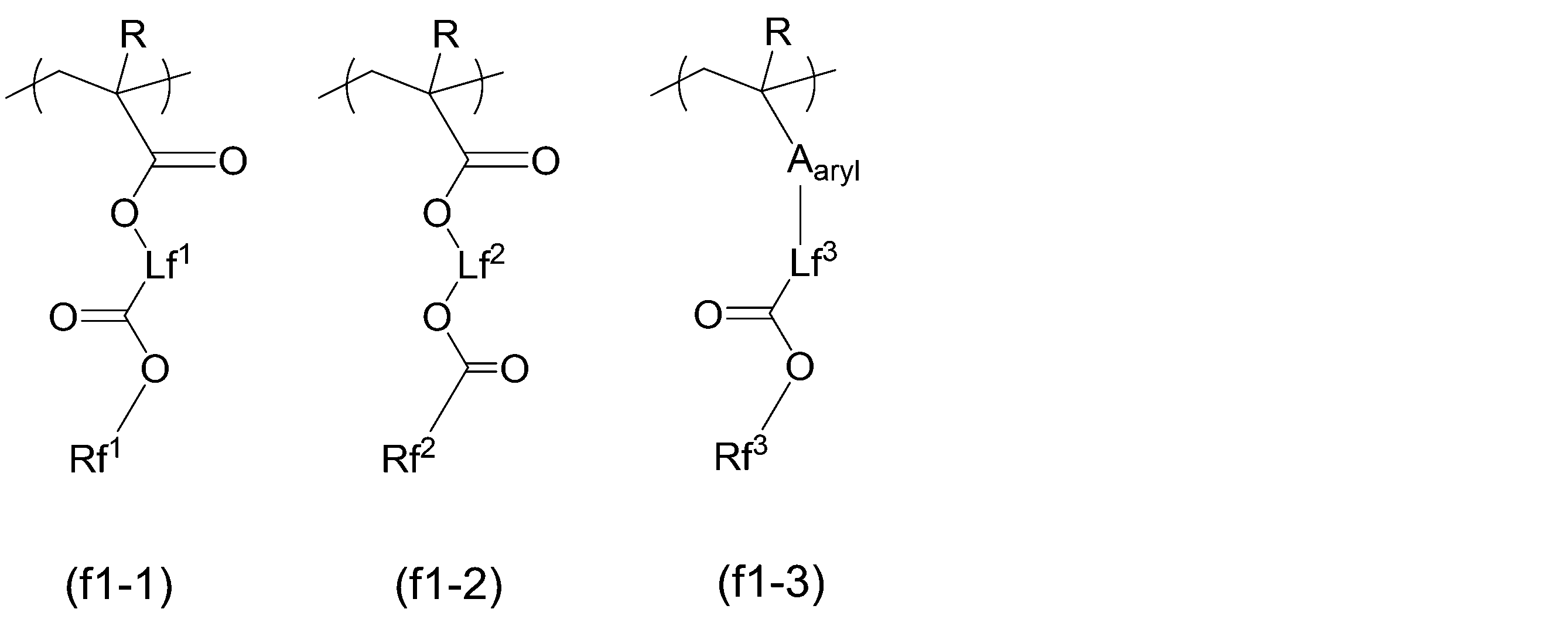
本発明の第2の態様は、支持体上に、前記第1の態様に係るレジスト組成物を用いてレジスト膜を形成する工程、前記レジスト膜を露光する工程、及び前記露光後のレジスト膜を現像してレジストパターンを形成する工程を有するレジストパターン形成方法である。
本発明によれば、高感度化が図れ、かつ、リソグラフィー特性が良好で、ディフェクトが低減されたレジストパターンを形成できるレジスト組成物、及び当該レジスト組成物を用いたレジストパターン形成方法を提供することができる。
本明細書及び本特許請求の範囲において、「脂肪族」とは、芳香族に対する相対的な概念であって、芳香族性を持たない基、化合物等を意味するものと定義する。
「アルキル基」は、特に断りがない限り、直鎖状、分岐鎖状及び環状の1価の飽和炭化水素基を包含するものとする。アルコキシ基中のアルキル基も同様である。
「アルキレン基」は、特に断りがない限り、直鎖状、分岐鎖状及び環状の2価の飽和炭化水素基を包含するものとする。
「ハロゲン原子」は、フッ素原子、塩素原子、臭素原子、ヨウ素原子が挙げられる。
「構成単位」とは、高分子化合物(樹脂、重合体、共重合体)を構成するモノマー単位(単量体単位)を意味する。
「置換基を有してもよい」と記載する場合、水素原子(-H)を1価の基で置換する場合と、メチレン基(-CH2-)を2価の基で置換する場合との両方を含む。
「露光」は、放射線の照射全般を含む概念とする。
「アルキル基」は、特に断りがない限り、直鎖状、分岐鎖状及び環状の1価の飽和炭化水素基を包含するものとする。アルコキシ基中のアルキル基も同様である。
「アルキレン基」は、特に断りがない限り、直鎖状、分岐鎖状及び環状の2価の飽和炭化水素基を包含するものとする。
「ハロゲン原子」は、フッ素原子、塩素原子、臭素原子、ヨウ素原子が挙げられる。
「構成単位」とは、高分子化合物(樹脂、重合体、共重合体)を構成するモノマー単位(単量体単位)を意味する。
「置換基を有してもよい」と記載する場合、水素原子(-H)を1価の基で置換する場合と、メチレン基(-CH2-)を2価の基で置換する場合との両方を含む。
「露光」は、放射線の照射全般を含む概念とする。
「酸分解性基」は、酸の作用により、当該酸分解性基の構造中の少なくとも一部の結合が開裂し得る酸分解性を有する基である。
酸の作用により極性が増大する酸分解性基としては、例えば、酸の作用により分解して極性基を生じる基が挙げられる。
極性基としては、例えばカルボキシ基、水酸基、アミノ基、スルホ基(-SO3H)等が挙げられる。
酸分解性基としてより具体的には、前記極性基が酸解離性基で保護された基(例えばOH含有極性基の水素原子を、酸解離性基で保護した基)が挙げられる。
酸の作用により極性が増大する酸分解性基としては、例えば、酸の作用により分解して極性基を生じる基が挙げられる。
極性基としては、例えばカルボキシ基、水酸基、アミノ基、スルホ基(-SO3H)等が挙げられる。
酸分解性基としてより具体的には、前記極性基が酸解離性基で保護された基(例えばOH含有極性基の水素原子を、酸解離性基で保護した基)が挙げられる。
「酸解離性基」とは、(i)酸の作用により、当該酸解離性基と該酸解離性基に隣接する原子との間の結合が開裂し得る酸解離性を有する基、又は、(ii)酸の作用により一部の結合が開裂した後、さらに脱炭酸反応が生じることにより、当該酸解離性基と該酸解離性基に隣接する原子との間の結合が開裂し得る基、の双方をいう。
酸分解性基を構成する酸解離性基は、当該酸解離性基の解離により生成する極性基よりも極性の低い基であることが必要で、これにより、酸の作用により該酸解離性基が解離した際に、該酸解離性基よりも極性の高い極性基が生じて極性が増大する。その結果、(A1)成分全体の極性が増大する。極性が増大することにより、相対的に、現像液に対する溶解性が変化し、現像液がアルカリ現像液の場合には溶解性が増大し、現像液が有機系現像液の場合には溶解性が減少する。
酸分解性基を構成する酸解離性基は、当該酸解離性基の解離により生成する極性基よりも極性の低い基であることが必要で、これにより、酸の作用により該酸解離性基が解離した際に、該酸解離性基よりも極性の高い極性基が生じて極性が増大する。その結果、(A1)成分全体の極性が増大する。極性が増大することにより、相対的に、現像液に対する溶解性が変化し、現像液がアルカリ現像液の場合には溶解性が増大し、現像液が有機系現像液の場合には溶解性が減少する。
「基材成分」とは、膜形成能を有する有機化合物である。基材成分として用いられる有機化合物は、非重合体と重合体とに大別される。非重合体としては、通常、分子量が500以上4000未満のものが用いられる(以下「低分子化合物」という)。以下「樹脂」、「高分子化合物」又は「ポリマー」という場合は、分子量が1000以上の重合体を示す。重合体の分子量としては、GPC(ゲルパーミエーションクロマトグラフィー)によるポリスチレン換算の重量平均分子量を用いるものとする。
「誘導される構成単位」とは、炭素原子間の多重結合、例えば、エチレン性二重結合が開裂して構成される構成単位を意味する。
「アクリル酸エステル」は、α位の炭素原子に結合した水素原子が置換基で置換されていてもよい。該α位の炭素原子に結合した水素原子を置換する置換基(Rαx)は、水素原子以外の原子又は基である。また、置換基(Rαx)がエステル結合を含む置換基で置換されたイタコン酸ジエステルや、置換基(Rαx)がヒドロキシアルキル基やその水酸基を修飾した基で置換されたαヒドロキシアクリルエステルも含むものとする。なお、アクリル酸エステルのα位の炭素原子とは、特に断りがない限り、アクリル酸のカルボニル基が結合している炭素原子のことである。
以下、α位の炭素原子に結合した水素原子が置換基で置換されたアクリル酸エステルを、α置換アクリル酸エステルということがある。
「アクリル酸エステル」は、α位の炭素原子に結合した水素原子が置換基で置換されていてもよい。該α位の炭素原子に結合した水素原子を置換する置換基(Rαx)は、水素原子以外の原子又は基である。また、置換基(Rαx)がエステル結合を含む置換基で置換されたイタコン酸ジエステルや、置換基(Rαx)がヒドロキシアルキル基やその水酸基を修飾した基で置換されたαヒドロキシアクリルエステルも含むものとする。なお、アクリル酸エステルのα位の炭素原子とは、特に断りがない限り、アクリル酸のカルボニル基が結合している炭素原子のことである。
以下、α位の炭素原子に結合した水素原子が置換基で置換されたアクリル酸エステルを、α置換アクリル酸エステルということがある。
「誘導体」とは、対象化合物のα位の水素原子がアルキル基、ハロゲン化アルキル基等の他の置換基に置換されたもの、並びにそれらの誘導体を含む概念とする。それらの誘導体としては、α位の水素原子が置換基に置換されていてもよい対象化合物の水酸基の水素原子を有機基で置換したもの;α位の水素原子が置換基に置換されていてもよい対象化合物に、水酸基以外の置換基が結合したもの等が挙げられる。なお、α位とは、特に断りがない限り、官能基と隣接した1番目の炭素原子のことをいう。
ヒドロキシスチレンのα位の水素原子を置換する置換基としては、Rαxと同様のものが挙げられる。
ヒドロキシスチレンのα位の水素原子を置換する置換基としては、Rαxと同様のものが挙げられる。
本明細書及び本特許請求の範囲において、化学式で表される構造によっては、不斉炭素が存在し、エナンチオ異性体(enantiomer)やジアステレオ異性体(diastereomer)が存在し得るものがある。その場合は一つの化学式でそれら異性体を代表して表す。それらの異性体は単独で用いてもよいし、混合物として用いてもよい。
「ディフェクト」とは、例えば、コンタクトホールパターン(CHパターン)の形成において、ホールの開口不足によりターゲットサイズのホール直径より小さくなる欠陥や、ホールの開口過剰によりターゲットサイズのホール直径より大きくなる欠陥等をいう。
(レジスト組成物)
本実施形態のレジスト組成物は、露光により酸を発生し、かつ、酸の作用により現像液に対する溶解性が変化するものである。
かかるレジスト組成物は、酸の作用により現像液に対する溶解性が変化する基材成分(A)(以下「(A)成分」ともいう)と、塩基解離性基を含む構成単位(f1)を有するフッ素樹脂成分(F1)(以下「(F1)成分ともいう」)とを含有する。
また、本実施形態のレジスト組成物は、上述した(A)成分、及び(F1)成分に加え、その他成分をさらに含有してもよい。その他成分としては、例えば以下に示す(B)成分、(D)成分、(E)成分、(F)成分、(S)成分などが挙げられる。
本実施形態のレジスト組成物は、露光により酸を発生し、かつ、酸の作用により現像液に対する溶解性が変化するものである。
かかるレジスト組成物は、酸の作用により現像液に対する溶解性が変化する基材成分(A)(以下「(A)成分」ともいう)と、塩基解離性基を含む構成単位(f1)を有するフッ素樹脂成分(F1)(以下「(F1)成分ともいう」)とを含有する。
また、本実施形態のレジスト組成物は、上述した(A)成分、及び(F1)成分に加え、その他成分をさらに含有してもよい。その他成分としては、例えば以下に示す(B)成分、(D)成分、(E)成分、(F)成分、(S)成分などが挙げられる。
本実施形態のレジスト組成物は、具体的には、(1)露光により酸を発生する酸発生剤成分(B)(以下「(B)成分」という)をさらに含有するものであってもよく;(2)(A)成分が露光により酸を発生する成分であってもよく;(3)(A)成分が露光により酸を発生する成分であり、かつ、さらに(B)成分を含有するものであってもよい。
すなわち、上記(2)及び(3)の場合、(A)成分は、「露光により酸を発生し、かつ、酸の作用により現像液に対する溶解性が変化する基材成分」となる。(A)成分が露光により酸を発生し、かつ、酸の作用により現像液に対する溶解性が変化する基材成分である場合、後述する(A1)成分が、露光により酸を発生し、かつ、酸の作用により現像液に対する溶解性が変化する樹脂であることが好ましい。このような樹脂としては、露光により酸を発生する構成単位を有する高分子化合物を用いることができる。露光により酸を発生する構成単位としては、後述の構成単位(a5)等を用いることができる。
すなわち、上記(2)及び(3)の場合、(A)成分は、「露光により酸を発生し、かつ、酸の作用により現像液に対する溶解性が変化する基材成分」となる。(A)成分が露光により酸を発生し、かつ、酸の作用により現像液に対する溶解性が変化する基材成分である場合、後述する(A1)成分が、露光により酸を発生し、かつ、酸の作用により現像液に対する溶解性が変化する樹脂であることが好ましい。このような樹脂としては、露光により酸を発生する構成単位を有する高分子化合物を用いることができる。露光により酸を発生する構成単位としては、後述の構成単位(a5)等を用いることができる。
本実施形態のレジスト組成物を用いてレジスト膜を形成し、該レジスト膜に対して選択的露光を行うと、該レジスト膜の露光部では、例えば、(A)成分及び/又は(B)成分から酸が発生し、該酸の作用により(A)成分の現像液に対する溶解性が変化する一方で、該レジスト膜の未露光部では(A)成分の現像液に対する溶解性が変化しないため、露光部と未露光部との間で現像液に対する溶解性の差が生じる。そのため、該レジスト膜を現像すると、該レジスト組成物がポジ型の場合はレジスト膜露光部が溶解除去されてポジ型のレジストパターンが形成され、該レジスト組成物がネガ型の場合はレジスト膜未露光部が溶解除去されてネガ型のレジストパターンが形成される。
本実施形態のレジスト組成物は、ポジ型レジスト組成物であってもよく、ネガ型レジスト組成物であってもよい。また、本実施形態のレジスト組成物は、レジストパターン形成時の現像処理にアルカリ現像液を用いるアルカリ現像プロセス用であってもよく、該現像処理に有機溶剤を含む現像液(有機系現像液)を用いる溶剤現像プロセス用であってもよい。
<基材成分(A)>
本実施形態のレジスト組成物において、(A)成分は、酸の作用により現像液に対する溶解性が変化する樹脂成分(A1)(以下「(A1)成分」ともいう)を含む。
(A1)成分を用いることにより、露光前後で基材成分の極性が変化するため、アルカリ現像プロセスだけでなく、溶剤現像プロセスにおいても、良好な現像コントラストを得ることができる。
(A)成分としては、該(A1)成分とともに他の高分子化合物及び/又は低分子化合物を併用してもよい。
本実施形態のレジスト組成物において、(A)成分は、酸の作用により現像液に対する溶解性が変化する樹脂成分(A1)(以下「(A1)成分」ともいう)を含む。
(A1)成分を用いることにより、露光前後で基材成分の極性が変化するため、アルカリ現像プロセスだけでなく、溶剤現像プロセスにおいても、良好な現像コントラストを得ることができる。
(A)成分としては、該(A1)成分とともに他の高分子化合物及び/又は低分子化合物を併用してもよい。
本実施形態のレジスト組成物において、(A)成分は、1種を単独で用いてもよく、2種以上を併用してもよい。
・(A1)成分について
(A1)成分は、酸の作用により現像液に対する溶解性が変化する樹脂成分である。
(A1)成分は、後述する一般式(a0-1)で表される化合物から誘導される構成単位(a0)を有する。
(A1)成分は、酸の作用により現像液に対する溶解性が変化する樹脂成分である。
(A1)成分は、後述する一般式(a0-1)で表される化合物から誘導される構成単位(a0)を有する。
≪構成単位(a0)≫
構成単位(a0)は、下記一般式(a0-1)で表される化合物から誘導される構成単位である。
構成単位(a0)は、下記一般式(a0-1)で表される化合物から誘導される構成単位である。

前記一般式(a0-1)中、W01は、重合性基含有基を表す。「重合性基」とは、重合性基を有する化合物がラジカル重合等により重合することを可能とする基であり、例えばエチレン性二重結合などの炭素原子間の多重結合を含む基をいう。
重合性基としては、例えば、ビニル基、アリル基、アクリロイル基、メタクリロイル基、フルオロビニル基、ジフルオロビニル基、トリフルオロビニル基、ジフルオロトリフルオロメチルビニル基、トリフルオロアリル基、パーフルオロアリル基、トリフルオロメチルアクリロイル基、ノニルフルオロブチルアクリロイル基、ビニルエーテル基、含フッ素ビニルエーテル基、アリルエーテル基、含フッ素アリルエーテル基、スチリル基、ビニルナフチル基、含フッ素スチリル基、含フッ素ビニルナフチル基、ノルボルニル基、含フッ素ノルボルニル基、シリル基等が挙げられる。
重合性基としては、例えば、ビニル基、アリル基、アクリロイル基、メタクリロイル基、フルオロビニル基、ジフルオロビニル基、トリフルオロビニル基、ジフルオロトリフルオロメチルビニル基、トリフルオロアリル基、パーフルオロアリル基、トリフルオロメチルアクリロイル基、ノニルフルオロブチルアクリロイル基、ビニルエーテル基、含フッ素ビニルエーテル基、アリルエーテル基、含フッ素アリルエーテル基、スチリル基、ビニルナフチル基、含フッ素スチリル基、含フッ素ビニルナフチル基、ノルボルニル基、含フッ素ノルボルニル基、シリル基等が挙げられる。
重合性基含有基は、重合性基のみから構成される基でもよく、重合性基と該重合性基以外の他の基とから構成される基でもよい。重合性基以外の他の基としては、置換基を有してもよい2価の炭化水素基、ヘテロ原子を含む2価の連結基等が挙げられる。
重合性基含有基としては、例えば、式:C(RX11)(RX12)=C(RX13)-Yax0-で表される基が好適に挙げられる。前記式中、RX11、RX12及びRX13は、それぞれ独立に、水素原子、炭素原子数1~5のアルキル基又は炭素原子数1~5のハロゲン化アルキル基を表し、Yax0は、単結合または2価の連結基を表す。Yax0における2価の連結基としては、置換基を有してもよい2価の炭化水素基、ヘテロ原子を含む2価の連結基等が挙げられる。Yax0における2価の連結基としては、エステル結合(-C(=O)-O-)、オキシカルボニル基(-O-C(=O)-)、エーテル結合(-O-)、直鎖状若しくは分岐鎖状のアルキレン基、又はこれらの組合せが挙げられる。Yax0は、単結合、エステル結合(-C(=O)-O-)、オキシカルボニル基(-O-C(=O)-)が好ましい。
重合性基含有基としては、例えば、式:C(RX11)(RX12)=C(RX13)-Yax0-で表される基が好適に挙げられる。前記式中、RX11、RX12及びRX13は、それぞれ独立に、水素原子、炭素原子数1~5のアルキル基又は炭素原子数1~5のハロゲン化アルキル基を表し、Yax0は、単結合または2価の連結基を表す。Yax0における2価の連結基としては、置換基を有してもよい2価の炭化水素基、ヘテロ原子を含む2価の連結基等が挙げられる。Yax0における2価の連結基としては、エステル結合(-C(=O)-O-)、オキシカルボニル基(-O-C(=O)-)、エーテル結合(-O-)、直鎖状若しくは分岐鎖状のアルキレン基、又はこれらの組合せが挙げられる。Yax0は、単結合、エステル結合(-C(=O)-O-)、オキシカルボニル基(-O-C(=O)-)が好ましい。
前記一般式(a0-1)中、La01における2価の連結基としては、特に限定されないが、置換基を有してもよい2価の炭化水素基、及びヘテロ原子を含む2価の連結基が挙げられる。
・置換基を有してもよい2価の炭化水素基:
置換基を有してもよい2価の炭化水素基は、脂肪族炭化水素基であってもよく、芳香族炭化水素基であってもよい。
置換基を有してもよい2価の炭化水素基は、脂肪族炭化水素基であってもよく、芳香族炭化水素基であってもよい。
・・脂肪族炭化水素基
脂肪族炭化水素基は、芳香族性を持たない炭化水素基を意味する。該脂肪族炭化水素基は、飽和であってもよく、不飽和であってもよく、通常は飽和であることが好ましい。
前記脂肪族炭化水素基としては、直鎖状若しくは分岐鎖状の脂肪族炭化水素基、又は構造中に環を含む脂肪族炭化水素基等が挙げられる。
脂肪族炭化水素基は、芳香族性を持たない炭化水素基を意味する。該脂肪族炭化水素基は、飽和であってもよく、不飽和であってもよく、通常は飽和であることが好ましい。
前記脂肪族炭化水素基としては、直鎖状若しくは分岐鎖状の脂肪族炭化水素基、又は構造中に環を含む脂肪族炭化水素基等が挙げられる。
・・・直鎖状若しくは分岐鎖状の脂肪族炭化水素基
該直鎖状の脂肪族炭化水素基は、炭素原子数1~10が好ましく、炭素原子数1~6がより好ましく、炭素原子数1~4がさらに好ましく、炭素原子数1~3が最も好ましい。
直鎖状の脂肪族炭化水素基としては、直鎖状のアルキレン基が好ましく、具体的には、メチレン基[-CH2-]、エチレン基[-(CH2)2-]、トリメチレン基[-(CH2)3-]、テトラメチレン基[-(CH2)4-]、ペンタメチレン基[-(CH2)5-]等が挙げられる。
該分岐鎖状の脂肪族炭化水素基は、炭素原子数2~10が好ましく、炭素原子数3~6がより好ましく、炭素原子数3又は4がさらに好ましく、炭素原子数3が最も好ましい。
分岐鎖状の脂肪族炭化水素基としては、分岐鎖状のアルキレン基が好ましく、具体的には、-CH(CH3)-、-CH(CH2CH3)-、-C(CH3)2-、-C(CH3)(CH2CH3)-、-C(CH3)(CH2CH2CH3)-、-C(CH2CH3)2-等のアルキルメチレン基;-CH(CH3)CH2-、-CH(CH3)CH(CH3)-、-C(CH3)2CH2-、-CH(CH2CH3)CH2-、-C(CH2CH3)2-CH2-等のアルキルエチレン基;-CH(CH3)CH2CH2-、-CH2CH(CH3)CH2-等のアルキルトリメチレン基;-CH(CH3)CH2CH2CH2-、-CH2CH(CH3)CH2CH2-等のアルキルテトラメチレン基などのアルキルアルキレン基等が挙げられる。アルキルアルキレン基におけるアルキル基としては、炭素原子数1~5の直鎖状のアルキル基が好ましい。
該直鎖状の脂肪族炭化水素基は、炭素原子数1~10が好ましく、炭素原子数1~6がより好ましく、炭素原子数1~4がさらに好ましく、炭素原子数1~3が最も好ましい。
直鎖状の脂肪族炭化水素基としては、直鎖状のアルキレン基が好ましく、具体的には、メチレン基[-CH2-]、エチレン基[-(CH2)2-]、トリメチレン基[-(CH2)3-]、テトラメチレン基[-(CH2)4-]、ペンタメチレン基[-(CH2)5-]等が挙げられる。
該分岐鎖状の脂肪族炭化水素基は、炭素原子数2~10が好ましく、炭素原子数3~6がより好ましく、炭素原子数3又は4がさらに好ましく、炭素原子数3が最も好ましい。
分岐鎖状の脂肪族炭化水素基としては、分岐鎖状のアルキレン基が好ましく、具体的には、-CH(CH3)-、-CH(CH2CH3)-、-C(CH3)2-、-C(CH3)(CH2CH3)-、-C(CH3)(CH2CH2CH3)-、-C(CH2CH3)2-等のアルキルメチレン基;-CH(CH3)CH2-、-CH(CH3)CH(CH3)-、-C(CH3)2CH2-、-CH(CH2CH3)CH2-、-C(CH2CH3)2-CH2-等のアルキルエチレン基;-CH(CH3)CH2CH2-、-CH2CH(CH3)CH2-等のアルキルトリメチレン基;-CH(CH3)CH2CH2CH2-、-CH2CH(CH3)CH2CH2-等のアルキルテトラメチレン基などのアルキルアルキレン基等が挙げられる。アルキルアルキレン基におけるアルキル基としては、炭素原子数1~5の直鎖状のアルキル基が好ましい。
前記直鎖状または分岐鎖状の脂肪族炭化水素基は、置換基を有してもよく、有していなくてもよい。該置換基としては、フッ素原子、フッ素原子で置換された炭素原子数1~5のフッ素化アルキル基、カルボニル基等が挙げられる。
・・・構造中に環を含む脂肪族炭化水素基
該構造中に環を含む脂肪族炭化水素基としては、環構造中にヘテロ原子を含む置換基を含んでもよい環状の脂肪族炭化水素基(脂肪族炭化水素環から水素原子を2個除いた基)、前記環状の脂肪族炭化水素基が直鎖状または分岐鎖状の脂肪族炭化水素基の末端に結合した基、前記環状の脂肪族炭化水素基が直鎖状または分岐鎖状の脂肪族炭化水素基の途中に介在する基などが挙げられる。前記直鎖状または分岐鎖状の脂肪族炭化水素基としては前記と同様のものが挙げられる。
環状の脂肪族炭化水素基は、炭素原子数3~20が好ましく、炭素原子数3~12がより好ましい。
環状の脂肪族炭化水素基は、多環式基であってもよく、単環式基であってもよい。単環式の脂環式炭化水素基としては、モノシクロアルカンから2個の水素原子を除いた基が好ましい。該モノシクロアルカンとしては、炭素原子数3~6のものが好ましく、具体的にはシクロペンタン、シクロヘキサン等が挙げられる。多環式の脂環式炭化水素基としては、ポリシクロアルカンから2個の水素原子を除いた基が好ましく、該ポリシクロアルカンとしては、炭素原子数7~12のものが好ましく、具体的にはアダマンタン、ノルボルナン、イソボルナン、トリシクロデカン、テトラシクロドデカン等が挙げられる。
該構造中に環を含む脂肪族炭化水素基としては、環構造中にヘテロ原子を含む置換基を含んでもよい環状の脂肪族炭化水素基(脂肪族炭化水素環から水素原子を2個除いた基)、前記環状の脂肪族炭化水素基が直鎖状または分岐鎖状の脂肪族炭化水素基の末端に結合した基、前記環状の脂肪族炭化水素基が直鎖状または分岐鎖状の脂肪族炭化水素基の途中に介在する基などが挙げられる。前記直鎖状または分岐鎖状の脂肪族炭化水素基としては前記と同様のものが挙げられる。
環状の脂肪族炭化水素基は、炭素原子数3~20が好ましく、炭素原子数3~12がより好ましい。
環状の脂肪族炭化水素基は、多環式基であってもよく、単環式基であってもよい。単環式の脂環式炭化水素基としては、モノシクロアルカンから2個の水素原子を除いた基が好ましい。該モノシクロアルカンとしては、炭素原子数3~6のものが好ましく、具体的にはシクロペンタン、シクロヘキサン等が挙げられる。多環式の脂環式炭化水素基としては、ポリシクロアルカンから2個の水素原子を除いた基が好ましく、該ポリシクロアルカンとしては、炭素原子数7~12のものが好ましく、具体的にはアダマンタン、ノルボルナン、イソボルナン、トリシクロデカン、テトラシクロドデカン等が挙げられる。
環状の脂肪族炭化水素基は、置換基を有してもよいし、有していなくてもよい。該置換基としては、アルキル基、アルコキシ基、ハロゲン原子、ハロゲン化アルキル基、水酸基、カルボニル基等が挙げられる。
前記置換基としてのアルキル基としては、炭素原子数1~5のアルキル基が好ましく、メチル基、エチル基、プロピル基、n-ブチル基、tert-ブチル基であることがより好ましい。
前記置換基としてのアルコキシ基としては、炭素原子数1~5のアルコキシ基が好ましく、メトキシ基、エトキシ基、n-プロポキシ基、iso-プロポキシ基、n-ブトキシ基、tert-ブトキシ基がより好ましく、メトキシ基、エトキシ基がさらに好ましい。
前記置換基としてのハロゲン原子としては、フッ素原子が好ましい。
前記置換基としてのハロゲン化アルキル基としては、前記アルキル基の水素原子の一部または全部が前記ハロゲン原子で置換された基が挙げられる。
環状の脂肪族炭化水素基は、その環構造を構成する炭素原子の一部がヘテロ原子を含む置換基で置換されてもよい。該ヘテロ原子を含む置換基としては、-O-、-C(=O)-O-、-S-、-S(=O)2-、-S(=O)2-O-が好ましい。
前記置換基としてのアルキル基としては、炭素原子数1~5のアルキル基が好ましく、メチル基、エチル基、プロピル基、n-ブチル基、tert-ブチル基であることがより好ましい。
前記置換基としてのアルコキシ基としては、炭素原子数1~5のアルコキシ基が好ましく、メトキシ基、エトキシ基、n-プロポキシ基、iso-プロポキシ基、n-ブトキシ基、tert-ブトキシ基がより好ましく、メトキシ基、エトキシ基がさらに好ましい。
前記置換基としてのハロゲン原子としては、フッ素原子が好ましい。
前記置換基としてのハロゲン化アルキル基としては、前記アルキル基の水素原子の一部または全部が前記ハロゲン原子で置換された基が挙げられる。
環状の脂肪族炭化水素基は、その環構造を構成する炭素原子の一部がヘテロ原子を含む置換基で置換されてもよい。該ヘテロ原子を含む置換基としては、-O-、-C(=O)-O-、-S-、-S(=O)2-、-S(=O)2-O-が好ましい。
・・芳香族炭化水素基
該芳香族炭化水素基は、芳香環を少なくとも1つ有する炭化水素基である。
この芳香環は、4n+2個のπ電子をもつ環状共役系であれば特に限定されず、単環式でもよいし、多環式でもよい。芳香環の炭素原子数は5~30であることが好ましく、炭素原子数5~20がより好ましく、炭素原子数6~15がさらに好ましく、炭素原子数6~12が特に好ましい。ただし、該炭素原子数には、置換基における炭素原子数を含まないものとする。
芳香環として具体的には、ベンゼン、ナフタレン、アントラセン、フェナントレン等の芳香族炭化水素環;前記芳香族炭化水素環を構成する炭素原子の一部がヘテロ原子で置換された芳香族複素環等が挙げられる。芳香族複素環におけるヘテロ原子としては、酸素原子、硫黄原子、窒素原子等が挙げられる。芳香族複素環として具体的には、ピリジン環、チオフェン環等が挙げられる。
芳香族炭化水素基として具体的には、前記芳香族炭化水素環または芳香族複素環から水素原子を2つ除いた基(アリーレン基またはヘテロアリーレン基);2以上の芳香環を含む芳香族化合物(例えばビフェニル、フルオレン等)から水素原子を2つ除いた基;前記芳香族炭化水素環または芳香族複素環から水素原子を1つ除いた基(アリール基またはヘテロアリール基)の水素原子の1つがアルキレン基で置換された基(例えば、ベンジル基、フェネチル基、1-ナフチルメチル基、2-ナフチルメチル基、1-ナフチルエチル基、2-ナフチルエチル基等のアリールアルキル基におけるアリール基から水素原子をさらに1つ除いた基)等が挙げられる。前記アリール基またはヘテロアリール基に結合するアルキレン基の炭素原子数は、1~4であることが好ましく、炭素原子数1~2であることがより好ましく、炭素原子数1であることが特に好ましい。
該芳香族炭化水素基は、芳香環を少なくとも1つ有する炭化水素基である。
この芳香環は、4n+2個のπ電子をもつ環状共役系であれば特に限定されず、単環式でもよいし、多環式でもよい。芳香環の炭素原子数は5~30であることが好ましく、炭素原子数5~20がより好ましく、炭素原子数6~15がさらに好ましく、炭素原子数6~12が特に好ましい。ただし、該炭素原子数には、置換基における炭素原子数を含まないものとする。
芳香環として具体的には、ベンゼン、ナフタレン、アントラセン、フェナントレン等の芳香族炭化水素環;前記芳香族炭化水素環を構成する炭素原子の一部がヘテロ原子で置換された芳香族複素環等が挙げられる。芳香族複素環におけるヘテロ原子としては、酸素原子、硫黄原子、窒素原子等が挙げられる。芳香族複素環として具体的には、ピリジン環、チオフェン環等が挙げられる。
芳香族炭化水素基として具体的には、前記芳香族炭化水素環または芳香族複素環から水素原子を2つ除いた基(アリーレン基またはヘテロアリーレン基);2以上の芳香環を含む芳香族化合物(例えばビフェニル、フルオレン等)から水素原子を2つ除いた基;前記芳香族炭化水素環または芳香族複素環から水素原子を1つ除いた基(アリール基またはヘテロアリール基)の水素原子の1つがアルキレン基で置換された基(例えば、ベンジル基、フェネチル基、1-ナフチルメチル基、2-ナフチルメチル基、1-ナフチルエチル基、2-ナフチルエチル基等のアリールアルキル基におけるアリール基から水素原子をさらに1つ除いた基)等が挙げられる。前記アリール基またはヘテロアリール基に結合するアルキレン基の炭素原子数は、1~4であることが好ましく、炭素原子数1~2であることがより好ましく、炭素原子数1であることが特に好ましい。
前記芳香族炭化水素基は、当該芳香族炭化水素基が有する水素原子が置換基で置換されていてもよい。例えば当該芳香族炭化水素基中の芳香環に結合した水素原子が置換基で置換されていてもよい。該置換基としては、例えば、アルキル基、アルコキシ基、ハロゲン原子、ハロゲン化アルキル基、水酸基等が挙げられる。
前記置換基としてのアルキル基としては、炭素原子数1~5のアルキル基が好ましく、メチル基、エチル基、プロピル基、n-ブチル基、tert-ブチル基であることがより好ましい。
前記置換基としてのアルコキシ基、ハロゲン原子およびハロゲン化アルキル基としては、前記環状の脂肪族炭化水素基が有する水素原子を置換する置換基として例示したものが挙げられる。
前記置換基としてのアルキル基としては、炭素原子数1~5のアルキル基が好ましく、メチル基、エチル基、プロピル基、n-ブチル基、tert-ブチル基であることがより好ましい。
前記置換基としてのアルコキシ基、ハロゲン原子およびハロゲン化アルキル基としては、前記環状の脂肪族炭化水素基が有する水素原子を置換する置換基として例示したものが挙げられる。
・ヘテロ原子を含む2価の連結基:
ヘテロ原子を含む2価の連結基としては、-O-、-C(=O)-O-、-O-C(=O)-、-C(=O)-、-O-C(=O)-O-、-C(=O)-NH-、-NH-、-NH-C(=NH)-(Hはアルキル基、アシル基等の置換基で置換されていてもよい。)、-S-、-S(=O)2-、-S(=O)2-O-、一般式-Y21-O-Y22-、-Y21-O-、-Y21-C(=O)-O-、-C(=O)-O-Y21-、-[Y21-C(=O)-O]m”-Y22-、-Y21-O-C(=O)-Y22-または-Y21-S(=O)2-O-Y22-で表される基[式中、Y21およびY22はそれぞれ独立して置換基を有してもよい2価の炭化水素基であり、Oは酸素原子であり、m”は1~3の整数である。]等が挙げられる。
前記ヘテロ原子を含む2価の連結基が-C(=O)-NH-、-C(=O)-NH-C(=O)-、-NH-、-NH-C(=NH)-の場合、そのHはアルキル基、アシル基等の置換基で置換されていてもよい。該置換基(アルキル基、アシル基等)は、炭素原子数が1~10であることが好ましく、1~8であることがさらに好ましく、1~5であることが特に好ましい。
一般式-Y21-O-Y22-、-Y21-O-、-Y21-C(=O)-O-、-C(=O)-O-Y21-、-[Y21-C(=O)-O]m”-Y22-、-Y21-O-C(=O)-Y22-または-Y21-S(=O)2-O-Y22-中、Y21およびY22は、それぞれ独立して、置換基を有してもよい2価の炭化水素基である。該2価の炭化水素基としては、前記と同様のものが挙げられる。
Y21としては、直鎖状の脂肪族炭化水素基が好ましく、直鎖状のアルキレン基がより好ましく、炭素原子数1~5の直鎖状のアルキレン基がさらに好ましく、メチレン基またはエチレン基が特に好ましい。
Y22としては、直鎖状または分岐鎖状の脂肪族炭化水素基が好ましく、メチレン基、エチレン基またはアルキルメチレン基がより好ましい。該アルキルメチレン基におけるアルキル基は、炭素原子数1~5の直鎖状のアルキル基が好ましく、炭素原子数1~3の直鎖状のアルキル基がより好ましく、メチル基が最も好ましい。
式-[Y21-C(=O)-O]m”-Y22-で表される基において、m”は1~3の整数であり、1又は2であることが好ましく、1がより好ましい。つまり、式-[Y21-C(=O)-O]m”-Y22-で表される基としては、式-Y21-C(=O)-O-Y22-で表される基が特に好ましい。なかでも、式-(CH2)a’-C(=O)-O-(CH2)b’-で表される基が好ましい。該式中、a’は、1~10の整数であり、1~8の整数が好ましく、1~5の整数がより好ましく、1または2がさらに好ましく、1が最も好ましい。b’は、1~10の整数であり、1~8の整数が好ましく、1~5の整数がより好ましく、1または2がさらに好ましく、1が最も好ましい。
ヘテロ原子を含む2価の連結基としては、-O-、-C(=O)-O-、-O-C(=O)-、-C(=O)-、-O-C(=O)-O-、-C(=O)-NH-、-NH-、-NH-C(=NH)-(Hはアルキル基、アシル基等の置換基で置換されていてもよい。)、-S-、-S(=O)2-、-S(=O)2-O-、一般式-Y21-O-Y22-、-Y21-O-、-Y21-C(=O)-O-、-C(=O)-O-Y21-、-[Y21-C(=O)-O]m”-Y22-、-Y21-O-C(=O)-Y22-または-Y21-S(=O)2-O-Y22-で表される基[式中、Y21およびY22はそれぞれ独立して置換基を有してもよい2価の炭化水素基であり、Oは酸素原子であり、m”は1~3の整数である。]等が挙げられる。
前記ヘテロ原子を含む2価の連結基が-C(=O)-NH-、-C(=O)-NH-C(=O)-、-NH-、-NH-C(=NH)-の場合、そのHはアルキル基、アシル基等の置換基で置換されていてもよい。該置換基(アルキル基、アシル基等)は、炭素原子数が1~10であることが好ましく、1~8であることがさらに好ましく、1~5であることが特に好ましい。
一般式-Y21-O-Y22-、-Y21-O-、-Y21-C(=O)-O-、-C(=O)-O-Y21-、-[Y21-C(=O)-O]m”-Y22-、-Y21-O-C(=O)-Y22-または-Y21-S(=O)2-O-Y22-中、Y21およびY22は、それぞれ独立して、置換基を有してもよい2価の炭化水素基である。該2価の炭化水素基としては、前記と同様のものが挙げられる。
Y21としては、直鎖状の脂肪族炭化水素基が好ましく、直鎖状のアルキレン基がより好ましく、炭素原子数1~5の直鎖状のアルキレン基がさらに好ましく、メチレン基またはエチレン基が特に好ましい。
Y22としては、直鎖状または分岐鎖状の脂肪族炭化水素基が好ましく、メチレン基、エチレン基またはアルキルメチレン基がより好ましい。該アルキルメチレン基におけるアルキル基は、炭素原子数1~5の直鎖状のアルキル基が好ましく、炭素原子数1~3の直鎖状のアルキル基がより好ましく、メチル基が最も好ましい。
式-[Y21-C(=O)-O]m”-Y22-で表される基において、m”は1~3の整数であり、1又は2であることが好ましく、1がより好ましい。つまり、式-[Y21-C(=O)-O]m”-Y22-で表される基としては、式-Y21-C(=O)-O-Y22-で表される基が特に好ましい。なかでも、式-(CH2)a’-C(=O)-O-(CH2)b’-で表される基が好ましい。該式中、a’は、1~10の整数であり、1~8の整数が好ましく、1~5の整数がより好ましく、1または2がさらに好ましく、1が最も好ましい。b’は、1~10の整数であり、1~8の整数が好ましく、1~5の整数がより好ましく、1または2がさらに好ましく、1が最も好ましい。
なかでも、La01は、置換基を有してもよい芳香族炭化水素基、又は置換基を有してもよい脂環式炭化水素基が好ましく、感度の向上及びラフネス低減の観点から、置換基を有してもよい芳香族炭化水素基がより好ましく、置換基を有してもよいベンゼン環から2個の炭素原子を除いた基が更に好ましい。
前記一般式(a0-1)中、La02における2価の連結基としては、置換基を有してもよい2価の炭化水素基、ヘテロ原子を含む2価の連結基が挙げられる。La02における2価の連結基としては、ヘテロ原子を含む2価の連結基が好ましい。
La02が置換基を有してもよい2価の炭化水素基である場合、該2価の炭化水素基としては、直鎖状若しくは分岐鎖状の脂肪族炭化水素基が好ましい。該直鎖状の脂肪族炭化水素基は、炭素原子数が1~10であることが好ましく、炭素原子数1~6がより好ましく、炭素原子数1~4がさらに好ましく、炭素原子数1~3が特に好ましい。分岐鎖状の脂肪族炭化水素基は、炭素原子数が2~10であることが好ましく、炭素原子数3~6がより好ましく、炭素原子数3又は4がさらに好ましく、炭素原子数3特に好ましい。直鎖状若しくは分岐鎖状の炭化水素基は、飽和でもよく、不飽和でもよいが、飽和が好ましい。
La02がヘテロ原子を含む2価の連結基である場合、該連結基として好ましいものとしては、-O-、-C(=O)-O-、-O-C(=O)-、-C(=O)-、-O-C(=O)-O-、-C(=O)-NH-、-NH-、-NH-C(=NH)-(Hはアルキル基、アシル基等の置換基で置換されていてもよい。)、-S-、-S(=O)2-、-S(=O)2-O-、一般式-Y21-O-Y22-、-Y21-O-、-Y21-C(=O)-O-、-C(=O)-O-Y21-、-[Y21-C(=O)-O]m”-Y22-、-Y21-O-C(=O)-Y22-または-Y21-S(=O)2-O-Y22-で表される基[式中、Y21およびY22はそれぞれ独立して置換基を有してもよい2価の炭化水素基であり、Oは酸素原子であり、m”は0~3の整数である。]等が挙げられる。
前記へテロ原子を含む2価の連結基が-C(=O)-NH-、-C(=O)-NH-C(=O)-、-NH-、-NH-C(=NH)-の場合、そのHはアルキル基、アシル基等の置換基で置換されていてもよい。該置換基(アルキル基、アシル基等)は、炭素原子数が1~10であることが好ましく、1~8であることがさらに好ましく、1~5であることが特に好ましい。
一般式-Y21-O-Y22-、-Y21-O-、-Y21-C(=O)-O-、-C(=O)-O-Y21-、-[Y21-C(=O)-O]m”-Y22-、-Y21-O-C(=O)-Y22-または-Y21-S(=O)2-O-Y22-中、Y21およびY22は、それぞれ独立して、置換基を有してもよい2価の炭化水素基である。該2価の炭化水素基としては、前記と同様のものが挙げられる。
Y21としては、直鎖状の脂肪族炭化水素基が好ましく、直鎖状のアルキレン基がより好ましく、炭素原子数1~5の直鎖状のアルキレン基がさらに好ましく、メチレン基またはエチレン基が特に好ましい。
Y22としては、直鎖状または分岐鎖状の脂肪族炭化水素基が好ましく、メチレン基、エチレン基またはアルキルメチレン基がより好ましい。該アルキルメチレン基におけるアルキル基は、炭素原子数1~5の直鎖状のアルキル基が好ましく、炭素原子数1~3の直鎖状のアルキル基がより好ましく、メチル基が最も好ましい。
式-[Y21-C(=O)-O]m”-Y22-で表される基において、m”は0~3の整数であり、0~2の整数であることが好ましく、0または1がより好ましく、1が特に好ましい。つまり、式-[Y21-C(=O)-O]m”-Y22-で表される基としては、式-Y21-C(=O)-O-Y22-で表される基が特に好ましい。なかでも、式-(CH2)a’-C(=O)-O-(CH2)b’-で表される基が好ましい。該式中、a’は、1~10の整数であり、1~8の整数が好ましく、1~5の整数がより好ましく、1または2がさらに好ましく、1が最も好ましい。b’は、1~10の整数であり、1~8の整数が好ましく、1~5の整数がより好ましく、1または2がさらに好ましく、1が最も好ましい。
前記へテロ原子を含む2価の連結基が-C(=O)-NH-、-C(=O)-NH-C(=O)-、-NH-、-NH-C(=NH)-の場合、そのHはアルキル基、アシル基等の置換基で置換されていてもよい。該置換基(アルキル基、アシル基等)は、炭素原子数が1~10であることが好ましく、1~8であることがさらに好ましく、1~5であることが特に好ましい。
一般式-Y21-O-Y22-、-Y21-O-、-Y21-C(=O)-O-、-C(=O)-O-Y21-、-[Y21-C(=O)-O]m”-Y22-、-Y21-O-C(=O)-Y22-または-Y21-S(=O)2-O-Y22-中、Y21およびY22は、それぞれ独立して、置換基を有してもよい2価の炭化水素基である。該2価の炭化水素基としては、前記と同様のものが挙げられる。
Y21としては、直鎖状の脂肪族炭化水素基が好ましく、直鎖状のアルキレン基がより好ましく、炭素原子数1~5の直鎖状のアルキレン基がさらに好ましく、メチレン基またはエチレン基が特に好ましい。
Y22としては、直鎖状または分岐鎖状の脂肪族炭化水素基が好ましく、メチレン基、エチレン基またはアルキルメチレン基がより好ましい。該アルキルメチレン基におけるアルキル基は、炭素原子数1~5の直鎖状のアルキル基が好ましく、炭素原子数1~3の直鎖状のアルキル基がより好ましく、メチル基が最も好ましい。
式-[Y21-C(=O)-O]m”-Y22-で表される基において、m”は0~3の整数であり、0~2の整数であることが好ましく、0または1がより好ましく、1が特に好ましい。つまり、式-[Y21-C(=O)-O]m”-Y22-で表される基としては、式-Y21-C(=O)-O-Y22-で表される基が特に好ましい。なかでも、式-(CH2)a’-C(=O)-O-(CH2)b’-で表される基が好ましい。該式中、a’は、1~10の整数であり、1~8の整数が好ましく、1~5の整数がより好ましく、1または2がさらに好ましく、1が最も好ましい。b’は、1~10の整数であり、1~8の整数が好ましく、1~5の整数がより好ましく、1または2がさらに好ましく、1が最も好ましい。
La02における2価の連結基としては、エステル結合(-C(=O)-O-)、オキシカルボニル基(-O-C(=O)-)、又はエーテル結合(-O-)が好ましい。
前記一般式(a0-1)中、Ar01は、置換基を有してもよい芳香族炭化水素基を表す。Ar01における芳香族炭化水素基としては、前記La01における芳香族炭化水素基と同様のものが挙げられる。Ar01としては、芳香族炭化水素環から水素原子を2つ除いた基が好ましい。前記芳香族炭化環としては、上記La01で挙げたものと同様のものが挙げられる。Ar01としては、置換基を有してもよいベンゼン環から2個の水素原子を除いた基が好ましい。
Ar01における芳香族炭化水素基は、置換基を有してもよく、置換基を有しなくてもよい。該置換基としては、前記La01における芳香族炭化水素基が有してもよい置換基と同様のものが挙げられる。
Ar01における芳香族炭化水素基は、感度の向上及びラフネス低減の観点から、置換基としてヨウ素原子を有することがより好ましい。前記ヨウ素原子は、芳香族炭化水素環の水素原子を置換する置換基であってもよい。置換基としてのヨウ素原子の数としては、例えば、1~4個、1~3個、2個又は1個が挙げられる。置換基としてのヨウ素原子の数が多くなるほど、高感度化が図りやすくなる。
Ar01における芳香族炭化水素基は、感度の向上及びラフネス低減の観点から、置換基としてヨウ素原子を有することがより好ましい。前記ヨウ素原子は、芳香族炭化水素環の水素原子を置換する置換基であってもよい。置換基としてのヨウ素原子の数としては、例えば、1~4個、1~3個、2個又は1個が挙げられる。置換基としてのヨウ素原子の数が多くなるほど、高感度化が図りやすくなる。
一般式(a0-1)中、Ya01は、2価の連結基又は単結合を表す。Ya01における2価の連結基としては、前記La02における2価の連結基と同様のものが挙げられる。
Ya01における2価の連結基としては、ヘテロ原子を含む2価の連結基が好適に挙げられる。ヘテロ原子を含む2価の連結基としては、上記La01におけるヘテロ原子を含む2価の連結基と同様のものが挙げられる。Ya01におけるヘテロ原子を含む2価の連結基としては、酸素原子(エーテル結合:-O-)、エステル結合(-C(=O)-O-)、オキシカルボニル基(-O-C(=O)-)、アミド結合(-C(=O)-NH-)、カルボニル基(-C(=O)-)、カーボネート結合(-O-C(=O)-O-)、2級アミノ基(-NH-)、及びスルホニル基(-SO2-)、並びこれらとアルキレン基との組合せ等が挙げられる。
Ya01における2価の連結基としては、ヘテロ原子を含む2価の連結基が好適に挙げられる。ヘテロ原子を含む2価の連結基としては、上記La01におけるヘテロ原子を含む2価の連結基と同様のものが挙げられる。Ya01におけるヘテロ原子を含む2価の連結基としては、酸素原子(エーテル結合:-O-)、エステル結合(-C(=O)-O-)、オキシカルボニル基(-O-C(=O)-)、アミド結合(-C(=O)-NH-)、カルボニル基(-C(=O)-)、カーボネート結合(-O-C(=O)-O-)、2級アミノ基(-NH-)、及びスルホニル基(-SO2-)、並びこれらとアルキレン基との組合せ等が挙げられる。
一般式(a0-1)中、Va01は、単結合、アルキレン基又はフッ素化アルキレン基を表す。
Va01におけるアルキレン基は、炭素原子数1~4が好ましく、炭素原子数1~3がより好ましく、炭素原子数1又は2がさらに好ましい。Va01におけるアルキレン基は、直鎖状でもよく、分岐鎖状でもよいが、直鎖状が好ましい。
Va01におけるフッ素化アルキレン基としては、前記アルキレン基の水素原子の一部又は全部がフッ素原子で置換された基が挙げられる。Va01におけるフッ素化アルキレン基の具体例としては、-CFH-、-CH2-CFH-、-CH(CF3)-、-CH2-CH(CF3)-が挙げられる。中でも、フッ素化アルキレン基は、-CFH-、又は-CH2-CFH-が好ましい。
Va01は、炭素原子数1~4のアルキレン基又は炭素原子数1~4のフッ素化アルキレン基が好ましく、炭素原子数1~3のアルキレン基又は炭素原子数1~3のフッ素化アルキレン基がより好ましく、メチレン基、エチレン基、-CHF-がさらに好ましい。
Va01におけるアルキレン基は、炭素原子数1~4が好ましく、炭素原子数1~3がより好ましく、炭素原子数1又は2がさらに好ましい。Va01におけるアルキレン基は、直鎖状でもよく、分岐鎖状でもよいが、直鎖状が好ましい。
Va01におけるフッ素化アルキレン基としては、前記アルキレン基の水素原子の一部又は全部がフッ素原子で置換された基が挙げられる。Va01におけるフッ素化アルキレン基の具体例としては、-CFH-、-CH2-CFH-、-CH(CF3)-、-CH2-CH(CF3)-が挙げられる。中でも、フッ素化アルキレン基は、-CFH-、又は-CH2-CFH-が好ましい。
Va01は、炭素原子数1~4のアルキレン基又は炭素原子数1~4のフッ素化アルキレン基が好ましく、炭素原子数1~3のアルキレン基又は炭素原子数1~3のフッ素化アルキレン基がより好ましく、メチレン基、エチレン基、-CHF-がさらに好ましい。
前記式(a0-1)中、Ya01及びVa01が共に単結合となることはない。すなわち、Ya01が単結合である場合、Va01は、アルキレン基又はフッ素化アルキレン基である。Va01が単結合である場合、Ya01は2価の連結基である。
前記式(a0-1)中、Ra01は、水素原子、フッ素原子、又は炭素原子数1~5のフッ素化アルキル基である。Ra01におけるフッ素化アルキル基は、直鎖状でもよく、分岐鎖状でもよいが、直鎖状が好ましい。Ra01におけるフッ素化アルキル基は、炭素原子数1~3が好ましく、炭素原子数1又は2がより好ましい。前記フッ素化アルキル基は、パーフルオロアルキル基が好ましい。
Ra01は、フッ素原子、又は炭素原子数1~5のパーフルオロアルキル基が好ましく、フッ素原子、又は炭素原子数1~3のパーフルオロアルキル基がより好ましく、フッ素原子又はトリフルオロメチル基がさらに好ましく、フッ素原子が特に好ましい。
Ra01は、フッ素原子、又は炭素原子数1~5のパーフルオロアルキル基が好ましく、フッ素原子、又は炭素原子数1~3のパーフルオロアルキル基がより好ましく、フッ素原子又はトリフルオロメチル基がさらに好ましく、フッ素原子が特に好ましい。
構成単位(a0)は、下記一般式(a0-1-1)で表される構成単位が好ましい。

前記一般式(a0-1-1)中、Rは、水素原子、炭素原子数1~5のアルキル基又は炭素原子数1~5のハロゲン化アルキル基を表す。
Rにおける炭素原子数1~5のアルキル基としては、炭素原子数1~5の直鎖状又は分岐鎖状のアルキル基が好ましい。具体的には、メチル基、エチル基、プロピル基、イソプロピル基、n-ブチル基、イソブチル基、tert-ブチル基、ペンチル基、イソペンチル基、ネオペンチル基等が挙げられる。炭素原子数1~5のハロゲン化アルキル基は、前記炭素原子数1~5のアルキル基の水素原子の一部または全部がハロゲン原子で置換された基である。前記ハロゲン原子としては、フッ素原子が好ましい。
Rとしては、工業上の入手の容易さから、水素原子又はメチル基が好ましい。
Rにおける炭素原子数1~5のアルキル基としては、炭素原子数1~5の直鎖状又は分岐鎖状のアルキル基が好ましい。具体的には、メチル基、エチル基、プロピル基、イソプロピル基、n-ブチル基、イソブチル基、tert-ブチル基、ペンチル基、イソペンチル基、ネオペンチル基等が挙げられる。炭素原子数1~5のハロゲン化アルキル基は、前記炭素原子数1~5のアルキル基の水素原子の一部または全部がハロゲン原子で置換された基である。前記ハロゲン原子としては、フッ素原子が好ましい。
Rとしては、工業上の入手の容易さから、水素原子又はメチル基が好ましい。
一般式(a0-1-1)中、Yx01は、ヘテロ原子を含む2価の連結基又は単結合を表す。ヘテロ原子を含む2価の連結基としては、上記La02におけるヘテロ原子を含む2価の連結基と同様のものが挙げられる。Yx01におけるヘテロ原子を含む2価の連結基の具体例としては、エステル結合(-C(=O)-O-)、オキシカルボニル基(-O-C(=O)-)、エーテル結合(-O-)、これらと直鎖状若しくは分岐鎖状のアルキレン基との組合せが挙げられる。Yx01は、単結合、エステル結合(-C(=O)-O-)、オキシカルボニル基(-O-C(=O)-)が好ましい。
一般式(a0-1-1)中、La011は、置換基を有してもよい芳香族炭化水素基、又は置換基を有してもよい脂環式炭化水素基を表す。La011としては、上記一般式(a0-1)中のLa01と同様のものが挙げられる。La011は、置換基を有してもよい芳香族炭化水素基が好ましく、置換基を有してもよいベンゼン環から2個の水素原子を除いた基がより好ましい。
一般式(a0-1-1)中、La021は、2価の連結基を表す。La021における2価の連結基としては、上記一般式(a0-1)中のLa02と同様のものが挙げられる。La02は、エステル結合(-C(=O)-O-)、オキシカルボニル基(-O-C(=O)-)、又はエーテル結合(-O-)が好ましい。
一般式(a0-1-1)中、Ar011は、置換基を有してもよい芳香族炭化水素基を表す。Ar011としては、上記一般式(a0-1)中のAr01と同様のものが挙げられる。Ar01としては、置換基を有してもよいベンゼン環から2個の水素原子を除いた基が好ましい。Ar01における芳香族炭化水素基は、置換基としてヨウ素原子を有することが好ましい。
一般式(a0-1-1)中、Ya011は、2価の連結基又は単結合を表す。Ya011における2価の連結基としては、上記一般式(a0-1)中のYa01と同様のものが挙げられる。Ya011は、酸素原子(エーテル結合:-O-)、エステル結合(-C(=O)-O-)、又はオキシカルボニル基(-O-C(=O)-)が好ましい。
一般式(a0-1-1)中、Va011は、単結合、アルキレン基又はフッ素化アルキレン基を表す。Va011におけるアルキレン基及びフッ素化アルキレン基としては、上記一般式(a0-1)中のVa01と同様のものが挙げられる。Va011は、メチレン基、エチレン基、-CHF-が好ましい。
前記式(a0-1-1)中、Ya011及びVa011が共に単結合となることはない。すなわち、Ya011が単結合である場合、Va011は、アルキレン基又はフッ素化アルキレン基である。Va011が単結合である場合、Ya011は2価の連結基である。
一般式(a0-1-1)中、Ra011は、水素原子、フッ素原子、又は炭素原子数1~5のフッ素化アルキル基を表す。Ra011における炭素原子数1~5のフッ素化アルキル基としては、上記一般式(a0-1)中のRa01と同様のものが挙げられる。Ra011は、フッ素原子又はトリフルオロメチル基が好ましく、フッ素原子がより好ましい。
構成単位(a0)は、下記一般式(a0-1-1-1)で表される構成単位が好ましい。
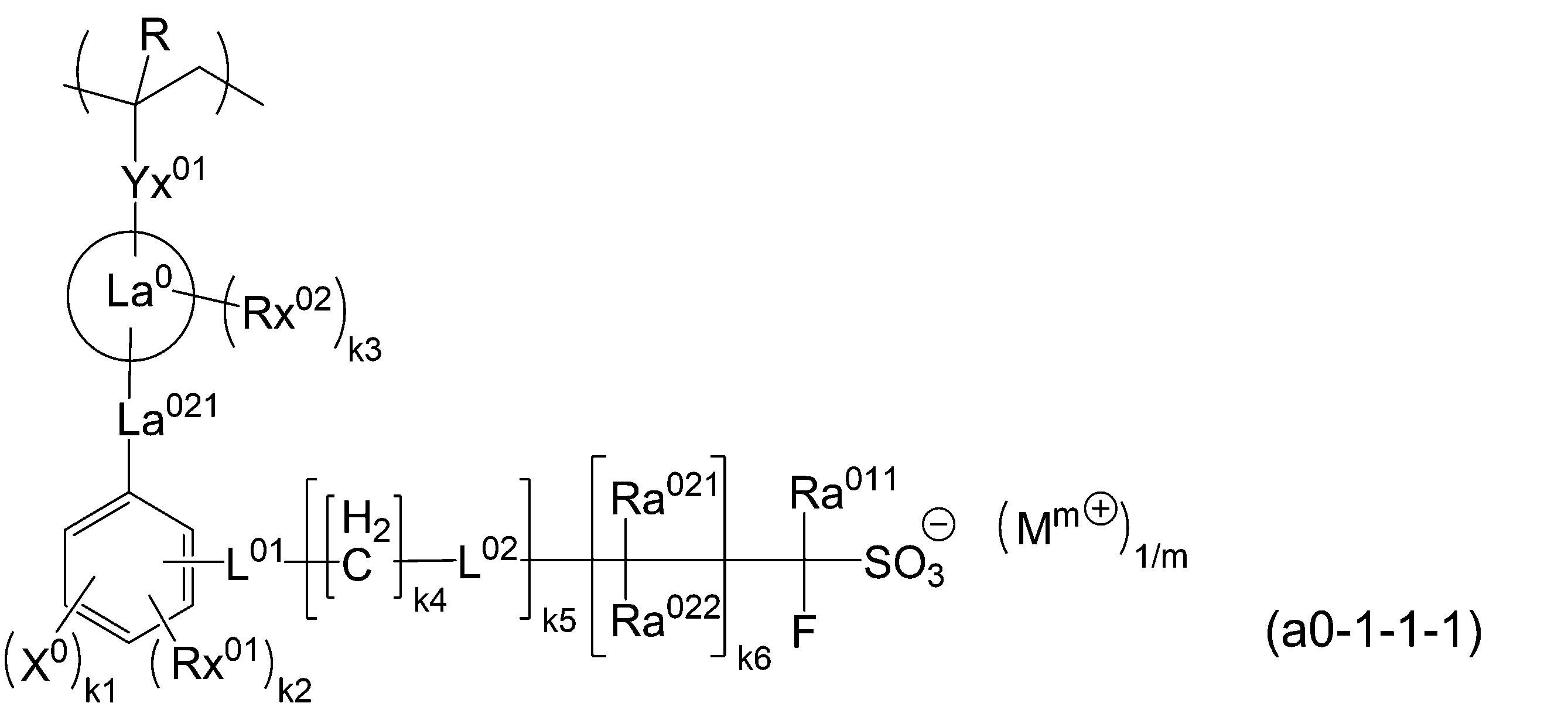
一般式(a0-1-1-1)中、R、Yx01、La021、及びRa011は、前記一般式(a0-1-1)中のR、Yx01、La021、及びRa011とそれぞれ同じである。
一般式(a0-1-1-1)中、La0は、芳香族炭化水素環又は脂肪族炭化水素環を表す。
La0における芳香族炭化水素環は、単環でもよく、多環でもよい。La0における芳香族炭化水素環の具体例としては、ベンゼン環、ナフタレン環、アントラセン環、フェナントレン環等が挙げられる。La0における芳香族炭化水素環は、ベンゼン環が好ましい。
La0における脂肪族炭化水素環は、単環でもよく、多環でもよい。La0における脂肪族炭化水素環としては、シクロペンタン環、シクロヘキサン環等のモノシクロアルカン環;アダマンタン環、ノルボルナン環、イソボルナン環、トリシクロデカン環、テトラシクロドデカン環等のポリシクロアルカン環が挙げられる。La0における脂肪族炭化水素環は、アダマンタン環が好ましい。
La0は、芳香族炭化水素環が好ましく、ベンゼン環又はナフタレン環がより好ましく、ベンゼン環がさらに好ましい。
La0における芳香族炭化水素環は、単環でもよく、多環でもよい。La0における芳香族炭化水素環の具体例としては、ベンゼン環、ナフタレン環、アントラセン環、フェナントレン環等が挙げられる。La0における芳香族炭化水素環は、ベンゼン環が好ましい。
La0における脂肪族炭化水素環は、単環でもよく、多環でもよい。La0における脂肪族炭化水素環としては、シクロペンタン環、シクロヘキサン環等のモノシクロアルカン環;アダマンタン環、ノルボルナン環、イソボルナン環、トリシクロデカン環、テトラシクロドデカン環等のポリシクロアルカン環が挙げられる。La0における脂肪族炭化水素環は、アダマンタン環が好ましい。
La0は、芳香族炭化水素環が好ましく、ベンゼン環又はナフタレン環がより好ましく、ベンゼン環がさらに好ましい。
一般式(a0-1-1-1)中、L01及びL02は、それぞれ独立に、単結合、-O-、-CO-、-OCO-、-COO-、-NH-、-SO2-、-N(Ra)-C(=O)-、-N(Ra)-、-C(Ra)(Ra)-N(Ra)-、-C(Ra)(N(Ra)(Ra))-、又は、-C(=O)-N(Ra)-を表す。前記式中、Raは、水素原子又はアルキル基を表す。Raにおけるアルキル基は、炭素原子数1~4が好ましく、炭素原子数1~3がより好ましく、メチル基又はエチル基がさらに好ましい。
L01及びL02は、-O-、-CO-、-OCO-、又は-COO-が好ましい。
L01及びL02は、-O-、-CO-、-OCO-、又は-COO-が好ましい。
一般式(a0-1-1-1)中、k4は、1~5の整数である。k4は、1~3の整数が好ましく、1又は2が特に好ましい。
一般式(a0-1-1-1)中、k5は、0又は1である。k5は、0が好ましい。
一般式(a0-1-1-1)中、Ra021及びRa022は、それぞれ独立に、水素原子、フッ素原子、又は炭素原子数1~5のフッ素化アルキル基を表す。Ra021及びRa022におけるフッ素化アルキル基は、炭素原子数1~3が好ましく、炭素原子数1又は2がより好ましい。Ra021及びRa022は、水素原子、フッ素原子、又はトリフルオロメチレン基が好ましい。
Ra021及びRa022の組合せとしては、Ra021及びRa022が共に水素原子の組合せ;Ra021が水素原子、Ra022がフッ素原子の組合せ;Ra021が及びRa022が共にフッ素原子の組合せ;Ra021が水素原子、Ra022がトリフルオロメチレン基の組合せ;Ra021がフッ素原子、Ra022がトリフルオロメチレン基の組合せ;Ra021が及びRa022が共にトリフルオロメチレン基の組合せ等が挙げられる。
Ra021及びRa022の組合せとしては、Ra021及びRa022が共に水素原子の組合せ;Ra021が水素原子、Ra022がフッ素原子の組合せ;Ra021が及びRa022が共にフッ素原子の組合せ;Ra021が水素原子、Ra022がトリフルオロメチレン基の組合せ;Ra021がフッ素原子、Ra022がトリフルオロメチレン基の組合せ;Ra021が及びRa022が共にトリフルオロメチレン基の組合せ等が挙げられる。
一般式(a0-1-1-1)中、k6は、0~5の整数である。k6は、0~3の整数が好ましく、1~3の整数がより好ましく、1又は2がさらに好ましい。
k6が2以上のとき、複数のRa021は、相互に同じでもよく、異なってもよい。k6が2以上のとき、複数のRa022は、相互に同じでもよく、異なってもよい。
一般式(a0-1-1-1)中、X0は、ヨウ素原子を表す。
一般式(a0-1-1-1)中、Rx01は、ヨウ素原子以外の置換基を表す。Rx01としては、例えば、アルキル基、アルコキシ基、フッ素原子、塩素原子、ハロゲン化アルキル基、水酸基等が挙げられる。前記ハロゲン化アルキル基としては、フッ素化アルキル基が好ましい。Rx01におけるアルキル基、アルコキシ基、及びハロゲン化アルキル基としては、前記一般式(a0-1)中のLa01における芳香族炭化水素基の置換基として挙げたものと同様のものが挙げられる。
一般式(a0-1-1-1)中、k1及びk2は、それぞれ独立に、0~4の整数を表し、k1+k2≦4である。k1は1~4の整数が好ましく、1~3の整数がより好ましく、2又は3がさらに好ましい。k2は、0~3の整数が好ましく、0~2の整数がより好ましく、0又は1がさらに好ましい。
Rx02は、置換基を表す。Rx02としては、アルキル基、アルコキシ基、ハロゲン原子、ハロゲン化アルキル基、水酸基等が挙げられる。Rx02におけるアルキル基、アルコキシ基、ハロゲン原子、ハロゲン化アルキル基としては、上記一般式(a0-1)中のLa01における芳香族炭化水素基の置換基として挙げたものと同様のものが挙げられる。
一般式(a0-1-1-1)中、k3は、原子価が許容する限り、0以上の整数である。k3は、0~3の整数が好ましく、0~2の整数がより好ましく、0又は1がさらに好ましい。
構成単位(a0)の具体例を以下に挙げるが、これらに限定されない。以下の各式中、Rαは、水素原子、メチル基又はトリフルオロメチル基を表す。Mm+はm価のカチオンである。


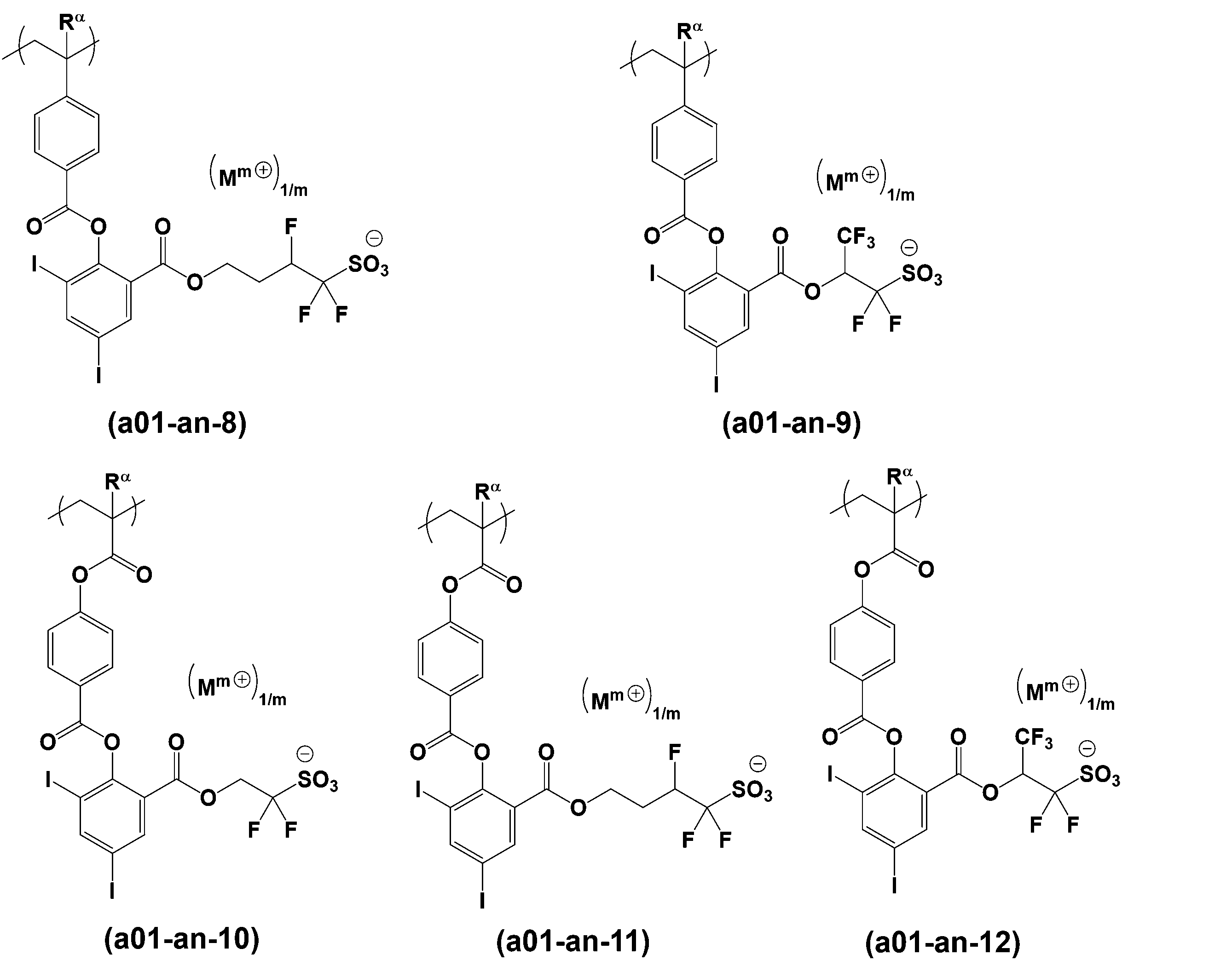
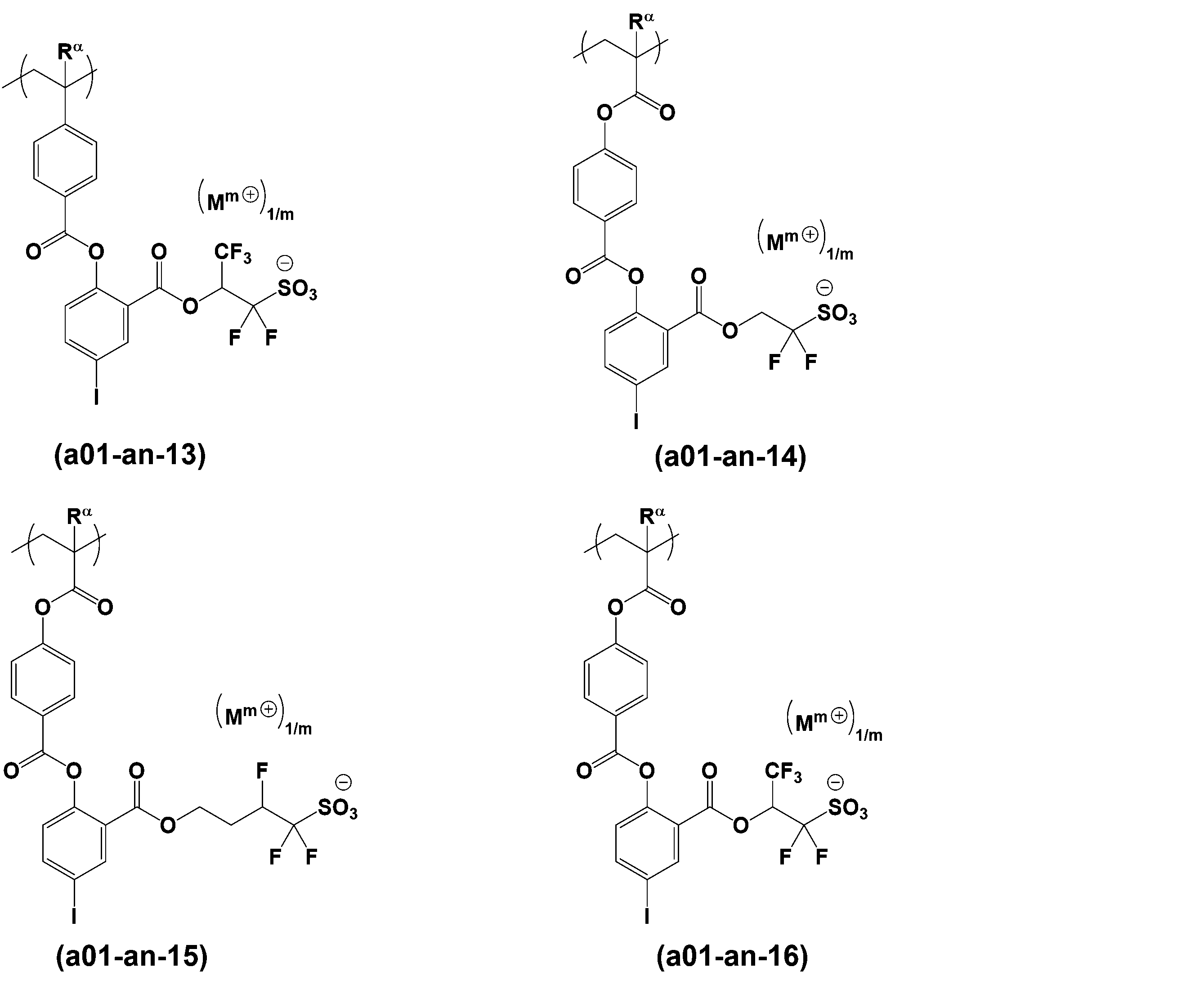

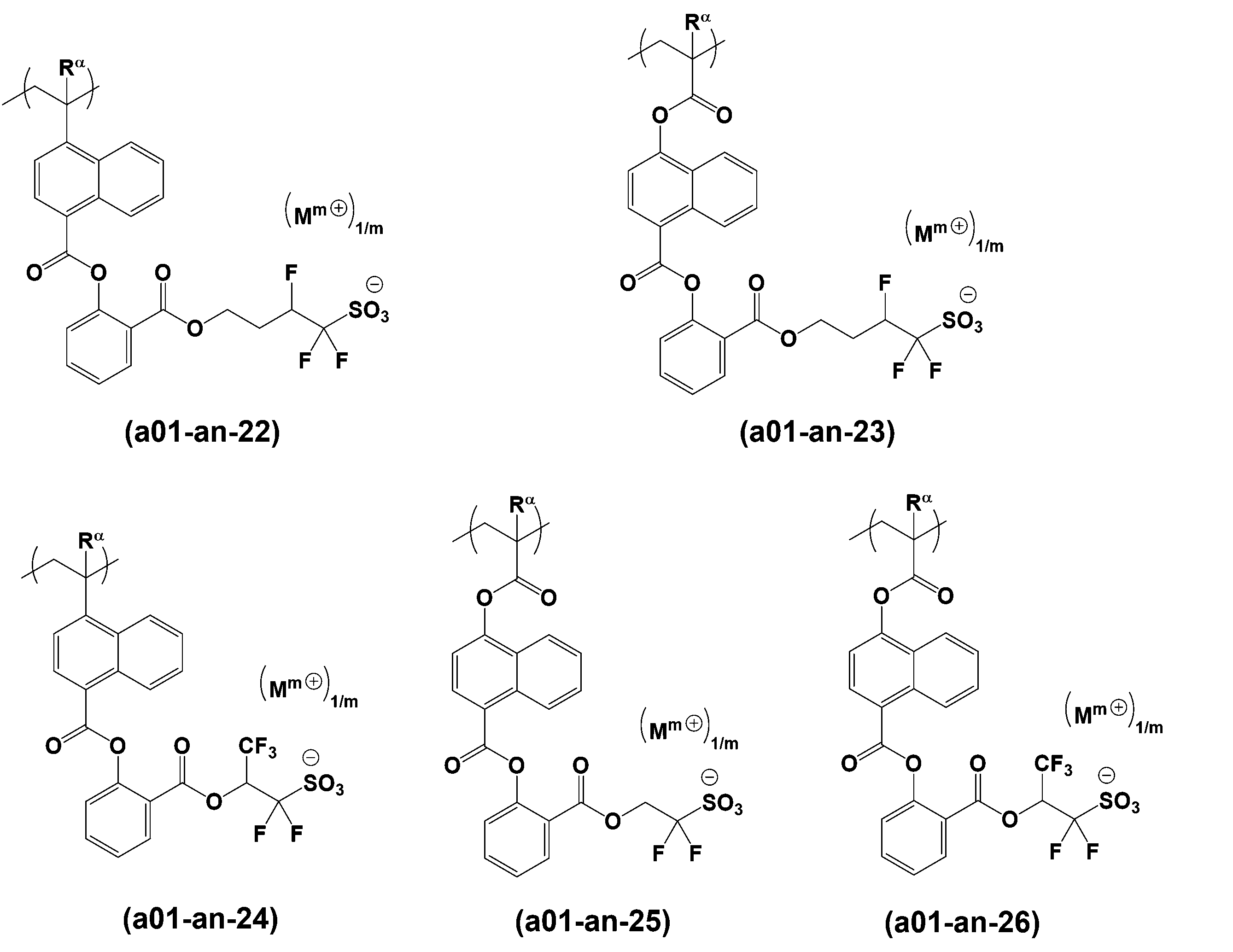
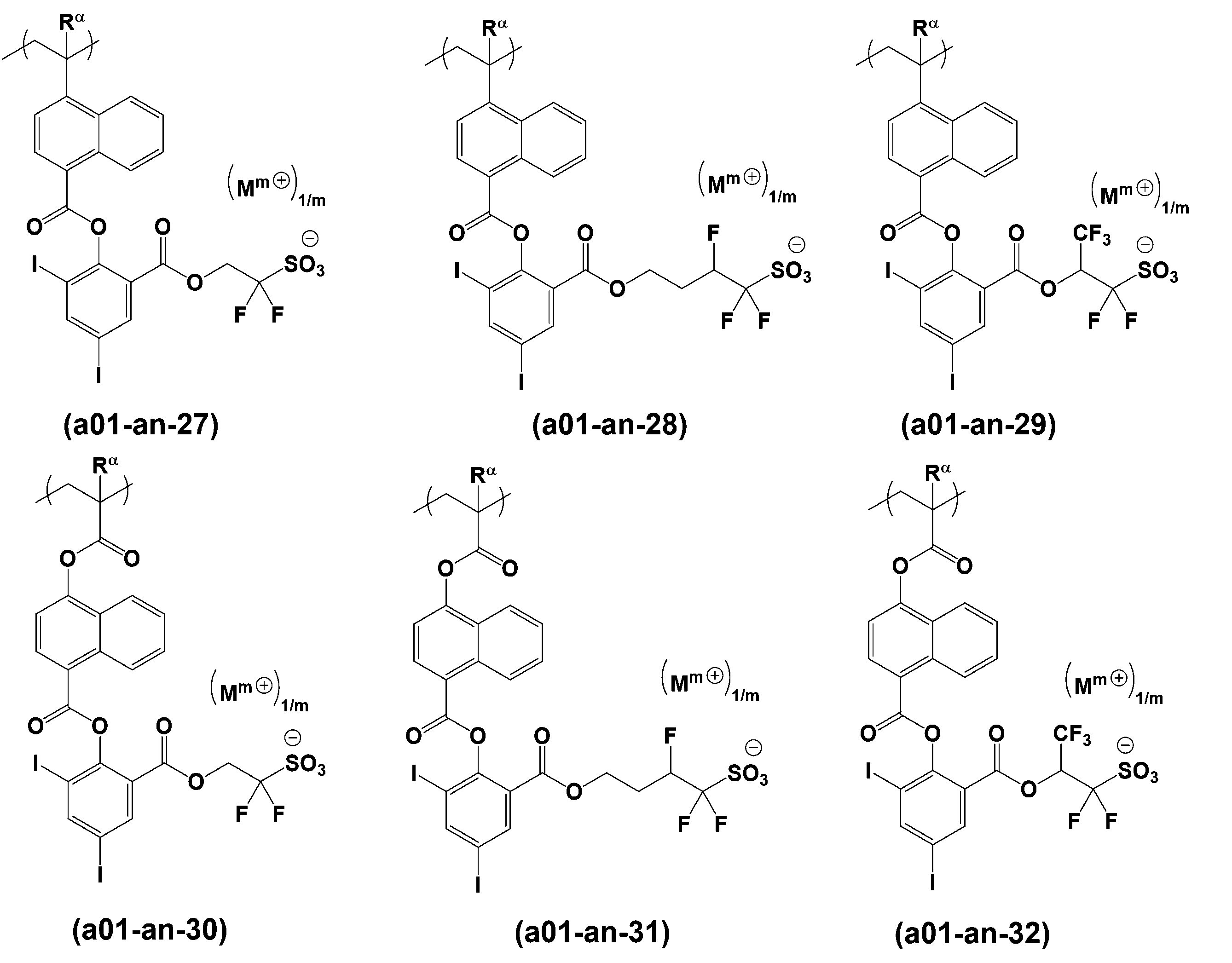


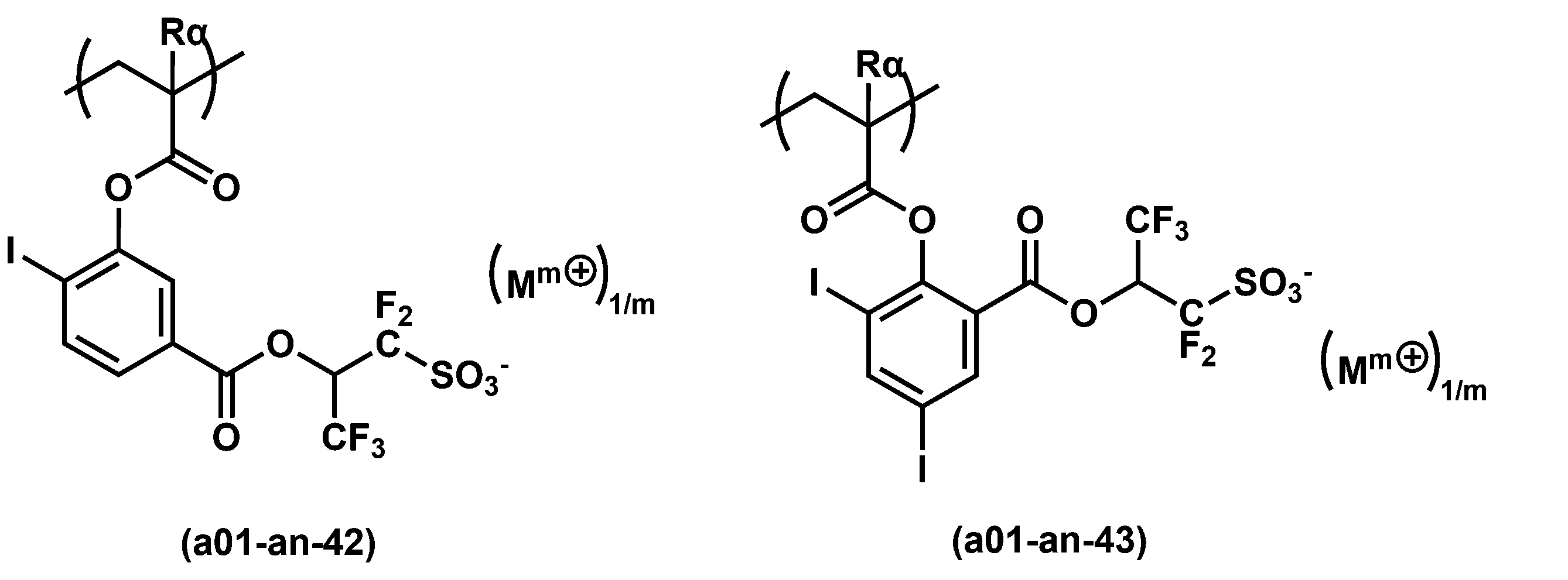
構成単位(a0)は、前記式(a01-an-1)~(a01-an-43)のいずれかで表される構成単位が好ましく、前記式(a01-an-1)~(a01-an-441)のいずれかで表される構成単位がより好ましく、前記式(a01-an-1)~(a01-an-7)のいずれかで表される構成単位が更に好ましい。
{カチオン部}
上述の式中のMm+は、m価のカチオンを表す。前記カチオンとしては、スルホニウムカチオン、又はヨードニウムカチオンが好ましい。mは、1以上の整数である。
好ましいカチオン部((Mm+)1/m)としては、下記の一般式(ca-1)~(ca-3)でそれぞれ表される有機カチオンが挙げられる。
上述の式中のMm+は、m価のカチオンを表す。前記カチオンとしては、スルホニウムカチオン、又はヨードニウムカチオンが好ましい。mは、1以上の整数である。
好ましいカチオン部((Mm+)1/m)としては、下記の一般式(ca-1)~(ca-3)でそれぞれ表される有機カチオンが挙げられる。

上記の一般式(ca-1)~(ca-3)中、R201~R207におけるアリール基としては、炭素原子数6~20の無置換のアリール基が挙げられ、フェニル基、ナフチル基が好ましい。
R201~R207におけるアルキル基としては、鎖状又は環状のアルキル基であって、炭素原子数1~30のものが好ましい。
R201~R207におけるアルケニル基としては、炭素原子数が2~10であることが好ましい。
R201~R207、およびR210が有していてもよい置換基としては、例えば、アルキル基、ハロゲン原子、ハロゲン化アルキル基、カルボニル基、シアノ基、アミノ基、アリール基、下記の一般式(ca-r-1)~(ca-r-7)でそれぞれ表される基等が挙げられる。
R201~R207におけるアルキル基としては、鎖状又は環状のアルキル基であって、炭素原子数1~30のものが好ましい。
R201~R207におけるアルケニル基としては、炭素原子数が2~10であることが好ましい。
R201~R207、およびR210が有していてもよい置換基としては、例えば、アルキル基、ハロゲン原子、ハロゲン化アルキル基、カルボニル基、シアノ基、アミノ基、アリール基、下記の一般式(ca-r-1)~(ca-r-7)でそれぞれ表される基等が挙げられる。

置換基を有してもよい環式基:
該環式基は、環状の炭化水素基であることが好ましく、該環状の炭化水素基は、芳香族炭化水素基であってもよく、脂肪族炭化水素基であってもよい。脂肪族炭化水素基は、芳香族性を持たない炭化水素基を意味する。また、脂肪族炭化水素基は、飽和であってもよく、不飽和であってもよく、通常は飽和であることが好ましい。
該環式基は、環状の炭化水素基であることが好ましく、該環状の炭化水素基は、芳香族炭化水素基であってもよく、脂肪族炭化水素基であってもよい。脂肪族炭化水素基は、芳香族性を持たない炭化水素基を意味する。また、脂肪族炭化水素基は、飽和であってもよく、不飽和であってもよく、通常は飽和であることが好ましい。
R’201における芳香族炭化水素基は、芳香環を有する炭化水素基である。該芳香族炭化水素基の炭素原子数は3~30であることが好ましく、炭素原子数5~30がより好ましく、炭素原子数5~20がさらに好ましく、炭素原子数6~15が特に好ましく、炭素原子数6~10が最も好ましい。ただし、該炭素原子数には、置換基における炭素原子数を含まないものとする。
R’201における芳香族炭化水素基が有する芳香環として具体的には、ベンゼン、フルオレン、ナフタレン、アントラセン、フェナントレン、ビフェニル、又はこれらの芳香環を構成する炭素原子の一部がヘテロ原子で置換された芳香族複素環などが挙げられる。芳香族複素環におけるヘテロ原子としては、酸素原子、硫黄原子、窒素原子等が挙げられる。
R’201における芳香族炭化水素基として具体的には、前記芳香環から水素原子を1つ除いた基(アリール基:例えばフェニル基、ナフチル基など)、前記芳香環の水素原子の1つがアルキレン基で置換された基(例えばベンジル基、フェネチル基、1-ナフチルメチル基、2-ナフチルメチル基、1-ナフチルエチル基、2-ナフチルエチル基等のアリールアルキル基など)等が挙げられる。前記アルキレン基(アリールアルキル基中のアルキル鎖)の炭素原子数は、1~4であることが好ましく、炭素原子数1~2がより好ましく、炭素原子数1が特に好ましい。
R’201における芳香族炭化水素基が有する芳香環として具体的には、ベンゼン、フルオレン、ナフタレン、アントラセン、フェナントレン、ビフェニル、又はこれらの芳香環を構成する炭素原子の一部がヘテロ原子で置換された芳香族複素環などが挙げられる。芳香族複素環におけるヘテロ原子としては、酸素原子、硫黄原子、窒素原子等が挙げられる。
R’201における芳香族炭化水素基として具体的には、前記芳香環から水素原子を1つ除いた基(アリール基:例えばフェニル基、ナフチル基など)、前記芳香環の水素原子の1つがアルキレン基で置換された基(例えばベンジル基、フェネチル基、1-ナフチルメチル基、2-ナフチルメチル基、1-ナフチルエチル基、2-ナフチルエチル基等のアリールアルキル基など)等が挙げられる。前記アルキレン基(アリールアルキル基中のアルキル鎖)の炭素原子数は、1~4であることが好ましく、炭素原子数1~2がより好ましく、炭素原子数1が特に好ましい。
R’201における環状の脂肪族炭化水素基は、構造中に環を含む脂肪族炭化水素基が挙げられる。
この構造中に環を含む脂肪族炭化水素基としては、脂環式炭化水素基(脂肪族炭化水素環から水素原子を1個除いた基)、脂環式炭化水素基が直鎖状または分岐鎖状の脂肪族炭化水素基の末端に結合した基、脂環式炭化水素基が直鎖状または分岐鎖状の脂肪族炭化水素基の途中に介在する基などが挙げられる。
前記脂環式炭化水素基は、炭素原子数が3~20であることが好ましく、3~12であることがより好ましい。
前記脂環式炭化水素基は、多環式基であってもよく、単環式基であってもよい。単環式の脂環式炭化水素基としては、モノシクロアルカンから1個以上の水素原子を除いた基が好ましい。該モノシクロアルカンとしては、炭素原子数3~6のものが好ましく、具体的にはシクロペンタン、シクロヘキサン等が挙げられる。多環式の脂環式炭化水素基としては、ポリシクロアルカンから1個以上の水素原子を除いた基が好ましく、該ポリシクロアルカンとしては、炭素原子数7~30のものが好ましい。中でも、該ポリシクロアルカンとしては、アダマンタン、ノルボルナン、イソボルナン、トリシクロデカン、テトラシクロドデカン等の架橋環系の多環式骨格を有するポリシクロアルカン;ステロイド骨格を有する環式基等の縮合環系の多環式骨格を有するポリシクロアルカンがより好ましい。
この構造中に環を含む脂肪族炭化水素基としては、脂環式炭化水素基(脂肪族炭化水素環から水素原子を1個除いた基)、脂環式炭化水素基が直鎖状または分岐鎖状の脂肪族炭化水素基の末端に結合した基、脂環式炭化水素基が直鎖状または分岐鎖状の脂肪族炭化水素基の途中に介在する基などが挙げられる。
前記脂環式炭化水素基は、炭素原子数が3~20であることが好ましく、3~12であることがより好ましい。
前記脂環式炭化水素基は、多環式基であってもよく、単環式基であってもよい。単環式の脂環式炭化水素基としては、モノシクロアルカンから1個以上の水素原子を除いた基が好ましい。該モノシクロアルカンとしては、炭素原子数3~6のものが好ましく、具体的にはシクロペンタン、シクロヘキサン等が挙げられる。多環式の脂環式炭化水素基としては、ポリシクロアルカンから1個以上の水素原子を除いた基が好ましく、該ポリシクロアルカンとしては、炭素原子数7~30のものが好ましい。中でも、該ポリシクロアルカンとしては、アダマンタン、ノルボルナン、イソボルナン、トリシクロデカン、テトラシクロドデカン等の架橋環系の多環式骨格を有するポリシクロアルカン;ステロイド骨格を有する環式基等の縮合環系の多環式骨格を有するポリシクロアルカンがより好ましい。
なかでも、R’201における環状の脂肪族炭化水素基としては、モノシクロアルカンまたはポリシクロアルカンから水素原子を1つ以上除いた基が好ましく、ポリシクロアルカンから水素原子を1つ除いた基がより好ましく、アダマンチル基、ノルボルニル基が特に好ましく、アダマンチル基が最も好ましい。
脂環式炭化水素基に結合してもよい、直鎖状または分岐鎖状の脂肪族炭化水素基は、炭素原子数が1~10であることが好ましく、炭素原子数1~6がより好ましく、炭素原子数1~4がさらに好ましく、炭素原子数1~3が特に好ましい。
直鎖状の脂肪族炭化水素基としては、直鎖状のアルキレン基が好ましく、具体的には、メチレン基[-CH2-]、エチレン基[-(CH2)2-]、トリメチレン基[-(CH2)3-]、テトラメチレン基[-(CH2)4-]、ペンタメチレン基[-(CH2)5-]等が挙げられる。
分岐鎖状の脂肪族炭化水素基としては、分岐鎖状のアルキレン基が好ましく、具体的には、-CH(CH3)-、-CH(CH2CH3)-、-C(CH3)2-、-C(CH3)(CH2CH3)-、-C(CH3)(CH2CH2CH3)-、-C(CH2CH3)2-等のアルキルメチレン基;-CH(CH3)CH2-、-CH(CH3)CH(CH3)-、-C(CH3)2CH2-、-CH(CH2CH3)CH2-、-C(CH2CH3)2-CH2-等のアルキルエチレン基;-CH(CH3)CH2CH2-、-CH2CH(CH3)CH2-等のアルキルトリメチレン基;-CH(CH3)CH2CH2CH2-、-CH2CH(CH3)CH2CH2-等のアルキルテトラメチレン基などのアルキルアルキレン基等が挙げられる。アルキルアルキレン基におけるアルキル基としては、炭素原子数1~5の直鎖状のアルキル基が好ましい。
直鎖状の脂肪族炭化水素基としては、直鎖状のアルキレン基が好ましく、具体的には、メチレン基[-CH2-]、エチレン基[-(CH2)2-]、トリメチレン基[-(CH2)3-]、テトラメチレン基[-(CH2)4-]、ペンタメチレン基[-(CH2)5-]等が挙げられる。
分岐鎖状の脂肪族炭化水素基としては、分岐鎖状のアルキレン基が好ましく、具体的には、-CH(CH3)-、-CH(CH2CH3)-、-C(CH3)2-、-C(CH3)(CH2CH3)-、-C(CH3)(CH2CH2CH3)-、-C(CH2CH3)2-等のアルキルメチレン基;-CH(CH3)CH2-、-CH(CH3)CH(CH3)-、-C(CH3)2CH2-、-CH(CH2CH3)CH2-、-C(CH2CH3)2-CH2-等のアルキルエチレン基;-CH(CH3)CH2CH2-、-CH2CH(CH3)CH2-等のアルキルトリメチレン基;-CH(CH3)CH2CH2CH2-、-CH2CH(CH3)CH2CH2-等のアルキルテトラメチレン基などのアルキルアルキレン基等が挙げられる。アルキルアルキレン基におけるアルキル基としては、炭素原子数1~5の直鎖状のアルキル基が好ましい。
また、R’201における環状の炭化水素基は、複素環等のようにヘテロ原子を含んでもよい。具体的には、前記一般式(a2-r-1)~(a2-r-7)でそれぞれ表されるラクトン含有環式基、前記一般式(b5-r-1)~(b5-r-4)でそれぞれ表される-SO2-含有環式基、その他上記の化学式(r-hr-1)~(r-hr-16)でそれぞれ表される複素環式基が挙げられる。
R’201の環式基における置換基としては、たとえば、アルキル基、アルコキシ基、ハロゲン原子、ハロゲン化アルキル基、水酸基、カルボニル基、ニトロ基等が挙げられる。
置換基としてのアルキル基としては、炭素原子数1~5のアルキル基が好ましく、メチル基、エチル基、プロピル基、n-ブチル基、tert-ブチル基が最も好ましい。
置換基としてのアルコキシ基としては、炭素原子数1~5のアルコキシ基が好ましく、メトキシ基、エトキシ基、n-プロポキシ基、iso-プロポキシ基、n-ブトキシ基、tert-ブトキシ基がより好ましく、メトキシ基、エトキシ基が最も好ましい。
置換基としてのハロゲン原子としては、フッ素原子が好ましい。
置換基としてのハロゲン化アルキル基としては、炭素原子数1~5のアルキル基、たとえばメチル基、エチル基、プロピル基、n-ブチル基、tert-ブチル基等の水素原子の一部または全部が前記ハロゲン原子で置換された基が挙げられる。
置換基としてのカルボニル基は、環状の炭化水素基を構成するメチレン基(-CH2-)を置換する基である。
置換基としてのアルキル基としては、炭素原子数1~5のアルキル基が好ましく、メチル基、エチル基、プロピル基、n-ブチル基、tert-ブチル基が最も好ましい。
置換基としてのアルコキシ基としては、炭素原子数1~5のアルコキシ基が好ましく、メトキシ基、エトキシ基、n-プロポキシ基、iso-プロポキシ基、n-ブトキシ基、tert-ブトキシ基がより好ましく、メトキシ基、エトキシ基が最も好ましい。
置換基としてのハロゲン原子としては、フッ素原子が好ましい。
置換基としてのハロゲン化アルキル基としては、炭素原子数1~5のアルキル基、たとえばメチル基、エチル基、プロピル基、n-ブチル基、tert-ブチル基等の水素原子の一部または全部が前記ハロゲン原子で置換された基が挙げられる。
置換基としてのカルボニル基は、環状の炭化水素基を構成するメチレン基(-CH2-)を置換する基である。
置換基を有してもよい鎖状のアルキル基:
R’201の鎖状のアルキル基としては、直鎖状又は分岐鎖状のいずれでもよい。
直鎖状のアルキル基としては、炭素原子数が1~20であることが好ましく、炭素原子数1~15であることがより好ましく、炭素原子数1~10が最も好ましい。
分岐鎖状のアルキル基としては、炭素原子数が3~20であることが好ましく、炭素原子数3~15であることがより好ましく、炭素原子数3~10が最も好ましい。具体的には、例えば、1-メチルエチル基、1-メチルプロピル基、2-メチルプロピル基、1-メチルブチル基、2-メチルブチル基、3-メチルブチル基、1-エチルブチル基、2-エチルブチル基、1-メチルペンチル基、2-メチルペンチル基、3-メチルペンチル基、4-メチルペンチル基などが挙げられる。
R’201の鎖状のアルキル基としては、直鎖状又は分岐鎖状のいずれでもよい。
直鎖状のアルキル基としては、炭素原子数が1~20であることが好ましく、炭素原子数1~15であることがより好ましく、炭素原子数1~10が最も好ましい。
分岐鎖状のアルキル基としては、炭素原子数が3~20であることが好ましく、炭素原子数3~15であることがより好ましく、炭素原子数3~10が最も好ましい。具体的には、例えば、1-メチルエチル基、1-メチルプロピル基、2-メチルプロピル基、1-メチルブチル基、2-メチルブチル基、3-メチルブチル基、1-エチルブチル基、2-エチルブチル基、1-メチルペンチル基、2-メチルペンチル基、3-メチルペンチル基、4-メチルペンチル基などが挙げられる。
置換基を有してもよい鎖状のアルケニル基:
R’201の鎖状のアルケニル基としては、直鎖状又は分岐鎖状のいずれでもよく、炭素原子数が2~10であることが好ましく、炭素原子数2~5がより好ましく、炭素原子数2~4がさらに好ましく、炭素原子数3が特に好ましい。直鎖状のアルケニル基としては、例えば、ビニル基、プロペニル基(アリル基)、ブチニル基などが挙げられる。分岐鎖状のアルケニル基としては、例えば、1-メチルビニル基、2-メチルビニル基、1-メチルプロペニル基、2-メチルプロペニル基などが挙げられる。
鎖状のアルケニル基としては、上記の中でも、直鎖状のアルケニル基が好ましく、ビニル基、プロペニル基がより好ましく、ビニル基が特に好ましい。
R’201の鎖状のアルケニル基としては、直鎖状又は分岐鎖状のいずれでもよく、炭素原子数が2~10であることが好ましく、炭素原子数2~5がより好ましく、炭素原子数2~4がさらに好ましく、炭素原子数3が特に好ましい。直鎖状のアルケニル基としては、例えば、ビニル基、プロペニル基(アリル基)、ブチニル基などが挙げられる。分岐鎖状のアルケニル基としては、例えば、1-メチルビニル基、2-メチルビニル基、1-メチルプロペニル基、2-メチルプロペニル基などが挙げられる。
鎖状のアルケニル基としては、上記の中でも、直鎖状のアルケニル基が好ましく、ビニル基、プロペニル基がより好ましく、ビニル基が特に好ましい。
R’201の鎖状のアルキル基またはアルケニル基における置換基としては、たとえば、アルコキシ基、ハロゲン原子、ハロゲン化アルキル基、水酸基、カルボニル基、ニトロ基、アミノ基、上記R’201における環式基等が挙げられる。
R’201の置換基を有してもよい環式基、置換基を有してもよい鎖状のアルキル基、又は置換基を有してもよい鎖状のアルケニル基は、上述したものの他、置換基を有してもよい環式基又は置換基を有してもよい鎖状のアルキル基として、上述の式(a1-r-2)で表される酸解離性基と同様のものも挙げられる。
なかでも、R’201は、置換基を有してもよい環式基が好ましく、置換基を有してもよい環状の炭化水素基であることがより好ましい。より具体的には、例えば、フェニル基、ナフチル基、ポリシクロアルカンから1個以上の水素原子を除いた基;前記一般式(a2-r-1)~(a2-r-7)でそれぞれ表されるラクトン含有環式基;前記一般式(b5-r-1)~(b5-r-4)でそれぞれ表される-SO2-含有環式基などが好ましい。
上記の一般式(ca-1)~(ca-3)中、R201~R203、R206~R207は、相互に結合して式中のイオウ原子と共に環を形成する場合、硫黄原子、酸素原子、窒素原子等のヘテロ原子や、カルボニル基、-SO-、-SO2-、-SO3-、-COO-、-CONH-または-N(RN)-(該RNは炭素原子数1~5のアルキル基である。)等の官能基を介して結合してもよい。形成される環としては、式中のイオウ原子をその環骨格に含む1つの環が、イオウ原子を含めて、3~10員環であることが好ましく、5~7員環であることが特に好ましい。形成される環の具体例としては、例えばチオフェン環、チアゾール環、ベンゾチオフェン環、ジベンゾチオフェン環、9H-チオキサンテン環、チオキサントン環、チアントレン環、フェノキサチイン環、テトラヒドロチオフェニウム環、テトラヒドロチオピラニウム環等が挙げられる。
R208~R209は、それぞれ独立に、水素原子または炭素原子数1~5のアルキル基を表し、水素原子又は炭素原子数1~3のアルキル基が好ましく、アルキル基となる場合、相互に結合して環を形成してもよい。
R210は、置換基を有してもよいアリール基、置換基を有してもよいアルキル基、置換基を有してもよいアルケニル基、又は置換基を有してもよい-SO2-含有環式基である。
R210におけるアリール基としては、炭素原子数6~20の無置換のアリール基が挙げられ、フェニル基、ナフチル基が好ましい。
R210におけるアルキル基としては、鎖状又は環状のアルキル基であって、炭素原子数1~30のものが好ましい。
R210におけるアルケニル基としては、炭素原子数が2~10であることが好ましい。
R210における、置換基を有してもよい-SO2-含有環式基としては、「-SO2-含有多環式基」が好ましく、上記一般式(b5-r-1)で表される基がより好ましい。
R210におけるアリール基としては、炭素原子数6~20の無置換のアリール基が挙げられ、フェニル基、ナフチル基が好ましい。
R210におけるアルキル基としては、鎖状又は環状のアルキル基であって、炭素原子数1~30のものが好ましい。
R210におけるアルケニル基としては、炭素原子数が2~10であることが好ましい。
R210における、置換基を有してもよい-SO2-含有環式基としては、「-SO2-含有多環式基」が好ましく、上記一般式(b5-r-1)で表される基がより好ましい。
前記式(ca-1)で表される好適なカチオンとして具体的には、下記の化学式(ca-1-1)~(ca-1-75)でそれぞれ表されるカチオンが挙げられる。
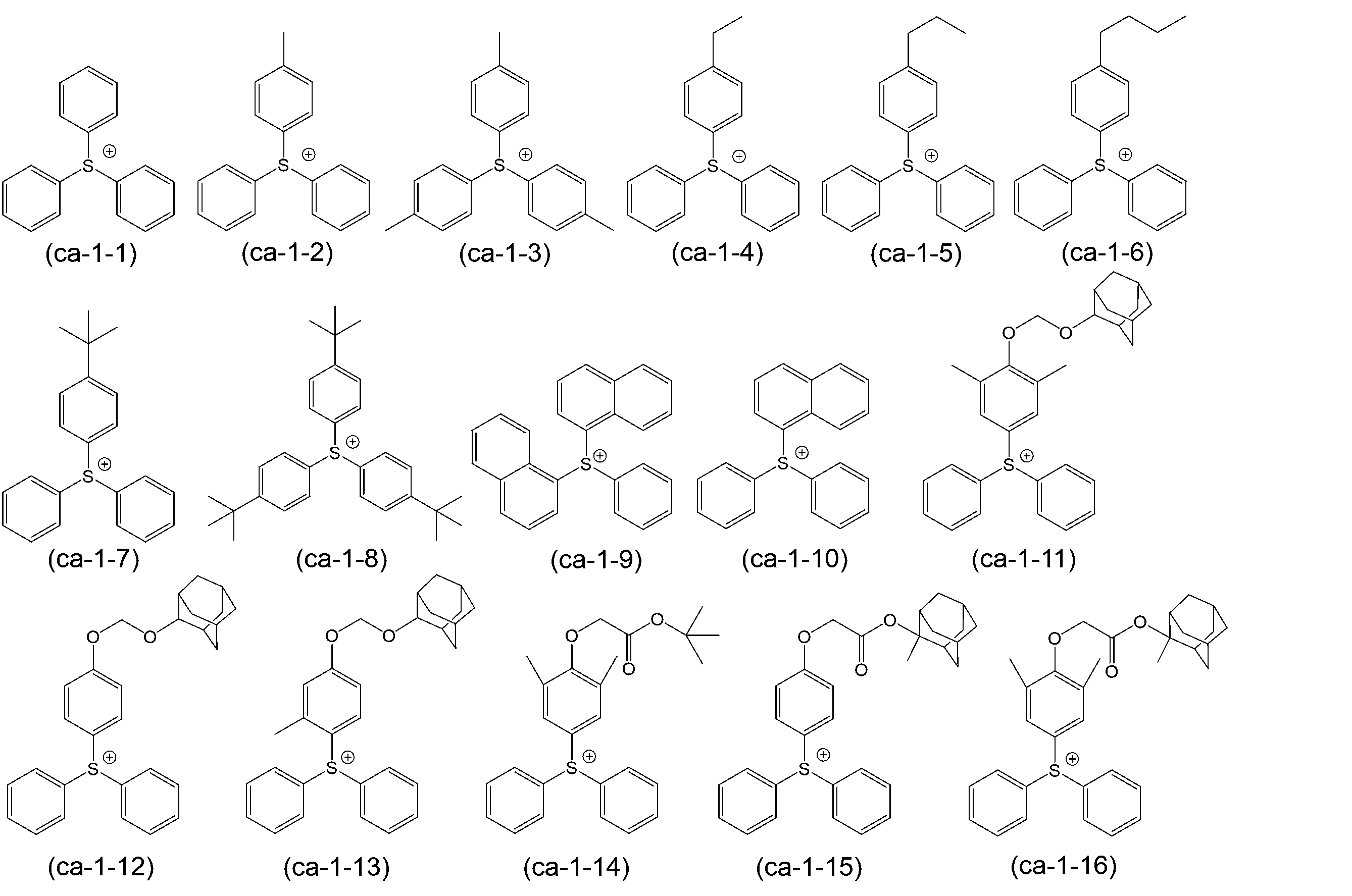


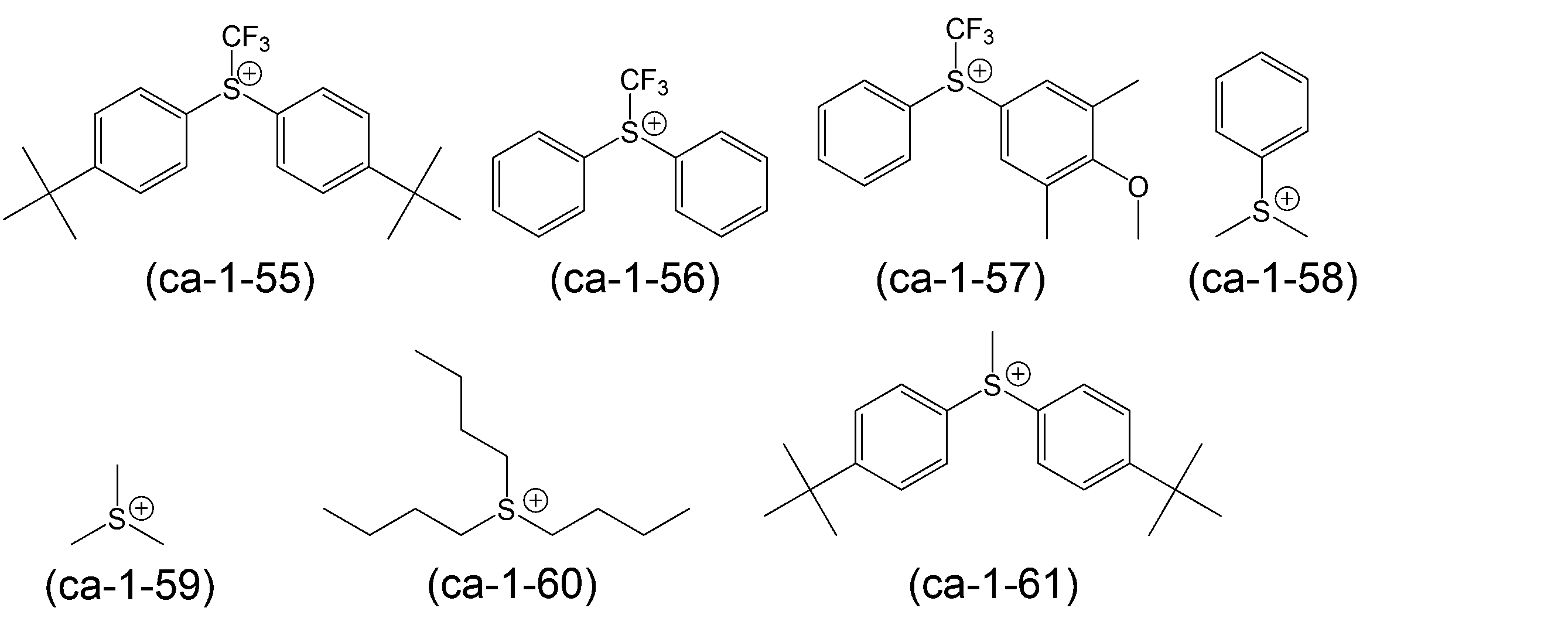

前記式(ca-2)で表される好適なカチオンとして具体的には、ジフェニルヨードニウムカチオン、ビス(4-tert-ブチルフェニル)ヨードニウムカチオン等が挙げられる。
前記式(ca-3)で表される好適なカチオンとして具体的には、下記式(ca-3-1)~(ca-3-6)でそれぞれ表されるカチオンが挙げられる。
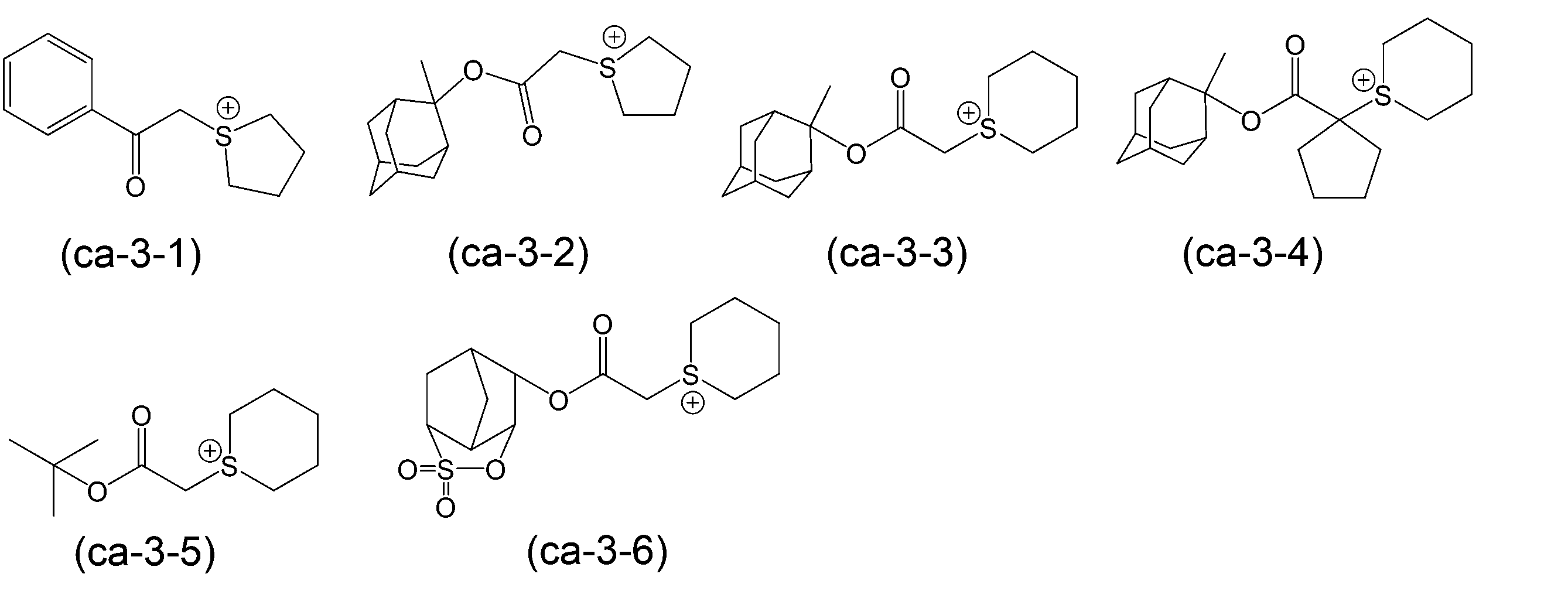
Mm+としては、前記式(ca-1)で表されるカチオンが好ましい。また、Mm+としては、フッ素原子を有するm価のカチオンが好ましい。Mm+としては、下記式(ca-1-1)で表されるカチオンが好ましい。
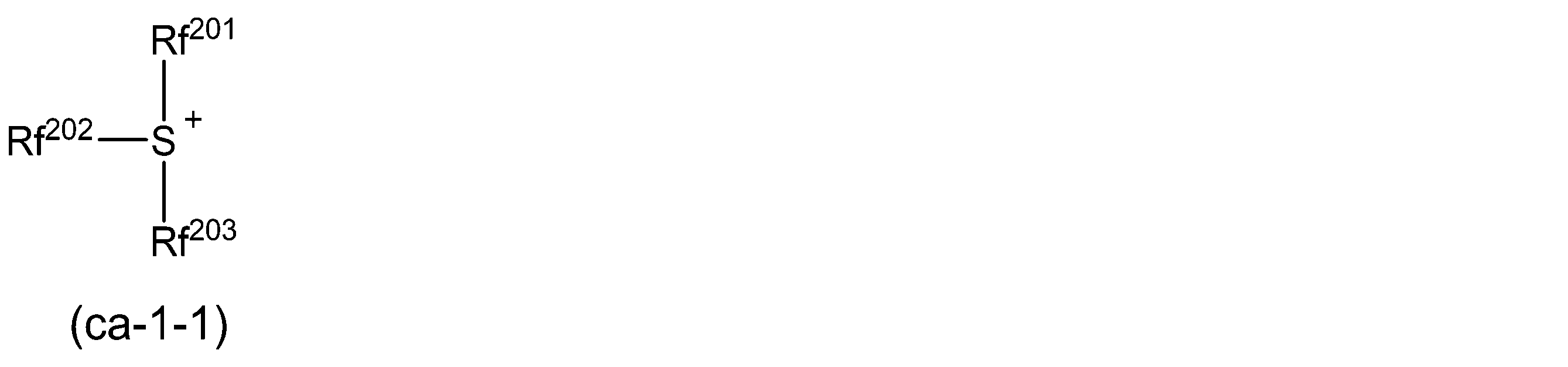
構成単位(a0)の具体例を以下に挙げるが、これらに限定されない。以下の各式中、Rαは、水素原子、メチル基又はトリフルオロメチル基を表す。
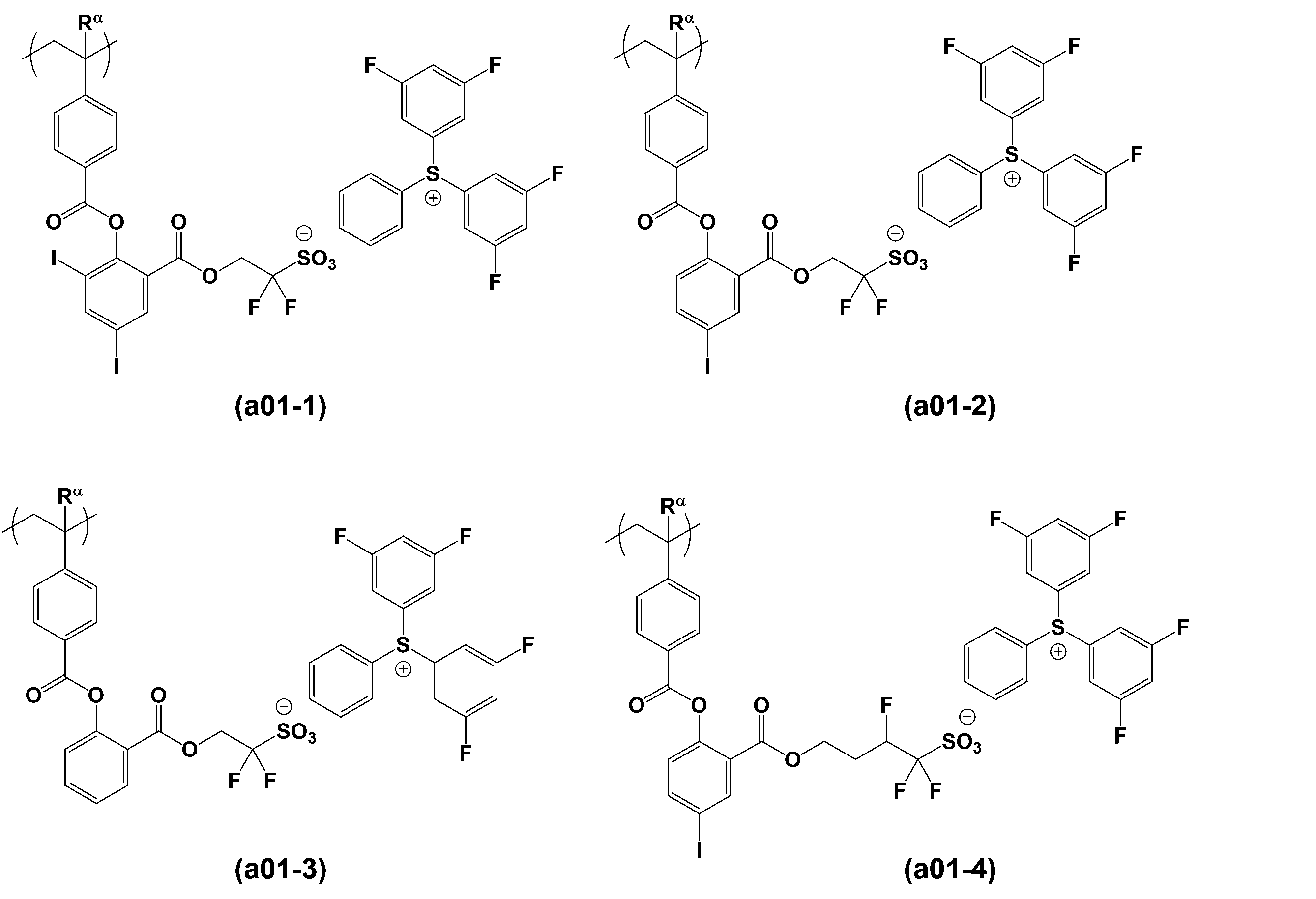
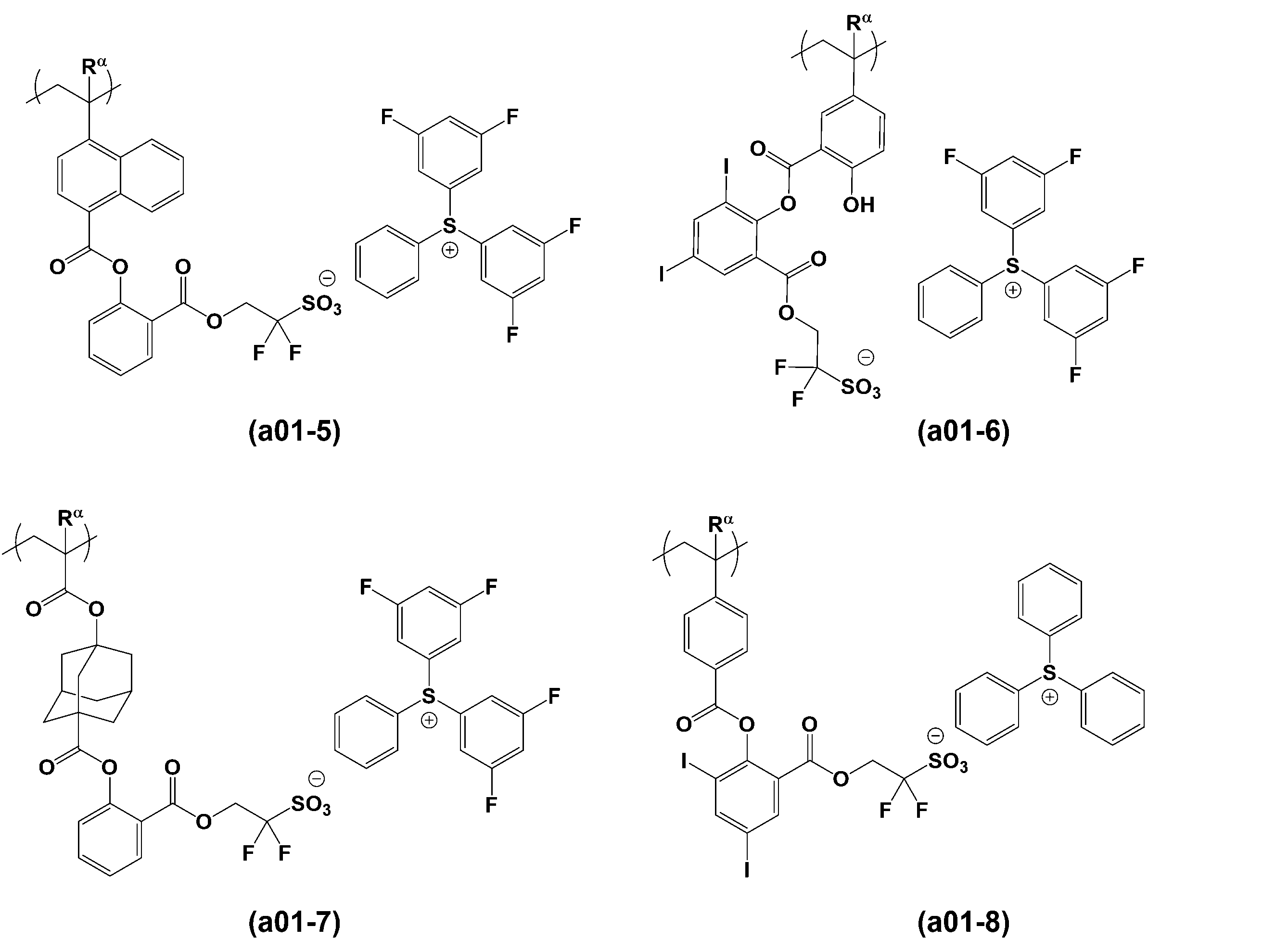
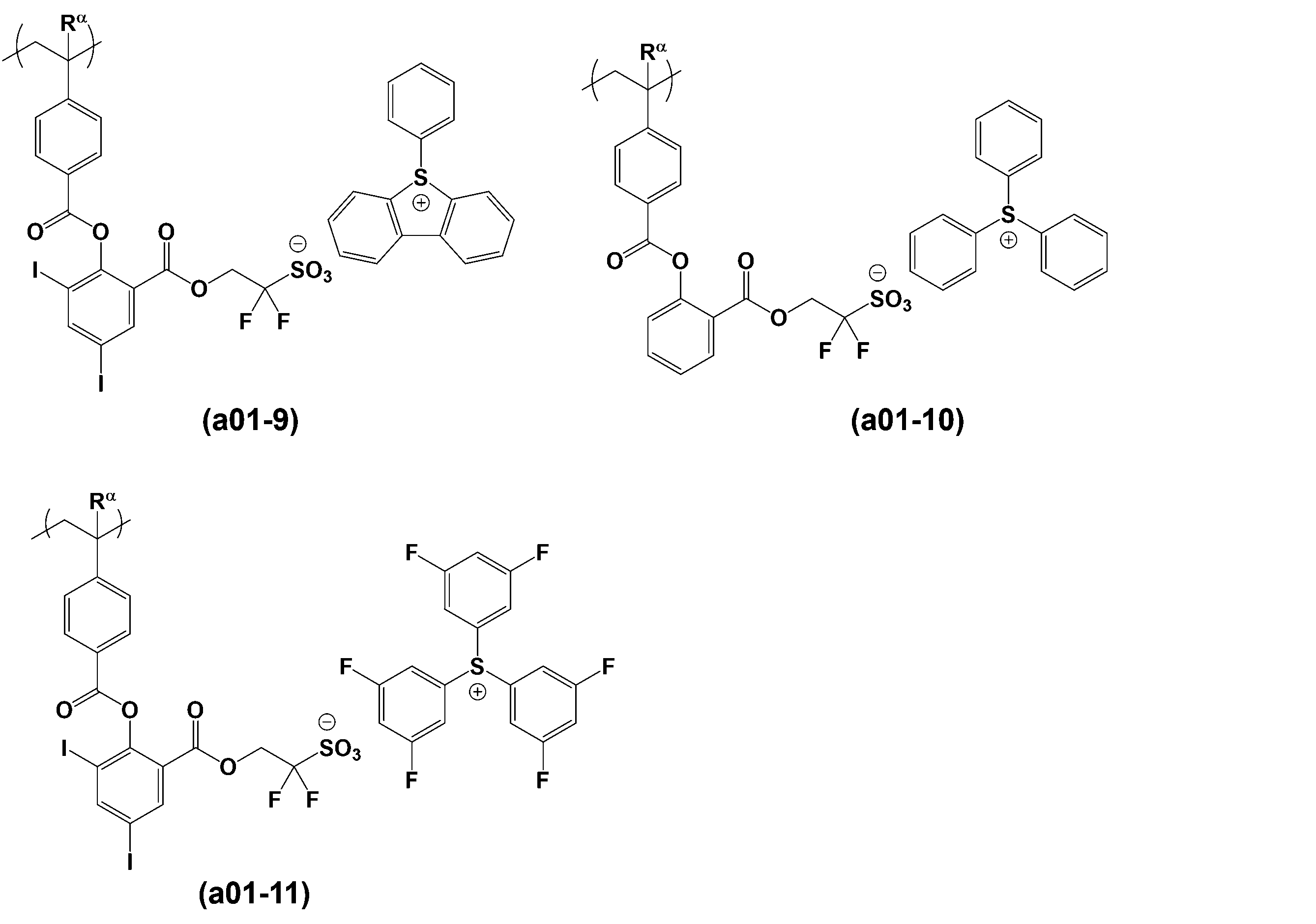

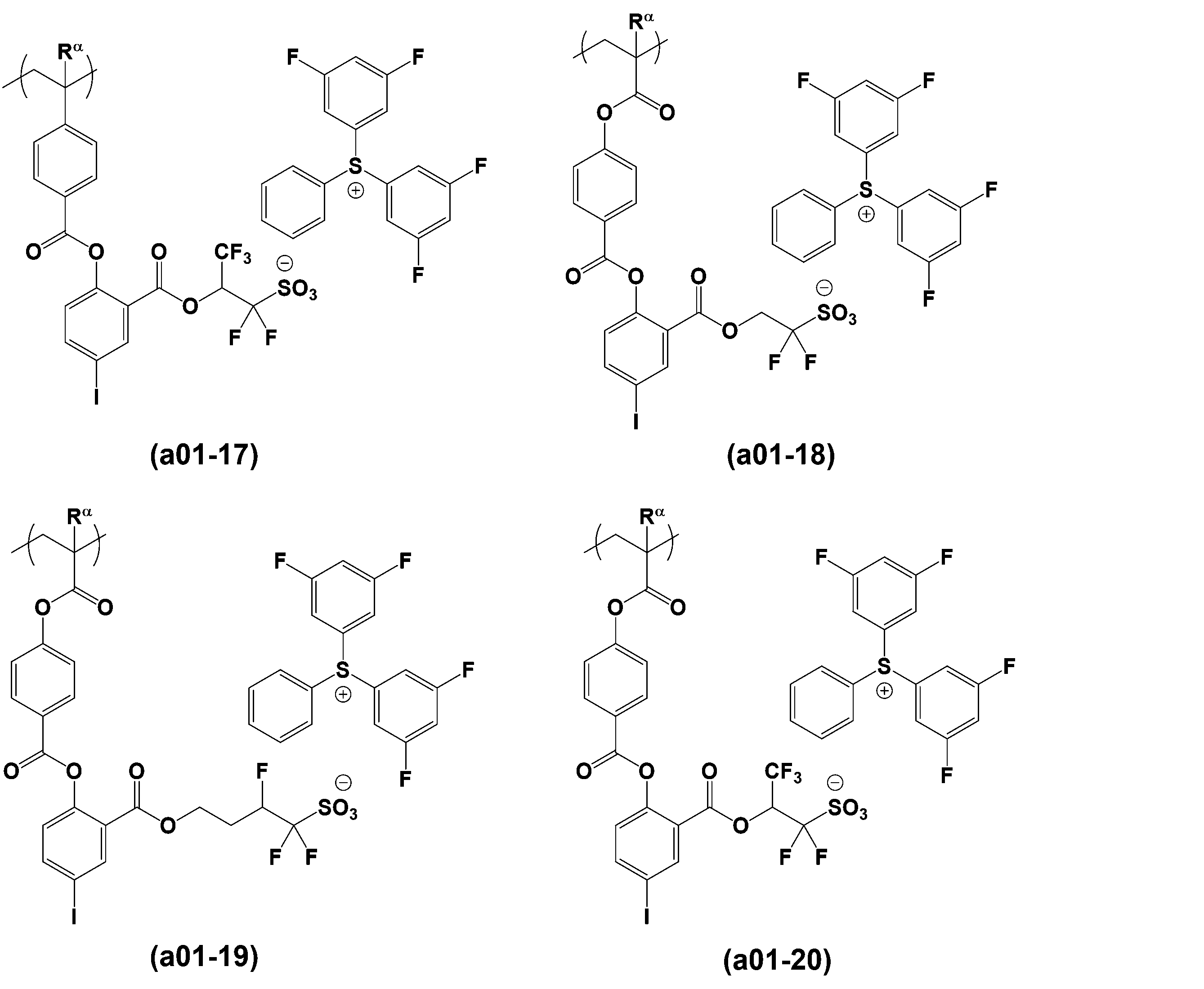
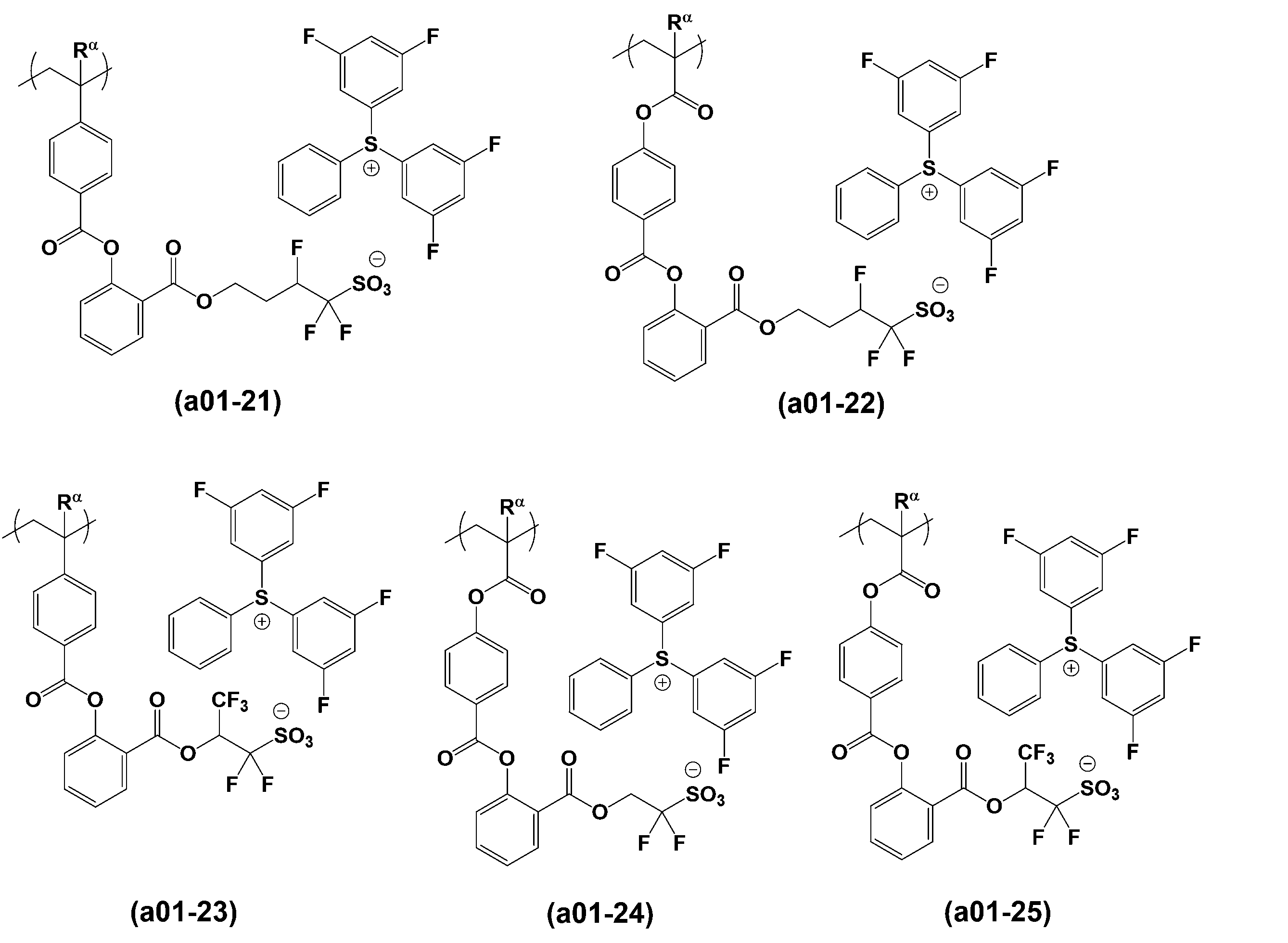
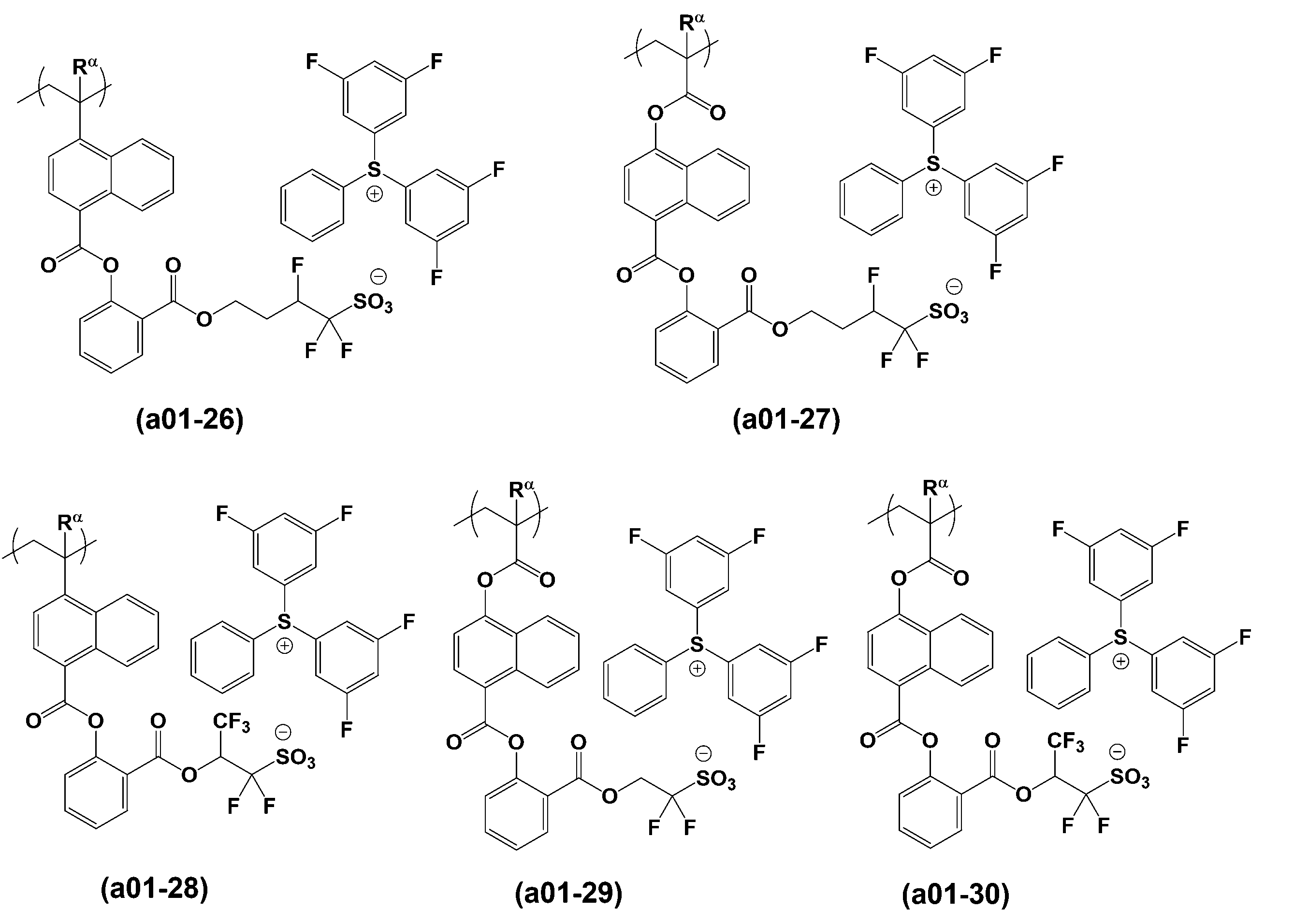


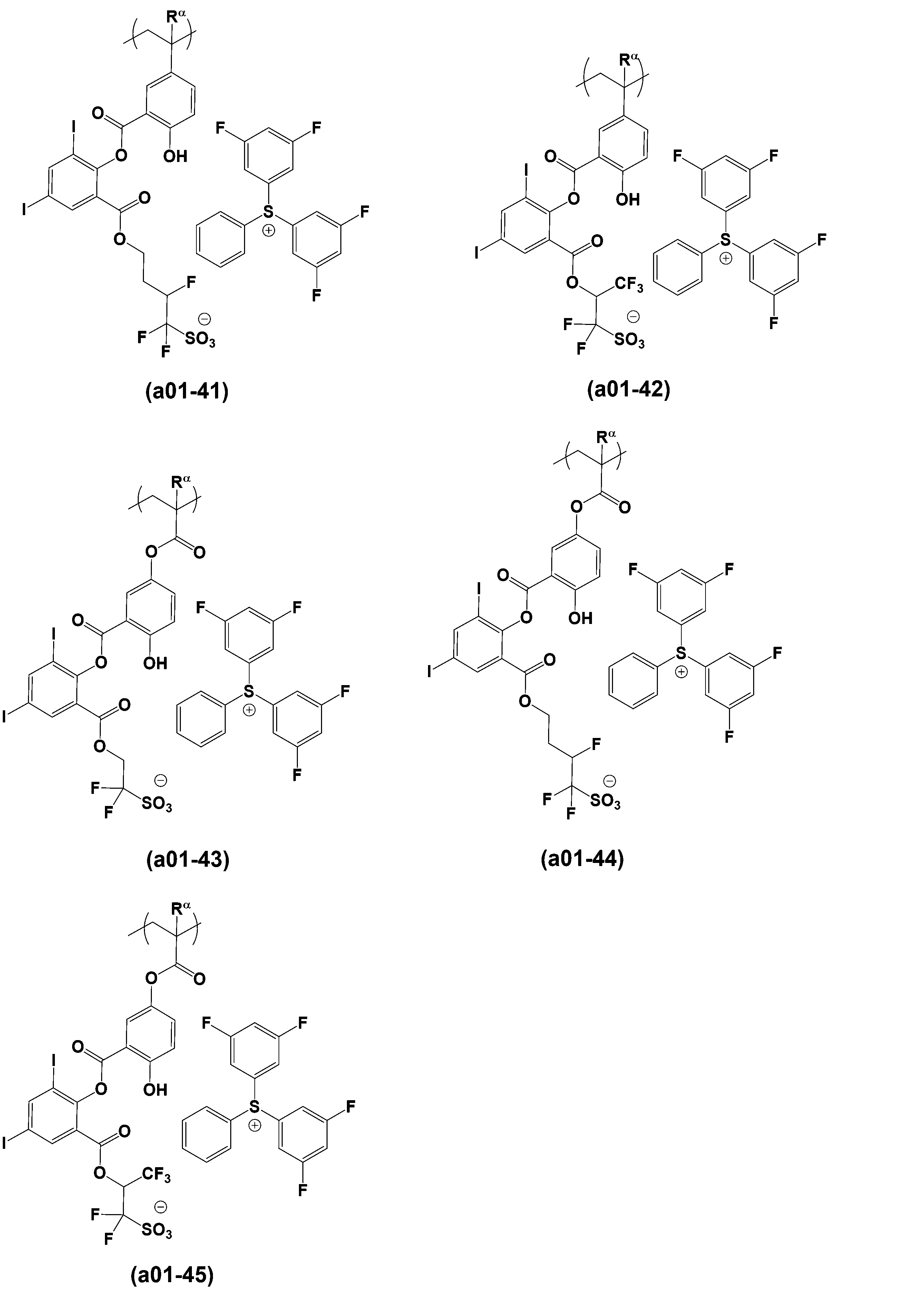

構成単位(a01)は、前記式(a01-1)~(a01-47)のいずれかで表される構成単位が好ましく、前記式(a01-1)~(a01-45)のいずれかで表される構成単位がより好ましく、前記式(a01-1)~(a01-11)のいずれかで表される構成単位が更に好ましい。
(A1)成分が有する構成単位(a0)は、1種でもよく2種以上でもよい。
(A1)成分中の構成単位(a0)の割合は、(A1)成分を構成する全構成単位の合計(100モル%)に対して、1~50モル%が好ましく、2~35モル%がより好ましく、5~30モル%がさらに好ましく、8~20モル%が特に好ましい。
構成単位(a0)の割合が、前記の好ましい範囲の下限値以上であると、感度がより向上する。構成単位(a0)の割合が、前記好ましい範囲の上限値以下であると、ラフネスがより低減される。
(A1)成分中の構成単位(a0)の割合は、(A1)成分を構成する全構成単位の合計(100モル%)に対して、1~50モル%が好ましく、2~35モル%がより好ましく、5~30モル%がさらに好ましく、8~20モル%が特に好ましい。
構成単位(a0)の割合が、前記の好ましい範囲の下限値以上であると、感度がより向上する。構成単位(a0)の割合が、前記好ましい範囲の上限値以下であると、ラフネスがより低減される。
≪その他構成単位≫
(A1)成分は、上述した構成単位(a0)に加えて、他の構成単位を有してもよい。
他の構成単位としては、例えば、酸の作用により極性が増大する酸分解性基を含む構成単位(a1);後述の一般式(a10-1)で表される構成単位(a10);ラクトン含有環式基を含む構成単位(a2);後述の一般式(a8-1)で表される化合物から誘導される構成単位(a8)などが挙げられる。
(A1)成分は、上述した構成単位(a0)に加えて、他の構成単位を有してもよい。
他の構成単位としては、例えば、酸の作用により極性が増大する酸分解性基を含む構成単位(a1);後述の一般式(a10-1)で表される構成単位(a10);ラクトン含有環式基を含む構成単位(a2);後述の一般式(a8-1)で表される化合物から誘導される構成単位(a8)などが挙げられる。
構成単位(a1):
構成単位(a1)は、酸の作用により極性が増大する酸分解性基を含む構成単位である。
構成単位(a1)は、酸の作用により極性が増大する酸分解性基を含む構成単位である。
酸解離性基としては、これまで、化学増幅型レジスト組成物用のベース樹脂の酸解離性基として提案されているものが挙げられる。
化学増幅型レジスト組成物用のベース樹脂の酸解離性基として提案されているものとして具体的には、以下に説明する「アセタール型酸解離性基」、「第3級アルキルエステル型酸解離性基」、「第3級アルキルオキシカルボニル酸解離性基」、「第2級アルキルオキシカルボニル酸解離性基」が挙げられる。
化学増幅型レジスト組成物用のベース樹脂の酸解離性基として提案されているものとして具体的には、以下に説明する「アセタール型酸解離性基」、「第3級アルキルエステル型酸解離性基」、「第3級アルキルオキシカルボニル酸解離性基」、「第2級アルキルオキシカルボニル酸解離性基」が挙げられる。
アセタール型酸解離性基:
前記極性基のうちカルボキシ基または水酸基を保護する酸解離性基としては、例えば、下記一般式(a1-r-1)で表される酸解離性基(以下「アセタール型酸解離性基」ということがある。)が挙げられる。
前記極性基のうちカルボキシ基または水酸基を保護する酸解離性基としては、例えば、下記一般式(a1-r-1)で表される酸解離性基(以下「アセタール型酸解離性基」ということがある。)が挙げられる。

式(a1-r-1)中、Ra’1及びRa’2のうち、少なくとも一方が水素原子であることが好ましく、両方が水素原子であることがより好ましい。
Ra’1又はRa’2がアルキル基である場合、該アルキル基としては、上記α置換アクリル酸エステルについての説明で、α位の炭素原子に結合してもよい置換基として挙げたアルキル基と同様のものが挙げられ、炭素原子数1~5のアルキル基が好ましい。具体的には、直鎖状または分岐鎖状のアルキル基が好ましく挙げられる。より具体的には、メチル基、エチル基、プロピル基、イソプロピル基、n-ブチル基、イソブチル基、tert-ブチル基、ペンチル基、イソペンチル基、ネオペンチル基などが挙げられ、メチル基またはエチル基がより好ましく、メチル基が特に好ましい。
Ra’1又はRa’2がアルキル基である場合、該アルキル基としては、上記α置換アクリル酸エステルについての説明で、α位の炭素原子に結合してもよい置換基として挙げたアルキル基と同様のものが挙げられ、炭素原子数1~5のアルキル基が好ましい。具体的には、直鎖状または分岐鎖状のアルキル基が好ましく挙げられる。より具体的には、メチル基、エチル基、プロピル基、イソプロピル基、n-ブチル基、イソブチル基、tert-ブチル基、ペンチル基、イソペンチル基、ネオペンチル基などが挙げられ、メチル基またはエチル基がより好ましく、メチル基が特に好ましい。
式(a1-r-1)中、Ra’3の炭化水素基としては、直鎖状もしくは分岐鎖状のアルキル基、又は環状の炭化水素基が挙げられる。
該直鎖状のアルキル基は、炭素原子数が1~5であることが好ましく、炭素原子数が1~4がより好ましく、炭素原子数1または2がさらに好ましい。具体的には、メチル基、エチル基、n-プロピル基、n-ブチル基、n-ペンチル基等が挙げられる。これらの中でも、メチル基、エチル基またはn-ブチル基が好ましく、メチル基またはエチル基がより好ましい。
該直鎖状のアルキル基は、炭素原子数が1~5であることが好ましく、炭素原子数が1~4がより好ましく、炭素原子数1または2がさらに好ましい。具体的には、メチル基、エチル基、n-プロピル基、n-ブチル基、n-ペンチル基等が挙げられる。これらの中でも、メチル基、エチル基またはn-ブチル基が好ましく、メチル基またはエチル基がより好ましい。
該分岐鎖状のアルキル基は、炭素原子数が3~10であることが好ましく、炭素原子数3~5がより好ましい。具体的には、イソプロピル基、イソブチル基、tert-ブチル基、イソペンチル基、ネオペンチル基、1,1-ジエチルプロピル基、2,2-ジメチルブチル基等が挙げられ、イソプロピル基であることが好ましい。
Ra’3が環状の炭化水素基となる場合、該炭化水素基は、脂肪族炭化水素基でも芳香族炭化水素基でもよく、また、多環式基でも単環式基でもよい。
単環式基である脂肪族炭化水素基としては、モノシクロアルカンから1個の水素原子を除いた基が好ましい。該モノシクロアルカンとしては、炭素原子数3~6のものが好ましく、具体的にはシクロペンタン、シクロヘキサン等が挙げられる。
多環式基である脂肪族炭化水素基としては、ポリシクロアルカンから1個の水素原子を除いた基が好ましく、該ポリシクロアルカンとしては、炭素原子数7~12のものが好ましく、具体的にはアダマンタン、ノルボルナン、イソボルナン、トリシクロデカン、テトラシクロドデカン等が挙げられる。
単環式基である脂肪族炭化水素基としては、モノシクロアルカンから1個の水素原子を除いた基が好ましい。該モノシクロアルカンとしては、炭素原子数3~6のものが好ましく、具体的にはシクロペンタン、シクロヘキサン等が挙げられる。
多環式基である脂肪族炭化水素基としては、ポリシクロアルカンから1個の水素原子を除いた基が好ましく、該ポリシクロアルカンとしては、炭素原子数7~12のものが好ましく、具体的にはアダマンタン、ノルボルナン、イソボルナン、トリシクロデカン、テトラシクロドデカン等が挙げられる。
Ra’3の環状の炭化水素基が芳香族炭化水素基となる場合、該芳香族炭化水素基は、芳香環を少なくとも1つ有する炭化水素基である。
この芳香環は、4n+2個のπ電子をもつ環状共役系であれば特に限定されず、単環式でも多環式でもよい。芳香環の炭素原子数は5~30であることが好ましく、炭素原子数5~20がより好ましく、炭素原子数6~15がさらに好ましく、炭素原子数6~12が特に好ましい。
芳香環として具体的には、ベンゼン、ナフタレン、アントラセン、フェナントレン等の芳香族炭化水素環;前記芳香族炭化水素環を構成する炭素原子の一部がヘテロ原子で置換された芳香族複素環等が挙げられる。芳香族複素環におけるヘテロ原子としては、酸素原子、硫黄原子、窒素原子等が挙げられる。芳香族複素環として具体的には、ピリジン環、チオフェン環等が挙げられる。
Ra’3における芳香族炭化水素基として具体的には、前記芳香族炭化水素環または芳香族複素環から水素原子を1つ除いた基(アリール基またはヘテロアリール基);2以上の芳香環を含む芳香族化合物(例えばビフェニル、フルオレン等)から水素原子を1つ除いた基;前記芳香族炭化水素環または芳香族複素環の水素原子の1つがアルキレン基で置換された基(例えば、ベンジル基、フェネチル基、1-ナフチルメチル基、2-ナフチルメチル基、1-ナフチルエチル基、2-ナフチルエチル基等のアリールアルキル基など)等が挙げられる。前記芳香族炭化水素環または芳香族複素環に結合するアルキレン基の炭素原子数は、1~4であることが好ましく、炭素原子数1~2であることがより好ましく、炭素原子数1であることが特に好ましい。
この芳香環は、4n+2個のπ電子をもつ環状共役系であれば特に限定されず、単環式でも多環式でもよい。芳香環の炭素原子数は5~30であることが好ましく、炭素原子数5~20がより好ましく、炭素原子数6~15がさらに好ましく、炭素原子数6~12が特に好ましい。
芳香環として具体的には、ベンゼン、ナフタレン、アントラセン、フェナントレン等の芳香族炭化水素環;前記芳香族炭化水素環を構成する炭素原子の一部がヘテロ原子で置換された芳香族複素環等が挙げられる。芳香族複素環におけるヘテロ原子としては、酸素原子、硫黄原子、窒素原子等が挙げられる。芳香族複素環として具体的には、ピリジン環、チオフェン環等が挙げられる。
Ra’3における芳香族炭化水素基として具体的には、前記芳香族炭化水素環または芳香族複素環から水素原子を1つ除いた基(アリール基またはヘテロアリール基);2以上の芳香環を含む芳香族化合物(例えばビフェニル、フルオレン等)から水素原子を1つ除いた基;前記芳香族炭化水素環または芳香族複素環の水素原子の1つがアルキレン基で置換された基(例えば、ベンジル基、フェネチル基、1-ナフチルメチル基、2-ナフチルメチル基、1-ナフチルエチル基、2-ナフチルエチル基等のアリールアルキル基など)等が挙げられる。前記芳香族炭化水素環または芳香族複素環に結合するアルキレン基の炭素原子数は、1~4であることが好ましく、炭素原子数1~2であることがより好ましく、炭素原子数1であることが特に好ましい。
Ra’3における環状の炭化水素基は、置換基を有してもよい。この置換基としては、例えば、-RP1、-RP2-O-RP1、-RP2-CO-RP1、-RP2-CO-ORP1、-RP2-O-CO-RP1、-RP2-OH、-RP2-CN又は-RP2-COOH(以下これらの置換基をまとめて「Rax5」ともいう。)等が挙げられる。
ここで、RP1は、炭素原子数1~10の1価の鎖状飽和炭化水素基、炭素原子数3~20の1価の脂肪族環状飽和炭化水素基又は炭素原子数6~30の1価の芳香族炭化水素基である。また、RP2は、単結合、炭素原子数1~10の2価の鎖状飽和炭化水素基、炭素原子数3~20の2価の脂肪族環状飽和炭化水素基又は炭素原子数6~30の2価の芳香族炭化水素基である。但し、RP1及びRP2の鎖状飽和炭化水素基、脂肪族環状飽和炭化水素基及び芳香族炭化水素基の有する水素原子の一部又は全部はフッ素原子で置換されていてもよい。上記脂肪族環状炭化水素基は、上記置換基を1種単独で1つ以上有していてもよいし、上記置換基のうち複数種を各1つ以上有していてもよい。
炭素原子数1~10の1価の鎖状飽和炭化水素基としては、例えば、メチル基、エチル基、プロピル基、ブチル基、ペンチル基、ヘキシル基、ヘプチル基、オクチル基、デシル基等が挙げられる。
炭素原子数3~20の1価の脂肪族環状飽和炭化水素基としては、例えば、シクロプロピル基、シクロブチル基、シクロペンチル基、シクロヘキシル基、シクロヘプチル基、シクロオクチル基、シクロデシル基、シクロドデシル基等の単環式脂肪族飽和炭化水素基;ビシクロ[2.2.2]オクタニル基、トリシクロ[5.2.1.02,6]デカニル基、トリシクロ[3.3.1.13,7]デカニル基、テトラシクロ[6.2.1.13,6.02,7]ドデカニル基、アダマンチル基等の多環式脂肪族飽和炭化水素基が挙げられる。
炭素原子数6~30の1価の芳香族炭化水素基としては、例えば、ベンゼン、ビフェニル、フルオレン、ナフタレン、アントラセン、フェナントレン等の芳香族炭化水素環から水素原子1個を除いた基が挙げられる。
ここで、RP1は、炭素原子数1~10の1価の鎖状飽和炭化水素基、炭素原子数3~20の1価の脂肪族環状飽和炭化水素基又は炭素原子数6~30の1価の芳香族炭化水素基である。また、RP2は、単結合、炭素原子数1~10の2価の鎖状飽和炭化水素基、炭素原子数3~20の2価の脂肪族環状飽和炭化水素基又は炭素原子数6~30の2価の芳香族炭化水素基である。但し、RP1及びRP2の鎖状飽和炭化水素基、脂肪族環状飽和炭化水素基及び芳香族炭化水素基の有する水素原子の一部又は全部はフッ素原子で置換されていてもよい。上記脂肪族環状炭化水素基は、上記置換基を1種単独で1つ以上有していてもよいし、上記置換基のうち複数種を各1つ以上有していてもよい。
炭素原子数1~10の1価の鎖状飽和炭化水素基としては、例えば、メチル基、エチル基、プロピル基、ブチル基、ペンチル基、ヘキシル基、ヘプチル基、オクチル基、デシル基等が挙げられる。
炭素原子数3~20の1価の脂肪族環状飽和炭化水素基としては、例えば、シクロプロピル基、シクロブチル基、シクロペンチル基、シクロヘキシル基、シクロヘプチル基、シクロオクチル基、シクロデシル基、シクロドデシル基等の単環式脂肪族飽和炭化水素基;ビシクロ[2.2.2]オクタニル基、トリシクロ[5.2.1.02,6]デカニル基、トリシクロ[3.3.1.13,7]デカニル基、テトラシクロ[6.2.1.13,6.02,7]ドデカニル基、アダマンチル基等の多環式脂肪族飽和炭化水素基が挙げられる。
炭素原子数6~30の1価の芳香族炭化水素基としては、例えば、ベンゼン、ビフェニル、フルオレン、ナフタレン、アントラセン、フェナントレン等の芳香族炭化水素環から水素原子1個を除いた基が挙げられる。
Ra’3が、Ra’1、Ra’2のいずれかと結合して環を形成する場合、該環式基としては、4~7員環が好ましく、4~6員環がより好ましい。該環式基の具体例としては、テトラヒドロピラニル基、テトラヒドロフラニル基等が挙げられる。
第3級アルキルエステル型酸解離性基:
上記極性基のうち、カルボキシ基を保護する酸解離性基としては、例えば、下記一般式(a1-r-2)で表される酸解離性基が挙げられる。
なお、下記式(a1-r-2)で表される酸解離性基のうち、アルキル基により構成されるものを、以下、便宜上「第3級アルキルエステル型酸解離性基」ということがある。
上記極性基のうち、カルボキシ基を保護する酸解離性基としては、例えば、下記一般式(a1-r-2)で表される酸解離性基が挙げられる。
なお、下記式(a1-r-2)で表される酸解離性基のうち、アルキル基により構成されるものを、以下、便宜上「第3級アルキルエステル型酸解離性基」ということがある。

Ra’4の炭化水素基としては、直鎖状もしくは分岐鎖状のアルキル基、鎖状もしくは環状のアルケニル基、又は、環状の炭化水素基が挙げられる。
Ra’4における直鎖状もしくは分岐鎖状のアルキル基、環状の炭化水素基(単環式基である脂肪族炭化水素基、多環式基である脂肪族炭化水素基、芳香族炭化水素基)は、前記Ra’3と同様のものが挙げられる。
Ra’4における鎖状もしくは環状のアルケニル基は、炭素原子数2~10のアルケニル基が好ましい。
Ra’5、Ra’6の炭化水素基としては、前記Ra’3と同様のものが挙げられる。
Ra’4における直鎖状もしくは分岐鎖状のアルキル基、環状の炭化水素基(単環式基である脂肪族炭化水素基、多環式基である脂肪族炭化水素基、芳香族炭化水素基)は、前記Ra’3と同様のものが挙げられる。
Ra’4における鎖状もしくは環状のアルケニル基は、炭素原子数2~10のアルケニル基が好ましい。
Ra’5、Ra’6の炭化水素基としては、前記Ra’3と同様のものが挙げられる。
Ra’5とRa’6とが互いに結合して環を形成する場合、下記一般式(a1-r2-1)で表される基、下記一般式(a1-r2-2)で表される基、下記一般式(a1-r2-3)で表される基が好適に挙げられる。
一方、Ra’4~Ra’6が互いに結合せず、独立した炭化水素基である場合、下記一般式(a1-r2-4)で表される基が好適に挙げられる。
一方、Ra’4~Ra’6が互いに結合せず、独立した炭化水素基である場合、下記一般式(a1-r2-4)で表される基が好適に挙げられる。
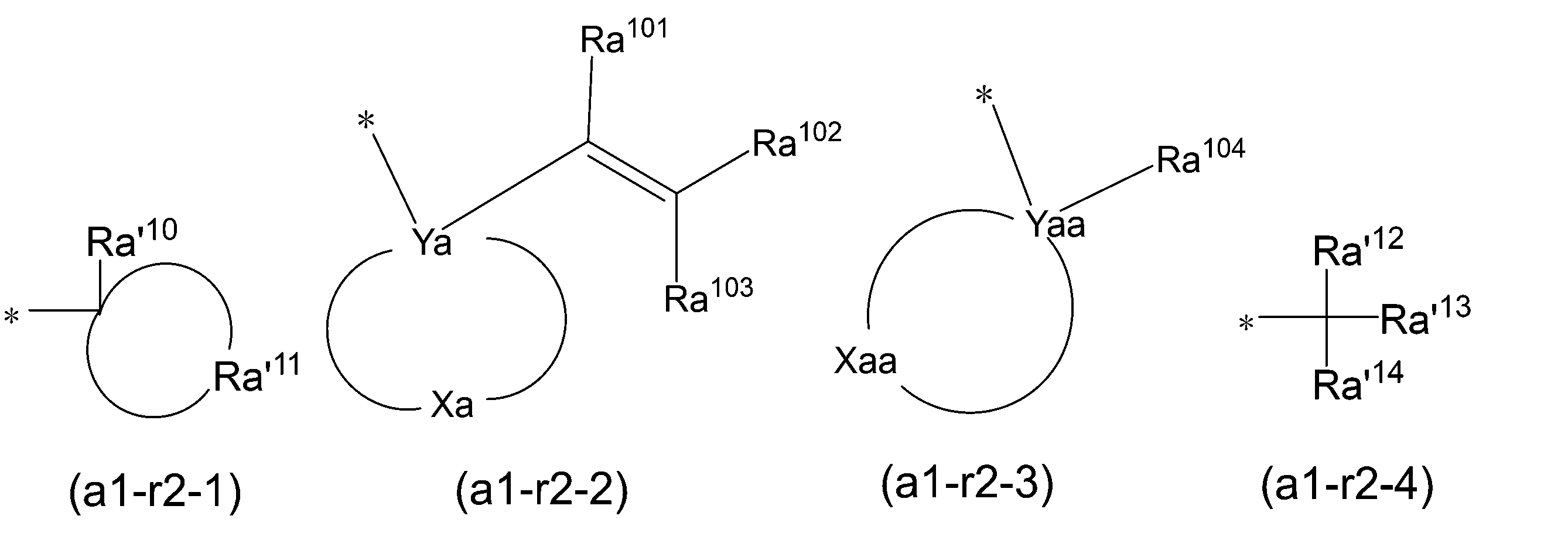
上記の式(a1-r2-1)中、Ra’10は、一部がハロゲン原子もしくはヘテロ原子含有基で置換されていてもよい直鎖状もしくは分岐鎖状の炭素原子数1~12のアルキル基である。
Ra’10における、直鎖状のアルキル基としては、炭素原子数1~12であり、炭素原子数1~10が好ましく、炭素原子数1~5が特に好ましい。
Ra’10における、分岐鎖状のアルキル基としては、前記Ra’3と同様のものが挙げられる。
Ra’10における、分岐鎖状のアルキル基としては、前記Ra’3と同様のものが挙げられる。
Ra’10におけるアルキル基は、一部がハロゲン原子もしくはヘテロ原子含有基で置換されていてもよい。例えば、アルキル基を構成する水素原子の一部が、ハロゲン原子又はヘテロ原子含有基で置換されていてもよい。また、アルキル基を構成する炭素原子(メチレン基など)の一部が、ヘテロ原子含有基で置換されていてもよい。
ここでいうヘテロ原子としては、酸素原子、硫黄原子、窒素原子が挙げられる。ヘテロ原子含有基としては、(-O-)、-C(=O)-O-、-O-C(=O)-、-C(=O)-、-O-C(=O)-O-、-C(=O)-NH-、-NH-、-S-、-S(=O)2-、-S(=O)2-O-等が挙げられる。
ここでいうヘテロ原子としては、酸素原子、硫黄原子、窒素原子が挙げられる。ヘテロ原子含有基としては、(-O-)、-C(=O)-O-、-O-C(=O)-、-C(=O)-、-O-C(=O)-O-、-C(=O)-NH-、-NH-、-S-、-S(=O)2-、-S(=O)2-O-等が挙げられる。
式(a1-r2-1)中、Ra’11(Ra’10が結合した炭素原子と共に形成する脂肪族環式基)は、式(a1-r-1)におけるRa’3の単環式基又は多環式基である脂肪族炭化水素基(脂環式炭化水素基)として挙げた基が好ましい。その中でも、単環式の脂環式炭化水素基が好ましく、具体的には、シクロペンチル基、シクロヘキシル基がより好ましい。
式(a1-r2-2)中、XaがYaと共に形成する環状の炭化水素基としては、前記式(a1-r-1)中のRa’3における環状の1価の炭化水素基(脂肪族炭化水素基)から水素原子1個以上をさらに除いた基が挙げられる。
XaがYaと共に形成する環状の炭化水素基は、置換基を有してもよい。この置換基としては、上記Ra’3における環状の炭化水素基が有していてもよい置換基と同様のものが挙げられる。
式(a1-r2-2)中、Ra101~Ra103における、炭素原子数1~10の1価の鎖状飽和炭化水素基としては、例えば、メチル基、エチル基、プロピル基、ブチル基、ペンチル基、ヘキシル基、ヘプチル基、オクチル基、デシル基等が挙げられる。
Ra101~Ra103における、炭素原子数3~20の1価の脂肪族環状飽和炭化水素基としては、例えば、シクロプロピル基、シクロブチル基、シクロペンチル基、シクロヘキシル基、シクロヘプチル基、シクロオクチル基、シクロデシル基、シクロドデシル基等の単環式脂肪族飽和炭化水素基;ビシクロ[2.2.2]オクタニル基、トリシクロ[5.2.1.02,6]デカニル基、トリシクロ[3.3.1.13,7]デカニル基、テトラシクロ[6.2.1.13,6.02,7]ドデカニル基、アダマンチル基等の多環式脂肪族飽和炭化水素基等が挙げられる。
Ra101~Ra103は、中でも、合成容易性の観点から、水素原子、炭素原子数1~10の1価の鎖状飽和炭化水素基が好ましく、その中でも、水素原子、メチル基、エチル基がより好ましく、水素原子が特に好ましい。
XaがYaと共に形成する環状の炭化水素基は、置換基を有してもよい。この置換基としては、上記Ra’3における環状の炭化水素基が有していてもよい置換基と同様のものが挙げられる。
式(a1-r2-2)中、Ra101~Ra103における、炭素原子数1~10の1価の鎖状飽和炭化水素基としては、例えば、メチル基、エチル基、プロピル基、ブチル基、ペンチル基、ヘキシル基、ヘプチル基、オクチル基、デシル基等が挙げられる。
Ra101~Ra103における、炭素原子数3~20の1価の脂肪族環状飽和炭化水素基としては、例えば、シクロプロピル基、シクロブチル基、シクロペンチル基、シクロヘキシル基、シクロヘプチル基、シクロオクチル基、シクロデシル基、シクロドデシル基等の単環式脂肪族飽和炭化水素基;ビシクロ[2.2.2]オクタニル基、トリシクロ[5.2.1.02,6]デカニル基、トリシクロ[3.3.1.13,7]デカニル基、テトラシクロ[6.2.1.13,6.02,7]ドデカニル基、アダマンチル基等の多環式脂肪族飽和炭化水素基等が挙げられる。
Ra101~Ra103は、中でも、合成容易性の観点から、水素原子、炭素原子数1~10の1価の鎖状飽和炭化水素基が好ましく、その中でも、水素原子、メチル基、エチル基がより好ましく、水素原子が特に好ましい。
上記Ra101~Ra103で表される鎖状飽和炭化水素基、又は脂肪族環状飽和炭化水素基が有する置換基としては、例えば、上述のRax5と同様の基が挙げられる。
Ra101~Ra103の2つ以上が互いに結合して環状構造を形成することにより生じる炭素-炭素二重結合を含む基としては、例えば、シクロペンテニル基、シクロヘキセニル基、メチルシクロペンテニル基、メチルシクロヘキセニル基、シクロペンチリデンエテニル基、シクロへキシリデンエテニル基等が挙げられる。これらの中でも、合成容易性の観点から、シクロペンテニル基、シクロヘキセニル基、シクロペンチリデンエテニル基が好ましい。
式(a1-r2-3)中、XaaがYaaと共に形成する脂肪族環式基は、式(a1-r-1)におけるRa’3の単環式基又は多環式基である脂肪族炭化水素基として挙げた基が好ましい。
式(a1-r2-3)中、Ra104における芳香族炭化水素基としては、炭素原子数5~30の芳香族炭化水素環から水素原子1個以上を除いた基が挙げられる。中でも、Ra104は、炭素原子数6~15の芳香族炭化水素環から水素原子1個以上を除いた基が好ましく、ベンゼン、ナフタレン、アントラセン又はフェナントレンから水素原子1個以上を除いた基がより好ましく、ベンゼン、ナフタレン又はアントラセンから水素原子1個以上を除いた基がさらに好ましく、ベンゼン又はナフタレンから水素原子1個以上を除いた基が特に好ましく、ベンゼンから水素原子1個以上を除いた基が最も好ましい。
式(a1-r2-3)中、Ra104における芳香族炭化水素基としては、炭素原子数5~30の芳香族炭化水素環から水素原子1個以上を除いた基が挙げられる。中でも、Ra104は、炭素原子数6~15の芳香族炭化水素環から水素原子1個以上を除いた基が好ましく、ベンゼン、ナフタレン、アントラセン又はフェナントレンから水素原子1個以上を除いた基がより好ましく、ベンゼン、ナフタレン又はアントラセンから水素原子1個以上を除いた基がさらに好ましく、ベンゼン又はナフタレンから水素原子1個以上を除いた基が特に好ましく、ベンゼンから水素原子1個以上を除いた基が最も好ましい。
式(a1-r2-3)中のRa104が有していてもよい置換基としては、例えば、メチル基、エチル基、プロピル基、ヒドロキシ基、カルボキシ基、ハロゲン原子、アルコキシ基(メトキシ基、エトキシ基、プロポキシ基、ブトキシ基等)、アルキルオキシカルボニル基等が挙げられる。
式(a1-r2-4)中、Ra’12及びRa’13は、それぞれ独立に、炭素原子数1~10の1価の鎖状飽和炭化水素基である。Ra’12及びRa’13における、炭素原子数1~10の1価の鎖状飽和炭化水素基としては、上記のRa101~Ra103における、炭素原子数1~10の1価の鎖状飽和炭化水素基と同様のものが挙げられる。この鎖状飽和炭化水素基が有する水素原子の一部又は全部は置換されていてもよい。
Ra’12及びRa’13は、中でも、炭素原子数1~5のアルキル基が好ましく、炭素原子数1~5のアルキル基がより好ましく、メチル基、エチル基がさらに好ましく、メチル基が特に好ましい。
上記Ra’12及びRa’13で表される鎖状飽和炭化水素基が置換されている場合、その置換基としては、例えば、上述のRax5と同様の基が挙げられる。
Ra’12及びRa’13は、中でも、炭素原子数1~5のアルキル基が好ましく、炭素原子数1~5のアルキル基がより好ましく、メチル基、エチル基がさらに好ましく、メチル基が特に好ましい。
上記Ra’12及びRa’13で表される鎖状飽和炭化水素基が置換されている場合、その置換基としては、例えば、上述のRax5と同様の基が挙げられる。
式(a1-r2-4)中、Ra’14は、置換基を有してもよい炭化水素基である。Ra’14における炭化水素基としては、直鎖状もしくは分岐鎖状のアルキル基、又は環状の炭化水素基が挙げられる。
Ra’14における直鎖状のアルキル基は、炭素原子数が1~5であることが好ましく、1~4がより好ましく、1又は2がさらに好ましい。具体的には、メチル基、エチル基、n-プロピル基、n-ブチル基、n-ペンチル基等が挙げられる。これらの中でも、メチル基、エチル基又はn-ブチル基が好ましく、メチル基又はエチル基がより好ましい。
Ra’14における分岐鎖状のアルキル基は、炭素原子数が3~10であることが好ましく、3~5がより好ましい。具体的には、イソプロピル基、イソブチル基、tert-ブチル基、イソペンチル基、ネオペンチル基、1,1-ジエチルプロピル基、2,2-ジメチルブチル基等が挙げられ、イソプロピル基であることが好ましい。
Ra’14が環状の炭化水素基となる場合、該炭化水素基は、脂肪族炭化水素基でも芳香族炭化水素基でもよく、また、多環式基でも単環式基でもよい。
単環式基である脂肪族炭化水素基としては、モノシクロアルカンから1個の水素原子を除いた基が好ましい。該モノシクロアルカンとしては、炭素原子数3~6のものが好ましく、具体的にはシクロペンタン、シクロヘキサン等が挙げられる。
多環式基である脂肪族炭化水素基としては、ポリシクロアルカンから1個の水素原子を除いた基が好ましく、該ポリシクロアルカンとしては、炭素原子数7~12のものが好ましく、具体的にはアダマンタン、ノルボルナン、イソボルナン、トリシクロデカン、テトラシクロドデカン等が挙げられる。
単環式基である脂肪族炭化水素基としては、モノシクロアルカンから1個の水素原子を除いた基が好ましい。該モノシクロアルカンとしては、炭素原子数3~6のものが好ましく、具体的にはシクロペンタン、シクロヘキサン等が挙げられる。
多環式基である脂肪族炭化水素基としては、ポリシクロアルカンから1個の水素原子を除いた基が好ましく、該ポリシクロアルカンとしては、炭素原子数7~12のものが好ましく、具体的にはアダマンタン、ノルボルナン、イソボルナン、トリシクロデカン、テトラシクロドデカン等が挙げられる。
Ra’14における芳香族炭化水素基としては、Ra104における芳香族炭化水素基と同様のものが挙げられる。中でも、Ra’14は、炭素原子数6~15の芳香族炭化水素環から水素原子1個以上を除いた基が好ましく、ベンゼン、ナフタレン、アントラセン又はフェナントレンから水素原子1個以上を除いた基がより好ましく、ベンゼン、ナフタレン又はアントラセンから水素原子1個以上を除いた基がさらに好ましく、ナフタレン又はアントラセンから水素原子1個以上を除いた基が特に好ましく、ナフタレンから水素原子1個以上を除いた基が最も好ましい。
Ra’14が有していてもよい置換基としては、Ra104が有していてもよい置換基と同様のものが挙げられる。
Ra’14が有していてもよい置換基としては、Ra104が有していてもよい置換基と同様のものが挙げられる。
式(a1-r2-4)中のRa’14がナフチル基である場合、前記式(a1-r2-4)における第3級炭素原子と結合する位置は、ナフチル基の1位又は2位のいずれであってもよい。
式(a1-r2-4)中のRa’14がアントリル基である場合、前記式(a1-r2-4)における第3級炭素原子と結合する位置は、アントリル基の1位、2位又は9位のいずれであってもよい。
式(a1-r2-4)中のRa’14がアントリル基である場合、前記式(a1-r2-4)における第3級炭素原子と結合する位置は、アントリル基の1位、2位又は9位のいずれであってもよい。
前記式(a1-r2-1)で表される基の具体例を以下に挙げる。
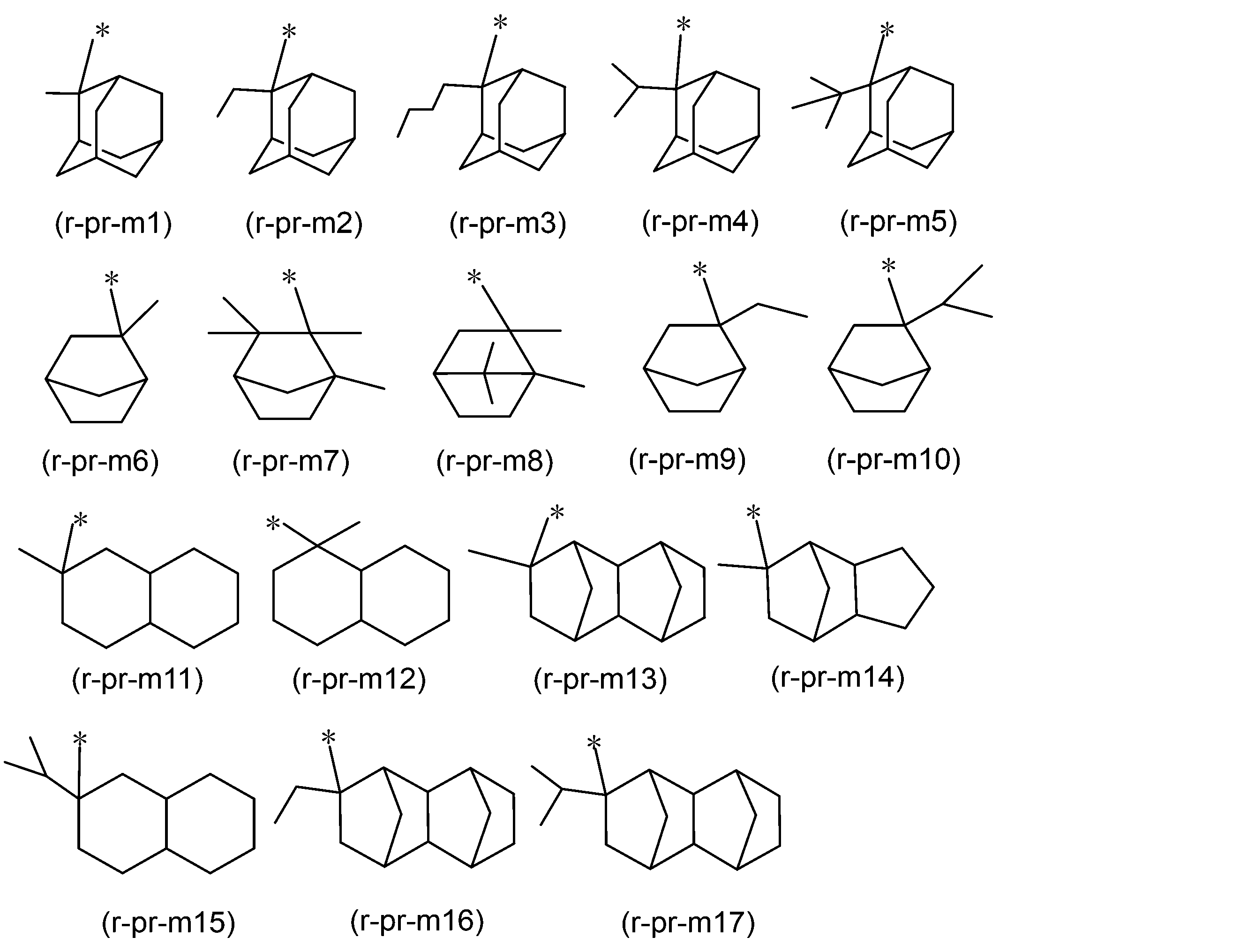
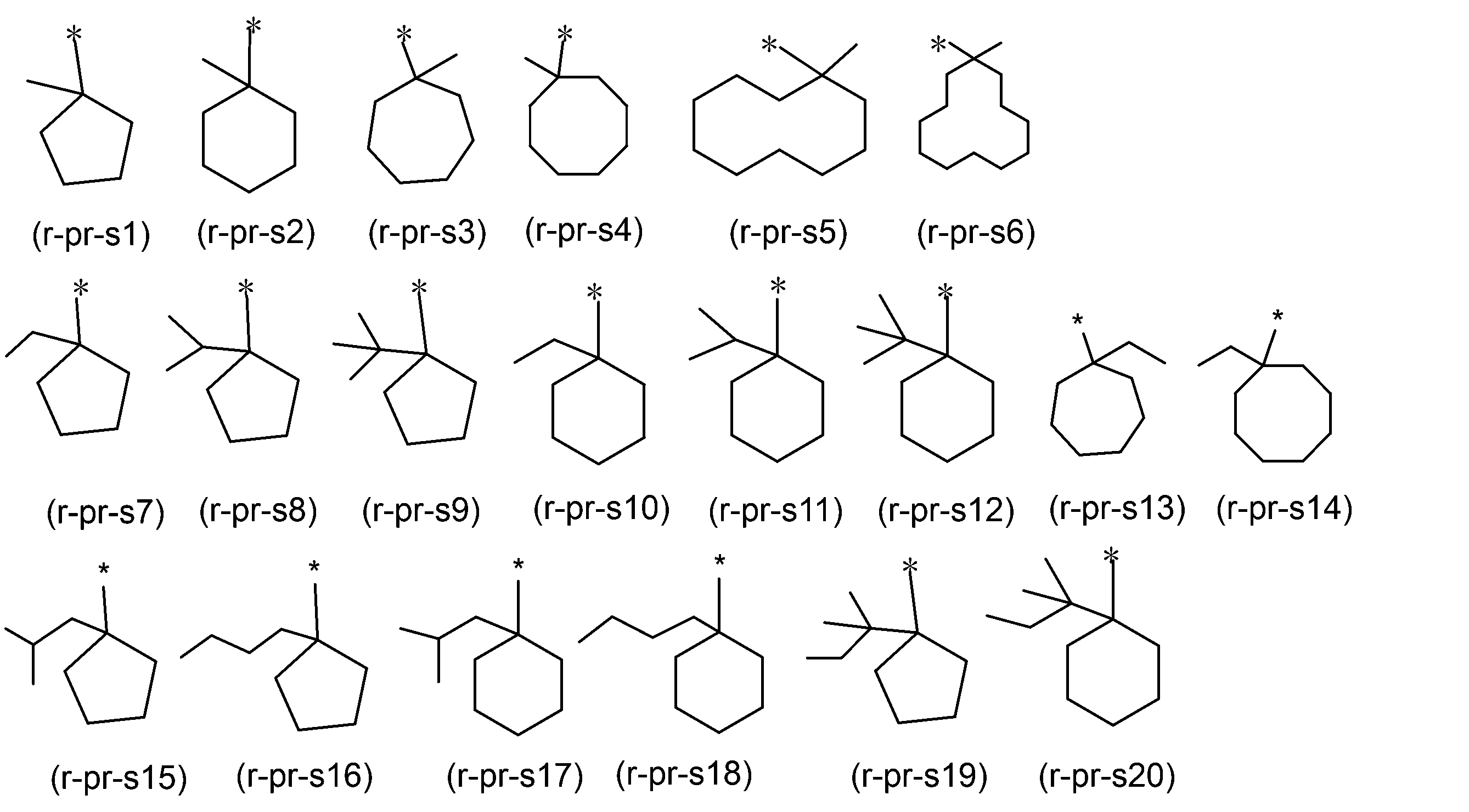

前記式(a1-r2-2)で表される基の具体例を以下に挙げる。

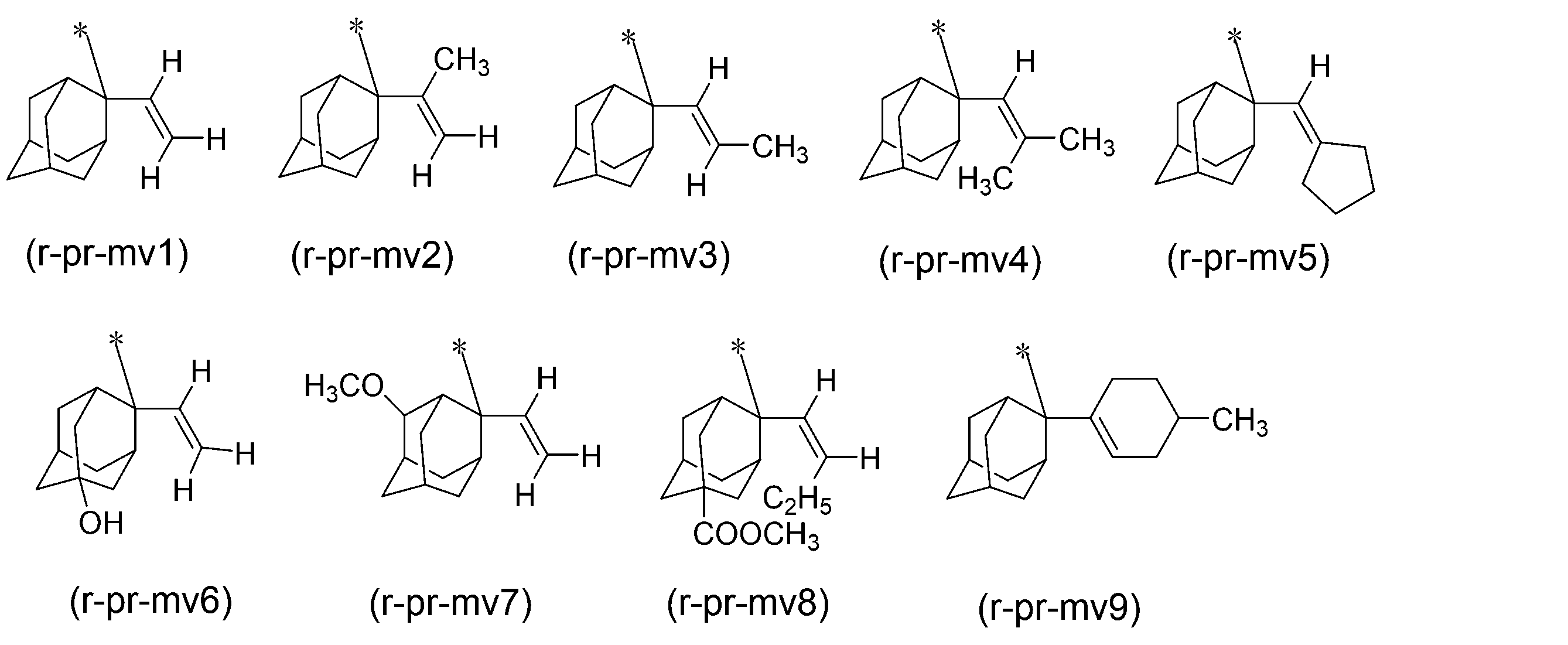

前記式(a1-r2-3)で表される基の具体例を以下に挙げる。
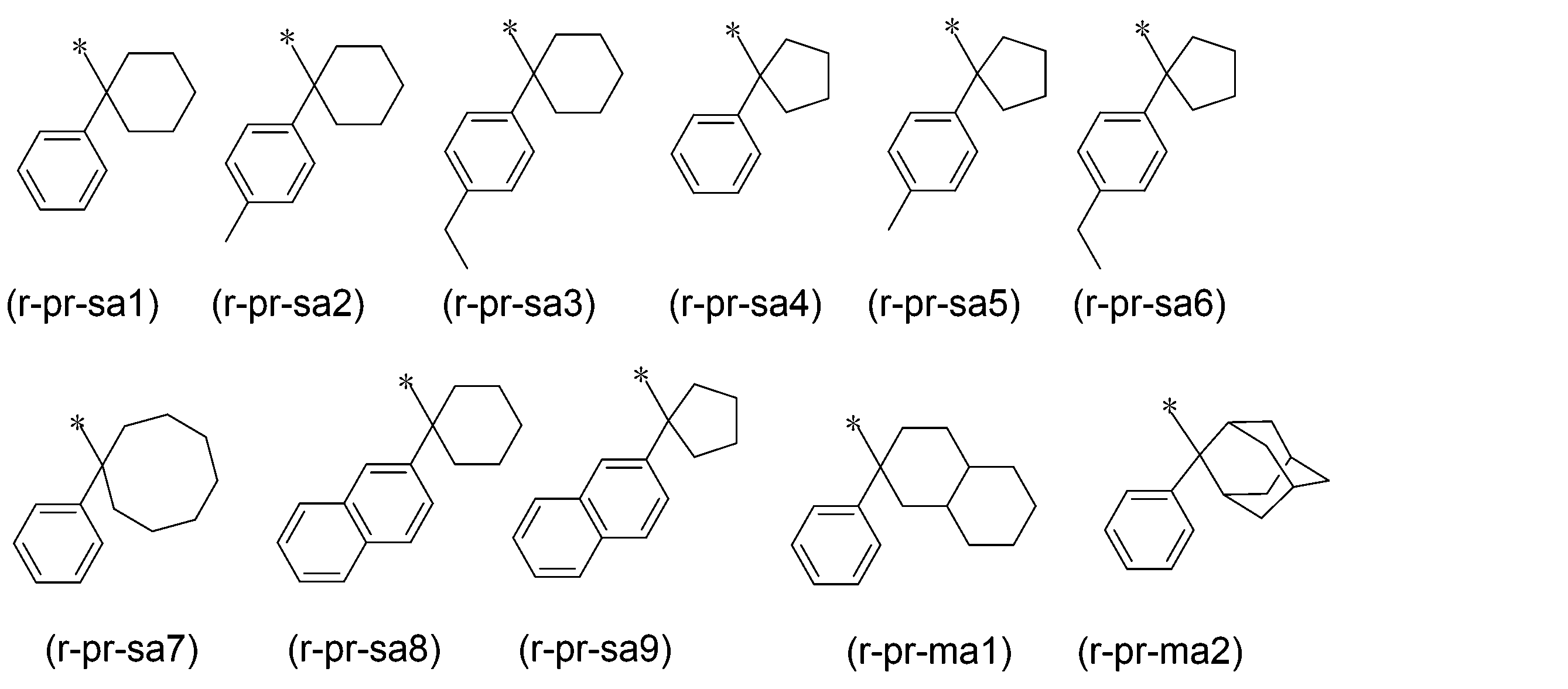
前記式(a1-r2-4)で表される基の具体例を以下に挙げる。

第3級アルキルオキシカルボニル酸解離性基:
前記極性基のうち水酸基を保護する酸解離性基としては、例えば、下記一般式(a1-r-3)で表される酸解離性基(以下便宜上「第3級アルキルオキシカルボニル酸解離性基」ということがある)が挙げられる。
前記極性基のうち水酸基を保護する酸解離性基としては、例えば、下記一般式(a1-r-3)で表される酸解離性基(以下便宜上「第3級アルキルオキシカルボニル酸解離性基」ということがある)が挙げられる。

式(a1-r-3)中、Ra’7~Ra’9は、それぞれ炭素原子数1~5のアルキル基が好ましく、炭素原子数1~3のアルキル基がより好ましい。
また、各アルキル基の合計の炭素原子数は、3~7であることが好ましく、炭素原子数3~5であることがより好ましく、炭素原子数3~4であることが最も好ましい。
また、各アルキル基の合計の炭素原子数は、3~7であることが好ましく、炭素原子数3~5であることがより好ましく、炭素原子数3~4であることが最も好ましい。
第2級アルキルエステル型酸解離性基:
上記極性基のうち、カルボキシ基を保護する酸解離性基としては、例えば、下記一般式(a1-r-4)で表される酸解離性基が挙げられる。
上記極性基のうち、カルボキシ基を保護する酸解離性基としては、例えば、下記一般式(a1-r-4)で表される酸解離性基が挙げられる。

式中、Ra’10及びRa’12における炭化水素基としては、前記Ra’3と同様のものが挙げられる。
式中、Ra’11a及びRa’11bにおけるアルキル基としては、前記Ra’1におけるアルキル基と同様のものが挙げられる。
式中、Ra’10及びRa’12における炭化水素基、並びに、Ra’11a及びRa’11bにおけるアルキル基は置換基を有してもよい。この置換基としては、例えば、上述したRax5等が挙げられる。
式中、Ra’11a及びRa’11bにおけるアルキル基としては、前記Ra’1におけるアルキル基と同様のものが挙げられる。
式中、Ra’10及びRa’12における炭化水素基、並びに、Ra’11a及びRa’11bにおけるアルキル基は置換基を有してもよい。この置換基としては、例えば、上述したRax5等が挙げられる。
Ra’10とRa’11a又はRa’11bとは、互いに結合して環を形成してもよい。該環は、多環であっても、単環であってもよく、脂環であっても、芳香環であってもよい。
該脂環及び芳香環は、ヘテロ原子を含むものでもよい。
該脂環及び芳香環は、ヘテロ原子を含むものでもよい。
Ra’10とRa’11a又はRa’11bとが、互いに結合して形成する環としては、上記の中でも、モノシクロアルケン、モノシクロアルケンの炭素原子の一部がヘテロ原子(酸素原子、硫黄原子等)で置換された環、モノシクロアルカジエンが好ましく、炭素原子数3~6のシクロアルケンが好ましく、シクロペンテン又はシクロヘキセンが好ましい。
Ra’10とRa’11a又はRa’11bとが、互いに結合して形成する環は、縮合環であってもよい。該縮合環として、具体的には、インダン等が挙げられる。
Ra’10とRa’11a又はRa’11bとが、互いに結合して形成する環は、置換基を有してもよい。この置換基としては、例えば、上述したRax5等が挙げられる。
Ra’11a又はRa’11bと、Ra’12とは、互いに結合して環を形成してもよく、該環としては、Ra’10とRa’11a又はRa’11bとが、互いに結合して形成する環と同様のものが挙げられる。
前記式(a1-r-4)で表される基の具体例を以下に挙げる。
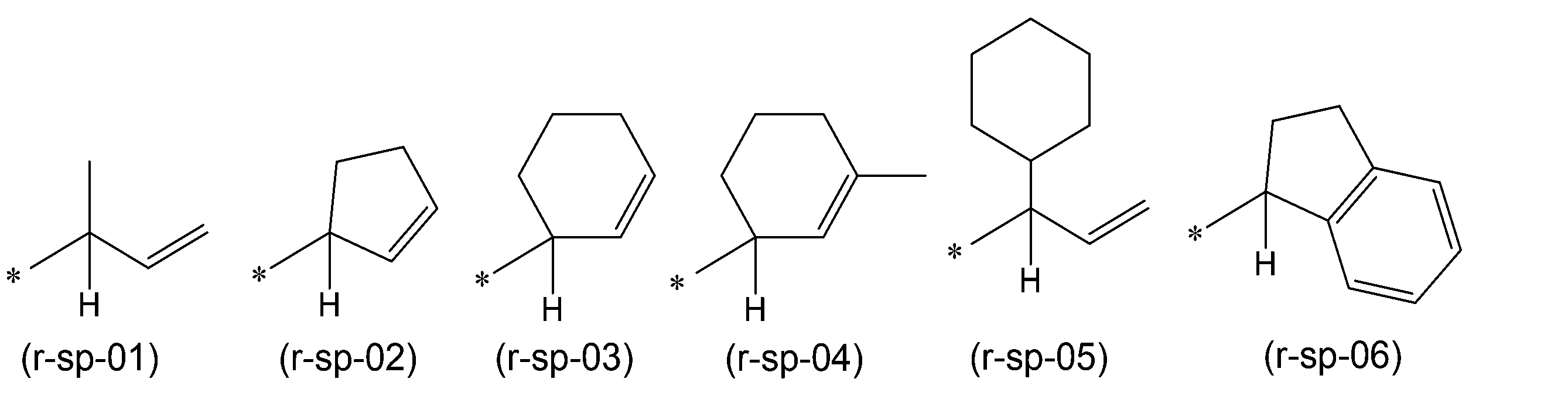
構成単位(a1)としては、α位の炭素原子に結合した水素原子が置換基で置換されていてもよいアクリル酸エステルから誘導される構成単位、アクリルアミドから誘導される構成単位、ヒドロキシスチレン若しくはヒドロキシスチレン誘導体から誘導される構成単位の水酸基における水素原子の少なくとも一部が前記酸分解性基を含む置換基により保護された構成単位、ビニル安息香酸若しくはビニル安息香酸誘導体から誘導される構成単位の-C(=O)-OHにおける水素原子の少なくとも一部が前記酸分解性基を含む置換基により保護された構成単位等が挙げられる。
構成単位(a1)としては、上記のなかでも、α位の炭素原子に結合した水素原子が置換基で置換されていてもよいアクリル酸エステルから誘導される構成単位が好ましい。
かかる構成単位(a1)の好ましい具体例としては、下記一般式(a1-1)、(a1-2)又は(a1-3)で表される構成単位が挙げられる。
かかる構成単位(a1)の好ましい具体例としては、下記一般式(a1-1)、(a1-2)又は(a1-3)で表される構成単位が挙げられる。
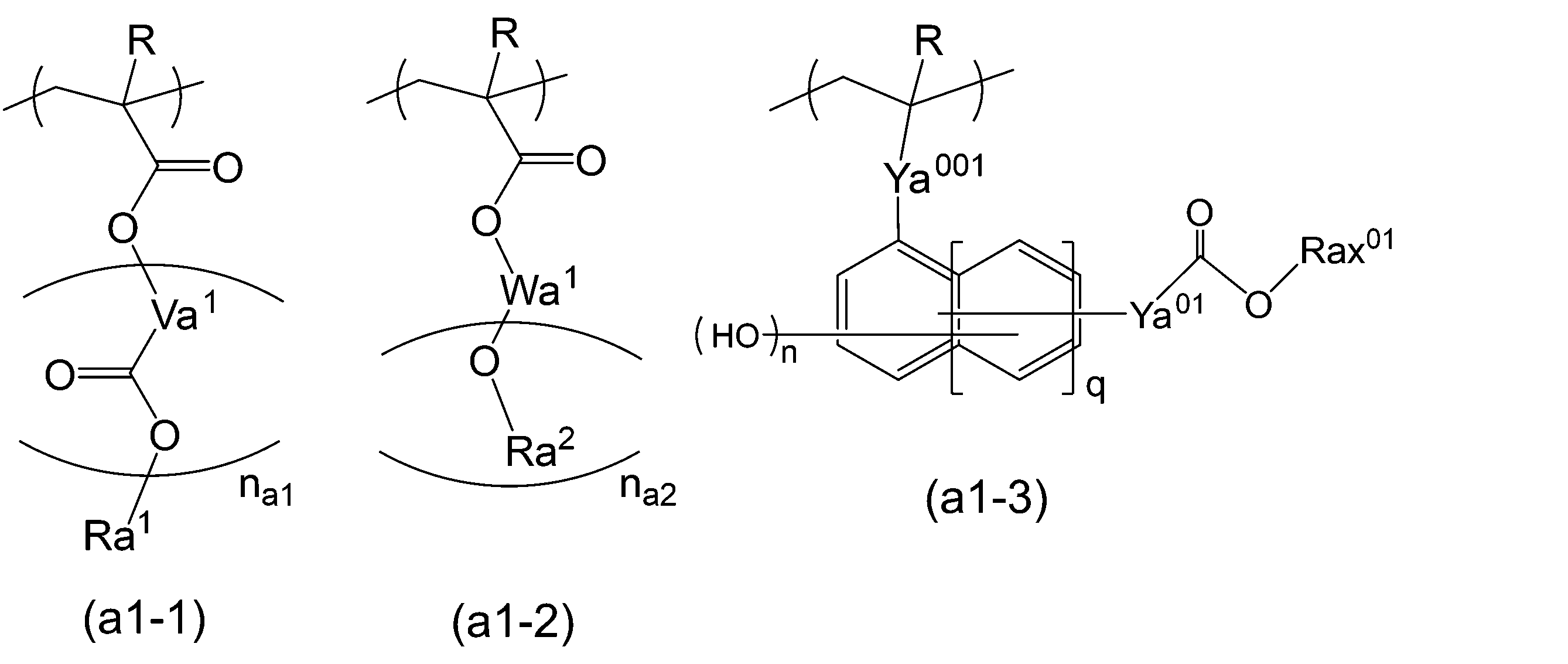
前記式(a1-1)中、Rは、水素原子、炭素原子数1~5のアルキル基又は炭素原子数1~5のハロゲン化アルキル基である。Rにおける炭素原子数1~5のアルキル基は、炭素原子数1~5の直鎖状または分岐鎖状のアルキル基が好ましく、具体的には、メチル基、エチル基、プロピル基、イソプロピル基、n-ブチル基、イソブチル基、tert-ブチル基、ペンチル基、イソペンチル基、ネオペンチル基等が挙げられる。炭素原子数1~5のハロゲン化アルキル基は、前記炭素原子数1~5のアルキル基の水素原子の一部または全部がハロゲン原子で置換された基である。該ハロゲン原子としては、特にフッ素原子が好ましい。
Rとしては、水素原子、炭素原子数1~5のアルキル基又は炭素原子数1~5のフッ素化アルキル基が好ましく、工業上の入手の容易さから、水素原子又はメチル基が最も好ましい。
Rとしては、水素原子、炭素原子数1~5のアルキル基又は炭素原子数1~5のフッ素化アルキル基が好ましく、工業上の入手の容易さから、水素原子又はメチル基が最も好ましい。
前記式(a1-1)中、Va1における2価の炭化水素基は、脂肪族炭化水素基であってもよく、芳香族炭化水素基であってもよい。
Va1における2価の炭化水素基としての脂肪族炭化水素基は、飽和であってもよく、不飽和であってもよく、通常は飽和であることが好ましい。
該脂肪族炭化水素基として、より具体的には、直鎖状もしくは分岐鎖状の脂肪族炭化水素基、又は、構造中に環を含む脂肪族炭化水素基等が挙げられる。
該脂肪族炭化水素基として、より具体的には、直鎖状もしくは分岐鎖状の脂肪族炭化水素基、又は、構造中に環を含む脂肪族炭化水素基等が挙げられる。
前記直鎖状の脂肪族炭化水素基は、炭素原子数が1~10であることが好ましく、炭素原子数1~6がより好ましく、炭素原子数1~4がさらに好ましく、炭素原子数1~3が最も好ましい。
直鎖状の脂肪族炭化水素基としては、直鎖状のアルキレン基が好ましく、具体的には、メチレン基[-CH2-]、エチレン基[-(CH2)2-]、トリメチレン基[-(CH2)3-]、テトラメチレン基[-(CH2)4-]、ペンタメチレン基[-(CH2)5-]等が挙げられる。
前記分岐鎖状の脂肪族炭化水素基は、炭素原子数が2~10であることが好ましく、炭素原子数3~6がより好ましく、炭素原子数3又は4がさらに好ましく、炭素原子数3が最も好ましい。
分岐鎖状の脂肪族炭化水素基としては、分岐鎖状のアルキレン基が好ましく、具体的には、-CH(CH3)-、-CH(CH2CH3)-、-C(CH3)2-、-C(CH3)(CH2CH3)-、-C(CH3)(CH2CH2CH3)-、-C(CH2CH3)2-等のアルキルメチレン基;-CH(CH3)CH2-、-CH(CH3)CH(CH3)-、-C(CH3)2CH2-、-CH(CH2CH3)CH2-、-C(CH2CH3)2-CH2-等のアルキルエチレン基;-CH(CH3)CH2CH2-、-CH2CH(CH3)CH2-等のアルキルトリメチレン基;-CH(CH3)CH2CH2CH2-、-CH2CH(CH3)CH2CH2-等のアルキルテトラメチレン基などのアルキルアルキレン基等が挙げられる。アルキルアルキレン基におけるアルキル基としては、炭素原子数1~5の直鎖状のアルキル基が好ましい。
直鎖状の脂肪族炭化水素基としては、直鎖状のアルキレン基が好ましく、具体的には、メチレン基[-CH2-]、エチレン基[-(CH2)2-]、トリメチレン基[-(CH2)3-]、テトラメチレン基[-(CH2)4-]、ペンタメチレン基[-(CH2)5-]等が挙げられる。
前記分岐鎖状の脂肪族炭化水素基は、炭素原子数が2~10であることが好ましく、炭素原子数3~6がより好ましく、炭素原子数3又は4がさらに好ましく、炭素原子数3が最も好ましい。
分岐鎖状の脂肪族炭化水素基としては、分岐鎖状のアルキレン基が好ましく、具体的には、-CH(CH3)-、-CH(CH2CH3)-、-C(CH3)2-、-C(CH3)(CH2CH3)-、-C(CH3)(CH2CH2CH3)-、-C(CH2CH3)2-等のアルキルメチレン基;-CH(CH3)CH2-、-CH(CH3)CH(CH3)-、-C(CH3)2CH2-、-CH(CH2CH3)CH2-、-C(CH2CH3)2-CH2-等のアルキルエチレン基;-CH(CH3)CH2CH2-、-CH2CH(CH3)CH2-等のアルキルトリメチレン基;-CH(CH3)CH2CH2CH2-、-CH2CH(CH3)CH2CH2-等のアルキルテトラメチレン基などのアルキルアルキレン基等が挙げられる。アルキルアルキレン基におけるアルキル基としては、炭素原子数1~5の直鎖状のアルキル基が好ましい。
前記構造中に環を含む脂肪族炭化水素基としては、脂環式炭化水素基(脂肪族炭化水素環から水素原子を2個除いた基)、脂環式炭化水素基が直鎖状または分岐鎖状の脂肪族炭化水素基の末端に結合した基、脂環式炭化水素基が直鎖状または分岐鎖状の脂肪族炭化水素基の途中に介在する基などが挙げられる。前記直鎖状または分岐鎖状の脂肪族炭化水素基としては、前記直鎖状の脂肪族炭化水素基または前記分岐鎖状の脂肪族炭化水素基と同様のものが挙げられる。
前記脂環式炭化水素基は、炭素原子数が3~20であることが好ましく、炭素原子数3~12であることがより好ましい。
前記脂環式炭化水素基は、多環式であってもよく、単環式であってもよい。単環式の脂環式炭化水素基としては、モノシクロアルカンから2個の水素原子を除いた基が好ましい。該モノシクロアルカンとしては炭素原子数3~6のものが好ましく、具体的にはシクロペンタン、シクロヘキサン等が挙げられる。多環式の脂環式炭化水素基としては、ポリシクロアルカンから2個の水素原子を除いた基が好ましく、該ポリシクロアルカンとしては炭素原子数7~12のものが好ましく、具体的にはアダマンタン、ノルボルナン、イソボルナン、トリシクロデカン、テトラシクロドデカン等が挙げられる。
前記脂環式炭化水素基は、炭素原子数が3~20であることが好ましく、炭素原子数3~12であることがより好ましい。
前記脂環式炭化水素基は、多環式であってもよく、単環式であってもよい。単環式の脂環式炭化水素基としては、モノシクロアルカンから2個の水素原子を除いた基が好ましい。該モノシクロアルカンとしては炭素原子数3~6のものが好ましく、具体的にはシクロペンタン、シクロヘキサン等が挙げられる。多環式の脂環式炭化水素基としては、ポリシクロアルカンから2個の水素原子を除いた基が好ましく、該ポリシクロアルカンとしては炭素原子数7~12のものが好ましく、具体的にはアダマンタン、ノルボルナン、イソボルナン、トリシクロデカン、テトラシクロドデカン等が挙げられる。
Va1における2価の炭化水素基としての芳香族炭化水素基は、芳香環を有する炭化水素基である。
かかる芳香族炭化水素基は、炭素原子数が3~30であることが好ましく、5~30であることがより好ましく、5~20がさらに好ましく、6~15が特に好ましく、6~12が最も好ましい。ただし、該炭素原子数には、置換基における炭素原子数を含まないものとする。
芳香族炭化水素基が有する芳香環として具体的には、ベンゼン、ビフェニル、フルオレン、ナフタレン、アントラセン、フェナントレン等の芳香族炭化水素環;前記芳香族炭化水素環を構成する炭素原子の一部がヘテロ原子で置換された芳香族複素環等が挙げられる。芳香族複素環におけるヘテロ原子としては、酸素原子、硫黄原子、窒素原子等が挙げられる。
該芳香族炭化水素基として具体的には、前記芳香族炭化水素環から水素原子を2つ除いた基(アリーレン基);前記芳香族炭化水素環から水素原子を1つ除いた基(アリール基)の水素原子の1つがアルキレン基で置換された基(例えば、ベンジル基、フェネチル基、1-ナフチルメチル基、2-ナフチルメチル基、1-ナフチルエチル基、2-ナフチルエチル基等のアリールアルキル基におけるアリール基から水素原子をさらに1つ除いた基)等が挙げられる。前記アルキレン基(アリールアルキル基中のアルキル鎖)の炭素原子数は、1~4であることが好ましく、1~2であることがより好ましく、1であることが特に好ましい。
かかる芳香族炭化水素基は、炭素原子数が3~30であることが好ましく、5~30であることがより好ましく、5~20がさらに好ましく、6~15が特に好ましく、6~12が最も好ましい。ただし、該炭素原子数には、置換基における炭素原子数を含まないものとする。
芳香族炭化水素基が有する芳香環として具体的には、ベンゼン、ビフェニル、フルオレン、ナフタレン、アントラセン、フェナントレン等の芳香族炭化水素環;前記芳香族炭化水素環を構成する炭素原子の一部がヘテロ原子で置換された芳香族複素環等が挙げられる。芳香族複素環におけるヘテロ原子としては、酸素原子、硫黄原子、窒素原子等が挙げられる。
該芳香族炭化水素基として具体的には、前記芳香族炭化水素環から水素原子を2つ除いた基(アリーレン基);前記芳香族炭化水素環から水素原子を1つ除いた基(アリール基)の水素原子の1つがアルキレン基で置換された基(例えば、ベンジル基、フェネチル基、1-ナフチルメチル基、2-ナフチルメチル基、1-ナフチルエチル基、2-ナフチルエチル基等のアリールアルキル基におけるアリール基から水素原子をさらに1つ除いた基)等が挙げられる。前記アルキレン基(アリールアルキル基中のアルキル鎖)の炭素原子数は、1~4であることが好ましく、1~2であることがより好ましく、1であることが特に好ましい。
前記式(a1-1)中、Ra1は、上記式(a1-r-1)、(a1-r-2)又は(a1-r-4)で表される酸解離性基である。
前記式(a1-2)中、Wa1におけるna2+1価の炭化水素基は、脂肪族炭化水素基であってもよく、芳香族炭化水素基であってもよい。該脂肪族炭化水素基は、芳香族性を持たない炭化水素基を意味し、飽和であってもよく、不飽和であってもよく、通常は飽和であることが好ましい。前記脂肪族炭化水素基としては、直鎖状または分岐鎖状の脂肪族炭化水素基、構造中に環を含む脂肪族炭化水素基、或いは直鎖状または分岐鎖状の脂肪族炭化水素基と構造中に環を含む脂肪族炭化水素基とを組み合わせた基が挙げられる。
前記na2+1価は、2~4価が好ましく、2又は3価がより好ましい。
前記na2+1価は、2~4価が好ましく、2又は3価がより好ましい。
前記式(a1-2)中、Ra2は、上記の一般式(a1-r-1)又は(a1-r-3)で表される酸解離性基である。
前記式(a1-3)中、Ya001における2価の連結基としては、特に限定されないが、置換基を有してもよい2価の炭化水素基、及びヘテロ原子を含む2価の連結基等が好適なものとして挙げられる。
Ya001としては、エステル結合[-C(=O)-O-、-O-C(=O)-]、エーテル結合(-O-)、直鎖状若しくは分岐鎖状のアルキレン基、芳香族炭化水素基又はこれらの組合せ、あるいは単結合であることが好ましい。アルキレン基の炭素原子数は、1~10であることが好ましく、炭素原子数1~6がより好ましく、炭素原子数1~4がさらに好ましく、炭素原子数1~3が特に好ましい。
これらの中でも、Ya001としては、エステル結合[-C(=O)-O-、-O-C(=O)-]と直鎖状のアルキレン基との組み合わせ、又は単結合であることがより好ましく、単結合であることがさらに好ましい。
Ya001としては、エステル結合[-C(=O)-O-、-O-C(=O)-]、エーテル結合(-O-)、直鎖状若しくは分岐鎖状のアルキレン基、芳香族炭化水素基又はこれらの組合せ、あるいは単結合であることが好ましい。アルキレン基の炭素原子数は、1~10であることが好ましく、炭素原子数1~6がより好ましく、炭素原子数1~4がさらに好ましく、炭素原子数1~3が特に好ましい。
これらの中でも、Ya001としては、エステル結合[-C(=O)-O-、-O-C(=O)-]と直鎖状のアルキレン基との組み合わせ、又は単結合であることがより好ましく、単結合であることがさらに好ましい。
前記式(a1-3)中、Ya01における2価の連結基としては、特に限定されないが、置換基を有してもよい2価の炭化水素基、ヘテロ原子を含む2価の連結基等が好適なものとして挙げられる。
Ya01は、上記の中でも、エステル結合[-C(=O)-O-、-O-C(=O)-]、エーテル結合(-O-)、直鎖状若しくは分岐鎖状のアルキレン基、芳香族炭化水素基又はこれらの組合せ、あるいは単結合であることが好ましい。これらの中でも、Ya01としては、エステル結合[-C(=O)-O-、-O-C(=O)-]と直鎖状のアルキレン基との組み合わせ、又は単結合であることがより好ましく、単結合であることがさらに好ましい。
Ya01は、上記の中でも、エステル結合[-C(=O)-O-、-O-C(=O)-]、エーテル結合(-O-)、直鎖状若しくは分岐鎖状のアルキレン基、芳香族炭化水素基又はこれらの組合せ、あるいは単結合であることが好ましい。これらの中でも、Ya01としては、エステル結合[-C(=O)-O-、-O-C(=O)-]と直鎖状のアルキレン基との組み合わせ、又は単結合であることがより好ましく、単結合であることがさらに好ましい。
前記式(a1-3)中、Rax01は、上記の一般式(a1-r-2)又は(a1-r-4)で表される酸解離性基が好ましく、これらの中でも、一般式(a1-r-2)で表される酸解離性基がより好ましく、一般式(a1-r2-1)で表される基がさらに好ましい。
前記式(a1-3)中、qは、0~3の整数である。qが0の場合はベンゼン構造、qが1の場合はナフタレン構造、qが2の場合はアントラセン構造、qが3の場合はテトラセン構造となる。
前記式(a1-3)中、nは、1以上の整数であり、好ましくは1~5であり、より好ましくは1~3であり、さらに好ましくは1又は2である。
前記式(a1-3)中、n≦q×2+4である。例えば、qが1でナフタレン構造である場合、該ナフタレンは、6個全部の水素原子がヒドロキシ基で置換されていてもよい。また、該ナフタレンにおいて、Ya001、-Ya01-C(=O)-O-Ra01基、及びヒドロキシ基の置換位置は特に限定されない。
前記式(a1-3)中、nは、1以上の整数であり、好ましくは1~5であり、より好ましくは1~3であり、さらに好ましくは1又は2である。
前記式(a1-3)中、n≦q×2+4である。例えば、qが1でナフタレン構造である場合、該ナフタレンは、6個全部の水素原子がヒドロキシ基で置換されていてもよい。また、該ナフタレンにおいて、Ya001、-Ya01-C(=O)-O-Ra01基、及びヒドロキシ基の置換位置は特に限定されない。
以下に構成単位(a1)の具体例を示す。
以下の各式中、Rαは、水素原子、メチル基またはトリフルオロメチル基を示す。
以下の各式中、Rαは、水素原子、メチル基またはトリフルオロメチル基を示す。


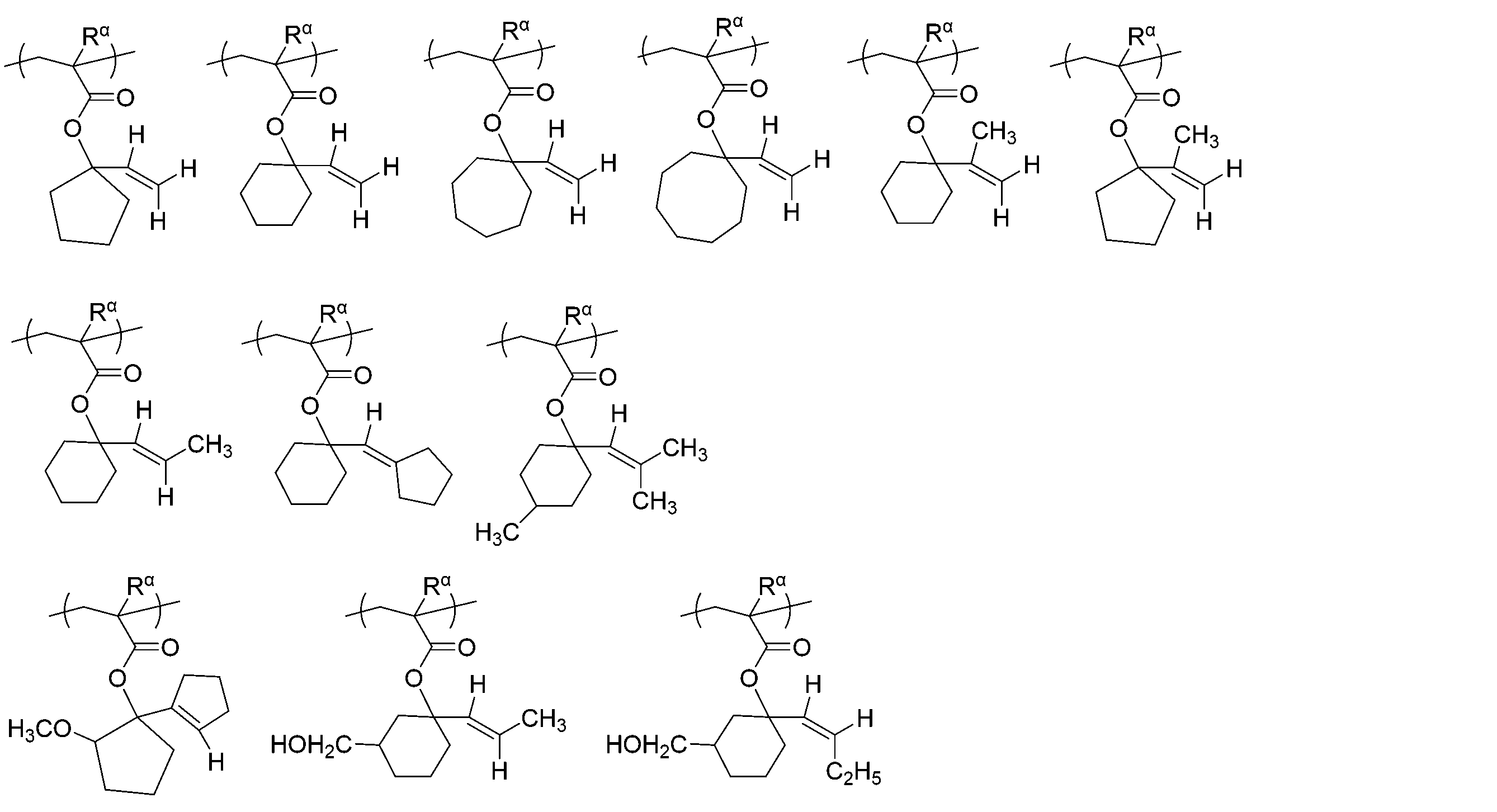
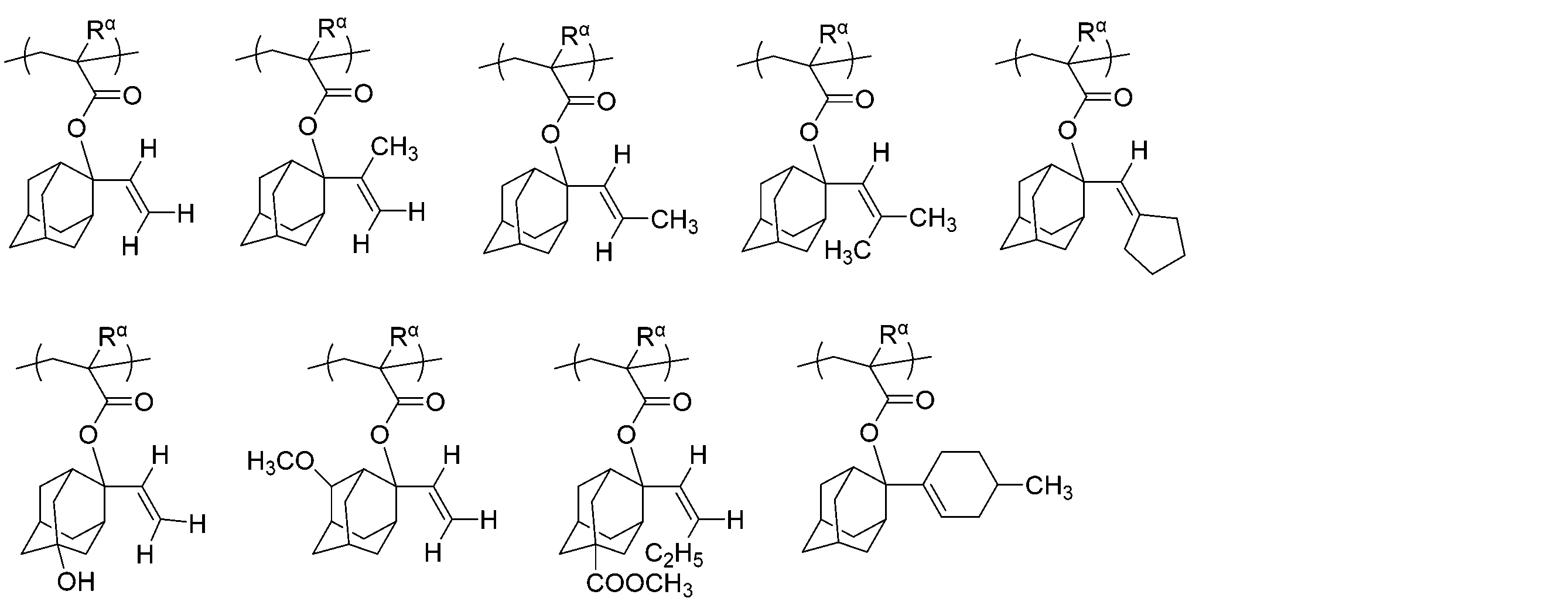

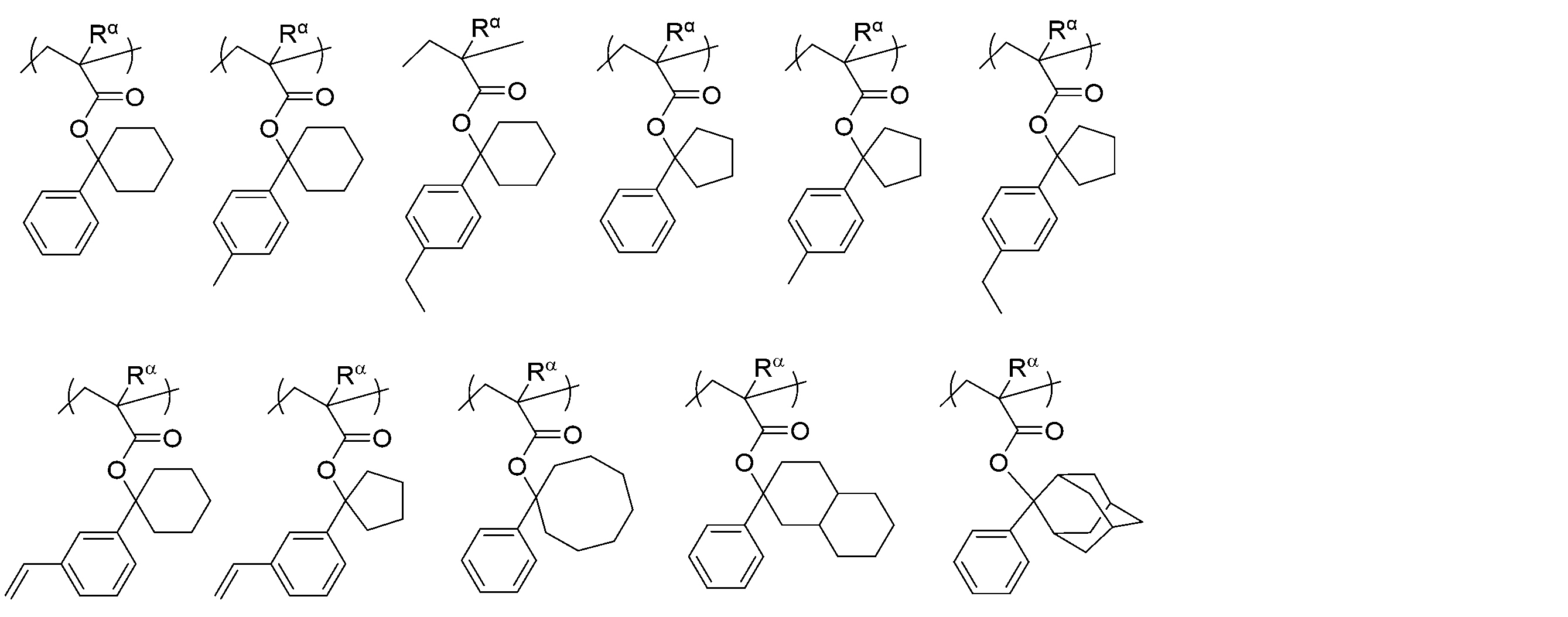

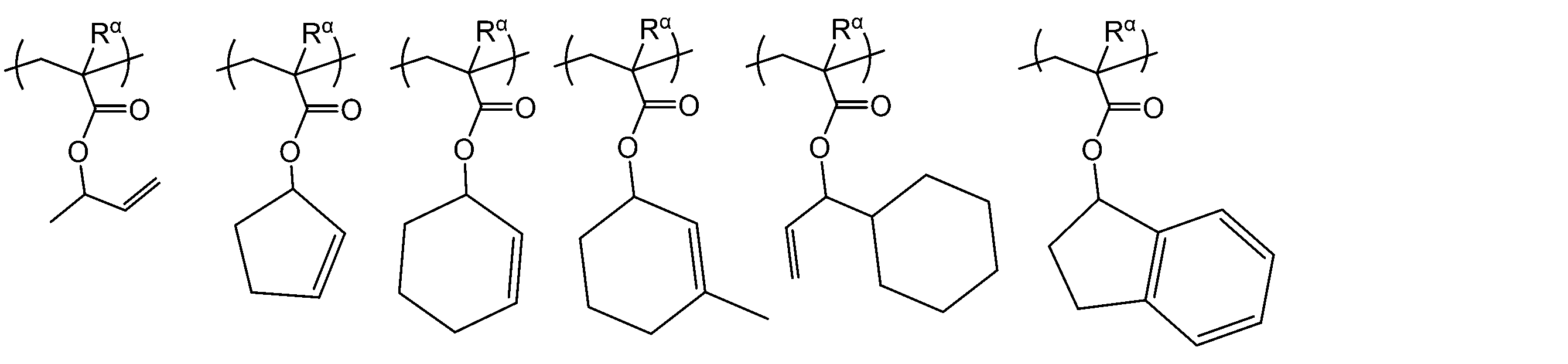
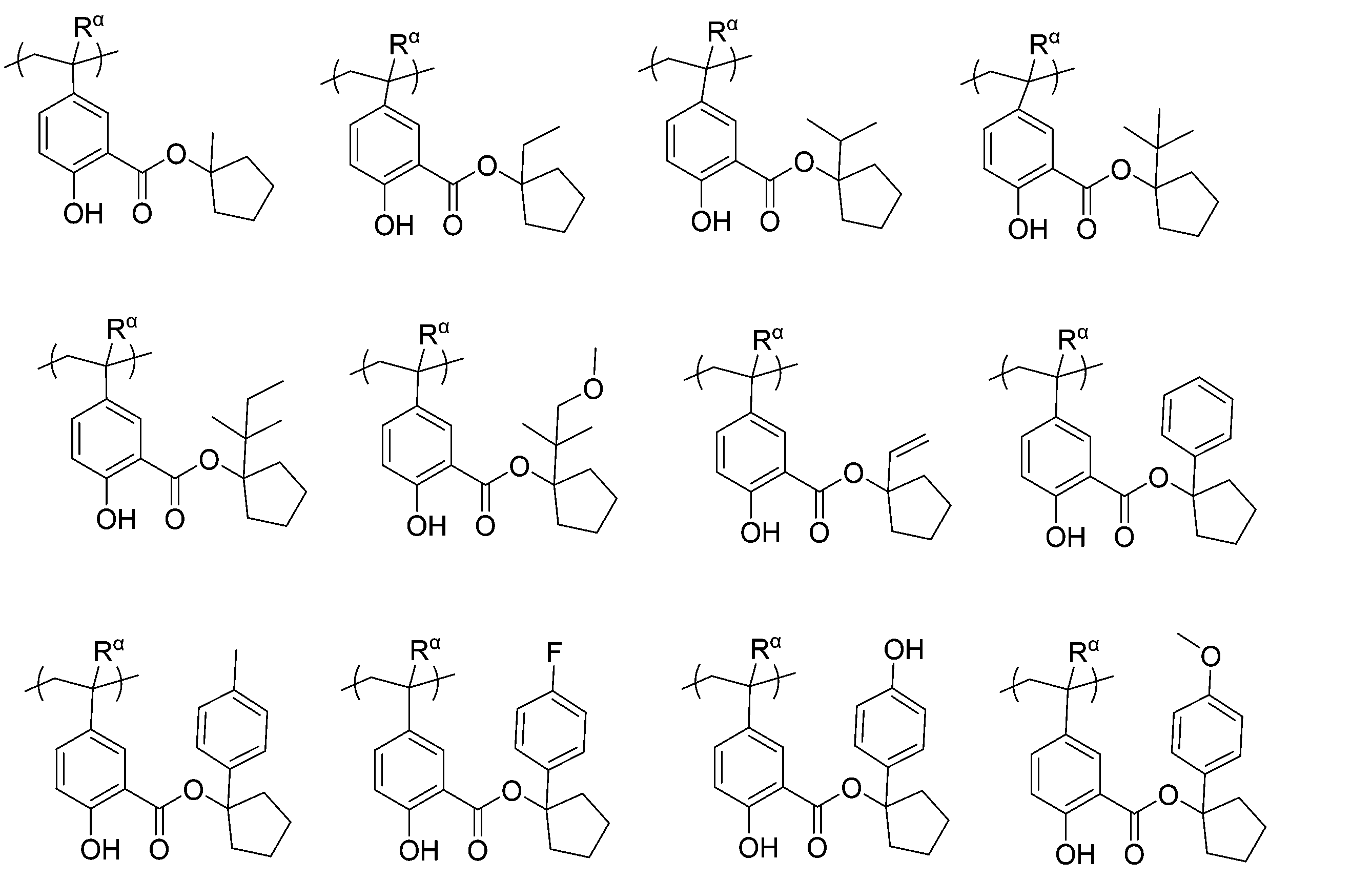
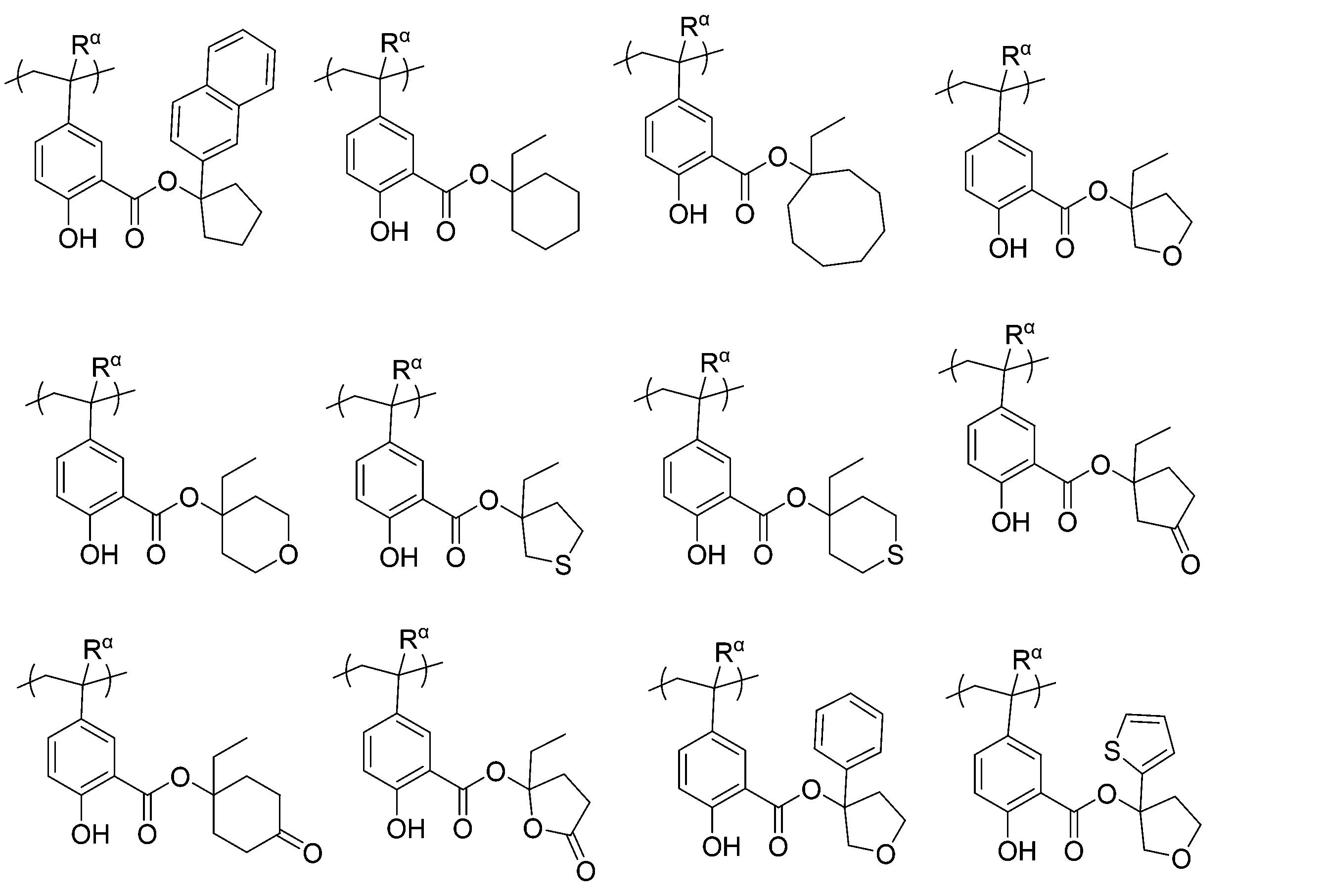
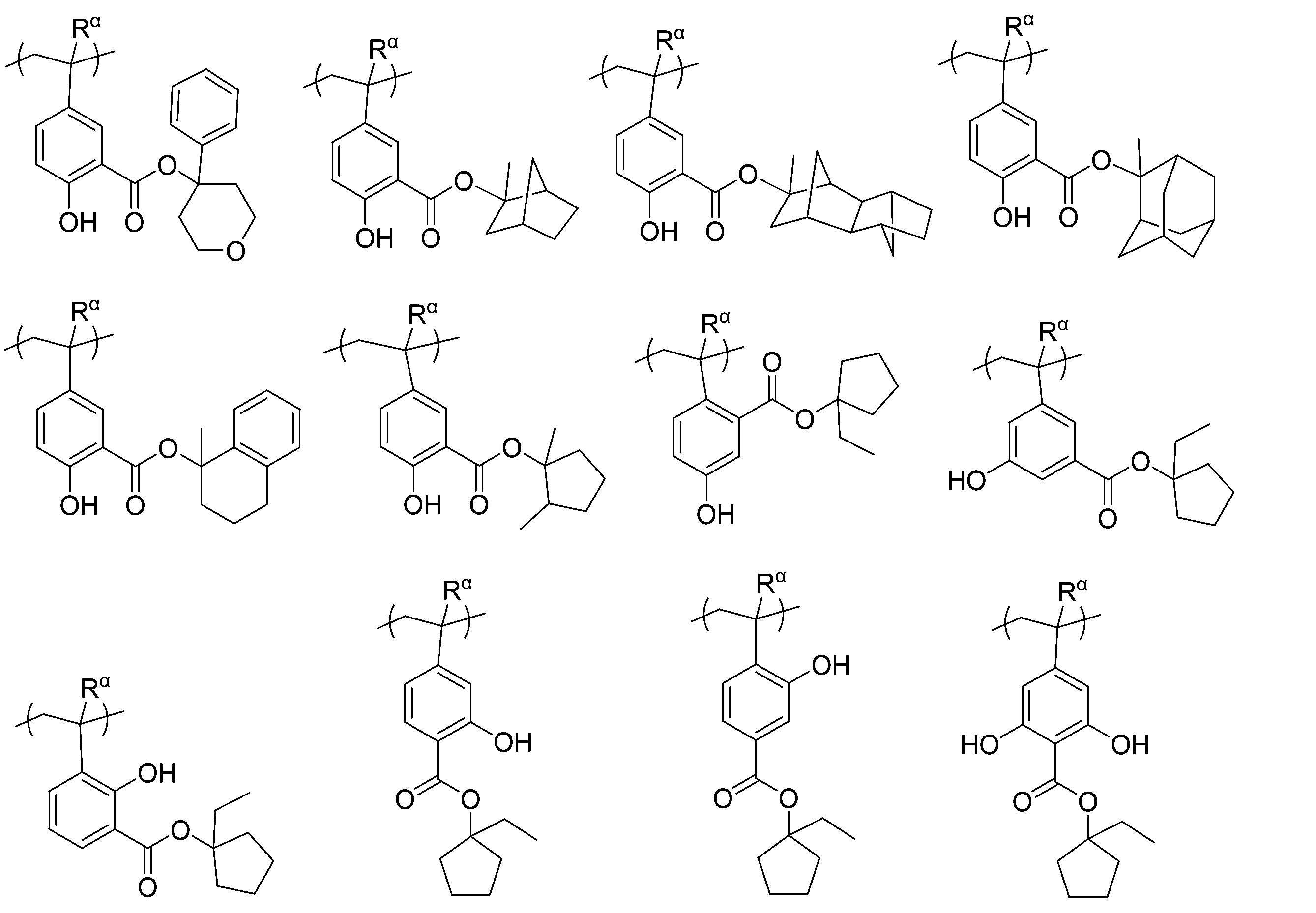
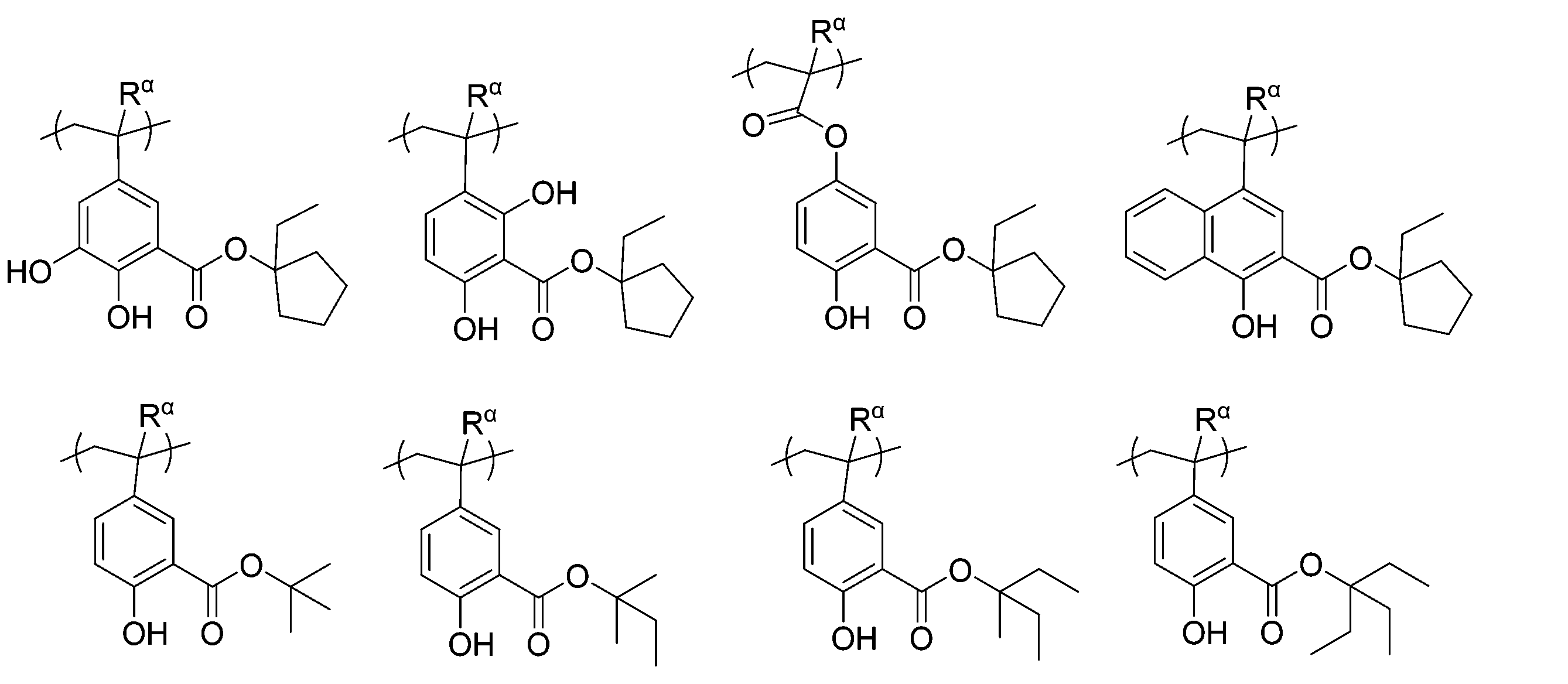
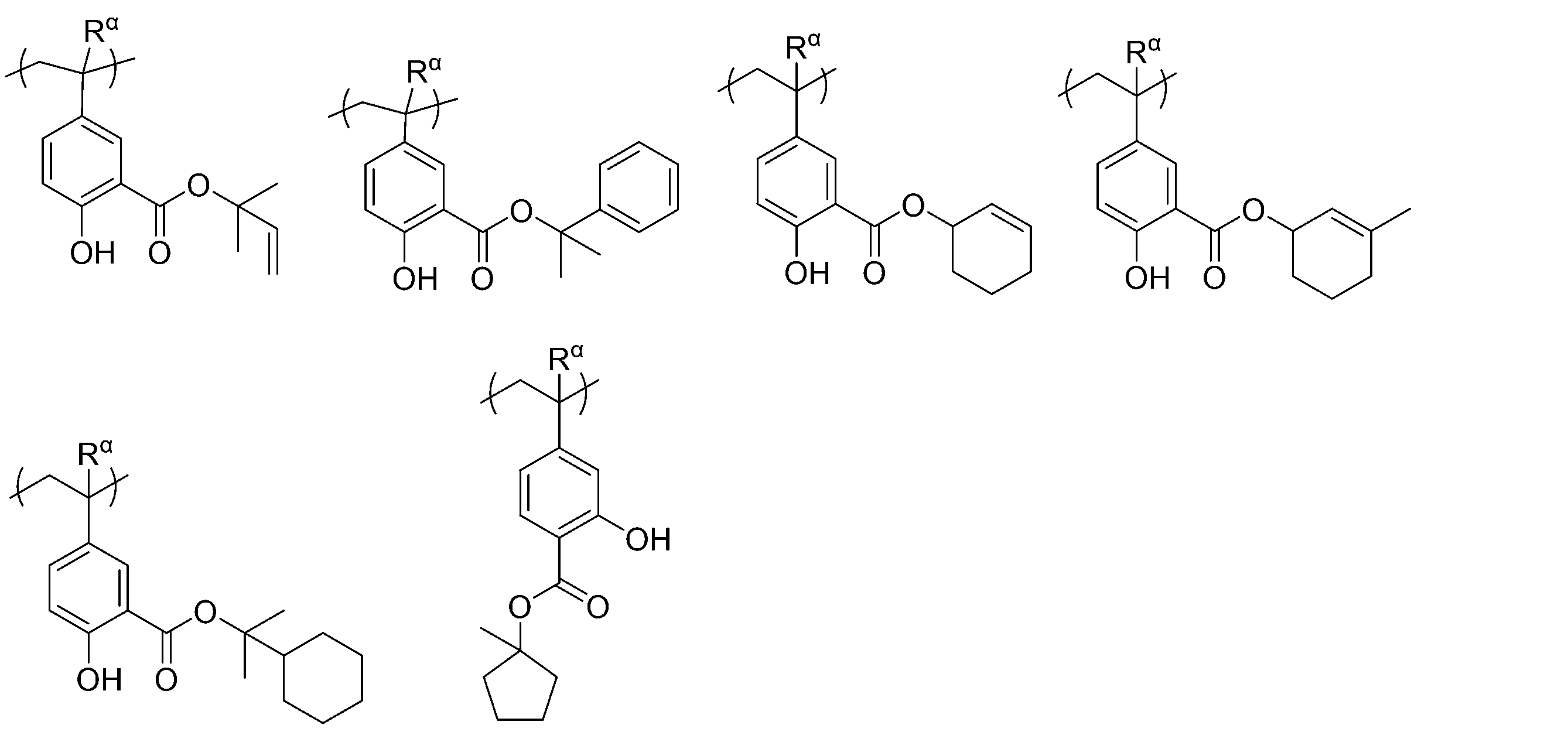
(A1)成分が有する構成単位(a1)は、1種でもよく2種以上でもよい。
構成単位(a1)としては、電子線やEUVによるリソグラフィーでの特性(感度、形状等)をより高められやすいことから、前記式(a1-1)で表される構成単位、又は前記式(a1-3)で表される構成単位がより好ましい。
中でも、EB用又はEUV用において反応性を高められて好適なことから、酸解離性基(Ra1、Rax01)が、それぞれ、上記の一般式(a1-r2-1)、(a1-r2-3)、(a1-r2-4)又は(a1-r-4)で表される酸解離性基であることが好ましく、その中でも環式基であるものを選択することが特に好ましい。
構成単位(a1)としては、電子線やEUVによるリソグラフィーでの特性(感度、形状等)をより高められやすいことから、前記式(a1-1)で表される構成単位、又は前記式(a1-3)で表される構成単位がより好ましい。
中でも、EB用又はEUV用において反応性を高められて好適なことから、酸解離性基(Ra1、Rax01)が、それぞれ、上記の一般式(a1-r2-1)、(a1-r2-3)、(a1-r2-4)又は(a1-r-4)で表される酸解離性基であることが好ましく、その中でも環式基であるものを選択することが特に好ましい。
(A1)成分中の構成単位(a1)の割合は、該(A1)成分を構成する全構成単位の合計(100モル%)に対して、5~80モル%が好ましく、10~75モル%がより好ましく、30~70モル%がさらに好ましく、40~70モル%が特に好ましい。
構成単位(a1)の割合を、前記の好ましい範囲の下限値以上とすることによって、感度、解像性、ラフネス改善等のリソグラフィー特性が向上する。一方、前記の好ましい範囲の上限値以下であると、他の構成単位とのバランスを取ることができ、種々のリソグラフィー特性が良好となる。
構成単位(a1)の割合を、前記の好ましい範囲の下限値以上とすることによって、感度、解像性、ラフネス改善等のリソグラフィー特性が向上する。一方、前記の好ましい範囲の上限値以下であると、他の構成単位とのバランスを取ることができ、種々のリソグラフィー特性が良好となる。
構成単位(a10):
構成単位(a10)は、下記一般式(a10-1)で表される構成単位である。
構成単位(a10)は、下記一般式(a10-1)で表される構成単位である。

前記式(a10-1)中、Rは、前記一般式(a1-1)中のRと同じである。Rとしては、水素原子、炭素原子数1~5のアルキル基又は炭素原子数1~5のフッ素化アルキル基が好ましく、工業上の入手の容易さから、水素原子又はメチル基が特に好ましい。
前記式(a10-1)中、Yax1は、単結合又は2価の連結基である。
前記の化学式中、Yax1における2価の連結基としては、特に限定されないが、置換基を有してもよい2価の炭化水素基、ヘテロ原子を含む2価の連結基等が好適なものとして挙げられる。
前記の化学式中、Yax1における2価の連結基としては、特に限定されないが、置換基を有してもよい2価の炭化水素基、ヘテロ原子を含む2価の連結基等が好適なものとして挙げられる。
・置換基を有してもよい2価の炭化水素基:
置換基を有してもよい2価の炭化水素基は、脂肪族炭化水素基であってもよく、芳香族炭化水素基であってもよい。
置換基を有してもよい2価の炭化水素基は、脂肪族炭化水素基であってもよく、芳香族炭化水素基であってもよい。
・・脂肪族炭化水素基
脂肪族炭化水素基は、芳香族性を持たない炭化水素基を意味する。該脂肪族炭化水素基は、飽和であってもよく、不飽和であってもよく、通常は飽和であることが好ましい。
前記脂肪族炭化水素基としては、直鎖状若しくは分岐鎖状の脂肪族炭化水素基、又は構造中に環を含む脂肪族炭化水素基等が挙げられる。
脂肪族炭化水素基は、芳香族性を持たない炭化水素基を意味する。該脂肪族炭化水素基は、飽和であってもよく、不飽和であってもよく、通常は飽和であることが好ましい。
前記脂肪族炭化水素基としては、直鎖状若しくは分岐鎖状の脂肪族炭化水素基、又は構造中に環を含む脂肪族炭化水素基等が挙げられる。
・・・直鎖状若しくは分岐鎖状の脂肪族炭化水素基
該直鎖状の脂肪族炭化水素基は、炭素原子数1~10でが好ましく、炭素原子数1~6がより好ましく、炭素原子数1~4がさらに好ましく、炭素原子数1~3が最も好ましい。
直鎖状の脂肪族炭化水素基としては、直鎖状のアルキレン基が好ましく、具体的には、メチレン基[-CH2-]、エチレン基[-(CH2)2-]、トリメチレン基[-(CH2)3-]、テトラメチレン基[-(CH2)4-]、ペンタメチレン基[-(CH2)5-]等が挙げられる。
該分岐鎖状の脂肪族炭化水素基は、炭素原子数2~10が好ましく、炭素原子数3~6がより好ましく、炭素原子数3又は4がさらに好ましく、炭素原子数3が最も好ましい。
分岐鎖状の脂肪族炭化水素基としては、分岐鎖状のアルキレン基が好ましく、具体的には、-CH(CH3)-、-CH(CH2CH3)-、-C(CH3)2-、-C(CH3)(CH2CH3)-、-C(CH3)(CH2CH2CH3)-、-C(CH2CH3)2-等のアルキルメチレン基;-CH(CH3)CH2-、-CH(CH3)CH(CH3)-、-C(CH3)2CH2-、-CH(CH2CH3)CH2-、-C(CH2CH3)2-CH2-等のアルキルエチレン基;-CH(CH3)CH2CH2-、-CH2CH(CH3)CH2-等のアルキルトリメチレン基;-CH(CH3)CH2CH2CH2-、-CH2CH(CH3)CH2CH2-等のアルキルテトラメチレン基などのアルキルアルキレン基等が挙げられる。アルキルアルキレン基におけるアルキル基としては、炭素原子数1~5の直鎖状のアルキル基が好ましい。
該直鎖状の脂肪族炭化水素基は、炭素原子数1~10でが好ましく、炭素原子数1~6がより好ましく、炭素原子数1~4がさらに好ましく、炭素原子数1~3が最も好ましい。
直鎖状の脂肪族炭化水素基としては、直鎖状のアルキレン基が好ましく、具体的には、メチレン基[-CH2-]、エチレン基[-(CH2)2-]、トリメチレン基[-(CH2)3-]、テトラメチレン基[-(CH2)4-]、ペンタメチレン基[-(CH2)5-]等が挙げられる。
該分岐鎖状の脂肪族炭化水素基は、炭素原子数2~10が好ましく、炭素原子数3~6がより好ましく、炭素原子数3又は4がさらに好ましく、炭素原子数3が最も好ましい。
分岐鎖状の脂肪族炭化水素基としては、分岐鎖状のアルキレン基が好ましく、具体的には、-CH(CH3)-、-CH(CH2CH3)-、-C(CH3)2-、-C(CH3)(CH2CH3)-、-C(CH3)(CH2CH2CH3)-、-C(CH2CH3)2-等のアルキルメチレン基;-CH(CH3)CH2-、-CH(CH3)CH(CH3)-、-C(CH3)2CH2-、-CH(CH2CH3)CH2-、-C(CH2CH3)2-CH2-等のアルキルエチレン基;-CH(CH3)CH2CH2-、-CH2CH(CH3)CH2-等のアルキルトリメチレン基;-CH(CH3)CH2CH2CH2-、-CH2CH(CH3)CH2CH2-等のアルキルテトラメチレン基などのアルキルアルキレン基等が挙げられる。アルキルアルキレン基におけるアルキル基としては、炭素原子数1~5の直鎖状のアルキル基が好ましい。
前記直鎖状または分岐鎖状の脂肪族炭化水素基は、置換基を有してもよく、有していなくてもよい。該置換基としては、フッ素原子、フッ素原子で置換された炭素原子数1~5のフッ素化アルキル基、カルボニル基等が挙げられる。
・・・構造中に環を含む脂肪族炭化水素基
該構造中に環を含む脂肪族炭化水素基としては、環構造中にヘテロ原子を含む置換基を含んでもよい環状の脂肪族炭化水素基(脂肪族炭化水素環から水素原子を2個除いた基)、前記環状の脂肪族炭化水素基が直鎖状または分岐鎖状の脂肪族炭化水素基の末端に結合した基、前記環状の脂肪族炭化水素基が直鎖状または分岐鎖状の脂肪族炭化水素基の途中に介在する基などが挙げられる。前記直鎖状または分岐鎖状の脂肪族炭化水素基としては前記と同様のものが挙げられる。
環状の脂肪族炭化水素基は、炭素原子数3~20が好ましく、炭素原子数3~12がより好ましい。
環状の脂肪族炭化水素基は、多環式基であってもよく、単環式基であってもよい。単環式の脂環式炭化水素基としては、モノシクロアルカンから2個の水素原子を除いた基が好ましい。該モノシクロアルカンとしては、炭素原子数3~6のものが好ましく、具体的にはシクロペンタン、シクロヘキサン等が挙げられる。多環式の脂環式炭化水素基としては、ポリシクロアルカンから2個の水素原子を除いた基が好ましく、該ポリシクロアルカンとしては、炭素原子数7~12のものが好ましく、具体的にはアダマンタン、ノルボルナン、イソボルナン、トリシクロデカン、テトラシクロドデカン等が挙げられる。
該構造中に環を含む脂肪族炭化水素基としては、環構造中にヘテロ原子を含む置換基を含んでもよい環状の脂肪族炭化水素基(脂肪族炭化水素環から水素原子を2個除いた基)、前記環状の脂肪族炭化水素基が直鎖状または分岐鎖状の脂肪族炭化水素基の末端に結合した基、前記環状の脂肪族炭化水素基が直鎖状または分岐鎖状の脂肪族炭化水素基の途中に介在する基などが挙げられる。前記直鎖状または分岐鎖状の脂肪族炭化水素基としては前記と同様のものが挙げられる。
環状の脂肪族炭化水素基は、炭素原子数3~20が好ましく、炭素原子数3~12がより好ましい。
環状の脂肪族炭化水素基は、多環式基であってもよく、単環式基であってもよい。単環式の脂環式炭化水素基としては、モノシクロアルカンから2個の水素原子を除いた基が好ましい。該モノシクロアルカンとしては、炭素原子数3~6のものが好ましく、具体的にはシクロペンタン、シクロヘキサン等が挙げられる。多環式の脂環式炭化水素基としては、ポリシクロアルカンから2個の水素原子を除いた基が好ましく、該ポリシクロアルカンとしては、炭素原子数7~12のものが好ましく、具体的にはアダマンタン、ノルボルナン、イソボルナン、トリシクロデカン、テトラシクロドデカン等が挙げられる。
環状の脂肪族炭化水素基は、置換基を有してもよいし、有していなくてもよい。該置換基としては、アルキル基、アルコキシ基、ハロゲン原子、ハロゲン化アルキル基、水酸基、カルボニル基等が挙げられる。
前記置換基としてのアルキル基としては、炭素原子数1~5のアルキル基が好ましく、メチル基、エチル基、プロピル基、n-ブチル基、tert-ブチル基であることがより好ましい。
前記置換基としてのアルコキシ基としては、炭素原子数1~5のアルコキシ基が好ましく、メトキシ基、エトキシ基、n-プロポキシ基、iso-プロポキシ基、n-ブトキシ基、tert-ブトキシ基がより好ましく、メトキシ基、エトキシ基がさらに好ましい。
前記置換基としてのハロゲン原子としては、フッ素原子が好ましい。
前記置換基としてのハロゲン化アルキル基としては、前記アルキル基の水素原子の一部または全部が前記ハロゲン原子で置換された基が挙げられる。
環状の脂肪族炭化水素基は、その環構造を構成する炭素原子の一部がヘテロ原子を含む置換基で置換されてもよい。該ヘテロ原子を含む置換基としては、-O-、-C(=O)-O-、-S-、-S(=O)2-、-S(=O)2-O-が好ましい。
前記置換基としてのアルキル基としては、炭素原子数1~5のアルキル基が好ましく、メチル基、エチル基、プロピル基、n-ブチル基、tert-ブチル基であることがより好ましい。
前記置換基としてのアルコキシ基としては、炭素原子数1~5のアルコキシ基が好ましく、メトキシ基、エトキシ基、n-プロポキシ基、iso-プロポキシ基、n-ブトキシ基、tert-ブトキシ基がより好ましく、メトキシ基、エトキシ基がさらに好ましい。
前記置換基としてのハロゲン原子としては、フッ素原子が好ましい。
前記置換基としてのハロゲン化アルキル基としては、前記アルキル基の水素原子の一部または全部が前記ハロゲン原子で置換された基が挙げられる。
環状の脂肪族炭化水素基は、その環構造を構成する炭素原子の一部がヘテロ原子を含む置換基で置換されてもよい。該ヘテロ原子を含む置換基としては、-O-、-C(=O)-O-、-S-、-S(=O)2-、-S(=O)2-O-が好ましい。
・・芳香族炭化水素基
該芳香族炭化水素基は、芳香環を少なくとも1つ有する炭化水素基である。
この芳香環は、4n+2個のπ電子をもつ環状共役系であれば特に限定されず、単環式でもよいし、多環式でもよい。芳香環の炭素原子数は5~30であることが好ましく、炭素原子数5~20がより好ましく、炭素原子数6~15がさらに好ましく、炭素原子数6~12が特に好ましい。ただし、該炭素原子数には、置換基における炭素原子数を含まないものとする。
芳香環として具体的には、ベンゼン、ナフタレン、アントラセン、フェナントレン等の芳香族炭化水素環;前記芳香族炭化水素環を構成する炭素原子の一部がヘテロ原子で置換された芳香族複素環等が挙げられる。芳香族複素環におけるヘテロ原子としては、酸素原子、硫黄原子、窒素原子等が挙げられる。芳香族複素環として具体的には、ピリジン環、チオフェン環等が挙げられる。
芳香族炭化水素基として具体的には、前記芳香族炭化水素環または芳香族複素環から水素原子を2つ除いた基(アリーレン基またはヘテロアリーレン基);2以上の芳香環を含む芳香族化合物(例えばビフェニル、フルオレン等)から水素原子を2つ除いた基;前記芳香族炭化水素環または芳香族複素環から水素原子を1つ除いた基(アリール基またはヘテロアリール基)の水素原子の1つがアルキレン基で置換された基(例えば、ベンジル基、フェネチル基、1-ナフチルメチル基、2-ナフチルメチル基、1-ナフチルエチル基、2-ナフチルエチル基等のアリールアルキル基におけるアリール基から水素原子をさらに1つ除いた基)等が挙げられる。前記アリール基またはヘテロアリール基に結合するアルキレン基の炭素原子数は、1~4であることが好ましく、炭素原子数1~2であることがより好ましく、炭素原子数1であることが特に好ましい。
該芳香族炭化水素基は、芳香環を少なくとも1つ有する炭化水素基である。
この芳香環は、4n+2個のπ電子をもつ環状共役系であれば特に限定されず、単環式でもよいし、多環式でもよい。芳香環の炭素原子数は5~30であることが好ましく、炭素原子数5~20がより好ましく、炭素原子数6~15がさらに好ましく、炭素原子数6~12が特に好ましい。ただし、該炭素原子数には、置換基における炭素原子数を含まないものとする。
芳香環として具体的には、ベンゼン、ナフタレン、アントラセン、フェナントレン等の芳香族炭化水素環;前記芳香族炭化水素環を構成する炭素原子の一部がヘテロ原子で置換された芳香族複素環等が挙げられる。芳香族複素環におけるヘテロ原子としては、酸素原子、硫黄原子、窒素原子等が挙げられる。芳香族複素環として具体的には、ピリジン環、チオフェン環等が挙げられる。
芳香族炭化水素基として具体的には、前記芳香族炭化水素環または芳香族複素環から水素原子を2つ除いた基(アリーレン基またはヘテロアリーレン基);2以上の芳香環を含む芳香族化合物(例えばビフェニル、フルオレン等)から水素原子を2つ除いた基;前記芳香族炭化水素環または芳香族複素環から水素原子を1つ除いた基(アリール基またはヘテロアリール基)の水素原子の1つがアルキレン基で置換された基(例えば、ベンジル基、フェネチル基、1-ナフチルメチル基、2-ナフチルメチル基、1-ナフチルエチル基、2-ナフチルエチル基等のアリールアルキル基におけるアリール基から水素原子をさらに1つ除いた基)等が挙げられる。前記アリール基またはヘテロアリール基に結合するアルキレン基の炭素原子数は、1~4であることが好ましく、炭素原子数1~2であることがより好ましく、炭素原子数1であることが特に好ましい。
前記芳香族炭化水素基は、当該芳香族炭化水素基が有する水素原子が置換基で置換されていてもよい。例えば当該芳香族炭化水素基中の芳香環に結合した水素原子が置換基で置換されていてもよい。該置換基としては、例えば、アルキル基、アルコキシ基、ハロゲン原子、ハロゲン化アルキル基、水酸基等が挙げられる。
前記置換基としてのアルキル基としては、炭素原子数1~5のアルキル基が好ましく、メチル基、エチル基、プロピル基、n-ブチル基、tert-ブチル基であることがより好ましい。
前記置換基としてのアルコキシ基、ハロゲン原子およびハロゲン化アルキル基としては、前記環状の脂肪族炭化水素基が有する水素原子を置換する置換基として例示したものが挙げられる。
前記置換基としてのアルキル基としては、炭素原子数1~5のアルキル基が好ましく、メチル基、エチル基、プロピル基、n-ブチル基、tert-ブチル基であることがより好ましい。
前記置換基としてのアルコキシ基、ハロゲン原子およびハロゲン化アルキル基としては、前記環状の脂肪族炭化水素基が有する水素原子を置換する置換基として例示したものが挙げられる。
・ヘテロ原子を含む2価の連結基:
ヘテロ原子を含む2価の連結基としては、-O-、-C(=O)-O-、-O-C(=O)-、-C(=O)-、-O-C(=O)-O-、-C(=O)-NH-、-NH-、-NH-C(=NH)-(Hはアルキル基、アシル基等の置換基で置換されていてもよい。)、-S-、-S(=O)2-、-S(=O)2-O-、一般式-Y21-O-Y22-、-Y21-O-、-Y21-C(=O)-O-、-C(=O)-O-Y21-、-[Y21-C(=O)-O]m”-Y22-、-Y21-O-C(=O)-Y22-または-Y21-S(=O)2-O-Y22-で表される基[式中、Y21およびY22はそれぞれ独立して置換基を有してもよい2価の炭化水素基であり、Oは酸素原子であり、m”は0~3の整数である。]等が挙げられる。
前記ヘテロ原子を含む2価の連結基が-C(=O)-NH-、-C(=O)-NH-C(=O)-、-NH-、-NH-C(=NH)-の場合、そのHはアルキル基、アシル基等の置換基で置換されていてもよい。該置換基(アルキル基、アシル基等)は、炭素原子数が1~10であることが好ましく、1~8であることがさらに好ましく、1~5であることが特に好ましい。
一般式-Y21-O-Y22-、-Y21-O-、-Y21-C(=O)-O-、-C(=O)-O-Y21-、-[Y21-C(=O)-O]m”-Y22-、-Y21-O-C(=O)-Y22-または-Y21-S(=O)2-O-Y22-中、Y21およびY22は、それぞれ独立して、置換基を有してもよい2価の炭化水素基である。該2価の炭化水素基としては、前記と同様のものが挙げられる。
Y21としては、直鎖状の脂肪族炭化水素基が好ましく、直鎖状のアルキレン基がより好ましく、炭素原子数1~5の直鎖状のアルキレン基がさらに好ましく、メチレン基またはエチレン基が特に好ましい。
Y22としては、直鎖状または分岐鎖状の脂肪族炭化水素基が好ましく、メチレン基、エチレン基またはアルキルメチレン基がより好ましい。該アルキルメチレン基におけるアルキル基は、炭素原子数1~5の直鎖状のアルキル基が好ましく、炭素原子数1~3の直鎖状のアルキル基がより好ましく、メチル基が最も好ましい。
式-[Y21-C(=O)-O]m”-Y22-で表される基において、m”は1~3の整数であり、1又は2であることが好ましく、1がより好ましい。つまり、式-[Y21-C(=O)-O]m”-Y22-で表される基としては、式-Y21-C(=O)-O-Y22-で表される基が特に好ましい。なかでも、式-(CH2)a’-C(=O)-O-(CH2)b’-で表される基が好ましい。該式中、a’は、1~10の整数であり、1~8の整数が好ましく、1~5の整数がより好ましく、1または2がさらに好ましく、1が最も好ましい。b’は、1~10の整数であり、1~8の整数が好ましく、1~5の整数がより好ましく、1または2がさらに好ましく、1が最も好ましい。
ヘテロ原子を含む2価の連結基としては、-O-、-C(=O)-O-、-O-C(=O)-、-C(=O)-、-O-C(=O)-O-、-C(=O)-NH-、-NH-、-NH-C(=NH)-(Hはアルキル基、アシル基等の置換基で置換されていてもよい。)、-S-、-S(=O)2-、-S(=O)2-O-、一般式-Y21-O-Y22-、-Y21-O-、-Y21-C(=O)-O-、-C(=O)-O-Y21-、-[Y21-C(=O)-O]m”-Y22-、-Y21-O-C(=O)-Y22-または-Y21-S(=O)2-O-Y22-で表される基[式中、Y21およびY22はそれぞれ独立して置換基を有してもよい2価の炭化水素基であり、Oは酸素原子であり、m”は0~3の整数である。]等が挙げられる。
前記ヘテロ原子を含む2価の連結基が-C(=O)-NH-、-C(=O)-NH-C(=O)-、-NH-、-NH-C(=NH)-の場合、そのHはアルキル基、アシル基等の置換基で置換されていてもよい。該置換基(アルキル基、アシル基等)は、炭素原子数が1~10であることが好ましく、1~8であることがさらに好ましく、1~5であることが特に好ましい。
一般式-Y21-O-Y22-、-Y21-O-、-Y21-C(=O)-O-、-C(=O)-O-Y21-、-[Y21-C(=O)-O]m”-Y22-、-Y21-O-C(=O)-Y22-または-Y21-S(=O)2-O-Y22-中、Y21およびY22は、それぞれ独立して、置換基を有してもよい2価の炭化水素基である。該2価の炭化水素基としては、前記と同様のものが挙げられる。
Y21としては、直鎖状の脂肪族炭化水素基が好ましく、直鎖状のアルキレン基がより好ましく、炭素原子数1~5の直鎖状のアルキレン基がさらに好ましく、メチレン基またはエチレン基が特に好ましい。
Y22としては、直鎖状または分岐鎖状の脂肪族炭化水素基が好ましく、メチレン基、エチレン基またはアルキルメチレン基がより好ましい。該アルキルメチレン基におけるアルキル基は、炭素原子数1~5の直鎖状のアルキル基が好ましく、炭素原子数1~3の直鎖状のアルキル基がより好ましく、メチル基が最も好ましい。
式-[Y21-C(=O)-O]m”-Y22-で表される基において、m”は1~3の整数であり、1又は2であることが好ましく、1がより好ましい。つまり、式-[Y21-C(=O)-O]m”-Y22-で表される基としては、式-Y21-C(=O)-O-Y22-で表される基が特に好ましい。なかでも、式-(CH2)a’-C(=O)-O-(CH2)b’-で表される基が好ましい。該式中、a’は、1~10の整数であり、1~8の整数が好ましく、1~5の整数がより好ましく、1または2がさらに好ましく、1が最も好ましい。b’は、1~10の整数であり、1~8の整数が好ましく、1~5の整数がより好ましく、1または2がさらに好ましく、1が最も好ましい。
Yax1としては、単結合、エステル結合[-C(=O)-O-、-O-C(=O)-]、エーテル結合(-O-)、直鎖状若しくは分岐鎖状のアルキレン基、又はこれらの組合せが好ましく、単結合、エステル結合[-C(=O)-O-、-O-C(=O)-]がより好ましい。
前記式(a10-1)中、Wax1は、置換基を有してもよい芳香族炭化水素基である。
Wax1における芳香族炭化水素基としては、置換基を有してもよい芳香環から(nax1+1)個の水素原子を除いた基が挙げられる。ここでの芳香環は、4n+2個のπ電子をもつ環状共役系であれば特に限定されない。芳香環の炭素原子数は5~30であることが好ましく、炭素原子数5~20がより好ましく、炭素原子数6~15がさらに好ましく、炭素原子数6~12が特に好ましい。該芳香環として具体的には、ベンゼン、ナフタレン、アントラセン、フェナントレン等の芳香族炭化水素環;前記芳香族炭化水素環を構成する炭素原子の一部がヘテロ原子で置換された芳香族複素環等が挙げられる。芳香族複素環におけるヘテロ原子としては、酸素原子、硫黄原子、窒素原子等が挙げられる。芳香族複素環として具体的には、ピリジン環、チオフェン環等が挙げられる。
また、Wax1における芳香族炭化水素基としては、2以上の置換基を有してもよい芳香環を含む芳香族化合物(例えばビフェニル、フルオレン等)から(nax1+1)個の水素原子を除いた基も挙げられる。
上記の中でも、Wax1としては、ベンゼン、ナフタレン、アントラセンまたはビフェニルから(nax1+1)個の水素原子を除いた基が好ましく、ベンゼン又はナフタレンから(nax1+1)個の水素原子を除いた基がより好ましく、ベンゼンから(nax1+1)個の水素原子を除いた基がさらに好ましい。
Wax1における芳香族炭化水素基としては、置換基を有してもよい芳香環から(nax1+1)個の水素原子を除いた基が挙げられる。ここでの芳香環は、4n+2個のπ電子をもつ環状共役系であれば特に限定されない。芳香環の炭素原子数は5~30であることが好ましく、炭素原子数5~20がより好ましく、炭素原子数6~15がさらに好ましく、炭素原子数6~12が特に好ましい。該芳香環として具体的には、ベンゼン、ナフタレン、アントラセン、フェナントレン等の芳香族炭化水素環;前記芳香族炭化水素環を構成する炭素原子の一部がヘテロ原子で置換された芳香族複素環等が挙げられる。芳香族複素環におけるヘテロ原子としては、酸素原子、硫黄原子、窒素原子等が挙げられる。芳香族複素環として具体的には、ピリジン環、チオフェン環等が挙げられる。
また、Wax1における芳香族炭化水素基としては、2以上の置換基を有してもよい芳香環を含む芳香族化合物(例えばビフェニル、フルオレン等)から(nax1+1)個の水素原子を除いた基も挙げられる。
上記の中でも、Wax1としては、ベンゼン、ナフタレン、アントラセンまたはビフェニルから(nax1+1)個の水素原子を除いた基が好ましく、ベンゼン又はナフタレンから(nax1+1)個の水素原子を除いた基がより好ましく、ベンゼンから(nax1+1)個の水素原子を除いた基がさらに好ましい。
Wax1における芳香族炭化水素基は、置換基を有してもよく、有していなくてもよい。前記置換基としては、例えば、アルキル基、アルコキシ基、ハロゲン原子、ハロゲン化アルキル基等が挙げられる。前記置換基としてのアルキル基、アルコキシ基、ハロゲン原子、ハロゲン化アルキル基としては、Yax1における環状の脂肪族炭化水素基の置換基として挙げたものと同様のものが挙げられる。前記置換基は、炭素原子数1~5の直鎖状若しくは分岐鎖状のアルキル基が好ましく、炭素原子数1~3の直鎖状若しくは分岐鎖状のアルキル基がより好ましく、エチル基又はメチル基がさらに好ましく、メチル基が特に好ましい。Wax1における芳香族炭化水素基は、置換基を有していないことが好ましい。
前記式(a10-1)中、nax1は、1以上の整数であり、1~10の整数が好ましく、1~5の整数がより好ましく、1、2又は3がさらに好ましく、1又は2が特に好ましい。
以下に、前記式(a10-1)で表される構成単位(a10)の具体例を示す。
以下の各式中、Rαは、水素原子、メチル基又はトリフルオロメチル基を表す。
以下の各式中、Rαは、水素原子、メチル基又はトリフルオロメチル基を表す。

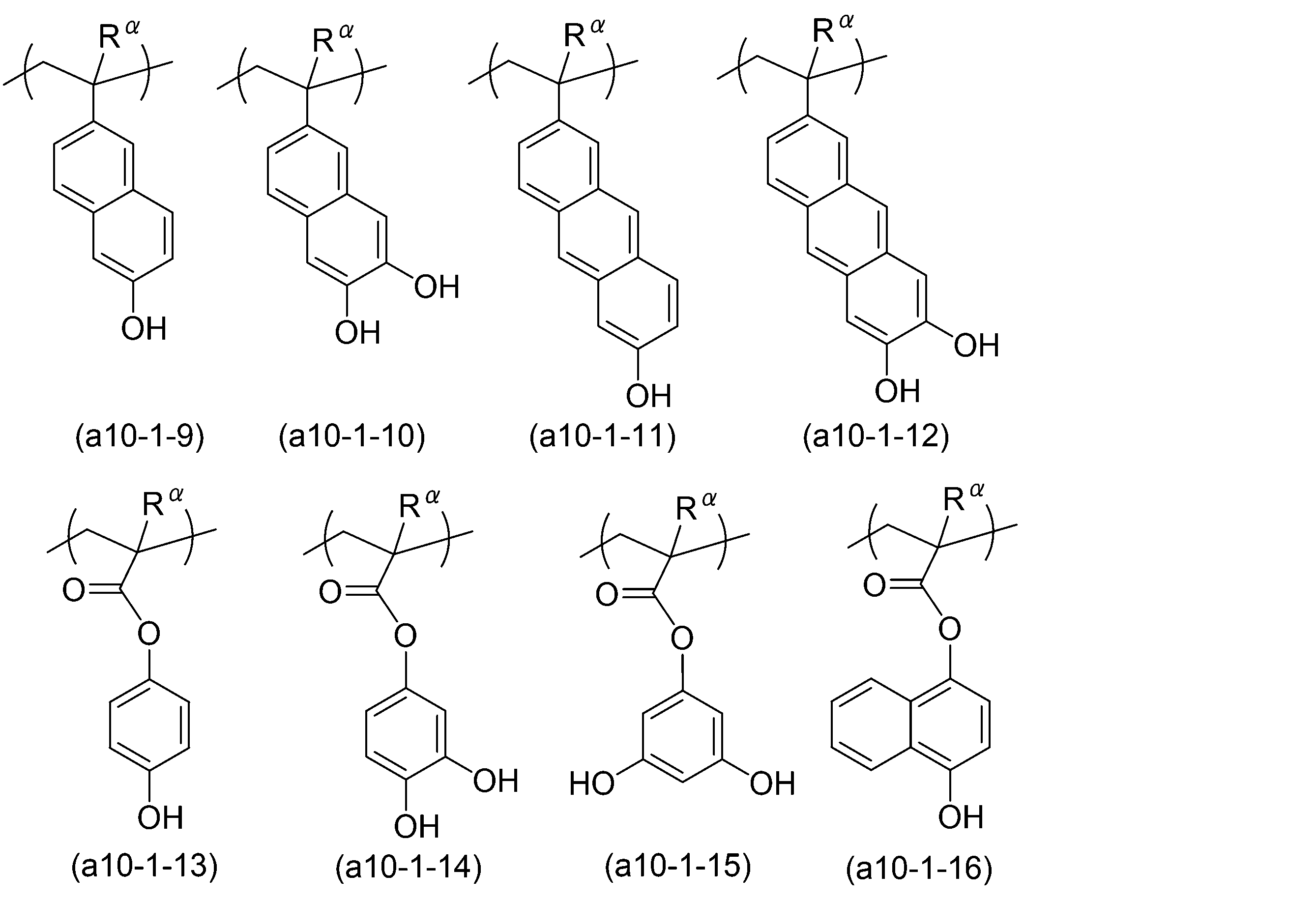
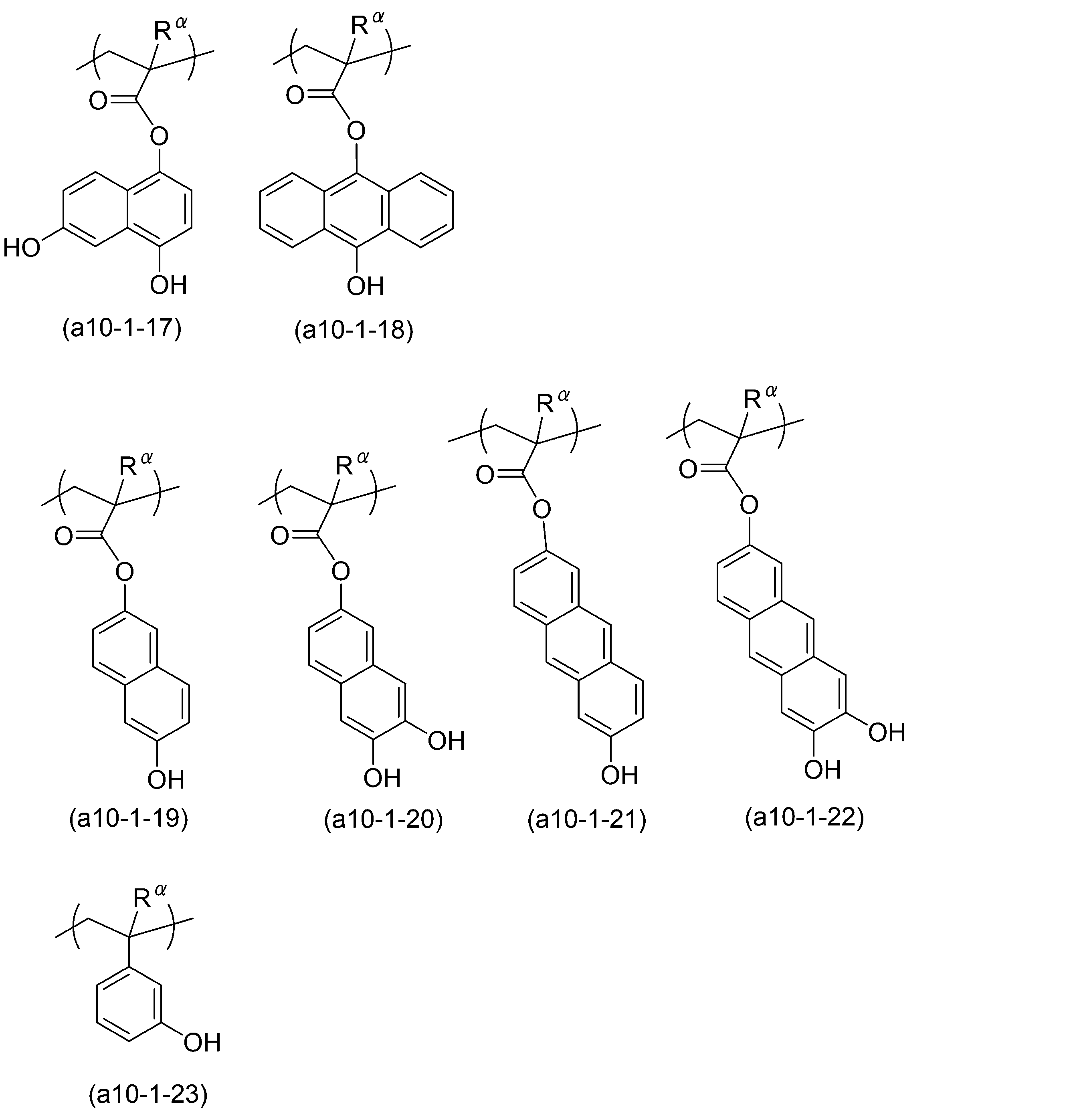
(A1)成分が有する構成単位(a10)は、1種でもよく2種以上でもよい。(A1)成分は、構成単位(a10)を有してもよく、有しなくてもよいが、構成単位(a10)を有することが好ましい。
(A1)成分が構成単位(a10)を有する場合、(A1)成分中の構成単位(a10)の割合は、(A1)成分を構成する全構成単位の合計(100モル%)に対して、15~80モル%が好ましく、20~70モル%がより好ましく、25~65モル%がさらに好ましく、25~60モル%が特に好ましい。
構成単位(a10)の割合を下限値以上とすることにより、感度がより高められやすくなる。一方、上限値以下とすることにより、他の構成単位とのバランスをとりやすくなる。
(A1)成分が構成単位(a10)を有する場合、(A1)成分中の構成単位(a10)の割合は、(A1)成分を構成する全構成単位の合計(100モル%)に対して、15~80モル%が好ましく、20~70モル%がより好ましく、25~65モル%がさらに好ましく、25~60モル%が特に好ましい。
構成単位(a10)の割合を下限値以上とすることにより、感度がより高められやすくなる。一方、上限値以下とすることにより、他の構成単位とのバランスをとりやすくなる。
構成単位(a2):
(A1)成分は、ラクトン含有環式基を含む構成単位(a2)(但し、構成単位(a1)に該当するものを除く)を有してもよい。
構成単位(a2)のラクトン含有環式基は、(A1)成分をレジスト膜の形成に用いた場合に、レジスト膜の基板への密着性を高める上で有効である。また、構成単位(a2)を有することで、例えば酸拡散長を適切に調整する、レジスト膜の基板への密着性を高める、現像時の溶解性を適切に調整する等の効果により、リソグラフィー特性等が良好となる。
(A1)成分は、ラクトン含有環式基を含む構成単位(a2)(但し、構成単位(a1)に該当するものを除く)を有してもよい。
構成単位(a2)のラクトン含有環式基は、(A1)成分をレジスト膜の形成に用いた場合に、レジスト膜の基板への密着性を高める上で有効である。また、構成単位(a2)を有することで、例えば酸拡散長を適切に調整する、レジスト膜の基板への密着性を高める、現像時の溶解性を適切に調整する等の効果により、リソグラフィー特性等が良好となる。
「ラクトン含有環式基」とは、その環骨格中に-O-C(=O)-を含む環(ラクトン環)を含有する環式基を示す。ラクトン環をひとつ目の環として数え、ラクトン環のみの場合は単環式基、さらに他の環構造を有する場合は、その構造に関わらず多環式基と称する。ラクトン含有環式基は、単環式基であってもよく、多環式基であってもよい。
構成単位(a2)におけるラクトン含有環式基としては、特に限定されることなく任意のものが使用可能である。具体的には、下記一般式(a2-r-1)~(a2-r-7)でそれぞれ表される基が挙げられる。
構成単位(a2)におけるラクトン含有環式基としては、特に限定されることなく任意のものが使用可能である。具体的には、下記一般式(a2-r-1)~(a2-r-7)でそれぞれ表される基が挙げられる。

前記一般式(a2-r-1)~(a2-r-7)中、Ra’21におけるアルキル基としては、炭素原子数1~6のアルキル基が好ましい。該アルキル基は、直鎖状または分岐鎖状であることが好ましい。具体的には、メチル基、エチル基、プロピル基、イソプロピル基、n-ブチル基、イソブチル基、tert-ブチル基、ペンチル基、イソペンチル基、ネオペンチル基、ヘキシル基等が挙げられる。これらの中でも、メチル基またはエチル基が好ましく、メチル基が特に好ましい。
Ra’21におけるアルコキシ基としては、炭素原子数1~6のアルコキシ基が好ましい。該アルコキシ基は、直鎖状または分岐鎖状であることが好ましい。具体的には、前記Ra’21におけるアルキル基として挙げたアルキル基と酸素原子(-O-)とが連結した基が挙げられる。
Ra’21におけるハロゲン原子としては、フッ素原子が好ましい。
Ra’21におけるハロゲン化アルキル基としては、前記Ra’21におけるアルキル基の水素原子の一部または全部が前記ハロゲン原子で置換された基が挙げられる。該ハロゲン化アルキル基としては、フッ素化アルキル基が好ましく、特にパーフルオロアルキル基が好ましい。
Ra’21におけるアルコキシ基としては、炭素原子数1~6のアルコキシ基が好ましい。該アルコキシ基は、直鎖状または分岐鎖状であることが好ましい。具体的には、前記Ra’21におけるアルキル基として挙げたアルキル基と酸素原子(-O-)とが連結した基が挙げられる。
Ra’21におけるハロゲン原子としては、フッ素原子が好ましい。
Ra’21におけるハロゲン化アルキル基としては、前記Ra’21におけるアルキル基の水素原子の一部または全部が前記ハロゲン原子で置換された基が挙げられる。該ハロゲン化アルキル基としては、フッ素化アルキル基が好ましく、特にパーフルオロアルキル基が好ましい。
Ra’21における-COOR”、-OC(=O)R”において、R”はいずれも水素原子、アルキル基、又は、ラクトン含有環式基である。
R”におけるアルキル基としては、直鎖状、分岐鎖状、環状のいずれでもよく、炭素原子数は1~15が好ましい。
R”が直鎖状もしくは分岐鎖状のアルキル基の場合は、炭素原子数1~10であることが好ましく、炭素原子数1~5であることがさらに好ましく、メチル基またはエチル基であることが特に好ましい。
R”が環状のアルキル基の場合は、炭素原子数3~15であることが好ましく、炭素原子数4~12であることがさらに好ましく、炭素原子数5~10が最も好ましい。具体的には、フッ素原子またはフッ素化アルキル基で置換されていてもよいし、されていなくてもよいモノシクロアルカンから1個以上の水素原子を除いた基;ビシクロアルカン、トリシクロアルカン、テトラシクロアルカンなどのポリシクロアルカンから1個以上の水素原子を除いた基などを例示できる。より具体的には、シクロペンタン、シクロヘキサン等のモノシクロアルカンから1個以上の水素原子を除いた基;アダマンタン、ノルボルナン、イソボルナン、トリシクロデカン、テトラシクロドデカンなどのポリシクロアルカンから1個以上の水素原子を除いた基などが挙げられる。
R”におけるラクトン含有環式基としては、前記一般式(a2-r-1)~(a2-r-7)でそれぞれ表される基と同様のものが挙げられる。
Ra’21におけるヒドロキシアルキル基としては、炭素原子数が1~6であるものが好ましく、具体的には、前記Ra’21におけるアルキル基の水素原子の少なくとも1つが水酸基で置換された基が挙げられる。
R”におけるアルキル基としては、直鎖状、分岐鎖状、環状のいずれでもよく、炭素原子数は1~15が好ましい。
R”が直鎖状もしくは分岐鎖状のアルキル基の場合は、炭素原子数1~10であることが好ましく、炭素原子数1~5であることがさらに好ましく、メチル基またはエチル基であることが特に好ましい。
R”が環状のアルキル基の場合は、炭素原子数3~15であることが好ましく、炭素原子数4~12であることがさらに好ましく、炭素原子数5~10が最も好ましい。具体的には、フッ素原子またはフッ素化アルキル基で置換されていてもよいし、されていなくてもよいモノシクロアルカンから1個以上の水素原子を除いた基;ビシクロアルカン、トリシクロアルカン、テトラシクロアルカンなどのポリシクロアルカンから1個以上の水素原子を除いた基などを例示できる。より具体的には、シクロペンタン、シクロヘキサン等のモノシクロアルカンから1個以上の水素原子を除いた基;アダマンタン、ノルボルナン、イソボルナン、トリシクロデカン、テトラシクロドデカンなどのポリシクロアルカンから1個以上の水素原子を除いた基などが挙げられる。
R”におけるラクトン含有環式基としては、前記一般式(a2-r-1)~(a2-r-7)でそれぞれ表される基と同様のものが挙げられる。
Ra’21におけるヒドロキシアルキル基としては、炭素原子数が1~6であるものが好ましく、具体的には、前記Ra’21におけるアルキル基の水素原子の少なくとも1つが水酸基で置換された基が挙げられる。
Ra’21としては、上記の中でも、それぞれ独立に水素原子又はシアノ基であることが好ましい。
前記一般式(a2-r-2)、(a2-r-3)、(a2-r-5)中、A”における炭素原子数1~5のアルキレン基としては、直鎖状または分岐鎖状のアルキレン基が好ましく、メチレン基、エチレン基、n-プロピレン基、イソプロピレン基等が挙げられる。該アルキレン基が酸素原子または硫黄原子を含む場合、その具体例としては、前記アルキレン基の末端または炭素原子間に-O-または-S-が介在する基が挙げられ、例えば、-O-CH2-、-CH2-O-CH2-、-S-CH2-、-CH2-S-CH2-等が挙げられる。A”としては、炭素原子数1~5のアルキレン基または-O-が好ましく、炭素原子数1~5のアルキレン基がより好ましく、メチレン基が最も好ましい。
下記に一般式(a2-r-1)~(a2-r-7)でそれぞれ表される基の具体例を挙げる。
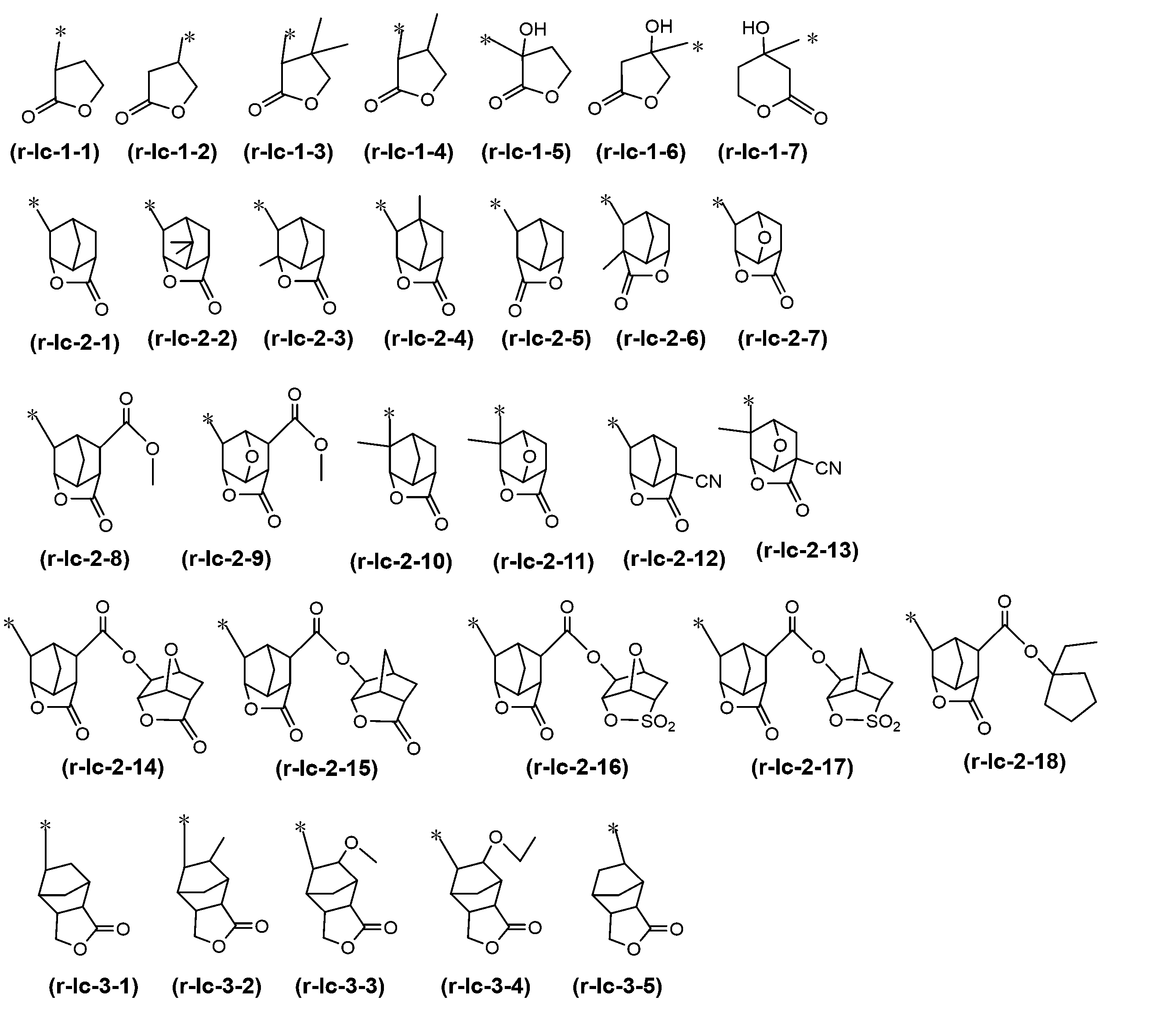
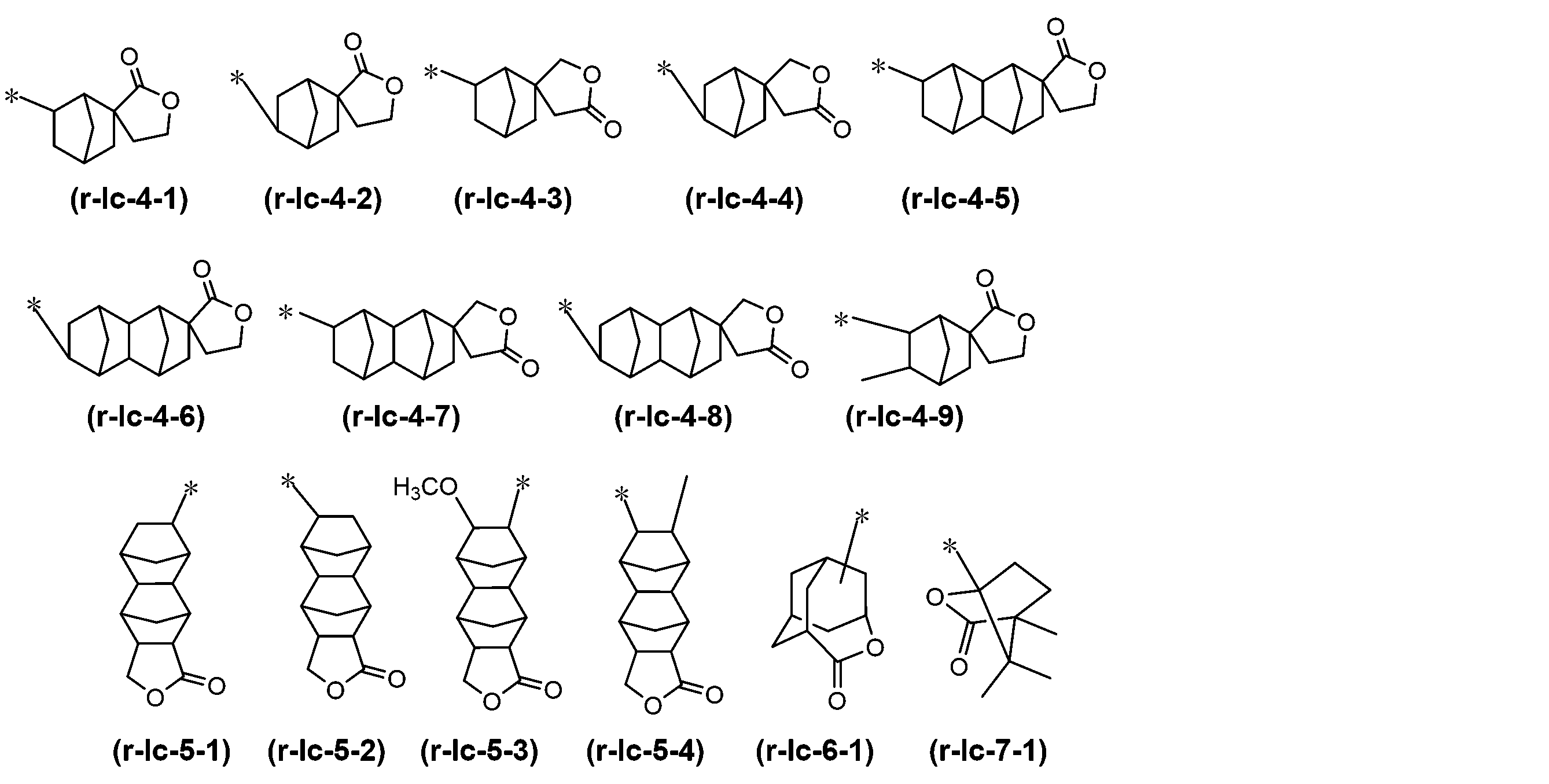
構成単位(a2)としては、なかでも、α位の炭素原子に結合した水素原子が置換基で置換されていてもよいアクリル酸エステルから誘導される構成単位が好ましい。
かかる構成単位(a2)は、下記一般式(a2-1)で表される構成単位であることが好ましい。
かかる構成単位(a2)は、下記一般式(a2-1)で表される構成単位であることが好ましい。

前記式(a2-1)中、Rは前記と同じである。Rとしては、水素原子、炭素原子数1~5のアルキル基又は炭素原子数1~5のフッ素化アルキル基が好ましく、工業上の入手の容易さから、水素原子又はメチル基が特に好ましい。
前記式(a2-1)中、Ya21における2価の連結基としては、特に限定されないが、置換基を有してもよい2価の炭化水素基、ヘテロ原子を含む2価の連結基等が好適に挙げられる。Ya21における2価の連結基としては、上記一般式(a10-1)中のYax1における2価の連結基と同様のものが挙げられる。
Ya21としては、単結合、エステル結合[-C(=O)-O-]、エーテル結合(-O-)、直鎖状若しくは分岐鎖状のアルキレン基、又はこれらの組合せであることが好ましい。
前記式(a2-1)中、Ya21は、単結合であり、La21は、-COO-、又は、-OCO-、であることが好ましい。
前記式(a2-1)中、Ra21はラクトン含有環式基である。
Ra21におけるラクトン含有環式基としてはそれぞれ、前述した一般式(a2-r-1)~(a2-r-7)でそれぞれ表される基が好適に挙げられる。
Ra21におけるラクトン含有環式基としてはそれぞれ、前述した一般式(a2-r-1)~(a2-r-7)でそれぞれ表される基が好適に挙げられる。
(A1)成分が有する構成単位(a2)は、1種でもよく2種以上でもよい。(A1)成分は、構成単位(a2)を有してもよく、有しなくてもよい。
(A1)成分が構成単位(a2)を有する場合、構成単位(a2)の割合は、当該(A1)成分を構成する全構成単位の合計(100モル%)に対して、1~20モル%であることが好ましく、1~15モル%であることがより好ましく、1~10モル%であることがさらに好ましい。
構成単位(a2)の割合を好ましい下限値以上とすると、前述した効果によって、構成単位(a2)を含有させることによる効果が充分に得られ、上限値以下であると、他の構成単位とのバランスを取ることができ、種々のリソグラフィー特性が良好となる。
(A1)成分が構成単位(a2)を有する場合、構成単位(a2)の割合は、当該(A1)成分を構成する全構成単位の合計(100モル%)に対して、1~20モル%であることが好ましく、1~15モル%であることがより好ましく、1~10モル%であることがさらに好ましい。
構成単位(a2)の割合を好ましい下限値以上とすると、前述した効果によって、構成単位(a2)を含有させることによる効果が充分に得られ、上限値以下であると、他の構成単位とのバランスを取ることができ、種々のリソグラフィー特性が良好となる。
構成単位(a8):
構成単位(a8)は、下記一般式(a8-1)で表される化合物から誘導される構成単位である。
構成単位(a8)は、下記一般式(a8-1)で表される化合物から誘導される構成単位である。
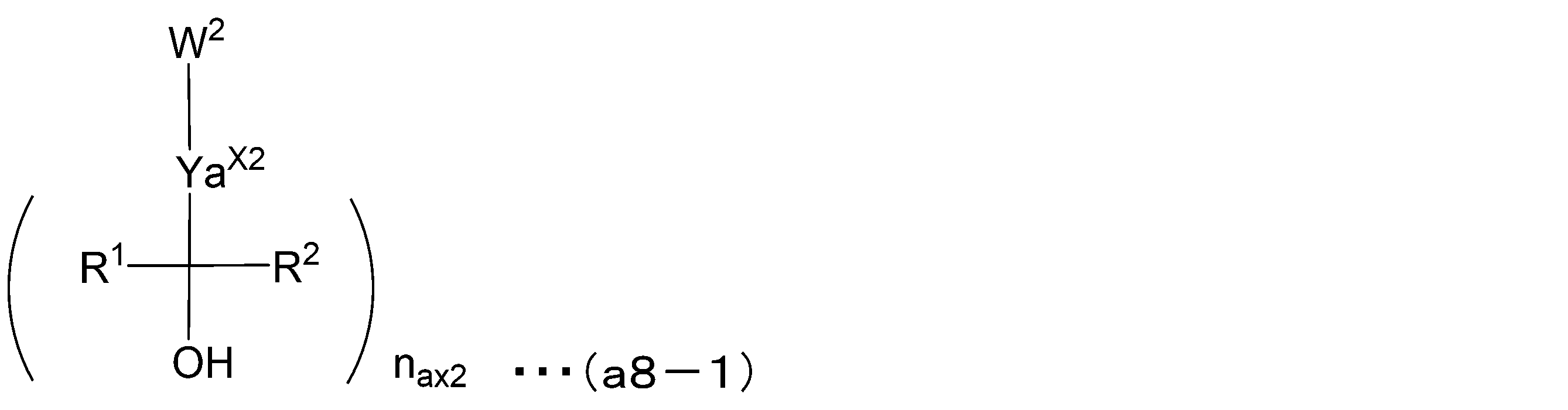
W2の重合性基含有基における「重合性基」とは、重合性基を有する化合物がラジカル重合等により重合することを可能とする基であり、例えばエチレン性二重結合などの炭素原子間の多重結合を含む基をいう。
重合性基含有基としては、重合性基のみから構成される基でもよいし、重合性基と該重合性基以外の他の基とから構成される基でもよい。該重合性基以外の他の基としては、置換基を有してもよい2価の炭化水素基、ヘテロ原子を含む2価の連結基等が挙げられる。
重合性基含有基としては、例えば、化学式:C(RX11)(RX12)=C(RX13)-Yax0-で表される基が好適に挙げられる。
この化学式中、RX11、RX12及びRX13は、それぞれ、水素原子、炭素原子数1~5のアルキル基又は炭素原子数1~5のハロゲン化アルキル基であり、Yax0は、単結合または2価の連結基である。
重合性基含有基としては、例えば、化学式:C(RX11)(RX12)=C(RX13)-Yax0-で表される基が好適に挙げられる。
この化学式中、RX11、RX12及びRX13は、それぞれ、水素原子、炭素原子数1~5のアルキル基又は炭素原子数1~5のハロゲン化アルキル基であり、Yax0は、単結合または2価の連結基である。
Yax2とW2とが形成する縮合環としては、W2部位の重合性基とYax2とが形成する縮合環、W2部位の重合性基以外の他の基とYax2とが形成する縮合環が挙げられる。
Yax2とW2とが形成する縮合環は、置換基を有してもよい。
Yax2とW2とが形成する縮合環は、置換基を有してもよい。
以下に、構成単位(a8)の具体例を示す。
下記の式中、Rαは、水素原子、メチル基又はトリフルオロメチル基を示す。
下記の式中、Rαは、水素原子、メチル基又はトリフルオロメチル基を示す。
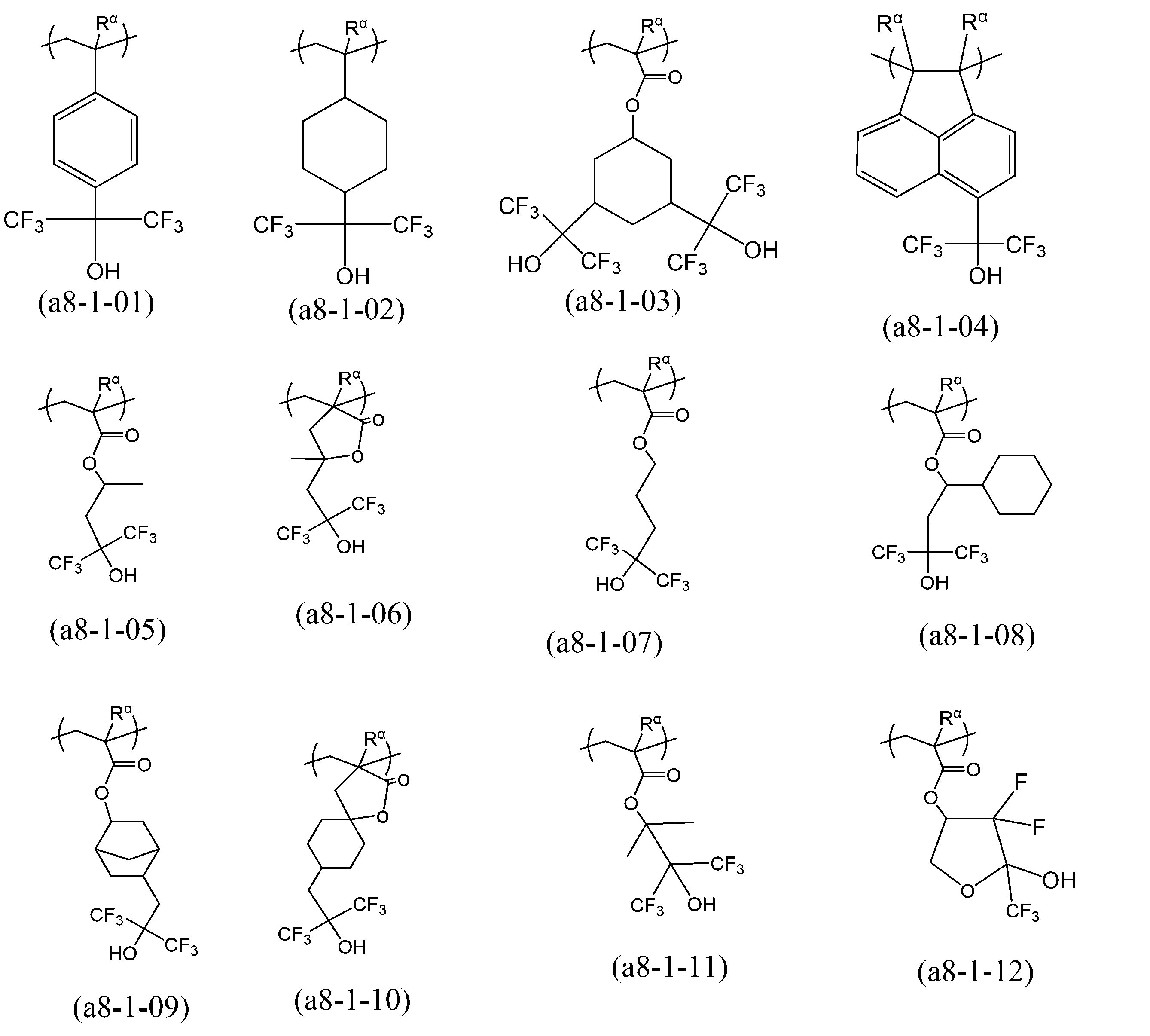
上記例示の中でも、構成単位(a8)は、化学式(a8-1-01)~(a8-1-04)、(a8-1-06)、(a8-1-08)、(a8-1-09)、及び、(a8-1-10)でそれぞれ表される構成単位からなる群より選択される少なくとも1種が好ましく、化学式(a8-1-01)~(a8-1-04)、(a8-1-09)でそれぞれ表される構成単位からなる群より選択される少なくとも1種がより好ましい。
(A1)成分が有する構成単位(a8)は、1種でもよく2種以上でもよい。(A1)成分は、構成単位(a8)を有してもよく、有しなくてもよい。
(A1)成分における構成単位(a8)の割合は、(A1)成分を構成する全構成単位の合計(100モル%)に対して、0~50モル%であることが好ましく、0~30モル%であることがより好ましい。
(A1)成分における構成単位(a8)の割合は、(A1)成分を構成する全構成単位の合計(100モル%)に対して、0~50モル%であることが好ましく、0~30モル%であることがより好ましい。
レジスト組成物が含有する(A1)成分は、1種を単独で用いてもよく、2種以上を併用してもよい。
(A1)成分としては、例えば、構成単位(a0)と構成単位(a10)との繰り返し構造を含む高分子化合物、構成単位(a0)と構成単位(a1)との繰り返し構造を含む高分子化合物、構成単位(a0)と構成単位(a1)と構成単位(a10)との繰り返し構造を含む高分子化合物等が挙げられる。
(A1)成分としては、前記構成単位(a0)と、下記一般式(a10-1-1)で表される構成単位とを有する共重合体、又は前記構成単位(a0)と、下記一般式(a1-1-1)で表される構成単位とを有する共重合体が好ましく、前記構成単位(a0)と、下記一般式(a10-1-1)で表される構成単位と、下記一般式(a1-1-1)で表される構成単位とを有する共重合体がより好ましい。
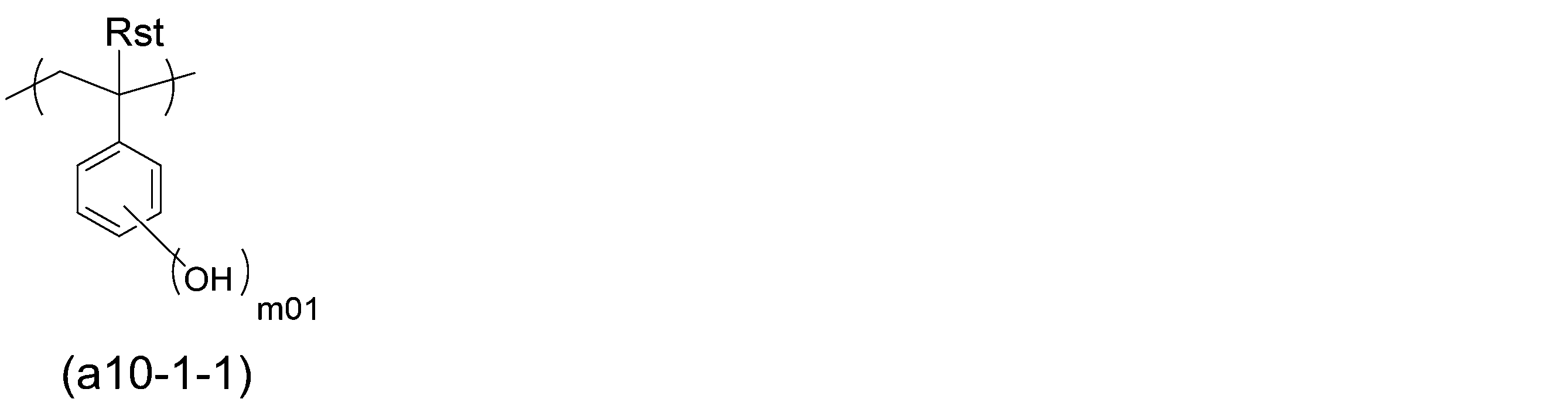
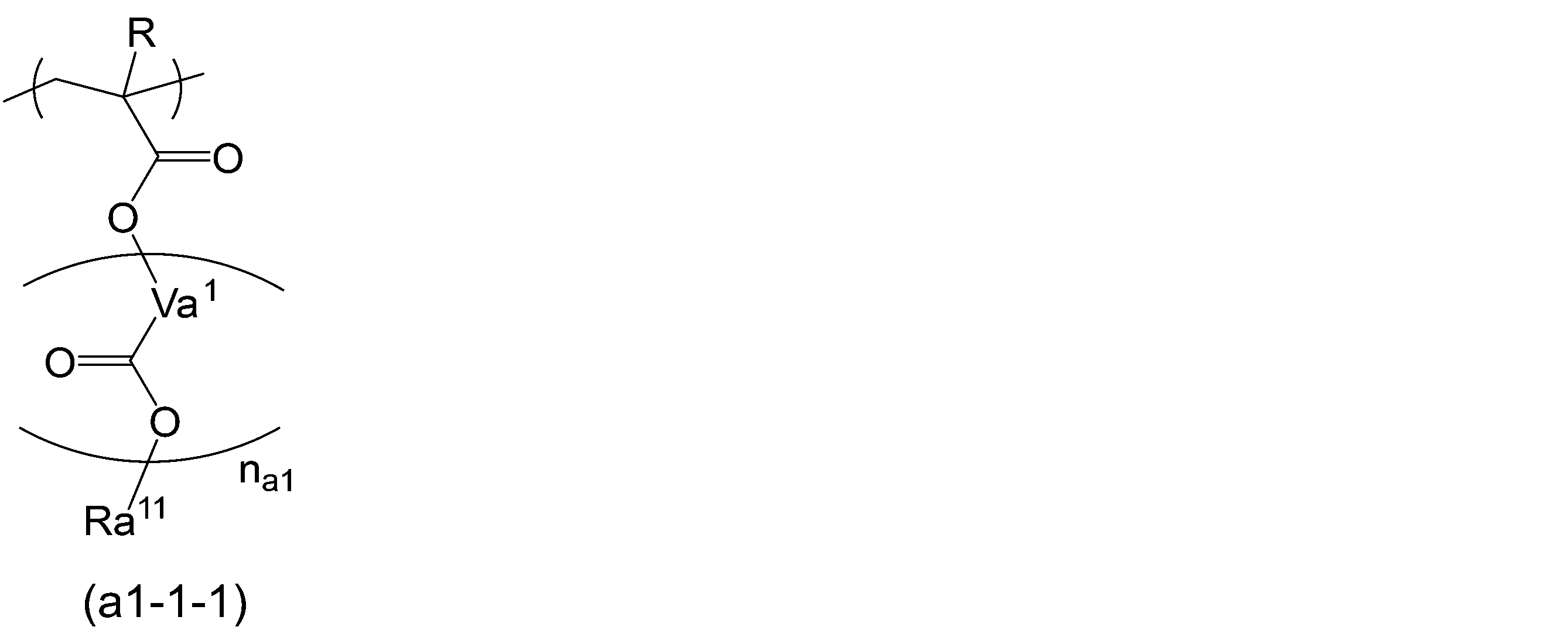
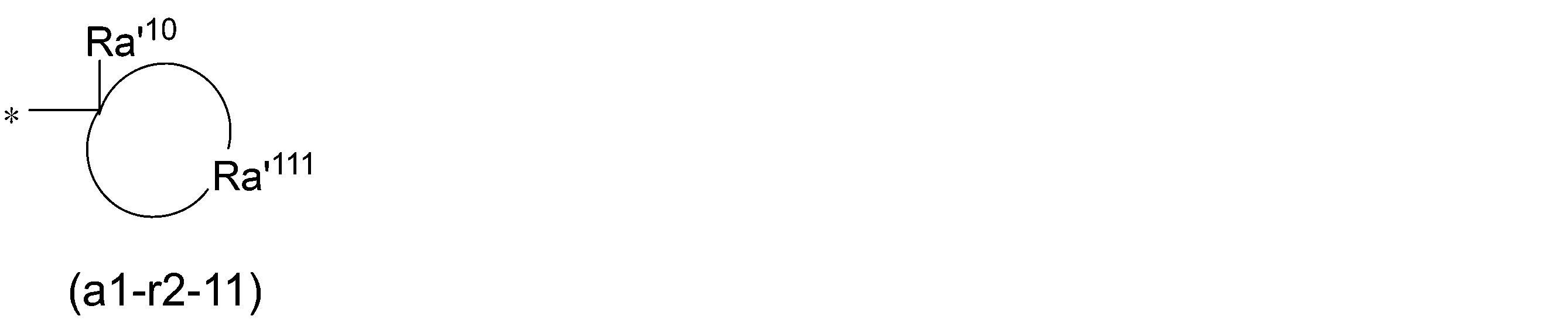
かかる(A1)成分は、各構成単位を誘導するモノマーを重合溶媒に溶解し、ここに、例えばアゾビスイソブチロニトリル(AIBN)、アゾビスイソ酪酸ジメチル(例えばV-601など)等のラジカル重合開始剤を加えて重合することにより製造することができる。
あるいは、かかる(A1)成分は、構成単位(a1)を誘導するモノマーと、任意の構成単位(例えば、構成単位(a10等)を誘導するモノマーと、を重合溶媒に溶解し、ここに、上記のようなラジカル重合開始剤を加えて重合し、その後、脱保護反応を行うことにより製造することができる。
なお、重合の際に、例えば、HS-CH2-CH2-CH2-C(CF3)2-OHのような連鎖移動剤を併用して用いることにより、末端に-C(CF3)2-OH基を導入してもよい。このように、アルキル基の水素原子の一部がフッ素原子で置換されたヒドロキシアルキル基が導入された共重合体は、現像欠陥の低減やLER(ラインエッジラフネス:ライン側壁の不均一な凹凸)の低減に有効である。
あるいは、かかる(A1)成分は、構成単位(a1)を誘導するモノマーと、任意の構成単位(例えば、構成単位(a10等)を誘導するモノマーと、を重合溶媒に溶解し、ここに、上記のようなラジカル重合開始剤を加えて重合し、その後、脱保護反応を行うことにより製造することができる。
なお、重合の際に、例えば、HS-CH2-CH2-CH2-C(CF3)2-OHのような連鎖移動剤を併用して用いることにより、末端に-C(CF3)2-OH基を導入してもよい。このように、アルキル基の水素原子の一部がフッ素原子で置換されたヒドロキシアルキル基が導入された共重合体は、現像欠陥の低減やLER(ラインエッジラフネス:ライン側壁の不均一な凹凸)の低減に有効である。
(A1)成分の重量平均分子量(Mw)(ゲルパーミエーションクロマトグラフィー(GPC)によるポリスチレン換算基準)は、特に限定されるものではなく、1000~50000が好ましく、5000~40000がより好ましく、5000~30000がさらに好ましい。
(A1)成分のMwがこの範囲の好ましい上限値以下であると、レジストとして用いるのに充分なレジスト溶剤への溶解性があり、この範囲の好ましい下限値以上であると、耐ドライエッチング性やレジストパターン断面形状が良好である。
(A1)成分の分散度(Mw/Mn)は、特に限定されず、1.0~4.0が好ましく、1.0~3.0がより好ましく、1.0~2.0が特に好ましい。なお、Mnは数平均分子量を示す。
(A1)成分のMwがこの範囲の好ましい上限値以下であると、レジストとして用いるのに充分なレジスト溶剤への溶解性があり、この範囲の好ましい下限値以上であると、耐ドライエッチング性やレジストパターン断面形状が良好である。
(A1)成分の分散度(Mw/Mn)は、特に限定されず、1.0~4.0が好ましく、1.0~3.0がより好ましく、1.0~2.0が特に好ましい。なお、Mnは数平均分子量を示す。
・(A2)成分について
本実施形態のレジスト組成物は、(A)成分として、前記(A1)成分に該当しない、酸の作用により現像液に対する溶解性が変化する基材成分(以下「(A2)成分」という。)を併用してもよい。
(A2)成分としては、特に限定されず、化学増幅型レジスト組成物用の基材成分として従来から知られている多数のものから任意に選択して用いればよい。
(A2)成分は、高分子化合物又は低分子化合物の1種を単独で用いてもよく2種以上を組み合わせて用いてもよい。
本実施形態のレジスト組成物は、(A)成分として、前記(A1)成分に該当しない、酸の作用により現像液に対する溶解性が変化する基材成分(以下「(A2)成分」という。)を併用してもよい。
(A2)成分としては、特に限定されず、化学増幅型レジスト組成物用の基材成分として従来から知られている多数のものから任意に選択して用いればよい。
(A2)成分は、高分子化合物又は低分子化合物の1種を単独で用いてもよく2種以上を組み合わせて用いてもよい。
(A)成分中の(A1)成分の割合は、(A)成分の総質量に対し、25質量%以上が好ましく、50質量%以上がより好ましく、75質量%以上がさらに好ましく、100質量%であってもよい。該割合が25質量%以上であると、高感度化や解像性、ラフネス改善などの種々のリソグラフィー特性に優れたレジストパターンが形成されやすくなる。
本実施形態のレジスト組成物中、(A)成分の含有量は、形成しようとするレジスト膜厚等に応じて調整すればよい。
≪酸発生剤成分(B)≫
本実施形態のレジスト組成物は、さらに、露光により酸を発生する酸発生剤成分(B)を含有することが好ましい。
(B)成分としては、特に限定されず、これまで化学増幅型レジスト組成物用の酸発生剤として提案されているものを用いることができる。
このような酸発生剤としては、ヨードニウム塩やスルホニウム塩などのオニウム塩系酸発生剤、オキシムスルホネート系酸発生剤;ビスアルキル又はビスアリールスルホニルジアゾメタン類、ポリ(ビススルホニル)ジアゾメタン類などのジアゾメタン系酸発生剤;ニトロベンジルスルホネート系酸発生剤、イミノスルホネート系酸発生剤、ジスルホン系酸発生剤など多種のものが挙げられる。
本実施形態のレジスト組成物は、さらに、露光により酸を発生する酸発生剤成分(B)を含有することが好ましい。
(B)成分としては、特に限定されず、これまで化学増幅型レジスト組成物用の酸発生剤として提案されているものを用いることができる。
このような酸発生剤としては、ヨードニウム塩やスルホニウム塩などのオニウム塩系酸発生剤、オキシムスルホネート系酸発生剤;ビスアルキル又はビスアリールスルホニルジアゾメタン類、ポリ(ビススルホニル)ジアゾメタン類などのジアゾメタン系酸発生剤;ニトロベンジルスルホネート系酸発生剤、イミノスルホネート系酸発生剤、ジスルホン系酸発生剤など多種のものが挙げられる。
オニウム塩系酸発生剤としては、例えば、下記の一般式(b-1)で表される化合物(以下「(b-1)成分」ともいう)、一般式(b-2)で表される化合物(以下「(b-2)成分」ともいう)又は一般式(b-3)で表される化合物(以下「(b-3)成分」ともいう)が挙げられる。

{アニオン部}
・(b-1)成分におけるアニオン
式(b-1)中、R101は、置換基を有してもよい環式基、置換基を有してもよい鎖状のアルキル基、又は置換基を有してもよい鎖状のアルケニル基である。
・(b-1)成分におけるアニオン
式(b-1)中、R101は、置換基を有してもよい環式基、置換基を有してもよい鎖状のアルキル基、又は置換基を有してもよい鎖状のアルケニル基である。
置換基を有してもよい環式基:
該環式基は、環状の炭化水素基であることが好ましく、該環状の炭化水素基は、芳香族炭化水素基であってもよく、脂肪族炭化水素基であってもよい。脂肪族炭化水素基は、芳香族性を持たない炭化水素基を意味する。また、脂肪族炭化水素基は、飽和であることが好ましい。
該環式基は、環状の炭化水素基であることが好ましく、該環状の炭化水素基は、芳香族炭化水素基であってもよく、脂肪族炭化水素基であってもよい。脂肪族炭化水素基は、芳香族性を持たない炭化水素基を意味する。また、脂肪族炭化水素基は、飽和であることが好ましい。
R101における芳香族炭化水素基は、芳香環を有する炭化水素基である。該芳香族炭化水素基の炭素原子数は3~30であることが好ましく、5~30であることがより好ましく、5~20がさらに好ましく、6~15が特に好ましく、6~10が最も好ましい。但し、該炭素原子数には、置換基における炭素原子数を含まないものとする。
R101における芳香族炭化水素基が有する芳香環として具体的には、ベンゼン、フルオレン、ナフタレン、アントラセン、フェナントレン、ビフェニル、又はこれらの芳香環を構成する炭素原子の一部がヘテロ原子で置換された芳香族複素環などが挙げられる。芳香族複素環におけるヘテロ原子としては、酸素原子、硫黄原子、窒素原子等が挙げられる。
R101における芳香族炭化水素基として具体的には、前記芳香環から水素原子を1つ除いた基(アリール基:例えば、フェニル基、ナフチル基など)、前記芳香環の水素原子の1つがアルキレン基で置換された基(例えば、ベンジル基、フェネチル基、1-ナフチルメチル基など)等が挙げられる。前記アルキレン基(アリールアルキル基中のアルキル鎖)の炭素原子数は、1~4であることが好ましく、1~2であることがより好ましく、1であることが特に好ましい。
R101における芳香族炭化水素基が有する芳香環として具体的には、ベンゼン、フルオレン、ナフタレン、アントラセン、フェナントレン、ビフェニル、又はこれらの芳香環を構成する炭素原子の一部がヘテロ原子で置換された芳香族複素環などが挙げられる。芳香族複素環におけるヘテロ原子としては、酸素原子、硫黄原子、窒素原子等が挙げられる。
R101における芳香族炭化水素基として具体的には、前記芳香環から水素原子を1つ除いた基(アリール基:例えば、フェニル基、ナフチル基など)、前記芳香環の水素原子の1つがアルキレン基で置換された基(例えば、ベンジル基、フェネチル基、1-ナフチルメチル基など)等が挙げられる。前記アルキレン基(アリールアルキル基中のアルキル鎖)の炭素原子数は、1~4であることが好ましく、1~2であることがより好ましく、1であることが特に好ましい。
R101における環状の脂肪族炭化水素基は、構造中に環を含む脂肪族炭化水素基が挙げられる。
この構造中に環を含む脂肪族炭化水素基としては、脂環式炭化水素基(脂肪族炭化水素環から水素原子を1個除いた基)、脂環式炭化水素基が直鎖状または分岐鎖状の脂肪族炭化水素基の末端に結合した基、脂環式炭化水素基が直鎖状または分岐鎖状の脂肪族炭化水素基の途中に介在する基などが挙げられる。
前記脂環式炭化水素基は、炭素原子数が3~20であることが好ましく、3~12であることがより好ましい。
前記脂環式炭化水素基は、多環式基であってもよく、単環式基であってもよい。単環式の脂環式炭化水素基としては、モノシクロアルカンから1個以上の水素原子を除いた基が好ましい。該モノシクロアルカンとしては、炭素原子数3~6のものが好ましく、具体的にはシクロペンタン、シクロヘキサン等が挙げられる。多環式の脂環式炭化水素基としては、ポリシクロアルカンから1個以上の水素原子を除いた基が好ましく、該ポリシクロアルカンとしては、炭素原子数7~30のものが好ましい。中でも、該ポリシクロアルカンとしては、アダマンタン、ノルボルナン、イソボルナン、トリシクロデカン、テトラシクロドデカン等の架橋環系の多環式骨格を有するポリシクロアルカン;ステロイド骨格を有する環式基等の縮合環系の多環式骨格を有するポリシクロアルカンがより好ましい。
この構造中に環を含む脂肪族炭化水素基としては、脂環式炭化水素基(脂肪族炭化水素環から水素原子を1個除いた基)、脂環式炭化水素基が直鎖状または分岐鎖状の脂肪族炭化水素基の末端に結合した基、脂環式炭化水素基が直鎖状または分岐鎖状の脂肪族炭化水素基の途中に介在する基などが挙げられる。
前記脂環式炭化水素基は、炭素原子数が3~20であることが好ましく、3~12であることがより好ましい。
前記脂環式炭化水素基は、多環式基であってもよく、単環式基であってもよい。単環式の脂環式炭化水素基としては、モノシクロアルカンから1個以上の水素原子を除いた基が好ましい。該モノシクロアルカンとしては、炭素原子数3~6のものが好ましく、具体的にはシクロペンタン、シクロヘキサン等が挙げられる。多環式の脂環式炭化水素基としては、ポリシクロアルカンから1個以上の水素原子を除いた基が好ましく、該ポリシクロアルカンとしては、炭素原子数7~30のものが好ましい。中でも、該ポリシクロアルカンとしては、アダマンタン、ノルボルナン、イソボルナン、トリシクロデカン、テトラシクロドデカン等の架橋環系の多環式骨格を有するポリシクロアルカン;ステロイド骨格を有する環式基等の縮合環系の多環式骨格を有するポリシクロアルカンがより好ましい。
なかでも、R101における環状の脂肪族炭化水素基としては、モノシクロアルカンまたはポリシクロアルカンから水素原子を1つ以上除いた基が好ましく、ポリシクロアルカンから水素原子を1つ除いた基がより好ましく、アダマンチル基、ノルボルニル基がさらに好ましく、アダマンチル基が特に好ましい。
脂環式炭化水素基に結合してもよい、直鎖状の脂肪族炭化水素基は、炭素原子数が1~10であることが好ましく、1~6がより好ましく、1~4がさらに好ましく、1~3が最も好ましい。直鎖状の脂肪族炭化水素基としては、直鎖状のアルキレン基が好ましく、具体的には、メチレン基[-CH2-]、エチレン基[-(CH2)2-]、トリメチレン基[-(CH2)3-]、テトラメチレン基[-(CH2)4-]、ペンタメチレン基[-(CH2)5-]等が挙げられる。
脂環式炭化水素基に結合してもよい、分岐鎖状の脂肪族炭化水素基は、炭素原子数が2~10であることが好ましく、3~6がより好ましく、3又は4がさらに好ましく、3が最も好ましい。分岐鎖状の脂肪族炭化水素基としては、分岐鎖状のアルキレン基が好ましく、具体的には、-CH(CH3)-、-CH(CH2CH3)-、-C(CH3)2-、-C(CH3)(CH2CH3)-、-C(CH3)(CH2CH2CH3)-、-C(CH2CH3)2-等のアルキルメチレン基;-CH(CH3)CH2-、-CH(CH3)CH(CH3)-、-C(CH3)2CH2-、-CH(CH2CH3)CH2-、-C(CH2CH3)2-CH2-等のアルキルエチレン基;-CH(CH3)CH2CH2-、-CH2CH(CH3)CH2-等のアルキルトリメチレン基;-CH(CH3)CH2CH2CH2-、-CH2CH(CH3)CH2CH2-等のアルキルテトラメチレン基などのアルキルアルキレン基等が挙げられる。アルキルアルキレン基におけるアルキル基としては、炭素原子数1~5の直鎖状のアルキル基が好ましい。
脂環式炭化水素基に結合してもよい、分岐鎖状の脂肪族炭化水素基は、炭素原子数が2~10であることが好ましく、3~6がより好ましく、3又は4がさらに好ましく、3が最も好ましい。分岐鎖状の脂肪族炭化水素基としては、分岐鎖状のアルキレン基が好ましく、具体的には、-CH(CH3)-、-CH(CH2CH3)-、-C(CH3)2-、-C(CH3)(CH2CH3)-、-C(CH3)(CH2CH2CH3)-、-C(CH2CH3)2-等のアルキルメチレン基;-CH(CH3)CH2-、-CH(CH3)CH(CH3)-、-C(CH3)2CH2-、-CH(CH2CH3)CH2-、-C(CH2CH3)2-CH2-等のアルキルエチレン基;-CH(CH3)CH2CH2-、-CH2CH(CH3)CH2-等のアルキルトリメチレン基;-CH(CH3)CH2CH2CH2-、-CH2CH(CH3)CH2CH2-等のアルキルテトラメチレン基などのアルキルアルキレン基等が挙げられる。アルキルアルキレン基におけるアルキル基としては、炭素原子数1~5の直鎖状のアルキル基が好ましい。
また、R101における環状の炭化水素基は、複素環等のようにヘテロ原子を含んでもよい。具体的には、前記一般式(a2-r-1)~(a2-r-7)でそれぞれ表されるラクトン含有環式基、前記一般式(b5-r-1)~(b5-r-4)でそれぞれ表される-SO2-含有環式基、その他前記化学式(r-hr-1)~(r-hr-16)でそれぞれ表される複素環式基が挙げられる。
R101の環式基における置換基としては、例えば、アルキル基、アルコキシ基、ハロゲン原子、ハロゲン化アルキル基、水酸基、カルボニル基、ニトロ基等が挙げられる。
置換基としてのアルキル基としては、炭素原子数1~5のアルキル基が好ましい。
置換基としてのアルコキシ基としては、炭素原子数1~5のアルコキシ基が好ましく、メトキシ基、エトキシ基、n-プロポキシ基、iso-プロポキシ基、n-ブトキシ基、tert-ブトキシ基がより好ましく、メトキシ基、エトキシ基が最も好ましい。
置換基としてのハロゲン原子としては、フッ素原子、臭素原子、ヨウ素原子が好ましい。
置換基としてのハロゲン化アルキル基としては、炭素原子数1~5のアルキル基、例えばメチル基、エチル基、プロピル基、n-ブチル基、tert-ブチル基等の水素原子の一部または全部が前記ハロゲン原子で置換された基が挙げられる。
置換基としてのカルボニル基は、環状の炭化水素基を構成するメチレン基(-CH2-)を置換する基である。
置換基としてのアルキル基としては、炭素原子数1~5のアルキル基が好ましい。
置換基としてのアルコキシ基としては、炭素原子数1~5のアルコキシ基が好ましく、メトキシ基、エトキシ基、n-プロポキシ基、iso-プロポキシ基、n-ブトキシ基、tert-ブトキシ基がより好ましく、メトキシ基、エトキシ基が最も好ましい。
置換基としてのハロゲン原子としては、フッ素原子、臭素原子、ヨウ素原子が好ましい。
置換基としてのハロゲン化アルキル基としては、炭素原子数1~5のアルキル基、例えばメチル基、エチル基、プロピル基、n-ブチル基、tert-ブチル基等の水素原子の一部または全部が前記ハロゲン原子で置換された基が挙げられる。
置換基としてのカルボニル基は、環状の炭化水素基を構成するメチレン基(-CH2-)を置換する基である。
R101における環状の炭化水素基は、脂肪族炭化水素環と芳香環とが縮合した縮合環を含む縮合環式基であってもよい。前記縮合環としては、例えば、架橋環系の多環式骨格を有するポリシクロアルカンに、1個以上の芳香環が縮合したもの等が挙げられる。前記架橋環系ポリシクロアルカンの具体例としては、ビシクロ[2.2.1]ヘプタン(ノルボルナン)、ビシクロ[2.2.2]オクタン等のビシクロアルカンが挙げられる。前記縮合環式としては、ビシクロアルカンに2個又は3個の芳香環が縮合した縮合環を含む基が好ましく、ビシクロ[2.2.2]オクタンに2個又は3個の芳香環が縮合した縮合環を含む基がより好ましい。R101における縮合環式基の具体例としては、下記式(r-br-1)~(r-br-2)で表される基が挙げられる。式中*は、式(b-1)中のY101に結合する結合手を表す。

R101における縮合環式基が有していてもよい置換基としては、例えば、アルキル基、アルコキシ基、ハロゲン原子、ハロゲン化アルキル基、水酸基、カルボニル基、ニトロ基、芳香族炭化水素基、脂環式炭化水素基等が挙げられる。
前記縮合環式基の置換基としてのアルキル基、アルコキシ基、ハロゲン原子、ハロゲン化アルキル基は、上記R101における環式基の置換基として挙げたものと同様のものが挙げられる。
前記縮合環式基の置換基としての芳香族炭化水素基としては、芳香環から水素原子を1つ除いた基(アリール基:例えば、フェニル基、ナフチル基など)、前記芳香環の水素原子の1つがアルキレン基で置換された基(例えば、ベンジル基、フェネチル基、1-ナフチルメチル基、2-ナフチルメチル基、1-ナフチルエチル基、2-ナフチルエチル基等のアリールアルキル基など)、上記式(r-hr-1)~(r-hr-6)でそれぞれ表される複素環式基等が挙げられる。
前記縮合環式基の置換基としての脂環式炭化水素基としては、シクロペンタン、シクロヘキサン等のモノシクロアルカンから1個の水素原子を除いた基;アダマンタン、ノルボルナン、イソボルナン、トリシクロデカン、テトラシクロドデカン等のポリシクロアルカンから1個の水素原子を除いた基;前記一般式(a2-r-1)~(a2-r-7)でそれぞれ表されるラクトン含有環式基;前記一般式(b5-r-1)~(b5-r-4)でそれぞれ表される-SO2-含有環式基;前記式(r-hr-7)~(r-hr-16)でそれぞれ表される複素環式基等が挙げられる。
前記縮合環式基の置換基としてのアルキル基、アルコキシ基、ハロゲン原子、ハロゲン化アルキル基は、上記R101における環式基の置換基として挙げたものと同様のものが挙げられる。
前記縮合環式基の置換基としての芳香族炭化水素基としては、芳香環から水素原子を1つ除いた基(アリール基:例えば、フェニル基、ナフチル基など)、前記芳香環の水素原子の1つがアルキレン基で置換された基(例えば、ベンジル基、フェネチル基、1-ナフチルメチル基、2-ナフチルメチル基、1-ナフチルエチル基、2-ナフチルエチル基等のアリールアルキル基など)、上記式(r-hr-1)~(r-hr-6)でそれぞれ表される複素環式基等が挙げられる。
前記縮合環式基の置換基としての脂環式炭化水素基としては、シクロペンタン、シクロヘキサン等のモノシクロアルカンから1個の水素原子を除いた基;アダマンタン、ノルボルナン、イソボルナン、トリシクロデカン、テトラシクロドデカン等のポリシクロアルカンから1個の水素原子を除いた基;前記一般式(a2-r-1)~(a2-r-7)でそれぞれ表されるラクトン含有環式基;前記一般式(b5-r-1)~(b5-r-4)でそれぞれ表される-SO2-含有環式基;前記式(r-hr-7)~(r-hr-16)でそれぞれ表される複素環式基等が挙げられる。
置換基を有してもよい鎖状のアルキル基:
R101の鎖状のアルキル基としては、直鎖状又は分岐鎖状のいずれでもよい。
直鎖状のアルキル基としては、炭素原子数が1~20であることが好ましく、1~15であることがより好ましく、1~10が最も好ましい。
分岐鎖状のアルキル基としては、炭素原子数が3~20であることが好ましく、3~15であることがより好ましく、3~10が最も好ましい。具体的には、例えば、1-メチルエチル基、1-メチルプロピル基、2-メチルプロピル基、1-メチルブチル基、2-メチルブチル基、3-メチルブチル基、1-エチルブチル基、2-エチルブチル基、1-メチルペンチル基、2-メチルペンチル基、3-メチルペンチル基、4-メチルペンチル基などが挙げられる。
R101の鎖状のアルキル基としては、直鎖状又は分岐鎖状のいずれでもよい。
直鎖状のアルキル基としては、炭素原子数が1~20であることが好ましく、1~15であることがより好ましく、1~10が最も好ましい。
分岐鎖状のアルキル基としては、炭素原子数が3~20であることが好ましく、3~15であることがより好ましく、3~10が最も好ましい。具体的には、例えば、1-メチルエチル基、1-メチルプロピル基、2-メチルプロピル基、1-メチルブチル基、2-メチルブチル基、3-メチルブチル基、1-エチルブチル基、2-エチルブチル基、1-メチルペンチル基、2-メチルペンチル基、3-メチルペンチル基、4-メチルペンチル基などが挙げられる。
置換基を有してもよい鎖状のアルケニル基:
R101の鎖状のアルケニル基としては、直鎖状又は分岐鎖状のいずれでもよく、炭素原子数が2~10であることが好ましく、2~5がより好ましく、2~4がさらに好ましく、3が特に好ましい。直鎖状のアルケニル基としては、例えば、ビニル基、プロペニル基(アリル基)、ブチニル基などが挙げられる。分岐鎖状のアルケニル基としては、例えば、1-メチルビニル基、2-メチルビニル基、1-メチルプロペニル基、2-メチルプロペニル基などが挙げられる。
鎖状のアルケニル基としては、上記の中でも、直鎖状のアルケニル基が好ましく、ビニル基、プロペニル基がより好ましく、ビニル基が特に好ましい。
R101の鎖状のアルケニル基としては、直鎖状又は分岐鎖状のいずれでもよく、炭素原子数が2~10であることが好ましく、2~5がより好ましく、2~4がさらに好ましく、3が特に好ましい。直鎖状のアルケニル基としては、例えば、ビニル基、プロペニル基(アリル基)、ブチニル基などが挙げられる。分岐鎖状のアルケニル基としては、例えば、1-メチルビニル基、2-メチルビニル基、1-メチルプロペニル基、2-メチルプロペニル基などが挙げられる。
鎖状のアルケニル基としては、上記の中でも、直鎖状のアルケニル基が好ましく、ビニル基、プロペニル基がより好ましく、ビニル基が特に好ましい。
R101の鎖状のアルキル基またはアルケニル基における置換基としては、例えば、アルコキシ基、ハロゲン原子、ハロゲン化アルキル基、水酸基、カルボニル基、ニトロ基、アミノ基、上記R101における環式基等が挙げられる。
式(b-1)中、Y101は、単結合または酸素原子を含む2価の連結基である。
Y101が酸素原子を含む2価の連結基である場合、該Y101は、酸素原子以外の原子を含有してもよい。酸素原子以外の原子としては、例えば炭素原子、水素原子、硫黄原子、窒素原子等が挙げられる。
酸素原子を含む2価の連結基としては、例えば下記一般式(y-al-1)~(y-al-7)でそれぞれ表される連結基が挙げられる。なお、下記一般式(y-al-1)~(y-al-7)において、上記式(b-1)中のR101と結合するのが、下記一般式(y-al-1)~(y-al-7)中のV’101である。
Y101が酸素原子を含む2価の連結基である場合、該Y101は、酸素原子以外の原子を含有してもよい。酸素原子以外の原子としては、例えば炭素原子、水素原子、硫黄原子、窒素原子等が挙げられる。
酸素原子を含む2価の連結基としては、例えば下記一般式(y-al-1)~(y-al-7)でそれぞれ表される連結基が挙げられる。なお、下記一般式(y-al-1)~(y-al-7)において、上記式(b-1)中のR101と結合するのが、下記一般式(y-al-1)~(y-al-7)中のV’101である。
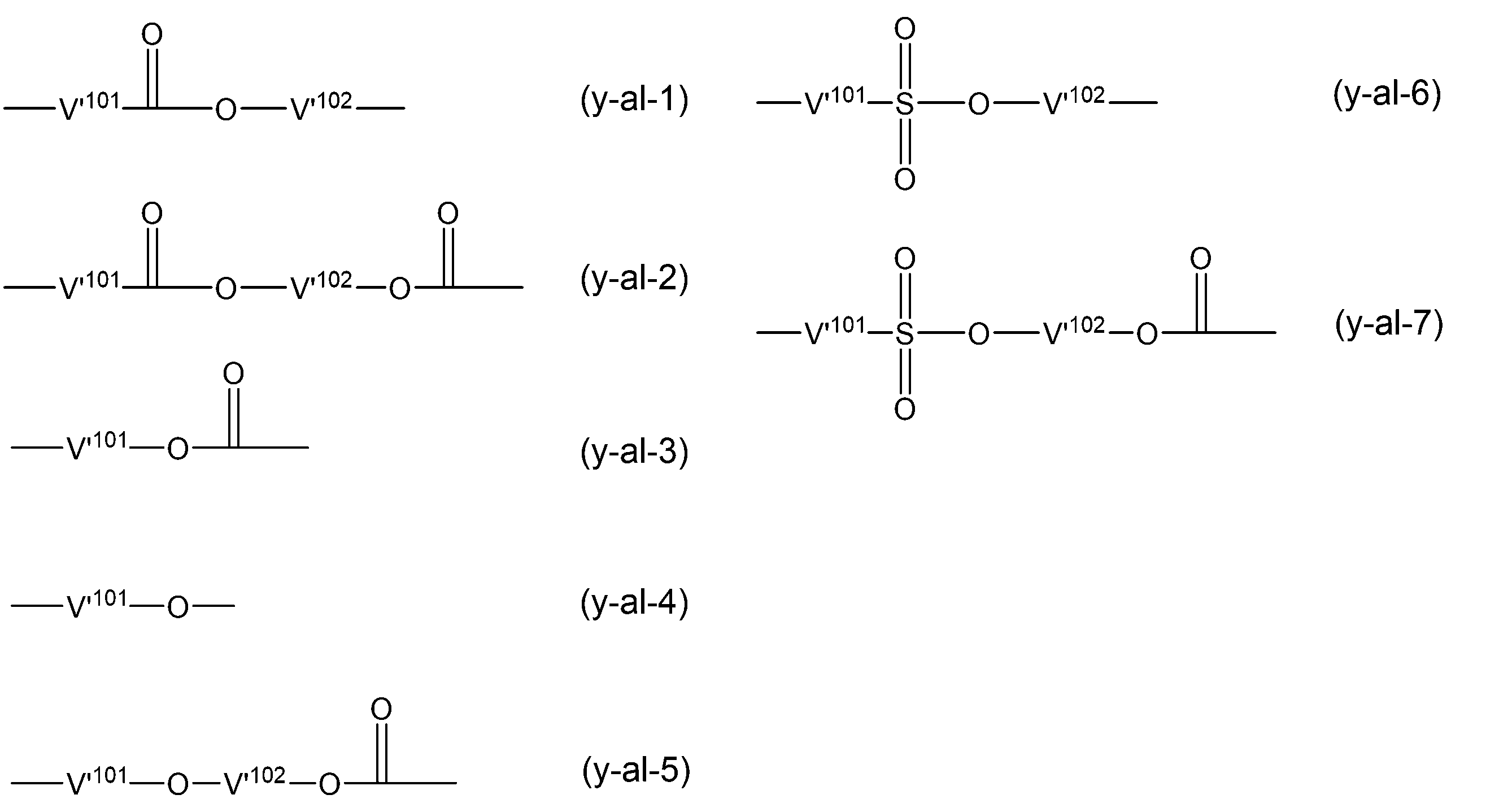
V’102における2価の飽和炭化水素基は、炭素原子数1~30のアルキレン基であることが好ましく、炭素原子数1~10のアルキレン基であることがより好ましく、炭素原子数1~5のアルキレン基であることがさらに好ましい。
V’101およびV’102におけるアルキレン基としては、直鎖状のアルキレン基でもよく分岐鎖状のアルキレン基でもよく、直鎖状のアルキレン基が好ましい。
V’101およびV’102におけるアルキレン基として、具体的には、メチレン基[-CH2-];-CH(CH3)-、-CH(CH2CH3)-、-C(CH3)2-、-C(CH3)(CH2CH3)-、-C(CH3)(CH2CH2CH3)-、-C(CH2CH3)2-等のアルキルメチレン基;エチレン基[-CH2CH2-];-CH(CH3)CH2-、-CH(CH3)CH(CH3)-、-C(CH3)2CH2-、-CH(CH2CH3)CH2-等のアルキルエチレン基;トリメチレン基(n-プロピレン基)[-CH2CH2CH2-];-CH(CH3)CH2CH2-、-CH2CH(CH3)CH2-等のアルキルトリメチレン基;テトラメチレン基[-CH2CH2CH2CH2-];-CH(CH3)CH2CH2CH2-、-CH2CH(CH3)CH2CH2-等のアルキルテトラメチレン基;ペンタメチレン基[-CH2CH2CH2CH2CH2-]等が挙げられる。
また、V’101又はV’102における前記アルキレン基における一部のメチレン基が、炭素原子数5~10の2価の脂肪族環式基で置換されていてもよい。当該脂肪族環式基は、前記式(a1-r-1)中のRa’3の環状の脂肪族炭化水素基(単環式の脂肪族炭化水素基、多環式の脂肪族炭化水素基)から水素原子をさらに1つ除いた2価の基が好ましく、シクロへキシレン基、1,5-アダマンチレン基または2,6-アダマンチレン基がより好ましい。
V’101およびV’102におけるアルキレン基として、具体的には、メチレン基[-CH2-];-CH(CH3)-、-CH(CH2CH3)-、-C(CH3)2-、-C(CH3)(CH2CH3)-、-C(CH3)(CH2CH2CH3)-、-C(CH2CH3)2-等のアルキルメチレン基;エチレン基[-CH2CH2-];-CH(CH3)CH2-、-CH(CH3)CH(CH3)-、-C(CH3)2CH2-、-CH(CH2CH3)CH2-等のアルキルエチレン基;トリメチレン基(n-プロピレン基)[-CH2CH2CH2-];-CH(CH3)CH2CH2-、-CH2CH(CH3)CH2-等のアルキルトリメチレン基;テトラメチレン基[-CH2CH2CH2CH2-];-CH(CH3)CH2CH2CH2-、-CH2CH(CH3)CH2CH2-等のアルキルテトラメチレン基;ペンタメチレン基[-CH2CH2CH2CH2CH2-]等が挙げられる。
また、V’101又はV’102における前記アルキレン基における一部のメチレン基が、炭素原子数5~10の2価の脂肪族環式基で置換されていてもよい。当該脂肪族環式基は、前記式(a1-r-1)中のRa’3の環状の脂肪族炭化水素基(単環式の脂肪族炭化水素基、多環式の脂肪族炭化水素基)から水素原子をさらに1つ除いた2価の基が好ましく、シクロへキシレン基、1,5-アダマンチレン基または2,6-アダマンチレン基がより好ましい。
式(b-1)中、V101は、単結合、アルキレン基又はフッ素化アルキレン基である。なかでも、V101は、単結合、又は炭素原子数1~4の直鎖状のフッ素化アルキレン基であることが好ましい。
式(b-1)中、R102は、フッ素原子又は炭素原子数1~5のフッ素化アルキル基である。R102は、フッ素原子または炭素原子数1~5のパーフルオロアルキル基であることが好ましく、フッ素原子であることがより好ましい。
前記式(b-1)で表されるアニオン部の具体例としては、例えば、Y101が単結合となる場合、トリフルオロメタンスルホネートアニオンやパーフルオロブタンスルホネートアニオン等のフッ素化アルキルスルホネートアニオンが挙げられ;Y101が酸素原子を含む2価の連結基である場合、下記式(an-1)~(an-3)のいずれかで表されるアニオンが挙げられる。
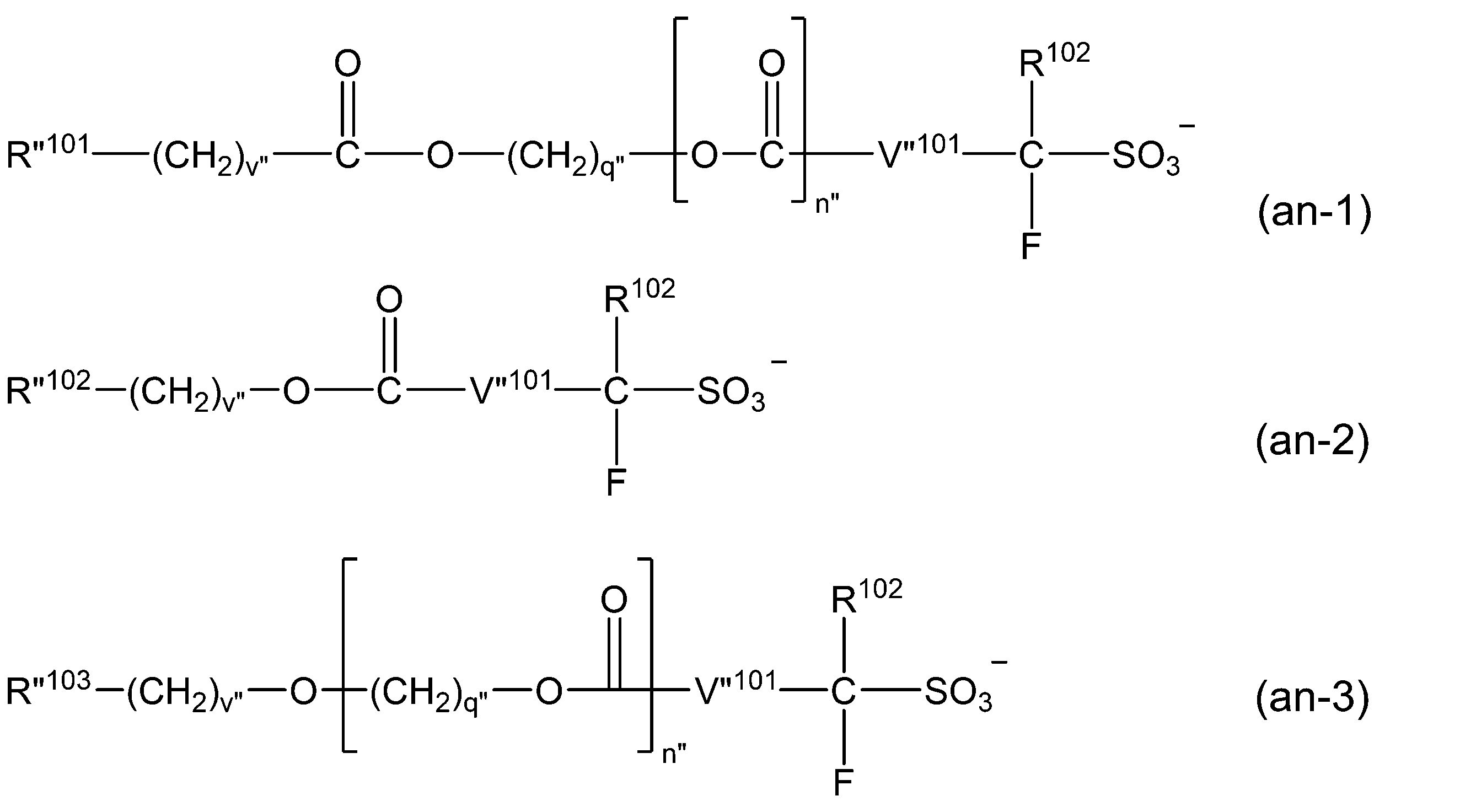
R”101、R”102およびR”103の置換基を有してもよい脂肪族環式基は、前記式(b-1)中のR101における環状の脂肪族炭化水素基として例示した基であることが好ましい。前記置換基としては、前記式(b-1)中のR101における環状の脂肪族炭化水素基を置換してもよい置換基と同様のものが挙げられる。
R”101およびR”103における置換基を有してもよい芳香族環式基は、前記式(b-1)中のR101における環状の炭化水素基における芳香族炭化水素基として例示した基であることが好ましい。前記置換基としては、前記式(b-1)中のR101における該芳香族炭化水素基を置換してもよい置換基と同様のものが挙げられる。
R”101における置換基を有してもよい鎖状のアルキル基は、前記式(b-1)中のR101における鎖状のアルキル基として例示した基であることが好ましい。
R”103における置換基を有してもよい鎖状のアルケニル基は、前記式(b-1)中のR101における鎖状のアルケニル基として例示した基であることが好ましい。
R”103における置換基を有してもよい鎖状のアルケニル基は、前記式(b-1)中のR101における鎖状のアルケニル基として例示した基であることが好ましい。
・(b-2)成分におけるアニオン
式(b-2)中、R104、R105は、それぞれ独立に、置換基を有してもよい環式基、置換基を有してもよい鎖状のアルキル基、または置換基を有してもよい鎖状のアルケニル基であり、それぞれ、式(b-1)中のR101と同様のものが挙げられる。ただし、R104、R105は、相互に結合して環を形成していてもよい。
R104、R105は、置換基を有してもよい鎖状のアルキル基が好ましく、直鎖状若しくは分岐鎖状のアルキル基、又は直鎖状若しくは分岐鎖状のフッ素化アルキル基であることがより好ましい。
該鎖状のアルキル基の炭素原子数は、1~10であることが好ましく、より好ましくは炭素原子数1~7、さらに好ましくは炭素原子数1~3である。R104、R105の鎖状のアルキル基の炭素原子数は、上記炭素原子数の範囲内において、レジスト用溶剤への溶解性も良好である等の理由により、小さいほど好ましい。また、R104、R105の鎖状のアルキル基においては、フッ素原子で置換されている水素原子の数が多いほど、酸の強度が強くなり、また、250nm以下の高エネルギー光や電子線に対する透明性が向上するため好ましい。前記鎖状のアルキル基中のフッ素原子の割合、すなわちフッ素化率は、好ましくは70~100%、さらに好ましくは90~100%であり、最も好ましくは、全ての水素原子がフッ素原子で置換されたパーフルオロアルキル基である。
式(b-2)中、V102、V103は、それぞれ独立に、単結合、アルキレン基、またはフッ素化アルキレン基であり、それぞれ、式(b-1)中のV101と同様のものが挙げられる。
式(b-2)中、L101、L102は、それぞれ独立に単結合又は酸素原子である。
式(b-2)中、R104、R105は、それぞれ独立に、置換基を有してもよい環式基、置換基を有してもよい鎖状のアルキル基、または置換基を有してもよい鎖状のアルケニル基であり、それぞれ、式(b-1)中のR101と同様のものが挙げられる。ただし、R104、R105は、相互に結合して環を形成していてもよい。
R104、R105は、置換基を有してもよい鎖状のアルキル基が好ましく、直鎖状若しくは分岐鎖状のアルキル基、又は直鎖状若しくは分岐鎖状のフッ素化アルキル基であることがより好ましい。
該鎖状のアルキル基の炭素原子数は、1~10であることが好ましく、より好ましくは炭素原子数1~7、さらに好ましくは炭素原子数1~3である。R104、R105の鎖状のアルキル基の炭素原子数は、上記炭素原子数の範囲内において、レジスト用溶剤への溶解性も良好である等の理由により、小さいほど好ましい。また、R104、R105の鎖状のアルキル基においては、フッ素原子で置換されている水素原子の数が多いほど、酸の強度が強くなり、また、250nm以下の高エネルギー光や電子線に対する透明性が向上するため好ましい。前記鎖状のアルキル基中のフッ素原子の割合、すなわちフッ素化率は、好ましくは70~100%、さらに好ましくは90~100%であり、最も好ましくは、全ての水素原子がフッ素原子で置換されたパーフルオロアルキル基である。
式(b-2)中、V102、V103は、それぞれ独立に、単結合、アルキレン基、またはフッ素化アルキレン基であり、それぞれ、式(b-1)中のV101と同様のものが挙げられる。
式(b-2)中、L101、L102は、それぞれ独立に単結合又は酸素原子である。
・(b-3)成分におけるアニオン
式(b-3)中、R106~R108は、それぞれ独立に、置換基を有してもよい環式基、置換基を有してもよい鎖状のアルキル基、又は置換基を有してもよい鎖状のアルケニル基であり、それぞれ、式(b-1)中のR101と同様のものが挙げられる。
式(b-3)中、L103~L105は、それぞれ独立に、単結合、-CO-又は-SO2-である。
式(b-3)中、R106~R108は、それぞれ独立に、置換基を有してもよい環式基、置換基を有してもよい鎖状のアルキル基、又は置換基を有してもよい鎖状のアルケニル基であり、それぞれ、式(b-1)中のR101と同様のものが挙げられる。
式(b-3)中、L103~L105は、それぞれ独立に、単結合、-CO-又は-SO2-である。
上記の中でも、(B)成分のアニオン部としては、(b-1)成分におけるアニオンが好ましく、前記式(an-1)で表されるアニオンがより好ましい。
{カチオン部}
前記の式(b-1)、式(b-2)、式(b-3)中、M’m+は、m価のオニウムカチオンを表す。この中でも、スルホニウムカチオン、ヨードニウムカチオンが好ましい。mは、1以上の整数である。
前記の式(b-1)、式(b-2)、式(b-3)中におけるM’m+としては、前記式(a5-1)におけるM’m+と同様である。
前記の式(b-1)、式(b-2)、式(b-3)中、M’m+は、m価のオニウムカチオンを表す。この中でも、スルホニウムカチオン、ヨードニウムカチオンが好ましい。mは、1以上の整数である。
前記の式(b-1)、式(b-2)、式(b-3)中におけるM’m+としては、前記式(a5-1)におけるM’m+と同様である。
上記の中でも、(B)成分のカチオン部としては、スルホニウムカチオンが好ましく、前記式(ca-1)~(ca-3)でそれぞれ表されるカチオンがより好ましく、前記式(ca-1)で表されるカチオンが更に好ましく、前記式(ca-1-1)~(ca-1-83)でそれぞれ表されるカチオンが特に好ましい。
本実施形態のレジスト組成物において、(B)成分は、1種を単独で用いてもよく、2種以上を併用してもよい。
レジスト組成物中、(B)成分の含有量は、(A)成分100質量部に対して、50質量部未満が好ましく、10~40質量部がより好ましい。
(B)成分の含有量を、前記の好ましい範囲とすることで、パターン形成が十分に行われる。また、レジスト組成物の各成分を有機溶剤に溶解した際、均一な溶液が得られやすく、レジスト組成物としての保存安定性が良好となるため好ましい。
レジスト組成物中、(B)成分の含有量は、(A)成分100質量部に対して、50質量部未満が好ましく、10~40質量部がより好ましい。
(B)成分の含有量を、前記の好ましい範囲とすることで、パターン形成が十分に行われる。また、レジスト組成物の各成分を有機溶剤に溶解した際、均一な溶液が得られやすく、レジスト組成物としての保存安定性が良好となるため好ましい。
(A1)成分が構成単位(a5)の繰り返し構造を有する場合、レジスト組成物中、(B)成分の含有量は、(A)成分100質量部に対して、50質量部未満が好ましく、0~40質量部がより好ましく、0~30質量部がさらに好ましい。
≪塩基成分(D)≫
本実施形態のレジスト組成物は、(A)成分に加えて、露光により発生する酸をトラップ(すなわち、酸の拡散を制御)する塩基成分((D)成分)を含有してもよい。(D)成分は、レジスト組成物において露光により発生する酸をトラップするクエンチャー(酸拡散制御剤)として作用するものである。
(D)成分としては、例えば、露光により分解して酸拡散制御性を失う光崩壊性塩基(D1)(以下「(D1)成分」という。)、該(D1)成分に該当しない含窒素有機化合物(D2)(以下「(D2)成分」という。)等が挙げられる。これらの中でも、高感度化、ラフネス低減、塗布欠陥の発生の抑制の特性をいずれも高められやすいことから、光崩壊性塩基((D1)成分)が好ましい。
本実施形態のレジスト組成物は、(A)成分に加えて、露光により発生する酸をトラップ(すなわち、酸の拡散を制御)する塩基成分((D)成分)を含有してもよい。(D)成分は、レジスト組成物において露光により発生する酸をトラップするクエンチャー(酸拡散制御剤)として作用するものである。
(D)成分としては、例えば、露光により分解して酸拡散制御性を失う光崩壊性塩基(D1)(以下「(D1)成分」という。)、該(D1)成分に該当しない含窒素有機化合物(D2)(以下「(D2)成分」という。)等が挙げられる。これらの中でも、高感度化、ラフネス低減、塗布欠陥の発生の抑制の特性をいずれも高められやすいことから、光崩壊性塩基((D1)成分)が好ましい。
・(D1)成分について
(D1)成分としては、露光により分解して酸拡散制御性を失うものであれば特に限定されず、下記一般式(d1-1)で表される化合物(以下「(d1-1)成分」という。)、下記一般式(d1-2)で表される化合物(以下「(d1-2)成分」という。)及び下記一般式(d1-3)で表される化合物(以下「(d1-3)成分」という。)からなる群より選ばれる1種以上の化合物が好ましい。
(d1-1)~(d1-3)成分は、レジスト膜の露光部においては分解して酸拡散制御性(塩基性)を失うためクエンチャーとして作用せず、レジスト膜の未露光部においてクエンチャーとして作用する。
(D1)成分としては、露光により分解して酸拡散制御性を失うものであれば特に限定されず、下記一般式(d1-1)で表される化合物(以下「(d1-1)成分」という。)、下記一般式(d1-2)で表される化合物(以下「(d1-2)成分」という。)及び下記一般式(d1-3)で表される化合物(以下「(d1-3)成分」という。)からなる群より選ばれる1種以上の化合物が好ましい。
(d1-1)~(d1-3)成分は、レジスト膜の露光部においては分解して酸拡散制御性(塩基性)を失うためクエンチャーとして作用せず、レジスト膜の未露光部においてクエンチャーとして作用する。
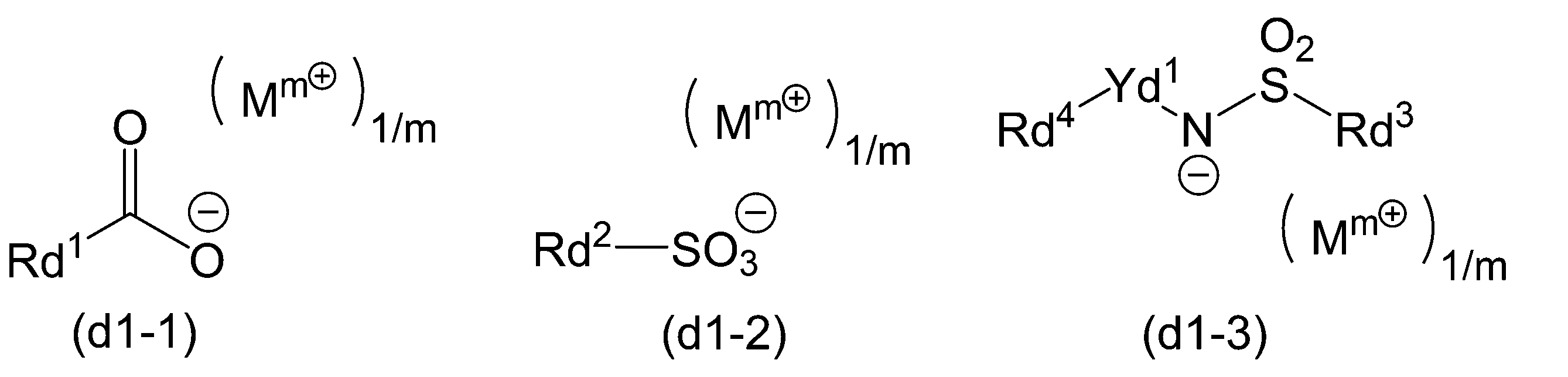
{(d1-1)成分}
・・アニオン部
式(d1-1)中、Rd1は、置換基を有してもよい環式基、置換基を有してもよい鎖状のアルキル基、又は置換基を有してもよい鎖状のアルケニル基であり、それぞれ前記R’201と同様のものが挙げられる。
これらのなかでも、Rd1としては、置換基を有してもよい芳香族炭化水素基、置換基を有してもよい脂肪族環式基、又は置換基を有してもよい鎖状のアルキル基が好ましい。これらの基が有していてもよい置換基としては、水酸基、オキソ基、アルキル基、アリール基、フッ素原子、フッ素化アルキル基、上記一般式(a2-r-1)~(a2-r-8)でそれぞれ表されるラクトン含有環式基、エーテル結合、エステル結合、またはこれらの組み合わせが挙げられる。エーテル結合やエステル結合を置換基として含む場合、アルキレン基を介していてもよく、この場合の置換基としては、上記式(y-al-1)~(y-al-5)でそれぞれ表される連結基が好ましい。なお、Rd1における芳香族炭化水素基、脂肪族環式基、又は鎖状のアルキル基が、置換基として、上記一般式(y-al-1)~(y-al-7)でそれぞれ表される連結基を有する場合、上記一般式(y-al-1)~(y-al-7)において、式(d1-1)中のRd1における芳香族炭化水素基、脂肪族環式基、又は鎖状のアルキル基を構成する炭素原子に結合するのが、上記一般式(y-al-1)~(y-al-7)中のV’101である。
前記芳香族炭化水素基としては、フェニル基、ナフチル基、ビシクロオクタン骨格を含む多環構造(ビシクロオクタン骨格とこれ以外の環構造とからなる多環構造)が好適に挙げられる。
前記脂肪族環式基としては、アダマンタン、ノルボルナン、イソボルナン、トリシクロデカン、テトラシクロドデカン等のポリシクロアルカンから1個以上の水素原子を除いた基であることがより好ましい。
前記鎖状のアルキル基としては、炭素原子数が1~10であることが好ましく、具体的には、メチル基、エチル基、プロピル基、ブチル基、ペンチル基、ヘキシル基、ヘプチル基、オクチル基、ノニル基、デシル基等の直鎖状のアルキル基;1-メチルエチル基、1-メチルプロピル基、2-メチルプロピル基、1-メチルブチル基、2-メチルブチル基、3-メチルブチル基、1-エチルブチル基、2-エチルブチル基、1-メチルペンチル基、2-メチルペンチル基、3-メチルペンチル基、4-メチルペンチル基等の分岐鎖状のアルキル基が挙げられる。
・・アニオン部
式(d1-1)中、Rd1は、置換基を有してもよい環式基、置換基を有してもよい鎖状のアルキル基、又は置換基を有してもよい鎖状のアルケニル基であり、それぞれ前記R’201と同様のものが挙げられる。
これらのなかでも、Rd1としては、置換基を有してもよい芳香族炭化水素基、置換基を有してもよい脂肪族環式基、又は置換基を有してもよい鎖状のアルキル基が好ましい。これらの基が有していてもよい置換基としては、水酸基、オキソ基、アルキル基、アリール基、フッ素原子、フッ素化アルキル基、上記一般式(a2-r-1)~(a2-r-8)でそれぞれ表されるラクトン含有環式基、エーテル結合、エステル結合、またはこれらの組み合わせが挙げられる。エーテル結合やエステル結合を置換基として含む場合、アルキレン基を介していてもよく、この場合の置換基としては、上記式(y-al-1)~(y-al-5)でそれぞれ表される連結基が好ましい。なお、Rd1における芳香族炭化水素基、脂肪族環式基、又は鎖状のアルキル基が、置換基として、上記一般式(y-al-1)~(y-al-7)でそれぞれ表される連結基を有する場合、上記一般式(y-al-1)~(y-al-7)において、式(d1-1)中のRd1における芳香族炭化水素基、脂肪族環式基、又は鎖状のアルキル基を構成する炭素原子に結合するのが、上記一般式(y-al-1)~(y-al-7)中のV’101である。
前記芳香族炭化水素基としては、フェニル基、ナフチル基、ビシクロオクタン骨格を含む多環構造(ビシクロオクタン骨格とこれ以外の環構造とからなる多環構造)が好適に挙げられる。
前記脂肪族環式基としては、アダマンタン、ノルボルナン、イソボルナン、トリシクロデカン、テトラシクロドデカン等のポリシクロアルカンから1個以上の水素原子を除いた基であることがより好ましい。
前記鎖状のアルキル基としては、炭素原子数が1~10であることが好ましく、具体的には、メチル基、エチル基、プロピル基、ブチル基、ペンチル基、ヘキシル基、ヘプチル基、オクチル基、ノニル基、デシル基等の直鎖状のアルキル基;1-メチルエチル基、1-メチルプロピル基、2-メチルプロピル基、1-メチルブチル基、2-メチルブチル基、3-メチルブチル基、1-エチルブチル基、2-エチルブチル基、1-メチルペンチル基、2-メチルペンチル基、3-メチルペンチル基、4-メチルペンチル基等の分岐鎖状のアルキル基が挙げられる。
前記鎖状のアルキル基が置換基としてフッ素原子又はフッ素化アルキル基を有するフッ素化アルキル基である場合、フッ素化アルキル基の炭素原子数は、1~11が好ましく、1~8がより好ましく、1~4がさらに好ましい。該フッ素化アルキル基は、フッ素原子以外の原子を含有してもよい。フッ素原子以外の原子としては、例えば酸素原子、硫黄原子、窒素原子等が挙げられる。
以下に(d1-1)成分のアニオン部の好ましい具体例を示す。

・・カチオン部
式(d1-1)中、Mm+は、m価の有機カチオンである。
Mm+の有機カチオンとしては、前記一般式(ca-1)~(ca-3)でそれぞれ表されるカチオンと同様のものが好適に挙げられ、前記一般式(ca-1)で表されるカチオンがより好ましく、前記式(ca-1-1)~(ca-1-84)でそれぞれ表されるカチオンがさらに好ましい。
(d1-1)成分は、1種を単独で用いてもよく、2種以上を組み合わせて用いてもよい。
式(d1-1)中、Mm+は、m価の有機カチオンである。
Mm+の有機カチオンとしては、前記一般式(ca-1)~(ca-3)でそれぞれ表されるカチオンと同様のものが好適に挙げられ、前記一般式(ca-1)で表されるカチオンがより好ましく、前記式(ca-1-1)~(ca-1-84)でそれぞれ表されるカチオンがさらに好ましい。
(d1-1)成分は、1種を単独で用いてもよく、2種以上を組み合わせて用いてもよい。
{(d1-2)成分}
・・アニオン部
式(d1-2)中、Rd2は、置換基を有してもよい環式基、置換基を有してもよい鎖状のアルキル基、又は置換基を有してもよい鎖状のアルケニル基であり、前記R’201と同様のものが挙げられる。
但し、Rd2における、S原子に隣接する炭素原子にはフッ素原子は結合していない(フッ素置換されていない)ものとする。これにより、(d1-2)成分のアニオンが適度な弱酸アニオンとなり、(D)成分としてのクエンチング能が向上する。
Rd2としては、置換基を有してもよい鎖状のアルキル基、又は置換基を有してもよい脂肪族環式基であることが好ましく、置換基を有してもよい脂肪族環式基であることがより好ましい。
・・アニオン部
式(d1-2)中、Rd2は、置換基を有してもよい環式基、置換基を有してもよい鎖状のアルキル基、又は置換基を有してもよい鎖状のアルケニル基であり、前記R’201と同様のものが挙げられる。
但し、Rd2における、S原子に隣接する炭素原子にはフッ素原子は結合していない(フッ素置換されていない)ものとする。これにより、(d1-2)成分のアニオンが適度な弱酸アニオンとなり、(D)成分としてのクエンチング能が向上する。
Rd2としては、置換基を有してもよい鎖状のアルキル基、又は置換基を有してもよい脂肪族環式基であることが好ましく、置換基を有してもよい脂肪族環式基であることがより好ましい。
該鎖状のアルキル基としては、炭素原子数1~10であることが好ましく、3~10であることがより好ましい。
該脂肪族環式基としては、アダマンタン、ノルボルナン、イソボルナン、トリシクロデカン、テトラシクロドデカン等から1個以上の水素原子を除いた基(置換基を有してもよい);カンファーから1個以上の水素原子を除いた基であることがより好ましい。
該脂肪族環式基としては、アダマンタン、ノルボルナン、イソボルナン、トリシクロデカン、テトラシクロドデカン等から1個以上の水素原子を除いた基(置換基を有してもよい);カンファーから1個以上の水素原子を除いた基であることがより好ましい。
Rd2の炭化水素基は、置換基を有していてもよく、該置換基としては、前記式(d1-1)のRd1における炭化水素基(芳香族炭化水素基、脂肪族環式基、鎖状のアルキル基)が有していてもよい置換基と同様のものが挙げられる。
以下に(d1-2)成分のアニオン部の好ましい具体例を示す。

・・カチオン部
式(d1-2)中、Mm+は、m価の有機カチオンであり、前記式(d1-1)中のMm+と同様である。
(d1-2)成分は、1種を単独で用いてもよく、2種以上を組み合わせて用いてもよい。
式(d1-2)中、Mm+は、m価の有機カチオンであり、前記式(d1-1)中のMm+と同様である。
(d1-2)成分は、1種を単独で用いてもよく、2種以上を組み合わせて用いてもよい。
{(d1-3)成分}
・・アニオン部
式(d1-3)中、Rd3は置換基を有してもよい環式基、置換基を有してもよい鎖状のアルキル基、又は置換基を有してもよい鎖状のアルケニル基であり、前記R’201と同様のものが挙げられ、フッ素原子を含む環式基、鎖状のアルキル基、又は鎖状のアルケニル基であることが好ましい。中でも、フッ素化アルキル基が好ましく、前記Rd1のフッ素化アルキル基と同様のものがより好ましい。
・・アニオン部
式(d1-3)中、Rd3は置換基を有してもよい環式基、置換基を有してもよい鎖状のアルキル基、又は置換基を有してもよい鎖状のアルケニル基であり、前記R’201と同様のものが挙げられ、フッ素原子を含む環式基、鎖状のアルキル基、又は鎖状のアルケニル基であることが好ましい。中でも、フッ素化アルキル基が好ましく、前記Rd1のフッ素化アルキル基と同様のものがより好ましい。
式(d1-3)中、Rd4は、置換基を有してもよい環式基、置換基を有してもよい鎖状のアルキル基、又は置換基を有してもよい鎖状のアルケニル基であり、前記R’201と同様のものが挙げられる。
なかでも、置換基を有してもよいアルキル基、アルコキシ基、アルケニル基、環式基であることが好ましい。
Rd4におけるアルキル基は、炭素原子数1~5の直鎖状又は分岐鎖状のアルキル基が好ましく、具体的には、メチル基、エチル基、プロピル基、イソプロピル基、n-ブチル基、イソブチル基、tert-ブチル基、ペンチル基、イソペンチル基、ネオペンチル基等が挙げられる。Rd4のアルキル基の水素原子の一部が水酸基、シアノ基等で置換されていてもよい。
Rd4におけるアルコキシ基は、炭素原子数1~5のアルコキシ基が好ましく、炭素原子数1~5のアルコキシ基として具体的には、メトキシ基、エトキシ基、n-プロポキシ基、iso-プロポキシ基、n-ブトキシ基、tert-ブトキシ基が挙げられる。なかでも、メトキシ基、エトキシ基が好ましい。
なかでも、置換基を有してもよいアルキル基、アルコキシ基、アルケニル基、環式基であることが好ましい。
Rd4におけるアルキル基は、炭素原子数1~5の直鎖状又は分岐鎖状のアルキル基が好ましく、具体的には、メチル基、エチル基、プロピル基、イソプロピル基、n-ブチル基、イソブチル基、tert-ブチル基、ペンチル基、イソペンチル基、ネオペンチル基等が挙げられる。Rd4のアルキル基の水素原子の一部が水酸基、シアノ基等で置換されていてもよい。
Rd4におけるアルコキシ基は、炭素原子数1~5のアルコキシ基が好ましく、炭素原子数1~5のアルコキシ基として具体的には、メトキシ基、エトキシ基、n-プロポキシ基、iso-プロポキシ基、n-ブトキシ基、tert-ブトキシ基が挙げられる。なかでも、メトキシ基、エトキシ基が好ましい。
Rd4におけるアルケニル基は、前記R’201におけるアルケニル基と同様のものが挙げられ、ビニル基、プロペニル基(アリル基)、1-メチルプロペニル基、2-メチルプロペニル基が好ましい。これらの基はさらに置換基として、炭素原子数1~5のアルキル基又は炭素原子数1~5のハロゲン化アルキル基を有していてもよい。
Rd4における環式基は、前記R’201における環式基と同様のものが挙げられ、シクロペンタン、シクロヘキサン、アダマンタン、ノルボルナン、イソボルナン、トリシクロデカン、テトラシクロドデカン等のシクロアルカンから1個以上の水素原子を除いた脂環式基、又は、フェニル基、ナフチル基等の芳香族基が好ましい。Rd4が脂環式基である場合、レジスト組成物が有機溶剤に良好に溶解することにより、リソグラフィー特性が良好となる。また、Rd4が芳香族基である場合、EUV等を露光光源とするリソグラフィーにおいて、該レジスト組成物が光吸収効率に優れ、感度やリソグラフィー特性が良好となる。
式(d1-3)中、Yd1は、単結合または2価の連結基である。
Yd1における2価の連結基としては、特に限定されないが、置換基を有してもよい2価の炭化水素基(脂肪族炭化水素基、芳香族炭化水素基)、ヘテロ原子を含む2価の連結基等が挙げられる。これらはそれぞれ、上記式(a2-1)中のYa21における2価の連結基についての説明のなかで挙げた、置換基を有してもよい2価の炭化水素基、ヘテロ原子を含む2価の連結基と同様のものが挙げられる。
Yd1としては、カルボニル基、エステル結合、アミド結合、アルキレン基又はこれらの組み合わせであることが好ましい。アルキレン基としては、直鎖状又は分岐鎖状のアルキレン基であることがより好ましく、メチレン基又はエチレン基であることがさらに好ましい。
Yd1における2価の連結基としては、特に限定されないが、置換基を有してもよい2価の炭化水素基(脂肪族炭化水素基、芳香族炭化水素基)、ヘテロ原子を含む2価の連結基等が挙げられる。これらはそれぞれ、上記式(a2-1)中のYa21における2価の連結基についての説明のなかで挙げた、置換基を有してもよい2価の炭化水素基、ヘテロ原子を含む2価の連結基と同様のものが挙げられる。
Yd1としては、カルボニル基、エステル結合、アミド結合、アルキレン基又はこれらの組み合わせであることが好ましい。アルキレン基としては、直鎖状又は分岐鎖状のアルキレン基であることがより好ましく、メチレン基又はエチレン基であることがさらに好ましい。
以下に(d1-3)成分のアニオン部の好ましい具体例を示す。
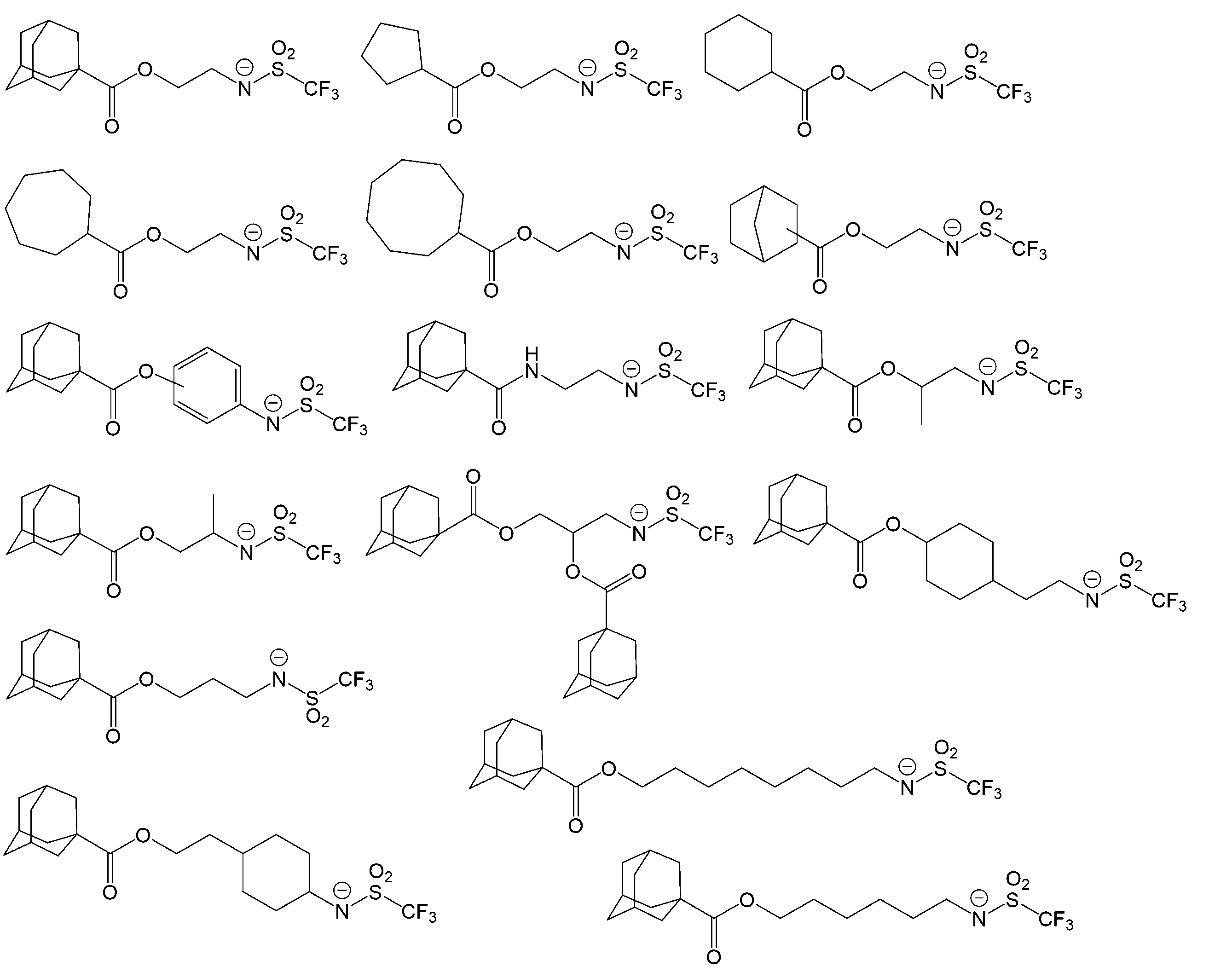

・・カチオン部
式(d1-3)中、Mm+は、m価の有機カチオンであり、前記式(d1-1)中のMm+と同様である。
(d1-3)成分は、1種を単独で用いてもよく、2種以上を組み合わせて用いてもよい。
式(d1-3)中、Mm+は、m価の有機カチオンであり、前記式(d1-1)中のMm+と同様である。
(d1-3)成分は、1種を単独で用いてもよく、2種以上を組み合わせて用いてもよい。
(D1)成分は、上記(d1-1)~(d1-3)成分のいずれか1種のみを用いてもよく、2種以上を組み合わせて用いてもよい。
レジスト組成物が(D1)成分を含有する場合、レジスト組成物中の(D1)成分の含有量は、(A)成分100質量部に対して、0.5~15質量部が好ましく、1~12質量部がより好ましく、2~10質量部がさらに好ましい。
レジスト組成物が(D1)成分を含有する場合、レジスト組成物中の(D1)成分の含有量は、(A)成分100質量部に対して、0.5~15質量部が好ましく、1~12質量部がより好ましく、2~10質量部がさらに好ましい。
(D1)成分は、上記(d1-1)成分を含むことが好ましい。
(D1)成分全体のうち、(d1-1)成分の含有量は、50質量%以上であることが好ましく、70質量%以上であることが好ましく、90質量%以上であることがさらに好ましく、(D1)成分は化合物(d1-1)成分のみからなるものであってもよい。
(D1)成分全体のうち、(d1-1)成分の含有量は、50質量%以上であることが好ましく、70質量%以上であることが好ましく、90質量%以上であることがさらに好ましく、(D1)成分は化合物(d1-1)成分のみからなるものであってもよい。
(D1)成分の製造方法:
前記の(d1-1)成分、(d1-2)成分の製造方法は、特に限定されず、公知の方法により製造することができる。
また、(d1-3)成分の製造方法は、特に限定されず、例えば、US2012-0149916号公報に記載の方法と同様にして製造される。
前記の(d1-1)成分、(d1-2)成分の製造方法は、特に限定されず、公知の方法により製造することができる。
また、(d1-3)成分の製造方法は、特に限定されず、例えば、US2012-0149916号公報に記載の方法と同様にして製造される。
・(D2)成分について
(D)成分としては、上記(D1)成分に該当しない含窒素有機化合物成分(以下「(D2)成分」という。)を含有してもよい。
(D2)成分としては、酸拡散制御剤として作用するもので、かつ、(D1)成分に該当しないものであれば特に限定されず、公知のものから任意に用いればよい。なかでも、脂肪族アミンが好ましく、この中でも特に第2級脂肪族アミンや第3級脂肪族アミンがより好ましい。
脂肪族アミンとは、1つ以上の脂肪族基を有するアミンであり、該脂肪族基は炭素原子数が1~12であることが好ましい。
脂肪族アミンとしては、アンモニアNH3の水素原子の少なくとも1つを、炭素原子数12以下のアルキル基もしくはヒドロキシアルキル基で置換したアミン(アルキルアミンもしくはアルキルアルコールアミン)又は環式アミンが挙げられる。
アルキルアミンおよびアルキルアルコールアミンの具体例としては、n-ヘキシルアミン、n-ヘプチルアミン、n-オクチルアミン、n-ノニルアミン、n-デシルアミン等のモノアルキルアミン;ジエチルアミン、ジ-n-プロピルアミン、ジ-n-ヘプチルアミン、ジ-n-オクチルアミン、ジシクロヘキシルアミン等のジアルキルアミン;トリメチルアミン、トリエチルアミン、トリ-n-プロピルアミン、トリ-n-ブチルアミン、トリ-n-ペンチルアミン、トリ-n-ヘキシルアミン、トリ-n-ヘプチルアミン、トリ-n-オクチルアミン、トリ-n-ノニルアミン、トリ-n-デシルアミン、トリ-n-ドデシルアミン等のトリアルキルアミン;ジエタノールアミン、トリエタノールアミン、ジイソプロパノールアミン、トリイソプロパノールアミン、ジ-n-オクタノールアミン、トリ-n-オクタノールアミン等のアルキルアルコールアミンが挙げられる。これらの中でも、炭素原子数6~30のトリアルキルアミンがさらに好ましく、トリ-n-ペンチルアミン又はトリ-n-オクチルアミンが特に好ましい。
(D)成分としては、上記(D1)成分に該当しない含窒素有機化合物成分(以下「(D2)成分」という。)を含有してもよい。
(D2)成分としては、酸拡散制御剤として作用するもので、かつ、(D1)成分に該当しないものであれば特に限定されず、公知のものから任意に用いればよい。なかでも、脂肪族アミンが好ましく、この中でも特に第2級脂肪族アミンや第3級脂肪族アミンがより好ましい。
脂肪族アミンとは、1つ以上の脂肪族基を有するアミンであり、該脂肪族基は炭素原子数が1~12であることが好ましい。
脂肪族アミンとしては、アンモニアNH3の水素原子の少なくとも1つを、炭素原子数12以下のアルキル基もしくはヒドロキシアルキル基で置換したアミン(アルキルアミンもしくはアルキルアルコールアミン)又は環式アミンが挙げられる。
アルキルアミンおよびアルキルアルコールアミンの具体例としては、n-ヘキシルアミン、n-ヘプチルアミン、n-オクチルアミン、n-ノニルアミン、n-デシルアミン等のモノアルキルアミン;ジエチルアミン、ジ-n-プロピルアミン、ジ-n-ヘプチルアミン、ジ-n-オクチルアミン、ジシクロヘキシルアミン等のジアルキルアミン;トリメチルアミン、トリエチルアミン、トリ-n-プロピルアミン、トリ-n-ブチルアミン、トリ-n-ペンチルアミン、トリ-n-ヘキシルアミン、トリ-n-ヘプチルアミン、トリ-n-オクチルアミン、トリ-n-ノニルアミン、トリ-n-デシルアミン、トリ-n-ドデシルアミン等のトリアルキルアミン;ジエタノールアミン、トリエタノールアミン、ジイソプロパノールアミン、トリイソプロパノールアミン、ジ-n-オクタノールアミン、トリ-n-オクタノールアミン等のアルキルアルコールアミンが挙げられる。これらの中でも、炭素原子数6~30のトリアルキルアミンがさらに好ましく、トリ-n-ペンチルアミン又はトリ-n-オクチルアミンが特に好ましい。
環式アミンとしては、例えば、ヘテロ原子として窒素原子を含む複素環化合物が挙げられる。該複素環化合物としては、単環式のもの(脂肪族単環式アミン)であっても多環式のもの(脂肪族多環式アミン)であってもよい。
脂肪族単環式アミンとして、具体的には、ピペリジン、ピペラジン等が挙げられる。
脂肪族多環式アミンとしては、炭素原子数が6~10のものが好ましく、具体的には、1,5-ジアザビシクロ[4.3.0]-5-ノネン、1,8-ジアザビシクロ[5.4.0]-7-ウンデセン、ヘキサメチレンテトラミン、1,4-ジアザビシクロ[2.2.2]オクタン等が挙げられる。
脂肪族単環式アミンとして、具体的には、ピペリジン、ピペラジン等が挙げられる。
脂肪族多環式アミンとしては、炭素原子数が6~10のものが好ましく、具体的には、1,5-ジアザビシクロ[4.3.0]-5-ノネン、1,8-ジアザビシクロ[5.4.0]-7-ウンデセン、ヘキサメチレンテトラミン、1,4-ジアザビシクロ[2.2.2]オクタン等が挙げられる。
その他の脂肪族アミンとしては、トリス(2-メトキシメトキシエチル)アミン、トリス{2-(2-メトキシエトキシ)エチル}アミン、トリス{2-(2-メトキシエトキシメトキシ)エチル}アミン、トリス{2-(1-メトキシエトキシ)エチル}アミン、トリス{2-(1-エトキシエトキシ)エチル}アミン、トリス{2-(1-エトキシプロポキシ)エチル}アミン、トリス[2-{2-(2-ヒドロキシエトキシ)エトキシ}エチル]アミン、トリエタノールアミントリアセテート等が挙げられ、トリエタノールアミントリアセテートが好ましい。
また、(D2)成分としては、芳香族アミンを用いてもよい。
芳香族アミンとしては、4-ジメチルアミノピリジン、ピロール、インドール、ピラゾール、イミダゾールまたはこれらの誘導体、トリベンジルアミン、2,6-ジイソプロピルアニリン、N-tert-ブトキシカルボニルピロリジン、2,6-ジ-tert-ブチルピリジン、2,6-ジ-tert-ブチルピリジン等が挙げられる。
芳香族アミンとしては、4-ジメチルアミノピリジン、ピロール、インドール、ピラゾール、イミダゾールまたはこれらの誘導体、トリベンジルアミン、2,6-ジイソプロピルアニリン、N-tert-ブトキシカルボニルピロリジン、2,6-ジ-tert-ブチルピリジン、2,6-ジ-tert-ブチルピリジン等が挙げられる。
(D2)成分は、1種を単独で用いてもよく、2種以上を組み合わせて用いてもよい。
レジスト組成物が(D2)成分を含有する場合、レジスト組成物中、(D2)成分の含有量は、(A)成分100質量部に対して、通常、0.01~5質量部の範囲で用いられる。上記範囲とすることにより、レジストパターン形状、引き置き経時安定性等が向上する。
レジスト組成物が(D2)成分を含有する場合、レジスト組成物中、(D2)成分の含有量は、(A)成分100質量部に対して、通常、0.01~5質量部の範囲で用いられる。上記範囲とすることにより、レジストパターン形状、引き置き経時安定性等が向上する。
≪有機カルボン酸、並びにリンのオキソ酸及びその誘導体からなる群より選択される少なくとも1種の化合物(E)≫
本実施形態のレジスト組成物には、感度劣化の防止や、レジストパターン形状、引き置き経時安定性等の向上の目的で、任意の成分として、有機カルボン酸、並びにリンのオキソ酸及びその誘導体からなる群より選択される少なくとも1種の化合物(E)(以下「(E)成分」という)を含有させることができる。
有機カルボン酸として、具体的には、酢酸、マロン酸、クエン酸、リンゴ酸、コハク酸、安息香酸、サリチル酸等が挙げられ、その中でも、サリチル酸が好ましい。
リンのオキソ酸としては、リン酸、ホスホン酸、ホスフィン酸等が挙げられ、これらの中でも特にホスホン酸が好ましい。
本実施形態のレジスト組成物には、感度劣化の防止や、レジストパターン形状、引き置き経時安定性等の向上の目的で、任意の成分として、有機カルボン酸、並びにリンのオキソ酸及びその誘導体からなる群より選択される少なくとも1種の化合物(E)(以下「(E)成分」という)を含有させることができる。
有機カルボン酸として、具体的には、酢酸、マロン酸、クエン酸、リンゴ酸、コハク酸、安息香酸、サリチル酸等が挙げられ、その中でも、サリチル酸が好ましい。
リンのオキソ酸としては、リン酸、ホスホン酸、ホスフィン酸等が挙げられ、これらの中でも特にホスホン酸が好ましい。
本実施形態のレジスト組成物において、(E)成分は、1種を単独で用いてもよく、2種以上を併用してもよい。
レジスト組成物が(E)成分を含有する場合、(E)成分の含有量は、(A)成分100質量部に対して、0.01~5質量部が好ましく、0.05~3質量部がより好ましい。上記範囲とすることにより、リソグラフィー特性がより向上する。
レジスト組成物が(E)成分を含有する場合、(E)成分の含有量は、(A)成分100質量部に対して、0.01~5質量部が好ましく、0.05~3質量部がより好ましい。上記範囲とすることにより、リソグラフィー特性がより向上する。
≪フッ素添加剤成分(F)≫
本実施形態のレジスト組成物は、疎水性樹脂としてフッ素添加剤成分(以下「(F)成分」という)を含有する。(F)成分は、レジスト膜に撥水性を付与するために使用され、(A)成分とは別の樹脂として用いられることでリソグラフィー特性を向上させることができる。
本実施形態において、(F)成分は、塩基解離性基を含む構成単位(f1)を有するフッ素樹脂成分(F1)を含有する。
本実施形態のレジスト組成物は、疎水性樹脂としてフッ素添加剤成分(以下「(F)成分」という)を含有する。(F)成分は、レジスト膜に撥水性を付与するために使用され、(A)成分とは別の樹脂として用いられることでリソグラフィー特性を向上させることができる。
本実施形態において、(F)成分は、塩基解離性基を含む構成単位(f1)を有するフッ素樹脂成分(F1)を含有する。
≪構成単位(f1)≫
前記塩基解離性基を含む構成単位(f1)は、下記一般式(f1-1)で表される構成単位(f1-1)、下記一般式(f1-2)で表される構成単位(f1-2)及び下記一般式(f1-3)で表される構成単位(f1-3)からなる群より選ばれる少なくとも1種を含有する。
前記塩基解離性基を含む構成単位(f1)は、下記一般式(f1-1)で表される構成単位(f1-1)、下記一般式(f1-2)で表される構成単位(f1-2)及び下記一般式(f1-3)で表される構成単位(f1-3)からなる群より選ばれる少なくとも1種を含有する。
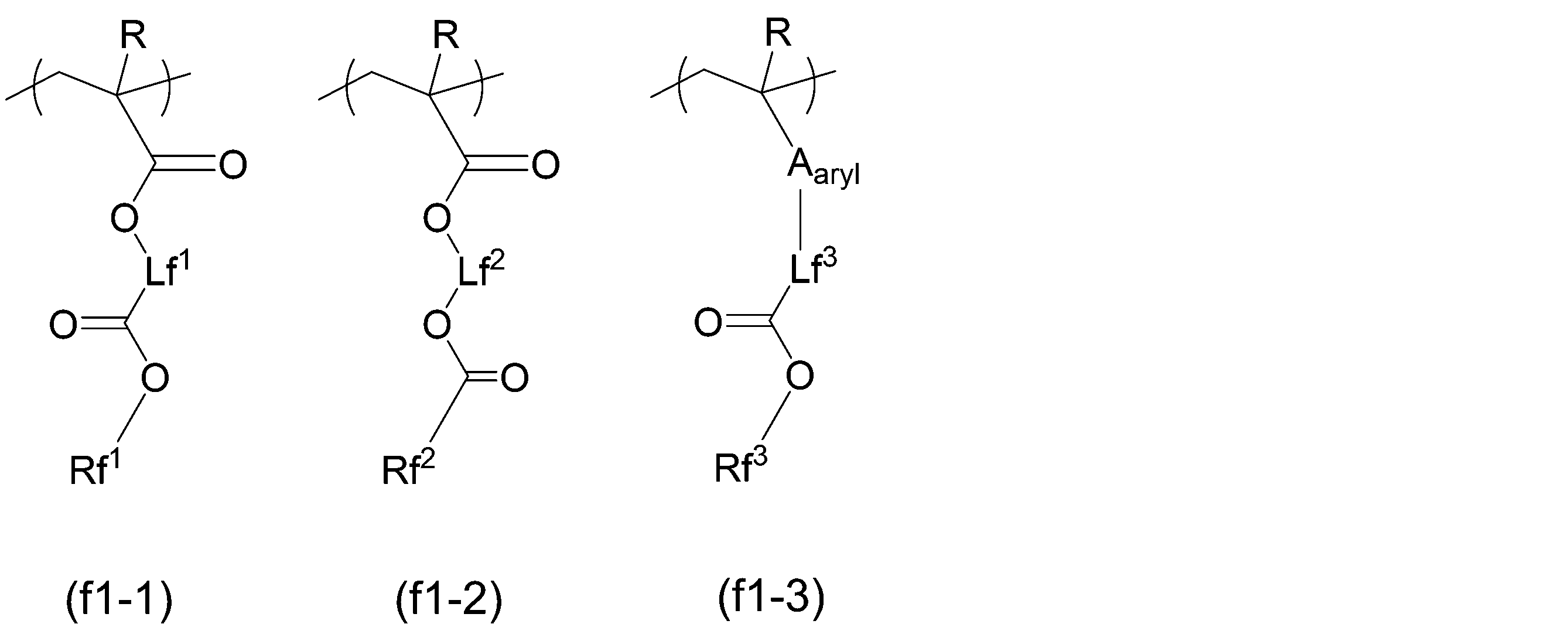
前記式(f1-1)~(f1-3)中、Rにおける炭素数1~5のアルキル基は、炭素数1~5の直鎖状又は分岐鎖状のアルキル基が好ましく、具体的には、メチル基、エチル基、プロピル基、イソプロピル基、n-ブチル基、イソブチル基、tert-ブチル基、ペンチル基、イソペンチル基、ネオペンチル基等が挙げられる。
Rにおける炭素数1~5のハロゲン化アルキル基は、前記炭素数1~5のアルキル基の水素原子の一部又は全部がハロゲン原子で置換された基である。該ハロゲン原子としては、フッ素原子、塩素原子、臭素原子、ヨウ素原子等が挙げられ、特にフッ素原子が好ましい。
Rとしては、水素原子、炭素数1~5のアルキル基又は炭素数1~5のフッ素化アルキル基が好ましく、工業上の入手の容易さから、水素原子、メチル基又はトリフルオロメチル基がより好ましく、水素原子又はメチル基がさらに好ましく、メチル基が特に好ましい。
Rにおける炭素数1~5のハロゲン化アルキル基は、前記炭素数1~5のアルキル基の水素原子の一部又は全部がハロゲン原子で置換された基である。該ハロゲン原子としては、フッ素原子、塩素原子、臭素原子、ヨウ素原子等が挙げられ、特にフッ素原子が好ましい。
Rとしては、水素原子、炭素数1~5のアルキル基又は炭素数1~5のフッ素化アルキル基が好ましく、工業上の入手の容易さから、水素原子、メチル基又はトリフルオロメチル基がより好ましく、水素原子又はメチル基がさらに好ましく、メチル基が特に好ましい。
前記式(f1-1)及び(f1-2)中、Lf1及びLf2は、それぞれ独立に、酸解離性基を含まない2価の連結基である。
「酸解離性部位」とは、上述した「酸解離性基」のように当該有機基内における、露光により発生する酸が作用して解離する部位をいう。すなわち、主鎖に結合している(-C(=O)-O-)のO原子とLf1及びLf2とが、酸の作用により解離することはない。
「酸解離性部位」とは、上述した「酸解離性基」のように当該有機基内における、露光により発生する酸が作用して解離する部位をいう。すなわち、主鎖に結合している(-C(=O)-O-)のO原子とLf1及びLf2とが、酸の作用により解離することはない。
Lf1及びLf2における酸解離性部位を有さない2価の連結基としては、置換基を有していてもよい2価の炭化水素基、ヘテロ原子を含む2価の連結基等が挙げられる。高感度化、CDU改善及びディフェクト低減の観点から、Lf1及びLf2における酸解離性部位を有さない2価の連結基は、多環構造を有さないことが好ましい。
・置換基を有してもよい2価の炭化水素基:
Lf1及びLf2が置換基を有してもよい2価の炭化水素基である場合、該炭化水素基は、脂肪族炭化水素基でもよいし、芳香族炭化水素基でもよい。
Lf1及びLf2が置換基を有してもよい2価の炭化水素基である場合、該炭化水素基は、脂肪族炭化水素基でもよいし、芳香族炭化水素基でもよい。
・・Lf1及びLf2における脂肪族炭化水素基
脂肪族炭化水素基は、芳香族性を持たない炭化水素基を意味する。該脂肪族炭化水素基は、飽和であってもよく、不飽和であってもよく、通常は飽和であることが好ましい。
前記脂肪族炭化水素基としては、直鎖状若しくは分岐鎖状の脂肪族炭化水素基、又は構造中に環を含む脂肪族炭化水素基等が挙げられる。
脂肪族炭化水素基は、芳香族性を持たない炭化水素基を意味する。該脂肪族炭化水素基は、飽和であってもよく、不飽和であってもよく、通常は飽和であることが好ましい。
前記脂肪族炭化水素基としては、直鎖状若しくは分岐鎖状の脂肪族炭化水素基、又は構造中に環を含む脂肪族炭化水素基等が挙げられる。
・・・直鎖状若しくは分岐鎖状の脂肪族炭化水素基
該直鎖状の脂肪族炭化水素基は、炭素数が1~10であることが好ましく、炭素数1~6がより好ましく、炭素数1~4がさらに好ましい。
直鎖状の脂肪族炭化水素基としては、直鎖状のアルキレン基が好ましく、具体的には、メチレン基[-CH2-]、エチレン基[-(CH2)2-]、トリメチレン基[-(CH2)3-]、テトラメチレン基[-(CH2)4-]、ペンタメチレン基[-(CH2)5-]等が挙げられる。
該分岐鎖状の脂肪族炭化水素基は、炭素数が2~10であることが好ましく、炭素数3~6がより好ましく、炭素数3又は4がさらに好ましい。
分岐鎖状の脂肪族炭化水素基としては、分岐鎖状のアルキレン基が好ましく、具体的には、-CH(CH3)-、-CH(CH2CH3)-等のアルキルメチレン基;-CH(CH3)CH2-、-CH(CH3)CH(CH3)-、-CH(CH2CH3)CH2-等のアルキルエチレン基;-CH(CH3)CH2CH2-、-CH2CH(CH3)CH2-等のアルキルトリメチレン基;-CH(CH3)CH2CH2CH2-、-CH2CH(CH3)CH2CH2-等のアルキルテトラメチレン基などのアルキルアルキレン基等が挙げられる。アルキルアルキレン基におけるアルキル基としては、炭素数1~5の直鎖状のアルキル基が好ましい。
該直鎖状の脂肪族炭化水素基は、炭素数が1~10であることが好ましく、炭素数1~6がより好ましく、炭素数1~4がさらに好ましい。
直鎖状の脂肪族炭化水素基としては、直鎖状のアルキレン基が好ましく、具体的には、メチレン基[-CH2-]、エチレン基[-(CH2)2-]、トリメチレン基[-(CH2)3-]、テトラメチレン基[-(CH2)4-]、ペンタメチレン基[-(CH2)5-]等が挙げられる。
該分岐鎖状の脂肪族炭化水素基は、炭素数が2~10であることが好ましく、炭素数3~6がより好ましく、炭素数3又は4がさらに好ましい。
分岐鎖状の脂肪族炭化水素基としては、分岐鎖状のアルキレン基が好ましく、具体的には、-CH(CH3)-、-CH(CH2CH3)-等のアルキルメチレン基;-CH(CH3)CH2-、-CH(CH3)CH(CH3)-、-CH(CH2CH3)CH2-等のアルキルエチレン基;-CH(CH3)CH2CH2-、-CH2CH(CH3)CH2-等のアルキルトリメチレン基;-CH(CH3)CH2CH2CH2-、-CH2CH(CH3)CH2CH2-等のアルキルテトラメチレン基などのアルキルアルキレン基等が挙げられる。アルキルアルキレン基におけるアルキル基としては、炭素数1~5の直鎖状のアルキル基が好ましい。
前記直鎖状または分岐鎖状の脂肪族炭化水素基は、置換基を有していてもよく、有していなくてもよい。該置換基としては、フッ素原子、フッ素原子で置換された炭素数1~5のフッ素化アルキル基、カルボニル基等が挙げられる。
・・・構造中に環を含む脂肪族炭化水素基
該構造中に環を含む脂肪族炭化水素基としては、環構造中にヘテロ原子を含む置換基を含んでもよい環状の脂肪族炭化水素基(脂肪族炭化水素環から水素原子を2個除いた基)、前記環状の脂肪族炭化水素基が直鎖状または分岐鎖状の脂肪族炭化水素基の末端に結合した基、前記環状の脂肪族炭化水素基が直鎖状または分岐鎖状の脂肪族炭化水素基の途中に介在する基などが挙げられる。前記直鎖状または分岐鎖状の脂肪族炭化水素基としては前記と同様のものが挙げられる。
環状の脂肪族炭化水素基は、炭素数が3~20であることが好ましく、炭素数3~12であることがより好ましい。
環状の脂肪族炭化水素基は、単環式基であっても多環式基であってもよい。
単環式の脂環式炭化水素基としては、モノシクロアルカンから2個の水素原子を除いた基が好ましい。該モノシクロアルカンとしては、炭素数3~6のものが好ましく、具体的にはシクロペンタン、シクロヘキサン等が挙げられる。多環式の脂環式炭化水素基としては、ポリシクロアルカンから2個の水素原子を除いた基が好ましく、該ポリシクロアルカンとしては、デカリン、ペルヒドロアズレン、ペルヒドロアントラセン、ステロイド骨格を有する環構造等の縮合環系の多環式骨格を有するポリシクロアルカンが挙げられる。
該構造中に環を含む脂肪族炭化水素基としては、環構造中にヘテロ原子を含む置換基を含んでもよい環状の脂肪族炭化水素基(脂肪族炭化水素環から水素原子を2個除いた基)、前記環状の脂肪族炭化水素基が直鎖状または分岐鎖状の脂肪族炭化水素基の末端に結合した基、前記環状の脂肪族炭化水素基が直鎖状または分岐鎖状の脂肪族炭化水素基の途中に介在する基などが挙げられる。前記直鎖状または分岐鎖状の脂肪族炭化水素基としては前記と同様のものが挙げられる。
環状の脂肪族炭化水素基は、炭素数が3~20であることが好ましく、炭素数3~12であることがより好ましい。
環状の脂肪族炭化水素基は、単環式基であっても多環式基であってもよい。
単環式の脂環式炭化水素基としては、モノシクロアルカンから2個の水素原子を除いた基が好ましい。該モノシクロアルカンとしては、炭素数3~6のものが好ましく、具体的にはシクロペンタン、シクロヘキサン等が挙げられる。多環式の脂環式炭化水素基としては、ポリシクロアルカンから2個の水素原子を除いた基が好ましく、該ポリシクロアルカンとしては、デカリン、ペルヒドロアズレン、ペルヒドロアントラセン、ステロイド骨格を有する環構造等の縮合環系の多環式骨格を有するポリシクロアルカンが挙げられる。
環状の脂肪族炭化水素基は、置換基を有していてもよいし、有していなくてもよい。該置換基としては、アルキル基、アルコキシ基、ハロゲン原子、ハロゲン化アルキル基、水酸基、カルボニル基等が挙げられる。
前記置換基としてのアルキル基としては、炭素数1~5のアルキル基が好ましく、メチル基、エチル基、プロピル基、n-ブチル基、tert-ブチル基であることがより好ましい。
前記置換基としてのアルコキシ基としては、炭素数1~5のアルコキシ基が好ましく、メトキシ基、エトキシ基、n-プロポキシ基、iso-プロポキシ基、n-ブトキシ基、tert-ブトキシ基がより好ましく、メトキシ基、エトキシ基がさらに好ましい。
前記置換基としてのハロゲン原子としては、フッ素原子、塩素原子、臭素原子、ヨウ素原子等が挙げられ、フッ素原子が好ましい。
前記置換基としてのハロゲン化アルキル基としては、前記アルキル基の水素原子の一部または全部が前記ハロゲン原子で置換された基が挙げられる。
環状の脂肪族炭化水素基は、その環構造を構成する炭素原子の一部がヘテロ原子を含む置換基で置換されてもよい。該ヘテロ原子を含む置換基としては、-O-、-C(=O)-O-、-S-、-S(=O)2-、-S(=O)2-O-が挙げられる。
前記置換基としてのアルキル基としては、炭素数1~5のアルキル基が好ましく、メチル基、エチル基、プロピル基、n-ブチル基、tert-ブチル基であることがより好ましい。
前記置換基としてのアルコキシ基としては、炭素数1~5のアルコキシ基が好ましく、メトキシ基、エトキシ基、n-プロポキシ基、iso-プロポキシ基、n-ブトキシ基、tert-ブトキシ基がより好ましく、メトキシ基、エトキシ基がさらに好ましい。
前記置換基としてのハロゲン原子としては、フッ素原子、塩素原子、臭素原子、ヨウ素原子等が挙げられ、フッ素原子が好ましい。
前記置換基としてのハロゲン化アルキル基としては、前記アルキル基の水素原子の一部または全部が前記ハロゲン原子で置換された基が挙げられる。
環状の脂肪族炭化水素基は、その環構造を構成する炭素原子の一部がヘテロ原子を含む置換基で置換されてもよい。該ヘテロ原子を含む置換基としては、-O-、-C(=O)-O-、-S-、-S(=O)2-、-S(=O)2-O-が挙げられる。
・・Lf1及びLf2における芳香族炭化水素基
該芳香族炭化水素基は、芳香環を少なくとも1つ有する炭化水素基である。
この芳香環は、4n+2個のπ電子をもつ環状共役系であれば特に限定されず、単環式でもよいし、多環式でもよい。芳香環の炭素数は5~30であることが好ましく、炭素数5~20がより好ましく、炭素数6~15がさらに好ましく、炭素数6~12が特に好ましい。ただし、該炭素数には、置換基における炭素数を含まないものとする。
芳香環として具体的には、ベンゼン、ナフタレン、アントラセン、フェナントレン等の芳香族炭化水素環;前記芳香族炭化水素環を構成する炭素原子の一部がヘテロ原子で置換された芳香族複素環等が挙げられる。芳香族複素環におけるヘテロ原子としては、酸素原子、硫黄原子、窒素原子等が挙げられる。芳香族複素環として具体的には、ピリジン環、チオフェン環等が挙げられる。
芳香族炭化水素基として具体的には、前記芳香族炭化水素環または芳香族複素環から水素原子を2つ除いた基(アリーレン基またはヘテロアリーレン基);2以上の芳香環を含む芳香族化合物(例えばビフェニル、フルオレン等)から水素原子を2つ除いた基;前記芳香族炭化水素環または芳香族複素環から水素原子を1つ除いた基(アリール基またはヘテロアリール基)の水素原子の1つがアルキレン基で置換された基(例えば、ベンジル基、フェネチル基、1-ナフチルメチル基、2-ナフチルメチル基、1-ナフチルエチル基、2-ナフチルエチル基等のアリールアルキル基におけるアリール基から水素原子をさらに1つ除いた基)等が挙げられる。前記アリール基またはヘテロアリール基に結合するアルキレン基の炭素数は、1~4であることが好ましく、炭素数1~2であることがより好ましく、炭素数1であることが特に好ましい。
該芳香族炭化水素基は、芳香環を少なくとも1つ有する炭化水素基である。
この芳香環は、4n+2個のπ電子をもつ環状共役系であれば特に限定されず、単環式でもよいし、多環式でもよい。芳香環の炭素数は5~30であることが好ましく、炭素数5~20がより好ましく、炭素数6~15がさらに好ましく、炭素数6~12が特に好ましい。ただし、該炭素数には、置換基における炭素数を含まないものとする。
芳香環として具体的には、ベンゼン、ナフタレン、アントラセン、フェナントレン等の芳香族炭化水素環;前記芳香族炭化水素環を構成する炭素原子の一部がヘテロ原子で置換された芳香族複素環等が挙げられる。芳香族複素環におけるヘテロ原子としては、酸素原子、硫黄原子、窒素原子等が挙げられる。芳香族複素環として具体的には、ピリジン環、チオフェン環等が挙げられる。
芳香族炭化水素基として具体的には、前記芳香族炭化水素環または芳香族複素環から水素原子を2つ除いた基(アリーレン基またはヘテロアリーレン基);2以上の芳香環を含む芳香族化合物(例えばビフェニル、フルオレン等)から水素原子を2つ除いた基;前記芳香族炭化水素環または芳香族複素環から水素原子を1つ除いた基(アリール基またはヘテロアリール基)の水素原子の1つがアルキレン基で置換された基(例えば、ベンジル基、フェネチル基、1-ナフチルメチル基、2-ナフチルメチル基、1-ナフチルエチル基、2-ナフチルエチル基等のアリールアルキル基におけるアリール基から水素原子をさらに1つ除いた基)等が挙げられる。前記アリール基またはヘテロアリール基に結合するアルキレン基の炭素数は、1~4であることが好ましく、炭素数1~2であることがより好ましく、炭素数1であることが特に好ましい。
前記芳香族炭化水素基は、当該芳香族炭化水素基が有する水素原子が置換基で置換されていてもよい。例えば当該芳香族炭化水素基中の芳香環に結合した水素原子が置換基で置換されていてもよい。該置換基としては、例えば、アルキル基、アルコキシ基、ハロゲン原子、ハロゲン化アルキル基、水酸基等が挙げられる。
前記置換基としてのアルキル基としては、炭素数1~5のアルキル基が好ましく、メチル基、エチル基、プロピル基、n-ブチル基、tert-ブチル基であることがより好ましい。
前記置換基としてのアルコキシ基、ハロゲン原子およびハロゲン化アルキル基としては、前記環状の脂肪族炭化水素基が有する水素原子を置換する置換基として例示したものが挙げられる。
前記置換基としてのアルキル基としては、炭素数1~5のアルキル基が好ましく、メチル基、エチル基、プロピル基、n-ブチル基、tert-ブチル基であることがより好ましい。
前記置換基としてのアルコキシ基、ハロゲン原子およびハロゲン化アルキル基としては、前記環状の脂肪族炭化水素基が有する水素原子を置換する置換基として例示したものが挙げられる。
・ヘテロ原子を含む2価の連結基:
Lf1及びLf2がヘテロ原子を含む2価の連結基である場合、該連結基として好ましいものとしては、-O-、-C(=O)-O-、-O-C(=O)-、-C(=O)-、-O-C(=O)-O-、-C(=O)-NH-、-NH-、-NH-C(=NH)-(Hはアルキル基、アシル基等の置換基で置換されていてもよい。)、-S-、-S(=O)2-、-S(=O)2-O-、一般式-Y21-O-Y22-、-Y21-O-、-Y21-C(=O)-O-、-C(=O)-O-Y21-、-[Y21-C(=O)-O]m”-Y22-、-Y21-O-C(=O)-Y22-または-Y21-S(=O)2-O-Y22-で表される基[式中、Y21およびY22はそれぞれ独立して置換基を有していてもよい2価の炭化水素基であり、Oは酸素原子であり、m”は1~3の整数である。]等が挙げられる。
前記へテロ原子を含む2価の連結基が-C(=O)-NH-、-C(=O)-NH-C(=O)-、-NH-、-NH-C(=NH)-の場合、そのHはアルキル基、アシル基等の置換基で置換されていてもよい。該置換基(アルキル基、アシル基等)は、炭素数が1~10であることが好ましく、1~8であることがさらに好ましく、1~5であることが特に好ましい。
一般式-Y21-O-Y22-、-Y21-O-、-Y21-C(=O)-O-、-C(=O)-O-Y21-、-[Y21-C(=O)-O]m”-Y22-、-Y21-O-C(=O)-Y22-または-Y21-S(=O)2-O-Y22-中、Y21およびY22は、それぞれ独立して、置換基を有していてもよい2価の炭化水素基である。該2価の炭化水素基としては、前記Lf1及びLf2における2価の連結基としての説明で挙げた(置換基を有していてもよい2価の炭化水素基)と同様のものが挙げられる。
Y21としては、直鎖状の脂肪族炭化水素基が好ましく、直鎖状のアルキレン基がより好ましく、炭素数1~5の直鎖状のアルキレン基がさらに好ましく、メチレン基またはエチレン基が特に好ましい。
Y22としては、直鎖状または分岐鎖状の脂肪族炭化水素基が好ましく、メチレン基、エチレン基またはアルキルメチレン基がより好ましい。該アルキルメチレン基におけるアルキル基は、炭素数1~5の直鎖状のアルキル基が好ましく、炭素数1~3の直鎖状のアルキル基がより好ましく、メチル基が最も好ましい。
式-[Y21-C(=O)-O]m”-Y22-で表される基において、m”は1~3の整数であり、1又は2であることが好ましく、1がより好ましい。つまり、式-[Y21-C(=O)-O]m”-Y22-で表される基としては、式-Y21-C(=O)-O-Y22-で表される基が特に好ましい。なかでも、式-(CH2)a’-C(=O)-O-(CH2)b’-で表される基が好ましい。該式中、a’は、1~10の整数であり、1~8の整数が好ましく、1~5の整数がより好ましく、1または2がさらに好ましく、1が最も好ましい。b’は、1~10の整数であり、1~8の整数が好ましく、1~5の整数がより好ましく、1または2がさらに好ましく、1が最も好ましい。
Lf1及びLf2がヘテロ原子を含む2価の連結基である場合、該連結基として好ましいものとしては、-O-、-C(=O)-O-、-O-C(=O)-、-C(=O)-、-O-C(=O)-O-、-C(=O)-NH-、-NH-、-NH-C(=NH)-(Hはアルキル基、アシル基等の置換基で置換されていてもよい。)、-S-、-S(=O)2-、-S(=O)2-O-、一般式-Y21-O-Y22-、-Y21-O-、-Y21-C(=O)-O-、-C(=O)-O-Y21-、-[Y21-C(=O)-O]m”-Y22-、-Y21-O-C(=O)-Y22-または-Y21-S(=O)2-O-Y22-で表される基[式中、Y21およびY22はそれぞれ独立して置換基を有していてもよい2価の炭化水素基であり、Oは酸素原子であり、m”は1~3の整数である。]等が挙げられる。
前記へテロ原子を含む2価の連結基が-C(=O)-NH-、-C(=O)-NH-C(=O)-、-NH-、-NH-C(=NH)-の場合、そのHはアルキル基、アシル基等の置換基で置換されていてもよい。該置換基(アルキル基、アシル基等)は、炭素数が1~10であることが好ましく、1~8であることがさらに好ましく、1~5であることが特に好ましい。
一般式-Y21-O-Y22-、-Y21-O-、-Y21-C(=O)-O-、-C(=O)-O-Y21-、-[Y21-C(=O)-O]m”-Y22-、-Y21-O-C(=O)-Y22-または-Y21-S(=O)2-O-Y22-中、Y21およびY22は、それぞれ独立して、置換基を有していてもよい2価の炭化水素基である。該2価の炭化水素基としては、前記Lf1及びLf2における2価の連結基としての説明で挙げた(置換基を有していてもよい2価の炭化水素基)と同様のものが挙げられる。
Y21としては、直鎖状の脂肪族炭化水素基が好ましく、直鎖状のアルキレン基がより好ましく、炭素数1~5の直鎖状のアルキレン基がさらに好ましく、メチレン基またはエチレン基が特に好ましい。
Y22としては、直鎖状または分岐鎖状の脂肪族炭化水素基が好ましく、メチレン基、エチレン基またはアルキルメチレン基がより好ましい。該アルキルメチレン基におけるアルキル基は、炭素数1~5の直鎖状のアルキル基が好ましく、炭素数1~3の直鎖状のアルキル基がより好ましく、メチル基が最も好ましい。
式-[Y21-C(=O)-O]m”-Y22-で表される基において、m”は1~3の整数であり、1又は2であることが好ましく、1がより好ましい。つまり、式-[Y21-C(=O)-O]m”-Y22-で表される基としては、式-Y21-C(=O)-O-Y22-で表される基が特に好ましい。なかでも、式-(CH2)a’-C(=O)-O-(CH2)b’-で表される基が好ましい。該式中、a’は、1~10の整数であり、1~8の整数が好ましく、1~5の整数がより好ましく、1または2がさらに好ましく、1が最も好ましい。b’は、1~10の整数であり、1~8の整数が好ましく、1~5の整数がより好ましく、1または2がさらに好ましく、1が最も好ましい。
上記の中でも、Lf1及びLf2としては、単結合、エステル結合[-C(=O)-O-]、エーテル結合(-O-)、置換基を有していてもよい直鎖状若しくは分岐鎖状のアルキレン基、又はこれらの組合せであることが好ましく、置換基を有していてもよい炭素数1~10の直鎖状又は分岐鎖状のアルキレン基がより好ましく、炭素数1~10の直鎖状のアルキレン基又炭素数1~10の分岐鎖状のフッ素化アルキレン基がさらに好ましい。
前記式(f1-2)中、Rf2における1価の有機基としては、例えば、-RfP1、-RfP2-RfP1、-CH(-RfP1)2、-RfP2-O-RfP1、-RfP2-C(=O)-RfP1、-RfP2-C(=O)-ORfP1、-RfP2-O-C(=O)-RfP1等が挙げられる。
ここで、RfP1は、1価の直鎖状又は分岐鎖状のアルキル基、1価の脂環式炭化水素基又は1価の芳香族炭化水素基である。複数のRfP1は、同一でも異なっていてもよい。
RfP1における直鎖状若しくは分岐鎖状のアルキル基、1価の脂環式炭化水素基及び芳香族炭化水素基の有する水素原子の一部又は全部はフッ素原子、フッ素原子で置換された炭素数1~5のフッ素化アルキル基、カルボニル基等で置換されていてもよい。
ここで、RfP1は、1価の直鎖状又は分岐鎖状のアルキル基、1価の脂環式炭化水素基又は1価の芳香族炭化水素基である。複数のRfP1は、同一でも異なっていてもよい。
RfP1における直鎖状若しくは分岐鎖状のアルキル基、1価の脂環式炭化水素基及び芳香族炭化水素基の有する水素原子の一部又は全部はフッ素原子、フッ素原子で置換された炭素数1~5のフッ素化アルキル基、カルボニル基等で置換されていてもよい。
RfP2は、単結合、2価の直鎖状又は分岐鎖状のアルキレン基、2価の脂環式炭化水素基又は2価の芳香族炭化水素基である。
RfP2の2価の直鎖状又は分岐鎖状のアルキレン基、2価の脂環式炭化水素基又は2価の芳香族炭化水素基の有する水素原子の一部又は全部はフッ素原子、フッ素原子で置換された炭素数1~5のフッ素化アルキル基、カルボニル基等で置換されていてもよい。
RfP2の2価の直鎖状又は分岐鎖状のアルキレン基、2価の脂環式炭化水素基又は2価の芳香族炭化水素基の有する水素原子の一部又は全部はフッ素原子、フッ素原子で置換された炭素数1~5のフッ素化アルキル基、カルボニル基等で置換されていてもよい。
RfP1における、1価の直鎖状又は分岐鎖状のアルキル基の炭素数としては、炭素数1~40が好ましく、炭素数1~20がより好ましく、炭素数1~12がさらに好ましい。
1価の直鎖状のアルキル基として、具体的には、メチル基、エチル基、プロピル基、ブチル基、ペンチル基、ヘキシル基、ヘプチル基、オクチル基、ノニル基、デシル基、ウンデシル基、ドデシル基が挙げられる。
1価の分岐鎖状のアルキル基として、具体的には、1-メチルエチル基、1-メチルプロピル基、2-メチルプロピル基、1-メチルブチル基、2-メチルブチル基、3-メチルブチル基、1-エチルブチル基、2-エチルブチル基、1-メチルペンチル基、2-メチルペンチル基、3-メチルペンチル基、4-メチルペンチル基等が挙げられる。
1価の直鎖状のアルキル基として、具体的には、メチル基、エチル基、プロピル基、ブチル基、ペンチル基、ヘキシル基、ヘプチル基、オクチル基、ノニル基、デシル基、ウンデシル基、ドデシル基が挙げられる。
1価の分岐鎖状のアルキル基として、具体的には、1-メチルエチル基、1-メチルプロピル基、2-メチルプロピル基、1-メチルブチル基、2-メチルブチル基、3-メチルブチル基、1-エチルブチル基、2-エチルブチル基、1-メチルペンチル基、2-メチルペンチル基、3-メチルペンチル基、4-メチルペンチル基等が挙げられる。
RfP1における、1価の脂環式炭化水素基としては、1価の単環式の脂環式炭化水素基、1価の多環式の脂環式炭化水素基が挙げられる。ただし、架橋構造を有する脂肪族環式基は除かれる。
1価の単環式の脂環式炭化水素基として、具体的には、シクロプロピル基、シクロブチル基、シクロペンチル基、シクロヘキシル基、シクロヘプチル基、シクロオクチル基、シクロデシル基、シクロドデシル基等が挙げられる。
1価の多環式の脂環式炭化水素基として、具体的には、ポリシクロアルカンから1個の水素原子を除いた基が挙げられる。該ポリシクロアルカンとしては、デカリン、ペルヒドロアズレン、ペルヒドロアントラセン、ステロイド骨格を有する環構造等の縮合環系の多環式骨格を有するポリシクロアルカン等が挙げられる。
RfP1における、1価の芳香族炭化水素基としては、芳香環から水素原子1個を除いた基が挙げられる。ここでの芳香環は、4n+2個のπ電子をもつ環状共役系であれば特に限定されず、単環式でも多環式でもよい。芳香環の炭素数は5~30であることが好ましく、炭素数5~20がより好ましく、炭素数6~15がさらに好ましく、炭素数6~12が特に好ましい。該芳香環として具体的には、ベンゼン、ナフタレン、アントラセン、フェナントレン等の芳香族炭化水素環;前記芳香族炭化水素環を構成する炭素原子の一部がヘテロ原子で置換された芳香族複素環等が挙げられる。芳香族複素環におけるヘテロ原子としては、酸素原子、硫黄原子、窒素原子等が挙げられる。芳香族複素環として具体的には、ピリジン環、チオフェン環等が挙げられる。
RfP2における、2価の直鎖状若しくは分岐鎖状のアルキレン基、2価の脂環式炭化水素基又は2価の芳香族炭化水素基としては、上述したLf1及びLf2で説明した内容と同様のものが挙げられる。
上記の中でも、Rf2は、-RfP1、-RfP2-RfP1、-CH(-RfP1)2が好ましい。
上述したLf2及びRf2のうち、少なくとも一方は、炭化水素基の水素原子の一部又は全部がフッ素原子で置換された基である。なかでも、Lf2及びRf2が炭化水素基の水素原子の一部又は全部がフッ素原子で置換された基を含むことが好ましい。
前記式(f1-1)及び(f1-3)中、Rf1及びRf3におけるフッ素原子を有する有機基は、上記Rf2における1価の有機基のうち、フッ素原子を有するものが挙げられる。なかでも、Rf1及びRf3は、-RfP11、-RfP21-RfP11、-CH(-RfP11)2が好ましい。
式中、RfP11は、フッ素原子を有する1価の直鎖状又は分岐鎖状のアルキル基、フッ素原子を有する1価の脂環式炭化水素基又はフッ素原子を有する1価の芳香族炭化水素基である。複数のRfP11は、同一でも異なっていてもよい。RfP11は、フッ素原子を有する1価の直鎖状又は分岐鎖状のアルキル基、フッ素原子を有する1価の脂環式炭化水素基又はフッ素原子を有する1価の芳香族炭化水素基は、フッ素原子を有する以外は、上記Rfp1と同様である。
RfP21は、単結合、2価の直鎖状又は分岐鎖状のアルキレン基、2価の脂環式炭化水素基又は2価の芳香族炭化水素基であり、上記RfP2と同様である。
式中、RfP11は、フッ素原子を有する1価の直鎖状又は分岐鎖状のアルキル基、フッ素原子を有する1価の脂環式炭化水素基又はフッ素原子を有する1価の芳香族炭化水素基である。複数のRfP11は、同一でも異なっていてもよい。RfP11は、フッ素原子を有する1価の直鎖状又は分岐鎖状のアルキル基、フッ素原子を有する1価の脂環式炭化水素基又はフッ素原子を有する1価の芳香族炭化水素基は、フッ素原子を有する以外は、上記Rfp1と同様である。
RfP21は、単結合、2価の直鎖状又は分岐鎖状のアルキレン基、2価の脂環式炭化水素基又は2価の芳香族炭化水素基であり、上記RfP2と同様である。
前記式(f1-3)中、Aarylとしては、置換基を有していてもよい芳香族炭化水素環から2個の水素原子を除いた基が挙げられる。
Aarylにおける芳香族環式基の環骨格としては、炭素数が6~15であることが好ましく、例えば、ベンゼン環、ナフタレン環、フェナントレン環、アントラセン環等が挙げられる。これらの中でも、ベンゼン環又はナフタレン環が特に好ましい。
Aarylにおいて、芳香族環式基が有してもよい置換基としては、たとえば、ハロゲン原子、アルキル基、アルコキシ基、炭素数1~5のハロゲン化アルキル基、酸素原子(=O)等が挙げられる。ハロゲン原子としては、フッ素原子、塩素原子、ヨウ素原子、臭素原子等が挙げられる。Aarylの芳香族環式基が有してもよい置換基としては、フッ素原子であることが好ましい。
Aarylの芳香族環式基としては、置換基を有さないものであってもよく、置換基を有するものでもよく、置換基を有さないものであることが好ましい。
Aarylにおいて、芳香族環式基が置換基を有するものである場合、置換基の数は、1つであってもよく、2つ以上であってもよく、1つ又は2つであることが好ましく、1つであることがより好ましい。
Aarylにおける芳香族環式基の環骨格としては、炭素数が6~15であることが好ましく、例えば、ベンゼン環、ナフタレン環、フェナントレン環、アントラセン環等が挙げられる。これらの中でも、ベンゼン環又はナフタレン環が特に好ましい。
Aarylにおいて、芳香族環式基が有してもよい置換基としては、たとえば、ハロゲン原子、アルキル基、アルコキシ基、炭素数1~5のハロゲン化アルキル基、酸素原子(=O)等が挙げられる。ハロゲン原子としては、フッ素原子、塩素原子、ヨウ素原子、臭素原子等が挙げられる。Aarylの芳香族環式基が有してもよい置換基としては、フッ素原子であることが好ましい。
Aarylの芳香族環式基としては、置換基を有さないものであってもよく、置換基を有するものでもよく、置換基を有さないものであることが好ましい。
Aarylにおいて、芳香族環式基が置換基を有するものである場合、置換基の数は、1つであってもよく、2つ以上であってもよく、1つ又は2つであることが好ましく、1つであることがより好ましい。
前記式(f1-3)中、Lf3における多環構造を有さず、かつ、酸解離性基を含まない2価の連結基は、上記Lf1及びLf3における多環構造を有さず、かつ、酸解離性基を含まない2価の連結基と同様である。
Lf3における多環構造を有さず、かつ、酸解離性基を含まない2価の連結基としては、炭素数1~10のアルキレン基、-O-、-C(=O)-、-C(=O)-O-、-O-C(=O)-、カーボネート結合(―O-C(=O)-O-)、-NH-C(=O)-、又はそれらの組み合わせなどが挙げられ、-O-と炭素数1~10のアルキレン基との組み合わせが最も好ましい。
炭素数1~10のアルキレン基としては、直鎖状、分岐鎖状もしくは環状のアルキレン基が挙げられ、炭素数1~5の直鎖状または分岐鎖状のアルキレン基、炭素数4~10の環状のアルキレン基が好ましい。
Lf3における多環構造を有さず、かつ、酸解離性基を含まない2価の連結基としては、炭素数1~10のアルキレン基、-O-、-C(=O)-、-C(=O)-O-、-O-C(=O)-、カーボネート結合(―O-C(=O)-O-)、-NH-C(=O)-、又はそれらの組み合わせなどが挙げられ、-O-と炭素数1~10のアルキレン基との組み合わせが最も好ましい。
炭素数1~10のアルキレン基としては、直鎖状、分岐鎖状もしくは環状のアルキレン基が挙げられ、炭素数1~5の直鎖状または分岐鎖状のアルキレン基、炭素数4~10の環状のアルキレン基が好ましい。
以下に、構成単位(f1)の具体例を示す。
以下の各式中、Rαは、水素原子、メチル基又はトリフルオロメチル基を示す。
以下の各式中、Rαは、水素原子、メチル基又はトリフルオロメチル基を示す。
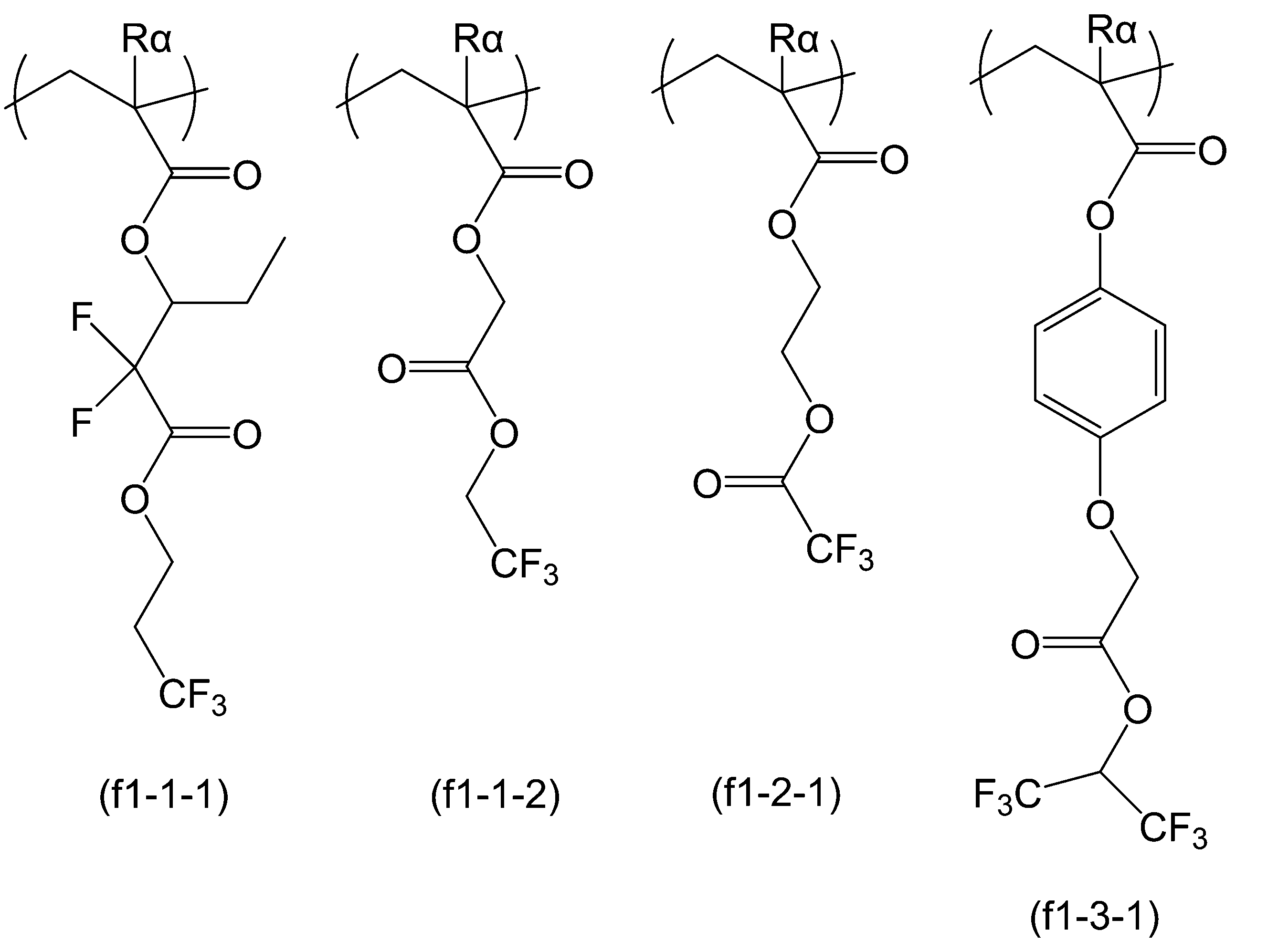
なかでも、構成単位(f1)としては、上記一般式(f1-1)で表される構成単位が好ましい。
(F1)成分が有する構成単位(f1)は、1種であってもよく2種以上であってもよい。
(F1)成分中、構成単位(f1)の割合は、該(F1)成分を構成する全構成単位の合計(100モル%)に対して、35~100モル%が好ましく、55~90モル%がより好ましく、60~85モル%がさらに好ましい。
構成単位(f1)の割合を、前記の好ましい範囲の下限値以上とすることにより、表面偏析効果が高まり、現像液の親和性を向上させることができるため、ラフネス改善等のリソグラフィー特性が向上しやすい。また、上限値以下とすることにより、他の構成単位とのバランスを取ることができ、種々のリソグラフィー特性が良好となりやすい。
(F1)成分が有する構成単位(f1)は、1種であってもよく2種以上であってもよい。
(F1)成分中、構成単位(f1)の割合は、該(F1)成分を構成する全構成単位の合計(100モル%)に対して、35~100モル%が好ましく、55~90モル%がより好ましく、60~85モル%がさらに好ましい。
構成単位(f1)の割合を、前記の好ましい範囲の下限値以上とすることにより、表面偏析効果が高まり、現像液の親和性を向上させることができるため、ラフネス改善等のリソグラフィー特性が向上しやすい。また、上限値以下とすることにより、他の構成単位とのバランスを取ることができ、種々のリソグラフィー特性が良好となりやすい。
≪その他構成単位≫
(F1)成分は、上述した構成単位(f1)に加え、必要に応じてその他構成単位を有するものでもよい。
その他構成単位としては、例えば、酸の作用により極性が増大する酸分解性基を含む構成単位(f2)、後述する一般式(f3-1)で表される構成単位(f3)、ラクトン含有環式基を含む構成単位(f4)(但し、構成単位(f1)に該当するものを除く)、後述する一般式(f5-1)で表される構成単位(f5)などが挙げられる。
(F1)成分は、上述した構成単位(f1)に加え、必要に応じてその他構成単位を有するものでもよい。
その他構成単位としては、例えば、酸の作用により極性が増大する酸分解性基を含む構成単位(f2)、後述する一般式(f3-1)で表される構成単位(f3)、ラクトン含有環式基を含む構成単位(f4)(但し、構成単位(f1)に該当するものを除く)、後述する一般式(f5-1)で表される構成単位(f5)などが挙げられる。
≪構成単位(f2)≫
構成単位(f2)は、上述の(A1)成分における構成単位(a1)と同様である。
なかでも、構成単位(f2)としては、上記一般式(a1-r2-1)又は(a1-r2-3)で表される酸解離性基を有する構成単位が好ましく、下記一般式(f2-1)で表される構成単位(f2-11)がより好ましい。
構成単位(f2)は、上述の(A1)成分における構成単位(a1)と同様である。
なかでも、構成単位(f2)としては、上記一般式(a1-r2-1)又は(a1-r2-3)で表される酸解離性基を有する構成単位が好ましく、下記一般式(f2-1)で表される構成単位(f2-11)がより好ましい。

前記式(f1-1)中、R及びVa1は、前記式(a1-1)中のR及びVa1と同様である。
(F1)成分が有する構成単位(f2)は、1種でもよく2種以上でもよい。(F1)成分は、構成単位(f2)を有してもよく、有しなくてもよいが、構成単位(f2)を有することが好ましい。
(F1)成分が構成単位(f2)を有する場合、(F1)成分中の構成単位(f2)の割合は、(F1)成分を構成する全構成単位の合計(100モル%)に対して、5~50モル%が好ましく、10~45モル%がより好ましく、15~40モル%がさらに好ましい。
構成単位(f2)の割合が上記の好ましい範囲の下限値以上であると、レジスト膜露光部での現像液に対する溶解性をより促進しやすい。構成単位(f2)の割合が前記範囲の上限値以下であると、他の構成単位とのバランスをとることができる。
(F1)成分が構成単位(f2)を有する場合、(F1)成分中の構成単位(f2)の割合は、(F1)成分を構成する全構成単位の合計(100モル%)に対して、5~50モル%が好ましく、10~45モル%がより好ましく、15~40モル%がさらに好ましい。
構成単位(f2)の割合が上記の好ましい範囲の下限値以上であると、レジスト膜露光部での現像液に対する溶解性をより促進しやすい。構成単位(f2)の割合が前記範囲の上限値以下であると、他の構成単位とのバランスをとることができる。
≪構成単位(f3)≫
構成単位(f3)は、下記一般式(f3-1)で表される構成単位である。
構成単位(f3)は、下記一般式(f3-1)で表される構成単位である。

前記一般式(f3-1)中、Rは、水素原子、炭素数1~5のアルキル基又は炭素数1~5のハロゲン化アルキル基である。Rにおける炭素数1~5のアルキル基は、炭素数1~5の直鎖状又は分岐鎖状のアルキル基が好ましく、具体的には、メチル基、エチル基、プロピル基、イソプロピル基、n-ブチル基、イソブチル基、tert-ブチル基、ペンチル基、イソペンチル基、ネオペンチル基等が挙げられる。Rにおける炭素数1~5のハロゲン化アルキル基は、前記炭素数1~5のアルキル基の水素原子の一部又は全部がハロゲン原子で置換された基である。該ハロゲン原子としては、フッ素原子、塩素原子、臭素原子、ヨウ素原子等が挙げられ、特にフッ素原子が好ましい。Rとしては、水素原子、炭素数1~5のアルキル基又は炭素数1~5のフッ素化アルキル基が好ましく、工業上の入手の容易さから、水素原子又はメチル基がより好ましく、メチル基がさらに好ましい。
(F1)成分が有する構成単位(f3)は、1種でもよく2種以上でもよい。(F1)成分は、構成単位(f3)を有してもよく、有しなくてもよいが、構成単位(f3)を有することが好ましい。
(F1)成分が構成単位(f3)を有する場合、(F1)成分中の構成単位(f3)の割合は、(F1)成分を構成する全構成単位の合計(100モル%)に対して、1~25モル%が好ましく、3~20モル%がより好ましく、5~15モル%が更に好ましい。
構成単位(f3)の割合が前記範囲の下限値以上であると、アルカリ現像プロセスにおいて、レジスト膜のアルカリ現像液に対する溶解性が高められやすくなる。また、ディフェクトの発生を抑制する効果がより向上する。構成単位(f3)の割合が前記範囲の上限値以下であると、他の構成単位とのバランスをとることができる。
(F1)成分が構成単位(f3)を有する場合、(F1)成分中の構成単位(f3)の割合は、(F1)成分を構成する全構成単位の合計(100モル%)に対して、1~25モル%が好ましく、3~20モル%がより好ましく、5~15モル%が更に好ましい。
構成単位(f3)の割合が前記範囲の下限値以上であると、アルカリ現像プロセスにおいて、レジスト膜のアルカリ現像液に対する溶解性が高められやすくなる。また、ディフェクトの発生を抑制する効果がより向上する。構成単位(f3)の割合が前記範囲の上限値以下であると、他の構成単位とのバランスをとることができる。
≪構成単位(f4)≫
ラクトン含有環式基を含む構成単位(f4)は、上述の(A1)成分における構成単位(a2)のラクトン含有環式基を含む構成単位と同様である。
なかでも、構成単位(f4)としては、前記一般式(a2-r-1)又は(a2-r-2)で表されるラクトン含有環式基を有する構成単位が好ましく、下記一般式(f4-1)で表される構成単位(f4-1)がより好ましい。
ラクトン含有環式基を含む構成単位(f4)は、上述の(A1)成分における構成単位(a2)のラクトン含有環式基を含む構成単位と同様である。
なかでも、構成単位(f4)としては、前記一般式(a2-r-1)又は(a2-r-2)で表されるラクトン含有環式基を有する構成単位が好ましく、下記一般式(f4-1)で表される構成単位(f4-1)がより好ましい。

前記式(f4-1)中、R、Ya21、La21及びR’は、前記式(a2-1)中のR、Ya21、La21及びR’と同様である。
(F1)成分が有する構成単位(f4)は、1種でもよく2種以上でもよい。(F1)成分は、構成単位(f4)を有してもよく、有しなくてもよいが、構成単位(f4)を有することが好ましい。
(F1)成分が構成単位(f4)を有する場合、(F1)成分中の構成単位(f4)の割合は、(F1)成分を構成する全構成単位の合計(100モル%)に対して、5~50モル%が好ましく、10~45モル%がより好ましく、15~40モル%がさらに好ましい。
構成単位(f4)の割合が前記範囲の下限値以上であると、アルカリ現像プロセスにおいて、レジスト膜のアルカリ現像液に対する溶解性が高められやすくなる。また、ディフェクト改善に効果がある。構成単位(f4)の割合が前記範囲の上限値以下であると、他の構成単位とのバランスをとりやすくなる。
(F1)成分が構成単位(f4)を有する場合、(F1)成分中の構成単位(f4)の割合は、(F1)成分を構成する全構成単位の合計(100モル%)に対して、5~50モル%が好ましく、10~45モル%がより好ましく、15~40モル%がさらに好ましい。
構成単位(f4)の割合が前記範囲の下限値以上であると、アルカリ現像プロセスにおいて、レジスト膜のアルカリ現像液に対する溶解性が高められやすくなる。また、ディフェクト改善に効果がある。構成単位(f4)の割合が前記範囲の上限値以下であると、他の構成単位とのバランスをとりやすくなる。
≪構成単位(f5)≫
構成単位(f5)は、下記一般式(f5-1)で表される構成単位である。
構成単位(f5)は、下記一般式(f5-1)で表される構成単位である。
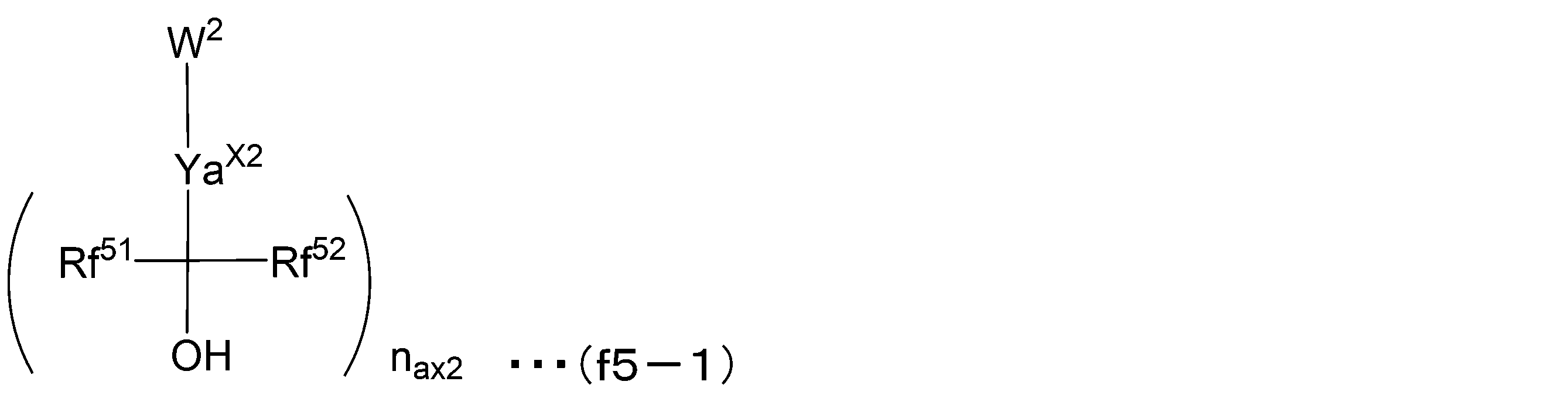
前記一般式(f5-1)中、W2及びYax2は、前記一般式(a8-1)中のW2及びYax2と同様である。
前記一般式(f5-1)中、Rf51における炭素原子数1~12のフッ素化アルキル基は、前記一般式(a8-1)中のR1における炭素原子数1~12のフッ素化アルキル基と同様である。
前記一般式(f5-1)中、Rf52におけるフッ素原子を有してもよい炭素原子数1~12の有機基は、前記一般式(a8-1)中のR2におけるフッ素原子を有してもよい炭素原子数1~12の有機基と同様である。
前記一般式(f5-1)中、Rf51における炭素原子数1~12のフッ素化アルキル基は、前記一般式(a8-1)中のR1における炭素原子数1~12のフッ素化アルキル基と同様である。
前記一般式(f5-1)中、Rf52におけるフッ素原子を有してもよい炭素原子数1~12の有機基は、前記一般式(a8-1)中のR2におけるフッ素原子を有してもよい炭素原子数1~12の有機基と同様である。
好ましい(F1)成分としては、構成単位(f1)からなる重合体(ホモポリマー)、構成単位(f1)と構成単位(f2)との繰り返し構造を有する共重合体(F1-a)、構成単位(f1)と構成単位(f2)と構成単位(f3)との繰り返し構造を有する共重合体(F1-b)、構成単位(f1)と構成単位(f4)との繰り返し構造を有する共重合体(F1-c)、構成単位(f1)と構成単位(f5)との繰り返し構造を有する共重合体(F1-d)などが挙げられる。
前記共重合体(F1-a)中、構成単位(f1)の割合は、前記共重合体(F1-a)を構成する全構成単位の合計(100モル%)に対して、55~85モル%が好ましく、60~80モル%がより好ましく、65~75モル%が更に好ましい。
前記共重合体(F1-a)中、構成単位(f2)の割合は、前記共重合体(F1-a)を構成する全構成単位の合計(100モル%)に対して、15~45モル%が好ましく、20~40モル%がより好ましく、25~35モル%が更に好ましい。
前記共重合体(F1-a)中、構成単位(f2)の割合は、前記共重合体(F1-a)を構成する全構成単位の合計(100モル%)に対して、15~45モル%が好ましく、20~40モル%がより好ましく、25~35モル%が更に好ましい。
前記共重合体(F1-b)中、構成単位(f1)の割合は、前記共重合体(F1-b)を構成する全構成単位の合計(100モル%)に対して、55~85モル%が好ましく、60~80モル%がより好ましく、65~75モル%が更に好ましい。
前記共重合体(F1-b)中、構成単位(f2)の割合は、前記共重合体(F1-b)を構成する全構成単位の合計(100モル%)に対して、5~35モル%が好ましく、10~30モル%がより好ましく、15~25モル%が更に好ましい。
前記共重合体(F1-b)中、構成単位(f3)の割合は、前記共重合体(F1-b)を構成する全構成単位の合計(100モル%)に対して、1~25モル%が好ましく、3~20モル%がより好ましく、5~15モル%が更に好ましい。
前記共重合体(F1-b)中、構成単位(f2)の割合は、前記共重合体(F1-b)を構成する全構成単位の合計(100モル%)に対して、5~35モル%が好ましく、10~30モル%がより好ましく、15~25モル%が更に好ましい。
前記共重合体(F1-b)中、構成単位(f3)の割合は、前記共重合体(F1-b)を構成する全構成単位の合計(100モル%)に対して、1~25モル%が好ましく、3~20モル%がより好ましく、5~15モル%が更に好ましい。
前記共重合体(F1-c)中、構成単位(f1)の割合は、前記共重合体(F1-c)を構成する全構成単位の合計(100モル%)に対して、55~85モル%が好ましく、60~80モル%がより好ましく、65~75モル%が更に好ましい。
前記共重合体(F1-c)中、構成単位(f4)の割合は、前記共重合体(F1-c)を構成する全構成単位の合計(100モル%)に対して、15~45モル%が好ましく、20~40モル%がより好ましく、25~35モル%が更に好ましい。
前記共重合体(F1-c)中、構成単位(f4)の割合は、前記共重合体(F1-c)を構成する全構成単位の合計(100モル%)に対して、15~45モル%が好ましく、20~40モル%がより好ましく、25~35モル%が更に好ましい。
前記共重合体(F1-d)中、構成単位(f1)の割合は、前記共重合体(F1-d)を構成する全構成単位の合計(100モル%)に対して、55~85モル%が好ましく、60~80モル%がより好ましく、65~75モル%が更に好ましい。
前記共重合体(F1-d)中、構成単位(f5)の割合は、前記共重合体(F1-d)を構成する全構成単位の合計(100モル%)に対して、15~45モル%が好ましく、20~40モル%がより好ましく、25~35モル%が更に好ましい。
前記共重合体(F1-d)中、構成単位(f5)の割合は、前記共重合体(F1-d)を構成する全構成単位の合計(100モル%)に対して、15~45モル%が好ましく、20~40モル%がより好ましく、25~35モル%が更に好ましい。
(F1)成分は、所望とする構成単位を誘導するモノマーを、例えば、アゾビスイソブチロニトリル(AIBN)、アゾビスイソ酪酸ジメチル等のラジカル重合開始剤を用いた公知のラジカル重合等により重合させることによって得ることができる。
(F1)成分の重量平均分子量(Mw)(ゲルパーミエーションクロマトグラフィーによるポリスチレン換算基準)は、1000~50000が好ましく、5000~40000がより好ましく、10000~30000がさらに好ましい。この範囲の上限値以下であると、レジストとして用いるのに充分なレジスト溶剤への溶解性があり、この範囲の下限値以上であると、耐ドライエッチング性やレジストパターン断面形状が良好である。
(F1)成分の分散度(Mw/Mn)は、1.0~5.0が好ましく、1.0~3.0がより好ましく、1.2~2.5がさらに好ましい。
本実施形態のレジスト組成物中、(F1)成分は、1種を単独で用いてもよく、2種以上を併用してもよい。
本実施形態のレジスト組成物は、(F)成分として、前記(F1)成分に該当しない、アルカリ現像液に対して分解性を示すフッ素添加剤成分を併用してもよい。
(F)成分中の(F1)成分の割合は、(F)成分の総質量に対し、25質量%以上が好ましく、50質量%以上がより好ましく、75質量%以上がさらに好ましく、100質量%であってもよい。(F1)成分の割合が25質量%以上であると、レジストパターンを形成する際に、レジスト膜の露光部と未露光部とのコントラストをより向上させやすくなる。
本実施形態のレジスト組成物は、(F)成分として、前記(F1)成分に該当しない、アルカリ現像液に対して分解性を示すフッ素添加剤成分を併用してもよい。
(F)成分中の(F1)成分の割合は、(F)成分の総質量に対し、25質量%以上が好ましく、50質量%以上がより好ましく、75質量%以上がさらに好ましく、100質量%であってもよい。(F1)成分の割合が25質量%以上であると、レジストパターンを形成する際に、レジスト膜の露光部と未露光部とのコントラストをより向上させやすくなる。
本実施形態のレジスト組成物において、(F)成分は、1種を単独で用いてもよく、2種以上を併用してもよい。
本実施形態のレジスト組成物中、(F)成分の含有量は、(A)成分100質量部に対して、0.5~15質量部が好ましく、1~12質量部がより好ましく、2~10質量部がさらに好ましい。
(F)成分の含有量が、前記範囲の下限値以上であると、レジストパターン形成において、アルカリ現像液に対するレジスト膜未露光部の溶解性が高められやすくなり、解像性能がより向上する。また、ディフェクトの発生が抑制される。一方、上限値以下であると、リソグラフィー特性がより向上する。
本実施形態のレジスト組成物中、(F)成分の含有量は、(A)成分100質量部に対して、0.5~15質量部が好ましく、1~12質量部がより好ましく、2~10質量部がさらに好ましい。
(F)成分の含有量が、前記範囲の下限値以上であると、レジストパターン形成において、アルカリ現像液に対するレジスト膜未露光部の溶解性が高められやすくなり、解像性能がより向上する。また、ディフェクトの発生が抑制される。一方、上限値以下であると、リソグラフィー特性がより向上する。
≪有機溶剤成分(S)≫
本実施形態のレジスト組成物は、レジスト材料を有機溶剤成分(以下「(S)成分」という)に溶解させて製造することができる。
本実施形態のレジスト組成物において、(S)成分は、1種単独で用いてもよく、2種以上の混合溶剤として用いてもよい。なかでも、PGMEA、PGME、γ-ブチロラクトン、EL、シクロヘキサノン、ジアセトンアルコールが好ましい。
本実施形態のレジスト組成物は、レジスト材料を有機溶剤成分(以下「(S)成分」という)に溶解させて製造することができる。
本実施形態のレジスト組成物において、(S)成分は、1種単独で用いてもよく、2種以上の混合溶剤として用いてもよい。なかでも、PGMEA、PGME、γ-ブチロラクトン、EL、シクロヘキサノン、ジアセトンアルコールが好ましい。
また、(S)成分としては、PGMEAと極性溶剤とを混合した混合溶剤も好ましい。その配合比(質量比)は、PGMEAと極性溶剤との相溶性等を考慮して適宜決定すればよい。
(S)成分としては、PGMEA及びELの中から選ばれる少なくとも1種とγ-ブチロラクトンとの混合溶剤も好ましい。この場合、混合割合としては、前者と後者との質量比が、好ましくは70:30~95:5とされる。
(S)成分の使用量は、特に限定されず、基板等に塗布可能な濃度で、塗布膜厚に応じて適宜設定される。一般的にはレジスト組成物の固形分濃度が0.1~20質量%、好ましくは0.2~15質量%の範囲内となるように(S)成分は用いられる。
(S)成分としては、PGMEA及びELの中から選ばれる少なくとも1種とγ-ブチロラクトンとの混合溶剤も好ましい。この場合、混合割合としては、前者と後者との質量比が、好ましくは70:30~95:5とされる。
(S)成分の使用量は、特に限定されず、基板等に塗布可能な濃度で、塗布膜厚に応じて適宜設定される。一般的にはレジスト組成物の固形分濃度が0.1~20質量%、好ましくは0.2~15質量%の範囲内となるように(S)成分は用いられる。
本実施形態のレジスト組成物は、上記レジスト材料を(S)成分に溶解させた後、ポリイミド多孔質膜、ポリアミドイミド多孔質膜等を用いて、不純物等の除去を行ってもよい。例えば、ポリイミド多孔質膜からなるフィルター、ポリアミドイミド多孔質膜からなるフィルター、ポリイミド多孔質膜及びポリアミドイミド多孔質膜からなるフィルター等を用いて、レジスト組成物の濾過を行ってもよい。前記ポリイミド多孔質膜及び前記ポリアミドイミド多孔質膜としては、例えば、特開2016-155121号公報に記載のもの等が例示される。
以上説明した本実施形態のレジスト組成物は、一般式(a0-1)で表される化合物から誘導される構成単位(a0)を有する樹脂成分(A1)と、塩基解離性基を含む構成単位(f1)を有するフッ素樹脂成分(F1)とを含有する。前記塩基解離性基を含む構成単位(f1)は、下記一般式(f1-1)で表される構成単位(f1-1)、下記一般式(f1-2)で表される構成単位(f1-2)及び下記一般式(f1-3)で表される構成単位(f1-3)からなる群より選ばれる少なくとも1種を含有する。
構成単位(a0)は、露光により酸を発生する酸発生基を含み、酸発生基であるアニオン部が樹脂成分(A1)に組み込まれている。これにより、露光により発生する酸の過剰な拡散が抑制される。酸の過剰な拡散が抑制されることにより、ラフネスが低減されると推測される。
さらに、樹脂成分(A1)内に含まれる構成単位(a0)のアニオン部はまた適度な大きさを有し、樹脂成分(A1)に含まれる酸分解性基に適度に近接し得る。そのため、酸分解性基が脱保護されやすくなる。そのため、感度が高くなると推測される。
一方、樹脂成分(A1)は、疎水性が高い構造となる場合がある。本実施形態のレジスト組成物は、樹脂成分(A1)にフッ素樹脂成分(F1)を組み合わせることで、レジスト組成物の親水性が向上し、現像液に対する溶解性が向上する結果、CDU等のリソグラフィー特性の改善、ディフェクトの低減に寄与していると推測される。
上記の効果が相まって、本実施形態のレジスト組成物は、高感度化が図れ、且つCDU等のリソグラフィー特性が良好で、ディフェクトが低減されたレジストパターンを形成できると推測される。
構成単位(a0)は、露光により酸を発生する酸発生基を含み、酸発生基であるアニオン部が樹脂成分(A1)に組み込まれている。これにより、露光により発生する酸の過剰な拡散が抑制される。酸の過剰な拡散が抑制されることにより、ラフネスが低減されると推測される。
さらに、樹脂成分(A1)内に含まれる構成単位(a0)のアニオン部はまた適度な大きさを有し、樹脂成分(A1)に含まれる酸分解性基に適度に近接し得る。そのため、酸分解性基が脱保護されやすくなる。そのため、感度が高くなると推測される。
一方、樹脂成分(A1)は、疎水性が高い構造となる場合がある。本実施形態のレジスト組成物は、樹脂成分(A1)にフッ素樹脂成分(F1)を組み合わせることで、レジスト組成物の親水性が向上し、現像液に対する溶解性が向上する結果、CDU等のリソグラフィー特性の改善、ディフェクトの低減に寄与していると推測される。
上記の効果が相まって、本実施形態のレジスト組成物は、高感度化が図れ、且つCDU等のリソグラフィー特性が良好で、ディフェクトが低減されたレジストパターンを形成できると推測される。
(レジストパターン形成方法)
本発明の第2の態様に係るレジストパターン形成方法は、支持体上に、上述した本発明の第1の態様に係るレジスト組成物を用いてレジスト膜を形成する工程、前記レジスト膜を露光する工程、及び前記露光後のレジスト膜を現像してレジストパターンを形成する工程を有する方法である。
かかるレジストパターン形成方法の一実施形態としては、例えば以下のようにして行うレジストパターン形成方法が挙げられる。
本発明の第2の態様に係るレジストパターン形成方法は、支持体上に、上述した本発明の第1の態様に係るレジスト組成物を用いてレジスト膜を形成する工程、前記レジスト膜を露光する工程、及び前記露光後のレジスト膜を現像してレジストパターンを形成する工程を有する方法である。
かかるレジストパターン形成方法の一実施形態としては、例えば以下のようにして行うレジストパターン形成方法が挙げられる。
まず、上述した実施形態のレジスト組成物を、支持体上にスピンナー等で塗布し、ベーク(ポストアプライベーク(PAB))処理を、例えば80~150℃の温度条件にて40~120秒間、好ましくは60~90秒間施してレジスト膜を形成する。
次に、該レジスト膜に対し、例えば電子線描画装置、ArF露光装置等の露光装置を用いて、所定のパターンが形成されたマスク(マスクパターン)を介した露光またはマスクパターンを介さない電子線の直接照射による描画等による選択的露光を行った後、ベーク(ポストエクスポージャーベーク(PEB))処理を、例えば80~150℃の温度条件にて40~120秒間、好ましくは60~90秒間施す。
次に、前記レジスト膜を現像処理する。現像処理は、アルカリ現像プロセスの場合は、アルカリ現像液を用い、溶剤現像プロセスの場合は、有機溶剤を含有する現像液(有機系現像液)を用いて行う。
次に、該レジスト膜に対し、例えば電子線描画装置、ArF露光装置等の露光装置を用いて、所定のパターンが形成されたマスク(マスクパターン)を介した露光またはマスクパターンを介さない電子線の直接照射による描画等による選択的露光を行った後、ベーク(ポストエクスポージャーベーク(PEB))処理を、例えば80~150℃の温度条件にて40~120秒間、好ましくは60~90秒間施す。
次に、前記レジスト膜を現像処理する。現像処理は、アルカリ現像プロセスの場合は、アルカリ現像液を用い、溶剤現像プロセスの場合は、有機溶剤を含有する現像液(有機系現像液)を用いて行う。
現像処理後、好ましくはリンス処理を行う。リンス処理は、アルカリ現像プロセスの場合は、純水を用いた水リンスが好ましく、溶剤現像プロセスの場合は、有機溶剤を含有するリンス液を用いることが好ましい。
溶剤現像プロセスの場合、前記現像処理またはリンス処理の後に、パターン上に付着している現像液またはリンス液を、超臨界流体により除去する処理を行ってもよい。
現像処理後またはリンス処理後、乾燥を行う。また、場合によっては、上記現像処理後にベーク処理(ポストベーク)を行ってもよい。
溶剤現像プロセスの場合、前記現像処理またはリンス処理の後に、パターン上に付着している現像液またはリンス液を、超臨界流体により除去する処理を行ってもよい。
現像処理後またはリンス処理後、乾燥を行う。また、場合によっては、上記現像処理後にベーク処理(ポストベーク)を行ってもよい。
支持体としては、特に限定されず、従来公知のものを用いることができ、例えば、電子部品用の基板や、これに所定の配線パターンが形成されたもの等が挙げられる。より具体的には、シリコンウェーハ、銅、クロム、鉄、アルミニウム等の金属製の基板や、ガラス基板等が挙げられる。配線パターンの材料としては、例えば銅、アルミニウム、ニッケル、金等が使用可能である。
露光に用いる波長は、特に限定されず、ArFエキシマレーザー、KrFエキシマレーザー、F2エキシマレーザー、EUV(極端紫外線)、VUV(真空紫外線)、EB(電子線)、X線、軟X線等の放射線を用いて行うことができる。
レジスト膜の露光方法は、空気や窒素等の不活性ガス中で行う通常の露光(ドライ露光)であってもよく、液浸露光(Liquid Immersion Lithography)であってもよい。
液浸露光は、予めレジスト膜と露光装置の最下位置のレンズ間を、空気の屈折率よりも大きい屈折率を有する溶媒(液浸媒体)で満たし、その状態で露光(浸漬露光)を行う露光方法である。
液浸媒体としては、空気の屈折率よりも大きく、かつ、露光されるレジスト膜の屈折率よりも小さい屈折率を有する溶媒が好ましく、例えば、水、フッ素系不活性液体、シリコン系溶剤、炭化水素系溶剤等が挙げられる。
液浸媒体としては、水が好ましく用いられる。
液浸露光は、予めレジスト膜と露光装置の最下位置のレンズ間を、空気の屈折率よりも大きい屈折率を有する溶媒(液浸媒体)で満たし、その状態で露光(浸漬露光)を行う露光方法である。
液浸媒体としては、空気の屈折率よりも大きく、かつ、露光されるレジスト膜の屈折率よりも小さい屈折率を有する溶媒が好ましく、例えば、水、フッ素系不活性液体、シリコン系溶剤、炭化水素系溶剤等が挙げられる。
液浸媒体としては、水が好ましく用いられる。
アルカリ現像プロセスで現像処理に用いるアルカリ現像液としては、例えば0.1~10質量%テトラメチルアンモニウムヒドロキシド(TMAH)水溶液が挙げられる。
溶剤現像プロセスで現像処理に用いる有機系現像液が含有する有機溶剤としては、(A)成分(露光前の(A)成分)を溶解し得るものであればよく、公知の有機溶剤の中から適宜選択できる。具体的には、ケトン系溶剤、エステル系溶剤、アルコール系溶剤、ニトリル系溶剤、アミド系溶剤、エーテル系溶剤等の極性溶剤、炭化水素系溶剤等が挙げられる。
溶剤現像プロセスで現像処理に用いる有機系現像液が含有する有機溶剤としては、(A)成分(露光前の(A)成分)を溶解し得るものであればよく、公知の有機溶剤の中から適宜選択できる。具体的には、ケトン系溶剤、エステル系溶剤、アルコール系溶剤、ニトリル系溶剤、アミド系溶剤、エーテル系溶剤等の極性溶剤、炭化水素系溶剤等が挙げられる。
エステル系溶剤としては、例えば、酢酸メチル、酢酸ブチル、酢酸エチル、酢酸イソプロピル、酢酸ペンチル、酢酸イソペンチル、酢酸アミル、プロピレングリコールモノメチルエーテルアセテート、エチレングリコールモノエチルエーテルアセテート、ジエチレングリコールモノブチルエーテルアセテート、ジエチレングリコールモノエチルエーテルアセテート、エチル-3-エトキシプロピオネート、3-メトキシブチルアセテート、3-メチル-3-メトキシブチルアセテート、蟻酸メチル、蟻酸エチル、蟻酸ブチル、蟻酸プロピル、乳酸エチル、乳酸ブチル、乳酸プロピル、ブタン酸ブチル、2-ヒドロキシイソ酪酸メチル、酢酸イソアミル、イソ酪酸イソブチル、及び、プロピオン酸ブチルが挙げられる。
ニトリル系溶剤としては、例えば、アセトニトリル、プロピオニトリル、バレロニトリル、ブチロニトリル等が挙げられる。
有機系現像液には、必要に応じて公知の添加剤を配合できる。該添加剤としては、例えば界面活性剤が挙げられる。界面活性剤としては、特に限定されないが、例えばイオン性や非イオン性のフッ素系及び/又はシリコン系界面活性剤等を用いることができる。
現像処理は、公知の現像方法により実施することが可能であり、例えば現像液中に支持体を一定時間浸漬する方法(ディップ法)、支持体表面に現像液を表面張力によって盛り上げて一定時間静止する方法(パドル法)、支持体表面に現像液を噴霧する方法(スプレー法)、一定速度で回転している支持体上に一定速度で現像液塗出ノズルをスキャンしながら現像液を塗出し続ける方法(ダイナミックディスペンス法)等が挙げられる。
溶剤現像プロセスで現像処理後のリンス処理に用いるリンス液が含有する有機溶剤としては、例えば前記有機系現像液に用いる有機溶剤として挙げた有機溶剤のうち、レジストパターンを溶解しにくいものを適宜選択して使用できる。通常、炭化水素系溶剤、ケトン系溶剤、エステル系溶剤、アルコール系溶剤、アミド系溶剤およびエーテル系溶剤から選択される少なくとも1種類の溶剤を使用する。
これらの有機溶剤は、いずれか1種を単独で用いてもよく、2種以上を併用してもよい。また、上記以外の有機溶剤や水と混合して用いてもよい。
これらの有機溶剤は、いずれか1種を単独で用いてもよく、2種以上を併用してもよい。また、上記以外の有機溶剤や水と混合して用いてもよい。
リンス液を用いたリンス処理(洗浄処理)は、公知のリンス方法により実施できる。該リンス処理の方法としては、例えば一定速度で回転している支持体上にリンス液を塗出し続ける方法(回転塗布法)、リンス液中に支持体を一定時間浸漬する方法(ディップ法)、支持体表面にリンス液を噴霧する方法(スプレー法)等が挙げられる。
以上説明した本実施形態のレジストパターン形成方法によれば、上述したレジスト組成物が用いられているため、高感度化が図れ、且つCDU等のリソグラフィー特性が良好で、ディフェクトが低減されたレジストパターンを形成できる。
上述した実施形態のレジスト組成物、及び、上述した実施形態のパターン形成方法において使用される各種材料(例えば、レジスト溶剤、現像液、リンス液、反射防止膜形成用組成物、トップコート形成用組成物など)は、金属、ハロゲンを含む金属塩、酸、アルカリ、硫黄原子又はリン原子を含む成分等の不純物を含まないことが好ましい。ここで、金属原子を含む不純物としては、Na、K、Ca、Fe、Cu、Mn、Mg、Al、Cr、Ni、Zn、Ag、Sn、Pb、Li、またはこれらの塩などを挙げることができる。これら材料に含まれる不純物の含有量としては、200ppb以下が好ましく、1ppb以下がより好ましく、100ppt(parts per trillion)以下が更に好ましく、10ppt以下が特に好ましく、実質的に含まないこと(測定装置の検出限界以下であること)が最も好ましい。
以下、実施例により本発明をさらに詳細に説明するが、本発明はこれらの例によって限定されるものではない。
高分子化合物(A1-1)~(A1-10)及び(A-1)~(A-4)は、それぞれ、各高分子化合物を構成する構成単位を誘導するモノマーを、所定のモル比で用いて、ラジカル重合し、その後、構成単位(a10)を誘導するモノマー((m10-1-pre)~(m10-2-pre))の脱保護反応を行うことにより得た。
得られた各高分子化合物について、それぞれ、重量平均分子量(Mw)及び分子量分散度(Mw/Mn)を、GPC測定(標準ポリスチレン換算)により求めた。結果を表1に示す。
また、得られた各高分子化合物について、共重合組成比(構造式中の各構成単位の割合(モル比))を、カーボン13核磁気共鳴スペクトル(600MHz、13C-NMR)により求めた。結果を表1に示す。
得られた各高分子化合物について、それぞれ、重量平均分子量(Mw)及び分子量分散度(Mw/Mn)を、GPC測定(標準ポリスチレン換算)により求めた。結果を表1に示す。
また、得られた各高分子化合物について、共重合組成比(構造式中の各構成単位の割合(モル比))を、カーボン13核磁気共鳴スペクトル(600MHz、13C-NMR)により求めた。結果を表1に示す。


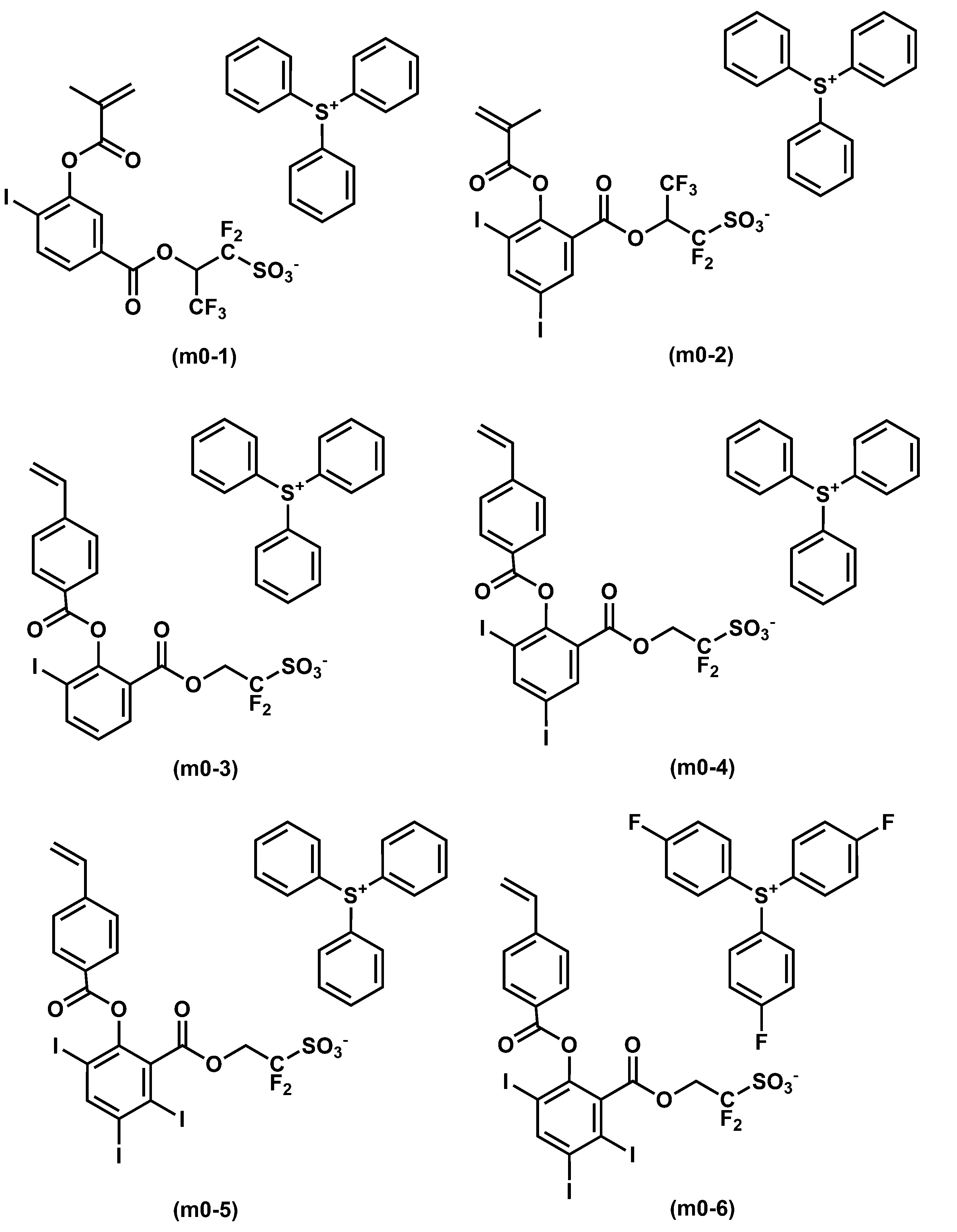


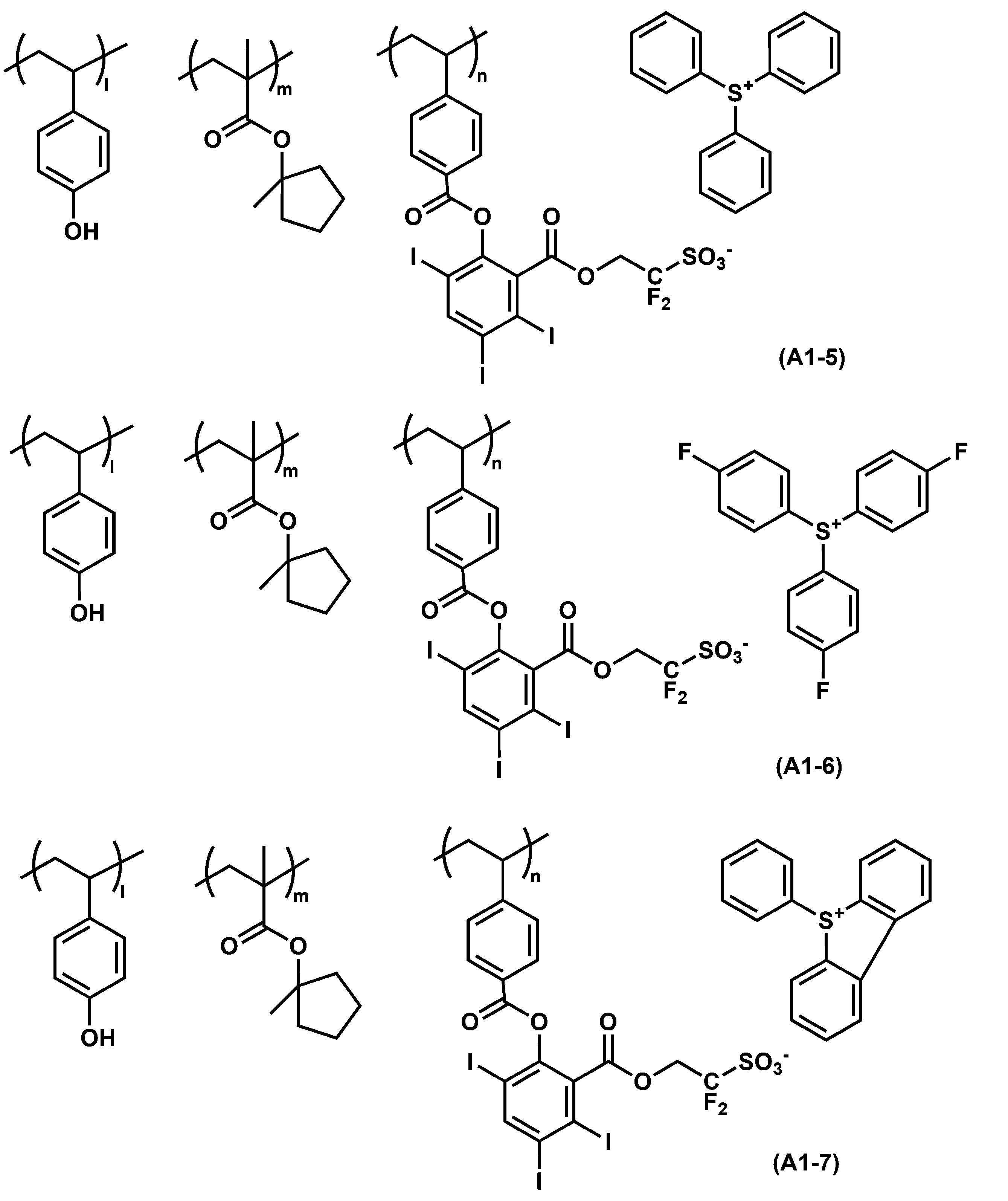

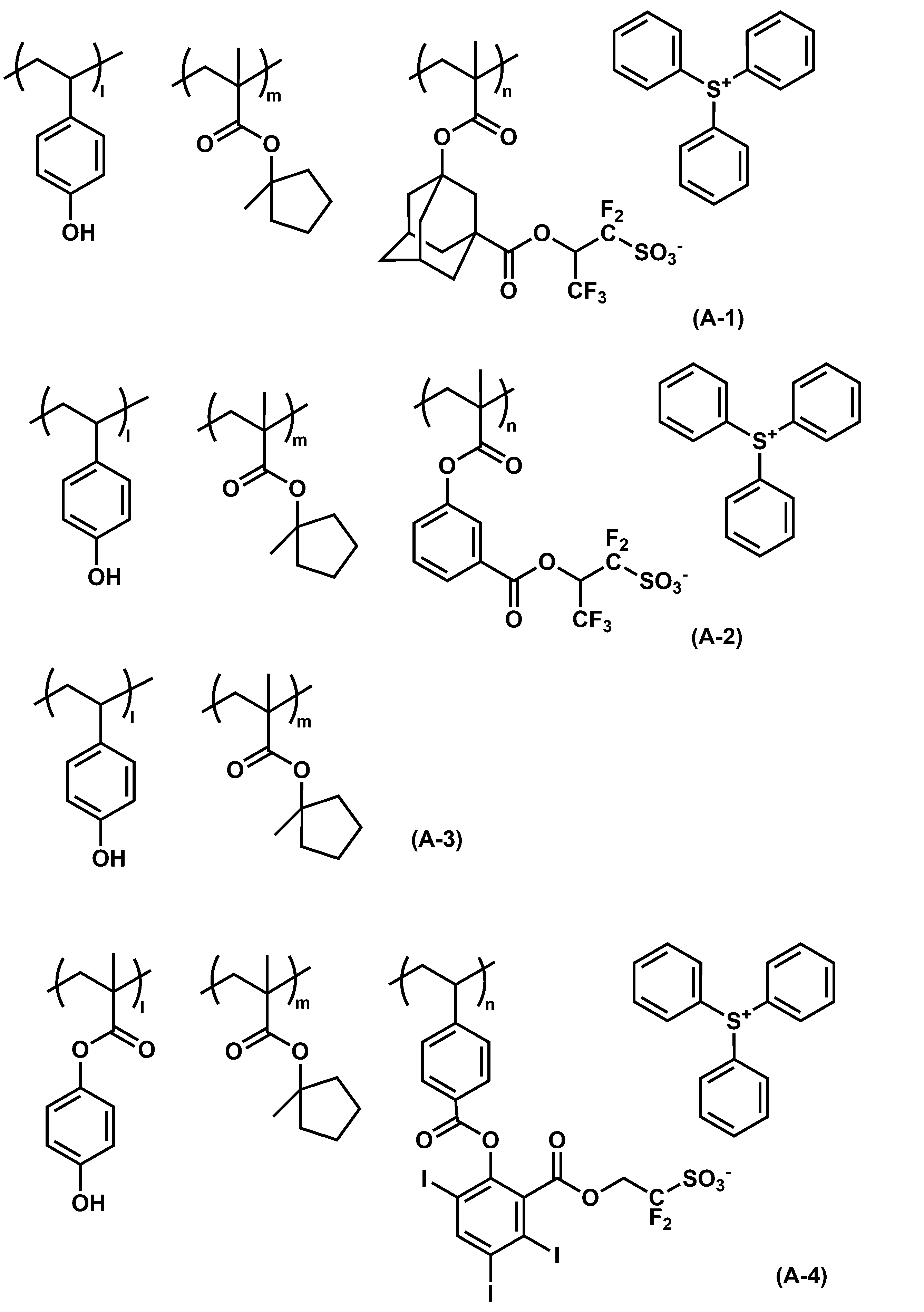
<レジスト組成物の調製>
(実施例1~25、比較例1~7)
表2~4に示す各成分を混合して溶解し、各例のレジスト組成物をそれぞれ調製した。
(実施例1~25、比較例1~7)
表2~4に示す各成分を混合して溶解し、各例のレジスト組成物をそれぞれ調製した。
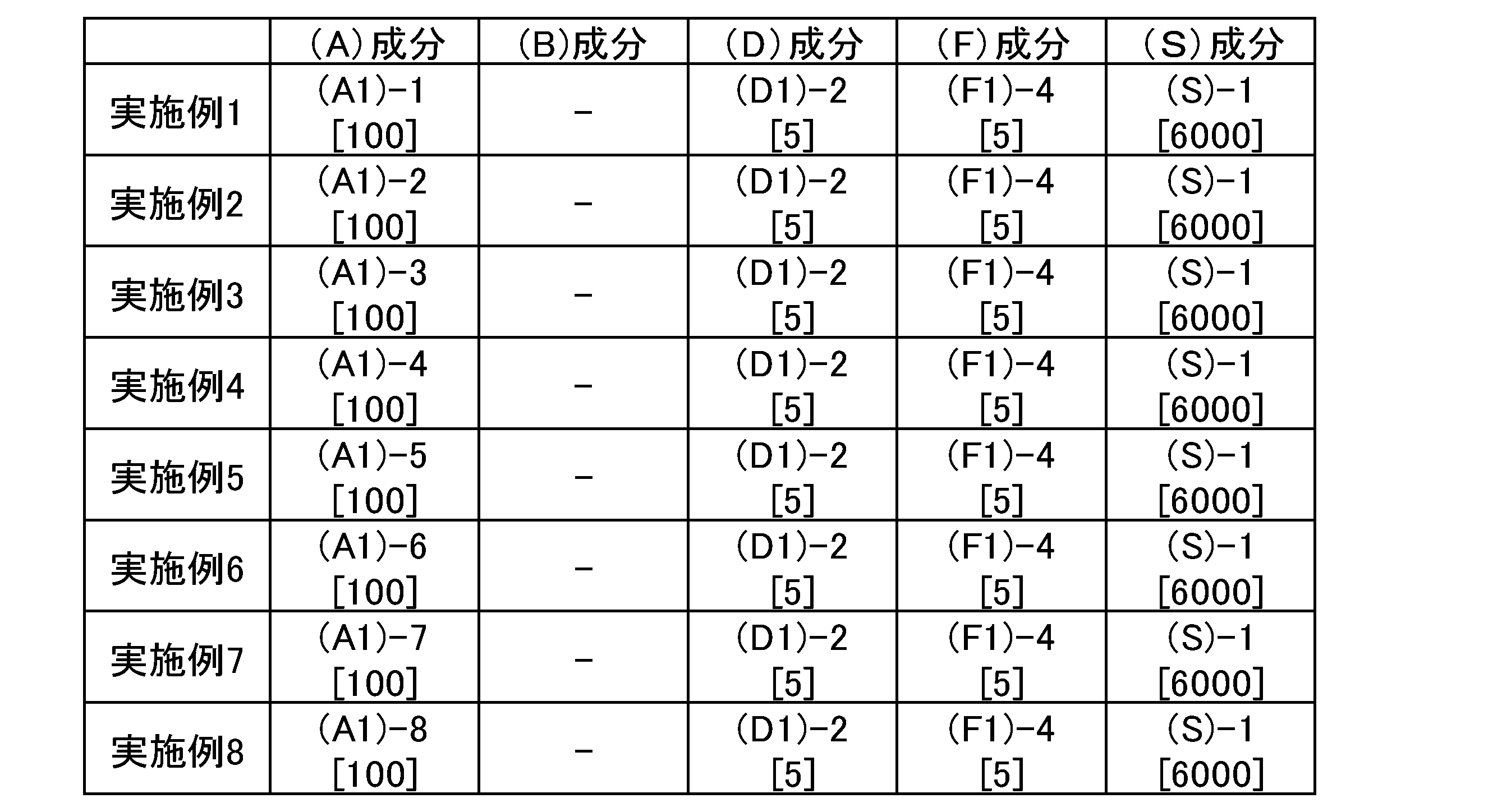

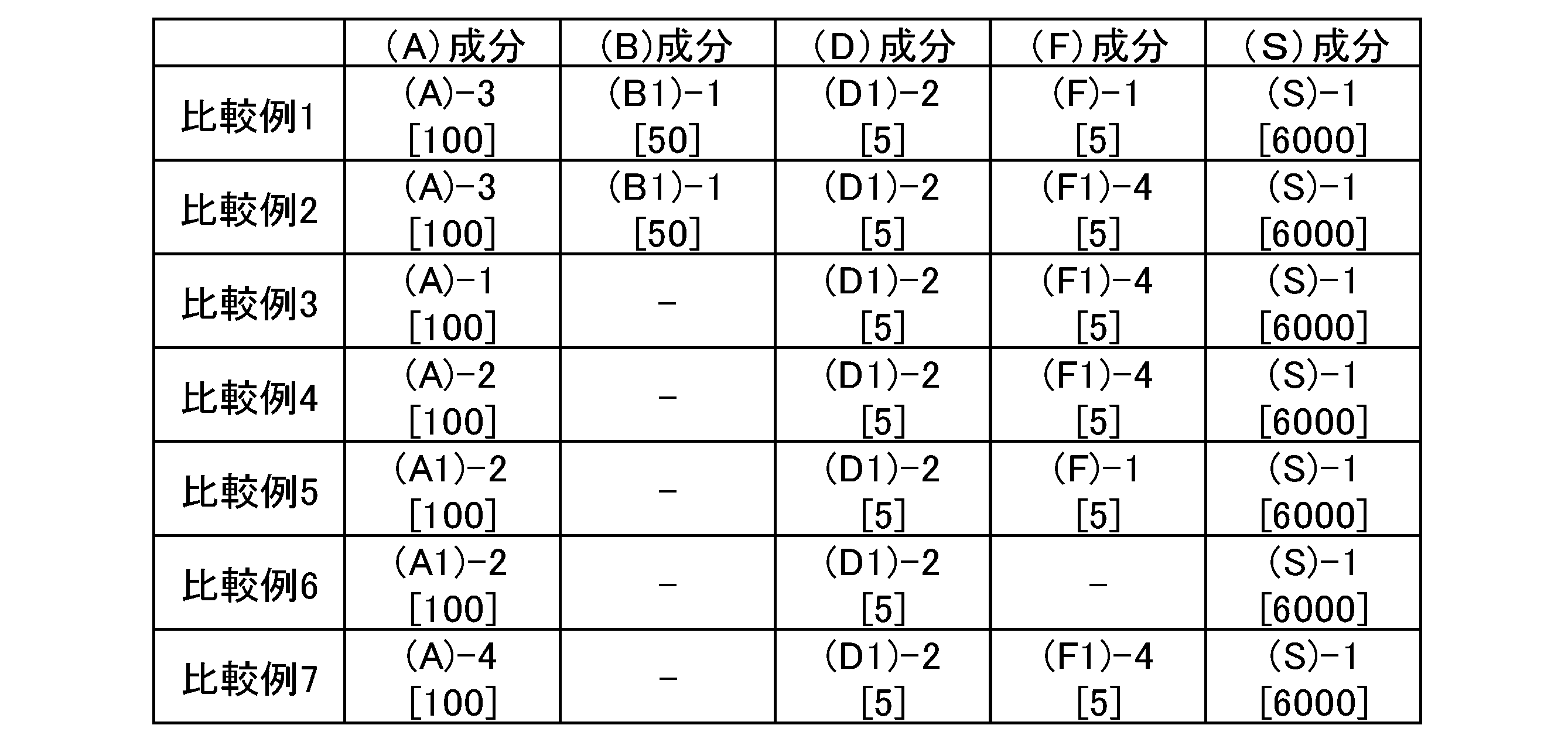
表2~4中、各略号はそれぞれ以下の意味を有する。[ ]内の数値は配合量(質量部)である。
(A1)-1~(A1)-10:前記高分子化合物(A1-1)~(A1-10)。
(A)-1~(A)-4:前記高分子化合物(A-1)~(A-4)。
(B1)-1:下記の化合物(B1-1)からなる酸発生剤。
(D1)-1:下記の化合物(D1-1)からなる酸拡散制御剤。
(D2)-2:下記の化合物(D1-2)からなる酸拡散制御剤。
(A1)-1~(A1)-10:前記高分子化合物(A1-1)~(A1-10)。
(A)-1~(A)-4:前記高分子化合物(A-1)~(A-4)。
(B1)-1:下記の化合物(B1-1)からなる酸発生剤。
(D1)-1:下記の化合物(D1-1)からなる酸拡散制御剤。
(D2)-2:下記の化合物(D1-2)からなる酸拡散制御剤。

(F1)-1:下記式(F1-1)で表される高分子化合物。GPC測定により求めた標準ポリスチレン換算の重量平均分子量(Mw)は15000、分子量分散度(Mw/Mn)1.70。13C-NMRにより求めた共重合組成比(構造式中の各構成単位の割合(モル比))はl/m=70/30。
(F1)-2:下記式(F1-2)で表される高分子化合物。GPC測定により求めた標準ポリスチレン換算の重量平均分子量(Mw)は15000、分子量分散度(Mw/Mn)1.70。13C-NMRにより求めた共重合組成比(構造式中の各構成単位の割合(モル比))はl/m/n=70/20/10。
(F1)-3:下記式(F1-3)で表される高分子化合物。GPC測定により求めた標準ポリスチレン換算の重量平均分子量(Mw)は15000、分子量分散度(Mw/Mn)1.70。13C-NMRにより求めた共重合組成比(構造式中の各構成単位の割合(モル比))はl/m/n=70/20/10。
(F1)-4:下記式(F1-4)で表される高分子化合物。GPC測定により求めた標準ポリスチレン換算の重量平均分子量(Mw)は15000、分子量分散度(Mw/Mn)1.70。13C-NMRにより求めた共重合組成比(構造式中の各構成単位の割合(モル比))はl/m=70/30。
(F1)-5:下記式(F1-5)で表される高分子化合物。GPC測定により求めた標準ポリスチレン換算の重量平均分子量(Mw)は15000、分子量分散度(Mw/Mn)1.70。13C-NMRにより求めた共重合組成比(構造式中の各構成単位の割合(モル比))はl/m=70/30。
(F1)-6:下記式(F1-6)で表される高分子化合物。GPC測定により求めた標準ポリスチレン換算の重量平均分子量(Mw)は15000、分子量分散度(Mw/Mn)1.70。13C-NMRにより求めた共重合組成比(構造式中の各構成単位の割合(モル比))はl/m=70/30。
(F1)-2:下記式(F1-2)で表される高分子化合物。GPC測定により求めた標準ポリスチレン換算の重量平均分子量(Mw)は15000、分子量分散度(Mw/Mn)1.70。13C-NMRにより求めた共重合組成比(構造式中の各構成単位の割合(モル比))はl/m/n=70/20/10。
(F1)-3:下記式(F1-3)で表される高分子化合物。GPC測定により求めた標準ポリスチレン換算の重量平均分子量(Mw)は15000、分子量分散度(Mw/Mn)1.70。13C-NMRにより求めた共重合組成比(構造式中の各構成単位の割合(モル比))はl/m/n=70/20/10。
(F1)-4:下記式(F1-4)で表される高分子化合物。GPC測定により求めた標準ポリスチレン換算の重量平均分子量(Mw)は15000、分子量分散度(Mw/Mn)1.70。13C-NMRにより求めた共重合組成比(構造式中の各構成単位の割合(モル比))はl/m=70/30。
(F1)-5:下記式(F1-5)で表される高分子化合物。GPC測定により求めた標準ポリスチレン換算の重量平均分子量(Mw)は15000、分子量分散度(Mw/Mn)1.70。13C-NMRにより求めた共重合組成比(構造式中の各構成単位の割合(モル比))はl/m=70/30。
(F1)-6:下記式(F1-6)で表される高分子化合物。GPC測定により求めた標準ポリスチレン換算の重量平均分子量(Mw)は15000、分子量分散度(Mw/Mn)1.70。13C-NMRにより求めた共重合組成比(構造式中の各構成単位の割合(モル比))はl/m=70/30。
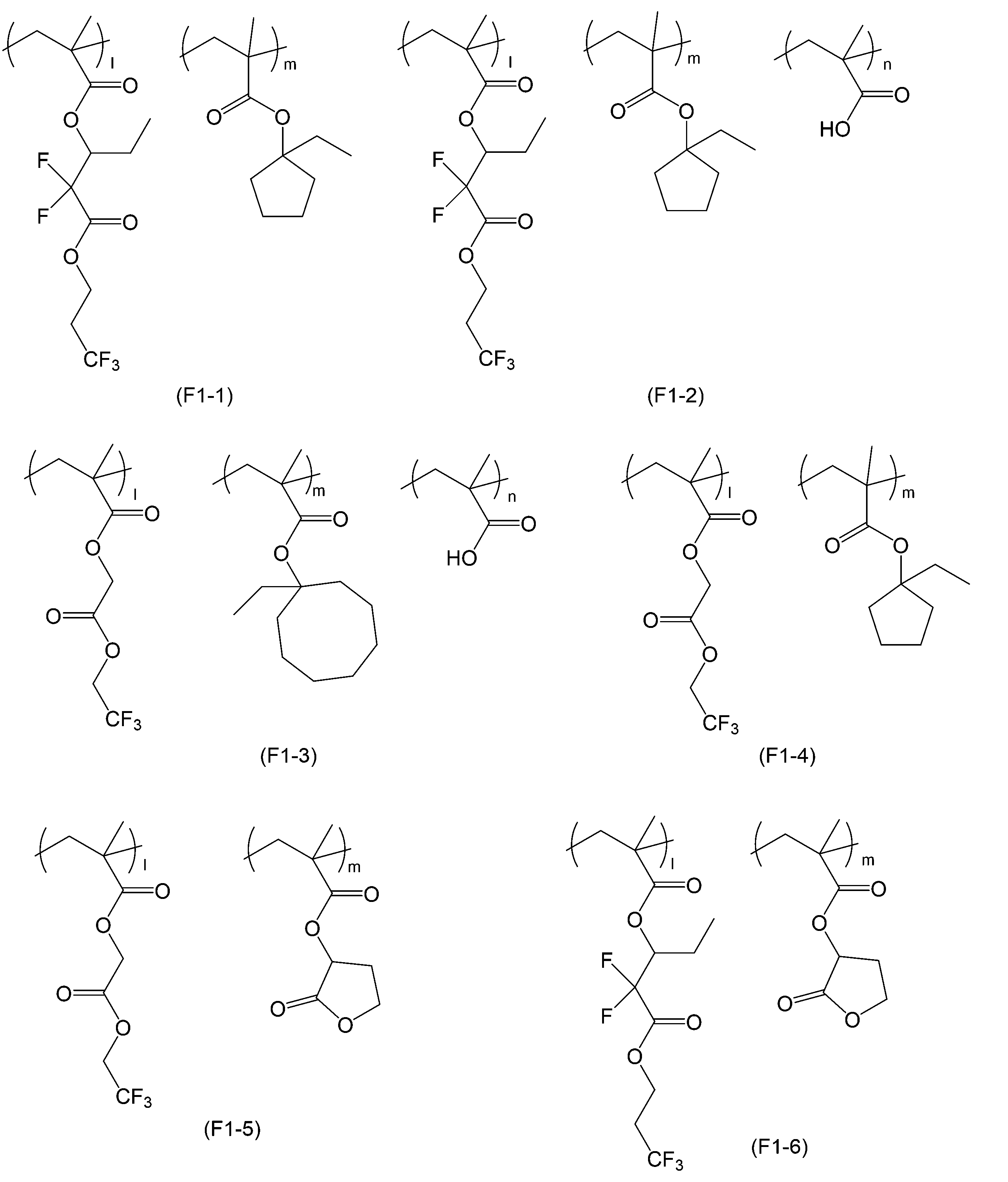
(F1)-7:下記式(F1-7)で表される高分子化合物。GPC測定により求めた標準ポリスチレン換算の重量平均分子量(Mw)は15000、分子量分散度(Mw/Mn)1.70。13C-NMRにより求めた共重合組成比(構造式中の各構成単位の割合(モル比))はl/m=70/30。
(F1)-8:下記式(F1-8)で表される高分子化合物。GPC測定により求めた標準ポリスチレン換算の重量平均分子量(Mw)は15000、分子量分散度(Mw/Mn)1.70。13C-NMRにより求めた共重合組成比(構造式中の各構成単位の割合(モル比))はl/m=70/30。
(F1)-9:下記式(F1-9)で表される高分子化合物。GPC測定により求めた標準ポリスチレン換算の重量平均分子量(Mw)は15000、分子量分散度(Mw/Mn)1.70。13C-NMRにより求めた共重合組成比(構造式中の各構成単位の割合(モル比))はl/m=70/30。
(F1)-10:下記式(F1-10)で表される高分子化合物。GPC測定により求めた標準ポリスチレン換算の重量平均分子量(Mw)は15000、分子量分散度(Mw/Mn)1.70。13C-NMRにより求めた共重合組成比(構造式中の各構成単位の割合(モル比))はl/m=70/30。
(F1)-11:下記式(F1-11)で表されるホモポリマー。GPC測定により求めた標準ポリスチレン換算の重量平均分子量(Mw)は15000、分子量分散度(Mw/Mn)1.70。
(F1)-12:下記式(F1-12)で表される高分子化合物。GPC測定により求めた標準ポリスチレン換算の重量平均分子量(Mw)は15000、分子量分散度(Mw/Mn)1.70。13C-NMRにより求めた共重合組成比(構造式中の各構成単位の割合(モル比))はl/m=70/30。
(F1)-13:下記式(F1-13)で表される高分子化合物。GPC測定により求めた標準ポリスチレン換算の重量平均分子量(Mw)は15000、分子量分散度(Mw/Mn)1.70。13C-NMRにより求めた共重合組成比(構造式中の各構成単位の割合(モル比))はl/m=70/30。
(F1)-14:下記式(F1-14)で表される高分子化合物。GPC測定により求めた標準ポリスチレン換算の重量平均分子量(Mw)は15000、分子量分散度(Mw/Mn)1.70。13C-NMRにより求めた共重合組成比(構造式中の各構成単位の割合(モル比))はl/m=70/30。
(F1)-15:下記式(F1-15)で表される高分子化合物。GPC測定により求めた標準ポリスチレン換算の重量平均分子量(Mw)は15000、分子量分散度(Mw/Mn)1.70。13C-NMRにより求めた共重合組成比(構造式中の各構成単位の割合(モル比))はl/m=70/30。
(F1)-8:下記式(F1-8)で表される高分子化合物。GPC測定により求めた標準ポリスチレン換算の重量平均分子量(Mw)は15000、分子量分散度(Mw/Mn)1.70。13C-NMRにより求めた共重合組成比(構造式中の各構成単位の割合(モル比))はl/m=70/30。
(F1)-9:下記式(F1-9)で表される高分子化合物。GPC測定により求めた標準ポリスチレン換算の重量平均分子量(Mw)は15000、分子量分散度(Mw/Mn)1.70。13C-NMRにより求めた共重合組成比(構造式中の各構成単位の割合(モル比))はl/m=70/30。
(F1)-10:下記式(F1-10)で表される高分子化合物。GPC測定により求めた標準ポリスチレン換算の重量平均分子量(Mw)は15000、分子量分散度(Mw/Mn)1.70。13C-NMRにより求めた共重合組成比(構造式中の各構成単位の割合(モル比))はl/m=70/30。
(F1)-11:下記式(F1-11)で表されるホモポリマー。GPC測定により求めた標準ポリスチレン換算の重量平均分子量(Mw)は15000、分子量分散度(Mw/Mn)1.70。
(F1)-12:下記式(F1-12)で表される高分子化合物。GPC測定により求めた標準ポリスチレン換算の重量平均分子量(Mw)は15000、分子量分散度(Mw/Mn)1.70。13C-NMRにより求めた共重合組成比(構造式中の各構成単位の割合(モル比))はl/m=70/30。
(F1)-13:下記式(F1-13)で表される高分子化合物。GPC測定により求めた標準ポリスチレン換算の重量平均分子量(Mw)は15000、分子量分散度(Mw/Mn)1.70。13C-NMRにより求めた共重合組成比(構造式中の各構成単位の割合(モル比))はl/m=70/30。
(F1)-14:下記式(F1-14)で表される高分子化合物。GPC測定により求めた標準ポリスチレン換算の重量平均分子量(Mw)は15000、分子量分散度(Mw/Mn)1.70。13C-NMRにより求めた共重合組成比(構造式中の各構成単位の割合(モル比))はl/m=70/30。
(F1)-15:下記式(F1-15)で表される高分子化合物。GPC測定により求めた標準ポリスチレン換算の重量平均分子量(Mw)は15000、分子量分散度(Mw/Mn)1.70。13C-NMRにより求めた共重合組成比(構造式中の各構成単位の割合(モル比))はl/m=70/30。

(F)-1:下記式(F-1)で表される高分子化合物。GPC測定により求めた標準ポリスチレン換算の重量平均分子量(Mw)は15000、分子量分散度(Mw/Mn)1.70。13C-NMRにより求めた共重合組成比(構造式中の各構成単位の割合(モル比))はl/m=70/30。
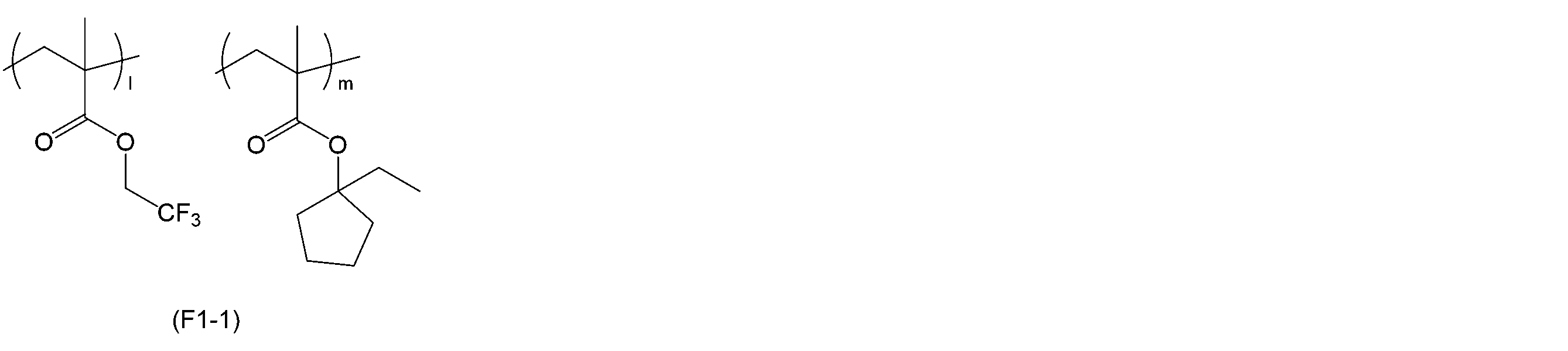
(S)-1:プロピレングリコールモノメチルエーテルアセテート/プロピレングリコールモノメチルエーテル/乳酸エチル/ジアセトンアルコール=45/25/15/15(質量比)の混合溶剤。
ヘキサメチルジシラザン(HMDS)処理を施した12インチシリコン基板上に、各例のレジスト組成物をそれぞれ、スピンナーを用いて塗布し、ホットプレート上で、温度120℃で60秒間のプレベーク(PAB)処理を行い、乾燥することにより、膜厚50nmのレジスト膜を形成した。
次に、前記レジスト膜に対し、EUVスキャナーNXE3400 (NXE3400(NA0.33, inner σ/outer σ=0.3/0.9, クアドルポール照明) (ASML社製)を用い、直径26nmのホールが等間隔(ピッチ52nm)に配置されたコンタクトホールパターン(以下「CHパターン」という。)とする露光を行った後、110℃で60秒間の露光後加熱(PEB)処理を行った。
次いで、23℃にて、2.38質量%テトラメチルアンモニウムヒドロキシド(TMAH)水溶液「NMD-3」(商品名、東京応化工業株式会社製)を用いて、30秒間のアルカリ現像を行った後、純水を用いて15秒間水リンス処理を行った。その結果、直径26nmのホールが等間隔(ピッチ52nm)に配置されたコンタクトホールパターン(以下、「CHパターン」という)が形成された。
次に、前記レジスト膜に対し、EUVスキャナーNXE3400 (NXE3400(NA0.33, inner σ/outer σ=0.3/0.9, クアドルポール照明) (ASML社製)を用い、直径26nmのホールが等間隔(ピッチ52nm)に配置されたコンタクトホールパターン(以下「CHパターン」という。)とする露光を行った後、110℃で60秒間の露光後加熱(PEB)処理を行った。
次いで、23℃にて、2.38質量%テトラメチルアンモニウムヒドロキシド(TMAH)水溶液「NMD-3」(商品名、東京応化工業株式会社製)を用いて、30秒間のアルカリ現像を行った後、純水を用いて15秒間水リンス処理を行った。その結果、直径26nmのホールが等間隔(ピッチ52nm)に配置されたコンタクトホールパターン(以下、「CHパターン」という)が形成された。
[最適露光量(Eop)の評価]
前記のレジストパターンの形成方法によってターゲットサイズのCHパターンが形成される最適露光量Eop(mJ/cm2)を求めた。結果を「Eop[mJ/cm2]」として表5~7に示した。
前記のレジストパターンの形成方法によってターゲットサイズのCHパターンが形成される最適露光量Eop(mJ/cm2)を求めた。結果を「Eop[mJ/cm2]」として表5~7に示した。
[パターン寸法の面内均一性(CDU)の評価]
上記の<レジストパターンの形成>によって形成されたCHパターンについて、測長SEM(走査型電子顕微鏡、加速電圧500V、商品名:CG6300、日立ハイテク社製)により、CHパターン合計10000個について上空から観察し、各ホールのホール直径(nm)を測定した。そして、その測定結果から算出した標準偏差(σ)の3倍値(3σ)を求めた。その結果を「CDU[nm]」として表5~7に示した。
このようにして求められる3σは、その値が小さいほど、該レジスト膜に形成された複数のホールの寸法(CD)均一性が高いことを意味する。
上記の<レジストパターンの形成>によって形成されたCHパターンについて、測長SEM(走査型電子顕微鏡、加速電圧500V、商品名:CG6300、日立ハイテク社製)により、CHパターン合計10000個について上空から観察し、各ホールのホール直径(nm)を測定した。そして、その測定結果から算出した標準偏差(σ)の3倍値(3σ)を求めた。その結果を「CDU[nm]」として表5~7に示した。
このようにして求められる3σは、その値が小さいほど、該レジスト膜に形成された複数のホールの寸法(CD)均一性が高いことを意味する。
[パターン欠陥の評価]
前記のCDUの評価にて観察されたCHパターンの10000個のホールうち、ホール直径が18.2nm(ターゲットサイズの70%)以下を開口不足の欠陥として定義し、その数を計測した。結果を「開口不足欠陥数[個]」として表5~7に示した。
また、ホール直径が33.8nm(ターゲットサイズの130%)以上を開口過剰の欠陥として定義し、その数を計測した。結果を「開口過剰欠陥数[個]」として表5~7に示した。
前記のCDUの評価にて観察されたCHパターンの10000個のホールうち、ホール直径が18.2nm(ターゲットサイズの70%)以下を開口不足の欠陥として定義し、その数を計測した。結果を「開口不足欠陥数[個]」として表5~7に示した。
また、ホール直径が33.8nm(ターゲットサイズの130%)以上を開口過剰の欠陥として定義し、その数を計測した。結果を「開口過剰欠陥数[個]」として表5~7に示した。


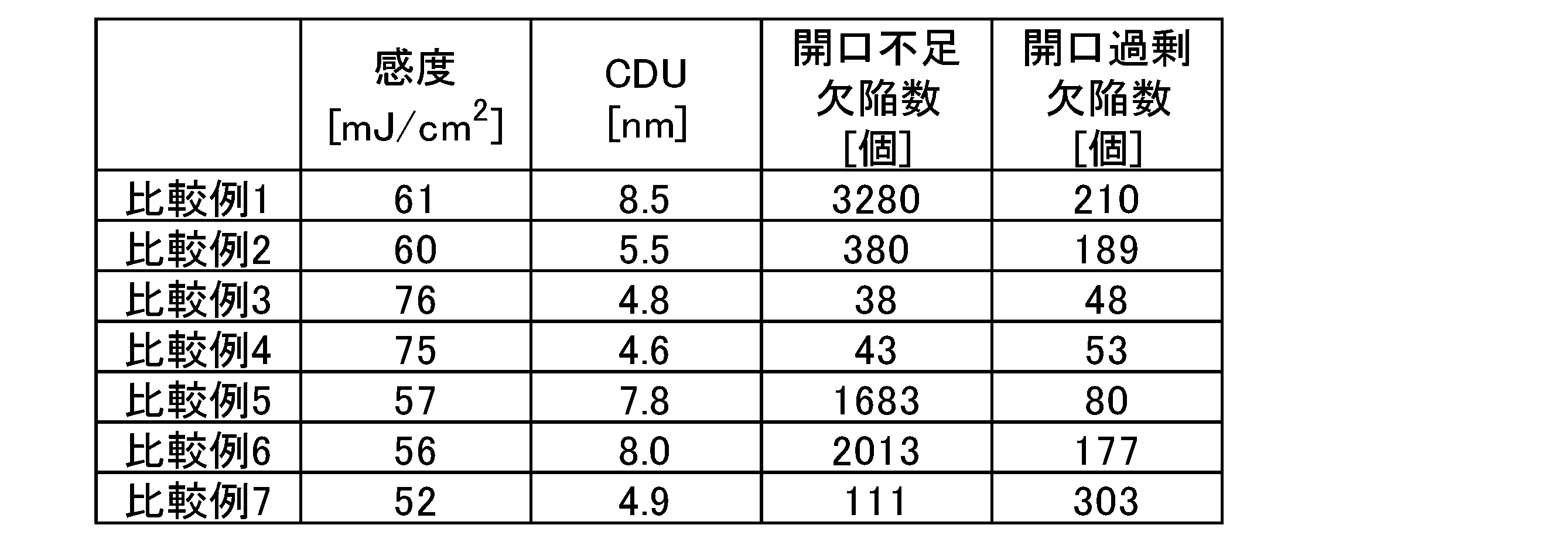
表5~7に示す通り、実施例のレジスト組成物は、感度及びCDUのいずれも良好であり、パターン欠陥数が低減されていることが確認された。
以上、本発明の好ましい実施例を説明したが、本発明はこれら実施例に限定されることはない。本発明の趣旨を逸脱しない範囲で、構成の付加、省略、置換、およびその他の変更が可能である。本発明は前述した説明によって限定されることはなく、添付のクレームの範囲によってのみ限定される。
Claims (10)
- 露光により酸を発生し、かつ、酸の作用により現像液に対する溶解性が変化するレジスト組成物であって、
酸の作用により現像液に対する溶解性が変化する樹脂成分(A1)と、
塩基解離性基を含む構成単位(f1)を有するフッ素樹脂成分(F1)と、を含有し、
前記樹脂成分(A1)は、下記一般式(a0-1)で表される化合物から誘導される構成単位(a0)を有し、
前記塩基解離性基を含む構成単位(f1)は、下記一般式(f1-1)で表される構成単位(f1-1)、下記一般式(f1-2)で表される構成単位(f1-2)及び下記一般式(f1-3)で表される構成単位(f1-3)からなる群より選ばれる少なくとも1種を含有する、レジスト組成物。

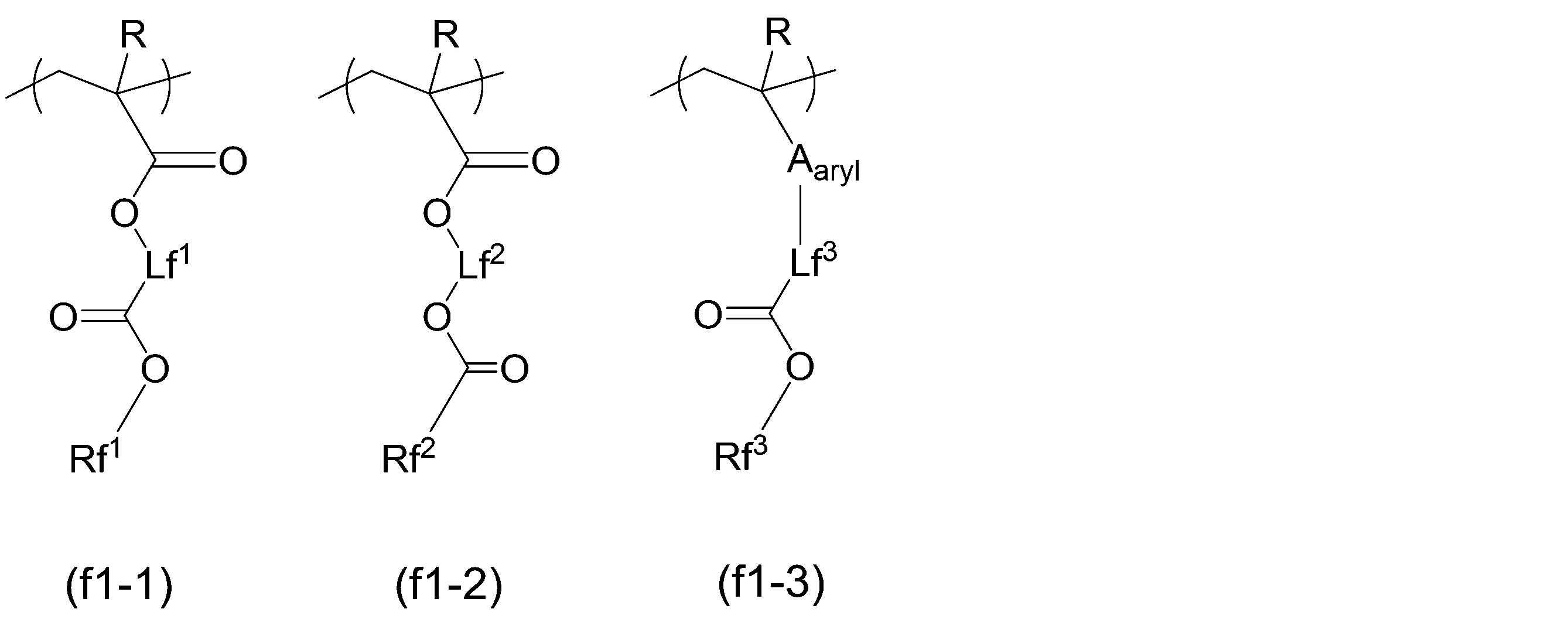
- 前記一般式(a0-1)中、La01が、置換基を有してもよい芳香族炭化水素基、又は置換基を有してもよい脂環式炭化水素基である、請求項1に記載のレジスト組成物。
- 前記構成単位(a0)が、下記一般式(a0-1-1)で表される構成単位である、請求項1に記載のレジスト組成物。

- 前記フッ素樹脂成分(F1)が、前記構成単位(f1)と、下記一般式(f3-1)で表される構成単位(f3)とを有する、請求項1に記載のレジスト組成物。

- 前記フッ素樹脂成分(F1)が、前記構成単位(f1)と、ラクトン含有環式基を含む構成単位(f4)とを有する、請求項1に記載のレジスト組成物。
- 前記フッ素樹脂成分(F1)が、前記構成単位(f1)と、下記一般式(f5-1)で表される化合物から誘導される構成単位を有する、請求項1に記載のレジスト組成物。
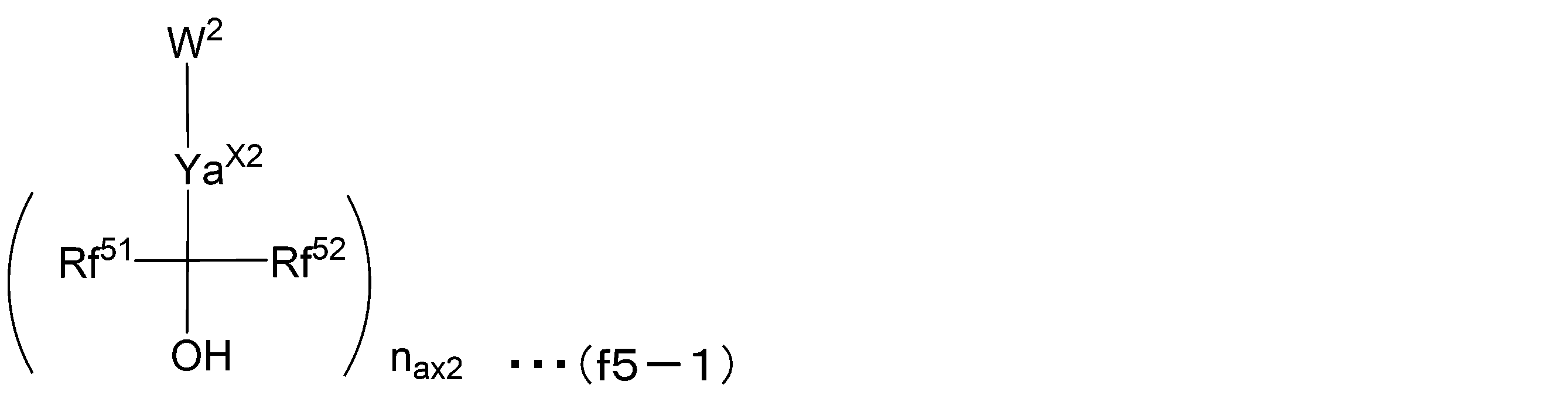
- 前記樹脂成分(A1)は、前記構成単位(a0)と、下記一般式(a10-1-1)で表される構成単位とを有する共重合体である、請求項1に記載のレジスト組成物。

- 前記一般式(a0-1)中、Ar01は、置換基として少なくともヨウ素原子を2個以上有する芳香族炭化水素基である、請求項1に記載のレジスト組成物。
- 前記樹脂成分(A1)は、前記構成単位(a0)と、下記一般式(a1-1-1)で表される構成単位とを有する共重合体である、請求項1に記載のレジスト組成物。
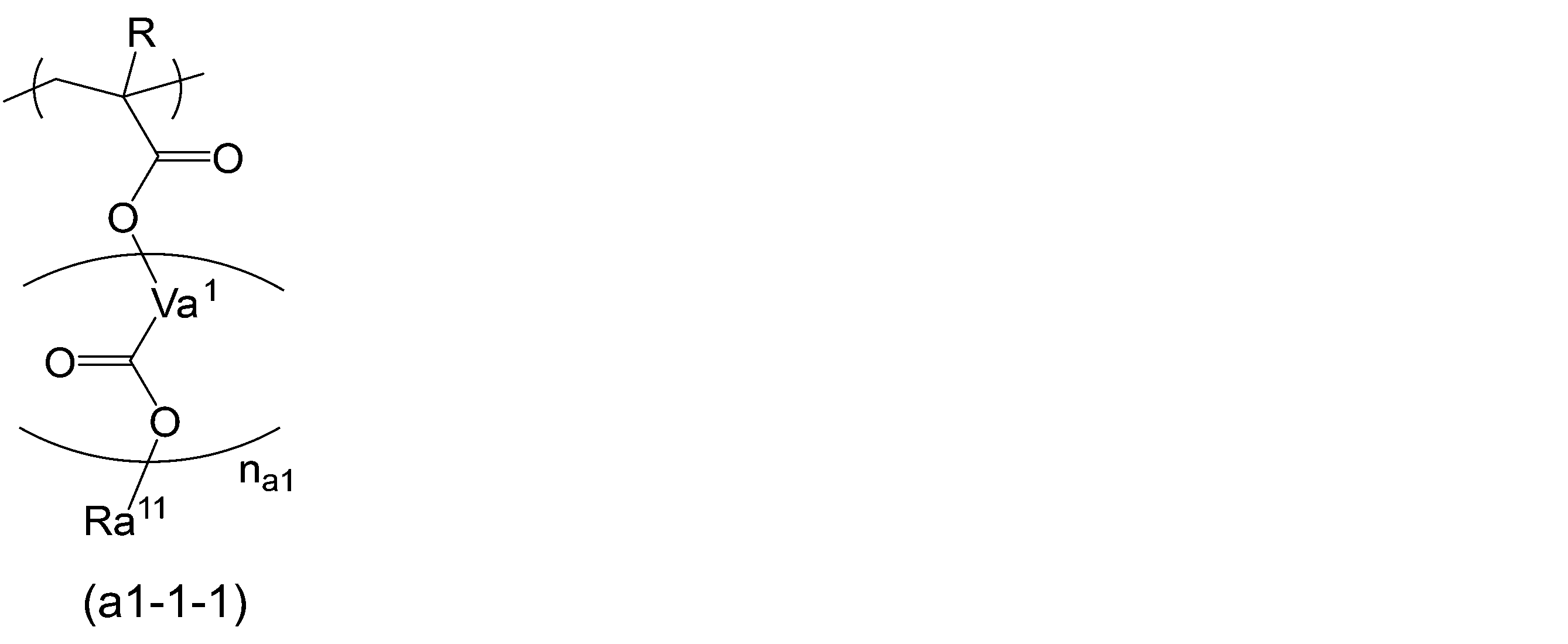

- 支持体上に、請求項1に記載のレジスト組成物を用いてレジスト膜を形成する工程、前記レジスト膜を露光する工程、及び前記露光後のレジスト膜を現像してレジストパターンを形成する工程を有する、レジストパターン形成方法。
Priority Applications (1)
| Application Number | Priority Date | Filing Date | Title |
|---|---|---|---|
| KR1020267000401A KR20260033000A (ko) | 2023-06-30 | 2024-06-27 | 레지스트 조성물 및 레지스트 패턴 형성 방법 |
Applications Claiming Priority (2)
| Application Number | Priority Date | Filing Date | Title |
|---|---|---|---|
| JP2023108823A JP2025007433A (ja) | 2023-06-30 | 2023-06-30 | レジスト組成物及びレジストパターン形成方法 |
| JP2023-108823 | 2023-06-30 |
Publications (1)
| Publication Number | Publication Date |
|---|---|
| WO2025005192A1 true WO2025005192A1 (ja) | 2025-01-02 |
Family
ID=93939210
Family Applications (1)
| Application Number | Title | Priority Date | Filing Date |
|---|---|---|---|
| PCT/JP2024/023379 Ceased WO2025005192A1 (ja) | 2023-06-30 | 2024-06-27 | レジスト組成物及びレジストパターン形成方法 |
Country Status (4)
| Country | Link |
|---|---|
| JP (1) | JP2025007433A (ja) |
| KR (1) | KR20260033000A (ja) |
| TW (1) | TW202517693A (ja) |
| WO (1) | WO2025005192A1 (ja) |
Citations (2)
| Publication number | Priority date | Publication date | Assignee | Title |
|---|---|---|---|---|
| JP2013083966A (ja) * | 2011-09-30 | 2013-05-09 | Fujifilm Corp | 感活性光線性又は感放射線性樹脂組成物、並びに、それを用いた感活性光線性又は感放射線性膜及びパターン形成方法 |
| WO2023058365A1 (ja) * | 2021-10-04 | 2023-04-13 | Jsr株式会社 | 感放射線性樹脂組成物及びパターン形成方法 |
-
2023
- 2023-06-30 JP JP2023108823A patent/JP2025007433A/ja active Pending
-
2024
- 2024-06-27 KR KR1020267000401A patent/KR20260033000A/ko active Pending
- 2024-06-27 WO PCT/JP2024/023379 patent/WO2025005192A1/ja not_active Ceased
- 2024-06-27 TW TW113124009A patent/TW202517693A/zh unknown
Patent Citations (2)
| Publication number | Priority date | Publication date | Assignee | Title |
|---|---|---|---|---|
| JP2013083966A (ja) * | 2011-09-30 | 2013-05-09 | Fujifilm Corp | 感活性光線性又は感放射線性樹脂組成物、並びに、それを用いた感活性光線性又は感放射線性膜及びパターン形成方法 |
| WO2023058365A1 (ja) * | 2021-10-04 | 2023-04-13 | Jsr株式会社 | 感放射線性樹脂組成物及びパターン形成方法 |
Also Published As
| Publication number | Publication date |
|---|---|
| TW202517693A (zh) | 2025-05-01 |
| JP2025007433A (ja) | 2025-01-17 |
| KR20260033000A (ko) | 2026-03-10 |
Similar Documents
| Publication | Publication Date | Title |
|---|---|---|
| WO2024166788A1 (ja) | レジスト組成物、レジストパターン形成方法、化合物及び高分子化合物 | |
| WO2025079370A1 (ja) | レジスト組成物、レジストパターン形成方法及び化合物 | |
| WO2025079553A1 (ja) | レジスト組成物、レジストパターン形成方法、及び化合物 | |
| WO2025047532A1 (ja) | レジスト組成物、レジストパターン形成方法、高分子化合物、及び化合物 | |
| WO2025005060A1 (ja) | レジスト組成物、レジストパターン形成方法、高分子化合物、及び化合物 | |
| WO2024171874A1 (ja) | レジスト組成物及びレジストパターン形成方法 | |
| WO2024176696A1 (ja) | レジスト組成物、レジストパターン形成方法、化合物及び高分子化合物 | |
| WO2024176701A1 (ja) | レジスト組成物、レジストパターン形成方法、化合物及び高分子化合物 | |
| WO2024071131A1 (ja) | レジスト組成物及びレジストパターン形成方法 | |
| JP2024112755A (ja) | レジスト組成物、レジストパターン形成方法、化合物及び高分子化合物 | |
| WO2025005192A1 (ja) | レジスト組成物及びレジストパターン形成方法 | |
| WO2026048575A1 (ja) | レジスト組成物、レジストパターン形成方法、高分子化合物、及び化合物 | |
| WO2025253927A1 (ja) | レジスト組成物、レジストパターン形成方法、化合物、及び高分子化合物 | |
| WO2025009502A1 (ja) | レジスト組成物、レジストパターン形成方法及び高分子化合物 | |
| WO2025258562A1 (ja) | レジスト組成物、レジストパターン形成方法、化合物、酸発生剤、酸拡散制御剤及び高分子化合物 | |
| WO2025253944A1 (ja) | レジスト組成物、レジストパターン形成方法、化合物、及び高分子化合物 | |
| WO2024253168A1 (ja) | レジスト組成物及びレジストパターン形成方法 | |
| WO2025018212A1 (ja) | レジスト組成物、レジストパターン形成方法、化合物及び高分子化合物 | |
| WO2025244102A1 (ja) | レジスト組成物及びレジストパターン形成方法 | |
| JP2025178097A (ja) | レジスト組成物及びレジストパターン形成方法 | |
| WO2025105311A1 (ja) | レジスト組成物、レジストパターン形成方法、化合物及び酸発生剤 | |
| WO2025126725A1 (ja) | レジスト組成物、レジストパターン形成方法、化合物及び高分子化合物 | |
| JP2025174185A (ja) | レジスト組成物、レジストパターン形成方法、及び高分子化合物 | |
| WO2025192522A1 (ja) | レジスト組成物、レジストパターン形成方法、重合体、化合物、ラジカル重合開始剤及び連鎖移動剤 | |
| WO2025205331A1 (ja) | レジスト組成物、レジストパターン形成方法、化合物、ラジカル重合開始剤、連鎖移動剤及び重合体 |
Legal Events
| Date | Code | Title | Description |
|---|---|---|---|
| 121 | Ep: the epo has been informed by wipo that ep was designated in this application |
Ref document number: 24832051 Country of ref document: EP Kind code of ref document: A1 |
|
| NENP | Non-entry into the national phase |
Ref country code: DE |