WO2025005096A1 - ポリクロロトリフルオロエチレン成形体およびその製造方法 - Google Patents
ポリクロロトリフルオロエチレン成形体およびその製造方法 Download PDFInfo
- Publication number
- WO2025005096A1 WO2025005096A1 PCT/JP2024/023061 JP2024023061W WO2025005096A1 WO 2025005096 A1 WO2025005096 A1 WO 2025005096A1 JP 2024023061 W JP2024023061 W JP 2024023061W WO 2025005096 A1 WO2025005096 A1 WO 2025005096A1
- Authority
- WO
- WIPO (PCT)
- Prior art keywords
- molded body
- polychlorotrifluoroethylene
- pctfe
- molded
- heater
- Prior art date
- Legal status (The legal status is an assumption and is not a legal conclusion. Google has not performed a legal analysis and makes no representation as to the accuracy of the status listed.)
- Ceased
Links
Images

Classifications
-
- B—PERFORMING OPERATIONS; TRANSPORTING
- B29—WORKING OF PLASTICS; WORKING OF SUBSTANCES IN A PLASTIC STATE IN GENERAL
- B29C—SHAPING OR JOINING OF PLASTICS; SHAPING OF MATERIAL IN A PLASTIC STATE, NOT OTHERWISE PROVIDED FOR; AFTER-TREATMENT OF THE SHAPED PRODUCTS, e.g. REPAIRING
- B29C43/00—Compression moulding, i.e. applying external pressure to flow the moulding material; Apparatus therefor
- B29C43/32—Component parts, details or accessories; Auxiliary operations
- B29C43/34—Feeding the material to the mould or the compression means
-
- B—PERFORMING OPERATIONS; TRANSPORTING
- B29—WORKING OF PLASTICS; WORKING OF SUBSTANCES IN A PLASTIC STATE IN GENERAL
- B29C—SHAPING OR JOINING OF PLASTICS; SHAPING OF MATERIAL IN A PLASTIC STATE, NOT OTHERWISE PROVIDED FOR; AFTER-TREATMENT OF THE SHAPED PRODUCTS, e.g. REPAIRING
- B29C43/00—Compression moulding, i.e. applying external pressure to flow the moulding material; Apparatus therefor
- B29C43/32—Component parts, details or accessories; Auxiliary operations
- B29C43/58—Measuring, controlling or regulating
Definitions
- This disclosure relates to a polychlorotrifluoroethylene molded body and a method for producing the same.
- Patent Document 1 describes a thermoplastic copolymer that contains 0.5 to 6 mole percent vinylidene fluoride and is essentially composed of trifluorochloroethylene.
- the present disclosure aims to provide a molded body that is less likely to crack even when tightened with a strong force.
- the present disclosure also aims to provide a manufacturing method for a molded body that is less likely to crack even when tightened with a strong force.
- a molded body containing polychlorotrifluoroethylene wherein the melting point of the polychlorotrifluoroethylene is 211 to 216°C, the projected area of the molded body is 1000 mm2 or more, the thickness of the molded body is 25 to 50 mm, and the crystallinity of the molded body is 65% or less.
- a molded body that is less likely to crack even when tightened with a strong force.
- a manufacturing method for a molded body that can produce a molded body that is less likely to crack even when tightened with a strong force.
- FIG. 1 is a graph plotting heater temperatures and heating times in the methods for producing molded bodies of Experimental Examples 1 to 6 and Comparative Examples 1 to 3.
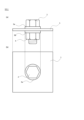
- Fig. 2 is a schematic diagram for explaining a method for carrying out a crack resistance test.
- Fig. 2(a) is a schematic front view of a sample sheet sandwiched between a bolt, a washer, and a nut.
- Fig. 2(b) is a schematic top view of the sample sheet sandwiched between a bolt, a washer, and a nut.
- Patent document 1 describes how polychlorotrifluoroethylene containing 0.5 to 6 mole percent vinylidene fluoride exhibits the chemical and physical properties of chlorotrifluoroethylene homopolymer, while the final film is highly glossy, smooth, and less prone to embrittlement.
- Chlorotrifluoroethylene (CTFE) homopolymers have the advantage that they can be molded with high dimensional precision compared to CTFE copolymers such as those described in Patent Document 1.
- CTFE Chlorotrifluoroethylene
- PCTFE polychlorotrifluoroethylene
- the molded article of the present disclosure is a molded article containing PCTFE, in which the melting point of PCTFE is 211 to 216°C, the projected area of the molded article is 1000 mm2 or more, the thickness of the molded article is 25 to 50 mm, and the crystallinity of the molded article is 65% or less.
- the molded article of the present disclosure is a thick-walled molded article having a large projected area.
- the projected area of the molded body is 1000 mm2 or more, preferably 5000 mm2 or more, more preferably 10000 mm2 or more, even more preferably 50000 mm2 or more, and particularly preferably 100000 mm2 or more.
- the upper limit of the projected area may be, for example, 300000 mm2 or less. If the projected area of the molded body is too small, cracks are unlikely to occur in the molded body, but it becomes difficult to use it for some applications such as a turntable of a semiconductor cleaning device for placing a large wafer.
- the projected area is the projected area of the molded body as viewed in the thickness direction of the molded body.
- the thickness of the molded body is 25 to 50 mm, preferably 47 mm or less, and more preferably 44 mm or less. If the molded body is too thick, it becomes difficult to reduce the crystallinity of the molded body, and as a result, cracks are more likely to occur in the molded body. If the molded body is too thin, cracks are less likely to occur in the molded body, but it becomes difficult to use it in some applications, such as turntables for semiconductor cleaning equipment on which large wafers are placed.
- the crystallinity of the molded body is 65% or less.
- the crystallinity of the molded body is preferably 40% or more, and more preferably 52% or more.
- the molded body of the present disclosure is a PCTFE molded body having a relatively large projected area, and is therefore typically molded by compression molding.
- compression molding When attempting to manufacture a thick PCTFE molded body having such a large projected area by compression molding under conventional conditions, there is a problem in that cracks will occur when the resulting molded body is clamped with a strong force.
- molded bodies in which the crystallinity of the molded body is adjusted to fall within the above range are less likely to crack even when clamped with a strong force.
- PCTFE may be a homopolymer of chlorotrifluoroethylene, or a copolymer of CTFE and a monomer copolymerizable with CTFE.
- Monomers that can be copolymerized with CTFE include ethylene, vinylidene fluoride, tetrafluoroethylene, hexafluoropropylene, fluoro(alkyl vinyl ether), (perfluorobutyl)ethylene, (perfluorohexyl)ethylene, perfluoro(1,1,2-trihydro-1-hexene), and perfluoro(1,1,5-trihydro-1-pentene).
- the content of CTFE units in PCTFE is preferably 90-100 mol%, more preferably 98-100 mol%, even more preferably 99-100 mol%, and particularly preferably 99.9-100 mol%.
- the higher the content of CTFE units in PCTFE the more improved the mechanical properties, dimensional stability, chemical resistance, low chemical permeability, low gas permeability, and other properties of the molded body.
- the monomer composition of PCTFE can be measured by 19 F-NMR.
- PCTFE is a homopolymer of CTFE.
- a homopolymer of CTFE is a polymer that contains substantially only CTFE units, preferably a polymer that contains 99.9 to 100 mol% of CTFE units, and more preferably a polymer consisting of only CTFE units.
- the molded article of the present disclosure is less susceptible to cracking even when it contains a homopolymer of CTFE as PCTFE.
- the melting point of PCTFE is 211-216°C.
- the melting point of PCTFE can be adjusted by adjusting the monomer composition of PCTFE.
- CTFE homopolymers usually have a melting point within the above range.
- the melting point of PCTFE can be measured using a differential scanning calorimeter (DSC).
- DSC differential scanning calorimeter
- the flow value of PCTFE measured at 230° C. is preferably 2.0 ⁇ 10 ⁇ 3 ml/sec or less, preferably 1.0 ⁇ 10 ⁇ 4 ml/sec or more, and more preferably 1.0 ⁇ 10 ⁇ 3 ml/sec or more.
- the above flow values are the flow values of the PCTFE forming the molded body. Therefore, the above flow values may differ from the flow values of the PCTFE as a raw material used to manufacture a molded body containing PCTFE having the above dimensions.
- the flow value of PCTFE can be measured using a high-pressure flow tester under the following conditions: 230°C, load of 980N (100kg), nozzle diameter of 1mm ⁇ .
- the flow value of PCTFE is the volume of PCTFE extruded from the nozzle per second.
- the molded body of the present disclosure may be obtained by processing a compression molded product obtained by compression molding into a desired shape using a known method such as cutting.
- the molded body of the present disclosure has excellent chemical resistance and mechanical properties, and is unlikely to crack even when tightened with a strong force. Therefore, the molded body of the present disclosure can be suitably used as a component of semiconductor manufacturing equipment, in particular as a component fixed to the equipment using threaded parts such as PCTFE bolts and nuts.
- the molded body of the present disclosure can be suitably used, for example, as a turntable for processing silicon wafers, peripheral parts such as wafer guides, guides for cleaning silicon wafers, couplers for chemical piping, valves, joints, valve seats such as low-temperature valve seats for LNG transport ships, and the like. Examples of turntables include turntables for semiconductor cleaning equipment.
- the molded body of the present disclosure can be suitably manufactured by the manufacturing method of the present disclosure. Next, the manufacturing method of the present disclosure will be described in detail.
- a molded article having a projected area of 1000 mm2 or more and a thickness of 25 to 50 mm is manufactured.
- a thick PCTFE molded article having such a large projected area is manufactured by compression molding under conventional conditions, there is a problem that cracks occur when the obtained molded article is clamped with a strong force.
- a mold for obtaining a molded body having the above-mentioned size is heated by a heater, PCTFE is filled into the mold, and the PCTFE in the mold is compression molded to obtain a molded body.
- the temperature of the heater is set to 290 to 325°C, and the heating time by the heater and the heater temperature are adjusted to satisfy the relational formula (X), thereby suppressing an increase in the crystallinity of the obtained molded body, and as a result, the occurrence of cracks can be suppressed.
- the step of heating the mold by a heater and the step of filling the mold with PCTFE can be performed in any order. That is, in the manufacturing method of the present disclosure, the mold may be heated by a heater and then PCTFE may be filled into the heated mold, or the mold filled with PTFE may be filled into the mold and then heated by a heater.
- the heater temperature is 290 to 325°C, preferably 292°C or higher, more preferably 294°C or higher, and preferably 323°C or lower, more preferably 321°C or lower.
- the heater temperature is the set temperature of a heater (preferably an electric heating wire) disposed inside or outside the mold.
- the mold is heated using a hot air circulation oven with the heater temperature set within the above range.
- the heating time by the heater and the heater temperature are adjusted so as to satisfy the following relational expression (X).
- heating time by heater in relational formula (X) specifically refers to the time from placing a compression molding die filled with PCTFE raw material in an oven that can be heated to a specified temperature by a heater, to heating for a specified period of time, to removing the die from the oven.
- heating time by heater in relational formula (X) specifically refers to the time from placing a compression molding die filled with PCTFE raw material in an oven that can be heated to a specified temperature by a heater, to heating for a specified period of time, to removing the die from the oven.
- Compression molding of PCTFE is performed by setting the heater temperature of an oven such as a hot air circulation oven to a predetermined temperature within the range of 290 to 325°C, placing a mold filled with PCTFE raw material in the oven and heating it to melt the PCTFE raw material. After heating for a predetermined time, the mold is removed from the oven and cooled in the mold while compressing it with a separately prepared compression press. Cooling can be done by air cooling or water cooling, but cooling while applying pressure is preferable because it can remove air bubbles, prevent the formation of air bubbles directly above the molded body, and prevent deformation and cracks in the molded body. It is also possible to heat the mold in advance and then add the raw material, but from the perspective of preventing contamination of the raw material and safety in the work, it is preferable to fill the raw material into a mold at room temperature in a clean environment.
- a hot plate press equipped with a heater can be used to heat and melt the PCTFE, and after the PCTFE has been heated and melted, the mold can be moved to a cooling press and cooled under pressure.
- a hot air circulating oven it is more preferable to heat and melt it in a hot air circulating oven, as this allows complete melting in a short time and prevents thermal degradation such as an increase in flow value. If the mold produces a lot of flash and the molded product is thin, this can be adjusted by filling the raw material by a few percent to about 10% more than the calculated filling amount.
- the heating time using the heater is, for example, 30 to 240 minutes, and preferably 40 minutes or more and 230 minutes or less.
- the pressure applied to the PCTFE in the mold is, for example, 3 to 50 MPa.
- the pressure applied to the PCTFE in the mold may be gradually increased.
- compression molding is carried out so that the rate of change in the flow value of PCTFE calculated by the following formula is 3.0 or less.
- Rate of change of flow value (F 1 ⁇ F 0 )/F 0
- F 0 Flow value of PCTFE before filling the mold (raw material flow value)
- F 1 Flow value of PCTFE forming the molded body (molded body flow value)
- the flow value of the PCTFE before it is filled into the mold and the flow value of the PCTFE that forms the molded body can both be measured using the method described above.
- the mechanical properties of the molded body can be easily adjusted to within the above range, and as a result, the occurrence of cracks can be suppressed.
- the rate of change of the flow value of PCTFE can be kept low by appropriately adjusting the size of the molded body, the heating time by the heater, and the heater temperature.
- the flow value (raw material flow value) of PCTFE measured at 230°C before filling the mold is preferably 1.0 x 10⁻⁴ ml/sec or more, more preferably 4.0 x 10⁻⁴ ml/sec or more, preferably 1.0 x 10⁻³ ml/sec or less, more preferably 8.0 x 10⁻⁴ ml/sec or less.
- the shape of the PCTFE filled into the mold is not particularly limited, and it may be in the form of powder, granules, tablets, or pellets.
- a molded body can be obtained by cooling the PCTFE together with the mold while compressing the PCTFE, and removing the molded body of PCTFE from the mold.
- cooling methods include known methods such as natural cooling in air at room temperature (air cooling), forced cooling with cold air (air cooling), and forced cooling with water (water cooling).
- air cooling is preferable, and cooling with cold air is more preferable, because even thick molded bodies with large projected areas can be cooled while being compressed with a compression press, and the occurrence of cracks can be suppressed.
- Water cooling is preferable from the viewpoint of easily reducing the degree of crystallinity, but in the case of large molded bodies, caution is required because if the timing of cooling is too early, the molded body may crack due to distortion of the shrinkage stress caused by solidification.
- the molded body can be air-cooled to a temperature slightly below the melting point of PCTFE, and then quickly cooled to below 150°C by water cooling.
- PCTFE crystallizes rapidly in the temperature range of 160-190°C, so crystallization can be further suppressed by quickly cooling in this temperature range. Crystallization can be further suppressed if water cooling is started when the temperature of the molded body reaches 190-200°C through air cooling, but it is preferable to select the timing to start water cooling taking into account the temperature distribution of the molded body.
- a molded article containing polychlorotrifluoroethylene The melting point of the polychlorotrifluoroethylene is 211 to 216° C., The projected area of the molded body is 1000 mm2 or more, and the thickness of the molded body is 25 to 50 mm; The molded article has a crystallinity of 65% or less.
- the polychlorotrifluoroethylene is a homopolymer of chlorotrifluoroethylene.
- a molded article according to the first or second aspect wherein the flow value of the polychlorotrifluoroethylene measured at 230° C. is 2.0 ⁇ 10 ⁇ 3 ml/sec or less.
- a fourth aspect of the present disclosure According to any one of the first to third aspects, there is provided a molded article which is a turntable for a semiconductor cleaning device.
- a molded article according to any one of the first to fourth aspects, wherein the projected area of the molded article is 10,000 to 300,000 mm2 , the thickness of the molded article is 25 to 44 mm, the crystallinity of the molded article is 52 to 65%, and the flow value of the polychlorotrifluoroethylene measured at 230°C is 1.0 x 10 -3 to 2.0 x 10 -3 ml/sec.
- a method for producing a molded article according to any one of the first to fifth aspects comprising heating a metal mold with a heater, filling the metal mold with the polychlorotrifluoroethylene, and compression molding the polychlorotrifluoroethylene in the metal mold to obtain the molded article,
- the temperature of the heater is set to 290 to 325° C.
- Rate of change in flow value (F 1 ⁇ F 0 )/F 0
- the temperature was determined as the temperature corresponding to the maximum value on the heat of fusion curve when the temperature was raised at a rate of 10° C./min using a differential scanning calorimeter (product name: X-DSC7000, manufactured by Hitachi High-Tech Science Corporation).
- a metal hexagonal bolt 2 of size M10 JIS B1175 (1988), outer diameter 10 mm ⁇ ), metal flat washers (diameter 20 mm ⁇ , hole diameter 12 mm ⁇ , thickness 1 mm) 3a and 3b, and a metal hexagonal nut 4 of size M10 were fixed in the holes of the sample sheet 1.
- the bolt 2 and nut 4 were tightened with a torque wrench to a maximum torque of 3.7 (N ⁇ m).
- the sample sheet sandwiched between the bolt, washer and nut was kept for 24 hours, and then the bolt, washer and nut were removed from the sample sheet.
- the surface of the sample sheet tightened by the washer was observed with a magnifying glass and evaluated according to the following criteria. N: No cracks were observed. Y: Cracks were observed.
- Crystallinity (%) ⁇ (specific gravity-2.072)/(2.183-2.072) ⁇ 100
- PCTFE having the following physical properties was used.
- Experimental Example 1 A mold was prepared which was made of carbon steel and had a hard chrome-plated resin contact surface, and which was composed of a cylindrical part having an inner diameter of 120 mm, an outer diameter of 160 mm, and a height of 60 mm, as well as a bottom plate and an upper plate having an outer diameter of 118 mm and a thickness of 15 mm.
- the mold filled with the raw material was placed in the oven. After heating for 40 minutes, the mold was removed, and the hydraulic gauge pressure was gradually increased to 3-20 MPa using a compression press to remove air bubbles. The pressure was increased to 20-50 MPa, and the mold was air-cooled while maintaining the pressure so that vacuum bubbles would not occur during solidification. After cooling, the pressure was released, and the mold was removed from the compression press. The molded body was removed from the mold using a simple hand press. The projected area of the obtained molded body was 11,304 mm2 , and the thickness was 25 mm. The molded body was visually checked for the presence of cracks, but no cracks were found.
- Figure 1 is a graph plotting heater temperature and heating time in the manufacturing methods of molded bodies for Experimental Examples 1 to 6 and Comparative Examples 1 to 3.
Landscapes
- Engineering & Computer Science (AREA)
- Mechanical Engineering (AREA)
- Casting Or Compression Moulding Of Plastics Or The Like (AREA)
Priority Applications (2)
| Application Number | Priority Date | Filing Date | Title |
|---|---|---|---|
| CN202480042027.9A CN121419873A (zh) | 2023-06-27 | 2024-06-25 | 聚三氟氯乙烯成型体及其制造方法 |
| JP2025530149A JPWO2025005096A1 (https=) | 2023-06-27 | 2024-06-25 |
Applications Claiming Priority (2)
| Application Number | Priority Date | Filing Date | Title |
|---|---|---|---|
| JP2023105271 | 2023-06-27 | ||
| JP2023-105271 | 2023-06-27 |
Related Child Applications (1)
| Application Number | Title | Priority Date | Filing Date |
|---|---|---|---|
| US19/432,359 Continuation US20260115976A1 (en) | 2023-06-27 | 2025-12-24 | Polychlorotrifluoroethylene molded article and method for producing the same |
Publications (1)
| Publication Number | Publication Date |
|---|---|
| WO2025005096A1 true WO2025005096A1 (ja) | 2025-01-02 |
Family
ID=93939224
Family Applications (1)
| Application Number | Title | Priority Date | Filing Date |
|---|---|---|---|
| PCT/JP2024/023061 Ceased WO2025005096A1 (ja) | 2023-06-27 | 2024-06-25 | ポリクロロトリフルオロエチレン成形体およびその製造方法 |
Country Status (3)
| Country | Link |
|---|---|
| JP (1) | JPWO2025005096A1 (https=) |
| CN (1) | CN121419873A (https=) |
| WO (1) | WO2025005096A1 (https=) |
Citations (6)
| Publication number | Priority date | Publication date | Assignee | Title |
|---|---|---|---|---|
| JPH01158047A (ja) * | 1987-09-18 | 1989-06-21 | Nitto Denko Corp | ポリクロロトリフルオロエチレンフィルム、その製造法および該フィルムを用いたエレクトロルミネセンス素子 |
| JPH04182115A (ja) * | 1990-11-15 | 1992-06-29 | Nitto Denko Corp | 防湿性フィルムの製造法 |
| JP2007023231A (ja) * | 2005-07-21 | 2007-02-01 | Ntn Corp | フッ素樹脂製多孔体およびその製造方法 |
| JP2010260216A (ja) * | 2009-04-30 | 2010-11-18 | Nippon Valqua Ind Ltd | フッ素樹脂成形体およびその製造方法 |
| JP2018187939A (ja) * | 2016-07-22 | 2018-11-29 | 住友ベークライト株式会社 | サンドイッチパネルの製造方法 |
| JP2019104787A (ja) * | 2017-12-08 | 2019-06-27 | 株式会社クレハ | 成形体およびその製造方法 |
-
2024
- 2024-06-25 JP JP2025530149A patent/JPWO2025005096A1/ja active Pending
- 2024-06-25 CN CN202480042027.9A patent/CN121419873A/zh active Pending
- 2024-06-25 WO PCT/JP2024/023061 patent/WO2025005096A1/ja not_active Ceased
Patent Citations (6)
| Publication number | Priority date | Publication date | Assignee | Title |
|---|---|---|---|---|
| JPH01158047A (ja) * | 1987-09-18 | 1989-06-21 | Nitto Denko Corp | ポリクロロトリフルオロエチレンフィルム、その製造法および該フィルムを用いたエレクトロルミネセンス素子 |
| JPH04182115A (ja) * | 1990-11-15 | 1992-06-29 | Nitto Denko Corp | 防湿性フィルムの製造法 |
| JP2007023231A (ja) * | 2005-07-21 | 2007-02-01 | Ntn Corp | フッ素樹脂製多孔体およびその製造方法 |
| JP2010260216A (ja) * | 2009-04-30 | 2010-11-18 | Nippon Valqua Ind Ltd | フッ素樹脂成形体およびその製造方法 |
| JP2018187939A (ja) * | 2016-07-22 | 2018-11-29 | 住友ベークライト株式会社 | サンドイッチパネルの製造方法 |
| JP2019104787A (ja) * | 2017-12-08 | 2019-06-27 | 株式会社クレハ | 成形体およびその製造方法 |
Also Published As
| Publication number | Publication date |
|---|---|
| CN121419873A (zh) | 2026-01-27 |
| JPWO2025005096A1 (https=) | 2025-01-02 |
Similar Documents
| Publication | Publication Date | Title |
|---|---|---|
| US10265922B2 (en) | Fluoropolymer molded article | |
| JP7174306B2 (ja) | 射出成形体およびその製造方法 | |
| CN101522734B (zh) | 氟聚合物模塑方法和模制品 | |
| KR20200023400A (ko) | 불소 수지 성형체 | |
| KR101433495B1 (ko) | 불소중합체 성형 방법 및 불소중합체 성형품 | |
| KR20190025817A (ko) | 에틸렌-테트라플루오로에틸렌계 공중합체 필름 및 그 제조 방법 | |
| JP6787335B2 (ja) | 樹脂フィルムおよびその製造方法 | |
| US11267209B2 (en) | PFA molded body with excellent blister resistance and method of controlling occurrence of blisters in PFA molded body | |
| WO2025005096A1 (ja) | ポリクロロトリフルオロエチレン成形体およびその製造方法 | |
| JP4858545B2 (ja) | ポリテトラフルオロエチレン成形体及びその製造方法 | |
| US20260115976A1 (en) | Polychlorotrifluoroethylene molded article and method for producing the same | |
| JP5577590B2 (ja) | 成形体、ダイヤフラム弁、ダイヤフラムポンプ及びその製造方法 | |
| JP6546143B2 (ja) | 射出成形品を製造する方法 | |
| WO1994023938A1 (fr) | Procede de lissage d'un produit moule en resine fluoree et produit moule lisse obtenu selon ce procede | |
| JP6571237B2 (ja) | フッ素樹脂成形品 | |
| KR20220025974A (ko) | 성형성이 향상된 나일론 필름과 이를 이용한 이차전지용 파우치 필름 | |
| WO2019111455A1 (ja) | 成形体およびその製造方法 | |
| JP2017052854A (ja) | 耐ブリスター性に優れたフッ素樹脂組成物 | |
| JP7735064B2 (ja) | 耐熱離型シート及び樹脂の加熱溶融を伴う工程を実施する方法 | |
| JP2025026008A (ja) | フッ素樹脂粉体及びその成形体 | |
| JP2003311763A (ja) | Ptfe中実成形体製造方法 | |
| CN104141100A (zh) | 一种置氢改善Ti2AlNb基合金板材热拉深性能的方法 |
Legal Events
| Date | Code | Title | Description |
|---|---|---|---|
| 121 | Ep: the epo has been informed by wipo that ep was designated in this application |
Ref document number: 24831956 Country of ref document: EP Kind code of ref document: A1 |
|
| ENP | Entry into the national phase |
Ref document number: 2025530149 Country of ref document: JP Kind code of ref document: A |
|
| WWE | Wipo information: entry into national phase |
Ref document number: 2025530149 Country of ref document: JP |
|
| WWE | Wipo information: entry into national phase |
Ref document number: 202517132400 Country of ref document: IN |
|
| WWP | Wipo information: published in national office |
Ref document number: 202517132400 Country of ref document: IN |
|
| WWE | Wipo information: entry into national phase |
Ref document number: 2024831956 Country of ref document: EP |
|
| NENP | Non-entry into the national phase |
Ref country code: DE |
|
| ENP | Entry into the national phase |
Ref document number: 2024831956 Country of ref document: EP Effective date: 20260127 |
|
| ENP | Entry into the national phase |
Ref document number: 2024831956 Country of ref document: EP Effective date: 20260127 |