WO2025003699A1 - Method for affecting glass strength - Google Patents
Method for affecting glass strength Download PDFInfo
- Publication number
- WO2025003699A1 WO2025003699A1 PCT/GB2024/051685 GB2024051685W WO2025003699A1 WO 2025003699 A1 WO2025003699 A1 WO 2025003699A1 GB 2024051685 W GB2024051685 W GB 2024051685W WO 2025003699 A1 WO2025003699 A1 WO 2025003699A1
- Authority
- WO
- WIPO (PCT)
- Prior art keywords
- glass
- sheet
- powder
- major surface
- treated
- Prior art date
- Legal status (The legal status is an assumption and is not a legal conclusion. Google has not performed a legal analysis and makes no representation as to the accuracy of the status listed.)
- Ceased
Links
Classifications
-
- C—CHEMISTRY; METALLURGY
- C03—GLASS; MINERAL OR SLAG WOOL
- C03C—CHEMICAL COMPOSITION OF GLASSES, GLAZES OR VITREOUS ENAMELS; SURFACE TREATMENT OF GLASS; SURFACE TREATMENT OF FIBRES OR FILAMENTS MADE FROM GLASS, MINERALS OR SLAGS; JOINING GLASS TO GLASS OR OTHER MATERIALS
- C03C19/00—Surface treatment of glass, not in the form of fibres or filaments, by mechanical means
-
- B—PERFORMING OPERATIONS; TRANSPORTING
- B24—GRINDING; POLISHING
- B24C—ABRASIVE OR RELATED BLASTING WITH PARTICULATE MATERIAL
- B24C1/00—Methods for use of abrasive blasting for producing particular effects; Use of auxiliary equipment in connection with such methods
-
- B—PERFORMING OPERATIONS; TRANSPORTING
- B24—GRINDING; POLISHING
- B24C—ABRASIVE OR RELATED BLASTING WITH PARTICULATE MATERIAL
- B24C1/00—Methods for use of abrasive blasting for producing particular effects; Use of auxiliary equipment in connection with such methods
- B24C1/10—Methods for use of abrasive blasting for producing particular effects; Use of auxiliary equipment in connection with such methods for compacting surfaces, e.g. shot-peening
-
- B—PERFORMING OPERATIONS; TRANSPORTING
- B24—GRINDING; POLISHING
- B24C—ABRASIVE OR RELATED BLASTING WITH PARTICULATE MATERIAL
- B24C11/00—Selection of abrasive materials or additives for abrasive blasts
-
- C—CHEMISTRY; METALLURGY
- C03—GLASS; MINERAL OR SLAG WOOL
- C03C—CHEMICAL COMPOSITION OF GLASSES, GLAZES OR VITREOUS ENAMELS; SURFACE TREATMENT OF GLASS; SURFACE TREATMENT OF FIBRES OR FILAMENTS MADE FROM GLASS, MINERALS OR SLAGS; JOINING GLASS TO GLASS OR OTHER MATERIALS
- C03C12/00—Powdered glass; Bead compositions
-
- C—CHEMISTRY; METALLURGY
- C03—GLASS; MINERAL OR SLAG WOOL
- C03C—CHEMICAL COMPOSITION OF GLASSES, GLAZES OR VITREOUS ENAMELS; SURFACE TREATMENT OF GLASS; SURFACE TREATMENT OF FIBRES OR FILAMENTS MADE FROM GLASS, MINERALS OR SLAGS; JOINING GLASS TO GLASS OR OTHER MATERIALS
- C03C3/00—Glass compositions
- C03C3/04—Glass compositions containing silica
- C03C3/076—Glass compositions containing silica with 40% to 90% silica, by weight
- C03C3/083—Glass compositions containing silica with 40% to 90% silica, by weight containing aluminium oxide or an iron compound
- C03C3/085—Glass compositions containing silica with 40% to 90% silica, by weight containing aluminium oxide or an iron compound containing an oxide of a divalent metal
- C03C3/087—Glass compositions containing silica with 40% to 90% silica, by weight containing aluminium oxide or an iron compound containing an oxide of a divalent metal containing calcium oxide, e.g. common sheet or container glass
-
- C—CHEMISTRY; METALLURGY
- C09—DYES; PAINTS; POLISHES; NATURAL RESINS; ADHESIVES; COMPOSITIONS NOT OTHERWISE PROVIDED FOR; APPLICATIONS OF MATERIALS NOT OTHERWISE PROVIDED FOR
- C09K—MATERIALS FOR MISCELLANEOUS APPLICATIONS, NOT PROVIDED FOR ELSEWHERE
- C09K3/00—Materials not provided for elsewhere
- C09K3/14—Anti-slip materials; Abrasives
- C09K3/1436—Composite particles, e.g. coated particles
Definitions
- the present invention relates to a method of reducing the strength of a sheet of glass and to a method of making a laminated glazing including the sheet of glass that has had the strength thereof reduced.
- a laminated glazing may be used as a window in an automobile, in particular as a vehicle windscreen.
- Conventional laminated glazings for automotive windscreens comprise two plies of soda-lime- silicate glass joined by a sheet of polyvinyl butyral (PVB).
- PVB polyvinyl butyral
- each glass sheet is 2.1mm thick and the PVB sheet is typically 0.76mm thick.
- a laminated automotive windscreen provides the driver of the vehicle with improved safety benefits.
- vehicle manufacturers are also addressing vehicle safety in the event of a forward collision with a pedestrian.
- the pedestrian’s head may impact the vehicle windscreen thereby causing further injury to the pedestrian.
- W02013181505A1 describes a glass laminate including at least one chemically strengthened glass sheet with a thickness not exceeding 2.0 mm and a polymer interlayer between the glass sheets. Flaws are created in the surface of one of the glass sheets in order to weaken the glass laminate upon an impact event on a first side of the laminate, while retaining the strength of the laminate upon impact on the opposing second side of the laminate.
- EP2062862A1 describes a sheet glass laminate structure produced by laminating at least three sheet glasses each having a thickness of less than 1 mm through an intermediate layer between two adjacent sheet glasses.
- WO2019245819A1 describes a glass laminate construction with controlled breakage for pedestrian safety.
- WO202115654A1 describes a laminated glass for a vehicle that has been subjected to a strength levelling process which may include using a powder that has an average particle diameter of 10 nm to 100 pm.
- cerium oxide or ceria
- US2,383,500 US2,597,182 describes smoothing glass blanks using a smoothing technique which is employed between grinding and polishing steps.
- a mixture of rouge and pumice is used as the abrasive.
- Such grinding, smoothing and polishing processes were widely used before the development of the float process.
- US2012/0094578A1 describes heterocoagulate composite structures having a plurality of first particles (typically nanoparticles) on the surface of a second particle (typically a microparticle) for use in polishing compositions for both removing stains and polishing glass.
- the first particles contain cerium oxide and the second particle contains silicon oxide, aluminium oxide and/or zirconium oxide.
- the first particles are maintained on the surface of the second particle by electrostatic forces.
- W02003/091351A2 describes an unexpanded perlite ore polishing composition.
- the composition comprises a base material having grains of unexpanded perlite ore of a selected distribution of particle sizes which undergo fracturing of the grains as a function of an abrasive force applied to the base material.
- the selected distribution of particle sizes includes a significant volume of grains of unexpanded perlite ore having a (d90) particle size in a range of about 101 to about 229 pm.
- the base material is responsive to an abrasive force being applied thereto during polishing resulting in continued fracturing of the grains of unexpanded perlite ore to yield a final polishing composition having a sufficiently low level of abrasiveness under said abrasive force making it suitable for use in polishing.
- Compositions for polishing acrylic dentures and CRT tube surfaces using the unexpanded perlite ore polishing composition and methods for polishing the same are also described.
- the perlite ore polishing compositions described in W02003/091351A2, US2003/0203337A1 and US2003/0224702A1 have an initial selected particle size distribution that varies with use because there is a continued fracturing of the grains of unexpanded perlite during polishing under an abrasive force.
- the present invention aims to provide a method for reducing the strength of a sheet of glass that may be used in the making of a laminated glazing for a vehicle windscreen, such that the vehicle windscreen has a lower risk of causing serious pedestrian injuries in case the vehicle collides with a pedestrian.
- the present invention provides a method for reducing the strength of a first sheet of glass, the first glass sheet having a first major surface and a second opposing major surface; the method comprising a treatment step, the treatment step comprising treating a portion of the first major surface of the first sheet of glass with a first powder to reduce the strength of the first sheet of glass; wherein the first powder comprises particles comprising an aluminosilicate glass.
- the aluminosilicate glass comprises basalt.
- Basalt is an aluminosilicate glass because the composition comprises silica (SiC>2) and alumina (AI2O3).
- Other crushed igneous rock may also be used to form the first powder.
- the aluminosilicate glass has a composition comprising (by weight) 40-75% SiO2, 5-20% AI2O3, 0-10% Na 2 O, 0-10% K 2 O, 0-15% Fe 2 O 3 , and 0-20% CaO.
- the aluminosilicate glass has a composition comprising (by weight) 55-75% SiO2, 5- 15% AI2O3, 0-10% Na 2 O, 0-10% K 2 O, 0-10% Fe 2 O 3 , and 0-10% CaO.
- the aluminosilicate glass has a composition comprising (by weight) 70-75% SiO2, 10-15% AI2O3, 2-7% Na 2 O, 2-7% K 2 O, 0.5-3.5% Fe 2 O 3 .
- the aluminosilicate glass has a composition comprising (by weight) 71-75% SiO2, 10-14% AI2O3, 2-6% Na 2 O, 2-6% K 2 O, 0.5-2.5% Fe 2 O 3 and 0-1% CaO.
- the aluminosilicate glass may contain other impurities such as manganese oxide and/or titania.
- the impurities are less than about 5% by weight.
- the first powder comprises particles having a particle size distribution, the particle size distribution having: a mean particle diameter; and a median particle diameter.
- the first powder comprises particles having a particle size distribution, the particle size distribution having: a mean particle diameter between 1 pm and 250 pm; and/or a median particle diameter of greater than 5 pm.
- the mean particle diameter may be determined using a particle size analyser such as a Beckman Coulter LS 13 320 Particle Size Analyzer.
- the median particle diameter of the particle size distribution is often referred to in the art as D50 or Dv(50) and is the size point below which 50% of the material is contained.
- D50 may be determined using a particle size analyser such as a Beckman Coulter LS 13 320 Particle Size Analyzer.
- the median particle diameter of the particle size distribution of the first powder is not more than 100 pm.
- the avoidance of dust is advantageous because any dust introduced into the laminate may remain following a lamination process and may be visible in the final laminated glazing.
- the mean particle diameter of the particle size distribution is at least mpl pm, wherein mpl is 1, 2, 3, 4, 5, 10, 15, 20, 25, 30, 35, 40, 45 or 50.
- the mean particle diameter of the particle size distribution is at most mp2 pm, wherein mp2 is 200, 150 or 100.
- the mean particle diameter of the particle size distribution is in the range mpl pm to mp2 pm, wherein mpl is 1, 2, 3, 4, 5, 10, 15, 20, 25, 30, 35, 40, 45 or 50 and mp2 is 200, 150 or 100.
- the median particle diameter of the particle size distribution is not more than 90 pm.
- the median particle diameter of the particle size distribution is not more than 80 pm.
- the median particle diameter of the particle size distribution is not more than 70 pm.
- the median particle diameter of the particle size distribution is at least 10 pm.
- the median particle diameter of the particle size distribution is at least 15 pm, more preferably at least 20 pm, even more preferably at least 25 pm, even more preferably at least 30 pm.
- the median particle diameter of the particle size distribution is in the range mdl pm to md2 pm, wherein mdl is 5, 10, 15, 20, 25 or 30 and md2 is 100, 90, 80 , 70, 60 or 50.
- the treatment process may suitably reduce the strength of the treated glass sheet whilst avoiding visually observable scratches on the glass major surface.
- the particles in the particle distribution have a lower diameter and an upper diameter.
- the upper diameter may be defined as the particle diameter in the particle size distribution up to and including which 90% of the total volume of material in the sample being used to determine the particle size distribution is contained.
- the upper diameter may be referred to as D90 or Dv(90). For example, if the D90 is 200 pm, this means that 90% of the sample has a size of 200 pm or smaller.
- D90 may be determined using a particle size analyser such as a Beckman Coulter LS 13 320 Particle Size Analyzer.
- the lower diameter may be defined as the particle diameter below which 10% of the material used to determine the particle distribution is contained.
- the lower diameter may be referred to as D10 and may be determined using a particle size analyser such as a Beckman Coulter LS 13 320 Particle Size Analyzer.
- the parameters D10, D50 and D90 have been used in size distribution measurements by laser diffraction for many years and are well known to a person skilled in the art.
- the particle size distribution has a D10 greater than 1 pm and preferably not more than 20 pm, more preferably not more than 15 pm, even more preferably not more than 10 pm.
- the particle size distribution has a D90 greater than 50 pm.
- the particle size distribution has a D90 greater than Dw pm, wherein Dw is 60, 70, 80, 90, 100, 125 or 150.
- the particle size distribution has a D90 less than Dx pm, where Dx is 500, or 400, or 300, or 200.
- the particle size distribution has a span defined as (D90 - D10)/D50 and gives an indication of how far D10 and D90 are apart, normalised with the midpoint.
- the first powder has a particle size distribution with a span defined as (D90 - D10)/D50 of between 0.5 and 15.
- the span is between 1 and 15, more preferably between 1 and 10, even more preferably between m and n, wherein m is 1.5, or 2, or 2.5 and n is 3, or 4, or 5, or 6, or 7, or 8, or 9.
- D90 - D10 is at least 30 pm, more preferably D90 - D10 is at least Da pm, wherein Da is 40, 50, 60, 70, 80, 90 or 100.
- D90 - D10 is at most 400 pm, more preferably D90 - D10 is at most Db pm, wherein Db is 350, 300, 250 or 200.
- the particle size distribution has a mode particle diameter of at least 50 pm, more preferably at least 75 pm, even more preferably at least 100 pm, even more preferably at least 125 pm.
- particles that have a Vickers Hardness less than 10 GPa Particles that have a much greater hardness than the glass being treated have a tendency to cause too many and/or too deep marks i.e. scratches, which may affect the optical properties to the treated glass sheet. It is preferred that the hardness of the particles of the first powder is about 1.1 - 2, or 1.5 - 2 times the hardness of the first sheet of glass.
- the first power is applied to the first major surface of the first sheet of glass using a powder applicator.
- the first powder is applied to the first major surface of the first sheet of glass by a powder applicator comprising at least one of a cloth, a brush, a blade and a roller.
- a powder applicator comprising at least one of a cloth, a brush, a blade and a roller.
- the first powder may be applied to the first major surface of the first sheet of glass and then rubbed with the cloth; and/or the first powder may be applied to the cloth and the cloth with the first powder thereon rubbed onto the first major surface of the first sheet of glass.
- the first powder may be applied to the first major surface of the first sheet of glass and then rubbed with the brush; and/or the first powder may be applied to the brush and the brush with the first powder thereon rubbed onto the first major surface of the first sheet of glass.
- the first powder may be applied to the first major surface of the first sheet of glass and then rubbed with the blade; and/or the first powder may be applied to the blade and the blade with the powder thereon rubbed onto the first major surface of the first sheet of glass.
- the first powder may be applied to the first major surface of the first sheet of glass and then rubbed with the roller; and/or the first powder may be applied to the roller and the roller with the first powder thereon rubbed onto the first major surface of the first sheet of glass.
- the blade comprises an elastomeric material.
- the brush comprises a plurality of bristles.
- the duration of the treatment step may depend on the size of the brushes, the number of bristles per unit area for the or each brush and the speed of the brush relative to the first major surface of the first sheet of glass when being treated. For example, similar results may be obtained using a brush at a rotational speed Si relative to the first major surface of the first sheet of glass when being treated for a duration 7i and a brush at a rotational speed of V2S1 for a duration of 27i .
- the bristles of the brush comprise a synthetic material, preferably nylon (e.g. nylon 612 or nylon 66) or polyester.
- nylon e.g. nylon 612 or nylon 66
- polyester e.g. nylon 612 or nylon 66
- other types of bristles may also be useful in the treatment step.
- each bristle incorporates an amount of particles, in particular abrasive particles.
- examples of such bristles are disclosed in US4,507,361 and US5,226,929.
- Methods for making bristles having an abrasive fdler are known, for example being described in US3,522,342.
- the first powder is directed toward the first major surface of the sheet of glass using a fluid carrier.
- the fluid carrier comprises a gas, more preferably nitrogen or air.
- the fluid carrier comprises a liquid, more preferably water.
- the fluid carrier is in the form of a jet.
- the fluid carrier strikes the first major surface of the sheet of glass with a velocity, wherein the velocity of the fluid carrier is preferably less than 200 m/s, more preferably between 1 m/s and 100 m/s.
- the velocity of the fluid is selected to achieve the desired strength reduction of the first sheet of glass.
- a liquid is used during the treatment step when the first major surface of the first sheet of glass is treated with the first powder.
- the liquid comprises water.
- the first powder is dispersed in the liquid.
- the liquid with the first powder dispersed therein may be a slurry.
- the second major surface of the first sheet of glass is treated with a second powder, the second powder having a composition and comprising particles having a particle size distribution.
- the second major surface of the first sheet of glass is preferably treated during the treatment step, although the second major surface of the first sheet of glass may be treated before, after and/or at the same time as when the first major surface of the first sheet of glass is treated with the first powder.
- the particle size distribution of the second powder is the same as the particle size distribution of the first powder.
- the composition of the second powder is the same as a composition of the first powder.
- the second powder is the same as the first powder.
- first sheet of glass is a pane of a laminated glazing, the laminated glazing comprising the first sheet of glass joined to a sheet of glazing material by an interlayer structure comprising at least one sheet of adhesive interlayer material, the pane of the laminated glazing having an exposed major surface, and wherein the exposed major surface comprises the first major surface of the first sheet of glass.
- the exposed major surface of the laminated glazing does not face the interlayer structure.
- the exposed major surface of the laminated glazing is surface one or surface four of the laminated glazing.
- the sheet of glazing material is a sheet of glass or a sheet of plastic.
- the sheet of glazing material has a thickness between 1mm and 5mm, more preferably between 1.3mm and 3mm.
- the sheet of glazing material is a sheet of chemically strengthened glass having a thickness between 0.4mm and 1.3mm.
- the sheet of glazing material is thinner than the first sheet of glass.
- the laminated glazing is a vehicle window, in particular an automobile windscreen.
- the sheet of glazing material is a sheet of glass that has been produced using a float process, and a first major surface of the sheet of glazing material is the tin side and a second opposing major surface of the sheet of glazing material is the air side.
- the sheet of glazing material is a soda-lime-silicate glass having a composition comprising (by weight), SiCh 69 - 74 %; AI2O3 0 - 3 %; Na2O 10 - 16 %; K2O 0 - 5 %; MgO 0 - 6 %; CaO 5 - 14 %; SO3 0 - 2 %.
- the laminated glazing comprising the first sheet of glass joined to a sheet of glazing material by an interlayer structure comprising at least one sheet of adhesive interlayer material, the pane of the laminated glazing having an exposed major surface, and wherein the exposed major surface comprises the first major surface of the first sheet of glass, preferably the laminated glazing is a vehicle window, in particular an automobile windscreen.
- the laminated glazing achieves a Head Injury Criteria (HIC) value of less than 700, more preferably less than 650, even more preferably less than 600.
- HIC Head Injury Criteria
- HIC Head Impact Criteria
- the HIC value is measured according to EURO-NCAP Vulnerable Road User Testing Protocol Version 9.0.2 at grid position A, 12, a, wherein a is between -4 and +4, preferably between -3 and +3, more preferably between -2 and +2; and an impact velocity of 40km/h.
- a head form used to determine the HIC value is as described in UN Regulation No. 127 (E/ECE/324/Rev.2/Add. 126/Rev.2).
- the first sheet of glass has been produced using a float process, and wherein the first major surface of the first sheet of glass is the tin side and the second major surface of the first sheet of glass is the air side.
- the first sheet of glass has been produced using a float process, and wherein the first major surface of the first sheet of glass is the air side and the second major surface of the first sheet of glass is the tin side.
- the treatment step does not comprise a grinding step.
- the first sheet of glass has been made using a float process, rolling process or a down drawing process.
- glass sheets produced by a float process has fired polished surfaces having good optical quality and parallel major surfaces not requiring subsequent grinding and/or re-polishing.
- the treatment step in such embodiments is not used to improve the optical quality of the as formed first sheet of glass, although as is readily apparent, if the portion of the first sheet of glass prior to the treatment step is soiled, the first treatment step will also clean any dirt on the portion of the first major surface of the first sheet of glass. It is therefore preferred to clean the first major surface of the first sheet of glass prior to carrying out the treatment step.
- the treatment step includes at least a first cleaning step.
- the first cleaning step can take place before the portion of the first major surface of the first sheet of glass is treated with the powder or after the portion of the first major surface of the first sheet of glass is treated with the powder.
- the portion of the first major surface of the first sheet of glass that is treated with the powder may be cleaned before and after being treated with the powder.
- Cleaning may be carried out using known cleaning means, including fluids and/or contact materials such as cloths, brushes and sponges.
- the first cleaning step is used to remove dirt or the like from the first major surface of the first sheet of glass without reducing the strength of the first sheet of glass.
- the particles prior to the treatment step the particles have a first particle size distribution, and following the treatment step the particles have a second size distribution, wherein the first particle size distribution is the same, or substantially the same, as the second particle size distribution.
- the particles do not fracture when used to treat the first portion of the first major surface of the first sheet of glass, or that any fracturing of the particles used to treat the first portion of the first major surface of the first sheet of glass is such that the D90 of the particles in the powder is only reduced by between 5 and 50%.
- the first particle size distribution may have a D90 of 500pm
- the second particle size distribution may have a D90 of between about 250pm and 475pm.
- the first powder is free, or substantially free, of ceria.
- the first powder does not contain any deliberate additions of ceria particles.
- the first powder is free, or substantially free, of rouge.
- the first powder does not contain any deliberate additions of rouge particles.
- the first powder consists essentially of a powdered aluminosilicate glass.
- the particles consist essentially of an aluminosilicate glass.
- the first powder is a powdered aluminate silicate glass comprising a plurality of particles.
- the first powder has a composition comprising (by weight) 40-75% SiO 2 , 5-20% A1 2 O 3 , 0-10% Na 2 O, 0-10% K 2 O, 0-15% Fe 2 O 3 , and 0-20% CaO.
- the first powder has a composition comprising (by weight) 65-75% SiO 2 , 5-15% AI2O3, 0-10% Na 2 O, 0-10% K 2 O, 0-10% Fe 2 O 3 , and 0-10% CaO.
- the first powder has a composition comprising (by weight) 55-75% SiO 2 , 5-15% AI2O3, 0-10% Na 2 O, 0-10% K 2 O, 0-10% Fe 2 O 3 , and 0-10% CaO.
- the first powder has a composition comprising (by weight) 70-75% SiO 2 , 10-15% AI2O3, 2-7% Na 2 O, 2-7% K 2 O, 0.5-3.5% Fe 2 O 3 .
- the first powder has a composition comprising (by weight) 71-75% SiO 2 , 10-14% AI2O3, 2-6% Na 2 O, 2-6% K 2 O, 0.5-2.5% Fe 2 O 3 and 0-1% CaO.
- the particles of the first powder do not have a heterocoagulate structure.
- the first powder does not comprise unexpanded perlite.
- the aluminosilicate glass is not a perlite.
- the portion of the first major surface of the first sheet of glass has a first visible light transmittance
- the portion of the first major surface of the first sheet of glass has a second visible light transmittance, wherein the second visible transmittance is at least 70%.
- Visible light transmittance may be measured in terms of a recognised standard such as BS EN410 (2011).
- the first major surface of the first sheet of glass is treated with the first powder whilst the first sheet of glass is flat, and thereafter, the first sheet of glass is shaped using a shaping process such that after being shaped, the first sheet of glass has a radius of curvature in at least one direction of between 500mm and 10000mm, preferably between 1000mm and 8000mm.
- the first major surface of the first sheet of glass is treated with the first powder after the first sheet of glass has been shaped using a shaping process such that after the shaping process the first sheet of glass has a radius of curvature in at least one direction of between 500mm and 10000mm, preferably between 1000mm and 8000mm.
- the first major surface of the first sheet of glass is treated with the first powder before being shaped and also after being shaped.
- the portion of the first major surface of the first sheet of glass that is treated with the first powder during the treatment step has an area less than the area of the first major surface of the first sheet of glass.
- the area of the portion of the first major surface of the first sheet of glass that is treated with the first powder during the treatment step is between 10% and 80% of the area of the first major surface of the first sheet of glass.
- the portion of the first major surface of the first sheet of glass that is treated with the powder during the treatment step extends to at least one peripheral edge of the first major surface of the first sheet of glass.
- the first sheet of glass has a thickness between 1mm and 5mm, more preferably between 1.3mm and 3mm.
- the first major surface of the first sheet of glass is a convex surface.
- the first major surface has on at least a portion thereof an optically transparent coating that reflects and/or absorbs infrared radiation.
- the first major surface of the first sheet of glass is convex.
- the first sheet of glass is a sheet of soda-lime-silicate glass, in particular a sheet of float glass.
- the first sheet of glass is made using a float process.
- Other methods of making sheet glass may also be used, such as rolling and down drawing.
- Soda-lime-silicate glass is often referred to as soda-lime-silica glass, or simply a sheet “sodalime” glass.
- the first sheet of glass is a soda-lime-silicate glass having a composition comprising (by weight), SiO 2 69 - 74 %; A1 2 O 3 0 - 3 %; Na 2 O 10 - 16 %; K 2 O 0 - 5 %; MgO 0 - 6 %; CaO 5 - 14 %; SO3 0 - 2 %; and Fe 2 O 3 0.005 - 2 %.
- the first sheet of glass is not chemically strengthened.
- a sheet of glass may be classified as not being chemically strengthened when the sheet of glass has not been subject to an ion exchange process or has been subject to an ion exchange process following which the depth of layer is between 0 pm and Dxo pm, where Dxo is 1, or 2, or 3, or 4, or 5.
- the first sheet of glass is a sheet of alkali aluminosilicate glass that preferably comprises at least about 6wt% (percent by weight) aluminium oxide (A1 2 O 3 ) and/or is preferably chemically strengthened.
- the portion of the first major surface of the first sheet of glass has an initial roughness prior to being treated with the first powder, and a final roughness following treatment with the first powder, wherein the treated portion of the first major surface of the first sheet of glass comprises a region having a surface roughness with Rz less than 20pm.
- Rz is the maximum height of the profile and is the sum of the largest profile peak height and the largest profile valley depth within a sampling length.
- the sample length may be less than 5cm, preferably between 0.5cm and 4cm, or 0.5cm and 3cm, or 0.5cm and 2cm, or 0.5cm and 1cm.
- the sample length may be greater or equal to 1cm.
- the portion of the first major surface of the first sheet of glass has an initial roughness prior to being treated with the first powder, and a final roughness following treatment with the first powder, wherein the treated portion of the first major surface of the first sheet of glass comprises a region having a surface roughness with Ra less than 5 pm, preferably less than 4 pm, or 3 pm, or 2 pm, or 1 pm.
- Ra is the arithmetical mean deviation of the profile within a sampling length.
- the sample length may be less than 5cm, preferably between 0.5cm and 4cm, or 0.5cm and 3cm, or 0.5cm and 2cm, or 0.5cm and 1cm.
- the sample length may be greater or equal to 1cm.
- the portion of the first major surface of the first sheet of glass has an initial roughness prior to being treated with the first powder, and a final roughness following treatment with the first powder, wherein the treated portion of the first major surface of the first sheet of glass comprises a region having a surface roughness with Rmax being at least 10 pm and/or preferably having Rmax at most 25 pm.
- Rmax is the largest single roughness depth within a sampling length.
- the sample length may be less than 5cm, preferably between 0.5cm and 4cm, or 0.5cm and 3cm, or 0.5cm and 2cm, or 0.5cm and 1cm.
- the sample length may be greater or equal to 1cm.
- the portion of the first major surface of the first sheet of glass has an initial roughness prior to being treated with the first powder, and a final roughness following treatment with the first powder, wherein the treated portion of the first major surface of the first sheet of glass comprises a region having a surface roughness with Rv being at most 20 pm.
- Rv is the maximum profile valley depth (Rv) within a sampling length.
- the sample length may be less than 5cm, preferably between 0.5cm and 4cm, or 0.5cm and 3cm, or 0.5cm and 2cm, or 0.5cm and 1cm.
- the sample length may be greater or equal to 1cm.
- the portion of the first major surface of the first sheet of glass has an initial roughness prior to being treated with the first powder, and a final roughness following treatment with the first powder, wherein the treated portion of the first major surface of the first sheet of glass comprises a region having a surface roughness with Rz less than about 8pm.
- the sample length may be less than 5cm, preferably between 0.5cm and 4cm, or 0.5cm and 3cm, or 0.5cm and 2cm, or 0.5cm and 1cm. The sample length may be greater or equal to 1cm.
- the portion of the first major surface of the first sheet of glass has an initial roughness prior to being treated with the first powder, and a final roughness following treatment with the first powder, wherein the treated portion of the first major surface of the first sheet of glass comprises a region having a surface roughness with Ra in the range of 0.3 pm to 2 pm.
- the sample length may be less than 5cm, preferably between 0.5cm and 4cm, or 0.5cm and 3cm, or 0.5cm and 2cm, or 0.5cm and 1cm.
- the sample length may be greater or equal to 1cm.
- the portion of the first major surface of the first sheet of glass has an initial roughness prior to being treated with the first powder, and a final roughness following treatment with the first powder, wherein the treated portion of the first major surface of the first sheet of glass comprises a region having a surface roughness with Rmax being at least 1 pm and/or preferably having Rmax at most 10 pm.
- the sample length may be less than 5cm, preferably between 0.5cm and 4cm, or 0.5cm and 3cm, or 0.5cm and 2cm, or 0.5cm and 1cm. The sample length may be greater or equal to 1cm.
- the portion of the first major surface of the first sheet of glass has an initial roughness prior to being treated with the first powder, and a final roughness following treatment with the first powder, wherein the treated portion of the first major surface of the first sheet of glass comprises a region having a surface roughness with Rv being at most 4 pm, preferably at most 3 pm and/or preferably with Rv being at least 0.5 pm.
- the sample length may be less than 5cm, preferably between 0.5cm and 4cm, or 0.5cm and 3cm, or 0.5cm and 2cm, or 0.5cm and 1cm. The sample length may be greater or equal to 1cm.
- the portion of the first major surface of the first sheet of glass has an initial roughness prior to being treated with the first powder, and a final roughness following treatment with the first powder, wherein the treated portion of the first major surface of the first sheet of glass comprises a region having a surface roughness with Rz at most 10pm, and preferably with Rz at most 40pm or preferably with Rz at most 35 pm or more preferably with Rz at most 30 pm.
- the sample length may be less than 5cm, preferably between 0.5cm and 4cm, or 0.5cm and 3cm, or 0.5cm and 2cm, or 0.5cm and 1cm. The sample length may be greater or equal to 1cm.
- the portion of the first major surface of the first sheet of glass has an initial roughness prior to being treated with the first powder, and a final roughness following treatment with the first powder, wherein the treated portion of the first major surface of the first sheet of glass comprises a region having a surface roughness with Ra in the range of 0.1 pm to 8 pm.
- the sample length may be less than 5cm, preferably between 0.5cm and 4cm, or 0.5cm and 3cm, or 0.5cm and 2cm, or 0.5cm and 1cm.
- the sample length may be greater or equal to 1cm.
- the portion of the first major surface of the first sheet of glass has an initial roughness prior to being treated with the first powder, and a final roughness following treatment with the first powder, wherein the treated portion of the first major surface of the first sheet of glass comprises a region having a surface roughness with Rmax being at most 20 pm.
- the sample length may be less than 5cm, preferably between 0.5cm and 4cm, or 0.5cm and 3cm, or 0.5cm and 2cm, or 0.5cm and 1cm.
- the sample length may be greater or equal to 1cm.
- the first sheet of glass has an increased haze of less than about 5%.
- Haze measurements may be made using a BYK Hazegard Plus in transmission mode, or a spectrometer such as a Perkin-Elmer Lambda 1050.
- the present invention provides from a second aspect a method of making a laminated glazing comprising the steps: (i) providing a first glass sheet having a first major surface and a second opposing major surface; (ii) reducing the strength of the first sheet of glass using a method according to the first aspect of the present invention; and (iii) laminating the first glass sheet to a sheet of glazing material using an interlayer structure comprising at least one sheet of adhesive interlayer material; wherein the first major surface of the first sheet of glass faces the interlayer structure or wherein the second major surface of the first sheet of glass faces the interlayer structure.
- surface one of a laminated glazing is an outermost surface of the laminated glazing and surface four of the laminated glazing is an inner facing surface being defined in relation to a vehicle or building interior in which the laminated glazing is installed.
- the inner facing surface of the laminated glazing faces the interior of the vehicle or building in which the laminated glazing is installed.
- the outermost surface (often referred to as the outer surface) faces the exterior of the vehicle or building in which the laminated glazing is installed.
- step (ii) and before step (iii) the first sheet of glass is washed to remove any powder therefrom that may otherwise end up in the final laminated glazing.
- step (ii) takes place before step (iii) and following step (iii) the first major surface of the first sheet of glass faces the interlayer structure.
- the first major surface of the first sheet of glass is surface two or surface three of the laminated glazing.
- the second major surface of the first sheet of glass is treated with a second powder having a composition and comprising particles having a particle size distribution, wherein the second major surface of the first sheet of glass is treated before or after step (iii).
- step (ii) takes place before step (iii) and wherein following step (iii) the second major surface of the first sheet of glass faces the interlayer structure.
- step (ii) takes place before step (iii) and wherein following step (iii) the second major surface of the first sheet of glass faces the interlayer structure have other preferable features.
- the first major surface of the first sheet of glass is surface one or surface four of the laminated glazing.
- the second major surface of the first sheet of glass is treated with the second powder during step (ii).
- the first sheet of glass has thickness between 1mm and 5mm, more preferably between 1.3mm and 3mm.
- the sheet of glazing material has a thickness between 1mm and 5mm, more preferably between 1.3mm and 3mm.
- the sheet of glazing material is thinner than the first sheet of glass.
- sheet of glazing material is a second sheet of glass that has had the strength thereof reduced using a method according to the first aspect of the present invention.
- the laminated glazing is a window for an opening of a vehicle.
- the laminated glazing is a vehicle windscreen.
- the laminated glazing is curved in at least one direction.
- the radius of curvature in the at least one direction is between 500mm and 20000mm, more preferably between 1000mm and 8000mm.
- the at least one sheet of adhesive interlayer material comprises polyvinyl butyral (PVB), acoustic modified PVB, a copolymer of ethylene such as ethylene vinyl acetate (EVA), polyurethane (PU), poly vinyl chloride (PVC), a copolymer of ethylene and methacrylic acid (EMA) or Uvekol (a liquid curable resin).
- PVB polyvinyl butyral
- EVA ethylene vinyl acetate
- PU polyurethane
- PVC poly vinyl chloride
- EMA ethylene and methacrylic acid
- Uvekol a liquid curable resin
- the at least one sheet of adhesive interlayer material is a sheet of polyvinyl butyral (PVB), EVA, PVC, EMA, polyurethane, acoustic modified PVB or Uvekol (a liquid curable resin).
- PVB polyvinyl butyral
- EVA polyvinyl butyral
- PVC polyvinyl butyral
- EMA polyurethane
- Uvekol a liquid curable resin
- the at least one sheet of adhesive interlayer material has a thickness between 0.3mm and 2.3mm, more preferably between 0.3mm and 1.6mm, most preferably between 0.3 and 0.8mm.
- the interlayer structure comprises 2, or 3, or 4, or 5, or 6, or 7, or 8, or 9, or 10, or more, sheets of adhesive interlayer material.
- Each sheet of adhesive interlayer material may be the same type i.e. all PVB and may all have the same thickness.
- the interlayer structure comprises at least one sheet of polyester, more preferably at least one sheet of polyethylene terephthalate (PET), and preferably the at least one sheet of polyester carries on at least one major surface thereof an optically transparent coating that reflects and/or absorbs infrared radiation.
- PET polyethylene terephthalate
- the first sheet of glass is a sheet of soda-lime-silicate glass, in particular a sheet of float glass.
- the sheet of glazing material is a sheet of soda-lime-silicate glass, in particular a sheet of float glass.
- the first sheet of glass is not chemically strengthened.
- a sheet of glass may be classified as not being chemically strengthened when the sheet of glass has not been subject to an ion exchange process or has been subject to an ion exchange process following which the depth of layer is between 0 pm and Dxo pm, where Dxo is 1, or 2, or 3, or 4, or 5.
- the laminated glazing achieves a Head Injury Criteria (HIC) value of less than 700, more preferably less than 650, even more preferably less than 600.
- HIC Head Injury Criteria
- HIC Head Impact Criteria
- the HIC value is measured according to EURO-NCAP Vulnerable Road User Testing Protocol Version 9.0.2 at grid position A, 12, a, wherein a is between -4 and +4, preferably between -3 and +3, more preferably between -2 and +2; and an impact velocity of 40km/h.
- a head form used to determine the HIC value may be as described in UN Regulation No. 127 (E/ECE/324/Rev.2/Add. 126/Rev.2) Annex 4.
- the sheet of glazing material is a sheet of alkali aluminosilicate glass.
- the sheet of alkali aluminosilicate glass comprises at least about 6wt% (percent by weight) aluminium oxide (AI2O3).
- the sheet of glazing material is a sheet of chemically strengthened glass, wherein preferably the sheet of glazing material has a thickness less than 1 ,2mm, more preferably between 0.3mm and 1mm, even more preferably between 0.4mm and 0.9mm.
- the sheet of glazing material is a second sheet of glass that has had the strength thereof reduced using a method according to the first aspect of the present invention.
- the treated surface of the second sheet of glass faces the interlayer structure.
- the first sheet of glass has been produced using a float process, and the first major surface of the first sheet of glass is the tin side and the second major surface of the first sheet of glass is the air side.
- the first sheet of glass has been produced using a float process, and the first major surface of the first sheet of glass is the air side and the second major surface of the first sheet of glass is the tin side.
- the sheet of glazing material is a sheet of glass that has been produced using a float process, and a first major surface of the sheet of glazing material is the tin side and a second opposing major surface of the sheet of glazing material is the air side.
- the sheet of glazing material is a sheet of glass that has been produced using a float process, and a first major surface of the sheet of glazing material is the air side and a second major surface of the sheet of glazing material is the tin side.
- Figure 1 is a cross-sectional view of a laminated glazing made in accordance with the present invention.
- Figure 2 is a plan-view of a laminated glazing made in accordance with the present invention.
- Figure 3 is a graph showing the details of the particle distribution used to treat glass sheets to reduce the strength thereof.
- Figure 4 is the view from inside a vehicle that has a windscreen in made in accordance with the present invention.
- Figure 1 shows a cross-sectional view of a curved laminated glazing made in accordance with the present invention.
- the laminated glazing 1 has a first sheet 3 of soda-lime-silicate glass having a composition such as clear float glass and may include colouring agents such as iron oxide to provide the laminated glazing with some form of solar control.
- the first sheet 3 has a thickness of 2. 1mm although the thickness may be in the range 1 ,4mm to 2.5mm or in the range 1 ,6mm to 2.3mm.
- a typical soda-lime-silicate glass composition is (by weight), SiO 2 69 - 74 %; AI2O3 0 - 3 %; Na 2 O 10 - 16 %; K 2 O 0 - 5 %; MgO 0 - 6 %; CaO 5 - 14 %; SO3 0 - 2 %; Fe 2 O 3 0.005 - 2 %.
- the glass composition may also contain other additives, for example, refining aids, which would normally be present in an amount of up to 2 %.
- the soda-lime-silica glass composition may contain other colouring agents such as CO3O4, NiO and Se to impart to the glass a desired colour when viewed in transmitted light.
- the transmitted glass colour may be measured in terms of a recognised standard such as BS EN410 (2011).
- the laminated glazing 1 also has a second sheet 7 of soda-lime-silicate glass having a thickness of 2.1mm, but the second sheet may have a thickness may be in the range 1 ,4mm to 2.5mm and is preferably not as thick as the first sheet 3.
- the interlayer structure 5 may comprise two or more sheets of adhesive interlayer material.
- the adhesive interlayer material may contain heat absorbing and/or heat reflecting particles such as indium tin oxide (ITO).
- ITO indium tin oxide
- PET polyethylene terephthalate
- Such a coating may be infrared radiation reflective and may comprise one, or two, or three, or more layers comprising silver.
- the laminated glazing 1 is curved in one or more directions.
- the radius of curvature in one of the one or more directions is between 1000mm and 8000mm.
- the treated central region 17 on surface four (the concave fourth major surface 15 of the second sheet 7 of soda-lime-silicate glass) that has been treated with a powder according to the present invention.
- the treated central region 17 extends between lateral edges 17’, 17”.
- only the treated central region 17 was treated with a powder in accordance with the present invention.
- at least one of surface one, surface two, surface three and surface four has been treated with a powder according to the present invention.
- FIG. 1 is a schematic plan-view of the laminated glazing 1 in the direction of arrow 10 of figure 1.
- Figure 2 is a cross-sectional view along plane including line n-n
- an obscuration band 21 is on the concave fourth major surface 15 of the second sheet 7.
- the obscuration band 21 is optically opaque and was applied to the glass in a conventional manner prior to the second sheet 7 being shaped.
- the obscuration band 21 is a coating that was screen printed onto the glass surface and is fused onto the glass surface by heating.
- the laminated glazing 1 Inboard of the obscuration band 21 the laminated glazing 1 has a through vision region 23.
- the allowable light transmission of a vehicle windscreen is usually set by legislation such as ECE R43.
- the through vision region exhibits a total visible light transmittance (Illuminant A, two-degree observer) of 70% or more as measured at normal incidence. Visible light transmittance may be measured in terms of a recognised standard such as BS EN410 (2011).
- the treated central region 17 In a central region of the through vision region 23 is located the treated central region 17.
- the treated central region 17 In figure 2, the treated central region 17 is shown as a dotted line, but in the laminated glazing 1 it is not possible by the unaided eye to determine the location of the treated central region 17.
- the treated region 17 is a rectangular region having a first side 17a, a second side 17, a third side 17c and a fourth side 17d.
- the area of the treated central region 17 is about 40% of the area of the through vision region but may be 10% - 80% of the area of the through vision region 23.
- the laminated glazing 1 in plan view has comers h,j, k and I such that the laminated glazing has an upper edge h-j, a lower edge k-l, a right edge j-k and a left edge l-h when viewed in the direction of arrow 10.
- the treated central region 17 is located inside the area bounded by the comers h,j, k and I.
- the central treated region 17 has a rectangular shape but the treated central region may have other shapes, such as square, oval, circular or irregular.
- the side 17a may be parallel with the upper edge h-j of the laminated glazing.
- the side 17b may be parallel with the right edge j-k of the laminated glazing.
- the side 17c may be parallel with the lower edge k-l of the laminated glazing.
- the side 17d may be parallel with the left edge l-h of the laminated glazing.
- the sides 17a, 17b and 17d may be as shown in figure 2, but the side 17c may be curved and substantially parallel to the lower edge k-l of the laminated glazing.
- the treated central region has sides that are uniformly spaced from the edges of the obscuration band, although not essential.
- the treated region may extend from one side of the obscuration band, for example at a lower edge, and extend into the through vision region.
- the treated central region 17 is a portion of the concave fourth major surface 15 of second sheet of glass 7 has been treated with a powder according to the present invention to reduce the strength of the laminated glazing 1.
- the laminated glazing 1 When the laminated glazing 1 is installed as a windscreen in a vehicle, in the event of a pedestrian being involved in a collision with the vehicle, the reduction in strength of the windscreen (due to the reduced strength of the second sheet of glass 7) upon an impact with the convex first major surface 9 reduces the seriousness of injury, for in particular head injury, to the pedestrian.
- the laminated windscreen 1 was made in a conventional manner, whereby the first and second sheets of glass 3, 7 were shaped using a suitable shaping process such as a press bending process or a gravity sag bending process.
- the first and second sheets of glass 3, 7 may be shaped separately or together at the same time, wherein the first and second sheets of glass 3, 7 are shaped as a pair. This may be carried out with the second sheet of glass 7 on the first sheet of glass 3.
- the first sheet of glass 3 may be on the second sheet of glass 7 and the order thereof is alternated prior to lamination.
- the shaped glass sheets were then joined together via the sheet of PVB 5 using a conventional lamination process. Following lamination, the windscreen 1 was washed with deionised water, and following washing the exposed surfaces thereof had pristine surfaces.
- the laminated glazing 1 was then supported about the periphery with the concave fourth major surface 15 facing upwards.
- the centre 1 ’ of the concave fourth major surface 15 was applied to the centre 1 ’ of the concave fourth major surface 15 and spread uniformly by rubbing over an area to define the central treated region i.e. the rectangular region 17 having sides 17a, 17b, 17c and 17d.
- the treated region had dimensions of about 80 cm x 50 cm.
- the surface roughness of float glass has Rz ⁇ 0. 1pm. It is preferred that following treatment with the powder, the surface roughness of the region treated with the powder ⁇ 1 pm, preferably ⁇ 0.5 pm. It was not possible with the unaided eye to determine where the powder had been rubbed on the concave fourth major surface 15.
- the powder was a commercially available pumicite powder having a chemical composition shown in Table 1.
- the powder had a particle size distribution determined using a commercially available particle size analyser such as a Beckman Coulter LS 13 320 Particle Size Analyzer and is shown in figure 3.
- line 60 is the line for the ‘Differential Volume (%)’ represents the number of percentage of particles within a certain diameter size range.
- the line 62 is the line for the ‘Cumulative > Volume (%)’ and represents the percentage of particles having a diameter greater than the specified particle diameter. For example, about 76% of the particles have a particle diameter greater than 10 pm.
- the powder had a mean particle diameter of 62 pm, a median particle diameter (D50) of 33 pm, a mode particle diameter of 154 pm, a DIO particle diameter of 4.2 pm and a D90 particle diameter of 169 pm.
- the span of the particle distribution of the powder was 4.99.
- the values of mean particle diameter, median particle diameter, mode particle diameter, DIO particle diameter and D90 particle diameter were determined from measurements made on a sample of the powder using a Beckman Coulter LS 13 320 particle size analyser. That is, a Beckman Coulter LS 13 320 particle size analyser was used to determine the particle size distribution of a sample of the powder to determine the various characteristics discussed above.
- the powder had 75% of the sample with a particle size less than about 101 pm and 50% of the sample had a particle size less than about 33 pm.
- the powder includes particles that are suitably hard to damage the surface of the sheet of glass being treated. Such particles may be referred to as abrasive particle.
- the powder used in the examples described herein has a particle size distribution that does not produce excessive dusting during the treatment step and has sufficient large particles such that the treatment step can be carried out in a sufficiently short time without imparting unduly large scratches that may reduce the glass optical quality.
- Optical quality may include measurement of haze and/or a method as described in W02004/083835A1 or US5,694,479.
- the powder used during the treatment step may be collected after the treatment step and the particle size distribution thereof determined using a suitable particle size analyser such as Beckman Coulter LS 13 320 particle size analyser.
- a series of tests were carried out in order to determine the effect on the strength of a sheet of glass when treating a portion of a major surface thereof with the power described above.
- the tests were carried out on a number of sheets of soda-lime-silica glass that were formed by a float process.
- the glass sheets used for the assessment were monolithic and each had a nominal thickness of 4mm.
- Each glass sheet was a sheet of annealed clear float glass, which was cut and edge-worked to produce ten sets of 240 mm x 240 mm samples, see Table 2.
- clear float glass it is meant a glass having a composition as defined in BS EN 572-1 and BS EN 572-2 (2012).
- glass that is produced by a float process has a “tin side” that was in contact with molten tin during forming, and an “air side” opposite the tin side. It is well known in the art that the tin side has a lower strength due to the tin side being in contact with conveyor rolls when being transported from the float bath through the annealing lehr to subsequently be cut into sheets.
- the strength was measured by applying a load from the air side or the tin side, thereby testing the strength of the opposite surface.
- Sample sets Al and A2 were a control set to determine the baseline strength of the clear float glass sheets, measured either from the air side or the tin side.
- Sample sets Bl and B2 were annealed glass sheets (as in sample sets Al and A2) which were treated with the powder and then the strength measurements made from either the tin side or the air side.
- Sample sets Cl and C2 were similar to sample sets Bl and B2 except that after being treated with the test powder, the samples were then heat treated by ramping up the glass temperature from ambient conditions (about 20 °C) to about 650 °C, followed by suitable air cooling to ambient conditions to simulate athermal profile experienced by a sheet of glass during a glass shaping process, such as a gravity sag bending process or a press bending process.
- Sample sets D 1 and D2 were previously annealed glass sheets that are subsequently heat treated as discussed above in relation to sample sets Cl and C2.
- Sample sets F 1 and F2 were as sample sets D 1 and D2, but after the suitable air-cooling step to ambient conditions the samples in the sample sets were treated with the powder in the same way as sample sets Bl, B2 and Cl, C2.
- Sample sets Cl and C2 were prepared to evaluate the effect on the strength of the glass sheets when treatment with the powder was carried out before the heat treatment step, whereas sample sets Fl and F2 were prepared to evaluate the effect on the strength of the glass sheets then treatment with the powder was carried out after the heat treatment step.
- Samples that were treated with the powder were prepared as follows. For each sheet of glass in a particular sample set that was treated with the powder, 1g of the powder was placed onto the centre of the major surface to be treated. The powder was evenly spread over a circular area having a diameter of about 100mm centred at the centre of the sheet of glass. A pressing force of about 0.5N was used to apply the powder to the major surface of the sheet of glass, starting at the centre of the sheet of glass moving in a spiral direction outwards to the perimeter of the 100mm circular area and back to the centre to uniformly spread the powder over the entire circular area. Each spiral pass from the centre of the circular area to the perimeter of the circular area took 10 seconds and was performed using a rubber tool having a contact area with the glass surface of about 1 cm 2 .
- Samples that had been heat treated were measured using a GASP surface stress measurement device such as that commercially available from Strainoptics (www.strainoptics.com) and Ayrox (ww.ayrox.com).
- the GASP surface stress measurements indicated surface compressive stresses of about 14 MPa to 17MPa. That is, the heat treated samples had an increase in the surface compressive stress of about 14 MPa to 17MPa compared to the annealed glass samples.
- the surface damage caused by treating either the tin side or the air side (sometimes referred to as the non-tin side) of each glass sheet was not visible to the unaided eye. Damage could be seen using a microscope and using an Olympus SZX-12 optical microscope with a xl.6 objective at setting 40 scratches could be seen. Some of the observed scratches may have already been present in the surface of the glass sheet before being treated with the powder. The observed scratches were greater than 100pm long (typically less than 1000pm long) and less than 5pm wide.
- the strength of the sample set Al (141.8 MPa) is higher than the strength of the sample set A2 (100.7 MPa) illustrating the difference in glass strength between the air side and the tin side of a sheet of glass made using a float process.
- the tin side is in contact with conveyor rollers after the glass sheet has been formed which introduce sub-critical cracks into the tin side of the float glass sheet thereby reducing glass strength.
- sample sets D 1 and D2 show that the strength of the glass increases by about 50-60MPa (compared to sample sets Al and A2).
- the strength of the sample sets Fl and F2 is not reduced to the same extent as the corresponding sample sets Bl and B2, and this may be because the initial strength of sample sets Fl and F2 before treatment with the powder was higher.
- the strength of the sample sets Fl and F2 is about 15MPa higher than the corresponding sample sets Bl and B2.
- the effect of treating the glass sheets with the powder, and heat treating the powder treated glass sheets is to reduce the strength of the glass sheets compared to heat treating the annealed glass sheets with no intermediate treatment step with the powder (sample sets D 1 and D2) to a level comparable to that of the annealed glass sheets (sample sets Al and A2) but with a slightly narrower strength distribution (the Weibull Modulus has increased).
- vehicle windscreens were made where at least one of the glass sheets of the vehicle windscreen was treated with the previously described powder.
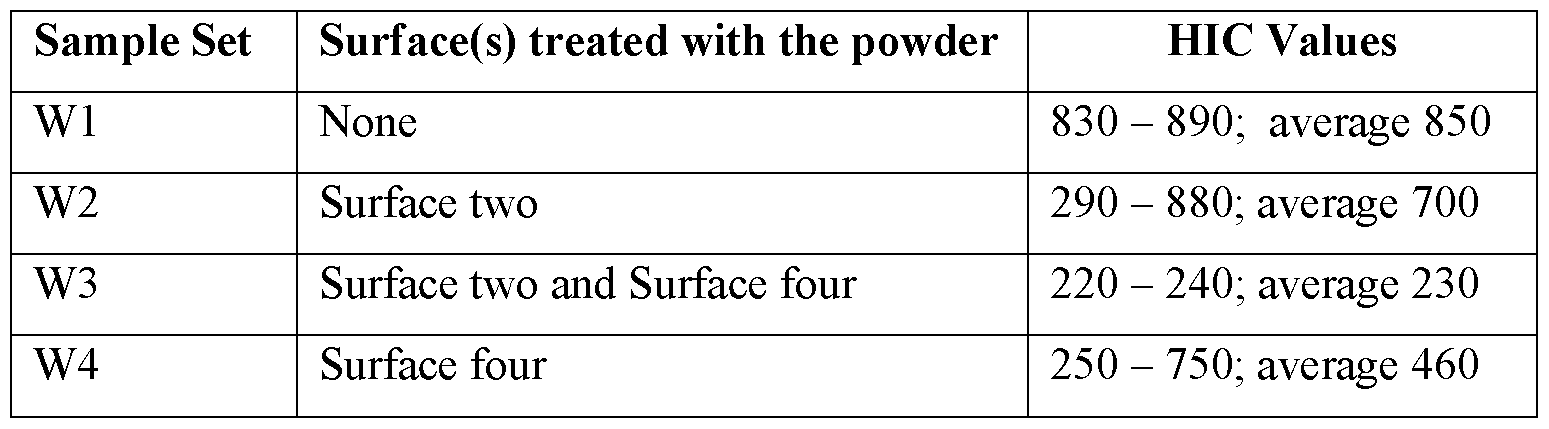
- Vehicle windscreens were constructed having the constructions as shown in Table 3.
- Each vehicle windscreen consisted of a pair of initially press bent glass sheets of clear soda-lime-silica glass having a thickness of 2. 1mm laminated together using a sheet of PVB having a thickness of 0.76mm. Conventional lamination conditions were used, and the same lamination conditions were used to prepare each vehicle windscreen. Treatment with the powder was carried out on the bent glass sheets prior to lamination. In connection with the sample sets shown in Table 2, this corresponds to how samples in sample sets Fl or F2 were treated prior to the strength measurements being made.
- the vehicle windscreens were made by first bending the glass sheets that were to be the inner and outer panes.
- the glass sheet that was to be the outer pane is the sheet of glass of the vehicle windscreen that faces the exterior of the vehicle in which the vehicle windscreen is installed (or is intended to be installed); and the inner pane is the sheet of glass of the vehicle windscreen that faces the interior of the vehicle in which the vehicle windscreen is installed (or is intended to be installed).
- the outer pane of the laminated glazing 1 corresponds to the first sheet of glass 3 and the inner pane of the laminated glazing 1 corresponds to the second sheet of glass 7.
- each glass sheet was bent (often referred to as “shaped”) separately using a conventional press bending process such as described in EP0398759A2 or W02004/085324A1.
- the bent glass sheets were then laminated together using a sheet of PVB having a thickness of 0.76mm to make the samples in Table 3.
- Samples in sample set W1 are comparative, where neither of the inner or outer panes were treated with the powder.
- the glass sheets used to make each sample in sample set W2 were shaped using the same bending process as used to shape the glass sheets for samples in sample set W 1 , but prior to assembling the individual bent glass sheets to make the final windscreen, the surface of the outer pane that would be facing the sheet of PVB in the final laminated windscreen (conventionally referred to as surface two) was treated with the previously described powder. No other glass surface was treated with the powder.
- the glass sheets used to make each sample in sample set W3 were shaped using the same bending process as used to shape the glass sheets for samples in sample set Wl, but prior to assembling the individual bent glass sheets to make the final windscreen, the surface of the outer pane that would be facing the sheet of PVB in the final laminated windscreen (conventionally referred to as surface two) was treated with the previously described powder (as in sample set W2). However, in addition the surface of the inner pane that would not be facing the sheet of PVB in the final laminated windscreen (conventionally referred to as surface for) was also treated with the previously described powder.
- the glass sheets used to make each sample in sample set W4 were shaped using the same bending process as used to shape the glass sheets for samples in sample set Wl, but prior to assembling the individual bent glass sheets to make the final windscreen, the surface of the inner pane that would not be facing the sheet of PVB in the final laminated windscreen (conventionally referred to as surface four) was treated with the previously described powder. No other glass surface was treated with the powder.
- surface one was a convex surface and surface two was a concave surface
- surface three was a convex surface
- surface four was a concave surface.
- Treatment with the powder consisted of applying 1g of the powder to a portion of the surface of the bent glass sheet that would be a test impact location for a HIC test.
- the 1g of test powder was uniformly spread over a square area of dimensions 50 mm x 50 mm using a pressing force of about 0.5N using a rubber tool.
- Linear, parallel application of the test powder was used to cover the square area in about 5 seconds and a total treatment time of about 60 seconds.
- the square forming the treated region was centred at the desired impact location for the HIC test.
- the glass sheet was washed with water to remove any test powder from the glass sheet that may otherwise end up in the final laminated glazing.
- the particle size distribution of the powder may also help assist removal of the powder from the glass sheet following treatment. Both surfaces of the glass sheet may be cleaned, even if only one surface of the glass sheet is treated with the powder.
- sample sets Wl, W2, W3 and W4 surface one and surface three was the tin side of the respective glass sheets used for the outer and inner plies. Due to the similar strength of the heat treated sheets, see sample sets Fl and F2 (and Table 2), similar results would be expected if surface one was the tin side and surface three was the air side; or if surface one was the air side and surface three was the tin side; or if surface one was the air side and surface three was the air side.
- HIC test was carried out using the procedure described in EURO-NCAP Vulnerable Road User Testing Protocol Version 9.0.2 at grid position A, 12, +2 and an impact velocity of 40km/h.
- the head form used to determine the HIC value was as described in UN Regulation No. 127 (E/ECE/324/Rev.2/Add. 126/Rev.2) Annex 4.
- the increased Weibull Modulus indicates the strength distribution is less variable after the glass sheets have been treated with the powder. Without being bound by theory, this is may help reduce the overall HIC value for the vehicle windscreens treated with the powder because there are less likely to be regions of the glass sheet surface with higher than average strength.
- HIC value for a vehicle windscreen it may be desirable to have a HIC value below 700, preferably below 650.
- Sample sets W3 and W4 have an average HIC value below 700.
- the HIC value was consistently less than 700 with little variability in the HIC values for the vehicle windscreens in this sample set.
- the treated region may be less than 80% of the area of the respective major surface of the glass sheet and/or the treated region may be more than 10% of the area of the respective major surface of the glass sheet. Having a greater percentage of surface two and/or surface four treated with the powder increases the area of the vehicle windscreen that has reduced strength (and so a reduced HIC value), thereby helping to reduce the potential for injury to a pedestrian whose head may strike different parts of the vehicle windscreen.
- FIG. 4 shows a vehicle that includes a windscreen 100 made in accordance with the present invention.
- the windscreen 100 is essentially as previously described with refence to figures 1 and 2.
- the windscreen 100 has a through vision region defined by upper edge D-G; right hand edge F- G; lower edge E-F and left-hand edge D-E.
- Inboard of the upper, right hand, lower and left-hand edges is a treated region 104.
- the treated region is defined by upper edge D’-G’; right hand edge F’-G’; lower edge E’-F’ and left-hand edge D’-E’ .
- Inboard of the treated region surface 4 of the windscreen has been treated with powder of the type described above.
- the treated region 104 is not discernible to the naked eye and forms part of the through vision region 102. Outboard of the treated region 104, surface 4 of the windscreen has not been treated with powder.
- the treated region 104 is about 75% of the entire see through region 102.
- surface two has also been treated with powder, which may be the same powder as used to treated surface four.
- Any combination of surface one, surface two, surface three and surface four may be treated.
- the strength of the sheet of glass is reduced, which also reduces the strength of the windscreen 100. If a pedestrian hits the windscreen 100, thereby making contact with surface one of the windscreen, the windscreen is able to break more easily because of the treatment with the powder.
- Treatment of the sheet of glass may be before the sheet of glass is laminated to another sheet of glazing material, in particular a sheet of glass, to make the laminated glazing.
- the sheet of glass may be treated with the powder after having been laminated to a sheet of glazing material, such as a sheet of glass, although this is only possible for exposed surfaces of the windscreen.
Landscapes
- Chemical & Material Sciences (AREA)
- Engineering & Computer Science (AREA)
- Materials Engineering (AREA)
- Organic Chemistry (AREA)
- Mechanical Engineering (AREA)
- Life Sciences & Earth Sciences (AREA)
- Chemical Kinetics & Catalysis (AREA)
- General Chemical & Material Sciences (AREA)
- Geochemistry & Mineralogy (AREA)
- Composite Materials (AREA)
- Glass Compositions (AREA)
Abstract
Description


Claims
Priority Applications (2)
| Application Number | Priority Date | Filing Date | Title |
|---|---|---|---|
| EP24740517.8A EP4735395A1 (en) | 2023-06-29 | 2024-06-28 | Method for affecting glass strength |
| CN202480043140.9A CN121419948A (en) | 2023-06-29 | 2024-06-28 | Methods affecting glass strength |
Applications Claiming Priority (2)
| Application Number | Priority Date | Filing Date | Title |
|---|---|---|---|
| GB2309915.3 | 2023-06-29 | ||
| GBGB2309915.3A GB202309915D0 (en) | 2023-06-29 | 2023-06-29 | Method for affecting glass strength |
Publications (1)
| Publication Number | Publication Date |
|---|---|
| WO2025003699A1 true WO2025003699A1 (en) | 2025-01-02 |
Family
ID=87556784
Family Applications (1)
| Application Number | Title | Priority Date | Filing Date |
|---|---|---|---|
| PCT/GB2024/051685 Ceased WO2025003699A1 (en) | 2023-06-29 | 2024-06-28 | Method for affecting glass strength |
Country Status (4)
| Country | Link |
|---|---|
| EP (1) | EP4735395A1 (en) |
| CN (1) | CN121419948A (en) |
| GB (1) | GB202309915D0 (en) |
| WO (1) | WO2025003699A1 (en) |
Citations (18)
| Publication number | Priority date | Publication date | Assignee | Title |
|---|---|---|---|---|
| US2383500A (en) | 1944-02-04 | 1945-08-28 | Albert S Polan | Polishing compound |
| US2597182A (en) | 1949-03-31 | 1952-05-20 | Libbey Owens Ford Glass Co | Surfacing glass sheets or plates |
| US3522342A (en) | 1967-07-03 | 1970-07-28 | Nypel Inc | Apparatus and method for making bristles having a filler |
| US4507361A (en) | 1983-07-18 | 1985-03-26 | Allied Corporation | Low moisture absorption bristle of nylon and polyester |
| EP0398759A2 (en) | 1989-05-19 | 1990-11-22 | Nippon Sheet Glass Co. Ltd. | Method of heating glass sheet for laminated glass |
| US5226929A (en) | 1991-05-15 | 1993-07-13 | Sumitomo Chemical Company, Ltd. | Abrasive brush |
| US5694479A (en) | 1994-06-02 | 1997-12-02 | Saint Gobain Vitrage | Process for measuring the optical quality of a glass product |
| US20030203337A1 (en) | 2002-04-25 | 2003-10-30 | Roulston John S. | Unexpanded perlite ore polishing composition and methods |
| WO2003091351A2 (en) | 2002-04-25 | 2003-11-06 | Advanced Minerals Corporation | Polishing composition and methods |
| US20030224702A1 (en) | 2002-04-25 | 2003-12-04 | Roulston John S. | Unexpanded perlite ore polishing composition and methods |
| WO2004083835A1 (en) | 2003-03-19 | 2004-09-30 | Pilkington Plc | Method to determine the optical quality of a glazing |
| WO2004085324A1 (en) | 2003-03-28 | 2004-10-07 | Pilkington Automotive Deutschland Gmbh | Process and plant for the treatment of the glass sheets of an asymmetric glass-sheet pair |
| EP2062862A1 (en) | 2006-09-14 | 2009-05-27 | Nippon Electric Glass Co., Ltd. | Sheet glass laminate structure and multiple sheet glass laminate structure |
| US20120094578A1 (en) | 2010-01-27 | 2012-04-19 | Farning Abigail R | Heterocoagulate, and compositions and method for polishing and surface treatment |
| WO2013181505A1 (en) | 2012-06-01 | 2013-12-05 | Corning Incorporated | Glass laminate construction for optimized breakage performance |
| WO2019245819A1 (en) | 2018-06-22 | 2019-12-26 | Corning Incorporated | Glass laminate construction with controlled breakage for pedestrian safety |
| WO2021015654A1 (en) | 2019-07-19 | 2021-01-28 | Essity Hygiene And Health Aktiebolag | Absorbent article comprising a core having alternating high density and low density areas of absorbent material |
| WO2022224912A1 (en) * | 2021-04-20 | 2022-10-27 | Agc株式会社 | Manufacturing method for laminated glass for automobile window |
-
2023
- 2023-06-29 GB GBGB2309915.3A patent/GB202309915D0/en not_active Ceased
-
2024
- 2024-06-28 EP EP24740517.8A patent/EP4735395A1/en active Pending
- 2024-06-28 WO PCT/GB2024/051685 patent/WO2025003699A1/en not_active Ceased
- 2024-06-28 CN CN202480043140.9A patent/CN121419948A/en active Pending
Patent Citations (18)
| Publication number | Priority date | Publication date | Assignee | Title |
|---|---|---|---|---|
| US2383500A (en) | 1944-02-04 | 1945-08-28 | Albert S Polan | Polishing compound |
| US2597182A (en) | 1949-03-31 | 1952-05-20 | Libbey Owens Ford Glass Co | Surfacing glass sheets or plates |
| US3522342A (en) | 1967-07-03 | 1970-07-28 | Nypel Inc | Apparatus and method for making bristles having a filler |
| US4507361A (en) | 1983-07-18 | 1985-03-26 | Allied Corporation | Low moisture absorption bristle of nylon and polyester |
| EP0398759A2 (en) | 1989-05-19 | 1990-11-22 | Nippon Sheet Glass Co. Ltd. | Method of heating glass sheet for laminated glass |
| US5226929A (en) | 1991-05-15 | 1993-07-13 | Sumitomo Chemical Company, Ltd. | Abrasive brush |
| US5694479A (en) | 1994-06-02 | 1997-12-02 | Saint Gobain Vitrage | Process for measuring the optical quality of a glass product |
| US20030203337A1 (en) | 2002-04-25 | 2003-10-30 | Roulston John S. | Unexpanded perlite ore polishing composition and methods |
| WO2003091351A2 (en) | 2002-04-25 | 2003-11-06 | Advanced Minerals Corporation | Polishing composition and methods |
| US20030224702A1 (en) | 2002-04-25 | 2003-12-04 | Roulston John S. | Unexpanded perlite ore polishing composition and methods |
| WO2004083835A1 (en) | 2003-03-19 | 2004-09-30 | Pilkington Plc | Method to determine the optical quality of a glazing |
| WO2004085324A1 (en) | 2003-03-28 | 2004-10-07 | Pilkington Automotive Deutschland Gmbh | Process and plant for the treatment of the glass sheets of an asymmetric glass-sheet pair |
| EP2062862A1 (en) | 2006-09-14 | 2009-05-27 | Nippon Electric Glass Co., Ltd. | Sheet glass laminate structure and multiple sheet glass laminate structure |
| US20120094578A1 (en) | 2010-01-27 | 2012-04-19 | Farning Abigail R | Heterocoagulate, and compositions and method for polishing and surface treatment |
| WO2013181505A1 (en) | 2012-06-01 | 2013-12-05 | Corning Incorporated | Glass laminate construction for optimized breakage performance |
| WO2019245819A1 (en) | 2018-06-22 | 2019-12-26 | Corning Incorporated | Glass laminate construction with controlled breakage for pedestrian safety |
| WO2021015654A1 (en) | 2019-07-19 | 2021-01-28 | Essity Hygiene And Health Aktiebolag | Absorbent article comprising a core having alternating high density and low density areas of absorbent material |
| WO2022224912A1 (en) * | 2021-04-20 | 2022-10-27 | Agc株式会社 | Manufacturing method for laminated glass for automobile window |
Non-Patent Citations (1)
| Title |
|---|
| ACTA MATERIALA, vol. 59, no. 4, 2011, pages 1790 - 1799 |
Also Published As
| Publication number | Publication date |
|---|---|
| CN121419948A (en) | 2026-01-27 |
| EP4735395A1 (en) | 2026-05-06 |
| GB202309915D0 (en) | 2023-08-16 |
Similar Documents
| Publication | Publication Date | Title |
|---|---|---|
| CN104703793B (en) | Glass laminate construction for optimized breakability | |
| JP6431069B2 (en) | Thin glass laminate structure | |
| US20180154615A1 (en) | Glass laminate with pane having glass-glass laminate structure | |
| EP3137428B1 (en) | Strengthened glass and compositions therefor | |
| CN109016739B (en) | Lightweight hybrid glass laminate | |
| US20180200995A1 (en) | Strengthened asymmetric glass laminates | |
| US20170113520A1 (en) | Composite glass with thin inner pane | |
| US20260061725A1 (en) | Laminated glazing | |
| CN107405884A (en) | Composite glass with thin inner glass pane and acoustically damping thermoplastic interlayer | |
| JPH1160294A (en) | Laminated glass for vehicle | |
| WO2025003699A1 (en) | Method for affecting glass strength | |
| WO2025003700A1 (en) | Method for affecting glass strength | |
| WO2026053984A1 (en) | Laminated glass |
Legal Events
| Date | Code | Title | Description |
|---|---|---|---|
| 121 | Ep: the epo has been informed by wipo that ep was designated in this application |
Ref document number: 24740517 Country of ref document: EP Kind code of ref document: A1 |
|
| WWE | Wipo information: entry into national phase |
Ref document number: 2024740517 Country of ref document: EP |
|
| NENP | Non-entry into the national phase |
Ref country code: DE |
|
| ENP | Entry into the national phase |
Ref document number: 2024740517 Country of ref document: EP Effective date: 20260129 |
|
| ENP | Entry into the national phase |
Ref document number: 2024740517 Country of ref document: EP Effective date: 20260129 |