WO2025003530A1 - Method and system for scalable quantum circuit configuration in noisy intermediate-scale quantum devices - Google Patents

Method and system for scalable quantum circuit configuration in noisy intermediate-scale quantum devices Download PDF

Info

Publication number
WO2025003530A1
WO2025003530A1 PCT/EP2024/068523 EP2024068523W WO2025003530A1 WO 2025003530 A1 WO2025003530 A1 WO 2025003530A1 EP 2024068523 W EP2024068523 W EP 2024068523W WO 2025003530 A1 WO2025003530 A1 WO 2025003530A1
Authority
WO
WIPO (PCT)
Prior art keywords
quantum
ansatz
function
wave
computing
Prior art date
Legal status (The legal status is an assumption and is not a legal conclusion. Google has not performed a legal analysis and makes no representation as to the accuracy of the status listed.)
Ceased
Application number
PCT/EP2024/068523
Other languages
French (fr)
Inventor
César FENIOU
Baptiste CLAUDON
Muhammad HASSAN
Axel COURTAT
Olivier ADJOUA
Yvon MADAY
Jean-Philip PIQUEMAL
Current Assignee (The listed assignees may be inaccurate. Google has not performed a legal analysis and makes no representation or warranty as to the accuracy of the list.)
Qubit Pharmaceuticals
Original Assignee
Qubit Pharmaceuticals
Priority date (The priority date is an assumption and is not a legal conclusion. Google has not performed a legal analysis and makes no representation as to the accuracy of the date listed.)
Filing date
Publication date
Application filed by Qubit Pharmaceuticals filed Critical Qubit Pharmaceuticals
Priority to EP24738295.5A priority Critical patent/EP4736079A1/en
Publication of WO2025003530A1 publication Critical patent/WO2025003530A1/en
Anticipated expiration legal-status Critical
Ceased legal-status Critical Current

Links

Classifications

    • GPHYSICS
    • G06COMPUTING OR CALCULATING; COUNTING
    • G06NCOMPUTING ARRANGEMENTS BASED ON SPECIFIC COMPUTATIONAL MODELS
    • G06N10/00Quantum computing, i.e. information processing based on quantum-mechanical phenomena
    • GPHYSICS
    • G06COMPUTING OR CALCULATING; COUNTING
    • G06FELECTRIC DIGITAL DATA PROCESSING
    • G06F17/00Digital computing or data processing equipment or methods, specially adapted for specific functions
    • G06F17/10Complex mathematical operations
    • G06F17/11Complex mathematical operations for solving equations, e.g. nonlinear equations, general mathematical optimization problems
    • GPHYSICS
    • G06COMPUTING OR CALCULATING; COUNTING
    • G06NCOMPUTING ARRANGEMENTS BASED ON SPECIFIC COMPUTATIONAL MODELS
    • G06N10/00Quantum computing, i.e. information processing based on quantum-mechanical phenomena
    • G06N10/80Quantum programming, e.g. interfaces, languages or software-development kits for creating or handling programs capable of running on quantum computers; Platforms for simulating or accessing quantum computers, e.g. cloud-based quantum computing

Definitions

  • the present invention relates to the field of quantum computers.
  • Quantum computing is a rapidly improving technology that employs the laws of quantum mechanics to solve specific problems which are too complex for classical computers.
  • quantum computing has gathered significant attention due to its potential to solve computational problems that are not adapted for classical computers.
  • hybrid quantum-classical systems which integrate quantum and classical computing elements.
  • VQEs operate by constructing a parameterized wave-function, which is optimized to minimize the expectation value of a given Hamiltonian.
  • NISQ intermediate-scale quantum
  • the invention relates to a computer implemented method for the generation of an optimized ansatz ( ⁇ (m)) wave-function, said computer implemented method comprising operating a system comprising quantum computational means and classical computational means, said method comprising: o Generating analytic functions of a parameter 0 from an objective function implying a current ansatz, unitary operators and parameter; o Selecting several angles values of the parameter 0 to generate, from the analytic functions of the parameter 0, a system of equations minimizing the number of measurements to be done on quantum computational means; o On the quantum computational means, computing unknown operator expectation values of the objective function at the several selected angles values, o On the classical computational means, computing the objective function for any unitary operator (B), any angle of the parameter 0, and thereby obtain:
  • the invention introduces a novel implementation of a method of generation of an optimized ansatz (MJ(m)) wave-function, such as a Variational Quantum Eigensolver (VQE), optimized for noisy quantum devices. It implements an adaptive, quasi-greedy optimization development that reduces dependency on gradient calculations. This approach enables more efficient quantum computations by decreasing resource usage and enhancing the system’s resilience to quantum noise. Consequently, the invention improves the internal functioning of quantum hardware and integrates well with advanced classical computing techniques to enhance the performance and accuracy of quantum circuits.
  • MJ(m) optimized ansatz wave-function
  • VQE Variational Quantum Eigensolver
  • the invention capitalizes on gradient-free techniques to dynamically optimize quantum circuits, offering scalable and less resource-intensive quantum computations.
  • the method as illustrated hereafter is effective even in environments with significant quantum noise and imperfections.
  • the invention is applicable across various quantum computation methods and hardware, especially useful in quantum chemistry and complex materials developement. It facilitates the development of quantum computation that leverage quantum mechanical properties like superposition and entanglement, simplifying the complexity of quantum computing and delivering significant computational benefits over both classical and traditional quantum methods.
  • the invention can boost the efficiency and accuracy of quantum computations on noisy Intermediate Scale Quantum (NISQ) devices through a particular application of gradient-free optimization within the Greedy Gradient-free Adaptive Variational Quantum Eigensolver (GGA- VQE).
  • NISQ Noise-Socket Quantum
  • GGA- VQE Greedy Gradient-free Adaptive Variational Quantum Eigensolver
  • This adaptation notably reduces the number of quantum circuit measurements required per iteration, providing substantial benefits in scenarios demanding high computational precision with limited resources.
  • Such improvements are particularly advantageously in quantum chemical simulations for modeling complex molecular systems, resulting in reduced operational costs and enhanced performance.
  • This method has proven effective in accurately determining the ground states of complex systems, crucial for advances in chemical and material sciences.
  • the method according to the invention can optionally include one or more of the following characteristics alone or in combination: for the step of generating analytic functions of a parameter 0 from an objective function is done using trigonometric transformations. for the step of computing unknown operator expectation values of the objective function at the several selected angles values is done employing a minimal measurement strategy that optimizes the sampling points based on the trigonometric properties of the objective function; for the step of computing the objective function for any unitary operator (B), the optimal unitary operator Bm is determined by a greedy, gradient-free optimization process, and the optimal angle 0'm is optimized through analytical methods to achieve minimal energy configuration.
  • the step of computing the objective function for example L(B,0,
  • the steps of Generating, Selecting, Computing on the quantum computational means, and Computing the objective on the classical computational means are repeated iteratively and wherein the objective function, for example L(B,0,
  • the quantum computational means comprise quantum hardware or classical hardware configured to simulate quantum computing, and preferably are selected among: quantum computers based on trapped ions, superconducting quantum computers, neutral atoms in optical lattices, quantum dot computer spin-based or spatial-based, Bose-Einstein condensate-based quantum computer, quantum wells computers, nuclear magnetic resonance quantum computer, cavity quantum electrodynamics, optical
  • the classical computational means comprise CPU, GPU or ASIC, preferably configured to support the computational demands and parallel processing requirements of hybrid quantum-classical algorithms.
  • the pool of unitary operators is selected among: Qubit Excitation-based Pool, Qubit Hardware-efficient Pool, and/or Minimal Hardware-efficient Pool.
  • the pool of unitary operators includes single and double fermionic excitation operators, spin-complemented pairs of single and double fermionic excitation operators and/or individual Pauli chains, e.g. from the division of fermionic-ADAPT operators after a Jordan- Wine mapping.
  • the ansatz wave function comprises more than five parameters, preferably more than 10, 15, 20 parameters.
  • the unitary operator selected is the one whose action on a current ansatz ( ⁇ (curr)) produce a new wave function with the largest orbital overlap with respect to a target wave function (I 1 target).
  • the parameterized unitary operator ( ⁇ m B m ) is select so as that its action on the current ansatz
  • Y(curr) is likely to produce a new wave-function having the largest overlap with a target wave-function the overlap is calculated according to a Compute-UncomputeMethod or an Hadamard SWAP-Test.
  • the target wave function (
  • the target wave function is with a tractable high accuracy approximation of a full-CI wave- function.
  • the target wave function is an ADAPT-VQE ansatz, for example comprising more than five parameters, preferably more than 10, 15, 20 parameters.
  • the target wave function is a Selected-Configuration Interaction ansatz, preferably computed according to the so-called Configuration Interaction perturbatively selected iteratively (Cl PSI).
  • the invention can also relate to a computer implemented method for simulating quantum many-body system using the optimized ansatz generated according to the method of the invention.
  • the invention can also relate to quantum computing system for quantum chemical simulations characterized in that it comprises an optimized quantum computing circuit obtainable, preferably obtained, by a method according to a method of the invention.
  • the quantum computing means for quantum chemical simulations comprises a quantum circuit corresponding to an ansatz of a molecule comprising at least three atoms, said ansatz comprising no more than 20 parameters per atom and has a chemical accuracy threshold of 10 -3 Hartree or less, at bond length of 3 Angstrom or more.
  • the invention can also relate to one or more computer-readable media storing computer-executable instructions, which when executed by a computer cause the computer to perform a method according to the present invention.
  • the one or more computer-readable media storing computer-executable instructions, when executed by a computer cause the computer to perform a method, the method comprising: o Generating analytic functions of a parameter 0 from an objective function implying a current ansatz, unitary operators and parameter; o Selecting several angles values of the parameter 0 to generate, from the analytic functions of the parameter 0, a system of equations minimizing the number of measurements to be done on quantum computational means; o On the quantum computational means, computing unknown operator expectation values of the objective function at the several selected angles values, o On the classical computational means, computing the objective function for any unitary operator (B), any angle of the parameter 0, and thereby obtain:
  • the invention can also relate to a computer configured to implement a method according to the invention.
  • the invention can relate to a computing system, comprising: quantum computing means; and classical computing means configured to communicate with and control the quantum computing means, the system being further configured to implement a method according to the invention.
  • the invention can relate to a computing system, comprising: quantum computing means; and classical computing means configured to communicate with and control the quantum computing means, the system being further configured to: o Generating analytic functions of a parameter 0 from an objective function implying a current ansatz, unitary operators and parameter; o Selecting several angles values of the parameter 0 to generate, from the analytic functions of the parameter 0, a system of equations minimizing the number of measurements to be done on quantum computational means; o On the quantum computational means, computing unknown operator expectation values of the objective function at the several selected angles values, o On the classical computational means, computing the objective function for any unitary operator (B), any angle of the parameter 0, and thereby obtain:
  • the invention can relate to a computing system, comprising: quantum computing means; and classical computing means configured to communicate with and control the quantum computing means, the system being further configured to: o Generating, preferably using classical computational means, analytic functions of the parameter 0 for any unitary operator (B), from an objective function L(B,0,
  • the invention can also relate to the use of a method, a quantum circuit or a computer system of the invention during execution of quantum circuit simulating the quantum dynamics of chemical reactions.
  • FIG. 1 is an illustration of a situation where the ADAPT-VQE selection criterion does not pick the optimal operator leading to the largest energy drop
  • FIG. 2 is an illustration of a Hadamard SWAP-Test circuit to compute the overlap
  • FIG. 3 is a schematic overview of the GGA-VQE algorithm with hybrid observable measurement.
  • the HPC simulator is used to evaluate the final ansatz wavefunction obtained by executing GGA-VQE on the QPU
  • FIG. 4 is a illustration of the energy convergence of the GGA-VQE algorithm with respect to the number of iterations.
  • FIG. 5 is a convergence plot of the fidelity of the GGA-VQE ansatz wave-function produced by the QPU and re-implemented in a HPC simulator (hybrid evaluation approach) with the exact ground state of this Ising model obtained using a diagonalisation procedure on the HPC simulator.
  • FIG. 6 is an illustration of expected energy drop of each Hermitian generator from the operator pool during the GGA-VQE iterative procedure on the QPU.
  • the minimal pool operators, numbered from 1 to 48, are listed in the same order as defined in Equation (18). All energy differences are expressed in eV.
  • FIG. 7 is an illustration of one-dimensional energy landscapes of the operators YO and Z0Z1 when applied to the initial state.
  • the light grey curve is extrapolated from five noisy circuit evaluations following the method described in the present invention.
  • the black curve is the exact energy landscape obtained from an HPC simulation. The energy differences are expressed in eV, and the angles are given in radians.
  • FIG. 8 is a schematic representation of an embodiment of a computer configured to implement the invention.
  • FIG. 9 illustrates the Overlap-GGA-VQE ansatz with the target state. It comprises the fidelity of a classically simulated ansatz with the target state, and the hybrid and QPU fidelity evaluations.
  • the hybrid evaluation is carried out by retrieving the Overlap-GGA-VQE ansatz wave-function generated by the QPU, re-implementing it on the HPC simulator, and then evaluating the variational energy.
  • FIG. 10 illustrates a quantum circuit performing a generic single-qubit evolution
  • FIG. 11 illustrates a quantum circuit performing a generic double-qubit evolution
  • each box in the flow diagrams or block diagrams may represent a system, a device, a module or code which comprises several executable instructions for implementing the specified logical function(s).
  • the functions associated with the box may appear in a different order than indicated in the drawings. For example, two boxes successively shown, may be executed substantially simultaneously, or boxes may sometimes be executed in the reverse order, depending on the functionality involved.
  • Each box of flow diagrams or block diagrams and combinations of boxes in flow diagrams or block diagrams may be implemented by special systems that perform the specified functions or actions or perform combinations of special equipment and computer instructions.
  • quantum computing devices operate on quantum bits (or qubits) that store or represent information as both binary states and superpositions of binary states.
  • quantum computer is probabilistic, thus measurements of algorithmic outputs provide a proper solution within a confidence interval. The computation is then repeated until a satisfactory probable certainty of solution can be achieved.
  • a quantum computation uses a qubit as its essential unit instead of a classical computing bit.
  • the qubit e.g., quantum binary digit
  • the qubit is the quantum-mechanical analog of the classical bit.
  • a “quantum circuit” can refer to a series of quantum gates organized sequentially to enact a unitary transformation on a specified initial quantum state, resulting in a transformed final quantum state. Each gate within the circuit may be parameterized, for instance, by specifying one or more rotational angles in single-qubit rotation gates.
  • a "gate” is an elementary operation within a quantum circuit that modifies quantum states through specified transformations.
  • quantum computing device encompasses any system capable of implementing quantum gates and managing qubits, which may include hardware that exploits quantum physical phenomena to manipulate physical qubits or classical hardware designed to simulate qubits.
  • Hamiltonian H or “molecular Hamiltonian” can mean, within the meaning of the invention, an operator that fully defines a quantum system.
  • the lowest eigenvalue of the Hamiltonian represents the ground state, which is frequently the objective of optimization in quantum chemistry calculations.
  • the representation of a Hamiltonian may vary with each molecule, depending on the chosen computational basis. "Energy” in this context denotes the expectation value of the Hamiltonian for a given normalized quantum state, with minimization of this value indicative of alignment with the ground state.
  • a “NISQ (Noisy Intermediate Scale Quantum) device” can refer to a category of quantum computers characterized by possessing a number of qubits ranging from approximately 50 to a few hundred, where the quantum operations are inherently accompanied by notable noise levels.
  • a "Variational Quantum Eigensolver” can be defined, according to the invention, as an algorithm designed for solving the eigenvalue problems of quantum systems, particularly effective on NISQ devices.
  • the VQE algorithm can be characterized by parameterized quantum circuits where quantum circuits parameters are optimized through a feedback loop to find a system's ground state.
  • a “hybrid quantum-classical system”, according to the invention can be a computing architecture that combines quantum and classical processing capabilities, where for example quantum processor is tasked with state preparation and measurement while classical processor manages optimization and data processing, creating a feedback loop with the quantum processor.
  • Quantum circuit measurements can involve the process of obtaining specific quantum state properties through the observation of qubits, where each measurement typically results in a probabilistic collapse of the quantum state into one of several possible states, influencing subsequent quantum operations.
  • Adaptive algorithms in the context of the invention can be considered as algorithms that adjust their operational parameters or procedures based on feedback concerning their performance.
  • “Gradient-free optimization” in the context of the invention can be considered as an optimization approach that bypasses the computational overhead associated with gradient calculations by employing alternative strategies such as heuristic or probabilistic techniques to determine the direction of optimization, significantly reducing computational demands especially in environments with high noise levels.
  • An "operator pool” in the context of the invention can comprise a predefined set of quantum gates or operations from which selections are made during the execution of a quantum algorithm to optimize performance, particularly pivotal in adaptive and variational quantum algorithms.
  • Quantized unitary operators are defined as quantum operators that influence the state of qubits within a quantum circuit through adjustable parameters, typically involving angles in rotation gates that modify the state transformation properties of the operators.
  • wavefunction ( ⁇ ) can mean, within the meaning of the invention, a function which represents the probability density of finding a particle at a given location, preferably on Hilbert space.
  • a target wave function can be an approximation of the ground state of an Hamiltonian.
  • ansatz or “ansatz wavefunction” can mean, within the meaning of the invention, a subroutine consisting of a sequence of gates applied to specific wires.
  • An ansatz wavefunction can capture the most important contributions to the electronic correlation energy and, at the same time, is capable of being represented on rather shallow quantum circuits.
  • the initial anthesis can also be called the current ansatz which is the ansatz which will be grown by appending the selected operators.
  • the process is preferably iterative, the process begin with an initial ansatz while after at least an iteration a current ansatz (the current ansatz can generally be the new ansatz of the previous iteration) is used.
  • “Greedy algorithms” in the context of the invention can be defined as algorithms that make successive choices that appear to be optimal at each step, aimed at achieving a local optimum with an assumption that these local optima will lead to a globally optimal solution.
  • “Ground state approximation” in the context of the invention can refer to a method of estimating the lowest energy state of a quantum system, which is found several technical applications, for example in quantum chemistry for predicting molecular configurations and interactions.
  • process compute “determine”, “display”, “extract”, “compare” or more broadly “executable operation” can mean, within the meaning of the invention, an action performed by a computing device or a processor unless the context indicates otherwise.
  • the operations relate to actions and/or processes of a data processing system, for example a computing system or an electronic computing device, which manipulates and transforms the data represented as physical (electronic) quantities in the memories of the computing system or other devices for storing, transmitting or displaying information.
  • calculation operations are carried out by the processor of the device, the produced data are entered in a corresponding field in a data memory and this field or these fields can be returned to a user for example through a Human Machine Interface formatting such data.
  • These operations may be based on applications or software.
  • application means any expression, code or notation, of a set of instructions intended to cause a data processing to perform a particular function directly or indirectly (for example after a conversion operation into another code).
  • exemplary program codes may include, but are not limited to, a subprogram, a function, an executable application, a source code, an object code, a library and/or any other sequence of instructions designed for being performed on a computing system.
  • processor is meant, within the meaning of the invention, at least one hardware circuit configured to perform operations according to instructions contained in a code.
  • the hardware circuit may be an integrated circuit. Examples of a processor include, but are not limited to, a central processing unit, a graphics processor, an application-specific integrated circuit (“ASIC” according to Anglo-Saxon terminology), and a programmable logic circuit. A single processor or several other units may be used to implement the invention.
  • Coupled is meant, within the meaning of the invention, connected, directly or indirectly, with one or more intermediate elements. Two elements may be coupled mechanically, electrically or linked by a communication channel.
  • human-machine interface corresponds to any element allowing a human being to communicate with a computer, in particular and without that list being exhaustive, a keyboard and means allowing in response to the commands entered on the keyboard to perform displays and optionally to select with the mouse or a touchpad item displayed on the screen.
  • a touch screen for selecting directly on the screen the elements touched by the finger or an object and optionally with the possibility of displaying a virtual keyboard.
  • the inventors developed a new method for optimizing variational quantum eigensolvers in noisy quantum environments.
  • This method involving quantum computers and classical computers solves the problem of inefficient quantum resource utilization and excessive computational demands typical in conventional quantum computing methodologies.
  • the inventors developed the use of gradient-free optimization and adaptive circuit configuration.
  • the use of analytic landscape functions that are simple trigonometric functions of 0, enable precise and efficient manipulation of parameters to optimize the quantum circuit's performance.
  • applying trigonometric transformations to the objective function to express it in terms of elementary trigonometric functions of 0, enabling the use of a minimal number of measurements.
  • Such features allow for significant reductions in the number of quantum measurements required and enhance the efficiency of determining ground state energies of quantum systems, even in the presence of operational noise typically associated with NISQ devices.
  • analytic functions of the parameter 0 involves the utilization of trigonometric expressions to define the dependencies of quantum circuit outcomes on changes in 0.
  • the invention preferably relies on an approach where the optimal parameter values (including 0) are identified through energy sorting mechanisms.
  • This approach involves evaluating the objective function at selected values of 0 to construct a landscape function that is analytically tractable.
  • landscape functions are explicitly stated to be analytic functions of 0, making it possible to express the objective function in terms of simple trigonometric functions of 0 for any unitary operator belonging to the chosen operator pool. This facilitates a straightforward computational approach to optimizing the ansatz by allowing for the direct calculation of the most promising modifications to the quantum circuit based on the minimization of the energy landscape.
  • the invention relates to a computer implemented method. This method can be used for the generation of an optimized ansatz ( ⁇ (m)) wave-function.
  • the computer implemented method preferably comprise operating a system comprising quantum computational means and classical computational means.
  • the method can comprise the following steps: Generating analytic functions of a parameter 0 from an objective function; Selecting several angles values of the parameter 0 to generate minimizing the number of measurements to be done on quantum computational means; Computing unknown operator expectation values of the objective function at the several selected angles values; Computing the objective function for any unitary operator (B), any angle of the parameter 0, and thereby obtain a locally optimal unitary operator that should be added to the current ansatz
  • a method of the invention can comprise: o Generating analytic functions of a parameter 0 from an objective function using trigonometric transformations, which include a current ansatz, unitary operators and the parameter 0; o Selecting several angles values of the parameter 0 to generate, from the analytic functions of the parameter 0, a system of equations minimizing the number of measurements to be done on quantum computational means; o On the quantum computational means, computing unknown operator expectation values of the objective function at the several selected angles values employing a minimal measurement strategy that optimizes the sampling points based on the trigonometric properties of the objective function; o On the classical computational means, computing the objective function for any unitary operator (B), any angle of the parameter 0, and thereby obtain:
  • the invention can relate to a computer implemented method for the generation of an optimized ansatz (MJjm)) wave-function, said computer implemented method comprising operating a system comprising quantum computational means and classical computational means, said method comprising: o Generating, from an objective function L(B,0, 14 J (curr)», analytic functions of a parameter 0, where B e P is any unitary operator from an operator pool, the parameter 0 e [-IT, TT>, and
  • the invention can relate to a computer implemented method for the generation of an optimized ansatz ( ⁇ (m)) wave-function from a current ansatz (U- 1 (curr) > wave-function, said computer implemented method comprising operating a system comprising quantum computational means and classical computational means, said method comprising: o Generating, preferably using classical computational means, analytic functions of a parameter 0 for any unitary operator (B), from an objective function L(B,0,
  • the invention can relate to a computer implemented method for the generation of an optimized ansatz (MJ(m)) from a current ansatz (
  • the invention can also relate to a computer configured to implement a method according to the invention.
  • it can relate to a quantum computer configured to implement a method according to the invention.
  • computing devices for quantum chemical simulations arranged and specifically configured to implement a method, or a quantum circuit of the invention.
  • the invention relates to quantum computing devices 10, for example said quantum computing devices 10 being configured for quantum chemical simulations.
  • the quantum computing devices comprise a quantum circuit 11 for quantum chemical simulation obtainable, preferably obtained, by a method according to the invention.
  • the invention quantum computing devices can be integrated in a computing system 1 as described hereafter. Also, the computer implemented methods according to the invention can be implemented on a computing system.
  • the computing system can include one or more classical binary computers coupled to one or more quantum computers.
  • the one or more conventional binary computers can be configured to receive one or more computing tasks via an input port and to output corresponding computational results via an output port.
  • the one or more quantum computers can be configured to execute one or more quantum circuits that are generated from the one or more tasks to generate corresponding output results for the one or more classical binary computers to use to generate the corresponding computational results.
  • the computing system 1 can comprises: one or more quantum computing devices, one or more memory components 20, one or more communication interfaces 30; one or more processors 40; and/or one or more user interfaces 50.
  • the memory component 20 may comprise any computer readable medium known in the art including, for example, a volatile memory, such as a static random access memory (SRAM) and a dynamic random-access memory (DRAM), and / or a non-volatile memory, such as read-only memory, flash memories, hard disks, optical disks and magnetic tapes.
  • the memory component 20 may include a plurality of instructions or modules or applications for performing various functions.
  • the memory component 10 can implement routines, programs, or matrix-type data structures.
  • the memory component 20 may comprise a medium readable by a computing system in the form of a volatile memory, such as a random-access memory (RAM) and / or a cache memory.
  • the memory component 20, like the other modules, can for example be connected with the other components of the computing system 1 via a communication bus and one or more data carrier interfaces.
  • the computing system 1 can also comprise a communication interface 30.
  • the communication interface 30 is preferably configured to transmit data on at least one communication network and may implement a wired or wireless communication.
  • the computing system 1 can communicate with other devices or computing systems and in particular with clients thanks to the communication interface 30.
  • a communication interface 30 according to the invention is in particular configured to exchange data with third-party devices or systems.
  • a computing system 1 may comprise one or more processors 40.
  • a processor 40 may be operably coupled to the memory component 20 to execute instructions, encoded in programs, for carrying out the presently disclosed techniques, more particularly to perform the method according to the invention.
  • the encoded instructions may be stored in any suitable article of manufacture (such as the memory component 20) that includes at least one tangible non-transitory, computer-readable medium that at least collectively stores these instructions or routines.
  • the memory component 20 may contain a set of instructions that, when executed by the processor 40, performs the method of the invention.
  • the memory component 20 may include any number of databases or similar storage media that can be queried from the processor 40 as needed to perform the method of the invention.
  • a computing system 1 can be incorporated into a computing system and able to communicate with one or several external devices such as a keyboard, a pointer device, a display, or any device allowing a user to interact with the system 1 .
  • the computing system 1 may also be configured to communicate with or via a human-machineinterface.
  • the computing system 1 can be coupled to a human interface machine (HMI).
  • HMI human interface machine
  • the HMI may be used to allow the transmission of parameters to the devices or conversely make available to the user the values of the data measured or calculated by the device.
  • the HMI is communicatively coupled to a processor and includes a user output interface and a user input interface.
  • the user output interface may include an audio and display output interface and various indicators such as visual indicators, audible indicators and haptic indicators.
  • the user input interface may include a keyboard, a mouse, or another navigation module such as a touch screen, a touchpad, a stylus input interface, and a microphone for inputting audible signals such as a user speech, data and commands that can be recognized by the processor.
  • the invention can be used on the one hand in improving the proper functioning of any quantum computer and on the other hand in several field of applications using convention, hybrid or quantum computers.
  • the invention can be used to initialize a quantum state to represent a molecular system.
  • it can set up a quantum state, either a ground state or a superposition, that corresponds to a particular molecular configuration.
  • the present invention can be used to apply molecular Hamiltonian's interactions to a prepared quantum state. It's can be used when for analysing chemical properties and/or simulating molecular dynamics.
  • the invention in this context might be used to perform conditional operations based on multiple qubit states, accurately reproducing the intricate interactions within a molecule.
  • the application of this invention to physical qubits can be done using several quantum systems such as superconducting qubits systems, trapped ions qubits systems or photonic qubits systems.
  • the implementation can for example comprise initializing the qubits in a quantum register. This can involve cooling the superconducting qubits to their ground state, typically using dilution refrigerators that bring the system close to absolute zero temperature.
  • Superconducting quantum computers often use transmon qubits, which are weakly anharmonic oscillators. Coupling multiple transmon qubits using resonant or dispersive interactions can facilitate the control and target operations of the quantum gate or circuit of the present invention.
  • applying microwave pulses to the control qubits can bring them into the desired state. These pulses should be calibrated in duration, amplitude, and phase to achieve the correct quantum state.
  • the invention can be further implemented by sequentially activating interactions between the control qubits and the target qubit. This can be achieved using a series of controlled-phase gates, which are native to superconducting systems, followed by single-qubit rotations to transform the CZ into CNOT operations.
  • the invention can benefit from implement quantum error correction protocols, such as a surface code, to detect and correct errors during the gate operation.
  • quantum error correction protocols such as a surface code
  • the implementation should comprise a measure of the state of the qubits.
  • Superconducting qubit measurements typically involve statedependent frequency shifts, which are detected using resonant circuits.
  • the implementation can for example comprise cooling trapped ions to their motional ground state using laser cooling techniques, such as Doppler cooling followed by sideband cooling.
  • implementation of the present invention in a trapped ions can use tightly focused laser beams to individually address ions in the trap. This allows for selective manipulation of control and target ions for the quantum gates or quantum circuit according to the invention.
  • the invention can comprise using a combination of single-ion operations and multi-ion entangling operations. Single-ion operations can be achieved through Rabi oscillations induced by laser pulses while multi-ion entangling operations can be implemented using Molmer-Sorensen gates, which entangle the internal states of the ions via their collective motional modes.
  • gates and quantum circuit should comprise by sequentially applying controlled operations across the ion chain, with predetermined timing and synchronization of laser pulses.
  • the eventual issues of decoherence and operational error can be addressed using techniques like dynamical decoupling and sympathetic cooling, where auxiliary ions are used for cooling without disturbing the computational qubits.
  • the invention can comprise a measure of the state of the ions where ions are illuminated with a laser, and the emitted photons are detected, like in a statedependent fluorescence.
  • the implementation can for example comprise a generation of entangled photon pairs using spontaneous parametric down-conversion or other quantum dot-based sources.
  • the control and target qubits can be encoded into different degrees of freedom of the photons, such as polarization, path, or orbital angular momentum modes.
  • the invention can implement the gates and quantum circuit of the invention using linear optical elements like beam splitters, phase shifters, and wave plates. These elements manipulate the photonic qubits to perform the necessary quantum gates.
  • photons can be entangled using quantum interference effects at beam splitters and other optical elements. Due to the probabilistic nature of optical quantum computing, the invention can preferably use ancilla photons and post-selection techniques to achieve a higher success rate.
  • the photons can be detected using single-photon detectors, such as avalanche photodiodes. Preferably, the measurement results are then post-processed to account for any non-deterministic operations.
  • the invention can be used in drug discovery, during quantum state preparation and in particular the initialization of quantum states that represent molecular structures; during the implementation of Ansatz in Quantum Algorithms and for example implementing the ansatz in variational algorithms; during execution of quantum circuit simulating the quantum dynamics of chemical reactions.
  • the invention relates to one or more computer-readable media storing computer-readable instructions that when executed by one or more quantum computing devices and/or one or more processors cause the one or more processors to perform a method according to the invention.
  • the computer-readable media is a tangible non-transitory computer- readable media.
  • Computer-readable media may include any instrumentality or aggregation of instrumentalities that may retain data and/or instructions for a period of time.
  • Computer-readable media may include, for example, without limitation, storage media such as a direct access storage device (e.g. a hard disk drive or floppy disk drive), a sequential access storage device (e.g. a tape disk drive), compact disk, CD-ROM, DVD, RAM, ROM, electrically erasable programmable read-only memory (EEPROM), and/or flash memory; as well as communications media such as wires, optical fibers, microwaves, radio waves, and other electromagnetic and/or optical carriers; and/or any combination of the foregoing.
  • direct access storage device e.g. a hard disk drive or floppy disk drive
  • sequential access storage device e.g. a tape disk drive
  • compact disk CD-ROM, DVD, RAM, ROM, electrically erasable programmable read-only memory (EEPROM), and/or flash memory
  • communications media such as wires, optical fiber
  • a computer-readable medium may be any tangible medium that may contain, or store, a program for use by or in connection with an instruction execution system, apparatus, or device.
  • a computer-readable medium may be, for example, but not limited to, an electronic, magnetic, optical, electromagnetic, infrared or semiconductor system, apparatus or device, or any suitable combination of the foregoing. More specific examples (a non-exhaustive list) of the computer-readable storage medium would include: a hard disk, a random-access memory (RAM).
  • Computer program code for performing operations for aspects of the present invention may be written in any combination of one or more programming languages, including an object-oriented programming language such as Java, C ++, or similar, the programming language "C” or similar programming languages, a scripting language such as Perl, or similar languages, and I or functional languages such as Meta Language.
  • Program code can run entirely on a user's computer, partly on a user's computer, and partly on a remote computer or entirely on the computer or remote server. In the latter scenario, the remote computer can be connected to a user's computer by any type of network, including a local area network (LAN) or a wide area network (WAN).
  • LAN local area network
  • WAN wide area network
  • These computer program instructions may be stored on a computer readable medium that can direct a computing device (i.e. computer, server ...), so that the instructions stored in the computer-readable medium produce a computing device configured to implement the invention.
  • a computing device may be a personal computer, a network storage device, or any other suitable device and may vary in size, shape, performance, functionality, and price.
  • the computing device may include random access memory (RAM), one or more processing resources such as a central processing unit (CPU) or hardware or software control logic, ROM, and/or other types of nonvolatile memory.
  • Additional components of the computing device may include one or more disk drives, one or more network ports for communication with external devices as well as various input and output (I/O) devices, such as a keyboard, a mouse, and a video display.
  • the computing device may also include one or more buses operable to transmit communications between the various hardware components.
  • the ADAPT- VQE algorithm has made a notable impact in the field by demonstrating a significant reduction in the redundant terms in the ansatz circuits for a range of molecules, thus enhancing the accuracy and efficiency of the VQE.
  • the ADAPT-VQE algorithm consists of two steps: Step
  • Step 2 The new parametrised ansatz wave-function at iteration m + 1 is then obtained by performing a global optimisation over all parameters 6, ... . , 0 m+i of the expectation value of the Hermitian operator under study. More precisely, we solve the m + 1 -dimensional optimisation problem and define the new ansatz wave-function at iteration m+ l as
  • the main computational bottleneck in the ADAPT- VQE methodology is the global optimisation step wherein the ansatz wave-function is variationally tuned to minimise the associated expectation value.
  • the cost function for this second step since it arises from measurements on a NISQ device, is both high-dimensional and extremely noisy, thus often rendering the associated optimisation problem computationally intractable.
  • a single measurement of the expectation value of a molecular Hamiltonian represented in second quantised-form using N spin-orbitals requires A(A 4 ) individual measurements on the quantum device. It is thus hardly surprising that the total number of measurements required for a successful ADAPT-VQE procedure on even the smallest molecules requires tens of thousands of measurements (see Table 1 below).
  • Table 1 Total number of measurements required for successful QEB-ADAPT-VQE procedures that yield a chemically accurate (i.e., with an error lower than 1O ⁇ 3 Ha) ansatz wave-functions.
  • the Hamiltonian was discretised using a minimal STO-3G basis set. Both resulting molecular Hamiltonians were composed of 276 terms.
  • the operator pool for both molecules consists of 44 different unitary operators.
  • the simulations with hardware noise involved 2500 shots. Both molecules posses a stretched geometry with a bong length of 2.5 Angstrom. All simulations used a classical BFGS optimiser.
  • our adaptive algorithm selects a locally optimal unitary operator U* and associated optimal angle 0’ m +i that satisfy: ee[-2r,?r)
  • the one-dimensional objective functions appearing in the optimisation problem (2) can be expressed as analytical functions of 0 for any unitary operator U belonging to popular choices of operator pools.
  • these analytical landscape functions can be determined explicitly using a fixed number of measurements that depends on the nature of the operator pool and the Hermitian operator A. Consequently, using a minimal number of measurements of the quantum device, we can immediately determine both the best unitary operator U* and the optimal angle 0’ m +i that should be used to update the current ansatz wave-function.
  • ADAPT-VQE adaptive derivative-assembled pseudo-Trotter variational quantum eigensolver
  • ADAPT-VQE is a VQE-inspired algo-rithm designed to approximate the ground state wave-function and ground state energy of a given Hamiltonian.
  • ADAPT-VQE does not specify a fixed ansatz for the sought-after ground state at the beginning of the algorithm. Instead, ADAPT-VQE functions by first fixing a set of admissible Hermitian generators (the so-called operator pool).
  • the ansatz wave-function is then grown iteratively by parametrically exponentiating a carefully selected Hermitian generator, appending this exponentiated generator to the previous ansatz wave-function, and then variational ly tuning the new ansatz wave-function. Since the selection procedure is tailored to the specific Hamiltonian system under consideration (see below), one usually hopes to obtain a more compact ansatz than the one generated by non-adaptive VQEs while still retaining the practical advantages of the VQE for near-term quantum hardware.
  • the general workflow of the ADAPT-VQE algorithm is as follows. Given the qubit representation of an input Hamiltonian H, a pool of admissible Hermitian generators P, and a stopping criterion:
  • ADAPT-VQE was primarily developed for quantum chemistry applications, i.e., for application to molecular systems typically described by a second-quantized molecular Hamiltonian mapped to a qubit representation through the Jordan-Wigner transformation.
  • an advantageous choice for the initial state in the ADAPT-VQE algorithm is the Hartree-Fock wave-function. Indeed, in the standard formalism where each qubit is used to represent a specific spin-orbital, we can write
  • the reference Hartree-Fock state for a system having n electrons in N spinorbitals can be expressed as
  • '+’HF> :
  • this is an example of a case where we have access to an initial state that is both simple to represent on quantum architecture and also yields a wave-function having a reasonable overlap with the sought-after ground state wave-function.
  • such an efficient choice for the initial state might not be possible, in which case we might have to rely on random initialisations, for instance.
  • the first commonly used operator pool is the Qubit excitation-based (QEB) pool which is inspired by the popular coupled cluster method from computational quantum chemistry.
  • QEB Qubit excitation-based
  • the QEB pool consists of so-called single-qubit and double-qubit excitation operators which take the form and
  • p,q,r, and s denote qubit indices and X p and Y p are the usual one-qubit Pauli gates acting on qubit p.
  • the single-qubit generator A pq acts between the single qubits p and q while the double-qubit generator Apqrs acts between the qubit pairs (p,q) and (r,s).
  • the QEB operator pool a priori has O (N 4 ) elements.
  • the QEB operator pool can be limited to those single-qubit and double-qubit excitation operators which preserve important symmetries in the system such as spin or the number of particles. Additionally, it is preferably readily checked that the parametric exponentiation of a QEB operator is easy to calculate, and the resulting unitary operators have well-known CNOT-optimised circuits.
  • Qubit hardware efficient pool addresses this issue by considering instead a pool consisting of modified single and double excitation operators of the form
  • the ground state eigenfunction can be expressed as a real linear combination of real basis vectors.
  • a so-called minimal operator pool that allows the transformation of any real-valued wave-function (in particular, the Hartree-Fock reference state) to another real-valued wave-function (in particular, the sought-after ground state eigenfunction). More precisely, given an N-qubit system, we may define the operator pool
  • a core step in the ADAPT-VQE algorithm is the selection of an optimal Hermitian generator B from the operator pool whose addition to the current ansatz can produce a new ansatz wave-function with the largest drop in energy.
  • Current implementations of ADAPT-VQE make this choice through a heuristic criterion based on evaluating certain gradients of the expectation value of the Hamiltonian. More precisely, for a given pool of operators P, at the mth iteration, one computes (c.f., Equation (3))
  • FIG. 1 A representative example of this situation is displayed in Figure 1 .
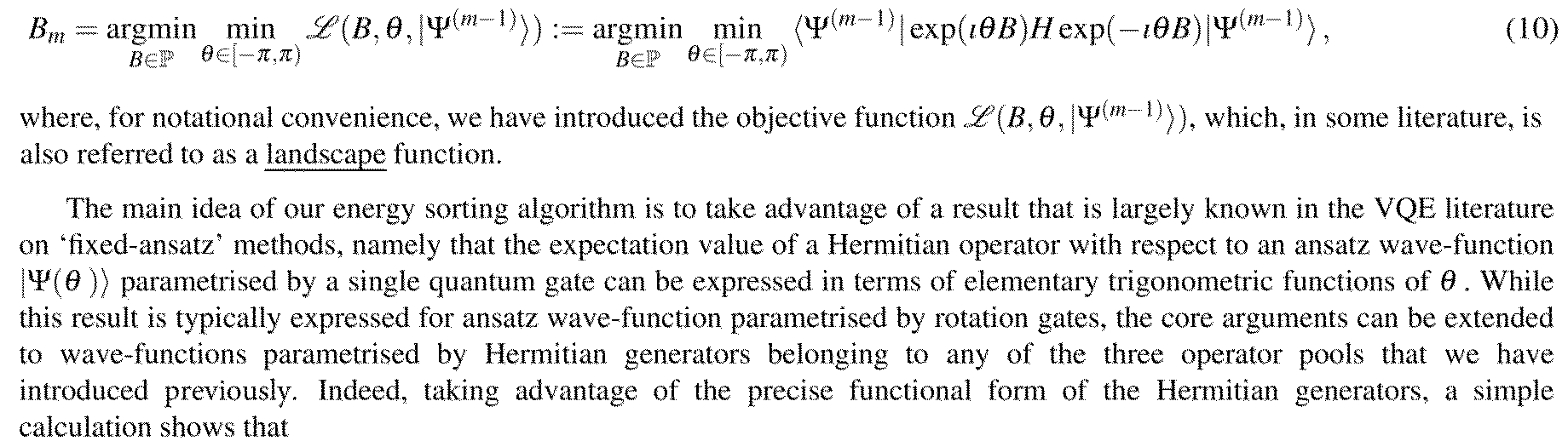
  • Equation (13) implies that for any Hermitian generator B from our operator pools and any arbitrary wave-function the objective function 0. ⁇ j>) ) can be expressed in terms of elementary trigonometric functions of 0. An important consequence of this expression is that, if we now evaluate the objective function ⁇ ?(B, 0,
  • the landscape function (10) assumes the addition of a single operator to the current ansatz wave-function at each iteration of the adaptive algorithm. If the pool of potential unitary operators is commutative, then the specific order in which operators are chosen is unimportant, and it is therefore sufficient to consider a sequential application of the representation (13) of to determine, at each iteration, the optimal operator to append to the current ansatz.
  • the energy sorting algorithm that we have introduced is the basis of the following greedy gradient-free adaptive VQE, which we dub GGA-VQE.
  • the Greedy Gradient-free Adaptive Variational Quantum Eiqensolver (GGA-VQE)
  • Equation ( 19) A close study of the right-hand side of Equation ( 19) now indicates that many terms involving the expectation values of the Pauli matrices can be measured directly and simultaneously on the quantum device without the need to run over all possible Hermitian generators in P.
  • Overlap-ADAPT-VQE is a hybrid quantum/classical algorithm in the spirit of ADAPT-VQE which aims to construct compact approximations of target wave-functions through an iterative procedure. As discussed in an earlier contribution ⁇ , Overlap-ADAPT-VQE seeks to improve the construction of adaptive ansatz wave-function for a VQE procedure in the following two ways:
  • the Overlap-ADAPT-VQE can generate a compact approximation of this target wave-function. This compact approximation can then be used as an initialisation for a subsequent second adaptive VQE procedure with the aim of further improving the quality of the ansatz whilst reducing the overall quantum circuit-depth.
  • Overlap-ADAPT-VQE can be used to generate a high-quality initialisation for a subsequent adaptive VQE algorithm on a quantum device. More precisely, by taking a moderately accurate, classically computed wave-function as the target, Overlap-ADAPT- VQE can produce a high-fidelity, compact approximation of this classical wave-function on a quantum device. This compact approximation can then be used as the initialisation for a subsequent adaptive VQE procedure which helps alleviate the issue of initial barren plateaus.
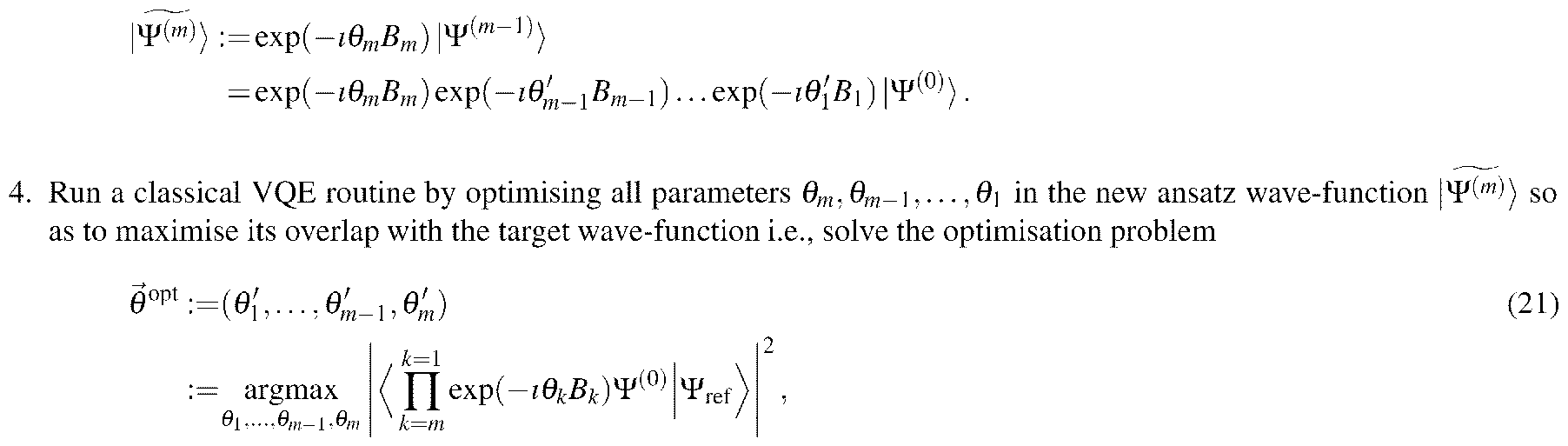
  • the Overlap-ADAPT procedure does not require the measurement of the expectation value of the Hamiltonian. Instead, at each iteration of Overlap-ADAPT, we measure the overlap between the current ansatz wave-function and the target wave-function to be approximated- a measurement that is much simpler to achieve. To be more precise, the general workflow of the Overlap-ADAPT-VQE algorithm is as follows.
  • the criterion (20) is a heuristic, and there is no guarantee that the Hermitian generator B m selected through this criterion will indeed lead to the parametrised unitary operator whose action on the current ansatz q '" 1 y results in the greatest increase in overlap.
  • the compute-uncompute method has the advantage of not requiring any additional qubits beyond those required to represent the circuits Uy and Uy. It does, however, require combining the individual circuits Uy and Uy into a single quantum circuit which therefore has twice the depth of the initial circuits.
  • the Hadamard SWAP-Test may also be computed through the so-called SWAP test method for which the associated circuit is shown below.
  • the essential idea of this method is to construct a circuit containing an ancillary qubit such that the probability p(0) of measuring 0 on the ancillary qubit is related to the overlap through the relation
  • the SWAP test circuit has the advantage of having the same circuit depth as that of the individual circuits Uy and Uy representing the states I'P) and
  • the GGA-VQE algorithm minimises the variational energy of the ansatz wave-function, while the Overlap-GGA-VQE algorithm maximises the overlap (fidelity) of the ansatz with an accurate target state.
  • the divergence could be due to ansatz evaluation errors.
  • the adaptive algorithm has succeeded (at least to a certain degree) in selecting appropriate parametrised unitary operators and corresponding optimal angles, the actual measurement of the fidelity on the quantum device is a failure due to hardware and measurement noise.
  • the ansatz evaluation error can be considered as being largely a reflection of the limits of the current QPU hardware and not indicative of the failure of our adaptive algorithms. Consequently, we will primarily focus on evaluating possible algorithmic failures in the QPU implementations of our adaptive algorithms.
  • a strategy to make this evaluation is to retrieve the ansatz wave-function yielded by the QPU-implemented GGA-VQE or Overlap-GGA-VQE methods, represent this ansatz wavefunction using methods on a HPC simulator, and measure the sought-after observables.
  • Figure 4 illustrates the convergence of the hybrid energy evaluations of the GGA-VQE ansatz wave-function with respect to the number of algorithm iterations.
  • these hybrid energy evaluations are obtained by first running the GGA-VQE algorithm on the lonQ Aria QPU, retrieving the resulting ansatz wave-function and re-implementing it on the HPC simulator, and then evaluating the variational energy on the HPC simulator.
  • the GGA-VQE energies obtain by direct measurement on the QPU.
  • Figure 5 clearly indicates that QPU-implemented GGA-VQE procedure successfully provides an ansatz wave-function that closely matches the ground state. Moreover, the QPU implementation and HPC simulator implementation of the GGA-VQE method seem highly consistent despite significant noise in the quantum evaluation of observables, as noticeable from the QPU energy evaluation curve in Figure 4.
  • the resulting QEB-ADAPT-VQE target wave-function which has an error of about 1.4 mHa, is constructed using four generators from the Qubit Excitation-based pool leading to a total CNOT circuit count of 32.
  • the purpose of applying the Overlap-GGA-VQE algorithm is to obtain a high-fidelity approximation of this target wave-function using fewer CNOT gates.
  • P consists of a collection of single excitation qubit hardware-efficient operators (recall Equation (7)). Equipped with the operator pool F, we apply the Overlap-GGA-VQE algorithm to the target QEB-ADAPT-VQE wave-function. It is important to note that, for the current HF system, the initial Hartree-Fock state exhibits no overlap with the QEB-ADAPT-VQE target.
  • hybrid fidelity evaluation refers to the classically recomputed fidelity of the QPU-generated ansatz (see the discussion at the start of this section). This hybrid fidelity evaluation precisely matches the value of the fidelity obtained through the pure HPC simulator implementation of Overlap-GGA-VQE, regardless of the choice of overlap measurement technique.
  • the QPU implementation of the Overlap-GGA-VQE procedure manages to provided an ansatz wave-function that achieves a fidelity of over 99% with a chemically accurate target wavefunction while using only 2 CNOT gates.
  • the target ground-state for this numerical experiment was generated through a QEB-ADAPT-VQE procedure on a classical simulator while the wave-function overlaps- required by the Overlap- GGA-VQE procedure- were measured on the QPU using two different methods: the compute- uncompute method and the Swap test.
  • transverse-field Ising Hamiltonian leads to a huge reduction in the computational cost of the energy sorting step of the GGA-VQE algorithm.
  • the energy sorting step a priori requires measurements for a general system Hamiltonian and an operator pool of size M, the number of required measurements reduces to just five in the case of the one-dimensional transverse field Hamiltonian.
  • the goal of this section is to briefly describe similar reductions in the computational complexity of the energy sorting algorithm for Ising spin-chain Hamiltonians with local magnetic fields and couplings in all three spatial directions, i.e., Hamiltonians of the form
  • h k and h z k denote constants that model the intensity of the magnetic field along the x and z directions while J ,J k y and J k are constants that model the strength of the nearest-neighbour interactions in the x,y, and z directions respectively.
  • Tables 2 and 3 list the terms of interest that appear in the one-dimensional GGA-VQE landscape functions that are used to perform the energy sorting step. Comparing the terms that appear in Tables 2 and 3 with the simpler expressions for a transverse-field Ising Hamiltonian, we see that the only new terms that arise are of the Zp ⁇ Zp-iXp and Y p ⁇ X p . As before, we can simultaneously measure such operators acting on a disjoint set of qubits- a process that will require an additional five quantum circuits at each step. Consequently, applying the GGA-VQE algorithm to general Ising Hamiltonians of the form (28) will require constructing and measuring at most ten quantum circuits, irrespective of the number of qubits and the size of the minimal operator pool.

Landscapes

  • Engineering & Computer Science (AREA)
  • Physics & Mathematics (AREA)
  • General Physics & Mathematics (AREA)
  • Theoretical Computer Science (AREA)
  • Mathematical Physics (AREA)
  • Mathematical Optimization (AREA)
  • Software Systems (AREA)
  • Data Mining & Analysis (AREA)
  • Pure & Applied Mathematics (AREA)
  • Mathematical Analysis (AREA)
  • Computational Mathematics (AREA)
  • General Engineering & Computer Science (AREA)
  • Condensed Matter Physics & Semiconductors (AREA)
  • Computing Systems (AREA)
  • Artificial Intelligence (AREA)
  • Evolutionary Computation (AREA)
  • Operations Research (AREA)
  • Algebra (AREA)
  • Databases & Information Systems (AREA)
  • Management, Administration, Business Operations System, And Electronic Commerce (AREA)

Abstract

The invention relates to methods and systems for generation of an optimized ansatz (Ψ(m)) wave-function, said computer implemented method comprising operating a system comprising quantum computational means and classical computational means, said method comprising: o Generating analytic functions of a parameter Θ from an objective function; o Selecting several angles values of the parameter Θ to generate, from the analytic functions of the parameter Θ; o On the quantum computational means, computing unknown operator expectation values of the objective function at the several selected angles values; o On the classical computational means, computing the objective function for any unitary operator (B), any angle of the parameter θ, o Appending the resulting locally optimal unitary operator to the left of the current ansatz wave-function |Ψ(curr)), preferably to generate an optimized ansatz (Ψ(m)) wave-function.

Description

Method and system for scalable quantum circuit configuration in noisy intermediate-scale quantum devices.
Field of the invention
The present invention relates to the field of quantum computers.
De|cription of Related Art
Quantum computing is a rapidly improving technology that employs the laws of quantum mechanics to solve specific problems which are too complex for classical computers. In the past three decades, quantum computing has gathered significant attention due to its potential to solve computational problems that are not adapted for classical computers. Among the most promising approaches in this domain is the use of hybrid quantum-classical systems, which integrate quantum and classical computing elements. A notable example of such systems is the Variational Quantum Eigensolver (VQE), designed primarily for simulating quantum many-body systems. VQEs operate by constructing a parameterized wave-function, which is optimized to minimize the expectation value of a given Hamiltonian.
However, the practical implementation of these algorithms faces significant challenges, especially within the noisy intermediate-scale quantum (NISQ) era. NISQ devices, characterized by their limited qubit count and inherent noise, impose substantial restrictions on quantum algorithm performance. The primary difficulties involve the noisy evaluation of the wave-functions and the polynomial scaling in the number of observables needed for effective operation. These issues often result in suboptimal performance and limited scalability of VQE algorithms, necessitating a significant number of quantum circuit evaluations, which can be resource-intensive.
Recent developments have attempted to address these challenges through various adaptations of the VQE framework. Techniques such as the adaptation of quantum circuits based on dynamic selection of operators from a predefined pool have been explored to enhance the efficiency and accuracy of these algorithms. Nonetheless, these methods still contend with the fundamental issue of noise and the extensive computational overhead linked to iterative optimization procedures.
In particular, the challenge of optimizing high-dimensional cost functions on NISQ devices remains a significant challenge. The need to balance quantum resource utilization with algorithmic performance under noisy conditions continues to drive research in this area. Thus, there is still a need for new methods and quantum circuit focusing on addressing the constraints of noise and limited qubit coherence times, optimize the use of quantum resources, and improve the scalability and accuracy of quantum computations in practical applications, in particular when Variational Quantum Eigensolver is concerned.
Summary of the invention
The following sets forth a simplified summary of selected aspects, embodiments and examples of the present invention for the purpose of providing a basic understanding of the invention. However, the summary does not constitute an extensive overview of all the aspects, embodiments and examples of the invention. The sole purpose of the summary is to present selected aspects, embodiments and examples of the invention in a concise form as an introduction to the more detailed description of the aspects, embodiments and examples of the invention that follow the summary.
In one aspect, the invention relates to a computer implemented method for the generation of an optimized ansatz (ψ(m)) wave-function, said computer implemented method comprising operating a system comprising quantum computational means and classical computational means, said method comprising: o Generating analytic functions of a parameter 0 from an objective function implying a current ansatz, unitary operators and parameter; o Selecting several angles values of the parameter 0 to generate, from the analytic functions of the parameter 0, a system of equations minimizing the number of measurements to be done on quantum computational means; o On the quantum computational means, computing unknown operator expectation values of the objective function at the several selected angles values, o On the classical computational means, computing the objective function for any unitary operator (B), any angle of the parameter 0, and thereby obtain:
• the locally, optimal unitary operator Bm that should be added to the current ansatz | ψ-1 (curr)> wave function, and
• the optimal angle 0'm; and o Appending the resulting locally optimal unitary operator to the left of the current ansatz wave-function |ψ (curr)>, preferably to generate an optimized ansatz (ψ(m)) wave-function.
The invention introduces a novel implementation of a method of generation of an optimized ansatz (MJ(m)) wave-function, such as a Variational Quantum Eigensolver (VQE), optimized for noisy quantum devices. It implements an adaptive, quasi-greedy optimization development that reduces dependency on gradient calculations. This approach enables more efficient quantum computations by decreasing resource usage and enhancing the system’s resilience to quantum noise. Consequently, the invention improves the internal functioning of quantum hardware and integrates well with advanced classical computing techniques to enhance the performance and accuracy of quantum circuits.
In some implementations, the invention capitalizes on gradient-free techniques to dynamically optimize quantum circuits, offering scalable and less resource-intensive quantum computations. The method as illustrated hereafter is effective even in environments with significant quantum noise and imperfections.
The invention is applicable across various quantum computation methods and hardware, especially useful in quantum chemistry and complex materials developement. It facilitates the development of quantum computation that leverage quantum mechanical properties like superposition and entanglement, simplifying the complexity of quantum computing and delivering significant computational benefits over both classical and traditional quantum methods.
Specifically, the invention can boost the efficiency and accuracy of quantum computations on Noisy Intermediate Scale Quantum (NISQ) devices through a particular application of gradient-free optimization within the Greedy Gradient-free Adaptive Variational Quantum Eigensolver (GGA- VQE). This adaptation notably reduces the number of quantum circuit measurements required per iteration, providing substantial benefits in scenarios demanding high computational precision with limited resources. Such improvements are particularly advantageously in quantum chemical simulations for modeling complex molecular systems, resulting in reduced operational costs and enhanced performance. This method has proven effective in accurately determining the ground states of complex systems, crucial for advances in chemical and material sciences.
According to other optional features of the method according to the invention, it can optionally include one or more of the following characteristics alone or in combination: for the step of generating analytic functions of a parameter 0 from an objective function is done using trigonometric transformations. for the step of computing unknown operator expectation values of the objective function at the several selected angles values is done employing a minimal measurement strategy that optimizes the sampling points based on the trigonometric properties of the objective function; for the step of computing the objective function for any unitary operator (B), the optimal unitary operator Bm is determined by a greedy, gradient-free optimization process, and the optimal angle 0'm is optimized through analytical methods to achieve minimal energy configuration. the step of computing the objective function, for example L(B,0, | (curr)), at the several selected angles, requires measuring at most ten quantum circuits for Hamiltonians of a given form, regardless of the number of qubits. the steps of Generating, Selecting, Computing on the quantum computational means, and Computing the objective on the classical computational means are repeated iteratively and wherein the objective function, for example L(B,0, |ψ (curr)», is computed on the classical computational means analytically for any unitary operator (B), any angle of the parameter 0, and any ansatz wave-function Iψ (m-1 )> already appended to the ansatz wave-function, the quantum computational means comprise quantum hardware or classical hardware configured to simulate quantum computing, and preferably are selected among: quantum computers based on trapped ions, superconducting quantum computers, neutral atoms in optical lattices, quantum dot computer spin-based or spatial-based, Bose-Einstein condensate-based quantum computer, quantum wells computers, nuclear magnetic resonance quantum computer, cavity quantum electrodynamics, optical quantum computer, or diamond-based quantum computer. the classical computational means comprise CPU, GPU or ASIC, preferably configured to support the computational demands and parallel processing requirements of hybrid quantum-classical algorithms. the pool of unitary operators is selected among: Qubit Excitation-based Pool, Qubit Hardware-efficient Pool, and/or Minimal Hardware-efficient Pool. the pool of unitary operators includes single and double fermionic excitation operators, spin-complemented pairs of single and double fermionic excitation operators and/or individual Pauli chains, e.g. from the division of fermionic-ADAPT operators after a Jordan- Wine mapping. the ansatz wave function comprises more than five parameters, preferably more than 10, 15, 20 parameters. it comprises the use of 30 or less, preferably 20 or less, even more preferably 10 or less quantum circuit measurements for each iteration, advantageously this is regardless of the number of qubits and the size of the operator pool. the unitary operator selected is the one whose action on a current ansatz (Ψ (curr)) produce a new wave function with the largest orbital overlap with respect to a target wave function (I1 target). the parameterized unitary operator (θmBm) is select so as that its action on the current ansatz |Y(curr) is likely to produce a new wave-function having the largest overlap with a target wave-function the overlap is calculated according to a Compute-UncomputeMethod or an Hadamard SWAP-Test. it further comprises a step of computing the target ansatz wave function (| ,ref)), said computing being performed by binary computing means or by quantum computing means, the target wave function is with a tractable high accuracy approximation of a full-CI wave- function. the target wave function is an ADAPT-VQE ansatz, for example comprising more than five parameters, preferably more than 10, 15, 20 parameters. the target wave function is a Selected-Configuration Interaction ansatz, preferably computed according to the so-called Configuration Interaction perturbatively selected iteratively (Cl PSI).
According to another aspect, the invention can also relate to a computer implemented method for simulating quantum many-body system using the optimized ansatz generated according to the method of the invention.
According to another aspect, the invention can also relate to quantum computing system for quantum chemical simulations characterized in that it comprises an optimized quantum computing circuit obtainable, preferably obtained, by a method according to a method of the invention.
In particular, the quantum computing means for quantum chemical simulations according to the invention comprises a quantum circuit corresponding to an ansatz of a molecule comprising at least three atoms, said ansatz comprising no more than 20 parameters per atom and has a chemical accuracy threshold of 10-3 Hartree or less, at bond length of 3 Angstrom or more.
According to another aspect, the invention can also relate to one or more computer-readable media storing computer-executable instructions, which when executed by a computer cause the computer to perform a method according to the present invention.
In particular, the one or more computer-readable media storing computer-executable instructions, when executed by a computer cause the computer to perform a method, the method comprising: o Generating analytic functions of a parameter 0 from an objective function implying a current ansatz, unitary operators and parameter; o Selecting several angles values of the parameter 0 to generate, from the analytic functions of the parameter 0, a system of equations minimizing the number of measurements to be done on quantum computational means; o On the quantum computational means, computing unknown operator expectation values of the objective function at the several selected angles values, o On the classical computational means, computing the objective function for any unitary operator (B), any angle of the parameter 0, and thereby obtain:
• the locally, optimal unitary operator Bm that should be added to the current ansatz | H-1 (curr)> wave function, and
• the optimal angle 0'm; and o Appending the resulting locally optimal unitary operator to the left of the current ansatz wave-function | ’4J(cu rr)>, preferably to generate an optimized ansatz (^(m)) wave-function.
According to another aspect, the invention can also relate to a computer configured to implement a method according to the invention.
In another aspect, the invention can relate to a computing system, comprising: quantum computing means; and classical computing means configured to communicate with and control the quantum computing means, the system being further configured to implement a method according to the invention.
In particular, the invention can relate to a computing system, comprising: quantum computing means; and classical computing means configured to communicate with and control the quantum computing means, the system being further configured to: o Generating analytic functions of a parameter 0 from an objective function implying a current ansatz, unitary operators and parameter; o Selecting several angles values of the parameter 0 to generate, from the analytic functions of the parameter 0, a system of equations minimizing the number of measurements to be done on quantum computational means; o On the quantum computational means, computing unknown operator expectation values of the objective function at the several selected angles values, o On the classical computational means, computing the objective function for any unitary operator (B), any angle of the parameter 0, and thereby obtain:
• the locally, optimal unitary operator Bm that should be added to the current ansatz | H-1 (curr)> wave function, and
• the optimal angle 0'm; and o Appending the resulting locally optimal unitary operator to the left of the current ansatz wave-function | ’4J(cu rr)>, preferably to generate an optimized ansatz (^(m)) wave-function.
For example, the invention can relate to a computing system, comprising: quantum computing means; and classical computing means configured to communicate with and control the quantum computing means, the system being further configured to: o Generating, preferably using classical computational means, analytic functions of the parameter 0 for any unitary operator (B), from an objective function L(B,0, |4J(curr))); o Selecting several values of 0 to generate, from the objective function, a linear system of equations for the unknown operator expectation values; o On the quantum computational means, computing the objective function L(B,0, |l4J(curr)» at the several selected angles, o On the classical computational means, computing the objective function L(B,0, |'+’(curr)», analytically for any generator B, and any angle 0 , and thereby obtain:
• the locally, optimal Hermitian generator Bm that should be added to the current ansatz | l(curr)) and
• the optimal angle 0'm; and o Appending the resulting locally optimal unitary operator to the left of the current ansatz wave-function | ,(curr), i.e. , define the new optimized ansatz wave-function I
According to another aspect, the invention can also relate to the use of a method, a quantum circuit or a computer system of the invention during execution of quantum circuit simulating the quantum dynamics of chemical reactions.
Brief description of the drawings
The foregoing and other objects, features and advantages of the present invention will become more apparent from the following detailed description when taken in conjunction with the accompanying drawings in which:
FIG. 1 is an illustration of a situation where the ADAPT-VQE selection criterion does not pick the optimal operator leading to the largest energy drop
FIG. 2 is an illustration of a Hadamard SWAP-Test circuit to compute the overlap | < t’|'4J>|2
FIG. 3 is a schematic overview of the GGA-VQE algorithm with hybrid observable measurement. In this embodiment, the HPC simulator is used to evaluate the final ansatz wavefunction obtained by executing GGA-VQE on the QPU
FIG. 4 is a illustration of the energy convergence of the GGA-VQE algorithm with respect to the number of iterations.
FIG. 5 is a convergence plot of the fidelity of the GGA-VQE ansatz wave-function produced by the QPU and re-implemented in a HPC simulator (hybrid evaluation approach) with the exact ground state of this Ising model obtained using a diagonalisation procedure on the HPC simulator.
FIG. 6 is an illustration of expected energy drop of each Hermitian generator from the operator pool during the GGA-VQE iterative procedure on the QPU. The minimal pool operators, numbered from 1 to 48, are listed in the same order as defined in Equation (18). All energy differences are expressed in eV.
FIG. 7 is an illustration of one-dimensional energy landscapes of the operators YO and Z0Z1 when applied to the initial state. The light grey curve is extrapolated from five noisy circuit evaluations following the method described in the present invention. The black curve is the exact energy landscape obtained from an HPC simulation. The energy differences are expressed in eV, and the angles are given in radians.
FIG. 8 is a schematic representation of an embodiment of a computer configured to implement the invention.
FIG. 9 illustrates the Overlap-GGA-VQE ansatz with the target state. It comprises the fidelity of a classically simulated ansatz with the target state, and the hybrid and QPU fidelity evaluations. The hybrid evaluation is carried out by retrieving the Overlap-GGA-VQE ansatz wave-function generated by the QPU, re-implementing it on the HPC simulator, and then evaluating the variational energy.
FIG. 10 illustrates a quantum circuit performing a generic single-qubit evolution
FIG. 11 illustrates a quantum circuit performing a generic double-qubit evolution
Several aspects of the present invention are disclosed with reference to flow diagrams and/or block diagrams of methods, devices and computer program products according to embodiments of the invention. On the figures, the flow diagrams and/or block diagrams show the architecture, the functionality and possible implementation of devices or systems or methods and computer program products, according to several embodiments of the invention. For this purpose, each box in the flow diagrams or block diagrams may represent a system, a device, a module or code which comprises several executable instructions for implementing the specified logical function(s). In some implementations, the functions associated with the box may appear in a different order than indicated in the drawings. For example, two boxes successively shown, may be executed substantially simultaneously, or boxes may sometimes be executed in the reverse order, depending on the functionality involved. Each box of flow diagrams or block diagrams and combinations of boxes in flow diagrams or block diagrams may be implemented by special systems that perform the specified functions or actions or perform combinations of special equipment and computer instructions.
Detailed description
Hereinafter, we describe the vocabulary associated with the invention, before presenting the drawbacks of the prior art, and then finally showing in greater detail how the invention remedies them.
Conventional computers operate on binary digits that store or represent information in the form of binary states to perform computational and information processing functions. In contrast, quantum computing devices operate on quantum bits (or qubits) that store or represent information as both binary states and superpositions of binary states. A distinction between a quantum and classical computer is that the quantum computer is probabilistic, thus measurements of algorithmic outputs provide a proper solution within a confidence interval. The computation is then repeated until a satisfactory probable certainty of solution can be achieved. A quantum computation uses a qubit as its essential unit instead of a classical computing bit. The qubit (e.g., quantum binary digit) is the quantum-mechanical analog of the classical bit. Whereas classical bits can employ on only one of two basis states (e.g., 0 or 1 ), qubits can employ superpositions of those basis states, allowing a number of qubits to theoretically hold exponentially more information than a same number of classical bits. General quantum programs require coordination of quantum and classical parts of a computation. One way to think about general quantum programs is to identify processes and abstractions involved in specifying a quantum algorithm, transforming the algorithm into executable form, running an experiment or simulation, and analyzing the results.
A “quantum circuit” can refer to a series of quantum gates organized sequentially to enact a unitary transformation on a specified initial quantum state, resulting in a transformed final quantum state. Each gate within the circuit may be parameterized, for instance, by specifying one or more rotational angles in single-qubit rotation gates. A "gate" is an elementary operation within a quantum circuit that modifies quantum states through specified transformations. The term "quantum computing device" encompasses any system capable of implementing quantum gates and managing qubits, which may include hardware that exploits quantum physical phenomena to manipulate physical qubits or classical hardware designed to simulate qubits.
By “Hamiltonian” (H) or “molecular Hamiltonian” can mean, within the meaning of the invention, an operator that fully defines a quantum system. The lowest eigenvalue of the Hamiltonian represents the ground state, which is frequently the objective of optimization in quantum chemistry calculations. The representation of a Hamiltonian may vary with each molecule, depending on the chosen computational basis. "Energy" in this context denotes the expectation value of the Hamiltonian for a given normalized quantum state, with minimization of this value indicative of alignment with the ground state.
A "NISQ (Noisy Intermediate Scale Quantum) device" can refer to a category of quantum computers characterized by possessing a number of qubits ranging from approximately 50 to a few hundred, where the quantum operations are inherently accompanied by notable noise levels.
These devices, operative without full quantum error correction, are marked by their error susceptibility and a limited qubit coherence (Displaying reduced times of qubit stability).
A "Variational Quantum Eigensolver" can be defined, according to the invention, as an algorithm designed for solving the eigenvalue problems of quantum systems, particularly effective on NISQ devices. The VQE algorithm can be characterized by parameterized quantum circuits where quantum circuits parameters are optimized through a feedback loop to find a system's ground state.
A "hybrid quantum-classical system", according to the invention can be a computing architecture that combines quantum and classical processing capabilities, where for example quantum processor is tasked with state preparation and measurement while classical processor manages optimization and data processing, creating a feedback loop with the quantum processor.
"Quantum circuit measurements", according to the invention, can involve the process of obtaining specific quantum state properties through the observation of qubits, where each measurement typically results in a probabilistic collapse of the quantum state into one of several possible states, influencing subsequent quantum operations.
"Adaptive algorithms" in the context of the invention can be considered as algorithms that adjust their operational parameters or procedures based on feedback concerning their performance. "Gradient-free optimization" in the context of the invention can be considered as an optimization approach that bypasses the computational overhead associated with gradient calculations by employing alternative strategies such as heuristic or probabilistic techniques to determine the direction of optimization, significantly reducing computational demands especially in environments with high noise levels.
An "operator pool" in the context of the invention can comprise a predefined set of quantum gates or operations from which selections are made during the execution of a quantum algorithm to optimize performance, particularly pivotal in adaptive and variational quantum algorithms.
“Parameterized unitary operators" are defined as quantum operators that influence the state of qubits within a quantum circuit through adjustable parameters, typically involving angles in rotation gates that modify the state transformation properties of the operators.
“wavefunction” (^ ) can mean, within the meaning of the invention, a function which represents the probability density of finding a particle at a given location, preferably on Hilbert space. A target wave function can be an approximation of the ground state of an Hamiltonian.
"ansatz" or "ansatz wavefunction" can mean, within the meaning of the invention, a subroutine consisting of a sequence of gates applied to specific wires. An ansatz wavefunction can capture the most important contributions to the electronic correlation energy and, at the same time, is capable of being represented on rather shallow quantum circuits. The initial ansatz can also be called the current ansatz which is the ansatz which will be grown by appending the selected operators. As the process is preferably iterative, the process begin with an initial ansatz while after at least an iteration a current ansatz (the current ansatz can generally be the new ansatz of the previous iteration) is used.
"Greedy algorithms" in the context of the invention can be defined as algorithms that make successive choices that appear to be optimal at each step, aimed at achieving a local optimum with an assumption that these local optima will lead to a globally optimal solution.
"Ground state approximation" in the context of the invention can refer to a method of estimating the lowest energy state of a quantum system, which is found several technical applications, for example in quantum chemistry for predicting molecular configurations and interactions.
By “process”, compute “determine”, “display”, “extract”, “compare” or more broadly “executable operation” can mean, within the meaning of the invention, an action performed by a computing device or a processor unless the context indicates otherwise. In this regard, the operations relate to actions and/or processes of a data processing system, for example a computing system or an electronic computing device, which manipulates and transforms the data represented as physical (electronic) quantities in the memories of the computing system or other devices for storing, transmitting or displaying information. In particular, calculation operations are carried out by the processor of the device, the produced data are entered in a corresponding field in a data memory and this field or these fields can be returned to a user for example through a Human Machine Interface formatting such data. These operations may be based on applications or software.
The terms or expressions “application”, “software”, “program code”, and “executable code” mean any expression, code or notation, of a set of instructions intended to cause a data processing to perform a particular function directly or indirectly (for example after a conversion operation into another code). Exemplary program codes may include, but are not limited to, a subprogram, a function, an executable application, a source code, an object code, a library and/or any other sequence of instructions designed for being performed on a computing system.
By “processor” is meant, within the meaning of the invention, at least one hardware circuit configured to perform operations according to instructions contained in a code. The hardware circuit may be an integrated circuit. Examples of a processor include, but are not limited to, a central processing unit, a graphics processor, an application-specific integrated circuit (“ASIC” according to Anglo-Saxon terminology), and a programmable logic circuit. A single processor or several other units may be used to implement the invention.
By “coupled” is meant, within the meaning of the invention, connected, directly or indirectly, with one or more intermediate elements. Two elements may be coupled mechanically, electrically or linked by a communication channel.
The expression “human-machine interface”, within the meaning of the invention, corresponds to any element allowing a human being to communicate with a computer, in particular and without that list being exhaustive, a keyboard and means allowing in response to the commands entered on the keyboard to perform displays and optionally to select with the mouse or a touchpad item displayed on the screen. Another embodiment is a touch screen for selecting directly on the screen the elements touched by the finger or an object and optionally with the possibility of displaying a virtual keyboard.
As described hereafter, the inventors developed a new method for optimizing variational quantum eigensolvers in noisy quantum environments. This method involving quantum computers and classical computers solves the problem of inefficient quantum resource utilization and excessive computational demands typical in conventional quantum computing methodologies. In particular, the inventors developed the use of gradient-free optimization and adaptive circuit configuration. Also, the use of analytic landscape functions that are simple trigonometric functions of 0, enable precise and efficient manipulation of parameters to optimize the quantum circuit's performance. In particular, applying trigonometric transformations to the objective function to express it in terms of elementary trigonometric functions of 0, enabling the use of a minimal number of measurements. Such features allow for significant reductions in the number of quantum measurements required and enhance the efficiency of determining ground state energies of quantum systems, even in the presence of operational noise typically associated with NISQ devices.
As it will be described, analytic functions of the parameter 0 involves the utilization of trigonometric expressions to define the dependencies of quantum circuit outcomes on changes in 0. Also the invention preferably relies on an approach where the optimal parameter values (including 0) are identified through energy sorting mechanisms. This approach involves evaluating the objective function at selected values of 0 to construct a landscape function that is analytically tractable. These landscape functions are explicitly stated to be analytic functions of 0, making it possible to express the objective function in terms of simple trigonometric functions of 0 for any unitary operator belonging to the chosen operator pool. This facilitates a straightforward computational approach to optimizing the ansatz by allowing for the direct calculation of the most promising modifications to the quantum circuit based on the minimization of the energy landscape. This approach is particularly advantageous for quantum computing applications where minimizing computational overhead and error rates is crucial due to the inherently noisy environment of NISQ devices. The ability to analytically determine the impact of parameter changes directly contributes to the method's effectiveness and efficiency, making it a novel aspect of this research. In a first aspect, the invention relates to a computer implemented method. This method can be used for the generation of an optimized ansatz (^(m)) wave-function.
The computer implemented method preferably comprise operating a system comprising quantum computational means and classical computational means.
The method can comprise the following steps: Generating analytic functions of a parameter 0 from an objective function; Selecting several angles values of the parameter 0 to generate minimizing the number of measurements to be done on quantum computational means; Computing unknown operator expectation values of the objective function at the several selected angles values; Computing the objective function for any unitary operator (B), any angle of the parameter 0, and thereby obtain a locally optimal unitary operator that should be added to the current ansatz | ,(curr)) wave function, and an optimal angle 0'm; And appending the resulting locally optimal unitary operator to the left of the current ansatz wave-function |'+’(curr)>, preferably to generate an optimized ansatz (MJjm)) wave-function.
In particular, a method of the invention can comprise: o Generating analytic functions of a parameter 0 from an objective function using trigonometric transformations, which include a current ansatz, unitary operators and the parameter 0; o Selecting several angles values of the parameter 0 to generate, from the analytic functions of the parameter 0, a system of equations minimizing the number of measurements to be done on quantum computational means; o On the quantum computational means, computing unknown operator expectation values of the objective function at the several selected angles values employing a minimal measurement strategy that optimizes the sampling points based on the trigonometric properties of the objective function; o On the classical computational means, computing the objective function for any unitary operator (B), any angle of the parameter 0, and thereby obtain:
• the locally, optimal unitary operator Bm determined by a greedy, gradient- free optimization process that should be added to the current ansatz |'4J(curr)> wave function, and
• the optimal angle 0'm optimized through analytical methods to achieve minimal energy configuration; and o Appending the resulting locally optimal unitary operator to the left of the current ansatz wave-function |4J(cu rr)>, preferably to generate an optimized ansatz (MJjm)) wave-function.
For example, the invention can relate to a computer implemented method for the generation of an optimized ansatz (MJjm)) wave-function, said computer implemented method comprising operating a system comprising quantum computational means and classical computational means, said method comprising: o Generating, from an objective function L(B,0, 14J(curr)», analytic functions of a parameter 0, where B e P is any unitary operator from an operator pool, the parameter 0 e [-IT, TT>, and | '4J(curr)> denotes a current ansatz wave-function; o Selecting several angles values of the parameter 0 to generate, from the analytic functions of the parameter 0, a linear system of equations minimizing the number of measurements to be done on quantum computational means; o On the quantum computational means, computing the objective function L(B,0, |l4J(curr)» at the several selected angles values, o On the classical computational means, computing the objective function L(B,0, |'+’(curr)», analytically for any unitary operator (B), any angle of the parameter 0, and thereby obtain:
• the locally, optimal unitary operator Bm that should be added to the current ansatz |4l(curr)) wave function, and
• the optimal angle 0'm; and o Appending the resulting locally optimal unitary operator to the left of the current ansatz wave-function | '4J(cu rr)>, i.e. , define the new optimized ansatz wave-function |Y(m)).
For example, the invention can relate to a computer implemented method for the generation of an optimized ansatz (^(m)) wave-function from a current ansatz (U-1 (curr) > wave-function, said computer implemented method comprising operating a system comprising quantum computational means and classical computational means, said method comprising: o Generating, preferably using classical computational means, analytic functions of a parameter 0 for any unitary operator (B), from an objective function L(B,0, |4,(curr))), where B e P is any unitary operator from an operator pool, the parameter 0 e [-IT, TT>, and ^(curr)) denotes the current ansatz wave-function; o Applying trigonometric transformations to the objective function L(B,0, |MJ(curr)» to express it in terms of elementary trigonometric functions of 0; o Selecting several angles values of the parameter 0 to generate, from the analytic functions of the parameter 0, a linear system of equations for unknown operator expectation values; o On the quantum computational means, computing the objective function L(B,0, |MJ(curr)» at the several selected angles values; o On the classical computational means, computing the objective function L(B,0, |4l(curr))), analytically for any unitary operator (B), any angle of the parameter 0, and thereby obtain:
• the locally, optimal unitary operator Bm that should be added to the current ansatz |l4J(curr)> wave function, and
• the optimal angle 0'm; and o Appending the resulting locally optimal unitary operator to the left of the current ansatz wavefunction |4J(curr)), i.e., define the new optimized ansatz wave-function |'4J(m)).
Also, the invention can relate to a computer implemented method for the generation of an optimized ansatz (MJ(m)) from a current ansatz (| '4J(curr)>, said computer implemented method being implemented on a system comprising quantum computational means and conventional computational means, said method comprising: o Selecting a locally optimal unitary operator, from an operator pool and an optimal angle 0'm for said unitary operator that satisfies (Eq. 2)
‘K* = argmin f/eo
Figure imgf000016_0001
this selection of the locally optimal unitary operator comprises: o Expressing one-dimensional objective functions appearing in the optimisation problem (2), as analytic functions of 0 for any unitary operator (B) under an objective function L(B,0, |4l(curr))), o Selecting several values of 0 to generate, from the objective function, a linear system of equations for the unknown operator expectation values; o On the quantum computational means, computing the objective function L(B,0, |'4J(curr)>) at the several selected angles, o On the conventional computational means, computing the objective function L(B,0, |'4J(curr))), analytically for any generator B, any angle 0, and any wave-function |'4J(curr)>, in order to solve the optimization problem
Bm = argmin min
Figure imgf000016_0003
, argmin min ('pf'” h|exp(ifljB)Hexp(
Figure imgf000016_0002
, (10)
Bet set for any unitary operator (B) from the operator pool, and thereby obtain:
• the locally, optimal Hermitian generator Bm that should be added to the current ansatz ^(curr)) and
• the optimal angle 0'm;
Append the resulting locally optimal unitary operator Bm to the left of the current ansatz wave-function |l4J(curr)>, i.e., define the new optimized ansatz wave-function ^(m))
Figure imgf000016_0004
where the optimal angle 0'm is obtained in the process of solving the optimisation problem (12)
B„, = argmin min
Figure imgf000016_0005
. ( 12)
Bel”
According to another aspect, the invention can also relate to a computer configured to implement a method according to the invention. In particular, it can relate to a quantum computer configured to implement a method according to the invention.
Also, it can relate to computing devices for quantum chemical simulations arranged and specifically configured to implement a method, or a quantum circuit of the invention.
In another aspect, the invention relates to quantum computing devices 10, for example said quantum computing devices 10 being configured for quantum chemical simulations. In particular, the quantum computing devices comprise a quantum circuit 11 for quantum chemical simulation obtainable, preferably obtained, by a method according to the invention.
The invention quantum computing devices can be integrated in a computing system 1 as described hereafter. Also, the computer implemented methods according to the invention can be implemented on a computing system.
The computing system can include one or more classical binary computers coupled to one or more quantum computers. The one or more conventional binary computers can be configured to receive one or more computing tasks via an input port and to output corresponding computational results via an output port.
The one or more quantum computers can be configured to execute one or more quantum circuits that are generated from the one or more tasks to generate corresponding output results for the one or more classical binary computers to use to generate the corresponding computational results.
As illustrated in figure 8, the computing system 1 can comprises: one or more quantum computing devices, one or more memory components 20, one or more communication interfaces 30; one or more processors 40; and/or one or more user interfaces 50.
The memory component 20 may comprise any computer readable medium known in the art including, for example, a volatile memory, such as a static random access memory (SRAM) and a dynamic random-access memory (DRAM), and / or a non-volatile memory, such as read-only memory, flash memories, hard disks, optical disks and magnetic tapes. The memory component 20 may include a plurality of instructions or modules or applications for performing various functions. Thus, the memory component 10 can implement routines, programs, or matrix-type data structures. Preferably, the memory component 20 may comprise a medium readable by a computing system in the form of a volatile memory, such as a random-access memory (RAM) and / or a cache memory. The memory component 20, like the other modules, can for example be connected with the other components of the computing system 1 via a communication bus and one or more data carrier interfaces.
Furthermore, the computing system 1 can also comprise a communication interface 30. The communication interface 30 is preferably configured to transmit data on at least one communication network and may implement a wired or wireless communication. The computing system 1 can communicate with other devices or computing systems and in particular with clients thanks to the communication interface 30. A communication interface 30 according to the invention is in particular configured to exchange data with third-party devices or systems.
A computing system 1 may comprise one or more processors 40. A processor 40 may be operably coupled to the memory component 20 to execute instructions, encoded in programs, for carrying out the presently disclosed techniques, more particularly to perform the method according to the invention.
The encoded instructions may be stored in any suitable article of manufacture (such as the memory component 20) that includes at least one tangible non-transitory, computer-readable medium that at least collectively stores these instructions or routines. In this manner, the memory component 20 may contain a set of instructions that, when executed by the processor 40, performs the method of the invention.
The memory component 20 may include any number of databases or similar storage media that can be queried from the processor 40 as needed to perform the method of the invention.
These different modules or components are separated in Figure 8, but the invention may provide various types of arrangement, for example a single module cumulating all the functions described here. Similarly, these modules or components may be divided into several electronic boards or gathered on a single electronic board. A computing system 1 according to the invention can be incorporated into a computing system and able to communicate with one or several external devices such as a keyboard, a pointer device, a display, or any device allowing a user to interact with the system 1 .
The computing system 1 may also be configured to communicate with or via a human-machineinterface. Thus, in one embodiment of the present invention, the computing system 1 can be coupled to a human interface machine (HMI). The HMI may be used to allow the transmission of parameters to the devices or conversely make available to the user the values of the data measured or calculated by the device.
In general, the HMI is communicatively coupled to a processor and includes a user output interface and a user input interface. The user output interface may include an audio and display output interface and various indicators such as visual indicators, audible indicators and haptic indicators. The user input interface may include a keyboard, a mouse, or another navigation module such as a touch screen, a touchpad, a stylus input interface, and a microphone for inputting audible signals such as a user speech, data and commands that can be recognized by the processor.
As mentioned, the invention can be used on the one hand in improving the proper functioning of any quantum computer and on the other hand in several field of applications using convention, hybrid or quantum computers.
For example, the invention can be used to initialize a quantum state to represent a molecular system. In particular, it can set up a quantum state, either a ground state or a superposition, that corresponds to a particular molecular configuration.
Also, advantageously in a context of molecular analysis, the present invention can be used to apply molecular Hamiltonian's interactions to a prepared quantum state. It's can be used when for analysing chemical properties and/or simulating molecular dynamics. The invention in this context might be used to perform conditional operations based on multiple qubit states, accurately reproducing the intricate interactions within a molecule. The application of this invention to physical qubits can be done using several quantum systems such as superconducting qubits systems, trapped ions qubits systems or photonic qubits systems. The implementation can for example comprise initializing the qubits in a quantum register. This can involve cooling the superconducting qubits to their ground state, typically using dilution refrigerators that bring the system close to absolute zero temperature. Superconducting quantum computers often use transmon qubits, which are weakly anharmonic oscillators. Coupling multiple transmon qubits using resonant or dispersive interactions can facilitate the control and target operations of the quantum gate or circuit of the present invention. In particular, applying microwave pulses to the control qubits can bring them into the desired state. These pulses should be calibrated in duration, amplitude, and phase to achieve the correct quantum state. The invention can be further implemented by sequentially activating interactions between the control qubits and the target qubit. This can be achieved using a series of controlled-phase gates, which are native to superconducting systems, followed by single-qubit rotations to transform the CZ into CNOT operations. As superconducting qubits are prone to errors due to decoherence and operational inaccuracies, the invention can benefit from implement quantum error correction protocols, such as a surface code, to detect and correct errors during the gate operation. Finally, the implementation should comprise a measure of the state of the qubits. Superconducting qubit measurements typically involve statedependent frequency shifts, which are detected using resonant circuits.
The implementation can for example comprise cooling trapped ions to their motional ground state using laser cooling techniques, such as Doppler cooling followed by sideband cooling. Preferably, implementation of the present invention in a trapped ions can use tightly focused laser beams to individually address ions in the trap. This allows for selective manipulation of control and target ions for the quantum gates or quantum circuit according to the invention. The invention can comprise using a combination of single-ion operations and multi-ion entangling operations. Single-ion operations can be achieved through Rabi oscillations induced by laser pulses while multi-ion entangling operations can be implemented using Molmer-Sorensen gates, which entangle the internal states of the ions via their collective motional modes. Thus, implementing the invention gates and quantum circuit should comprise by sequentially applying controlled operations across the ion chain, with predetermined timing and synchronization of laser pulses. The eventual issues of decoherence and operational error can be addressed using techniques like dynamical decoupling and sympathetic cooling, where auxiliary ions are used for cooling without disturbing the computational qubits. Finally, the invention can comprise a measure of the state of the ions where ions are illuminated with a laser, and the emitted photons are detected, like in a statedependent fluorescence.
The implementation can for example comprise a generation of entangled photon pairs using spontaneous parametric down-conversion or other quantum dot-based sources. In such system, the control and target qubits can be encoded into different degrees of freedom of the photons, such as polarization, path, or orbital angular momentum modes. The invention can implement the gates and quantum circuit of the invention using linear optical elements like beam splitters, phase shifters, and wave plates. These elements manipulate the photonic qubits to perform the necessary quantum gates. For example, photons can be entangled using quantum interference effects at beam splitters and other optical elements. Due to the probabilistic nature of optical quantum computing, the invention can preferably use ancilla photons and post-selection techniques to achieve a higher success rate. Finally, the photons can be detected using single-photon detectors, such as avalanche photodiodes. Preferably, the measurement results are then post-processed to account for any non-deterministic operations.
The invention can be used in drug discovery, during quantum state preparation and in particular the initialization of quantum states that represent molecular structures; during the implementation of Ansatz in Quantum Algorithms and for example implementing the ansatz in variational algorithms; during execution of quantum circuit simulating the quantum dynamics of chemical reactions.
Thus, in another aspect, the invention relates to one or more computer-readable media storing computer-readable instructions that when executed by one or more quantum computing devices and/or one or more processors cause the one or more processors to perform a method according to the invention. Preferably, the computer-readable media is a tangible non-transitory computer- readable media.
For the purposes of this disclosure, computer-readable media may include any instrumentality or aggregation of instrumentalities that may retain data and/or instructions for a period of time. Computer-readable media may include, for example, without limitation, storage media such as a direct access storage device (e.g. a hard disk drive or floppy disk drive), a sequential access storage device (e.g. a tape disk drive), compact disk, CD-ROM, DVD, RAM, ROM, electrically erasable programmable read-only memory (EEPROM), and/or flash memory; as well as communications media such as wires, optical fibers, microwaves, radio waves, and other electromagnetic and/or optical carriers; and/or any combination of the foregoing.
In particular, any combination of one or more computer-readable media may be used. In the context of this document, a computer-readable medium may be any tangible medium that may contain, or store, a program for use by or in connection with an instruction execution system, apparatus, or device. A computer-readable medium may be, for example, but not limited to, an electronic, magnetic, optical, electromagnetic, infrared or semiconductor system, apparatus or device, or any suitable combination of the foregoing. More specific examples (a non-exhaustive list) of the computer-readable storage medium would include: a hard disk, a random-access memory (RAM).
Computer program code for performing operations for aspects of the present invention may be written in any combination of one or more programming languages, including an object-oriented programming language such as Java, C ++, or similar, the programming language "C" or similar programming languages, a scripting language such as Perl, or similar languages, and I or functional languages such as Meta Language. Program code can run entirely on a user's computer, partly on a user's computer, and partly on a remote computer or entirely on the computer or remote server. In the latter scenario, the remote computer can be connected to a user's computer by any type of network, including a local area network (LAN) or a wide area network (WAN).
These computer program instructions may be stored on a computer readable medium that can direct a computing device (i.e. computer, server ...), so that the instructions stored in the computer-readable medium produce a computing device configured to implement the invention.
For example, a computing device may be a personal computer, a network storage device, or any other suitable device and may vary in size, shape, performance, functionality, and price. The computing device may include random access memory (RAM), one or more processing resources such as a central processing unit (CPU) or hardware or software control logic, ROM, and/or other types of nonvolatile memory. Additional components of the computing device may include one or more disk drives, one or more network ports for communication with external devices as well as various input and output (I/O) devices, such as a keyboard, a mouse, and a video display. The computing device may also include one or more buses operable to transmit communications between the various hardware components.
EXAMPLE
The invention is further described in detail by reference to the following experimental examples. These examples are provided for purposes of illustration only and are not intended to be limiting unless otherwise specified. Thus, the invention should in no way be construed as being limited to the following examples, but rather, should be construed to encompass any and all variations which become evident as a result of the teaching provided herein.
Without further description, it is believed that one of ordinary skill in the art can, using the preceding description and the following illustrative examples, make and utilize the quantum circuit and ansatz of the present invention and practice the claimed methods. The following working examples therefore, specifically point out the preferred embodiments of the present invention, and are not to be construed as limiting in any way the remainder of the disclosure.
The ADAPT- VQE algorithm has made a notable impact in the field by demonstrating a significant reduction in the redundant terms in the ansatz circuits for a range of molecules, thus enhancing the accuracy and efficiency of the VQE. At it’s core, the ADAPT-VQE algorithm consists of two steps: Step
Figure imgf000021_0001
Figure imgf000021_0002
This results in a new parametrised ansatz wave-function
Figure imgf000021_0003
. Note that, at this stage, 0m+i is a free parameter whose value has not been fixed. Step 2 The new parametrised ansatz wave-function at iteration m + 1 is then obtained by performing a global optimisation over all parameters 6, ... . , 0m+i of the expectation value of the Hermitian operator under study. More precisely, we solve the m + 1 -dimensional optimisation problem
Figure imgf000022_0001
and define the new ansatz wave-function at iteration m+ l as
Figure imgf000022_0002
It can now readily be seen that the main computational bottleneck in the ADAPT- VQE methodology, which incidentally arises also “fixed-ansatz” methods, is the global optimisation step wherein the ansatz wave-function is variationally tuned to minimise the associated expectation value. Indeed, the cost function for this second step, since it arises from measurements on a NISQ device, is both high-dimensional and extremely noisy, thus often rendering the associated optimisation problem computationally intractable. As a representative example, a single measurement of the expectation value of a molecular Hamiltonian represented in second quantised-form using N spin-orbitals requires A(A4 ) individual measurements on the quantum device. It is thus hardly surprising that the total number of measurements required for a successful ADAPT-VQE procedure on even the smallest molecules requires tens of thousands of measurements (see Table 1 below).
Figure imgf000022_0003
Table 1. Total number of measurements required for successful QEB-ADAPT-VQE procedures that yield a chemically accurate (i.e., with an error lower than 1O~3 Ha) ansatz wave-functions. For both molecules, the Hamiltonian was discretised using a minimal STO-3G basis set. Both resulting molecular Hamiltonians were composed of 276 terms. The operator pool for both molecules consists of 44 different unitary operators. The simulations with hardware noise involved 2500 shots. Both molecules posses a stretched geometry with a bong length of 2.5 Angstrom. All simulations used a classical BFGS optimiser.
Interestingly, while a great deal of effort has been devoted to developing various improvements of the original ADAPT procedure, a majority of this research has focused on further compactifying the adaptively generated ansatz wave-functions, thus reducing the quantum circuit depth and the number of CNOT gates required to represent the ansatze.
Unfortunately, these improvements either do not deal with, or even worse, come at the expense of further increasing the number of measurements on the quantum device required to perform the iterative procedure. Comparatively fewer articles in the literature have focused on decreasing the quantum measurement overhead re-quired to implement ADAPT-VQE-type methods on current NISQ devices, and despite some notable advancements, (see, e.g., the energy evaluation schemes), the gap between the quantum resources afforded by the current generation of quantum hardware and those required by these improved adaptive algorithms is yet to be bridged.
Here after is described a noise-resistant and resource-efficient, greedy gradient-free adaptive variational quantum algorithm that can successfully be implemented on quantum devices, in particular on noisy quantum devices. The method that we introduce is motivated by the gradient- free, analytical optimisation approaches that have been proposed in the VQE literature on ‘fixed- ansatz’ methods.
In this method, we have replaced the conventional ADAPT-VQE operator selection criterion with a newly developed gradient-free energy sorting approach that allows us to identify the locally optimal parametrised unitary operator and the associated optimal angle, which when appended to the current ansatz wave-function, will produce a new ansatz wave-function with the biggest drop in expectation value.
In other words, in contrast to the ADAPT-VQE gradient-based criterion (1), our adaptive algorithm selects a locally optimal unitary operator U* and associated optimal angle 0’m+i that satisfy:
Figure imgf000023_0001
ee[-2r,?r)
As we discuss below, the one-dimensional objective functions appearing in the optimisation problem (2), also known as landscape functions, can be expressed as analytical functions of 0 for any unitary operator U belonging to popular choices of operator pools. Moreover, these analytical landscape functions can be determined explicitly using a fixed number of measurements that depends on the nature of the operator pool and the Hermitian operator A. Consequently, using a minimal number of measurements of the quantum device, we can immediately determine both the best unitary operator U* and the optimal angle 0’m+i that should be used to update the current ansatz wave-function. By iteratively growing an ansatz wave-function using only such locally optimal parametrised unitary operators and not re-optimising the “frozen-core” of the previous ansatz, we are able to eschew entirely the need for a global optimisation of a multi-dimensional noisy objective function. We refer to this adaptive algorithm as the greedy, gradient-free adaptive variational quantum eigensolver or GGA-VQE algorithm for short . Let us remark here that while gradient-free, analytical optimisation approaches for VQEs have been explored in the ‘fixed-ansatz’ literature and energy-sorting algorithms to improve the ADAPT-VQE operator selection criterion have also been proposed, to the best of our knowledge, our work is the first attempt to combine both approaches and develop a greedy gradient-free adaptive variational quantum VQE.
Equipped with this resource-efficient methodology, we explore practical implementations of such greedy gradient-free adaptive algorithms on quantum devices. For our first numerical experiment, we consider the ground state preparation of an open boundary, one-dimensional transverse-field Ising model. We show that for Ising Hamiltonians of this nature, using a minimal hardware-efficient operator pool, each iteration of the GGA-VQE algorithm requires measuring only five observables on quantum circuits, regardless of the system size (i.e. , the number of qubits involved). As a proof of concept, we run the GGA-VQE algorithm for such an Ising model on a 25-qubit register on a state-of-the-art, trapped ion quantum computer and successfully achieve a ground state fidelity of over 98%.
Our second numerical experiment, on the same trapped ion quantum computer, pertains to the recently developed Overlap-ADAPT-VQE algorithm that seeks to generate a compact approximation of a target wave-function through an iterative, adaptive overlap maximisation procedure. We consider a stretched hydrogen fluoride (HF) molecular system, and we take as the target wave-function, an approximate ground-state generated through a classical QEB-ADAPT- VQE procedure. We then apply the Overlap-GGA-VQE algorithm to progressively grow an ansatz wave-function that achieves an overlap of over 99% with the target wave-function. Since the Overlap-ADAPT-VQE algorithm requires measuring wave-function overlaps on quantum devices, we consider two possible methods- each requiring different quantum resources-that may be employed for this purpose. These are the so-called compute-uncompute approach, which requires a deeper circuit but no additional qubits to perform overlap measurements, and the Swap test method, which utilises a second qubit register to compute the wave-function overlaps but has the advantage of not increasing the circuit depth. Thus, our work also provides an empirical investigation of the merits of each approach for overlap computations.
Finally, let us emphasise that the methodology that we introduce in this invention, while motivated by the aforementioned goal of attaining practical realisations of adaptive variational algorithms on current NISQ devices, can also be used for the purpose of compactifying adaptive ansatz wavefunctions at the cost of increasing the measurement overhead on the quantum device. Such applications are briefly discussed hereafter, and a study of the capabilities of our methodology in relation to other works on generating ultra-compact adaptive ansatz wave-functions will be the subject of future work.
Method
The Adaptive Derivative-Assembled Pseudo-Trotter Variational Quantum Eiqensolver
The adaptive derivative-assembled pseudo-Trotter variational quantum eigensolver (ADAPT-VQE) is a VQE-inspired algo-rithm designed to approximate the ground state wave-function and ground state energy of a given Hamiltonian. Unlike many other classical variational quantum eigensolvers such as the various flavours of trotterised unitary coupled cluster however, ADAPT-VQE does not specify a fixed ansatz for the sought-after ground state at the beginning of the algorithm. Instead, ADAPT-VQE functions by first fixing a set of admissible Hermitian generators (the so-called operator pool). The ansatz wave-function is then grown iteratively by parametrically exponentiating a carefully selected Hermitian generator, appending this exponentiated generator to the previous ansatz wave-function, and then variational ly tuning the new ansatz wave-function. Since the selection procedure is tailored to the specific Hamiltonian system under consideration (see below), one usually hopes to obtain a more compact ansatz than the one generated by non-adaptive VQEs while still retaining the practical advantages of the VQE for near-term quantum hardware.
The general workflow of the ADAPT-VQE algorithm is as follows. Given the qubit representation of an input Hamiltonian H, a pool of admissible Hermitian generators P, and a stopping criterion:
Figure imgf000025_0001
Note that the criterion (3) is simply a heuristic, and there is no guarantee that the Hermitian generator Bm selected through this criterion will indeed lead to the parameterised unitary operator whose action on the current ansatz 'P'"' 1 results in the largest drop in energy. This point will be the subject of further discussion in Section 2.3.
Figure imgf000025_0002
Let us remark here that a common choice of stopping criterion is to impose a pre-defined threshold tolerance e > 0 on the magnitude of the gradients computed in Step 2 above, i.e., exit the ADAPT-VQE algorithm at iteration m if
Figure imgf000025_0003
An obvious alternative option is to impose a maximal iteration count on the number of ADAPT-VQE steps or a minimal decrease of the expectation value between two iterates
Figure imgf000025_0004
Next, let us discuss some commonly used operator pools for ADAPT-VQE.
Operator Pools for ADAPT-VQE
As one may expect by studying the ADAPT-VQE workflow, the success of the algorithm is strongly impacted by the choice of the Hermitian generator pool P. As an extreme example, if all generators in the operator pool commute with the Hamiltonian, then the algorithm will terminate at the first iteration thus resulting in no improvement of the initial guess. The goal of this section is to briefly present some popular operator pools. While a great variety of operator pools have been introduced in the literature, we will limit ourselves to a ‘chemically-inspired’ pool which is popular for simulating quantum chemical systems, a simplified version of this chemically-inspired pool which (empirically) leads to lower quantum gate counts, and finally a so-called minimal operator pool which possesses some useful mathematical properties. Before doing so however, let us first clarify some additional details concerning the ADAPT-VQE algorithm.
ADAPT-VQE was primarily developed for quantum chemistry applications, i.e., for application to molecular systems typically described by a second-quantized molecular Hamiltonian mapped to a qubit representation through the Jordan-Wigner transformation. In this setting, an advantageous choice for the initial state in the ADAPT-VQE algorithm is the Hartree-Fock wave-function. Indeed, in the standard formalism where each qubit is used to represent a specific spin-orbital, we can write |0)P and |1)p to denote states corresponding to an empty and occupied spin-orbital p respectively. With this notation, the reference Hartree-Fock state for a system having n electrons in N spinorbitals can be expressed as |'+’HF> := |1 o ... 1 n-1 On ...ON-I), which is straightforward to represent on quantum circuits. Note that this is an example of a case where we have access to an initial state that is both simple to represent on quantum architecture and also yields a wave-function having a reasonable overlap with the sought-after ground state wave-function. Of course, for arbitrary Hamiltonians, such an efficient choice for the initial state might not be possible, in which case we might have to rely on random initialisations, for instance.
The Qubit Excitation-based Pool
The first commonly used operator pool is the Qubit excitation-based (QEB) pool which is inspired by the popular coupled cluster method from computational quantum chemistry. The QEB pool consists of so-called single-qubit and double-qubit excitation operators which take the form
Figure imgf000026_0001
and
Figure imgf000026_0002
Here p,q,r, and s denote qubit indices and Xp and Yp are the usual one-qubit Pauli gates acting on qubit p. Thus, the single-qubit generator Apq acts between the single qubits p and q while the double-qubit generator Apqrs acts between the qubit pairs (p,q) and (r,s).
Given an N-qubit system, it is easy to see that the QEB operator pool a priori has O (N4) elements. The QEB operator pool can be limited to those single-qubit and double-qubit excitation operators which preserve important symmetries in the system such as spin or the number of particles. Additionally, it is preferably readily checked that the parametric exponentiation of a QEB operator is easy to calculate, and the resulting unitary operators have well-known CNOT-optimised circuits.
The Qubit Hardware-efficient Pool
While the Qubit excitation-based pool provides excellent performance in numerical simulations on quantum simulators, the practical implementation of QEB-based ansatz wave-functions on near- term quantum hardware remains challenging. This is primarily due to the fact that the number of CNOT gates required to construct the associated QEB circuits, while significantly smaller than the
CNOT counts for classical “fixed-ansatz” approaches, is still far too high. The so-called Qubit hardware efficient pool addresses this issue by considering instead a pool consisting of modified single and double excitation operators of the form
Figure imgf000027_0001
Minimal Hardware-efficient Pool
When the Hamiltonian under study is real-valued, then the ground state eigenfunction can be expressed as a real linear combination of real basis vectors. For such settings therefore, it is possible to show the existence of a so-called minimal operator pool that allows the transformation of any real-valued wave-function (in particular, the Hartree-Fock reference state) to another real-valued wave-function (in particular, the sought-after ground state eigenfunction). More precisely, given an N-qubit system, we may define the operator pool
Figure imgf000027_0002
Resource Saving Enhancements and the GGA-VQE Algorithm
A core step in the ADAPT-VQE algorithm is the selection of an optimal Hermitian generator B from the operator pool whose addition to the current ansatz can produce a new ansatz wave-function with the largest drop in energy. Current implementations of ADAPT-VQE make this choice through a heuristic criterion based on evaluating certain gradients of the expectation value of the Hamiltonian. More precisely, for a given pool of operators P, at the mth iteration, one computes (c.f., Equation (3))
Figure imgf000028_0001
A representative example of this situation is displayed in Figure 1 .
Given that at each iteration of ADAPT-VQE, we face the task of optimising a multi-dimensional objective function which is very noisy due to the quality of the current quantum hardware, the selection of the wrong operator to append to the current ansatz wave-function can be a costly mistake. In this section, we introduce an energy sorting algorithm that allows the exact selection of the locally, optimal Hermitian generator from any of the three operator pools that we have introduced previously. In other words, we show that it is possible, using a few measurements on the quantum device, to exactly solve the optimisation problem
Figure imgf000028_0002
1 . For any generator B in the Qubit-Excitation-Based (QEB) operator pool, it holds that B3 = B with I denoting the identity matrix.
2. For any generator B in the Qubit hardware-efficient and minimal hardware-efficient pools, it holds that B2 = I .
The above simple relations now imply that for any generator B in the Qubit-Excitation-Based (QEB) operator pool and any θ ∈ [— π ,π ), it holds that exp(— iθB) = I + (cos(0) — 1 ) B2 — isin(θ)B, ( H ) and for any generator B in the Qubit hardware-efficient and minimal hardware-efficient pools and any θ ∈ [— π ,π ), it holds that
(12)
Figure imgf000029_0005
Figure imgf000029_0004
( \ y
Figure imgf000029_0001
where and denote the anti-commutator and commutator respectively.
Equation (13) implies that for any Hermitian generator B from our operator pools and any arbitrary wave-function the objective function 0. <j>) ) can be expressed in terms of elementary trigonometric functions of 0. An important consequence of this expression is that, if we now evaluate the objective function ^?(B, 0, |0)) at certain well-chosen angles, we can obtain a linear system of equations for the unknown operator expectation values. More precisely,
For the QEB pool (B3 = B):
Figure imgf000029_0002
For the hardware efficient pools (B“ = /):
Figure imgf000029_0003
In other words, using a minimal number of measurements and by solving a very small linear system, we can compute all terms involving B,H, and |0) in the expression (13) for the objective function (B. 0, j0)). Since the dependency of this function on 0 is through elementary trigonometric functions, we can thus express the objective function fZ i/J. 0. |0)) analytically for any generator B, any angle 0, and any wave-function . This allows us to solve the optimisation problem (10) up to arbitrary precision for any Hermitian generator B from our operator pool, and thereby obtain the locally, optimal generator that should be added to the current ansatz wave-function 'P'"' ' j.. Note that if we assume an operator pool of size M, a total of 4M+ 1 measurements will be required to screen all Hermitian generators from the qubit-excitation based pool while a total of 2M + 1 measurements will be required to screen all Hermitian generators from the two hardware efficient pools.
The landscape function (10) assumes the addition of a single operator to the current ansatz wave-function at each iteration of the adaptive algorithm. If the pool of potential unitary operators is commutative, then the specific order in which operators are chosen is unimportant, and it is therefore sufficient to consider a sequential application of the representation (13) of
Figure imgf000029_0006
to determine, at each iteration, the optimal operator to append to the current ansatz.
On the other hand, if the Hermitian generators belonging to the operator pool do not commute (which is often the case), then the ordering of the operators is important, and it is potentially useful to consider landscape functions based on the simultaneous addition of d > 1 operators to the current ansatz wave-function at each iteration. Multi-dimensional analytical landscape functions
Let us consider an adaptive procedure in which d unitary operators, constructed using d Hermitian generators from a given operator pool P are to be appended to the current ansatz wave-function |<p!'" 1 ; ) at iteration m. We are now interested in determining the ordered (/-tuple of Hermitian generator such that
Figure imgf000030_0003
Figure imgf000030_0001
Consequently, a total of 7 measurements on a quantum device are required to deduce an analytical expression for the two- dimensional landscape liincti or any Hermitian generators B1 ,B2 belonging to either of the two
Figure imgf000030_0002
Figure imgf000031_0001
Since the goal of the current invention is the successful implementation of adaptive variational quantum algorithms on current generation NISQ devices, we will, for the moment, limit ourselves to the computationally cheap case of one-dimensional landscape functions, which suffices for the relatively simple Hamiltonians that we consider in the sequel.
In this one-dimensional setting, the energy sorting algorithm that we have introduced is the basis of the following greedy gradient-free adaptive VQE, which we dub GGA-VQE. The Greedy Gradient-free Adaptive Variational Quantum Eiqensolver (GGA-VQE)
Given the qubit representation of an input Hamiltonian H, a pool of admissible Hermitian generators P, and a stopping criterion:
1 . Boot the qubits to an initial state jT’0-1).
Figure imgf000032_0001
GGA-VQE for a Transverse-field Isinq Model
While the ADAPT-VQE algorithm is predominantly applied to compute the ground state energies of molecular systems, there is, in principle, no restriction in applying the method to obtain ground state energies for more general Hamiltonians. The goal of this section is to describe in detail, the application of the GGA-VQE algorithm that we have introduced previously to an open boundary transverse-field Ising Hamiltonian. Ising Hamiltonians of this type are of great importance in condensed matter physics since they are among the simplest models capable of representing different phases of matter, depending on the value of various systems parameters. As the Ising Hamiltonian is well-known theoretically, it also presents a good first test for computational experiments prior to tackling more complex molecular Hamiltonians.
Given an //-qubit register, we consider the transverse-field Ising Hamiltonian given by
Figure imgf000032_0002
where Xp and Zt> denote the usual Y and Z Pauli matrices acting on qubit p, and h,J > 0 are system parameters. The physical constant h models the intensity of a magnetic field directed along the x-axis, whereas the constant J models the strength of the nearest-neighbour interactions. If J < 0, neighbouring spins tend to align, and the opposite is true if J > 0. Note that in this model, each qubit represents a spin-state.
Since the Ising Hamiltonian is real valued, a natural choice of operator pool is the minimal hardware-efficient pool introduced in Section 2.2, which is given by
Figure imgf000032_0003
Implementing the GGA-VQE algorithm can require us to solve, at each iteration, a minimisation problem so as to identify the optimal Hermitian generator which should be used to construct the new ansatz wave-function. The objective function associated with this minimisation problem (see Equation (10)) is given by where B ∈ P is any Hermitian generator from our operator pool, the paramete denotes the previous
Figure imgf000033_0006
ansatz wave-function.
It can now be shown (see the Appendix for a detailed demonstration) that for the Ising Hamiltonian defined through Equation (17) and the minimal hardware-efficient pool P given by (18), the objective functio las the following simple structure:
Figure imgf000033_0005
Figure imgf000033_0001
A close study of the right-hand side of Equation ( 19) now indicates that many terms involving the expectation values of the Pauli matrices can be measured directly and simultaneously on the quantum device without the need to run over all possible Hermitian generators in P.
• The terms containing only tensor products of Z operators can readily be measured in the computational basis.
• The terms containing only tensor products of X (resp. T) operators can be measured by applying a Hadamard (resp. S' = diag(l , — i) and a Hadamard) gate on each qubit.
• The remaining terms are of the form XpZp+t or Zp^ iXpZp+t . Terms of this form can be measured by applying a Hadamard gate on qubit p. The terms corresponding to p even commute and can therefore be measured simultaneously. The same holds true for the p odd terms which can thus also be measured simultaneously.
Consequently, it is possible, at each iteration of the Greedy-ADAPT-VQE algorithm to construct exactly five quantum circuits whose measurements allow us to recover an analytical expression for all objective functions in terms of elementary trigonometric functions of 0. We have thus achieved a radical reduction
Figure imgf000033_0004
in the number of required measurements from 4;V — 3 (for the minimal hardware-efficient pool of size 2N — 2) to five.
We end this section by noting that a simple choice of initial state for the energy-sorting frozen core ADAPT-VQE procedure is given by the ground-state of the non-interacting Hamiltonian
Figure imgf000033_0003
Figure imgf000033_0002
Assuming that the system parameters satisfy \h\ > |7|, it is not unreasonable to expect the ground state of the true interacting Hamiltonian to be a perturbation of |'P^). Overlap-GGA-VQE for Molecular Systems
We have at our disposal an alternative and considerably simpler adaptive algorithm that can be used to explore the limits of the current quantum hardware for the simulation of molecular systems. This is the so-called Overlap-ADAPT-VQE algorithm.
Overlap-ADAPT-VQE is a hybrid quantum/classical algorithm in the spirit of ADAPT-VQE which aims to construct compact approximations of target wave-functions through an iterative procedure. As discussed in an earlier contribution^, Overlap-ADAPT-VQE seeks to improve the construction of adaptive ansatz wave-function for a VQE procedure in the following two ways:
First, it can be used as a compression strategy to generate more compact ansatz wavefunctions which can be represented using shallower quantum circuits and fewer CNOT gates. More precisely, given a target wave-function represented on a quantum device, the Overlap-ADAPT-VQE can generate a compact approximation of this target wave-function. This compact approximation can then be used as an initialisation for a subsequent second adaptive VQE procedure with the aim of further improving the quality of the ansatz whilst reducing the overall quantum circuit-depth.
Second, Overlap-ADAPT-VQE can be used to generate a high-quality initialisation for a subsequent adaptive VQE algorithm on a quantum device. More precisely, by taking a moderately accurate, classically computed wave-function as the target, Overlap-ADAPT- VQE can produce a high-fidelity, compact approximation of this classical wave-function on a quantum device. This compact approximation can then be used as the initialisation for a subsequent adaptive VQE procedure which helps alleviate the issue of initial barren plateaus.
In contrast to ADAPT, the Overlap-ADAPT procedure does not require the measurement of the expectation value of the Hamiltonian. Instead, at each iteration of Overlap-ADAPT, we measure the overlap between the current ansatz wave-function and the target wave-function to be approximated- a measurement that is much simpler to achieve. To be more precise, the general workflow of the Overlap-ADAPT-VQE algorithm is as follows.
Figure imgf000034_0001
Note that, as in the classical ADAPT-VQE procedure, the criterion (20) is a heuristic, and there is no guarantee that the Hermitian generator Bm selected through this criterion will indeed lead to the parametrised unitary operator whose action on the current ansatz q '" 1 y results in the greatest increase in overlap.
3. Append the resulting parametrised unitary operator to the left of the current ansatz wave-function lP'"' b), i.e., define
Figure imgf000034_0002
Figure imgf000035_0001
It is not difficult to see that the Overlap- AD APT- VQE procedure can also be viewed as finding the maximizer of a Hamiltonian H given by II = |'l')ref (KP[ref. Thus, the formalism developed here before can readily be adapted to fit the framework of Overlap- ADAPT -VQE, and in particular, we can define an Overlap-GGA-VQE algorithm. In order to be able to take advantage of the energy sorting algorithm in this setting, we will, additionally, describe how to compute the expectation of this type of Hamiltonian, i.e., how to compute the overlap between two arbitrary states.
The Compute-UncorriDute Method
One method to compute the overlap between two states represented on A-qubit quantum registers is to use the so-called compute-uncompute method. Indeed, assume we have knowledge of two quantum circuits lAp and Uy such that Uy |0) = I1!1) and Uy |0) = |<I’) , where |0) denotes the initial (usually Hartree-Fock) state. Then, the overlap | (4>|'I') |2 can be computed as the expectation value of the projector on the zero state |0) (0| = (^Z)"" with respect to the state U® |'P). Indeed, we have
Figure imgf000035_0002
The compute-uncompute method has the advantage of not requiring any additional qubits beyond those required to represent the circuits Uy and Uy. It does, however, require combining the individual circuits Uy and Uy into a single quantum circuit which therefore has twice the depth of the initial circuits.
The Hadamard SWAP-Test
Figure imgf000035_0004
may also be computed through the so-called SWAP test method for which the associated circuit is shown below. The essential idea of this method is to construct a circuit containing an ancillary qubit such that the probability p(0) of measuring 0 on the ancillary qubit is related to the overlap through the relation
Figure imgf000035_0003
The SWAP test circuit has the advantage of having the same circuit depth as that of the individual circuits Uy and Uy representing the states I'P) and |4») respectively. On the other hand, this efficiency in circuit depth comes at the cost of doubling the number of qubits and requiring N SWAP gates.
Hybrid Measurements of Quantum Simulations
Before proceeding to the actual numerical results, let us briefly describe the specific outcomes that we wish to explore using QPU implementations of these adaptive algorithms. The primary objective of such adaptive procedures is to yield a wave-function ansatz that accurately represents the ground state of the physical system under study. Our goal in executing such adaptive algorithms on the QPU therefore is to obtain an ordered set of operators (together with corresponding optimal parameters) whose application to the initial state, yield a state that exhibits a high fidelity to the true ground state of the physical system under study. Note that the fidelity of two quantum states |qj> and |<t>> is defined as the overlap squared of these two states, i.e., F(|qj),|<t>)) = |{qj |<D>|2.
To achieve the sought-after state preparation, the GGA-VQE algorithm minimises the variational energy of the ansatz wave-function, while the Overlap-GGA-VQE algorithm maximises the overlap (fidelity) of the ansatz with an accurate target state.
In order to evaluate the success of our QPU implementations, we must therefore measure the fidelities of the ansatz wave-functions generated by these adaptive algorithms and compare the results obtained on the QPU to those obtained from an HPC simulator. Large differences between the results obtained from the QPU implementations and those obtained from the classical HPC simulations would naturally indicate that the measurement and hardware noise on the quantum device is too great for our algorithm to succeed.
It is crucial to note, however, that any divergence between the QPU and HPC simulator results, while ultimately due to device noise, can nevertheless arise from two different sources: The divergence could be due to algorithmic failure. In other words, the noise on the quantum device results in the adaptive algorithm either selecting the wrong parametrised unitary operators to append to the current ansatz, or the wrong ‘optimal’ angles, or both.
The divergence could be due to ansatz evaluation errors. In other words, while the adaptive algorithm has succeeded (at least to a certain degree) in selecting appropriate parametrised unitary operators and corresponding optimal angles, the actual measurement of the fidelity on the quantum device is a failure due to hardware and measurement noise.
The ansatz evaluation error can be considered as being largely a reflection of the limits of the current QPU hardware and not indicative of the failure of our adaptive algorithms. Consequently, we will primarily focus on evaluating possible algorithmic failures in the QPU implementations of our adaptive algorithms. A strategy to make this evaluation, is to retrieve the ansatz wave-function yielded by the QPU-implemented GGA-VQE or Overlap-GGA-VQE methods, represent this ansatz wavefunction using methods on a HPC simulator, and measure the sought-after observables.
We refer to this approach as ’hybrid’ observable evaluation in the sequel. It is important to emphasise that the construction of the ansatz wave-function, i.e. , the choice and order of unitary operators as well as the corresponding angles are all determined by calculations on the QPU. It is only the final measurement of the ansatz wave-function that takes place on the simulator. Of course, it is also of interest to determine the degree of ansatz evaluation errors and we will, where possible, evaluate the energy or fidelity of the generated ansatz wave-function directly on the quantum computer.
The algorithmic procedures in this description have been performed using an in-house code. All quantum computations have been executed on an lonQ Aria 25-qubits trapped-ion quantum computer which incorporates built-in error mitigation techniques, and each observable is evaluated using 2500 shots. Classical simulations were conducted using a multi-GPU-accelerated quantum simulator with all simulator computations being run on a single A100 node.
The GGA-VQE algorithm applied to the Isinq Model
For our first set of numerical experiments, we apply the GGA-VQE algorithm described in Section 2.3 to the transverse-field Ising model described previously.
We set the system parameters of the Ising Hamiltonian to h = 0.5, J = 0.2, which ensures that the two-body interactions in this Ising Hamiltonian play an important role.
Figure 4 illustrates the convergence of the hybrid energy evaluations of the GGA-VQE ansatz wave-function with respect to the number of algorithm iterations. We remind the reader that these hybrid energy evaluations are obtained by first running the GGA-VQE algorithm on the lonQ Aria QPU, retrieving the resulting ansatz wave-function and re-implementing it on the HPC simulator, and then evaluating the variational energy on the HPC simulator. For reference, we also plot the corresponding energy curve obtained by executing the GGA-VQE ansatz directly on the HPC simulator using 106 samples per measured circuit. In addition, as an indication of the measurement and hardware noise, we also plot the GGA-VQE energies obtain by direct measurement on the QPU.
Figure 5 clearly indicates that QPU-implemented GGA-VQE procedure successfully provides an ansatz wave-function that closely matches the ground state. Moreover, the QPU implementation and HPC simulator implementation of the GGA-VQE method seem highly consistent despite significant noise in the quantum evaluation of observables, as noticeable from the QPU energy evaluation curve in Figure 4.
Indeed, the greedy, gradient-free operator selection procedure that we have introduced in this invention, which relies on a function extrapolation using five noisy evaluations on the QPU, is able to build an ansatz with an energy error below 2.50x10~2 eV and a fidelity exceeding 98% with the exact ground state (see Figure 5).
To better illustrate the outstanding robustness of the GGA-VQE procedure with respect to QPU noise, we depict in Figure 6 the expected maximal energy drop of each Hermitian generator from the chosen minimal operator pool throughout the iterative procedure. We observe maximal energy drops of approximately 1 .5x10~2 eV for the first 24 iterations followed by a great decrease in the potential energy drops from iteration 25 onwards. This is consistent with the energy curve displayed in Figure 4 which steadily decreases for the first 24 iterations and then reaches a plateau.
It is important to note that while Figure 4 displays a decrease in the hybrid evaluation of energy between the 24th and 25th iterations. In our opinion, this decrease cannot be attributed to the newly introduced operator. Rather, it is simply a fortuitous consequence of measurement noise. Indeed, the reference simulator curve does not demonstrate any such energy decrease after the 24th iteration. Note that Figure 6 also suggests a possible explanation for the noise-resilience of the GGA-VQE algorithm. Indeed, we see that the pool of potential unitary operators that can be appended to the current ansatz wave-function can broadly be divided into two camps, namely, operators whose addition to the current ansatz will lead to an approximate energy drop of 1 .5x10-2 eV, and operators whose addition to the current ansatz will not meaningfully lower the expectation energy. Thus, the presence of hardware noise can result in a less optimal operator from the first camp being appended to the current ansatz but it will likely not yield a useless operator from the second camp.
For further confirmation, we examine the energy landscapes associated with certain Hermitian generators from the operator pool, extrapolated using five noisy measurements on the QPU. We compare these noisy QPU-based landscapes with the reference landscapes obtained from the HPC simulator. Our results, displayed in Figure 7, indicate a nearly perfect match for an operator that enables an energy drop (Z0Y1 ), as well as for an operator that does not improve the ansatz (Y0) at the first GGA-VQE iteration. This finding explains the remarkable resilience to QPU noise of operator selection in the GGAVQE procedure, and suggests that the QPU-implemented algorithm can consistently pick the optimal operator and associated parameter, resulting in a gradual reduction of the variational energy of the ansatz wave-function and thus convergence towards the ground state.
Overlap-GGA-VQE for a Stretched HF molecule
For our next set of numerical experiments, we consider the application of the Overlap-GGA-VQE algorithm for the approximation of the ground state eigenfunction of the HF molecule at a bond distance of 2,5 A. We consider an active space of 8 electrons in 10 spin orbitals in the minimal STO-3g basis set, thus freezing the lowest l.s orbital as doubly occupied. The Hartree-Fock state can therefore be represented as = 111 1 111 1 100 , which requires 10 qubits. The target wave-function for the Overlap-GGA-VQE process is obtained using a QEB-ADAPT-VQE procedure carried out on the Hyperion HPC simulator until convergence at the chemical accuracy level. The resulting QEB-ADAPT-VQE target wave-function, which has an error of about 1.4 mHa, is constructed using four generators from the Qubit Excitation-based pool leading to a total CNOT circuit count of 32. The purpose of applying the Overlap-GGA-VQE algorithm is to obtain a high-fidelity approximation of this target wave-function using fewer CNOT gates.
We employ a subset F of the qubit hardware-efficient pool introduced previously. More precisely, we define an index set P for pairs of qubits given by
P = {(4,0), (8,0), (5, 1 ), (9, 1), (5.0), (7,0), (7, 1)}.
Corresponding to this index set P, we define the sub-pool F of qubit hardware-efficient operators as
Figure imgf000037_0001
In other words, P consists of a collection of single excitation qubit hardware-efficient operators (recall Equation (7)). Equipped with the operator pool F, we apply the Overlap-GGA-VQE algorithm to the target QEB-ADAPT-VQE wave-function. It is important to note that, for the current HF system, the initial Hartree-Fock state exhibits no overlap with the QEB-ADAPT-VQE target.
The final fidelities of the QPU-implemented and simulator-implemented Overlap-GGA-VQE ansatz wave-functions are plotted in Figure 9. We remind the reader that the term ‘hybrid fidelity evaluation’ refers to the classically recomputed fidelity of the QPU-generated ansatz (see the discussion at the start of this section). This hybrid fidelity evaluation precisely matches the value of the fidelity obtained through the pure HPC simulator implementation of Overlap-GGA-VQE, regardless of the choice of overlap measurement technique.
For completeness, we have also plotted the fidelities obtained from the QPU implementation of the Overlap-GGA-VQE procedure through direct measurement on the QPU. In this case, we see that the Swap test exhibits a higher noise level than the compute-uncompute method which indicates that- at least for this hardware- a deeper circuit involving only 10 qubits is less affected by device noise than a shorter circuit that requires gates and connectivity across 20 qubits. Note, however, that in both cases, the hybrid evaluation of the Overlap-GGA-VQE ansatz is highly accurate as indicated in Figure 9.
Indeed, the QPU implementation of the Overlap-GGA-VQE procedure manages to provided an ansatz wave-function that achieves a fidelity of over 99% with a chemically accurate target wavefunction while using only 2 CNOT gates.
Discussion
In this invention, we have developed new resource-saving strategies to execute, for the first time, adaptive variational quantum algorithms on a state-of-the-art, 25-qubit trapped ion, error-mitigated quantum computer. While a great deal of effort has recently been devoted to developing adaptive variational quantum algorithms that yield ultra-compact ansatz wave-functions, the actual realization of such adaptive algorithms on the current generation of NISQ devices has received less attention. Since the main bottleneck in practical implementations on NISQ devices is the multidimensional optimization of a highly noise cost function, we have introduced a new noise-resistant and resource-efficient, greedy gradient-free variational quantum algorithm that relies on operator- by-operator local optimizations using only a small number of measurements on the quantum device.
As a physics application, we have used the novel greedy gradient-free adaptive variational quantum eigensolver (GGAVQE) introduced in this paper to successfully compute the ground state of an open boundary 25-qubit transverse-field Ising Hamiltonian, achieving a ground state fidelity of over 98%. The GGA-VQE algorithm that we have developed for the Ising model is also highly scalable since each iteration of this method requires a fixed number of circuit measurements, regardless of the number of qubits or the size of the operator pool. Ising models have already been studied using various methods in quantum regimes that claim to surpass the memory capacity of classical computers, and these studies, in combination with ours, demonstrate promising results in the potential of useful quantum computation before the era of fault-tolerance.
As an additional application targeted at chemistry applications, we have combined our greedy approach with the Overlap-ADAPT-VQE algorithm introduced in to compute compact approximations of a target wave-function through an iterative, adaptive overlap maximisation procedure. We have applied this novel Overlap-GGA-VQE algorithm to a stretched 10-qubit hydrogen fluoride (HF) molecular system and shown that the algorithm is able to generate a highly compact approximation of a target approximate ground-state that achieves a fidelity of over 99%.
The target ground-state for this numerical experiment was generated through a QEB-ADAPT-VQE procedure on a classical simulator while the wave-function overlaps- required by the Overlap- GGA-VQE procedure- were measured on the QPU using two different methods: the compute- uncompute method and the Swap test.
For both the Ising model and the stretched HF molecule, we have demonstrated that, despite the high level of device noise in observable quantum measurements, our noise-resistant GGA-VQE procedure can select a sequence of unitary operators and corresponding optimal angles that can be used to construct an accurate approximation of the ground state. Indeed, our greedy operator selection relies on an extrapolation of the associated objective function using a minimal number of noisy quantum measurements, and this extrapolation technique seems resilient to device noise, as evidenced by the close alignment between the QPU-extrapolated objective function and the HPC simulator-extrapolated objective function. Moreover, because we utilize extrapolated objective functions for the VQE portion of the algorithm, our greedy, gradient-free protocols do not require any multi-dimensional noisy optimization at all, thus bypassing the main bottleneck of QPU implementations of adaptive VQEs.
Let us emphasize that the energy sorting procedure for optimal operator selection that we have developed in this invention is easily extendable to multi-operator selection and optimization at the cost of a higher number of measurements on the quantum device, and some preliminary ideas in this direction have been presented here before. While the ground state preparation of the relatively simple Hamiltonians considered in this invention could be effectively carried out by appending one locally optimal operator at a time to the current ansatz wave-function, it is likely that the multioperator generalizations of our energy sorting procedure will be effective in the ground state preparation of strongly correlated systems such as stretched linear chains of hydrogen atoms. Similarly, the extensions of the Ising model GGA-VQE algorithm that we have developed can easily be applied to other spin-chain systems such as the Hubbard model. Further research in both these directions will be the subject of future work.
In our opinion, the successful implementation of adaptive variational algorithms on the quantum hardware of today indicates the suitability of these algorithms for approximate state preparation that can be used as the basis of a more accurate Quantum Phase Estimation (QPE) procedure to evaluate the ground state energy of a given Hamiltonian. Since the probability of success for QPE is directly proportional to the fidelity between the approximate eigenstate and the true eigenstate, accurate, adaptive hybrid algorithms can play an important role in the pre-processing step for quantum phase estimation. Independent of such a pre-processing application, let us also point out that certain interesting studies have demonstrated potential applications of adaptive algorithms to dynamic simulation problems.
Appendix
Quantum circuits for qubit-excitation operators
For the sake of completeness, we present a few key quantum circuits used in the hardware experiments carried out for this invention. The circuit for a single-qubit excitation is given in Figure 10 whereas the circuit for a double-qubit excitation is displayed in Figure 11 . Note that both qubit excitations correspond to the qubit-excitation based (QEB) pool introduced here before, and the circuits displayed here are the most hardware-efficient implementations of these operators.
38 Periodicity of QEB operator pool and involutory property of hardware-efficient pools
Figure imgf000040_0001
Figure imgf000040_0005
Figure imgf000040_0006
Figure imgf000040_0003
Figure imgf000040_0004
Figure imgf000040_0002
39 Analytical expressions of GGA-VQE objective functions for the Ising Hamiltonian
Figure imgf000041_0001
Figure imgf000041_0003
Figure imgf000041_0002
Reducing the computational complexity of the energy sorting algorithm for general spin
As demonstrated previously, the specific structure of transverse-field Ising Hamiltonian leads to a huge reduction in the computational cost of the energy sorting step of the GGA-VQE algorithm. Indeed, while the energy sorting step a priori requires measurements for a general system Hamiltonian and an operator pool of size M, the number of required measurements reduces to just five in the case of the one-dimensional transverse field Hamiltonian. The goal of this section is to briefly describe similar reductions in the computational complexity of the energy sorting algorithm for Ising spin-chain Hamiltonians with local magnetic fields and couplings in all three spatial directions, i.e., Hamiltonians of the form
Figure imgf000042_0001
Here, hk and hz k denote constants that model the intensity of the magnetic field along the x and z directions while J ,Jk y and Jk are constants that model the strength of the nearest-neighbour interactions in the x,y, and z directions respectively.
Tables 2 and 3 list the terms of interest that appear in the one-dimensional GGA-VQE landscape functions that are used to perform the energy sorting step. Comparing the terms that appear in Tables 2 and 3 with the simpler expressions for a transverse-field Ising Hamiltonian, we see that the only new terms that arise are of the Zp^Zp-iXp and Yp^Xp. As before, we can simultaneously measure such operators acting on a disjoint set of qubits- a process that will require an additional five quantum circuits at each step. Consequently, applying the GGA-VQE algorithm to general Ising Hamiltonians of the form (28) will require constructing and measuring at most ten quantum circuits, irrespective of the number of qubits and the size of the minimal operator pool.
Figure imgf000042_0002
Table 2. Commutators involving generators from the minimal operator pool and the local magnetic field terms.
Figure imgf000042_0003
Table 3. Commutators involving generators from the minimal operator pool and the interaction terms in each direction. [0001] The invention can be the subject of numerous variants and applications other than those described above. In particular, unless otherwise indicated, the different structural and functional characteristics of each of the implementations described above should not be considered as combined and I or closely and I or inextricably linked to each other, but on the contrary as simple juxtapositions. In addition, the structural and I or functional characteristics of the various embodiments described above may be the subject in whole or in part of any different juxtaposition or any different combination.

Claims

Claims
1 . A computer implemented method for the generation of an optimized ansatz (^(m)) wavefunction, said computer implemented method comprising operating a system comprising quantum computational means and classical computational means, said method comprising: o Generating analytic functions of a parameter 0 from an objective function implying a current ansatz, unitary operators and parameter; o Selecting several angles values of the parameter 0 to generate, from the analytic functions of the parameter 0, a system of equations minimizing the number of measurements to be done on quantum computational means; o On the quantum computational means, computing unknown operator expectation values of the objective function at the several selected angles values; o On the classical computational means, computing the objective function for any unitary operator (B), any angle of the parameter 0, and thereby obtain:
• the locally, optimal unitary operator Bm that should be added to the current ansatz | l4J(curr)> wave function, and
• the optimal angle 0'm; and o Appending the resulting locally optimal unitary operator to the left of the current ansatz wave-function | ’4J(cu rr)>, preferably to generate an optimized ansatz (^(m)) wave-function.
2. A computer implemented method according to claim 1 , wherein for the step of generating analytic functions of the parameter 0 from an objective function is done using trigonometric transformations.
3. A computer implemented method according to claim 1 or 2, wherein for the step of computing unknown operator expectation values of the objective function at the several selected angles values is done employing a minimal measurement strategy that optimizes the sampling points based on the trigonometric properties of the objective function.
4. A computer implemented method according to any one of claim 1 to 3, wherein for the step of computing the objective function for any unitary operator (B), the optimal unitary operator Bm is determined by a greedy, gradient-free optimization process, and the optimal angle 0'm is optimized through analytical methods to achieve minimal energy configuration.
5. The computer implemented method according to anyone of the preceding claims, wherein the step of computing the objective function, for example L(B,0, | ’(curr)», at the several selected angles, requires measuring at most ten quantum circuits for Hamiltonians of a given form, regardless of the number of qubits.
6. The computer implemented method according to anyone of the preceding claims, wherein the steps of Generating, Selecting, Computing on the quantum computational means, and Computing the objective on the classical computational means are repeated iteratively and wherein the objective function, for example L(B,0, |'4J(curr)» , is computed on the classical computational means analytically for any unitary operator (B), any angle of the parameter 0, and any ansatz wave-function |’4J(m-1 )> already appended to the ansatz wave-function.
7. The computer implemented method according to anyone of the preceding claims, wherein the quantum computational means comprise quantum hardware or classical hardware configured to simulate quantum computing, and preferably are selected among: quantum computers based on trapped ions, superconducting quantum computers, neutral atoms in optical lattices, quantum dot computer spin-based or spatial-based, Bose-Einstein condensate-based quantum computer, quantum wells computers, nuclear magnetic resonance quantum computer, cavity quantum electrodynamics, optical quantum computer, or diamond-based quantum computer.
8. The computer implemented method according to anyone of the preceding claims, wherein the classical computational means comprise CPU, GPU or ASIC, preferably configured to support the computational demands and parallel processing requirements of hybrid quantum-classical algorithms.
9. The computer implemented method according to anyone of the preceding claims, wherein the pool of unitary operators is selected among: Qubit Excitation-based Pool, Qubit Hardware-efficient Pool, and/or Minimal Hardware-efficient Pool.
10. The computer implemented method according to anyone of the preceding claims, wherein the pool of unitary operators includes single and double fermionic excitation operators, spin-complemented pairs of single and double fermionic excitation operators and/or individual Pauli chains, e.g. from the division of fermionic-ADAPT operators after a Jordan- Wine mapping.
1 1 . The computer implemented method according to anyone of the preceding claims, wherein the ansatz wave function comprises more than five parameters, preferably more than 10, 15, 20 parameters.
12. The computer implemented method according to anyone the preceding claims, wherein it comprises the use of 30 or less, preferably 20 or less, even more preferably 10 or less quantum circuit measurements for each iteration, advantageously this is regardless of the number of qubits and the size of the operator pool.
13. The computer implemented method according to anyone of the preceding claims, wherein the unitary operator selected is the one whose action on a current ansatz (Ψ (curr)) produce a new wave function with the largest orbital overlap with respect to a target wave function C+'target).
14. The computer implemented method according to anyone of the preceding claims, wherein the parameterized unitary operator (0mBm) is select so as that its action on the current ansatz |Y(curr) is likely to produce a new wave-function having the largest overlap with a target wave-function,
15. The computer implemented method according to anyone of the preceding claims, wherein the overlap is calculated according to a Compute-Uncompute method or an Hadamard SWAP-Test.
16. The computer implemented method according to anyone of the preceding claims, wherein it further comprises a step of computing the target ansatz wave function (| T ref)) , said computing being performed by binary computing means or by quantum computing means.
17. The computer implemented method according to claims 14 or 15, wherein the target wave function is with a tractable high accuracy approximation of a full-CI wave-function.
18. The computer implemented method according to claims 14 or 15, wherein the target wave function is an ADAPT-VQE ansatz, for example comprising more than five parameters, preferably more than 10, 15, 20 parameters.
19. The computer implemented method according to claims 14 or 15, wherein the target wave function is a Selected-Configuration Interaction ansatz, preferably computed according to the so-called Configuration Interaction perturbatively selected iteratively (Cl PSI).
20. A computer implemented method for simulating quantum many-body system using the optimized ansatz generated according to anyone of the preceding claims.
21 . Quantum computing means for quantum chemical simulations characterized in that it comprises an optimized quantum computing circuit obtainable, preferably obtained, by a method according to any of the preceding claims.
22. The quantum computing means for quantum chemical simulations according to the preceding claim, characterized in that it comprises a quantum circuit corresponding to an ansatz of a molecule comprising at least three atoms, said ansatz comprising no more than 20 parameters per atom and has a chemical accuracy threshold of 10 3 Hartree or less, at bond length of 3 Angstrom or more.
23. One or more computer-readable media storing computer-executable instructions, which when executed by a computer cause the computer to perform a method according to anyone of the claims 1 to 19.
24. One or more computer-readable media storing computer-executable instructions according to claim 23, which when executed by a computer cause the computer to perform a method, the method comprising: o Generating analytic functions of the parameter 0 from an objective function implying a current ansatz, unitary operators and parameter; o Selecting several angles values of the parameter 0 to generate, from the analytic functions of the parameter 0, a system of equations minimizing the number of measurements to be done on quantum computational means; o On the quantum computational means, computing unknown operator expectation values of the objective function at the several selected angles values, o On the classical computational means, computing the objective function for any unitary operator (B), any angle of the parameter 0, and thereby obtain:
• the locally, optimal unitary operator Bm that should be added to the current ansatz | Ψ (curr)) wave function, and
• the optimal angle 0'm; and o Appending the resulting locally optimal unitary operator to the left of the current ansatz wave-function | Ψ (curr)), preferably to generate an optimized ansatz (ψ(m)) wave-function.
25. A computing system, comprising: quantum computing means; and classical computing means configured to communicate with and control the quantum computing means, the system being further configured to implement a method according to anyone of the claims 1 to 19.
26. A computing system according to claim 25, the system being further configured to: o Generating analytic functions of a parameter 0 from an objective function implying a current ansatz, unitary operators and parameter; o Selecting several angles values of the parameter 0 to generate, from the analytic functions of the parameter 0, a system of equations minimizing the number of measurements to be done on quantum computational means; o On the quantum computational means, computing unknown operator expectation values of the objective function at the several selected angles values, o On the classical computational means, computing the objective function for any unitary operator (B), any angle of the parameter 0, and thereby obtain:
• the locally, optimal unitary operator Bm that should be added to the current ansatz | Ψ (curr)) wave function, and
• the optimal angle 0'm; and o Appending the resulting locally optimal unitary operator to the left of the current ansatz wave-function | Ψ (curr)), preferably to generate an optimized ansatz (Ψ(m)) wave-function.
27. A computing system according to claim 25, the system being further configured to: o Generating, preferably using classical computational means, analytic functions of the parameter 0 for any unitary operator (B), from an objective function L(B,0, | Ψ (curr)) ; o Selecting several values of 0 to generate, from the objective function, a linear system of equations for the unknown operator expectation values; o On the quantum computational means, computing the objective function L(B,0, | Ψ (curr)) at the several selected angles, o On the classical computational means, computing the objective function L(B,0, | Ψ (curr)) , analytically for any generator B, and any angle 0 , and thereby obtain:
• the locally, optimal Hermitian generator Bm that should be added to the current ansatz | Ψ (curr)) and
• the optimal angle 0'm; and o Appending the resulting locally optimal unitary operator to the left of the current ansatz wave-function | Ψ (curr)) i.e. , define the new optimized ansatz wave-function | Ψ (curr))
PCT/EP2024/068523 2023-06-29 2024-07-01 Method and system for scalable quantum circuit configuration in noisy intermediate-scale quantum devices Ceased WO2025003530A1 (en)

Priority Applications (1)

Application Number Priority Date Filing Date Title
EP24738295.5A EP4736079A1 (en) 2023-06-29 2024-07-01 Method and system for scalable quantum circuit configuration in noisy intermediate-scale quantum devices

Applications Claiming Priority (2)

Application Number Priority Date Filing Date Title
EP23306077.1 2023-06-29
EP23306077 2023-06-29

Publications (1)

Publication Number Publication Date
WO2025003530A1 true WO2025003530A1 (en) 2025-01-02

Family

ID=87933776

Family Applications (1)

Application Number Title Priority Date Filing Date
PCT/EP2024/068523 Ceased WO2025003530A1 (en) 2023-06-29 2024-07-01 Method and system for scalable quantum circuit configuration in noisy intermediate-scale quantum devices

Country Status (2)

Country Link
EP (1) EP4736079A1 (en)
WO (1) WO2025003530A1 (en)

Non-Patent Citations (1)

* Cited by examiner, † Cited by third party
Title
JOHN ROGERS ET AL: "Error mitigation in variational quantum eigensolvers using tailored probabilistic machine learning", ARXIV.ORG, CORNELL UNIVERSITY LIBRARY, 201 OLIN LIBRARY CORNELL UNIVERSITY ITHACA, NY 14853, 18 April 2023 (2023-04-18), XP091486802 *

Also Published As

Publication number Publication date
EP4736079A1 (en) 2026-05-06

Similar Documents

Publication Publication Date Title
Cerezo et al. Variational quantum algorithms
Klco et al. Digitization of scalar fields for quantum computing
Mazzola Quantum computing for chemistry and physics applications from a Monte Carlo perspective
Duguet et al. Colloquium: Eigenvector continuation and projection-based emulators
Scherer et al. Concrete resource analysis of the quantum linear-system algorithm used to compute the electromagnetic scattering cross section of a 2D target
US20220284337A1 (en) Classically-boosted variational quantum eigensolver
CN111615709A (en) Preparation of correlated Fermi states on a quantum computer
JP2020534607A (en) Systems, methods, quantum computing devices and computer programs to achieve high hardware efficiency variable quantum eigenvalue solvers for quantum computing machines
US12067458B2 (en) Parameter initialization on quantum computers through domain decomposition
AU2022263561A1 (en) Quantum measurement device calibration method and apparatus, electronic device and medium
Ball et al. Walsh-synthesized noise filters for quantum logic
WO2003056512A1 (en) Quantum computing integrated development environment
WO2020146794A1 (en) Measurement reduction via orbital frames decompositions on quantum computers
EP4042338A1 (en) Quantum algorithm and design for a quantum circuit architecture to simulate interacting fermions
EP4224378A1 (en) Differentiable generative modelling using a hybrid computer including a quantum processor
JP7334298B2 (en) Method and apparatus for calibrating quantum measuring instruments, electronics and media
US20230206100A1 (en) Quantum calculating thermalization rate and boltzmann sampling
Javanmard et al. Matrix product state ansatz for the variational quantum solution of the Heisenberg model on Kagome geometries
Camps et al. Quantum Computing Technology Roadmaps and Capability Assessment for Scientific Computing--An analysis of use cases from the NERSC workload
US20250124323A1 (en) Quantum computing system and method for use in investigating quantum electrodynamic effects in physical systems
WO2025133377A1 (en) Quantum computing with sequential quantum processors through bias terms
WO2025003530A1 (en) Method and system for scalable quantum circuit configuration in noisy intermediate-scale quantum devices
Lan et al. Variational quantum simulation of time-local quantum master equations via quantum jump
Zhang et al. Scalable quantum simulations of molecular systems via improved optimization of neural quantum states
US20240330736A1 (en) Resource-efficient pulse-based variational quantum algorithm

Legal Events

Date Code Title Description
121 Ep: the epo has been informed by wipo that ep was designated in this application

Ref document number: 24738295

Country of ref document: EP

Kind code of ref document: A1

WWE Wipo information: entry into national phase

Ref document number: 2024738295

Country of ref document: EP

NENP Non-entry into the national phase

Ref country code: DE

ENP Entry into the national phase

Ref document number: 2024738295

Country of ref document: EP

Effective date: 20260129

ENP Entry into the national phase

Ref document number: 2024738295

Country of ref document: EP

Effective date: 20260129