WO2025003430A1 - Methods and cells for removing lactate from acid whey - Google Patents
Methods and cells for removing lactate from acid whey Download PDFInfo
- Publication number
- WO2025003430A1 WO2025003430A1 PCT/EP2024/068294 EP2024068294W WO2025003430A1 WO 2025003430 A1 WO2025003430 A1 WO 2025003430A1 EP 2024068294 W EP2024068294 W EP 2024068294W WO 2025003430 A1 WO2025003430 A1 WO 2025003430A1
- Authority
- WO
- WIPO (PCT)
- Prior art keywords
- lactate
- product
- acidified
- awla
- bacterial cell
- Prior art date
- Legal status (The legal status is an assumption and is not a legal conclusion. Google has not performed a legal analysis and makes no representation as to the accuracy of the status listed.)
- Ceased
Links
Classifications
-
- A—HUMAN NECESSITIES
- A23—FOODS OR FOODSTUFFS; TREATMENT THEREOF, NOT COVERED BY OTHER CLASSES
- A23C—DAIRY PRODUCTS, e.g. MILK, BUTTER OR CHEESE; MILK OR CHEESE SUBSTITUTES; PREPARATION THEREOF
- A23C21/00—Whey; Whey preparations
- A23C21/02—Whey; Whey preparations containing, or treated with, microorganisms or enzymes
-
- A—HUMAN NECESSITIES
- A23—FOODS OR FOODSTUFFS; TREATMENT THEREOF, NOT COVERED BY OTHER CLASSES
- A23J—PROTEIN COMPOSITIONS FOR FOODSTUFFS; WORKING-UP PROTEINS FOR FOODSTUFFS; PHOSPHATIDE COMPOSITIONS FOR FOODSTUFFS
- A23J1/00—Obtaining protein compositions for foodstuffs; Bulk opening of eggs and separation of yolks from whites
- A23J1/20—Obtaining protein compositions for foodstuffs; Bulk opening of eggs and separation of yolks from whites from milk, e.g. casein; from whey
- A23J1/205—Obtaining protein compositions for foodstuffs; Bulk opening of eggs and separation of yolks from whites from milk, e.g. casein; from whey from whey, e.g. lactalbumine
-
- A—HUMAN NECESSITIES
- A23—FOODS OR FOODSTUFFS; TREATMENT THEREOF, NOT COVERED BY OTHER CLASSES
- A23J—PROTEIN COMPOSITIONS FOR FOODSTUFFS; WORKING-UP PROTEINS FOR FOODSTUFFS; PHOSPHATIDE COMPOSITIONS FOR FOODSTUFFS
- A23J3/00—Working-up of proteins for foodstuffs
- A23J3/04—Animal proteins
- A23J3/08—Dairy proteins
-
- C—CHEMISTRY; METALLURGY
- C07—ORGANIC CHEMISTRY
- C07K—PEPTIDES
- C07K14/00—Peptides having more than 20 amino acids; Gastrins; Somatostatins; Melanotropins; Derivatives thereof
- C07K14/195—Peptides having more than 20 amino acids; Gastrins; Somatostatins; Melanotropins; Derivatives thereof from bacteria
- C07K14/34—Peptides having more than 20 amino acids; Gastrins; Somatostatins; Melanotropins; Derivatives thereof from bacteria from Corynebacterium (G)
-
- C—CHEMISTRY; METALLURGY
- C12—BIOCHEMISTRY; BEER; SPIRITS; WINE; VINEGAR; MICROBIOLOGY; ENZYMOLOGY; MUTATION OR GENETIC ENGINEERING
- C12N—MICROORGANISMS OR ENZYMES; COMPOSITIONS THEREOF; PROPAGATING, PRESERVING, OR MAINTAINING MICROORGANISMS; MUTATION OR GENETIC ENGINEERING; CULTURE MEDIA
- C12N1/00—Microorganisms; Compositions thereof; Processes of propagating, maintaining or preserving microorganisms or compositions thereof; Processes of preparing or isolating a composition containing a microorganism; Culture media therefor
- C12N1/20—Bacteria; Culture media therefor
- C12N1/205—Bacterial isolates
-
- A—HUMAN NECESSITIES
- A23—FOODS OR FOODSTUFFS; TREATMENT THEREOF, NOT COVERED BY OTHER CLASSES
- A23C—DAIRY PRODUCTS, e.g. MILK, BUTTER OR CHEESE; MILK OR CHEESE SUBSTITUTES; PREPARATION THEREOF
- A23C2220/00—Biochemical treatment
- A23C2220/20—Treatment with microorganisms
- A23C2220/202—Genetic engineering of microorganisms used in dairy technology
-
- A—HUMAN NECESSITIES
- A23—FOODS OR FOODSTUFFS; TREATMENT THEREOF, NOT COVERED BY OTHER CLASSES
- A23V—INDEXING SCHEME RELATING TO FOODS, FOODSTUFFS OR NON-ALCOHOLIC BEVERAGES AND LACTIC OR PROPIONIC ACID BACTERIA USED IN FOODSTUFFS OR FOOD PREPARATION
- A23V2400/00—Lactic or propionic acid bacteria
- A23V2400/61—Propionibacterium
- A23V2400/617—Freudenreichii
-
- C—CHEMISTRY; METALLURGY
- C12—BIOCHEMISTRY; BEER; SPIRITS; WINE; VINEGAR; MICROBIOLOGY; ENZYMOLOGY; MUTATION OR GENETIC ENGINEERING
- C12R—INDEXING SCHEME ASSOCIATED WITH SUBCLASSES C12C - C12Q, RELATING TO MICROORGANISMS
- C12R2001/00—Microorganisms ; Processes using microorganisms
- C12R2001/01—Bacteria or Actinomycetales ; using bacteria or Actinomycetales
- C12R2001/15—Corynebacterium
Definitions
- the present invention relates to methods and bacterial cells for removing lactate from acid whey (AW) containing lactate.
- AW acid whey
- de-acidified AW products and dried whey powders for example spray-dried whey powders, obtained by the methods or bacterial cells disclosed herein.
- Acid whey is the liquid left over of acid coagulated dairy products such as cream, cottage and ricotta cheese and strained (Greek style) yogurt (Rocha-Mendoza et al., 2021).
- This dairy side stream typically has a pH of 4.2-4.5 and contains solid content of about 5-6.4%, with lactose making up the majority (3.9-4.9%), followed by lactate (-0.8%) and smaller amounts of galactose and protein (Chandrapala et al., 2016).
- thermoplasticity and hygroscopicity caused by an elevated content of lactate promotes inter-particle adhesion, resulting in the generation of large particles during storage and a significant decrease in the shelf life of the powders (Chandrapala et al., 2016)(Chandrapala & Vasiljevic, 2017). Therefore, it is necessary to maximize removal of lactate from AW in order to decrease operational problems in downstream spray drying and obtain higher-value powders from AW.
- the present invention offers a simple, effective and sustainable method for removing lactate, and optionally also galactose, completely from AW, which enables spray drying of the resulting de-acidified AW product and the provision of a dried whey powder, such as a spray-dried whey powder. It is a main aspect of the present invention to provide methods for removing lactate from AW containing lactate (AWLA), comprising the steps of: i. providing the AWLA; ii. contacting the AWLA with a bacterial cell belonging to the genus of Corynebacterium, Propionibacterium, Brevibacterium or Bacillus, such as a bacterial cell belonging to the species Corynebacterium glutamicum, C.
- AWLA AW containing lactate
- casei C. variabile, Propionibacterium freudenreichii, Brevibacterium linens and/or Bacillus coagulans, preferably C. glutamicum, C. casei, C. variabile and/or Bacillus coagulans, whereby metabolization of the lactate from the AWLA by the bacterial cell occurs, thereby producing a de-acidified AW product.
- a further main aspect of the present invention is to provide a bacterial cell capable of metabolizing lactate of AWLA, said cell comprising a mutation in one or more of: i. sigM as set forth in SEQ ID NO: 3; ii. whcA as set forth in SEQ ID NO: 7; and/or iii. the upstream-region (SEQ ID NO: 11) of the coding sequence (CDS) encoding AccD1 , or a functional homologue of any of the aforementioned sequences having at least 70% sequence identity thereto.
- a further aspect of the present disclosure is to provide a dried whey powder, such as a spray-dried whey powder, comprising a de-acidified AW product, such as a de-acidified AW product obtained by a method and/or bacterial cell disclosed herein.
- a dried whey powder such as a spray-dried whey powder
- a de-acidified AW product such as a de-acidified AW product obtained by a method and/or bacterial cell disclosed herein.
- a method of producing a dried whey powder comprising: i. providing a de-acidified AW product as disclosed herein; and ii. drying said de-acidified AW product, thereby obtaining a dried whey powder, such as a free-flowing dried whey powder.
- a food composition comprising: i. a dried whey powder, such as a spray-dried whey powder, disclosed herein;. ii. a de-acidified AW product disclosed herein, such as a de-acidified AW product obtained by a method and/or bacterial cell disclosed herein .
- Figure 1 Effect of pH and initial ODeoo on lactate removal rate of WT strain, (a) Lactate concentration and (b) pH change in AW with different initial pH; (c) Lactate concentration and (d) pH change in AW (pH 6.5) with different initial ODeoo.
- FIG. 2 Outline of the ALE experiment used to isolate C. glutamicum mutants with higher lactate metabolization rates.
- C. glutamicum ATCC 13032 wild-type (WT) was sub-cultured in CGXIIL medium (pH 6.5) at 30 °C with 200-rpm shaking. Cells from cultures after 10, 35, 60 passages were plated on CGXIIL agar, and ten colonies were randomly selected from each plate giving rise to three sets of ten isolates, and growth curves of WT are indicated by arrows. These sets were designated G10, G35 and G60 sets, (b) Growth characterization using a BioLector microscale cultivation device.
- Figure 3 Time course of cell density (a) and lactate consumption (b) for C. glutamicum ATCC 13032 wild type (WT) and its derivative strain C. glutamicum G6006 grown in CGXII medium with 0.67% lactate (pH 6.5).
- Figure 4 Confirmation of the lactose-negative phenotype of the RD1M5 derived strains, (a) GM17-TTC plates were used to verify the inability of RD1 M5 and LAC1 to produce lactate, (b) Optical density (OD) of LAC1 in minimal medium with 1% glucose (SALG), 1% galactose (SALGa), 1 % lactose (SALL) after 12 h cultivation.
- Figure 5 The effect of initial cell density (ODeoo) of LAC1 on (a) galactose removal and (b) lactate removal from AW.
- FIG. 6 Powder obtained from raw AW (RAW), AW without lactate (AWL), AW without lactate and with less galactose (AWLG), respectively.
- A16 Corynebacterium variabile A16
- A111 Corynebacterium glutamicum A111
- A26 Corynebacterium casei A26
- A37 Corynebacterium variabile A37
- MB2 Corynebacterium casei MB2
- BC250 Bacillus coagulans BC250.
- Lactate and/or lactic acid as term herein also comprise any salt thereof.
- Lactic acid has a pK a of 3.86 and therefore exists in an equilibrium with lactate. The person skilled in the art will therefore know that removal of either the dissociated or non-dissociated form from a liquid solution containing both, will influence the equilibrium and pH of said solution.
- lactate and/or lactic acid is referred to as lactate, which is the dominating species at the relevant pHs, i.e. pHs above pH 3.86.
- the skilled person is well capable of calculating the amount of either lactate and/or lactic acid at a defined pH.
- Acid whey refers to the type of whey that is remaining after milk has been curdled and strained in the processing of acidic-type dairy products.
- Acid whey may also be known as sour whey or acid, sour milk whey, acid-set cheese waste stream, greek yogurt waste stream, and/or acid dairy waste. It contains lactate and may further contain lactose and/or galactose.
- Acid whey may be abbreviated herein as AW and the terms will be used interchangeably.
- Removal as term herein comprises the term degradation With respect to a cell such as a bacterial cell, the following terms may herein be used as synonyms of each other: consuming, removing, degrading, metabolizing, utilizing and converting.
- De-acidified AW product refers to AW wherefrom lactate has been removed either completely or partially. Trace quantities or insignificant amounts of lactate may still be present in the de-acidified AW product. De-acidified AW product may also be referred to as AWL herein.
- Functional homologue as term herein is applied to a functional variant of polynucleotides and/or polypeptides, i.e. modified versions of a polynucleotide or polypeptide such as a protein or enzyme, or homologous polynucleotides or polypeptides originating from a different genus or species, which with respect to the polypeptide retain some or all the catalytic activity of the original polypeptide.
- Functional homologues with respect to polypeptides may have been modified by introducing mutations which confer e.g.
- the mutation(s) introduced in the functional homologues are preferably mutations in the gene encoding the corresponding polypeptide, for example a mutation in the promoter of the gene or in the coding sequence (CDS) encoding the polypeptide.
- the term functional homologue comprises both orthologue and paralog.
- Sequence identity as term herein with respect to a polynucleotide or polypeptide is defined herein as the percentage of nucleic acids or residues in the candidate sequence that are identical with the nucleic acids or residues of a corresponding native polynucleotide or polypeptide after aligning the sequences and introducing gaps, if necessary, to achieve the maximum percent identity, and considering any conservative substitutions according to the NCIIIB rules (https://iubmb.qmul.ac.uk/misc/naseq.html; NC-llIB, Eur J Biochem (1985)) as part of the sequence identity.
- any variant said to have at least 70% sequence identity to a specified sequence refers to a sequence having at least 70%, such as at least 71%, such as at least 72%, such as at least 73%, such as at least 74%, such as at least 75%, such as at least 76%, such as at least 77%, such as at least 78%, such as at least 79%, such as at least 80%, such as at least 81%, such as at least 82%, such as at least 83%, such as at least 84%, such as at least 85%, such as at least 86%, such as at least 87%, such as at least 87%, such as at least 88%, such as at least 89%, such as
- AWLA AW containing lactate
- the method for removing lactate from AWLA comprises the steps of: i. providing the AWLA; ii. contacting the AWLA with a bacterial cell, such as a food-grade bacterial cell, capable of metabolizing lactate, whereby metabolization of the lactate from the AWLA by the bacterial cell occurs, thereby producing a de-acidified AW product.
- a bacterial cell such as a food-grade bacterial cell
- the bacterial cell may be a bacterial cell belonging to the genus of Corynebacterium such as C. glutamicum, C. casei and C. variabile, to the genus of Propionibacterium such as P. freudenreichii, to the genus of Brevibacterium such as B. linens, or to the genus of Bacillus such as B. coagulans.
- the method for removing lactate from AWLA comprises the steps of: i. providing the AWLA; ii. contacting the AWLA with a bacterial cell belonging to the genus of Corynebacterium, Propionibacterium, Brevibacterium or Bacillus, such as a bacterial cell belonging to the species C. glutamicum, C. casei, C. variabile, Propionibacterium freudenreichii, Brevi bacterium linens and/or Bacillus coagulans, preferably C. glutamicum, C. casei, C. variabile and/or B. coagulans, whereby metabolization of the lactate from the AWLA by the bacterial cell occurs, thereby producing a de-acidified AW product.
- a bacterial cell belonging to the genus of Corynebacterium, Propionibacterium, Brevibacterium or Bacillus such as a bacterial cell belonging to the species C. glutamicum, C. casei, C. variabile, Propionibacterium
- the pH of unprocessed AW such as AWLA
- AWLA unprocessed AW
- AWLA unprocessed AW
- Figure 1a increasing the initial pH of the AWLA from 4.2 results in a lactate being removed at a higher rate by the bacterial cell. Therefore, it is an aspect of the present disclosure that the pH of the AWLA and/or the de-acidified AW product is adjusted.
- the method for removing lactate from AWLA further comprises a step of adjusting pH of the AWLA and/or de-acidified AW product, for example between step i. and step ii., during step ii., and/or after step ii, preferably the step of adjusting pH of the AWLA is performed is between step i. and step ii.
- the method for removing lactate from AWLA comprises the steps of: i. providing the AWLA; ii. adjusting pH of the AWLA; iii. contacting the AWLA with a bacterial cell, such as a bacterial cell belonging to the genus of Corynebacterium, Propionibacterium, Brevi bacterium or Bacillus, optionally a bacterial cell belonging to the species C. glutamicum, C. casei, C. variabile, Propionibacterium freudenreichii, Brevi bacterium linens and/or Bacillus coagulans, preferably C. glutamicum, C. casei, C. variabile, and/or B. coagulans, whereby metabolization of the lactate from the AWLA by the bacterial cell occurs, thereby producing a de-acidified AW product.
- a bacterial cell such as a bacterial cell belonging to the genus of Corynebacterium, Propionibacterium, Brevi bacterium or Bacillus
- the pH of the AWLA is adjusted prior to step ii. to between 4.5 and 8.5, such as between 5 and 8.5, such as between 5.5 and 8, for example between 5.5 and 7.5, such as between 5.5 and 7, for example between 5.5 and 6.5, such as between 5.5 and 6, such as between 6 and 7, for example between such as between 6.25 and 6.75, such as 6.5.
- the rate of lactate removal from the AWLA may depend on the amount of bacterial cells that is contacted with the AWLA. This may also be referred to as inoculum size and is typically presented as an optical density measured at a wavelength of 600 nm (ODeoo).
- Optical density (OD) is a concentration measure and can be determined using a spectrophotometer. It may be challenging for turbid liquids to reliably measure OD thereof, thus the inoculum size may be presented in another measure such as colonyforming units (CFU) per volume or gram cell dry weight (g CDW) per volume, or the inoculum size may be calculated based on the OD of the seed culture. Skilled person is well capable of correlating OD and CFU per volume or g CDW per volume.
- the step of contacting comprises inoculating the bacterial cell into the AWLA to an optical density (OD) at 600 nm between 0.25 and 25, such as between 0.25 and 20, such as between 0.25 and 15, such as between 0.25 and 10, such as between 0.35 and 6, such as between 0.5 and 5, such as between 1 and 4, such as between 1.25 and 3.5, such as between 1.5 and 3, such as between 1.5 and 2.5, for example to an OD at 600 nm of 2.
- OD optical density
- the step of contacting comprises inoculating the bacterial cell into the AWLA to a cell concentration between 0.1 and 7.5 g CDW/L, such as between 0.1 and 6 g CDW/L, such as between 0.1 and 5 g CDW/L, such as between 0.1 and 4 g CDW/L, such as between 0.1 and 3 g CDW/L, such as between 0.1 and 2.5 g CDW/L, such as between 0.105 and 1.8 g CDW/L, such as between 0.15 and 1.5 g CDW/L, such as between 0.15 and 1.8 g CDW/L, such as between 0.225 and 1.5 g CDW/L, such as between 0.3 and 1.2 g CDW/L, such as between 0.375 and 1.05 g CDW/L, such as between 0.45 and 0.9 g CDW/L, such as between 0.45 and 0.75 g CDW/L, such as between 0.5 and 0.65 g CDW/L, such as to cell concentration of 0.6 g
- the step of contacting comprises inoculating the another bacterial cell into the AWLA to an OD at 600 nm between 0.15 and 10, such as between 1.5 and 6, such as between 0.25 and 4, such as between 0.5 and 2, such as between 0.75 and 1.5, such as to an OD at 600 nm of 2.
- the step of contacting comprises inoculating the another bacterial cell into the AWLA to a concentration between 0.045 and 1.8 g CDW/L, such as between 0.075 and 1.2 g CDW/L, such as between 0.15 and 0.6 g CDW/L, such as between 0.225 and 0.45 g CDW/L, such as a concentration of 0.6 g CDW/L.
- the step of contacting comprises cultivating the bacterial cells with and/or in AW at a temperature between 20 and 60 °C, such as between 20 and 40 °C, such as between 25 and 35 °C, such as between 27 and 33 °C, such as between 27.5 and 32.5 °C, such as between 28 and 32 °C, such as between 29 and 31 °C, such as between 29.5 and 30.5 °C, such as 30 °C.
- the bacterial cell such as the bacterial cell of the method for removing lactate from AWLA, is capable of metabolizing between 50 and 180 mM lactate, such as between 55 and 170 mM lactate, for example between 60 and 150 mM lactate; in less than 24 h, for example in less than 20 h, such as in less than 19 h, such as in less than 18 h, or less; from an initial pH between 4.5 and 7.5, such as between 5 and 7, for example between 5.5 and 7, such as between 6 and 7, for example at an initial pH at 6.5.
- the bacterial cell such as the bacterial cell of the method for removing lactate from AWLA, is capable of metabolizing between 0.5% and 1.7% lactate in the form of dry matter (weight/volume), such as between 0.5% and 1.6%, for example between 0.55% and 1.5% lactate in the form of dry matter (weight/volume); in less than 24 h, for example in less than 20 h, such as in less than 19 h, such as in less than 18 h, or less; from an initial pH between 4.5 and 7.5, such as between 5 and 7, for example between 5.5 and 7, such as between 6 and 7, for example at an initial pH at 6.5.
- the method for removing lactate from AWLA may be performed as a batch process, a fed-batch process, and/or a continuous process.
- the process may be carried out in a reaction vessel, such as a bioreactor, suitable for performing a batch process and/or fermentation, a fed-batch process and/or fermentation, or a continuous process and/or continuous fermentation process.
- a reaction vessel such as a bioreactor
- a small amount of AWLA may initially be pH adjusted and contacted with the bacterial cells capable of removing lactate.
- AWLA that has not been pH adjusted may be supplied to the reaction vessel with a feeding rate and in an amount wherein the pH of the mixture is maintained above 7.
- the bacterial cell is capable of multiplying, i.e. capable of growing or dividing, in the AWLA. It may be necessary to supply the AWLA with one or more additives to allow growth of the bacterial cell depending on the growth requirements of said bacterial cell.
- an additive is added to the AWLA, for example between step i. and step ii., during step ii., and/or after step ii.
- the additive may be one or more salts and/or a nutrient such as yeast extract, peptone, a nitrogen source, or other rich sources of nutrients.
- the additive may be cocktail of different salts as mentioned in Shen et al., 2019.
- AW may comprise galactose and/or lactose, which may interfere with the further processing of the AW, AWLA and/or de-acidified AW product.
- the AWLA and/or the deacidified AW product further comprises galactose
- the method for removing lactate from AWLA further comprises a step of removing the galactose from the AWLA and/or the de-acidified AW product.
- the method for removing lactate from AWLA further comprises contacting the AWLA and/or the de-acidified AW product with lactase capable of degrading lactose, thereby removing lactose from the AWLA and/or the de-acidified AW product.
- the method for removing lactate from AWLA further comprises contacting the AWLA and/or the de-acidified AW product with another cell capable of metabolizing galactose, thereby removing galactose from the AWLA and/or the de-acidified AW product.
- Removal of galactose by another cell may be performed simultaneously to or with the removal of lactate from AWLA, or as a separate step either prior to the removal of lactate from AWLA or thereafter, i.e. removal of galactose from the de-acidified AW product.
- the amount of galactose in AWLA and/or the de-acidified AW product is reduced by at least 40%, such as at least 45%, such as at least 50%, such as at least 60%, such as at least 70%, such as at least 80%, such as at least 90%, such as at least 95%, such as at least 98%, such as at least 99%, such as 100% compared to the amount of galactose in the unprocessed AW.
- Said unprocessed AW may be AWLA and/or de-acidified AW product and refers to AW that has not been processed with respect to galactose removal.
- unprocessed AW refers to AWLA. If galactose is removed prior to removing lactate from AWLA, unprocessed AW refers to AWLA. If galactose is removed simultaneous to removal of lactate from AWLA, the unprocessed AW refers to AWLA and de-acidified AW-product. If galactose is removed after the removal of AWLA, the unprocessed AW refers to de-acidified AW-product.
- the amount of galactose in the de-acidified AW product is reduced by at least 40%, such as at least 45%, such as at least 50%, such as at least 55%, such as at least 60%, such as at least 65%, such as at least 70%, such as at least 75%, such as at least 80%, such as at least 85%, such as at least 90%, such as at least 95%, such as at least 96%, such as at least 97%, such as at least 98%, such as at least 99%, such as 100% compared to the amount of galactose in the AWLA.
- the amount of galactose in the de-acidified AW product is reduced by 50% in 18 hours.
- the another cell is a food-grade cell and/or GRAS cell.
- the another cell is a bacterial cell, such as a Gram-positive bacterial cell and/or a lactic acid bacteria cell, or a fungal cell, such as a yeast cell.
- the another cell is a bacterial cell belonging to the order of Lactobacillales.
- the another cell is a bacterial cell belonging to the genera Lactococcus, Lactobacillus, Pediococcus, Leuconostoc, Streptococcus or Oenococcus.
- the another cell is a bacterial cell belonging to the species Lactococcus lactis, such as L.
- the another cell is a L. lactis subsp. lactis biovar diacetylactis RD1M5 cell, that does not contain a lactosecluster plasmid.
- the method for removing lactate from AWLA comprises a further step of treating the de-acidified AW product, such as after step ii., for example a step of drying it, a step of fractionating it, a step of neutralizing it, a step of sterilizing it, and/or a step of filtrating it.
- the method for removing lactate from AWLA comprises the steps of: i. providing the AWLA; ii. contacting the AWLA with a bacterial cell, such as a food-grade bacterial cell, capable of metabolizing lactate, whereby metabolization of the lactate from the AWLA by the bacterial cell occurs, thereby producing a de-acidified AW product; and iii. treating the de-acidified AW product, such as by spray drying, fractionating it, neutralizing it, sterilizing it, and/or filtrating it.
- a bacterial cell such as a food-grade bacterial cell, capable of metabolizing lactate
- the step of treating the de-acidified AW product comprises sterilizing the de-acidified AW product, such as by heating, pasteurization, autoclaving, filtration, and/or chemical sterilization.
- the step of treating the de-acidified AW product comprises filtering to remove cells, such as bacterial cells, and/or cell debris, such as bacterial cell debris, from the de-acidified AW product.
- the method does not comprise a step of: i. applying an ionic-exchange resin; ii. electrodialysis; and/or iii. nanofiltration, to remove the lactate by absorption, lysis and/or separation, respectively.
- the step of treating the de-acidified AW product comprises drying the de-acidified AW product.
- the method further comprises a step of drying the de-acidified AW product.
- the step of drying the deacidified AW product comprises evaporation of liquid, such as water.
- the method for removing lactate from AWLA comprises the steps of: i. providing the AWLA; ii. contacting the AWLA with a bacterial cell, such as a food-grade bacterial cell, capable of metabolizing lactate, whereby metabolization of the lactate from the AWLA by the bacterial cell occurs, thereby producing a de-acidified AW product; and iii. drying the de-acidified AW product, thereby producing a dried whey powder.
- a bacterial cell such as a food-grade bacterial cell
- the step of drying the de-acidified AW product may comprise spray drying, rotary drying, freeze drying, flash drying, vacuum drying and/or fluidized bed drying.
- the step of treating the de-acidified AW product may comprise a step of spray drying the de-acidified AW product.
- the method further comprises a step of spray drying the de-acidified AW product.
- the method for removing lactate from AWLA comprises the steps of: i. providing the AWLA; ii. contacting the AWLA with a bacterial cell, such as a food-grade bacterial cell, capable of metabolizing lactate, whereby metabolization of the lactate from the AWLA by the bacterial cell occurs, thereby producing a de-acidified AW product; and iii. spray drying the de-acidified AW product, thereby producing a spray dried whey powder.
- the step of spray drying the de-acidified AW product is performed at a feed inlet temperature between 100 and 260 °C, such as between 125 and 235 °C, such as between 150 and 210 °C, such as between 160 and 200 °C, such as between 185 and 195 °C, for example 190 °C..
- the step of spray drying the de-acidified AW product is performed at a powder outlet temperature of at least 50 °C, such as at least 55 °C, such as at least 60 °C, such as at least 70 °C, such as at least 75 °C, or higher, for example 80 °C.
- a dried whey powder for example a spray-dried whey powder
- the method for removing lactate from AWLA further comprises a step of recovering, such as collecting, the dried whey powder.
- the method for removing lactate from AWLA comprises the steps of: i. providing the AWLA; ii.
- the method for removing lactate from AWLA further comprises a step of drying the de-acidified AW product thereby obtaining a dried whey powder, such as a dried whey powder comprising said de-acidified AW product.
- the step of drying the de-acidified AW product results in a dried whey powder described in the section “Dried whey powders”.
- AWLA AW containing lactate
- the bacterial cell is a food-grade bacterial cell.
- the bacterial cell is a lactic acid bacterial cell and/or a Gram-positive bacterial cell.
- the cell is a bacterial cell belonging to the genus of Corynebacterium such as Corynebacterium glutamicum, C. case/, or C. variabile, Bacillus such as Bacillus coagulans, Propionibacterium such as Propionibacterium freudenheimii or Brevi bacterium such as Brevibacterium linens.
- the bacterial cell is of the species C. glutamicum.
- the C. glutamicum cell may be an evolved C. glutamicum.
- the B. coagulans cell may be an evolved B. coagulans cell.
- An evolved bacterial cell with increased fitness on lactate such as lactate of AWLA, or being able to metabolize lactate to a higher extent, more efficiently or faster compared to a non-evolved, corresponding bacterial cell, may be obtained through evolution.
- evolution For example it may be obtained through adaptive laboratory evolution (ALE).
- ALE adaptive laboratory evolution
- Said ALE may be performed using a cultivation medium comprising AWLA and/or lactate, wherein a first bacterial cell is cultivated, incubated and/or propagated for a prolonged period of time, thereby obtaining a population of evolved bacterial cells, wherefrom an evolved bacterial cell may be obtained, said evolved bacterial cell having an increased fitness or metabolizing lactate more efficiently, to a higher extent or faster compared to a corresponding non-evolved bacterial cell, when cultivated and/or propagated in cultivation medium comprising AWLA and/or lactate.
- the ALE experiment may for example be carried out as serial transfers of bacterial cultures cultivated, incubated and/or propagated in a batch culture (fermentation).
- a method of making or selecting a bacterial cell having improved metabolization of lactate comprising: i. providing a parent bacterial cell of the species Corynebacterium glutamicum, C. case/, C. variabile, Bacillus coagulans, Propionibacterium freudenreichii, and/or Brevi bacterium linens’, ii. propagating said parent bacterial cell in a cultivation medium comprising LA, thereby obtaining cultivation broth; iii. optionally continuously monitoring the bacterial cell density and/or biomass concentration of said cultivation broth, iv.
- bacterial cell density and/or biomass concentration and/or concentration of LA and/or AWLA in said cultivation medium and/or cultivation broth to maintain a propagation environment that selects for bacterial cells having improved metabolization of LA; and v. optionally repeating steps ii to iv; thereby obtaining a bacterial cell having improved metabolization of LA relative to the parent bacterial cell.
- Bacterial cells that are not optimized for growth on milk substrates may be evolved to be adapted to grow on substrates with milk components.
- the bacterial cell does not secrete proteins with protease activity. In other embodiments, the bacterial cell is not capable of secreting proteins. In other words, in some embodiments the bacterial cell is an extracellular proteasedeficient bacterial cell.
- the bacterial cell is not capable of metabolizing lactose. In other the bacterial cell is not capable of metabolizing galactose. For example, in some embodiments the bacterial cell is not capable of metabolizing lactose, but is capable of metabolizing galactose. Optimized bacterial cells
- novel bacterial cells capable of metabolizing lactate of AWLA.
- Said novel bacterial cells are in particular useful for removing lactate from AWLA, but may also be useful in removing lactate from other sources.
- the inventors have found, that mutation of or in one or more of the genes sigM, whcA and/or the upstream-region of the gene AccD1 of C. glutamicum results in enhanced lactate metabolization compared to a non-modified C. glutamicum.
- mutation of or in one or more of the genes sigM, whcA and/or the upstream-region of the gene AccD1 of C. glutamicum results in faster removal of lactate from AWLA compared to when a nonmodified C. glutamicum is applied.
- a bacterial cell capable of metabolizing lactate of AWLA, said cell comprising a mutation in one or more of: i. sigM as set forth in SEQ ID NO: 3; ii. whcA as set forth in SEQ ID NO: 7; and/or iii. the upstream-region (SEQ ID NO: 11) of the CDS encoding AccD1, or a functional homologue of any of the aforementioned sequences having at least 70% sequence identity thereto, preferably wherein said bacterial cell is a C. glutamicum cell.
- a bacterial cell capable of metabolizing lactate of AWLA, said cell comprising a mutation in: i. sigM as set forth in SEQ ID NO: 3; and ii. the upstream-region (SEQ ID NO: 11) of the CDS encoding AccD1 , or in a functional homologue of any of the aforementioned sequences having at least 70% sequence identity thereto, wherein said bacterial cell is a C. glutamicum cell.
- a bacterial cell capable of metabolizing lactate of AWLA comprising a mutation in: i. whcA as set forth in SEQ ID NO: 7; and ii. the upstream-region (SEQ ID NO: 11) of the CDS encoding AccD1 , or in a functional homologue of any of the aforementioned sequences having at least 70% sequence identity thereto, wherein said bacterial cell is a C. glutamicum cell.
- the bacterial cell capable of metabolizing lactate of AWLA comprises a mutation in sigM as set forth in SEQ ID NO: 3, or a functional homologue thereof having at least 70% sequence identity thereto.
- the bacterial cell capable of metabolizing lactate of AWLA comprises a mutation in whcA as set forth in SEQ ID NO: 7, or a functional homologue thereof having at least 70% sequence identity thereto.
- the bacterial cell capable of metabolizing lactate of AWLA comprises a mutation in the upstream-region (SEQ ID NO: 11) of the CDS encoding AccD1, or a functional homologue thereof having at least 70% sequence identity thereto.
- the bacterial cell may be a bacterial cell belonging to the genus of Corynebacterium such as C. glutamicum, C. casei and C. variabile, to the genus of Propionibacterium such as P. freudenreichii, to the genus of Brevibacterium such as B. linens, or to the genus of Bacillus such as B. coagulans.
- Corynebacterium such as C. glutamicum, C. casei and C. variabile
- Propionibacterium such as P. freudenreichii
- Brevibacterium such as B. linens
- Bacillus such as B. coagulans.
- the bacterial cell capable of metabolizing lactate of AWLA is a C. glutamicum, and comprises a mutation in sigM as set forth in SEQ ID NO: 3, or a functional homologue thereof having at least 70% sequence identity thereto.
- the bacterial cell capable of metabolizing lactate of AWLA is a C. glutamicum, and comprises a mutation in whcA as set forth in SEQ ID NO: 7, or a functional homologue thereof having at least 70% sequence identity thereto.
- the bacterial cell capable of metabolizing lactate of AWLA is a C. glutamicum, and comprises a mutation in sigM as set forth in SEQ ID NO: 3 and whcA as set forth in SEQ ID NO: 7, or functional homologues thereof having at least 70% sequence identity thereto.
- the bacterial cell capable of metabolizing lactate of AWLA is a C. glutamicum, and comprises a mutation in the upstream-region (SEQ ID NO: 11) of the CDS encoding AccD1 , or a functional homologue thereof having at least 70% sequence identity thereto.
- the bacterial cell capable of metabolizing lactate of AWLA is a C. glutamicum, and comprises a mutation in sigM as set forth in SEQ ID NO: 3 and a mutation in the upstream-region (SEQ ID NO: 11) of the CDS encoding AccD1, or functional homologues thereof having at least 70% sequence identity thereto.
- the bacterial cell capable of metabolizing lactate of AWLA is a C. glutamicum, and comprises a mutation in whcA as set forth in SEQ ID NO: 7 and a mutation in the upstream-region (SEQ ID NO: 11) of the CDS encoding AccD1, or functional homologues thereof having at least 70% sequence identity thereto.
- homologues of any one of sigM, whcA and AccD1 may be paralogs or orthologues found in other genera or species.
- the bacterial cell capable of metabolizing lactate of AWLA comprises a mutation in one or more of: i. sigM as set forth in SEQ ID NO: 3; ii. whcA as set forth in SEQ ID NO: 7; and/or iii.
- the upstream-region (SEQ ID NO: 11) of the CDS encoding AccD1 or a functional homologue of any of the aforementioned sequences having at least 70% sequence identity thereto, and metabolizes lactate from AWLA at least 20% faster compared to the metabolization by a wild-type bacterial cell grown in similar conditions, such as at least 25% faster, such as at least 30% faster, such as at least 35% faster, such as at least 40% faster, such as at least 45% faster, such as at least 50% faster, such as at least 55% faster, such as at least 60% faster, or faster, optionally wherein said wild-type bacterial cell is a corresponding bacterial cell without said mutation, but otherwise identical to the bacterial cell.
- the bacterial cell capable of metabolizing lactate of AWLA comprises a mutation in one or more of: i. sigM as set forth in SEQ ID NO: 3; ii. whcA as set forth in SEQ ID NO: 7; and/or iii.
- the upstream-region (SEQ ID NO: 11) of the CDS encoding AccD1 or a functional homologue of any of the aforementioned sequences having at least 70% sequence identity thereto, and metabolizes lactate from AWLA between 20% and 60% faster compared to the metabolization by a wild-type bacterial cell grown in similar conditions, such as between 20% and 55% faster, such as between 25% and 50% faster, optionally wherein said wild-type bacterial cell is a corresponding bacterial cell without said mutation, but otherwise identical to the bacterial cell.
- the mutation may be a mutation in a nucleic acid sequence or nucleic acid encoding sigM and result in an amino acid substitution in the encoded protein.
- the mutation may be a missense mutation or a nonsense mutation.
- the bacterial cell comprises a nucleic acid sequence or nucleic acid, such as a gene, encoding SEQ ID NO: 2, for example SEQ ID NO: 4, or a functional homologue thereof having at least 70% sequence identity thereto.
- the mutation may be a mutation in a nucleic acid sequence or nucleic acid encoding wchA.
- the mutation may be a frame-shift mutation, a nonsense mutation or a missense mutation.
- the bacterial cell comprises a nucleic acid sequence or nucleic acid, such as a gene, encoding SEQ ID NO: 6, for example SEQ ID NO: 8 or a functional homologue thereof having at least 70% sequence identity thereto.
- said AccD1 may be as set forth in SEQ ID NO: 9, or a functional homologue thereof having at least 70% sequence identity thereto.
- Said AccD1 may be encoded by a nucleic acid as set forth in SEQ ID NO: 10, or a homologue thereof having at least 70% sequence identity thereto.
- the upstream-region of the CDS encoding AccD1 as set forth in SEQ ID NO: 11 is defined as 400 base pairs upstream the start codon of AccD1.
- said mutation may comprise a shortening in the length of a G-repeat region 300 to 400 base pair upstream the start codon of AccD1 (SEQ ID NO: 11), such as a shortening of a G(6)-repeat region to a G(5)-repeat region.
- the upstream-region of the CDS encoding AccD1 comprises a G(5)-repeat region approximately 300 to 400 base pairs upstream the start codon of AccD1 (SEQ ID NO: 9), or a functional homologue thereof having at least 70% sequence identity thereto.
- the mutation in the upstream-region of the CDS encoding AccD1 is a deletion of a G in a G(6)-repeat region resulting in a G(5)-repeat region.
- the upstream-region of the CDS encoding AccD1 comprising a mutation is as set forth in SEQ ID NO: 12.
- the mutated upstream-region of the CDS encoding AccD1 is as set forth in SEQ ID NO: 12.
- the mutation in the upstream-region of the CDS encoding AccD1 is a G->A substitution.
- the G->A substitution is a G->A substitution at position 882893 of C. glutamicum ATCC 13032, said position being determined by the reference genome sequence of C. glutamicum ATCC 13032 (Genbank accession number:
- the upstream-region of the CDS encoding AccD1 comprising a mutation is as set forth in SEQ ID NO: 13.
- said mutated upstream-region of the CDS encoding AccD1 is as set forth in SEQ ID NO: 13.
- the present disclosure relates to a Bacillus coagulans cell harboring a mutated D-2 hydroxyacid dehydrogenase resulting in improved conversion of lactate to pyruvate.
- a Bacillus coagulans cell harboring a mutated D-2 hydroxyacid dehydrogenase may be capable of metabolizing lactate more efficiently than a corresponding Bacillus coagulans cell not harboring said mutated D-2 hydroxyacid dehydrogenase, but otherwise identical thereto, when cultivated in similar conditions.
- Bacillus coagulans cell capable of metabolizing lactate, said cell comprising at least one mutation in a D-2 hydroxyacid dehydrogenase, such as in a B. coagulans D-2 hydroxyacid dehydrogenase as set forth in SEQ ID NO: 16 or in a functional homologue thereof having at least 70% sequence identity thereto.
- the B. coagulans cell capable of metabolizing lactate comprises a D-2 hydroxyacid dehydrogenase as set forth in SEQ ID NO: 16 or a functional homologue thereof having at least 70% sequence identity thereto, wherein said D-2 hydroxyacid dehydrogenase comprises at least one, such as at least two, such as at least three substitutions, wherein said substitutions are selected from: i. a substitution of a residue corresponding to residue 177 of the polypeptide set forth in SEQ ID NO: 16, wherein said substitution is a substitution into glycine (G), such as a substitution of a glutamic acid (E) for a glycine (G), such as E177G; ii.
- K lysine
- E glutamic acid
- G glycine
- the Bacillus coagulans cell capable of metabolizing lactate comprises a D-2 hydroxyacid dehydrogenase as set forth in SEQ ID NO: 16, with the exception of a E177G substitution, or in a functional homologue thereof having at least 70% sequence identity thereto.
- the B. coagulans cell capable of metabolizing lactate comprises a D-2 hydroxyacid dehydrogenase as set forth in of the in SEQ ID NO: 16, with the exception of a E272K substitution, or in a functional homologue thereof having at least 70% sequence identity thereto.
- the B. coagulans cell capable of metabolizing lactate comprises a D-2 hydroxyacid dehydrogenase as set forth in of the in SEQ ID NO: 16, with the exception of a E272K substitution, or in a functional homologue thereof having at least 70% sequence identity thereto.
- coagulans cell capable of metabolizing lactate comprises a D-2 hydroxyacid dehydrogenase as set forth in SEQ ID NO: 16, with the exception of a S307G substitution, or in a functional homologue thereof having at least 70% sequence identity thereto.
- the B. coagulans cell capable of metabolizing lactate comprises a mutated D-2 hydroxyacid dehydrogenase as set forth in SEQ ID NO: 17 or a functional homologue thereof having at least 70% sequence identity thereto.
- the B. coagulans cell capable of metabolizing lactate comprises a mutated D-2 hydroxyacid dehydrogenase as set forth in SEQ ID NO: 17 or a functional homologue thereof having at least 70% sequence identity thereto and comprising mutations E177G, E272K and/or S307G.
- the mutation in D-2 hydroxyacid dehydrogenase as set forth in SEQ ID NO: 16 may be a mutation in a nucleic acid encoding a D-2 hydroxyacid dehydrogenase.
- Said mutated D-2 hydroxyacid dehydrogenase (SEQ ID NO: 17) or a functional homologue thereof having at least 70% sequence identity thereto may be encoded by the nucleic acid set forth in SEQ ID NO: 15 or by a functional homologue thereof having at least 70% sequence identity thereto.
- the B. coagulans cell comprises a nucleic acid, such as a gene, encoding SEQ ID NO: 17, the nucleic acid being for example SEQ ID NO: 15 or a functional homologue thereof having at least 70% sequence identity thereto.
- AW is a by-product or side-stream from the dairy industry. It is the liquid that remains after curdling and straining milk and may be generated during the process of making acidic dairy products.
- the AWLA is obtained from the process of straining yoghurt to obtained strained yoghurt.
- the strained yoghurt is selected from hung yoghurt, bag yoghurt, Greek yoghurt, Greek- style yoghurt, skyr, yoghurt cheese, sack yoghurt and/or kerned yoghurt.
- the AWLA is obtained from manufacturing acid coagulated dairy products such as cream cheese, cottage cheese and/or and ricotta cheese.
- the acid coagulated dairy product and/or strained yoghurt is manufactured from cow milk, goat milk, sheep milk, camel milk, alpaca milk and/or dromedary milk.
- the AWLA contains D-lactate, L- lactate, D-lactic acid and/or L-lactic acid. Therefore, in some embodiments of the present invention, such as of the method for removing lactate from AWLA, the content of D-lactate, L-lactate, D-lactic acid and/or L-lactic acid in the de-acidified AW product is reduced compared to the content in the AWLA.
- the concentration of lactate of the AWLA is between 50 and 180 mM, such as between 55 and 160 mM, such as between 60 and 150 mM, for example between 80 and 120 mM, such as between 85 and 110 mM, such as between 105 and 110 mM, for example 107 mM.
- the content of lactate of the AWLA is between 0.5% and 1.5% lactate in the form of dry matter (weight/volume), such as between 0.54% and 1.4%, such as between 0.6% and 1.2%, such as between 0.7% and 1.1%, such as between 0.85% and 1%, such as between 0.9% and 1%, for example 0.96% lactate in the form of dry matter (weight/volume).
- the concentration of lactate of the AWLA is at least 50 mM, for example at least 60 mM, such as at least 70 mM, for example at least 80 mM, such as at least 85 mM, for example at least 90 mM, such as at least 95 mM, for example at least 100 mM, such as at least 105 mM, for example at least 107 mM, such as at least 110 mM, such as at least 115 mM, such as at least 120 mM, such as at least 125 mM, such as at least 130 mM, such as at least 140 mM, such as at least 150 mM, or more.
- the content of lactate of the AWLA is between 0.90% and 1% lactate in the form of dry matter (weight/volume), such as between 0.92% and 1%, such as between 0.93% and 1%, such as between 0.94 and 0.99%, for example between 0.95% and 0.99% lactate in the form of dry matter (weight/volume).
- the content of lactate of the AWLA is at least 0.5% lactate in the form of dry matter (weight/volume), such as at least 0.54%, such as at least 0.72%, such as at least 0.94%, such as at least 0.95%, such as at least 0.99%, such as at least 1%, such as at least 1.05, such as at least 1.08%, such as at least 1.4%, such as at least 1.5% lactate in the form of dry matter (weight/volume), or more.
- the content of lactate in AWLA is less than 0.8% lactate in the form of dry matter (weight/volume), such as less than 0.7%, such as less than 0.6%, such as less than 0.55%, such as less than 0.5% lactate in the form of dry matter (weight/volume), or less.
- the de-acidified AW product obtained by a method described herein.
- the method may be a method described herein in section “Methods”.
- the de-acidified AW product contains cell debris of one or more cells belonging to a genus of Corynebacterium, Bacillus, Propionibacterium, Lactococcus, Brevibacterium, Lactobacillus, Pediococcus, Leuconostoc, Streptococcus or Oenococcus, and/or to the species of Corynebacterium glutamicum, C. case/, C.
- the pH of the de-acidified AW product is between 4.5 and 9.5, such as between 5 and 9.5, such as between 5.5 and 9, such as between 6 and 8.5, such as between 6.25 and 8, such as 6.5.
- the concentration of lactate in the de-acidified AW product is less than 200 mM, such as less than 150 mM, such as less than 125 mM, such as less than 100 mM, such as less than 75 mM, such as less than 50 mM, such as less than 25 mM, such as less than 15 mM, such as less than 10 mM, such as less than 7.5 mM, such as less than 5 mM, such as less than 2.5 mM, such as less than 1 mM, or less, for example 0 mM.
- the concentration of lactate in the de-acidified AW product is at the most 200 mM, such as at the most 150 mM, such as at the most 125 mM, such as at the most 100 mM, such as at the most 75 mM, such as at the most 50 mM, such as at the most 25 mM, such as at the most 15 mM, such as at the most 10 mM, such as at the most 7.5 mM, such as at the most 5 mM, such as at the most 2.5 mM, such as at the most 1 mM, for example 0 mM.
- the concentration of lactate in the de-acidified AW product is between 0 and 20 mM, such as between 0 and 10 mM, for example between 0 and 10 mM, such as between 0 and 5 mM, for example between 0 and 4 mM, such as between 0 and 3 mM, for example between 0 and 2 mM or such as between 0 and 1 mM.
- the concentration of lactate in the de-acidified AW product is between 0 and 2 mM, such as 1 mM or 0 mM.
- the concentration of lactate in the deacidified AW product is 0 mM.
- the concentration of lactate in the de-acidified AW product is between 0 and 10 mM, such as between 5 and 10 mM, such as between 6 and 10 mM, for example between 7 and 10 mM, such as between 8 and 10 mM or for example between 9 and 10 mM.
- the content of lactate in the de-acidified AW product is between 0% and 0.2% lactate in the form of dry matter (weight/volume), such as between 0% and 0.1 %, for example between 0% and 0.15%, such as between 0% and 0.05%, for example between 0% and 0.04%, such as between 0% and 0.04%, for example between 0 % and 0.02%, or such as between 0% and 0.01 % lactate in the form of dry matter (weight/volume).
- the content of lactate in the de-acidified AW product is between 0% and 0.02% lactate in the form of dry matter (weight/volume), for example 0.01 % lactate in the form of dry matter (weight/volume), or 0% lactate in the form of dry matter (weight/volume).
- the content of lactate in the de-acidified AW product is between 0% and 0.1 % lactate in the form of dry matter (weight/volume), such as between 0.04% and 0.1 %, such as between 0.05% and 0.09%, for example between 0.06% and 0.09%, such as between 0.07% and 0.09%, or for example between 0.08% and 0.09% lactate in the form of dry matter (weight/volume).
- Skilled person is also well-capable of measuring the pH of the AWLA and/or the deacidified AW product, such as by using a pH meter. Skilled person is also well-capable of determining the concentration of lactate, such as by using liquid chromatography, for example high-performance liquid chromatography (HPLC).
- HPLC high-performance liquid chromatography
- the protein content of the de-acidified AW product obtained by a method described herein and/or comprised in the dried whey powder disclosed herein and/or obtained by a method described has a protein content that is ⁇ 10 % compared to the protein content of the AWLA, such as ⁇ 9 %, such as ⁇ 8 %, such as ⁇ 7 %, such as ⁇ 6 %, such as ⁇ 5 %, such as ⁇ 4 %, such as ⁇ 2 %, such as ⁇ 1 %, such as the same.
- the protein content of the dried whey powder disclosed herein and/or obtained by a method described herein has a protein content that is ⁇ 10 % compared to the protein content of the AWLA, such as ⁇ 9 %, such as ⁇ 8 %, such as ⁇ 7 %, such as ⁇ 6 %, such as ⁇ 5 %, such as ⁇ 4 %, such as ⁇ 2 %, such as ⁇ 1 %, such as the same.
- the protein content of AWLA may be between 12 and 8 % w/w, such as between 11 and 9 % w/w, such as between 10.5 and 9.5 % w/w, such as approximately 10 % w/w.
- the protein content of the deacidified AW product and/or the dried whey powder is between 11.5 and 7,5 % w/w, such as between 11 and 8 % w/w, such as between 10.5 and 9.5 % w/w, such as approximately 10 % w/w.
- Protein content of a de-acidified AW product or dried whey powder may be measured using the Kjeldahl total nitrogen method, Bradford method or another suitable method, for example as described in Metsamuuronen et al., 2011 , or Miralles et al., 2000.
- a dried whey powder comprising a de-acidified AW product and methods for producing such.
- a dried whey powder such as a spray-dried whey powder, comprising a de-acidified AW product.
- a dried whey powder such as a spray-dried whey powder, comprising a deacidified AW product by a method described herein.
- the method may be a method described herein in the section “Methods” and in particular in the section “Drying” and in the present section.
- the dried whey powders, such as the spray-dried whey powder, according to the invention does not have any unpleasant smells.
- dried whey powder such as the spray-dried whey powder, comprising the de-acidified AW product disclosed herein has a more pale color as compared to dried whey powder, such as spray-dried whey powder, comprising AWLA.
- dried whey powder comprising the de-acidified AW product is whiter compared to dried whey powder comprising AWLA. The whiteness of the powder may be determined visually.
- a method of producing a dried whey powder such as a dried whey powder comprising a de-acidified AW product.
- the present disclosure relates to a method of producing a dried whey powder, comprising: i. providing a de-acidified AW product as disclosed herein; and ii. drying said de-acidified AW product, optionally wherein said drying comprises spray drying, rotary drying, freeze drying, flash drying, vacuum drying and/or fluidized bed drying, thereby obtaining a dried whey powder, preferably wherein said dried whey powder is free-flowing.
- the method of producing said dried whey powder results in a dried whey powder having a lactose yield above 40%, such as above 42.5%, for example above 45%, such as above 47.5%, for example above 48.5%, such as above 49%, for example above 49.5%, such as above 50%, for example above 50.5%, such as above 52.5%, for example above 53.5%, or more.
- the method of producing said dried whey powder results in a dried whey powder having a lactose yield between 40% and 60%, such as between 45% and 55%, for example between 47% and 53%, such as between 48% and 52%, such as between 48.5% and 51%.
- lactose content of dried whey powder may be measured by HPLC.
- Lactose yield is defined as the percentage (%) weight fraction of the amount of lactose in the deacidified AW product prior to drying, such as prior to spray drying the de-acidified AW product to obtain said dried whey powder.
- the dried whey powder obtained by the method of producing a dried whey powder disclosed herein, is preferably free-flowing and contains at the most 3 % w/w lactate, such as at the most 2.5 % w/w lactate, such as at the most 2 % w/w lactate, such as at the most 1.5 % w/w lactate, such as at the most 1 % w/w lactate, such as at the most 0.75% w/w lactate, such as at the most 0.5% w/w lactate, such as at the most 0.3 % w/w lactate, or less, such as 0 % w/w lactate.
- the dried whey powder contains cell debris of one or more cells belonging to a genus of Corynebacterium, Bacillus, Propionibacterium, Lactococcus, Brevibacterium, Lactobacillus, Pediococcus, Leuconostoc, Streptococcus or Oenococcus, and/or to the species of Corynebacterium glutamicum, C. casei, C. variabile, Bacillus coagulans, Propionibacterium freudenreichii, Lactococcus lactis, L. lactis subsp. lactis biovardiacetylactis RD1M5, or Brevibacterium linens.
- Water may still be present in said dried whey powder although at a less percentage than prior to the step of drying.
- said dried whey powder has a water content of less than 4.7% measured at 25 °C and 40% humidity, such as less than 4.6%, for example less than 4.3%, such as less than 4%, for example less than 3.8%, such as less than 3.5%, for example less than 3.3%, such as less than 3.2%, or less.
- said dried whey powder has a water content of less than 23.5% measured at 25 °C and 80% humidity, such as less than 23%, for example less than 22%, such as less than 20.5%, for example less than 19%, such as less than 18.5%, for example less than 17%, for example less than 16.5%, or less.
- said dried whey powder has a lactose yield above 40%, such as above 42.5%, for example above 45%, such as above 47.5%, for example above 48.5%, such as above 49%, for example above 49.5%, such as above 50%, for example above 50.5%, such as above 52.5%, for example above 53.5%, or more.
- Lactose yield of dried whey powder may be determined by dissolving said powder in water and determining the content of lactose using HPLC.
- said dried whey powder such as said spray-dried whey powder, has a lactose yield between 40% and 60%, such as between 45% and 55%, for example between 47% and 53%, such as between 48% and 52%, such as between 48.5% and 51%.
- the dried whey powder such as the spray-dried whey powder, may also be characterized based on the sizes of the particles thereof and in particular the particle size distribution since the particles may not be of the same but different sizes. Particle size distribution influences the properties of a powder, for example its flowability.
- the particle size distribution of the dried whey powder may be determined by laser diffraction.
- Laser diffraction is a well-known technique for determining particle size and may for example be measured using a Malvern Master Sizer 2000 equipped with a 300-mm measurement cell (0.5 pm-1000 pm range) and a dry sampling system.
- refractive indexes 1.45 for dry particles may be applied.
- An often applied parameter to describe the size distribution of particles in a powder is the De Brouckere mean diameter, volume moment mean diameter or D[4,3], Skilled person is capable of determining D[4,3] for a powder, such as a dried whey powder.
- the dried whey powder such as the spray-dried whey powder
- the particle size distribution of a powder may also be presented using the Sauter mean diameter, SMD or D[3,2], Skilled person is capable of determining D[3,2] for a powder.
- the dried whey powder such as the spray-dried whey powder, has a D[3,2] between 200 and 5 nm, for example between 150 and 5 nm, such as between 125 and 5 nm, for example between 100 and 5 nm, such as between 75 and 5 nm, such as between 50 and 5 nm, for example between 25 and 5 nm, such as between 15 and 7, for example between 13 and 9.
- said dried whey powder has a Dx (10) between 4 and 10.2 pm, such as between 5 and 10 pm, such as between 6 and 9 pm, for example between 6.5 and 8.5, such as between 7 and 8.5, for example 7, 7.3, 7.5, 8 or 8.5 pm.
- said dried whey powder has a Dx (50) between 20 and 103.5 pm, such as between 30 and 100 pm, such as between 35 and 90 pm, such as between 40 and 80 pm, such as between 40 and 70 pm, for example between 40 and 65 pm, such as between 45 and 65 pm, such as between 45 and 60 pm, such as between 47 and 56 pm, for example 47, 47.8, 48, 55, 55.8 or 60 pm.
- said dried whey powder has a Dx (90) between 200 and 465 pm, such as between 225 and 400 pm, for example between 250 and 350 pm, such as between 265 and 320 pm, for example between 270 and 315 pm, such as between 280 and 310 pm, for example between 290 and 310 pm, such as between 295 and 305 pm, for example 304 pm or 295.6 pm.
- said dried whey powder has a Dx (10) between 4 and 10.2 pm, a Dx (50) between 20 and 103.5 pm, and a Dx (90) between 200 and 465 pm.
- said dried whey powder such as a spray-dried whey powder, may have a Dx (10) between 6 and 9 pm, a Dx (50) between 45 and 57 pm, and a Dx (90) between 290 and 310 pm.
- the dried whey powder according to the invention is free-flowing.
- the dried-whey powder according to the invention is a free-flowing powder.
- the dried whey powder is without caking and/or clumping.
- the dried whey powder does not have a tendency to form lumps or masses. This imply that it has great flow capabilities, and is easy to handle and manage, for example easy to pack, transport, dose, pour and/or further process as well as potentially consume. These are crucial properties for powders within the food, feed and/or pharmaceutical industry.
- the dried whey powder is a spray-dried whey powder.
- the de-acidified AW product and/or the dried, optionally spray-dried, whey powder disclosed herein and/or obtained by a method described herein have improved properties compared to AW or AW that has been processed by alternative methods, and may therefore be useful in food or feed compositions.
- a food composition comprising the dried whey powder described herein, for example a spray-dried whey powder, obtained by a method described herein.
- a food composition comprising the de-acidified AW product described herein, for example a de-acidified AW product obtained by a method described herein.
- C. glutamicum ATCC 13032 was cultivated in Brain Heart Infusion broth (BHI) or CGXII minimal medium containing 107 mM lactate (CGXIIL, pH 6.5) at 30 °C with 200-rpm shaking.
- BHI Brain Heart Infusion broth
- CGXII minimal medium containing 107 mM lactate CGXIIL, pH 6.5
- lactis biovardiacetylactis RD1M5 with low lactate dehydrogenase activity a natural mutant of the dairy strain SD96 (Jian-ming Liu et al., 2021), was grown aerobically in M17 medium with 1% lactose (LM17) or 1% glucose (GM 17), or defined SAL medium (Solem et al., 2013) with 1% lactose (SALL) or 1% glucose (SALG) or 1 % galactose (SALGa).
- RD1M5 lactose plasmid curing strains was aerobically grown at 30 °C in LM17 medium.
- AW with pH 4.2 was obtained from Aria Foods, which contained about 117 mM, 45 mM, 107 mM lactose, galactose and lactate respectively.
- An overnight BHI broth culture of C. glutamicum ATCC 13032 wild-type strain (WT) was centrifuged at 5000xg for 5 min to collect the cell pellet, which was washed with sterile 0.85% NaCI solution and re-suspended in the same solution to a final optical density (OD) of 5, 10, 20, 40, 80 and 160 at 600 nm (ODeoo), respectively.
- the optimization experiments were performed in 100 mL conical flasks containing 19 ml of AW.
- Adaptation of C. glutamicum in CGXIIL was performed using a serial-transfer regime as depicted in Figure 2a.
- Cells from frozen glycerol stock were streaked on the CGXIIL plates with pH 6.5. Single colonies were inoculated into glass tubes containing 5 ml of BHI and incubated overnight. Then 100 pL of the overnight culture was transferred into 5 mL of CGXIIL with pH 6.5. After the culture entered the stationary phase, the procedure was repeated and this growth-and-dilution process was continued for about 3 months. For every 5 times of passages, a culture sample was withdrawn and stored at -80 °C for future analysis. 10 bigger isolates were randomly collected from these frozen stocks at passage times of 10, 35, and 60, respectively, by plating on CGXIIL solid medium with pH 6.5.
- Pre-cultures of ATCC 13032 wild type (WT) and its adapted derivatives were prepared in 24-well plates filled with 1 mL CGXIIL medium. The 24-well plates were incubated 24h at 30 °C. 50 L pre-culture was inoculated into 48-well plates filled with 1 mL CGXIIL. Growth experiments were performed for 2 days using a Biolector (M2p-labs, Germany) with 800-rpm shaking. After 24 h of cultivation, samples were withdrawn to determine optical density.
- Lactate removal using ATCC 13032 adapted derivatives was carried out in a 100 ml flask filled with 20 mL AW (pH 6.5) with initial ODeoo of 2. Samples were withdrawn at 0, 12, 18, and 24 hours to determine lactate concentration (using HPLC).
- a single colony of WT and G6006 was inoculated into a 50 ml flask filled with 10 ml BHI. This culture together with its 10-fold serial dilution were incubated overnight at 30 °C. Cells exponentially growing in cultures with ODeoo around 0.5 were collected by centrifuge at 5000 x g for 5 min and washed two times with 0.85% NaCI. The cells were re-suspended in CGXIIL medium to an ODeoo of 5 and 0.5 ml immediately inoculated into 50 ml of CGXIIL medium. At different time points, samples were withdrawn to determine cell density (ODeoo), pH as well as lactate concentration.
- ODeoo cell density
- TTC indicator agar is composed of 15 g/L casein peptone, 5 g/L yeast extract (YE), 0.5 g/L MgSO4, 0.5 g/L ascorbic acid, 5 g/L glucose, 15 g/L agar, and 0.1 g/L TTC (Jianming Liu et al., 2020). Then dark red colonies were simultaneously inoculated into SALL and SALG medium. The isolates that only grew in SALG medium and nearly did not produce lactic acid were selected for experiments where their galactose removing ability was tested.
- a laboratory mini spray drier (Buchi-B290) with an aspirator setting of 100% was used to spray dry three kinds of feed solution: raw AW (RAW), lactate-removed AW (i.e. deacidified AW, de-acidified AW product or AWL), and both lactate-and partial galactose- removed AW (AWLG).
- the aspirator setting, nozzle air flow rate, and feed solution flow rate was maintained at 100% (38 m 3 /h), 80 kg/h and 0.6 L/h, respectively, and inlet and outlet temperatures were fixed at 190°C ⁇ 5 and 75 ⁇ 5°C, respectively.
- the spray dryer was run for 1 h, after which dried powder was collected and immediately sealed and placed in a desiccator with silica gel beads until further analysis.
- lactate and galactose were evaluated in terms of lactose powder yield, hygroscopicity and particle size.
- Lactose powder yield was calculated as the % weight fraction of the amount of lactose originally contained in the feed that was introduced to the spray dryer.
- Hygroscopicity was defined as the final moisture content (g/100 g dry basis) after exposure to humid air under normal conditions, and was determined by placing the sample in an atmosphere with a known relative humidity (generally 40 and 80% relative humidity) at 25 °C until equilibrium was reached, after which the water content was measured by weighing, as described by Priyamvada Thorakkattu (2015).
- the powder particle size distribution was determined by using a Malvern Master Sizer 2000 (Malvern Instruments Ltd, Malvern, UK) equipped with a 300-mm measurement cell (0.5 pm-1000 pm range). Powders were dispersed with a dry sampling system. Refractive indexes of 1.45 for dry particles was applied in calculations. The D[3,2], D[4,3], d(0.1), d(0.5) and d(0.9) were chosen to describe the particle size distribution.
- OD optical density
- VWR UV-1600PC spectrophotometer
- Changes in pH during growth was determined with a Lab 845 pH Meter (SI Analytics, Denmark).
- Lactate in culture broth or medium was quantified by using a high-performance liquid chromatography (HPLC) (Dionex, Sunnyvale, USA) equipped with an Aminex HPX- 87H column (Bio-Rad, Hercules, USA) and a RI-101 refractive index detector (Shodex RI-101 ;Showa Denko K.K., Tokyo, Japan) (Zhao et al., 2022).
- HPLC high-performance liquid chromatography
- Figure 1c and Table 2 lactate removal by the WT at different initial OD can be seen.
- Figure 1d displays pH change in AW (with initial pH 6.5) for different initial OD of the WT.
- ODeoo ODeoo
- lactate was not completely metabolized after 36 hours.
- Using a higher initial OD accelerated the metabolism of lactate, and the fastest lactate removal occurred at an initial ODeoo of 2, where the lactate was almost completely eliminated within 24 hours.
- lactate metabolism decreased significantly.
- G3507 from the 35 passage culture (G35 set) was also able to remove lactate within 18 hours.
- C. glutamicum WT was successfully adapted using ALE to grow at pHs as low as pH 5.5 in other experiments. Growth of C. glutamicum at pHs as low as pH 5.5 or lower is beneficial because it diminish the need for adjustment of the pH of the AW.
- Table 8 The effect of initial cell density (ODeoo) of LAC1 on galactose removal from AW.
- LAC1 mutants that rapidly metabolize galactose by non-genetic engineering methods, such as physical and chemical mutagenesis and adaptive evolution.
- Example 3 Screening of other bacteria for the ability to metabolize lactic acid
- Corynebacterium variabile A16 A 16
- Corynebacterium glutamicum A111 A 111
- Corynebacterium casei A26 A26
- Corynebacterium variabile A37 A37
- Corynebacterium casei MB2 MB2
- Bacillus coagulans BC250 (BC250) was derived from Bacillus coagulans GBI-30 6086 (Schiff®, USA) following adaptive laboratory evolution in UHT milk (250 serial transfers) milk at 56°C. All Corynebacterium spp. were grown in BHI broth for 24 h with 200 rpm shaking at 30°C. B. coagulans BC250 was grown in NYSM broth (comprising 23 g nutrient agar, 0.5 g yeast extract, 9.9 mg manganese chloride, 10.3 mg calcium chloride dihydrate, and 203.3 mg magnesium chloride hexahydrate per liter of water) with 200 rpm shaking but at 50°C for 24 hours.
- acid whey pH adjusted to 6 with 4M NaOH, original pH 4.5 and pasteurized at 100°C for 10min
- the cell suspensions in acid whey were incubated with shaking at 200 rpm for 72 hours.
- the incubation (fermentation) temperature was 50°C for BC250 and 30°C for the corynebacteria.
- the lactic acid content in samples of treated (deacidified) acid whey was determined using HPLC. Lactic acid removal was calculated using the following formula:
- Lactic acid removal (%) (1- Ly2h/Lo)x1OO
- L0 represents the initial concentration of lactate in the untreated acid whey.
- L72 means the concentration of lactate in acid whey after 72 hours fermentation (contact with the microorganisms).
- Bacillus coagulans was also tested for removal of lactic acid/lactate in acid whey. The results revealed that BC250 could reduce the lactic acid content in acid whey by 87%. The advantage of this bacteria is that the fermentation temperature is high (50°C). BC250 grows well even at 56°C (it was adapted to growth in UHT milk at 56°C.
- the wholegenome sequencing revealed that compared to the parental strain Bacillus coagulans GBI-30 6086, Bacillus coagulans BC250 harbored mutations in the gene encoding the enzyme D-2 hydroxyacid dehydrogenase (Table 10).
- the adapted Bacillus coagulans BC250 harbored the gene of SEQ ID NO: 15 encoding the mutated D-2 hydroxyacid dehydrogenase of SEQ ID NO: 17.
- Table 10 Mutations of D-2 hydroxyacid dehydrogenase identified in the adapted/evolved Bacillus coagulans BC250 compared to the parental Bacillus coagulans GBI-30 6086 harboring the wildtype D-2 hydroxyacid dehydrogenase (SEQ ID NO: 16 encoded by SEQ ID NO: 14).
- NC nucleotide change
- AAC amino acid change.
- Boonyai P. et al. (2004). Stickiness measurement techniques for food powders: A review. Powder Technology, 145(1), 34-46.
- the concentration of lactate in the deacidified AW product is between 0 and 20 mM, such as between 0 and 10 mM, for example between 0 and 10 mM, such as between 0 and 5 mM, for example between 0 and 4 mM, such as between 0 and 3 mM, for example between 0 and 2 mM or such as between 0 and 1 mM.
- the method according to item 1 wherein the concentration of lactate in the deacidified AW product is between 0 and 10 mM, such as between 5 and 10 mM, such as between 6 and 10 mM, for example between 7 and 10 mM, such as between 8 and 10 mM or for example between 9 and 10 mM.
- the method according to any one of the preceding items further comprising a step of adjusting pH of the AWLA and/or de-acidified AW product, for example between step i. and step ii.
- step ii. the pH of the AWLA is adjusted prior to step ii. to between 4.5 and 8.5, such as between 5 and 7.5, such as between 5.5 and 7, such as between 6 and 7, such as between 6.25 and 6.75, such as 6.5.
- an additive is added to the AWLA, for example between step i. and step ii., during step ii., and/or after step ii. 8.
- the additive is selected from yeast extract, one or more salts and peptone.
- AWLA contains D-lactate, L-lactate, D-lactic acid and/or L-lactic acid.
- the lactate concentration in the AWLA is between 50 and 180 mM, such as between 55 and 160 mM, such as between 60 and 150 mM, for example between 80 and 120 mM, such as between 85 and 110 mM, such as between 105 and 110 mM, for example 107 mM.
- the concentration of lactate of the AWLA is at least 50 mM, for example at least 60 mM, such as at least 70 mM, for example at least 80 mM, such as at least 85 mM, for example at least 90 mM, such as at least 95 mM, for example at least 100 mM, such as at least 105 mM, for example at least 107 mM, such as at least 110 mM, such as at least 115 mM, such as at least 120 mM, such as at least 125 mM, such as at least 130 mM, such as at least 140 mM, such as at least 150 mM, or more.
- the AWLA is obtained from the process of straining yoghurt to obtained strained yoghurt.
- the AWLA is obtained from manufacturing acid coagulated dairy products such as cream cheese, cottage cheese and/or and ricotta cheese.
- strained yoghurt is selected from hung yoghurt, bag yoghurt, Greek yoghurt, Greek-style yoghurt, skyr, yoghurt cheese, sack yoghurt and/or kerned yoghurt.
- the AWLA and/or the de-acidified AW product further comprises galactose
- the method further comprises a step of removing the galactose from the AWLA and/or the de-acidified AW product.
- the amount of galactose in the de-acidified AW product is reduced by at least 40%, such as at least 45%, such as at least 50%, such as at least 55%, such as at least 60%, such as at least 65%, such as at least 70%, such as at least 75%, such as at least 80%, such as at least 85%, such as at least 90%, such as at least 95%, such as at least 96%, such as at least 97%, such as at least 98%, such as at least 99%, such as 100% compared to the amount of galactose in the AWLA.
- the another cell is a food-grade cell and/or GRAS cell.
- the method according to any one of the preceding items, wherein the another cell is a bacterial cell, such as a Gram-positive bacterial cell and/or a lactic acid bacteria cell, or a fungal cell, such as a yeast cell.
- the method according to item 23, wherein the bacterial cell belongs to the order of Lactobacillales.
- the method according to item 23, wherein the bacterial cell belongs to the genera Lactococcus, Lactobacillus, Pediococcus, Leuconostoc, Streptococcus or Oenococcus.
- the step of contacting comprises inoculating the bacterial cell into the AWLA to an optical density (OD) at 600 nm between 0.25 and 25, such as between 0.25 and 20, such as between 0.25 and 15, such as between 0.25 and 10, such as between 0.35 and 6, such as between 0.5 and 5, such as between 1 and 4, such as between 1.25 and 3.5, such as between 1.5 and 3, such as between 1.5 and 2.5, such as to an OD at 600 nm of 2.
- OD optical density
- the step of contacting comprises inoculating the another bacterial cell into the AWLA to an OD at 600 nm between 0.5 and 6, such as between 0.75 and 5, such as between 1 and 4, for example between 1.5 and 3, such as between 1.5 and 2.5, such as between 1.75 and 2.25, such as 2.
- the step of contacting comprises cultivating the bacterial cell with and/or in AW at a temperature between 20 and 60 °C, such as between 20 and 40 °C, such as between 25 and 35 °C, such as between 27 and 33 °C, such as between 27.5 and 32.5 °C, such as between 28 and 32 °C, such as between 29 and 31 °C, such as between 29.5 and 30.5 °C, such as 30 °C.
- method further comprises a step of treating the de-acidified AW product, such as after step ii., for example a step of spray drying it, a step of fractionating it, a step of neutralizing it, a step of sterilizing it, and/or a step of filtrating it.
- step of treating the de-acidified AW product comprises sterilizing the de-acidified AW product, such as by heating, pasteurization, autoclaving, filtration, and/or chemical sterilization.
- the step of treating the de-acidified AW product comprises filtering to remove cells and/or cell debris from the de-acidified AW product.
- step of drying the de-acidified AW product comprises spray drying, rotary drying, freeze drying, flash drying, vacuum drying and/or fluidized bed drying, preferably the step of drying the deacidified AW product comprises spray drying the de-acidified AW product.
- step of spray drying the deacidified AW product is performed at a feed inlet temperature between 100 and 260 °C, such as between 125 and 235 °C, such as between 150 and 210 °C, such as between 160 and 200 °C, such as between 185 and 195 °C, for example 190 °C.
- step of spray drying the de-acidified AW product is performed at a powder outlet temperature between 50 and 140 °C, such as between 50 and 110 °C, such as between 55 and 100 °C such as between 60 and 95 °C, such as between 65 and 90 °C, such as between 70 and 80 °C, for example 75 °C.
- step of spray drying the de-acidified AW product is performed at a powder outlet temperature of at least 50 °C, such as at least 55 °C, such as at least 60 °C, such as at least 70 °C, such as at least 75 °C, or higher, for example 80 °C.
- a method of producing a dried whey powder comprising: i. providing a de-acidified AW product as defined in any one of items 67 to 68 or 79 to 84; and ii. drying said de-acidified AW product, optionally wherein said drying comprises spray drying, rotary drying, freeze drying, flash drying, vacuum drying and/or fluidized bed drying; thereby obtaining a dried whey powder, preferably wherein said dried whey powder is free-flowing.
- said dried whey powder has a lactose yield between 40% and 60%, such as between 45% and 55%, for example between 47% and 53%, such as between 48% and 52%, such as between 48.5% and 51%.
- a bacterial cell capable of metabolizing lactate of AWLA comprising a mutation in one or more of: i. sigM as set forth in SEQ ID NO: 3; ii. whcA as set forth in SEQ ID NO: 7; and/or iii. the upstream-region (SEQ ID NO: 11) of the coding sequence (CDS) encoding AccD1, or a functional homologue of any of the aforementioned sequences having at least 70% sequence identity thereto.
- a Bacillus coagulans cell capable of metabolizing lactate comprising a D-2 hydroxyacid dehydrogenase as set forth in SEQ ID NO: 16 or a functional homologue thereof having at least 70% sequence identity thereto, wherein said D-2 hydroxyacid dehydrogenase comprises at least one, such as at least two, such as at least three substitutions, wherein said substitutions are selected from: i. a substitution of a residue corresponding to residue 177 of the polypeptide set forth in SEQ ID NO: 16, wherein said substitution is a substitution into glycine (G), such as a substitution of a glutamic acid (E) for a glycine (G), such as E177G; ii.
- a bacterial cell capable of metabolizing lactate comprising a mutated D-2 hydroxyacid dehydrogenase as set forth in SEQ ID NO: 17 or a functional homologue thereof having at least 70% sequence identity thereto and comprising mutations E177G, E272K and/or S307G, wherein said bacterial cell is a Bacillus coagulans cell.
- the bacterial cell according to any one of items 46 to 47, wherein the bacterial cell comprises a nucleic acid, such as a gene, encoding SEQ ID NO: 17, the nucleic acid being for example SEQ ID NO: 15 or a functional homologue thereof having at least 70% sequence identity thereto. .
- the bacterial cell is a bacterial cell according to any one of items 45 to 48.
- the method and/or bacterial cell according to any one of the preceding items wherein the bacterial cell metabolizes lactate from AWLA at least 20% faster compared to the metabolization by a wild-type bacterial cell grown in similar conditions, such as at least 25% faster, such as at least 30% faster, such as at least 35% faster, such as at least 40% faster, such as at least 45% faster, such as at least 50% faster, such as at least 55% faster, such as at least 60% faster, or faster, optionally wherein said wild-type bacterial cell is a corresponding bacterial cell without said mutation, but otherwise identical to the bacterial cell. 1.
- the method and/or bacterial cell according to any one of the preceding items wherein the bacterial cell metabolizes lactate from AWLA between 20% and 60% faster compared to the metabolization by a wild-type bacterial cell grown in similar conditions, such as between 20% and 55% faster, such as between 25% and 50% faster, optionally wherein said wild-type bacterial cell is a corresponding bacterial cell without said mutation, but otherwise identical to the bacterial cell.
- the method and/or bacterial cell according to any one of the preceding items wherein the bacterial cell comprises a gene encoding SEQ ID NO: 2, such as SEQ ID NO: 4, or a functional homologue of any of the aforementioned sequences having at least 70% sequence identity thereto.
- the method and/or bacterial cell according to any one of the preceding items wherein the bacterial cell comprises a gene encoding SEQ ID NO: 6, such as SEQ ID NO: 8, or a functional homologue of any of the aforementioned sequences having at least 70% sequence identity thereto.
- the method and/or bacterial cell according to any one of the preceding wherein the upstream-region of the CDS encoding AccD1 is defined as 400 base pairs upstream the start codon of AccD1.
- the mutation in the upstream-region of the CDS encoding AccD1 is a deletion of a G in a G(6)-repeat region resulting in a G(5)-repeat region, preferably wherein the mutated upstream-region of the CDS encoding AccD1 is as set forth in SEQ ID NO: 12.
- bacterial cell is a lactic acid bacterial cell and/or a Gram-positive bacterial cell.
- the bacterial cell according to any one of items 45 or 50 to 60, wherein the bacterial cell belongs to the genus of Corynebacterium, Bacillus, Propionibacterium or Brevi bacterium.
- the bacterial cell according to any one of items 45 or 50 to 61 , wherein the bacterial cell belongs to the species Corynebacterium glutamicum, C. case/, C. variabile, Bacillus coagulans, Propionibacterium freudenreichii, or
- a dried whey powder comprising a de-acidified AW product.
- the dried whey powder according to any one of items 69 to 72 said dried whey powder having: i. a water content of less than 4.7% measured at 25 °C and 40% humidity, such as less than 4.6%, for example less than 4.3%, such as less than 4%, for example less than 3.8%, such as less than 3.5%, for example less than 3.3%, such as less than 3.2%, or less; and/or ii. a water content of less than 23.5% measured at 25 °C and 80% humidity, such as less than 23%, for example less than 22%, such as less than 20.5%, for example less than 19%, such as less than 18.5%, for example less than 17%, for example less than 16.5%, or less.
- a water content of less than 4.7% measured at 25 °C and 40% humidity such as less than 4.6%, for example less than 4.3%, such as less than 4%, for example less than 3.8%, such as less than 3.5%, for example less than 3.3%, such as less than 3.2%, or less
- the dried whey powder according to any one of items 69 to 74 said dried whey powder having a lactose yield between 40% and 60%, such as between 45% and 55%, for example between 47% and 53%, such as between 48% and 52%, such as between 48.5% and 51 %.
- the dried whey powder according to any one of items 69 to 75, said dried whey powder having: i. a Dx (10) between 4 and 10.2 pm, such as between 5 and 10 pm, such as between 6 and 9 pm, for example between 6.5 and 8.5, such as between 7 and 8.5, for example 7, 7.3, 7.5, 8 or 8.5 pm; ii.
- D[4,3] De Brouckere mean diameter
- the dried whey powder according to any one of items 69 to 77 obtained by the method according to any one of items 1 to 44, 49 to 60, or 63 to 66.
- the de-acidified AW product and/or the dried whey powder according to any one of the preceding items, wherein the pH of the de-acidified AW product is between 4.5 and 9.5, such as between 5 and 9.5, such as between 5.5 and 9, such as between 6 and 8.5, such as between 6.25 and 8, such as 6.5.
- lactis biovardiacetylactis RD1M5, or Brevibacterium linens The method, the de-acidified AW product, and/or the dried whey powder according to any one of the preceding items, wherein the dried whey powder contains cell debris of one or more cells belonging to a genus of Corynebacterium, Bacillus, Propionibacterium, Lactococcus, Brevibacterium, Lactobacillus, Pediococcus, Leuconostoc, Streptococcus or Oenococcus, and/or to the species of Corynebacterium glutamicum, C. casei, C.
- the method, the de-acidified AW product, and/or the dried whey powder according to any one of the preceding items, wherein the protein content of the de-acidified AW product is ⁇ 10 % compared to the protein content of the AWLA, such as ⁇ 9 %, such as ⁇ 8 %, such as ⁇ 7 %, such as ⁇ 6 %, such as ⁇ 5 %, such as ⁇ 4 %, such as ⁇ 2 %, such as ⁇ 1 %, such as the same, preferably wherein the protein content of the AWLA is approximately 10 % w/w.
- the de-acidified AW product, and/or the dried whey powder according to any one of the preceding items, wherein the protein content of the AWLA is between 12 and 8 % w/w, such as between 11 and 9 % w/w, such as between 10.5 and 9.5 % w/w, such as approximately 10 % w/w.
- a method of making or selecting a bacterial cell having improved metabolization of lactate comprising: i. providing a parent bacterial cell of the species Corynebacterium glutamicum, C. case/, C. variabile, Bacillus coagulans, Propionibacterium freudenreichii, and/or Brevibacterium linens’, ii. propagating said parent bacterial cell in a cultivation medium comprising LA, thereby obtaining cultivation broth; iii. optionally continuously monitoring the bacterial cell density and/or biomass concentration of said cultivation broth, i.
- composition comprising: i. the dried whey powder according to any one of items 69 to 84; ii. the de-acidified AW product according to any one of items 67 to 68 or 72 to 84.
Landscapes
- Life Sciences & Earth Sciences (AREA)
- Chemical & Material Sciences (AREA)
- Health & Medical Sciences (AREA)
- Engineering & Computer Science (AREA)
- Organic Chemistry (AREA)
- Biochemistry (AREA)
- Zoology (AREA)
- Polymers & Plastics (AREA)
- Genetics & Genomics (AREA)
- Food Science & Technology (AREA)
- General Health & Medical Sciences (AREA)
- Bioinformatics & Cheminformatics (AREA)
- Wood Science & Technology (AREA)
- Medicinal Chemistry (AREA)
- Microbiology (AREA)
- Biotechnology (AREA)
- Nutrition Science (AREA)
- Gastroenterology & Hepatology (AREA)
- Tropical Medicine & Parasitology (AREA)
- Virology (AREA)
- Proteomics, Peptides & Aminoacids (AREA)
- Biomedical Technology (AREA)
- Biophysics (AREA)
- Molecular Biology (AREA)
- General Engineering & Computer Science (AREA)
- Preparation Of Compounds By Using Micro-Organisms (AREA)
Abstract
The present invention relates to methods and bacterial cells for removing lactate from acid whey (AW) containing lactate. In particular, provided are de-acidified AW products and dried whey powders, for example spray-dried whey powders, obtained by the methods or bacterial cells disclosed herein.
Description
METHODS AND CELLS FOR REMOVING LACTATE FROM ACID WHEY
Technical field
The present invention relates to methods and bacterial cells for removing lactate from acid whey (AW) containing lactate. In particular, provided are de-acidified AW products and dried whey powders, for example spray-dried whey powders, obtained by the methods or bacterial cells disclosed herein.
Background
Acid whey (AW) is the liquid left over of acid coagulated dairy products such as cream, cottage and ricotta cheese and strained (Greek style) yogurt (Rocha-Mendoza et al., 2021). This dairy side stream typically has a pH of 4.2-4.5 and contains solid content of about 5-6.4%, with lactose making up the majority (3.9-4.9%), followed by lactate (-0.8%) and smaller amounts of galactose and protein (Chandrapala et al., 2016). The global Greek yogurt market size is projected to reach $11.2 billion by 2027 owing to growing consumer health consciousness and dietary preferences, which will result in the production of very large quantities of AW (https://www.alliedmarketresearch.com/greek-yogurt-market-A06295). Despite massive profits generated from Greek yogurt production, manufacturers have been struggling to find a more economical and environmentally sustainable way to dispose of the AW, driven by environmental policies that have become increasingly stringent (Chandrapala et al., 2016)(Rocha-Mendoza et al., 2021). The biological oxygen demand for degrading AW is high (BOD>35,OOOppm) and costly treatment facilities are needed (Bolwig et al., 2019). AW has generally been used as animal feed in raw form or used for biogas production (Prazeres et al., 2012) (Chen et al., 2016). However, these applications are not sufficiently attractive economically.
Processing AW to make lactose powder is an alternative value-added application as most of the solid content of AW is lactose. One of the indispensable steps in this process is spray drying (Chen et al., 2016). However, spray drying of AW is not an easy task since high concentrations of lactate and the low pH of AW interferes with spray drying, causing the powder to stick to the dryer walls, thereby reducing the quality and yield of the product collected, and furthermore the spray dryer can be damaged in the process (Boonyai et al., 2004) (Saffari & Langrish, 2014). Moreover, it has been found that increased thermoplasticity and hygroscopicity caused by an
elevated content of lactate promotes inter-particle adhesion, resulting in the generation of large particles during storage and a significant decrease in the shelf life of the powders (Chandrapala et al., 2016)(Chandrapala & Vasiljevic, 2017). Therefore, it is necessary to maximize removal of lactate from AW in order to decrease operational problems in downstream spray drying and obtain higher-value powders from AW. To address these challenges, there have been attempts at using ultrafiltration, nanofiltration and electrodialysis or combinations of these to remove lactate (Chandrapala et al., 2016; Chen et al., 2016) (Chandrapala et al., 2017) (Dufton et al., 2019) (Talebi et al., 2020). However, none of these strategies have proven to be sufficiently efficient at removing lactate. Moreover, the cost and environmental impact of the above-mentioned processes are also tremendous (Dufton et al., 2019). Apart from lactate, the small amount of galactose present in AW could decrease storage stability of spray dried powder as galactose could increase the tendency of stickiness and agglomeration to occur in powders (Rao et al., 2004)(Priyamvada Thorakkattu, 2015).
Summary
In order to valorise AW and fully exploit the potential of this by-product/side-stream of the dairy industry, removal of the lactate is required. Interestingly, the inventors of the present disclosure has found that food-grade non-engineered bacterial cells can be used to remove lactate completely from AW. The inventors have identified superior bacterial cells, such as evolved bacterial cells of the species Corynebacterium glutamicum, that are able to remove lactate faster than ancestral non-evolved cells. The faster and complete removal of lactate is of great industrial value and economic importance. The de-acidified AW products obtained by the methods and cells provided herein are suitable for industrial scale drying processes, such as spray drying, which is an important feature, which cannot be met by any hitherto known and commercial relevant processing techniques of AW.
Thus, the present invention offers a simple, effective and sustainable method for removing lactate, and optionally also galactose, completely from AW, which enables spray drying of the resulting de-acidified AW product and the provision of a dried whey powder, such as a spray-dried whey powder.
It is a main aspect of the present invention to provide methods for removing lactate from AW containing lactate (AWLA), comprising the steps of: i. providing the AWLA; ii. contacting the AWLA with a bacterial cell belonging to the genus of Corynebacterium, Propionibacterium, Brevibacterium or Bacillus, such as a bacterial cell belonging to the species Corynebacterium glutamicum, C. casei, C. variabile, Propionibacterium freudenreichii, Brevibacterium linens and/or Bacillus coagulans, preferably C. glutamicum, C. casei, C. variabile and/or Bacillus coagulans, whereby metabolization of the lactate from the AWLA by the bacterial cell occurs, thereby producing a de-acidified AW product.
A further main aspect of the present invention is to provide a bacterial cell capable of metabolizing lactate of AWLA, said cell comprising a mutation in one or more of: i. sigM as set forth in SEQ ID NO: 3; ii. whcA as set forth in SEQ ID NO: 7; and/or iii. the upstream-region (SEQ ID NO: 11) of the coding sequence (CDS) encoding AccD1 , or a functional homologue of any of the aforementioned sequences having at least 70% sequence identity thereto.
It is another aspect of the present disclosure to provide a de-acidified AW product obtained by a method and/or bacterial cell disclosed herein.
A further aspect of the present disclosure is to provide a dried whey powder, such as a spray-dried whey powder, comprising a de-acidified AW product, such as a de-acidified AW product obtained by a method and/or bacterial cell disclosed herein.
Thus, provided in a further aspect of the present disclosure is a method of producing a dried whey powder, comprising: i. providing a de-acidified AW product as disclosed herein; and ii. drying said de-acidified AW product, thereby obtaining a dried whey powder, such as a free-flowing dried whey powder. Provided herein is also a food composition comprising:
i. a dried whey powder, such as a spray-dried whey powder, disclosed herein;. ii. a de-acidified AW product disclosed herein, such as a de-acidified AW product obtained by a method and/or bacterial cell disclosed herein .
Description of Drawings
Figure 1 : Effect of pH and initial ODeoo on lactate removal rate of WT strain, (a) Lactate concentration and (b) pH change in AW with different initial pH; (c) Lactate concentration and (d) pH change in AW (pH 6.5) with different initial ODeoo.
Figure 2: Outline of the ALE experiment used to isolate C. glutamicum mutants with higher lactate metabolization rates, (a) For the adaptation, C. glutamicum ATCC 13032 wild-type (WT) was sub-cultured in CGXIIL medium (pH 6.5) at 30 °C with 200-rpm shaking. Cells from cultures after 10, 35, 60 passages were plated on CGXIIL agar, and ten colonies were randomly selected from each plate giving rise to three sets of ten isolates, and growth curves of WT are indicated by arrows. These sets were designated G10, G35 and G60 sets, (b) Growth characterization using a BioLector microscale cultivation device. Samples were incubated at 30 °C with shaking at 800 rpm and the cell density was recorded automatically. Wild type (WT) and isolates are colored in cyan and purple, respectively, (c) Cell density (ODeoo) of isolated colonies after 24h cultivation in BioLector microscale cultivation device, (d) Lactate removal from AW with an initial pH of 6.5 by the WT and G35 set of strains at an initial ODeoo of 2. (e) Lactate removal from AW with pH 6.5 by WT and G60 set of strains with initial ODeoo of
2.
Figure 3: Time course of cell density (a) and lactate consumption (b) for C. glutamicum ATCC 13032 wild type (WT) and its derivative strain C. glutamicum G6006 grown in CGXII medium with 0.67% lactate (pH 6.5).
Figure 4: Confirmation of the lactose-negative phenotype of the RD1M5 derived strains, (a) GM17-TTC plates were used to verify the inability of RD1 M5 and LAC1 to produce lactate, (b) Optical density (OD) of LAC1 in minimal medium with 1% glucose (SALG), 1% galactose (SALGa), 1 % lactose (SALL) after 12 h cultivation.
Figure 5: The effect of initial cell density (ODeoo) of LAC1 on (a) galactose removal and (b) lactate removal from AW.
Figure 6: Powder obtained from raw AW (RAW), AW without lactate (AWL), AW without lactate and with less galactose (AWLG), respectively.
Figure 7: Lactic acid/lactate removal for strains of different Corynebacterium spp. and Bacillus coagulans. Conical flasks containing different strains with start OD600nm=0.05, as indicated, were incubated at 30°C (Corynebacterium spp.) and 50°C (Bacillus coagulans) with 200 rpm shaking. Lactate was measured after 72 h of incubation. Results are shown as mean ± standard deviation for three replicates. A16: Corynebacterium variabile A16, A111 : Corynebacterium glutamicum A111 , A26: Corynebacterium casei A26, A37: Corynebacterium variabile A37 , MB2: Corynebacterium casei MB2, and BC250: Bacillus coagulans BC250.
Detailed description
Definitions
Lactate and/or lactic acid as term herein also comprise any salt thereof. Lactic acid has a pKa of 3.86 and therefore exists in an equilibrium with lactate. The person skilled in the art will therefore know that removal of either the dissociated or non-dissociated form from a liquid solution containing both, will influence the equilibrium and pH of said solution. In the context of the present invention the lactate and/or lactic acid is referred to as lactate, which is the dominating species at the relevant pHs, i.e. pHs above pH 3.86. The skilled person is well capable of calculating the amount of either lactate and/or lactic acid at a defined pH.
Acid whey as term herein refers to the type of whey that is remaining after milk has been curdled and strained in the processing of acidic-type dairy products. Acid whey may also be known as sour whey or acid, sour milk whey, acid-set cheese waste stream, greek yogurt waste stream, and/or acid dairy waste. It contains lactate and may further contain lactose and/or galactose. Acid whey may be abbreviated herein as AW and the terms will be used interchangeably.
Removal as term herein comprises the term degradation With respect to a cell such as a bacterial cell, the following terms may herein be used as synonyms of each other: consuming, removing, degrading, metabolizing, utilizing and converting.
De-acidified AW product refers to AW wherefrom lactate has been removed either completely or partially. Trace quantities or insignificant amounts of lactate may still be present in the de-acidified AW product. De-acidified AW product may also be referred to as AWL herein.
Functional homologue as term herein is applied to a functional variant of polynucleotides and/or polypeptides, i.e. modified versions of a polynucleotide or polypeptide such as a protein or enzyme, or homologous polynucleotides or polypeptides originating from a different genus or species, which with respect to the polypeptide retain some or all the catalytic activity of the original polypeptide. Functional homologues with respect to polypeptides may have been modified by introducing mutations which confer e.g. increased activity, a change in intracellular localisation, increased stability, prolonged half-life, among others, but retain the same function such as for example the ability to perform the same enzymatic reaction as the polypeptides they are derived from, albeit possibly to a different extent. With respect to polypeptides, the mutation(s) introduced in the functional homologues are preferably mutations in the gene encoding the corresponding polypeptide, for example a mutation in the promoter of the gene or in the coding sequence (CDS) encoding the polypeptide. The term functional homologue comprises both orthologue and paralog.
Sequence identity as term herein with respect to a polynucleotide or polypeptide is defined herein as the percentage of nucleic acids or residues in the candidate sequence that are identical with the nucleic acids or residues of a corresponding native polynucleotide or polypeptide after aligning the sequences and introducing gaps, if necessary, to achieve the maximum percent identity, and considering any conservative substitutions according to the NCIIIB rules (https://iubmb.qmul.ac.uk/misc/naseq.html; NC-llIB, Eur J Biochem (1985)) as part of the sequence identity. Neither 5' or 3' extensions nor insertions (for nucleic acids) or N’ or C’ extensions nor insertions (for polypeptides) result in a reduction of identity. Methods and computer programs for the alignments are well known in the art. Thus, throughout the present disclosure, it will be understood that any variant said to have at least 70% sequence identity to a specified
sequence (polynucleotide or polypeptide) refers to a sequence having at least 70%, such as at least 71%, such as at least 72%, such as at least 73%, such as at least 74%, such as at least 75%, such as at least 76%, such as at least 77%, such as at least 78%, such as at least 79%, such as at least 80%, such as at least 81%, such as at least 82%, such as at least 83%, such as at least 84%, such as at least 85%, such as at least 86%, such as at least 87%, such as at least 87%, such as at least 88%, such as at least 89%, such as at least 90%, such as at least 91%, such as at least 92%, such as at least 93%, such as at least 94%, such as at least 95%, such as at least 96%, such as at least 97%, such as at least 98%, such as at least 99%, such as 100% sequence identity thereto.
Methods for removing lactate from AW
It is a main aspect of the present invention to provide methods for removing lactate from AW containing lactate (AWLA).
In one embodiment of the present invention, the method for removing lactate from AWLA, comprises the steps of: i. providing the AWLA; ii. contacting the AWLA with a bacterial cell, such as a food-grade bacterial cell, capable of metabolizing lactate, whereby metabolization of the lactate from the AWLA by the bacterial cell occurs, thereby producing a de-acidified AW product.
The bacterial cell may be a bacterial cell belonging to the genus of Corynebacterium such as C. glutamicum, C. casei and C. variabile, to the genus of Propionibacterium such as P. freudenreichii, to the genus of Brevibacterium such as B. linens, or to the genus of Bacillus such as B. coagulans. In other embodiments, the bacterial cell described elsewhere herein, in particular in section “Microorganisms”, for example in the section “Optimized bacterial cells”.
Thus, in another embodiment of the present invention, the method for removing lactate from AWLA, comprises the steps of: i. providing the AWLA; ii. contacting the AWLA with a bacterial cell belonging to the genus of Corynebacterium, Propionibacterium, Brevibacterium or Bacillus, such
as a bacterial cell belonging to the species C. glutamicum, C. casei, C. variabile, Propionibacterium freudenreichii, Brevi bacterium linens and/or Bacillus coagulans, preferably C. glutamicum, C. casei, C. variabile and/or B. coagulans, whereby metabolization of the lactate from the AWLA by the bacterial cell occurs, thereby producing a de-acidified AW product.
Processing conditions
The pH of unprocessed AW, such as AWLA, obtained as a side-stream/by-product from the dairy industry is acidic. As shown for example in Figure 1a, increasing the initial pH of the AWLA from 4.2 results in a lactate being removed at a higher rate by the bacterial cell. Therefore, it is an aspect of the present disclosure that the pH of the AWLA and/or the de-acidified AW product is adjusted.
Thus, in some embodiments of the present invention, the method for removing lactate from AWLA further comprises a step of adjusting pH of the AWLA and/or de-acidified AW product, for example between step i. and step ii., during step ii., and/or after step ii, preferably the step of adjusting pH of the AWLA is performed is between step i. and step ii.
Therefore, in some embodiments, the method for removing lactate from AWLA, comprises the steps of: i. providing the AWLA; ii. adjusting pH of the AWLA; iii. contacting the AWLA with a bacterial cell, such as a bacterial cell belonging to the genus of Corynebacterium, Propionibacterium, Brevi bacterium or Bacillus, optionally a bacterial cell belonging to the species C. glutamicum, C. casei, C. variabile, Propionibacterium freudenreichii, Brevi bacterium linens and/or Bacillus coagulans, preferably C. glutamicum, C. casei, C. variabile, and/or B. coagulans, whereby metabolization of the lactate from the AWLA by the bacterial cell occurs, thereby producing a de-acidified AW product.
In some embodiments, the pH of the AWLA is adjusted prior to step ii. to at least 4.5, such as at least 5, such as at least 5.5, such as at least 6, such as at least 6.5, such as
at least 7, such as at least 7.5, such as at least 8, or higher. Once the metabolization of lactate proceeds, the pH will automatically increase. An initial adjustment in pH will result in the whole process proceeding faster.
In other embodiments, the pH of the AWLA is adjusted prior to step ii. to between 4.5 and 8.5, such as between 5 and 8.5, such as between 5.5 and 8, for example between 5.5 and 7.5, such as between 5.5 and 7, for example between 5.5 and 6.5, such as between 5.5 and 6, such as between 6 and 7, for example between such as between 6.25 and 6.75, such as 6.5.
The rate of lactate removal from the AWLA may depend on the amount of bacterial cells that is contacted with the AWLA. This may also be referred to as inoculum size and is typically presented as an optical density measured at a wavelength of 600 nm (ODeoo). Optical density (OD) is a concentration measure and can be determined using a spectrophotometer. It may be challenging for turbid liquids to reliably measure OD thereof, thus the inoculum size may be presented in another measure such as colonyforming units (CFU) per volume or gram cell dry weight (g CDW) per volume, or the inoculum size may be calculated based on the OD of the seed culture. Skilled person is well capable of correlating OD and CFU per volume or g CDW per volume.
Figure 1c shows that at an initial pH of 6.5, the rate of lactate removal from AWLA increases with increasing inoculum size (initial ODeoo). Thus, the rate of lactate removal may be adjusted by adjusting the inoculum size. In some embodiments of the present invention, the step of contacting comprises inoculating the bacterial cell into the AWLA to an optical density (OD) at 600 nm between 0.25 and 25, such as between 0.25 and 20, such as between 0.25 and 15, such as between 0.25 and 10, such as between 0.35 and 6, such as between 0.5 and 5, such as between 1 and 4, such as between 1.25 and 3.5, such as between 1.5 and 3, such as between 1.5 and 2.5, for example to an OD at 600 nm of 2.
In other embodiments, the step of contacting comprises inoculating the bacterial cell into the AWLA to a cell concentration between 0.1 and 7.5 g CDW/L, such as between 0.1 and 6 g CDW/L, such as between 0.1 and 5 g CDW/L, such as between 0.1 and 4 g CDW/L, such as between 0.1 and 3 g CDW/L, such as between 0.1 and 2.5 g CDW/L, such as between 0.105 and 1.8 g CDW/L, such as between 0.15 and 1.5 g
CDW/L, such as between 0.15 and 1.8 g CDW/L, such as between 0.225 and 1.5 g CDW/L, such as between 0.3 and 1.2 g CDW/L, such as between 0.375 and 1.05 g CDW/L, such as between 0.45 and 0.9 g CDW/L, such as between 0.45 and 0.75 g CDW/L, such as between 0.5 and 0.65 g CDW/L, such as to cell concentration of 0.6 g CDW/L.
In other embodiments, the step of contacting comprises inoculating the another bacterial cell into the AWLA to an OD at 600 nm between 0.15 and 10, such as between 1.5 and 6, such as between 0.25 and 4, such as between 0.5 and 2, such as between 0.75 and 1.5, such as to an OD at 600 nm of 2.
In some further embodiments, the step of contacting comprises inoculating the another bacterial cell into the AWLA to a concentration between 0.045 and 1.8 g CDW/L, such as between 0.075 and 1.2 g CDW/L, such as between 0.15 and 0.6 g CDW/L, such as between 0.225 and 0.45 g CDW/L, such as a concentration of 0.6 g CDW/L.
In further some embodiments, the step of contacting comprises cultivating the bacterial cells with and/or in AW at a temperature between 20 and 60 °C, such as between 20 and 40 °C, such as between 25 and 35 °C, such as between 27 and 33 °C, such as between 27.5 and 32.5 °C, such as between 28 and 32 °C, such as between 29 and 31 °C, such as between 29.5 and 30.5 °C, such as 30 °C.
In some embodiments of the present invention, the bacterial cell, such as the bacterial cell of the method for removing lactate from AWLA, is capable of metabolizing between 50 and 180 mM lactate, such as between 55 and 170 mM lactate, for example between 60 and 150 mM lactate; in less than 24 h, for example in less than 20 h, such as in less than 19 h, such as in less than 18 h, or less; from an initial pH between 4.5 and 7.5, such as between 5 and 7, for example between 5.5 and 7, such as between 6 and 7, for example at an initial pH at 6.5.
In other embodiments of the present invention, the bacterial cell, such as the bacterial cell of the method for removing lactate from AWLA, is capable of
metabolizing between 0.5% and 1.7% lactate in the form of dry matter (weight/volume), such as between 0.5% and 1.6%, for example between 0.55% and 1.5% lactate in the form of dry matter (weight/volume); in less than 24 h, for example in less than 20 h, such as in less than 19 h, such as in less than 18 h, or less; from an initial pH between 4.5 and 7.5, such as between 5 and 7, for example between 5.5 and 7, such as between 6 and 7, for example at an initial pH at 6.5.
With respect to the processing regime and/or set-up for treating the AWLA, the method for removing lactate from AWLA may be performed as a batch process, a fed-batch process, and/or a continuous process. Thus, the process may be carried out in a reaction vessel, such as a bioreactor, suitable for performing a batch process and/or fermentation, a fed-batch process and/or fermentation, or a continuous process and/or continuous fermentation process. For example and with respect to the fed-batch process, a small amount of AWLA may initially be pH adjusted and contacted with the bacterial cells capable of removing lactate. Once the pH of the mixture of AWLA and de-acidified AW product has increased to above pH 7, AWLA that has not been pH adjusted may be supplied to the reaction vessel with a feeding rate and in an amount wherein the pH of the mixture is maintained above 7.
It may be desirable and/or required that the bacterial cell is capable of multiplying, i.e. capable of growing or dividing, in the AWLA. It may be necessary to supply the AWLA with one or more additives to allow growth of the bacterial cell depending on the growth requirements of said bacterial cell. In some embodiments, an additive is added to the AWLA, for example between step i. and step ii., during step ii., and/or after step ii. For example, the additive may be one or more salts and/or a nutrient such as yeast extract, peptone, a nitrogen source, or other rich sources of nutrients. The additive may be cocktail of different salts as mentioned in Shen et al., 2019.
Galactose removal
In addition to lactate, AW may comprise galactose and/or lactose, which may interfere with the further processing of the AW, AWLA and/or de-acidified AW product.
Thus, in some embodiments of the present disclosure, the AWLA and/or the deacidified AW product further comprises galactose, and the method for removing lactate from AWLA further comprises a step of removing the galactose from the AWLA and/or the de-acidified AW product.
In some embodiments, the method for removing lactate from AWLA further comprises contacting the AWLA and/or the de-acidified AW product with lactase capable of degrading lactose, thereby removing lactose from the AWLA and/or the de-acidified AW product.
In some embodiments of the present invention, the method for removing lactate from AWLA further comprises contacting the AWLA and/or the de-acidified AW product with another cell capable of metabolizing galactose, thereby removing galactose from the AWLA and/or the de-acidified AW product. Removal of galactose by another cell may be performed simultaneously to or with the removal of lactate from AWLA, or as a separate step either prior to the removal of lactate from AWLA or thereafter, i.e. removal of galactose from the de-acidified AW product.
In some embodiments, the amount of galactose in AWLA and/or the de-acidified AW product is reduced by at least 40%, such as at least 45%, such as at least 50%, such as at least 60%, such as at least 70%, such as at least 80%, such as at least 90%, such as at least 95%, such as at least 98%, such as at least 99%, such as 100% compared to the amount of galactose in the unprocessed AW. Said unprocessed AW may be AWLA and/or de-acidified AW product and refers to AW that has not been processed with respect to galactose removal. If galactose is removed prior to removing lactate from AWLA, unprocessed AW refers to AWLA. If galactose is removed simultaneous to removal of lactate from AWLA, the unprocessed AW refers to AWLA and de-acidified AW-product. If galactose is removed after the removal of AWLA, the unprocessed AW refers to de-acidified AW-product. In some embodiments, the amount of galactose in the de-acidified AW product is reduced by at least 40%, such as at least 45%, such as at least 50%, such as at least 55%, such as at least 60%, such as at least 65%, such as at least 70%, such as at least 75%, such as at least 80%, such as at least 85%, such as at least 90%, such as at least 95%, such as at least 96%, such as at least 97%, such as at least 98%, such as at least 99%, such as 100% compared
to the amount of galactose in the AWLA. In some embodiment, the amount of galactose in the de-acidified AW product is reduced by 50% in 18 hours.
In some embodiments, the another cell is a food-grade cell and/or GRAS cell. In other embodiments, the another cell is a bacterial cell, such as a Gram-positive bacterial cell and/or a lactic acid bacteria cell, or a fungal cell, such as a yeast cell. In further embodiments, the another cell is a bacterial cell belonging to the order of Lactobacillales. In some other embodiments, the another cell is a bacterial cell belonging to the genera Lactococcus, Lactobacillus, Pediococcus, Leuconostoc, Streptococcus or Oenococcus. In other embodiments, the another cell is a bacterial cell belonging to the species Lactococcus lactis, such as L. lactis subsp. lactis biovar diacetylactis RD1M5, or Bacillus coagulans. In some embodiments, the another cell is a L. lactis subsp. lactis biovar diacetylactis RD1M5 cell, that does not contain a lactosecluster plasmid.
Downstream processing (sterilization, filtration, spray drying)
In some embodiments of the present invention, the method for removing lactate from AWLA comprises a further step of treating the de-acidified AW product, such as after step ii., for example a step of drying it, a step of fractionating it, a step of neutralizing it, a step of sterilizing it, and/or a step of filtrating it.
Thus, in some embodiments of the present invention, the method for removing lactate from AWLA, comprises the steps of: i. providing the AWLA; ii. contacting the AWLA with a bacterial cell, such as a food-grade bacterial cell, capable of metabolizing lactate, whereby metabolization of the lactate from the AWLA by the bacterial cell occurs, thereby producing a de-acidified AW product; and iii. treating the de-acidified AW product, such as by spray drying, fractionating it, neutralizing it, sterilizing it, and/or filtrating it.
In some embodiments, the step of treating the de-acidified AW product comprises sterilizing the de-acidified AW product, such as by heating, pasteurization, autoclaving, filtration, and/or chemical sterilization.
In other embodiments, the step of treating the de-acidified AW product comprises filtering to remove cells, such as bacterial cells, and/or cell debris, such as bacterial cell debris, from the de-acidified AW product.
In some other embodiments, the method does not comprise a step of: i. applying an ionic-exchange resin; ii. electrodialysis; and/or iii. nanofiltration, to remove the lactate by absorption, lysis and/or separation, respectively.
In preferred embodiments, the step of treating the de-acidified AW product comprises drying the de-acidified AW product. Thus, in some embodiments, the method further comprises a step of drying the de-acidified AW product. The step of drying the deacidified AW product comprises evaporation of liquid, such as water.
Hence, in some embodiments of the present invention, the method for removing lactate from AWLA, comprises the steps of: i. providing the AWLA; ii. contacting the AWLA with a bacterial cell, such as a food-grade bacterial cell, capable of metabolizing lactate, whereby metabolization of the lactate from the AWLA by the bacterial cell occurs, thereby producing a de-acidified AW product; and iii. drying the de-acidified AW product, thereby producing a dried whey powder.
The step of drying the de-acidified AW product, such as step iii., may comprise spray drying, rotary drying, freeze drying, flash drying, vacuum drying and/or fluidized bed drying.
For example, the step of treating the de-acidified AW product may comprise a step of spray drying the de-acidified AW product. Thus, in some embodiments, the method further comprises a step of spray drying the de-acidified AW product. Thus, in some embodiments of the present invention, the method for removing lactate from AWLA, comprises the steps of:
i. providing the AWLA; ii. contacting the AWLA with a bacterial cell, such as a food-grade bacterial cell, capable of metabolizing lactate, whereby metabolization of the lactate from the AWLA by the bacterial cell occurs, thereby producing a de-acidified AW product; and iii. spray drying the de-acidified AW product, thereby producing a spray dried whey powder.
In some embodiments, the step of spray drying the de-acidified AW product is performed at a feed inlet temperature between 100 and 260 °C, such as between 125 and 235 °C, such as between 150 and 210 °C, such as between 160 and 200 °C, such as between 185 and 195 °C, for example 190 °C..
In other embodiments, the step of spray drying the de-acidified AW product is performed at a powder outlet temperature between 50 and 140 °C, such as between 50 and 110 °C, such as between 55 and 100 °C such as between 60 and 95 °C, such as between 65 and 90 °C, such as between 70 and 80 °C, for example 75 °C.
In further some embodiments, the step of spray drying the de-acidified AW product is performed at a powder outlet temperature of at least 50 °C, such as at least 55 °C, such as at least 60 °C, such as at least 70 °C, such as at least 75 °C, or higher, for example 80 °C.
In further some embodiments, a dried whey powder, for example a spray-dried whey powder, is recovered, such as during a step of drying the de-acidified AW product, such as during a step of spray drying the de-acidified AW product. In some embodiments, the method for removing lactate from AWLA further comprises a step of recovering, such as collecting, the dried whey powder. In other words, the method for removing lactate from AWLA, comprises the steps of: i. providing the AWLA; ii. contacting the AWLA with a bacterial cell, such as a food-grade bacterial cell, capable of metabolizing lactate, whereby metabolization of the lactate from the AWLA by the bacterial cell occurs, thereby producing a de-acidified AW product; iii. drying the de-acidified AW product, thereby producing a dried whey powder
iv. recovering the dried whey powder, thereby obtaining a dried whey powder.
Thus, in some embodiments the method for removing lactate from AWLA further comprises a step of drying the de-acidified AW product thereby obtaining a dried whey powder, such as a dried whey powder comprising said de-acidified AW product.
Preferably the step of drying the de-acidified AW product, results in a dried whey powder described in the section “Dried whey powders”.
Microorganisms
It is a main aspect of the present invention to provide bacterial cells for removing lactate from AW containing lactate (AWLA), for example in a method according to the present invention, but not limited thereto. Thus, the bacterial cells described in this section are useful in methods for producing a de-acidified AW product.
In preferred embodiments, the bacterial cell is a food-grade bacterial cell. In some embodiments, the bacterial cell is a lactic acid bacterial cell and/or a Gram-positive bacterial cell. In other embodiments, the cell is a bacterial cell belonging to the genus of Corynebacterium such as Corynebacterium glutamicum, C. case/, or C. variabile, Bacillus such as Bacillus coagulans, Propionibacterium such as Propionibacterium freudenreichii or Brevi bacterium such as Brevibacterium linens. In some embodiments, the bacterial cell is of the species C. glutamicum. In other some embodiments, the C. glutamicum cell may be an evolved C. glutamicum. In other embodiments, the B. coagulans cell may be an evolved B. coagulans cell.
An evolved bacterial cell with increased fitness on lactate, such as lactate of AWLA, or being able to metabolize lactate to a higher extent, more efficiently or faster compared to a non-evolved, corresponding bacterial cell, may be obtained through evolution. For example it may be obtained through adaptive laboratory evolution (ALE). Said ALE may be performed using a cultivation medium comprising AWLA and/or lactate, wherein a first bacterial cell is cultivated, incubated and/or propagated for a prolonged period of time, thereby obtaining a population of evolved bacterial cells, wherefrom an evolved bacterial cell may be obtained, said evolved bacterial cell having an increased fitness or metabolizing lactate more efficiently, to a higher extent or faster compared to
a corresponding non-evolved bacterial cell, when cultivated and/or propagated in cultivation medium comprising AWLA and/or lactate. The ALE experiment may for example be carried out as serial transfers of bacterial cultures cultivated, incubated and/or propagated in a batch culture (fermentation).
Thus, provided herein is also a method of making or selecting a bacterial cell having improved metabolization of lactate, comprising: i. providing a parent bacterial cell of the species Corynebacterium glutamicum, C. case/, C. variabile, Bacillus coagulans, Propionibacterium freudenreichii, and/or Brevi bacterium linens’, ii. propagating said parent bacterial cell in a cultivation medium comprising LA, thereby obtaining cultivation broth; iii. optionally continuously monitoring the bacterial cell density and/or biomass concentration of said cultivation broth, iv. optionally adjusting the bacterial cell density and/or biomass concentration and/or concentration of LA and/or AWLA in said cultivation medium and/or cultivation broth, to maintain a propagation environment that selects for bacterial cells having improved metabolization of LA; and v. optionally repeating steps ii to iv; thereby obtaining a bacterial cell having improved metabolization of LA relative to the parent bacterial cell.
Bacterial cells that are not optimized for growth on milk substrates may be evolved to be adapted to grow on substrates with milk components.
In some embodiments, the bacterial cell does not secrete proteins with protease activity. In other embodiments, the bacterial cell is not capable of secreting proteins. In other words, in some embodiments the bacterial cell is an extracellular proteasedeficient bacterial cell.
In some embodiments, the bacterial cell is not capable of metabolizing lactose. In other the bacterial cell is not capable of metabolizing galactose. For example, in some embodiments the bacterial cell is not capable of metabolizing lactose, but is capable of metabolizing galactose.
Optimized bacterial cells
It is a main aspect of the present invention to provide novel bacterial cells capable of metabolizing lactate of AWLA. Said novel bacterial cells are in particular useful for removing lactate from AWLA, but may also be useful in removing lactate from other sources. In particular, the inventors have found, that mutation of or in one or more of the genes sigM, whcA and/or the upstream-region of the gene AccD1 of C. glutamicum results in enhanced lactate metabolization compared to a non-modified C. glutamicum. When applied in a method for removing lactate from AWLA, mutation of or in one or more of the genes sigM, whcA and/or the upstream-region of the gene AccD1 of C. glutamicum results in faster removal of lactate from AWLA compared to when a nonmodified C. glutamicum is applied.
Thus, provided herein is a bacterial cell capable of metabolizing lactate of AWLA, said cell comprising a mutation in one or more of: i. sigM as set forth in SEQ ID NO: 3; ii. whcA as set forth in SEQ ID NO: 7; and/or iii. the upstream-region (SEQ ID NO: 11) of the CDS encoding AccD1, or a functional homologue of any of the aforementioned sequences having at least 70% sequence identity thereto, preferably wherein said bacterial cell is a C. glutamicum cell.
Also provided herein is a bacterial cell capable of metabolizing lactate of AWLA, said cell comprising a mutation in: i. sigM as set forth in SEQ ID NO: 3; and ii. the upstream-region (SEQ ID NO: 11) of the CDS encoding AccD1 , or in a functional homologue of any of the aforementioned sequences having at least 70% sequence identity thereto, wherein said bacterial cell is a C. glutamicum cell.
Provided is also a bacterial cell capable of metabolizing lactate of AWLA, said cell comprising a mutation in: i. whcA as set forth in SEQ ID NO: 7; and ii. the upstream-region (SEQ ID NO: 11) of the CDS encoding AccD1 , or in a functional homologue of any of the aforementioned sequences having at least 70% sequence identity thereto, wherein said bacterial cell is a C. glutamicum cell.
In some embodiments, the bacterial cell capable of metabolizing lactate of AWLA comprises a mutation in sigM as set forth in SEQ ID NO: 3, or a functional homologue thereof having at least 70% sequence identity thereto.
In other embodiments, the bacterial cell capable of metabolizing lactate of AWLA comprises a mutation in whcA as set forth in SEQ ID NO: 7, or a functional homologue thereof having at least 70% sequence identity thereto.
In some embodiments, the bacterial cell capable of metabolizing lactate of AWLA comprises a mutation in the upstream-region (SEQ ID NO: 11) of the CDS encoding AccD1, or a functional homologue thereof having at least 70% sequence identity thereto.
The bacterial cell may be a bacterial cell belonging to the genus of Corynebacterium such as C. glutamicum, C. casei and C. variabile, to the genus of Propionibacterium such as P. freudenreichii, to the genus of Brevibacterium such as B. linens, or to the genus of Bacillus such as B. coagulans.
Thus, in some embodiments, the bacterial cell capable of metabolizing lactate of AWLA is a C. glutamicum, and comprises a mutation in sigM as set forth in SEQ ID NO: 3, or a functional homologue thereof having at least 70% sequence identity thereto.
In other embodiments, the bacterial cell capable of metabolizing lactate of AWLA is a C. glutamicum, and comprises a mutation in whcA as set forth in SEQ ID NO: 7, or a functional homologue thereof having at least 70% sequence identity thereto.
In some further embodiments, the bacterial cell capable of metabolizing lactate of AWLA is a C. glutamicum, and comprises a mutation in sigM as set forth in SEQ ID NO: 3 and whcA as set forth in SEQ ID NO: 7, or functional homologues thereof having at least 70% sequence identity thereto.
In other embodiments, the bacterial cell capable of metabolizing lactate of AWLA is a C. glutamicum, and comprises a mutation in the upstream-region (SEQ ID NO: 11) of the CDS encoding AccD1 , or a functional homologue thereof having at least 70% sequence identity thereto.
In some further embodiments, the bacterial cell capable of metabolizing lactate of AWLA is a C. glutamicum, and comprises a mutation in sigM as set forth in SEQ ID NO: 3 and a mutation in the upstream-region (SEQ ID NO: 11) of the CDS encoding AccD1, or functional homologues thereof having at least 70% sequence identity thereto.
In some further embodiments, the bacterial cell capable of metabolizing lactate of AWLA is a C. glutamicum, and comprises a mutation in whcA as set forth in SEQ ID NO: 7 and a mutation in the upstream-region (SEQ ID NO: 11) of the CDS encoding AccD1, or functional homologues thereof having at least 70% sequence identity thereto.
With respect to functional homologues of any one of sigM, whcA and AccD1 , such homologues may be paralogs or orthologues found in other genera or species.
In some embodiments, the bacterial cell capable of metabolizing lactate of AWLA comprises a mutation in one or more of: i. sigM as set forth in SEQ ID NO: 3; ii. whcA as set forth in SEQ ID NO: 7; and/or iii. the upstream-region (SEQ ID NO: 11) of the CDS encoding AccD1 , or a functional homologue of any of the aforementioned sequences having at least 70% sequence identity thereto, and metabolizes lactate from AWLA at least 20% faster compared to the metabolization by a wild-type bacterial cell grown in similar conditions, such as at least 25% faster, such as at least 30% faster, such as at least 35% faster, such as at least 40% faster, such as at least 45% faster, such as at least 50% faster, such as at least 55% faster, such as at least 60% faster, or faster, optionally wherein said wild-type bacterial cell is a corresponding bacterial cell without said mutation, but otherwise identical to the bacterial cell.
In some embodiments, the bacterial cell capable of metabolizing lactate of AWLA comprises a mutation in one or more of: i. sigM as set forth in SEQ ID NO: 3; ii. whcA as set forth in SEQ ID NO: 7; and/or iii. the upstream-region (SEQ ID NO: 11) of the CDS encoding AccD1 ,
or a functional homologue of any of the aforementioned sequences having at least 70% sequence identity thereto, and metabolizes lactate from AWLA between 20% and 60% faster compared to the metabolization by a wild-type bacterial cell grown in similar conditions, such as between 20% and 55% faster, such as between 25% and 50% faster, optionally wherein said wild-type bacterial cell is a corresponding bacterial cell without said mutation, but otherwise identical to the bacterial cell.
With respect to the mutation in sigM as set forth in SEQ ID NO: 3, the mutation may be a mutation in a nucleic acid sequence or nucleic acid encoding sigM and result in an amino acid substitution in the encoded protein. For example, the mutation may be a missense mutation or a nonsense mutation. In some embodiments, the bacterial cell comprises a nucleic acid sequence or nucleic acid, such as a gene, encoding SEQ ID NO: 2, for example SEQ ID NO: 4, or a functional homologue thereof having at least 70% sequence identity thereto.
With regards to the mutation in wchA as set forth in SEQ ID NO: 7, the mutation may be a mutation in a nucleic acid sequence or nucleic acid encoding wchA. For example, the mutation may be a frame-shift mutation, a nonsense mutation or a missense mutation. In some embodiments, the bacterial cell comprises a nucleic acid sequence or nucleic acid, such as a gene, encoding SEQ ID NO: 6, for example SEQ ID NO: 8 or a functional homologue thereof having at least 70% sequence identity thereto.
With respect to the mutation in the upstream-region of the CDS encoding AccD1 , said AccD1 may be as set forth in SEQ ID NO: 9, or a functional homologue thereof having at least 70% sequence identity thereto. Said AccD1 may be encoded by a nucleic acid as set forth in SEQ ID NO: 10, or a homologue thereof having at least 70% sequence identity thereto. In some embodiments the upstream-region of the CDS encoding AccD1 as set forth in SEQ ID NO: 11 is defined as 400 base pairs upstream the start codon of AccD1. With respect to the mutation in the upstream-region of the CDS encoding AccD1 as set forth in SEQ ID NO: 11 , said mutation may comprise a shortening in the length of a G-repeat region 300 to 400 base pair upstream the start codon of AccD1 (SEQ ID NO: 11), such as a shortening of a G(6)-repeat region to a G(5)-repeat region. In some embodiments, the upstream-region of the CDS encoding AccD1 comprises a G(5)-repeat region approximately 300 to 400 base pairs upstream the start codon of AccD1 (SEQ ID NO: 9), or a functional homologue thereof having at
least 70% sequence identity thereto. In other words, in some embodiments the mutation in the upstream-region of the CDS encoding AccD1 is a deletion of a G in a G(6)-repeat region resulting in a G(5)-repeat region. Thus, in some embodiments the upstream-region of the CDS encoding AccD1 comprising a mutation is as set forth in SEQ ID NO: 12. In other words, in some embodiments the mutated upstream-region of the CDS encoding AccD1 is as set forth in SEQ ID NO: 12. In other embodiments, the mutation in the upstream-region of the CDS encoding AccD1 is a G->A substitution. Preferably the G->A substitution is a G->A substitution at position 882893 of C. glutamicum ATCC 13032, said position being determined by the reference genome sequence of C. glutamicum ATCC 13032 (Genbank accession number:
NZ_CP115148). Thus, in some embodiments the upstream-region of the CDS encoding AccD1 comprising a mutation is as set forth in SEQ ID NO: 13. In other words, in some embodiments said mutated upstream-region of the CDS encoding AccD1 is as set forth in SEQ ID NO: 13.
In another aspect, the present disclosure relates to a Bacillus coagulans cell harboring a mutated D-2 hydroxyacid dehydrogenase resulting in improved conversion of lactate to pyruvate. Thus, a Bacillus coagulans cell harboring a mutated D-2 hydroxyacid dehydrogenase may be capable of metabolizing lactate more efficiently than a corresponding Bacillus coagulans cell not harboring said mutated D-2 hydroxyacid dehydrogenase, but otherwise identical thereto, when cultivated in similar conditions.
Thus, provided herein is a Bacillus coagulans cell capable of metabolizing lactate, said cell comprising at least one mutation in a D-2 hydroxyacid dehydrogenase, such as in a B. coagulans D-2 hydroxyacid dehydrogenase as set forth in SEQ ID NO: 16 or in a functional homologue thereof having at least 70% sequence identity thereto.
In some embodiments, the B. coagulans cell capable of metabolizing lactate comprises a D-2 hydroxyacid dehydrogenase as set forth in SEQ ID NO: 16 or a functional homologue thereof having at least 70% sequence identity thereto, wherein said D-2 hydroxyacid dehydrogenase comprises at least one, such as at least two, such as at least three substitutions, wherein said substitutions are selected from: i. a substitution of a residue corresponding to residue 177 of the polypeptide set forth in SEQ ID NO: 16, wherein said substitution is a substitution into glycine
(G), such as a substitution of a glutamic acid (E) for a glycine (G), such as E177G; ii. a substitution of a residue corresponding to residue 272 of the polypeptide set forth in SEQ ID NO: 16, wherein said substitution is a substitution into lysine (K), such as a substitution of a glutamic acid (E) for lysine (K), such as E272K; and iii. a substitution of a residue corresponding to residue 307 of the polypeptide set forth in SEQ ID NO: 16, wherein said substitution is a substitution into glycine, such as a substation of a serine (S) for a glycine (G), such as S307G.
In some embodiments the Bacillus coagulans cell capable of metabolizing lactate comprises a D-2 hydroxyacid dehydrogenase as set forth in SEQ ID NO: 16, with the exception of a E177G substitution, or in a functional homologue thereof having at least 70% sequence identity thereto. In some embodiments the B. coagulans cell capable of metabolizing lactate comprises a D-2 hydroxyacid dehydrogenase as set forth in of the in SEQ ID NO: 16, with the exception of a E272K substitution, or in a functional homologue thereof having at least 70% sequence identity thereto. In some embodiments the B. coagulans cell capable of metabolizing lactate comprises a D-2 hydroxyacid dehydrogenase as set forth in SEQ ID NO: 16, with the exception of a S307G substitution, or in a functional homologue thereof having at least 70% sequence identity thereto.
Thus, in some embodiments, the B. coagulans cell capable of metabolizing lactate comprises a mutated D-2 hydroxyacid dehydrogenase as set forth in SEQ ID NO: 17 or a functional homologue thereof having at least 70% sequence identity thereto. In some embodiments, the B. coagulans cell capable of metabolizing lactate comprises a mutated D-2 hydroxyacid dehydrogenase as set forth in SEQ ID NO: 17 or a functional homologue thereof having at least 70% sequence identity thereto and comprising mutations E177G, E272K and/or S307G.
With regard to the mutation in D-2 hydroxyacid dehydrogenase as set forth in SEQ ID NO: 16, the mutation may be a mutation in a nucleic acid encoding a D-2 hydroxyacid dehydrogenase. Said mutated D-2 hydroxyacid dehydrogenase (SEQ ID NO: 17) or a functional homologue thereof having at least 70% sequence identity thereto may be encoded by the nucleic acid set forth in SEQ ID NO: 15 or by a functional homologue thereof having at least 70% sequence identity thereto. Thus, in some embodiments, the
B. coagulans cell comprises a nucleic acid, such as a gene, encoding SEQ ID NO: 17, the nucleic acid being for example SEQ ID NO: 15 or a functional homologue thereof having at least 70% sequence identity thereto.
A WLA and sources
AW is a by-product or side-stream from the dairy industry. It is the liquid that remains after curdling and straining milk and may be generated during the process of making acidic dairy products.
Thus, in some embodiments of the present invention, the AWLA is obtained from the process of straining yoghurt to obtained strained yoghurt. In other embodiments, the strained yoghurt is selected from hung yoghurt, bag yoghurt, Greek yoghurt, Greek- style yoghurt, skyr, yoghurt cheese, sack yoghurt and/or kerned yoghurt. In further some embodiments, the AWLA is obtained from manufacturing acid coagulated dairy products such as cream cheese, cottage cheese and/or and ricotta cheese. In further embodiments, the acid coagulated dairy product and/or strained yoghurt is manufactured from cow milk, goat milk, sheep milk, camel milk, alpaca milk and/or dromedary milk.
In is an embodiment of the present disclosure, that the AWLA contains D-lactate, L- lactate, D-lactic acid and/or L-lactic acid. Therefore, in some embodiments of the present invention, such as of the method for removing lactate from AWLA, the content of D-lactate, L-lactate, D-lactic acid and/or L-lactic acid in the de-acidified AW product is reduced compared to the content in the AWLA.
In some embodiments, the concentration of lactate of the AWLA is between 50 and 180 mM, such as between 55 and 160 mM, such as between 60 and 150 mM, for example between 80 and 120 mM, such as between 85 and 110 mM, such as between 105 and 110 mM, for example 107 mM.
In other embodiments, the content of lactate of the AWLA is between 0.5% and 1.5% lactate in the form of dry matter (weight/volume), such as between 0.54% and 1.4%, such as between 0.6% and 1.2%, such as between 0.7% and 1.1%, such as between 0.85% and 1%, such as between 0.9% and 1%, for example 0.96% lactate in the form of dry matter (weight/volume).
In some other embodiments, the concentration of lactate of the AWLA is at least 50 mM, for example at least 60 mM, such as at least 70 mM, for example at least 80 mM, such as at least 85 mM, for example at least 90 mM, such as at least 95 mM, for example at least 100 mM, such as at least 105 mM, for example at least 107 mM, such as at least 110 mM, such as at least 115 mM, such as at least 120 mM, such as at least 125 mM, such as at least 130 mM, such as at least 140 mM, such as at least 150 mM, or more.
In further embodiments, the content of lactate of the AWLA is between 0.90% and 1% lactate in the form of dry matter (weight/volume), such as between 0.92% and 1%, such as between 0.93% and 1%, such as between 0.94 and 0.99%, for example between 0.95% and 0.99% lactate in the form of dry matter (weight/volume).
In other embodiments, the content of lactate of the AWLA is at least 0.5% lactate in the form of dry matter (weight/volume), such as at least 0.54%, such as at least 0.72%, such as at least 0.94%, such as at least 0.95%, such as at least 0.99%, such as at least 1%, such as at least 1.05, such as at least 1.08%, such as at least 1.4%, such as at least 1.5% lactate in the form of dry matter (weight/volume), or more.
In some other embodiments, the content of lactate in AWLA is less than 0.8% lactate in the form of dry matter (weight/volume), such as less than 0.7%, such as less than 0.6%, such as less than 0.55%, such as less than 0.5% lactate in the form of dry matter (weight/volume), or less.
De-acidified A W products and whey powders
Provided herein are methods and cell for removing lactate from AWLA. Thus, it is a main aspect of the present invention to provide de-acidified AW products and whey powders, which may be obtained by the present methods and cells.
De-acidified AWLA
Disclosed herein is a de-acidified AW product obtained by a method described herein. For example, the method may be a method described herein in section “Methods”.
In some embodiments, the de-acidified AW product contains cell debris of one or more cells belonging to a genus of Corynebacterium, Bacillus, Propionibacterium, Lactococcus, Brevibacterium, Lactobacillus, Pediococcus, Leuconostoc, Streptococcus or Oenococcus, and/or to the species of Corynebacterium glutamicum, C. case/, C. variabile, Bacillus coagulans, Propionibacterium freudenreichii, Lactococcus lactis, L. lactis subsp. lactis biovardiacetylactis RD1M5, or Brevibacterium linens.
In some embodiments, the pH of the de-acidified AW product is between 4.5 and 9.5, such as between 5 and 9.5, such as between 5.5 and 9, such as between 6 and 8.5, such as between 6.25 and 8, such as 6.5.
In some embodiments, the concentration of lactate in the de-acidified AW product is less than 200 mM, such as less than 150 mM, such as less than 125 mM, such as less than 100 mM, such as less than 75 mM, such as less than 50 mM, such as less than 25 mM, such as less than 15 mM, such as less than 10 mM, such as less than 7.5 mM, such as less than 5 mM, such as less than 2.5 mM, such as less than 1 mM, or less, for example 0 mM.
In some embodiments, the concentration of lactate in the de-acidified AW product is at the most 200 mM, such as at the most 150 mM, such as at the most 125 mM, such as at the most 100 mM, such as at the most 75 mM, such as at the most 50 mM, such as at the most 25 mM, such as at the most 15 mM, such as at the most 10 mM, such as at the most 7.5 mM, such as at the most 5 mM, such as at the most 2.5 mM, such as at the most 1 mM, for example 0 mM.
In other embodiments, the concentration of lactate in the de-acidified AW product is between 0 and 20 mM, such as between 0 and 10 mM, for example between 0 and 10 mM, such as between 0 and 5 mM, for example between 0 and 4 mM, such as between 0 and 3 mM, for example between 0 and 2 mM or such as between 0 and 1 mM. Preferably, the concentration of lactate in the de-acidified AW product is between 0 and 2 mM, such as 1 mM or 0 mM. Preferably the concentration of lactate in the deacidified AW product is 0 mM.
In other embodiments, the concentration of lactate in the de-acidified AW product is between 0 and 10 mM, such as between 5 and 10 mM, such as between 6 and 10 mM,
for example between 7 and 10 mM, such as between 8 and 10 mM or for example between 9 and 10 mM.
In some embodiments, the content of lactate in the de-acidified AW product is between 0% and 0.2% lactate in the form of dry matter (weight/volume), such as between 0% and 0.1 %, for example between 0% and 0.15%, such as between 0% and 0.05%, for example between 0% and 0.04%, such as between 0% and 0.04%, for example between 0 % and 0.02%, or such as between 0% and 0.01 % lactate in the form of dry matter (weight/volume). Preferably, the content of lactate in the de-acidified AW product is between 0% and 0.02% lactate in the form of dry matter (weight/volume), for example 0.01 % lactate in the form of dry matter (weight/volume), or 0% lactate in the form of dry matter (weight/volume).
In other embodiments, the content of lactate in the de-acidified AW product is between 0% and 0.1 % lactate in the form of dry matter (weight/volume), such as between 0.04% and 0.1 %, such as between 0.05% and 0.09%, for example between 0.06% and 0.09%, such as between 0.07% and 0.09%, or for example between 0.08% and 0.09% lactate in the form of dry matter (weight/volume).
Skilled person is also well-capable of measuring the pH of the AWLA and/or the deacidified AW product, such as by using a pH meter. Skilled person is also well-capable of determining the concentration of lactate, such as by using liquid chromatography, for example high-performance liquid chromatography (HPLC).
In other embodiments, the protein content of the de-acidified AW product obtained by a method described herein and/or comprised in the dried whey powder disclosed herein and/or obtained by a method described has a protein content that is ± 10 % compared to the protein content of the AWLA, such as ± 9 %, such as ± 8 %, such as ± 7 %, such as ± 6 %, such as ± 5 %, such as ± 4 %, such as ± 2 %, such as ± 1 %, such as the same. In some other embodiments, the protein content of the dried whey powder disclosed herein and/or obtained by a method described herein has a protein content that is ± 10 % compared to the protein content of the AWLA, such as ± 9 %, such as ± 8 %, such as ± 7 %, such as ± 6 %, such as ± 5 %, such as ± 4 %, such as ± 2 %, such as ± 1 %, such as the same. The protein content of AWLA may be between 12 and 8 % w/w, such as between 11 and 9 % w/w, such as between 10.5 and 9.5 % w/w, such as
approximately 10 % w/w. Thus, in some embodiments, the protein content of the deacidified AW product and/or the dried whey powder is between 11.5 and 7,5 % w/w, such as between 11 and 8 % w/w, such as between 10.5 and 9.5 % w/w, such as approximately 10 % w/w.
Protein content of a de-acidified AW product or dried whey powder may be measured using the Kjeldahl total nitrogen method, Bradford method or another suitable method, for example as described in Metsamuuronen et al., 2011 , or Miralles et al., 2000.
Dried whey powders and methods for obtaining such
Further disclosed herein is a dried whey powder comprising a de-acidified AW product and methods for producing such. In particular, disclosed here is a dried whey powder, such as a spray-dried whey powder, comprising a de-acidified AW product. Disclosed is also a dried whey powder, such as a spray-dried whey powder, comprising a deacidified AW product by a method described herein. The method may be a method described herein in the section “Methods” and in particular in the section “Drying” and in the present section. The dried whey powders, such as the spray-dried whey powder, according to the invention does not have any unpleasant smells. Furthermore, dried whey powder, such as the spray-dried whey powder, comprising the de-acidified AW product disclosed herein has a more pale color as compared to dried whey powder, such as spray-dried whey powder, comprising AWLA. In other words, dried whey powder comprising the de-acidified AW product is whiter compared to dried whey powder comprising AWLA. The whiteness of the powder may be determined visually.
Thus, provided herein is a method of producing a dried whey powder, such as a dried whey powder comprising a de-acidified AW product.
In one aspect, the present disclosure relates to a method of producing a dried whey powder, comprising: i. providing a de-acidified AW product as disclosed herein; and ii. drying said de-acidified AW product, optionally wherein said drying comprises spray drying, rotary drying, freeze drying, flash drying, vacuum drying and/or fluidized bed drying, thereby obtaining a dried whey powder, preferably wherein said dried whey powder is free-flowing.
In some embodiments, the method of producing said dried whey powder results in a dried whey powder having a lactose yield above 40%, such as above 42.5%, for example above 45%, such as above 47.5%, for example above 48.5%, such as above 49%, for example above 49.5%, such as above 50%, for example above 50.5%, such as above 52.5%, for example above 53.5%, or more.
In some embodiments, the method of producing said dried whey powder results in a dried whey powder having a lactose yield between 40% and 60%, such as between 45% and 55%, for example between 47% and 53%, such as between 48% and 52%, such as between 48.5% and 51%.
The lactose content of dried whey powder may be measured by HPLC. Lactose yield is defined as the percentage (%) weight fraction of the amount of lactose in the deacidified AW product prior to drying, such as prior to spray drying the de-acidified AW product to obtain said dried whey powder.
In some embodiments, the dried whey powder, obtained by the method of producing a dried whey powder disclosed herein, is preferably free-flowing and contains at the most 3 % w/w lactate, such as at the most 2.5 % w/w lactate, such as at the most 2 % w/w lactate, such as at the most 1.5 % w/w lactate, such as at the most 1 % w/w lactate, such as at the most 0.75% w/w lactate, such as at the most 0.5% w/w lactate, such as at the most 0.3 % w/w lactate, or less, such as 0 % w/w lactate.
In some embodiments, the dried whey powder contains cell debris of one or more cells belonging to a genus of Corynebacterium, Bacillus, Propionibacterium, Lactococcus, Brevibacterium, Lactobacillus, Pediococcus, Leuconostoc, Streptococcus or Oenococcus, and/or to the species of Corynebacterium glutamicum, C. casei, C. variabile, Bacillus coagulans, Propionibacterium freudenreichii, Lactococcus lactis, L. lactis subsp. lactis biovardiacetylactis RD1M5, or Brevibacterium linens.
Water may still be present in said dried whey powder although at a less percentage than prior to the step of drying.
In some embodiments, said dried whey powder has a water content of less than 4.7% measured at 25 °C and 40% humidity, such as less than 4.6%, for example less than 4.3%, such as less than 4%, for example less than 3.8%, such as less than 3.5%, for example less than 3.3%, such as less than 3.2%, or less.
In further embodiments, said dried whey powder has a water content of less than 23.5% measured at 25 °C and 80% humidity, such as less than 23%, for example less than 22%, such as less than 20.5%, for example less than 19%, such as less than 18.5%, for example less than 17%, for example less than 16.5%, or less.
In further embodiments, said dried whey powder has a lactose yield above 40%, such as above 42.5%, for example above 45%, such as above 47.5%, for example above 48.5%, such as above 49%, for example above 49.5%, such as above 50%, for example above 50.5%, such as above 52.5%, for example above 53.5%, or more. Lactose yield of dried whey powder may be determined by dissolving said powder in water and determining the content of lactose using HPLC.
In further embodiments, said dried whey powder, such as said spray-dried whey powder, has a lactose yield between 40% and 60%, such as between 45% and 55%, for example between 47% and 53%, such as between 48% and 52%, such as between 48.5% and 51%.
The dried whey powder, such as the spray-dried whey powder, may also be characterized based on the sizes of the particles thereof and in particular the particle size distribution since the particles may not be of the same but different sizes. Particle size distribution influences the properties of a powder, for example its flowability.
The particle size distribution of the dried whey powder may be determined by laser diffraction. Laser diffraction is a well-known technique for determining particle size and may for example be measured using a Malvern Master Sizer 2000 equipped with a 300-mm measurement cell (0.5 pm-1000 pm range) and a dry sampling system. For calculation of particle size distributions, refractive indexes of 1.45 for dry particles may be applied.
An often applied parameter to describe the size distribution of particles in a powder is the De Brouckere mean diameter, volume moment mean diameter or D[4,3], Skilled person is capable of determining D[4,3] for a powder, such as a dried whey powder. In some embodiments, the dried whey powder, such as the spray-dried whey powder, has a D[4,3] between 1000 and 20 nm, for example between 750 and 30 nm, such as between 500 and 40 nm, for example between 250 and 50 nm, such as between 200 and 60 nm, for example between 150 and 70 nm, such as between 115 and 90, for example between 112.5 and 96.
The particle size distribution of a powder may also be presented using the Sauter mean diameter, SMD or D[3,2], Skilled person is capable of determining D[3,2] for a powder. In some embodiments, the dried whey powder, such as the spray-dried whey powder, has a D[3,2] between 200 and 5 nm, for example between 150 and 5 nm, such as between 125 and 5 nm, for example between 100 and 5 nm, such as between 75 and 5 nm, such as between 50 and 5 nm, for example between 25 and 5 nm, such as between 15 and 7, for example between 13 and 9.
In some further embodiments, said dried whey powder has a Dx (10) between 4 and 10.2 pm, such as between 5 and 10 pm, such as between 6 and 9 pm, for example between 6.5 and 8.5, such as between 7 and 8.5, for example 7, 7.3, 7.5, 8 or 8.5 pm.
In further embodiments, said dried whey powder has a Dx (50) between 20 and 103.5 pm, such as between 30 and 100 pm, such as between 35 and 90 pm, such as between 40 and 80 pm, such as between 40 and 70 pm, for example between 40 and 65 pm, such as between 45 and 65 pm, such as between 45 and 60 pm, such as between 47 and 56 pm, for example 47, 47.8, 48, 55, 55.8 or 60 pm.
In other some embodiments, said dried whey powder has a Dx (90) between 200 and 465 pm, such as between 225 and 400 pm, for example between 250 and 350 pm, such as between 265 and 320 pm, for example between 270 and 315 pm, such as between 280 and 310 pm, for example between 290 and 310 pm, such as between 295 and 305 pm, for example 304 pm or 295.6 pm.
In some embodiments, said dried whey powder has a Dx (10) between 4 and 10.2 pm, a Dx (50) between 20 and 103.5 pm, and a Dx (90) between 200 and 465 pm. For
example, said dried whey powder, such as a spray-dried whey powder, may have a Dx (10) between 6 and 9 pm, a Dx (50) between 45 and 57 pm, and a Dx (90) between 290 and 310 pm.
The dried whey powder according to the invention is free-flowing. Thus, the dried-whey powder according to the invention is a free-flowing powder. In particular, the dried whey powder is without caking and/or clumping. In other words the dried whey powder does not have a tendency to form lumps or masses. This imply that it has great flow capabilities, and is easy to handle and manage, for example easy to pack, transport, dose, pour and/or further process as well as potentially consume. These are crucial properties for powders within the food, feed and/or pharmaceutical industry.
In preferred embodiments, the dried whey powder is a spray-dried whey powder.
Food composition
The de-acidified AW product and/or the dried, optionally spray-dried, whey powder disclosed herein and/or obtained by a method described herein have improved properties compared to AW or AW that has been processed by alternative methods, and may therefore be useful in food or feed compositions.
Therefore, disclosed herein is a food composition comprising the dried whey powder described herein, for example a spray-dried whey powder, obtained by a method described herein. Disclosed herein is a food composition comprising the de-acidified AW product described herein, for example a de-acidified AW product obtained by a method described herein.
Examples
Example 1: Materials & methods
Microorganisms and growth condition
C. glutamicum ATCC 13032 was cultivated in Brain Heart Infusion broth (BHI) or CGXII minimal medium containing 107 mM lactate (CGXIIL, pH 6.5) at 30 °C with 200-rpm shaking. L. lactis subsp. lactis biovardiacetylactis RD1M5 with low lactate dehydrogenase activity, a natural mutant of the dairy strain SD96 (Jian-ming Liu et al., 2021), was grown aerobically in M17 medium with 1% lactose (LM17) or 1% glucose (GM 17), or defined SAL medium (Solem et al., 2013) with 1% lactose (SALL) or 1%
glucose (SALG) or 1 % galactose (SALGa). RD1M5 lactose plasmid curing strains was aerobically grown at 30 °C in LM17 medium.
Optimization of initial pH and initial ODeoo of AW
AW with pH 4.2 was obtained from Aria Foods, which contained about 117 mM, 45 mM, 107 mM lactose, galactose and lactate respectively. An overnight BHI broth culture of C. glutamicum ATCC 13032 wild-type strain (WT) was centrifuged at 5000xg for 5 min to collect the cell pellet, which was washed with sterile 0.85% NaCI solution and re-suspended in the same solution to a final optical density (OD) of 5, 10, 20, 40, 80 and 160 at 600 nm (ODeoo), respectively. The optimization experiments were performed in 100 mL conical flasks containing 19 ml of AW. In order to compare the effect of pH on lactate metabolism rate in AW, the pH of AW was adjusted by the addition of ammonia solution to obtain different pH levels of 5, 5.5, 6, 6.5, 7, 7. 5 and 1 mL of resuspension with ODeoo of 20 was inoculated into AW at an initial ODeoo of 1 . To investigate the effect of initial ODeoo on lactate metabolism rate, 1 mL of resuspension with ODeoo of 5, 10, 20, 40, 80 and 160 was transferred to 19 ml of AW with pH 6.5 to initial ODeoo of 0.25, 0.5, 1 , 2, 4, and 8.
Adaptive evolution of C. glutamicum in lactate minimal medium
Adaptation of C. glutamicum in CGXIIL was performed using a serial-transfer regime as depicted in Figure 2a. Cells from frozen glycerol stock were streaked on the CGXIIL plates with pH 6.5. Single colonies were inoculated into glass tubes containing 5 ml of BHI and incubated overnight. Then 100 pL of the overnight culture was transferred into 5 mL of CGXIIL with pH 6.5. After the culture entered the stationary phase, the procedure was repeated and this growth-and-dilution process was continued for about 3 months. For every 5 times of passages, a culture sample was withdrawn and stored at -80 °C for future analysis. 10 bigger isolates were randomly collected from these frozen stocks at passage times of 10, 35, and 60, respectively, by plating on CGXIIL solid medium with pH 6.5.
Comparison of the performance of ATCC 13032 and its adapted derivatives in terms of lactate removing capacity in defined CGXII medium containing lactate Growth in High-throughput microbioreactor
Pre-cultures of ATCC 13032 wild type (WT) and its adapted derivatives were prepared in 24-well plates filled with 1 mL CGXIIL medium. The 24-well plates were incubated
24h at 30 °C. 50 L pre-culture was inoculated into 48-well plates filled with 1 mL CGXIIL. Growth experiments were performed for 2 days using a Biolector (M2p-labs, Germany) with 800-rpm shaking. After 24 h of cultivation, samples were withdrawn to determine optical density.
Lactate removal in AW
Lactate removal using ATCC 13032 adapted derivatives was carried out in a 100 ml flask filled with 20 mL AW (pH 6.5) with initial ODeoo of 2. Samples were withdrawn at 0, 12, 18, and 24 hours to determine lactate concentration (using HPLC).
Comparison of growth and lactate metabolism kinetics of WT and its adapted derivative G6006 in flask
A single colony of WT and G6006 was inoculated into a 50 ml flask filled with 10 ml BHI. This culture together with its 10-fold serial dilution were incubated overnight at 30 °C. Cells exponentially growing in cultures with ODeoo around 0.5 were collected by centrifuge at 5000 x g for 5 min and washed two times with 0.85% NaCI. The cells were re-suspended in CGXIIL medium to an ODeoo of 5 and 0.5 ml immediately inoculated into 50 ml of CGXIIL medium. At different time points, samples were withdrawn to determine cell density (ODeoo), pH as well as lactate concentration.
Whole genome sequencing
Whole bacterial genome re-sequencing was carried out using the DNBseq platform at BGI-Tech (Hongkong, China). The resulting raw 150-bp paired-end reads corresponding to the ATCC 13032 (WT) strain and the adapted strains G3507 and G6006 were processed and then mapped to the reference genome (C. glutamicum ATCC 13032, Genbank Accession number: NZ_CP115148) by using default settings in the Geneious Prime software (Auckland, New Zealand). Next, single nucleotide variations (SNVs) of the parental strain and the adapted strains were detected using the respective function in same software, accepting variant frequency of no less than 90% and strand bias not exceeding 75%. SNVs occurring in both the adapted and the parental strain were categorized as false-positive mutations and were not considered in the analysis.
Isolation of lactose plasmid-cured derivatives of RD1M5.
Curing of the lactose plasmid was accomplished through growth at 30°C in the presence of ethidium bromide (EB). L. lactis RD1M5 was grown overnight in GM 17 broth. 50pL of seed culture was then transferred to 5 mL of fresh GM 17 broth containing 0.5,1 , 2, 3, 4, and 5 ug of EB per ml, respectively, and cultivated for 12 h. After the curing treatment, serially diluted culture was plated on TTC (2, 3, 5-triphenyl tetrazolium) indicator agar for 48 h. TTC indicator agar is composed of 15 g/L casein peptone, 5 g/L yeast extract (YE), 0.5 g/L MgSO4, 0.5 g/L ascorbic acid, 5 g/L glucose, 15 g/L agar, and 0.1 g/L TTC (Jianming Liu et al., 2020). Then dark red colonies were simultaneously inoculated into SALL and SALG medium. The isolates that only grew in SALG medium and nearly did not produce lactic acid were selected for experiments where their galactose removing ability was tested.
Co-cultivation of G6006 and LAC1
To maximize the concurrent removal of galactose and lactate from AW, we conducted an optimization study to determine the appropriate inoculum amount of LA1C. The experiment was carried out in 100 ml conical flasks under same conditions (30 °C , 200 rpm) used for removing lactate. The initial ODeoo of G6006 was 2 in all experiments, while the initial ODeoo of LAC1 was adjusted to 0, 0.25, 0.5, 1 ,2 and 4, respectively.
Spray drying of processed AW
A laboratory mini spray drier (Buchi-B290) with an aspirator setting of 100% was used to spray dry three kinds of feed solution: raw AW (RAW), lactate-removed AW (i.e. deacidified AW, de-acidified AW product or AWL), and both lactate-and partial galactose- removed AW (AWLG). The aspirator setting, nozzle air flow rate, and feed solution flow rate was maintained at 100% (38 m3/h), 80 kg/h and 0.6 L/h, respectively, and inlet and outlet temperatures were fixed at 190°C± 5 and 75±5°C, respectively. After reaching a steady-state condition (30 min), the spray dryer was run for 1 h, after which dried powder was collected and immediately sealed and placed in a desiccator with silica gel beads until further analysis.
Powder properties
The effects of the presence of lactate and galactose on powder properties were evaluated in terms of lactose powder yield, hygroscopicity and particle size.
Lactose powder yield was calculated as the % weight fraction of the amount of lactose originally contained in the feed that was introduced to the spray dryer.
Hygroscopicity was defined as the final moisture content (g/100 g dry basis) after exposure to humid air under normal conditions, and was determined by placing the sample in an atmosphere with a known relative humidity (generally 40 and 80% relative humidity) at 25 °C until equilibrium was reached, after which the water content was measured by weighing, as described by Priyamvada Thorakkattu (2015).
The powder particle size distribution was determined by using a Malvern Master Sizer 2000 (Malvern Instruments Ltd, Malvern, UK) equipped with a 300-mm measurement cell (0.5 pm-1000 pm range). Powders were dispersed with a dry sampling system. Refractive indexes of 1.45 for dry particles was applied in calculations. The D[3,2], D[4,3], d(0.1), d(0.5) and d(0.9) were chosen to describe the particle size distribution.
Analytic methods
Bacterial growth was monitored by measuring optical density (OD) at 600 nm (ODeoo) using a UV-1600PC spectrophotometer (VWR, Denmark). Changes in pH during growth was determined with a Lab 845 pH Meter (SI Analytics, Denmark). Lactate in culture broth or medium was quantified by using a high-performance liquid chromatography (HPLC) (Dionex, Sunnyvale, USA) equipped with an Aminex HPX- 87H column (Bio-Rad, Hercules, USA) and a RI-101 refractive index detector (Shodex RI-101 ;Showa Denko K.K., Tokyo, Japan) (Zhao et al., 2022).
Example 2: Results
Effects of initial pH and initial OD on lactate removal by C. glutamicum
It has previously been shown that C. glutamicum ATCC 13032 (WT) is capable of growing with lactate as sole carbon and energy source (Kato et al., 2010). We decided to investigate whether this strain could remove lactate from raw AW with a pH of 4.2. The WT could hardly metabolize lactate in this low pH food waste (Figure 1a), even with an initial ODeoo of 20 (data not shown), which we suspected was due to an inability to maintain the proton motive force (pmf) and thus a high intracellular pH at this low pH (Follmann et al., 2009). To allow C. glutamicum to metabolize lactate in
AW, the pH of the AW was adjusted to pH 5-8 with ammonia solution. As shown in Figure 1a and Table 1 , when the pH was adjusted to 5.5 and above, this enabled the WT to metabolize all lactate within 36 h and the final pH consistently increased to around 9.1 (Figure 1 b), except when the initial pH was 5.5. However, the lactate removal or metabolization rate began to decrease when the pH was below 5.5. We
noted that raw AW with a pH of 6.5 resulted in the least amount of lactate remaining (9.98 mM) after 24 h, thus, we chose this pH value as fixed pH for next optimization of inoculation doses.
Table 1 . Effect of pH on lactate removal from raw AW by C. glutamicum ATCC 13032 (WT).
Lactate (mM) pH
Oh 12h 24h 36h
4.2 108.68±2.33 106.95±1.05 107.24±1.24 107.18±0.18
5 108.33±1.49 102.63±0.37 102.61 ±1.61 86.48±1.52
5.5 108.23±0.5 86.99±2.99 36.14±2.86 0.22+0.22
6 108.18±0.44 81.42±1.58 23.06±2.94 0.22+0.22
6.5 108.03±0.2 75.53±1.53 9.98±2.02 0±0
7 107.96±1.41 83.6±1.4 14.5±0.5 0.23±0.23
7.5 107.72±0.53 85.41±2.59 16.26±2.74 0.2±0.2
8 107.62±0.52 88.7±0.3 17±3 0.2±0.2
In Figure 1c and Table 2 lactate removal by the WT at different initial OD can be seen. Likewise, Figure 1d displays pH change in AW (with initial pH 6.5) for different initial OD of the WT. At the lowest initial OD, ODeoo, of 0.25, lactate was not completely metabolized after 36 hours. Using a higher initial OD accelerated the metabolism of lactate, and the fastest lactate removal occurred at an initial ODeoo of 2, where the lactate was almost completely eliminated within 24 hours. However, when the initial OD was increased to 8, lactate metabolism decreased significantly. We speculate that the initial ODeoo of 8 could result in nutrient competition between bacteria, which eventually disrupted bacterial growth and lactate metabolism (Jeff Sumardee et al., 2020).
To our knowledge, no attempt to remove lactate in AW uisng C. glutamicum from lactate has been reported. Our work proves that using C. glutamicum to remove lactate from AW is feasible, and we found that both lactose and galactose were nearly completely preserved during aerobic cultivation (data not shown). After pH and initial OD optimization, the lactate in AW could almost completely be metabolized within 24 hours.
Table 2. Effect of initial ODeoo on lactate removal from raw AW by C. glutamicum ATCC 13032 (WT).
Lactate (mM)
O Dsoo -
Oh 12h 24h 36h
0.25 107.12±1.88 94.29±0.83 16.28±1.76 16.28±2.21
0.5 106.99±1.29 80.94±2.1 0.27±0.39 0.27±0.28
1 106.89±1.42 76.39±1.76 0.11±0.29 0.11±0.11
2 108.4±0.12 64.01±0.58 0.25±0.01 0.25±0.25
4 107.36±0.87 66.38±0.35 0.14±1.31 0.14±0.14
8 106.16±1.83 81.49±1.82 0.57±0.53 0.57±0.01
It has been reported that C. glutamicum grows well in cheaply defined media (Wang et al., 2018), and da Luz found (da Luz et al., 2017) maximum cell density of OD 40.5 can be obtained using their modified minimal medium, indicating that large volumes of AW can be processed with cost-effectively cultivated C. glutamicum.
Isolation of a C. glutamicum mutant with improved ability to remove lactate from AW Although lactate in AW can be nearly completely removed within 24 hours after optimization of extracellular process parameters such as pH and inoculum size, it is still necessary to further improve the removal efficiency as shorter processing time can decrease production costs to generate natural C. glutamicum strains with superior lactate metabolism, an ALE (Adaptive Laboratory Evolution) was performed in minimal lactate medium, believing beneficial mutations could emerge after hundreds to thousands of generations and that properties of C. glutamicum using lactate could be optimized. It should be emphasized that due to the growth of strains in minimum lactate medium being more easily monitored, we directly evolved C. glutamicum in this medium rather than AW as it is a milky cloudy liquid at pH 6.5.
Culture samples obtained after 10, 35 and 60 passages were plated on CGXIIL (pH 6.5), and ten random colonies from each passage, designated as the G10, G35, and G60 sets, were selected for characterization. From Figure 2b and c, it is evident that the majority of the isolates grew faster and had a higher final cell density (GD600) than the wild-type strain (WT), especially isolates from the 35 and 60 passages.
Subsequently, the lactate metabolization ability of G35 and G60 sets were determined in AW. As shown in Figure 2d and Table 3, as well as in Figure 2e and Table 4, all the
isolates from these two passages metabolize lactate in AW faster than the WT. Especially isolates from the 60 passage culture (G60 set), stood out and a total of four strains named G6001, G6005, G6003, and G6006 could remove lactate within 18 h.
However, one isolate, named G3507, from the 35 passage culture (G35 set) was also able to remove lactate within 18 hours. The most efficient isolate/strain, G6006, was capable of almost eliminating lactate in AW after 12 hours, nearly saving 12 hours as compared to the WT.
Table 3. Lactate removal from AW with an initial pH of 6.5 by the WT and G35 sets of strains at an initial ODeoo of 2.
Lactate (mM) Strai ns -
Oh 12h 18h 24h
WT 105.53±1.09 63.92±0.2 31.59±1.48 3.45±0.45
G3501 105±1.28 59.43±0.88 23.6±0.74 0
G3502 105.13±0.88 56.72±2.77 22.43±0.48 0
G3503 105.07±0.63 59.53±0.98 24.49±0.65 0
G3504 104.81±1.09 51.37±1.18 13.16±1.12 0
G3505 104.92±0.67 50.24±0.14 11.46±0.67 0
G3506 105.06±0.61 57.53±0.88 13.16±0.45 0
G3507 104.79±1.07 37.65±1.88 1.14±0.72 0
G3508 105.24±0.99 58.12±2.08 22.94±0.38 0
G3509 105.48±1.03 54.11±1.14 10.56±0.59 0
G3510 105.67±0.56 58.88±1.55 22.9±0.6 0
Table 4. Lactate removal from AW with an initial pH 6.5 by WT and G60 sets of strains with initial ODeoo of 2.
Lactate(mM) Strains _
Oh 12h 18h 24h
WT 104.15±1.23 63.9±3.23 35.23±2.73 3.25±0.53
G6001 104.25±1.41 30.69±1.77 0 0
G6002 103.78±0.92 53.3±0.93 18.19±3.32 0
G6003 104.44±0.59 26.95±1.54 0 0
G6004 104.49±1.46 49.14±2.27 15.44±1.26 0
G6005 104.32±1.4 25.71 ±0.54 0 0
G6006 104.77±0.64 5.57±0.88 0 0
G6007 103.98±1.34 60.77±0.25 28.45±1.91 2.32±0.22
G6008 103.56±2.33 43.287±2.23 9.34±0.94 0
G6009 104.26±1.91 53.827±2.31 17.23±2.22 0
G6010 104.34±0.66 41.837±1.11 7.25±0.74 0
Furthermore, C. glutamicum WT was successfully adapted using ALE to grow at pHs as low as pH 5.5 in other experiments. Growth of C. glutamicum at pHs as low as pH 5.5 or lower is beneficial because it diminish the need for adjustment of the pH of the AW.
Characterization in shake flasks reveals that G6006 also has higher growth rate and metabolic flux
Above, we monitored the growth of the evolved strains in minimal lactate culture using a BioLector and then identified a robust strain G6006 from our last passage culture which could shorten the time of lactate removal from AW by half compared with WT. However, due to the relatively small scale of Biolector, it is difficult to characterize and compare WT and adapted G6006 in detail in terms of max special growth rate and lactate consumption rate, which we think are important properties for elucidating its lactate removal ability in AW. Characterization of isolates using shake flask experiments (Figure 3 and Table 5) confirmed that growth (Figure 3a) and lactate metabolism (Figure 3b) of G6006 was significantly faster than that for the WT in CGXII medium with 0.67% lactate (pH 6.5). It should be noted that both strains entered the stationary phase more slowly than they did when cultivated in microtiterplate in the Biolector, which we suspect can be ascribed to more effective aeration in the Biolector microbioreactor and the reduced fermentation volume (Wang et al., 2018). Characterization is summarized in Table 6 and revealed that G6006 grew faster than the wild-type strain (WT) by 146%, and its specific lactate consumption rate (18.289±0.136 mmol/h/g DW) correspondingly increased by 56.3%. In addition, the biomass yield (26.23±0.04) of G6006 and final cell density (ODeoo) was increased by around 32.9%, which indicated that less lactate is used for same biomass production in G6006. It is reported that biomass of C. glutamicum can be used as a biosorption for the removal and/or recovery of heavy metals from industrial wastewaters (Choi & Yun, 2004), which provides a sustainable route for reuse of G6006 biomass waste after it is used for remove lactate from AW.
Table 5. Lactate consumption for C. glutamicum ATCC 13032 wild type (WT) and its derivative strain C. glutamicum G6006 grown in CGXII medium with 0.67% lactate (pH 6.5). aNA stands for Not Analyzed.
Lactate (mM)
Time(h) _
WT G6006
0 74.33±0.42 74.33±0.21
3 NAa 72.84±0.02
4 NA 72.11 ±0.03
5 NA 71.44±0.21
6 NA 69.5±0.13
6.5 NA 68.77±0.44
7 NA 67.19±1.23
7.5 NA 65.31±0.59
8 73.083±0.19 63.3±0.28
8.5 73.05±0.05 NA
10 73.02±0.06 45.18±1.08
12 72.03±2.18 8.65±0.79
13 NA 0
14 70.01±0.03 0
16 67.59±0.22 0
17 65.73±0.01 0
18 63.21±0.12 0
20 59.24±0.23 0
22 51.3±0.22 0
24 33.23±1.13 0
26 3.2.1±1.78 0
28 0 0
33 0 0
Table 6. Characterization of C. glutamicum ATCC 13032 (WT) and its adapted derivatives isolate/strain C. glutamicum G3507 and G6006 cultivated in CGXII medium with 0.67% lactate (pH 6.5) (lactate minimal medium) in shake flasks.
Q. . - Lactate consumption rate Biomass yield (g tram pmax(n ) (mmol/h/g DW) DW/mol of lactate)

G3507 0.415±0.007 16.509±0.054 25.337±0.081
G6006 0.458±0.003 18.289±0.136 26.225±0.036
Scrutinizing the genomes of the lactate minimal medium-adapted strains
To identify the mutations responsible for the faster growth phenotype of C. glutamicum G6006, we seguenced its genome as well as that of the parent strain. We also seguenced the genome of G3507 from the 35-passage culture (G35 set), which reguired 25% less time to eliminate lactate in AW than the WT. In addition, the maximum specific growth rate, lactate consumption rate, and biomass yield for this strain in lactate minimal medium were much greater than for the WT, however, the improvement was less than for G6006 (Table 6). As shown in Table 7, in total 4 singlenucleotide variations (SNVs) were identified in the genomes of G3507 and G6006, including 2 in protein coding regions and 2 in intergenic regions. Interestingly, these two adapted strains both had mutations upstream of AccD1 (Acetyl-CoA carboxylase - subunit) coding region, which is a component of the acetyl-CoA carboxylase reguired for fatty acid synthesis (Gande et al., 2007), strongly indicating that the enhanced growth on lactate of the adapted strains was linked to changes in fatty acid synthesis. The remaining two mutations were in genes encoding regulators. One SNV detected in G3507 was a T to G change in sigM, encoding a sigma-70 family RNA polymerase sigma factor (SigM), leading to amino acid replacement of F by L. It is reported that the SigM is involved in the regulation of oxidative and heat stress response in C. glutamicum (Nakunst et al., 2007). We hypothesize that this mutation changed the target range/activity of SigM, thereby affecting the growth rate of G3507 under aerobic conditions. The other SNV detected in G6006 was that one more G was inserted in whcA encoding WhiB family transcriptional regulator, leading to a frameshift mutation. WhcA is known to play a negative role in the oxidative stress response (Bush, 2018). Park et al (2012), found that overexpressing whcA retarded cell growth and increased susceptibility to oxidants. Based on this available evidence, it can be inferred that the frameshift mutation in the whcA gene in G6006 is likely to decrease its activity, leading to increased oxidative stress. This may explain why the G6006 has a faster growth rate and higher biomass.
Table 7. Mutations identified in the minimal lactate medium adapted mutants C. glutamicum G3507 and G6006. CDS: coding sequence, RP: Reference position*, SNV: single-nucleotide variant, NC: nucleotide change, AAC: amino acid change. SEQ ID
NOs (native nucleic acid/mutated nucleic acid/native polypeptide/mutated polypeptide)
Production or SEQ ID
Strain RP V*na Regi NC AAC (Distance from CDS) NOs tion on neared product
(G)6 (-344bp) 11/12/-/-
8828 CK.. . inter
-> None Acetyl-CoA carboxylase
96 genic
(G)5 _ p-subunit AccD1 _
G3507 - sigma-70 family RNA 3/4/1/2
3 2 SNV
 polymerase sigma factor
666 CDS G sigM
2988 c gene ( vG)6 - c Frame WhiB fami ily transcr ■ipt-iona il 7/8/5Z6
46 bNV CDS (G)7 Shift regulator WhcA
G6006 -
G > (-341 bp) 11/13/-/-
8828 CK.. . inter
' None Acetyl-CoA carboxylase
93 genic

 P-subunit AccD1
Position is based on the genome sequence of C. glutamicum ATCC 13032 (Genbank
Genbank accession number: NZ_CP115148)
Isolation of lactose plasmid-cured derivatives of RD1M5
Our group earlier isolated L. lactis RD1M5 by chemical mutagenesis (Jianming Liu et al., 2020), a strain with an almost eliminated ability to produce lactic acid. RD1M5 is able to metabolize lactose, and a lactose utilization gene cluster was found to be present on one plasmid (Dorau et al., 2020)(Jianming Liu et al., 2020). In order to obtain a lactose-negative derivative of RD1M5, a plasmid curing experiment was carried out with ethidium bromide (EB). Since exposure of RD1M5 to 3 pg/mL EB resulted in a 99% reduction in viability, this concentration was used for isolating lactose-negative derivatives of L. lactis RD1M5. After streaking mutagenized RD1M5 culture on TTC agar plates, only 11 red colonies were found (red color = unable to produce lactic acid) (Figure 4a), indicating that RDM 15 readily reverts to producing lactic acid. Subsequently, we investigated the capacity of these 11 red colonies to metabolize lactose and galactose, and we finally identified one isolate, LAC1 , that had lost its ability to metabolize lactose, while retaining the ability to metabolize galactose (Figure 4b). Therefore, this strain was used for removing galactose in AW in combination with G6006 to remove lactate from AW.
Co-cultivation of strains G6006 and LAC1 to remove lactate and galactose from AW
In the initial experiment, it was observed that LAC1 exhibited a slow metabolism rate of galactose in pH-adjusted AW (data not shown), possibly due to the insufficient abundance of AW protein to support the growth of LAC1 . To accelerate the removal of galactose while removing lactate, LAC1 with varying initial ODeoo was co-cultivated with G6006. Corynebacterium glutamicum is known to produce amino acids, which may be utilized by LAC1 and therefore contribute to the growth of LAC1. As seen from Figure 5a and Table 8, when the initial ODeoo of LAC1 is 1 , 58.7% of the galactose can be consumed within 18 hours. Further increasing the inoculum size of LAC1 slowed down the metabolism rate of galactose. However, when prolonging the fermentation time by 18 h, only an additional 14.9% of the galactose was removed, suggesting that the remaining nutrients from AW or the high pH caused by lactate removal were inadequate to sustain LACTs growth. It is noteworthy that the addition of LAC1 resulted in elongation of the complete removal of lactate from 12 to 18 hours (metabolic period), indicating that inoculation of LAC1 into G6006 slightly attenuated the rate of lactate metabolism for G6006 (Figure 5b and Table 9). Taking into account the economic cost of time, an initial ODeoo of 1 for LAC1 and an 18-hour metabolic period were selected for the complete elimination of lactate and partial removal of galactose for further experiments.
Table 8. The effect of initial cell density (ODeoo) of LAC1 on galactose removal from AW.
Galactose (mM)
Oh 12h 18h 36h
43.32±0.14 42.7±0.3 43.38±0.18 44.73±0.3
42.98±0.23 36.97±0.23 22.17±0.19 15.05±0.18
42.43±0.2 34.97±0.24 20.84±0.65 14.41±0.19
42.67±0.15 32.96±1.85 17.91±0.14 11.42±0.58
43.43±0.13 31.09±0.87 22.99±2.04 12.56±2.89
43.12±0.24 32.47±0.46 23.63±1.59 17.25±1.74
Table 9. The effect of initial cell density (ODeoo) of LAC1 on lactate removal from AW.
Lactate (mM) Oh 12h 18h 36h
106.92±0.76 1 ,644±0.62 0 0~
105.12±0.38 4.3±0.46 0 0
105.23±0.39 8.99±0.43 0 0
106.78±0.66 8.68±0.31 0 0
105.43±0.35 14.58±0.34 0 0
104.45±0.77 14.09±0.06 0 0
To completely remove galactose while removing lactic acid, it is necessary to screen for LAC1 mutants that rapidly metabolize galactose by non-genetic engineering methods, such as physical and chemical mutagenesis and adaptive evolution.
AW powder without lactate was less sensitive to absorbing moisture
To assess the effectiveness of the microbial treatment of AW, we prepared a spray dried powder using a laboratory mini spray drier (Buchi-B290). According to Table 8, raw AW (RAW) had the lowest lactose yield during the spray drying process, which is consistent with the results reported by Saffari & Langrish (2014). This could be due to the high level of stickiness caused by lactate during the spray drying process.
Murti et al., (2009) reported that as the moisture content of lactose powder increases, the degree of stickiness also increases. Therefore, hygroscopicity was measured to evaluate the powders’ tendency towards stickiness and caking. The results in Table 8 indicate that raw AW (RAW) powders were more prone to absorb moisture at both 40% and 80% relative humidity, suggesting that they are more able to cause lumping and caking problems when compared to processed AW powders. Additionally, the presence of highly hygroscopic lactate leads to an increased stickiness between particles, therefore resulting in a large monomodal size distribution with a D[4,3] of approximately 243 mm. The lactose and galactose concentration of AWL was similar to that of RAW and approximately 46 mM, and 110 mM, while the galactose concentration of the spray-dried AWLG was approximately 20 mM.
Table 8. Lactose yield, hygroscopicity and powder particle size distribution data of three samples, RAW, AWL and AWLG, after spray drying
RAW AWL AWLG
Analysis Unit AW wo. lactate
Raw AW AW wo. lactate and less galactose 1 64 + Lactose yield (%) % n - 49.56 ± 0.78 50.45 ± 3.12
I
Hygroscopicity at 40% g/100 g 5_88 ± 3.32 ± 0.08 3.17 ± 0.23 relative humidity a a 0.02
H rosco icit at 80% 28 15 ±

Our findings emphasize the importance of removing lactate before spray drying AW and confirmed that our method can be applied to remove lactate from AW. Our method results in a free-flowing powder without tendency to caking. In addition, AWL and AWLG powders did not have an unpleasant smell although the pH of the AW was adjusted with ammonia solution before it was spray-dried. It is worth noting that the color of AWL and AWLG was more white than that of RAW (Figure 6) which can be ascribed to a slight burning of AW during spray drying.
Example 3: Screening of other bacteria for the ability to metabolize lactic acid
Methods & materials
To assess the ability to metabolize lactic acid, six microorganisms were tested. Five strains/species of Corynebacterium and one of Bacillus were used: including Corynebacterium variabile A16 (A 16), Corynebacterium glutamicum A111 (A 111), Corynebacterium casei A26 (A26), Corynebacterium variabile A37 (A37) and Corynebacterium casei MB2 (MB2), where the corynebacteria were isolated from bacterial smear-ripened cheese. Bacillus coagulans BC250 (BC250) was derived from Bacillus coagulans GBI-30 6086 (Schiff®, USA) following adaptive laboratory evolution in UHT milk (250 serial transfers) milk at 56°C. All Corynebacterium spp. were grown in BHI broth for 24 h with 200 rpm shaking at 30°C. B. coagulans BC250 was grown in NYSM broth (comprising 23 g nutrient agar, 0.5 g yeast extract, 9.9 mg manganese chloride, 10.3 mg calcium chloride dihydrate, and 203.3 mg magnesium chloride hexahydrate per liter of water) with 200 rpm shaking but at 50°C for 24 hours. The cells were subsequently washed with 0.9% NaCI, and inoculated into acid whey (pH adjusted to 6 with 4M NaOH, original pH 4.5 and pasteurized at 100°C for 10min) to obtain an initial cell density corresponding to OD6oonm= 0.05. To facilitate lactic acid removal, the cell suspensions in acid whey were incubated with shaking at 200 rpm for
72 hours. The incubation (fermentation) temperature was 50°C for BC250 and 30°C for the corynebacteria. After fermentation, the lactic acid content in samples of treated (deacidified) acid whey was determined using HPLC. Lactic acid removal was calculated using the following formula:
Lactic acid removal (%) = (1- Ly2h/Lo)x1OO
L0 represents the initial concentration of lactate in the untreated acid whey. L72 means the concentration of lactate in acid whey after 72 hours fermentation (contact with the microorganisms).
The genome of the adapted/evolved strain B. coagulans BC250 as well as the parental strain Bacillus coagulans GBI-30 6086 were whole-genome sequenced similar to the whole-genome sequencing described herein above in Example 1.
Results
The ability of selected bacteria to metabolize lactic acid/lactate in acid whey was tested by growth in conical flasks inoculated to an initial density of OD600nm=0.05 and incubated at 30°C for Corynebacterium spp. and 50°C for the Bacillus coagulans strain with 200 rpm shaking and lactate was measured after 72 h of incubation. All the selected bacteria displayed an ability to metabolize lactate (Figure 7). For A37, 99.5% of the lactic acid could be eliminated. A16, which belongs to the same species as A37 eliminated 19.4% of the lactic acid. These results revealed that the ability to metabolize lactic acid varies between different bacterial species, and within a given species there may even be strain differences.
Bacillus coagulans was also tested for removal of lactic acid/lactate in acid whey. The results revealed that BC250 could reduce the lactic acid content in acid whey by 87%. The advantage of this bacteria is that the fermentation temperature is high (50°C). BC250 grows well even at 56°C (it was adapted to growth in UHT milk at 56°C. The wholegenome sequencing revealed that compared to the parental strain Bacillus coagulans GBI-30 6086, Bacillus coagulans BC250 harbored mutations in the gene encoding the enzyme D-2 hydroxyacid dehydrogenase (Table 10). The adapted Bacillus coagulans BC250 harbored the gene of SEQ ID NO: 15 encoding the mutated D-2 hydroxyacid dehydrogenase of SEQ ID NO: 17.
Table 10: Mutations of D-2 hydroxyacid dehydrogenase identified in the adapted/evolved Bacillus coagulans BC250 compared to the parental Bacillus coagulans GBI-30 6086 harboring the wildtype D-2 hydroxyacid dehydrogenase (SEQ ID NO: 16 encoded by SEQ ID NO: 14). NC: nucleotide change, AAC: amino acid change.
Strain NC AAC
T530C E177G
EC"50 C814T E272K
T919C S307G
Sequence overview


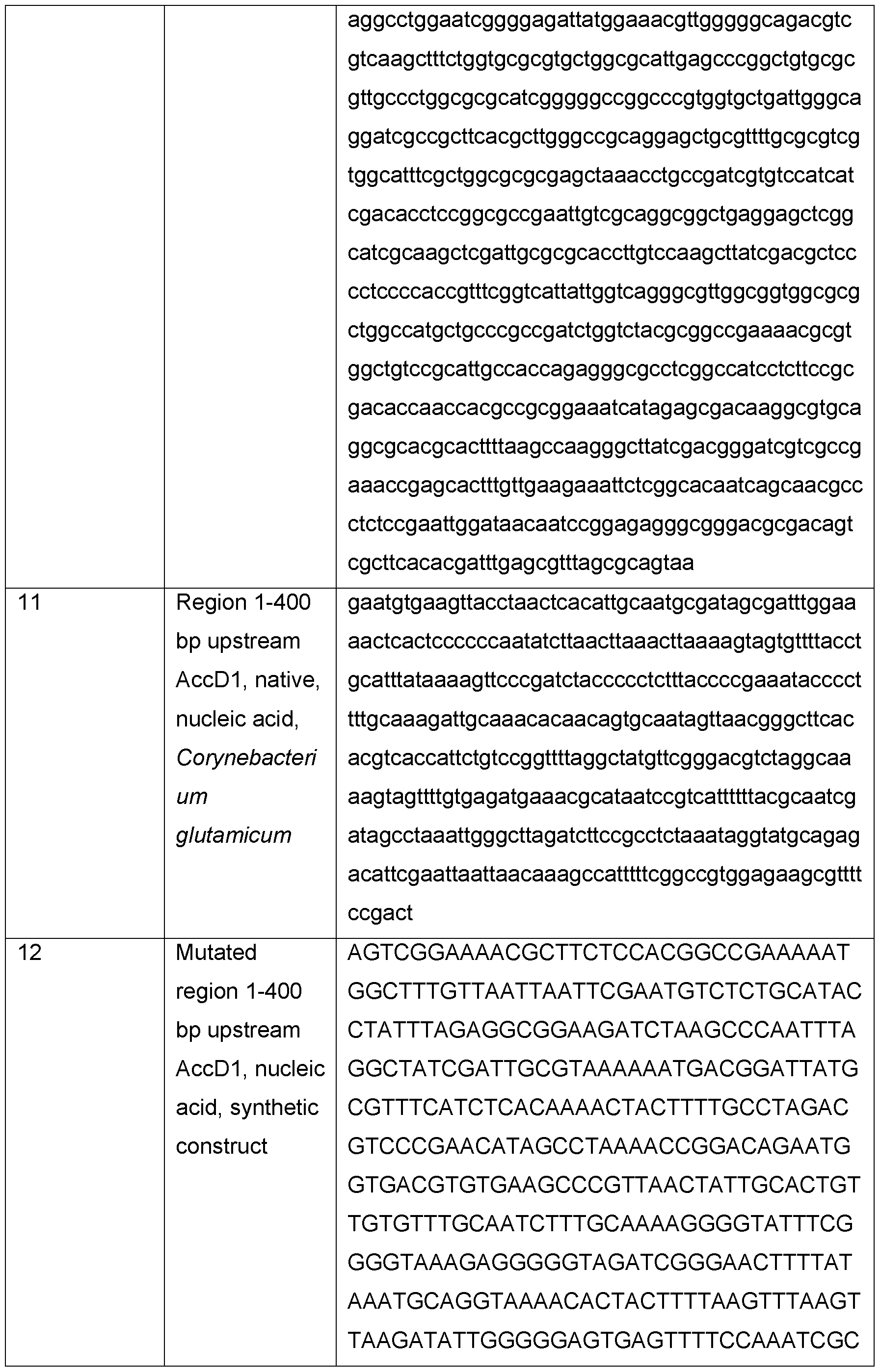


References
Bolwig, S. et al. (2019). Valorisation of whey: A tale of two Nordic dairies. In From Waste to Value: Valorisation Pathways for Organic Waste Streams in Circular Bioeconomies Taylor & Francis.
Boonyai, P. et al. (2004). Stickiness measurement techniques for food powders: A review. Powder Technology, 145(1), 34-46.
Chandrapala, J. et al. (2016). Removal of lactate from acid whey using nanofiltration. Journal of Food Engineering, 177, 59-64.
Chandrapala, J. et al. (2017). Strategies for maximizing removal of lactic acid from acid whey - Addressing the un-processability issue. Separation and Purification Technology, 172, 489-497.
Chandrapala, J., & Vasiljevic, T. (2017). Properties of spray dried lactose powders influenced by presence of lactic acid and calcium. Journal of Food Engineering, 198, 63-71.
Chen, G. Q. et al. (2016). Removal of lactic acid from acid whey using electrodialysis. Separation and Purification Technology, 158, 230-237.
Choi, S. B., & Yun, Y. S. (2004). Lead biosorption by waste biomass of Corynebacterium glutamicum generated from lysine fermentation process. Biotechnology Letters, 26(4), 331-336. da Luz et al. (2017). Analysis of intracellular metabolites of Corynebacterium glutamicum at high cell density with automated sampling and filtration and assessment
of engineered enzymes for effective l-lysine production. Engineering in Life Science, 17, 512-522.
Dufton, G. et al. (2019). Positive impact of pulsed electric field on lactic acid removal, demineralization and membrane scaling during acid whey electrodialysis. International Journal of Molecular Sciences, 20(4).
Follmann et al., 2009. Functional genomics of pH homeostasis in Corynebacterium glutamicum revealed novel links between pH response, oxidative stress, iron homeostasis and methionine synthesis). BMC Genomics, 10:621
Gande, R. et al. (2007). The two carboxylases of corynebacterium glutamicum essential for fatty acid and mycolic acid synthesis. Journal of Bacteriology, 189(14), 5257-5264.
Jeff Sumardee, N. S., Mohd-Hairul, A. R., & Mortan, S. H. (2020). Effect of inoculum size and glucose concentration for bacterial cellulose production by Lactobacillus acidophilus. IOP Conference Series: Materials Science and Engineering, 991(1)
Kato, O., Youn, J., Stansen, K. C., Matsui, D., Oikawa, T., & Wendisch, V. F. (2010). Quinone-dependent D-lactate dehydrogenase Did ( Cg1027 ) is essential for growth of Corynebacterium glutamicum on D-lactate.
Liu, Jian-ming, Chen, L., Jensen, P. R., & Solem, C. (2021). Food grade microbial synthesis of the butter aroma compound butanedione using engineered and nonengineered Lactococcus lactis. Metabolic Engineering, 67(August), 443-452.
Liu, Jianming, Chen, L., Dorau, R., Lillevang, S. K., Jensen, P. R., & Solem, C. (2020). From waste to taste-efficient production of the butter aroma compound acetoin from low-value dairy side streams using a natural (nonengineered) Lactococcus lactis dairy isolate. Journal of Agricultural and Food Chemistry, 68(21), 5891-5899.
Metsamuuronen, S., Manttari, M., & Nystrdm, M. (2011). Comparison of analysis methods for protein concentration and its use in UF fractionation of whey. Desalination, 283, 156-164
Miralles, B., Bartolome, B., Amigo, L., & Ramos, M. (2000). Comparison of three methods to determine the whey protein to total protein ratio in milk. Journal of dairy science, 83(12), 2759-2765
Prazeres, A. R. et al. (2012). Cheese whey management: A review. Journal of Environmental Management, 110, 48-68. Priyamvada Thorakkattu. (2015). Effect of lactic acid and galactose on the storage stability of lactose rich permeate powders. http://mpoc.org.my/malaysian-palm-oil-industry/
Rao et al. (2004). Changes in Galactose and Lactic Acid Content of Sweet Whey during Storage. Journal of Food Protection, 67(2), 403-406.
Rocha-Mendoza et al. (2021). Invited review: Acid whey trends and health benefits. Journal of Dairy Science, 104(2), 1262-1275.
Saffari, M., & Langrish, T. (2014). Effect of lactic acid in-process crystallization of lactose/protein powders during spray drying. Journal of Food Engineering, 137, 88-94.
Shen et al. (2019). Development of a novel, robust and cost-efficient process for valorizing dairy waste exemplified by ethanol production. Microbial cell factories, 18(1), 51.
Talebi, S. et al. (2020). Pilot study on the removal of lactic acid and minerals from acid whey using membrane technology. ACS Sustainable Chemistry and Engineering, 8(7), 2742-2752.
Wang, Z., Liu, J., Chen, L., Zeng, A. P., Solem, C., & Jensen, P. R. (2018). Alterations in the transcription factors GntR1 and RamA enhance the growth and central metabolism of Corynebacterium glutamicum. Metabolic Engineering, 48(May), 1-12. https://doi.Org/10.1016/j.ymben.2018.05.004
Items
1. A method for removing lactate from acid whey (AW) containing lactate (AWLA), comprising the steps of:
i. providing the AWLA; ii. contacting the AWLA with a bacterial cell of the species Corynebacterium glutamicum, C. casei, C. variabile and/or Bacillus coagulans, whereby metabolization of the lactate from the AWLA by the bacterial cell occurs, thereby producing a de-acidified AW product. The method according to item 1 , wherein the concentration of lactate in the deacidified AW product is between 0 and 20 mM, such as between 0 and 10 mM, for example between 0 and 10 mM, such as between 0 and 5 mM, for example between 0 and 4 mM, such as between 0 and 3 mM, for example between 0 and 2 mM or such as between 0 and 1 mM. The method according to item 1 , wherein the concentration of lactate in the deacidified AW product is between 0 and 10 mM, such as between 5 and 10 mM, such as between 6 and 10 mM, for example between 7 and 10 mM, such as between 8 and 10 mM or for example between 9 and 10 mM. The method according to any one of the preceding items, further comprising a step of adjusting pH of the AWLA and/or de-acidified AW product, for example between step i. and step ii. The method according to any one of the preceding items, wherein the pH of the AWLA is adjusted prior to step ii. to at least 4.5, such as at least 5, such as at least 5.5, such as at least 6, such as at least 6.5, such as at least 7, such as at least 7.5, such as at least 8, or higher. The method according to any one of the preceding items, wherein the pH of the AWLA is adjusted prior to step ii. to between 4.5 and 8.5, such as between 5 and 7.5, such as between 5.5 and 7, such as between 6 and 7, such as between 6.25 and 6.75, such as 6.5. The method according to any one of the preceding items, wherein an additive is added to the AWLA, for example between step i. and step ii., during step ii., and/or after step ii.
8. The method according to item 7, wherein the additive is selected from yeast extract, one or more salts and peptone.
9. The method according to any one of the preceding items, wherein the AWLA contains D-lactate, L-lactate, D-lactic acid and/or L-lactic acid.
10. The method according to any one of the preceding items, wherein the content of D-lactate, L-lactate, D-lactic acid and/or L-lactic acid in the de-acidified AW product is reduced compared to the content in the AWLA.
11 . The method according to any one of the preceding items, wherein the lactate concentration in the AWLA is between 50 and 180 mM, such as between 55 and 160 mM, such as between 60 and 150 mM, for example between 80 and 120 mM, such as between 85 and 110 mM, such as between 105 and 110 mM, for example 107 mM.
12. The method according to any one of the preceding items, wherein the concentration of lactate of the AWLA is at least 50 mM, for example at least 60 mM, such as at least 70 mM, for example at least 80 mM, such as at least 85 mM, for example at least 90 mM, such as at least 95 mM, for example at least 100 mM, such as at least 105 mM, for example at least 107 mM, such as at least 110 mM, such as at least 115 mM, such as at least 120 mM, such as at least 125 mM, such as at least 130 mM, such as at least 140 mM, such as at least 150 mM, or more.
13. The method according to any one of the preceding items, wherein the content of lactate of the AWLA is between 0.90% and 1 % lactate in the form of dry matter (weight/volume), such as between 0.92% and 1 %, such as between 0.93% and 1 %, such as between 0.94% and 1%, for example between 0.95% and 0.99% lactate in the form of dry matter (weight/volume).
14. The method according to any one of the preceding items, wherein the AWLA is obtained from the process of straining yoghurt to obtained strained yoghurt.
15. The method according to any one of the preceding items, wherein the AWLA is obtained from manufacturing acid coagulated dairy products such as cream cheese, cottage cheese and/or and ricotta cheese.
16. The method according to item 14, wherein the strained yoghurt is selected from hung yoghurt, bag yoghurt, Greek yoghurt, Greek-style yoghurt, skyr, yoghurt cheese, sack yoghurt and/or kerned yoghurt.
17. The method according to any one of items 14 to 16, wherein the acid coagulated dairy product and/or strained yoghurt is manufactured from cow milk, goat milk, sheep milk, camel milk, alpaca milk and/or dromedary milk.
18. The method according to any one of the preceding items, wherein the AWLA and/or the de-acidified AW product further comprises galactose, and the method further comprises a step of removing the galactose from the AWLA and/or the de-acidified AW product.
19. The method according to any one of the preceding items, further comprising contacting the AWLA and/or the de-acidified AW product with another cell capable of metabolizing galactose, thereby removing galactose from the AWLA and/or the de-acidified AW product.
20. The method according to any one of the preceding items, wherein the amount of galactose in the de-acidified AW product is reduced by at least 40%, such as at least 45%, such as at least 50%, such as at least 55%, such as at least 60%, such as at least 65%, such as at least 70%, such as at least 75%, such as at least 80%, such as at least 85%, such as at least 90%, such as at least 95%, such as at least 96%, such as at least 97%, such as at least 98%, such as at least 99%, such as 100% compared to the amount of galactose in the AWLA.
21. The method according to any one of the preceding items, wherein the amount of galactose in the de-acidified AW product is reduced by 50% in 18 hours.
22. The method according to any one of the preceding items, wherein the another cell is a food-grade cell and/or GRAS cell.
The method according to any one of the preceding items, wherein the another cell is a bacterial cell, such as a Gram-positive bacterial cell and/or a lactic acid bacteria cell, or a fungal cell, such as a yeast cell. The method according to item 23, wherein the bacterial cell belongs to the order of Lactobacillales. The method according to item 23, wherein the bacterial cell belongs to the genera Lactococcus, Lactobacillus, Pediococcus, Leuconostoc, Streptococcus or Oenococcus. The method according to any one of items 23 to 24, wherein the bacterial cell belongs to the species Lactococcus lactis, such as L. lactis subsp. lactis biovar diacetylactis RD1M5, or Bacillus coagulans. The method according to any one of items 23 to 26, wherein the bacterial cell is a L. lactis subsp. lactis biovar diacetylactis RD1M5 cell that does not contain a lactose-cluster plasmid. The method according to any one of the preceding items, wherein the step of contacting comprises inoculating the bacterial cell into the AWLA to an optical density (OD) at 600 nm between 0.25 and 25, such as between 0.25 and 20, such as between 0.25 and 15, such as between 0.25 and 10, such as between 0.35 and 6, such as between 0.5 and 5, such as between 1 and 4, such as between 1.25 and 3.5, such as between 1.5 and 3, such as between 1.5 and 2.5, such as to an OD at 600 nm of 2. The method according to any one of items 22 to 27, wherein the step of contacting comprises inoculating the another bacterial cell into the AWLA to an OD at 600 nm between 0.5 and 6, such as between 0.75 and 5, such as between 1 and 4, for example between 1.5 and 3, such as between 1.5 and 2.5, such as between 1.75 and 2.25, such as 2.
The method according to any one of items 22 to 27 or 29, wherein the step of contacting comprises inoculating the another bacterial cell into the AWLA to an OD at 600 nm between 0.15 and 10, such as between 1.5 and 6, such as between 0.25 and 4, such as between 0.5 and 2, such as between 0.75 and
1.5, such as to an OD at 600 nm of 2. The method according to any one of the preceding items, wherein the step of contacting comprises cultivating the bacterial cell with and/or in AW at a temperature between 20 and 60 °C, such as between 20 and 40 °C, such as between 25 and 35 °C, such as between 27 and 33 °C, such as between 27.5 and 32.5 °C, such as between 28 and 32 °C, such as between 29 and 31 °C, such as between 29.5 and 30.5 °C, such as 30 °C. The method according to any one of the preceding items, wherein method further comprises a step of treating the de-acidified AW product, such as after step ii., for example a step of spray drying it, a step of fractionating it, a step of neutralizing it, a step of sterilizing it, and/or a step of filtrating it. The method according to item 32, wherein the step of treating the de-acidified AW product comprises sterilizing the de-acidified AW product, such as by heating, pasteurization, autoclaving, filtration, and/or chemical sterilization. The method according to any one of the preceding items, wherein the step of treating the de-acidified AW product comprises filtering to remove cells and/or cell debris from the de-acidified AW product. The method according to any one of the preceding items, wherein the method does not comprise a step of: i. applying an ionic-exchange resin; ii. electrodialysis; and/or iii. nanofiltration, to remove the lactate by absorption, lysis and/or separation, respectively. The method according to any one of the preceding items, further comprising a step of drying the de-acidified AW product, or
further comprising a step of drying the de-acidified AW product thereby obtaining a dried whey powder, such as a dried whey powder comprising said de-acidified AW product.
37. The method according to item 36, wherein the step of drying the de-acidified AW product comprises spray drying, rotary drying, freeze drying, flash drying, vacuum drying and/or fluidized bed drying, preferably the step of drying the deacidified AW product comprises spray drying the de-acidified AW product.
38. The method according to item 37, wherein the step of spray drying the deacidified AW product is performed at a feed inlet temperature between 100 and 260 °C, such as between 125 and 235 °C, such as between 150 and 210 °C, such as between 160 and 200 °C, such as between 185 and 195 °C, for example 190 °C.
39. The method according to any one of items 37 to 38, wherein the step of spray drying the de-acidified AW product is performed at a powder outlet temperature between 50 and 140 °C, such as between 50 and 110 °C, such as between 55 and 100 °C such as between 60 and 95 °C, such as between 65 and 90 °C, such as between 70 and 80 °C, for example 75 °C.
40. The method according to any one of items 37 to 39, wherein the step of spray drying the de-acidified AW product is performed at a powder outlet temperature of at least 50 °C, such as at least 55 °C, such as at least 60 °C, such as at least 70 °C, such as at least 75 °C, or higher, for example 80 °C.
41 . The method according to any one of items 36 to 39, wherein a dried whey powder, such as a spray-dried whey powder, is recovered.
42. A method of producing a dried whey powder, comprising: i. providing a de-acidified AW product as defined in any one of items 67 to 68 or 79 to 84; and ii. drying said de-acidified AW product, optionally wherein said drying comprises spray drying, rotary drying, freeze drying, flash drying, vacuum drying and/or fluidized bed drying;
thereby obtaining a dried whey powder, preferably wherein said dried whey powder is free-flowing.
43. The method according to any one of the preceding items, wherein said dried whey powder has a lactose yield above 40%, such as above 42.5%, for example above 45%, such as above 47.5%, for example above 48.5%, such as above 49%, for example above 49.5%, such as above 50%, for example above 50.5%, such as above 52.5%, for example above 53.5%, or more.
44. The method according to any one of the preceding items, wherein said dried whey powder has a lactose yield between 40% and 60%, such as between 45% and 55%, for example between 47% and 53%, such as between 48% and 52%, such as between 48.5% and 51%.
45. A bacterial cell capable of metabolizing lactate of AWLA, said cell comprising a mutation in one or more of: i. sigM as set forth in SEQ ID NO: 3; ii. whcA as set forth in SEQ ID NO: 7; and/or iii. the upstream-region (SEQ ID NO: 11) of the coding sequence (CDS) encoding AccD1, or a functional homologue of any of the aforementioned sequences having at least 70% sequence identity thereto.
46. A Bacillus coagulans cell capable of metabolizing lactate comprising a D-2 hydroxyacid dehydrogenase as set forth in SEQ ID NO: 16 or a functional homologue thereof having at least 70% sequence identity thereto, wherein said D-2 hydroxyacid dehydrogenase comprises at least one, such as at least two, such as at least three substitutions, wherein said substitutions are selected from: i. a substitution of a residue corresponding to residue 177 of the polypeptide set forth in SEQ ID NO: 16, wherein said substitution is a substitution into glycine (G), such as a substitution of a glutamic acid (E) for a glycine (G), such as E177G; ii. a substitution of a residue corresponding to residue 272 of the polypeptide set forth in SEQ ID NO: 16, wherein said substitution is a substitution into
lysine (K), such as a substitution of a glutamic acid (E) for lysine (K), such as E272K; and iii. a substitution of a residue corresponding to residue 307 of the polypeptide set forth in SEQ ID NO: 16, wherein said substitution is a substitution into glycine, such as a substation of a serine (S) for a glycine (G), such as S307G. . A bacterial cell capable of metabolizing lactate, said cell comprising a mutated D-2 hydroxyacid dehydrogenase as set forth in SEQ ID NO: 17 or a functional homologue thereof having at least 70% sequence identity thereto and comprising mutations E177G, E272K and/or S307G, wherein said bacterial cell is a Bacillus coagulans cell. . The bacterial cell according to any one of items 46 to 47, wherein the bacterial cell comprises a nucleic acid, such as a gene, encoding SEQ ID NO: 17, the nucleic acid being for example SEQ ID NO: 15 or a functional homologue thereof having at least 70% sequence identity thereto. . The method according to any one of items 1 to 44, wherein the bacterial cell is a bacterial cell according to any one of items 45 to 48. . The method and/or bacterial cell according to any one of the preceding items, wherein the bacterial cell metabolizes lactate from AWLA at least 20% faster compared to the metabolization by a wild-type bacterial cell grown in similar conditions, such as at least 25% faster, such as at least 30% faster, such as at least 35% faster, such as at least 40% faster, such as at least 45% faster, such as at least 50% faster, such as at least 55% faster, such as at least 60% faster, or faster, optionally wherein said wild-type bacterial cell is a corresponding bacterial cell without said mutation, but otherwise identical to the bacterial cell. 1. The method and/or bacterial cell according to any one of the preceding items, wherein the bacterial cell metabolizes lactate from AWLA between 20% and 60% faster compared to the metabolization by a wild-type bacterial cell grown in similar conditions, such as between 20% and 55% faster, such as between 25% and 50% faster, optionally wherein said wild-type bacterial cell is a
corresponding bacterial cell without said mutation, but otherwise identical to the bacterial cell. The method and/or bacterial cell according to any one of the preceding items, wherein the mutation in sigM (SEQ ID NO: 3) results in an amino acid substitution in the encoded protein is a missense mutation or a nonsense mutation. The method and/or bacterial cell according to any one of the preceding items, wherein the bacterial cell comprises a gene encoding SEQ ID NO: 2, such as SEQ ID NO: 4, or a functional homologue of any of the aforementioned sequences having at least 70% sequence identity thereto. The method and/or bacterial cell according to any one of the preceding items, wherein the mutation in wchA (SEQ ID NO: 7) is a frame-shift mutation, a nonsense mutation or a missense mutation. The method and/or bacterial cell according to any one of the preceding items, wherein the bacterial cell comprises a gene encoding SEQ ID NO: 6, such as SEQ ID NO: 8, or a functional homologue of any of the aforementioned sequences having at least 70% sequence identity thereto. The method and/or bacterial cell according to any one of the preceding, wherein the upstream-region of the CDS encoding AccD1 is defined as 400 base pairs upstream the start codon of AccD1. The method and/or bacterial cell according to any one of the preceding items, wherein the mutation in the upstream-region of the CDS encoding AccD1 is a deletion of a G in a G(6)-repeat region resulting in a G(5)-repeat region, preferably wherein the mutated upstream-region of the CDS encoding AccD1 is as set forth in SEQ ID NO: 12. The method and/or bacterial cell according to item 56, wherein the mutation in the upstream-region of the CDS encoding AccD1 is a G->A substitution,
preferably wherein the mutated upstream-region of the CDS encoding AccD1 is as set forth in SEQ ID NO: 13.
59. The method and/or bacterial cell according to any one of the preceding items, wherein the bacterial cell is a food-grade bacterial cell.
60. The method and/or bacterial cell according to any one of the preceding items, wherein the bacterial cell is a lactic acid bacterial cell and/or a Gram-positive bacterial cell.
61. The bacterial cell according to any one of items 45 or 50 to 60, wherein the bacterial cell belongs to the genus of Corynebacterium, Bacillus, Propionibacterium or Brevi bacterium.
62. The bacterial cell according to any one of items 45 or 50 to 61 , wherein the bacterial cell belongs to the species Corynebacterium glutamicum, C. case/, C. variabile, Bacillus coagulans, Propionibacterium freudenreichii, or
Brevi bacterium linens.
63. The method and/or bacterial cell according to any one of the preceding items, wherein the bacterial cell is capable of metabolizing between 60 and 150 mM lactate in less than 24 h from an initial pH between 6 and 7.
64. The method and/or bacterial cell according to any one of the preceding items, wherein the cell does not secrete proteins with protease activity, such as wherein the cell is a protease-deficient cell.
65. The method and/or bacterial cell according to any one of the preceding items, wherein the bacterial cell is not capable of metabolizing lactose and/or galactose.
66. The method and/or bacterial cell according to any one of the preceding items, wherein the bacterial cell is capable of metabolizing lactose and/or galactose.
67. A de-acidified AW product obtained by a method according to any one of items 1 to 39 or 49 to 66.
68. A de-acidified AW product obtained by a method according to any one of items 1 to 39 or 49 to 66, preferably wherein the concentration of lactate in the deacidified AW product is between 0 and 20 mM, such as between 0 and 10 mM, for example between 0 and 10 mM, such as between 0 and 5 mM, for example between 0 and 4 mM, such as between 0 and 3 mM, for example between 0 and 2 mM or such as between 0 and 1 mM, preferably the concentration of lactate in the de-acidified AW product is 0 mM.
69. A dried whey powder comprising a de-acidified AW product.
70. The dried whey powder according to item 69, wherein the dried whey powder is free-flowing
71. A dried whey powder obtained by a method according to any one of items 42 to 44, preferably the dried whey powder being free-flowing and wherein said dried whey powder contains at the most 3 % w/w lactate, such as at the most 2.5 % w/w lactate, such as at the most 2 % w/w lactate, such as at the most 1.5 % w/w lactate, such as at the most 1 % w/w lactate, such as at the most 0.75% w/w lactate, such as at the most 0.5% w/w lactate, such as at the most 0.3 % w/w lactate, or less, such as 0 % w/w lactate.
72. The dried whey powder according to any one items 69 to 71 , wherein the dried whey powder is a spray-dried whey powder.
73. The dried whey powder according to any one of items 69 to 72, said dried whey powder having: i. a water content of less than 4.7% measured at 25 °C and 40% humidity, such as less than 4.6%, for example less than 4.3%, such as less than 4%, for example less than 3.8%, such as less than 3.5%, for example less than 3.3%, such as less than 3.2%, or less; and/or ii. a water content of less than 23.5% measured at 25 °C and 80% humidity, such as less than 23%, for example less than 22%, such as
less than 20.5%, for example less than 19%, such as less than 18.5%, for example less than 17%, for example less than 16.5%, or less.
74. The dried whey powder according to any one of items 69 to 73, said dried whey powder having a lactose yield above 40%, such as above 42.5%, for example above 45%, such as above 47.5%, for example above 48.5%, such as above 49%, for example above 49.5%, such as above 50%, for example above 50.5%, such as above 52.5%, for example above 53.5%, or more.
75. The dried whey powder according to any one of items 69 to 74, said dried whey powder having a lactose yield between 40% and 60%, such as between 45% and 55%, for example between 47% and 53%, such as between 48% and 52%, such as between 48.5% and 51 %.
76. The dried whey powder according to any one of items 69 to 75, said dried whey powder having: i. a Dx (10) between 4 and 10.2 pm, such as between 5 and 10 pm, such as between 6 and 9 pm, for example between 6.5 and 8.5, such as between 7 and 8.5, for example 7, 7.3, 7.5, 8 or 8.5 pm; ii. a Dx (50) between 20 and 103.5 pm, such as between 30 and 100 pm, such as between 35 and 90 pm, such as between 40 and 80 pm, such as between 40 and 70 pm, for example between 40 and 65 pm, such as between 45 and 65 pm, such as between 45 and 60 pm, such as between 47 and 56 pm, for example 47, 47.8, 48, 55, 55.8 or 60 pm; and/or iii. a Dx (90) between 200 and 465 pm, such as between 225 and 400 pm, for example between 250 and 350 pm, such as between 265 and 320 pm, for example between 270 and 315 pm, such as between 280 and 310 pm, for example between 290 and 310 pm, such as between 295 and 305 pm, for example 304 pm or 295.6 pm.
77. The dried whey powder according to any one of items 69 to 76, said dried whey powder having: i. a De Brouckere mean diameter (D[4,3]) between 1000 and 20 nm, for example between 750 and 30 nm, such as between 500 and 40 nm, for
example between 250 and 50 nm, such as between 200 and 60 nm, for example between 150 and 70 nm, such as between 115 and 90, for example between 112.5 and 96; and/or ii. a Sauter mean diameter (D[3,2]) between 200 and 5 nm, for example between 150 and 5 nm, such as between 125 and 5 nm, for example between 100 and 5 nm, such as between 75 and 5 nm, such as between 50 and 5 nm, for example between 25 and 5 nm, such as between 15 and 7, for example between 13 and 9. The dried whey powder according to any one of items 69 to 77 obtained by the method according to any one of items 1 to 44, 49 to 60, or 63 to 66. The method, the de-acidified AW product, and/or the dried whey powder according to any one of the preceding items, wherein the pH of the de-acidified AW product is between 4.5 and 9.5, such as between 5 and 9.5, such as between 5.5 and 9, such as between 6 and 8.5, such as between 6.25 and 8, such as 6.5. The method, the de-acidified AW product, and/or the dried whey powder according to any one of the preceding items, wherein the de-acidified AW product contain cell debris of one or more cells belonging to a genus of Corynebacterium, Bacillus, Propionibacterium, Lactococcus, Brevibacterium, Lactobacillus, Pediococcus, Leuconostoc, Streptococcus or Oenococcus, and/or to the species of Corynebacterium glutamicum, C. casei, C. variabile, Bacillus coagulans, Propionibacterium freudenreichii, Lactococcus lactis, L. lactis subsp. lactis biovardiacetylactis RD1M5, or Brevibacterium linens. The method, the de-acidified AW product, and/or the dried whey powder according to any one of the preceding items, wherein the dried whey powder contains cell debris of one or more cells belonging to a genus of Corynebacterium, Bacillus, Propionibacterium, Lactococcus, Brevibacterium, Lactobacillus, Pediococcus, Leuconostoc, Streptococcus or Oenococcus, and/or to the species of Corynebacterium glutamicum, C. casei, C. variabile, Bacillus coagulans, Propionibacterium freudenreichii, Lactococcus lactis, L. lactis subsp. lactis biovardiacetylactis RD1M5, or Brevibacterium linens.
82. The method, the de-acidified AW product, and/or the dried whey powder according to any one of the preceding items, wherein the protein content of the de-acidified AW product is ± 10 % compared to the protein content of the AWLA, such as ± 9 %, such as ± 8 %, such as ± 7 %, such as ± 6 %, such as ± 5 %, such as ± 4 %, such as ± 2 %, such as ± 1 %, such as the same, preferably wherein the protein content of the AWLA is approximately 10 % w/w.
83. The method, the de-acidified AW product, and/or the dried whey powder according to any one of the preceding items, wherein the protein content of the AWLA is between 12 and 8 % w/w, such as between 11 and 9 % w/w, such as between 10.5 and 9.5 % w/w, such as approximately 10 % w/w.
84. The method, the de-acidified AW product, and/or the dried whey powder according to any one of the preceding items, wherein the protein content of the de-acidified AW product and/or the dried whey powder is between 11.5 and 7,5 % w/w, such as between 11 and 8 % w/w, such as between 10.5 and 9.5 % w/w, such as approximately 10 % w/w.
85. A method of making or selecting a bacterial cell having improved metabolization of lactate, comprising: i. providing a parent bacterial cell of the species Corynebacterium glutamicum, C. case/, C. variabile, Bacillus coagulans, Propionibacterium freudenreichii, and/or Brevibacterium linens’, ii. propagating said parent bacterial cell in a cultivation medium comprising LA, thereby obtaining cultivation broth; iii. optionally continuously monitoring the bacterial cell density and/or biomass concentration of said cultivation broth, i. optionally adjusting the bacterial cell density and/or biomass concentration and/or concentration of LA and/or AWLA in said cultivation medium and/or cultivation broth, to maintain a propagation environment that selects for bacterial cells having improved metabolization of LA; and ii. optionally repeating steps ii to iv;
thereby obtaining a bacterial cell having improved metabolization of LA relative to the parent bacterial cell. od composition comprising: i. the dried whey powder according to any one of items 69 to 84; ii. the de-acidified AW product according to any one of items 67 to 68 or 72 to 84.
Claims
1. A method for removing lactate from acid whey (AW) containing lactate (AWLA), comprising the steps of: i. providing the AWLA; ii. contacting the AWLA with a bacterial cell of the species Corynebacterium glutamicum, C. casei, C. variabile and/or Bacillus coagulans, whereby metabolization of the lactate from the AWLA by the bacterial cell occurs, thereby producing a de-acidified AW product.
2. The method according to claim 1, wherein the concentration of lactate in the deacidified AW product is between 0 and 20 mM, such as between 0 and 10 mM, for example between 0 and 10 mM, such as between 0 and 5 mM, for example between 0 and 4 mM, such as between 0 and 3 mM, for example between 0 and 2 mM or such as between 0 and 1 mM.
3. The method according to any one of the preceding claims, wherein the pH of the AWLA is adjusted prior to step ii. to at least 4.5, such as at least 5, such as at least 5.5, such as at least 6, such as at least 6.5, such as at least 7, such as at least 7.5, such as at least 8, or higher.
4. The method according to any one of the preceding claims, wherein the AWLA and/or the de-acidified AW product further comprises galactose, and the method further comprises a step of removing the galactose from the AWLA and/or the de-acidified AW product.
5. The method according to any one of the preceding claims, further comprising contacting the AWLA and/or the de-acidified AW product with another cell capable of metabolizing galactose, thereby removing galactose from the AWLA and/or the de-acidified AW product.
6. The method according to any one of the preceding claims, wherein the amount of galactose in the de-acidified AW product is reduced by at least 40%, such as at least 45%, such as at least 50%, such as at least 55%, such as at least 60%, such as at least 65%, such as at least 70%, such as at least 75%, such as at least 80%, such as at least 85%, such as at least 90%, such as at least 95%,
such as at least 96%, such as at least 97%, such as at least 98%, such as at least 99%, such as 100% compared to the amount of galactose in the AWLA.
7. The method according to any one of the preceding claims, wherein the another cell is a bacterial cell, such as a Gram-positive bacterial cell and/or a lactic acid bacteria cell, or a fungal cell, such as a yeast cell.
8. The method according to any one of the preceding claims, wherein the step of contacting comprises inoculating the bacterial cell into the AWLA to an optical density (OD) at 600 nm between 0.35 and 6, such as between 0.5 and 5, such as between 1 and 4, such as between 1 .25 and 3.5, such as between 1 .5 and 3, such as between 1.5 and 2.5, such as to an OD at 600 nm of 2.
9. The method according to any one of the preceding claims, further comprising a step of drying the de-acidified AW product, optionally the step of drying the deacidified AW product comprises spray drying, rotary drying, freeze drying, flash drying, vacuum drying and/or fluidized bed drying, preferably the step of drying the de-acidified AW product comprises spray drying the de-acidified AW product.
10. A method of producing a dried whey powder, comprising: i. providing a de-acidified AW product as defined in claim 14; and ii. drying said de-acidified AW product, optionally wherein said drying comprises spray drying, rotary drying, freeze drying, flash drying, vacuum drying and/or fluidized bed drying; thereby obtaining a dried whey powder, preferably wherein said dried whey powder is free-flowing.
11 . A bacterial cell capable of metabolizing lactate of AWLA, said cell comprising a mutation in one or more of: i. sigM as set forth in SEQ ID NO: 3; ii. whcA as set forth in SEQ ID NO: 7; and/or iii. the upstream-region (SEQ ID NO: 11) of the coding sequence (CDS) encoding AccD1 , or a functional homologue of any of the aforementioned sequences having at least 70% sequence identity thereto.
12. The method and/or bacterial cell according to any one of the preceding claims, wherein the bacterial cell metabolizes lactate from AWLA at least 20% faster compared to the metabolization by a wild-type bacterial cell grown in similar conditions, such as at least 25% faster, such as at least 30% faster, such as at least 35% faster, such as at least 40% faster, such as at least 45% faster, such as at least 50% faster, such as at least 55% faster, such as at least 60% faster, or faster, optionally wherein said wild-type bacterial cell is a corresponding bacterial cell without said mutation, but otherwise identical to the bacterial cell.
13. The bacterial cell according to any one of claims 11 to 12, wherein the bacterial cell belongs to the species Corynebacterium glutamicum.
14. A de-acidified AW product obtained by a method according to any one of claims 1 to 9, preferably wherein the concentration of lactate in the de-acidified AW product is between 0 and 20 mM, such as between 0 and 10 mM, for example between 0 and 10 mM, such as between 0 and 5 mM, for example between 0 and 4 mM, such as between 0 and 3 mM, for example between 0 and 2 mM or such as between 0 and 1 mM, preferably the concentration of lactate in the deacidified AW product is 0 mM.
15. A dried whey powder obtained by a method according to claim 10, preferably the dried whey powder being free-flowing and wherein said dried whey powder contains at the most 3 % w/w lactate, such as at the most 2.5 % w/w lactate, such as at the most 2 % w/w lactate, such as at the most 1.5 % w/w lactate, such as at the most 1 % w/w lactate, such as at the most 0.75% w/w lactate, such as at the most 0.5% w/w lactate, such as at the most 0.3 % w/w lactate, or less, such as 0 % w/w lactate.
16. The dried whey powder according to claim 15, wherein the dried whey powder is a spray-dried whey powder.
17. The dried whey powder according to any one of claims 15 to 16, said dried whey powder having:
i. a water content of less than 4.7% measured at 25 °C and 40% humidity; and/or ii. a water content of less than 23.5% measured at 25 °C and 80% humidity.
18. The dried whey powder according to any one of claims 15 to 17, said dried whey powder having: i. a water content of less than 4.7% measured at 25 °C and 40% humidity; and said dried whey powder having: ii. a Dx (10) between 4 and 10.2 pm; iii. a Dx (50) between 20 and 103.5 pm; and iv. a Dx (90) between 200 and 465 pm.
19. The dried whey powder according to any one of claims 15 to 18, said dried whey powder having: i. a De Brouckere mean diameter (D[4,3]) between 1000 and 20 nm; and/or ii. a Sauter mean diameter (D[3,2]) between 200 and 5 nm.
20. The dried whey powder according to any one of claims 15 to 19 obtained by the method according to any one of claims 1 to 12.
21. The method, the de-acidified AW product, and/or the dried whey powder according to any one of the preceding claims, wherein the pH of the de-acidified AW product is between 4.5 and 9.5, such as between 5 and 9.5, such as between 5.5 and 9, such as between 6 and 8.5, such as between 6.25 and 8, such as 6.5.
22. The method, the de-acidified AW product, and/or the dried whey powder according to any one of the preceding claims, wherein the de-acidified AW product contain cell debris of one or more cells belonging to a genus of Corynebacterium or Bacillus, and/or to the species of Corynebacterium glutamicum, C. case/, C. variabile, or Bacillus coagulans.
23. The method, the de-acidified AW product, and/or the dried whey powder according to any one of the preceding claims, wherein the dried whey powder contains cell debris of one or more cells belonging to a genus of Corynebacterium or Bacillus, and/or to the species of Corynebacterium glutamicum, C. case/, C. variabile, or Bacillus coagulans.
24. The method, the de-acidified AW product, and/or the dried whey powder according to any one of the preceding claims, wherein the protein content of the de-acidified AW product is ± 10 % compared to the protein content of the AWLA, such as ± 9 %, such as ± 8 %, such as ± 7 %, such as ± 6 %, such as ± 5 %, such as ± 4 %, such as ± 2 %, such as ± 1 %, such as the same, preferably wherein the protein content of the AWLA is approximately 10 % w/w.
25. A method of making or selecting a bacterial cell having improved metabolization of lactate, comprising: i. providing a parent bacterial cell of the species Corynebacterium glutamicum, C. case/, C. variabile, and/or Bacillus coagulans', ii. propagating said parent bacterial cell in a cultivation medium comprising LA, thereby obtaining cultivation broth; iii. optionally continuously monitoring the bacterial cell density and/or biomass concentration of said cultivation broth, iv. optionally adjusting the bacterial cell density and/or biomass concentration and/or concentration of LA and/or AWLA in said cultivation medium and/or cultivation broth, to maintain a propagation environment that selects for bacterial cells having improved metabolization of LA, and v. optionally repeating steps ii to iv; thereby obtaining a bacterial cell having improved metabolization of LA relative to the parent bacterial cell.
Applications Claiming Priority (2)
| Application Number | Priority Date | Filing Date | Title |
|---|---|---|---|
| EP23182114.1 | 2023-06-28 | ||
| EP23182114 | 2023-06-28 |
Publications (1)
| Publication Number | Publication Date |
|---|---|
| WO2025003430A1 true WO2025003430A1 (en) | 2025-01-02 |
Family
ID=87036390
Family Applications (1)
| Application Number | Title | Priority Date | Filing Date |
|---|---|---|---|
| PCT/EP2024/068294 Ceased WO2025003430A1 (en) | 2023-06-28 | 2024-06-28 | Methods and cells for removing lactate from acid whey |
Country Status (1)
| Country | Link |
|---|---|
| WO (1) | WO2025003430A1 (en) |
Citations (1)
| Publication number | Priority date | Publication date | Assignee | Title |
|---|---|---|---|---|
| US20150329883A1 (en) * | 2014-05-19 | 2015-11-19 | Samsung Electronics Co., Ltd. | Genetically engineered bacterial cell and method of producing succinic acid using the same |
-
2024
- 2024-06-28 WO PCT/EP2024/068294 patent/WO2025003430A1/en not_active Ceased
Patent Citations (1)
| Publication number | Priority date | Publication date | Assignee | Title |
|---|---|---|---|---|
| US20150329883A1 (en) * | 2014-05-19 | 2015-11-19 | Samsung Electronics Co., Ltd. | Genetically engineered bacterial cell and method of producing succinic acid using the same |
Non-Patent Citations (28)
| Title |
|---|
| "Genbank", Database accession no. NZ_CP115148 |
| BOLWIG, S. ET AL.: "Valorisation of whey: A tale of two Nordic dairies", IN FROM WASTE TO VALUE: VALORISATION PATHWAYS FOR ORGANIC WASTE STREAMS IN CIRCULAR BIOECONOMIES TAYLOR & FRANCIS, 2019 |
| BOONYAI, P. ET AL.: "Stickiness measurement techniques for food powders: A review", POWDER TECHNOLOGY, vol. 145, no. 1, 2004, pages 34 - 46 |
| CHANDRAPALA JAYANI ET AL: "Strategies for maximizing removal of lactic acid from acid whey - Addressing the un-processability issue", SEPARATION AND PURIFICATION TECHNOLOGY, ELSEVIER SCIENCE, AMSTERDAM, NL, vol. 172, 6 September 2016 (2016-09-06), pages 489 - 497, XP029755652, ISSN: 1383-5866, DOI: 10.1016/J.SEPPUR.2016.09.004 * |
| CHANDRAPALA, J. ET AL.: "Removal of lactate from acid whey using nanofiltration", JOURNAL OF FOOD ENGINEERING, vol. 177, 2016, pages 59 - 64, XP029413643, DOI: 10.1016/j.jfoodeng.2015.12.019 |
| CHANDRAPALA, J. ET AL.: "Strategies for maximizing removal of lactic acid from acid whey - Addressing the un-processability issue", SEPARATION AND PURIFICATION TECHNOLOGY, vol. 172, 2017, pages 489 - 497, XP029755652, DOI: 10.1016/j.seppur.2016.09.004 |
| CHANDRAPALA, J.VASILJEVIC, T.: "Properties of spray dried lactose powders influenced by presence of lactic acid and calcium", JOURNAL OF FOOD ENGINEERING, vol. 198, 2017, pages 63 - 71, XP029856029, DOI: 10.1016/j.jfoodeng.2016.11.017 |
| CHEN, G. Q. ET AL.: "Removal of lactic acid from acid whey using electrodialysis", SEPARATION AND PURIFICATION TECHNOLOGY, vol. 158, 2016, pages 230 - 237, XP055556723, DOI: 10.1016/j.seppur.2015.12.016 |
| CHOI, S. B.YUN, Y. S.: "Lead biosorption by waste biomass of Corynebacterium glutamicum generated from lysine fermentation process", BIOTECHNOLOGY LETTERS, vol. 26, no. 4, 2004, pages 331 - 336 |
| DA LUZ: "Analysis of intracellular metabolites of Corynebacterium glutamicum at high cell density with automated sampling and filtration and assessment of engineered enzymes for effective I-lysine production", ENGINEERING IN LIFE SCIENCE, vol. 17, pages 512 - 522 |
| DUFTON, G. ET AL.: "Positive impact of pulsed electric field on lactic acid removal, demineralization and membrane scaling during acid whey electrodialysis.", INTERNATIONAL JOURNAL OF MOLECULAR SCIENCES, vol. 20, no. 4, 2019 |
| FOLLMANN ET AL.: "Functional genomics of pH homeostasis in Corynebacterium glutamicum revealed novel links between pH response, oxidative stress, iron homeostasis and methionine synthesis).", BMC GENOMICS, vol. 10, 2009, pages 621, XP021066028 |
| GANDE, R. ET AL.: "The two carboxylases of corynebacterium glutamicum essential for fatty acid and mycolic acid synthesis", JOURNAL OF BACTERIOLOGY, vol. 189, no. 14, 2007, pages 5257 - 5264, XP055303063, DOI: 10.1128/JB.00254-07 |
| GOURDON P ET AL: "Cloning of the malic enzyme gene from Corynebacterium glutamicum and role of the enzyme in lactate metabolism", APPLIED AND ENVIRONMENTAL MICROBIOLOGY, AMERICAN SOCIETY FOR MICROBIOLOGY, US, vol. 66, no. 7, 1 July 2000 (2000-07-01), pages 2981 - 2987, XP002252045, ISSN: 0099-2240, DOI: 10.1128/AEM.66.7.2981-2987.2000 * |
| JEFF SUMARDEE, N. S.MOHD-HAIRUL, A. R.MORTAN, S. H.: "Effect of inoculum size and glucose concentration for bacterial cellulose production by Lactobacillus acidophilus", IOP CONFERENCE SERIES: MATERIALS SCIENCE AND ENGINEERING, vol. 991, no. 1, 2020 |
| KATO, O.YOUN, J.STANSEN, K. C.MATSUI, D.OIKAWA, T.WENDISCH, V. F., QUINONE-DEPENDENT D-LACTATE DEHYDROGENASE OLD ( CG1027 ) IS ESSENTIAL FOR GROWTH OF CORYNEBACTERIUM GLUTAMICUM ON D-LACTATE, 2010 |
| LIU, JIANMINGCHEN, L.DORAU, R.LILLEVANG, S. K.JENSEN, P. R.SOLEM, C.: "From waste to taste-efficient production of the butter aroma compound acetoin from low-value dairy side streams using a natural (nonengineered) Lactococcus lactis dairy isolate", JOURNAL OF AGRICULTURAL AND FOOD CHEMISTRY, vol. 68, no. 21, 2020, pages 5891 - 5899, XP093139547, DOI: 10.1021/acs.jafc.0c00882 |
| LIU, JIAN-MINGCHEN, L.JENSEN, P. R.SOLEM, C.: "Food grade microbial synthesis of the butter aroma compound butanedione using engineered and non-engineered Lactococcus lactis.", METABOLIC ENGINEERING, vol. 67, 2021, pages 443 - 452, XP086768177, DOI: 10.1016/j.ymben.2021.08.006 |
| METSÄMUURONEN, S.MÄNTTÄRI, M.NYSTRÖM, M.: "Comparison of analysis methods for protein concentration and its use in UF fractionation of whey", DESALINATION, vol. 283, 2011, pages 156 - 164, XP028599417, DOI: 10.1016/j.desal.2011.02.012 |
| MIRALLES, B.BARTOLOMÉ, B.AMIGO, L.RAMOS, M.: "Comparison of three methods to determine the whey protein to total protein ratio in milk", JOURNAL OF DAIRY SCIENCE, vol. 83, no. 12, 2000, pages 2759 - 2765 |
| PRAZERES, A. R. ET AL.: "Journal of Environmental Management", vol. 110, 2012, PRIYAMVADA THORAKKATTU, article "Effect of lactic acid and galactose on the storage stability of lactose rich permeate powders", pages: 48 - 68 |
| RAO ET AL.: "Changes in Galactose and Lactic Acid Content of Sweet Whey during Storage", JOURNAL OF FOOD PROTECTION, vol. 67, no. 2, 2004, pages 403 - 406 |
| ROCHA-MENDOZA ET AL.: "Invited review: Acid whey trends and health benefits", JOURNAL OF DAIRY SCIENCE, vol. 104, no. 2, 2021, pages 1262 - 1275, XP086446994, DOI: 10.3168/jds.2020-19038 |
| SAFFARI, M.LANGRISH, T.: "Effect of lactic acid in-process crystallization of lactose/protein powders during spray drying", JOURNAL OF FOOD ENGINEERING, vol. 137, 2014, pages 88 - 94 |
| SHEN ET AL.: "Development of a novel, robust and cost-efficient process for valorizing dairy waste exemplified by ethanol production.", MICROBIAL CELL FACTORIES, vol. 18, no. 1, 2019, pages 51 |
| TALEBI, S. ET AL.: "Pilot study on the removal of lactic acid and minerals from acid whey using membrane technology.", ACS SUSTAINABLE CHEMISTRY AND ENGINEERING, vol. 8, no. 7, 2020, pages 2742 - 2752 |
| WANG, Z.LIU, J.CHEN, L.ZENG, A. P.SOLEM, C.JENSEN, P. R.: "Alterations in the transcription factors GntR1 and RamA enhance the growth and central metabolism of Corynebacterium glutamicum", METABOLIC ENGINEERING, vol. 48, 2018, pages 1 - 12, XP085977759, Retrieved from the Internet <URL:https://doi.org/10.1016/j.ymben.2018.05.004> DOI: 10.1016/j.ymben.2018.05.004 |
| ZHAO GE ET AL: "Transforming acid whey into a resource by selective removal of lactic acid and galactose using optimized food-grade microorganisms", BIORESOURCE TECHNOLOGY, vol. 387, 1 November 2023 (2023-11-01), AMSTERDAM, NL, pages 129594, XP093101266, ISSN: 0960-8524, DOI: 10.1016/j.biortech.2023.129594 * |
Similar Documents
| Publication | Publication Date | Title |
|---|---|---|
| Monnet et al. | Growth and adaptation of microorganisms on the cheese surface | |
| Herrero-Fresno et al. | Lactobacillus casei strains isolated from cheese reduce biogenic amine accumulation in an experimental model | |
| Leclercq-Perlat et al. | Controlled production of Camembert-type cheeses. Part I: Microbiological and physicochemical evolutions | |
| Monnet et al. | The Arthrobacter arilaitensis Re117 genome sequence reveals its genetic adaptation to the surface of cheese | |
| Thierry et al. | Strain-to-strain differences within lactic and propionic acid bacteria species strongly impact the properties of cheese–A review | |
| Sasaki et al. | NADH Oxidase of Streptococcus thermophilus 1131 is Required for the Effective Yogurt Fermentation with Lactobacillus delbrueckii subsp. bulgaricus 2038 | |
| Neviani et al. | Recovery and differentiation of long ripened cheese microflora through a new cheese-based cultural medium | |
| Yue et al. | Analysis of the complete genome sequence of Lactobacillus delbrueckii ssp. bulgaricus with post-acidification capacity and its influence on yogurt in storage | |
| Maragkoudakis et al. | Potential use of scotta, the by-product of the ricotta cheese manufacturing process, for the production of fermented drinks | |
| Berthoud et al. | Development of new methods for the quantitative detection and typing of Lactobacillus parabuchneri in dairy products | |
| Unno et al. | Lactic acid bacterial diversity in Brie cheese focusing on salt concentration and pH of isolation medium and characterisation of halophilic and alkaliphilic lactic acid bacterial isolates | |
| Zhao et al. | Transforming acid whey into a resource by selective removal of lactic acid and galactose using optimized food-grade microorganisms | |
| Roy et al. | Effect of two thermoresistant non-starter lactic acid bacteria strains on volatilome profile during Cheddar ripening simulation | |
| Spus et al. | Isolation and characterization of Lactobacillus helveticus DSM 20075 variants with improved autolytic capacity | |
| US20130189396A1 (en) | Method for producing a fermented food containing bifidobacteria | |
| DK3140416T3 (en) | COLLECTION OF PROPIONI BACTERIUM AND Yeast | |
| FR2906536A1 (en) | Streptococcus thermophilus strain of which epsAD fragment presents a restriction profile after digestion by restriction enzymes, useful in bacterial composition, to prepare e.g. food product, dietary supplement or dietetic supplement | |
| EP3938546A1 (en) | New lactic acid bacteria | |
| Scheller et al. | Comparative analysis of an intestinal strain of Bifidobacterium longum and a strain of Bifidobacterium animalis subspecies lactis in Cheddar cheese | |
| Murat et al. | Food stabilizing potential of nisin Z produced by wild Lactococcus lactis subsp. lactis from raw milk and some fermented products | |
| Verma et al. | Sustainable utilization of dairy waste paneer whey by pediococcus pentosaceus NCDC 273 for lactic acid production | |
| CN109068676B (en) | Novel bacteria | |
| Zhao et al. | DTU DTU Library | |
| Khadidja et al. | Specific aminopeptidases of indigenous Lactobacillus brevis and Lactobacillus plantarum | |
| Siragusa et al. | Disruption of the gene encoding glutamate dehydrogenase affects growth, amino acids catabolism and survival of Lactobacillus plantarum UC1001 |
Legal Events
| Date | Code | Title | Description |
|---|---|---|---|
| 121 | Ep: the epo has been informed by wipo that ep was designated in this application |
Ref document number: 24737946 Country of ref document: EP Kind code of ref document: A1 |
|
| NENP | Non-entry into the national phase |
Ref country code: DE |
|
| 122 | Ep: pct application non-entry in european phase |
Ref document number: 24737946 Country of ref document: EP Kind code of ref document: A1 |