WO2025002811A1 - Heat-curable sealing composition - Google Patents
Heat-curable sealing composition Download PDFInfo
- Publication number
- WO2025002811A1 WO2025002811A1 PCT/EP2024/066224 EP2024066224W WO2025002811A1 WO 2025002811 A1 WO2025002811 A1 WO 2025002811A1 EP 2024066224 W EP2024066224 W EP 2024066224W WO 2025002811 A1 WO2025002811 A1 WO 2025002811A1
- Authority
- WO
- WIPO (PCT)
- Prior art keywords
- epoxy resin
- thermosetting
- resin composition
- component epoxy
- liquid
- Prior art date
- Legal status (The legal status is an assumption and is not a legal conclusion. Google has not performed a legal analysis and makes no representation as to the accuracy of the status listed.)
- Ceased
Links
Classifications
-
- C—CHEMISTRY; METALLURGY
- C08—ORGANIC MACROMOLECULAR COMPOUNDS; THEIR PREPARATION OR CHEMICAL WORKING-UP; COMPOSITIONS BASED THEREON
- C08G—MACROMOLECULAR COMPOUNDS OBTAINED OTHERWISE THAN BY REACTIONS ONLY INVOLVING UNSATURATED CARBON-TO-CARBON BONDS
- C08G59/00—Polycondensates containing more than one epoxy group per molecule; Macromolecules obtained by polymerising compounds containing more than one epoxy group per molecule using curing agents or catalysts which react with the epoxy groups
- C08G59/18—Macromolecules obtained by polymerising compounds containing more than one epoxy group per molecule using curing agents or catalysts which react with the epoxy groups ; e.g. general methods of curing
- C08G59/20—Macromolecules obtained by polymerising compounds containing more than one epoxy group per molecule using curing agents or catalysts which react with the epoxy groups ; e.g. general methods of curing characterised by the epoxy compounds used
- C08G59/22—Di-epoxy compounds
- C08G59/226—Mixtures of di-epoxy compounds
-
- C—CHEMISTRY; METALLURGY
- C08—ORGANIC MACROMOLECULAR COMPOUNDS; THEIR PREPARATION OR CHEMICAL WORKING-UP; COMPOSITIONS BASED THEREON
- C08G—MACROMOLECULAR COMPOUNDS OBTAINED OTHERWISE THAN BY REACTIONS ONLY INVOLVING UNSATURATED CARBON-TO-CARBON BONDS
- C08G59/00—Polycondensates containing more than one epoxy group per molecule; Macromolecules obtained by polymerising compounds containing more than one epoxy group per molecule using curing agents or catalysts which react with the epoxy groups
- C08G59/18—Macromolecules obtained by polymerising compounds containing more than one epoxy group per molecule using curing agents or catalysts which react with the epoxy groups ; e.g. general methods of curing
- C08G59/20—Macromolecules obtained by polymerising compounds containing more than one epoxy group per molecule using curing agents or catalysts which react with the epoxy groups ; e.g. general methods of curing characterised by the epoxy compounds used
- C08G59/22—Di-epoxy compounds
- C08G59/24—Di-epoxy compounds carbocyclic
- C08G59/245—Di-epoxy compounds carbocyclic aromatic
-
- C—CHEMISTRY; METALLURGY
- C08—ORGANIC MACROMOLECULAR COMPOUNDS; THEIR PREPARATION OR CHEMICAL WORKING-UP; COMPOSITIONS BASED THEREON
- C08G—MACROMOLECULAR COMPOUNDS OBTAINED OTHERWISE THAN BY REACTIONS ONLY INVOLVING UNSATURATED CARBON-TO-CARBON BONDS
- C08G59/00—Polycondensates containing more than one epoxy group per molecule; Macromolecules obtained by polymerising compounds containing more than one epoxy group per molecule using curing agents or catalysts which react with the epoxy groups
- C08G59/18—Macromolecules obtained by polymerising compounds containing more than one epoxy group per molecule using curing agents or catalysts which react with the epoxy groups ; e.g. general methods of curing
- C08G59/20—Macromolecules obtained by polymerising compounds containing more than one epoxy group per molecule using curing agents or catalysts which react with the epoxy groups ; e.g. general methods of curing characterised by the epoxy compounds used
- C08G59/32—Epoxy compounds containing three or more epoxy groups
-
- C—CHEMISTRY; METALLURGY
- C08—ORGANIC MACROMOLECULAR COMPOUNDS; THEIR PREPARATION OR CHEMICAL WORKING-UP; COMPOSITIONS BASED THEREON
- C08G—MACROMOLECULAR COMPOUNDS OBTAINED OTHERWISE THAN BY REACTIONS ONLY INVOLVING UNSATURATED CARBON-TO-CARBON BONDS
- C08G59/00—Polycondensates containing more than one epoxy group per molecule; Macromolecules obtained by polymerising compounds containing more than one epoxy group per molecule using curing agents or catalysts which react with the epoxy groups
- C08G59/18—Macromolecules obtained by polymerising compounds containing more than one epoxy group per molecule using curing agents or catalysts which react with the epoxy groups ; e.g. general methods of curing
- C08G59/20—Macromolecules obtained by polymerising compounds containing more than one epoxy group per molecule using curing agents or catalysts which react with the epoxy groups ; e.g. general methods of curing characterised by the epoxy compounds used
- C08G59/32—Epoxy compounds containing three or more epoxy groups
- C08G59/38—Epoxy compounds containing three or more epoxy groups together with di-epoxy compounds
-
- C—CHEMISTRY; METALLURGY
- C08—ORGANIC MACROMOLECULAR COMPOUNDS; THEIR PREPARATION OR CHEMICAL WORKING-UP; COMPOSITIONS BASED THEREON
- C08G—MACROMOLECULAR COMPOUNDS OBTAINED OTHERWISE THAN BY REACTIONS ONLY INVOLVING UNSATURATED CARBON-TO-CARBON BONDS
- C08G59/00—Polycondensates containing more than one epoxy group per molecule; Macromolecules obtained by polymerising compounds containing more than one epoxy group per molecule using curing agents or catalysts which react with the epoxy groups
- C08G59/18—Macromolecules obtained by polymerising compounds containing more than one epoxy group per molecule using curing agents or catalysts which react with the epoxy groups ; e.g. general methods of curing
- C08G59/40—Macromolecules obtained by polymerising compounds containing more than one epoxy group per molecule using curing agents or catalysts which react with the epoxy groups ; e.g. general methods of curing characterised by the curing agents used
- C08G59/4007—Curing agents not provided for by the groups C08G59/42 - C08G59/66
- C08G59/4014—Nitrogen containing compounds
- C08G59/4035—Hydrazines; Hydrazides
-
- C—CHEMISTRY; METALLURGY
- C08—ORGANIC MACROMOLECULAR COMPOUNDS; THEIR PREPARATION OR CHEMICAL WORKING-UP; COMPOSITIONS BASED THEREON
- C08G—MACROMOLECULAR COMPOUNDS OBTAINED OTHERWISE THAN BY REACTIONS ONLY INVOLVING UNSATURATED CARBON-TO-CARBON BONDS
- C08G59/00—Polycondensates containing more than one epoxy group per molecule; Macromolecules obtained by polymerising compounds containing more than one epoxy group per molecule using curing agents or catalysts which react with the epoxy groups
- C08G59/18—Macromolecules obtained by polymerising compounds containing more than one epoxy group per molecule using curing agents or catalysts which react with the epoxy groups ; e.g. general methods of curing
- C08G59/68—Macromolecules obtained by polymerising compounds containing more than one epoxy group per molecule using curing agents or catalysts which react with the epoxy groups ; e.g. general methods of curing characterised by the catalysts used
- C08G59/686—Macromolecules obtained by polymerising compounds containing more than one epoxy group per molecule using curing agents or catalysts which react with the epoxy groups ; e.g. general methods of curing characterised by the catalysts used containing nitrogen
-
- C—CHEMISTRY; METALLURGY
- C09—DYES; PAINTS; POLISHES; NATURAL RESINS; ADHESIVES; COMPOSITIONS NOT OTHERWISE PROVIDED FOR; APPLICATIONS OF MATERIALS NOT OTHERWISE PROVIDED FOR
- C09J—ADHESIVES; NON-MECHANICAL ASPECTS OF ADHESIVE PROCESSES IN GENERAL; ADHESIVE PROCESSES NOT PROVIDED FOR ELSEWHERE; USE OF MATERIALS AS ADHESIVES
- C09J163/00—Adhesives based on epoxy resins; Adhesives based on derivatives of epoxy resins
Definitions
- the invention relates to the field of a sealing composition for automotive body work in particular.
- CDC cathodic dip coating
- WO 2012/084806 provides a heat-curable sealing compound compositions having a dual curing mechanism.
- the sealing compound cures due to heat such as that prevailing in the CDC oven.
- heat-curable sealing compositions have good mechanical and storage properties, especially with respect to elongation at break performance and storage at elevated temperature between 50 °C - 60 °C.
- the object of the present invention is therefore to make available a thermosetting one-component epoxy resin composition that can be used as a sealing composition which does not show bubble formation at curing temperatures at 210 °C and provides good mechanical and storage properties, especially with respect to elongation at break performance and storage at elevated temperature between 50 °C - 60 °C.
- thermosetting one-component epoxy resin composition according to claim 1 achieve this object.
- thermosetting one-component epoxy resin composition is therefore suitable for use as a sealing compound in automotive bodies in particular.
- thermosetting one-component epoxy resin composition comprising a) at least one liquid epoxy resin A1 having an average of more than one epoxy group per molecule, that is an aromatic liquid epoxy resin; b) at least one liquid epoxy resin A2 having an average of more than one epoxy group per molecule, that is selected from the group consisting of: - glycidyl ethers of difunctional saturated, branched or unbranched, cyclic or open-chain C2-C30 alcohols;
- the curing agent B is a dihydrazide, preferably selected from the group consisting of aromatic dicarboxylic dihydrazide B1 and aliphatic dicarboxylic dihydrazide B2
- at least one toughness improver D selected from the group consisting of terminally blocked polyurethane polymers D1 , liquid rubbers D2 and core-shell polymers D3, preferably a terminally blocked polyurethane polymer D1.
- the weight ratio of the at least one liquid epoxy resin A1 to the at least one liquid epoxy resin A2 is from 0.25 - 5.0, preferably 0.33 - 3.0, more preferably 0.5 - 2.0, most preferably 0.75 - 1 .5.
- polymer in the present document refers on the one hand to a group of macromolecules that are chemically uniform but are different with respect to the degree of polymerization, the molecular weight and the chain length and are synthesized by a polyreaction (polymerization, polyaddition, polycondensation).
- this term also includes derivatives of such a group of macromolecules from polyreactions, i.e. , compounds obtained by reactions, for example, addition or substitution of functional groups on predetermined molecules and which may be chemically uniform or chemically heterogeneous.
- This term additionally also includes so-called prepolymers, i.e., reactive oligomeric precursors whose functional groups are involved in the structure of the macromolecules.
- Substance names that begin with "poly-” such as polyisocyanate, polyaldimine, polyamine, polyol, polymercaptans or polyglycidyl ethers in the present document refer to substances formally containing two or more functional groups, which also appear in their name, per molecule.
- mass and “weight” are used synonymously in this document. Thus a “percentage by weight” (% by weight) is a percentage mass fraction which unless otherwise stated relates to the mass (the weight) of the total composition or, depending on the context, of the entire molecule.
- molecular weight in the present document, in the context of polymers, refers to the average molecular weight M n , commonly measured with gel permeation chromatography (GPC) against polystyrene standard.
- Room temperature of the present documents is understood to be a temperature of 25°C.
- vehicle in this document is understood to refer to any means of transport by water, by land and by air.
- Such means of transport include in particular ships, wheeled vehicles, such as automobiles, buses, cars, trucks and rail vehicles such as streetcars and railway vehicles.
- a "one-component" composition in the present document denotes a curable composition in which all the ingredients of the composition are mixed and stored together in the same container and which are stable in storage over a lengthy period of time at room temperature, so they undergo little or no significant change in their use properties or application properties due to storage, and such a composition cures following application by the action of heat.
- thermosetting one-component epoxy resin composition comprises a) at least one liquid epoxy resin A1 having an average of more than one epoxy group per molecule, that is an aromatic liquid epoxy resin.
- Preferred liquid epoxy resins A1 have the formula (II)
- the substituents R’” and R” are each independently H or CH3.
- the index r has a value of 0 to 1 .
- r has a value of less than 0.2.
- DGEBA diglycidyl ethers of bisphenol A
- A/F diglycidyl ethers of bisphenol A
- Such liquid resins are available, for example, as Araldite® GY 250, Araldite® PY 304, Araldite® GY 282 (Huntsman), or D.E.R.TM 331 , or D.E.R.TM 330 (Olin), or Epikote 828 (Hexion).
- novolacs are suitable epoxy resins A1. These have in particular the following formula:
- Such epoxy resins are commercially available under the trade names EPN or ECN as well as Tactix® 556 from Huntsman or under the product line D.E.N. TM from Dow Chemical.
- bisphenol A diglycidyl ether bisphenol F diglycidyl ether or bisphenol A / F diglycidyl ether
- Araldite® GY 240 Aralite® GY 250, Araldite® GY 281 , Araldite® GY 282, Araldite® GY 285, Araldite® PY 304 or Araldite® PY 720 (all from Huntsman), or D.E.R.® 330, D.E.R.® 331 , D.E.R ® 332, D.E.R ® 336, D.E.R ® 351 , D.E.R ® 352, D.E.R ® 354 or D.E.R ® 356 (all from Olin), or novolak glycidyl ether.
- Such novolac glycidyl ethers are commercially available, for example from Olin, Huntsman, Momentive or Emerald Performance Materials.
- Preferred types are D.E.N.® 431 , D.E.N.® 438 or D.E.N.® 439 (from Olin), Araldite® EPN 1179, Araldite® EPN 1180, Araldite® EPN 1182 or Araldite® EPN 1183 (from Huntsman), Epon® 154, Epon® 160 or Epon® 161 (from Momentive) or Epalloy® 8250, Epalloy® 8330 or Epalloy® 8350 (from Emerald Performance Materials).
- the liquid epoxy resin A1 is a liquid epoxy resin of the formula (II).
- thermosetting one-component epoxy resin composition comprises b) at least one liquid epoxy resin A2 having an average of more than one epoxy group per molecule that is selected from the group consisting of:
- - glycidyl ethers of difunctional saturated, branched or unbranched, cyclic or open-chain C2-C30 alcohols in particular selected from the group consisting of ethylene glycol, butanediol, hexanediol, octanediol glycidyl ethers, cyclohexane dimethanol diglycidyl ether and neopentyl glycol diglycidyl ether;
- - glycidyl ethers of tri- or polyfunctional, saturated, branched or unbranched, cyclic or open-chain alcohols in particular selected from the group consisting of epoxidized castor oil, epoxidized trimethylolpropane, epoxidized pentaerythritol and epoxidized polyglycidyl ethers of aliphatic polyols such as sorbitol, glycerol or trimethylol propane;
- polyether polyols in particular selected from the group consisting of polyethylene glycol diglycidyl ether and polypropylene glycol diglycidyl ether.
- the liquid epoxy resin A2 is selected from glycidyl ethers of difunctional saturated, branched or unbranched, cyclic or open-chain C2-C30 alcohols, in particular selected from the group consisting of ethylene glycol, butanediol, hexanediol, octanediol glycidyl ethers, cyclohexane dimethanol diglycidyl ether and neopentyl glycol diglycidyl ether. Most preferably the liquid epoxy resin A2 is a glycidyl ether of hexanediol.
- the proportion of the sum of the liquid epoxy resins A1 and A2 is 5-20% by weight, preferably 7.5-15% by weight, more preferably 10-12.5% by weight, based on the total weight of the one-component epoxy resin composition.
- the weight ratio of the at least one liquid epoxy resin A1 to the at least one liquid epoxy resin A2 is from 0.25 - 5.0, preferably 0.33 - 3.0, more preferably 0.5 - 2.0, most preferably 0.75 - 1 .5.
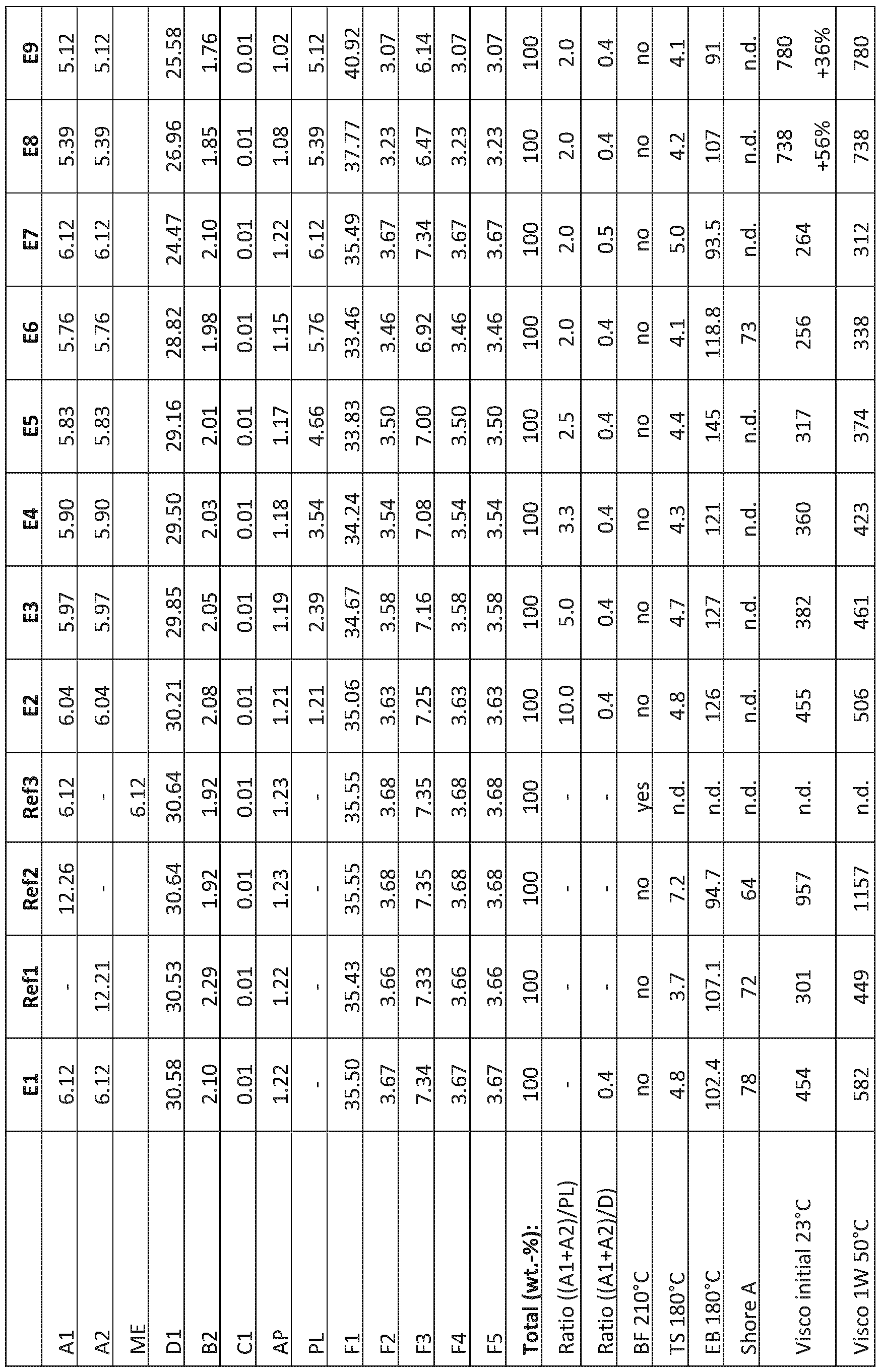
- a weight ratio of more than 5.0 leads to insufficient elongation performance as well as to a too high viscosity. This can be seen, for example, in table 2 in the comparison of E1 with Ref2.
- the composition of the invention also contains at least one curing agent B for epoxy resins.
- the curing agent B is a dihydrazide, which is preferably selected from the group consisting of aromatic dicarboxylic dihydrazide B1 and aliphatic dicarboxylic dihydrazide B2.
- the curing agent B is an aromatic dicarboxylic dihydrazide B1 , it is preferably selected from the group consisting of isophthalic dihydrazide and/or terephthalic dihydrazide, preferably isophthalic dihydrazide.
- the curing agent B is an aliphatic dicarboxylic dihydrazide B2, preferably selected from the group consisting of glutaric dihydrazide, adipic dihydrazide, pimelic dihydrazide, 8,12-eicosadienedioic acid 1 ,20-dihydrazide and 4-isopropyl-2,5-dioxoimidazolidine-1 ,3-di(propionohydrazide).
- aliphatic dicarboxylic dihydrazide B2 preferably selected from the group consisting of glutaric dihydrazide, adipic dihydrazide, pimelic dihydrazide, 8,12-eicosadienedioic acid 1 ,20-dihydrazide and 4-isopropyl-2,5-dioxoimidazolidine-1 ,3-di(propionohydrazide).
- adipic dihydrazide 8,12-eicosadienedioic acid 1 ,20- dihydrazide (UDH) and 4-isopropyl-2,5-dioxoimidazolidine-1 ,3- di(propionohydrazide) (VDH). Most preferred is adipic dihydrazide.
- Suitable dihydrazides are commercially available, for example, from Otsuka Chemical Co., Ltd under the Ajicure® trade name (from Ajinomoto Fine- TechnoCo., Inc.) and under the Technicure® trade name (from A&C Catalysts)
- the ratio of the proportion of the sum of the epoxy groups of the liquid epoxy resins A1 and A2 in mol / proportion of curing agent B in mol ((A1+A2)/B) is 3-8, preferably 4-7, more preferably 5-7, most preferably 5.5-6.5.
- a ratio of more than 8 is disadvantageous with respect to lower values for Shore A values.
- a ratio of less than 3 is disadvantageous with respect to lower values for elongation at break and storage stability.
- thermosetting one-component epoxy resin composition additionally contains at least one accelerator C for epoxy resins. This is advantageous especially with respect to curing at lower temperatures.
- the substituted urea of the formula (III) is preferably selected from the group consisting of p-chlorophenyl-N,N-dimethylurea (monuron), 3-phenyl-1 ,1 - dimethylurea (fenuron), 3,4-dichlorophenyl-N,N-dimethylurea (diuron), N- methylurea, N,N-dimethylurea, N,N'-dimethylurea, N,N,N'-trimethylurea, N,N,N',N'-tetramethylurea and derivatives thereof, where some or all methyl groups are instead ethyl groups.
- Suitable urea derivatives are commercially available, for example, under the Dyhard ® trade name (from AlzChem Group AG), under the Omicure® trade name (from CVC Thermoset Specialties), under the Amicure® trade name (from Evonik) and from Sigma Aldrich.
- the accelerator C especially has a molecule of less than 1000 g/mol, especially between 80 and 800 g/mol. If the molecular weight is greater, the accelerating effect is reduced and the necessary use amount is significantly higher, which can in turn lead to poor mechanical properties.
- the amount of the accelerator C is advantageously 0.005-1.0% by weight, especially 0.01 -0.5% by weight, preferably 0.05-0.25% by weight, based on the weight of the sum of the liquid epoxy resins A1 and A2.
- the ratio of the proportion of accelerator C in grams per mole of the sum of the epoxy groups of the liquid epoxy resins A1 and A2 is preferably 0.01 - 0.5 g/mol of epoxy groups, especially 0.05-0.3 g/mol of epoxy groups, more preferably 0.075-0.2 g/mol of epoxy groups, most preferably 0.08-0.15 g/mol of epoxy groups.
- the one-component thermosetting epoxy resin composition comprises at least one toughness improver D.
- the toughness improvers D may be solid or liquid, preferably liquid.
- the toughness improver D is selected from the group consisting of terminally blocked polyurethane polymers D1 , liquid rubbers D2 and core-shell polymers D3.
- the toughness improver D is preferably selected from the group consisting of terminally blocked polyurethane polymers D1 and liquid rubbers D2. Particular preference is given to a terminally blocked polyurethane polymer D1.
- the terminally blocked polyurethane prepolymer is prepared from a linear or branched polyurethane prepolymer terminated by isocyanate groups with one or more isocyanate-reactive compounds. If two or more such isocyanate-reactive compounds are used, the reaction can be effected sequentially or with a mixture of these compounds.
- the reaction is preferably effected in such a way that the one or more isocyanatereactive compounds are used stoichiometrically or in a stoichiometric excess in order to ensure that all NCO groups have been converted.
- the polyurethane prepolymer with isocyanate end groups can be prepared from at least one diisocyanate or triisocyanate and from a polymer QPM having terminal amino, thiol or hydroxyl groups and/or from an optionally substituted polyphenol QPP, preferably polymer QPM having terminal amino, thiol or hydroxyl groups.
- Suitable diisocyanates are aliphatic, cycloaliphatic, aromatic or araliphatic diisocyanates, especially commercial products such as methylene diphenyl diisocyanate (MDI), hexamethylene diisocyanate (HDI), toluene diisocyanate (TDI), toluidine diisocyanate (TODI), isophorone diisocyanate (IPDI), trimethylhexamethylene diisocyanate (TMDI), 2,5- or 2,6- bis(isocyanatomethyl)bicyclo[2.2.1]heptane, naphthalene 1 ,5-di isocyanate (NDI), dicyclohexylmethyl diisocyanate (H12MDI), p-phenylene diisocyanate (PPDI), m- tetramethylxylylene diisocyanate (TMXDI), etc. and dimers thereof. Preference is given to HDI, IPDI, MDI
- Suitable triisocyanates are trimers or biurets of aliphatic, cycloaliphatic, aromatic or araliphatic diisocyanates, especially the isocyanurates and biurets of the diisocyanates described in the previous paragraph. It is of course also possible to use suitable mixtures of di- or triisocyanates.
- Especially suitable polymers Q M having terminal amino, thiol or hydroxyl groups are polymers Q having two or three terminal amino, thiol or hydroxyl groups.
- the polymers Q M advantageously have an equivalent weight of 300-6000, especially of 600-4000, preferably of 700-2200, g/equivalent of NCO-reactive groups.
- Preferred polymers Q M are polyols having average molecular weights between 600 and 6000 daltons, selected from the group consisting of polyethylene glycols, polypropylene glycols, polyethylene glycol-polypropylene glycol block polymers, polybutylene glycols, hydroxyl-term inated polybutadienes, hydroxyl-term inated butadiene-acrylonitrile copolymers and mixtures thereof.
- Especially preferred polymers QPM are a-w-di hydroxy polyalkylene glycols having C2-Ce-alkylene groups or having mixed C2-Ce-alkylene groups, terminated by amino, thiol or, preferably, hydroxyl groups.
- Particular preference is given to polypropylene glycols or polybutylene glycols.
- Particular preference is further given to hydroxyl group-term inated polyoxybutylenes.
- Especially suitable polyphenols Qpp are bis-, tris- and tetraphenols. This is understood to mean not just straight phenols but optionally also substituted phenols. The nature of the substitution may be very varied. More particularly, this is understood to mean substitution directly on the aromatic ring to which the phenolic OH group is bonded. Phenols are additionally understood to mean not just monocyclic aromatics but also polycyclic or fused aromatics or heteroaromatics that have the phenolic OH group directly on the aromatic or heteroaromatic system.
- the polyurethane prepolymer is prepared from at least one diisocyanate or triisocyanate and from a polymer Q M having terminal amino, thiol or hydroxyl groups.
- the polyurethane prepolymer is prepared in a manner known to the person skilled in the art of polyurethane, especially by using the diisocyanate or triisocyanate in a stoichiometric excess in relation to the amino, thiol or hydroxyl groups of the polymer Q .
- the polyurethane prepolymer having isocyanate end groups preferably has elastic character. It preferably exhibits a glass transition temperature Tg of less than 0°C.
- the toughness improver D may be a liquid rubber D2. This may be, for example, a carboxy- or epoxy-term inated polymer.
- this liquid rubber may be a carboxy- or epoxy-term inated acrylonitrile/butadiene copolymer or derivative thereof.
- Such liquid rubbers are commercially available, for example, under the Hypro / Hypox® CTBN and CTBNX and ETBN name from Emerald Performance Materials.
- Suitable derivatives are especially elastomer-modified prepolymers having epoxy groups, as sold commercially under the Polydis® product line, especially from the Polydis® 36.. product line, by Struktol® (Schill+Seilacher perennial, Germany) or under the Albipox product line (Evonik, Germany).
- this liquid rubber may be a polyacrylate liquid rubber which is fully miscible with liquid epoxy resins and separates to form microdroplets only in the course of curing of the epoxy resin matrix.
- polyacrylate liquid rubbers are available, for example, under the 20208-XPA name from Dow.
- the toughness improver D in a third embodiment, may be a core-shell polymer D3.
- Core-shell polymers consist of an elastic core polymer and a rigid shell polymer.
- Particularly suitable core-shell polymers consist of a core of elastic acrylate or butadiene polymer encased by a rigid shell of a rigid thermoplastic polymer. This core-shell structure either forms spontaneously as a result of separation of a block copolymer or is defined by the conduct of the polymerization as a latex or suspension polymerization with subsequent grafting.
- Preferred coreshell polymers are what are called MBS polymers, which are commercially available under the ClearstrengthTM trade name from Arkema, ParaloidTM from Dow or F-351 TM from Zeon.
- the proportion of toughness improver D, especially of terminally blocked polyurethane polymer D1 is 15-45% by weight, especially 20-40% by weight, especially 22.5-35% by weight, especially 25-35% by weight, more preferably 27.5-32.5% by weight, based on the total weight of the thermosetting one-component epoxy resin composition.
- This is advantageous in that this gives higher values of elongation. This can be seen, for example, in table 2 in the comparison of E6 with E7.
- the weight ratio of the sum of the at least one liquid epoxy resin A1 and the at least one liquid epoxy resin A2 to the at least one toughness improver D is from 0.25 - 0.6, preferably 0.3 - 0.5, more preferably 0.35 - 0.55.
- Such a weight ratio is advantageous with respect to higher values of elongation. This can be seen, for example, in table 2 in the comparison of E6 with E7.
- thermosetting one-component epoxy resin composition additionally includes at least one plasticizer PL.
- plasticizers are selected from the group consisting of dibutyl phthalate (DBP), diisobutyl phalate (DIBP), di-isononyl phthalate (DINP), diallyl phthalate (DAP), di-2-ethylhexyl-phthalate (DEHP or DOP), diisodecyl phthalate (DIDP), di(2-propyl heptyl) phthalate (DPHP), di-2-ethylhexyl adipate (DOA), di(tridecyl)phthalate (DTDP), butyl benzyl phthalate (BBP), dihexyl phthalate, tri-2-ethyl hexyl trimellitate (TOTM), condensation products of glycols such as 1 ,3 buylene glycol with dibasic organic acids such as adipic acid, and dipropylene glycol dibenzoate, most preferably tri-2-ethyl hexyl trimellitate
- the weight ratio of the sum of the at least one liquid epoxy resin A1 and the at least one liquid epoxy resin A2 to the at least one plasticizer PL is from 1 - 10, preferably 1 .25 - 5, more preferably 1 .5 - 3, even more preferably 1 .75 - 2.5, most preferably 1 .8 - 2.2.
- Such a weight ratio is advantageous with respect to higher values of elongation and lower viscosity. This can be seen, for example, in table 2 in the comparison of E6 with E1 - E5.
- thermosetting one-component epoxy resin composition additionally comprises at least one filler F.
- filler F Preference is given here to mica, talc, kaolin, wollastonite, feldspar, titanium oxide, syenite, chlorite, bentonite, montmorillonite, calcium carbonate (precipitated or ground), dolomite, quartz, silicas (fused or precipitated), cristobalite, calcium oxide, aluminum hydroxide, magnesium oxide, hollow ceramic beads, hollow glass beads, hollow organic beads, glass beads, color pigments. Particular preference is given to fillers selected from the group consisting of calcium carbonate, calcium oxide, talc, titanium oxide, and fumed silicas.
- the total proportion of the overall filler F is 35-60% by weight preferably 45-55% by weight, more preferably 47.5-52.5% by weight, based on the total weight of the thermosetting one-component epoxy resin composition.
- Such a preferred range is advantageous with respect to higher values of elongation. This can be seen, for example, in table 2 in the comparison of E6 with E8 and E9.
- thermosetting one-component epoxy resin composition comprises less than 3 wt.-%, based on the total weight of the one- component epoxy resin composition, of at least one epoxy-bearing reactive diluent G containing only one epoxy group.
- epoxy-bearing reactive diluents are known to the person skilled in the art. Preferred examples of epoxy-bearing reactive diluents are:
- - glycidyl ethers of monofunctional, saturated or unsaturated, branched or unbranched, cyclic or open-chain, C4-C30 alcohols, e.g. butanol glycidyl ether, hexanol glycidyl ether, 2-ethylhexanol glycidyl ether, allyl glycidyl ether, tetrahydrofurfuryl and furfuryl glycidyl ether, trimethoxysilyl glycidyl ether, and the like;
- C4-C30 alcohols e.g. butanol glycidyl ether, hexanol glycidyl ether, 2-ethylhexanol glycidyl ether, allyl glycidyl ether, tetrahydrofurfuryl and furfuryl glycidyl ether, trimethoxy
- - glycidyl ethers of phenol compounds with only one OH-group such as phenyl glycidyl ether, cresyl glycidyl ether, p-tert-butylphenyl glycidyl ether, nonylphenol glycidyl ether and 3-n-pentadecenyl glycidyl ether (from cashewnutshell oil).
- phenyl glycidyl ether cresyl glycidyl ether, p-tert- butylphenyl glycidyl ether, nonylphenol glycidyl ether and 3-n-pentadecenyl glycidyl ether.
- the amount of the at least one epoxy-bearing reactive diluent G containing only one epoxy group is preferably less than 2% by weight, especially less than 1 % by weight, preferably less than 0.5% by weight, more preferably less than 0.3% by weight, most preferably less than 0.1 % by weight, based on the total weight of the epoxy resin composition. More preferably, the thermosetting one-component epoxy resin composition does not include any such reactive diluent G.
- the epoxy resin composition of the invention has a viscosity at 23°C of 150 - 900 Pa*s, especially 200 - 800 Pa*s, preferably 200 - 400 Pa*s, more preferably 250 - 350 Pa*s, especially measured with a rheometer in oscillation using a plate-plate geometry with the following parameters: 10 Hz, measurement gap 1 mm, plate-plate diameter 25 mm, 0.01 -10% deformation, determination of A4 complex viscosity h* determined at 10% deformation. This is advantageous in that this assures good applicability.
- thermosetting one-component epoxy resin composition is prepared and stored in the absence of moisture. It is stable in storage, i.e. , it can be stored for a period of several months or up to a year or even more in the absence of moisture in a suitable package or configuration, for example, a drum, a bag or a cartridge without any changes in application properties or in its properties after curing of an extent that would be relevant for use thereof.
- the storage stability is usually determined by measuring the viscosity.
- thermosetting one-component epoxy resin composition is characterized by extraordinarily good storage stability.
- the change in viscosity of the composition in an aluminum cartridge with an airtight seal after storage for 7 days at 60°C in a circulating air oven can be used as a measure of long-term storage stability at room temperature.
- thermosetting one-component epoxy resin compositions according to the invention at 210 °C. Therefore, they have excellent mechanical properties and an optimal visual aspect. This is especially important because the CDC paint goes above the surface of the composition if used as a sealing compound and so the sealing compound surface can be seen through the CDC paint and/or the colored paint subsequently placed over it.
- compositions are largely elastic after being cured by heat. This is especially advantageous in the case of seals that are exposed to impacts or movements during use.
- thermosetting one-component epoxy resin compositions to be usable in particular as sealing compounds in autobody work, in particular in the engine space or for doors, trunk lids, tailgates or hoods.
- they may also be used as the sealing compound in flange fold seals, such as those disclosed in WO 2008/077918 A1.
- a method for sealing which comprises the following steps, is disclosed: i) Applying a thermosetting one-component epoxy resin composition, such as that described above, to a substrate (S); ii) Heating the thermosetting one-component epoxy resin composition to a temperature above 120°C, in particular between 160°C and 220°C, to form a cured thermosetting one-component epoxy resin composition.
- Materials suitable for substrate (S) include in particular metals, in particular those metals which are used in the construction of vehicle bodies of automobiles in particular. These include in particular steels, especially electrolytical ly galvanized, flame galvanized, oiled steel, Bonazinc-coated steel and subsequently phosphatized steel, or aluminum, in particular in the variants that typically occur in automotive engineering. These include steel plates or aluminum plates in particular.
- the present invention also relates to a coated substrate obtained by applying a thermosetting one-component epoxy resin composition such as that described in detail above to the surface of a substrate.
- thermosetting one-component epoxy resin composition is applied to an oiled steel plate.
- the advantage of the composition that it adheres well to such a substrate and cures with very few blasters.
- step ia) it is preferable for a step ia) to be performed between step i) and step ii): ia) Applying a paint, in particular a CDC paint, to the thermosetting one- component epoxy resin composition.
- Step ii) is preferably performed in a CDC oven.
- curing takes place, so that the thermosetting one-component epoxy resin composition receives its final strength.
- the composition is heated to a temperature of 100-220°C, especially of 120-200°C, preferably between 130 and 150°C, more preferably between 130 and 140°C, and the composition is left at the aforementioned temperature for 10 min - 6 h, 10 min - 2 h, 10 min - 60 min, 10 min - 30 min, 10 min - 20 min, more preferably 10 min - 15 min.
- thermosetting one-component epoxy resin composition is suitable for sealing gaps in particular.
- thermosetting one-component epoxy resin composition prefferably applied in or to a gap in step i), said gap being bordered by two surfaces of the substrate (S) and a second substrate (S2), the second substrate (S2) being made of the same material as the substrate (S) or a different material.
- compositions of the invention have the following properties:
- the reference compositions Ref1 -Ref4 and the inventive compositions E1 to E12 were produced according to the compositions in table 2 and table 3.
- the stated amounts in table 2 and table 3 are in parts by weight.
- the ratio of the proportion of the sum of the epoxy groups of the liquid epoxy resins A1 and A2 in mol / proportion of curing agent B in mol ((A1+A2)/B) is 6.
- the ratio of the proportion of accelerator C in grams per mole of the sum of the epoxy groups of the liquid epoxy resins A1 and A2 ((A1+A2)/C) is 0.1 .
- the mixed compositions were applied into a silicone mold to form a layer having a thickness of 2 mm and were cured at 210 °C for 30 minutes. After curing, the test specimens were analyzed for bubble formation. If bubble formation occurred, the sample was rated “yes”, if no bubble formation occurred the sample was rated “no”.
- dumbbell-shaped bars (specimen type 5A of DIN EN ISO 527) having a thickness of 2 mm and a length of 750 mm. After curing at 180 °C for 30 minutes, the test specimens were measured under standard conditions at a pulling speed 200 mm/min (TS, EB), respectively. The tensile strength and elongation at break were determined according to DIN EN ISO 527.
- Shore A hardness was measured according to DIN 53505 with a specimen of 6 mm thickness, which was cured for 30min at 180 °C.
- Viscosity measurements of the compositions were effected 1 d after production on an Anton Paar MCR 101 rheometer by oscillation using a plate-plate geometry at a temperature of 23°C with the following parameters: 10 Hz, measurement gap 1 mm, plate-plate diameter 25 mm, 0.01 -10% deformation, determination of A4 complex viscosity h* determined at 10% deformation.
- the measurement is displayed in table 2 and table 3 under "Visco initial 23°C".
- the viscosity measurement was repeated after storage at the specified temperature for a specified time in weeks (W) or month (M), and the percentage rise in viscosity that results after the storage was ascertained.
- the measured viscosity in Pa*s measured at a temperature of 23°C after storage for 1 week at 50°C and 60°C is displayed in table 2 under "Visco 1 W 50°C” and "Visco 1 W 60°C” respectively.
- the measured viscosity in Pa*s measured at a temperature of 23°C after storage for 1 month at 23°C is displayed in table 3 under "Visco 1 M 23°C".
- the value between parentheses shows the percentage rise in viscosity.
Landscapes
- Chemical & Material Sciences (AREA)
- Organic Chemistry (AREA)
- Health & Medical Sciences (AREA)
- Chemical Kinetics & Catalysis (AREA)
- Medicinal Chemistry (AREA)
- Polymers & Plastics (AREA)
- Epoxy Resins (AREA)
Abstract
Description




Claims

Priority Applications (2)
| Application Number | Priority Date | Filing Date | Title |
|---|---|---|---|
| CN202480033371.1A CN121175356A (en) | 2023-06-28 | 2024-06-12 | Heat-curable sealing composition |
| EP24731387.7A EP4735503A1 (en) | 2023-06-28 | 2024-06-12 | Heat-curable sealing composition |
Applications Claiming Priority (2)
| Application Number | Priority Date | Filing Date | Title |
|---|---|---|---|
| EP23182196.8 | 2023-06-28 | ||
| EP23182196.8A EP4484461A1 (en) | 2023-06-28 | 2023-06-28 | Heat-curable sealing composition |
Publications (1)
| Publication Number | Publication Date |
|---|---|
| WO2025002811A1 true WO2025002811A1 (en) | 2025-01-02 |
Family
ID=87036508
Family Applications (1)
| Application Number | Title | Priority Date | Filing Date |
|---|---|---|---|
| PCT/EP2024/066224 Ceased WO2025002811A1 (en) | 2023-06-28 | 2024-06-12 | Heat-curable sealing composition |
Country Status (3)
| Country | Link |
|---|---|
| EP (2) | EP4484461A1 (en) |
| CN (1) | CN121175356A (en) |
| WO (1) | WO2025002811A1 (en) |
Citations (4)
| Publication number | Priority date | Publication date | Assignee | Title |
|---|---|---|---|---|
| WO2008077918A1 (en) | 2006-12-21 | 2008-07-03 | Sika Technology Ag | Edging-fold bond |
| WO2012084806A2 (en) | 2010-12-23 | 2012-06-28 | Sika Technology Ag | Heat-curing sealant compositions having fast skin formation and high tensile strength |
| US20200095418A1 (en) * | 2017-05-25 | 2020-03-26 | Henkel IP & Holding GmbH | Curable compositions |
| EP4067405A1 (en) * | 2021-04-01 | 2022-10-05 | Sika Technology AG | Thermosetting epoxy resin composition suitable for precuring without additional metal bonding techniques |
-
2023
- 2023-06-28 EP EP23182196.8A patent/EP4484461A1/en not_active Withdrawn
-
2024
- 2024-06-12 EP EP24731387.7A patent/EP4735503A1/en active Pending
- 2024-06-12 CN CN202480033371.1A patent/CN121175356A/en active Pending
- 2024-06-12 WO PCT/EP2024/066224 patent/WO2025002811A1/en not_active Ceased
Patent Citations (4)
| Publication number | Priority date | Publication date | Assignee | Title |
|---|---|---|---|---|
| WO2008077918A1 (en) | 2006-12-21 | 2008-07-03 | Sika Technology Ag | Edging-fold bond |
| WO2012084806A2 (en) | 2010-12-23 | 2012-06-28 | Sika Technology Ag | Heat-curing sealant compositions having fast skin formation and high tensile strength |
| US20200095418A1 (en) * | 2017-05-25 | 2020-03-26 | Henkel IP & Holding GmbH | Curable compositions |
| EP4067405A1 (en) * | 2021-04-01 | 2022-10-05 | Sika Technology AG | Thermosetting epoxy resin composition suitable for precuring without additional metal bonding techniques |
Also Published As
| Publication number | Publication date |
|---|---|
| EP4484461A1 (en) | 2025-01-01 |
| EP4735503A1 (en) | 2026-05-06 |
| CN121175356A (en) | 2025-12-19 |
Similar Documents
| Publication | Publication Date | Title |
|---|---|---|
| KR102858553B1 (en) | Thermosetting epoxy resin composition having low curing temperature and good storage stability | |
| WO2023036748A1 (en) | Expandable one-component thermosetting epoxy adhesive with improved adhesion | |
| EP3402835B1 (en) | Single-component thermosetting epoxide adhesive with improved adhesion | |
| EP4314106B1 (en) | Thermosetting epoxy resin composition suitable for precuring without additional metal bonding techniques | |
| JP7230025B2 (en) | Method for structurally joining substrates with different coefficients of linear thermal expansion | |
| WO2025021662A1 (en) | Heat-curing epoxy resin composition suitable for low curing temperature with good storage stability | |
| US20240059828A1 (en) | Hem flange bonding method | |
| EP4735503A1 (en) | Heat-curable sealing composition | |
| WO2022133880A1 (en) | One-component thermosetting epoxy adhesive with improved adhesion at high temperatures | |
| US20210163665A1 (en) | One component thermosetting epoxy resin compositions | |
| EP4556503A1 (en) | Heat-curing epoxy resin composition suitable for pre-curing processes without additional metal joining techniques | |
| US11208580B2 (en) | Single-component thermosetting epoxy resin having high scouring resistance | |
| WO2025153474A1 (en) | Heat-curing epoxy resin composition suitable for low curing temperature with good adhesion and toughening abilities | |
| JP7123985B2 (en) | A method of connecting molded bodies by injecting a single-component thermosetting epoxy resin composition into a cavity | |
| EP4534580A1 (en) | Heat-curing epoxy resin composition suitable for low curing temperature with good open time and corrosion resistance | |
| WO2024256501A1 (en) | Heat-curing epoxy resin composition suitable for low curing temperature with good storage stability | |
| EP4631998A1 (en) | Use of eggshell or seashell particles to improve properties of heat-curing epoxy resin compositions | |
| EP4588976A1 (en) | Heat-curing epoxy resin composition with high corrosion resistance | |
| EP4636033A1 (en) | Heat-curing epoxy resin compositions with improved impact peel values | |
| EP4660215A1 (en) | One-component thermosetting epoxy adhesive with improved adhesion and impact peel strength |
Legal Events
| Date | Code | Title | Description |
|---|---|---|---|
| 121 | Ep: the epo has been informed by wipo that ep was designated in this application |
Ref document number: 24731387 Country of ref document: EP Kind code of ref document: A1 |
|
| ENP | Entry into the national phase |
Ref document number: 2025560000 Country of ref document: JP Kind code of ref document: A |
|
| WWE | Wipo information: entry into national phase |
Ref document number: 202517114210 Country of ref document: IN |
|
| WWP | Wipo information: published in national office |
Ref document number: 202517114210 Country of ref document: IN |
|
| WWE | Wipo information: entry into national phase |
Ref document number: 2024731387 Country of ref document: EP |
|
| NENP | Non-entry into the national phase |
Ref country code: DE |
|
| ENP | Entry into the national phase |
Ref document number: 2024731387 Country of ref document: EP Effective date: 20260128 |
|
| ENP | Entry into the national phase |
Ref document number: 2024731387 Country of ref document: EP Effective date: 20260128 |
|
| WWP | Wipo information: published in national office |
Ref document number: 2024731387 Country of ref document: EP |