WO2024261069A1 - Heat-curing epoxy resin composition having high storage stability - Google Patents
Heat-curing epoxy resin composition having high storage stability Download PDFInfo
- Publication number
- WO2024261069A1 WO2024261069A1 PCT/EP2024/067114 EP2024067114W WO2024261069A1 WO 2024261069 A1 WO2024261069 A1 WO 2024261069A1 EP 2024067114 W EP2024067114 W EP 2024067114W WO 2024261069 A1 WO2024261069 A1 WO 2024261069A1
- Authority
- WO
- WIPO (PCT)
- Prior art keywords
- epoxy resin
- particles
- resin composition
- component
- thermosetting epoxy
- Prior art date
- Legal status (The legal status is an assumption and is not a legal conclusion. Google has not performed a legal analysis and makes no representation as to the accuracy of the status listed.)
- Ceased
Links
Classifications
-
- C—CHEMISTRY; METALLURGY
- C08—ORGANIC MACROMOLECULAR COMPOUNDS; THEIR PREPARATION OR CHEMICAL WORKING-UP; COMPOSITIONS BASED THEREON
- C08G—MACROMOLECULAR COMPOUNDS OBTAINED OTHERWISE THAN BY REACTIONS ONLY INVOLVING UNSATURATED CARBON-TO-CARBON BONDS
- C08G59/00—Polycondensates containing more than one epoxy group per molecule; Macromolecules obtained by polymerising compounds containing more than one epoxy group per molecule using curing agents or catalysts which react with the epoxy groups
- C08G59/18—Macromolecules obtained by polymerising compounds containing more than one epoxy group per molecule using curing agents or catalysts which react with the epoxy groups ; e.g. general methods of curing
-
- C—CHEMISTRY; METALLURGY
- C08—ORGANIC MACROMOLECULAR COMPOUNDS; THEIR PREPARATION OR CHEMICAL WORKING-UP; COMPOSITIONS BASED THEREON
- C08G—MACROMOLECULAR COMPOUNDS OBTAINED OTHERWISE THAN BY REACTIONS ONLY INVOLVING UNSATURATED CARBON-TO-CARBON BONDS
- C08G59/00—Polycondensates containing more than one epoxy group per molecule; Macromolecules obtained by polymerising compounds containing more than one epoxy group per molecule using curing agents or catalysts which react with the epoxy groups
- C08G59/18—Macromolecules obtained by polymerising compounds containing more than one epoxy group per molecule using curing agents or catalysts which react with the epoxy groups ; e.g. general methods of curing
- C08G59/188—Macromolecules obtained by polymerising compounds containing more than one epoxy group per molecule using curing agents or catalysts which react with the epoxy groups ; e.g. general methods of curing using encapsulated compounds
-
- C—CHEMISTRY; METALLURGY
- C08—ORGANIC MACROMOLECULAR COMPOUNDS; THEIR PREPARATION OR CHEMICAL WORKING-UP; COMPOSITIONS BASED THEREON
- C08G—MACROMOLECULAR COMPOUNDS OBTAINED OTHERWISE THAN BY REACTIONS ONLY INVOLVING UNSATURATED CARBON-TO-CARBON BONDS
- C08G59/00—Polycondensates containing more than one epoxy group per molecule; Macromolecules obtained by polymerising compounds containing more than one epoxy group per molecule using curing agents or catalysts which react with the epoxy groups
- C08G59/18—Macromolecules obtained by polymerising compounds containing more than one epoxy group per molecule using curing agents or catalysts which react with the epoxy groups ; e.g. general methods of curing
- C08G59/40—Macromolecules obtained by polymerising compounds containing more than one epoxy group per molecule using curing agents or catalysts which react with the epoxy groups ; e.g. general methods of curing characterised by the curing agents used
- C08G59/50—Amines
- C08G59/5046—Amines heterocyclic
- C08G59/5053—Amines heterocyclic containing only nitrogen as a heteroatom
- C08G59/5073—Amines heterocyclic containing only nitrogen as a heteroatom having two nitrogen atoms in the ring
-
- C—CHEMISTRY; METALLURGY
- C08—ORGANIC MACROMOLECULAR COMPOUNDS; THEIR PREPARATION OR CHEMICAL WORKING-UP; COMPOSITIONS BASED THEREON
- C08G—MACROMOLECULAR COMPOUNDS OBTAINED OTHERWISE THAN BY REACTIONS ONLY INVOLVING UNSATURATED CARBON-TO-CARBON BONDS
- C08G59/00—Polycondensates containing more than one epoxy group per molecule; Macromolecules obtained by polymerising compounds containing more than one epoxy group per molecule using curing agents or catalysts which react with the epoxy groups
- C08G59/18—Macromolecules obtained by polymerising compounds containing more than one epoxy group per molecule using curing agents or catalysts which react with the epoxy groups ; e.g. general methods of curing
- C08G59/68—Macromolecules obtained by polymerising compounds containing more than one epoxy group per molecule using curing agents or catalysts which react with the epoxy groups ; e.g. general methods of curing characterised by the catalysts used
- C08G59/686—Macromolecules obtained by polymerising compounds containing more than one epoxy group per molecule using curing agents or catalysts which react with the epoxy groups ; e.g. general methods of curing characterised by the catalysts used containing nitrogen
-
- C—CHEMISTRY; METALLURGY
- C09—DYES; PAINTS; POLISHES; NATURAL RESINS; ADHESIVES; COMPOSITIONS NOT OTHERWISE PROVIDED FOR; APPLICATIONS OF MATERIALS NOT OTHERWISE PROVIDED FOR
- C09J—ADHESIVES; NON-MECHANICAL ASPECTS OF ADHESIVE PROCESSES IN GENERAL; ADHESIVE PROCESSES NOT PROVIDED FOR ELSEWHERE; USE OF MATERIALS AS ADHESIVES
- C09J163/00—Adhesives based on epoxy resins; Adhesives based on derivatives of epoxy resins
Definitions
- the invention relates to the field of thermosetting epoxy resin compositions, especially for use as bodywork adhesive and for production of structural foams.
- thermosetting epoxy resin compositions have long been known.
- An important field of use of thermosetting epoxy resin compositions is in motor vehicle construction, especially in bonding or the foam-filling of voids in the bodywork.
- the bodywork is heated in the cathodic electrocoating oven, because of which the thermosetting epoxy resin composition is cured and optionally foamed.
- thermosetting epoxy resin compositions which on the one hand have high storage stability and nevertheless also have satisfactory mechanical properties.
- thermosetting epoxy resin compositions which on the one hand have high storage stability and nevertheless also have satisfactory mechanical properties.
- thermosetting epoxy resin composition as claimed in claim 1.
- This epoxy resin composition can be used particularly efficiently as a one-component thermosetting adhesive, especially as a thermosetting one-component bodywork adhesive in motor vehicle construction, and for production of a structural foam for the reinforcement of voids, especially in metallic structures. Further aspects of the invention form the subject matter of further independent claims. Particularly preferred embodiments of the invention form the subject matter of the dependent claims.
- the present invention relates to one-component thermosetting epoxy resin compositions
- a “toughness improver” is understood to mean an addition to an epoxy resin matrix that results in a distinct increase in toughness even in the case of small additions of > 5% by weight, especially > 10% by weight, based on the total weight of the epoxy resin compositions and is thus capable of absorbing higher flexural, tensile, impact or shock stress before the matrix cracks or breaks.
- poly in substance names such as “polyol”, “polyisocyanate”, “polyether” or “polyamine” in the present document indicates that the respective substance, in a formal sense, contains more than one of the functional groups that occur in its name per molecule.
- molecular weight is understood to mean the molar mass (in grams per mole) of a molecule.
- Average molecular weight is understood to mean the number-average molecular weight Mn of an oligomeric or polymeric mixture of molecules, which is typically determined by means of GPC against polystyrene as standard.
- primary amino group refers to an NH2 group bonded to one organic radical
- secondary amino group refers to an NH group bonded to two organic radicals which may also together be part of a ring. Accordingly, an amine having one primary amino group is referred to as “primary amine”, one having a secondary amino group correspondingly as “secondary amine”, and one having a tertiary amino group as “tertiary amine”.
- room temperature refers to a temperature of 23°C.
- the epoxy resin A having an average of more than one epoxy group per molecule is preferably a liquid epoxy resin or a solid epoxy resin.
- the term "solid epoxy resin” is very familiar to the person skilled in the art of epoxies and is used by contrast with “liquid epoxy resins”.
- the glass transition temperature of solid resins is above room temperature, meaning that they can be comminuted at room temperature to give free-flowing powders.
- Preferred epoxy resins have the formula (II)
- R' and R" are independently either H or CH3.
- the index s has a value of > 1 .5, especially of 2 to 12.
- Solid epoxy resins of this kind are commercially available, for example from Dow or Huntsman or Hexion.
- semisolid epoxy resins Compounds of the formula (II) having an index s of 1 to 1.5 are referred to as semisolid epoxy resins by the person skilled in the art. For this present invention, they are likewise considered to be solid resins. However, preferred solid epoxy resins are epoxy resins in the narrower sense, i.e. where the index s has a value of > 1 .5. In liquid epoxy resins, the index s has a value of less than 1 . Preferably, s has a value of less than 0.2.
- DGEBA diglycidyl ethers of bisphenol A
- Such liquid resins are available, for example, as Araldite® GY 250, Araldite® PY 304, Araldite® GY 282 (Huntsman) or D.E.R.TM 331 or D.E.R.TM 330 (Dow) or Epikote 828 (Hexion).
- epoxy novolaks are what are called epoxy novolaks. More particularly, these are phenol or cresol epoxy novolaks. Such epoxy resins are commercially available under the EPN or ECN and Tactix® trade names from Huntsman or from the D.E.N.TM product series from Dow Chemical.
- the epoxy resin A is a liquid epoxy resin of the formula (II).
- thermosetting epoxy resin composition contains both at least one liquid epoxy resin of the formula (II) with s ⁇ 1 , especially less than 0.2, and at least one solid epoxy resin of the formula (II) with s > 1 .5, especially from 2 to 12.
- the proportion of the epoxy resin A is preferably 10-60% by weight, especially 30-50% by weight, based on the total weight of the epoxy resin composition.
- epoxy resin A is an aforementioned solid epoxy resin.
- the one-component thermosetting epoxy resin composition comprises b) porous particles PP, selected from the group consisting of zeolite particles, perlite particles, phonolite particles, calcium silicate particles, silica particles PS, foamed polyurethane particles, expanded vermiculite particles, fumed metal oxide particles, and kieselguhr particles, which have incorporated in the pores at least one component ComP which is: - i) a curing agent for epoxy resins B, or
- the porous particles PP preferably have a pore size of 4 - 30 nm, preferably 5 - 10 nm, more preferably 5 - 8 nm.
- the pore size is determined by nitrogen absorption.
- the porous particles PP preferably have a particle size from 5 - 500 pm, preferably 20 - 150 pm, more preferably 30 - 100 pm. This is advantageous with respect to improved storage stability.
- the particle size is determined by laser diffraction.
- the amount of the at least one component ComP, incorporated in the pores of the porous particles PP is 4 - 50 wt.-%, preferably 8 - 40 wt.-%, more preferably 10 - 35 wt.-%, based on the total weight of the porous particles PP.
- the one-component thermosetting epoxy resin composition contains 0.05 - 5 % by weight, preferably 0.1 - 2 % by weight, more preferably 0.2 - 1 % by weight, based on the total weight of the epoxy resin composition, of said porous particles PP.
- porous particles PP are porous silica particles PS.
- such porous silica particles PS are based on silicon dioxide.
- the porous silica particles PS are mesoporous silica particles.
- the porous silica particles PS are spherical in shape.
- the porous particles PP can be derivatized or non-derivatized porous silica particles PS.
- aliphatic chains especially C8 - C18 chains, can be used for the hydrophobization of the porous particles.
- the porous particles PP are non- derivatized porous silica particles PS.
- the b) porous particles PP which have incorporated in the pores at least one component ComP, are not encased by a coating material.
- Said encasing coating material acts at room temperature as a mechanical barrier between the porous particles PP and the epoxy resin A having an average of more than one epoxy group per molecule.
- the coating material may be selected from the list consisting of polyethylene, polyamide, polyethylene glycol and waxes.
- the at least one component ComP is incorporated in the pores of the porous particles PP, by a method, which comprises
- said method uses step I’).
- Said solvent is preferably water or an organic solvent or mixtures thereof.
- Preferred organic solvents are selected from the list consisting of alcohols, esters, ethers, ketones, aliphatic hydrocarbons and aromatic hydrocarbons.
- the at least one component ComP is:
- the at least one component ComP is ii) an accelerator C for curing agents for epoxy resins.
- the curing agent for epoxy resins B is selected from the list consisting of aliphatic, cycloaliphatic or arylaliphatic primary di- or triamines; ether group- containing aliphatic primary di- or triamines; and polyamines containing secondary amino groups, preferably ether group-containing aliphatic primary di- or triamines.
- component B2 incorporated in the pores of silicate particles show significantly improved storage stability compared to the addition of B2 not loaded on silicate particles. This effect was even more pronounced in the case of B2 being loaded on non-derivatized silicate particles (PS1).
- Such curing agents are further preferred due to their availability in liquid form that allows the loading into the porous particles without the need of dispersing the curing agent in a solvent.
- Preferred ether group-containing aliphatic primary di- or triamines are primary polyoxyalkylene di- or -triamines, especially 3,3'-[Oxybis(2,1-ethanediyloxy)]bis-1- propanamine.
- Such primary polyoxyalkylene di- or -triamines are commercially available, for example, as Ancamine 1922A from Evonik.
- the curing agent for epoxy resins B is present in the one-component thermosetting epoxy resin composition in an amount that the ratio of the number of groups reactive toward epoxy groups of the curing agent B to the number of epoxy groups of the epoxy resin A is preferably in the range from 0.7 to 1 .2, in particular 0.8 to 1 .0, particularly preferably 0.90 until 0.98.
- a preferred accelerator C is selected from the list consisting substituted ureas, imidazoles, imidazolines, blocked amines and tertiary amines, preferably substituted ureas, imidazoles and tertiary amines, more preferably imidazoles.
- Preferred substituted ureas are selected from the list consisting of 3-(3-chloro-4-methyl- phenyl)-1 , 1 -dimethylurea (chlortoluron); phenyldimethylureas, especially p-chlorophenyl- N,N-dimethylurea (monuron), 3-phenyl-1 ,1 -dimethylurea (fenuron), 3,4-dichlorophenyl- N,N-dimethylurea (diuron) and
- the tertiary amine is preferably selected from the group consisting of 2- (dimethylaminomethyl)phenol, 2,6-bis(dimethylaminomethyl)phenol, 2,4- bis(dimethylaminomethyl)phenol, 2,4,6-tris( dimethylaminomethyl)phenol and 2,4,6- tris(((3-(dimethylamino)propyl)amino)methyl)phenol, especially 2,4,6-tris(((3- (dimethylamino)propyl)amino)methyl )phenol and 2,4,6- tris(dimethylaminomethyl)phenol.
- the tertiary amine tAM is a mixture of 2,4,6-tris(((3-(dimethylamino)propyl)amino)methyl)phenol and 2,4,6- tris(dimethylaminomethyl)phenol.
- Such a mixture of 2,4,6-tris(((3-(dimethylamino)propyl)amino)methyl)phenol and 2,4,6- tris(dimethylaminomethyl)phenol is commercially available, for example, as Ancamine K54 from Evonik.
- Preferred imidazoles are N-aminoalkylimidazolyl compounds.
- Preferred imidazoles are also imidazolium salts of formula (V):
- R1 is an organic radical having 1 to 20 C atoms
- R2, R3, R4, and R5 are each an H atom or an organic radical having 1 to 20 C atoms,
- X is an anion, and n is 1 , 2, or 3, preferably 1 .
- the anion is selected from the group consisting of alkylsulfates; alkylsulfonates; halides, more particularly chloride, bromide and iodide; thiocyanate; dicyanamide; carboxylates; phosphates, more particularly dimethylphosphate and diethylphosphate; and phosphonates.
- Particularly preferred anions are selected from the group consisting of methanesulfonate, trifluoromethanesulfonate, dimethylphosphate, diethylphosphate, methylsulfate, ethylsulfate, thiocyanate, and dicyanamide.
- thiocyanate (SCN-) and dicyanamide are especially preferred.
- R1 and R3 are preferably, independently of one another, an organic radical having 1 to 10 C atoms. More particularly R1 and R3 are an aliphatic radical, more particularly an aliphatic radical without further heteroatoms, such as an alkyl group, for example. With particular preference R1 and R3 independently of one another are a C1 to C10 or a C1 to C4 alkyl group. Very preferably R1 and R3 independently of one another are a methyl group or an ethyl group.
- R2, R4, and R5, preferably independently, are an H atom or an organic radical having 1 to 10 C atoms; more particularly R2, R4, and R5 are an H atom or an aliphatic radical.
- R2, R4, and R5, independently of one another, are an H atom or an alkyl group; more particularly, R2, R4, and R5, independently of one another, are an H atom or a C1 to C4 alkyl group.
- Very preferably R2, R4, and R5 are each an H atom.
- n is 1 .
- X is preferably one of the abovementioned and preferred anions, very preferably thiocyanate and dicyanamide.
- the imidazolium salts of formula I is selected from 1-methyl-3- methylimidazolium thiocyanate, 1-methyl-3-ethylimidazolium thiocyanate, 1-methyl-3- methylimidazolium dicyanamide and 1-methyl-3-ethylimidazolium dicyanamide, especially 1-methyl-3-methylimidazolium dicyanamide.
- the accelerator C is present in the one-component thermosetting epoxy resin composition in an amount that the molar ratio of accelerator C to epoxy resin A is from 0.01 - 70 mmol/mol, preferably 0.1 - 60 mmol/mol, more preferably 0.3 - 50 mmol/mol.
- the one-component thermosetting epoxy resin composition preferably contains at least one toughness improver D.
- the toughness improvers D may be liquid or solid.
- the toughness improver D is selected from the group consisting of terminally blocked polyurethane polymers D1 , liquid rubbers D2 and core-shell polymers D3.
- the toughness improver D is selected from the group consisting of terminally blocked polyurethane polymers D1 and liquid rubbers D2. Particular preference is given to a terminally blocked polyurethane polymer D1.
- the toughness improver D is a terminally blocked polyurethane polymer D1 , it is preferably a terminally blocked polyurethane prepolymer of the formula (I).
- R 1 here is a p-valent radical of a linear or branched polyurethane prepolymer terminated by isocyanate groups after the removal of the terminal isocyanate groups, and p has a value of 2 to 8.
- R 2 is independently a substituent selected from the group consisting of
- R 5 , R 6 , R 7 and R 8 here are each independently an alkyl or cycloalkyl or aralkyl or arylalkyl group, or R 5 together with R 6 , or R 7 together with R 8 , form part of a 4- to 7-membered, optionally substituted ring.
- R 9 ' and R 10 are each independently an alkyl or aralkyl or arylalkyl group or an alkyloxy or aryloxy or aralkyloxy group, and R 11 is an alkyl group.
- R 12 , R 13 and R 14 are each independently an alkylene group which has 2 to 5 carbon atoms and optionally has double bonds or is substituted, or a phenylene group or a hydrogenated phenylene group.
- R 15 , R 16 and R 17 are each independently H or an alkyl group or an aryl group or an aralkyl group, and R 18 is an aralkyl group or a mono- or polycyclic, substituted or unsubstituted aromatic group that optionally has aromatic hydroxyl groups.
- R 4 is a radical of an aliphatic, cycloaliphatic, aromatic or araliphatic epoxide containing a primary or secondary hydroxyl group after the removal of the hydroxyl and epoxy groups, and m has a value of 1 , 2 or 3.
- R 18 is especially considered to be firstly phenols or polyphenols, especially bisphenols, after removal of a hydroxyl group.
- Preferred examples of such phenols and bisphenols are especially phenol, cresol, resorcinol, catechol, cardanol (3-pentadecenylphenol (from cashewnutshell oil)), nonylphenol, phenols that have been reacted with styrene or dicyclopentadiene, bisphenol A, bisphenol F and 2,2'-diallylbisphenol A.
- R 18 is secondly considered to be especially hydroxybenzyl alcohol and benzyl alcohol after removal of a hydroxyl group.
- R 5 , R 6 , R 7 , R 8 , R 9 , R 9 ', R 10 , R 11 , R 15 , R 16 or R 17 is an alkyl group, this is especially a linear or branched Ci-C2o-alkyl group.
- R 5 , R 6 , R 7 , R 8 , R 9 , R 9 ', R 10 , R 15 , R 16 , R 17 or R 18 is an aralkyl group, this moiety is especially a methylene-bonded aromatic group, especially a benzyl group.
- R 5 , R 6 , R 7 , R 8 , R 9 , R 9 ' or R 10 is an alkylaryl group, this is especially a phenylene-bonded Ci- to C2o-alkyl group, for example tolyl or xylyl.
- R 2 radicals are preferably the substituents of the formulae
- a preferred substituent of the formula -caprolactam after removal of the NH proton is monophenols or polyphenols, especially bisphenols, after removal of a phenolic hydrogen atom.
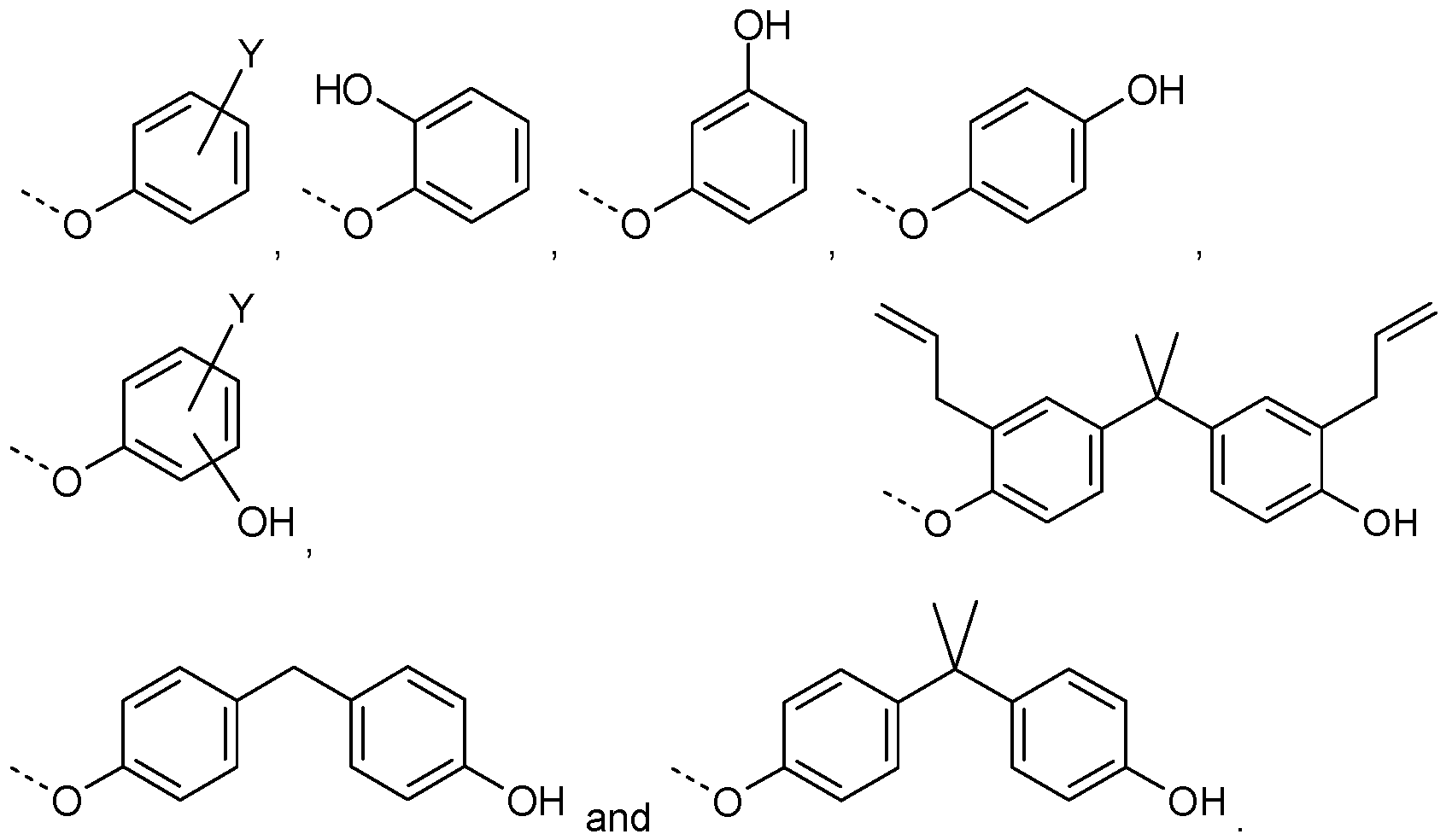
- Particularly preferred examples of such R 2 radicals are radicals selected from the group consisting of
- the Y radical here is a saturated, aromatic or olefinical ly unsaturated hydrocarbyl radical having 1 to 20 carbon atoms, especially having 1 to 15 carbon atoms.
- Preferred Y are especially allyl, methyl, nonyl, dodecyl, phenyl, alkyl ether, carboxylic ester or an unsaturated Cis-alkyl radical having 1 to 3 double bonds.
- R 2 is .
- the terminally blocked polyurethane prepolymer of the formula (I) is prepared from the linear or branched polyurethane prepolymer terminated by isocyanate groups with one or more isocyanate-reactive compounds R 2 H. If two or more such isocyanate-reactive compounds are used, the reaction can be effected sequentially or with a mixture of these compounds.
- the reaction is preferably effected in such a way that the one or more isocyanate-reactive compounds R 2 H are used stoichiometrically or in a stoichiometric excess in order to ensure that all NCO groups have been converted.
- the polyurethane prepolymer with isocyanate end groups on which R 1 is based can be prepared from at least one diisocyanate or triisocyanate and from a polymer QPM having terminal amino, thiol or hydroxyl groups and/or from an optionally substituted polyphenol QPP.
- Suitable diisocyanates are aliphatic, cycloaliphatic, aromatic or araliphatic diisocyanates, especially commercial products such as methylene diphenyl diisocyanate (MDI), hexamethylene diisocyanate (HDI), toluene diisocyanate (TDI), toluidine diisocyanate (TODI), isophorone diisocyanate (IPDI), trimethylhexamethylene diisocyanate (TMDI), 2,5- or 2,6-bis(isocyanatomethyl)bicyclo[2.2.1]heptane, naphthalene 1 ,5-diisocyanate (NDI), dicyclohexylmethyl diisocyanate (H12MDI), p-phenylene diisocyanate (PPDI), m- tetramethylxylylene diisocyanate (TMXDI), etc. and dimers thereof. Preference is given to HDI, IPDI, MDI
- Suitable triisocyanates are trimers or biurets of aliphatic, cycloaliphatic, aromatic or araliphatic diisocyanates, especially the isocyanurates and biurets of the diisocyanates described in the previous paragraph. It is of course also possible to use suitable mixtures of di- or triisocyanates.
- Especially suitable polymers QPM having terminal amino, thiol or hydroxyl groups are polymers QPM having two or three terminal amino, thiol or hydroxyl groups.
- the polymers QPM advantageously have an equivalent weight of 300-6000, especially of 600-4000, preferably of 700-2200, g/equivalent of NCO-reactive groups.
- Preferred polymers QPM are polyols having average molecular weights between 600 and 6000 daltons, selected from the group consisting of polyethylene glycols, polypropylene glycols, polyethylene glycol-polypropylene glycol block polymers, polybutylene glycols, hydroxyl-terminated polybutadienes, hydroxyl-terminated butadiene-acrylonitrile copolymers and mixtures thereof.
- Especially preferred polymers QPM are a, co-dihydroxy polyalkylene glycols having C2-C6- alkylene groups or having mixed C2-Ce-alkylene groups, terminated by amino, thiol or, preferably, hydroxyl groups.
- Particular preference is given to polypropylene glycols or polybutylene glycols.
- Particular preference is further given to hydroxyl group-terminated polyoxybutylenes.
- Especially suitable polyphenols Qpp are bis-, tris- and tetraphenols. This is understood to mean not just straight phenols but optionally also substituted phenols. The nature of the substitution may be very varied. More particularly, this is understood to mean substitution directly on the aromatic ring to which the phenolic OH group is bonded. Phenols are additionally understood to mean not just monocyclic aromatics but also polycyclic or fused aromatics or heteroaromatics that have the phenolic OH group directly on the aromatic or heteroaromatic system.
- the polyurethane prepolymer is prepared from at least one diisocyanate or triisocyanate and from a polymer QPM having terminal amino, thiol or hydroxyl groups.
- the polyurethane prepolymer is prepared in a manner known to the person skilled in the art of polyurethane, especially by using the diisocyanate or triisocyanate in a stoichiometric excess in relation to the amino, thiol or hydroxyl groups of the polymer QPM.
- the polyurethane prepolymer having isocyanate end groups preferably has elastic character. It preferably exhibits a glass transition temperature Tg of less than 0°C.
- the toughness improver D may be a liquid rubber D2. This may be, for example, a carboxyl- or epoxy-terminated polymer.
- this liquid rubber may be a carboxyl- or epoxy-terminated acrylonitrile/butadiene copolymer or a derivative thereof.
- Such liquid rubbers are commercially available, for example, under the Hypro/Hypox® CTBN name and CTBNX and ETBN from Emerald Performance Materials.
- Suitable derivatives are especially elastomer-modified prepolymers having epoxy groups, as sold commercially under the Polydis® product line, especially from the Polydis® 36.. product line, by Struktol® (Sch i 11+ Sei lacher civil, Germany) or under the Albipox product line (Evonik, Germany).
- this liquid rubber may be a polyacrylate liquid rubber which is fully miscible with liquid epoxy resins and does not separate to form microdroplets until the epoxy resin matrix is cured.
- polyacrylate liquid rubbers are available, for example, under the 20208-XPA name from Dow.
- the toughness improver D may be a core-shell polymer D3.
- Coreshell polymers consist of an elastic core polymer and a rigid shell polymer.
- Particularly suitable core-shell polymers consist of a core of elastic acrylate or butadiene polymer encased by a rigid shell of a rigid thermoplastic polymer. This core-shell structure either forms spontaneously as a result of separation of a block copolymer or is defined by the conduct of the polymerization as a latex or suspension polymerization with subsequent grafting.
- Preferred core-shell polymers are what are called MBS polymers, which are commercially available under the ClearstrengthTM trade name from Arkema, ParaloidTM from Dow or F-351 TM from Zeon.
- the proportion of toughness improver D is 5-50% by weight, 10-40% by weight, 15-30% by weight, more preferably 20-30% by weight, based on the total weight of the epoxy resin composition.
- the composition additionally comprises at least one filler F.
- fillers selected from the group consisting of calcium carbonate (precipitated or ground), fumed silicas and calcium oxide.
- the total proportion of the overall filler F is 5-45% by weight, preferably 10-40% by weight, based on the total weight of the epoxy resin composition.
- the composition may comprise a physical or chemical blowing agent as obtainable, for example, under the ExpancelTM trade name from Akzo Nobel or CelogenTM from Chemtura or under the Luvopor® trade name from Lehmann & Voss.
- the proportion of the blowing agent is advantageously 0.1-3% by weight, based on the total weight of the epoxy resin composition.
- the composition additionally comprises at least one epoxy-bearing reactive diluent G.
- reactive diluents are known to those skilled in the art.
- Preferred examples of epoxy-bearing reactive diluents are:
- - glycidyl ethers of monofunctional saturated or unsaturated, branched or unbranched, cyclic or open-chain C4-C30 alcohols, e.g. butanol glycidyl ether, hexanol glycidyl ether, 2-ethylhexanol glycidyl ether, allyl glycidyl ether, tetrahydrofurfuryl and furfuryl glycidyl ether, trimethoxysilyl glycidyl ether etc.;
- glycidyl ethers of difunctional saturated or unsaturated, branched or unbranched, cyclic or open-chain C2-C30 alcohols, for example ethylene glycol glycidyl ether, butanediol glycidyl ether, hexanediol glycidyl ether, octanediol glycidyl ether, cyclohexanedimethanol diglycidyl ether, neopentyl glycol diglycidyl ether etc;
- glycidyl ethers of tri- or polyfunctional, saturated or unsaturated, branched or unbranched, cyclic or open-chain alcohols such as epoxidized castor oil, epoxidized trimethylolpropane, epoxidized pentaerythritol or polyglycidyl ethers of aliphatic polyols such as sorbitol, glycerol or trimethylolpropane etc;
- - glycidyl ethers of phenol compounds and aniline compounds such as phenyl glycidyl ether, cresyl glycidyl ether, p-tert-butylphenyl glycidyl ether, nonylphenol glycidyl ether, 3-n-pentadecenyl glycidyl ether (from cashewnutshell oil), N,N- diglycidylaniline, etc.;
- - epoxidized amines such as N,N-diglycidylcyclohexylamine etc.
- epoxidized mono- or dicarboxylic acids such as glycidyl neodecanoate, glycidyl methacrylate, glycidyl benzoate, diglycidyl phthalate, tetrahydrophthalate and hexahydrophthalate, diglycidyl esters of dimeric fatty acids etc;
- polyether polyols such as polyethylene glycol diglycidyl ether, polypropylene glycol diglycidyl ether etc. Particular preference is given to hexanediol diglycidyl ether, cresyl glycidyl ether, p-tert- butylphenyl glycidyl ether, polypropylene glycol diglycidyl ether and polyethylene glycol diglycidyl ether.
- the total proportion of the epoxy-bearing reactive diluent G is 0.1-15% by weight, preferably 0.1-5% by weight, especially preferably 0.1-2% by weight, more preferably 0.2-1 % by weight, based on the total weight of the epoxy resin composition.
- the composition may include further constituents, especially catalysts, stabilizers, especially heat and/or light stabilizers, thixotropic agents, plasticizers, solvents, mineral or organic fillers, blowing agents, dyes and pigments, anticorrosives, surfactants, defoamers and adhesion promoters.
- Suitable stabilizers are specially optionally substituted phenols such as BHT or Wingstay® T (Elikem), sterically hindered amines or N-oxyl compounds such as TEMPO (Evonik).
- a particularly preferred one-component epoxy resin composition comprises:
- epoxy resin A having an average of more than one epoxy group per molecule; preferably 50-100% by weight, especially 80-100% by weight, of the epoxy resin A is a liquid epoxy resin and 0-30% by weight, especially 0-20% by weight, more preferably 0-15% by weight, of the epoxy resin A is a solid epoxy resin;
- porous particles PP preferably silica particles PS, which have incorporated in the pores at least one component ComP which is:
- At least one toughness improver D is selected from the group consisting of terminally blocked polyurethane polymers D1 , liquid rubbers D2 and core-shell polymers D3; the proportion of toughness improver D preferably is 5-50% by weight, 10-40% by weight, 15-30% by weight, more preferably 20-30% by weight, based on the total weight of the epoxy resin composition;
- a filler F preferably selected from the group consisting of calcium carbonate (precipitated or ground), fumed silicas and calcium oxide;
- the preferred one-component epoxy resin composition has a weight ratio of the at least one epoxy resin A having an average of more than one epoxy group per molecule to the porous particles PP, which have incorporated in the pores at least one component ComP (A : PP), of 20-800 : 1 , preferably 75-400 : 1 , more preferably 150-300 : 1.
- the preferred one-component epoxy resin composition consists of the aforementioned constituents to an extent of more than 80% by weight, preferably more than 90% by weight, especially more than 95% by weight, especially preferably more than 98% by weight, most preferably more than 99% by weight, based on the total weight of the epoxy resin composition.
- the epoxy resin composition of the invention has a viscosity at 25°C of 500-3000 Pa*s, especially 1000-2500 Pa*s, preferably 1000-2000 Pa*s. This is advantageous in that this assures good applicability.
- the viscosity is measured as described in the examples.
- the viscosity measured at a measurement temperature of 25°C, after storage for 3 days at 60°C one day after production rises by less than 400%, preferably less than 300%, more preferably less than 250%.
- thermosetting epoxy resin compositions having, in the cured state: -a tensile shear strength, especially measured to DIN EN 1465, more preferably as described in the examples, of more than 10 MPa, more than 15 MPa, more than 20 MPa, and/or
- -a tensile strength especially measured to DIN EN ISO 527, more preferably as described in the examples, of more than 10 MPa, more than 15 MPa, more than 20 MPa, and/or -a modulus of elasticity, especially measured to DIN EN ISO 527, more preferably as described in the examples, of 300-3000 MPa, preferably 1000-3000 MPa.
- thermosetting epoxy resin composition of the invention is preferably not capable of curing by means of free-radical polymerization reactions, especially free-radical polymerization reactions induced by UV/light or free-radical polymerization reactions induced by heat.
- thermosetting epoxy resin compositions described are particularly suitable for use as one-component thermosetting adhesives, especially as thermosetting one-component adhesive in motor vehicle construction and sandwich panel construction.
- a one-component adhesive has a range of possible uses. More particularly, thermosetting one-component adhesives that feature high impact resistance, both at higher temperatures and at low temperatures, are achievable thereby.
- Such adhesives are required for the bonding of heat-stable materials.
- Heat-stable materials are understood to mean materials that are dimensionally stable at least during the curing time at a curing temperature of 100-220°C, preferably 120-200°C, at least during the curing time.
- metals and plastics such as ABS, polyamide, polyphenylene ether, composite materials such as SMC, unsaturated polyesters GFR, epoxy or acrylate composite materials.
- metals and plastics such as ABS, polyamide, polyphenylene ether, composite materials such as SMC, unsaturated polyesters GFR, epoxy or acrylate composite materials.
- a particularly preferred use is considered to be the bonding of identical or different metals, especially in bodywork construction in the automobile industry.
- the preferred metals are in particular steel, especially electrolytically galvanized, hot dip-galvanized, oiled steel, Bonazinc-coated steel, and subsequently phosphated steel, and also aluminum, especially in the variants that typically occur in automobile construction.
- Such an adhesive is especially contacted first with the materials to be bonded at a temperature of between 10°C and 80°C, especially between 10°C and 60°C, and later cured at a temperature of typically 100-220°C, preferably 120-200°C.
- a further aspect of the present invention relates to a method of bonding heat-stable substrates, comprising the steps of: i) applying a thermosetting epoxy resin composition as described in detail above to the surface of a heat-stable substrate S1 , especially of a metal; ii) contacting the thermosetting epoxy resin composition applied with the surface of a further heat-stable substrate S2, especially of a metal; iii) heating the composition to a temperature of 100-220°C, especially of 120- 200°C.
- the substrate S2 here consists of the same material as or a different material than the substrate S1 .
- the substrates S1 and/or S2 are especially the aforementioned metals and plastics.
- step iii) heating the composition to a temperature of 100-220°C, especially of 120-200°C, the composition is left at the aforementioned temperature for 10 min - 6 h, 10 min - 2 h, 10 min - 60 min, 20 min - 60 min.
- the method does not include any step comprising a free-radical polymerization of the thermosetting epoxy resin composition.
- the method does not include any step of free-radical polymerization reaction induced by UV/light or free-radical polymerization reactions induced by heat.
- Such a method of bonding heat-stable materials results in an adhesive-bonded article.
- Such an article is preferably a motor vehicle or part of a motor vehicle.
- a further aspect of the present invention is therefore an adhesive-bonded article obtained from the aforementioned method. It is of course possible to use a composition of the invention to realize not only thermosetting adhesives but also sealing compounds. In addition, the compositions of the invention are suitable not just for automobile construction but also for other fields of use. Particular mention should be made of related applications in the transportation sector such as ships, trucks, buses or rail vehicles, or in the construction of consumer goods, for example washing machines.
- the materials adhesive-bonded by means of a composition of the invention are used at temperatures between typically 120°C and -40°C, preferably between 100°C and -40°C, especially between 80°C and -40°C.
- thermosetting epoxy resin composition of the invention is the use thereof as a thermosetting one-component bodywork adhesive in motor vehicle construction or as a stiffening compound or as a foamable, thermosetting composition for the reinforcement of voids in structural components and reinforcing elements.
- a further aspect of the present invention relates to a cured epoxy resin composition as obtained by heating a thermosetting epoxy resin composition as described in detail above.
- the heating is typically effected in an oven at a temperature of 100-220°C, preferably between 120 and 200°C, preferably for 10 min - 6 h, 10 min - 2 h, 10 min - 60 min, 20 min - 60 min, at the aforementioned temperature.
- the invention further encompasses the use of porous particles PP, preferably silica particles PS, which have incorporated in the pores at least one component ComP, as described above for increasing the storage stability of a one-component thermosetting epoxy resin composition, especially a thermosetting epoxy adhesive, preferably in motor vehicle construction and sandwich panel construction. Preference is given to a thermosetting epoxy resin composition as described above.
- the increase in the storage stability is based on the comparison with one-component thermosetting epoxy resin compositions that do not contain any of the aforementioned porous particles PP, preferably silica particles PS, which have incorporated in the pores at least one component ComP.
- Storage stability is preferably determined by viscosity measurements of the one- component thermosetting epoxy resin composition, especially on the basis of the determination of the percentage rise in viscosity that arises after storage.
- the percentage rise in viscosity is preferably that after storage at 60°C for 3 days; more particularly, the viscosity measurements are conducted before and after storage, at a temperature of 25°C in each case. More preferably, the percentage rise in viscosity that arises after storage is determined as follows.
- the starting viscosity is determined one day after production of the one- component thermosetting epoxy resin composition on an MCR 302 rheometerfrom Anton Paar by oscillation using a plate-plate geometry at a temperature of 25°C with the following parameters: 5 Hz, 1 mm gap, plate diameter 25 mm, 1 % deformation.
- the storage stability of the adhesives is assessed by repeating the viscosity measurement after storage at 60°C for 3 days and ascertaining the percentage rise in viscosity that arises after the storage.
- the viscosity measurements before and after the storage are each conducted at a temperature of 25°C.
- the type and amount used of the porous particles PP preferably silica particles PS, which have incorporated in the pores at least one component ComP, correspond to the type and amount described above; more particularly, the types and amounts designated as preferred above are also used with preference.
- the percentage rise in viscosity that arises after storage at 60°C for 3 days, compared to a one-component thermosetting epoxy resin composition that contains the same amount of the component ComP but not incorporated in the pores of the aforementioned porous particles PP, which have incorporated in the pores at least one component ComP is not more than 400%, preferably not more than 300%, more preferably not more than 250%.
- the product was used as such as toughness improver D-1.
- thermogravimetric analysis was used. Loaded and unloaded porous silicate samples were weighed in an oven on a microbalance and heated. Accordingly, the change in mass with temperature and time was recorded.
- the TGA method was based on the one described in the literature by A. Hillerstrdm, J. van Stam, M. Andersson, Green Chem. 2009, 11 , 662-66. " oo
- the appropriate component ComP was either added in pure form or loaded on PS-1 or PS-2.
- TS Tensile strength
- E-Mod modulus of elasticity
- TSS Tensile shear strength
- Tensile shear strength was determined on a tensile testing machine at a strain rate of 10 mm/min in a triplicate determination to DIN EN 1465.
- Viscosity/storaqe stability of adhesives Viscosity measurements of the compositions were effected immediately (“initial”) after production on an Anton Paar MCR 302 rheometer by oscillation using a plate-plate geometry at a temperature of 25°C or 50°C with the following parameters: 5 Hz, 1 mm gap, plate diameter 25 mm, 1 % deformation.
- the viscosity measurement was repeated after storage at the specified temperatures (50°C, 60°C respectively) for a specified time in days (d), and the percentage rise in viscosity that results after the storage was ascertained.
Landscapes
- Chemical & Material Sciences (AREA)
- Organic Chemistry (AREA)
- Health & Medical Sciences (AREA)
- Chemical Kinetics & Catalysis (AREA)
- Medicinal Chemistry (AREA)
- Polymers & Plastics (AREA)
- Epoxy Resins (AREA)
Abstract
Description




Claims


Priority Applications (2)
| Application Number | Priority Date | Filing Date | Title |
|---|---|---|---|
| EP24732719.0A EP4731695A1 (en) | 2023-06-22 | 2024-06-19 | Heat-curing epoxy resin composition having high storage stability |
| CN202480029211.XA CN121057761A (en) | 2023-06-22 | 2024-06-19 | Thermosetting epoxy resin compositions with high storage stability |
Applications Claiming Priority (2)
| Application Number | Priority Date | Filing Date | Title |
|---|---|---|---|
| EP23180928.6 | 2023-06-22 | ||
| EP23180928.6A EP4480982A1 (en) | 2023-06-22 | 2023-06-22 | Heat-curing epoxy resin composition having high storage stability |
Publications (1)
| Publication Number | Publication Date |
|---|---|
| WO2024261069A1 true WO2024261069A1 (en) | 2024-12-26 |
Family
ID=86942058
Family Applications (1)
| Application Number | Title | Priority Date | Filing Date |
|---|---|---|---|
| PCT/EP2024/067114 Ceased WO2024261069A1 (en) | 2023-06-22 | 2024-06-19 | Heat-curing epoxy resin composition having high storage stability |
Country Status (3)
| Country | Link |
|---|---|
| EP (2) | EP4480982A1 (en) |
| CN (1) | CN121057761A (en) |
| WO (1) | WO2024261069A1 (en) |
Citations (4)
| Publication number | Priority date | Publication date | Assignee | Title |
|---|---|---|---|---|
| US3018264A (en) * | 1957-11-25 | 1962-01-23 | Union Carbide Corp | Polyepoxide compositions |
| US20050107494A1 (en) * | 2002-02-18 | 2005-05-19 | Takayuki Matsushima | Latent hardener, process for producing the same, and adhesive containing latent hardener |
| US20120153230A1 (en) * | 2010-09-17 | 2012-06-21 | Sony Chemical & Information Device Corporation | Method for producing latent curing agent |
| JP2013067794A (en) * | 2011-09-09 | 2013-04-18 | Hokko Chem Ind Co Ltd | Epoxy resin-based composition |
-
2023
- 2023-06-22 EP EP23180928.6A patent/EP4480982A1/en not_active Withdrawn
-
2024
- 2024-06-19 WO PCT/EP2024/067114 patent/WO2024261069A1/en not_active Ceased
- 2024-06-19 CN CN202480029211.XA patent/CN121057761A/en active Pending
- 2024-06-19 EP EP24732719.0A patent/EP4731695A1/en active Pending
Patent Citations (4)
| Publication number | Priority date | Publication date | Assignee | Title |
|---|---|---|---|---|
| US3018264A (en) * | 1957-11-25 | 1962-01-23 | Union Carbide Corp | Polyepoxide compositions |
| US20050107494A1 (en) * | 2002-02-18 | 2005-05-19 | Takayuki Matsushima | Latent hardener, process for producing the same, and adhesive containing latent hardener |
| US20120153230A1 (en) * | 2010-09-17 | 2012-06-21 | Sony Chemical & Information Device Corporation | Method for producing latent curing agent |
| JP2013067794A (en) * | 2011-09-09 | 2013-04-18 | Hokko Chem Ind Co Ltd | Epoxy resin-based composition |
Non-Patent Citations (1)
| Title |
|---|
| A. HILLERSTRÖMJ. VAN STAMM. ANDERSSON, GREEN CHEM., vol. 11, 2009, pages 662 - 66 |
Also Published As
| Publication number | Publication date |
|---|---|
| EP4480982A1 (en) | 2024-12-25 |
| EP4731695A1 (en) | 2026-04-29 |
| CN121057761A (en) | 2025-12-02 |
Similar Documents
| Publication | Publication Date | Title |
|---|---|---|
| US11891507B2 (en) | Thermosetting epoxy resin composition having low curing temperature and good storage stability | |
| CN111372967B (en) | Thermal curing epoxy resin composition with high storage stability | |
| JP2011503315A5 (en) | ||
| CN117715997A (en) | Expandable one-component thermosetting epoxy adhesives with improved adhesion | |
| JP7214418B2 (en) | One-component thermosetting epoxy adhesive with improved adhesion | |
| JP2024512182A (en) | Heat-cured epoxy resin composition suitable for pre-curing processes that do not require additional metal bonding techniques | |
| US11932786B2 (en) | Method for structurally joining substrates having different coefficients of linear thermal expansion | |
| WO2025021662A1 (en) | Heat-curing epoxy resin composition suitable for low curing temperature with good storage stability | |
| EP4731695A1 (en) | Heat-curing epoxy resin composition having high storage stability | |
| JP5263521B2 (en) | Curable resin composition | |
| KR102761024B1 (en) | Use of a toughening agent to increase the maximum linear expansion of a single-component thermosetting epoxy resin composition | |
| EP4556503A1 (en) | Heat-curing epoxy resin composition suitable for pre-curing processes without additional metal joining techniques | |
| WO2025219390A1 (en) | Heat-curing epoxy resin compositions with improved impact peel values | |
| EP4631998A1 (en) | Use of eggshell or seashell particles to improve properties of heat-curing epoxy resin compositions | |
| EP4727989A1 (en) | Heat-curing epoxy resin composition suitable for low curing temperature with good storage stability | |
| EP4588976A1 (en) | Heat-curing epoxy resin composition with high corrosion resistance | |
| BR112021007419B1 (en) | THERMOSETABLE EPOXY RESIN COMPOSITION, ITS USE, PROCESS FOR BONDING HEAT-STABLE SUBSTRATES AND ADHESIVE-BONDED ARTICLE |
Legal Events
| Date | Code | Title | Description |
|---|---|---|---|
| 121 | Ep: the epo has been informed by wipo that ep was designated in this application |
Ref document number: 24732719 Country of ref document: EP Kind code of ref document: A1 |
|
| WWE | Wipo information: entry into national phase |
Ref document number: 2024732719 Country of ref document: EP |
|
| NENP | Non-entry into the national phase |
Ref country code: DE |
|
| ENP | Entry into the national phase |
Ref document number: 2024732719 Country of ref document: EP Effective date: 20260122 |
|
| ENP | Entry into the national phase |
Ref document number: 2024732719 Country of ref document: EP Effective date: 20260122 |
|
| ENP | Entry into the national phase |
Ref document number: 2024732719 Country of ref document: EP Effective date: 20260122 |
|
| WWP | Wipo information: published in national office |
Ref document number: 2024732719 Country of ref document: EP |