WO2024259451A1 - Low molecular weight polymeric soot dispersant - Google Patents
Low molecular weight polymeric soot dispersant Download PDFInfo
- Publication number
- WO2024259451A1 WO2024259451A1 PCT/US2024/034405 US2024034405W WO2024259451A1 WO 2024259451 A1 WO2024259451 A1 WO 2024259451A1 US 2024034405 W US2024034405 W US 2024034405W WO 2024259451 A1 WO2024259451 A1 WO 2024259451A1
- Authority
- WO
- WIPO (PCT)
- Prior art keywords
- alkyl
- molecular weight
- percent
- group
- polymeric dispersant
- Prior art date
- Legal status (The legal status is an assumption and is not a legal conclusion. Google has not performed a legal analysis and makes no representation as to the accuracy of the status listed.)
- Ceased
Links
Classifications
-
- C—CHEMISTRY; METALLURGY
- C10—PETROLEUM, GAS OR COKE INDUSTRIES; TECHNICAL GASES CONTAINING CARBON MONOXIDE; FUELS; LUBRICANTS; PEAT
- C10M—LUBRICATING COMPOSITIONS; USE OF CHEMICAL SUBSTANCES EITHER ALONE OR AS LUBRICATING INGREDIENTS IN A LUBRICATING COMPOSITION
- C10M149/00—Lubricating compositions characterised by the additive being a macromolecular compound containing nitrogen
- C10M149/02—Macromolecular compounds obtained by reactions only involving carbon-to-carbon unsaturated bonds
-
- C—CHEMISTRY; METALLURGY
- C08—ORGANIC MACROMOLECULAR COMPOUNDS; THEIR PREPARATION OR CHEMICAL WORKING-UP; COMPOSITIONS BASED THEREON
- C08F—MACROMOLECULAR COMPOUNDS OBTAINED BY REACTIONS ONLY INVOLVING CARBON-TO-CARBON UNSATURATED BONDS
- C08F255/00—Macromolecular compounds obtained by polymerising monomers on to polymers of hydrocarbons as defined in group C08F10/00
- C08F255/02—Macromolecular compounds obtained by polymerising monomers on to polymers of hydrocarbons as defined in group C08F10/00 on to polymers of olefins having two or three carbon atoms
-
- C—CHEMISTRY; METALLURGY
- C08—ORGANIC MACROMOLECULAR COMPOUNDS; THEIR PREPARATION OR CHEMICAL WORKING-UP; COMPOSITIONS BASED THEREON
- C08F—MACROMOLECULAR COMPOUNDS OBTAINED BY REACTIONS ONLY INVOLVING CARBON-TO-CARBON UNSATURATED BONDS
- C08F8/00—Chemical modification by after-treatment
-
- C—CHEMISTRY; METALLURGY
- C08—ORGANIC MACROMOLECULAR COMPOUNDS; THEIR PREPARATION OR CHEMICAL WORKING-UP; COMPOSITIONS BASED THEREON
- C08F—MACROMOLECULAR COMPOUNDS OBTAINED BY REACTIONS ONLY INVOLVING CARBON-TO-CARBON UNSATURATED BONDS
- C08F8/00—Chemical modification by after-treatment
- C08F8/30—Introducing nitrogen atoms or nitrogen-containing groups
- C08F8/32—Introducing nitrogen atoms or nitrogen-containing groups by reaction with amines
-
- C—CHEMISTRY; METALLURGY
- C10—PETROLEUM, GAS OR COKE INDUSTRIES; TECHNICAL GASES CONTAINING CARBON MONOXIDE; FUELS; LUBRICANTS; PEAT
- C10M—LUBRICATING COMPOSITIONS; USE OF CHEMICAL SUBSTANCES EITHER ALONE OR AS LUBRICATING INGREDIENTS IN A LUBRICATING COMPOSITION
- C10M2217/00—Organic macromolecular compounds containing nitrogen as ingredients in lubricant compositions
- C10M2217/02—Macromolecular compounds obtained from nitrogen containing monomers by reactions only involving carbon-to-carbon unsaturated bonds
-
- C—CHEMISTRY; METALLURGY
- C10—PETROLEUM, GAS OR COKE INDUSTRIES; TECHNICAL GASES CONTAINING CARBON MONOXIDE; FUELS; LUBRICANTS; PEAT
- C10M—LUBRICATING COMPOSITIONS; USE OF CHEMICAL SUBSTANCES EITHER ALONE OR AS LUBRICATING INGREDIENTS IN A LUBRICATING COMPOSITION
- C10M2217/00—Organic macromolecular compounds containing nitrogen as ingredients in lubricant compositions
- C10M2217/02—Macromolecular compounds obtained from nitrogen containing monomers by reactions only involving carbon-to-carbon unsaturated bonds
- C10M2217/022—Macromolecular compounds obtained from nitrogen containing monomers by reactions only involving carbon-to-carbon unsaturated bonds containing monomers having an unsaturated radical bound to an amino group
-
- C—CHEMISTRY; METALLURGY
- C10—PETROLEUM, GAS OR COKE INDUSTRIES; TECHNICAL GASES CONTAINING CARBON MONOXIDE; FUELS; LUBRICANTS; PEAT
- C10M—LUBRICATING COMPOSITIONS; USE OF CHEMICAL SUBSTANCES EITHER ALONE OR AS LUBRICATING INGREDIENTS IN A LUBRICATING COMPOSITION
- C10M2217/00—Organic macromolecular compounds containing nitrogen as ingredients in lubricant compositions
- C10M2217/02—Macromolecular compounds obtained from nitrogen containing monomers by reactions only involving carbon-to-carbon unsaturated bonds
- C10M2217/024—Macromolecular compounds obtained from nitrogen containing monomers by reactions only involving carbon-to-carbon unsaturated bonds containing monomers having an unsaturated radical bound to an amido or imido group
-
- C—CHEMISTRY; METALLURGY
- C10—PETROLEUM, GAS OR COKE INDUSTRIES; TECHNICAL GASES CONTAINING CARBON MONOXIDE; FUELS; LUBRICANTS; PEAT
- C10N—INDEXING SCHEME ASSOCIATED WITH SUBCLASS C10M RELATING TO LUBRICATING COMPOSITIONS
- C10N2030/00—Specified physical or chemical properties which is improved by the additive characterising the lubricating composition, e.g. multifunctional additives
- C10N2030/06—Oiliness; Film-strength; Anti-wear; Resistance to extreme pressure
-
- C—CHEMISTRY; METALLURGY
- C10—PETROLEUM, GAS OR COKE INDUSTRIES; TECHNICAL GASES CONTAINING CARBON MONOXIDE; FUELS; LUBRICANTS; PEAT
- C10N—INDEXING SCHEME ASSOCIATED WITH SUBCLASS C10M RELATING TO LUBRICATING COMPOSITIONS
- C10N2060/00—Chemical after-treatment of the constituents of the lubricating composition
- C10N2060/06—Chemical after-treatment of the constituents of the lubricating composition by epoxydes or oxyalkylation reactions
Definitions
- the present disclosure relates to lubricant additives and lubricating oil compositions containing the same. More particularly, the present disclosure relates to low molecular weight polymeric dispersants that can improve wear and/or soot dispersion when used as lubricant additives.
- BACKGROUND Internal combustion engines can produce soot as a result of incomplete combustion. Soot formation is generally more prevalent in diesel engines compared to gasoline engines due to the differences in how fuel is injected and ignited. Accumulation of soot can lead to number of issues such as increasing engine wear leading to engine failure.
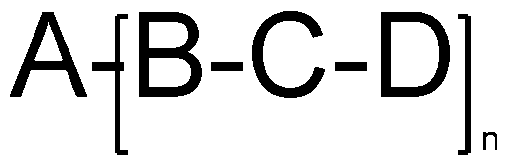
- this disclosure is related to a low molecular weight polymeric dispersant composition, wherein the polymeric dispersant is represented by the following generalized structure: n T-11885-P wherein A is liquid hydrocarbon polymer, B is alkyl imide or alkyl amide, C is polyamine, alkyl amine, alkyl ether amine or alkyl hydroxyl amine, and D is 1-(arene-2-yloxy)propan-2-ol; and n is 1 to 15.
- this disclosure is related to a lubricating oil composition
- a lubricating oil composition comprising: a major amount of a base oil of lubricating viscosity; and a low molecular weight polymeric dispersant represented by the following generalized structure: A-B-C-D n wherein A is liquid imide or alkyl amide, C is polyamine, alkyl amine, alkyl ether amine or alkyl hydroxyl amine, and D is 1-(arene-2-yloxy)propan-2-ol; and n is 1 to 15.
- this disclosure is related to a method for improving wear or soot dispersion in an internal combustion engine, the method comprising lubricating the engine with a lubricating oil composition comprising: a major amount of a base oil of lubricating viscosity; and a low molecular weight polymeric dispersant represented by the following generalized structure: A-B- D n wherein A is liquid imide or alkyl amide, C is polyamine, alkyl amine, alkyl ether amine or alkyl hydroxyl amine, and D is 1-(arene-2-yloxy)propan-2-ol; and n is 1 to 15.
- a major amount of a base oil refers to where the amount of the base oil is at least 40 wt. % of the lubricating oil composition. In some embodiments, “a major amount” of a base oil refers to an amount of the base oil more than 50 wt. %, more than 60 wt. %, more than 70 wt. %, more than 80 wt. %, or more than 90 wt. % of the lubricating oil composition.
- Total Base Number refers to the level of alkalinity in an oil sample, which indicates the ability of the composition to continue to neutralize corrosive acids, in accordance with ASTM Standard No. D2896 or equivalent procedure. The test measures the change in electrical conductivity, and the results are expressed as mgKOH/g (the equivalent number of milligrams of KOH needed to neutralize 1 gram of a product). Therefore, a high TBN reflects strongly overbased products and, as a result, a higher base reserve for neutralizing acids.
- HOB refers to high overbased with a TBN above 250 on an actives basis
- LOB refers to low overbased with a TBN below 100 on an actives basis.
- liquid polymer and/or related terms such as “liquid hydrocarbon polymer” refers to a polymer that is liquid under ambient temperature and pressure.
- the liquid polymers of the present disclosure exhibit KV100 of less than 3000 cSt and can be chemically grafted (e.g., radical initiation, acylating agent, etc.).
- Specific examples of liquid hydrocarbon polymers include “liquid olefin copolymer” which refers to an olefin copolymer that is liquid under ambient temperature and pressure.
- the low molecular weight polymeric dispersant can be used as a lubricant additive to impart one or more performance benefits to a lubricating oil composition.
- Polymeric Dispersant [12] The low molecular weight polymeric dispersant can be used as a lubricant additive to provide protection against wear and/or improve soot dispersion in an internal combustion engine.
- the low molecular weight polymer dispersant can be represented by the following generalized structure: A-B-C-D n wherein A is liquid alkyl imide or alkyl amide; C is independently polyamine, alkyl amine, alkyl ether amine, or alkyl hydroxyl amine; D is 1-(arene- 2-yloxy)propan-2-ol; and wherein n is 1 to 15. In some preferred embodiments, n is 3 to 9.
- the liquid hydrocarbon polymer has average number molecular weight (Mn) of about 1,500 to about 16,000.
- Mn average number molecular weight
- the low molecular weight polymeric dispersant of this disclosure may be synthesized or obtained by any compatible means.
- the low molecular weight polymeric dispersant may be obtained by a series of reaction steps determined by the type of grafting agent used.
- the low molecular weight polymeric dispersant can be obtained by i) grafting a liquid hydrocarbon polymer with an acylating grafting agent, ii) functionalizing with a polyamine, and iii) post-treating with an aryl glycidyl ether.
- the low molecular weight polymeric dispersant can be obtained by i) grafting a liquid hydrocarbon polymer with an allyl or vinyl aminic grafting agent and ii) post-treating with an aryl glycidyl ether.
- the low molecular weight polymeric dispersant is the reaction product of a liquid hydrocarbon polymer having a number average molecular weight (M n ) from about 1,500 and about 16,000; an acylating grafting agent; a polyamine; and an aryl glycidyl ether.
- the low molecular weight polymeric dispersant is the reaction product of a liquid hydrocarbon polymer having a number average molecular weight (M n ) from about 1,500 and about 16,000; an allyl or vinyl aminic grafting agent; and an aryl glycidyl ether.
- M n number average molecular weight
- the aryl glycidyl ether is added during the final reaction step (i.e., as a post- treatment).
- the liquid hydrocarbon polymer of this disclosure can be characterized as having a low molecular weight, particularly when compared to olefin copolymers conventionally used as T-11885-P viscosity index improvers.
- the Mn of the liquid hydrocarbon polymer can be measured by any compatible method such as gel permeation chromatography.
- the number average (Mn) molecular weight of the liquid hydrocarbon polymer is from about 1,500 to about 16,000 such as from about 1,500 to about 15,500, about 1,500 to about 15,000, about 1,500 to about 14,500, about 1,500 to about 14,000, about 1,500 to about 13,500, about 1,500 to about 13,000, about 1,500 to about 12,500, about 1,500 to about 12,000, about 1,500 to about 11,500, about 1,500 to about 11,000, about 1,500 to about 10,500, about 1,500 to about 10,000, about 1,500 to about 9,500, about 1,500 to about 9,000, about 1,500 to about 8,500, about 1,500 to about 8,000, about 1,500 to about 7,500, about 1,500 to about 7,000, about 1,500 to about 6,500, about 1,500 to about 6,000, about 1,500 to about 5,500, about 1,500 to about 5,000, about 1,500 to about 4,500, about 1,500 to about 4,000, about 1,500 to about 3,500, about 1,500 to about 3,000, about 1,500 to about 2,500, about 1,500 to about 1,500 to about
- liquid hydrocarbon polymers include, but are not limited to, ethylene- propylene copolymers, ethylene-based polymers, or propylene-based polymers.
- Ethylene or T-11885-P propylene-based polymers herein can include blends or reacted products of ethylene or propylene and one or more C4 to C28 alpha-olefins, and additionally optionally other dienes or polyenes and thus may herein also include terpolymers, and other higher forms.
- the ethylene content of the copolymer is in the range of 10 to 80 percent by weight, such as 10 to 75 percent, 10 to 70 percent, 10 to 65 percent, 10 to 60 percent 10 to 50 percent, 10 to 45 percent, 10 to 40 percent, 10 to 35 percent, 10 to 30 percent 10 to 25 percent 10 to 20 percent, 10 to 15 percent, 15 to 80 percent, 15 to 75 percent, 15 to 70 percent, 15 to 65 percent, 15 to 60 percent, 15 to 55 percent, 15 to 50 percent, 15 to 45 percent, 15 to 40 percent, 15 to 35 percent, 15 to 30 percent, 15 to 25 percent, 15 to 20 percent, 20 to 80 percent, 20 to 75 percent, 20 to 70 percent, 20 to 65 percent, 20 to 60 percent, 20 to 55 percent, 20 to 50 percent, 20 to 45 percent, 20 to 40 percent, 20 to 35 percent, 20 to 30 percent, 20 to 25 percent, 25 to 80 percent, 25 to 75 percent, 25 to 70 percent, 25 to 65 percent, 25 to 60 percent, 25 to 55 percent, 25 to 50 percent, 25 to 45 percent, 25 to 40 percent, 25 to 40
- the ethylene-based copolymer is an ethylene-propylene copolymer.
- the propylene content of the ethylene-propylene copolymer is in the range of 20 to 90 percent by weight, such as 20 to 85 percent, 20 to 80 percent, 20 to 75 percent, 20 to 70 percent, 20 to 65 percent, 20 to 60 percent 20 to 50 percent, 20 to 45 percent, 20 to 40 percent, 20 to 35 percent, 20 to 30 percent 20 to 25 percent, 25 to 90 percent, 25 to 85 percent, 25 to 80 percent, 25 to 75 percent, 25 to 70 percent, 25 to 65 percent, 25 to 60 percent, 25 to 55 percent, 25 to 50 percent, 25 to 45 percent, 25 to 40 percent, 25 to 35 percent, 25 to 30 percent, 30 to 90 percent, 30 to 85 percent, 30 to 80 percent, 30 to 75 percent, 30 to 70 percent, 30 to 65 percent, 30 to 60 percent, 30 to 55 percent, 30 to 50 percent, 30 to 45 percent, 30 to 40 percent, 30 to 35 percent, 35 to 90 percent,
- Free Radical Initiator T-11885-P The grafting reaction can be catalyzed by a free radical initiator.
- free radical initiator include peroxides, hydroperoxides, peresters, and also azo compounds and preferably those which have a boiling point greater than 100oC and decompose thermally within the grafting temperature range to provide free radicals.
- free-radical initiators are peroxides (diacyl peroxides such as benzoyl peroxide, dialkyl peroxides such as 1,1-bis(tert- butylperoxy)cyclohexane, 1,1-bis(tert-butylperoxy)-3,3,5-trimethylcyclohexane, 2,2-bis(tert- butylperoxy)butane, dicumylperoxide, tert-butylcumylperoxide, bis(tert- butylperoxyisopropyl)benzene, di-tert-butylperoxide (DTBP), di-tert-amylperoxide, 2,5- dimethyl-2,5-di(tert-butylperoxy)hexane, 2,5-dimethyl-2,5-di(tert-butylperoxy)-hexyne), hydroperoxides, peroxyesters such as tert-butyl peroxy be
- the initiator is typically used in an amount of from about 0.005% and about 1% by weight based on the weight of the reaction mixture solution.
- the grafting is preferably carried out in an inert atmosphere, such as under nitrogen blanketing.
- Suitable grafting agents of this disclosure include i) an acylating grafting agent (e.g., ethylenically unsaturated acylating agent) or ii) an allyl or vinyl aminic grafting agent (e.g., allyl amines or vinyl amines).
- the grafting agents of this disclosure generally feature 2 reaction sites. One reaction site allows the grafting agent to form a chemical linkage with the low molecular T-11885-P weight hydrocarbon polymer. The second reaction site allows the grafting agent to form a chemical linkage with a polyamine in the case of an acylating grafting agent.
- the second reaction site is available for post-treatment with an aryl glycidyl ether.
- Acylating Grafting Agent [30]
- the acylating grafting agent is an ethylenically unsaturated acylating agent.
- the ethylenically unsaturated acylating agent is a carboxylic acid or functional derivative thereof (including esters and anhydrides).
- the carboxylic acid may include, for example, acrylic acid, crotonic acid, methyacrylic acid, maleic acid, fumaric acid, itaconic acid, citraconic acid, mesaconic acid, glutaconic acid, chloromaleic acid, aconitic acid, methylcrotonic acid, or sorbic acid.
- the acylating agent is an ester of the carboxylic acid.
- the acylating agent is an anhydride of the carboxylic acid.
- the ethylenically unsaturated carboxylic acid or functional derivative thereof is typically grafted onto the hydrocarbon polymer backbone at about 100oC to about 250oC in the presence of a free radical initiator.
- the hydrocarbon polymer backbone has been suitably reacted with the acylating grafting agent in the range of 0.5 to 10.0 wt % of the acylating grafting agent based upon the total mass of polymer.
- Radical Initiation Using Acylating Grafting Agent A non-limiting example of a radical initiated grafting reaction with an acylating grafting agent (maleic anhydride) is shown below: T-11885-P free radical initiator Allyl or Vinyl Aminic Grafting Agent [32]
- the grafting agent is allyl or vinyl aminic grafting agent.
- the allyl or vinyl aminic grafting agent generally includes a first reaction site – an allyl or vinyl group that can react with the polymer and a second reaction site – an amine that can be post-treated by a post-treatment agent such as an aryl glycidyl ether.
- a post-treatment agent such as an aryl glycidyl ether.
- the allyl or vinyl aminic graft agent can be represented by the following generalized structure: W Z wherein W is vinyl, alkyl vinyl, allyl, or alkyl allyl group and Z is piperazine, alkylamine, arylamine, formamide, alkyl carbamide, alkyl amide, or aryl amide.
- Suitable allyl or vinyl aminic grafting agent include, for example, 1- ethenylpiperazine, 1-(prop-1-en-2-yl)piperazine, 1-allylpiperazine, N-allylmethylamine, allylcyclohexylamine, N-allylaniline, N,2-dimethyl-2-propen-1-amine, N-ethyl-2- methylallylamine, 1-(2-methylprop-2-en-1-yl)piperazine, and N-vinylformamide.
- Suitable allyl or vinyl aminic grafting agents that need deprotection reaction before post-treatment with aryl glycidyl ether include, for example, N-vinylacetamide, N- vinylbenzamide, and methyl vinylcarbamate.
- T-11885-P Radical Initiation Using Allyl Aminic Grafting Agent [35] A non-limiting example of a radical initiated grafting reaction with allyl aminic grafting agent (allyl piperazine) is shown below: free radical initiaor Polyamine [36]
- the polyamines of this disclosure can be used to functionalize acylating grafting agents during the synthesis of the low molecular weight polymeric dispersant.
- the polyamine used in the synthesis of the low molecular weight polymeric dispersant can be represented by the following generalized structure: H 2 N X Y wherein X is C2-C10 hydrocarbyl group, amino alkyl group, ether group, thioether group, or aromatic group and Y is amino C 1 -C 10 hydrocarbyl group, amino alkyl hydroxyl group, amino alkyl ether group, amino alkyl thioether group, amino aromatic group, or piperazine.
- Particularly useful polyamines include aminoethylpiperazine, aminoethylethanolamine, and N-phenyl-p-phenylenediamine.
- Non-limiting examples of polyamines include the following: T-11885-P H N N O 2 H H 2 N N H H 2 N N N H H diamine H N H N- p- Glycidyl Ethers
- the grafted product (when using allyl or vinyl aminic grafting agent) or the polyamine functionalized grafted product (when using acylating grafting agent) includes a second reaction T-11885-P site (aminic nitrogen) which allows for post-treatment with a glycidyl ether. Due to its reactivity, secondary nitrogen is generally more desirable than primary or tertiary nitrogen.
- Suitable examples of aryl glycidyl ethers include, but are not limited to, phenyl glycidyl ether and naphthyl glycidyl ether.
- O O ether [41] Without being limited by theory, it is believed that post-treatment of the grafted product or polyamine functionalized grafted product can greatly enhance soot dispersing capabilities. It is also believed that the presence of a secondary nitrogen on the grafted product or polyamine functionalized grafted product is highly desirable for post-treatment(s) due to the reactivity of secondary nitrogen compared to primary nitrogen or tertiary nitrogen.
- the lubricating oil composition may further comprise an additive that can impart or improve any desirable property of the lubricating oil composition.
- an additive that can impart or improve any desirable property of the lubricating oil composition.
- Any additive known to a person of ordinary skill in the art may be used in the lubricating oil compositions disclosed herein. Some suitable additives have been described in Mortier et al., “Chemistry and Technology of Lubricants,” 2nd Edition. London, Springer, (1996); and Leslie R. Rudnick, "Lubricant Additives: Chemistry and Applications," New York, Marcel Dekker (2003), both of which are incorporated herein by reference.
- the additive can be selected from the T-11885-P group consisting of antioxidants, antiwear agents, detergents, rust inhibitors, demulsifiers, friction modifiers, multi-functional additives, viscosity index improvers, pour point depressants, foam inhibitors, metal deactivators, dispersants, corrosion inhibitors, lubricity improvers, thermal stability improvers, anti-haze additives, icing inhibitors, dyes, markers, static dissipaters, biocides and combinations thereof.
- the concentration of each of the additives in the lubricating oil composition when used, may range from about 0.001 wt. % to about 10 wt. %, from about 0.01 wt.
- the lubricating oil composition may comprise a metal detergent such as a metal salicylate, metal phenate, or metal sulfonate.
- the metal can be any metal suitable for making detergents.
- suitable metals include alkali metals, alkaline earth metals and transition metals.
- the metal is Ca, Mg, Ba, K, Na, Li or the like.
- the amount of the detergent is from about 0.001 wt. % to about 10 wt. %, from about 0.05 wt. % to about 3 wt. %, or from about 0.1 wt. % to about 1 wt. %, based on the total weight of the lubricating oil composition.
- the lubricating oil composition may comprise additional detergents generally known in the art.
- the detergent comprises at least one high overbased (TBN above 250 on an actives basis).
- Overbased metal detergents are generally produced by carbonating a mixture of hydrocarbons, detergent acid, for example: sulfonic acid, alkylhydroxybenzoate etc., metal oxide or hydroxides (for example calcium oxide or calcium hydroxide) and promoters such as xylene, methanol and water.
- detergent acid for example: sulfonic acid, alkylhydroxybenzoate etc.
- metal oxide or hydroxides for example calcium oxide or calcium hydroxide
- promoters such as xylene, methanol and water.
- the calcium oxide or hydroxide reacts with the gaseous carbon dioxide to form calcium carbonate.
- the sulfonic acid is neutralized with an excess of CaO or Ca(OH) 2 , to form the sulfonate.
- overbased detergents may be low overbased (LOB), e.g., an overbased salt having a TBN below 100 on an actives basis.
- the TBN of a low overbased salt may be from about 10 to about 100.
- the TBN of a low overbased salt may be from about 10 to about 80.
- Overbased detergents may be medium overbased (MOB), e.g., an overbased salt having a TBN from about 100 to about 250 on an actives basis.
- the TBN of a medium overbased salt may be from about 100 to about 200.
- the TBN of a medium overbased salt may be from about 125 to about 175.
- Overbased detergents may be high overbased (HOB), e.g., an overbased salt having a TBN above 250 on an actives basis.
- the TBN of a high overbased salt may be from about 250 to about 800 on an actives basis.
- the lubricating oil composition comprises low levels of sulfur containing calcium phenates (e.g., about 40 mmol or less of Ca from sulfurized phenates such as T-11885-P 35 mmol or less, 30 mmol or less, 25 mmol or less, 20 mmol or less, 10 mmol or less, 5 mmol or less and 0 mmol).
- the lubricating oil composition disclosed herein can comprise one or more anti- wear agents.
- the lubricating oil composition is free or substantially free of sulfur-containing anti-wear composition.
- Anti-wear agents reduce wear of metal parts.
- ZDDP zinc dihydrocarbyl dithiophosphates
- R 1 and R 2 groups are alkyl groups having from 2 to 8 carbon atoms (e.g., the alkyl radicals may be ethyl, n-propyl, isopropyl, n-butyl, isobutyl, sec- butyl, n-pentyl, isopentyl, n-hexyl, isohexyl, 2-ethylhexyl).
- the average number of carbon atoms of the mixture of R 1 and R 2 on the molar basis will be at least 4.5.
- the zinc dihydrocarbyl dithiophosphate can therefore comprise zinc dialkyl dithiophosphates.
- the zinc dialkyl dithiophosphate is a primary, secondary zinc dialkyl dithiophosphate, or a combination thereof.
- ZDDP may be present at 3 wt. % or less (e.g., 0.1 to 1.5 wt. %, or 0.5 to 1.0 wt %) of the lubricating oil composition.
- T-11885-P Dispersants [53]
- the lubricating oil composition disclosed herein can further comprise a dispersant. Dispersants maintain in suspension materials resulting from oxidation during engine operation that are insoluble in oil, thus preventing soot or sludge flocculation and precipitation or deposition on metal parts.
- Dispersants useful herein include nitrogen-containing, ashless (metal-free) dispersants known to effective to reduce formation of deposits upon use in gasoline and diesel engines.
- Suitable dispersants include hydrocarbyl succinimides, hydrocarbyl succinamides, mixed ester/amides of hydrocarbyl-substituted succinic acid, hydroxyesters of hydrocarbyl-substituted succinic acid, and Mannich condensation products of hydrocarbyl-substituted phenols, formaldehyde and polyamines. Also suitable are condensation products of polyamines and hydrocarbyl-substituted phenyl acids. Mixtures of these dispersants can also be used.
- succinimide-based dispersants include borated succinimides, non-borated succinimides, post-treated succinimides, and the like.
- Basic nitrogen-containing ashless dispersants are well-known lubricating oil additives and methods for their preparation are extensively described in the patent literature.
- Preferred dispersants are the alkenyl succinimides and succinamides where the alkenyl-substituent is a long- chain of preferably greater than 40 carbon atoms. These materials are readily made by reacting a hydrocarbyl-substituted dicarboxylic acid material with a molecule containing amine functionality.
- Suitable amines are polyamines such as polyalkylene polyamines, hydroxy-substituted polyamines and polyoxyalkylene polyamines.
- the dispersants may be post-treated (e.g., with a boronating agent, epoxide, ethylene carbonate, or a cyclic carbonate).
- Nitrogen-containing ashless (metal-free) dispersants are basic and contribute to the TBN of a lubricating oil composition to which they are added, without introducing additional T-11885-P sulfated ash.
- Dispersants may be present at 0.1 to 10 wt.
- Nitrogen from the dispersants is present from greater than 0.0050 to 0.30 wt. % (e.g., greater than 0.0050 to 0.10 wt. %, 0.0050 to 0.080 wt. %, 0.0050 to 0.060 wt. %, 0.0050 to 0.050 wt. %, 0.0050 to 0.040 wt. %, 0.0050 to 0.030 wt. %) based on the weight of the dispersants in the finished oil.
- the lubricating oil composition disclosed herein can further comprise an additional antioxidant that can reduce or prevent the oxidation of the base oil. Any antioxidant known by a person of ordinary skill in the art may be used in the lubricating oil composition.
- Non- limiting examples of suitable antioxidants include amine-based antioxidants (e.g., alkyl diphenylamines, phenyl- ⁇ -naphthylamine, alkyl or aralkyl substituted phenyl- ⁇ -naphthylamine, alkylated p-phenylene diamines, tetramethyl-diaminodiphenylamine and the like), phenolic antioxidants (e.g., 2-tert-butylphenol, 4-methyl-2,6-di-tert-butylphenol, 2,4,6-tri-tert-butylphenol, 2,6-di-tert-butyl-p-cresol, 2,6-di-tert-butylphenol, 4,4'-methylenebis-(2,6-di-tert-butylphenol), 4,4'-thiobis(6-di-tert-butyl-o-cresol) and the like), sulfur-based antioxidants (e.g
- the amount of the antioxidant may vary from about 0.01 wt. % to about 10 wt. %, from about 0.05 wt. % to about 5 wt. %, or from about 0.1 wt. % to about 3 wt. %, based on the total weight of the lubricating oil composition.
- Some suitable antioxidants have been described in Leslie R. Rudnick, "Lubricant Additives: Chemistry and Applications," New York. Marcel Dekker, Chapter 1, pages 1-28 (2003), which is incorporated herein by reference.
- T-11885-P Foam Inhibitors [56]
- the lubricating oil composition disclosed herein can optionally comprise a foam inhibitor or an anti-foam that can break up foams in oils.
- any foam inhibitor or anti-foam known by a person of ordinary skill in the art may be used in the lubricating oil composition.
- suitable anti-foams include silicone oils or polydimethylsiloxanes, fluorosilicones, alkoxylated aliphatic acids, polyethers (e.g., polyethylene glycols), branched polyvinyl ethers, alkyl acrylate polymers, alkyl methacrylate polymers, polyalkoxyamines and combinations thereof.
- the anti-foam comprises glycerol monostearate, polyglycol palmitate, a trialkyl monothiophosphate, an ester of sulfonated ricinoleic acid, benzoylacetone, methyl salicylate, glycerol monooleate, or glycerol dioleate.
- the amount of the anti-foam may vary from about 0.0005 wt. % to about 5 wt. %, from about 0.05 wt. % to about 3 wt. %, or from about 0.1 wt. % to about 1 wt. %, based on the total weight of the lubricating oil composition.
- the lubricating oil composition comprises a molybdenum additive.
- Suitable molybdenum additives include molybdenum succinimide, sulfurized oxymolybdenum dithiocarbamate, sulfurized oxymolybdenum organophosphorodithioate, oxymolybdenum monoglyceride, oxymolybdenum diethylate amide, amine-molybdenum complex compound, and sulfur-containing molybdenum complex compound.
- T-11885-P The Oil of Lubricating Viscosity
- the lubricating oil compositions disclosed herein generally comprise at least one oil of lubricating viscosity. Any base oil known to a skilled artisan can be used as the oil of lubricating viscosity disclosed herein.
- the amount of the base oil in the lubricating oil composition may be from about 70 to about 99.5 wt. %, based on the total weight of the lubricating oil composition.
- the amount of the base oil in the lubricating oil composition is from about 75 to about 99 wt. %, from about 80 to about 98.5 wt. %, or from about 80 to about 98 wt. %, based on the total weight of the lubricating oil composition.
- the base oil is or comprises any natural or synthetic lubricating base oil fraction.
- synthetic oils include oils, such as polyalphaolefins or PAOs, prepared from the polymerization of at least one alpha-olefin, such as ethylene, or from hydrocarbon synthesis procedures using carbon monoxide and hydrogen gases, such as the Fisher-Tropsch process.
- the base oil comprises less than about 10 wt. % of one or more heavy fractions, based on the total weight of the base oil.
- a heavy fraction refers to a lube oil fraction having a viscosity of at least about 20 cSt at 100°C. In certain embodiments, the heavy fraction has a viscosity of at least about 25 cSt or at least about 30 cSt at 100° C.
- the amount of the one or more heavy fractions in the base oil is T-11885-P less than about 10 wt. %, less than about 5 wt. %, less than about 2.5 wt. %, less than about 1 wt. %, or less than about 0.1 wt.
- the base oil comprises no heavy fraction.
- the lubricating oil compositions comprise a major amount of a base oil of lubricating viscosity.
- the base oil has a kinematic viscosity at 100°C. from about 2.5 centistokes (cSt) to about 20 cSt, from about 4 centistokes (cSt) to about 20 cSt, or from about 5 cSt to about 16 cSt.
- the kinematic viscosity of the base oils or the lubricating oil compositions disclosed herein can be measured according to ASTM D 445, which is incorporated herein by reference.
- the base oil is or comprises a base stock or blend of base stocks.
- the base stocks are manufactured using a variety of different processes including, but not limited to, distillation, solvent refining, hydrogen processing, oligomerization, esterification, and rerefining.
- the base stocks comprise a rerefined stock.
- the rerefined stock shall be substantially free from materials introduced through manufacturing, contamination, or previous use.
- the base oil comprises one or more of the base stocks in one or more of Groups I-V as specified in the American Petroleum Institute (API) Publication 1509, Fourteen Edition, December 1996 (i.e., API Base Oil Interchangeability Guidelines for Passenger Car Motor Oils and Diesel Engine Oils), which is incorporated herein by reference.
- the API guideline defines a base stock as a lubricant component that may be manufactured using a variety of different processes.
- Groups I, II and III base stocks are mineral oils, each with specific ranges of the amount of saturates, sulfur content and viscosity index.
- Group IV base stocks are polyalphaolefins (PAO).
- Group V base stocks include all other base stocks not included in Group I, II, III, or IV.
- the base oil comprises one or more of the base stocks in Group I, II, III, IV, V or a combination thereof. In other embodiments, the base oil comprises one or more of the base stocks in Group II, III, IV or a combination thereof. In further embodiments, the base oil comprises one or more of the base stocks in Group II, III, IV or a combination thereof wherein the base oil has a kinematic viscosity from about 2.5 centistokes (cSt) to about 20 cSt, from about 4 cSt to about 20 cSt, or from about 5 cSt to about 16 cSt at 100°C.
- cSt centistokes
- the base oil may be selected from the group consisting of natural oils of lubricating viscosity, synthetic oils of lubricating viscosity and mixtures thereof.
- the base oil includes base stocks obtained by isomerization of synthetic wax and slack wax, as well as hydrocrackate base stocks produced by hydrocracking (rather than solvent extracting) the aromatic and polar components of the crude.
- the base oil of lubricating viscosity includes natural oils, such as animal oils, vegetable oils, mineral oils (e.g., liquid petroleum oils and solvent treated or acid-treated mineral oils of the paraffinic, naphthenic or mixed paraffinic- naphthenic types), oils derived from coal or shale, and combinations thereof.
- animal oils include bone oil, lanolin, fish oil, lard oil, dolphin oil, seal oil, shark oil, tallow oil, and whale oil.
- vegetable oils include castor oil, olive oil, peanut oil, rapeseed oil, corn oil, sesame oil, cottonseed oil, soybean oil, sunflower oil, safflower oil, hemp oil, linseed oil, tung oil, oiticica oil, jojoba oil, and meadow foam oil. Such oils may be partially or fully hydrogenated.
- the synthetic oils of lubricating viscosity include hydrocarbon oils and halo-substituted hydrocarbon oils such as polymerized and inter-polymerized olefins, alkylbenzenes, polyphenyls, alkylated diphenyl ethers, alkylated diphenyl sulfides, as well as their derivatives, analogues and homologues thereof, and the like.
- the synthetic T-11885-P oils include alkylene oxide polymers, interpolymers, copolymers and derivatives thereof wherein the terminal hydroxyl groups can be modified by esterification, etherification, and the like.
- the synthetic oils include the esters of dicarboxylic acids with a variety of alcohols. In certain embodiments, the synthetic oils include esters made from C 5 to C 12 monocarboxylic acids and polyols and polyol ethers. In further embodiments, the synthetic oils include tri-alkyl phosphate ester oils, such as tri-n-butyl phosphate and tri-iso-butyl phosphate. [66] In some embodiments, the synthetic oils of lubricating viscosity include silicon-based oils (such as the polyakyl-, polyaryl-, polyalkoxy-, polyaryloxy-siloxane oils and silicate oils).
- the synthetic oils include liquid esters of phosphorus-containing acids, polymeric tetrahydrofurans, polyalphaolefins, and the like.
- Base oil derived from the hydroisomerization of wax may also be used, either alone or in combination with the aforesaid natural and/or synthetic base oil. Such wax isomerate oil is produced by the hydroisomerization of natural or synthetic waxes or mixtures thereof over a hydroisomerization catalyst.
- the base oil comprises a poly-alpha-olefin (PAO).
- the poly-alpha-olefins may be derived from an alpha-olefin having from about 2 to about 30, from about 4 to about 20, or from about 6 to about 16 carbon atoms.
- suitable poly-alpha-olefins include those derived from octene, decene, mixtures thereof, and the like.
- These poly-alpha-olefins may have a viscosity from about 2 to about 15, from about 3 to about 12, or from about 4 to about 8 centistokes at 100° C.
- the poly-alpha-olefins may be used together with other base oils such as mineral oils.
- the base oil comprises a polyalkylene glycol or a polyalkylene glycol derivative, where the terminal hydroxyl groups of the polyalkylene glycol may be modified T-11885-P by esterification, etherification, acetylation and the like.
- suitable polyalkylene glycols include polyethylene glycol, polypropylene glycol, polyisopropylene glycol, and combinations thereof.
- Non-limiting examples of suitable polyalkylene glycol derivatives include ethers of polyalkylene glycols (e.g., methyl ether of polyisopropylene glycol, diphenyl ether of polyethylene glycol, diethyl ether of polypropylene glycol, etc.), mono- and polycarboxylic esters of polyalkylene glycols, and combinations thereof.
- the polyalkylene glycol or polyalkylene glycol derivative may be used together with other base oils such as poly-alpha-olefins and mineral oils.
- the base oil comprises any of the esters of dicarboxylic acids (e.g., phthalic acid, succinic acid, alkyl succinic acids, alkenyl succinic acids, maleic acid, azelaic acid, suberic acid, sebacic acid, fumaric acid, adipic acid, linoleic acid dimer, malonic acid, alkyl malonic acids, alkenyl malonic acids, and the like) with a variety of alcohols (e.g., butyl alcohol, hexyl alcohol, dodecyl alcohol, 2-ethylhexyl alcohol, ethylene glycol, diethylene glycol monoether, propylene glycol, and the like).
- dicarboxylic acids e.g., phthalic acid, succinic acid, alkyl succinic acids, alkenyl succinic acids, maleic acid, azelaic acid, suberic acid, sebacic acid, fumaric acid, adipic acid, l
- Non-limiting examples of these esters include dibutyl adipate, di(2-ethylhexyl) sebacate, di-n-hexyl fumarate, dioctyl sebacate, diisooctyl azelate, diisodecyl azelate, dioctyl phthalate, didecyl phthalate, dieicosyl sebacate, the 2-ethylhexyl diester of linoleic acid dimer, and the like.
- the base oil comprises a hydrocarbon prepared by the Fischer- Tropsch process.
- the Fischer-Tropsch process prepares hydrocarbons from gases containing hydrogen and carbon monoxide using a Fischer-Tropsch catalyst.
- the base oil comprises an unrefined oil, a refined oil, a rerefined oil, or a mixture thereof.
- Unrefined oils are those obtained directly from a natural or synthetic source without further purification treatment.
- Non-limiting examples of unrefined oils include shale oils obtained directly from retorting operations, petroleum oils obtained directly from primary distillation, and ester oils obtained directly from an esterification process and used without further treatment.
- Refined oils are similar to the unrefined oils except the former have been further treated by one or more purification processes to improve one or more properties. Many such purification processes are known to those skilled in the art such as solvent extraction, secondary distillation, acid or base extraction, filtration, percolation, and the like. Rerefined oils are obtained by applying to refined oils processes similar to those used to obtain refined oils. Such rerefined oils are also known as reclaimed or reprocessed oils and often are additionally treated by processes directed to removal of spent additives and oil breakdown products. [73] The following examples are presented to exemplify embodiments but are not intended to limit the application to the specific embodiments set forth. Unless indicated to the contrary, all parts and percentages are by weight. All numerical values are approximate.
- Example 1 Maleation T-11885-P free radical initiator
- the copolymer was heated to 150°C. [78] Maleic anhydride (64.38 g) and di-tert-amyl peroxide (4.83 g) were charged at a constant rate simultaneously into the reactor agitation zone over a 2-hour period. After the charging, the reactor was held at temperature for an additional 15 minutes. Reaction was monitored using FT- IR for completeness. The saponification value of the product was measured to be 21.98 mgKOH/g.
- the maleated ethylene-propylene copolymer has an Mn 4499 based on gel permeation chromatography (calibrated by polystyrene standard) and KV100 was 1035.3 cSt.
- Example 3 Maleation T-11885-P
- Ethylene-propylene copolymer 3001.6 g, KV100 ⁇ 600 cSt
- the copolymer was heated to 150°C.
- Maleic anhydride 99.23 g
- di-tert-amyl peroxide 7.44 g
- Example 5 Imidation and Post-Treatment O O
- Example 1 (442.97 g) and 100 neutral oil (220 g) were charged to a stirred 1-liter glass reactor equipped with an overhead condenser and nitrogen sparge. The mixture was heated to 165 ⁇ 5°C while being stirred.
- Aminoethylpiperazine (AEP: 17.28 g) was charged to the reactor. The reaction was held at 165 ⁇ 5°C for 2 hours. The mixture was sparged using nitrogen to remove water formed during the reaction. Upon completion of the imidation reaction, 2-naphthyl glycidyl ether (NGE: 26.43 g) then added to the reaction mixture. The reaction was held at 165 ⁇ 5°C for 3 hours with a nitrogen sparge to give the final product.
- NGE 2-naphthyl glycidyl ether
- Example 6 Imidation and Post-Treatment Procedure
- Maleated ethylene-propylene copolymer prepared as described in Example 1 (1892.9 g) and 100 neutral oil (523.89 g) were charged to a stirred 4-liter glass reactor equipped with an T-11885-P overhead condenser and nitrogen sparge. The mixture was heated to 165 ⁇ 5°C while being stirred. Aminoethylpiperazine (AEP: 79.33 g) was charged to the reactor. The reaction was held at 165 ⁇ 5°C for 2 hours. The mixture was sparged using nitrogen to remove water formed during the reaction.
- AEP Aminoethylpiperazine
- N-phenyl- p-phenylenediamine (NPPDA: 18.12 g) was then added and reaction was held for 2 hours. Reaction was monitored via FT-IR for completeness.
- Example 3 200 g; ⁇ 3.1wt% maleic anhydride
- 100 neutral oil 178.6 g
- the mixture was heated to 100 ⁇ 5°C with stirring.
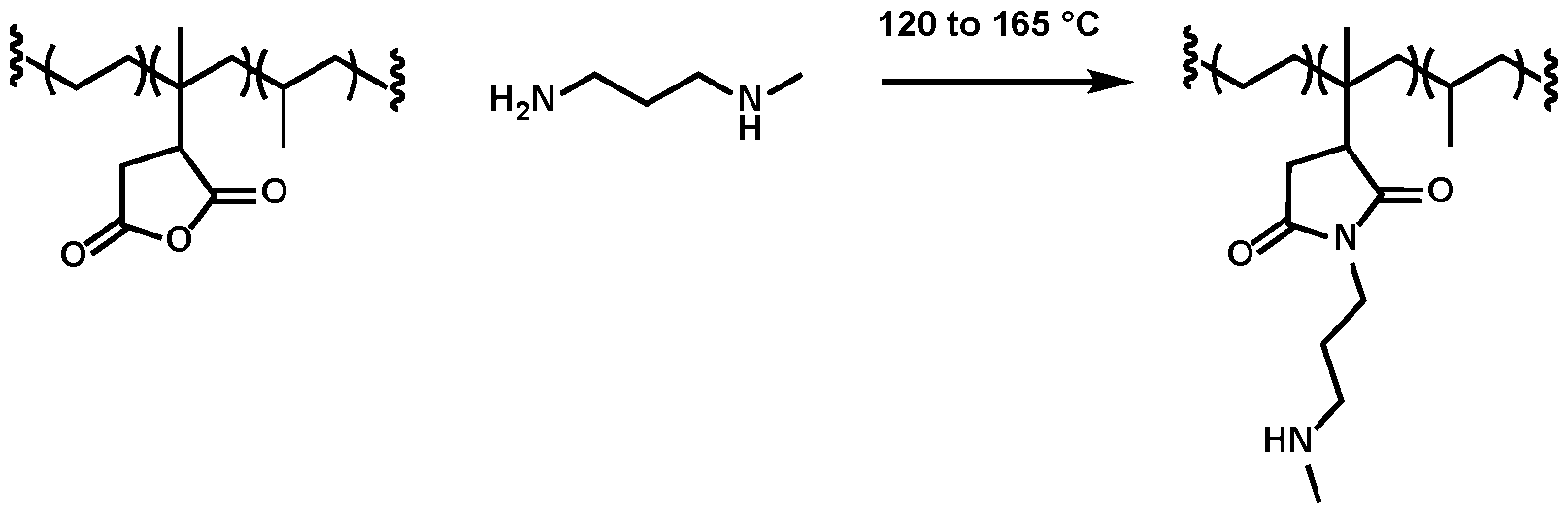
- N-Methyl-1,3-propanediamine MeDAP: 5.57 g
- Example 10 Imidation and Post-Treatment Procedure O 3 (200 g; ⁇ 3.1wt% maleic anhydride) and 100 neutral oil (178.6 g) were charged to a stirred 1-liter glass reactor equipped with an overhead condenser and nitrogen sparge. The mixture was heated to 100 ⁇ 5°C with stirring. N-Methyl-1,3-propanediamine (MeDAP: 5.57 g) was added to the reactor.
- MeDAP N-Methyl-1,3-propanediamine
- the reactor was heated to 120 ⁇ 5°C and held at this temperature for 1 hour with a nitrogen to remove generated water. The reaction was then heated to 160 ⁇ 5°C and held for 1 hour. The reaction was monitored for completeness via FT-IR. Next, 2-naphthyl glycidyl ether (NGE: 12.7 g) was charged to the reactor and the reaction was held at 165 ⁇ 5°C for 1 hour. The reaction was monitored for completeness via FT-IR and 1 H-NMR.
- NGE 2-naphthyl glycidyl ether
- Example 11 Maleation [88] Ethylene-propylene copolymer (3003.8 g, KV100 ⁇ 2000 cSt) was transferred into a stirred 4-liter stainless steel reactor equipped with charging lines for maleic anhydride and di-t-amyl peroxide and blanketed with nitrogen. The copolymer was heated to 170°C. T-11885-P [89] Maleic anhydride (121.90 g) and di-tert-amyl peroxide (18.29 g) were charged at a constant rate simultaneously into the reactor agitation zone over a 2-hour period. After the charging, the reactor was held at temperature for an additional 15 minutes. The reaction was monitored for completeness via FT-IR.
- the reaction mixture was stirred at temperature for another 15 min before concluding the reaction.
- the maleated ethylene-propylene copolymer has an Mn 6916 based on gel permeation chromatography (calibrated by polystyrene standard).
- Example 12 - Imidation and Post-Treatment maleic anhydride), and 100R neutral oil (417 g) were charged to a stirred 4-liter glass reactor equipped with an overhead stirrer, nitrogen sweep, heating mantle, and temperature controller. The mixture was to 165 ⁇ 5°C while being stirred.
- Aminoethylpiperazine (AEP: 48.74 g) was charged to the reactor. The reaction was held at 165 ⁇ 5°C for 1.5 hours.
- Example 11 polymer was mixed with mineral oil to obtain a 55% polymer solution. This mixture (1420.5 g, 55% polymer) was slowly charged to the 4-liter reactor at 75 ⁇ 5°C without agitation to achieve a final dilution of 40% polymer in oil. Temperature of reactor was increased to 165 ⁇ 5°C without agitation and held for 2 hours. Next, the reaction was stirred for 1.5 hours while maintaining the temperature at 165 ⁇ 5°C.
- Example 14 Imidation and Post-Treatment T-11885-P O O oil (1513.6 g) were charged in a stirred 4-liter glass reactor equipped with an overhead stirrer, nitrogen sweep, heating mantle, and temperature controller. Aminoethylpiperazine (AEP: 33.28 g) was added to the reactor. The reaction was held at 165oC for 2.5 hours. Upon completion of the imidation reaction, 2-naphthyl glycidyl ether (NGE: 51.59 g) was then added to the reaction mixture. Reaction was held at 165oC for 3 hours.
- AEP Aminoethylpiperazine
- NGE 2-naphthyl glycidyl ether
- Example 15 Maleation
- Ethylene-propylene copolymer 3006.5 g, KV100 ⁇ 2000 cSt
- the copolymer was heated to 170°C.
- Maleic anhydride 92.98 g
- di-tert-amyl peroxide (12.19 g) were charged at a constant rate simultaneously into the reactor agitation zone over a 2-hour period. After the charging, the reactor was held at temperature for an additional 15 minutes. The reaction was monitored for completeness via FT-IR.
- the reaction mixture was stirred at temperature for another 15 min before T-11885-P concluding the reaction.
- the maleated ethylene-propylene copolymer has an Mn 6433 based on gel permeation chromatography (calibrated by polystyrene standard).
- Example 16 - Imidation and Post-Treatment O O OH oil (221.7 g) were charged to a stirred 1-liter glass reactor equipped with a condenser and nitrogen sweep. The mixture was heated to 165°C while being stirred. Aminoethylethanolamine (AEEA: 7.09 g) was added to the reactor. The reaction mixture was held at 165°C for 2.5 hours.
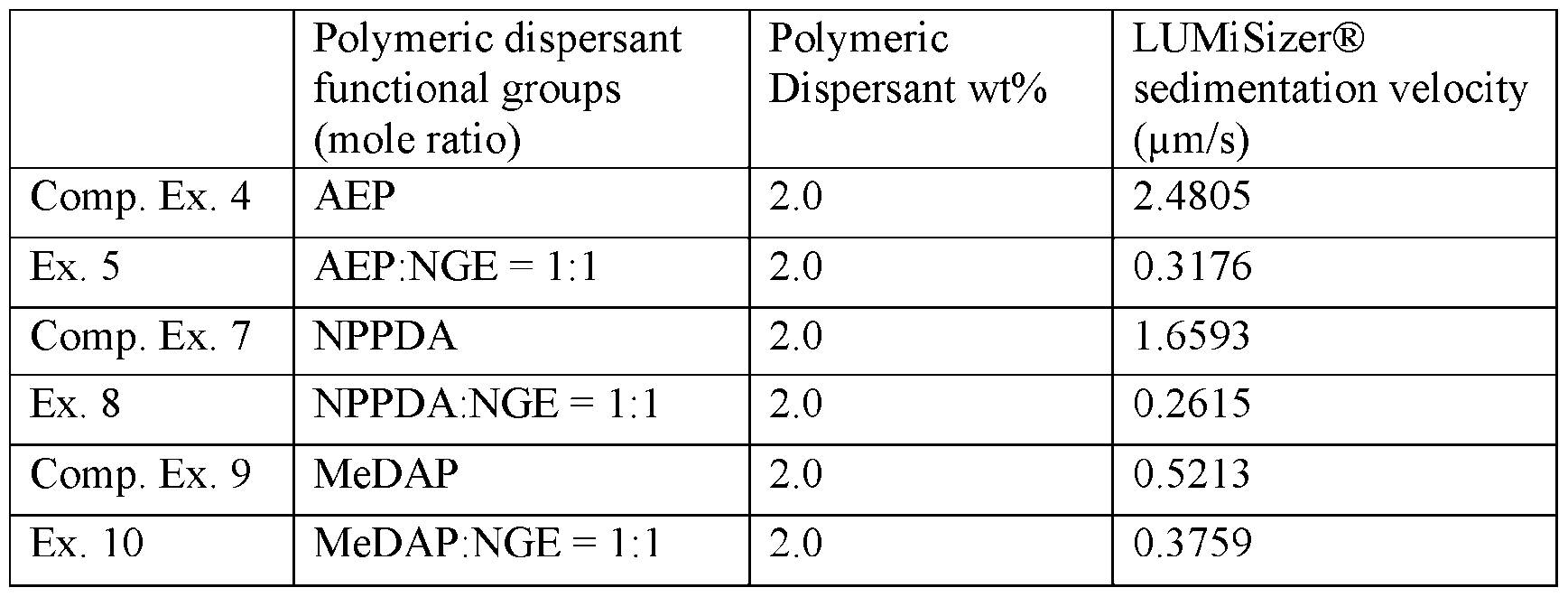
- the results summarized in the table below show that post-treatment with naphthyl glycidyl ether improves the performance: Polymeric dispersant Polymeric LUMiSizer® functional groups Dispersant wt% sedimentation velocity Cummins® ISB Test [99]
- the Cummins® ISB test is an industry standard Diesel engine durability test using a Cummins® 5.9 L ISB engine. The test lasts 350 hr and consists of two stages: a 100 hr soot generation stage followed by a 250 hr cyclic stage to induce valve train wear. [100] Upon completion of the test cycle, the engine is dismantled and the Cam and Tappets are analyzed for wear.
- Inventive Example B is the same formulation used for Comparative Example A with the addition of 1 wt% of Polymeric Dispersant from Example 6, a scaled-up synthesis as described in Example 5.
- the bench and engine test data shown here indicate that a liquid hydrocarbon polymer having number average molecular weight (Mn) from about 1,500 and about 16,000, functionalized with an ethylenically unsaturated acylating grafting agent, reacted with a post- treatable polyamine, then post-treated with naphthyl glycidyl ether has improved soot handling performance over the non-post-treated examples.
- Mn number average molecular weight
Landscapes
- Chemical & Material Sciences (AREA)
- Chemical Kinetics & Catalysis (AREA)
- Organic Chemistry (AREA)
- General Chemical & Material Sciences (AREA)
- Health & Medical Sciences (AREA)
- Medicinal Chemistry (AREA)
- Polymers & Plastics (AREA)
- Oil, Petroleum & Natural Gas (AREA)
- Lubricants (AREA)
Abstract
Description








Claims


Priority Applications (3)
| Application Number | Priority Date | Filing Date | Title |
|---|---|---|---|
| CN202480044197.0A CN121443708A (en) | 2023-06-16 | 2024-06-17 | Low molecular weight polymer soot dispersant |
| EP24740300.9A EP4728030A1 (en) | 2023-06-16 | 2024-06-17 | Low molecular weight polymeric soot dispersant |
| KR1020267001506A KR20260029343A (en) | 2023-06-16 | 2024-06-17 | low molecular weight polymeric smoke dispersant |
Applications Claiming Priority (2)
| Application Number | Priority Date | Filing Date | Title |
|---|---|---|---|
| US202363521477P | 2023-06-16 | 2023-06-16 | |
| US63/521,477 | 2023-06-16 |
Publications (1)
| Publication Number | Publication Date |
|---|---|
| WO2024259451A1 true WO2024259451A1 (en) | 2024-12-19 |
Family
ID=91856234
Family Applications (1)
| Application Number | Title | Priority Date | Filing Date |
|---|---|---|---|
| PCT/US2024/034405 Ceased WO2024259451A1 (en) | 2023-06-16 | 2024-06-17 | Low molecular weight polymeric soot dispersant |
Country Status (4)
| Country | Link |
|---|---|
| EP (1) | EP4728030A1 (en) |
| KR (1) | KR20260029343A (en) |
| CN (1) | CN121443708A (en) |
| WO (1) | WO2024259451A1 (en) |
Cited By (1)
| Publication number | Priority date | Publication date | Assignee | Title |
|---|---|---|---|---|
| WO2026015452A1 (en) * | 2024-07-11 | 2026-01-15 | Chevron Oronite Company Llc | Lubricant for diesel engine with enhanced anti-wear performance |
Citations (2)
| Publication number | Priority date | Publication date | Assignee | Title |
|---|---|---|---|---|
| US20160361699A1 (en) * | 2015-06-12 | 2016-12-15 | Ethox Chemicals, Llc | Polymeric Invert Emulsifiers |
| WO2022018681A1 (en) * | 2020-07-23 | 2022-01-27 | Chevron Oronite Company Llc | Succinimide dispersants post-treated with aromatic glycidyl ethers that exhibit good soot handling performance |
-
2024
- 2024-06-17 EP EP24740300.9A patent/EP4728030A1/en active Pending
- 2024-06-17 WO PCT/US2024/034405 patent/WO2024259451A1/en not_active Ceased
- 2024-06-17 CN CN202480044197.0A patent/CN121443708A/en active Pending
- 2024-06-17 KR KR1020267001506A patent/KR20260029343A/en active Pending
Patent Citations (2)
| Publication number | Priority date | Publication date | Assignee | Title |
|---|---|---|---|---|
| US20160361699A1 (en) * | 2015-06-12 | 2016-12-15 | Ethox Chemicals, Llc | Polymeric Invert Emulsifiers |
| WO2022018681A1 (en) * | 2020-07-23 | 2022-01-27 | Chevron Oronite Company Llc | Succinimide dispersants post-treated with aromatic glycidyl ethers that exhibit good soot handling performance |
Non-Patent Citations (6)
| Title |
|---|
| "American Petroleum Institute (API", December 1996 |
| "Reactive Modifiers for Polymers Softcover reprint of the original", 1997 |
| A. SEQUERIA, JR.: "Lubricant Base Oil and Wax Processing", 1994, MARCEL DECKER |
| D. V. BROCK, LUBRICATION ENGINEERING, vol. 43, 1987, pages 184 - 5 |
| LESLIE R. RUDNICK: "Lubricant Additives: Chemistry and Applications", 2003, MARCEL DEKKER, pages: 113 - 136 |
| MORTIER ET AL.: "Chemistry and Technology of Lubricants", 1996, SPRINGER, pages: 190 - 193 |
Cited By (1)
| Publication number | Priority date | Publication date | Assignee | Title |
|---|---|---|---|---|
| WO2026015452A1 (en) * | 2024-07-11 | 2026-01-15 | Chevron Oronite Company Llc | Lubricant for diesel engine with enhanced anti-wear performance |
Also Published As
| Publication number | Publication date |
|---|---|
| KR20260029343A (en) | 2026-03-04 |
| CN121443708A (en) | 2026-01-30 |
| EP4728030A1 (en) | 2026-04-22 |
Similar Documents
| Publication | Publication Date | Title |
|---|---|---|
| US7238650B2 (en) | Low-chlorine, polyolefin-substituted, with amine reacted, alpha-beta unsaturated carboxylic compounds | |
| JP5539983B2 (en) | Novel copolymer and its lubricating composition | |
| US5861363A (en) | Polyalkylene succinimide composition useful in internal combustion engines | |
| EP2021387A2 (en) | Novel polymers and methods of controlling viscosity | |
| CN101679903A (en) | Lubricant composition for combustion engine containing dispersant additve and polymer dispersant viscosity index improver | |
| EP2797970A1 (en) | Functionalized olefin copolymers with monoamine terminated polyether and lubricating oil compositions | |
| JP5389320B2 (en) | Lubricating oil additive composition and method for producing the same | |
| EP4728030A1 (en) | Low molecular weight polymeric soot dispersant | |
| KR20190063436A (en) | Lubricating oil additives | |
| US20030224948A1 (en) | Lubricating oil additive comprising EC-treated succinimide, borated dispersant and corrosion inhibitor | |
| EP4728031A1 (en) | Polymeric soot dispersant | |
| CA3112718C (en) | Low viscosity lubricating oil composition | |
| EP4728029A1 (en) | Low molecular weight polymeric soot dispersant | |
| CA2305637A1 (en) | Polyalkylene succinimide composition useful in internal combustion engines | |
| WO2026015445A1 (en) | Lubricant for improved soot control performance in diesel engines | |
| EP1141180A1 (en) | Triazine derivative as dispersant for lubricants and fuels | |
| WO2026015452A1 (en) | Lubricant for diesel engine with enhanced anti-wear performance | |
| US20040198613A1 (en) | Polymer composition for lubricant additives | |
| CN111979014B (en) | Lubricant Additives | |
| US20250075145A1 (en) | High efficiency engine oil compositions | |
| AU2002345987B2 (en) | Low-chlorine, polyolefin-substituted, with amine reacted, alpha-beta unsaturated carboxylic compounds |
Legal Events
| Date | Code | Title | Description |
|---|---|---|---|
| 121 | Ep: the epo has been informed by wipo that ep was designated in this application |
Ref document number: 24740300 Country of ref document: EP Kind code of ref document: A1 |
|
| ENP | Entry into the national phase |
Ref document number: 2025572796 Country of ref document: JP Kind code of ref document: A |
|
| ENP | Entry into the national phase |
Ref document number: 1020267001506 Country of ref document: KR Free format text: ST27 STATUS EVENT CODE: A-0-1-A10-A15-NAP-PA0105 (AS PROVIDED BY THE NATIONAL OFFICE) |
|
| WWE | Wipo information: entry into national phase |
Ref document number: 1020267001506 Country of ref document: KR |
|
| WWE | Wipo information: entry into national phase |
Ref document number: 2024740300 Country of ref document: EP |
|
| NENP | Non-entry into the national phase |
Ref country code: DE |
|
| ENP | Entry into the national phase |
Ref document number: 2024740300 Country of ref document: EP Effective date: 20260116 |
|
| ENP | Entry into the national phase |
Ref document number: 2024740300 Country of ref document: EP Effective date: 20260116 |
|
| WWE | Wipo information: entry into national phase |
Ref document number: 11202508347S Country of ref document: SG |
|
| WWP | Wipo information: published in national office |
Ref document number: 11202508347S Country of ref document: SG |
|
| ENP | Entry into the national phase |
Ref document number: 2024740300 Country of ref document: EP Effective date: 20260116 |
|
| ENP | Entry into the national phase |
Ref document number: 2024740300 Country of ref document: EP Effective date: 20260116 |
|
| WWP | Wipo information: published in national office |
Ref document number: 1020267001506 Country of ref document: KR |
|
| WWP | Wipo information: published in national office |
Ref document number: 2024740300 Country of ref document: EP |