WO2024259342A2 - Methods for synthesizing αlpha-deuterated αlpha-amino acids and derivatives thereof - Google Patents
Methods for synthesizing αlpha-deuterated αlpha-amino acids and derivatives thereof Download PDFInfo
- Publication number
- WO2024259342A2 WO2024259342A2 PCT/US2024/034160 US2024034160W WO2024259342A2 WO 2024259342 A2 WO2024259342 A2 WO 2024259342A2 US 2024034160 W US2024034160 W US 2024034160W WO 2024259342 A2 WO2024259342 A2 WO 2024259342A2
- Authority
- WO
- WIPO (PCT)
- Prior art keywords
- alkyl
- alkylene
- nhc
- compound
- haloalkyl
- Prior art date
- Legal status (The legal status is an assumption and is not a legal conclusion. Google has not performed a legal analysis and makes no representation as to the accuracy of the status listed.)
- Ceased
Links
Classifications
-
- C—CHEMISTRY; METALLURGY
- C07—ORGANIC CHEMISTRY
- C07B—GENERAL METHODS OF ORGANIC CHEMISTRY; APPARATUS THEREFOR
- C07B59/00—Introduction of isotopes of elements into organic compounds ; Labelled organic compounds per se
- C07B59/002—Heterocyclic compounds
-
- C—CHEMISTRY; METALLURGY
- C07—ORGANIC CHEMISTRY
- C07D—HETEROCYCLIC COMPOUNDS
- C07D263/00—Heterocyclic compounds containing 1,3-oxazole or hydrogenated 1,3-oxazole rings
- C07D263/02—Heterocyclic compounds containing 1,3-oxazole or hydrogenated 1,3-oxazole rings not condensed with other rings
- C07D263/08—Heterocyclic compounds containing 1,3-oxazole or hydrogenated 1,3-oxazole rings not condensed with other rings having one double bond between ring members or between a ring member and a non-ring member
- C07D263/16—Heterocyclic compounds containing 1,3-oxazole or hydrogenated 1,3-oxazole rings not condensed with other rings having one double bond between ring members or between a ring member and a non-ring member with hetero atoms or with carbon atoms having three bonds to hetero atoms with at the most one bond to halogen, e.g. ester or nitrile radicals, directly attached to ring carbon atoms
- C07D263/18—Oxygen atoms
- C07D263/20—Oxygen atoms attached in position 2
- C07D263/24—Oxygen atoms attached in position 2 with hydrocarbon radicals, substituted by oxygen atoms, attached to other ring carbon atoms
-
- C—CHEMISTRY; METALLURGY
- C07—ORGANIC CHEMISTRY
- C07D—HETEROCYCLIC COMPOUNDS
- C07D413/00—Heterocyclic compounds containing two or more hetero rings, at least one ring having nitrogen and oxygen atoms as the only ring hetero atoms
- C07D413/02—Heterocyclic compounds containing two or more hetero rings, at least one ring having nitrogen and oxygen atoms as the only ring hetero atoms containing two hetero rings
- C07D413/06—Heterocyclic compounds containing two or more hetero rings, at least one ring having nitrogen and oxygen atoms as the only ring hetero atoms containing two hetero rings linked by a carbon chain containing only aliphatic carbon atoms
-
- C—CHEMISTRY; METALLURGY
- C07—ORGANIC CHEMISTRY
- C07D—HETEROCYCLIC COMPOUNDS
- C07D493/00—Heterocyclic compounds containing oxygen atoms as the only ring hetero atoms in the condensed system
- C07D493/02—Heterocyclic compounds containing oxygen atoms as the only ring hetero atoms in the condensed system in which the condensed system contains two hetero rings
- C07D493/04—Ortho-condensed systems
-
- C—CHEMISTRY; METALLURGY
- C07—ORGANIC CHEMISTRY
- C07D—HETEROCYCLIC COMPOUNDS
- C07D493/00—Heterocyclic compounds containing oxygen atoms as the only ring hetero atoms in the condensed system
- C07D493/12—Heterocyclic compounds containing oxygen atoms as the only ring hetero atoms in the condensed system in which the condensed system contains three hetero rings
- C07D493/14—Ortho-condensed systems
-
- C—CHEMISTRY; METALLURGY
- C07—ORGANIC CHEMISTRY
- C07B—GENERAL METHODS OF ORGANIC CHEMISTRY; APPARATUS THEREFOR
- C07B2200/00—Indexing scheme relating to specific properties of organic compounds
- C07B2200/05—Isotopically modified compounds, e.g. labelled
Definitions
- Exemplary materials, methods and techniques disclosed and contemplated herein generally relate to methods for synthesizing ⁇ -deuterated ⁇ -amino acids and their derivatives.
- INTRODUCTION [0004] The current methods for synthesizing ⁇ -deuterated ⁇ -amino acid derivatives employ the asymmetric alkylation of glycine derived imines followed by deuteration with D 2 O or H/D exchange of amino acid derivatives. However, these existing methods only achieve moderate deuteration levels, and do not work well for highly sterically demanding amino acids.
- the present disclosure provides a method for preparing a deuterated compound of formula (I), or a salt thereof, wherein: R 1 is G 1 , C 1-10 alkyl, –L 1 –R Y , or –G 1 -L 1 –R Y ; R 2 is an amine protecting group, hydrogen, or C 1-6 alkyl; and R 3 is C 1-6 alkyl or C 1-4 haloalkyl; G 1 , at each occurrence, is a 6- to 12-membered aryl, a 5- to 12-membered heteroaryl, C 3–10 carbocyclyl, or a 4- to 12-membered heterocyclyl, wherein G 1 is optionally substituted with 1-4 substituents independently selected from the group consisting of C 1-6 alkyl, C 1-4 haloalkyl, halogen, cyano, G 1a , –OH, –OC 1-6 alkyl, –OG 1a ,
- the method for preparing a deuterated compound of formula (I), or a salt thereof may comprise mixing a compound of formula (III): ' a compound of formula (II), with a photocatalyst, a base, and D 2 O to form a reaction mixture; and exposing the reaction mixture to light, thereby producing the deuterated compound of formula (I).
- the compound of formula (I) may have at least 75% deuterium incorporation at each deuterium label.
- the compound of formula (III) may be
- the base may be a Lewis base.
- the photocatalyst may be an iridium (Ir)-based photocatalyst.
- the light may be blue LED light.
- the present disclosure provides methods of preparing a deuterated compound of formula (I-AA), or a salt thereof, the method comprising preparing a deuterated compound of formula (I), then hydrolyzing the deuterated compound of formula (I).
- the deuterated compound of formula (I-AA) may be:
- FIG. 1 shows examples of ⁇ -deuterated amino acid therapeutics.
- FIG. 2 shows an example substrate scope for the deuteration methods described herein.
- FIG. 3 shows an example late-stage functionalization of complex bioactive molecules and conversion of products to amino acids using the deuteration methods described herein.
- Described herein is a mild, versatile deuteration method that has been developed for efficient incorporation of various side chains and deuterium into methylene oxazolidinones.
- the method delivers structurally diverse chiral ⁇ -deuterated a-amino acid derivatives in good yields with excellent diastereoselectivity and uniformly high level of deuterium incorporation.
- the employment of readily available starting materials, an inexpensive and safe D 2 O as deuterium reagent, mild reaction conditions, and operational simplicity makes the method practical in synthesis.
- the approach has significantly expanded the scope for accessing both aryl and alkyl side chain contained ⁇ -amino acids.
- the present disclosure also contemplates other embodiments “comprising,” “consisting of” and “consisting essentially of,” the embodiments or elements presented herein, whether explicitly set forth or not.
- the modifier “about” used in connection with a quantity is inclusive of the stated value and has the meaning dictated by the context (for example, it includes at least the degree of error associated with the measurement of the particular quantity).
- the modifier “about” should also be considered as disclosing the range defined by the absolute values of the two endpoints. For example, the expression “from about 2 to about 4” also discloses the range “from 2 to 4.”
- the term “about” may refer to plus or minus 10% of the indicated number.
- alkoxy include, but are not limited to, methoxy, ethoxy, propoxy, 2-propoxy, butoxy and tert- butoxy.
- alkyl as used herein, means a straight or branched, saturated hydrocarbon chain.
- lower alkyl or “C 1-6 alkyl” means a straight or branched chain hydrocarbon containing from 1 to 6 carbon atoms.
- C 1-4 alkyl means a straight or branched chain hydrocarbon containing from 1 to 4 carbon atoms.
- alkyl include, but are not limited to, methyl, ethyl, n-propyl, iso-propyl, n-butyl, sec-butyl, iso-butyl, tert-butyl, n- pentyl, isopentyl, neopentyl, n-hexyl, 3-methylhexyl, 2,2-dimethylpentyl, 2,3-dimethylpentyl, n- heptyl, n-octyl, n-nonyl, and n-decyl.
- alkenyl means a straight or branched, hydrocarbon chain containing at least one carbon-carbon double bond.
- alkoxyalkyl refers to an alkoxy group, as defined herein, appended to the parent molecular moiety through an alkyl group, as defined herein.
- alkylamino means at least one alkyl group, as defined herein, is appended to the parent molecular moiety through an amino group, as defined herein.
- amide means –C(O)NR– or –NRC(O)–, wherein R may be hydrogen, alkyl, cycloalkyl, aryl, heteroaryl, heterocycle, alkenyl, or heteroalkyl.
- aminoalkyl as used herein, means at least one amino group, as defined herein, is appended to the parent molecular moiety through an alkylene group, as defined herein.
- amino means —NR x R y , wherein R x and R y may be hydrogen, alkyl, cycloalkyl, aryl, heteroaryl, heterocycle, alkenyl, or heteroalkyl.
- R x and R y may be hydrogen, alkyl, cycloalkyl, aryl, heteroaryl, heterocycle, alkenyl, or heteroalkyl.
- amino may be – NR x –, wherein R x may be hydrogen, alkyl, cycloalkyl, aryl, heteroaryl, heterocycle, alkenyl, or heteroalkyl.
- aryl refers to a phenyl or a phenyl appended to the parent molecular moiety and fused to a cycloalkane group (e.g., the aryl may be indan-4-yl), fused to a 6-membered arene group (i.e., the aryl is naphthyl), or fused to a non-aromatic heterocycle (e.g., the aryl may be benzo[d][1,3]dioxol-5-yl).
- phenyl is used when referring to a substituent and the term 6-membered arene is used when referring to a fused ring.
- the 6- membered arene is monocyclic (e.g., benzene or benzo).
- the aryl may be monocyclic (phenyl) or bicyclic (e.g., a 9- to 12-membered fused bicyclic system).
- cyanoalkyl means at least one –CN group, is appended to the parent molecular moiety through an alkylene group, as defined herein.
- cycloalkoxy refers to a cycloalkyl group, as defined herein, appended to the parent molecular moiety through an oxygen atom.
- cycloalkyl or “cycloalkane,” as used herein, refers to a saturated ring system containing all carbon atoms as ring members and zero double bonds.
- cycloalkyl is used herein to refer to a cycloalkane when present as a substituent.
- a cycloalkyl may be a monocyclic cycloalkyl (e.g., cyclopropyl), a fused bicyclic cycloalkyl (e.g., decahydronaphthalenyl), or a bridged cycloalkyl in which two non-adjacent atoms of a ring are linked by an alkylene bridge of 1, 2, 3, or 4 carbon atoms (e.g., bicyclo[2.2.1]heptanyl).
- a monocyclic cycloalkyl e.g., cyclopropyl
- a fused bicyclic cycloalkyl e.g., decahydronaphthalenyl
- a bridged cycloalkyl in which two non-adjacent atoms of a ring are linked by an alkylene bridge of 1, 2, 3, or 4 carbon atoms (e.g., bicyclo[2.2.1]heptanyl).
- cycloalkyl include, but are not limited to, cyclopropyl, cyclobutyl, cyclopentyl, cyclohexyl, cycloheptyl, cyclooctyl, cyclononyl, cyclodecyl, adamantyl, and bicyclo[1.1.1]pentanyl.
- cycloalkenyl or “cycloalkene,” as used herein, means a non-aromatic monocyclic or multicyclic ring system containing all carbon atoms as ring members and at least one carbon-carbon double bond and preferably having from 5-10 carbon atoms per ring.
- cycloalkenyl is used herein to refer to a cycloalkene when present as a substituent.
- a cycloalkenyl may be a monocyclic cycloalkenyl (e.g., cyclopentenyl), a fused bicyclic cycloalkenyl (e.g., octahydronaphthalenyl), or a bridged cycloalkenyl in which two non-adjacent atoms of a ring are linked by an alkylene bridge of 1, 2, 3, or 4 carbon atoms (e.g., bicyclo[2.2.1]heptenyl).
- Exemplary monocyclic cycloalkenyl rings include cyclopentenyl, cyclohexenyl or cycloheptenyl.
- Exemplary monocyclic cycloalkenyl rings include cyclopentenyl, cyclohexenyl or cycloheptenyl.
- the term “carbocyclyl” means a “cycloalkyl” or a “cycloalkenyl.”
- the term “carbocycle” means a “cycloalkane” or a “cycloalkene.”
- the term “carbocyclyl” refers to a “carbocycle” when present as a substituent.
- cycloalkylene and heterocyclylene refer to divalent groups derived from the base ring, i.e., cycloalkane, heterocycle.
- examples of cycloalkylene and heterocyclylene include, respectively, Cycloalkylene and heterocyclylene include a geminal divalent groups such as 1,1-C 3-6 cycloalkylene (i.e., A further example is 1,1-cyclopropylene (i.e., [0033]
- halogen or “halo,” as used herein, means Cl, Br, I, or F.
- haloalkyl means an alkyl group, as defined herein, in which one, two, three, four, five, six, seven or eight hydrogen atoms are replaced by a halogen.
- haloalkoxy means at least one haloalkyl group, as defined herein, is appended to the parent molecular moiety through an oxygen atom.
- halocycloalkyl means a cycloalkyl group, as defined herein, in which one or more hydrogen atoms are replaced by a halogen.
- heteroalkyl means an alkyl group, as defined herein, in which one or more of the carbon atoms has been replaced by a heteroatom selected from S, O, P and N.
- Representative examples of heteroalkyls include, but are not limited to, alkyl ethers, secondary and tertiary alkyl amines, amides, and alkyl sulfides.
- heteroaryl refers to an aromatic monocyclic heteroatom- containing ring (monocyclic heteroaryl) or a bicyclic ring system containing at least one monocyclic heteroaromatic ring (bicyclic heteroaryl).
- heteroaryl is used herein to refer to a heteroarene when present as a substituent.
- the monocyclic heteroaryl are five or six membered rings containing at least one heteroatom independently selected from the group consisting of N, O and S (e.g., 1, 2, 3, or 4 heteroatoms independently selected from O, S, and N).
- the five membered aromatic monocyclic rings have two double bonds, and the six membered aromatic monocyclic rings have three double bonds.
- the bicyclic heteroaryl is an 8- to 12-membered ring system and includes a fused bicyclic heteroaromatic ring system (i.e., 10 ⁇ electron system) such as a monocyclic heteroaryl ring fused to a 6-membered arene (e.g., quinolin-4-yl, indol-1-yl), a monocyclic heteroaryl ring fused to a monocyclic heteroarene (e.g., naphthyridinyl), and a phenyl fused to a monocyclic heteroarene (e.g., quinolin-5-yl, indol-4-yl).
- a fused bicyclic heteroaromatic ring system i.e., 10 ⁇ electron system
- a monocyclic heteroaryl ring fused to a 6-membered arene e.g., quinolin-4-yl, indol-1-yl
- a bicyclic heteroaryl/heteroarene group includes a 9-membered fused bicyclic heteroaromatic ring system having four double bonds and at least one heteroatom contributing a lone electron pair to a fully aromatic 10 ⁇ electron system, such as ring systems with a nitrogen atom at the ring junction (e.g., imidazopyridine) or a benzoxadiazolyl.
- a bicyclic heteroaryl also includes a fused bicyclic ring system composed of one heteroaromatic ring and one non-aromatic ring such as a monocyclic heteroaryl ring fused to a monocyclic carbocyclic ring (e.g., 6,7-dihydro-5H- cyclopenta[b]pyridinyl), or a monocyclic heteroaryl ring fused to a monocyclic heterocycle (e.g., 2,3-dihydrofuro[3,2-b]pyridinyl).
- the bicyclic heteroaryl is attached to the parent molecular moiety at an aromatic ring atom.
- heteroaryl include, but are not limited to, indolyl (e.g., indol-1-yl, indol-2-yl, indol-4-yl), pyridinyl (including pyridin-2-yl, pyridin-3-yl, pyridin-4-yl), pyrimidinyl, pyrazinyl, pyridazinyl, pyrazolyl (e.g., pyrazol-4-yl), pyrrolyl, benzopyrazolyl, 1,2,3-triazolyl (e.g., triazol-4-yl), 1,3,4-thiadiazolyl, 1,2,4-thiadiazolyl, 1,3,4-oxadiazolyl, 1,2,4-oxadiazolyl, imidazolyl, thiazolyl (e.g., thiazol-4-yl), isothiazolyl, thienyl, benzimidazolyl (e.g
- heterocycle or “heterocyclic,” as used herein, means a monocyclic heterocycle, a bicyclic heterocycle, or a tricyclic heterocycle.
- heterocyclyl is used herein to refer to a heterocycle when present as a substituent.
- the monocyclic heterocycle is a three-, four-, five-, six-, seven-, or eight-membered ring containing at least one heteroatom independently selected from the group consisting of O, N, and S.
- the three- or four-membered ring contains zero or one double bond, and one heteroatom selected from the group consisting of O, N, and S.
- the five-membered ring contains zero or one double bond and one, two or three heteroatoms selected from the group consisting of O, N and S.
- the six-membered ring contains zero, one or two double bonds and one, two, or three heteroatoms selected from the group consisting of O, N, and S.
- the seven- and eight-membered rings contains zero, one, two, or three double bonds and one, two, or three heteroatoms selected from the group consisting of O, N, and S.
- monocyclic heterocyclyls include, but are not limited to, azetidinyl, azepanyl, aziridinyl, diazepanyl, 1,3-dioxanyl, 1,3-dioxolanyl, 1,3-dithiolanyl, 1,3-dithianyl, imidazolinyl, imidazolidinyl, isothiazolinyl, isothiazolidinyl, isoxazolinyl, isoxazolidinyl, morpholinyl, 2-oxo-3-piperidinyl, 2-oxoazepan-3-yl, oxadiazolinyl, oxadiazolidinyl, oxazolinyl, oxazolidinyl, oxetanyl, oxepanyl, oxocanyl, piperazinyl, piperidinyl, pyranyl, pyrazolin
- the bicyclic heterocycle is a monocyclic heterocycle fused to a 6- membered arene, or a monocyclic heterocycle fused to a monocyclic cycloalkane, or a monocyclic heterocycle fused to a monocyclic cycloalkene, or a monocyclic heterocycle fused to a monocyclic heterocycle, or a monocyclic heterocycle fused to a monocyclic heteroarene, or a spiro heterocycle group, or a bridged monocyclic heterocycle ring system in which two non-adjacent atoms of the ring are linked by an alkylene bridge of 1, 2, 3, or 4 carbon atoms, or an alkenylene bridge of two, three, or four carbon atoms.
- bicyclic heterocyclyl is attached to the parent molecular moiety at a non-aromatic ring atom (e.g., indolin-1-yl).
- bicyclic heterocyclyls include, but are not limited to, chroman-4-yl, 2,3-dihydrobenzofuran-2-yl, 2,3-dihydrobenzothien- 2-yl, 1,2,3,4-tetrahydroisoquinolin-2-yl, 2-azaspiro[3.3]heptan-2-yl, 2-oxa-6-azaspiro[3.3]heptan- 6-yl, azabicyclo[2.2.1]heptyl (including 2-azabicyclo[2.2.1]hept-2-yl), azabicyclo[3.1.0]hexanyl (including 3-azabicyclo[3.1.0]hexan-3-yl), 2,3-dihydro-1H-indol-1-yl, isoindolin-2-yl, oc
- Tricyclic heterocycles are exemplified by a bicyclic heterocycle fused to a 6-membered arene, or a bicyclic heterocycle fused to a monocyclic cycloalkane, or a bicyclic heterocycle fused to a monocyclic cycloalkene, or a bicyclic heterocycle fused to a monocyclic heterocycle, or a bicyclic heterocycle in which two non-adjacent atoms of the bicyclic ring are linked by an alkylene bridge of 1, 2, 3, or 4 carbon atoms, or an alkenylene bridge of two, three, or four carbon atoms.
- tricyclic heterocycles include, but are not limited to, octahydro-2,5-epoxypentalene, hexahydro- 2H-2,5-methanocyclopenta[b]furan, hexahydro-1H-1,4-methanocyclopenta[c]furan, aza- adamantane (1-azatricyclo[3.3.1.13,7]decane), and oxa-adamantane (2- oxatricyclo[3.3.1.13,7]decane).
- the monocyclic, bicyclic, and tricyclic heterocyclyls are connected to the parent molecular moiety at a non-aromatic ring atom.
- hydroxyl or “hydroxy,” as used herein, means an -OH group.
- hydroxyalkyl means at least one -OH group, is appended to the parent molecular moiety through an alkylene group, as defined herein.
- Terms such as “alkyl,” “cycloalkyl,” “alkylene,” etc. may be preceded by a designation indicating the number of atoms present in the group in a particular instance (e.g., "C 1-4 alkyl,” “C 3- 6 cycloalkyl,” “C 1-4 alkylene”). These designations are used as generally understood by those skilled in the art.
- C the representation "C” followed by a subscripted number indicates the number of carbon atoms present in the group that follows.
- C 3 alkyl is an alkyl group with three carbon atoms (i.e., n-propyl, isopropyl).
- C 1-4 alkyl the members of the group that follows may have any number of carbon atoms falling within the recited range.
- a “C 1-4 alkyl,” for example, is an alkyl group having from 1 to 4 carbon atoms, however arranged (i.e., straight chain or branched).
- substituted refers to a group that may be further substituted with one or more non-hydrogen substituent groups.
- any "hydrogen” or "H,” whether explicitly recited or implicit in the structure, encompasses hydrogen isotopes 1 H (protium) and 2 H (deuterium).
- the present disclosure also includes an isotopically-labeled compound (e.g., deuterium labeled), where an atom in the isotopically-labeled compound is specified as a particular isotope of the atom.
- isotopes suitable for inclusion in the compounds of the invention are hydrogen, carbon, nitrogen, oxygen, phosphorus, sulfur, fluorine, and chlorine, such as, but not limited to 2 H, 3 H, 13 C, 14 C, 15 N, 18 O, 17 O, 31 P, 32 P, 35 S, 18 F, and 36 Cl, respectively.
- isotopically enriched means that in a composition comprising a plurality of molecules of the compound, the amount (e.g., fraction, ration or percentage) of the plurality of molecules having the particular isotope at the particular atom is substantially greater than the natural abundance of the particular isotope, due to synthetic enrichment of the particular atom with the particular isotope.
- Isotopically-enriched forms of compounds of formulae (I), (I-AA), (II), or any subformulas may generally be prepared by conventional techniques known to those skilled in the art or by processes analogous to those described in the accompanying Examples using an appropriate isotopically-enriched reagent in place of a non-isotopically-enriched reagent.
- the extent of isotopic enrichment can be characterized as a percent incorporation of a particular isotope at an isotopically labeled atom (e.g., % deuterium incorporation at a deuterium label).
- a compound with an isotopically enriched deuterium ( 2 H, denoted as “D”) atom at one or more particular locations includes a plurality of molecules of the compound, where as a result of synthetic enrichment, the percentage of the plurality of molecules having deuterium at each of the one or more particular locations is greater than about 1% (the natural abundance of deuterium is substantially less than 1%), and in many cases is substantially greater than about 1%.
- a compound with an isotope incorporated at a particular isotopically labeled atom may include a plurality of molecules of the compound, where the amount of the plurality of molecules having the isotope at the particular isotopically labeled atom may be at least about two-or-more-fold greater than the natural abundance of the isotope at that atom, including but not limited to at least about two-fold, at least about three-fold, at least about four-fold, at least about five-fold, at least about 10-fold, at least about 20-fold, at least about 30-fold, at least about 40-fold, at least about 50-fold, at least about 60-fold, at least about 70-fold, at least about 80-fold, at least about 90-fold, at least about 100-fold, and at least about 200-fold, among others.
- a compound with an isotope at a particular isotopically labeled atom also may include a plurality of molecules of the compound where, as a result of synthetic enrichment, at least 1%, at least 5%, at least 10%, at least 15%, at least 20%, at least 25%, at least 30%, at least 35%, at least 40%, at least 45%, at least 50%, at least 55%, at least 60%, at least 65%, at least 70%, at least 75%, at least 80%, at least 85%, at least 90%, at least 95%, at least 99%, or at least 99.5% of the plurality of molecules have the isotope at the isotopically labeled atom.
- natural abundance refers to the abundance of the isotope as naturally found on the planet Earth.
- the natural abundance of 15 N on the planet Earth is generally regarded to be about 0.37% (i.e., substantially less than about 1%), while the natural abundance of deuterium ( 2 H) on the planet Earth is generally regarded to be about 0.015% (i.e., substantially less than about 1%).
- photochemical means relating to or caused by the chemical action of light. II. Exemplary Compounds [0053] The present disclosure relates to deuterated amino acids, their derivatives, and methods for synthesizing the same.
- deuterated Compounds of Formula (I) [0054]
- the present disclosure provides deuterated compounds of formula (I), or a salt thereof, wherein R 1 , R 2 , and R 3 are as defined herein.
- Deuterated compounds of formula (I) may be used to prepare various deuterated amino acids and their derivatives. [0055] In the following, various embodiments of the compounds of formula (I) are disclosed. The first embodiment is denoted E1, the second embodiment is denoted E2 and so forth. [0056] E1.
- a deuterated compound of formula (I), or a salt thereof wherein: R 1 is G 1 , C 1-10 alkyl, –L 1 –R Y , or –G 1 -L 1 –R Y ; R 2 is an amine protecting group, hydrogen, or C 1-6 alkyl; R 3 is C 1-6 alkyl, C 1-4 haloalkyl; G 1 , at each occurrence, is a 6- to 12-membered aryl, a 5- to 12-membered heteroaryl, C 3–10 carbocyclyl, or a 4- to 12-membered heterocyclyl, wherein G 1 is optionally substituted with 1-4 substituents independently selected from the group consisting of C 1-6 alkyl, C 1-4 haloalkyl, halogen, cyano, G 1a , –OH, –OC 1-6 alkyl, –OG 1a , –OC 1- 4 haloalkyl, –SH, –SC 1-6 alkyl,
- E2 The deuterated compound of E1, or a salt thereof, wherein R 1 is G 1 .
- E3. The deuterated compound of E2, or a salt thereof, wherein G 1 is the optionally substituted 6- to 12-membered aryl.
- E4. The deuterated compound of E3, or a salt thereof, wherein the optionally substituted 6- to 12-membered aryl is optionally substituted phenyl.
- E5. The deuterated compound of E4, or a salt thereof, wherein G 1 is , [0061] E6.
- the deuterated compound of E2, or a salt thereof, wherein G 1 is the optionally substituted C 3–10 carbocyclyl.
- E7 The deuterated compound of E6, or a salt thereof, wherein G 1 is .
- E8 The deuterated compound of E2, or a salt thereof, wherein G 1 is the optionally substituted 4- to 12-membered heterocyclyl.
- E9. The deuterated compound of E8, or a salt thereof, wherein the optionally substituted 4- to 12-membered heterocyclyl is optionally substituted piperidinyl.
- E10. The deuterated compound of E9, or a salt thereof, wherein G 1 is [0066] E11.
- E12 The deuterated compound of E11, or a salt thereof, wherein R 1 is or .
- E13 The deuterated compound of E11, or a salt thereof, wherein R 1 is or .
- E14 The deuterated compound of any one of E1-E13, or a salt thereof, wherein R 2 is the amine protecting group.
- E15 The deuterated compound of E14, or a salt thereof, wherein the amine protecting group is
- E16 The deuterated compound of any one of E1-E15, or a salt thereof, wherein R 2 is C 1-6 alkyl.
- E17 E17.
- E16 The deuterated compound of E16, or a salt thereof, wherein R 2 is ⁇ CH 3 .
- E18 The deuterated compound of E17, or a salt thereof, wherein each hydrogen in the ⁇ CH 3 is deuterium.
- E19 The deuterated compound of any one of E1-E18, or a salt thereof, wherein R 3 is C 1-6 alkyl.
- E20 The deuterated compound of E19, or a salt thereof, wherein R 3 is .
- E21 The deuterated compound of any one of E1-E20, or a salt thereof, wherein the compound of formula (I) is a compound of formula: [0077] E22.
- E23 The deuterated compound of any one of E1-E22, or a salt thereof, wherein that compound has at least 50% deuterium incorporation at each deuterium label.
- E24 The deuterated compound of any one of E1-E22, or a salt thereof, wherein that compound has at least 75% deuterium incorporation at each deuterium label.
- E25 The deuterated compound of any one of E1-E22, or a salt thereof, wherein that compound has at least 90% deuterium incorporation at each deuterium label.
- E26 The deuterated compound of any one of E1-E21, or a salt thereof, wherein the compound of formula (I) is .
- deuterated compounds of formula (I-AA) may be a deuterated amino acid or a derivative thereof.
- various embodiments of the compounds of formula (I-AA) are disclosed. The first embodiment is denoted E1, the second embodiment is denoted E2 and so forth. [0084] E1.
- R 1 is G 1 , C 1-10 alkyl, –L 1 –R Y , or –G 1 -L 1 –R Y ;
- G 1 at each occurrence, is a 6- to 12-membered aryl, a 5- to 12-membered heteroaryl, C 3–10 carbocyclyl, or a 4- to 12-membered heterocyclyl, wherein G 1 is optionally substituted with 1-4 substituents independently selected from the group consisting of C 1-6 alkyl, C 1-4 haloalkyl, halogen, cyano, G 1a , –OH, –OC 1-6 alkyl, –OG 1a , –OC 1- 4 haloalkyl, –SH, –SC 1-6 alkyl, –SG 1a , –SC 1-4 haloalkyl, —NH 2 , –NHC 1-4 alkyl, –
- E2 The deuterated compound of E1, or a salt thereof, wherein R 1 is G 1 .
- E3. The deuterated compound of E2, or a salt thereof, wherein G 1 is the optionally substituted 6- to 12-membered aryl.
- E4. The deuterated compound of E3, or a salt thereof, wherein the optionally substituted 6- to 12-membered aryl is optionally substituted phenyl.
- E5. The deuterated compound of E4, or a salt thereof, wherein G 1 is , .
- E6 The deuterated compound of E2, or a salt thereof, wherein G 1 is the optionally substituted C 3–10 carbocyclyl.
- E7 The deuterated compound of E6, or a salt thereof, wherein G 1 is .
- E8 The deuterated compound of E2, or a salt thereof, wherein G 1 is the optionally substituted 4- to 12-membered heterocyclyl.
- E9. The deuterated compound of E8, or a salt thereof, wherein the optionally substituted 4- to 12-membered heterocyclyl is optionally substituted piperidinyl.
- E10 The deuterated compound of E9, or a salt thereof, wherein G 1 is .
- E11 The deuterated compound of E1, or a salt thereof, wherein R 1 is C 1-10 alkyl or –L 1 – R Y .
- E12 The deuterated compound of E11, or a salt thereof, wherein R 1 is or .
- E13 The deuterated compound of E11, or a salt thereof, wherein R 1 is or .
- E14 The deuterated compound of any one of E1-E13, or a salt thereof, wherein the compound of formula (I) is a compound of formula: [0098] E15.
- E16 The deuterated compound of any one of E1-E14, or a salt thereof, wherein that compound has at least 50% deuterium incorporation at each deuterium label.
- E16 The deuterated compound of any one of E1-E14, or a salt thereof, wherein that compound has at least 75% deuterium incorporation at each deuterium label.
- E17 The deuterated compound of any one of E1-E14, or a salt thereof, wherein that compound has at least 90% deuterium incorporation at each deuterium label.
- E18 The deuterated compound of any one of E1-E14, or a salt thereof, wherein that compound has at least 95% deuterium incorporation at each deuterium label.
- Stereoisomers include enantiomers and diastereomers, and mixtures of enantiomers or diastereomers.
- the compounds of formulae (I) and (II) when no specific configuration is indicated at a stereogenic center (e.g., carbon), the compounds include all possible stereoisomers.
- Individual stereoisomers of the compounds may be prepared synthetically from commercially available starting materials, which contain asymmetric or chiral centers or by preparation of racemic mixtures followed by methods of resolution well-known to those of ordinary skill in the art.
- any “hydrogen” or “H,” whether explicitly recited or implicit in the structure, encompasses hydrogen isotopes 1 H (protium) and 2 H (deuterium).
- the present disclosure also includes isotopically-labeled compounds (e.g., deuterium labeled), where an atom in the isotopically-labeled compound is specified as a particular isotope of the atom.
- isotopes suitable for inclusion in the compounds of the invention are hydrogen, carbon, nitrogen, oxygen, phosphorus, sulfur, fluorine, and chlorine, such as, but not limited to 2 H, 3 H, 13 C, 14 C, 15 N, 18 O, 17 O, 31 P, 32 P, 35 S, 18 F, and 36 Cl, respectively.
- Isotopically-enriched forms of compounds of formulae (I), (II), or any subformulas may generally be prepared by conventional techniques known to those skilled in the art or by processes analogous to those described in the accompanying Examples using an appropriate isotopically- enriched reagent in place of a non-isotopically-enriched reagent.
- Deuterated compounds of formula (I) and formula (I-AA) may be prepared by exemplary synthetic processes depicted in the following schemes, where R’, R”, R 1 , R 2 , and R 3 are defined as described herein. [00109] Abbreviations which have been used in the descriptions and schemes that follow are: W is watts; LED is light emitting diode; and PC is photocatalyst.
- deuterated compounds of formula (I) may be prepared by mixing a compound of formula (III), with a compound of formula (II), a photocatalyst, a base (e.g., a Lewis base), and a deuterated solvent (e.g., D 2 O) to form a reaction mixture. The reaction mixture may then be exposed to light (e.g., a blue LED light), thereby producing the deuterated compound of formula (I).
- General Scheme 2 illustrates the method for preparing deuterated compounds of formula (I-AA), described herein. General Scheme 2.
- deuterated compounds of formula (I-AA) may be prepared by subjecting a deuterated compound of formula (I) to suitable hydrolysis conditions (e.g., acid and heating), thereby hydrolyzing the deuterated compound of formula (I) and providing a deuterated compound of formula (I-AA).
- suitable hydrolysis conditions e.g., acid and heating
- molar ratio of the compound of formula (II) to the compound of formula (III) may be 1.0 to 3.0.
- the molar ratio of the compound of formula (II) to the compound of formula (III) may be 1.1 to 2.9; 1.2 to 2.8; 1.3 to 2.7; 1.4 to 2.6; 1.5 to 2.5; 1.6 to 2.4; 1.7 to 2.3; 1.8 to 2.2; or 1.9 to 2.1.
- the molar ratio of the compound of formula (II) to the compound of formula (III) may be no less than 1.0; no less than 1.1; no less than 1.2; no less than 1.3; no less than 1.4; no less than 1.5; no less 1.6; no less 1.7; no less 1.8; no less than 1.9; no less than 2.0; no less than 2.1; no less than 2.2; no less than 2.3; no less than 2.4; no less than 2.5; no less than 2.6; no less 2.7; no less than 2.8; or no less than 2.9.
- the molar ratio of the compound of formula (II) to the compound of formula (III) may be no greater than 3.0; no greater than 2.9; no greater than 2.8; no greater than 2.7; no greater than 2.6; no greater than 2.5; no greater than 2.4; no greater than 2.3; no greater than 2.2; no greater than 2.1; no greater than 2.0; no greater than 1.9; no greater than 1.8; no greater than 1.7; no greater than 1.6; no greater than 1.5; no greater than 1.4; no greater than 1.3; no greater than 1.2; or no greater than 1.1.
- the solvent of the mixture may be a deuterated solvent.
- the deuterated solvent may comprise deuterated water (D 2 O) and/or deuterated methanol (MeOD).
- the solvent of the mixture may further comprise a second solvent.
- the second solvent may be an organic solvent.
- the organic solvent may be a polar aprotic solvent.
- Exemplary polar aprotic solvents include, without limitation, acetone, acetonitrile (MeCN), tetrahydrofuran (THF), dichloromethane (DCM), 1,4-dioxane, dimethylsulfoxide (DMSO), N,N-dimethylformamide (DMF), and combinations thereof. 3.
- the compound of formula (II) may be present in the mixture at a concentration of 0.05 M to 0.2 M. In some instances, the compound of formula (II) may be present in the mixture at a concentration of 0.06 M to 0.19 M; 0.07 M to 0.18 M; 0.08 M to 0.17 M; 0.09 M to 0.16 M; 0.1 M to 0.15 M; 0.11 M to 0.14 M; or 0.12 to 0.13 M. In some instances, the compound of formula (II) may be present in the mixture at a concentration of no greater than 0.2 M; no greater than 0.18 M; no greater than 0.15 M; no greater than 0.13 M; no greater than 0.10 M; or no greater than 0.07 M.
- the compound of formula (II) may be present in the mixture at a concentration of no less than 0.05 M; no less than 0.07 M; no less than 0.1 M; no less than 0.13 M; no less than 0.15 M; or no less than 0.17 M. 4.
- Photocatalysts [00117]
- the mixture may comprise a catalyst.
- the catalyst may be a photocatalyst.
- photocatalyst means a catalyst that, upon irradiation with ultraviolet (UV)- or visible light generates electron-hole pairs that generate free radicals).
- Exemplary photocatalysts include any catalyst operable to participate in deuteration mechanisms described herein may be used in the reaction mixture.
- the photocatalyst may comprise an iridium (Ir)-based photocatalyst and/or a ruthenium (Ru)-based photocatalyst.
- the iridium (Ir)-based photocatalyst may include one or more iridium (Ir) complexes.
- the ruthenium (Ru)-based photocatalyst may include one or more ruthenium (Ru) complexes.
- the photocatalyst may comprise iridium and/or ruthenium complexes.
- Suitable iridium complexes may include, without limitation Ir[dF(CF 3 )ppy] 2 (dtbbpy) + , Ir(dF(CF 3 )ppy) 2 (4,4’-dcbpy) and Ir(ppy) 2 (dtbbpy) + .
- Homoleptic iridium complexes, such as Ir(dFppy) 3 may also be used as photocatalyst.
- the photocatalyst may be [4,4′-Bis(1,1-dimethylethyl)-2,2′- bipyridine-N1,N1′]bis[3,5-difluoro-2-[5-(trifluoromethyl)-2-pyridinyl-N]phenyl-C]Iridium(III) hexafluorophosphate (Ir[dF(CF 3 )ppy] 2 (dtbpy)PF 6 ) or tris(2,2’-(p- CF 3 )bipyridine)ruthenium(II)tetrafluoroborate (Ru(bpy) 3 (BF 4 ) 2 ).
- the photocatalyst may comprise 1,2,3,5-tetrakis(carbazol-9-yl)-4,6- dicyanobenzene (4CzIPN), 9-Mesityl-10-methylacridinium Perchlorate (Mes-Acr-Me + ⁇ ClO 4 ⁇ ), 6- Cl-isatin, isatin, Eosin Y, Rose Bengal, or combinations thereof.
- exemplary reaction mixtures may comprise the photocatalyst at 0.1 mole % (mol%) to 5 mol%.
- exemplary reaction mixtures may comprise the photocatalyst at no greater than 5 mol%; no greater than 4.5 mol%; no greater than 4 mol%; no greater than 3.5 mol%; no greater than 3 mol%; no greater than 2.5 mol%; no greater than 2 mol%; no greater than 1.5 mol%; no greater than 1 mol%; no greater than 0.5 mol%; or no greater than 0.25 mol%.
- exemplary reaction mixtures may comprise the photocatalyst at no less than 0.1 mol%; no less than 0.25 mol%; no less than 0.5 mol%; no less than 1 mol%; no less than 1.5 mol%; no less than 2 mol%; no less than 2.5 mol%; no less than 3 mol%; or no less than 3.5 mol%. 5.
- Bases [00121]
- exemplary reaction mixtures may further comprise a base.
- Exemplary bases include, without limitation, organic bases, inorganic bases, and combinations thereof.
- the base may comprise an electron-accepting cation (e.g., sodium (Na + ), lithium (Li + ), and/or potassium (K + )) and an electron-donating anion (e.g., acetate (OAc ⁇ ), carbonate (CO 3 –2 )).
- Example bases that may be present in the mixture include, without limitation, sodium acetate (NaOAc), potassium acetate (KOAc), lithium acetate (LiOAc), and combinations thereof.
- the base may be a Lewis base.
- the term “Lewis base” means a base capable a pair of non-bonding electrons, i.e., an electron pair donor.
- the Lewis base may be quinuclidinol or 1,4-diazabicyclo[2.2.2]octane (DABCO).
- the molar ratio of base to compound of formula (II) may be 0.1 to 3.0.
- the molar ratio of base to compound of formula (II) may be 0.2 to 2.8; 0.3 to 2.7; 0.4 to 2.6; 0.5 to 2.5; 0.6 to 2.4; 0.7 to 2.3; 0.8 to 2.2; or 0.9 to 2.1.
- the molar ratio of base to compound of formula (II) may be no greater than 3.0; no greater than 2.8; no greater than 2.6; no greater than 2.5; no greater than 2.2; no greater than 2.0; no greater than 1.8; no greater than 1.5; no greater than 1.2; no greater than 1.0; no greater than 0.8; no greater than 0.5; or no greater than 0.2.
- the molar ratio of base to compound of formula (II) may be no less than 0.1; no less than 0.3; no less than 0.5; no less than 0.8; no less than 1.0; no less than 1.2; no less than 1.5; no less than 1.7; no less than 2.0; no less than 2.2; no less than 2.5; no less than 2.7; or no less than 2.8.
- Light Source [00124] In some instances, the light may be provided from one or more light emitting diode (LED) light sources. Exemplary LED light sources include, without limitation, white LED, purple LED, blue LED, and combinations thereof. In various instances, the light may be provided from one or more blue LED light sources.
- the blue LED light source is a 40 W Kessil Blue LED.
- exposing the mixture to light may occur in the absence of oxygen (O 2 ).
- the mixture to light may occur under argon (Ar) atmosphere or nitrogen (N 2 ) atmosphere.
- Time Period [00126] In various instances, exposing the mixture to light may occur for a time period of 12 to 48 hours. In some instances, exposing the mixture to light may occur for a time period of 14 to 46 hours; 15 to 45 hours; 18 to 42 hours; 20 to 40 hours; 22 to 38 hours; 23 to 37 hours; 24 to 36 hours; 25 to 35 hours; 26 to 34 hours; 27 to 33 hours; or 28 to 32 hours.
- exposing the mixture to light may occur for a time period of no greater than 48 hours; no greater than 45 hours; no greater than 42 hours; no greater than 40 hours; no greater than 38 hours; no greater than 36 hours; no greater than 32 hours; no greater than 30 hours; no greater than 28 hours; no greater than 26 hours; no greater than 24 hours; no greater than 20 hours; no greater than 18 hours; no greater than 16 hours; or no greater than 14 hours.
- the mixture while being exposed to light, the mixture may be maintained at a temperature of 23 °C to 41 °C; 24 °C to 40 °C; 25 °C to 39 °C; 26 °C to 38 °C; 26 °C to 38 °C; 27 °C to 37 °C; 28 °C to 36 °C; 29 °C to 35 °C; 30 °C to 34 °C; or 31 °C to 32 °C.
- the mixture may be maintained at a temperature of no greater than 42 °C; no greater than 40 °C; no greater than 38 °C; no greater than 36 °C; no greater than 34 °C; no greater than 32 °C; no greater than 30 °C; no greater than 28 °C; no greater than 26 °C; or no greater than 24 °C.
- the mixture may be maintained at a temperature of no less than 22 °C; no less than 24 °C; no less than 26 °C; no less than 28 °C; no less than 30 °C; no less than 32 °C; no less than 34 °C; no less than 36 °C; no less than 38 °C; or no less than 40 °C.
- the compounds and intermediates may be isolated and purified by methods well-known to those skilled in the art of organic synthesis.
- Examples of conventional methods for isolating and purifying compounds can include, but are not limited to, chromatography on solid supports such as silica gel, alumina, or silica derivatized with alkylsilane groups, by recrystallization at high or low temperature with an optional pretreatment with activated carbon, thin-layer chromatography, distillation at various pressures, sublimation under vacuum, and trituration, as described for instance in "Vogel's Textbook of Practical Organic Chemistry", 5th edition (1989), by Furniss, Hannaford, Smith, and Tatchell, pub. Longman Scientific & Technical, Essex CM20 2JE, England. [00129] A disclosed compound may have at least one basic nitrogen whereby the compound can be treated with an acid to form a desired salt.
- a compound may be reacted with an acid at or above room temperature to provide the desired salt, which is deposited, and collected by filtration after cooling.
- acids suitable for the reaction include, but are not limited to tartaric acid, lactic acid, succinic acid, as well as mandelic, atrolactic, methanesulfonic, ethanesulfonic, toluenesulfonic, naphthalenesulfonic, benzenesulfonic, carbonic, fumaric, maleic, gluconic, acetic, propionic, salicylic, hydrochloric, hydrobromic, phosphoric, sulfuric, citric, hydroxybutyric, camphorsulfonic, malic, phenylacetic, aspartic, or glutamic acid, and the like.
- reaction conditions and reaction times for each individual step can vary depending on the reactants employed and substituents present in the reactants used. Specific procedures are provided in the Examples section. Reactions can be worked up in the conventional manner, e.g., by eliminating the solvent from the residue and further purified according to methodologies generally known in the art such as, but not limited to, crystallization, distillation, extraction, trituration, and chromatography. Unless otherwise described, the starting materials and reagents are either commercially available or can be prepared by one skilled in the art from commercially available materials using methods described in the chemical literature.
- Suitable protecting groups and the methods for protecting and deprotecting different substituents using such suitable protecting groups are well known to those skilled in the art; examples of which can be found in PGM Wuts and TW Greene, in Greene’s book titled Protective Groups in Organic Synthesis (4 th ed.), John Wiley & Sons, NY (2006), which is incorporated herein by reference in its entirety. Synthesis of the compounds of the invention can be accomplished by methods analogous to those described in the synthetic schemes described hereinabove and in specific examples.
- an optically active form of a disclosed compound When an optically active form of a disclosed compound is required, it can be obtained by carrying out one of the procedures described herein using an optically active starting material (prepared, for example, by asymmetric induction of a suitable reaction step), or by resolution of a mixture of the stereoisomers of the compound or intermediates using a standard procedure (such as chromatographic separation, recrystallization, or enzymatic resolution).
- an optically active starting material prepared, for example, by asymmetric induction of a suitable reaction step
- resolution of a mixture of the stereoisomers of the compound or intermediates using a standard procedure (such as chromatographic separation, recrystallization, or enzymatic resolution).
- a pure geometric isomer of a compound when a pure geometric isomer of a compound is required, it can be obtained by carrying out one of the above procedures using a pure geometric isomer as a starting material, or by resolution of a mixture of the geometric isomers of the compound or intermediates using a standard
- ESI-TOF electrospray ionization time-of-flight.
- Kessil A160WE Controllable LED aquarium Lights (40w, 440nm) were purchased from Amazon. Except Merck 60 silica gel was used for chromatography, and Whatman silica gel plates with a fluorescence F254 indicator were used for thin-layer chromatography (TLC) analysis.
- the reaction could deliver aryl side chain contained chiral ⁇ -amino acid derivatives, which cannot be accessed by photoredox mediated decarboxylative approaches.
- the results of the study revealed that thiomethyl, acetamido and phenyl substituted phenylboronic acid worked smoothly under the standard conditions and generated useful aromatic amino acids 3b-3d (FIG. 2). Excellent diastereoselectivity and high deuterium incorporation were achieved in these cases.
- the process provides a viable approach to accessing deuterated 4-mercapto-L-phenylalanine, a substrate particularly valuable for the study of catalytic mechanism of tyrosine O-prenyltransferase SirD.
- the tested tertiary alkylboronic acids including an adamantyl group and analogue (3n, 3o) or a tert-butyl group bearing various functional groups (3p-3t) furnished the corresponding products in good to excellent yield and with uniformly high diastereoselectivity (>20:1 dr) and high deuteration level (95-98%). It is noted that under the mild reaction conditions broad functional groups such as protected amines (3c, 3d, 3g, 3k, and 3q), alkene (3t), ester (3s), ether (3a), thioether (3b) and fluorine (3l) can be tolerated.
- Trimethylacetaldehyde (3.09 mL, 28.5 mmol, 1.2 equiv) and activated 3 ⁇ molecular sieves (25 g) were added to the reaction flask, each in one portion.
- the reaction was placed under nitrogen atmosphere and stirred at room temperature until the starting material had been consumed (determined by 1 H NMR of a filtered and concentrated aliquot of the reaction solution dissolved in CD 3 OD).
- the reaction was quickly filtered through celite and concentrated by rotary evaporation. The residue was dried under high vacuum for 24 hours to afford the imine as a white solid.
- the imine was dissolved in anhydrous DCM (250 mL) and cooled to ⁇ 30 °C.
- Benzyl chloroformate (5.05 mL, 35.5 mmol, 1.5 equiv) was added to the reaction dropwise via syringe. The reaction was allowed to reach 0 °C. The reaction was stirred for a full 18 hours then warmed to room temperature and stirred for an additional 6 hours. The mixture was washed with 1 M aqueous NaOH (1x 125 mL). The organic layer was dried over sodium sulfate, filtered, and concentrated by rotary evaporation. The residue was purified by flash chromatography (0%–10% ethyl acetate/hexanes) to afford the product (4.0 g, 40% yield) as a colorless oil. The physical properties and spectral data were consistent with the reported values.
- the reaction was stirred at room temperature for 18 hours.
- the reaction mixture was washed with 1 M aqueous sodium hydroxide (3 x 50 mL).
- the organic layer was dried over sodium sulfate, filtered, and concentrated by rotary evaporation.
- the residue was purified by flash chromatography (10%– 30% ethyl acetate/hexanes) to afford the product (5.0 g, 74% yield) as a white foam.
- the physical properties and spectral data were consistent with the reported values.
- R 1 is G 1 , C 1-10 alkyl, –L 1 –R Y , or –G 1 -L 1 –R Y ;
- R 2 is an amine protecting group, hydrogen, or C 1-6 alkyl;
- R 3 is C 1-6 alkyl or C 1-4 haloalkyl;
- G 1 at each occurrence, is a 6- to 12-membered aryl, a 5- to 12-membered heteroaryl, C 3–10 carbocyclyl, or a 4- to 12-membered heterocyclyl, wherein G 1 is optionally substituted with 1-4 substituents independently selected from the group consisting of C 1-6 alkyl, C 1-4 haloalkyl, halogen, cyano, G 1a , –OH, –OC 1-6 alkyl, –OG 1a , –OC 1- 4 haloalkyl, –SH, –
- Clause 23 The method of any one of clauses 1-22, wherein the compound of formula (I) has at least 75% deuterium incorporation at each deuterium label.
- Clause 24 The method of any one of clauses 1-22, wherein the compound of formula (I) has at least 90% deuterium incorporation at each deuterium label.
- Clause 26 The method of any one of clauses 1-25, wherein the base is a Lewis base.
- Clause 28 The method of any one of clauses 1-27, wherein the light is blue LED light.
- Clause 29. A method of preparing a deuterated compound of formula (I-AA), or a salt thereof, the method comprising: preparing a deuterated compound of formula (I) according to the method of any one of clauses 1-28; then hydrolyzing the deuterated compound of formula (I).
- Clause 30. The method of clause 29, wherein the deuterated compound of formula (I-AA) is .
- a deuterated compound of formula (I), or a salt thereof wherein: R 1 is G 1 , C 1-10 alkyl, –L 1 –R Y , or –G 1 -L 1 –R Y ; R 2 is an amine protecting group, hydrogen, or C 1-6 alkyl; R 3 is C 1-6 alkyl, C 1-4 haloalkyl; G 1 , at each occurrence, is a 6- to 12-membered aryl, a 5- to 12-membered heteroaryl, C 3–10 carbocyclyl, or a 4- to 12-membered heterocyclyl, wherein G 1 is optionally substituted with 1-4 substituents independently selected from the group consisting of C 1-6 alkyl, C 1-4 haloalkyl, halogen, cyano, G 1a , –OH, –OC 1-6 alkyl, –OG 1a , –OC 1- 4 haloalkyl, –SH, –SC 1-6 alkyl,
Landscapes
- Chemical & Material Sciences (AREA)
- Organic Chemistry (AREA)
- Organic Low-Molecular-Weight Compounds And Preparation Thereof (AREA)
Abstract
Exemplary materials, methods and techniques disclosed and contemplated herein generally relate to methods for synthesizing α-deuterated α-amino acids and their derivatives.
Description
METHODS FOR SYNTHESIZING ΑLPHA-DEUTERATED ΑLPHA-AMINO ACIDS AND DERIVATIVES THEREOF CROSS-REFERENCE TO RELATED APPLICATION(S) [0001] This application claims priority to U.S. Provisional Patent Application No.63/508,459, filed on June 15, 2023, the entire contents of which are incorporated herein by reference. STATEMENT OF GOVERNMENT INTEREST [0002] This invention was made with government support under Grant No. 5R01GM125920-03, awarded by the National Institute of Health (NIH). The government has certain rights in the invention. TECHNICAL FIELD [0003] Exemplary materials, methods and techniques disclosed and contemplated herein generally relate to methods for synthesizing α-deuterated α-amino acids and their derivatives. INTRODUCTION [0004] The current methods for synthesizing α-deuterated α-amino acid derivatives employ the asymmetric alkylation of glycine derived imines followed by deuteration with D2O or H/D exchange of amino acid derivatives. However, these existing methods only achieve moderate deuteration levels, and do not work well for highly sterically demanding amino acids. SUMMARY [0005] In one aspect, the present disclosure provides a method for preparing a deuterated compound of formula (I), or a salt thereof,
 wherein: R1 is G1, C1-10alkyl, –L1–RY, or –G1-L1–RY;
R2 is an amine protecting group, hydrogen, or C1-6alkyl; and R3 is C1-6alkyl or C1-4haloalkyl; G1, at each occurrence, is a 6- to 12-membered aryl, a 5- to 12-membered heteroaryl, C3–10carbocyclyl, or a 4- to 12-membered heterocyclyl, wherein G1 is optionally substituted with 1-4 substituents independently selected from the group consisting of C1-6alkyl, C1-4haloalkyl, halogen, cyano, G1a, –OH, –OC1-6alkyl, –OG1a, –OC1- 4haloalkyl, –SH, –SC1-6alkyl, –SG1a, –SC1-4haloalkyl, –NH2, –NHC1-4alkyl, –NHG1a, –N(C1-4alkyl)2, –C(O)C1-4alkyl, –C(O)G1a, –C(O)OC1-4alkyl, –C(O)OG1a, –C(O)NH2, –C(O)NHG1a, –C(O)NHC1-4alkyl, –C(O)N(C1-4alkyl)2, –SO2C1-4alkyl, –SO2G1a, –SO2NH2, –SO2NHC1-4alkyl, –SO2N(C1-4alkyl)2, –C1-4alkylene–OH, –C1-4alkylene– OC1-4alkyl, –C1-4alkylene–NH2, –C1-4alkylene–NHC1-4alkyl, –C1-4alkylene–N(C1- 4alkyl)2, –O–C1-4alkylene–OH, –O–C1-4alkylene–OC1-4alkyl, –O–C1-4alkylene–NH2, –O–C1-4alkylene–NHC1-4alkyl, –O–C1-4alkylene–N(C1-4alkyl)2, and C1-3alkylene–G1a, wherein G1 is optionally further substituted with a peptide moiety comprising a chain of 1-8 amino acids, wherein each amino acid is optionally substituted with an amine protecting group and/or a carboxylic acid protecting group; G1a, at each occurrence, is a 6- to 12-membered aryl, a 5- to 12-membered heteroaryl, C3–10carbocyclyl, or a 4- to 12-membered heterocyclyl, wherein G1a is optionally substituted with 1-4 substituents independently selected from the group consisting of C1-4alkyl, C1-2haloalkyl, halogen, cyano, –OH, –OC1-4alkyl, –OC1-2haloalkyl, –SH, –SC1-4alkyl, –SC1-2haloalkyl, –NH2, –NHC1-4alkyl, –N(C1-4alkyl)2, –C(O)C1-4alkyl, –C(O)OC1-4alkyl,–C(O)NH2, –C(O)NHC1-4alkyl, –C(O)N(C1-4alkyl)2, –SO2C1-4alkyl, –SO2NH2, –SO2NHC1-4alkyl, and –SO2N(C1-4alkyl)2; L1, at each occurrence, is a C1-10alkylene, wherein optionally one or more methylene groups in the alkylene of L1 are independently replaced with –O–, –S–, –SO–, –SO2–, –C(O)–, –C(O)O–, –C(O)N(RX)–, or –N(RX)–, wherein 2 methylene groups replaced with –O–, –S–, –SO–, –C(O)O–, –C(O)N(RX)–, –SO2–, or –N(RX)– are separated by two or more carbon atoms in the alkylene; and/or optionally one methylene group in the alkylene of L1 is replaced with –Cy1–;
Cy1 is phenylene, C3-6cycloalkylene, or a 4- to 6-membered heterocyclylene, wherein Cy1 is optionally substituted with 1-6 substituents independently selected from the group consisting of C1-4alkyl, C1-2haloalkyl, and halogen; RX is hydrogen, C1-4alkyl, C3-4cycloalkyl, or –C1-3alkylene–C3-4cycloalkyl; RY, at each occurrence, is C1-4alkyl, C2-4alkenyl, –OC1-4alkyl, –OC1-4haloalkyl, –OH, GY, –OGY, cyano, –SH, –SC1-4alkyl, –SC1-4haloalkyl, –SG1, –NH2, –NHC1-4alkyl, –NHGY, –N(C1-4alkyl)2, –NHC(O)C1-4alkyl, –NHC(O)OC1-4alkyl, –C(O)C1-4alkyl, –C(O)GY, –C(O)OGY, –C(O)OC1-4alkyl, –C(O)NH2, –C(O)NHC1-4alkyl, –C(O)N(C1-4alkyl)2, –C(O)NHGY, –C(O)N(GY)2, –SO2C1-4alkyl, –SO2GY, –SO2NH2, –SO2NHC1-4alkyl, or –SO2N(C1-4alkyl)2; and GY, at each occurrence, is a 6- to 12-membered aryl, a 5- to 12-membered heteroaryl, C3–10carbocyclyl, or a 4- to 12-membered heterocyclyl, wherein GY is optionally substituted with 1-4 substituents independently selected from the group consisting of C1-4alkyl, C1-2haloalkyl, halogen, cyano, –OH, –OC1-4alkyl, –OC1-2haloalkyl, –SH, –SC1-4alkyl, –SC1-2haloalkyl, –NH2, –NHC1-4alkyl, –N(C1-4alkyl)2, –C(O)C1-4alkyl, –C(O)OC1-4alkyl,–C(O)NH2, –C(O)NHC1-4alkyl, –C(O)N(C1-4alkyl)2, –SO2C1-4alkyl, –SO2NH2, –SO2NHC1-4alkyl, and –SO2N(C1-4alkyl)2. [0006] The method for preparing a deuterated compound of formula (I), or a salt thereof, may comprise mixing a compound of formula (III): '
wherein: R1 is G1, C1-10alkyl, –L1–RY, or –G1-L1–RY;
R2 is an amine protecting group, hydrogen, or C1-6alkyl; and R3 is C1-6alkyl or C1-4haloalkyl; G1, at each occurrence, is a 6- to 12-membered aryl, a 5- to 12-membered heteroaryl, C3–10carbocyclyl, or a 4- to 12-membered heterocyclyl, wherein G1 is optionally substituted with 1-4 substituents independently selected from the group consisting of C1-6alkyl, C1-4haloalkyl, halogen, cyano, G1a, –OH, –OC1-6alkyl, –OG1a, –OC1- 4haloalkyl, –SH, –SC1-6alkyl, –SG1a, –SC1-4haloalkyl, –NH2, –NHC1-4alkyl, –NHG1a, –N(C1-4alkyl)2, –C(O)C1-4alkyl, –C(O)G1a, –C(O)OC1-4alkyl, –C(O)OG1a, –C(O)NH2, –C(O)NHG1a, –C(O)NHC1-4alkyl, –C(O)N(C1-4alkyl)2, –SO2C1-4alkyl, –SO2G1a, –SO2NH2, –SO2NHC1-4alkyl, –SO2N(C1-4alkyl)2, –C1-4alkylene–OH, –C1-4alkylene– OC1-4alkyl, –C1-4alkylene–NH2, –C1-4alkylene–NHC1-4alkyl, –C1-4alkylene–N(C1- 4alkyl)2, –O–C1-4alkylene–OH, –O–C1-4alkylene–OC1-4alkyl, –O–C1-4alkylene–NH2, –O–C1-4alkylene–NHC1-4alkyl, –O–C1-4alkylene–N(C1-4alkyl)2, and C1-3alkylene–G1a, wherein G1 is optionally further substituted with a peptide moiety comprising a chain of 1-8 amino acids, wherein each amino acid is optionally substituted with an amine protecting group and/or a carboxylic acid protecting group; G1a, at each occurrence, is a 6- to 12-membered aryl, a 5- to 12-membered heteroaryl, C3–10carbocyclyl, or a 4- to 12-membered heterocyclyl, wherein G1a is optionally substituted with 1-4 substituents independently selected from the group consisting of C1-4alkyl, C1-2haloalkyl, halogen, cyano, –OH, –OC1-4alkyl, –OC1-2haloalkyl, –SH, –SC1-4alkyl, –SC1-2haloalkyl, –NH2, –NHC1-4alkyl, –N(C1-4alkyl)2, –C(O)C1-4alkyl, –C(O)OC1-4alkyl,–C(O)NH2, –C(O)NHC1-4alkyl, –C(O)N(C1-4alkyl)2, –SO2C1-4alkyl, –SO2NH2, –SO2NHC1-4alkyl, and –SO2N(C1-4alkyl)2; L1, at each occurrence, is a C1-10alkylene, wherein optionally one or more methylene groups in the alkylene of L1 are independently replaced with –O–, –S–, –SO–, –SO2–, –C(O)–, –C(O)O–, –C(O)N(RX)–, or –N(RX)–, wherein 2 methylene groups replaced with –O–, –S–, –SO–, –C(O)O–, –C(O)N(RX)–, –SO2–, or –N(RX)– are separated by two or more carbon atoms in the alkylene; and/or optionally one methylene group in the alkylene of L1 is replaced with –Cy1–;
Cy1 is phenylene, C3-6cycloalkylene, or a 4- to 6-membered heterocyclylene, wherein Cy1 is optionally substituted with 1-6 substituents independently selected from the group consisting of C1-4alkyl, C1-2haloalkyl, and halogen; RX is hydrogen, C1-4alkyl, C3-4cycloalkyl, or –C1-3alkylene–C3-4cycloalkyl; RY, at each occurrence, is C1-4alkyl, C2-4alkenyl, –OC1-4alkyl, –OC1-4haloalkyl, –OH, GY, –OGY, cyano, –SH, –SC1-4alkyl, –SC1-4haloalkyl, –SG1, –NH2, –NHC1-4alkyl, –NHGY, –N(C1-4alkyl)2, –NHC(O)C1-4alkyl, –NHC(O)OC1-4alkyl, –C(O)C1-4alkyl, –C(O)GY, –C(O)OGY, –C(O)OC1-4alkyl, –C(O)NH2, –C(O)NHC1-4alkyl, –C(O)N(C1-4alkyl)2, –C(O)NHGY, –C(O)N(GY)2, –SO2C1-4alkyl, –SO2GY, –SO2NH2, –SO2NHC1-4alkyl, or –SO2N(C1-4alkyl)2; and GY, at each occurrence, is a 6- to 12-membered aryl, a 5- to 12-membered heteroaryl, C3–10carbocyclyl, or a 4- to 12-membered heterocyclyl, wherein GY is optionally substituted with 1-4 substituents independently selected from the group consisting of C1-4alkyl, C1-2haloalkyl, halogen, cyano, –OH, –OC1-4alkyl, –OC1-2haloalkyl, –SH, –SC1-4alkyl, –SC1-2haloalkyl, –NH2, –NHC1-4alkyl, –N(C1-4alkyl)2, –C(O)C1-4alkyl, –C(O)OC1-4alkyl,–C(O)NH2, –C(O)NHC1-4alkyl, –C(O)N(C1-4alkyl)2, –SO2C1-4alkyl, –SO2NH2, –SO2NHC1-4alkyl, and –SO2N(C1-4alkyl)2. [0006] The method for preparing a deuterated compound of formula (I), or a salt thereof, may comprise mixing a compound of formula (III): '
 a compound of formula (II),
 with a photocatalyst, a base, and D2O to form a reaction mixture; and exposing the reaction mixture to light, thereby producing the deuterated compound of formula (I). The compound of
formula (I) may have at least 75% deuterium incorporation at each deuterium label. The compound of formula (III) may be
with a photocatalyst, a base, and D2O to form a reaction mixture; and exposing the reaction mixture to light, thereby producing the deuterated compound of formula (I). The compound of
formula (I) may have at least 75% deuterium incorporation at each deuterium label. The compound of formula (III) may be
 The base may be a Lewis base. The photocatalyst may be an iridium (Ir)-based photocatalyst. The light may be blue LED light.
[0007] In another aspect, the present disclosure provides methods of preparing a deuterated compound of formula (I-AA), or a salt thereof,
 the method comprising preparing a deuterated compound of formula (I), then hydrolyzing the deuterated compound of formula (I). The deuterated compound of formula (I-AA) may be:

[0008] Before any embodiments of the disclosure are explained in detail, it is to be understood that the disclosure is not limited in its application to the details of construction and the arrangement of components set forth in the following description or illustrated in the following drawings. The disclosure is capable of other embodiments and of being practiced or of being carried out in various ways.
BRIEF DESCRIPTION OF THE DRAWINGS
[0009] FIG. 1 shows examples of α-deuterated amino acid therapeutics.
[0010] FIG. 2 shows an example substrate scope for the deuteration methods described herein.
[0011] FIG. 3 shows an example late-stage functionalization of complex bioactive molecules and conversion of products to amino acids using the deuteration methods described herein.
DETAILED DESCRIPTION
[0012] Described herein is a mild, versatile deuteration method that has been developed for efficient incorporation of various side chains and deuterium into methylene oxazolidinones. The method delivers structurally diverse chiral α-deuterated a-amino acid derivatives in good yields with excellent diastereoselectivity and uniformly high level of deuterium incorporation. The
employment of readily available starting materials, an inexpensive and safe D2O as deuterium reagent, mild reaction conditions, and operational simplicity makes the method practical in synthesis. Notably, the approach has significantly expanded the scope for accessing both aryl and alkyl side chain contained α-amino acids. It is expected that the synthetic method and the valued deuterated amino acid building blocks will find broad applications in organic and medicinal chemistry. [0013] Before any embodiments of the disclosure are explained in detail, it is to be understood that the disclosure is not limited in its application to the details of construction and the arrangement of components set forth in the following description or illustrated in the following drawings. The disclosure is capable of other embodiments and of being practiced or of being carried out in various way. I. Definitions [0014] Unless otherwise defined, all technical and scientific terms used herein have the same meaning as commonly understood by one of ordinary skill in the art. In case of conflict, the present document, including definitions, will control. Preferred methods and materials are described below, although methods and materials similar or equivalent to those described herein can be used in practice or testing of the present invention. All publications, patent applications, patents and other references mentioned herein are incorporated by reference in their entirety. The materials, methods, and examples disclosed herein are illustrative only and not intended to be limiting. [0015] The terms “comprise(s),” “include(s),” “having,” “has,” “can,” “contain(s),” and variants thereof, as used herein, are intended to be open-ended transitional phrases, terms, or words that do not preclude the possibility of additional acts or structures. The singular forms “a,” “an” and “the” include plural references unless the context clearly dictates otherwise. The present disclosure also contemplates other embodiments “comprising,” “consisting of” and “consisting essentially of,” the embodiments or elements presented herein, whether explicitly set forth or not. [0016] The modifier “about” used in connection with a quantity is inclusive of the stated value and has the meaning dictated by the context (for example, it includes at least the degree of error associated with the measurement of the particular quantity). The modifier “about” should also be considered as disclosing the range defined by the absolute values of the two endpoints. For example, the expression “from about 2 to about 4” also discloses the range “from 2 to 4.” The
term “about” may refer to plus or minus 10% of the indicated number. For example, “about 10%” may indicate a range of 9% to 11%, and “about 1” may mean from 0.9–1.1. Other meanings of “about” may be apparent from the context, such as rounding off, so, for example “about 1” may also mean from 0.5 to 1.4. [0017] Definitions of specific functional groups and chemical terms are described in more detail below. For purposes of this disclosure, the chemical elements are identified in accordance with the Periodic Table of the Elements, CAS version, Handbook of Chemistry and Physics, 75th Ed., inside cover, and specific functional groups are generally defined as described therein. Additionally, general principles of organic chemistry, as well as specific functional moieties and reactivity, are described in Organic Chemistry, Thomas Sorrell, University Science Books, Sausalito, 1999; Smith and March March's Advanced Organic Chemistry, 5th Edition, John Wiley & Sons, Inc., New York, 2001; Larock, Comprehensive Organic Transformations, VCH Publishers, Inc., New York, 1989; Carruthers, Some Modern Methods of Organic Synthesis, 3rd Edition, Cambridge University Press, Cambridge, 1987; the entire contents of each of which are incorporated herein by reference. [0018] The term “alkoxy,” as used herein, refers to a group –O–alkyl. Representative examples of alkoxy include, but are not limited to, methoxy, ethoxy, propoxy, 2-propoxy, butoxy and tert- butoxy. [0019] The term “alkyl,” as used herein, means a straight or branched, saturated hydrocarbon chain. The term “lower alkyl” or “C1-6alkyl” means a straight or branched chain hydrocarbon containing from 1 to 6 carbon atoms. The term “C1-4alkyl” means a straight or branched chain hydrocarbon containing from 1 to 4 carbon atoms. Representative examples of alkyl include, but are not limited to, methyl, ethyl, n-propyl, iso-propyl, n-butyl, sec-butyl, iso-butyl, tert-butyl, n- pentyl, isopentyl, neopentyl, n-hexyl, 3-methylhexyl, 2,2-dimethylpentyl, 2,3-dimethylpentyl, n- heptyl, n-octyl, n-nonyl, and n-decyl. [0020] The term “alkenyl,” as used herein, means a straight or branched, hydrocarbon chain containing at least one carbon-carbon double bond. [0021] The term “alkoxyalkyl,” as used herein, refers to an alkoxy group, as defined herein, appended to the parent molecular moiety through an alkyl group, as defined herein.
[0022] The term “alkylamino,” as used herein, means at least one alkyl group, as defined herein, is appended to the parent molecular moiety through an amino group, as defined herein. [0023] The term “amide,” as used herein, means –C(O)NR– or –NRC(O)–, wherein R may be hydrogen, alkyl, cycloalkyl, aryl, heteroaryl, heterocycle, alkenyl, or heteroalkyl. [0024] The term “aminoalkyl” as used herein, means at least one amino group, as defined herein, is appended to the parent molecular moiety through an alkylene group, as defined herein. [0025] The term “amino,” as used herein, means –NRxRy, wherein Rx and Ry may be hydrogen, alkyl, cycloalkyl, aryl, heteroaryl, heterocycle, alkenyl, or heteroalkyl. In the case of an aminoalkyl group or any other moiety where amino appends together two other moieties, amino may be – NRx–, wherein Rx may be hydrogen, alkyl, cycloalkyl, aryl, heteroaryl, heterocycle, alkenyl, or heteroalkyl. [0026] The term “aryl,” as used herein, refers to a phenyl or a phenyl appended to the parent molecular moiety and fused to a cycloalkane group (e.g., the aryl may be indan-4-yl), fused to a 6-membered arene group (i.e., the aryl is naphthyl), or fused to a non-aromatic heterocycle (e.g., the aryl may be benzo[d][1,3]dioxol-5-yl). The term “phenyl” is used when referring to a substituent and the term 6-membered arene is used when referring to a fused ring. The 6- membered arene is monocyclic (e.g., benzene or benzo). The aryl may be monocyclic (phenyl) or bicyclic (e.g., a 9- to 12-membered fused bicyclic system). [0027] The term “cyanoalkyl,” as used herein, means at least one –CN group, is appended to the parent molecular moiety through an alkylene group, as defined herein. [0028] The term “cycloalkoxy,” as used herein, refers to a cycloalkyl group, as defined herein, appended to the parent molecular moiety through an oxygen atom. [0029] The term “cycloalkyl” or “cycloalkane,” as used herein, refers to a saturated ring system containing all carbon atoms as ring members and zero double bonds. The term “cycloalkyl” is used herein to refer to a cycloalkane when present as a substituent. A cycloalkyl may be a monocyclic cycloalkyl (e.g., cyclopropyl), a fused bicyclic cycloalkyl (e.g., decahydronaphthalenyl), or a bridged cycloalkyl in which two non-adjacent atoms of a ring are linked by an alkylene bridge of 1, 2, 3, or 4 carbon atoms (e.g., bicyclo[2.2.1]heptanyl). Representative examples of cycloalkyl include, but are not limited to, cyclopropyl, cyclobutyl, cyclopentyl, cyclohexyl, cycloheptyl, cyclooctyl, cyclononyl, cyclodecyl, adamantyl, and bicyclo[1.1.1]pentanyl.
[0030] The term “cycloalkenyl” or “cycloalkene,” as used herein, means a non-aromatic monocyclic or multicyclic ring system containing all carbon atoms as ring members and at least one carbon-carbon double bond and preferably having from 5-10 carbon atoms per ring. The term “cycloalkenyl” is used herein to refer to a cycloalkene when present as a substituent. A cycloalkenyl may be a monocyclic cycloalkenyl (e.g., cyclopentenyl), a fused bicyclic cycloalkenyl (e.g., octahydronaphthalenyl), or a bridged cycloalkenyl in which two non-adjacent atoms of a ring are linked by an alkylene bridge of 1, 2, 3, or 4 carbon atoms (e.g., bicyclo[2.2.1]heptenyl). Exemplary monocyclic cycloalkenyl rings include cyclopentenyl, cyclohexenyl or cycloheptenyl. Exemplary monocyclic cycloalkenyl rings include cyclopentenyl, cyclohexenyl or cycloheptenyl. [0031] The term “carbocyclyl” means a “cycloalkyl” or a “cycloalkenyl.” The term “carbocycle” means a “cycloalkane” or a “cycloalkene.” The term “carbocyclyl” refers to a “carbocycle” when present as a substituent. [0032] The terms cycloalkylene and heterocyclylene refer to divalent groups derived from the base ring, i.e., cycloalkane, heterocycle. For purposes of illustration, examples of cycloalkylene and heterocyclylene include, respectively,
 Cycloalkylene and heterocyclylene include a geminal divalent groups such as 1,1-C3-6cycloalkylene (i.e.,
 A further example is 1,1-cyclopropylene (i.e.,
 [0033] The term “halogen” or “halo,” as used herein, means Cl, Br, I, or F. [0034] The term “haloalkyl,” as used herein, means an alkyl group, as defined herein, in which one, two, three, four, five, six, seven or eight hydrogen atoms are replaced by a halogen. [0035] The term “haloalkoxy,” as used herein, means at least one haloalkyl group, as defined herein, is appended to the parent molecular moiety through an oxygen atom. [0036] The term “halocycloalkyl,” as used herein, means a cycloalkyl group, as defined herein, in which one or more hydrogen atoms are replaced by a halogen. [0037] The term “heteroalkyl,” as used herein, means an alkyl group, as defined herein, in which one or more of the carbon atoms has been replaced by a heteroatom selected from S, O, P
and N. Representative examples of heteroalkyls include, but are not limited to, alkyl ethers, secondary and tertiary alkyl amines, amides, and alkyl sulfides. [0038] The term “heteroaryl,” as used herein, refers to an aromatic monocyclic heteroatom- containing ring (monocyclic heteroaryl) or a bicyclic ring system containing at least one monocyclic heteroaromatic ring (bicyclic heteroaryl). The term “heteroaryl” is used herein to refer to a heteroarene when present as a substituent. The monocyclic heteroaryl are five or six membered rings containing at least one heteroatom independently selected from the group consisting of N, O and S (e.g., 1, 2, 3, or 4 heteroatoms independently selected from O, S, and N). The five membered aromatic monocyclic rings have two double bonds, and the six membered aromatic monocyclic rings have three double bonds. The bicyclic heteroaryl is an 8- to 12-membered ring system and includes a fused bicyclic heteroaromatic ring system (i.e., 10π electron system) such as a monocyclic heteroaryl ring fused to a 6-membered arene (e.g., quinolin-4-yl, indol-1-yl), a monocyclic heteroaryl ring fused to a monocyclic heteroarene (e.g., naphthyridinyl), and a phenyl fused to a monocyclic heteroarene (e.g., quinolin-5-yl, indol-4-yl). A bicyclic heteroaryl/heteroarene group includes a 9-membered fused bicyclic heteroaromatic ring system having four double bonds and at least one heteroatom contributing a lone electron pair to a fully aromatic 10π electron system, such as ring systems with a nitrogen atom at the ring junction (e.g., imidazopyridine) or a benzoxadiazolyl. A bicyclic heteroaryl also includes a fused bicyclic ring system composed of one heteroaromatic ring and one non-aromatic ring such as a monocyclic heteroaryl ring fused to a monocyclic carbocyclic ring (e.g., 6,7-dihydro-5H- cyclopenta[b]pyridinyl), or a monocyclic heteroaryl ring fused to a monocyclic heterocycle (e.g., 2,3-dihydrofuro[3,2-b]pyridinyl). The bicyclic heteroaryl is attached to the parent molecular moiety at an aromatic ring atom. Other representative examples of heteroaryl include, but are not limited to, indolyl (e.g., indol-1-yl, indol-2-yl, indol-4-yl), pyridinyl (including pyridin-2-yl, pyridin-3-yl, pyridin-4-yl), pyrimidinyl, pyrazinyl, pyridazinyl, pyrazolyl (e.g., pyrazol-4-yl), pyrrolyl, benzopyrazolyl, 1,2,3-triazolyl (e.g., triazol-4-yl), 1,3,4-thiadiazolyl, 1,2,4-thiadiazolyl, 1,3,4-oxadiazolyl, 1,2,4-oxadiazolyl, imidazolyl, thiazolyl (e.g., thiazol-4-yl), isothiazolyl, thienyl, benzimidazolyl (e.g., benzimidazol-5-yl), benzothiazolyl, benzoxazolyl, benzoxadiazolyl, benzothienyl, benzofuranyl, isobenzofuranyl, furanyl, oxazolyl, isoxazolyl, purinyl, isoindolyl, quinoxalinyl, indazolyl (e.g., indazol-4-yl, indazol-5-yl), quinazolinyl, 1,2,4-triazinyl, 1,3,5-
triazinyl, isoquinolinyl, quinolinyl, imidazo[1,2-a]pyridinyl (e.g., imidazo[1,2-a]pyridin-6-yl), naphthyridinyl, pyridoimidazolyl, thiazolo[5,4-b]pyridin-2-yl, and thiazolo[5,4-d]pyrimidin-2-yl. [0039] The term “heterocycle” or “heterocyclic,” as used herein, means a monocyclic heterocycle, a bicyclic heterocycle, or a tricyclic heterocycle. The term “heterocyclyl” is used herein to refer to a heterocycle when present as a substituent. The monocyclic heterocycle is a three-, four-, five-, six-, seven-, or eight-membered ring containing at least one heteroatom independently selected from the group consisting of O, N, and S. The three- or four-membered ring contains zero or one double bond, and one heteroatom selected from the group consisting of O, N, and S. The five-membered ring contains zero or one double bond and one, two or three heteroatoms selected from the group consisting of O, N and S. The six-membered ring contains zero, one or two double bonds and one, two, or three heteroatoms selected from the group consisting of O, N, and S. The seven- and eight-membered rings contains zero, one, two, or three double bonds and one, two, or three heteroatoms selected from the group consisting of O, N, and S. Representative examples of monocyclic heterocyclyls include, but are not limited to, azetidinyl, azepanyl, aziridinyl, diazepanyl, 1,3-dioxanyl, 1,3-dioxolanyl, 1,3-dithiolanyl, 1,3-dithianyl, imidazolinyl, imidazolidinyl, isothiazolinyl, isothiazolidinyl, isoxazolinyl, isoxazolidinyl, morpholinyl, 2-oxo-3-piperidinyl, 2-oxoazepan-3-yl, oxadiazolinyl, oxadiazolidinyl, oxazolinyl, oxazolidinyl, oxetanyl, oxepanyl, oxocanyl, piperazinyl, piperidinyl, pyranyl, pyrazolinyl, pyrazolidinyl, pyrrolinyl, pyrrolidinyl, tetrahydrofuranyl, tetrahydropyranyl, tetrahydropyridinyl, tetrahydrothienyl, thiadiazolinyl, thiadiazolidinyl, 1,2-thiazinanyl, 1,3-thiazinanyl, thiazolinyl, thiazolidinyl, thiomorpholinyl, 1,1-dioxidothiomorpholinyl (thiomorpholine sulfone), thiopyranyl, and trithianyl. The bicyclic heterocycle is a monocyclic heterocycle fused to a 6- membered arene, or a monocyclic heterocycle fused to a monocyclic cycloalkane, or a monocyclic heterocycle fused to a monocyclic cycloalkene, or a monocyclic heterocycle fused to a monocyclic heterocycle, or a monocyclic heterocycle fused to a monocyclic heteroarene, or a spiro heterocycle group, or a bridged monocyclic heterocycle ring system in which two non-adjacent atoms of the ring are linked by an alkylene bridge of 1, 2, 3, or 4 carbon atoms, or an alkenylene bridge of two, three, or four carbon atoms. The bicyclic heterocyclyl is attached to the parent molecular moiety at a non-aromatic ring atom (e.g., indolin-1-yl). Representative examples of bicyclic heterocyclyls include, but are not limited to, chroman-4-yl, 2,3-dihydrobenzofuran-2-yl, 2,3-dihydrobenzothien-
2-yl, 1,2,3,4-tetrahydroisoquinolin-2-yl, 2-azaspiro[3.3]heptan-2-yl, 2-oxa-6-azaspiro[3.3]heptan- 6-yl, azabicyclo[2.2.1]heptyl (including 2-azabicyclo[2.2.1]hept-2-yl), azabicyclo[3.1.0]hexanyl (including 3-azabicyclo[3.1.0]hexan-3-yl), 2,3-dihydro-1H-indol-1-yl, isoindolin-2-yl, octahydrocyclopenta[c]pyrrolyl, octahydropyrrolopyridinyl, tetrahydroisoquinolinyl, 7- oxabicyclo[2.2.1]heptanyl, hexahydro-2H-cyclopenta[b]furanyl, 2-oxaspiro[3.3]heptanyl, 3- oxaspiro[5.5]undecanyl, 6-oxaspiro[2.5]octan-1-yl, and 3-oxabicyclo[3.1.0]hexan-6-yl. Tricyclic heterocycles are exemplified by a bicyclic heterocycle fused to a 6-membered arene, or a bicyclic heterocycle fused to a monocyclic cycloalkane, or a bicyclic heterocycle fused to a monocyclic cycloalkene, or a bicyclic heterocycle fused to a monocyclic heterocycle, or a bicyclic heterocycle in which two non-adjacent atoms of the bicyclic ring are linked by an alkylene bridge of 1, 2, 3, or 4 carbon atoms, or an alkenylene bridge of two, three, or four carbon atoms. Examples of tricyclic heterocycles include, but are not limited to, octahydro-2,5-epoxypentalene, hexahydro- 2H-2,5-methanocyclopenta[b]furan, hexahydro-1H-1,4-methanocyclopenta[c]furan, aza- adamantane (1-azatricyclo[3.3.1.13,7]decane), and oxa-adamantane (2- oxatricyclo[3.3.1.13,7]decane). The monocyclic, bicyclic, and tricyclic heterocyclyls are connected to the parent molecular moiety at a non-aromatic ring atom. [0040] The term “hydroxyl” or “hydroxy,” as used herein, means an -OH group. [0041] The term “hydroxyalkyl,” as used herein, means at least one -OH group, is appended to the parent molecular moiety through an alkylene group, as defined herein. [0042] Terms such as "alkyl," "cycloalkyl," "alkylene," etc. may be preceded by a designation indicating the number of atoms present in the group in a particular instance (e.g., "C1-4alkyl," "C3- 6cycloalkyl," "C1-4alkylene"). These designations are used as generally understood by those skilled in the art. For example, the representation "C" followed by a subscripted number indicates the number of carbon atoms present in the group that follows. Thus, "C3alkyl" is an alkyl group with three carbon atoms (i.e., n-propyl, isopropyl). Where a range is given, as in "C1-4," the members of the group that follows may have any number of carbon atoms falling within the recited range. A "C1-4alkyl," for example, is an alkyl group having from 1 to 4 carbon atoms, however arranged (i.e., straight chain or branched). [0043] The term “substituted” refers to a group that may be further substituted with one or more non-hydrogen substituent groups. Substituent groups include, but are not limited to, halogen, =O
(oxo), =S (thioxo), cyano, nitro, fluoroalkyl, alkoxyfluoroalkyl, fluoroalkoxy, alkyl, alkenyl, alkynyl, haloalkyl, haloalkoxy, heteroalkyl, cycloalkyl, cycloalkenyl, aryl, heteroaryl, heterocycle, cycloalkylalkyl, heteroarylalkyl, arylalkyl, hydroxy, hydroxyalkyl, alkoxy, alkoxyalkyl, alkylene, aryloxy, phenoxy, benzyloxy, amino, alkylamino, acylamino, aminoalkyl, arylamino, sulfonylamino, sulfinylamino, sulfonyl, alkylsulfonyl, arylsulfonyl, aminosulfonyl, sulfinyl, –COOH, ketone, amide, carbamate, and acyl. [0044] For compounds described herein, groups and substituents thereof may be selected in accordance with permitted valence of the atoms and the substituents, such that the selections and substitutions result in a stable compound, e.g., which does not spontaneously undergo transformation such as by rearrangement, cyclization, elimination, etc. [0045] In the compounds of formulae (I), (I-AA), (II) and any subformulas, any "hydrogen" or "H," whether explicitly recited or implicit in the structure, encompasses hydrogen isotopes 1H (protium) and 2H (deuterium). [0046] The present disclosure also includes an isotopically-labeled compound (e.g., deuterium labeled), where an atom in the isotopically-labeled compound is specified as a particular isotope of the atom. Examples of isotopes suitable for inclusion in the compounds of the invention are hydrogen, carbon, nitrogen, oxygen, phosphorus, sulfur, fluorine, and chlorine, such as, but not limited to 2H, 3H, 13C, 14C, 15N, 18O, 17O, 31P, 32P, 35S, 18F, and 36Cl, respectively. [0047] The term “isotopically enriched,” as used herein with reference to any particular isotope of any particular atom of a compound, means that in a composition comprising a plurality of molecules of the compound, the amount (e.g., fraction, ration or percentage) of the plurality of molecules having the particular isotope at the particular atom is substantially greater than the natural abundance of the particular isotope, due to synthetic enrichment of the particular atom with the particular isotope. [0048] Isotopically-enriched forms of compounds of formulae (I), (I-AA), (II), or any subformulas, may generally be prepared by conventional techniques known to those skilled in the art or by processes analogous to those described in the accompanying Examples using an appropriate isotopically-enriched reagent in place of a non-isotopically-enriched reagent. The extent of isotopic enrichment can be characterized as a percent incorporation of a particular isotope at an isotopically labeled atom (e.g., % deuterium incorporation at a deuterium label).
[0049] For example, a compound with an isotopically enriched deuterium (2H, denoted as “D”) atom at one or more particular locations includes a plurality of molecules of the compound, where as a result of synthetic enrichment, the percentage of the plurality of molecules having deuterium at each of the one or more particular locations is greater than about 1% (the natural abundance of deuterium is substantially less than 1%), and in many cases is substantially greater than about 1%. [0050] In some cases, a compound with an isotope incorporated at a particular isotopically labeled atom may include a plurality of molecules of the compound, where the amount of the plurality of molecules having the isotope at the particular isotopically labeled atom may be at least about two-or-more-fold greater than the natural abundance of the isotope at that atom, including but not limited to at least about two-fold, at least about three-fold, at least about four-fold, at least about five-fold, at least about 10-fold, at least about 20-fold, at least about 30-fold, at least about 40-fold, at least about 50-fold, at least about 60-fold, at least about 70-fold, at least about 80-fold, at least about 90-fold, at least about 100-fold, and at least about 200-fold, among others. In some cases, a compound with an isotope at a particular isotopically labeled atom also may include a plurality of molecules of the compound where, as a result of synthetic enrichment, at least 1%, at least 5%, at least 10%, at least 15%, at least 20%, at least 25%, at least 30%, at least 35%, at least 40%, at least 45%, at least 50%, at least 55%, at least 60%, at least 65%, at least 70%, at least 75%, at least 80%, at least 85%, at least 90%, at least 95%, at least 99%, or at least 99.5% of the plurality of molecules have the isotope at the isotopically labeled atom. [0051] The term “natural abundance,” as used herein with reference to any particular isotope of an element, refers to the abundance of the isotope as naturally found on the planet Earth. For example, the natural abundance of 15N on the planet Earth is generally regarded to be about 0.37% (i.e., substantially less than about 1%), while the natural abundance of deuterium (2H) on the planet Earth is generally regarded to be about 0.015% (i.e., substantially less than about 1%). [0052] The term “photochemical,” as used herein, means relating to or caused by the chemical action of light. II. Exemplary Compounds [0053] The present disclosure relates to deuterated amino acids, their derivatives, and methods for synthesizing the same. The importance of the deuterium labelling has been fully demonstrated
by a wide range of applications in chemical, biological and material sciences, such as reaction mechanism studies, drug discovery and development, and molecular structure analysis. Among them, the value of introducing deuterium into the α-position of amino acids and derivatives has been appreciated by the examples of biologically active compounds and therapeutics (FIG.1). The modification can improve the properties such as metabolic stability and slowdown of racemization in peptido and peptidomimetic therapeutics and thus enhance their performance. A. Deuterated Compounds of Formula (I) [0054] In one aspect, the present disclosure provides deuterated compounds of formula (I),
[0033] The term “halogen” or “halo,” as used herein, means Cl, Br, I, or F. [0034] The term “haloalkyl,” as used herein, means an alkyl group, as defined herein, in which one, two, three, four, five, six, seven or eight hydrogen atoms are replaced by a halogen. [0035] The term “haloalkoxy,” as used herein, means at least one haloalkyl group, as defined herein, is appended to the parent molecular moiety through an oxygen atom. [0036] The term “halocycloalkyl,” as used herein, means a cycloalkyl group, as defined herein, in which one or more hydrogen atoms are replaced by a halogen. [0037] The term “heteroalkyl,” as used herein, means an alkyl group, as defined herein, in which one or more of the carbon atoms has been replaced by a heteroatom selected from S, O, P
and N. Representative examples of heteroalkyls include, but are not limited to, alkyl ethers, secondary and tertiary alkyl amines, amides, and alkyl sulfides. [0038] The term “heteroaryl,” as used herein, refers to an aromatic monocyclic heteroatom- containing ring (monocyclic heteroaryl) or a bicyclic ring system containing at least one monocyclic heteroaromatic ring (bicyclic heteroaryl). The term “heteroaryl” is used herein to refer to a heteroarene when present as a substituent. The monocyclic heteroaryl are five or six membered rings containing at least one heteroatom independently selected from the group consisting of N, O and S (e.g., 1, 2, 3, or 4 heteroatoms independently selected from O, S, and N). The five membered aromatic monocyclic rings have two double bonds, and the six membered aromatic monocyclic rings have three double bonds. The bicyclic heteroaryl is an 8- to 12-membered ring system and includes a fused bicyclic heteroaromatic ring system (i.e., 10π electron system) such as a monocyclic heteroaryl ring fused to a 6-membered arene (e.g., quinolin-4-yl, indol-1-yl), a monocyclic heteroaryl ring fused to a monocyclic heteroarene (e.g., naphthyridinyl), and a phenyl fused to a monocyclic heteroarene (e.g., quinolin-5-yl, indol-4-yl). A bicyclic heteroaryl/heteroarene group includes a 9-membered fused bicyclic heteroaromatic ring system having four double bonds and at least one heteroatom contributing a lone electron pair to a fully aromatic 10π electron system, such as ring systems with a nitrogen atom at the ring junction (e.g., imidazopyridine) or a benzoxadiazolyl. A bicyclic heteroaryl also includes a fused bicyclic ring system composed of one heteroaromatic ring and one non-aromatic ring such as a monocyclic heteroaryl ring fused to a monocyclic carbocyclic ring (e.g., 6,7-dihydro-5H- cyclopenta[b]pyridinyl), or a monocyclic heteroaryl ring fused to a monocyclic heterocycle (e.g., 2,3-dihydrofuro[3,2-b]pyridinyl). The bicyclic heteroaryl is attached to the parent molecular moiety at an aromatic ring atom. Other representative examples of heteroaryl include, but are not limited to, indolyl (e.g., indol-1-yl, indol-2-yl, indol-4-yl), pyridinyl (including pyridin-2-yl, pyridin-3-yl, pyridin-4-yl), pyrimidinyl, pyrazinyl, pyridazinyl, pyrazolyl (e.g., pyrazol-4-yl), pyrrolyl, benzopyrazolyl, 1,2,3-triazolyl (e.g., triazol-4-yl), 1,3,4-thiadiazolyl, 1,2,4-thiadiazolyl, 1,3,4-oxadiazolyl, 1,2,4-oxadiazolyl, imidazolyl, thiazolyl (e.g., thiazol-4-yl), isothiazolyl, thienyl, benzimidazolyl (e.g., benzimidazol-5-yl), benzothiazolyl, benzoxazolyl, benzoxadiazolyl, benzothienyl, benzofuranyl, isobenzofuranyl, furanyl, oxazolyl, isoxazolyl, purinyl, isoindolyl, quinoxalinyl, indazolyl (e.g., indazol-4-yl, indazol-5-yl), quinazolinyl, 1,2,4-triazinyl, 1,3,5-
triazinyl, isoquinolinyl, quinolinyl, imidazo[1,2-a]pyridinyl (e.g., imidazo[1,2-a]pyridin-6-yl), naphthyridinyl, pyridoimidazolyl, thiazolo[5,4-b]pyridin-2-yl, and thiazolo[5,4-d]pyrimidin-2-yl. [0039] The term “heterocycle” or “heterocyclic,” as used herein, means a monocyclic heterocycle, a bicyclic heterocycle, or a tricyclic heterocycle. The term “heterocyclyl” is used herein to refer to a heterocycle when present as a substituent. The monocyclic heterocycle is a three-, four-, five-, six-, seven-, or eight-membered ring containing at least one heteroatom independently selected from the group consisting of O, N, and S. The three- or four-membered ring contains zero or one double bond, and one heteroatom selected from the group consisting of O, N, and S. The five-membered ring contains zero or one double bond and one, two or three heteroatoms selected from the group consisting of O, N and S. The six-membered ring contains zero, one or two double bonds and one, two, or three heteroatoms selected from the group consisting of O, N, and S. The seven- and eight-membered rings contains zero, one, two, or three double bonds and one, two, or three heteroatoms selected from the group consisting of O, N, and S. Representative examples of monocyclic heterocyclyls include, but are not limited to, azetidinyl, azepanyl, aziridinyl, diazepanyl, 1,3-dioxanyl, 1,3-dioxolanyl, 1,3-dithiolanyl, 1,3-dithianyl, imidazolinyl, imidazolidinyl, isothiazolinyl, isothiazolidinyl, isoxazolinyl, isoxazolidinyl, morpholinyl, 2-oxo-3-piperidinyl, 2-oxoazepan-3-yl, oxadiazolinyl, oxadiazolidinyl, oxazolinyl, oxazolidinyl, oxetanyl, oxepanyl, oxocanyl, piperazinyl, piperidinyl, pyranyl, pyrazolinyl, pyrazolidinyl, pyrrolinyl, pyrrolidinyl, tetrahydrofuranyl, tetrahydropyranyl, tetrahydropyridinyl, tetrahydrothienyl, thiadiazolinyl, thiadiazolidinyl, 1,2-thiazinanyl, 1,3-thiazinanyl, thiazolinyl, thiazolidinyl, thiomorpholinyl, 1,1-dioxidothiomorpholinyl (thiomorpholine sulfone), thiopyranyl, and trithianyl. The bicyclic heterocycle is a monocyclic heterocycle fused to a 6- membered arene, or a monocyclic heterocycle fused to a monocyclic cycloalkane, or a monocyclic heterocycle fused to a monocyclic cycloalkene, or a monocyclic heterocycle fused to a monocyclic heterocycle, or a monocyclic heterocycle fused to a monocyclic heteroarene, or a spiro heterocycle group, or a bridged monocyclic heterocycle ring system in which two non-adjacent atoms of the ring are linked by an alkylene bridge of 1, 2, 3, or 4 carbon atoms, or an alkenylene bridge of two, three, or four carbon atoms. The bicyclic heterocyclyl is attached to the parent molecular moiety at a non-aromatic ring atom (e.g., indolin-1-yl). Representative examples of bicyclic heterocyclyls include, but are not limited to, chroman-4-yl, 2,3-dihydrobenzofuran-2-yl, 2,3-dihydrobenzothien-
2-yl, 1,2,3,4-tetrahydroisoquinolin-2-yl, 2-azaspiro[3.3]heptan-2-yl, 2-oxa-6-azaspiro[3.3]heptan- 6-yl, azabicyclo[2.2.1]heptyl (including 2-azabicyclo[2.2.1]hept-2-yl), azabicyclo[3.1.0]hexanyl (including 3-azabicyclo[3.1.0]hexan-3-yl), 2,3-dihydro-1H-indol-1-yl, isoindolin-2-yl, octahydrocyclopenta[c]pyrrolyl, octahydropyrrolopyridinyl, tetrahydroisoquinolinyl, 7- oxabicyclo[2.2.1]heptanyl, hexahydro-2H-cyclopenta[b]furanyl, 2-oxaspiro[3.3]heptanyl, 3- oxaspiro[5.5]undecanyl, 6-oxaspiro[2.5]octan-1-yl, and 3-oxabicyclo[3.1.0]hexan-6-yl. Tricyclic heterocycles are exemplified by a bicyclic heterocycle fused to a 6-membered arene, or a bicyclic heterocycle fused to a monocyclic cycloalkane, or a bicyclic heterocycle fused to a monocyclic cycloalkene, or a bicyclic heterocycle fused to a monocyclic heterocycle, or a bicyclic heterocycle in which two non-adjacent atoms of the bicyclic ring are linked by an alkylene bridge of 1, 2, 3, or 4 carbon atoms, or an alkenylene bridge of two, three, or four carbon atoms. Examples of tricyclic heterocycles include, but are not limited to, octahydro-2,5-epoxypentalene, hexahydro- 2H-2,5-methanocyclopenta[b]furan, hexahydro-1H-1,4-methanocyclopenta[c]furan, aza- adamantane (1-azatricyclo[3.3.1.13,7]decane), and oxa-adamantane (2- oxatricyclo[3.3.1.13,7]decane). The monocyclic, bicyclic, and tricyclic heterocyclyls are connected to the parent molecular moiety at a non-aromatic ring atom. [0040] The term “hydroxyl” or “hydroxy,” as used herein, means an -OH group. [0041] The term “hydroxyalkyl,” as used herein, means at least one -OH group, is appended to the parent molecular moiety through an alkylene group, as defined herein. [0042] Terms such as "alkyl," "cycloalkyl," "alkylene," etc. may be preceded by a designation indicating the number of atoms present in the group in a particular instance (e.g., "C1-4alkyl," "C3- 6cycloalkyl," "C1-4alkylene"). These designations are used as generally understood by those skilled in the art. For example, the representation "C" followed by a subscripted number indicates the number of carbon atoms present in the group that follows. Thus, "C3alkyl" is an alkyl group with three carbon atoms (i.e., n-propyl, isopropyl). Where a range is given, as in "C1-4," the members of the group that follows may have any number of carbon atoms falling within the recited range. A "C1-4alkyl," for example, is an alkyl group having from 1 to 4 carbon atoms, however arranged (i.e., straight chain or branched). [0043] The term “substituted” refers to a group that may be further substituted with one or more non-hydrogen substituent groups. Substituent groups include, but are not limited to, halogen, =O
(oxo), =S (thioxo), cyano, nitro, fluoroalkyl, alkoxyfluoroalkyl, fluoroalkoxy, alkyl, alkenyl, alkynyl, haloalkyl, haloalkoxy, heteroalkyl, cycloalkyl, cycloalkenyl, aryl, heteroaryl, heterocycle, cycloalkylalkyl, heteroarylalkyl, arylalkyl, hydroxy, hydroxyalkyl, alkoxy, alkoxyalkyl, alkylene, aryloxy, phenoxy, benzyloxy, amino, alkylamino, acylamino, aminoalkyl, arylamino, sulfonylamino, sulfinylamino, sulfonyl, alkylsulfonyl, arylsulfonyl, aminosulfonyl, sulfinyl, –COOH, ketone, amide, carbamate, and acyl. [0044] For compounds described herein, groups and substituents thereof may be selected in accordance with permitted valence of the atoms and the substituents, such that the selections and substitutions result in a stable compound, e.g., which does not spontaneously undergo transformation such as by rearrangement, cyclization, elimination, etc. [0045] In the compounds of formulae (I), (I-AA), (II) and any subformulas, any "hydrogen" or "H," whether explicitly recited or implicit in the structure, encompasses hydrogen isotopes 1H (protium) and 2H (deuterium). [0046] The present disclosure also includes an isotopically-labeled compound (e.g., deuterium labeled), where an atom in the isotopically-labeled compound is specified as a particular isotope of the atom. Examples of isotopes suitable for inclusion in the compounds of the invention are hydrogen, carbon, nitrogen, oxygen, phosphorus, sulfur, fluorine, and chlorine, such as, but not limited to 2H, 3H, 13C, 14C, 15N, 18O, 17O, 31P, 32P, 35S, 18F, and 36Cl, respectively. [0047] The term “isotopically enriched,” as used herein with reference to any particular isotope of any particular atom of a compound, means that in a composition comprising a plurality of molecules of the compound, the amount (e.g., fraction, ration or percentage) of the plurality of molecules having the particular isotope at the particular atom is substantially greater than the natural abundance of the particular isotope, due to synthetic enrichment of the particular atom with the particular isotope. [0048] Isotopically-enriched forms of compounds of formulae (I), (I-AA), (II), or any subformulas, may generally be prepared by conventional techniques known to those skilled in the art or by processes analogous to those described in the accompanying Examples using an appropriate isotopically-enriched reagent in place of a non-isotopically-enriched reagent. The extent of isotopic enrichment can be characterized as a percent incorporation of a particular isotope at an isotopically labeled atom (e.g., % deuterium incorporation at a deuterium label).
[0049] For example, a compound with an isotopically enriched deuterium (2H, denoted as “D”) atom at one or more particular locations includes a plurality of molecules of the compound, where as a result of synthetic enrichment, the percentage of the plurality of molecules having deuterium at each of the one or more particular locations is greater than about 1% (the natural abundance of deuterium is substantially less than 1%), and in many cases is substantially greater than about 1%. [0050] In some cases, a compound with an isotope incorporated at a particular isotopically labeled atom may include a plurality of molecules of the compound, where the amount of the plurality of molecules having the isotope at the particular isotopically labeled atom may be at least about two-or-more-fold greater than the natural abundance of the isotope at that atom, including but not limited to at least about two-fold, at least about three-fold, at least about four-fold, at least about five-fold, at least about 10-fold, at least about 20-fold, at least about 30-fold, at least about 40-fold, at least about 50-fold, at least about 60-fold, at least about 70-fold, at least about 80-fold, at least about 90-fold, at least about 100-fold, and at least about 200-fold, among others. In some cases, a compound with an isotope at a particular isotopically labeled atom also may include a plurality of molecules of the compound where, as a result of synthetic enrichment, at least 1%, at least 5%, at least 10%, at least 15%, at least 20%, at least 25%, at least 30%, at least 35%, at least 40%, at least 45%, at least 50%, at least 55%, at least 60%, at least 65%, at least 70%, at least 75%, at least 80%, at least 85%, at least 90%, at least 95%, at least 99%, or at least 99.5% of the plurality of molecules have the isotope at the isotopically labeled atom. [0051] The term “natural abundance,” as used herein with reference to any particular isotope of an element, refers to the abundance of the isotope as naturally found on the planet Earth. For example, the natural abundance of 15N on the planet Earth is generally regarded to be about 0.37% (i.e., substantially less than about 1%), while the natural abundance of deuterium (2H) on the planet Earth is generally regarded to be about 0.015% (i.e., substantially less than about 1%). [0052] The term “photochemical,” as used herein, means relating to or caused by the chemical action of light. II. Exemplary Compounds [0053] The present disclosure relates to deuterated amino acids, their derivatives, and methods for synthesizing the same. The importance of the deuterium labelling has been fully demonstrated
by a wide range of applications in chemical, biological and material sciences, such as reaction mechanism studies, drug discovery and development, and molecular structure analysis. Among them, the value of introducing deuterium into the α-position of amino acids and derivatives has been appreciated by the examples of biologically active compounds and therapeutics (FIG.1). The modification can improve the properties such as metabolic stability and slowdown of racemization in peptido and peptidomimetic therapeutics and thus enhance their performance. A. Deuterated Compounds of Formula (I) [0054] In one aspect, the present disclosure provides deuterated compounds of formula (I),
 or a salt thereof, wherein R1, R2, and R3 are as defined herein. Deuterated compounds of formula (I) may be used to prepare various deuterated amino acids and their derivatives. [0055] In the following, various embodiments of the compounds of formula (I) are disclosed. The first embodiment is denoted E1, the second embodiment is denoted E2 and so forth. [0056] E1. A deuterated compound of formula (I), or a salt thereof,
 wherein: R1 is G1, C1-10alkyl, –L1–RY, or –G1-L1–RY; R2 is an amine protecting group, hydrogen, or C1-6alkyl; R3 is C1-6alkyl, C1-4haloalkyl; G1, at each occurrence, is a 6- to 12-membered aryl, a 5- to 12-membered heteroaryl, C3–10carbocyclyl, or a 4- to 12-membered heterocyclyl, wherein G1 is optionally substituted with 1-4 substituents independently selected from the group consisting of C1-6alkyl, C1-4haloalkyl, halogen, cyano, G1a, –OH, –OC1-6alkyl, –OG1a, –OC1- 4haloalkyl, –SH, –SC1-6alkyl, –SG1a, –SC1-4haloalkyl, –NH2, –NHC1-4alkyl, –NHG1a, –N(C1-4alkyl)2, –C(O)C1-4alkyl, –C(O)G1a, –C(O)OC1-4alkyl, –C(O)OG1a, –C(O)NH2, –C(O)NHG1a, –C(O)NHC1-4alkyl, –C(O)N(C1-4alkyl)2, –SO2C1-4alkyl, –SO2G1a,
–SO2NH2, –SO2NHC1-4alkyl, –SO2N(C1-4alkyl)2, –C1-4alkylene–OH, –C1-4alkylene– OC1-4alkyl, –C1-4alkylene–NH2, –C1-4alkylene–NHC1-4alkyl, –C1-4alkylene–N(C1- 4alkyl)2, –O–C1-4alkylene–OH, –O–C1-4alkylene–OC1-4alkyl, –O–C1-4alkylene–NH2, –O–C1-4alkylene–NHC1-4alkyl, –O–C1-4alkylene–N(C1-4alkyl)2, and C1-3alkylene–G1a, wherein G1 is optionally further substituted with a peptide moiety comprising a chain of 1-8 amino acids, wherein each amino acid is optionally substituted with an amine protecting group and/or a carboxylic acid protecting group; G1a, at each occurrence, is a 6- to 12-membered aryl, a 5- to 12-membered heteroaryl, C3–10carbocyclyl, or a 4- to 12-membered heterocyclyl, wherein G1a is optionally substituted with 1-4 substituents independently selected from the group consisting of C1-4alkyl, C1-2haloalkyl, halogen, cyano, –OH, –OC1-4alkyl, –OC1-2haloalkyl, –SH, –SC1-4alkyl, –SC1-2haloalkyl, –NH2, –NHC1-4alkyl, –N(C1-4alkyl)2, –C(O)C1-4alkyl, –C(O)OC1-4alkyl,–C(O)NH2, –C(O)NHC1-4alkyl, –C(O)N(C1-4alkyl)2, –SO2C1-4alkyl, –SO2NH2, –SO2NHC1-4alkyl, and –SO2N(C1-4alkyl)2; L1, at each occurrence, is a C1-10alkylene, wherein optionally one or more methylene groups in the alkylene of L1 are independently replaced with –O–, –S–, –SO–, –SO2–, –C(O)–, –C(O)O–, –C(O)N(RX)–, or –N(RX)–, wherein 2 methylene groups replaced with –O–, –S–, –SO–, –C(O)O–, –C(O)N(RX)–, –SO2–, or –N(RX)– are separated by two or more carbon atoms in the alkylene; and/or optionally one methylene group in the alkylene of L1 is replaced with –Cy1–; Cy1 is phenylene, C3-6cycloalkylene, or a 4- to 6-membered heterocyclylene, wherein Cy1 is optionally substituted with 1-6 substituents independently selected from the group consisting of C1-4alkyl, C1-2haloalkyl, and halogen; RX is hydrogen, C1-4alkyl, C3-4cycloalkyl, or –C1-3alkylene–C3-4cycloalkyl; RY, at each occurrence, is C1-4alkyl, C2-4alkenyl, –OC1-4alkyl, –OC1-4haloalkyl, –OH, GY, –OGY, cyano, –SH, –SC1-4alkyl, –SC1-4haloalkyl, –SG1, –NH2, –NHC1-4alkyl, –NHGY, –N(C1-4alkyl)2, –NHC(O)C1-4alkyl, –NHC(O)OC1-4alkyl, –C(O)C1-4alkyl, –C(O)GY, –C(O)OGY, –C(O)OC1-4alkyl, –C(O)NH2, –C(O)NHC1-4alkyl, –C(O)N(C1-4alkyl)2, –C(O)NHGY, –C(O)N(GY)2, –SO2C1-4alkyl, –SO2GY, –SO2NH2, –SO2NHC1-4alkyl, or –SO2N(C1-4alkyl)2; and
GY, at each occurrence, is a 6- to 12-membered aryl, a 5- to 12-membered heteroaryl, C3–10carbocyclyl, or a 4- to 12-membered heterocyclyl, wherein GY is optionally substituted with 1-4 substituents independently selected from the group consisting of C1-4alkyl, C1-2haloalkyl, halogen, cyano, –OH, –OC1-4alkyl, –OC1-2haloalkyl, –SH, –SC1-4alkyl, –SC1-2haloalkyl, –NH2, –NHC1-4alkyl, –N(C1-4alkyl)2, –C(O)C1-4alkyl, –C(O)OC1-4alkyl,–C(O)NH2, –C(O)NHC1-4alkyl, –C(O)N(C1-4alkyl)2, –SO2C1-4alkyl, –SO2NH2, –SO2NHC1-4alkyl, and –SO2N(C1-4alkyl)2. [0057] E2. The deuterated compound of E1, or a salt thereof, wherein R1 is G1. [0058] E3. The deuterated compound of E2, or a salt thereof, wherein G1 is the optionally substituted 6- to 12-membered aryl. [0059] E4. The deuterated compound of E3, or a salt thereof, wherein the optionally substituted 6- to 12-membered aryl is optionally substituted phenyl. [0060] E5. The deuterated compound of E4, or a salt thereof, wherein G1 is
wherein: R1 is G1, C1-10alkyl, –L1–RY, or –G1-L1–RY; R2 is an amine protecting group, hydrogen, or C1-6alkyl; R3 is C1-6alkyl, C1-4haloalkyl; G1, at each occurrence, is a 6- to 12-membered aryl, a 5- to 12-membered heteroaryl, C3–10carbocyclyl, or a 4- to 12-membered heterocyclyl, wherein G1 is optionally substituted with 1-4 substituents independently selected from the group consisting of C1-6alkyl, C1-4haloalkyl, halogen, cyano, G1a, –OH, –OC1-6alkyl, –OG1a, –OC1- 4haloalkyl, –SH, –SC1-6alkyl, –SG1a, –SC1-4haloalkyl, –NH2, –NHC1-4alkyl, –NHG1a, –N(C1-4alkyl)2, –C(O)C1-4alkyl, –C(O)G1a, –C(O)OC1-4alkyl, –C(O)OG1a, –C(O)NH2, –C(O)NHG1a, –C(O)NHC1-4alkyl, –C(O)N(C1-4alkyl)2, –SO2C1-4alkyl, –SO2G1a,
–SO2NH2, –SO2NHC1-4alkyl, –SO2N(C1-4alkyl)2, –C1-4alkylene–OH, –C1-4alkylene– OC1-4alkyl, –C1-4alkylene–NH2, –C1-4alkylene–NHC1-4alkyl, –C1-4alkylene–N(C1- 4alkyl)2, –O–C1-4alkylene–OH, –O–C1-4alkylene–OC1-4alkyl, –O–C1-4alkylene–NH2, –O–C1-4alkylene–NHC1-4alkyl, –O–C1-4alkylene–N(C1-4alkyl)2, and C1-3alkylene–G1a, wherein G1 is optionally further substituted with a peptide moiety comprising a chain of 1-8 amino acids, wherein each amino acid is optionally substituted with an amine protecting group and/or a carboxylic acid protecting group; G1a, at each occurrence, is a 6- to 12-membered aryl, a 5- to 12-membered heteroaryl, C3–10carbocyclyl, or a 4- to 12-membered heterocyclyl, wherein G1a is optionally substituted with 1-4 substituents independently selected from the group consisting of C1-4alkyl, C1-2haloalkyl, halogen, cyano, –OH, –OC1-4alkyl, –OC1-2haloalkyl, –SH, –SC1-4alkyl, –SC1-2haloalkyl, –NH2, –NHC1-4alkyl, –N(C1-4alkyl)2, –C(O)C1-4alkyl, –C(O)OC1-4alkyl,–C(O)NH2, –C(O)NHC1-4alkyl, –C(O)N(C1-4alkyl)2, –SO2C1-4alkyl, –SO2NH2, –SO2NHC1-4alkyl, and –SO2N(C1-4alkyl)2; L1, at each occurrence, is a C1-10alkylene, wherein optionally one or more methylene groups in the alkylene of L1 are independently replaced with –O–, –S–, –SO–, –SO2–, –C(O)–, –C(O)O–, –C(O)N(RX)–, or –N(RX)–, wherein 2 methylene groups replaced with –O–, –S–, –SO–, –C(O)O–, –C(O)N(RX)–, –SO2–, or –N(RX)– are separated by two or more carbon atoms in the alkylene; and/or optionally one methylene group in the alkylene of L1 is replaced with –Cy1–; Cy1 is phenylene, C3-6cycloalkylene, or a 4- to 6-membered heterocyclylene, wherein Cy1 is optionally substituted with 1-6 substituents independently selected from the group consisting of C1-4alkyl, C1-2haloalkyl, and halogen; RX is hydrogen, C1-4alkyl, C3-4cycloalkyl, or –C1-3alkylene–C3-4cycloalkyl; RY, at each occurrence, is C1-4alkyl, C2-4alkenyl, –OC1-4alkyl, –OC1-4haloalkyl, –OH, GY, –OGY, cyano, –SH, –SC1-4alkyl, –SC1-4haloalkyl, –SG1, –NH2, –NHC1-4alkyl, –NHGY, –N(C1-4alkyl)2, –NHC(O)C1-4alkyl, –NHC(O)OC1-4alkyl, –C(O)C1-4alkyl, –C(O)GY, –C(O)OGY, –C(O)OC1-4alkyl, –C(O)NH2, –C(O)NHC1-4alkyl, –C(O)N(C1-4alkyl)2, –C(O)NHGY, –C(O)N(GY)2, –SO2C1-4alkyl, –SO2GY, –SO2NH2, –SO2NHC1-4alkyl, or –SO2N(C1-4alkyl)2; and
GY, at each occurrence, is a 6- to 12-membered aryl, a 5- to 12-membered heteroaryl, C3–10carbocyclyl, or a 4- to 12-membered heterocyclyl, wherein GY is optionally substituted with 1-4 substituents independently selected from the group consisting of C1-4alkyl, C1-2haloalkyl, halogen, cyano, –OH, –OC1-4alkyl, –OC1-2haloalkyl, –SH, –SC1-4alkyl, –SC1-2haloalkyl, –NH2, –NHC1-4alkyl, –N(C1-4alkyl)2, –C(O)C1-4alkyl, –C(O)OC1-4alkyl,–C(O)NH2, –C(O)NHC1-4alkyl, –C(O)N(C1-4alkyl)2, –SO2C1-4alkyl, –SO2NH2, –SO2NHC1-4alkyl, and –SO2N(C1-4alkyl)2. [0057] E2. The deuterated compound of E1, or a salt thereof, wherein R1 is G1. [0058] E3. The deuterated compound of E2, or a salt thereof, wherein G1 is the optionally substituted 6- to 12-membered aryl. [0059] E4. The deuterated compound of E3, or a salt thereof, wherein the optionally substituted 6- to 12-membered aryl is optionally substituted phenyl. [0060] E5. The deuterated compound of E4, or a salt thereof, wherein G1 is
 ,
,
 [0061] E6. The deuterated compound of E2, or a salt thereof, wherein G1 is the optionally substituted C3–10carbocyclyl.
[0062] E7. The deuterated compound of E6, or a salt thereof, wherein G1 is

 . [0063] E8. The deuterated compound of E2, or a salt thereof, wherein G1 is the optionally substituted 4- to 12-membered heterocyclyl. [0064] E9. The deuterated compound of E8, or a salt thereof, wherein the optionally substituted 4- to 12-membered heterocyclyl is optionally substituted piperidinyl. [0065] E10. The deuterated compound of E9, or a salt thereof, wherein G1 is
 [0066] E11. The deuterated compound of E1, or a salt thereof, wherein R1 is C1-10alkyl or –L1– RY.
[0067] E12. The deuterated compound of E11, or a salt thereof, wherein R1 is
[0066] E11. The deuterated compound of E1, or a salt thereof, wherein R1 is C1-10alkyl or –L1– RY.
[0067] E12. The deuterated compound of E11, or a salt thereof, wherein R1 is
 or
or
 . [0068] E13. The deuterated compound of E11, or a salt thereof, wherein R1 is
 or
or
 . [0069] E14. The deuterated compound of any one of E1-E13, or a salt thereof, wherein R2 is the amine protecting group. [0070] E15. The deuterated compound of E14, or a salt thereof, wherein the amine protecting group is
 [0071] E16. The deuterated compound of any one of E1-E15, or a salt thereof, wherein R2 is C1-6alkyl. [0072] E17. The deuterated compound of E16, or a salt thereof, wherein R2 is −CH3. [0073] E18. The deuterated compound of E17, or a salt thereof, wherein each hydrogen in the −CH3 is deuterium. [0074] E19. The deuterated compound of any one of E1-E18, or a salt thereof, wherein R3 is C1-6alkyl. [0075] E20. The deuterated compound of E19, or a salt thereof, wherein R3 is
 . [0076] E21. The deuterated compound of any one of E1-E20, or a salt thereof, wherein the compound of formula (I) is a compound of formula:
 [0077] E22. The deuterated compound of any one of E1-E21, or a salt thereof, wherein the compound of formula (I) is

 . [0078] E23. The deuterated compound of any one of E1-E22, or a salt thereof, wherein that compound has at least 50% deuterium incorporation at each deuterium label. [0079] E24. The deuterated compound of any one of E1-E22, or a salt thereof, wherein that compound has at least 75% deuterium incorporation at each deuterium label. [0080] E25. The deuterated compound of any one of E1-E22, or a salt thereof, wherein that compound has at least 90% deuterium incorporation at each deuterium label. [0081] E26. The deuterated compound of any one of E1-E22, or a salt thereof, wherein that compound has at least 95% deuterium incorporation at each deuterium label. B. Deuterated Compounds of Formula (I-AA) [0082] In another aspect, the present disclosure provides deuterated compounds of formula (I- AA), or a salt thereof,
 wherein R1 is as defined herein. Deuterated compounds of formula (I-AA) may be a deuterated amino acid or a derivative thereof. [0083] In the following, various embodiments of the compounds of formula (I-AA) are disclosed. The first embodiment is denoted E1, the second embodiment is denoted E2 and so forth. [0084] E1. A deuterated compound of formula (I-AA), or a salt thereof,
 wherein: R1 is G1, C1-10alkyl, –L1–RY, or –G1-L1–RY; G1, at each occurrence, is a 6- to 12-membered aryl, a 5- to 12-membered heteroaryl, C3–10carbocyclyl, or a 4- to 12-membered heterocyclyl, wherein G1 is optionally substituted with 1-4 substituents independently selected from the group consisting of C1-6alkyl, C1-4haloalkyl, halogen, cyano, G1a, –OH, –OC1-6alkyl, –OG1a, –OC1- 4haloalkyl, –SH, –SC1-6alkyl, –SG1a, –SC1-4haloalkyl, –NH2, –NHC1-4alkyl, –NHG1a, –N(C1-4alkyl)2, –C(O)C1-4alkyl, –C(O)G1a, –C(O)OC1-4alkyl, –C(O)OG1a, –C(O)NH2, –C(O)NHG1a, –C(O)NHC1-4alkyl, –C(O)N(C1-4alkyl)2, –SO2C1-4alkyl, –SO2G1a, –SO2NH2, –SO2NHC1-4alkyl, –SO2N(C1-4alkyl)2, –C1-4alkylene–OH, –C1-4alkylene– OC1-4alkyl, –C1-4alkylene–NH2, –C1-4alkylene–NHC1-4alkyl, –C1-4alkylene–N(C1- 4alkyl)2, –O–C1-4alkylene–OH, –O–C1-4alkylene–OC1-4alkyl, –O–C1-4alkylene–NH2, –O–C1-4alkylene–NHC1-4alkyl, –O–C1-4alkylene–N(C1-4alkyl)2, and C1-3alkylene–G1a, wherein G1 is optionally further substituted with a peptide moiety comprising a chain of 1-8 amino acids, wherein each amino acid is optionally substituted with an amine protecting group and/or a carboxylic acid protecting group; G1a, at each occurrence, is a 6- to 12-membered aryl, a 5- to 12-membered heteroaryl, C3–10carbocyclyl, or a 4- to 12-membered heterocyclyl, wherein G1a is optionally substituted with 1-4 substituents independently selected from the group consisting of C1-4alkyl, C1-2haloalkyl, halogen, cyano, –OH, –OC1-4alkyl, –OC1-2haloalkyl, –SH, –SC1-4alkyl, –SC1-2haloalkyl, –NH2, –NHC1-4alkyl, –N(C1-4alkyl)2, –C(O)C1-4alkyl, –C(O)OC1-4alkyl,–C(O)NH2, –C(O)NHC1-4alkyl, –C(O)N(C1-4alkyl)2, –SO2C1-4alkyl, –SO2NH2, –SO2NHC1-4alkyl, and –SO2N(C1-4alkyl)2; L1, at each occurrence, is a C1-10alkylene, wherein optionally one or more methylene groups in the alkylene of L1 are independently replaced with –O–, –S–, –SO–, –SO2–, –C(O)–, –C(O)O–, –C(O)N(RX)–, or –N(RX)–, wherein 2 methylene groups replaced with –O–, –S–, –SO–, –C(O)O–, –C(O)N(RX)–, –SO2–, or –N(RX)– are separated by
two or more carbon atoms in the alkylene; and/or optionally one methylene group in the alkylene of L1 is replaced with –Cy1–; Cy1 is phenylene, C3-6cycloalkylene, or a 4- to 6-membered heterocyclylene, wherein Cy1 is optionally substituted with 1-6 substituents independently selected from the group consisting of C1-4alkyl, C1-2haloalkyl, and halogen; RX is hydrogen, C1-4alkyl, C3-4cycloalkyl, or –C1-3alkylene–C3-4cycloalkyl; RY, at each occurrence, is C1-4alkyl, C2-4alkenyl, –OC1-4alkyl, –OC1-4haloalkyl, –OH, GY, –OGY, cyano, –SH, –SC1-4alkyl, –SC1-4haloalkyl, –SG1, –NH2, –NHC1-4alkyl, –NHGY, –N(C1-4alkyl)2, –NHC(O)C1-4alkyl, –NHC(O)OC1-4alkyl, –C(O)C1-4alkyl, –C(O)GY, –C(O)OGY, –C(O)OC1-4alkyl, –C(O)NH2, –C(O)NHC1-4alkyl, –C(O)N(C1-4alkyl)2, –C(O)NHGY, –C(O)N(GY)2, –SO2C1-4alkyl, –SO2GY, –SO2NH2, –SO2NHC1-4alkyl, or –SO2N(C1-4alkyl)2; and GY, at each occurrence, is a 6- to 12-membered aryl, a 5- to 12-membered heteroaryl, C3–10carbocyclyl, or a 4- to 12-membered heterocyclyl, wherein GY is optionally substituted with 1-4 substituents independently selected from the group consisting of C1-4alkyl, C1-2haloalkyl, halogen, cyano, –OH, –OC1-4alkyl, –OC1-2haloalkyl, –SH, –SC1-4alkyl, –SC1-2haloalkyl, –NH2, –NHC1-4alkyl, –N(C1-4alkyl)2, –C(O)C1-4alkyl, –C(O)OC1-4alkyl,–C(O)NH2, –C(O)NHC1-4alkyl, –C(O)N(C1-4alkyl)2, –SO2C1-4alkyl, –SO2NH2, –SO2NHC1-4alkyl, and –SO2N(C1-4alkyl)2. [0085] E2. The deuterated compound of E1, or a salt thereof, wherein R1 is G1. [0086] E3. The deuterated compound of E2, or a salt thereof, wherein G1 is the optionally substituted 6- to 12-membered aryl. [0087] E4. The deuterated compound of E3, or a salt thereof, wherein the optionally substituted 6- to 12-membered aryl is optionally substituted phenyl.
wherein: R1 is G1, C1-10alkyl, –L1–RY, or –G1-L1–RY; G1, at each occurrence, is a 6- to 12-membered aryl, a 5- to 12-membered heteroaryl, C3–10carbocyclyl, or a 4- to 12-membered heterocyclyl, wherein G1 is optionally substituted with 1-4 substituents independently selected from the group consisting of C1-6alkyl, C1-4haloalkyl, halogen, cyano, G1a, –OH, –OC1-6alkyl, –OG1a, –OC1- 4haloalkyl, –SH, –SC1-6alkyl, –SG1a, –SC1-4haloalkyl, –NH2, –NHC1-4alkyl, –NHG1a, –N(C1-4alkyl)2, –C(O)C1-4alkyl, –C(O)G1a, –C(O)OC1-4alkyl, –C(O)OG1a, –C(O)NH2, –C(O)NHG1a, –C(O)NHC1-4alkyl, –C(O)N(C1-4alkyl)2, –SO2C1-4alkyl, –SO2G1a, –SO2NH2, –SO2NHC1-4alkyl, –SO2N(C1-4alkyl)2, –C1-4alkylene–OH, –C1-4alkylene– OC1-4alkyl, –C1-4alkylene–NH2, –C1-4alkylene–NHC1-4alkyl, –C1-4alkylene–N(C1- 4alkyl)2, –O–C1-4alkylene–OH, –O–C1-4alkylene–OC1-4alkyl, –O–C1-4alkylene–NH2, –O–C1-4alkylene–NHC1-4alkyl, –O–C1-4alkylene–N(C1-4alkyl)2, and C1-3alkylene–G1a, wherein G1 is optionally further substituted with a peptide moiety comprising a chain of 1-8 amino acids, wherein each amino acid is optionally substituted with an amine protecting group and/or a carboxylic acid protecting group; G1a, at each occurrence, is a 6- to 12-membered aryl, a 5- to 12-membered heteroaryl, C3–10carbocyclyl, or a 4- to 12-membered heterocyclyl, wherein G1a is optionally substituted with 1-4 substituents independently selected from the group consisting of C1-4alkyl, C1-2haloalkyl, halogen, cyano, –OH, –OC1-4alkyl, –OC1-2haloalkyl, –SH, –SC1-4alkyl, –SC1-2haloalkyl, –NH2, –NHC1-4alkyl, –N(C1-4alkyl)2, –C(O)C1-4alkyl, –C(O)OC1-4alkyl,–C(O)NH2, –C(O)NHC1-4alkyl, –C(O)N(C1-4alkyl)2, –SO2C1-4alkyl, –SO2NH2, –SO2NHC1-4alkyl, and –SO2N(C1-4alkyl)2; L1, at each occurrence, is a C1-10alkylene, wherein optionally one or more methylene groups in the alkylene of L1 are independently replaced with –O–, –S–, –SO–, –SO2–, –C(O)–, –C(O)O–, –C(O)N(RX)–, or –N(RX)–, wherein 2 methylene groups replaced with –O–, –S–, –SO–, –C(O)O–, –C(O)N(RX)–, –SO2–, or –N(RX)– are separated by
two or more carbon atoms in the alkylene; and/or optionally one methylene group in the alkylene of L1 is replaced with –Cy1–; Cy1 is phenylene, C3-6cycloalkylene, or a 4- to 6-membered heterocyclylene, wherein Cy1 is optionally substituted with 1-6 substituents independently selected from the group consisting of C1-4alkyl, C1-2haloalkyl, and halogen; RX is hydrogen, C1-4alkyl, C3-4cycloalkyl, or –C1-3alkylene–C3-4cycloalkyl; RY, at each occurrence, is C1-4alkyl, C2-4alkenyl, –OC1-4alkyl, –OC1-4haloalkyl, –OH, GY, –OGY, cyano, –SH, –SC1-4alkyl, –SC1-4haloalkyl, –SG1, –NH2, –NHC1-4alkyl, –NHGY, –N(C1-4alkyl)2, –NHC(O)C1-4alkyl, –NHC(O)OC1-4alkyl, –C(O)C1-4alkyl, –C(O)GY, –C(O)OGY, –C(O)OC1-4alkyl, –C(O)NH2, –C(O)NHC1-4alkyl, –C(O)N(C1-4alkyl)2, –C(O)NHGY, –C(O)N(GY)2, –SO2C1-4alkyl, –SO2GY, –SO2NH2, –SO2NHC1-4alkyl, or –SO2N(C1-4alkyl)2; and GY, at each occurrence, is a 6- to 12-membered aryl, a 5- to 12-membered heteroaryl, C3–10carbocyclyl, or a 4- to 12-membered heterocyclyl, wherein GY is optionally substituted with 1-4 substituents independently selected from the group consisting of C1-4alkyl, C1-2haloalkyl, halogen, cyano, –OH, –OC1-4alkyl, –OC1-2haloalkyl, –SH, –SC1-4alkyl, –SC1-2haloalkyl, –NH2, –NHC1-4alkyl, –N(C1-4alkyl)2, –C(O)C1-4alkyl, –C(O)OC1-4alkyl,–C(O)NH2, –C(O)NHC1-4alkyl, –C(O)N(C1-4alkyl)2, –SO2C1-4alkyl, –SO2NH2, –SO2NHC1-4alkyl, and –SO2N(C1-4alkyl)2. [0085] E2. The deuterated compound of E1, or a salt thereof, wherein R1 is G1. [0086] E3. The deuterated compound of E2, or a salt thereof, wherein G1 is the optionally substituted 6- to 12-membered aryl. [0087] E4. The deuterated compound of E3, or a salt thereof, wherein the optionally substituted 6- to 12-membered aryl is optionally substituted phenyl.
[0088] E5. The deuterated compound of E4, or a salt thereof, wherein G1 is
 ,
,
 . [0089] E6. The deuterated compound of E2, or a salt thereof, wherein G1 is the optionally substituted C3–10carbocyclyl. [0090] E7. The deuterated compound of E6, or a salt thereof, wherein G1 is

 . [0091] E8. The deuterated compound of E2, or a salt thereof, wherein G1 is the optionally substituted 4- to 12-membered heterocyclyl. [0092] E9. The deuterated compound of E8, or a salt thereof, wherein the optionally substituted 4- to 12-membered heterocyclyl is optionally substituted piperidinyl.
[0093] E10. The deuterated compound of E9, or a salt thereof, wherein G1 is
 . [0094] E11. The deuterated compound of E1, or a salt thereof, wherein R1 is C1-10alkyl or –L1– RY. [0095] E12. The deuterated compound of E11, or a salt thereof, wherein R1 is
 or
or
 . [0096] E13. The deuterated compound of E11, or a salt thereof, wherein R1 is
 or
or
 . [0097] E14. The deuterated compound of any one of E1-E13, or a salt thereof, wherein the compound of formula (I) is a compound of formula:
 [0098] E15. The deuterated compound of any one of E1-E14, or a salt thereof, wherein that compound has at least 50% deuterium incorporation at each deuterium label. [0099] E16. The deuterated compound of any one of E1-E14, or a salt thereof, wherein that compound has at least 75% deuterium incorporation at each deuterium label.
[00100] E17. The deuterated compound of any one of E1-E14, or a salt thereof, wherein that compound has at least 90% deuterium incorporation at each deuterium label. [00101] E18. The deuterated compound of any one of E1-E14, or a salt thereof, wherein that compound has at least 95% deuterium incorporation at each deuterium label. [00102] Compounds may exist as a stereoisomer wherein asymmetric or chiral centers are present. The stereoisomer is “R” or “S” depending on the configuration of substituents around the chiral carbon atom. The terms “R” and “S” used herein are configurations as defined in IUPAC 1974 Recommendations for Section E, Fundamental Stereochemistry, in Pure Appl. Chem., 1976, 45: 13-30. The disclosure contemplates various stereoisomers and mixtures thereof and these are specifically included within the scope of this invention. Stereoisomers include enantiomers and diastereomers, and mixtures of enantiomers or diastereomers. In the compounds of formulae (I) and (II), when no specific configuration is indicated at a stereogenic center (e.g., carbon), the compounds include all possible stereoisomers. [00103] Individual stereoisomers of the compounds may be prepared synthetically from commercially available starting materials, which contain asymmetric or chiral centers or by preparation of racemic mixtures followed by methods of resolution well-known to those of ordinary skill in the art. These methods of resolution are exemplified by (1) attachment of a mixture of enantiomers to a chiral auxiliary, separation of the resulting mixture of diastereomers by recrystallization or chromatography and optional liberation of the optically pure product from the auxiliary as described in Furniss, Hannaford, Smith, and Tatchell, “Vogel's Textbook of Practical Organic Chemistry,” 5th edition (1989), Longman Scientific & Technical, Essex CM20 2JE, England, or (2) direct separation of the mixture of optical enantiomers on chiral chromatographic columns, or (3) fractional recrystallization methods. [00104] The compound may possess tautomeric forms, as well as geometric isomers, and that these also constitute an aspect of the invention. [00105] In the compounds of formulae (I), (II), and any subformulas, any “hydrogen” or “H,” whether explicitly recited or implicit in the structure, encompasses hydrogen isotopes 1H (protium) and 2H (deuterium). [00106] The present disclosure also includes isotopically-labeled compounds (e.g., deuterium labeled), where an atom in the isotopically-labeled compound is specified as a particular isotope
of the atom. Examples of isotopes suitable for inclusion in the compounds of the invention are hydrogen, carbon, nitrogen, oxygen, phosphorus, sulfur, fluorine, and chlorine, such as, but not limited to 2H, 3H, 13C, 14C, 15N, 18O, 17O, 31P, 32P, 35S, 18F, and 36Cl, respectively. [00107] Isotopically-enriched forms of compounds of formulae (I), (II), or any subformulas, may generally be prepared by conventional techniques known to those skilled in the art or by processes analogous to those described in the accompanying Examples using an appropriate isotopically- enriched reagent in place of a non-isotopically-enriched reagent. The extent of isotopic enrichment can be characterized as a percent incorporation of a particular isotope at an isotopically-labeled atom (e.g., % deuterium incorporation at a deuterium label). III. Exemplary Synthetic Methods [00108] Deuterated compounds of formula (I) and formula (I-AA) may be prepared by exemplary synthetic processes depicted in the following schemes, where R’, R”, R1, R2, and R3 are defined as described herein. [00109] Abbreviations which have been used in the descriptions and schemes that follow are: W is watts; LED is light emitting diode; and PC is photocatalyst. [00110] General Scheme 1, below, illustrates the method for preparing deuterated compounds of formula (I), described herein. General Scheme 1.
[0098] E15. The deuterated compound of any one of E1-E14, or a salt thereof, wherein that compound has at least 50% deuterium incorporation at each deuterium label. [0099] E16. The deuterated compound of any one of E1-E14, or a salt thereof, wherein that compound has at least 75% deuterium incorporation at each deuterium label.
[00100] E17. The deuterated compound of any one of E1-E14, or a salt thereof, wherein that compound has at least 90% deuterium incorporation at each deuterium label. [00101] E18. The deuterated compound of any one of E1-E14, or a salt thereof, wherein that compound has at least 95% deuterium incorporation at each deuterium label. [00102] Compounds may exist as a stereoisomer wherein asymmetric or chiral centers are present. The stereoisomer is “R” or “S” depending on the configuration of substituents around the chiral carbon atom. The terms “R” and “S” used herein are configurations as defined in IUPAC 1974 Recommendations for Section E, Fundamental Stereochemistry, in Pure Appl. Chem., 1976, 45: 13-30. The disclosure contemplates various stereoisomers and mixtures thereof and these are specifically included within the scope of this invention. Stereoisomers include enantiomers and diastereomers, and mixtures of enantiomers or diastereomers. In the compounds of formulae (I) and (II), when no specific configuration is indicated at a stereogenic center (e.g., carbon), the compounds include all possible stereoisomers. [00103] Individual stereoisomers of the compounds may be prepared synthetically from commercially available starting materials, which contain asymmetric or chiral centers or by preparation of racemic mixtures followed by methods of resolution well-known to those of ordinary skill in the art. These methods of resolution are exemplified by (1) attachment of a mixture of enantiomers to a chiral auxiliary, separation of the resulting mixture of diastereomers by recrystallization or chromatography and optional liberation of the optically pure product from the auxiliary as described in Furniss, Hannaford, Smith, and Tatchell, “Vogel's Textbook of Practical Organic Chemistry,” 5th edition (1989), Longman Scientific & Technical, Essex CM20 2JE, England, or (2) direct separation of the mixture of optical enantiomers on chiral chromatographic columns, or (3) fractional recrystallization methods. [00104] The compound may possess tautomeric forms, as well as geometric isomers, and that these also constitute an aspect of the invention. [00105] In the compounds of formulae (I), (II), and any subformulas, any “hydrogen” or “H,” whether explicitly recited or implicit in the structure, encompasses hydrogen isotopes 1H (protium) and 2H (deuterium). [00106] The present disclosure also includes isotopically-labeled compounds (e.g., deuterium labeled), where an atom in the isotopically-labeled compound is specified as a particular isotope
of the atom. Examples of isotopes suitable for inclusion in the compounds of the invention are hydrogen, carbon, nitrogen, oxygen, phosphorus, sulfur, fluorine, and chlorine, such as, but not limited to 2H, 3H, 13C, 14C, 15N, 18O, 17O, 31P, 32P, 35S, 18F, and 36Cl, respectively. [00107] Isotopically-enriched forms of compounds of formulae (I), (II), or any subformulas, may generally be prepared by conventional techniques known to those skilled in the art or by processes analogous to those described in the accompanying Examples using an appropriate isotopically- enriched reagent in place of a non-isotopically-enriched reagent. The extent of isotopic enrichment can be characterized as a percent incorporation of a particular isotope at an isotopically-labeled atom (e.g., % deuterium incorporation at a deuterium label). III. Exemplary Synthetic Methods [00108] Deuterated compounds of formula (I) and formula (I-AA) may be prepared by exemplary synthetic processes depicted in the following schemes, where R’, R”, R1, R2, and R3 are defined as described herein. [00109] Abbreviations which have been used in the descriptions and schemes that follow are: W is watts; LED is light emitting diode; and PC is photocatalyst. [00110] General Scheme 1, below, illustrates the method for preparing deuterated compounds of formula (I), described herein. General Scheme 1.
 [00111] As shown in General Scheme 1 above, deuterated compounds of formula (I) may be prepared by mixing a compound of formula (III), with a compound of formula (II), a photocatalyst, a base (e.g., a Lewis base), and a deuterated solvent (e.g., D2O) to form a reaction mixture. The
reaction mixture may then be exposed to light (e.g., a blue LED light), thereby producing the deuterated compound of formula (I). [00112] General Scheme 2, below, illustrates the method for preparing deuterated compounds of formula (I-AA), described herein. General Scheme 2.
[00111] As shown in General Scheme 1 above, deuterated compounds of formula (I) may be prepared by mixing a compound of formula (III), with a compound of formula (II), a photocatalyst, a base (e.g., a Lewis base), and a deuterated solvent (e.g., D2O) to form a reaction mixture. The
reaction mixture may then be exposed to light (e.g., a blue LED light), thereby producing the deuterated compound of formula (I). [00112] General Scheme 2, below, illustrates the method for preparing deuterated compounds of formula (I-AA), described herein. General Scheme 2.
 [00113] As shown in General Scheme 2 above, deuterated compounds of formula (I-AA) may be prepared by subjecting a deuterated compound of formula (I) to suitable hydrolysis conditions (e.g., acid and heating), thereby hydrolyzing the deuterated compound of formula (I) and providing a deuterated compound of formula (I-AA). A. Exemplary Reaction Mixtures 1. Molar Ratios of Compound of Formula (II) to Formula (III) [00114] For exemplary mixtures, in various instances, the molar ratio of the compound of formula (II) to the compound of formula (III) may be 1.0 to 3.0. In some instances, the molar ratio of the compound of formula (II) to the compound of formula (III) may be 1.1 to 2.9; 1.2 to 2.8; 1.3 to 2.7; 1.4 to 2.6; 1.5 to 2.5; 1.6 to 2.4; 1.7 to 2.3; 1.8 to 2.2; or 1.9 to 2.1. In some instances, the molar ratio of the compound of formula (II) to the compound of formula (III) may be no less than 1.0; no less than 1.1; no less than 1.2; no less than 1.3; no less than 1.4; no less than 1.5; no less 1.6; no less 1.7; no less 1.8; no less than 1.9; no less than 2.0; no less than 2.1; no less than 2.2; no less than 2.3; no less than 2.4; no less than 2.5; no less than 2.6; no less 2.7; no less than 2.8; or no less than 2.9. In some instances, the molar ratio of the compound of formula (II) to the compound of formula (III) may be no greater than 3.0; no greater than 2.9; no greater than 2.8; no greater than 2.7; no greater than 2.6; no greater than 2.5; no greater than 2.4; no greater than 2.3; no greater than 2.2; no greater than 2.1; no greater than 2.0; no greater than 1.9; no greater than
1.8; no greater than 1.7; no greater than 1.6; no greater than 1.5; no greater than 1.4; no greater than 1.3; no greater than 1.2; or no greater than 1.1. 2. Solvents [00115] In various instances, the solvent of the mixture may be a deuterated solvent. The deuterated solvent may comprise deuterated water (D2O) and/or deuterated methanol (MeOD). In various instances, the solvent of the mixture may further comprise a second solvent. The second solvent may be an organic solvent. In some instances, the organic solvent may be a polar aprotic solvent. Exemplary polar aprotic solvents include, without limitation, acetone, acetonitrile (MeCN), tetrahydrofuran (THF), dichloromethane (DCM), 1,4-dioxane, dimethylsulfoxide (DMSO), N,N-dimethylformamide (DMF), and combinations thereof. 3. Compound of Formula (II) Concentrations [00116] In various instances, the compound of formula (II) may be present in the mixture at a concentration of 0.05 M to 0.2 M. In some instances, the compound of formula (II) may be present in the mixture at a concentration of 0.06 M to 0.19 M; 0.07 M to 0.18 M; 0.08 M to 0.17 M; 0.09 M to 0.16 M; 0.1 M to 0.15 M; 0.11 M to 0.14 M; or 0.12 to 0.13 M. In some instances, the compound of formula (II) may be present in the mixture at a concentration of no greater than 0.2 M; no greater than 0.18 M; no greater than 0.15 M; no greater than 0.13 M; no greater than 0.10 M; or no greater than 0.07 M. In some instances, the compound of formula (II) may be present in the mixture at a concentration of no less than 0.05 M; no less than 0.07 M; no less than 0.1 M; no less than 0.13 M; no less than 0.15 M; or no less than 0.17 M. 4. Photocatalysts [00117] In various instances, the mixture may comprise a catalyst. The catalyst may be a photocatalyst. As used herein, the term “photocatalyst” means a catalyst that, upon irradiation with ultraviolet (UV)- or visible light generates electron-hole pairs that generate free radicals). Exemplary photocatalysts include any catalyst operable to participate in deuteration mechanisms described herein may be used in the reaction mixture. [00118] In various instances the photocatalyst may comprise an iridium (Ir)-based photocatalyst and/or a ruthenium (Ru)-based photocatalyst. In some instances, the iridium (Ir)-based photocatalyst may include one or more iridium (Ir) complexes. In some instances, the ruthenium (Ru)-based photocatalyst may include one or more ruthenium (Ru) complexes. In some instances,
the photocatalyst may comprise iridium and/or ruthenium complexes. Suitable iridium complexes may include, without limitation Ir[dF(CF3)ppy]2(dtbbpy)+, Ir(dF(CF3)ppy)2(4,4’-dcbpy) and Ir(ppy)2(dtbbpy)+. Homoleptic iridium complexes, such as Ir(dFppy)3, may also be used as photocatalyst. In some instances, the photocatalyst may be [4,4′-Bis(1,1-dimethylethyl)-2,2′- bipyridine-N1,N1′]bis[3,5-difluoro-2-[5-(trifluoromethyl)-2-pyridinyl-N]phenyl-C]Iridium(III) hexafluorophosphate (Ir[dF(CF3)ppy]2(dtbpy)PF6) or tris(2,2’-(p- CF3)bipyridine)ruthenium(II)tetrafluoroborate (Ru(bpy)3(BF4)2). [00119] In other instances, the photocatalyst may comprise 1,2,3,5-tetrakis(carbazol-9-yl)-4,6- dicyanobenzene (4CzIPN), 9-Mesityl-10-methylacridinium Perchlorate (Mes-Acr-Me+·ClO4 −), 6- Cl-isatin, isatin, Eosin Y, Rose Bengal, or combinations thereof. [00120] In various instances, exemplary reaction mixtures may comprise the photocatalyst at 0.1 mole % (mol%) to 5 mol%. In various instances, exemplary reaction mixtures may comprise the photocatalyst at 0.25 mol% to 4.5 mol%; 0.5 mol% to 4 mol%; 0.75 mol% to 3.5 mol%; 1 mol% to 3 mol%; 1.5 mol% to 2.5 mol%; or 1.75 mol% to 2.25 mol%. In various instances, exemplary reaction mixtures may comprise the photocatalyst at no greater than 5 mol%; no greater than 4.5 mol%; no greater than 4 mol%; no greater than 3.5 mol%; no greater than 3 mol%; no greater than 2.5 mol%; no greater than 2 mol%; no greater than 1.5 mol%; no greater than 1 mol%; no greater than 0.5 mol%; or no greater than 0.25 mol%. In various instances, exemplary reaction mixtures may comprise the photocatalyst at no less than 0.1 mol%; no less than 0.25 mol%; no less than 0.5 mol%; no less than 1 mol%; no less than 1.5 mol%; no less than 2 mol%; no less than 2.5 mol%; no less than 3 mol%; or no less than 3.5 mol%. 5. Bases [00121] In various instances, exemplary reaction mixtures may further comprise a base. Exemplary bases include, without limitation, organic bases, inorganic bases, and combinations thereof. In some instances, the base may comprise an electron-accepting cation (e.g., sodium (Na+), lithium (Li+), and/or potassium (K+)) and an electron-donating anion (e.g., acetate (OAc−), carbonate (CO3 –2)). Example bases that may be present in the mixture include, without limitation,
sodium acetate (NaOAc), potassium acetate (KOAc), lithium acetate (LiOAc), and combinations thereof. [00122] In various instances, the base may be a Lewis base. As used herein, the term “Lewis base” means a base capable a pair of non-bonding electrons, i.e., an electron pair donor. In various instances, the Lewis base may be quinuclidinol or 1,4-diazabicyclo[2.2.2]octane (DABCO). [00123] In various instances, the molar ratio of base to compound of formula (II) may be 0.1 to 3.0. In various instances, the molar ratio of base to compound of formula (II) may be 0.2 to 2.8; 0.3 to 2.7; 0.4 to 2.6; 0.5 to 2.5; 0.6 to 2.4; 0.7 to 2.3; 0.8 to 2.2; or 0.9 to 2.1. In various instances, the molar ratio of base to compound of formula (II) may be no greater than 3.0; no greater than 2.8; no greater than 2.6; no greater than 2.5; no greater than 2.2; no greater than 2.0; no greater than 1.8; no greater than 1.5; no greater than 1.2; no greater than 1.0; no greater than 0.8; no greater than 0.5; or no greater than 0.2. In various instances, the molar ratio of base to compound of formula (II) may be no less than 0.1; no less than 0.3; no less than 0.5; no less than 0.8; no less than 1.0; no less than 1.2; no less than 1.5; no less than 1.7; no less than 2.0; no less than 2.2; no less than 2.5; no less than 2.7; or no less than 2.8. B. Exemplary Reaction Conditions 1. Light Source [00124] In some instances, the light may be provided from one or more light emitting diode (LED) light sources. Exemplary LED light sources include, without limitation, white LED, purple LED, blue LED, and combinations thereof. In various instances, the light may be provided from one or more blue LED light sources. In some instances, the blue LED light source is a 40 W Kessil Blue LED. 2. Atmosphere [00125] In various instances, exposing the mixture to light may occur in the absence of oxygen (O2). For instance, the mixture to light may occur under argon (Ar) atmosphere or nitrogen (N2) atmosphere. 3. Time Period [00126] In various instances, exposing the mixture to light may occur for a time period of 12 to 48 hours. In some instances, exposing the mixture to light may occur for a time period of 14 to 46
hours; 15 to 45 hours; 18 to 42 hours; 20 to 40 hours; 22 to 38 hours; 23 to 37 hours; 24 to 36 hours; 25 to 35 hours; 26 to 34 hours; 27 to 33 hours; or 28 to 32 hours. In some instances, exposing the mixture to light may occur for a time period of no greater than 48 hours; no greater than 45 hours; no greater than 42 hours; no greater than 40 hours; no greater than 38 hours; no greater than 36 hours; no greater than 32 hours; no greater than 30 hours; no greater than 28 hours; no greater than 26 hours; no greater than 24 hours; no greater than 20 hours; no greater than 18 hours; no greater than 16 hours; or no greater than 14 hours. In some instances, exposing the mixture to light may occur for a time period of no less than 12 hours; no less than 14 hours; no less than 16 hours; no less than 18 hours; no less than 20 hours; no less than 22 hours; no less than 24 hours; no less than 26 hours; no less than 28 hours; no less than 30 hours; no less than 34 hours; no less than 36 hours; no less than 40 hours; no less than 44 hours; or no less than 46 hours. 4. Temperature [00127] In various instances, during light exposure, the mixture may be maintained at a temperature of 22 °C to 42 °C. In some instances, while being exposed to light, the mixture may be maintained at a temperature of 23 °C to 41 °C; 24 °C to 40 °C; 25 °C to 39 °C; 26 °C to 38 °C; 26 °C to 38 °C; 27 °C to 37 °C; 28 °C to 36 °C; 29 °C to 35 °C; 30 °C to 34 °C; or 31 °C to 32 °C. In some instances, during light exposure, the mixture may be maintained at a temperature of no greater than 42 °C; no greater than 40 °C; no greater than 38 °C; no greater than 36 °C; no greater than 34 °C; no greater than 32 °C; no greater than 30 °C; no greater than 28 °C; no greater than 26 °C; or no greater than 24 °C. In some instances, during light exposure, the mixture may be maintained at a temperature of no less than 22 °C; no less than 24 °C; no less than 26 °C; no less than 28 °C; no less than 30 °C; no less than 32 °C; no less than 34 °C; no less than 36 °C; no less than 38 °C; or no less than 40 °C. [00128] The compounds and intermediates may be isolated and purified by methods well-known to those skilled in the art of organic synthesis. Examples of conventional methods for isolating and purifying compounds can include, but are not limited to, chromatography on solid supports such as silica gel, alumina, or silica derivatized with alkylsilane groups, by recrystallization at high or low temperature with an optional pretreatment with activated carbon, thin-layer chromatography, distillation at various pressures, sublimation under vacuum, and trituration, as described for instance in "Vogel's Textbook of Practical Organic Chemistry", 5th edition (1989),
by Furniss, Hannaford, Smith, and Tatchell, pub. Longman Scientific & Technical, Essex CM20 2JE, England. [00129] A disclosed compound may have at least one basic nitrogen whereby the compound can be treated with an acid to form a desired salt. For example, a compound may be reacted with an acid at or above room temperature to provide the desired salt, which is deposited, and collected by filtration after cooling. Examples of acids suitable for the reaction include, but are not limited to tartaric acid, lactic acid, succinic acid, as well as mandelic, atrolactic, methanesulfonic, ethanesulfonic, toluenesulfonic, naphthalenesulfonic, benzenesulfonic, carbonic, fumaric, maleic, gluconic, acetic, propionic, salicylic, hydrochloric, hydrobromic, phosphoric, sulfuric, citric, hydroxybutyric, camphorsulfonic, malic, phenylacetic, aspartic, or glutamic acid, and the like. [00130] Optimum reaction conditions and reaction times for each individual step can vary depending on the reactants employed and substituents present in the reactants used. Specific procedures are provided in the Examples section. Reactions can be worked up in the conventional manner, e.g., by eliminating the solvent from the residue and further purified according to methodologies generally known in the art such as, but not limited to, crystallization, distillation, extraction, trituration, and chromatography. Unless otherwise described, the starting materials and reagents are either commercially available or can be prepared by one skilled in the art from commercially available materials using methods described in the chemical literature. Starting materials, if not commercially available, can be prepared by procedures selected from standard organic chemical techniques, techniques that are analogous to the synthesis of known, structurally similar compounds, or techniques that are analogous to the above-described schemes or the procedures described in the synthetic examples section. [00131] Routine experimentations, including appropriate manipulation of the reaction conditions, reagents and sequence of the synthetic route, protection of any chemical functionality that cannot be compatible with the reaction conditions, and deprotection at a suitable point in the reaction sequence of the method are included in the scope of the invention. Suitable protecting groups and the methods for protecting and deprotecting different substituents using such suitable protecting groups are well known to those skilled in the art; examples of which can be found in PGM Wuts and TW Greene, in Greene’s book titled Protective Groups in Organic Synthesis (4th ed.), John Wiley & Sons, NY (2006), which is incorporated herein by reference in its entirety.
Synthesis of the compounds of the invention can be accomplished by methods analogous to those described in the synthetic schemes described hereinabove and in specific examples. [00132] When an optically active form of a disclosed compound is required, it can be obtained by carrying out one of the procedures described herein using an optically active starting material (prepared, for example, by asymmetric induction of a suitable reaction step), or by resolution of a mixture of the stereoisomers of the compound or intermediates using a standard procedure (such as chromatographic separation, recrystallization, or enzymatic resolution). [00133] Similarly, when a pure geometric isomer of a compound is required, it can be obtained by carrying out one of the above procedures using a pure geometric isomer as a starting material, or by resolution of a mixture of the geometric isomers of the compound or intermediates using a standard procedure such as chromatographic separation. [00134] It can be appreciated that the synthetic schemes and specific examples as described are illustrative and are not to be read as limiting the scope of the invention as it is defined in the appended claims. All alternatives, modifications, and equivalents of the synthetic methods and specific examples are included within the scope of the claims. IV. Experimental Examples [00135] Without limiting the scope of the instant disclosure, various experimental examples of embodiments discussed above were prepared and the results are discussed below. [00136] Abbreviations that may be used in the examples that follow are: NaOAc is sodium acetate; EtOAc is ethyl acetate; Me is methyl; Et is ethyl; Ph is phenyl; Ac is acetyl; Bn is benzyl; MeCN is acetonitrile; THF is tetrahydrofuran; D2O is deuterated water;
DABCO is 1,4-diazabicyclo[2.2.2]octane; DMSO is dimethylsulfoxide; DCM is dichloromethane; DCC is N,N'-dicyclohexylcarbodiimide; DMA is dimethylacetamide; DMF is N,N-dimethylformamide; DMAP is 4-dimethylaminopyridine; CH3OD is deuterated methanol; Cbz is benzyloxycarbonyl; Boc is tert-butyloxycarbonyl; Ir[dF(CF3)ppy]2(dtbpy)PF6 is [4,4′-Bis(1,1-dimethylethyl)-2,2′-bipyridine-N1,N1′]bis[3,5- difluoro-2-[5-(trifluoromethyl)-2-pyridinyl-N]phenyl-C]Iridium(III) hexafluorophosphate; Mes-Acr-Me+ ·ClO4 − is 9-Mesityl-10-methylacridinium Perchlorate; 4CzIPN is 1,2,3,5-Tetrakis(carbazol-9-yl)-4,6-dicyanobenzene; Ru(bpy)3(BF4)2 is Tris(2,2’-(p-CF3)bipyridine)ruthenium(II)tetrafluoroborate; Molar is M; rt, RT, or r.t. is room temperature; sat. is saturated; eq, eq., or equiv is equivalent(s); wt% or wt.% is weight %; PC is photocatalyst; TEA is triethyl amine; LED is light emitting diode; TLC is thin layer chromatography; UV is ultraviolet; HRMS is high resolution mass spectrometry; LCMS is liquid chromatography mass spectrometry; and ESI-TOF is electrospray ionization time-of-flight.
1. General Information [00137] Starting materials 1a-1t are commercially available reagents, which were purchased from Sigma Aldrich, Matrix Chemical, AK Sci, Alfa Aesar, TCI, Aurora Building Blocks 9, Aurora Fine Chemicals LLC, 4DrugDiscovery LLC, Aquila Pharmatech Product List, Chemieliva Pharmaceutical Product List and Chem Cruz, and used as received unless otherwise noted. Kessil A160WE Controllable LED Aquarium Lights (40w, 440nm) were purchased from Amazon. Except Merck 60 silica gel was used for chromatography, and Whatman silica gel plates with a fluorescence F254 indicator were used for thin-layer chromatography (TLC) analysis.1H and 13C NMR spectra were recorded on Bruker Advance 400/500. Chemical shifts in 1H NMR spectra are reported in parts per million (ppm) relative to residual chloroform (7.26 ppm) or dimethyl sulfoxide (2.50 ppm) as internal standards.1H NMR data are reported as follows: chemical shift, multiplicity (s = singlet, d = doublet, m = multiplet), coupling constant in Hertz (Hz) and hydrogen numbers based on integration intensities.13C NMR chemical shifts are reported in ppm relative to the central peak of CDCl3 (77.16 ppm) as internal standards. High-resolution mass spectrometry was performed in Analytical and Biological Mass Spectrometry Center. 2. General Procedure and Evaluation of Reaction Conditions 2.1 General Procedure:
[00113] As shown in General Scheme 2 above, deuterated compounds of formula (I-AA) may be prepared by subjecting a deuterated compound of formula (I) to suitable hydrolysis conditions (e.g., acid and heating), thereby hydrolyzing the deuterated compound of formula (I) and providing a deuterated compound of formula (I-AA). A. Exemplary Reaction Mixtures 1. Molar Ratios of Compound of Formula (II) to Formula (III) [00114] For exemplary mixtures, in various instances, the molar ratio of the compound of formula (II) to the compound of formula (III) may be 1.0 to 3.0. In some instances, the molar ratio of the compound of formula (II) to the compound of formula (III) may be 1.1 to 2.9; 1.2 to 2.8; 1.3 to 2.7; 1.4 to 2.6; 1.5 to 2.5; 1.6 to 2.4; 1.7 to 2.3; 1.8 to 2.2; or 1.9 to 2.1. In some instances, the molar ratio of the compound of formula (II) to the compound of formula (III) may be no less than 1.0; no less than 1.1; no less than 1.2; no less than 1.3; no less than 1.4; no less than 1.5; no less 1.6; no less 1.7; no less 1.8; no less than 1.9; no less than 2.0; no less than 2.1; no less than 2.2; no less than 2.3; no less than 2.4; no less than 2.5; no less than 2.6; no less 2.7; no less than 2.8; or no less than 2.9. In some instances, the molar ratio of the compound of formula (II) to the compound of formula (III) may be no greater than 3.0; no greater than 2.9; no greater than 2.8; no greater than 2.7; no greater than 2.6; no greater than 2.5; no greater than 2.4; no greater than 2.3; no greater than 2.2; no greater than 2.1; no greater than 2.0; no greater than 1.9; no greater than
1.8; no greater than 1.7; no greater than 1.6; no greater than 1.5; no greater than 1.4; no greater than 1.3; no greater than 1.2; or no greater than 1.1. 2. Solvents [00115] In various instances, the solvent of the mixture may be a deuterated solvent. The deuterated solvent may comprise deuterated water (D2O) and/or deuterated methanol (MeOD). In various instances, the solvent of the mixture may further comprise a second solvent. The second solvent may be an organic solvent. In some instances, the organic solvent may be a polar aprotic solvent. Exemplary polar aprotic solvents include, without limitation, acetone, acetonitrile (MeCN), tetrahydrofuran (THF), dichloromethane (DCM), 1,4-dioxane, dimethylsulfoxide (DMSO), N,N-dimethylformamide (DMF), and combinations thereof. 3. Compound of Formula (II) Concentrations [00116] In various instances, the compound of formula (II) may be present in the mixture at a concentration of 0.05 M to 0.2 M. In some instances, the compound of formula (II) may be present in the mixture at a concentration of 0.06 M to 0.19 M; 0.07 M to 0.18 M; 0.08 M to 0.17 M; 0.09 M to 0.16 M; 0.1 M to 0.15 M; 0.11 M to 0.14 M; or 0.12 to 0.13 M. In some instances, the compound of formula (II) may be present in the mixture at a concentration of no greater than 0.2 M; no greater than 0.18 M; no greater than 0.15 M; no greater than 0.13 M; no greater than 0.10 M; or no greater than 0.07 M. In some instances, the compound of formula (II) may be present in the mixture at a concentration of no less than 0.05 M; no less than 0.07 M; no less than 0.1 M; no less than 0.13 M; no less than 0.15 M; or no less than 0.17 M. 4. Photocatalysts [00117] In various instances, the mixture may comprise a catalyst. The catalyst may be a photocatalyst. As used herein, the term “photocatalyst” means a catalyst that, upon irradiation with ultraviolet (UV)- or visible light generates electron-hole pairs that generate free radicals). Exemplary photocatalysts include any catalyst operable to participate in deuteration mechanisms described herein may be used in the reaction mixture. [00118] In various instances the photocatalyst may comprise an iridium (Ir)-based photocatalyst and/or a ruthenium (Ru)-based photocatalyst. In some instances, the iridium (Ir)-based photocatalyst may include one or more iridium (Ir) complexes. In some instances, the ruthenium (Ru)-based photocatalyst may include one or more ruthenium (Ru) complexes. In some instances,
the photocatalyst may comprise iridium and/or ruthenium complexes. Suitable iridium complexes may include, without limitation Ir[dF(CF3)ppy]2(dtbbpy)+, Ir(dF(CF3)ppy)2(4,4’-dcbpy) and Ir(ppy)2(dtbbpy)+. Homoleptic iridium complexes, such as Ir(dFppy)3, may also be used as photocatalyst. In some instances, the photocatalyst may be [4,4′-Bis(1,1-dimethylethyl)-2,2′- bipyridine-N1,N1′]bis[3,5-difluoro-2-[5-(trifluoromethyl)-2-pyridinyl-N]phenyl-C]Iridium(III) hexafluorophosphate (Ir[dF(CF3)ppy]2(dtbpy)PF6) or tris(2,2’-(p- CF3)bipyridine)ruthenium(II)tetrafluoroborate (Ru(bpy)3(BF4)2). [00119] In other instances, the photocatalyst may comprise 1,2,3,5-tetrakis(carbazol-9-yl)-4,6- dicyanobenzene (4CzIPN), 9-Mesityl-10-methylacridinium Perchlorate (Mes-Acr-Me+·ClO4 −), 6- Cl-isatin, isatin, Eosin Y, Rose Bengal, or combinations thereof. [00120] In various instances, exemplary reaction mixtures may comprise the photocatalyst at 0.1 mole % (mol%) to 5 mol%. In various instances, exemplary reaction mixtures may comprise the photocatalyst at 0.25 mol% to 4.5 mol%; 0.5 mol% to 4 mol%; 0.75 mol% to 3.5 mol%; 1 mol% to 3 mol%; 1.5 mol% to 2.5 mol%; or 1.75 mol% to 2.25 mol%. In various instances, exemplary reaction mixtures may comprise the photocatalyst at no greater than 5 mol%; no greater than 4.5 mol%; no greater than 4 mol%; no greater than 3.5 mol%; no greater than 3 mol%; no greater than 2.5 mol%; no greater than 2 mol%; no greater than 1.5 mol%; no greater than 1 mol%; no greater than 0.5 mol%; or no greater than 0.25 mol%. In various instances, exemplary reaction mixtures may comprise the photocatalyst at no less than 0.1 mol%; no less than 0.25 mol%; no less than 0.5 mol%; no less than 1 mol%; no less than 1.5 mol%; no less than 2 mol%; no less than 2.5 mol%; no less than 3 mol%; or no less than 3.5 mol%. 5. Bases [00121] In various instances, exemplary reaction mixtures may further comprise a base. Exemplary bases include, without limitation, organic bases, inorganic bases, and combinations thereof. In some instances, the base may comprise an electron-accepting cation (e.g., sodium (Na+), lithium (Li+), and/or potassium (K+)) and an electron-donating anion (e.g., acetate (OAc−), carbonate (CO3 –2)). Example bases that may be present in the mixture include, without limitation,
sodium acetate (NaOAc), potassium acetate (KOAc), lithium acetate (LiOAc), and combinations thereof. [00122] In various instances, the base may be a Lewis base. As used herein, the term “Lewis base” means a base capable a pair of non-bonding electrons, i.e., an electron pair donor. In various instances, the Lewis base may be quinuclidinol or 1,4-diazabicyclo[2.2.2]octane (DABCO). [00123] In various instances, the molar ratio of base to compound of formula (II) may be 0.1 to 3.0. In various instances, the molar ratio of base to compound of formula (II) may be 0.2 to 2.8; 0.3 to 2.7; 0.4 to 2.6; 0.5 to 2.5; 0.6 to 2.4; 0.7 to 2.3; 0.8 to 2.2; or 0.9 to 2.1. In various instances, the molar ratio of base to compound of formula (II) may be no greater than 3.0; no greater than 2.8; no greater than 2.6; no greater than 2.5; no greater than 2.2; no greater than 2.0; no greater than 1.8; no greater than 1.5; no greater than 1.2; no greater than 1.0; no greater than 0.8; no greater than 0.5; or no greater than 0.2. In various instances, the molar ratio of base to compound of formula (II) may be no less than 0.1; no less than 0.3; no less than 0.5; no less than 0.8; no less than 1.0; no less than 1.2; no less than 1.5; no less than 1.7; no less than 2.0; no less than 2.2; no less than 2.5; no less than 2.7; or no less than 2.8. B. Exemplary Reaction Conditions 1. Light Source [00124] In some instances, the light may be provided from one or more light emitting diode (LED) light sources. Exemplary LED light sources include, without limitation, white LED, purple LED, blue LED, and combinations thereof. In various instances, the light may be provided from one or more blue LED light sources. In some instances, the blue LED light source is a 40 W Kessil Blue LED. 2. Atmosphere [00125] In various instances, exposing the mixture to light may occur in the absence of oxygen (O2). For instance, the mixture to light may occur under argon (Ar) atmosphere or nitrogen (N2) atmosphere. 3. Time Period [00126] In various instances, exposing the mixture to light may occur for a time period of 12 to 48 hours. In some instances, exposing the mixture to light may occur for a time period of 14 to 46
hours; 15 to 45 hours; 18 to 42 hours; 20 to 40 hours; 22 to 38 hours; 23 to 37 hours; 24 to 36 hours; 25 to 35 hours; 26 to 34 hours; 27 to 33 hours; or 28 to 32 hours. In some instances, exposing the mixture to light may occur for a time period of no greater than 48 hours; no greater than 45 hours; no greater than 42 hours; no greater than 40 hours; no greater than 38 hours; no greater than 36 hours; no greater than 32 hours; no greater than 30 hours; no greater than 28 hours; no greater than 26 hours; no greater than 24 hours; no greater than 20 hours; no greater than 18 hours; no greater than 16 hours; or no greater than 14 hours. In some instances, exposing the mixture to light may occur for a time period of no less than 12 hours; no less than 14 hours; no less than 16 hours; no less than 18 hours; no less than 20 hours; no less than 22 hours; no less than 24 hours; no less than 26 hours; no less than 28 hours; no less than 30 hours; no less than 34 hours; no less than 36 hours; no less than 40 hours; no less than 44 hours; or no less than 46 hours. 4. Temperature [00127] In various instances, during light exposure, the mixture may be maintained at a temperature of 22 °C to 42 °C. In some instances, while being exposed to light, the mixture may be maintained at a temperature of 23 °C to 41 °C; 24 °C to 40 °C; 25 °C to 39 °C; 26 °C to 38 °C; 26 °C to 38 °C; 27 °C to 37 °C; 28 °C to 36 °C; 29 °C to 35 °C; 30 °C to 34 °C; or 31 °C to 32 °C. In some instances, during light exposure, the mixture may be maintained at a temperature of no greater than 42 °C; no greater than 40 °C; no greater than 38 °C; no greater than 36 °C; no greater than 34 °C; no greater than 32 °C; no greater than 30 °C; no greater than 28 °C; no greater than 26 °C; or no greater than 24 °C. In some instances, during light exposure, the mixture may be maintained at a temperature of no less than 22 °C; no less than 24 °C; no less than 26 °C; no less than 28 °C; no less than 30 °C; no less than 32 °C; no less than 34 °C; no less than 36 °C; no less than 38 °C; or no less than 40 °C. [00128] The compounds and intermediates may be isolated and purified by methods well-known to those skilled in the art of organic synthesis. Examples of conventional methods for isolating and purifying compounds can include, but are not limited to, chromatography on solid supports such as silica gel, alumina, or silica derivatized with alkylsilane groups, by recrystallization at high or low temperature with an optional pretreatment with activated carbon, thin-layer chromatography, distillation at various pressures, sublimation under vacuum, and trituration, as described for instance in "Vogel's Textbook of Practical Organic Chemistry", 5th edition (1989),
by Furniss, Hannaford, Smith, and Tatchell, pub. Longman Scientific & Technical, Essex CM20 2JE, England. [00129] A disclosed compound may have at least one basic nitrogen whereby the compound can be treated with an acid to form a desired salt. For example, a compound may be reacted with an acid at or above room temperature to provide the desired salt, which is deposited, and collected by filtration after cooling. Examples of acids suitable for the reaction include, but are not limited to tartaric acid, lactic acid, succinic acid, as well as mandelic, atrolactic, methanesulfonic, ethanesulfonic, toluenesulfonic, naphthalenesulfonic, benzenesulfonic, carbonic, fumaric, maleic, gluconic, acetic, propionic, salicylic, hydrochloric, hydrobromic, phosphoric, sulfuric, citric, hydroxybutyric, camphorsulfonic, malic, phenylacetic, aspartic, or glutamic acid, and the like. [00130] Optimum reaction conditions and reaction times for each individual step can vary depending on the reactants employed and substituents present in the reactants used. Specific procedures are provided in the Examples section. Reactions can be worked up in the conventional manner, e.g., by eliminating the solvent from the residue and further purified according to methodologies generally known in the art such as, but not limited to, crystallization, distillation, extraction, trituration, and chromatography. Unless otherwise described, the starting materials and reagents are either commercially available or can be prepared by one skilled in the art from commercially available materials using methods described in the chemical literature. Starting materials, if not commercially available, can be prepared by procedures selected from standard organic chemical techniques, techniques that are analogous to the synthesis of known, structurally similar compounds, or techniques that are analogous to the above-described schemes or the procedures described in the synthetic examples section. [00131] Routine experimentations, including appropriate manipulation of the reaction conditions, reagents and sequence of the synthetic route, protection of any chemical functionality that cannot be compatible with the reaction conditions, and deprotection at a suitable point in the reaction sequence of the method are included in the scope of the invention. Suitable protecting groups and the methods for protecting and deprotecting different substituents using such suitable protecting groups are well known to those skilled in the art; examples of which can be found in PGM Wuts and TW Greene, in Greene’s book titled Protective Groups in Organic Synthesis (4th ed.), John Wiley & Sons, NY (2006), which is incorporated herein by reference in its entirety.
Synthesis of the compounds of the invention can be accomplished by methods analogous to those described in the synthetic schemes described hereinabove and in specific examples. [00132] When an optically active form of a disclosed compound is required, it can be obtained by carrying out one of the procedures described herein using an optically active starting material (prepared, for example, by asymmetric induction of a suitable reaction step), or by resolution of a mixture of the stereoisomers of the compound or intermediates using a standard procedure (such as chromatographic separation, recrystallization, or enzymatic resolution). [00133] Similarly, when a pure geometric isomer of a compound is required, it can be obtained by carrying out one of the above procedures using a pure geometric isomer as a starting material, or by resolution of a mixture of the geometric isomers of the compound or intermediates using a standard procedure such as chromatographic separation. [00134] It can be appreciated that the synthetic schemes and specific examples as described are illustrative and are not to be read as limiting the scope of the invention as it is defined in the appended claims. All alternatives, modifications, and equivalents of the synthetic methods and specific examples are included within the scope of the claims. IV. Experimental Examples [00135] Without limiting the scope of the instant disclosure, various experimental examples of embodiments discussed above were prepared and the results are discussed below. [00136] Abbreviations that may be used in the examples that follow are: NaOAc is sodium acetate; EtOAc is ethyl acetate; Me is methyl; Et is ethyl; Ph is phenyl; Ac is acetyl; Bn is benzyl; MeCN is acetonitrile; THF is tetrahydrofuran; D2O is deuterated water;
DABCO is 1,4-diazabicyclo[2.2.2]octane; DMSO is dimethylsulfoxide; DCM is dichloromethane; DCC is N,N'-dicyclohexylcarbodiimide; DMA is dimethylacetamide; DMF is N,N-dimethylformamide; DMAP is 4-dimethylaminopyridine; CH3OD is deuterated methanol; Cbz is benzyloxycarbonyl; Boc is tert-butyloxycarbonyl; Ir[dF(CF3)ppy]2(dtbpy)PF6 is [4,4′-Bis(1,1-dimethylethyl)-2,2′-bipyridine-N1,N1′]bis[3,5- difluoro-2-[5-(trifluoromethyl)-2-pyridinyl-N]phenyl-C]Iridium(III) hexafluorophosphate; Mes-Acr-Me+ ·ClO4 − is 9-Mesityl-10-methylacridinium Perchlorate; 4CzIPN is 1,2,3,5-Tetrakis(carbazol-9-yl)-4,6-dicyanobenzene; Ru(bpy)3(BF4)2 is Tris(2,2’-(p-CF3)bipyridine)ruthenium(II)tetrafluoroborate; Molar is M; rt, RT, or r.t. is room temperature; sat. is saturated; eq, eq., or equiv is equivalent(s); wt% or wt.% is weight %; PC is photocatalyst; TEA is triethyl amine; LED is light emitting diode; TLC is thin layer chromatography; UV is ultraviolet; HRMS is high resolution mass spectrometry; LCMS is liquid chromatography mass spectrometry; and ESI-TOF is electrospray ionization time-of-flight.
1. General Information [00137] Starting materials 1a-1t are commercially available reagents, which were purchased from Sigma Aldrich, Matrix Chemical, AK Sci, Alfa Aesar, TCI, Aurora Building Blocks 9, Aurora Fine Chemicals LLC, 4DrugDiscovery LLC, Aquila Pharmatech Product List, Chemieliva Pharmaceutical Product List and Chem Cruz, and used as received unless otherwise noted. Kessil A160WE Controllable LED Aquarium Lights (40w, 440nm) were purchased from Amazon. Except Merck 60 silica gel was used for chromatography, and Whatman silica gel plates with a fluorescence F254 indicator were used for thin-layer chromatography (TLC) analysis.1H and 13C NMR spectra were recorded on Bruker Advance 400/500. Chemical shifts in 1H NMR spectra are reported in parts per million (ppm) relative to residual chloroform (7.26 ppm) or dimethyl sulfoxide (2.50 ppm) as internal standards.1H NMR data are reported as follows: chemical shift, multiplicity (s = singlet, d = doublet, m = multiplet), coupling constant in Hertz (Hz) and hydrogen numbers based on integration intensities.13C NMR chemical shifts are reported in ppm relative to the central peak of CDCl3 (77.16 ppm) as internal standards. High-resolution mass spectrometry was performed in Analytical and Biological Mass Spectrometry Center. 2. General Procedure and Evaluation of Reaction Conditions 2.1 General Procedure:
 [00138] To an oven-dried 20 mL-Schlenk tube equipped with a stir bar, were added boronic acid 1 (0.2 mmol, 1.0 equiv), and Lewis base (0.3 mmol, 1.5 equiv). Then acetone/CH3OD (1:1 v/v, 0.2M, 0.5 mL) and 80 equiv. D2O was added using a syringe. The solution was then stirred at rt for 1 h. After pretreated of 1 and 2, chiral dehydroalanine (0.4 mmol, 2.0 equiv) and Ir[dF(CF3)ppy]2(dtbpy)PF6 (2 mol %) dissolved in acetone/CH3OD (1:1 v/v, 0.2M, 0.5 mL) was added using a syringe. The technique “freeze-pump-thaw” (three times) was applied to the reaction system to remove the oxygen. The solution was then stirred at room temperature under the irradiation of two 40 W Kessil Blue LEDs for 24 h using electronic fan to cool the tube. The
distance between Blue LEDs and solution is 1-2 cm. After completion of the reaction, 2 mL of water was added and extracted by EtOAc. The combined organic layer was washed with brine and then dried over anhydrous Na2SO4 and evaporated in vacuum. The desired products were obtained in the corresponding yields after purification by flash chromatography on silica gel eluting with hexane/ethyl acetate. 2.2 Reaction Conditions Evaluation [00139] The reaction of 4-methoxyphenylboronic acid (1a, 1.0 equiv.), (S)- methyleneoxazolidinone (2, 2.0 equiv), D2O (80.0 equiv) as the deuterium source and a photocatalyst (PC) irradiated by 40 W Kessil blue LED was probed. Commonly used quinuclidin- 3-ol (1.5 equiv) as the Lewis base (LB) in photoredox deboronation was tested in acetone/MeOD (1:1 (v/v)) as the solvent for 24 h. The studies revealed that the reaction efficiency was PC- dependent (Table 1 entries 1−2 and Table 2). Table 1. Reaction Condition Evaluation O
[00138] To an oven-dried 20 mL-Schlenk tube equipped with a stir bar, were added boronic acid 1 (0.2 mmol, 1.0 equiv), and Lewis base (0.3 mmol, 1.5 equiv). Then acetone/CH3OD (1:1 v/v, 0.2M, 0.5 mL) and 80 equiv. D2O was added using a syringe. The solution was then stirred at rt for 1 h. After pretreated of 1 and 2, chiral dehydroalanine (0.4 mmol, 2.0 equiv) and Ir[dF(CF3)ppy]2(dtbpy)PF6 (2 mol %) dissolved in acetone/CH3OD (1:1 v/v, 0.2M, 0.5 mL) was added using a syringe. The technique “freeze-pump-thaw” (three times) was applied to the reaction system to remove the oxygen. The solution was then stirred at room temperature under the irradiation of two 40 W Kessil Blue LEDs for 24 h using electronic fan to cool the tube. The
distance between Blue LEDs and solution is 1-2 cm. After completion of the reaction, 2 mL of water was added and extracted by EtOAc. The combined organic layer was washed with brine and then dried over anhydrous Na2SO4 and evaporated in vacuum. The desired products were obtained in the corresponding yields after purification by flash chromatography on silica gel eluting with hexane/ethyl acetate. 2.2 Reaction Conditions Evaluation [00139] The reaction of 4-methoxyphenylboronic acid (1a, 1.0 equiv.), (S)- methyleneoxazolidinone (2, 2.0 equiv), D2O (80.0 equiv) as the deuterium source and a photocatalyst (PC) irradiated by 40 W Kessil blue LED was probed. Commonly used quinuclidin- 3-ol (1.5 equiv) as the Lewis base (LB) in photoredox deboronation was tested in acetone/MeOD (1:1 (v/v)) as the solvent for 24 h. The studies revealed that the reaction efficiency was PC- dependent (Table 1 entries 1−2 and Table 2). Table 1. Reaction Condition Evaluation O

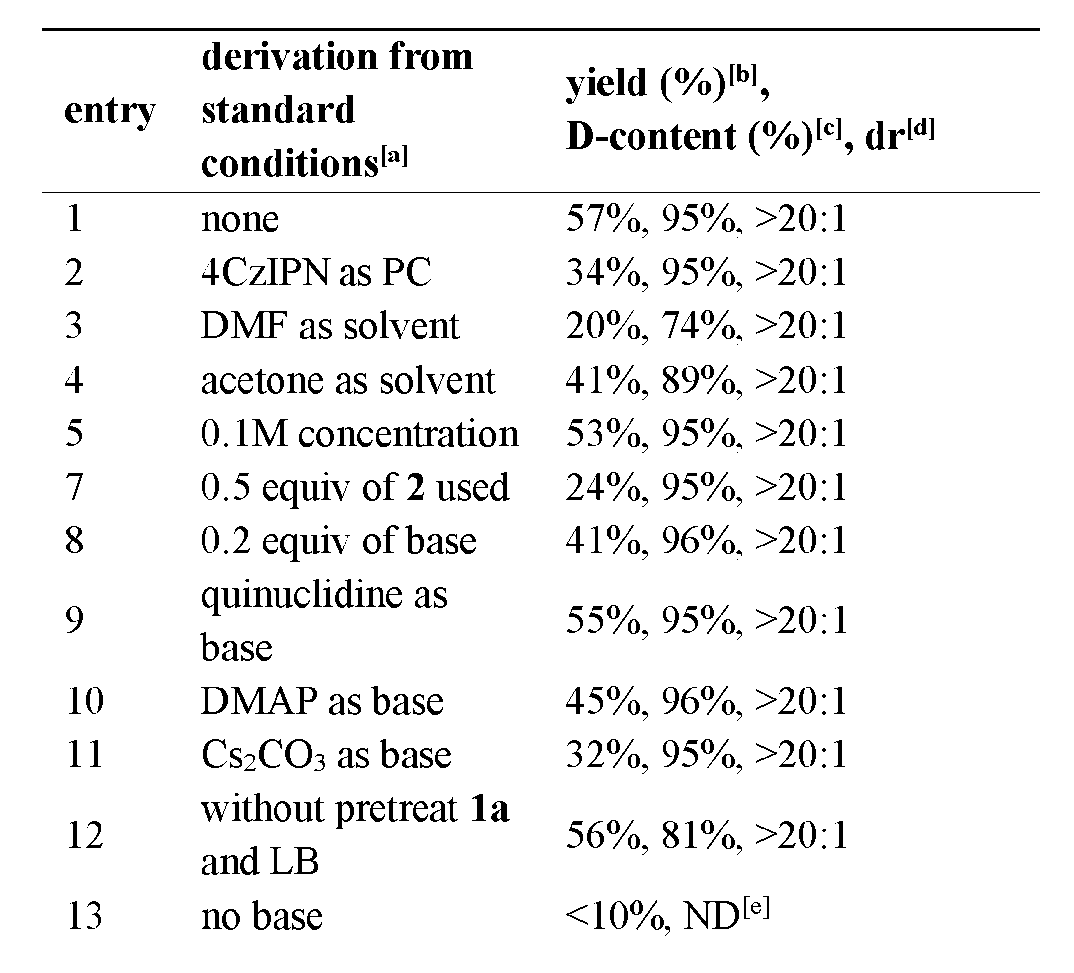
 Table 2. Screening of photocatalysta, b

 [00140] Among the PCs probed, Ir[dF(CF3)ppy]2(dtbpy)PF6 delivered the desired product 3a in 57% yield (Table 1, entry 1). There was a noticeable amount of deboronated byproduct formed (Table 2). In addition, the reaction delivered the product with 95% D-incorporation and an excellent level of diastereometric ratio (dr, > 20:1). [00141] Further reaction condition optimization by probing the solvent (Table 1, entries 3-4 and Table 3), the concentration (Table 1, entry 5), ratio between 1a and 2 (Table 1, entry 7), base (Table 1, entries 8-11, and Table 4 and Table 6) and deuterium source (Table 5 and Table 7)
revealed the optimized reaction conditions: 1.5 equiv of quinuclidin-3-ol, 2.0 equiv of 2, 0.2 M of concentration and acetone/MeOD as co-solvent (Table 1, entry 1). The control experiments validated that base, light, and photocatalyst were essential for the process (Table 1, entries 8−10). Table 3. Screening of solventa,b O
[00140] Among the PCs probed, Ir[dF(CF3)ppy]2(dtbpy)PF6 delivered the desired product 3a in 57% yield (Table 1, entry 1). There was a noticeable amount of deboronated byproduct formed (Table 2). In addition, the reaction delivered the product with 95% D-incorporation and an excellent level of diastereometric ratio (dr, > 20:1). [00141] Further reaction condition optimization by probing the solvent (Table 1, entries 3-4 and Table 3), the concentration (Table 1, entry 5), ratio between 1a and 2 (Table 1, entry 7), base (Table 1, entries 8-11, and Table 4 and Table 6) and deuterium source (Table 5 and Table 7)
revealed the optimized reaction conditions: 1.5 equiv of quinuclidin-3-ol, 2.0 equiv of 2, 0.2 M of concentration and acetone/MeOD as co-solvent (Table 1, entry 1). The control experiments validated that base, light, and photocatalyst were essential for the process (Table 1, entries 8−10). Table 3. Screening of solventa,b O

 Table 4. Screening of basea,b O


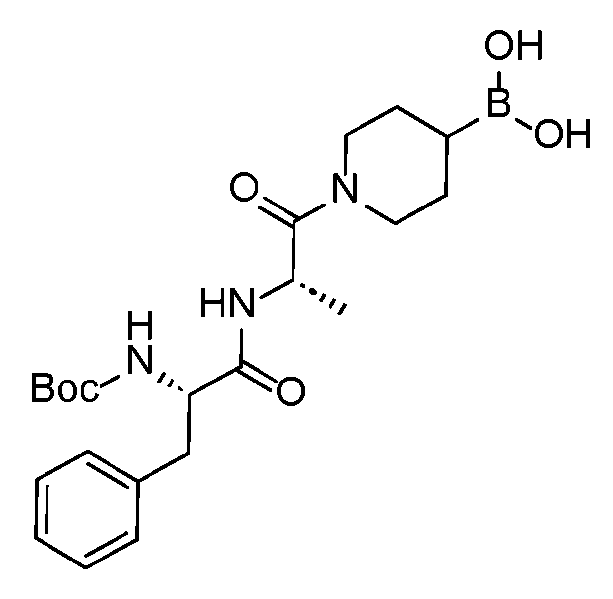


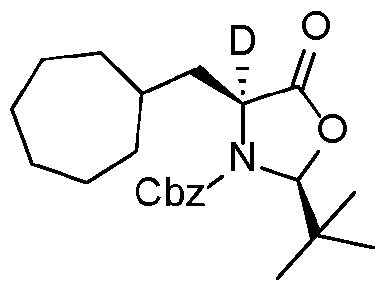
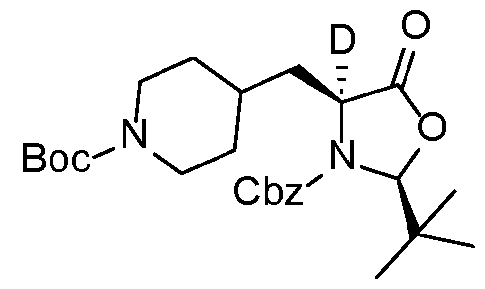
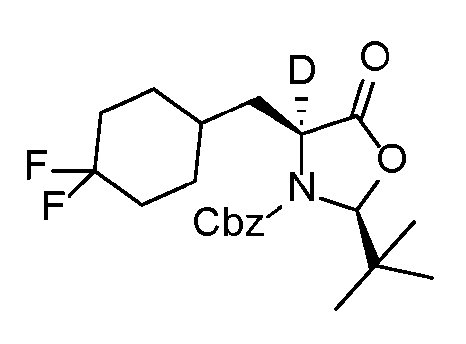


Clause 23. The method of any one of clauses 1-22, wherein the compound of formula (I) has at least 75% deuterium incorporation at each deuterium label.
Clause 24. The method of any one of clauses 1-22, wherein the compound of formula (I) has at least 90% deuterium incorporation at each deuterium label.
Clause 25. The method of any one of clauses 1-24, wherein the compound of formula (III) is

Clause 26. The method of any one of clauses 1-25, wherein the base is a Lewis base.
Clause 27. The method of any one of clauses 1-26, wherein the photocatalyst is an iridium (Ir)-based photocatalyst.
Clause 28. The method of any one of clauses 1-27, wherein the light is blue LED light.
Clause 29. A method of preparing a deuterated compound of formula (I-AA), or a salt thereof,
 the method comprising: preparing a deuterated compound of formula (I) according to the method of any one of clauses 1-28; then hydrolyzing the deuterated compound of formula (I). Clause 30. The method of clause 29, wherein the deuterated compound of formula (I-AA) is
 . Clause 31. A deuterated compound of formula (I), or a salt thereof,
 wherein: R1 is G1, C1-10alkyl, –L1–RY, or –G1-L1–RY; R2 is an amine protecting group, hydrogen, or C1-6alkyl; R3 is C1-6alkyl, C1-4haloalkyl; G1, at each occurrence, is a 6- to 12-membered aryl, a 5- to 12-membered heteroaryl, C3–10carbocyclyl, or a 4- to 12-membered heterocyclyl, wherein G1 is optionally substituted with 1-4 substituents independently selected from the group consisting of C1-6alkyl, C1-4haloalkyl, halogen, cyano, G1a, –OH, –OC1-6alkyl, –OG1a, –OC1- 4haloalkyl, –SH, –SC1-6alkyl, –SG1a, –SC1-4haloalkyl, –NH2, –NHC1-4alkyl, –NHG1a, –N(C1-4alkyl)2, –C(O)C1-4alkyl, –C(O)G1a, –C(O)OC1-4alkyl, –C(O)OG1a, –C(O)NH2, –C(O)NHG1a, –C(O)NHC1-4alkyl, –C(O)N(C1-4alkyl)2, –SO2C1-4alkyl, –SO2G1a, –SO2NH2, –SO2NHC1-4alkyl, –SO2N(C1-4alkyl)2, –C1-4alkylene–OH, –C1-4alkylene–
OC1-4alkyl, –C1-4alkylene–NH2, –C1-4alkylene–NHC1-4alkyl, –C1-4alkylene–N(C1- 4alkyl)2, –O–C1-4alkylene–OH, –O–C1-4alkylene–OC1-4alkyl, –O–C1-4alkylene–NH2, –O–C1-4alkylene–NHC1-4alkyl, –O–C1-4alkylene–N(C1-4alkyl)2, and C1-3alkylene–G1a, wherein G1 is optionally further substituted with a peptide moiety comprising a chain of 1-8 amino acids, wherein each amino acid is optionally substituted with an amine protecting group and/or a carboxylic acid protecting group; G1a, at each occurrence, is a 6- to 12-membered aryl, a 5- to 12-membered heteroaryl, C3–10carbocyclyl, or a 4- to 12-membered heterocyclyl, wherein G1a is optionally substituted with 1-4 substituents independently selected from the group consisting of C1-4alkyl, C1-2haloalkyl, halogen, cyano, –OH, –OC1-4alkyl, –OC1-2haloalkyl, –SH, –SC1-4alkyl, –SC1-2haloalkyl, –NH2, –NHC1-4alkyl, –N(C1-4alkyl)2, –C(O)C1-4alkyl, –C(O)OC1-4alkyl,–C(O)NH2, –C(O)NHC1-4alkyl, –C(O)N(C1-4alkyl)2, –SO2C1-4alkyl, –SO2NH2, –SO2NHC1-4alkyl, and –SO2N(C1-4alkyl)2; L1, at each occurrence, is a C1-10alkylene, wherein optionally one or more methylene groups in the alkylene of L1 are independently replaced with –O–, –S–, –SO–, –SO2–, –C(O)–, –C(O)O–, –C(O)N(RX)–, or –N(RX)–, wherein 2 methylene groups replaced with –O–, –S–, –SO–, –C(O)O–, –C(O)N(RX)–, –SO2–, or –N(RX)– are separated by two or more carbon atoms in the alkylene; and/or optionally one methylene group in the alkylene of L1 is replaced with –Cy1–; Cy1 is phenylene, C3-6cycloalkylene, or a 4- to 6-membered heterocyclylene, wherein Cy1 is optionally substituted with 1-6 substituents independently selected from the group consisting of C1-4alkyl, C1-2haloalkyl, and halogen; RX is hydrogen, C1-4alkyl, C3-4cycloalkyl, or –C1-3alkylene–C3-4cycloalkyl; RY, at each occurrence, is C1-4alkyl, C2-4alkenyl, –OC1-4alkyl, –OC1-4haloalkyl, –OH, GY, –OGY, cyano, –SH, –SC1-4alkyl, –SC1-4haloalkyl, –SG1, –NH2, –NHC1-4alkyl, –NHGY, –N(C1-4alkyl)2, –NHC(O)C1-4alkyl, –NHC(O)OC1-4alkyl, –C(O)C1-4alkyl, –C(O)GY, –C(O)OGY, –C(O)OC1-4alkyl, –C(O)NH2, –C(O)NHC1-4alkyl, –C(O)N(C1-4alkyl)2, –C(O)NHGY, –C(O)N(GY)2, –SO2C1-4alkyl, –SO2GY, –SO2NH2, –SO2NHC1-4alkyl, or –SO2N(C1-4alkyl)2; and GY, at each occurrence, is a 6- to 12-membered aryl, a 5- to 12-membered heteroaryl,
C3–10carbocyclyl, or a 4- to 12-membered heterocyclyl, wherein GY is optionally substituted with 1-4 substituents independently selected from the group consisting of C1-4alkyl, C1-2haloalkyl, halogen, cyano, –OH, –OC1-4alkyl, –OC1-2haloalkyl, –SH, –SC1-4alkyl, –SC1-2haloalkyl, –NH2, –NHC1-4alkyl, –N(C1-4alkyl)2, –C(O)C1-4alkyl, –C(O)OC1-4alkyl,–C(O)NH2, –C(O)NHC1-4alkyl, –C(O)N(C1-4alkyl)2, –SO2C1-4alkyl, –SO2NH2, –SO2NHC1-4alkyl, and –SO2N(C1-4alkyl)2. Clause 32. The compound of clause 31, or a salt thereof, wherein that compound has at least 50% deuterium incorporation at each deuterium label. Clause 33. The compound of clause 31, or a salt thereof, wherein that compound has at least 75% deuterium incorporation at each deuterium label. Clause 34. The compound of clause 31, or a salt thereof, wherein that compound has at least 90% deuterium incorporation at each deuterium label. Clause 35. The compound of clause 31, or a salt thereof, wherein that compound has at least 95% deuterium incorporation at each deuterium label. Clause 36. The compound of clause 31, or a salt thereof, wherein that compound has at least 99% deuterium incorporation at each deuterium label.
wherein: R1 is G1, C1-10alkyl, –L1–RY, or –G1-L1–RY; R2 is an amine protecting group, hydrogen, or C1-6alkyl; R3 is C1-6alkyl, C1-4haloalkyl; G1, at each occurrence, is a 6- to 12-membered aryl, a 5- to 12-membered heteroaryl, C3–10carbocyclyl, or a 4- to 12-membered heterocyclyl, wherein G1 is optionally substituted with 1-4 substituents independently selected from the group consisting of C1-6alkyl, C1-4haloalkyl, halogen, cyano, G1a, –OH, –OC1-6alkyl, –OG1a, –OC1- 4haloalkyl, –SH, –SC1-6alkyl, –SG1a, –SC1-4haloalkyl, –NH2, –NHC1-4alkyl, –NHG1a, –N(C1-4alkyl)2, –C(O)C1-4alkyl, –C(O)G1a, –C(O)OC1-4alkyl, –C(O)OG1a, –C(O)NH2, –C(O)NHG1a, –C(O)NHC1-4alkyl, –C(O)N(C1-4alkyl)2, –SO2C1-4alkyl, –SO2G1a, –SO2NH2, –SO2NHC1-4alkyl, –SO2N(C1-4alkyl)2, –C1-4alkylene–OH, –C1-4alkylene–
OC1-4alkyl, –C1-4alkylene–NH2, –C1-4alkylene–NHC1-4alkyl, –C1-4alkylene–N(C1- 4alkyl)2, –O–C1-4alkylene–OH, –O–C1-4alkylene–OC1-4alkyl, –O–C1-4alkylene–NH2, –O–C1-4alkylene–NHC1-4alkyl, –O–C1-4alkylene–N(C1-4alkyl)2, and C1-3alkylene–G1a, wherein G1 is optionally further substituted with a peptide moiety comprising a chain of 1-8 amino acids, wherein each amino acid is optionally substituted with an amine protecting group and/or a carboxylic acid protecting group; G1a, at each occurrence, is a 6- to 12-membered aryl, a 5- to 12-membered heteroaryl, C3–10carbocyclyl, or a 4- to 12-membered heterocyclyl, wherein G1a is optionally substituted with 1-4 substituents independently selected from the group consisting of C1-4alkyl, C1-2haloalkyl, halogen, cyano, –OH, –OC1-4alkyl, –OC1-2haloalkyl, –SH, –SC1-4alkyl, –SC1-2haloalkyl, –NH2, –NHC1-4alkyl, –N(C1-4alkyl)2, –C(O)C1-4alkyl, –C(O)OC1-4alkyl,–C(O)NH2, –C(O)NHC1-4alkyl, –C(O)N(C1-4alkyl)2, –SO2C1-4alkyl, –SO2NH2, –SO2NHC1-4alkyl, and –SO2N(C1-4alkyl)2; L1, at each occurrence, is a C1-10alkylene, wherein optionally one or more methylene groups in the alkylene of L1 are independently replaced with –O–, –S–, –SO–, –SO2–, –C(O)–, –C(O)O–, –C(O)N(RX)–, or –N(RX)–, wherein 2 methylene groups replaced with –O–, –S–, –SO–, –C(O)O–, –C(O)N(RX)–, –SO2–, or –N(RX)– are separated by two or more carbon atoms in the alkylene; and/or optionally one methylene group in the alkylene of L1 is replaced with –Cy1–; Cy1 is phenylene, C3-6cycloalkylene, or a 4- to 6-membered heterocyclylene, wherein Cy1 is optionally substituted with 1-6 substituents independently selected from the group consisting of C1-4alkyl, C1-2haloalkyl, and halogen; RX is hydrogen, C1-4alkyl, C3-4cycloalkyl, or –C1-3alkylene–C3-4cycloalkyl; RY, at each occurrence, is C1-4alkyl, C2-4alkenyl, –OC1-4alkyl, –OC1-4haloalkyl, –OH, GY, –OGY, cyano, –SH, –SC1-4alkyl, –SC1-4haloalkyl, –SG1, –NH2, –NHC1-4alkyl, –NHGY, –N(C1-4alkyl)2, –NHC(O)C1-4alkyl, –NHC(O)OC1-4alkyl, –C(O)C1-4alkyl, –C(O)GY, –C(O)OGY, –C(O)OC1-4alkyl, –C(O)NH2, –C(O)NHC1-4alkyl, –C(O)N(C1-4alkyl)2, –C(O)NHGY, –C(O)N(GY)2, –SO2C1-4alkyl, –SO2GY, –SO2NH2, –SO2NHC1-4alkyl, or –SO2N(C1-4alkyl)2; and GY, at each occurrence, is a 6- to 12-membered aryl, a 5- to 12-membered heteroaryl,
C3–10carbocyclyl, or a 4- to 12-membered heterocyclyl, wherein GY is optionally substituted with 1-4 substituents independently selected from the group consisting of C1-4alkyl, C1-2haloalkyl, halogen, cyano, –OH, –OC1-4alkyl, –OC1-2haloalkyl, –SH, –SC1-4alkyl, –SC1-2haloalkyl, –NH2, –NHC1-4alkyl, –N(C1-4alkyl)2, –C(O)C1-4alkyl, –C(O)OC1-4alkyl,–C(O)NH2, –C(O)NHC1-4alkyl, –C(O)N(C1-4alkyl)2, –SO2C1-4alkyl, –SO2NH2, –SO2NHC1-4alkyl, and –SO2N(C1-4alkyl)2. Clause 32. The compound of clause 31, or a salt thereof, wherein that compound has at least 50% deuterium incorporation at each deuterium label. Clause 33. The compound of clause 31, or a salt thereof, wherein that compound has at least 75% deuterium incorporation at each deuterium label. Clause 34. The compound of clause 31, or a salt thereof, wherein that compound has at least 90% deuterium incorporation at each deuterium label. Clause 35. The compound of clause 31, or a salt thereof, wherein that compound has at least 95% deuterium incorporation at each deuterium label. Clause 36. The compound of clause 31, or a salt thereof, wherein that compound has at least 99% deuterium incorporation at each deuterium label.
Claims
CLAIMS What is claimed is: 1. A method for preparing a deuterated compound of formula (I), or a salt thereof,
 wherein: R1 is G1, C1-10alkyl, –L1–RY, or –G1-L1–RY; R2 is an amine protecting group, hydrogen, or C1-6alkyl; and R3 is C1-6alkyl or C1-4haloalkyl; G1, at each occurrence, is a 6- to 12-membered aryl, a 5- to 12-membered heteroaryl, C3–10carbocyclyl, or a 4- to 12-membered heterocyclyl, wherein G1 is optionally substituted with 1-4 substituents independently selected from the group consisting of C1-6alkyl, C1-4haloalkyl, halogen, cyano, G1a, –OH, –OC1-6alkyl, –OG1a, –OC1- 4haloalkyl, –SH, –SC1-6alkyl, –SG1a, –SC1-4haloalkyl, –NH2, –NHC1-4alkyl, –NHG1a, –N(C1-4alkyl)2, –C(O)C1-4alkyl, –C(O)G1a, –C(O)OC1-4alkyl, –C(O)OG1a, –C(O)NH2, –C(O)NHG1a, –C(O)NHC1-4alkyl, –C(O)N(C1-4alkyl)2, –SO2C1-4alkyl, –SO2G1a, –SO2NH2, –SO2NHC1-4alkyl, –SO2N(C1-4alkyl)2, –C1-4alkylene–OH, –C1-4alkylene– OC1-4alkyl, –C1-4alkylene–NH2, –C1-4alkylene–NHC1-4alkyl, –C1-4alkylene–N(C1- 4alkyl)2, –O–C1-4alkylene–OH, –O–C1-4alkylene–OC1-4alkyl, –O–C1-4alkylene–NH2, –O–C1-4alkylene–NHC1-4alkyl, –O–C1-4alkylene–N(C1-4alkyl)2, and C1-3alkylene–G1a, wherein G1 is optionally further substituted with a peptide moiety comprising a chain of 1-8 amino acids, wherein each amino acid is optionally substituted with an amine protecting group and/or a carboxylic acid protecting group; G1a, at each occurrence, is a 6- to 12-membered aryl, a 5- to 12-membered heteroaryl, C3–10carbocyclyl, or a 4- to 12-membered heterocyclyl, wherein G1a is optionally substituted with 1-4 substituents independently selected from the group consisting of C1-4alkyl, C1-2haloalkyl, halogen, cyano, –OH, –OC1-4alkyl, –OC1-2haloalkyl, –SH, –SC1-4alkyl, –SC1-2haloalkyl, –NH2, –NHC1-4alkyl, –N(C1-4alkyl)2,
–C(O)C1-4alkyl, –C(O)OC1-4alkyl,–C(O)NH2, –C(O)NHC1-4alkyl, –C(O)N(C1-4alkyl)2, –SO2C1-4alkyl, –SO2NH2, –SO2NHC1-4alkyl, and –SO2N(C1-4alkyl)2; L1, at each occurrence, is a C1-10alkylene, wherein optionally one or more methylene groups in the alkylene of L1 are independently replaced with –O–, –S–, –SO–, –SO2–, –C(O)–, –C(O)O–, –C(O)N(RX)–, or –N(RX)–, wherein 2 methylene groups replaced with –O–, –S–, –SO–, –C(O)O–, –C(O)N(RX)–, –SO2–, or –N(RX)– are separated by two or more carbon atoms in the alkylene; and/or optionally one methylene group in the alkylene of L1 is replaced with –Cy1–; Cy1 is phenylene, C3-6cycloalkylene, or a 4- to 6-membered heterocyclylene, wherein Cy1 is optionally substituted with 1-6 substituents independently selected from the group consisting of C1-4alkyl, C1-2haloalkyl, and halogen; RX is hydrogen, C1-4alkyl, C3-4cycloalkyl, or –C1-3alkylene–C3-4cycloalkyl; RY, at each occurrence, is C1-4alkyl, C2-4alkenyl, –OC1-4alkyl, –OC1-4haloalkyl, –OH, GY, –OGY, cyano, –SH, –SC1-4alkyl, –SC1-4haloalkyl, –SG1, –NH2, –NHC1-4alkyl, –NHGY, –N(C1-4alkyl)2, –NHC(O)C1-4alkyl, –NHC(O)OC1-4alkyl, –C(O)C1-4alkyl, –C(O)GY, –C(O)OGY, –C(O)OC1-4alkyl, –C(O)NH2, –C(O)NHC1-4alkyl, –C(O)N(C1-4alkyl)2, –C(O)NHGY, –C(O)N(GY)2, –SO2C1-4alkyl, –SO2GY, –SO2NH2, –SO2NHC1-4alkyl, or –SO2N(C1-4alkyl)2; and GY, at each occurrence, is a 6- to 12-membered aryl, a 5- to 12-membered heteroaryl, C3–10carbocyclyl, or a 4- to 12-membered heterocyclyl, wherein GY is optionally substituted with 1-4 substituents independently selected from the group consisting of C1-4alkyl, C1-2haloalkyl, halogen, cyano, –OH, –OC1-4alkyl, –OC1-2haloalkyl, –SH, –SC1-4alkyl, –SC1-2haloalkyl, –NH2, –NHC1-4alkyl, –N(C1-4alkyl)2, –C(O)C1-4alkyl, –C(O)OC1-4alkyl,–C(O)NH2, –C(O)NHC1-4alkyl, –C(O)N(C1-4alkyl)2, –SO2C1-4alkyl, –SO2NH2, –SO2NHC1-4alkyl, and –SO2N(C1-4alkyl)2; the method comprising: mixing a compound of formula (III): wherein
wherein: R1 is G1, C1-10alkyl, –L1–RY, or –G1-L1–RY; R2 is an amine protecting group, hydrogen, or C1-6alkyl; and R3 is C1-6alkyl or C1-4haloalkyl; G1, at each occurrence, is a 6- to 12-membered aryl, a 5- to 12-membered heteroaryl, C3–10carbocyclyl, or a 4- to 12-membered heterocyclyl, wherein G1 is optionally substituted with 1-4 substituents independently selected from the group consisting of C1-6alkyl, C1-4haloalkyl, halogen, cyano, G1a, –OH, –OC1-6alkyl, –OG1a, –OC1- 4haloalkyl, –SH, –SC1-6alkyl, –SG1a, –SC1-4haloalkyl, –NH2, –NHC1-4alkyl, –NHG1a, –N(C1-4alkyl)2, –C(O)C1-4alkyl, –C(O)G1a, –C(O)OC1-4alkyl, –C(O)OG1a, –C(O)NH2, –C(O)NHG1a, –C(O)NHC1-4alkyl, –C(O)N(C1-4alkyl)2, –SO2C1-4alkyl, –SO2G1a, –SO2NH2, –SO2NHC1-4alkyl, –SO2N(C1-4alkyl)2, –C1-4alkylene–OH, –C1-4alkylene– OC1-4alkyl, –C1-4alkylene–NH2, –C1-4alkylene–NHC1-4alkyl, –C1-4alkylene–N(C1- 4alkyl)2, –O–C1-4alkylene–OH, –O–C1-4alkylene–OC1-4alkyl, –O–C1-4alkylene–NH2, –O–C1-4alkylene–NHC1-4alkyl, –O–C1-4alkylene–N(C1-4alkyl)2, and C1-3alkylene–G1a, wherein G1 is optionally further substituted with a peptide moiety comprising a chain of 1-8 amino acids, wherein each amino acid is optionally substituted with an amine protecting group and/or a carboxylic acid protecting group; G1a, at each occurrence, is a 6- to 12-membered aryl, a 5- to 12-membered heteroaryl, C3–10carbocyclyl, or a 4- to 12-membered heterocyclyl, wherein G1a is optionally substituted with 1-4 substituents independently selected from the group consisting of C1-4alkyl, C1-2haloalkyl, halogen, cyano, –OH, –OC1-4alkyl, –OC1-2haloalkyl, –SH, –SC1-4alkyl, –SC1-2haloalkyl, –NH2, –NHC1-4alkyl, –N(C1-4alkyl)2,
–C(O)C1-4alkyl, –C(O)OC1-4alkyl,–C(O)NH2, –C(O)NHC1-4alkyl, –C(O)N(C1-4alkyl)2, –SO2C1-4alkyl, –SO2NH2, –SO2NHC1-4alkyl, and –SO2N(C1-4alkyl)2; L1, at each occurrence, is a C1-10alkylene, wherein optionally one or more methylene groups in the alkylene of L1 are independently replaced with –O–, –S–, –SO–, –SO2–, –C(O)–, –C(O)O–, –C(O)N(RX)–, or –N(RX)–, wherein 2 methylene groups replaced with –O–, –S–, –SO–, –C(O)O–, –C(O)N(RX)–, –SO2–, or –N(RX)– are separated by two or more carbon atoms in the alkylene; and/or optionally one methylene group in the alkylene of L1 is replaced with –Cy1–; Cy1 is phenylene, C3-6cycloalkylene, or a 4- to 6-membered heterocyclylene, wherein Cy1 is optionally substituted with 1-6 substituents independently selected from the group consisting of C1-4alkyl, C1-2haloalkyl, and halogen; RX is hydrogen, C1-4alkyl, C3-4cycloalkyl, or –C1-3alkylene–C3-4cycloalkyl; RY, at each occurrence, is C1-4alkyl, C2-4alkenyl, –OC1-4alkyl, –OC1-4haloalkyl, –OH, GY, –OGY, cyano, –SH, –SC1-4alkyl, –SC1-4haloalkyl, –SG1, –NH2, –NHC1-4alkyl, –NHGY, –N(C1-4alkyl)2, –NHC(O)C1-4alkyl, –NHC(O)OC1-4alkyl, –C(O)C1-4alkyl, –C(O)GY, –C(O)OGY, –C(O)OC1-4alkyl, –C(O)NH2, –C(O)NHC1-4alkyl, –C(O)N(C1-4alkyl)2, –C(O)NHGY, –C(O)N(GY)2, –SO2C1-4alkyl, –SO2GY, –SO2NH2, –SO2NHC1-4alkyl, or –SO2N(C1-4alkyl)2; and GY, at each occurrence, is a 6- to 12-membered aryl, a 5- to 12-membered heteroaryl, C3–10carbocyclyl, or a 4- to 12-membered heterocyclyl, wherein GY is optionally substituted with 1-4 substituents independently selected from the group consisting of C1-4alkyl, C1-2haloalkyl, halogen, cyano, –OH, –OC1-4alkyl, –OC1-2haloalkyl, –SH, –SC1-4alkyl, –SC1-2haloalkyl, –NH2, –NHC1-4alkyl, –N(C1-4alkyl)2, –C(O)C1-4alkyl, –C(O)OC1-4alkyl,–C(O)NH2, –C(O)NHC1-4alkyl, –C(O)N(C1-4alkyl)2, –SO2C1-4alkyl, –SO2NH2, –SO2NHC1-4alkyl, and –SO2N(C1-4alkyl)2; the method comprising: mixing a compound of formula (III): wherein

 and a compound of formula (II),
 with a photocatalyst, a base, and D2O to form a reaction mixture; and exposing the reaction mixture to light, thereby producing the deuterated compound of formula (I).
2. The method of claim 1, wherein R1 is G1.
3. The method of claim 2, wherein G1 is the optionally substituted 6- to 12-membered aryl.
4. The method of claim 3, wherein the optionally substituted 6- to 12-membered aryl is optionally substituted phenyl.
5. The method of claim 4, wherein G 1 is


6. The method of claim 2, wherein G1 is the optionally substituted C3–10carbocyclyl.
7. The method of claim 6, wherein G1 is
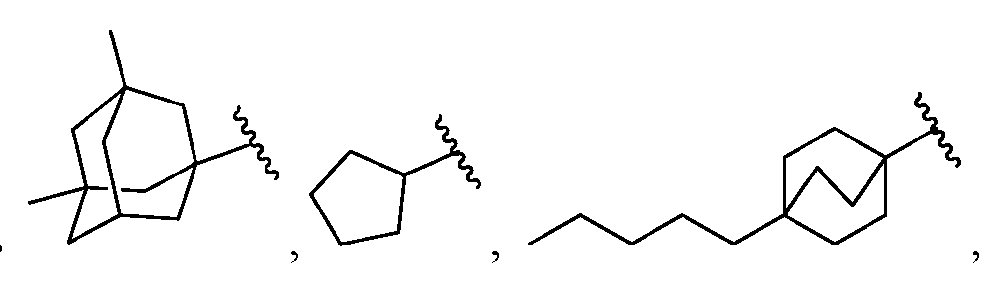

8. The method of claim 2, wherein G1 is the optionally substituted 4- to 12-membered heterocyclyl.
9. The method of claim 8, wherein the optionally substituted 4- to 12-membered heterocyclyl is optionally substituted piperidinyl.
10. The method of claim 9, wherein G1 is

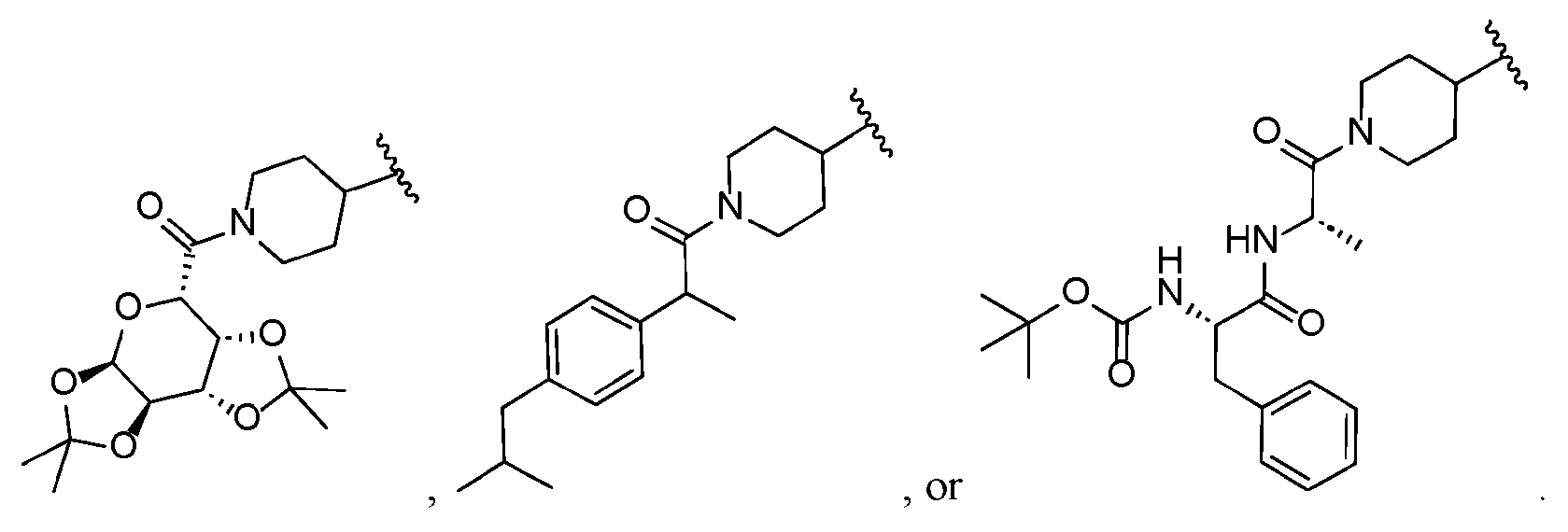
11. The method of claim 1, wherein R1 is C1-10alkyl or –L1–RY.
12. The method of claim 11, wherein R1 is

13. The method of claim 11, wherein R1 is
 .
.
14. The method of claim 1, wherein R2 is the amine protecting group.
15. The method of claim 14, wherein the amine protecting group is

16. The method of claim 1, wherein R2 is C1-6alkyl.
17. The method of claim 16, wherein R2 is −CH3.
18. The method of claim 17, wherein each hydrogen in the −CH3 is deuterium.
19. The method of claim 1, wherein R3 is C1-6alkyl.
20. The method of claim 19, wherein R3 is
 .
.
21. The method of claim 1, wherein the compound of formula (I) is a compound of formula:

22. The method of claim 1, wherein the compound of formula (I) is


23. The method of claim 1, wherein the compound of formula (I) has at least 75% deuterium incorporation at each deuterium label.
24. The method of claim 1, wherein the compound of formula (I) has at least 90% deuterium incorporation at each deuterium label.
25. The method of claim 1, wherein the compound of formula (III) is

26. The method of claim 1, wherein the base is a Lewis base.
27. The method of claim 1, wherein the photocatalyst is an iridium (Ir)-based photocatalyst.
28. The method of claim 1, wherein the light is blue LED light.
29. A method of preparing a deuterated compound of formula (I-AA), or a salt thereof,
 the method comprising: preparing a deuterated compound of formula (I) according to the method of claim 1; then hydrolyzing the deuterated compound of formula (I).
30. The method of claim 29, wherein the deuterated compound of formula (I-AA) is
 .
.
31. A deuterated compound of formula (I), or a salt thereof,
 wherein: R1 is G1, C1-10alkyl, –L1–RY, or –G1-L1–RY; R2 is an amine protecting group, hydrogen, or C1-6alkyl; R3 is C1-6alkyl, C1-4haloalkyl; G1, at each occurrence, is a 6- to 12-membered aryl, a 5- to 12-membered heteroaryl, C3–10carbocyclyl, or a 4- to 12-membered heterocyclyl, wherein G1 is optionally substituted with 1-4 substituents independently selected from the group consisting of C1-6alkyl, C1-4haloalkyl, halogen, cyano, G1a, –OH, –OC1-6alkyl, –OG1a, –OC1- 4haloalkyl, –SH, –SC1-6alkyl, –SG1a, –SC1-4haloalkyl, –NH2, –NHC1-4alkyl, –NHG1a, –N(C1-4alkyl)2, –C(O)C1-4alkyl, –C(O)G1a, –C(O)OC1-4alkyl, –C(O)OG1a, –C(O)NH2, –C(O)NHG1a, –C(O)NHC1-4alkyl, –C(O)N(C1-4alkyl)2, –SO2C1-4alkyl, –SO2G1a, –SO2NH2, –SO2NHC1-4alkyl, –SO2N(C1-4alkyl)2, –C1-4alkylene–OH, –C1-4alkylene– OC1-4alkyl, –C1-4alkylene–NH2, –C1-4alkylene–NHC1-4alkyl, –C1-4alkylene–N(C1- 4alkyl)2, –O–C1-4alkylene–OH, –O–C1-4alkylene–OC1-4alkyl, –O–C1-4alkylene–NH2, –O–C1-4alkylene–NHC1-4alkyl, –O–C1-4alkylene–N(C1-4alkyl)2, and C1-3alkylene–G1a, wherein G1 is optionally further substituted with a peptide moiety comprising a chain of 1-8 amino acids, wherein each amino acid is optionally substituted with an amine protecting group and/or a carboxylic acid protecting group; G1a, at each occurrence, is a 6- to 12-membered aryl, a 5- to 12-membered heteroaryl, C3–10carbocyclyl, or a 4- to 12-membered heterocyclyl, wherein G1a is optionally substituted with 1-4 substituents independently selected from the group consisting
of C1-4alkyl, C1-2haloalkyl, halogen, cyano, –OH, –OC1-4alkyl, –OC1-2haloalkyl, –SH, –SC1-4alkyl, –SC1-2haloalkyl, –NH2, –NHC1-4alkyl, –N(C1-4alkyl)2, –C(O)C1-4alkyl, –C(O)OC1-4alkyl,–C(O)NH2, –C(O)NHC1-4alkyl, –C(O)N(C1-4alkyl)2, –SO2C1-4alkyl, –SO2NH2, –SO2NHC1-4alkyl, and –SO2N(C1-4alkyl)2; L1, at each occurrence, is a C1-10alkylene, wherein optionally one or more methylene groups in the alkylene of L1 are independently replaced with –O–, –S–, –SO–, –SO2–, –C(O)–, –C(O)O–, –C(O)N(RX)–, or –N(RX)–, wherein 2 methylene groups replaced with –O–, –S–, –SO–, –C(O)O–, –C(O)N(RX)–, –SO2–, or –N(RX)– are separated by two or more carbon atoms in the alkylene; and/or optionally one methylene group in the alkylene of L1 is replaced with –Cy1–; Cy1 is phenylene, C3-6cycloalkylene, or a 4- to 6-membered heterocyclylene, wherein Cy1 is optionally substituted with 1-6 substituents independently selected from the group consisting of C1-4alkyl, C1-2haloalkyl, and halogen; RX is hydrogen, C1-4alkyl, C3-4cycloalkyl, or –C1-3alkylene–C3-4cycloalkyl; RY, at each occurrence, is C1-4alkyl, C2-4alkenyl, –OC1-4alkyl, –OC1-4haloalkyl, –OH, GY, –OGY, cyano, –SH, –SC1-4alkyl, –SC1-4haloalkyl, –SG1, –NH2, –NHC1-4alkyl, –NHGY, –N(C1-4alkyl)2, –NHC(O)C1-4alkyl, –NHC(O)OC1-4alkyl, –C(O)C1-4alkyl, –C(O)GY, –C(O)OGY, –C(O)OC1-4alkyl, –C(O)NH2, –C(O)NHC1-4alkyl, –C(O)N(C1-4alkyl)2, –C(O)NHGY, –C(O)N(GY)2, –SO2C1-4alkyl, –SO2GY, –SO2NH2, –SO2NHC1-4alkyl, or –SO2N(C1-4alkyl)2; and GY, at each occurrence, is a 6- to 12-membered aryl, a 5- to 12-membered heteroaryl, C3–10carbocyclyl, or a 4- to 12-membered heterocyclyl, wherein GY is optionally substituted with 1-4 substituents independently selected from the group consisting of C1-4alkyl, C1-2haloalkyl, halogen, cyano, –OH, –OC1-4alkyl, –OC1-2haloalkyl, –SH, –SC1-4alkyl, –SC1-2haloalkyl, –NH2, –NHC1-4alkyl, –N(C1-4alkyl)2, –C(O)C1-4alkyl, –C(O)OC1-4alkyl,–C(O)NH2, –C(O)NHC1-4alkyl, –C(O)N(C1-4alkyl)2, –SO2C1-4alkyl, –SO2NH2, –SO2NHC1-4alkyl, and –SO2N(C1-4alkyl)2.
wherein: R1 is G1, C1-10alkyl, –L1–RY, or –G1-L1–RY; R2 is an amine protecting group, hydrogen, or C1-6alkyl; R3 is C1-6alkyl, C1-4haloalkyl; G1, at each occurrence, is a 6- to 12-membered aryl, a 5- to 12-membered heteroaryl, C3–10carbocyclyl, or a 4- to 12-membered heterocyclyl, wherein G1 is optionally substituted with 1-4 substituents independently selected from the group consisting of C1-6alkyl, C1-4haloalkyl, halogen, cyano, G1a, –OH, –OC1-6alkyl, –OG1a, –OC1- 4haloalkyl, –SH, –SC1-6alkyl, –SG1a, –SC1-4haloalkyl, –NH2, –NHC1-4alkyl, –NHG1a, –N(C1-4alkyl)2, –C(O)C1-4alkyl, –C(O)G1a, –C(O)OC1-4alkyl, –C(O)OG1a, –C(O)NH2, –C(O)NHG1a, –C(O)NHC1-4alkyl, –C(O)N(C1-4alkyl)2, –SO2C1-4alkyl, –SO2G1a, –SO2NH2, –SO2NHC1-4alkyl, –SO2N(C1-4alkyl)2, –C1-4alkylene–OH, –C1-4alkylene– OC1-4alkyl, –C1-4alkylene–NH2, –C1-4alkylene–NHC1-4alkyl, –C1-4alkylene–N(C1- 4alkyl)2, –O–C1-4alkylene–OH, –O–C1-4alkylene–OC1-4alkyl, –O–C1-4alkylene–NH2, –O–C1-4alkylene–NHC1-4alkyl, –O–C1-4alkylene–N(C1-4alkyl)2, and C1-3alkylene–G1a, wherein G1 is optionally further substituted with a peptide moiety comprising a chain of 1-8 amino acids, wherein each amino acid is optionally substituted with an amine protecting group and/or a carboxylic acid protecting group; G1a, at each occurrence, is a 6- to 12-membered aryl, a 5- to 12-membered heteroaryl, C3–10carbocyclyl, or a 4- to 12-membered heterocyclyl, wherein G1a is optionally substituted with 1-4 substituents independently selected from the group consisting
of C1-4alkyl, C1-2haloalkyl, halogen, cyano, –OH, –OC1-4alkyl, –OC1-2haloalkyl, –SH, –SC1-4alkyl, –SC1-2haloalkyl, –NH2, –NHC1-4alkyl, –N(C1-4alkyl)2, –C(O)C1-4alkyl, –C(O)OC1-4alkyl,–C(O)NH2, –C(O)NHC1-4alkyl, –C(O)N(C1-4alkyl)2, –SO2C1-4alkyl, –SO2NH2, –SO2NHC1-4alkyl, and –SO2N(C1-4alkyl)2; L1, at each occurrence, is a C1-10alkylene, wherein optionally one or more methylene groups in the alkylene of L1 are independently replaced with –O–, –S–, –SO–, –SO2–, –C(O)–, –C(O)O–, –C(O)N(RX)–, or –N(RX)–, wherein 2 methylene groups replaced with –O–, –S–, –SO–, –C(O)O–, –C(O)N(RX)–, –SO2–, or –N(RX)– are separated by two or more carbon atoms in the alkylene; and/or optionally one methylene group in the alkylene of L1 is replaced with –Cy1–; Cy1 is phenylene, C3-6cycloalkylene, or a 4- to 6-membered heterocyclylene, wherein Cy1 is optionally substituted with 1-6 substituents independently selected from the group consisting of C1-4alkyl, C1-2haloalkyl, and halogen; RX is hydrogen, C1-4alkyl, C3-4cycloalkyl, or –C1-3alkylene–C3-4cycloalkyl; RY, at each occurrence, is C1-4alkyl, C2-4alkenyl, –OC1-4alkyl, –OC1-4haloalkyl, –OH, GY, –OGY, cyano, –SH, –SC1-4alkyl, –SC1-4haloalkyl, –SG1, –NH2, –NHC1-4alkyl, –NHGY, –N(C1-4alkyl)2, –NHC(O)C1-4alkyl, –NHC(O)OC1-4alkyl, –C(O)C1-4alkyl, –C(O)GY, –C(O)OGY, –C(O)OC1-4alkyl, –C(O)NH2, –C(O)NHC1-4alkyl, –C(O)N(C1-4alkyl)2, –C(O)NHGY, –C(O)N(GY)2, –SO2C1-4alkyl, –SO2GY, –SO2NH2, –SO2NHC1-4alkyl, or –SO2N(C1-4alkyl)2; and GY, at each occurrence, is a 6- to 12-membered aryl, a 5- to 12-membered heteroaryl, C3–10carbocyclyl, or a 4- to 12-membered heterocyclyl, wherein GY is optionally substituted with 1-4 substituents independently selected from the group consisting of C1-4alkyl, C1-2haloalkyl, halogen, cyano, –OH, –OC1-4alkyl, –OC1-2haloalkyl, –SH, –SC1-4alkyl, –SC1-2haloalkyl, –NH2, –NHC1-4alkyl, –N(C1-4alkyl)2, –C(O)C1-4alkyl, –C(O)OC1-4alkyl,–C(O)NH2, –C(O)NHC1-4alkyl, –C(O)N(C1-4alkyl)2, –SO2C1-4alkyl, –SO2NH2, –SO2NHC1-4alkyl, and –SO2N(C1-4alkyl)2.
32. The compound of claim 31 , or a salt thereof, wherein that compound has at least 50% deuterium incorporation at each deuterium label.
33. The compound of claim 31, or a salt thereof, wherein that compound has at least 75% deuterium incorporation at each deuterium label.
34. The compound of claim 31, or a salt thereof, wherein that compound has at least 90% deuterium incorporation at each deuterium label.
35. The compound of claim 31, or a salt thereof, wherein that compound has at least 95% deuterium incorporation at each deuterium label.
36. The compound of claim 31, or a salt thereof, wherein that compound has at least 99% deuterium incorporation at each deuterium label.
Applications Claiming Priority (2)
| Application Number | Priority Date | Filing Date | Title |
|---|---|---|---|
| US202363508459P | 2023-06-15 | 2023-06-15 | |
| US63/508,459 | 2023-06-15 |
Publications (2)
| Publication Number | Publication Date |
|---|---|
| WO2024259342A2 true WO2024259342A2 (en) | 2024-12-19 |
| WO2024259342A3 WO2024259342A3 (en) | 2025-05-01 |
Family
ID=93852784
Family Applications (1)
| Application Number | Title | Priority Date | Filing Date |
|---|---|---|---|
| PCT/US2024/034160 Ceased WO2024259342A2 (en) | 2023-06-15 | 2024-06-14 | Methods for synthesizing αlpha-deuterated αlpha-amino acids and derivatives thereof |
Country Status (1)
| Country | Link |
|---|---|
| WO (1) | WO2024259342A2 (en) |
Family Cites Families (1)
| Publication number | Priority date | Publication date | Assignee | Title |
|---|---|---|---|---|
| WO2021158781A1 (en) * | 2020-02-06 | 2021-08-12 | Arizona Board Of Regents On Behalf Of The University Of Arizona | Methods for practical synthesis of deuterated amino acids |
-
2024
- 2024-06-14 WO PCT/US2024/034160 patent/WO2024259342A2/en not_active Ceased
Also Published As
| Publication number | Publication date |
|---|---|
| WO2024259342A3 (en) | 2025-05-01 |
Similar Documents
| Publication | Publication Date | Title |
|---|---|---|
| AU2023263450B2 (en) | Pyridazine compounds for inhibiting nlrp3 | |
| AU2025230659A1 (en) | Hdac6 inhibitors and uses thereof | |
| Sawada et al. | Synthesis and antitumor activity of 20 (S)-camptothecin derivatives: Carbamate-linked, water-soluble derivaties of 7-ethyl-10-hydroxycamptothecin | |
| AU2014235750B2 (en) | Inhibitors of indoleamine 2,3-dioxygenase (IDO) | |
| CA2923398C (en) | Method for producing spirooxindole derivative | |
| Gosselin et al. | Rigid dipeptide surrogates: Syntheses of enantiopure quinolizidinone and pyrroloazepinone amino acids from a common diaminodicarboxylate precursor | |
| CA3128435A1 (en) | Indolo heptamyl oxime analogue as parp inhibitor | |
| EP2970114A1 (en) | Ido inhibitors | |
| US12312361B2 (en) | Methods for practical synthesis of deuterated amino acids | |
| CA3177061A1 (en) | Azaspirocycles as monoacylglycerol lipase modulators | |
| KR20200141041A (en) | Macrocyclic compounds as TRK kinase inhibitors | |
| AU2020401999A1 (en) | Compound as cyclin-dependent kinase 9 inhibitor and use thereof | |
| Liu et al. | A highly efficient and eco-friendly method for the synthesis of 1, 3-indandione ring-fused 3-oxindoles bearing two contiguous quaternary stereocenters via an aldol reaction in aqueous media | |
| WO2022169985A1 (en) | Hdac6 inhibitors and uses thereof | |
| WO2021118827A1 (en) | Visible-light mediated organophotoredox catalytic deuteration of aromatic and aliphatic aldehydes | |
| Rao et al. | Enantioselective synthesis and antiviral activity of purine and pyrimidine cyclopentenyl C-nucleosides | |
| CN120289484B (en) | Pyrrolidone dihydro isoxazole compound and preparation method and application thereof | |
| Churches et al. | Stereoselectivity of the Petasis reaction with various chiral amines and styrenylboronic acids | |
| CN109942665B (en) | Triptolide derivative and preparation method and application thereof | |
| Elboray et al. | Regio and stereoselective catalytic five-component cascades of diverse heterocyclic bisallenes: tri-directional exploration of biochemical space | |
| JP2024509864A (en) | Tricyclic pyridine as a cyclin-dependent kinase 7 (CDK7) inhibitor | |
| WO2023250348A2 (en) | Methods for synthesizing deuterated formylindoles | |
| Monbrun et al. | Diastereoselective Michael addition of 2H-2-oxo-1, 4, 2-oxaza phosphinanes to olefins | |
| CN112979615B (en) | Quinazoline urea compound, preparation method thereof, preparation intermediate, pharmaceutical composition and application | |
| Yao | Development of Enantioselective and Regioselective Reactions Via Visible-Light-Induced Photocatalysis |
Legal Events
| Date | Code | Title | Description |
|---|---|---|---|
| NENP | Non-entry into the national phase |
Ref country code: DE |