WO2024259052A1 - Pitch-based composite powders containing a graphitization catalyst and methods for production and use thereof - Google Patents
Pitch-based composite powders containing a graphitization catalyst and methods for production and use thereof Download PDFInfo
- Publication number
- WO2024259052A1 WO2024259052A1 PCT/US2024/033737 US2024033737W WO2024259052A1 WO 2024259052 A1 WO2024259052 A1 WO 2024259052A1 US 2024033737 W US2024033737 W US 2024033737W WO 2024259052 A1 WO2024259052 A1 WO 2024259052A1
- Authority
- WO
- WIPO (PCT)
- Prior art keywords
- graphitization
- pitch
- composite powder
- graphitization catalyst
- precursor
- Prior art date
- Legal status (The legal status is an assumption and is not a legal conclusion. Google has not performed a legal analysis and makes no representation as to the accuracy of the status listed.)
- Ceased
Links
Classifications
-
- C—CHEMISTRY; METALLURGY
- C01—INORGANIC CHEMISTRY
- C01B—NON-METALLIC ELEMENTS; COMPOUNDS THEREOF; METALLOIDS OR COMPOUNDS THEREOF NOT COVERED BY SUBCLASS C01C
- C01B32/00—Carbon; Compounds thereof
- C01B32/20—Graphite
- C01B32/205—Preparation
-
- H—ELECTRICITY
- H01—ELECTRIC ELEMENTS
- H01M—PROCESSES OR MEANS, e.g. BATTERIES, FOR THE DIRECT CONVERSION OF CHEMICAL ENERGY INTO ELECTRICAL ENERGY
- H01M10/00—Secondary cells; Manufacture thereof
- H01M10/05—Accumulators with non-aqueous electrolyte
- H01M10/052—Li-accumulators
- H01M10/0525—Rocking-chair batteries, i.e. batteries with lithium insertion or intercalation in both electrodes; Lithium-ion batteries
-
- H—ELECTRICITY
- H01—ELECTRIC ELEMENTS
- H01M—PROCESSES OR MEANS, e.g. BATTERIES, FOR THE DIRECT CONVERSION OF CHEMICAL ENERGY INTO ELECTRICAL ENERGY
- H01M4/00—Electrodes
- H01M4/02—Electrodes composed of, or comprising, active material
- H01M4/13—Electrodes for accumulators with non-aqueous electrolyte, e.g. for lithium-accumulators; Processes of manufacture thereof
- H01M4/133—Electrodes based on carbonaceous material, e.g. graphite-intercalation compounds or CFx
-
- H—ELECTRICITY
- H01—ELECTRIC ELEMENTS
- H01M—PROCESSES OR MEANS, e.g. BATTERIES, FOR THE DIRECT CONVERSION OF CHEMICAL ENERGY INTO ELECTRICAL ENERGY
- H01M4/00—Electrodes
- H01M4/02—Electrodes composed of, or comprising, active material
- H01M4/36—Selection of substances as active materials, active masses, active liquids
- H01M4/362—Composites
- H01M4/364—Composites as mixtures
-
- H—ELECTRICITY
- H01—ELECTRIC ELEMENTS
- H01M—PROCESSES OR MEANS, e.g. BATTERIES, FOR THE DIRECT CONVERSION OF CHEMICAL ENERGY INTO ELECTRICAL ENERGY
- H01M4/00—Electrodes
- H01M4/02—Electrodes composed of, or comprising, active material
- H01M4/36—Selection of substances as active materials, active masses, active liquids
- H01M4/58—Selection of substances as active materials, active masses, active liquids of inorganic compounds other than oxides or hydroxides, e.g. sulfides, selenides, tellurides, halogenides or LiCoFy; of polyanionic structures, e.g. phosphates, silicates or borates
- H01M4/583—Carbonaceous material, e.g. graphite-intercalation compounds or CFx
- H01M4/587—Carbonaceous material, e.g. graphite-intercalation compounds or CFx for inserting or intercalating light metals
-
- H—ELECTRICITY
- H01—ELECTRIC ELEMENTS
- H01M—PROCESSES OR MEANS, e.g. BATTERIES, FOR THE DIRECT CONVERSION OF CHEMICAL ENERGY INTO ELECTRICAL ENERGY
- H01M4/00—Electrodes
- H01M4/86—Inert electrodes with catalytic activity, e.g. for fuel cells
- H01M4/8605—Porous electrodes
-
- H—ELECTRICITY
- H01—ELECTRIC ELEMENTS
- H01M—PROCESSES OR MEANS, e.g. BATTERIES, FOR THE DIRECT CONVERSION OF CHEMICAL ENERGY INTO ELECTRICAL ENERGY
- H01M4/00—Electrodes
- H01M4/86—Inert electrodes with catalytic activity, e.g. for fuel cells
- H01M4/8647—Inert electrodes with catalytic activity, e.g. for fuel cells consisting of more than one material, e.g. consisting of composites
- H01M4/8652—Inert electrodes with catalytic activity, e.g. for fuel cells consisting of more than one material, e.g. consisting of composites as mixture
-
- H—ELECTRICITY
- H01—ELECTRIC ELEMENTS
- H01M—PROCESSES OR MEANS, e.g. BATTERIES, FOR THE DIRECT CONVERSION OF CHEMICAL ENERGY INTO ELECTRICAL ENERGY
- H01M4/00—Electrodes
- H01M4/86—Inert electrodes with catalytic activity, e.g. for fuel cells
- H01M4/90—Selection of catalytic material
-
- H—ELECTRICITY
- H01—ELECTRIC ELEMENTS
- H01M—PROCESSES OR MEANS, e.g. BATTERIES, FOR THE DIRECT CONVERSION OF CHEMICAL ENERGY INTO ELECTRICAL ENERGY
- H01M4/00—Electrodes
- H01M4/86—Inert electrodes with catalytic activity, e.g. for fuel cells
- H01M4/90—Selection of catalytic material
- H01M4/9016—Oxides, hydroxides or oxygenated metallic salts
-
- H—ELECTRICITY
- H01—ELECTRIC ELEMENTS
- H01M—PROCESSES OR MEANS, e.g. BATTERIES, FOR THE DIRECT CONVERSION OF CHEMICAL ENERGY INTO ELECTRICAL ENERGY
- H01M4/00—Electrodes
- H01M4/86—Inert electrodes with catalytic activity, e.g. for fuel cells
- H01M4/96—Carbon-based electrodes
-
- C—CHEMISTRY; METALLURGY
- C01—INORGANIC CHEMISTRY
- C01P—INDEXING SCHEME RELATING TO STRUCTURAL AND PHYSICAL ASPECTS OF SOLID INORGANIC COMPOUNDS
- C01P2002/00—Crystal-structural characteristics
- C01P2002/02—Amorphous compounds
-
- C—CHEMISTRY; METALLURGY
- C01—INORGANIC CHEMISTRY
- C01P—INDEXING SCHEME RELATING TO STRUCTURAL AND PHYSICAL ASPECTS OF SOLID INORGANIC COMPOUNDS
- C01P2002/00—Crystal-structural characteristics
- C01P2002/70—Crystal-structural characteristics defined by measured X-ray, neutron or electron diffraction data
- C01P2002/74—Crystal-structural characteristics defined by measured X-ray, neutron or electron diffraction data by peak-intensities or a ratio thereof only
-
- C—CHEMISTRY; METALLURGY
- C01—INORGANIC CHEMISTRY
- C01P—INDEXING SCHEME RELATING TO STRUCTURAL AND PHYSICAL ASPECTS OF SOLID INORGANIC COMPOUNDS
- C01P2002/00—Crystal-structural characteristics
- C01P2002/80—Crystal-structural characteristics defined by measured data other than those specified in group C01P2002/70
- C01P2002/88—Crystal-structural characteristics defined by measured data other than those specified in group C01P2002/70 by thermal analysis data, e.g. TGA, DTA, DSC
-
- C—CHEMISTRY; METALLURGY
- C01—INORGANIC CHEMISTRY
- C01P—INDEXING SCHEME RELATING TO STRUCTURAL AND PHYSICAL ASPECTS OF SOLID INORGANIC COMPOUNDS
- C01P2004/00—Particle morphology
- C01P2004/60—Particles characterised by their size
- C01P2004/61—Micrometer sized, i.e. from 1-100 micrometer
-
- C—CHEMISTRY; METALLURGY
- C01—INORGANIC CHEMISTRY
- C01P—INDEXING SCHEME RELATING TO STRUCTURAL AND PHYSICAL ASPECTS OF SOLID INORGANIC COMPOUNDS
- C01P2006/00—Physical properties of inorganic compounds
- C01P2006/40—Electric properties
-
- H—ELECTRICITY
- H01—ELECTRIC ELEMENTS
- H01M—PROCESSES OR MEANS, e.g. BATTERIES, FOR THE DIRECT CONVERSION OF CHEMICAL ENERGY INTO ELECTRICAL ENERGY
- H01M4/00—Electrodes
- H01M4/02—Electrodes composed of, or comprising, active material
- H01M2004/026—Electrodes composed of, or comprising, active material characterised by the polarity
- H01M2004/027—Negative electrodes
-
- Y—GENERAL TAGGING OF NEW TECHNOLOGICAL DEVELOPMENTS; GENERAL TAGGING OF CROSS-SECTIONAL TECHNOLOGIES SPANNING OVER SEVERAL SECTIONS OF THE IPC; TECHNICAL SUBJECTS COVERED BY FORMER USPC CROSS-REFERENCE ART COLLECTIONS [XRACs] AND DIGESTS
- Y02—TECHNOLOGIES OR APPLICATIONS FOR MITIGATION OR ADAPTATION AGAINST CLIMATE CHANGE
- Y02E—REDUCTION OF GREENHOUSE GAS [GHG] EMISSIONS, RELATED TO ENERGY GENERATION, TRANSMISSION OR DISTRIBUTION
- Y02E60/00—Enabling technologies; Technologies with a potential or indirect contribution to GHG emissions mitigation
- Y02E60/10—Energy storage using batteries
Definitions
- compositions comprising: up to about 35 wt.% graphitization catalyst dispersed in a carbon matrix, based on a total mass of the composition; wherein the carbon matrix comprises amorphous carbon.
- methods of the present disclosure comprise: forming a blend comprising about 0.1 wt.% to about 35 wt.% graphitization catalyst or a precursor thereof and about 20 wt.% to about 99.9 wt.% petroleum pitch, each based on a total mass of the blend; and processing the blend under grinding conditions to form a composite powder; wherein the graphitization catalyst is dispersed in a matrix comprising the petroleum pitch and the petroleum pitch comprises a plurality of pitch particles.
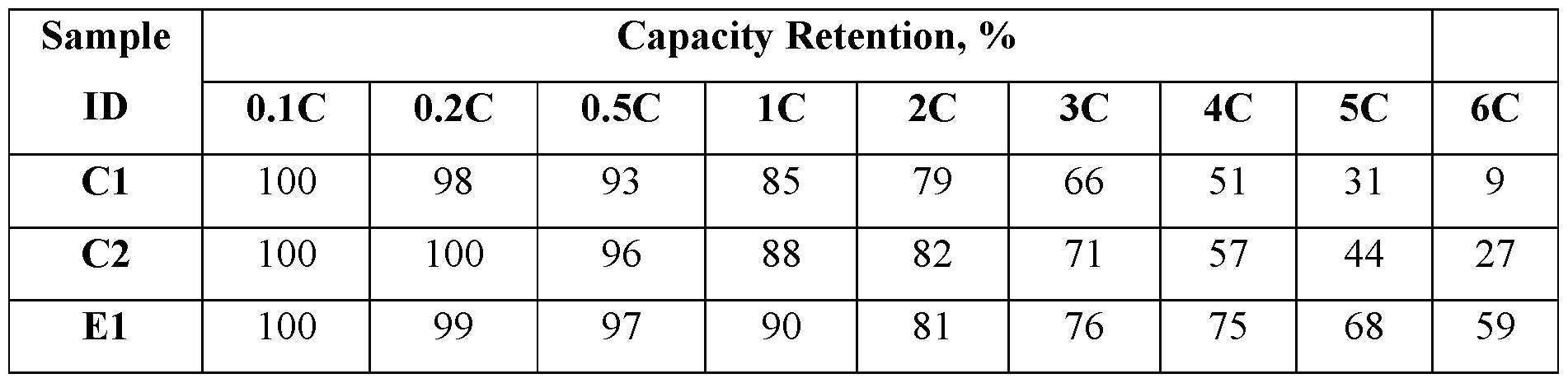
- Another objective of the present disclosure is to provide a negative electrode for lithium-ion battery which has a large discharge capacity, suffers surprisingly low loss in capacity during regular charging-discharging cycles and during charge-discharge at high rate.
- the disclosure provides a method of incorporating said graphitization catalyst within the graphite precursor via melt blending: 0.1 wt.% to about 35 wt.% graphitization catalyst or a precursor thereof and about 20 wt.% to about 99.9 wt.% petroleum pitch, each based on a total mass of the blend; and processing the produced composite under grinding conditions to form a composite powder; wherein the graphitization catalyst is dispersed within a matrix comprising the petroleum pitch and the petroleum pitch comprises a plurality of pitch particles.
- the present disclosure relates to a negative electrode for metal ion battery having particle size in the range of 1 pm to 50 pm formed from a composite powder comprising 0.1 wt.% to 30 wt.% graphitizing catalyst or a precursor thereof, based on a total mass of the composite powder; and about 20 wt.% to about 99.9 wt.% petroleum pitch, based on a total mass of the composite powder; wherein the graphitization catalyst or the precursor thereof is dispersed in a matrix comprising the petroleum pitch, and the petroleum pitch comprises a plurality of pitch particles that has been graphitized at a temperature between 1800 °C to 3000 °C.
- the graphitization catalyst is able to reduce the time required to achieve >90% degree of graphitization. The high rate of graphitization enables graphitization >80% at lower temperatures than standard ones (2800-3400°C).
- FIG. 1A is a diagram of a composite powder having a graphitization catalyst dispersed between pitch particles in accordance with some embodiments of the present disclosure.
- FIG. IB is a diagram of a composite powder having a graphitization catalyst within the interior of pitch particles in accordance with some embodiments of the present disclosure.
- FIG. 1C is a diagram of a composite powder having a graphitization catalyst both within the interior of the pitch particles and dispersed between the pitch particles in accordance with some embodiments of the present disclosure.
- FIG. 3 is an x-ray diffraction pattern for composite powders produced in accordance with some embodiments of the present disclosure.
- FIG. 4 is a graph of degree of graphitization versus temperature for composite powders produced in accordance with some embodiments of the present disclosure.
- FIG. 5 is a graph of capacity retention versus discharge cycles for electrodes produced in accordance with some embodiments of the present disclosure.
- the present disclosure relates to composite powders and, more particularly, to composite powders containing petroleum pitch or derived from petroleum pitch.
- a “graphitization catalyst” is a substance capable of promoting conversion of a precursor material into graphite under suitable pyrolysis conditions. Suitable graphitization catalysts may lower the temperature and/or the time required to produce synthetic graphite under the pyrolysis conditions or raise the amount of synthetic graphite produced under a given set of pyrolysis conditions. A precursor to a graphitization catalyst may be converted to the graphitization catalyst in the course of being heated under the pyrolysis conditions. Unless otherwise specified or evident from context in the present disclosure, the term “graphitization catalyst” is used herein to refer equivalently to a graphitization catalyst or a graphitization catalyst precursor.
- the present disclosure provides ready access to composite powders comprising a graphitization catalyst dispersed in petroleum pitch.
- Petroleum pitch is a carbon-rich viscoelastic material originating from petroleum and having properties similar to a thermoplastic polymer by virtue of having a softening temperature.
- the composite powders may be readily shaped into a desired form before being converted into amorphous carbon and subsequently into graphite.
- the dispersion of the graphitization catalyst within the petroleum pitch may differ.
- processing of the graphitization catalyst and the petroleum pitch below the softening temperature may lead to the graphitization catalyst being dispersed within an interstitial space around pitch particles (including contacting an outer surface of the pitch particles), whereas processing at or above the softening temperature may lead to dispersion of at least a portion of the graphitization catalyst within the interior of pitch particles following breakup of a continuous pitch matrix.
- Either composite powder morphology may be effective for promoting graphite production according to the disclosure herein, although composite powders having the graphitization catalyst dispersed within the interior of the pitch particles facilitate more effective contact with a larger surface area of the petroleum pitch to promote more effective conversion into graphite.
- graphitization catalyst dispersed in the interior prevents the formation of nitrides and carbides that can potentially act as insulative material creating high resistance.
- grinding and/or pulverization processes may be utilized to facilitate production of the composite powders disclosed herein.
- Methods for forming the composite powders may include those employing continuous blending and grinding, either with or without first softening the petroleum pitch by heating above the softening temperature.
- the grinding processes may facilitate dispersion of the graphitization catalyst within the petroleum pitch.
- suitable grinding processes may promote conversion of larger pitch particles into a smaller size and/or promote conversion of a continuous pitch matrix into a particulate form.
- the graphitization catalyst may similarly undergo a reduction in size during the grinding process, possibly into a nanoparticle form.
- nanoparticle form refers to any size range below about 1000 nm, preferably below about 500 nm, and more preferably below about 200 nm or below about 100 nm.
- the blending processes herein may be referred to as melt blending processes.
- the blending processes herein may be referred to as dry blending processes.
- the blending process may be conducted continuously in a screw mill extruder or similar extruder type, and the resulting composite powder may be obtained directly from the extruder without the need for further grinding in most cases.
- the composite powder may be sieved to a specified particle size, if needed or desired.
- dry blending processes may be conducted with the extruder being cooled (e.g., between about -10°C to about 5°C) to maintain the petroleum pitch in a hardened state and to limit potential chemical degradation.
- the term “cold blending” is used to refer to dry blending processes taking place below room temperature (23 °C) and below a softening temperature of the petroleum pitch undergoing blending.
- suitable graphitization catalysts may promote graphitization through mechanisms including, but not limited to, diffusion and intercalation, carbon dissolution-precipitation, carbide formation-decomposition, or any combination thereof. Multiple mechanisms for promoting graphite formation may be operative simultaneously, either with a single graphitization catalyst promoting graphitization by multiple mechanisms or by utilizing two or more graphitization catalysts that promote graphite formation through different mechanisms. Additional description of suitable graphitization catalysts is provided in greater detail below.
- the new numbering scheme for groups of the Periodic Table is used.
- the groups (columns) are numbered sequentially from left to right from 1 through 18, excluding the f-block elements (lanthanides and actinides).
- the term “transition metal” refers to any atom from Groups 3-12 of the Periodic Table.
- composite powders of the present disclosure may comprise a graphitization catalyst or a graphitization catalyst precursor blended with petroleum pitch, wherein the graphitization catalyst or the graphitization catalyst precursor is dispersed in a matrix comprising the petroleum pitch, and the petroleum pitch comprises a plurality of pitch particles.
- the composite powders may comprise about 0.1 wt.% to about 30 wt.% graphitization catalyst or a precursor thereof, based on total mass of the composite powder, and about 20 wt.% to about 99.9 wt.% petroleum pitch, based on total mass of the composite powder.
- the morphology of the composite powders may vary depending on whether the graphitization catalyst is combined with the petroleum pitch under melt blending conditions, dry blending conditions, or a combination thereof.
- the graphitization catalyst may be dispersed in the composite powder by being located between pitch particles, such as in the interstitial space between the pitch particles, such that the graphitization catalyst contacts an outer surface of the pitch particles.
- FIG. 1A is a diagram of composite powder 100A showing graphitization catalyst 102 dispersed between pitch particles 104 within interstitial spaces 106 and/or situated upon the outer surface of pitch particles 104.
- FIG. IB is a diagram of composite powder 100B showing graphitization catalyst 102 within the interior of pitch particles 104, in which case interstitial spaces 106 are unoccupied (as depicted in FIG. IB) or some graphitization catalyst 102 may reside in interstitial spaces 106 and/or become embedded in the outer surface of pitch particles 104 (FIG. 1C).
- FIG. 1C is a diagram of composite powder 100C showing graphitization catalyst 102 within the interior of pitch particles 104 and also within interstitial spaces 106, wherein interstitial spaces 106 are filled either during a melt blending process or during a further dry blending process following a melt blending process. While pitch particles 104 and graphitization catalyst 102 are shown in FIGS. 1A-1C as being round and individually of the same size, it is to be appreciated that the particle shapes may be irregular and a range of particle sizes may be present for both graphitization catalyst 102 and pitch particles 104.
- composite powders of the present disclosure may comprise up to about 10 wt.%, or up to about 15 wt.%, or up to about 20 wt.%, or up to about 25 wt.%, or up to about 30 wt.% graphitization catalyst, and about 20 wt.% to about 99.9 wt.% petroleum pitch, each based on a total mass of the composite powder, and wherein the graphitization catalyst is dispersed in a matrix comprising the petroleum pitch, and the petroleum pitch comprises a plurality of pitch particles.
- the composite powders may contain the graphitization catalyst or a precursor thereof in an amount ranging from about 0.1 wt.% to about 15 wt.%, or about 0.1 wt.% to about 15 wt.%, or about 0.1 wt.% to about 5 wt.%, or about 1 wt.% to about 15 wt.%, or about 1 wt.% to about 10 wt.%, or about 1 wt.% to about 5 wt.%, or about 2 wt.% to about 30 wt.%, or about 3 wt.% to about 25 wt.%, or about 3 wt.% to about 20 wt.%, or about 4 wt.% to about 20 wt.%, or about 5 wt.% to about 15 wt.%, or about 10 wt.% to about 20 wt.%, or about 3 wt.% to about 10 wt.%, each based on
- the composite powders may contain the petroleum pitch in an amount ranging from about 25 wt.% to about 99.9 wt.%, or about 30 wt.% to about 80 wt.%, or about 40 wt.% to about 75 wt.%, or about 30 wt.% to about 50 wt.%, or about 50 wt.% to about 70 wt.%, or about 70 wt.% to about 90 wt.%, or about 80 wt.% to about 98 wt.%, or about 85 wt.% to about 99 wt.%, or about 90 wt.% to about 99.9 wt.%, each based on a total mass of the composite powders.
- the petroleum pitch used in the present disclosure may be obtained from any source or process, provided that the petroleum pitch does not contain components that might be detrimental to an intended application following carbonization or graphitization of the composite powder.
- at least a majority of the petroleum pitch may comprise a mesophase pitch.
- Mesophase pitch is an anisotropic pitch that comprises a complex mixture of aromatic molecules that are at least partially ordered and coalesce into a liquid crystalline phase. The crystallinity may enhance mechanical integrity, for example.
- the highly aligned structure may promote enhanced electrical conductivity, as well as facilitate production of the regular lattice structure of the graphite itself.
- the petroleum pitch used herein may have a mesophase pitch content of about 50 wt.% or greater, or about 60 wt.% or greater, or about 70 wt.% or greater, or about 80 wt.% or greater, or about 90 wt.% or greater, or about 95 wt.% or greater, or about 99 wt.% or greater, or about 99.9 wt.% or greater, such as about 80 wt.% to about 99.9 wt.%, or about 90 wt.% to about 99.9 wt.%, or about 95 wt.% to about 99.9 wt.%, or even 100 wt.%, each based on a total mass of the petroleum pitch.
- Suitable graphitization catalysts may promote conversion of petroleum pitch to graphite by one or more mechanisms including, but not limited to, diffusion and intercalation, carbon dissolution-precipitation, carbide formation-decomposition, or any combination thereof.
- a graphitization catalyst may be dispersed directly in a matrix comprising pitch particles, or a precursor to a graphitization catalyst may be utilized.
- Graphitization catalyst precursors may undergo a chemical reaction, including decomposition, to produce an active graphitization catalyst in the course of being heated up to a desired carbonization temperature and/or a desired graphitization temperature.
- Suitable graphitization catalysts may lower the temperature needed to convert amorphous carbon into graphite, decrease the amount of time needed to convert amorphous carbon into graphite, increase the amount of amorphous carbon converted into graphite, or any combination thereof, any or all of which may facilitate graphite production with a decreased energy consumption relative to conversion of petroleum pitch into graphite under un-catalyzed conditions.
- having a larger portion of the graphitization catalysts inside the pitch matrix can further facilitate graphite production while minimizing energy consumption and resistance compared to having the catalyst on the pitch surface due to enhanced dispersion quality and limited nitride and carbide formation.
- suitable graphitization catalysts may promote graphitization by virtue of the diffusion constant of one or more elements therein.
- an element with a diffusion constant larger than carbon in both the transverse and longitudinal directions may enhance graphitization of petroleum pitch and similar graphite precursors by becoming intercalated between aromatic rings in adjacent layers, thereby leaving large voids that carbon may exploit through self-diffusion to improve the graphitization rate.
- Suitable graphitization catalysts that may promote graphitization through intercalation and diffusion include those containing a Group 13 element.
- Group 13 elements include boron, aluminum, gallium, indium, and thallium.
- suitable graphitization catalysts containing a Group 13 element may comprise boron.
- Suitable boron-containing graphitization catalysts may include, but are not limited to, boric acid, organic esters of boric acid, sodium tetraborate, tetrahydroxyborate salts, orthoborate salts, metaborate salts, triborate salts, tetraborate salts, pentaborate salts, octaborate salts, boronic acids, boronate esters, boron oxides, boron carbides, the like, or any combination thereof.
- suitable graphitization catalysts containing a Group 4-7 element may comprise titanium, vanadium, chromium, or manganese.
- Suitable graphitization catalysts containing a Group 4-7 element may include, but are not limited to, Ti metal, V metal, Cr metal, Mn metal, titanium oxide, vanadium oxide, chromium oxide, manganese dioxide, and the like.
- the composite powders of the present disclosure may optionally further comprise graphite, which may be introduced when blending the graphitization catalyst with the petroleum pitch and forming the composite powder, or the graphite may be mixed with the composite powder afterward.
- the composite powders may comprise graphite in an amount ranging from about 0.1 wt.% to about 85 wt.%, or about 0.1 wt.% to about 60 wt.%, or about 5 wt.% to about 60 wt.%, or about 5 wt.% to about 20 wt.%, or about 20 wt.% to 40 wt.%, or about 30 wt.% to about 60 wt.%, or about 5 wt.% to about 20 wt.%, or about 20 wt.% to about 50 wt.%, each based on total mass of the composite powder.
- graphite if present in the composite powders, may be present exterior to the pitch particles (e.g., within the interstitial spaces between pitch particles, including upon the outer surface of pitch particles), if the composite powder is prepared by a dry blending process, or within the interior of the pitch particles, if the composite powder is prepared by a melt blending process.
- the added graphite present within the composite powders may be upgraded by having its graphitization percentage increased after the composite powders have been carbonized and subsequently graphitized in the presence of the graphitization catalyst. Without being limited by theory or mechanism, the graphitization catalyst may promote such upgrading of the added graphite.
- the composite powders may be further processed after incorporating the graphitization catalyst (and optionally graphite) but before carbonizing and/or graphitizing the petroleum pitch within the composite powder.
- the composite powders may be heated in a low-oxygen environment (e.g., about 0.1 mol% oxygen to about 20 mol% oxygen) below the softening temperature of the petroleum pitch. At least some oxidation of the petroleum pitch may take place under such conditions to provide a number of benefits. Namely, when heating petroleum pitch in a low-oxygen environment below the softening temperature of the petroleum pitch, mechanical integrity of the composite powder and carbon matrices produced therefrom may be enhanced through at least partial crosslinking of the petroleum pitch.
- the at least partial crosslinking may increase the softening temperature of the petroleum pitch as well, thereby allowing the composite powder to maintain its shape more readily as the composite powder is heated up during carbonization or graphitization.
- the graphitization catalyst may become at least partially embedded in the outer surface of the pitch particles being processed under such conditions.
- the foregoing heating below the softening temperature may take place at a temperature above room temperature and below about 500°C, or below about 400°C, or below about 300°C, or below about 200°C, such as within a range of about 200°C to about 450°C, or about 200°C to about 300°C, or about 200°C to about 250°C, or about 250°C to about 350°C, or about 300°C to about 450°C.
- the actual heating temperature may be selected based upon the initial softening temperature of the petroleum pitch.
- the low- oxygen environment may have an oxygen concentration from ranging from about 0.1 mol% to about 20 mol%, or about 1 mol% to about 15 mol%, or about 1 mol% to about 10 mol%, or about 1 mol% to about 5 mol%, or less than about 5 mol%, or less than about 1 mol%.
- the composite powders may be heated at a temperature ranging from about 200°C to about 450°C, or about 200°C to about 300°C, or about 300°C to about 450°C, or about 250°C to about 400°C in an environment containing about 0.1 mol% to about 20 mol% oxygen.
- at least some crosslinking of the petroleum pitch may take place.
- a concurrent increase in softening temperature may occur upon crosslinking of the petroleum pitch.
- the above composite powders may serve as a precursor composite for forming carbon composites in which the petroleum pitch is pyrolyzed (carbonized) to form a carbon matrix comprising amorphous carbon and/or graphite.
- Amorphous carbon may be distinguished from graphite spectroscopically by powder X-ray diffraction, for example. Conversion of the composite powders to a graphite-containing composite may occur with initial conversion of the petroleum pitch to amorphous carbon at a first heating temperature, followed by a subsequent heating operation at a second heating temperature that is higher than the first heating temperature to form graphite, each heating operation being conducted under conditions that may lead to a minimal reaction with oxygen.
- Amorphous carbon may be formed upon exposing the petroleum pitch to a temperature ranging from about 700°C to about 1800°C, or about 900°C to about 1800°C, preferably about 900°C to about 1500°C or about 1000°C to about 1500°C, or more preferably about 900°C to about 1400°C, in a no-oxygen or very low- oxygen environment (e.g., an oxygen content below about 0.1 mol% or below), preferably in the presence of an inert gas environment.
- a no-oxygen or very low- oxygen environment e.g., an oxygen content below about 0.1 mol% or below
- graphitization of the composite powders disclosed herein may take place at a graphitization temperature up to about 3400°C, such as a graphitization temperature ranging from about 2000°C to about 3400°C, or about 2000°C to about 2500°C, or about 2500°C to about 3000°C, or about 2800°C to about 3200°C, or about 2200°C to about 2800°C, or even at a graphitization temperature lower than about 2000°C but above the carbonization temperature.
- a graphitization temperature up to about 3400°C, such as a graphitization temperature ranging from about 2000°C to about 3400°C, or about 2000°C to about 2500°C, or about 2500°C to about 3000°C, or about 2800°C to about 3200°C, or about 2200°C to about 2800°C, or even at a graphitization temperature lower than about 2000°C but above the carbonization temperature.
- the time period over which graphitization is conducted may be about 18 hours or less, or about 15 hours or less, or about 12 hours or less, or about 10 hours or less, or about 9 hours or less, or about 8 hours or less, or about 7 hours or less, or about 6 hours or less, or about 5 hours or less, or about 4 hours or less, or about 3 hours or less, or about 2 hours or less, or about 1 hour or less.
- a small amount of mass loss may occur when carbonizing the composite powders to form the carbon matrix. Without being limited by theory or mechanism, the mass loss is believed to result from various reactions of the petroleum pitch that form gaseous products. Such reactions may include, for instance, dehydrogenation, polymerization with side chain loss and/or hydrogen production, dealkylation, condensation of aromatic rings, and decomposition of oxygen-containing groups. Gaseous products may include, for example, carbon monoxide, carbon dioxide, water vapor, hydrocarbon vapor, methane, and the like. Up to about 20 wt.% of the petroleum pitch may undergo mass loss due to oxidation during carbonization.
- the amount of such mass loss is about 10 wt.% or less, or about 5 wt.% or less, or about 2 wt.% or less.
- the corresponding loading of the graphitization catalyst in the carbon matrix may increase, such as up to about 35 wt.% based on total mass of the resulting carbon matrix.
- Methods of the present disclosure may provide composite powders, compositions produced from the composite powders and containing a carbon matrix comprising amorphous carbon, or compositions produced from the composite powders comprising a carbon matrix comprising graphite.
- the composite powders may be produced under grinding conditions suitable to disperse the graphitization catalyst or a precursor thereof in a matrix comprising a petroleum pitch in the form of a plurality of pitch particles.
- Such methods may comprise: forming a blend comprising about 0.1 wt.% to about 30 wt.% graphitization catalyst or a precursor thereof and 20 wt.% to 99.9 wt.% petroleum pitch, each based on total mass of the blend; and processing the blend under grinding conditions to form a composite powder, in which the graphitization catalyst is dispersed in a matrix comprising the petroleum pitch, and the petroleum pitch comprises a plurality of pitch particles.
- the composite powders may be produced by dry blending processes. Suitable dry blending processes for making the composite powders described herein allow for single-step processing of materials to be realized, while ensuring appropriate particle sizes and a thorough dispersion of the graphitization catalyst among the pitch particles. Dry blending processes, preferably cold blending processes, may combine the graphitization catalyst and the petroleum pitch in a manner to maintain the petroleum pitch below its softening temperature while dispersing particles of the graphitization catalyst among a plurality of pitch particles. Combining the petroleum pitch and the graphitization catalyst in the foregoing manner may comprise milling, extruding, grinding, the like, or any combination thereof. A reduction in particle size of the petroleum pitch and/or the graphitization catalyst may take place in the course of such dry blending processes.
- the composite powders disclosed herein may be formed by milling or grinding a suitable petroleum pitch and a suitable graphitization catalyst, preferably during a continuous milling or grinding process, more preferably a milling or grinding process conducted in a screw mill extruder.
- milling or grinding may suitably combine the graphitization catalyst and the petroleum pitch as particles into a well-dispersed state while concurrently reducing the particle size of the individual components (e.g., the graphitization catalyst and the petroleum pitch) within the composite powders.
- the graphitization catalyst and petroleum pitch introduced to the screw mill extruder need not necessarily reside within the final size range present in the composite powders.
- the composite powders may be produced by melt blending processes, in which the graphitization catalyst may be blended with the petroleum pitch at or above a softening temperature of the petroleum pitch.
- the heating during a melt blending process may take place at a temperature above the softening temperature and up to about 500°C, or up to about 400°C, or up to about 350°C, or up to about 325°C, such as within a range of about 300°C to about 500°C, or about 325°C to about 450°C, or about 350°C to about 425°C, or about 350°C to about 475°C.
- the graphitization catalyst In so processing the graphitization catalyst with the petroleum pitch, at least a portion of the graphitization catalyst may become dispersed within a continuous pitch matrix that comprises softened petroleum pitch.
- the graphitization catalyst may undergo a change in particle size as blending with the petroleum pitch occurs.
- the resulting melt blend containing the continuous pitch matrix may be cooled to a temperature below the softening temperature, at which point the continuous pitch matrix may be broken up into a plurality of pitch particles containing the graphitization catalyst within the interior of the pitch particles.
- Suitable melt blending processes may be conducted in an extruder in a similar manner to related dry blending processes, except for initially heating above the softening temperature of the petroleum pitch, followed by cooling below the softening temperature once the graphitization catalyst has been thoroughly dispersed within the continuous pitch matrix. Heating may be conducted in a multi-zone extruder having a first zone maintained at a temperature above the softening temperature of the petroleum pitch and a second zone maintained at a temperature below the softening temperature of the petroleum pitch. Such melt blending processes may likewise be performed in a screw mill extruder under continuous grinding conditions, or alternately batchwise using ball or sand milling above the softening temperature of the petroleum pitch, followed by cooling and grinding the continuous pitch matrix thereafter to form the composite powder.
- combination grinding processes are also contemplated in the present disclosure.
- two or more extruders in series may be utilized to achieve a desired particle size or extent of blending and/or two or more extruders in parallel may be utilized to increase throughput.
- two or more extruders in series may be utilized at different temperatures, wherein a first extruder forms a continuous pitch matrix containing dispersed graphitization catalyst above the softening temperature of the petroleum pitch and a second extruder grinds the continuous pitch matrix into a composite powder below the softening temperature of the petroleum pitch.
- a melt blending process achieves a higher quality of dispersion by having more of the graphitization catalysts in the interior of the pitch particles.
- a dry blending process may follow a melt blending process to produce composite powders having graphitization catalyst dispersed both within the interior of the pitch particles and between the pitch particles.
- the resulting slurries are coated onto a copper foil that is the current collector, dried into films, and calendered to achieve a total film thickness of up to 150 pm with up to 15 layers making the negative electrode (i.e. anode).
- the anode electrode sheets are added to cathode ones with a separator film in between and pressed together into a pouch cell.
- the resulting cell is filled with an electrolyte made from a combination of carbonates (ethyl, ethyl methyl, dimethyl, etc%) and lithium salts (LiPChF?, LiBF 4 , LiBOB, LiPFe, LiFSI, LiTFSI, etc).
- Embodiments disclosed herein include:
- A. Composite powders comprise: about 0.1 wt.% to about 30 wt.% graphitization catalyst or a precursor thereof, based on a total mass of the composite powder; and about 20 wt.% to 99.9 wt.% petroleum pitch, based on a total mass of the composite powder; wherein the graphitization catalyst or the precursor thereof is dispersed in a matrix comprising the petroleum pitch, and the petroleum pitch comprises a plurality of pitch particles.
- compositions obtained from composite powders comprise: up to about 35 wt.% graphitization catalyst dispersed in a carbon matrix, based on a total mass of the composition; wherein the carbon matrix comprises amorphous carbon.
- Bl The composition of B, wherein the composition is produced by a process comprising providing the composite powder of A; and heating the petroleum pitch at a carbonization temperature sufficient to form the carbon matrix in an environment comprising about 0.1 mol% oxygen or below; wherein the graphitization catalyst precursor, if present, is converted to the graphitization catalyst while forming the carbon matrix.
- C. Methods for making composite powders comprise: forming a blend comprising about 0.1 wt.% to about 35 wt.% graphitization catalyst or a precursor thereof and about 20 wt.% to about 99.9 wt.% petroleum pitch, each based on a total mass of the blend; and processing the blend under grinding conditions to form a composite powder; wherein the graphitization catalyst is dispersed in a matrix comprising the petroleum pitch and the petroleum pitch comprises a plurality of pitch particles.
- Embodiments A-C may have one or more of the following additional elements in any combination: [0066] Element 1 : wherein the petroleum pitch comprises about 50 wt.% or greater mesophase pitch.
- Element 2 wherein the graphitization catalyst or the precursor thereof is dispersed in an interstitial space between the pitch particles.
- Element 3 wherein at least a portion of the graphitization catalyst or the precursor thereof is dispersed within an interior of the pitch particles.
- Element 4 wherein the pitch particles have a particle size ranging from about 1 pm to about 25 pm.
- Element 5 wherein the composite powder comprises about 0.1 wt.% to about 10 wt.% graphitization catalyst.
- Element 6 wherein the graphitization catalyst or the precursor thereof comprises a compound containing at least one of a Group 2 element, a Group 4 element, a Group 5 element, a Group 6 element, a Group 7 element, a Group 8 element, a Group 9 element, a Group 10 element, a Group 13 element, Cu, Zn, or Si.
- Element 7 wherein the graphitization catalyst or the precursor thereof comprises an oxide, a carbide, a salt, a coordination compound, or any combination thereof.
- Element 8 wherein the graphitization catalyst or the precursor thereof comprises a boron-, iron-, nickel-, cobalt-, molybdenum-, titanium-, zirconium-, manganese-, and vanadium-containing compound.
- Element 9 wherein the boron-containing compound comprises at least one compound selected from the group consisting of boric acid, sodium tetraborate, tetrahydroxyborate salts, orthoborate salts, metaborate salts, triborate salts, tetraborate salts, pentaborate salts, octaborate salts, boronic acids, boronate esters, boron oxides, boron carbides, and combinations thereof.
- boric acid sodium tetraborate, tetrahydroxyborate salts, orthoborate salts, metaborate salts, triborate salts, tetraborate salts, pentaborate salts, octaborate salts, boronic acids, boronate esters, boron oxides, boron carbides, and combinations thereof.
- Element 10 wherein the carbonization temperature ranges from about 700°C to about 1800°C.
- Element 11 wherein forming the blend comprises melt blending the graphitization catalyst or the precursor thereof and the petroleum pitch at or above a softening temperature of the petroleum pitch to disperse the graphitization catalyst or the precursor thereof in a continuous pitch matrix, and processing the blend under the grinding conditions comprises grinding the continuous pitch matrix to form the pitch particles with at least a portion of the graphitization catalyst or the precursor thereof dispersed within an interior of the pitch particles.
- Element 12 wherein the method further comprises heating the composite powder at a temperature ranging from about 200°C to about 450°C in an environment containing about 0.1 mol% to about 20 mol% oxygen.
Landscapes
- Chemical & Material Sciences (AREA)
- Chemical Kinetics & Catalysis (AREA)
- Electrochemistry (AREA)
- General Chemical & Material Sciences (AREA)
- Organic Chemistry (AREA)
- Inorganic Chemistry (AREA)
- Engineering & Computer Science (AREA)
- Materials Engineering (AREA)
- General Life Sciences & Earth Sciences (AREA)
- Life Sciences & Earth Sciences (AREA)
- Geology (AREA)
- Composite Materials (AREA)
- Manufacturing & Machinery (AREA)
- Carbon And Carbon Compounds (AREA)
Abstract
Description


Claims
Priority Applications (4)
| Application Number | Priority Date | Filing Date | Title |
|---|---|---|---|
| EP24738175.9A EP4727893A1 (en) | 2023-06-15 | 2024-06-13 | Pitch-based composite powders containing a graphitization catalyst and methods for production and use thereof |
| CN202480039936.7A CN121511212A (en) | 2023-06-15 | 2024-06-13 | Pitch-based composite powder containing graphitization catalyst and its production and application methods |
| KR1020267001098A KR20260023040A (en) | 2023-06-15 | 2024-06-13 | Pitch-based composite powder containing graphitization catalyst, and its production method and use |
| US19/407,916 US20260084970A1 (en) | 2023-06-15 | 2025-12-03 | Pitch-based composite powders containing a graphitization catalyst and methods for production and use thereof |
Applications Claiming Priority (2)
| Application Number | Priority Date | Filing Date | Title |
|---|---|---|---|
| US202363508397P | 2023-06-15 | 2023-06-15 | |
| US63/508,397 | 2023-06-15 |
Related Child Applications (1)
| Application Number | Title | Priority Date | Filing Date |
|---|---|---|---|
| US19/407,916 Continuation US20260084970A1 (en) | 2023-06-15 | 2025-12-03 | Pitch-based composite powders containing a graphitization catalyst and methods for production and use thereof |
Publications (1)
| Publication Number | Publication Date |
|---|---|
| WO2024259052A1 true WO2024259052A1 (en) | 2024-12-19 |
Family
ID=91782028
Family Applications (1)
| Application Number | Title | Priority Date | Filing Date |
|---|---|---|---|
| PCT/US2024/033737 Ceased WO2024259052A1 (en) | 2023-06-15 | 2024-06-13 | Pitch-based composite powders containing a graphitization catalyst and methods for production and use thereof |
Country Status (5)
| Country | Link |
|---|---|
| US (1) | US20260084970A1 (en) |
| EP (1) | EP4727893A1 (en) |
| KR (1) | KR20260023040A (en) |
| CN (1) | CN121511212A (en) |
| WO (1) | WO2024259052A1 (en) |
Cited By (2)
| Publication number | Priority date | Publication date | Assignee | Title |
|---|---|---|---|---|
| CN120736515A (en) * | 2025-09-02 | 2025-10-03 | 安徽科达新材料有限公司 | Modification method for low-temperature graphitization of oxide nitride synergistic catalytic slurry oil |
| CN121627407A (en) * | 2026-02-04 | 2026-03-10 | 山西北都科技股份有限公司 | A fabrication process for a high-strength, ultra-high-power graphite electrode |
Citations (3)
| Publication number | Priority date | Publication date | Assignee | Title |
|---|---|---|---|---|
| EP0869566A2 (en) * | 1997-03-07 | 1998-10-07 | PETOCA, Ltd | Graphite material for use in negative electrode of lithium-ion secondary battery and process for producing the same |
| EP1302443A2 (en) * | 2001-10-02 | 2003-04-16 | Polymatech Co., Ltd. | Graphitized carbon powder and thermally conductive composition containing this powder |
| US20110044881A1 (en) * | 2009-08-21 | 2011-02-24 | Stansberry Peter G | Method For The Catalytic Extraction Of Coal |
Family Cites Families (5)
| Publication number | Priority date | Publication date | Assignee | Title |
|---|---|---|---|---|
| US5340670A (en) * | 1992-06-01 | 1994-08-23 | Kabushiki Kaisha Toshiba | Lithium secondary battery and method of manufacturing carbonaceous material for negative electrode of the battery |
| JP5623686B2 (en) * | 2007-06-01 | 2014-11-12 | パナソニック株式会社 | Composite negative electrode active material and non-aqueous electrolyte secondary battery |
| DE102016201429A1 (en) * | 2016-01-29 | 2017-08-03 | Sgl Carbon Se | Novel coke with additives |
| CN108698832A (en) * | 2016-01-29 | 2018-10-23 | 西格里碳素欧洲公司 | Catalytically active additive for coke derived from gasoline or coal |
| US10483542B2 (en) * | 2017-02-16 | 2019-11-19 | Global Graphene Group, Inc. | Aluminum secondary battery having an exfoliated graphite-based high-capacity cathode and manufacturing method |
-
2024
- 2024-06-13 CN CN202480039936.7A patent/CN121511212A/en active Pending
- 2024-06-13 KR KR1020267001098A patent/KR20260023040A/en active Pending
- 2024-06-13 WO PCT/US2024/033737 patent/WO2024259052A1/en not_active Ceased
- 2024-06-13 EP EP24738175.9A patent/EP4727893A1/en active Pending
-
2025
- 2025-12-03 US US19/407,916 patent/US20260084970A1/en active Pending
Patent Citations (3)
| Publication number | Priority date | Publication date | Assignee | Title |
|---|---|---|---|---|
| EP0869566A2 (en) * | 1997-03-07 | 1998-10-07 | PETOCA, Ltd | Graphite material for use in negative electrode of lithium-ion secondary battery and process for producing the same |
| EP1302443A2 (en) * | 2001-10-02 | 2003-04-16 | Polymatech Co., Ltd. | Graphitized carbon powder and thermally conductive composition containing this powder |
| US20110044881A1 (en) * | 2009-08-21 | 2011-02-24 | Stansberry Peter G | Method For The Catalytic Extraction Of Coal |
Cited By (2)
| Publication number | Priority date | Publication date | Assignee | Title |
|---|---|---|---|---|
| CN120736515A (en) * | 2025-09-02 | 2025-10-03 | 安徽科达新材料有限公司 | Modification method for low-temperature graphitization of oxide nitride synergistic catalytic slurry oil |
| CN121627407A (en) * | 2026-02-04 | 2026-03-10 | 山西北都科技股份有限公司 | A fabrication process for a high-strength, ultra-high-power graphite electrode |
Also Published As
| Publication number | Publication date |
|---|---|
| CN121511212A (en) | 2026-02-10 |
| EP4727893A1 (en) | 2026-04-22 |
| US20260084970A1 (en) | 2026-03-26 |
| KR20260023040A (en) | 2026-02-20 |
Similar Documents
| Publication | Publication Date | Title |
|---|---|---|
| Fan et al. | Epoxy phenol novolac resin: A novel precursor to construct high performance hard carbon anode toward enhanced sodium-ion batteries | |
| US20260084970A1 (en) | Pitch-based composite powders containing a graphitization catalyst and methods for production and use thereof | |
| JP4392169B2 (en) | Nonaqueous electrolyte secondary battery and method for producing positive electrode material thereof | |
| KR100981909B1 (en) | Anode active material for lithium secondary battery, manufacturing method thereof and lithium secondary battery comprising same | |
| JP5225690B2 (en) | Composite graphite particles and lithium secondary battery using the same | |
| Zhu et al. | A comprehensive study of effects of carbon coating on Li4Ti5O12 anode material for lithium-ion batteries | |
| EP2991141A1 (en) | Silicon-containing material, non-aqueous electrolyte secondary battery negative electrode and method for manufacturing same, and non-aqueous electrolyte secondary battery and method for manufacturing same | |
| EP1906472A1 (en) | Non-aqueous secondary battery-use graphite composite particle, cathode active substance material containing it, cathode and non-aqueous secondary battery | |
| Babu | Carbon–based Materials for Li‐ion Battery | |
| US10483542B2 (en) | Aluminum secondary battery having an exfoliated graphite-based high-capacity cathode and manufacturing method | |
| JP2015072809A (en) | Silicon-containing material, negative electrode for non-aqueous electrolyte secondary battery, non-aqueous electrolyte secondary battery, and production method thereof | |
| JP3945928B2 (en) | Method for producing carbon material for negative electrode of lithium ion secondary battery | |
| CN1148739A (en) | Indefinite-form carbon material, electrode thereof, and accumulator cell with said electrode | |
| KR102512034B1 (en) | Manufacturing method of high performance lithium titanate anode material for application in lithium ion battery | |
| He et al. | Sustainable Polyvinyl Chloride‐Derived Soft Carbon Anodes for Potassium‐Ion Storage: Electrochemical Behaviors and Mechanism | |
| JP5772939B2 (en) | Carbon material for electrodes | |
| Kim et al. | Electrochemical performance of Mn3O4 nanorods by N‐doped reduced graphene oxide using ultrasonic spray pyrolysis for lithium storage | |
| Liu et al. | Tailored Synthesis of Coral‐Like CoTiO3/Co3O4/TiO2 Nanobelts with Superior Lithium Storage Capability | |
| Liu et al. | Sn/SnOx core-shell structure encapsulated in nitrogen-doped porous carbon frameworks for enhanced lithium storage | |
| JP4973247B2 (en) | Carbon material for electrodes | |
| JP2630939B2 (en) | Non-aqueous secondary battery | |
| CN114097119B (en) | Electrode particles for batteries | |
| Fey et al. | High-capacity carbons prepared from acrylonitrile-butadiene-styrene terpolymer for use as an anode material in lithium-ion batteries | |
| Jiao et al. | Nanodiamonds assisted synthesis of porous carbon anode for high-capacity and long-cycling lithium-ion batteries | |
| EP4727894A2 (en) | Pitch-based composite powders containing silicon and methods for production and use thereof |
Legal Events
| Date | Code | Title | Description |
|---|---|---|---|
| 121 | Ep: the epo has been informed by wipo that ep was designated in this application |
Ref document number: 24738175 Country of ref document: EP Kind code of ref document: A1 |
|
| WWE | Wipo information: entry into national phase |
Ref document number: 202517128499 Country of ref document: IN |
|
| WWP | Wipo information: published in national office |
Ref document number: 202517128499 Country of ref document: IN |
|
| ENP | Entry into the national phase |
Ref document number: 1020267001098 Country of ref document: KR Free format text: ST27 STATUS EVENT CODE: A-0-1-A10-A15-NAP-PA0105 (AS PROVIDED BY THE NATIONAL OFFICE) |
|
| WWE | Wipo information: entry into national phase |
Ref document number: 1020267001098 Country of ref document: KR |
|
| WWE | Wipo information: entry into national phase |
Ref document number: 2024738175 Country of ref document: EP |
|
| NENP | Non-entry into the national phase |
Ref country code: DE |
|
| ENP | Entry into the national phase |
Ref document number: 2024738175 Country of ref document: EP Effective date: 20260115 |
|
| ENP | Entry into the national phase |
Ref document number: 2024738175 Country of ref document: EP Effective date: 20260115 |
|
| ENP | Entry into the national phase |
Ref document number: 2024738175 Country of ref document: EP Effective date: 20260115 |
|
| WWP | Wipo information: published in national office |
Ref document number: 1020267001098 Country of ref document: KR |
|
| WWP | Wipo information: published in national office |
Ref document number: 2024738175 Country of ref document: EP |