4239-109793-02 E-089-2023-0-PC-01 EPIDITHIODIKETOPIPERAZINE ANALOGS AND METHODS OF USE CROSS-REFERENCE TO RELATED APPLICATION [0001] This application claims the benefit of the earlier filing date of U.S. Provisional Application No.63/507,813, filed June 13, 2023, which is incorporated by reference in its entirety herein. ACKNOWLEDGMENT OF GOVERNMENT SUPPORT [0002] This invention was made with government support under project number Z01Z|A SC 006538 awarded by the National Institutes of Health, National Cancer Institute, R01 GM12157302 awarded by the National Institutes of Health, and CHE-1900229 awarded by the National Science Foundation. The government has certain rights in the invention. FIELD [0003] Epidithiodiketopiperazine analogs and methods of use thereof are disclosed. BACKGROUND [0004] Several epidithiodiketopiperazines (ETPs) possess diverse biological activities including anticancer, antimicrobial, antifungal, antibacterial and antiviral properties. ETPs are known as a class of compounds that have been shown to inhibit the heterodimeric hypoxia inducible factor 1 (HIF-1), a protein of importance in many cancer tumor cells. HIF-1 regulates transcription in response to fluctuations in oxygen levels. HIF-1 is correlated with angiogenesis and tumorigenicity in many cancers, and it has been shown to interact with the p300 family of coactivators of transcription. Several members of the ETP family of fungal secondary metabolites namely, gliotoxin, chaetocin, and chetomin are able to block the interaction between the HIF-1α subunit and p300 in vitro by a zinc ejection mechanism (Cook et al., J of Biol Chem, September 24, 2009, 284(39):26831-26838). As such, compounds that target the HIF-1 pathway hold potential in a range of treatment settings, including as anticancer, antimicrobial and antifungal therapeutics, among others (Semenza et al., Cell, February 3, 2012, 148(3):339-408). A need exists for ETP analogs that exhibit direct HIF-1 inhibitory effects without excessive toxicity. SUMMARY [0005] Epidithiodiketopiperazine (ETP) analogs and methods of using the analogs are disclosed. In some aspects, the ETP analog is a compound according to Formula I, or a stereoisomer or pharmaceutically acceptable salt, solvate, or hydrate thereof:
4239-109793-02 E-089-2023-0-PC-01 O R
3 R
1 S N where R
1 is aryl or heteroaryl; R
2 is - aryl, or heteroaryl; and R
3 and R
4 independently are aliphatic,
- - or -C(O)R
a. Each R
a independently is -H, aliphatic, or heteroaliphatic. R
7 R
8 [0006] In any of the foregoing or following aspects, R
1 or R
12 1
R
3 independently are -H, aliphatic, halo, R
8 and R
9 independently are -H, aliphatic, halo,
O x -OR
a, -N(R
a)
2, -SR
a, -C(O)OR
a, or -C(O)R
a, or R
8 and R
9 together 2; R
10 is -H, aliphatic, heteroaliphatic, -OH, -C(O)OR
a, or -C(O)R
a; and
-H, aliphatic, or heteroaliphatic. In some aspects, R
1 is . 2
[0007] In any of the foregoing or following aspects, R may - - p is 1, 2, 3, 4, 5, 6, 7, 8, 9, or 10, and R
c is -H, -OR
a, -SR
a, -N(R
a)
2, or -C(O)OR
a; or substituted phenyl. In some CF
3 . [0008]
a compound as disclosed herein, or a stereoisomer or pharmaceutical salt, solvate, or hydrate thereof, and (ii) a pharmaceutically acceptable carrier. [0009] In some aspects, a method for inhibiting hypoxia inducible factor 1 (HIF-1) includes contacting a cell expressing HIF-1 with an effective amount of a compound as disclosed herein, or a stereoisomer or pharmaceutical salt, solvate, or hydrate thereof. In some implementations,
4239-109793-02 E-089-2023-0-PC-01 contacting the cell comprises administering to a subject a therapeutically effective amount of the compound, or stereoisomer or pharmaceutically acceptable salt, solvate, or hydrate thereof, or a therapeutically effective amount of a pharmaceutical composition comprising the compound, or stereoisomer or pharmaceutically acceptable salt, solvate, or hydrate thereof. [0010] In any of the foregoing or following aspects, the subject may have a condition characterized at least in part by abnormal levels of HIF-1 activity. In some aspects, the subject has a condition characterized by angiogenesis, tumorigenicity, inflammation, immunosuppression, an immunological disease, a microbial infection, a fungal infection, a viral infection, or any combination thereof. [0011] The foregoing and other objects, features, and advantages of the invention will become more apparent from the following detailed description, which proceeds with reference to the accompanying figures. BRIEF DESCRIPTION OF THE DRAWINGS [0012] FIG.1 is a graph showing activity of positive controls chetomin (1 μM), CAI (30 μM), and several epidithiodiketopiperazine analogs (ETPs) at a screening dose of 1 μM in a rat aortic ring (RAR) angiogenesis assay. [0013] FIG.2 shows representatives images of the RAR assay of FIG.1. [0014] FIG.3 is a graph showing activity of chetomin (1μM) and several ETPs (1 μM) in a lattice tubule formation assay; data shown represents percent tubule formation of DMSO control, error bars represent standard error of the mean. [0015] FIG.4 shows representative images of the lattice assay of FIG.3. [0016] FIG.5 is a graph showing results of several ETPs in a cytotoxicity assay in a prostate cancer cell line at a screening dose of 10 μM. [0017] FIG.6 is a graph showing results of several ETPs in a multiple myeloma cell line (MOLP-8) viability assay at 100 nM and 1 μM doses over 72 hours; data represents percent viability of DMSO control, error bars represent standard error of the mean. [0018] FIG.7 is a graph showing results of several ETPs in a multiple myeloma cell line (RPMI-8226) viability assay at 100 nM and 1 μM doses; data represents percent viability of DMSO control, error bars represent standard error of the mean.
4239-109793-02 E-089-2023-0-PC-01 [0019] FIG.8 is a graph showing results of several ETPs in a colon cancer cell line (HCT-29) viability assay at 1 μM and 10 μM doses; data represents percent viability of DMSO control, error bars represent standard error of the mean. [0020] FIG.9 is a graph showing results of several ETPs in a colon cancer cell line (HCT-116) viability assay at 1 μM and 10 μM doses; data represents percent viability of DMSO control, error bars represent standard error of the mean. [0021] FIGS.10A-10B show results of several ETPs in a multiple myeloma spheroid (MOLP-8) viability assay. FIG.10A is a graph showing cell viability of MOLP-8 tumor spheroids after 72 hours of treatment at 100 nM and 1 μM doses; data represent percent viability of DMSO control, error bars represent standard error of the mean. FIG.10B shows representative images (4x magnification) of the assay of FIG.10A when treated with the ETPs at 100 nM and 1 μM doses; images were cropped to 302,500 pixels
2. [0022] FIGS.11A-11B show results of several ETPs in another multiple myeloma spheroid (RPMI-8226) viability assay. FIG.11A is a graph showing cell viability of RPMI-8226 tumor spheroids after 72 hours of treatment at 100 nM and 1 μM doses; FIG.11B shows representative images (4x magnification) of the assay of FIG.11A when treated with the ETPs at 100 nM and 1 μM doses; images were cropped to 302,500 pixels
2. [0023] FIGS.12A-12D show results of several ETPs in a colon cancer spheroid (HT-29 and HCT-116) viability assay. FIG.12A is a graph showing cell viability of HT-29 tumor spheroids after 72 hours of treatment at 5 μM and 10 μM doses. FIG.12B is a graph showing cell viability of HT-116 tumor spheroids after 72 hours of treatment at 5 μM and 10 μM doses. FIG.12C shows representative images (4x magnification) of the assay of FIG.12A at 0, 24, 48, and 72 hours; FIG.12D shows representative images (4x magnification) of the assay of FIG.12B at 0, 24, 48, and 72 hours. Results in FIGS.12A and 12B represent percent viability of DMSO control spheroids, error bars represent standard error of the mean. All images were cropped to 302,500 pixels
2. DETAILED DESCRIPTION [0024] This disclosure concerns epidithiodiketopiperazine (ETP) analogs, and methods of using the analogs. In some aspects, the ETP analogs inhibit hypoxia inducible factor 1 (HIF-1). In certain aspects, the ETP analogs are administered to a subject. The subject may have a condition characterized by angiogenesis, tumorigenicity, inflammation or an inflammatory process, immunosuppression, a microbial infection, a fungal infection, a viral infection, or any combination thereof.
4239-109793-02 E-089-2023-0-PC-01 I. Definitions and Abbreviations [0025] The following explanations of terms and abbreviations are provided to better describe the present disclosure and to guide those of ordinary skill in the art in the practice of the present disclosure. As used herein, “comprising” means “including” and the singular forms “a” or “an” or “the” include plural references unless the context clearly dictates otherwise. The term “or” refers to a single element of stated alternative elements or a combination of two or more elements, unless the context clearly indicates otherwise. [0026] Unless explained otherwise, all technical and scientific terms used herein have the same meaning as commonly understood to one of ordinary skill in the art to which this disclosure belongs. Although methods and materials similar or equivalent to those described herein can be used in the practice or testing of the present disclosure, suitable methods and materials are described below. The materials, methods, and examples are illustrative only and not intended to be limiting. Other features of the disclosure are apparent from the following detailed description and the claims. [0027] The disclosure of numerical ranges should be understood as referring to each discrete point within the range, inclusive of endpoints, unless otherwise noted. Unless otherwise indicated, all numbers expressing quantities of components, molecular weights, percentages, temperatures, times, and so forth, as used in the specification or claims are to be understood as being modified by the term “about.” Accordingly, unless otherwise implicitly or explicitly indicated, or unless the context is properly understood by a person of ordinary skill in the art to have a more definitive construction, the numerical parameters set forth are approximations that may depend on the desired properties sought and/or limits of detection under standard test conditions/methods as known to those of ordinary skill in the art. When directly and explicitly distinguishing embodiments from discussed prior art, the embodiment numbers are not approximates unless the word “about” is recited. [0028] Although there are alternatives for various components, parameters, operating conditions, etc. set forth herein, that does not mean that those alternatives are necessarily equivalent and/or perform equally well. Nor does it mean that the alternatives are listed in a preferred order unless stated otherwise. [0029] Definitions of common terms in chemistry may be found in Richard J. Lewis, Sr. (ed.), Hawley’s Condensed Chemical Dictionary, published by John Wiley & Sons, Inc., 2016 (ISBN 978-1-118-13515-0). The presently disclosed compounds also include all isotopes of atoms present in the compounds, which can include, but are not limited to, deuterium, tritium,
18F,
14C, etc.
4239-109793-02 E-089-2023-0-PC-01 [0030] In order to facilitate review of the various embodiments of the disclosure, the following explanations of specific terms are provided: [0031] Administration/administering: “Administration of” and “administering a” compound should be understood to mean providing a compound, a prodrug of a compound, or a pharmaceutical composition as described herein. The compound or composition can be administered by another person to the subject (e.g., intravenously) or it can be self-administered by the subject (e.g., tablets). Co-administration or co-administering means administering two or more therapeutic agents or modalities. Co-administration may occur simultaneously or sequentially in any order, and may occur by the same or different routes of administration. When administering simultaneously, the two or more therapeutic agents may be present in a single pharmaceutical composition or in separate pharmaceutical compositions. [0032] Aliphatic: A substantially hydrocarbon-based compound, or a radical thereof (e.g., C
6H
13, for a hexane radical), including alkanes, alkenes, alkynes, including cyclic versions thereof, and further including straight- and branched-chain arrangements, and all stereo and position isomers as well. Cyclic aliphatic groups may be referred to as cycloaliphatic. Unless expressly stated otherwise, an aliphatic group contains from one to twenty-five carbon atoms; for example, from one to fifteen, from one to ten, from one to six, or from one to four carbon atoms. The term "lower aliphatic" refers to an aliphatic group containing from one to ten carbon atoms. An aliphatic chain may be substituted or unsubstituted. Unless expressly referred to as an “unsubstituted aliphatic,” an aliphatic group can either be unsubstituted or substituted. A substituted aliphatic group includes at least one sp
3-hybridized carbon or at least two sp
2-hybridized carbons bonded with a double bond or at least two sp-hybridized carbons bonded with a triple bond. An aliphatic group can be substituted with one or more substituents (up to two substituents for each methylene carbon in an aliphatic chain, or up to one substituent for each carbon of a -C=C- double bond in an aliphatic chain, or up to one substituent for a carbon of a terminal methine group). Exemplary substituents include, but are not limited to, alkyl, alkenyl, alkynyl, alkoxy, alkylamino, alkylthio, acyl, aldehyde, amide, amino, aminoalkyl, aryl, arylalkyl, carboxyl, cyano, cycloalkyl, dialkylamino, halo, haloaliphatic, heteroaliphatic, heteroaryl, heterocycloaliphatic, hydroxyl, oxo, sulfonamide, sulfhydryl, thioalkoxy, or other functionality. [0033] Aryl: A monovalent aromatic carbocyclic group of, unless specified otherwise, from 6 to 15 carbon atoms having a single ring (e.g., phenyl) or multiple condensed rings in which at least one ring is aromatic (e.g., indole, benzodioxole, and the like), provided that the point of attachment is through an atom of an aromatic portion of the aryl group and the aromatic portion at the point of
4239-109793-02 E-089-2023-0-PC-01 attachment contains only carbons in the aromatic ring. If any aromatic ring portion contains a heteroatom, the group is a heteroaryl and not an aryl. Aryl groups are monocyclic, bicyclic, tricyclic or tetracyclic. [0034] Effective amount: An amount sufficient to achieve a particular desired results, such as to inhibit a protein or enzyme, to elicit a desired biological or medical response in a tissue, system, subject or patient; to treat a specified disorder or disease; to ameliorate or eradicate one or more of its symptoms; and/or to prevent the occurrence of the disease or disorder. [0035] Heteroaryl: An aromatic compound or group having at least one heteroatom, i.e., one or more carbon atoms in the ring has been replaced with an atom having at least one lone pair of electrons, typically nitrogen, oxygen, phosphorus, silicon, or sulfur. [0036] Pharmaceutically acceptable: A substance that can be taken into a subject without significant adverse toxicological effects on the subject. [0037] Pharmaceutically acceptable carrier: The pharmaceutically acceptable carriers (vehicles) useful in this disclosure are conventional. Remington: The Science and Practice of Pharmacy, The University of the Sciences in Philadelphia, Editor, Lippincott, Williams, & Wilkins, Philadelphia, PA, 21
st Edition (2005), describes compositions and formulations suitable for pharmaceutical delivery of one or more thalidomide analogs as disclosed herein. In general, the nature of the carrier will depend on the particular mode of administration being employed. For instance, parenteral formulations usually comprise injectable fluids that include pharmaceutically and physiologically acceptable fluids such as water, physiological saline, balanced salt solutions, aqueous dextrose, glycerol or the like as a vehicle. In some examples, the pharmaceutically acceptable carrier may be sterile to be suitable for administration to a subject (for example, by parenteral, intramuscular, or subcutaneous injection). In addition to biologically-neutral carriers, pharmaceutical compositions to be administered can contain minor amounts of non-toxic auxiliary substances, such as wetting or emulsifying agents, preservatives, and pH buffering agents and the like, for example sodium acetate or sorbitan monolaurate. [0038] Pharmaceutically acceptable salt: A biologically compatible salt of a compound that can be used as a drug, which salts are derived from a variety of organic and inorganic counter ions well known in the art and include, by way of example only, sodium, potassium, calcium, magnesium, ammonium, tetraalkylammonium, and the like; and when the molecule contains a basic functionality, salts of organic or inorganic acids, such as hydrochloride, hydrobromide, tartrate, mesylate, acetate, maleate, oxalate, and the like. Pharmaceutically acceptable acid addition salts are those salts that retain the biological effectiveness of the free bases while formed by acid partners
4239-109793-02 E-089-2023-0-PC-01 that are not biologically or otherwise undesirable, e.g., inorganic acids such as hydrochloric acid, hydrobromic acid, sulfuric acid, nitric acid, phosphoric acid, and the like, as well as organic acids such as acetic acid, trifluoroacetic acid, propionic acid, glycolic acid, pyruvic acid, oxalic acid, maleic acid, malonic acid, succinic acid, fumaric acid, tartaric acid, citric acid, benzoic acid, benzene sulfonic acid (besylate), cinnamic acid, mandelic acid, methanesulfonic acid, ethanesulfonic acid, p-toluenesulfonic acid, salicylic acid and the like. Pharmaceutically acceptable base addition salts include those derived from inorganic bases such as sodium, potassium, lithium, ammonium, calcium, magnesium, iron, zinc, copper, manganese, aluminum salts and the like. Exemplary salts are the ammonium, potassium, sodium, calcium, and magnesium salts. Salts derived from pharmaceutically acceptable organic non-toxic bases include, but are not limited to, salts of primary, secondary, and tertiary amines, substituted amines including naturally occurring substituted amines, cyclic amines and basic ion exchange resins, such as isopropylamine, trimethylamine, diethylamine, triethylamine, tripropylamine, ethanolamine, 2-dimethylaminoethanol, 2-diethylaminoethanol, dicyclohexylamine, lysine, arginine, histidine, caffeine, procaine, hydrabamine, choline, betaine, ethylenediamine, glucosamine, methylglucamine, theobromine, purines, piperazine, piperidine, N-ethylpiperidine, polyamine resins, and the like. Exemplary organic bases are isopropylamine, diethylamine, ethanolamine, trimethylamine, dicyclohexylamine, choline, and caffeine. (See, for example, S. M. Berge, et al., “Pharmaceutical Salts,” J. Pharm. Sci., 1977; 66:1-19, which is incorporated herein by reference.) For therapeutic use, salts of the compounds are those wherein the counter-ion is pharmaceutically acceptable. However, salts of acids and bases which are non-pharmaceutically acceptable may also find use, for example, in the preparation or purification of a pharmaceutically acceptable compound. [0039] Stereoisomers: Isomers that have the same molecular formula and sequence of bonded atoms, but which differ only in the three-dimensional orientation of the atoms in space. [0040] Subject: An animal (human or non-human) subjected to a treatment, observation or experiment. Includes both human and veterinary subjects, including human and non-human mammals, such as rats, mice, cats, dogs, pigs, horses, cows, and non-human primates. [0041] Therapeutically effective amount: An amount sufficient to provide a beneficial, or therapeutic, effect to a subject or a given percentage of subjects. The amount of a compound which constitutes a “therapeutically effective amount” may vary depending on the compound, the desired result, the disease state and its severity, the age and/or size of the subject to be treated, and the like.
4239-109793-02 E-089-2023-0-PC-01 II. Epidithiodiketopiperazine (ETP) Analogs Aspects of ETP analogs disclosed herein are compounds having a structure according to Formula I, or a stereoisomer or pharmaceutically acceptable salt, solvate, or hydrate thereof: . [0042] With respect to Formula I, R
1
R
2 is -H, aliphatic, heteroaliphatic, aryl, or heteroaryl; and R
3 and R
4 independently are aliphatic, heteroaliphatic, -H, –C(O)OR
a, or -C(O)R
a. Each R
a independently is -H, aliphatic, or heteroaliphatic. In some aspects, each R
a independently is -H, unsubstituted C1-C6 alkyl, or substituted C1-C6 alkyl (e.g., trifluoromethyl). In certain aspects, each R
a independently is -H or methyl. [0043] R
1 is aryl or heteroaryl, and may be monocyclic or bicyclic. In any of the foregoing or following aspects, R
1 may be , where R
5-R
7 and R
11-R
15
-N(R
a)2, -SR
a, -C(O)OR
a, or -C(O)R
a. R
8 and R
9 independently are -H, aliphatic, halo, -OR
a, -N(R
a)
2, -SR
a, -C(O)OR
a, or -C(O)R
a, or R
8 and R
9 together form an alkylenedioxy functional , where x is 1 or 2. R
10 is -H, aliphatic, heteroaliphatic, -OH, -C(O)OR
a, or -C(O)R
a. R
a is
defined. [0044] In any of the foregoing or following aspects, R
5-R
7 and R
11-R
15 independently may be -H, unsubstituted or substituted C1-C6 alkyl, halo, -OR
a, -N(R
a)2, -SR
a, -C(O)OR
a, or -C(O)R
a. In some implementations, R
5-R
7 and R
11-R
15 independently are -H, -(CH
2)
nR
b, halo, -OR
a, -N(R
a)2, -SR
a, -C(O)OR
a, or -C(O)R
a, where n is 1, 2, 3, 4, 5, or 6, R
b is -H, -OR
a, halo, or -N(R
a)
2, and each R
a independently is as previously defined. In some examples, each R
a is -H or methyl. In certain implementations, R
5-R
7 and R
11-R
15 independently are -H, C1-C3 alkyl, substituted C
1-C
3 alkyl, -OR
a, or -N(R
a)
2 where each R
a independently is -H or C
1-C
3 alkyl.
4239-109793-02 E-089-2023-0-PC-01 [0045] R
8 and R
9 independently are -H, aliphatic, halo, -OR
a, -N(R
a)
2, or -SR
a, or R
8 and R
9 O x together form an alkylenedioxy functional group O , where x is 1 or 2. R
a is as previously defined. In any of the foregoing or following and R
9 may independently be -H,
unsubstituted or substituted C1-C6 alkyl, halo, -OR
a, -N(R
a)2, or -SR
a, or R
8 and R
9 together form O x where x is 1 or 2. In some aspects, R
8 and R
9 independently are -H, -(CH2)nR
b where n and O
x R
b are as previously defined, halo, -OR
a, -N(R
a)
2, or -SR
a, or R
8 and R
9 together where O
x is 1 or 2. In certain aspects, R
8 and R
9 . [0046] R
10 is -H, aliphatic, heteroaliphatic,
OR
a, or -C(O)R
a. R
a is as previously defined. In any of the foregoing or following aspects, R
10 may be -H, or unsubstituted or substituted C1-C6 alkyl. In some aspects, R
10 is -H or -(CH2)nR
b where n and R
b are as previously defined. In certain aspects, R
10 is -H or -(CH
2)
nR
b where R
b is -H. In some examples, R
10 is -H. [0047] In one aspect, R
5-R
9 are -H. In an independent aspect, R
5-R
7 are -H, and R
8 and R
9 together O form O . In another independent aspect, R
10-R
15 are -H. Exemplary R
1 groups include, but are not limited to, . [0048] R
2 is -H,
heteroaryl. In any of the foregoing or following aspects, R
2 may be alkyl, heteroalkyl, aryl, or heteroaryl. In some aspects, R
2 is -H, unsubstituted or substituted alkyl, or substituted aryl. In some aspects, R
2 is -H, -(CH2)pR
c, or substituted phenyl, where p is 1, 2, 3, 4, 5, 6, 7, 8, 9, or 10, and R
c is -H, -OR
a, -SR
a, -N(R
a)
2, -C(O)OR
a, or -C(O)R
a, where R
a is as previously defined. In certain aspects, R
2 is -H, -(CH
2)
pH, -(CH
2)
pOH, or substituted phenyl. In some examples, R
2 is -H, -CH
3, -CH
2OH, or some implementations, when R
2 is -(CH
2)
pOH, such as when R
2 is -CH
2OH, the
exhibit enhanced anti-angiogenic activity compared to other compounds wherein R
2 is not -(CH
2)
pOH.
4239-109793-02 E-089-2023-0-PC-01 [0049] R
3 and R
4 independently are aliphatic, heteroaliphatic, -H,–C(O)OR
a, or -C(O)R
a, where R
a is as previously defined. In any of the foregoing or following aspects, R
3 and R
4 independently may be alkyl, heteroalkyl, -H,–C(O)OR
a, or -C(O)R
a. In some aspects, the alkyl is substituted or unsubstituted C
1-C
6 alkyl. In certain aspects, R
3 and R
4 independently are -(CH
2)
nR
b, where n is 1, 2, 3, 4, 5, or 6, and R
b is -H, -OR
a, halo, or -N(R
a)2 where each R
a independently is as previously defined. In some examples, R
3 and R
4 independently are unsubstituted C
1-C
6 alkyl, -(CH
2)
nOH, or -H. [0050] In some implementations, (i) R
1 is R
2 is -H, -(CH
2)
nR
b where R
b is -H or -OH, or alkyl, or
(iv) any combination of two or more of (i), (ii), and (iii). In some implementations, is -H, CF
3
[0051] In some aspects, if R
1 is phenyl or substituted phenyl, then R
2 is not H, methyl, hydroxymethyl (-CH2OH), phenyl, halo-substituted phenyl, trifluoromethoxy-substituted phenyl, O methyl-substituted phenyl, . In certain aspects, if R
1 is pyridinyl, then R
2 is not methyl.
4239-109793-02 E-089-2023-0-PC-01 [0052] Exemplary compounds according to Formula I include, but are not limited to: ,
, and stereoisomers and pharmaceutically acceptable salts, solvates,
[0053] In any of the foregoing or following aspects, the compound is not any of the following compounds where Me is methyl and Bn is benzyl: Br O O Me Me ,
4239-109793-02 E-089-2023-0-PC-01 or

[0054] Aspects of a pharmaceutical composition comprise an ETP analog (or a stereoisomer or pharmaceutical salt, solvate, or hydrate thereof) as disclosed herein, and a pharmaceutically acceptable carrier. The disclosed compounds can be further combined with excipients, and optionally sustained-release matrices, such as biodegradable polymers. The composition may comprise a unit dosage form of the composition, and may further comprise instructions for administering the composition to a subject. Such pharmaceutical compositions may be used in methods for inhibiting HIF-1 activity, as well as methods for ameliorating conditions characterized by angiogenesis, tumorigenicity, a microbial infection, a fungal infection, a viral infection, or any combination thereof, as discussed further in section IV below. [0055] The disclosed pharmaceutical compositions can be in the form of tablets, capsules, powders, granules, lozenges, liquid or gel preparations, such as oral, topical, or sterile parenteral solutions or suspensions (e.g., eye or ear drops, throat or nasal sprays, etc.), transdermal patches, and other forms known in the art. [0056] Pharmaceutical compositions can be administered systemically or locally in any manner appropriate to the treatment of a given condition, including orally, parenterally, rectally, nasally, buccally, vaginally, topically, optically, by inhalation spray, or via an implanted reservoir. The term "parenterally" as used herein includes, but is not limited to subcutaneous, intravenous, intramuscular, intrasternal, intrasynovial, intrathecal, intrahepatic, intralesional, and intracranial administration, for example, by injection or infusion. For treatment of the central nervous system, the pharmaceutical compositions may readily penetrate the blood-brain barrier when peripherally or intraventricularly administered. [0057] Pharmaceutically acceptable carriers include, but are not limited to, ion exchangers, alumina, aluminum stearate, lecithin, serum proteins (such as human serum albumin), buffers (such as phosphates), glycine, sorbic acid, potassium sorbate, partial glyceride mixtures of saturated
4239-109793-02 E-089-2023-0-PC-01 vegetable fatty acids, water, salts or electrolytes such as protamine sulfate, disodium hydrogen phosphate, potassium hydrogen phosphate, sodium chloride, zinc salts, colloidal silica, magnesium trisilicate, polyvinyl pyrrolidone, cellulose-based substances, polyethylene glycol, sodium carboxymethylcellulose, polyacrylates, waxes, polyethylene-polyoxypropylene-block polymers, polyethylene glycol, and wool fat. [0058] Tablets and capsules for oral administration can be in a form suitable for unit dose presentation and can contain conventional pharmaceutically acceptable excipients. Examples of these include binding agents such as syrup, acacia, gelatin, sorbitol, tragacanth, and polyvinylpyrrolidone; fillers such as lactose, sugar, corn starch, calcium phosphate, sorbitol, or glycine; tableting lubricants, such as magnesium stearate, talc, polyethylene glycol, or silica; disintegrants, such as potato starch; and dispersing or wetting agents, such as sodium lauryl sulfate. Oral liquid preparations can be in the form of, for example, aqueous or oily suspensions, solutions, emulsions, syrups or elixirs, or can be presented as a dry product for reconstitution with water or other suitable vehicle before use. [0059] The pharmaceutical compositions can also be administered parenterally in a sterile aqueous or oleaginous medium. The composition can be dissolved or suspended in a non-toxic parenterally-acceptable diluent or solvent, e.g., as a solution in 1,3-butanediol. Commonly used vehicles and solvents include water, physiological saline, Hank's solution, Ringer's solution, and sterile, fixed oils, including synthetic mono- or di-glycerides, etc. For topical application, the drug may be made up into a solution, suspension, cream, lotion, or ointment in a suitable aqueous or non-aqueous vehicle. Additives may also be included, for example, buffers such as sodium metabisulfite or disodium edetate; preservatives such as bactericidal and fungicidal agents, including phenyl mercuric acetate or nitrate, benzalkonium chloride or chlorhexidine, and thickening agents, such as hypromellose. [0060] The compounds can be used in the form of pharmaceutically acceptable salts derived from inorganic or organic acids and bases, including, but not limited to: acetate, adipate, alginate, aspartate, benzoate, benzenesulfonate, bisulfate, butyrate, citrate, camphorate, camphorsulfonate, cyclopentanepropionate, digluconate, dodecylsulfate, ethanesulfonate, fumarate, glucoheptanoate, glycerophosphate, hemisulfate, heptanoate, hexanoate, hydrochloride, hydrobromide, hydroiodide, 2-hydroxyethanesulfonate, lactate, maleate, methanesulfonate, 2-naphthalenesulfonate, nicotinate, oxalate, pamoate, pectinate, persulfate, 3-phenylpropionate, picrate, pivalate, propionate, succinate, tartrate, thiocyanate, tosylate, and undecanoate. Base salts include, but are not limited to, ammonium salts, alkali metal salts (such as sodium and potassium salts), alkaline earth metal salts
4239-109793-02 E-089-2023-0-PC-01 (such as calcium and magnesium salts), salts with organic bases (such as dicyclohexylamine salts), N-methyl-D-glucamine, and salts with amino acids (such as arginine, lysine, etc.). Basic nitrogen-containing groups can be quaternized, for example, with such agents as C1-8 alkyl halides (such as methyl, ethyl, propyl, and butyl chlorides, bromides, and iodides), dialkyl sulfates (such as dimethyl, diethyl, dibutyl, and diamyl sulfates), long-chain halides (such as decyl, lauryl, myristyl, and stearyl chlorides, bromides, and iodides), aralkyl halides (such as benzyl and phenethyl bromides), etc. Water or oil-soluble or dispersible products are produced thereby. [0061] The pharmaceutical compositions of the disclosure typically are sterile and stable under conditions of manufacture, storage and use. Sterile solutions can be prepared by incorporating the ETP in the required amount in an appropriate solvent with one or a combination of ingredients enumerated herein, as required, followed by filtered sterilization. Generally, dispersions are prepared by incorporating the ETP into a sterile vehicle that contains a basic dispersion medium and the required other ingredients from those enumerated herein. In the case of sterile powders, methods of preparation may include vacuum drying and freeze-drying which yields a powder of the ETP plus any additional desired ingredient from a previously sterile-filtered solution thereof. The prevention of the action of microorganisms can be accomplished by various antibacterial and antifungal agents, for example, parabens, chlorobutanol, phenol, sorbic acid, thimerosal, and the like. [0062] The instant disclosure also includes kits, packages and multi-container units containing the herein described pharmaceutical compositions, ETPs, and/or means for administering the same for use in the prevention and treatment of diseases and other conditions in mammalian subjects. In one embodiment, these kits include a container or formulation that contains one or more of the ETPs described herein. In one example, the ETP is formulated in a pharmaceutical preparation for delivery to a subject. The ETP is optionally contained in a bulk dispensing container or unit or multi-unit dosage form. Optional dispensing means can be provided, for example a pulmonary or intranasal spray applicator. Packaging materials optionally include a label or instruction indicating for what treatment purposes and/or in what manner the pharmaceutical agent packaged therewith can be used. IV. Methods of Use [0063] The compounds disclosed herein, and stereoisomers, pharmaceutically acceptable salts, solvates, or hydrates thereof, may be used for inhibiting HIF-1. In some aspects, inhibiting HIF-1 comprises inhibiting an interaction between an HIF-1α subunit and histone acetyltransferase p300, e.g., via disruption of a zinc-binding domain. In certain aspects, the compounds disclosed herein,
4239-109793-02 E-089-2023-0-PC-01 and stereoisomers, pharmaceutically acceptable salts, solvates, or hydrates thereof, may block the interaction between HIF-1α and p300 by a zinc ejection mechanism. In some aspects, the compounds disclosed herein, and stereoisomers, pharmaceutically acceptable salts, solvates, or hydrates thereof, may downregulate HIF-1α target genes. In some aspects, downregulation of HIF-1α target genes inhibits tumor growth. [0064] In some implementations, the compounds disclosed herein, and stereoisomers, pharmaceutically acceptable salts, solvates, or hydrates thereof, may be used for treating conditions characterized by abnormal levels of HIF-1 activity, such as by higher than normal levels of HIF-1 activity. Such conditions include, but are not limited to, conditions characterized by angiogenesis, tumorigenicity, inflammation, immunosuppression, a microbial infection, a fungal infection, a viral infection, or any combination thereof. For example, HIF-1 is known to be the master regulator of cancer progression. Because HIF-1 activity is a common mechanism underlying all cancers, inhibiting HIF-1 inhibits cancer progression in all cancers. [0065] In some aspects, a cell expressing HIF-1 is contacted with an effective amount of an ETP analog as disclosed herein, or a stereoisomer or pharmaceutical salt, solvate, or hydrate thereof to inhibit HIF-1. The cell may be contacted in vitro, in vivo, or ex vivo. In one implementation, the , thereof.

any amount of the ETP analog may comprise administering to a subject a therapeutically effective amount of the compound, or stereoisomer or pharmaceutically acceptable salt, solvate, or hydrate thereof, or a therapeutically effective amount of a pharmaceutical composition comprising the compound, or stereoisomer or pharmaceutically acceptable salt, solvate, or hydrate thereof. Administration may be performed by any suitable route, including orally, parenterally, rectally, nasally, buccally, vaginally, topically, optically, by inhalation spray, or via an implanted reservoir.
4239-109793-02 E-089-2023-0-PC-01 [0067] In some aspects, the subject has a condition characterized at least in part by abnormal levels of HIF-1 activity, and administering to the subject the therapeutically effective amount of the compound, or stereoisomer or pharmaceutically acceptable salt, solvate, or hydrate thereof, or the therapeutically effective amount of the pharmaceutical composition comprising the compound, or stereoisomer or pharmaceutically acceptable salt, solvate, or hydrate thereof inhibits HIF-1 activity. [0068] In some implementations, the subject has a condition characterized by angiogenesis, tumorigenicity, inflammation or an inflammatory process, an immunological disease, immunosuppression, a microbial infection, a fungal infection, a viral infection, or any combination thereof. The condition may be mediated, at least in part, by abnormal HIF-1 activity. In one implementation, the subject has cancer. In some aspects, the cancer is characterized at least in part by overexpression of HIF-1α. HIF-1α overexpression has been associated with increased tumor growth and reduced patient survival in most cancers. Exemplary cancers include, but are not limited to, prostate cancer, colon cancer, multiple myeloma, and acute myeloid leukemia. HIF-1α inhibition has the potential to markedly reduce tumorigenesis and mortality, especially in advanced cancers in which conventional treatments fail to effectively infiltrate the hypoxic tumor microenvironment. [0069] In an independent implementation, the subject has a microbial infection, a fungal infection, or a viral infection. In one example, the subject has an enterovirus or rhinovirus infection. In another example, the subject has Aspergillosis, a fungal infection found in immunocompromised individuals. In yet another example, the subject has a human immunodeficiency viral (HIV) infection. In still another example, the subject has a Gram-positive bacterial infection (e.g., a Staphylococcus infection) or a yeast infection (e.g., a Candida albicans infection). [0070] In some implementations, when R
2 of the compound is -(CH2)pOH, such as -CH2OH, the compound may exhibit enhanced anti-angiogenic activity compared to other compounds wherein R
2 is not -(CH2)pOH. Without wishing to be bound by a particular theory of operation, the enhanced anti-angiogenic activity may be attributed to the compound’s superior ability to target the angiogenic response of venous blood vessels, as demonstrated by a human tube formation model in the examples described infra. [0071] In any of the foregoing or following implementations, administering to the subject the therapeutically effective amount of the compound, or stereoisomer or pharmaceutically acceptable salt, solvate, or hydrate thereof, or the therapeutically effective amount of the pharmaceutical composition comprising the compound, or stereoisomer or pharmaceutically acceptable salt, solvate, or hydrate thereof may inhibit angiogenesis, inhibit tumor growth, inhibit inflammation,
4239-109793-02 E-089-2023-0-PC-01 ameliorate the microbial infection, ameliorate the fungal infection, ameliorate the viral infection, or any combination thereof. [0072] In any of the foregoing aspects, a subject may be administered a therapeutically effective amount of an ETP analog according to general formula I, or stereoisomer, a pharmaceutically acceptable salt, solvate, or hydrate thereof, or a pharmaceutical composition comprising the compound. In another aspect, the subject is administered a therapeutically effective amount of or
or a stereoisomer, a pharmaceutically acceptable salt, solvate, or composition comprising the compound. In still another aspect,
the subject is administered a therapeutically effective amount of
a stereoisomer, a pharmaceutically acceptable salt, solvate, or
composition comprising the compound. [0073] In one implementation, the subject has a condition characterized by angiogenesis, and the compound is ,
4239-109793-02 E-089-2023-0-PC-01 a stereoisomer, a
[0074] In one implementation, the subject has a condition characterized by angiogenesis, and the a
[0075] In one implementation, the subject has multiple myeloma, and the compound is ,
[0076] In one implementation, the subject has colon cancer, and the compound is , or
, or a stereoisomer, a pharmaceutically acceptable salt, solvate, or
4239-109793-02 E-089-2023-0-PC-01 hydrate thereof. In certain aspects, the subject has colon cancer and the compound is a
[0077] In one implementation, the subject has prostate cancer, and the compound is , or a stereoisomer, a pharmaceutically

[0078] In any of the foregoing aspects, the ETP compound may be co-administered with another therapeutic agent, modality, or combination thereof. Co-administration may occur simultaneously or sequentially in any order, and may occur by the same or different routes of administration. When administering simultaneously, the two or more therapeutic agents may be present in a single pharmaceutical composition or in separate pharmaceutical compositions. In some aspects, an ETP compound as disclosed herein is co-administered with another HIF-1 inhibitor. Suitable additional therapeutic agents include, but are not limited to, anti-cancer agents, anti-inflammatory agents, antimicrobial agents, antifungal agents, antiviral agents, immunological disease therapeutic agents, and combinations thereof. In some implementations, the ETP compound is co-administered with another modality, such as a surgical procedure, radiation, or the like. V. Examples [0079] Methods [0080] Cell culture: PC3 prostate cancer cells (American Type Culture Collection, Manassas, VA) were maintained in F-12K media supplemented with 10% fetal bovine serum, 50 U/ml penicillin, and 50 mg/ml streptomycin (Gibco, Gaithersburg, MD). MOLP-8 multiple myeloma cells (DSMZ, Braunschweig, Germany) were maintained in RPMI-1640 medium (Gibco, Billings, MT) supplemented with 15% fetal bovine serum, 1% penicillin/streptomycin. RPMI-8226 multiple myeloma cells (ATCC, Manassas, VA) were maintained in RPMI-1640 medium (Gibco) supplemented with 10% fetal bovine serum, 1% penicillin/streptomycin. HT29 and HCT116 colon cancer cells (American Type Culture Collection, Manassas, VA), were maintained in McCoy’s 5A
4239-109793-02 E-089-2023-0-PC-01 Medium (ATCC) supplemented with 10% fetal bovine serum (R&D Biosystems, Minneapolis, MN), 1% penicillin/streptomycin (Gibco). Pooled human umbilical vein endothelial cells (HUVECs) (Lonza, Walkersville, Maryland) were maintained in EBM-2 media supplemented with EGM+ SingleQuots (Lonza, Walkersville, Maryland). All cancer cells were used within three months of thawing and early passages of HUVECs (before passage 10) were used in assays. All cells were routinely tested for mycoplasma and cell line authentication via STR profiling (ATCC). Cells were cultured in 5% CO2 and 95% air at 37 ºC. [0081] Rat aortic ring assay of angiogenesis (RAR): The anti-angiogenic effects of the test compounds were evaluated in the rat aortic ring angiogenesis model as previously described (Ng et al., Cancer Res., June 15, 2003, 63(12):3189-94; Beedie et al., Mol. Cancer Ther., October 2015, 10:2228-37)). The three-dimensional ex vivo aortic ring model recapitulates the complexities of angiogenesis and combines the advantages of in vitro and in vivo models. Briefly, 24-well tissue culture plates were covered with 250 µL of Matrigel
® matrix (Corning, Corning, NY) and allowed to set for 1 hour at 37 °C and 5% CO2. Six- to eight-week old male Sprague Dawley rats were euthanized and the descending aortas were dissected. Following excision of fibroadipose tissue, the aortic sections were cut into 1-mm cross-sections, placed on Matrigel
®-coated wells, and layered with additional Matrigel
® matrix (250 µl). These were then allowed to set, after which the cross-sectional rings were covered with endothelial cell growth media (EGM-2, Lonza, Walkersville, MD) and incubated under 5% CO2 at 37 °C overnight. EGM-2 consists of endothelial cell basal medium (EBM-2) supplemented with the EGM-2 SingleQuots™ kit, which includes FBS, hydrocortisone, hFGF, VEGF, R3-IGF, ascorbic acid, hEGF, GA-1000, and heparin (CC-4176, Lonza).. After 24 h, the medium was removed and replaced with EBM-2 containing either the vehicle control (0.5% DMSO), known angiogenesis inhibitor CAI (30 µM) as the positive control, chetomin (1 µM), or the test compounds at 1 µM. Rings were incubated for 3 additional days and then imaged on day 5 using an EVOS scope. This was independently replicated three times using aortas from 3-4 different rats. The area of angiogenic sprouting, reported in square pixels, was quantified using Adobe
® Photoshop
® software. Data was presented as percent growth based on the negative control (vehicle), which was normalized to 100% growth. [0082] Lattice tubule formation assay: Test compounds were assessed in an in vitro angiogenesis assay using the ECMatrix™ in vitro angiogenesis assay kit purchased from Millipore Sigma (Darmstadt, Germany) following the manufacturer’s protocol.- Briefly, ECMatrix (50μL/well) was plated in a 96-well plate and left to set for 30 minutes. HUVECs treated with vehicle control (0.5% DMSO), 1µM Chetomin (positive control) or 1µM of the test compounds were then plated atop the gel (35,000 cells/well). Wells were imaged after 18 hours of treatment. Tubule formation was
4239-109793-02 E-089-2023-0-PC-01 quantified using ImageJ. Experiments were independently repeated four times (with n=3 technical replicates for each experiment).-- [0083] Cytotoxicity assay (CCK-8): The anti-cancer effects of the compounds were evaluated in the cytotoxicity assay using the PC3 prostate cancer cell line as a model. PC3 cells were seeded overnight into 96-well plates in 100 μL of medium. After overnight incubation at 37°C, medium was removed and cells were treated with fresh media containing either the vehicle control (0.5% DMSO), the positive control (10 µM chetomin), or the test compounds at 10 µM. Cell viability was measured 24 hours after treatment using the Cell Counting Kit-8 cytotoxicity assay according to the manufacturer’s instructions (Dojindo, Rockville, MD), and absorbance was read at 450 nm using a SpectraMax M2 fluorescence plate reader (Molecular Devices, Sunnyvale, CA). [0084] CellTiter-Glo
® cell viability assay: The anti-cancer effects of the compounds were evaluated in multiple myeloma (MOLP-8, RPMI-8226) and colon cancer (HT29 and HCT116) cell lines using the CellTiter-Glo
® cell viability assay (Promega, Madison, WI). MOLP-8 and RPMI-8226 cells were seeded at 20,000 and 10,000 cells per well, respectively, at a volume of 50 µL per well and HCT116 and HT29 cells were seeded at 10,000 and 15,000 cells per well, respectively, at a volume of 100 µL per well. Following overnight incubation at 37ºC in black-walled, clear bottom plates, the cells were treated with vehicle control (0.5% DMSO), positive control (chetomin), or the test compounds at 100 nM and 1 µM doses for MOLP-8 and RPMI-8226 and 1µm and 10µm for the HCT116 and HT29. For MOLP-8 and RPMI-8226 cells, 50 µL of the drug/medium solution, with the drugs at twice their intended concentration, were plated on top of the 50 µL of seeded cells, diluting the concentrations 1:2. For HT29 and HCT116 cells, media was completely replaced with 100 µL treated media. Cell viability was measured following 72 or 48 hours of treatment for myeloma and colon cells, respectively, using the Promega CellTiter-Glo
® Luminescent Cell Viability Assay according to the manufacturer’s instructions (Promega, Madison, WI). Luminescence was read at an integration time of 1000 ms using a SpectraMax
® M2 fluorescence plate reader (Molecular Devices, San Jose, CA). [0085] Three-dimensional (3D) spheroid assay and CellTiter-Glo
® 3D cell viability assay: MOLP-8 and RPMI-8226 cells were seeded on ultra-low attachment surface plates (Corning, Corning, NY) at 1,2500 and 800 cells/well, respectively. After 30 minutes’ incubation, the spheroids were treated with vehicle control, 100 nM chetomin, or test compounds at 100 nM and 1 µM. Following 72-hour treatment, images of the spheroids were captured on the Nikon Eclipse TE2000-U at 4x magnification, and spheroid cell viability was assessed by 3D CellTiter-Glo (Promega, Madison, WI). HCT116 and HT29 cells were seeded on ultra-low attachment surface
4239-109793-02 E-089-2023-0-PC-01 plates at 4,000 cells/well and 5,000 cells/well, respectively. Spheroid formation occurred for 72 (HT-29) or 24 (HCT-116) hours before treatment. Spheroids were then treated at 5 and 10 µM of the test compounds, DMSO vehicle control, or 5µM chetomin (positive control).72 hours after treatment, spheroid viability was assessed by 3D CellTiter-Glo
® cell viability assay and images were captured on the Nikon ECLIPSE TE2000-U microscope (Nikon Instruments Inc., Melville, NY) and NIS-Elements software at 4x magnification (1.6125 μm/pixel). Images were cropped to 302,500 pixels2. [0086] Statistical analysis: Analysis was conducted using GraphPad Prism software (Version 7, GraphPad Software, La Jolla, CA). Statistical significance was assessed using two-tailed Student’s t-tests and error bars represent mean ± standard error of the mean. [0087] Example 1 – Synthesis and Characterization [0088] Reagents and Methods [0089] Commercial reagents were purified prior to use using standard laboratory procedures. Unless otherwise noted, all reactions were carried out with distilled and degassed solvents under an atmosphere of dry N
2 in flame or oven dried glassware with standard vacuum-line techniques. All reactions were carried out in Teflon screw cap reaction vials with magnetic stirring unless otherwise indicated. Dichloromethane, tetrahydrofuran, dioxane, and acetonitrile were purified under a positive pressure of dry argon by passage through two columns of activated alumina. Toluene was purified under a positive pressure of dry argon by passage through columns of activated alumina and Q5 (Grubbs apparatus). All workup and purification procedures were carried out with reagent grade solvents. TrSCl was freshly prepared prior to use. Ha(OTf)4 was purchased from Alfa Aesar and used as supplied. Standard column chromatography techniques using ZEOprep
® 60/40-63 μm silica gels (Zeochem, Louisville, KY) were used for purification. Liquids and solutions were transferred via syringe or cannula. [0090]
1H and
13C NMR spectra were recorded at room temperature on Varian
® Inova
® instrumentation: Varian
® I400 (
1H NMR at 400MHz and
13C NMR at 100 MHz), Varian
® VXR400 (
1H NMR at 400 MHz and
13C NMR at 100 MHz), Varian I500 (
1H NMR at 500 MHz and
13C NMR at 126 MHz) and Varian
® I600 (
1H NMR at 600 MHz and
13C NMR at 151 MHz) using deuterium lock. Data for
1H NMR spectra are quoted relative to chloroform as an internal standard (7.26 ppm) and data for
13C NMR spectra are quoted relative to chloroform or as an internal standard (77.16 ppm) and are reported in terms of chemical shift (δ ppm). Data are reported as follows: chemical shift, multiplicity (s = singlet, d = doublet, t = triplet, q = quartet, br = broad, m = multiplet), coupling constants (Hz) and integration. Infrared spectra (IR) were obtained on the
4239-109793-02 E-089-2023-0-PC-01 Bruker
® TENSOR II FTIR Spectrometer and recorded in wavenumbers (cm
-1). High Resolution Mass (HRMS) analysis was obtained using Electron Impact Ionization (EI), Chemical Ionization (CI), Electrospray (ESI) and Atmospheric Pressure Chemical Ionization (APCI) and reported as m/z (relative intensity) for the [M]
+, [M+H]
+ or [M+Na]
+ molecular ion. Chiral HPLC analyses were performed on an Agilent
® 1200 Series system. [0091] Synthesis of (±) Hyalodendrin:
to a round bottom flask equipped with stirred bar and dissolved in MeOH (825 mL, 0.8 M). The reaction mixture was then cooled to 0 °C and thionyl chloride (202 mL, 2.78 mol, 4.14 equiv) was added dropwise over 90 minutes. Upon completion of the addition the reaction mixture was heated to reflux for 2 hours before being cooled to room temperature and concentrated under vacuum. The
4239-109793-02 E-089-2023-0-PC-01 crude was then triturated with Et
2O (2 x 1 L) to yield methyl methylglycinate (92 g, 99%) as a white solid. This process was repeated and the material was used directly without purification. [0094] Methyl methylglycinate (92 g, 0.66 mol, 1 equiv) was added to a round bottom flask equipped with stirred bar. Methylamine (33% in EtOH, 420 mL, 3.31 mol, 5 equiv) was then added and the reaction mixture was stirred at room temperature for 20 hours. The reaction mixture was the concentrated under vacuum and the solid obtained was treated with methylamine (40% in H2O, 150 mL) and extracted with DCM (3 × 500 mL). The organics were then combined, dried with MgSO
4 and concentrated under reduced pressure. This process was then repeated and the crude material of both batches combined and purified by vacuum distillation (95 °C at 1 mmHg) to afford the title compound (66 g, 49% over 2 steps) as a colourless liquid. [0095]
1H NMR (400 MHz, CDCl
3): δ 3.21 (s, 2H), 2.83 (d, J = 5.1 Hz, 3H), 2.40 (s, 3H).
13C NMR (151 MHz, CDCl3): δ 171.8, 53.9, 36.0, 25.0. [0096] Triketopiperazine formation [0097] 1,4-Dimethylpiperazine-2,3,5-trione (13):
mmol, 3 equiv.) was added to a round bottom flask equipped with stirred bar and dissolved in DCM (170 mL, 0.35 M) before adding DIPEA (31.5 mL, 180 mmol, 3 equiv). The reaction mixture was then cooled to 0 °C and oxalyl chloride (7.65 mL, 90 mmol, 1.5 equiv) in DCM (85 mL) was added dropwise over 30 minutes. The reaction mixture was then warmed to room temperature and stirred for 1 hour before cooling to 0 °C again and adding of N-methyl-2-(methylamino)acetamide (6.12 g, 60 mmol, 1 equiv) in DCM (60 mL) dropwise over 20 minutes. The reaction mixture was then stirred at room temperature for 18 hours before being diluted with 1 M HCl (150 mL) and poured into a separation funnel containing 1 M HCl (150 mL). The layers were separated and the aqueous phase was extracted with DCM (2 × 150 mL). The organics were then combined, dried with MgSO
4 and concentrated under reduced pressure. The title compound was obtained (3.7 g, 24 mmol, 40%) as a white solid following purification by column chromatography [SiO
2, 50–100% EtOAc/petroleum ether]. [0098] IR (neat): 2929, 2888, 1675, 1425, 1330, 1167, 987, 725 cm
-1.
1H NMR (500 MHz, CDCl
3): δ 4.35 (s, 2H), 3.19 (s, 3H), 3.04 (s, 3H).
13C NMR (126 MHz, CDCl
3): δ 165.2, 156.8,
4239-109793-02 E-089-2023-0-PC-01 152.4, 52.4, 34.1, 27.1. HRMS (ESI): m/z calcd for [M+Na]
+: C
6H
8O
3N
2Na: 179.0427 Found: 179.0427. [0099] This process was repeated ten times on 120 mmol scale to afford a total of 72 g (0.46 mol) of the title compound. [0100] Thiolation of triketopiperazine [0101] 6-(((

2,3,5-trione (14): 1,4-Dimethylpiperazine-2,3,5-trione 13 (5.0 g, 32 mmol, 1 equiv) was added to a flame dried 3-neck round bottom flask equipped with stirred bar and nitrogen inlet and purged ×3 with nitrogen gas. The TKP was then dissolved in THF (320 mL, 0.1 M) and cooled to -78 °C before adding lithium hexamethyldisilazane (1 M in THF, 35.2 mL, 35.2 mmol, 1.1 equiv) dropwise over 20 minutes. The reaction mixture was stirred at -78 °C for 1 hour before adding S-(((tert-butyldimethylsilyl)oxy)methyl) 4-methylbenzenesulfonothioate* (11.7 g, 35.2 mmol, 1.1 equiv) via syringe over 5 minutes. The reaction mixture was allowed to warm to room temperature and stirred for 18 hours before being quenched with sat. aqueous NH4Cl (150 mL) and extracted with EtOAc (2 × 200 mL). The organics were then combined, dried with MgSO
4 and concentrated under reduced pressure. The title compound was obtained (9.02 g, 27.2 mmol, 85%) as a white solid following purification by column chromatography [SiO
2, 25–50% EtOAc/petroleum ether]. [0102] IR (neat): 2929, 2857, 1683, 1318, 1248, 1063, 831 cm
-1.
1H NMR (500 MHz, CDCl3): δ 5.18 (s, 1H), 4.91 (d, J = 11.8 Hz, 1H), 4.70 (d, J = 11.7 Hz, 1H), 3.21 (s, 3H), 3.11 (s, 3H), 0.82 (s, 9H), 0.05 (d, J = 1.2 Hz, 6H).
13C NMR (126 MHz, CDCl3): δ 166.6, 155.8, 153.0, 64.9, 62.7, 32.7, 27.6, 25.7, 18.3, -5.1, -5.5. HRMS (ESI): m/z calcd for [M+Na]
+: C
13H
24O
4N
2NaSSi: 355.1118 Found: 355.1121. [0103] *The sulfenating reagent was prepared according to the procedure of Clive et al. (Org. Synth.2013, 90, 10–24).
4239-109793-02 E-089-2023-0-PC-01 [0104] Benzylation of triketopiperazine [0105] 6-
2,3,5- trione (15): 6-((((Tert-butyldimethylsilyl)oxy)methyl)thio)-1,4-dimethylpiperazine-2,3,5-trione 14 (2.98 g, 9 mmol, 1 equiv) was added to a flame dried round bottom flask equipped with stirred bar and purged ×3 with nitrogen gas. THF (45 mL, 0.2 M) and distilled DMPU (22.5 mL, 0.4 M) were then added and the reaction mixture was cooled to 0 °C before adding lithium hexamethyldisilazane (1 M in THF, 9.9 mL, 9.9 mmol, 1.1 equiv) dropwise. The reaction mixture was stirred at 0 °C for 1 hour before adding benzyl bromide (1.62 mL, 13.5 mmol, 1.5 equiv). The reaction mixture was allowed to warm to room temperature and stirred for 18 hours. The reaction mixture was then diluted with EtOAc (100 mL) and washed with 10% aqueous LiCl (2 × 100 mL) and brine (100 mL). The organic phase was the dried with MgSO
4 and concentrated under reduced pressure. The title compound was obtained (3.2 g, 7.6 mmol, 84%) as a yellow oil following purification by column chromatography [SiO
2, 10–30% EtOAc/petroleum ether]. [0106] IR (neat): 2855, 1681, 1333, 1257, 1060, 833, 779, 700 cm
-1.
1H NMR (600 MHz, CDCl3): δ 7.29 – 7.20 (m, 3H), 7.02 – 6.98 (m, 2H), 4.74 (q, J = 12.1 Hz, 2H), 3.64 (d, J = 14.2 Hz, 1H), 3.37 (s, 3H), 3.30 (d, J = 14.2 Hz, 1H), 3.11 (s, 3H), 0.83 (s, 9H), 0.05 (d, J = 4.9 Hz, 6H).
13C NMR (101 MHz, CDCl3): δ 168.5, 154.9, 153.7, 132.6, 129.4, 129.0, 128.3, 75.4, 65.3, 43.2, 30.6, 27.7, 25.7, 18.4, -5.2, -5.5. HRMS (ESI): m/z calcd for [M+Na]
+ C
20H
30O
4N
2NaSSi: 445.1588 Found: 445.1590. [0107] Deprotection/STr trapping
[0108] 6-Benzyl-1,4-dimethyl-6- piperazine-2,3,5-trione (16): A round bottom flask equipped with stirrer bar was charged with 6-benzyl-6-((((tert-butyldimethylsilyl)oxy)methyl)thio)-1,4-dimethylpiperazine-2,3,5-trione 15
4239-109793-02 E-089-2023-0-PC-01 (3.1 g, 7.38 mmol, 1 equiv) and tritylsulfenyl chloride (5.27 g, 17 mmol, 2.3 equiv) in THF (37 mL, 0.2 M). Tetrabutylammonium fluoride (1 M in THF, 8.1 mL, 8.1 mmol, 1.1 equiv) was then added dropwise and the reaction mixture was stirred for 1 hour at room temperature. The reaction mixture was then diluted with H
2O (50 mL) and extracted with EtOAc (50 mL). The organic phase was washed with brine (50 mL) before being dried with MgSO4 and concentrated under reduced pressure. The title compound was obtained (3.5 g, 6.3 mmol, 85%) as a yellow solid following purification by column chromatography [SiO2, 10–30% EtOAc/petroleum ether]. [0109] IR (neat): 3053, 2359, 2341, 1682, 1335, 1088, 696 cm
-1. [0110]
1H NMR (500 MHz, CDCl3): δ 7.38 – 7.23 (m, 15H), 7.21 – 7.14 (m, 3H), 6.86 (dd, J = 6.7, 2.9 Hz, 2H), 3.47 (d, J = 14.3 Hz, 1H), 3.10 (s, 3H), 2.84 (d, J = 14.3 Hz, 1H), 2.78 (s, 3H).
13C NMR (101 MHz, CDCl3): δ 166.8, 154.9, 153.7, 143.0, 132.8, 130.3, 129.01, 128.99, 128.2, 128.1, 127.7, 79.2, 73.1, 41.6, 31.0, 27.3. HRMS (ESI): m/z calcd for [M+Na]
+: C
32H
28O
3N
2NaS
2: 575.1432 Found: 575.1434. [0111] The intermediate thiol resulting from deprotection was unstable. When using standard fluoride sources, various quantities of desulfenylated material were produced. This corresponds to the N,N-dimethyltriketopiperazine derived from phenylalanine. [0112] Grignard addition/elimination
: A flame dried round bottom flask equipped with stirrer bar was charged with 6-benzyl-1,4-dimethyl-6-(trityldisulfaneyl)piperazine-2,3,5-trione 16 (2.72 g, 4.9 mmol, 1 equiv) in THF (49 mL, 0.1 M) and cooled to -78 °C. Methylmagnesium bromide (3 M in Et
2O, 2.45 mL, 7.35 mmol, 1.5 equiv) was then added dropwise and the reaction mixture was stirred for 30 minutes at -78 °C. The reaction mixture was warmed to room temperature and quenched with sat. aqueous NH
4Cl (50 mL) and extracted with EtOAc (50 mL). The organic phase was washed with brine (10 mL) before being dried with MgSO4 and concentrated under reduced pressure to afford the crude diols 17 (dr 1:1) as a white solid. This material was then dissolved in DCM (49 mL, 0.1 M) before adding p-toluenesulfonic acid (84 mg, 0.49 mmol, 10 mol%) and stirring for 2 hours at room temperature. The reaction mixture was then quenched with H
2O (50 mL) and extracted with DCM
4239-109793-02 E-089-2023-0-PC-01 (50 mL). The combined organics were then washed with brine (50 mL) before being dried with MgSO
4 and concentrated under reduced pressure. The title compound was obtained (1.57 g, 2.8 mmol, 58%) as a white solid following purification by column chromatography [SiO2, 10% EtOAc/petroleum ether]. [0114]
1H NMR (500 MHz, CDCl3): δ 7.38 – 7.34 (m, 6H), 7.33 – 7.22 (m, 9H), 7.19 – 7.13 (m, 3H), 6.95 – 6.85 (m, 2H), 5.63 (d, J = 1.3 Hz, 1H), 4.59 (d, J = 1.3 Hz, 1H), 3.50 (d, J = 14.3 Hz, 1H), 2.98 (s, 3H), 2.84 (s, 3H), 2.51 (d, J = 14.4 Hz, 1H).
13C NMR (126 MHz, CDCl
3): δ 162.5, 158.5, 143.2, 135.4, 133.9, 130.1, 129.0, 128.3, 127.7, 127.2, 127.1, 101.7, 78.3, 72.6, 40.5, 30.5, 29.9. Spectral data are consistent with those reported previously by Fukuyama and coworkers (Chem. Sci.2014, 5, 2003–2006) [0115] Dihydroxylation/ring closure
with stirrer bar was charged with 3-benzyl-1,4-dimethyl-6-methylene-3- (trityldisulfaneyl)piperazine-2,5-dione 18 (1.57 g, 2.8 mmol, 1 equiv) in acetone/H
2O (4:1, 14 mL, 0.2 M). Osmium tetroxide (75 mg, 0.28 mmol, 10 mol%) and N-methylmorpholine N-oxide (653 mg, 5.6 mmol, 2 equiv) were then added and the reaction mixture was stirred at room temperature for 5 hours, during which time the reaction became homogeneous. The reaction mixture was then poured into a 1:1 mixture of EtOAc and sat. NaHCO3 in a separation funnel. The layers were separated and the aqueous phase was extracted twice more with EtOAc (10 mL). The combined organics were then washed with H2O (50 mL) and brine (50 mL) before being dried with MgSO
4 and concentrated under reduced pressure. The crude diol was passed through a plug of silica gel with 50% EtOAc/petroleum ether to afford the clean diols 19 as a 1:1 mixture of diastereomers in 89% yield. [0117] An aliquot of this sample was then separated and the individual diastereomers compared with previously reported spectra from Fukuyama and coworkers (Chem. Sci.2014, 5, 2003-2006). [0118] Less polar diasteromer:
1H NMR (500 MHz, CDCl3): δ 7.41 (dd, J = 7.6, 2.1 Hz, 6H), 7.35 – 7.31 (m, 6H), 7.29 (dt, J = 7.9, 3.7 Hz, 3H), 7.21 – 7.18 (m, 3H), 6.87 (dt, J = 7.3, 2.2 Hz, 2H),
4239-109793-02 E-089-2023-0-PC-01 3.67 – 3.53 (m, 2H), 3.46 (dd, J = 14.4, 2.1 Hz, 1H), 2.87 (s, 3H), 2.83 (s, 3H), 2.10 (dd, J = 14.4, 2.1 Hz, 1H). [0119] More polar diasteromer:
1H NMR (500 MHz, CDCl3): δ 7.42 – 7.36 (m, 6H), 7.34 – 7.29 (m, 6H), 7.28 (dd, J = 7.0, 1.5 Hz, 3H), 7.23 – 7.18 (m, 3H), 6.93 (dd, J = 6.3, 2.8 Hz, 2H), 3.50 (d, J = 14.1 Hz, 1H), 3.20 (dd, J = 11.9, 1.6 Hz, 1H), 2.84 (s, 3H), 2.78 (s, 3H), 2.45 – 2.22 (m, 2H). [0120] A flame dried round bottom flask equipped with stirrer bar was charged with diols 19 (877 mg, 1.5 mmol, 1 equiv) in DCM (7.5 mL, 0.2 M) under nitrogen and cooled to -78 °C. Boron trifluoride diethyl etherate (0.37 mL, 3 mmol, 2 equiv) was then added dropwise. The reaction mixture was stirred at this temperature for 5 minutes, then warmed to room temperature and stirred for 1 hour before being quenched with sat. NaHCO3 (10 mL) and extracted with DCM (10 mL). The combined organics were then washed with brine (20 mL) before being dried with MgSO
4 and concentrated under reduced pressure. The title compound was obtained (341 mg, 1.05 mmol, 70%) as a white solid following purification by column chromatography [SiO
2, 10–20% EtOAc/petroleum ether]. [0121]
1H NMR (600 MHz, CDCl3): δ 7.39 – 7.22 (m, 5H), 4.39 (d, J = 12.5 Hz, 1H), 4.32 (d, J = 10.7 Hz, 1H), 4.09 (d, J = 17.7 Hz, 1H), 3.63 (d, J = 17.8 Hz, 1H), 3.21 (s, 3H), 2.98 (s, 3H).
13C NMR (126 MHz, CDCl3): δ 166.9, 165.6, 134.2, 129.2, 128.8, 127.4, 75.8, 75.4, 61.2, 36.9, 28.7, 27.6. Spectral data are consistent with those reported previously by Fukuyama and co-workers (Chem. Sci.2014, 5, 2003–2006). [0122] Synthesis of ETP Derivatives – Scheme 2
4239-109793-02 E-089-2023-0-PC-01 [0123] General Procedure A for alkylation of TKP
[0124] 6-((((Tert-butyldimethylsilyl)oxy)methyl)thio)-1,4-dimethylpiperazine-2,3,5-trione 14 (664 mg, 2 mmol, 1 equiv) was added to a flame dried round bottom flask equipped with stirred bar and purged ×3 with nitrogen gas. THF (10 mL, 0.2 M) and distilled DMPU (5 mL, 0.4 M) were then added and the reaction mixture was cooled to 0 °C before adding lithium hexamethyldisilazane (1 M in THF, 2.2 mL, 2.2 mmol, 1.1 equiv) dropwise. The reaction mixture was stirred at 0 °C for 1 hour before adding the specified alkyl halide (3 mmol, 1.5 equiv). The reaction mixture was allowed to warm to room temperature and stirred for 18 hours. The reaction mixture was then diluted with EtOAc (20 mL) and washed with 10% aqueous LiCl (2 × 20 mL) and brine (20 mL). The organic phase was the dried with MgSO4 and concentrated under reduced pressure and the crude material was purified by column chromatography [SiO
2, specified eluent]. [0125] General Procedure B for deprotection/STr trapping
[0126] A round bottom flask equipped with stirrer bar was charged with the appropriate alkylated TKP (1 mmol, 1 equiv) and tritylsulfenyl chloride (714 mg, 2.3 mmol, 2.3 equiv) in THF (5 mL, 0.2 M). Tetrabutylammonium fluoride (1 M in THF, 1.1 mL, 1.1 mmol, 1.1 equiv) was then added dropwise and the reaction mixture was stirred for 1 hour at room temperature. The reaction mixture was then diluted with H2O (10 mL) and extracted with EtOAc (10 mL). The organic phase was washed with brine (10 mL) before being dried with MgSO
4 and concentrated under reduced pressure. The crude material was purified by column chromatography [SiO2, specified eluent]. [0127] General Procedure C for Grignard addition and disulfide bridge formation
4239-109793-02 E-089-2023-0-PC-01 [0128] Step i) A was charged with the
appropriate alkylated/dithiolated TKP (0.5 mmol, 1 equiv) in THF (5 mL, 0.1 M) and cooled to -78 °C. The specified Grignard reagent (0.75 mmol, 1.5 equiv) was then added dropwise and the reaction mixture was stirred for 30 min at -78 °C. The reaction mixture was warmed to room temperature and quenched with sat. aqueous NH
4Cl (10 mL) and extracted with EtOAc (10 mL). The organic phase was washed with brine (10 mL) before being dried with MgSO4 and concentrated under reduced pressure. When necessary, the crude material was passed through a silica plug prior to the next step. [0129] Step ii) The diastereomeric mixture of alcohols (assumed quantitative, 0.5 mmol) was dissolved in MeCN (140 mL), 0.0357 M), charged with a stirrer bar and purged ×3 with nitrogen gas. To this solution was added Ha(OTf)
4 (581 mg, 0.75 mmol) in one portion. The solution immediately turns bright yellow. After 30 min, sat. NaHCO
3 (50 mL) was added and extracted with EtOAc (2 × 100 mL), washed with sat. brine (50 mL). The organic phase was the dried with MgSO4 and concentrated under reduced pressure and the crude material was purified by column chromatography [SiO
2, specified eluent]. [0130] Scope of Electrophile:
butyldimethylsilyl)oxy)methyl)thio)-1,4-dimethylpiperazi ne-2,3,5-trione (23A): Prepared according to General Procedure A using 2-bromobenzyl bromide (750 mg, 3 mmol, 1.5 equiv). The title compound was obtained as a colourless oil (705 mg, 70%) following purification by column chromatography (SiO2, 10–20% EtOAc/petroleum ether). [0133] IR (neat): 2933, 2848, 1681, 1396, 1328, 1258, 1065, 829, 786 cm
-1.
1H NMR (600 MHz, CDCl
3): δ 7.59 – 7.52 (m, 1H), 7.17 (dt, J = 7.5, 5.2 Hz, 1H), 7.13 – 7.05 (m, 1H), 6.87 (dd, J = 7.9, 2.9 Hz, 1H), 4.79 (qd, J = 12.6, 3.0 Hz, 2H), 4.00 (d, J = 15.9 Hz, 1H), 3.63 (d, J = 15.9 Hz,
4239-109793-02 E-089-2023-0-PC-01 1H), 3.27 (s, 3H), 3.19 (s, 3H), 0.85 (s, 9H), 0.08 (s, 6H).
13C NMR (126 MHz, CDCl
3): δ 168.1, 155.2, 153.8, 134.0, 133.3, 129.4, 128.7, 128.1, 125.3, 74.1, 65.7, 41.9, 30.6, 28.2, 25.8, 18.5, -5.0, -5.4. HRMS (ESI): m/z calcd for [M+Na]
+ C20H2O4N2BrNaSSi: 523.0693 Found: 523.0693.
dimethyl-6-(trityldisulfaneyl)piperazine-2,3,5-trione (23B): Prepared according to General Procedure B. The title compound was obtained as a white solid (464 mg, 74%) following purification by column chromatography (SiO2, 10–40% EtOAc/petroleum ether). [0136] IR (neat): 2927, 1682, 1440, 1328, 734, 699, 666 cm
-1.
1H NMR (600 MHz, CDCl
3): δ 7.53 (dd, J = 7.9, 1.5 Hz, 1H), 7.38 – 7.23 (m, 15H), 7.11 (td, J = 7.6, 1.5 Hz, 1H), 7.06 (td, J = 7.6, 1.7 Hz, 1H), 6.72 (d, J = 7.2 Hz, 1H), 3.86 (d, J = 16.1 Hz, 1H), 3.25 (d, J = 16.2 Hz, 1H), 2.84 (s, 6H).
13C NMR (126 MHz, CDCl
3): δ 166.0, 155.6, 153.9, 142.9, 133.8, 133.3, 130.4, 129.2, 128.2, 128.0, 125.0, 77.9, 73.6, 39.8, 30.1, 27.7. HRMS (ESI): m/z calcd for [M+Na]
+ C32H27O3N2BrNaS2: 653.0539 Found: 653.0540.
2,3-dithia-5,7-diazabicyclo[2.2.2]octane-6,8-dione (23C): Prepared according to General Procedure C using methylmagnesium bromide (3 M in Et2O, 0.25 mL, 0.75 mmol, 1.5 equiv). The title compound was obtained as a white solid (63 mg, 33%) following purification by column chromatography (SiO
2, 10–30% Et
2O/petroleum ether). [0139] IR (neat): 2940, 1681, 1349, 1244, 907, 726 cm
-1.
1H NMR (500 MHz, CDCl3): δ 7.61 (d, J = 7.9 Hz, 1H), 7.22 (d, J = 7.3 Hz, 1H), 7.17 (d, J = 7.6 Hz, 1H), 7.13 (t, J = 7.7 Hz, 1H), 4.02 (d, J = 17.0 Hz, 1H), 3.72 (d, J = 16.9 Hz, 1H), 3.13 (s, 3H), 2.93 (s, 3H), 2.08 (s, 3H).
4239-109793-02 E-089-2023-0-PC-01 [0140]
13C NMR (126 MHz, CDCl
3): δ 166.5, 165.2, 133.8, 133.2, 128.9, 128.7, 127.8, 124.9, 75.9, 72.9, 37.2, 28.8, 28.0, 19.1. HRMS (ESI): m/z calcd for [M+Na]
+ C
14H
15O
2N
2BrNaS
2: 408.9651 Found: 408.9653.
oxy)methyl)thio)-1,4-dimethyl-6-(4-(trifluoromethyl)benz yl)piperazine-2,3,5-trione (24A): Prepared according to General Procedure A using 4-trifluoromethylbenzyl bromide (717 mg, 3 mmol, 1.5 equiv). The title compound was obtained as a white solid (652 mg, 66%) following purification by column chromatography (SiO
2, 10–30% EtOAc/petroleum ether). [0143] IR (neat): 2933, 2859, 1685, 1323, 1113, 1065, 831, 786, 664 cm
-1.
1H NMR (600 MHz, CDCl
3): δ 7.53 (d, J = 7.9 Hz, 1H), 7.17 (d, J = 7.9 Hz, 2H), 4.76 (dd, J = 3.8, 1.7 Hz, 2H), 3.76 (d, J = 14.3 Hz, 1H), 3.38 – 3.32 (m, 4H), 3.15 (s, 3H), 0.84 (s, 9H), 0.06 (d, J = 4.1 Hz, 6H).
13C NMR (126 MHz, CDCl
3): δ 168.2, 154.8, 153.7, 137.0, 130.6 (d,
2J
C-F = 32.8 Hz), 130.0, 126.0 (q, 3JC-F = 3.4 Hz), 123.8 (d,
1JC-F = 272.4 Hz), 75.0, 65.4, 42.7, 30.6, 27.8, 25.8, 18.5, -5.1, -5.5.
19F NMR (376 MHz, CDCl
3): δ -62.95 (s, 3F). HRMS (ESI): m/z calcd for [M+Na]
+ C21H29O4N2F3NaSSi: 513.1462 Found: 513.1461.
benzyl)-6-(trityldisulfaneyl)piperazine-2,3,5-trione (24B): Prepared according to General Procedure B. The title compound was obtained as a white solid (400 mg, 65%) following purification by column chromatography (SiO2, 10–30% EtOAc/petroleum ether). [0146] IR (neat): 1683, 1323, 1121, 1067, 699 cm
-1.
1H NMR (600 MHz, CDCl
3): δ 7.46 (d, J = 8.0 Hz, 2H), 7.37 – 7.24 (m, 15H), 7.00 (d, J = 7.9 Hz, 2H), 3.56 (d, J = 14.7 Hz, 1H), 3.06 (s, 3H), 2.83 (s, 3H), 2.71 (d, J = 14.6 Hz, 1H).
13C NMR (126 MHz, CDCl
3): δ 166.4, 154.9, 153.8, 143.0, 137.3, 130.4, 129.6, 128.2, 127.8, 126.0 (q,
2JC-F = 3.6 Hz), 123.8 (app. d,
1JC-F = 272.3 Hz), 78.3,
4239-109793-02 E-089-2023-0-PC-01 73.6, 40.3, 30.8, 27.6. Carbon bearing CF
3 not observed.
19F NMR (376 MHz, CDCl
3): δ -62.88 (s, 3F). HRMS (ESI): m/z calcd for [M+Na]
+ C
33H
27O
3N
2F
3NaS
2: 643.1307 Found: 643.1306.
benzyl)-2,3-dithia-5,7-diazabicyclo[2.2.2]octane- 6,8-dione (24C): Prepared according to General Procedure C using methylmagnesium bromide (3 M in Et
2O, 0.25 mL, 0.75 mmol, 1.5 equiv). The title compound was obtained as an off-white solid (111 mg, 59%) following purification by column chromatography (SiO2, 10–30% Et2O/petroleum ether). [0149] IR (neat): 2931, 1678, 1322, 1167, 1105, 1066, 729, 692, 429 cm
-1.
1H NMR (600 MHz, CDCl3): δ 7.63 – 7.52 (m, 2H), 7.41 (dd, J = 8.4, 3.5 Hz, 2H), 4.12 (d, J Hz, 1H), 3.65 (d, J
= 12.7 Hz, 1H), 3.12 (s, 3H), 2.97 (s, 3H), 2.06 (s, 3H).
13C NMR (126 MHz, CDCl
3): δ 166.6, 165.2, 138.6, 129.6 (app. d,
2JC-F = 32.8 Hz), 129.3, 125.7 (q,
3JC-F = 3.3 Hz), 124.1 (app. d,
1JC-F = 272.4 Hz), 75.8, 72.7, 37.1, 28.9, 28.0, 19.0.
19F NMR (376 MHz, CDCl3): δ -62.72 (s, 3F). HRMS (ESI): m/z calcd for [M+H]
+ C15H16O2N2F3S2: 377.0600 Found: 377.0600.
methyl)thio)-6-(3-methoxybenzyl)-1,4-dimethylpiperazine- 2,3,5-trione (25A): Prepared according to General Procedure A using 3-methoxybenzyl bromide (0.42 mL, 3 mmol, 1.5 equiv). The title compound was obtained as a white solid (660 mg, 73%) following purification by column chromatography (SiO
2, 10–20% EtOAc/petroleum ether). [0151] IR (neat): 2924, 2854, 1683, 1355, 1261, 1071, 830, 781, 693 cm
-1.
1H NMR (600 MHz, CDCl3): δ 7.15 (t, J = 7.9 Hz, 1H), 6.77 (d, J = 8.3 Hz, 1H), 6.57 (d, J = 7.7 Hz, 1H), 6.54 (s, 1H), 4.93 – 4.59 (m, 2H), 3.72 (s, 2H), 3.62 (d, J = 14.2 Hz, 1H), 3.35 (s, 3H), 3.25 (d, J = 14.4 Hz, 1H), 3.14 (s, 3H), 0.83 (s, 9H), 0.05 (s, 6H).
13C NMR (126 MHz, CDCl3): δ 168.6, 160.0, 155.1, 153.8, 134.2, 130.1, 121.6, 115.4, 113.6, 75.5, 65.4, 55.3, 43.3, 30.8, 27.9, 25.8, 18.5, -5.1, -5.4. HRMS (ESI): m/z calcd for [M+H]
+ C
21H
33O
5N
2SSi: 453.1874 Found: 453.1876.
4239-109793-02 E-089-2023-0-PC-01 6-(trityldisulfaneyl)piperazine-2,3,5-trione (25B): Prepared
according to General Procedure B. The title compound was obtained as a white solid (496 mg, 85%) following purification by column chromatography (SiO
2, 10–30% EtOAc/petroleum ether). [0153] IR (neat): 1685, 1348, 1259, 906, 725, 698, 647 cm
-1.
1H NMR (600 MHz, CDCl
3): δ 7.40 – 7.23 (m, 15H), 7.09 (t, J = 8.0 Hz, 1H), 6.72 (dd, J = 8.3, 2.6 Hz, 1H), 6.42 (d, J = 7.7 Hz, 1H), 6.38 (s, 1H), 3.69 (s, 3H), 3.43 (d, J = 14.3 Hz, 1H), 3.09 (s, 3H), 2.79 (s, 3H), 2.73 (d, J = 14.3 Hz, 1H).
13C NMR (126 MHz, CDCl3): δ 166.9, 159.9, 155.1, 153.8, 143.1, 134.4, 130.4, 130.1, 128.2, 127.8, 121.2, 115.1, 113.4, 79.2, 73.2, 55.3, 41.6, 31.1, 27.5. HRMS (ESI): m/z calcd for [M+Na]
+ C33H30O4N2NaS2: 605.1539 Found: 605.1542.
2,3-dithia-5,7-diazabicyclo[2.2.2]octane-6,8- dione (25C): Prepared according to General Procedure C using methylmagnesium bromide (3 M in Et
2O, 0.25 mL, 0.75 mmol, 1.5 equiv). The title compound was obtained as a white solid (106 mg, 63%) following purification by column chromatography (SiO2, 10–30% Et2O/petroleum ether). [0156] IR (neat): 2929, 1670, 1580, 1352, 1229, 1121, 1052, 777, 699, 631 cm
-1.
1H NMR (600 MHz, CDCl
3): δ 7.22 (t, J = 8.0 Hz, 1H), 6.85 (d, J = 7.1 Hz, 2H), 6.79 (d, J = 8.8 Hz, 1H), 4.09 (d, J = 15.9 Hz, 1H), 3.79 (s, 3H), 3.56 (d, J = 15.8 Hz, 1H), 3.12 (s, 3H), 2.98 (s, 3H), 2.05 (s, 3H).
13C NMR (126 MHz, CDCl
3): δ 166.7, 165.4, 159.8, 136.0, 129.7, 121.3, 115.4, 112.1, 76.2, 72.7, 55.3, 37.2, 29.0, 28.0, 19.1. HRMS (ESI): m/z calcd for [M+Na]
+ C15H18O3N2NaS2: 361.0651 Found: 361.0653.
4239-109793-02 E-089-2023-0-PC-01 oxy)methyl)thio)-6-(4-chlorobenzyl)-1,4-
dimethylpiperazine-2,3,5-trione (26A): Prepared according to General Procedure A using 4-chlorobenzyl bromide (616 mg, 3 mmol, 1.5 equiv). The title compound was obtained as a colourless oil (721 mg, 79%) following purification by column chromatography (SiO210–20% EtOAc/petroleum ether). [0159] IR (neat): 2929, 2856, 1681, 1332, 1257, 1065, 907, 831, 723 cm
-1.
1H NMR (600 MHz, CDCl3): δ 7.20 (d, J = 8.4 Hz, 2H), 6.94 (d, J = 8.2 Hz, 2H), 4.83 – 4.63 (m, 2H), 3.60 (d, J = 14.2 Hz, 1H), 3.33 (s, 3H), 3.26 (d, J = 14.3 Hz, 1H), 3.11 (s, 3H), 0.81 (s, 9H), 0.03 (d, J = 4.4 Hz, 6H).
13C NMR (126 MHz, CDCl
3): δ 168.3, 154.8, 153.7, 134.4, 131.2, 130.8, 129.3, 75.2, 65.4, 42.4, 30.7, 27.8, 25.8, 18.5, -5.1, -5.5. HRMS (ESI): m/z calcd for [M+Na]
+ C20H29O4N2ClNaSSi: 479.1198 Found: 479.1200.
6-(trityldisulfaneyl)piperazine-2,3,5-trione (26B): Prepared according to General Procedure B. The title compound was obtained as a white solid (502 mg, 86%) following purification by column chromatography (SiO
2, 10–30% EtOAc/petroleum ether). [0161] IR (neat): 1683, 1488, 1329, 758, 732, 698, 486 cm
-1.
1H NMR (500 MHz, CDCl3): δ 7.35 – 7.24 (m, 15H), 7.17 (d, J = 6.7 Hz, 2H), 6.80 (d, J = 6.8 Hz, 2H), 3.44 (d, J = 13.0 Hz, 1H), 3.07 (s, 3H), 2.79 (s, 3H), 2.70 (d, J = 14.5 Hz, 1H).
13C NMR (126 MHz, CDCl
3): δ 166.6, 154.9, 153.7, 143.0, 131.5, 130.5, 130.4, 129.2, 128.2, 127.8, 78.7, 73.4, 40.5, 30.9, 27.5. HRMS (ESI): m/z calcd for [M+Na]
+ C
32H
27O
3N
2ClNaS
2: 609.1044 Found: 609.1046.
4239-109793-02 E-089-2023-0-PC-01 [0163] 1-(4-chlorobenzyl)-4,5,7-trimethyl-2,3-dithia-5,7-diazabicyclo[2.2.2]octane-6,8-dione (26C): Prepared according to General Procedure C using methylmagnesium bromide (3 M in Et
2O, 0.25 mL, 0.75 mmol, 1.5 equiv). The title compound was obtained as an off-white solid (93 mg, 54%) following purification by column chromatography (SiO
2, 10–30% Et
2O/petroleum ether). [0164] IR (neat): 1682, 1491, 1347, 1095, 1015 cm
-1.
1H NMR (600 MHz, CDCl3): δ 7.45 – 7.16 (m, 5H), 4.03 (d, J = 15.8 Hz, 1H), 3.57 (d, J = 15.9 Hz, 1H), 3.12 (s, 3H), 2.98 (s, 3H), 2.06 (s, 3H).
13C NMR (126 MHz, CDCl
3): δ 166.7, 165.3, 133.3, 132.9, 130.5, 128.9, 76.0, 72.6, 36.7, 28.9, 28.0, 19.0. HRMS (ACPI): m/z calcd for [M+H]
+ C14H16O2N2ClS2: 343.0336 Found: 343.0337.
oxy)methyl)thio)-1,4-dimethyl-6-(naphthalen-2- ylmethyl)piperazine-2,3,5-trione (27A): Prepared according to General Procedure A using 2-(bromomethyl)naphthalene (663 mg, 3 mmol, 1.5 equiv). The title compound was obtained as a colourless oil (637 mg, 66%) following purification by column chromatography (SiO
2, 10–30% EtOAc/petroleum ether). [0167] IR (neat): 2929, 2856, 1685, 1392, 1258, 1051, 832, 780 cm
-1.
1H NMR (600 MHz, CDCl
3): δ 7.76 (dd, J = 6.1, 3.4 Hz, 1H), 7.72 (d, J = 8.7 Hz, 2H), 7.50 (d, J = 1.7 Hz, 1H), 7.46 (dd, J = 6.3, 3.2 Hz, 2H), 7.09 (dd, J = 8.5, 1.8 Hz, 1H), 4.76 (q, J = 12.2 Hz, 2H), 3.82 (d, J = 14.2 Hz, 1H), 3.46 (d, J = 14.2 Hz, 1H), 3.43 (s, 3H), 3.08 (s, 3H), 0.84 (s, 9H), 0.06 (d, J = 6.5 Hz, 6H).
13C NMR (126 MHz, CDCl3): δ 168.6, 154.9, 153.8, 133.3, 132.8, 130.2, 129.0, 128.9, 127.83, 127.76, 126.72, 126.68, 126.63, 75.5, 65.4, 43.4, 30.8, 27.8, 25.8, 18.5, -5.1, -5.4. HRMS (ESI): m/z calcd for [M+Na]
+ C
24H
32O
4N
2NaSSi: 495.1744 Found: 495.1744.
4239-109793-02 E-089-2023-0-PC-01 [0169] 1,4-dimethyl-6-(naphthalen-2-ylmethyl)-6-(trityldisulfaneyl)piperazine-2,3,5-trione (27B): Prepared according to General Procedure B. The title compound was obtained as a white solid (555 mg, 92%) following purification by column chromatography (SiO2, 10–30% EtOAc/petroleum ether). [0170] IR (neat): 1679, 1351, 1328, 765, 727, 702, 418 cm
-1.
1H NMR (500 MHz, CDCl3): δ 7.74 (dd, J = 6.0, 3.4 Hz, 1H), 7.67 (d, J = 8.1 Hz, 2H), 7.44 (dd, J = 6.3, 3.2 Hz, 2H), 7.36 – 7.27 (m, 16H), 6.95 (dd, J = 8.5, 1.8 Hz, 1H), 3.63 (d, J = 14.4 Hz, 1H), 3.17 (s, 3H), 2.95 (d, J = 14.4 Hz, 1H), 2.73 (s, 3H).
13C NMR (126 MHz, CDCl3): δ 166.9, 155.0, 153.8, 143.2, 133.3, 132.7, 130.5, 130.4, 128.9, 128.6, 128.2, 127.80, 127.76, 126.7, 126.6, 126.4, 79.2, 73.3, 41.6, 31.1, 27.5. HRMS (ESI): m/z calcd for [M+Na]
+ C36H30O3N2NaS2: 625.1590 Found: 625.1596.
ylmethyl)-2,3-dithia-5,7-diazabicyclo[2.2.2]octane-6,8- dione (27C): Prepared according to General Procedure C using methylmagnesium bromide (3 M in Et2O, 0.25 mL, 0.75 mmol, 1.5 equiv). The title compound was obtained as a colourless oil (91 mg, 51%) following purification by column chromatography (SiO2, 10–30% Et2O/petroleum ether). [0173] IR (neat): 2927, 1672, 1412, 1368, 1110, 812, 730, 635 cm
-1.
1H NMR (600 MHz, CDCl
3): δ 7.88 – 7.76 (m, 3H), 7.71 (s, 1H), 7.49 – 7.45 (m, 2H), 7.45 – 7.41 (m, 1H), 4.25 (d, J = 15.8 Hz, 1H), 3.78 (d, J = 14.0 Hz, 1H), 3.15 (s, 3H), 3.02 (s, 3H), 2.08 (s, 3H).
13C NMR (126 MHz, CDCl
3): δ 166.8, 165.5, 133.4, 132.5, 132.0, 128.4, 128.0, 127.8, 127.7, 127.3, 126.4, 126.2, 76.4, 72.7, 37.4, 29.1, 28.0, 19.1. HRMS (ESI): m/z calcd for [M+Na]
+ C18H18O2N2NaS2: 381.0702 Found: 381.0704.
oxy)methyl)thio)-6-(4-fluoro-3-methylbenzyl)-1,4- dimethylpiperazine-2,3,5-trione (28A): Prepared according to General Procedure A using 4-(bromomethyl)-1-fluoro-2-methylbenzene (609 mg, 3 mmol, 1.5 equiv). The title compound was
4239-109793-02 E-089-2023-0-PC-01 obtained as a white solid (676 mg, 75%) following purification by column chromatography (SiO
2, 10–20% EtOAc/petroleum ether). [0176] IR (neat): 2955, 2929, 2857, 1683, 1329, 1251, 1211, 1142, 1053832, 789, 717 cm
-1.
1H NMR (600 MHz, CDCl3): δ 6.87 (t, J = 8.8 Hz, 1H), 6.83 (dd, J = 7.3, 2.3 Hz, 1H), 6.79 (ddd, J = 7.9, 4.8, 2.4 Hz, 1H), 4.98 – 4.50 (m, 2H), 3.57 (d, J = 14.2 Hz, 1H), 3.35 (s, 3H), 3.23 (d, J = 14.3 Hz, 1H), 3.13 (s, 3H), 2.19 (d, J = 1.9 Hz, 3H), 0.84 (s, 9H), 0.05 (d, J = 4.8 Hz, 6H).
13C NMR (126 MHz, CDCl
3): δ 168.5, 161.1 (d,
1J
C-F = 246.9 Hz), 155.0, 153.8, 132.7 (d,
3J
C-F = 5.2 Hz), 128.4 (d,
3JC-F = 8.1 Hz), 128.2 (d, JC-F = 3.8 Hz), 125.7 (d,
2JC-F= 17.3 Hz), 115.7 (d,
2JC-F = 22.5 Hz), 75.5, 65.4, 42.4, 30.7, 27.8, 25.8, 18.5, 14.6 (d,
3J
C-F = 3.4 Hz), -5.1, -5.4.
19F NMR (376 MHz, CDCl3): δ -117.45 (s, 1F). HRMS (ESI): m/z calcd for [M+Na]
+ C21H31O4N2FNaSSi: 477.1650 Found: 477.1651.
-1,4-dimethyl-6-(trityldisulfaneyl)piperazine-2,3,5-trione (28B): Prepared according to General Procedure B. The title compound was obtained as a white solid (534 mg, 91%) following purification by column chromatography (SiO
2, 10–30% EtOAc/petroleum ether). [0179] IR (neat): 1681, 1503, 1442, 1343, 1122, 760, 735, 697 cm
-1.
1H NMR (500 MHz, CDCl3): δ 7.47 – 7.11 (m, 15H), 6.77 (td, J = 8.8, 2.9 Hz, 1H), 6.63 (dd, J = 14.8, 5.4 Hz, 2H), 3.42 – 3.24 (m, 1H), 3.07 (s, 3H), 2.81 – 2.55 (m, 4H), 2.11 (s, 3H).
13C NMR (126 MHz, CDCl3): δ 166.8, 161.0 (d,
1J
C-F = 247.0 Hz), 155.0, 153.8, 143.1, 132.3 (d,
3J
C-F = 5.3 Hz), 130.4, 128.2, 128.0 (d,
3JC-F = 8.3 Hz), 127.8, 125.7 (d,
2JC-F = 17.1 Hz), 115.6 (d,
2JC-F = 22.6 Hz), 79.2, 73.2, 40.8, 31.0, 27.4, 14.6.
19F NMR (376 MHz, CDCl
3): δ -117.55 (s, 1F). HRMS (ESI): m/z calcd for [M+Na]
+ C33H29O3N2FNaS2: 607.1496 Found: 607.1498.
4239-109793-02 E-089-2023-0-PC-01 [0181] 1-(4-Fluoro-3-methylbenzyl)-4,5,7-trimethyl-2,3-dithia-5,7-diazabicyclo[2.2.2]octane- 6,8-dione (28C): Prepared according to General Procedure C using methylmagnesium bromide (3 M in Et2O, 0.25 mL, 0.75 mmol, 1.5 equiv). The title compound was obtained as an off-white solid (71 mg, 42%) following purification by column chromatography (SiO
2, 10–30% Et
2O/petroleum ether). [0182] IR (neat): 2920, 1674, 1503, 1412, 1355, 1241, 1110, 818, 622 cm
-1.
1H NMR (500 MHz, CDCl
3): δ 7.11 (d, J = 7.3 Hz, 1H), 7.06 (td, J = 5.7, 2.7 Hz, 1H), 6.91 (td, J = 8.9, 2.1 Hz, 1H), 3.98 (d, J = 15.8 Hz, 1H), 3.54 (d, J = 15.7 Hz, 1H), 3.10 (s, 3H), 2.98 (s, 3H), 2.23 (s, 3H), 2.04 (s, 3H).
13C NMR (126 MHz, CDCl
3): δ 166.8, 165.4, 160.5 (d,
1J
C-F = 245.0 Hz), 132.3 (d,
3J
C-F = 5.1 Hz), 129.8 (d, JC-F = 3.8 Hz), 128.0 (d,
3JC-F = 7.9 Hz), 125.1 (d,
2JC-F = 17.4 Hz), 115.1 (d,
2JC-F = 22.4 Hz), 76.3, 72.5, 36.5, 28.9, 28.0, 19.0, 14.8 (d,
3J
C-F = 3.4 Hz).
19F NMR (376 MHz, CDCl
3): δ -119.46 (s, 1F). HRMS (ESI): m/z calcd for [M+Na]
+ C15H17O2N2FNaS2: 363.0608 Found: 363.0609. N
oxy)methyl)thio)-1,4-dimethyl-6-(pyridin- 3- ylmethyl)piperazine-2,3,5-trione (29A): Prepared according to General Procedure A using 3-(bromomethyl)pyridine hydrobromide (758 mg, 3 mmol, 1.5 equiv) with 3 equiv LiHMDS (6 mL, 1 M in THF, 6 mmol). The title compound was obtained as an off-white solid (210 mg, 25%) following purification by column chromatography (SiO
2, 50% EtOAc/petroleum ether with 2% Et3N). [0185] IR (neat): 2926, 2851, 1682, 1398, 1331, 1257, 1061, 830, 788 cm
-1.
1H NMR (500 MHz, CDCl
3): δ 8.45 (d, J = 4.8 Hz, 1H), 8.30 (d, J = 2.8 Hz, 1H), 7.31 (dt, J = 6.6, 2.3 Hz, 1H), 7.15 (dd, J = 7.9, 4.5 Hz, 1H), 4.71 (d, J = 1.6 Hz, 1H), 3.68 (d, J = 14.4 Hz, 1H), 3.31 (s, 3H), 3.28 (d, J = 15.6 Hz, 1H), 3.11 (s, 3H), 0.79 (s, 9H), 0.01 (s, 6H).
13C NMR (126 MHz, CDCl
3): δ 168.1, 154.7, 153.7, 150.7, 149.6, 136.7, 128.7, 123.7, 74.8, 65.4, 40.3, 30.5, 27.8, 25.7, 18.4, -5.2, -5.5. HRMS (ESI): m/z calcd for [M+H]
+ C19H30O4N3SSi: 424.1721 Found: 424.1722.
4239-109793-02 E-089-2023-0-PC-01 3-ylmethyl)-6-(trityldisulfaneyl)piperazine-2,3,5-trione (29B):
Prepared according to General Procedure B on 0.5 mmol scale. The title compound was obtained as a white solid (135 mg, 49%) following purification by column chromatography (SiO2, 10–70% EtOAc/petroleum ether). [0188] IR (neat): 1681, 1439, 1343, 734, 698, 666, 554 cm
-1.
1H NMR (500 MHz, CDCl3): δ 8.47 (s, 1H), 8.21 (s, 1H), 7.41 – 7.28 (m, 15H), 7.21 (s, 1H), 7.16 (dd, J = 8.1, 4.4 Hz, 1H), 3.54 (d, J = 14.9 Hz, 1H), 3.07 (s, 3H), 2.87 (s, 3H), 2.64 (d, J = 14.8 Hz, 1H).
13C NMR (126 MHz, CDCl3): δ 166.3, 154.8, 153.7, 150.4, 149.4, 143.0, 136.4, 130.4, 128.2, 127.8, 123.8, 78.1, 73.6, 37.9, 30.7, 27.6. HRMS (ESI): m/z calcd for [M+Na]
+ C
31H
27O
3N
3NaS
2: 576.1386 Found: 576.1386.
3-ylmethyl)-2,3-dithia-5,7-diazabicyclo[2.2.2]octane- 6,8-dione (29C): Prepared according to General Procedure C on 0.2 mmol scale using methylmagnesium bromide (3 M in Et
2O, 0.1 mL, 0.3 mmol, 1.5 equiv). The title compound was obtained as a white solid (41 mg, 66%) following purification by column chromatography (SiO2, 10–70% EtOAc/petroleum ether). [0191] IR (neat): 1677, 1246, 1166, 1033, 637, 518 cm
-1.
1H NMR (500 MHz, CDCl
3): δ 8.61 – 8.54 (m, 1H), 8.51 (dd, J = 4.9, 1.5 Hz, 1H), 7.71 – 7.63 (m, 1H), 7.23 (ddd, J = 8.0, 4.8, 0.8 Hz, 1H), 4.05 (d, J = 14.9 Hz, 1H), 3.59 (d, J = 15.8 Hz, 1H), 3.11 (s, 3H), 2.98 (s, 3H), 2.05 (s, 3H).
13C NMR (126 MHz, CDCl
3): δ 166.7, 165.2, 150.6, 148.7, 136.7, 130.5, 123.6, 75.9, 72.5, 35.0, 29.0, 28.0, 19.0. HRMS (ESI): m/z calcd for [M+H]
+ C13H16O2N3S2: 310.0678 Found: 310.0680.
4239-109793-02 E-089-2023-0-PC-01 [0193] 6-((((Tert-butyldimethylsilyl)oxy)methyl)thio)-1,4-dimethyl-6-(prop-2-yn-1- yl)piperazine-2,3,5-trione (30A): Prepared according to General Procedure A using propargyl bromide (80% wt. in toluene, 0.71 mL, 3 mmol, 1.5 equiv). The title compound was obtained as a white solid (439 mg, 59%) following purification by column chromatography (SiO
2, 10–20% EtOAc/petroleum ether). [0194] IR (neat): 3242, 2955, 2928, 2850, 1685, 1400, 1334, 1065, 829, 786, 689 cm
-1.
1H NMR (600 MHz, CDCl
3): δ 4.77 (d, J = 12.3 Hz, 1H), 4.71 (d, J = 12.3 Hz, 1H), 3.44 (dd, J = 17.1, 2.5 Hz, 1H), 3.33 (s, 3H), 3.24 (s, 3H), 2.88 (dd, J = 17.1, 2.5 Hz, 1H), 2.10 (s, 1H), 0.84 (s, 9H), 0.06 (d, J = 0.9 Hz, 6H).
13C NMR (126 MHz, CDCl
3): δ 167.5, 155.4, 153.7, 75.7, 73.8, 72.8, 65.6, 29.2, 28.9, 28.2, 25.8, 18.4, -5.0, -5.4. HRMS (ESI): m/z calcd for [M+Na]
+ C16H26O4N2NaSSi: 393.1275 Found: 393.1278.
2-yn-1-yl)-6-(trityldisulfaneyl)piperazine-2,3,5-trione (30B): Prepared according to General Procedure B. The title compound was obtained as an off-white solid (425 mg, 85%) following purification by column chromatography (SiO2, 10–20% EtOAc/petroleum ether). [0197] IR (neat): 3284, 1685, 1441, 1346, 1156, 759, 736, 699, 650 cm
-1.
1H NMR (600 MHz, CDCl3): δ 7.42 – 7.21 (m, 15H), 3.16 (dd, J = 17.0, 2.7 Hz, 1H), 3.05 (s, 3H), 2.91 (s, 3H), 2.09 – 1.95 (m, 2H).
13C NMR (126 MHz, CDCl
3): δ 165.6, 155.6, 153.7, 142.9, 130.4, 128.3, 127.9, 75.9, 75.8, 73.7, 73.3, 29.0, 27.9, 25.9. HRMS (ESI): m/z calcd for [M+Na]
+ C28H24O3N2NaS2: 523.1121 Found: 523.1120.
2-yn-1-yl)-2,3-dithia-5,7-diazabicyclo[2.2.2]octane-6,8-dione (30C): Prepared according to General Procedure C using methylmagnesium bromide (3 M in Et
2O, 0.25 mL, 0.75 mmol, 1.5 equiv). The title compound was obtained as a colourless oil (37 mg, 29%) following purification by column chromatography (SiO
2, 10–20% EtOAc/petroleum ether).
4239-109793-02 E-089-2023-0-PC-01 [0200] IR (neat): 3245, 1681, 1463, 1356, 1261, 1117, 747, 626 cm
-1.
1H NMR (500 MHz, CDCl
3): δ 3.35 (dd, J = 17.4, 2.8 Hz, 1H), 3.23 – 3.18 (m, 4H), 3.07 (s, 3H), 2.23 (t, J = 2.7 Hz, 1H), 2.00 (s, 3H).
13C NMR (126 MHz, CDCl3): δ 166.1, 164.6, 74.3, 73.1, 72.3, 28.3, 27.7, 23.5, 18.9. HRMS (ESI): m/z calcd for [M-S
2]
+ C
10H
12N
2O
2: 192.0899 Found: 192.0893. O
oxy)methyl)thio)-1,4-dimethylpiperazine-2,3,5- trione (31A): Prepared according to General Procedure A using allyl bromide (0.17 mL, 3 mmol, 1.5 equiv). The title compound was obtained as a white solid (600 mg, 81%) following purification by column chromatography (SiO
2, 20% EtOAc/petroleum ether). [0203] IR (neat): 2928, 2856, 1683, 1337, 1269, 1069, 834, 778, 681 cm
-1.
1H NMR (500 MHz, CDCl3): δ 5.54 – 5.39 (m, 1H), 5.28 – 5.14 (m, 2H), 4.84 – 4.59 (m, 2H), 3.29 (s, 3H), 3.25 – 3.21 (m, 4H), 2.76 (dd, J = 14.5, 7.3 Hz, 1H), 0.84 (s, 9H), 0.05 (s, 6H).
13C NMR (126 MHz, CDCl
3): δ 168.2, 155.5, 153.9, 128.9, 122.3, 73.6, 65.3, 41.6, 29.2, 28.0, 25.8, 18.5, -5.0, -5.4. HRMS (ESI): m/z calcd for [M+Na]
+ C16H28O4N2NaSSi: 395.1431 Found: 395.1433. O
(trityldisulfaneyl)piperazine-2,3,5-trione (31B): Prepared according to General Procedure B. The title compound was obtained as a colourless oil (251 mg, 50%) following purification by column chromatography (SiO
2, 10–20% EtOAc/petroleum ether). [0206] IR (neat): 1683, 1440, 1338, 1283, 756, 730, 697, 542 cm
-1.
1H NMR (600 MHz, CDCl
3): δ 7.44 – 7.16 (m, 15H), 5.40 – 5.26 (m, 1H), 5.13 – 5.03 (m, 2H), 3.05 (dd, J = 14.7, 6.3 Hz, 1H), 2.92 (s, 3H), 2.86 (s, 3H), 2.16 (dd, J = 14.7, 7.6 Hz, 1H).
13C NMR (126 MHz, CDCl
3): δ 166.3, 155.9, 154.1, 143.2, 130.6, 129.4, 128.4, 128.0, 122.0, 77.2, 73.6, 39.3, 29.3, 27.8. HRMS (ESI): m/z calcd for [M+Na]
+ C
28H
26O
3N
2NaS
2: 525.1277 Found: 525.1277.
4239-109793-02 E-089-2023-0-PC-01 2,3-dithia-5,7-diazabicyclo[2.2.2]octane-6,8-dione (31C):
Prepared according to General Procedure C using methylmagnesium bromide (3 M in Et
2O, 0.25 mL, 0.75 mmol, 1.5 equiv). The title compound was obtained as a colourless oil (70 mg, 54%) following purification by column chromatography (SiO
2, 10–30% Et
2O/petroleum ether). [0209] IR (neat): 2922, 1676, 1419, 1358, 1023, 929, 633 cm
-1.
1H NMR (600 MHz, CDCl
3): δ 6.02 (dddd, J = 17.5, 10.3, 7.6, 5.3 Hz, 1H), 5.33 (dd, J = 17.2, 1.6 Hz, 1H), 5.28 (dd, J = 10.2, 1.5 Hz, 1H), 3.31 – 3.23 (m, 1H), 3.11 (s, 3H), 3.08 (s, 3H), 3.07 – 3.01 (m, 1H), 2.01 (s, 3H).
13C NMR (126 MHz, CDCl3): δ 166.8, 165.2, 131.5, 120.4, 74.9, 72.1, 36.9, 28.1, 27.7, 19.0. HRMS (ESI): m/z calcd for [M-S2]
+ C10H14N2O2: 194.1055 Found: 194.1058. [0210] Scope of Nucleophile [0211] Steps 32A and 32B correspond to compounds 15 and 16 as described above.
dithia-5,7-diazabicyclo[2.2.2]octane-6,8-dione (32C): Prepared according to General Procedure C using isobutylmagnesium bromide (1.00 mL, 0.75 mmol, 0.75M in Et2O, 1.5 equiv). The title compound* was obtained as a white solid (60 mg, 41%) following purification by column chromatography (SiO
2, 20-50% Et
2O/petroleum ether). [0214] IR (neat): 2990, 2926, 1688, 1371, 1247, 1121, 730 cm
-1.
1H NMR (500 MHz, CDCl
3): δ 7.50 – 7.17 (m, 5H), 5.38 (s, 1H), 4.05 (d, J = 15.8 Hz, 1H), 3.59 (d, J = 15.8 Hz, 1H), 3.17 (s, 3H), 2.94 (s, 3H).
13C NMR (126 MHz, CDCl
3): δ 165.6, 164.9, 134.2, 129.1, 128.8, 127.4, 76.8, 67.3, 36.8, 32.4, 28.3. HRMS (ESI): m/z calcd for [M+Na]
+ C13H14O2N2NaS2: 317.0389 Found: 317.0392. [0215] * This compound has been prepared previously but no spectroscopic data was presented: Fukuyama et al. (Tetrahedron Lett.1976, 38, 3393-3396).
4239-109793-02 E-089-2023-0-PC-01 2,3-dithia-5,7-diazabicyclo[2.2.2]octane-6,8-dione (33C):
Prepared according to General Procedure C using methylmagnesium bromide (3 M in Et
2O, 0.25 mL, 0.75 mmol, 1.5 equiv). The title compound* was obtained as a white solid (96 mg, 62%) following purification by column chromatography (SiO
2, 10–30% EtO
2/petroleum ether). [0218] IR (neat): 2919, 1672, 1415, 1354, 1112, 756, 697, 621, 532 cm
-1.
1H NMR (600 MHz, CDCl3): δ 7.41 – 7.13 (m, 5H), 4.10 (d, J = 15.9 Hz, 1H), 3.57 (d, J = 15.9 Hz, 1H), 3.10 (s, 3H), 2.95 (s, 3H), 2.04 (s, 3H).
13C NMR (126 MHz, CDCl
3): δ 166.7, 165.4, 134.4, 128.9, 128.7, 127.2, 76.1, 72.6, 37.1, 28.9, 27.9, 19.0. HRMS (ESI): m/z calcd for [M+Na]
+ C14H16O2N2NaS2: 331.0545 Found: 331.0546. [0219] * This compound has been prepared previously: Fukuyama et al. (Tetrahedron Lett.1976, 38, 3393-3396).
5,7-dimethyl-2,3-dithia-5,7- diazabicyclo[2.2.2]oc tane-6,8-dione (34C): Prepared according to General Procedure C using (2-(1,3-dioxan-2-yl)ethyl)magnesium bromide (1.5 mL, 0.75 mmol, 0.5 M in THF, 1.5 equiv). The title compound was obtained as a white solid (63 mg, 32%) following purification by column chromatography (SiO
2, 25-50% EtOAc/petroleum ether). [0222] IR (neat): 2958, 2852, 1681, 1336, 1140, 730 cm
-1.
1H NMR (500 MHz, CDCl
3): δ 7.50 – 7.11 (m, 5H), 4.67 (dd, J = 5.7, 3.5 Hz, 1H), 4.19 – 3.97 (m, 3H), 3.76 (td, J = 12.4, 2.2 Hz, 2H), 3.56 (d, J = 15.9 Hz, 1H), 3.13 (s, 3H), 2.93 (s, 3H), 2.55 (ddd, J = 14.2, 11.5, 5.3 Hz, 1H), 2.41 (ddd, J = 14.4, 11.3, 3.7 Hz, 1H), 2.25 (dddd, J = 13.6, 11.3, 5.3, 3.5 Hz, 1H), 2.11 – 1.98 (m, 1H), 1.74 (dddd, J = 13.6, 11.5, 5.7, 3.7 Hz, 1H), 1.34 (dt, J = 13.4, 1.4 Hz, 1H).
13C NMR (126 MHz, CDCl3): δ 166.5, 165.7, 134.5, 128.9, 128.8, 127.3, 101.1, 76.8, 76.7, 67.0, 67.0, 37.1, 30.5, 28.9, 28.8, 26.6, 25.8. HRMS (ESI): m/z calcd for [M+Na]
+ C
19H
24O
4N
2NaS
2: 431.1070 Found: 431.1070.
4239-109793-02 E-089-2023-0-PC-01 2,3-dithia-5,7-diazabicyclo[2.2.2]octane-6,8-dione (35C):
Prepared according to General Procedure C using allylmagnesium bromide (0.75 mL, 0.75 mmol, 1.0 M in THF, 1.5 equiv). The title compound was obtained as a colourless oil (78 mg, 47%) following purification by column chromatography (SiO
2, 10-25% Et
2O/petroleum ether). [0225] IR (neat): 2925, 1676, 1409, 1339, 1093, 910, 728 cm
-1.
1H NMR (500 MHz, CDCl
3): δ 7.33 – 7.23 (m, 5H), 6.06 (dddd, J = 17.6, 10.3, 7.7, 5.3 Hz, 1H), 5.39 – 5.29 (m, 2H), 4.11 (d, J = 15.9 Hz, 1H), 3.59 (d, J = 15.9 Hz, 1H), 3.34 – 3.29 (m, 1H), 3.15 (s, 3H), 3.10-3.04 (dd, J = 14.9, 7.8 Hz, 1H), 2.97 (s, 3H).
13C NMR (126 MHz, CDCl3): δ 166.2, 165.8, 134.5, 131.5, 129.0, 128.8, 127.3, 120.5, 76.5, 75.6, 37.1, 36.8, 29.0, 28.4. HRMS (ESI): m/z calcd for [M+Na]
+ C
16H
18O
2N
2NaS
2: 357.0702 Found: 357.0704.
5,7-diazabicyclo[2.2.2]octane-6,8-dione (36C): Prepared according to General Procedure C using benzylmagnesium bromide (0.375 mL, 0.75 mmol, 2.0 M in THF, 1.5 equiv). After 30 minutes a further 0.375 mL was added. The title compound* was obtained as a white solid (96 mg, 50%) following purification by column chromatography (SiO
2, 10-25% Et
2O/petroleum ether). [0228] IR (neat): 2924, 1679, 1603, 1337, 1098, 907, 725, 697 cm
-1.
1H NMR (500 MHz, CDCl
3): δ 7.45 (d, J = 4.4 Hz, 8H), 7.39 (tt, J = 10.5, 4.3 Hz, 2H), 4.26 (d, J = 15.8 Hz, 2H), 3.76 (d, J = 15.8 Hz, 2H), 3.14 (s, 6H).
13C NMR (126 MHz, CDCl
3): δ 166.0, 134.5, 129.0, 128.8, 127.3, 37.1, 29.2. HRMS (ESI): m/z calcd for [M+Na]
+ C20H20O2N2NaS2: 407.0858 Found: 407.0862. * Spectroscopic data are in accordance with Nicolaou et al. (Angew. Chem. Int. Ed.2012, 51, 728– 732).
4239-109793-02 E-089-2023-0-PC-01 2,3-dithia-5,7-diazabicyclo[2.2.2]octane-6,8-dione
(37C): Prepared according to General Procedure C using phenylmagnesium bromide (0.25 mL, 0.75 mmol, 3.0 M in Et2O, 1.5 equiv). After 30 minutes a further 0.25 mL was added. The title compound was obtained as a colourless oil (96 mg, 52%) following purification by column chromatography (SiO2, 10-25% Et2O/petroleum ether). [0231] IR (neat): 3030, 2927, 2250, 1680, 1327, 908, 694 cm
-1.
1H NMR (500 MHz, CDCl3): δ 7.60 (dd, J = 7.0, 2.8 Hz, 2H), 7.55 – 7.49 (m, 3H), 7.41 – 7.32 (m, 4H), 7.32 – 7.27 (m, 1H), 4.19 (d, J = 15.8 Hz, 1H), 3.69 (d, J = 15.7 Hz, 1H), 3.03 (s, 3H), 2.72 (s, 3H).
13C NMR (126 MHz, CDCl
3): δ 166.2, 165.8, 134.5, 132.3, 130.2, 129.2, 128.9, 128.8, 127.4, 80.9, 76.7, 37.2, 31.4, 29.6. HRMS (ESI): m/z calcd for [M+Na]
+ C19H18O2N2NaS2: 393.0702 Found: 393.0703.
dimethyl-2,3-dithia-5,7-diazabicyclo[2.2.2]octane-6,8- dione (38C): Prepared according to General Procedure C using 4-chlorophenylmagnesium bromide (0.75 mL, 0.75 mmol, 1.0 M in Et
2O 1.5 equiv). After 30 minutes a further 0.75 mL was added. The title compound was obtained as a colourless oil (101 mg, 50%) following purification by column chromatography (SiO
2, 10-25% Et
2O/petroleum ether). [0234] IR (neat): 2929, 1684, 1494, 1336, 1094, 732 cm
-1.
1H NMR (500 MHz, CDCl
3): δ 7.55 (d, J = 8.6 Hz, 2H), 7.50 (d, J = 8.9 Hz, 2H), 7.41 – 7.32 (m, 4H), 7.32 – 7.27 (m, 1H), 4.17 (d, J = 15.7 Hz, 1H), 3.69 (d, J = 15.8 Hz, 1H), 3.03 (s, 3H), 2.72 (s, 3H).
13C NMR (126 MHz, CDCl
3): δ 165.9, 165.6, 136.5, 134.4, 130.8, 129.2, 128.8, 127.5, 80.2, 76.7, 37.1, 31.4, 29.6. HRMS (ESI): m/z calcd for [M+Na]
+ C
19H
17O
2N
2ClNaS
2: 427.0312 Found: 427.0315.
4239-109793-02 E-089-2023-0-PC-01 -2,3-dithia-5,7-diazabicyclo[2.2.2]octane-6,8-dione
(39C): Prepared according to General Procedure C using o-tolylmagnesium bromide (0.75 mL, 0.75 mmol, 1.0 M in THF, 1.5 equiv). After 30 minutes a further 0.75 mL was added. The title compound was obtained as a colourless oil (102 mg, 53%) following purification by column chromatography (SiO2, 10-30% Et2O/petroleum ether). [0237] IR (neat): 3367, 2929, 2249, 1679, 1335, 906 cm
-1.
1H NMR (500 MHz, CDCl3): δ 7.67 (dd, J = 7.7, 1.2 Hz, 1H), 7.43 (td, J = 7.5, 1.3 Hz, 1H), 7.40 – 7.28 (m, 7H), 4.21 (d, J = 15.8 Hz, 1H), 3.71 (d, J = 15.8 Hz, 1H), 3.04 (s, 3H), 2.73 (s, 3H), 2.30 (s, 3H).
13C NMR (126 MHz, CDCl
3): δ 165.3, 164.9, 137.4, 134.6, 132.1, 130.9, 130.3, 129.0, 128.8, 128.3, 127.3, 126.5, 81.6, 77.0, 37.1, 30.5, 29.4, 20.3. HRMS (ESI): m/z calcd for [M+Na]
+ C20H20O2N2NaS2: 407.0858 Found: 407.0865.
phenyl)-2,3-dithia-5,7- diazabicyclo[2.2.2] octane-6,8-dione (40C): Prepared according to General Procedure C using 4-trifluoromethoxyphenylmagnesium bromide (0.75 mL, 0.75 mmol, 1.0 M in THF, 1.5 equiv). The title compound was obtained as a white solid (135 mg, 59%) following purification by column chromatography (SiO2, 10-30% Et2O/petroleum ether). [0240] IR (neat): 3362, 2920, 2249, 1685, 1330, 906, 730 cm
-1.
1H NMR (500 MHz, CDCl
3): δ 7.73 – 7.59 (m, 2H), 7.41 – 7.26 (m, 7H), 4.17 (d, J = 15.7 Hz, 1H), 3.71 (d, J = 15.7 Hz, 1H), 3.04 (s, 3H), 2.72 (s, 3H).
13C NMR (126 MHz, CDCl
3): δ 165.8, 165.6, 150.3, 134.3, 130.9, 130.7, 129.2, 128.8, 127.5, 120.9, 120.4 (q,
1JC-F = 258.5 Hz), 80.0, 76.7, 37.0, 31.4, 29.6.
19F NMR (376 MHz, CDCl
3) δ -57.75 (s, 3F). HRMS (ESI): m/z calcd for [M+Na]
+ C
20H
17O
3N
2F
3NaS
2: 477.0525 Found: 477.0527.
4239-109793-02 E-089-2023-0-PC-01 butyldimethylsilyl)oxy)methyl)thio)-1,4-dimethyl-3,5,6-

trioxopiperazin-2- -1H-indole-1-carboxylate: 6-((((Tert-butyldimethylsilyl)oxy)methyl)thio)-1,4-dimethylpiperazine-2,3,5-trione 14 (5.58 g, 16.8 mmol, 1 equiv) was added to a flame dried round bottom flask equipped with stirred bar and purged with nitrogen. THF (84 mL, 0.2 M) and distilled DMPU (43 mL, 0.4 M) were then added, and the reaction mixture was cooled to 0 °C before adding lithium hexamethyldisilazane (1 M in THF, 18.5 mL, 18.5 mmol, 1.1 equiv) dropwise. The reaction mixture was stirred at 0 °C for 1 h before addition of tert-butyl 3-(bromomethyl)-1H-indole-1-carboxylate (5.73 g, 18.5 mmol, 1.1 equiv). The reaction mixture was allowed to warm to room temperature and stirred for 18 h. The reaction mixture was then diluted with EtOAc (200 mL) and washed with 10% aqueous LiCl (2 x 200 mL) and brine (200 mL). The organic phase was the dried with MgSO4 and concentrated under reduced pressure. Purification by column chromatography [SiO
215%-20% EtOAc/Petroluem ether] yielded the title compound as a white solid (7.81 g, 83%). [0243]
1H NMR (500 MHz, CDCl3) δ 8.06 (d, J = 8.3 Hz, 1H), 7.50 (dt, J = 7.8, 1.0 Hz, 1H), 7.30 (ddd, J = 8.4, 7.2, 1.3 Hz, 1H), 7.22 (ddd, J = 8.1, 7.2, 1.1 Hz, 1H), 4.82 – 4.72 (m, 2H), 3.92 (dd, J = 15.2, 1.0 Hz, 1H), 3.42 – 3.34 (m, 1H), 3.32 (s, 3H), 3.11 (s, 3H), 1.64 (s, 9H), 0.84 (s, 9H), 0.07 (s, 6H).
3,5,6-trioxo-2-(trityldisulfaneyl)piperazin-2-yl)methyl)- 1H-indole-1-carboxylate: A round bottom flask equipped with stirrer bar was charged with tert-butyl 3-((2-((((tert-butyldimethylsilyl)oxy)methyl)thio)-1,4-dimethyl-3,5,6- trioxopiperazin-2-yl)methyl)-1H-indole-1-carboxylate (10.0 g 17.82 mmol, 1.0 equiv) and tritylsulfenyl chloride (12.75 mg, 41.0 mmol, 2.3 equiv) in THF (50 mL, 0.2 M).
4239-109793-02 E-089-2023-0-PC-01 tetra-n-butylammonium fluoride (1 M in THF, 19.6 mL, 19.6 mmol, 1.1 equiv) was then added dropwise and the reaction mixture was stirred for 1 h at room temperature. The reaction mixture was then diluted with H
2O (100 mL) and extracted with EtOAc (200 mL). The organic phase was washed with brine (100 mL) before being dried with MgSO
4 and concentrated under reduced pressure. Purification by column chromatography [SiO2, 10%-33% EtOAc/Petroleum ether] gave the title compound (10.47 g, 85%). [0246]
1H NMR (500 MHz, CDCl3) δ 8.19 (d, J = 8.4 Hz, 1H), 7.56 – 7.51 (m, 1H), 7.50 – 7.44 (m, 17H), 7.38 – 7.31 (m, 1H), 3.85 (dd, J = 15.3, 1.1 Hz, 1H), 3.18 (s, 3H), 3.00 – 2.94 (m, 1H), 2.93 (s, 3H), 1.77 (s, 9H). [0247] CMP5-142 [0248]
-4,5,7-trimethyl-2,3-dithia-5,7-diazabicyclo[2.2.2]octane-6,8- dione – CMP5-142: A flame dried round bottom flask equipped with stirrer bar was charged with tert-butyl 3-((1,4-dimethyl-3,5,6-trioxo-2-(trityldisulfaneyl)piperazin-2-yl)methyl)- 1H-indole-1-carboxylate (547 mg, 0.792 mmol, 1 equiv) in THF (5.5 mL, 0.1 M) and cooled to -78 °C. Methylmagnesium bromide (3 M in Et
2O, 396 µL 1.18 mmol, 1.5 equiv) was then added dropwise and the reaction mixture was stirred for 30 min at –78 °C. The reaction mixture was warmed to room temperature and quenched with sat. aqueous NH4Cl (10 mL) and extracted with EtOAc (10 mL). The organic phase was washed with brine (10 mL) before being dried with MgSO
4 and concentrated under reduced pressure. [0249] The mixture of diastereomeric alcohols (assumed quant, 0.792 mmol) was dissolved in MeCN (220 mL), 0.0357 M), charged with a stirrer bar and purged with nitrogen. To this solution was added Ha(OTf)4 (920 mg, 1.18 mmol) in one portion. The solution immediately turned bright yellow. After 30 min, sat. NaHCO
3 (50 mL) was added and the mixture extracted with EtOAc (2 x 100 mL), and washed with sat. brine (50 mL). The organic phase was then dried with MgSO4 and concentrated under reduced pressure. Purification by column chromatography [SiO
2, 20-50% EtOAc/petroleum ether] yielded the title compound (93 mg, 34%, over 2 steps). [0250] IR (thin film): 3343, 2939, 2218, 1677, 1458, 1348, 909, 733 cm
-1.
1H NMR (500 MHz, CDCl
3) δ 8.36 (s, 1H), 7.67 – 7.61 (m, 1H), 7.37 – 7.32 (m, 1H), 7.31 – 7.07 (m, 3H), 5.29 (d, J = 4.8 Hz, 0H), 4.01 (dd, J = 15.6, 4.3 Hz, 1H), 3.73 (dd, J = 15.1, 3.7 Hz, 1H), 3.12 (s, 3H), 2.99 (s, 3H), 2.03 (s, 3H).
13C NMR (126 MHz, CDCl
3) δ 166.92, 165.76, 135.56, 130.53, 128.03, 127.64,
4239-109793-02 E-089-2023-0-PC-01 124.40, 122.39, 119.94, 118.12, 111.51, 108.45, 72.43, 28.69, 27.90,19.07. C
16H
17O
2N
3NaS
2 requires 370.0654, actual 370.0654, Δ = 0.0002 ppm. -5,7-dimethyl-2,3-dithia-5,7-diazabicyclo
[2.2.2]octane-6,8-dione CMP6-93: A flame dried round bottom flask equipped with stirrer bar was charged with tert-butyl 3-((1,4-dimethyl-3,5,6-trioxo-2-(trityldisulfaneyl)piperazin- 2-yl)methyl)-1H-indole-1-carboxylate (2.07 g, 3.0 mmol, 1 equiv) in THF (30 mL, 0.1 M) and cooled to –78 °C. Methylmagnesium bromide (1.5 mL, 4.5 mmol, 3 M in Et2O, 1.5 equiv) was then added dropwise and the reaction mixture was stirred for 30 min at -78 °C. The reaction mixture was warmed to room temperature and quenched with sat. aqueous NH4Cl (50 mL) and extracted with EtOAc (100 mL). The organic phase was washed with brine (50 mL) before being dried with MgSO
4 and concentrated under reduced pressure. [0253] The mixture of diastereomeric alcohols (assumed quant) was dissolved in dichloromethane (12 mL, 0.25 M) and cooled to –78 °C. Triethylamine (836 µL, 6 mmol, 2 equiv) was added followed by methanesulfonyl chloride (348 µL, 4.5 mmol, 1.5 equiv) dropwise. The reaction was stirred for 30 min then warmed to room temperature, diluted with DCM (50 mL) and quenched with HCl (1 M, 50 mL). The organics were separated, dried with Na
2SO
4 and concentrated. The product was pure enough to use in the subsequent step without purification. [0254]
1H NMR (600 MHz, CDCl3) δ 7.99 (d, J = 7.9 Hz, 1H), 7.43 – 6.90 (m, 19H), 5.67 (d, J = 1.3 Hz, 1H), 4.64 (d, J = 1.3 Hz, 1H), 3.63 (dd, J = 15.6, 1.2 Hz, 1H), 2.86 (app d, J = 5.3 Hz, 6H), 2.46 (d, J = 15.7 Hz, 1H), 1.56 (s, 9H). [0255] The exocyclic alkene (assumed quant) was dissolved in acetone/H2O (4:1, 22.5 mL 0.133M). Osmium tetroxide (38 mg, 0.15 mmol, 5 mol%) and N-methylmorpholine N-oxide (703 mg, 6.0 mmol, 2 equiv) were then added and the reaction mixture was stirred at room temperature for 16 h, during which time the reaction became homogeneous. The reaction mixture was then poured into a 1:1 mixture of EtOAc and sat. NaHCO3. The layers were separated, and the aqueous phase was extracted twice more with EtOAc (50 mL). The combined organics were then washed with H2O (50 mL) and brine (50 mL) before being dried with MgSO4 and concentrated under reduced pressure. The diastereomeric diols (1.3 g, 61% over 3 steps) were isolated as a
4239-109793-02 E-089-2023-0-PC-01 yellow foam following purification by column chromatography [SiO
2, 25–50% EtOAc/petroleum ether]. [0256] A flame dried round bottom flask equipped with stirrer bar was charged with diols (530 mg, 0.732 mmol, 1 equiv) in DCM (3.6 mL, 0.2 M) under nitrogen and cooled to –78 °C. Boron trifluoride diethyl etherate (356 µL, 2.93 mmol, 4 equiv) was then added dropwise. The reaction mixture was stirred at this temperature for 15 min, then warmed to room temperature and stirred for 15 min. Another portion of boron trifluoride diethyl etherate (100 µL, 0.823 mmol) was then added. After 10 min, sat. NaHCO3 (10 mL) was added and extracted with DCM (50 mL). The combined organics were then washed with brine (20 mL) before being dried with Na
2SO
4 and concentrated under reduced pressure. The title compound was obtained (130 mg, 49%) as a clear oil following purification by column chromatography [SiO
2, 25–50% EtOAc/petroleum ether]. [0257] IR (thin film): 3343, 2902, 2209, 1676, 1423, 1361, 1102, 925, 751 cm
-1.
1H NMR (400 MHz, CDCl3) δ 8.16 (s, 1H), 7.65 (d, J = 7.6 Hz, 1H), 7.39 (d, J = 7.8 Hz, 1H), 7.25-7.16 (m,3H), 4.38 (d, J = 12.6 Hz, 1H), 4.29 (d, J = 12.7 Hz, 1H), 4.01 (d, J = 15.5 Hz, 1H), 3.76 (d, J = 15.4 Hz, 1H), 3.50 (s, 1H), 3.22 (s, H), 3.01 (s, 3H). C16H16O3N3S2 requires 364.0784, actual 364.0787, Δ = 0.82 ppm.

5-ylmethyl)-6-((((tert-butyldimethylsilyl)oxy)methyl)thio)-1,4- dimethylpiperazine-2,3,5-trione: 6-((((Tert-butyldimethylsilyl)oxy)methyl)thio)-1,4- dimethylpiperazine-2,3,5-trione 14 (1.66 g, 5 mmol, 1 equiv) was added to a flame dried round bottom flask equipped with stirred bar and purged with nitrogen. THF (25 mL, 0.2 M) and distilled DMPU (12.5 mL, 0.4 M) were then added, and the reaction mixture was cooled to 0 °C before adding lithium hexamethyldisilazane (1 M in THF, 5.5 mL, 5.5 mmol, 1.1 equiv) dropwise. The reaction mixture was stirred at 0 °C for 1 h before addition of 5-(bromomethyl)benzo[d][1,3]dioxole (1.61 g, 7.5 mmol, 1.5 equiv). The reaction mixture was allowed to warm to room temperature and stirred for 18 h. The reaction mixture was then diluted with EtOAc (20 mL) and washed with 10% aqueous LiCl (2 x 20 mL) and brine (20 mL). The organic phase was the dried with MgSO
4 and concentrated under reduced pressure. Purification by
4239-109793-02 E-089-2023-0-PC-01 column chromatography [SiO
210-25% EtOAc/Petroleum ether] yielded the title compound (1.82 g, 78%) [0260]
1H NMR (400 MHz, CDCl3) δ 6.67 (d, J = 8.4 Hz, 1H), 6.51 – 6.44 (m, 2H), 5.95 – 5.89 (m, 2H), 4.79 – 4.67 (m, 2H), 3.56 (d, J = 14.3 Hz, 1H), 3.33 (s, 3H), 3.19 (d, J = 14.3 Hz 1H), 3.16 (s, 3H) 0.83 (s, 9H), 0.05 (s, 6H).

5-ylmethyl)-1,4-dimethyl-6-(trityldisulfaneyl)piperazine-2,3,5- trione: A round bottom flask equipped with stirrer bar was charged with 6-(benzo[d][1,3]dioxol- 5-ylmethyl)-6-((((tert-butyldimethylsilyl)oxy)methyl)thio)-1,4-dimethylpiperazine-2,3,5-trione (1.72 g, 3.69 mmol, 1 equiv) and tritylsulfenyl chloride (2.63 g, 8.47 mmol, 2.3 equiv) in THF (17 mL, 0.2 M). tetra-n-Butylammonium fluoride (1 M in THF, 4.06 mL, 4.06 mmol, 1.1 equiv) was then added dropwise and the reaction mixture was stirred for 1 h at room temperature. The reaction mixture was then diluted with H2O (50 mL) and extracted with EtOAc (50 mL). The organic phase was washed with brine (10 mL) before being dried with MgSO4 and concentrated under reduced pressure. Purification by column chromatography [SiO
2, 10-33% EtOAc/petroleum ether] yielded the title compound (1.72 g, 78%) [0263]
1H NMR (600 MHz, CDCl3) δ 7.42 – 7.09 (m, 15H), 6.57 (d, J = 7.9 Hz, 1H), 6.35 – 6.22 (m, 2H), 5.95 – 5.76 (m, 2H), 3.37 – 3.34 (m, 1H), 3.04 (s, 3H), 2.77 (s, 3H), 2.63 (d, J = 14.4 Hz, 1H). 7
- (hydroxymethyl)-5,7-dimethyl-2,3-dithia-5,7- diazabicyclo[2.2.2]octane-6,8-dione CMP6-7: A flame dried round bottom flask equipped with stirrer bar was charged with 6-(benzo[d][1,3]dioxol-5-ylmethyl)-1,4-dimethyl-6- (trityldisulfaneyl)piperazine-2,3,5-trione (2.3 g 3.85 mmol, 1 equiv) in THF (38.5 mL, 0.1 M) and cooled to –78 °C. Methylmagnesium bromide (3 M in Et
2O, 1.93 mL, 5.78 mmol, 1.5 equiv) was
4239-109793-02 E-089-2023-0-PC-01 then added dropwise and the reaction mixture was stirred for 30 min at –78 °C. The reaction mixture was warmed to room temperature and quenched with sat. aqueous NH
4Cl (70 mL) and extracted with EtOAc (70 mL). The organic phase was washed with brine (50 mL) before being dried with MgSO
4 and concentrated under reduced pressure. [0266] The mixture of diastereomeric alcohols (1.74 g 2.85 mmol) was dissolved in dichloromethane (11.4 mL, 0.25M) and cooled to –78 °C. Triethylamine (795 µL, 5.7 mmol, 2 equiv) was added followed by methanesulfonyl chloride (331 µL, 4.27 mmol, 1.5 equiv) dropwise. The reaction was stirred for 30 min then warmed to room temperature over 30 min, diluted with DCM (50 mL) and quenched with HCl (1 M, 50 mL). The organics were separated, dried with Na2SO4 and concentrated. The product (brown foam) was pure enough to use in the subsequent step without purification. [0267] The exocyclic alkene (2.85 mmol) was dissolved in acetone/H
2O (4:1, 28.5 mL 0.1 M). Osmium tetroxide (72 mg, 0.285 mmol, 10 mol%) and N-methylmorpholine N-oxide (668 mg, 5.7 mmol, 2 equiv) were then added and the reaction mixture was stirred at room temperature for 16 h, during which time the reaction became homogeneous. The reaction mixture was then poured into a 1:1 mixture of EtOAc and sat. NaHCO
3. The layers were separated, and the aqueous phase was extracted twice more with EtOAc (50 mL). The combined organics were then washed with H
2O (50 mL) and brine (50 mL) before being dried with MgSO
4 and concentrated under reduced pressure. The diastereomeric diols (1.35 g) were isolated as a white foam and used without purification. [0268] A flame dried round bottom flask equipped with stirrer bar was charged with diols (1.35 g, 2.15 mmol, 1 equiv) in DCM (12 mL, 0.18 M) under nitrogen and cooled to –78 °C. Boron trifluoride diethyl etherate (704 µL, 5.70 mmol, 3 equiv) was then added dropwise. The reaction mixture was stirred at this temperature for 30 min, then warmed to room temperature and stirred for 30 min. The reaction was then quenched with sat. NaHCO3 (10 mL) was added and extracted with DCM (50 mL). The combined organics were then washed with brine (20 mL) before being dried with Na2SO4 and concentrated under reduced pressure. The title compound was obtained (200 mg, 19% over 3 steps) as a clear oil following purification by column chromatography [SiO
2, 20–30% EtOAc/petroleum ether]. [0269] IR (thin film): 3472, 2895, 1677, 1503, 1489, 1347, 1038, 925 cm
-1.
1H NMR (500 MHz, CDCl
3) δ 6.89 (s, 1H), 6.81 – 6.69 (m, 2H), 5.94 (s, 2H), 4.37 (d, J = 12.6 Hz, 1H), 4.29 (d, J = 12.6 Hz, 1H), 3.94 (d, J = 15.4 Hz, 1H), 3.58 (d, J = 15.4 Hz, 1H), 3.19 (s, 3H), 3.01 (s, 3H).
13C NMR (126 MHz, CDCl
3) δ 167.05, 165.68, 147.98, 147.06, 127.61, 123.05, 110.08, 108.37,
4239-109793-02 E-089-2023-0-PC-01 101.30, 76.13, 75.14, 61.34, 36.68, 28.69, 27.65. C
15H
16O
5N
2NaS
2 requires 391.0393, actual 391.0393, Δ = 0.0002 ppm. [0270] Examples 2-6 [0271] The compounds of Table 1 subsequently were evaluated in several assays. [0272] Table 1 –ETP Compounds Compound Structure Compound Structure
[ ] xamp e – at ort c ng ( ) ssay of ng ogenes s [0274] The compounds of Table 1 were tested in the RAR model at an initial 1 μM screening dose (Reece et al., Mol Cancer, April 28, 2014, 13:91). Rat aortic microvessel outgrowth was normalized to 100% based on vehicle (DMSO) control. The positive controls (30 μM CAI and
4239-109793-02 E-089-2023-0-PC-01 1 μM chetomin) inhibited microvessel outgrowth by 92% and 95%, respectively. The compounds of Table 1 all potently inhibited microvessel outgrowths (FIG.1). At a concentration of 1 µM, compounds CMP5-47, CMP5-87, CMP5-142, CMP6-7, CMP6-93 and JF730 displayed anti-angiogenic activity of greater than or equal to approximately 93% inhibition of microvessel outgrowths, comparable to that of the 30 µM CAI and 1 µM chetomin positive controls (Table 2, FIG.2). Anti-angiogenic activity of the ETP compounds is evident by the lack of microvessel outgrowth in treated rings compared to the untreated vehicle (DSMO) control. Three of the compounds – CMP6-7, CMP-693, and JF730 demonstrated >95% inhibition of angiogenesis. [0275] Table 2 – Anti-angiogenic activity of newly synthesized epidithiodiketopiperazines in the RAR assay Test Compound % Inhibition [0276] Example 3 – Lattic

[0277] To confirm the antiangiogenic activity of the lead compounds, they were subjected to a second round of screening using another angiogenesis model, the human umbilical vein endothelial cell (HUVEC) tube formation (lattice) assay. HUVECs are derived from the endothelium of veins from the human umbilical cord. They play a key role in vascular sprouting and growth of blood vessels and are sufficiently analogous to cancerous endothelial cells for the evaluation of anti-angiogenic activity both in vitro and in vivo. Compounds CMP6-7, CMP6-93, and JF730 inhibited tube formation by >80% vs. chetomin (80%); CMP6-7 and JF730 had a greater effect on tube formation than chetomin. Representative images of tubule formation for each treatment group are shown in FIG.3 (images were taken at 4x magnification); images were processed in ImageJ to determine tubule formation (FIG.4).
4239-109793-02 E-089-2023-0-PC-01 [0278] Example 4 – Cytotoxicity Assay (CCK-8) [0279] All compounds of Table 1 were tested in the PC3 prostate cancer cell line for cytotoxicity at a 10 μM screening dose (Reece et al., Mol Cancer, April 28, 2014, 13:91). As shown in FIG.5, of the compounds tested, 10 µM CMP5-87 and CMP5-142 demonstrated inhibition of cell proliferation by >60% in the PC3 prostate cancer cell line comparable to the inhibitory effects of chetomin as reported in literature (~50% inhibition). [0280] Example 5 – CellTiter-Glo
® Luminescent Cell Viability Assay [0281] All compounds of Table 1 were tested via CellTiter-Glo in multiple myeloma cell lines (MOLP-8 and RPMI-8226) at 100 nM and 1 µM doses and colon cancer cell lines (HCT-116 and HT-29) at 1µM and 10µM doses. As shown in FIG.6, CMP5-87, CMP6-7, CMP6-93, and JF730 demonstrated greater than 70% inhibition of MOLP-8 cell proliferation at the 1 µM doses. Similarly, as shown in FIG.7, CMP5-87, CMP6-7, CMP6-93, and JF730 demonstrated greater than 60% inhibition of RPMI-8226 cell proliferation at the 1 µM doses. CMP6-7, CMP6-93, and JF730 inhibited greater than 60% of HT29 cell proliferation at 10 µM doses (FIG.8) and CMP5-87, CMP5-142, and CMP6-93 inhibited greater than 70% of HCT116 cell proliferation at 10 µM doses (FIG.9). [0282] Example 6- Spheroid Assessments using – CellTiter-Glo
® 3D Cell Viability Assay [0283] Compound activity was evaluated in three dimensional (3D) spheroid models of both multiple myeloma (MOLP-8 and RPMI-8226) and colon cancer (HT-29 and HCT-116). In vitro spheroid models are more physiologically relevant because they more closely resemble in vivo nutrient and oxygen gradients and encapsulate cell-cell and cell-matrix interactions. [0284] Assessment of ETP compound anticancer activity in a multiple myeloma assay (MOLP-8) revealed that treatment for 72 hours with 1 μM doses of CMP5-87, CMP6-7, CMP6-93, and JF730 reduced spheroid cell viability by over 99% (FIG.10A). Notably, CMP6-93 and chetomin reduced spheroid cell viability by over 99% at the 100 nM dose. Additionally, representative images of MOLP-8 spheroids treated with the ETP compounds at 100 nM doses shows that CMP6-7, CMP6-93, and JF730 reduced spheroid cell viability by over 88% (FIG.10B). [0285] Assessment of ETP compound anticancer activity in a multiple myeloma assay (RPMI-8226) revealed that treatment for 72 hours with 1 μM doses of CMP5-87, CMP6-7, CMP6-93, and JF730 reduced spheroid cell viability by over 99% (FIG.11A). Additionally, representative images of RPMI-8226 spheroids treated with the ETP compounds at 100 nM doses shows that CMP6-7 and CMP6-93 reduced spheroid cell viability by over 60% (FIG.11B).
4239-109793-02 E-089-2023-0-PC-01 [0286] Assessment of ETP compound anticancer activity in a colon cancer spheroid (HT-29 and HCT-116) assay revealed activity at 5 and 10 µM. After 72 hours of treatment with 5µM of CMP5-142 and CMP6-93, the viability of HT29 spheroids was reduced by over 70% (FIG.12A) compared to chetomin, which reduced spheroid viability by 40%. In HCT-116 spheroids, 10 µM CMP6-93 decreased viability by over 90% and 5µM CMP5-142 reduced viability by over 70% after 72 hours (FIG.12B). Of note, both HT-29 and HCT-116 spheroids were more sensitive to CMP5-152 and CMP-693 than chetomin, which reduced spheroid viability by 34%. The effects of ETP compounds on spheroid integrity are visible after 24 hours of treatment; representative images of spheroids over the 72 hours treatment period are shown in FIGS.12C and 12D. Images were cropped to 302,500 pixels
2. [0287] Discussion [0288] Angiogenesis represents the budding and sprouting of new vessels from preexisting arteries and veins. The lead compounds possess excellent antiangiogenic activity in both the ex vivo RAR and in vitro tube formation assay, two models that represent the angiogenic response of arterial and venous vessels, respectively. The presence of different cell types renders the aortic ring model a more physiologically relevant system compared to in vitro models with isolated endothelial cells, and results obtained with the aortic ring assay consistently correlate with in vivo observations. The lead compounds also possess anti-cancer activity using 3D tumor spheroid cytotoxicity assays in both multiple myeloma and colon cancer models. Overall, the compounds possess excellent biological activities. [0289] In view of the many possible embodiments to which the principles of the disclosed invention may be applied, it should be recognized that the illustrated embodiments are only preferred examples of the invention and should not be taken as limiting the scope of the invention. Rather, the scope of the invention is defined by the following claims. We therefore claim as our invention all that comes within the scope and spirit of these claims.
 - - or -C(O)Ra. Each Ra independently is -H, aliphatic, or heteroaliphatic. R7 R8 [0006] In any of the foregoing or following aspects, R1 or R12 1
 R 3 independently are -H, aliphatic, halo, R8 and R9 independently are -H, aliphatic, halo,
 O x -ORa, -N(Ra)2, -SRa, -C(O)ORa, or -C(O)Ra, or R8 and R9 together 2; R10 is -H, aliphatic, heteroaliphatic, -OH, -C(O)ORa, or -C(O)Ra; and
 -H, aliphatic, or heteroaliphatic. In some aspects, R1 is . 2
 [0007] In any of the foregoing or following aspects, R may - - p is 1, 2, 3, 4, 5, 6, 7, 8, 9, or 10, and Rc is -H, -ORa, -SRa, -N(Ra)2, or -C(O)ORa; or substituted phenyl. In some CF3 . [0008]
 a compound as disclosed herein, or a stereoisomer or pharmaceutical salt, solvate, or hydrate thereof, and (ii) a pharmaceutically acceptable carrier. [0009] In some aspects, a method for inhibiting hypoxia inducible factor 1 (HIF-1) includes contacting a cell expressing HIF-1 with an effective amount of a compound as disclosed herein, or a stereoisomer or pharmaceutical salt, solvate, or hydrate thereof. In some implementations,
4239-109793-02 E-089-2023-0-PC-01 contacting the cell comprises administering to a subject a therapeutically effective amount of the compound, or stereoisomer or pharmaceutically acceptable salt, solvate, or hydrate thereof, or a therapeutically effective amount of a pharmaceutical composition comprising the compound, or stereoisomer or pharmaceutically acceptable salt, solvate, or hydrate thereof. [0010] In any of the foregoing or following aspects, the subject may have a condition characterized at least in part by abnormal levels of HIF-1 activity. In some aspects, the subject has a condition characterized by angiogenesis, tumorigenicity, inflammation, immunosuppression, an immunological disease, a microbial infection, a fungal infection, a viral infection, or any combination thereof. [0011] The foregoing and other objects, features, and advantages of the invention will become more apparent from the following detailed description, which proceeds with reference to the accompanying figures. BRIEF DESCRIPTION OF THE DRAWINGS [0012] FIG.1 is a graph showing activity of positive controls chetomin (1 μM), CAI (30 μM), and several epidithiodiketopiperazine analogs (ETPs) at a screening dose of 1 μM in a rat aortic ring (RAR) angiogenesis assay. [0013] FIG.2 shows representatives images of the RAR assay of FIG.1. [0014] FIG.3 is a graph showing activity of chetomin (1μM) and several ETPs (1 μM) in a lattice tubule formation assay; data shown represents percent tubule formation of DMSO control, error bars represent standard error of the mean. [0015] FIG.4 shows representative images of the lattice assay of FIG.3. [0016] FIG.5 is a graph showing results of several ETPs in a cytotoxicity assay in a prostate cancer cell line at a screening dose of 10 μM. [0017] FIG.6 is a graph showing results of several ETPs in a multiple myeloma cell line (MOLP-8) viability assay at 100 nM and 1 μM doses over 72 hours; data represents percent viability of DMSO control, error bars represent standard error of the mean. [0018] FIG.7 is a graph showing results of several ETPs in a multiple myeloma cell line (RPMI-8226) viability assay at 100 nM and 1 μM doses; data represents percent viability of DMSO control, error bars represent standard error of the mean.
4239-109793-02 E-089-2023-0-PC-01 [0019] FIG.8 is a graph showing results of several ETPs in a colon cancer cell line (HCT-29) viability assay at 1 μM and 10 μM doses; data represents percent viability of DMSO control, error bars represent standard error of the mean. [0020] FIG.9 is a graph showing results of several ETPs in a colon cancer cell line (HCT-116) viability assay at 1 μM and 10 μM doses; data represents percent viability of DMSO control, error bars represent standard error of the mean. [0021] FIGS.10A-10B show results of several ETPs in a multiple myeloma spheroid (MOLP-8) viability assay. FIG.10A is a graph showing cell viability of MOLP-8 tumor spheroids after 72 hours of treatment at 100 nM and 1 μM doses; data represent percent viability of DMSO control, error bars represent standard error of the mean. FIG.10B shows representative images (4x magnification) of the assay of FIG.10A when treated with the ETPs at 100 nM and 1 μM doses; images were cropped to 302,500 pixels2. [0022] FIGS.11A-11B show results of several ETPs in another multiple myeloma spheroid (RPMI-8226) viability assay. FIG.11A is a graph showing cell viability of RPMI-8226 tumor spheroids after 72 hours of treatment at 100 nM and 1 μM doses; FIG.11B shows representative images (4x magnification) of the assay of FIG.11A when treated with the ETPs at 100 nM and 1 μM doses; images were cropped to 302,500 pixels2. [0023] FIGS.12A-12D show results of several ETPs in a colon cancer spheroid (HT-29 and HCT-116) viability assay. FIG.12A is a graph showing cell viability of HT-29 tumor spheroids after 72 hours of treatment at 5 μM and 10 μM doses. FIG.12B is a graph showing cell viability of HT-116 tumor spheroids after 72 hours of treatment at 5 μM and 10 μM doses. FIG.12C shows representative images (4x magnification) of the assay of FIG.12A at 0, 24, 48, and 72 hours; FIG.12D shows representative images (4x magnification) of the assay of FIG.12B at 0, 24, 48, and 72 hours. Results in FIGS.12A and 12B represent percent viability of DMSO control spheroids, error bars represent standard error of the mean. All images were cropped to 302,500 pixels2. DETAILED DESCRIPTION [0024] This disclosure concerns epidithiodiketopiperazine (ETP) analogs, and methods of using the analogs. In some aspects, the ETP analogs inhibit hypoxia inducible factor 1 (HIF-1). In certain aspects, the ETP analogs are administered to a subject. The subject may have a condition characterized by angiogenesis, tumorigenicity, inflammation or an inflammatory process, immunosuppression, a microbial infection, a fungal infection, a viral infection, or any combination thereof.
4239-109793-02 E-089-2023-0-PC-01 I. Definitions and Abbreviations [0025] The following explanations of terms and abbreviations are provided to better describe the present disclosure and to guide those of ordinary skill in the art in the practice of the present disclosure. As used herein, “comprising” means “including” and the singular forms “a” or “an” or “the” include plural references unless the context clearly dictates otherwise. The term “or” refers to a single element of stated alternative elements or a combination of two or more elements, unless the context clearly indicates otherwise. [0026] Unless explained otherwise, all technical and scientific terms used herein have the same meaning as commonly understood to one of ordinary skill in the art to which this disclosure belongs. Although methods and materials similar or equivalent to those described herein can be used in the practice or testing of the present disclosure, suitable methods and materials are described below. The materials, methods, and examples are illustrative only and not intended to be limiting. Other features of the disclosure are apparent from the following detailed description and the claims. [0027] The disclosure of numerical ranges should be understood as referring to each discrete point within the range, inclusive of endpoints, unless otherwise noted. Unless otherwise indicated, all numbers expressing quantities of components, molecular weights, percentages, temperatures, times, and so forth, as used in the specification or claims are to be understood as being modified by the term “about.” Accordingly, unless otherwise implicitly or explicitly indicated, or unless the context is properly understood by a person of ordinary skill in the art to have a more definitive construction, the numerical parameters set forth are approximations that may depend on the desired properties sought and/or limits of detection under standard test conditions/methods as known to those of ordinary skill in the art. When directly and explicitly distinguishing embodiments from discussed prior art, the embodiment numbers are not approximates unless the word “about” is recited. [0028] Although there are alternatives for various components, parameters, operating conditions, etc. set forth herein, that does not mean that those alternatives are necessarily equivalent and/or perform equally well. Nor does it mean that the alternatives are listed in a preferred order unless stated otherwise. [0029] Definitions of common terms in chemistry may be found in Richard J. Lewis, Sr. (ed.), Hawley’s Condensed Chemical Dictionary, published by John Wiley & Sons, Inc., 2016 (ISBN 978-1-118-13515-0). The presently disclosed compounds also include all isotopes of atoms present in the compounds, which can include, but are not limited to, deuterium, tritium, 18F, 14C, etc.
4239-109793-02 E-089-2023-0-PC-01 [0030] In order to facilitate review of the various embodiments of the disclosure, the following explanations of specific terms are provided: [0031] Administration/administering: “Administration of” and “administering a” compound should be understood to mean providing a compound, a prodrug of a compound, or a pharmaceutical composition as described herein. The compound or composition can be administered by another person to the subject (e.g., intravenously) or it can be self-administered by the subject (e.g., tablets). Co-administration or co-administering means administering two or more therapeutic agents or modalities. Co-administration may occur simultaneously or sequentially in any order, and may occur by the same or different routes of administration. When administering simultaneously, the two or more therapeutic agents may be present in a single pharmaceutical composition or in separate pharmaceutical compositions. [0032] Aliphatic: A substantially hydrocarbon-based compound, or a radical thereof (e.g., C6H13, for a hexane radical), including alkanes, alkenes, alkynes, including cyclic versions thereof, and further including straight- and branched-chain arrangements, and all stereo and position isomers as well. Cyclic aliphatic groups may be referred to as cycloaliphatic. Unless expressly stated otherwise, an aliphatic group contains from one to twenty-five carbon atoms; for example, from one to fifteen, from one to ten, from one to six, or from one to four carbon atoms. The term "lower aliphatic" refers to an aliphatic group containing from one to ten carbon atoms. An aliphatic chain may be substituted or unsubstituted. Unless expressly referred to as an “unsubstituted aliphatic,” an aliphatic group can either be unsubstituted or substituted. A substituted aliphatic group includes at least one sp3-hybridized carbon or at least two sp2-hybridized carbons bonded with a double bond or at least two sp-hybridized carbons bonded with a triple bond. An aliphatic group can be substituted with one or more substituents (up to two substituents for each methylene carbon in an aliphatic chain, or up to one substituent for each carbon of a -C=C- double bond in an aliphatic chain, or up to one substituent for a carbon of a terminal methine group). Exemplary substituents include, but are not limited to, alkyl, alkenyl, alkynyl, alkoxy, alkylamino, alkylthio, acyl, aldehyde, amide, amino, aminoalkyl, aryl, arylalkyl, carboxyl, cyano, cycloalkyl, dialkylamino, halo, haloaliphatic, heteroaliphatic, heteroaryl, heterocycloaliphatic, hydroxyl, oxo, sulfonamide, sulfhydryl, thioalkoxy, or other functionality. [0033] Aryl: A monovalent aromatic carbocyclic group of, unless specified otherwise, from 6 to 15 carbon atoms having a single ring (e.g., phenyl) or multiple condensed rings in which at least one ring is aromatic (e.g., indole, benzodioxole, and the like), provided that the point of attachment is through an atom of an aromatic portion of the aryl group and the aromatic portion at the point of
4239-109793-02 E-089-2023-0-PC-01 attachment contains only carbons in the aromatic ring. If any aromatic ring portion contains a heteroatom, the group is a heteroaryl and not an aryl. Aryl groups are monocyclic, bicyclic, tricyclic or tetracyclic. [0034] Effective amount: An amount sufficient to achieve a particular desired results, such as to inhibit a protein or enzyme, to elicit a desired biological or medical response in a tissue, system, subject or patient; to treat a specified disorder or disease; to ameliorate or eradicate one or more of its symptoms; and/or to prevent the occurrence of the disease or disorder. [0035] Heteroaryl: An aromatic compound or group having at least one heteroatom, i.e., one or more carbon atoms in the ring has been replaced with an atom having at least one lone pair of electrons, typically nitrogen, oxygen, phosphorus, silicon, or sulfur. [0036] Pharmaceutically acceptable: A substance that can be taken into a subject without significant adverse toxicological effects on the subject. [0037] Pharmaceutically acceptable carrier: The pharmaceutically acceptable carriers (vehicles) useful in this disclosure are conventional. Remington: The Science and Practice of Pharmacy, The University of the Sciences in Philadelphia, Editor, Lippincott, Williams, & Wilkins, Philadelphia, PA, 21st Edition (2005), describes compositions and formulations suitable for pharmaceutical delivery of one or more thalidomide analogs as disclosed herein. In general, the nature of the carrier will depend on the particular mode of administration being employed. For instance, parenteral formulations usually comprise injectable fluids that include pharmaceutically and physiologically acceptable fluids such as water, physiological saline, balanced salt solutions, aqueous dextrose, glycerol or the like as a vehicle. In some examples, the pharmaceutically acceptable carrier may be sterile to be suitable for administration to a subject (for example, by parenteral, intramuscular, or subcutaneous injection). In addition to biologically-neutral carriers, pharmaceutical compositions to be administered can contain minor amounts of non-toxic auxiliary substances, such as wetting or emulsifying agents, preservatives, and pH buffering agents and the like, for example sodium acetate or sorbitan monolaurate. [0038] Pharmaceutically acceptable salt: A biologically compatible salt of a compound that can be used as a drug, which salts are derived from a variety of organic and inorganic counter ions well known in the art and include, by way of example only, sodium, potassium, calcium, magnesium, ammonium, tetraalkylammonium, and the like; and when the molecule contains a basic functionality, salts of organic or inorganic acids, such as hydrochloride, hydrobromide, tartrate, mesylate, acetate, maleate, oxalate, and the like. Pharmaceutically acceptable acid addition salts are those salts that retain the biological effectiveness of the free bases while formed by acid partners
4239-109793-02 E-089-2023-0-PC-01 that are not biologically or otherwise undesirable, e.g., inorganic acids such as hydrochloric acid, hydrobromic acid, sulfuric acid, nitric acid, phosphoric acid, and the like, as well as organic acids such as acetic acid, trifluoroacetic acid, propionic acid, glycolic acid, pyruvic acid, oxalic acid, maleic acid, malonic acid, succinic acid, fumaric acid, tartaric acid, citric acid, benzoic acid, benzene sulfonic acid (besylate), cinnamic acid, mandelic acid, methanesulfonic acid, ethanesulfonic acid, p-toluenesulfonic acid, salicylic acid and the like. Pharmaceutically acceptable base addition salts include those derived from inorganic bases such as sodium, potassium, lithium, ammonium, calcium, magnesium, iron, zinc, copper, manganese, aluminum salts and the like. Exemplary salts are the ammonium, potassium, sodium, calcium, and magnesium salts. Salts derived from pharmaceutically acceptable organic non-toxic bases include, but are not limited to, salts of primary, secondary, and tertiary amines, substituted amines including naturally occurring substituted amines, cyclic amines and basic ion exchange resins, such as isopropylamine, trimethylamine, diethylamine, triethylamine, tripropylamine, ethanolamine, 2-dimethylaminoethanol, 2-diethylaminoethanol, dicyclohexylamine, lysine, arginine, histidine, caffeine, procaine, hydrabamine, choline, betaine, ethylenediamine, glucosamine, methylglucamine, theobromine, purines, piperazine, piperidine, N-ethylpiperidine, polyamine resins, and the like. Exemplary organic bases are isopropylamine, diethylamine, ethanolamine, trimethylamine, dicyclohexylamine, choline, and caffeine. (See, for example, S. M. Berge, et al., “Pharmaceutical Salts,” J. Pharm. Sci., 1977; 66:1-19, which is incorporated herein by reference.) For therapeutic use, salts of the compounds are those wherein the counter-ion is pharmaceutically acceptable. However, salts of acids and bases which are non-pharmaceutically acceptable may also find use, for example, in the preparation or purification of a pharmaceutically acceptable compound. [0039] Stereoisomers: Isomers that have the same molecular formula and sequence of bonded atoms, but which differ only in the three-dimensional orientation of the atoms in space. [0040] Subject: An animal (human or non-human) subjected to a treatment, observation or experiment. Includes both human and veterinary subjects, including human and non-human mammals, such as rats, mice, cats, dogs, pigs, horses, cows, and non-human primates. [0041] Therapeutically effective amount: An amount sufficient to provide a beneficial, or therapeutic, effect to a subject or a given percentage of subjects. The amount of a compound which constitutes a “therapeutically effective amount” may vary depending on the compound, the desired result, the disease state and its severity, the age and/or size of the subject to be treated, and the like.
4239-109793-02 E-089-2023-0-PC-01 II. Epidithiodiketopiperazine (ETP) Analogs Aspects of ETP analogs disclosed herein are compounds having a structure according to Formula I, or a stereoisomer or pharmaceutically acceptable salt, solvate, or hydrate thereof: . [0042] With respect to Formula I, R1
a compound as disclosed herein, or a stereoisomer or pharmaceutical salt, solvate, or hydrate thereof, and (ii) a pharmaceutically acceptable carrier. [0009] In some aspects, a method for inhibiting hypoxia inducible factor 1 (HIF-1) includes contacting a cell expressing HIF-1 with an effective amount of a compound as disclosed herein, or a stereoisomer or pharmaceutical salt, solvate, or hydrate thereof. In some implementations,
4239-109793-02 E-089-2023-0-PC-01 contacting the cell comprises administering to a subject a therapeutically effective amount of the compound, or stereoisomer or pharmaceutically acceptable salt, solvate, or hydrate thereof, or a therapeutically effective amount of a pharmaceutical composition comprising the compound, or stereoisomer or pharmaceutically acceptable salt, solvate, or hydrate thereof. [0010] In any of the foregoing or following aspects, the subject may have a condition characterized at least in part by abnormal levels of HIF-1 activity. In some aspects, the subject has a condition characterized by angiogenesis, tumorigenicity, inflammation, immunosuppression, an immunological disease, a microbial infection, a fungal infection, a viral infection, or any combination thereof. [0011] The foregoing and other objects, features, and advantages of the invention will become more apparent from the following detailed description, which proceeds with reference to the accompanying figures. BRIEF DESCRIPTION OF THE DRAWINGS [0012] FIG.1 is a graph showing activity of positive controls chetomin (1 μM), CAI (30 μM), and several epidithiodiketopiperazine analogs (ETPs) at a screening dose of 1 μM in a rat aortic ring (RAR) angiogenesis assay. [0013] FIG.2 shows representatives images of the RAR assay of FIG.1. [0014] FIG.3 is a graph showing activity of chetomin (1μM) and several ETPs (1 μM) in a lattice tubule formation assay; data shown represents percent tubule formation of DMSO control, error bars represent standard error of the mean. [0015] FIG.4 shows representative images of the lattice assay of FIG.3. [0016] FIG.5 is a graph showing results of several ETPs in a cytotoxicity assay in a prostate cancer cell line at a screening dose of 10 μM. [0017] FIG.6 is a graph showing results of several ETPs in a multiple myeloma cell line (MOLP-8) viability assay at 100 nM and 1 μM doses over 72 hours; data represents percent viability of DMSO control, error bars represent standard error of the mean. [0018] FIG.7 is a graph showing results of several ETPs in a multiple myeloma cell line (RPMI-8226) viability assay at 100 nM and 1 μM doses; data represents percent viability of DMSO control, error bars represent standard error of the mean.
4239-109793-02 E-089-2023-0-PC-01 [0019] FIG.8 is a graph showing results of several ETPs in a colon cancer cell line (HCT-29) viability assay at 1 μM and 10 μM doses; data represents percent viability of DMSO control, error bars represent standard error of the mean. [0020] FIG.9 is a graph showing results of several ETPs in a colon cancer cell line (HCT-116) viability assay at 1 μM and 10 μM doses; data represents percent viability of DMSO control, error bars represent standard error of the mean. [0021] FIGS.10A-10B show results of several ETPs in a multiple myeloma spheroid (MOLP-8) viability assay. FIG.10A is a graph showing cell viability of MOLP-8 tumor spheroids after 72 hours of treatment at 100 nM and 1 μM doses; data represent percent viability of DMSO control, error bars represent standard error of the mean. FIG.10B shows representative images (4x magnification) of the assay of FIG.10A when treated with the ETPs at 100 nM and 1 μM doses; images were cropped to 302,500 pixels2. [0022] FIGS.11A-11B show results of several ETPs in another multiple myeloma spheroid (RPMI-8226) viability assay. FIG.11A is a graph showing cell viability of RPMI-8226 tumor spheroids after 72 hours of treatment at 100 nM and 1 μM doses; FIG.11B shows representative images (4x magnification) of the assay of FIG.11A when treated with the ETPs at 100 nM and 1 μM doses; images were cropped to 302,500 pixels2. [0023] FIGS.12A-12D show results of several ETPs in a colon cancer spheroid (HT-29 and HCT-116) viability assay. FIG.12A is a graph showing cell viability of HT-29 tumor spheroids after 72 hours of treatment at 5 μM and 10 μM doses. FIG.12B is a graph showing cell viability of HT-116 tumor spheroids after 72 hours of treatment at 5 μM and 10 μM doses. FIG.12C shows representative images (4x magnification) of the assay of FIG.12A at 0, 24, 48, and 72 hours; FIG.12D shows representative images (4x magnification) of the assay of FIG.12B at 0, 24, 48, and 72 hours. Results in FIGS.12A and 12B represent percent viability of DMSO control spheroids, error bars represent standard error of the mean. All images were cropped to 302,500 pixels2. DETAILED DESCRIPTION [0024] This disclosure concerns epidithiodiketopiperazine (ETP) analogs, and methods of using the analogs. In some aspects, the ETP analogs inhibit hypoxia inducible factor 1 (HIF-1). In certain aspects, the ETP analogs are administered to a subject. The subject may have a condition characterized by angiogenesis, tumorigenicity, inflammation or an inflammatory process, immunosuppression, a microbial infection, a fungal infection, a viral infection, or any combination thereof.
4239-109793-02 E-089-2023-0-PC-01 I. Definitions and Abbreviations [0025] The following explanations of terms and abbreviations are provided to better describe the present disclosure and to guide those of ordinary skill in the art in the practice of the present disclosure. As used herein, “comprising” means “including” and the singular forms “a” or “an” or “the” include plural references unless the context clearly dictates otherwise. The term “or” refers to a single element of stated alternative elements or a combination of two or more elements, unless the context clearly indicates otherwise. [0026] Unless explained otherwise, all technical and scientific terms used herein have the same meaning as commonly understood to one of ordinary skill in the art to which this disclosure belongs. Although methods and materials similar or equivalent to those described herein can be used in the practice or testing of the present disclosure, suitable methods and materials are described below. The materials, methods, and examples are illustrative only and not intended to be limiting. Other features of the disclosure are apparent from the following detailed description and the claims. [0027] The disclosure of numerical ranges should be understood as referring to each discrete point within the range, inclusive of endpoints, unless otherwise noted. Unless otherwise indicated, all numbers expressing quantities of components, molecular weights, percentages, temperatures, times, and so forth, as used in the specification or claims are to be understood as being modified by the term “about.” Accordingly, unless otherwise implicitly or explicitly indicated, or unless the context is properly understood by a person of ordinary skill in the art to have a more definitive construction, the numerical parameters set forth are approximations that may depend on the desired properties sought and/or limits of detection under standard test conditions/methods as known to those of ordinary skill in the art. When directly and explicitly distinguishing embodiments from discussed prior art, the embodiment numbers are not approximates unless the word “about” is recited. [0028] Although there are alternatives for various components, parameters, operating conditions, etc. set forth herein, that does not mean that those alternatives are necessarily equivalent and/or perform equally well. Nor does it mean that the alternatives are listed in a preferred order unless stated otherwise. [0029] Definitions of common terms in chemistry may be found in Richard J. Lewis, Sr. (ed.), Hawley’s Condensed Chemical Dictionary, published by John Wiley & Sons, Inc., 2016 (ISBN 978-1-118-13515-0). The presently disclosed compounds also include all isotopes of atoms present in the compounds, which can include, but are not limited to, deuterium, tritium, 18F, 14C, etc.
4239-109793-02 E-089-2023-0-PC-01 [0030] In order to facilitate review of the various embodiments of the disclosure, the following explanations of specific terms are provided: [0031] Administration/administering: “Administration of” and “administering a” compound should be understood to mean providing a compound, a prodrug of a compound, or a pharmaceutical composition as described herein. The compound or composition can be administered by another person to the subject (e.g., intravenously) or it can be self-administered by the subject (e.g., tablets). Co-administration or co-administering means administering two or more therapeutic agents or modalities. Co-administration may occur simultaneously or sequentially in any order, and may occur by the same or different routes of administration. When administering simultaneously, the two or more therapeutic agents may be present in a single pharmaceutical composition or in separate pharmaceutical compositions. [0032] Aliphatic: A substantially hydrocarbon-based compound, or a radical thereof (e.g., C6H13, for a hexane radical), including alkanes, alkenes, alkynes, including cyclic versions thereof, and further including straight- and branched-chain arrangements, and all stereo and position isomers as well. Cyclic aliphatic groups may be referred to as cycloaliphatic. Unless expressly stated otherwise, an aliphatic group contains from one to twenty-five carbon atoms; for example, from one to fifteen, from one to ten, from one to six, or from one to four carbon atoms. The term "lower aliphatic" refers to an aliphatic group containing from one to ten carbon atoms. An aliphatic chain may be substituted or unsubstituted. Unless expressly referred to as an “unsubstituted aliphatic,” an aliphatic group can either be unsubstituted or substituted. A substituted aliphatic group includes at least one sp3-hybridized carbon or at least two sp2-hybridized carbons bonded with a double bond or at least two sp-hybridized carbons bonded with a triple bond. An aliphatic group can be substituted with one or more substituents (up to two substituents for each methylene carbon in an aliphatic chain, or up to one substituent for each carbon of a -C=C- double bond in an aliphatic chain, or up to one substituent for a carbon of a terminal methine group). Exemplary substituents include, but are not limited to, alkyl, alkenyl, alkynyl, alkoxy, alkylamino, alkylthio, acyl, aldehyde, amide, amino, aminoalkyl, aryl, arylalkyl, carboxyl, cyano, cycloalkyl, dialkylamino, halo, haloaliphatic, heteroaliphatic, heteroaryl, heterocycloaliphatic, hydroxyl, oxo, sulfonamide, sulfhydryl, thioalkoxy, or other functionality. [0033] Aryl: A monovalent aromatic carbocyclic group of, unless specified otherwise, from 6 to 15 carbon atoms having a single ring (e.g., phenyl) or multiple condensed rings in which at least one ring is aromatic (e.g., indole, benzodioxole, and the like), provided that the point of attachment is through an atom of an aromatic portion of the aryl group and the aromatic portion at the point of
4239-109793-02 E-089-2023-0-PC-01 attachment contains only carbons in the aromatic ring. If any aromatic ring portion contains a heteroatom, the group is a heteroaryl and not an aryl. Aryl groups are monocyclic, bicyclic, tricyclic or tetracyclic. [0034] Effective amount: An amount sufficient to achieve a particular desired results, such as to inhibit a protein or enzyme, to elicit a desired biological or medical response in a tissue, system, subject or patient; to treat a specified disorder or disease; to ameliorate or eradicate one or more of its symptoms; and/or to prevent the occurrence of the disease or disorder. [0035] Heteroaryl: An aromatic compound or group having at least one heteroatom, i.e., one or more carbon atoms in the ring has been replaced with an atom having at least one lone pair of electrons, typically nitrogen, oxygen, phosphorus, silicon, or sulfur. [0036] Pharmaceutically acceptable: A substance that can be taken into a subject without significant adverse toxicological effects on the subject. [0037] Pharmaceutically acceptable carrier: The pharmaceutically acceptable carriers (vehicles) useful in this disclosure are conventional. Remington: The Science and Practice of Pharmacy, The University of the Sciences in Philadelphia, Editor, Lippincott, Williams, & Wilkins, Philadelphia, PA, 21st Edition (2005), describes compositions and formulations suitable for pharmaceutical delivery of one or more thalidomide analogs as disclosed herein. In general, the nature of the carrier will depend on the particular mode of administration being employed. For instance, parenteral formulations usually comprise injectable fluids that include pharmaceutically and physiologically acceptable fluids such as water, physiological saline, balanced salt solutions, aqueous dextrose, glycerol or the like as a vehicle. In some examples, the pharmaceutically acceptable carrier may be sterile to be suitable for administration to a subject (for example, by parenteral, intramuscular, or subcutaneous injection). In addition to biologically-neutral carriers, pharmaceutical compositions to be administered can contain minor amounts of non-toxic auxiliary substances, such as wetting or emulsifying agents, preservatives, and pH buffering agents and the like, for example sodium acetate or sorbitan monolaurate. [0038] Pharmaceutically acceptable salt: A biologically compatible salt of a compound that can be used as a drug, which salts are derived from a variety of organic and inorganic counter ions well known in the art and include, by way of example only, sodium, potassium, calcium, magnesium, ammonium, tetraalkylammonium, and the like; and when the molecule contains a basic functionality, salts of organic or inorganic acids, such as hydrochloride, hydrobromide, tartrate, mesylate, acetate, maleate, oxalate, and the like. Pharmaceutically acceptable acid addition salts are those salts that retain the biological effectiveness of the free bases while formed by acid partners
4239-109793-02 E-089-2023-0-PC-01 that are not biologically or otherwise undesirable, e.g., inorganic acids such as hydrochloric acid, hydrobromic acid, sulfuric acid, nitric acid, phosphoric acid, and the like, as well as organic acids such as acetic acid, trifluoroacetic acid, propionic acid, glycolic acid, pyruvic acid, oxalic acid, maleic acid, malonic acid, succinic acid, fumaric acid, tartaric acid, citric acid, benzoic acid, benzene sulfonic acid (besylate), cinnamic acid, mandelic acid, methanesulfonic acid, ethanesulfonic acid, p-toluenesulfonic acid, salicylic acid and the like. Pharmaceutically acceptable base addition salts include those derived from inorganic bases such as sodium, potassium, lithium, ammonium, calcium, magnesium, iron, zinc, copper, manganese, aluminum salts and the like. Exemplary salts are the ammonium, potassium, sodium, calcium, and magnesium salts. Salts derived from pharmaceutically acceptable organic non-toxic bases include, but are not limited to, salts of primary, secondary, and tertiary amines, substituted amines including naturally occurring substituted amines, cyclic amines and basic ion exchange resins, such as isopropylamine, trimethylamine, diethylamine, triethylamine, tripropylamine, ethanolamine, 2-dimethylaminoethanol, 2-diethylaminoethanol, dicyclohexylamine, lysine, arginine, histidine, caffeine, procaine, hydrabamine, choline, betaine, ethylenediamine, glucosamine, methylglucamine, theobromine, purines, piperazine, piperidine, N-ethylpiperidine, polyamine resins, and the like. Exemplary organic bases are isopropylamine, diethylamine, ethanolamine, trimethylamine, dicyclohexylamine, choline, and caffeine. (See, for example, S. M. Berge, et al., “Pharmaceutical Salts,” J. Pharm. Sci., 1977; 66:1-19, which is incorporated herein by reference.) For therapeutic use, salts of the compounds are those wherein the counter-ion is pharmaceutically acceptable. However, salts of acids and bases which are non-pharmaceutically acceptable may also find use, for example, in the preparation or purification of a pharmaceutically acceptable compound. [0039] Stereoisomers: Isomers that have the same molecular formula and sequence of bonded atoms, but which differ only in the three-dimensional orientation of the atoms in space. [0040] Subject: An animal (human or non-human) subjected to a treatment, observation or experiment. Includes both human and veterinary subjects, including human and non-human mammals, such as rats, mice, cats, dogs, pigs, horses, cows, and non-human primates. [0041] Therapeutically effective amount: An amount sufficient to provide a beneficial, or therapeutic, effect to a subject or a given percentage of subjects. The amount of a compound which constitutes a “therapeutically effective amount” may vary depending on the compound, the desired result, the disease state and its severity, the age and/or size of the subject to be treated, and the like.
4239-109793-02 E-089-2023-0-PC-01 II. Epidithiodiketopiperazine (ETP) Analogs Aspects of ETP analogs disclosed herein are compounds having a structure according to Formula I, or a stereoisomer or pharmaceutically acceptable salt, solvate, or hydrate thereof: . [0042] With respect to Formula I, R1
 R2 is -H, aliphatic, heteroaliphatic, aryl, or heteroaryl; and R3 and R4 independently are aliphatic, heteroaliphatic, -H, –C(O)ORa, or -C(O)Ra. Each Ra independently is -H, aliphatic, or heteroaliphatic. In some aspects, each Ra independently is -H, unsubstituted C1-C6 alkyl, or substituted C1-C6 alkyl (e.g., trifluoromethyl). In certain aspects, each Ra independently is -H or methyl. [0043] R1 is aryl or heteroaryl, and may be monocyclic or bicyclic. In any of the foregoing or following aspects, R1 may be , where R5-R7 and R11-R15
 -N(Ra)2, -SRa, -C(O)ORa, or -C(O)Ra. R8 and R9 independently are -H, aliphatic, halo, -ORa, -N(Ra)2, -SRa, -C(O)ORa, or -C(O)Ra, or R8 and R9 together form an alkylenedioxy functional , where x is 1 or 2. R10 is -H, aliphatic, heteroaliphatic, -OH, -C(O)ORa, or -C(O)Ra. Ra is
 defined. [0044] In any of the foregoing or following aspects, R5-R7 and R11-R15 independently may be -H, unsubstituted or substituted C1-C6 alkyl, halo, -ORa, -N(Ra)2, -SRa, -C(O)ORa, or -C(O)Ra. In some implementations, R5-R7 and R11-R15 independently are -H, -(CH2)nRb, halo, -ORa, -N(Ra)2, -SRa, -C(O)ORa, or -C(O)Ra, where n is 1, 2, 3, 4, 5, or 6, Rb is -H, -ORa, halo, or -N(Ra)2, and each Ra independently is as previously defined. In some examples, each Ra is -H or methyl. In certain implementations, R5-R7 and R11-R15 independently are -H, C1-C3 alkyl, substituted C1-C3 alkyl, -ORa, or -N(Ra)2 where each Ra independently is -H or C1-C3 alkyl.
4239-109793-02 E-089-2023-0-PC-01 [0045] R8 and R9 independently are -H, aliphatic, halo, -ORa, -N(Ra)2, or -SRa, or R8 and R9 O x together form an alkylenedioxy functional group O , where x is 1 or 2. Ra is as previously defined. In any of the foregoing or following and R9 may independently be -H,
defined. [0044] In any of the foregoing or following aspects, R5-R7 and R11-R15 independently may be -H, unsubstituted or substituted C1-C6 alkyl, halo, -ORa, -N(Ra)2, -SRa, -C(O)ORa, or -C(O)Ra. In some implementations, R5-R7 and R11-R15 independently are -H, -(CH2)nRb, halo, -ORa, -N(Ra)2, -SRa, -C(O)ORa, or -C(O)Ra, where n is 1, 2, 3, 4, 5, or 6, Rb is -H, -ORa, halo, or -N(Ra)2, and each Ra independently is as previously defined. In some examples, each Ra is -H or methyl. In certain implementations, R5-R7 and R11-R15 independently are -H, C1-C3 alkyl, substituted C1-C3 alkyl, -ORa, or -N(Ra)2 where each Ra independently is -H or C1-C3 alkyl.
4239-109793-02 E-089-2023-0-PC-01 [0045] R8 and R9 independently are -H, aliphatic, halo, -ORa, -N(Ra)2, or -SRa, or R8 and R9 O x together form an alkylenedioxy functional group O , where x is 1 or 2. Ra is as previously defined. In any of the foregoing or following and R9 may independently be -H,
 unsubstituted or substituted C1-C6 alkyl, halo, -ORa, -N(Ra)2, or -SRa, or R8 and R9 together form O x where x is 1 or 2. In some aspects, R8 and R9 independently are -H, -(CH2)nRb where n and O
 x Rb are as previously defined, halo, -ORa, -N(Ra)2, or -SRa, or R8 and R9 together where O
 x is 1 or 2. In certain aspects, R8 and R9 . [0046] R10 is -H, aliphatic, heteroaliphatic,
 ORa, or -C(O)Ra. Ra is as previously defined. In any of the foregoing or following aspects, R10 may be -H, or unsubstituted or substituted C1-C6 alkyl. In some aspects, R10 is -H or -(CH2)nRb where n and Rb are as previously defined. In certain aspects, R10 is -H or -(CH2)nRb where Rb is -H. In some examples, R10 is -H. [0047] In one aspect, R5-R9 are -H. In an independent aspect, R5-R7 are -H, and R8 and R9 together O form O . In another independent aspect, R10-R15 are -H. Exemplary R1 groups include, but are not limited to, . [0048] R2 is -H,
 heteroaryl. In any of the foregoing or following aspects, R2 may be alkyl, heteroalkyl, aryl, or heteroaryl. In some aspects, R2 is -H, unsubstituted or substituted alkyl, or substituted aryl. In some aspects, R2 is -H, -(CH2)pRc, or substituted phenyl, where p is 1, 2, 3, 4, 5, 6, 7, 8, 9, or 10, and Rc is -H, -ORa, -SRa, -N(Ra)2, -C(O)ORa, or -C(O)Ra, where Ra is as previously defined. In certain aspects, R2 is -H, -(CH2)pH, -(CH2)pOH, or substituted phenyl. In some examples, R2 is -H, -CH3, -CH2OH, or some implementations, when R2 is -(CH2)pOH, such as when R2 is -CH2OH, the
 exhibit enhanced anti-angiogenic activity compared to other compounds wherein R2 is not -(CH2)pOH.
4239-109793-02 E-089-2023-0-PC-01 [0049] R3 and R4 independently are aliphatic, heteroaliphatic, -H,–C(O)ORa, or -C(O)Ra, where Ra is as previously defined. In any of the foregoing or following aspects, R3 and R4 independently may be alkyl, heteroalkyl, -H,–C(O)ORa, or -C(O)Ra. In some aspects, the alkyl is substituted or unsubstituted C1-C6 alkyl. In certain aspects, R3 and R4 independently are -(CH2)nRb, where n is 1, 2, 3, 4, 5, or 6, and Rb is -H, -ORa, halo, or -N(Ra)2 where each Ra independently is as previously defined. In some examples, R3 and R4 independently are unsubstituted C1-C6 alkyl, -(CH2)nOH, or -H. [0050] In some implementations, (i) R1 is R2 is -H, -(CH2)nRb where Rb is -H or -OH, or alkyl, or
exhibit enhanced anti-angiogenic activity compared to other compounds wherein R2 is not -(CH2)pOH.
4239-109793-02 E-089-2023-0-PC-01 [0049] R3 and R4 independently are aliphatic, heteroaliphatic, -H,–C(O)ORa, or -C(O)Ra, where Ra is as previously defined. In any of the foregoing or following aspects, R3 and R4 independently may be alkyl, heteroalkyl, -H,–C(O)ORa, or -C(O)Ra. In some aspects, the alkyl is substituted or unsubstituted C1-C6 alkyl. In certain aspects, R3 and R4 independently are -(CH2)nRb, where n is 1, 2, 3, 4, 5, or 6, and Rb is -H, -ORa, halo, or -N(Ra)2 where each Ra independently is as previously defined. In some examples, R3 and R4 independently are unsubstituted C1-C6 alkyl, -(CH2)nOH, or -H. [0050] In some implementations, (i) R1 is R2 is -H, -(CH2)nRb where Rb is -H or -OH, or alkyl, or
 (iv) any combination of two or more of (i), (ii), and (iii). In some implementations, is -H, CF3
 [0051] In some aspects, if R1 is phenyl or substituted phenyl, then R2 is not H, methyl, hydroxymethyl (-CH2OH), phenyl, halo-substituted phenyl, trifluoromethoxy-substituted phenyl, O methyl-substituted phenyl, . In certain aspects, if R1 is pyridinyl, then R2 is not methyl.
 4239-109793-02 E-089-2023-0-PC-01 [0052] Exemplary compounds according to Formula I include, but are not limited to: ,
 , and stereoisomers and pharmaceutically acceptable salts, solvates,
 [0053] In any of the foregoing or following aspects, the compound is not any of the following compounds where Me is methyl and Bn is benzyl: Br O O Me Me ,
 4239-109793-02 E-089-2023-0-PC-01 or
 or a stereoisomer, a pharmaceutically acceptable salt, solvate, or composition comprising the compound. In still another aspect,
 the subject is administered a therapeutically effective amount of
 a stereoisomer, a pharmaceutically acceptable salt, solvate, or
 composition comprising the compound. [0073] In one implementation, the subject has a condition characterized by angiogenesis, and the compound is ,
 4239-109793-02 E-089-2023-0-PC-01 a stereoisomer, a
 [0074] In one implementation, the subject has a condition characterized by angiogenesis, and the a
 [0075] In one implementation, the subject has multiple myeloma, and the compound is ,
 [0076] In one implementation, the subject has colon cancer, and the compound is , or
 , or a stereoisomer, a pharmaceutically acceptable salt, solvate, or
 4239-109793-02 E-089-2023-0-PC-01 hydrate thereof. In certain aspects, the subject has colon cancer and the compound is a
 [0077] In one implementation, the subject has prostate cancer, and the compound is , or a stereoisomer, a pharmaceutically
 to a round bottom flask equipped with stirred bar and dissolved in MeOH (825 mL, 0.8 M). The reaction mixture was then cooled to 0 °C and thionyl chloride (202 mL, 2.78 mol, 4.14 equiv) was added dropwise over 90 minutes. Upon completion of the addition the reaction mixture was heated to reflux for 2 hours before being cooled to room temperature and concentrated under vacuum. The
4239-109793-02 E-089-2023-0-PC-01 crude was then triturated with Et2O (2 x 1 L) to yield methyl methylglycinate (92 g, 99%) as a white solid. This process was repeated and the material was used directly without purification. [0094] Methyl methylglycinate (92 g, 0.66 mol, 1 equiv) was added to a round bottom flask equipped with stirred bar. Methylamine (33% in EtOH, 420 mL, 3.31 mol, 5 equiv) was then added and the reaction mixture was stirred at room temperature for 20 hours. The reaction mixture was the concentrated under vacuum and the solid obtained was treated with methylamine (40% in H2O, 150 mL) and extracted with DCM (3 × 500 mL). The organics were then combined, dried with MgSO4 and concentrated under reduced pressure. This process was then repeated and the crude material of both batches combined and purified by vacuum distillation (95 °C at 1 mmHg) to afford the title compound (66 g, 49% over 2 steps) as a colourless liquid. [0095] 1H NMR (400 MHz, CDCl3): δ 3.21 (s, 2H), 2.83 (d, J = 5.1 Hz, 3H), 2.40 (s, 3H).13C NMR (151 MHz, CDCl3): δ 171.8, 53.9, 36.0, 25.0. [0096] Triketopiperazine formation [0097] 1,4-Dimethylpiperazine-2,3,5-trione (13):
to a round bottom flask equipped with stirred bar and dissolved in MeOH (825 mL, 0.8 M). The reaction mixture was then cooled to 0 °C and thionyl chloride (202 mL, 2.78 mol, 4.14 equiv) was added dropwise over 90 minutes. Upon completion of the addition the reaction mixture was heated to reflux for 2 hours before being cooled to room temperature and concentrated under vacuum. The
4239-109793-02 E-089-2023-0-PC-01 crude was then triturated with Et2O (2 x 1 L) to yield methyl methylglycinate (92 g, 99%) as a white solid. This process was repeated and the material was used directly without purification. [0094] Methyl methylglycinate (92 g, 0.66 mol, 1 equiv) was added to a round bottom flask equipped with stirred bar. Methylamine (33% in EtOH, 420 mL, 3.31 mol, 5 equiv) was then added and the reaction mixture was stirred at room temperature for 20 hours. The reaction mixture was the concentrated under vacuum and the solid obtained was treated with methylamine (40% in H2O, 150 mL) and extracted with DCM (3 × 500 mL). The organics were then combined, dried with MgSO4 and concentrated under reduced pressure. This process was then repeated and the crude material of both batches combined and purified by vacuum distillation (95 °C at 1 mmHg) to afford the title compound (66 g, 49% over 2 steps) as a colourless liquid. [0095] 1H NMR (400 MHz, CDCl3): δ 3.21 (s, 2H), 2.83 (d, J = 5.1 Hz, 3H), 2.40 (s, 3H).13C NMR (151 MHz, CDCl3): δ 171.8, 53.9, 36.0, 25.0. [0096] Triketopiperazine formation [0097] 1,4-Dimethylpiperazine-2,3,5-trione (13):
 mmol, 3 equiv.) was added to a round bottom flask equipped with stirred bar and dissolved in DCM (170 mL, 0.35 M) before adding DIPEA (31.5 mL, 180 mmol, 3 equiv). The reaction mixture was then cooled to 0 °C and oxalyl chloride (7.65 mL, 90 mmol, 1.5 equiv) in DCM (85 mL) was added dropwise over 30 minutes. The reaction mixture was then warmed to room temperature and stirred for 1 hour before cooling to 0 °C again and adding of N-methyl-2-(methylamino)acetamide (6.12 g, 60 mmol, 1 equiv) in DCM (60 mL) dropwise over 20 minutes. The reaction mixture was then stirred at room temperature for 18 hours before being diluted with 1 M HCl (150 mL) and poured into a separation funnel containing 1 M HCl (150 mL). The layers were separated and the aqueous phase was extracted with DCM (2 × 150 mL). The organics were then combined, dried with MgSO4 and concentrated under reduced pressure. The title compound was obtained (3.7 g, 24 mmol, 40%) as a white solid following purification by column chromatography [SiO2, 50–100% EtOAc/petroleum ether]. [0098] IR (neat): 2929, 2888, 1675, 1425, 1330, 1167, 987, 725 cm-1.1H NMR (500 MHz, CDCl3): δ 4.35 (s, 2H), 3.19 (s, 3H), 3.04 (s, 3H).13C NMR (126 MHz, CDCl3): δ 165.2, 156.8,
4239-109793-02 E-089-2023-0-PC-01 152.4, 52.4, 34.1, 27.1. HRMS (ESI): m/z calcd for [M+Na]+: C6H8O3N2Na: 179.0427 Found: 179.0427. [0099] This process was repeated ten times on 120 mmol scale to afford a total of 72 g (0.46 mol) of the title compound. [0100] Thiolation of triketopiperazine [0101] 6-(((
mmol, 3 equiv.) was added to a round bottom flask equipped with stirred bar and dissolved in DCM (170 mL, 0.35 M) before adding DIPEA (31.5 mL, 180 mmol, 3 equiv). The reaction mixture was then cooled to 0 °C and oxalyl chloride (7.65 mL, 90 mmol, 1.5 equiv) in DCM (85 mL) was added dropwise over 30 minutes. The reaction mixture was then warmed to room temperature and stirred for 1 hour before cooling to 0 °C again and adding of N-methyl-2-(methylamino)acetamide (6.12 g, 60 mmol, 1 equiv) in DCM (60 mL) dropwise over 20 minutes. The reaction mixture was then stirred at room temperature for 18 hours before being diluted with 1 M HCl (150 mL) and poured into a separation funnel containing 1 M HCl (150 mL). The layers were separated and the aqueous phase was extracted with DCM (2 × 150 mL). The organics were then combined, dried with MgSO4 and concentrated under reduced pressure. The title compound was obtained (3.7 g, 24 mmol, 40%) as a white solid following purification by column chromatography [SiO2, 50–100% EtOAc/petroleum ether]. [0098] IR (neat): 2929, 2888, 1675, 1425, 1330, 1167, 987, 725 cm-1.1H NMR (500 MHz, CDCl3): δ 4.35 (s, 2H), 3.19 (s, 3H), 3.04 (s, 3H).13C NMR (126 MHz, CDCl3): δ 165.2, 156.8,
4239-109793-02 E-089-2023-0-PC-01 152.4, 52.4, 34.1, 27.1. HRMS (ESI): m/z calcd for [M+Na]+: C6H8O3N2Na: 179.0427 Found: 179.0427. [0099] This process was repeated ten times on 120 mmol scale to afford a total of 72 g (0.46 mol) of the title compound. [0100] Thiolation of triketopiperazine [0101] 6-(((
 2,3,5- trione (15): 6-((((Tert-butyldimethylsilyl)oxy)methyl)thio)-1,4-dimethylpiperazine-2,3,5-trione 14 (2.98 g, 9 mmol, 1 equiv) was added to a flame dried round bottom flask equipped with stirred bar and purged ×3 with nitrogen gas. THF (45 mL, 0.2 M) and distilled DMPU (22.5 mL, 0.4 M) were then added and the reaction mixture was cooled to 0 °C before adding lithium hexamethyldisilazane (1 M in THF, 9.9 mL, 9.9 mmol, 1.1 equiv) dropwise. The reaction mixture was stirred at 0 °C for 1 hour before adding benzyl bromide (1.62 mL, 13.5 mmol, 1.5 equiv). The reaction mixture was allowed to warm to room temperature and stirred for 18 hours. The reaction mixture was then diluted with EtOAc (100 mL) and washed with 10% aqueous LiCl (2 × 100 mL) and brine (100 mL). The organic phase was the dried with MgSO4 and concentrated under reduced pressure. The title compound was obtained (3.2 g, 7.6 mmol, 84%) as a yellow oil following purification by column chromatography [SiO2, 10–30% EtOAc/petroleum ether]. [0106] IR (neat): 2855, 1681, 1333, 1257, 1060, 833, 779, 700 cm-1.1H NMR (600 MHz, CDCl3): δ 7.29 – 7.20 (m, 3H), 7.02 – 6.98 (m, 2H), 4.74 (q, J = 12.1 Hz, 2H), 3.64 (d, J = 14.2 Hz, 1H), 3.37 (s, 3H), 3.30 (d, J = 14.2 Hz, 1H), 3.11 (s, 3H), 0.83 (s, 9H), 0.05 (d, J = 4.9 Hz, 6H).13C NMR (101 MHz, CDCl3): δ 168.5, 154.9, 153.7, 132.6, 129.4, 129.0, 128.3, 75.4, 65.3, 43.2, 30.6, 27.7, 25.7, 18.4, -5.2, -5.5. HRMS (ESI): m/z calcd for [M+Na]+ C20H30O4N2NaSSi: 445.1588 Found: 445.1590. [0107] Deprotection/STr trapping
 [0108] 6-Benzyl-1,4-dimethyl-6- piperazine-2,3,5-trione (16): A round bottom flask equipped with stirrer bar was charged with 6-benzyl-6-((((tert-butyldimethylsilyl)oxy)methyl)thio)-1,4-dimethylpiperazine-2,3,5-trione 15
4239-109793-02 E-089-2023-0-PC-01 (3.1 g, 7.38 mmol, 1 equiv) and tritylsulfenyl chloride (5.27 g, 17 mmol, 2.3 equiv) in THF (37 mL, 0.2 M). Tetrabutylammonium fluoride (1 M in THF, 8.1 mL, 8.1 mmol, 1.1 equiv) was then added dropwise and the reaction mixture was stirred for 1 hour at room temperature. The reaction mixture was then diluted with H2O (50 mL) and extracted with EtOAc (50 mL). The organic phase was washed with brine (50 mL) before being dried with MgSO4 and concentrated under reduced pressure. The title compound was obtained (3.5 g, 6.3 mmol, 85%) as a yellow solid following purification by column chromatography [SiO2, 10–30% EtOAc/petroleum ether]. [0109] IR (neat): 3053, 2359, 2341, 1682, 1335, 1088, 696 cm-1. [0110] 1H NMR (500 MHz, CDCl3): δ 7.38 – 7.23 (m, 15H), 7.21 – 7.14 (m, 3H), 6.86 (dd, J = 6.7, 2.9 Hz, 2H), 3.47 (d, J = 14.3 Hz, 1H), 3.10 (s, 3H), 2.84 (d, J = 14.3 Hz, 1H), 2.78 (s, 3H).13C NMR (101 MHz, CDCl3): δ 166.8, 154.9, 153.7, 143.0, 132.8, 130.3, 129.01, 128.99, 128.2, 128.1, 127.7, 79.2, 73.1, 41.6, 31.0, 27.3. HRMS (ESI): m/z calcd for [M+Na]+: C32H28O3N2NaS2: 575.1432 Found: 575.1434. [0111] The intermediate thiol resulting from deprotection was unstable. When using standard fluoride sources, various quantities of desulfenylated material were produced. This corresponds to the N,N-dimethyltriketopiperazine derived from phenylalanine. [0112] Grignard addition/elimination
[0108] 6-Benzyl-1,4-dimethyl-6- piperazine-2,3,5-trione (16): A round bottom flask equipped with stirrer bar was charged with 6-benzyl-6-((((tert-butyldimethylsilyl)oxy)methyl)thio)-1,4-dimethylpiperazine-2,3,5-trione 15
4239-109793-02 E-089-2023-0-PC-01 (3.1 g, 7.38 mmol, 1 equiv) and tritylsulfenyl chloride (5.27 g, 17 mmol, 2.3 equiv) in THF (37 mL, 0.2 M). Tetrabutylammonium fluoride (1 M in THF, 8.1 mL, 8.1 mmol, 1.1 equiv) was then added dropwise and the reaction mixture was stirred for 1 hour at room temperature. The reaction mixture was then diluted with H2O (50 mL) and extracted with EtOAc (50 mL). The organic phase was washed with brine (50 mL) before being dried with MgSO4 and concentrated under reduced pressure. The title compound was obtained (3.5 g, 6.3 mmol, 85%) as a yellow solid following purification by column chromatography [SiO2, 10–30% EtOAc/petroleum ether]. [0109] IR (neat): 3053, 2359, 2341, 1682, 1335, 1088, 696 cm-1. [0110] 1H NMR (500 MHz, CDCl3): δ 7.38 – 7.23 (m, 15H), 7.21 – 7.14 (m, 3H), 6.86 (dd, J = 6.7, 2.9 Hz, 2H), 3.47 (d, J = 14.3 Hz, 1H), 3.10 (s, 3H), 2.84 (d, J = 14.3 Hz, 1H), 2.78 (s, 3H).13C NMR (101 MHz, CDCl3): δ 166.8, 154.9, 153.7, 143.0, 132.8, 130.3, 129.01, 128.99, 128.2, 128.1, 127.7, 79.2, 73.1, 41.6, 31.0, 27.3. HRMS (ESI): m/z calcd for [M+Na]+: C32H28O3N2NaS2: 575.1432 Found: 575.1434. [0111] The intermediate thiol resulting from deprotection was unstable. When using standard fluoride sources, various quantities of desulfenylated material were produced. This corresponds to the N,N-dimethyltriketopiperazine derived from phenylalanine. [0112] Grignard addition/elimination
 : A flame dried round bottom flask equipped with stirrer bar was charged with 6-benzyl-1,4-dimethyl-6-(trityldisulfaneyl)piperazine-2,3,5-trione 16 (2.72 g, 4.9 mmol, 1 equiv) in THF (49 mL, 0.1 M) and cooled to -78 °C. Methylmagnesium bromide (3 M in Et2O, 2.45 mL, 7.35 mmol, 1.5 equiv) was then added dropwise and the reaction mixture was stirred for 30 minutes at -78 °C. The reaction mixture was warmed to room temperature and quenched with sat. aqueous NH4Cl (50 mL) and extracted with EtOAc (50 mL). The organic phase was washed with brine (10 mL) before being dried with MgSO4 and concentrated under reduced pressure to afford the crude diols 17 (dr 1:1) as a white solid. This material was then dissolved in DCM (49 mL, 0.1 M) before adding p-toluenesulfonic acid (84 mg, 0.49 mmol, 10 mol%) and stirring for 2 hours at room temperature. The reaction mixture was then quenched with H2O (50 mL) and extracted with DCM
4239-109793-02 E-089-2023-0-PC-01 (50 mL). The combined organics were then washed with brine (50 mL) before being dried with MgSO4 and concentrated under reduced pressure. The title compound was obtained (1.57 g, 2.8 mmol, 58%) as a white solid following purification by column chromatography [SiO2, 10% EtOAc/petroleum ether]. [0114] 1H NMR (500 MHz, CDCl3): δ 7.38 – 7.34 (m, 6H), 7.33 – 7.22 (m, 9H), 7.19 – 7.13 (m, 3H), 6.95 – 6.85 (m, 2H), 5.63 (d, J = 1.3 Hz, 1H), 4.59 (d, J = 1.3 Hz, 1H), 3.50 (d, J = 14.3 Hz, 1H), 2.98 (s, 3H), 2.84 (s, 3H), 2.51 (d, J = 14.4 Hz, 1H).13C NMR (126 MHz, CDCl3): δ 162.5, 158.5, 143.2, 135.4, 133.9, 130.1, 129.0, 128.3, 127.7, 127.2, 127.1, 101.7, 78.3, 72.6, 40.5, 30.5, 29.9. Spectral data are consistent with those reported previously by Fukuyama and coworkers (Chem. Sci.2014, 5, 2003–2006) [0115] Dihydroxylation/ring closure
: A flame dried round bottom flask equipped with stirrer bar was charged with 6-benzyl-1,4-dimethyl-6-(trityldisulfaneyl)piperazine-2,3,5-trione 16 (2.72 g, 4.9 mmol, 1 equiv) in THF (49 mL, 0.1 M) and cooled to -78 °C. Methylmagnesium bromide (3 M in Et2O, 2.45 mL, 7.35 mmol, 1.5 equiv) was then added dropwise and the reaction mixture was stirred for 30 minutes at -78 °C. The reaction mixture was warmed to room temperature and quenched with sat. aqueous NH4Cl (50 mL) and extracted with EtOAc (50 mL). The organic phase was washed with brine (10 mL) before being dried with MgSO4 and concentrated under reduced pressure to afford the crude diols 17 (dr 1:1) as a white solid. This material was then dissolved in DCM (49 mL, 0.1 M) before adding p-toluenesulfonic acid (84 mg, 0.49 mmol, 10 mol%) and stirring for 2 hours at room temperature. The reaction mixture was then quenched with H2O (50 mL) and extracted with DCM
4239-109793-02 E-089-2023-0-PC-01 (50 mL). The combined organics were then washed with brine (50 mL) before being dried with MgSO4 and concentrated under reduced pressure. The title compound was obtained (1.57 g, 2.8 mmol, 58%) as a white solid following purification by column chromatography [SiO2, 10% EtOAc/petroleum ether]. [0114] 1H NMR (500 MHz, CDCl3): δ 7.38 – 7.34 (m, 6H), 7.33 – 7.22 (m, 9H), 7.19 – 7.13 (m, 3H), 6.95 – 6.85 (m, 2H), 5.63 (d, J = 1.3 Hz, 1H), 4.59 (d, J = 1.3 Hz, 1H), 3.50 (d, J = 14.3 Hz, 1H), 2.98 (s, 3H), 2.84 (s, 3H), 2.51 (d, J = 14.4 Hz, 1H).13C NMR (126 MHz, CDCl3): δ 162.5, 158.5, 143.2, 135.4, 133.9, 130.1, 129.0, 128.3, 127.7, 127.2, 127.1, 101.7, 78.3, 72.6, 40.5, 30.5, 29.9. Spectral data are consistent with those reported previously by Fukuyama and coworkers (Chem. Sci.2014, 5, 2003–2006) [0115] Dihydroxylation/ring closure
 with stirrer bar was charged with 3-benzyl-1,4-dimethyl-6-methylene-3- (trityldisulfaneyl)piperazine-2,5-dione 18 (1.57 g, 2.8 mmol, 1 equiv) in acetone/H2O (4:1, 14 mL, 0.2 M). Osmium tetroxide (75 mg, 0.28 mmol, 10 mol%) and N-methylmorpholine N-oxide (653 mg, 5.6 mmol, 2 equiv) were then added and the reaction mixture was stirred at room temperature for 5 hours, during which time the reaction became homogeneous. The reaction mixture was then poured into a 1:1 mixture of EtOAc and sat. NaHCO3 in a separation funnel. The layers were separated and the aqueous phase was extracted twice more with EtOAc (10 mL). The combined organics were then washed with H2O (50 mL) and brine (50 mL) before being dried with MgSO4 and concentrated under reduced pressure. The crude diol was passed through a plug of silica gel with 50% EtOAc/petroleum ether to afford the clean diols 19 as a 1:1 mixture of diastereomers in 89% yield. [0117] An aliquot of this sample was then separated and the individual diastereomers compared with previously reported spectra from Fukuyama and coworkers (Chem. Sci.2014, 5, 2003-2006). [0118] Less polar diasteromer: 1H NMR (500 MHz, CDCl3): δ 7.41 (dd, J = 7.6, 2.1 Hz, 6H), 7.35 – 7.31 (m, 6H), 7.29 (dt, J = 7.9, 3.7 Hz, 3H), 7.21 – 7.18 (m, 3H), 6.87 (dt, J = 7.3, 2.2 Hz, 2H),
4239-109793-02 E-089-2023-0-PC-01 3.67 – 3.53 (m, 2H), 3.46 (dd, J = 14.4, 2.1 Hz, 1H), 2.87 (s, 3H), 2.83 (s, 3H), 2.10 (dd, J = 14.4, 2.1 Hz, 1H). [0119] More polar diasteromer: 1H NMR (500 MHz, CDCl3): δ 7.42 – 7.36 (m, 6H), 7.34 – 7.29 (m, 6H), 7.28 (dd, J = 7.0, 1.5 Hz, 3H), 7.23 – 7.18 (m, 3H), 6.93 (dd, J = 6.3, 2.8 Hz, 2H), 3.50 (d, J = 14.1 Hz, 1H), 3.20 (dd, J = 11.9, 1.6 Hz, 1H), 2.84 (s, 3H), 2.78 (s, 3H), 2.45 – 2.22 (m, 2H). [0120] A flame dried round bottom flask equipped with stirrer bar was charged with diols 19 (877 mg, 1.5 mmol, 1 equiv) in DCM (7.5 mL, 0.2 M) under nitrogen and cooled to -78 °C. Boron trifluoride diethyl etherate (0.37 mL, 3 mmol, 2 equiv) was then added dropwise. The reaction mixture was stirred at this temperature for 5 minutes, then warmed to room temperature and stirred for 1 hour before being quenched with sat. NaHCO3 (10 mL) and extracted with DCM (10 mL). The combined organics were then washed with brine (20 mL) before being dried with MgSO4 and concentrated under reduced pressure. The title compound was obtained (341 mg, 1.05 mmol, 70%) as a white solid following purification by column chromatography [SiO2, 10–20% EtOAc/petroleum ether]. [0121] 1H NMR (600 MHz, CDCl3): δ 7.39 – 7.22 (m, 5H), 4.39 (d, J = 12.5 Hz, 1H), 4.32 (d, J = 10.7 Hz, 1H), 4.09 (d, J = 17.7 Hz, 1H), 3.63 (d, J = 17.8 Hz, 1H), 3.21 (s, 3H), 2.98 (s, 3H).13C NMR (126 MHz, CDCl3): δ 166.9, 165.6, 134.2, 129.2, 128.8, 127.4, 75.8, 75.4, 61.2, 36.9, 28.7, 27.6. Spectral data are consistent with those reported previously by Fukuyama and co-workers (Chem. Sci.2014, 5, 2003–2006). [0122] Synthesis of ETP Derivatives – Scheme 2
with stirrer bar was charged with 3-benzyl-1,4-dimethyl-6-methylene-3- (trityldisulfaneyl)piperazine-2,5-dione 18 (1.57 g, 2.8 mmol, 1 equiv) in acetone/H2O (4:1, 14 mL, 0.2 M). Osmium tetroxide (75 mg, 0.28 mmol, 10 mol%) and N-methylmorpholine N-oxide (653 mg, 5.6 mmol, 2 equiv) were then added and the reaction mixture was stirred at room temperature for 5 hours, during which time the reaction became homogeneous. The reaction mixture was then poured into a 1:1 mixture of EtOAc and sat. NaHCO3 in a separation funnel. The layers were separated and the aqueous phase was extracted twice more with EtOAc (10 mL). The combined organics were then washed with H2O (50 mL) and brine (50 mL) before being dried with MgSO4 and concentrated under reduced pressure. The crude diol was passed through a plug of silica gel with 50% EtOAc/petroleum ether to afford the clean diols 19 as a 1:1 mixture of diastereomers in 89% yield. [0117] An aliquot of this sample was then separated and the individual diastereomers compared with previously reported spectra from Fukuyama and coworkers (Chem. Sci.2014, 5, 2003-2006). [0118] Less polar diasteromer: 1H NMR (500 MHz, CDCl3): δ 7.41 (dd, J = 7.6, 2.1 Hz, 6H), 7.35 – 7.31 (m, 6H), 7.29 (dt, J = 7.9, 3.7 Hz, 3H), 7.21 – 7.18 (m, 3H), 6.87 (dt, J = 7.3, 2.2 Hz, 2H),
4239-109793-02 E-089-2023-0-PC-01 3.67 – 3.53 (m, 2H), 3.46 (dd, J = 14.4, 2.1 Hz, 1H), 2.87 (s, 3H), 2.83 (s, 3H), 2.10 (dd, J = 14.4, 2.1 Hz, 1H). [0119] More polar diasteromer: 1H NMR (500 MHz, CDCl3): δ 7.42 – 7.36 (m, 6H), 7.34 – 7.29 (m, 6H), 7.28 (dd, J = 7.0, 1.5 Hz, 3H), 7.23 – 7.18 (m, 3H), 6.93 (dd, J = 6.3, 2.8 Hz, 2H), 3.50 (d, J = 14.1 Hz, 1H), 3.20 (dd, J = 11.9, 1.6 Hz, 1H), 2.84 (s, 3H), 2.78 (s, 3H), 2.45 – 2.22 (m, 2H). [0120] A flame dried round bottom flask equipped with stirrer bar was charged with diols 19 (877 mg, 1.5 mmol, 1 equiv) in DCM (7.5 mL, 0.2 M) under nitrogen and cooled to -78 °C. Boron trifluoride diethyl etherate (0.37 mL, 3 mmol, 2 equiv) was then added dropwise. The reaction mixture was stirred at this temperature for 5 minutes, then warmed to room temperature and stirred for 1 hour before being quenched with sat. NaHCO3 (10 mL) and extracted with DCM (10 mL). The combined organics were then washed with brine (20 mL) before being dried with MgSO4 and concentrated under reduced pressure. The title compound was obtained (341 mg, 1.05 mmol, 70%) as a white solid following purification by column chromatography [SiO2, 10–20% EtOAc/petroleum ether]. [0121] 1H NMR (600 MHz, CDCl3): δ 7.39 – 7.22 (m, 5H), 4.39 (d, J = 12.5 Hz, 1H), 4.32 (d, J = 10.7 Hz, 1H), 4.09 (d, J = 17.7 Hz, 1H), 3.63 (d, J = 17.8 Hz, 1H), 3.21 (s, 3H), 2.98 (s, 3H).13C NMR (126 MHz, CDCl3): δ 166.9, 165.6, 134.2, 129.2, 128.8, 127.4, 75.8, 75.4, 61.2, 36.9, 28.7, 27.6. Spectral data are consistent with those reported previously by Fukuyama and co-workers (Chem. Sci.2014, 5, 2003–2006). [0122] Synthesis of ETP Derivatives – Scheme 2
 4239-109793-02 E-089-2023-0-PC-01 [0123] General Procedure A for alkylation of TKP
 [0124] 6-((((Tert-butyldimethylsilyl)oxy)methyl)thio)-1,4-dimethylpiperazine-2,3,5-trione 14 (664 mg, 2 mmol, 1 equiv) was added to a flame dried round bottom flask equipped with stirred bar and purged ×3 with nitrogen gas. THF (10 mL, 0.2 M) and distilled DMPU (5 mL, 0.4 M) were then added and the reaction mixture was cooled to 0 °C before adding lithium hexamethyldisilazane (1 M in THF, 2.2 mL, 2.2 mmol, 1.1 equiv) dropwise. The reaction mixture was stirred at 0 °C for 1 hour before adding the specified alkyl halide (3 mmol, 1.5 equiv). The reaction mixture was allowed to warm to room temperature and stirred for 18 hours. The reaction mixture was then diluted with EtOAc (20 mL) and washed with 10% aqueous LiCl (2 × 20 mL) and brine (20 mL). The organic phase was the dried with MgSO4 and concentrated under reduced pressure and the crude material was purified by column chromatography [SiO2, specified eluent]. [0125] General Procedure B for deprotection/STr trapping
 [0126] A round bottom flask equipped with stirrer bar was charged with the appropriate alkylated TKP (1 mmol, 1 equiv) and tritylsulfenyl chloride (714 mg, 2.3 mmol, 2.3 equiv) in THF (5 mL, 0.2 M). Tetrabutylammonium fluoride (1 M in THF, 1.1 mL, 1.1 mmol, 1.1 equiv) was then added dropwise and the reaction mixture was stirred for 1 hour at room temperature. The reaction mixture was then diluted with H2O (10 mL) and extracted with EtOAc (10 mL). The organic phase was washed with brine (10 mL) before being dried with MgSO4 and concentrated under reduced pressure. The crude material was purified by column chromatography [SiO2, specified eluent]. [0127] General Procedure C for Grignard addition and disulfide bridge formation
4239-109793-02 E-089-2023-0-PC-01 [0128] Step i) A was charged with the
[0126] A round bottom flask equipped with stirrer bar was charged with the appropriate alkylated TKP (1 mmol, 1 equiv) and tritylsulfenyl chloride (714 mg, 2.3 mmol, 2.3 equiv) in THF (5 mL, 0.2 M). Tetrabutylammonium fluoride (1 M in THF, 1.1 mL, 1.1 mmol, 1.1 equiv) was then added dropwise and the reaction mixture was stirred for 1 hour at room temperature. The reaction mixture was then diluted with H2O (10 mL) and extracted with EtOAc (10 mL). The organic phase was washed with brine (10 mL) before being dried with MgSO4 and concentrated under reduced pressure. The crude material was purified by column chromatography [SiO2, specified eluent]. [0127] General Procedure C for Grignard addition and disulfide bridge formation
4239-109793-02 E-089-2023-0-PC-01 [0128] Step i) A was charged with the
 appropriate alkylated/dithiolated TKP (0.5 mmol, 1 equiv) in THF (5 mL, 0.1 M) and cooled to -78 °C. The specified Grignard reagent (0.75 mmol, 1.5 equiv) was then added dropwise and the reaction mixture was stirred for 30 min at -78 °C. The reaction mixture was warmed to room temperature and quenched with sat. aqueous NH4Cl (10 mL) and extracted with EtOAc (10 mL). The organic phase was washed with brine (10 mL) before being dried with MgSO4 and concentrated under reduced pressure. When necessary, the crude material was passed through a silica plug prior to the next step. [0129] Step ii) The diastereomeric mixture of alcohols (assumed quantitative, 0.5 mmol) was dissolved in MeCN (140 mL), 0.0357 M), charged with a stirrer bar and purged ×3 with nitrogen gas. To this solution was added Ha(OTf)4 (581 mg, 0.75 mmol) in one portion. The solution immediately turns bright yellow. After 30 min, sat. NaHCO3 (50 mL) was added and extracted with EtOAc (2 × 100 mL), washed with sat. brine (50 mL). The organic phase was the dried with MgSO4 and concentrated under reduced pressure and the crude material was purified by column chromatography [SiO2, specified eluent]. [0130] Scope of Electrophile:
 butyldimethylsilyl)oxy)methyl)thio)-1,4-dimethylpiperazi ne-2,3,5-trione (23A): Prepared according to General Procedure A using 2-bromobenzyl bromide (750 mg, 3 mmol, 1.5 equiv). The title compound was obtained as a colourless oil (705 mg, 70%) following purification by column chromatography (SiO2, 10–20% EtOAc/petroleum ether). [0133] IR (neat): 2933, 2848, 1681, 1396, 1328, 1258, 1065, 829, 786 cm-1.1H NMR (600 MHz, CDCl3): δ 7.59 – 7.52 (m, 1H), 7.17 (dt, J = 7.5, 5.2 Hz, 1H), 7.13 – 7.05 (m, 1H), 6.87 (dd, J = 7.9, 2.9 Hz, 1H), 4.79 (qd, J = 12.6, 3.0 Hz, 2H), 4.00 (d, J = 15.9 Hz, 1H), 3.63 (d, J = 15.9 Hz,
4239-109793-02 E-089-2023-0-PC-01 1H), 3.27 (s, 3H), 3.19 (s, 3H), 0.85 (s, 9H), 0.08 (s, 6H).13C NMR (126 MHz, CDCl3): δ 168.1, 155.2, 153.8, 134.0, 133.3, 129.4, 128.7, 128.1, 125.3, 74.1, 65.7, 41.9, 30.6, 28.2, 25.8, 18.5, -5.0, -5.4. HRMS (ESI): m/z calcd for [M+Na]+ C20H2O4N2BrNaSSi: 523.0693 Found: 523.0693.
butyldimethylsilyl)oxy)methyl)thio)-1,4-dimethylpiperazi ne-2,3,5-trione (23A): Prepared according to General Procedure A using 2-bromobenzyl bromide (750 mg, 3 mmol, 1.5 equiv). The title compound was obtained as a colourless oil (705 mg, 70%) following purification by column chromatography (SiO2, 10–20% EtOAc/petroleum ether). [0133] IR (neat): 2933, 2848, 1681, 1396, 1328, 1258, 1065, 829, 786 cm-1.1H NMR (600 MHz, CDCl3): δ 7.59 – 7.52 (m, 1H), 7.17 (dt, J = 7.5, 5.2 Hz, 1H), 7.13 – 7.05 (m, 1H), 6.87 (dd, J = 7.9, 2.9 Hz, 1H), 4.79 (qd, J = 12.6, 3.0 Hz, 2H), 4.00 (d, J = 15.9 Hz, 1H), 3.63 (d, J = 15.9 Hz,
4239-109793-02 E-089-2023-0-PC-01 1H), 3.27 (s, 3H), 3.19 (s, 3H), 0.85 (s, 9H), 0.08 (s, 6H).13C NMR (126 MHz, CDCl3): δ 168.1, 155.2, 153.8, 134.0, 133.3, 129.4, 128.7, 128.1, 125.3, 74.1, 65.7, 41.9, 30.6, 28.2, 25.8, 18.5, -5.0, -5.4. HRMS (ESI): m/z calcd for [M+Na]+ C20H2O4N2BrNaSSi: 523.0693 Found: 523.0693.
 dimethyl-6-(trityldisulfaneyl)piperazine-2,3,5-trione (23B): Prepared according to General Procedure B. The title compound was obtained as a white solid (464 mg, 74%) following purification by column chromatography (SiO2, 10–40% EtOAc/petroleum ether). [0136] IR (neat): 2927, 1682, 1440, 1328, 734, 699, 666 cm-1.1H NMR (600 MHz, CDCl3): δ 7.53 (dd, J = 7.9, 1.5 Hz, 1H), 7.38 – 7.23 (m, 15H), 7.11 (td, J = 7.6, 1.5 Hz, 1H), 7.06 (td, J = 7.6, 1.7 Hz, 1H), 6.72 (d, J = 7.2 Hz, 1H), 3.86 (d, J = 16.1 Hz, 1H), 3.25 (d, J = 16.2 Hz, 1H), 2.84 (s, 6H). 13C NMR (126 MHz, CDCl3): δ 166.0, 155.6, 153.9, 142.9, 133.8, 133.3, 130.4, 129.2, 128.2, 128.0, 125.0, 77.9, 73.6, 39.8, 30.1, 27.7. HRMS (ESI): m/z calcd for [M+Na]+ C32H27O3N2BrNaS2: 653.0539 Found: 653.0540.
 2,3-dithia-5,7-diazabicyclo[2.2.2]octane-6,8-dione (23C): Prepared according to General Procedure C using methylmagnesium bromide (3 M in Et2O, 0.25 mL, 0.75 mmol, 1.5 equiv). The title compound was obtained as a white solid (63 mg, 33%) following purification by column chromatography (SiO2, 10–30% Et2O/petroleum ether). [0139] IR (neat): 2940, 1681, 1349, 1244, 907, 726 cm-1.1H NMR (500 MHz, CDCl3): δ 7.61 (d, J = 7.9 Hz, 1H), 7.22 (d, J = 7.3 Hz, 1H), 7.17 (d, J = 7.6 Hz, 1H), 7.13 (t, J = 7.7 Hz, 1H), 4.02 (d, J = 17.0 Hz, 1H), 3.72 (d, J = 16.9 Hz, 1H), 3.13 (s, 3H), 2.93 (s, 3H), 2.08 (s, 3H).
4239-109793-02 E-089-2023-0-PC-01 [0140] 13C NMR (126 MHz, CDCl3): δ 166.5, 165.2, 133.8, 133.2, 128.9, 128.7, 127.8, 124.9, 75.9, 72.9, 37.2, 28.8, 28.0, 19.1. HRMS (ESI): m/z calcd for [M+Na]+ C14H15O2N2BrNaS2: 408.9651 Found: 408.9653.
2,3-dithia-5,7-diazabicyclo[2.2.2]octane-6,8-dione (23C): Prepared according to General Procedure C using methylmagnesium bromide (3 M in Et2O, 0.25 mL, 0.75 mmol, 1.5 equiv). The title compound was obtained as a white solid (63 mg, 33%) following purification by column chromatography (SiO2, 10–30% Et2O/petroleum ether). [0139] IR (neat): 2940, 1681, 1349, 1244, 907, 726 cm-1.1H NMR (500 MHz, CDCl3): δ 7.61 (d, J = 7.9 Hz, 1H), 7.22 (d, J = 7.3 Hz, 1H), 7.17 (d, J = 7.6 Hz, 1H), 7.13 (t, J = 7.7 Hz, 1H), 4.02 (d, J = 17.0 Hz, 1H), 3.72 (d, J = 16.9 Hz, 1H), 3.13 (s, 3H), 2.93 (s, 3H), 2.08 (s, 3H).
4239-109793-02 E-089-2023-0-PC-01 [0140] 13C NMR (126 MHz, CDCl3): δ 166.5, 165.2, 133.8, 133.2, 128.9, 128.7, 127.8, 124.9, 75.9, 72.9, 37.2, 28.8, 28.0, 19.1. HRMS (ESI): m/z calcd for [M+Na]+ C14H15O2N2BrNaS2: 408.9651 Found: 408.9653.
 oxy)methyl)thio)-1,4-dimethyl-6-(4-(trifluoromethyl)benz yl)piperazine-2,3,5-trione (24A): Prepared according to General Procedure A using 4-trifluoromethylbenzyl bromide (717 mg, 3 mmol, 1.5 equiv). The title compound was obtained as a white solid (652 mg, 66%) following purification by column chromatography (SiO2, 10–30% EtOAc/petroleum ether). [0143] IR (neat): 2933, 2859, 1685, 1323, 1113, 1065, 831, 786, 664 cm-1.1H NMR (600 MHz, CDCl3): δ 7.53 (d, J = 7.9 Hz, 1H), 7.17 (d, J = 7.9 Hz, 2H), 4.76 (dd, J = 3.8, 1.7 Hz, 2H), 3.76 (d, J = 14.3 Hz, 1H), 3.38 – 3.32 (m, 4H), 3.15 (s, 3H), 0.84 (s, 9H), 0.06 (d, J = 4.1 Hz, 6H).13C NMR (126 MHz, CDCl3): δ 168.2, 154.8, 153.7, 137.0, 130.6 (d, 2JC-F = 32.8 Hz), 130.0, 126.0 (q, 3JC-F = 3.4 Hz), 123.8 (d, 1JC-F = 272.4 Hz), 75.0, 65.4, 42.7, 30.6, 27.8, 25.8, 18.5, -5.1, -5.5.19F NMR (376 MHz, CDCl3): δ -62.95 (s, 3F). HRMS (ESI): m/z calcd for [M+Na]+ C21H29O4N2F3NaSSi: 513.1462 Found: 513.1461.
 benzyl)-6-(trityldisulfaneyl)piperazine-2,3,5-trione (24B): Prepared according to General Procedure B. The title compound was obtained as a white solid (400 mg, 65%) following purification by column chromatography (SiO2, 10–30% EtOAc/petroleum ether). [0146] IR (neat): 1683, 1323, 1121, 1067, 699 cm-1.1H NMR (600 MHz, CDCl3): δ 7.46 (d, J = 8.0 Hz, 2H), 7.37 – 7.24 (m, 15H), 7.00 (d, J = 7.9 Hz, 2H), 3.56 (d, J = 14.7 Hz, 1H), 3.06 (s, 3H), 2.83 (s, 3H), 2.71 (d, J = 14.6 Hz, 1H).13C NMR (126 MHz, CDCl3): δ 166.4, 154.9, 153.8, 143.0, 137.3, 130.4, 129.6, 128.2, 127.8, 126.0 (q, 2JC-F = 3.6 Hz), 123.8 (app. d, 1JC-F = 272.3 Hz), 78.3,
4239-109793-02 E-089-2023-0-PC-01 73.6, 40.3, 30.8, 27.6. Carbon bearing CF3 not observed.19F NMR (376 MHz, CDCl3): δ -62.88 (s, 3F). HRMS (ESI): m/z calcd for [M+Na]+ C33H27O3N2F3NaS2: 643.1307 Found: 643.1306.
benzyl)-6-(trityldisulfaneyl)piperazine-2,3,5-trione (24B): Prepared according to General Procedure B. The title compound was obtained as a white solid (400 mg, 65%) following purification by column chromatography (SiO2, 10–30% EtOAc/petroleum ether). [0146] IR (neat): 1683, 1323, 1121, 1067, 699 cm-1.1H NMR (600 MHz, CDCl3): δ 7.46 (d, J = 8.0 Hz, 2H), 7.37 – 7.24 (m, 15H), 7.00 (d, J = 7.9 Hz, 2H), 3.56 (d, J = 14.7 Hz, 1H), 3.06 (s, 3H), 2.83 (s, 3H), 2.71 (d, J = 14.6 Hz, 1H).13C NMR (126 MHz, CDCl3): δ 166.4, 154.9, 153.8, 143.0, 137.3, 130.4, 129.6, 128.2, 127.8, 126.0 (q, 2JC-F = 3.6 Hz), 123.8 (app. d, 1JC-F = 272.3 Hz), 78.3,
4239-109793-02 E-089-2023-0-PC-01 73.6, 40.3, 30.8, 27.6. Carbon bearing CF3 not observed.19F NMR (376 MHz, CDCl3): δ -62.88 (s, 3F). HRMS (ESI): m/z calcd for [M+Na]+ C33H27O3N2F3NaS2: 643.1307 Found: 643.1306.
 benzyl)-2,3-dithia-5,7-diazabicyclo[2.2.2]octane- 6,8-dione (24C): Prepared according to General Procedure C using methylmagnesium bromide (3 M in Et2O, 0.25 mL, 0.75 mmol, 1.5 equiv). The title compound was obtained as an off-white solid (111 mg, 59%) following purification by column chromatography (SiO2, 10–30% Et2O/petroleum ether). [0149] IR (neat): 2931, 1678, 1322, 1167, 1105, 1066, 729, 692, 429 cm-1.1H NMR (600 MHz, CDCl3): δ 7.63 – 7.52 (m, 2H), 7.41 (dd, J = 8.4, 3.5 Hz, 2H), 4.12 (d, J Hz, 1H), 3.65 (d, J
 = 12.7 Hz, 1H), 3.12 (s, 3H), 2.97 (s, 3H), 2.06 (s, 3H).13C NMR (126 MHz, CDCl3): δ 166.6, 165.2, 138.6, 129.6 (app. d, 2JC-F = 32.8 Hz), 129.3, 125.7 (q, 3JC-F = 3.3 Hz), 124.1 (app. d, 1JC-F = 272.4 Hz), 75.8, 72.7, 37.1, 28.9, 28.0, 19.0.19F NMR (376 MHz, CDCl3): δ -62.72 (s, 3F). HRMS (ESI): m/z calcd for [M+H]+ C15H16O2N2F3S2: 377.0600 Found: 377.0600.
 methyl)thio)-6-(3-methoxybenzyl)-1,4-dimethylpiperazine- 2,3,5-trione (25A): Prepared according to General Procedure A using 3-methoxybenzyl bromide (0.42 mL, 3 mmol, 1.5 equiv). The title compound was obtained as a white solid (660 mg, 73%) following purification by column chromatography (SiO2, 10–20% EtOAc/petroleum ether). [0151] IR (neat): 2924, 2854, 1683, 1355, 1261, 1071, 830, 781, 693 cm-1.1H NMR (600 MHz, CDCl3): δ 7.15 (t, J = 7.9 Hz, 1H), 6.77 (d, J = 8.3 Hz, 1H), 6.57 (d, J = 7.7 Hz, 1H), 6.54 (s, 1H), 4.93 – 4.59 (m, 2H), 3.72 (s, 2H), 3.62 (d, J = 14.2 Hz, 1H), 3.35 (s, 3H), 3.25 (d, J = 14.4 Hz, 1H), 3.14 (s, 3H), 0.83 (s, 9H), 0.05 (s, 6H).13C NMR (126 MHz, CDCl3): δ 168.6, 160.0, 155.1, 153.8, 134.2, 130.1, 121.6, 115.4, 113.6, 75.5, 65.4, 55.3, 43.3, 30.8, 27.9, 25.8, 18.5, -5.1, -5.4. HRMS (ESI): m/z calcd for [M+H]+ C21H33O5N2SSi: 453.1874 Found: 453.1876.
4239-109793-02 E-089-2023-0-PC-01 6-(trityldisulfaneyl)piperazine-2,3,5-trione (25B): Prepared
methyl)thio)-6-(3-methoxybenzyl)-1,4-dimethylpiperazine- 2,3,5-trione (25A): Prepared according to General Procedure A using 3-methoxybenzyl bromide (0.42 mL, 3 mmol, 1.5 equiv). The title compound was obtained as a white solid (660 mg, 73%) following purification by column chromatography (SiO2, 10–20% EtOAc/petroleum ether). [0151] IR (neat): 2924, 2854, 1683, 1355, 1261, 1071, 830, 781, 693 cm-1.1H NMR (600 MHz, CDCl3): δ 7.15 (t, J = 7.9 Hz, 1H), 6.77 (d, J = 8.3 Hz, 1H), 6.57 (d, J = 7.7 Hz, 1H), 6.54 (s, 1H), 4.93 – 4.59 (m, 2H), 3.72 (s, 2H), 3.62 (d, J = 14.2 Hz, 1H), 3.35 (s, 3H), 3.25 (d, J = 14.4 Hz, 1H), 3.14 (s, 3H), 0.83 (s, 9H), 0.05 (s, 6H).13C NMR (126 MHz, CDCl3): δ 168.6, 160.0, 155.1, 153.8, 134.2, 130.1, 121.6, 115.4, 113.6, 75.5, 65.4, 55.3, 43.3, 30.8, 27.9, 25.8, 18.5, -5.1, -5.4. HRMS (ESI): m/z calcd for [M+H]+ C21H33O5N2SSi: 453.1874 Found: 453.1876.
4239-109793-02 E-089-2023-0-PC-01 6-(trityldisulfaneyl)piperazine-2,3,5-trione (25B): Prepared
 according to General Procedure B. The title compound was obtained as a white solid (496 mg, 85%) following purification by column chromatography (SiO2, 10–30% EtOAc/petroleum ether). [0153] IR (neat): 1685, 1348, 1259, 906, 725, 698, 647 cm-1.1H NMR (600 MHz, CDCl3): δ 7.40 – 7.23 (m, 15H), 7.09 (t, J = 8.0 Hz, 1H), 6.72 (dd, J = 8.3, 2.6 Hz, 1H), 6.42 (d, J = 7.7 Hz, 1H), 6.38 (s, 1H), 3.69 (s, 3H), 3.43 (d, J = 14.3 Hz, 1H), 3.09 (s, 3H), 2.79 (s, 3H), 2.73 (d, J = 14.3 Hz, 1H).13C NMR (126 MHz, CDCl3): δ 166.9, 159.9, 155.1, 153.8, 143.1, 134.4, 130.4, 130.1, 128.2, 127.8, 121.2, 115.1, 113.4, 79.2, 73.2, 55.3, 41.6, 31.1, 27.5. HRMS (ESI): m/z calcd for [M+Na]+ C33H30O4N2NaS2: 605.1539 Found: 605.1542.
 2,3-dithia-5,7-diazabicyclo[2.2.2]octane-6,8- dione (25C): Prepared according to General Procedure C using methylmagnesium bromide (3 M in Et2O, 0.25 mL, 0.75 mmol, 1.5 equiv). The title compound was obtained as a white solid (106 mg, 63%) following purification by column chromatography (SiO2, 10–30% Et2O/petroleum ether). [0156] IR (neat): 2929, 1670, 1580, 1352, 1229, 1121, 1052, 777, 699, 631 cm-1.1H NMR (600 MHz, CDCl3): δ 7.22 (t, J = 8.0 Hz, 1H), 6.85 (d, J = 7.1 Hz, 2H), 6.79 (d, J = 8.8 Hz, 1H), 4.09 (d, J = 15.9 Hz, 1H), 3.79 (s, 3H), 3.56 (d, J = 15.8 Hz, 1H), 3.12 (s, 3H), 2.98 (s, 3H), 2.05 (s, 3H).13C NMR (126 MHz, CDCl3): δ 166.7, 165.4, 159.8, 136.0, 129.7, 121.3, 115.4, 112.1, 76.2, 72.7, 55.3, 37.2, 29.0, 28.0, 19.1. HRMS (ESI): m/z calcd for [M+Na]+ C15H18O3N2NaS2: 361.0651 Found: 361.0653.
4239-109793-02 E-089-2023-0-PC-01 oxy)methyl)thio)-6-(4-chlorobenzyl)-1,4-
2,3-dithia-5,7-diazabicyclo[2.2.2]octane-6,8- dione (25C): Prepared according to General Procedure C using methylmagnesium bromide (3 M in Et2O, 0.25 mL, 0.75 mmol, 1.5 equiv). The title compound was obtained as a white solid (106 mg, 63%) following purification by column chromatography (SiO2, 10–30% Et2O/petroleum ether). [0156] IR (neat): 2929, 1670, 1580, 1352, 1229, 1121, 1052, 777, 699, 631 cm-1.1H NMR (600 MHz, CDCl3): δ 7.22 (t, J = 8.0 Hz, 1H), 6.85 (d, J = 7.1 Hz, 2H), 6.79 (d, J = 8.8 Hz, 1H), 4.09 (d, J = 15.9 Hz, 1H), 3.79 (s, 3H), 3.56 (d, J = 15.8 Hz, 1H), 3.12 (s, 3H), 2.98 (s, 3H), 2.05 (s, 3H).13C NMR (126 MHz, CDCl3): δ 166.7, 165.4, 159.8, 136.0, 129.7, 121.3, 115.4, 112.1, 76.2, 72.7, 55.3, 37.2, 29.0, 28.0, 19.1. HRMS (ESI): m/z calcd for [M+Na]+ C15H18O3N2NaS2: 361.0651 Found: 361.0653.
4239-109793-02 E-089-2023-0-PC-01 oxy)methyl)thio)-6-(4-chlorobenzyl)-1,4-
 dimethylpiperazine-2,3,5-trione (26A): Prepared according to General Procedure A using 4-chlorobenzyl bromide (616 mg, 3 mmol, 1.5 equiv). The title compound was obtained as a colourless oil (721 mg, 79%) following purification by column chromatography (SiO210–20% EtOAc/petroleum ether). [0159] IR (neat): 2929, 2856, 1681, 1332, 1257, 1065, 907, 831, 723 cm-1.1H NMR (600 MHz, CDCl3): δ 7.20 (d, J = 8.4 Hz, 2H), 6.94 (d, J = 8.2 Hz, 2H), 4.83 – 4.63 (m, 2H), 3.60 (d, J = 14.2 Hz, 1H), 3.33 (s, 3H), 3.26 (d, J = 14.3 Hz, 1H), 3.11 (s, 3H), 0.81 (s, 9H), 0.03 (d, J = 4.4 Hz, 6H). 13C NMR (126 MHz, CDCl3): δ 168.3, 154.8, 153.7, 134.4, 131.2, 130.8, 129.3, 75.2, 65.4, 42.4, 30.7, 27.8, 25.8, 18.5, -5.1, -5.5. HRMS (ESI): m/z calcd for [M+Na]+ C20H29O4N2ClNaSSi: 479.1198 Found: 479.1200.
 6-(trityldisulfaneyl)piperazine-2,3,5-trione (26B): Prepared according to General Procedure B. The title compound was obtained as a white solid (502 mg, 86%) following purification by column chromatography (SiO2, 10–30% EtOAc/petroleum ether). [0161] IR (neat): 1683, 1488, 1329, 758, 732, 698, 486 cm-1.1H NMR (500 MHz, CDCl3): δ 7.35 – 7.24 (m, 15H), 7.17 (d, J = 6.7 Hz, 2H), 6.80 (d, J = 6.8 Hz, 2H), 3.44 (d, J = 13.0 Hz, 1H), 3.07 (s, 3H), 2.79 (s, 3H), 2.70 (d, J = 14.5 Hz, 1H).13C NMR (126 MHz, CDCl3): δ 166.6, 154.9, 153.7, 143.0, 131.5, 130.5, 130.4, 129.2, 128.2, 127.8, 78.7, 73.4, 40.5, 30.9, 27.5. HRMS (ESI): m/z calcd for [M+Na]+ C32H27O3N2ClNaS2: 609.1044 Found: 609.1046.
 4239-109793-02 E-089-2023-0-PC-01 [0163] 1-(4-chlorobenzyl)-4,5,7-trimethyl-2,3-dithia-5,7-diazabicyclo[2.2.2]octane-6,8-dione (26C): Prepared according to General Procedure C using methylmagnesium bromide (3 M in Et2O, 0.25 mL, 0.75 mmol, 1.5 equiv). The title compound was obtained as an off-white solid (93 mg, 54%) following purification by column chromatography (SiO2, 10–30% Et2O/petroleum ether). [0164] IR (neat): 1682, 1491, 1347, 1095, 1015 cm-1.1H NMR (600 MHz, CDCl3): δ 7.45 – 7.16 (m, 5H), 4.03 (d, J = 15.8 Hz, 1H), 3.57 (d, J = 15.9 Hz, 1H), 3.12 (s, 3H), 2.98 (s, 3H), 2.06 (s, 3H).13C NMR (126 MHz, CDCl3): δ 166.7, 165.3, 133.3, 132.9, 130.5, 128.9, 76.0, 72.6, 36.7, 28.9, 28.0, 19.0. HRMS (ACPI): m/z calcd for [M+H]+ C14H16O2N2ClS2: 343.0336 Found: 343.0337.
 oxy)methyl)thio)-1,4-dimethyl-6-(naphthalen-2- ylmethyl)piperazine-2,3,5-trione (27A): Prepared according to General Procedure A using 2-(bromomethyl)naphthalene (663 mg, 3 mmol, 1.5 equiv). The title compound was obtained as a colourless oil (637 mg, 66%) following purification by column chromatography (SiO2, 10–30% EtOAc/petroleum ether). [0167] IR (neat): 2929, 2856, 1685, 1392, 1258, 1051, 832, 780 cm-1.1H NMR (600 MHz, CDCl3): δ 7.76 (dd, J = 6.1, 3.4 Hz, 1H), 7.72 (d, J = 8.7 Hz, 2H), 7.50 (d, J = 1.7 Hz, 1H), 7.46 (dd, J = 6.3, 3.2 Hz, 2H), 7.09 (dd, J = 8.5, 1.8 Hz, 1H), 4.76 (q, J = 12.2 Hz, 2H), 3.82 (d, J = 14.2 Hz, 1H), 3.46 (d, J = 14.2 Hz, 1H), 3.43 (s, 3H), 3.08 (s, 3H), 0.84 (s, 9H), 0.06 (d, J = 6.5 Hz, 6H). 13C NMR (126 MHz, CDCl3): δ 168.6, 154.9, 153.8, 133.3, 132.8, 130.2, 129.0, 128.9, 127.83, 127.76, 126.72, 126.68, 126.63, 75.5, 65.4, 43.4, 30.8, 27.8, 25.8, 18.5, -5.1, -5.4. HRMS (ESI): m/z calcd for [M+Na]+ C24H32O4N2NaSSi: 495.1744 Found: 495.1744.
 4239-109793-02 E-089-2023-0-PC-01 [0169] 1,4-dimethyl-6-(naphthalen-2-ylmethyl)-6-(trityldisulfaneyl)piperazine-2,3,5-trione (27B): Prepared according to General Procedure B. The title compound was obtained as a white solid (555 mg, 92%) following purification by column chromatography (SiO2, 10–30% EtOAc/petroleum ether). [0170] IR (neat): 1679, 1351, 1328, 765, 727, 702, 418 cm-1.1H NMR (500 MHz, CDCl3): δ 7.74 (dd, J = 6.0, 3.4 Hz, 1H), 7.67 (d, J = 8.1 Hz, 2H), 7.44 (dd, J = 6.3, 3.2 Hz, 2H), 7.36 – 7.27 (m, 16H), 6.95 (dd, J = 8.5, 1.8 Hz, 1H), 3.63 (d, J = 14.4 Hz, 1H), 3.17 (s, 3H), 2.95 (d, J = 14.4 Hz, 1H), 2.73 (s, 3H).13C NMR (126 MHz, CDCl3): δ 166.9, 155.0, 153.8, 143.2, 133.3, 132.7, 130.5, 130.4, 128.9, 128.6, 128.2, 127.80, 127.76, 126.7, 126.6, 126.4, 79.2, 73.3, 41.6, 31.1, 27.5. HRMS (ESI): m/z calcd for [M+Na]+ C36H30O3N2NaS2: 625.1590 Found: 625.1596.
 ylmethyl)-2,3-dithia-5,7-diazabicyclo[2.2.2]octane-6,8- dione (27C): Prepared according to General Procedure C using methylmagnesium bromide (3 M in Et2O, 0.25 mL, 0.75 mmol, 1.5 equiv). The title compound was obtained as a colourless oil (91 mg, 51%) following purification by column chromatography (SiO2, 10–30% Et2O/petroleum ether). [0173] IR (neat): 2927, 1672, 1412, 1368, 1110, 812, 730, 635 cm-1.1H NMR (600 MHz, CDCl3): δ 7.88 – 7.76 (m, 3H), 7.71 (s, 1H), 7.49 – 7.45 (m, 2H), 7.45 – 7.41 (m, 1H), 4.25 (d, J = 15.8 Hz, 1H), 3.78 (d, J = 14.0 Hz, 1H), 3.15 (s, 3H), 3.02 (s, 3H), 2.08 (s, 3H).13C NMR (126 MHz, CDCl3): δ 166.8, 165.5, 133.4, 132.5, 132.0, 128.4, 128.0, 127.8, 127.7, 127.3, 126.4, 126.2, 76.4, 72.7, 37.4, 29.1, 28.0, 19.1. HRMS (ESI): m/z calcd for [M+Na]+ C18H18O2N2NaS2: 381.0702 Found: 381.0704.
 oxy)methyl)thio)-6-(4-fluoro-3-methylbenzyl)-1,4- dimethylpiperazine-2,3,5-trione (28A): Prepared according to General Procedure A using 4-(bromomethyl)-1-fluoro-2-methylbenzene (609 mg, 3 mmol, 1.5 equiv). The title compound was
4239-109793-02 E-089-2023-0-PC-01 obtained as a white solid (676 mg, 75%) following purification by column chromatography (SiO2, 10–20% EtOAc/petroleum ether). [0176] IR (neat): 2955, 2929, 2857, 1683, 1329, 1251, 1211, 1142, 1053832, 789, 717 cm-1.1H NMR (600 MHz, CDCl3): δ 6.87 (t, J = 8.8 Hz, 1H), 6.83 (dd, J = 7.3, 2.3 Hz, 1H), 6.79 (ddd, J = 7.9, 4.8, 2.4 Hz, 1H), 4.98 – 4.50 (m, 2H), 3.57 (d, J = 14.2 Hz, 1H), 3.35 (s, 3H), 3.23 (d, J = 14.3 Hz, 1H), 3.13 (s, 3H), 2.19 (d, J = 1.9 Hz, 3H), 0.84 (s, 9H), 0.05 (d, J = 4.8 Hz, 6H).13C NMR (126 MHz, CDCl3): δ 168.5, 161.1 (d, 1JC-F = 246.9 Hz), 155.0, 153.8, 132.7 (d, 3JC-F = 5.2 Hz), 128.4 (d, 3JC-F = 8.1 Hz), 128.2 (d, JC-F = 3.8 Hz), 125.7 (d, 2JC-F= 17.3 Hz), 115.7 (d, 2JC-F = 22.5 Hz), 75.5, 65.4, 42.4, 30.7, 27.8, 25.8, 18.5, 14.6 (d, 3JC-F = 3.4 Hz), -5.1, -5.4.19F NMR (376 MHz, CDCl3): δ -117.45 (s, 1F). HRMS (ESI): m/z calcd for [M+Na]+ C21H31O4N2FNaSSi: 477.1650 Found: 477.1651.
oxy)methyl)thio)-6-(4-fluoro-3-methylbenzyl)-1,4- dimethylpiperazine-2,3,5-trione (28A): Prepared according to General Procedure A using 4-(bromomethyl)-1-fluoro-2-methylbenzene (609 mg, 3 mmol, 1.5 equiv). The title compound was
4239-109793-02 E-089-2023-0-PC-01 obtained as a white solid (676 mg, 75%) following purification by column chromatography (SiO2, 10–20% EtOAc/petroleum ether). [0176] IR (neat): 2955, 2929, 2857, 1683, 1329, 1251, 1211, 1142, 1053832, 789, 717 cm-1.1H NMR (600 MHz, CDCl3): δ 6.87 (t, J = 8.8 Hz, 1H), 6.83 (dd, J = 7.3, 2.3 Hz, 1H), 6.79 (ddd, J = 7.9, 4.8, 2.4 Hz, 1H), 4.98 – 4.50 (m, 2H), 3.57 (d, J = 14.2 Hz, 1H), 3.35 (s, 3H), 3.23 (d, J = 14.3 Hz, 1H), 3.13 (s, 3H), 2.19 (d, J = 1.9 Hz, 3H), 0.84 (s, 9H), 0.05 (d, J = 4.8 Hz, 6H).13C NMR (126 MHz, CDCl3): δ 168.5, 161.1 (d, 1JC-F = 246.9 Hz), 155.0, 153.8, 132.7 (d, 3JC-F = 5.2 Hz), 128.4 (d, 3JC-F = 8.1 Hz), 128.2 (d, JC-F = 3.8 Hz), 125.7 (d, 2JC-F= 17.3 Hz), 115.7 (d, 2JC-F = 22.5 Hz), 75.5, 65.4, 42.4, 30.7, 27.8, 25.8, 18.5, 14.6 (d, 3JC-F = 3.4 Hz), -5.1, -5.4.19F NMR (376 MHz, CDCl3): δ -117.45 (s, 1F). HRMS (ESI): m/z calcd for [M+Na]+ C21H31O4N2FNaSSi: 477.1650 Found: 477.1651.
 -1,4-dimethyl-6-(trityldisulfaneyl)piperazine-2,3,5-trione (28B): Prepared according to General Procedure B. The title compound was obtained as a white solid (534 mg, 91%) following purification by column chromatography (SiO2, 10–30% EtOAc/petroleum ether). [0179] IR (neat): 1681, 1503, 1442, 1343, 1122, 760, 735, 697 cm-1.1H NMR (500 MHz, CDCl3): δ 7.47 – 7.11 (m, 15H), 6.77 (td, J = 8.8, 2.9 Hz, 1H), 6.63 (dd, J = 14.8, 5.4 Hz, 2H), 3.42 – 3.24 (m, 1H), 3.07 (s, 3H), 2.81 – 2.55 (m, 4H), 2.11 (s, 3H).13C NMR (126 MHz, CDCl3): δ 166.8, 161.0 (d, 1JC-F = 247.0 Hz), 155.0, 153.8, 143.1, 132.3 (d, 3JC-F = 5.3 Hz), 130.4, 128.2, 128.0 (d, 3JC-F = 8.3 Hz), 127.8, 125.7 (d, 2JC-F = 17.1 Hz), 115.6 (d, 2JC-F = 22.6 Hz), 79.2, 73.2, 40.8, 31.0, 27.4, 14.6.19F NMR (376 MHz, CDCl3): δ -117.55 (s, 1F). HRMS (ESI): m/z calcd for [M+Na]+ C33H29O3N2FNaS2: 607.1496 Found: 607.1498.
 4239-109793-02 E-089-2023-0-PC-01 [0181] 1-(4-Fluoro-3-methylbenzyl)-4,5,7-trimethyl-2,3-dithia-5,7-diazabicyclo[2.2.2]octane- 6,8-dione (28C): Prepared according to General Procedure C using methylmagnesium bromide (3 M in Et2O, 0.25 mL, 0.75 mmol, 1.5 equiv). The title compound was obtained as an off-white solid (71 mg, 42%) following purification by column chromatography (SiO2, 10–30% Et2O/petroleum ether). [0182] IR (neat): 2920, 1674, 1503, 1412, 1355, 1241, 1110, 818, 622 cm-1.1H NMR (500 MHz, CDCl3): δ 7.11 (d, J = 7.3 Hz, 1H), 7.06 (td, J = 5.7, 2.7 Hz, 1H), 6.91 (td, J = 8.9, 2.1 Hz, 1H), 3.98 (d, J = 15.8 Hz, 1H), 3.54 (d, J = 15.7 Hz, 1H), 3.10 (s, 3H), 2.98 (s, 3H), 2.23 (s, 3H), 2.04 (s, 3H).13C NMR (126 MHz, CDCl3): δ 166.8, 165.4, 160.5 (d, 1JC-F = 245.0 Hz), 132.3 (d, 3JC-F = 5.1 Hz), 129.8 (d, JC-F = 3.8 Hz), 128.0 (d, 3JC-F = 7.9 Hz), 125.1 (d, 2JC-F = 17.4 Hz), 115.1 (d, 2JC-F = 22.4 Hz), 76.3, 72.5, 36.5, 28.9, 28.0, 19.0, 14.8 (d, 3JC-F = 3.4 Hz).19F NMR (376 MHz, CDCl3): δ -119.46 (s, 1F). HRMS (ESI): m/z calcd for [M+Na]+ C15H17O2N2FNaS2: 363.0608 Found: 363.0609. N
 oxy)methyl)thio)-1,4-dimethyl-6-(pyridin- 3- ylmethyl)piperazine-2,3,5-trione (29A): Prepared according to General Procedure A using 3-(bromomethyl)pyridine hydrobromide (758 mg, 3 mmol, 1.5 equiv) with 3 equiv LiHMDS (6 mL, 1 M in THF, 6 mmol). The title compound was obtained as an off-white solid (210 mg, 25%) following purification by column chromatography (SiO2, 50% EtOAc/petroleum ether with 2% Et3N). [0185] IR (neat): 2926, 2851, 1682, 1398, 1331, 1257, 1061, 830, 788 cm-1.1H NMR (500 MHz, CDCl3): δ 8.45 (d, J = 4.8 Hz, 1H), 8.30 (d, J = 2.8 Hz, 1H), 7.31 (dt, J = 6.6, 2.3 Hz, 1H), 7.15 (dd, J = 7.9, 4.5 Hz, 1H), 4.71 (d, J = 1.6 Hz, 1H), 3.68 (d, J = 14.4 Hz, 1H), 3.31 (s, 3H), 3.28 (d, J = 15.6 Hz, 1H), 3.11 (s, 3H), 0.79 (s, 9H), 0.01 (s, 6H).13C NMR (126 MHz, CDCl3): δ 168.1, 154.7, 153.7, 150.7, 149.6, 136.7, 128.7, 123.7, 74.8, 65.4, 40.3, 30.5, 27.8, 25.7, 18.4, -5.2, -5.5. HRMS (ESI): m/z calcd for [M+H]+ C19H30O4N3SSi: 424.1721 Found: 424.1722.
4239-109793-02 E-089-2023-0-PC-01 3-ylmethyl)-6-(trityldisulfaneyl)piperazine-2,3,5-trione (29B):
oxy)methyl)thio)-1,4-dimethyl-6-(pyridin- 3- ylmethyl)piperazine-2,3,5-trione (29A): Prepared according to General Procedure A using 3-(bromomethyl)pyridine hydrobromide (758 mg, 3 mmol, 1.5 equiv) with 3 equiv LiHMDS (6 mL, 1 M in THF, 6 mmol). The title compound was obtained as an off-white solid (210 mg, 25%) following purification by column chromatography (SiO2, 50% EtOAc/petroleum ether with 2% Et3N). [0185] IR (neat): 2926, 2851, 1682, 1398, 1331, 1257, 1061, 830, 788 cm-1.1H NMR (500 MHz, CDCl3): δ 8.45 (d, J = 4.8 Hz, 1H), 8.30 (d, J = 2.8 Hz, 1H), 7.31 (dt, J = 6.6, 2.3 Hz, 1H), 7.15 (dd, J = 7.9, 4.5 Hz, 1H), 4.71 (d, J = 1.6 Hz, 1H), 3.68 (d, J = 14.4 Hz, 1H), 3.31 (s, 3H), 3.28 (d, J = 15.6 Hz, 1H), 3.11 (s, 3H), 0.79 (s, 9H), 0.01 (s, 6H).13C NMR (126 MHz, CDCl3): δ 168.1, 154.7, 153.7, 150.7, 149.6, 136.7, 128.7, 123.7, 74.8, 65.4, 40.3, 30.5, 27.8, 25.7, 18.4, -5.2, -5.5. HRMS (ESI): m/z calcd for [M+H]+ C19H30O4N3SSi: 424.1721 Found: 424.1722.
4239-109793-02 E-089-2023-0-PC-01 3-ylmethyl)-6-(trityldisulfaneyl)piperazine-2,3,5-trione (29B):
 Prepared according to General Procedure B on 0.5 mmol scale. The title compound was obtained as a white solid (135 mg, 49%) following purification by column chromatography (SiO2, 10–70% EtOAc/petroleum ether). [0188] IR (neat): 1681, 1439, 1343, 734, 698, 666, 554 cm-1.1H NMR (500 MHz, CDCl3): δ 8.47 (s, 1H), 8.21 (s, 1H), 7.41 – 7.28 (m, 15H), 7.21 (s, 1H), 7.16 (dd, J = 8.1, 4.4 Hz, 1H), 3.54 (d, J = 14.9 Hz, 1H), 3.07 (s, 3H), 2.87 (s, 3H), 2.64 (d, J = 14.8 Hz, 1H).13C NMR (126 MHz, CDCl3): δ 166.3, 154.8, 153.7, 150.4, 149.4, 143.0, 136.4, 130.4, 128.2, 127.8, 123.8, 78.1, 73.6, 37.9, 30.7, 27.6. HRMS (ESI): m/z calcd for [M+Na]+ C31H27O3N3NaS2: 576.1386 Found: 576.1386.
 3-ylmethyl)-2,3-dithia-5,7-diazabicyclo[2.2.2]octane- 6,8-dione (29C): Prepared according to General Procedure C on 0.2 mmol scale using methylmagnesium bromide (3 M in Et2O, 0.1 mL, 0.3 mmol, 1.5 equiv). The title compound was obtained as a white solid (41 mg, 66%) following purification by column chromatography (SiO2, 10–70% EtOAc/petroleum ether). [0191] IR (neat): 1677, 1246, 1166, 1033, 637, 518 cm-1.1H NMR (500 MHz, CDCl3): δ 8.61 – 8.54 (m, 1H), 8.51 (dd, J = 4.9, 1.5 Hz, 1H), 7.71 – 7.63 (m, 1H), 7.23 (ddd, J = 8.0, 4.8, 0.8 Hz, 1H), 4.05 (d, J = 14.9 Hz, 1H), 3.59 (d, J = 15.8 Hz, 1H), 3.11 (s, 3H), 2.98 (s, 3H), 2.05 (s, 3H). 13C NMR (126 MHz, CDCl3): δ 166.7, 165.2, 150.6, 148.7, 136.7, 130.5, 123.6, 75.9, 72.5, 35.0, 29.0, 28.0, 19.0. HRMS (ESI): m/z calcd for [M+H]+ C13H16O2N3S2: 310.0678 Found: 310.0680.
 4239-109793-02 E-089-2023-0-PC-01 [0193] 6-((((Tert-butyldimethylsilyl)oxy)methyl)thio)-1,4-dimethyl-6-(prop-2-yn-1- yl)piperazine-2,3,5-trione (30A): Prepared according to General Procedure A using propargyl bromide (80% wt. in toluene, 0.71 mL, 3 mmol, 1.5 equiv). The title compound was obtained as a white solid (439 mg, 59%) following purification by column chromatography (SiO2, 10–20% EtOAc/petroleum ether). [0194] IR (neat): 3242, 2955, 2928, 2850, 1685, 1400, 1334, 1065, 829, 786, 689 cm-1.1H NMR (600 MHz, CDCl3): δ 4.77 (d, J = 12.3 Hz, 1H), 4.71 (d, J = 12.3 Hz, 1H), 3.44 (dd, J = 17.1, 2.5 Hz, 1H), 3.33 (s, 3H), 3.24 (s, 3H), 2.88 (dd, J = 17.1, 2.5 Hz, 1H), 2.10 (s, 1H), 0.84 (s, 9H), 0.06 (d, J = 0.9 Hz, 6H).13C NMR (126 MHz, CDCl3): δ 167.5, 155.4, 153.7, 75.7, 73.8, 72.8, 65.6, 29.2, 28.9, 28.2, 25.8, 18.4, -5.0, -5.4. HRMS (ESI): m/z calcd for [M+Na]+ C16H26O4N2NaSSi: 393.1275 Found: 393.1278.
 2-yn-1-yl)-6-(trityldisulfaneyl)piperazine-2,3,5-trione (30B): Prepared according to General Procedure B. The title compound was obtained as an off-white solid (425 mg, 85%) following purification by column chromatography (SiO2, 10–20% EtOAc/petroleum ether). [0197] IR (neat): 3284, 1685, 1441, 1346, 1156, 759, 736, 699, 650 cm-1.1H NMR (600 MHz, CDCl3): δ 7.42 – 7.21 (m, 15H), 3.16 (dd, J = 17.0, 2.7 Hz, 1H), 3.05 (s, 3H), 2.91 (s, 3H), 2.09 – 1.95 (m, 2H).13C NMR (126 MHz, CDCl3): δ 165.6, 155.6, 153.7, 142.9, 130.4, 128.3, 127.9, 75.9, 75.8, 73.7, 73.3, 29.0, 27.9, 25.9. HRMS (ESI): m/z calcd for [M+Na]+ C28H24O3N2NaS2: 523.1121 Found: 523.1120.
 2-yn-1-yl)-2,3-dithia-5,7-diazabicyclo[2.2.2]octane-6,8-dione (30C): Prepared according to General Procedure C using methylmagnesium bromide (3 M in Et2O, 0.25 mL, 0.75 mmol, 1.5 equiv). The title compound was obtained as a colourless oil (37 mg, 29%) following purification by column chromatography (SiO2, 10–20% EtOAc/petroleum ether).
4239-109793-02 E-089-2023-0-PC-01 [0200] IR (neat): 3245, 1681, 1463, 1356, 1261, 1117, 747, 626 cm-1.1H NMR (500 MHz, CDCl3): δ 3.35 (dd, J = 17.4, 2.8 Hz, 1H), 3.23 – 3.18 (m, 4H), 3.07 (s, 3H), 2.23 (t, J = 2.7 Hz, 1H), 2.00 (s, 3H).13C NMR (126 MHz, CDCl3): δ 166.1, 164.6, 74.3, 73.1, 72.3, 28.3, 27.7, 23.5, 18.9. HRMS (ESI): m/z calcd for [M-S2]+ C10H12N2O2: 192.0899 Found: 192.0893. O
2-yn-1-yl)-2,3-dithia-5,7-diazabicyclo[2.2.2]octane-6,8-dione (30C): Prepared according to General Procedure C using methylmagnesium bromide (3 M in Et2O, 0.25 mL, 0.75 mmol, 1.5 equiv). The title compound was obtained as a colourless oil (37 mg, 29%) following purification by column chromatography (SiO2, 10–20% EtOAc/petroleum ether).
4239-109793-02 E-089-2023-0-PC-01 [0200] IR (neat): 3245, 1681, 1463, 1356, 1261, 1117, 747, 626 cm-1.1H NMR (500 MHz, CDCl3): δ 3.35 (dd, J = 17.4, 2.8 Hz, 1H), 3.23 – 3.18 (m, 4H), 3.07 (s, 3H), 2.23 (t, J = 2.7 Hz, 1H), 2.00 (s, 3H).13C NMR (126 MHz, CDCl3): δ 166.1, 164.6, 74.3, 73.1, 72.3, 28.3, 27.7, 23.5, 18.9. HRMS (ESI): m/z calcd for [M-S2]+ C10H12N2O2: 192.0899 Found: 192.0893. O
 oxy)methyl)thio)-1,4-dimethylpiperazine-2,3,5- trione (31A): Prepared according to General Procedure A using allyl bromide (0.17 mL, 3 mmol, 1.5 equiv). The title compound was obtained as a white solid (600 mg, 81%) following purification by column chromatography (SiO2, 20% EtOAc/petroleum ether). [0203] IR (neat): 2928, 2856, 1683, 1337, 1269, 1069, 834, 778, 681 cm-1.1H NMR (500 MHz, CDCl3): δ 5.54 – 5.39 (m, 1H), 5.28 – 5.14 (m, 2H), 4.84 – 4.59 (m, 2H), 3.29 (s, 3H), 3.25 – 3.21 (m, 4H), 2.76 (dd, J = 14.5, 7.3 Hz, 1H), 0.84 (s, 9H), 0.05 (s, 6H).13C NMR (126 MHz, CDCl3): δ 168.2, 155.5, 153.9, 128.9, 122.3, 73.6, 65.3, 41.6, 29.2, 28.0, 25.8, 18.5, -5.0, -5.4. HRMS (ESI): m/z calcd for [M+Na]+ C16H28O4N2NaSSi: 395.1431 Found: 395.1433. O
 (trityldisulfaneyl)piperazine-2,3,5-trione (31B): Prepared according to General Procedure B. The title compound was obtained as a colourless oil (251 mg, 50%) following purification by column chromatography (SiO2, 10–20% EtOAc/petroleum ether). [0206] IR (neat): 1683, 1440, 1338, 1283, 756, 730, 697, 542 cm-1.1H NMR (600 MHz, CDCl3): δ 7.44 – 7.16 (m, 15H), 5.40 – 5.26 (m, 1H), 5.13 – 5.03 (m, 2H), 3.05 (dd, J = 14.7, 6.3 Hz, 1H), 2.92 (s, 3H), 2.86 (s, 3H), 2.16 (dd, J = 14.7, 7.6 Hz, 1H).13C NMR (126 MHz, CDCl3): δ 166.3, 155.9, 154.1, 143.2, 130.6, 129.4, 128.4, 128.0, 122.0, 77.2, 73.6, 39.3, 29.3, 27.8. HRMS (ESI): m/z calcd for [M+Na]+ C28H26O3N2NaS2: 525.1277 Found: 525.1277.
4239-109793-02 E-089-2023-0-PC-01 2,3-dithia-5,7-diazabicyclo[2.2.2]octane-6,8-dione (31C):
(trityldisulfaneyl)piperazine-2,3,5-trione (31B): Prepared according to General Procedure B. The title compound was obtained as a colourless oil (251 mg, 50%) following purification by column chromatography (SiO2, 10–20% EtOAc/petroleum ether). [0206] IR (neat): 1683, 1440, 1338, 1283, 756, 730, 697, 542 cm-1.1H NMR (600 MHz, CDCl3): δ 7.44 – 7.16 (m, 15H), 5.40 – 5.26 (m, 1H), 5.13 – 5.03 (m, 2H), 3.05 (dd, J = 14.7, 6.3 Hz, 1H), 2.92 (s, 3H), 2.86 (s, 3H), 2.16 (dd, J = 14.7, 7.6 Hz, 1H).13C NMR (126 MHz, CDCl3): δ 166.3, 155.9, 154.1, 143.2, 130.6, 129.4, 128.4, 128.0, 122.0, 77.2, 73.6, 39.3, 29.3, 27.8. HRMS (ESI): m/z calcd for [M+Na]+ C28H26O3N2NaS2: 525.1277 Found: 525.1277.
4239-109793-02 E-089-2023-0-PC-01 2,3-dithia-5,7-diazabicyclo[2.2.2]octane-6,8-dione (31C):
 Prepared according to General Procedure C using methylmagnesium bromide (3 M in Et2O, 0.25 mL, 0.75 mmol, 1.5 equiv). The title compound was obtained as a colourless oil (70 mg, 54%) following purification by column chromatography (SiO2, 10–30% Et2O/petroleum ether). [0209] IR (neat): 2922, 1676, 1419, 1358, 1023, 929, 633 cm-1.1H NMR (600 MHz, CDCl3): δ 6.02 (dddd, J = 17.5, 10.3, 7.6, 5.3 Hz, 1H), 5.33 (dd, J = 17.2, 1.6 Hz, 1H), 5.28 (dd, J = 10.2, 1.5 Hz, 1H), 3.31 – 3.23 (m, 1H), 3.11 (s, 3H), 3.08 (s, 3H), 3.07 – 3.01 (m, 1H), 2.01 (s, 3H).13C NMR (126 MHz, CDCl3): δ 166.8, 165.2, 131.5, 120.4, 74.9, 72.1, 36.9, 28.1, 27.7, 19.0. HRMS (ESI): m/z calcd for [M-S2]+ C10H14N2O2: 194.1055 Found: 194.1058. [0210] Scope of Nucleophile [0211] Steps 32A and 32B correspond to compounds 15 and 16 as described above.
 dithia-5,7-diazabicyclo[2.2.2]octane-6,8-dione (32C): Prepared according to General Procedure C using isobutylmagnesium bromide (1.00 mL, 0.75 mmol, 0.75M in Et2O, 1.5 equiv). The title compound* was obtained as a white solid (60 mg, 41%) following purification by column chromatography (SiO2, 20-50% Et2O/petroleum ether). [0214] IR (neat): 2990, 2926, 1688, 1371, 1247, 1121, 730 cm-1.1H NMR (500 MHz, CDCl3): δ 7.50 – 7.17 (m, 5H), 5.38 (s, 1H), 4.05 (d, J = 15.8 Hz, 1H), 3.59 (d, J = 15.8 Hz, 1H), 3.17 (s, 3H), 2.94 (s, 3H).13C NMR (126 MHz, CDCl3): δ 165.6, 164.9, 134.2, 129.1, 128.8, 127.4, 76.8, 67.3, 36.8, 32.4, 28.3. HRMS (ESI): m/z calcd for [M+Na]+ C13H14O2N2NaS2: 317.0389 Found: 317.0392. [0215] * This compound has been prepared previously but no spectroscopic data was presented: Fukuyama et al. (Tetrahedron Lett.1976, 38, 3393-3396).
4239-109793-02 E-089-2023-0-PC-01 2,3-dithia-5,7-diazabicyclo[2.2.2]octane-6,8-dione (33C):
dithia-5,7-diazabicyclo[2.2.2]octane-6,8-dione (32C): Prepared according to General Procedure C using isobutylmagnesium bromide (1.00 mL, 0.75 mmol, 0.75M in Et2O, 1.5 equiv). The title compound* was obtained as a white solid (60 mg, 41%) following purification by column chromatography (SiO2, 20-50% Et2O/petroleum ether). [0214] IR (neat): 2990, 2926, 1688, 1371, 1247, 1121, 730 cm-1.1H NMR (500 MHz, CDCl3): δ 7.50 – 7.17 (m, 5H), 5.38 (s, 1H), 4.05 (d, J = 15.8 Hz, 1H), 3.59 (d, J = 15.8 Hz, 1H), 3.17 (s, 3H), 2.94 (s, 3H).13C NMR (126 MHz, CDCl3): δ 165.6, 164.9, 134.2, 129.1, 128.8, 127.4, 76.8, 67.3, 36.8, 32.4, 28.3. HRMS (ESI): m/z calcd for [M+Na]+ C13H14O2N2NaS2: 317.0389 Found: 317.0392. [0215] * This compound has been prepared previously but no spectroscopic data was presented: Fukuyama et al. (Tetrahedron Lett.1976, 38, 3393-3396).
4239-109793-02 E-089-2023-0-PC-01 2,3-dithia-5,7-diazabicyclo[2.2.2]octane-6,8-dione (33C):
 Prepared according to General Procedure C using methylmagnesium bromide (3 M in Et2O, 0.25 mL, 0.75 mmol, 1.5 equiv). The title compound* was obtained as a white solid (96 mg, 62%) following purification by column chromatography (SiO2, 10–30% EtO2/petroleum ether). [0218] IR (neat): 2919, 1672, 1415, 1354, 1112, 756, 697, 621, 532 cm-1.1H NMR (600 MHz, CDCl3): δ 7.41 – 7.13 (m, 5H), 4.10 (d, J = 15.9 Hz, 1H), 3.57 (d, J = 15.9 Hz, 1H), 3.10 (s, 3H), 2.95 (s, 3H), 2.04 (s, 3H).13C NMR (126 MHz, CDCl3): δ 166.7, 165.4, 134.4, 128.9, 128.7, 127.2, 76.1, 72.6, 37.1, 28.9, 27.9, 19.0. HRMS (ESI): m/z calcd for [M+Na]+ C14H16O2N2NaS2: 331.0545 Found: 331.0546. [0219] * This compound has been prepared previously: Fukuyama et al. (Tetrahedron Lett.1976, 38, 3393-3396).
 5,7-dimethyl-2,3-dithia-5,7- diazabicyclo[2.2.2]oc tane-6,8-dione (34C): Prepared according to General Procedure C using (2-(1,3-dioxan-2-yl)ethyl)magnesium bromide (1.5 mL, 0.75 mmol, 0.5 M in THF, 1.5 equiv). The title compound was obtained as a white solid (63 mg, 32%) following purification by column chromatography (SiO2, 25-50% EtOAc/petroleum ether). [0222] IR (neat): 2958, 2852, 1681, 1336, 1140, 730 cm-1.1H NMR (500 MHz, CDCl3): δ 7.50 – 7.11 (m, 5H), 4.67 (dd, J = 5.7, 3.5 Hz, 1H), 4.19 – 3.97 (m, 3H), 3.76 (td, J = 12.4, 2.2 Hz, 2H), 3.56 (d, J = 15.9 Hz, 1H), 3.13 (s, 3H), 2.93 (s, 3H), 2.55 (ddd, J = 14.2, 11.5, 5.3 Hz, 1H), 2.41 (ddd, J = 14.4, 11.3, 3.7 Hz, 1H), 2.25 (dddd, J = 13.6, 11.3, 5.3, 3.5 Hz, 1H), 2.11 – 1.98 (m, 1H), 1.74 (dddd, J = 13.6, 11.5, 5.7, 3.7 Hz, 1H), 1.34 (dt, J = 13.4, 1.4 Hz, 1H).13C NMR (126 MHz, CDCl3): δ 166.5, 165.7, 134.5, 128.9, 128.8, 127.3, 101.1, 76.8, 76.7, 67.0, 67.0, 37.1, 30.5, 28.9, 28.8, 26.6, 25.8. HRMS (ESI): m/z calcd for [M+Na]+ C19H24O4N2NaS2: 431.1070 Found: 431.1070.
4239-109793-02 E-089-2023-0-PC-01 2,3-dithia-5,7-diazabicyclo[2.2.2]octane-6,8-dione (35C):
5,7-dimethyl-2,3-dithia-5,7- diazabicyclo[2.2.2]oc tane-6,8-dione (34C): Prepared according to General Procedure C using (2-(1,3-dioxan-2-yl)ethyl)magnesium bromide (1.5 mL, 0.75 mmol, 0.5 M in THF, 1.5 equiv). The title compound was obtained as a white solid (63 mg, 32%) following purification by column chromatography (SiO2, 25-50% EtOAc/petroleum ether). [0222] IR (neat): 2958, 2852, 1681, 1336, 1140, 730 cm-1.1H NMR (500 MHz, CDCl3): δ 7.50 – 7.11 (m, 5H), 4.67 (dd, J = 5.7, 3.5 Hz, 1H), 4.19 – 3.97 (m, 3H), 3.76 (td, J = 12.4, 2.2 Hz, 2H), 3.56 (d, J = 15.9 Hz, 1H), 3.13 (s, 3H), 2.93 (s, 3H), 2.55 (ddd, J = 14.2, 11.5, 5.3 Hz, 1H), 2.41 (ddd, J = 14.4, 11.3, 3.7 Hz, 1H), 2.25 (dddd, J = 13.6, 11.3, 5.3, 3.5 Hz, 1H), 2.11 – 1.98 (m, 1H), 1.74 (dddd, J = 13.6, 11.5, 5.7, 3.7 Hz, 1H), 1.34 (dt, J = 13.4, 1.4 Hz, 1H).13C NMR (126 MHz, CDCl3): δ 166.5, 165.7, 134.5, 128.9, 128.8, 127.3, 101.1, 76.8, 76.7, 67.0, 67.0, 37.1, 30.5, 28.9, 28.8, 26.6, 25.8. HRMS (ESI): m/z calcd for [M+Na]+ C19H24O4N2NaS2: 431.1070 Found: 431.1070.
4239-109793-02 E-089-2023-0-PC-01 2,3-dithia-5,7-diazabicyclo[2.2.2]octane-6,8-dione (35C):
 Prepared according to General Procedure C using allylmagnesium bromide (0.75 mL, 0.75 mmol, 1.0 M in THF, 1.5 equiv). The title compound was obtained as a colourless oil (78 mg, 47%) following purification by column chromatography (SiO2, 10-25% Et2O/petroleum ether). [0225] IR (neat): 2925, 1676, 1409, 1339, 1093, 910, 728 cm-1.1H NMR (500 MHz, CDCl3): δ 7.33 – 7.23 (m, 5H), 6.06 (dddd, J = 17.6, 10.3, 7.7, 5.3 Hz, 1H), 5.39 – 5.29 (m, 2H), 4.11 (d, J = 15.9 Hz, 1H), 3.59 (d, J = 15.9 Hz, 1H), 3.34 – 3.29 (m, 1H), 3.15 (s, 3H), 3.10-3.04 (dd, J = 14.9, 7.8 Hz, 1H), 2.97 (s, 3H).13C NMR (126 MHz, CDCl3): δ 166.2, 165.8, 134.5, 131.5, 129.0, 128.8, 127.3, 120.5, 76.5, 75.6, 37.1, 36.8, 29.0, 28.4. HRMS (ESI): m/z calcd for [M+Na]+ C16H18O2N2NaS2: 357.0702 Found: 357.0704.
 5,7-diazabicyclo[2.2.2]octane-6,8-dione (36C): Prepared according to General Procedure C using benzylmagnesium bromide (0.375 mL, 0.75 mmol, 2.0 M in THF, 1.5 equiv). After 30 minutes a further 0.375 mL was added. The title compound* was obtained as a white solid (96 mg, 50%) following purification by column chromatography (SiO2, 10-25% Et2O/petroleum ether). [0228] IR (neat): 2924, 1679, 1603, 1337, 1098, 907, 725, 697 cm-1.1H NMR (500 MHz, CDCl3): δ 7.45 (d, J = 4.4 Hz, 8H), 7.39 (tt, J = 10.5, 4.3 Hz, 2H), 4.26 (d, J = 15.8 Hz, 2H), 3.76 (d, J = 15.8 Hz, 2H), 3.14 (s, 6H).13C NMR (126 MHz, CDCl3): δ 166.0, 134.5, 129.0, 128.8, 127.3, 37.1, 29.2. HRMS (ESI): m/z calcd for [M+Na]+ C20H20O2N2NaS2: 407.0858 Found: 407.0862. * Spectroscopic data are in accordance with Nicolaou et al. (Angew. Chem. Int. Ed.2012, 51, 728– 732).
4239-109793-02 E-089-2023-0-PC-01 2,3-dithia-5,7-diazabicyclo[2.2.2]octane-6,8-dione
5,7-diazabicyclo[2.2.2]octane-6,8-dione (36C): Prepared according to General Procedure C using benzylmagnesium bromide (0.375 mL, 0.75 mmol, 2.0 M in THF, 1.5 equiv). After 30 minutes a further 0.375 mL was added. The title compound* was obtained as a white solid (96 mg, 50%) following purification by column chromatography (SiO2, 10-25% Et2O/petroleum ether). [0228] IR (neat): 2924, 1679, 1603, 1337, 1098, 907, 725, 697 cm-1.1H NMR (500 MHz, CDCl3): δ 7.45 (d, J = 4.4 Hz, 8H), 7.39 (tt, J = 10.5, 4.3 Hz, 2H), 4.26 (d, J = 15.8 Hz, 2H), 3.76 (d, J = 15.8 Hz, 2H), 3.14 (s, 6H).13C NMR (126 MHz, CDCl3): δ 166.0, 134.5, 129.0, 128.8, 127.3, 37.1, 29.2. HRMS (ESI): m/z calcd for [M+Na]+ C20H20O2N2NaS2: 407.0858 Found: 407.0862. * Spectroscopic data are in accordance with Nicolaou et al. (Angew. Chem. Int. Ed.2012, 51, 728– 732).
4239-109793-02 E-089-2023-0-PC-01 2,3-dithia-5,7-diazabicyclo[2.2.2]octane-6,8-dione
 (37C): Prepared according to General Procedure C using phenylmagnesium bromide (0.25 mL, 0.75 mmol, 3.0 M in Et2O, 1.5 equiv). After 30 minutes a further 0.25 mL was added. The title compound was obtained as a colourless oil (96 mg, 52%) following purification by column chromatography (SiO2, 10-25% Et2O/petroleum ether). [0231] IR (neat): 3030, 2927, 2250, 1680, 1327, 908, 694 cm-1.1H NMR (500 MHz, CDCl3): δ 7.60 (dd, J = 7.0, 2.8 Hz, 2H), 7.55 – 7.49 (m, 3H), 7.41 – 7.32 (m, 4H), 7.32 – 7.27 (m, 1H), 4.19 (d, J = 15.8 Hz, 1H), 3.69 (d, J = 15.7 Hz, 1H), 3.03 (s, 3H), 2.72 (s, 3H).13C NMR (126 MHz, CDCl3): δ 166.2, 165.8, 134.5, 132.3, 130.2, 129.2, 128.9, 128.8, 127.4, 80.9, 76.7, 37.2, 31.4, 29.6. HRMS (ESI): m/z calcd for [M+Na]+ C19H18O2N2NaS2: 393.0702 Found: 393.0703.
 dimethyl-2,3-dithia-5,7-diazabicyclo[2.2.2]octane-6,8- dione (38C): Prepared according to General Procedure C using 4-chlorophenylmagnesium bromide (0.75 mL, 0.75 mmol, 1.0 M in Et2O 1.5 equiv). After 30 minutes a further 0.75 mL was added. The title compound was obtained as a colourless oil (101 mg, 50%) following purification by column chromatography (SiO2, 10-25% Et2O/petroleum ether). [0234] IR (neat): 2929, 1684, 1494, 1336, 1094, 732 cm-1.1H NMR (500 MHz, CDCl3): δ 7.55 (d, J = 8.6 Hz, 2H), 7.50 (d, J = 8.9 Hz, 2H), 7.41 – 7.32 (m, 4H), 7.32 – 7.27 (m, 1H), 4.17 (d, J = 15.7 Hz, 1H), 3.69 (d, J = 15.8 Hz, 1H), 3.03 (s, 3H), 2.72 (s, 3H).13C NMR (126 MHz, CDCl3): δ 165.9, 165.6, 136.5, 134.4, 130.8, 129.2, 128.8, 127.5, 80.2, 76.7, 37.1, 31.4, 29.6. HRMS (ESI): m/z calcd for [M+Na]+ C19H17O2N2ClNaS2: 427.0312 Found: 427.0315.
4239-109793-02 E-089-2023-0-PC-01 -2,3-dithia-5,7-diazabicyclo[2.2.2]octane-6,8-dione
dimethyl-2,3-dithia-5,7-diazabicyclo[2.2.2]octane-6,8- dione (38C): Prepared according to General Procedure C using 4-chlorophenylmagnesium bromide (0.75 mL, 0.75 mmol, 1.0 M in Et2O 1.5 equiv). After 30 minutes a further 0.75 mL was added. The title compound was obtained as a colourless oil (101 mg, 50%) following purification by column chromatography (SiO2, 10-25% Et2O/petroleum ether). [0234] IR (neat): 2929, 1684, 1494, 1336, 1094, 732 cm-1.1H NMR (500 MHz, CDCl3): δ 7.55 (d, J = 8.6 Hz, 2H), 7.50 (d, J = 8.9 Hz, 2H), 7.41 – 7.32 (m, 4H), 7.32 – 7.27 (m, 1H), 4.17 (d, J = 15.7 Hz, 1H), 3.69 (d, J = 15.8 Hz, 1H), 3.03 (s, 3H), 2.72 (s, 3H).13C NMR (126 MHz, CDCl3): δ 165.9, 165.6, 136.5, 134.4, 130.8, 129.2, 128.8, 127.5, 80.2, 76.7, 37.1, 31.4, 29.6. HRMS (ESI): m/z calcd for [M+Na]+ C19H17O2N2ClNaS2: 427.0312 Found: 427.0315.
4239-109793-02 E-089-2023-0-PC-01 -2,3-dithia-5,7-diazabicyclo[2.2.2]octane-6,8-dione
 (39C): Prepared according to General Procedure C using o-tolylmagnesium bromide (0.75 mL, 0.75 mmol, 1.0 M in THF, 1.5 equiv). After 30 minutes a further 0.75 mL was added. The title compound was obtained as a colourless oil (102 mg, 53%) following purification by column chromatography (SiO2, 10-30% Et2O/petroleum ether). [0237] IR (neat): 3367, 2929, 2249, 1679, 1335, 906 cm-1. 1H NMR (500 MHz, CDCl3): δ 7.67 (dd, J = 7.7, 1.2 Hz, 1H), 7.43 (td, J = 7.5, 1.3 Hz, 1H), 7.40 – 7.28 (m, 7H), 4.21 (d, J = 15.8 Hz, 1H), 3.71 (d, J = 15.8 Hz, 1H), 3.04 (s, 3H), 2.73 (s, 3H), 2.30 (s, 3H).13C NMR (126 MHz, CDCl3): δ 165.3, 164.9, 137.4, 134.6, 132.1, 130.9, 130.3, 129.0, 128.8, 128.3, 127.3, 126.5, 81.6, 77.0, 37.1, 30.5, 29.4, 20.3. HRMS (ESI): m/z calcd for [M+Na]+ C20H20O2N2NaS2: 407.0858 Found: 407.0865.
 phenyl)-2,3-dithia-5,7- diazabicyclo[2.2.2] octane-6,8-dione (40C): Prepared according to General Procedure C using 4-trifluoromethoxyphenylmagnesium bromide (0.75 mL, 0.75 mmol, 1.0 M in THF, 1.5 equiv). The title compound was obtained as a white solid (135 mg, 59%) following purification by column chromatography (SiO2, 10-30% Et2O/petroleum ether). [0240] IR (neat): 3362, 2920, 2249, 1685, 1330, 906, 730 cm-1.1H NMR (500 MHz, CDCl3): δ 7.73 – 7.59 (m, 2H), 7.41 – 7.26 (m, 7H), 4.17 (d, J = 15.7 Hz, 1H), 3.71 (d, J = 15.7 Hz, 1H), 3.04 (s, 3H), 2.72 (s, 3H).13C NMR (126 MHz, CDCl3): δ 165.8, 165.6, 150.3, 134.3, 130.9, 130.7, 129.2, 128.8, 127.5, 120.9, 120.4 (q, 1JC-F = 258.5 Hz), 80.0, 76.7, 37.0, 31.4, 29.6.19F NMR (376 MHz, CDCl3) δ -57.75 (s, 3F). HRMS (ESI): m/z calcd for [M+Na]+ C20H17O3N2F3NaS2: 477.0525 Found: 477.0527.
4239-109793-02 E-089-2023-0-PC-01 butyldimethylsilyl)oxy)methyl)thio)-1,4-dimethyl-3,5,6-
phenyl)-2,3-dithia-5,7- diazabicyclo[2.2.2] octane-6,8-dione (40C): Prepared according to General Procedure C using 4-trifluoromethoxyphenylmagnesium bromide (0.75 mL, 0.75 mmol, 1.0 M in THF, 1.5 equiv). The title compound was obtained as a white solid (135 mg, 59%) following purification by column chromatography (SiO2, 10-30% Et2O/petroleum ether). [0240] IR (neat): 3362, 2920, 2249, 1685, 1330, 906, 730 cm-1.1H NMR (500 MHz, CDCl3): δ 7.73 – 7.59 (m, 2H), 7.41 – 7.26 (m, 7H), 4.17 (d, J = 15.7 Hz, 1H), 3.71 (d, J = 15.7 Hz, 1H), 3.04 (s, 3H), 2.72 (s, 3H).13C NMR (126 MHz, CDCl3): δ 165.8, 165.6, 150.3, 134.3, 130.9, 130.7, 129.2, 128.8, 127.5, 120.9, 120.4 (q, 1JC-F = 258.5 Hz), 80.0, 76.7, 37.0, 31.4, 29.6.19F NMR (376 MHz, CDCl3) δ -57.75 (s, 3F). HRMS (ESI): m/z calcd for [M+Na]+ C20H17O3N2F3NaS2: 477.0525 Found: 477.0527.
4239-109793-02 E-089-2023-0-PC-01 butyldimethylsilyl)oxy)methyl)thio)-1,4-dimethyl-3,5,6-
 3,5,6-trioxo-2-(trityldisulfaneyl)piperazin-2-yl)methyl)- 1H-indole-1-carboxylate: A round bottom flask equipped with stirrer bar was charged with tert-butyl 3-((2-((((tert-butyldimethylsilyl)oxy)methyl)thio)-1,4-dimethyl-3,5,6- trioxopiperazin-2-yl)methyl)-1H-indole-1-carboxylate (10.0 g 17.82 mmol, 1.0 equiv) and tritylsulfenyl chloride (12.75 mg, 41.0 mmol, 2.3 equiv) in THF (50 mL, 0.2 M).
4239-109793-02 E-089-2023-0-PC-01 tetra-n-butylammonium fluoride (1 M in THF, 19.6 mL, 19.6 mmol, 1.1 equiv) was then added dropwise and the reaction mixture was stirred for 1 h at room temperature. The reaction mixture was then diluted with H2O (100 mL) and extracted with EtOAc (200 mL). The organic phase was washed with brine (100 mL) before being dried with MgSO4 and concentrated under reduced pressure. Purification by column chromatography [SiO2, 10%-33% EtOAc/Petroleum ether] gave the title compound (10.47 g, 85%). [0246] 1H NMR (500 MHz, CDCl3) δ 8.19 (d, J = 8.4 Hz, 1H), 7.56 – 7.51 (m, 1H), 7.50 – 7.44 (m, 17H), 7.38 – 7.31 (m, 1H), 3.85 (dd, J = 15.3, 1.1 Hz, 1H), 3.18 (s, 3H), 3.00 – 2.94 (m, 1H), 2.93 (s, 3H), 1.77 (s, 9H). [0247] CMP5-142 [0248]
3,5,6-trioxo-2-(trityldisulfaneyl)piperazin-2-yl)methyl)- 1H-indole-1-carboxylate: A round bottom flask equipped with stirrer bar was charged with tert-butyl 3-((2-((((tert-butyldimethylsilyl)oxy)methyl)thio)-1,4-dimethyl-3,5,6- trioxopiperazin-2-yl)methyl)-1H-indole-1-carboxylate (10.0 g 17.82 mmol, 1.0 equiv) and tritylsulfenyl chloride (12.75 mg, 41.0 mmol, 2.3 equiv) in THF (50 mL, 0.2 M).
4239-109793-02 E-089-2023-0-PC-01 tetra-n-butylammonium fluoride (1 M in THF, 19.6 mL, 19.6 mmol, 1.1 equiv) was then added dropwise and the reaction mixture was stirred for 1 h at room temperature. The reaction mixture was then diluted with H2O (100 mL) and extracted with EtOAc (200 mL). The organic phase was washed with brine (100 mL) before being dried with MgSO4 and concentrated under reduced pressure. Purification by column chromatography [SiO2, 10%-33% EtOAc/Petroleum ether] gave the title compound (10.47 g, 85%). [0246] 1H NMR (500 MHz, CDCl3) δ 8.19 (d, J = 8.4 Hz, 1H), 7.56 – 7.51 (m, 1H), 7.50 – 7.44 (m, 17H), 7.38 – 7.31 (m, 1H), 3.85 (dd, J = 15.3, 1.1 Hz, 1H), 3.18 (s, 3H), 3.00 – 2.94 (m, 1H), 2.93 (s, 3H), 1.77 (s, 9H). [0247] CMP5-142 [0248]
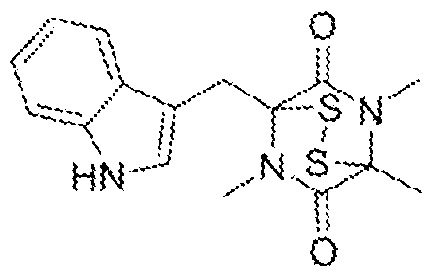 -4,5,7-trimethyl-2,3-dithia-5,7-diazabicyclo[2.2.2]octane-6,8- dione – CMP5-142: A flame dried round bottom flask equipped with stirrer bar was charged with tert-butyl 3-((1,4-dimethyl-3,5,6-trioxo-2-(trityldisulfaneyl)piperazin-2-yl)methyl)- 1H-indole-1-carboxylate (547 mg, 0.792 mmol, 1 equiv) in THF (5.5 mL, 0.1 M) and cooled to -78 °C. Methylmagnesium bromide (3 M in Et2O, 396 µL 1.18 mmol, 1.5 equiv) was then added dropwise and the reaction mixture was stirred for 30 min at –78 °C. The reaction mixture was warmed to room temperature and quenched with sat. aqueous NH4Cl (10 mL) and extracted with EtOAc (10 mL). The organic phase was washed with brine (10 mL) before being dried with MgSO4 and concentrated under reduced pressure. [0249] The mixture of diastereomeric alcohols (assumed quant, 0.792 mmol) was dissolved in MeCN (220 mL), 0.0357 M), charged with a stirrer bar and purged with nitrogen. To this solution was added Ha(OTf)4 (920 mg, 1.18 mmol) in one portion. The solution immediately turned bright yellow. After 30 min, sat. NaHCO3 (50 mL) was added and the mixture extracted with EtOAc (2 x 100 mL), and washed with sat. brine (50 mL). The organic phase was then dried with MgSO4 and concentrated under reduced pressure. Purification by column chromatography [SiO2, 20-50% EtOAc/petroleum ether] yielded the title compound (93 mg, 34%, over 2 steps). [0250] IR (thin film): 3343, 2939, 2218, 1677, 1458, 1348, 909, 733 cm-1.1H NMR (500 MHz, CDCl3) δ 8.36 (s, 1H), 7.67 – 7.61 (m, 1H), 7.37 – 7.32 (m, 1H), 7.31 – 7.07 (m, 3H), 5.29 (d, J = 4.8 Hz, 0H), 4.01 (dd, J = 15.6, 4.3 Hz, 1H), 3.73 (dd, J = 15.1, 3.7 Hz, 1H), 3.12 (s, 3H), 2.99 (s, 3H), 2.03 (s, 3H).13C NMR (126 MHz, CDCl3) δ 166.92, 165.76, 135.56, 130.53, 128.03, 127.64,
4239-109793-02 E-089-2023-0-PC-01 124.40, 122.39, 119.94, 118.12, 111.51, 108.45, 72.43, 28.69, 27.90,19.07. C16H17O2N3NaS2 requires 370.0654, actual 370.0654, Δ = 0.0002 ppm. -5,7-dimethyl-2,3-dithia-5,7-diazabicyclo
-4,5,7-trimethyl-2,3-dithia-5,7-diazabicyclo[2.2.2]octane-6,8- dione – CMP5-142: A flame dried round bottom flask equipped with stirrer bar was charged with tert-butyl 3-((1,4-dimethyl-3,5,6-trioxo-2-(trityldisulfaneyl)piperazin-2-yl)methyl)- 1H-indole-1-carboxylate (547 mg, 0.792 mmol, 1 equiv) in THF (5.5 mL, 0.1 M) and cooled to -78 °C. Methylmagnesium bromide (3 M in Et2O, 396 µL 1.18 mmol, 1.5 equiv) was then added dropwise and the reaction mixture was stirred for 30 min at –78 °C. The reaction mixture was warmed to room temperature and quenched with sat. aqueous NH4Cl (10 mL) and extracted with EtOAc (10 mL). The organic phase was washed with brine (10 mL) before being dried with MgSO4 and concentrated under reduced pressure. [0249] The mixture of diastereomeric alcohols (assumed quant, 0.792 mmol) was dissolved in MeCN (220 mL), 0.0357 M), charged with a stirrer bar and purged with nitrogen. To this solution was added Ha(OTf)4 (920 mg, 1.18 mmol) in one portion. The solution immediately turned bright yellow. After 30 min, sat. NaHCO3 (50 mL) was added and the mixture extracted with EtOAc (2 x 100 mL), and washed with sat. brine (50 mL). The organic phase was then dried with MgSO4 and concentrated under reduced pressure. Purification by column chromatography [SiO2, 20-50% EtOAc/petroleum ether] yielded the title compound (93 mg, 34%, over 2 steps). [0250] IR (thin film): 3343, 2939, 2218, 1677, 1458, 1348, 909, 733 cm-1.1H NMR (500 MHz, CDCl3) δ 8.36 (s, 1H), 7.67 – 7.61 (m, 1H), 7.37 – 7.32 (m, 1H), 7.31 – 7.07 (m, 3H), 5.29 (d, J = 4.8 Hz, 0H), 4.01 (dd, J = 15.6, 4.3 Hz, 1H), 3.73 (dd, J = 15.1, 3.7 Hz, 1H), 3.12 (s, 3H), 2.99 (s, 3H), 2.03 (s, 3H).13C NMR (126 MHz, CDCl3) δ 166.92, 165.76, 135.56, 130.53, 128.03, 127.64,
4239-109793-02 E-089-2023-0-PC-01 124.40, 122.39, 119.94, 118.12, 111.51, 108.45, 72.43, 28.69, 27.90,19.07. C16H17O2N3NaS2 requires 370.0654, actual 370.0654, Δ = 0.0002 ppm. -5,7-dimethyl-2,3-dithia-5,7-diazabicyclo
 [2.2.2]octane-6,8-dione CMP6-93: A flame dried round bottom flask equipped with stirrer bar was charged with tert-butyl 3-((1,4-dimethyl-3,5,6-trioxo-2-(trityldisulfaneyl)piperazin- 2-yl)methyl)-1H-indole-1-carboxylate (2.07 g, 3.0 mmol, 1 equiv) in THF (30 mL, 0.1 M) and cooled to –78 °C. Methylmagnesium bromide (1.5 mL, 4.5 mmol, 3 M in Et2O, 1.5 equiv) was then added dropwise and the reaction mixture was stirred for 30 min at -78 °C. The reaction mixture was warmed to room temperature and quenched with sat. aqueous NH4Cl (50 mL) and extracted with EtOAc (100 mL). The organic phase was washed with brine (50 mL) before being dried with MgSO4 and concentrated under reduced pressure. [0253] The mixture of diastereomeric alcohols (assumed quant) was dissolved in dichloromethane (12 mL, 0.25 M) and cooled to –78 °C. Triethylamine (836 µL, 6 mmol, 2 equiv) was added followed by methanesulfonyl chloride (348 µL, 4.5 mmol, 1.5 equiv) dropwise. The reaction was stirred for 30 min then warmed to room temperature, diluted with DCM (50 mL) and quenched with HCl (1 M, 50 mL). The organics were separated, dried with Na2SO4 and concentrated. The product was pure enough to use in the subsequent step without purification. [0254] 1H NMR (600 MHz, CDCl3) δ 7.99 (d, J = 7.9 Hz, 1H), 7.43 – 6.90 (m, 19H), 5.67 (d, J = 1.3 Hz, 1H), 4.64 (d, J = 1.3 Hz, 1H), 3.63 (dd, J = 15.6, 1.2 Hz, 1H), 2.86 (app d, J = 5.3 Hz, 6H), 2.46 (d, J = 15.7 Hz, 1H), 1.56 (s, 9H). [0255] The exocyclic alkene (assumed quant) was dissolved in acetone/H2O (4:1, 22.5 mL 0.133M). Osmium tetroxide (38 mg, 0.15 mmol, 5 mol%) and N-methylmorpholine N-oxide (703 mg, 6.0 mmol, 2 equiv) were then added and the reaction mixture was stirred at room temperature for 16 h, during which time the reaction became homogeneous. The reaction mixture was then poured into a 1:1 mixture of EtOAc and sat. NaHCO3. The layers were separated, and the aqueous phase was extracted twice more with EtOAc (50 mL). The combined organics were then washed with H2O (50 mL) and brine (50 mL) before being dried with MgSO4 and concentrated under reduced pressure. The diastereomeric diols (1.3 g, 61% over 3 steps) were isolated as a
4239-109793-02 E-089-2023-0-PC-01 yellow foam following purification by column chromatography [SiO2, 25–50% EtOAc/petroleum ether]. [0256] A flame dried round bottom flask equipped with stirrer bar was charged with diols (530 mg, 0.732 mmol, 1 equiv) in DCM (3.6 mL, 0.2 M) under nitrogen and cooled to –78 °C. Boron trifluoride diethyl etherate (356 µL, 2.93 mmol, 4 equiv) was then added dropwise. The reaction mixture was stirred at this temperature for 15 min, then warmed to room temperature and stirred for 15 min. Another portion of boron trifluoride diethyl etherate (100 µL, 0.823 mmol) was then added. After 10 min, sat. NaHCO3 (10 mL) was added and extracted with DCM (50 mL). The combined organics were then washed with brine (20 mL) before being dried with Na2SO4 and concentrated under reduced pressure. The title compound was obtained (130 mg, 49%) as a clear oil following purification by column chromatography [SiO2, 25–50% EtOAc/petroleum ether]. [0257] IR (thin film): 3343, 2902, 2209, 1676, 1423, 1361, 1102, 925, 751 cm-1. 1H NMR (400 MHz, CDCl3) δ 8.16 (s, 1H), 7.65 (d, J = 7.6 Hz, 1H), 7.39 (d, J = 7.8 Hz, 1H), 7.25-7.16 (m,3H), 4.38 (d, J = 12.6 Hz, 1H), 4.29 (d, J = 12.7 Hz, 1H), 4.01 (d, J = 15.5 Hz, 1H), 3.76 (d, J = 15.4 Hz, 1H), 3.50 (s, 1H), 3.22 (s, H), 3.01 (s, 3H). C16H16O3N3S2 requires 364.0784, actual 364.0787, Δ = 0.82 ppm.
[2.2.2]octane-6,8-dione CMP6-93: A flame dried round bottom flask equipped with stirrer bar was charged with tert-butyl 3-((1,4-dimethyl-3,5,6-trioxo-2-(trityldisulfaneyl)piperazin- 2-yl)methyl)-1H-indole-1-carboxylate (2.07 g, 3.0 mmol, 1 equiv) in THF (30 mL, 0.1 M) and cooled to –78 °C. Methylmagnesium bromide (1.5 mL, 4.5 mmol, 3 M in Et2O, 1.5 equiv) was then added dropwise and the reaction mixture was stirred for 30 min at -78 °C. The reaction mixture was warmed to room temperature and quenched with sat. aqueous NH4Cl (50 mL) and extracted with EtOAc (100 mL). The organic phase was washed with brine (50 mL) before being dried with MgSO4 and concentrated under reduced pressure. [0253] The mixture of diastereomeric alcohols (assumed quant) was dissolved in dichloromethane (12 mL, 0.25 M) and cooled to –78 °C. Triethylamine (836 µL, 6 mmol, 2 equiv) was added followed by methanesulfonyl chloride (348 µL, 4.5 mmol, 1.5 equiv) dropwise. The reaction was stirred for 30 min then warmed to room temperature, diluted with DCM (50 mL) and quenched with HCl (1 M, 50 mL). The organics were separated, dried with Na2SO4 and concentrated. The product was pure enough to use in the subsequent step without purification. [0254] 1H NMR (600 MHz, CDCl3) δ 7.99 (d, J = 7.9 Hz, 1H), 7.43 – 6.90 (m, 19H), 5.67 (d, J = 1.3 Hz, 1H), 4.64 (d, J = 1.3 Hz, 1H), 3.63 (dd, J = 15.6, 1.2 Hz, 1H), 2.86 (app d, J = 5.3 Hz, 6H), 2.46 (d, J = 15.7 Hz, 1H), 1.56 (s, 9H). [0255] The exocyclic alkene (assumed quant) was dissolved in acetone/H2O (4:1, 22.5 mL 0.133M). Osmium tetroxide (38 mg, 0.15 mmol, 5 mol%) and N-methylmorpholine N-oxide (703 mg, 6.0 mmol, 2 equiv) were then added and the reaction mixture was stirred at room temperature for 16 h, during which time the reaction became homogeneous. The reaction mixture was then poured into a 1:1 mixture of EtOAc and sat. NaHCO3. The layers were separated, and the aqueous phase was extracted twice more with EtOAc (50 mL). The combined organics were then washed with H2O (50 mL) and brine (50 mL) before being dried with MgSO4 and concentrated under reduced pressure. The diastereomeric diols (1.3 g, 61% over 3 steps) were isolated as a
4239-109793-02 E-089-2023-0-PC-01 yellow foam following purification by column chromatography [SiO2, 25–50% EtOAc/petroleum ether]. [0256] A flame dried round bottom flask equipped with stirrer bar was charged with diols (530 mg, 0.732 mmol, 1 equiv) in DCM (3.6 mL, 0.2 M) under nitrogen and cooled to –78 °C. Boron trifluoride diethyl etherate (356 µL, 2.93 mmol, 4 equiv) was then added dropwise. The reaction mixture was stirred at this temperature for 15 min, then warmed to room temperature and stirred for 15 min. Another portion of boron trifluoride diethyl etherate (100 µL, 0.823 mmol) was then added. After 10 min, sat. NaHCO3 (10 mL) was added and extracted with DCM (50 mL). The combined organics were then washed with brine (20 mL) before being dried with Na2SO4 and concentrated under reduced pressure. The title compound was obtained (130 mg, 49%) as a clear oil following purification by column chromatography [SiO2, 25–50% EtOAc/petroleum ether]. [0257] IR (thin film): 3343, 2902, 2209, 1676, 1423, 1361, 1102, 925, 751 cm-1. 1H NMR (400 MHz, CDCl3) δ 8.16 (s, 1H), 7.65 (d, J = 7.6 Hz, 1H), 7.39 (d, J = 7.8 Hz, 1H), 7.25-7.16 (m,3H), 4.38 (d, J = 12.6 Hz, 1H), 4.29 (d, J = 12.7 Hz, 1H), 4.01 (d, J = 15.5 Hz, 1H), 3.76 (d, J = 15.4 Hz, 1H), 3.50 (s, 1H), 3.22 (s, H), 3.01 (s, 3H). C16H16O3N3S2 requires 364.0784, actual 364.0787, Δ = 0.82 ppm.
 - (hydroxymethyl)-5,7-dimethyl-2,3-dithia-5,7- diazabicyclo[2.2.2]octane-6,8-dione CMP6-7: A flame dried round bottom flask equipped with stirrer bar was charged with 6-(benzo[d][1,3]dioxol-5-ylmethyl)-1,4-dimethyl-6- (trityldisulfaneyl)piperazine-2,3,5-trione (2.3 g 3.85 mmol, 1 equiv) in THF (38.5 mL, 0.1 M) and cooled to –78 °C. Methylmagnesium bromide (3 M in Et2O, 1.93 mL, 5.78 mmol, 1.5 equiv) was
4239-109793-02 E-089-2023-0-PC-01 then added dropwise and the reaction mixture was stirred for 30 min at –78 °C. The reaction mixture was warmed to room temperature and quenched with sat. aqueous NH4Cl (70 mL) and extracted with EtOAc (70 mL). The organic phase was washed with brine (50 mL) before being dried with MgSO4 and concentrated under reduced pressure. [0266] The mixture of diastereomeric alcohols (1.74 g 2.85 mmol) was dissolved in dichloromethane (11.4 mL, 0.25M) and cooled to –78 °C. Triethylamine (795 µL, 5.7 mmol, 2 equiv) was added followed by methanesulfonyl chloride (331 µL, 4.27 mmol, 1.5 equiv) dropwise. The reaction was stirred for 30 min then warmed to room temperature over 30 min, diluted with DCM (50 mL) and quenched with HCl (1 M, 50 mL). The organics were separated, dried with Na2SO4 and concentrated. The product (brown foam) was pure enough to use in the subsequent step without purification. [0267] The exocyclic alkene (2.85 mmol) was dissolved in acetone/H2O (4:1, 28.5 mL 0.1 M). Osmium tetroxide (72 mg, 0.285 mmol, 10 mol%) and N-methylmorpholine N-oxide (668 mg, 5.7 mmol, 2 equiv) were then added and the reaction mixture was stirred at room temperature for 16 h, during which time the reaction became homogeneous. The reaction mixture was then poured into a 1:1 mixture of EtOAc and sat. NaHCO3. The layers were separated, and the aqueous phase was extracted twice more with EtOAc (50 mL). The combined organics were then washed with H2O (50 mL) and brine (50 mL) before being dried with MgSO4 and concentrated under reduced pressure. The diastereomeric diols (1.35 g) were isolated as a white foam and used without purification. [0268] A flame dried round bottom flask equipped with stirrer bar was charged with diols (1.35 g, 2.15 mmol, 1 equiv) in DCM (12 mL, 0.18 M) under nitrogen and cooled to –78 °C. Boron trifluoride diethyl etherate (704 µL, 5.70 mmol, 3 equiv) was then added dropwise. The reaction mixture was stirred at this temperature for 30 min, then warmed to room temperature and stirred for 30 min. The reaction was then quenched with sat. NaHCO3 (10 mL) was added and extracted with DCM (50 mL). The combined organics were then washed with brine (20 mL) before being dried with Na2SO4 and concentrated under reduced pressure. The title compound was obtained (200 mg, 19% over 3 steps) as a clear oil following purification by column chromatography [SiO2, 20–30% EtOAc/petroleum ether]. [0269] IR (thin film): 3472, 2895, 1677, 1503, 1489, 1347, 1038, 925 cm-1.1H NMR (500 MHz, CDCl3) δ 6.89 (s, 1H), 6.81 – 6.69 (m, 2H), 5.94 (s, 2H), 4.37 (d, J = 12.6 Hz, 1H), 4.29 (d, J = 12.6 Hz, 1H), 3.94 (d, J = 15.4 Hz, 1H), 3.58 (d, J = 15.4 Hz, 1H), 3.19 (s, 3H), 3.01 (s, 3H).13C NMR (126 MHz, CDCl3) δ 167.05, 165.68, 147.98, 147.06, 127.61, 123.05, 110.08, 108.37,
4239-109793-02 E-089-2023-0-PC-01 101.30, 76.13, 75.14, 61.34, 36.68, 28.69, 27.65. C15H16O5N2NaS2 requires 391.0393, actual 391.0393, Δ = 0.0002 ppm. [0270] Examples 2-6 [0271] The compounds of Table 1 subsequently were evaluated in several assays. [0272] Table 1 –ETP Compounds Compound Structure Compound Structure
- (hydroxymethyl)-5,7-dimethyl-2,3-dithia-5,7- diazabicyclo[2.2.2]octane-6,8-dione CMP6-7: A flame dried round bottom flask equipped with stirrer bar was charged with 6-(benzo[d][1,3]dioxol-5-ylmethyl)-1,4-dimethyl-6- (trityldisulfaneyl)piperazine-2,3,5-trione (2.3 g 3.85 mmol, 1 equiv) in THF (38.5 mL, 0.1 M) and cooled to –78 °C. Methylmagnesium bromide (3 M in Et2O, 1.93 mL, 5.78 mmol, 1.5 equiv) was
4239-109793-02 E-089-2023-0-PC-01 then added dropwise and the reaction mixture was stirred for 30 min at –78 °C. The reaction mixture was warmed to room temperature and quenched with sat. aqueous NH4Cl (70 mL) and extracted with EtOAc (70 mL). The organic phase was washed with brine (50 mL) before being dried with MgSO4 and concentrated under reduced pressure. [0266] The mixture of diastereomeric alcohols (1.74 g 2.85 mmol) was dissolved in dichloromethane (11.4 mL, 0.25M) and cooled to –78 °C. Triethylamine (795 µL, 5.7 mmol, 2 equiv) was added followed by methanesulfonyl chloride (331 µL, 4.27 mmol, 1.5 equiv) dropwise. The reaction was stirred for 30 min then warmed to room temperature over 30 min, diluted with DCM (50 mL) and quenched with HCl (1 M, 50 mL). The organics were separated, dried with Na2SO4 and concentrated. The product (brown foam) was pure enough to use in the subsequent step without purification. [0267] The exocyclic alkene (2.85 mmol) was dissolved in acetone/H2O (4:1, 28.5 mL 0.1 M). Osmium tetroxide (72 mg, 0.285 mmol, 10 mol%) and N-methylmorpholine N-oxide (668 mg, 5.7 mmol, 2 equiv) were then added and the reaction mixture was stirred at room temperature for 16 h, during which time the reaction became homogeneous. The reaction mixture was then poured into a 1:1 mixture of EtOAc and sat. NaHCO3. The layers were separated, and the aqueous phase was extracted twice more with EtOAc (50 mL). The combined organics were then washed with H2O (50 mL) and brine (50 mL) before being dried with MgSO4 and concentrated under reduced pressure. The diastereomeric diols (1.35 g) were isolated as a white foam and used without purification. [0268] A flame dried round bottom flask equipped with stirrer bar was charged with diols (1.35 g, 2.15 mmol, 1 equiv) in DCM (12 mL, 0.18 M) under nitrogen and cooled to –78 °C. Boron trifluoride diethyl etherate (704 µL, 5.70 mmol, 3 equiv) was then added dropwise. The reaction mixture was stirred at this temperature for 30 min, then warmed to room temperature and stirred for 30 min. The reaction was then quenched with sat. NaHCO3 (10 mL) was added and extracted with DCM (50 mL). The combined organics were then washed with brine (20 mL) before being dried with Na2SO4 and concentrated under reduced pressure. The title compound was obtained (200 mg, 19% over 3 steps) as a clear oil following purification by column chromatography [SiO2, 20–30% EtOAc/petroleum ether]. [0269] IR (thin film): 3472, 2895, 1677, 1503, 1489, 1347, 1038, 925 cm-1.1H NMR (500 MHz, CDCl3) δ 6.89 (s, 1H), 6.81 – 6.69 (m, 2H), 5.94 (s, 2H), 4.37 (d, J = 12.6 Hz, 1H), 4.29 (d, J = 12.6 Hz, 1H), 3.94 (d, J = 15.4 Hz, 1H), 3.58 (d, J = 15.4 Hz, 1H), 3.19 (s, 3H), 3.01 (s, 3H).13C NMR (126 MHz, CDCl3) δ 167.05, 165.68, 147.98, 147.06, 127.61, 123.05, 110.08, 108.37,
4239-109793-02 E-089-2023-0-PC-01 101.30, 76.13, 75.14, 61.34, 36.68, 28.69, 27.65. C15H16O5N2NaS2 requires 391.0393, actual 391.0393, Δ = 0.0002 ppm. [0270] Examples 2-6 [0271] The compounds of Table 1 subsequently were evaluated in several assays. [0272] Table 1 –ETP Compounds Compound Structure Compound Structure
 [ ] xamp e – at ort c ng ( ) ssay of ng ogenes s [0274] The compounds of Table 1 were tested in the RAR model at an initial 1 μM screening dose (Reece et al., Mol Cancer, April 28, 2014, 13:91). Rat aortic microvessel outgrowth was normalized to 100% based on vehicle (DMSO) control. The positive controls (30 μM CAI and
4239-109793-02 E-089-2023-0-PC-01 1 μM chetomin) inhibited microvessel outgrowth by 92% and 95%, respectively. The compounds of Table 1 all potently inhibited microvessel outgrowths (FIG.1). At a concentration of 1 µM, compounds CMP5-47, CMP5-87, CMP5-142, CMP6-7, CMP6-93 and JF730 displayed anti-angiogenic activity of greater than or equal to approximately 93% inhibition of microvessel outgrowths, comparable to that of the 30 µM CAI and 1 µM chetomin positive controls (Table 2, FIG.2). Anti-angiogenic activity of the ETP compounds is evident by the lack of microvessel outgrowth in treated rings compared to the untreated vehicle (DSMO) control. Three of the compounds – CMP6-7, CMP-693, and JF730 demonstrated >95% inhibition of angiogenesis. [0275] Table 2 – Anti-angiogenic activity of newly synthesized epidithiodiketopiperazines in the RAR assay Test Compound % Inhibition [0276] Example 3 – Lattic
[ ] xamp e – at ort c ng ( ) ssay of ng ogenes s [0274] The compounds of Table 1 were tested in the RAR model at an initial 1 μM screening dose (Reece et al., Mol Cancer, April 28, 2014, 13:91). Rat aortic microvessel outgrowth was normalized to 100% based on vehicle (DMSO) control. The positive controls (30 μM CAI and
4239-109793-02 E-089-2023-0-PC-01 1 μM chetomin) inhibited microvessel outgrowth by 92% and 95%, respectively. The compounds of Table 1 all potently inhibited microvessel outgrowths (FIG.1). At a concentration of 1 µM, compounds CMP5-47, CMP5-87, CMP5-142, CMP6-7, CMP6-93 and JF730 displayed anti-angiogenic activity of greater than or equal to approximately 93% inhibition of microvessel outgrowths, comparable to that of the 30 µM CAI and 1 µM chetomin positive controls (Table 2, FIG.2). Anti-angiogenic activity of the ETP compounds is evident by the lack of microvessel outgrowth in treated rings compared to the untreated vehicle (DSMO) control. Three of the compounds – CMP6-7, CMP-693, and JF730 demonstrated >95% inhibition of angiogenesis. [0275] Table 2 – Anti-angiogenic activity of newly synthesized epidithiodiketopiperazines in the RAR assay Test Compound % Inhibition [0276] Example 3 – Lattic
 R1 is aryl or heteroaryl; R2 is -H, aliphatic, heteroaliphatic, aryl, or heteroaryl; R3 and R4 independently are aliphatic, heteroaliphatic, -H, -C(O)ORa, or -C(O)Ra; and each Ra independently is -H, aliphatic, or heteroaliphatic, wherein if R1 is phenyl or substituted phenyl, R3 is methyl, and R4 is methyl, then R2 is not -H, methyl, hydroxymethyl, phenyl, halo-substituted phenyl, trifluoromethoxy-substituted phenyl, methyl-substituted phenyl, or if R1 is pyridinyl, R3 is
 is not methyl. 2. The compound of claim 1, wherein R1 is: , where
 R5-R7 and R11-R15 independently are -H, aliphatic, halo, -ORa, -N(Ra)2, -SRa, -C(O)ORa, or -C(O)Ra; R8 and R9 independently are -H, aliphatic, halo, -ORa, -N(Ra)2, -SRa, -C(O)ORa, or -C(O)Ra, or R8 and R9 together 2; R10 is -H,
 (O)ORa, or -C(O)Ra; and each Ra independently is -H, aliphatic, or heteroaliphatic.
4239-109793-02 E-089-2023-0-PC-01 3. The compound of claim 2, wherein R5-R7 and R11-R15 independently are -H, unsubstituted or substituted C1-C6 alkyl, halo, -ORa, -N(Ra)2, -SRa, -C(O)ORa, or -C(O)Ra. 4. The compound of claim 2 or claim 3, wherein R5-R7 and R11-R15 independently are -H, C1-C3 alkyl, substituted C1-C3 alkyl, halo, -ORa, or -N(Ra)2 where each Ra independently is -H or C1-C3 alkyl. 5. The compound of any one of claims 2-4, wherein: R7 R8 O
(O)ORa, or -C(O)Ra; and each Ra independently is -H, aliphatic, or heteroaliphatic.
4239-109793-02 E-089-2023-0-PC-01 3. The compound of claim 2, wherein R5-R7 and R11-R15 independently are -H, unsubstituted or substituted C1-C6 alkyl, halo, -ORa, -N(Ra)2, -SRa, -C(O)ORa, or -C(O)Ra. 4. The compound of claim 2 or claim 3, wherein R5-R7 and R11-R15 independently are -H, C1-C3 alkyl, substituted C1-C3 alkyl, halo, -ORa, or -N(Ra)2 where each Ra independently is -H or C1-C3 alkyl. 5. The compound of any one of claims 2-4, wherein: R7 R8 O
 R8 and R9 are -H or, R8 and R9 together .
 6. The compound of any one of claims 2-4, wherein: R12 R13
 Rb is -H and n is 1, 2, 3, 4, 5, or 6. 7. The compound of any one of claims 1-6, wherein each Ra is -H or methyl. 8. The compound of claim 1, wherein R1 is .
 9. The compound of any one of claims 1-8, wherein R2 is -H, alkyl, heteroalkyl, aryl, or heteroaryl.
4239-109793-02 E-089-2023-0-PC-01 10. The compound of any one of claims 1-9, wherein R2 is: -H; or -(CH2)pRc, where p is 1, 2, 3, 4, 5, 6, 7, 8, 9, or 10, and Rc is -H, -ORa, -SRa, -N(Ra)2, -C(O)ORa, or -C(O)Ra, where Ra is -H, aliphatic, or heteroaliphatic; or substituted phenyl. 11. The compound of any one of claims 1-10, wherein R2 is -H, -(CH2)pH, -(CH2)pOH, or substituted phenyl. 12. The compound of any one of claims 1-11, wherein R2 is -H, -CH3, -CH2OH, or CF3 . The compound of claim 1, wherein the compound is:
9. The compound of any one of claims 1-8, wherein R2 is -H, alkyl, heteroalkyl, aryl, or heteroaryl.
4239-109793-02 E-089-2023-0-PC-01 10. The compound of any one of claims 1-9, wherein R2 is: -H; or -(CH2)pRc, where p is 1, 2, 3, 4, 5, 6, 7, 8, 9, or 10, and Rc is -H, -ORa, -SRa, -N(Ra)2, -C(O)ORa, or -C(O)Ra, where Ra is -H, aliphatic, or heteroaliphatic; or substituted phenyl. 11. The compound of any one of claims 1-10, wherein R2 is -H, -(CH2)pH, -(CH2)pOH, or substituted phenyl. 12. The compound of any one of claims 1-11, wherein R2 is -H, -CH3, -CH2OH, or CF3 . The compound of claim 1, wherein the compound is:
 , .
, .
 14. The compound of claim 1, wherein the compound is: .
 4239-109793-02 E-089-2023-0-PC-01 15. A pharmaceutical composition, comprising: a compound, or a stereoisomer or pharmaceutical salt, solvate, or hydrate thereof, according to any one of claims 1-14; and a pharmaceutically acceptable carrier. 16. A method for inhibiting hypoxia inducible factor 1 (HIF-1), comprising contacting a cell expressing HIF-1 with an effective amount of a compound, or a stereoisomer or pharmaceutical salt, solvate, or hydrate thereof, according to any one of claims 1-14. 17. The method of claim 16, wherein inhibiting HIF-1 comprises inhibiting an interaction between an HIF-1α subunit and histone acetyltransferase p300. 18. The method of claim 16 or claim 17, wherein contacting the cell with an effective amount of the compound, or stereoisomer or pharmaceutically acceptable salt, solvate, or hydrate thereof, comprises administering to a subject a therapeutically effective amount of the compound, or stereoisomer or pharmaceutically acceptable salt, solvate, or hydrate thereof, or a therapeutically effective amount of a pharmaceutical composition comprising the compound, or stereoisomer or pharmaceutically acceptable salt, solvate, or hydrate thereof. 19. The method of claim 18, wherein the subject has a condition characterized at least in part by abnormal levels of HIF-1 activity. 20. The method of claim 19, wherein administering to the subject the therapeutically effective amount of the compound, or stereoisomer or pharmaceutically acceptable salt, solvate, or hydrate thereof, or the therapeutically effective amount of the pharmaceutical composition comprising the compound, or stereoisomer or pharmaceutically acceptable salt, solvate, or hydrate thereof inhibits HIF-1 activity. 21. The method of claim 18, wherein the subject has a condition characterized by angiogenesis, tumorigenicity, inflammation, immunosuppression, an immunological disease, a microbial infection, a fungal infection, a viral infection, or any combination thereof. 22. The method of claim 21, wherein the subject has cancer.
4239-109793-02 E-089-2023-0-PC-01 23. The method of claim 22, wherein the cancer is prostate cancer, colon cancer, multiple myeloma, or acute myeloid leukemia. 24. The method of any one of claims 21-23, wherein administering to the subject the therapeutically effective amount of the compound, or stereoisomer or pharmaceutically acceptable salt, solvate, or hydrate thereof, or the therapeutically effective amount of the pharmaceutical composition comprising the compound, or stereoisomer or pharmaceutically acceptable salt, solvate, or hydrate thereof inhibits angiogenesis, inhibits tumor growth, inhibits inflammation, ameliorates the microbial infection, ameliorates the fungal infection, ameliorates the viral infection, or any combination thereof. 25. The method of any one of claims 18-24, further comprising administering to the subject an additional therapeutic agent, an additional therapeutic modality, or a combination thereof. 26. The method of claim 25, wherein the additional therapeutic agent, additional therapeutic modality, or combination thereof comprises an anti-cancer agent, an anti-inflammatory agent, an antimicrobial agent, an antifungal agent, an antiviral agent, an immunological disease therapeutic agent, surgery, radiation, or any combination thereof. 27. The method of any one of claims 16-26, wherein the compound is: , or any combination thereof.
4239-109793-02 E-089-2023-0-PC-01 15. A pharmaceutical composition, comprising: a compound, or a stereoisomer or pharmaceutical salt, solvate, or hydrate thereof, according to any one of claims 1-14; and a pharmaceutically acceptable carrier. 16. A method for inhibiting hypoxia inducible factor 1 (HIF-1), comprising contacting a cell expressing HIF-1 with an effective amount of a compound, or a stereoisomer or pharmaceutical salt, solvate, or hydrate thereof, according to any one of claims 1-14. 17. The method of claim 16, wherein inhibiting HIF-1 comprises inhibiting an interaction between an HIF-1α subunit and histone acetyltransferase p300. 18. The method of claim 16 or claim 17, wherein contacting the cell with an effective amount of the compound, or stereoisomer or pharmaceutically acceptable salt, solvate, or hydrate thereof, comprises administering to a subject a therapeutically effective amount of the compound, or stereoisomer or pharmaceutically acceptable salt, solvate, or hydrate thereof, or a therapeutically effective amount of a pharmaceutical composition comprising the compound, or stereoisomer or pharmaceutically acceptable salt, solvate, or hydrate thereof. 19. The method of claim 18, wherein the subject has a condition characterized at least in part by abnormal levels of HIF-1 activity. 20. The method of claim 19, wherein administering to the subject the therapeutically effective amount of the compound, or stereoisomer or pharmaceutically acceptable salt, solvate, or hydrate thereof, or the therapeutically effective amount of the pharmaceutical composition comprising the compound, or stereoisomer or pharmaceutically acceptable salt, solvate, or hydrate thereof inhibits HIF-1 activity. 21. The method of claim 18, wherein the subject has a condition characterized by angiogenesis, tumorigenicity, inflammation, immunosuppression, an immunological disease, a microbial infection, a fungal infection, a viral infection, or any combination thereof. 22. The method of claim 21, wherein the subject has cancer.
4239-109793-02 E-089-2023-0-PC-01 23. The method of claim 22, wherein the cancer is prostate cancer, colon cancer, multiple myeloma, or acute myeloid leukemia. 24. The method of any one of claims 21-23, wherein administering to the subject the therapeutically effective amount of the compound, or stereoisomer or pharmaceutically acceptable salt, solvate, or hydrate thereof, or the therapeutically effective amount of the pharmaceutical composition comprising the compound, or stereoisomer or pharmaceutically acceptable salt, solvate, or hydrate thereof inhibits angiogenesis, inhibits tumor growth, inhibits inflammation, ameliorates the microbial infection, ameliorates the fungal infection, ameliorates the viral infection, or any combination thereof. 25. The method of any one of claims 18-24, further comprising administering to the subject an additional therapeutic agent, an additional therapeutic modality, or a combination thereof. 26. The method of claim 25, wherein the additional therapeutic agent, additional therapeutic modality, or combination thereof comprises an anti-cancer agent, an anti-inflammatory agent, an antimicrobial agent, an antifungal agent, an antiviral agent, an immunological disease therapeutic agent, surgery, radiation, or any combination thereof. 27. The method of any one of claims 16-26, wherein the compound is: , or any combination thereof.
 4239-109793-02 E-089-2023-0-PC-01 28. The method of any one of claims 16-26, wherein the compound is: , or a combination thereof.
 29. A compound, or a stereoisomer or pharmaceutical salt, solvate, or hydrate thereof, according to any one of claims 1-14 for use in a method of inhibiting HIF-1. 30. A compound, or a stereoisomer or pharmaceutical salt, solvate, or hydrate thereof, according to any one of claims 1-14 for use in treating a condition characterized at least in part by abnormal levels of HIF-1 activity, particularly wherein the condition is characterized at least in part by angiogenesis, tumorigenicity, inflammation, immunosuppression, an immunological disease, a microbial infection, a fungal infection, a viral infection, or any combination thereof. 31. The compound of claim 30, wherein the condition is cancer. 32. The compound of claim 31, wherein the cancer is prostate cancer, colon cancer, multiple myeloma, or acute myeloid leukemia. 33. The compound of any one of claims 29-32, wherein the compound is: , , or any combination thereof.
 4239-109793-02 E-089-2023-0-PC-01 34. The compound of any one of claims 29-32, wherein the compound is: , or a combination thereof.
