WO2024258693A1 - Ethylene tar dispersants and charge gas compressor surface modifiers - Google Patents
Ethylene tar dispersants and charge gas compressor surface modifiers Download PDFInfo
- Publication number
- WO2024258693A1 WO2024258693A1 PCT/US2024/032476 US2024032476W WO2024258693A1 WO 2024258693 A1 WO2024258693 A1 WO 2024258693A1 US 2024032476 W US2024032476 W US 2024032476W WO 2024258693 A1 WO2024258693 A1 WO 2024258693A1
- Authority
- WO
- WIPO (PCT)
- Prior art keywords
- pct
- reaction product
- added
- ppm
- amount
- Prior art date
- Legal status (The legal status is an assumption and is not a legal conclusion. Google has not performed a legal analysis and makes no representation as to the accuracy of the status listed.)
- Ceased
Links
Classifications
-
- C—CHEMISTRY; METALLURGY
- C10—PETROLEUM, GAS OR COKE INDUSTRIES; TECHNICAL GASES CONTAINING CARBON MONOXIDE; FUELS; LUBRICANTS; PEAT
- C10G—CRACKING HYDROCARBON OILS; PRODUCTION OF LIQUID HYDROCARBON MIXTURES, e.g. BY DESTRUCTIVE HYDROGENATION, OLIGOMERISATION, POLYMERISATION; RECOVERY OF HYDROCARBON OILS FROM OIL-SHALE, OIL-SAND, OR GASES; REFINING MIXTURES MAINLY CONSISTING OF HYDROCARBONS; REFORMING OF NAPHTHA; MINERAL WAXES
- C10G9/00—Thermal non-catalytic cracking, in the absence of hydrogen, of hydrocarbon oils
- C10G9/14—Thermal non-catalytic cracking, in the absence of hydrogen, of hydrocarbon oils in pipes or coils with or without auxiliary means, e.g. digesters, soaking drums, expansion means
- C10G9/16—Preventing or removing incrustation
-
- C—CHEMISTRY; METALLURGY
- C10—PETROLEUM, GAS OR COKE INDUSTRIES; TECHNICAL GASES CONTAINING CARBON MONOXIDE; FUELS; LUBRICANTS; PEAT
- C10G—CRACKING HYDROCARBON OILS; PRODUCTION OF LIQUID HYDROCARBON MIXTURES, e.g. BY DESTRUCTIVE HYDROGENATION, OLIGOMERISATION, POLYMERISATION; RECOVERY OF HYDROCARBON OILS FROM OIL-SHALE, OIL-SAND, OR GASES; REFINING MIXTURES MAINLY CONSISTING OF HYDROCARBONS; REFORMING OF NAPHTHA; MINERAL WAXES
- C10G75/00—Inhibiting corrosion or fouling in apparatus for treatment or conversion of hydrocarbon oils, in general
- C10G75/04—Inhibiting corrosion or fouling in apparatus for treatment or conversion of hydrocarbon oils, in general by addition of antifouling agents
Definitions
- PCT P2023_028-WO-PCT (40980-912) ETHYLENE TAR DISPERSANTS AND CHARGE GAS COMPRESSOR SURFACE MODIFIERS CROSS REFERENCE TO RELATED APPLICATIONS
- This application claims priority to United States Provisional Patent Application No. 63/507,635, filed on June 12, 2023, which is incorporated by reference herein in its entirety .
- FIELD [0002] The disclosed technology relates generally to compositions and methods for preventing fouling, deposition, and/or emulsification in ethylene plant quench systems and charge gas compressors.
- the disclosed technology relates to compositions and methods for preventing fouling, deposition, and/or emulsification in ethylene plant quench systems and charge gas compressors by adding a dispersant chemistry.
- feedstock naphtha, LPG, ethane, shale gas, etc.
- secondary substances including a relatively heavy condensable material, referred to by varied names such as tar, pyrolysis tar, ethylene tar, py-tar, cracker tar, residue, ethylene cracker residue, etc., and can manifest itself as solids or viscous liquids.
- Fouled quench system components and emulsification issues in the quench water separator can PCT P2023_028-WO-PCT (40980-912) lead to reduced production throughput, operational challenges, reduced run lengths, and expensive cleaning operations.
- CGCs Charge Gas Compressors
- ethylene production plants can experience fouling with a similar type material that will lead to throughput reductions and plant shutdowns for cleaning.
- Improved chemistries to prevent fouling of these systems are needed.
- the disclosed technology provides for compositions and methods for preventing fouling, deposition, and/or emulsification in ethylene plant quench systems and charge gas compressors.
- Various aspects of the disclosure relate to a method of preventing fouling, deposition, plugging and/or emulsification in a quench system of an ethylene plant comprising adding to the system a dispersant chemistry comprising an effective amount of a reaction product formed by reaction of reactants (A), (B), and (C), wherein (A) comprises an alkyl substituted phenol of the structure [0008] wherein R and R 1 are the same or different and are independently selected from alkyl, aryl, alkaryl, or arylalkyl of from about 1 to 20 carbon atoms and x is 0 or 1; (B) comprises a polyamine of the structure [0009] or different and are independently selected from H, alkyl, aryl, aralkyl, or alkaryl having from 1 to 20 carbon atoms, y being 0 or 1; and (C) comprising an aldehyde of the structure PCT P2023_028-WO-PCT (40980-912) [00
- Various aspects of the disclosure relate to a method of preventing fouling in a charge gas compressor (CGC) of an ethylene plant comprising adding to the compressor a dispersant chemistry comprising an effective amount of a reaction product formed by reaction of reactants (A), (B), and (C), wherein (A) comprises an alkyl substituted phenol of the structure [0012] wherein R and R 1 are the same or different and are independently selected from alkyl, aryl, alkaryl, or arylalkyl of from about 1 to 20 carbon atoms and x is 0 or 1; (B) comprises a polyamine of the structure [0013] or different and are independently selected from H, alkyl, aryl, aralkyl, or alkaryl having from 1 to 20 carbon atoms, y being 0 or 1; and (C) comprising an aldehyde of the structure [0015]
- the fouling may be caused by solid or viscous liquids comprising ethylene tar or polymers
- PCT P2023_028-WO-PCT (40980-912)
- Approximating language may be applied to modify any quantitative representation that could permissibly vary without resulting in a change in the basic function to which it is related. Accordingly, a value modified by a term or terms, such as “about”, is not limited to the precise value specified. In at least some instances, the approximating language may correspond to the precision of an instrument for measuring the value. Range limitations may be combined and/or interchanged, and such ranges are identified and include all the sub-ranges stated herein unless context or language indicates otherwise.
- a process, method, article or apparatus that comprises a list of elements is not necessarily limited to only those elements, but may include other elements not expressly listed or inherent to such process, method, article, or apparatus.
- the singular forms “a”, “an”, and “the” include plural referents unless the context clearly dictates otherwise.
- the disclosed technology provides for compositions and methods for preventing fouling, deposition, and/or emulsification in ethylene plant quench systems and charge gas compressors.
- compositions and methods disclosed herein provide a solution for ethylene plant quench systems that experience fouling, deposition, plugging, or emulsification issues caused by solids or viscous liquids (often referred to by terms such as tar, ethylene tar, pyrolysis tar, py-tar, residue, cracker residue, and other terms) by providing a dispersant chemistry that dissolves or disperses the solids and/or viscous liquids into an aqueous or hydrocarbon continuous phase, preventing the deposition of the solids and/or viscous liquids within the quench system and/or preventing the migration of the solids and/or viscous liquids to the hydrocarbon-water interface of a quench water separator.
- solids or viscous liquids often referred to by terms such as tar, ethylene tar, pyrolysis tar, py-tar, residue, cracker residue, and other terms
- an effective amount refers to any amount of the disclosed dispersant chemistry that is effective in preventing fouling, deposition, and/or emulsification in ethylene plant quench systems and charge gas compressors caused by fouling substances such as ethylene tar and/or polymers formed through radical-induced polymerization reactions.
- tar or “ethylene tar” refers to the by-product of thermal cracking feedstock (ethane, natural gas, naphtha, heavy gas oil, etc.) to produce ethylene. It may be in the form of a heavy solid or viscous liquid that often has a high carbon content and is often highly aromatic. In some cases, tar may also include inorganic components that are entrained in the feedstock or are byproducts of corrosion within the feedstock processing equipment. [0033] In various aspects of the disclosed technology, a method of preventing fouling, deposition, and/or emulsification in ethylene plant quench systems or charge gas compressors is disclosed.
- the method comprises adding to the system or compressor a dispersant chemistry comprising an effective amount of a reaction product formed by reaction of reactants (A), (B), and (C), wherein (A) comprises an alkyl substituted phenol of the structure PCT P2023_028-WO-PCT (40980-912) [0034] wherein R selected from alkyl, aryl, alkaryl, or and x is 0 or 1; [0035] wherein (B) comprises a polyamine of the structure [0036] wherein Z is a positive integer, R 2 and R 3 may be the same or different and are independently selected from H, alkyl, aryl, aralkyl, or alkaryl having from 1 to 20 carbon atoms, y may be 0 or 1; and wherein (C) comprises an aldehyde of the structure [0037] wherein R4 may be selected from hydrogen and alkyl having 1 to 6 carbon atoms.
- A comprises an alkyl substituted phenol of the structure PCT P
- exemplary compounds that may fall within the scope of Formula I include p-cresol, 4-ethylphenol, 4-t-butylphenol, 4-t-amylphenol, 4-t- octylphenol, 4-dodecylphenol, 2,4-di-t-butylphenol, 2,4-di-t-amylphenol, and 4- nonylphenol.
- exemplary polyamines which may be used in accordance with Formula II include ethylenediamine, propylene diamine, diethylene triamine, triethylene tetramine, tetraethylene pentaamine and the like.
- the aldehyde component may comprise formaldehyde, acetaldehyde, propanaldehyde, butrylaldehyde, hexaldehyde, heptaldehyde, and the like.
- the formaldehyde may be used in its monomeric form, or its polymeric form, i.e., paraformaldehyde.
- the reaction may proceed at temperatures from about 50°C to about 200°C, or between about 75°C to about 175°C.
- the time PCT P2023_028-WO-PCT (40980-912) required for completion of the reaction may vary from about 1 to about 8 hours, varying based on the specific reactants chosen and the reaction temperature.
- the molar range of components (A):(B):(C) may fall within 0.5-5:1:0.5-5, or from about 1-2:1:1-2, or from about 2:1:2.
- the dispersant chemistries of the disclosure may be added in an amount of about 0.05 to 50,000 ppm, or from about 0.5; 1; 50; 100; 200; 300; 400; 500; 600; 700; 800; 900; 1,000; 2,000; 3,000; 4,000; 5,000; 10,000; 20,000; 30,000; 40,000; or 50,000 ppm, or about 1 ppm to about 10,000 ppm, or about 5 ppm to about 500 ppm, or about 200 ppm, or any value between any of these amounts.
- the methods may further comprise adding to the system or compressor, a wash oil.
- the fouling, deposition, and/or emulsification may be caused by solid or viscous liquids comprising ethylene tar or polymers formed through radical-induced polymerization reactions.
- the disclosed method may be used in quench systems of an ethylene plant, charge gas compressors, or any other system that would benefit from the disclosed methods.
- EXAMPLES [0047] The present technology will be further described in the following examples, which should be viewed as being illustrative and should not be construed to narrow the scope of the disclosed technology or limit the scope to any particular embodiments.
- Case A Untreated Tar sample was settled immediately [0055] 1) Any treatment vials that blocked the light were considered effective. [0056] 2) The effective treatments were ranked by how long they blocked the light. The treatment vial that blocked the light the longest was considered the best. [0057] Case B: Untreated Tar sample was slowly settled [0058] 1) Ineffective treatment vials that allowed the light fully to pass through were eliminated. [0059] 2) At specific periods, treatments were compared by the darkness of the solution and the volume of dark materials at the tip of the vials. The darkest solution with the least materials volume at the tip of a vial was considered the best treatment.
- Table 1 Vial Number Product Dosage (ppmA) P2023_028-WO-PCT (40980-912) 6 Comparative Treatment 3 200 7 Comparative Treatment 4 200 f the d spersant c em stry o t e d sc osure, ex b ted super or g t b oc ng act v ty when compared to the untreated vials 1, 9 and 17 and the comparative vials 2-8, 10-16, 18-20 and 22-24.
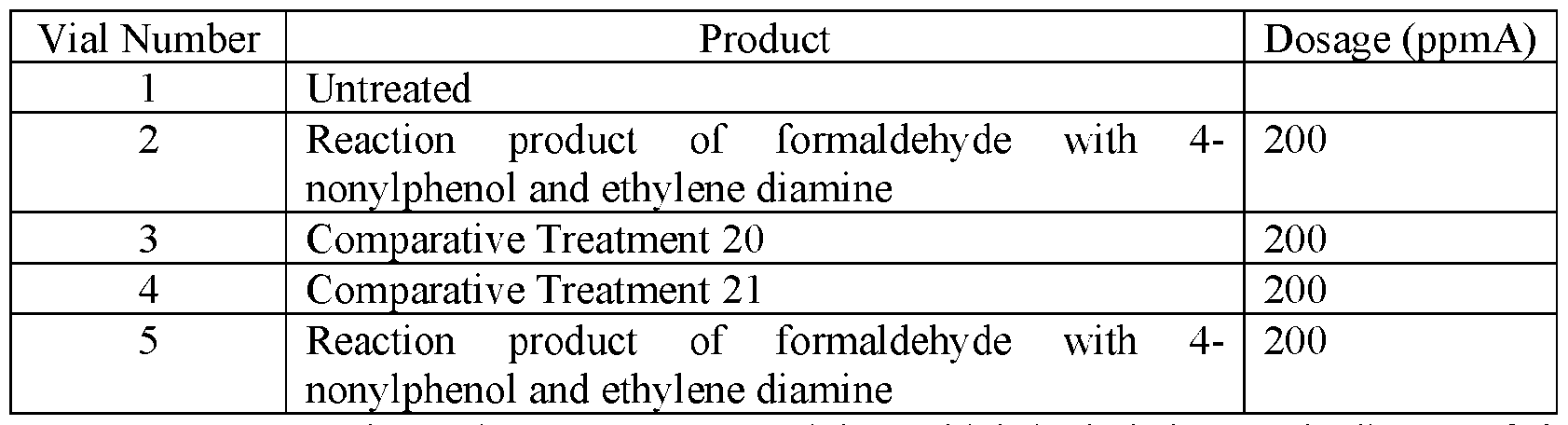
- Example 2 [0066] 0.2 g of tar was individually added into a set of 245 mL combi vials.4 mL of A-150 and various treatment chemistries, as listed in Table 2 below, were added to each vial. The vials were preheated to 80°C for 20 minutes. The vials were then shaken for 1 minute at the level 4 mark on the Combi instrument. After shaking, and under continued heating, photos were taken and the effectiveness of the treatments were compared.
- vial 13 which included an embodiment of the dispersant chemistry of the disclosure, exhibited superior light blocking activity over a period of time of up to 30 minutes when compared to the untreated vials 12 and 20 and the comparative vials 14-19, 21 and 22.
- Example 4 [0074] 0.2 g of tar was individually added into a set of 115 mL combi vials.4 mL of A-150 and various treatment chemistries, as listed in Table 4 below, were added to each vial. The vials were preheated to 80°C for 20 minutes. The vials were then shaken for 1 minute at the level 4 mark on the Combi instrument. After shaking, and under continued heating, photos were taken and the effectiveness of the treatments were compared.
- Example 8 [0090] 0.2 g of tar was individually added into a set of 55 mL combi vials. 4 mL of caustic water and various treatment chemistries, as listed in Table 6 below, were added to each vial. The vials were preheated to 80°C for 20 minutes. The vials were then shaken for 1 minute at the level 4 mark on the Combi instrument. After shaking, and under continued heating, photos were taken and the effectiveness of the treatments were compared.
Landscapes
- Chemical & Material Sciences (AREA)
- Oil, Petroleum & Natural Gas (AREA)
- Engineering & Computer Science (AREA)
- Chemical Kinetics & Catalysis (AREA)
- General Chemical & Material Sciences (AREA)
- Organic Chemistry (AREA)
- Physics & Mathematics (AREA)
- Thermal Sciences (AREA)
- Organic Low-Molecular-Weight Compounds And Preparation Thereof (AREA)
- Lubricants (AREA)
- Production Of Liquid Hydrocarbon Mixture For Refining Petroleum (AREA)
Abstract
Description




Claims


Priority Applications (2)
| Application Number | Priority Date | Filing Date | Title |
|---|---|---|---|
| EP24737250.1A EP4724548A1 (en) | 2023-06-12 | 2024-06-05 | Ethylene tar dispersants and charge gas compressor surface modifiers |
| CN202480045185.XA CN121443705A (en) | 2023-06-12 | 2024-06-05 | Ethylene tar dispersant and surface modifier for pyrolysis gas compressor |
Applications Claiming Priority (2)
| Application Number | Priority Date | Filing Date | Title |
|---|---|---|---|
| US202363507635P | 2023-06-12 | 2023-06-12 | |
| US63/507,635 | 2023-06-12 |
Publications (1)
| Publication Number | Publication Date |
|---|---|
| WO2024258693A1 true WO2024258693A1 (en) | 2024-12-19 |
Family
ID=91738882
Family Applications (1)
| Application Number | Title | Priority Date | Filing Date |
|---|---|---|---|
| PCT/US2024/032476 Ceased WO2024258693A1 (en) | 2023-06-12 | 2024-06-05 | Ethylene tar dispersants and charge gas compressor surface modifiers |
Country Status (4)
| Country | Link |
|---|---|
| EP (1) | EP4724548A1 (en) |
| CN (1) | CN121443705A (en) |
| TW (1) | TW202506781A (en) |
| WO (1) | WO2024258693A1 (en) |
Citations (3)
| Publication number | Priority date | Publication date | Assignee | Title |
|---|---|---|---|---|
| US4927519A (en) * | 1988-04-04 | 1990-05-22 | Betz Laboratories, Inc. | Method for controlling fouling deposit formation in a liquid hydrocarbonaceous medium using multifunctional antifoulant compositions |
| US6797329B2 (en) * | 2002-01-03 | 2004-09-28 | Baker Hughes Incorporated | Antifoulant dispersant and method |
| US9505988B2 (en) * | 2011-10-19 | 2016-11-29 | Nalco Company | Circulation aid for primary fractional quench loops |
-
2024
- 2024-06-05 CN CN202480045185.XA patent/CN121443705A/en active Pending
- 2024-06-05 EP EP24737250.1A patent/EP4724548A1/en active Pending
- 2024-06-05 WO PCT/US2024/032476 patent/WO2024258693A1/en not_active Ceased
- 2024-06-07 TW TW113121275A patent/TW202506781A/en unknown
Patent Citations (3)
| Publication number | Priority date | Publication date | Assignee | Title |
|---|---|---|---|---|
| US4927519A (en) * | 1988-04-04 | 1990-05-22 | Betz Laboratories, Inc. | Method for controlling fouling deposit formation in a liquid hydrocarbonaceous medium using multifunctional antifoulant compositions |
| US6797329B2 (en) * | 2002-01-03 | 2004-09-28 | Baker Hughes Incorporated | Antifoulant dispersant and method |
| US9505988B2 (en) * | 2011-10-19 | 2016-11-29 | Nalco Company | Circulation aid for primary fractional quench loops |
Also Published As
| Publication number | Publication date |
|---|---|
| EP4724548A1 (en) | 2026-04-15 |
| TW202506781A (en) | 2025-02-16 |
| CN121443705A (en) | 2026-01-30 |
Similar Documents
| Publication | Publication Date | Title |
|---|---|---|
| US2589200A (en) | Process for breaking emulsions of the oil-in-water class | |
| CA2062926C (en) | Oleophilic molybdenum compound for use in hydroconversion of a hydrocarbon and a method for producing the same | |
| JP2010504207A (en) | Siloxane crosslinking demulsifier | |
| WO2024258693A1 (en) | Ethylene tar dispersants and charge gas compressor surface modifiers | |
| US7211665B2 (en) | Sulfide scavenger | |
| EP0092883B1 (en) | Method of demulsifying emulsions of oil and water with heterocyclic ammonium polyamidoamines | |
| RU2614755C1 (en) | Method for heavy hydrocarbons hydroconversion (versions) | |
| US5234626A (en) | Methods of demulsifying employing condensates as demulsifiers for oil-in water emulsions | |
| KR20000049111A (en) | Use of sarcosinates as asphaltene dispersants | |
| DE69002558T2 (en) | Anti-incrustation compositions and methods. | |
| CN108473877B (en) | Method for dispersing by-products formed in dilution steam systems | |
| USRE22963E (en) | Processes for resolving oil-in | |
| EP0714969B1 (en) | Inhibition of fouling or coke formation in hydrocarbon processing equipment | |
| CN1102848A (en) | Antiscalants for petrochemical processing | |
| Al-Sabagh et al. | Demulsification efficiency of some new demulsifiers based on 1, 3, 5-triethanolhexahydro-1, 3, 5-triazine | |
| US7223331B2 (en) | Method for settling suspended fine inorganic solid particles from hydrocarbon slurry and additive for use therewith | |
| US2875157A (en) | Resolving water-in-oil emulsions | |
| US5593568A (en) | Coker/visbreaker and ethylene furnace antifoulant | |
| WO2020112273A1 (en) | Fouling abatement for coker heaters | |
| US10647929B2 (en) | Method for converting heavy oil by means of high asphaltene dispersion | |
| CA2334487C (en) | Improved method for settling suspended fine inorganic solid particles from hydorcarbon slurry and additive for use therewith | |
| GB2259301A (en) | Middle distillate fuels and stabilizing additives therefor | |
| CN114479008B (en) | Demulsifier and preparation method and application thereof | |
| CN114929840A (en) | Method and system for quenching pyrolysis effluent | |
| GB2144448A (en) | A process for inhibiting the deposition of paraffins in crude oils and petroleum fractions |
Legal Events
| Date | Code | Title | Description |
|---|---|---|---|
| 121 | Ep: the epo has been informed by wipo that ep was designated in this application |
Ref document number: 24737250 Country of ref document: EP Kind code of ref document: A1 |
|
| REG | Reference to national code |
Ref country code: BR Ref legal event code: B01A Ref document number: 112025027750 Country of ref document: BR |
|
| ENP | Entry into the national phase |
Ref document number: 2024737250 Country of ref document: EP Effective date: 20260112 |
|
| WWE | Wipo information: entry into national phase |
Ref document number: 2024737250 Country of ref document: EP |
|
| NENP | Non-entry into the national phase |
Ref country code: DE |
|
| ENP | Entry into the national phase |
Ref document number: 2024737250 Country of ref document: EP Effective date: 20260112 |
|
| ENP | Entry into the national phase |
Ref document number: 2024737250 Country of ref document: EP Effective date: 20260112 |
|
| ENP | Entry into the national phase |
Ref document number: 2024737250 Country of ref document: EP Effective date: 20260112 |
|
| ENP | Entry into the national phase |
Ref document number: 2024737250 Country of ref document: EP Effective date: 20260112 |
|
| WWP | Wipo information: published in national office |
Ref document number: 2024737250 Country of ref document: EP |