WO2024258629A1 - Arterial hemoshield device for arterial blood draw and related methods - Google Patents
Arterial hemoshield device for arterial blood draw and related methods Download PDFInfo
- Publication number
- WO2024258629A1 WO2024258629A1 PCT/US2024/031729 US2024031729W WO2024258629A1 WO 2024258629 A1 WO2024258629 A1 WO 2024258629A1 US 2024031729 W US2024031729 W US 2024031729W WO 2024258629 A1 WO2024258629 A1 WO 2024258629A1
- Authority
- WO
- WIPO (PCT)
- Prior art keywords
- arterial
- catheter
- fluid pathway
- adapter
- hemoshield
- Prior art date
- Legal status (The legal status is an assumption and is not a legal conclusion. Google has not performed a legal analysis and makes no representation as to the accuracy of the status listed.)
- Ceased
Links
Classifications
-
- A—HUMAN NECESSITIES
- A61—MEDICAL OR VETERINARY SCIENCE; HYGIENE
- A61M—DEVICES FOR INTRODUCING MEDIA INTO, OR ONTO, THE BODY; DEVICES FOR TRANSDUCING BODY MEDIA OR FOR TAKING MEDIA FROM THE BODY; DEVICES FOR PRODUCING OR ENDING SLEEP OR STUPOR
- A61M25/00—Catheters; Hollow probes
- A61M25/01—Introducing, guiding, advancing, emplacing or holding catheters
- A61M25/06—Body-piercing guide needles or the like
- A61M25/0606—"Over-the-needle" catheter assemblies, e.g. I.V. catheters
-
- A—HUMAN NECESSITIES
- A61—MEDICAL OR VETERINARY SCIENCE; HYGIENE
- A61B—DIAGNOSIS; SURGERY; IDENTIFICATION
- A61B5/00—Measuring for diagnostic purposes; Identification of persons
- A61B5/15—Devices for taking samples of blood
- A61B5/150007—Details
- A61B5/150015—Source of blood
- A61B5/15003—Source of blood for venous or arterial blood
-
- A—HUMAN NECESSITIES
- A61—MEDICAL OR VETERINARY SCIENCE; HYGIENE
- A61B—DIAGNOSIS; SURGERY; IDENTIFICATION
- A61B5/00—Measuring for diagnostic purposes; Identification of persons
- A61B5/15—Devices for taking samples of blood
- A61B5/153—Devices specially adapted for taking samples of venous or arterial blood, e.g. with syringes
-
- A—HUMAN NECESSITIES
- A61—MEDICAL OR VETERINARY SCIENCE; HYGIENE
- A61B—DIAGNOSIS; SURGERY; IDENTIFICATION
- A61B5/00—Measuring for diagnostic purposes; Identification of persons
- A61B5/15—Devices for taking samples of blood
- A61B5/150007—Details
- A61B5/150206—Construction or design features not otherwise provided for; manufacturing or production; packages; sterilisation of piercing element, piercing device or sampling device
- A61B5/150274—Manufacture or production processes or steps for blood sampling devices
-
- A—HUMAN NECESSITIES
- A61—MEDICAL OR VETERINARY SCIENCE; HYGIENE
- A61B—DIAGNOSIS; SURGERY; IDENTIFICATION
- A61B5/00—Measuring for diagnostic purposes; Identification of persons
- A61B5/15—Devices for taking samples of blood
- A61B5/150007—Details
- A61B5/150366—Blood collection bags, e.g. connected to the patient by a catheter comprising means for removing a small sample of collected blood from the bag
-
- A—HUMAN NECESSITIES
- A61—MEDICAL OR VETERINARY SCIENCE; HYGIENE
- A61B—DIAGNOSIS; SURGERY; IDENTIFICATION
- A61B5/00—Measuring for diagnostic purposes; Identification of persons
- A61B5/15—Devices for taking samples of blood
- A61B5/150007—Details
- A61B5/150946—Means for varying, regulating, indicating or limiting the speed or time of blood collection
-
- A—HUMAN NECESSITIES
- A61—MEDICAL OR VETERINARY SCIENCE; HYGIENE
- A61B—DIAGNOSIS; SURGERY; IDENTIFICATION
- A61B5/00—Measuring for diagnostic purposes; Identification of persons
- A61B5/15—Devices for taking samples of blood
- A61B5/150992—Blood sampling from a fluid line external to a patient, such as a catheter line, combined with an infusion line; Blood sampling from indwelling needle sets, e.g. sealable ports, luer couplings or valves
-
- A—HUMAN NECESSITIES
- A61—MEDICAL OR VETERINARY SCIENCE; HYGIENE
- A61B—DIAGNOSIS; SURGERY; IDENTIFICATION
- A61B5/00—Measuring for diagnostic purposes; Identification of persons
- A61B5/15—Devices for taking samples of blood
- A61B5/155—Devices specially adapted for continuous or multiple sampling, e.g. at predetermined intervals
-
- A—HUMAN NECESSITIES
- A61—MEDICAL OR VETERINARY SCIENCE; HYGIENE
- A61M—DEVICES FOR INTRODUCING MEDIA INTO, OR ONTO, THE BODY; DEVICES FOR TRANSDUCING BODY MEDIA OR FOR TAKING MEDIA FROM THE BODY; DEVICES FOR PRODUCING OR ENDING SLEEP OR STUPOR
- A61M39/00—Tubes, tube connectors, tube couplings, valves, access sites or the like, specially adapted for medical use
- A61M39/10—Tube connectors; Tube couplings
-
- A—HUMAN NECESSITIES
- A61—MEDICAL OR VETERINARY SCIENCE; HYGIENE
- A61M—DEVICES FOR INTRODUCING MEDIA INTO, OR ONTO, THE BODY; DEVICES FOR TRANSDUCING BODY MEDIA OR FOR TAKING MEDIA FROM THE BODY; DEVICES FOR PRODUCING OR ENDING SLEEP OR STUPOR
- A61M25/00—Catheters; Hollow probes
- A61M25/0021—Catheters; Hollow probes characterised by the form of the tubing
- A61M25/0023—Catheters; Hollow probes characterised by the form of the tubing by the form of the lumen, e.g. cross-section, variable diameter
- A61M25/0026—Multi-lumen catheters with stationary elements
- A61M25/003—Multi-lumen catheters with stationary elements characterized by features relating to least one lumen located at the distal part of the catheter, e.g. filters, plugs or valves
- A61M2025/0031—Multi-lumen catheters with stationary elements characterized by features relating to least one lumen located at the distal part of the catheter, e.g. filters, plugs or valves characterized by lumina for withdrawing or delivering, i.e. used for extracorporeal circuit treatment
-
- A—HUMAN NECESSITIES
- A61—MEDICAL OR VETERINARY SCIENCE; HYGIENE
- A61M—DEVICES FOR INTRODUCING MEDIA INTO, OR ONTO, THE BODY; DEVICES FOR TRANSDUCING BODY MEDIA OR FOR TAKING MEDIA FROM THE BODY; DEVICES FOR PRODUCING OR ENDING SLEEP OR STUPOR
- A61M39/00—Tubes, tube connectors, tube couplings, valves, access sites or the like, specially adapted for medical use
- A61M39/02—Access sites
- A61M39/0247—Semi-permanent or permanent transcutaneous or percutaneous access sites to the inside of the body
- A61M2039/0258—Semi-permanent or permanent transcutaneous or percutaneous access sites to the inside of the body for vascular access, e.g. blood stream access
-
- A—HUMAN NECESSITIES
- A61—MEDICAL OR VETERINARY SCIENCE; HYGIENE
- A61M—DEVICES FOR INTRODUCING MEDIA INTO, OR ONTO, THE BODY; DEVICES FOR TRANSDUCING BODY MEDIA OR FOR TAKING MEDIA FROM THE BODY; DEVICES FOR PRODUCING OR ENDING SLEEP OR STUPOR
- A61M39/00—Tubes, tube connectors, tube couplings, valves, access sites or the like, specially adapted for medical use
- A61M39/10—Tube connectors; Tube couplings
- A61M2039/1083—Tube connectors; Tube couplings having a plurality of female connectors, e.g. Luer connectors
-
- A—HUMAN NECESSITIES
- A61—MEDICAL OR VETERINARY SCIENCE; HYGIENE
- A61M—DEVICES FOR INTRODUCING MEDIA INTO, OR ONTO, THE BODY; DEVICES FOR TRANSDUCING BODY MEDIA OR FOR TAKING MEDIA FROM THE BODY; DEVICES FOR PRODUCING OR ENDING SLEEP OR STUPOR
- A61M39/00—Tubes, tube connectors, tube couplings, valves, access sites or the like, specially adapted for medical use
- A61M39/10—Tube connectors; Tube couplings
- A61M2039/1088—Tube connectors; Tube couplings having a plurality of male connectors, e.g. Luer connectors
-
- A—HUMAN NECESSITIES
- A61—MEDICAL OR VETERINARY SCIENCE; HYGIENE
- A61M—DEVICES FOR INTRODUCING MEDIA INTO, OR ONTO, THE BODY; DEVICES FOR TRANSDUCING BODY MEDIA OR FOR TAKING MEDIA FROM THE BODY; DEVICES FOR PRODUCING OR ENDING SLEEP OR STUPOR
- A61M2210/00—Anatomical parts of the body
- A61M2210/12—Blood circulatory system
Definitions
- a catheter is commonly used to infuse fluids into vasculature of a patient.
- the catheter may be used for infusing normal saline solution, various medicaments, or total parenteral nutrition.
- the catheter may also be used for withdrawing blood from the patient.
- the catheter may include an over-the-needle intravenous (“IV”) catheter.
- IV intravenous
- the catheter may be mounted over an introducer needle having a sharp distal tip.
- the catheter and the introducer needle may be assembled so that the distal tip of the introducer needle extends beyond the distal tip of the catheter with the bevel of the needle facing up away from skin of the patient.
- the catheter and introducer needle are generally inserted at a shallow angle through the skin into vasculature of the patient.
- a clinician In order to verify proper placement of the introducer needle and/or the catheter in the blood vessel, a clinician generally confirms that there is “flashback” of blood in a flashback chamber of a catheter assembly including the catheter. Once placement of the needle has been confirmed, the clinician may temporarily occlude flow in the vasculature and remove the needle, leaving the catheter in place for future blood withdrawal or fluid infusion.
- a blood collection container For blood withdrawal or collecting a blood sample from a patient, a blood collection container may be used.
- the blood collection container may include a syringe or a test tube with a rubber stopper at one end.
- the blood collection container has had all or a portion of air removed from the test tube so pressure within the blood collection container is lower than ambient pressure.
- Such a blood collection container is often referred to as an internal vacuum or a vacuum tube.
- a commonly used blood collection container is a VACUTAINER® blood collection tube, available from Becton Dickinson & Company.
- the blood collection container may be coupled to the catheter.
- a pressure in the vein is higher than a pressure in the blood collection container, which pushes blood into the blood collection container, thus filling the blood collection container with blood.
- a vacuum within the blood collection container decreases as the blood collection container fills, until the pressure in the blood collection container equalizes with the pressure in the vein, and the flow of blood stops.
- red blood cells are in a high shear stress state and susceptible to hemolysis due to a high initial pressure differential between the vein and the blood collection container. Hemolysis may result in rejection and discard of a blood sample. The high initial pressure differential can also result in catheter tip collapse, vein collapse, or other complications that prevent or restrict blood from fdling the blood collection container. As the blood collection container fills, a pressure differential between the vein and the blood collection container decreases, and filling of the blood collection tube with blood slows significantly. The risk for hemolysis is much higher in the case of arterial blood draw due to higher pressure in the artery in comparison to venous blood draw.
- the present disclosure generally relates to an arterial catheter system configured for blood draw or collection, as well as related devices and methods.
- the arterial catheter system may include a catheter assembly, which may include a catheter adapter and an arterial catheter.
- the catheter adapter may include a distal end and a proximal end.
- the arterial catheter may extend from the distal end of the catheter adapter.
- the arterial catheter system may include a needle assembly, which may include a needle hub and an introducer needle extending from the needle hub.
- the arterial catheter system may include an arterial hemoshield device coupled to the catheter assembly.
- the arterial catheter system may include a fluid pathway within the arterial catheter, the catheter adapter, and the arterial hemoshield device.
- a first fluidic resistance within a portion of the fluid pathway within the arterial hemoshield device may be greater than a second fluidic resistance within the fluid pathway distal to the portion of the fluid pathway.
- the first fluidic resistance within the portion of the fluid pathway may facilitate a decreased flow rate of arterial blood within the portion of the fluid pathway such that the maximum shear stress is reduced and there is a decreased risk of hemolysis of the arterial blood that will be collected.
- the arterial hemoshield device may include a distal end, which may include a luer adapter. In some embodiments, the arterial hemoshield device may include a proximal end, which may include a blood collection device. In some embodiments, the arterial hemoshield device may include an extension tube extending between the distal end and the proximal end. In some embodiments, the portion of the fluid pathway may be disposed within the extension tube.
- the extension tube may include a distal end and a proximal end.
- the distal end of the extension tube may be integrated with the luer adapter.
- the proximal end of the extension tube may be integrated with the blood collection device.
- the luer adapter may be a first luer adapter.
- the blood collection device may include a second luer adapter.
- the arterial catheter system may include a third luer adapter coupled to the second luer adapter.
- the extension tube may include a distal end and a proximal end.
- the distal end of the extension tube may be integrated with the first luer adapter. In some embodiments, the proximal end of the extension tube may be integrated with the third luer adapter. In some embodiments, a geometric factor Gf of the portion of the fluid pathway may be different than a geometric factor Gf of another portion of the fluid pathway. In some embodiments, the extension tube may have no more than one lumen extending therethrough. [0013] In some embodiments, the arterial hemoshield device may include a compact connector, which may include a spiral tube. In some embodiments, the portion of the fluid pathway may be disposed within the spiral tube.
- the catheter adapter may include a side port disposed between the distal end of the catheter adapter and the proximal end of the catheter adapter.
- the catheter assembly may include another extension tube extending from the side port.
- a distal end of the another extension tube may be integrated with the side port.
- a proximal end of the other extension tube may be integrated with a Y-adapter.
- the compact connector may be coupled to the Y-adapter.
- a geometric factor Gf of the portion of the fluid pathway is different than a geometric factor Gf of another portion of the fluid pathway.
- the spiral tube may have no more than one lumen extending therethrough.
- the arterial hemoshield device may include a female luer adapter coupled to catheter assembly.
- the arterial hemoshield device may include a blood collection device, which may include a distal end.
- the distal end of the blood collection device may include a male luer adapter coupled to the female luer adapter.
- the male luer adapter may include a distal opening.
- the arterial hemoshield device may include a cannula in fluid communication with the male luer adapter.
- the cannula may include a distal end and a sharp proximal tip.
- an elongated neck may be disposed between the male luer adapter and the sharp proximal tip.
- the portion of the fluid pathway extends from the distal opening through the sharp proximal tip.
- a geometric factor Gf of the portion of the fluid pathway may be different than a geometric factor Gf of another portion of the fluid pathway.
- a method of blood collection may include inserting the arterial catheter of the arterial catheter system into an artery of a patient.
- the arterial catheter system may include the catheter assembly.
- the catheter assembly may include the catheter adapter, which may include the distal end and the proximal end.
- the catheter assembly may include the arterial catheter extending from the distal end of the catheter adapter.
- the arterial catheter system may include the needle assembly, which may include the needle hub and the introducer needle extending from the needle hub.
- the arterial catheter system may include the arterial hemoshield device coupled to the catheter assembly.
- the arterial catheter system may include the fluid pathway within the arterial catheter, catheter adapter, and the arterial hemoshield device.
- the first fluidic resistance within the portion of the fluid pathway within the arterial hemoshield device may be greater than the second fluidic resistance within the fluid pathway distal to the portion of the fluid pathway.
- the method of blood collection may include collecting arterial blood in a particular blood collection device, which may be coupled to the catheter assembly, whereby the arterial blood flows through the portion of the fluid pathway and into the particular blood collection device.
- a method of manufacturing the arterial catheter system may include coupling the catheter assembly to the needle assembly.
- the method of manufacturing may include coupling an arterial hemoshield device to the catheter assembly such that the arterial hemoshield device is in fluid communication with the catheter assembly and a portion of the fluid pathway is within the arterial catheter, the catheter hub, and the arterial hemoshield device.
- the method of manufacturing may include selecting a length L of a portion of the fluid pathway within the hemoshield device and an inner diameter D of the portion of the fluid pathway within the hemoshield device such that a first fluidic resistance within the portion of the fluid pathway is greater than a second fluidic resistance within the fluid pathway distal to the portion of the fluid pathway.
- Figure 1A is an upper perspective view of an example arterial hemoshield device, according to some embodiments.
- Figure IB is a cross-sectional view of the arterial hemoshield device of Figure 1A, according to some embodiments.
- Figure 1C is an upper perspective view of the arterial hemoshield device of Figure 1A coupled to an example arterial catheter assembly, according to some embodiments;
- Figure 2A is an upper perspective view of another example arterial hemoshield device, according to some embodiments.
- Figure 2B is a cross-sectional view of the arterial hemoshield device of Figure 2B, according to some embodiments.
- Figure 2C is an upper perspective view of the arterial hemoshield device of Figure 2A coupled to the arterial catheter assembly of Figure 1C, according to some embodiments;
- Figure 3A is an upper perspective view of an example arterial catheter system, according to some embodiments; and [0029] Figure 3B is an upper perspective view of an example portion of an arterial catheter system, according to some embodiments;
- Figure 4A is an upper perspective view of an example arterial catheter system, illustrating an example compact connector, according to some embodiments
- Figure 4B is a cross-sectional view of a portion of the arterial catheter system of Figure 4A, according to some embodiments.
- Figure 5A is an upper perspective view of an example arterial hemoshield device, according to some embodiments.
- Figure 5B is a cross-sectional view of the arterial hemoshield device of Figure 5A, according to some embodiments.
- Figure 5C is an upper perspective view of a portion of the arterial hemoshield device of Figure 5 A, according to some embodiments.
- Figure 5D is a cross-sectional view of the portion coupled to a remaining portion of the arterial hemoshield device of Figure 5 A, according to some embodiments;
- Figure 6A is an upper perspective view of an example arterial catheter system, according to some embodiments.
- Figure 6B is a cross-sectional view of the arterial catheter system of Figure 3A, illustrating an example needle assembly removed, according to some embodiments.
- an arterial hemoshield device 10 may include a distal end 12, which may include a luer adapter 14 configured to couple to a catheter adapter or another suitable vascular access device.
- the arterial hemoshield device 10 may be configured to reduce a maximum shear stress on arterial blood drawn from an artery into an arterial catheter system and thereby reduce a risk of hemolysis of the arterial blood, providing an improved blood sample.
- the arterial hemoshield device 10 may include a proximal end 16, which may include a blood collection device 18.
- the blood collection device 18 may include or correspond to a blood collection container.
- the blood collection container may include a syringe, an evacuated blood collection tube (or vacuum tube), a small sample collection device, or any other container configured to collect blood from a patient via a pressure differential.
- the blood collection device 18 may include a needle assembly 19, which may include a needle 20 configured to receive a blood collection container.
- the blood collection container may include the evacuated blood collection tube.
- the blood collection container may have all or a portion of air removed so pressure within the blood collection container is lower than ambient pressure.
- the needle assembly 19 may include one or more threads, which may be configured to couple to a holder 22 of the blood collection device 18, which may be generally cylindrical and may be configured to hold the blood collection container.
- the holder 22 may be integrally formed with the needle assembly 19 or coupled to the needle assembly 19 via bonding or another suitable method.
- the holder 22 may surround the needle 20.
- the needle assembly 19 and the holder 22 may include or correspond to a luer lock access device, such as, for example, the VACUTAINER® LUER-LOKTM ACCESS DEVICE available from Becton Dickinson & Company.
- the holder 22 may include or correspond to the blood collection tube holder 127 described in U.S. Patent Application No. 17/075,420, filed October 20, 2020, entitled “BLOOD COLLECTION SYSTEM WITH USER-ADJUSTED PRESSURE MANAGEMENT AND
- the luer adapter 14 may be a first luer adapter.
- the arterial hemoshield device 10 may include a second luer adapter 24.
- the blood collection device 18 may include the second luer adapter 24.
- the needle 20 may be integrated with the second luer adapter 24.
- a proximal end of the needle 20 may be enveloped within an elastomeric sheath 26.
- the elastomeric sheath 26 may include an open distal end 28 and a closed proximal end 30.
- the needle 20 in response to the blood collection container pushing the elastomeric sheath 26 distally, the needle 20 may pierce the elastomeric sheath 26, and the needle 20 may insert into a cavity of the blood collection container.
- the arterial hemoshield device 10 may include an extension tube 32, which may extend between the distal end 12 of the arterial hemoshield device 10 and the proximal end 16 of the arterial hemoshield device 10.
- the extension tube 32 may be rigid or semi-rigid, which may reduce a likelihood of kinking.
- the extension tube 32 may be flexible such that it is configured to bend.
- the extension tube 32 may be constructed of plastic.
- the extension tube 32 may include no more than one lumen extending therethrough.
- the arterial hemoshield device 10 may include a third luer adapter 34, which may be coupled to the second luer adapter 24.
- the extension tube 32 may include a distal end 36 and a proximal end 38.
- the distal end 36 may be coupled to or integrated with the first luer adapter.
- the proximal end of the extension tube 32 may be coupled to or integrated with the third luer adapter 34.
- the proximal end of the extension tube 32 may be coupled to or integrated with the blood collection device 18 and the arterial catheter system may not include the third luer adapter 34.
- the arterial hemoshield device 10 may act as a flow resistor in a fluid pathway of an arterial catheter system, illustrated, for example, in Figure 1C, or another vascular access system.
- the arterial catheter system may include an arterial catheter assembly 37, which may include a catheter adapter 39 and an arterial catheter 40.
- the arterial catheter 40 may be secured within the catheter adapter 39 and may extend distally from the catheter adapter 39.
- the catheter adapter 39 may include a distal end 42, a proximal end 44, and a lumen extending through the distal end 42 and the proximal end 44.
- an introducer needle 45 may extend from a needle shield through the arterial catheter 40.
- the arterial catheter assembly 37 may be integrated.
- another extension tube 46 may extend from a side port 48 the catheter adapter 39.
- a proximal end of the other extension tube 46 may include a fourth luer adapter 50, which may be coupled to the first luer adapter.
- the arterial catheter assembly 37 may be straight and/or the first luer adapter may be coupled to the proximal end 44 of the catheter adapter 39.
- one or more of the first luer adapter, the second luer adapter 24, the third luer adapter 34, and the fourth luer adapter 50 may include a slip or thread or clip male luer adapter, a slip or thread female luer adapter, a needleless connector, a blunt cannula, or another suitable access device.
- the arterial catheter 40 may include an arterial catheter.
- the arterial catheter 40 may be shorter and/or more rigid than an intravenous catheter, such as a peripheral intravenous catheter.
- the arterial hemoshield device 10 may be coupled to the arterial catheter assembly 37 in any number of suitable ways.
- the fluid pathway of the arterial catheter system may include one or more of the following: the arterial catheter 40, the catheter adapter 39, the other extension tube 46, the fourth luer adapter 50, the first luer adapter, the extension tube 32, the third luer adapter 34, the second luer adapter 24, and the blood collection device 18.
- the arterial hemoshield device 10 may lower a flow rate of blood within the fluid pathway of the arterial catheter system, which may in turn lower a shear rate for hemolysis management.
- the arterial catheter assembly 37 may be substituted with another type of vascular access device, such as, for example, a venipuncture device, an infusion disposable, a blood collection access device, or a blood collection container.
- a geometric factor Gf of a portion of the fluid pathway within the extension tube 32 may equal L / D 4 , wherein L is the length of the extension tube 32 and D is the inner diameter of the portion of the fluid pathway within the extension tube 32.
- the portion of the fluid pathway may be cylindrical along an entirety of the length L, and the inner diameter D may be constant along the length L.
- the length L corresponds to an entire length of the extension tube 32, according to some embodiments.
- the geometric factor Gf of the portion of the fluid pathway within the extension tube 32 may be defined such that a fluidic resistance R
- the geometric factor Gf of the portion of the fluid pathway may be selected to reduce a maximum shear stress on arterial blood drawn from an artery and thereby reduce a risk of hemolysis of the arterial blood.
- a blood cell experiences shear stress as it flows in a fluid pathway.
- the maximum shear stress is along the wall of the fluid pathway, or wall shear stress.
- Wall shear stress on blood cells is considered a major source of mechanical damage to blood cells.
- the wall shear stress is typically expressed as: in which AP is the pressure drop along a path with a length of L and an interior radius of r. k is shrinkage index.
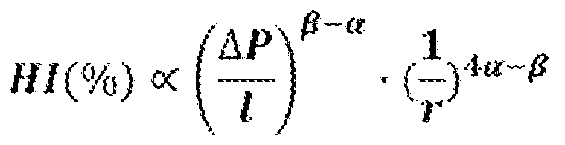
- the hemolysis index is related to pressure gradient and cross-sectional characteristic dimension:
- Fluid flow in a particular extension tube with a cylindrical fluid pathway therethrough can be analyzed using Poiseuille’s equation: where AP is a change in pressure gradient across the length of the particular extension tube, D and
- the extension tube 32 may have multiple sections with lengths (LI, L2, L3) and inner diameters of (DI, D2, D3), the geometric factor is then:
- the extension tube 32 may have an inner diameter that changes over the length of the extension tube, the geometric factor is then:
- the extension tube 32 may have a cross section that is not circular.
- the geometric factor can be determined by measuring the flow rate (Q) at given pressure (AP) with known viscosity (/z) fluid:
- the fluidic resistance may be a first fluidic resistance.
- the first fluidic resistance of the portion of the fluid pathway within the extension tube may be greater than a second fluidic resistance within the fluid pathway distal to the portion of the fluid pathway.
- the first fluidic resistance may be greater than a particular fluidic resistance within a lumen of the catheter adapter 39, where arterial blood may travel prior to reaching the extension tube 32 and the arterial hemoshield device 10 through which blood may be collected.
- the arterial catheter 40 may be a 20G arterial catheter.
- the length L and the inner diameter D may be selected such that the geometric factor Gf of the portion of the fluid pathway within the extension tube 32 is 3.41E+06 (1/in 3 ) or higher.
- the length L and the inner diameter D for a 20G arterial catheter may be selected such that the geometric factor Gf of the portion of the fluid pathway within the extension tube 32 is 3.41E+06 (l/in 3 )+/- 10%.
- the arterial catheter 20 may be a 18G arterial catheter.
- the length L and the inner diameter D may be selected such that the geometric factor G/ of the portion of the fluid pathway within the extension tube 32 is 2.88E+06 (1/in 3 ) or higher.
- the length L and the inner diameter D for a 18G arterial catheter may be selected such that the geometric factor Gf of the portion of the fluid pathway within the extension tube 32 is 2.88E+06 (l/in 3 )+/- 10%.
- the arterial catheter 20 may be a 22G arterial catheter.
- the length L and the inner diameter D may be selected such that the geometric factor Gf of the portion of the fluid pathway within the extension tube 32 is 1.05E+07 (1/in 3 ) or higher.
- the length L and the inner diameter D for a 24G arterial catheter may be selected such that the geometric factor Gf of the portion of the fluid pathway within the extension tube 32 is 1.05E+07 (l/in 3 )+/- 10%.
- the arterial catheter 20 may be a 24G arterial catheter.
- the length L and the inner diameter D may be selected such that the geometric factor Gf of the portion of the fluid pathway within the extension tube 32 is 3.20E+07 (1/in 3 ) or higher.
- the length L and the inner diameter D for a 24G arterial catheter may be selected such that the geometric factor Gf of the portion of the fluid pathway within the extension tube 32 is 3.20E+07 (l/in 3 )+/- 10%.
- the fluid pathway of the arterial catheter system which may include one or more of the needle assembly 19, the extension tube 32, and the arterial catheter assembly 37 (which may include the other extension tube 46), may include an entirety of a blood collection pathway through which blood flows during blood collection.
- the system geometric factor Gfs for the fluid pathway of the arterial catheter system can be determined in similar fashion as described earlier.
- an arterial hemoshield device 52 is illustrated, according to some embodiments.
- the arterial hemoshield device 52 may be similar or identical to the arterial hemoshield device 10 of Figures 1A-1C in terms of one or more included features and/or operation.
- the proximal end of the extension tube 32 may be integrated with the blood collection device 18.
- the arterial hemoshield device 52 may include a clamp 54, which may be disposed on the extension tube 32.
- the clamp 54 may be configured to move between a clamped position and an unclamped position or between a more clamped position and a less clamped position.
- the clamp 54 may prevent or reduce fluid flow through the extension tube 32 in response to the clamp 54 being in the clamped position.
- the clinician may adjust flow resistance within the arterial catheter system by manually changing fluid characteristics of the arterial catheter system via the clamp 54.
- flow resistance within the arterial catheter system in response to the clamp 54 being in the clamped position, flow resistance within the arterial catheter system may be increased and blood flow through the extension tube 32 may be reduced. In these embodiments, a risk of hemolysis may be reduced.
- the clinician may move the clamp to the unclamped position, which may allow faster blood collection when a risk of hemolysis is reduced.
- the clamp 54 may include a slide clamp, which may include a slot that becomes progressively narrower.
- the extension tube 32 may be flexible and compliant.
- the clinician may adjust an inner diameter of the extension tube 32 by adjusting a depth of the extension tube 32 within the slot of the slide clamp. The clinician may in turn adjust a flow resistance within the arterial hemoshield device 52.
- the clamp 54 may include a roller clamp, a slide clamp, a pinch clamp, or another suitable type of clamp.
- the arterial catheter assembly 118 may include an arterial hemoshield device 120, which may be integrated with the arterial catheter assembly 37.
- the distal end 12 of the arterial hemoshield device 120 may be integrated with an adapter 122 of the arterial catheter assembly 37, as illustrated, for example, in Figure 3 A, or integrated with the catheter adapter 39 itself.
- the arterial hemoshield device 120 may not be removable from the arterial catheter assembly 118.
- the distal end of the extension tube 32 may be integrated with the adapter 122 or the catheter adapter 39.
- the adapter 122 may include a Y-adapter, a T-adapter, or another suitable adapter.
- the other extension tube 46 may be shorter than the extension tube 52 such that the adapter 122 provides a port for near patient blood collection or sampling.
- the arterial hemoshield device 120 may be similar or identical to one or more of the following in terms of one or more included features and/or operation: the arterial hemoshield device 10 of Figures 1A-1 C and the arterial hemoshield device 52 of Figures 2A-2C.
- the portion 124 of the arterial catheter assembly may include an arterial hemoshield device 126, which may be coupled to or integrated with an instrument delivery device 127, which may deliver a probe, a catheter, or a guidewire through a particular arterial catheter assembly (as illustrated, for example, in Figure 3 A).
- the arterial hemoshield device 126 may be similar or identical to one or more of the following in terms of one or more included features and/or operation: the arterial hemoshield device 10 of Figures 1A-1C and the arterial hemoshield device 52 of Figures 2A-2C.
- the instrument delivery device 127 may include any suitable instrument delivery device.
- the instrument delivery device 127 may be further described in U.S. Patent No. 11,969,247, granted April 30, 2024, entitled “EXTENSION HOUSING A PROBE OR INTRAVENOUS CATHETER,” U.S. Patent Application No 16/388,650, filed April 18, 2019, entitled “INSTRUMENT DELIVERY DEVICE HAVING A ROTARY ELEMENT,” U.S. Patent No. 11,173,277, granted November 16, 2021, entitled “MULTI-DIAMETER CATHETER AND RELATED DEVICES AND METHODS,” U.S. Patent No.
- an arterial catheter system 410 is illustrated, according to some embodiments.
- the arterial catheter system 410 may be configured to reduce a maximum shear stress on arterial blood drawn from an artery into the arterial catheter system 410 and thereby reduce a risk of hemolysis of the arterial blood, providing an improved blood sample.
- the arterial catheter system 410 may be similar or identical to the arterial catheter system of one or more of Figures 1C, 3 A, and 3B in terms of one or more included features and/or operation.
- the arterial catheter system 410 may include an arterial catheter assembly 412, which may include a catheter adapter 414.
- the catheter adapter 414 may include a distal end 416 and a proximal end 418.
- the arterial catheter assembly 412 may include an arterial catheter 420 extending from the distal end 416 of the catheter adapter 414.
- the arterial catheter 420 may be shorter and/or more rigid than an intravenous catheter, such as a peripheral intravenous catheter.
- the arterial catheter system 410 may include a needle assembly 422, which may include a needle hub 424 and an introducer needle 426.
- the arterial catheter system 410 may include a tube 428 coupled to the arterial catheter assembly 412 and having a distal end 430 and a proximal end 432.
- the arterial catheter system 410 may include a fluid pathway 434 extending through at least the arterial catheter 420, catheter adapter 414, and the tube 428.
- a geometric factor Gr of a portion 436 of the fluid pathway is a geometric factor Gr of a portion 436 of the fluid pathway
- the portion 436 of the fluid pathway 434 within the tube 428 may equal L / D 4 , wherein L is the length of the tube 428 and D is the inner diameter of the portion of the fluid pathway 434 within the tube 428.
- the portion 436 of the fluid pathway 434 may be cylindrical along an entirety of the length L, and the inner diameter D may be constant along the length L.
- the length L corresponds to an entire length of the tube 428, according to some embodiments.
- the geometric factor Gf of the portion 436 of the fluid pathway 434 may be selected to reduce a maximum shear stress on arterial blood drawn from an artery and thereby reduce a risk of hemolysis of the arterial blood.
- the fluidic resistance may be a first fluidic resistance.
- the first fluidic resistance of the portion 436 of the fluid pathway 434 within the tube 428 may be greater than a second fluidic resistance within the fluid pathway 434 distal to the portion 436 of the fluid pathway 434.
- the first fluidic resistance may be greater than a particular fluidic resistance within a lumen 438 of the catheter adapter 414, where arterial blood may travel prior to reaching the tube 428 and adapter 440, which may be coupled to a blood collection device for blood collection.
- a blood cell experiences shear stress as it flows in a fluid pathway.
- the maximum shear stress is along the wall of the fluid pathway, or wall shear stress.
- Wall shear stress on blood cells is considered a major source of mechanical damage to blood cells.
- the hemolysis index is related to pressure gradient and cross-sectional characteristic dimension:
- the tube 428 may have multiple sections with lengths (LI , L2, L3) and inner diameters of (DI, D2, D3), the geometric factor is then:
- the tube 428 may have an inner diameter that changes over the length of the tube, the geometric factor is then:
- the tube 428 may have a cross section that is not circular.
- the geometric factor can be determined by measuring the flow rate (Q) at given pressure (AP) with known viscosity Qu.) fluid:
- the first fluidic resistance which may be lower than the second fluidic resistance, may facilitate a decreased flow rate of arterial blood within the portion 436 of the fluid pathway 434 within the tube 428 such that the maximum shear stress is reduced within the portion 436 of the fluid pathway 434 and there is a decreased risk of hemolysis of the arterial blood that will be collected.
- the length L and the inner diameter D of the tube 428 which may determine the geometric factor Gf of the portion 436 of the fluid pathway 434, may be selected to increase the first fluidic resistance and decrease the flow rate within the portion 436 of the fluid pathway such that the risk of hemolysis is decreased but the flow rate is still adequate for blood collection.
- the arterial catheter 420 may be a 20G arterial catheter.
- the length L and the inner diameter D may be selected such that the geometric factor Gf of the portion 436 of the fluid pathway 434 within the tube 428 is 3.33E+06 (1/in 3 ) or higher.
- the length L and the inner diameter D may be selected such that the geometric factor G/ of the portion 436 of the fluid pathway 434 within the tube 428 is 3.41E+06 (1/in 3 ) or higher.
- the length L and the inner diameter D may be selected such that the geometric factor Gy of the portion 436 of the fluid pathway 434 within the tube 428 is 3.33E+06 (1/in 3 ) or higher.
- the arterial catheter 20 may be a 18G arterial catheter.
- the length L and the inner diameter D may be selected such that the geometric factor Gf of the portion of the fluid pathway within the tube 428 is 2.88E+06 (1/in 3 ) or higher.
- the arterial catheter 20 may be a 22G arterial catheter.
- the length L and the inner diameter D may be selected such that the geometric factor Gf of the portion of the fluid pathway within the tube 428 is 1.05E+07 (1/in 3 ) or higher.
- the arterial catheter 20 may be a 24G arterial catheter.
- the length L and the inner diameter D may be selected such that the geometric factor Gf of the portion of the fluid pathway within the tube 428 is 3.20E+07 (1/in 3 ) or higher.
- the tube 428 may include no more than one lumen 442 extending therethrough. In these embodiments, a single lumen may be sufficient for the tube 428 in the arterial catheter system 410 since arterial catheters are rarely used for infusion where an extension tube with higher fluidic resistance might reduce the infusion rate significantly.
- the catheter adapter 414 may include a side port 444 disposed between the distal end 416 of the catheter adapter 414 and the proximal end 418 of the catheter adapter 414.
- an extension tube 454 may include a distal end coupled to or integrated with the side port 444.
- the extension tube 454 may include a proximal end coupled to or integrated with an adapter 456, which may a Y-adapter or another suitable adapter.
- the adapter 456 may include at least two ports, one for blood collection and the other for pressure monitoring.
- a needleless access connector 457 may be coupled to one or more ports of the adapter 456.
- a compact connector 458 may include the tube 428 therein.
- the tube 428 may include a spiral or coil shape, which may facilitate a compact device for easy use by a clinician.
- the tube 428 may be flexible, rigid, or semi-rigid.
- the tube 428 may be constructed of plastic or another suitable material.
- a proximal end 460 of the compact connector 458 may include a female luer or another suitable adapter for coupling to a blood collection device.
- the proximal end 460 may include a septum 461 configured to compress in response to coupling the proximal end 460 with the blood collection device.
- the blood collection device in fluid communication with the fluid pathway 434.
- a distal end 462 of the compact connector 458 may be coupled to or integrated with the adapter 456.
- the hemoshield device 520 may include a distal end 522 and a proximal end 524.
- the distal end 522 of the hemoshield device 520 may include a male luer adapter 526, which may include a distal opening 528.
- the hemoshield device 520 may include a cannula 530 in fluid communication with the male luer adapter 526.
- the cannula 530 may include a distal end 532 and a sharp proximal tip 534.
- the cannula 530 may be constructed of metal or another suitable material configured to punctuate a seal of a blood collection container, such as a blood collection tube.
- a blood collection container such as a blood collection tube.
- an elastomeric sheath 531 and in response to insertion of the blood collection container being inserted into the hemoshield device 520, the sharp proximal tip 534 may puncture the elastomeric sheath 531, which may be compressed in a distal direction by the blood collection container.
- the hemoshield device 520 may include an elongated neck 535 disposed between the male luer adapter 526 and the sharp proximal tip 534.
- a fluid pathway of an arterial catheter system may include a portion 536 within the hemoshield device 520, the portion 536 extending from the distal opening 528 through the sharp proximal tip 534.
- a diameter 537 of the portion 536 of the fluid pathway is constant.
- an entire length 538 of the portion 536 of the fluid pathway is represented by L, and the diameter 537 of the portion 536 of the fluid pathway is represented by D.
- the male luer adapter 526 of the hemoshield device 520 may include a collar 539, which may extend around a protrusion 540 of the male luer adapter 526.
- the distal opening 528 may be disposed within a distal-most portion of the protrusion 540.
- an inner surface of the collar 539 may be threaded to form a luer-lock fit with a corresponding female luer adapter.
- the inner surface of the collar 539 may be smooth to form a slip-fit with a corresponding female luer adapter.
- the portion 536 of the fluid pathway may be formed entirely by the cannula 530, which may extend through the collar 539 and form the protrusion 540 and the distal opening 528.
- an outer diameter of the collar 539 may be greater than an outer diameter of the elongated neck 535.
- the hemoshield device 520 may include a holder 541 configured to receive a blood collection container, such as a blood collection tube.
- the holder 541 may include a cylindrical body 542.
- the sharp proximal tip 534 may be disposed in a center of the cylindrical body 542 to facilitate puncture of a seal of the blood collection container in response to insertion of the blood collection container within a proximal opening 544 of the cylindrical body 542.
- an outer diameter of the cylindrical body 542 may be greater than the outer diameter of the elongated neck 535.
- the elongated neck 535 may be disposed between the holder 541 and the collar 539.
- the distal end 532 of the cannula 530 may be integrated and secured within the elongated neck 535.
- the elastomeric sheath 531 may be coupled to an inner surface of the holder 541.
- the hemoshield device 520 may include a female luer adapter 546 disposed at a proximal end of the elongated neck 535.
- the distal end of the holder 541 may include a male luer adapter 548.
- the female luer adapter 546 may be coupled to the male luer adapter 548.
- the hemoshield device 520 may include an extension 550, which a user may couple to the holder 541 to provide the elongated neck 535 and an increased L, which may decrease the risk of hemolysis.
- D may correspond to an inner diameter of the cannula 530.
- an inner diameter of the elongated neck 535 may be equal to D along all or a portion of the elongated neck 535.
- the male luer adapter 548 may be similar or identical to the male luer adapter 526 in terms of one or more features and/or operation.
- an arterial catheter system 552 is illustrated, according to some embodiments.
- the arterial catheter system 552 may be similar or identical to the arterial catheter system of one or more of Figures 1C, 3A, 3B, 4A, and 4B in terms of one or more included features and/or operation.
- the arterial catheter system 552 may include an arterial catheter 554, and a female luer adapter 556 coupled to the arterial catheter 554.
- the arterial catheter system 552 may include the hemoshield device 520, which may reduce the risk of hemolysis.
- the arterial catheter system 552 may include a catheter adapter 558, which may include a distal end 560, a proximal end 562, and a lumen 564 extending through the distal end 560 of the catheter adapter 558 and the proximal end 562 of the catheter adapter 558.
- the arterial catheter 554 may extend distally from the distal end 560 of the catheter adapter 558.
- the male luer adapter 526 of the hemoshield device 520 may be coupled to the female luer adapter 556.
- the arterial catheter system 552 and/or a location of the female luer adapter 556 may vary.
- the arterial catheter system 552 may include an extension tube 66, which may include a distal end integrated with a side port 568 of the catheter adapter 558 and a proximal end integrated with the female luer adapter 556.
- the side port 568 may be disposed in between the distal end 560 and the proximal end 562 of the catheter adapter 558 and in fluid communication with the lumen 564.
- the proximal end 562 of the catheter adapter 558 may include the female luer adapter 556, and the hemoshield device 520 may be coupled to the proximal end 562 of the catheter adapter 558.
- a septum 570 may be disposed within the lumen 564 of the catheter adapter 558.
- an introducer needle 572 of a needle assembly 574 may extend through the septum 570 and the arterial catheter 554 when the arterial catheter system 552 is inserted into the vasculature of the patient.
- the needle assembly 574 may be removed from the arterial catheter system 552 in response to the arterial catheter 554 being inserted into the vasculature.
- the introducer needle 572 may include a sharp distal tip 76 and may extend from a needle hub 578 of the needle assembly 574, which may be coupled to the proximal end 562 of the catheter adapter 558.
- a maximum shear stress during blood collection through an arterial catheter 554 is much higher than a maximum shear stress during blood collection using another type of catheter, i.e. a venous catheter.
- the particular cannula may include or correspond to the cannula 530, and the cylindrical fluid pathway may include or correspond to the portion 536. Since // is the viscosity of the fluid and not part of the extension tube geometry, a geometric factor Gf is defined such that Rf (the fluid resistance) is
- the portion 536 of the fluid pathway may have multiple sections with lengths (LI, L2, L3) and inner diameters of (DI, D2, D3), the geometric factor is then:
- the portion 536 of the fluid pathway may have an inner diameter that changes over the length of the fluid pathway, the geometric factor is then: L dl
- the portion 536 of the fluid pathway may have a cross section that is not circular.
- the geometric factor can be determined by measuring the flow rate (Q) at given pressure (AP) with known viscosity ( ) fluid:
- the diameter of the portion 536 of the fluid pathway may be greater than a minimum inner diameter of the arterial catheter 554.
- D 4 / L is equal to or less than a predetermined value, which may be based at least in part on the gauge of the arterial catheter 554.
- the predetermined value may correspond to a value at which the risk of hemolysis is determined to below.
- the fluidic resistance within the portion 536 of the fluid pathway may facilitate a decreased flow rate of arterial blood within the portion 536 of the fluid pathway 534 within the cannula 530 such that the maximum shear stress is reduced and there is a decreased risk of hemolysis of the arterial blood that will be collected.
- the length L and the inner diameter D of the cannula 530 which may determine the geometric factor Gr of the portion 536 of the fluid pathway, may be selected to increase the fluidic resistance and decrease the flow rate within the portion 536 of the fluid pathway such that the risk of hemolysis is decreased but the flow rate is still adequate for blood collection.
- a fluidic resistance within the portion 536 of the fluid pathway may be a first fluidic resistance.
- the first fluidic resistance of the portion of the fluid pathway within the extension tube may be greater than a second fluidic resistance within the fluid pathway distal to the portion 536 of the fluid pathway.
- the first fluidic resistance may be greater than a particular fluidic resistance within a lumen of the catheter adapter 564, where arterial blood may travel prior to reaching the extension tube 32 and the arterial hemoshield device 10 through which blood may be collected.
Landscapes
- Health & Medical Sciences (AREA)
- Life Sciences & Earth Sciences (AREA)
- Engineering & Computer Science (AREA)
- Heart & Thoracic Surgery (AREA)
- Animal Behavior & Ethology (AREA)
- Hematology (AREA)
- Veterinary Medicine (AREA)
- Biomedical Technology (AREA)
- Public Health (AREA)
- General Health & Medical Sciences (AREA)
- Biophysics (AREA)
- Pathology (AREA)
- Surgery (AREA)
- Molecular Biology (AREA)
- Medical Informatics (AREA)
- Physics & Mathematics (AREA)
- Pulmonology (AREA)
- Anesthesiology (AREA)
- Manufacturing & Machinery (AREA)
- Media Introduction/Drainage Providing Device (AREA)
- External Artificial Organs (AREA)
Abstract
Description




Claims
Priority Applications (1)
| Application Number | Priority Date | Filing Date | Title |
|---|---|---|---|
| EP24737195.8A EP4727451A1 (en) | 2023-06-14 | 2024-05-30 | Arterial hemoshield device for arterial blood draw and related methods |
Applications Claiming Priority (4)
| Application Number | Priority Date | Filing Date | Title |
|---|---|---|---|
| US202363521028P | 2023-06-14 | 2023-06-14 | |
| US63/521,028 | 2023-06-14 | ||
| US18/677,611 US20240416086A1 (en) | 2023-06-14 | 2024-05-29 | Arterial hemoshield device for arterial blood draw and related methods |
| US18/677,611 | 2024-05-29 |
Publications (1)
| Publication Number | Publication Date |
|---|---|
| WO2024258629A1 true WO2024258629A1 (en) | 2024-12-19 |
Family
ID=91738880
Family Applications (1)
| Application Number | Title | Priority Date | Filing Date |
|---|---|---|---|
| PCT/US2024/031729 Ceased WO2024258629A1 (en) | 2023-06-14 | 2024-05-30 | Arterial hemoshield device for arterial blood draw and related methods |
Country Status (4)
| Country | Link |
|---|---|
| US (1) | US20240416086A1 (en) |
| EP (1) | EP4727451A1 (en) |
| CN (2) | CN119138894A (en) |
| WO (1) | WO2024258629A1 (en) |
Families Citing this family (1)
| Publication number | Priority date | Publication date | Assignee | Title |
|---|---|---|---|---|
| USD1040998S1 (en) * | 2022-05-26 | 2024-09-03 | Dcstar Inc | Tube |
Citations (10)
| Publication number | Priority date | Publication date | Assignee | Title |
|---|---|---|---|---|
| US20190021640A1 (en) * | 2017-07-19 | 2019-01-24 | Becton, Dickinson And Company | Extension housing a probe or intravenous catheter |
| US20210186394A1 (en) * | 2019-12-20 | 2021-06-24 | Becton, Dickinson And Company | Catheter extension set and related methods |
| US20210228125A1 (en) * | 2020-01-24 | 2021-07-29 | Becton, Dickinson And Company | Catheter having dedicated blood collection port and related methods |
| US11173277B2 (en) | 2018-04-20 | 2021-11-16 | Becton, Dickinson And Company | Multi-diameter catheter and related devices and methods |
| US20220047195A1 (en) * | 2020-08-14 | 2022-02-17 | Becton, Dickinson And Company | Blood Collection Device and Related Systems and Methods |
| US20220110562A1 (en) * | 2020-10-12 | 2022-04-14 | Becton, Dickinson And Company | Blood Draw Syringe With Hemolysis Protection |
| US11337628B2 (en) | 2018-11-29 | 2022-05-24 | Becton, Dickinson And Company | Syringe-based delivery device for a vascular access instrument |
| US11406795B2 (en) | 2018-07-10 | 2022-08-09 | Becton, Dickinson And Company | Delivery device for a vascular access instrument |
| US11504503B2 (en) | 2019-04-05 | 2022-11-22 | Becton, Dickinson And Company | Vascular access instrument having a fluid permeable structure, and related devices and methods |
| US11547832B2 (en) | 2019-01-18 | 2023-01-10 | Becton, Dickinson And Company | Catheter delivery device and related systems and methods |
-
2024
- 2024-05-29 US US18/677,611 patent/US20240416086A1/en active Pending
- 2024-05-30 EP EP24737195.8A patent/EP4727451A1/en active Pending
- 2024-05-30 WO PCT/US2024/031729 patent/WO2024258629A1/en not_active Ceased
- 2024-06-14 CN CN202410764240.2A patent/CN119138894A/en active Pending
- 2024-06-14 CN CN202421365507.2U patent/CN222968996U/en active Active
Patent Citations (11)
| Publication number | Priority date | Publication date | Assignee | Title |
|---|---|---|---|---|
| US20190021640A1 (en) * | 2017-07-19 | 2019-01-24 | Becton, Dickinson And Company | Extension housing a probe or intravenous catheter |
| US11969247B2 (en) | 2017-07-19 | 2024-04-30 | Becton, Dickinson And Company | Extension housing a probe or intravenous catheter |
| US11173277B2 (en) | 2018-04-20 | 2021-11-16 | Becton, Dickinson And Company | Multi-diameter catheter and related devices and methods |
| US11406795B2 (en) | 2018-07-10 | 2022-08-09 | Becton, Dickinson And Company | Delivery device for a vascular access instrument |
| US11337628B2 (en) | 2018-11-29 | 2022-05-24 | Becton, Dickinson And Company | Syringe-based delivery device for a vascular access instrument |
| US11547832B2 (en) | 2019-01-18 | 2023-01-10 | Becton, Dickinson And Company | Catheter delivery device and related systems and methods |
| US11504503B2 (en) | 2019-04-05 | 2022-11-22 | Becton, Dickinson And Company | Vascular access instrument having a fluid permeable structure, and related devices and methods |
| US20210186394A1 (en) * | 2019-12-20 | 2021-06-24 | Becton, Dickinson And Company | Catheter extension set and related methods |
| US20210228125A1 (en) * | 2020-01-24 | 2021-07-29 | Becton, Dickinson And Company | Catheter having dedicated blood collection port and related methods |
| US20220047195A1 (en) * | 2020-08-14 | 2022-02-17 | Becton, Dickinson And Company | Blood Collection Device and Related Systems and Methods |
| US20220110562A1 (en) * | 2020-10-12 | 2022-04-14 | Becton, Dickinson And Company | Blood Draw Syringe With Hemolysis Protection |
Also Published As
| Publication number | Publication date |
|---|---|
| EP4727451A1 (en) | 2026-04-22 |
| CN222968996U (en) | 2025-06-13 |
| US20240416086A1 (en) | 2024-12-19 |
| CN119138894A (en) | 2024-12-17 |
Similar Documents
| Publication | Publication Date | Title |
|---|---|---|
| EP4076188B1 (en) | Catheter extension set | |
| EP4321094B1 (en) | Blood collection adapter | |
| EP4093284B1 (en) | Catheter having dedicated blood collection port | |
| EP4196011B1 (en) | Blood collection device and related systems | |
| WO2022081420A1 (en) | Blood draw syringe with hemolysis protection | |
| US20240416086A1 (en) | Arterial hemoshield device for arterial blood draw and related methods | |
| CN223068904U (en) | Duct arterial system |
Legal Events
| Date | Code | Title | Description |
|---|---|---|---|
| 121 | Ep: the epo has been informed by wipo that ep was designated in this application |
Ref document number: 24737195 Country of ref document: EP Kind code of ref document: A1 |
|
| WWE | Wipo information: entry into national phase |
Ref document number: 2024737195 Country of ref document: EP |
|
| NENP | Non-entry into the national phase |
Ref country code: DE |
|
| ENP | Entry into the national phase |
Ref document number: 2024737195 Country of ref document: EP Effective date: 20260114 |
|
| ENP | Entry into the national phase |
Ref document number: 2024737195 Country of ref document: EP Effective date: 20260114 |
|
| ENP | Entry into the national phase |
Ref document number: 2024737195 Country of ref document: EP Effective date: 20260114 |
|
| ENP | Entry into the national phase |
Ref document number: 2024737195 Country of ref document: EP Effective date: 20260114 |
|
| WWP | Wipo information: published in national office |
Ref document number: 2024737195 Country of ref document: EP |