WO2024258345A1 - Copper functionalized mxene with cellulose nanocrystal alginate hydrogel composite for urea adsorption - Google Patents
Copper functionalized mxene with cellulose nanocrystal alginate hydrogel composite for urea adsorption Download PDFInfo
- Publication number
- WO2024258345A1 WO2024258345A1 PCT/SG2024/050392 SG2024050392W WO2024258345A1 WO 2024258345 A1 WO2024258345 A1 WO 2024258345A1 SG 2024050392 W SG2024050392 W SG 2024050392W WO 2024258345 A1 WO2024258345 A1 WO 2024258345A1
- Authority
- WO
- WIPO (PCT)
- Prior art keywords
- mxene
- composite material
- urea
- cnc
- mxenes
- Prior art date
- Legal status (The legal status is an assumption and is not a legal conclusion. Google has not performed a legal analysis and makes no representation as to the accuracy of the status listed.)
- Ceased
Links
Classifications
-
- A—HUMAN NECESSITIES
- A61—MEDICAL OR VETERINARY SCIENCE; HYGIENE
- A61M—DEVICES FOR INTRODUCING MEDIA INTO, OR ONTO, THE BODY; DEVICES FOR TRANSDUCING BODY MEDIA OR FOR TAKING MEDIA FROM THE BODY; DEVICES FOR PRODUCING OR ENDING SLEEP OR STUPOR
- A61M1/00—Suction or pumping devices for medical purposes; Devices for carrying-off, for treatment of, or for carrying-over, body-liquids; Drainage systems
- A61M1/14—Dialysis systems; Artificial kidneys; Blood oxygenators ; Reciprocating systems for treatment of body fluids, e.g. single needle systems for hemofiltration or pheresis
- A61M1/16—Dialysis systems; Artificial kidneys; Blood oxygenators ; Reciprocating systems for treatment of body fluids, e.g. single needle systems for hemofiltration or pheresis with membranes
- A61M1/1694—Dialysis systems; Artificial kidneys; Blood oxygenators ; Reciprocating systems for treatment of body fluids, e.g. single needle systems for hemofiltration or pheresis with membranes with recirculating dialysing liquid
- A61M1/1696—Dialysis systems; Artificial kidneys; Blood oxygenators ; Reciprocating systems for treatment of body fluids, e.g. single needle systems for hemofiltration or pheresis with membranes with recirculating dialysing liquid with dialysate regeneration
-
- B—PERFORMING OPERATIONS; TRANSPORTING
- B01—PHYSICAL OR CHEMICAL PROCESSES OR APPARATUS IN GENERAL
- B01J—CHEMICAL OR PHYSICAL PROCESSES, e.g. CATALYSIS OR COLLOID CHEMISTRY; THEIR RELEVANT APPARATUS
- B01J20/00—Solid sorbent compositions or filter aid compositions; Sorbents for chromatography; Processes for preparing, regenerating or reactivating thereof
- B01J20/02—Solid sorbent compositions or filter aid compositions; Sorbents for chromatography; Processes for preparing, regenerating or reactivating thereof comprising inorganic material
-
- B—PERFORMING OPERATIONS; TRANSPORTING
- B01—PHYSICAL OR CHEMICAL PROCESSES OR APPARATUS IN GENERAL
- B01J—CHEMICAL OR PHYSICAL PROCESSES, e.g. CATALYSIS OR COLLOID CHEMISTRY; THEIR RELEVANT APPARATUS
- B01J20/00—Solid sorbent compositions or filter aid compositions; Sorbents for chromatography; Processes for preparing, regenerating or reactivating thereof
- B01J20/02—Solid sorbent compositions or filter aid compositions; Sorbents for chromatography; Processes for preparing, regenerating or reactivating thereof comprising inorganic material
- B01J20/0203—Solid sorbent compositions or filter aid compositions; Sorbents for chromatography; Processes for preparing, regenerating or reactivating thereof comprising inorganic material comprising compounds of metals not provided for in B01J20/04
- B01J20/0233—Compounds of Cu, Ag, Au
- B01J20/0237—Compounds of Cu
-
- B—PERFORMING OPERATIONS; TRANSPORTING
- B01—PHYSICAL OR CHEMICAL PROCESSES OR APPARATUS IN GENERAL
- B01J—CHEMICAL OR PHYSICAL PROCESSES, e.g. CATALYSIS OR COLLOID CHEMISTRY; THEIR RELEVANT APPARATUS
- B01J20/00—Solid sorbent compositions or filter aid compositions; Sorbents for chromatography; Processes for preparing, regenerating or reactivating thereof
- B01J20/22—Solid sorbent compositions or filter aid compositions; Sorbents for chromatography; Processes for preparing, regenerating or reactivating thereof comprising organic material
- B01J20/24—Naturally occurring macromolecular compounds, e.g. humic acids or their derivatives
-
- B—PERFORMING OPERATIONS; TRANSPORTING
- B01—PHYSICAL OR CHEMICAL PROCESSES OR APPARATUS IN GENERAL
- B01J—CHEMICAL OR PHYSICAL PROCESSES, e.g. CATALYSIS OR COLLOID CHEMISTRY; THEIR RELEVANT APPARATUS
- B01J20/00—Solid sorbent compositions or filter aid compositions; Sorbents for chromatography; Processes for preparing, regenerating or reactivating thereof
- B01J20/28—Solid sorbent compositions or filter aid compositions; Sorbents for chromatography; Processes for preparing, regenerating or reactivating thereof characterised by their form or physical properties
- B01J20/28002—Solid sorbent compositions or filter aid compositions; Sorbents for chromatography; Processes for preparing, regenerating or reactivating thereof characterised by their form or physical properties characterised by their physical properties
- B01J20/28004—Sorbent size or size distribution, e.g. particle size
-
- B—PERFORMING OPERATIONS; TRANSPORTING
- B01—PHYSICAL OR CHEMICAL PROCESSES OR APPARATUS IN GENERAL
- B01J—CHEMICAL OR PHYSICAL PROCESSES, e.g. CATALYSIS OR COLLOID CHEMISTRY; THEIR RELEVANT APPARATUS
- B01J20/00—Solid sorbent compositions or filter aid compositions; Sorbents for chromatography; Processes for preparing, regenerating or reactivating thereof
- B01J20/28—Solid sorbent compositions or filter aid compositions; Sorbents for chromatography; Processes for preparing, regenerating or reactivating thereof characterised by their form or physical properties
- B01J20/28014—Solid sorbent compositions or filter aid compositions; Sorbents for chromatography; Processes for preparing, regenerating or reactivating thereof characterised by their form or physical properties characterised by their form
- B01J20/28016—Particle form
- B01J20/28019—Spherical, ellipsoidal or cylindrical
-
- B—PERFORMING OPERATIONS; TRANSPORTING
- B01—PHYSICAL OR CHEMICAL PROCESSES OR APPARATUS IN GENERAL
- B01J—CHEMICAL OR PHYSICAL PROCESSES, e.g. CATALYSIS OR COLLOID CHEMISTRY; THEIR RELEVANT APPARATUS
- B01J20/00—Solid sorbent compositions or filter aid compositions; Sorbents for chromatography; Processes for preparing, regenerating or reactivating thereof
- B01J20/28—Solid sorbent compositions or filter aid compositions; Sorbents for chromatography; Processes for preparing, regenerating or reactivating thereof characterised by their form or physical properties
- B01J20/28014—Solid sorbent compositions or filter aid compositions; Sorbents for chromatography; Processes for preparing, regenerating or reactivating thereof characterised by their form or physical properties characterised by their form
- B01J20/28026—Particles within, immobilised, dispersed, entrapped in or on a matrix, e.g. a resin
-
- B—PERFORMING OPERATIONS; TRANSPORTING
- B01—PHYSICAL OR CHEMICAL PROCESSES OR APPARATUS IN GENERAL
- B01J—CHEMICAL OR PHYSICAL PROCESSES, e.g. CATALYSIS OR COLLOID CHEMISTRY; THEIR RELEVANT APPARATUS
- B01J2220/00—Aspects relating to sorbent materials
- B01J2220/50—Aspects relating to the use of sorbent or filter aid materials
- B01J2220/62—In a cartridge
Definitions
- the present disclosure generally relates to hydrogel composites for urea adsorption, and more particularly relates to copper functionalized MXene with cellulose nanocrystal alginate hydrogel composites for urea adsorption.
- CKD Chronic kidney disease
- the only way to diagnose CKD is to establish the presence of a prolonged structural kidney damage and a decline in kidney function.
- the kidney progression reaches the end-stage renal disease, it will require renal replacement therapy for the patient.
- hemodialysis requires direct contact with blood and uses a dialysis machine as an artificial kidney. This method removes the solutes from the blood via an osmotic process and restore the cellular fluid environment of the body to the normal.
- peritoneal dialysis uses the peritoneum in the patient’s abdomen as the membrane. Peritoneal fluid is flowed into the peritoneum to be exchanged with the blood. Peritoneal dialysis corrects the electrolyte problems, removes excess fluid, and toxins from the body of patients with kidney failure.
- MXene-based materials have anionic surfaces. Hence, MXene can intercalate and retain ions in the interlayers. This allows MXene materials to act as an adsorbent material. Many reports have shown that MXene can adsorb various heavy metal ions from water. There are also reports that demonstrate the use of MXene to adsorb organic pollutants from water. Urea can be intercalated into the MXenes interlayers. In 2018, Gogotsi et al. (Meng, F.
- a composite material formed from a hydrogel polymeric matrix, MXenes surface-functionalised with copper atoms and cellulose nanocrystals can provide superior and selective adsorption of urea in a dialysate.
- a composite material comprising: a hydrogel polymeric matrix; a plurality of MXenes, where each MXene has a first and second surface and a plurality of copper atoms are dispersed on the first and second surface of each MXene; and cellulose nanocrystals, wherein the plurality of MXenes and cellulose nanocrystals are dispersed throughout the hydrogel polymer matrix.
- cellulose nanocrystals are in a surface-functionalised state, where they are functionalised by one or more of the group consisting of a melamine-formaldehyde polymer and a polymeric catechol (e.g. a poly(levodopa), and more particularly, a polytannic acid, and a polydopamine), optionally wherein the cellulose nanocrystals are functionalised by polydopamine.
- weight to weight ratio of the plurality of MXenes denuded of the plurality of copper atoms to the plurality of copper atoms is from 25:1 to 150:1 , such as from 50:1 to 100:1 , such as from 65:1 to 95:1 , such as from 74:1 to 94:1 , such as about 75:1 (e.g. 74.63:1 ), such as about 93:1 (e.g. 93.28:1 ).
- weight to weight ratio of the cellulose nanocrystals to the plurality of MXenes, including the plurality of copper atoms is from 5:1 to 20:1 , such as from 7:1 to 15:1 , such as about 10:1.
- weight to weight ratio of the hydrogel polymeric matrix to the plurality of MXenes, including the plurality of copper atoms is from 5:1 to 20:1 , such as from 7:1 to 15:1 , such as about 10:1.
- hydrogel polymeric matrix is selected from one or more of the group consisting of a poly(acrylic acid), a chitosan, a polyethylene oxide), a poly(vinyl alcohol), and a crosslinked alginate, optionally wherein the hydrogel polymeric matrix is an alkaline earth/transition metal (e.g. Ca 2+ or Cu 2+ ) crosslinked alginate (e.g. an alkaline earth (e.g. Ca 2+ ) crosslinked alginate).
- alkaline earth/transition metal e.g. Ca 2+ or Cu 2+
- a sorbent material for use in kidney dialysis wherein the sorbent material comprises a composite material as described in any one of Clauses 1 to 12, optionally wherein the kidney dialysis is peritoneal dialysis.
- a sorbent cartridge for use in kidney dialysis wherein the sorbent cartridge comprises a composite material as described in any one of Clauses 1 to 12, optionally wherein the kidney dialysis is peritoneal dialysis.
- a method of dialysis comprising the steps of:
- FIG. 1 depicts a schematic of MXene hydrogel composite.
- XRD X-ray diffraction
- FIG. 3 depicts XRD spectra of various Cu functionalized MXene, pristine MILD MXene and MAX phase.
- FIG. 4 depicts XRD spectra of 48% HF-synthesized MXene.
- FIG. 11 depicts XPS spectra of Cu 78.6 (a) Cu 2p, (b) O 1 s, (c) Ti 2p and (d) C 1 s.
- FIG. 12 depicts XPS spectra of Cu 157.2 (a) Cu 2p, (b) O 1s, (c) Ti 2p and (d) C 1 s.
- FIG. 13 depicts (a) XAS Cu L 23 -edge Partial Fluorescence Yield (PFY), (b) Cu L 2 , 3 -edge Total electron yield (TEY), (c) XAS O K-edge Partial Fluorescence Yield (PFY), and (d) O K- edge Total electron yield (TEY) of Cu (I) oxide (dash), Cu (II) oxide (dot), Cu metal tape (dash-dot), and Cu 39.3 MXene (line).
- FIG. 15 depicts scanning electron microscopy with energy dispersive X-ray spectroscopy (SEM-EDX) spectrum of CNC Alg Ca.
- FIG. 16 depicts SEM-EDX spectrum of CNC Alg Cu.
- FIG. 17 depicts SEM-EDX spectrum and image of MX CNC Alg Ca.
- FIG. 19 depicts SEM-EDX spectrum and image of Cu40 CNC Alg Ca.
- FIG. 20 depicts XPS spectra of MXene before addition of CNC, (a) wide, (b) Ti 2p, (c) c 1 s, and (d) O 1 s.
- FIG. 21 depicts XPS spectra of MXene after addition of CNC, (a) wide, (b) Ti 2p, (c) c 1 s, and (d) O 1 s.
- FIG. 22 depicts STEM-electron energy loss spectroscopy (EELS) of microtome Cu MX CNC composite
- EELS STEM-electron energy loss spectroscopy
- FIG. 23 depicts (a) comparison of urea adsorption test in aqueous solution with pristine MXene and various Cu functionalized MXene with initial concentration of ⁇ 30 mg/dL.
- FIG. 24 depicts XRD spectra of vacuum dried (dot) and freeze-dried (line) Cu 39.3 MXene.
- FIG. 25 depicts an overall scheme of Cu functionalization of MXene incorporating with functionalized CNC and bead casting.
- FIG. 26 depicts (a) the structures of dopamine, melamine formaldehyde, and tannic acid.
- the chemical characterization of functionalized CNC - (b) FTIR PTA CNC (line), PTA (dot), PDA CNC (line), PDA (dot), MF CNC (line), MF (dot), (c) XPS wide spectra of PTA CNC (dash-dot), PDA CNC (dot), MF CNC (dash), CNC (line), and (d) amount of functionalized PTA, MF, and PDA on CNC surface, (e) TGA of PTA CNC (line), PTA (dash), PDA CNC (line), PDA (dash), MF CNC (line), MF (dash) and, CNC (line).
- a composite material formed from a hydrogel polymeric matrix, MXenes surface-functionalised with copper atoms and cellulose nanocrystals can provide superior and selective adsorption of urea in a dialysate.
- a composite material comprising: a hydrogel polymeric matrix; a plurality of MXenes, where each MXene has a first and second surface and a plurality of copper atoms are dispersed on the first and second surface of each MXene; and cellulose nanocrystals, wherein the plurality of MXenes and cellulose nanocrystals are dispersed throughout the hydrogel polymer matrix.
- the word “comprising” may be interpreted as requiring the features mentioned, but not limiting the presence of other features. Alternatively, the word “comprising” may also relate to the situation where only the components/features listed are intended to be present (e.g.
- the word “comprising” may be replaced by the phrases “consists of” or “consists essentially of”). It is explicitly contemplated that both the broader and narrower interpretations can be applied to all aspects and embodiments of the present invention. In other words, the word “comprising” and synonyms thereof may be replaced by the phrase “consisting of” or the phrase “consists essentially of” or synonyms thereof and vice versa.
- the phrase, “consists essentially of” and its pseudonyms may be interpreted herein to refer to a material where minor impurities may be present.
- the material may be greater than or equal to 90% pure, such as greater than 95% pure, such as greater than 97% pure, such as greater than 99% pure, such as greater than 99.9% pure, such as greater than 99.99% pure, such as greater than 99.999% pure, such as 100% pure.
- the cellulose nanocrystals act to prevent formation of aggregates between the MXenes in the composition, thereby allowing the MXenes present in the composition to display a greater surface area and hence ensure that the copper atoms dispersed on the surfaces of the MXenes are more readily available to take part in the adsorption of materials (e.g. urea).
- the cellulose nanocrystals may prevent formation of aggregates between individual MXenes in the plurality of MXenes.
- the cellulose nanocrystals may be in a surface-functionalised state or a surface-unfunctionalised state.
- the cellulose nanocrystals may be in a surface-unfunctionalised state.
- the cellulose nanocrystals may be in a surface- functionalised state, and without wishing to be bound by theory, it is believed that the surface functionalisation may allow these cellulose nanocrystals to take part in the adsorption of urea (due to the surface-functionalised moieties providing active sites for the interaction with urea), thereby improving the adsorption capacity of the composite material.
- the cellulose nanocrystals may be in a surface-functionalised state, where they are functionalised by one or more of the group consisting of a melamine-formaldehyde polymer and a polymeric catechol (e.g. a poly(levodopa), and more particularly, a polytannic acid, and a polydopamine).
- a poly(levodopa) e.g. a poly(levodopa
- the cellulose nanocrystals may be functionalised by polydopamine.
- MXenes are two-dimensional compounds that consist of atomically thin layers of transition metal carbides, nitrides or carbonitrides.
- the plurality of MXenes may be Ti3C2T x , where T represents -OH, -halide, or -O-, optionally wherein T represents -OH, -F, -Cl, or -O-.
- the weight to weight ratio of the plurality of MXenes denuded of the plurality of copper atoms to the plurality of copper atoms may be from 25:1 to 150:1 , such as from 50:1 to 100:1 , such as from 65:1 to 95:1 , such as from 74:1 to 94:1 , such as about 75:1 (e.g. 74.63:1 ), such as about 93:1 (e.g. 93.28:1 ).
- any suitable weight to weight ratio of the cellulose nanocrystals to the plurality of MXenes including the plurality of copper atoms may be used herein.
- the weight to weight ratio of the cellulose nanocrystals to the plurality of MXenes, including the plurality of copper atoms may be from 5:1 to 20:1 , such as from 7:1 to 15:1 , such as about 10:1 .
- any suitable weight to weight ratio of the hydrogel polymeric matrix to the plurality of MXenes including the plurality of copper atoms may be used herein.
- the weight to weight ratio of the hydrogel polymeric matrix to the plurality of MXenes, including the plurality of copper atoms may be from 5:1 to 20:1 , such as from 7:1 to 15:1 , such as about 10:1.
- the plurality of copper atoms may be in any suitable oxidation state.
- the plurality of copper atoms may have an oxidation state of 0 or +1 .
- hydrogel polymeric matrix is intended to refer to any polymeric material, or combination of polymeric materials, that may form a polymeric network that may absorb water into the polymeric network, or polymeric matrix.
- the hydrogel may contain covalent crosslinks or may contain non-covalent crosslinks (e.g. ionic or other intermolecular interactions).
- suitable hydrogel polymeric matrix materials include, but are not limited to, a poly(acrylic acid), a chitosan, a polyethylene oxide), a poly(vinyl alcohol), and a crosslinked alginate, and combinations thereof.
- the hydrogel polymeric matrix may be an alkaline earth/transition metal (e.g. Ca 2+ or Cu 2+ ) crosslinked alginate (e.g. an alkaline earth (e.g. Ca 2+ ) crosslinked alginate).
- the composite material disclosed herein may be provided in any suitable form for its intended use as a sorbent material.
- the composite material may be presented in the form of a plurality of beads.
- the beads may have any suitable size, for example, the plurality of beads may have an average diameter of from 0.8 to 4 mm.
- the composite material may be provided in the form of particles.
- the composite material may have a Qvax value for the adsorption of urea of:
- the urea concentration used for the adsorption test may be from 1 mg/dL to 350 mg/dL. A similar concentration range may be used for the simulated dialysate test as well. Further details of these tests are provided in the experimental section below.
- the composite material disclosed herein may therefore have a higher adsorption affinity for urea, while using natural-based materials without the need for the use of high energy consumption during the manufacture of the composite material.
- the composite material can be cast into any shape or form.
- the MXene can also be synthesized and functionalized using a method that avoids the hazardous use of HF.
- the natural materials used herein are cheap and abundant. These materials are also highly accessible and can be readily scaled. As such, the manufacture of the composite material is green for the environment as it can be synthesized in water, without the use of organic solvents.
- the composite material of the current invention may be suitable for use as a sorbent material, whether alone or in combination with other sorbent components.
- a sorbent material for use in kidney dialysis wherein the sorbent material comprises a composite material as described hereinbefore.
- Said sorbent material may be used in any kidney dialysis system, but it may be particularly useful in peritoneal dialysis.
- Cu L 2 , 3 - and O K-edge XAS were conducted on Cu 39.3 MXene as well as the reference CuO (Cu(ll)), Cu 2 O (Cu(l)), and metallic Cu tape.
- Cu L 3 (L 2 )-edge XAS reflects the unoccupied Cu 3d/4s states utilizing Cu 2p 3/2 (2pi/ 2 ) -> 3d/4s dipole transition probability, to directly show the average valence of the Cu ions in the functionalized MXene. It is clearly shown in the PFY (FIG.
- the TEY spectrum of the functionalized MXene shows that the peak features are significantly suppressed, which might be due to the sample charging effect of the insulating MXene (Vlachos, D. et al., J. Synchrotron Radiat. 2005, 12 (2), 224-233).
- O K-edge XAS reflects the unoccupied Cu electronic structure hybridized with the O orbitals, useful for identifying the chemistry of Cu ions that are indeed bound to the O ions in the MXene. Similar to the case of Cu L 2 3-edge, both the PFY (FIG. 13c) and TEY (FIG.
- the XAS data evidently shows that the reduced Cu ions are indeed chemically bound to the MXene via forming Cu(l)-0 bonding. This is consistent with the result of Bao et al., which described that the Cu was anchored on MXene via a Cu-0 bond and the valence state of Cu present was between 0 and +1 (Bao, H. et al., Nat. Common. 2021 , 12 (1 ), 238). Therefore, it can thus be surmised from both XAS and XPS results that Cu binds on the MXene surface via Ti-O-Cu connections.
- FIG. 14 is the collected FTIR results which shows that base material is indeed based on CNC.
- FIGS. 15-16 show the hydrogel bead in the absence of MXene.
- the SEM- EDX revealed the presence of Ti in MXene doped hydrogel formulation for FIGS. 17-19. This shows that the MXene was distributed across the composite.
- FIG. 20 shows the typical XPS analysis for C 1 s, O 1 s and Ti 2p for pristine MXene and Cu functionalized MXene materials.
- the bulk signals acquired were changed for C 1 s and O 1 s as seen in FIG. 21 .
- Some of the Ti 2p signals were picked up and the signal remains like before incorporating the CNC. This suggest that the CNC did not change the MXene surface chemically.
- the presence of CNC between the MXene layers were elucidated by performing ultramicrotome on the CNC incorporated MXene samples and characterized using STEM-EELS. From FIG. 22, the void seen in the Ti EELS mapping shows that there was a carbon-based material sandwiched between the MXene layers. As CNC was the only material that was incorporated, this C signal was most likely CNC between the MXene sheets.
- the urea adsorbed was calculated from:
- q e is the amount of urea adsorbed per gram of sample at equilibrium
- qo is the maximum urea adsorbed per gram of the sample
- K is the Langmuir-type constant defined by the van’t Hoff equation
- n is the heterogeneity of the site energies.
- Example 3 a first variation of the hydrogel beads was synthesized in Example 3, and the adsorption capacity of the beads are summarized in Table 1. From the adsorption isotherm results, the incorporation of copper functionalized MXene in the hydrogel formulation significantly enhanced the adsorption capabilities. The presence of copper ions has a significant impact on the urea adsorption. This could be due to the copper acting as active sites for urea adsorption. This was shown by Liu et al. (Liu, J. et al., J. Appt. Polym. Sci. 2003, 90 (4), 1108-1 112) that Cu can be used as active sites for urea adsorption.
- the increase in Cu loading may also block the accessibility of N2 onto some sites during BET measurement. This could explain why Cu 78.6 and Cu 157.2 showed poorer urea adsorption than Cu 39.3.
- the Cu functionalized MXene had higher BET surface area values.
- the pristine MXene has Li + intercalants present, which blocks the available sites on the MXene surface to adsorb N 2 . After Cu functionalization on MXene, the Li + intercalants were removed as shown by XRD, and Cu active sites were induced.
- Adsorption isotherm for Cu 39.3 was modelled using Langmuir, Freundlich and Langmuir- Freundlich isotherm equations (FIG. 23e).
- the Langmuir isotherm model describes the behaviour of adsorbate as a monolayer homogenous surface (Hameed, B. H. et al., J. Hazard. Mater. 2007, 141 (3), 819-825; and Desta, M. B., Journal of Thermodynamics 2013, 2013, 375830).
- the Freundlich isotherm model describes the adsorbate as a multilayer heterogeneous surface (Nassar, M. Y.
- HF-MXene interacts with urea via a charge transfer between the urea and HF-MXene surface. Since the HF-MXene adsorbs urea by intercalation mechanism and not active sites, it would behave as a multilayer adsorbent.
- the MILD MXene has Li + intercalants tightly bound to MXene surface termination. The Cu functionalization removed the Li + intercalants shown by XRD, this allows urea to adsorb onto Cu and MXene active sites.
- Both XPS and XAS show the Cu species on MXene were between 0 to +1 , and they were chemically bonded onto the MXene surface via the Ti-O-Cu bond.
- the adsorption mechanism for Cu functionalized MXene could be by using the Cu single sites interacting with urea.
- the most probable interaction between Cu and urea would be the electron rich O on the carbonyl to the electron deficient Cu.
- the adsorption mechanism of urea by Cu 39.3 was different than HFM Xene.
- the knowledge about the adsorption mechanism provides some idea on how to improve the metal decorated MXene for a more effective urea removal.
- the functionalized composition of MF, PDA, and TA on the CNCs was estimated by thermogravimetric analysis (TGA) (TA Instruments TGA Q50). Samples of MF, PDA, TA, CNC, MF CNC, PDA CNC, and TA CNC were weighed onto alumina crucible, carried on a platinum dish, and heated from 25 to 700 °C with rate of 10 °C/min with an N2 flow of 40 mL/min. The coating percentage was calculated using the residue at 600 °C.
- TGA thermogravimetric analysis
- Example 5 the hierarchical structure design using MXene nanosheets, intercalated by CNC and the structure was held together by alginate crosslinked using Ca 2+ ions.
- Example 6 the CNC surface was optimized by functionalizing with compounds with enhanced hydrogen bonding functional groups. Namely, the CNC surface was functionalized using tannic acid (PTA), melamine formaldehyde (MF), and polydopamine (PDA). These compounds have additional hydrogen bonding sites which could be used for urea interaction.
- PTA tannic acid
- MF melamine formaldehyde
- PDA polydopamine
- the valence state of Cu in the doped MILD synthesized MXene is between 0 and +1 , as verified by XAS and XPS. Excessive Cu loading on MXene was found to lead to a decrease in the urea adsorption capacity. The optimal amount of Cu loading for functionalization on MXene for urea adsorption was 39.3 - 78.6 pmol. Although this work highlights the potential of MXene used as a dialysis membrane, it is understood that a spent dialysate is a complex solution with multiple competitive species and Cu functionalized MXene may not lead to selective adsorption of urea molecules. Possible future work could include the use of ligands at Cu single atom sites that may increase the selectivity for urea interaction.
Landscapes
- Chemical & Material Sciences (AREA)
- Analytical Chemistry (AREA)
- Organic Chemistry (AREA)
- Chemical Kinetics & Catalysis (AREA)
- Health & Medical Sciences (AREA)
- Heart & Thoracic Surgery (AREA)
- Inorganic Chemistry (AREA)
- Urology & Nephrology (AREA)
- Vascular Medicine (AREA)
- Emergency Medicine (AREA)
- Dispersion Chemistry (AREA)
- Engineering & Computer Science (AREA)
- Anesthesiology (AREA)
- Biomedical Technology (AREA)
- Hematology (AREA)
- Life Sciences & Earth Sciences (AREA)
- Animal Behavior & Ethology (AREA)
- General Health & Medical Sciences (AREA)
- Public Health (AREA)
- Veterinary Medicine (AREA)
- Solid-Sorbent Or Filter-Aiding Compositions (AREA)
Abstract
Disclosed herein is a composite material, comprising a hydrogel polymeric matrix, a plurality of MXenes, where each MXene has a first and second surface and a plurality of copper atoms are dispersed on the first and second surface of each MXene, and cellulose nanocrystals, wherein the plurality of MXenes and cellulose nanocrystals are dispersed throughout the hydrogel polymer matrix Also disclosed herein are a sorbent cartridge for use in kidney dialysis, wherein the sorbent cartridge comprises a composite material as aforementioned, use of a composite material as aforementioned in the selective adsorption of urea, use of a composite material as aforementioned in a wearable artificial kidney device, and a method of dialysis comprising the steps of (i) obtaining a dialysate from a subject, and (ii) passing the dialysate through a sorbent material that comprises the composite material as aforementioned.
Description
COPPER FUNCTIONALIZED MXENE WITH CELLULOSE NANOCRYSTAL ALGINATE HYDROGEL COMPOSITE FOR UREA ADSORPTION
Field of Invention
The present disclosure generally relates to hydrogel composites for urea adsorption, and more particularly relates to copper functionalized MXene with cellulose nanocrystal alginate hydrogel composites for urea adsorption.
Background
The listing or discussion of a prior-published document in this specification should not necessarily be taken as an acknowledgement that the document is part of the state of the art or is common general knowledge.
Chronic kidney disease (CKD) can be caused by various other diseases, which progressively alter the kidney’s structure and function irreversibly. The only way to diagnose CKD is to establish the presence of a prolonged structural kidney damage and a decline in kidney function. When the kidney progression reaches the end-stage renal disease, it will require renal replacement therapy for the patient.
CKD has affected a substantial population in recent years. The number of people receiving renal replacement therapy is projected to double from 2.5 million to 5.4 million by 2030. At present, the most common treatment methods for these patients with impaired kidney function are dialysis or kidney transplant. A kidney transplant is seldom a viable choice as patients would face challenges after the transplant procedure. For example, the patients need to take immunosuppression drugs after the kidney transplant procedure to suppress the immune system to prevent kidney rejection of the transplanted organ. However, prolonged use of immunosuppression drugs will lead to other infections and malignancies as the body cannot defend itself against harmful invaders. In preventing long-term use of immunosuppression drugs, there is a need for a low rejection rate of the transplanted kidney. Thus, dialysis is a more viable choice.
There are two types of dialysis available for patients: hemodialysis and peritoneal dialysis. Hemodialysis therapy requires direct contact with blood and uses a dialysis machine as an artificial kidney. This method removes the solutes from the blood via an osmotic process and restore the cellular fluid environment of the body to the normal. On the other hand, peritoneal
dialysis uses the peritoneum in the patient’s abdomen as the membrane. Peritoneal fluid is flowed into the peritoneum to be exchanged with the blood. Peritoneal dialysis corrects the electrolyte problems, removes excess fluid, and toxins from the body of patients with kidney failure. Both dialysis methods require the patient to be in close proximity to the dialysis machine for at least an average of 3.6 hours for each dialysis session, three times a week. The patient may have to face a compromised lifestyle due to the need to undergo dialysis treatment permanently. Thus, there is a demand for portable dialysis machines.
Very recently, a few prototypes of the wearable artificial kidney have been developed, and moving forward, there is a strong drive to reduce the size and weight of the machine to improve portability. To achieve these aims, the machine must operate in circulation instead of using a single-pass system and this requires the use of a selective membrane to remove uremic toxins in the fluid. Among the metabolic waste products, urea is the most difficult to remove as urea is inert at physiological pH, and it does not act as a nucleophile or an electrophile. Further, the current materials used/developed are not based on natural materials or they require high energy to synthesize. Hence, it is exceptionally challenging to eliminate urea from the body without a functioning kidney.
A new class of 2D nanomaterials known as MXene was discovered in 201 1. It is generally synthesized using a top-down wet chemical selective etching method and the ceramic precursor is known as the MAX phase. The MXene obtained after etching can be defined by a general formula of Mn+iXnTx. In the general formula, M represents early transition metals, such as Ti, Mo, Zr, V, Cr, and Nb. The X represents carbon and/or nitrogen and T stands for the surface termination groups, which can be -O-, -Halides, and -OH. MXene can be assembled by freeze-drying, electrostatic spinning, hot pressing, vacuum-assisted filtration, spin-coatings, and electrodeposition. Since O and F are very electronegative groups, MXene-based materials have anionic surfaces. Hence, MXene can intercalate and retain ions in the interlayers. This allows MXene materials to act as an adsorbent material. Many reports have shown that MXene can adsorb various heavy metal ions from water. There are also reports that demonstrate the use of MXene to adsorb organic pollutants from water. Urea can be intercalated into the MXenes interlayers. In 2018, Gogotsi et al. (Meng, F. et al., ACS Nano 2018, 12(10), 10518-10528) reported using 10% hydrofluoric acid (HF) to synthesize Ti3C2Tx MXene as a urea sorbent material. They have found that 10% HF synthesized multilayer TiaCzTx MXene could remove urea up to ~30 mg/dL. DFT studies have reported that -OH terminations on MXene have better interaction with urea, followed by -O- and lastly -F terminations (Meng, F et al., ACS Nano 2018, 12 (10), 10518-10528; and Maleki, R. et al., Appl. Surf. Sci. 2021 , 566, 150629). The calculated adsorption energy
of urea on the -OH terminated surface was -0.93 eV, as compared to -0.53 eV for the -O- termination, implying that a higher concentration of -OH group on MXene surface would result in a more effective adsorption and removal of urea.
Another common method for synthesizing Ti3C2Tx MXene is using the minimally intensive layer delamination (MILD) method. The MILD synthesis method can produce multi-layered and even single-layered MXene via sonication. This method of MXene synthesis avoids the direct use of HF, which is very hazardous and may be challenging for larger scale synthesis, making it more accessible than the conventional HF-based synthesis method. The MXene prepared by the MILD method can be functionalized easily, as there are surface functional groups available on MXene. However, this type of MXene was found to have a low concentration of -OH terminations. Hope et al. quantitatively determined that the surface of MXene synthesized using fluoride-based salt etchants had a large majority of -O- and -F terminations, which outnumbered the -OH terminations (Hope, M. A. et al., Phys. Chem. Chem. Phys. 2016, 18 (7), 5099-5102). In addition, Li+ was found to have strong adsorption energy of -1.581 eV for Ti3C2O2, followed by -0.222 eV for Ti3C2F2, and lastly, -0.053 eV for Ti3C2(OH)2 (Zhang, H. et al., J. Phys. Chem. C 2019, 123 (5), 2792-2800). With Ti3C2O2 as the major component of the MXene surface, the binding energy to Li+ was found to be stronger than the calculated urea adsorption. Thus, the MXene surface would prefer the adsorption of Li+ than urea. Sundararaj et al. improved on the MILD synthesis method by purging dry nitrogen gas during the etching phase yielding an increase in Ti-OH content, as shown in the XPS spectra (Shayesteh Zeraati, A et al., Nanoscale 2021 , 13 (6), 3572-3580). Nevertheless, currently, there are no reports of MXene synthesized using the MILD method or functionalized MXene as a urea sorbent material.
Therefore, there exists a need for new MXene-based materials for urea adsorption.
Summary of Invention
It has been surprisingly found that a composite material formed from a hydrogel polymeric matrix, MXenes surface-functionalised with copper atoms and cellulose nanocrystals (whether surface-functionalised or not) can provide superior and selective adsorption of urea in a dialysate.
Aspects and embodiments of the invention will now be referred to in the following numbered clauses.
1 . A composite material, comprising: a hydrogel polymeric matrix; a plurality of MXenes, where each MXene has a first and second surface and a plurality of copper atoms are dispersed on the first and second surface of each MXene; and cellulose nanocrystals, wherein the plurality of MXenes and cellulose nanocrystals are dispersed throughout the hydrogel polymer matrix.
2. The composite material according to Clause 1 , wherein the cellulose nanocrystals prevent formation of aggregates between individual MXenes in the plurality of MXenes.
3. The composite material according to Clause 1 or Clause 2, wherein the cellulose nanocrystals are in a surface-functionalised state or a surface-unfunctionalised state, optionally wherein the cellulose nanocrystals are in a surface-unfunctionalised state.
4. The composite material according to Clause 3, wherein the cellulose nanocrystals are in a surface-functionalised state, where they are functionalised by one or more of the group consisting of a melamine-formaldehyde polymer and a polymeric catechol (e.g. a poly(levodopa), and more particularly, a polytannic acid, and a polydopamine), optionally wherein the cellulose nanocrystals are functionalised by polydopamine.
5. The composite material according to any one of the preceding clauses, wherein the plurality of MXenes are TiaCzTx, where T represents -OH, -halide, or -O-, optionally wherein T represents -OH, -F, -Cl, or -O-.
6. The composite material according to any one of the preceding clauses, wherein the weight to weight ratio of the plurality of MXenes denuded of the plurality of copper atoms to the plurality of copper atoms is from 25:1 to 150:1 , such as from 50:1 to 100:1 , such as from 65:1 to 95:1 , such as from 74:1 to 94:1 , such as about 75:1 (e.g. 74.63:1 ), such as about 93:1 (e.g. 93.28:1 ).
7. The composite material according to any one of the preceding clauses, wherein the weight to weight ratio of the cellulose nanocrystals to the plurality of MXenes, including the plurality of copper atoms is from 5:1 to 20:1 , such as from 7:1 to 15:1 , such as about 10:1.
8. The composite material according to any one of the preceding clauses, wherein the weight to weight ratio of the hydrogel polymeric matrix to the plurality of MXenes, including
the plurality of copper atoms is from 5:1 to 20:1 , such as from 7:1 to 15:1 , such as about 10:1.
9. The composite material according to any one of the preceding clauses, wherein the plurality of copper atoms have an oxidation state of 0 or +1 .
10. The composite material according to any one of the preceding clauses, wherein the hydrogel polymeric matrix is selected from one or more of the group consisting of a poly(acrylic acid), a chitosan, a polyethylene oxide), a poly(vinyl alcohol), and a crosslinked alginate, optionally wherein the hydrogel polymeric matrix is an alkaline earth/transition metal (e.g. Ca2+ or Cu2+) crosslinked alginate (e.g. an alkaline earth (e.g. Ca2+) crosslinked alginate).
11 . The composite material according to any one of the preceding clauses, wherein the composite material is presented in the form of a plurality of beads, optionally wherein the plurality of beads have an average diameter of from 0.8 to 4 mm.
12. The composite material according to any one of the preceding clauses, wherein the composite material has a C value for the adsorption of urea of:
(a) from 125 to 500 mg/g, such as from 150 to 370 mg/g, such as from 160 to 355 mg/g, such as about 170 mg/g (e.g. 170.5 mg/g), about 213 mg/g (e.g. 213.1 mg/g), about 226 mg/g (e.g. 226.4 mg/g), and about 354 mg/g (e.g. 354.4 mg/g) using an aqueous solution of urea; and/or
(b) from 50 to 150 mg/g, such as from 65 to 120 mg/g, such as about 68 mg/g (e.g. 67.9 mg/g), about 80 mg/g (e.g. 79.9 mg/g), about 96 mg/g (e.g. 95.6 mg/g), and about 115 mg/g (e.g. 1 15.1 mg/g) using a simulated dialysate solution comprising urea.
13. A sorbent material for use in kidney dialysis, wherein the sorbent material comprises a composite material as described in any one of Clauses 1 to 12, optionally wherein the kidney dialysis is peritoneal dialysis.
14. A sorbent cartridge for use in kidney dialysis, wherein the sorbent cartridge comprises a composite material as described in any one of Clauses 1 to 12, optionally wherein the kidney dialysis is peritoneal dialysis.
15. Use of a composite material as described in any one of Clauses 1 to 12 in the selective adsorption of urea.
16. Use of a composite material according to any one of Clauses 1 to 12 in a wearable artificial kidney device.
17. A method of dialysis comprising the steps of:
(i) obtaining a dialysate from a subject; and
(ii) passing the dialysate through a sorbent material that comprises the composite material as described in any one of Clauses 1 to 12.
Drawings
FIG. 1 depicts a schematic of MXene hydrogel composite.
FIG. 2 depicts (a) X-ray diffraction (XRD) spectra of various Cu functionalized MXene, pristine MXene and MAX phase, (b) Raman spectra of pristine MXene (line) and Cu 39.3 functionalized MXene (dash), (c) Transmission electron microscopy (TEM) image of pristine MILD synthesized MXene, scale bar = 10 nm. (d) Scanning transmission electron microscopy (STEM) image of Cu 39.3 functionalized MXene, scale bar = 10 nm.
FIG. 3 depicts XRD spectra of various Cu functionalized MXene, pristine MILD MXene and MAX phase.
FIG. 4 depicts XRD spectra of 48% HF-synthesized MXene.
FIG. 5 depicts STEM image of MXene and EDX area scan of MXene. Scale bar = 200 nm.
FIG. 6 depicts STEM image of Cu 39.3 MXene and EDX area scan of Cu 39.3 MXene. Scale bar = 200 nm.
FIG. 7 depicts (a) X-ray photoelectron spectroscopy (XPS) survey spectra of Cu 39.3 (line), Cu 78.6 (dot), Cu 157.2 (dash) and MXene (dash-dot), (b) XPS spectra of Ti 2p of Cu 39.3. (c) XPS spectra of Cu 2p of Cu 39.3.
FIG. 8 depicts XPS spectra of HF MXene (a) survey, (b) O 1 s, (c) Ti 2p, (d) C 1 s and (e) Al 2p.
FIG. 9 depicts XPS spectra of MILD MXene (a) Cu 2p, (b) 0 1 s, (c) Ti 2p and (d) C 1s.
FIG. 10 depicts XPS spectra of Cu 39.3 (a) Cu 2p, (b) O 1 s, (c) Ti 2p and (d) C 1 s.
FIG. 11 depicts XPS spectra of Cu 78.6 (a) Cu 2p, (b) O 1 s, (c) Ti 2p and (d) C 1 s.
FIG. 12 depicts XPS spectra of Cu 157.2 (a) Cu 2p, (b) O 1s, (c) Ti 2p and (d) C 1 s.
FIG. 13 depicts (a) XAS Cu L23-edge Partial Fluorescence Yield (PFY), (b) Cu L2,3-edge Total electron yield (TEY), (c) XAS O K-edge Partial Fluorescence Yield (PFY), and (d) O K- edge Total electron yield (TEY) of Cu (I) oxide (dash), Cu (II) oxide (dot), Cu metal tape (dash-dot), and Cu 39.3 MXene (line).
FIG. 14 depicts FTIR spectra of CNC (line), CNC Alg Ca (dash), CNC Alg Cu (dots), MX CNC Alg Ca (dash dot), MX CNC Alg Cu (dash dot dot) and Cu40 CNC Alg Ca (short dash).
FIG. 15 depicts scanning electron microscopy with energy dispersive X-ray spectroscopy (SEM-EDX) spectrum of CNC Alg Ca.
FIG. 16 depicts SEM-EDX spectrum of CNC Alg Cu.
FIG. 17 depicts SEM-EDX spectrum and image of MX CNC Alg Ca.
FIG. 18 depicts SEM-EDX spectrum and image of MX CNC Alg Cu.
FIG. 19 depicts SEM-EDX spectrum and image of Cu40 CNC Alg Ca.
FIG. 20 depicts XPS spectra of MXene before addition of CNC, (a) wide, (b) Ti 2p, (c) c 1 s, and (d) O 1 s.
FIG. 21 depicts XPS spectra of MXene after addition of CNC, (a) wide, (b) Ti 2p, (c) c 1 s, and (d) O 1 s.
FIG. 22 depicts STEM-electron energy loss spectroscopy (EELS) of microtome Cu MX CNC composite (a) STEM images, scale bar = 100 nm, (b) EELS spectra and (c) EELS mapping of Ti and C, scale bar = 50 nm.
FIG. 23 depicts (a) comparison of urea adsorption test in aqueous solution with pristine MXene and various Cu functionalized MXene with initial concentration of ~30 mg/dL. (b) Comparison of average urea adsorption test in aqueous solution with pristine MILD MXene and various Cu functionalized MXene with an initial concentration of -30 mg/dL. (c) XRD spectra of vacuum dried (dot) and freeze-dried (line) Cu 39.3. (d) Comparison of urea adsorption test in aqueous solution with various methods of drying Cu 39.3 MXene at -200 mg and vacuum dried Cu 39.3 MXene at -600 mg and -2.000 g with an initial concentration of -30 mg/dL. (e) Urea adsorption isotherm from aqueous solution for Cu 39.3 MXene with Langmuir (dotted line) fitted -200 mg data plot (star), Freundlich (dashed line), and Langmuir-Freundlich (solid line) adsorption isotherm equations.
FIG. 24 depicts XRD spectra of vacuum dried (dot) and freeze-dried (line) Cu 39.3 MXene.
FIG. 25 depicts an overall scheme of Cu functionalization of MXene incorporating with functionalized CNC and bead casting.
FIG. 26 depicts (a) the structures of dopamine, melamine formaldehyde, and tannic acid. The chemical characterization of functionalized CNC - (b) FTIR PTA CNC (line), PTA (dot), PDA CNC (line), PDA (dot), MF CNC (line), MF (dot), (c) XPS wide spectra of PTA CNC (dash-dot), PDA CNC (dot), MF CNC (dash), CNC (line), and (d) amount of functionalized PTA, MF, and PDA on CNC surface, (e) TGA of PTA CNC (line), PTA (dash), PDA CNC (line), PDA (dash), MF CNC (line), MF (dash) and, CNC (line).
Description
It has been surprisingly found that a composite material formed from a hydrogel polymeric matrix, MXenes surface-functionalised with copper atoms and cellulose nanocrystals (whether surface-functionalised or not) can provide superior and selective adsorption of urea in a dialysate.
In a first aspect of the invention, there is provided a composite material, comprising: a hydrogel polymeric matrix; a plurality of MXenes, where each MXene has a first and second surface and a plurality of copper atoms are dispersed on the first and second surface of each MXene; and cellulose nanocrystals, wherein the plurality of MXenes and cellulose nanocrystals are dispersed throughout the hydrogel polymer matrix.
In embodiments herein, the word “comprising” may be interpreted as requiring the features mentioned, but not limiting the presence of other features. Alternatively, the word “comprising” may also relate to the situation where only the components/features listed are intended to be present (e.g. the word “comprising” may be replaced by the phrases “consists of” or “consists essentially of”). It is explicitly contemplated that both the broader and narrower interpretations can be applied to all aspects and embodiments of the present invention. In other words, the word “comprising” and synonyms thereof may be replaced by the phrase “consisting of” or the phrase “consists essentially of” or synonyms thereof and vice versa.
The phrase, “consists essentially of” and its pseudonyms may be interpreted herein to refer to a material where minor impurities may be present. For example, the material may be greater than or equal to 90% pure, such as greater than 95% pure, such as greater than 97% pure, such as greater than 99% pure, such as greater than 99.9% pure, such as greater than 99.99% pure, such as greater than 99.999% pure, such as 100% pure.
Without wishing to be bound by theory, it is believed that the cellulose nanocrystals act to prevent formation of aggregates between the MXenes in the composition, thereby allowing the MXenes present in the composition to display a greater surface area and hence ensure that the copper atoms dispersed on the surfaces of the MXenes are more readily available to take part in the adsorption of materials (e.g. urea). Thus, in certain embodiments of the invention, the cellulose nanocrystals may prevent formation of aggregates between individual MXenes in the plurality of MXenes.
In certain embodiments of the invention that may be mentioned herein, the cellulose nanocrystals may be in a surface-functionalised state or a surface-unfunctionalised state. For example, the cellulose nanocrystals may be in a surface-unfunctionalised state.
In embodiments of the invention where the cellulose nanocrystals may be in a surface- functionalised state, and without wishing to be bound by theory, it is believed that the surface functionalisation may allow these cellulose nanocrystals to take part in the adsorption of urea (due to the surface-functionalised moieties providing active sites for the interaction with urea), thereby improving the adsorption capacity of the composite material.
Any suitable surface functionalisation of the cellulose nanocrystals may be used in embodiments discussed herein. In particular examples of the invention, the cellulose
nanocrystals may be in a surface-functionalised state, where they are functionalised by one or more of the group consisting of a melamine-formaldehyde polymer and a polymeric catechol (e.g. a poly(levodopa), and more particularly, a polytannic acid, and a polydopamine). In particular embodiments of the invention that may be mentioned herein, the cellulose nanocrystals may be functionalised by polydopamine.
MXenes are two-dimensional compounds that consist of atomically thin layers of transition metal carbides, nitrides or carbonitrides. In embodiments of the invention that may be mentioned herein, the plurality of MXenes may be Ti3C2Tx, where T represents -OH, -halide, or -O-, optionally wherein T represents -OH, -F, -Cl, or -O-.
Any suitable weight to weight ratio of the plurality of MXenes denuded of the plurality of copper atoms to the plurality of copper atoms may be used herein. In certain embodiments of the invention that may be mentioned herein, the weight to weight ratio of the plurality of MXenes denuded of the plurality of copper atoms to the plurality of copper atoms may be from 25:1 to 150:1 , such as from 50:1 to 100:1 , such as from 65:1 to 95:1 , such as from 74:1 to 94:1 , such as about 75:1 (e.g. 74.63:1 ), such as about 93:1 (e.g. 93.28:1 ).
Any suitable weight to weight ratio of the cellulose nanocrystals to the plurality of MXenes including the plurality of copper atoms may be used herein. In certain embodiments of the invention that may be mentioned herein, the weight to weight ratio of the cellulose nanocrystals to the plurality of MXenes, including the plurality of copper atoms may be from 5:1 to 20:1 , such as from 7:1 to 15:1 , such as about 10:1 .
Any suitable weight to weight ratio of the hydrogel polymeric matrix to the plurality of MXenes including the plurality of copper atoms may be used herein. In certain embodiments of the invention that may be mentioned herein, the weight to weight ratio of the hydrogel polymeric matrix to the plurality of MXenes, including the plurality of copper atoms may be from 5:1 to 20:1 , such as from 7:1 to 15:1 , such as about 10:1.
The plurality of copper atoms may be in any suitable oxidation state. For example, the plurality of copper atoms may have an oxidation state of 0 or +1 .
When used herein, the term “hydrogel polymeric matrix” is intended to refer to any polymeric material, or combination of polymeric materials, that may form a polymeric network that may absorb water into the polymeric network, or polymeric matrix. The hydrogel may contain covalent crosslinks or may contain non-covalent crosslinks (e.g. ionic or other intermolecular
interactions). Examples of suitable hydrogel polymeric matrix materials include, but are not limited to, a poly(acrylic acid), a chitosan, a polyethylene oxide), a poly(vinyl alcohol), and a crosslinked alginate, and combinations thereof. In certain embodiments that may be mentioned herein, the hydrogel polymeric matrix may be an alkaline earth/transition metal (e.g. Ca2+ or Cu2+) crosslinked alginate (e.g. an alkaline earth (e.g. Ca2+) crosslinked alginate).
The composite material disclosed herein may be provided in any suitable form for its intended use as a sorbent material. For example, the composite material may be presented in the form of a plurality of beads. The beads may have any suitable size, for example, the plurality of beads may have an average diameter of from 0.8 to 4 mm. In further embodiments of the invention, the composite material may be provided in the form of particles.
The composite material may have a Qvax value for the adsorption of urea of:
(a) from 125 to 500 mg/g, such as from 150 to 370 mg/g, such as from 160 to 355 mg/g, such as about 170 mg/g (e.g. 170.5 mg/g), about 213 mg/g (e.g. 213.1 mg/g), about 226 mg/g (e.g. 226.4 mg/g), and about 354 mg/g (e.g. 354.4 mg/g) using an aqueous solution of urea; and/or
(b) from 50 to 150 mg/g, such as from 65 to 120 mg/g, such as about 68 mg/g (e.g. 67.9 mg/g), about 80 mg/g (e.g. 79.9 mg/g), about 96 mg/g (e.g. 95.6 mg/g), and about 115 mg/g (e.g. 1 15.1 mg/g) using a simulated dialysate solution comprising urea.
The urea concentration used for the adsorption test may be from 1 mg/dL to 350 mg/dL. A similar concentration range may be used for the simulated dialysate test as well. Further details of these tests are provided in the experimental section below.
The manufacture of the composite material, and the component parts thereof, are discussed in more detail in the examples section below.
The composite material disclosed herein may therefore have a higher adsorption affinity for urea, while using natural-based materials without the need for the use of high energy consumption during the manufacture of the composite material. The composite material can be cast into any shape or form. The MXene can also be synthesized and functionalized using a method that avoids the hazardous use of HF.
The natural materials used herein are cheap and abundant. These materials are also highly accessible and can be readily scaled. As such, the manufacture of the composite material is green for the environment as it can be synthesized in water, without the use of organic solvents.
As noted herein, the composite material of the current invention may be suitable for use as a sorbent material, whether alone or in combination with other sorbent components. Thus, in a further aspect of the invention, there is provided a sorbent material for use in kidney dialysis, wherein the sorbent material comprises a composite material as described hereinbefore. Said sorbent material may be used in any kidney dialysis system, but it may be particularly useful in peritoneal dialysis.
As will be appreciated, the sorbent material may therefore be provided in a sorbent cartridge for use in kidney dialysis. Thus, in a further aspect of the invention, there is provided a sorbent cartridge for use in kidney dialysis, wherein the sorbent cartridge comprises a composite material as described herein, optionally wherein the kidney dialysis is peritoneal dialysis.
In yet a further aspect of the invention, there is provided use of a composite material as described herein in the selective adsorption of urea.
In yet a further aspect of the invention, there is provided use of a composite material as described herein in a wearable artificial kidney device.
In yet a further aspect of the invention, there is provided a method of dialysis comprising the steps of:
(i) obtaining a dialysate from a subject; and
(ii) passing the dialysate through a sorbent material that comprises the composite material as described herein.
Further aspects and embodiments of the invention will now be discussed by reference to the following non-limiting examples.
Examples
Materials
Lithium fluoride 300 mesh powder (LiF), hydrofluoric acid 48% (HF), hydrochloric acid 37% (HCI), copper (II) chloride dihydrate ACS reagent >99.0% (CuCI2.2H2O), melamine 99%, formaldehyde solution ACS reagent 37 wt% in H2O, 4-(2-Hydroxyethyl)piperazine-1 -ethane- sulfonic acid (HEPES) >99.5% (titration), tannic acid ACS reagent, urea puriss. p.a., ACS reagent, reag. Ph. Eur., >99%, crystalline, calcium chloride, anhydrous, granular ReagentPlus®, >97% and sodium alginate (Alg) were purchased from Sigma-Aldrich, Inc. Dopamine HCI 98%, Tris(hydroxymethyl)aminomethane (Tris) ACS >99.8% were purchased from Aladdin. Sodium hydroxide (NaOH) was purchased from Schedelco. Cellulose nanocrystals (CNC) were donated from CelluForce. Physineal 40 dialysate was purchased from Baxter. 200 mesh Titanium Aluminum Carbide MAX phase powder (Ti3AIC2) was purchased from ANR Technologies. BioAssay kit (DIUR-100) was purchased from QuantiChrom™.
Example 1. MXene synthesis
The method was adapted and modified from Gogotsi et al. (Alhabeb, M. et a/., Chem. Mater. 2017, 29 (18), 7633-7644). Typically, Ti3C2Tx is synthesized using acid etching. MXene was synthesized using the minimally intensive layer delamination (MILD) method.
LiF (3.2 g) was added to 9 M HCI (40.0 mL) and stirred for 10 min. Ti3AIC2 (2.0 g) was added gradually over 10 min into the etchant solution. The reaction mixture was heated to 35 °C in a water bath and stirred for 96 h. The reaction mixture was centrifuged at 3500 rpm for 10 min. The supernatant was decanted, and the residue was resuspended with fresh DI water. The washing was repeated until the supernatant exceeded a pH of 5. The mixture was purged with N2 gas for 20 min followed by sonicated for 30 min under N2 gas flow. The mixture was centrifuged at 3 500 rpm for 1 h, afterwards the supernatant was collected and centrifuged at 10 000 rpm for 1 h. The supernatant was discarded, and the residue was freeze dried for 72 h. Ti3C2Tx (MX) was obtained as a black solid.
MXene synthesis with 48% HF
Ti3AIC2 (2.0 g) was added gradually over 10 min into 48% HF solution. The reaction mixture was heated to 35 °C in a water bath and stirred for 96 h. The reaction mixture was centrifuged at 3500 rpm for 10 min. The supernatant was decanted, and the residue was resuspended with fresh DI water. The washing was repeated until the supernatant exceeded a pH of 5. The mixture was purged with N2 gas for 20 min followed by sonicated for 30 min under N2 gas flow. The mixture was centrifuged at 3 500 rpm for 1 h, afterwards the supernatant was collected and centrifuged at 10 000 rpm for 1 h. The supernatant was
discarded, and the residue was freeze dried for 72 h. Ti3C2Tx (HF MXene) was obtained as a black solid.
Example 2. Cu functionalization of MXene
Cu MX
The method was adapted and modified from Liu et al. (Bao, H. et al., Nat. Commun. 2021 , 72 (1 ), 238).
Ti3C2Tx (250 mg) was sonicated in DI water (250 mL) for 10 min. 1 mg/dL of CuCI2 solution (3.4, 6.7, 13.4, or 26.8 mL corresponding to 19.6, 39.3, 78.6, or 157.2 pmol, respectively, or more particularly, 39.3 pmol) was added drop-wise into the Ti3C2Tx suspension and left to stir for 30 min, followed by sonication for 1 h. The mixture was centrifuged at 10 000 rpm for 30 min and washed with fresh DI water. The centrifuge step was repeated twice, and the residue was dried for 18 h.
When used herein, Cu 39.3 and Cu40 specifically refer to a copper functionalized MXene powder containing 39.3 pmol of copper and may be used interchangeably.
Cu40
Method was adapted and modified from Bao et al. (Bao, H. et al., Nat. Commun. 2021 , 12 (1 ), 238). DI water (250.0 mL) was added to a 500 mL round bottom flask containing MXene (250.0 mg). The mixture was sonicated for 10 min followed by magnetic stirring at high speed for 10 min. To a 20 mL glass vial, CuCI2.2H2O (10.0 mg) was added along with DI water (10.0 mL) to obtain a solution concentration of 1 mg/mL. CuCI2 solution (6.7 mL, 40 pmol) was then added into the mixture dropwise and left to stir for 30 min, followed by sonication for 1 h. The mixture was poured into four centrifuge tubes and centrifuge at 10 000 rpm for 30 min. The supernatant was decanted, and the residue was resuspended with fresh DI water. The washing step was repeated twice and dried in a vacuum oven at 40 °C for 18 h. The product (Cu40) was obtained as a black solid.
Example 3. Functionalization of cellulose nanocrystal
Melamine-Formaldehyde functionalization
The method was adapted and modified from Grishkewich et al. (Grishkewich, N. et al., Ind. Eng. Chem. Res. 2020, 59 (47), 20854-20865).
Melamine (2.2 g) and formaldehyde (4.0 mL) were combined with deionized (DI) H2O (10.0 mL). 1 M NaOH was used to adjust the pH of the solution to 9 and heated to 80 °C. Once the solution become murky, the mixture was added to a solution of CNC (100 mL, 1 wt%). The pH was adjusted to 4 using 1 M HCI and the reaction continued for 2 h at 80 °C. After the reaction has completed, the mixture was cooled to room temperature. The product recovered using vacuum filtration, washed with DI H2O and dried at 60 °C. The final product was collected as white powder (MF CNC). Melamine-formaldehyde polymer was made in the absence of CNC.
Polydopamine functionalization
The method was adapted and modified from Tang et al. (Tang, J. et a!., Ind. Eng. Chem. Res. 2015, 54 (13), 3299-3308). Tris (0.3 g) was added into the CNC solution (250 mL, 2 wt%) and sonicated for 15 min. The pH of the solution was adjusted to 8 and dopamine HCI (0.5 g) was added into the solution. The reaction was left to stir for 18 h at room temperature. The products were obtained by centrifuging at 10 krpm, washed with DI H2O. The residue was freezed at -20 °C for 24 h and freeze dried over 72 h. The final product was collected as black powder (PDA CNC). Polydopamine was made in the absence of CNC.
Tannic acid functionalization
The method was adapted and modified from Haji et al. (Haji, F. et al., Carbohydr. Polym. 2023, 312, 120835). CNC (100 mL, 2 wt%) was sonicated for 30 min, followed by addition of HEPES (0.476 g). The pH of the solution was adjusted to 8.0 using 1 M NaOH. Tannic acid (100 mg) was added to the solution and the reaction mixture was left to stir for 18 h. The mixture was purified using dialysis against DI H2O for 5 days. The purified product was freezed at -20 °C and freeze-dried for 72 h. The product was collected as light green powder (TA CNC). Polytannic acid was made in the absence of CNC.
Hydrogel Synthesis
CNC or functionalized CNC (400 mg, 4 wt%) was added to deionized water (20 mL) and was stirred for 30 min at room temperature and pressure (RTP). MXene or Cu40 (40 mg, 0.4 wt%) was sonicated for 30 min in deionized water (20 mL), and then gradually added to the CNC mixture. This mixture was left to stir for 18 h. Sodium alginate (400 mg, 2 wt%) was gradually added to deionized water (20 mL) and stirred for 18 h. The alginate solution (20 mL) was added to the CNC mixture with stirring and sonicated for 30 min. This solution was then used for hydrogel bead casting with a peristaltic pump at low speed into a gelation solution (CaCIz or CuCIz, 2 wt%, 100 mL) with slow stirring. The hydrogel beads were left in the gelation solution for at least 30 min for stabilization. The hydrogel beads were then
washed with deionized water three times (150 mL each). The washed hydrogel beads were used for urea adsorption.
Overall, the hydrogel composite was formed by mixing 10 parts of ONG with 1 part of MXene, 10 parts of Alg and the mixture was gradually injected into 20 parts of gelation solution to form the bead like structure (FIG. 1 ).
Deionized water (10 mL) was added to a 50 mL container, followed by the addition of functionalized cellulose nanocrystals CNC (400 mg, 4 wt%). The mixture was stirred for 30 min at room temperature. 2D material (Cu MX or Cu40, 40 mg, 0.4 wt%) was sonicated for 30 min in deionized water (10 mL), followed by addition to the CNC mixture gradually. This mixture was left to stir for 18 h. Sodium alginate (400 mg, 2 wt%) was gradually added to deionized water (20 mL) and stirred for 18 h. The alginate solution (20 mL) was added to the CNC mixture with stirring and sonicated for 30 min. This solution was used for hydrogel bead casting with a Cole-Parmer 7521-10 Masterflex L/S Standard Drive at low speed into a gelation solution (CaCh or CuCh, 2 wt%, 100 mL) with slow stirring. The hydrogel beads were left in the gelation solution to stabilize for at least 30 min. The hydrogel beads were washed with deionized water for three times (150 mL each). The washed hydrogel beads were used for urea adsorption. The same procedure was adopted to prepare hydrogel beads without any MXene.
CNC Alg Ca, CNC Alg Cu, MX CNC Alg Ca, MX CNC Alg Cu, Cu40 CNC Alg Ca, PTA CNC Alg Ca, MF CNC Alg Ca, PDA CNC Alg Ca, Cu40 PTA CNC Alg Ca, Cu40 MF CNC Alg Ca, and Cu40 PDA CNC Alg Ca were prepared by using the “Hydrogel Synthesis” method provided above.
CNC Alg Ca refers to a mixture of 1 :1 CNC and alginate crosslinked in a Ca2+ gelation bath. CNC Alg Cu refers to a mixture of 1 :1 CNC and alginate crosslinked in a Cu2+ gelation bath. MX CNC Alg Ca refers to a mixture of 0.1 :1 :1 pristine MXene, CNC and alginate crosslinked in a Ca2+ gelation bath.
MX CNC Alg Cu refers to a mixture of 0.1 :1 :1 pristine MXene, CNC and alginate crosslinked in a Cu2+ gelation bath.
Cu40 CNC Alg Ca refers to a mixture of 0.1 :1 :1 Cu functionalized MXene, CNC and alginate crosslinked in a Ca2+ gelation bath.
PTA CNC Alg Ca refers to a mixture of 1 :1 PTA CNC and alginate crosslinked in a Ca2+ gelation bath.
MF CNC Alg Ca refers to a mixture of 1 :1 MF CNC and alginate crosslinked in a Ca2+ gelation bath.
PDA CNC Alg Ca refers to a mixture of 1 :1 PDA CNC and alginate crosslinked in a Ca2+ gelation bath.
Cu40 PTA CNC Alg Ca refers to a mixture of 0.1 :1 :1 Cu functionalized MXene, PTA CNC and alginate crosslinked in a Ca2+ gelation bath.
Cu40 MF CNC Alg Ca refers to a mixture of 0.1 :1 :1 Cu functionalized MXene, MF CNC and alginate crosslinked in a Ca2+ gelation bath.
Cu40 PDA CNC Alg Ca refers to a mixture of 0.1 :1 :1 Cu functionalized MXene, PDA CNC and alginate crosslinked in a Ca2+ gelation bath.
Example 4. Characterization
The hydrogel products prepared in Example 3 were freeze-dried for 96 h and characterized as follows.
Analytical techniques
XRD was performed using XRD Panalytical Xpert Pro and Bruker D8 Advance with Cu Ka radiation (1 .54 nm). The scan range used was 3 ° to 90 ° with a step size of 0.03 °. The time per step used was at 75 s and scan speed of 0.056 s 1 for Panalytical. The starting angle used was 3 ° to 90 ° with a step size of 0.05 ° and the time per step used was 0.8 s. Brunauer- Emmett -Teller (BET) surface area was analyzed using ASAP 2020. Surface analysis was performed using XPS Kratos AXIS Supra monochromatic Al-Ka (1486.6 eV) X- ray beam. Charge neutralization was used to correct the charge shift by irradiating low- energy electrons and ion beams onto the sample. XPS narrow scan spectra for Ti 2p, C 1 s, O 1s, and Cu 2p were collected. The background type used is Shirley and the binding energy scale for all XPS spectra was referenced to C 1 s Ti-C-Ti of 282.0 eV. All samples were vacuumed overnight at 40 °C before loading into XPS. The spectra were processed using CasaXPS version 2.3.23 (Fairley, N. et al., Appl. Surf. Sci. Adv. 2021 , 5, 100112). TEM samples were prepared by suspending MXene flakes in ethanol and drop casting onto Au grid 400 mesh. The grids were kept in vacuum for 1 week at 10'5 Torr using cold cathode pump. The TEM images STEM-EDX were taken using JEOL-2100-F at 200 kV, and HR- STEM images were taken using ACTEM JEOL JEM-ARM300F Grand ARM at 300 kV, respectively. Raman spectra were collected using Renishaw InVia Reflex Raman Spectrometer with a laser source of wavelength 514 nm laser at a power of 5 mW. The laser was focused on the sample with a 20X objective lens on the microscope. The soft XAS at Cu
L2,3- and O K-edge was conducted in beamline 10-1 Stanford Synchrotron Radiation Lightsource (SSRL). The absorption coefficients were recorded with increasing the incident photon’s energy across the edge of the respective atomic species. During the XAS measurement, the synchrotron energy had shifted slightly. Thus, the Cu(ll) oxide peak in Cu L2,3-edge was corrected to 931 eV (Grioni, M. et al., Phys. Pev. B 1989, 39 (3), 1541 -1545; and van der Laan, G. et al., J. Phys. Chem. Solids 1992, 53 (9), 1185-1 190) and O K-edge was corrected to 529 eV (Grunes, L. A. et al., Phys. Rev. B 1982, 25 (12), 7157-7173; and de Groot, F. M. F. et al., Phys. Rev. B 1989, 40 (8), 5715-5723) for both total electron yield (TEY) and partial fluorescence yield (PFY). Cu(l) oxide peak for Cu L2,3-edge and O K-edge was corrected to 933.4 eV (van der Laan, G. et al., J. Phys. Chem. Solids 1992, 53 (9), 1185-1 190) and 532.5 eV, respectively. Cu metal was corrected to 933.4 eV (Grioni, M. et al., Phys. Rev. B 1989, 39 (3), 1541 -1545; Saikova, S. et al., Appl. Surf. Sci. 2012, 258 (20), 8214-8221 ; and Grioni, M. et a!., Phys. Rev. B 992, 45 (7), 3309-3318) and 532.5 eV (Frati, F. et al., Chem. Rev. (Washington, DC, U. S.) 2020, 120 (9), 4056-41 10) for Cu L2,3-edge and O K-edge, respectively. FTIR was performed by using a Perkin Elmer Frontier at scan rate of 4 cm 1. SEM-EDX was performed on a JEOL JSM-7800F PRIME at 5 kV.
Results and discussion
XRD and Raman spectroscopy were used to characterize the products obtained from the synthesis and the results are shown in FIGS. 2a and 3. The successful etching of the MAX phase is evident from the absence of the distinct peaks found in MAX phase at 19.8° and 38.9° and the downshift of the (002) peak (Naguib, M. et al., Adv. Mater. (Weinheim, Ger.) 2011 , 23 (37), 4248-4253). This corresponds to the removal of the Al layer that increases the interlayer spacing of MXene. The Cu functionalized MXene generally has a smaller interlayer spacing than pristine MXene. This could imply that during functionalization, the intercalants such as water and Li+ were removed. As the Cu loading is increased from 19.6 to 157.2 pmol, the (002) peak further shifts from -7.5° to 8°, suggesting the removal of even more trapped intercalating agents from the Ti3C2 interlayers. The peak broadening observed could be related to the slight variation of the amount of lower Cu loading. It is plausible that the functionalization of MXene surface with Cu species has a smaller interlayer spacing due to the alteration of the MXene surface charge. The Cu functionalization on MXene changes the surface charge to become more positive. The positive surface causes a charge repulsion with Li+ intercalants, which leads to the decreased in interlayer spacing and water molecules are less accessible into the interlayer spacing. It is also worth noting that even with the highest Cu concentration, no peaks associated with the Cu phase could be identified. This implies the existence of homogeneous atomically dispersed Cu atoms on the MXene surface instead of Cu clusters or nanoparticles. Unlike the salt-acid mixture used in the MILD
synthesis, the HF-synthesized MXene was prepared using 48% HF as an etchant and the washing procedure was similar to the one used for MILD synthesized MXene. The resulting HF MXene (FIG. 4) also shows the absence of the distinct peak at 19.8 ° but the remaining peaks could be indexed as cubic TiC phase (PDF 32-1383) (Sun, H.-Y. et al., Mater. Sci.-Pol 2014, 32 (4), 696-701 ; and Hajalilou, A. et al., Metall. Mater. Trans. 82014, 45, 1615-1621 ). This shows that the HF MXene was over-etched, which results in an inseparable mixture of Ti3C2Tx and TiC, that is challenging to purify, highlighting the main drawback of this approach. The bonding structure in the MILD synthesized MXene is consistent with the previously reported works using Raman spectroscopy with peaks present at 200, 630, and 730 cm 1, as shown in FIG. 2b (Sarycheva, A. et al., Chem. Mater. 2020, 32 (8), 3480-3488). The nearly identical Raman spectra indicate that the Cu functionalization of MXene did not result in any significant change in the bonding structure. The TEM image of pristine MILD synthesized MXene shows a nearly electron-transparent layered nanosheet without a thin oxidized surface (FIG. 2c). As observed in the HR-STEM image (FIG. 2d), the surface of Cu 39.3 MXene was dispersed with Cu atoms as seen from the contrasting spots that correspond to Cu. These spots appear to be on the lattice fringes of MXene, which imply the Cu single atom is sitting directly on MXene and not on any other substrate. Since Cu has a higher atomic number (Z) than Ti, it would appear with brighter contrast compared to Ti. Furthermore, STEM-EDX for MXene shows no Cu signal on the pristine MXene surface (FIG. 5), while a noticeable Cu signal was coming from the Cu 39.3 MXene (FIG. 6). Thus, this implies that the MXene surface has been successfully functionalized with Cu.
XPS was used to study the composition and chemical states on the surface of the Cu functionalized MXene. As shown in the survey scan, the MILD synthesized products were mostly Ti3C2 MXene with negligible Al content (MAX phase) (FIG. 7a) (Halim, J. et al., Appl. Surf. Sei. 2016, 362, 406-417). Similarly, for the HF synthesized MXene, the products obtained were mostly Ti3C2 MXene with negligible Al content (FIG. 8) but with less F than the MILD synthesis. However, stronger signal of C 1 s of HF MXene indicates a larger fraction of Ti— C— Ti compared to the MILD synthesized MXene (FIGS. 8d and 9d). This could be due to the cubic TiC phase produced by the over-etching of the MAX phase using HF, which is in good agreement with the XRD results. Upon functionalization, additional core-level peaks corresponding to Cu could also be observed. Quantitative analysis shows the concentration of Cu detected by XPS increased with the amount of Cu2+ used in the synthesis, i.e. 0.1 at%, 0.41 at%, and 0.45 at% for Cu 39.3, Cu 78.6, and Cu 157.2, respectively (FIG. 7a). Cu was not detectable on the Cu 19.6 sample, likely due to the sensitivity limit of the instrument. From the Ti 2p spectra, Ti(IV) species were found to be present in not only the Cu functionalized MXene but also in the pristine MXene. It could be due to the surface oxidation
of the MXene as the reactions were conducted in DI water with a long sonication time. This could promote the oxidation of MXene and thus the increased in the TiO2 signals. Interestingly, there were another set of Ti(IV) signals in Cu functionalized MXene with the Ti 2p3/2 at -460 eV, as seen in FIGS. 7b and 10c-12c. These peaks are believed to emerge from the reduction of Cu2+ by the MXene surface as the peak area increases with the amount of Cu2+ used for functionalization. A small shift of the Ti(V) peaks to higher energy has been reported for TiO2 doped with metallic species, such as ln-TiO2 and Sn-TiO2 (Ji, T. et al., J. Mater. Chem. C 2017, 5 (48), 12848-12856; and Sun, B. et al., Nanoscale Res. Lett. 2013, 8 (1 ), 462). Li and Zeng argued that the positive shift could indicate electron transfer from the Ti4+ in the oxide matrix due to the neighboring metallic ionic species (Li, J. & Zeng, H. C., J. Am. Chem. Soc. 2007, 129 (51 ), 15839-15847). In the present disclosure, it is likely that the atomically dispersed Cu dopants in the MXene surface formed a heterogeneous linkage with TiO2, i.e. Ti-O-Cu, in which the electron cloud is transferred from Ti4+ to Cu2+. All Cu functionalized MXenes show peaks at -932 eV and -952 eV for Cu 2p3/2 and Cu 2p 2 orbitals, respectively (FIGS. 7c and 10a-12a). This suggests that the Cu2+ used in the reaction was reduced to 0 or +1 state by the MXene surface because both Cu1+ and CuO have similar Cu 2p features (Bao, H. et al., Nat. Common. 2021 , 12 (1 ), 238; Zhao, Q. et al., ACS Nano 2021 , 15 (3), 4927-4936; and Jin, L. et al., J. Mater. Chem. A 2021 , 9 (46), 25964-25973). Since XPS was unable to determine the exact ionic state of Cu, X-ray absorption spectroscopy (XAS) was employed to elucidate the chemical state of the Cu present on MXene and the nature of the bonding of Cu onto MXene.
The absorption coefficients were recorded with increasing the incident photon’s energy across the edge of the respective atomic species. For both edges, two types of XAS measurements were performed simultaneously, namely PFY mode and the TEY mode. In the PFY mode, 3d-to-2p Xray emission counts are collected using the superconducting transition edge sensor (TES) with a probing depth over 100 nm, so it reflects the Cu bonding states and electronic structure throughout the MXene. Meanwhile, in the TEY mode, the probing region is confined within -5 nm depth from the surface (due to the short inelastic mean free path of electrons) and thus mostly reflects the surface chemistry. Cu L2,3- and O K-edge XAS were conducted on Cu 39.3 MXene as well as the reference CuO (Cu(ll)), Cu2O (Cu(l)), and metallic Cu tape. Cu L3(L2)-edge XAS reflects the unoccupied Cu 3d/4s states utilizing Cu 2p3/2(2pi/2) -> 3d/4s dipole transition probability, to directly show the average valence of the Cu ions in the functionalized MXene. It is clearly shown in the PFY (FIG. 13a) that the spectrum of Cu 39.3 MXene is the most similar to that of Cu(l) oxide, having a peak around 933 eV, typical for Cu(l) or metallic Cu (Cho, D.-Y. et al., Nanoscale
2013, 5 (5), 1781 -1784). Also, the intensity level of the higher-energy background for L3- edge (935 eV - 950 eV) is between those for Cu(l) oxide and the metallic Cu tape. Therefore, we can infer that the Cu ions are reduced to a valency of between 0 to +1 . This is in good agreement with the XPS results that the species detected was indistinguishable between 0 and +1 states. On the other hand, the TEY spectrum of the functionalized MXene (FIG. 13b) shows that the peak features are significantly suppressed, which might be due to the sample charging effect of the insulating MXene (Vlachos, D. et al., J. Synchrotron Radiat. 2005, 12 (2), 224-233). O K-edge XAS reflects the unoccupied Cu electronic structure hybridized with the O orbitals, useful for identifying the chemistry of Cu ions that are indeed bound to the O ions in the MXene. Similar to the case of Cu L23-edge, both the PFY (FIG. 13c) and TEY (FIG. 13d) data show that the spectrum of Cu 39.3 MXene is almost identical to that of Cu(l) oxide. This conclusively shows that the reduced Cu ions are indeed chemically bounded to the O ions in the MXene. There is a faint Cu(ll)-0 signal at -530 eV seen in the spectrum of Cu 39.3 MXene, indicating a small amount of Cu(ll)-0 bonds. As can be seen in FIG. 13d, the Cu(ll)-0 feature is more pronounced in the TEY spectra compared to the PFY spectra (FIG. 13c). Since the TEY mode highlights the surface region only rather than the bulk MXene, it can be understood that Cu(ll)-0 bonds exist mostly at the surface. The XAS data evidently shows that the reduced Cu ions are indeed chemically bound to the MXene via forming Cu(l)-0 bonding. This is consistent with the result of Bao et al., which described that the Cu was anchored on MXene via a Cu-0 bond and the valence state of Cu present was between 0 and +1 (Bao, H. et al., Nat. Common. 2021 , 12 (1 ), 238). Therefore, it can thus be surmised from both XAS and XPS results that Cu binds on the MXene surface via Ti-O-Cu connections.
FIG. 14 is the collected FTIR results which shows that base material is indeed based on CNC.
SEM-EDX results shows the elemental composition of hydrogel formulation in different gelation solution. FIGS. 15-16 show the hydrogel bead in the absence of MXene. The SEM- EDX revealed the presence of Ti in MXene doped hydrogel formulation for FIGS. 17-19. This shows that the MXene was distributed across the composite.
FIG. 20 shows the typical XPS analysis for C 1 s, O 1 s and Ti 2p for pristine MXene and Cu functionalized MXene materials. After incorporating CNC into MXene, the bulk signals acquired were changed for C 1 s and O 1 s as seen in FIG. 21 . This shows that the CNC were on the MXene surface as XPS is a surface sensitive characterization technique. Some of the
Ti 2p signals were picked up and the signal remains like before incorporating the CNC. This suggest that the CNC did not change the MXene surface chemically. The presence of CNC between the MXene layers were elucidated by performing ultramicrotome on the CNC incorporated MXene samples and characterized using STEM-EELS. From FIG. 22, the void seen in the Ti EELS mapping shows that there was a carbon-based material sandwiched between the MXene layers. As CNC was the only material that was incorporated, this C signal was most likely CNC between the MXene sheets.
Example 5. Urea adsorption
Urea adsorption test
For the urea adsorption test, each sample was prepared in a 10 mL glass vial, followed by the addition of 6 mL of 30 mg/dL urea solution. The mixture was shaken with an orbital shaker at 150 rpm for 4 min and left static in a 37 °C water bath for 1 h. Then, 2 mL of the mixture was centrifuged at 14.8 k rpm for 5 min to remove as many large particles as possible. The supernatants were collected and centrifuged again at 14.8 k rpm for 5 min another two more times to obtain a colorless supernatant.
High-Performance Liquid Chromatography (HPLC)
Urea concentration was quantified using HPLC. The analyses were performed on Agilent 1200 Gradient HPLC system, equipped with a quaternary pump (G1311 A-1200 model), diode array detector (G1315D-1200 model), variable wavelength detector (G1314F-1260 model), micro vacuum degasser (G1322A-1200 model), thermostatted column oven (G1316A-1200 model), and thermostatted automatic sampler (G1329A-1200 model), and controlled by LC solutions software. Chromatographic separation was performed on a Luna NH2 reverse phase (RP) column (5 pm, 4.6 x 250 mm), at room temperature and a flow rate of 1.5 mL/min of acetonitrile HPLC grade with Type I DI water 95% (v/v): 0-10 min. Before the injection (5 pL) in the HPLC system, the extract solutions were filtered through regenerated cellulose (0.22 pm) syringe filter. A calibration curve was prepared from 5 to 100 mg/dL urea concentration and urea was detected by ultraviolet-visible (UV-Vis) spectroscopy (G1314F-1260 model) at 195 nm after 5 min. The calibration plot was obtained by using the area under the curve of detected urea to quantify the concentration of urea present in the solution.
Adsorption isotherm
Urea concentration was quantified using urea assay kit (DIUR-100) from QuantiChrom™. 5 pL of sample was used for quantification with 200 pL of DIUR-100 reagent mixture. The
concentration of urea was determined by reading the optical density (OD) of the mixture at 520 nm. Biotek Synergy H1 plate reader was used to read the 96-well microplate at 520 nm.
The urea adsorbed was calculated from:
( c - G )v ? = - - — q is the amount of adsorbed urea in mg/g, C, is the initial concentration of urea (mg/dL), Ct is the final concentration of urea at equilibrium (mg/dL), V is the volume of urea solution used (mL), and m is the mass of sample used (g).
The Langmuir (1 ), Freundlich (2), and Langmuir-Freundlich (3) adsorption isotherm equations were employed using the equations below. qe is the amount of urea adsorbed per gram of sample at equilibrium, qo is the maximum urea adsorbed per gram of the sample, K is the Langmuir-type constant defined by the van’t Hoff equation, and the term n is the heterogeneity of the site energies.
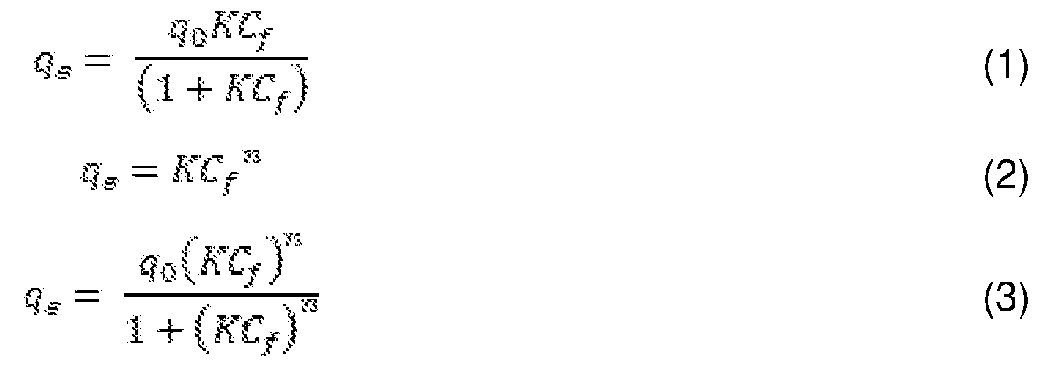
Results and discussion
Therefore, a first variation of the hydrogel beads was synthesized in Example 3, and the adsorption capacity of the beads are summarized in Table 1. From the adsorption isotherm results, the incorporation of copper functionalized MXene in the hydrogel formulation significantly enhanced the adsorption capabilities. The presence of copper ions has a significant impact on the urea adsorption. This could be due to the copper acting as active sites for urea adsorption. This was shown by Liu et al. (Liu, J. et al., J. Appt. Polym. Sci. 2003, 90 (4), 1108-1 112) that Cu can be used as active sites for urea adsorption. Thus, the incorporation of Cu into natural materials can enhance urea adsorption. Our Cu functionalized MXene (Cu40) shows excellent urea adsorption capabilities in aqueous urea solution and in simulated dialysate solution. Cu40 is able to remove urea in a complex solution with multiple competitive species which was reported as a problem for MXene (Meng, F. et al., ACS Nano 2018, 12 (10), 10518-10528). The final products demonstrated are shown in Table 1 .
Table 1. Langmuir adsorption isotherm of hydrogel composite in aqueous urea solution.

Table 2. Langmuir adsorption isotherm of hydrogel composite in simulated dialysate solution.

The urea adsorption procedure typically uses -200 mg of MXene sample was added into 6 mL of -30 mg/dL urea solution. The mixture was shaken at 150 rpm for 4 min and left at 37 °C for 1 hour. There was no significant urea adsorption for both pristine MILD MXene and HF MXene. Both types of MXene have a majority -O- terminations while the MILD synthesized MXene has additional Li+ intercalants. HF MXene shows slightly lower urea adsorption compared to MILD MXene in FIG. 23a. This shows that both the surface termination and the intercalants can influence the MXene urea interaction: urea has poor adsorption energy for -O- terminations compared to -OH terminations and Li+ intercalants have higher adsorption energy to MXene surface compared to urea. All Cu functionalized MXenes show improved urea adsorption compared to pristine MXenes as seen in FIG. 23a. Among the various concentrations of Cu used, Cu 39.3 shows the best urea adsorption, followed by Cu 19.6, Cu 78.6, and lastly Cu 157.2. Upon repetition, Cu 39.3 consistently shows more adsorption compared to Cu 19.6, Cu 78.6, and Cu 157.2 (FIG. 23b), up to 0.79 mg/g, 0.77 mg/g, 0.37 mg/g, and 0.29 mg/g, respectively. From these results, Cu was found to be more effective to adsorb urea as a single atom site compared to the higher Cu loading (Cu 78. And Cu 157.2). For Cu 19.6 and Cu 39.3, the binding sites on the MXene surface available for Cu functionalization are far from saturation due to the low Cu loading. Thus, for Cu 39.3, Cu is expected to be present as single atoms on MXene which was also observed in the previous HR-STEM study. When the Cu loading was further increased (Cu 78.6 and Cu 157.2), which could be verified from the XPS data, the Cu started to aggregate on the MXene surface. Cu starts to aggregate on MXene rather than providing Cu single atom sites,
which lowers the effective surface area for urea adsorption. Since the aggregation of Cu on the MXene surface decreases the effective surface area, this leads to a decrease in the urea adsorption efficiency. This was shown by Brunauer-Emmett-Teller (BET) results. The BET surface area and pore volume for Cu 39.3 and Cu 157.2 were 35.32 m2/g and 17.33 m2/g, 0.003 cm3/g and 0.001 cm3/g, respectively (Table 3). The decrease in BET surface area and pore volume hinders the adsorption capacities of Cu 157.2. The increase in Cu loading may also block the accessibility of N2 onto some sites during BET measurement. This could explain why Cu 78.6 and Cu 157.2 showed poorer urea adsorption than Cu 39.3. Compared to pristine MXene of 10 m2/g (Xia, Q. X. et al., FISC Adv 2017 , 7(18), 1 1000-1 101 1 ), the Cu functionalized MXene had higher BET surface area values. The pristine MXene has Li+ intercalants present, which blocks the available sites on the MXene surface to adsorb N2. After Cu functionalization on MXene, the Li+ intercalants were removed as shown by XRD, and Cu active sites were induced. This allows N2 to adsorb onto active sites, thus increasing the surface area available on the MXene surface. From the XPS results obtained, the Cu valence state present on MXene for Cu 39.3, Cu 78.6, and Cu 157.2 were the same, between 0 and +1. Therefore, the Cu functionalized MXene uses a Cu single atom site than the ensemble of Cu on the MXene surface as the adsorption site. Freeze-drying was further attempted to minimize the reduction in the interlayer spacing associated with dehydration upon Cu functionalization of MXene. During freeze-drying, the trapped water molecules could be sublimed, allowing the structural integrity to be maintained. However, in the case of Cu 39.3, freeze-drying could not alleviate the decreased interlayer spacing; in fact, the spacing was found to be even smaller than that in the vacuum-dried samples (FIGS. 23c and 24), leading to marginally lowered urea adsorption (FIG. 23d). Cu 39.3 with different drying methods showed similar adsorption capacity. By increasing the amount of Cu 39.3 used from -200 mg to -600 mg, the urea removal could be improved from 3.22 mg/dL to 5.62 mg/dL. Likewise, the urea removal increased to 13.33 mg/dL by further increasing Cu 39.3 used to -2.000 g. Higher urea removal was possible by using higher mass loading of Cu 39.3, though the adsorption capacity actually decreased when compared to the lower mass loading of Cu 39.3. This was likely caused by the agglomeration of MXene at flakes in the dispersion at higher mass loading. The agglomeration of adsorbent would decrease the active sites, thus leading to decreased adsorption capacity. The other possible reason for the reduction in adsorption capacity could be the presence of lower urea concentration per gram of MXene since the equilibrium adsorption capacity is a function of the urea concentration.
Table 3. Summary of BET Cu functionalized MXene results.

Table 4. Summary of Langmuir, Freundlich and Langmuir-Freundlich isotherm model and various constants values obtained from each model.

Adsorption isotherm for Cu 39.3 was modelled using Langmuir, Freundlich and Langmuir- Freundlich isotherm equations (FIG. 23e). The Langmuir isotherm model describes the behaviour of adsorbate as a monolayer homogenous surface (Hameed, B. H. et al., J. Hazard. Mater. 2007, 141 (3), 819-825; and Desta, M. B., Journal of Thermodynamics 2013, 2013, 375830). The Freundlich isotherm model describes the adsorbate as a multilayer heterogeneous surface (Nassar, M. Y. et al., RSC Adv 2017, 7 (13), 8034-8050; and Jaroniec, M., Surf. Sci. 1975, 50 (2), 553-564). Using the Langmuir-Freundlich isotherm model fitting, the adsorption behavior of Cu 39.3 was closer to Langmuir than Freundlich. Thus, Cu 39.3 behaves more like a monolayer homogenous surface than a multilayered heterogeneous surface for urea adsorption. The adsorption behavior was observed to be different from Gogotsi et al., where HF-MXene behaves as a multilayer adsorbent (Meng, F. et al., ACS Nano 2018, 12 (10), 10518-10528). HF-MXene interacts with urea via a charge transfer between the urea and HF-MXene surface. Since the HF-MXene adsorbs urea by intercalation mechanism and not active sites, it would behave as a multilayer adsorbent. The MILD MXene has Li+ intercalants tightly bound to MXene surface termination. The Cu functionalization removed the Li+ intercalants shown by XRD, this allows urea to adsorb onto Cu and MXene active sites. Both XPS and XAS show the Cu species on MXene were between 0 to +1 , and they were chemically bonded onto the MXene surface via the Ti-O-Cu bond. STEM shows that Cu was dispersed on the MXene surface as a Cu single atom site. Therefore, the adsorption mechanism for Cu functionalized MXene could be by using the Cu single sites interacting with urea. The most probable interaction between Cu and urea would
be the electron rich O on the carbonyl to the electron deficient Cu. Thus, the adsorption mechanism of urea by Cu 39.3 was different than HFM Xene. The knowledge about the adsorption mechanism provides some idea on how to improve the metal decorated MXene for a more effective urea removal.
Example 6. Functionalized CNC
Functionalized CNCs were prepared by following the protocols in Example 3. The functionalised materials were characterised by following the protocols in Example 4.
Thermogravimetric Analysis (TGA)
The functionalized composition of MF, PDA, and TA on the CNCs was estimated by thermogravimetric analysis (TGA) (TA Instruments TGA Q50). Samples of MF, PDA, TA, CNC, MF CNC, PDA CNC, and TA CNC were weighed onto alumina crucible, carried on a platinum dish, and heated from 25 to 700 °C with rate of 10 °C/min with an N2 flow of 40 mL/min. The coating percentage was calculated using the residue at 600 °C.

£}.227(CiVC) + CCcafctn#) = y (5)
Results and discussion
In Example 5, the hierarchical structure design using MXene nanosheets, intercalated by CNC and the structure was held together by alginate crosslinked using Ca2+ ions. In Example 6, the CNC surface was optimized by functionalizing with compounds with enhanced hydrogen bonding functional groups. Namely, the CNC surface was functionalized using tannic acid (PTA), melamine formaldehyde (MF), and polydopamine (PDA). These compounds have additional hydrogen bonding sites which could be used for urea interaction. The overall synthesis scheme was shown in FIG. 25. The chemical characterization of the functionalization was performed using FTIR, XPS and TGA. From FIG. 26a, the FTIR performed on the functionalized CNC clearly demonstrates the evidence of new functional groups on CNC. For pristine CNCs the peaks at 1644 crrr1, 2907 cm- and 3343 crrr1 correspond to the C=O stretch, symmetric C-H vibrations and OH stretching in CNCs, respectively. PTA functionalization onto CNC has shown additional peak at 1576 cm-1 which could be due to the presence of aromatic rings in tannic acid. On the other hand, PDA CNC shows the successful polymerization of dopamine onto CNC with the N-H bending at 1510 cm-1. After the MF functionalization, there were new peaks observed that correspond to -CH
bending of MF at 1342 cm-1 and the triazine ring in the melamine group at 812 cm-1. The XPS analysis shows that the PTA functionalization shows no significant changes as PTA consist of C and O only, while MF and PDA functionalization on CNC shows the presence of N element in FIG. 26b. These results show that the functionalization was successful. To quantify the amount of functionalization on CNC surface, TGA was performed, and the calculation of the functionalization was performed by using the residue left at 600 °C, and by applying Equations 4 and 5. The functionalization was summarized in FIGS. 26c-d, 7.1%, 41 .1%, and 43.8% for PTA CNC, MF CNC and PDA CNC respectively.
Table 5. Difference in urea adsorption.

Thus, herein, we report on the study of various concentrations of Cu functionalized MILD synthesized MXene in an aqueous urea solution. The calculated adsorption energy for urea on Cu functionalized MXene was -2.16 eV, which was higher than that on MXene with -OH surface termination (-0.93 eV). Another advantage of this combination is that MXene also has self-reduction properties, which allows Cu ions to anchor on MXene surfaces without the addition of any reducing agent. In the present disclosure, the presence of Cu ions on the MXene improved the adsorption of urea. Furthermore, it was found that the concentration of Cu on MXene could affect the urea adsorption capabilities of the material.
Although MILD synthesis of MXene is safer and is more accessible than the direct HF method, the synthesized products have few -OH terminations and have better interactions with the residual Li+ ions than with urea. Considering these factors, MILD synthesized MXene is in fact not an ideal option for urea adsorption. Based on our previous study, Cu doping on MXene was found to have better interaction with urea than on pristine MXene surface, resulting in improved urea adsorption compared to pristine MXene. Therefore, Cu functionalization was combined with the MILD-synthesized MXene, which binds on the surface via Ti-O-Cu linkage. The valence state of Cu in the doped MILD synthesized
MXene is between 0 and +1 , as verified by XAS and XPS. Excessive Cu loading on MXene was found to lead to a decrease in the urea adsorption capacity. The optimal amount of Cu loading for functionalization on MXene for urea adsorption was 39.3 - 78.6 pmol. Although this work highlights the potential of MXene used as a dialysis membrane, it is understood that a spent dialysate is a complex solution with multiple competitive species and Cu functionalized MXene may not lead to selective adsorption of urea molecules. Possible future work could include the use of ligands at Cu single atom sites that may increase the selectivity for urea interaction.
Claims
1 . A composite material, comprising: a hydrogel polymeric matrix; a plurality of MXenes, where each MXene has a first and second surface and a plurality of copper atoms are dispersed on the first and second surface of each MXene; and cellulose nanocrystals, wherein the plurality of MXenes and cellulose nanocrystals are dispersed throughout the hydrogel polymer matrix.
2. The composite material according to Claim 1 , wherein the cellulose nanocrystals prevent formation of aggregates between individual MXenes in the plurality of MXenes.
3. The composite material according to Claim 1 or Claim 2, wherein the cellulose nanocrystals are in a surface-functionalised state or a surface-unfunctionalised state, optionally wherein the cellulose nanocrystals are in a surface-unfunctionalised state.
4. The composite material according to Claim 3, wherein the cellulose nanocrystals are in a surface-functionalised state, where they are functionalised by one or more of the group consisting of a melamine-formaldehyde polymer and a polymeric catechol (e.g. a poly(levodopa), and more particularly, a polytannic acid, and a polydopamine), optionally wherein the cellulose nanocrystals are functionalised by polydopamine.
5. The composite material according to any one of the preceding claims, wherein the plurality of MXenes are TiaCaTx, where T represents -OH, -halide, or -O-, optionally wherein T represents -OH, -F, -Cl, or -O-
6. The composite material according to any one of the preceding claims, wherein the weight to weight ratio of the plurality of MXenes denuded of the plurality of copper atoms to the plurality of copper atoms is from 25:1 to 150:1 , such as from 50:1 to 100:1 , such as from 65:1 to 95:1 , such as from 74:1 to 94:1 , such as about 75:1 (e.g. 74.63:1 ), such as about 93:1 (e.g. 93.28:1 ).
7. The composite material according to any one of the preceding claims, wherein the weight to weight ratio of the cellulose nanocrystals to the plurality of MXenes, including the plurality of copper atoms is from 5:1 to 20:1 , such as from 7:1 to 15:1 , such as about 10:1 .
8. The composite material according to any one of the preceding claims, wherein the weight to weight ratio of the hydrogel polymeric matrix to the plurality of MXenes, including the plurality of copper atoms is from 5:1 to 20:1 , such as from 7:1 to 15:1 , such as about 10:1.
9. The composite material according to any one of the preceding claims, wherein the plurality of copper atoms have an oxidation state of 0 or +1 .
10. The composite material according to any one of the preceding claims, wherein the hydrogel polymeric matrix is selected from one or more of the group consisting of a poly(acrylic acid), a chitosan, a polyethylene oxide), a poly(vinyl alcohol), and a crosslinked alginate, optionally wherein the hydrogel polymeric matrix is an alkaline earth/transition metal (e.g. Ca2+ or Cu2+) crosslinked alginate (e.g. an alkaline earth (e.g. Ca2+) crosslinked alginate).
11 . The composite material according to any one of the preceding claims, wherein the composite material is presented in the form of a plurality of beads, optionally wherein the plurality of beads have an average diameter of from 0.8 to 4 mm.
12. The composite material according to any one of the preceding claims, wherein the composite material has a C x value for the adsorption of urea of:
(a) from 125 to 500 mg/g, such as from 150 to 370 mg/g, such as from 160 to 355 mg/g, such as about 170 mg/g (e.g. 170.5 mg/g), about 213 mg/g (e.g. 213.1 mg/g), about 226 mg/g (e.g. 226.4 mg/g), and about 354 mg/g (e.g. 354.4 mg/g) using an aqueous solution of urea; and/or
(b) from 50 to 150 mg/g, such as from 65 to 120 mg/g, such as about 68 mg/g (e.g. 67.9 mg/g), about 80 mg/g (e.g. 79.9 mg/g), about 96 mg/g (e.g. 95.6 mg/g), and about 115 mg/g (e.g. 1 15.1 mg/g) using a simulated dialysate solution comprising urea.
13. A sorbent material for use in kidney dialysis, wherein the sorbent material comprises a composite material as described in any one of Claims 1 to 12, optionally wherein the kidney dialysis is peritoneal dialysis.
14. A sorbent cartridge for use in kidney dialysis, wherein the sorbent cartridge comprises a composite material as described in any one of Claims 1 to 12, optionally wherein the kidney dialysis is peritoneal dialysis.
15. Use of a composite material as described in any one of Claims 1 to 12 in the selective adsorption of urea.
16. Use of a composite material according to any one of Claims 1 to 12 in a wearable artificial kidney device.
17. A method of dialysis comprising the steps of:
(i) obtaining a dialysate from a subject; and
(ii) passing the dialysate through a sorbent material that comprises the composite material as described in any one of Claims 1 to 12.
Applications Claiming Priority (2)
| Application Number | Priority Date | Filing Date | Title |
|---|---|---|---|
| SG10202301712W | 2023-06-16 | ||
| SG10202301712W | 2023-06-16 |
Publications (1)
| Publication Number | Publication Date |
|---|---|
| WO2024258345A1 true WO2024258345A1 (en) | 2024-12-19 |
Family
ID=93852790
Family Applications (1)
| Application Number | Title | Priority Date | Filing Date |
|---|---|---|---|
| PCT/SG2024/050392 Ceased WO2024258345A1 (en) | 2023-06-16 | 2024-06-12 | Copper functionalized mxene with cellulose nanocrystal alginate hydrogel composite for urea adsorption |
Country Status (1)
| Country | Link |
|---|---|
| WO (1) | WO2024258345A1 (en) |
Cited By (2)
| Publication number | Priority date | Publication date | Assignee | Title |
|---|---|---|---|---|
| CN121177573A (en) * | 2025-11-03 | 2025-12-23 | 山东大学齐鲁第二医院 | An MXene-based artificial dura mater, its preparation method, and its application. |
| CN122252161A (en) * | 2026-05-27 | 2026-06-23 | 潍坊科技学院 | Biochar-loaded zinc-iron layered double metal oxide composite material and preparation method and application thereof |
Citations (3)
| Publication number | Priority date | Publication date | Assignee | Title |
|---|---|---|---|---|
| US20160175812A1 (en) * | 2014-12-22 | 2016-06-23 | Nishil Mohammed | PRISTINE AND SURFACE FUNCTIONALIZED CELLULOSE NANOCRYSTALS (CNCs) INCORPORATED HYDROGEL BEADS AND USES THEREOF |
| US20220161223A1 (en) * | 2017-08-01 | 2022-05-26 | Drexel University | MXene Sorbent For Removal Of Small Molecules From Dialysate |
| WO2022153889A1 (en) * | 2021-01-13 | 2022-07-21 | 株式会社村田製作所 | Adsorption element, method for manufacturing same, adsorption sheet, separation film, and artificial dialysis equipment |
-
2024
- 2024-06-12 WO PCT/SG2024/050392 patent/WO2024258345A1/en not_active Ceased
Patent Citations (3)
| Publication number | Priority date | Publication date | Assignee | Title |
|---|---|---|---|---|
| US20160175812A1 (en) * | 2014-12-22 | 2016-06-23 | Nishil Mohammed | PRISTINE AND SURFACE FUNCTIONALIZED CELLULOSE NANOCRYSTALS (CNCs) INCORPORATED HYDROGEL BEADS AND USES THEREOF |
| US20220161223A1 (en) * | 2017-08-01 | 2022-05-26 | Drexel University | MXene Sorbent For Removal Of Small Molecules From Dialysate |
| WO2022153889A1 (en) * | 2021-01-13 | 2022-07-21 | 株式会社村田製作所 | Adsorption element, method for manufacturing same, adsorption sheet, separation film, and artificial dialysis equipment |
Non-Patent Citations (1)
| Title |
|---|
| WEI JINGJIANG, ZHU CHENGLONG, ZENG ZHIHUI, PAN FEI, WAN FUQIANG, LEI LIWEN, NYSTRÖM GUSTAV, FU ZHENGYI: "Bioinspired cellulose‐integrated MXene‐based hydrogels for multifunctional sensing and electromagnetic interference shielding", INTERDISCIPLINARY MATERIALS, vol. 1, no. 4, 1 October 2022 (2022-10-01), pages 495 - 506, XP093255529, ISSN: 2767-4401, DOI: 10.1002/idm2.12026 * |
Cited By (2)
| Publication number | Priority date | Publication date | Assignee | Title |
|---|---|---|---|---|
| CN121177573A (en) * | 2025-11-03 | 2025-12-23 | 山东大学齐鲁第二医院 | An MXene-based artificial dura mater, its preparation method, and its application. |
| CN122252161A (en) * | 2026-05-27 | 2026-06-23 | 潍坊科技学院 | Biochar-loaded zinc-iron layered double metal oxide composite material and preparation method and application thereof |
Similar Documents
| Publication | Publication Date | Title |
|---|---|---|
| Tanhaei et al. | Efficient carbon interlayed magnetic chitosan adsorbent for anionic dye removal: Synthesis, characterization and adsorption study | |
| Liu et al. | Tailored Janus silica nanosheets integrating bispecific artificial receptors for simultaneous adsorption of 2, 6-dichlorophenol and Pb (ii) | |
| Nie et al. | A millimeter-sized negatively charged polymer embedded with molybdenum disulfide nanosheets for efficient removal of Pb (II) from aqueous solution | |
| Wang et al. | A hierarchical hybrid monolith: MoS42−-intercalated NiFe layered double hydroxide nanosheet arrays assembled on carbon foam for highly efficient heavy metal removal | |
| JP6972102B2 (en) | Solid-phase crystallization method of metal-organic framework in mesoporous material and its hybrid material | |
| Dinari et al. | Fabrication of poly (methyl methacrylate)/silica KIT-6 nanocomposites via in situ polymerization approach and their application for removal of Cu2+ from aqueous solution | |
| Gan et al. | Experimental and computational investigations of zirconium-based metal-organic frameworks for bilirubin adsorption | |
| Zhang et al. | A combination of distillation–precipitation polymerization and click chemistry: fabrication of boronic acid functionalized Fe3O4 hybrid composites for enrichment of glycoproteins | |
| Sharma et al. | Calorimetric study of alkali metal ion (K+, Na+, Li+) exchange in a clay-like MXene | |
| KR102349638B1 (en) | Absorbent having MXene beads coated with prussian blue and cesium removal method using the same | |
| Icten et al. | Magnetite doped metal–organic framework nanocomposites: an efficient adsorbent for removal of bisphenol-A pollutant | |
| Naicker et al. | Fabrication of novel magnetic chitosan/graphene-oxide/metal oxide nanocomposite beads for Cr (VI) adsorption | |
| US20120168383A1 (en) | Graphene-iron oxide complex and fabrication method thereof | |
| Cui et al. | Synthesis of cauliflower-like ion imprinted polymers for selective adsorption and separation of lithium ion | |
| Liu et al. | Adenine-bearing covalent organic frameworks via one-pot tandem reaction for selective adsorption of Ag+ | |
| Li et al. | Bioinspired succinyl-β-cyclodextrin membranes for enhanced uranium extraction and reclamation | |
| CN108816187A (en) | A kind of preparation of L-arginine modified graphene oxide sponge and uranium absorption method | |
| CN104168996A (en) | Multilayer organic-templated-boehmite-nanoarchitecture for water purification | |
| Abdelrahman et al. | Facile synthesis of MgO/CuO and MgO/Cu3MgO4 binary nanocomposites as promising adsorbents for the disposal of Zn (II) ions | |
| Yang et al. | The efficient immobilization of uranium (vi) by modified dendritic fibrous nanosilica (DFNS) using mussel bioglue | |
| CN110201629A (en) | Ternary hydrotalcite adsorbent and its preparation method and application | |
| US20070219280A1 (en) | Organometallic Complex Structure and Production Method Thereof; and Functional Film, Functional Composite Material, Functional Structure and Adsorption and Desorption Sensor Using the Organometallic Complex Structure | |
| CN114797783A (en) | Adsorbent for selectively removing Cr (VI), preparation method and application thereof | |
| Li et al. | Ellagic acid-based MOFs/polyethersulfone composite membrane with hierarchical porous structure for rapid uranium removal from wastewater | |
| JP5653408B2 (en) | Radioactive Cs adsorbent and method for producing the same |
Legal Events
| Date | Code | Title | Description |
|---|---|---|---|
| 121 | Ep: the epo has been informed by wipo that ep was designated in this application |
Ref document number: 24823810 Country of ref document: EP Kind code of ref document: A1 |
|
| NENP | Non-entry into the national phase |
Ref country code: DE |
|
| 122 | Ep: pct application non-entry in european phase |
Ref document number: 24823810 Country of ref document: EP Kind code of ref document: A1 |