WO2024257862A1 - アミンの分離方法 - Google Patents
アミンの分離方法 Download PDFInfo
- Publication number
- WO2024257862A1 WO2024257862A1 PCT/JP2024/021733 JP2024021733W WO2024257862A1 WO 2024257862 A1 WO2024257862 A1 WO 2024257862A1 JP 2024021733 W JP2024021733 W JP 2024021733W WO 2024257862 A1 WO2024257862 A1 WO 2024257862A1
- Authority
- WO
- WIPO (PCT)
- Prior art keywords
- mobile phase
- acid
- amine
- amines
- base
- Prior art date
- Legal status (The legal status is an assumption and is not a legal conclusion. Google has not performed a legal analysis and makes no representation as to the accuracy of the status listed.)
- Ceased
Links
Images















Classifications
-
- B—PERFORMING OPERATIONS; TRANSPORTING
- B01—PHYSICAL OR CHEMICAL PROCESSES OR APPARATUS IN GENERAL
- B01J—CHEMICAL OR PHYSICAL PROCESSES, e.g. CATALYSIS OR COLLOID CHEMISTRY; THEIR RELEVANT APPARATUS
- B01J20/00—Solid sorbent compositions or filter aid compositions; Sorbents for chromatography; Processes for preparing, regenerating or reactivating thereof
- B01J20/281—Sorbents specially adapted for preparative, analytical or investigative chromatography
-
- B—PERFORMING OPERATIONS; TRANSPORTING
- B01—PHYSICAL OR CHEMICAL PROCESSES OR APPARATUS IN GENERAL
- B01J—CHEMICAL OR PHYSICAL PROCESSES, e.g. CATALYSIS OR COLLOID CHEMISTRY; THEIR RELEVANT APPARATUS
- B01J20/00—Solid sorbent compositions or filter aid compositions; Sorbents for chromatography; Processes for preparing, regenerating or reactivating thereof
- B01J20/281—Sorbents specially adapted for preparative, analytical or investigative chromatography
- B01J20/282—Porous sorbents
- B01J20/283—Porous sorbents based on silica
-
- B—PERFORMING OPERATIONS; TRANSPORTING
- B01—PHYSICAL OR CHEMICAL PROCESSES OR APPARATUS IN GENERAL
- B01J—CHEMICAL OR PHYSICAL PROCESSES, e.g. CATALYSIS OR COLLOID CHEMISTRY; THEIR RELEVANT APPARATUS
- B01J20/00—Solid sorbent compositions or filter aid compositions; Sorbents for chromatography; Processes for preparing, regenerating or reactivating thereof
- B01J20/281—Sorbents specially adapted for preparative, analytical or investigative chromatography
- B01J20/29—Chiral phases
-
- G—PHYSICS
- G01—MEASURING; TESTING
- G01N—INVESTIGATING OR ANALYSING MATERIALS BY DETERMINING THEIR CHEMICAL OR PHYSICAL PROPERTIES
- G01N30/00—Investigating or analysing materials by separation into components using adsorption, absorption or similar phenomena or using ion-exchange, e.g. chromatography or field flow fractionation
- G01N30/02—Column chromatography
- G01N30/26—Conditioning of the fluid carrier; Flow patterns
-
- G—PHYSICS
- G01—MEASURING; TESTING
- G01N—INVESTIGATING OR ANALYSING MATERIALS BY DETERMINING THEIR CHEMICAL OR PHYSICAL PROPERTIES
- G01N30/00—Investigating or analysing materials by separation into components using adsorption, absorption or similar phenomena or using ion-exchange, e.g. chromatography or field flow fractionation
- G01N30/02—Column chromatography
- G01N30/88—Integrated analysis systems specially adapted therefor, not covered by a single one of the groups G01N30/04 - G01N30/86
Definitions
- This disclosure relates to a method for separating amines.
- polysaccharide-based CSPs separation agents that use polysaccharide derivatives as chiral selectors (hereinafter referred to as "polysaccharide-based CSPs") are known to be extremely effective in separating many enantiomers and substances that are difficult to separate with general separation agents due to their similar structures, such as structural isomers.
- An object of the present disclosure is to provide a method for separating amines, which has excellent separation performance.
- the method further comprises an analysis step of analyzing the amine separated by the separation step, In the analysis step, analysis is performed using at least a mass spectrometer.
- [3] The method for separating an amine according to [1] or [2], wherein the base is at least one selected from the group consisting of ammonia, a primary amine, a secondary amine, and a tertiary amine.
- [4] The method for separating an amine according to [3], wherein the base is at least one selected from the group consisting of ammonia, ethylamine, n-propylamine, 2-propylamine, dimethylamine, diethylamine, trimethylamine, triethylamine, pyrrolidine, and piperidine.
- the base is at least one selected from the group consisting of ammonia, ethylamine, n-propylamine, 2-propylamine, dimethylamine, diethylamine, trimethylamine, triethylamine, pyrrolidine, and piperidine.
- the mobile phase contains at least oxalic acid as the specific acid.
- [6] The method for separating amines according to any one of [1] to [5], wherein at least one of the oligosaccharides, polysaccharides, and derivatives thereof has an optically active site.
- [7] The method for separating an amine according to any one of [1] to [6], wherein the solvent is one or more selected from the group consisting of water, acetonitrile, ethanol, methanol, 2-propanol, hexane, heptane, THF, and liquid carbon dioxide.
- the solvent is one or more selected from the group consisting of water, acetonitrile, ethanol, methanol, 2-propanol, hexane, heptane, THF, and liquid carbon dioxide.
- the present disclosure provides an amine separation method with excellent separation performance.
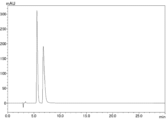
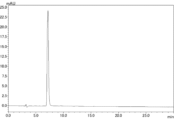
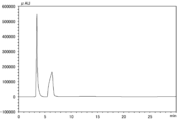
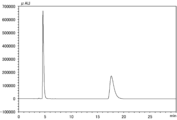
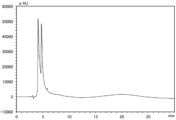
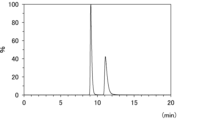
- 1 is a liquid chromatogram obtained by analysis of amines in Example 1.
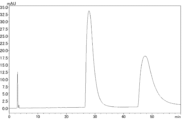
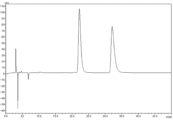
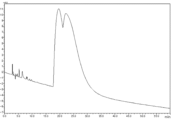
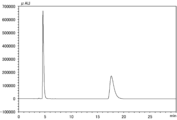
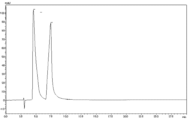
- 1 is a liquid chromatogram obtained by analysis of an amine in Comparative Example 1.
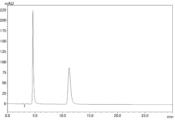
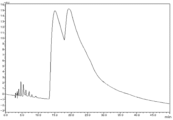
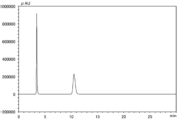
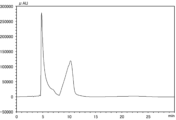
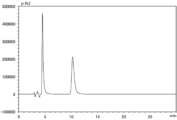
- 1 is a liquid chromatogram obtained by analysis of an amine in Comparative Example 2.
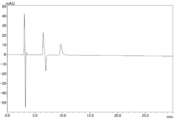
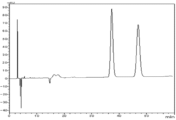
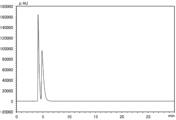
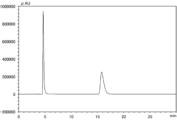
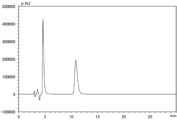
- 1 is a liquid chromatogram obtained by analysis of an amine in Comparative Example 3.
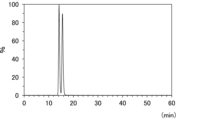
- 1 is a liquid chromatogram obtained by analysis of amines in Example 2.
- 1 is a liquid chromatogram obtained by analysis of an amine in Comparative Example 4.
- 1 is a liquid chromatogram obtained by analysis of amines in Example 3.
- 1 is a liquid chromatogram obtained by analysis of an amine in Comparative Example 5.
- 1 is a liquid chromatogram obtained by analysis of amines in Example 4.
- 1 is a liquid chromatogram obtained by analysis of an amine in Comparative Example 6.
- 1 is a liquid chromatogram obtained by analysis of amines in Example 5.
- 1 is a liquid chromatogram obtained by analysis of an amine in Comparative Example 7.
- 1 is a liquid chromatogram obtained by analysis of amines in Example 6.
- 1 is a liquid chromatogram obtained by analysis of an amine in Comparative Example 8.
- 1 is a liquid chromatogram obtained by analysis of an amine in Comparative Example 9.
- 1 is a liquid chromatogram obtained by analysis of amines in Example 7.
- 1 is a liquid chromatogram obtained by analysis of an amine in Comparative Example 10.
- 1 is a liquid chromatogram obtained by analysis of amines in Example 8.
- 1 is a liquid chromatogram obtained by analysis of an amine in Comparative Example 11.
- 1 is a liquid chromatogram obtained by analysis of amines in Example 9.
- 1 is a liquid chromatogram obtained by analysis of amines in Example 10.
- 1 is a liquid chromatogram obtained by analysis of amines in Example 11.
- 1 is a liquid chromatogram obtained by analysis of amines in Example 12.
- 1 is a liquid chromatogram obtained by analysis of amines in Example 13.
- 1 is a liquid chromatogram obtained by analysis of amines in Example 14.
- 1 is a liquid chromatogram obtained by analysis of an amine in Comparative Example 12.
- 1 is a liquid chromatogram obtained by analysis of amines in Example 15.
- 1 is a liquid chromatogram obtained by analysis of an amine in Comparative Example 13.
- 1 is a liquid chromatogram obtained by analysis of amines in Example 16.
- 1 is a liquid chromatogram obtained by analysis of an amine in Comparative Example 14.
- 1 is a liquid chromatogram obtained by analysis of amines in Example 17.
- 1 is a liquid chromatogram obtained by analysis of amines in Example 18.
- 1 is a liquid chromatogram obtained by analysis of amines in Example 19.
- 1 is a mass spectrum obtained by mass spectrometry of the amine in Example 20.
- 1 is a mass spectrum obtained by mass spectrometry of the amine in Example 21.
- 1 is a mass spectrum obtained by mass spectrometry of the amine in Example 22.
- 1 is a mass spectrum obtained by mass spectrometry of the amine in Example 23.
- 1 is a mass spectrum obtained by mass spectrometry of the amine in Example 24.
- the method for separating an amine comprises: A stationary phase comprising at least one of an oligosaccharide, a polysaccharide, and a derivative thereof; a mobile phase comprising one or more specific acids selected from the group consisting of oxalic acid, acetic acid, formic acid, and trifluoroacetic acid, one or more bases, and a solvent; and isolating the amine by chromatography using where A is a value calculated for each specific acid contained in the mobile phase by the following formula (1), SA is a total value of A calculated for each specific acid, B is a value calculated for each base contained in the mobile phase by the following formula (2), and SB is a total value of B calculated for each base, and SB/SA is 0.05 or more and 0.95 or less.
- Formula (1): A valence of specific
- the above-mentioned amine separation method may include a step other than the above-mentioned separation step, such as an analysis step of analyzing (e.g., identifying) the separated amine, a quantification step of quantifying the separated amine, a step of predicting the structure of the separated amine, or a recovery step of recovering the separated amine.
- the mobile phase in the above embodiment is a mobile phase before it contains the amines to be separated, and the "amine content in the mobile phase" is the amine content in the mobile phase before it contains the amines to be separated.
- an oligosaccharide is a sugar having five or more sugar residues.
- oligosaccharides and polysaccharides can be distinguished by molecular weight, with those with a molecular weight of 3,000 or less being considered oligosaccharides and those with a molecular weight of more than 3,000 being considered polysaccharides.
- a specific acid includes both a free acid and an acid anion
- a specific base includes both a free acid and a cation.
- an acid anion and a cation may form a salt with each other or with other ions.
- oligosaccharide/polysaccharide derivatives oligosaccharides, polysaccharides, and their derivatives (hereinafter collectively referred to as "oligosaccharide/polysaccharide derivatives") and a mobile phase containing one or more specific acids selected from the group consisting of oxalic acid, acetic acid, formic acid, and trifluoroacetic acid, one or more bases, and a solvent, and further adjusting the content of these acids and bases, the separation performance of amines can be improved.
- the inventors have found that by adding a base to the mobile phase at a molar concentration lower than the molar concentration (content) of the acid, and neutralizing a portion of the acid to convert it into a salt, the concentration of the counter anion in the mobile phase can be adjusted to a preferred level even if the acid is a weak acid. Furthermore, based on the above-described mechanism discovered by the inventors, the inventors have further investigated the type of acid, and the contents of acid and amine, and as a result have found that the configuration according to the above-described embodiment can improve the separation performance of amines, specifically, can ensure sufficient retention time of the analyte in chromatography.
- the present inventors have further studied and found that when the stationary phase is acidic and causes non-specific adsorption of the sample amine, for example, when the stationary phase contains silica gel as a carrier, a phenomenon called peak tailing, which is thought to be caused by the silanol group, often occurs.
- the above-mentioned aspect of the present embodiment can improve the separation performance of the amine, specifically, can make the peak of the chromatogram obtained by analysis sharper. If an ionic interaction occurs between the above-mentioned cation and the conjugated anion of the dissociated silanol, the peak of the chromatogram obtained by analysis will become broad.
- the present inventors speculate that in the embodiment described here, the presence of excess acid suppresses the dissociation of silanol, thereby suppressing this ionic interaction.
- the pH of the mobile phase is made high and the sample amine is retained as a neutral molecule in the non-ionic stationary phase.
- the stationary phase contains silica gel, the silica gel is likely to dissolve under such conditions and the column is likely to deteriorate, so measures are taken to prevent the pH from rising too high by adding a salt with a buffering effect such as ammonium bicarbonate and inserting a guard column, which is cheaper to replace than the main column, before the main column and saturating the mobile phase flowing through the main column with silica, thereby suppressing the elution of silica from the main column.
- the pH is lowered by the excess acid, so that it is not necessary to take the above-mentioned measures, which is also a major advantage.
- Non-Patent Document 1 when a separation operation using the mobile phase disclosed in Non-Patent Document 1 is applied to the separation of amines, a non-volatile salt having a high boiling point is added to the mobile phase, and the salt is likely to remain after the solvent in the mobile phase is evaporated, resulting in a decrease in the separation performance of the amines.
- salts containing an anion of one or more specific acids selected from the group consisting of oxalic acid, acetic acid, formic acid, and trifluoroacetic acid and an amine cation are generated in the mobile phase, but these salts are easily volatilized or thermally decomposed, and therefore high-boiling, non-volatile salts are unlikely to remain even if the solvent is evaporated.
- the amines to be separated are not particularly limited as long as they are compounds containing an amino group, and may be any of primary amines, secondary amines, and tertiary amines.
- Specific examples of amines include amino acids such as alanine, cysteine, glutamic acid, methionine, leucine, tyrosine, and tryptophan; amino acid derivatives such as esters and amides of the above amino acids; amino alcohols such as dimethylaminoethanol, propanolamine, methioninol, and norephedrine; phenylethylamine; cyclic amines such as 1-phenyl-1,2,3,4-tetrahydroisoquinoline; and other basic pharmaceuticals containing an amino group, particularly their enantiomers.
- the separation method according to this embodiment can achieve high separation performance that distinguishes between molecular shapes, and can therefore separate mixtures of amines that are difficult to separate due to their similar structures into individual amines.
- Examples of mixtures of amines that are similar in structure include mixtures of chain isomers, mixtures of positional isomers, mixtures of geometric isomers, and mixtures of analogues.
- the greatest feature is that a mixture of enantiomers can be separated into individual enantiomers by using a chiral stationary phase having an oligosaccharide/polysaccharide derivative with optically active sites as the stationary phase.
- the stationary phase may contain at least one of oligosaccharides, polysaccharides, and their derivatives (hereinafter, these are also collectively referred to as “oligosaccharide/polysaccharide derivatives") as an adsorbent (also referred to as “separation agent”), and the form in which the oligosaccharide/polysaccharide derivative is contained is not particularly limited.
- the adsorbent may be a solidified mixture of oligosaccharides/polysaccharide derivatives or oligosaccharide/polysaccharide derivatives and other components, or a mixture of oligosaccharides/polysaccharide derivatives or oligosaccharide/polysaccharide derivatives and other components supported on a carrier.
- polysaccharides or oligosaccharide derivatives insolubilized by a method such as providing a chemical bond between the carrier, providing a chemical bond between the oligosaccharide/polysaccharide derivative, or providing a polymer-impermeable layer on the surface of the oligosaccharide/polysaccharide derivative are particularly useful.
- the shape of the stationary phase is not particularly limited, and may be, for example, crushed and amorphous, but is preferably spherical. In this case, it can be used in column chromatography, in which the particles are packed in a column.
- the oligosaccharide/polysaccharide derivative itself may be granulated, but from the viewpoint of superior efficiency, pressure resistance, and ease of use, it is preferable to support it on a carrier such as porous silica gel. In the case of a porous carrier, only the surface may be porous, and when the oligosaccharide/polysaccharide derivative is supported, it may be distributed near the surface (variously called core-shell, surface porous, or peripheral).
- the stationary phase is spherical in shape
- its diameter is not particularly limited, but is preferably 0.5 to 100 ⁇ m, more preferably 0.5 to 50 ⁇ m, and even more preferably 1 to 20 ⁇ m (from the viewpoint of affordability in current chromatography devices). From the viewpoint of amine separation, a smaller diameter is preferable, but when used in a large-scale device for fractionation, a larger diameter is preferable in order to reduce the flow resistance.
- "spherical” also includes a nearly spherical shape.
- oligosaccharide/polysaccharide derivative is not particularly limited, and may be, for example, an oligosaccharide/polysaccharide in which a part or all of the hydroxyl or amino groups of an oligosaccharide or polysaccharide (hereinafter, these are also collectively referred to as "oligosaccharide/polysaccharide") are substituted with a substituent.
- the polysaccharide derivative is, for example, obtained by reacting a part or all of the hydroxyl or amino groups of an oligosaccharide/polysaccharide with another compound, and an example is an oligosaccharide/polysaccharide in which a part or all of the hydroxyl groups of the oligosaccharide/polysaccharide are esterified with an aliphatic carboxylic acid, benzoic acid, or phenylcarbamic acid, which may further contain one or more substituents.
- an oligosaccharide/polysaccharide in which at least one hydrogen atom contained in a benzene ring is esterified with a benzoic acid or phenylcarbamic acid, each of which is independently substituted with a methyl group or a halogen atom is preferred.
- the oligosaccharide/polysaccharide derivatives may be used alone or in any combination of two or more.
- oligosaccharide or polysaccharide that serves as the parent of the oligosaccharide or polysaccharide derivative.
- the number of sugar residues in an oligosaccharide or polysaccharide is not particularly limited as long as it is 5 or more, and may be, for example, 10 or more, 20 or more, or less than 1,000, 500 or less, 100 or less, 75 or less, or 50 or less.
- the type of monosaccharide constituting the oligosaccharide/polysaccharide is not particularly limited, and examples thereof include aldotetroses such as erythrose or threose, aldopentoses such as ribose, lyxose, xylose, or arabinose, aldohexoses such as allose, talose, gulose, glucose, altrose, mannose, galactose, or idose, ketotetroses such as erythrulose, ketopentoses such as xylose or ribulose, or ketohexoses such as psicose, fructose, sorbose, or tagatose, etc.
- glucose, fructose, and glucosamine are preferred as they are highly pure and easily available as raw materials.
- These monosaccharides may be used alone or in combination of two or more.
- examples of polysaccharides include amylose, amylopectin, glycogen, cellulose, curdlan, paramylon, chitin, chitosan, dextran, nigeran, agarose, carrageenan, heparin, alginic acid, hyaluronic acid, pectin, xyloglucan, xylan, glucomannan, and levan.
- cellulose, amylose, chitin, chitosan, curdlan, schizophyllan, agarose, and the like are preferred from the viewpoints of excellent separation performance, high purity, and easy availability.
- Amylose and amylopectin may be used alone, or may be used in a form containing both, such as starch.
- oligosaccharide/polysaccharide derivatives having optically active sites are preferred.
- the amount of oligosaccharide/polysaccharide derivatives in the stationary phase is not particularly limited, and can be appropriately set with reference to known methods in which oligosaccharide/polysaccharide derivatives are used as separation agents in the stationary phase.
- the content of oligosaccharide/polysaccharide derivatives in the stationary phase may be 100% by mass, and when the above-mentioned carriers are used, it is preferably 5% by mass or more and 50% by mass or less, more preferably 5% by mass or more and 30% by mass or less, and even more preferably 10% by mass or more and 30% by mass or less.
- the embodiment containing oligosaccharide/polysaccharide derivatives is not particularly limited, and the oligosaccharide/polysaccharide derivative or the oligosaccharide/polysaccharide derivative itself may be made into particles, porous particles, or porous monoliths as necessary, a solidified mixture of oligosaccharide/polysaccharide derivatives or oligosaccharide/polysaccharide derivatives and other components may be used, or a mixture of oligosaccharide/polysaccharide derivatives or oligosaccharide/polysaccharide derivatives and other components supported on a carrier may be used, but an oligosaccharide/polysaccharide derivative or a mixture of oligosaccharide/polysaccharide derivatives and other components supported on a carrier is preferred, and an oligosaccharide/polysaccharide derivative supported on a carrier is more preferred.
- a known method can be adopted, and it may be physical supporting or chemical supporting.
- the chemical supporting for example, a method in which the oligosaccharide/polysaccharide derivative is supported on the carrier by a chemical bond such as a covalent bond can be preferably adopted.
- a method in which a reactive group is introduced into the oligosaccharide/polysaccharide derivative, the raw material of the oligosaccharide/polysaccharide derivative, or the intermediate of the oligosaccharide/polysaccharide derivative, and this substituent is reacted with the reactive group present on the carrier surface can be mentioned.
- a treatment for providing a chemical bond between the oligosaccharide/polysaccharide derivative may be carried out.
- the reactive group present on the carrier surface may be a group present on the surface of an untreated carrier, or may be a group introduced on the carrier surface by surface treating the carrier with a surface treatment agent, for example, a silane coupling agent such as 3-aminopropyltriethoxysilane and 3-glycidyloxypropyltrimethoxysilane.
- a method in which a pair of so-called click reaction is respectively bound to the stationary phase and the oligosaccharide/polysaccharide derivative and reacted with each other can also be mentioned.
- an insolubilized layer can be formed on the surface of the carrier by forming a so-called cross-linking bond between atomic groups containing the oligosaccharide/polysaccharide derivative.
- the oligosaccharide/polysaccharide derivative may be supported on the carrier by, for example, a method of impregnating silica gel with a solution of the oligosaccharide/polysaccharide derivative and evaporating it to physically adsorb (e.g., coat) the oligosaccharide/polysaccharide derivative onto the carrier.
- the oligosaccharide/polysaccharide derivative from the viewpoint of suppressing dissolution of the oligosaccharide/polysaccharide derivative in the solvent, it is preferable to insolubilize the oligosaccharide/polysaccharide derivative by forming some kind of chemical bond between the silica gel and the oligosaccharide/polysaccharide derivative backbone, or by forming some kind of chemical bond between the oligosaccharide/polysaccharide derivative on the carrier. Note that, in order to suppress dissolution of the oligosaccharide/polysaccharide derivative in the solvent, it is preferable to provide a chemical bond between the oligosaccharide/polysaccharide derivative even when a carrier is not used.
- the carrier is not particularly limited as long as it can immobilize oligosaccharide/polysaccharide derivatives on the carrier.
- the carrier may be an inorganic carrier or an organic carrier, but is preferably an inorganic carrier.
- inorganic carriers include silica gel, alumina, magnesia, glass, kaolin, titanium oxide, silicate, zirconia, and hydroxyapatite.
- organic carriers include cross-linked polystyrene, cross-linked poly(meth)acrylamide, cross-linked poly(meth)acrylate, and polysaccharide.
- Hybrid silica gels in which a polyfunctional silane coupling agent is copolymerized when forming silica gel can also be used. It is preferable that these organic carriers are insolubilized by being cross-linked with a cross-linking agent.
- the shape of the carrier is not particularly limited, and examples include particles and porous cylinders (monoliths) that are liquid-tightly contained in a column tube.
- the inner wall of a capillary can also be used as a carrier. If the separation factor is sufficiently large, a membrane-type carrier can be used and developed in the thickness direction, or it can be developed in the surface direction as thin-layer chromatography.
- the carrier is preferably silica gel.
- silica gel has the above-mentioned characteristics, i.e., excellent separation performance, and is hard and durable.
- so-called core-shell type silica gel may be used, and silica gel with a chemically modified surface may also be used.
- the mobile phase comprises one or more specific acids selected from the group consisting of oxalic acid, acetic acid, formic acid, and trifluoroacetic acid, one or more bases, and a solvent.
- the mobile phase may contain components other than the above components as long as the components do not impair the separation performance.
- the mobile phase is preferably a homogeneous system (single-phase system) at least under the conditions for carrying out the analysis.
- the term “mobile phase” refers to a liquid that is poured into the stationary phase together with the material to be separated in chromatography such as liquid chromatography and supercritical fluid chromatography, moves together with the material to be separated, and then elutes the separated material from the stationary phase.
- the salt content in the mobile phase is not particularly limited, but from the viewpoint of ensuring the desired separation performance, it is preferably 0.5 mmol/L to 1000 mmol/L, more preferably 1 mmol/L to 200 mmol/L, even more preferably 1 mmol/L to 50 mmol/L, and particularly preferably 1 mmol/L to 20 mmol/L.
- MS mass spectrometry
- the content of high-boiling point salts is low.
- high-boiling point salts include salts containing metal ions as cations or salts containing quaternary ammonium ions.
- the content of the salt is preferably 5 mM or less, and more preferably substantially absent (below the detection limit).
- the mobile phase contains one or more specific acids selected from the group consisting of oxalic acid, acetic acid, formic acid, and trifluoroacetic acid. Of these, it is preferable that at least one or more acids selected from the group consisting of oxalic acid and trifluoroacetic acid are included because of their relatively high acidity.
- oxalic acid is included as a specific acid, since it does not have such a tendency, is easily decomposed into low molecular weight carbon monoxide, carbon dioxide, and water at the temperature of the MS detector, is unlikely to adversely affect MS analysis, and is obtained inexpensively as easy-to-handle dihydrate crystals that are not hygroscopic.
- These acids may be one type alone, or may be a combination of any two or more types in any ratio.
- other acids may be included within the range in which the effects of the present disclosure can be obtained.
- oxalic acid has the advantage that it can be separated by precipitation using calcium ions when the eluate is separated.
- a specific acid contained in the mobile phase preferably provides counter ions that promote retention of sample ammonium in the stationary phase in ion pair chromatography by forming a salt in part, and also exists as an acid in part to ensure that the sample amine is converted to an ammonium ion. Since the sample amine is dilute under chromatographic conditions, there is a high probability that it will exist as an ammonium ion even if the mobile phase is nearly neutral, but this can be ensured by using an excess of acid.
- the content of the specific acid in the mobile phase is preferably 1 mmol/L or more, and is preferably 1000 mmol/L or less, more preferably 200 mmol/L or less, even more preferably 50 mmol/L or less, and particularly preferably 20 mmol/L or less, from the viewpoint of improving the separation performance of the amine. If the content is equal to or greater than the lower limit of the range, the effect of retaining the sample is substantially obtained (however dilute the concentration is, to a greater or lesser extent, but a certain concentration is necessary to obtain a practical effect). If the content is equal to or less than the upper limit of the range, there is no adverse effect on detection, particularly detection by MS. That is, preferred ranges of the content in the mobile phase include, for example, 1 to 1000 mmol/L, 1 to 200 mmol/L, 1 to 50 mmol/L, and 1 to 20 mmol/L.
- acids other than the specific acid examples include methanesulfonic acid, nitric acid, phosphoric acid, glycolic acid, etc., and from the viewpoint of being less likely to form a high-boiling point non-volatile salt, organic acids such as nitric acid or glycolic acid are preferred, and from the viewpoint of being less corrosive to the equipment, sulfonic acids, phosphoric acid, and organic acids are preferred.
- These acids other than the specific acid may be one type alone or a combination of any two or more types in any ratio.
- the mobile phase contains a base.
- a base with a molar concentration smaller than that of the specific acid is added to neutralize a part of the specific acid.
- the base include metals, hydroxides, and carbonates of quaternary ammonium.
- the salt may be a salt of an acid weaker than the specific acid, and is preferably an amine. When it is an amine, it dissociates into the specific acid and the amine by heat and volatilizes, so that it does not inhibit detection by mass spectrometry (MS). Note that since the mobile phase is an environment of excess acid, the base basically exists as a salt in the mobile phase.
- the base is contained so as to satisfy the condition that, when the value calculated for each specific acid contained in the mobile phase by the following formula (1) is A, the total value of A calculated for each specific acid is SA, the value calculated for the base contained in the mobile phase by the following formula (2) is B, and the total value of B calculated for each base is SB, SB/SA is 0.05 or more and 0.95 or less.
- the valence of acetic acid is 1, the valence of formic acid is 1, and the valence of trifluoroacetic acid is 1.
- the valence of oxalic acid can be 1 or 2, but since there is a difference of 10 ⁇ 3 between the first-stage and second-stage dissociation constants, it is assumed that the second-stage dissociation occurs only to a negligible extent under the conditions of the present disclosure in which the amount of base is smaller than the number of moles of acid ( ⁇ 0.095), and therefore, in the present disclosure, it is treated as 1.
- the valence of each of the specific acids is 1, and therefore the above formula (1) can also be expressed by the following formula (1)'.
- Formula (1)': A molar concentration of a specific acid (mol/L)
- the above SB/SA is not particularly limited as long as it is 0.05 or more and 0.95 or less, but from the viewpoint of improving the separation performance of amines, it is preferably 0.1 or more, more preferably 0.2 or more, and even more preferably 0.4 or more, and from the viewpoint of reducing the acidity of the system and possibly causing the sample amines to not be completely ionized, it is preferably 0.9 or less, and more preferably 0.7 or less.
- preferred ranges of content in the mobile phase include, for example, 0.1 to 0.9, 0.2 to 0.7, and 0.4 to 0.7.
- the mobile phase contains X1 mol/L of acetic acid (valence: 1) as a specific acid and Y1 mol/L of triethylamine (valence: 1) as a base
- An acid having a degree of dissociation smaller than that of the specific acid may be contained at any concentration, but when an acid having a degree of dissociation larger than that of the specific acid is contained, this acid will preferentially consume the "base", so the above SB/SA may be calculated by regarding SB as (above SB) - (valence of acid having a degree of dissociation larger than that of the specific acid contained in the mobile phase) x (concentration (mol/L) of acid having a degree of dissociation larger than that of the specific acid contained in the mobile phase).
- the second term is multiplied by the number of charges up to the stage having a degree of dissociation larger than that of the "specific acid".
- the above dissociation degree is the degree of dissociation in water at 25° C. This dissociation degree is described in, for example, “pKa Data Compiled by R. Williams” published by the American Chemical Society.
- Another embodiment of the present disclosure is an embodiment in which the above SB/SA is set taking into consideration only the concentrations of a specific acid and base.
- the above formulas (1) and (2) are replaced with the following formulas (1)" and (2)", respectively.
- the valence of oxalic acid is treated as 1 or 2.
- the valence when oxalic acid exists as a monovalent acid, the valence is 1, and when oxalic acid exists as a divalent acid, the valence is 2.
- the conditions of the above-mentioned embodiment can be applied in the same way.
- the type of amine is not particularly limited, and examples include ammonia, primary amines, secondary amines, and tertiary amines, and it is preferable that the amine is one or more types selected from the group consisting of ammonia, primary amines, secondary amines, and tertiary amines.
- the amine may be one type alone or a combination of any two or more types in any ratio.
- primary amines examples include primary amines having an alkyl group.
- preferred examples include monoalkylamines such as methylamine, ethylamine, n-propylamine, 2-propylamine, and butylamine.
- Secondary amines include, for example, secondary amines each having two independent alkyl groups.
- preferred examples include non-cyclic dialkylamines such as dimethylamine, diethylamine, diisopropylamine, and dibutylamine; and cyclic amines such as N-unsubstituted pyrrolidine and N-unsubstituted piperidine.
- tertiary amines include tertiary amines each having three independent alkyl groups.
- preferred examples include non-cyclic trialkylamines such as trimethylamine, triethylamine, diisopropylethylamine, and tributylamine; and cyclic trialkylamines such as N-substituted pyrrolidine, N-substituted piperidine, and 1,4-diazabicyclo[2.2.2]octane.
- the number of carbon atoms in the alkyl group bonded to each of the above amines is not particularly limited, but those with small molecular weights have the problem of being highly volatile and difficult to handle, and those with large molecular weights are likely to cause noise in MS detection, so the number may be 1 or more, 2 or more, 3 or more, 10 or less, 8 or less, or 6 or less, and in particular, 1 to 4 is preferable, and 1 to 2 is more preferable.
- primary to tertiary ammonium ions with small alkyl group carbon numbers have small molecular weights, so when chromatography is performed by LC-MS, ions with masses close to the amines to be separated are unlikely to be generated, and noise is reduced.
- triethylamine is convenient for the analysis of samples with molecular weights exceeding 200, taking ease of handling into consideration.
- ammonia is used as a base, the solubility of its salt in organic solvents is generally low, so amines with alkyl substituents may be more advantageous.
- the substituents bonded to the N-substituted pyrrolidine, N-substituted piperidine, or N,N-disubstituted pyrrolidine, N,N-disubstituted piperidine are not particularly limited, but are preferably alkyl groups, and the conditions for the alkyl group can be the same as those for the alkyl groups bonded to the above-mentioned amines. This is because, as mentioned above, in LC-MS, it is preferable for the molecular weight of the ammonium ion to be small.
- the amine is preferably at least one selected from the group consisting of ammonia, ethylamine, n-propylamine, 2-propylamine, dimethylamine, diethylamine, trimethylamine, triethylamine, pyrrolidine, and piperidine, and more preferably at least one selected from the group consisting of ammonia, diethylamine, triethylamine, and 2-propylamine, for reasons such as a low boiling point, ease of availability, applicability to UV detection, volatility, and a small molecular weight that makes it unlikely to interfere with MS detection.
- an alkali metal such as lithium, sodium, or potassium, or other metals can be used.
- the method of using a specific acid and a base that partially neutralizes the acid is the simplest method of preparing the mobile phase according to this embodiment, but an equivalent mobile phase can also be obtained by adding a salt of the specific acid and the specific acid, and the preparation method is not limited to this method.
- the specific acid added here does not necessarily have to be a specific acid corresponding to the salt, and may be any one or more selected from the group consisting of oxalic acid, acetic acid, formic acid, and trifluoroacetic acid.
- the solvent contained in the mobile phase in this embodiment is not particularly limited as long as it can dissolve the amines to be separated and various components such as specific acids, and water or a liquid other than water (hereinafter sometimes referred to as a "nonaqueous solvent”) can be used.
- nonaqueous solvent include organic solvents (water content: 0% by volume), and subcritical or supercritical carbon dioxide.
- the solvent contained in the mobile phase include water only; nonaqueous solvent only; a mixed solvent of water and a nonaqueous solvent, pressurized carbon dioxide and a nonaqueous solvent, and a mixed solvent containing a trace amount of water as necessary.
- the two or more kinds of solvents are preferably a combination of solvents that do not cause phase separation under the separation conditions of the amine.
- a solvent having low polarity that is, a so-called normal phase solvent
- a mixture of a more polar alcohol, ester, ether, nitrile, halogenated hydrocarbon, etc. with a hydrocarbon such as hexane or heptane, or a mixture of water to the extent that it dissolves uniformly therein can be preferably used.
- supercritical fluid chromatography which is called subcritical or supercritical carbon dioxide
- the organic solvent is not particularly limited, but is preferably an organic solvent capable of dissolving the amine to be separated.
- Suitable organic solvents include, for example, acetonitrile, acetone, tetrahydrofuran (THF), tert-butyl methyl ether, methanol, ethanol, n-propanol, 2-propanol, dimethyl sulfoxide (DMSO), dimethylformamide (DMF), or dimethylacetamide (DMAc).
- the organic solvent may contain a hydrocarbon such as hexane, hexane, or heptane; or a halogenated hydrocarbon such as dichloromethane; etc.
- the organic solvent preferably contains one or more selected from the group consisting of acetonitrile, acetone, methanol, ethanol, 2-propanol, hexane, heptane, THF, and tert-butyl methyl ether, and more preferably acetonitrile. It is particularly preferable that the solvent contained in the mobile phase contains 70% or more by volume of acetonitrile.
- the organic solvent may be one type alone or a combination of any two or more types in any ratio.
- the organic solvent may be a mixture of an alcohol and a hydrocarbon having 5 to 8 carbon atoms, which is commonly used in chromatography.
- An example of such a mixture is a hexane/ethanol mixture that is compatible with water. If the organic solvent has a hexane/ethanol mixing ratio of, for example, 100/100 (v/v), it is possible to prepare a mixed solvent with a water content of about 10% by volume. The addition of water slightly reduces retention, but increases the peak plate number and improves the time efficiency of analysis. Hexane/ethanol/methanol also give good peak plate numbers in the compatible range.
- a mixture of alcohol and a hydrocarbon with 5 to 8 carbon atoms has low viscosity, making it possible to achieve high flow rates at low pressures in chromatography, and also has low UV absorption, making it possible to detect amines by UV absorption.
- the chromatography is performed by a supercritical fluid chromatograph.
- a mixed solvent of water and an organic solvent, or an organic solvent (water content 0 volume %) as an auxiliary solvent in combination with the subcritical or supercritical carbon dioxide so that the target component can be dissolved in the mobile phase at the target concentration.
- the organic solvent here has the same meaning as the organic solvent listed as the non-aqueous solvent.
- the mixed solvent of water and an organic solvent as the auxiliary solvent and the organic solvent are preferably exemplified by a mixed solvent of water and methanol, or methanol, respectively.
- the volume of the solvent is calculated based on the density of liquid carbon dioxide at -20°C, which is 1.030 g/mL, for convenience.
- solvents have been explained above, but from the standpoints of low viscosity, transparency to ultraviolet light (in the case of ultraviolet light detection, which is the most commonly used method), non-high toxicity and danger, low cost, and the tendency of chiral stationary phases made of polysaccharide derivatives to provide good separation, it is preferable to use one or more solvents selected from the group consisting of water, acetonitrile, ethanol, methanol, 2-propanol, hexane, heptane, THF, and liquid carbon dioxide.
- the content of the solvent in the mobile phase (the total content when two or more types are included) is not particularly limited and can be set appropriately depending on the application. For example, it may be 90% by mass or more, 95% by mass or more, 98% by mass or more, 99% by mass or more, less than 100% by mass, 99.9% by mass or less, or 99.5% by mass or less.
- the mobile phase may contain remaining components other than the specific acids and bases described above.
- an example of the mixing ratio of each component when the solvent is a ternary mixture is described below.
- An example of a reverse phase solvent is a mixture of acetonitrile, alcohols, and THF containing 50% by volume or more of water, and a water content of 70% by volume or more is preferable to provide good separation.
- An example of a normal phase solvent is a mixture containing 40% by volume or more of hexane and/or heptane, with the remainder being 2-propanol or ethanol, and a small amount of water.
- the mobile phase may contain components other than the above-mentioned components (other components) within the range in which the effects of the present disclosure can be obtained.
- components that give non-volatile salts are not preferable.
- the mobile phase can be prepared by a known solution preparation method or a method similar to a known solution preparation method, for example, a method of mixing the above-mentioned components.
- a known method is to form a salt from an acid and a base and use it to prepare the mobile phase.
- the expression "containing an acid and a base” is used, but both may literally be dissolved in an appropriate amount in the mobile phase solvent.
- substantially the same mobile phase can be obtained by dissolving the acid and the salt of the acid and the base in the mobile phase solvent.
- This method of preparing the mobile phase by contacting the acid and the base in a solvent rather than directly contacting them is preferable in that it is simple and can avoid problems caused by neutralization heat such as evaporation of some components.
- a highly volatile amine such as ammonia
- a solvent such as water may be used, and the composition of the mobile phase solvent may be corrected as necessary.
- a salt of a weak acid such as a carbonate or hydrogen carbonate as a precursor.
- the weak acid by-product here does not have a significant effect on retention whether it remains in the mobile phase as it is or is gasified and volatilized.
- the mobile phase can be prepared by dissolving the commercially available product in a solvent and mixing it with an acid to adjust the acidity as necessary.
- the need to adjust the acidity arises when the retention of the sample amine is insufficient or the peak shape is undesirable.
- the chromatography used in this embodiment is not particularly limited, and examples thereof include liquid chromatography, supercritical fluid chromatography, etc.
- the form of the chromatography is also not particularly limited, and any known form can be adopted, and not only column chromatography but also thin layer chromatography, chromatography provided with a layer formed by depositing a fibrous adsorbent, or chromatography using a capillary or microchannel in which a thin layer of an adsorbent layer is provided in some form on the inner wall of a thin tube, etc. can be adopted.
- the chromatography can be carried out using a commercially available chromatograph, such as a liquid chromatograph or a supercritical fluid chromatograph, etc.
- the column equilibration conditions, flow rate, and other conditions can be appropriately selected depending on the column size, sample volume, type of mobile phase, and the like.
- the amine separation method according to this embodiment may further include an analysis step of analyzing the amine separated in the separation step.
- the method for detecting amines in chromatography is not particularly limited, the method according to the present embodiment includes a method using a mass spectrometer.
- the formation of volatile salts can be promoted by appropriately selecting an additive, and therefore, it is a great advantage that a mass spectrometer can be used as an analyzer.
- Amine separation and analysis may be performed using the same device, or each device may be performed using a separate device.
- amine separation and mass analysis of the separated amines can be performed consecutively using liquid chromatography-mass spectrometry (LC-MS), which combines liquid chromatography with mass spectrometry (MS).
- LC-MS liquid chromatography-mass spectrometry
- MS mass spectrometry
- the mass analysis of the amines may be a quantitative or qualitative analysis of the separated amines.
- a UV detector may be used alone, or even more information can be obtained by using a mass analyzer in combination.
- the ionization method in mass analysis can be appropriately selected from atmospheric pressure chemical ionization (APCI), atmospheric pressure photoionization (APPI), electrospray (ESI), fast atom bombardment (FAB), thermospray (TSP), etc., depending on the type of salt, type of acid, type of amine, and the purpose of analysis.
- the mass detector can be appropriately selected from quadrupole mass spectrometers (Q-MS), ion trap mass spectrometers (IT-MS), time-of-flight mass spectrometers (TOF-MS), etc., depending on the required sensitivity and resolution.
- Example 1 [Preparation of mobile phase] 1260 mg of oxalic acid dihydrate was weighed and transferred to a 1000 mL volumetric flask. Water and acetonitrile were weighed out in a ratio of 800.0 g and 156.6 g, respectively, into this volumetric flask, and about 20 mL of the mixed solvent (volume ratio 80/20) was added, and then 506 mg of triethylamine was added. Then, the above water/acetonitrile (80/20 (v/v)) mixed solvent was added to the volumetric flask, and the mobile phase was obtained by stirring until no undissolved matter remained.
- the solvent was weighed to the nearest 0.1 g and the additives were weighed to the nearest 1 mg, and the concentrations were calculated based on this.
- the density of water was 1.00 g/mL, and the density of acetonitrile was 0.783 g/mL.
- the amine to be separated represented by the following formula (3) (“Pindolol” manufactured by USP), was dissolved in a water/acetonitrile (1/1 (v/v)) mixed solvent to a concentration of about 1 mg/mL, and 2 ⁇ L of the obtained solution was injected into the column by an autosampler. The mobile phase was pumped at 0.43 mL/min to the column, the temperature of which was adjusted to 30° C. Details of the amine separation and analysis methods are given below.
- Example 2 The same procedure as in Example 1 was carried out except that oxalic acid dihydrate was not used and that ammonium bicarbonate (AHC) and diethylamine (DEA) were used instead of triethylamine, to prepare a mobile phase having an AHC content of 10.0 mmol/L and a DEA content of 15.5 mmol/L, respectively. Separation and analysis of the amine represented by the above formula (3) were carried out in the same manner as in Example 1, except that the above mobile phase was used as the mobile phase and a guard column described in the notes at the end of Table 1 was inserted before the CHIRALPAK IB-N column (only in this Comparative Example). The results are shown in Figure 3.
- AHC ammonium bicarbonate
- DEA diethylamine
- the amine represented by the above formula (3) was separated and analyzed in the same manner as in Example 1, except that the above mobile phase was used as the mobile phase. The results are shown in Figure 5.
- Example 4 The same procedure as in Example 2 was carried out except that oxalic acid dihydrate was not used and diethylamine ("DEA" in Table 1) was used instead of triethylamine, to prepare a mobile phase with a DEA content of 10.0 mmol/L.
- DEA diethylamine
- the amine represented by the above formula (3) was separated and analyzed in the same manner as in Example 1, except that the above mobile phase was used as the mobile phase. The results are shown in Figure 6.
- Example 3 As the column, a column packed with a chiral stationary phase in which cellulose tris(3-chloro-4-methylphenylcarbamate) was supported on silica gel (CHIRALPAK IM (manufactured by Daicel Corporation, registered trademark), average packing diameter 5 ⁇ m, length 250 mm, inner diameter 4.6 mm ⁇ ) was used, and separation and analysis of the amine to be analyzed were carried out in the same manner as in Example 2, except that the amine to be analyzed was changed to an amine represented by the following formula (4): The results are shown in Figure 7.
- CHIRALPAK IM manufactured by Daicel Corporation, registered trademark
- Example 4 The amine to be analyzed was separated and analyzed in the same manner as in Example 2, except that the object to be analyzed was changed to an amide of phenylglycine represented by the following formula (5).
- C 6 H 5 -CH(NH 2 )-CONH 2 manufactured by Tokyo Kasei
- the results are shown in Figure 9.
- the amine represented by the above formula (4) was separated and analyzed in the same manner as in Example 3, except that the above mobile phase was used as the mobile phase, and a column packed with a chiral stationary phase in which amylose tris (3-chlorophenylcarbamate) was supported on silica gel (CHIRALPAK ID (manufactured by Daicel Corporation, registered trademark), average packing diameter 5 ⁇ m, length 250 mm, inner diameter 4.6 mm ⁇ ) was used as the column. The results are shown in Figure 11.
- CHIRALPAK ID manufactured by Daicel Corporation, registered trademark
- Example 7 The same procedure as in Example 5 was carried out except that oxalic acid dihydrate and triethylamine were not added, to prepare a mobile phase containing 0 mmol/L of OXA and 0 mmol/L of TEA, respectively.
- the amine represented by the above formula (4) was separated and analyzed in the same manner as in Example 5, except that the above mobile phase was used as the mobile phase. The results are shown in Figure 12.
- Example 6 The amine represented by the above formula (4) was separated and analyzed in the same manner as in Example 5, except that a column packed with a chiral stationary phase in which amylose tris (3,5-dichlorophenylcarbamate) was supported on silica gel (CHIRALPAK IE (manufactured by Daicel Corporation, registered trademark), average packing diameter 5 ⁇ m, length 250 mm, inner diameter 4.6 mm ⁇ ) was used.
- the amine represented by the above formula (4) was separated and analyzed in the same manner as in Example 5, except that the above mobile phase was used as the mobile phase. The results are shown in Figure 13.
- Example 8 The same procedure as in Example 6 was carried out except that oxalic acid dihydrate and triethylamine were not added, and a mobile phase containing OXA and TEA at concentrations of 0 mmol/L and 0 mmol/L, respectively, was prepared.
- the amine represented by the above formula (4) was separated and analyzed in the same manner as in Example 6, except that the above mobile phase was used as the mobile phase. The results are shown in Figure 14.
- AN stands for acetonitrile
- OxA stands for oxalic acid
- TEA triethylamine
- AHC ammonium bicarbonate
- DEA diethylamine
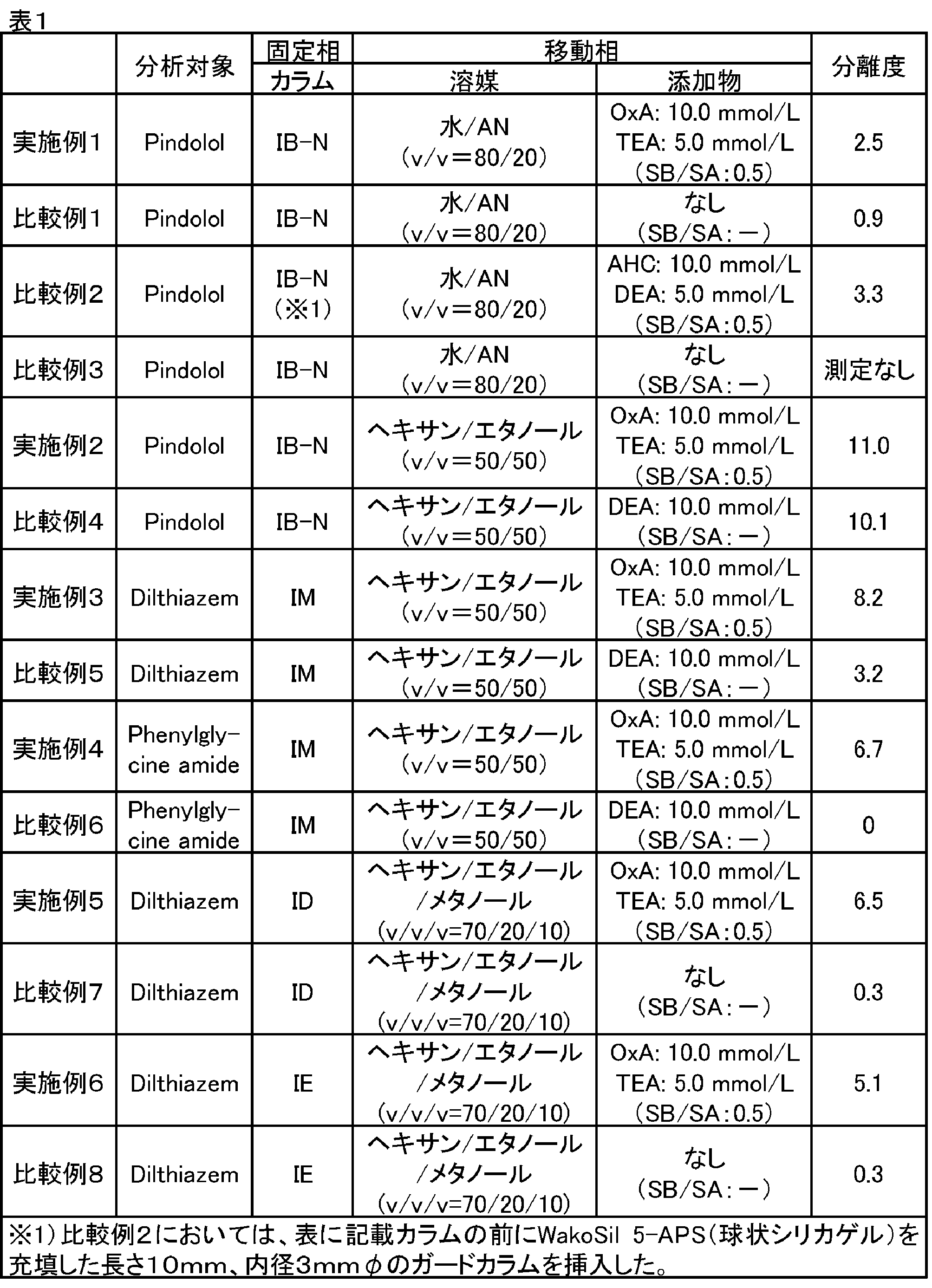
- Example 1 By comparing Example 1 with Comparative Examples 1 and 3, Example 5 with Comparative Example 7, and Example 6 with Comparative Example 8, it can be seen that even when the same solvent is used, if nothing is added, peak tailing is generally severe and the degree of separation is low, or the chromatogram obtained is unstable due to the column history before and after (Comparative Examples 1 and 3 use the same mobile phase, but are sandwiched between Example 1 and Comparative Example 2, respectively), but stable retention and separation can be obtained by using the mobile phase according to the embodiment of the present disclosure.
- Comparative Example 9 is a separation using a mobile phase in which only oxalic acid was added, but the peak shape and separation are clearly poorer than those of Example 2.
- Comparative Example 2 is one such condition, and uses an alkaline mobile phase.
- the peak width is larger than in Example 1, and the time efficiency of separation is poor.
- a mobile phase that is more basic for a stationary phase containing silica gel it is necessary to prevent deterioration of the column by inserting a guard column (pre-column) containing silica gel, and the same method is used in this comparative example.
- the peak shape became abnormal in Comparative Example 3 after this analysis, indicating that a history was left in the column.
- TFA trifluoroacetic acid
- the amine represented by the above formula (3) was separated and analyzed in the same manner as in Example 1, except that the above mobile phase was used as the mobile phase. The results are shown in Figure 15.
- the amine represented by the above formula (3) was separated and analyzed in the same manner as in Example 1, except that the above mobile phase was used as the mobile phase. The results are shown in Figure 16.
- the amine represented by the above formula (3) was separated and analyzed in the same manner as in Example 1, except that the above mobile phase was used as the mobile phase. The results are shown in Figure 18.
- TFA trifluoroacetic acid
- Example 7 By comparing Example 7 with Comparative Example 9, and Example 8 with Comparative Example 10, it can be seen that the degree of separation is improved when SB/SA is 0.05 or more and 0.95 or less.
- Example 11 A mobile phase was prepared in the same manner as in Example 1, except that AcOH was used instead of OxA so that the content of acetic acid (AcOH) in the mobile phase was 10.0 mol/L, and TEA was not used.
- the amine represented by the above formula (3) was separated and analyzed in the same manner as in Example 1, except that the above mobile phase was used as the mobile phase. The results are shown in Figure 19.
- Example 9 A mobile phase (TEA content: 5.0 mol/L) was prepared in the same manner as in Example 1, except that AcOH was used instead of OxA so that the AcOH content in the mobile phase was 10.0 mol/L.
- the amine represented by the above formula (3) was separated and analyzed in the same manner as in Example 1, except that the above mobile phase was used as the mobile phase. The results are shown in Figure 20.
- Example 10 A mobile phase was prepared in the same manner as in Example 9, except that ammonium acetate (NH 4 OAc) was used instead of TEA so that the content of NH 4 OAc in the mobile phase was 5.0 mol/L.
- the amine represented by the above formula (3) was separated and analyzed in the same manner as in Example 1, except that the above mobile phase was used as the mobile phase. The results are shown in Figure 21.
- the amine represented by the above formula (3) was separated and analyzed in the same manner as in Example 1, except that the above mobile phase was used as the mobile phase. The results are shown in Figure 22.
- the amine represented by the above formula (3) was separated and analyzed in the same manner as in Example 1, except that the above mobile phase was used as the mobile phase. The results are shown in Figure 23.
- Example 13 The amine to be analyzed was separated and analyzed in the same manner as in Example 12, except that the amine to be analyzed was changed to an amine represented by the following formula (6) (1-phenyl-1,2,3,4-tetrahydroisoquinoline). The results are shown in Figure 24.
- Example 14 A mobile phase was prepared in the same manner as in Example 12, except that AcOH was used so that the content of AcOH in the mobile phase was 10.0 mol/L, and NH 4 OAc was used so that the content of NH 4 OAc in the mobile phase was 10.0 mol/L.
- the amine represented by the above formula (3) was separated and analyzed in the same manner as in Example 1, except that the above mobile phase was used as the mobile phase. The results are shown in Figure 25.
- ammonium acetate was added as a base instead of ammonia. Therefore, in addition to the acetic acid added as an acid, the mobile phase also contains acetic acid that is generated by dissociation of ammonium acetate. Therefore, when a molar ratio of acetic acid:ammonium acetate is used at 1:1, the molar ratio of acetic acid:ammonia in the mobile phase is 2:1, and SB/SA is 0.5.
- the amine represented by the above formula (3) was separated and analyzed in the same manner as in Example 1, except that the above mobile phase was used as the mobile phase. The results are shown in Figure 26.
- the amine represented by the above formula (3) was separated and analyzed in the same manner as in Example 1, except that the above mobile phase was used as the mobile phase. The results are shown in Figure 27.
- Example 16 The amine to be analyzed was separated and analyzed in the same manner as in Example 15, except that the amine to be analyzed was changed to the amine represented by the above formula (6) (phenyl- ⁇ -isoquinoline). The results are shown in Figure 29.
- Example 15 By comparing Example 15 with Comparative Example 12 and Example 16 with Comparative Example 13, it can be seen that the degree of separation is improved when SB/SA is 0.05 or more and 0.95 or less.
- Example 14> The same procedure as in Example 2 was carried out except that TEA was not added, to prepare a mobile phase having an OxA content of 10.0 mmol/L.
- the amine represented by the above formula (3) was separated and analyzed in the same manner as in Example 2, except that the above mobile phase was used as the mobile phase. The results are shown in Figure 30.
- Example 17 The mobile phase was prepared in the same manner as in Example 2, except that OxA was used so that the content of OxA in the mobile phase was 2.50 mol/L, and TEA was used so that the content of TEA in the mobile phase was 1.25 mol/L.
- the amine represented by the above formula (3) was separated and analyzed in the same manner as in Example 1, except that the above mobile phase was used as the mobile phase. The results are shown in Figure 31.
- Example 18 The mobile phase was prepared in the same manner as in Example 2, except that OxA was used so that the content of OxA in the mobile phase was 5.0 mol/L, and TEA was used so that the content of TEA in the mobile phase was 2.5 mol/L.
- the amine represented by the above formula (3) was separated and analyzed in the same manner as in Example 1, except that the above mobile phase was used as the mobile phase. The results are shown in Figure 32.
- the amine represented by the above formula (3) was separated and analyzed in the same manner as in Example 1, except that the above mobile phase was used as the mobile phase. The results are shown in Figure 33.
- HPLC device ACQUITY UPLC H-Class PLUS Ionization method: ESI Measurement mode: Positive ⁇ Probe temperature: 400°C ⁇ Source temperature: 120°C
- the results are shown in Figure 34.
- the vertical axis of the graph in the figure represents the maximum value of the highest peak as 100%. This is the same in the following Figures 35 to 38.
- the detected masses m/z (relative mass of ions divided by their charge) obtained by the above analysis are shown in Table 6 below.
- Example 21 The mobile phase was prepared in the same manner as in Example 1 above. Separation and analysis of the amine to be analyzed were performed in the same manner as in Example 20, except that the method shown in Example 20 above was used for separation and analysis of the amine, and the analyte was changed to the amine represented by the above formula (6) (1-phenyl-1,2,3,4-tetrahydroisoquinoline). The results are shown in FIG.
- Example 22 The mobile phase was prepared in the same manner as in Example 2 above.
- the amine represented by formula (3) above was separated and analyzed in the same manner as in Example 2, except that the method for separating and analyzing the amine was used as shown in Example 20 above. The results are shown in FIG.
- Example 23 The mobile phase was prepared in the same manner as in Example 3 above.
- the amine represented by formula (3) above was separated and analyzed in the same manner as in Example 3, except that the method for separating and analyzing the amine was used as shown in Example 20 above. The results are shown in FIG.
- Example 24 The mobile phase was prepared in the same manner as in Example 3 above. Separation and analysis of amines were performed in the same manner as in Example 3, except that the method shown in Example 20 above was used for separation and analysis of amines, and the analyte was changed to an amine represented by the following formula (7) (nicardipine). The results are shown in FIG.
- the amine separation method according to the embodiment of the present disclosure can improve the amine separation performance.
- the method can be applied to LC-MS by appropriately selecting components contained in the mobile phase from those that can avoid or reduce adverse effects on detection by a mass spectrometer. Therefore, such an amine separation method can be widely applied to analysis and purification by various types of liquid chromatography, and is expected to be used in the fields of organic chemistry, medicine, pharmacology, and the like.
Landscapes
- Chemical & Material Sciences (AREA)
- Analytical Chemistry (AREA)
- Organic Chemistry (AREA)
- Chemical Kinetics & Catalysis (AREA)
- Life Sciences & Earth Sciences (AREA)
- Health & Medical Sciences (AREA)
- Physics & Mathematics (AREA)
- Biochemistry (AREA)
- General Health & Medical Sciences (AREA)
- General Physics & Mathematics (AREA)
- Immunology (AREA)
- Pathology (AREA)
- Organic Low-Molecular-Weight Compounds And Preparation Thereof (AREA)
- Solid-Sorbent Or Filter-Aiding Compositions (AREA)
Abstract
Description
本開示は、分離性能に優れるアミンの分離方法を提供することを課題とする。
シュウ酸、酢酸、ギ酸、及びトリフルオロ酢酸からなる群から選択される1種以上の特定の酸、1種以上の塩基、並びに溶媒を含む移動相と、
を用いてクロマトグラフィーによりアミンを分離する分離工程を含み、
前記移動相に含まれる各特定の酸について下記式(1)で算出される値をA、各特定の酸で算出された各Aの合計値をSA、前記移動相に含まれる各塩基について下記式(2)で算出される値をB、各塩基で算出された各Bの合計値をSBとした場合において、SB/SAが、0.05以上、0.95以下である、
アミンの分離方法。
式(1):A=特定の酸の価数×特定の酸のモル濃度(mol/L)
式(2):B=塩基の価数×塩基のモル濃度(mol/L)
[2] 前記分離工程により分離されたアミンを分析する分析工程をさらに含み、
前記分析工程において、少なくとも質量分析器を用いた分析が行われる、
[1]に記載のアミンの分離方法。
[3] 前記塩基が、アンモニア、第1級アミン、第2級アミン、及び第3級アミンからなる群より選択される1種以上である、[1]又は[2]に記載のアミンの分離方法。
[4] 前記塩基が、アンモニア、エチルアミン、n-プロピルアミン、2-プロピルアミン、ジメチルアミン、ジエチルアミン、トリメチルアミン、トリエチルアミン、ピロリジン、及びピペリジンからなる群より選択される1種以上である、[3]に記載のアミンの分離方法。
[5] 前記移動相が、前記特定の酸として、少なくともシュウ酸を含む、[1]~[4]のいずれかに記載のアミンの分離方法。
[6] 前記オリゴ糖、多糖、及びこれらの誘導体の少なくともいずれかが、光学活性部位を有する、[1]~[5]のいずれかに記載のアミンの分離方法。
[7] 前記溶媒が、水、アセトニトリル、エタノール、メタノール、2-プロパノール、ヘキサン、ヘプタン、THF、及び液体二酸化炭素からなる群から選択される1種以上である、[1]~[6]のいずれかに記載のアミンの分離方法。
また、本開示に開示された各々の態様は、本開示に開示された他のいかなる特徴とも組み合わせることができる。
なお、本開示において、数値範囲の下限値及び上限値を分けて記載する場合、前記数値範囲は、それらのうち任意の下限値と任意の上限値とを組み合わせたものとすることができる。また、本開示において、「~」を用いてその前後に数値又は物性値を挟んで表現する場合、端点である下限及び上限の値を含むものとして用いることとする。また、「A~B」又は「A以上B以下」で表される数値範囲が段階的(例えば、好ましい順)に記載されている場合、各数値範囲の上限及び下限は任意に組み合わせることができる。
また、本開示において「A又はB」の表現は、「A及びBからなる群から選択される少なくとも1つ」と読み替えることができる。
本開示の一実施形態に係るアミンの分離方法(以下、単に「アミンの分離方法」とも称する。)は、
オリゴ糖、多糖、及びこれらの誘導体の少なくともいずれかを含む固定相と、
シュウ酸、酢酸、ギ酸、及びトリフルオロ酢酸からなる群から選択される1種以上の特定の酸、1種以上の塩基、並びに溶媒を含む移動相と、
を用いてクロマトグラフィーによりアミンを分離する分離工程を含み、
前記移動相に含まれる各特定の酸について下記式(1)で算出される値をA、各特定の酸で算出された各Aの合計値をSA、前記移動相に含まれる各塩基について下記式(2)で算出される値をB、各塩基で算出された各Bの合計値をSBとした場合において、SB/SAが、0.05以上、0.95以下である、
アミンの分離方法である。
式(1):A=特定の酸の価数×特定の酸のモル濃度(mol/L)
式(2):B=塩基の価数×塩基のモル濃度(mol/L)
また、上記の実施形態に係る移動相は、分離対象となるアミンを含む前の移動相であり、「前記移動相中のアミンの含有率」は、分離対象となるアミンを含む前の移動相中のアミンの含有率である。
また、本開示において、オリゴ糖は、糖残基数が5以上の糖である。
また、本開示におけるオリゴ糖と多糖との区別について、分子量で分けることができ、分子量が3000以下であるものをオリゴ糖とし、3000超であるものを多糖とする。
また、本実施形態において、特定の酸は遊離しているもの及び酸アニオンとなっているものの両方を含み、塩基は遊離しているもの及びカチオンとなっているものの両方を含む。また、酸アニオン及びカチオンは、互いに、又は他のイオンとともに、塩を形成していてもよい。
本発明者らが鋭意検討した結果、移動相に、酸のモル濃度(含有率)よりも低いモル濃度で塩基を加え、酸の一部を中和して塩に変換することで、酸が弱酸であったとしても、移動相中の対アニオンの濃度を好ましいレベルに調整できることを見出した。
さらに、本発明者らは、本発明者らによって見出された上記の機構をもとに、酸の種類、並びに酸及びアミンの含有率等の検討を重ねた結果、上記の本実施形態に係る構成によりアミンの分離性能を向上させる、具体的にはクロマトグラフィーにおける分析対象の保持時間を十分にすることができることを見出した。
上述したカチオンと、解離されたシラノールの共役陰イオンとの間でイオン的な相互作用が生じた場合、分析により得られるクロマトグラムのピークがブロードになってしまうが、本実施形態に係る態様では過剰の酸の存在により、シラノールの解離が抑制され、このイオン的な相互作用が抑制されたと本発明者らは推測している。
一方で、本実施形態に係る態様では、過剰の酸によりpHが低くなるため、上記のような対策を取る必要がないことも大きな利点である。
一方で、上記の本実施形態における移動相において、塩基としてアミンを採用した場合、移動相中では、シュウ酸、酢酸、ギ酸、及びトリフルオロ酢酸からなる群から選択される1種以上の特定の酸のアニオン及びアミンのカチオンを含む塩が生じるが、これらの塩は、揮発又は熱分解しやすいため、溶媒を蒸発させたとしても高沸点の不揮発性の塩が残りにくい。
本実施形態に係る分離方法によれば、複数のアミンの混合物を各アミンに分離したり、アミンと非アミンとを含む混合物からアミンを分離したりすることができる。特にアミンのエナンチオマー(鏡像異性体)を分離できることは科学技術における重要性が大きい。
固定相は、吸着剤(「分離剤」とも称する。)としてオリゴ糖、多糖及びこれらの誘導体の少なくともいずれか(以下、これらを総称して「オリゴ糖・多糖誘導体」とも称する。)を含んでいればよく、オリゴ糖・多糖誘導体を含む態様は特段制限されない。例えば、吸着剤として、オリゴ糖・多糖誘導体又はオリゴ糖・多糖誘導体と他の成分との混合物を固化したものを用いてもよく、オリゴ糖・多糖誘導体又はオリゴ糖・多糖誘導体と他の成分との混合物を担体に担持させたものを用いてもよい。また担持において、担体との間に化学結合を設ける、オリゴ糖・多糖誘導体間に化学結合を設ける、又はオリゴ糖・多糖誘導体表面に高分子不透過性の層を設けるなどの方法により、多糖又はオリゴ糖誘導体を不溶化したものは特に有用性が高い。
なお、オリゴ糖・多糖誘導体は、1種類を単独でも用いてもよく、2種以上を任意の組み合わせで併用してもよい。
オリゴ糖・多糖の糖残基数は、5以上であれば特段制限されず、例えば、10以上であってもよく、20以上であってもよく、また、1000未満であってもよく、500以下であってもよく、100以下であってもよく、75以下であってもよく、50以下であってもよい。
なお、これらの単糖は、1種類を単独で用いてもよく、2種以上を併用してもよい。
これらの方法の中でも、溶媒へのオリゴ糖・多糖誘導体の溶解を抑制できる観点から、好ましくは、シリカゲルとオリゴ糖・多糖誘導体骨格との間に何らかの化学結合を形成する方法、又は担体上のオリゴ糖・多糖誘導体間に何らかの化学結合を形成す方法により不溶化することが好ましい。なお、溶媒へのオリゴ糖・多糖誘導体の溶解を抑制するため、担体を用いない場合でも、オリゴ糖・多糖誘導体間に化学結合を設けることが好ましい。
移動相は、シュウ酸、酢酸、ギ酸、及びトリフルオロ酢酸からなる群から選択される1種以上の特定の酸、1種以上の塩基、並びに溶媒を含む。
移動相は、分離性能を阻害しない範囲で、上記の成分以外の成分を含んでいてもよい。また、移動相は、少なくとも分析を実施する条件において、均一系(単相系)であることが好ましい。
移動相は、シュウ酸、酢酸、ギ酸、及びトリフルオロ酢酸からなる群から選択される1種以上の特定の酸を含む。これらのうち、酸性度が比較的高いことから、シュウ酸、及びトリフルオロ酢酸からなる群から選択される1種以上の酸が少なくとも含まれることが好ましい。さらに、液体クロマトグラフィーの部材に吸着するなどして他の分析にコンタミネーションを起こしやすく、かつ廃棄後、環境に対するフッ素汚染を防止する注意を求められるトリフルオロ酢酸に対し、そのような傾向がなく、またMS検出器の温度で容易に低分子量の一酸化炭素、二酸化炭素、及び水に分解するためMS分析に悪影響を及ぼしにくく、また吸湿性などがない扱いやすい2水結晶として安価に得られる、シュウ酸が特定の酸として少なくとも含まれることが特に好ましい。これらの酸は、1種単独であってもよく、任意の2種以上を任意の比率で組み合わせたものであってもよい。また、本開示の効果が得られる範囲で、他の酸を含んでいてもよい。
なお、シュウ酸は、溶出液を分取した場合に、カルシウムイオンを用いて沈殿分離することが出来るという利点もある。
移動相に含まれる特定の酸は、一部が塩になることでイオンペアクロマトグラフィーにおいて試料アンモニウムの固定相への保持を促す対イオンを供給するとともに、一部は酸として存在させ、試料アミンを確実にアンモニウムイオンに変換することが好ましい。試料アミンはクロマトグラフィー条件において稀薄であるため、移動相がほぼ中性であってもアンモニウムイオンとして存在する確率が高いが、酸を過剰にすることによってこれを確実にすることが出来る。
上記の含有率が上記範囲の下限以上であれば、実質的に(どれだけ薄くても大なり小なりの効果は得られるが、実際的な効果が得るためにはある程度の濃度が必要)試料を保持させる効果が得られる。また、上記の含有率が上記範囲の上限以下であれば、検出、特にMSによる検出に対し悪影響がない。すなわち、移動相に含まれる含有率の好ましい範囲としては、例えば1~1000mmol/L、1~200mmol/L、1~50mmol/L、1~20mmol/Lの範囲が挙げられる。
移動相は、塩基を含む。上述した特定の酸の一部を共役アニオンとしたイオンペアクロマトグラフィーとしての保持を確実にするためには、該特定の酸よりも小さいモル濃度の塩基を加え、特定の酸の一部を中和する。この塩基としては、例えば、金属、4級アンモニウムの水酸化物、又は炭酸塩等が挙げられる。該塩は、前記特定の酸よりも弱い酸の塩であってもよく、アミンであることが好ましい。アミンである場合には、熱によって特定の酸とアミンに解離し、揮発することによって質量分析法(MS)による検出を阻害しない。なお、移動相は酸過剰の環境となっているため、塩基は基本的に移動相中では塩として存在している。
式(1):A=特定の酸の価数×特定の酸のモル濃度(mol/L)
式(2):B=塩基の価数×塩基のモル濃度(mol/L)
なお、酢酸の価数は1、ギ酸の価数は1、トリフルオロ酢酸の価数は1である。シュウ酸の価数は1又は2となり得るが、第1段と第2段の解離定数に10の3乗の開きがあるため、塩基の量が酸のモル数より小さい(<0.095)本開示の条件においては、第2段解離は無視できる程度にしか起こらないと推定されることから本開示においては1として扱う。
なお、上記の通り、特定の酸の価数はいずれも1となるため、上記式(1)は、下記式(1)’で表すこともできる。
式(1)’:A=特定の酸のモル濃度(mol/L)
なお、上記の解離度は、25℃水中での解離度とする。この解離度は、例えば、American Chemical Societyから発行されている“pKa Data Compiled by R. Williams”に記載されている。
式(1)”:A=特定の酸のモル濃度(mol/L)
式(2)”:B=塩基のモル濃度(mol/L)
なお、アンモニアをはじめとする低沸点アミンは、蒸気圧が高いため定量的に添加することが困難な場合がある。このような場合、それらアミンの炭酸塩あるいは炭酸水素塩を用い、少量の水の中で該塩に含まれる酸と反応させ、二酸化炭素を発生させることにより、アンモニア単体を添加するのと実質的に同じ添加物を得ることができる。
本実施形態における移動相に含まれる溶媒は、分離対象であるアミン、並びに特定の酸等の各種成分を溶解できる限り特段制限されず、水、又は水以外の液体(以下、「非水溶媒」と称することがある。)等を用いることができる。
非水溶媒としては、例えば、有機溶媒(水含有率0体積%)、又は亜臨界もしくは超臨界二酸化炭素等が挙げられる。
移動相に含まれる溶媒としては、例えば、水のみ;非水溶媒のみ;水と非水溶媒との混合溶媒、加圧二酸化炭素と非水溶媒、必要に応じて微量の水を含む混合溶媒等が挙げられる。移動相に含まれる溶媒が、2種以上の溶媒からなる混合溶媒である場合、前記2種以上の溶媒は、アミンの分離条件において相分離を起こさない溶媒の組み合わせであることが好ましい。具体的には、例えば、極性の低いもの、いわゆる順相溶媒を用いることができ、ヘキサンもしくはヘプタン等の炭化水素に、より極性の高いアルコール、エステル、エーテル、ニトリルもしくはハロゲン化炭化水素等を混和したもの、又はこれに更に均一溶解する範囲で水を混和したものが好ましく用いられる。より具体的には、例えば、有機溶媒を基本とする極性の高い組成を有する溶媒であり、アセトニトリルをベースとし、少量(1~20体積%)の水を含むもの、水をベースとし、更に極性が高い逆相溶媒として少量(通常1~40体積%)のアセトニトリル、もしくはメタノールを含むもの、又は一般的に超臨界流体クロマトグラフィーと称される加圧二酸化炭素であり、亜臨界もしくは超臨界二酸化炭素と呼ばれるものを溶媒として用いることができる。
なお、本技術分野では、通常、「超臨界」は、全ての組成や温度において、厳密に超臨界状態にあるというものには限らず、二酸化炭素を主とする溶媒を用いた場合に「超臨界」の呼称が用いられることが多い。本開示でも「超臨界」の語は同様に扱う。
なお、移動相に含まれる溶媒が、亜臨界又は超臨界二酸化炭素を含む場合、これらの体積は、便宜上、-20℃における液体二酸化炭素の密度1.030g/mLに基づいて算出するものとする。
移動相は、本開示の効果が得られる範囲で、上述した成分以外の成分(その他の成分)を含んでいてもよい。ただし、質量分析法(MS)による検出を行う場合には、不揮発性の塩を与える成分は好ましくない。
移動相の調製方法は、公知の溶液調製方法又は公知の溶液調製方法に準じた方法により行うことができる。例えば、上記の各成分を混合する方法が挙げられる。
本実施形態において用いられるクロマトグラフィーは、特に限定されず、例えば液体クロマトグラフィー、又は超臨界流体クロマトグラフィー等が挙げられる。また、クロマトグラフィーの形態も特段制限されず、公知の形態を採用することができ、カラムクロマトグラフィーだけでなく、薄層クロマトグラフィー、繊維状の吸着剤が堆積して成る層を設けたクロマトグラフィー、又は細管の内壁に何らかの形で吸着剤層の薄層を設けたキャピラリー又はマイクロ流路によるクロマトグラフィー等も採用することができる。
クロマトグラフィーは、市販のクロマトグラフ、例えば液体クロマトグラフ及び超臨界流体クロマトグラフ等を用いて行うことができる。カラムの平衡化条件及び流速等の諸条件は、カラムサイズ、試料容量、又は移動相の種類等に応じて適宜選択することができる。
クロマトグラフィーにおいてアミンを検出する方法は特段制限されないが、本実施形態に係る方法では、質量分析器を用いた方法が挙げられる。本実施形態では、添加物を適切に選ぶことにより揮発性の塩の形成を促すことができるため、分析器として質量分析器を適用できることは大きい長所である。
<実施例1>
[移動相の調製]
シュウ酸二水和物1260mgを秤取り、1000mLのメスフラスコに移した。このメスフラスコに水とアセトニトリルをそれぞれ800.0g、156.6gの割合で秤取、混合した混合溶媒(体積比換算80/20)の約20mLを入れ、次いで、トリエチルアミン506mgを入れた。その後、上記の水/アセトニトリル(80/20(v/v))混合溶媒でメスアップし、未溶解物がなくなるまで撹拌することで、移動相を得た。該移動相中の溶媒の組成は、水/アセトニトリル=80/20(v/v)であり、移動相中のシュウ酸(ОxA)及びトリエチルアミン(TEA)の含有率は、それぞれ10.0mmol/L及び5.0mmol/Lであった。なお、シュウ酸二水和物に含まれる水の量はわずかであるため溶媒組成への影響はない。また、200℃に加熱したステンレス板上に100μLの移動相を滴下したが、残渣は見られなかった。この結果は以下の他の実施例でも同様であった。
また、水の密度は1.00g/mL、アセトニトリルの密度は0.783g/mLとした。
カラムとして、セルローストリス(3,5-ジメチルフェニルカルバメート)をシリカゲルに担持したキラル固定相が充填されたカラム(CHIRALPAK IB-N(株式会社ダイセル製、登録商標)、平均充填剤径5μm、長さ250mm、内径4.6mmφ)を用い、液体クロマトグラフとして高速液体クロマトグラフを用いてアミンの分離を行った。このとき、分離対象である下記の式(3)で表されるアミン(USP社製「Pindolol」)は、水/アセトニトリル(1/1(v/v))混合溶媒に約1mg/mLの濃度となるように溶解し、得られた溶液2μLをオートサンプラによってカラムに注入した。また、移動相は、0.43mL/分で30℃に調温したカラムに送液した。
アミンの分離方法や分析方法の詳細を次に示す。
高速液体クロマトグラフ(HPLC)の検出器としてSPD-M20A(株式会社島津製作所製、ダイオードアレイのUV-Vis検出器)を用い、カラムに1時間以上移動相を1.0mL/minで送液した後、試料を約1mg/mLで移動相に溶解した試料液5μLをオートサンプラにより注入し、同じ流速で、カラム温度を30℃に設定し、アミンの分離及び分析を行った。
HPLCで用いた装置、及びデータ処理装置の詳細を以下に示す。以下の装置は全て株式会社島津製作所製である。
・HPLC装置:システムコントローラ CBM-20A、ポンプ LC-20AD、オートサンプラ SIL-20AC、カラムオーブン SPD-M20A
・データ処理装置:LabSolutions Version 5.97
結果を図1に示す。

実施例1で分離及び分析を実施した後のカラムに移動相として、水/アセトニトリル(80/20(v/v))混合溶媒を用い、1時間以上試料注入せずに通液したこと以外は実施例1と同様の方法で、再度上記の式(3)で表されるアミンの分離、分析を行った。なお、用いた移動相には、酸及びアミンを添加していないため、移動相中の酸及びアミンの含有率は、それぞれ0mmol/L及び0mmol/Lであった。
結果を図2に示す。
シュウ酸二水和物を用いなかったこと、トリエチルアミンの代わりに炭酸水素アンモニウム(AHC)及びジエチルアミン(DEA)を用いたこと以外は実施例1と同様の操作を行い、AHC及びDEAの含有率が、それぞれ10.0mmol/L及び15.5mmol/Lである移動相を調製した。
移動相として上記の移動相を用いたことと、CHIRALPAK IB-Nのカラムの前に、表1下注記載のガードカラムを挿入したこと(本比較例のみ)以外は実施例1と同様の方法で上記の式(3)で表されるアミンの分離、分析を行った。
結果を図3に示す。
比較例2で分離及び分析を実施した後のカラムに移動相として、水/アセトニトリル(80/20(v/v))混合溶媒を用い、1時間以上試料注入せずに通液したこと以外は実施例1と同様の方法で上記の式(3)で表されるアミンの分離、分析を行った。なお、用いた移動相には、酸及びアミンを添加していないため、移動相中の酸及びアミンの含有率は、それぞれ0mmol/L及び0mmol/Lであった。
結果を図4に示す。
溶媒を、水とアセトニトリルから、ヘキサンとエタノール(ヘキサン/エタノール=50/50(v/v)に変更したこと以外は実施例1と同様の操作を行い、ОxA及びTEAの含有率が、それぞれ10.0mmol/L及び5.0mmol/Lである移動相を調製した。
移動相として上記の移動相を用いたこと以外は実施例1と同様の方法で上記の式(3)で表されるアミンの分離、分析を行った。
結果を図5に示す。
シュウ酸二水和物を用いなかったこと、トリエチルアミンの代わりにジエチルアミン(表1における「DEA」)を用いたこと以外は実施例2と同様の操作を行い、DEAの含有率が10.0mmol/Lである移動相を調製した。
移動相として上記の移動相を用いたこと以外は実施例1と同様の方法で上記の式(3)で表されるアミンの分離、分析を行った。
結果を図6に示す。
カラムとして、セルローストリス(3-クロロ-4-メチルフェニルカルバメート)をシリカゲルに担持したキラル固定相が充填されたカラム(CHIRALPAK IM(株式会社ダイセル製、登録商標)、平均充填剤径5μm、長さ250mm、内径4.6mmφ)を用い、分析対象を下記の式(4)で表されるアミンに変更したこと以外は実施例2と同様の方法で分析対象であるアミンの分離、分析を行った。
結果を図7に示す。

カラムとして実施例3で用いたカラムを用いたこと以外は比較例4と同様の方法で上記の式(4)で表されるアミンの分離、分析を行った。
結果を図8に示す。
分析対象を下記の式(5)で表されるフェニルグリシンのアミドに変更したこと以外は実施例2と同様の方法で分析対象であるアミンの分離、分析を行った。
C6H5-CH(NH2)-CONH2 (東京化成製) (5)
結果を図9に示す。
分析対象を上記の式(5)で表されるフェニルグリシンのアミドに変更したこと以外は比較例5と同様の方法で分析対象であるアミンの分離、分析を行った。
結果を図10に示す。
溶媒を、ヘキサンとエタノールから、ヘキサンとエタノールとメタノール(ヘキサン/エタノール/メタノール=70/20/19(v/v/v))に変更したこと以外は実施例3と同様の操作を行い、ОxA及びTEAの含有率が、それぞれ10.0mmol/L及び5.0mmol/Lである移動相を調整製した。
移動相として上記の移動相を用いたこと、及びカラムとして、アミローストリス(3-クロロフェニルカルバメート)をシリカゲルに担持したキラル固定相が充填されたカラム(CHIRALPAK ID(株式会社ダイセル製、登録商標)、平均充填剤径5μm、長さ250mm、内径4.6mmφ)を用いたこと以外は実施例3と同様の方法で上記の式(4)で表されるアミンの分離、分析を行った。
結果を図11に示す。
シュウ酸二水和及びトリエチルアミンの添加を行わなかったこと以外は実施例5と同様の操作を行い、ОxA及びTEAの含有率が、それぞれ0mmol/L及び0mmol/Lである移動相を調整製した。
移動相として上記の移動相を用いたこと以外は実施例5と同様の方法で上記の式(4)で表されるアミンの分離、分析を行った。
結果を図12に示す。
カラムとして、アミローストリス(3,5-ジクロロフェニルカルバメート)をシリカゲルに担持したキラル固定相が充填されたカラム(CHIRALPAK IE(株式会社ダイセル製、登録商標)、平均充填剤径5μm、長さ250mm、内径4.6mmφ)を用いたこと以外は実施例5と同様の方法で上記の式(4)で表されるアミンの分離、分析を行った。
移動相として上記の移動相を用いたこと以外は実施例5と同様の方法で上記の式(4)で表されるアミンの分離、分析を行った。
結果を図13に示す。
シュウ酸二水和及びトリエチルアミンの添加を行わなかったこと以外は実施例6と同様の操作を行い、ОxA及びTEAの含有率が、それぞれ0mmol/L及び0mmol/Lである移動相を調整した。
移動相として上記の移動相を用いたこと以外は実施例6と同様の方法で上記の式(4)で表されるアミンの分離、分析を行った。
結果を図14に示す。
各実施例及び比較例における分離度は、島津製作所のクロマトグラフィーデータ解析プログラム LabSolutions Version 5.97によってして自動算出したUSP分離度である。結果を表1に示す。
<比較例9>
溶媒を、水/アセトニトリル=80/20(v/v)の混合溶液から水/アセトニトリル=2.5/97.5(v/v)の混合溶液に変更し、移動相中のトリフルオロ酢酸(TFA)の含有率が10.0mol/LとなるようにOxAの代わりにTFAを用い、TEAを用いなかったこと以外は実施例1と同様の操作を行い、移動相を調製した。
移動相として上記の移動相を用いたこと以外は実施例1と同様の方法で上記の式(3)で表されるアミンの分離、分析を行った。
結果を図15に示す。
溶媒を、水/アセトニトリル=50/50(v/v)の混合溶液から水/アセトニトリル=2.5/97.5(v/v)の混合溶液に変更し、移動相中のトリフルオロ酢酸(TFA)の含有率が10.0mol/LとなるようにOxAの代わりにTFAを用いたこと以外は実施例1と同様の操作を行い、移動相(TEAの含有率は5.0mol/L)を調製した。
移動相として上記の移動相を用いたこと以外は実施例1と同様の方法で上記の式(3)で表されるアミンの分離、分析を行った。
結果を図16に示す。
溶媒を、水/アセトニトリル=2.5/97.5(v/v)の混合溶液からヘキサン/エタノール=50/50(v/v)の混合溶液に変更したこと以外は比較例9と同様の操作を行い、移動相を調製した。
移動相として上記の移動相を用いたこと以外は実施例1と同様の方法で上記の式(3)で表されるアミンの分離、分析を行った。
結果を図17に示す。
溶媒を、水/アセトニトリル=2.5/97.5(v/v)の混合溶液からヘキサン/エタノール=50/50(v/v)の混合溶液に変更したこと以外は実施例7と同様の操作を行い、移動相を調製した。
移動相として上記の移動相を用いたこと以外は実施例1と同様の方法で上記の式(3)で表されるアミンの分離、分析を行った。
結果を図18に示す。
各実施例及び比較例における分離度は、島津製作所のクロマトグラフィーデータ解析プログラム LabSolutions Version 5.97によってして自動算出したUSP分離度である。結果を表1に示す。

<比較例11>
移動相中の酢酸(AcOH)の含有率が10.0mol/LとなるようにOxAの代わりにAcOHを用い、TEAを用いなかったこと以外は実施例1と同様の操作を行い、移動相を調製した。
移動相として上記の移動相を用いたこと以外は実施例1と同様の方法で上記の式(3)で表されるアミンの分離、分析を行った。
結果を図19に示す。
移動相中のAcOHの含有率が10.0mol/LとなるようにOxAの代わりにAcOHを用いたこと以外は実施例1と同様の操作を行い、移動相(TEAの含有率は5.0mol/L)を調製した。
移動相として上記の移動相を用いたこと以外は実施例1と同様の方法で上記の式(3)で表されるアミンの分離、分析を行った。
結果を図20に示す。
移動相中の酢酸アンモニウム(NH4OAc)の含有率が5.0mol/LとなるようにTEAの代わりにNH4OAcを用いたこと以外は実施例9と同様の操作を行い、移動相を調製した。
移動相として上記の移動相を用いたこと以外は実施例1と同様の方法で上記の式(3)で表されるアミンの分離、分析を行った。
結果を図21に示す。
溶媒を、水/アセトニトリル=80/20(v/v)の混合溶液からヘキサン/エタノール=50/50(v/v)の混合溶液に変更したこと以外は実施例9と同様の操作を行い、移動相を調製した。
移動相として上記の移動相を用いたこと以外は実施例1と同様の方法で上記の式(3)で表されるアミンの分離、分析を行った。
結果を図22に示す。
溶媒を、水/アセトニトリル=80/20(v/v)の混合溶液からヘキサン/エタノール=50/50(v/v)の混合溶液に変更したこと以外は実施例10と同様の操作を行い、移動相を調製した。
移動相として上記の移動相を用いたこと以外は実施例1と同様の方法で上記の式(3)で表されるアミンの分離、分析を行った。
結果を図23に示す。
分析対象を下記の式(6)で表されるアミン(1-フェニル-1,2,3,4-テトラヒドロイソキノリン)に変更したこと以外は実施例12と同様の方法で分析対象であるアミンの分離、分析を行った。
結果を図24に示す。
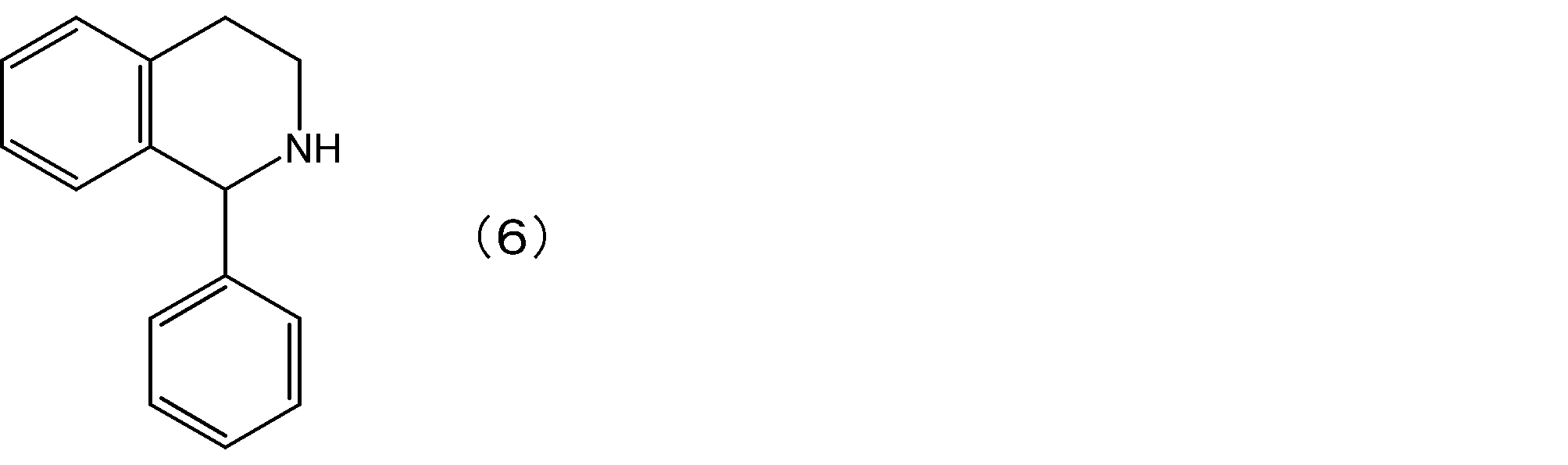
移動相中のAcOHの含有率が10.0mol/LとなるようにAcOHを用いたこと、移動相中のNH4OAcの含有率が10.0mol/LとなるようにNH4OAcを用いたこと以外は実施例12と同様の操作を行い、移動相を調製した。
移動相として上記の移動相を用いたこと以外は実施例1と同様の方法で上記の式(3)で表されるアミンの分離、分析を行った。
結果を図25に示す。
各実施例及び比較例における分離度は、島津製作所のクロマトグラフィーデータ解析プログラム LabSolutions Version 5.97によってして自動算出したUSP分離度である。結果を表3に示す。
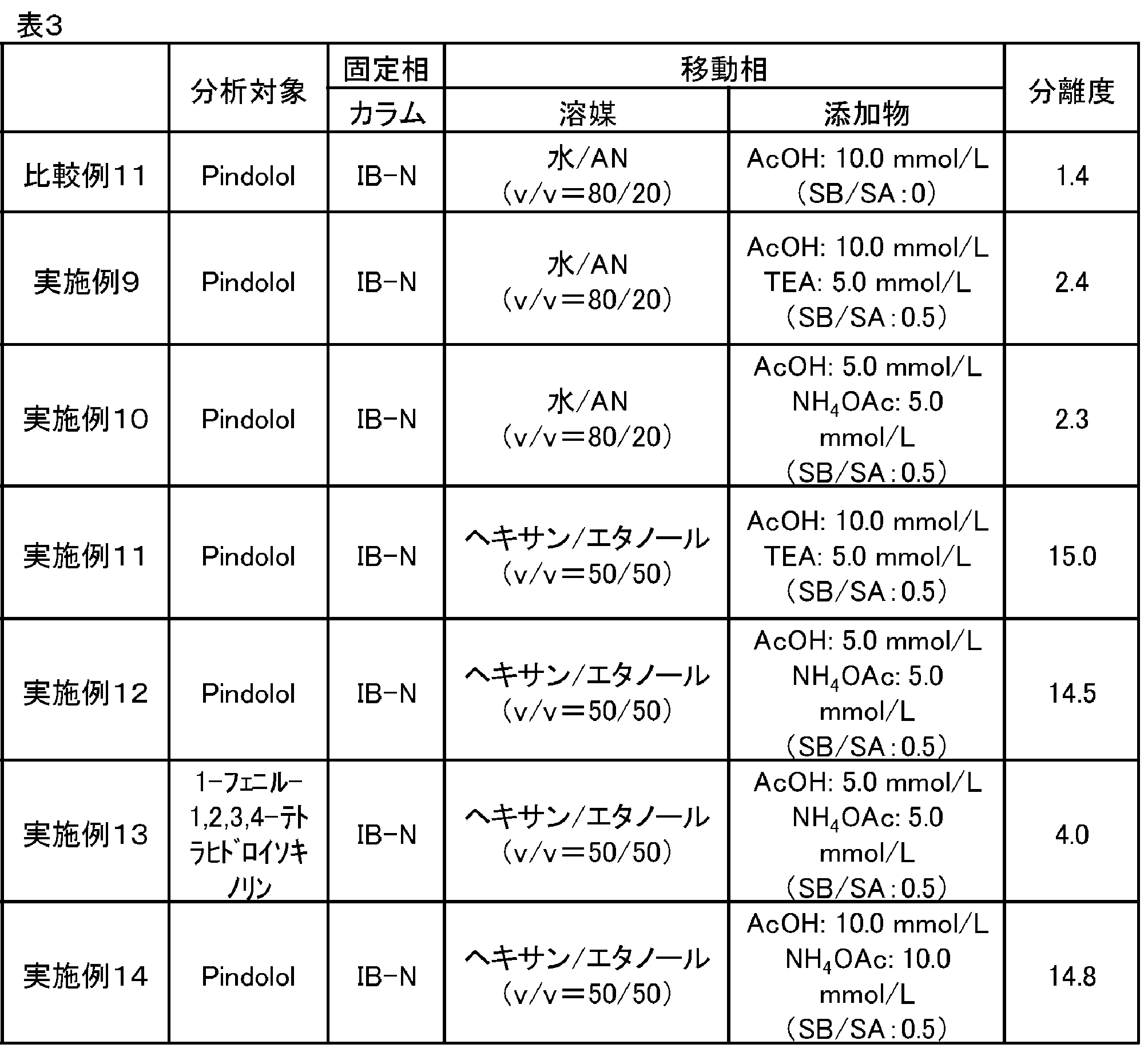
<比較例12>
溶媒を、水/アセトニトリル=80/20(v/v)の混合溶液からヘキサン/エタノール=50/50(v/v)の混合溶液に変更したこと、移動相中のギ酸(FA)の含有率が10.1mol/LとなるようにOxAの代わりにFAを用い、TEAを用いなかったこと以外は実施例1と同様の操作を行い、移動相を調製した。
移動相として上記の移動相を用いたこと以外は実施例1と同様の方法で上記の式(3)で表されるアミンの分離、分析を行った。
結果を図26に示す。
溶媒を、水/アセトニトリル=80/20(v/v)の混合溶液からヘキサン/エタノール=50/50(v/v)の混合溶液に変更したこと、移動相中のギ酸(FA)の含有率が10.0mol/LとなるようにOxAの代わりにFAを用いたこと以外は実施例1と同様の操作を行い、移動相(TEAの含有率は5.0mol/L)を調製した。
移動相として上記の移動相を用いたこと以外は実施例1と同様の方法で上記の式(3)で表されるアミンの分離、分析を行った。
結果を図27に示す。
分析対象を上記の式(6)で表されるアミン(フェニル-β-イソキノリン)に変更したこと以外は比較例12と同様の方法で分析対象であるアミンの分離、分析を行った。
結果を図28に示す。
分析対象を上記の式(6)で表されるアミン(フェニル-β-イソキノリン)に変更したこと以外は実施例15と同様の方法で分析対象であるアミンの分離、分析を行った。
結果を図29に示す。
各実施例及び比較例における分離度は、島津製作所のクロマトグラフィーデータ解析プログラム LabSolutions Version 5.97によってして自動算出したUSP分離度である。結果を表4に示す。

<比較例14>
TEAを添加しなかったこと以外は実施例2と同様の操作を行い、ОxAの含有率が10.0mmol/Lである移動相を調整した。
移動相として上記の移動相を用いたこと以外は実施例2と同様の方法で上記の式(3)で表されるアミンの分離、分析を行った。
結果を図30に示す。
移動相中のOxAの含有率が2.50mol/LとなるようにOxAを用いたこと、移動相中のTEAの含有率が1.25mol/LとなるようにTEAを用いたこと以外は実施例2と同様の操作を行い、移動相を調製した。
移動相として上記の移動相を用いたこと以外は実施例1と同様の方法で上記の式(3)で表されるアミンの分離、分析を行った。
結果を図31に示す。
移動相中のOxAの含有率が5.0mol/LとなるようにOxAを用いたこと、移動相中のTEAの含有率が2.5mol/LとなるようにTEAを用いたこと以外は実施例2と同様の操作を行い、移動相を調製した。
移動相として上記の移動相を用いたこと以外は実施例1と同様の方法で上記の式(3)で表されるアミンの分離、分析を行った。
結果を図32に示す。
溶媒を、水とアセトニトリルの混合溶液から、ヘキサンとエタノールと水(ヘキサン/エタノール/水=50/50/2(v/v/v))の混合溶液に変更したこと以外は実施例1と同様の操作を行い、ОxA及びTEAの含有率が、それぞれ10.0mmol/L及び5.0mmol/Lである移動相を調整した。
移動相として上記の移動相を用いたこと以外は実施例1と同様の方法で上記の式(3)で表されるアミンの分離、分析を行った。
結果を図33に示す。
各実施例及び比較例における分離度は、島津製作所のクロマトグラフィーデータ解析プログラム LabSolutions Version 5.97によってして自動算出したUSP分離度である。結果を表5に示す。
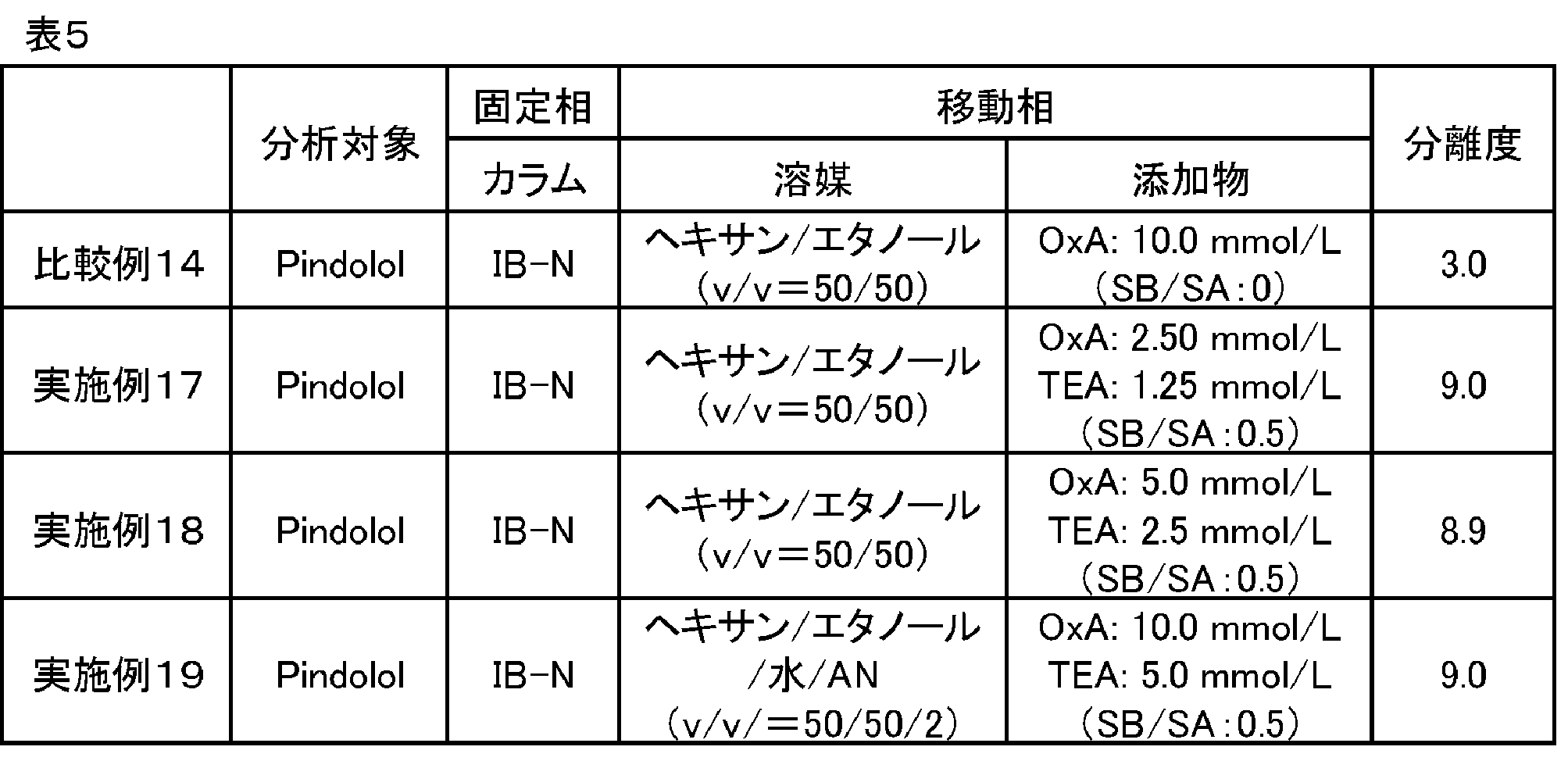
<実施例20>
[移動相の調製]
上述した実施例1と同様の方法で移動相を調製した。
アミンの分離及び分析を次に示す方法を用いたこと以外は実施例1と同様の方法で、上記の式(3)で表されるアミンの分離及び分析を行った。
高速液体クロマトグラフ(HPLC)の検出器としてACQUITY Qda(日本ウォーターズ株式会社製、質量検出器)を用い、カラムに1時間移動相を0.75mL/minで送液した後、試料を約1~2mg/mL溶液(フィルターでろ過済み)で移動相に溶解した試料液1μLをオートサンプラにより注入し、同じ流速で、カラム温度を室温(約25℃)に設定し、アミンの分離及び分析を行った。
HPLCで用いた装置の詳細を以下に示す。
・HPLC装置:ACQUITY UPLC H-Class PLUS
・イオン化法:ESI
・測定モード:Positive
・Probe温度:400℃
・Sourse温度:120℃
結果を図34に示す。図中のグラフの縦軸は、最も高いピークの最大値を100%としている。これは以下の図35~38でも同様である。
また、上記の分析により得られた検出質量m/z(イオンの相対質量を価数で割った値)を以下の表6に示す。
上述した実施例1と同様の方法で移動相を調製した。
アミンの分離及び分析を上記の実施例20に示す方法を用いたたこと、及び分析対象を分析対象を上記の式(6)で表されるアミン(1-フェニル-1,2,3,4-テトラヒドロイソキノリン)に変更したこと以外は実施例20と同様の方法で分析対象であるアミンの分離、分析を行った。
結果を図35及び表6に示す。
上述した実施例2と同様の方法で移動相を調製した。
アミンの分離及び分析を上記の実施例20に示す方法を用いたたこと以外は実施例2と同様の方法で、上記の式(3)で表されるアミンの分離及び分析を行った。
結果を図36及び表6に示す。
上述した実施例3と同様の方法で移動相を調製した。
アミンの分離及び分析を上記の実施例20に示す方法を用いたたこと以外は実施例3と同様の方法で、上記の式(3)で表されるアミンの分離及び分析を行った。
結果を図37及び表6に示す。
上述した実施例3と同様の方法で移動相を調製した。
アミンの分離及び分析を上記の実施例20に示す方法を用いたたこと、及び分析対象を下記の式(7)で表されるアミン(ニカルジピン)に変更したこと以外は実施例3と同様の方法でアミンの分離及び分析を行った。
結果を図38及び表6に示す。

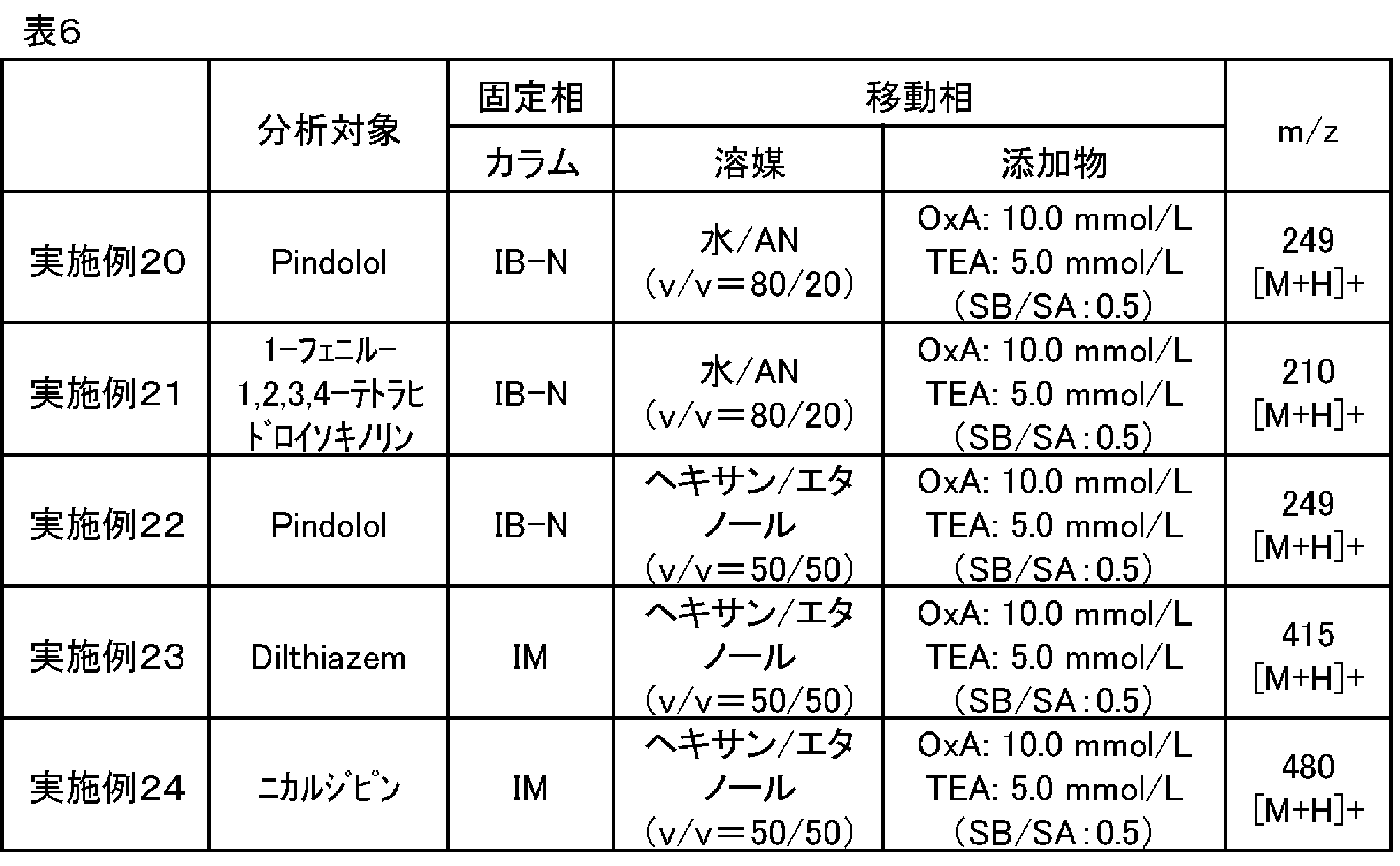
したがって、かかるアミンの分離方法は、各種液体クロマトグラフィーによる分析及び精製等に広く適用することができ、有機化学、医学、及び薬学等の分野での展開が期待される。
Claims (7)
- オリゴ糖、多糖、及びこれらの誘導体の少なくともいずれかを含む固定相と、
シュウ酸、酢酸、ギ酸、及びトリフルオロ酢酸からなる群から選択される1種以上の特定の酸、1種以上の塩基、並びに溶媒を含む移動相と、
を用いてクロマトグラフィーによりアミンを分離する分離工程を含み、
前記移動相に含まれる各特定の酸について下記式(1)で算出される値をA、各特定の酸で算出された各Aの合計値をSA、前記移動相に含まれる各塩基について下記式(2)で算出される値をB、各塩基で算出された各Bの合計値をSBとした場合において、SB/SAが、0.05以上、0.95以下である、
アミンの分離方法。
式(1):A=特定の酸の価数×特定の酸のモル濃度(mol/L)
式(2):B=塩基の価数×塩基のモル濃度(mol/L) - 前記分離工程により分離されたアミンを分析する分析工程をさらに含み、
前記分析工程において、少なくとも質量分析器を用いた分析が行われる、
請求項1に記載のアミンの分離方法。 - 前記塩基が、アンモニア、第1級アミン、第2級アミン、及び第3級アミンからなる群より選択される1種以上である、請求項1又は2に記載のアミンの分離方法。
- 前記塩基が、アンモニア、エチルアミン、n-プロピルアミン、2-プロピルアミン、ジメチルアミン、ジエチルアミン、トリメチルアミン、トリエチルアミン、ピロリジン、及びピペリジンからなる群より選択される1種以上である、請求項3に記載のアミンの分離方法。
- 前記移動相が、前記特定の酸として、少なくともシュウ酸を含む、請求項1又は2に記載のアミンの分離方法。
- 前記オリゴ糖、多糖、及びこれらの誘導体の少なくともいずれかが、光学活性部位を有する、請求項1又は2に記載のアミンの分離方法。
- 前記溶媒が、水、アセトニトリル、エタノール、メタノール、2-プロパノール、ヘキサン、ヘプタン、THF、及び液体二酸化炭素からなる群から選択される1種以上である、請求項1又は2に記載のアミンの分離方法。
Priority Applications (3)
| Application Number | Priority Date | Filing Date | Title |
|---|---|---|---|
| CN202480032985.8A CN121175563A (zh) | 2023-06-14 | 2024-06-14 | 胺的分离方法 |
| JP2025528017A JPWO2024257862A1 (ja) | 2023-06-14 | 2024-06-14 | |
| EP24823475.9A EP4729936A1 (en) | 2023-06-14 | 2024-06-14 | Amine separation method |
Applications Claiming Priority (2)
| Application Number | Priority Date | Filing Date | Title |
|---|---|---|---|
| JP2023-097913 | 2023-06-14 | ||
| JP2023097913 | 2023-06-14 |
Publications (1)
| Publication Number | Publication Date |
|---|---|
| WO2024257862A1 true WO2024257862A1 (ja) | 2024-12-19 |
Family
ID=93852202
Family Applications (1)
| Application Number | Title | Priority Date | Filing Date |
|---|---|---|---|
| PCT/JP2024/021733 Ceased WO2024257862A1 (ja) | 2023-06-14 | 2024-06-14 | アミンの分離方法 |
Country Status (4)
| Country | Link |
|---|---|
| EP (1) | EP4729936A1 (ja) |
| JP (1) | JPWO2024257862A1 (ja) |
| CN (1) | CN121175563A (ja) |
| WO (1) | WO2024257862A1 (ja) |
Citations (7)
| Publication number | Priority date | Publication date | Assignee | Title |
|---|---|---|---|---|
| JP2006133159A (ja) * | 2004-11-09 | 2006-05-25 | Daicel Chem Ind Ltd | 擬似移動床式クロマトグラフィー装置 |
| JP2010505110A (ja) * | 2006-09-29 | 2010-02-18 | カウンスィル オブ サイエンティフィック アンド インダストリアル リサーチ | 有機−無機ハイブリッドキラル吸着剤およびその製造方法 |
| JP2014029313A (ja) * | 2012-07-20 | 2014-02-13 | Mitsubishi Chemicals Corp | クロマトグラフィー用分離剤 |
| JP2015087261A (ja) * | 2013-10-30 | 2015-05-07 | 公立大学法人大阪府立大学 | 分析方法 |
| JP2016524166A (ja) * | 2013-07-11 | 2016-08-12 | サイノファーム タイワン,リミティド | 硫酸化オリゴ糖を検出する分析法 |
| JP2019196948A (ja) * | 2018-05-08 | 2019-11-14 | 日清オイリオグループ株式会社 | トリグリセリドの分析方法、油脂の選別方法、及びトリグリセリドの製造方法 |
| JP2023161874A (ja) * | 2022-04-26 | 2023-11-08 | 株式会社ダイセル | 移動相、及びイオン化可能な有機化合物の分離方法 |
-
2024
- 2024-06-14 CN CN202480032985.8A patent/CN121175563A/zh active Pending
- 2024-06-14 JP JP2025528017A patent/JPWO2024257862A1/ja active Pending
- 2024-06-14 WO PCT/JP2024/021733 patent/WO2024257862A1/ja not_active Ceased
- 2024-06-14 EP EP24823475.9A patent/EP4729936A1/en active Pending
Patent Citations (7)
| Publication number | Priority date | Publication date | Assignee | Title |
|---|---|---|---|---|
| JP2006133159A (ja) * | 2004-11-09 | 2006-05-25 | Daicel Chem Ind Ltd | 擬似移動床式クロマトグラフィー装置 |
| JP2010505110A (ja) * | 2006-09-29 | 2010-02-18 | カウンスィル オブ サイエンティフィック アンド インダストリアル リサーチ | 有機−無機ハイブリッドキラル吸着剤およびその製造方法 |
| JP2014029313A (ja) * | 2012-07-20 | 2014-02-13 | Mitsubishi Chemicals Corp | クロマトグラフィー用分離剤 |
| JP2016524166A (ja) * | 2013-07-11 | 2016-08-12 | サイノファーム タイワン,リミティド | 硫酸化オリゴ糖を検出する分析法 |
| JP2015087261A (ja) * | 2013-10-30 | 2015-05-07 | 公立大学法人大阪府立大学 | 分析方法 |
| JP2019196948A (ja) * | 2018-05-08 | 2019-11-14 | 日清オイリオグループ株式会社 | トリグリセリドの分析方法、油脂の選別方法、及びトリグリセリドの製造方法 |
| JP2023161874A (ja) * | 2022-04-26 | 2023-11-08 | 株式会社ダイセル | 移動相、及びイオン化可能な有機化合物の分離方法 |
Non-Patent Citations (3)
| Title |
|---|
| A. ISHIKAWAT. SHIBATA: "Cellulosic Chiral Stationary Phase Under Reversed-Phase Condition", JOURNAL OF LIQUID CHROMATOGRAPHY, vol. 16, 1993, pages 859 - 878 |
| R. WILLIAMS: "pKa Data Compiled", AMERICAN CHEMICAL SOCIETY |
| TASCHWER MAGDALENA, GRASCHER JÖRG, SCHMID MARTIN G.: "Development of an enantioseparation method for novel psychoactive drugs by HPLC using a Lux ® Cellulose-2 column in polar organic phase mode", FORENSIC SCIENCE INTERNATIONAL, ELSEVIER B.V., AMSTERDAM, NL, vol. 270, 1 January 2017 (2017-01-01), AMSTERDAM, NL , pages 232 - 240, XP093248050, ISSN: 0379-0738, DOI: 10.1016/j.forsciint.2016.10.011 * |
Also Published As
| Publication number | Publication date |
|---|---|
| JPWO2024257862A1 (ja) | 2024-12-19 |
| CN121175563A (zh) | 2025-12-19 |
| EP4729936A1 (en) | 2026-04-22 |
Similar Documents
| Publication | Publication Date | Title |
|---|---|---|
| Tan et al. | Advances in analytical chemistry using the unique properties of ionic liquids | |
| Zheng et al. | In-tube solid-phase microextraction based on hybrid silica monolith coupled to liquid chromatography–mass spectrometry for automated analysis of ten antidepressants in human urine and plasma | |
| Ren et al. | Novel molecularly imprinted phenolic resin–dispersive filter extraction for rapid determination of perfluorooctanoic acid and perfluorooctane sulfonate in milk | |
| Cruz-Vera et al. | Combined use of carbon nanotubes and ionic liquid to improve the determination of antidepressants in urine samples by liquid chromatography | |
| Müller et al. | Matrix effects in the analysis of polar organic water contaminants with HILIC-ESI-MS | |
| Sarafraz-Yazdi et al. | Comparison of hollow fiber and single-drop liquid-phase microextraction techniques for HPLC determination of aniline derivatives in water | |
| Yu et al. | Automated analysis of non-steroidal anti-inflammatory drugs in human plasma and water samples by in-tube solid-phase microextraction coupled to liquid chromatography-mass spectrometry based on a poly (4-vinylpyridine-co-ethylene dimethacrylate) monolith | |
| Amini et al. | A new disposable ionic liquid based coating for headspace solid-phase microextraction of methyl tert-butyl ether in a gasoline sample followed by gas chromatography–flame ionization detection | |
| Hayashida et al. | Applicability of supercritical fluid chromatography for oligonucleotide analysis: A proof-of-concept study | |
| WO2024257862A1 (ja) | アミンの分離方法 | |
| Hu et al. | Preparation of a 1, 4-Diazabicyclo [2.2. 2] octane sulfonate betaine zwitterionic stationary phase and comparative evaluation of its separation performance in hydrophilic interaction chromatography | |
| Cardinael et al. | Sample derivatization in separation science | |
| US20200016511A1 (en) | Materials and methods for trap-elute mixed mode chromatography | |
| Folprechtová et al. | Macrocyclic glycopeptide‐based chiral selectors for enantioseparation in sub/supercritical fluid chromatography | |
| US20260062375A1 (en) | Amine separation method | |
| JP2023161874A (ja) | 移動相、及びイオン化可能な有機化合物の分離方法 | |
| Han et al. | Application of ionic liquids as mobile phase additives and surface-bonded stationary phase in liquid chromatography | |
| Hsieh et al. | Chiral supercritical fluid chromatography/tandem mass spectrometry for the simultaneous determination of pindolol and propranolol in metabolic stability samples | |
| JP4887286B2 (ja) | エナンチオマーの分離用組成物及び方法 | |
| Aral et al. | Synthesis of a novel multifunctional stationary phase derived from diethanolamine, HILIC/RPLC/WAX mixed-mode HPLC applications, and investigation of the retention mechanism: T. Aral et al. | |
| Sato et al. | Weak cation-exchange restricted-access material for on-line purification of basic drugs in plasma | |
| Cârje et al. | Enantioseparation of indapamide by high performance liquid chromatography using ovomucoid glycoprotein as chiral selector | |
| WO2023008546A1 (ja) | 液体クロマトグラフィーによるアミンの分離方法 | |
| Shibata et al. | Ion-pair chromatographic attribute in the retention of ammonium ion on a crown ether-based and a polysaccharide-based chiral stationary phases. Some mobile phase additives compatible with liquid chromatography-electrospray ionization-mass spectrometry | |
| Lin et al. | Capillary liquid chromatography using a hydrophilic/cation-exchange monolithic column with a dynamically modified cationic surfactant |
Legal Events
| Date | Code | Title | Description |
|---|---|---|---|
| 121 | Ep: the epo has been informed by wipo that ep was designated in this application |
Ref document number: 24823475 Country of ref document: EP Kind code of ref document: A1 |
|
| ENP | Entry into the national phase |
Ref document number: 2025528017 Country of ref document: JP Kind code of ref document: A |
|
| WWE | Wipo information: entry into national phase |
Ref document number: 2025528017 Country of ref document: JP |
|
| WWE | Wipo information: entry into national phase |
Ref document number: 202647001756 Country of ref document: IN |
|
| WWE | Wipo information: entry into national phase |
Ref document number: 2024823475 Country of ref document: EP |
|
| NENP | Non-entry into the national phase |
Ref country code: DE |
|
| ENP | Entry into the national phase |
Ref document number: 2024823475 Country of ref document: EP Effective date: 20260114 |
|
| WWP | Wipo information: published in national office |
Ref document number: 202647001756 Country of ref document: IN |
|
| ENP | Entry into the national phase |
Ref document number: 2024823475 Country of ref document: EP Effective date: 20260114 |
|
| ENP | Entry into the national phase |
Ref document number: 2024823475 Country of ref document: EP Effective date: 20260114 |
|
| ENP | Entry into the national phase |
Ref document number: 2024823475 Country of ref document: EP Effective date: 20260114 |
|
| WWP | Wipo information: published in national office |
Ref document number: 2024823475 Country of ref document: EP |