WO2024257630A1 - ガラスセラミックス構造体及び電子部品 - Google Patents
ガラスセラミックス構造体及び電子部品 Download PDFInfo
- Publication number
- WO2024257630A1 WO2024257630A1 PCT/JP2024/020069 JP2024020069W WO2024257630A1 WO 2024257630 A1 WO2024257630 A1 WO 2024257630A1 JP 2024020069 W JP2024020069 W JP 2024020069W WO 2024257630 A1 WO2024257630 A1 WO 2024257630A1
- Authority
- WO
- WIPO (PCT)
- Prior art keywords
- ceramic
- weight
- ceramic layer
- layer
- glass
- Prior art date
- Legal status (The legal status is an assumption and is not a legal conclusion. Google has not performed a legal analysis and makes no representation as to the accuracy of the status listed.)
- Ceased
Links
Images





Classifications
-
- C—CHEMISTRY; METALLURGY
- C03—GLASS; MINERAL OR SLAG WOOL
- C03C—CHEMICAL COMPOSITION OF GLASSES, GLAZES OR VITREOUS ENAMELS; SURFACE TREATMENT OF GLASS; SURFACE TREATMENT OF FIBRES OR FILAMENTS MADE FROM GLASS, MINERALS OR SLAGS; JOINING GLASS TO GLASS OR OTHER MATERIALS
- C03C3/00—Glass compositions
- C03C3/04—Glass compositions containing silica
- C03C3/076—Glass compositions containing silica with 40% to 90% silica, by weight
- C03C3/089—Glass compositions containing silica with 40% to 90% silica, by weight containing boron
- C03C3/091—Glass compositions containing silica with 40% to 90% silica, by weight containing boron containing aluminium
- C03C3/093—Glass compositions containing silica with 40% to 90% silica, by weight containing boron containing aluminium containing zinc or zirconium
-
- B—PERFORMING OPERATIONS; TRANSPORTING
- B32—LAYERED PRODUCTS
- B32B—LAYERED PRODUCTS, i.e. PRODUCTS BUILT-UP OF STRATA OF FLAT OR NON-FLAT, e.g. CELLULAR OR HONEYCOMB, FORM
- B32B18/00—Layered products essentially comprising ceramics, e.g. refractory products
-
- C—CHEMISTRY; METALLURGY
- C03—GLASS; MINERAL OR SLAG WOOL
- C03C—CHEMICAL COMPOSITION OF GLASSES, GLAZES OR VITREOUS ENAMELS; SURFACE TREATMENT OF GLASS; SURFACE TREATMENT OF FIBRES OR FILAMENTS MADE FROM GLASS, MINERALS OR SLAGS; JOINING GLASS TO GLASS OR OTHER MATERIALS
- C03C10/00—Devitrified glass ceramics, i.e. glass ceramics having a crystalline phase dispersed in a glassy phase and constituting at least 50% by weight of the total composition
- C03C10/0036—Devitrified glass ceramics, i.e. glass ceramics having a crystalline phase dispersed in a glassy phase and constituting at least 50% by weight of the total composition containing SiO2, Al2O3 and a divalent metal oxide as main constituents
-
- C—CHEMISTRY; METALLURGY
- C03—GLASS; MINERAL OR SLAG WOOL
- C03C—CHEMICAL COMPOSITION OF GLASSES, GLAZES OR VITREOUS ENAMELS; SURFACE TREATMENT OF GLASS; SURFACE TREATMENT OF FIBRES OR FILAMENTS MADE FROM GLASS, MINERALS OR SLAGS; JOINING GLASS TO GLASS OR OTHER MATERIALS
- C03C14/00—Glass compositions containing a non-glass component, e.g. compositions containing fibres, filaments, whiskers, platelets, or the like, dispersed in a glass matrix
- C03C14/004—Glass compositions containing a non-glass component, e.g. compositions containing fibres, filaments, whiskers, platelets, or the like, dispersed in a glass matrix the non-glass component being in the form of particles or flakes
-
- C—CHEMISTRY; METALLURGY
- C03—GLASS; MINERAL OR SLAG WOOL
- C03C—CHEMICAL COMPOSITION OF GLASSES, GLAZES OR VITREOUS ENAMELS; SURFACE TREATMENT OF GLASS; SURFACE TREATMENT OF FIBRES OR FILAMENTS MADE FROM GLASS, MINERALS OR SLAGS; JOINING GLASS TO GLASS OR OTHER MATERIALS
- C03C17/00—Surface treatment of glass, not in the form of fibres or filaments, by coating
- C03C17/06—Surface treatment of glass, not in the form of fibres or filaments, by coating with metals
-
- C—CHEMISTRY; METALLURGY
- C04—CEMENTS; CONCRETE; ARTIFICIAL STONE; CERAMICS; REFRACTORIES
- C04B—LIME, MAGNESIA; SLAG; CEMENTS; COMPOSITIONS THEREOF, e.g. MORTARS, CONCRETE OR LIKE BUILDING MATERIALS; ARTIFICIAL STONE; CERAMICS; REFRACTORIES; TREATMENT OF NATURAL STONE
- C04B35/00—Shaped ceramic products characterised by their composition; Ceramics compositions; Processing powders of inorganic compounds preparatory to the manufacturing of ceramic products
- C04B35/01—Shaped ceramic products characterised by their composition; Ceramics compositions; Processing powders of inorganic compounds preparatory to the manufacturing of ceramic products based on oxide ceramics
- C04B35/10—Shaped ceramic products characterised by their composition; Ceramics compositions; Processing powders of inorganic compounds preparatory to the manufacturing of ceramic products based on oxide ceramics based on aluminium oxide
- C04B35/111—Fine ceramics
- C04B35/117—Composites
-
- C—CHEMISTRY; METALLURGY
- C04—CEMENTS; CONCRETE; ARTIFICIAL STONE; CERAMICS; REFRACTORIES
- C04B—LIME, MAGNESIA; SLAG; CEMENTS; COMPOSITIONS THEREOF, e.g. MORTARS, CONCRETE OR LIKE BUILDING MATERIALS; ARTIFICIAL STONE; CERAMICS; REFRACTORIES; TREATMENT OF NATURAL STONE
- C04B35/00—Shaped ceramic products characterised by their composition; Ceramics compositions; Processing powders of inorganic compounds preparatory to the manufacturing of ceramic products
- C04B35/01—Shaped ceramic products characterised by their composition; Ceramics compositions; Processing powders of inorganic compounds preparatory to the manufacturing of ceramic products based on oxide ceramics
- C04B35/14—Shaped ceramic products characterised by their composition; Ceramics compositions; Processing powders of inorganic compounds preparatory to the manufacturing of ceramic products based on oxide ceramics based on silica
-
- C—CHEMISTRY; METALLURGY
- C04—CEMENTS; CONCRETE; ARTIFICIAL STONE; CERAMICS; REFRACTORIES
- C04B—LIME, MAGNESIA; SLAG; CEMENTS; COMPOSITIONS THEREOF, e.g. MORTARS, CONCRETE OR LIKE BUILDING MATERIALS; ARTIFICIAL STONE; CERAMICS; REFRACTORIES; TREATMENT OF NATURAL STONE
- C04B35/00—Shaped ceramic products characterised by their composition; Ceramics compositions; Processing powders of inorganic compounds preparatory to the manufacturing of ceramic products
- C04B35/01—Shaped ceramic products characterised by their composition; Ceramics compositions; Processing powders of inorganic compounds preparatory to the manufacturing of ceramic products based on oxide ceramics
- C04B35/16—Shaped ceramic products characterised by their composition; Ceramics compositions; Processing powders of inorganic compounds preparatory to the manufacturing of ceramic products based on oxide ceramics based on silicates other than clay
- C04B35/22—Shaped ceramic products characterised by their composition; Ceramics compositions; Processing powders of inorganic compounds preparatory to the manufacturing of ceramic products based on oxide ceramics based on silicates other than clay rich in calcium oxide, e.g. wollastonite
-
- C—CHEMISTRY; METALLURGY
- C04—CEMENTS; CONCRETE; ARTIFICIAL STONE; CERAMICS; REFRACTORIES
- C04B—LIME, MAGNESIA; SLAG; CEMENTS; COMPOSITIONS THEREOF, e.g. MORTARS, CONCRETE OR LIKE BUILDING MATERIALS; ARTIFICIAL STONE; CERAMICS; REFRACTORIES; TREATMENT OF NATURAL STONE
- C04B35/00—Shaped ceramic products characterised by their composition; Ceramics compositions; Processing powders of inorganic compounds preparatory to the manufacturing of ceramic products
- C04B35/01—Shaped ceramic products characterised by their composition; Ceramics compositions; Processing powders of inorganic compounds preparatory to the manufacturing of ceramic products based on oxide ceramics
- C04B35/453—Shaped ceramic products characterised by their composition; Ceramics compositions; Processing powders of inorganic compounds preparatory to the manufacturing of ceramic products based on oxide ceramics based on zinc, tin, or bismuth oxides or solid solutions thereof with other oxides, e.g. zincates, stannates or bismuthates
-
- C—CHEMISTRY; METALLURGY
- C04—CEMENTS; CONCRETE; ARTIFICIAL STONE; CERAMICS; REFRACTORIES
- C04B—LIME, MAGNESIA; SLAG; CEMENTS; COMPOSITIONS THEREOF, e.g. MORTARS, CONCRETE OR LIKE BUILDING MATERIALS; ARTIFICIAL STONE; CERAMICS; REFRACTORIES; TREATMENT OF NATURAL STONE
- C04B35/00—Shaped ceramic products characterised by their composition; Ceramics compositions; Processing powders of inorganic compounds preparatory to the manufacturing of ceramic products
- C04B35/01—Shaped ceramic products characterised by their composition; Ceramics compositions; Processing powders of inorganic compounds preparatory to the manufacturing of ceramic products based on oxide ceramics
- C04B35/46—Shaped ceramic products characterised by their composition; Ceramics compositions; Processing powders of inorganic compounds preparatory to the manufacturing of ceramic products based on oxide ceramics based on titanium oxides or titanates
- C04B35/462—Shaped ceramic products characterised by their composition; Ceramics compositions; Processing powders of inorganic compounds preparatory to the manufacturing of ceramic products based on oxide ceramics based on titanium oxides or titanates based on titanates
- C04B35/465—Shaped ceramic products characterised by their composition; Ceramics compositions; Processing powders of inorganic compounds preparatory to the manufacturing of ceramic products based on oxide ceramics based on titanium oxides or titanates based on titanates based on alkaline earth metal titanates
- C04B35/468—Shaped ceramic products characterised by their composition; Ceramics compositions; Processing powders of inorganic compounds preparatory to the manufacturing of ceramic products based on oxide ceramics based on titanium oxides or titanates based on titanates based on alkaline earth metal titanates based on barium titanates
- C04B35/4682—Shaped ceramic products characterised by their composition; Ceramics compositions; Processing powders of inorganic compounds preparatory to the manufacturing of ceramic products based on oxide ceramics based on titanium oxides or titanates based on titanates based on alkaline earth metal titanates based on barium titanates based on BaTiO3 perovskite phase
-
- H—ELECTRICITY
- H01—ELECTRIC ELEMENTS
- H01B—CABLES; CONDUCTORS; INSULATORS; SELECTION OF MATERIALS FOR THEIR CONDUCTIVE, INSULATING OR DIELECTRIC PROPERTIES
- H01B3/00—Insulators or insulating bodies characterised by the insulating materials; Selection of materials for their insulating or dielectric properties
- H01B3/02—Insulators or insulating bodies characterised by the insulating materials; Selection of materials for their insulating or dielectric properties mainly consisting of inorganic substances
- H01B3/12—Insulators or insulating bodies characterised by the insulating materials; Selection of materials for their insulating or dielectric properties mainly consisting of inorganic substances ceramics
-
- H—ELECTRICITY
- H05—ELECTRIC TECHNIQUES NOT OTHERWISE PROVIDED FOR
- H05K—PRINTED CIRCUITS; CASINGS OR CONSTRUCTIONAL DETAILS OF ELECTRIC APPARATUS; MANUFACTURE OF ASSEMBLAGES OF ELECTRICAL COMPONENTS
- H05K1/00—Printed circuits
- H05K1/02—Details
- H05K1/03—Use of materials for the substrate
-
- C—CHEMISTRY; METALLURGY
- C03—GLASS; MINERAL OR SLAG WOOL
- C03C—CHEMICAL COMPOSITION OF GLASSES, GLAZES OR VITREOUS ENAMELS; SURFACE TREATMENT OF GLASS; SURFACE TREATMENT OF FIBRES OR FILAMENTS MADE FROM GLASS, MINERALS OR SLAGS; JOINING GLASS TO GLASS OR OTHER MATERIALS
- C03C2214/00—Nature of the non-vitreous component
- C03C2214/20—Glass-ceramics matrix
-
- C—CHEMISTRY; METALLURGY
- C03—GLASS; MINERAL OR SLAG WOOL
- C03C—CHEMICAL COMPOSITION OF GLASSES, GLAZES OR VITREOUS ENAMELS; SURFACE TREATMENT OF GLASS; SURFACE TREATMENT OF FIBRES OR FILAMENTS MADE FROM GLASS, MINERALS OR SLAGS; JOINING GLASS TO GLASS OR OTHER MATERIALS
- C03C2214/00—Nature of the non-vitreous component
- C03C2214/30—Methods of making the composites
-
- C—CHEMISTRY; METALLURGY
- C03—GLASS; MINERAL OR SLAG WOOL
- C03C—CHEMICAL COMPOSITION OF GLASSES, GLAZES OR VITREOUS ENAMELS; SURFACE TREATMENT OF GLASS; SURFACE TREATMENT OF FIBRES OR FILAMENTS MADE FROM GLASS, MINERALS OR SLAGS; JOINING GLASS TO GLASS OR OTHER MATERIALS
- C03C2218/00—Methods for coating glass
- C03C2218/10—Deposition methods
- C03C2218/11—Deposition methods from solutions or suspensions
- C03C2218/119—Deposition methods from solutions or suspensions by printing
-
- C—CHEMISTRY; METALLURGY
- C04—CEMENTS; CONCRETE; ARTIFICIAL STONE; CERAMICS; REFRACTORIES
- C04B—LIME, MAGNESIA; SLAG; CEMENTS; COMPOSITIONS THEREOF, e.g. MORTARS, CONCRETE OR LIKE BUILDING MATERIALS; ARTIFICIAL STONE; CERAMICS; REFRACTORIES; TREATMENT OF NATURAL STONE
- C04B2235/00—Aspects relating to ceramic starting mixtures or sintered ceramic products
- C04B2235/02—Composition of constituents of the starting material or of secondary phases of the final product
- C04B2235/30—Constituents and secondary phases not being of a fibrous nature
- C04B2235/32—Metal oxides, mixed metal oxides, or oxide-forming salts thereof, e.g. carbonates, nitrates, (oxy)hydroxides, chlorides
- C04B2235/3205—Alkaline earth oxides or oxide forming salts thereof, e.g. beryllium oxide
- C04B2235/3215—Barium oxides or oxide-forming salts thereof
-
- C—CHEMISTRY; METALLURGY
- C04—CEMENTS; CONCRETE; ARTIFICIAL STONE; CERAMICS; REFRACTORIES
- C04B—LIME, MAGNESIA; SLAG; CEMENTS; COMPOSITIONS THEREOF, e.g. MORTARS, CONCRETE OR LIKE BUILDING MATERIALS; ARTIFICIAL STONE; CERAMICS; REFRACTORIES; TREATMENT OF NATURAL STONE
- C04B2235/00—Aspects relating to ceramic starting mixtures or sintered ceramic products
- C04B2235/02—Composition of constituents of the starting material or of secondary phases of the final product
- C04B2235/30—Constituents and secondary phases not being of a fibrous nature
- C04B2235/32—Metal oxides, mixed metal oxides, or oxide-forming salts thereof, e.g. carbonates, nitrates, (oxy)hydroxides, chlorides
- C04B2235/3217—Aluminum oxide or oxide forming salts thereof, e.g. bauxite, alpha-alumina
-
- C—CHEMISTRY; METALLURGY
- C04—CEMENTS; CONCRETE; ARTIFICIAL STONE; CERAMICS; REFRACTORIES
- C04B—LIME, MAGNESIA; SLAG; CEMENTS; COMPOSITIONS THEREOF, e.g. MORTARS, CONCRETE OR LIKE BUILDING MATERIALS; ARTIFICIAL STONE; CERAMICS; REFRACTORIES; TREATMENT OF NATURAL STONE
- C04B2235/00—Aspects relating to ceramic starting mixtures or sintered ceramic products
- C04B2235/02—Composition of constituents of the starting material or of secondary phases of the final product
- C04B2235/30—Constituents and secondary phases not being of a fibrous nature
- C04B2235/32—Metal oxides, mixed metal oxides, or oxide-forming salts thereof, e.g. carbonates, nitrates, (oxy)hydroxides, chlorides
- C04B2235/3281—Copper oxides, cuprates or oxide-forming salts thereof, e.g. CuO or Cu2O
-
- C—CHEMISTRY; METALLURGY
- C04—CEMENTS; CONCRETE; ARTIFICIAL STONE; CERAMICS; REFRACTORIES
- C04B—LIME, MAGNESIA; SLAG; CEMENTS; COMPOSITIONS THEREOF, e.g. MORTARS, CONCRETE OR LIKE BUILDING MATERIALS; ARTIFICIAL STONE; CERAMICS; REFRACTORIES; TREATMENT OF NATURAL STONE
- C04B2235/00—Aspects relating to ceramic starting mixtures or sintered ceramic products
- C04B2235/02—Composition of constituents of the starting material or of secondary phases of the final product
- C04B2235/30—Constituents and secondary phases not being of a fibrous nature
- C04B2235/32—Metal oxides, mixed metal oxides, or oxide-forming salts thereof, e.g. carbonates, nitrates, (oxy)hydroxides, chlorides
- C04B2235/3284—Zinc oxides, zincates, cadmium oxides, cadmiates, mercury oxides, mercurates or oxide forming salts thereof
-
- C—CHEMISTRY; METALLURGY
- C04—CEMENTS; CONCRETE; ARTIFICIAL STONE; CERAMICS; REFRACTORIES
- C04B—LIME, MAGNESIA; SLAG; CEMENTS; COMPOSITIONS THEREOF, e.g. MORTARS, CONCRETE OR LIKE BUILDING MATERIALS; ARTIFICIAL STONE; CERAMICS; REFRACTORIES; TREATMENT OF NATURAL STONE
- C04B2235/00—Aspects relating to ceramic starting mixtures or sintered ceramic products
- C04B2235/02—Composition of constituents of the starting material or of secondary phases of the final product
- C04B2235/30—Constituents and secondary phases not being of a fibrous nature
- C04B2235/34—Non-metal oxides, non-metal mixed oxides, or salts thereof that form the non-metal oxides upon heating, e.g. carbonates, nitrates, (oxy)hydroxides, chlorides
- C04B2235/3409—Boron oxide, borates, boric acids, or oxide forming salts thereof, e.g. borax
-
- C—CHEMISTRY; METALLURGY
- C04—CEMENTS; CONCRETE; ARTIFICIAL STONE; CERAMICS; REFRACTORIES
- C04B—LIME, MAGNESIA; SLAG; CEMENTS; COMPOSITIONS THEREOF, e.g. MORTARS, CONCRETE OR LIKE BUILDING MATERIALS; ARTIFICIAL STONE; CERAMICS; REFRACTORIES; TREATMENT OF NATURAL STONE
- C04B2235/00—Aspects relating to ceramic starting mixtures or sintered ceramic products
- C04B2235/02—Composition of constituents of the starting material or of secondary phases of the final product
- C04B2235/30—Constituents and secondary phases not being of a fibrous nature
- C04B2235/34—Non-metal oxides, non-metal mixed oxides, or salts thereof that form the non-metal oxides upon heating, e.g. carbonates, nitrates, (oxy)hydroxides, chlorides
- C04B2235/3418—Silicon oxide, silicic acids or oxide forming salts thereof, e.g. silica sol, fused silica, silica fume, cristobalite, quartz or flint
-
- C—CHEMISTRY; METALLURGY
- C04—CEMENTS; CONCRETE; ARTIFICIAL STONE; CERAMICS; REFRACTORIES
- C04B—LIME, MAGNESIA; SLAG; CEMENTS; COMPOSITIONS THEREOF, e.g. MORTARS, CONCRETE OR LIKE BUILDING MATERIALS; ARTIFICIAL STONE; CERAMICS; REFRACTORIES; TREATMENT OF NATURAL STONE
- C04B2235/00—Aspects relating to ceramic starting mixtures or sintered ceramic products
- C04B2235/60—Aspects relating to the preparation, properties or mechanical treatment of green bodies or pre-forms
- C04B2235/602—Making the green bodies or pre-forms by moulding
- C04B2235/6025—Tape casting, e.g. with a doctor blade
-
- C—CHEMISTRY; METALLURGY
- C04—CEMENTS; CONCRETE; ARTIFICIAL STONE; CERAMICS; REFRACTORIES
- C04B—LIME, MAGNESIA; SLAG; CEMENTS; COMPOSITIONS THEREOF, e.g. MORTARS, CONCRETE OR LIKE BUILDING MATERIALS; ARTIFICIAL STONE; CERAMICS; REFRACTORIES; TREATMENT OF NATURAL STONE
- C04B2235/00—Aspects relating to ceramic starting mixtures or sintered ceramic products
- C04B2235/70—Aspects relating to sintered or melt-casted ceramic products
- C04B2235/80—Phases present in the sintered or melt-cast ceramic products other than the main phase
-
- C—CHEMISTRY; METALLURGY
- C04—CEMENTS; CONCRETE; ARTIFICIAL STONE; CERAMICS; REFRACTORIES
- C04B—LIME, MAGNESIA; SLAG; CEMENTS; COMPOSITIONS THEREOF, e.g. MORTARS, CONCRETE OR LIKE BUILDING MATERIALS; ARTIFICIAL STONE; CERAMICS; REFRACTORIES; TREATMENT OF NATURAL STONE
- C04B2237/00—Aspects relating to ceramic laminates or to joining of ceramic articles with other articles by heating
- C04B2237/30—Composition of layers of ceramic laminates or of ceramic or metallic articles to be joined by heating, e.g. Si substrates
- C04B2237/32—Ceramic
- C04B2237/34—Oxidic
-
- C—CHEMISTRY; METALLURGY
- C04—CEMENTS; CONCRETE; ARTIFICIAL STONE; CERAMICS; REFRACTORIES
- C04B—LIME, MAGNESIA; SLAG; CEMENTS; COMPOSITIONS THEREOF, e.g. MORTARS, CONCRETE OR LIKE BUILDING MATERIALS; ARTIFICIAL STONE; CERAMICS; REFRACTORIES; TREATMENT OF NATURAL STONE
- C04B2237/00—Aspects relating to ceramic laminates or to joining of ceramic articles with other articles by heating
- C04B2237/30—Composition of layers of ceramic laminates or of ceramic or metallic articles to be joined by heating, e.g. Si substrates
- C04B2237/32—Ceramic
- C04B2237/34—Oxidic
- C04B2237/341—Silica or silicates
-
- C—CHEMISTRY; METALLURGY
- C04—CEMENTS; CONCRETE; ARTIFICIAL STONE; CERAMICS; REFRACTORIES
- C04B—LIME, MAGNESIA; SLAG; CEMENTS; COMPOSITIONS THEREOF, e.g. MORTARS, CONCRETE OR LIKE BUILDING MATERIALS; ARTIFICIAL STONE; CERAMICS; REFRACTORIES; TREATMENT OF NATURAL STONE
- C04B2237/00—Aspects relating to ceramic laminates or to joining of ceramic articles with other articles by heating
- C04B2237/30—Composition of layers of ceramic laminates or of ceramic or metallic articles to be joined by heating, e.g. Si substrates
- C04B2237/32—Ceramic
- C04B2237/34—Oxidic
- C04B2237/343—Alumina or aluminates
-
- C—CHEMISTRY; METALLURGY
- C04—CEMENTS; CONCRETE; ARTIFICIAL STONE; CERAMICS; REFRACTORIES
- C04B—LIME, MAGNESIA; SLAG; CEMENTS; COMPOSITIONS THEREOF, e.g. MORTARS, CONCRETE OR LIKE BUILDING MATERIALS; ARTIFICIAL STONE; CERAMICS; REFRACTORIES; TREATMENT OF NATURAL STONE
- C04B2237/00—Aspects relating to ceramic laminates or to joining of ceramic articles with other articles by heating
- C04B2237/30—Composition of layers of ceramic laminates or of ceramic or metallic articles to be joined by heating, e.g. Si substrates
- C04B2237/32—Ceramic
- C04B2237/34—Oxidic
- C04B2237/345—Refractory metal oxides
- C04B2237/346—Titania or titanates
-
- C—CHEMISTRY; METALLURGY
- C04—CEMENTS; CONCRETE; ARTIFICIAL STONE; CERAMICS; REFRACTORIES
- C04B—LIME, MAGNESIA; SLAG; CEMENTS; COMPOSITIONS THEREOF, e.g. MORTARS, CONCRETE OR LIKE BUILDING MATERIALS; ARTIFICIAL STONE; CERAMICS; REFRACTORIES; TREATMENT OF NATURAL STONE
- C04B2237/00—Aspects relating to ceramic laminates or to joining of ceramic articles with other articles by heating
- C04B2237/50—Processing aspects relating to ceramic laminates or to the joining of ceramic articles with other articles by heating
- C04B2237/58—Forming a gradient in composition or in properties across the laminate or the joined articles
-
- C—CHEMISTRY; METALLURGY
- C04—CEMENTS; CONCRETE; ARTIFICIAL STONE; CERAMICS; REFRACTORIES
- C04B—LIME, MAGNESIA; SLAG; CEMENTS; COMPOSITIONS THEREOF, e.g. MORTARS, CONCRETE OR LIKE BUILDING MATERIALS; ARTIFICIAL STONE; CERAMICS; REFRACTORIES; TREATMENT OF NATURAL STONE
- C04B2237/00—Aspects relating to ceramic laminates or to joining of ceramic articles with other articles by heating
- C04B2237/50—Processing aspects relating to ceramic laminates or to the joining of ceramic articles with other articles by heating
- C04B2237/70—Forming laminates or joined articles comprising layers of a specific, unusual thickness
- C04B2237/704—Forming laminates or joined articles comprising layers of a specific, unusual thickness of one or more of the ceramic layers or articles
Definitions
- the present invention relates to a glass ceramic structure and an electronic component.
- Low-temperature sintered ceramic materials can be co-fired with low-melting-point metal materials that have a relatively low resistivity, making it possible to form multilayer ceramic substrates with excellent high-frequency characteristics, and they are widely used as substrate materials for high-frequency modules in information and communication terminals.
- a typical low-temperature sintering ceramic material is a glass-ceramic composite material made by mixing a ceramic material such as Al 2 O 3 with a B 2 O 3 -SiO 2 glass material, but since it contains boron, which is easily volatilized during firing, the composition of the resulting substrate is prone to variation.
- non-glass low-temperature sintering ceramic materials that do not contain boron have been proposed, but the ceramic sintered body obtained by sintering such low-temperature sintering ceramic materials has a small fracture toughness value, so that the desired strength characteristics may not be obtained.
- the strength of the ceramic sintered body is increased by precipitating crystals such as fresnoite or celsian throughout the ceramic layer.
- crystals are precipitated throughout the entire structure, the electrical properties are limited to a certain extent, and it is not possible to apply stress to specific locations in the ceramic sintered body.
- the sintered body in Patent Document 1 has a unique material composition, it is necessary to change the composition of the glass ceramic material in order to add strength.
- the present invention aims to solve the above problems and provide a glass ceramic structure and electronic component that are locally endowed with fracture toughness.
- a first glass ceramic structure of the present invention is a glass ceramic structure having a first ceramic layer containing crystals, and a second ceramic layer containing crystals and having a different crystal content from the first ceramic layer, the second ceramic layer being present on the surface of the glass ceramic structure or between the first ceramic layers in the thickness direction, the relationship between the shortest distance in the thickness direction from the surface of the glass ceramic structure to the second ceramic layer and the layer thickness of the second ceramic layer is (shortest distance from the surface)/(layer thickness of the second ceramic layer) ⁇ 10, and the composition of the first ceramic layer is SiO 2 : 45 wt % or more and 77.5 wt % or less, B 2 O 3 : 5 wt % or more and 20 wt % or less, and % or more, ZnO: 2.7 wt.
- the crystals being at least one selected from the group consisting of Al2O3 , ZnSi2O4 , ZnO, ZnAl2O4 , BaAl2Si2O8 , ZnTiO3 , Al2TiO5 , TiO2 , Mg2SiO4 , MgSiO3 and MgO , the proportion of the cross-sectional area of the crystals present in the second ceramic layer in the ceramic cross section is greater than the proportion of the cross-sectional area of the crystals present in the first ceramic layer in the ceramic cross section, the difference being 10 area % or more, 75 area % or less.
- a second glass ceramic structure of the present invention is a glass ceramic structure having a plurality of first ceramic layers containing crystals, a second ceramic layer containing crystals and having a different crystal content from the first ceramic layers, and an internal electrode, wherein the second ceramic layer is present between the first ceramic layers in a thickness direction or on a surface of the glass ceramic structure, the second ceramic layer and the internal electrode are adjacent to each other in the thickness direction, or the first ceramic layer is present between the second ceramic layer and the internal electrode in the thickness direction, the relationship between the shortest distance from the internal electrode to the second ceramic layer in the thickness direction and the layer thickness of the second ceramic layer is (shortest distance from the internal electrode)/(layer thickness of the second ceramic layer) ⁇ 10, and the composition of the first ceramic layer is SiO 2 : 45% by weight or more and 77.5% by weight or less, B 2 O 3 : 5% by weight or more and 20% by weight or less , and % or more, ZnO: 2.7 wt.
- the crystals being at least one selected from the group consisting of Al2O3 , ZnSi2O4 , ZnO, ZnAl2O4 , BaAl2Si2O8 , ZnTiO3 , Al2TiO5 , TiO2 , Mg2SiO4 , MgSiO3 and MgO , the proportion of the cross-sectional area of the crystals present in the second ceramic layer in the ceramic cross section is greater than the proportion of the cross-sectional area of the crystals present in the first ceramic layer in the ceramic cross section, the difference being 10 area % or more, 75 area % or less.
- the electronic component of the present invention includes the above-mentioned glass ceramic structure.
- the present invention can provide glass ceramic structures and electronic components that have localized fracture toughness.
- FIG. 1 is a schematic cross-sectional view showing an example of the first glass-ceramic structure.
- FIG. 2 is a schematic cross-sectional view showing another example of the first glass ceramic structure.
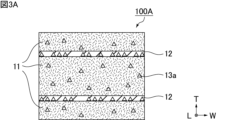
- FIG. 3A is a schematic cross-sectional view showing an example of crystal distribution in the glass ceramic structure of FIG.
- FIG. 3B is a schematic cross-sectional view showing another example of the crystal distribution in the glass ceramic structure of FIG.
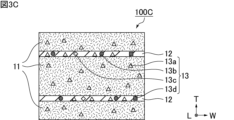
- FIG. 3C is a schematic cross-sectional view showing another example of the crystal distribution in the glass ceramic structure of FIG.
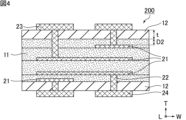
- FIG. 4 is a schematic cross-sectional view showing an example of the second glass-ceramic structure.
- FIG. 5 is a schematic cross-sectional view showing an example of an electronic component.
- FIG. 5 is a schematic cross-sectional view showing an example of an electronic component.
- FIG. 6 is a perspective view showing a method for measuring the bending strength of the glass ceramic structures produced in the examples.
- FIG. 7 is a schematic cross-sectional view for evaluating the strength of the glass ceramic structures produced in the examples.
- FIG. 8 is a schematic cross-sectional view for evaluating the strength of the glass ceramic structure produced in the example.
- the first glass ceramic structure, the second glass ceramic structure, and the electronic component of the present invention will be described below. Note that the present invention is not limited to the following configurations, and may be modified as appropriate without departing from the gist of the present invention. In addition, a combination of multiple individual preferred configurations described below also constitutes the present invention.
- the first glass ceramic structure of the present invention has a first ceramic layer containing crystals, and a second ceramic layer containing crystals and having a different crystal content from that of the first ceramic layer, and the second ceramic layer is present between the first ceramic layers in the thickness direction or on the surface of the glass ceramic structure.
- the first ceramic layer is a main body.
- Figure 1 is a schematic cross-sectional view showing an example of a first glass ceramic structure.
- the glass ceramic structure 100 shown in Figure 1 is formed by laminating three first ceramic layers 11 and two second ceramic layers 12.
- the second ceramic layer 12 having a layer thickness t ( ⁇ m) is arranged at a position with the shortest distance D1 from one main surface 100a of the glass ceramic structure 100, and another second ceramic layer 12 is arranged at a position with the shortest distance D1 from the other main surface 100b of the glass ceramic structure 100.
- the second ceramic layer may be two layers, one layer, or three or more layers. It is preferable that the first glass ceramic structure has two second ceramic layers.
- the relationship between the shortest distance in the thickness direction from the surface of the first glass ceramic structure to the second ceramic layer (hereinafter sometimes referred to as the "shortest distance from the surface") and the layer thickness of the second ceramic layer is (shortest distance from the surface)/(layer thickness of the second ceramic layer) ⁇ 10.
- the shortest distance from the surface and the thickness of the second ceramic layer are determined as follows. As shown in Fig. 1, first, a cross section (WT cross section) in the width (W) and stacking (T) directions passing through the center of the length (L) direction of the glass ceramic structure is exposed by polishing. If necessary, an etching treatment is performed on the polished surface. Then, the exposed cross section is observed by a scanning electron microscope.
- the interval between adjacent straight lines may be determined to be approximately 5 to 10 times the layer thickness of the second ceramic layer to be measured.
- draw the same number of straight lines on both sides of straight line Lc In other words, draw an odd number of straight lines including straight lines Lc. For example, draw three straight lines including straight lines Lc.
- FIG. 2 is a schematic cross-sectional view showing another example of a first glass-ceramic structure, in which two second ceramic layers 12 are disposed on two main surfaces of a glass-ceramic structure 110.
- the shortest distance in the thickness direction from the surface of the first glass ceramic structure to the second ceramic layer is, for example, preferably 0 ⁇ m or more and 150 ⁇ m or less, and more preferably 0 ⁇ m or more and 120 ⁇ m or less.
- the thickness of the second ceramic layer is, for example, preferably 3 ⁇ m or more and 75 ⁇ m or less, and more preferably 5 ⁇ m or more and 60 ⁇ m or less.
- the shortest distance and the thickness of the second ceramic layer are not limited to the above ranges, and may be adjusted to satisfy the above formula.
- the thickness of the second ceramic layer is preferably 3 ⁇ m or more and 75 ⁇ m or less.
- the composition of the first ceramic layer is as follows: SiO2 : 45% to 77.5% by weight , B2O3 : 5% to 20% by weight, Al2O3 : 2.6% to 20% by weight, ZnO : 2.7% to 20% by weight, CuO: 0% to 3.4% by weight, BaO: 0% to 10% by weight.
- the above compositions are calculated as oxides.
- the second ceramic layer (also called the crystalline layer) has a non-crystalline portion with a composition in the same range as the composition of the first ceramic layer described above, but has a different crystalline content from the first ceramic layer, with the second ceramic layer containing more crystals.
- the type of crystal with a different content is not particularly limited, and may be crystals contained in the first ceramic layer, or crystals not contained in the first ceramic layer but only in the second ceramic layer, or both.
- Examples of the crystals contained in the first ceramic layer include Al 2 O 3 and ZnO.
- Examples of crystals contained only in the second ceramic layer include ZnSi2O4 , ZnAl2O4 , BaAl2Si2O8 , ZnTiO3 , Al2TiO5 , TiO2 , Mg2SiO4 , MgSiO3 , and MgO .
- the crystals having different contents between the first ceramic layer and the second ceramic layer are at least one selected from the group consisting of Al2O3 , ZnSi2O4 , ZnO, ZnAl2O4 , BaAl2Si2O8 , ZnTiO3 , Al2TiO5 , TiO2 , Mg2SiO4 , MgSiO3 , and MgO .
- the crystals having different contents may be one type or two or more types, but are preferably two or more types.
- the proportion of the cross-sectional area of the crystals present in the second ceramic layer in the ceramic cross section is greater than the proportion of the cross-sectional area of the crystals present in the first ceramic layer in the ceramic cross section, and the difference (hereinafter sometimes referred to as difference (d1)) is 10 area % or more and 75 area % or less.
- the cross-sectional area of the crystals is not the cross-sectional area of a specific type of crystal, but the total cross-sectional area of all types of crystals. Since the difference (d1) is a comparison of the cross-sectional areas of all types of crystals, the proportion of a specific type of crystal in the second ceramic layer may be less than the proportion of the same specific type of crystal in the first ceramic layer.
- the proportion of the cross-sectional area of the crystals in the ceramic cross section can be calculated, for example, as follows. First, the cross section of the sample is observed using a scanning electron microscope (SEM) and an X-ray diffraction analyzer (XRD), and the crystalline and amorphous parts are marked with specific colors. The marked crystalline parts are extracted using image analysis software or image editing software (Photoshop (registered trademark), ImageJ, etc.), and after black and white binarization processing, the cross-sectional areas of the crystalline parts and the amorphous parts are obtained. The cross-sectional area of the crystalline parts is divided by the sum of the cross-sectional areas of the crystalline parts and the amorphous parts to calculate the proportion of the cross-sectional area of the crystals in the ceramic cross section.
- SEM scanning electron microscope
- XRD X-ray diffraction analyzer
- the difference (d1) is 10 area % or more and 75 area % or less, the flexural strength of the glass ceramic structure is improved compared to when the difference (d1) is outside the above range.
- Fig. 3A is a schematic cross-sectional view showing an example of crystal distribution in the glass ceramic structure of Fig. 1.
- Fig. 3B is a schematic cross-sectional view showing another example of crystal distribution in the glass ceramic structure of Fig. 1.
- Fig. 3C is a schematic cross-sectional view showing another example of crystal distribution in the glass ceramic structure of Fig. 1.
- the crystals 13a present in the second ceramic layer 12 are also present in the first ceramic layer 11, and the second ceramic layer 12 contains more crystals.
- the crystals 13a and 13b present in the second ceramic layer 12 are also present in the first ceramic layer 11, and the second ceramic layer 12 contains more crystals.
- the crystals 13b are not present in the first ceramic layer 11, and are present only in the second ceramic layer 12. If the difference (d1) is within the above range, the first ceramic layer 11 may contain more crystals 13a than the second ceramic layer 12, and the second ceramic layer 12 may not contain crystals 13a.
- the crystal 13a is also present in the first ceramic layer 11, and the second ceramic layer 12 contains more crystals.
- the crystals 13b, 13c, and 13d are not present in the first ceramic layer 11, and are present only in the second ceramic layer 12. If the difference (d1) is within the above range, the crystal 13a may be contained in greater amounts in the first ceramic layer 11 than in the second ceramic layer 12, and the crystal 13a may not be contained in the second ceramic layer 12.
- the only crystal present in the first ceramic layer 11 is crystal 13a, but two or more types of crystals may be present in the first ceramic layer 11. Also, four or more types of crystals may be present in the second ceramic layer 12.
- the first glass ceramic structure can be produced, for example, by the following method.
- (1) Preparation of Green Sheet A A glass ceramic material to be the first ceramic layer of the first glass ceramic structure is mixed with a binder, a plasticizer, etc. to prepare a ceramic slurry A.
- the ceramic slurry A is then formed on a substrate film (e.g., a polyethylene terephthalate (PET) film) and dried to prepare the green sheet A.
- a substrate film e.g., a polyethylene terephthalate (PET) film
- a mixed raw material is prepared by mixing the glass ceramic material used in the preparation of Green Sheet A with at least one filler component selected from the group consisting of Al2O3 , BaTiO3 , ZnO, and Mg2SiO4 .
- the mixed raw material is mixed with a binder, a plasticizer, etc. to prepare a ceramic slurry B. Then, the ceramic slurry B is formed on a substrate film and then dried to produce a green sheet B.
- Green sheets A are laminated, and green sheet B is placed on the surface of the laminate, or green sheet B is sandwiched between green sheets A to prepare a laminated green sheet, which is then fired to react green sheet A with green sheet B and generate crystals on the entire or part of the lamination surface of green sheet B.
- a second ceramic layer is formed at the position of green sheet B, and a glass ceramic structure (multilayer ceramic substrate) as shown in FIG. 1 or FIG. 2 is obtained.
- the crystals of Al 2 O 3 , BaAl 2 Si 2 O 8 and ZnAl 2 O 4 increase in the second ceramic layer.
- ZnO is used as the filler component
- Mg 2 SiO 4 is used as the filler component
- MgSiO 3 and MgO crystals increases in the second ceramic layer.
- BaTiO3 is used as the filler component, the crystals of ZnTiO3, Al2TiO5, BaAl2Si2O8 and TiO2 increase in the second ceramic layer.
- green sheet B it is also possible to form a pattern on green sheet A using ceramic slurry B, which is the raw material of green sheet B, and then stack the green sheet A with the pattern formed on it and sinter the resulting laminate to generate a second ceramic layer on the surface or inside of the glass ceramic structure.
- Methods for forming the pattern include metal mask printing, chemical etching using chemicals, physical etching such as laser processing, inkjet printing, spray coating, etc.
- the firing temperature of the laminated green sheets is not particularly limited as long as it is a temperature at which the glass ceramic material constituting green sheet A and green sheet B can be fired, and is, for example, 1000°C or less.
- the glass ceramic material used in the present invention is a low-temperature co-fired ceramic (LTCC) material.
- the laminated green sheets may be fired while sandwiched between constraining green sheets.
- the constraining green sheets contain, as a main component, an inorganic material (e.g., Al 2 O 3 ) that is not substantially fired at the firing temperature of the glass ceramic material constituting green sheets A and B. Therefore, the constraining green sheets do not shrink when the laminated green sheets are fired, and act to suppress shrinkage in the main surface direction of the laminated green sheets. As a result, the dimensional accuracy of the obtained structure is improved.
- the first glass ceramic structure has the above structure, which gives the location where the second ceramic layer is formed high fracture toughness.
- compressive stress and tensile stress can be generated in various locations within the second ceramic layer. This allows the stress to be distributed in response to a localized load, making it possible to increase fracture toughness.
- the second glass ceramic structure of the present invention is a glass ceramic structure having a plurality of first ceramic layers containing crystals, a second ceramic layer containing crystals and having a different crystal content from the first ceramic layers, and an internal electrode, wherein the second ceramic layer is present between the first ceramic layers in the thickness direction or on the surface of the glass ceramic structure, and the second ceramic layer and the internal electrode are adjacent to each other in the thickness direction, or the first ceramic layer is present between the second ceramic layer and the internal electrode in the thickness direction.
- the first ceramic layer is a main body.
- Figure 4 is a schematic cross-sectional view showing an example of a second glass ceramic structure.
- the glass ceramic structure 200 shown in Figure 4 is formed by laminating a plurality of first ceramic layers 11 and second ceramic layers 12 (four first ceramic layers and two second ceramic layers in Figure 4).
- the second ceramic layers 12 are present on the surface of the glass ceramic structure 200 in the thickness direction.
- the second ceramic layer may be two layers, one layer, or three or more layers. It is preferable that the second glass ceramic structure has two second ceramic layers.
- the internal electrodes 21 are arranged in multiple layers.
- the internal electrodes 21 are arranged between two first ceramic layers 11 adjacent in the thickness direction, or between the first ceramic layer 11 and the second ceramic layer 12 adjacent in the thickness direction.
- the second ceramic layer 12 having a layer thickness t ( ⁇ m) is arranged at the shortest distance D2 in the thickness direction from the internal electrode 21, and the first ceramic layer 11 is present between the second ceramic layer 12 and the internal electrode 21.
- Another second ceramic layer 12 is arranged so that a part of it is adjacent to the internal electrode 21 in the thickness direction.
- the glass ceramic structure 200 has via conductors 22 and external electrodes 23, 24 formed therein. These, for example, constitute passive elements such as capacitors and inductors, or constitute connection wiring that provides electrical connections between elements.
- the external electrode 23 is disposed on one main surface of the glass ceramic structure 200 .
- the external electrode 24 is disposed on the other main surface of the glass ceramic structure 200 .
- the via conductor 22 is arranged to penetrate the first ceramic layer 11 and the second ceramic layer 12, and serves to electrically connect the internal electrode 21 to the external electrodes 23 and 24.
- the via conductor 22 may be arranged to electrically connect two internal electrodes 21.
- the relationship between the shortest distance in the thickness direction from the internal electrode to the second ceramic layer and the layer thickness of the second ceramic layer is (shortest distance from the internal electrode)/(layer thickness of the second ceramic layer) ⁇ 10.
- the thickness of the second ceramic layer can be determined in the same manner as the first glass ceramic structure.
- the second ceramic layer is in contact with the internal electrode in the thickness direction.
- the shortest distance from the internal electrode to the second ceramic layer in the thickness direction is, for example, preferably 0 ⁇ m or more and 150 ⁇ m or less, and more preferably 0 ⁇ m or more and 120 ⁇ m or less.
- the thickness of the second ceramic layer is, for example, preferably 3 ⁇ m or more and 75 ⁇ m or less, and more preferably 5 ⁇ m or more and 60 ⁇ m or less.
- the shortest distance from the internal electrode and the thickness of the second ceramic layer are not limited to the above ranges, and may be adjusted to satisfy the above formula.
- the layer thickness of the second ceramic layer is preferably 3 ⁇ m or more and 75 ⁇ m or less.
- composition of the amorphous portion of the first ceramic layer and the second ceramic layer, the composition of the crystals, and the crystal content ratio can be the same as those of the first glass ceramic structure.
- the proportion of a cross-sectional area of the crystals present in the second ceramic layer in the ceramic cross section is greater than the proportion of a cross-sectional area of the crystals present in the first ceramic layer in the ceramic cross section, and the difference (d2) is 10 area % or more and 75 area % or less.
- the difference (d2) is 10 area % or more and 75 area % or less, structural defects occurring around the internal electrodes and their deterioration can be suppressed, compared to when the difference (d2) is outside the above range.
- the internal electrodes, via conductors, and external electrodes can be formed using a conductive paste containing Ag or Cu.
- the internal electrodes, via conductors, and external electrodes preferably contain Cu as the main component.
- the internal electrodes, via conductors, and external electrodes can be formed by printing using a metal mask or the like, or by transfer lamination of a Cu pattern.
- the second glass-ceramic structure can be produced, for example, by the following method.
- the green sheets A and B can be prepared in the same manner as the first glass ceramic structure.
- the internal electrodes, via conductors, and external electrodes are formed on a part of the green sheets A by using a conductive paste containing Ag or Cu or the like.
- a laminated green sheet is prepared by laminating green sheet A, and disposing green sheet B on the surface of the laminate, and then fired to react green sheet A with green sheet B, thereby forming crystals on the entire or part of the lamination surface of green sheet B.
- a glass ceramic structure as shown in FIG.
- the laminated green sheet is fired at 1000°C or less, in the same manner as in the preparation of the first glass ceramic structure.
- the firing atmosphere for the laminated green sheet is not particularly limited, but an air atmosphere is preferred when a material that is not easily oxidized, such as Ag, is used as the internal electrodes, and a low-oxygen atmosphere, such as a nitrogen atmosphere, is preferred when a material that is easily oxidized, such as Cu, is used.
- the firing atmosphere for the laminated green sheet may also be a reducing atmosphere.
- the second glass ceramic structure has the above structure, which gives the location where the second ceramic layer is formed high fracture toughness.
- the electronic component of the present invention includes the first glass-ceramic structure of the present invention and/or the second glass-ceramic structure of the present invention.
- the electronic component of the present invention includes, for example, a multilayer ceramic substrate, which is an example of a first glass ceramic structure and a second glass ceramic structure, and a chip component mounted on the multilayer ceramic substrate.
- the chip component include an LC filter, a capacitor, an inductor, a patch antenna, a coupler, and a laminated balun.
- FIG. 5 is a schematic cross-sectional view showing an example of an electronic component.
- a chip component 30 may be mounted on a glass ceramic structure (multilayer ceramic substrate) 200 in a state where it is electrically connected to an external electrode 23. In this way, an electronic component 300 including the glass ceramic structure 200 is formed.
- the electronic component 300 may be mounted on a mounting substrate (e.g., a motherboard) so as to be electrically connected via the external electrodes 24.
- a mounting substrate e.g., a motherboard
- the first glass ceramic structure and the second glass ceramic structure may also be applied to chip components mounted on a multilayer ceramic substrate. That is, the first glass ceramic structure and the second glass ceramic structure may be applied to an LC filter, a capacitor, an inductor, a patch antenna, a coupler, a laminated balun, etc.
- the first glass ceramic structure and the second glass ceramic structure may be applied to applications other than multilayer ceramic substrates and chip components.
- the first ceramic layer has a composition of SiO2 : 45% by weight or more and 77.5% by weight or less, B2O3 : 5% by weight or more and 20% by weight or less, Al2O3 : 2.6% by weight or more and 20% by weight or less, ZnO: 2.7% by weight or more and 20% by weight or less, CuO: 0% by weight or more and 3.4% by weight or less, BaO: 0% by weight or more and 10% by weight or less;
- the crystal is at least one selected from
- a glass ceramic structure having a plurality of first ceramic layers containing crystals, a second ceramic layer containing crystals and having a different crystal content from the first ceramic layers, and an internal electrode, the second ceramic layer is present between the first ceramic layers in a thickness direction or on a surface of the glass ceramic structure; the second ceramic layer and the internal electrode are adjacent to each other in a thickness direction, or the first ceramic layer is present between the second ceramic layer and the internal electrode in the thickness direction; a relationship between a shortest distance from the internal electrode to the second ceramic layer in a thickness direction and a layer thickness of the second ceramic layer is (shortest distance from the internal electrode)/(layer thickness of the second ceramic layer) ⁇ 10; the first ceramic layer has a composition of SiO2 : 45% by weight or more and 77.5% by weight or less, B2O3 : 5% by weight or more and 20% by weight or less, Al2O3 : 2.6% by weight or more and 20% by weight or less, ZnO: 2.7% by weight or more and 20% by weight or less
- the prepared mixed powder raw material was mixed with a toluene/ethanol mixed solvent and a dispersant, mixed in a ball mill with PSZ balls (diameter: 5 mm), and then a butyral-based binder solution and a plasticizer dissolved in a toluene/ethanol mixed solvent were added and further mixed to obtain the target slurry.
- the obtained slurry was molded on a carrier film with a doctor blade and dried to obtain a green sheet A with a thickness of 20 ⁇ m after firing.
- Green Sheets B1 to B4 A powder mixture was prepared by mixing 10% by weight or more and 95% by weight or less of the glass frit used in Green Sheet A with 5% by weight or more and 90% by weight or less of one of Al 2 O 3 (Green Sheet B1), ZnO (Green Sheet B2), Mg 2 SiO 4 (Green Sheet B3) or BaTiO 3 (Green Sheet B4) as a filler component.
- the prepared powder mixture was mixed in a ball mill with PSZ balls (diameter: 5 mm), and then a butyral-based binder solution and a plasticizer dissolved in a toluene/ethanol mixed solvent were added and further mixed to obtain the target slurry.
- the obtained slurry was formed on a carrier film with a doctor blade and dried to obtain green sheets B1 to B4 with thicknesses of 5, 10, and 50 ⁇ m after firing, respectively.
- (C) Preparation of glass ceramic structure The glass ceramic structure was prepared by the following procedure: 50 sheets of green sheet A cut to 78 mm ⁇ 58 mm were stacked, and two sheets of green sheet B1 cut to the same dimensions were stacked on the surface of the stack of green sheet A, or at a position 50 ⁇ m or 100 ⁇ m from the surface of the stack of green sheet A in the thickness direction.
- the laminate was subjected to isostatic pressing at 160 MPa to prepare a bonded body.
- the bonded body was cut into individual pieces of 35 mm x 6 mm, and then fired in a reducing atmosphere at 900°C or higher and 1000°C or lower for 60 minutes or more to obtain the intended glass ceramic structure (hereinafter also referred to as a sample). Samples were also prepared in the same manner using green sheets B2 to B4.
- the crystals of Al 2 O 3 , BaAl 2 Si 2 O 8 and ZnAl 2 O 4 were increased.
- the crystals of ZnAl 2 O 3 , ZnO and ZnSi 2 O 4 were increased.
- the crystals of Mg 2 SiO 4 , MgSiO 3 and MgO were increased.
- the crystals of ZnTiO3 , Al2TiO5 , BaAl2Si2O8 and TiO2 were increased.
- the flexural strength of samples in which the cross-sectional area of the crystals in the ceramic cross section was 5 area %, 10 area %, 40 area %, and 75 area % larger than that of the surrounding layers was measured and evaluated.
- the proportion of the cross-sectional area of the crystal was calculated as follows. First, the cross-section of the sample was observed by a scanning electron microscope (SEM), and the crystalline portion and the amorphous portion were marked with a specific color. The marked crystalline portion was extracted using image analysis software (ImageJ), and a black and white binarization process was performed, after which the cross-sectional area of the crystalline portion and the cross-sectional area of the amorphous portion were obtained. The cross-sectional area of the crystalline portion was divided by the sum of the cross-sectional areas of the crystalline portion and the amorphous portion to obtain the proportion of the cross-sectional area of the crystal in the cross-section of the sample.
- FIG. 6 is a perspective view showing a method for measuring the flexural strength of the glass ceramic structure prepared in the example.
- the effectiveness of green sheet B was judged to be present for samples in which the flexural strength ratio exceeded 120% when the flexural strength of a reference sample produced by laminating and firing only green sheet A was taken as 100%.
- Tables 1 to 4 show the increase in the cross-sectional area of the crystals in the second ceramic layer compared to the first ceramic layer, the thickness (t) of the second ceramic layer, the distance (D1) of the second ceramic layer from the sample surface, and the flexural strength ratio of the sample, (D1)/(t), for the sample using green sheet B1.
- Tables 2 to 4 show the results when green sheets B2 to B4 were used.
- green sheet A has a ceramic composition of compositions 2 to 7 shown in Table 5, if the crystal content of the second ceramic layer is 10 area % or more and 75 area % or less compared to the surrounding area, an improvement in the flexural strength of the sample was also confirmed.
- green sheet A was laminated on the internal electrodes to a thickness of 0 to 50 ⁇ m, and then green sheet B1, which would have a thickness of 5 ⁇ m, 10 ⁇ m or 50 ⁇ m after firing, was laminated, and finally 25 layers of green sheet A, which would have a thickness of 20 ⁇ m after firing, were laminated again to produce a laminate.
- the laminate was subjected to a hydrostatic press at 160 MPa to produce a bonded body.
- the bonded body was cut into individual pieces of 5 mm x 5 mm, and then fired in a reducing atmosphere at 900 to 1000 ° C for 60 minutes or more to obtain a ceramic structure having an internal electrode, which was used as a strength confirmation sample.
- Strength confirmation samples were also produced in the same manner using green sheets B2 to B4.
- FIG. 7 is a schematic cross-sectional view for evaluating the strength of the glass ceramic structure prepared in the example.
- FIG. 8 is a schematic cross-sectional view for evaluating the strength of the glass ceramic structure prepared in the example.
- the stamping generates a crack inside the ceramic, and this crack is defined as a fracture line BL.
- the fracture line BL extends from the stamped portion toward the internal electrode 21 or the second ceramic layer 12.
- Each sample (glass ceramic structure 200) was observed to see whether the fracture line BL reached the internal electrode 21.
- the same experiment was also carried out for a ceramic and internal electrode structure (Comparative Example 19) formed only with green sheet A without using green sheets B1 to B4. The results are shown in Table 6.
- the ceramic composition of the green sheet A used in Examples 61 to 92 and Comparative Examples 19 to 27 is composition 1 in Table 5. Even when the green sheet A has a ceramic composition of compositions 2 to 7 shown in Table 5, if the crystal content of the second ceramic layer is 10 area % or more and 75 area % or less compared to the first ceramic layer, the fracture line does not reach the internal electrode, as in Examples 61 to 92.
- Second ceramic layer 13a, 13b, 13c, 13d Crystal 21 Internal electrode 22 Via conductor 23, 24 External electrode 30 Chip component 100, 100A, 100B, 100C, 110 First glass ceramic structure 100a One main surface 100b of first glass ceramic structure Other main surface 200 Second glass ceramic structure 300 Electronic component t Layer thickness D1 of second ceramic layer Shortest distance D2 from surface Shortest distance BL from internal electrode Break lines F1 , F2 , F3 Support P Impact point Pb Probe
Landscapes
- Chemical & Material Sciences (AREA)
- Engineering & Computer Science (AREA)
- Ceramic Engineering (AREA)
- Materials Engineering (AREA)
- Organic Chemistry (AREA)
- Chemical Kinetics & Catalysis (AREA)
- Geochemistry & Mineralogy (AREA)
- General Chemical & Material Sciences (AREA)
- Life Sciences & Earth Sciences (AREA)
- Manufacturing & Machinery (AREA)
- Structural Engineering (AREA)
- Dispersion Chemistry (AREA)
- Crystallography & Structural Chemistry (AREA)
- Composite Materials (AREA)
- Inorganic Chemistry (AREA)
- Microelectronics & Electronic Packaging (AREA)
- Production Of Multi-Layered Print Wiring Board (AREA)
- Compositions Of Oxide Ceramics (AREA)
Priority Applications (3)
| Application Number | Priority Date | Filing Date | Title |
|---|---|---|---|
| JP2025527835A JPWO2024257630A1 (https=) | 2023-06-16 | 2024-05-31 | |
| CN202480006161.3A CN120418214A (zh) | 2023-06-16 | 2024-05-31 | 玻璃陶瓷结构体和电子部件 |
| US19/254,349 US20250326684A1 (en) | 2023-06-16 | 2025-06-30 | Glass ceramic structure and electronic component |
Applications Claiming Priority (2)
| Application Number | Priority Date | Filing Date | Title |
|---|---|---|---|
| JP2023-099457 | 2023-06-16 | ||
| JP2023099457 | 2023-06-16 |
Related Child Applications (1)
| Application Number | Title | Priority Date | Filing Date |
|---|---|---|---|
| US19/254,349 Continuation US20250326684A1 (en) | 2023-06-16 | 2025-06-30 | Glass ceramic structure and electronic component |
Publications (1)
| Publication Number | Publication Date |
|---|---|
| WO2024257630A1 true WO2024257630A1 (ja) | 2024-12-19 |
Family
ID=93851830
Family Applications (1)
| Application Number | Title | Priority Date | Filing Date |
|---|---|---|---|
| PCT/JP2024/020069 Ceased WO2024257630A1 (ja) | 2023-06-16 | 2024-05-31 | ガラスセラミックス構造体及び電子部品 |
Country Status (4)
| Country | Link |
|---|---|
| US (1) | US20250326684A1 (https=) |
| JP (1) | JPWO2024257630A1 (https=) |
| CN (1) | CN120418214A (https=) |
| WO (1) | WO2024257630A1 (https=) |
Citations (5)
| Publication number | Priority date | Publication date | Assignee | Title |
|---|---|---|---|---|
| JP2008270741A (ja) * | 2007-03-27 | 2008-11-06 | Kyocera Corp | 配線基板 |
| JP2011114173A (ja) * | 2009-11-27 | 2011-06-09 | Kyocera Corp | ガラスセラミック配線基板およびコイル内蔵ガラスセラミック配線基板ならびにガラスセラミック配線基板の製造方法 |
| WO2013099944A1 (ja) * | 2011-12-27 | 2013-07-04 | 株式会社村田製作所 | 多層セラミック基板およびそれを用いた電子部品 |
| WO2021256408A1 (ja) * | 2020-06-17 | 2021-12-23 | 株式会社村田製作所 | ガラス、ガラスセラミックス及び積層セラミック電子部品 |
| WO2023095605A1 (ja) * | 2021-11-25 | 2023-06-01 | 株式会社村田製作所 | ガラスセラミックス及び電子部品 |
-
2024
- 2024-05-31 WO PCT/JP2024/020069 patent/WO2024257630A1/ja not_active Ceased
- 2024-05-31 CN CN202480006161.3A patent/CN120418214A/zh active Pending
- 2024-05-31 JP JP2025527835A patent/JPWO2024257630A1/ja active Pending
-
2025
- 2025-06-30 US US19/254,349 patent/US20250326684A1/en active Pending
Patent Citations (5)
| Publication number | Priority date | Publication date | Assignee | Title |
|---|---|---|---|---|
| JP2008270741A (ja) * | 2007-03-27 | 2008-11-06 | Kyocera Corp | 配線基板 |
| JP2011114173A (ja) * | 2009-11-27 | 2011-06-09 | Kyocera Corp | ガラスセラミック配線基板およびコイル内蔵ガラスセラミック配線基板ならびにガラスセラミック配線基板の製造方法 |
| WO2013099944A1 (ja) * | 2011-12-27 | 2013-07-04 | 株式会社村田製作所 | 多層セラミック基板およびそれを用いた電子部品 |
| WO2021256408A1 (ja) * | 2020-06-17 | 2021-12-23 | 株式会社村田製作所 | ガラス、ガラスセラミックス及び積層セラミック電子部品 |
| WO2023095605A1 (ja) * | 2021-11-25 | 2023-06-01 | 株式会社村田製作所 | ガラスセラミックス及び電子部品 |
Also Published As
| Publication number | Publication date |
|---|---|
| CN120418214A (zh) | 2025-08-01 |
| US20250326684A1 (en) | 2025-10-23 |
| JPWO2024257630A1 (https=) | 2024-12-19 |
Similar Documents
| Publication | Publication Date | Title |
|---|---|---|
| JP6214930B2 (ja) | 多層配線基板 | |
| CN209962815U (zh) | 层叠线圈部件 | |
| JP5821975B2 (ja) | 複合積層セラミック電子部品 | |
| US7790271B2 (en) | Dielectric ceramic composition, ceramic substrate, and method for producing the same | |
| JP5435176B2 (ja) | 複合積層セラミック電子部品 | |
| JP5761341B2 (ja) | ガラスセラミック組成物 | |
| EP2168928B1 (en) | Glass Ceramic Substrate | |
| WO2010092970A1 (ja) | 低温焼結セラミック焼結体および多層セラミック基板 | |
| JP7494908B2 (ja) | ガラスセラミックス及び積層セラミック電子部品 | |
| US20180319129A1 (en) | Multilayer body and electronic component | |
| WO2010058697A1 (ja) | ガラスセラミック組成物およびガラスセラミック基板 | |
| JP5888524B2 (ja) | 複合積層セラミック電子部品 | |
| KR20100014344A (ko) | 적층 유전체 제조 방법 | |
| KR20170134228A (ko) | 유리-세라믹-페라이트 조성물 및 전자 부품 | |
| KR20040008094A (ko) | 동 페이스트, 이것을 이용한 배선기판 및 배선기판의제조방법 | |
| WO2024257630A1 (ja) | ガラスセラミックス構造体及び電子部品 | |
| JP7056764B2 (ja) | ガラスセラミック材料、積層体、及び、電子部品 | |
| JP6493560B2 (ja) | 多層セラミック基板及び電子部品 | |
| JP2005268712A (ja) | 積層セラミック電子部品およびその製造方法 |
Legal Events
| Date | Code | Title | Description |
|---|---|---|---|
| 121 | Ep: the epo has been informed by wipo that ep was designated in this application |
Ref document number: 24823250 Country of ref document: EP Kind code of ref document: A1 |
|
| WWE | Wipo information: entry into national phase |
Ref document number: 202480006161.3 Country of ref document: CN |
|
| WWE | Wipo information: entry into national phase |
Ref document number: 2025527835 Country of ref document: JP |
|
| WWP | Wipo information: published in national office |
Ref document number: 202480006161.3 Country of ref document: CN |
|
| NENP | Non-entry into the national phase |
Ref country code: DE |