WO2024257625A1 - 通信装置、制御方法及びプログラム - Google Patents
通信装置、制御方法及びプログラム Download PDFInfo
- Publication number
- WO2024257625A1 WO2024257625A1 PCT/JP2024/019968 JP2024019968W WO2024257625A1 WO 2024257625 A1 WO2024257625 A1 WO 2024257625A1 JP 2024019968 W JP2024019968 W JP 2024019968W WO 2024257625 A1 WO2024257625 A1 WO 2024257625A1
- Authority
- WO
- WIPO (PCT)
- Prior art keywords
- iab
- iab node
- node
- message
- border
- Prior art date
- Legal status (The legal status is an assumption and is not a legal conclusion. Google has not performed a legal analysis and makes no representation as to the accuracy of the status listed.)
- Ceased
Links
Images




Classifications
-
- H—ELECTRICITY
- H04—ELECTRIC COMMUNICATION TECHNIQUE
- H04W—WIRELESS COMMUNICATION NETWORKS
- H04W24/00—Supervisory, monitoring or testing arrangements
- H04W24/10—Scheduling measurement reports ; Arrangements for measurement reports
-
- H—ELECTRICITY
- H04—ELECTRIC COMMUNICATION TECHNIQUE
- H04W—WIRELESS COMMUNICATION NETWORKS
- H04W24/00—Supervisory, monitoring or testing arrangements
- H04W24/02—Arrangements for optimising operational condition
-
- H—ELECTRICITY
- H04—ELECTRIC COMMUNICATION TECHNIQUE
- H04W—WIRELESS COMMUNICATION NETWORKS
- H04W72/00—Local resource management
- H04W72/20—Control channels or signalling for resource management
- H04W72/27—Control channels or signalling for resource management between access points
-
- H—ELECTRICITY
- H04—ELECTRIC COMMUNICATION TECHNIQUE
- H04W—WIRELESS COMMUNICATION NETWORKS
- H04W72/00—Local resource management
- H04W72/50—Allocation or scheduling criteria for wireless resources
- H04W72/51—Allocation or scheduling criteria for wireless resources based on terminal or device properties
-
- H—ELECTRICITY
- H04—ELECTRIC COMMUNICATION TECHNIQUE
- H04W—WIRELESS COMMUNICATION NETWORKS
- H04W76/00—Connection management
- H04W76/20—Manipulation of established connections
-
- H—ELECTRICITY
- H04—ELECTRIC COMMUNICATION TECHNIQUE
- H04W—WIRELESS COMMUNICATION NETWORKS
- H04W84/00—Network topologies
-
- H—ELECTRICITY
- H04—ELECTRIC COMMUNICATION TECHNIQUE
- H04W—WIRELESS COMMUNICATION NETWORKS
- H04W88/00—Devices specially adapted for wireless communication networks, e.g. terminals, base stations or access point devices
- H04W88/08—Access point devices
-
- H—ELECTRICITY
- H04—ELECTRIC COMMUNICATION TECHNIQUE
- H04W—WIRELESS COMMUNICATION NETWORKS
- H04W92/00—Interfaces specially adapted for wireless communication networks
- H04W92/16—Interfaces between hierarchically similar devices
- H04W92/20—Interfaces between hierarchically similar devices between access points
Definitions
- This disclosure relates to a communication device, a control method, and a program.
- 3GPP (3rd Generation Partnership Project) (registered trademark) is currently working on standardizing IAB (Integrated Access and Backhaul) as a communications technology for backhaul.
- IAB technology is a technology that simultaneously uses millimeter wave wireless communication in the 28 GHz band, which is used for access communication between base stations and user equipment (UE), as backhaul communication (Patent Document 1).
- IAB technology By using IAB technology, it is possible to expand area coverage at a lower cost than with conventional wired communications using optical fiber, etc.
- 3GPP has been formulating specifications for border IAB nodes up to Rel-17.
- a border IAB node is an IAB node that has been discussed since Rel-17 and connects to both IAB networks managed by different IAB donors.
- the control of the border IAB node is performed by a single IAB donor. Therefore, IAB nodes that connect below the border IAB node connect to the IAB network managed by the IAB donor that controls the border IAB node.
- the advantage of a border IAB node is that when an IAB donor that controls a border IAB node communicates with a device that connects to the border IAB node, the communication can be via an IAB network managed by another IAB donor. This allows the IAB donor that controls the border IAB node to reduce inconvenience when a wireless link failure occurs in the network that it manages. In other words, by using another IAB network, it becomes possible to communicate while avoiding wireless link failure.
- IAB nodes As 5G (5th Generation Mobile Communication System) becomes more widespread in the future, it is expected that IAB nodes, and especially mobile IAB nodes, will become more widely used by the general public. In this case, there is a possibility that all IAB nodes will not be able to function as border IAB nodes due to device specifications, resource limitations, etc.
- the present invention has been made in consideration of at least one of the above problems.
- One aspect of the present invention aims to provide a mechanism that makes it possible to identify IAB nodes that can operate as border IAB nodes.
- FIG. 2 is a hardware block diagram of an IAB node and an IAB donor.
- FIG. 2 is a software functional block diagram of an IAB node and an IAB donor.
- 1 is a configuration example of a backhaul communication system (a network using backhaul communication) according to a first embodiment.
- 1 is an example of a boundary IAB node processing sequence for an IAB node in the 3GPP standard.
- 1 is a schematic flowchart illustrating an example of an RRC message generation process of an IAB node in the first embodiment.
- 13 is an example of a sequence for determining whether or not a boundary IAB node process is required by an IAB donor according to the first embodiment.
- 1 is an example of a network participation processing sequence of an IAB node in the 3GPP standard.
- 13 is an example of a sequence for determining whether or not a boundary IAB node process is required for an IAB donor in the second embodiment.
- FIG. 1 is a block diagram showing an example of a hardware configuration of an IAB node according to the first embodiment. Note that the hardware configuration of an IAB donor may be similar.
- the hardware configuration 101 of the IAB node includes a control unit 102, a memory unit 103, a wireless communication unit 104, and a communication antenna control unit 105.
- the control unit 102 is composed of one or more processors such as a CPU or MPU, and controls the entire communication device by executing a control program read into the RAM, which is the storage unit 103.
- processors such as a CPU or MPU
- the control unit 102 controls the entire communication device by executing a control program read into the RAM, which is the storage unit 103.
- each process performed by the control unit 102 which will be described in the flowcharts below, can also be realized using hardware circuits such as ASIC or FPGA.
- ASIC is an abbreviation for Application Specific Integrated Circuit.
- FPGA is an abbreviation for Field Programmable Gate Array.
- the processes described in the flowcharts below can be realized by having a hardware circuit and a processor such as a CPU or MPU work together.
- the memory unit 103 stores information used by the control unit 102 for control and information related to communication.
- the memory unit 103 stores the control program executed by the control unit 102, as well as various information such as cell information, connection terminal information, IAB routing information, and location information.
- the memory unit 103 may include a main memory unit and an auxiliary memory unit.
- the main memory unit may be, for example, a ROM (Read Only Memory) or a RAM (Random Access Memory).
- the main memory unit may store or temporarily store programs and data such as an OS (Operating System) which is the basic software executed by the control unit 102, and application software.
- the auxiliary memory unit may be, for example, a HDD (Hard Disk Drive) or an SSD (Solid State Drive), and may store data related to application software.
- a control program stored in a non-volatile storage area is expanded in a RAM (Random Access Memory) and executed by a processor constituting the control unit 102. In this way, the control unit 102 and the memory unit 103 may function as a so-called computer.
- the storage unit 103 may include a recording medium that stores a specific program.
- the program stored in this recording medium may be installed via a drive device or the like, and the installed specific program may be executable by the control unit 102.
- Various types of recording media may be used as the recording medium.
- the recording medium may be a recording medium that records information optically, electrically, or magnetically, such as a CD (Compact Disc)-ROM, a flexible disk, or a magneto-optical disk.
- the recording medium may also be a semiconductor memory that records information electrically, such as a ROM or a flash memory. Note that the recording medium does not include a carrier wave.
- the wireless communication unit 104 performs cellular network communication such as LTE and 5G that conform to the 3GPP standard.
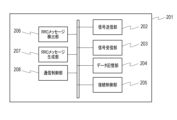
- FIG. 2 is a block diagram showing an example of the configuration of the software function blocks of an IAB node that executes the communication control function.
- the software configuration of an IAB donor may be similar.
- the IAB node software configuration 201 is stored in the memory unit 103 and executed in the control unit 102.
- the software configuration 201 includes a signal transmission unit 202, a signal reception unit 203, a data storage unit 204, a connection control unit 205, an RRC message detection unit 206, an RRC message generation unit 207, and a communication control unit 208.
- the signal transmitting unit 202 and the signal receiving unit 203 carry out cellular network communication such as LTE and 5G that conform to the 3GPP standard with a terminal device such as a UE.
- the data storage unit 204 stores and holds the software itself, IAB routing information, information about connected terminals, location information, movement route information, etc.
- connection control unit 205 controls the antenna for wireless communication performed by the wireless communication unit 104.
- the RRC message detection unit 206 detects RRC messages from IAB nodes located in the vicinity (hereinafter also referred to as "surrounding IAB nodes"), UEs, and IAB donors.
- RRC is an abbreviation for Radio Resource Control.
- the RRC message generation unit 207 generates RRC messages to be sent to surrounding IAB nodes, UEs, and IAB donors.
- the communication control unit 208 connects to and disconnects from networks such as LTE and 5G.
- FIG. 3 shows an example of the configuration of a backhaul communication system (a network using backhaul communication) in this embodiment.
- backhaul communication communication from the IAB donor, which is the relay source, is relayed in order from the parent node to the child node.
- an IAB donor provides backhaul communication to an IAB node that connects to itself, in which case the IAB donor is the parent node, and the IAB node that connects to the IAB donor is the child node.
- the communication system includes IAB donors 302 and 303 that are connected to CN (core network) 301.
- IAB donor 302 and IAB donor 303 provide a connection to CN 301 via backhaul communication to the IAB nodes that connect to them as child nodes (i.e., provide backhaul communication).
- the CN and the IAB donor are typically connected by wire and via an IP (Internet Protocol) network.
- IP Internet Protocol
- the interface between IAB donors is the Xn interface defined in 3GPP TS 38.420.
- UE 307 communicating in cell area 308 of a cell provided by IAB node 306 can connect to CN 301 via each IAB donor or IAB node. In the communication system shown in FIG. 3, UE 307 connects to CN 301 via IAB node 306.
- IAB donors and IAB nodes can also provide UEs with connectivity to CN 301 in their cell areas.
- IAB node 310 is connected to IAB donor 303 as a child node.
- IAB node 310 is further connected to IAB node 311 as a child node. In this way, IAB donor 302 and IAB donor 303 each build their own IAB network.
- Figure 4A shows a typical sequence when an IAB node according to the 3GPP standard operates as a border IAB node. This sequence is defined in 3GPP TS 38.401.
- IAB node 306 operates as a boundary IAB node
- IAB node 310 IAB donor 303
- UE307 is connected to IAB node 306. In this case, UE307 transmits and receives downlink data S420 and uplink data S421 to CN301 via IAB node 306, IAB node 304, and IAB donor 302.
- the NR-DC connection establishment process for the boundary IAB node shown in S401 is performed between the IAB node 306 and CN 301.
- the "DC" in NR-DC is an abbreviation for Dual Connectivity.
- the IAB node 306 collects information on surrounding IAB nodes and base stations, and transmits the currently connected upper node as a Measurement Report.
- the IAB donor 302 and other devices work together to execute the NR-DC connection establishment process, which adds the second connection destination selected by the IAB donor 302 as a secondary node.
- This processing sequence is defined in 3GPP TS 37.340 and is performed on the MT (Mobile Termination) part of the border IAB node 306.
- IAB donor 302 sends an IAB TRANSPORT MIGRATION MANAGEMENT REQUEST message to IAB donor 303, which is the second connection destination.
- the IAB donor 303 Upon receiving this request, the IAB donor 303 sends a DL RRC MESSAGE TRANSFER message, which corresponds to an RRCReconfiguration message, to the IAB node 310 in S403.
- the IAB node 310 sends an RRCReconfiguration message to the boundary IAB node 306 to which it is to connect.
- the border IAB node 306 sends an RRCReconfigurationComplete message to the IAB node 310 in S405.
- the IAB node 310 sends a UL RRC MESSAGE TRANSFER message equivalent to the RRCReconfigurationComplete message to the IAB donor 303 (S406).
- the border IAB node 306 is prepared to connect to the IAB node 310 and IAB donor 303, which will be the second communication path. Then, in S407, wireless layer and backhaul connection processing is performed between the border IAB node 306 and the IAB node 310 and IAB donor 303, which will be the second connection destination.
- IAB donor 303 sends an IAB TRANSPORT MIGRATION MANAGEMENT RESPONSE to IAB donor 302 as a response to S402.
- IAB donor 302 sends an IAB TRANSPORT MIGRATION MANAGEMENT REQUEST message to IAB donor 303, which is the offload destination (S410). The sending of this message corresponds to the sending of the completion of the offload process.
- IAB donor 303 sends an IAB TRANSPORT MIGRATION MANAGEMENT RESPONSE message to IAB donor 302 (S411).
- IAB node 306 operates as a boundary IAB node, and uplink and downlink data can be sent and received on the second communication path via IAB node 310.
- the process shown in FIG. 4A is performed when the IAB node 306 is a mobile IAB node and operates as a border IAB node. By allowing the moving mobile IAB node to become a border IAB node, connection switching during movement can be performed seamlessly.
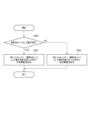
- FIG. 4B is a schematic flowchart showing an example of an RRC message generation process executed on the mobile IAB node 306 side.
- the process shown in FIG. 4B may be executed at any timing when the mobile IAB node 306 is not operating as a border IAB node.
- the process shown in FIG. 4B may be executed before transmitting the RRCSetupComplete message in step S605 of FIG. 6 described later.
- the mobile IAB node 306 determines whether it can operate as a border IAB node. Whether it can operate as a border IAB node may be determined based on any determination criteria. For example, the determination criteria may include that the location of the mobile IAB node 306 is within a location range in which it can operate as a border IAB node.
- the mobile IAB node 306 includes in the RRC message specific information indicating that the node is capable of operating as a border IAB node.
- the specific information is information indicating whether the node is capable of operating as a border IAB node.
- the mobile IAB node 306 includes in the RRC message specific information indicating that the node is not capable of operating as a border IAB node. Note that in other embodiments, if the node is not capable of operating as a border IAB node, the mobile IAB node 306 may not include the specific information itself in the RRC message in step S452.
- the IAB donor 302 receiving the RRC message can determine whether the mobile IAB node 306 can operate as a border IAB node based on specific information.
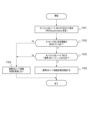
- FIG. 5 is a schematic flow chart showing the flow of processing performed on the IAB donor 302 side in relation to the processing shown in FIG. 4B.
- the mobile IAB node 306 joins the network topology via the IAB node 304, and the associated processing shown in FIG. 6 is executed.
- FIG. 6 shows an example sequence for when a mobile IAB node 306 joins a 5G network.
- This sequence is an example of a 5G network connection sequence for a typical IAB node according to the 3GPP standard defined in 3GPP TR38.401.
- the mobile IAB node 306 sends an RRCSetupRequest message to the IAB node 304 in S601.
- the IAB node 304 that received the message wants the sending mobile IAB node 306 to join the 5G network, it sends an initial UL RRC message to the IAB donor 302 in S602.
- the IAB donor 302 When the IAB donor 302 receives this message, it sends a DL RRC message (S603) to the IAB node 304, and the IAB node 304 sends an RRCSetup message (S604) to the mobile IAB node 306.
- the mobile IAB node 306 receives this and sends an RRCSetupComplete message to the IAB node 304 in S605.
- the IAB node 304 then sends an UL RRC message to the IAB donor 302 in S606 to relay the RRCSetupComplete message.
- the IAB donor 302 In order to establish a context for the mobile IAB node 306 that has connected to the IAB donor 302, the IAB donor 302 sends a context setup request message to the IAB node 304 in S607.
- the IAB node 304 sends a SecurityModeCommand message to the mobile IAB node 306 in S608.
- the IAB node 304 After sending this message, the IAB node 304 asynchronously sends a context setup response message to the IAB donor 302 in S609.
- the mobile IAB node 306 sends a SecurityModeComplete message to the IAB node 304 in S610.
- the IAB node 304 relays the SecurityModeComplete message and sends a UL RRC message to the IAB donor 302 in S611.
- the IAB donor 302 receives this and sends the RRCConfiguration message in a DL RRC message to the IAB node 304 in S612.
- the IAB node 304 relays the DL RRC message and sends the RRCConfiguration message to the mobile IAB node 306 in S613.
- the mobile IAB node 306 sends an RRCConfigurationComplete message in response to the RRCConfiguration message to the IAB node 304 in S614.
- the IAB node 304 relays this and sends a UL RRC message to the IAB donor 302 in S615.
- the RRCSetupComplete message format is defined in 3GPP TS 38.331.
- the specified information may be included in the RRCSetupComplete-IEs parameters or the extension parameter group of the RRCSetupComplete-IEs.
- RRCSetupComplete message specific information may be included in the RRCSetupRequest message or the RRCReconfigurationComplete message.
- the IAB donor 302 determines whether the RRCSetupComplete message contains specific information.
- the RRCSetupRequest message may contain specific information instead of or in addition to the RRCSetupComplete message. In this case, the IAB donor 302 may determine in F502 whether the RRCSetupRequest message contains specific information.
- the IAB donor 302 determines whether the RRCSetupComplete message includes an information field indicating whether or not the IAB donor can operate as a border IAB node.
- a parameter check is performed that is included in the information field to determine whether or not the node can operate as a border IAB node.
- the parameter may be a binary value, such as 1 for operable and 0 for inoperable.
- the information field may be set only if the node is operable.
- the judgment process in F503 determines that the currently participating mobile IAB node 306 can operate as a border IAB node, a series of processes shown in FIG. 4A are required to operate it as a border IAB node.
- the IAB donor 302 in F505 performs a series of processes shown in FIG. 4A to operate it as a border IAB node.
- an IAB node transmits to the IAB donor whether or not it can operate as a border IAB node, and the IAB donor 302 that receives this can determine whether or not to perform the process shown in FIG. 4A.
- This allows the process shown in FIG. 4A to be performed only for IAB nodes that can operate as border IAB nodes. As a result, it is possible to reduce the inconvenience (the increase in system load described above) that can occur when all IAB nodes operate as border IAB nodes.
- the IAB node transmits predetermined information when it joins the network topology. Then, the IAB donor uses the predetermined information to determine whether or not to execute the series of processes shown in Fig. 4A for operating as a border IAB node. In contrast, in the second embodiment, the timing at which the IAB node transmits surrounding environment information to the IAB donor is used, rather than the timing at which the IAB node joins the network topology. Specifically, it is as follows.
- an IAB node periodically transmits the collected surrounding environment information to an IAB donor in a MeasurementReport message.
- This message is used by the IAB donor to form the network topology.
- the IAB donor After receiving the Measurement Report message, the IAB donor sends an RRCReconfiguration message to the sending IAB node to reconfigure the network topology as necessary. This causes the IAB donor to be handed over.
- the series of processes shown in FIG. 4A for operating as a border IAB node may be performed at such timing.
- the MeasurementReport message is sent with the specified information included.
- the IAB donor can use the MeasurementReport message to determine whether or not to carry out the series of processes shown in Figure 4A to operate as a border IAB node.
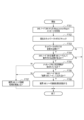
- FIG. 7 shows a flow chart for the IAB donor 302 in this embodiment.
- the IAB node 306 is a mobile IAB node that is assumed to move, but in this embodiment, it is described as an IAB node that does not move. However, it goes without saying that it may also be a mobile IAB node that is assumed to move.
- the IAB donor 302 receives a MeasurementReport message including specific information from the IAB node 306 via the IAB node 304.
- the MeasurementReport message format is defined in 3GPP TS38.331.
- the specific information can be included in parameters in the MeasResults field in the MeasurementReport-IEs field.
- the IAB donor 302 checks the current network topology in F702 and determines in F703 whether a change to the network topology of the IAB node 306 is necessary.
- the system returns to normal operation. However, in this case, it may be determined that it is not necessary to operate as a border IAB node, but that a handover to another node is necessary. In other words, a handover process for the IAB node in question (not shown) may be executed.
- the node determines whether an information field is included indicating whether or not the node can operate as a border IAB node.
- a parameter check is performed on the information field to determine whether or not the node can operate as a border IAB node.
- This second embodiment also provides the same effects as the first embodiment described above.
- the transmission means for transmitting the specific information mainly uses an RRC message.
- the specific information may also be included in the IAB node's notification information, such as a beacon, and transmitted.
- Broadcast information includes SSB, MIB, SIB, etc., and the information transmitted by these may include specified information (information on whether the sending IAB node can operate as a boundary IAB node).
- SSB is an abbreviation for Synchronization Signal Block.
- MIB is an abbreviation for Master Information Block.
- SIB is an abbreviation for System Information Block.
- SIBs various information formats are defined for SIBs in particular, such as surrounding cell information, idle information, and side link related information.
- a new format for defining specific information may be created within these definitions and transmitted as a new SIB.
- a field indicating specific information may be added to an existing information definition format.
- the specified information information field indicating whether or not the node can operate as a border IAB node
- the system returns to normal operation. In other words, as shown in F504 and F707, the connection process as a border IAB node is not carried out.
- the system operation may be to perform connection processing as a border IAB node.
- a mobile IAB node is used in the first embodiment, and an IAB node that does not move is used in the second embodiment.
- the determination process shown in FIG. 4A and FIG. 7 may be performed in a different order or with additional determination processes.
- the process shown in F704 for determining whether the source IAB node needs to operate as a border IAB node may be performed as a pre-processing step of F502.
- a method of including specific information in the IAB node's notification information, such as a beacon, and transmitting it as a transmission means other than an RRC message is exemplified.
- it may be transmitted in a BAP (Backhaul Adaptation Protocol) message.
- the BAP message specifications are defined in 3GPP TS 38.340.
- it may be transmitted by including specific information (an information field and a parameter indicating whether the source IAB node can operate as a border IAB node) in a data PDU (Protocol Data Unit) and a control PDU.
Landscapes
- Engineering & Computer Science (AREA)
- Computer Networks & Wireless Communication (AREA)
- Signal Processing (AREA)
- Mobile Radio Communication Systems (AREA)
Abstract
Description
前記判定結果に基づいて、前記判定結果に応じた通信メッセージを送信する送信手段を有することを特徴とする。
図1は第一の実施形態に係るIABノードのハードウェア構成の一例を表すブロック図である。なお、IABドナーのハードウェア構成についても同様であってよい。
上述した第一の実施形態ではIABノードがネットワークトポロジへ参加するタイミングで所定情報を送信する。そして、IABドナーが所定情報を用いて図4Aに示した境界IABノードとして動作させる一連の処理を実施するか否か判定する。これに対して、第二の実施形態では、IABノードがネットワークトポロジへ参加するタイミングではなく、IABノードが周辺環境情報をIABドナーへ送信するタイミングを利用する。具体的には、以下の通りである。
上述した第一及び第二の実施形態では、所定情報を送信する送信手段や、IABドナーが図4Aに示した境界IABノードとして動作させる一連の処理を実施するか否か判断を実施する判断タイミングを説明してきた。
Claims (12)
- 一のIAB(Integrated Access and Backhaul)ネットワークを形成するIABノードとして機能している自ノードが、前記一のIABネットワークと他の一のIABネットワークの両方へ接続するIABノードである境界IABノードとして動作可能であるか否かを判定する判定手段と、
前記判定手段の判定結果に基づいて、前記判定結果に応じた通信メッセージを送信する送信手段を有することを特徴とする、通信装置。 - 前記通信メッセージは、自ノードが前記境界IABノードとして動作可能であるか否かを表す所定情報を含むことを特徴とする、請求項1に記載の通信装置。
- 前記所定情報は、前記判定結果を表すパラメータの値を含むことを特徴とする、請求項2に記載の通信装置。
- モバイルIABノードとして移動可能であることを特徴とする、請求項1乃至3のいずれか1項に記載の通信装置。
- 一のIAB(Integrated Access and Backhaul)ネットワークを形成するIABドナーとして機能する通信装置であって、
IABノードとして機能する他の通信装置から、通信メッセージを受信する受信手段と、
前記通信メッセージに基づいて、前記他の通信装置が、前記一のIABネットワークと他の一のIABネットワークの両方へ接続するIABノードである境界IABノードとして動作可能であるか否かを判断する判断手段とを有することを特徴とする、通信装置。 - 前記判断手段は、前記通信メッセージに所定情報が含まれているか否かに基づいて、前記他の通信装置が境界IABノードとして動作可能であるか否かを判断することを特徴とする、請求項5に記載の通信装置。
- 前記判断手段は、前記通信メッセージに前記所定情報が含まれている場合に、前記所定情報に基づいて、前記他の通信装置が境界IABノードとして動作可能であるか否かを判断することを特徴とする、請求項6に記載の通信装置。
- 前記所定情報は、前記他の通信装置が境界IABノードとして動作可能であるか否かを表すパラメータの値を含むことを特徴とする、請求項6又は7に記載の通信装置。
- 前記通信メッセージは、RRC(Radio Resource Control)メッセージ、BAP(Backhaul Adaptation Protocol)メッセージ、又はMeasurementReportメッセージであることを特徴とする、
請求項1乃至8のいずれか1項に記載の通信装置。 - 前記通信メッセージは、RRCメッセージであり、
前記RRCメッセージは、RRC SetupCompleteメッセージ又はMeasurementReportメッセージであることを特徴とする、請求項1乃至8のいずれか1項に記載の通信装置。 - 通信を制御する制御方法であって、
一のIAB(Integrated Access and Backhaul)ネットワークを形成するIABノードとして機能している自ノードが、前記一のIABネットワークと他の一のIABネットワークの両方へ接続するIABノードである境界IABノードとして動作可能であるか否かを判定する判定工程と、
前記判定工程の判定結果に基づいて、前記判定結果に応じた通信メッセージを送信する送信工程とを有することを特徴とする、制御方法。 - コンピュータに、
一のIAB(Integrated Access and Backhaul)ネットワークを形成するIABノードとして機能している自ノードが、前記一のIABネットワークと他の一のIABネットワークの両方へ接続するIABノードである境界IABノードとして動作可能であるか否かを判定する判定工程と、
前記判定工程の判定結果に基づいて、前記判定結果に応じた通信メッセージを送信する送信工程とを実行させることを特徴とするプログラム。
Priority Applications (2)
| Application Number | Priority Date | Filing Date | Title |
|---|---|---|---|
| EP24823245.6A EP4727197A1 (en) | 2023-06-12 | 2024-05-31 | Communication device, control method, and program |
| US19/409,414 US20260089746A1 (en) | 2023-06-12 | 2025-12-04 | Communication apparatus and control method |
Applications Claiming Priority (2)
| Application Number | Priority Date | Filing Date | Title |
|---|---|---|---|
| JP2023096499A JP2024178018A (ja) | 2023-06-12 | 2023-06-12 | 通信装置、制御方法及びプログラム |
| JP2023-096499 | 2023-06-12 |
Related Child Applications (1)
| Application Number | Title | Priority Date | Filing Date |
|---|---|---|---|
| US19/409,414 Continuation US20260089746A1 (en) | 2023-06-12 | 2025-12-04 | Communication apparatus and control method |
Publications (1)
| Publication Number | Publication Date |
|---|---|
| WO2024257625A1 true WO2024257625A1 (ja) | 2024-12-19 |
Family
ID=93851809
Family Applications (1)
| Application Number | Title | Priority Date | Filing Date |
|---|---|---|---|
| PCT/JP2024/019968 Ceased WO2024257625A1 (ja) | 2023-06-12 | 2024-05-31 | 通信装置、制御方法及びプログラム |
Country Status (4)
| Country | Link |
|---|---|
| US (1) | US20260089746A1 (ja) |
| EP (1) | EP4727197A1 (ja) |
| JP (1) | JP2024178018A (ja) |
| WO (1) | WO2024257625A1 (ja) |
Citations (4)
| Publication number | Priority date | Publication date | Assignee | Title |
|---|---|---|---|---|
| JP2019534625A (ja) | 2016-09-29 | 2019-11-28 | エイ・ティ・アンド・ティ インテレクチュアル プロパティ アイ,エル.ピー. | アクセス・バックホール統合(iab)無線ネットワークの初期アクセス及び無線リソース管理 |
| US20220394571A1 (en) | 2019-10-02 | 2022-12-08 | Qualcomm Incorporated | Parallel handover and failure handling |
| WO2023013604A1 (ja) * | 2021-08-03 | 2023-02-09 | 京セラ株式会社 | 通信制御方法 |
| JP2023096499A (ja) | 2021-12-27 | 2023-07-07 | 花王株式会社 | 固形化粧料の製造方法 |
-
2023
- 2023-06-12 JP JP2023096499A patent/JP2024178018A/ja active Pending
-
2024
- 2024-05-31 EP EP24823245.6A patent/EP4727197A1/en active Pending
- 2024-05-31 WO PCT/JP2024/019968 patent/WO2024257625A1/ja not_active Ceased
-
2025
- 2025-12-04 US US19/409,414 patent/US20260089746A1/en active Pending
Patent Citations (4)
| Publication number | Priority date | Publication date | Assignee | Title |
|---|---|---|---|---|
| JP2019534625A (ja) | 2016-09-29 | 2019-11-28 | エイ・ティ・アンド・ティ インテレクチュアル プロパティ アイ,エル.ピー. | アクセス・バックホール統合(iab)無線ネットワークの初期アクセス及び無線リソース管理 |
| US20220394571A1 (en) | 2019-10-02 | 2022-12-08 | Qualcomm Incorporated | Parallel handover and failure handling |
| WO2023013604A1 (ja) * | 2021-08-03 | 2023-02-09 | 京セラ株式会社 | 通信制御方法 |
| JP2023096499A (ja) | 2021-12-27 | 2023-07-07 | 花王株式会社 | 固形化粧料の製造方法 |
Non-Patent Citations (2)
| Title |
|---|
| APPLE: "Mobility enhancement in mobile IAB", 3GPP DRAFT; R2-2209763, 3RD GENERATION PARTNERSHIP PROJECT (3GPP), MOBILE COMPETENCE CENTRE ; 650, ROUTE DES LUCIOLES ; F-06921 SOPHIA-ANTIPOLIS CEDEX ; FRANCE, vol. RAN WG2, no. E-Conference; 20221010 - 20221019, 30 September 2022 (2022-09-30), Mobile Competence Centre ; 650, route des Lucioles ; F-06921 Sophia-Antipolis Cedex ; France, XP052263090 * |
| HUAWEI, HISILICON: "Mobile IAB mobility enhancement", 3GPP DRAFT; R2-2209522, 3RD GENERATION PARTNERSHIP PROJECT (3GPP), MOBILE COMPETENCE CENTRE ; 650, ROUTE DES LUCIOLES ; F-06921 SOPHIA-ANTIPOLIS CEDEX ; FRANCE, vol. RAN WG2, no. E-meeting; 20221010 - 20221019, 30 September 2022 (2022-09-30), Mobile Competence Centre ; 650, route des Lucioles ; F-06921 Sophia-Antipolis Cedex ; France, XP052262851 * |
Also Published As
| Publication number | Publication date |
|---|---|
| EP4727197A1 (en) | 2026-04-15 |
| JP2024178018A (ja) | 2024-12-24 |
| US20260089746A1 (en) | 2026-03-26 |
Similar Documents
| Publication | Publication Date | Title |
|---|---|---|
| US12262269B2 (en) | Communication system | |
| RU2752242C1 (ru) | Способы, обеспечивающие возможность двойного подключения для избыточных путей плоскости пользователя, и соответствующие сетевые узлы | |
| US10390376B2 (en) | Communications system | |
| EP3749009B1 (en) | Method and apparatus for link maintenance | |
| CN113556806B (zh) | 基站和在蜂窝电信网络中操作基站的方法 | |
| CN110830979A (zh) | 信息传输方法及装置 | |
| EP2472920A1 (en) | Method for obtaining neighbor cell information, and network | |
| US20250317789A1 (en) | Communication method and communication apparatus | |
| CN107371198B (zh) | 小区切换的方法和系统 | |
| US8755801B2 (en) | Method and access node for transmitting information | |
| US12348448B2 (en) | First network node, second network node, third network node and methods performed thereby, for handling a measurement configuration | |
| JP2023546424A (ja) | Iabノードのマイグレーション方法及び装置 | |
| CN116349293A (zh) | Iab节点的移植方法及装置 | |
| JP2024178018A (ja) | 通信装置、制御方法及びプログラム | |
| US20260082285A1 (en) | Handover processing method, apparatus, and communication device | |
| KR20120131045A (ko) | 로컬 네트워크 간 이동성을 제공하는 방법 및 로컬 게이트웨이 | |
| CN116506866A (zh) | 一种节点移动的机制和相应的节点 | |
| US20250227582A1 (en) | Communication method, communication apparatus, and communication system | |
| US20250106700A1 (en) | Method and apparatus for node movement and corresponding node | |
| US20260067787A1 (en) | Communication method and communication apparatus | |
| JP2025017109A (ja) | 基地局、通信装置、制御方法、プログラム | |
| EP4738899A1 (en) | Communication method and apparatus | |
| WO2025142614A1 (ja) | 通信装置、基地局、制御方法、プログラム | |
| WO2024172030A1 (ja) | 通信制御方法 | |
| WO2025200867A1 (zh) | 通信方法及装置 |
Legal Events
| Date | Code | Title | Description |
|---|---|---|---|
| 121 | Ep: the epo has been informed by wipo that ep was designated in this application |
Ref document number: 24823245 Country of ref document: EP Kind code of ref document: A1 |
|
| ENP | Entry into the national phase |
Ref document number: 2024823245 Country of ref document: EP Effective date: 20260112 |
|
| WWE | Wipo information: entry into national phase |
Ref document number: 2024823245 Country of ref document: EP |
|
| NENP | Non-entry into the national phase |
Ref country code: DE |
|
| ENP | Entry into the national phase |
Ref document number: 2024823245 Country of ref document: EP Effective date: 20260112 |
|
| ENP | Entry into the national phase |
Ref document number: 2024823245 Country of ref document: EP Effective date: 20260112 |
|
| ENP | Entry into the national phase |
Ref document number: 2024823245 Country of ref document: EP Effective date: 20260112 |
|
| ENP | Entry into the national phase |
Ref document number: 2024823245 Country of ref document: EP Effective date: 20260112 |
|
| WWP | Wipo information: published in national office |
Ref document number: 2024823245 Country of ref document: EP |