WO2024256967A1 - Filler reinforced polyester compositions with improved sustainable content, surface aesthetics and nmt bonding strength - Google Patents
Filler reinforced polyester compositions with improved sustainable content, surface aesthetics and nmt bonding strength Download PDFInfo
- Publication number
- WO2024256967A1 WO2024256967A1 PCT/IB2024/055711 IB2024055711W WO2024256967A1 WO 2024256967 A1 WO2024256967 A1 WO 2024256967A1 IB 2024055711 W IB2024055711 W IB 2024055711W WO 2024256967 A1 WO2024256967 A1 WO 2024256967A1
- Authority
- WO
- WIPO (PCT)
- Prior art keywords
- glass fiber
- recycled
- thermoplastic composition
- composition according
- component
- Prior art date
- Legal status (The legal status is an assumption and is not a legal conclusion. Google has not performed a legal analysis and makes no representation as to the accuracy of the status listed.)
- Ceased
Links
Classifications
-
- C—CHEMISTRY; METALLURGY
- C08—ORGANIC MACROMOLECULAR COMPOUNDS; THEIR PREPARATION OR CHEMICAL WORKING-UP; COMPOSITIONS BASED THEREON
- C08L—COMPOSITIONS OF MACROMOLECULAR COMPOUNDS
- C08L67/00—Compositions of polyesters obtained by reactions forming a carboxylic ester link in the main chain; Compositions of derivatives of such polymers
- C08L67/02—Polyesters derived from dicarboxylic acids and dihydroxy compounds
-
- C—CHEMISTRY; METALLURGY
- C08—ORGANIC MACROMOLECULAR COMPOUNDS; THEIR PREPARATION OR CHEMICAL WORKING-UP; COMPOSITIONS BASED THEREON
- C08K—Use of inorganic or non-macromolecular organic substances as compounding ingredients
- C08K7/00—Use of ingredients characterised by shape
- C08K7/02—Fibres or whiskers
- C08K7/04—Fibres or whiskers inorganic
- C08K7/14—Glass
-
- C—CHEMISTRY; METALLURGY
- C08—ORGANIC MACROMOLECULAR COMPOUNDS; THEIR PREPARATION OR CHEMICAL WORKING-UP; COMPOSITIONS BASED THEREON
- C08L—COMPOSITIONS OF MACROMOLECULAR COMPOUNDS
- C08L23/00—Compositions of homopolymers or copolymers of unsaturated aliphatic hydrocarbons having only one carbon-to-carbon double bond; Compositions of derivatives of such polymers
- C08L23/02—Compositions of homopolymers or copolymers of unsaturated aliphatic hydrocarbons having only one carbon-to-carbon double bond; Compositions of derivatives of such polymers not modified by chemical after-treatment
- C08L23/04—Homopolymers or copolymers of ethene
- C08L23/08—Copolymers of ethene
- C08L23/0846—Copolymers of ethene with unsaturated hydrocarbons containing atoms other than carbon or hydrogen
- C08L23/0869—Copolymers of ethene with unsaturated hydrocarbons containing atoms other than carbon or hydrogen with unsaturated acids, e.g. [meth]acrylic acid; with unsaturated esters, e.g. [meth]acrylic acid esters
-
- C—CHEMISTRY; METALLURGY
- C08—ORGANIC MACROMOLECULAR COMPOUNDS; THEIR PREPARATION OR CHEMICAL WORKING-UP; COMPOSITIONS BASED THEREON
- C08L—COMPOSITIONS OF MACROMOLECULAR COMPOUNDS
- C08L23/00—Compositions of homopolymers or copolymers of unsaturated aliphatic hydrocarbons having only one carbon-to-carbon double bond; Compositions of derivatives of such polymers
- C08L23/02—Compositions of homopolymers or copolymers of unsaturated aliphatic hydrocarbons having only one carbon-to-carbon double bond; Compositions of derivatives of such polymers not modified by chemical after-treatment
- C08L23/04—Homopolymers or copolymers of ethene
- C08L23/08—Copolymers of ethene
- C08L23/0846—Copolymers of ethene with unsaturated hydrocarbons containing atoms other than carbon or hydrogen
- C08L23/0869—Copolymers of ethene with unsaturated hydrocarbons containing atoms other than carbon or hydrogen with unsaturated acids, e.g. [meth]acrylic acid; with unsaturated esters, e.g. [meth]acrylic acid esters
- C08L23/0884—Epoxide-containing esters
-
- C—CHEMISTRY; METALLURGY
- C08—ORGANIC MACROMOLECULAR COMPOUNDS; THEIR PREPARATION OR CHEMICAL WORKING-UP; COMPOSITIONS BASED THEREON
- C08L—COMPOSITIONS OF MACROMOLECULAR COMPOUNDS
- C08L67/00—Compositions of polyesters obtained by reactions forming a carboxylic ester link in the main chain; Compositions of derivatives of such polymers
- C08L67/02—Polyesters derived from dicarboxylic acids and dihydroxy compounds
- C08L67/025—Polyesters derived from dicarboxylic acids and dihydroxy compounds containing polyether sequences
-
- C—CHEMISTRY; METALLURGY
- C08—ORGANIC MACROMOLECULAR COMPOUNDS; THEIR PREPARATION OR CHEMICAL WORKING-UP; COMPOSITIONS BASED THEREON
- C08L—COMPOSITIONS OF MACROMOLECULAR COMPOUNDS
- C08L69/00—Compositions of polycarbonates; Compositions of derivatives of polycarbonates
- C08L69/005—Polyester-carbonates
-
- C—CHEMISTRY; METALLURGY
- C08—ORGANIC MACROMOLECULAR COMPOUNDS; THEIR PREPARATION OR CHEMICAL WORKING-UP; COMPOSITIONS BASED THEREON
- C08L—COMPOSITIONS OF MACROMOLECULAR COMPOUNDS
- C08L2203/00—Applications
- C08L2203/20—Applications use in electrical or conductive gadgets
-
- C—CHEMISTRY; METALLURGY
- C08—ORGANIC MACROMOLECULAR COMPOUNDS; THEIR PREPARATION OR CHEMICAL WORKING-UP; COMPOSITIONS BASED THEREON
- C08L—COMPOSITIONS OF MACROMOLECULAR COMPOUNDS
- C08L2205/00—Polymer mixtures characterised by other features
- C08L2205/02—Polymer mixtures characterised by other features containing two or more polymers of the same C08L -group
- C08L2205/025—Polymer mixtures characterised by other features containing two or more polymers of the same C08L -group containing two or more polymers of the same hierarchy C08L, and differing only in parameters such as density, comonomer content, molecular weight, structure
-
- C—CHEMISTRY; METALLURGY
- C08—ORGANIC MACROMOLECULAR COMPOUNDS; THEIR PREPARATION OR CHEMICAL WORKING-UP; COMPOSITIONS BASED THEREON
- C08L—COMPOSITIONS OF MACROMOLECULAR COMPOUNDS
- C08L2205/00—Polymer mixtures characterised by other features
- C08L2205/03—Polymer mixtures characterised by other features containing three or more polymers in a blend
- C08L2205/035—Polymer mixtures characterised by other features containing three or more polymers in a blend containing four or more polymers in a blend
-
- C—CHEMISTRY; METALLURGY
- C08—ORGANIC MACROMOLECULAR COMPOUNDS; THEIR PREPARATION OR CHEMICAL WORKING-UP; COMPOSITIONS BASED THEREON
- C08L—COMPOSITIONS OF MACROMOLECULAR COMPOUNDS
- C08L2207/00—Properties characterising the ingredient of the composition
- C08L2207/20—Recycled plastic
-
- Y—GENERAL TAGGING OF NEW TECHNOLOGICAL DEVELOPMENTS; GENERAL TAGGING OF CROSS-SECTIONAL TECHNOLOGIES SPANNING OVER SEVERAL SECTIONS OF THE IPC; TECHNICAL SUBJECTS COVERED BY FORMER USPC CROSS-REFERENCE ART COLLECTIONS [XRACs] AND DIGESTS
- Y02—TECHNOLOGIES OR APPLICATIONS FOR MITIGATION OR ADAPTATION AGAINST CLIMATE CHANGE
- Y02W—CLIMATE CHANGE MITIGATION TECHNOLOGIES RELATED TO WASTEWATER TREATMENT OR WASTE MANAGEMENT
- Y02W30/00—Technologies for solid waste management
- Y02W30/50—Reuse, recycling or recovery technologies
- Y02W30/62—Plastics recycling; Rubber recycling
Definitions
- thermoplastic compositions having improved nano molding technology (NMT) bonding strength and in particular to NMT compositions including a glass fiber component including recycled round glass fiber.
- NMT nano molding technology
- NMT nano molding technology
- CNC computer numerical control
- thermoplastic composition including: from about 20 wt% to about 65 wt% of a resin component including polybutylene terephthalate (PBT), polycyclohexylenedimethylene terephthalate (PCT), polyethylene terephthalate (PET), or a combination thereof; from about 10 wt% to about 30 wt% of a polyestercarbonate copolymer including resorcinol units; from about 5 wt% to about 50 wt% of a glass fiber component including recycled round glass fiber; and from about 5 wt% to about 10 wt% of at least one additive component.
- PBT polybutylene terephthalate
- PCT polycyclohexylenedimethylene terephthalate
- PET polyethylene terephthalate
- the composition has a higher nano molding technology (NMT) bonding strength as compared to a comparative composition including flat glass fibers instead of the recycled round glass fibers.
- the composition has a dielectric constant (Dk) of at least 3.3 as evaluated at 2.5 gigahertz (GHz) or 5.0 GHz in accordance with a SPDR (split post dielectric resonator) Method, or at least 3.24 as evaluated at 60 GHz in accordance with a Coaxial Method.
- Dk dielectric constant
- FIGS. 1A-1D are optical microscopy images of the milled areas of samples prepared from compositions Cl, Exl, C2 and Ex2, respectively.
- FIGS. 2A and 2B are optical microscopy images of the interface between the milled and unmilled areas of samples prepared from composition Cl (FIG. 2A) and Ex2 (FIG. 2B).
- NMT nano molding technology
- the present disclosure relates to compositions based on both recycled resin and recycled filler building blocks for maximum sustainable content, with improved surface appearance due to the geometry and amount of the filler while maintaining NMT bonding strength and other physical properties.
- This disclosure shows that the surface aesthetics can be improved by changing the geometry of the glass fibers or by reducing the amount of glass fibers, and the sustainable content can be improved by using a recycled glass fiber that does not result in loss of NMT bonding strength, color capability or significant loss of other properties.
- compositions for NMT applications including 100% pre-consumer recycled glass fibers with a round cross-section as an alternative to flat cross-section (low warp) glass fibers with no recycle content.
- the recycled round glass fibers were of interest for the increase in total sustainable content of the composition. However, they also unexpectedly improved the surface appearance of the parts after milling, and slightly higher the NMT bonding strength compared to flat glass fibers.
- the use of recycled resins or fillers can often lead to degradation of properties and color, but as demonstrated in the present disclosure the properties were maintained compared to the virgin material with only slight differences due to the geometry of the glass fibers.
- compositions according to the present disclosure could reduce the need for additional processing steps (e.g., polishing and laser ablation).
- the sustainable filler also adds the benefit of reduced carbon footprint with comparable or better NMT bonding strength and mechanical property performance.
- Ranges can be expressed herein as from one value (first value) to another value (second value). When such a range is expressed, the range includes in some aspects one or both of the first value and the second value. Similarly, when values are expressed as approximations, by use of the antecedent ‘about,’ it will be understood that the particular value forms another aspect. It will be further understood that the endpoints of each of the ranges are significant both in relation to the other endpoint, and independently of the other endpoint. It is also understood that there are a number of values disclosed herein, and that each value is also herein disclosed as “about” that particular value in addition to the value itself. For example, if the value “10” is disclosed, then “about 10” is also disclosed. It is also understood that each unit between two particular units are also disclosed. For example, if 10 and 15 are disclosed, then 11, 12, 13, and 14 are also disclosed.
- the terms “about” and “at or about” mean that the amount or value in question can be the designated value, approximately the designated value, or about the same as the designated value. It is generally understood, as used herein, that it is the nominal value indicated ⁇ 10% variation unless otherwise indicated or inferred. The term is intended to convey that similar values promote equivalent results or effects recited in the claims. That is, it is understood that amounts, sizes, formulations, parameters, and other quantities and characteristics are not and need not be exact, but can be approximate and/or larger or smaller, as desired, reflecting tolerances, conversion factors, rounding off, measurement error and the like, and other factors known to those of skill in the art.
- an amount, size, formulation, parameter or other quantity or characteristic is “about” or “approximate” whether or not expressly stated to be such. It is understood that where “about” is used before a quantitative value, the parameter also includes the specific quantitative value itself, unless specifically stated otherwise.
- compositions of the disclosure Disclosed are the components to be used to prepare the compositions of the disclosure as well as the compositions themselves to be used within the methods disclosed herein. These and other materials are disclosed herein, and it is understood that when combinations, subsets, interactions, groups, etc. of these materials are disclosed that while specific reference of each various individual and collective combinations and permutation of these compounds cannot be explicitly disclosed, each is specifically contemplated and described herein. For example, if a particular compound is disclosed and discussed and a number of modifications that can be made to a number of molecules including the compounds are discussed, specifically contemplated is each and every combination and permutation of the compound and the modifications that are possible unless specifically indicated to the contrary.
- references in the specification and concluding claims to parts by weight of a particular element or component in a composition or article denotes the weight relationship between the element or component and any other elements or components in the composition or article for which a part by weight is expressed.
- X and Y are present at a weight ratio of 2:5, and are present in such ratio regardless of whether additional components are contained in the compound.
- a weight percent of a component is based on the total weight of the formulation or composition in which the component is included.
- polycarbonate refers to an oligomer or polymer including residues of one or more dihydroxy compounds, e.g., dihydroxy aromatic compounds, joined by carbonate linkages; it also encompasses homopolycarbonates, copolycarbonates, and (co)polyestercarbonates.
- residues and “structural units”, used in reference to the constituents of the polymers, are synonymous throughout the specification.
- weight percent As used herein the terms “weight percent,” “wt%,” and “wt. %,” which can be used interchangeably, indicate the percent by weight of a given component based on the total weight of the composition, unless otherwise specified. That is, unless otherwise specified, all wt% values are based on the total weight of the composition. It should be understood that the sum of wt% values for all components in a disclosed composition or formulation are equal to 100.
- compositions disclosed herein have certain functions. Disclosed herein are certain structural requirements for performing the disclosed functions and it is understood that there are a variety of structures that can perform the same function that are related to the disclosed structures, and that these structures will typically achieve the same result.
- thermoplastic composition including: from about 20 wt% to about 65 wt% of a resin component including polybutylene terephthalate (PBT), polycyclohexylenedimethylene terephthalate (PCT), polyethylene terephthalate (PET), or a combination thereof; from about 10 wt% to about 30 wt% of a polyestercarbonate copolymer including resorcinol units; from about 5 wt% to about 50 wt% of a glass fiber component including recycled round glass fiber; and from about 5 wt% to about 10 wt% of at least one additive component.
- PBT polybutylene terephthalate
- PCT polycyclohexylenedimethylene terephthalate
- PET polyethylene terephthalate
- the composition has a higher nano molding technology (NMT) bonding strength as compared to a comparative composition including flat glass fibers instead of the recycled round glass fibers, wherein NMT bonding strength is evaluated according to a modified ISO 19095 procedure.
- the composition has a dielectric constant (Dk) of at least 3.3 as evaluated at 2.5 gigahertz (GHz) or 5.0 GHz in accordance with a SPDR (split post dielectric resonator) Method, or at least 3.24 as evaluated at 60 GHz in accordance with a Coaxial Method.
- Dk dielectric constant
- polybutylene terephthalate can be used interchangeably with poly(l,4-butylene terephthalate).
- polyethylene terephthalate can be used interchangeably with poly(ethyl benzene- 1,4-dicarboxylate).
- polyethylene terephthalate is a type of polyester.
- polycyclohexylenedimethylene terephthalate is a crystalline polyester formed from cyclohexanedimethanol (CHDM) and either dimethyl terephthalate (DMT) or terephthalic acid (TP A).
- PETG and PCTG are copolyesters formed by including ethylene glycol (EG) in the polymerization reaction. PETG is formed if less than 50% of the diol content in the copolyester is CHDM; PCTG is formed if greater than 50% of the diol content in the copolyester is CHDM.
- PCTA is formed by including additional diacids such as isophthalic acid (IPA).
- the polyester component includes PBT, PET, or a combination thereof.
- the resin component including polybutylene terephthalate (PBT), polycyclohexylenedimethylene terephthalate (PCT), polyethylene terephthalate (PET), or a combination thereof may including virgin resin or recycled resin.
- PBT polybutylene terephthalate
- PCT polycyclohexylenedimethylene terephthalate
- PET polyethylene terephthalate
- the resin component includes chemically recycled polymer.
- An exemplary chemically recycled polymer is chemically recycled PBT.
- Chemically recycled PBT is a copolymer containing 1-20 % comonomers, like ethylene glycol, isophthalic acid (IPA) and diethylene glycol (DEG).
- IPA isophthalic acid
- DEG diethylene glycol
- the chemically recycled PBT named as iQ PBT, is derived from a chemical upcycled (or post-consumer recycled) PET.
- compositions formed from iQ PBT provide an environmentally friendly advantage that provide desirable elastic modulus, stress at break, and elongation at break.
- an upcycled PBT include those available under the trade name ELCRINTM iQ Resin, manufactured by SABICTM.
- the PBT may be derived from the polyethylene terephthalate) component by any method that involves depolymerization of the poly(ethylene terephthalate) component and polymerization of the depolymerized polyethylene terephthalate) component with 1,4 butanediol to provide the PET-derived PBT.
- the PET-derived poly(butylene terephthalate) component may be made by a process that involves depolymerizing a poly(ethylene terephthalate) and/or a polyethylene terephthalate) copolymer, with a 1,4 butanediol component at a temperature from 180 °C to 230 °C, under agitation, at a pressure that is at least atmospheric pressure in the presence of a catalyst component, at an elevated temperature, under an inert atmosphere, to produce a molten mixture containing an oligomer containing ethylene terephthalate moieties, an oligomer containing ethylene isophthalate moieties, an oligomer containing diethylene terephthalate moieties, an oligomer containing diethylene isophthalate moieties, an oligomer containing butylene terephthalate moieties, an oligomer containing butylene isophthalate moieties, a covalently bonded oligomeric
- the resin component includes at least two chemically recycled PBT components, such as but not limited to a chemically recycled PBT having a low intrinsic viscosity (IV) of from 0.63-0.68 (e.g., iQ 195B) and a second chemically recycled PBT having a high intrinsic viscosity (IV) of from 1.15-1.22 (iQ 315B).
- a chemically recycled PBT having a low intrinsic viscosity (IV) of from 0.63-0.68 e.g., iQ 195B
- the thermoplastic composition includes from about 20 wt% to about 65 wt% of the resin component. In some aspects the composition includes at least 20 wt%, or at least 25 wt%, or at least 30 wt% or at least 40 wt%, or at least 45 wt%, or no more than 65 wt%, or no more than 60 wt%, or no more than 55 wt%, of the resin component.
- the copolyestercarbonate copolymer may include ester units of the formula wherein D is a divalent group derived from a dihydroxy compound, and may be, for example, a C2-30 alkylene group, a C3-30 alicyclic group, a Ce-30 aromatic group or a polyoxyalkylene group in which the alkylene groups contain 2 to 6 carbon atoms, specifically 2, 3, or 4 carbon atoms; and T divalent group derived from a dicarboxylic acid, and may be, for example, a C2- 30 alkylene group, a C6-30 alicyclic group, a Ce-30 alkyl aromatic group, or a Ce-30 aromatic group.
- aromatic dicarboxylic acids from which the T group in the ester is derived include isophthalic or terephthalic acid, l,2-di(p-carboxyphenyl)ethane, 4,4'- dicarboxydiphenyl ether, 4,4'-bisbenzoic acid, and combinations including at least one of the foregoing acids. Acids containing fused rings can also be present, such as in 1,4-, 1,5-, or 2,6- naphthalenedicarboxylic acids. Specific dicarboxylic acids are terephthalic acid, isophthalic acid, naphthalene dicarboxylic acid, cyclohexane dicarboxylic acid, or combinations thereof.
- a specific dicarboxylic acid includes a combination of isophthalic acid and terephthalic acid wherein the weight ratio of isophthalic acid to terephthalic acid is 99: 1 to 1:99.
- D is a C2-6 alkylene group and T is p-phenylene, m-phenylene, naphthalene, a divalent cycloaliphatic group, or a combination thereof.
- This class of polyester includes the poly(alkylene terephthalates).
- the ester units of the polyester or polyester block include arylate ester units derived from the reaction product of one equivalent of an isophthalic acid derivative and/or terephthalic acid derivative with a resorcinol of the formula wherein each R f is independently C1-12 alkyl, or halogen, and u is 0 to 4. It will be understood that R f is hydrogen when u is 0. Typically, the halogen can be chlorine or bromine.
- compounds in which the — OH groups are substituted meta to one another, and wherein R f and u are as described above, are also generally referred to herein as resorcinols.
- Examples of compounds that may be represented by this formula include resorcinol (where u is 0), substituted resorcinol compounds such as 5-methyl resorcinol, 5-ethyl resorcinol, 5- propyl resorcinol, 5-butyl resorcinol, 5-t-butyl resorcinol, 5-phenyl resorcinol, 5-cumyl resorcinol, 2,4,5,6-tetrafluoro resorcinol, 2,4,5,6-tetrabromo resorcinol, or the like; catechol; hydroquinone; substituted hydroquinones such as 2-methyl hydroquinone, 2-ethyl hydroquinone, 2-propyl hydroquinone, 2-butyl hydroquinone, 2-t-butyl hydroquinone, 2- phenyl hydroquinone, 2-cumyl hydroquinone, 2,3,5,6-tetramethyl hydroquinone, 2, 3,5,6-
- Such arylate ester units are also referred to herein as isophthalate- terephthalate-resorcinol ester units, sometimes referred to in abbreviated form as ITR ester units.
- isophthalate-terephthalate-resorcinol ester units include a combination isophthalate esters, terephthalate esters, and resorcinol esters.
- isophthalate-terephthalate-resorcinol ester units include a combination of isophthalateresorcinol ester units and terephthalate-resorcinol ester units, wherein the molar ratio of isophthalate-resorcinol ester units to terephthalate-resorcinol ester units is 99: 1 to 1 :99, or 95:5 to 5:95, or 90: 10 to 10:90, or 80:20 to 20:80.
- the arylate ester units include isophthalate-terephthalate-resorcinol ester units in which the resorcinol is 1,3 -dihydroxybenzene.
- Exemplary aromatic polyester blocks include poly(isophthalate-terephthalate-resorcinol) esters, poly(isophthalate-terephthalate-bisphenol- A) esters, poly[(isophthalate-terephthalate-resorcinol) ester-co-(isophthalate-terephthalate- bisphenol-A)] ester, or a combination including at least one of these.
- a useful arylate polyester block is a poly(isophthalate-terephthalate-resorcinol) ester.
- the copolyestercarbonate copolymer includes ITR blocks and polycarbonate blocks, as shown in the formula below: wherein x is the mole % of the ITR ester block and y is the mole % of the polycarbonate block.
- An exemplary copolyestercarbonate copolymer is SLX 90/10 resin, available from SABIC. SLX 90/10 includes 90 mole % ITR block and 10 mole % PC block.
- the copolyestercarbonate copolymer has a ratio of ITR ester units to polycarbonate monomer units of from 20:80 to 95:5, or from 85: 15 to 95:5, or from 88: 12 to 92:8, or about 90: 10.
- the composition includes from about 10 wt% to about 30 wt% of the polyestercarbonate copolymer including resorcinol units.
- the composition includes at least 10 wt%, or at least 11 wt%, or at least 12 wt%, or at least 13 wt%, or at least 14 wt%, or no more than 30 wt%, or no more than 25 wt%, or no more than 24 wt%, or no more than 23 wt%, or no more than 22 wt%, or no more than 21 wt%, or no more than 20 wt%, or no more than 19 wt%, or no more than 18 wt%, or no more than 17 wt%, of the polyestercarbonate copolymer including resorcinol units.
- the composition includes from about 5 wt% to about 50 wt% of the glass fiber component including recycled round glass fiber.
- the composition includes at least 5 wt%, or at least 10 wt%, or at least 15 wt%, or at least 16 wt%, or at least 17 wt%, or at least 18 wt%, or at least 19 wt%, or at least 20 wt%, or no more than 50 wt%, or no more than 45 wt%, or no more than 40 wt%, or no more than 35 wt%, or no more than 34 wt%, or no more than 33 wt%, or no more than 32 wt%, or no more than 31 wt%, or no more than 30 wt%, of the glass fiber component.
- the recycled round glass fiber may in some aspects be a pre-consumer (also known as post-industrial) recycled glass fiber. Such glass fibers are formed from a chemical recycling type process, so the properties are not degrade
- a “round glass fiber” may be described according to a conventional understanding as a glass fiber having a generally circular or substantially circular cross section.
- the round glass fiber has an aspect ratio of less than 1.5: 1, wherein aspect ratio is described as a ratio of the length of the major axis to the length of the minor axis of the elongated non-circular cross-section.
- flat glass fibers have an aspect ratio of greater than 1.5: 1, such as 2: 1, or 3: 1, or 4: 1, or 5: 1, or 6: 1, or 7: 1, or 8: 1, or 9: 1, or 10: 1.
- the flat glass fiber had an aspect ratio of about 4: 1.
- the recycled round glass fiber has a length of less than 8 millimeters (mm) and a diameter of less than 15 micron (pm).
- the recycled round glass fiber has a length of less than 7 mm, or less than 6 mm, or less than 5 mm, or about 4 mm.
- the recycled round glass fiber has a length of less than 14 pm, or less than 13 pm, or less than 12 pm, or less than 11 pm, or about 10 pm.
- the round glass fiber is a conventional glass fiber.
- the round glass fiber does not have low dielectric constant (Dk) properties. It has been found that in certain aspects compositions with a conventional glass fiber have improved melt volume rate (MVR) properties as compared to compositions including a low Dk glass fiber. Such compositions may be desirable in certain applications.
- Dk dielectric constant
- compositions have a MVR that is from 20-200% higher, or at least 20% higher, or at least 25% higher, or at least 30% higher, or at least 35% higher, or at least 50% higher, or at least 60% higher, or at least 70% higher, or at least 80% higher, or at least 90% higher, or at least 100% higher, or at least 110% higher, than comparative compositions that include a low Dk glass fiber instead of a conventional recycled round glass fiber.
- MVR may be evaluated at 250 °C and 5 kg in accordance with ISO 1133.
- compositions with a conventional glass fiber have improved flexural modulus properties as compared to compositions including a low Dk glass fiber. Such compositions may be desirable in certain applications.
- compositions have a flexural modulus that is from 5-50% higher, or at least 5% higher, or at least 5.5% higher, or at least 6% higher, or at least 7% higher, or at least 7% higher, or at least 7% higher, or at least 11% higher, than comparative compositions that include a low Dk glass fiber instead of a conventional recycled round glass fiber.
- Flexural modulus may be evaluated in accordance with ASTM D790.
- compositions according to aspects of the disclosure which do not include a low Dk glass fiber may thus have a dielectric constant (Dk) of at least 3.3 as evaluated at 2.5 gigahertz (GHz) or 5.0 GHz in accordance with a SPDR (split post dielectric resonator)Method.
- Dk dielectric constant
- the compositions have a Dk of no greater than 6, or no greater than 5, or no greater than 4, as evaluated at 2.5 gigahertz (GHz) or 5.0 GHz in accordance with a SPDR (split post dielectric resonator) Method.
- compositions have a dielectric constant of least 3.24 as evaluated at 60 GHz in accordance with a Coaxial Method.
- the compositions have a Dk of no greater than 6, or no greater than 5, or no greater than 4, as evaluated at 60 GHz in accordance with a Coaxial Method.
- the additive component may include, but is not limited to, an impact modifier, a mold release agent, a quenching agent, UV stabilizer, impact modifier, heat stabilizer, antioxidant, colorant, a transesterification inhibitor, an acid scavenger, an anti-drip agent, an antistatic agent, a chain extender, a flow promoter, a lubricant, a plasticizer, a flame retardant, a UV reflecting additive, a blowing agent, a reinforcing agent, or a combination thereof.
- the additive component includes an impact modifier, a mold release agent, a quenching agent, UV stabilizer, impact modifier, heat stabilizer, antioxidant, colorant, or a combination thereof.
- the composition does not include a carbon-based filler, including but not limited to carbon black, and in particular conductive carbon black.
- the composition includes less than 5 wt%, or less than 4 wt%, or less than 3 wt%, or less than 2 wt%, or less than 1 wt% carbon black.
- Compositions including a carbonbased filler — and especially conductive carbon black — would be expected to be more electrically conductive than compositions according to aspects of the disclosure described herein; such compositions may not be suitable in certain electronic device applications where the high conductivity could interfere with signal transmission properties.
- Metal bonding strength is used to evaluate NMT performance.
- plastic resin is injected onto a metal surface that is treated by a special chemical solution.
- This NMT process is developed from the integration technology of metal and plastics. It allows for manufacture of certain parts of consumer products and replaces the traditional insert molding or die casting process.
- the composition has a higher nano molding technology (NMT) bonding strength as compared to a comparative composition including flat glass fibers instead of the recycled round glass fibers, wherein NMT bonding strength is evaluated according to a modified ISO 19095 procedure.
- NMT bonding strength is evaluated according to a modified ISO 19095 procedure.
- the modified ISO 19095 procedure is described in PCT publication WO2015/200272, the disclosure of which is incorporated herein by this reference in its entirety.
- ISO 19095 is a standard for “Evaluation of the adhesion interface performance in plastic -metal assemblies,” which is considered the bar test widely accepted by the industry. Two types of bar parts are used, including a lap joint and a butt joint.
- the modified ISO 19095 procedure includes the following steps: i) Pre-treatment on the metal parts to create nano- and micro- sized holes on metal surface by a chemical etching process; ii) Within an effective treatment timeframe, plastic is injection-molded onto the pre-treated aluminum insets; iii) Bonding force is measured by recording the force when the molded parts are pulled until the breaking point on a standard tensile test machine; and iv) Bonding strength is calculated (e.g., to MPa unit) accordingly by using bonding force divided by bonding area.
- the metal may be pre-treated with a metal surface treatment, which may include one of two major processes: T (Taiseiplas)-treatment and TRI (Technology Rising from IWATE)- treatment. These methods were developed by different companies in Japan.
- T Teaiseiplas
- TRI Technology Rising from IWATE
- T treatment primarily relies on physical anchoring.
- the composition has improved surface appearance as compared to a comparative composition including flat glass fibers instead of the recycled round glass fibers. Improved surface appearance may be evaluated as described herein.
- the composition may in some aspects include at least 20 wt% recycled content, or in further aspects at least 25 wt%, or at least 30 wt%, or at least 35 wt%, or at least 40 wt%, or at least 45 wt%, or at least 50 wt%, or at least 55 wt%, or at least 60 wt%, or at least 65 wt%, or at least 70 wt%, or at least 75 wt% recycled content.
- the one or any foregoing components described herein may be first dry blended with each other, or dry blended with any combination of foregoing components, then fed into an extruder from one or multi-feeders, or separately fed into an extruder from one or multi -feeders.
- the fillers used in the disclosure may also be first processed into a masterbatch, then fed into an extruder.
- the components may be fed into the extruder from a throat hopper or any side feeders.
- the extruders used in the disclosure may have a single screw, multiple screws, intermeshing co-rotating or counter rotating screws, non-intermeshing co-rotating or counter rotating screws, reciprocating screws, screws with pins, screws with screens, barrels with pins, rolls, rams, helical rotors, co-kneaders, disc-pack processors, various other types of extrusion equipment, or combinations including at least one of the foregoing.
- the components may also be mixed together and then melt-blended to form the thermoplastic compositions.
- the melt blending of the components involves the use of shear force, extensional force, compressive force, ultrasonic energy, electromagnetic energy, thermal energy or combinations including at least one of the foregoing forces or forms of energy.
- the barrel temperature on the extruder during compounding can be set at the temperature where at least a portion of the polymer has reached a temperature greater than or equal to about the melting temperature, if the resin is a semi-crystalline organic polymer, or the flow point (e.g., the glass transition temperature) if the resin is an amorphous resin.
- thermoplastic composition may first be extruded and formed into pellets. The pellets may then be fed into a molding machine where it may be formed into any desirable shape or product.
- thermoplastic composition emanating from a single melt blender may be formed into sheets or strands and subjected to post-extrusion processes such as annealing, uniaxial or biaxial orientation.
- the temperature of the melt in the present process may in some aspects be maintained as low as possible in order to avoid excessive thermal degradation of the components.
- the melt temperature is maintained between about 230°C and about 350°C, although higher temperatures can be used provided that the residence time of the resin in the processing equipment is kept relatively short.
- the melt processed composition exits processing equipment such as an extruder through small exit holes in a die.
- the resulting strands of molten resin may be cooled by passing the strands through a water bath.
- the cooled strands can be chopped into pellets for packaging and further handling.
- the present disclosure pertains to shaped, formed, or molded articles including the thermoplastic compositions.
- the thermoplastic compositions can be molded into useful shaped articles by a variety of means such as injection molding, extrusion, rotational molding, blow molding and thermoforming to form articles and structural components of, for example, personal or commercial electronics devices, including but not limited to cellular telephones, tablet computers, personal computers, notebook and portable computers, and other such equipment, medical applications, RFID applications, automotive applications, and the like.
- the article is extrusion molded.
- the article is injection molded.
- the article is a component of a consumer electronics application.
- the article is an internal or external component of a mobile phone, tablet, computer, or watch.
- the present disclosure pertains to and includes at least the following aspects.
- a thermoplastic composition comprising: from about 20 wt% to about 65 wt% of a resin component comprising polybutylene terephthalate (PBT), polycyclohexylenedimethylene terephthalate (PCT), polyethylene terephthalate (PET), or a combination thereof; from about 10 wt% to about 30 wt% of a polyestercarbonate copolymer comprising resorcinol units; from about 5 wt% to about 50 wt% of a glass fiber component comprising recycled round glass fiber; and from about 5 wt% to about 10 wt% of at least one additive component, wherein the composition has a higher nano molding technology (NMT) bonding strength as compared to a comparative composition including flat glass fibers instead of the recycled round glass fibers, wherein NMT bonding strength is evaluated according to a modified ISO 19095 procedure, and wherein the composition has a dielectric constant (Dk) of a.
- NMT nano molding technology
- Aspect 2 The thermoplastic composition according to Aspect 1, wherein the composition has improved surface appearance as compared to a comparative composition including flat glass fibers instead of the recycled round glass fibers.
- Aspect 3 The thermoplastic composition according to Aspect 1 or 2, wherein the resin component comprises a chemically recycled polymer.
- Aspect 4 The thermoplastic composition according to Aspect 3, wherein the chemically recycled polymer comprises at least two chemically recycled PBT polymers.
- Aspect 5. The thermoplastic composition according to any of Aspects 1 to 4, wherein the polyestercarbonate copolymer comprising resorcinol units comprises isophthalate-terephthalate-resorcinol (ITR) ester units.
- thermoplastic composition according to any of Aspects 1 to 5, wherein the composition comprises from about 20 wt% to about 30 wt% of the glass fiber component.
- Aspect 7 The thermoplastic composition according to any of Aspects 1 to 6, wherein the recycled round glass fiber has a length of less than 8 millimeters (mm) and a diameter of less than 15 micron (pm).
- thermoplastic composition according to any of Aspects 1 to 7, wherein the composition is suitable for use in NMT bonding applications.
- thermoplastic composition according to any of Aspects 1 to 8, wherein the additive component comprises an impact modifier, a mold release agent, a quenching agent, UV stabilizer, impact modifier, heat stabilizer, antioxidant, colorant, a transesterification inhibitor, an acid scavenger, an anti-drip agent, an antistatic agent, a chain extender, a flow promoter, a lubricant, a plasticizer, a flame retardant, a UV reflecting additive, a blowing agent, a reinforcing agent, or a combination thereof.
- the additive component comprises an impact modifier, a mold release agent, a quenching agent, UV stabilizer, impact modifier, heat stabilizer, antioxidant, colorant, a transesterification inhibitor, an acid scavenger, an anti-drip agent, an antistatic agent, a chain extender, a flow promoter, a lubricant, a plasticizer, a flame retardant, a UV reflecting additive, a blowing agent, a reinforcing agent, or
- thermoplastic composition according to any of Aspects 1 to 9, wherein the additive component comprises an impact modifier, a mold release agent, a quenching agent, UV stabilizer, impact modifier, heat stabilizer, antioxidant, colorant, or a combination thereof.
- thermoplastic composition according to any of Aspects 1 to 10, wherein the composition comprises at least 40 wt% recycled content.
- Aspect 12 The thermoplastic composition according to any of Aspects 1 to 11, wherein the composition comprises: from about 40 wt% to about 55 wt% of the resin component; from about 10 wt% to about 20 wt% of the polyestercarbonate copolymer; from about 20 wt% to about 35 wt% of the glass fiber component; and from about 5 wt% to about 10 wt% of the at least one additive component.
- Aspect 13 An article comprising the thermoplastic composition according to any of Aspects 1 to 12.
- Aspect 14 The article according to Aspect 13, wherein the article is a component of a consumer electronics application.
- Aspect 15 The article according to Aspect 13, wherein the article is an internal or external component of a mobile phone, tablet, computer, or watch.
- reaction conditions e.g., component concentrations, desired solvents, solvent mixtures, temperatures, pressures and other reaction ranges and conditions that can be used to optimize the product purity and yield obtained from the described process. Only reasonable and routine experimentation will be required to optimize such process conditions.
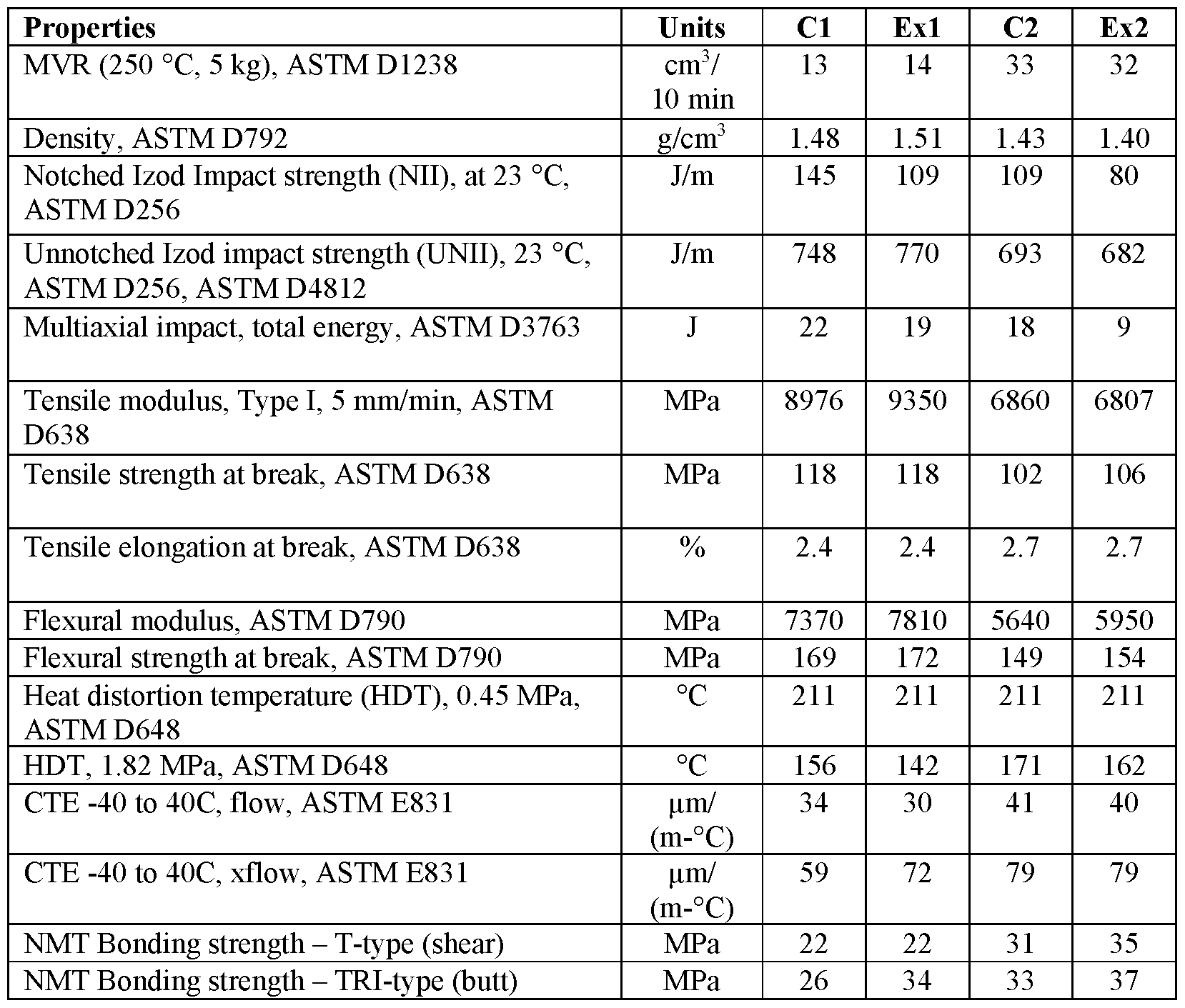
- PBT-based glass-filled compositions were prepared and tested in accordance with Tables 1A and IB:
- Comparative composition Cl included 30 wt% flat glass fiber. It had slightly higher impact strength and tensile and flexural modulus compared to the round recycled glass fiber at 30 wt% (Exl). However, composition Exl had an unexpected improvement in NMT bonding strength compared to comparative composition Cl with the TRI metal treatment. This could be partially due to differences in sizing chemistry on the glass fibers. The surface appearance after milling was also unexpectedly improved, as demonstrated below.
- the 30 wt% glass- filled samples might have higher bonding strength due to higher modulus and lower shrinkage than the 20 wt% glass filled samples, the decrease in amount of glass fiber and higher flow of the 20 wt% glass filled samples may help to fill the nano-sized holes in the metal more effectively and lead to improved NMT adhesion.
- the round glass fibers have more area that appears to be hidden under the resin surface, which will lead to less reflection of light on the surface and an improved surface appearance. This may be due to the difference in surface area of the glass fibers as well as a difference in sizing chemistry on the glass fibers which can influence compatibility with the resin.
- the exposed surface area was quantified by microscopy, and the results are shown in Table 2. There is a significant difference in the exposed area in the 20% GF samples. The exposed area of the 30% GF samples was not significantly different, however the difference was noticeable by eye when viewing the parts. In addition, the surface appearance of compositions C2 and Ex2 with 20% glass fibers was significantly improved compared to the 30 wt% samples due to the decrease in the amount of glass fiber available to come to the surface of the part, which will negatively affect the appearance.
- FIGS. 2A and 2B show optical microscopy images of the interface between the milled and unmilled areas of the parts. The boundary is much cleaner and more intact for composition Ex2 (FIG. 2B) with round glass fiber compared to comparative composition Cl (FIG. 2A) with flat glass fiber; this can also influence the surface appearance.
- Color chips were milled on an ACRA LCM-50 milling machine customized to mill plastic parts.
- the cutter was 2.5 inches.
- the feed rate for the plastic chip was 10 inches/min with a cutter speed of 1350 RPM.
- the plastic color chip was inserted in a holder.
- the cutter was lowered to cut the bottom half of the color chip.
- 50 to 125 microns of a smooth resin rich surface is removed via this milling procedure. Removal of the resin rich surface reveals a rough surface with exposed glass fiber.
- This simulated milling process closely replicates a commercial milling process, and results from this simulated process are relatable and/or comparable to results that would be obtained by compositions milled in a commercial milling machine.
- the composition has an improved surface appearance as compared to a comparative composition including flat glass fibers instead of the recycled round glass fibers, wherein improved surface appearance is characterized as having a visual surface rating improvement of at least 2 categories, or 3 categories, as compared to the comparative composition, as evaluated on a scale of 1 to 4.
- the composition has a visual surface rating of at least 3, or at least 4, as evaluated as described herein.
- the recycled round glass fibers have the benefit of a significant improvement in sustainable content (100% pre-consumer recycled) but unlike many other recycled materials, they have comparable mechanical performance to virgin glass fibers.
- the surface appearance after milling was unexpectedly improved with the recycled glass fibers with round geometry compared to standard flat geometry glass fibers that are used in many commercial NMT grades.
- the NMT bonding strength was also unexpectedly slightly higher by using round geometry recycled glass fibers and/or by decreasing the amount of glass fibers to 20%.
- compositions (C3 and C4) including a low dielectric constant (Dk) glass fiber instead of the recycled round glass fiber were prepared as shown in Table 4A. Additional example compositions Ex3 and Ex4 are included for comparison:
- Dk was evaluated at the indicated frequency according to a SPDR (split post dielectric resonator) Method, which includes measuring these values using a QWED split post dielectric resonator and an Agilent network analyzer.
- SPDR split post dielectric resonator
- the minimum sample size is 70 mm x 70mm; the maximum sample thickness is 4 mm.
- the minimum sample size is 30 mm x 30mm; the maximum sample thickness is 2 mm.
- the “Coaxial Method” for determining Dk includes measuring these values using a coaxial probe and a network analyzer.
- the sample size is at least 50 mm; the sample thickness is from 0.1-20 mm thick (2-3 mm preferred); the test was performed in a clean room with constant temperature and humidity using 100 mm x 100 mm x 3.0 mm plaques.
- From the Dk results in Tables 5 and 6 it was observed that the example compositions had higher Dk values as compared to the comparative compositions including a low Dk glass fiber. When evaluated according to the Coaxial Method the example compositions also had a higher Dk at 60 GHz as compared to the comparative compositions that included a flat glass fiber.
- PCT Polycyclohexylenedimethylene terephthalate
- PET polyethylene terephthalate
Landscapes
- Chemical & Material Sciences (AREA)
- Health & Medical Sciences (AREA)
- Chemical Kinetics & Catalysis (AREA)
- Medicinal Chemistry (AREA)
- Polymers & Plastics (AREA)
- Organic Chemistry (AREA)
- Compositions Of Macromolecular Compounds (AREA)
Abstract
Description




Claims
Priority Applications (3)
| Application Number | Priority Date | Filing Date | Title |
|---|---|---|---|
| CN202480039133.1A CN121358804A (en) | 2023-06-14 | 2024-06-11 | Filler-reinforced polyester compositions with improved sustainable content, surface aesthetics, and NMT bond strength |
| EP24733046.7A EP4709793A1 (en) | 2023-06-14 | 2024-06-11 | Filler reinforced polyester compositions with improved sustainable content, surface aesthetics and nmt bonding strength |
| KR1020257041464A KR20260006680A (en) | 2023-06-14 | 2024-06-11 | Filler-reinforced polyester compositions with improved sustainable content, surface aesthetics, and NMT bond strength |
Applications Claiming Priority (2)
| Application Number | Priority Date | Filing Date | Title |
|---|---|---|---|
| EP23179156.7A EP4477711A1 (en) | 2023-06-14 | 2023-06-14 | Filler reinforced polyester compositions with improved sustainable content, surface aesthetics and nmt bonding strength |
| EP23179156.7 | 2023-06-14 |
Publications (1)
| Publication Number | Publication Date |
|---|---|
| WO2024256967A1 true WO2024256967A1 (en) | 2024-12-19 |
Family
ID=86776427
Family Applications (1)
| Application Number | Title | Priority Date | Filing Date |
|---|---|---|---|
| PCT/IB2024/055711 Ceased WO2024256967A1 (en) | 2023-06-14 | 2024-06-11 | Filler reinforced polyester compositions with improved sustainable content, surface aesthetics and nmt bonding strength |
Country Status (4)
| Country | Link |
|---|---|
| EP (2) | EP4477711A1 (en) |
| KR (1) | KR20260006680A (en) |
| CN (1) | CN121358804A (en) |
| WO (1) | WO2024256967A1 (en) |
Citations (3)
| Publication number | Priority date | Publication date | Assignee | Title |
|---|---|---|---|---|
| US20150368464A1 (en) * | 2013-03-13 | 2015-12-24 | Sabic Global Technologies B.V. | Reinforced polyestercarbonate, polycarbonate-polydiorganosiloxane, poly(butylene-terephthalate) blend, and article comprising same |
| WO2015200272A2 (en) | 2014-06-23 | 2015-12-30 | Sabic Global Technologies B.V. | Filler reinforced thermoplastic compositions with improved bonding strength |
| EP4011976A1 (en) * | 2020-12-14 | 2022-06-15 | SHPP Global Technologies B.V. | Thermoplastic compositions with low dissipation factor for nano molding technology (nmt) applications |
Family Cites Families (1)
| Publication number | Priority date | Publication date | Assignee | Title |
|---|---|---|---|---|
| EP4209552A1 (en) * | 2022-01-07 | 2023-07-12 | SHPP Global Technologies B.V. | Articles and structures of wave absorption material |
-
2023
- 2023-06-14 EP EP23179156.7A patent/EP4477711A1/en not_active Withdrawn
-
2024
- 2024-06-11 KR KR1020257041464A patent/KR20260006680A/en active Pending
- 2024-06-11 EP EP24733046.7A patent/EP4709793A1/en active Pending
- 2024-06-11 WO PCT/IB2024/055711 patent/WO2024256967A1/en not_active Ceased
- 2024-06-11 CN CN202480039133.1A patent/CN121358804A/en active Pending
Patent Citations (3)
| Publication number | Priority date | Publication date | Assignee | Title |
|---|---|---|---|---|
| US20150368464A1 (en) * | 2013-03-13 | 2015-12-24 | Sabic Global Technologies B.V. | Reinforced polyestercarbonate, polycarbonate-polydiorganosiloxane, poly(butylene-terephthalate) blend, and article comprising same |
| WO2015200272A2 (en) | 2014-06-23 | 2015-12-30 | Sabic Global Technologies B.V. | Filler reinforced thermoplastic compositions with improved bonding strength |
| EP4011976A1 (en) * | 2020-12-14 | 2022-06-15 | SHPP Global Technologies B.V. | Thermoplastic compositions with low dissipation factor for nano molding technology (nmt) applications |
Also Published As
| Publication number | Publication date |
|---|---|
| EP4477711A1 (en) | 2024-12-18 |
| EP4709793A1 (en) | 2026-03-18 |
| CN121358804A (en) | 2026-01-16 |
| KR20260006680A (en) | 2026-01-13 |
Similar Documents
| Publication | Publication Date | Title |
|---|---|---|
| KR102918389B1 (en) | Compositions and articles of wavelength-transmitting and improved dimensional radar cover materials | |
| WO2019116267A1 (en) | Processing aids for filler dispersion and uses thereof | |
| US20240026150A1 (en) | Thermoplastic Compositions Including Natural Fiber Having Good Mechanical Properties and Good Dielectric Properties | |
| EP4477711A1 (en) | Filler reinforced polyester compositions with improved sustainable content, surface aesthetics and nmt bonding strength | |
| EP4514896B1 (en) | Thermoplastic compositions having high metal bonding force for nmt applications | |
| KR102885625B1 (en) | Thermoplastic compositions with low dielectric properties and excellent mechanical performance | |
| EP4166605A1 (en) | Laser transparent low warpage glass filled pbt compositions for laser welding | |
| WO2022259140A1 (en) | Sustainable flame retardant glass-filled polyester compositions | |
| EP4209551A1 (en) | Thermoplastic compositions with improved performance for nano molding technology (nmt) | |
| KR101857078B1 (en) | Poly (butylene terephthalate) ester compositions, methods of manufacture, and articles thereof | |
| WO2022130179A1 (en) | Thermoplastic compositions with low dissipation factor for nano molding technology (nmt) applications | |
| EP4600304A1 (en) | Flame retardant polybutylene terephthalate compositions and articles | |
| Hongsriphan et al. | Tensile and impact properties of recycled poly (Ethylene terephthalate) and polycarbonate composites reinforced with silane treated hollow glass microspheres | |
| EP4359474A1 (en) | Electrically conductive compositions including carbon fiber-filled semi-crystalline polymers | |
| WO2025181725A1 (en) | Highly filled pbt-based thermally conductive and electrically insulative compositions having improved ductility and cti properties | |
| EP4600303A1 (en) | Flame retardant and light transmissive crystalline polymer compositions and articles | |
| TW202216897A (en) | Fan unit containing recycled and renewable polymeric compositions | |
| EP4559975A1 (en) | Flame retardant polycarbonate/polybutylene terephthalate compositions having good hydro-stability and low temperature impact performance | |
| EP4441135A1 (en) | Polycarbonate-based thermoplastic compositions having improved transparency properties | |
| WO2026062928A1 (en) | Masterbatch, resin composition, and resin molded body | |
| KR20090073930A (en) | Natural fiber reinforced polylactic acid resin composition |
Legal Events
| Date | Code | Title | Description |
|---|---|---|---|
| 121 | Ep: the epo has been informed by wipo that ep was designated in this application |
Ref document number: 24733046 Country of ref document: EP Kind code of ref document: A1 |
|
| WWE | Wipo information: entry into national phase |
Ref document number: 202547113939 Country of ref document: IN |
|
| WWP | Wipo information: published in national office |
Ref document number: 202547113939 Country of ref document: IN |
|
| ENP | Entry into the national phase |
Ref document number: 1020257041464 Country of ref document: KR Free format text: ST27 STATUS EVENT CODE: A-0-1-A10-A15-NAP-PA0105 (AS PROVIDED BY THE NATIONAL OFFICE) |
|
| WWE | Wipo information: entry into national phase |
Ref document number: 1020257041464 Country of ref document: KR Ref document number: 2024733046 Country of ref document: EP |
|
| ENP | Entry into the national phase |
Ref document number: 2024733046 Country of ref document: EP Effective date: 20251211 |
|
| ENP | Entry into the national phase |
Ref document number: 2024733046 Country of ref document: EP Effective date: 20251211 |
|
| ENP | Entry into the national phase |
Ref document number: 2024733046 Country of ref document: EP Effective date: 20251211 |
|
| ENP | Entry into the national phase |
Ref document number: 2024733046 Country of ref document: EP Effective date: 20251211 |
|
| WWP | Wipo information: published in national office |
Ref document number: 1020257041464 Country of ref document: KR |
|
| NENP | Non-entry into the national phase |
Ref country code: DE |
|
| ENP | Entry into the national phase |
Ref document number: 2024733046 Country of ref document: EP Effective date: 20251211 |
|
| ENP | Entry into the national phase |
Ref document number: 2024733046 Country of ref document: EP Effective date: 20251211 |
|
| ENP | Entry into the national phase |
Ref document number: 2024733046 Country of ref document: EP Effective date: 20251211 |
|
| ENP | Entry into the national phase |
Ref document number: 2024733046 Country of ref document: EP Effective date: 20251211 |
|
| WWP | Wipo information: published in national office |
Ref document number: 2024733046 Country of ref document: EP |