WO2024256651A1 - Method for producing aromatic thiazines or selenazines - Google Patents
Method for producing aromatic thiazines or selenazines Download PDFInfo
- Publication number
- WO2024256651A1 WO2024256651A1 PCT/EP2024/066589 EP2024066589W WO2024256651A1 WO 2024256651 A1 WO2024256651 A1 WO 2024256651A1 EP 2024066589 W EP2024066589 W EP 2024066589W WO 2024256651 A1 WO2024256651 A1 WO 2024256651A1
- Authority
- WO
- WIPO (PCT)
- Prior art keywords
- group
- substituted
- unsubstituted
- acid
- formula
- Prior art date
- Legal status (The legal status is an assumption and is not a legal conclusion. Google has not performed a legal analysis and makes no representation as to the accuracy of the status listed.)
- Ceased
Links
Classifications
-
- C—CHEMISTRY; METALLURGY
- C07—ORGANIC CHEMISTRY
- C07D—HETEROCYCLIC COMPOUNDS
- C07D279/00—Heterocyclic compounds containing six-membered rings having one nitrogen atom and one sulfur atom as the only ring hetero atoms
- C07D279/04—1,3-Thiazines; Hydrogenated 1,3-thiazines
- C07D279/08—1,3-Thiazines; Hydrogenated 1,3-thiazines condensed with carbocyclic rings or ring systems
-
- C—CHEMISTRY; METALLURGY
- C07—ORGANIC CHEMISTRY
- C07D—HETEROCYCLIC COMPOUNDS
- C07D293/00—Heterocyclic compounds containing rings having nitrogen and selenium or nitrogen and tellurium, with or without oxygen or sulfur atoms, as the ring hetero atoms
- C07D293/10—Heterocyclic compounds containing rings having nitrogen and selenium or nitrogen and tellurium, with or without oxygen or sulfur atoms, as the ring hetero atoms condensed with carbocyclic rings or ring systems
Definitions
- the present invention relates to a method for producing aromatic thiazines and selenazines as well as to a method for producing pharmaceutical products based on said aromatic thiazines and selenazines.
- the present invention relates to the use of hexamethylenetetramine and an acid for converting a thiol or selenol group and an adjacent CH group in an aromatic group into a 2-H-[1 , 3]-thiazine or 2-H-[1 ,3]-selenazine.
- PD 404182 having the following formula (4) which was first developed by Birck et al., J. Am. Chem. Soc. 2000, 122, 9334-9335, as 3-deoxy-d- manno-octulosonic acid 8-phosphate (KDO 8-P) synthase inhibitor.
- the technical problem underlying the present invention is to provide novel means for obtaining aromatic thiazine and selenazine derivatives and corresponding pharmaceutical products based on said aromatic thiazines and selenazines, which do not involve several reaction steps and avoid toxic and/or sensitive compounds.
- the present invention relates to a method for producing a compound represented by the following general formula (1 ), wherein the method comprises reacting a compound represented by the following general formula (2) with hexamethylenetetramine (HMTA) in the presence of an acid, wherein X is S or Se, and R 1 to R 4 are each independently selected from the group consisting of a hydrogen atom, a substituted or unsubstituted alkyl group, a substituted or unsubstituted cycloalkyl group, a substituted or unsubstituted alkenyl group, a substituted or unsubstituted cycloalkenyl group, a substituted or unsubstituted alkynyl group, a substituted or unsubstituted aryl group, a substituted or unsubstituted heteroaryl group, a halogen atom, -XH, -S-alkyl, -NE 1 E 2 , -NO2, -CN,
- halogen refers particularly to fluorine atoms, chlorine atoms, bromine atoms, and iodine atoms, preferably fluorine atoms and bromine atoms.
- alkyl group refers particularly to a branched or linear alkyl group having 1 to 20, preferably 1 to 12, more preferably 1 to 6, and most preferably 1 to 4 carbon atoms, which can be substituted or unsubstituted.
- alkyl groups represent methyl groups, ethyl groups, propyl groups, isopropyl groups, butyl groups, isobutyl groups, tertbutyl groups, pentyl groups, hexyl groups, and heptyl groups.
- the term ’’cycloalkyl group” refers particularly to a cycloalkyl group having 3 to 10, preferably 4 to 8, more preferably 5 or 6, and most preferably 6 carbon atoms, which can be substituted or unsubstituted.
- Examples of cycloalkyl groups represent cyclobutyl groups, cyclopentyl groups, and cyclohexyl groups.
- alkenyl group refers particularly to a branched or linear alkenyl group having 2 to 20, preferably 2 to 12, more preferably 2 to 6, and most preferably 2 to 4 carbon atoms, which can be substituted or unsubstituted.
- alkenyl groups represent vinyl groups and allyl groups.
- cycloalkenyl group refers particularly to a cycloalkenyl group having 4 to 10, preferably 5 to 8, more preferably 5 or 6, and most preferably 6 carbon atoms, which can be substituted or unsubstituted.
- Examples of cycloalkenyl groups represent cyclopentenyl groups, cyclopentadienyl groups, cyclohexyl groups, and cyclohexadienyl groups.
- the term ’’alkynyl group” refers particularly to a branched or linear alkynyl group having 2 to 20, preferably 2 to 12, more preferably 2 to 6, and most preferably 2 to 4 carbon atoms, which can be substituted or unsubstituted.
- Examples of alkynyl groups represent ethynyl groups, 1 -propynyl groups, and propargyl groups.
- aryl group refers particularly to an aryl group consisting of 1 to 6, preferably 1 to 4, more preferably 1 to 3 aromatic rings, and most preferably 1 ring, which can be substituted or unsubstituted.
- aryl groups represent phenyl groups, anthracenyl or naphthyl groups.
- heteroaryl group refers particularly to a heteroaryl group consisting of 1 to 6, preferably 1 to 4, more preferably 1 to 3 aromatic rings including heteroatoms, which can be substituted or unsubstituted.
- Heteroatoms, which are present in heteroaryl groups are for example N, 0 and S.
- heteroaryl groups represent pyridyl groups, pyrim idinyl groups, thienyl groups, furyl groups or pyrrolyl groups.
- the alkyl groups, the cycloalkyl groups, the alkenyl groups, the cycloalkenyl groups, the alkynyl groups, the aryl groups and the heteroaryl groups may be substituted or unsubstituted.
- the potential substituents are not specifically limited. Accordingly, instead of hydrogen atoms any substituent known in the prior art can be bonded to the further positions of the corresponding groups.
- the potential substituents may be selected from the group consisting of a branched or linear alkyl group having 1 to 6 carbon atoms, a cycloalkyl group having 4 to 8 carbon atoms, a branched or linear alkenyl group having 2 to 6 carbon atoms, a cycloalkenyl group having 4 to 8 carbon atoms, a branched or linear alkynyl group having 2 to 6 carbon atoms, an aryl group having 1 to 3 aromatic rings, a heteroaryl group having 1 to 3 aromatic rings including heteroatoms, a halogen atom, -NL 1 L 2 , -NO2, -CN, -OL 3 , -C(O)L 4 , -C(O)NL 5 L 6 , -COOL 7 , and -SO3L 8 , wherein L 1 to L 8 are each independently selected from a hydrogen atom, a branched or linear alkyl group having 1 to 6 carbon atoms, a
- substituted alkyl groups are aralkyl groups or alkyl groups substituted with e.g. halogen atoms, such as e.g. a trifluoromethyl group, or any other of the above-mentioned substituents.
- halogen atoms such as e.g. a trifluoromethyl group, or any other of the above-mentioned substituents.
- the term ’’aralkyl group” refers particularly to an alkyl group wherein one or more hydrogen atoms, preferably terminal hydrogen atoms of the alkyl chain, are replaced by aryl or heteroaryl groups. Examples of aralkyl groups represent benzyl groups or 1 - or 2-phenylethyl groups.
- the potential substituents are selected from the group consisting of a branched or linear alkyl group having 1 to 6 carbon atoms, a branched or linear alkenyl group having 2 to 6 carbon atoms, a branched or linear alkynyl group having 2 to 6 carbon atoms, a halogen atom, -NH2, -NHCH3, -N(CH3)2, -NO2, -OH, -OCH3, -OEt, -C(O)H, -C(O)CH 3 , -C(O)Et, and -COOH.
- one or more tetravalent carbon atoms when present, in each of the alkyl groups, the cycloalkyl groups, the alkenyl groups, the cycloalkenyl groups, and the alkynyl groups may each independently be substituted by a member selected from the group consisting of 0, (OCH2CH2)nO, S, (SCH2CH2)mS, C(O), C(O)O, NL 9 , and C(O)NL 10 , preferably 0, (OCH 2 CH2)nO, C(O)O, and C(O)NL 10 , wherein n and m are each independently an integer from 1 to 6.
- an alkyl group may be interrupted by e.g. one or more PEG linkers and/or amide bonds, and an alkenyl group may contain a C(O) group, such as in an acryloyl group.
- the way the groups are introduced instead of a carbon atom is not specifically limited.
- a carbon atom may be substituted by C(O)O in the sense of -C(O)O- or -OC(O)- and by C(O)NL 10 in the sense of -C(O)NL 10 - or -NL 10 C(O)-.
- L 9 and L 10 are each independently selected from the group consisting of a hydrogen atom, a branched or linear alkyl group having 1 to 6 carbon atoms, a cycloalkyl group having 4 to 8 carbon atoms, a branched or linear alkenyl group having 2 to 6 carbon atoms, a cycloalkenyl group having 4 to 8 carbon atoms, a branched or linear alkynyl group having 2 to 6 carbon atoms, an aryl group having 1 to 3 aromatic rings, a heteroaryl group having 1 to 3 aromatic rings including heteroatoms, -OG 1 , -C(0)G 2 , -C(O)NG 3 G 4 , -C00G 5 , and -SO2G 6 .
- L 9 and L 10 are each independently selected from the group consisting of a hydrogen atom, a branched or linear alkyl group having 1 to 6 carbon atoms, an aryl group having 1 to 3 aromatic rings, -C(O)G 2 , and -SO2G 6 .
- L 9 and L 10 are each independently selected from the group consisting of a hydrogen atom and a branched or linear alkyl group having 1 to 6 carbon atoms.
- G 1 to G 6 are each independently selected from the group consisting of a hydrogen atom, a branched or linear alkyl group having 1 to 6 carbon atoms, a cycloalkyl group having 4 to 8 carbon atoms, a branched or linear alkenyl group having 2 to 6 carbon atoms, a cycloalkenyl group having 4 to 8 carbon atoms, a branched or linear alkynyl group having 2 to 6 carbon atoms, an aryl group having 1 to 3 aromatic rings, a heteroaryl group having 1 to 3 aromatic rings including heteroatoms.
- G 1 to G 6 are each independently selected from the group consisting of a hydrogen atom, a branched or linear alkyl group having 1 to 6 carbon atoms, an aryl group having 1 to 3 aromatic rings.
- the alkyl groups, the cycloalkyl groups, the alkenyl groups, the cycloalkenyl groups, the alkynyl groups, the aryl groups, and the heteroaryl groups are preferably unsubstituted. Moreover, if not stated otherwise, the alkyl groups, the alkenyl groups, and the alkynyl groups are preferably linear.
- the compound represented by the general formula (2) has at least one -XH group. Accordingly, the compound represented by the general formula (2) may have more than one -XH group, e.g. one or more of R 1 to R 4 can be a -XH group, which can all be converted by the reaction as shown in Fig. 1 . In case one or more of R 1 to R 4 are a -XH group, R 2 and/or R 4 are preferably a -XH group, and more preferably R 2 and/or R 4 are a -XH group and R 1 and/or R 3 are a hydrogen atom. Preferably, the compound represented by the general formula (2) has (in total) one -XH group.
- X is S or Se.
- X is S.
- R 1 to R 4 are each independently selected from the group consisting of a hydrogen atom, a substituted or unsubstituted alkyl group, a substituted or unsubstituted cycloalkyl group, a substituted or unsubstituted alkenyl group, a substituted or unsubstituted cycloalkenyl group, a substituted or unsubstituted alkynyl group, a substituted or unsubstituted aryl group, a substituted or unsubstituted heteroaryl group, a halogen atom, -XH, -S-alkyl, -NE 1 E 2 , -NO 2 , -CN, -OE 3 , -C(O)E 4 , -C(O)NE 5 E 6 , -COOE 7 , and -SO3E 8 .
- E 1 to E 8 are each independently selected from the group consisting of a hydrogen atom, a substituted or unsubstituted alkyl group, a substituted or unsubstituted cycloalkyl group, a substituted or unsubstituted alkenyl group, a substituted or unsubstituted cycloalkenyl group, a substituted or unsubstituted alkynyl group, a substituted or unsubstituted aryl group, and a substituted or unsubstituted heteroaryl group, preferably E 1 to E 8 are each independently selected from the group consisting of a hydrogen atom, a substituted or unsubstituted alkyl group, and a substituted or unsubstituted aryl group, most preferably E 1 to E 8 are each independently selected from the group consisting of a hydrogen atom and a substituted or unsubstituted alkyl group.
- R 1 to R 4 are each independently selected from the group consisting of a hydrogen atom, a substituted or unsubstituted alkyl group, a substituted or unsubstituted alkenyl group, a halogen atom, -XH, -S-alkyl, -NO2, -OE 3 , and -COOE 7 . More preferably, R 1 to R 4 are each independently selected from the group consisting of a hydrogen atom, a substituted or unsubstituted alkyl group, -SMe, -OMe, -COOMe, and a halogen atom. Preferably, at least two, more preferably at least three of R 1 to R 4 are a hydrogen atom.
- each of R 1 to R 4 is a hydrogen atom.
- Formula (1 a) Formula (2a)
- each of R 2 to R 4 is a hydrogen atom.
- R 1 is a substituted or unsubstituted, branched or linear alkyl group having from 1 to 6 carbon atoms, more preferably 1 to 4 carbon atoms, a halogen atom, -OE 3 , or -COOE 7 . More preferably, R 1 is selected from a methyl group, a bromine atom, -OMe, and -COOMe.
- X is S.
- each of R 1 and R 3 is a hydrogen atom.
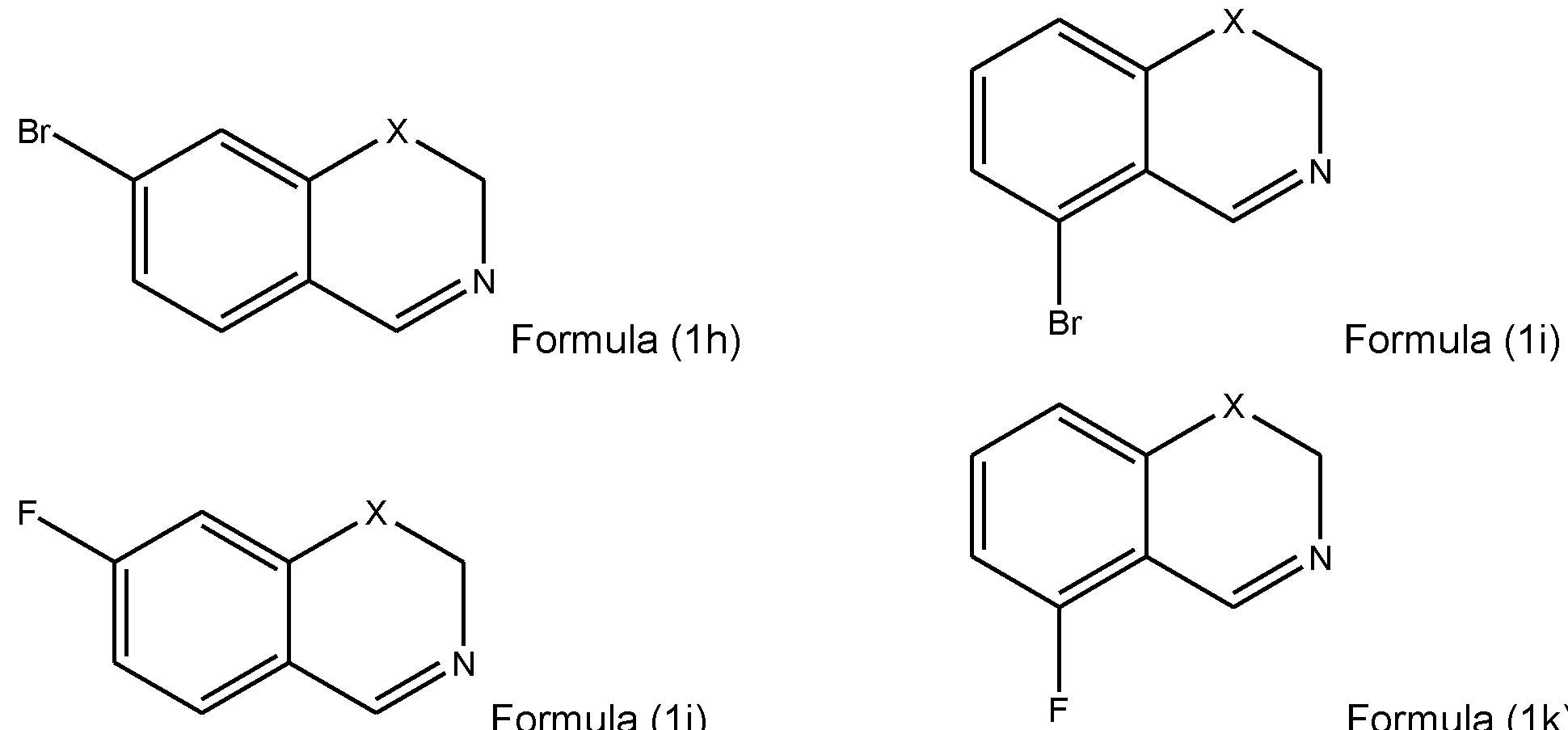
- one of R 2 and R 4 is a hydrogen atom and the other one of R 2 and R 4 is a substituted or unsubstituted, branched or linear alkyl group having from 1 to 6 carbon atoms, more preferably 1 to 4 carbon atoms, a halogen atom, -OE 3 , or -COOE 7 More preferably, the other one of R 2 and R 4 is selected from a methyl group, a bromine atom, a fluorine atom, and -OMe.
- R 2 is a hydrogen atom or R 4 is a hydrogen atom
- the respective compound represented by formula (2) is identical (e.g. Formulas (2f) and (2g) below) and its respective reaction yields one or both of the corresponding compounds (1 ), wherein R 2 is a hydrogen atom (e.g. Formula (1 g) below) or R 4 is a hydrogen atom (e.g. Formula (1f) below).
- X is S.
- each of R 1 , R 2 , and R 4 is a hydrogen atom.
- R 3 is a substituted or unsubstituted, branched or linear alkyl group having from 1 to 6 carbon atoms, more preferably 1 to 4 carbon atoms, a halogen atom, -S-alkyl, -OE 3 , -NO2, or -COOE 7 .
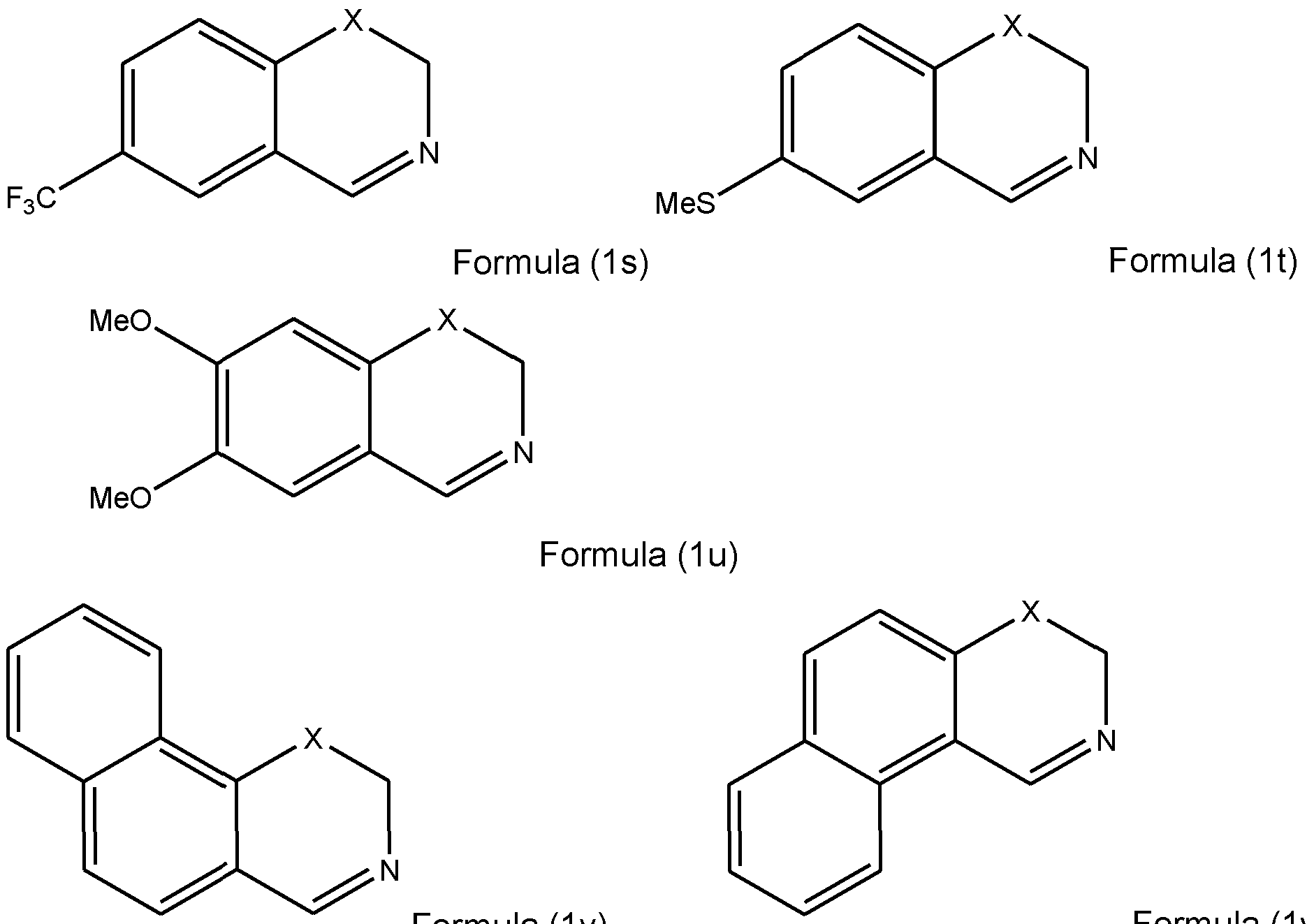
- R 1 selected from a methyl group, a tert-butyl group, a trifluoromethyl group, a bromine atom, a fluorine atom, -SMe, and -OMe.
- X is S.
- each of R 1 and R 4 is a hydrogen atom.
- R 2 and R 3 are independently selected from the group consisting of a substituted or unsubstituted, branched or linear alkyl group having from 1 to 6 carbon atoms, more preferably 1 to 4 carbon atoms, a halogen atom, -OE 3 , and -COOE 7 . More preferably, R 2 and R 3 are independently selected from a methyl group, a bromine atom, -OMe, and -COOMe. Most preferably, each of R 2 and R 3 are -OMe.
- X is S.
- R 1 to R 4 bind to each other to form a ring.
- R 1 and R 2 or R 3 and R 4 bind to each other to form a ring, more preferably an aromatic ring, most preferably a six-membered aromatic ring.
- the remaining of R 1 to R 4 are each preferably a hydrogen atom.
- X is S.
- R 1 to R 4 are a -XH group.
- R 2 and/or R 4 are a -XH group.
- R 1 and/or R 3 are preferably a hydrogen atom.
- X is S.
- the method comprises reacting the compound represented by the general formula (2) with hexamethylenetetramine (HMTA) in the presence of an acid, particularly a Bronsted acid.
- acids which can be used are trifluoroacetic acid, p-toluenesulfonic acid, trifluoromethanesulfonic acid, methanesulfonic acid, (non-fluorinated) carboxylic acids, such as acetic acid, and mineral acids. Said acids can be used alone or as a mixture of two or more thereof.
- the acid is selected from trifluoroacetic acid, p-toluenesulfonic acid, trifluoromethanesulfonic acid, methanesulfonic acid, and acetic acid, more preferably from trifluoroacetic acid, p-toluenesulfonic acid, trifluoromethanesulfonic acid, and methanesulfonic acid. Most preferably, the acid is trifluoroacetic acid.
- the acid can be present in an amount of at least 10 equivalents in relation to the amount of groups -XH present in the compound represented by the general formula (2).
- the acid is preferably present in an amount of at least 15 equivalents, more preferably at least 18 equivalents in relation to the amount of groups -XH present in the compound represented by the general formula (2).
- the upper limit of the amount of acid is not particularly limited and may for example be 100 equivalents in relation to the amount of groups -XH present in the compound represented by the general formula (2). The above amounts thereby indicate the added amounts of the component.
- Hexamethylenetetramine can be present in an amount of at least 1.0 equivalents in relation to the amount of groups -XH present in the compound represented by the general formula (2). Hexamethylenetetramine is preferably present in an amount of at least 1.2 equivalents, more preferably at least 1.4 equivalents, most preferably at least 1.5 equivalents in relation to the amount of groups -XH present in the compound represented by the general formula (2).
- the upper limit of the amount of hexamethylenetetramine is not particularly limited and may for example be 5.0 equivalents in relation to the amount of groups -XH present in the compound represented by the general formula (2). The above amounts thereby indicate the added amounts of the component.
- the temperature at which the step of reacting the compound represented by the general formula (2) is carried out is not particularly limited.
- the temperature may be at least 0°C, preferably at least 30°C, more preferably at least 50°C, and most preferably at least 70°C.
- the upper limit of the temperature is not particularly limited but may depend on the reactants used.
- the upper limit of the temperature may be 140°C, preferably 110°C, and more preferably 90°C.
- the temperature at which the step of reacting the compound represented by the general formula (2) is carried out is 80°C.
- the duration for which the step of reacting the compound represented by the general formula (2) is carried out is not particularly limited.
- the duration may be from 30 s to 10 d, preferably from 5 min to 6 d, more preferably from 2 h to 4 d, and more preferably from 8 h to 2 d.
- the step of reacting the compound represented by the general formula (2) may be carried out in the presence of an inert and/or dry atmosphere.
- the step of reacting the compound represented by the general formula (2) can be carried out under nitrogen atmosphere or argon atmosphere, preferably under argon atmosphere.
- the compound represented by the general formula (1 ) may be purified and isolated by various methods known in the art. For example, unreacted starting material and/or potential side-products may be removed by filtration, distillation, extraction, or column chromatography from the reaction mixture.
- the isolated yield of the compound represented by the general formula (1 ) is not particularly limited.
- the isolated yield of the compound represented by the general formula (1 ) in relation to the amount of the compound represented by the general formula (2) may be at least 10%.
- the isolated yield of the compound represented by the general formula (1 ) in relation to the amount of the compound represented by the general formula (2) is at least 20%, more preferably at least 30%, more preferably at least 40%, more preferably at least 50%, more preferably at least 60%, more preferably at least 70%, and most preferably at least 80%.
- the present invention relates to a method for producing pharmaceutical products., i.e. , a compound represented by the following general formula (3), wherein the method comprises carrying out the production method according to the present invention to produce the compound of the general formula (1 ), and converting the compound of the general formula (1 ) into the compound of the general formula (3).
- X and R 1 to R 4 are defined as above and Z 1 and Z 2 are each independently selected from 0 or NR 5 , wherein R 5 is selected from the group consisting of a hydrogen atom, a substituted or unsubstituted alkyl group, a substituted or unsubstituted cycloalkyl group, a substituted or unsubstituted alkenyl group, a substituted or unsubstituted cycloalkenyl group, a substituted or unsubstituted alkynyl group, a substituted or unsubstituted aryl group, and a substituted or unsubstituted heteroaryl group.
- R 6 is selected from the group consisting of a hydrogen atom, a substituted or unsubstituted alkyl group, a substituted or unsubstituted cycloalkyl group, a substituted or unsubstituted alkenyl group, a substituted or unsubstituted cycloalkenyl group, a substituted or unsubstituted alkynyl group, a substituted or unsubstituted aryl group, a substituted or unsubstituted heteroaryl group, and a substituted or unsubstituted amino group, wherein R 5 and R 6 may bind to each other to form one or more rings.
- the compound of the general formula (3) is a compound of the formula (4) Formula (4).
- the compound of formulae (4) may be obtained by the reaction scheme shown in Fig. 2.
- the reaction scheme in contrast to the synthesis described by Mizuhara et al., using copper-mediated carbon disulphide addition followed by hydrolysis and nitrogen introduction using cyanogen bromide, according to the present invention, it is possible to refrain from using transition metals as well as highly toxic compounds like CS2 as well as BrCN.
- the present invention relates to the use of hexamethylenetetramine and an acid for converting a thiol or selenol group and an adjacent CH group in an aromatic group into a 2-H-[1 , 3]-thiazine or 2-H-[1 ,3]-selenazine.
- adjacent CH group means a CH group directly bonded to the carbon atom to which the thiol or selenol group is bonded.
- Infrared spectroscopical measurements were conducted using a Bruker Tensor 27 spectrometer with ZnSe ATR crystal.
- the used abbreviations for describing the relative intensity of the obtained signals are vw (very weak, 0 - 10%), w (weak, 10 - 30%), m (medium, 30 - 60%), s (strong, 60 - 90%) and vs (very strong, 90 - 100%).
- Mass spectrometric analyses were performed by the mass spectrometry department of University of Heidelberg under the supervision of Dr Jurgen H. Gross.
- the utilised devices were Bruker AutoFlex Speed time-of-flight spectrometer (MALDI-TOF), Bruker ApexQe hybrid 9.4T FT-ICR spectrometer (ESI), JEOL AccuTOF GCx spectrometer with direct insertion probe (El) and Bruker timsTOFfleX ion mobility-quadrupole-time-of-flight spectrometer with a trapped ion mobility spectrometry stage (MALDI-TOF, APCI).
- MALDI-TOF Bruker AutoFlex Speed time-of-flight spectrometer
- ESI Bruker ApexQe hybrid 9.4T FT-ICR spectrometer
- El JEOL AccuTOF GCx spectrometer with direct insertion probe
- El Bruker timsTOFfleX
- DCTB frans-2-[3-(4-tert-Butylphenyl)-2- methylpropenylidene)malononitrile
- PEG polyethylene glycole
- Nuclear magnetic resonance spectra were obtained using a Bruker Avance DRX 300 (300 MHz) or a Bruker Avance III 400 (400 MHz) spectrometer. The chemical shifts 5 are shown in parts per million (ppm) and the coupling constants J in Hertz (Hz). The spectra were recorded at 298 K, if not mentioned otherwise.
- Multiplicities were labelled with s (singlet), d (doublet), dd (doublet of doublet), t (triplet), td (triplet of doublet), q (quartet) and m (multiplet).
- Analytical thin layer chromatography was conducted using TLC Silica gel 60 F254 plates purchased from Merck. The resulted spots were analysed using ultraviolet radiation (254 nm and 366 nm). Flash chromatography was performed using Silica gel 60 (40-63 pm / 230-400 mesh ASTM) from Machery-Nagel.
- Example 2 2/-/-Benzo[e][1 ,3]selenazine (1 a-Se) Reaction conditions based on 2.93 mmol selenophenol (2a-Se) (461 mg) were used.
- Compound 1a-Se was purified by flash chromatography using DCM/MeOH (50:1 v/v) as eluent and obtained in 55% yield (319 mg, 1 .63 mmol) as yellow oil.
- Compound 2b-S was used as starting material.
- Compound 1b-S was purified by flash chromatography using DCM/EtOAc (50:1 v/v) as eluent and obtained in 86% yield (422 mg, 2.59 mmol) as yellow oil.
- Compound 2c-S was used as starting material.
- Compound 1c-S was purified by flash chromatography using DCM/EtOAc (50:1 v/v) as eluent and obtained in 71 % yield (487 mg, 2.14 mmol) as light orange solid.
- Compound 2d-S was used as starting material.
- Compound 1d-S was purified by flash chromatography using n-pentane/EtOAc (1 :1 v/v) as eluent and obtained in 56% yield (300 mg, 1 .67 mmol) as yellow oil.
- Example 7 7-Methyl-2H-benzo[e][1 ,3]thiazine (1f) and 5-Methyl-2H- benzo[e][1 ,3]thiazine (1 g)
- Compound 2f/g-S was used as starting material.
- Compounds 1f-S and 1g-S were purified by flash chromatography using n-pentane/EtOAc (1 :1 v/v) and obtained as 7.7:1 mixture (1f-S/1g-S) in 88% yield (429 mg, 2.63 mmol) as a yellow liquid.
- Compound 2h/i-S was used as starting material.
- Compound 1h-S was purified from the mixture of compounds 1h-S and 1 i-S by flash chromatography using n-pentane/EtOAc (1 :1 v/v) as eluent and obtained in 48% yield (326 mg, 1 .43 mmol) as light orange solid.
- Retention factor 0.24 (n-pentane/EtOAc 4:1 v/v). Melting point: 57 °C.
- Compound 2h/i-S was used as starting material.
- Compound 1 i-S was purified from the mixture of compounds 1h-S and 1 i-S by flash chromatography using n-pentane/EtOAc (1 :1 v/v) as eluent and obtained in 44% yield (301 mg, 1 .32 mmol) as yellow solid.
- Example 9 7-Fluoro-2/-/-benzo[e][1 ,3]thiazine (1j-S) and 5-Fluoro-2H- benzo[e][1 ,3]thiazine (1 k-S)
- Compound 2j/k-S was used as starting material.
- Compound 1 j-S was purified from the mixture of compounds 1j-S and 1k-S by flash chromatography using n-pentane/EtOAc (2:1 v/v) and obtained in 78% yield (393 mg, 2.35 mmol) as a slightly yellow oil. Retention factor: 0.24 (n-pentane/EtOAc 2:1 v/v).
- Compound 2j/k-S was used as starting material.
- Compound 1k-S was purified from the mixture of compounds 1j-S and 1k-S by flash chromatography using n-pentane/EtOAc (2: 1 and 8: 1 v/v) as eluent and obtained in 7% yield (35 mg, 0.21 mmol) as slightly yellow oil.
- Retention factor 0.31 (n-pentane/EtOAc 8:1 v/v).
- IR (ATR, FT) v (cm’ 1 ) 2962 (vw), 2891 (vw), 2829 (vw), 1626 (s), 1601 (s), 1564 (s), 1450 (s), 1427 (w), 1373 (m), 1294 (w), 1271 (vw), 1242 (s), 1217 (m), 1198 (w), 1165 (m), 1150 (w), 962 (m), 951 (m), 928 (m), 897 (s), 843 (m), 777 (vs), 739 (m), 717 (m), 687 (m).
- Compound 2o-S was used as starting material.
- Compound 1o-S was purified by flash chromatography using n-pentane/EtOAc (4:1 v/v) as eluent and obtained in 66% yield (450 mg, 1 .97 mmol) as slightly yellow solid.
- Compound 2p-S was used as starting material.
- Compound 1p-S was purified by flash chromatography using n-pentane/EtOAc (2:1 v/v) as eluent and obtained in 41 % yield (208 mg, 1 .25 mmol) as yellow oil.
- Example 15 6-te/Y-Butyl-2H-benzo[e][1 ,3]thiazine (1 r-S)
- Compound 2r-S was used as starting material.
- Compound 1r-S was purified by flash chromatography using n-pentane/EtOAc (3:1 v/v) and obtained in 90% yield (554 mg, 2.70 mmol) as an orange oil.
- Compound 2s-S was used as starting material.
- Compound 1s-S was purified by flash chromatography using DCM/EtOAc (120:1 v/v) as eluent and obtained in 36% yield (237 mg, 1.09 mmol) as light-yellow solid.
- Compound 2u-S was used as starting material.
- Compound 1u-S was purified by flash chromatography using n-pentane/EtOAc (1 :1 v/v) as eluent and obtained in 78% yield (492 mg, 2.35 mmol) as light yellow solid.
- Compound 2v-S was used as starting material.
- Compound 1v-S was purified by flash chromatography using n-pentane/EtOAc (4:1 v/v) as eluent and obtained in 85% yield (509 mg, 2.56 mmol) as yellow solid.
- Compound 2x-S was used as starting material.
- Compound 1x-S was synthesised using 10 mL TFA instead of 5 mL and purified by flash chromatography using EtOAc/methanol (20:1 v/v) and obtained in 51 % yield (335 mg, 1.52 mmol) as yellow solid.
- the compounds represented by the formula (1 ) can be obtained in high yields and with extensive substrate scope. Even annulated TT systems like thionaphthols 2v-S and 2w-S were suitable for thiazine formation with high yields. zo[e][1 ,3]thiazine-2,4(3/-/)-dione
- a 100 mL round-bottomed flask was filled with sodium chlorite (2.4 g, 80 wt%, 20 mmol), aqueous sodium dihydrogenphosphate solution (6.3 mL, 1 mol L -1 , 6.3 mmol) and THF (16.3 mL).
- a solution of 8-methyl-2/-/-benzo[e][1 ,3]thiazine 1b-S (682 mg, 4 mmol) in THF (4.2 mL) was added dropwise and the resulted slightly yellow emulsion was stirred vigorously at room temperature for 24 h.
- the emulsion was mixed with EtOAc (120 mL) and washed with water (40 mL), aqueous sodium thiosulfate solution (40 mL, 1 mol L’ 1 ) and brine (40 mL).
- the organic phase was dried using Na2SO4.
- the solvent of the filtrate was evaporated in vacuo and purified by flash chromatography using n-pentane/EtOAc (2:1 v/v) as solvent. After dissolving in ethyl acetate and precipitating with n-pentane the product was obtained as colourless solid in 22% yield (181 mg, 0.9 mmol).
Landscapes
- Chemical & Material Sciences (AREA)
- Organic Chemistry (AREA)
- Organic Low-Molecular-Weight Compounds And Preparation Thereof (AREA)
Abstract
Description




Claims




Priority Applications (1)
| Application Number | Priority Date | Filing Date | Title |
|---|---|---|---|
| EP24733577.1A EP4727928A1 (en) | 2023-06-16 | 2024-06-14 | Method for producing aromatic thiazines or selenazines |
Applications Claiming Priority (2)
| Application Number | Priority Date | Filing Date | Title |
|---|---|---|---|
| EP23179741.6 | 2023-06-16 | ||
| EP23179741.6A EP4477650A1 (en) | 2023-06-16 | 2023-06-16 | Method for producing aromatic thiazines or selenazines |
Publications (1)
| Publication Number | Publication Date |
|---|---|
| WO2024256651A1 true WO2024256651A1 (en) | 2024-12-19 |
Family
ID=86862110
Family Applications (1)
| Application Number | Title | Priority Date | Filing Date |
|---|---|---|---|
| PCT/EP2024/066589 Ceased WO2024256651A1 (en) | 2023-06-16 | 2024-06-14 | Method for producing aromatic thiazines or selenazines |
Country Status (2)
| Country | Link |
|---|---|
| EP (2) | EP4477650A1 (en) |
| WO (1) | WO2024256651A1 (en) |
-
2023
- 2023-06-16 EP EP23179741.6A patent/EP4477650A1/en not_active Withdrawn
-
2024
- 2024-06-14 EP EP24733577.1A patent/EP4727928A1/en active Pending
- 2024-06-14 WO PCT/EP2024/066589 patent/WO2024256651A1/en not_active Ceased
Non-Patent Citations (6)
| Title |
|---|
| BIRCK ET AL., J. AM. CHEM. SOC., vol. 122, 2000, pages 9334 - 9335 |
| CHILIN ET AL: "A new access to quinazolines from simple anilines", TETRAHEDRON, ELSEVIER SIENCE PUBLISHERS, AMSTERDAM, NL, vol. 62, no. 52, 16 November 2006 (2006-11-16), pages 12351 - 12356, XP005728848, ISSN: 0040-4020, DOI: 10.1016/J.TET.2006.09.103 * |
| G. R. FULMERA. J. M. MILLERN. H. SHERDENH. E. GOTTLIEBA. NUDELMANB. M. STOLTZJ. E. BERCAWK. 1. GOLDBERG, ORGANOMETALLICS, vol. 29, 2010, pages 2176 - 2179 |
| LIU XIANG ET AL: "Construction of Diverse N -Heterocycles by Formal (3 + 3) Cycloaddition of Naphthol/Thionaphthol/Naphthylamine and 1,3,5-Triazinanes", THE JOURNAL OF ORGANIC CHEMISTRY, vol. 88, no. 1, 6 January 2023 (2023-01-06), pages 75 - 85, XP093102032, ISSN: 0022-3263, DOI: 10.1021/acs.joc.2c01822 * |
| MIZUHARA ET AL., ORG. BIOMOL. CHEM., vol. 10, 2012, pages 6792 - 6802 |
| SZABO JANOS ET AL: "SYNTHESIS OF 2H- AND 4H-1,3-BENZOTHIAZINE DERIVATIVES", ACTA CHIMICA ACADEMIAE SCIENTIARUM HUNGARICAE, 23 March 1976 (1976-03-23), pages 403 - 407, XP093205995, Retrieved from the Internet <URL:https://real-j.mtak.hu/3745/1/ActaChimica_093.pdf> * |
Also Published As
| Publication number | Publication date |
|---|---|
| EP4477650A1 (en) | 2024-12-18 |
| EP4727928A1 (en) | 2026-04-22 |
Similar Documents
| Publication | Publication Date | Title |
|---|---|---|
| Thomas et al. | Synthesis of 2-amino-5-chloro-3-(trifluoromethyl) benzenethiol and conversion into 4H-1, 4-benzothiazines and their sulfones | |
| FI76809B (en) | FOR EXAMINATION OF THERAPEUTIC ANALYSIS OF 5- (3-PYRIDYL) PYRROLO / 1,2-C / THIAZOLE-7-CARBOXAMIDE DERIVATIVES. | |
| Rhodes et al. | One-pot mild and efficient synthesis of [1, 3] thiazino [3, 2-a] indol-4-ones and their anti-proliferative activity | |
| KR20150015488A (en) | Amides of 2-amino-4-arylthiazole compounds and their salts | |
| PL161369B1 (en) | Method of obtaining novel derivatives of 2-iminobenzothiazoline | |
| WO2024256651A1 (en) | Method for producing aromatic thiazines or selenazines | |
| Nowak et al. | Synthesis of novel heteropentacenes containing nitrogen, sulfur and oxygen or selenium | |
| Komkov et al. | Synthesis of new pyrido [2, 3-d] pyrimidin-5-ones and pyrido [2, 3-d] pyrimidin-7-ones functionalized at position 4 from 5-acetyl-6-amino-4-methylsulfanyl-2-phenylpyrimidine | |
| US3759912A (en) | Quinoxalines | |
| El‐Desoky et al. | Synthesis and reactions of 4H‐3, 1‐benzothiazines | |
| Ma̧kosza et al. | Vicarious nucleophilic substitution of hydrogen proceeding via heterocyclic ring opening | |
| Dorokhov et al. | Diacetylketene N, S-acetals in synthesis of new functionalized 2 (1H)-pyrimidinethiones | |
| Demirayak et al. | A facile synthesis of some thieno/furo‐[2, 3‐d] pyrimidine‐2‐yl‐thioacetic acid derivatives | |
| PH26101A (en) | Benzodioxole derivatives | |
| D'Amico et al. | Derivatives of 4-chloro-3, 5-dinitrobenzotrifluoride. 2. Synthesis of 2-(trifluoromethyl)-4-nitrobenzimidazo [2, 1-b] benzothiazole and related compounds | |
| CA2039114A1 (en) | 4h-pyrrolo[1,2-a]thieno[2,3-f]diazepine[1,4]derivatives, a process for their preparation and pharmaceutical compositions holding same | |
| Wang et al. | One-pot three-component construction of benzo [4, 5] imidazo [1, 2-a] benzo [4, 5] thieno [3, 2-d] pyrimidines through [5+ 1+ 3] cascade cyclization | |
| US3573286A (en) | Pyridoxal derivatives and production thereof | |
| Afrough et al. | Synthesis and characterisation of new 3-methyl-6-[1-(pyrimidin-4-yl) ethyl]-5 H-pyrimido [5, 4-e][1, 2, 4] triazolo [3, 4-b][1, 3, 4] thiadiazine derivatives | |
| KR900006857B1 (en) | Organic salts and preparation methods thereof | |
| Gonda et al. | 2-Isothiocyanatobenzylpyridinium bromide-An intermediate for the synthesis of 2-arylamino-4H-benzo [d][1, 3] thiazines | |
| Ghorab et al. | Reactions with ethyl-4, 5, 6, 7-tetrahydro-2-isothiocyanato-1-benzothiophene-3-carboxylate. Synthesis of some novel heterocyclic compounds with potential hypnotic activity | |
| Kobayashi et al. | SYNTHESIS OF [1, 4] DITHIINO [2, 3-d] PYRIMIDINE-6-CARBONITRILE DERIVATIVES VIA THE REACTION OF 2-[(4-CHLOROPYRIMIDIN-5-YL) SULFANYL] ACETONITRILES WITH CARBON DISULFIDE | |
| Kóródi | Side‐chain chlorination of methylquinolines | |
| Yıldırım | Synthesis and Structural Analysis of Some New Sulfanyl Amino 1, 4-Naphthoquinone Derivatives |
Legal Events
| Date | Code | Title | Description |
|---|---|---|---|
| 121 | Ep: the epo has been informed by wipo that ep was designated in this application |
Ref document number: 24733577 Country of ref document: EP Kind code of ref document: A1 |
|
| WWE | Wipo information: entry into national phase |
Ref document number: 2024733577 Country of ref document: EP |
|
| NENP | Non-entry into the national phase |
Ref country code: DE |
|
| ENP | Entry into the national phase |
Ref document number: 2024733577 Country of ref document: EP Effective date: 20260116 |
|
| ENP | Entry into the national phase |
Ref document number: 2024733577 Country of ref document: EP Effective date: 20260116 |
|
| ENP | Entry into the national phase |
Ref document number: 2024733577 Country of ref document: EP Effective date: 20260116 |
|
| ENP | Entry into the national phase |
Ref document number: 2024733577 Country of ref document: EP Effective date: 20260116 |
|
| WWP | Wipo information: published in national office |
Ref document number: 2024733577 Country of ref document: EP |