WO2024256632A1 - Pharmaceutical formulations of an amylin receptor agonist and a glp-1 receptor agonist comprising a cyclodextrin - Google Patents
Pharmaceutical formulations of an amylin receptor agonist and a glp-1 receptor agonist comprising a cyclodextrin Download PDFInfo
- Publication number
- WO2024256632A1 WO2024256632A1 PCT/EP2024/066541 EP2024066541W WO2024256632A1 WO 2024256632 A1 WO2024256632 A1 WO 2024256632A1 EP 2024066541 W EP2024066541 W EP 2024066541W WO 2024256632 A1 WO2024256632 A1 WO 2024256632A1
- Authority
- WO
- WIPO (PCT)
- Prior art keywords
- pharmaceutical formulation
- semaglutide
- cagrilintide
- cyclodextrin
- formulation
- Prior art date
- Legal status (The legal status is an assumption and is not a legal conclusion. Google has not performed a legal analysis and makes no representation as to the accuracy of the status listed.)
- Ceased
Links
Classifications
-
- A—HUMAN NECESSITIES
- A61—MEDICAL OR VETERINARY SCIENCE; HYGIENE
- A61K—PREPARATIONS FOR MEDICAL, DENTAL OR TOILETRY PURPOSES
- A61K9/00—Medicinal preparations characterised by special physical form
- A61K9/0012—Galenical forms characterised by the site of application
- A61K9/0019—Injectable compositions; Intramuscular, intravenous, arterial, subcutaneous administration; Compositions to be administered through the skin in an invasive manner
-
- A—HUMAN NECESSITIES
- A61—MEDICAL OR VETERINARY SCIENCE; HYGIENE
- A61K—PREPARATIONS FOR MEDICAL, DENTAL OR TOILETRY PURPOSES
- A61K47/00—Medicinal preparations characterised by the non-active ingredients used, e.g. carriers or inert additives; Targeting or modifying agents chemically bound to the active ingredient
- A61K47/30—Macromolecular organic or inorganic compounds, e.g. inorganic polyphosphates
- A61K47/36—Polysaccharides; Derivatives thereof, e.g. gums, starch, alginate, dextrin, hyaluronic acid, chitosan, inulin, agar or pectin
- A61K47/40—Cyclodextrins; Derivatives thereof
-
- A—HUMAN NECESSITIES
- A61—MEDICAL OR VETERINARY SCIENCE; HYGIENE
- A61K—PREPARATIONS FOR MEDICAL, DENTAL OR TOILETRY PURPOSES
- A61K38/00—Medicinal preparations containing peptides
- A61K38/16—Peptides having more than 20 amino acids; Gastrins; Somatostatins; Melanotropins; Derivatives thereof
- A61K38/17—Peptides having more than 20 amino acids; Gastrins; Somatostatins; Melanotropins; Derivatives thereof from animals; from humans
- A61K38/22—Hormones
-
- A—HUMAN NECESSITIES
- A61—MEDICAL OR VETERINARY SCIENCE; HYGIENE
- A61K—PREPARATIONS FOR MEDICAL, DENTAL OR TOILETRY PURPOSES
- A61K38/00—Medicinal preparations containing peptides
- A61K38/16—Peptides having more than 20 amino acids; Gastrins; Somatostatins; Melanotropins; Derivatives thereof
- A61K38/17—Peptides having more than 20 amino acids; Gastrins; Somatostatins; Melanotropins; Derivatives thereof from animals; from humans
- A61K38/22—Hormones
- A61K38/26—Glucagons
-
- A—HUMAN NECESSITIES
- A61—MEDICAL OR VETERINARY SCIENCE; HYGIENE
- A61P—SPECIFIC THERAPEUTIC ACTIVITY OF CHEMICAL COMPOUNDS OR MEDICINAL PREPARATIONS
- A61P3/00—Drugs for disorders of the metabolism
- A61P3/04—Anorexiants; Antiobesity agents
-
- A—HUMAN NECESSITIES
- A61—MEDICAL OR VETERINARY SCIENCE; HYGIENE
- A61P—SPECIFIC THERAPEUTIC ACTIVITY OF CHEMICAL COMPOUNDS OR MEDICINAL PREPARATIONS
- A61P3/00—Drugs for disorders of the metabolism
- A61P3/08—Drugs for disorders of the metabolism for glucose homeostasis
- A61P3/10—Drugs for disorders of the metabolism for glucose homeostasis for hyperglycaemia, e.g. antidiabetics
-
- A—HUMAN NECESSITIES
- A61—MEDICAL OR VETERINARY SCIENCE; HYGIENE
- A61P—SPECIFIC THERAPEUTIC ACTIVITY OF CHEMICAL COMPOUNDS OR MEDICINAL PREPARATIONS
- A61P9/00—Drugs for disorders of the cardiovascular system
-
- A—HUMAN NECESSITIES
- A61—MEDICAL OR VETERINARY SCIENCE; HYGIENE
- A61K—PREPARATIONS FOR MEDICAL, DENTAL OR TOILETRY PURPOSES
- A61K2300/00—Mixtures or combinations of active ingredients, wherein at least one active ingredient is fully defined in groups A61K31/00 - A61K41/00
Definitions
- the current invention relates to a pharmaceutical formulation which is a coformulation of a GLP-1 receptor agonist and an amylin receptor agonist.
- Said pharmaceutical formulation may be used for the medical treatment of subjects with overweight or obesity, with or without one or more associated co-morbidities; diabetes, with or without one or more associated comorbidities; and/or one or more cardiovascular diseases.
- Semaglutide is a glucagon-like peptide 1 (GLP-1) receptor agonist and is the active pharmaceutical ingredient in Ozempic®.
- Ozempic® is indicated (i) as an adjunct to diet and exercise to improve glycemic control in adults with type 2 diabetes mellitus and (ii) to reduce the risk of major adverse cardiovascular events in adults with type 2 diabetes mellitus and established cardiovascular disease.
- Semaglutide is also the active pharmaceutical ingredient in Wegovy®.
- Wegovy® is indicated as an adjunct to a reduced calorie diet and increased physical activity for chronic weight management in adult patients with an initial body mass index (BMI) of greater or equal to 30 kg/m 2 or greater than 27 kg/m 2 , in the presence of at least one weight-related comorbidity.
- BMI body mass index
- Ozempic® and Wegovy® are liquid pharmaceutical formulations comprising 8 mM phosphate and having a pH of about 7.4.
- a fixed-dose combination of an amylin receptor agonist, cagrilintide, and the GLP-1 receptor agonist, semaglutide, has been investigated for the treatment of overweight and obesity (Lancet 2021 ; 397: 1736-48).
- the drug products investigated were in the form of separate liquid pharmaceutical formulations for subcutaneous use, comprising either cagrilintide or semaglutide.
- Semaglutide a GLP-1 receptor agonist
- Semaglutide is optimally stable at pH 7.4 and has previously been formulated in a neutral to slightly basic solution of pH 7-8, to ensure an acceptablechemical and physical stability in aqueous solution.
- Cagrilintide is optimally stable at pH 4.0 and has been formulated in acidic solution, as an increasing pH accelerates the rate of its chemical degradation.
- cagrilintide and semaglutide preclude a simple mixture of these two peptides.
- GLP-1 receptor agonist and amylin receptor agonist combinations when the two have incompatible optimal pH ranges.
- GLP-1 receptor agonist such as semaglutide
- amylin receptor agonist such as cagrilintide
- Disclosed herein is a means of co-formulating an amylin receptor agonist and a GLP-1 receptor agonist.
- a pharmaceutical formulation comprising an amylin receptor agonist, a GLP-1 receptor agonist, a cyclodextrin comprising hydrophilic chemical substitutions such as hydroxypropyl substitutions and at least one preservative and/or stabilising agent.
- the cyclodextrin may be of the hydroxypropyl-substituted alpha type, comprising six ring-arranged glucose units.
- the cyclodextrin may be of the hydroxypropyl-substituted beta type, comprising seven ring-arranged glucose units.
- the at least one preservative may be m-cresol and/or phenol and/or EDTA.
- the at least one stabilising agent may be EDTA.
- the pharmaceutical formulation may further comprise a buffer, such as histidine or citrate; a tonicity agent, such as sorbitol and/or propylene glycol; and/or a surfactant such as polysorbate 20 and/or 80.
- the pharmaceutical formulation may be a liquid formulation.
- the liquid pharmaceutical formulation has a pH within the range of 5.6-6.4, preferably 5.8-6.2.
- the pharmaceutical formulation disclosed herein may be administered by parenteral injection, preferably subcutaneous injection.
- the pharmaceutical formulation disclosed herein may be suitable for multiple use.
- the pharmaceutical formulation of the current invention may be multiply advantageous. It enables co-formulation of an amylin receptor agonist and a GLP-1 receptor agonist, is suitable for multiple use in that it demonstrates efficacy against microbial growth and is well tolerated when injected subcutaneously.
- the pharmaceutical formulation disclosed herein may be used for the medical treatment of subjects with overweight or obesity, with or without one or more associated comorbidities and/or diabetes, with or without one or more associated co-morbidities.
- the pharmaceutical formulation disclosed herein may improve convenience, treatment compliance and ultimately improved clinical outcome in such patients.
- a pharmaceutical formulation comprising an amylin receptor agonist, a GLP-1 receptor agonist, a cyclodextrin comprising hydroxypropyl substitutions and at least one preservative and/or stabilising agent.
- a liquid pharmaceutical formulation comprising an amylin receptor agonist, a GLP-1 receptor agonist, a cyclodextrin comprising hydroxypropyl substitutions and at least one preservative and/or stabilising agent.
- Disclosed herein is a means of co-formulating an amylin receptor agonist and a GLP-1 receptor agonist, wherein the GLP-1 receptor agonist has an isoelectric point that precludes its co-formulation in the pH range enabling chemical stability of the amylin receptor agonist.
- a means of co-formulating a GLP-1 receptor agonist having an isoelectric point (pl) of less than about 5.0, such as 3.0-5.0, such as 3.8-4.9, such as less than about 4.5, such as 3.0-4.5, such as 3.5-4.5, such as 4.0-4.5; and an amylin receptor agonist.
- the optimal pH of the amylin receptor agonist is the pH at which it is, chemically and physically, most stable.
- the person skilled in the art can easily find the amylin receptor agonist’s optimal pH by testing its chemical and physical stability in an aqueous solution essentially consisting of the amylin receptor agonist, a buffer and water for injection, across the pH range.
- the optimal pH of the GLP-1 receptor agonist is the pH at which it is, chemically and physically, most stable.
- the person skilled in the art can easily find the GLP-1 receptor agonist’s optimal pH by testing its chemical and physical stability, in an aqueous solution essentially consisting of the GLP-1 receptor agonist, a buffer and water for injection, across the pH range.
- the physical stability of the GLP-1 receptor agonist may reflect its isoelectric point, which may coincide with the pH where poorest physical stability might be expected.
- any GLP-1 receptor agonist and/or any amylin receptor agonist in any liquid formulation can be quantified by means of, e.g., reversed phase (ultra) high performance liquid chromatography (RP-UHPLC or RP-HPLC) and/or by measuring the percentage of high molecular weight protein (%HMWP) by means of, e.g., size exclusion chromatography (SEC).
- RP-UHPLC reversed phase high performance liquid chromatography
- %HMWP percentage of high molecular weight protein
- SEC size exclusion chromatography
- the physical stability of a GLP-1 receptor agonist and/or any amylin receptor agonist in any liquid formulation can be quantified by measuring particle formation and/or fibrillation by means of micro-flow imaging (MFI) or a Thioflavin T (ThT) fluorescence stress assay, respectively.
- MFI micro-flow imaging
- ThT Thioflavin T fluorescence stress assay
- an amylin receptor agonist and a GLP-1 receptor agonist whose optimal pHs differ by at least about two pH units, such as 2-5 pH units, such as 2-4 pH units, such as 3-5 pH units.
- the GLP-1 receptor agonist may have an isoelectric point (pl) of less than 5.0 or less than 4.5, such as 3.0-5.0, such as 3.5-5.0, such as 3.5-4.5, such as 3.8-4.9, such as 4.0-4.5.
- the GLP-1 receptor agonist may be semaglutide.
- the GLP-1 receptor agonist may be tirzepatide.
- the amylin receptor agonist may have an isoelectric point (pl) of 7.6-9.4 or 8-9.
- the amylin receptor agonist may be a human amylin-derived peptide derivative having an isoelectric point (pl) of 7.6-9.4 or 8-9.
- the amylin receptor agonist may be cagrilintide, or a biologically active metabolite or degradation product of cagrilintide.
- the amylin receptor agonist may be a peptide derivative disclosed in WO2013/156594, such as that of Example 52.
- composition of the formulation disclosed herein preserves and/or improves the chemical and physical stability of the active pharmaceutical ingredients, even when coformulated at pH 5.6-6.4; preserves the pharmacokinetic profiles of the active pharmaceutical ingredients in terms of their bioavailability and exposure; and exhibits an acceptable local tolerance upon subcutaneous injection.
- pharmaceutical formulation may herein be used interchangeably to refer to a liquid pharmaceutical formulation comprising a GLP-1 receptor agonist and an amylin receptor agonist.
- the pharmaceutical formulation disclosed herein is suitable for parenteral injection, preferably subcutaneous injection.
- the pharmaceutical formulation disclosed herein may be suitable for multiple use.
- amylin herein refers to a polypeptide having the same amino acid sequence as an endogenous amylin, such as human amylin.
- An amylin receptor agonist may bind to and activate the calcitonin receptor (CTR) and/or the amylin receptors (AMYRs).
- CTR calcitonin receptor
- AYRs amylin receptors
- the latter consist of heterodimers of two components: the calcitonin receptor (CTR) and one of three receptor activity-modifying proteins (RAMP1- 3) resulting in three possible complexes, AMYR1-3.
- amylin receptor agonist may be defined as a chemical entity which is capable of binding to an amylin receptor and is capable of activating or “agonising” it.
- the amylin receptor agonist is capable of binding to and activating at least the amylin receptor 3 (AMYR3).
- the amylin receptor agonist may also be capable of agonising the calcitonin receptor, the amylin receptor 1 (AMYR1) and/or the amylin receptor 2 (AMYR2).
- Examples of endogenous amylin receptor agonists are human amylin and human calcitonin.
- exogenous amylin receptor agonists are cagrilintide and pramlintide (the active pharmaceutical ingredient in Symlin®).
- the concentration of the amylin receptor agonist in the pharmaceutical formulation disclosed herein may be at least about 0.25 mg/ml.
- the concentration of the amylin receptor agonist in the pharmaceutical formulation disclosed herein may be, at the most, about 22 mg/ml.
- the concentration of the amylin receptor agonist in the pharmaceutical formulation disclosed herein may be such as to provide any one of the doses specified herein.
- the amylin receptor agonist is capable of activating the amylin receptor; in other words, it is “potent” on the amylin receptor.
- the in vitro potency of the amylin receptor agonist on amylin receptor 3 may be measured as described in WO2022/129526, Assay 2.
- the potency of the compound may be described by means of its EC50 value, wherein EC50 represents the concentration of compound upon which 50% of its maximal effect is observed. The lower the EC50 value, the more potent the compound.
- the amylin receptor agonist as disclosed herein may have an ECso value of less than 300 pM, such as less than 200 pM, such as less than 150 pM, preferably less than 100 pM, such as less than 75 pM, preferably less than 50 pM, such as less than 40 pM, such as less than 30 pM, such as less than 20 pM, such as less than 10 pM.
- amylin receptor agonist in the pharmaceutical formulation disclosed herein may be cagrilintide or a biologically active metabolite or degradation product of cagrilintide.
- Cagrilintide also known as AM833 is the compound of Example 53 in
- WO20 12/168432 N-alpha-[(S)-4-Carboxy-4-(19-carboxynonadecanoylamino)butyryl]- [Glu14,Arg17,Pro37]-pramlintide.
- Cagrilintide may be prepared as described in WO20 12/168432, pages 153-155.
- Cagrilintide may be in the form of a salt, preferably a pharmaceutically acceptable salt.
- a biologically active metabolite or degradation product of cagrilintide may have an aspartate (Asp) in position 21 or 22.
- a biologically active metabolite or degradation product of cagrilintide may have an iso-aspartate (iso-Asp) in position 21 or 22.
- cagrilintide had an ECso value of about 11 pM (WO2022/129526, Tables 4b and 4c).
- the concentration of cagrilintide in the pharmaceutical formulation disclosed herein may be from about 0.25 mg/ml to about 22 mg/ml.
- the pharmaceutical formulation disclosed herein may comprise cagrilintide in a concentration of about 0.33-18 mg/ml; such as 0.25-0.5 mg/ml, such as about 0.33 mg/ml; such as 0.5-1.0 mg/ml, such as about 0.67 mg/ml; such as 1.0-1.5 mg/ml, such as about 1.33 mg/ml; such as 1.5-2.0 mg/ml, such as about 1.5 mg/ml; such as 2.0-2.5 mg/ml; such as 2.5-3.0 mg/ml; such as 3.0-3.5 mg/ml; such as about 3.2 mg/ml; such as 3.5-4.0 mg/ml; such as 4.0-5.0 mg/ml; such as 5.0-6.0 mg/ml; such as 6.0-7.0 mg/ml, such as 7.0-8.0 mg/ml, such as 8.0-9.0 mg/ml, such as 9.0-10.0 mg/ml, such as about 9.6 mg/ml; such as 10-11 mg/ml, such as 11.0-12.0
- the concentration of cagrilintide in the pharmaceutical formulation disclosed herein may be at least about 0.25 mg/ml.
- the pharmaceutical formulation disclosed herein may comprise no more than 22 mg/ml cagrilintide.
- the pharmaceutical formulation disclosed herein may comprise no more than 12 mg/ml cagrilintide.
- GLP-1 or “native GLP-1” herein refers to human Glucagon-Like Peptide-1 (GLP-1 (7-37)).
- GLP-1 receptor agonist may be defined as a ligand which is capable of binding to the GLP-1 receptor and producing a biological response similar to that of the endogenous ligand, glucagon-like peptide 1 (GLP-1 (7-37)).
- GLP-1 (7-37) glucagon-like peptide 1
- a "full" GLP-1 receptor agonist may be defined as a GLP-1 receptor agonist which is capable of eliciting a biological response of the same magnitude as GLP-1 (7-37).
- exenatide the active pharmaceutical ingredient in Byetta®
- liraglutide the active pharmaceutical ingredient in Victoza® and Saxenda®, first disclosed in WO98/08871 , Example 37
- lixisenatide the active pharmaceutical ingredient in Lyxumia®, disclosed in W001/04156
- retatrutide Dislosed in WO2019/125938, Example 12
- semaglutide the active pharmaceutical ingredient in Ozempic®, Rybelsus® and Wegovy®
- tirzepatide the active pharmaceutical ingredient in Mounjaro®/Zepbound®, disclosed in WO2016/111971 , Example 1 , and in U.S. Patent No. 9,474,780.
- the GLP-1 receptor agonist may be a GLP-1 (7-37) peptide derivative, such as semaglutide or liraglutide.
- the GLP-1 receptor agonist may be within a compound that also agonises one or more other receptors; such as a dual- or triple- receptor agonist, such as tirzepatide.
- the GLP-1 receptor agonist may be tirzepatide.
- the concentration of the GLP-1 receptor agonist in the pharmaceutical formulation disclosed herein may be at least about 0.25 mg/ml.
- the concentration of the GLP-1 receptor agonist in the pharmaceutical formulation disclosed herein may be, at the most, about 30 mg/ml.
- the concentration of the GLP-1 receptor agonist in the pharmaceutical formulation disclosed herein may be from about 0.25 mg/ml to about 30 mg/ml.
- the concentration of the GLP-1 receptor agonist in the pharmaceutical formulation disclosed herein may be from about 0.25 mg/ml to about 22 mg/ml.
- the concentration of the GLP-1 receptor agonist in the pharmaceutical formulation disclosed herein may be from about 5 mg/ml to about 30 mg/ml.
- the concentration of the GLP-1 receptor agonist in the pharmaceutical formulation disclosed herein may be such as to provide any one of the doses specified herein.
- the GLP-1 receptor agonist is capable of binding to and activating, or “agonising” the GLP-1 receptor; in other words, it is “potent” on the GLP-1 receptor.
- the in vitro potency of the GLP-1 receptor agonist on the GLP-1 receptor may be measured as described in WO/2022/129526, Assay 1 .
- the potency of the compound may be described by means of its ECso values, wherein ECso represents the concentration of compound upon which 50% of its maximal effect is observed. The lower the ECso value, the more potent the compound.
- the GLP-1 receptor agonist disclosed herein may have an ECso value of less than 300 pM, such as less than 200 pM, such as less than 150 pM, preferably less than 100 pM, such as less than 75 pM, even more preferably less than 50 pM, such as less than 40 pM, such as less than 30 pM, such as less than 20 pM, such as less than 10 pM.
- Semaglutide is a GLP-1 receptor agonist also known as N 626 - ⁇ 18-[N-(17- carboxyheptadecanoyl)-L-y-glutamyl]- 10-oxo-3,6, 12, 15-tetraoxa-9, 18-diazaoctadecanoyl ⁇ -[8- (2-amino-2-propanoic acid),34-L-arginine]human glucagon-like peptide 1(7-37).
- Semaglutide was described in W02006/097537 and in J. Med. Chem. 2015, 58, 18, 7370-7380 and may be manufactured using methods well known to the person skilled in the art, such as that briefly described in W02006/097537, Example 4.
- Semaglutide may be present in the current pharmaceutical formulation in its fully or partly ionised form; for example one or more carboxylic acid groups (-COOH) may be deprotonated into the carboxylate group (-COOj and/or one or more amino groups (-NH2) may be protonated into the -NH 3 + group.
- carboxylic acid groups -COOH
- -COOj carboxylate group
- amino groups -NH2
- Semaglutide may be in the form of a salt, preferably a pharmaceutically acceptable salt.
- semaglutide had an EC50 value of about 5.5 pM (see WO/2022/129526, Tables 4b and 4c).
- the concentration of semaglutide in the pharmaceutical formulation disclosed herein may be from about 0.25 mg/ml to about 22 mg/ml.
- the pharmaceutical formulation may comprise semaglutide in a concentration of about 0.33-18 mg/ml; such as 0.25-0.5 mg/ml, such as about 0.33 mg/ml; such as 0.5-1.0 mg/ml, such as about 0.67 mg/ml; such as 1.0-1.5 mg/ml, such as about 1.33 mg/ml; such as 1.5-2.0 mg/ml, such as about 1.5 mg/ml; such as 2.0-2.5 mg/ml; such as about 2.2 mg/ml, such as 2.5-3.0 mg/ml; such as 3.0-3.5 mg/ml; such as about 3.2 mg/ml; such as 3.5-4.0 mg/ml; such as 4.0-5.0 mg/ml; such as about 4.8 mg/ml; such as 5.0-6.0 mg/ml; such as 6.0- 7.0 mg/ml, such as about 6.4 mg/ml; such as 7.0-8.0 mg/ml, such as about 8.0 mg/ml; such as 8.0-9.0 mg/ml,
- the concentration of semaglutide in the pharmaceutical formulation disclosed herein may be at least about 0.25 mg/ml.
- the pharmaceutical formulation disclosed herein may comprise no more than 22 mg/ml semaglutide.
- the pharmaceutical formulation disclosed herein may comprise no more than 12 mg/ml semaglutide.
- the GLP-1 receptor agonist and/or amylin receptor agonist in the pharmaceutical formulation disclosed herein may, for instance, be produced by classical peptide synthesis, e.g. solid phase peptide synthesis using t-Boc or Fmoc chemistry, or other well established techniques, such as those described in Greene and Wuts, “Protective Groups in Organic Synthesis”, John Wiley & Sons, 1999; Florencio Zaragoza Ddrwald, “Organic Synthesis on Solid Phase”, Wiley-VCH Verlag GmbH, 2000; and “Fmoc Solid Phase Peptide Synthesis”, Edited by W.C. Chan and P.D. White, Oxford University Press, 2000.
- the GLP-1 receptor agonist and/or amylin receptor agonist may be produced by recombinant expression techniques, e.g. by culturing a host cell containing a DNA sequence encoding the peptide sequence and capable of expressing the peptide, in a suitable nutrient medium under conditions permitting the expression of the peptide.
- host cells suitable for expression of these peptides are Escherichia coli, Saccharomyces cerevisiae and mammalian BHK or CHO cell lines.
- GLP-1 receptor agonists comprising one or more non-proteogenic amino acids may also be produced, semi-synthetically, using a combination of recombinant expression techniques and chemical peptide synthesis as described in W02009/083549.
- Compounds which comprise one or more non-natural amino acids and/or a covalently attached N-terminal mono- or dipeptide mimetic may also be produced as described in Hodgson et al in "The synthesis of peptides and proteins containing non-natural amino acids", Chemical Society Reviews, vol. 33, no. 7 (2004), p. 422-430.
- the pharmaceutical formulation (drug product) disclosed herein may be prepared using the method described in WO2023/187067.
- the composition comprising the drug substances and cyclodextrin, such as the drug product may be freeze- or spray-dried using methods known to the person skilled in the art.
- Ohtake, S., Izutsu, K. I., & Lechuga-Ballesteros, D. (Eds.) describe such methods in “Drying technologies for biotechnology and pharmaceutical applications” (2020) John Wiley & Sons.
- the composition comprising the drug substances and cyclodextrin that is dried may further comprise a surfactant, such as polysorbate 20 and/or 80.
- composition is intermediately freeze- or spray-dried then the dry formulation is dissolved or “reconstituted” in aqueous solution prior to use.
- Said aqueous solution may be presented in a vial.
- Said aqueous solution may comprise or consist of a pre-determined amount of water for injection.
- Said aqueous solution may comprise or consist of a predetermined amount of water for injection and one or more preservatives.
- Said aqueous solution may comprise or consist of a pre-determined amount of water for injection and phenol and/or m-cresol and/or EDTA.
- Said aqueous solution may comprise or consist of a pre-determined amount of water for injection, phenol and/or EDTA.
- Said aqueous solution may comprise or consist of a pre-determined amount of water for injection and m-cresol and/or EDTA.
- Said aqueous solution may comprise or consist of a pre-determined amount of water for injection and phenol and/or m-cresol.
- Said aqueous solution may comprise or consist of a pre-determined amount of water for injection and phenol.
- Said aqueous solution may comprise or consist of a pre-determined amount of water for injection and m-cresol.
- Said aqueous solution may comprise or consist of a pre-determined amount of water for injection and EDTA.
- Said aqueous solution may further comprise a buffer having at least one pKa value of about 5.0-7.0, such as histidine or citrate.
- Said aqueous solution may further comprise sorbitol.
- the liquid pharmaceutical formulation ultimately administered to the patient has the composition disclosed herein.
- the isoelectric point (pl) of a molecule is the pH at which a molecule carries no net charge.
- the pl of a peptide such as the peptide backbone of the GLP-1 receptor agonist or the peptide backbone of the amylin receptor agonist, may be theoretically calculated from the pK values of the peptide’s amino acids and of the terminal amine and carboxyl groups and can be used to predict the solubility of the peptide at a given pH.
- the overall net charge of a protein or peptide is related to the solution pH and can be approximated using the Henderson-Hasselbach equation (Po HN, Senozan NM.
- the Henderson-Hasselbalch Equation Its History and Limitations. J Chem Educ.
- the charge of a peptide influences its solubility. Peptides with a net charge, whether positive or negative, have enhanced solubility in water because the charged groups can interact with water molecules [Pace CN, Grimsley GR, Scholtz JM. Protein ionizable groups: pK values and their contribution to protein stability and solubility. J Biol. Chem. 2009;284(20): 13285-13289], [The effect of net charge on the solubility, activity, and stability of ribonuclease Sa, Shaw, Kevin L.; Grimsley, Gerald R.; Yakovlev, Gennady I.; Makarov, Alexander A.; Pace, C. Nick, Protein Science (2001), 10 (6), 1206-1215], Thus, good solubility is typically obtained at a formulation pH away from the isoelectric point where the peptide carries sufficient charge, positive or negative, to accommodate solubility.
- the theoretically calculated or predicted isoelectric point of the GLP-1 receptor agonist may be equal to or less than about 5.0, preferably less than about 4.5.
- the theoretically calculated/predicted isoelectric point of the GLP-1 receptor agonist may be in the range of 3.5-5.0, such as 3.8-4.9, such as 3.5-4.5, such as about 4.0-4.5.
- semaglutide has a theoretically calculated/predicted isoelectric point of about 4.37.
- Liraglutide has a theoretically calculated/predicted isoelectric point of about 4.47.
- Tirzepatide has a theoretically calculated/predicted isoelectric point of about 4.03.
- Retatrutide has a theoretically calculated/predicted isoelectric point of about 3.93.
- GLP-1 receptor agonists having theoretically calculated isoelectric points above 4.5.
- the theoretically calculated isoelectric point of the amylin receptor agonist may have an isoelectric point (pl) in the range of 7.6-9.4 or 8-9.
- Cagrilintide has a theoretically calculated isoelectric point of about 8.56.
- amylin receptor agonists having theoretically calculated isoelectric points above 9.4.
- the pharmaceutical formulation disclosed herein comprises a cyclodextrin comprising hydroxypropyl substitutions.
- the pharmaceutical formulation may comprise more than 10% w/v of a cyclodextrin comprising hydroxypropyl substitutions.
- the pharmaceutical formulation may comprise less than 22% w/v of a cyclodextrin comprising hydroxypropyl substitutions.
- the pharmaceutical formulation may comprise about 10-20% w/v, about 12-18% w/v, about 10-17.5% w/v, about 11.25-15%, such as about 15% w/v of a cyclodextrin comprising hydroxypropyl substitutions.
- Cyclodextrins are oligosaccharide starch derivatives consisting of 6, 7 or 8 a-(1,4)- linked glucopyranose (glucose) units arranged cyclically and denoted the alpha, beta or gamma type, respectively.
- the cyclodextrins have a wide range of applications, amongst others as pharmaceutical excipients [P. Breen & S. S.
- the hydroxyl groups of the glucose units of the cyclodextrins may be substituted by a varying number of hydrophilic chemical substitutions e.g. by hydroxypropyl groups, leading to differences in degree of substitution which can be described as either the average number of hydroxypropyl per cyclodextrin molecule (abbreviated DS) or the molar substitution degree corresponding to the average number of hydroxypropyl per glucose units present in the cyclodextrin in question (abbreviated MS).
- DS average number of hydroxypropyl per cyclodextrin molecule
- MS molar substitution degree corresponding to the average number of hydroxypropyl per glucose units present in the cyclodextrin in question
- hydroxypropyl per cyclodextrin can be achieved by multiplication of the molar substitution degree by the number of glucose units comprised in the cyclodextrin in question. Difference in degree of substitution can result in alterations in physicochemical properties such as surface activity and complexing abilities.
- the hydroxyl groups may also be chemically substituted by groups of sulfobutylether. These mostly hydrophilic modifications have yielded cyclodextrin derivates highly suitable for parenteral administration [Cyclodextrins used as excipients, 2017, EMA/CHMP/333892/2013, Committee for Human Medicinal Products (CHMP)]. Cyclodextrins comprising hydroxypropyl substitutions are commonly abbreviated HP-CDs whereas cyclodextrins comprising sulfobutylether substitutions are abbreviated SBE-CDs.
- the cyclodextrins comprising hydrophilic substitutions adopt what may be described as cone-liked shapes having a hydrophobic inner cavity and a hydrophilic outer surface formed by the many hydrophilic substitutions capable of forming hydrogen bonds with neighbouring water molecules, thereby improving water solubility [T. Loftsson, Cyclodextrins in Parenteral Formulations, Journal of Pharmaceutical Sciences, 2020, 1-11],
- the pharmaceutical formulation disclosed herein preferably comprises a cyclodextrin of the hydroxypropyl-substituted alpha type and/or a cyclodextrin of the hydroxypropyl-substituted beta type.
- the pharmaceutical formulation disclosed herein may comprise a cyclodextrin of the hydroxypropyl-substituted alpha type, comprising six ring-arranged glucose units.
- the hydroxypropyl substituted cyclodextrin of the alpha type is abbreviated HP-A-CD.
- Hydroxypropyl-alpha-cyclodextrins (CAS: 128446-33-3/99241-24-4) are commercially available, with an average molar substitution (MS) of 0.8 and a molar substitution range of 0.5-0.9.
- the pharmaceutical formulation disclosed herein may comprise hydroxypropyl- alpha-cyclodextrin having a minimum of about 0.4 hydroxypropyls per glucose unit.
- the pharmaceutical formulation disclosed herein may comprise hydroxypropyl-alpha-cyclodextrin having a maximum of about 1.2 hydroxypropyls per glucose unit.
- the pharmaceutical formulation disclosed herein may comprise hydroxypropyl- alpha-cyclodextrin having a molar substitution range of 0.5-0.9 hydroxypropyls per glucose unit.
- the pharmaceutical formulation disclosed herein may comprise hydroxypropyl-alpha- cyclodextrin having an average molar substitution (MS) of about 0.8 hydroxypropyls per glucose unit.
- the pharmaceutical formulation disclosed herein may comprise a cyclodextrin of the hydroxypropyl-substituted beta type, comprising seven ring-arranged glucose units.
- the hydroxypropyl substituted cyclodextrin of the beta type is abbreviated HP-B-CD.
- Hydroxypropyl-beta-cyclodextrins are well known pharmaceutical excipients, typically used in small molecule pharmaceutical formulations, primarily to increase solubility and bioavailability [T. Loftsson, Cyclodextrins in Parenteral Formulations, Journal of Pharmaceutical Sciences, 2020, 1-11], Thus far, the use of cyclodextrins and cyclodextrin substituted derivatives in protein and peptide-based pharmaceutical formulations is limited.
- hydroxypropyl substitution degrees for hydroxypropyl-beta-cyclodextrins as pharmaceutical excipients ranges between 2.8 and 10.5 according to the European and US pharmacopoeia [USP 38 NF 33, Pharm Eur 8, as estimated by methods described in USP ⁇ 761 > /Pharm. Eur. 2.2.33], corresponding to 0.4- 1.5 hydroxypropyl per glucose unit (MS).
- cyclodextrins such as hydroxypropyl-beta-cyclodextrins are usually described by means of the average molar substitutions (MS) of their molar substitution ranges.
- Hydroxypropyl-beta-cyclodextrins are commercially available for use as excipients, with average molar substitutions (MS) including: MS 0.62, with a molar substitution range of 0.58-0.68; MS 0.67, with a molar substitution range from (0.6-0.9); MS 0.68, with a molar substitution range from (0.58-0.72); MS 0.84, with a molar substitution range from (0.8-1.0); MS 0.92, with a molar substitution range from (0.81-0.99); MS 1.08, with a molar substitution range from (0.86-1.14); each value describing the number of hydroxypropyls per glucose unit.
- MS average molar substitutions
- the pharmaceutical formulation disclosed herein may comprise hydroxypropyl-beta- cyclodextrin having a minimum of about 0.4 hydroxypropyls per glucose unit.
- the pharmaceutical formulation disclosed herein may comprise hydroxypropyl-beta-cyclodextrin having a maximum of about 1.2 hydroxypropyls per glucose unit.
- the pharmaceutical formulation disclosed herein may comprise hydroxypropyl-beta- cyclodextrin having a molar substitution range of 0.58-1.0 hydroxypropyls per glucose unit.
- the pharmaceutical formulation disclosed herein may comprise hydroxypropyl-beta- cyclodextrin having an average molar substitution (MS) range of about 0.62-0.92 hydroxypropyls per glucose unit.
- the pharmaceutical formulation disclosed herein may comprise hydroxypropyl-beta- cyclodextrin having an average molar substitution (MS) of about 0.62-0.84 hydroxypropyls per glucose unit.
- MS average molar substitution
- the pharmaceutical formulation disclosed herein may comprise hydroxypropyl-beta- cyclodextrin having an average molar substitution (MS) of about 0.62.
- the pharmaceutical formulation disclosed herein may comprise hydroxypropyl-beta-cyclodextrin having about 0.58-0.68 hydroxypropyls per glucose unit.
- the pharmaceutical formulation disclosed herein may comprise hydroxypropyl-beta- cyclodextrin having an average molar substitution (MS) of about 0.68.
- the pharmaceutical formulation disclosed herein may comprise hydroxypropyl-beta-cyclodextrin having about 0.58-0.72 hydroxypropyls per glucose unit.
- the pharmaceutical formulation disclosed herein may comprise hydroxypropyl-beta- cyclodextrin having an average molar substitution (MS) of about 0.67.
- the pharmaceutical formulation disclosed herein may comprise hydroxypropyl-beta-cyclodextrin having about 0.6-0.9 hydroxypropyls per glucose unit.
- the pharmaceutical formulation disclosed herein may comprise hydroxypropyl-beta- cyclodextrin having an average molar substitution (MS) of about 0.84.
- the pharmaceutical formulation disclosed herein may comprise hydroxypropyl-beta-cyclodextrin having about 0.8-1.0 hydroxypropyls per glucose unit.
- the pharmaceutical formulation disclosed herein may comprise hydroxypropyl-beta- cyclodextrin having an average molar substitution (MS) of about 0.92.
- the pharmaceutical formulation disclosed herein may comprise hydroxypropyl-beta-cyclodextrin having about 0.81-0.99 hydroxypropyls per glucose unit.
- the pharmaceutical formulation disclosed herein may comprise more than 10% w/v and less than 22% w/v, such as about 10-20% w/v, such as about 12-18% w/v, such as about 10-17.5% w/v, such as about 11.25-15%, such as about 15% w/v hydroxypropyl-beta- cyclodextrin having a minimum of about 0.4 hydroxypropyls per glucose unit and a maximum of about 1.2 hydroxypropyls per glucose unit; such as an average of 0.62-0.92 hydroxypropyls per glucose unit, such as about 0.75 hydroxypropyls per glucose unit; such as an average of 0.62-0.84 hydroxypropyls per glucose unit; such as an average of 0.62 hydroxypropyls per glucose unit, such as about 0.58-0.68 hydroxypropyls per glucose unit.
- Cyclodextrins bind and form complexes with the hydrophobic moieties of molecules.
- the interaction between several common pharmaceutical preservatives and cyclodextrin is well documented and represents a major obstacle in the development of preserved liquid pharmaceutical formulations comprising cyclodextrin (Loftsson, T., Stefansdottir, O., Fridriksdottir, H., & Gudmundsson, 0. (1992), Drug development and industrial pharmacy, 18(13), 1477-1484).
- the preservative-cyclodextrin complex loses its antimicrobial effect.
- the preservative competes and displaces the drug in the drug-cyclodextrin complex, greatly reducing both the chemical and physical stability of the formulation.
- the pharmaceutical formulation disclosed herein has involved overcoming these well-known obstacles.
- the pharmaceutical formulation disclosed herein may comprise one or more preservatives.
- Preservatives for use in pharmaceutical formulations are well-known to the skilled person. For convenience, reference is made to Remington: The Science and Practice of Pharmacy, 21 st edition, 2006.
- the concentration of the one or more preservatives must be such that the regulatory requirements for a pharmaceutical formulation for multiple use with respect to antimicrobial efficacy are fulfilled.
- the purpose of the one or more preservatives is to inhibit microbial growth in the pharmaceutical formulation once the latter is no longer in sterile packaging.
- the most widely used pharmaceutical antimicrobial preservatives are aromatic organic compounds, such as benzyl alcohol, phenol, m-cresol and parabens.
- the one or more preservatives in the pharmaceutical formulation disclosed herein may be m-cresol and/or phenol and/or EDTA.
- One preservative in the pharmaceutical formulation disclosed herein may be m- cresol in a concentration of 9-40 mM.
- One preservative in the pharmaceutical formulation disclosed herein may be phenol in a concentration of 18-65 mM.
- the preservatives in the pharmaceutical formulation disclosed herein may be m- cresol in a concentration of 9-40 mM and phenol in a concentration of 18-65 mM.
- One preservative in the pharmaceutical formulation disclosed herein may be EDTA in a concentration of 0.5-5.0 mg/ml.
- the preservatives in the pharmaceutical formulation disclosed herein may be tricresol in a concentration of 9-40 mM, phenol in a concentration of 18-65 mM and EDTA in a concentration of 0.5-5.0 mg/ml.
- the pharmaceutical formulation may comprise a stabilising agent.
- a stabilising agent in pharmaceutical formulations is well-known to the skilled person. For convenience, reference is made to Remington: The Science and Practice of Pharmacy, 21 st edition, 2006.
- the stabilising agent may be EDTA.
- the stabilising agent may be EDTA in a concentration of 0.5-5.0 mg/ml.
- EDTA may thus serve as a preservative and/or as a stabilising agent.
- the pharmaceutical formulation may comprise a buffer.
- a buffer in pharmaceutical formulations is well-known to the skilled person. For convenience, reference is made to Remington: The Science and Practice of Pharmacy, 21 st edition, 2006. pH may be measured at “room temperature”, typically defined as 15-25°C or 15- 20°C. pH is preferably measured at about 20°C.
- the pharmaceutical formulation disclosed herein may comprise a buffer having a pKa close to the desired pH of the solution.
- the pharmaceutical formulation may comprise a buffer having at least one pKa value of about 5.0-7.0.
- the pharmaceutical formulation may comprise a buffer having a pKa of about 5.0-7.0.
- the pharmaceutical formulation may comprise a buffer selected from the group consisting of histidine, citrate and/or phosphate.
- the buffer may be citrate, in a concentration of 3-30 mM.
- the buffer may be histidine, in a concentration of 3-30 mM.
- the buffer may be phosphate, in a concentration of 3-30 mM.
- the pharmaceutical formulation may further comprise one or more agents for adjusting pH, such as NaOH and/or HCI.
- the desired pH of the pharmaceutical formulation may be about 5.6-6.4, such as about 5.8-6.2.
- the pH may be about 5.6, such as about 5.7, such as about pH 5.8, such as about 5.9, such as about 6.0, such as about 6.1 , such as about 6.2, such as about 6.3, such as about 6.4.
- the pH is preferably about 6.0.
- the pharmaceutical formulation may comprise a tonicity agent.
- a tonicity agent in pharmaceutical formulations is well-known to the skilled person. For convenience, reference is made to Remington: The Science and Practice of Pharmacy, 21 st edition, 2006.
- the purpose of the tonicity agent is to protect living tissue when the formulation is injected into the body.
- the tonicity agent may be selected from the group consisting of glycerol, mannitol, propylene glycol, sorbitol or trehalose, or a combination thereof.
- the tonicity agent may be glycerol.
- the tonicity agent may be mannitol.
- the tonicity agent may be propylene glycol.
- the tonicity agent may be sorbitol.
- the tonicity agent may be trehalose.
- the concentration of the tonicity agent is such as to render the formulation isotonic.
- the tonicity agent is glycerol, it may be present in a concentration of 2.5-18 mg/ml.
- the tonicity agent is mannitol, it may be present in a concentration of 16.5-37.5 mg/ml, such as about 20 mg/ml.
- the tonicity agent is propylene glycol, it may be present in a concentration of about 2-15 mg/ml.
- the tonicity agent is sorbitol
- it may be present in a concentration of about 5-35 mg/ml; such as about 10-30 mg/ml; such as about 16-28 mg/ml, such as about 16.5-25 mg/ml, such as about 16-26 mg/ml; such as about 16-24 mg/ml; such as about 26 mg/ml, such as about 24 mg/ml, such as about 22 mg/ml, such as about 20 mg/ml, such as about 18 mg/ml, such as about 16 mg/ml, such as about 12 mg/ml.
- the tonicity agent is trehalose
- it may be present in a concentration of 33-75 mg/ml, such as about 38 mg/ml.
- the pharmaceutical formulation may comprise a surfactant.
- the surfactant may further increase the physical stability and robustness of a formulation during its manufacture, storage and use as a medicament; for example, preserve the stability of a formulation when it is exposed to air inside a container.
- the use of surfactants in pharmaceutical formulations is well-known to the skilled person. For convenience, reference is made to Remington: The Science and Practice of Pharmacy, 21 st edition, 2006.
- the surfactant may be selected from the group consisting of polysorbate 20 and/or polysorbate 80.
- the surfactant may be polysorbate 20.
- the surfactant is preferably polysorbate 80.
- the pharmaceutical formulation may comprise 0.01 mg/ml or more polysorbate 20 and up to 2.0, such as up to 1.5 mg/ml polysorbate 20.
- the pharmaceutical formulation may comprise about 0.01-1.0 mg/ml polysorbate 20, such as about 0.05 mg/ml polysorbate 20.
- the pharmaceutical formulation When presented in a vial, the pharmaceutical formulation may comprise more than about 0.1 and less than about 0.2 mg/ml polysorbate 20.
- the pharmaceutical formulation may comprise 0.01 mg/ml or more polysorbate 80 and up to 2.0, such as up to 1.5 mg/ml polysorbate 80.
- the pharmaceutical formulation may comprise 0.01-0.1 mg/ml polysorbate 80; preferably about 0.05 mg/ml polysorbate 80.
- the pharmaceutical formulation When presented in a vial, the pharmaceutical formulation may comprise more than about 0.1 and less than about 0.2 mg/ml polysorbate 80.
- the pharmaceutical formulation may comprise water for injection (WFI).
- WFI water for injection
- the pharmaceutical formulation may comprise more than 75% w/w water, such as 80% w/w water, such as about 85% w/w water, such as up to 90% w/w water.
- compositions disclosed herein may be for medical use.
- the pharmaceutical formulation disclosed herein may be administered by parenteral injection.
- the pharmaceutical formulation disclosed herein may be administered by subcutaneous injection.
- treatment refers to the medical therapy of any human or other vertebrate subject in need thereof.
- Said subject is expected to have undergone physical examination by a medical practitioner, or a veterinary medical practitioner, who has given a tentative or definitive diagnosis which would indicate that the use of said specific treatment is beneficial to the health of said human or other vertebrate.
- the timing and purpose of said treatment may vary from one individual to another, according to the status quo of the subject’s health.
- said treatment may be prophylactic (preventative), palliative, symptomatic and/or curative.
- the pharmaceutical formulation disclosed herein may be administered to a human subject.
- the pharmaceutical formulation disclosed herein may be used in:
- diabetes and associated symptoms such as hyperglycaemia, type 2 diabetes, impaired glucose tolerance, type 1 diabetes, non-insulin dependent diabetes, maturity onset diabetes of the young (MODY), gestational diabetes and/or for the reduction of HbA1c;
- diabetes the delaying or prevention of diabetic disease progression, such as progression in type 2 diabetes, delaying the progression of impaired glucose tolerance (IGT) to insulinrequiring type 2 diabetes and/or delaying the onset and/or progression of non-insulin requiring type 2 diabetes to insulin-requiring type 2 diabetes;
- ITT impaired glucose tolerance
- cardiovascular disease such as the delaying or reduction of the development of a major adverse cardiovascular event (MACE) selected from the group consisting of cardiovascular death, non-fatal myocardial infarction, non-fatal stroke, revascularisation, hospitalisation for unstable angina pectoris, and hospitalisation for heart failure;
- MACE major adverse cardiovascular event
- NASH non-alcoholic fatty liver disease
- ALD alcoholic liver disease disease
- the indication may be (i). The indication may be (ii). The indication may be (iii). The indication may be (iv). The indication may be (v). The indication may be (vi). The indication may be (vii). The indication may be (viii). The indication may be overweight or obesity. The indication may be type 2 diabetes.
- all subjects suffering from obesity are also considered to be suffering from overweight.
- the subject suffering from obesity may be a human being, such as an adult human or a child, wherein “child” includes the infant and the adolescents.
- the World Health Organization defines obesity as being the abnormal or excessive accumulation of fat that may impair health and considers body mass index (BMI) to be the most convenient population-level measure of overweight and obesity.
- BMI body mass index
- the formula used to calculate BMI is weight in kilograms (kg)/height in meters squared (m 2 ).
- overweight and obesity as follows: overweight means having a BMI greater than or equal to 25; obesity means having a BMI greater than or equal to 30.
- the WHO For children, the WHO considers age when defining overweight and obesity.
- overweight means having a weight-for-height greater than two standard deviations above the WHO Child Growth Standards median; and obesity means having a weight-for-height greater than three standard deviations above the WHO Child Growth Standards median.
- Overweight and obesity are defined as follows for children aged five to nineteen: overweight means having a BMI-for-age that is greater than one standard deviation above the WHO Growth Reference median; and obesity means having a BMI-for-age that is greater than two standard deviations above the WHO Growth Reference median. Nonetheless, the diagnostic criteria for underweight, the normal range, pre- obesity/overweight and obesity can differ between countries/populations, as illustrated in Table (i) below for adults.
- An adult human subject suffering from obesity may thus have a BMI of 25 kg/m 2 or more, 27 kg/m 2 or more, 28 kg/m 2 or more or 30 kg/m 2 or more; this subject may also be referred to as being obese.
- the obesity may be class I, class II, class III or class IV obesity.
- An adult human subject suffering from overweight may have a BMI of 24 kg/m 2 or more, 25 kg/m 2 or more, or 27 kg/m 2 or more.
- a human subject suffering from overweight has a BMI in the range of 24 to ⁇ 27 kg/m 2 , in the range of 24 to ⁇ 28 kg/m 2 , in the range of 25 to ⁇ 30 kg/m 2 or in the range of 27 to ⁇ 30 kg/m 2 .
- the weight-related co-morbidity may be one, or a combination of any one of the diseases mentioned in (i), (ii), (iv), (v) and (vii), above.
- the pharmaceutical formulation disclosed herein may be for use in the treatment or prevention of overweight, wherein the patient may have at least one weight-related comorbidity.
- the pharmaceutical formulation disclosed herein may be for use in the treatment or prevention of obesity, wherein the patient may have at least one weight-related comorbidity.
- the pharmaceutical formulation disclosed herein may be used as an adjunct to a reduced-calorie diet and increased physical activity for chronic weight management, in a subject that is obese at the start of treatment.
- the pharmaceutical formulation disclosed herein may be used as an adjunct to a reduced-calorie diet and increased physical activity for chronic weight management in a subject that is overweight at the start of treatment and has at least one weight-related comorbidity.
- the pharmaceutical formulation disclosed herein may be used as an adjunct to a reduced-calorie diet and increased physical activity for chronic weight management in an adult human being with an initial body mass index (BMI) of 30 kg/m 2 or more, 28 kg/m 2 or more, 27 kg/m 2 or more or 25 kg/m 2 or more.
- BMI body mass index
- the pharmaceutical formulation disclosed herein may be used as an adjunct to a reduced-calorie diet and increased physical activity for chronic weight management in an adult human beingthat has an initial body mass index (BMI) of 25 kg/m 2 or more or 24 kg/m 2 or more and at least one weight-related co-morbidity.
- BMI body mass index
- Administration of the pharmaceutical formulation disclosed herein may result in >15% weight loss, such as >20% weight loss, such as >25% weight loss, such as >30% weight loss, such as about 15-40% weight loss, such as about 20-35% weight loss, such as about 25-30% weight loss, within 26 weeks of the start of treatment.
- Administration of the pharmaceutical formulation disclosed herein disclosed herein may result in >15% weight loss, such as >20% weight loss, such as >25% weight loss, such as >30% weight loss, such as about 15-40% weight loss, such as about 20-35% weight loss, such as about 25-30% weight loss, within 26 weeks of the start of treatment.
- the pharmaceutical formulation disclosed herein may be for use in the treatment or prevention of diabetes, as described in (i) or (ii), above.
- the pharmaceutical formulation disclosed herein may be for use in the treatment or prevention of diabetes and at least one diabetes-related co-morbidity, such as (vi), above.
- Administration of the pharmaceutical formulation disclosed herein may result in a higher HbAi c reduction, in %-points, compared to that which results from treatment with either the GLP-1 receptor agonist as sole active ingredient or the amylin receptor agonist as the sole active ingredient.
- Administration of the semaglutide and cagrilintide pharmaceutical formulations disclosed herein may result in a higher HbAi c reduction, in %-points, compared to that which results from treatment with either semaglutide as sole active ingredient or cagrilintide as sole active ingredient.
- the pharmaceutical formulation of the invention comprises a specific concentration of amylin receptor agonist and a specific concentration of GLP-1 receptor agonist.
- the pharmaceutical formulation may comprise from 0.25 to 22 mg/ml cagrilintide and from 0.25 to 22 mg/ml semaglutide.
- the doses of GLP receptor agonist and amylin receptor agonist administered in a single injection depend on the concentrations of these active ingredients within the pharmaceutical formulation and the volume of pharmaceutical formulation administered.
- the pharmaceutical formulation of the invention may be administered as a single dose at predefined intervals.
- a single dose of the pharmaceutical formulation disclosed herein may contain any one of the following doses of an amylin receptor agonist, such as cagrilintide, and a GLP-1 receptor agonist, such as semaglutide.
- an amylin receptor agonist such as cagrilintide
- a GLP-1 receptor agonist such as semaglutide
- An effective amount of an amylin receptor agonist, such as cagrilintide, and a GLP-1 receptor agonist, such as semaglutide, may be administered to a subject in need thereof.
- the dose may be administered approximately once weekly.
- the interval between two fixed doses may be about 4 days, about 5 days, about 6 days, about 7 days, about 8 days, about 9 days or about 10 days.
- a fixed maintenance dose is administered approximately once every 7 days (once weekly).
- the dose may be administered to an individual having any one or a combination of the diseases or co-morbidities listed above.
- the dose is administered a subject with obesity (body mass index [BMI] >30 kg/m 2 ).
- the dose is administered to individuals that are overweight (BMI >27 kg/m 2 - ⁇ 30 kg/m 2 ) and that have at least one weight-related co-morbidity (e.g. hypertension, type 2 diabetes mellitus, or dyslipidaemia).
- once weekly treatment results in a statistically significant, dose-dependent, reduction in body weight.
- the dose is administered as an adjunct to diet and exercise to improve glycemic control in adults with type 2 diabetes mellitus.
- an amylin receptor agonist such as cagrilintide
- a GLP-1 receptor agonist such as semaglutide
- Treatment may be once weekly and the dose-escalation period may be 16 weeks.
- Treatment may be once weekly, wherein dose escalation occurs approximately once weekly.
- Treatment may be once weekly, whereindose escalation occurs approximately once every other week.
- Treatment may be once weekly, whereindose escalation occurs approximately once every three weeks.
- Treatment may be once weekly, wherein dose escalation occurs approximately once every four weeks.
- the dose of amylin receptor agonist administered may be about 0.25-16 mg, such as about 0.25-9.0 mg, such as about 0.25-4.5 mg, such as about 0.25-2.4 mg.
- the dose of cagrilintide administered may be about 0.25-16 mg, such as about 0.25- 9.0 mg, such as about 0.25-4.5 mg, such as about 0.25-2.4 mg.
- the dose of cagrilintide administered may be about 0.25 mg.
- the dose of cagrilintide administered may be about 0.5 mg.
- the dose of cagrilintide administered may be about 1.0 mg.
- the dose of cagrilintide administered may be about 1.5 mg.
- the dose of cagrilintide administered may be about 1.7 mg.
- the dose of cagrilintide administered may be about 2.4 mg.
- the dose of cagrilintide administered may be about 3.4 mg.
- the dose of cagrilintide administered may be about 3.6 mg.
- the dose of cagrilintide administered may be about 4.5 mg.
- the dose of cagrilintide administered may be about 7.2 mg.
- the dose of cagrilintide administered may be about 8.0 mg.
- the dose of cagrilintide administered may be about 9.0 mg.
- the dose of cagrilintide administered may be about 16.0 mg.
- the dose of GLP-1 receptor agonist administered may be about 0.25-16 mg, such as about 0.25-9.0 mg, such as about 0.25-4.5 mg, such as about 0.25-2.4 mg.
- the dose of semaglutide administered may be about 0.25-16 mg, such as about 0.25-9.0 mg, such as about 0.25-4.5 mg, such as about 0.25-2.4 mg.
- the dose of semaglutide administered may be about 0.25 mg.
- the dose of semaglutide administered may be about 0.5 mg.
- the dose of semaglutide administered may be about 1.0 mg.
- the dose of semaglutide administered may be about 1.5 mg.
- the dose of semaglutide administered may be about 1.7 mg.
- the dose of semaglutide administered may be about 2.4 mg.
- the dose of semaglutide administered may be about 3.6 mg.
- the dose of semaglutide administered may be about 4.5 mg.
- the dose of semaglutide administered may be about 4.8 mg.
- the dose of semaglutide administered may be about 6.0 mg.
- the dose of semaglutide administered may be about 6.9 mg.
- the dose of semaglutide administered may be about 7.2 mg.
- the dose of semaglutide administered may be about 8.0 mg.
- the dose of semaglutide administered may be about 9.0 mg.
- the dose of semaglutide administered may be about 12 mg.
- the dose of semaglutide administered may be about 16.0 mg.
- the dose of semaglutide administered may be about 16.0 mg.
- the ratio of amylin receptor agonist to GLP-1 receptor agonist may be about 1:2.
- the ratio of cagrilintide to semaglutide may be about 1 :2.
- the dose of cagrilintide may be about 0.125 mg and the dose of semaglutide may be about 0.25 mg.
- the dose of cagrilintide may be about 0.25 mg and the dose of semaglutide may be about 0.5 mg.
- the dose of cagrilintide may be about 0.5 mg and the dose of semaglutide may be about 1.0 mg.
- the dose of cagrilintide may be about 0.75 mg and the dose of semaglutide may be about 1.5 mg.
- the dose of cagrilintide may be about 0.85 mg and the dose of semaglutide may be about 1.7 mg.
- the dose of cagrilintide may be about 1.2 mg and the dose of semaglutide may be about 2.4 mg.
- the dose of cagrilintide may be about 2.25 mg and the dose of semaglutide may be about 4.5 mg.
- the dose of cagrilintide administered may be about 3.6 mg and the dose of semaglutide may be about 7.2 mg.
- the dose of cagrilintide may be about 4.0 mg and the dose of semaglutide may be about 8.0 mg.
- the dose of cagrilintide may be about 7.2 mg and the dose of semaglutide may be about 14.4 mg.
- the dose of cagrilintide may be about 8.0 mg and the dose of semaglutide may be about 16.0 mg.
- the maintenance dose of cagrilintide may be about 1.2 mg and the maintenance dose of semaglutide may be about 2.4 mg.
- the maintenance dose of cagrilintide may be about 2.25 mg and the maintenance dose of semaglutide may be about 4.5 mg.
- the maintenance dose of cagrilintide may be about 4.0 mg and the maintenance dose of semaglutide may be about 8.0 mg.
- the maintenance dose of cagrilintide may be about 8.0 mg and the maintenance dose of semaglutide may be about 16.0 mg.
- the ratio of amylin receptor agonist to GLP-1 receptor agonist may be about 1 :1.
- the ratio of cagrilintide to semaglutide may be about 1 :1.
- the dose of cagrilintide may be about 0.25 mg and the dose of semaglutide may be about 0.25 mg.
- the dose of cagrilintide may be about 0.5 mg and the dose of semaglutide may be about 0.5 mg.
- the dose of cagrilintide may be about 1.0 mg and the dose of semaglutide may be about 1.0 mg.
- the maintenance dose of cagrilintide may be about 1.0 mg and the maintenance dose of semaglutide may be about 1.0 mg.
- the dose of cagrilintide may be about 1.7 mg and the dose of semaglutide may be about 1.7 mg.
- the maintenance dose of cagrilintide may be about 1.7 and the maintenance dose of semaglutide may be about 1.7.
- the dose of cagrilintide may be about 2.4 mg and the dose of semaglutide may be about 2.4 mg.
- the maintenance dose of cagrilintide may be about 2.4 mg and the maintenance dose of semaglutide may be about 2.4 mg.
- the dose of cagrilintide may be about 4.5 mg and the dose of semaglutide may be about 4.5 mg.
- the dose of cagrilintide may be about 8.0 mg and the dose of semaglutide may be about 8.0 mg.
- the dose of cagrilintide may be about 16.0 mg and the dose of semaglutide may be about 16.0 mg.
- the ratio of amylin receptor agonist to GLP-1 receptor agonist may be between 1:1 and 1:7.
- the dose of cagrilintide may be about 2.4 mg and the dose of semaglutide may be about 2.4 mg to 16.0 mg.
- the dose of cagrilintide may be about 2.4 mg and the dose of semaglutide may be about 3.6 mg to 16.0 mg.
- the dose of cagrilintide may be about 2.4 mg and the dose of semaglutide may be about 2.4 mg to 13.5 mg.
- the dose of cagrilintide may be about 2.4 mg and the dose of semaglutide may be about 3.6 mg to 13.5 mg.
- the dose of cagrilintide may be about 2.4 mg and the dose of semaglutide may be about 3.6 mg.
- the dose of cagrilintide may be about 2.4 mg and the dose of semaglutide may be about 4.8 mg.
- the dose of cagrilintide may be about 2.4 mg and the dose of semaglutide may be about 6.0 mg.
- the dose of cagrilintide may be about 2.4 mg and the dose of semaglutide may be about 6.9 mg.
- the dose of cagrilintide may be about 2.4 mg and the dose of semaglutide may be about 7.2 mg.
- the dose of cagrilintide may be about 2.4 mg and the dose of semaglutide may be about 8.0 mg.
- the dose of cagrilintide may be about 2.4 mg and the dose of semaglutide may be about 12 mg.
- the dose of cagrilintide may be about 3.4 mg and the dose of semaglutide may be about 13.5 mg.
- Cagrilintide and semaglutide may be administered once-weekly at an initial dose of 0.25 mg and then escalated to the subsequent dosing levels of 0.5 mg, 1.0 mg and 1.7 mg until reaching the target/maintenance dose of 2.4 mg once-weekly.
- cagrilintide and semaglutide may be administered once-weekly and escalated every four weeks to the subsequent dosing levels of 0.5 mg, 1.0 mg and 1.7 mg, until reaching the target/maintenance dose of 2.4 mg once-weekly.
- cagrilintide and semaglutide may be administered once-weekly and escalated every four weeks to the subsequent dosing levels of 0.5 mg, 1.0 mg and 1.7 mg, until reaching the target/maintenance dose of 2.4 mg once-weekly.
- 0.25 mg cagrilintide and 0.25 mg semaglutide may be administered once a week for four weeks (weeks 0-3) and escalated every four weeks to the subsequent dosing levels of 0.5 mg cagrilintide and 0.5 semaglutide (weeks 4-7), 1.0 mg cagrilintide and 1.0 semaglutide (weeks 8-11) and 1.7 mg cagrilintide and 1.7 mg semaglutide (weeks 12-15), until reaching the target/maintenance dose of 2.4 mg cagrilintide and 2.4 mg semaglutide mg once-weekly (weeks 16 and thereafter).
- Cagrilintide and semaglutide may be administered once-weekly at initial doses of 0.25 mg and then escalated to the subsequent dosing levels of 0.5 mg, 1.0 mg, 1.7 mg and 2.4 mg, until reaching the target/maintenance dose of 4.5 mg once-weekly.
- Cagrilintide and semaglutide may be administered once-weekly at initial doses of 0.25 mg and then escalated to the subsequent dosing levels of 0.5 mg, 1.0 mg, 1.7 mg, 2.4 mg, 3.6 mg and 4.5 mg, until reaching the target/maintenance dose of 7.2 mg once-weekly.
- Cagrilintide and semaglutide may be administered once-weekly at initial doses of 0.25 mg and then escalated to the subsequent dosing levels of 0.5 mg, 1.0 mg, 1.7 mg, 2.4 mg, 3.6 mg, 4.5 mg and 7.2 mg, until reaching the target/maintenance dose of 8.0 mg once- weekly.
- Cagrilintide and semaglutide may be administered once-weekly at initial doses of 0.25 mg and then escalated to the subsequent dosing levels of 0.5 mg, 1.0 mg, 1.7 mg, 2.4 mg, 3.6 mg, 4.5 mg, 7.2 mg and 8.0, until reaching the target/maintenance dose of 16.0 mg once-weekly.
- the pharmaceutical formulation disclosed herein may be presented in the form of a kit comprising the pharmaceutical formulation together with instructions for use.
- the instructions for use may comprise the package insert of a drug.
- the pharmaceutical formulation disclosed herein may be a liquid formulation presented in an injection device.
- the injection device may be selected from the group consisting of a durable pen, a prefilled pen, or a prefilled syringe.
- the pharmaceutical formulation disclosed herein may be a liquid formulation presented in a vial or a cartridge.
- the kit may comprise a dried formulation in a first vial, an aqueous solution in a second vial and instructions for use, wherein reconstitution of the dried formulation in the aqueous solution provides the liquid pharmaceutical formulation disclosed herein.
- a pharmaceutical formulation comprising an amylin receptor agonist, a GLP-1 receptor agonist, a cyclodextrin comprising hydroxypropyl substitutions and at least one preservative and/or stabilising agent.
- amylin receptor agonist is cagrilintide.
- GLP-1 receptor agonist has an isoelectric point which is equal to or less than 5.0, such as equal to or less than 4.5; such as within the range of 3.0-5.0, such as within the range of 3.5-5.0, such as within the range of 3.5-4.5, such as within the range of 3.8-4.9, such as within the range of 4.0-4.5.
- said GLP-1 receptor agonist comprises a GLP-1 (7-37)-derived peptide having an isoelectric point which is equal to or less than 5.0, such as less than 4.5, such as within the range of 3.0-5.0, such as 3.5-5.0, such as 3.5-4.5, such as 3.8-4.9, such as 4.0-4.5.
- amylin receptor agonist has a theoretically calculated isoelectric point (pl) within the range of 7.6-9.4 or 8-9.
- amylin receptor agonist comprises a human amylin-derived peptide which has a theoretically calculated isoelectric point (pl) within the range of 7.6-9.4 or 8-9.
- a pharmaceutical formulation comprising cagrilintide, semaglutide, a cyclodextrin of the hydroxypropyl-substituted alpha and/or beta type, m-cresol, phenol and EDTA; and having a pH of 5.6-6.4, preferably 5.8-6.2.
- a pharmaceutical formulation comprising cagrilintide, semaglutide, a cyclodextrin of the hydroxypropyl-substituted alpha and/or beta type and EDTA; and having a pH of 5.6-6.4, preferably 5.8-6.2.
- composition according to any one of embodiments 25-59 comprising mannitol in a concentration of about 16.5-37.5 mg/ml, such as about 20 mg/ml.
- the pharmaceutical formulation according to any one of embodiments 25-63 comprising sorbitol in a concentration of about 5-35 mg/ml, such as about 10-30 mg/ml, such as about 16-28 mg/ml, such as about 16.5-25 mg/ml, such as about 16-24 mg/ml, such as about 24 mg/ml, such as about 20 mg/ml, such as about 16 mg/ml, such as about 12 mg/ml.
- the pharmaceutical formulation according to any one of embodiments 25-65 comprising trehalose in a concentration of about 33-75 mg/ml, such as about 33-45 mg/ml, such as about 38 mg/ml.
- the pharmaceutical formulation according to any one of the preceding embodiments further comprising a buffer having at least one pKa of about 5.0-7.0.
- a buffer selected from the group consisting of histidine, citrate and/or phosphate.
- the pharmaceutical formulation according to any one of embodiments 25-70 comprising about 3-30 mM histidine, such as 3-15 mM histidine, such as 3-10 mM histidine, such as about 6 mM histidine.
- the pharmaceutical formulation according to embodiment 75 comprising 0.01-0.1 mg/ml, such as about 0.05 mg/ml polysorbate 20 and/or polysorbate 80; or more than 0.1 and less than 0.2 mg/ml polysorbate 20 and/or polysorbate 80.
- the pharmaceutical formulation according to any one of embodiments 25-78 comprising at least 75% w/w water, such as about 80% w/w water, such as about 85% w/w water, such as up to about 90% w/w water.
- the pharmaceutical formulation according to any one of the preceding embodiments essentially consisting of: an effective amount of cagrilintide and semaglutide; a cyclodextrin of the hydroxypropyl-substituted alpha and/or beta type, said cyclodextrin comprising 0.58-1.0 hydroxypropyls per glucose unit, phenol and/or m-cresol, EDTA, histidine, sorbitol, polysorbate 20 and/or 80 and about 75-90% w/w water; and having a pH of 5.6-6.4, preferably about 5.8-6.2.
- the pharmaceutical formulation according to any one of the preceding embodiments essentially consisting of: an effective amount of cagrilintide and semaglutide; a cyclodextrin of the hydroxypropyl-substituted alpha and/or beta type, said cyclodextrin comprising an average of 0.62-0.92 hydroxypropyls per glucose unit; phenol and/or m-cresol, EDTA, histidine, sorbitol, polysorbate 20 and/or 80 and about 75-90% w/w water; and having a pH of 5.6-6.4, preferably about 5.8-6.2.
- a pharmaceutical formulation comprising:
- a pharmaceutical formulation comprising:
- the pharmaceutical formulation according to any one of embodiments 1-86 for use in the treatment or prevention of obesity in a subject said subject having an initial body mass index (BMI) of 25 kg/m 2 or more, 27 kg/m 2 or more, 28 kg/m 2 or more, or 30 kg/m 2 or more.
- BMI body mass index
- the pharmaceutical formulation according to any one of embodiments 1-86 for use, as an adjunct to a reduced-calorie diet and increased physical activity, in the treatment or prevention of overweight or obesity in an adult subject with: an initial body mass index (BMI) of 25 kg/m 2 , 27 kg/m 2 , 28 kg/m 2 or 30 kg/m 2 or more (obesity); or an initial body mass index (BMI) of 24 kg/m 2 , 25 kg/m 2 or 27 kg/m 2 or more (overweight) and at least one weight-related co-morbidity.
- BMI initial body mass index
- the pharmaceutical formulation according to any one of embodiments 1-86 for use, as an adjunct to a reduced-calorie diet and increased physical activity, in the chronic weight management of adult subjects with an initial body mass index (BMI) of 30 kg/m 2 or greater (obesity) or 27 kg/m 2 or greater (overweight) in the presence of at least one weight-related co-morbidity.
- BMI body mass index
- liquid pharmaceutical formulation according to any one of embodiments 87-94, wherein said at least one co-morbidity is diabetes and/or one or more cardiovascular diseases (CVD) and/or non-alcoholic steatohepatitis (NASH) or metabolic dysfunction- associated steatohepatitis (MASH) and/or alcoholic liver disease (ALD) and/or and/or obstructive sleep apnoea.
- CVD cardiovascular diseases
- NASH non-alcoholic steatohepatitis
- MASH metabolic dysfunction- associated steatohepatitis
- ALD alcoholic liver disease
- obstructive sleep apnoea obstructive sleep apnoea.
- kits comprising the pharmaceutical composition as defined in any one of embodiments 1-86 and instructions for use.
- kits comprising a vial comprising the pharmaceutical formulation according to any one of embodiments 1-86, and instructions for use.
- kit according to embodiment 110 wherein said pharmaceutical formulation is a liquid pharmaceutical formulation.
- liquid pharmaceutical formulation comprising:
- cyclodextrin of the hydroxypropyl-substituted alpha and/or beta type wherein said cyclodextrin comprises 0.58-1.0 hydroxypropyls per glucose unit, about 18-65 mM phenol and/or 9-40 mM m-cresol and/or 0.5-5.0 mg/ml EDTA, a buffer having at least one pKa value of about 5.0-7.0, such as 3-30 mM histidine or citrete about 5-35 mg/ml sorbitol, more than 0.1 and less than 0.2 mg/ml polysorbate 20 and/or 80, about 75-90% w/w water and having a pH of 5.6-6.4, such as about 5.7-6.4, preferably about 5.8-6.2.
- the kit according to embodiment 110 comprising: a freeze-dried or spray-dried formulation in a first vial, an aqueous solution in a second vial and instructions for use, wherein mixture of the contents of the two vials provides the liquid pharmaceutical formulation according to any one of embodiments 25-86.
- a kit comprising a freeze-dried or spray-dried formulation in a first vial, an aqueous solution in a second vial and instructions for use, wherein the formulation in the first vial comprises: cagrilintide, semaglutide, cyclodextrin of the hydroxypropyl-substituted alpha and/or beta type, wherein said cyclodextrin comprises 0.58-1.0 hydroxypropyls per glucose unit, optionally, EDTA, optionally, a buffer having at least one pKa value of about 5.0-7.0, optionally, sorbitol, polysorbate 20 and/or 80; and wherein the aqueous solution in the second vial comprises water for injection, optionally, phenol and/or m-cresol, optionally, EDTA, optionally, a buffer having at least one pKa value of about 5.0-7.0, such as histidine or citrate, optionally, sorbitol.
- a kit comprising the pharmaceutical composition as defined in any one of embodiments 1-86 and an injection device for administration of said pharmaceutical formulation to a subject, wherein said injection device is selected from the group consisting of a durable pen, a prefilled pen and a prefilled syringe.
- EXAMPLE 1 EFFECT OF HYDROXYPROPYL-BETA-CYCLODEXTRIN (HP-B-CD) ON THE CHEMICAL STABILITY OF CAGRILINTIDE
- HP-B-CD chemically stabilise cagrilintide
- chemical stability being measured in terms of cagrilintide purity and cagrilintide-related high molecular weight protein (HMWP).
- HMWP high molecular weight protein
- Cagrilintide is optimally stable at pH 4.0, the rate of its chemical degradation typically accelerating with an increase in pH. Surprisingly, a stable cagrilintide formulation was obtained at pH 6 when it was formulated with HP-B-CD.
- Each cagrilintide formulation was prepared by first dissolving the excipients in water and then dissolving cagrilintide drug substance in the excipient solution.
- the solution was pH adjusted and water was added to reach the final desired volume before being sterilised by filtration through a 0.22 pm sterile filter. After filtration, the formulation was filled in a 1 ml prefilled syringe.
- Samples were stored at 37°C for up to 21 days. After 14 days and 21 days, samples were analysed to determine the HMWP and cagrilintide purity levels.
- HMWP size exclusion chromatography
- Table 2 shows that when cagrilintide was stored at 37°C and at a pH of 4.0, very little HMWP was formed and only a minor decrease in cagrilintide purity was seen. In contrast, when the pH was 6.0 the rate of HMWP formation and decrease in cagrilintide purity accelerated. Surprisingly, this rapid chemical degradation was counteracted by the addition of HP-B-CD to the formulation, making it possible to formulate cagrilintide at pH 6.
- compositions of semaglutide formulations 1 , 2 and 3 are shown in table 3.
- Table 3 Composition of semaglutide formulations 1, 2 and 3
- ThT Thioflavin T
- HP-B-CD chemically stabilise semaglutide, chemical stability being measured in terms of semaglutide purity and semaglutide-related high molecular weight protein (HMWP).
- HMWP high molecular weight protein
- HMWP and semaglutide purity were determined after 0 days, 14 days, and 21 days’ storage at 37°C.
- Semaglutide purity was determined using reversed phase high performance liquid chromatography (RP-HPLC) where the samples were analysed using a Kinetex C18, 2.6 pm column (4.6 x 150 mm) with a gradient elution of eluent A consisting of 90% v/v 0.09 M phosphate solution, pH 3.6 and 10% v/v acetonitrile, and eluent B consisting of 60% v/v acetonitrile and 20% v/v isopropanol. Chromatography was conducted with UV detection (210 nm) at 30°C using a 10-100 pl injection volume and a flow rate of 0.7 ml/min. Purity was quantified as being the area of the main peak divided by the area of all peaks x 100%.
- RP-HPLC reversed phase high performance liquid chromatography
- HMWP size exclusion chromatography
- EXAMPLE 4 EFFECT OF HYDROXYPROPYL-B-CYCLODEXTRIN CONCENTRATION ON SEMAGLUTIDE CHEMICAL STABILITY
- This example shows the concentration-dependent effect of HP-B-CD on the chemical stability of semaglutide.
- composition of co-formulations comprising different concentrations of HP-B-CD is shown in table 6.
- Samples were stored at 37°C for 28 days at which samples were analysed to determine the chemical purity of semaglutide after 14, 21 , and 28 days.
- the purity of semaglutide was determined using reversed phase ultra-high performance liquid chromatography (RP-UHPLC), where the samples were analysed using a Waters Acquity phenyl-hexyl 1.7
- RP-UHPLC reversed phase ultra-high performance liquid chromatography
- This example shows the stabilising effect of different tonicity agents on the physical stability of otherwise identical cagrilintide and semaglutide co-formulations.
- composition of co-formulations comprising different tonicity agents is shown in table 8.
- Table 8 Composition of co-formulations comprising different tonicity agents
- the number of sub-visible particles present quantifies the physical stability of cagrilintide and semaglutide combined and were obtained by means of micro-flow imaging (MFI, see e.g. Sharma, D.K. et al. AAPS J. (2010), 12: 455-464 for principles of the MFI technique).
- MFI micro-flow imaging
- the sample was analysed by standard MFI system settings implying that the liquid was pipetted into a reservoir connected to a flow cell, the liquid was illuminated by a 10 LED light source (470 nm), and a digital camera (via magnification optics) recorded the contents of the flow cell as bright field images throughout the experiment. Data acquisition was accomplished using Protein Simple MVSS software. The recorded image stream from the entire run was processed by validated Novo Nordisk proprietary software MFI Data Validator whereby the number (normalised to counts per ml analysed liquid) of individual particles was obtained and presented by size; >5 pm, >10 pm, and >25 pm which are standard size ranges for sub-visible particles.
- the number of particles >5 pm includes all particles greater than 5 pm in diameter (>5 pm, >10 pm and >25 pm) and the number of particles > 10 pm includes all particles greater than 10 pm in diameter (>10 pm and >25 pm).
- the particle size is defined as the equivalent circular diameter (ECD).
- EXAMPLE 6 EFFECT OF DIFFERENT SURFACTANTS ON CO-FORMULATION PHYSICAL STABILITY
- This example shows the effect of different surfactants on the physical stability of otherwise identical cagrilintide and semaglutide co-formulations.
- compositions of co-formulations comprising different types of surfactants are shown in table 10.
- Results are the mean of 2 replicates and has been rounded to nearest integer value
- Co-formulation 12 contained the lowest number of sub-visible particles when stored for 17 days under stressed conditions. In co-formulation 11 , containing polysorbate 20, an increase in sub-visible particles was observed after 14 days, while in co-formulation 13 containing poloxamer 188 sub-visible particles are formed after 7 days at stressed conditions. It is evident that the co-formulation containing polysorbate 80 was the most stable and that the co-formulation containing polysorbate 20 was also acceptably stable.
- EXAMPLE 7 EFFECT OF DIFFERENT BUFFER SUBSTANCES ON CO-FORMULATION PHYSICAL STABILITY
- This example shows that the buffer substance has an effect on the physical stability of an otherwise identical cagrilintide and semaglutide co-formulation.
- composition of co-formulation 1 and co-formulation 14 are shown in table 12.
- Table 12 Composition of co-formulation 1 and co-formulation 14
- Results are the mean of 2 replicates and has been rounded to nearest integer value
- EXAMPLE 8 EFFECT OF DIFFERENT BUFFER CONCENTRATIONS ON CO- FORMULATION CHEMICAL STABILITY
- This example shows the effect of buffer concentration on the chemical stability of otherwise identical co-formulations.
- compositions of co-formulation containing different concentrations of buffer are shown in table 14.
- compositions of the tested co-formulations are as shown in table 14.
- the number of sub-visible particles was quantified as described in example 5.
- Results are the mean of 2 replicates and has been rounded to nearest integer value.
- EXAMPLE 10 EFFECT OF HP-B-CD CONCENTRATION ON SUBCUTANEOUS TOLERANCE UPON SUBCUTANEOUS INJECTION
- This example shows the concentration dependent effect of HP-B-CD on the subcutaneous tissue upon subcutaneous injection.
- compositions of the tested co-formulation vehicles prepared with varying HP-B-
- CD concentrations are shown in table 17.
- Table 17 Composition of co-formulation vehicles containing varying concentrations of HP-B-CD 1 MS: molar substitution, corresponds to hydroxypropyls per glucose unit.
- Sorbitol concentration varies with varying HP-B-CD concentration to maintain isotonic conditions.
- the local (subcutaneous) tolerance upon subcutaneous administration of formulations containing HP-B-CD was studied in 5 live LandracexYorkshirexDuroc (LYD) pigs by evaluation of the resulting skin lesions 6 days (necropsy) after subcutaneous administration of 600pl using syringes equipped with 25 G sized needles and 5mm stoppers. Skin samples sized 2x2cm were collected at necropsy, fixed in neutral buffered formalin, trimmed using multi-knife, embedded in paraffin, cut in 4 pm thin sections, mounted on glass slides and subsequently hematoxylin-eosin (HE) stained.
- HE hematoxylin-eosin
- Isotonic co-formulation vehicle preparations containing 10% w/v to 20% w/v HP-B-CD were evaluated for the level of subcutaneous necrosis that they elicited upon subcutaneous injection. The results are presented in table 20.
- EXAMPLE 11 EFFECT OF DIFFERENT TONICITY AGENTS ON SUBCUTANEOUS TOLERANCE UPON SUBCUTANEOUS INJECTION
- This example shows the effect on local tolerance of any one of three different tonicity agents (sorbitol, mannitol and trehalose) in otherwise identical isotonic co-formulation vehicles.
- compositions of the tested co-formulation vehicles are shown in table 19.
- Formulations were prepared as described in example 1 except that addition of active pharmaceutical ingredients was abstained from.
- EXAMPLE 12 CONFIRMATION ON THE EFFECT OF TONICITY AGENT TYPE IN THE HISTIDINE-BUFFERED FORMULATION AND THE EFFECT OF THE CITRATE- BUFFERED FORMULATION ON THE SUBCUTANEOUS TOLERANCE UPON SUBCUTANEOUS INJECTION
- compositions of the evaluated co-formulations are described in table 21 and 22.
- Co-formulations 17 and 18 were prepared as described in example 1.
- Coformulation vehicle 9 was prepared as described in example 1 except that addition of active pharmaceutical ingredients was abstained from.
- results presented in table 23 show that the type of tonicity agent included in the formulation affects its in vivo local tolerability.
- tonicity agent There is a correlation between tonicity agent and observed subcutaneous necrosis at the injection site.
- This example shows the effect of hydroxypropyl-alpha-cyclodextrin (HP-A-CD), hydroxypropyl-beta-cyclodextrin (HP-B-CD) and hydroxypropyl-gamma-cyclodextrin (HP-G- CD) on the formation of sub-visible particles and chemical degradation of cagrilintide in an otherwise identical cagrilintide and semaglutide co-formulation.
- HP-A-CD hydroxypropyl-alpha-cyclodextrin
- HP-B-CD hydroxypropyl-beta-cyclodextrin
- HP-G- CD hydroxypropyl-gamma-cyclodextrin
- compositions of co-formulation 20, 21 and 23 are shown in table 25.
- Table 25 Composition of co-formulations with hydroxypropyl cyclodextrins of varying type
- the number of sub-visible particles was determined as described in example 5.
- Results for number of sub-visible particles are the mean of 3 replicates and has been rounded to nearest integer value
- results presented in table 27 for the chemical purity of cagrilintide with either HP-A-CD or HP-B-CD show a slightly more rapid decrease in cagrilintide purity in co- formulation 20, containing HP-A-CD, than in co-formulation 21 containing HP-B-CD.
- either HP-A-CD or HP-B-CD is acceptable for coformulations of cagrilintide and semaglutide.
- HP-B- CD is preferred compared to HP-A-CD for a cagrilintide and semaglutide co-formulation, due to the superior purity of cagrilintide when formulated with HP-B-CD.
- EXAMPLE 14 EFFECT OF TYPE OF BETA-CYCLODEXTRIN SUBSTITUTION ON THE PHYSICAL STABILITY OF THE CO-FORMULATION
- This example shows the effect of sulfobutylether-B-cyclodextrin (SBE-B-CD) and hydroxypropyl-beta-cyclodextrin on the physical stability of otherwise identical cagrilintide and semaglutide co-formulations.
- compositions of co-formulations containing either HP-B-CD or SBE-B-CD are shown in table 28.
- the number of sub-visible particles was quantified as described in example 5.
- Results for number of sub-visible particles are the mean of 3 replicates and has been rounded to nearest integer value Concluding Remarks
- EXAMPLE 15 EFFECT OF CAGRILINTIDE AND SEMAGLUTIDE CONCENTRATION RATIOS ON THE PHYSICAL STABILITY OF THE CO-FORMULATION
- This example shows the effect of different concentration ratios of cagrilintide and semaglutide on the levels of sub-visible particles observed in the co-formulation.
- composition of histidine-buffered co-formulations 25 to 29 are shown in table 30, and the composition of histidine-buffered co-formulations 30 to 40 are shown in table 31.
- Table 30 Composition of histidine-buffered co-formulations with varying cagrilintide and semaglutide concentration ratios
- Table 31 Composition of histidine-buffered co-formulations with modified composition with varying cagrilintide and semaglutide concentration ratios
- the number of sub-visible particles was quantified as described in example 5.
- Results for number of sub-visible particles are the mean of 3 replicates and has been rounded to nearest integer value
- This example shows the effect of HP-B-CD concentration on the physical stability of the cagrilintide and semaglutide co-formulation, when the co-formulation is exposed to physical stress.
- composition of co-formulation 41 to 44 with the histidine-buffered composition is shown in table 32.
- results presented in table 33 show that the physical stability of the cagrilintide and semaglutide co-formulation is dependent upon the concentration of HP-B-CD, with lower concentrations resulting in shorter lag time until fibrillation occurs.
- the co-formulation comprising 7.5% w/v HP-B-CD was the least stable.
- the co-formulation comprising 15% w/v HP-B-CD was the most stable.
- EXAMPLE 17 LOCAL TOLERANCE, IN PIGS, OF SUBCUTANEOUSLY INJECTED VEHICLE FORMULATIONS VARYING IN HP-B-CD CONTENT AND MOLAR SUBSTITUTION DEGREE, AS WELL AS IN OVERALL BUFFER COMPOSITION
- compositions of the tested co-formulation vehicles are shown in table 34.
- Table 34 Composition of co-formulation vehicles varying in HP-B-CD content and molar substitution degree as well as in overall buffer composition
- Formulations were prepared as described in example 1 except that active pharmaceutical ingredients were not added.
- the co-formulation vehicles were evaluated for the level of subcutaneous tissue necrosis and inflammatory cell infiltration that they elicited upon subcutaneous injection. The results are presented in table 35.
- Co-formulation vehicles comprising 20% w/v HP-B-CD or less resulted mainly in no or minimal necrosis or inflammatory cell infiltration (scores of 1 or 2) and a single observation of mild inflammatory cell infiltration (a score of 3).
- Co-formulation vehicles comprising 22% w/v HP-B-CD or more all resulted in minimal to moderate necrosis and inflammatory cell infiltration (scores of up to 4). Based on these results, co-formulations containing less than 22% HP-B-CD appear suitable for subcutaneous use.
- co-formulation vehicles containing 20% w/v and 22% w/v HP-B-CD and citrate resulted in marked necrosis and inflammatory cell infiltration (scores of up to 5).
- co-formulation vehicles containing 20% w/v and 22% w/v HP-B-CD, histidine and sorbitol were more well tolerated, resulting in moderate necrosis and inflammatory cell infiltration (scores of up to 4).
- Co-formulation vehicles comprising m-cresol, phenol and EDTA, and either 15% w/v or 20% w/v HP-B-CD were well tolerated, resulting in mild necrosis and inflammatory cell infiltration (scores of up to 3).
- EXAMPLE 18 EFFECT OF DIFFERENT PHARMACEUTICAL PRESERVATIVES ON STAPHYLOCOCCUS AUREUS PRESERVATIVE EFFICACY FOR THE CAGRILINTIDE AND SEMAGLUTIDE CO-FORMULATION
- This example shows the effect of different antimicrobial preservatives in the cagrilintide and semaglutide co-formulation on the growth of Staphylococcus aureus after 24 hours.
- composition of co-formulations 45 to 56 is shown in table 36.
- MS molar substitution, corresponds to hydroxypropyls per glucose unit
- the co-formulations were prepared by making an excipient solution in which the drug substances where dissolved, followed by adjustment to reach final pH and volume.
- the co-formulations were sterile filtered and filled in 3 ml cartridges.
- the preservative efficacy test was conducted according to the European Pharmacopoeia (5.1.3) with the exception that it was only tested on the microorganism Staphylococcus aureus and the preservative efficacy was only calculated after 24 hours in terms of log reductions in the viable microorganism count compared to the time zero value obtained for the inoculum.
- the following example shows the effect of the two preservatives: sodium sulfite and potassium metabisulfite on the chemical stability in terms of chemical purity of cagrilintide and semaglutide in otherwise identical co-formulations.
- composition of co-formulation 57 to 63 is shown in table 38.
- Table 38 Composition of co-formulation 57 to 63 containing sodium sulfite or potassium metabisulfite
- the co-formulations were prepared as described in example 18. Method Samples used to determine the purity of cagrilintide and semaglutide were stored at 37°C for up to 21 days
- EXAMPLE 20 EFFECT AFTER 7 DAYS OF DIFFERENT PHARMACEUTICAL PRESERVATIVES ON THE PRESERVATIVE EFFICACY FOR THE CAGRILINTIDE AND SEMAGLUTIDE CO-FORMULATION
- This example shows the effect of different antimicrobial preservatives in the cagrilintide and semaglutide co-formulation on the growth of the microorganisms Staphylococcus aureus, Candida albicans, and Aspergillus brasiliensis after 7 days.
- composition of co-formulations 45 to 48 and 52 to 56 is as presented in example 18.
- the co-formulations were prepared as described in example 18.
- the preservative efficacy test was conducted according to the United States Pharmacopoeia (chapter 51) with the exception that it was only tested on the microorganisms Staphylococcus aureus, Candida albicans, and Aspergillus brasiliensis and the preservative efficacy was only calculated after 7 days in terms of log reductions in the viable microorganism count compared to the time zero value obtained for the inoculum.
- EXAMPLE 21 EFFECT AFTER 7 DAYS OF DIFFERENT CONCENTRATIONS OF BENZALKONIUM CHLORIDE AND EDTA ON THE PRESERVATIVE EFFICACY FOR THE CAGRILINTIDE AND SEMAGLTUDIE CO-FORMULATION
- This example shows the effect of cagrilintide and semaglutide co-formulations containing different concentrations of benzalkonium chloride and EDTA disodium, dihydrate on the growth of Staphylococcus aureus, Candida albicans, and Aspergillus brasiliensis after 7 days.
- composition of co-formulations 64 to 67 is shown in table 42.
- Table 42 Composition of co-formulations containing different concentrations of with benzalkonium and EDTA
- the co-formulations were prepared as described in example 18.
- the preservative efficacy of the co-formulations was tested on the microorganisms Staphylococcus aureus, Candida albicans, and Aspergillus brasiliensis and the preservative efficacy was calculated in terms of log reductions in the viable microorganism count after 7 days compared to the time zero value obtained for the inoculum.
- the following example shows the effect of different concentrations of benzalkonium and EDTA on the chemical stability in terms of chemical purity of cagrilintide and semaglutide.
- composition of co-formulations 64 to 68 is shown in table 44.
- Table 44 Composition of co-formulation 64 to 68 with benzalkonium and EDTA
- the co-formulations were prepared as described in example 18.
- EXAMPLE 23 EFFECT AFTER 28 DAYS OF DIFFERENT TONICITY AGENTS ON THE PRESERVATIVE EFFICACY FOR THE PRESERVED CAGRILINTIDE AND SEMAGLTUDIE CO-FORMULATION
- This example shows the effect of two different tonicity agents: sorbitol or propylene glycol together with m-cresol, phenol and EDTA, on preservative efficacy of the cagrilintide and semaglutide co-formulation when tested in a full preservative efficacy test (Ph. Eur.
- composition of co-formulation 69 and 70 is shown in table 47.
- Table 47 Composition of co-formulation containing m-cresol, phenol, and EDTA and either sorbitol or propylene glycol
- the co-formulations were prepared as described in example 18.
- the preservative efficacy of the co-formulations was tested in a full preservative efficacy test according to USP ( ⁇ 51>) and Ph. Eur. (5.1.3.) on the microorganisms: Staphylococcus aureus, Pseudomonas aeruginosa, Escherichia coli, Candida albicans and Aspergillus brasiliensis.
- the preservative efficacy was calculated in terms of log reductions in the viable microorganism count compared to the time zero value obtained for the inoculum.
- EXAMPLE 24 EFFECT OF DIFFERENT TONICITY AGENTS ON THE CHEMICAL STABILITY OF PRESERVED CAGRILINTIDE AND SEMAGLUTIDE CO-FORMULATION
- This example shows the effect of m-cresol, phenol, EDTA with two different tonicity agents: sorbitol or propylene glycol on the chemical stability of the cagrilintide and semaglutide co-formulation measured as the purity of cagrilintide and semaglutide.
- composition of co-formulation 69 and 70 is shown example 23.
- the co-formulation were prepared as described in example 18.
- EXAMPLE 25 EFFECT OF POLYSORBATE 80 ON THE PHYSICAL STABILITY OF THE CAGRILINTIDE AND SEMAGLTUDIE CO-FORMULATION PRESERVED WITH M- CRESOL, PHENOL AND EDTA
- composition of co-formulations 71 to 72 is shown in table 51.
- the co-formulation were prepared as described in example 18.
- the number of sub-visible particles was quantified as described in example 5.
- Results for number of sub-visible particles are the mean of 3 replicates and has been rounded to nearest integer value
- the data in table 52 show that the number of sub-visible particles seen in coformulation 71 without polysorbate 80 was greater than the number of sub-visible particles seen in co-formulation 72 containing polysorbate 80. That is, the co-formulation comprising polysorbate 80 was the most physically stable.
- EXAMPLE 26 EFFECT OF THE MOLAR SUBSTITUTION OF HP-B-CD ON THE PRESERVATIVE EFFICACY OF THE CAGRILINTIDE AND SEMAGLUTIDE CO- FORMULATION PRESERVED WITH M-CRESOL, PHENOL AND EDTA
- composition of co-formulations 73 to 74 is shown in table 53.
- Table 53 Composition of m-cresol, phenol and EDTA preserved co-formulation containing HP-B-CD varying hydroxypropyl molar substitution degree
- the co-formulations were prepared as described in example 18.
- the preservative efficacy of the co-formulations was tested in a full preservative efficacy test according to USP ( ⁇ 51>) and Ph. Eur. (5.1.3.) on the microorganisms Staphylococcus aureus, Pseudomonas aeruginosa, Escherichia coli, Candida albicans and Aspergillus brasiliensis.
- the preservative efficacy was calculated in terms of log reductions in the viable microorganism count compared to the time zero value obtained for the inoculum.
- EXAMPLE 27 EFFECT OF THE MOLAR SUBSTITUTION OF HP-B-CD ON THE PHYSICAL STABILITY OF THE PRESERVED CAGRILINTIDE AND SEMAGLTUDIE CO- FORMULATION
- This example shows the effect of HP-B-CD molar substitution degree on the physical stability in terms of sub-visible particle count in otherwise identical preserved cagrilintide and semaglutide co-formulations.
- composition of co-formulations 73 to 74 is as shown in example 26.
- the co-formulations were prepared as described in example 18.
- the number of sub-visible particles was quantified as described in example 5.
- This example shows the effect of different concentration of m-cresol, EDTA and HP- B-CD on preservative efficacy of the preserved cagrilintide and semaglutide coformulation when tested for preservative efficacy.
- composition of coformulation 75 to 78 is shown in table 56.
- the coformulation were prepared as described in example 18.
- the preservative efficacy of the co-formulations was tested on the microorganisms Staphylococcus aureus, Candida albicans, and Aspergillus brasiliensis and the preservative efficacy was calculated in terms of log reductions in the viable microorganism count after 7 days compared to the time zero value obtained for the inoculum.
- the method for testing preservative efficacy of 4 co-formulations was conducted according to the United States Pharmacopoeia (chapter 51), and Ph. Eur. (5.1.3.) with the exception that the preservative efficacy was only tested on the microorganism Candida albicans and only calculated after 7 days in terms of log reductions in the viable microorganism count compared to the time zero value obtained for the inoculum.
- EXAMPLE 29 EFFECT OF THE MOLAR SUBSTITUTION OF HP-B-CD ON THE PHYSICAL STABILITY OF THE PRESERVED CAGRILINTIDE AND SEMAGLTUDIE COFORMULATION
- This example shows the effect of HP-B-CD molar substitution degree on the physical stability in terms of sub-visible particle count in otherwise identical preserved cagrilintide and semaglutide co-formulations.
- composition of co-formulations 79 to 84 is as shown in table 58.
- Table 58 Composition of co-formulations comprising HP-B-CD with different average molar substitution degrees
- the co-formulations were prepared by making an excipient solution containing HP- B-CD, histidine, and sorbitol in which the drug substances are added. Hereafter, polysorbate80 and preservatives are added followed by adjustment to reach final pH and volume.
- the co-formulations were sterile filtered and filled in 3 ml cartridges.
- the number of sub-visible particles was quantified as described in example 5.
- Results for number of sub-visible particles are the mean of 3 replicates and has been rounded to nearest integer value
- This example shows the effect of HP-B-CD molar substitution degree on the chemical stability measured as the purity of semaglutide in otherwise identical preserved cagrilintide and semaglutide co-formulations.
- composition of co-formulations 79 to 84 is as shown in example 29.
- the co-formulations were prepared as described in example 29.
- EXAMPLE 31 EFFECT OF THE PH ON THE PHYSICAL STABILITY OF THE PRESERVED CAGRILINTIDE AND SEMAGLUTIDE CO-FORMULATION This example shows the effect of pH on the physical stability in terms of the propensity of cagrilintide and/or semaglutide to aggregate and form peptide fibrils in otherwise identical preserved cagrilintide and semaglutide co-formulations.
- composition The composition of co-formulations 85 to 89 is as shown in table 61.
- the co-formulations in table 62 were subjected to stress-inducing conditions and the propensity of cagrilintide and/or semaglutide to form peptide fibrils was quantified by measuring the time from the initiation of the assay until fibrillation occurs (“lag time”). The longer the lag time, the more stable the co-formulation. The results show that the lag time until fibrillation is longest in, and thereby the most stable co-formulation is, co-formulation 87 having a pH of 6. Co-formulation 86 (pH 5.8) and co-formulation 88 (pH 6.2) were found to be comparably stable. Co-formulation 85 (pH 5.6) had the shortest lag time until fibrillation, meaning that it was the least unstable, with regard to physical stability, of those tested.
- EXAMPLE 32 EFFECT OF THE CONCENTRATION OF HP-B-CD ON THE PHYSICAL STABILITY OF THE PRESERVED CAGRILINTIDE AND SEMAGLTUDIE CO- FORMULATION
- This example shows the effect of HP-B-CD concentration on the physical stability in terms of sub-visible particle count in otherwise identical preserved cagrilintide and semaglutide co-formulations.
- composition of co-formulations 90 to 94 is as shown in table 64.
- Table 64 Composition of co-formulations with different concentrations of HP-B- CD
- the co-formulations were prepared as described in example 29.
Landscapes
- Health & Medical Sciences (AREA)
- Life Sciences & Earth Sciences (AREA)
- Chemical & Material Sciences (AREA)
- Veterinary Medicine (AREA)
- Animal Behavior & Ethology (AREA)
- Medicinal Chemistry (AREA)
- Public Health (AREA)
- General Health & Medical Sciences (AREA)
- Pharmacology & Pharmacy (AREA)
- Engineering & Computer Science (AREA)
- Bioinformatics & Cheminformatics (AREA)
- Diabetes (AREA)
- Epidemiology (AREA)
- Endocrinology (AREA)
- Chemical Kinetics & Catalysis (AREA)
- Nuclear Medicine, Radiotherapy & Molecular Imaging (AREA)
- General Chemical & Material Sciences (AREA)
- Organic Chemistry (AREA)
- Proteomics, Peptides & Aminoacids (AREA)
- Gastroenterology & Hepatology (AREA)
- Immunology (AREA)
- Zoology (AREA)
- Hematology (AREA)
- Obesity (AREA)
- Inorganic Chemistry (AREA)
- Emergency Medicine (AREA)
- Heart & Thoracic Surgery (AREA)
- Cardiology (AREA)
- Child & Adolescent Psychology (AREA)
- Dermatology (AREA)
- Medicinal Preparation (AREA)
- Medicines That Contain Protein Lipid Enzymes And Other Medicines (AREA)
- Pharmaceuticals Containing Other Organic And Inorganic Compounds (AREA)
Abstract
Description


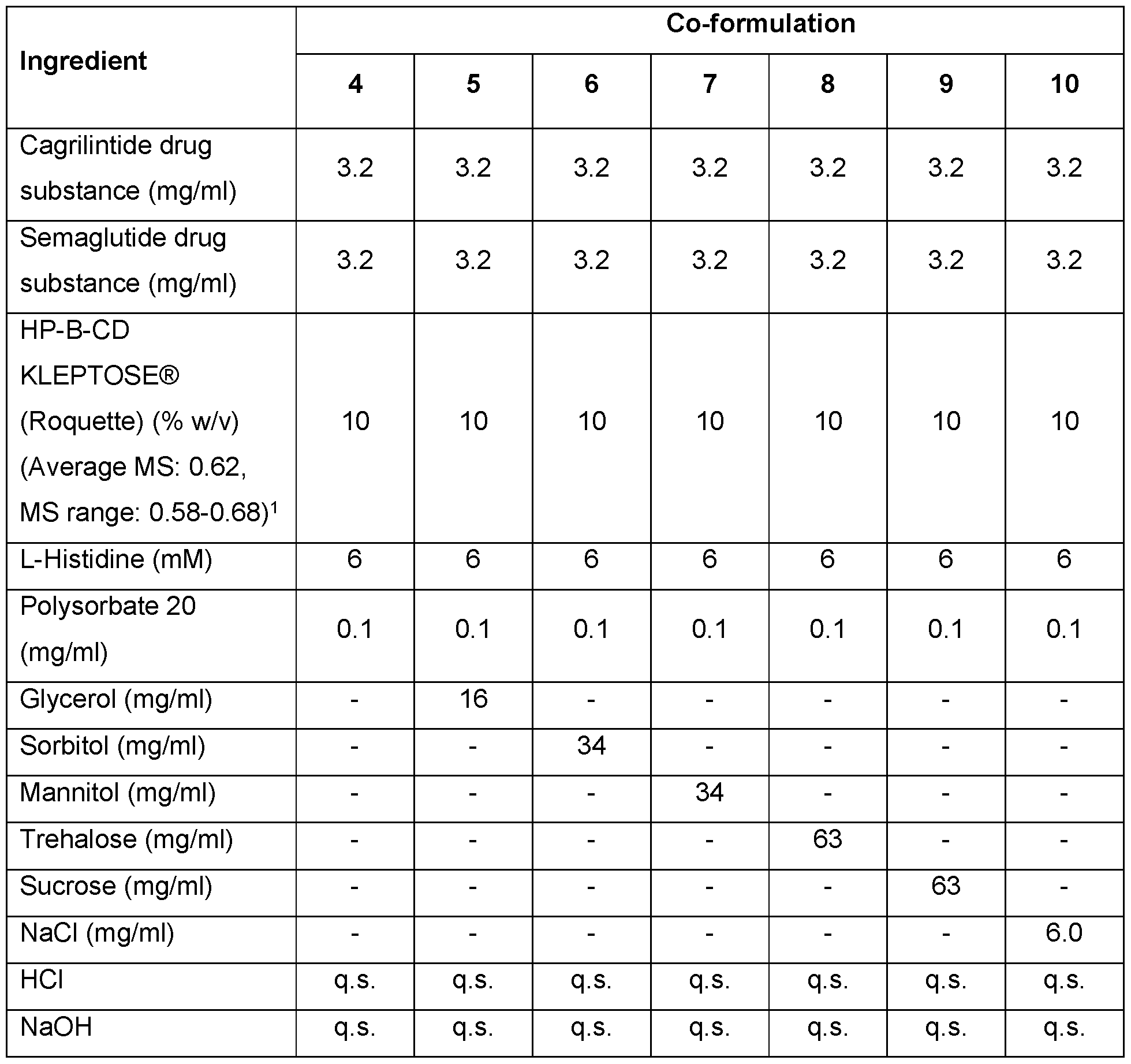


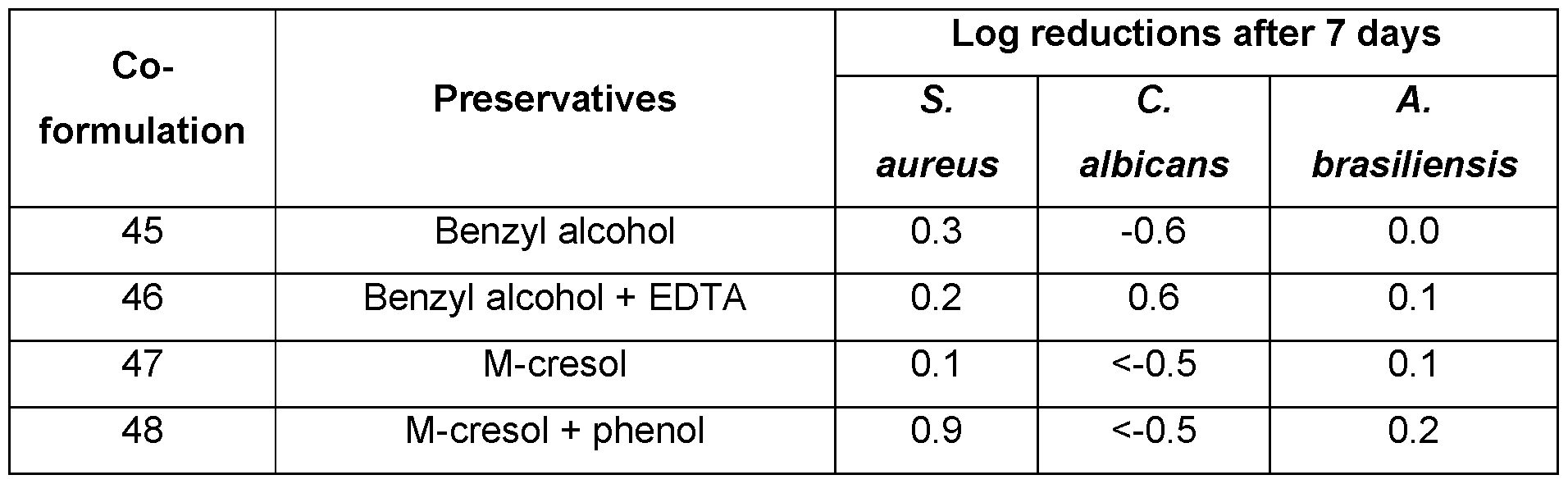


Claims
Priority Applications (7)
| Application Number | Priority Date | Filing Date | Title |
|---|---|---|---|
| IL325074A IL325074A (en) | 2023-06-15 | 2024-06-14 | Pharmaceutical formulations of an amylin receptor agonist and a glp-1 receptor agonist comprising a cyclodextrin |
| CN202480039645.8A CN122374007A (en) | 2023-06-15 | 2024-06-14 | Pharmaceutical formulations containing cyclodextrin, amylin receptor agonists, and GLP-1 receptor agonists |
| MX2025014950A MX2025014950A (en) | 2023-06-15 | 2024-06-14 | PHARMACEUTICAL FORMULATIONS OF AN AMYLIN RECEPTOR AGONIST AND A GLUCAGON-LIKE PEPTIDE 1 (GLP-1) RECEPTOR AGONIST COMPRISING A CYCLODEXTRIN |
| EP24735528.2A EP4727524A1 (en) | 2023-06-15 | 2024-06-14 | Pharmaceutical formulations of an amylin receptor agonist and a glp-1 receptor agonist comprising a cyclodextrin |
| AU2024305247A AU2024305247A1 (en) | 2023-06-15 | 2024-06-14 | Pharmaceutical formulations of an amylin receptor agonist and a glp-1 receptor agonist comprising a cyclodextrin |
| CONC2025/0017122A CO2025017122A2 (en) | 2023-06-15 | 2025-12-09 | Pharmaceutical formulations of an amylin receptor agonist and a glp-1 receptor agonist comprising a cyclodextrin |
| JOJO/P/2025/0310A JOP20250310A1 (en) | 2023-06-15 | 2025-12-14 | Pharmaceutical formulations of amylin receptor agonist and GLP-1 receptor agonist containing cyclodextrin |
Applications Claiming Priority (4)
| Application Number | Priority Date | Filing Date | Title |
|---|---|---|---|
| EP23179381 | 2023-06-15 | ||
| EP23179381.1 | 2023-06-15 | ||
| EP23180629 | 2023-06-21 | ||
| EP23180629.0 | 2023-06-21 |
Publications (1)
| Publication Number | Publication Date |
|---|---|
| WO2024256632A1 true WO2024256632A1 (en) | 2024-12-19 |
Family
ID=91664122
Family Applications (1)
| Application Number | Title | Priority Date | Filing Date |
|---|---|---|---|
| PCT/EP2024/066541 Ceased WO2024256632A1 (en) | 2023-06-15 | 2024-06-14 | Pharmaceutical formulations of an amylin receptor agonist and a glp-1 receptor agonist comprising a cyclodextrin |
Country Status (13)
| Country | Link |
|---|---|
| EP (1) | EP4727524A1 (en) |
| JP (1) | JP2024180368A (en) |
| KR (1) | KR20240176455A (en) |
| CN (1) | CN122374007A (en) |
| AR (1) | AR132977A1 (en) |
| AU (1) | AU2024305247A1 (en) |
| CL (1) | CL2025003861A1 (en) |
| CO (1) | CO2025017122A2 (en) |
| IL (1) | IL325074A (en) |
| JO (1) | JOP20250310A1 (en) |
| MX (1) | MX2025014950A (en) |
| TW (1) | TW202500183A (en) |
| WO (1) | WO2024256632A1 (en) |
Cited By (2)
| Publication number | Priority date | Publication date | Assignee | Title |
|---|---|---|---|---|
| KR102916795B1 (en) * | 2025-09-09 | 2026-01-22 | 송민섭 | Composition for aiding in obesity treatment and diet through appetite suppression and body fat reduction by promoting in-vivo glp-1 hormone secretion |
| DK182293B1 (en) * | 2025-01-16 | 2026-02-25 | Novo Nordisk As | Semaglutide for use in medical therapy including weight management |
Citations (13)
| Publication number | Priority date | Publication date | Assignee | Title |
|---|---|---|---|---|
| WO1998008871A1 (en) | 1996-08-30 | 1998-03-05 | Novo Nordisk A/S | Glp-1 derivatives |
| WO2001004156A1 (en) | 1999-07-12 | 2001-01-18 | Zealand Pharmaceuticals A/S | Peptides that lower blood glucose levels |
| WO2006097537A2 (en) | 2005-03-18 | 2006-09-21 | Novo Nordisk A/S | Acylated glp-1 compounds |
| WO2009083549A1 (en) | 2007-12-28 | 2009-07-09 | Novo Nordisk A/S | Semi-recombinant preparation of glp-1 analogues |
| WO2012168432A1 (en) | 2011-06-10 | 2012-12-13 | Novo Nordisk A/S | Polypeptides |
| WO2013156594A1 (en) | 2012-04-19 | 2013-10-24 | Novo Nordisk A/S | Human amylin analogues |
| CN103861089A (en) * | 2012-12-17 | 2014-06-18 | 江苏豪森药业股份有限公司 | Derivative of GLP-1 analogues or pharmaceutical salt injection of derivative as well as preparation method and applications of derivative of GLP-1 analogues or pharmaceutical salt injection of derivative |
| WO2016111971A1 (en) | 2015-01-09 | 2016-07-14 | Eli Lilly And Company | Gip and glp-1 co-agonist compounds |
| WO2019125938A1 (en) | 2017-12-21 | 2019-06-27 | Eli Lilly And Company | Incretin analogs and uses thereof |
| WO2021144476A1 (en) * | 2020-02-18 | 2021-07-22 | Novo Nordisk A/S | Pharmaceutical formulations |
| WO2021152184A1 (en) * | 2020-01-31 | 2021-08-05 | Adocia | Compositions comprising at least an amylin receptor agonist and a glp-1 receptor agonist |
| WO2022129526A1 (en) | 2020-12-18 | 2022-06-23 | Novo Nordisk A/S | Co-agonists of the glp-1 and amylin receptors |
| WO2023187067A1 (en) | 2022-03-30 | 2023-10-05 | Novo Nordisk A/S | Formulation method |
-
2024
- 2024-06-14 AU AU2024305247A patent/AU2024305247A1/en active Pending
- 2024-06-14 IL IL325074A patent/IL325074A/en unknown
- 2024-06-14 JP JP2024096781A patent/JP2024180368A/en active Pending
- 2024-06-14 CN CN202480039645.8A patent/CN122374007A/en active Pending
- 2024-06-14 AR ARP240101535A patent/AR132977A1/en unknown
- 2024-06-14 KR KR1020240077412A patent/KR20240176455A/en active Pending
- 2024-06-14 WO PCT/EP2024/066541 patent/WO2024256632A1/en not_active Ceased
- 2024-06-14 MX MX2025014950A patent/MX2025014950A/en unknown
- 2024-06-14 EP EP24735528.2A patent/EP4727524A1/en active Pending
- 2024-06-14 TW TW113122093A patent/TW202500183A/en unknown
-
2025
- 2025-12-09 CL CL2025003861A patent/CL2025003861A1/en unknown
- 2025-12-09 CO CONC2025/0017122A patent/CO2025017122A2/en unknown
- 2025-12-14 JO JOJO/P/2025/0310A patent/JOP20250310A1/en unknown
Patent Citations (14)
| Publication number | Priority date | Publication date | Assignee | Title |
|---|---|---|---|---|
| WO1998008871A1 (en) | 1996-08-30 | 1998-03-05 | Novo Nordisk A/S | Glp-1 derivatives |
| WO2001004156A1 (en) | 1999-07-12 | 2001-01-18 | Zealand Pharmaceuticals A/S | Peptides that lower blood glucose levels |
| WO2006097537A2 (en) | 2005-03-18 | 2006-09-21 | Novo Nordisk A/S | Acylated glp-1 compounds |
| WO2009083549A1 (en) | 2007-12-28 | 2009-07-09 | Novo Nordisk A/S | Semi-recombinant preparation of glp-1 analogues |
| WO2012168432A1 (en) | 2011-06-10 | 2012-12-13 | Novo Nordisk A/S | Polypeptides |
| WO2013156594A1 (en) | 2012-04-19 | 2013-10-24 | Novo Nordisk A/S | Human amylin analogues |
| CN103861089A (en) * | 2012-12-17 | 2014-06-18 | 江苏豪森药业股份有限公司 | Derivative of GLP-1 analogues or pharmaceutical salt injection of derivative as well as preparation method and applications of derivative of GLP-1 analogues or pharmaceutical salt injection of derivative |
| WO2016111971A1 (en) | 2015-01-09 | 2016-07-14 | Eli Lilly And Company | Gip and glp-1 co-agonist compounds |
| US9474780B2 (en) | 2015-01-09 | 2016-10-25 | Eli Lilly And Company | GIP and GLP-1 co-agonist compounds |
| WO2019125938A1 (en) | 2017-12-21 | 2019-06-27 | Eli Lilly And Company | Incretin analogs and uses thereof |
| WO2021152184A1 (en) * | 2020-01-31 | 2021-08-05 | Adocia | Compositions comprising at least an amylin receptor agonist and a glp-1 receptor agonist |
| WO2021144476A1 (en) * | 2020-02-18 | 2021-07-22 | Novo Nordisk A/S | Pharmaceutical formulations |
| WO2022129526A1 (en) | 2020-12-18 | 2022-06-23 | Novo Nordisk A/S | Co-agonists of the glp-1 and amylin receptors |
| WO2023187067A1 (en) | 2022-03-30 | 2023-10-05 | Novo Nordisk A/S | Formulation method |
Non-Patent Citations (20)
| Title |
|---|
| "Background review for cyclodextrins used as excipients", EMA/CHMP/333892/2013, COMMITTEE FOR HUMAN MEDICINAL PRODUCTS (CHMP, 2014 |
| "Evidence-Based Guideline on Adult Obesity Prevention and Management", 2023 |
| "Guidelines for Prevention and Control of Overweight and Obesity in Chinese Adults", CHINESE WORKING GROUP ON OBESITY, article "Guidelines for the Chinese population" |
| "Guidelines for the management of obesity disease", JAPANESE SOCIETY FOR THE STUDY OF OBESITY (JASSO, 2016 |
| A.L. LEHNINGERM. M. COX, PRINCIPLES OF BIOCHEMISTRY, 1982 |
| FLORENCIO ZARAGOZA DÖRWALD: "Fmoc Solid Phase Peptide Synthesis", 2000, OXFORD UNIVERSITY PRESS |
| GREENEWUTS: "Protective Groups in Organic Synthesis", 1999, JOHN WILEY & SONS |
| HODGSON ET AL.: "The synthesis of peptides and proteins containing non-natural amino acids", CHEMICAL SOCIETY REVIEWS, vol. 33, no. 7, 2004, pages 422 - 430, XP008067398 |
| J. MED. CHEM., vol. 58, no. 18, 2015, pages 7370 - 7380 |
| KOZLOWSKI, LUKASZ P.: "IPC - Isoelectric Point Calculator", BIOLOGY DIRECT, vol. 11, 2016, pages 55,1 - 55,16, XP093105617, DOI: 10.1186/s13062-016-0159-9 |
| LANCET, vol. 2021, no. 397, pages 1736 - 48 |
| LOFTSSON, T.STEFANSDOTTIR, O.FRIÔRIKSDÓTTIR, H.GUÔMUNDSSON, O., DRUG DEVELOPMENT AND INDUSTRIAL PHARMACY, vol. 18, no. 13, 1992, pages 1477 - 1484 |
| MISRA A ET AL.: "Guidelines for the Asian population", J ASSOC PHYSICIANS, vol. 2009, no. 57, pages 163 - 70 |
| P. BREENS. S. JAMBHEKAR: "Cyclodextrins in pharmaceutical formulations II: solubilization, binding constant, and complexation efficiency", DRUG DISCOVERY TODAY, vol. 21, 2 February 2016 (2016-02-02) |
| PACE CNGRIMSLEY GRSCHOLTZ JM.: "Protein ionizable groups: pK values and their contribution to protein stability and solubility", J BIOL. CHEM., vol. 284, no. 20, 2009, pages 13285 - 13289 |
| PHAN THI NHU QUYNH ET AL: "The Effect of Counterions in Hydrophobic Ion Pairs on Oral Bioavailability of Exenatide", ACS BIOMATERIALS SCIENCE & ENGINEERING, vol. 6, no. 9, 3 August 2020 (2020-08-03), pages 5032 - 5039, XP093024491, ISSN: 2373-9878, Retrieved from the Internet <URL:http://pubs.acs.org/doi/pdf/10.1021/acsbiomaterials.0c00637> DOI: 10.1021/acsbiomaterials.0c00637 * |
| REMINGTON: "The Science and Practice of Pharmacy", 2006 |
| SA, SHAWKEVIN L.GRIMSLEY, GERALD R.YAKOVLEV, GENNADY I.MAKAROV, ALEXANDER A.PACE, C. NICK, PROTEIN SCIENCE, vol. 10, no. 6, 2001, pages 1206 - 1215 |
| SHARMA, D.K. ET AL., AAPS J., vol. 12, 2010, pages 455 - 464 |
| T. LOFTSSON: "Cyclodextrins in Parenteral Formulations", JOURNAL OF PHARMACEUTICAL SCIENCES, 2020, pages 1 - 11 |
Cited By (4)
| Publication number | Priority date | Publication date | Assignee | Title |
|---|---|---|---|---|
| DK182293B1 (en) * | 2025-01-16 | 2026-02-25 | Novo Nordisk As | Semaglutide for use in medical therapy including weight management |
| DK202530540A1 (en) * | 2025-01-16 | 2026-02-25 | Novo Nordisk As | Semaglutide in medical therapy including weight management |
| AU2026202343A1 (en) * | 2025-01-16 | 2026-07-30 | Novo Nordisk A/S | Semaglutide in medical therapy including weight management |
| KR102916795B1 (en) * | 2025-09-09 | 2026-01-22 | 송민섭 | Composition for aiding in obesity treatment and diet through appetite suppression and body fat reduction by promoting in-vivo glp-1 hormone secretion |
Also Published As
| Publication number | Publication date |
|---|---|
| MX2025014950A (en) | 2026-02-03 |
| CL2025003861A1 (en) | 2026-03-13 |
| AR132977A1 (en) | 2025-08-13 |
| JOP20250310A1 (en) | 2025-12-14 |
| IL325074A (en) | 2026-02-01 |
| CO2025017122A2 (en) | 2026-03-16 |
| CN122374007A (en) | 2026-07-10 |
| AU2024305247A1 (en) | 2025-12-11 |
| TW202500183A (en) | 2025-01-01 |
| EP4727524A1 (en) | 2026-04-22 |
| JP2024180368A (en) | 2024-12-26 |
| KR20240176455A (en) | 2024-12-24 |
Similar Documents
| Publication | Publication Date | Title |
|---|---|---|
| WO2023110833A1 (en) | Pharmaceutical formulations comprising a cyclodextrin | |
| WO2023187067A1 (en) | Formulation method | |
| AU2024305247A1 (en) | Pharmaceutical formulations of an amylin receptor agonist and a glp-1 receptor agonist comprising a cyclodextrin | |
| CN112912100A (en) | Stable semaglutide compositions and uses thereof | |
| CN110087674A (en) | Pharmaceutical composition containing insulin | |
| EP4096702A1 (en) | Compositions comprising at least an amylin receptor agonist and a glp-1 receptor agonist | |
| EP4319798B1 (en) | Liquid formulations of amylin analogues | |
| CN112771073A (en) | Formulations of glucagon-like peptide 2(GLP-2) analogs | |
| WO2021079337A1 (en) | Pharmaceutical formulation of anti-her2 antibody and preparation thereof | |
| CN118382451A (en) | Pharmaceutical preparations containing cyclodextrins | |
| EP4447997A1 (en) | Pharmaceutical formulations comprising a cyclodextrin | |
| WO2024112231A1 (en) | Composition of fast-acting insulin (variants) | |
| US20230159606A1 (en) | Pharmaceutical compositions for glucagon and glp-1 co-agonist peptides | |
| JP2024501256A (en) | Therapeutic peptide preparations | |
| CA3240994C (en) | Liquid formulations of amylin analogues | |
| RU2838627C2 (en) | Liquid compositions of amylin analogues | |
| RU2819934C1 (en) | Liquid formulations of glucagon analogues | |
| HK40104625B (en) | Liquid formulations of amylin analogues | |
| WO2025141129A1 (en) | Formulations of glucagon-like-peptide 2 (glp-2) analogues and their uses | |
| CN121152639A (en) | A pharmaceutical formulation containing a GLP-1 fusion protein and its application |
Legal Events
| Date | Code | Title | Description |
|---|---|---|---|
| 121 | Ep: the epo has been informed by wipo that ep was designated in this application |
Ref document number: 24735528 Country of ref document: EP Kind code of ref document: A1 |
|
| WWE | Wipo information: entry into national phase |
Ref document number: AU2024305247 Country of ref document: AU Ref document number: 827471 Country of ref document: NZ |
|
| WWP | Wipo information: published in national office |
Ref document number: 827471 Country of ref document: NZ |
|
| WWE | Wipo information: entry into national phase |
Ref document number: 325074 Country of ref document: IL |
|
| ENP | Entry into the national phase |
Ref document number: 2024305247 Country of ref document: AU Date of ref document: 20240614 Kind code of ref document: A |
|
| WWE | Wipo information: entry into national phase |
Ref document number: 2501008437 Country of ref document: TH Ref document number: MX/A/2025/014950 Country of ref document: MX |
|
| WWE | Wipo information: entry into national phase |
Ref document number: P2025-04084 Country of ref document: AE |
|
| WWE | Wipo information: entry into national phase |
Ref document number: DZP2025001850 Country of ref document: DZ |
|
| REG | Reference to national code |
Ref country code: BR Ref legal event code: B01A Ref document number: 112025027728 Country of ref document: BR |
|
| WWP | Wipo information: published in national office |
Ref document number: 325074 Country of ref document: IL |
|
| WWE | Wipo information: entry into national phase |
Ref document number: 202647003035 Country of ref document: IN |
|
| WWE | Wipo information: entry into national phase |
Ref document number: 202690039 Country of ref document: EA |
|
| WWE | Wipo information: entry into national phase |
Ref document number: 2024735528 Country of ref document: EP |
|
| NENP | Non-entry into the national phase |
Ref country code: DE |
|
| ENP | Entry into the national phase |
Ref document number: 2024735528 Country of ref document: EP Effective date: 20260115 |
|
| WWE | Wipo information: entry into national phase |
Ref document number: 11202507776X Country of ref document: SG |
|
| WWP | Wipo information: published in national office |
Ref document number: 11202507776X Country of ref document: SG Ref document number: 202647003035 Country of ref document: IN |
|
| ENP | Entry into the national phase |
Ref document number: 2024735528 Country of ref document: EP Effective date: 20260115 |
|
| WWP | Wipo information: published in national office |
Ref document number: MX/A/2025/014950 Country of ref document: MX |
|
| ENP | Entry into the national phase |
Ref document number: 2024735528 Country of ref document: EP Effective date: 20260115 |
|
| WWP | Wipo information: published in national office |
Ref document number: 2024735528 Country of ref document: EP |