WO2024256582A1 - Compositions and uses thereof - Google Patents

Compositions and uses thereof Download PDF

Info

Publication number
WO2024256582A1
WO2024256582A1 PCT/EP2024/066448 EP2024066448W WO2024256582A1 WO 2024256582 A1 WO2024256582 A1 WO 2024256582A1 EP 2024066448 W EP2024066448 W EP 2024066448W WO 2024256582 A1 WO2024256582 A1 WO 2024256582A1
Authority
WO
WIPO (PCT)
Prior art keywords
acid
composition
food
antimicrobial composition
food composition
Prior art date
Legal status (The legal status is an assumption and is not a legal conclusion. Google has not performed a legal analysis and makes no representation as to the accuracy of the status listed.)
Ceased
Application number
PCT/EP2024/066448
Other languages
French (fr)
Inventor
Amelie ROUGER
Ana Paula DO ESPIRITO SANTO
Current Assignee (The listed assignees may be inaccurate. Google has not performed a legal analysis and makes no representation or warranty as to the accuracy of the list.)
Givaudan SA
Original Assignee
Givaudan SA
Priority date (The priority date is an assumption and is not a legal conclusion. Google has not performed a legal analysis and makes no representation as to the accuracy of the date listed.)
Filing date
Publication date
Application filed by Givaudan SA filed Critical Givaudan SA
Priority to EP24733892.4A priority Critical patent/EP4727374A1/en
Priority to KR1020267001503A priority patent/KR20260020493A/en
Priority to CN202480039467.9A priority patent/CN121335627A/en
Publication of WO2024256582A1 publication Critical patent/WO2024256582A1/en
Anticipated expiration legal-status Critical
Ceased legal-status Critical Current

Links

Classifications

    • AHUMAN NECESSITIES
    • A23FOODS OR FOODSTUFFS; TREATMENT THEREOF, NOT COVERED BY OTHER CLASSES
    • A23BPRESERVATION OF FOODS, FOODSTUFFS OR NON-ALCOHOLIC BEVERAGES; CHEMICAL RIPENING OF FRUIT OR VEGETABLES
    • A23B2/00Preservation of foods or foodstuffs, in general
    • A23B2/70Preservation of foods or foodstuffs, in general by treatment with chemicals
    • A23B2/725Preservation of foods or foodstuffs, in general by treatment with chemicals in the form of liquids or solids
    • A23B2/729Organic compounds; Microorganisms; Enzymes
    • A23B2/742Organic compounds containing oxygen
    • A23B2/754Organic compounds containing oxygen containing carboxyl groups
    • AHUMAN NECESSITIES
    • A23FOODS OR FOODSTUFFS; TREATMENT THEREOF, NOT COVERED BY OTHER CLASSES
    • A23BPRESERVATION OF FOODS, FOODSTUFFS OR NON-ALCOHOLIC BEVERAGES; CHEMICAL RIPENING OF FRUIT OR VEGETABLES
    • A23B2/00Preservation of foods or foodstuffs, in general
    • A23B2/70Preservation of foods or foodstuffs, in general by treatment with chemicals
    • A23B2/725Preservation of foods or foodstuffs, in general by treatment with chemicals in the form of liquids or solids
    • A23B2/729Organic compounds; Microorganisms; Enzymes
    • A23B2/733Compounds of undetermined constitution obtained from animals or plants
    • AHUMAN NECESSITIES
    • A23FOODS OR FOODSTUFFS; TREATMENT THEREOF, NOT COVERED BY OTHER CLASSES
    • A23BPRESERVATION OF FOODS, FOODSTUFFS OR NON-ALCOHOLIC BEVERAGES; CHEMICAL RIPENING OF FRUIT OR VEGETABLES
    • A23B70/00Preservation of non-alcoholic beverages

Definitions

  • the present invention relates to antimicrobial compositions that comprise organic acids and to their uses.
  • Food preservation techniques e.g. heat processing, freezing, ultrasound, irradiation, and modified atmosphere packaging, significantly reduce microbial load but of particular concern is the evidence that processed foods are being contaminated with microorganisms following processing and prior to packaging.
  • microbial spoilage of various foods such as dairy and meat products, dressings, spreads, margarines and seafood.
  • compositions with certain combinations of organic acids leads to a synergistic effect in the antimicrobial activity of the compositions.
  • the present invention relates to an antimicrobial composition, hereinafter the first antimicrobial composition of the invention, comprising a first component which is tartaric acid or cinnamic and a second component which is selected from the group consisting of citric acid, tartaric acid, succinic acid or cinnamic acid, or combinations thereof.
  • the present invention relates to an antimicrobial composition, hereinafter the second antimicrobial composition of the invention, comprising a first component which is cinnamic acid and a second component which is selected from the group consisting of citric acid, succinic acid, tartaric acid or combinations thereof.
  • Another aspect of the present invention relates to an antimicrobial composition
  • an antimicrobial composition comprising a first component which is tartaric acid or cinnamic acid and a second component which is selected from the group consisting of citric acid, succinic acid, tartaric acid, ferulic acid, formic acid, malic acid, levulinic acid, chlorogenic acid or cinnamic acid or combinations thereof.
  • the present invention relates to a food composition
  • a food composition comprising the antimicrobial composition of the invention (first or second composition of the invention).
  • the present invention relates to the use of the antimicrobial composition of the invention (first or second composition of the invention) for obtaining a shelf-stable food composition, for decreasing the content of microorganisms in a food composition, for increasing the shelf life of a food composition or for preservation of fresh or cooked food composition.
  • the present invention relates to a method for obtaining a shelf-stable food composition or for increasing the shelf life of a food composition, and/or for reducing the content of microorganisms of a food composition comprising contacting the food composition with the antimicrobial composition of the invention (first or second composition of the invention).
  • the present invention relates to a method for reducing the content of microorganisms in an acidic food product, the method comprising contacting the meat product with the antimicrobial composition of the invention.
  • compositions comprising organic acids with antimicrobial effect that present a synergistic antimicrobial effect in comparison with the antimicrobial activity of the individual components of the compositions.
  • Antimicrobial compositions of the invention are disclosed.
  • the first antimicrobial composition of the invention comprising a first component which is tartaric acid and a second component which is selected from the group consisting of citric acid, succinic acid, cinnamic acid or tartaric acid or combinations thereof.
  • a second aspect of the present invention relates to an antimicrobial composition, hereinafter the second antimicrobial composition of the invention, comprising a first component which is cinnamic acid and a second component which is selected from the group consisting of citric acid, succinic acid, tartaric acid or citric acid or combinations thereof.
  • Another aspect of the present invention relates to an antimicrobial composition
  • an antimicrobial composition comprising a first component which is tartaric acid or cinnamic acid and a second component which is selected from the group consisting of citric acid, succinic acid, tartaric acid, ferulic acid, formic acid, malic acid, levulinic acid, chlorogenic acid or cinnamic acid or combinations thereof.
  • the second component in the antimicrobial composition is different than the first component.
  • the first component comprises tartaric acid
  • the second component does not comprise tartaric acid.
  • the first component comprises cinnamic acid
  • the second component does not comprise cinnamic acid.
  • the organic acids present in the antimicrobial composition are different from one another.
  • the antimicrobial composition of the invention is a synergistic antimicrobial composition.
  • the present invention relates to a synergistic antimicrobial composition, comprising a first component which is cinnamic acid and a second component which is selected from the group consisting of citric acid, succinic acid, tartaric acid, or citric acid or combinations thereof.
  • the present invention relates to a synergistic antimicrobial composition, comprising a first component which is tartaric acid and a second component which is selected from the group consisting of citric acid, succinic acid, cinnamic acid or citric acid or combinations thereof.
  • antimicrobial refers to any compound capable of inhibiting the growth or propagation of microorganisms, and/or killing microorganisms; antimicrobial compounds include bactericides, bacteriostats, bacteriostatics, bacteriostatins, fungicides, fungistats, algaecides and algistats, depending on the dose level applied, system conditions and the level of microbial control desired.
  • organic acids refers to an organic compound with acidic properties.
  • the most common organic acids are the carboxylic acids, whose acidity is associated with their carboxyl group -COOH.
  • Sulfonic acids, containing the group - SO2OH are relatively stronger acids.
  • Alcohols, with -OH can act as acids but they are usually very weak.
  • the relative stability of the conjugate base of the acid determines its acidity.
  • Other groups can [also] confer acidity, usually weakly: the thiol group -SH, the enol group, and the phenol group.
  • organic compounds containing these groups are generally referred to as organic acids. Examples of organic acids, without limitation are, lactic acid, acetic acid, formic acid, citric acid, oxalic acid, uric acid, malic acid, propionic acid and tartaric acid.
  • the term “synergistic” or “synergy” refers to a result that is more than merely additive.
  • the synergistic effect may be an effect on a broader spectrum of microorganisms, for example single compounds may be only active for certain types of microorganism while the combination of those actives results in a broader protection (broader antimicrobial effect on a larger number of microorganisms).
  • the invention relates to an antimicrobial composition (first composition of the invention) comprising a first component which is tartaric acid and a second component selected from the group consisting of cinnamic acid, succinic acid and citric acid or combinations thereof.
  • the antimicrobial composition of the invention comprises succinic acid and tartaric acid and are present at a ratio of about 1 :4 to 1 :5.
  • the antimicrobial composition of the invention comprises tartaric acid and succinic acid and are present at a ratio of about 2:1.
  • the antimicrobial composition of the invention comprises tartaric acid and citric acid.
  • the antimicrobial composition of the invention comprises tartaric acid, citric acid and succinic acid.
  • the antimicrobial composition of the invention comprises tartaric acid, succinic acid and cinnamic acid.
  • the tartaric acid, succinic acid and cinnamic acid are present at a ratio of about 1 :0.1 :0.2 to about 1 :1 :2.
  • the antimicrobial composition of the invention (second composition of the invention) comprises a first component which is cinnamic acid and a second component which is selected from the group consisting of citric acid and succinic acid.
  • the antimicrobial composition of the invention comprises cinnamic acid and succinic acid.
  • the succinic acid and the cinnamic acid are present at a ratio of about 2: 1 to 3: 1 or 1 :4.
  • the antimicrobial composition of the invention comprises tartaric acid and cinnamic acid and further comprises citric acid (for example obtained from a lemon juice concentrate) or succinic acid.
  • the antimicrobial composition of the invention comprises cinnamic acid, succinic acid and tartaric acid.
  • the antimicrobial composition of the invention comprises cinnamic acid, tartaric acid and citric acid.
  • the antimicrobial composition of the invention comprises cinnamic acid, succinic acid and citric acid.
  • the antimicrobial composition of the invention comprises cinnamic acid, tartaric acid, citric acid and succinic acid.
  • the invention in another aspect, relates to an antimicrobial composition
  • an antimicrobial composition comprising citric acid and succinic acid.
  • Tartaric acid is a white, crystalline organic acid that occurs naturally in many fruits, most notably in grapes, but also in bananas, tamarinds, and citrus. Its salt, potassium bitartrate, commonly known as cream of tartar, develops naturally in the process of fermentation. It is commonly mixed with sodium bicarbonate and is sold as baking powder used as a leavening agent in food preparation. The acid itself is added to foods as an antioxidant E334 and to impart its distinctive sour taste. Naturally occurring tartaric acid is a useful raw material in organic chemical synthesis. Tartaric acid, an alpha- hydroxy-carboxylic acid, is diprotic and aldaric in acid characteristics, and is a dihydroxyl derivative of succinic acid. Tartaric acid is defined in the entry of the database CAS Registry with the number 87-69-4 as well as structurally by formula (i).
  • the tartaric acid has a natural origin and is obtained from bananas, tamarinds or citrus. In another particular embodiment, the tartaric acid has a synthetic origin.
  • the tartaric acid is present in the antimicrobial composition from about 0.1% to about 80%, based on the total weight of the antimicrobial composition. In other embodiments the tartaric acid is present in the antimicrobial composition from about 0.1% to about 3%, from about 2% to about 50% or even from about 5% to about 30% or from about 20% to about 40%%, based on the total weight of the antimicrobial composition.
  • Cinnamic acid is an organic compound with the formula CeHs-CF CH-COOH. It is a white crystalline compound that is slightly soluble in water, and freely soluble in many organic solvents. Classified as an unsaturated carboxylic acid, it occurs naturally in a number of plants. It exists as both a cis and a trans isomer. In a particular embodiment, the cinnamic acid is a cis isomer. In another particular embodiment, the cinnamic acid is a trans isomer. Cinnamic acid is obtained from oil of cinnamon, or from balsams such as storax. It is also found in shea butter. Cinnamic acid is defined in the entry of the database CAS Registry with the number 621-82-9 as well as structurally by formula (ii)
  • the cinnamic acid has a natural origin and is obtained from cinnamon or balsams. In another particular embodiment, the cinnamic acid has a synthetic origin.
  • Succinic acid is a dicarboxylic acid with the chemical formula (CH2)2(CC>2H)2.
  • succinic acid takes the form of an anion, succinate, which has multiple biological roles as a metabolic intermediate being converted into fumarate by the enzyme succinate dehydrogenase in complex 2 of the electron transport chain which is involved in making ATP, and as a signaling molecule reflecting the cellular metabolic state.
  • Succinic acid is defined in the entry of the database CAS Registry with the number 110- 15-6 as well as structurally by formula (iii).
  • the succinic acid has a natural origin. In another particular embodiment, the succinic acid has a synthetic origin.
  • Citric acid is an organic compound with the chemical formula HOC(CO2H)(CH2CC>2H)2 It is a colorless weak organic acid. It occurs naturally in citrus fruits. In biochemistry, it is an intermediate in the citric acid cycle, which occurs in the metabolism of all aerobic organisms. Citric acid occurs in a variety of fruits and vegetables, most notably citrus fruits. Lemons and limes have particularly high concentrations of the acid; it can constitute as much as 8% of the dry weight of these fruits. Citric acid is defined in the entry of the database CAS Registry with the number 77-92-9 as well as structurally by formula (iv). Formula (iv)
  • the citric acid has a natural origin and is obtained from citrus fruits. In another particular embodiment, the citric acid has a synthetic origin.
  • the citric acid has a natural origin.
  • the citric acid is obtained from a lemon juice concentrate.
  • the term “lemon juice concentrate” refers to the concentrate obtained from the lemon, including the whole fruit, and/or skin of the fruit, and/or the pulp of the fruit.
  • the fruit (lemon) or the parts may be fresh, frozen or dried.
  • the term as used herein refers to a lemon juice that has been partially dehydrated. It also refers to a reconstituted juice obtained from dried lemon juice.
  • the lemon juice concentrate contains a water content which is lower than 7 % weight per weight (w/w) and/or wherein the titrable acidity is between 45-60%.
  • titrable acidity refers to the total acid concentration in a food, which is determined by titration of intrinsic acids with a standard base.
  • the antimicrobial composition of the invention comprises tartaric acid and cinnamic acid and further comprises citric acid (for example obtained from a lemon juice concentrate) or succinic acid.
  • the antimicrobial composition of the invention comprises cinnamic acid and citric acid (for example obtained from a lemon juice concentrate) and further comprises succinic acid.
  • the antimicrobial composition of the invention comprises tartaric acid, citric acid (for example obtained from a lemon juice concentrate), succinic acid and cinnamic acid.
  • the invention is related to a composition which comprises a succinic acid and a citric acid (such as citric acid obtained from a lemon juice concentrate).
  • a succinic acid such as citric acid obtained from a lemon juice concentrate.
  • a citric acid such as citric acid obtained from a lemon juice concentrate.
  • succinic acid and a citric acid are present at a ratio of about 2:1.
  • the antimicrobial composition of the invention comprises cinnamic acid and/or tartaric acid and formic acid.
  • the antimicrobial composition of the invention comprises tartaric acid, succinic acid and formic acid.
  • the antimicrobial composition of the invention comprises cinnamic acid, succinic acid and formic acid.
  • the present invention relates to a food composition, hereinafter the food composition of the invention that comprises the antimicrobial composition of the invention (first or second composition of the invention).
  • the antimicrobial composition of the invention may be present in the food composition at least about 0.05%, at least about 0.1%, preferably at least about 0.5%, preferably at least about 1.0% or even 2%, 3%, 4% or 5%, based on the total weight of the food composition.
  • the antimicrobial composition of the invention may be present in the food composition from about 0.3% to about 5%, preferably from about 0.5% to about 3.5%, based on the total weight of the food composition.
  • the term “food composition” or “foodstuff” as used herein refers to a composition which is suitable for human or animal consumption.
  • the food composition includes, without limitation, eggs, egg-based products, including but not limited to mayonnaise, salad dressings, sauces, ice creams, egg powder, modified egg yolk and products made therefrom; baked goods, including breads, cakes, sweet dough products, laminated doughs, liquid batters, muffins, doughnuts, biscuits, crackers and cookies; confectionery, including chocolate, candies, caramels, halawa, gums, including sugar free and sugar sweetened gums, bubble gum, soft bubble gum, chewing gum and puddings; frozen products including sorbets, preferably frozen dairy products, including ice cream and ice milk; dairy products, including cheese, butter, milk, coffee cream, whipped cream, custard cream, milk drinks and yoghurts; plant based non-dairy products, mousses, whipped vegetable creams, meat products, including processed meat products; edible oils and fats, aerated
  • beverage refers to any potable or edible liquid.
  • the food composition of the invention is a meat product, meat analogue product or a fruit juice.
  • meal product is used herein with the meaning of those products extracted from poultry, fish, cattle, pork, sheep, etc., both with and without fat, either in the shape of meat cut or shred, ground meat, frozen meat, semi-frozen meat or refrigerated meat, either processed or not processed.
  • a meat analogue product may refer to foods made from vegetarian ingredients, which approximate certain aesthetic qualities (such as texture, flavour, appearance) or chemical characteristics of specific types of meat.
  • meat analogues include vegetable (veggie) burgers.
  • fruit juice is used herein with the meaning of those products obtained from the extraction or pressing of the natural liquid contained in fruits.
  • the fruit juice is extracted from fruits, including the whole fruit, and/or skin of the cranberry fruit, and/or the pulp of the fruit.
  • the fruit is lemon, lime, orange, apple, pineapple, strawberry, acerola, blueberry, banana, grape, peach, pomelo, papaya or mango.
  • the fruit juice is a concentrate fruit juice.
  • the food composition of the invention comprises the antimicrobial composition of the invention which comprises the tartaric acid and the cinnamic acid.
  • the tartaric acid and the cinnamic acid and are present at a ratio of from about 1 :10 to about 10:1 , such as from about 1 :5 to 5.1 such as about 1 :2.
  • the food composition of the invention comprises the antimicrobial composition of the invention which comprises the succinic acid and the tartaric acid and are present at a ratio of about 1 :4 to 1 :5.
  • the food composition of the invention comprises the antimicrobial composition of the invention which comprises the tartaric acid and the succinic acid and are present at a ratio of about 2:1 .
  • the food composition of the invention comprises the antimicrobial composition of the invention which comprises the succinic acid and the cinnamic acid and are present at a ratio of about 2:1 to 3:1 or 1 :4.
  • the food composition of the invention comprises the antimicrobial composition of the invention which comprises the succinic acid and the citric acid obtained from the lemon juice concentrate and are present at a ratio of about 2:1.
  • the food composition of the invention comprises the antimicrobial composition of the invention which comprises the cinnamic acid and the citric acid (for example obtained from a lemon juice concentrate) and are present at a ratio of about 8:1.
  • the food composition of the invention comprises the antimicrobial composition of the invention which comprises the tartaric acid and the citric acid (for example obtained from a lemon juice concentrate) and are present at a ratio of about 4:1.
  • the food composition of the invention comprises the antimicrobial composition of the invention which comprises the tartaric acid, the succinic acid and the cinnamic acid and are present at a ratio of about 2: 1:4 or 1 : 5: 2.
  • the tartaric acid, succinic acid and cinnamic acid are present at a ratio of about 1 :0.1 :0.2 to about 1 :1 :2 in the food composition.
  • the food composition of the invention comprises the antimicrobial composition of the invention which comprises the succinic acid, the tartaric acid and the citric acid obtained from the lemon juice concentrate and the cinnamic acid and are present at a ratio of about 2:8:1 .
  • the food composition of the invention comprises the antimicrobial composition of the invention which comprises the tartaric acid, the cinnamic acid and the citric acid obtained from the lemon juice concentrate and the cinnamic acid and are present at a ratio of about 4:8:1 .
  • the food composition of the invention comprises the antimicrobial composition of the invention which comprises the succinic acid, the tartaric acid, the cinnamic acid and the citric acid obtained from the lemon juice concentrate and the cinnamic acid and are present at a ratio of about 2:10:8:1
  • the antimicrobial composition of the invention is added to the food composition of the invention so that each of the tartaric acid, the cinnamic acid, the citric acid and/or the succinic acid from the antimicrobial composition are present in the food composition at concentrations in the range of 0,0001% to 1% (w/w) with respect to the food weight.
  • the tartaric acid from the antimicrobial composition of the invention is present in the food composition at a concentration in the range of 0,0001 % to 2% (w/w). In a more particular embodiment, the tartaric acid is at a concentration in the range of 0,001 % to 1 %( w/w). In a more particular embodiment, the tartaric acid is at a concentration in the range of 0,01% to 0,5% (w/w). In a more particular embodiment, the tartaric acid is at a concentration in the range of 0,01 % to 0,25% (w/w).
  • the tartaric acid from the antimicrobial composition of the invention is present in the food composition at a concentration of about 0,0125%, 0,05%, 0,125% or 0,25% (w/w).
  • the cinnamic acid from the antimicrobial composition of the invention is present in the food composition at a concentration in the range of 0,0001% to 2% (w/w). In a more particular embodiment, the cinnamic acid is at a concentration in the range of 0,001% to 1% (w/w). In a more particular embodiment, the cinnamic acid is at a concentration in the range of 0,01% to 0,5% (w/w). In a more particular embodiment, the cinnamic acid is at a concentration in the range of 0,01% to 0,13% (w/w).
  • the cinnamic acid from the antimicrobial composition of the invention is present in the food composition at a concentration of about 0,0625% or 0,125% (w/w).
  • the citric acid obtained from the lemon juice concentrate from the antimicrobial composition of the invention is present in the food composition at a concentration in the range of 0,0001 % to 5% (w/w). In a more particular embodiment, the citric acid is at a concentration in the range of 0,01% to 1 ,5% (w/w). In a more particular embodiment, the citric acid is at a concentration in the range of 0,1 % to 1% (w/w). In a more particular embodiment, the citric acid is at a concentration in the range of 0,3% to 1% (w/w).
  • the citric acid from the antimicrobial composition of the invention is present in the food composition at a concentration of about 0,5% or 1 % (w/w).
  • the succinic acid from the antimicrobial composition of the invention is present in the food composition at a concentration in the range of 0,0001 % to 2% (w/w).
  • the succinic acid is at a concentration in the range of 0,001% to 1% (w/w).
  • the succinic acid is at a concentration in the range of 0,01% to 0,5% (w/w).
  • the succinic acid is at a concentration in the range of 0,03% to 0,5% (w/w).
  • the succinic acid from the antimicrobial composition of the invention is present in the food composition at a concentration of about 0,01625%, 0,05%, 0,25% or 0,5% (w/w).
  • the food composition of the invention comprises the antimicrobial composition of the invention which comprises tartaric acid and cinnamic acid.
  • the tartaric acid from the antimicrobial composition of the invention composition is present in the food composition at a concentration of about 0,25% or 0,05% (w/w) and the cinnamic acid from the antimicrobial composition is present in the food composition at a concentration of about 0,02% or 0,125% (w/w).
  • the food composition of the invention comprises the antimicrobial composition of the invention which comprises the tartaric acid and the citric acid obtained from the lemon juice concentrate.
  • the tartaric acid from the antimicrobial composition is present in the food composition at a concentration of about 0,25% (w/w) and the citric acid obtained from the lemon juice concentrate from the antimicrobial composition is present in the food composition at a concentration of about 1% (w/w).
  • the food composition of the invention comprises the antimicrobial composition of the invention which comprises the cinnamic acid and the citric acid obtained from the lemon juice concentrate.
  • the cinnamic acid from the antimicrobial composition is present in the food composition at a concentration of about 0,125% (w/w) and citric acid obtained from the lemon juice concentrate from the antimicrobial composition is present in the food composition at a concentration of about 1% (w/w).
  • the food composition of the invention comprises the antimicrobial composition of the invention which comprises the cinnamic acid and the succinic acid.
  • the cinnamic acid from the antimicrobial composition is present in the food composition at a concentration of about 0,125% (w/w) and the succinic acid from the antimicrobial composition is present in the food composition at a concentration of about 0,5% (w/w).
  • the food composition of the invention comprises the antimicrobial composition of the invention which comprises the tartaric acid, the succinic acid and the cinnamic acid.
  • the tartaric acid from the antimicrobial composition is present in the food composition at a concentration of about 0, 125% or of about 0,25% (w/w)
  • the succinic acid from the antimicrobial composition is present in the food composition at a concentration of about 0,25%, 0,05% or of 0,5% (w/w)
  • the cinnamic acid from the antimicrobial composition is present in the food composition at a concentration of about 0,0625%, 0,0125%, 0,125% or 0,25 % (w/w).
  • the food composition of the invention comprises the antimicrobial composition of the invention which comprises the cinnamic acid, the succinic acid, and the citric acid obtained from the lemon juice concentrate.
  • the cinnamic acid from the antimicrobial composition is present in the food composition at a concentration of about 0,0375%, 0.0625% % (w/w)
  • the succinic acid from the antimicrobial composition is present in the food composition at a concentration of about 0,1625%, 0.25% or of 0,5% (w/w)
  • the citric acid obtained from the lemon juice concentrate from the antimicrobial composition is present in the food composition at a concentration of about 0,5% or of 0,3125% (w/w).
  • the food composition of the invention comprises the antimicrobial composition of the invention which comprises the tartaric acid, the cinnamic acid and the citric acid obtained from the lemon juice concentrate.
  • the tartaric acid from the antimicrobial composition is present in the food composition at a concentration of about 0,125%
  • the cinnamic acid from the antimicrobial composition is present in the food composition at a concentration of about 0,0625% (w/w)
  • the citric acid obtained from the lemon juice concentrate from the antimicrobial composition is present in the food composition at a concentration of about 0,5% (w/w).
  • the food composition of the invention comprises the antimicrobial composition of the invention which comprises the tartaric acid, the cinnamic acid, the citric acid obtained from the lemon juice concentrate and the succinic acid.
  • the tartaric acid from the antimicrobial composition is present in the food composition at a concentration of about 0,05% (w/w)
  • the cinnamic acid from the antimicrobial composition is present in the food composition at a concentration of about 0,0625%
  • the citric acid obtained from lemon juice concentrate from the antimicrobial composition is present in the food composition at a concentration of about 0,5%
  • the succinic acid from the antimicrobial composition is present in the food composition at a concentration of about 0,25%.
  • the expert will know how to adjust the quantity of the first component and the second component of the antimicrobial composition of the invention in the food composition of the invention.
  • concentrations of the first component and the second component may vary depending on the food composition.
  • the food composition of the invention comprises the antimicrobial composition of the invention which comprises succinic acid, tartaric acid and cinnamic acid.
  • succinic and tartaric acids are present at a ratio of about 1 : 10 to 10:1 or 1:5 to 1 :4 by weight.
  • tartaric and cinnamic acids are present at a ratio of about 2:1.
  • succinic and cinnamic acids are present at a ratio of about 1 :2 to 1 :3.
  • the food product is an acidic food product such as beverages, sauces, meat analogues, plant-based food.
  • the succinic acid from the antimicrobial composition is present in the food composition at a concentration between 0,03% and 0,05% (w/w)
  • the tartaric acid from the antimicrobial composition is present in the food composition at a concentration between 0,13% and 0,25% (w/w)
  • the cinnamic acid from the antimicrobial composition is present in the food composition at a concentration between 0,07% and 0,13% (w/w).
  • the food composition of the invention comprises the antimicrobial composition of the invention which comprises succinic acid, tartaric acid, cinnamic acid and citric acid obtained from the lemon juice concentrate.
  • succinic and tartaric acids are present at a ratio of about 5:1 to 4:1 by weight.
  • tartaric and cinnamic acids are present at a ratio of about 1 : 1.
  • succinic and cinnamic acids are present at a ratio of about 4:1.
  • cinnamic and citric acids are present at a ratio of about 10:1 to 7:1.
  • succinic and citric acids are present at a ratio of about 1 :2.
  • tartaric and citric acids are present at a ratio of about 1 :10 to 1:8.
  • the succinic acid from the antimicrobial composition is present in the food composition at a concentration between 0,16% and 0,25% (w/w)
  • the tartaric acid from the antimicrobial composition is present in the food composition at a concentration between 0,04% and 0,05% (w/w)
  • the cinnamic acid from the antimicrobial composition is present in the food composition at a concentration between 0,04% and 0,06% (w/w)
  • the citric acid obtained from the lemon juice concentrate from the antimicrobial composition is present in the food composition at a concentration between 0,31% and 0,5 % (w/w).
  • the food composition of the invention comprises the antimicrobial composition of the invention which comprises cinnamic acid and tartaric acid.
  • cinnamic and tartaric acids are present at a ratio of about 1 :10, 1 :20 or 1 :200.
  • the cinnamic acid from the antimicrobial composition is present in the food composition at a concentration between 0,0005% and 1% (w/w), and the tartaric acid from the antimicrobial composition is present in the food composition at a concentration between 0,001% and 1% (w/w).
  • the cinnamic acid from the antimicrobial composition is present in the food composition at a concentration of 0,02% or 0,0005% (w/w) and the tartaric acid from the antimicrobial composition is present in the food composition at a concentration of 0,05% or 0,1% (w/w).
  • the cinnamic acid from the antimicrobial composition is present in the food composition at a concentration of 0,02% (w/w) and the tartaric acid from the antimicrobial composition is present in the food composition at a concentration of 0,2% (w/w).
  • the food composition of the invention in addition to the antimicrobial composition of the invention, also comprise other additives, like herbs; spices; flavouring agents; colouring agents; emulsifiers (like fatty acid monoglycerides) or antioxidants.
  • the present invention relates to a nutraceutical or dietary supplement comprising the antimicrobial composition of the invention and a food or dietary acceptable adjuvant.
  • nutraceutical refers to substances useful in both nutritional and pharmaceutical fields of application.
  • nutraceutical compositions can be used as supplements to food and beverages and as pharmaceutical formulations for enteral or parenteral application which may be solid formulations, such as capsules or tablets, or liquid formulations, such as solutions or suspensions.
  • food or dietary acceptable adjuvant refers to any food material that can be used together with the main foodstuff material in order to enhance, preserve, and improve the characteristics of the foodstuff main material.
  • Adjuvants can also serve as fillers, diluents, viscosity regulators, etc.
  • the present invention relates to the use of the composition of the invention (first or second composition of the invention) for obtaining a shelf-stable food composition, for decreasing the content of microorganisms in a food composition, for increasing the shelf life of a food composition or for preservation of fresh or cooked food composition.
  • foodstuff 1 as used herein is intended to mean a substance which is suitable for human or animal consumption.
  • foodstuff as used herein also is meant to include food materials which are used in the preparation of a foodstuff.
  • the tern foodstuff includes, without limitation, eggs, egg-based products, including but not limited to mayonnaise, salad dressings, sauces, ice creams, egg powder, modified egg yolk and products made therefrom; baked goods, including breads, cakes, sweet dough products, laminated doughs, liquid batters, muffins, doughnuts, biscuits, crackers and cookies; confectionery, including chocolate, candies, caramels, halawa, gums, including sugar free and sugar sweetened gums, bubble gum, soft bubble gum, chewing gum and puddings; frozen products including sorbets, preferably frozen dairy products, including ice cream and ice milk; dairy products, including cheese, butter, milk, coffee cream, whipped cream, custard cream, milk drinks and yoghurts; mousses, whipped vegetable creams, meat products, including processed meat products; edible oils and fats, aerated and non-aerated whipped products, oil-in- water emulsions, water-in-oil emulsions, margarine, short
  • the foodstuff is a product selected from a group consisting of: eggs, mayonnaise, salad dressings, sauces, ice creams, egg powder, modified egg yolk, breads, cakes, sweet dough products, laminated doughs, liquid batters, muffins, doughnuts, biscuits, crackers, cookies, chocolate, candies, caramels, halawa, gums, bubble gum, soft bubble gum, chewing gum, puddings, sorbets, ice cream, ice milk, cheese, butter, milk, coffee cream, whipped cream, custard cream, milk drinks, yoghurts, mousses, whipped vegetable creams, meat, processed meat products, meat analogues, oils, edible oils, fats, oil-in-water emulsions, water-in-oil emulsions, margarine, mayonnaise, dips, cream based sauces, cream based soups, beverages, syrups, spice emulsions, sauces, patisseries, dairy products, oils, bakery, filling and
  • the foodstuff is a meat product, a meat analogue or a fruit juice.
  • preservation refers to processes that make food more resistant to microorganism growth and slow the oxidation of fats. This slows down the decomposition and rancidification process.
  • the content of the antimicrobial composition of the invention for the manufacture of the foodstuffs will be dependent on the type of foodstuff as well as the intended use of such product.
  • the present invention relates to a method for obtaining a shelf-stable food composition, for decreasing the content of microorganisms or for increasing the shelf life of a food composition
  • a method for obtaining a shelf-stable food composition for decreasing the content of microorganisms or for increasing the shelf life of a food composition
  • contacting the foodstuff with the antimicrobial composition of the invention first or second composition of the invention.
  • the foodstuff is a meat product, a meat analogue or a fruit juice.
  • the tartaric acid from the antimicrobial composition of the invention composition is present in the food composition at a concentration of about 0.25% or 0.05% (w/w) and the cinnamic acid from the antimicrobial composition is present in the food composition at a concentration of about 0.02% or 0.125% (w/w) for obtaining a shelf-stable food composition, for decreasing the content of microorganisms or for increasing the shelf life of said food composition.
  • the food product may have an acidic pH, a neutral or a basic pH.
  • the present invention relates to a method for reducing the content of microorganisms in a meat product or in an acidic food product, wherein the method comprising contacting the meat product with the antimicrobial composition of the invention.
  • the present invention relates to a method for reducing the content of microorganisms in a neutral or basic food product, wherein the method comprising contacting the meat product with the antimicrobial composition of the invention.
  • acidic food product refers to those products that have a pH lower than 4.5, such as beverages, concentrates and syrups for beverages, fruit preparations, vegetable preparations, sauces, dressings, canned pet food.
  • neutral or basic food product refers to those products that have a pH higher than 4.5 such as meat, meat analogues, non-fermented dairy, dairy alternatives, bakery, soups, vegetable soups, etc.
  • microorganism refers to any non-cellular or unicellular (including colonial) organism. Microorganisms include all prokaryotes. Microorganisms include bacterial spores, mycobacteria, protozoa, non-enveloped viruses, fungal spores, vegetative fungi, yeast, vegetative bacteria (including cyanobacteria), enveloped viruses, and other virus (e.g. virinos, viroids, phages), and algae (including lichens). The term is used interchangeably herein with "microbe.”
  • the microorganisms may be spoilage microorganism (food spoilage microorganisms).
  • spoilage microorganism refers to any organism or agent that can produce that food can become unsuitable for human consumption due to the outgrowth of said microorganisms.
  • These spoilage microorganisms are associated with impairment of food quality attributes, such as taste, texture, color, and nutritional value.
  • the food spoilage can be related to quality parameters or safety issues.
  • the majority of spoilage microorganisms present no particular food safety hazard while others can be pathogenic and/or produce toxins.
  • the spoilage microorganism is a filamentous fungi, a yeast or a bacteria.
  • pathogen refers to any organism or agent that can produce disease.
  • a pathogen may also be referred to as an infectious agent, or simply a germ.
  • Foodborne pathogens, or pathogens that can be present in a foodstuff are organisms or agents that contaminate food during production and processing, but also during storage and transport before consuming. During their growth these microorganisms can secrete different components, including toxins, into the extracellular environment. Other harmful substances can be also liberated and can contaminate food after disintegration of food pathogens. Some bacterial and fungal toxins can be resistant to inactivation, and can survive harsh treatment during food processing.
  • these agents are bacteria and fungi, some viruses, prions and protozoa.
  • the pathogen is a filamentous fungi, a yeast or a bacteria.
  • compositions of the invention have an antimicrobial action on complex groups mixtures of microorganism, or spoilage microorganism comprising one or more fungi, one or more yeast and one or more bacterial. This provides antimicrobial solutions against large spectrum of microorganisms.
  • reducing the content of microorganisms refers to a reduction of at least 0.5 Log CFU of microorganisms/g or ml of product or alternatively a reduction of at least 50% of the load of microorganisms.
  • the invention relates to a food composition comprising an effective amount of an antimicrobial composition of the invention.
  • an effective amount of an antimicrobial composition of the invention is the amount necessary in order to achieve a specific effect, in accordance with what one of ordinary skill in the art would be readily able to determine through routine experimentation.
  • an effective amount of an antimicrobial composition of the invention to be applied to a food product or foodstuff e.g.
  • meat, fish and poultry both fresh/unprocessed and processed
  • meat analogues or plant based products such as non-dairy products
  • beverage such as syrups
  • to obtain a shelf-stable food composition preparation and/or for increasing the shelf life of a food composition is an amount which is determined to reduce the content of microorganisms, and include known parameters which include, but are not limited to, the concentration of the components of the antimicrobial composition of the invention, the volume and/or surface area of the food composition (e.g. meat, fish and poultry (both fresh/unprocessed and processed), meat analogues or plant based products (such as non-dairy products), or beverage (such as syrups) etc,) and the atmospheric environment conditions of said food composition.
  • the product (such as food or beverage) obtained by the above mentioned method(s) comprising a food product (such as food or beverage) and an antimicrobial composition of the invention has from about 12ppm, 15ppm, 20 ppm, 30, 40, 50, 60, 70, 80, 90, 100 ppm, to about 6%, 5%, 4%, 4%, 3%, 2%, 1 % (or 10000ppm), 9000ppm, 8000ppm, 7000ppm, 6000ppm, 5000ppm, 4000ppm, 3000ppm, 2000ppm, 1000ppm, 800ppm, 600ppm, 500ppm, 400ppm, 300ppm to 200ppm w/w, such as from 50ppm to 1000ppm, such as from 650 to 1300ppm, such as from 390 to 600 of cinnamic acid in the final product.
  • the product (such as food or beverage) obtained by the above mentioned method(s) comprising a food product (such as food or beverage) and an antimicrobial composition of the invention has from about 12ppm, 15ppm, 20 ppm, 30, 40, 50, 60, 70, 80, 90, 100 ppm, to about 6%, 5%, 4%, 4%, 3%, 2%, 1 % (or 10000ppm), 9000ppm, 8000ppm, 7000ppm, 6000ppm, 5000ppm, 4000ppm, 3000ppm, 2000ppm, 1000ppm, 800ppm, 600ppm, 500ppm, 400ppm, 300ppm to 200ppm w/w, such as from 50ppm to 1000ppm, such as 1250 to 2500 ppm and from 325 to 500ppm of tartaric acid in the final product.
  • the product (such as food or beverage) obtained by the above mentioned method(s) comprising a food product (such as food or beverage) and an antimicrobial composition of the invention has less than 400 ppm of tartaric acid.
  • the tartaric acid may be present from about 50 ppm to about 400 ppm, from about 100 ppm to about 400 ppm, from about 100 ppm to about 300 ppm.
  • the product (such as food or beverage) obtained by the above mentioned method(s) comprising a food product (such as food or beverage) and an antimicrobial composition of the invention has from about 12ppm, 15ppm, 20 ppm, 30, 40, 50, 60, 70, 80, 90, 100 ppm, to about 6%, 5%, 4%, 4%, 3%, 2%, 1 % (or 10000ppm), 9000ppm, 8000ppm, 7000ppm, 6000ppm, 5000ppm, 4000ppm, 3000ppm, 2000ppm, 1000ppm, 800ppm, 600ppm, 500ppm, 400ppm, 300ppm to 200ppm w/w, such as from 50ppm to 1000ppm, such as from 250 to 500ppm, such as from 1500 to 2500ppm and of succinic acid in the final product.
  • the product (such as food or beverage) obtained by the above mentioned method(s) comprising a food product (such as food or beverage) and an antimicrobial composition of the invention has from about 12ppm, 15ppm, 20 ppm, 30, 40, 50, 60, 70, 80, 90, 100 ppm, to about 6%, 5%, 4%, 4%, 3%, 2%, 1 % (or 10000ppm), 9000ppm, 8000ppm, 7000ppm, 6000ppm, 5000ppm, 4000ppm, 3000ppm, 2000ppm, 1000ppm, 800ppm, 600ppm, 500ppm, 400ppm, 300ppm to 200ppm w/w, such as from 50ppm to 1000ppm, such as from about of 1500 to 2000 ppm of citric acid in the final product.
  • the microorganisms are filamentous fungi, a yeast or a bacteria.
  • the antimicrobial composition of the invention is effective against a mould or a filamentous fungus.
  • the present invention relates to a method for obtaining a shelf-stable food composition or for increasing the shelf life of a food composition, and/or for reducing the content of a filamentous fungi or a mould of a food composition comprising contacting the food composition with the antimicrobial composition of the invention.
  • a fungus is any member of the group of eukaryotic organisms that includes microorganisms such as yeasts and molds, as well as the more familiar mushrooms.
  • the filamentous fungi is a species from a genus selected from the group consisting of the Penicillium genus, the Aspergillus genus, the Byssochlamys genus, the Rhizopus genus, the Thalaromyces genus, the Cladosporium genus, the Cephalosporium genus, the Emericellopsis genus, the Pleurotus genus, the Tolepocladium genus, the Trichoderma genus, the Fusarium genus, the Claviceps genus, the Aureobasidium genus and the Giberella genus.
  • the filamentous fungi from the Penicillium genus is P. digitalis, P. glabrum, P. crysogenum, P. corylophylum or P. albicans or wherein the filamentous fungi from the Aspergillus genus is A. oryzae, A. flavus, A. glabrum or A. fumigatus.
  • the mould or fungi inhibited is Aspergillus niger, Penicillium chrysogenum and/or Talaromyces flavus.
  • the antimicrobial composition of the invention is effective against yeast.
  • yeasts are eukaryotic, single-celled microorganisms classified as members of the fungus kingdom.
  • the yeast is a species from a genus selected from the group Schizosaccharomyces, Candida, Hanseniaspora, Nadsonia, Saccharomycodes, Wickerhamia, Lipomyces, Ambrosiozyma, Pachysolen, Arthroascus, Pachytichospora, Citeromyces, Pichia, Clavispora, Saccharomyces, Cyniclomyces, Saccharomycopsis, Kluyveromyces, Debaryomyces, Schwanniomyces, Dekkera, Sporopachydermia, Guilliermondella, Stephanoascus, Hansenula, Torulaspora, Issatchenkia, Wickerhamiella, Yarrowia, Lodderomyces, Wingea and Zygosaccharomyces gen
  • the present invention relates to a method for obtaining a shelf-stable food composition or for increasing the shelf life of a food composition, and/or for reducing the content of yeast of a food composition comprising contacting the food composition with the antimicrobial composition of the invention.
  • the yeast reduced or inhibited is one or more of a yeast from a genus selected from the group Schizosaccharomyces, Candida, Hanseniaspora, Nadsonia, Saccharomycodes, Wickerhamia, Lipomyces, Ambrosiozyma, Pachysolen, Arthroascus, Pachytichospora, Citeromyces, Pichia, Clavispora, Saccharomyces, Cyniclomyces, Saccharomycopsis, Kluyveromyces, Debaryomyces, Schwanniomyces, Dekkera, Sporopachydermia, Guilliermondella, Stephanoascus, Hansenula, Torulaspora, Issatchenkia, Wickerhamiella, Yarrowia, Lodderomyces, Wingea and Zygosaccharomyces genus.
  • a yeast from a genus selected from the group Schizosaccharomyces,
  • the yeast is Zygosaccharomyces rouxii, Zygosaccharomyces bailli, Candida albicans, Saccharomyces cerevisiae.
  • the food is an acidic food composition.
  • Bacteria constitute a large domain of prokaryotic microorganisms.
  • the bacteria is a lactic acid bacteria, Enterobacteriaceae, Pseudomonas, Bacillus, Streptococcus, Staphylococcus, Clostridium.
  • Lactobacillales are an order of gram-positive, low-GC, acid-tolerant, generally nonsporulating, nonrespiring, either rodshaped (bacilli) or spherical (cocci) bacteria that share common metabolic and physiological characteristics.
  • These bacteria usually found in decomposing plants and milk products, produce lactic acid as the major metabolic end product of carbohydrate fermentation, giving them the common name lactic acid bacteria (LAB).
  • the antimicrobial composition of the invention is effective against lactic acid bacteria.
  • the present invention relates to a method for obtaining a shelf-stable food composition or for increasing the shelf life of a food composition, and/or for reducing the content of lactic acid bacteria of a food composition comprising contacting the food composition with the antimicrobial composition of the invention.
  • the food is an acidic food composition.
  • the lactic acid bacteria is a species from the genus Lactobacillus, Leuconostoc, Lactococcus or Pediococcus.
  • the lactic acid bacteria is Leuconostoc mesenteroides, Leuconostoc gelidum, Lactiplantibacillus paraplantarum, Lactiplantibacillus plantarum, Lacticaseibacillus paracasei, Lactobacillus casei, Lactobacillus delbrueecki, Lactobacillus fuchuensis, Lactobacillus curvatus, Levilactobacillus brevis, Latilactobacillus sakei, Pediococcus acidilactici or Lactobacillus buchneri.
  • the antimicrobial composition of the invention is effective against acetic acid bacteria.
  • the present invention relates to a method for obtaining a shelf-stable food composition or for increasing the shelf life of a food composition, and/or for reducing the content of acetic acid bacteria of a food composition comprising contacting the food composition with the antimicrobial composition of the invention.
  • the antimicrobial composition is contacted with the food product under conditions leading to the food composition of the invention.
  • the present invention also relates to a kit comprising the different elements of an antimicrobial composition of the invention described herein.
  • the kit comprises the elements already mixed and ready to use (for example as a blend) and optionally instructions of how to use said ingredients.
  • the kit comprises the different elements separately and optionally instructions of how to use said ingredients.
  • the kit may comprise one or more of cinnamic acid, tartaric acid, succinic acid, and citric acid.
  • the kit may comprise, but not limited to: a cinnamic acid and tartaric acid, a cinnamic acid and succinic acid, a cinnamic acid and citric acid a tartaric acid and succinic acid, a tartaric acid and citric acid, a succinic acid citric acid, a cinnamic acid, tartaric acid and succinic acid, a cinnamic acid, citric acid and succinic acid, a cinnamic acid, tartaric acid, succinic acid and citric acid.
  • the kit comprises the different elements separately and optionally instructions of how to use said ingredients.
  • the kit comprises the different elements as a blend and optionally instructions of how to use said ingredients.
  • a measurable value refers to variations of ⁇ 20%, ⁇ 10%, ⁇ 5%, ⁇ 1 %, ⁇ 0.5%, or, particularly, ⁇ 0.1 % of the specified amount.
  • Yeast Extract Glucose Chloramphenicol broth medium (YGC) [composition in g/litre: Yeast extract 5.0; D(+)glucose 20.0; chloramphenicol 0.1], pH adjusted to 3.2 with orthophosphoric acid 1M.
  • YGC Chloramphenicol broth medium
  • Yeast Extract Glucose Chloramphenicol agar medium (YGC) [composition in g/litre: Yeast extract 5.0; D(+)glucose 20.0; chloramphenicol 0.1 ; agar-agar 14.9],
  • Buffer solution [KH2PO4 3 g; Na2HPO4 6 g; Tween 80 0.10 ml; distilled H20 to 1 litre].
  • Sodium chloride (NaCI, Merk) solution 0.9% in deionized sterile water was used for dilutions of culture of microorganisms.
  • microorganisms used in the in vitro and callenge tests are from DSMZ collection (Deutsche Sammlung von Mikroorganismen und Zellkulturen) or from private collection of spoilage microorganisms.
  • the application matrices were inoculated in the surface with 2 - 3 Log of spores I ml and incubated at 25°C for at least, 7 days.
  • Yeasts strains were incubated, separately, at 30 °C in Yeast Extract Glucose Chloramphenicol broth medium (YGC). After the culture period, counting of colony forming units (CFU) were done on YGC agar medium. Dilutions with NaCI 0.9% were made to obtain an inoculation rate of 2 - 3 Log CFU I ml of the application matrices.
  • YGC Yeast Extract Glucose Chloramphenicol broth medium
  • Broth model was made to mimic meat analogue matrices. Composition is close to media growth where level of salt, protein and nutriment were adjusted (table 1).
  • the pH of broth is adjusted to 6 to mimic natural pH of plant-based burger.
  • inoculations were performed either with a meat analogue microbiota collected on spoiled burger analogue (see description below) or a pool of lactic acid bacteria containing collection strains of Lactobacillus buchneri, Lactobacillus plantarum, Lactobacillus sakeii, Lactobacillus curvatus, Pediococcus acidilactici.
  • the inoculation rate was of 3 Log CFU/ml.
  • Bioinformatic analysis was performed using Emu v3.0+ database rrnDB v5.6 and NCBI 16S RefSeq September, 2020 & Qiime2 DADA2 - database GTDB (release 202).
  • Lemon extract used in this study was a small granule which has a lemon juice flavor and an acidic taste. It is made with lemon juice and produced by vacuum drying.
  • 1 kg product is made from around 12.4 kg single strength juice at 8°Brix I obtained from around 21.5 kg fresh fruit.
  • Composition is lemon juice, Silicon dioxide E 551 (Anti-caking).
  • Particle size is 100% through 1.4 mm.
  • Water content is ⁇ 7 % and titrable acidity (citric acid monohydrate) is between 45 - 60 %
  • tartaric acid or cinnamic acid When tartaric acid or cinnamic acid are applied alone, at 0.25% and 0.125% respectively, in a meat analogue broth, they do not inhibit the growth of a pool of lactic acid bacteria. Surprisingly, when Tartaric acid and Cinnamic acid are applied in combination, at the same above dosages, the growth of a pool of lactic acid bacteria is inhibited.
  • tartaric acid or lemon extract When tartaric acid or lemon extract are applied alone, at 0.25% and 1.0% respectively, in a meat analogue broth, they do not inhibit the growth of a pool of lactic acid bacteria. Surprisingly, when “tartaric acid & lemon” are applied in combination, at the same above dosages, the growth of a pool of lactic acid bacteria is inhibited.
  • tartaric acid, succinic acid or cinnamic acid When tartaric acid, succinic acid or cinnamic acid are applied alone, at 0.125%, 0.25% and 0.0625% respectively, in a meat analogue broth, they inhibit partially the growth of a pool of lactic acid bacteria. Surprisingly, when tartaric acid, succinic acid and cinnamic acid are applied in combination, at the same above dosages, the growth of a pool of lactic acid bacteria is completely inhibited.
  • tartaric acid, succinic acid or cinnamic acid When tartaric acid, succinic acid or cinnamic acid are applied in combination at 0.25%, 0.05% and 0.125% respectively, in a meat analogue matrix, they inhibit the growth of a pool of lactic acid bacteria inoculated on the matrix.
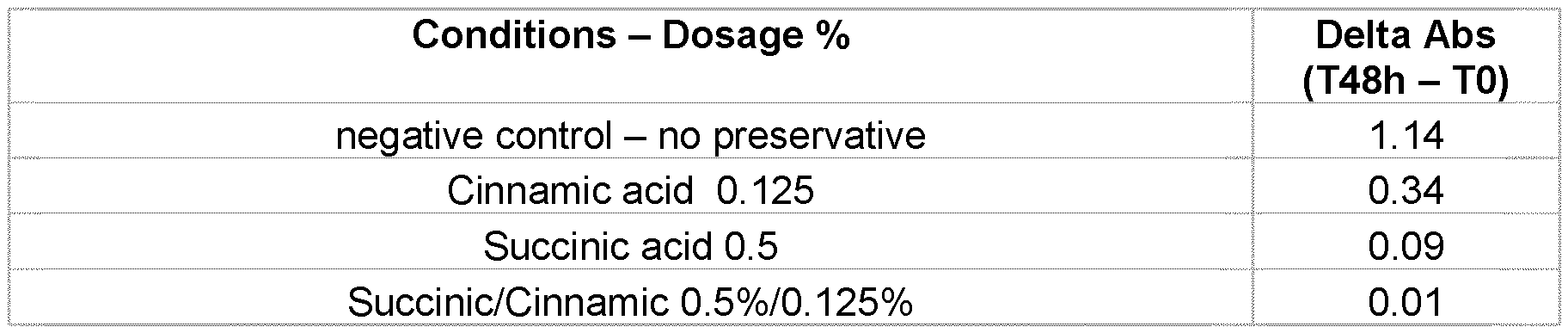
  • Synergy 3 OA Synergy Cinnamic acid & succinic acid & lemon against lactic acid bacteria in vitro
  • Synergy 3 OA Synergy Cinnamic acid & succinic acid & lemon against pool of meat analogue spoilers in vitro
  • tartaric acid, succinic acid, cinnamic acid and lemon extract When tartaric acid, succinic acid, cinnamic acid and lemon extract are applied alone, at 0.0652%, 0.125% and 0.0312% and 0.25% respectively, in a meat analogue broth, they inhibit partially the growth of a pool of lactic acid bacteria. Surprisingly, when tartaric acid, succinic acid, cinnamic acid and lemon extract are applied in combination, at the same above dosages, the growth of a pool of lactic acid bacteria is completely inhibited.
  • Non inoculated matrices (endogenous contaminations) stored in anaerobiosis at 8°C - Count on PCA agar.
  • tartaric acid, succinic acid, cinnamic acid and lemon extract are applied in combination at 0.05%, 0.25%, 0.0625% and 0.5% respectively, in a meat analogue matrix, they inhibit the growth of endogenous contaminants of the matrix.
  • Aspergillus niger is inhibited.
  • tartaric acid, succinic acid or formic acid When tartaric acid, succinic acid or formic acid are applied alone, at 400ppm, 125ppm and 1000ppm, respectively, in a meat analogue broth they inhibit partially the growth of a pool of meat analogue spoilers. Surprisingly, when tartaric acid, succinic acid and formic acid are applied in combination, at the same dosages, the growth of a pool of meat analogue spoilers is completely inhibited.

Landscapes

  • Life Sciences & Earth Sciences (AREA)
  • Engineering & Computer Science (AREA)
  • Wood Science & Technology (AREA)
  • Zoology (AREA)
  • Chemical & Material Sciences (AREA)
  • Food Science & Technology (AREA)
  • Polymers & Plastics (AREA)
  • Food Preservation Except Freezing, Refrigeration, And Drying (AREA)
  • Agricultural Chemicals And Associated Chemicals (AREA)

Abstract

The present invention relates to antimicrobial compositions that comprise organic acids and to their uses.

Description

COMPOSITIONS AND USES THEREOF
TECHNICAL FIELD OF THE INVENTION
The present invention relates to antimicrobial compositions that comprise organic acids and to their uses.
BACKGROUND OF THE INVENTION
The need to improve food preservation methods is enormous. It is estimated that about one quarter of the word's food supply is lost as a result of microbial spoilage, and food- borne microbial infections represent a constant and serious threat to human health.
Several bacterial species that may contaminate and grow in foodstuffs and crops are pathogenic or produce toxins and cause a range of food-poisoning diseases. Despite substantial improvement in the technology and hygiene, food products may be exposed to spoilage and pathogenic bacteria in the food-handling environment and the number of food poisoning is still increasing in most of the countries.
Food preservation techniques, e.g. heat processing, freezing, ultrasound, irradiation, and modified atmosphere packaging, significantly reduce microbial load but of particular concern is the evidence that processed foods are being contaminated with microorganisms following processing and prior to packaging. Of rinsing concern in the food industry is microbial spoilage of various foods such as dairy and meat products, dressings, spreads, margarines and seafood.
There has been extensive research conducted in the field of food safety to develop effective anti-microbial compositions, which function as anti-fungal and anti-bacterial compositions.
SUMMARY OF THE INVENTION
The inventors have discovered that compositions with certain combinations of organic acids leads to a synergistic effect in the antimicrobial activity of the compositions.
Therefore, in a first aspect, the present invention relates to an antimicrobial composition, hereinafter the first antimicrobial composition of the invention, comprising a first component which is tartaric acid or cinnamic and a second component which is selected from the group consisting of citric acid, tartaric acid, succinic acid or cinnamic acid, or combinations thereof. In a second aspect, the present invention relates to an antimicrobial composition, hereinafter the second antimicrobial composition of the invention, comprising a first component which is cinnamic acid and a second component which is selected from the group consisting of citric acid, succinic acid, tartaric acid or combinations thereof.
Another aspect of the present invention relates to an antimicrobial composition comprising a first component which is tartaric acid or cinnamic acid and a second component which is selected from the group consisting of citric acid, succinic acid, tartaric acid, ferulic acid, formic acid, malic acid, levulinic acid, chlorogenic acid or cinnamic acid or combinations thereof.
In a third aspect, the present invention relates to a food composition comprising the antimicrobial composition of the invention (first or second composition of the invention).
In another aspect, the present invention relates to the use of the antimicrobial composition of the invention (first or second composition of the invention) for obtaining a shelf-stable food composition, for decreasing the content of microorganisms in a food composition, for increasing the shelf life of a food composition or for preservation of fresh or cooked food composition.
In another aspect, the present invention relates to a method for obtaining a shelf-stable food composition or for increasing the shelf life of a food composition, and/or for reducing the content of microorganisms of a food composition comprising contacting the food composition with the antimicrobial composition of the invention (first or second composition of the invention).
In another aspect, the present invention relates to a method for reducing the content of microorganisms in an acidic food product, the method comprising contacting the meat product with the antimicrobial composition of the invention.
Hereinafter when we refer to “the antimicrobial composition of the invention” both first and second compositions of the invention are intended.
DETAILED DESCRIPTION OF THE INVENTION
As previously mentioned, the present invention discloses compositions comprising organic acids with antimicrobial effect that present a synergistic antimicrobial effect in comparison with the antimicrobial activity of the individual components of the compositions. Antimicrobial compositions of the invention.
As such a first aspect of the present invention relates to an antimicrobial composition, hereinafter the first antimicrobial composition of the invention, comprising a first component which is tartaric acid and a second component which is selected from the group consisting of citric acid, succinic acid, cinnamic acid or tartaric acid or combinations thereof.
As such, a second aspect of the present invention relates to an antimicrobial composition, hereinafter the second antimicrobial composition of the invention, comprising a first component which is cinnamic acid and a second component which is selected from the group consisting of citric acid, succinic acid, tartaric acid or citric acid or combinations thereof.
Another aspect of the present invention relates to an antimicrobial composition comprising a first component which is tartaric acid or cinnamic acid and a second component which is selected from the group consisting of citric acid, succinic acid, tartaric acid, ferulic acid, formic acid, malic acid, levulinic acid, chlorogenic acid or cinnamic acid or combinations thereof.
In a preferred embodiment of the present invention, in the antimicrobial composition the second component is different than the first component. As an example, if the first component comprises tartaric acid, the second component does not comprise tartaric acid. Similarly, if the first component comprises cinnamic acid, the second component does not comprise cinnamic acid. In another preferred embodiment, the organic acids present in the antimicrobial composition are different from one another.
In certain preferred embodiments, the antimicrobial composition of the invention is a synergistic antimicrobial composition.
Thus, the present invention relates to a synergistic antimicrobial composition, comprising a first component which is cinnamic acid and a second component which is selected from the group consisting of citric acid, succinic acid, tartaric acid, or citric acid or combinations thereof.
Thus, the present invention relates to a synergistic antimicrobial composition, comprising a first component which is tartaric acid and a second component which is selected from the group consisting of citric acid, succinic acid, cinnamic acid or citric acid or combinations thereof. The term “antimicrobial” as used herein refers to any compound capable of inhibiting the growth or propagation of microorganisms, and/or killing microorganisms; antimicrobial compounds include bactericides, bacteriostats, bacteriostatics, bacteriostatins, fungicides, fungistats, algaecides and algistats, depending on the dose level applied, system conditions and the level of microbial control desired.
The term “organic acids” as used herein refers to an organic compound with acidic properties. The most common organic acids are the carboxylic acids, whose acidity is associated with their carboxyl group -COOH. Sulfonic acids, containing the group - SO2OH, are relatively stronger acids. Alcohols, with -OH, can act as acids but they are usually very weak. The relative stability of the conjugate base of the acid determines its acidity. Other groups can [also] confer acidity, usually weakly: the thiol group -SH, the enol group, and the phenol group. In biological systems, organic compounds containing these groups are generally referred to as organic acids. Examples of organic acids, without limitation are, lactic acid, acetic acid, formic acid, citric acid, oxalic acid, uric acid, malic acid, propionic acid and tartaric acid.
As used herein, the term "synergistic" or "synergy" refers to a result that is more than merely additive.
Several synergistic examples are provided in the present document.
For example:
Compound A at dosage a% -> partial bacteria growth observed
Compound B at dosage b% -> growth bacteria observed
Compound C at dosage c% -> partial bacteria growth observed
Blend of compound A at dosage a% + compound B at dosage b% + compound C at c% -> no bacteria growth observed.
Or for example:
Compound A at dosage a% -> mould growth observed
Compound B at dosage b% -> mould growth observed
Blend of compound A at dosage a% + compound B at dosage b% -> no mould growth observed.
Also, the synergistic effect may be an effect on a broader spectrum of microorganisms, for example single compounds may be only active for certain types of microorganism while the combination of those actives results in a broader protection (broader antimicrobial effect on a larger number of microorganisms).
In another aspect, the invention relates to an antimicrobial composition (first composition of the invention) comprising a first component which is tartaric acid and a second component selected from the group consisting of cinnamic acid, succinic acid and citric acid or combinations thereof.
In another particular embodiment, the antimicrobial composition of the invention comprises succinic acid and tartaric acid and are present at a ratio of about 1 :4 to 1 :5.
In another particular embodiment, the antimicrobial composition of the invention comprises tartaric acid and succinic acid and are present at a ratio of about 2:1.
In another particular embodiment, the antimicrobial composition of the invention comprises tartaric acid and citric acid.
In another particular embodiment, the antimicrobial composition of the invention comprises tartaric acid and cinnamic acid.
In another particular embodiment, the antimicrobial composition of the invention comprises tartaric acid, citric acid and succinic acid.
In another particular embodiment, the antimicrobial composition of the invention comprises tartaric acid, succinic acid and cinnamic acid. In a particular embodiment, the tartaric acid, succinic acid and cinnamic acid are present at a ratio of about 1 :0.1 :0.2 to about 1 :1 :2.
In another particular embodiment, the antimicrobial composition of the invention (second composition of the invention) comprises a first component which is cinnamic acid and a second component which is selected from the group consisting of citric acid and succinic acid.
Thus, in a particular embodiment, the antimicrobial composition of the invention comprises cinnamic acid and succinic acid. In another particular embodiment, the succinic acid and the cinnamic acid are present at a ratio of about 2: 1 to 3: 1 or 1 :4.
In another particular embodiment, the antimicrobial composition of the invention comprises cinnamic acid and citric acid. In another particular embodiment, the cinnamic acid and the citric acid (for example obtained from a lemon juice concentrate) are present at a ratio of about 8: 1 . In another particular embodiment, the antimicrobial composition of the invention comprises cinnamic acid and tartaric acid. In a particular embodiment, the tartaric acid and the cinnamic acid and are present at a ratio of about 1 :2 such as 1 :2.5. In another embodiment, the tartaric acid and the cinnamic acid are present at a ratio of about 10:1 to about 10:1 , preferably from about 5:1 to about 1 :5, even more preferably from about 3:1 to about 1 :3.
In another particular embodiment, the antimicrobial composition of the invention comprises tartaric acid and cinnamic acid and further comprises citric acid (for example obtained from a lemon juice concentrate) or succinic acid.
In another particular embodiment, the antimicrobial composition of the invention comprises cinnamic acid, succinic acid and tartaric acid.
In another particular embodiment, the antimicrobial composition of the invention comprises cinnamic acid, tartaric acid and citric acid.
In another particular embodiment, the antimicrobial composition of the invention comprises cinnamic acid, succinic acid and citric acid.
In another particular embodiment, the antimicrobial composition of the invention comprises cinnamic acid, tartaric acid, citric acid and succinic acid.
In another aspect, the invention relates to an antimicrobial composition comprising citric acid and succinic acid.
Tartaric acid is a white, crystalline organic acid that occurs naturally in many fruits, most notably in grapes, but also in bananas, tamarinds, and citrus. Its salt, potassium bitartrate, commonly known as cream of tartar, develops naturally in the process of fermentation. It is commonly mixed with sodium bicarbonate and is sold as baking powder used as a leavening agent in food preparation. The acid itself is added to foods as an antioxidant E334 and to impart its distinctive sour taste. Naturally occurring tartaric acid is a useful raw material in organic chemical synthesis. Tartaric acid, an alpha- hydroxy-carboxylic acid, is diprotic and aldaric in acid characteristics, and is a dihydroxyl derivative of succinic acid. Tartaric acid is defined in the entry of the database CAS Registry with the number 87-69-4 as well as structurally by formula (i).
Figure imgf000008_0001
Formula (i)
In a particular embodiment, the tartaric acid has a natural origin and is obtained from bananas, tamarinds or citrus. In another particular embodiment, the tartaric acid has a synthetic origin.
In a particular embodiment, the tartaric acid is present in the antimicrobial composition from about 0.1% to about 80%, based on the total weight of the antimicrobial composition. In other embodiments the tartaric acid is present in the antimicrobial composition from about 0.1% to about 3%, from about 2% to about 50% or even from about 5% to about 30% or from about 20% to about 40%%, based on the total weight of the antimicrobial composition.
Cinnamic acid is an organic compound with the formula CeHs-CF CH-COOH. It is a white crystalline compound that is slightly soluble in water, and freely soluble in many organic solvents. Classified as an unsaturated carboxylic acid, it occurs naturally in a number of plants. It exists as both a cis and a trans isomer. In a particular embodiment, the cinnamic acid is a cis isomer. In another particular embodiment, the cinnamic acid is a trans isomer. Cinnamic acid is obtained from oil of cinnamon, or from balsams such as storax. It is also found in shea butter. Cinnamic acid is defined in the entry of the database CAS Registry with the number 621-82-9 as well as structurally by formula (ii)
Figure imgf000008_0002
Formula (ii) In a particular embodiment, the cinnamic acid has a natural origin and is obtained from cinnamon or balsams. In another particular embodiment, the cinnamic acid has a synthetic origin.
Succinic acid is a dicarboxylic acid with the chemical formula (CH2)2(CC>2H)2. In living organisms, succinic acid takes the form of an anion, succinate, which has multiple biological roles as a metabolic intermediate being converted into fumarate by the enzyme succinate dehydrogenase in complex 2 of the electron transport chain which is involved in making ATP, and as a signaling molecule reflecting the cellular metabolic state. Succinic acid is defined in the entry of the database CAS Registry with the number 110- 15-6 as well as structurally by formula (iii).
Figure imgf000009_0001
Formula (iii)
In a particular embodiment, the succinic acid has a natural origin. In another particular embodiment, the succinic acid has a synthetic origin.
Citric acid is an organic compound with the chemical formula HOC(CO2H)(CH2CC>2H)2 It is a colorless weak organic acid. It occurs naturally in citrus fruits. In biochemistry, it is an intermediate in the citric acid cycle, which occurs in the metabolism of all aerobic organisms. Citric acid occurs in a variety of fruits and vegetables, most notably citrus fruits. Lemons and limes have particularly high concentrations of the acid; it can constitute as much as 8% of the dry weight of these fruits. Citric acid is defined in the entry of the database CAS Registry with the number 77-92-9 as well as structurally by formula (iv).
Figure imgf000009_0002
Formula (iv)
In a particular embodiment, the citric acid has a natural origin and is obtained from citrus fruits. In another particular embodiment, the citric acid has a synthetic origin.
In a preferred embodiment of the antimicrobial composition of the invention, the citric acid has a natural origin. In a more preferred embodiment, the citric acid is obtained from a lemon juice concentrate. The term “lemon juice concentrate” refers to the concentrate obtained from the lemon, including the whole fruit, and/or skin of the fruit, and/or the pulp of the fruit. To obtain the lemon juice concentrate the fruit (lemon) or the parts may be fresh, frozen or dried. The term as used herein refers to a lemon juice that has been partially dehydrated. It also refers to a reconstituted juice obtained from dried lemon juice.
In a particular embodiment, the lemon juice concentrate contains a water content which is lower than 7 % weight per weight (w/w) and/or wherein the titrable acidity is between 45-60%. The term “titrable acidity” refers to the total acid concentration in a food, which is determined by titration of intrinsic acids with a standard base.
In another particular embodiment, the antimicrobial composition of the invention comprises tartaric acid and cinnamic acid and further comprises citric acid (for example obtained from a lemon juice concentrate) or succinic acid.
In another particular embodiment, the antimicrobial composition of the invention comprises cinnamic acid and citric acid (for example obtained from a lemon juice concentrate) and further comprises succinic acid.
In another particular embodiment, the antimicrobial composition of the invention comprises tartaric acid, citric acid (for example obtained from a lemon juice concentrate), succinic acid and cinnamic acid.
In another aspect, the invention is related to a composition which comprises a succinic acid and a citric acid (such as citric acid obtained from a lemon juice concentrate).
In certain embodiments, succinic acid and a citric acid (such as citric acid obtained from a lemon juice concentrate) and are present at a ratio of about 2:1.
In other embodiments, other acids such as formic acid, ferulic acid, malic acid, levulinic acid and/or chlorogenic acid may also be present in the antimicrobial composition in a suitable amount either individually or in combination with the other organic acids described herein. The other acids such as ferulic acid, maleic acid, levulinic acid and/or chlorogenic acid may be of natural and/or synthetic origin. In another particular embodiment, the antimicrobial composition of the invention comprises cinnamic acid and/or tartaric acid and formic acid.
In another particular embodiment, the antimicrobial composition of the invention comprises tartaric acid, succinic acid and formic acid.
In another particular embodiment, the antimicrobial composition of the invention comprises cinnamic acid, succinic acid and formic acid.
Food composition of the invention
In another aspect, the present invention relates to a food composition, hereinafter the food composition of the invention that comprises the antimicrobial composition of the invention (first or second composition of the invention).
The antimicrobial composition of the invention (first or second composition of the invention) may be present in the food composition at least about 0.05%, at least about 0.1%, preferably at least about 0.5%, preferably at least about 1.0% or even 2%, 3%, 4% or 5%, based on the total weight of the food composition. In another embodiment, the antimicrobial composition of the invention (first or second composition of the invention) may be present in the food composition from about 0.3% to about 5%, preferably from about 0.5% to about 3.5%, based on the total weight of the food composition.
As already mentioned before, when we refer to “the antimicrobial composition of the invention” both first and second compositions of the invention are intended.
The term “food composition” or “foodstuff” as used herein refers to a composition which is suitable for human or animal consumption. The food composition includes, without limitation, eggs, egg-based products, including but not limited to mayonnaise, salad dressings, sauces, ice creams, egg powder, modified egg yolk and products made therefrom; baked goods, including breads, cakes, sweet dough products, laminated doughs, liquid batters, muffins, doughnuts, biscuits, crackers and cookies; confectionery, including chocolate, candies, caramels, halawa, gums, including sugar free and sugar sweetened gums, bubble gum, soft bubble gum, chewing gum and puddings; frozen products including sorbets, preferably frozen dairy products, including ice cream and ice milk; dairy products, including cheese, butter, milk, coffee cream, whipped cream, custard cream, milk drinks and yoghurts; plant based non-dairy products, mousses, whipped vegetable creams, meat products, including processed meat products; edible oils and fats, aerated and non-aerated whipped products, meat analogues, oil-in- water emulsions, water-in-oil emulsions, margarine, shortening and spreads including low fat and very low fat spreads; dressings, mayonnaise, dips, cream based sauces, cream based soups, beverages, syrups, juice-based compounds spice emulsions, sauces, beverages, patisseries, oils, bakery, filling, and edible ink.
The term “beverage” as used herein refers to any potable or edible liquid.
In a preferred embodiment, the food composition of the invention is a meat product, meat analogue product or a fruit juice.
The term “meat product” is used herein with the meaning of those products extracted from poultry, fish, cattle, pork, sheep, etc., both with and without fat, either in the shape of meat cut or shred, ground meat, frozen meat, semi-frozen meat or refrigerated meat, either processed or not processed.
A meat analogue product may refer to foods made from vegetarian ingredients, which approximate certain aesthetic qualities (such as texture, flavour, appearance) or chemical characteristics of specific types of meat. Non-limiting examples of meat analogues include vegetable (veggie) burgers.
The term “fruit juice” is used herein with the meaning of those products obtained from the extraction or pressing of the natural liquid contained in fruits. The fruit juice is extracted from fruits, including the whole fruit, and/or skin of the cranberry fruit, and/or the pulp of the fruit. In a particular embodiment, the fruit is lemon, lime, orange, apple, pineapple, strawberry, acerola, blueberry, banana, grape, peach, pomelo, papaya or mango. In certain embodiments, the fruit juice is a concentrate fruit juice.
In a particular embodiment, the food composition of the invention comprises the antimicrobial composition of the invention which comprises the tartaric acid and the cinnamic acid. In a particular embodiment, the tartaric acid and the cinnamic acid and are present at a ratio of from about 1 :10 to about 10:1 , such as from about 1 :5 to 5.1 such as about 1 :2.
In another particular embodiment, the food composition of the invention comprises the antimicrobial composition of the invention which comprises the succinic acid and the tartaric acid and are present at a ratio of about 1 :4 to 1 :5.
In another particular embodiment, the food composition of the invention comprises the antimicrobial composition of the invention which comprises the tartaric acid and the succinic acid and are present at a ratio of about 2:1 . In another particular embodiment, the food composition of the invention comprises the antimicrobial composition of the invention which comprises the succinic acid and the cinnamic acid and are present at a ratio of about 2:1 to 3:1 or 1 :4.
In another particular embodiment, the food composition of the invention comprises the antimicrobial composition of the invention which comprises the succinic acid and the citric acid obtained from the lemon juice concentrate and are present at a ratio of about 2:1.
In another particular embodiment, the food composition of the invention comprises the antimicrobial composition of the invention which comprises the cinnamic acid and the citric acid (for example obtained from a lemon juice concentrate) and are present at a ratio of about 8:1.
In another particular embodiment, the food composition of the invention comprises the antimicrobial composition of the invention which comprises the tartaric acid and the citric acid (for example obtained from a lemon juice concentrate) and are present at a ratio of about 4:1.
In another particular embodiment, the food composition of the invention comprises the antimicrobial composition of the invention which comprises the tartaric acid, the succinic acid and the cinnamic acid and are present at a ratio of about 2: 1:4 or 1 : 5: 2. In another embodiment, the tartaric acid, succinic acid and cinnamic acid are present at a ratio of about 1 :0.1 :0.2 to about 1 :1 :2 in the food composition.
In another particular embodiment, the food composition of the invention comprises the antimicrobial composition of the invention which comprises the succinic acid, the tartaric acid and the citric acid obtained from the lemon juice concentrate and the cinnamic acid and are present at a ratio of about 2:8:1 .
In another particular embodiment, the food composition of the invention comprises the antimicrobial composition of the invention which comprises the tartaric acid, the cinnamic acid and the citric acid obtained from the lemon juice concentrate and the cinnamic acid and are present at a ratio of about 4:8:1 .
In another particular embodiment, the food composition of the invention comprises the antimicrobial composition of the invention which comprises the succinic acid, the tartaric acid, the cinnamic acid and the citric acid obtained from the lemon juice concentrate and the cinnamic acid and are present at a ratio of about 2:10:8:1 In a particular embodiment, the antimicrobial composition of the invention is added to the food composition of the invention so that each of the tartaric acid, the cinnamic acid, the citric acid and/or the succinic acid from the antimicrobial composition are present in the food composition at concentrations in the range of 0,0001% to 1% (w/w) with respect to the food weight.
In a more particular embodiment, the tartaric acid from the antimicrobial composition of the invention is present in the food composition at a concentration in the range of 0,0001 % to 2% (w/w). In a more particular embodiment, the tartaric acid is at a concentration in the range of 0,001 % to 1 %( w/w). In a more particular embodiment, the tartaric acid is at a concentration in the range of 0,01% to 0,5% (w/w). In a more particular embodiment, the tartaric acid is at a concentration in the range of 0,01 % to 0,25% (w/w).
In a preferred embodiment, the tartaric acid from the antimicrobial composition of the invention is present in the food composition at a concentration of about 0,0125%, 0,05%, 0,125% or 0,25% (w/w).
In another more particular embodiment, the cinnamic acid from the antimicrobial composition of the invention is present in the food composition at a concentration in the range of 0,0001% to 2% (w/w). In a more particular embodiment, the cinnamic acid is at a concentration in the range of 0,001% to 1% (w/w). In a more particular embodiment, the cinnamic acid is at a concentration in the range of 0,01% to 0,5% (w/w). In a more particular embodiment, the cinnamic acid is at a concentration in the range of 0,01% to 0,13% (w/w).
In a preferred embodiment, the cinnamic acid from the antimicrobial composition of the invention is present in the food composition at a concentration of about 0,0625% or 0,125% (w/w).
In another more particular embodiment, the citric acid obtained from the lemon juice concentrate from the antimicrobial composition of the invention is present in the food composition at a concentration in the range of 0,0001 % to 5% (w/w). In a more particular embodiment, the citric acid is at a concentration in the range of 0,01% to 1 ,5% (w/w). In a more particular embodiment, the citric acid is at a concentration in the range of 0,1 % to 1% (w/w). In a more particular embodiment, the citric acid is at a concentration in the range of 0,3% to 1% (w/w).
In a preferred embodiment, the citric acid from the antimicrobial composition of the invention is present in the food composition at a concentration of about 0,5% or 1 % (w/w). In another more particular embodiment, the succinic acid from the antimicrobial composition of the invention is present in the food composition at a concentration in the range of 0,0001 % to 2% (w/w). In a more particular embodiment, the succinic acid is at a concentration in the range of 0,001% to 1% (w/w). In a more particular embodiment, the succinic acid is at a concentration in the range of 0,01% to 0,5% (w/w). In a more particular embodiment, the succinic acid is at a concentration in the range of 0,03% to 0,5% (w/w).
In a preferred embodiment, the succinic acid from the antimicrobial composition of the invention is present in the food composition at a concentration of about 0,01625%, 0,05%, 0,25% or 0,5% (w/w).
In a particular embodiment, the food composition of the invention comprises the antimicrobial composition of the invention which comprises tartaric acid and cinnamic acid. In a more particular embodiment of the food composition of the invention, the tartaric acid from the antimicrobial composition of the invention composition is present in the food composition at a concentration of about 0,25% or 0,05% (w/w) and the cinnamic acid from the antimicrobial composition is present in the food composition at a concentration of about 0,02% or 0,125% (w/w).
In another particular embodiment, the food composition of the invention comprises the antimicrobial composition of the invention which comprises the tartaric acid and the citric acid obtained from the lemon juice concentrate. In a more particular embodiment of the food composition of the invention, the tartaric acid from the antimicrobial composition is present in the food composition at a concentration of about 0,25% (w/w) and the citric acid obtained from the lemon juice concentrate from the antimicrobial composition is present in the food composition at a concentration of about 1% (w/w).
In another particular embodiment, the food composition of the invention comprises the antimicrobial composition of the invention which comprises the cinnamic acid and the citric acid obtained from the lemon juice concentrate. In a more particular embodiment of the food composition of the invention, the cinnamic acid from the antimicrobial composition is present in the food composition at a concentration of about 0,125% (w/w) and citric acid obtained from the lemon juice concentrate from the antimicrobial composition is present in the food composition at a concentration of about 1% (w/w).
In another particular embodiment, the food composition of the invention comprises the antimicrobial composition of the invention which comprises the cinnamic acid and the succinic acid. In a more particular embodiment of the food composition of the invention, the cinnamic acid from the antimicrobial composition is present in the food composition at a concentration of about 0,125% (w/w) and the succinic acid from the antimicrobial composition is present in the food composition at a concentration of about 0,5% (w/w).
In another particular embodiment, the food composition of the invention comprises the antimicrobial composition of the invention which comprises the tartaric acid, the succinic acid and the cinnamic acid. In a more particular embodiment of the food composition of the invention, the tartaric acid from the antimicrobial composition is present in the food composition at a concentration of about 0, 125% or of about 0,25% (w/w), the succinic acid from the antimicrobial composition is present in the food composition at a concentration of about 0,25%, 0,05% or of 0,5% (w/w) and the cinnamic acid from the antimicrobial composition is present in the food composition at a concentration of about 0,0625%, 0,0125%, 0,125% or 0,25 % (w/w).
In another particular embodiment, the food composition of the invention comprises the antimicrobial composition of the invention which comprises the cinnamic acid, the succinic acid, and the citric acid obtained from the lemon juice concentrate. In a more particular embodiment, the cinnamic acid from the antimicrobial composition is present in the food composition at a concentration of about 0,0375%, 0.0625% % (w/w), the succinic acid from the antimicrobial composition is present in the food composition at a concentration of about 0,1625%, 0.25% or of 0,5% (w/w) and the citric acid obtained from the lemon juice concentrate from the antimicrobial composition is present in the food composition at a concentration of about 0,5% or of 0,3125% (w/w).
In another particular embodiment, the food composition of the invention comprises the antimicrobial composition of the invention which comprises the tartaric acid, the cinnamic acid and the citric acid obtained from the lemon juice concentrate. In a more particular embodiment of the food composition of the invention, the tartaric acid from the antimicrobial composition is present in the food composition at a concentration of about 0,125%, the cinnamic acid from the antimicrobial composition is present in the food composition at a concentration of about 0,0625% (w/w) and the citric acid obtained from the lemon juice concentrate from the antimicrobial composition is present in the food composition at a concentration of about 0,5% (w/w).
In another particular embodiment, the food composition of the invention comprises the antimicrobial composition of the invention which comprises the tartaric acid, the cinnamic acid, the citric acid obtained from the lemon juice concentrate and the succinic acid. In a more particular embodiment of the food composition of the invention, the tartaric acid from the antimicrobial composition is present in the food composition at a concentration of about 0,05% (w/w), the cinnamic acid from the antimicrobial composition is present in the food composition at a concentration of about 0,0625%, the citric acid obtained from lemon juice concentrate from the antimicrobial composition is present in the food composition at a concentration of about 0,5% and the succinic acid from the antimicrobial composition is present in the food composition at a concentration of about 0,25%.
The expert will know how to adjust the quantity of the first component and the second component of the antimicrobial composition of the invention in the food composition of the invention. For example, the concentrations of the first component and the second component may vary depending on the food composition.
In a particular embodiment, for plant based food, the food composition of the invention comprises the antimicrobial composition of the invention which comprises succinic acid, tartaric acid and cinnamic acid. In a preferred embodiment, succinic and tartaric acids are present at a ratio of about 1 : 10 to 10:1 or 1:5 to 1 :4 by weight. In another preferred embodiment, tartaric and cinnamic acids are present at a ratio of about 2:1. In another preferred embodiment, succinic and cinnamic acids are present at a ratio of about 1 :2 to 1 :3. In certain embodiments, the food product is an acidic food product such as beverages, sauces, meat analogues, plant-based food.
In a more particular embodiment of the food composition of the invention, for plant based food, the succinic acid from the antimicrobial composition is present in the food composition at a concentration between 0,03% and 0,05% (w/w), the tartaric acid from the antimicrobial composition is present in the food composition at a concentration between 0,13% and 0,25% (w/w) and the cinnamic acid from the antimicrobial composition is present in the food composition at a concentration between 0,07% and 0,13% (w/w).
In another particular embodiment, for plant based food, the food composition of the invention comprises the antimicrobial composition of the invention which comprises succinic acid, tartaric acid, cinnamic acid and citric acid obtained from the lemon juice concentrate. In a preferred embodiment, succinic and tartaric acids are present at a ratio of about 5:1 to 4:1 by weight. In another preferred embodiment, tartaric and cinnamic acids are present at a ratio of about 1 : 1. In another preferred embodiment, succinic and cinnamic acids are present at a ratio of about 4:1. In another preferred embodiment, cinnamic and citric acids are present at a ratio of about 10:1 to 7:1. In another preferred embodiment, succinic and citric acids are present at a ratio of about 1 :2. In another preferred embodiment, tartaric and citric acids are present at a ratio of about 1 :10 to 1:8. In a more particular embodiment of the food composition of the invention, for plant based food, the succinic acid from the antimicrobial composition is present in the food composition at a concentration between 0,16% and 0,25% (w/w), the tartaric acid from the antimicrobial composition is present in the food composition at a concentration between 0,04% and 0,05% (w/w), the cinnamic acid from the antimicrobial composition is present in the food composition at a concentration between 0,04% and 0,06% (w/w), and the citric acid obtained from the lemon juice concentrate from the antimicrobial composition is present in the food composition at a concentration between 0,31% and 0,5 % (w/w).
In another particular embodiment, for acidic food products (beverages, sauces, dressings, fruit preparations, vegetable preparations), the food composition of the invention comprises the antimicrobial composition of the invention which comprises cinnamic acid and tartaric acid. In a preferred embodiment, cinnamic and tartaric acids are present at a ratio of about 1 :10, 1 :20 or 1 :200.
In a more particular embodiment of the food composition of the invention, for acidic food products, the cinnamic acid from the antimicrobial composition is present in the food composition at a concentration between 0,0005% and 1% (w/w), and the tartaric acid from the antimicrobial composition is present in the food composition at a concentration between 0,001% and 1% (w/w).
In another particular embodiment of the food composition of the invention, for syrups and concentrates for beverages, the cinnamic acid from the antimicrobial composition is present in the food composition at a concentration of 0,02% or 0,0005% (w/w) and the tartaric acid from the antimicrobial composition is present in the food composition at a concentration of 0,05% or 0,1% (w/w).
In another particular embodiment of the food composition of the invention, for sauces, like mayonnaise), the cinnamic acid from the antimicrobial composition is present in the food composition at a concentration of 0,02% (w/w) and the tartaric acid from the antimicrobial composition is present in the food composition at a concentration of 0,2% (w/w).
In another particular embodiment, the food composition of the invention, in addition to the antimicrobial composition of the invention, also comprise other additives, like herbs; spices; flavouring agents; colouring agents; emulsifiers (like fatty acid monoglycerides) or antioxidants. In another aspect, the present invention relates to a nutraceutical or dietary supplement comprising the antimicrobial composition of the invention and a food or dietary acceptable adjuvant.
All previous embodiments and definitions described in relation with the previous aspects are equally valid for the current aspect and its embodiments.
The term “nutraceutical” as used herein refers to substances useful in both nutritional and pharmaceutical fields of application. Thus, nutraceutical compositions can be used as supplements to food and beverages and as pharmaceutical formulations for enteral or parenteral application which may be solid formulations, such as capsules or tablets, or liquid formulations, such as solutions or suspensions.
The expression “food or dietary acceptable adjuvant” as used herein refers to any food material that can be used together with the main foodstuff material in order to enhance, preserve, and improve the characteristics of the foodstuff main material. Adjuvants can also serve as fillers, diluents, viscosity regulators, etc.
Uses of the invention
In another aspect, the present invention relates to the use of the composition of the invention (first or second composition of the invention) for obtaining a shelf-stable food composition, for decreasing the content of microorganisms in a food composition, for increasing the shelf life of a food composition or for preservation of fresh or cooked food composition.
The term “food composition” or "foodstuff1 as used herein is intended to mean a substance which is suitable for human or animal consumption. In addition, the term foodstuff as used herein also is meant to include food materials which are used in the preparation of a foodstuff. As used herein the tern foodstuff includes, without limitation, eggs, egg-based products, including but not limited to mayonnaise, salad dressings, sauces, ice creams, egg powder, modified egg yolk and products made therefrom; baked goods, including breads, cakes, sweet dough products, laminated doughs, liquid batters, muffins, doughnuts, biscuits, crackers and cookies; confectionery, including chocolate, candies, caramels, halawa, gums, including sugar free and sugar sweetened gums, bubble gum, soft bubble gum, chewing gum and puddings; frozen products including sorbets, preferably frozen dairy products, including ice cream and ice milk; dairy products, including cheese, butter, milk, coffee cream, whipped cream, custard cream, milk drinks and yoghurts; mousses, whipped vegetable creams, meat products, including processed meat products; edible oils and fats, aerated and non-aerated whipped products, oil-in- water emulsions, water-in-oil emulsions, margarine, shortening and spreads including low fat and very low fat spreads; dressings, mayonnaise, dips, cream based sauces, cream based soups, beverages, syrups, spice emulsions, sauces, beverages, patisseries, oils, bakery, filling and edible ink.
In a preferred embodiment, the foodstuff is a product selected from a group consisting of: eggs, mayonnaise, salad dressings, sauces, ice creams, egg powder, modified egg yolk, breads, cakes, sweet dough products, laminated doughs, liquid batters, muffins, doughnuts, biscuits, crackers, cookies, chocolate, candies, caramels, halawa, gums, bubble gum, soft bubble gum, chewing gum, puddings, sorbets, ice cream, ice milk, cheese, butter, milk, coffee cream, whipped cream, custard cream, milk drinks, yoghurts, mousses, whipped vegetable creams, meat, processed meat products, meat analogues, oils, edible oils, fats, oil-in-water emulsions, water-in-oil emulsions, margarine, mayonnaise, dips, cream based sauces, cream based soups, beverages, syrups, spice emulsions, sauces, patisseries, dairy products, oils, bakery, filling and edible ink.
In a particular embodiment, the foodstuff is a meat product, a meat analogue or a fruit juice.
The term “preservation” refers to processes that make food more resistant to microorganism growth and slow the oxidation of fats. This slows down the decomposition and rancidification process.
As an expert may know the content of the antimicrobial composition of the invention for the manufacture of the foodstuffs will be dependent on the type of foodstuff as well as the intended use of such product.
Methods of the invention
In another aspect, the present invention relates to a method for obtaining a shelf-stable food composition, for decreasing the content of microorganisms or for increasing the shelf life of a food composition comprising contacting the foodstuff with the antimicrobial composition of the invention (first or second composition of the invention).
All previous embodiments and definitions described in relation with the previous aspects are equally valid for the current aspect and its embodiments.
In a particular embodiment, the foodstuff is a meat product, a meat analogue or a fruit juice.
In a more particular embodiment the tartaric acid from the antimicrobial composition of the invention composition is present in the food composition at a concentration of about 0.25% or 0.05% (w/w) and the cinnamic acid from the antimicrobial composition is present in the food composition at a concentration of about 0.02% or 0.125% (w/w) for obtaining a shelf-stable food composition, for decreasing the content of microorganisms or for increasing the shelf life of said food composition.
The food product, may have an acidic pH, a neutral or a basic pH.
In another aspect, the present invention relates to a method for reducing the content of microorganisms in a meat product or in an acidic food product, wherein the method comprising contacting the meat product with the antimicrobial composition of the invention.
In another aspect, the present invention relates to a method for reducing the content of microorganisms in a neutral or basic food product, wherein the method comprising contacting the meat product with the antimicrobial composition of the invention.
The term acidic food product refers to those products that have a pH lower than 4.5, such as beverages, concentrates and syrups for beverages, fruit preparations, vegetable preparations, sauces, dressings, canned pet food.
The term neutral or basic food product refers to those products that have a pH higher than 4.5 such as meat, meat analogues, non-fermented dairy, dairy alternatives, bakery, soups, vegetable soups, etc.
The term “microorganism” refers to any non-cellular or unicellular (including colonial) organism. Microorganisms include all prokaryotes. Microorganisms include bacterial spores, mycobacteria, protozoa, non-enveloped viruses, fungal spores, vegetative fungi, yeast, vegetative bacteria (including cyanobacteria), enveloped viruses, and other virus (e.g. virinos, viroids, phages), and algae (including lichens). The term is used interchangeably herein with "microbe."
In certain embodiments, the microorganisms may be spoilage microorganism (food spoilage microorganisms).
The term “spoilage microorganism” as used herein refers to any organism or agent that can produce that food can become unsuitable for human consumption due to the outgrowth of said microorganisms. These spoilage microorganisms are associated with impairment of food quality attributes, such as taste, texture, color, and nutritional value. The food spoilage can be related to quality parameters or safety issues. The majority of spoilage microorganisms present no particular food safety hazard while others can be pathogenic and/or produce toxins. In a particular embodiment, the spoilage microorganism is a filamentous fungi, a yeast or a bacteria.
The term “pathogen” as used herein refers to any organism or agent that can produce disease. A pathogen may also be referred to as an infectious agent, or simply a germ. Foodborne pathogens, or pathogens that can be present in a foodstuff, are organisms or agents that contaminate food during production and processing, but also during storage and transport before consuming. During their growth these microorganisms can secrete different components, including toxins, into the extracellular environment. Other harmful substances can be also liberated and can contaminate food after disintegration of food pathogens. Some bacterial and fungal toxins can be resistant to inactivation, and can survive harsh treatment during food processing.
In a particular embodiment, these agents are bacteria and fungi, some viruses, prions and protozoa. In a more particular embodiment, the pathogen is a filamentous fungi, a yeast or a bacteria.
Another advantage of the present solutions is that the inventive compositions of the invention have an antimicrobial action on complex groups mixtures of microorganism, or spoilage microorganism comprising one or more fungi, one or more yeast and one or more bacterial. This provides antimicrobial solutions against large spectrum of microorganisms.
The term “reducing the content of microorganisms” refers to a reduction of at least 0.5 Log CFU of microorganisms/g or ml of product or alternatively a reduction of at least 50% of the load of microorganisms.
As an expert may know the content of the antimicrobial composition of the invention for the manufacture of the foodstuffs will be dependent on the type of foodstuff as well as the intended use of such product. Thus in another embodiment, the invention relates to a food composition comprising an effective amount of an antimicrobial composition of the invention.
“Effective amount" is the amount necessary in order to achieve a specific effect, in accordance with what one of ordinary skill in the art would be readily able to determine through routine experimentation. For example, with regard to the present disclosure, an effective amount of an antimicrobial composition of the invention to be applied to a food product or foodstuff, e.g. meat, fish and poultry (both fresh/unprocessed and processed), meat analogues or plant based products (such as non-dairy products), or beverage (such as syrups) etc, to obtain a shelf-stable food composition preparation and/or for increasing the shelf life of a food composition, is an amount which is determined to reduce the content of microorganisms, and include known parameters which include, but are not limited to, the concentration of the components of the antimicrobial composition of the invention, the volume and/or surface area of the food composition (e.g. meat, fish and poultry (both fresh/unprocessed and processed), meat analogues or plant based products (such as non-dairy products), or beverage (such as syrups) etc,) and the atmospheric environment conditions of said food composition.
For example, In certain embodiments, the product (such as food or beverage) obtained by the above mentioned method(s) comprising a food product (such as food or beverage) and an antimicrobial composition of the invention has from about 12ppm, 15ppm, 20 ppm, 30, 40, 50, 60, 70, 80, 90, 100 ppm, to about 6%, 5%, 4%, 4%, 3%, 2%, 1 % (or 10000ppm), 9000ppm, 8000ppm, 7000ppm, 6000ppm, 5000ppm, 4000ppm, 3000ppm, 2000ppm, 1000ppm, 800ppm, 600ppm, 500ppm, 400ppm, 300ppm to 200ppm w/w, such as from 50ppm to 1000ppm, such as from 650 to 1300ppm, such as from 390 to 600 of cinnamic acid in the final product.
For example, In certain embodiments, the product (such as food or beverage) obtained by the above mentioned method(s) comprising a food product (such as food or beverage) and an antimicrobial composition of the invention has from about 12ppm, 15ppm, 20 ppm, 30, 40, 50, 60, 70, 80, 90, 100 ppm, to about 6%, 5%, 4%, 4%, 3%, 2%, 1 % (or 10000ppm), 9000ppm, 8000ppm, 7000ppm, 6000ppm, 5000ppm, 4000ppm, 3000ppm, 2000ppm, 1000ppm, 800ppm, 600ppm, 500ppm, 400ppm, 300ppm to 200ppm w/w, such as from 50ppm to 1000ppm, such as 1250 to 2500 ppm and from 325 to 500ppm of tartaric acid in the final product. In certain embodiments, the product (such as food or beverage) obtained by the above mentioned method(s) comprising a food product (such as food or beverage) and an antimicrobial composition of the invention has less than 400 ppm of tartaric acid. In other embodiments, the tartaric acid may be present from about 50 ppm to about 400 ppm, from about 100 ppm to about 400 ppm, from about 100 ppm to about 300 ppm.
For example, In certain embodiments, the product (such as food or beverage) obtained by the above mentioned method(s) comprising a food product (such as food or beverage) and an antimicrobial composition of the invention has from about 12ppm, 15ppm, 20 ppm, 30, 40, 50, 60, 70, 80, 90, 100 ppm, to about 6%, 5%, 4%, 4%, 3%, 2%, 1 % (or 10000ppm), 9000ppm, 8000ppm, 7000ppm, 6000ppm, 5000ppm, 4000ppm, 3000ppm, 2000ppm, 1000ppm, 800ppm, 600ppm, 500ppm, 400ppm, 300ppm to 200ppm w/w, such as from 50ppm to 1000ppm, such as from 250 to 500ppm, such as from 1500 to 2500ppm and of succinic acid in the final product.
For example, In certain embodiments, the product (such as food or beverage) obtained by the above mentioned method(s) comprising a food product (such as food or beverage) and an antimicrobial composition of the invention has from about 12ppm, 15ppm, 20 ppm, 30, 40, 50, 60, 70, 80, 90, 100 ppm, to about 6%, 5%, 4%, 4%, 3%, 2%, 1 % (or 10000ppm), 9000ppm, 8000ppm, 7000ppm, 6000ppm, 5000ppm, 4000ppm, 3000ppm, 2000ppm, 1000ppm, 800ppm, 600ppm, 500ppm, 400ppm, 300ppm to 200ppm w/w, such as from 50ppm to 1000ppm, such as from about of 1500 to 2000 ppm of citric acid in the final product.
In a particular embodiment, the microorganisms are filamentous fungi, a yeast or a bacteria.
In certain preferred embodiments, the antimicrobial composition of the invention is effective against a mould or a filamentous fungus.
Thus, in certain embodiments, the present invention relates to a method for obtaining a shelf-stable food composition or for increasing the shelf life of a food composition, and/or for reducing the content of a filamentous fungi or a mould of a food composition comprising contacting the food composition with the antimicrobial composition of the invention.
A fungus is any member of the group of eukaryotic organisms that includes microorganisms such as yeasts and molds, as well as the more familiar mushrooms. In a particular embodiment, the filamentous fungi is a species from a genus selected from the group consisting of the Penicillium genus, the Aspergillus genus, the Byssochlamys genus, the Rhizopus genus, the Thalaromyces genus, the Cladosporium genus, the Cephalosporium genus, the Emericellopsis genus, the Pleurotus genus, the Tolepocladium genus, the Trichoderma genus, the Fusarium genus, the Claviceps genus, the Aureobasidium genus and the Giberella genus.
In a more particular embodiment, the filamentous fungi from the Penicillium genus is P. digitalis, P. glabrum, P. crysogenum, P. corylophylum or P. albicans or wherein the filamentous fungi from the Aspergillus genus is A. oryzae, A. flavus, A. glabrum or A. fumigatus.
In certain embodiments, the mould or fungi inhibited is Aspergillus niger, Penicillium chrysogenum and/or Talaromyces flavus. In certain embodiments, the antimicrobial composition of the invention is effective against yeast.
Yeasts are eukaryotic, single-celled microorganisms classified as members of the fungus kingdom. In a particular embodiment, the yeast is a species from a genus selected from the group Schizosaccharomyces, Candida, Hanseniaspora, Nadsonia, Saccharomycodes, Wickerhamia, Lipomyces, Ambrosiozyma, Pachysolen, Arthroascus, Pachytichospora, Citeromyces, Pichia, Clavispora, Saccharomyces, Cyniclomyces, Saccharomycopsis, Kluyveromyces, Debaryomyces, Schwanniomyces, Dekkera, Sporopachydermia, Guilliermondella, Stephanoascus, Hansenula, Torulaspora, Issatchenkia, Wickerhamiella, Yarrowia, Lodderomyces, Wingea and Zygosaccharomyces genus.
Thus, in certain embodiments, the present invention relates to a method for obtaining a shelf-stable food composition or for increasing the shelf life of a food composition, and/or for reducing the content of yeast of a food composition comprising contacting the food composition with the antimicrobial composition of the invention. In certain embodiments, the yeast reduced or inhibited is one or more of a yeast from a genus selected from the group Schizosaccharomyces, Candida, Hanseniaspora, Nadsonia, Saccharomycodes, Wickerhamia, Lipomyces, Ambrosiozyma, Pachysolen, Arthroascus, Pachytichospora, Citeromyces, Pichia, Clavispora, Saccharomyces, Cyniclomyces, Saccharomycopsis, Kluyveromyces, Debaryomyces, Schwanniomyces, Dekkera, Sporopachydermia, Guilliermondella, Stephanoascus, Hansenula, Torulaspora, Issatchenkia, Wickerhamiella, Yarrowia, Lodderomyces, Wingea and Zygosaccharomyces genus.
In certain embodiments, the yeast is Zygosaccharomyces rouxii, Zygosaccharomyces bailli, Candida albicans, Saccharomyces cerevisiae.
In certain embodiments, the food is an acidic food composition.
Bacteria constitute a large domain of prokaryotic microorganisms. In a particular embodiment, the bacteria is a lactic acid bacteria, Enterobacteriaceae, Pseudomonas, Bacillus, Streptococcus, Staphylococcus, Clostridium. Lactobacillales are an order of gram-positive, low-GC, acid-tolerant, generally nonsporulating, nonrespiring, either rodshaped (bacilli) or spherical (cocci) bacteria that share common metabolic and physiological characteristics. These bacteria, usually found in decomposing plants and milk products, produce lactic acid as the major metabolic end product of carbohydrate fermentation, giving them the common name lactic acid bacteria (LAB). In certain preferred embodiments, the antimicrobial composition of the invention is effective against lactic acid bacteria.
Thus, in certain embodiments, the present invention relates to a method for obtaining a shelf-stable food composition or for increasing the shelf life of a food composition, and/or for reducing the content of lactic acid bacteria of a food composition comprising contacting the food composition with the antimicrobial composition of the invention. In certain embodiments, the food is an acidic food composition.
In a more particular embodiment, the lactic acid bacteria is a species from the genus Lactobacillus, Leuconostoc, Lactococcus or Pediococcus. In a still more particular embodiment, the lactic acid bacteria is Leuconostoc mesenteroides, Leuconostoc gelidum, Lactiplantibacillus paraplantarum, Lactiplantibacillus plantarum, Lacticaseibacillus paracasei, Lactobacillus casei, Lactobacillus delbrueecki, Lactobacillus fuchuensis, Lactobacillus curvatus, Levilactobacillus brevis, Latilactobacillus sakei, Pediococcus acidilactici or Lactobacillus buchneri.
In certain preferred embodiments, the antimicrobial composition of the invention is effective against acetic acid bacteria.
Thus, in certain embodiments, the present invention relates to a method for obtaining a shelf-stable food composition or for increasing the shelf life of a food composition, and/or for reducing the content of acetic acid bacteria of a food composition comprising contacting the food composition with the antimicrobial composition of the invention.
In a particular embodiment of the methods of the invention, the antimicrobial composition is contacted with the food product under conditions leading to the food composition of the invention.
KITS
The present invention also relates to a kit comprising the different elements of an antimicrobial composition of the invention described herein. In certain embodiments, the kit comprises the elements already mixed and ready to use (for example as a blend) and optionally instructions of how to use said ingredients.
In certain embodiments, the kit comprises the different elements separately and optionally instructions of how to use said ingredients. For example, the kit may comprise one or more of cinnamic acid, tartaric acid, succinic acid, and citric acid.
For example, the kit may comprise, but not limited to: a cinnamic acid and tartaric acid, a cinnamic acid and succinic acid, a cinnamic acid and citric acid a tartaric acid and succinic acid, a tartaric acid and citric acid, a succinic acid citric acid, a cinnamic acid, tartaric acid and succinic acid, a cinnamic acid, citric acid and succinic acid, a cinnamic acid, tartaric acid, succinic acid and citric acid.
In certain embodiments, the kit comprises the different elements separately and optionally instructions of how to use said ingredients.
In certain embodiments, the kit comprises the different elements as a blend and optionally instructions of how to use said ingredients.
For the avoidance of doubt, preferences, options, particular features and the like indicated for a given aspect, feature or parameter of the invention should, unless the context indicates other-wise, be regarded as having been disclosed in combination with any and all other preferences, options particular features and the like as indicated for the same or other aspects, features and parameters of the invention.
When we use the term "comprising" or "comprises" we mean that the composition being described must contain the listed ingredient(s) only but may optionally contain additional ingredients. When we use the term "consisting essentially of" or "consists essentially of" we mean that the extract or composition being described must contain the listed ingredient(s) and may also contain small (for example up to 5% by weight, or up to 1 % or 0.1 % by weight) of other ingredients provided that any additional ingredients do not affect the essential properties of the extract or composition. When we use the term "consisting of" or "consists of we mean that the extract or composition being described must contain the listed ingredient(s) only. The term "about" as used herein, e.g. when referring to a measurable value (such as an amount or weight of a particular component in the reaction mixture), refers to variations of ±20%, ±10%, ±5%, ±1 %, ±0.5%, or, particularly, ±0.1 % of the specified amount.
The invention will be described by way of the following examples which are to be considered as merely illustrative and not limitative of the scope of the invention. EXAMPLES
Materials and methods
Yeast Extract Glucose Chloramphenicol broth medium (YGC) [composition in g/litre: Yeast extract 5.0; D(+)glucose 20.0; chloramphenicol 0.1], pH adjusted to 3.2 with orthophosphoric acid 1M.
Yeast Extract Glucose Chloramphenicol agar medium (YGC) [composition in g/litre: Yeast extract 5.0; D(+)glucose 20.0; chloramphenicol 0.1 ; agar-agar 14.9],
Buffer solution [KH2PO4 3 g; Na2HPO4 6 g; Tween 80 0.10 ml; distilled H20 to 1 litre].
Organic acids (cinnamic, tartaric, malic, succinic) were used in their powder form, 100 % pure.
Orange-citrus concentrate for juices
Tropical concentrate for juices
Ortho-phosphoric acid (H3PO4, 85%; Merk) was used for pH correction.
Sodium chloride (NaCI, Merk) solution 0.9% in deionized sterile water was used for dilutions of culture of microorganisms.
The microorganisms used in the in vitro and callenge tests are from DSMZ collection (Deutsche Sammlung von Mikroorganismen und Zellkulturen) or from private collection of spoilage microorganisms.
Challenge tests against moulds
Spores of moulds were harvested from 14-day-old cultures incubated at 30 °C on Yeast Extract Glucose Chloramphenicol Agar medium (YGC) by flooding the agar plates with buffer solution and harvesting the spores using sterile rake shaped spreaders. Spore suspensions were filtered through a column of glass wool to remove hyphal fragments and then kept at 6°C until use. Counting was done using a Neubauer chamber. Viability assays were done using YGC agar medium.
The application matrices were inoculated in the surface with 2 - 3 Log of spores I ml and incubated at 25°C for at least, 7 days.
In vitro tests were performed in YGC medium, pH adjusted to 3.5 with ortho-phosphoric acid. Each microplate well received 200pl of different conditions. The YGC medium without preservative or test compounds was used as negative control. Tests were done in duplicate. Fruit syrups, mainly grenadine syrup were used as application matrix.
Tests in syrups were performed in sterile tubes containing 5 ml of the application matrix, in duplicate.
The efficacy or not of the test compounds was determined through visual detection of the germination of the spores: (+) means no activity against mould as evidenced by mycelium growth, (-) means inhibitory activity against mould as evidenced by absence of mycelium.
Challenge tests against yeasts
Yeasts strains were incubated, separately, at 30 °C in Yeast Extract Glucose Chloramphenicol broth medium (YGC). After the culture period, counting of colony forming units (CFU) were done on YGC agar medium. Dilutions with NaCI 0.9% were made to obtain an inoculation rate of 2 - 3 Log CFU I ml of the application matrices.
In vitro tests were performed in duplicate, as for moulds, but incubated at 25°C in a microplate reader under orbicular agitation (150rpm) every 5 minutes and absorbance recording at 600nm until the stationary phase was reached. Results are average of the difference between the absorbance at T final and absorbance at TO [Abs Tf - Abs TO], To, greater the difference between these two measurements, greater the growth of the yeast in the given medium.
A- In vitro test
Broth model was made to mimic meat analogue matrices. Composition is close to media growth where level of salt, protein and nutriment were adjusted (table 1).
Table 1. Broth composition
Figure imgf000029_0001
The pH of broth is adjusted to 6 to mimic natural pH of plant-based burger.
For the in vitro test, inoculations were performed either with a meat analogue microbiota collected on spoiled burger analogue (see description below) or a pool of lactic acid bacteria containing collection strains of Lactobacillus buchneri, Lactobacillus plantarum, Lactobacillus sakeii, Lactobacillus curvatus, Pediococcus acidilactici.
The inoculation rate was of 3 Log CFU/ml.
Incubation were performed at 30°C in a microplate reader under partial agitation (150rpm) 5s every 15s
Absorbance reading at 600nm every 2h for 48h, until the stationary phase.
Results presented below are an average of 2 determinations of delta absorbance (Abs T48h - Abs TO).
B- Meat analogue microbiota collected on spoiled burger analogue
Pool of meat analogue spoilers obtained from spoiled burger analogues from the supermarket.
Burger analogues from the supermarket stored under modified atmosphere were collected from local supermarkets a week before the shelf life of the product. Samples were stored at 8°C until experiments.
Fifty grams of burger were aseptically transferred into a sterile stomacher bag, with 50 mL of NaCI 0.9%, containing 1% Tween 80. Samples were then homogenized for 30 seconds in a stomacher. The homogenate was filtered through the bag filter and filtrate were centrifuged at 3 OOOxg 20 min at 4 °C and the bacterial pellet was resuspended into NaCI 0.9%.
All the following steps were performed by an external partner
DNA extraction from the collected bacteria, 0.5 mL of bacterial suspension was used
PCR amplification of rDNA 16S V3-V4 (see primer list Table 2) using PCR mix AccuStartTMII PCR SuperMix (VWR ; Ref.: 733-2242).
Table 2. List of primers used for V3-V4 rDNA 16S amplification
SequencelDNumber="1"
16SV3F341-A
CAAGCAGAAGACGGCATACGAGATGTGACTGGAGTTCAGACGTGTGCTCTTCCGA TCTTAACTCTCGCCTACGGGNGGCWGCAG
SequencelDNumber="2" 16SV3F341-D
CAAGCAGAAGACGGCATACGAGATGTGACTGGAGTTCAGACGTGTGCTCTTCCGA TCTGTCAGTGAGTCCTACGGG NGGCWGCAG
SequencelDNumber="3"
16SV3F341-G
CAAGCAGAAGACGGCATACGAGATGTGACTGGAGTTCAGACGTGTGCTCTTCCGA
TCTCGAGGAGACTACCTACGGGNGGCWGCAG
SequencelDNumber="4"
16SV4R806-1
AATGATACGGCGACCACCGAGATCTACACTCTTTCCCTACACGACGCTCTTCCGA
TCTAATCGTACGGGACTACHVGGGTWTCTAAT
SequencelDNumber="5"
16SV4R806-4
AATGATACGGCGACCACCGAGATCTACACTCTTTCCCTACACGACGCTCTTCCGA TCTTCCTGCGTGTGGACTACHVGGGTWTCTAAT
SequencelDNumber="6"
16SV4R806-7
AATGATACGGCGACCACCGAGATCTACACTCTTTCCCTACACGACGCTCTTCCGA TCTCTAGGATATCTGGACTACHVGGGTWTCTAAT
Library of sequencing set was performed using (MiSeq Reagent Kit v3 (600 cycles) (Illumina ; Ref : MS- 102-3003)) and sequencing was done with MiSeq (Illumina) 2X301 pb equipment.
Bioinformatic analysis was performed using Emu v3.0+ database rrnDB v5.6 and NCBI 16S RefSeq September, 2020 & Qiime2 DADA2 - database GTDB (release 202).
A total of 850 species were identified and the list of relative abundance of 256 OTUs (i.e. species) is shown Annex 1.
C- Description of lemon extract
Lemon extract used in this study was a small granule which has a lemon juice flavor and an acidic taste. It is made with lemon juice and produced by vacuum drying.
1 kg product is made from around 12.4 kg single strength juice at 8°Brix I obtained from around 21.5 kg fresh fruit. Composition is lemon juice, Silicon dioxide E 551 (Anti-caking).
Particle size is 100% through 1.4 mm.
Water content is < 7 % and titrable acidity (citric acid monohydrate) is between 45 - 60 %
Results
Table 3. Synergy 2 OA (Synergy tartaric acid & cinnamic acid) against lactic acid bacteria in vitro
Figure imgf000032_0001
When tartaric acid or cinnamic acid are applied alone, at 0.25% and 0.125% respectively, in a meat analogue broth, they do not inhibit the growth of a pool of lactic acid bacteria. Surprisingly, when Tartaric acid and Cinnamic acid are applied in combination, at the same above dosages, the growth of a pool of lactic acid bacteria is inhibited.
Table 4. Synergy 2 OA (Synergy tartaric acid & lemon) against lactic acid bacteria in vitro
Figure imgf000032_0002
When tartaric acid or lemon extract are applied alone, at 0.25% and 1.0% respectively, in a meat analogue broth, they do not inhibit the growth of a pool of lactic acid bacteria. Surprisingly, when “tartaric acid & lemon” are applied in combination, at the same above dosages, the growth of a pool of lactic acid bacteria is inhibited.
Table 5. Synergy 2 OA (Synergy cinnamic acid & lemon) against lactic acid bacteria in vitro
Figure imgf000033_0001
When cinnamic acid or lemon extract are applied alone, at 0.125% and 1.0% respectively, in a meat analogue broth, they do not inhibit the growth of a pool of lactic acid bacteria. Surprisingly, when “cinnamic acid & lemon” are applied in combination, at the same above dosages, the growth of a pool of lactic acid bacteria is inhibited.
Table 6. Synergy 2 OA (Synergy cinnamic acid & succinic acid) against lactic acid bacteria in vitro
Figure imgf000033_0002
When cinnamic acid or succinic acid are applied alone, at 0.125% and 0.5% respectively, in a meat analogue broth, they partially inhibit the growth of a pool of lactic acid bacteria.
Surprisingly, when “cinnamic acid & succinic acid” are applied in combination, at the same above dosages, the growth of a pool of lactic acid bacteria is totally inhibited.
Table 7. Synergy of 3 OA Tartaric acid 0.125% I Succinic acid 0.25% I Cinnamic acid
0.0625% against a pool of lactic acid bacteria in vitro
Figure imgf000033_0003
When tartaric acid, succinic acid or cinnamic acid are applied alone, at 0.125%, 0.25% and 0.0625% respectively, in a meat analogue broth, they inhibit partially the growth of a pool of lactic acid bacteria. Surprisingly, when tartaric acid, succinic acid and cinnamic acid are applied in combination, at the same above dosages, the growth of a pool of lactic acid bacteria is completely inhibited.
Table 8. Same results with other dosage tested.
Figure imgf000034_0001
When tartaric acid, succinic acid or cinnamic acid are applied alone, at 0.25%, 0.05% and 0.125% respectively, in a meat analogue broth, they inhibit partially the growth of a pool of lactic acid bacteria. Surprisingly, when Tartaric acid, Succinic acid and Cinnamic acid are applied in combination, at the same above dosages, the growth of a pool of lactic acid bacteria is completely inhibited. Table 9. Efficiency of blend of 3 OA Succinic acid 0.05% I T artaric acid 0.25% I Cinnamic acid 0.125% against a pool of lactic acid bacteria in matrix
Figure imgf000034_0002
When tartaric acid, succinic acid or cinnamic acid are applied in combination at 0.25%, 0.05% and 0.125% respectively, in a meat analogue matrix, they inhibit the growth of a pool of lactic acid bacteria inoculated on the matrix.
Table 10. Efficiency of blend of 3 OA Succinic acid 0.05% I Tartaric acid 0.25% I Cinnamic acid 0.125% against endogenous contaminants of meat analogue in matrix
Figure imgf000034_0003
Non inoculated matrices (endogenous contaminations) stored in anaerobiosis at 8°C - Count on PCA agar.
When tartaric acid, succinic acid or cinnamic acid are applied in combination at 0.25%, 0.05% and 0.125% respectively, in a meat analogue matrix, they inhibit the growth of endogenous contaminants of the matrix.
Table 11. Synergy 3 OA: Synergy Cinnamic acid & succinic acid & lemon against lactic acid bacteria in vitro
Figure imgf000035_0001
When cinnamic acid, succinic acid or lemon extract are applied alone, at 0.0625%, 0.25% and 0. 5% respectively, in a meat analogue broth, they inhibit partially the growth of a pool of lactic acid bacteria. Surprisingly, when Tartaric acid, Succinic acid and Cinnamic acid are applied in combination, at the same above dosages, the growth of a pool of lactic acid bacteria is completely inhibited.
Table 12. Synergy 3 OA: Synergy Cinnamic acid & succinic acid & lemon against pool of meat analogue spoilers in vitro
Figure imgf000035_0002
When cinnamic acid, succinic acid or lemon extract are applied alone, at 0.0625%, 0.25% and 0. 5% respectively, in a meat analogue broth, they inhibit partially the growth of a pool of meat analogue spoilers. Surprisingly, when Tartaric acid, Succinic acid and Cinnamic acid are applied in combination, at the same above dosages, the growth of a pool of meat analogue spoilers is completely inhibited.
Table 13. Synergy 3 OA: Cinnamic acid & tartaric acid & lemon against lactic acid bacteria in vitro
Figure imgf000036_0001
When cinnamic acid, tartaric acid or lemon extract are applied alone, at 0.0625%, 0.125% and 0.5% respectively, in a meat analogue broth, they do not inhibit the growth of a pool of lactic acid bacteria. Surprisingly, when Tartaric acid, Succinic acid and Cinnamic acid are applied in combination, at the same above dosages, the growth of a pool of lactic acid bacteria is inhibited.
Table 14. Synergy of 4 OA (Tartaric acid 0.0652% I Succinic acid 0.1250% /Cinnamic acid 0.0312% / Lemon 0.25%) against a pool of lactic acid bacteria in vitro
Figure imgf000036_0002
When tartaric acid, succinic acid, cinnamic acid and lemon extract are applied alone, at 0.0652%, 0.125% and 0.0312% and 0.25% respectively, in a meat analogue broth, they inhibit partially the growth of a pool of lactic acid bacteria. Surprisingly, when tartaric acid, succinic acid, cinnamic acid and lemon extract are applied in combination, at the same above dosages, the growth of a pool of lactic acid bacteria is completely inhibited.
Table 15. Efficiency of blend of 4 OA Succinic acid 0.25% I Tartaric acid 0.05% I Cinnamic acid 0.0625% / Lemon 0.5% against a pool of lactic acid bacteria in matrix
Figure imgf000037_0002
When tartaric acid, succinic acid, cinnamic acid and lemon extract are applied in combination at 0.05%, 0.25%, 0.0625% and 0.5% respectively, in a meat analogue matrix, they inhibit the growth of a pool of lactic acid bacteria inoculated on the matrix. Table 16. Efficiency of blend of 4 OA Succinic acid 0.25% I Tartaric acid 0.05% I Cinnamic acid 0.0625% I Lemon 0.5% against endogenous contaminants of meat analogue in matrix
Figure imgf000037_0003
Non inoculated matrices (endogenous contaminations) stored in anaerobiosis at 8°C - Count on PCA agar.
When tartaric acid, succinic acid, cinnamic acid and lemon extract are applied in combination at 0.05%, 0.25%, 0.0625% and 0.5% respectively, in a meat analogue matrix, they inhibit the growth of endogenous contaminants of the matrix.
Table 17. Test against yeast Zygosaccharomyces rouxii DSM7525 in vitro
Figure imgf000037_0001
Figure imgf000038_0001
When cinnamic acid or tartaric acid are applied alone, at 0.005 and 0.1% respectively, in the YGC medium, they do not inhibit the growth of Zygosaccharomyces rouxii DSM7525. Surprisingly, when cinnamic acid and tartaric acid are applied in combination, at the same above dosages, the growth of Zygosaccharomyces rouxii DSM7525 is inhibited.
Table 18. Test against mould Aspergillus niger in vitro on day 22
Figure imgf000038_0002
When cinnamic acid or tartaric acid are applied alone, at 0.02 and 0.05% respectively, in YGC medium, they do not inhibit the growth of Aspergillus niger. Surprisingly, when cinnamic acid and tartaric acid are applied in combination, at the same above dosages, the growth of Aspergillus niger is inhibited.
Table 19. Test against pool of moulds (Penicillium chrysogenum + Talaromyces flavus + Aspergillus niger) in application (orange-citrus concentrate for juices) on day 14
Figure imgf000038_0003
When cinnamic acid or tartaric acid are applied alone, at 0.02 and 0.05% respectively, in orange-citrus concentrate for juices, they do not inhibit the growth of the pool of moulds Penicillium chrysogenum + Talaromyces flavus + Aspergillus niger. Surprisingly, when cinnamic acid and tartaric acid are applied in combination, at the same above dosages, the growth of the pool of moulds Penicillium chrysogenum + Talaromyces flavus + Aspergillus niger is inhibited.
Table 20. Test against pool of moulds (Penicillium chrysogenum + Talaromyces flavus + Aspergillus niger) in application (tropical concentrate for juices) on day 14
Figure imgf000039_0001
When cinnamic acid or tartaric acid are applied alone, at 0.02 and 0.05% respectively, in tropical concentrate for juices, they do not inhibit the growth of the pool of moulds Penicillium chrysogenum + Talaromyces flavus + Aspergillus niger. Surprisingly, when cinnamic acid and tartaric acid are applied in combination, at the same above dosages, the growth of the pool of moulds Penicillium chrysogenum + Talaromyces flavus +
Aspergillus niger is inhibited.
Table 21. Synergy 3 OA (tartaric acid, cinnamic acid and formic acid) against pool of meat analogue spoilers in vitro
Figure imgf000039_0002
When tartaric acid, cinnamic acid or formic acid are applied alone, at 400 ppm, 325 ppm and 1000 ppm, respectively, in a meat analogue broth they inhibited partially the growth of a pool of meat analogue spoilers. Surprisingly, when tartaric acid, cinnamic acid and formic acid are applied in combination, at the same dosages, the growth of a pool of meat analogue spoilers is completely inhibited.
Table 22. Synergy 3 OA: (tartaric acid, succinic acid and formic acid against pool of meat analogue spoilers in vitro
Figure imgf000040_0001
When tartaric acid, succinic acid or formic acid are applied alone, at 400ppm, 125ppm and 1000ppm, respectively, in a meat analogue broth they inhibit partially the growth of a pool of meat analogue spoilers. Surprisingly, when tartaric acid, succinic acid and formic acid are applied in combination, at the same dosages, the growth of a pool of meat analogue spoilers is completely inhibited.
Table 23. Synergy 3 OA: (cinnamic acid, succinic acid and formic acid) against pool of meat analogue spoilers in vitro
Figure imgf000040_0002
Figure imgf000041_0001
When cinnamic acid, succinic acid or formic acid are applied alone, at 325ppm, 125ppm and 1000ppm, respectively, in a meat analogue broth they inhibit partially the growth of a pool of meat analogue spoilers. Surprisingly, when cinnamic acid, succinic acid and formic acid are applied in combination, at the same dosages, the growth of a pool of meat analogue spoilers is completely inhibited.

Claims

1. An antimicrobial composition comprising a first component which is tartaric acid or cinnamic acid and a second component which is selected from the group consisting of citric acid, succinic acid, tartaric acid, ferulic acid, formic acid, malic acid, levulinic acid, chlorogenic acid or cinnamic acid or combinations thereof.
2. The antimicrobial composition of claim 1 wherein the second component is different than the first component.
3. The antimicrobial composition of claim 1 or 2 wherein the composition comprises tartaric acid and citric acid and/or cinnamic acid and optionally further comprises succinic acid.
4. The antimicrobial composition of claims 1 to 3, wherein the citric acid is obtained from a lemon juice concentrate.
5. The antimicrobial composition of claim 4, wherein the lemon juice concentrate contains a water content which is lower than 7 % (w/w) and/or wherein the titrable acidity is between 45-60%.
6. A food composition that comprises the antimicrobial composition according to any of claims 1 to 5.
7. The food composition according to claim 6 wherein the antimicrobial composition has been added to the food composition so that each of the tartaric acid, citric acid, cinnamic acid and/or the succinic acid from the antimicrobial composition are present in the food compositions at concentrations in the range of 0.0001 % to 1% (w/w) with respect to the food weight.
8. The food composition according to claim 7 wherein
(i) The cinnamic acid from the antimicrobial composition is present in the food composition at a concentration of about 0,0001 % and 2% (w/w),
(ii) The tartaric acid from the antimicrobial composition is present in the food composition at a concentration between 0,0001 % and 2 % (w/w), (iii) the citric acid from the antimicrobial composition is present in the food composition at a concentration of about 0,0001 % and 5% (w/w) and/or
(iv) the succinic acid from the antimicrobial composition is present in the food composition at a concentration of about 0,0001 % and 2% (w/w).
9. The food composition according to claim 8 wherein
(i) The tartaric acid from the antimicrobial composition is present in the food composition at a concentration of about 0,25% or 0,05% (w/w) and the cinnamic acid from the antimicrobial composition is present in the food composition at a concentration of about 0,02% or 0.125% (w/w),
(ii) The cinnamic acid from the antimicrobial composition is present in the food composition at a concentration of about 0.125% (w/w) and the citric acid from the antimicrobial composition is present in the food composition at a concentration of about 1% (w/w),
(iii) The cinnamic acid from the antimicrobial composition is present in the food composition at a concentration of about 0.125% (w/w) and the succinic acid from the antimicrobial composition is present in the food composition at a concentration of about 0.5% (w/w).
10. The food composition according to claim 8 wherein
(i) the tartaric acid from the antimicrobial composition is present in the food composition at a concentration of about 0.125% or of about 0,25% (w/w), the succinic acid from the antimicrobial composition is present in the food composition at a concentration of about 0.25%, 0,05% or of 0,5% (w/w) and the cinnamic acid from the antimicrobial composition is present in the food composition at a concentration of about 0.0625%, 0,0125%, 0,125% or 0,25 % (w/w),
(ii) the cinnamic acid from the antimicrobial composition is present in the food composition at a concentration of about 0,0375%, 0.0625% % (w/w), the succinic acid from the antimicrobial composition is present in the food composition at a concentration of about 0,1625%, 0.25% or of 0,5% (w/w) and the citric acid from the antimicrobial composition is present in the food composition at a concentration of about 0.5% or of 0,3125% (w/w) or
(iii) the tartaric acid from the antimicrobial composition is present in the food composition at a concentration of about 0.125%, the cinnamic acid from the antimicrobial composition is present in the food composition at a concentration of about 0.0625% (w/w) and the citric acid from the antimicrobial composition is present in the food composition at a concentration of about 0.5% (w/w).
11. The food composition according to claim 8 wherein the tartaric acid from the antimicrobial composition is present in the food composition at a concentration of about 0,05% (w/w), the cinnamic acid from the antimicrobial composition is present in the food composition at a concentration of about 0,0625%, the citric acid from the antimicrobial composition is present in the food composition at a concentration of about 0,5% and the succinic acid from the antimicrobial composition is present in the food composition at a concentration of about 0,25%.
12. The food composition according to claim 11 which is a meat product or a fruit juice.
13. Use of the antimicrobial composition according to any one of claims from 1 to 5 for obtaining a shelf-stable food composition, for decreasing the content of microorganisms in a food composition, for increasing the shelf life of a food composition or for preservation of fresh or cooked food composition.
14. A method for obtaining a shelf-stable food preparation, for increasing the shelf life of a foodstuff and/or for reducing the content of microorganisms of a food composition comprising contacting the food composition with the antimicrobial composition according to any of claims 1 to 5.
15. The method according to claim 14 wherein the food composition is a meat product or a fruit juice.
16. A method for reducing the content of microorganisms in a meat product or in an acidic food product, wherein the method comprising contacting the meat product with the antimicrobial composition according to any of claims 1 to 5.
17. The method according to claims 14 to 16 wherein the microorganisms is a filamentous fungi, a yeast or a bacteria.
18. The method according to claim 17 wherein the filamentous fungi is a species from a genus selected from the group consisting of the Penicillium genus, the Aspergillus genus, the Byssochlamys genus, the Rhizopus genus, the Thalaromyces genus, the Cladosporium genus, the Cephalosporium genus, the Emericellopsis genus, the Pleurotus genus, the Tolepocladium genus, the Trichoderma genus, the Fusarium genus, the Claviceps genus, the Aureobasidium genus and the Giberella genus.
19. The method according to claim 18 wherein the filamentous fungi from the Penicillium genus is P. digitalis, P. glabrum, P. crysogenum, P. corylophylum or P. albicans or wherein the filamentous fungi from the Aspergillus genus is A. oryzae, A. flavus, A. glabrum or A. fumigatus.
20. The method according to claim 17 wherein the yeast is a species from a genus selected from the group Schizosaccharomyces, Candida, Hanseniaspora, Nadsonia, Saccharomycodes, Wickerhamia, Lipomyces, Ambrosiozyma, Pachysolen, Arthroascus, Pachytichospora, Citeromyces, Pichia, Clavispora, Saccharomyces, Cyniclomyces, Saccharomycopsis, Kluyveromyces, Debaryomyces, Schwanniomyces, Dekkera, Sporopachydermia, Guilliermondella, Stephanoascus, Hansenula, Torulaspora, Issatchenkia, Wickerhamiella, Yarrowia, Lodderomyces, Wingea and Zygosaccharomyces genus.
21. The method according to claim 17 wherein the bacteria is a lactic acid bacteria, acetic bacteria, Enterobacteriaceae, Pseudomonas, Bacillus, Streptococcus, Staphylococcus, Clostridium.
22. The method according to claim 21 wherein the lactic acid bacteria is a species from the genus Lactobacillus, Leuconostoc, Lactococcus or Pediococcus.
23. The method according to any of claims 14 to 22 wherein the antimicrobial composition is contacted with the food product under conditions leading to a food stuff as defined in any of claims 8 to 11.
24. An antimicrobial composition comprising a first component which is cinnamic acid and a second component which is selected from the group consisting of citric acid, succinic acid or tartaric acid or combinations thereof.
PCT/EP2024/066448 2023-06-16 2024-06-13 Compositions and uses thereof Ceased WO2024256582A1 (en)

Priority Applications (3)

Application Number Priority Date Filing Date Title
EP24733892.4A EP4727374A1 (en) 2023-06-16 2024-06-13 Compositions and uses thereof
KR1020267001503A KR20260020493A (en) 2023-06-16 2024-06-13 Composition and use thereof
CN202480039467.9A CN121335627A (en) 2023-06-16 2024-06-13 Compositions and their uses

Applications Claiming Priority (4)

Application Number Priority Date Filing Date Title
GB202309023 2023-06-16
EP23179720 2023-06-16
GB2309023.6 2023-06-16
EP23179720.0 2023-06-16

Publications (1)

Publication Number Publication Date
WO2024256582A1 true WO2024256582A1 (en) 2024-12-19

Family

ID=91585593

Family Applications (1)

Application Number Title Priority Date Filing Date
PCT/EP2024/066448 Ceased WO2024256582A1 (en) 2023-06-16 2024-06-13 Compositions and uses thereof

Country Status (4)

Country Link
EP (1) EP4727374A1 (en)
KR (1) KR20260020493A (en)
CN (1) CN121335627A (en)
WO (1) WO2024256582A1 (en)

Citations (3)

* Cited by examiner, † Cited by third party
Publication number Priority date Publication date Assignee Title
JPS57194775A (en) * 1981-05-21 1982-11-30 Asama Kasei Kk Storing and quality improving agent of food
WO2019038681A2 (en) * 2017-08-22 2019-02-28 Benny Antony Natural food preservative formulation
CN112056464A (en) * 2020-10-15 2020-12-11 长沙拜特生物科技研究所有限公司 Compound acidifier for livestock and poultry drinking water and preparation method thereof

Patent Citations (3)

* Cited by examiner, † Cited by third party
Publication number Priority date Publication date Assignee Title
JPS57194775A (en) * 1981-05-21 1982-11-30 Asama Kasei Kk Storing and quality improving agent of food
WO2019038681A2 (en) * 2017-08-22 2019-02-28 Benny Antony Natural food preservative formulation
CN112056464A (en) * 2020-10-15 2020-12-11 长沙拜特生物科技研究所有限公司 Compound acidifier for livestock and poultry drinking water and preparation method thereof

Non-Patent Citations (2)

* Cited by examiner, † Cited by third party
Title
KRISTINA L. PENNISTON ET AL: "Quantitative Assessment of Citric Acid in Lemon Juice, Lime Juice, and Commercially-Available Fruit Juice Products", JOURNAL OF ENDOUROLOGY, vol. 22, no. 3, 1 March 2008 (2008-03-01), US, pages 567 - 570, XP055315096, ISSN: 0892-7790, DOI: 10.1089/end.2007.0304 *
no. 110-15-6

Also Published As

Publication number Publication date
CN121335627A (en) 2026-01-13
EP4727374A1 (en) 2026-04-22
KR20260020493A (en) 2026-02-11

Similar Documents

Publication Publication Date Title
US12070050B2 (en) Organic food preservative compositions
RU2491009C2 (en) Composition
EP3370522B1 (en) Anti-microbial agent comprising xanthohumol and the use thereof in food products
CN103269598A (en) Microbicidal composition
EP3170403A1 (en) Preservative system and use thereof in edible products
Sagdic et al. Microbial ecology of mayonnaise, margarine, and sauces
KR101914611B1 (en) A natural food preservative composition comprising extract of Solanum nigrum L.
WO2024256582A1 (en) Compositions and uses thereof
Kour et al. Hurdle technology: A review
EP3170402A1 (en) Preservative system and use thereof in edible products
EP4727373A1 (en) Compositions and uses thereof
Podgorska-Kryszczuk et al. Yeast as an alternative method for fungal control, in food industries
KR20200073773A (en) Composition comprising fermented egg shell membrane for natural food additives and manufacturing method thereof
Yialee et al. Identification of Yeast Species in Sompuk, a Fermented Vegetable from Vientiane Markets, Lao PDR
Featherstone Control of biodeterioration in food
Pawlowska “Green preservatives”–combating fungi in the food industry by applying antifungal lactic acid bacteria
Singh et al. Food Biopreservatives

Legal Events

Date Code Title Description
121 Ep: the epo has been informed by wipo that ep was designated in this application

Ref document number: 24733892

Country of ref document: EP

Kind code of ref document: A1

ENP Entry into the national phase

Ref document number: 1020267001503

Country of ref document: KR

Free format text: ST27 STATUS EVENT CODE: A-0-1-A10-A15-NAP-PA0105 (AS PROVIDED BY THE NATIONAL OFFICE)

WWE Wipo information: entry into national phase

Ref document number: 1020267001503

Country of ref document: KR

WWE Wipo information: entry into national phase

Ref document number: 2024733892

Country of ref document: EP

NENP Non-entry into the national phase

Ref country code: DE

ENP Entry into the national phase

Ref document number: 2024733892

Country of ref document: EP

Effective date: 20260116

ENP Entry into the national phase

Ref document number: 2024733892

Country of ref document: EP

Effective date: 20260116

ENP Entry into the national phase

Ref document number: 2024733892

Country of ref document: EP

Effective date: 20260116

ENP Entry into the national phase

Ref document number: 2024733892

Country of ref document: EP

Effective date: 20260116

WWP Wipo information: published in national office

Ref document number: 1020267001503

Country of ref document: KR

WWP Wipo information: published in national office

Ref document number: 2024733892

Country of ref document: EP