WO2024256340A1 - Texture targets in scene description - Google Patents
Texture targets in scene description Download PDFInfo
- Publication number
- WO2024256340A1 WO2024256340A1 PCT/EP2024/065958 EP2024065958W WO2024256340A1 WO 2024256340 A1 WO2024256340 A1 WO 2024256340A1 EP 2024065958 W EP2024065958 W EP 2024065958W WO 2024256340 A1 WO2024256340 A1 WO 2024256340A1
- Authority
- WO
- WIPO (PCT)
- Prior art keywords
- texture
- target
- textures
- format
- targets
- Prior art date
- Legal status (The legal status is an assumption and is not a legal conclusion. Google has not performed a legal analysis and makes no representation as to the accuracy of the status listed.)
- Ceased
Links
Classifications
-
- G—PHYSICS
- G06—COMPUTING OR CALCULATING; COUNTING
- G06T—IMAGE DATA PROCESSING OR GENERATION, IN GENERAL
- G06T9/00—Image coding
-
- G—PHYSICS
- G06—COMPUTING OR CALCULATING; COUNTING
- G06T—IMAGE DATA PROCESSING OR GENERATION, IN GENERAL
- G06T15/00—Three-dimensional [3D] image rendering
- G06T15/04—Texture mapping
-
- H—ELECTRICITY
- H04—ELECTRIC COMMUNICATION TECHNIQUE
- H04N—PICTORIAL COMMUNICATION, e.g. TELEVISION
- H04N19/00—Methods or arrangements for coding, decoding, compressing or decompressing digital video signals
- H04N19/50—Methods or arrangements for coding, decoding, compressing or decompressing digital video signals using predictive coding
- H04N19/597—Methods or arrangements for coding, decoding, compressing or decompressing digital video signals using predictive coding specially adapted for multi-view video sequence encoding
Definitions
- the present embodiments generally relate to texture encoding/decoding for 3D scene representations, more particularly, to a format used to represent a texture as a linear combination of texture images in MPEG-I Scene Description.
- Three-dimensional scenes and models may be rendered in real-time to a user.
- Some formats such as the one proposed by Khronos / gITF (Graphics Language Transmission Format) and its extensions defined in MPEG Scene Description format or Apple / USDZ are possible ways to represent a 3D content to be rendered.
- Such formats support 3D model geometry, appearance, scene graph hierarchy, and animation. They are intended to be a streamlined, interoperable format for the delivery of 3D assets, while minimizing file size and runtime processing by applications. It is desirable to improve the representation of texture in such environment to offer more flexibility.
- a method comprises obtaining at least one format, from a description for a 3D scene, used to represent a texture as a linear combination of textures; obtaining, from the description, at least one texture target with an associated target weight; and reconstructing a texture based on the at least one format and the at least one texture target with its associated target weight.
- a method comprises obtaining at least one format, from a description for a 3D scene, used to represent a texture as a linear combination of textures; obtaining, from the description, at least one texture target with an associated target weight; and encoding a texture based on the at least one format and the at least one texture target with its associated target weight.
- One or more embodiments also provide a computer program comprising instructions which when executed by one or more processors cause the one or more processors to perform the method according to any of the embodiments described herein.
- One or more of the present embodiments also provide a computer readable storage medium having stored thereon instructions for processing scene description according to the methods described herein.
- One or more embodiments also provide a computer readable storage medium having stored thereon a scene description generated according to the methods described above.
- One or more embodiments also provide a method and apparatus for transmitting or receiving the scene description generated according to the methods described herein.
- FIG. 1 shows an example architecture of 3D content creation tools and modern graphics processing engine.
- FIG. 2 shows an example of the syntax of a data stream encoding an 3D scene description.
- FIG. 3 shows an example graph of 3D scene description.
- FIG. 4 illustrates the relations between top-level arrays either in a gITF asset or in a MPEG-I Scene Description (SD) into which the present principles may be implemented.
- FIG. 5a, 5b and 5c illustrate various steps of a same animation of textures according to an embodiment.
- FIG. 6 illustrates a texture image used in the above animation of textures according to an embodiment.
- FIG. 7 illustrates an exemplary embodiment of a method for parsing a Textureinfo.
- FIG. 8 illustrates various textures for parametric meshes to which the processing of a texture image according to an embodiment may apply.
- FIG. 1 shows an example architecture of 3D processing engine 130 which may be configured to implement the methods described herein.
- a device according to the architecture of FIG. 1 is linked with other devices via their bus 131 and/or via I/O interface 136.
- Device 130 comprises following elements that are linked together by a data and address bus 131 :
- microprocessor 132 which is, for example, a DSP (or Digital Signal Processor);
- ROM Read Only Memory
- RAM or Random Access Memory
- a power supply (not represented in FIG. 1), e.g., a battery.
- the power supply is external to the device.
- the word “register” used in the specification may correspond to area of small capacity (some bits) or to very large area (e.g., a whole program or large amount of received or decoded data).
- the ROM 133 comprises at least a program and parameters.
- the ROM 133 may store algorithms and instructions to perform techniques in accordance with present principles. When switched on, the CPU 132 uploads the program in the RAM and executes the corresponding instructions.
- the RAM 134 comprises, in a register, the program executed by the CPU 132 and uploaded after switch-on of the device 130, input data in a register, intermediate data in different states of the method in a register, and other variables used for the execution of the method in a register.
- Device 130 is linked, for example via bus 131 to a set of sensors 137 and to a set of rendering devices 138.
- Sensors 137 may be, for example, cameras, microphones, temperature sensors, Inertial Measurement Units, GPS, hygrometry sensors, IR or UV light sensors or wind sensors.
- Rendering devices 138 may be, for example, displays, speakers, vibrators, heat, fan, etc.
- the device 130 is configured to implement a method according to the present principles, and belongs to a set comprising:
- FIG. 2 shows an example of the syntax of a data stream encoding a 3D scene description.
- FIG. 2 also shows an example structure 210 of 3D scene description.
- the structure consists in a container which organizes the stream in independent elements of syntax.
- the structure may comprise a header part 220 which is a set of data common to every syntax element of the stream.
- the header part comprises some of metadata about syntax elements, describing the nature and the role of each of them.
- the structure also comprises a payload comprising an element of syntax 230 and an element of syntax 240.
- Syntax element 230 comprises data representative of the media content items described in the nodes of the scene graph related to scene elements. Images, meshes and other raw data may have been compressed according to a compression method. Alternatively, images, meshes and other raw data may have been directly embedded in scene description data 240 without being compressed. Element of syntax 240 is a part of the payload of the data stream and comprises data encoding the scene description as described according to the present principles.
- FIG. 3 shows an example graph 310 of a 3D scene description.
- the scene graph may comprise a description of real objects, for example ‘plane horizontal surface’ (that can be a table or a road) and a description of 3D objects 312, for example an animation of a car.
- Scene description is organized as an array 310 of nodes.
- a node can be linked to child nodes to form a scene structure 31 1.
- a node can carry a description of a real object (e.g., a semantic description) or a description of a 3D object.
- node 301 describes a camera located in the 3D volume of the scene.
- Node 302 describes a car and comprises an index of a representation of the car, for example an index in an array of 3D meshes.
- Node 303 is a child of node 302 and comprises a description of one wheel of the car. The same way, it comprises an index to the 3D mesh of the wheel.
- the same 3D mesh may be used for several objects in the 3D scene as the scale, location and orientation of objects are described in the scene nodes.
- FIG. 4 illustrates the current solution to represent texture in MPEG-I Scene Description (SD).
- FIG. 4 represents a gITF file structure.
- the entry point is the “scene” node (430) which contains “node” node(s) (435) that can be for instance a “camera” (410) or a “mesh” (440).
- the MPEG-I Scene Description (SD) format allows the storage in gITF files of texture image (498) or a link (498).
- the representation of textures (490) uses images (498) and textures samplers (495) in the gITF file.
- the first one (498) defines images loaded from a file or included in the gITF file (with buffer views (450)).
- the second one (495) points to samplers allowing to define how to use the image data.
- the MPEG-I Scene Description (SD) format allows the definition of sampling and wrapping strategies.
- an extension may apply at the gITF texture level, for instance KHR_texture_transforms, which specifies more complex transforms to apply on a texture image such as rotate or rescale the image.
- materials assets (470) in the gITF file reference textures may be used to define how the texture is used in the rendering, like changing colors, normals, etc.
- Textures combination can be performed before the creation of the gITF file in a so-called “baking” processing. During these preprocessing steps, one computes the combination and only stores the resulting texture in the gITF file. If it allows the transportation and rendering of the final scene, as we lose all the combination process, it no longer allow any further changes in the rendering of the final scene.
- Animation of texture can be also performed with “baking” processing. The texture image for each frame of the animation can be precomputed and then sent alongside the gITF file.
- “baking” processing The texture image for each frame of the animation can be precomputed and then sent alongside the gITF file.
- a weighted sum of images (such as 2D arrays of vectors) is processed.
- the values resulting from the weighted sum are clamped to ensure that they are in a valid color range.
- a range defined as [0,1] the clamping operation turns any negative value to zero and any value higher than one into one. Consequently, the proposed encoding allows the creation of new materials based on the weighted combination of texture images.
- the textureBase and textureTargets in the above equation (1 ) are textures, accessors or images as defined in the gITF file using current standard and extensions (respectively in textures, accessors or images assets).
- the gITF Specification makes use of common engineering and graphics terms such as image, buffer, texture, etc. to identify and describe certain gITF constructs and their attributes, states, and behaviors.
- the specification defines a texture as an object that combines an image and its sampler (as disclosed in the Section 5.29 “Texture” of the gITF 2.0 specification (https://reaistrv.khronos.Org/qlTF/specs/2.0/qlTF-2.0.pdf)) that allows the definition of sampling and wrapping strategies.
- Table 1 The GITF Texture property [36]
- the "source” property of Texture references the base texture. According to a particular embodiment, it may correspond to the base texture in the equation (1 ).
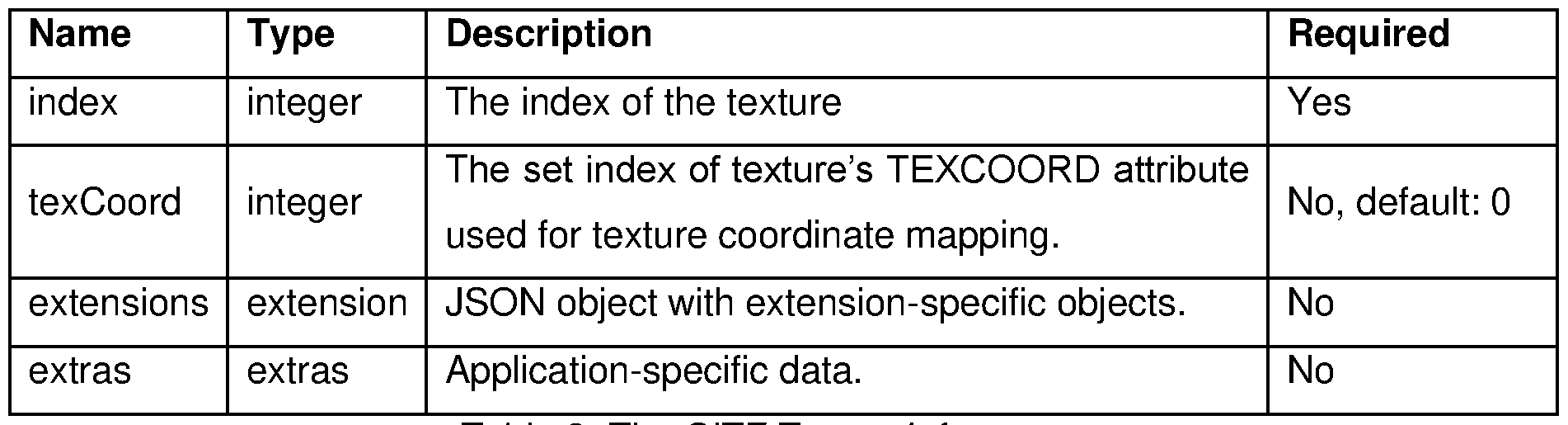
- Textureinfo Besides, in a gITF file, one can reference a texture using a Textureinfo property. It is used in several places in materials assets, like “baseColorTexture”, “normalTexture”, or “metallicRoughnessTexture”. The specification defines four properties for Textureinfo: “index”, “texCoord”, “extensions” and “extras” as disclosed in Section 5.30 “Textureinfo” of the gITF
- the "index” property of Textureinfo references the base texture. According to a particular embodiment, it may correspond to the base texture in the equation (1 ).
- a new “MPEG_textu retargets” property is defined in the “extensions” attribute respecting the definition of the Textureinfo property.
- the new “MPEG_texture_targets” property may be defined in the “extensions” attribute of the Texture property. The skilled in the art will recognize that this new “MPEG_textu retargets” property is optional.
- the “MPEG_texture_targets” property contains two arrays of properties:
- the “targets” property is an array of TextureTarget. It contains all the information needed to reference, and eventually update, a texture. Each item of index i in this array corresponds to textureTargeti in equation (1 ).
- the “weights” property is an array of float numbers to weight each texture target. Each item of index i in this array corresponds to weightt in equation (1 ).
- the size of the arrays “targets” and “weights” are the same.
- a TextureTarget property defines the texture data for one texture target.
- the disclosed format provides high compatibility with existing implementation as a particular software that does not support the texture targets extension, may use the base texture as defined in the standard, ignoring the targets. Consequently, an incomplete but relevant rendering is still possible, assuming that in most texture combinations, the base texture is the main contributor, and the targets slightly change the final result.
- the base texture is the main contributor, and the targets slightly change the final result.
- the skilled in the art will appreciate that, in the case where an item of “targets” has a property "texture” of type Textureinfo, it can define values in its “extensions” property in a recursive fashion, leading to an iterated specific processing for each texture target. For instance, each item in the “targets” array can use the KHR_texture_transform extension to transform texture targets before combination with the weighted sum.
- the following gITF may define a material with a combination of three texture images for the base color.
- Example 1 a material with a combination of three texture images for the base color [54]
- the material loader first parses the “images” list and load the three image files “textureBase.jpg”, “textureTargetO.jpg” and “textureTarget1.jpg”. Then, it parses the “textures” list and assigns each texture to one of the images: texture 0 corresponds to image in "textureBase.jpg” file; texture 1 corresponds to image in "textureTargetO.jpg” file; texture 2 corresponds to image in "textureTargetl .jpg” file.
- the material loader parses the “materials” list, and finds a single one with a "pbrMetallicRoughness” attribute.
- This attribute only defines the base color texture in the “baseColorTexture” attribute.
- the material loader parses the “MPEG_texture_targets” property in “materials/pbrMetallicRoughness/baseColorTexture/extensions”.
- the “targets” list contains two texture targets: texture target 0 references texture 1 with weight -0.1 ; texture target 1 references texture 2 with weight 0.4.
- baseColorTexture clampjtextureBase.jpg — 0.1 x textureTargetO.jpg + 0.4 x textureTargetl.jpg
- the resulting texture is a usual 2D array of RGB vectors that can be processed by current gITF decoders and renderers.
- the gITF may define a material creating an animation with textures.
- FIG. 5a, 5b and 5c illustrate various steps of a same animation of textures resulting from the processing of a texture image as shown on FIG. 6 according to a particular embodiment.
- one may create a material that changes with time, starting with a glowing rectangle as shown on FIG. 5a. This material may be applied on any surface, for instance on a cube or a mesh with the shape of a screen.
- a glowing number “2” slowly appears (e.g. the number fades from black to full white).
- FIG. 5b shows the animated texture with the number “2” fully visible.
- FIG. 6 illustrates a texture image used in the above animation of textures according to an embodiment.
- This single texture image is a texture atlas as it may contain four textures in a single image.
- Example 2 a material with a combination of portions of a single texture image to create animated textures
- KHR_texture_transform is firstly decoded.
- the “offset” and “scale” properties define a texture transform that crops the top-left part of the texture atlas, corresponding to the empty glowing rectangle.
- the loader decodes “MPEG_texture_targets” extension.
- targets there are three targets: each one references the same texture (“index” is 0). They also all have “KHR_texture_transform” content that describe a crop. The first one crops the top-right part (number “2”), the second one the bottom-left part (number “1”) and the last one the bottomright part (message “GO!”).
- the “weights” property defines the amount of each texture target to add.
- An item in the “animations” list defines a single animation that updates the material.
- this animation there is a single channel in the “channels” list. It references the sampler defined in the “samplers” list and use the “KHR_animation_pointer” extension to point to the “weights” property of the “MPEG_texture_targets” of the emissive texture.
- the sampler references the temporal values (in “input”) and weight values (in “output”). For sake of clarity, we don’t show the accessors/buffer views/buffers with theses values but present their content here.
- Each value in a weight combination corresponds to one of the texture targets: the one with number “2”, the one with number “1” and the one with message “GO!”.
- the final texture is always the base texture (the one with a rectangle) to which we add the texture targets with weights:
- Time 1s weights are [1 ,0,0]: the texture with number “2” is fully added to the base texture.
- Time 2s all weights are zero: only the base texture (with the rectangle) is used.
- Time 3s weights are [0,1 ,0]: the texture with number “1” is fully added to the base texture.
- Time 4s all weights are zero: only the base texture (with the rectangle) is used.
- Time 5s weights are [0,0,1]: the texture with number “GO!” is fully added to the base texture.
- the gITF may define a material where the texture sources are obtained from accessors.
- Example 3 a material where the texture sources are obtained from accessors
- Accessor 0 first array of 655363D vectors with 32-bit float values
- Accessor 1 second array of 655363D vectors with 32-bit float values.
- the material loader parses the “MPEG_texture_targets” property in “materials/pbrMetallicRoughness/baseColorTexture/extensions”.
- the “targets” list contains two texture targets: texture target 0 references accessor 0 with weight -0.1 ; texture target 1 references accessor 1 with weight 0.4.
- baseColorTexture clampftextureBase. png — 0.1 x accessor ⁇ + 0.4 x accessor- ⁇ )
- the resulting texture is a usual 2D array of RGB vectors that can be processed by current gITF decoders and renderers.
- the embodiment based on “accessor” properties allows processing texture data with 32-bit float values.
- texture data are defined from 8-bit integer converted to float, the embodiment based on “texture” property is limited to 8-bit precision.
- FIG. 7 illustrates an exemplary embodiment of a method for parsing a Textureinfo.
- the proposed extension data is parsed any time a Textureinfo property occurs in the gITF file.
- Most gITF parsers already offer hook mechanisms one can register. For our case, we ask the main gITF parser to call the extension code every time it finds a Textureinfo property. As shown on FIG.7, the process ingests Textureinfo data (710) and outputs a texture (780).
- a first step (720) the method first parses the data in a default fashion, as defined without any extension. This step (720) initializes the main texture. Then, the extension property of the texture is tested (730). If there is no “extensions” property, the process is over and outputs (780) the main texture. If there are extensions, it first applies any non- MPEG_texture_targets extensions (740, 750), like KHR_texture_transform. This holds for all current extensions but might not be true for future extensions. For these later cases, it will be up to the designers to choose the extension order. If no order is defined, we assume that MPEG_texture_targets extension always comes last. Each extension updates the main texture: its layout and values can change, but still remains a texture (e.g. a 2D array of vectors).
- the process (770) parses each item in the “targets” property. Since each item of this array is a Textureinfo, we repeat all the current processes presented with Fig. 7 in an iterated fashion. It means that each texture target (771 , 772) may be transformed or the result of a combination in a specific manner. From our process point of view, it does not matter since this process always outputs a texture. The only assumption is that each texture target has the same layout as the main texture. Then, each texture target is multiplied (773) by the corresponding weight in the “weights” array and added (774) to the main texture. Once all targets are processed, the main texture is returned (780).
- An exemplary embodiment relates to texture animation.
- texture can be animated with a pre-computation of all steps. Then, all these steps are stored in the gITF file, and the texture is changed every frame, leading to high memory footprint that may not fit on small hardware.
- the animation is expressed or approximated as a linear combination of textures, as for instance exposed with the non-limiting example 2, the proposed extension dramatically reduces the size of scene data. With this approach, we only store the texture we need to, as well as the weights and animation data that reproduce the texture animation.
- Another exemplary embodiment relates to light effects baking.
- a common technique to render scene with complex light effects uses texture baking. It precomputes the lights received by scene objects and store them in textures. Then, the renderer no more needs to compute lights and only must apply the texture to get a high-quality result.
- This is a common approach in video games, that consoles to display rendering they cannot compute in real time.
- This technique works fine if they are no (or few) dynamism in scene lights. If they are a lot of changes, like unstable lights (campfire, candles, ...), explosions, objects collapsing, etc., then we must regularly bake a lot of textures to reflect the changes. In the worst case, textures must be baked every frame.
- the proposed extension allows approximating the texture changes with combinations. For instance, unstable lights can be approximated with a dozen of textures, each one corresponding to a direction and hue. Then, for each frame, we choose a combination of these textures. We can repeat this approach every time the true texture may be approximated with a linear combination of texture targets. The resulting gITF file is then small and the scene can fit on small hardware.
- Another exemplary embodiment relates to the handling of numerous similar objects or characters. Indeed, some scenes can contain many similar objects or characters. For instance, one can find hundreds of trees in a forest or many warriors on a battlefield. Without the proposed extension, if we want to have unique objects or characters, we must precompute and store a different texture for each of them. As in the previous cases, it quickly leads to very large gITF files, and its data may not fit on small hardware.
- the proposed extension allows using a limited number of texture targets, and creating a unique combination for each object or character in the scene. With this approach, each new item only costs a few texture target weights.
- FIG. 8 illustrates various textures for parametric meshes to which the processing of a texture image according to an embodiment may apply.
- texture combinations There are many ways to create these texture combinations: we present an example here to create a unique texture for the face of each character in a scene using the FLAME face model as disclosed in “FLAME, Learning a model of facial shape and expression from 4D scans", by. Tianye Li, Timo Bolkart, Michael J Black, Hao Li and Javier Romero (SIGGRAPH ASIA 2017, BANGKOK, THAILAND).
- the FLAME face model defines a parametric face rig.
- Face meshes can be created combining many morph targets. These meshes can be textured combining a base texture and 200 texture targets with 512x512 float values.
- a combination 810, 820 represents a particular face identity (skin color, eye browns, etc.) as illustrated on FIG. 8.
- the proposed extension allows storing a texture combination in the same gITF file. As a result, we can create scenes with thousands of characters with a small memory footprint.
- gITF files may be transported in many ways (drivers, networks, etc.) and users receiving them can render faces and modify the combination if needed. For instance, artists in CGI production receive drafts of characters and refine them (e.g., change the combination weights) in their software (Blender, Maya, Unity, etc.).
- each of the methods comprises one or more steps or actions for achieving the described method. Unless a specific order of steps or actions is required for proper operation of the method, the order and/or use of specific steps and/or actions may be modified or combined. Additionally, terms such as “first”, “second”, etc. may be used in various embodiments to modify an element, component, step, operation, etc., such as, for example, a “first decoding” and a “second decoding”. Use of such terms does not imply an ordering to the modified operations unless specifically required. So, in this example, the first decoding need not be performed before the second decoding, and may occur, for example, before, during, or in an overlapping time period with the second decoding.
- the implementations and aspects described herein may be implemented in, for example, a method or a process, an apparatus, a software program, a data stream, or a signal. Even if only discussed in the context of a single form of implementation (for example, discussed only as a method), the implementation of features discussed may also be implemented in other forms (for example, an apparatus or program).
- An apparatus may be implemented in, for example, appropriate hardware, software, and firmware.
- the methods may be implemented in, for example, an apparatus, for example, a processor, which refers to processing devices in general, including, for example, a computer, a microprocessor, an integrated circuit, or a programmable logic device. Processors also include communication devices, for example, computers, cell phones, portable/personal digital assistants (“PDAs”), and other devices that facilitate communication of information between end-users.
- PDAs portable/personal digital assistants
- references to “one embodiment” or “an embodiment” or “one implementation” or “an implementation”, as well as other variations thereof, means that a particular feature, structure, characteristic, and so forth described in connection with the embodiment is included in at least one embodiment.
- the appearances of the phrase “in one embodiment” or “in an embodiment” or “in one implementation” or “in an implementation”, as well any other variations, appearing in various places throughout this application are not necessarily all referring to the same embodiment.
- this application may refer to “determining” various pieces of information. Determining the information may include one or more of, for example, estimating the information, calculating the information, predicting the information, or retrieving the information from memory.
- Accessing the information may include one or more of, for example, receiving the information, retrieving the information (for example, from memory), storing the information, moving the information, copying the information, calculating the information, determining the information, predicting the information, or estimating the information.
- this application may refer to “receiving” various pieces of information. Receiving is, as with “accessing”, intended to be a broad term. Receiving the information may include one or more of, for example, accessing the information, or retrieving the information (for example, from memory). Further, “receiving” is typically involved, in one way or another, during operations, for example, storing the information, processing the information, transmitting the information, moving the information, copying the information, erasing the information, calculating the information, determining the information, predicting the information, or estimating the information.
- such phrasing is intended to encompass the selection of the first listed option (A) only, or the selection of the second listed option (B) only, or the selection of the third listed option (C) only, or the selection of the first and the second listed options (A and B) only, or the selection of the first and third listed options (A and C) only, or the selection of the second and third listed options (B and C) only, or the selection of all three options (A and B and C).
- This may be extended, as is clear to one of ordinary skill in this and related arts, for as many items as are listed.
- implementations may produce a variety of signals formatted to carry information that may be, for example, stored or transmitted.
- the information may include, for example, instructions for performing a method, or data produced by one of the described implementations.
- a signal may be formatted to carry the bitstream of a described embodiment.
- Such a signal may be formatted, for example, as an electromagnetic wave (for example, using a radio frequency portion of spectrum) or as a baseband signal.
- the formatting may include, for example, encoding a data stream and modulating a carrier with the encoded data stream.
- the information that the signal carries may be, for example, analog or digital information.
- the signal may be transmitted over a variety of different wired or wireless links, as is known.
- the signal may be stored on a processor-readable medium.
Landscapes
- Engineering & Computer Science (AREA)
- Physics & Mathematics (AREA)
- General Physics & Mathematics (AREA)
- Theoretical Computer Science (AREA)
- Multimedia (AREA)
- Computer Graphics (AREA)
- Signal Processing (AREA)
- Processing Or Creating Images (AREA)
- Compression Of Band Width Or Redundancy In Fax (AREA)
- Image Generation (AREA)
Abstract
Description




Claims
Priority Applications (5)
| Application Number | Priority Date | Filing Date | Title |
|---|---|---|---|
| CN202480039559.7A CN121311923A (en) | 2023-06-16 | 2024-06-10 | Texture targets in scene description |
| EP24731602.9A EP4728480A1 (en) | 2023-06-16 | 2024-06-10 | Texture targets in scene description |
| KR1020267000788A KR20260041780A (en) | 2023-06-16 | 2024-06-10 | Texture targets in scene descriptions |
| AU2024303327A AU2024303327A1 (en) | 2023-06-16 | 2024-06-10 | Texture targets in scene description |
| MX2025015181A MX2025015181A (en) | 2023-06-16 | 2025-12-15 | Texture targets in scene description |
Applications Claiming Priority (2)
| Application Number | Priority Date | Filing Date | Title |
|---|---|---|---|
| EP23305963.3 | 2023-06-16 | ||
| EP23305963 | 2023-06-16 |
Publications (1)
| Publication Number | Publication Date |
|---|---|
| WO2024256340A1 true WO2024256340A1 (en) | 2024-12-19 |
Family
ID=87158230
Family Applications (1)
| Application Number | Title | Priority Date | Filing Date |
|---|---|---|---|
| PCT/EP2024/065958 Ceased WO2024256340A1 (en) | 2023-06-16 | 2024-06-10 | Texture targets in scene description |
Country Status (6)
| Country | Link |
|---|---|
| EP (1) | EP4728480A1 (en) |
| KR (1) | KR20260041780A (en) |
| CN (1) | CN121311923A (en) |
| AU (1) | AU2024303327A1 (en) |
| MX (1) | MX2025015181A (en) |
| WO (1) | WO2024256340A1 (en) |
Citations (1)
| Publication number | Priority date | Publication date | Assignee | Title |
|---|---|---|---|---|
| US20050248582A1 (en) * | 2004-05-06 | 2005-11-10 | Pixar | Dynamic wrinkle mapping |
-
2024
- 2024-06-10 WO PCT/EP2024/065958 patent/WO2024256340A1/en not_active Ceased
- 2024-06-10 CN CN202480039559.7A patent/CN121311923A/en active Pending
- 2024-06-10 EP EP24731602.9A patent/EP4728480A1/en active Pending
- 2024-06-10 KR KR1020267000788A patent/KR20260041780A/en active Pending
- 2024-06-10 AU AU2024303327A patent/AU2024303327A1/en active Pending
-
2025
- 2025-12-15 MX MX2025015181A patent/MX2025015181A/en unknown
Patent Citations (1)
| Publication number | Priority date | Publication date | Assignee | Title |
|---|---|---|---|---|
| US20050248582A1 (en) * | 2004-05-06 | 2005-11-10 | Pixar | Dynamic wrinkle mapping |
Non-Patent Citations (5)
| Title |
|---|
| "Information technology - Runtime 3D asset delivery format - Khronos glTF(TM) 2.0", 26 July 2022 (2022-07-26), pages 1 - 189, XP082074220, Retrieved from the Internet <URL:https://api.iec.ch/harmonized/publications/download/3038945> [retrieved on 20220726] * |
| "SGIS detail texture-The Detail Texture Extension", INTERNET CITATION, 1 January 1998 (1998-01-01), XP002188570, Retrieved from the Internet <URL:http://techpubs.sgi.com:80/library/manuals/2000/007-2392-002/pdf/007-2392-002.pdf> [retrieved on 20020129] * |
| ALEXANDRE HARDY ET AL: "Blend maps", IT RESEARCH IN DEVELOPING COUNTRIES, SOUTH AFRICAN INSTITUTE FOR COMPUTER SCIENTISTS AND INFORMATION TECHNOLOGISTS, P. O. BOX 392 UNISA 0003 REPUBLIC OF SOUTH AFRICA, 9 October 2006 (2006-10-09), pages 61 - 70, XP058095012, ISBN: 978-1-59593-567-0, DOI: 10.1145/1216262.1216269 * |
| SCHUSTER KERSTEN ET AL: "Compression and rendering of textured point clouds via sparse coding", PROCEEDINGS OF THE 36TH IEEE/ACM INTERNATIONAL CONFERENCE ON AUTOMATED SOFTWARE ENGINEERING, ACMPUB27, NEW YORK, NY, USA, 6 July 2021 (2021-07-06), pages 61 - 73, XP058907087, ISBN: 978-1-4503-9442-0, DOI: 10.2312/HPG.20211284 * |
| TIANYE LITIMO BOLKARTMICHAEL J BLACKHAO LIJAVIER ROMERO: "FLAME, Learning a model of facial shape and expression from 4D scans", SIGGRAPH ASIA, 2017 |
Also Published As
| Publication number | Publication date |
|---|---|
| EP4728480A1 (en) | 2026-04-22 |
| MX2025015181A (en) | 2026-02-03 |
| AU2024303327A1 (en) | 2025-12-18 |
| CN121311923A (en) | 2026-01-09 |
| KR20260041780A (en) | 2026-03-27 |
Similar Documents
| Publication | Publication Date | Title |
|---|---|---|
| CN111161392B (en) | Video generation method and device and computer system | |
| CN115908644A (en) | Animation processing method and device | |
| JP2006134322A (en) | Apparatus and method for providing a 3D animation file reflecting the personality of only a user in a mobile communication terminal | |
| US20200118003A1 (en) | Information processing apparatus, method, and program | |
| US9019268B1 (en) | Modification of a three-dimensional (3D) object data model based on a comparison of images and statistical information | |
| AU2024303327A1 (en) | Texture targets in scene description | |
| WO2024260763A1 (en) | Texture mix signaling in scene description | |
| EP4668765A1 (en) | Efficient representation of curve sets | |
| EP4730267A1 (en) | Volumetric representation of the hairstyle model of an avatar | |
| EP4712493A1 (en) | Signaling neural radiance field properties in avatar json interchange file format | |
| EP4629174A1 (en) | Polygons encoding in scene descriptions | |
| US20260024287A1 (en) | Real nodes extension in scene description | |
| EP4694141A1 (en) | General signaling of model properties encoding in scene and avatar descriptions | |
| US20250373863A1 (en) | End-to-end learning-based point cloud coding framework | |
| EP4697274A1 (en) | Avatar baldness area signaling | |
| WO2025214721A1 (en) | Animation mixer in scene descriptions | |
| EP4672760A1 (en) | 3D Gausian splatation in scene description | |
| WO2025073598A1 (en) | Controllers user interface encoding in scene description | |
| WO2025045630A1 (en) | Hybrid volumetric video encoding with implicit neural video representations to handle non-lambertian surfaces | |
| WO2025190653A1 (en) | Avatars with parametric textures in scene descriptions | |
| WO2026012695A1 (en) | Signaling avatar eye and eyelids handling in scene description | |
| WO2026002113A1 (en) | Encoding method and apparatus, decoding method and apparatus, and electronic device | |
| WO2026037669A1 (en) | Avatar baldness area signaling | |
| CN116824007A (en) | Animation playback method, animation generation method, device and electronic equipment | |
| WO2025153194A1 (en) | Avatar json interchange file format |
Legal Events
| Date | Code | Title | Description |
|---|---|---|---|
| 121 | Ep: the epo has been informed by wipo that ep was designated in this application |
Ref document number: 24731602 Country of ref document: EP Kind code of ref document: A1 |
|
| ENP | Entry into the national phase |
Ref document number: 2025569715 Country of ref document: JP Kind code of ref document: A |
|
| WWE | Wipo information: entry into national phase |
Ref document number: AU2024303327 Country of ref document: AU |
|
| WWE | Wipo information: entry into national phase |
Ref document number: 202517124604 Country of ref document: IN |
|
| WWE | Wipo information: entry into national phase |
Ref document number: MX/A/2025/015181 Country of ref document: MX |
|
| ENP | Entry into the national phase |
Ref document number: 2024303327 Country of ref document: AU Date of ref document: 20240610 Kind code of ref document: A |
|
| WWP | Wipo information: published in national office |
Ref document number: 202517124604 Country of ref document: IN |
|
| WWE | Wipo information: entry into national phase |
Ref document number: 1020267000788 Country of ref document: KR |
|
| WWE | Wipo information: entry into national phase |
Ref document number: 2024731602 Country of ref document: EP |
|
| NENP | Non-entry into the national phase |
Ref country code: DE |
|
| ENP | Entry into the national phase |
Ref document number: 2024731602 Country of ref document: EP Effective date: 20260116 |
|
| ENP | Entry into the national phase |
Ref document number: 2024731602 Country of ref document: EP Effective date: 20260116 |
|
| ENP | Entry into the national phase |
Ref document number: 2024731602 Country of ref document: EP Effective date: 20260116 |
|
| WWP | Wipo information: published in national office |
Ref document number: MX/A/2025/015181 Country of ref document: MX |
|
| ENP | Entry into the national phase |
Ref document number: 2024731602 Country of ref document: EP Effective date: 20260116 |
|
| WWP | Wipo information: published in national office |
Ref document number: 1020267000788 Country of ref document: KR |
|
| WWP | Wipo information: published in national office |
Ref document number: 2024731602 Country of ref document: EP |