WO2024254329A1 - Multivalent binding unit modified dideoxynucleotide triphosphates and methods of making and using the same - Google Patents

Multivalent binding unit modified dideoxynucleotide triphosphates and methods of making and using the same Download PDF

Info

Publication number
WO2024254329A1
WO2024254329A1 PCT/US2024/032844 US2024032844W WO2024254329A1 WO 2024254329 A1 WO2024254329 A1 WO 2024254329A1 US 2024032844 W US2024032844 W US 2024032844W WO 2024254329 A1 WO2024254329 A1 WO 2024254329A1
Authority
WO
WIPO (PCT)
Prior art keywords
compound
hapten
binding
formula
thiol
Prior art date
Legal status (The legal status is an assumption and is not a legal conclusion. Google has not performed a legal analysis and makes no representation as to the accuracy of the status listed.)
Ceased
Application number
PCT/US2024/032844
Other languages
French (fr)
Other versions
WO2024254329A8 (en
Inventor
Rigoberto PANTOJA
Xiangyuan YANG
Eric Vermaas
Yin Nah TEO
Liu DI
Current Assignee (The listed assignees may be inaccurate. Google has not performed a legal analysis and makes no representation or warranty as to the accuracy of the list.)
Illumina Inc
Original Assignee
Illumina Inc
Priority date (The priority date is an assumption and is not a legal conclusion. Google has not performed a legal analysis and makes no representation as to the accuracy of the date listed.)
Filing date
Publication date
Application filed by Illumina Inc filed Critical Illumina Inc
Priority to CN202480038145.2A priority Critical patent/CN121335912A/en
Priority to AU2024284320A priority patent/AU2024284320A1/en
Priority to EP24740262.1A priority patent/EP4724455A1/en
Publication of WO2024254329A1 publication Critical patent/WO2024254329A1/en
Publication of WO2024254329A8 publication Critical patent/WO2024254329A8/en
Anticipated expiration legal-status Critical
Ceased legal-status Critical Current

Links

Classifications

    • CCHEMISTRY; METALLURGY
    • C07ORGANIC CHEMISTRY
    • C07HSUGARS; DERIVATIVES THEREOF; NUCLEOSIDES; NUCLEOTIDES; NUCLEIC ACIDS
    • C07H19/00Compounds containing a hetero ring sharing one ring hetero atom with a saccharide radical; Nucleosides; Mononucleotides; Anhydro-derivatives thereof
    • C07H19/02Compounds containing a hetero ring sharing one ring hetero atom with a saccharide radical; Nucleosides; Mononucleotides; Anhydro-derivatives thereof sharing nitrogen
    • C07H19/04Heterocyclic radicals containing only nitrogen atoms as ring hetero atom
    • C07H19/06Pyrimidine radicals
    • C07H19/10Pyrimidine radicals with the saccharide radical esterified by phosphoric or polyphosphoric acids
    • CCHEMISTRY; METALLURGY
    • C07ORGANIC CHEMISTRY
    • C07HSUGARS; DERIVATIVES THEREOF; NUCLEOSIDES; NUCLEOTIDES; NUCLEIC ACIDS
    • C07H19/00Compounds containing a hetero ring sharing one ring hetero atom with a saccharide radical; Nucleosides; Mononucleotides; Anhydro-derivatives thereof
    • C07H19/02Compounds containing a hetero ring sharing one ring hetero atom with a saccharide radical; Nucleosides; Mononucleotides; Anhydro-derivatives thereof sharing nitrogen
    • C07H19/04Heterocyclic radicals containing only nitrogen atoms as ring hetero atom
    • C07H19/16Purine radicals
    • C07H19/20Purine radicals with the saccharide radical esterified by phosphoric or polyphosphoric acids

Definitions

  • the disclosure relates to multivalent binding unit modified dideoxynucleotide triphosphates (ddNTP) and methods of making and using the same.
  • ddNTP dideoxynucleotide triphosphates
  • SNPs Single nucleotide polymorphisms
  • allele specificity can be conferred by a single base extension that incorporates one or four labeled nucleotides. When excited by a laser, the nucleotide label emits a single. The intensity of that signal conveys information about allelic ration at that locus.
  • the compounds and methods of the disclosure utilize multivalent binding unit modified ddNTP to enhance binding unit binding partner binding affinity and thereby improve signal detection. This can beneficially result in decreased nonspecific binding that is mediated by both binding unit binding partner surface and dyes covalently attached to the binding unit binding partner for fluorescence detection. This can also beneficially reduce the amount of binding unit binding partner required in current reagent formulations, which in turn can minimize nonspecific binding and improve COGS. Finally, the compounds and method of the disclosure can beneficially decrease the number of staining rounds required for signal amplification.
  • the binding unit molecule can be haptens and the binding unit binding partner can be hapten binding partners.
  • a multivalent binding unit modified ddNTP can be a compound of formula I:
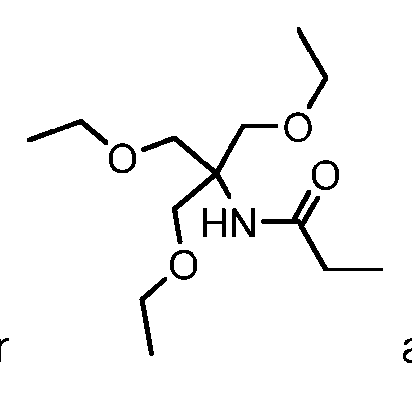
  • each ARM comprising a binding unit and a PEO- containing linker, each Q is independently selected from, and each Q attaches to 2 or 3 wherein for each Li and L 2 , d is independently selected from 1 to 10, and e is independently selected from 1 to 10, R is independently selected from a functionality resulting from a coupling reaction between one of the following pairs: amine- imidoester, amine-pentafluorophenyl ester, amine-/V-hydroxysuccinimide ester, aminehydroxymethyl phosphine, carboxyl-carbodiimide, thiol-maleimide, thiol-haloacetyl, thiol-pyridyl disulfide, thiol-thiosulfonate, thiol-vinyl sulfone, al
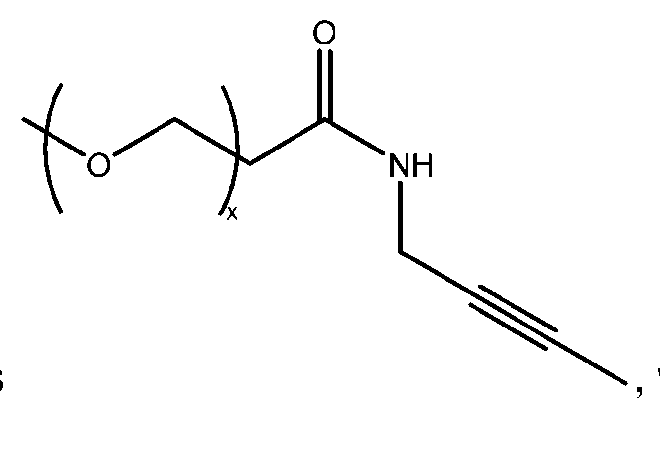
  • each ARM can include wherein for each ARM z is independently selected from 1 to 48 and y is independently selected from 1 to 48 T is independently selected from a functionality resulting from a coupling reaction between one of the following pairs: amine-imidoester, amine-pentafluorophenyl ester, amine-N- /tydroxysuccinimide ester, amine-hydroxymethyl phosphine, carboxyl-carbodiimide, thiol- maleimide, thiol-haloacetyl, thiol-pyridyl disulfide, thiol-thiosulfonate, thiol-vinyl sulfone, aldehyde-hydrazide, aldehyde-alkoxyamine, hydroxy-isocyanate, azide-phosphine, transcyclooctene-tetrazine, norbornene-tetrazine, azide-cycl
  • a kit can include a bead array comprising a plurality of beads, each bead having at least one capture oligonucleotide probe attached to a surface thereof; anti-DNP antibodies, each comprising a first fluorescence label; at least one compound of formula I; and instructions for use such that upon contact, one or more anti-DNP antibodies bind to each ARM of the at least one compound of formula I.
  • Figure 1 is a schematic illustration of a method of making a multivalent hapten- modified ddNTP in accordance with the disclosure
  • Figure 2 is a schematic illustration of a method of making a multivalent hapten- modified ddNTP in accordance with the disclosure
  • Figure 3 is a graph showing fluorescence analysis results comparing use of a multivalent hapten modified ddNTP to a commercially available monovalent DNP-ddNTP and a lab-produced monovalent DNP-ddNTP.
  • Figure 4 is a graph showing fluorescence analysis results comparing use of a multivalent hapten modified ddNTP to a commercially available monovalent DNP-ddNTP and a lab-produced monovalent DNP-ddNTP after multiple staining rounds.
  • Figure 5 is a graph showing fluorescence analysis in the green channel.
  • Figure 6 is a schematic illustration of an example assay in accordance with the disclosure.
  • Figure 7A is a graph showing fluorescence analysis in the red channel comparing extension efficiency using a multivalent hapten modified ddNTP to a commercially available monovalent DNP-ddNTP and a lab-produced monovalent DNP-ddNTP.
  • Figure 7B is a graph showing fluorescence analysis in the green channel comparing extension efficiency using a multivalent hapten modified ddNTP to a commercially available monovalent DNP-ddNTP and a lab-produced monovalent DNP-ddNTP.
  • Figure 8 is a graph showing the results in both extension and non-extension control sets comparing extension efficiency using a multivalent hapten modified ddNTP to a commercially available monovalent DNP-ddNTP and a lab-produced monovalent DNP-ddNTP.
  • Figure 9A is a graph showing the fluorescence analysis results of two rounds of staining using increased hapten-modified ddNTP concentrations.
  • Figure 9B is a graph showing the fluorescence analysis results of three rounds of staining using increased hapten-modified ddNTP concentrations.
  • Figure 10 is a graph showing the signal-to-noise ratio for performance testing on the Infinium EX microarray platform for compounds in accordance with the disclosure as compared to standard design ddNTP.
  • Figure 11 is a graph showing call rate and logR deviation metrics for performance testing of compounds in accordance with the disclosure as compared to standard design ddNTPs on the Infinium EX microarray platform.
  • ddNTP dideoxynucleotide triphosphates
  • the compounds of the disclosure can be useful in a variety of applications, including genotyping and multi-omics applications.
  • the binding unit modified ddNTP in accordance with the disclosure include multiple binding units bound or attached to the ddNTP, which has been observed to enhance binding affinity of the fluorescently labeled binding unit binding partner.
  • the binding unit modified ddNTPs in accordance with the disclosure can decrease nonspecific binding. This can beneficially allow for a reduced amount of binding unit binding partner to be used and/or reduce the number of staining rounds required for signal amplification.
  • the binding unit modified ddNTP can be a compound of formula I:
  • each ARM a - Q b - Mc - J -ddNTP, wherein a is at least 2, b is 1 to 3, c is 0 or 1 , each ARM comprising a binding unit and a PEO- containing linker, each Q is independently selected from, each Q attaches to 2 or 3
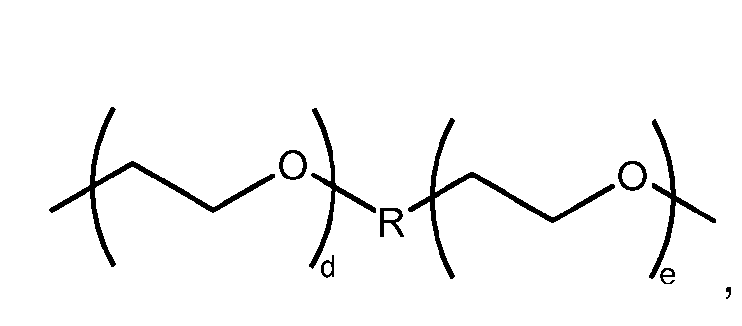
  • each Li and L 2 are independently selected from wherein for each L 1 and L 2 , d is independently selected from 1 to 10, and e is independently selected from 1 to 10, R is independently selected from a functionality resulting from a coupling reaction between one of the following pairs: amine- imidoester, amine-pentafluorophenyl ester, amine-N-hydroxysuccinimide ester, aminehydroxymethyl phosphine, carboxyl-carbodiimide, thiol-maleimide, thiol-haloacetyl, thiol-pyridyl disulfide, thiol-thiosulfonate, thiol-vinyl sulfone, aldehyde-hydrazide, aldehyde-alkoxyamine, hydroxy-isocyanate, azide-phosphine, transcyclooctene-tetrazine, norbornene-tetrazine
  • a can be at least 2 and up to 9.
  • a can be 2, 3, 4, 5, 6, 7, 8, or 9.
  • the binding unit in each ARM can be the same, for example.
  • the binding unit in two or more of the ARMS can be different, alternatively.
  • the compounds of the disclosure are hapten modified dideoxynucleotide triphosphates (ddNTP), which can be useful in genotyping applications to improve signal detection.
  • the hapten modified ddNTP in accordance with the disclosure include multivalent hapten molecules, which has been observed to enhance binding affinity of the fluorescently labeled hapten binding partner.
  • the hapten modified ddNTPs in accordance with the disclosure can decrease nonspecific binding. This can beneficially allow for a reduced amount of hapten binding partner to be used and/or reduce the number of staining rounds required for signal amplification.
  • the hapten modified ddNTP can be a compound of formula IA:
  • each ARM comprising a hapten and a PEO- containing linker, each Q is independently selected from, and each Q attaches to 2 or 3 , wherein for each L 1 and L 2 , d is independently selected from 1 to 10, and e is independently selected from 1 to 10, R is independently selected from a functionality resulting from a coupling reaction between one of the following pairs: amine- imidoester, amine-pentafluorophenyl ester, amine-N-hydroxysuccinimide ester, amine- hydroxymethyl phosphine, carboxyl-carbodiimide, thiol-maleimide, thiol-haloacetyl, thiol-pyridyl disulfide, thiol-thiosulfonate, thiol-vinyl
  • a can be at least 2 and up to 9.
  • a can be 2, 3, 4, 5, 6, 7, 8, or 9.
  • the hapten in each ARM can be the same, for example.
  • the hapten in two or more of the ARMS can be different, alternatively.
  • the hapten in each ARM can be independently selected from, for example, digoxigenin (DIG), 3-nitrotyrosine, biotin, alkyl chloride, O-GIcNAc, alkyl guanine, Ni-NTA and 2,4-dinitrophenol (DNP).
  • DIG digoxigenin
  • 3-nitrotyrosine biotin
  • alkyl chloride O-GIcNAc
  • alkyl guanine alkyl guanine
  • Ni-NTA 2,4-dinitrophenol
  • each ARM can be any ARM.
  • each ARM can include In each such ARM, z can be independently selected from 1 to 48, 1 to 12, 1 to 10, 13 to 24, 35 to 36, or 37 to 48, and any values therebetween and ranges defined by such values. In each ARM y can be independently selected from 1 to 48, 1 to 12, 1 to 10, 13 to 24, 35 to 36, or 37 to 48.
  • T is independently selected from a functionality that results from a coupling reaction between one of the following pairs of compounds: amine-imidoester, aminepentafluorophenyl ester, amine-N-hydroxysuccinimide ester, amine-hydroxymethyl phosphine, carboxyl-carbodiimide, thiol-maleimide, thiol-haloacetyl, thiol-pyridyl disulfide, thiol-thiosulfonate, thiol-vinyl sulfone, aldehyde-hydrazide, aldehyde-alkoxyamine, hydroxy-isocyanate, azidephosphine, transcyclooctene-tetrazine, norbornene-tetrazine, azide-cyclooctyne, azidenorbornene, or azide-alkyne.
  • T can example
  • each ARM T can be
  • T can be in at least one arm least one other arm.
  • each ARM, z and y can be same and the compound can be a symmetrical compound.
  • the compound can be asymmetrical.
  • two or more of the ARM, y and z can be different and the compound can be asymmetrical.
  • b can be 1 , 2 or 3.
  • c can be 0 or 1 .
  • Other selections for Q when c is 0 are also contemplated herein.
  • Each Li and L2 are independently selected from , wherein for each Li and L 2 , d is independently selected from
  • J is wherein x is from 1 to 48, 1 to 12, 1 to 10, 13 to 24, 35 to 36, or 37 to 48.
  • the ddNTP in the compound of formula I or formula IA can be any one of ddATP, ddTTP, ddllTP, ddGTP, or ddCTP.
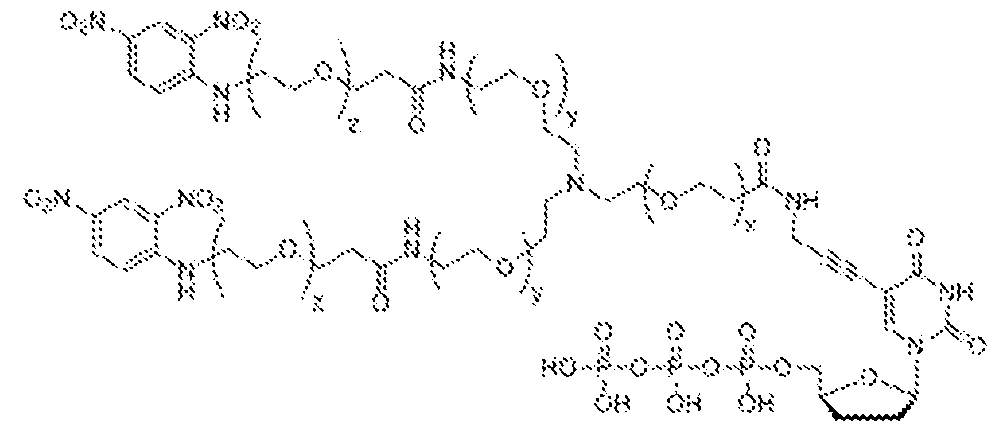
  • the compound of formula I or formula IA is a structure as shown in Table A
  • the anti-DNP antibody hybridizes to the DNP, thereby labeling the bead with the first label.
  • the first label can be, for example, a fluorescence label.
  • the label or interaction between the binding unit and the binding unit binding pair can results in a detectable signal such as fluorescence, bioluminescent, or electrical detection.
  • the kit can be useful for screening and/or identifying binding pairs between binding units and binding unit binding partners. For example, a plurality of binding unit bindings partners and/or a plurality of binding units can be included in the kit to screen for binding interactions through use of the kit.
  • a kit for genotyping can include, for example, a bead array comprising a plurality of beads, each bead having at least one capture oligonucleotide probe attached to a surface thereof, a hapten binding partner comprising a first fluorescence label, at least one compound of formula I, and instructions for use.
  • the hapten binding partner containing the first fluorescence label selectively binds to the hapten present on the ARM(s) of the compound of formula I.
  • the hapten binding partner can be an anti-DNP antibody comprising a first fluorescence label.
  • the anti-DNP antibody hybridizes to the DNP, thereby labeling the bead with the first fluorescence label.
  • Binding unit binding partners can be independently selected from antibodies, proteins, oligonucleotides, DNA, RNA, drugs, small molecules, dyes, peptides, and the like.
  • the hapten binding partners can be independently selected from anti-DNP antibodies, avidin, anti-DIG antibodies, WGA, SNAP tags, anti-nitrotyrosine antibodies, and His-Tag.
  • Hapten/Hapten binding partner pairs are identified above, and suitable binding unit binding partners can be selected based on the binding unit present on the compounds of formula I.
  • the binding unit on the compound of formula I can be, for example, a small molecule, peptide, or antibody, while the binding unit binder partner can be a protein, oligo, RNA or DNA.
  • the binding unit can be a protein and the binding unit binding partner can be a small molecule, peptide, or antibody to be screened for binding to the protein, oligo, RNA, or DNA.
  • the binding unit binding partner can include a label, such as a fluorescence label, bioluminescence label, or charge (for electrical detection), to allow for indication of binding pairs that occur.
  • the compounds and methods of the disclosure can be used, for example, to screen for interactions that may be useful, for example, in drug development.
  • Compounds and methods of the disclosure can utilize binding unit/binding unit partners for various applications.
  • the compounds and methods of the disclosure can be used in genotyping applications, binding pair screening and/or identification, and multi- omics.
  • counting multi-omics can be performed using the compounds of the disclosure in which the binding sets provided by the compounds of the disclosure and the binding unit partner can allow for detection of multiple analytes such as DNA, RNA, and protein binding sites.
  • the kit can include multiple different compounds of formula I and/or formula IA, for example, with different ddNTP portions.
  • the compounds of formula I can include a binding unit-modified ddATP and a binding unit-modified ddUTP, such that a single fluorescence signal from the first fluorescence label will be generated when both A and T are present on the bead.
  • Single detection of A and T as a single channel is commonly used in various genotyping process.
  • Any known bead array technology can be used with the kits of the disclosure.
  • the beads can be an Infinium bead array (Illumina).
  • the kit can include two sets of compounds of formula I and/or formula IA, each set having different binding units for binding to different fluorescently labeled binding unit binding partners.
  • a first set of the compound of formula I can include DNP as the hapten present on the arm, and an anti-DNP antibody with a first fluorescent label can be provided.
  • This first set of compounds can include a two subset of compounds, one subset including ddATP as the ddNTP and the other subset including ddUTP as the ddNTP.
  • the first set of compounds of formula I would result in fluorescently labeling A and T detection with a first fluorescent label.
  • the kit can further include a second set of compounds of formula I, for example, where the hapten present on the arm is biotin and the hapten binding partner is avidin with a second fluorescent label, different from the first fluorescent label.
  • the second set of compounds of formula I can include two subsets, one in which the ddNTP is ddGTP and the other in which the ddNTP is ddCTP.
  • the second set of compounds of formula I would result in fluorescently labeling G and C detection with the second fluorescent label. This can result in two channels of detection, for example, a red (A and T) and a green channel (G and C).
  • kits of the disclosure can include other platforms, such as non-bead platforms, in which the capture oligonucleotide probe is attached to a different substrate.
  • the methods and kits of the disclosure can be useful, for example, with DNA, RNA, and protein sequencing technologies.
  • Process of Using the Compounds of the Disclosure can utilize the compounds for various application, such as identifying binding pairs, phenotyping, genotyping, and in multi-omics applications.
  • a method of using the compounds of the disclosure can include capturing a target oligonucleotide on a substrate or bead array having a capture oligonucleotide. Upon contact with the sample, the capture oligonucleotide binds the target oligonucleotide form the sample, thereby capturing the target oligonucleotide.
  • the substrate having the captured target oligonucleotides are then contacted with one or more compounds of formula I and/or formula IA, wherein the ddNTP portion of the compound of formula I and/or formula IA binds to the target capture oligonucleotide as a single base extension thereof.
  • binding unit partners can be labeled such that binding between the binding unit present on the compound of formula I and/or formula IA and the binding unit partner can be identified. Selection of the binding pairs (binding unit and corresponding binding unit binding partners) can be made depending on the information desired to obtain from the process. For example, binding unit pairs can be used in methods of drug development and discovery to identifying potential candidates with a targeted activity. [0050] Compounds of the disclosure can be used, for example, in processes of genotyping using generally the same procedures as conventional ddNTP-hapten molecules.
  • the beads array or other substrate includes a capture oligonucleotide that, upon contact with a sample, captures through complementary binding target oligonucleotides from the sample.
  • the capture oligonucleotide binds to the complementary sequence in the sample, stopping one base before the locus of interest, thereby providing a bead having a captured target complementary sequence.
  • Allele specificity is conferred by a single base extension that includes one of four labeled nucleotides.
  • the labeled nucleotides hybridized to the captured target oligonucleotide having a complementary base thereto, thereby extending the capture oligonucleotide by a single base.
  • At least one of the label nucleotides can be a compound of formula I and/or formula IA.
  • the sample is contacted with one or more fluorescently labeled hapten binding partners.
  • a single hapten binding partner that specifically binds to the hapten present on the compound of formula I and/or formula IA is used.
  • multiple hapten binding partners each having distinct fluorescent labels can be contacted with the sample to bind to the respective hapten present on the labeled nucleotides.
  • the labeled nucleotides can include the compound of formula I for detection of a single nucleotide, while conventional labeled nucleotides can be used for detection of the other nucleotides.
  • the detection can be two-channel detection, whereby A and T bases are detected by a first signal and G and C bases are detected by a second single.
  • the labeled nucleotides comprising ddATP and ddTTP or ddllTP can be the compounds of formula I and/or formula IA.
  • a process of genotyping using a two-signal detection can include contacting a bead array or other substrate with a sample DNA, each bead or surface region of the bead array or other substrate, respectively, includes one or more capture oligonucleotide probes that each bind to a target complementary sequence in the sample, wherein the target complementary sequence binds to the one or more capture oligonucleotide probes stopping at least one base before a locus of interest thereby providing a bead array having captured target complementary sequence bound thereto.
  • the bead array or other substrate having the captured target complementary sequences bound to the capture oligonucleotide probe is then contacted with a composition comprising at least a first hapten modified ddNTPs and a second hapten modified ddNTP under conditions sufficient to hybridize the first and second hapten modified ddNTP to respective ones of the captured target complementary sequences as a single base extension of an associated capture oligonucleotide probe.
  • the first and second haptens are different.
  • One or both of the first and second hapten modified ddNTPs can be a compound of formula I.
  • the method further includes contacting the bead array comprising the hybridized first and second hapten modified ddNTPs with a labeling composition that includes a first hapten binding partner and a second hapten binding partner under conditions sufficient to bind the first hapten binding partner to the first hapten and the second hapten binding partner to the second hapten.
  • the first hapten binding partner comprises a first fluorescence label
  • the second hapten binding partner comprises a second fluorescence label.
  • the first hapten modified ddNTP cm include a first hapten modified ddATP and a first hapten modified ddUTP and the second hapten modified ddNTP comprises a second hapten modified ddGTP and a second hapten modified ddCTP
  • the first hapten modified ddNTP (DNP modified ddNTP) to be a compound of formula I and the biotin modified ddNTP to be monovalent.
  • DNP modified ddNTP a compound of formula I
  • biotin modified ddNTP to be monovalent.
  • ddATP- DNP and ddUTP-DNP are used in genotyping applications to generate a red channel signal. It has been observed that when monovalent ddNTP are utilized, the red channel signal is weaker than a green channel signal resulting from ddGTP-biotin and ddCTP-biotin labels. .
  • all four labeled nucleotides can be compounds of formula I.
  • a first set of compounds of formula can include a first hapten and a second set of compounds of formula I can include a second hapten.
  • the first hapten can be DNP and the second hapten can be biotin.
  • two subsets of compounds of formula I can be further provided, with one set having ddATP as the nucleotide and the other set having ddTTP or ddUTP as the nucleotide.
  • two subsets of compounds of formula I can be provided, with one set having ddGTP and the other subset having ddCTP.
  • the compound of formula I can be provided as four distinct sets, each set having a different nucleotide and different hapten. This can allow, for example, for four distinct fluorescent labels to be applied by a corresponding hapten binding partner.
  • the contacting of the bead array or other substrate with the hapten binding partner can be performed one or more times for each of the distinct hapten binding partners.
  • the staining by contacting can be performed 2 or more times, for example 3 or more times.
  • the contacting step for staining the bead array or other substrate can be performed a reduced number of times as compared when a monovalent hapten labeled nucleotide while maintaining the same or even having improved signal intensity.
  • Use of the multi-valent hapten modified ddNTPs of the disclosure can improve hapten binding partner binding affinity to the hapten, thereby allowing for a reduced amount of hapten binding partner to be use and/or reduce a number of staining or contacting rounds needed for labeling the ddNTP with the fluorescent labeled hapten binding partner.
  • the improve binding efficiency and increased signal to noise ratio resulting therefrom can also allow the bead array to be formed using smaller beads and/or with reduced bead spacing. This can beneficially increase the bead density in the array, allowing or an increased amount of content that can be assayed by the array.
  • alkyl refers to straight chained and branched saturated hydrocarbon groups containing one to thirty carbon atoms, for example, one to twenty carbon atoms, or one to ten carbon atoms.
  • C n means the alkyl group has “n” carbon atoms.
  • C4alkyl refers to an alkyl group that has 4 carbon atoms.
  • Ci ealkyl refers to an alkyl group having a number of carbon atoms encompassing the entire range (i.e. , 1 to 6 carbon atoms), as well as all subgroups (e.g., 1 -5, 2-5, 1 -4, 2-5, 1 , 2, 3, 4, 5, and 6 carbon atoms).
  • alkyl groups include, methyl, ethyl, n-propyl, isopropyl, n-butyl, secbutyl (2-methylpropyl), and t-butyl (1 ,1 -dimethylethyl).
  • an alkyl group can be an unsubstituted alkyl group or a substituted alkyl group.
  • alkylene refers to a bivalent saturated aliphatic radical.
  • C n means the alkylene group has "n" carbon atoms.
  • Ci-ealkylene refers to an alkylene group having a number of carbon atoms encompassing the entire range, as well as all subgroups, as previously described for "alkyl” groups.
  • alkene or “alkenyl” is defined identically as “alkyl” except for containing at least one carbon-carbon double bond, and having two to thirty carbon atoms, for example, two to twenty carbon atoms, or two to ten carbon atoms.
  • C n means the alkenyl group has “n” carbon atoms.
  • C4alkenyl refers to an alkenyl group that has 4 carbon atoms.
  • C ⁇ alkenyl refers to an alkenyl group having a number of carbon atoms encompassing the entire range (i.e.
  • alkenyl groups include ethenyl, 1 -propenyl, 2-propenyl, and butenyl.
  • an alkenyl group can be an unsubstituted alkenyl group or a substituted alkenyl group.
  • an alkenyl group can be a cis-alkenyl or trans-alkenyl.
  • alkyne or “alkynyl” is defined identically as “alkyl” except for containing at least one carbon-carbon triple bond, and having two to thirty carbon atoms, for example, two to twenty carbon atoms, or two to ten carbon atoms.
  • C n means the alkynyl group has “n” carbon atoms.
  • C4alkynyl refers to an alkynyl group that has 4 carbon atoms.
  • C 27 alkynyl refers to an alkynyl group having a number of carbon atoms encompassing the entire range (i.e., 2 to 7 carbon atoms), as well as all subgroups (e.g., 2-6, 2- 5, 3-6, 2, 3, 4, 5, 6, and 7 carbon atoms).
  • Specifically contemplated alkynyl groups include ethynyl, 1-propynyl, 2-propynyl, and butynyl.
  • an alkynyl group can be an unsubstituted alkynyl group or a substituted alkynyl group.
  • carbocycle refers to an aromatic or nonaromatic (i.e., fully or partially saturated) ring in which each atom of the ring is carbon.
  • a carbocycle can include, for example, from three to ten carbon atoms, four to eight carbon atoms, or five to six carbon atoms.
  • the term “carbocycle” also includes polycyclic ring systems having two or more cyclic rings in which two or more carbons are common to two adjoining rings wherein at least one of the rings is carbocyclic, e.g., the other cyclic rings can be cycloalkyls, cycloalkenyls, aryls, heteroaryls, and/or heterocycles.
  • cycloalkyl specifically refers to a non-aromatic carbocycle.
  • C n means the cycloalkyl group has “n” carbon atoms.
  • C5 cycloalkyl refers to a cycloalkyl group that has 5 carbon atoms in the ring.
  • C5-8 cycloalkyl refers to cycloalkyl groups having a number of carbon atoms encompassing the entire range (i.e., 5 to 10 carbon atoms), as well as all subgroups (e.g., 5-10, 5-9, 5-8, 5-6, 6-8, 7-8, 5-7, 5, 6, 7, 8, 9 and 10 carbon atoms).
  • Nonlimiting examples of cycloalkyl groups include cyclopropyl, cyclobutyl, cyclopentyl, cyclohexyl, cycloheptyl, and cyclooctyl. Unless otherwise indicated, a cycloalkyl group can be an unsubstituted cycloalkyl group or a substituted cycloalkyl group.
  • aryl refers to an aromatic carbocycle, and can be monocyclic or polycyclic (e.g., fused bicyclic and fused tricyclic) carbocyclic aromatic ring systems.
  • aryl groups include, but are not limited to, phenyl, naphthyl, tetrahydronaphthyl, phenanthrenyl, biphenylenyl, indanyl, indenyl, anthracenyl, fluorenyl, tetralinyl.
  • an aryl group can be an unsubstituted aryl group or a substituted aryl group.
  • heterocycle is defined similarly as carbocycle, except the ring contains one to four heteroatoms independently selected from oxygen, nitrogen, and sulfur.
  • a heterocycle can be a 3-10 membered aromatic or non-aromatic ring having 1 or 2 heteroatoms selected from N, O, and S.
  • a heterocycle can be a 5-6 membered ring having 1 or 2 ring heteroatoms selected from N, O, and S.
  • Nonlimiting examples of heterocycle groups include piperdine, tetrahydrofuran, tetrahydropyran, dihydrofuran, morpholine, oxazepaneyl, thiazole, pyrrole, and pyridine.
  • Heterocyclic groups optionally can be further N-substituted as described herein. Other substituents contemplated for the disclosed rings is provided elsewhere in this disclosure.
  • heteroaryl refers to an aromatic heterocycle, and can be monocyclic or polycyclic (e.g., fused bicyclic and fused tricyclic) aromatic ring systems, wherein one to four-ring atoms are selected from oxygen, nitrogen, or sulfur, and the remaining ring atoms are carbon, said ring system being joined to the remainder of the molecule by any of the ring atoms.
  • heteroaryl groups include, but are not limited to, pyridyl, pyridazinyl, pyrazinyl, pyrimidinyl, pyrrolyl, pyrazolyl, imidazolyl, thiazolyl, tetrazolyl, oxazolyl, isooxazolyl, thiadiazolyl, oxadiazolyl, furanyl, thienyl, quinolinyl, isoquinolinyl, benzoxazolyl, benzimidazolyl, benzofuranyl, benzothiazolyl, triazinyl, triazolyl, purinyl, pyrazinyl, purinyl, indolinyl, phthalzinyl, indazolyl, quinolinyl, isoquinolinyl, cinnolinyl, quinazolinyl, naphthyridinyl, pyridopyridinyl
  • hydroxy or “hydroxyl” as used herein refers to an “-OH” group. Accordingly, a “hydroxyalkyl” refers to an alkyl group substituted with one or more -OH groups.
  • alkoxy or “alkoxyl” refers to a “ — O-alkyl” group.
  • halo is defined as fluoro, chloro, bromo, and iodo. Accordingly, a “haloalkyl” refers to an alkyl group substituted with one or more halo atoms. A “haloalkoxy” refers to an alkoxy group that is substituted with one or more halo atoms.
  • a “substituted” functional group e.g., a substituted alkyl, cycloalkyl, aryl, or heteroaryl is a functional group having at least one hydrogen radical that is substituted with a nonhydrogen radical (i.e., a substituent).
  • non-hydrogen radicals include, but are not limited to, alkyl, cycloalkyl, alkenyl, cycloalkenyl, alkynyl, ether, aryl, O- alkylene aryl, N-alkylene aryl, alkylene aryl, heteroaryl, heterocycloalkyl, hydroxy, hydroxyalkyl, haloalkoxy, amido, oxy (or oxo), alkoxy, ester, thioester, acyl, carboxyl, cyano, nitro, amino, sulfhydryl, and halo.
  • the substituents can be bound to the same carbon or two or more different carbon atoms.
  • the compounds provided herein can be synthesized using conventional techniques readily available starting materials known to those skilled in the art. In general, the compounds provided herein are conveniently obtained via standard organic chemistry synthesis methods.
  • the synthetic processes disclosed herein can tolerate a wide variety of functional groups; therefore, various substituted starting materials can be used.
  • the processes generally provide the desired final compound at or near the end of the overall process, although it may be desirable in certain instances to further convert the compound to a pharmaceutically acceptable salt thereof.
  • the compounds of the disclosure can be synthesized in line with the examples shown below.
  • the compounds can be prepared by alkylation of the appropriate amine having a carboxyl group, with appropriate protecting groups as necessary.
  • the intermediate can be saponified, for example, to expose a reactive carboxylate. Then, amide coupling between the appropriate amine and the free carboxylate can occur.
  • the amine for the amide coupling noted above can be prepared via known synthetic techniques using appropriate starting materials and protecting groups, as necessary.
  • Single base extension reagent was formulated with compounds in accordance with the disclosure, as well as standard monovalent compounds as controls.
  • a single base extension regent having a compound in accordance with formula I was prepared by admixing single base extension premix (EML premix), SSBs, tTAQ608, and the labeled nucleotides.
  • EML premix single base extension premix
  • SSBs single base extension premix
  • tTAQ608 the labeled nucleotides.
  • G and C (green) channel detection conventional monovalent ddGTP-biotin and ddCTP-biotin labels were used.
  • a and T (red) channel detection following compounds in accordance with the disclosure were used.
  • diEML single base extension premix
  • Figure 1 shows a synthesis scheme for making the ddATP-diDNP
  • Figure 2 shows a synthesis scheme for making ddllTP-diDNP.
  • the ddATP-diDNP and ddllTP-diDNP were prepared by admixing 1 equiv bis-amine linker with 2.2 equiv DNP-NHS dissolved in 0.2M NaHCC>3:DMSO (1 .4 v/v). The admixture was stirred for 8 hours at room temperature. The mixture was purified by HPLC using water and ACN as eluant. The di-DNP-COOH product was then lyophilized. The lyophilized product was then reconstituted in DMF.
  • Controls were run using a convention, commercially available single base extension premix having monovalent labeled nucleotides (referred to herein as pEML), as well as a single base extension premix formulated with monovalent ddNTPs (referred to herein as devEML).
  • the formulated control included the same EML premix, SSBs, and tTAQ608 as used in the diEML, but included as the labeled nucleotides DNP-11 -ddATP, DNP-11 -ddUTP, as well as the same ddGTP-biotin and ddCTP-biotin used in diEML. Structures for DNP-1 1 -ddATP and DNP-11 -ddUTP are shown below.
  • Each of the reagents included a nominal ddNTP concentration of 0.125 pM.
  • the reagents were separately tested using an Infinium bead array (Illumina) with a standard MSA7 workflow (Infinium XT-ST workflow) with DPB purity instead of precipitate. Amplification was preformed using RAM 10 nm input with 18-hour incubation. The sample tested for this genotype testing included a single DNA type - NA11993.
  • Staining with the fluorescent labeled hapten binding partner was performed using the Xstain protocol in Tecan. Three staining rounds were performed and thee signal strength was evaluated with an iScan N392 after each round.
  • Figure 3 illustrates the signal in the red channel for each of the reagent samples tested.
  • the diEML having the compounds in accordance with the disclosure provided a detectible signal even after a single staining round.
  • Figure 3 further illustrates that ddNTPs coupled to PEG linkers with multiple DNP moieties can be incorporated by the tTaq608 polymerase using the same biochemical conditions as the monovalent ddNTP linker DNP species.
  • the increased signal resulting in a third round of staining as compared to the second round of staining was comparable between the diEML and pEML control, and that the diEML had a greater improvement in signal as compared to the devEML control.
  • Figure 5 illustrates that detection in the green channel with the biotin-modified ddGTP and ddCTP was unaffected by the use of the compounds in accordance with the claims.
  • the compounds of the disclosure were also evaluated using synthetic probes.
  • the same single base extension reagents as described in Example 1 were used, including the controls.
  • the example evaluated the extension efficiency of A, T, C, and G nucleotides from a hairpin probe. Both red (A, T), and green (C, G) channels were monitored.
  • Figure 6 is a schematic illustration of the process.
  • Figure 8 illustrates that increased signal was achieved with the A and T extension, in the diEML, utilizing the compound of the disclosure, as compared to the controls.
  • the dashed box in Figure 7 is the non-extension control set and no increase in signal was anticipated in that non-extension control set.
  • the purity of the hapten labeled ddNTPs was > 95% (HPLC).
  • the ddNTPs (standard and in accordance with the disclosure) were prepared in a 1 mM concentration in a formulation that included 10 mM Tris-HCI, 1 mM EDTA and had a pH of 7.6 ⁇ 0.2.
  • EML performance was measured using standard EML reagents in an Infinium EX microarray platform, which included a beadchip with 1 pm beads. Testing was done with decreasing antibody concentration in STX and ATX.
  • Standard EML reagents for testing the standard design ddNTPs included equimolar amounts of the standard design ddNTPS. Testing was performed with increasing concentrations of divalent ddNTPs in accordance with the disclosure. Testing conditions used are shown in the table below:

Landscapes

  • Chemical & Material Sciences (AREA)
  • Organic Chemistry (AREA)
  • Engineering & Computer Science (AREA)
  • Health & Medical Sciences (AREA)
  • Biochemistry (AREA)
  • Biotechnology (AREA)
  • General Health & Medical Sciences (AREA)
  • Genetics & Genomics (AREA)
  • Molecular Biology (AREA)
  • Life Sciences & Earth Sciences (AREA)
  • Measuring Or Testing Involving Enzymes Or Micro-Organisms (AREA)
  • Saccharide Compounds (AREA)
  • Pharmaceuticals Containing Other Organic And Inorganic Compounds (AREA)

Abstract

Compounds of the disclosure include modified dideoxynucleotide triphosphates (ddNPT) including multiple binding unit containing arms to provide multivalent binding unit molecules.

Description

MULTIVALENT BINDING UNIT MODIFIED DIDEOXYNUCLEOTIDE TRIPHOSPHATES AND METHODS OF MAKING AND USING THE SAME
CROSS-REFERENCE TO RELATED APPLICATOIN
[0001] The benefit of priority to U.S. Provisional Patent Application No. 63/471 ,425 filed June 6, 2023, is hereby claimed and the disclosure is incorporated herein by reference in its entirety.
FIELD
[0002] The disclosure relates to multivalent binding unit modified dideoxynucleotide triphosphates (ddNTP) and methods of making and using the same.
BACKGROUND
[0003] Single nucleotide polymorphisms (SNPs) are a common form of polymorphisms present in the human genome. In genotyping assays, allele specificity can be conferred by a single base extension that incorporates one or four labeled nucleotides. When excited by a laser, the nucleotide label emits a single. The intensity of that signal conveys information about allelic ration at that locus.
SUMMARY
[0004] Signal detection deficiencies have been observed in red channel (ddATP-DNP and ddUTP-DNP) detection. Lower signal in the red channel after 3 rounds of staining has been observed as compared to green channel detection. Without intending to be bound by theory, it is believed that some of the difference in signal intensity between red and green channels may be due to higher non-specific anti-DNP antibody-dye conjugate binding. This was observed through higher red signal in homozygous green SNPs.
[0005] The compounds and methods of the disclosure utilize multivalent binding unit modified ddNTP to enhance binding unit binding partner binding affinity and thereby improve signal detection. This can beneficially result in decreased nonspecific binding that is mediated by both binding unit binding partner surface and dyes covalently attached to the binding unit binding partner for fluorescence detection. This can also beneficially reduce the amount of binding unit binding partner required in current reagent formulations, which in turn can minimize nonspecific binding and improve COGS. Finally, the compounds and method of the disclosure can beneficially decrease the number of staining rounds required for signal amplification. For example, the binding unit molecule can be haptens and the binding unit binding partner can be hapten binding partners. [0006] In accordance with the disclosure, a multivalent binding unit modified ddNTP can be a compound of formula I:
ARMa - Qb - Mc - J -ddNTP, wherein a is at least 2, b is 1 to 3, c is 0 or 1 , each ARM comprising a binding unit and a PEO- containing linker, each Q is independently selected from,
Figure imgf000003_0001
and each Q attaches to 2 or 3
Figure imgf000003_0002
Figure imgf000003_0003
wherein for each Li and L2, d is independently
Figure imgf000003_0004
selected from 1 to 10, and e is independently selected from 1 to 10, R is independently selected from a functionality resulting from a coupling reaction between one of the following pairs: amine- imidoester, amine-pentafluorophenyl ester, amine-/V-hydroxysuccinimide ester, aminehydroxymethyl phosphine, carboxyl-carbodiimide, thiol-maleimide, thiol-haloacetyl, thiol-pyridyl disulfide, thiol-thiosulfonate, thiol-vinyl sulfone, aldehyde-hydrazide, aldehyde-alkoxyamine, hydroxy-isocyanate, azide-phosphine, transcyclooctene-tetrazine, norbornene-tetrazine, azide- cyclooctyne, azide-norbornene, or azide-alkyne, J is where x is
Figure imgf000003_0005
1 to 48. in accordance with the disclosure, each ARM can include
Figure imgf000004_0001
wherein for each ARM z is independently selected from 1 to 48 and y is independently selected from 1 to 48 T is independently selected from a functionality resulting from a coupling reaction between one of the following pairs: amine-imidoester, amine-pentafluorophenyl ester, amine-N- /tydroxysuccinimide ester, amine-hydroxymethyl phosphine, carboxyl-carbodiimide, thiol- maleimide, thiol-haloacetyl, thiol-pyridyl disulfide, thiol-thiosulfonate, thiol-vinyl sulfone, aldehyde-hydrazide, aldehyde-alkoxyamine, hydroxy-isocyanate, azide-phosphine, transcyclooctene-tetrazine, norbornene-tetrazine, azide-cyclooctyne, azide-norbornene, or azide-alkyne.
[0008] In accordance with the disclosure, a kit can include a bead array comprising a plurality of beads, each bead having at least one capture oligonucleotide probe attached to a surface thereof; anti-DNP antibodies, each comprising a first fluorescence label; at least one compound of formula I; and instructions for use such that upon contact, one or more anti-DNP antibodies bind to each ARM of the at least one compound of formula I.
[0009] In accordance with the disclosure, a process for genotyping can include contacting a bead array with a sample DNA, each bead of the bead array comprising one or more capture oligonucleotide probes that each bind to a target complementary sequence in the sample, wherein the target complementary sequence binds to the one or more capture oligonucleotide probes stopping at least one base before a locus of interest thereby providing a bead array having captured target complementary sequence; admixing the bead array having the captured target complementary sequences with a composition comprising at least a first hapten modified ddNTPs and a second hapten modified ddNTP under conditions sufficient to hybridize the first and second hapten modified ddNTPs to respective ones of the captured target complementary sequences as a single base extension of an associated capture oligonucleotide probe, wherein the first and second haptens are different and the first hapten modified ddNTP is a compound of formula I; contacting the bead array comprising the hybridized first and second hapten modified ddNTPs with a labeling composition comprising a first hapten binding partner and a second hapten binding partner under conditions to bind the hapten binding partner to the first hapten and the second hapten binding partner to the second hapten, wherein the first hapten binding partner comprises a first fluorescence label, and the hapten binding partner comprises a second fluorescence label and upon binding of the first and/or second hapten with the respective first and/or second hapten binding partner, the bead array is fluorescently labeled; and analyzing a fluorescence signal of the bead array after binding of the first and second hapten binding partners.
BRIEF DESCRIPTION OF THE DRAWINGS
[0010] Figure 1 is a schematic illustration of a method of making a multivalent hapten- modified ddNTP in accordance with the disclosure;
[0011] Figure 2 is a schematic illustration of a method of making a multivalent hapten- modified ddNTP in accordance with the disclosure;
[0012] Figure 3 is a graph showing fluorescence analysis results comparing use of a multivalent hapten modified ddNTP to a commercially available monovalent DNP-ddNTP and a lab-produced monovalent DNP-ddNTP.
[0013] Figure 4 is a graph showing fluorescence analysis results comparing use of a multivalent hapten modified ddNTP to a commercially available monovalent DNP-ddNTP and a lab-produced monovalent DNP-ddNTP after multiple staining rounds.
[0014] Figure 5 is a graph showing fluorescence analysis in the green channel.
[0015] Figure 6 is a schematic illustration of an example assay in accordance with the disclosure.
[0016] Figure 7A is a graph showing fluorescence analysis in the red channel comparing extension efficiency using a multivalent hapten modified ddNTP to a commercially available monovalent DNP-ddNTP and a lab-produced monovalent DNP-ddNTP.
[0017] Figure 7B is a graph showing fluorescence analysis in the green channel comparing extension efficiency using a multivalent hapten modified ddNTP to a commercially available monovalent DNP-ddNTP and a lab-produced monovalent DNP-ddNTP.
[0018] Figure 8 is a graph showing the results in both extension and non-extension control sets comparing extension efficiency using a multivalent hapten modified ddNTP to a commercially available monovalent DNP-ddNTP and a lab-produced monovalent DNP-ddNTP.
[0019] Figure 9A is a graph showing the fluorescence analysis results of two rounds of staining using increased hapten-modified ddNTP concentrations.
[0020] Figure 9B is a graph showing the fluorescence analysis results of three rounds of staining using increased hapten-modified ddNTP concentrations. [0021] Figure 10 is a graph showing the signal-to-noise ratio for performance testing on the Infinium EX microarray platform for compounds in accordance with the disclosure as compared to standard design ddNTP.
[0022] Figure 11 is a graph showing call rate and logR deviation metrics for performance testing of compounds in accordance with the disclosure as compared to standard design ddNTPs on the Infinium EX microarray platform.
DETAILED DESCRIPTION
[0023] Compounds of the disclosure are multivalent binding unit modified dideoxynucleotide triphosphates (ddNTP). The compounds of the disclosure can be useful in a variety of applications, including genotyping and multi-omics applications. The binding unit modified ddNTP in accordance with the disclosure include multiple binding units bound or attached to the ddNTP, which has been observed to enhance binding affinity of the fluorescently labeled binding unit binding partner. The binding unit modified ddNTPs in accordance with the disclosure can decrease nonspecific binding. This can beneficially allow for a reduced amount of binding unit binding partner to be used and/or reduce the number of staining rounds required for signal amplification.
[0024] The binding unit modified ddNTP can be a compound of formula I:
ARMa - Qb - Mc - J -ddNTP, wherein a is at least 2, b is 1 to 3, c is 0 or 1 , each ARM comprising a binding unit and a PEO- containing linker, each Q is independently selected from,
Figure imgf000006_0001
each Q attaches to 2 or 3
ARMS, and each M is
Figure imgf000006_0002
, each Li and L2 are independently selected from wherein for each L1 and L2, d is independently
Figure imgf000007_0001
selected from 1 to 10, and e is independently selected from 1 to 10, R is independently selected from a functionality resulting from a coupling reaction between one of the following pairs: amine- imidoester, amine-pentafluorophenyl ester, amine-N-hydroxysuccinimide ester, aminehydroxymethyl phosphine, carboxyl-carbodiimide, thiol-maleimide, thiol-haloacetyl, thiol-pyridyl disulfide, thiol-thiosulfonate, thiol-vinyl sulfone, aldehyde-hydrazide, aldehyde-alkoxyamine, hydroxy-isocyanate, azide-phosphine, transcyclooctene-tetrazine, norbornene-tetrazine, azidecyclooctyne, azide-norbornene, or azide-alkyne, J is
Figure imgf000007_0002
1 to 48.
[0025] In the compound of formula I, a can be at least 2 and up to 9. For example, a can be 2, 3, 4, 5, 6, 7, 8, or 9.
[0026] The binding unit in each ARM can be the same, for example. The binding unit in two or more of the ARMS can be different, alternatively.
[0027] The binding unit can be any one or more of antibodies, proteins, oligonucleotides, DNA, RNA, drugs, small molecules, dyes, peptides, and the like.
Hapten-Modified Multivalent DDNTP
[0028] In aspects, the compounds of the disclosure are hapten modified dideoxynucleotide triphosphates (ddNTP), which can be useful in genotyping applications to improve signal detection. The hapten modified ddNTP in accordance with the disclosure include multivalent hapten molecules, which has been observed to enhance binding affinity of the fluorescently labeled hapten binding partner. The hapten modified ddNTPs in accordance with the disclosure can decrease nonspecific binding. This can beneficially allow for a reduced amount of hapten binding partner to be used and/or reduce the number of staining rounds required for signal amplification.
[0029] The hapten modified ddNTP can be a compound of formula IA:
ARMa - Qb - Mc - J -ddNTP, wherein a is at least 2, b is 1 to 3, c is 0 or 1 , each ARM comprising a hapten and a PEO- containing linker, each Q is independently selected from,
Figure imgf000008_0001
and each Q attaches to 2 or 3
Figure imgf000008_0002
Figure imgf000008_0003
, wherein for each L1 and L2 , d is independently selected from 1 to 10, and e is independently selected from 1 to 10, R is independently selected from a functionality resulting from a coupling reaction between one of the following pairs: amine- imidoester, amine-pentafluorophenyl ester, amine-N-hydroxysuccinimide ester, amine- hydroxymethyl phosphine, carboxyl-carbodiimide, thiol-maleimide, thiol-haloacetyl, thiol-pyridyl disulfide, thiol-thiosulfonate, thiol-vinyl sulfone, aldehyde-hydrazide, aldehyde-alkoxyamine, hydroxy-isocyanate, azide-phosphine, transcyclooctene-tetrazine, norbornene-tetrazine, azide- cyclooctyne, azide-norbornene, or azide-alkyne, J is where x is
1 to 48.
Figure imgf000008_0004
[0030] In the compound of formula I A, a can be at least 2 and up to 9. For example, a can be 2, 3, 4, 5, 6, 7, 8, or 9.
[0031] The hapten in each ARM can be the same, for example. The hapten in two or more of the ARMS can be different, alternatively.
[0032] The hapten in each ARM can be independently selected from, for example, digoxigenin (DIG), 3-nitrotyrosine, biotin, alkyl chloride, O-GIcNAc, alkyl guanine, Ni-NTA and 2,4-dinitrophenol (DNP). The table below shows binding partners for the various haptens that can be included as part of the ARM of compounds of formula (I).
Figure imgf000009_0002
[0033] In either the compounds of formula I or formula IA, for example, each ARM can
For example, each ARM can include
Figure imgf000009_0001
In each such ARM, z can be independently selected from 1 to 48, 1 to 12, 1 to 10, 13 to 24, 35 to 36, or 37 to 48, and any values therebetween and ranges defined by such values. In each ARM y can be independently selected from 1 to 48, 1 to 12, 1 to 10, 13 to 24, 35 to 36, or 37 to 48.
[0034] In each ARM, T is independently selected from a functionality that results from a coupling reaction between one of the following pairs of compounds: amine-imidoester, aminepentafluorophenyl ester, amine-N-hydroxysuccinimide ester, amine-hydroxymethyl phosphine, carboxyl-carbodiimide, thiol-maleimide, thiol-haloacetyl, thiol-pyridyl disulfide, thiol-thiosulfonate, thiol-vinyl sulfone, aldehyde-hydrazide, aldehyde-alkoxyamine, hydroxy-isocyanate, azidephosphine, transcyclooctene-tetrazine, norbornene-tetrazine, azide-cyclooctyne, azidenorbornene, or azide-alkyne. [0035] For example, T can
Figure imgf000010_0001
example, in each ARM, T
For example, in each ARM T can be For example, T can
Figure imgf000010_0007
Figure imgf000010_0008
be
Figure imgf000010_0003
in at least one arm
Figure imgf000010_0002
least one other arm.
[0036] In each ARM, z and y can be same and the compound can be a symmetrical compound. Alternatively, in two or more of the ARM, y and z can be different and the compound can be asymmetrical.
[0037] In the compound of formula I or formula IA, b can be 1 , 2 or 3.
[0038] In the compound of formula I or formula IA, c can be 0 or 1 . For example, when c is 0,
Figure imgf000010_0004
Other selections for Q when c is 0 are also contemplated herein.
M, when present is,
Figure imgf000010_0005
Each Li and L2 are independently selected from
Figure imgf000010_0006
, wherein for each Li and L2, d is independently selected from
1 to 48, 1 to 12, 1 to 10, 13 to 24, 35 to 36, or 37 to 48, and e is independently selected from 1 to 48, 1 to 12, 1 to 10, 13 to 24, 35 to 36, or 37 to 48, and R is independently selected from the functionality resulting from a coupling reaction between one of the following pairs amine- imidoester, amine-pentafluorophenyl ester, amine- /V-hydroxysuccinimide ester, aminehydroxymethyl phosphine, carboxyl-carbodiimide, thiol-maleimide, thiol-haloacetyl, thiol-pyridyl disulfide, thiol-thiosulfonate, thiol-vinyl sulfone, aldehyde-hydrazide, aldehyde-alkoxyamine, hydroxy-isocyanate, azide-phosphine, transcyclooctene-tetrazine, norbornene-tetrazine, azidecyclooctyne, azide-norbornene, or azide-alkyne.
[0039] In the compound of formula I or formula IA, J is
Figure imgf000011_0001
wherein x is from 1 to 48, 1 to 12, 1 to 10, 13 to 24, 35 to 36, or 37 to 48.
[0040] The ddNTP in the compound of formula I or formula IA can be any one of ddATP, ddTTP, ddllTP, ddGTP, or ddCTP.
[0041] In various cases, the compound of formula I or formula IA is a structure as shown in Table A
Table A
Figure imgf000011_0002
Figure imgf000012_0001
Figure imgf000013_0001
Figure imgf000014_0001
Figure imgf000015_0001
Kits
[0042] A kit can include, for example, a bead array comprising a plurality of beads, each bead having at least one capture oligonucleotide probe attached to a surface thereof, a binding unit binding partner comprising a first label, at least one compound of formula I and/or formula IA, and instructions for use. The binding unit binding partner containing the first label selectively binds to the binding unit present on the ARM(s) of the compound of formula I and/or formula IA. For example, where the hapten is DNP, the hapten binding partner can be an anti-DNP antibody comprising a first fluorescence label. Upon contact with the anti-DNP antibody with the compound of formula I, the anti-DNP antibody hybridizes to the DNP, thereby labeling the bead with the first label. The first label can be, for example, a fluorescence label. The label or interaction between the binding unit and the binding unit binding pair can results in a detectable signal such as fluorescence, bioluminescent, or electrical detection. The kit can be useful for screening and/or identifying binding pairs between binding units and binding unit binding partners. For example, a plurality of binding unit bindings partners and/or a plurality of binding units can be included in the kit to screen for binding interactions through use of the kit.
[0043] A kit for genotyping can include, for example, a bead array comprising a plurality of beads, each bead having at least one capture oligonucleotide probe attached to a surface thereof, a hapten binding partner comprising a first fluorescence label, at least one compound of formula I, and instructions for use. The hapten binding partner containing the first fluorescence label selectively binds to the hapten present on the ARM(s) of the compound of formula I. For example, where the hapten is DNP, the hapten binding partner can be an anti-DNP antibody comprising a first fluorescence label. Upon contact with the anti-DNP antibody with the compound of formula I, the anti-DNP antibody hybridizes to the DNP, thereby labeling the bead with the first fluorescence label.
[0044] Binding unit binding partners can be independently selected from antibodies, proteins, oligonucleotides, DNA, RNA, drugs, small molecules, dyes, peptides, and the like. For example, the hapten binding partners can be independently selected from anti-DNP antibodies, avidin, anti-DIG antibodies, WGA, SNAP tags, anti-nitrotyrosine antibodies, and His-Tag. Hapten/Hapten binding partner pairs are identified above, and suitable binding unit binding partners can be selected based on the binding unit present on the compounds of formula I. The binding unit on the compound of formula I can be, for example, a small molecule, peptide, or antibody, while the binding unit binder partner can be a protein, oligo, RNA or DNA. Alternatively, the binding unit can be a protein and the binding unit binding partner can be a small molecule, peptide, or antibody to be screened for binding to the protein, oligo, RNA, or DNA. The binding unit binding partner can include a label, such as a fluorescence label, bioluminescence label, or charge (for electrical detection), to allow for indication of binding pairs that occur. The compounds and methods of the disclosure can be used, for example, to screen for interactions that may be useful, for example, in drug development.
[0045] Compounds and methods of the disclosure can utilize binding unit/binding unit partners for various applications. For example, the compounds and methods of the disclosure can be used in genotyping applications, binding pair screening and/or identification, and multi- omics. For example, counting multi-omics can be performed using the compounds of the disclosure in which the binding sets provided by the compounds of the disclosure and the binding unit partner can allow for detection of multiple analytes such as DNA, RNA, and protein binding sites.
The kit can include multiple different compounds of formula I and/or formula IA, for example, with different ddNTP portions. For example, the compounds of formula I can include a binding unit-modified ddATP and a binding unit-modified ddUTP, such that a single fluorescence signal from the first fluorescence label will be generated when both A and T are present on the bead. Single detection of A and T as a single channel is commonly used in various genotyping process. Any known bead array technology can be used with the kits of the disclosure. For example, the beads can be an Infinium bead array (Illumina).
[0046] For example, the kit can include two sets of compounds of formula I and/or formula IA, each set having different binding units for binding to different fluorescently labeled binding unit binding partners. For example, a first set of the compound of formula I can include DNP as the hapten present on the arm, and an anti-DNP antibody with a first fluorescent label can be provided. This first set of compounds can include a two subset of compounds, one subset including ddATP as the ddNTP and the other subset including ddUTP as the ddNTP. The first set of compounds of formula I would result in fluorescently labeling A and T detection with a first fluorescent label. The kit can further include a second set of compounds of formula I, for example, where the hapten present on the arm is biotin and the hapten binding partner is avidin with a second fluorescent label, different from the first fluorescent label. The second set of compounds of formula I can include two subsets, one in which the ddNTP is ddGTP and the other in which the ddNTP is ddCTP. The second set of compounds of formula I would result in fluorescently labeling G and C detection with the second fluorescent label. This can result in two channels of detection, for example, a red (A and T) and a green channel (G and C).
[0047] It is also contemplated herein that kits of the disclosure can include other platforms, such as non-bead platforms, in which the capture oligonucleotide probe is attached to a different substrate. The methods and kits of the disclosure can be useful, for example, with DNA, RNA, and protein sequencing technologies.
[0048] Process of Using the Compounds of the Disclosure Methods of the disclosure can utilize the compounds for various application, such as identifying binding pairs, phenotyping, genotyping, and in multi-omics applications.
[0049] A method of using the compounds of the disclosure can include capturing a target oligonucleotide on a substrate or bead array having a capture oligonucleotide. Upon contact with the sample, the capture oligonucleotide binds the target oligonucleotide form the sample, thereby capturing the target oligonucleotide. The substrate having the captured target oligonucleotides are then contacted with one or more compounds of formula I and/or formula IA, wherein the ddNTP portion of the compound of formula I and/or formula IA binds to the target capture oligonucleotide as a single base extension thereof. The bead array or substrate is then contacted with one or more binding unit partners. The binding unit partners can be labeled such that binding between the binding unit present on the compound of formula I and/or formula IA and the binding unit partner can be identified. Selection of the binding pairs (binding unit and corresponding binding unit binding partners) can be made depending on the information desired to obtain from the process. For example, binding unit pairs can be used in methods of drug development and discovery to identifying potential candidates with a targeted activity. [0050] Compounds of the disclosure can be used, for example, in processes of genotyping using generally the same procedures as conventional ddNTP-hapten molecules. In general, the beads array or other substrate includes a capture oligonucleotide that, upon contact with a sample, captures through complementary binding target oligonucleotides from the sample. The capture oligonucleotide binds to the complementary sequence in the sample, stopping one base before the locus of interest, thereby providing a bead having a captured target complementary sequence. Allele specificity is conferred by a single base extension that includes one of four labeled nucleotides. The labeled nucleotides hybridized to the captured target oligonucleotide having a complementary base thereto, thereby extending the capture oligonucleotide by a single base. At least one of the label nucleotides can be a compound of formula I and/or formula IA. After single base extension using the labeled nucleotides, the sample is contacted with one or more fluorescently labeled hapten binding partners. For single signal detecting, a single hapten binding partner that specifically binds to the hapten present on the compound of formula I and/or formula IA is used. For multiple signal detection, multiple hapten binding partners, each having distinct fluorescent labels can be contacted with the sample to bind to the respective hapten present on the labeled nucleotides.
[0051] In some cases, the labeled nucleotides can include the compound of formula I for detection of a single nucleotide, while conventional labeled nucleotides can be used for detection of the other nucleotides. In some cases, the detection can be two-channel detection, whereby A and T bases are detected by a first signal and G and C bases are detected by a second single. In such cases, the labeled nucleotides comprising ddATP and ddTTP or ddllTP can be the compounds of formula I and/or formula IA.
[0052] For example, a process of genotyping using a two-signal detection, with a first signal detecting A and T and a second signal detecting G and C can include contacting a bead array or other substrate with a sample DNA, each bead or surface region of the bead array or other substrate, respectively, includes one or more capture oligonucleotide probes that each bind to a target complementary sequence in the sample, wherein the target complementary sequence binds to the one or more capture oligonucleotide probes stopping at least one base before a locus of interest thereby providing a bead array having captured target complementary sequence bound thereto. The bead array or other substrate having the captured target complementary sequences bound to the capture oligonucleotide probe is then contacted with a composition comprising at least a first hapten modified ddNTPs and a second hapten modified ddNTP under conditions sufficient to hybridize the first and second hapten modified ddNTP to respective ones of the captured target complementary sequences as a single base extension of an associated capture oligonucleotide probe. The first and second haptens are different. One or both of the first and second hapten modified ddNTPs can be a compound of formula I. The method further includes contacting the bead array comprising the hybridized first and second hapten modified ddNTPs with a labeling composition that includes a first hapten binding partner and a second hapten binding partner under conditions sufficient to bind the first hapten binding partner to the first hapten and the second hapten binding partner to the second hapten. The first hapten binding partner comprises a first fluorescence label, and the second hapten binding partner comprises a second fluorescence label. Upon binding of the first and/or second hapten modified ddNTPs with the respective first and/or second hapten binding partner, the bead array or other substrate is fluorescently labeled. The fluorescent signal resulting from the bead array can then be analyzed for genotyping the sample. For example, in the process, the first hapten modified ddNTP cm include a first hapten modified ddATP and a first hapten modified ddUTP and the second hapten modified ddNTP comprises a second hapten modified ddGTP and a second hapten modified ddCTP
[0053] In some instance, for example, when using DNP as the first hapten and biotin as the second hapten, it can be advantageous to have the first hapten modified ddNTP (DNP modified ddNTP) to be a compound of formula I and the biotin modified ddNTP to be monovalent. This can balance the signal in the red and green channels, for example. Conventionally, ddATP- DNP and ddUTP-DNP are used in genotyping applications to generate a red channel signal. It has been observed that when monovalent ddNTP are utilized, the red channel signal is weaker than a green channel signal resulting from ddGTP-biotin and ddCTP-biotin labels. .
[0054] In some cases, all four labeled nucleotides can be compounds of formula I. For example, for two channel detection, a first set of compounds of formula can include a first hapten and a second set of compounds of formula I can include a second hapten. For example, the first hapten can be DNP and the second hapten can be biotin. Within the first set, two subsets of compounds of formula I can be further provided, with one set having ddATP as the nucleotide and the other set having ddTTP or ddUTP as the nucleotide. Similarly, within the second set, two subsets of compounds of formula I can be provided, with one set having ddGTP and the other subset having ddCTP. As a result of the distinct sets of compounds of formula I, detection of A or T can be made by the presence of a first signal resulting from the first fluorescent label, while detection of G or C can be made by the presence of a second signal resulting the second fluorescent label/ [0055] In still further embodiments, the compound of formula I can be provided as four distinct sets, each set having a different nucleotide and different hapten. This can allow, for example, for four distinct fluorescent labels to be applied by a corresponding hapten binding partner.
[0056] In any of the methods disclosed herein, the contacting of the bead array or other substrate with the hapten binding partner can be performed one or more times for each of the distinct hapten binding partners. For example, the staining by contacting can be performed 2 or more times, for example 3 or more times. For example, when the hapten-labeled nucleotide is a compound of formula I, the contacting step for staining the bead array or other substrate can be performed a reduced number of times as compared when a monovalent hapten labeled nucleotide while maintaining the same or even having improved signal intensity.
[0057] Use of the multi-valent hapten modified ddNTPs of the disclosure can improve hapten binding partner binding affinity to the hapten, thereby allowing for a reduced amount of hapten binding partner to be use and/or reduce a number of staining or contacting rounds needed for labeling the ddNTP with the fluorescent labeled hapten binding partner.
[0058] When using the compounds of the disclosure with bead arrays in particular, the improve binding efficiency and increased signal to noise ratio resulting therefrom, can also allow the bead array to be formed using smaller beads and/or with reduced bead spacing. This can beneficially increase the bead density in the array, allowing or an increased amount of content that can be assayed by the array.
Chemical Definitions
[0059] As used herein, the term “alkyl” refers to straight chained and branched saturated hydrocarbon groups containing one to thirty carbon atoms, for example, one to twenty carbon atoms, or one to ten carbon atoms. The term Cn means the alkyl group has “n” carbon atoms. For example, C4alkyl refers to an alkyl group that has 4 carbon atoms. Ci ealkyl refers to an alkyl group having a number of carbon atoms encompassing the entire range (i.e. , 1 to 6 carbon atoms), as well as all subgroups (e.g., 1 -5, 2-5, 1 -4, 2-5, 1 , 2, 3, 4, 5, and 6 carbon atoms). Nonlimiting examples of alkyl groups include, methyl, ethyl, n-propyl, isopropyl, n-butyl, secbutyl (2-methylpropyl), and t-butyl (1 ,1 -dimethylethyl). Unless otherwise indicated, an alkyl group can be an unsubstituted alkyl group or a substituted alkyl group.
[0060] As used herein, the term "alkylene" refers to a bivalent saturated aliphatic radical. The term Cn means the alkylene group has "n" carbon atoms. For example, Ci-ealkylene refers to an alkylene group having a number of carbon atoms encompassing the entire range, as well as all subgroups, as previously described for "alkyl" groups.
[0061] As used herein, the term “alkene” or “alkenyl” is defined identically as “alkyl” except for containing at least one carbon-carbon double bond, and having two to thirty carbon atoms, for example, two to twenty carbon atoms, or two to ten carbon atoms. The term Cn means the alkenyl group has “n” carbon atoms. For example, C4alkenyl refers to an alkenyl group that has 4 carbon atoms. C^alkenyl refers to an alkenyl group having a number of carbon atoms encompassing the entire range (i.e. , 2 to 7 carbon atoms), as well as all subgroups (e.g., 2-6, 2- 5, 3-6, 2, 3, 4, 5, 6, and 7 carbon atoms). Specifically contemplated alkenyl groups include ethenyl, 1 -propenyl, 2-propenyl, and butenyl. Unless otherwise indicated, an alkenyl group can be an unsubstituted alkenyl group or a substituted alkenyl group. Unless otherwise indicated, an alkenyl group can be a cis-alkenyl or trans-alkenyl.
[0062] As used herein, the term “alkyne” or “alkynyl” is defined identically as “alkyl” except for containing at least one carbon-carbon triple bond, and having two to thirty carbon atoms, for example, two to twenty carbon atoms, or two to ten carbon atoms. The term Cn means the alkynyl group has “n” carbon atoms. For example, C4alkynyl refers to an alkynyl group that has 4 carbon atoms. C27alkynyl refers to an alkynyl group having a number of carbon atoms encompassing the entire range (i.e., 2 to 7 carbon atoms), as well as all subgroups (e.g., 2-6, 2- 5, 3-6, 2, 3, 4, 5, 6, and 7 carbon atoms). Specifically contemplated alkynyl groups include ethynyl, 1-propynyl, 2-propynyl, and butynyl. Unless otherwise indicated, an alkynyl group can be an unsubstituted alkynyl group or a substituted alkynyl group.
[0063] As used herein, the term “carbocycle” refers to an aromatic or nonaromatic (i.e., fully or partially saturated) ring in which each atom of the ring is carbon. A carbocycle can include, for example, from three to ten carbon atoms, four to eight carbon atoms, or five to six carbon atoms. As used herein, the term “carbocycle” also includes polycyclic ring systems having two or more cyclic rings in which two or more carbons are common to two adjoining rings wherein at least one of the rings is carbocyclic, e.g., the other cyclic rings can be cycloalkyls, cycloalkenyls, aryls, heteroaryls, and/or heterocycles.
[0064] As used herein, the term “cycloalkyl” specifically refers to a non-aromatic carbocycle. The term Cn means the cycloalkyl group has “n” carbon atoms. For example, C5 cycloalkyl refers to a cycloalkyl group that has 5 carbon atoms in the ring. C5-8 cycloalkyl refers to cycloalkyl groups having a number of carbon atoms encompassing the entire range (i.e., 5 to 10 carbon atoms), as well as all subgroups (e.g., 5-10, 5-9, 5-8, 5-6, 6-8, 7-8, 5-7, 5, 6, 7, 8, 9 and 10 carbon atoms). Nonlimiting examples of cycloalkyl groups include cyclopropyl, cyclobutyl, cyclopentyl, cyclohexyl, cycloheptyl, and cyclooctyl. Unless otherwise indicated, a cycloalkyl group can be an unsubstituted cycloalkyl group or a substituted cycloalkyl group.
[0065] As used herein, the term “aryl” refers to an aromatic carbocycle, and can be monocyclic or polycyclic (e.g., fused bicyclic and fused tricyclic) carbocyclic aromatic ring systems. Examples of aryl groups include, but are not limited to, phenyl, naphthyl, tetrahydronaphthyl, phenanthrenyl, biphenylenyl, indanyl, indenyl, anthracenyl, fluorenyl, tetralinyl. Unless otherwise indicated, an aryl group can be an unsubstituted aryl group or a substituted aryl group.
[0066] As used herein, the term “heterocycle” is defined similarly as carbocycle, except the ring contains one to four heteroatoms independently selected from oxygen, nitrogen, and sulfur. For example, a heterocycle can be a 3-10 membered aromatic or non-aromatic ring having 1 or 2 heteroatoms selected from N, O, and S. As another example, a heterocycle can be a 5-6 membered ring having 1 or 2 ring heteroatoms selected from N, O, and S. Nonlimiting examples of heterocycle groups include piperdine, tetrahydrofuran, tetrahydropyran, dihydrofuran, morpholine, oxazepaneyl, thiazole, pyrrole, and pyridine.
[0067] Carbocyclic and heterocyclic groups can be saturated or partially unsaturated ring systems optionally substituted with, for example, one to three groups, independently selected alkyl, alkoxy, alkylene, OH, C(O)NH2, NH2, oxo (=0), aryl, haloalkyl, haloalkoxy, C(O)-alkyl, SO2alkyl, halo, OH, NHCi-salkylene-aryl, OCi-salkylene-aryl, Ci-salkylene-aryl, and C3- eheterocycloalkyl having 1-3 heteroatoms selected from N, O, and S. Heterocyclic groups optionally can be further N-substituted as described herein. Other substituents contemplated for the disclosed rings is provided elsewhere in this disclosure.
[0068] As used herein, the term “heteroaryl” refers to an aromatic heterocycle, and can be monocyclic or polycyclic (e.g., fused bicyclic and fused tricyclic) aromatic ring systems, wherein one to four-ring atoms are selected from oxygen, nitrogen, or sulfur, and the remaining ring atoms are carbon, said ring system being joined to the remainder of the molecule by any of the ring atoms. Nonlimiting examples of heteroaryl groups include, but are not limited to, pyridyl, pyridazinyl, pyrazinyl, pyrimidinyl, pyrrolyl, pyrazolyl, imidazolyl, thiazolyl, tetrazolyl, oxazolyl, isooxazolyl, thiadiazolyl, oxadiazolyl, furanyl, thienyl, quinolinyl, isoquinolinyl, benzoxazolyl, benzimidazolyl, benzofuranyl, benzothiazolyl, triazinyl, triazolyl, purinyl, pyrazinyl, purinyl, indolinyl, phthalzinyl, indazolyl, quinolinyl, isoquinolinyl, cinnolinyl, quinazolinyl, naphthyridinyl, pyridopyridinyl , indolyl, 3H-indolyl, pteridinyl, and quinooxalinyl. Unless otherwise indicated, a heteroaryl group can be an unsubstituted heteroaryl group or a substituted heteroaryl group.
[0069] As used herein, the term “hydroxy” or “hydroxyl” as used herein refers to an “-OH” group. Accordingly, a “hydroxyalkyl” refers to an alkyl group substituted with one or more -OH groups.
[0070] As used herein, the term “alkoxy” or “alkoxyl” refers to a “ — O-alkyl” group.
[0071] As used herein, the term "halo" is defined as fluoro, chloro, bromo, and iodo. Accordingly, a “haloalkyl” refers to an alkyl group substituted with one or more halo atoms. A “haloalkoxy” refers to an alkoxy group that is substituted with one or more halo atoms.
[0072] A “substituted” functional group (e.g., a substituted alkyl, cycloalkyl, aryl, or heteroaryl) is a functional group having at least one hydrogen radical that is substituted with a nonhydrogen radical (i.e., a substituent). Examples of non-hydrogen radicals (or substituents) include, but are not limited to, alkyl, cycloalkyl, alkenyl, cycloalkenyl, alkynyl, ether, aryl, O- alkylene aryl, N-alkylene aryl, alkylene aryl, heteroaryl, heterocycloalkyl, hydroxy, hydroxyalkyl, haloalkoxy, amido, oxy (or oxo), alkoxy, ester, thioester, acyl, carboxyl, cyano, nitro, amino, sulfhydryl, and halo. When a substituted alkyl group includes more than one non-hydrogen radical, the substituents can be bound to the same carbon or two or more different carbon atoms.
Synthesis of Compounds of the Disclosure
[0073] The compounds provided herein can be synthesized using conventional techniques readily available starting materials known to those skilled in the art. In general, the compounds provided herein are conveniently obtained via standard organic chemistry synthesis methods.
[0074] Although not limited to any one or several sources, classic texts such as Smith, M. B., March, J., March' s Advanced Organic Chemistry: Reactions, Mechanisms, and Structure, 5th edition, John Wiley & Sons: New York, 2001 ; and Greene, T.W., Wuts, P.G. M., Protective Groups in Organic Synthesis, 3rd edition, John Wiley & Sons: New York, 1999, are useful and recognized reference textbooks of organic synthesis known to those in the art. The following descriptions of synthetic methods are designed to illustrate, but not to limit, general procedures for the preparation of compounds of the present disclosure.
[0075] The synthetic processes disclosed herein can tolerate a wide variety of functional groups; therefore, various substituted starting materials can be used. The processes generally provide the desired final compound at or near the end of the overall process, although it may be desirable in certain instances to further convert the compound to a pharmaceutically acceptable salt thereof.
[0076] In general, the compounds of the disclosure can be synthesized in line with the examples shown below. For example, the compounds can be prepared by alkylation of the appropriate amine having a carboxyl group, with appropriate protecting groups as necessary. The intermediate can be saponified, for example, to expose a reactive carboxylate. Then, amide coupling between the appropriate amine and the free carboxylate can occur.
[0077] The amine for the amide coupling noted above can be prepared via known synthetic techniques using appropriate starting materials and protecting groups, as necessary.
[0078] Further modifications can be performed, e.g., to introduce additional substituents such as halo groups or alkyl groups.
EXAMPLES
Example 1
[0079] Single base extension reagent was formulated with compounds in accordance with the disclosure, as well as standard monovalent compounds as controls. A single base extension regent having a compound in accordance with formula I was prepared by admixing single base extension premix (EML premix), SSBs, tTAQ608, and the labeled nucleotides. For the G and C (green) channel detection, conventional monovalent ddGTP-biotin and ddCTP-biotin labels were used. For the A and T (red) channel detection following compounds in accordance with the disclosure were used. In the data set, the samples run using the extension reagent formulated with the compounds of formula I are referred to as diEML
Figure imgf000024_0001
Figure imgf000025_0001
[0080] Figure 1 shows a synthesis scheme for making the ddATP-diDNP and Figure 2 shows a synthesis scheme for making ddllTP-diDNP. The ddATP-diDNP and ddllTP-diDNP were prepared by admixing 1 equiv bis-amine linker with 2.2 equiv DNP-NHS dissolved in 0.2M NaHCC>3:DMSO (1 .4 v/v). The admixture was stirred for 8 hours at room temperature. The mixture was purified by HPLC using water and ACN as eluant. The di-DNP-COOH product was then lyophilized. The lyophilized product was then reconstituted in DMF. 1 .5 equiv TSTU was added to the mixture, followed by 20 equiv DIPEA and then stirred for 30 min at room temperature. 1 equiv PA-ddNTP was then added and stirred overnight at room temperature. The resulting product was purified by HPLC using 50 mM TEAA (pH 7.2) and ACN as eluant. The product was then lyophilized.
[0081] Controls were run using a convention, commercially available single base extension premix having monovalent labeled nucleotides (referred to herein as pEML), as well as a single base extension premix formulated with monovalent ddNTPs (referred to herein as devEML). In particular, the formulated control included the same EML premix, SSBs, and tTAQ608 as used in the diEML, but included as the labeled nucleotides DNP-11 -ddATP, DNP-11 -ddUTP, as well as the same ddGTP-biotin and ddCTP-biotin used in diEML. Structures for DNP-1 1 -ddATP and DNP-11 -ddUTP are shown below.
Figure imgf000026_0001
[0082] Each of the reagents included a nominal ddNTP concentration of 0.125 pM. The reagents were separately tested using an Infinium bead array (Illumina) with a standard MSA7 workflow (Infinium XT-ST workflow) with DPB purity instead of precipitate. Amplification was preformed using RAM 10 nm input with 18-hour incubation. The sample tested for this genotype testing included a single DNA type - NA11993.
[0083] Staining with the fluorescent labeled hapten binding partner was performed using the Xstain protocol in Tecan. Three staining rounds were performed and thee signal strength was evaluated with an iScan N392 after each round.
[0084] Figure 3 illustrates the signal in the red channel for each of the reagent samples tested. The diEML having the compounds in accordance with the disclosure provided a detectible signal even after a single staining round. Figure 3 further illustrates that ddNTPs coupled to PEG linkers with multiple DNP moieties can be incorporated by the tTaq608 polymerase using the same biochemical conditions as the monovalent ddNTP linker DNP species. [0085] Referring to Figure 4, it can be seen that the increased signal resulting in a third round of staining as compared to the second round of staining was comparable between the diEML and pEML control, and that the diEML had a greater improvement in signal as compared to the devEML control.
[0086] Finally, Figure 5 illustrates that detection in the green channel with the biotin-modified ddGTP and ddCTP was unaffected by the use of the compounds in accordance with the claims.
Example 2
[0087] The compounds of the disclosure were also evaluated using synthetic probes. The same single base extension reagents as described in Example 1 were used, including the controls. The example evaluated the extension efficiency of A, T, C, and G nucleotides from a hairpin probe. Both red (A, T), and green (C, G) channels were monitored. Figure 6 is a schematic illustration of the process.
[0088] Referring to Figures 7A and 7B, it was observed that the compounds in accordance with the disclosure (divalent DNP formulations) showed a higher signal. Nonspecific extension was observed by the signal in extension C and G. Nucleotide incorporation efficiency and specificity is impacted by templating base, pH, and the concentration and stoichiometry of the components: ddNTP-diDNP, polymerase, and catalytic metal (Mg2+). It is contemplated that further improvement of efficiency and specificity can be achieved with the compounds of the disclosure with further optimization of these parameters.
[0089] Figure 8 illustrates that increased signal was achieved with the A and T extension, in the diEML, utilizing the compound of the disclosure, as compared to the controls. The dashed box in Figure 7 is the non-extension control set and no increase in signal was anticipated in that non-extension control set.
Example 3
[0090] The effect of ddNTP concentration on incorporation rates was evaluated by comparing the performance of reagents having 0.125 pM ddNTP to reagents having 0.625 pM ddNTP. Other than concentrations, the reagents were prepared as described in Example 1 .
[0091] Referring to Figure 9A, it was observed that after 2 rounds of staining, the diEML having an increased concentration of the compound in accordance with the disclosure of 0625 pM showed significantly higher intensity in the red channel as compared to the production EML, but not significantly higher than the devEML also formulated with the higher (0.625 pM) concentration of monovalent ddNTP. However, as shown in Figure 9B, increased signal of the higher concentration diEML sample was observed.
Example 4
[0092] Compounds of the disclosure were evaluated using the Infinium EX® platform.
Performance using compounds in accordance with the disclosure (ddATP-diDNP and ddUTP- diDNP) were compared to standard ddNTPs as shown in the table below.
Standard Compounds Used for Comparison
Figure imgf000028_0001
Compounds in accordance with the disclosure: ddATP-diDNP Divalent DNP
Mol. Formula C73H1 17N14O39P3
Exact Mass: 1906.6815
Molecular Weight: 1907.7193
Figure imgf000029_0001
Chemical Formula: C73H117N14O39P3 Exact Mass: 1906.6815 Molecular Weight: 1907.7193 ddUTP-diDNP Divalent DNP
Mol. Formula: C71 H115N12O41 P3
Exact Mass: 1884.6496 Molecular Weight: 1885.6653
Figure imgf000029_0002
Chemical Formula: C71 H115 N12O41P3 Exact Mass: 1884 6496 Molecular Weight: 1885 6653
[0093] The purity of the hapten labeled ddNTPs was > 95% (HPLC). The ddNTPs (standard and in accordance with the disclosure) were prepared in a 1 mM concentration in a formulation that included 10 mM Tris-HCI, 1 mM EDTA and had a pH of 7.6 ± 0.2. [0094] EML performance was measured using standard EML reagents in an Infinium EX microarray platform, which included a beadchip with 1 pm beads. Testing was done with decreasing antibody concentration in STX and ATX. Standard EML reagents for testing the standard design ddNTPs included equimolar amounts of the standard design ddNTPS. Testing was performed with increasing concentrations of divalent ddNTPs in accordance with the disclosure. Testing conditions used are shown in the table below:
Figure imgf000030_0001
[0095] Referring to Figure 10, while there was an observed high signal-to-noise ratio at p95 for the compounds in accordance with the disclosure, a lower signal-to-noise ratio at p50 was observed. It is believed that modification of the testing conditions can be made to reduce the signal-to-noise ratio at p95. Signal to noise ratio of the EML reagents is included in Figure 10 as a control. Referring to Figure 1 1 , an increasing call rate was observed with increasing divalent ddNTP concentration and was independent of antibody concentration. Log R deviation metric was observed to decrease with increasing divalent ddNTP concentration independent of antibody concentration. Low Log R deviation is beneficial for optimal genotyping on the Infinium EX microarray platform. [0096] The foregoing description is given for clearness of understanding only, and no unnecessary limitations should be understood therefrom, as modifications within the scope of the disclosure may be apparent to those having ordinary skill in the art.
[0097] All patents, patent applications, government publications, government regulations, and literature references cited in this specification are hereby incorporated herein by reference in their entirety. In the case of conflict, the present description, including definitions, will control.
[0098] Throughout the specification, where the compounds, compositions, methods, and/or processes are described as including components, steps, or materials, it is contemplated that the compounds, compositions, methods, and/or processes can also comprise, consist essentially of, or consist of any combination of the recited components or materials, unless described otherwise. Component concentrations can be expressed in terms of weight concentrations, unless specifically indicated otherwise. Combinations of components are contemplated to include homogeneous and/or heterogeneous mixtures, as would be understood by a person of ordinary skill in the art in view of the foregoing disclosure.

Claims

What is claimed is:
1. A compound of formula I,
ARMa - Qb - Mc - J -ddNTP, wherein: a is at least 2, each ARM comprises a binding unit and a PEO containing linker, b is 1 to 3, each Q is independently selected from
Figure imgf000032_0001
each Q attaches to 2 or 3 ARMS
Figure imgf000032_0004
c is 0 or 1 ,
M is
Figure imgf000032_0002
, each Li and L2 are independently selected from
Figure imgf000032_0003
, wherein for each Li and L2, d is independently selected from 1 to 10, and e is independently selected from 1 to 10, R is independently selected from a functionality resulting from a coupling reaction between one of the following pairs: amine- imidoester, amine-pentafluorophenyl ester, amine- N-hydroxysuccinimide ester, aminehydroxymethyl phosphine, carboxyl-carbodiimide, thiol-maleimide, thiol-haloacetyl, thiol-pyridyl disulfide, thiol-thiosulfonate, thiol-vinyl sulfone, aldehyde-hydrazide, aldehyde-alkoxyamine, hydroxy-isocyanate, azide-phosphine, transcyclooctene-tetrazine, norbornene-tetrazine, azidecyclooctyne, azide-norbornene, or azide-alkyne, and J is where x is 1 to 48.
Figure imgf000033_0001
2. The compound of claim 1 , wherein the binding unit is one or more of antibodies, proteins, oligonucleotides, DNA, RNA, drugs, small molecules, dyes, and peptides.
3. The compound of claim 1 or 2, wherein each ARM comprises
Binding Unit
Figure imgf000033_0002
selected from 1 to 48 and y is independently selected from 1 to 48 T is independently selected from a functionality resulting from a coupling reaction between one of the following pairs: amine- imidoester, amine-pentafluorophenyl ester, amine-N hydroxysuccinimide ester, amine- hydroxymethyl phosphine, carboxyl-carbodiimide, thiol-maleimide, thiol-haloacetyl, thiol-pyridyl disulfide, thiol-thiosulfonate, thiol-vinyl sulfone, aldehyde-hydrazide, aldehyde-alkoxyamine, hydroxy-isocyanate, azide-phosphine, transcyclooctene-tetrazine, norbornene-tetrazine, azidecyclooctyne, azide-norbornene, or azide-alkyne
4. A compound of formula IA,
ARMa - Qb - Mc - J -ddNTP, wherein: a is at least 2, each ARM comprises a hapten and a PEO containing linker, b is 1 to 3, each Q is independently selected from
Figure imgf000033_0003
each Q attaches to 2 or 3 ARMS
Figure imgf000033_0004
c is 0 or 1 ,
M is
Figure imgf000034_0001
, each L1 and L2 are independently selected from
Figure imgf000034_0002
wherein for each Li and L2, d is independently selected from 1 to 10, and e is independently selected from 1 to 10, R is independently selected from a functionality resulting from a coupling reaction between one of the following pairs: amine- imidoester, amine-pentafluorophenyl ester, amine-N - hydroxysuccinimide ester, amine- hydroxymethyl phosphine, carboxyl-carbodiimide, thiol-maleimide, thiol-haloacetyl, thiol-pyridyl disulfide, thiol-thiosulfonate, thiol-vinyl sulfone, aldehyde-hydrazide, aldehyde-alkoxyamine, hydroxy-isocyanate, azide-phosphine, transcyclooctene-tetrazine, norbornene-tetrazine, azidecyclooctyne, azide-norbornene, or azide-alkyne, and
J is
Figure imgf000034_0003
where x is 1 to 48.
5. The compound of claim 4, wherein the hapten for each ARM is independently selected from digoxigenin (DIG), 3-nitrotyrosine, biotin, alkyl chloride, O-GIcNAc, alkyl guanine, Ni-NTA and 2,4-dinitrophenol (DNP).
6. The compound of 4 or 5, wherein each ARM comprises
Figure imgf000034_0004
wherein for each ARM z is independently selected from 1 to 48 and y is independently selected from 1 to 48 T is independently selected from a functionality resulting from a coupling reaction between one of the following pairs: amine- imidoester, amine-pentafluorophenyl ester, amine-N- hydroxysuccinimide ester, aminehydroxymethyl phosphine, carboxyl-carbodiimide, thiol-maleimide, thiol-haloacetyl, thiol-pyridyl disulfide, thiol-thiosulfonate, thiol-vinyl sulfone, aldehyde-hydrazide, aldehyde-alkoxyamine, hydroxy-isocyanate, azide-phosphine, transcyclooctene-tetrazine, norbornene-tetrazine, azidecyclooctyne, azide-norbornene, or azide-alkyne.
7. The compound of claim 3 or 5, wherein z and y are the same in each ARM.
8. The compound of claim 3 or 5, z and y are different in each least two of the ARM.
The compound of claim 3 or 5, wherein T is
Figure imgf000035_0001
in each of ARM.
The compound of claim 3 or 5, wherein T is in each ARM.
11. The compound of claim 3 or 5, where T is in at least one ARM and T
Figure imgf000035_0002
in at least one other ARM
Figure imgf000035_0003
The compound of claim 3 or 5, wherein T and
13. The compound of any one of the preceding claims, wherein R
Figure imgf000035_0004
14. The compound of any one of the preceding claims, wherein c is 1 .
15. The compound of any one of claims 1 to 13, wherein c is 0 and Q is
Figure imgf000035_0005
16. The compound of any one of the preceding claims, wherein the ddNTP is ddATP or ddllTP.
17. The compound of any one of the preceding claims, wherein the ddNTP is ddGTP or ddCTP.
18. The compound of any one of the preceding claims, wherein a is 2 to 9.
19. The compound of claim 4, wherein the compound is
Figure imgf000036_0001
20. The compound of claim 4, wherein the compound is ,
Figure imgf000036_0002
21 . The compound of claim 4, wherein the compound is one or more of:
Figure imgf000036_0003
wherein z and y have the same value on each ARM,
Figure imgf000037_0001
wherein at least one of z and y has different values on each ARM,
Figure imgf000037_0002
wherein z and y have the same value on each ARM, or
Figure imgf000037_0003
wherein at least one of z and y has different values on each ARM.
22. The compound of formula I, selected from
Figure imgf000037_0004
Figure imgf000038_0001
23. The compound of claim 4, wherein the compound is
Figure imgf000039_0001
24. A kit, comprising: a substrate comprising at plurality of capture oligonucleotide probes attached to a surface thereof; binding unit binding partners, each comprising a label; at least one compound of formula I according to any one of the preceding claims; and instructions for use for capturing a target from a sample on the substrate, binding the at least one compound of formula to the captured target as a single base extension of the capture oligonucleotide, and binding the binding unit binding partner to each ARM of the at least one compound of formula I.
25. The kit of claim 24, wherein the substrate is a bead array, and each bed has at least one capture oligonucleotide probe attached to a surface thereof.
26. A kit, comprising: a bead array comprising a plurality of beads, each bead having at least one capture oligonucleotide probe attached to a surface thereof; hapten binding partners, each comprising a first fluorescence label; at least one compound of formula IA according to any one of claims 4 to 23; and instructions for use for capturing a target oligonucleotide from a sample on the bead array, binding the at least one compound of formula to the captured target oligonucleotide as a single base extension of the capture oligonucleotide, and binding lone or more hapten binding partners bind to each ARM of the at least one compound of formula IA.
27. The kit of any one of claims 24 to 26, wherein the at least one compound of formula I or formula IA comprises a first compound of formula I or formula IA comprising ddATP and a second compound of formula I or formula IA comprising ddUTP.
28. The kit of claim 26 or 27 wherein the hapten binding partners are independently selected from anti-DNP antibodies, avidin, anti-DIG antibodies, WGA, SNAP tags, anti- nitrotyrosine antibodies, and His-Tag.
29. A process, comprising: contacting a substrate with a sample DNA, the substrate comprising a plurality of capture oligonucleotide probes that each bind to a target oligonucleotide in the sample, wherein the target oligonucleotide has a complementary sequence to the capture oligonucleotide probes such that the target oligonucleotide binds to the one or more capture oligonucleotide probes stopping at least one base before a locus of interest thereby providing a substrate having a captured target oligonucleotide; admixing the substrate having the captured target oligonucleotide with a composition comprising at least a first modified ddNTPs under conditions sufficient to hybridize the first modified ddNTP to one or more of the captured target oligonucleotides as a single base extension of an associated capture oligonucleotide probe, wherein the first is a compound of formula I in accordance with any one of the preceding claims comprising a first binding unit; contacting the substrate comprising the hybridized first modified ddNTPs with a labeling composition comprising at least a first binding unit binding partner under conditions to bind the first binding unit binding partner to the first binding unit, wherein the first binding unit binding partner comprises a first label, and upon binding of the first binding unit with the first binding unit binding partner, the substrate is labeled; and analyzing a signal associated with the label.
30. The process of claim 29, wherein the substrate is a bead array, and each bead array comprises a capture oligonucleotide attached to a surface thereof.
31 . The process of claim 29 or 30, wherein analyzing the signal associated with the label comprising analyzing the signal to identifying binding pairs.
32. The process of any one of claims 29 to 31 , wherein the first binding unit comprises antibodies, proteins, oligonucleotides, DNA, RNA, drugs, small molecules, dyes, and peptides.
33. The process of any one of claims 29 to 32, wherein the first binding unit binding partner comprises one or more of antibodies, proteins, oligonucleotides, DNA, RNA, drugs, small molecules, dyes, and peptides.
34. The process of any one of claims 29 to 33, wherein the labeling composition comprising a plurality of binding unit binding partners each comprising a label, and composition comprising at least the first modified ddNTP comprises a plurality of modified ddNTP comprising a plurality of different binding units, wherein upon contact of the labeling composition with the substrate at least a portion of the plurality of binding unit binding partners bind to one of the plurality of different binding units; and analyzing the signal comprises identifying binding pairs.
35. The process of any one of claims 29 to 34, wherein the label is a fluorescence label.
36. A process for genotyping, comprising: contacting a bead array with a sample DNA, each bead of the bead array comprising one or more capture oligonucleotide probes that each bind to a target complementary sequence in the sample, wherein the target complementary sequence binds to the one or more capture oligonucleotide probes stopping at least one base before a locus of interest thereby providing a bead array having captured target complementary sequence; admixing the bead array having the captured target complementary sequences with a composition comprising at least a first hapten modified ddNTPs and a second hapten modified ddNTP under conditions sufficient to hybridize the first and second hapten modified ddNTP to respective ones of the captured target complementary sequences as a single base extension of an associated capture oligonucleotide probe, wherein the first and second haptens are different and at least the first hapten modified ddNTP is a compound of formula I in accordance with any one of the preceding claims; contacting the bead array comprising the hybridized first and second hapten modified ddNTPs with a labeling composition comprising a first hapten binding partner and a second hapten binding partner under conditions to bind the first hapten binding partner to the first hapten and the second hapten binding partner to the second hapten, wherein the first hapten binding partner comprises a first fluorescence label, and the second hapten binding partner comprises a second fluorescence label and upon binding of the first and/or second hapten with the respective first and/or second hapten binding partner, the bead array is fluorescently labeled; and analyzing a fluorescence signal of the bead array after binding of the first hapten binding partner and the second hapten binding partner.
37. The process of claim 36, wherein the first hapten modified ddNTP comprises a first hapten modified ddATP and a first hapten modified ddllTP and the second hapten modified ddNTP comprises a second hapten modified ddGTP and a second hapten modified ddCTP.
38. The process of claim 36 or 37, comprising repeatedly contacting the bead array with the labeling composition.
39. The process of claim 36, wherein the bead array is fluorescently labeled with fewer repetitions of contacting the bead array with the labeling composition as compared to contacting the bead array with a contacting step comprising a hapten modified ddNPT having only a single ARM and at least maintains the same fluorescence signal intensity.
PCT/US2024/032844 2023-06-06 2024-06-06 Multivalent binding unit modified dideoxynucleotide triphosphates and methods of making and using the same Ceased WO2024254329A1 (en)

Priority Applications (3)

Application Number Priority Date Filing Date Title
CN202480038145.2A CN121335912A (en) 2023-06-06 2024-06-06 Multivalent binding unit modified dideoxynucleotide triphosphates, their preparation and application methods
AU2024284320A AU2024284320A1 (en) 2023-06-06 2024-06-06 Multivalent binding unit modified dideoxynucleotide triphosphates and methods of making and using the same
EP24740262.1A EP4724455A1 (en) 2023-06-06 2024-06-06 Multivalent binding unit modified dideoxynucleotide triphosphates and methods of making and using the same

Applications Claiming Priority (2)

Application Number Priority Date Filing Date Title
US202363471425P 2023-06-06 2023-06-06
US63/471,425 2023-06-06

Publications (2)

Publication Number Publication Date
WO2024254329A1 true WO2024254329A1 (en) 2024-12-12
WO2024254329A8 WO2024254329A8 (en) 2025-07-03

Family

ID=91856281

Family Applications (1)

Application Number Title Priority Date Filing Date
PCT/US2024/032844 Ceased WO2024254329A1 (en) 2023-06-06 2024-06-06 Multivalent binding unit modified dideoxynucleotide triphosphates and methods of making and using the same

Country Status (4)

Country Link
EP (1) EP4724455A1 (en)
CN (1) CN121335912A (en)
AU (1) AU2024284320A1 (en)
WO (1) WO2024254329A1 (en)

Citations (2)

* Cited by examiner, † Cited by third party
Publication number Priority date Publication date Assignee Title
WO2009054922A1 (en) * 2007-10-19 2009-04-30 The Trustees Of Columbia University In The City Of New York Dna sequencing with non-fluorescent nucleotide reversible terminators and cleavable label modified nucleotide terminators
WO2021007458A1 (en) * 2019-07-09 2021-01-14 The Trustees Of Columbia University In The City Of New York Novel nucleotide analogues and methods for use

Patent Citations (2)

* Cited by examiner, † Cited by third party
Publication number Priority date Publication date Assignee Title
WO2009054922A1 (en) * 2007-10-19 2009-04-30 The Trustees Of Columbia University In The City Of New York Dna sequencing with non-fluorescent nucleotide reversible terminators and cleavable label modified nucleotide terminators
WO2021007458A1 (en) * 2019-07-09 2021-01-14 The Trustees Of Columbia University In The City Of New York Novel nucleotide analogues and methods for use

Non-Patent Citations (6)

* Cited by examiner, † Cited by third party
Title
GREENE, T.W.WUTS, P.G. M.: "Protective Groups in Organic Synthesis", 1999, JOHN WILEY & SONS
KUMAR SHIV ET AL: "Synthesis and Energy Transfer Efficiency of FRET Terminators Derived from Different Linkers", NUCLEOSIDES, NUCLEOTIDES & NUCLEIC ACIDS, vol. 22, no. 5-8, 1 October 2003 (2003-10-01), US, pages 1595 - 1598, XP093203929, ISSN: 1525-7770, DOI: 10.1081/NCN-120023042 *
NAMPALLI SATYAM ET AL: "FLUORESCENCE RESONANCE ENERGY TRANSFER DYE NUCLEOTIDE TERMINATORS: A NEW SYNTHETIC APPROACH FOR HIGH-THROUGHOUT DNA SEQUENCING", NUCLEOSIDES, NUCLEOTIDES & NUCLEIC ACIDS, vol. 20, no. 4-7, 31 March 2001 (2001-03-31), US, pages 361 - 367, XP093128253, ISSN: 1525-7770, DOI: 10.1081/NCN-100002307 *
RAO T S ET AL: "Four color FRET dye nucleotide terminators for DNA sequencing", NUCLEOSIDES, NUCLEOTIDES & NUCLEIC ACIDS, TAYLOR & FRANCIS, US, vol. 20, no. 4-7, 1 January 2001 (2001-01-01), pages 673 - 676, XP002244469, ISSN: 1525-7770, DOI: 10.1081/NCN-100002348 *
RAO T S ET AL: "Synthesis of novel piperidinyl linker based energy transfer terminators and their potential use in DNA sequencing", NUCLEOSIDES, NUCLEOTIDES & NUCLEIC ACIDS, TAYLOR & FRANCIS, US, vol. 24, no. 5-7, 1 January 2005 (2005-01-01), pages 801 - 804, XP009090421, ISSN: 1525-7770, DOI: 10.1081/NCN-200060586 *
SMITH, M. B., MARCH: "J., March' s Advanced Organic Chemistry: Reactions, Mechanisms, and Structure", 2001, JOHN WILEY & SONS

Also Published As

Publication number Publication date
AU2024284320A1 (en) 2025-12-18
EP4724455A1 (en) 2026-04-15
WO2024254329A8 (en) 2025-07-03
CN121335912A (en) 2026-01-13

Similar Documents

Publication Publication Date Title
JP6243013B2 (en) 5-Formylcytosine-specific chemical labeling method and use thereof
US4898951A (en) Compounds used as intermediates in the preparations of non-radioactive biological probes
CN103459407B (en) Be used for the new ferrocene label of electrochemistry calibrating and the purposes in analytical method thereof
US6287821B1 (en) Nucleotide analogues with 3'-pro-fluorescent fluorophores in nucleic acid sequence analysis
EP0733058B1 (en) Nucleic acid mediated electron transfer
US20030077609A1 (en) Modified oligonucleotides and uses thereof
KR100495242B1 (en) Tag library compounds, compositions, kits and methods of use
US7001725B2 (en) Kits employing generalized target-binding e-tag probes
EP0783000A2 (en) Method for synthesizing end labeled nucleotide probes
AU6024496A (en) Adduct protection assay
JP2008148709A (en) Multisignal labeling reagent, labeling method, and quantification method using the same
Guo et al. A molecular beacon microarray based on a quantum dot label for detecting single nucleotide polymorphisms
KR101072900B1 (en) Method for selective labeling and detection of target nucleic acids using immobilized peptide nucleic acid probes
Browne et al. Simultaneous quantification of multiple nucleic acid targets using chemiluminescent probes
US4895955A (en) Non-radioactive carbodiimide precursor to nucleic acid probes
EP2367959B1 (en) Methods for shortening incubation times in hybridization assays
US20050053939A1 (en) Methods and compositions for enhancing detection in determinations employing cleavable electrophoretic tag reagents
Qiu et al. Design and synthesis of cleavable biotinylated dideoxynucleotides for DNA sequencing by matrix-assisted laser desorption/ionization time-of-flight mass spectrometry
Földes-Papp et al. Fluorescently labeled model DNA sequences for exonucleolytic sequencing
KR20040107476A (en) Novel method of highly sensitive nucleic acid analysis
AU2024284320A1 (en) Multivalent binding unit modified dideoxynucleotide triphosphates and methods of making and using the same
AU772995B2 (en) Methods of synthesizing polynucleotides by ligation of multiple oligomers
CA2461322A1 (en) .beta.2 adrenergic polymorphism detection
JP5114705B2 (en) Bipyridine-modified nucleoside or nucleotide and method for detecting methylcytosine using the same
CN119780414B (en) Microcystin-LR quick detection biosensor

Legal Events

Date Code Title Description
121 Ep: the epo has been informed by wipo that ep was designated in this application

Ref document number: 24740262

Country of ref document: EP

Kind code of ref document: A1

WWE Wipo information: entry into national phase

Ref document number: AU2024284320

Country of ref document: AU

WWE Wipo information: entry into national phase

Ref document number: CN2024800381452

Country of ref document: CN

ENP Entry into the national phase

Ref document number: 2024284320

Country of ref document: AU

Date of ref document: 20240606

Kind code of ref document: A

WWE Wipo information: entry into national phase

Ref document number: 2024740262

Country of ref document: EP

NENP Non-entry into the national phase

Ref country code: DE

ENP Entry into the national phase

Ref document number: 2024740262

Country of ref document: EP

Effective date: 20260107

ENP Entry into the national phase

Ref document number: 2024740262

Country of ref document: EP

Effective date: 20260107

ENP Entry into the national phase

Ref document number: 2024740262

Country of ref document: EP

Effective date: 20260107

ENP Entry into the national phase

Ref document number: 2024740262

Country of ref document: EP

Effective date: 20260107

ENP Entry into the national phase

Ref document number: 2024740262

Country of ref document: EP

Effective date: 20260107

WWP Wipo information: published in national office

Ref document number: 2024740262

Country of ref document: EP