WO2024254253A2 - Boronic acid mediated cellular delivery of therapeutic oligonucleotides - Google Patents
Boronic acid mediated cellular delivery of therapeutic oligonucleotides Download PDFInfo
- Publication number
- WO2024254253A2 WO2024254253A2 PCT/US2024/032724 US2024032724W WO2024254253A2 WO 2024254253 A2 WO2024254253 A2 WO 2024254253A2 US 2024032724 W US2024032724 W US 2024032724W WO 2024254253 A2 WO2024254253 A2 WO 2024254253A2
- Authority
- WO
- WIPO (PCT)
- Prior art keywords
- compound
- nucleic acid
- nucleotide
- boronate
- pharmaceutical composition
- Prior art date
- Legal status (The legal status is an assumption and is not a legal conclusion. Google has not performed a legal analysis and makes no representation as to the accuracy of the status listed.)
- Ceased
Links
Classifications
-
- C—CHEMISTRY; METALLURGY
- C07—ORGANIC CHEMISTRY
- C07H—SUGARS; DERIVATIVES THEREOF; NUCLEOSIDES; NUCLEOTIDES; NUCLEIC ACIDS
- C07H19/00—Compounds containing a hetero ring sharing one ring hetero atom with a saccharide radical; Nucleosides; Mononucleotides; Anhydro-derivatives thereof
- C07H19/02—Compounds containing a hetero ring sharing one ring hetero atom with a saccharide radical; Nucleosides; Mononucleotides; Anhydro-derivatives thereof sharing nitrogen
- C07H19/04—Heterocyclic radicals containing only nitrogen atoms as ring hetero atom
- C07H19/06—Pyrimidine radicals
- C07H19/10—Pyrimidine radicals with the saccharide radical esterified by phosphoric or polyphosphoric acids
-
- C—CHEMISTRY; METALLURGY
- C07—ORGANIC CHEMISTRY
- C07H—SUGARS; DERIVATIVES THEREOF; NUCLEOSIDES; NUCLEOTIDES; NUCLEIC ACIDS
- C07H19/00—Compounds containing a hetero ring sharing one ring hetero atom with a saccharide radical; Nucleosides; Mononucleotides; Anhydro-derivatives thereof
- C07H19/02—Compounds containing a hetero ring sharing one ring hetero atom with a saccharide radical; Nucleosides; Mononucleotides; Anhydro-derivatives thereof sharing nitrogen
- C07H19/04—Heterocyclic radicals containing only nitrogen atoms as ring hetero atom
- C07H19/06—Pyrimidine radicals
-
- C—CHEMISTRY; METALLURGY
- C07—ORGANIC CHEMISTRY
- C07H—SUGARS; DERIVATIVES THEREOF; NUCLEOSIDES; NUCLEOTIDES; NUCLEIC ACIDS
- C07H19/00—Compounds containing a hetero ring sharing one ring hetero atom with a saccharide radical; Nucleosides; Mononucleotides; Anhydro-derivatives thereof
- C07H19/02—Compounds containing a hetero ring sharing one ring hetero atom with a saccharide radical; Nucleosides; Mononucleotides; Anhydro-derivatives thereof sharing nitrogen
- C07H19/04—Heterocyclic radicals containing only nitrogen atoms as ring hetero atom
- C07H19/16—Purine radicals
- C07H19/20—Purine radicals with the saccharide radical esterified by phosphoric or polyphosphoric acids
Definitions
- Nucleic acid therapeutics including antisense oligonucleotides (ASOs), short interfering RNAs (siRNAs), microRNAs (miRNAs), and mRNAs are a promising and growing area in drug development.
- ASOs antisense oligonucleotides
- siRNAs short interfering RNAs
- miRNAs microRNAs
- mRNAs mRNAs
- mRNAs mRNAs
- a compound having a structure of Formula I, or a pharmaceutically acceptable salt, solvate, hydrate, tautomer, or stereoisomer thereof is provided: Formula I where X is a monophosphate, a diphosphate, a triphosphate, a nucleotide, or a nucleic acid.
- X is a monophosphate, a diphosphate, a triphosphate, a nucleotide or a nucleic acid
- Y is O or S
- Z is H, a nucleotide, or a detection label; and n is from 1 to 5.
- a pharmaceutical composition including: (a) a compound of Formula I, or a pharmaceutically acceptable salt, solvate, hydrate, tautomer, or stereoisomer thereof, a compound of Formula II, or a pharmaceutically acceptable salt, solvate, hydrate, tautomer, or stereoisomer thereof, or any combination thereof, wherein Formula I and Formula II have the following structures: mula II where:
- X is a monophosphate, a diphosphate, a triphosphate, a nucleotide or a nucleic acid
- Y is O or S
- Z is H, a nucleotide, or a detection label; and n is from 1 to 5; and (b) a pharmaceutically acceptable excipient.
- a method for delivering a nucleotide or a nucleic acid to a cell comprising contacting the cell with a compound of Formula I, or a pharmaceutically acceptable salt, solvate, hydrate, tautomer, or stereoisomer thereof, a compound of Formula II, or a pharmaceutically acceptable salt, solvate, hydrate, tautomer, or stereoisomer thereof, or any combination thereof, wherein Formula I and Formula II have the following structures: Formula I Formula II where:
- X is a monophosphate, a diphosphate, a triphosphate, a nucleotide or a nucleic acid
- Y is O or S
- Z is H, a nucleotide, or a detection label; and n is from 1 to 5.
- the compound which is bound to a nucleotide or a nucleic acid, binds to a cell surface glycan, and the cell uptakes the compound, thereby delivering the nucleotide or nucleic acid to the cell.
- the nucleotide or nucleic acid includes from about 1 to about 100 nucleobases.
- Y is S.
- the detection label is a fluorescent label. Any known fluorescent label can be used in the compositions and methods described herein.
- the nucleotide or nucleic acid is an antisense oligonucleotide. In some embodiments, the nucleotide or nucleic acid is synthetic. In some embodiments, the nucleotide or nucleic acid is a nucleic acid therapeutic.
- the compound has an increased splice-correcting activity as compared to a non-boronate analog.
- the increase in slice-correcting activity is about 20%, about 30%, about 40%, about 50%, about 60%, about 70%, about 80%, about 90%, about 100%, about 120%, about 130%, about 140%, about 150%, about 160%, about 170%, about 180%, about 190%, about 200%, about 220%, about 230%, about 240%, about 250%, about 260%, about 270%, about 280%, about 290%, about 300%, about 320%, about 330%, about 340%, about 350%, about 360%, about 370%, about 380%, about 390%, about 400%, about 420%, about 430%, about 440%, about 450%, about 460%, about 470%, about 480%, about 490%, or about 500%.
- the compound has an increased splice-correcting activity as compared to a non-boronate analog of up to
- the compound has an enhanced cytosolic penetration as compared to a non-boronate analog.
- the enhancement in cytosolic penetration is about 25%, about 50%, about 75%, about 100%, about 125%, about 150%, about 175%, about 200%, about 225%, about 250%, about 275%, about 300%, about 325%, about 350%, about 375%, about 400%, about 425%, about 450%, about 475%, about 500%, about 525%, about 550%, about 575%, about 600%, about 625%, about 650%, about 675%, or about 700%.
- the increase in cytosolic penetration is up to five-fold greater as compared to a non-boronate analog.
- the increase in cytosolic penetration is measured using a chloroalkane penetration assay (CAPA).
- CAPA chloroalkane penetration assay
- the compound has an increased cellular uptake as compared to a non-boronate analog.
- the increase in cellular uptake is about 5%, about 10%, about 15%, about 20%, about 25%, about 30%, about 35%, about 40%, about 45%, about 50%, about 55%, about 60%, about 70%, about 75%, about 80%, about 85%, about 90%, about 95%, or about 100%.
- the compound has an increased cell permeability as compared to a non-boronate analog.
- the increase in cell permeability is about 5%, about 10%, about 15%, about 20%, about 25%, about 30%, about 35%, about 40%, about 45%, about 50%, about 55%, about 60%, about 70%, about 75%, about 80%, about 85%, about 90%, about 95%, or about 100%.
- the nucleic acid is RNA or DNA.
- provided herein is a compound for use in an mRNA vaccine.
- FIG. 1 A shows that the enhanced internalization of 5boU-containing nucleic acids occurs via reversible covalent linking with cell-surface glycans.
- FIG. 1C shows an exemplary structure of a compound as described herein comprising a drug-like ASO, variable 5boU moieties, a linker, and a HaloTag substrate.
- FIG. 2 shows a deconvoluted LC-HRMS spectrum of fully assembled ASO Id carrying three 5boU units.
- FIG. 3 A shows data from the chloroalkane penetration assay using HaloTag- expressing HeLa cells.
- ct-ASOs and control small molecule ct-tryptophan (ct-W) were incubated with cells at indicated concentrations for 4 h, followed by washes and a chase with ct-dye.
- CPso values were calculated based on the curve fits shown. Error bars and CP50 errors are standard errors of the mean from at least three independent trials.
- FIG. 3B is a schematic showing the splice-correction based luciferase reporter assay.
- FIG. 3C shows data from the splice-correcting reporter assay using HeLa cells. All data are reported in terms of fold change of relative luminescence units (RLU) compared to untreated cells. Error bars show standard errors of the mean from three independent trials.
- RLU relative luminescence units
- FIG. 4 shows a scheme for the synthesis of 5boUTP and the direct incorporation of 5boUTP into an oligonucleotide to enhance cell penetration.
- the present invention is directed to the discovery of new compounds that significantly enhance the cellular delivery of ASOs. As noted above, limited cell permeability of ASOs considerably hinders their use as chemical probes and therapeutic agents and, therefore, the novel compounds described herein address a need in the art. [0029] Several strategies have been developed to enhance cellular delivery of ASOs and related oligonucleotides. The most common methods use polycationic cell-penetrating peptides (CPPs) that are covalently conjugated to oligonucleotide cargos via thioether, thiol- maleimide or click ligation.
- CPPs polycationic cell-penetrating peptides
- Derivatization with a cleavable linkage has also been employed for peptide-mediated delivery both in cells and in vivo.
- Another delivery strategy exploits the noncovalent interactions between cationic CPPs and negatively charged ASOs and siRNAs.
- peptide vectors containing hydrophobic elements for example, fatty acids, lipids, or cholesterol
- hydrophobic elements for example, fatty acids, lipids, or cholesterol
- electrophilic boronic acids form reversible, cyclic boronate esters with 1,2- and 1 ,3 -diols, including those presented by glycans at the cell surface. Further, it was unexpectedly discovered that the dynamic covalent bonding between boronic acid and cell surface glycans can promote cellular internalization and endosomal escape for delivery of bioactive peptides and proteins. Installing boronic acids within ASOs may offer an effective strategy for promoting cytosolic delivery of ASOs (Fig. 1 A).
- Example 1 below details a convergent synthetic method developed to assemble the modified ASOs (Scheme 1, Scheme 2) (synthesis of 5boU compounds).
- Scheme 1 details synthesis of individual components 2, 7, and 8, where (A) details a synthetic scheme for compound 2, (B) details the structure of linker phosphoramidite 7, and (C) details a synthetic scheme for compound 8.
- the ASO was prepared with 2’-(9-methylated (2’-OCH3) sugars and phosphorothioate (PS) backbone to provide stability against nucleases- this combination of chemical modifications matches those of FDA-approved ASO drugs as well as those in clinical trials.
- 2’-(9-methylated (2’-OCH3) sugars and phosphorothioate (PS) backbone to provide stability against nucleases- this combination of chemical modifications matches those of FDA-approved ASO drugs as well as those in clinical trials.
- the chloroalkyl HaloTag substrate moiety was prepared as an activated N- hydroxysuccinimide (NHS) ester 2 from commercially available compound 3 following a four-step protocol (Scheme 1 A).
- NHS N- hydroxysuccinimide
- Scheme 1A To introduce the long-chain alkyl linker, trifluoroacetyl protected hexylamine phosphoramidite 7 was employed (Scheme IB).
- MIDA N-methyliminodiacetic acid
- 5boU phosphoramidite building block 8 was synthesized (Scheme 1C).
- Scheme 2 details synthesis of the fully assembled ASOs.
- a cytosolic penetration assay using a chloroalkane penetration assay (CAPA, FIG. IB), is detailed in Example 2.
- the assay was used to quantitatively measure cytosolic penetration of the chemically modified nucleic acids.
- Dose dependent CAPA provides a sigmoidal curve which can be fit to produce a CPso value, the concentration of ct-ASO at which 50% of HaloTag is blocked.
- CPso values have proven to be highly quantitative and reproducible measurements of cytosolic delivery. This method has been applied to a variety of large molecule therapeutics, including ASOs, and allows for direct measurement of cell penetration without interference from endosomally trapped material.
- the results detailed in Example 2 demonstrated that adding two or three 5boU residues improved cell permeability by over 5-fold, resulting in cytosolic penetration that was nearly as efficient as a small molecule.
- Example 3 details a splice-correcting activity assay (cell-based luciferase reporter assay), which enables correlation f the CAPA data to ASO function (FIG. 3B).
- ASO corrects exon splicing of a P-globin intron inserted into a luciferase-coding mRNA, such that ASO splice-correction leads to expression of luciferase.
- the results detailed in Example 3 showed that increased splice correction was observed for ASOs lb and 1c which have one and two 5boU units, respectively, compared to non-boronate-containing ASO la (FIG. 3C).
- the 5boU compounds described herein have a structure according to Formula I, or a pharmaceutically acceptable salt, solvate, hydrate, tautomer, or stereoisomer thereof, or according to Formula II, or a pharmaceutically acceptable salt, solvate, hydrate, tautomer, or stereoisomer thereof: where:
- X is a monophosphate, a diphosphate, a triphosphate, a nucleotide or a nucleic acid
- Y is O or S
- Z is H, a nucleotide, or a detection label; and n is from 1 to 5.
- n is 1, n is 2, n is 3, n is 4, or n is 5.
- the nucleotide or nucleic acid includes from about 1 to about 100 nucleobases. In some embodiments, the nucleotide or nucleic acid includes from about 1 nucleobase, about 10 nucleobases, about 20 nucleobases, about 30 nucleobases, about 40 nucleobases, about 50 nucleobases, about 60 nucleobases, about 70 nucleobases, about 80 nucleobases, about 90 nucleobases, or about 100 nucleobases.
- the detection label is a fluorescent label. Any known fluorescent label can be used in the compositions and methods described herein. Examples of fluorescent labels include, but are not limited to, ethidium bromide, fluorescein, green fluorescent protein, synthetic and water-soluble fluorescent dyes, intrinsically fluorescent proteins, extrinsically fluorescent proteins, indodicarbocyanine, mNeonGreen, TurboGFP, RFP, mCherry, EGFP, HaloTag, etc.
- the compounds described herein may be used for cytosolic penetration measurements. In some embodiments, the compounds used herein may be used for detecting intracellular sugars. In some embodiments, the compounds described herein may be used for detecting intracellular oxidative intermediates.
- the nucleotide comprises a polynucleotide or an oligonucleotide.
- the nucleotide or nucleic acid is an antisense oligonucleotide.
- the nucleotide or nucleic acid is synthetic.
- the nucleotide or nucleic acid is a nucleic acid therapeutic.
- the nucleic acid is RNA or DNA.
- the nucleic acid is a siRNA, a miRNA, or a mRNA.
- the compounds used herein may be used in an mRNA vaccine.
- the 5boU compounds described herein can be incorporated into a polynucleotide or an oligonucleotide using any methods known in the art. Such methods include polymerase chain reaction (PCR).
- PCR polymerase chain reaction
- the compound of Formula I, or a pharmaceutically acceptable salt, solvate, hydrate, tautomer, or stereoisomer thereof, or the compound of Formula II, or a pharmaceutically acceptable salt, solvate, hydrate, tautomer, or stereoisomer thereof is a triphosphate, and is contacted with a polymerase, a template, primers, and nucleotides to produce a polynucleotide or an oligonucleotide having the 5boU moiety (FIG. 4).
- the compound of Formula I, or a pharmaceutically acceptable salt, solvate, hydrate, tautomer, or stereoisomer thereof, or Formula II, or a pharmaceutically acceptable salt, solvate, hydrate, tautomer, or stereoisomer thereof is installed at a terminal end of a nucleotide or a nucleic acid.
- the compound of Formula I or Formula II (or pharmaceutically acceptable salts, solvates, hydrates, tautomers, or stereoisomers thereof) is installed within a nucleotide or a nucleic acid.
- the compound of Formula I or Formula II (or pharmaceutically acceptable salts, solvates, hydrates, tautomers, or stereoisomers thereof) is installed both within and at a terminal end of a nucleotide or a nucleic acid.
- the compounds described herein have an increased splicecorrecting activity as compared to a non-boronate analog.
- the increase in slice-correcting activity is about 20%, about 30%, about 40%, about 50%, about 60%, about 70%, about 80%, about 90%, about 100%, about 120%, about 130%, about 140%, about 150%, about 160%, about 170%, about 180%, about 190%, about 200%, about 220%, about 230%, about 240%, about 250%, about 260%, about 270%, about 280%, about 290%, about 300%, about 320%, about 330%, about 340%, about 350%, about 360%, about 370%, about 380%, about 390%, about 400%, about 420%, about 430%, about 440%, about 450%, about 460%, about 470%, about 480%, about 490%, or about 500%.
- the compound has an increased splice-correcting activity as compared to a non-boronate analog of up to about 3 -fold greater.
- the increase in splice-correcting activity is measured using a bioluminescent-based technique.
- the increase in splice-correcting activity is measured using a luciferase reporter assay.
- the compounds described herein have an enhanced cytosolic penetration as compared to a non-boronate analog.
- the enhancement in cytosolic penetration is about 25%, about 50%, about 75%, about 100%, about 125%, about 150%, about 175%, about 200%, about 225%, about 250%, about 275%, about 300%, about 325%, about 350%, about 375%, about 400%, about 425%, about 450%, about 475%, about 500%, about 525%, about 550%, about 575%, about 600%, about 625%, about 650%, about 675%, or about 700%.
- the increase in cytosolic penetration is up to five-fold greater as compared to a non-boronate analog.
- the increase in cytosolic penetration is measured using a chloroalkane penetration assay (CAPA).
- CAPA chloroalkane penetration assay
- the compounds described herein have an increased cellular uptake as compared to a non-boronate analog.
- the increase in cellular uptake is about 5%, about 10%, about 15%, about 20%, about 25%, about 30%, about 35%, about 40%, about 45%, about 50%, about 55%, about 60%, about 70%, about 75%, about 80%, about 85%, about 90%, about 95%, or about 100%.
- the increase in cellular uptake is measured by adding a detection label to the compound, and detecting the label within the cell.
- the detection label is a fluorescent dye.
- cellular uptake is measured using fluorescence microscopy or by flow cytometry.
- the compounds described herein have an increased cell permeability as compared to a non-boronate analog.
- the increase in cell permeability is about 5%, about 10%, about 15%, about 20%, about 25%, about 30%, about 35%, about 40%, about 45%, about 50%, about 55%, about 60%, about 70%, about 75%, about 80%, about 85%, about 90%, about 95%, or about 100%.
- the compounds described herein may be used in a pharmaceutical composition.
- the pharmaceutical composition comprises a compound described herein and a pharmaceutically acceptable excipient.
- the pharmaceutically acceptable excipient include, but are not limited to, diluents, carriers, fillers, binders, lubricants, surfactants, sweetening and flavoring agents, coating materials, preservatives, dyes, thickeners, adjuvants, antimicrobial agents, and antioxidants.
- the method can comprise contacting the cell with a compound of Formula I, or a pharmaceutically acceptable salt, solvate, hydrate, tautomer, or stereoisomer thereof, a compound of Formula II, or a pharmaceutically acceptable salt, solvate, hydrate, tautomer, or stereoisomer thereof, or any combination thereof.
- the compound of Formula I or Formula II which is bound to a nucleotide or a nucleic acid, binds to a cell surface glycan, and the cell uptakes the compound, thereby delivering the nucleotide or nucleic acid to the cell.
- antisense oligonucleotide refers to polymeric forms of nucleotides of a given length of a single antisense stranded of nucleic acid molecule.
- antisense oligonucleotides include deoxyribonucleotides (DNAs), ribonucleotides (RNAs), and their corresponding analogs and derivatives thereof.
- Locked Nucleic Acid (LNA), Peptide Nucleic Acid (PNA), morpholino phosphoroamidate (MF), 2 '-O-m ethoxy ethyl oligonucleotide(s) (2'- MOE), 2'-O-methyl (2'-OCH3), phosphorothioate (PS), phosphoroamidate, methylphosphonate and universal base belong to the said analogs and derivatives.
- Antisense oligonucleotides include all formats of chemical modifications or and substitutions, which are both on and in between of nucleotides within a given antisense oligonucleotide.
- chemical modifications and substitutions include but are by no means limited to chemical modifications or substitutions on the molecular structures of pentose sugar, phosphate group and nitrogenous base of said antisense oligonucleotides.
- methylation of the naturally occurring nucleotides and analogs is one of the formats of chemical modifications.
- internucleotide linkages for example but by no means limited to phosphonates, methyl phosphonates, phosphoroamidites, phosphotriesters, phosphorothioates, phosphorodithioates, 2'-5 ' linkages, non-phosphorus linkages and the like are included.
- nucleic acid refers to DNA or RNA, whether it is a product of amplification, synthetically created, products of reverse transcription of RNA, or naturally occurring.
- nucleic acids are single- or double-stranded molecules and are composed of naturally occurring nucleotides. Double-stranded nucleic acid molecules can have 3'- or 5 '-overhangs and as such are not required or assumed to be completely doublestranded over their entire length.
- the nucleic acid can be composed of non- naturally occurring nucleotides and/or modifications to naturally occurring nucleotides.
- Examples include, but are not limited to, phosphorylation of 5' or 3' nucleotides to allow for ligation or prevention of exonuclease degradation/polymerase extension, respectively; amino, thiol, alkyne, or biotinyl modifications for covalent and near covalent attachments; fluorophores and quenchers; phosphorothioate, methylphosphonates, phosphoroamidates and phosphotriester linkages between nucleotides to prevent degradation; methylation; and modified bases or nucleosides such as deoxy-inosine, 5-bromo-dU, 2 '-deoxy -uridine, 2- aminopurine, 2', 3 '-dideoxy-cytidine, 5-methyl-dC, locked nucleic acids (LNA's), iso-dC and- dG bases, 2'-O-methyl RNA bases and fluorine modified nucleosides.
- phosphorylation of 5' or 3' nucleotides
- nucleoside refers to a compound consisting of a base linked to the C-l ' carbon of a sugar, for example, ribose or deoxyribose.
- the base portion of the nucleoside is usually a heterocyclic base, e.g., a purine or pyrimidine.
- nucleotide refers to a phosphate ester of a nucleoside, as a monomer unit or within a polynucleotide.
- “pharmaceutically acceptable” refers to those compounds, materials, compositions, and/or dosage forms which are, within the scope of sound medical judgment, suitable for use in contact with the tissues of human beings and animals without excessive toxicity, irritation, allergic response, or other problem or complication commensurate with a reasonable benefit/risk ratio.
- a chloroalkyl HaloTag substrate moiety was added to the compounds to quantitatively measure cytosolic penetration of the chemically modified nucleic acids.
- a panel of compounds (la-d) were designed, the compounds comprising (i) a chloroalkyl substrate for HaloTag, (ii) a linker, (iii) a 5boU-containing unit, and (iv) an ASO cargo (FIG. 1C).
- the ASO was prepared with 2’-(9-methylated (2’-OCH3) sugars and phosphorothioate (PS) backbone to provide stability against nucleases- this combination of chemical modifications matches those of FDA-approved ASO drugs as well as those in clinical trials.
- the sequence of the ASOs was chosen to promote splice correction of a luciferase reporter system.
- the chloroalkyl HaloTag substrate moiety was prepared as an activated N- hydroxysuccinimide (NHS) ester 2 from commercially available compound 3 following a four-step protocol (Scheme 1A). Briefly, compound 3 was subjected to chemoselective alkylation with l-chloro-6-iodohexane to afford iodo derivative 4. Subsequently, acid- catalyzed deprotection of Boc-carbamate led to free amine 5 which was coupled with succinic acid to furnish compound 6. Finally, NHS esterification of compound 6 led to compound 2. To introduce the long-chain alkyl linker, trifluoroacetyl protected hexylamine phosphoramidite 7 was employed (Scheme IB).
- N-methyliminodiacetic acid (MIDA)- protected 5boU phosphoramidite building block 8 was synthesized (Scheme 1C). Briefly, 5- bromouridine 9 was treated with tert-butyldimethylsilyl (TBS) chloride followed by metalhalogen exchange mediated installation of the boronic acid moiety as the key step, and MIDA protection furnished an advanced intermediate 10. Subsequent protection-deprotection steps and phosphoramidation led to phosphoramidite 8 (Scheme 1C). A base-sensitive MIDA protecting group was used because it remains intact during trichloroacetic acid mediated cleavage of 5-dimethoxytrityl (DMT) groups during solid-phase DNA synthesis.
- DMT 5-dimethoxytrityl
- MIDA can be removed by ammonia while performing global deprotection and cleavage of the completed oligonucleotide.
- Scheme 2 Synthesis of the fully assembled ASOs. Shown are the chemical steps to synthesize a dinucleotide with thiophosphate linkage via solid-phase technique. The cycle is repeated to incorporate the remaining canonical bases as well as 7 and 8. Ammonia-mediated global deprotection and cleavage led to unprotected compounds lla-d which were subsequently reacted with compound 2 to furnish the final compounds la-d.
- PS-modified ASOs were synthesized with a 5’ amine rewrite (Scheme 2).
- 5boU units were installed at the 5’ end of the ASOs to allow for late-stage incorporation of the boronate-containing nucleotides, and because substitution at the 5’ end is expected to minimally perturb the splice-correcting activity of ASOs.
- the chloroalkane penetration assay (CAPA, FIG. IB) was used to quantitatively measure cytosolic penetration of the chemically modified nucleic acids.
- CAPA cells expressing HaloTag enzyme are treated with a chloroalkane-tagged (ct) compound (a ct- ASO), then chased with ct-dye.
- ct-ASO chloroalkane-tagged compound that crosses the cell membrane will covalently block HaloTag, preventing the dye from being retained by cells in the chase step.
- the degree to which the ct-ASO penetrates the cytosol is inversely proportional to the fluorescence signal obtained after the chase step.
- Dose dependent CAPA provides a sigmoidal curve which can be fit to produce a CPso value, the concentration of ct-ASO at which 50% of HaloTag is blocked.
- CPso values have proven to be highly quantitative and reproducible measurements of cytosolic delivery. This method has been applied to a variety of large molecule therapeutics, including ASOs, and allows for direct measurement of cell penetration without interference from endosomally trapped material.
- the CPso value for an identical ct-ASO with a single 5boU lb was 0.18 ⁇ 0.06 pM, which means a single boronate moiety conferred a 2.4-fold increase in cytosolic penetration.
- ASO corrects exon splicing of a P-globin intron inserted into a luciferase-coding mRNA, such that ASO splice-correction leads to expression of luciferase.
- Relative luminescence units (RLU) of ct-ASO-treated cells were normalized to the background as measured for untreated cells. ct-ASOs were tested at concentrations between 0.06 pM and 5 pM and increasing splice-correction was observed at increasing concentrations of all compounds.
- Efficient delivery of therapeutic nucleic acids into cells presents a major challenge.
- the reversible interaction between boronic acid and cell surface glycans was exploited to increase cytosolic delivery of ASOs.
- Synthetic methods were developed to install 5boU site- selectively within drug-like oligonucleotides, and this chemistry was used to produce a panel of compounds each carrying an oligonucleotide sequence of interest, 5boU moiety, a linker, and a HaloTag substrate.
- boronated oligonucleotides exhibited improved cytosolic penetration by up to five-fold compared to non-boronate analogs.
- an ASO carrying three 5boU moieties was nearly as efficient as a small molecule.
Landscapes
- Chemical & Material Sciences (AREA)
- Organic Chemistry (AREA)
- Health & Medical Sciences (AREA)
- Life Sciences & Earth Sciences (AREA)
- Engineering & Computer Science (AREA)
- Biochemistry (AREA)
- Biotechnology (AREA)
- General Health & Medical Sciences (AREA)
- Genetics & Genomics (AREA)
- Molecular Biology (AREA)
- Pharmaceuticals Containing Other Organic And Inorganic Compounds (AREA)
Abstract
Provided are compounds of Formula I or Formula II, or their pharmaceutically acceptable salts, solvates, hydrates, tautomers, or stereoisomers for enhancing the cellular uptake of antisense oligonucleotides. The compounds install the artificial nucleotide 5-dihydroxyboryluridine in a site-specific manner within drug-like antisense oligonucleotides. The provided compounds have enhanced cytosolic penetration and splice-correcting activity compared to non-boron-containing analogs.
Description
BORONIC ACID MEDIATED CELLULAR DELIVERY OF THERAPEUTIC OLIGONUCLEOTIDES
CROSS-REFERENCE TO RELATED APPLICATION
[0001] This application claims priority to U.S. Provisional Patent Application No. 63/471,599, filed on June 7, 2023. The contents of this application are incorporated herein by reference in its entirety.
STATEMENT REGARDING FEDERALLY FUNDED RESEARCH
[0002] This invention was made with government support under CHE-2204114 awarded by the National Science Foundation and GM130752, GM127585, and GM148407 awarded by the National Institutes of Health. The government has certain rights in the invention.
BACKGROUND
[0003] Nucleic acid therapeutics, including antisense oligonucleotides (ASOs), short interfering RNAs (siRNAs), microRNAs (miRNAs), and mRNAs are a promising and growing area in drug development. Short, synthetic nucleic acid therapeutics such as ASOs are chemically modified, for example with 2’-O-methylated (2’-OCH3) sugars and a phosphorothioate (PS) backbone, to confer nuclease resistance and improve pharmacokinetics. However, limited cell permeability of ASOs considerably hinders their use as chemical probes and therapeutic agents.
[0004] There is a need in the art for enhanced cellular delivery of nucleic acid therapeutics, and the present disclosure satisfies this need.
SUMMARY OF THE INVENTION
[0005] According to one aspect of the present disclosure, a compound having a structure of Formula I, or a pharmaceutically acceptable salt, solvate, hydrate, tautomer, or stereoisomer thereof, is provided:
 Formula I where X is a monophosphate, a diphosphate, a triphosphate, a nucleotide, or a nucleic acid.
[0006] In one aspect, a compound having a structure of Formula II, or a pharmaceutically acceptable salt, solvate, hydrate, tautomer, or stereoisomer thereof, is provided:
 Formula II where:
X is a monophosphate, a diphosphate, a triphosphate, a nucleotide or a nucleic acid;
Y is O or S;
Z is H, a nucleotide, or a detection label; and n is from 1 to 5.
[0007] In another aspect, a pharmaceutical composition is provided, the pharmaceutical composition including: (a) a compound of Formula I, or a pharmaceutically acceptable salt, solvate, hydrate, tautomer, or stereoisomer thereof, a compound of Formula II, or a pharmaceutically acceptable salt, solvate, hydrate, tautomer, or stereoisomer thereof, or any combination thereof, wherein Formula I and Formula II have the following structures:
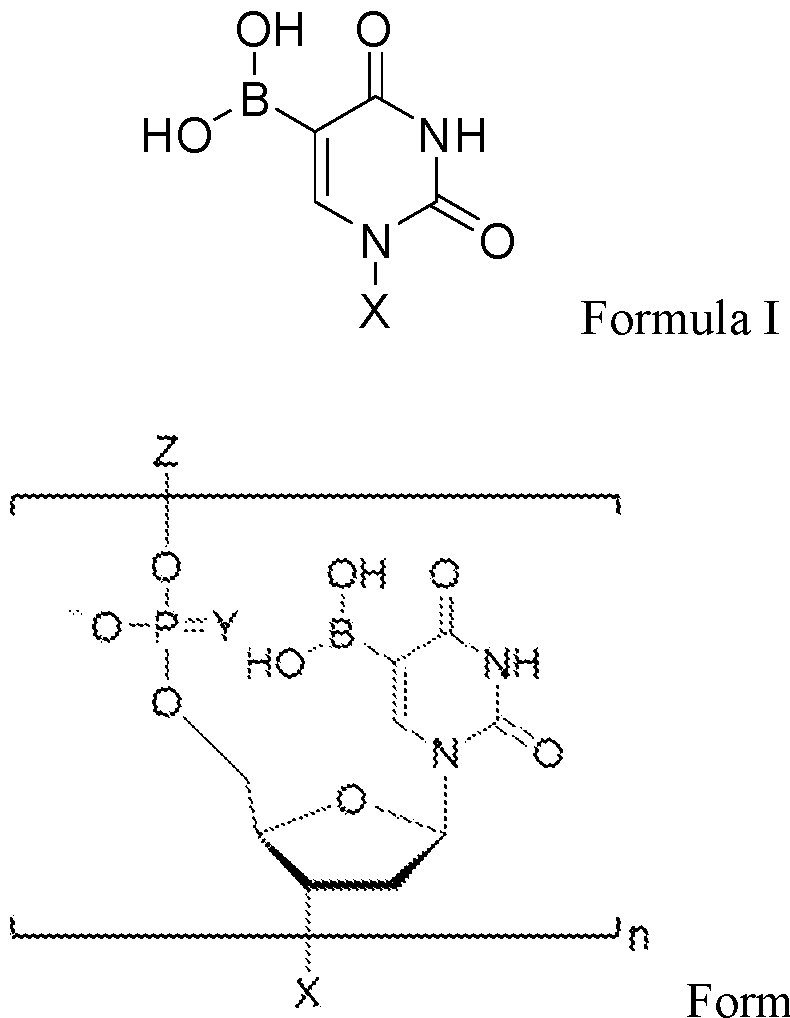 mula II where:
X is a monophosphate, a diphosphate, a triphosphate, a nucleotide or a nucleic acid;
Y is O or S;
Z is H, a nucleotide, or a detection label; and n is from 1 to 5; and (b) a pharmaceutically acceptable excipient.
[0008] In one aspect, a method for delivering a nucleotide or a nucleic acid to a cell is provided, the method comprising contacting the cell with a compound of Formula I, or a pharmaceutically acceptable salt, solvate, hydrate, tautomer, or stereoisomer thereof, a compound of Formula II, or a pharmaceutically acceptable salt, solvate, hydrate, tautomer, or stereoisomer thereof, or any combination thereof, wherein Formula I and Formula II have the following structures:
 Formula I
 Formula II where:
X is a monophosphate, a diphosphate, a triphosphate, a nucleotide or a nucleic acid;
Y is O or S;
Z is H, a nucleotide, or a detection label; and n is from 1 to 5.
100091 Without wishing to limit the present disclosure by any theory or mechanism, the compound, which is bound to a nucleotide or a nucleic acid, binds to a cell surface glycan, and the cell uptakes the compound, thereby delivering the nucleotide or nucleic acid to the cell.
[0010] In some embodiments, the nucleotide or nucleic acid includes from about 1 to about 100 nucleobases.
[0011] In some embodiments, Y is S.
[0012] In some embodiments, the detection label is a fluorescent label. Any known fluorescent label can be used in the compositions and methods described herein.
[0013 J In some embodiments, the nucleotide or nucleic acid is an antisense oligonucleotide. In some embodiments, the nucleotide or nucleic acid is synthetic. In some embodiments, the nucleotide or nucleic acid is a nucleic acid therapeutic.
[0014] In some embodiments, the compound has an increased splice-correcting activity as compared to a non-boronate analog. In some embodiments, the increase in slice-correcting activity is about 20%, about 30%, about 40%, about 50%, about 60%, about 70%, about 80%, about 90%, about 100%, about 120%, about 130%, about 140%, about 150%, about 160%, about 170%, about 180%, about 190%, about 200%, about 220%, about 230%, about 240%,
about 250%, about 260%, about 270%, about 280%, about 290%, about 300%, about 320%, about 330%, about 340%, about 350%, about 360%, about 370%, about 380%, about 390%, about 400%, about 420%, about 430%, about 440%, about 450%, about 460%, about 470%, about 480%, about 490%, or about 500%. In some embodiments, the compound has an increased splice-correcting activity as compared to a non-boronate analog of up to about 3- fold greater.
[0015] In some embodiments, the compound has an enhanced cytosolic penetration as compared to a non-boronate analog. In some embodiments, the enhancement in cytosolic penetration is about 25%, about 50%, about 75%, about 100%, about 125%, about 150%, about 175%, about 200%, about 225%, about 250%, about 275%, about 300%, about 325%, about 350%, about 375%, about 400%, about 425%, about 450%, about 475%, about 500%, about 525%, about 550%, about 575%, about 600%, about 625%, about 650%, about 675%, or about 700%. In some embodiments, the increase in cytosolic penetration is up to five-fold greater as compared to a non-boronate analog. In some embodiments, the increase in cytosolic penetration is measured using a chloroalkane penetration assay (CAPA).
[0016] In some embodiments, the compound has an increased cellular uptake as compared to a non-boronate analog. In some embodiments, the increase in cellular uptake is about 5%, about 10%, about 15%, about 20%, about 25%, about 30%, about 35%, about 40%, about 45%, about 50%, about 55%, about 60%, about 70%, about 75%, about 80%, about 85%, about 90%, about 95%, or about 100%.
[0017] In some embodiments, the compound has an increased cell permeability as compared to a non-boronate analog. In some embodiments, the increase in cell permeability is about 5%, about 10%, about 15%, about 20%, about 25%, about 30%, about 35%, about 40%, about 45%, about 50%, about 55%, about 60%, about 70%, about 75%, about 80%, about 85%, about 90%, about 95%, or about 100%.
[0018] In some embodiments, the nucleic acid is RNA or DNA. In some embodiments, provided herein is a compound for use in an mRNA vaccine.
[0019] Both the foregoing summary and the following description of the drawings and detailed description are exemplary and explanatory. They are intended to provide further details of the disclosure, but are not to be construed as limiting. Other objects, advantages,
and novel features will be readily apparent to those skilled in the art from the following detailed description of the disclosure.
BRIEF DESCRIPTION OF THE DRAWINGS
[0020] FIG. 1 A shows that the enhanced internalization of 5boU-containing nucleic acids occurs via reversible covalent linking with cell-surface glycans.
[0021] FIG. IB is a schematic showing the chloroalkane penetration assay (CAPA, ct-ASO = chloroalkane-tagged antisense oligonucleotide).
[0022J FIG. 1C shows an exemplary structure of a compound as described herein comprising a drug-like ASO, variable 5boU moieties, a linker, and a HaloTag substrate.
[0023] FIG. 2 shows a deconvoluted LC-HRMS spectrum of fully assembled ASO Id carrying three 5boU units.
[0024] FIG. 3 A shows data from the chloroalkane penetration assay using HaloTag- expressing HeLa cells. ct-ASOs and control small molecule ct-tryptophan (ct-W) were incubated with cells at indicated concentrations for 4 h, followed by washes and a chase with ct-dye. CPso values were calculated based on the curve fits shown. Error bars and CP50 errors are standard errors of the mean from at least three independent trials.
[0025] FIG. 3B is a schematic showing the splice-correction based luciferase reporter assay.
[0026] FIG. 3C shows data from the splice-correcting reporter assay using HeLa cells. All data are reported in terms of fold change of relative luminescence units (RLU) compared to untreated cells. Error bars show standard errors of the mean from three independent trials.
[0027] FIG. 4 shows a scheme for the synthesis of 5boUTP and the direct incorporation of 5boUTP into an oligonucleotide to enhance cell penetration.
DETAILED DESCRIPTION
I. Overview
[0028] The present invention is directed to the discovery of new compounds that significantly enhance the cellular delivery of ASOs. As noted above, limited cell permeability of ASOs considerably hinders their use as chemical probes and therapeutic agents and, therefore, the novel compounds described herein address a need in the art.
[0029] Several strategies have been developed to enhance cellular delivery of ASOs and related oligonucleotides. The most common methods use polycationic cell-penetrating peptides (CPPs) that are covalently conjugated to oligonucleotide cargos via thioether, thiol- maleimide or click ligation. Derivatization with a cleavable linkage, such as a disulfide bond, has also been employed for peptide-mediated delivery both in cells and in vivo. Another delivery strategy exploits the noncovalent interactions between cationic CPPs and negatively charged ASOs and siRNAs. Furthermore, peptide vectors containing hydrophobic elements (for example, fatty acids, lipids, or cholesterol) can form complexes with oligonucleotides which translocate them across the plasma membrane. However, for all of these strategies, issues related to chemical modifications, aggregation via charge neutralization, cell-type dependent heterogeneous uptake, and ineffective endosomal escape are common.
[0030] It was surprisingly found that electrophilic boronic acids form reversible, cyclic boronate esters with 1,2- and 1 ,3 -diols, including those presented by glycans at the cell surface. Further, it was unexpectedly discovered that the dynamic covalent bonding between boronic acid and cell surface glycans can promote cellular internalization and endosomal escape for delivery of bioactive peptides and proteins. Installing boronic acids within ASOs may offer an effective strategy for promoting cytosolic delivery of ASOs (Fig. 1 A).
[0031] Efficient delivery of therapeutic nucleic acids into cells presents a major challenge. As detailed in the examples below, the reversible interaction between boronic acid and cell surface glycans was exploited to increase cytosolic delivery of ASOs. Synthetic methods were developed to install 5boU site- selectively within drug-like oligonucleotides, and this chemistry was used to produce a panel of compounds each carrying an oligonucleotide sequence of interest, 5boU moiety, a linker, and a HaloTag substrate. In cell-based quantitative assays, boronated oligonucleotides exhibited improved cytosolic penetration by up to five-fold as compared to non-boronate analogs. Remarkably, an ASO carrying three 5boU moieties was nearly as efficient as a small molecule.
Experimental Results
[0032] Example 1 below details a convergent synthetic method developed to assemble the modified ASOs (Scheme 1, Scheme 2) (synthesis of 5boU compounds). Scheme 1 details synthesis of individual components 2, 7, and 8, where (A) details a synthetic scheme for
compound 2, (B) details the structure of linker phosphoramidite 7, and (C) details a synthetic scheme for compound 8. The ASO was prepared with 2’-(9-methylated (2’-OCH3) sugars and phosphorothioate (PS) backbone to provide stability against nucleases- this combination of chemical modifications matches those of FDA-approved ASO drugs as well as those in clinical trials.

[0033] The chloroalkyl HaloTag substrate moiety was prepared as an activated N- hydroxysuccinimide (NHS) ester 2 from commercially available compound 3 following a four-step protocol (Scheme 1 A). To introduce the long-chain alkyl linker, trifluoroacetyl protected hexylamine phosphoramidite 7 was employed (Scheme IB). To construct the boronic acid component, N-methyliminodiacetic acid (MIDA)-protected 5boU phosphoramidite building block 8 was synthesized (Scheme 1C).
[0034] Scheme 2 details synthesis of the fully assembled ASOs. Shown are the chemical steps to synthesize a dinucleotide with thiophosphate linkage via solid-phase technique. The cycle is repeated to incorporate the remaining canonical bases as well as 7 and 8. Ammonia- mediated global deprotection and cleavage led to unprotected compounds lla-d which were subsequently reacted with compound 2 to furnish the final compounds la-d. The identity of each intermediate and final compound was confirmed by ESI-HRMS (FIG. 2).

[0035] A cytosolic penetration assay, using a chloroalkane penetration assay (CAPA, FIG. IB), is detailed in Example 2. The assay was used to quantitatively measure cytosolic penetration of the chemically modified nucleic acids. Dose dependent CAPA provides a sigmoidal curve which can be fit to produce a CPso value, the concentration of ct-ASO at which 50% of HaloTag is blocked. CPso values have proven to be highly quantitative and
reproducible measurements of cytosolic delivery. This method has been applied to a variety of large molecule therapeutics, including ASOs, and allows for direct measurement of cell penetration without interference from endosomally trapped material. The results detailed in Example 2 demonstrated that adding two or three 5boU residues improved cell permeability by over 5-fold, resulting in cytosolic penetration that was nearly as efficient as a small molecule.
[0036] Finally, Example 3 details a splice-correcting activity assay (cell-based luciferase reporter assay), which enables correlation f the CAPA data to ASO function (FIG. 3B). In this assay, ASO corrects exon splicing of a P-globin intron inserted into a luciferase-coding mRNA, such that ASO splice-correction leads to expression of luciferase. The results detailed in Example 3 showed that increased splice correction was observed for ASOs lb and 1c which have one and two 5boU units, respectively, compared to non-boronate-containing ASO la (FIG. 3C). Consistent with the CPso values measured by CAPA, the greatest effects were observed at 60-200 nM concentrations, where ASOs lb and 1c showed 2-3-fold greater splice-correcting activity than ASO la. Interestingly, no such increase was observed for compound Id which had three 5boU units. This result may be due to increased affinity for cellular components that display multiple diols, such as complex glycans and ribonucleic acids, which may ultimately decrease cell penetration and accessibility in the cytosol.
[0037] Efficient delivery of therapeutic nucleic acids into cells presents a major challenge. The reversible interaction between boronic acid and cell surface glycans was exploited to increase cytosolic delivery of ASOs. Synthetic methods were developed to install 5boU site- selectively within drug-like oligonucleotides, and this chemistry was used to produce a panel of compounds each carrying an oligonucleotide sequence of interest, 5boU moiety, a linker, and a HaloTag substrate. In cell-based quantitative assays, boronated oligonucleotides exhibited improved cytosolic penetration by up to five-fold compared to non-boronate analogs. Remarkably, an ASO carrying three 5boU moieties was nearly as efficient as a small molecule.
II. Compounds
[0038] A concise synthetic strategy was developed to prepare and incorporate phosphoramidite of 5-dexyboryldexoyuridine (5boU) into short oligonucleotides using solid-
phase chemistry.
[0039] The 5boU compounds described herein have a structure according to Formula I, or a pharmaceutically acceptable salt, solvate, hydrate, tautomer, or stereoisomer thereof, or according to Formula II, or a pharmaceutically acceptable salt, solvate, hydrate, tautomer, or stereoisomer thereof:
 where:
X is a monophosphate, a diphosphate, a triphosphate, a nucleotide or a nucleic acid;
Y is O or S;
Z is H, a nucleotide, or a detection label; and n is from 1 to 5.
[0040] In some embodiments, n is 1, n is 2, n is 3, n is 4, or n is 5.
[0041 ] In some embodiments, the nucleotide or nucleic acid includes from about 1 to about 100 nucleobases. In some embodiments, the nucleotide or nucleic acid includes from about 1 nucleobase, about 10 nucleobases, about 20 nucleobases, about 30 nucleobases, about 40 nucleobases, about 50 nucleobases, about 60 nucleobases, about 70 nucleobases, about 80 nucleobases, about 90 nucleobases, or about 100 nucleobases.
[0042] In some embodiments, Y is S. In some embodiments, Y is O.
[0043] In some embodiments, the detection label is a fluorescent label. Any known fluorescent label can be used in the compositions and methods described herein. Examples of fluorescent labels include, but are not limited to, ethidium bromide, fluorescein, green fluorescent protein, synthetic and water-soluble fluorescent dyes, intrinsically fluorescent proteins, extrinsically fluorescent proteins, indodicarbocyanine, mNeonGreen, TurboGFP, RFP, mCherry, EGFP, HaloTag, etc.
[0044] In some embodiments, the compounds described herein may be used for cytosolic penetration measurements. In some embodiments, the compounds used herein may be used for detecting intracellular sugars. In some embodiments, the compounds described herein may be used for detecting intracellular oxidative intermediates.
[0045] In some embodiments, the nucleotide comprises a polynucleotide or an oligonucleotide. In some embodiments, the nucleotide or nucleic acid is an antisense oligonucleotide. In some embodiments, the nucleotide or nucleic acid is synthetic. In some embodiments, the nucleotide or nucleic acid is a nucleic acid therapeutic. In some embodiments, the nucleic acid is RNA or DNA. In some embodiments, the nucleic acid is a siRNA, a miRNA, or a mRNA. In some embodiments, the compounds used herein may be used in an mRNA vaccine.
[0046] The 5boU compounds described herein can be incorporated into a polynucleotide or an oligonucleotide using any methods known in the art. Such methods include polymerase chain reaction (PCR). In some embodiments, the compound of Formula I, or a pharmaceutically acceptable salt, solvate, hydrate, tautomer, or stereoisomer thereof, or the compound of Formula II, or a pharmaceutically acceptable salt, solvate, hydrate, tautomer, or stereoisomer thereof, is a triphosphate, and is contacted with a polymerase, a template, primers, and nucleotides to produce a polynucleotide or an oligonucleotide having the 5boU moiety (FIG. 4).
[0047] In some embodiments, the compound of Formula I, or a pharmaceutically acceptable salt, solvate, hydrate, tautomer, or stereoisomer thereof, or Formula II, or a pharmaceutically acceptable salt, solvate, hydrate, tautomer, or stereoisomer thereof, is installed at a terminal end of a nucleotide or a nucleic acid. In some embodiments, the compound of Formula I or Formula II (or pharmaceutically acceptable salts, solvates, hydrates, tautomers, or
stereoisomers thereof) is installed within a nucleotide or a nucleic acid. In some embodiments, the compound of Formula I or Formula II (or pharmaceutically acceptable salts, solvates, hydrates, tautomers, or stereoisomers thereof) is installed both within and at a terminal end of a nucleotide or a nucleic acid.
[0048] In some embodiments, the compounds described herein have an increased splicecorrecting activity as compared to a non-boronate analog. In some embodiments, the increase in slice-correcting activity is about 20%, about 30%, about 40%, about 50%, about 60%, about 70%, about 80%, about 90%, about 100%, about 120%, about 130%, about 140%, about 150%, about 160%, about 170%, about 180%, about 190%, about 200%, about 220%, about 230%, about 240%, about 250%, about 260%, about 270%, about 280%, about 290%, about 300%, about 320%, about 330%, about 340%, about 350%, about 360%, about 370%, about 380%, about 390%, about 400%, about 420%, about 430%, about 440%, about 450%, about 460%, about 470%, about 480%, about 490%, or about 500%. In some embodiments, the compound has an increased splice-correcting activity as compared to a non-boronate analog of up to about 3 -fold greater. In some embodiments, the increase in splice-correcting activity is measured using a bioluminescent-based technique. In some embodiments, the increase in splice-correcting activity is measured using a luciferase reporter assay.
1004 1 In some embodiments, the compounds described herein have an enhanced cytosolic penetration as compared to a non-boronate analog. In some embodiments, the enhancement in cytosolic penetration is about 25%, about 50%, about 75%, about 100%, about 125%, about 150%, about 175%, about 200%, about 225%, about 250%, about 275%, about 300%, about 325%, about 350%, about 375%, about 400%, about 425%, about 450%, about 475%, about 500%, about 525%, about 550%, about 575%, about 600%, about 625%, about 650%, about 675%, or about 700%. In some embodiments, the increase in cytosolic penetration is up to five-fold greater as compared to a non-boronate analog. In some embodiments, the increase in cytosolic penetration is measured using a chloroalkane penetration assay (CAPA).
[0050] In some embodiments, the compounds described herein have an increased cellular uptake as compared to a non-boronate analog. In some embodiments, the increase in cellular uptake is about 5%, about 10%, about 15%, about 20%, about 25%, about 30%, about 35%, about 40%, about 45%, about 50%, about 55%, about 60%, about 70%, about 75%, about
80%, about 85%, about 90%, about 95%, or about 100%. In some embodiments, the increase in cellular uptake is measured by adding a detection label to the compound, and detecting the label within the cell. In some embodiments, the detection label is a fluorescent dye. In some embodiments, cellular uptake is measured using fluorescence microscopy or by flow cytometry.
[0051 [ In some embodiments, the compounds described herein have an increased cell permeability as compared to a non-boronate analog. In some embodiments, the increase in cell permeability is about 5%, about 10%, about 15%, about 20%, about 25%, about 30%, about 35%, about 40%, about 45%, about 50%, about 55%, about 60%, about 70%, about 75%, about 80%, about 85%, about 90%, about 95%, or about 100%.
[0052] In some embodiments, the compounds described herein may be used in a pharmaceutical composition. In some embodiments, the pharmaceutical composition comprises a compound described herein and a pharmaceutically acceptable excipient. Examples of the pharmaceutically acceptable excipient include, but are not limited to, diluents, carriers, fillers, binders, lubricants, surfactants, sweetening and flavoring agents, coating materials, preservatives, dyes, thickeners, adjuvants, antimicrobial agents, and antioxidants.
III. Methods
100531 Also provided herein are methods for delivering a nucleotide or a nucleic acid to a cell. The method can comprise contacting the cell with a compound of Formula I, or a pharmaceutically acceptable salt, solvate, hydrate, tautomer, or stereoisomer thereof, a compound of Formula II, or a pharmaceutically acceptable salt, solvate, hydrate, tautomer, or stereoisomer thereof, or any combination thereof.
10054] Without wishing to limit the present disclosure by any theory or mechanism, the compound of Formula I or Formula II, which is bound to a nucleotide or a nucleic acid, binds to a cell surface glycan, and the cell uptakes the compound, thereby delivering the nucleotide or nucleic acid to the cell.
IV. Definitions
[0055] As used herein, “antisense oligonucleotide” refers to polymeric forms of nucleotides of a given length of a single antisense stranded of nucleic acid molecule. As will be appreciated by one of skilled in the art, antisense oligonucleotides include deoxyribonucleotides (DNAs), ribonucleotides (RNAs), and their corresponding analogs and derivatives thereof. As non-limiting examples, Locked Nucleic Acid (LNA), Peptide Nucleic Acid (PNA), morpholino phosphoroamidate (MF), 2 '-O-m ethoxy ethyl oligonucleotide(s) (2'- MOE), 2'-O-methyl (2'-OCH3), phosphorothioate (PS), phosphoroamidate, methylphosphonate and universal base belong to the said analogs and derivatives.
[0056] Antisense oligonucleotides include all formats of chemical modifications or and substitutions, which are both on and in between of nucleotides within a given antisense oligonucleotide. One ordinary skilled in the relevant art would recognize that said chemical modifications and substitutions include but are by no means limited to chemical modifications or substitutions on the molecular structures of pentose sugar, phosphate group and nitrogenous base of said antisense oligonucleotides. For example, methylation of the naturally occurring nucleotides and analogs is one of the formats of chemical modifications. Modifications of internucleotide linkages, for example but by no means limited to phosphonates, methyl phosphonates, phosphoroamidites, phosphotriesters, phosphorothioates, phosphorodithioates, 2'-5 ' linkages, non-phosphorus linkages and the like are included.
[0057] As used herein, “nucleic acid” refers to DNA or RNA, whether it is a product of amplification, synthetically created, products of reverse transcription of RNA, or naturally occurring. Typically, nucleic acids are single- or double-stranded molecules and are composed of naturally occurring nucleotides. Double-stranded nucleic acid molecules can have 3'- or 5 '-overhangs and as such are not required or assumed to be completely doublestranded over their entire length. Furthermore, the nucleic acid can be composed of non- naturally occurring nucleotides and/or modifications to naturally occurring nucleotides. Examples include, but are not limited to, phosphorylation of 5' or 3' nucleotides to allow for ligation or prevention of exonuclease degradation/polymerase extension, respectively; amino, thiol, alkyne, or biotinyl modifications for covalent and near covalent attachments;
fluorophores and quenchers; phosphorothioate, methylphosphonates, phosphoroamidates and phosphotriester linkages between nucleotides to prevent degradation; methylation; and modified bases or nucleosides such as deoxy-inosine, 5-bromo-dU, 2 '-deoxy -uridine, 2- aminopurine, 2', 3 '-dideoxy-cytidine, 5-methyl-dC, locked nucleic acids (LNA's), iso-dC and- dG bases, 2'-O-methyl RNA bases and fluorine modified nucleosides.
[0058] As used herein, “nucleoside” refers to a compound consisting of a base linked to the C-l ' carbon of a sugar, for example, ribose or deoxyribose. The base portion of the nucleoside is usually a heterocyclic base, e.g., a purine or pyrimidine.
100591 As used herein, “nucleotide” refers to a phosphate ester of a nucleoside, as a monomer unit or within a polynucleotide.
[0060] As used herein, “pharmaceutically acceptable” refers to those compounds, materials, compositions, and/or dosage forms which are, within the scope of sound medical judgment, suitable for use in contact with the tissues of human beings and animals without excessive toxicity, irritation, allergic response, or other problem or complication commensurate with a reasonable benefit/risk ratio.
[0061] As used herein, “about” will be understood by persons of ordinary skill in the art and will vary to some extent depending upon the context in which it is used. If there are uses of the term which are not clear to persons of ordinary skill in the art, given the context in which it is used, “about” will mean up to plus or minus 10% of the particular term.
[0062] The use of the terms “a” and “an” and “the” and similar referents in the context of describing the elements (especially in the context of the following claims) are to be construed to cover both the singular and the plural, unless otherwise indicated herein or clearly contradicted by context. Recitation of ranges of values herein are merely intended to serve as a shorthand method of referring individually to each separate value falling within the range, unless otherwise indicated herein, and each separate value is incorporated into the specification as if it were individually recited herein. All methods described herein can be performed in any suitable order unless otherwise indicated herein or otherwise clearly contradicted by context. The use of any and all examples, or exemplary language (e.g., “such as”) provided herein, is intended merely to better illuminate the embodiments and does not
pose a limitation on the scope of the claims unless otherwise stated. No language in the specification should be construed as indicating any non-claimed element as essential.
[0063] Various embodiments are described hereinafter. It should be noted that the specific embodiments are not intended as an exhaustive description or as a limitation to the broader aspects discussed herein. One aspect described in conjunction with a particular embodiment is not necessarily limited to that embodiment and can be practiced with any other embodiment(s).
[0064] The present invention, thus generally described, will be understood more readily by reference to the following examples, which are provided by way of illustration and are not intended to be limiting of the present invention.
EXAMPLES
{0065] Example 1. Synthesis of 5boU compounds
[0066] A convergent synthetic method was developed to assemble the modified ASOs (Scheme 1, Scheme 2).
[0067] Scheme 1. Synthesis of individual components 2, 7, and 8. (A) Synthetic scheme for compound 2. (B) Structure of linker phosphoramidite 7. (C) Synthetic scheme for compound 8.

[0068] A chloroalkyl HaloTag substrate moiety was added to the compounds to quantitatively measure cytosolic penetration of the chemically modified nucleic acids. A panel of compounds (la-d) were designed, the compounds comprising (i) a chloroalkyl substrate for HaloTag, (ii) a linker, (iii) a 5boU-containing unit, and (iv) an ASO cargo (FIG. 1C). The ASO was prepared with 2’-(9-methylated (2’-OCH3) sugars and phosphorothioate (PS) backbone to provide stability against nucleases- this combination of chemical modifications matches those of FDA-approved ASO drugs as well as those in clinical trials. The sequence of the ASOs was chosen to promote splice correction of a luciferase reporter system.
[0069] The chloroalkyl HaloTag substrate moiety was prepared as an activated N- hydroxysuccinimide (NHS) ester 2 from commercially available compound 3 following a four-step protocol (Scheme 1A). Briefly, compound 3 was subjected to chemoselective
alkylation with l-chloro-6-iodohexane to afford iodo derivative 4. Subsequently, acid- catalyzed deprotection of Boc-carbamate led to free amine 5 which was coupled with succinic acid to furnish compound 6. Finally, NHS esterification of compound 6 led to compound 2. To introduce the long-chain alkyl linker, trifluoroacetyl protected hexylamine phosphoramidite 7 was employed (Scheme IB).
[0070] To construct the boronic acid component, N-methyliminodiacetic acid (MIDA)- protected 5boU phosphoramidite building block 8 was synthesized (Scheme 1C). Briefly, 5- bromouridine 9 was treated with tert-butyldimethylsilyl (TBS) chloride followed by metalhalogen exchange mediated installation of the boronic acid moiety as the key step, and MIDA protection furnished an advanced intermediate 10. Subsequent protection-deprotection steps and phosphoramidation led to phosphoramidite 8 (Scheme 1C). A base-sensitive MIDA protecting group was used because it remains intact during trichloroacetic acid mediated cleavage of 5-dimethoxytrityl (DMT) groups during solid-phase DNA synthesis.
Furthermore, MIDA can be removed by ammonia while performing global deprotection and cleavage of the completed oligonucleotide.
[0071 ] Scheme 2. Synthesis of the fully assembled ASOs. Shown are the chemical steps to synthesize a dinucleotide with thiophosphate linkage via solid-phase technique. The cycle is repeated to incorporate the remaining canonical bases as well as 7 and 8. Ammonia-mediated global deprotection and cleavage led to unprotected compounds lla-d which were subsequently reacted with compound 2 to furnish the final compounds la-d.

[0072] Upon accessing the 5boU phosphoramidite 10, 2‘-OCH3-modified, PS-modified ASOs were synthesized with a 5’ amine rewrite (Scheme 2). 5boU units were installed at the 5’ end of the ASOs to allow for late-stage incorporation of the boronate-containing nucleotides, and because substitution at the 5’ end is expected to minimally perturb the splice-correcting activity of ASOs. To introduce phosphorothioate linkages, the growing oligonucleotide sequence was treated with 3-[(Dimethylaminomethylene)amino]-3H-l,2,4- dithiazole-5-thione (DDTT) in each cycle during solid-phase synthesis. A panel of ASOs carrying up to three 5boU units were synthesized to systematically examine the effects of boronic acid on cytosolic penetration.
[0073] After incorporation of 5boU, the long-chain alkyl linker was attached to the oligonucleotides on solid support using phosphoramidite 7 (Scheme 2). Ammonia-mediated
global deprotection and cleavage from solid support followed by HPLC purification yielded analytically pure compounds lla-d. Subsequently, the free primary amine was conjugated with the chloroalkane-NHS ester 2 in solution to yield final modified ASOs la-d which were further purified by HPLC (Scheme 2). The identity of each intermediate and final compound was confirmed by ESLHRMS (FIG. 2).
[0074] Example 2. Cytosolic Penetration Assay Using CAPA
[0075] The chloroalkane penetration assay (CAPA, FIG. IB) was used to quantitatively measure cytosolic penetration of the chemically modified nucleic acids. In CAPA, cells expressing HaloTag enzyme are treated with a chloroalkane-tagged (ct) compound (a ct- ASO), then chased with ct-dye. ct-ASO that crosses the cell membrane will covalently block HaloTag, preventing the dye from being retained by cells in the chase step. Thus, the degree to which the ct-ASO penetrates the cytosol is inversely proportional to the fluorescence signal obtained after the chase step. Dose dependent CAPA provides a sigmoidal curve which can be fit to produce a CPso value, the concentration of ct-ASO at which 50% of HaloTag is blocked. CPso values have proven to be highly quantitative and reproducible measurements of cytosolic delivery. This method has been applied to a variety of large molecule therapeutics, including ASOs, and allows for direct measurement of cell penetration without interference from endosomally trapped material.
[0076] After successfully synthesizing the fully assembled ct-ASOs, to obtain CAPA data were obtained for each of the compounds at concentrations ranging from 0.5 nM to 1 pM (FIG. 3 A). The CPso value for control small molecule ct-tryptophan (ct-W) was measured at 0.043 pM, consistent with prior observation. The CPso value for the non-boronate-containing ct-ASO la was 0.43 ± 0.11 pM, consistent with results previously observed for similar PS, 2'- O-methyoxyethyl-modified ASOs. The CPso value for an identical ct-ASO with a single 5boU lb was 0.18 ± 0.06 pM, which means a single boronate moiety conferred a 2.4-fold increase in cytosolic penetration. The CPso values for ct-ASOs with two and three 5boU nucleotides, 1c and Id, respectively, were 0.074 ± 0.004 pM and 0.057 ± 0.015 pM, respectively, indicating a further increase in cell permeability of roughly 2.4-fold for the second boronate moiety, followed by diminishing improvement when a third boronate was
added (FIG. 3 A). Overall, adding two or three 5boU residues improved cell permeability by over 5-fold, resulting in cytosolic penetration that was nearly as efficient as a small molecule.
[0077] Example 3. Splice-Correcting Activity Assay
[0078] To correlate the CAPA data to ASO function, the ASOs were then tested in an established cell-based luciferase reporter assay (FIG. 3B).
[0079] In this assay, ASO corrects exon splicing of a P-globin intron inserted into a luciferase-coding mRNA, such that ASO splice-correction leads to expression of luciferase. Relative luminescence units (RLU) of ct-ASO-treated cells were normalized to the background as measured for untreated cells. ct-ASOs were tested at concentrations between 0.06 pM and 5 pM and increasing splice-correction was observed at increasing concentrations of all compounds. Increased splice correction was observed for ASOs lb and 1c which have one and two 5boU units, respectively, compared to non-boronate-containing ASO la (FIG. 3C). Consistent with the CPso values measured by CAPA, the greatest effects were observed at 60-200 nM concentrations, where ASOs lb and 1c showed 2-3-fold greater splice-correcting activity than ASO la. Interestingly, no such increase was observed for compound Id which had three 5boU units. This result may be due to increased affinity for cellular components that display multiple diols, such as complex glycans and ribonucleic acids, which may ultimately decrease cell penetration and accessibility in the cytosol.
[0080] Efficient delivery of therapeutic nucleic acids into cells presents a major challenge. The reversible interaction between boronic acid and cell surface glycans was exploited to increase cytosolic delivery of ASOs. Synthetic methods were developed to install 5boU site- selectively within drug-like oligonucleotides, and this chemistry was used to produce a panel of compounds each carrying an oligonucleotide sequence of interest, 5boU moiety, a linker, and a HaloTag substrate. In cell-based quantitative assays, boronated oligonucleotides exhibited improved cytosolic penetration by up to five-fold compared to non-boronate analogs. Remarkably, an ASO carrying three 5boU moieties was nearly as efficient as a small molecule.
***
(0081 ] While certain embodiments have been illustrated and described, it should be understood that changes and modifications can be made therein in accordance with ordinary skill in the art without departing from the technology in its broader aspects as defined in the following claims.
[00821 The embodiments, illustratively described herein may suitably be practiced in the absence of any element or elements, limitation or limitations, not specifically disclosed herein. Thus, for example, the terms “comprising,” “including,” “containing,” etc. shall be read expansively and without limitation. Additionally, the terms and expressions employed herein have been used as terms of description and not of limitation, and there is no intention in the use of such terms and expressions of excluding any equivalents of the features shown and described or portions thereof, but it is recognized that various modifications are possible within the scope of the claimed technology. Additionally, the phrase “consisting essentially of’ will be understood to include those elements specifically recited and those additional elements that do not materially affect the basic and novel characteristics of the claimed technology. The phrase “consisting of’ excludes any element not specified.
[0083] The present disclosure is not to be limited in terms of the particular embodiments described in this application. Many modifications and variations can be made without departing from its spirit and scope, as will be apparent to those skilled in the art. Functionally equivalent methods and compositions within the scope of the disclosure, in addition to those enumerated herein, will be apparent to those skilled in the art from the foregoing descriptions. Such modifications and variations are intended to fall within the scope of the appended claims. The present disclosure is to be limited only by the terms of the appended claims, along with the full scope of equivalents to which such claims are entitled. It is to be understood that this disclosure is not limited to particular methods, reagents, compounds, or compositions, which can of course vary. It is also to be understood that the terminology used herein is for the purpose of describing particular embodiments only, and is not intended to be limiting.
[0084] In addition, where features or aspects of the disclosure are described in terms of Markush groups, those skilled in the art will recognize that the disclosure is also thereby described in terms of any individual member or subgroup of members of the Markush group.
(0085] As will be understood by one skilled in the art, for any and all purposes, particularly in terms of providing a written description, all ranges disclosed herein also encompass any and all possible subranges and combinations of subranges thereof. Any listed range can be easily recognized as sufficiently describing and enabling the same range being broken down into at least equal halves, thirds, quarters, fifths, tenths, etc. As a non-limiting example, each range discussed herein can be readily broken down into a lower third, middle third and upper third, etc. As will also be understood by one skilled in the art all language such as “up to,” “at least,” “greater than,” “less than,” and the like, include the number recited and refer to ranges which can be subsequently broken down into subranges as discussed above. Finally, as will be understood by one skilled in the art, a range includes each individual member.
(0086] All publications, patent applications, issued patents, and other documents referred to in this specification are herein incorporated by reference as if each individual publication, patent application, issued patent, or other document was specifically and individually indicated to be incorporated by reference in its entirety. Definitions that are contained in text incorporated by reference are excluded to the extent that they contradict definitions in this disclosure.
[0087] Other embodiments are set forth in the following claims.
Claims
1. A compound having a structure of Formula I, or a pharmaceutically acceptable salt, solvate, hydrate, tautomer, or stereoisomer thereof:
 Formula I wherein X is a monophosphate, a diphosphate, a triphosphate, a nucleotide, or a nucleic acid.
2. A compound having a structure of Formula II, or a pharmaceutically acceptable salt, solvate, hydrate, tautomer, or stereoisomer thereof:
 Formula II wherein:
X is a monophosphate, a diphosphate, a triphosphate, a nucleotide or a nucleic acid;
Y is O or S;
Z is H, a nucleotide, or a detection label; and n is from 1 to 5.
3. The compound of claim 1 or claim 2, wherein the nucleotide or nucleic acid comprises from 1 to 100 nucleobases.
4. The compound of any one of the preceding claims, wherein Y is S.
5. The compound of any one of the preceding claims, wherein the detection label is a fluorescent label.
6. The compound of any one of the preceding claims, wherein the nucleotide or nucleic acid is an antisense oligonucleotide.
7. The compound of any one of the preceding claims, wherein the nucleotide or nucleic acid is synthetic.
8. The compound of any one of the preceding claims, wherein the nucleotide or nucleic acid is a nucleic acid therapeutic.
9. The compound of any one of the preceding claims, wherein the compound has an increased splice-correcting activity as compared to a non-boronate analog.
10. The compound of claim 9, wherein the increase in slice-correcting activity is about 20%, about 30%, about 40%, about 50%, about 60%, about 70%, about 80%, about 90%, about 100%, about 120%, about 130%, about 140%, about 150%, about 160%, about 170%, about 180%, about 190%, about 200%, about 220%, about 230%, about 240%, about 250%, about 260%, about 270%, about 280%, about 290%, about 300%, about 320%, about 330%, about 340%, about 350%, about 360%, about 370%, about 380%, about 390%, about 400%, about 420%, about 430%, about 440%, about 450%, about 460%, about 470%, about 480%, about 490%, or about 500%.
11. The compound of claim 9 or 10, wherein the compound has an increased splicecorrecting activity as compared to a non-boronate analog of up to about 3 -fold greater.
12. The compound of any one of the preceding claims, wherein the compound has an enhanced cytosolic penetration as compared to a non-boronate analog.
13. The compound of claim 12, wherein the enhancement in cytosolic penetration is about 25%, about 50%, about 75%, about 100%, about 125%, about 150%, about 175%, about 200%, about 225%, about 250%, about 275%, about 300%, about 325%, about 350%, about
375%, about 400%, about 425%, about 450%, about 475%, about 500%, about 525%, about 550%, about 575%, about 600%, about 625%, about 650%, about 675%, or about 700%.
14. The compound of claim 12 or 13, wherein the increase in cytosolic penetration is up to five-fold greater as compared to a non-boronate analog.
15. The compound of any one of claims 12-14, wherein the increase in cytosolic penetration is measured using a chloroalkane penetration assay (CAPA).
16. The compound of any one of the preceding claims, wherein the compound has an increased cellular uptake as compared to a non-boronate analog.
17. The compound of claim 16, wherein the increase in cellular uptake is about 5%, about 10%, about 15%, about 20%, about 25%, about 30%, about 35%, about 40%, about 45%, about 50%, about 55%, about 60%, about 70%, about 75%, about 80%, about 85%, about 90%, about 95%, or about 100%.
18. The compound of any one of the preceding claims, wherein the compound has an increased cell permeability as compared to a non-boronate analog.
19. The compound of claim 18, wherein the increase in cell permeability is about 5%, about 10%, about 15%, about 20%, about 25%, about 30%, about 35%, about 40%, about 45%, about 50%, about 55%, about 60%, about 70%, about 75%, about 80%, about 85%, about 90%, about 95%, or about 100%.
20. The compound of any one of the preceding claims, wherein the nucleic acid is RNA or DNA.
21. The compound of any one of the preceding claims for use in an mRNA vaccine.
22. A pharmaceutical composition comprising:
(a) a compound of Formula I or Formula II, or a pharmaceutically acceptable salt, solvate, hydrate, tautomer, or stereoisomer thereof:
 mula II wherein
X is a monophosphate, a diphosphate, a triphosphate, a nucleotide or a nucleic acid;
Y is O or S;
Z is H, a nucleotide, or a detection label; and n is from 1 to 5; and
(b) a pharmaceutically acceptable excipient.
23. The pharmaceutical composition of claim 22, wherein the nucleotide or nucleic acid comprises from 1 to 100 nucleobases.
24. The pharmaceutical composition of claim 22 or 23, wherein Y is S.
25. The pharmaceutical composition of any one of claims 22 to 24, wherein the detection label is a fluorescent label.
26. The pharmaceutical composition of any one of claims 22-25, wherein the nucleotide or nucleic acid is an antisense oligonucleotide.
27. The pharmaceutical composition of any one of claims 22-26, wherein the nucleotide or nucleic acid is synthetic.
28. The pharmaceutical composition of any one of claims 22-27, wherein the nucleotide or nucleic acid is a nucleic acid therapeutic.
29. The pharmaceutical composition of any one of claims 22-28, wherein the compound has an increased splice-correcting activity as compared to a non-boronate analog.
30. The pharmaceutical composition of claim 29, wherein the increase in slice-correcting activity is about 20%, about 30%, about 40%, about 50%, about 60%, about 70%, about 80%, about 90%, about 100%, about 120%, about 130%, about 140%, about 150%, about 160%, about 170%, about 180%, about 190%, about 200%, about 220%, about 230%, about 240%, about 250%, about 260%, about 270%, about 280%, about 290%, about 300%, about 320%, about 330%, about 340%, about 350%, about 360%, about 370%, about 380%, about 390%, about 400%, about 420%, about 430%, about 440%, about 450%, about 460%, about 470%, about 480%, about 490%, or about 500%.
31. The pharmaceutical composition of claim 29 or 30, wherein the compound has an increased splice-correcting activity as compared to a non-boronate analog of up to about 3- fold greater.
32. The pharmaceutical composition of any one of claims 22-31, wherein the compound has an enhanced cytosolic penetration as compared to a non-boronate analog.
33. The pharmaceutical composition of claim 32, wherein the enhancement in cytosolic penetration is about 25%, about 50%, about 75%, about 100%, about 125%, about 150%, about 175%, about 200%, about 225%, about 250%, about 275%, about 300%, about 325%, about 350%, about 375%, about 400%, about 425%, about 450%, about 475%, about 500%, about 525%, about 550%, about 575%, about 600%, about 625%, about 650%, about 675%, or about 700%.
34. The pharmaceutical composition of claim 32 or 33, wherein the increase in cytosolic penetration is up to five-fold greater as compared to a non-boronate analog.
35. The pharmaceutical composition of any one of claims 32-34, wherein the increase in cytosolic penetration is measured using a chloroalkane penetration assay (CAPA).
36. The pharmaceutical composition of any one of claims 22-35, wherein the compound has an increased cellular uptake as compared to a non-boronate analog.
37. The pharmaceutical composition of claim 36, wherein the increase in cellular uptake is about 5%, about 10%, about 15%, about 20%, about 25%, about 30%, about 35%, about 40%, about 45%, about 50%, about 55%, about 60%, about 70%, about 75%, about 80%, about 85%, about 90%, about 95%, or about 100%.
38. The pharmaceutical composition of any one of claims 22-37, wherein the compound has an increased cell permeability as compared to a non-boronate analog.
39. The pharmaceutical composition of claim 38, wherein the increase in cell permeability is about 5%, about 10%, about 15%, about 20%, about 25%, about 30%, about 35%, about 40%, about 45%, about 50%, about 55%, about 60%, about 70%, about 75%, about 80%, about 85%, about 90%, about 95%, or about 100%.
40. The pharmaceutical composition of any one of claims 22-39, wherein the nucleic acid is RNA or DNA.
41. The pharmaceutical composition of any one of claims 22-40 for use in an mRNA vaccine.
42. A method for delivering a nucleotide or a nucleic acid to a cell, the method comprising: contacting the cell with a compound of Formula I or Formula II, or a pharmaceutically acceptable salt, solvate, hydrate, tautomer, or stereoisomer thereof:
 Formula I

X is a monophosphate, a diphosphate, a triphosphate, a nucleotide or a nucleic acid;
Y is O or S;
Z is H, a nucleotide, or a detection label; and n is from 1 to 5; wherein the compound binds to a cell surface glycan, and wherein the cell uptakes the compound, thereby delivering the nucleotide or nucleic acid to the cell.
43. The method of claim 42, wherein the nucleotide or nucleic acid comprises from 1 to 100 nucleobases.
44. The method of claim 42 or 43, wherein Y is S.
45. The method of any one of claims 42 to 44, wherein the detection label is a fluorescent label.
46. The method of any one of claims 42-45, wherein the nucleotide or nucleic acid is an antisense oligonucleotide.
47. The method of any one of claims 42-46, wherein the nucleotide or nucleic acid is synthetic.
48. The method of any one of claims 42-47, wherein the nucleotide or nucleic acid is a nucleic acid therapeutic.
49. The method of any one of claims 42-48, wherein the compound has an increased splice-correcting activity as compared to a non-boronate analog.
50. The method of claim 49, wherein the increase in slice-correcting activity is about 20%, about 30%, about 40%, about 50%, about 60%, about 70%, about 80%, about 90%, about 100%, about 120%, about 130%, about 140%, about 150%, about 160%, about 170%, about 180%, about 190%, about 200%, about 220%, about 230%, about 240%, about 250%, about 260%, about 270%, about 280%, about 290%, about 300%, about 320%, about 330%, about 340%, about 350%, about 360%, about 370%, about 380%, about 390%, about 400%, about 420%, about 430%, about 440%, about 450%, about 460%, about 470%, about 480%, about 490%, or about 500%.
51. The method of claim 49 or 50, wherein the compound has an increased splicecorrecting activity as compared to a non-boronate analog of up to about 3 -fold greater.
52. The method of any one of claims 42-51, wherein the compound has an enhanced cytosolic penetration as compared to a non-boronate analog.
53. The method of claim 52, wherein the enhancement in cytosolic penetration is about 25%, about 50%, about 75%, about 100%, about 125%, about 150%, about 175%, about 200%, about 225%, about 250%, about 275%, about 300%, about 325%, about 350%, about 375%, about 400%, about 425%, about 450%, about 475%, about 500%, about 525%, about 550%, about 575%, about 600%, about 625%, about 650%, about 675%, or about 700%.
54. The method of claim 52 or 53, wherein the increase in cytosolic penetration is up to five-fold greater as compared to a non-boronate analog.
55. The method of any one of claims 52-54, wherein the increase in cytosolic penetration is measured using a chloroalkane penetration assay (CAPA).
56. The method of any one of claims 42-55, wherein the compound has an increased cellular uptake as compared to a non-boronate analog.
57. The method of claim 56, wherein the increase in cellular uptake is about 5%, about 10%, about 15%, about 20%, about 25%, about 30%, about 35%, about 40%, about 45%,
about 50%, about 55%, about 60%, about 70%, about 75%, about 80%, about 85%, about 90%, about 95%, or about 100%.
58. The method of any one of claims 42-57, wherein the compound has an increased cell permeability as compared to a non-boronate analog.
59. The method of claim 58, wherein the increase in cell permeability is about 5%, about 10%, about 15%, about 20%, about 25%, about 30%, about 35%, about 40%, about 45%, about 50%, about 55%, about 60%, about 70%, about 75%, about 80%, about 85%, about 90%, about 95%, or about 100%.
60. The method of any one of claims 42-59, wherein the nucleic acid is RNA or DNA.
61. The method of any one of claims 42-60 for use in an mRNA vaccine.
Applications Claiming Priority (2)
| Application Number | Priority Date | Filing Date | Title |
|---|---|---|---|
| US202363471599P | 2023-06-07 | 2023-06-07 | |
| US63/471,599 | 2023-06-07 |
Publications (2)
| Publication Number | Publication Date |
|---|---|
| WO2024254253A2 true WO2024254253A2 (en) | 2024-12-12 |
| WO2024254253A3 WO2024254253A3 (en) | 2025-02-27 |
Family
ID=93794549
Family Applications (1)
| Application Number | Title | Priority Date | Filing Date |
|---|---|---|---|
| PCT/US2024/032724 Ceased WO2024254253A2 (en) | 2023-06-07 | 2024-06-06 | Boronic acid mediated cellular delivery of therapeutic oligonucleotides |
Country Status (1)
| Country | Link |
|---|---|
| WO (1) | WO2024254253A2 (en) |
Family Cites Families (2)
| Publication number | Priority date | Publication date | Assignee | Title |
|---|---|---|---|---|
| US6180766B1 (en) * | 1993-12-02 | 2001-01-30 | Raymond F. Schinazi | Nucleosides and oligonucleotides containing boron clusters |
| GB0905515D0 (en) * | 2009-03-31 | 2009-05-13 | Ge Healthcare Ltd | Radiolabelling methods |
-
2024
- 2024-06-06 WO PCT/US2024/032724 patent/WO2024254253A2/en not_active Ceased
Also Published As
| Publication number | Publication date |
|---|---|
| WO2024254253A3 (en) | 2025-02-27 |
Similar Documents
| Publication | Publication Date | Title |
|---|---|---|
| CN114681621B (en) | Peptide oligonucleotide conjugates | |
| US9441228B2 (en) | Post-synthetic chemical modification of RNA at the 2′-position of the ribose ring via “click” chemistry | |
| JP5816556B2 (en) | UNA oligomer structure for therapeutic agents | |
| JP7702444B2 (en) | Cell-penetrating peptides for antisense delivery | |
| HU227794B1 (en) | Oligonucleotide analogs compositions comprising same and process for producing them | |
| US12173287B2 (en) | Compositions and methods for improving strand biased | |
| US20240425543A1 (en) | Synthesis and Biological Activity of Phosphoramidimidate and Phosphoramidate DNA | |
| CN112055598B (en) | Compositions and methods for inhibiting GYS2 expression | |
| Dhara et al. | Synthesis, biophysical and biological evaluation of splice-switching oligonucleotides with multiple LNA-phosphothiotriester backbones | |
| Kavoosi et al. | 5-Dihydroxyboryluridine enhances cytosolic penetration of antisense oligonucleotides | |
| JP2003505517A (en) | Conjugates and methods for their preparation and their use for transporting molecules across biological membranes | |
| US20240384269A1 (en) | Compositions containing nucleic acid nanoparticles and processes related to alteration of their physiochemical characteristics | |
| EP2376518A1 (en) | A complex and method for enhancing nuclear delivery | |
| Patrushev et al. | New Zwitter-Ionic Oligonucleotides: Preparation and Complementary Binding | |
| Navarro et al. | Engineering G-quadruplex aptamer-5-fluoro-2′-deoxyuridine conjugates: Impact of tail orientation and RNA spacer insertion on structure and antitumor activity | |
| JP7216381B2 (en) | RNA action inhibitor and its use | |
| US20240116986A1 (en) | Fusion peptides containing dimeric alpha-helices, peptide-molecularconjugates containing the same and nucleic acid delivery compositionscontaining the same | |
| JP2026068029A (en) | Single-stranded nucleic acids and their uses | |
| Epple | Backbone-modified oligonucleotides for biology and medicine | |
| Efimov et al. | Synthesis and properties of pyrrolidine-based negatively charged DNA mimics | |
| WO2026057749A1 (en) | Method and product | |
| Jezowska-Herrera | Towards smart antisense and antigene therapeutics: design and synthesis of novel oligonucleotide based bioconjugates | |
| CN118660965A (en) | Antisense oligonucleotide complex | |
| Alvira Torre | Modified oligonucleotides for triple helix studies and for the obtention of structures with biomedical and technological interest |
Legal Events
| Date | Code | Title | Description |
|---|---|---|---|
| NENP | Non-entry into the national phase |
Ref country code: DE |
|
| 122 | Ep: pct application non-entry in european phase |
Ref document number: 24820001 Country of ref document: EP Kind code of ref document: A2 |