WO2024253783A1 - Silicon dioxide aerogel composite non-woven heat insulation sheet - Google Patents
Silicon dioxide aerogel composite non-woven heat insulation sheet Download PDFInfo
- Publication number
- WO2024253783A1 WO2024253783A1 PCT/US2024/027929 US2024027929W WO2024253783A1 WO 2024253783 A1 WO2024253783 A1 WO 2024253783A1 US 2024027929 W US2024027929 W US 2024027929W WO 2024253783 A1 WO2024253783 A1 WO 2024253783A1
- Authority
- WO
- WIPO (PCT)
- Prior art keywords
- silicon dioxide
- woven
- heat insulation
- dioxide aerogel
- insulation sheet
- Prior art date
- Legal status (The legal status is an assumption and is not a legal conclusion. Google has not performed a legal analysis and makes no representation as to the accuracy of the status listed.)
- Ceased
Links
Classifications
-
- B—PERFORMING OPERATIONS; TRANSPORTING
- B32—LAYERED PRODUCTS
- B32B—LAYERED PRODUCTS, i.e. PRODUCTS BUILT-UP OF STRATA OF FLAT OR NON-FLAT, e.g. CELLULAR OR HONEYCOMB, FORM
- B32B5/00—Layered products characterised by the non- homogeneity or physical structure, i.e. comprising a fibrous, filamentary, particulate or foam layer; Layered products characterised by having a layer differing constitutionally or physically in different parts
- B32B5/22—Layered products characterised by the non- homogeneity or physical structure, i.e. comprising a fibrous, filamentary, particulate or foam layer; Layered products characterised by having a layer differing constitutionally or physically in different parts characterised by the presence of two or more layers which are next to each other and are fibrous, filamentary, formed of particles or foamed
- B32B5/24—Layered products characterised by the non- homogeneity or physical structure, i.e. comprising a fibrous, filamentary, particulate or foam layer; Layered products characterised by having a layer differing constitutionally or physically in different parts characterised by the presence of two or more layers which are next to each other and are fibrous, filamentary, formed of particles or foamed one layer being a fibrous or filamentary layer
- B32B5/245—Layered products characterised by the non- homogeneity or physical structure, i.e. comprising a fibrous, filamentary, particulate or foam layer; Layered products characterised by having a layer differing constitutionally or physically in different parts characterised by the presence of two or more layers which are next to each other and are fibrous, filamentary, formed of particles or foamed one layer being a fibrous or filamentary layer another layer next to it being a foam layer
-
- D—TEXTILES; PAPER
- D04—BRAIDING; LACE-MAKING; KNITTING; TRIMMINGS; NON-WOVEN FABRICS
- D04H—MAKING TEXTILE FABRICS, e.g. FROM FIBRES OR FILAMENTARY MATERIAL; FABRICS MADE BY SUCH PROCESSES OR APPARATUS, e.g. FELTS, NON-WOVEN FABRICS; COTTON-WOOL; WADDING ; NON-WOVEN FABRICS FROM STAPLE FIBRES, FILAMENTS OR YARNS, BONDED WITH AT LEAST ONE WEB-LIKE MATERIAL DURING THEIR CONSOLIDATION
- D04H1/00—Non-woven fabrics formed wholly or mainly of staple fibres or like relatively short fibres
- D04H1/40—Non-woven fabrics formed wholly or mainly of staple fibres or like relatively short fibres from fleeces or layers composed of fibres without existing or potential cohesive properties
- D04H1/413—Non-woven fabrics formed wholly or mainly of staple fibres or like relatively short fibres from fleeces or layers composed of fibres without existing or potential cohesive properties containing granules other than absorbent substances
-
- B—PERFORMING OPERATIONS; TRANSPORTING
- B01—PHYSICAL OR CHEMICAL PROCESSES OR APPARATUS IN GENERAL
- B01J—CHEMICAL OR PHYSICAL PROCESSES, e.g. CATALYSIS OR COLLOID CHEMISTRY; THEIR RELEVANT APPARATUS
- B01J13/00—Colloid chemistry, e.g. the production of colloidal materials or their solutions, not otherwise provided for; Making microcapsules or microballoons
- B01J13/0091—Preparation of aerogels, e.g. xerogels
-
- B—PERFORMING OPERATIONS; TRANSPORTING
- B32—LAYERED PRODUCTS
- B32B—LAYERED PRODUCTS, i.e. PRODUCTS BUILT-UP OF STRATA OF FLAT OR NON-FLAT, e.g. CELLULAR OR HONEYCOMB, FORM
- B32B38/00—Ancillary operations in connection with laminating processes
-
- B—PERFORMING OPERATIONS; TRANSPORTING
- B32—LAYERED PRODUCTS
- B32B—LAYERED PRODUCTS, i.e. PRODUCTS BUILT-UP OF STRATA OF FLAT OR NON-FLAT, e.g. CELLULAR OR HONEYCOMB, FORM
- B32B38/00—Ancillary operations in connection with laminating processes
- B32B38/16—Drying; Softening; Cleaning
- B32B38/164—Drying
-
- C—CHEMISTRY; METALLURGY
- C01—INORGANIC CHEMISTRY
- C01B—NON-METALLIC ELEMENTS; COMPOUNDS THEREOF; METALLOIDS OR COMPOUNDS THEREOF NOT COVERED BY SUBCLASS C01C
- C01B33/00—Silicon; Compounds thereof
- C01B33/113—Silicon oxides; Hydrates thereof
- C01B33/12—Silica; Hydrates thereof, e.g. lepidoic silicic acid
- C01B33/14—Colloidal silica, e.g. dispersions, gels, sols
- C01B33/146—After-treatment of sols
-
- C—CHEMISTRY; METALLURGY
- C01—INORGANIC CHEMISTRY
- C01B—NON-METALLIC ELEMENTS; COMPOUNDS THEREOF; METALLOIDS OR COMPOUNDS THEREOF NOT COVERED BY SUBCLASS C01C
- C01B33/00—Silicon; Compounds thereof
- C01B33/113—Silicon oxides; Hydrates thereof
- C01B33/12—Silica; Hydrates thereof, e.g. lepidoic silicic acid
- C01B33/14—Colloidal silica, e.g. dispersions, gels, sols
- C01B33/152—Preparation of hydrogels
-
- C—CHEMISTRY; METALLURGY
- C01—INORGANIC CHEMISTRY
- C01B—NON-METALLIC ELEMENTS; COMPOUNDS THEREOF; METALLOIDS OR COMPOUNDS THEREOF NOT COVERED BY SUBCLASS C01C
- C01B33/00—Silicon; Compounds thereof
- C01B33/113—Silicon oxides; Hydrates thereof
- C01B33/12—Silica; Hydrates thereof, e.g. lepidoic silicic acid
- C01B33/14—Colloidal silica, e.g. dispersions, gels, sols
- C01B33/152—Preparation of hydrogels
- C01B33/154—Preparation of hydrogels by acidic treatment of aqueous silicate solutions
-
- C—CHEMISTRY; METALLURGY
- C01—INORGANIC CHEMISTRY
- C01B—NON-METALLIC ELEMENTS; COMPOUNDS THEREOF; METALLOIDS OR COMPOUNDS THEREOF NOT COVERED BY SUBCLASS C01C
- C01B33/00—Silicon; Compounds thereof
- C01B33/113—Silicon oxides; Hydrates thereof
- C01B33/12—Silica; Hydrates thereof, e.g. lepidoic silicic acid
- C01B33/14—Colloidal silica, e.g. dispersions, gels, sols
- C01B33/157—After-treatment of gels
- C01B33/158—Purification; Drying; Dehydrating
- C01B33/1585—Dehydration into aerogels
-
- C—CHEMISTRY; METALLURGY
- C04—CEMENTS; CONCRETE; ARTIFICIAL STONE; CERAMICS; REFRACTORIES
- C04B—LIME, MAGNESIA; SLAG; CEMENTS; COMPOSITIONS THEREOF, e.g. MORTARS, CONCRETE OR LIKE BUILDING MATERIALS; ARTIFICIAL STONE; CERAMICS; REFRACTORIES; TREATMENT OF NATURAL STONE
- C04B26/00—Compositions of mortars, concrete or artificial stone, containing only organic binders, e.g. polymer or resin concrete
- C04B26/02—Macromolecular compounds
- C04B26/04—Macromolecular compounds obtained by reactions only involving carbon-to-carbon unsaturated bonds
- C04B26/06—Acrylates
-
- C—CHEMISTRY; METALLURGY
- C04—CEMENTS; CONCRETE; ARTIFICIAL STONE; CERAMICS; REFRACTORIES
- C04B—LIME, MAGNESIA; SLAG; CEMENTS; COMPOSITIONS THEREOF, e.g. MORTARS, CONCRETE OR LIKE BUILDING MATERIALS; ARTIFICIAL STONE; CERAMICS; REFRACTORIES; TREATMENT OF NATURAL STONE
- C04B26/00—Compositions of mortars, concrete or artificial stone, containing only organic binders, e.g. polymer or resin concrete
- C04B26/02—Macromolecular compounds
- C04B26/04—Macromolecular compounds obtained by reactions only involving carbon-to-carbon unsaturated bonds
- C04B26/08—Macromolecular compounds obtained by reactions only involving carbon-to-carbon unsaturated bonds containing halogen
-
- D—TEXTILES; PAPER
- D04—BRAIDING; LACE-MAKING; KNITTING; TRIMMINGS; NON-WOVEN FABRICS
- D04H—MAKING TEXTILE FABRICS, e.g. FROM FIBRES OR FILAMENTARY MATERIAL; FABRICS MADE BY SUCH PROCESSES OR APPARATUS, e.g. FELTS, NON-WOVEN FABRICS; COTTON-WOOL; WADDING ; NON-WOVEN FABRICS FROM STAPLE FIBRES, FILAMENTS OR YARNS, BONDED WITH AT LEAST ONE WEB-LIKE MATERIAL DURING THEIR CONSOLIDATION
- D04H1/00—Non-woven fabrics formed wholly or mainly of staple fibres or like relatively short fibres
- D04H1/40—Non-woven fabrics formed wholly or mainly of staple fibres or like relatively short fibres from fleeces or layers composed of fibres without existing or potential cohesive properties
- D04H1/58—Non-woven fabrics formed wholly or mainly of staple fibres or like relatively short fibres from fleeces or layers composed of fibres without existing or potential cohesive properties by applying, incorporating or activating chemical or thermoplastic bonding agents, e.g. adhesives
- D04H1/587—Non-woven fabrics formed wholly or mainly of staple fibres or like relatively short fibres from fleeces or layers composed of fibres without existing or potential cohesive properties by applying, incorporating or activating chemical or thermoplastic bonding agents, e.g. adhesives characterised by the bonding agents used
-
- D—TEXTILES; PAPER
- D04—BRAIDING; LACE-MAKING; KNITTING; TRIMMINGS; NON-WOVEN FABRICS
- D04H—MAKING TEXTILE FABRICS, e.g. FROM FIBRES OR FILAMENTARY MATERIAL; FABRICS MADE BY SUCH PROCESSES OR APPARATUS, e.g. FELTS, NON-WOVEN FABRICS; COTTON-WOOL; WADDING ; NON-WOVEN FABRICS FROM STAPLE FIBRES, FILAMENTS OR YARNS, BONDED WITH AT LEAST ONE WEB-LIKE MATERIAL DURING THEIR CONSOLIDATION
- D04H1/00—Non-woven fabrics formed wholly or mainly of staple fibres or like relatively short fibres
- D04H1/40—Non-woven fabrics formed wholly or mainly of staple fibres or like relatively short fibres from fleeces or layers composed of fibres without existing or potential cohesive properties
- D04H1/58—Non-woven fabrics formed wholly or mainly of staple fibres or like relatively short fibres from fleeces or layers composed of fibres without existing or potential cohesive properties by applying, incorporating or activating chemical or thermoplastic bonding agents, e.g. adhesives
- D04H1/64—Non-woven fabrics formed wholly or mainly of staple fibres or like relatively short fibres from fleeces or layers composed of fibres without existing or potential cohesive properties by applying, incorporating or activating chemical or thermoplastic bonding agents, e.g. adhesives the bonding agent being applied in wet state, e.g. chemical agents in dispersions or solutions
-
- D—TEXTILES; PAPER
- D06—TREATMENT OF TEXTILES OR THE LIKE; LAUNDERING; FLEXIBLE MATERIALS NOT OTHERWISE PROVIDED FOR
- D06M—TREATMENT, NOT PROVIDED FOR ELSEWHERE IN CLASS D06, OF FIBRES, THREADS, YARNS, FABRICS, FEATHERS OR FIBROUS GOODS MADE FROM SUCH MATERIALS
- D06M11/00—Treating fibres, threads, yarns, fabrics or fibrous goods made from such materials, with inorganic substances or complexes thereof; Such treatment combined with mechanical treatment, e.g. mercerising
- D06M11/77—Treating fibres, threads, yarns, fabrics or fibrous goods made from such materials, with inorganic substances or complexes thereof; Such treatment combined with mechanical treatment, e.g. mercerising with silicon or compounds thereof
- D06M11/79—Treating fibres, threads, yarns, fabrics or fibrous goods made from such materials, with inorganic substances or complexes thereof; Such treatment combined with mechanical treatment, e.g. mercerising with silicon or compounds thereof with silicon dioxide, silicic acids or their salts
-
- F—MECHANICAL ENGINEERING; LIGHTING; HEATING; WEAPONS; BLASTING
- F16—ENGINEERING ELEMENTS AND UNITS; GENERAL MEASURES FOR PRODUCING AND MAINTAINING EFFECTIVE FUNCTIONING OF MACHINES OR INSTALLATIONS; THERMAL INSULATION IN GENERAL
- F16L—PIPES; JOINTS OR FITTINGS FOR PIPES; SUPPORTS FOR PIPES, CABLES OR PROTECTIVE TUBING; MEANS FOR THERMAL INSULATION IN GENERAL
- F16L59/00—Thermal insulation in general
- F16L59/02—Shape or form of insulating materials, with or without coverings integral with the insulating materials
- F16L59/026—Mattresses, mats, blankets or the like
-
- B—PERFORMING OPERATIONS; TRANSPORTING
- B32—LAYERED PRODUCTS
- B32B—LAYERED PRODUCTS, i.e. PRODUCTS BUILT-UP OF STRATA OF FLAT OR NON-FLAT, e.g. CELLULAR OR HONEYCOMB, FORM
- B32B2262/00—Composition or structural features of fibres which form a fibrous or filamentary layer or are present as additives
- B32B2262/02—Synthetic macromolecular fibres
- B32B2262/0253—Polyolefin fibres
-
- B—PERFORMING OPERATIONS; TRANSPORTING
- B32—LAYERED PRODUCTS
- B32B—LAYERED PRODUCTS, i.e. PRODUCTS BUILT-UP OF STRATA OF FLAT OR NON-FLAT, e.g. CELLULAR OR HONEYCOMB, FORM
- B32B2262/00—Composition or structural features of fibres which form a fibrous or filamentary layer or are present as additives
- B32B2262/02—Synthetic macromolecular fibres
- B32B2262/0261—Polyamide fibres
-
- B—PERFORMING OPERATIONS; TRANSPORTING
- B32—LAYERED PRODUCTS
- B32B—LAYERED PRODUCTS, i.e. PRODUCTS BUILT-UP OF STRATA OF FLAT OR NON-FLAT, e.g. CELLULAR OR HONEYCOMB, FORM
- B32B2262/00—Composition or structural features of fibres which form a fibrous or filamentary layer or are present as additives
- B32B2262/02—Synthetic macromolecular fibres
- B32B2262/0276—Polyester fibres
-
- B—PERFORMING OPERATIONS; TRANSPORTING
- B32—LAYERED PRODUCTS
- B32B—LAYERED PRODUCTS, i.e. PRODUCTS BUILT-UP OF STRATA OF FLAT OR NON-FLAT, e.g. CELLULAR OR HONEYCOMB, FORM
- B32B2262/00—Composition or structural features of fibres which form a fibrous or filamentary layer or are present as additives
- B32B2262/10—Inorganic fibres
- B32B2262/101—Glass fibres
-
- B—PERFORMING OPERATIONS; TRANSPORTING
- B32—LAYERED PRODUCTS
- B32B—LAYERED PRODUCTS, i.e. PRODUCTS BUILT-UP OF STRATA OF FLAT OR NON-FLAT, e.g. CELLULAR OR HONEYCOMB, FORM
- B32B2262/00—Composition or structural features of fibres which form a fibrous or filamentary layer or are present as additives
- B32B2262/10—Inorganic fibres
- B32B2262/106—Carbon fibres, e.g. graphite fibres
-
- B—PERFORMING OPERATIONS; TRANSPORTING
- B32—LAYERED PRODUCTS
- B32B—LAYERED PRODUCTS, i.e. PRODUCTS BUILT-UP OF STRATA OF FLAT OR NON-FLAT, e.g. CELLULAR OR HONEYCOMB, FORM
- B32B2266/00—Composition of foam
- B32B2266/04—Inorganic
- B32B2266/057—Silicon-containing material, e.g. glass
-
- B—PERFORMING OPERATIONS; TRANSPORTING
- B32—LAYERED PRODUCTS
- B32B—LAYERED PRODUCTS, i.e. PRODUCTS BUILT-UP OF STRATA OF FLAT OR NON-FLAT, e.g. CELLULAR OR HONEYCOMB, FORM
- B32B2266/00—Composition of foam
- B32B2266/12—Gel
- B32B2266/126—Aerogel, i.e. a supercritically dried gel
-
- B—PERFORMING OPERATIONS; TRANSPORTING
- B32—LAYERED PRODUCTS
- B32B—LAYERED PRODUCTS, i.e. PRODUCTS BUILT-UP OF STRATA OF FLAT OR NON-FLAT, e.g. CELLULAR OR HONEYCOMB, FORM
- B32B2307/00—Properties of the layers or laminate
- B32B2307/30—Properties of the layers or laminate having particular thermal properties
- B32B2307/304—Insulating
-
- C—CHEMISTRY; METALLURGY
- C04—CEMENTS; CONCRETE; ARTIFICIAL STONE; CERAMICS; REFRACTORIES
- C04B—LIME, MAGNESIA; SLAG; CEMENTS; COMPOSITIONS THEREOF, e.g. MORTARS, CONCRETE OR LIKE BUILDING MATERIALS; ARTIFICIAL STONE; CERAMICS; REFRACTORIES; TREATMENT OF NATURAL STONE
- C04B2111/00—Mortars, concrete or artificial stone or mixtures to prepare them, characterised by specific function, property or use
- C04B2111/20—Resistance against chemical, physical or biological attack
- C04B2111/28—Fire resistance, i.e. materials resistant to accidental fires or high temperatures
Definitions
- the present application relates to the technical field of composite materials, and specifically to a silicon dioxide aerogel composite non-woven heat insulation sheet.
- Aerogel is a material of an extremely low density, which can be as low as 3kg/m 3 , and also has a unique three-dimensional nanonetwork structure, large specific surface area and high porosity. Therefore, aerogel has excellent thermal insulation property and thereby widespread application prospects, as currently recognized solid material with the lowest thermal conductivity.
- the aerogel is combined with a fiber felt to form a thermal insulation felt, which has wide applications in fields such as aviation.
- a silicon dioxide aerogel composite non-woven heat insulation sheet comprising:
- a non-woven comprising a fiber and a binder bonding the fiber together, the binder having a hydroxyl group
- the silicon dioxide aerogel composite non-woven heat insulation sheet obtained through a sol preparation process, a gel substrate composite process, a gel reaction process and a drying process,
- the sol preparation process includes heating reflux at a first preset time at a first preset temperature after a catalyst, solvent and silicon source are mixed and stirred evenly and adding and mixing evenly a gel accelerator to form a sol precursor after cooling;
- the gel substrate composite process includes compounding the sol precursor into the non-woven
- the gel reaction process includes causing gel aging of a non-woven compounded with the sol precursor at a second preset temperature for a second preset time.
- the binder of the non-woven contains the hydroxyl group, which can reduce the powder loss rate of products.
- the binder contains polyvinyl alcohol; and/or
- the binder includes a reactant of polyacrylic acid and polyol.
- the binder of the non-woven contains polyvinyl alcohol and/or the reactant of polyacrylic acid and polyol, which can effectively reduce the powder loss rate of products.
- the binder is polyvinyl alcohol.
- the use of PVA by the binder of the non-woven can greatly reduce the powder loss rate of products under a wide range of conditions.
- the catalyst is hydrochloric acid.
- the solvent comprises water and anhydrous ethanol.
- the silicon source is tetraethyl orthosilicate.
- the gel accelerator is ammonia water.
- the sol preparation process includes adding hydrochloric acid and anhydrous ethanol after being mixed into tetraethyl orthosilicate and stirring for 2-5min, heating reflux mixed solution at 80-90°C for 3-5h, cooling to 15-25°C, and then adding ammonia water diluted with anhydrous ethanol and stirring for 15-25min to obtain the sol precursor.
- the gel reaction process includes causing gel aging of a nonwoven compounded with the sol precursor for 20-28h at 30-40°C.
- a solvent replacement process is further included between the gel reaction process and the drying process, comprising:
- a hydrophobic modification process is further included between the gel reaction process and the solvent replacement process, comprising:
- the drying process is CO2 supercritical drying.
- the drying process is performed using a CO2 supercritical drying device with a drying kettle and a separating kettle, comprising:
- a gel aged sheet is placed in the drying kettle and CO2 is injected into the CO2 supercritical drying device with a flow rate of 35-40 L/h for 6-1 Oh;
- the temperature in the separating kettle is controlled to be 30-50°C and the pressure therein is controlled to be 7-8 MPa such that CO2 and ethanol entering the separating kettle can be separated.
- the gel substrate composite process includes pouring the sol precursor into the non-woven by a perfusion process.
- the binder in the non-woven has a mass ratio of 5-30%.
- a ratio of the mass of the silicon dioxide aerogel to the mass of the non-woven is 5%-60%.
- the silicon dioxide aerogel composite non-woven heat insulation sheet has an air permeability of 1000-6000 mm/s.
- the silicon dioxide aerogel composite non-woven heat insulation sheet has a power loss rate of less than 1.5%.
- the silicon dioxide aerogel composite non-woven heat insulation sheet has a heat conductivity coefficient of less than 0.021 W/m»K.
- the silicon dioxide aerogel composite non-woven heat insulation sheet has a thickness of 0.3-3mm.
- the silicon dioxide aerogel composite non-woven heat insulation sheet has an areal density of 30-300g/m 2 .
- the second aspect of the present application provides a silicon dioxide aerogel composite non-woven heat insulation sheet, comprising:
- a non-woven comprising a fiber and a binder bonding the fiber together, the binder having a hydroxyl group;
- the binder of the non-woven contains the hydroxyl group, which can reduce the powder loss rate of products.
- the binder contains polyvinyl alcohol; and/or
- the binder includes a reactant of polyacrylic acid and polyol.
- the binder is polyvinyl alcohol.
- the binder in the non-woven has a mass ratio of 5-30%.
- a ratio of the mass of the silicon dioxide aerogel to the mass of the non-woven is 5%-60%.
- the silicon dioxide aerogel composite non-woven heat insulation sheet has an air permeability of 1000-6000 mm/s.
- the silicon dioxide aerogel composite non-woven heat insulation sheet has a power loss rate of less than 1.5%.
- the silicon dioxide aerogel composite non-woven heat insulation sheet has a heat conductivity coefficient of less than 0.021 W/m»K.
- the silicon dioxide aerogel composite non-woven heat insulation sheet has a thickness of 0.3-3mm.
- the silicon dioxide aerogel composite non-woven heat insulation has an areal density of 30-300g/m 2 .
- FIG. 1 shows a schematic view of the preparation process of a silicon dioxide aerogel composite non-woven heat insulation sheet according to an embodiment of the present application.
- FIG. 2 shows a schematic view of a supercritical drying device according to an embodiment of the present application.
- the present application provides a silicon dioxide aerogel composite non-woven heat insulation sheet, comprising a non-woven and silicon dioxide aerogel.
- the non woven comprises a fiber and a binder bonding the fiber together, the binder having a hydroxyl group.
- the silicon dioxide aerogel is compounded on the non-woven.
- the silicon dioxide aerogel composite non-woven heat insulation sheet is obtained through a sol preparation process, a gel substrate composite process, a gel reaction process and a drying process.
- the sol preparation process includes heating reflux at a first preset time at a first preset temperature after a catalyst, solvent and silicon source are mixed and stirred evenly and adding and mixing evenly a gel accelerator to form a sol precursor after cooling.
- the gel substrate composite process includes compounding the sol precursor into the non-woven.
- the gel reaction process includes causing gel aging of a non-woven compounded with the sol precursor at a second preset temperature for a second preset time.
- the binder in the non-woven contains a hydroxyl group, which greatly reduces the powder loss rate of products.
- the binder may contain polyvinyl alcohol, which is a compound with the hydroxyl group.
- the binder may contain a reactant of polyacrylic acid and polyol.
- the binder may contain polyvinyl alcohol and a reactant of polyacrylic acid and polyol, that is, the binder may be a mixture thereof.
- the binder is polyvinyl alcohol.
- the non-woven is polyvinyl alcohol-based non-woven.
- the silicon dioxide aerogel composite non-woven heat insulation sheet of the present application may also be referred to as the silicon dioxide aerogel composite polyvinyl alcohol-based non-woven heat insulation sheet.
- PVA polyvinyl alcohol
- PVA polyvinyl alcohol
- PVA polyvinyl alcohol
- it may be hydrolyzed by polyvinyl acetate, which has the main chemical structure of polyvinyl alcohol but contains a small amount of polyvinyl acetate monomer or a small mixture of other monomers.
- the non-woven in the embodiment of the present application is a fiber felt formed without the need for spinning and weaving, i.e., non-woven fabric.
- Non-woven is formed by directionally or randomly arranging the short fiber or long fiber to form a fiber network structure, and then reinforced by mechanical, thermal adhesion or chemical approaches, which does not have the warp and weft structure of textile fabric.
- the fiber can choose glass fiber, carbon fiber, nylon fiber, polyester fiber, polyester fiber, polypropylene fiber or a mixture of several fibers.
- the binder in the embodiment of this application refers to the binder used in non-woven fabrics to bring long and/or short fibers together or bind them together through physical and/or chemical action (e.g. intermolecular force) in three-dimensional space, i.e., the "binder", but not the "adhesive” used to form "surface to surface” bonding relationships between bonding surfaces.
- the silicon dioxide aerogel composite non-woven heat insulation sheet of this application is obtained successively through the sol preparation process, gel substrate composite process, gel reaction process, hydrophobic modification process, solvent replacement process and drying process.
- the catalyst is hydrochloric acid.
- the solvent comprises water and anhydrous ethanol.
- the silicon source is tetraethyl orthosilicate.
- the gel accelerator is ammonia water.
- the sol preparation process specifically includes adding hydrochloric acid and anhydrous ethanol after being mixed into tetraethyl orthosilicate and stirring for 2-5min, heating reflux mixed solution at 80-90°C for 3-5h, cooling to 15-25°C, and then adding ammonia water diluted with anhydrous ethanol and stirring for 15-25min to obtain the sol precursor.
- the gel substrate composite process includes pouring the sol precursor into the non-woven by a perfusion process.
- the gel substrate composite process can be a vacuum perfusion process.
- the gel reaction process includes causing gel aging of a nonwoven compounded with the sol precursor for 20-28h at 30-40°C.
- the hydrophobic modification process includes modifying a gel aged sheet with ethanol solution of silane of 20-30% volume fraction at 50-60°C for 8-24h.
- the solvent replacement process includes treating a gel aged sheet with anhydrous ethanol at 50-60°C for 8-24h to replace all solvents with anhydrous ethanol.
- the drying process is preferably CO2 supercritical drying. Specifically, the drying process is performed using a CO2 supercritical drying device with a drying kettle and a separating kettle.
- the drying process may comprise: the gel aged sheet is placed in the drying kettle and CO2 is injected into the CO2 supercritical drying device with a flow rate of 35-40 L/h for 6-10h, wherein the temperature in the drying kettle is controlled to be 50-70°C, and the pressure therein is controlled to be 17-18 MPa, so as to make CO2 enter a supercritical state and replace ethanol in the gel aged sheet; the temperature in the separating kettle is controlled to be 30-50°C and the pressure therein is controlled to be 7-8 MPa such that CO2 and ethanol entering the separating kettle can be separated.
- the drying process can be carried out in the CO2 supercritical drying device as shown in FIG. 2, wherein the CO2 gas cylinder provides a gas source for the storage tank.
- the CO2 gas forms liquid under the action of the refrigerator and enters the drying kettle with the booster pump.
- a two-stage separating kettle is disposed for two separating steps.
- the non-woven substrate is cut to an appropriate size and stacked into the required thickness, for example, the sheet of 25cmx25cm can be cut and stacked into a thickness of 0.7cm ⁇ lcm.
- Different non-woven substrates can be taken as different embodiments in various embodiments.
- the non-woven substrate can be W125 (which is produced by Owens Coming Company, with a gram weight of 125g/m 2 , a single thickness of 1.11mm, binder containing PVA), YL-496 (which is produced by Owens Coming Company, with a gram weight of 59.5g/m 2 , a single thickness of 0.5mm, binder containing PVA), CX-59 (which is produced by Owens Corning Company, with a gram weight of 46g/m 2 , a single thickness of 0.4mm, binder containing PVA), Special NI (which is produced by Owens Corning Company, with a gram weight of 37g/m 2 , a single thickness of 0.34mm, binder containing PVA), C50A (which is produced by Owens Corning Company, with a gram weight of 50g/m 2 , a single thickness of 0.4mm, binder containing reactants of polyacrylic acid and polyol), and C30A (produced by Owens Coming Company, with a
- the sol precursor prepared by the step above is poured into the cut non-woven by vacuum perfusion process.
- the gel is then aged at 35°C for 24h.
- the gel aged sheets is modified with ethanol solution of methyltrimethoxysilane of 20-30% volume fraction at 50-60°C for 8-24h.
- the gel aged and hydrophobic modified sheets is then treated with anhydrous ethanol at 50-60°C for 8-24h.
- the gel aged sheet is successively placed in the drying kettle of the CO2 supercritical drying device and CCh is injected into the CO2 supercritical drying device with a flow rate of 35-40 L/h for 6-10h, wherein the temperature in the drying kettle is controlled to be 60°C, and the pressure therein is controlled to be 17-18 MPa.
- the sheet is placed in the separating kettle. The temperature in the separating kettle is controlled to be 40°C, and the pressure therein is controlled to be 7.5MPa.
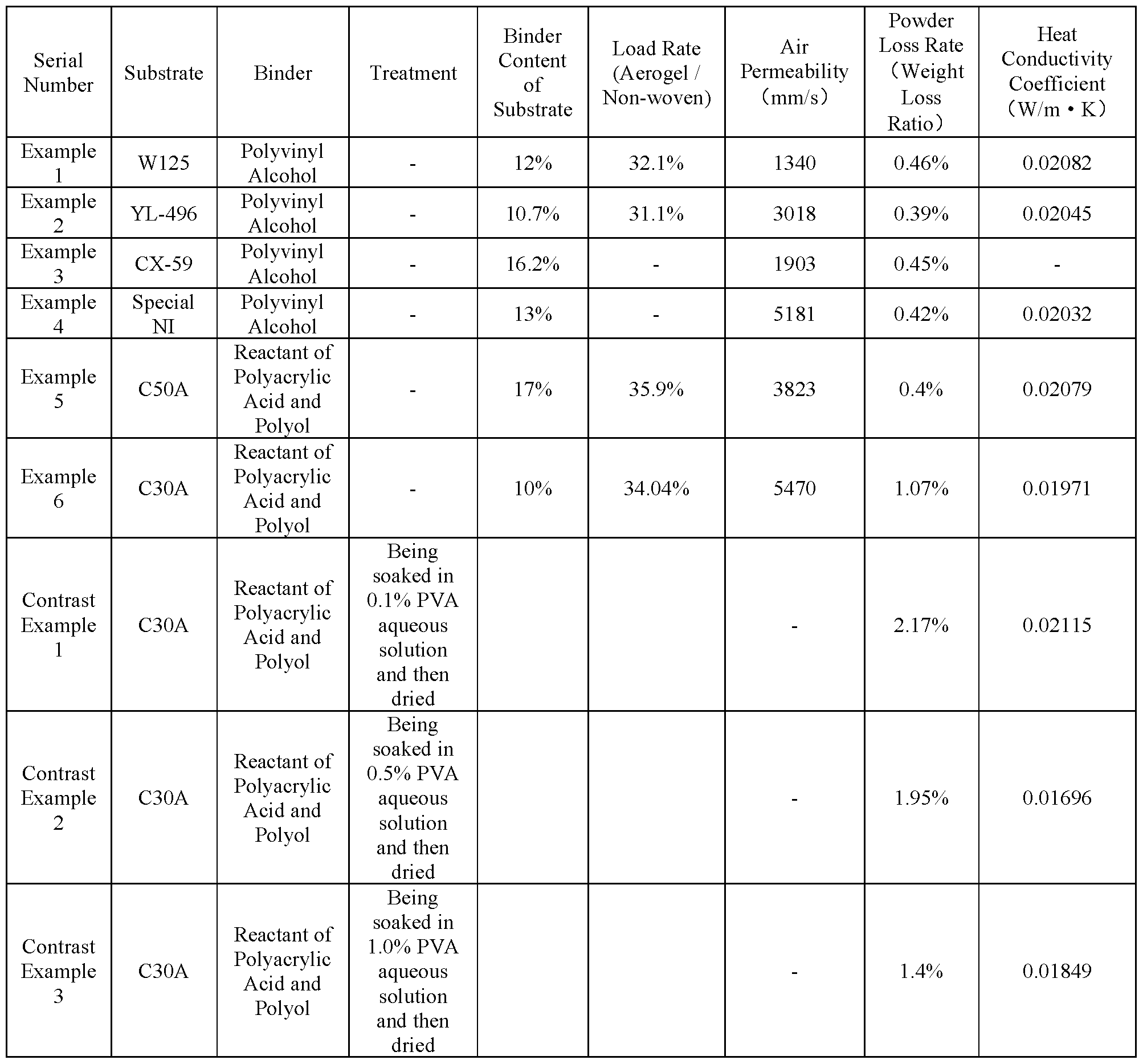
- Example 1 W125 is selected as substrate, and the experiment of preparing the silicon dioxide aerogel composite non-woven heat insulation sheet is carried out according to the above specific steps.
- Example 2 YL-496 is selected as substrate, and the experiment of preparing the silicon dioxide aerogel composite non-woven heat insulation sheet is carried out according to the above specific steps.
- Example 3 CX-59 is selected as substrate, and the experiment of preparing the silicon dioxide aerogel composite non-woven heat insulation sheet is carried out according to the above specific steps.
- Example 4 Special NI is selected as substrate, and the experiment of preparing the silicon dioxide aerogel composite non-woven heat insulation sheet is carried out according to the above specific steps.
- Example 5 C50A is selected as substrate, and the experiment of preparing the silicon dioxide aerogel composite non-woven heat insulation sheet is carried out according to the above specific steps.
- Example 6 C30A is selected as substrate, and the experiment of preparing the silicon dioxide aerogel composite non-woven heat insulation sheet is carried out according to the above specific steps.
- C30A is selected as substrate, which is soaked in 0.1% PVA aqueous solution and then dried.
- the experiment of preparing the silicon dioxide aerogel composite non-woven heat insulation sheet is carried out according to the specific steps in the above embodiments.
- C30A is selected as substrate, which is soaked in 0.5% PVA aqueous solution and then dried.
- the experiment of preparing the silicon dioxide aerogel composite non-woven heat insulation sheet is carried out according to the specific steps in the above embodiments.
- C30A is selected as substrate, which is soaked in 1.0% PVA aqueous solution and then dried.
- the experiment of preparing the silicon dioxide aerogel composite non-woven heat insulation sheet is carried out according to the specific steps in the above embodiments.
- the silicon dioxide aerogel composite non-woven heat insulation sheet After the preparation of the silicon dioxide aerogel composite non-woven heat insulation sheet, it is weighed and put into a closed container, and then placed on the vibration equipment for shock, with the frequency of 1200rpm and the time of lOmin. Upon the completion, it is weighted again, and the powder loss rate is calculated.
- both PVA-based non-woven and polyacrylic acid-based non-woven can achieve better effect of reducing the powder loss rate.
- high air permeability means high porosity
- low air permeability means low porosity
- the PVA-based non-woven can also have better powder loss rate data under the condition that the air permeability changes.
- the powder loss rate of polyacrylic acid-based non-woven will be affected by air permeability, that is, the powder loss rate of C30A with high air permeability is significantly improved compared to that of C50A with low air permeability.
- PVA-based non-woven has a wider range of adaptability relative to the non-woven of other systems, and is free from the influence of air permeability. This makes the silicon dioxide aerogel composite non-woven heat insulation sheet prepared by various types of PVA-based non-woven can overcome the problem that the aerogel insulation sheet is easy to lose powder.
- Example 6 In combination with Example 6 and Contrast Examples 1-3, it can be seen that even if PVA adhesive is added to non-woven with non-PVA system, it cannot effectively reduce but increase the powder loss rate. Accordingly, when PVA serves as a skeleton binder to bind the fibers together in all directions of the space, it has a significant improvement in reducing the powder loss rate. However, when PVA serves as a surface adhesive, it does not significantly improve the powder loss rate.
- the binder in the non-woven has a mass ratio of 5-30%, preferably 10%-17%.
- a ratio of the mass of the silicon dioxide aerogel to the mass of the non-woven is 5%-60%, preferably 32.1%-35.9%.
- the silicon dioxide aerogel composite non-woven heat insulation sheet of the present application has an air permeability of 1000-6000 mm/s, preferably 1340-5470 mm/s.
- the silicon dioxide aerogel composite non-woven heat insulation sheet has a power loss rate of less than 1.5%, preferably less than 1.07%, more preferably less than 0.46%, and further preferably 0.39%-0.46%.
- the silicon dioxide aerogel composite non-woven heat insulation sheet has a heat conductivity coefficient of less than 0.021 W/m»K, preferably less than 0.02082 W/m»K, and more preferably 0.01971-0.02082 W/m»K.
- the silicon dioxide aerogel composite non-woven heat insulation sheet has a single sheet thickness of 0.3-3mm,.
- the silicon dioxide aerogel composite non-woven heat insulation sheet of the present application has an areal density of 30-300g/m 2 .
Landscapes
- Chemical & Material Sciences (AREA)
- Organic Chemistry (AREA)
- Engineering & Computer Science (AREA)
- Dispersion Chemistry (AREA)
- Ceramic Engineering (AREA)
- Chemical Kinetics & Catalysis (AREA)
- Inorganic Chemistry (AREA)
- Textile Engineering (AREA)
- Materials Engineering (AREA)
- Structural Engineering (AREA)
- General Engineering & Computer Science (AREA)
- Mechanical Engineering (AREA)
- General Chemical & Material Sciences (AREA)
- Silicon Compounds (AREA)
Abstract
Description
Claims
Priority Applications (1)
| Application Number | Priority Date | Filing Date | Title |
|---|---|---|---|
| EP24728837.6A EP4724647A1 (en) | 2023-06-07 | 2024-05-06 | Silicon dioxide aerogel composite non-woven heat insulation sheet |
Applications Claiming Priority (2)
| Application Number | Priority Date | Filing Date | Title |
|---|---|---|---|
| CN202310671022.XA CN119099179A (en) | 2023-06-07 | 2023-06-07 | A silicon dioxide aerogel composite non-woven fabric thermal insulation sheet |
| CN202310671022.X | 2023-06-07 |
Publications (1)
| Publication Number | Publication Date |
|---|---|
| WO2024253783A1 true WO2024253783A1 (en) | 2024-12-12 |
Family
ID=91274654
Family Applications (1)
| Application Number | Title | Priority Date | Filing Date |
|---|---|---|---|
| PCT/US2024/027929 Ceased WO2024253783A1 (en) | 2023-06-07 | 2024-05-06 | Silicon dioxide aerogel composite non-woven heat insulation sheet |
Country Status (3)
| Country | Link |
|---|---|
| EP (1) | EP4724647A1 (en) |
| CN (1) | CN119099179A (en) |
| WO (1) | WO2024253783A1 (en) |
Families Citing this family (1)
| Publication number | Priority date | Publication date | Assignee | Title |
|---|---|---|---|---|
| CN120716259B (en) * | 2025-08-18 | 2026-01-16 | 湖北拓盈新材料有限公司 | Waterproof breathable composite film with heat insulation function and preparation method thereof |
Citations (3)
| Publication number | Priority date | Publication date | Assignee | Title |
|---|---|---|---|---|
| US20020094426A1 (en) * | 2000-12-22 | 2002-07-18 | Aspen Aerogels, Inc. | Aerogel composite with fibrous batting |
| US20180134566A1 (en) * | 2016-03-08 | 2018-05-17 | Lg Chem, Ltd. | Method for producing aerogel blanket and aerogel blanket produced thereby |
| US20190145571A1 (en) * | 2016-07-01 | 2019-05-16 | Panasonic Intellectual Property Management Co., Ltd. | Insulating material and device using insulating material |
-
2023
- 2023-06-07 CN CN202310671022.XA patent/CN119099179A/en active Pending
-
2024
- 2024-05-06 EP EP24728837.6A patent/EP4724647A1/en active Pending
- 2024-05-06 WO PCT/US2024/027929 patent/WO2024253783A1/en not_active Ceased
Patent Citations (3)
| Publication number | Priority date | Publication date | Assignee | Title |
|---|---|---|---|---|
| US20020094426A1 (en) * | 2000-12-22 | 2002-07-18 | Aspen Aerogels, Inc. | Aerogel composite with fibrous batting |
| US20180134566A1 (en) * | 2016-03-08 | 2018-05-17 | Lg Chem, Ltd. | Method for producing aerogel blanket and aerogel blanket produced thereby |
| US20190145571A1 (en) * | 2016-07-01 | 2019-05-16 | Panasonic Intellectual Property Management Co., Ltd. | Insulating material and device using insulating material |
Also Published As
| Publication number | Publication date |
|---|---|
| CN119099179A (en) | 2024-12-10 |
| EP4724647A1 (en) | 2026-04-15 |
Similar Documents
| Publication | Publication Date | Title |
|---|---|---|
| CN107312166B (en) | A kind of modified PET polyester and its preparation method and application | |
| CN110526728A (en) | A kind of fiber reinforcement does not carry out ceramic matric composite and preparation method thereof | |
| CN117362743B (en) | Preparation method of thermal shock-resistant aramid aerogel and aramid aerogel | |
| CN113072797B (en) | Epoxy resin-based composite material and preparation method thereof | |
| EP4724647A1 (en) | Silicon dioxide aerogel composite non-woven heat insulation sheet | |
| CN116393053B (en) | Modified nano SiO 2 Aerogel and preparation method thereof | |
| CN103464151B (en) | A kind of composite oxide supported ruthenium ammonia synthesis catalyst and preparation method thereof | |
| CN114797798B (en) | Preparation method and application of MOF/corn stalk composite material and device | |
| CN111943704A (en) | A kind of reusable high temperature resistant nanocrystalline aerogel material and preparation method thereof | |
| CN114437396A (en) | Electromagnetic shielding composite foam with sandwich structure and preparation method thereof | |
| CN110639440A (en) | Preparation method of carbon/silicon dioxide composite microspheres | |
| CN116042132A (en) | A kind of three-dimensional skeleton material, electronic encapsulation glue and its preparation method and application | |
| CN120089905A (en) | Graphene-polyimide composite lithium ion battery separator and preparation method thereof | |
| CN109265732A (en) | A kind of preparation method of oil absorption material | |
| CN112645729A (en) | High-temperature-resistant zirconia composite heat-insulating material with mesoporous structure and preparation method thereof | |
| CN112320809A (en) | Rare earth-based aerogel material and preparation method thereof | |
| CN111286252A (en) | Radiation-resistant anticorrosive paint and preparation method thereof | |
| CN111003686A (en) | Novel room temperature hydrogen storage material and preparation method thereof | |
| CN109796220A (en) | Calcium carbonate-calcium silicates-aerosil multilayer heat insulating composite material and preparation method thereof | |
| CN115521635B (en) | Heat conduction shielding composite material with double-isolation network structure and preparation method thereof | |
| CN120484583B (en) | Lithium battery diaphragm coating based on nano material and application thereof | |
| CN110627073A (en) | A kind of synthetic method of functionalized hollow silica for modified cyanate resin | |
| CN112320833B (en) | High temperature resistant SiO 2 -Gd 2 O 3 Composite aerogel and preparation method thereof | |
| CN118495951A (en) | Preparation method and application of boron-nitrogen co-doped graphene carbon aerogel wave-absorbing material | |
| CN116375447A (en) | Silicon-aluminum-based aerogel fiber composite material and preparation process thereof |
Legal Events
| Date | Code | Title | Description |
|---|---|---|---|
| 121 | Ep: the epo has been informed by wipo that ep was designated in this application |
Ref document number: 24728837 Country of ref document: EP Kind code of ref document: A1 |
|
| WWE | Wipo information: entry into national phase |
Ref document number: 2024728837 Country of ref document: EP |
|
| NENP | Non-entry into the national phase |
Ref country code: DE |
|
| ENP | Entry into the national phase |
Ref document number: 2024728837 Country of ref document: EP Effective date: 20260107 |
|
| ENP | Entry into the national phase |
Ref document number: 2024728837 Country of ref document: EP Effective date: 20260107 |
|
| ENP | Entry into the national phase |
Ref document number: 2024728837 Country of ref document: EP Effective date: 20260107 |
|
| ENP | Entry into the national phase |
Ref document number: 2024728837 Country of ref document: EP Effective date: 20260107 |
|
| ENP | Entry into the national phase |
Ref document number: 2024728837 Country of ref document: EP Effective date: 20260107 |
|
| WWP | Wipo information: published in national office |
Ref document number: 2024728837 Country of ref document: EP |