WO2024253663A1 - Polymer recyclate film products - Google Patents
Polymer recyclate film products Download PDFInfo
- Publication number
- WO2024253663A1 WO2024253663A1 PCT/US2023/024970 US2023024970W WO2024253663A1 WO 2024253663 A1 WO2024253663 A1 WO 2024253663A1 US 2023024970 W US2023024970 W US 2023024970W WO 2024253663 A1 WO2024253663 A1 WO 2024253663A1
- Authority
- WO
- WIPO (PCT)
- Prior art keywords
- polymer
- polarity polymer
- low polarity
- layer
- recyclate
- Prior art date
- Legal status (The legal status is an assumption and is not a legal conclusion. Google has not performed a legal analysis and makes no representation as to the accuracy of the status listed.)
- Ceased
Links
Classifications
-
- B—PERFORMING OPERATIONS; TRANSPORTING
- B29—WORKING OF PLASTICS; WORKING OF SUBSTANCES IN A PLASTIC STATE IN GENERAL
- B29D—PRODUCING PARTICULAR ARTICLES FROM PLASTICS OR FROM SUBSTANCES IN A PLASTIC STATE
- B29D7/00—Producing flat articles, e.g. films or sheets
- B29D7/01—Films or sheets
-
- B—PERFORMING OPERATIONS; TRANSPORTING
- B29—WORKING OF PLASTICS; WORKING OF SUBSTANCES IN A PLASTIC STATE IN GENERAL
- B29C—SHAPING OR JOINING OF PLASTICS; SHAPING OF MATERIAL IN A PLASTIC STATE, NOT OTHERWISE PROVIDED FOR; AFTER-TREATMENT OF THE SHAPED PRODUCTS, e.g. REPAIRING
- B29C48/00—Extrusion moulding, i.e. expressing the moulding material through a die or nozzle which imparts the desired form; Apparatus therefor
- B29C48/022—Extrusion moulding, i.e. expressing the moulding material through a die or nozzle which imparts the desired form; Apparatus therefor characterised by the choice of material
-
- B—PERFORMING OPERATIONS; TRANSPORTING
- B29—WORKING OF PLASTICS; WORKING OF SUBSTANCES IN A PLASTIC STATE IN GENERAL
- B29C—SHAPING OR JOINING OF PLASTICS; SHAPING OF MATERIAL IN A PLASTIC STATE, NOT OTHERWISE PROVIDED FOR; AFTER-TREATMENT OF THE SHAPED PRODUCTS, e.g. REPAIRING
- B29C48/00—Extrusion moulding, i.e. expressing the moulding material through a die or nozzle which imparts the desired form; Apparatus therefor
- B29C48/16—Articles comprising two or more components, e.g. co-extruded layers
- B29C48/18—Articles comprising two or more components, e.g. co-extruded layers the components being layers
- B29C48/21—Articles comprising two or more components, e.g. co-extruded layers the components being layers the layers being joined at their surfaces
-
- B—PERFORMING OPERATIONS; TRANSPORTING
- B32—LAYERED PRODUCTS
- B32B—LAYERED PRODUCTS, i.e. PRODUCTS BUILT-UP OF STRATA OF FLAT OR NON-FLAT, e.g. CELLULAR OR HONEYCOMB, FORM
- B32B27/00—Layered products comprising a layer of synthetic resin
- B32B27/30—Layered products comprising a layer of synthetic resin comprising vinyl (co)polymers; comprising acrylic (co)polymers
- B32B27/304—Layered products comprising a layer of synthetic resin comprising vinyl (co)polymers; comprising acrylic (co)polymers comprising vinyl halide (co)polymers, e.g. PVC, PVDC, PVF, PVDF
-
- B—PERFORMING OPERATIONS; TRANSPORTING
- B32—LAYERED PRODUCTS
- B32B—LAYERED PRODUCTS, i.e. PRODUCTS BUILT-UP OF STRATA OF FLAT OR NON-FLAT, e.g. CELLULAR OR HONEYCOMB, FORM
- B32B27/00—Layered products comprising a layer of synthetic resin
- B32B27/30—Layered products comprising a layer of synthetic resin comprising vinyl (co)polymers; comprising acrylic (co)polymers
- B32B27/306—Layered products comprising a layer of synthetic resin comprising vinyl (co)polymers; comprising acrylic (co)polymers comprising vinyl acetate or vinyl alcohol (co)polymers
-
- B—PERFORMING OPERATIONS; TRANSPORTING
- B32—LAYERED PRODUCTS
- B32B—LAYERED PRODUCTS, i.e. PRODUCTS BUILT-UP OF STRATA OF FLAT OR NON-FLAT, e.g. CELLULAR OR HONEYCOMB, FORM
- B32B27/00—Layered products comprising a layer of synthetic resin
- B32B27/32—Layered products comprising a layer of synthetic resin comprising polyolefins
- B32B27/322—Layered products comprising a layer of synthetic resin comprising polyolefins comprising halogenated polyolefins, e.g. PTFE
-
- B—PERFORMING OPERATIONS; TRANSPORTING
- B32—LAYERED PRODUCTS
- B32B—LAYERED PRODUCTS, i.e. PRODUCTS BUILT-UP OF STRATA OF FLAT OR NON-FLAT, e.g. CELLULAR OR HONEYCOMB, FORM
- B32B27/00—Layered products comprising a layer of synthetic resin
- B32B27/34—Layered products comprising a layer of synthetic resin comprising polyamides
-
- B—PERFORMING OPERATIONS; TRANSPORTING
- B32—LAYERED PRODUCTS
- B32B—LAYERED PRODUCTS, i.e. PRODUCTS BUILT-UP OF STRATA OF FLAT OR NON-FLAT, e.g. CELLULAR OR HONEYCOMB, FORM
- B32B7/00—Layered products characterised by the relation between layers; Layered products characterised by the relative orientation of features between layers, or by the relative values of a measurable parameter between layers, i.e. products comprising layers having different physical, chemical or physicochemical properties; Layered products characterised by the interconnection of layers
- B32B7/04—Interconnection of layers
- B32B7/12—Interconnection of layers using interposed adhesives or interposed materials with bonding properties
-
- B—PERFORMING OPERATIONS; TRANSPORTING
- B29—WORKING OF PLASTICS; WORKING OF SUBSTANCES IN A PLASTIC STATE IN GENERAL
- B29C—SHAPING OR JOINING OF PLASTICS; SHAPING OF MATERIAL IN A PLASTIC STATE, NOT OTHERWISE PROVIDED FOR; AFTER-TREATMENT OF THE SHAPED PRODUCTS, e.g. REPAIRING
- B29C48/00—Extrusion moulding, i.e. expressing the moulding material through a die or nozzle which imparts the desired form; Apparatus therefor
- B29C48/03—Extrusion moulding, i.e. expressing the moulding material through a die or nozzle which imparts the desired form; Apparatus therefor characterised by the shape of the extruded material at extrusion
- B29C48/07—Flat, e.g. panels
- B29C48/08—Flat, e.g. panels flexible, e.g. films
-
- B—PERFORMING OPERATIONS; TRANSPORTING
- B29—WORKING OF PLASTICS; WORKING OF SUBSTANCES IN A PLASTIC STATE IN GENERAL
- B29C—SHAPING OR JOINING OF PLASTICS; SHAPING OF MATERIAL IN A PLASTIC STATE, NOT OTHERWISE PROVIDED FOR; AFTER-TREATMENT OF THE SHAPED PRODUCTS, e.g. REPAIRING
- B29C48/00—Extrusion moulding, i.e. expressing the moulding material through a die or nozzle which imparts the desired form; Apparatus therefor
- B29C48/03—Extrusion moulding, i.e. expressing the moulding material through a die or nozzle which imparts the desired form; Apparatus therefor characterised by the shape of the extruded material at extrusion
- B29C48/09—Articles with cross-sections having partially or fully enclosed cavities, e.g. pipes or channels
- B29C48/10—Articles with cross-sections having partially or fully enclosed cavities, e.g. pipes or channels flexible, e.g. blown foils
-
- B—PERFORMING OPERATIONS; TRANSPORTING
- B29—WORKING OF PLASTICS; WORKING OF SUBSTANCES IN A PLASTIC STATE IN GENERAL
- B29K—INDEXING SCHEME ASSOCIATED WITH SUBCLASSES B29B, B29C OR B29D, RELATING TO MOULDING MATERIALS OR TO MATERIALS FOR MOULDS, REINFORCEMENTS, FILLERS OR PREFORMED PARTS, e.g. INSERTS
- B29K2023/00—Use of polyalkenes or derivatives thereof as moulding material
- B29K2023/04—Polymers of ethylene
- B29K2023/08—Copolymers of ethylene
- B29K2023/086—EVOH, i.e. ethylene vinyl alcohol copolymer
-
- B—PERFORMING OPERATIONS; TRANSPORTING
- B29—WORKING OF PLASTICS; WORKING OF SUBSTANCES IN A PLASTIC STATE IN GENERAL
- B29K—INDEXING SCHEME ASSOCIATED WITH SUBCLASSES B29B, B29C OR B29D, RELATING TO MOULDING MATERIALS OR TO MATERIALS FOR MOULDS, REINFORCEMENTS, FILLERS OR PREFORMED PARTS, e.g. INSERTS
- B29K2105/00—Condition, form or state of moulded material or of the material to be shaped
- B29K2105/26—Scrap or recycled material
-
- B—PERFORMING OPERATIONS; TRANSPORTING
- B29—WORKING OF PLASTICS; WORKING OF SUBSTANCES IN A PLASTIC STATE IN GENERAL
- B29K—INDEXING SCHEME ASSOCIATED WITH SUBCLASSES B29B, B29C OR B29D, RELATING TO MOULDING MATERIALS OR TO MATERIALS FOR MOULDS, REINFORCEMENTS, FILLERS OR PREFORMED PARTS, e.g. INSERTS
- B29K2995/00—Properties of moulding materials, reinforcements, fillers, preformed parts or moulds
- B29K2995/0037—Other properties
- B29K2995/0065—Permeability to gases
- B29K2995/0067—Permeability to gases non-permeable
-
- B—PERFORMING OPERATIONS; TRANSPORTING
- B32—LAYERED PRODUCTS
- B32B—LAYERED PRODUCTS, i.e. PRODUCTS BUILT-UP OF STRATA OF FLAT OR NON-FLAT, e.g. CELLULAR OR HONEYCOMB, FORM
- B32B2270/00—Resin or rubber layer containing a blend of at least two different polymers
-
- B—PERFORMING OPERATIONS; TRANSPORTING
- B32—LAYERED PRODUCTS
- B32B—LAYERED PRODUCTS, i.e. PRODUCTS BUILT-UP OF STRATA OF FLAT OR NON-FLAT, e.g. CELLULAR OR HONEYCOMB, FORM
- B32B2272/00—Resin or rubber layer comprising scrap, waste or recycling material
-
- B—PERFORMING OPERATIONS; TRANSPORTING
- B32—LAYERED PRODUCTS
- B32B—LAYERED PRODUCTS, i.e. PRODUCTS BUILT-UP OF STRATA OF FLAT OR NON-FLAT, e.g. CELLULAR OR HONEYCOMB, FORM
- B32B2307/00—Properties of the layers or laminate
- B32B2307/70—Other properties
- B32B2307/724—Permeability to gases, adsorption
- B32B2307/7242—Non-permeable
- B32B2307/7244—Oxygen barrier
-
- B—PERFORMING OPERATIONS; TRANSPORTING
- B32—LAYERED PRODUCTS
- B32B—LAYERED PRODUCTS, i.e. PRODUCTS BUILT-UP OF STRATA OF FLAT OR NON-FLAT, e.g. CELLULAR OR HONEYCOMB, FORM
- B32B2439/00—Containers; Receptacles
- B32B2439/70—Food packaging
-
- B—PERFORMING OPERATIONS; TRANSPORTING
- B32—LAYERED PRODUCTS
- B32B—LAYERED PRODUCTS, i.e. PRODUCTS BUILT-UP OF STRATA OF FLAT OR NON-FLAT, e.g. CELLULAR OR HONEYCOMB, FORM
- B32B27/00—Layered products comprising a layer of synthetic resin
- B32B27/06—Layered products comprising a layer of synthetic resin as the main or only constituent of a layer, which is next to another layer of the same or of a different material
- B32B27/08—Layered products comprising a layer of synthetic resin as the main or only constituent of a layer, which is next to another layer of the same or of a different material of synthetic resin
-
- B—PERFORMING OPERATIONS; TRANSPORTING
- B32—LAYERED PRODUCTS
- B32B—LAYERED PRODUCTS, i.e. PRODUCTS BUILT-UP OF STRATA OF FLAT OR NON-FLAT, e.g. CELLULAR OR HONEYCOMB, FORM
- B32B27/00—Layered products comprising a layer of synthetic resin
- B32B27/32—Layered products comprising a layer of synthetic resin comprising polyolefins
-
- C—CHEMISTRY; METALLURGY
- C08—ORGANIC MACROMOLECULAR COMPOUNDS; THEIR PREPARATION OR CHEMICAL WORKING-UP; COMPOSITIONS BASED THEREON
- C08J—WORKING-UP; GENERAL PROCESSES OF COMPOUNDING; AFTER-TREATMENT NOT COVERED BY SUBCLASSES C08B, C08C, C08F, C08G or C08H
- C08J2300/00—Characterised by the use of unspecified polymers
- C08J2300/30—Polymeric waste or recycled polymer
Definitions
- the present disclosure relates to multilayer films and methods for producing such multilayer films utilizing a tie layer between dissimilar film layers, wherein the tie layer comprises a compatibilized blend of dissimilar polymers.
- Polyolefin/barrier multilayer packaging materials are used to combine the respective performance of different polymers in different layers.
- the multilayer structure package performs a combination of functions that is not possible with a single layer of on polymer.
- the multilayer packaging is created to protect sensitive food products sufficiently and obtain extended shelf life.
- An oxygen barrier can be provided by one or more barrier layers comprising polymers containing polar groups such as, but not limited to, ethylene vinyl alcohol copolymers (EVOH) or polyamide (nylon).
- EVOH ethylene vinyl alcohol copolymers
- Nylon polyamide
- Mechanical properties such as tear resistance and puncture resistance can be provided by one or more layers comprising nonpolar polyolefins such as, but not limited to, a linear low-density polyethylene (LLDPE) and/or high density polyethylene (HDPE).
- LLC linear low-density polyethylene
- HDPE high density polyethylene
- Such multilayer packaging generally exhibits poor recyclability because of the dissimilar materials in such multilayer structures.
- the polar groups of the barrier layers do not disperse well in the nonpolar polymer matrix formed by the layers providing improved mechanical properties to the multilayer structure.
- This poor distribution of polar groups in such polymer recyclate results in poor processibility, mechanical properties, and/or optical properties. This results in disposal of such materials in landfill, thus counteracting efforts towards a circular economy.
- the present disclosure relates to multilayer films, comprising a first layer, a second layer, and a tie layer disposed between the first and second layers.
- the first layer comprises a first low polarity polymer.
- the second layer comprises a first high polarity polymer, wherein the first high polarity polymer comprises a first polar monomer.
- the tie layer is disposed between the first layer and the second layer and comprises a compatibilized polymer recyclate.
- the compatibilized polymer recyclate comprises a mixture of a polymer recy elate and a compatibilizer.
- the polymer recy elate comprises a second low polarity polymer and a second high polarity polymer, the second high polarity polymer comprising a second polar monomer.
- the compatibilizer comprises a third low polarity polymer grafted with one or more functional groups.
- the mixture of the polymer recyclate is subjected to compounding conditions sufficient to form the compatibilized polymer recyclate having a dispersed phase of domains of the second high polarity polymer in a matrix phase of the second low polarity polymer.
- the first low polarity polymer is miscible with the second low polarity polymer, providing adherence between the first layer and the tie layer.
- the first high polarity polymer is miscible with the second high polarity polymer, providing adherence between the second layer and the tie layer.
- the third low polarity polymer is miscible with the second low polarity polymer, and the functional group has interfacial reactivity with the second polar monomer, providing a more dispersed phase of domains of the second high polarity polymer having a smaller particle size in the matrix phase of the second low polarity polymer when compared to the polymer recyclate without compatibilizer.
- the present disclosure relates to a method for producing multilayer films, the method comprising providing a polymer recyclate, comprising a first low polarity polymer and a first high polarity polymer, the first high polarity polymer comprising a first polar comonomer.
- the method further comprises providing a compatibilizer, comprising a second low polarity polymer grafted with one or more functional groups.
- the polymer recyclate and the compatibilizer are mixed under compounding conditions sufficient to form a compatibilized polymer recyclate, wherein the compatibilized polymer recyclate has a dispersed phase of domains of the first high polarity polymer in a matrix phase of the first low polarity polymer
- a third low polarity polymer, a second high polarity polymer, and the compatibilized polymer recyclate are coextruded to form a multilayer film comprising: i) a first layer, comprising the third low polarity polymer, ii) a second layer, comprising the second high polarity polymer; and iii) a tie layer, disposed between the first layer and the second layer.
- Antioxidant agents means compounds that inhibit oxidation, a chemical reaction that can produce free radicals and chain reactions. Antioxidants are differentiated based on their reaction mechanisms and include: (1) primary antioxidants, and (2) secondary antioxidants.
- Barrier layer means a layer used in a multilayer film to impart gas impermeability in addition to other desired properties to a multilayer structure. Barrier layers herein comprise high polarity polymers.
- “Compatibility,” as used herein, means the capability of the individual component substances in an immiscible polymer blend to exhibit interfacial adhesion, in which interfaces between phases or components are maintained by intermolecular forces, chain entanglements, or both, across the interfaces — i.e., holding together of two bodies by interfacial forces or mechanical interlocking on a scale of micrometers or less. Further discussion of miscibility can be found in D. W. Fox and R. B. Allen, ‘Compatibility’, Encyclopedia of Polymer Science and Engineering, 2nd Ed., J. I. Kroschwitz, ed., Wiley Interscience, New York, 1985, Vol. 3, p. 784. Work, W.
- Compounding conditions means temperature, pressure, and shear force conditions implemented in an extruder to provide intimate mixing of two or more polymers and optionally additives to produce a substantially homogeneous polymer product.
- the compounding conditions will be such that the specific energy from the compounder from shear and/or added heat are sufficient to melt the polymer components and homogenize them.
- HDPE means ethylene homopolymers and ethylene copolymers produced in a suspension, solution, slurry, or gas phase polymerization process and having a density in the range of 0.940 g/cm’ to 0.970 g/cm 3 .
- High polarity polymer means a polar polymer comprising a sufficiently high amount of polar monomer and/or comonomer to result in the polar polymer having a low oxygen vapor transmission rate (OVTR), as measured by ASTM D3985, such as less than or equal to 200 cc*pm/m 2 *dayatm.
- OVTR oxygen vapor transmission rate
- LDPE ethylene homopolymers and/or ethylene copolymers produced in a high pressure free radical polymerization and having a density in the range of 0.910 g/cm 3 to 0.940 g/cm 3 .
- LLCPE means ethylene copolymers produced in a suspension, solution, slurry, or gas phase polymerization process and having a density in the range of 0.910 g/cm 3 to 0.940 g/cm 3 .
- Low polarity polymer means a polymer having a sufficiently tow amount of polar monomer or comonomer to result in the low polarity polymer having a high oxygen vapor transmission rate (OVTR), as measured by ASTM D3985, such as greater than or equal to 800 cc’pm/m 2 ’dayatm.
- the low polarity polymer comprises a polyolefin having no polarity, a copolymer of an olefin (such as ethylene or propylene) and an alpha mono-olefin comprising polar group, or a combination thereof.
- Low polarity polymers have a high degree of miscibility and/or compatibility with other low polarity polymers and are further characterized as providing one or more of high moisture barrier, high tensile strength, high tear strength, and high puncture resistance as measure by dart drop.
- MDPE means ethylene copolymers produced in a suspension, solution, slurry, or gas phase polymerization process and having a density in the range of 0.925 g/cm 3 to 0.940 g/cm 3 .
- Miscibility means the degree to which two polymers will mix to form a homogeneous polymer blends. Miscibility' is the capability of a mixture to form a single phase over certain ranges of temperature, pressure, and composition. Whether or not a single phase exists depends on the chemical structure, molar mass distribution, and molecular architecture of the components present. A single phase in a mixture may be confirmed by light scattering, x-ray scattering, and/or neutron scattering.
- Multilayer film means a coextruded structure comprising at least a barrier layer, a structural layer, and a tie layer.
- Nonpolar comonomer means a monomer unit containing only carbon and hydrogen.
- Nonpolar polymer means a polymer or copolymer consisting of units derived from a nonpolar monomers.
- Olefin as used herein, and alternatively referred to as “alkene,” is a linear, branched, or cyclic compound of carbon and hydrogen having at least one double bond.
- Poly monomer as used herein, means monomers containing highly electronegative atoms, such as chlorine, fluorine, oxygen, nitrogen, or sulfur, that give rise to polymers that contain permanent electric dipoles.
- Polymer means a polymer or copolymer comprising units derived from a polar monomer.
- polar polymer refers to polymer formed from at least one monomer that comprises at least one heteroatom. Some examples of heteroatoms include O, N, P and S.
- Polymer recy elate means post-consumer recycled (“PCR”) polymer and/or post-industrial recycled (“PIR”) polymer.
- PCR post-consumer recycled
- PIR post-industrial recycled
- Polymer recy elate is derived from an end product that has completed its life cycle as a consumer item and would otherwise be disposed of as waste (e.g., a polyethylene water bottle) or from plastic scrap that is generated as waste from an industrial process.
- Polymer recy elates herein are a mixture of a first low polarity polymer component and a high polarity polymer component comprising at least one polar monomer, such as produced by melting and mixing a barrier film having at least one layer of a first low polarity polymer component and at least on layer of a high polarity polymer component comprising at least one polar monomer.
- Polyolefin in some embodiments is a type of polymer with the general formula (CH2CHR)n where R is an alkyl group, including, but not limited to LDPE, LLDPE, MDPE, HDPE, and PP. Polyolefins are nonpolar polymers.
- “Functionalized polymer-based adhesive composition,” as used herein, means any composition comprising a functionalized polymer, alone or in combination with other polymers, where, in the context of coextruded layers of polymers, a layer of the functionalized polymer- based adhesive composition (or “tie layer”) will adhere better to both a first polymer layer and a second polymer layer than the first polymer layer and the second polymer layer would adhere to each other. Tie layers can also improve adhesion as described above where one or both polymer layers are replaced by a nonpolymeric layer.
- Primary antioxidants means compounds which function essentially as free radical terminators or scavengers. Primary antioxidants react rapidly with peroxy and alkoxy radicals. The majority of primary antioxidants for polymers are sterically hindered phenols.
- “Processability,” as used herein, refers to how well a polymer composition can be formed into a cast of blown film of commercial quality or molded by injection or compression molding into a molded article of commercial quality at commercially acceptable rates using the equipment and conditions.
- Secondary antioxidants means compounds which are preventive antioxidants that function by retarding chain initiation. Secondary' antioxidants react with hydroperoxides to yield non-radical products and are, therefore, frequently called hydroperoxide decomposers.
- “Structural layer,” as used herein, means a layer used in a multilayer film to impart desired mechanical properties and/or resistance to moisture to the multilayer structure.
- the terms “monomer” and “comonomer” are used interchangeably.
- the terms mean any compound with a polymerizable moiety that is added to a reactor in order to produce a polymer.
- a polymer is described as comprising one or more monomers, e.g., a polymer comprising propylene and ethylene
- ethylene content of 35 wt.% to 55 wt.%
- the mer unit in the copolymer is derived from ethylene in the polymerization reaction and the derived units are present at 35 wt.% to 55 wt.%, based upon the weight of the copolymer.
- multilayer film is of particular concern and discussed throughout this description.
- the description can use a slash to indicate that components to the left and right of the slash are in different layers and the relative position of components in layers can be so indicated by use of the slash to indicate layer boundaries.
- Ionomer Copolymers of ethylene and unsaturated carboxylic acid comonomers such as but not limited to, EAA and EMAA LDPE Low density polyehtylene
- PA Polyamides such as nylon
- PE Polyethylene an ethylene homopolymer or copolymer of a major portion of ethylene with one or more alpha-olefms and/or one or more polar comonomers
- PVDC Polyvinylidene chloride also includes copolymers of vinylidene chloride, such as with vinyl chloride or methyl acrylate (MA)).
- wt% weight percent [0041] It is noted that in this disclosure and particularly in the claims and/or paragraphs, terms such as “comprises”, “comprised”, “comprising” and the like can have the meaning attributed to it in U.S. patent law; e.g., they can mean “includes”, “included”, “including”, and the like; and that terms such as “consisting essentially of’ and “consists essentially of’ have the meaning ascribed to them in U. S. patent law, e.g., they allow for elements not explicitly recited, but exclude elements that are found in the prior art or that affect a basic or novel characteristic of the disclosure.
- Multilayer Barrier Film e.g., they allow for elements not explicitly recited, but exclude elements that are found in the prior art or that affect a basic or novel characteristic of the disclosure.
- Multilayer barrier films comprise at least one barrier layer.
- Such barrier layer or layers comprises a high polarity polymer, such as, but not limited to, EV OH, PA, PVDC, PCTFE, or a combination thereof.
- a high polarity polymer such as, but not limited to, EV OH, PA, PVDC, PCTFE, or a combination thereof.
- Such barrier layers have high clarity with excellent flex-crack resistance, and also some of the best barrier properties to gases such as oxygen, nitrogen, and carbon dioxide making it especially suited for packaging of food, drugs, cosmetics, and other perishable or delicate products to extend shelf life.
- high polarity polymers such as EVOH, PA, PVDC, and PCTFE have superior barrier properties.
- the good gas barrier properties of many high polarity polymers, such as EVOH and nylon deteriorate when exposed to moisture.
- Multilayer barrier films comprise at least one structural layer.
- Such structural layer or layers can comprise one or more polyolefins, one or more low polarity polymers, including polyolefins.
- Polyolefins such as polyethylene and polypropylene, have superior moisture resistance properties and also provide essential mechanical properties such as, but not limited to, one or more of structural integrity, puncture resistance, heat resistance, heat sealability, and/or abrasion resistance.
- Nonpolar polyolefins include, but are not limited to, HDPE, LDPE, LLDPE, MDPE, and PP, which have superior moisture barrier properties, are frequently used in combination in multilayer, co-extruded films in order to achieve a desired balance of properties.
- Low polarity polymers also provide one or more of structural integrity, moisture barrier, puncture resistance, heat resistance, heat sealability, and/or abrasion resistance.
- Such low polarity polymers include copolymers of units derived from ethylene and units derived from one or more of alpha mono-olefins comprising polar groups.
- Such low polarity polymers include, but are not limited to, EVA, ionomers (such as, but not limited to, EAA and EMAA), PET, PC, and/or PS, which provide one or more of moisture resistance, structural integrity, puncture resistance, heat resistance, heat sealability, and/or abrasion resistance.
- Low polarity polymers are frequently used in combination in multilayer, co-extruded films in order to achieve a desired balance of properties.
- one or more polyolefins and/or one or low polarity polymers are used individually in separate layers of a multilayer structure.
- one or more polyolefins and/or one or low polarity polymers are blended, and such blends are used in one or more layers of a multilayer structure.
- barrier layers and structural layers can select a combination of layers that will provide a balance of properties in the multilayer film for a desired application.
- layers having different mechanical properties often have chemical compositions that differ and result in such dissimilar layers not adhering well to one another.
- a multilayer barrier film comprises a structural layer and a barrier layer that do not adhere well to one another.
- a multilayer barrier film comprises a high polarity polymer barrier layer and a structural layer comprising one or more low polarity polymers (including polyolefins), such that the barrier layer and the structural layer that do not adhere well to one another.
- a tie layer comprises a compatibilized polymer recyclate. The compatibilized polymer recyclate comprises a mixture of a polymer recyclate and a compatibilizer.
- the polymer recyclate comprises a second low polarity polymer and a second high polarity polymer, the second high polarity polymer comprising a second polar monomer.
- the compatibilizer comprises a third low polarity polymer grafted with one or more functional groups. The mixture is subjected to compounding conditions sufficient to form the compatibilized polymer recyclate having a dispersed phase of domains of the second high polarity polymer in a matrix phase of the second low polarity polymer.
- the multilayer structure comprises:
- the general process for forming the multilayer structure includes co-extruding the layers to form a multilayer structure.
- the multilayer structures can be in the form of films or sheets, which may be further thermoformed or oriented, and can be produced using conventional methods and extrusion equipment well known to those skilled in the art, where layers of polymer melts are combined by introducing multiple polymer melt streams into a combining block/manifold or die which then directs the melt streams to flow together (while still in the block/manifold or die), then exiting the die together as a single flow stream. Alternately, multiple polymer melt streams can be introduced into a die and then combined just after exiting the die. Structural Layer
- each of one or more structural layers comprise one or more polyolefins.
- structural layers can be coextruded adjacent to another structural layer and/or one or more tie layers.
- a structural layer is a blend of two or more polyolefins such as, but not limited to, a blend of low density polyethylene (LDPE), linear low density polyethylene (LLDPE), medium density polyethylene, high density polyethylene (HDPE), and/or polypropylene (PP).
- LDPE low density polyethylene
- LLDPE linear low density polyethylene
- HDPE high density polyethylene
- PP polypropylene
- each of one or more structural layers comprise one or more low polarity polymers.
- structural layers can be coextruded adjacent to another structural layer and/or one or more tie layers.
- a structural layer is a blend of two or more low polarity polymers such as, but not limited to, a blend of EVA, ionomers (such as, but not limited to, EAA and EMAA), PET, PC, and/or PS.
- each of one or more structural layers comprise one or more polyolefins and one or more other structural layers comprise one or more low polarity polymers.
- structural layers can be coextruded adjacent to another structural layer and/or one or more tie layers.
- a structural layer is a blend of two or more of low density polyethylene (LDPE), linear low density polyethylene (LLDPE), medium density polyethylene, high density polyethylene (HDPE), polypropylene (PP), EVA, ionomers (such as, but not limited to, EAA and EMAA), PET, PC, and/or PS.
- Suitable polyethylenes for structural layers include ethylene homopolymers and copolymers of units derived from ethylene and units derived from one or more of C3-C20 alphaolefins or mixtures thereof.
- the units derived from the one or more Cs-Cs alpha-olefin comonomers are present in amounts up to 15 wt. %, based upon the total weight of the copolymer of ethylene.
- the ethylene homopolymers and copolymers can be produced using either Ziegler Natta catalyst, chromium-based catalyst, or single-site catalyst, e.g., metallocene catalyst.
- the ethylene homopolymers and copolymers can be produced using a gas phase process, high pressure process, slurry process, or solution process.
- Ethylene homopolymers and ethylene- Cs-Cs alpha-olefin copolymers include very low density polyethylene (VLDPE), low density polyethylene (LDPE), linear low density polyethylene (LLDPE), medium density polyethylene (MDPE) and high density polyethylene (HDPE).
- VLDPE is defined as having a density of 0.860 to 0.910 g/cm 3 , as measured by ASTM D-l 505 “Column Method.”
- LDPE and LLDPE are defined as having densities in the range of from 0.910 to 0.930 g/cm 3 .
- MDPE is defined as having a density of 0.930 to 0.945 g/cm 3 .
- HDPE is defined as having a density of at least 0.945 g/cm 3 , preferably from 0.945 to 0.969 g/cm 3 .
- the ethylene homopolymers and copolymers preferably have melt indexes (Mis), as measured by ASTM D 1238, condition 190° C./2.16 kg, from 0.01 to 400 dg/min., preferably, from 0.1 to 200 dg/min., more preferably from 1 to 100 dg/min.
- LDPE is derived from ethylene homopolymers, copolymers of units derived from ethylene and units derived from one or more of C3-C12 alpha-olefins, copolymers of units derived from ethylene and units derived from one or more of alpha monoolefins comprising polar groups, or mixtures thereof.
- LDPE homopolymers can be produced in a high pressure, free- radical polymerization process, such as in one or more tubular reactors, one or more autoclave reactors, or a combination thereof.
- Operating conditions for the high-pressure process can include, but are not limited to, a pressure in the range of from 70 MPa to 700 MPa and a temperature in the range of from 150°C to 500°C.
- Such homopolymers have a high degree of long-chain branching and a density in the range of from 0.910 g/cm 3 to 0.940 g/cm 3 .
- LDPE copolymers of ethylene and C3-C12 alpha-olefins can be produced in a high pressure, free-radical polymerization process, such as in one or more tubular reactors, one or more autoclave reactors, or a combination thereof.
- C3-C12 alpha-olefins include, but are not limited to, substituted or unsubstituted C3 to C12 alpha olefins such as propylene, butene, pentene, hexene, heptene, octene, nonene, decene, undecene, dodecane, and isomers thereof.
- comonomers can be present in amounts up to 15 wt%, 10 wt%, or 5 wt%.
- Operating conditions for the high-pressure process can include, but are not limited to, a pressure in the range of from 70 MPa to 700 MPa and a temperature in the range of from 150°C to 500°C.
- Such homopolymers have a high degree of long-chain branching and a density in the range of from 0.910 g/cm 3 to 0.940 g/cm 3 .
- LDPE copolymers of ethylene and one or more of alpha monoolefins comprising polar groups can be produced in a high pressure, free-radical polymerization process, such as in one or more tubular reactors, one or more autoclave reactors, or a combination thereof.
- alpha mono-olefins comprising polar groups include, but are not limited to, methacrylic acids, esters (e.g., acetate esters, such as vinyl acetate), nitriles, and amides, such as acrylic acid, methacrylic acid, cyclohexyl methacrylate, methyl acrylate, acrylonitrile, acrylamide, or mixtures thereof.
- comonomers can be present in amounts up to 15 wt%, 10 wt%, or 5 wt%.
- Operating conditions for the high-pressure process can include, but are not limited to, a pressure in the range of from 70 MPa to 700 MPa and a temperature in the range of from 150°C to 500°C.
- Such homopolymers have a high degree of long-chain branching and a density in the range of from 0.910 g/cm 3 to 0.940 g/cm 3 .
- LDPE as described above can be characterized by having: i) a density in the range of from 0.910 g/cm 3 to 0.940 g/cm 3 or from 0.915 g/cm 3 to 0.935 g/cm 3 ; ii) a melt index (2.16 kg, 190°C) less than or equal to 5.0 g/10 min., less than or equal to 1.0 g/10 min., less than or equal to 0.5 g/10 min., less than or equal to 0.2 g/10 min., or less than or equal to 0.1 g/10 min.; iii) a molecular weight distribution (M w /M n ) greater than 4.0, greater than 8.0, or greater than 15, and/or less than 35, less than 30, or less than 25; iv) a weight average molecular weight (M w ) greater than or equal to 100,000 daltons, greater than or equal to 150,000 daltons, greater than or equal to 200,000 dalton
- Suitable polypropylenes for structural layers include propylene homopolymers and copolymers, including plastomers, having of units derived from propylene and units derived one or more of ethylene and C4-C20 alpha-olefins or mixtures thereof.
- the units derived from one or more of ethylene and C4-C10 alpha-olefin comonomers are present in amounts up to 35 wt. %, based upon the total weight of the copolymer of propylene.
- the propylene homopolymers and copolymers can be produced using either Ziegler Natta or single-site catalysts, e.g., metallocene catalysts.
- the propylene homopolymers and copolymers can be produced using a gas phase process, slurry process, or solution process.
- the propylene polymer when it is a copolymer, it preferably contains 2 to 6 wt. %, based upon the total weight of the copolymer, of ethylene derived units as a comonomer.
- a first low polarity polymer component comprises a copolymer of ethylene and one or more polar comonomer, a copolymer of propylene and one or more polar comonomers, or a combination thereof, wherein the low first polarity polymer component has an oxygen vapor transmission rate (OVTR), as measured by ASTM D3895, of greater than or equal to 800 cc’pm/m 2 ’dayatm, greater than or equal to 900 cc’pm/m 2 ’day atm, or greater than or equal to 1,000 cc’pm/m 2 *day»atm.
- OVTR oxygen vapor transmission rate
- a structural layer can also be formed from a blend of two or more polyethylenes, two or more polypropylenes, or one or more polyethylenes and one or more polypropylenes.
- a structural layer can also be formed from a blend of two or more polyolefins, two or more low polarity polymers (other than polyolefins), or one or more polyolefins and one or more low polarity polymers (other than polyolefins).
- the multilayer structure includes at least one barrier layer, comprising a polymer having an oxygen vapor transmission rate (OVTR), as measured by ASTM D3895, of less or equal to 200 cc*pm/m 2 *dayatm. less than or equal to 150 cc»pm/m 2 »day , atm, less than or equal to 100 cc’pm/m 2 «day»atm, or less than or equal to 50 cc»pm/m 2 »day*atm.
- OVTR oxygen vapor transmission rate
- a barrier layer can include EV OH, PA (e.g., nylons, such as nylon 6, nylon 6,6, nylon 12, nylon 6,12, nylon 6,66, and blends thereof, as well as co-extruded structures of EV OH and nylons, such as EVOH/nylon and nylon/EVOH/nylon.
- Barrier layers can also include poly vinylidene chloride (PVDC) and/or polychlorotrifluoroethylene (PCTFE).
- the barrier layers are selected from EV OH, nylons or co-extruded structures thereof.
- the barrier layer is EV OH.
- the tie layer comprises a compatibihzed polymer recyclate to improve the adherence between a low polarity polymer structural layer and a high polarity polymer barrier layer, wherein the polymer recyclate comprises a mixture of a high polarity polymer and a low polarity polymer.
- the compatibilized polymer recyclate is formed by melt blending the polymer recyclate with a compatibilizer, wherein the compatibilizer comprises a low polarity polymer grafted with one or more functional groups.
- the polymer recyclate contacts the functionalized polymer prior to pelletization. In one or more other embodiments, the functionalized polymer contacts the polymer recyclate prior to pelletization.
- the process of combining the two components further includes melt blending the polymer recyclate and the functionalized polymer in the presence of adhesion promoting additive.
- the functionalized polymer is formed by addition of one or more pendant functional group to a polymer backbone comprising a second low polarity polymer.
- the low polarity polymer can be a polyolefin, such as an ethylene homopolymer or copolymer of ethylene and one or more alpha olefins.
- the low polarity polymer can be a copolymer of ethylene and one or more alpha mono-olefins comprising polar groups or a copolymer of propylene and one or more alpha mono-olefins comprising polar groups.
- the compatibilized polymer recyclate composition includes the functionalized polymer in a range of from 0.5 wt.% to 30 wt.%, or 1 wt.% to 20 wt.%, or 2 wt.% to 15 wt.%, or 5 wt. % to 15 wt. %, or 6 wt. % to 11 wt. %, or 12 wt. % to 17 wt. %, based on the total weight of the compatibilized polymer recyclate composition.
- a compatibilized polymer recyclate composition comprises a blend of LLDPE having a density in the range of from 0.910 to 0.930 g/cm 3 with a HDPE having a density of at least 0.945 g/cm 3 , preferably from 0.945 to 0.969 g/cm 3 , the HDPE having been functionalized with maleic anhydride (HDPE-g-MAH).
- the HDPE-g-MAH is present in the blend of LLDPE and HDPE-g-MAH in a range of from 0.5 wt.% to 30 wt.%, or
- a compatibilized polymer recy elate composition comprises a blend of LLDPE having a density in the range of from 0.910 to 0.930 g/cm 3 with another LLDPE having a density of 0.910 to 0.930 g/cm 3 , the LLDPE having been functionalized with maleic anhydride (LLDPE-g-MAH).
- LLDPE-g-MAH is present in the blend of LLDPE and LLDPE-g-MAH in a range of from 0.5 wt.% to 30 wt.%, or 1 wt.% to 20 wt.%, or
- compatibilizers comprising a low polarity polymer grafted with one or more functional groups are disclosed in U.S. Patent Publication Nos. 2017/0198103 and 2017/0335149, and U.S. Patent Nos. 7,687,575, 7,871,709, 8,598,264, 8,673,451, 8,685,539, 9,499,723, 9,650,548, 9,662,864, 9,676,971 , 9,803,074, 10,053,574, 10,150,894, 10,240,072, and 10,266,727, all of which, the contents are incorporated by reference herein in their entirety.
- the functional groups included in the compatibilizer composition are selected for having miscibility and/or compatibility with the high polarity polymer portion of the polymer recyclate.
- the low polarity polymer portion of the compatibilizer composition is selected for having miscibility and/or compatibility with the low polarity polymer portion of the polymer recyclate.
- Tie layer compositions intentionally contain one or more component polymers that are miscible and/or compatible with the layers that are adjacent to each side of the tie layer, wherein such adjacent layers are not miscible and/or compatible with one another.
- Polymer recyclates as disclosed herein provide a high polarity polymer portion and a low polarity polymer portion. However, the high polarity and low polarity portions of the polymer recyclate are not miscible and/or compatible with one another resulting in a dispersed phase of gels and/or domains of the high polarity polymer having a large particle size in a matrix phase of the low polarity polymer portion of the polymer recyclate.
- Such gels and/or domains of the high polarity polymer having a large particle size in a matrix phase of the low polarity polymer portion of the polymer recyclate result in the neat polymer recyclate having poor processibility, producing poor mechanical and/or optical properties for a tie layer so formed.
- Polymer recy elates herein comprise a mixture of at least one high polarity polymer and at least one low polarity polymer.
- polymer recyclate herein comprises a mixture of a low polarity polymer component and a high polarity polymer component, such as produced by melting and mixing a multilayer barrier film having at least one layer of a low polarity polymer component and at least one layer of a high polarity polymer component.
- polymer recyclate herein comprises a mixture of a polyolefin component, and a high polarity polymer component, such as produced by melting and mixing a multilayer barrier film having at least one layer of a polyolefin, and at least one layer of a high polarity polymer component, or alternatively, having at least one layer comprising a blend of at least one polyolefin and at least one low polarity polymer (other than a polyolefin) and at least one layer of a high polarity polymer component.
- a high polarity polymer component such as produced by melting and mixing a multilayer barrier film having at least one layer of a polyolefin, and at least one layer of a high polarity polymer component, or alternatively, having at least one layer comprising a blend of at least one polyolefin and at least one low polarity polymer (other than a polyolefin) and at least one layer of a high polarity polymer component.
- Polymer recyclate includes post-consumer recycled (“PCR”) polymer and/or postindustrial recycled (“PIR”) polymer.
- PCR post-consumer recycled
- PIR postindustrial recycled
- Polymer recyclate is derived from an end product that has completed its life cycle as a consumer item and would otherwise be disposed of as waste (e g., a polyethylene water bottle) or from plastic scrap that is generated as waste from an industrial process.
- Polymer recyclates herein are a mixture of a first low polarity polymer component and a high polarity polymer component comprising at least one polar monomer, such as produced by melting and mixing a barrier film having at least one layer of a first low polarity polymer component and at least on layer of a high polarity polymer component comprising at least one polar monomer.
- polymer recyclate is produced by subjecting any of the multilayer barrier films as described above to compounding conditions sufficient to form a polymer product having a dispersed phase of domains of the high polarity polymer component in a matrix phase comprising the first low polarity polymer.
- compounding conditions are implemented in the compounding zone of an extruder or mixer and are tailored for mixtures of specific low polarity polymers, and optionally additives. Temperature, pressure, and shear force conditions are implemented in the extruder or mixer sufficient to provide intimate mixing of the at least one barrier layer and the at least one structural layer or the at least one layer of a high polarity polymer and at least one layer of a low polarity polymer to produce a substantially homogeneous polymer blend of the layers of the multilayer barrier film.
- the compounding conditions will be such that the specific energy from the compounder from shear and/or added heat are sufficient to melt the polymer components and homogenize them.
- compounding conditions comprise a temperature in the compounding zone of less than or equal to 300°C, less than or equal to 250°C or less than or equal to 200°C.
- temperatures in the compounding zone can be in the range of from 125°C to 195°C, from 130°C to 180°C, or from 135°C to 165°C.
- temperatures in the compounding zone can be in the range of from 175°C to 245°C, from 180°C to 230°C, or from 185°C to 215°C.
- the polymer recyclate can be pelletized for later mixing a compatibilizer as described below or can be blended in the melted state with such compatibilizer.
- a compatibilizer as disclosed herein comprises a modified polymer produced by reacting a polymer with functional groups or monomers, such as acid and/or acid derivative moieties, wherein the polymer has the one or more functional groups or monomers grafted along the polymer chain.
- the modified polymer is a functionalized polyolefin, functionalized low polarity polymer (including polyolefin), or a combination thereof.
- the second low polarity polymer is a polyolefin such as a polyethylene homopolymer or copolymer.
- the polyolefin is a polypropylene homopolymer or copolymer.
- the polymer is a low polarity polymer (other than polyolefin).
- the low polanty polymer is a copolymer of ethylene and one or more polar comonomers.
- the low polarity polymer is a copolymer of propylene and one or more polar comonomers.
- the functionalized polymer is formed by addition of one or more pendant functional groups to a polymer backbone comprising a low polarity polymer (including polyolefin).
- the polyolefin can be an ethylene homopolymer or copolymer of ethylene and one or more alpha olefins.
- the low polarity polymer (other than polyolefin) can be a copolymer of ethylene and one or more alpha mono-olefins comprising polar groups or a copolymer of propylene and one or more alpha mono-olefins comprising polar groups.
- a compatibilizer as disclosed herein comprises a modified low polarity polymer produced by reacting a low polarity polymer with functional groups or monomers, such as acid and/or acid derivative moieties, wherein the low polarity polymer has the one or more functional groups or monomers grafted along the polymer chain.
- Functionalized polymers are generally formed by grafting a functional monomer onto the backbone (i.e., main chain) of a low polarity polymer.
- the composition of the low polarity polymer can be a polyolefin comprising a single ethylene-based polymer, a single propylene-based polymer, a blend of two or more ethylene-based polymers, a blend of two or more propylene-based polymers, or a blend of at least one ethylene-based polymer and at least one propylene-based polymer. Suitable ethylene-based polymers and propylene-based polymers are described below.
- the one or more polymers selected from ethylene-based polymers, propylene-based polymers, and combinations thereof selected for the composition of the olefin-base polymer can be the same as or different from those chosen for the composition of the polyolefin of the one or more structural layers of the multilayer barrier film.
- the functional groups included in the compatibilizer composition are selected for having miscibility and/or compatibility with the barrier layer composition.
- the low polarity polymer portion of the compatibilizer composition is selected for having miscibility and/or compatibility with the structural layer composition.
- the functional monomer can be grafted onto the polarity polymer via processes known to one skilled in the art.
- the graft may be formed via reactive extrusion processes.
- Reactive extrusion processes generally include contacting the low polarity polymer with the functional monomer within an extruder or in a solution process to form the functionalized polymer.
- the reactive extrusion processes may include any extrusion process known in the art. For example, raw materials (e.g., low polarity polymer and functional monomer) may be fed into a twin screw extruder in a concentration sufficient to form the functionalized low polarity polymer having a target graft content.
- the reaction to form the functionalized low polarity polymer may occur in the twin screw extruder under constant mixing and kneading, for example.
- the functionalized low polarity polymer generally includes a linear backbone of the polarity polymer with randomly distributed branches of the functional monomer, resulting in side chains that are structurally distinct from the main chain/backbone.
- the low polarity polymer contacts the functional monomer in the presence of an initiator.
- Initiators can be selected from those known to one skilled in the art, such as, but not limited to, organic peroxides. However, as discussed previously herein, grafting can take place under high temperature and high shear in absence of an initiator.
- compatibilizers of the invention are conveniently prepared by grafting the low polarity polymer in the substantial absence of solvent. This can be accomplished in a shear-imparting reactor, such as an extruder/reactor. Twin screw extruder/reactors such as those manufactured by Coperion (formerly Wemer-Pfleiderer) under the designations ZSK-53, ZSK-83 and ZSK-92 are commonly used. A free radical generating catalyst, such as an organic peroxide catalyst, can be employed but is not necessary. The grafting reaction is carried out at a temperature selected to minimize or avoid rapid vaporization and consequent losses of the graft monomer and any catalyst that may be employed.
- the graft monomer concentration in the reactor is typically about 1 to about 5 wt. % based on the total reaction mixture weight.
- a temperature profile where the temperature of the low polarity polymer melt increases gradually through the length of the extruder/reactor up to a maximum in the grafting reaction zone and then decreases toward the reactor exit is preferred.
- the maximum temperature within the reactor should be such that significant vaporization losses and/or premature decomposition of any peroxide catalyst are avoided. For example, if di-t-butyl peroxide and 2,5-dimethyl-2,5-di-(t-butylperoxy) hexane are used, temperatures within the reactor are maintained at or below about 220°C.
- Examples of useful peroxide catalysts include: l,l-bis(t-butylperoxy)cyclohexane; n-butyl-4,4-bis(t-butylperoxy- valerate); l,l-bis(t-butylperoxy)-3,3,5-trimethylcyclohexane; 2,2-bis(t-butyl-peroxy)butane; dicumylperoxide; t-butylcumylperoxide; alpha, alpha' -bis(t-butylperoxy-preoxy- isopropyl)benzene; di-t-butylperoxide; 2,5-dimethyl-2,5-di(t-butylperoxy) hexane; and the like.
- the grafting monomer and any catalyst used are preferably added in neat form to the extruder/reactor.
- the functionalized polymer i.e., functionalized low polarity polymer
- the functionalized polymer is obtained by grafting an ethylenically unsaturated carboxylic acid or derivative, particularly MAH, onto the polymer backbone.
- the grafting may be accomplished using known procedures in solution, in a fluidized bed reactor, by melt grafting or by irradiation grafting.
- the term grafting denotes covalent bonding of the grafting monomer to the polymer chain.
- the functionalized polymer may include the functional monomer in a range of from 0.10 wt% to 2.9 wt%, from 0.45 wt% to 2.8 wt%, from 0.70 wt% to 2.7 wt%, from 1.05 wt% to 2.6 wt%, from 1.50 wt% to 2.5 wt%, wherein weight percentages are based on the total weight of the compatibilizer.
- the compatibilizer has a melt index (h) in the range of from 0.5 dg/min. to 500 dg/min., from 1.0 dg/min. to 12.0 dg/min., from 3.0 dg/min. to 11.5 dg/min., from 5.0 dg/min. to 11.0 dg/min., from 7.0 dg/min. to 10.5 dg/min., or from 9.0 dg/min. to 10.0 dg/min.
- the compatibilizer has a density in the range of from 0.850 g/cm 3 to 0.960 g/cm 3 , from 0.855 g/cm 3 to 0.950 g/cm 3 , from 0.860 g/cm 3 to 0.940 g/cm 3 , from 0.865 g/cm 3 to 0.930 g/cm 3 , or from 0.870 g/cm 3 to 0.920 g/cm 3 .
- the compatibilizer has a melt elasticity (ER) in the range of from 0.30 to 3.00, from 0.31 to 2.35, from 0.32 to 1.70, from 0.33 to 1.05, or from 0.34 to 0.40.
- ER melt elasticity
- the compatibilizer has a melting temperature (T m ) less than 180°C, less than 170°C, or in the range of from 51°C to 145°C, from 52°C to 125°C, from 53°C to 105°C, from 54°C to 85°C, or from 55°C to 65°C.
- T m melting temperature
- a low polarity polymer comprises a polyolefin suitable for such grafting of one or more functional groups, including ethylene homopolymers and copolymers of units derived from ethylene and units derived from one or more of C3-C20 alpha-olefins or mixtures thereof.
- the units derived from the one or more Cs-Cs alpha-olefin comonomers are present in amounts up to 15 wt. %, based upon the total weight of the copolymer of ethylene.
- the ethylene homopolymers and copolymers can be produced using either Ziegler Natta catalysts, chromium-based catalysts, or single-site catalysts, e.g., metallocene catalysts.
- the ethylene homopolymers and copolymers can be produced using a gas phase process, high pressure process, slurry process, or solution process.
- Ethylene homopolymers and ethylene-C.-Cs alphaolefin copolymers include very low density polyethylene (VLDPE), low density polyethylene (LDPE), linear low density polyethylene (LLDPE), medium density polyethylene (MDPE) and high density polyethylene (HDPE).
- VLDPE is defined as having a density of 0.860 to 0.910 g/cm 3 , as measured by ASTM D-1505 “Column Method.”
- LDPE and LLDPE are defined as having densities in the range of from 0.910 to 0.930 g/cm 3 .
- MDPE is defined as having a density of 0.930 to 0.945 g/cm 3 .
- HDPE is defined as having a density of at least 0.945 g/cm 3 , preferably from 0.945 to 0.969 g/cm 3 .
- the ethylene homopolymers and copoly mers preferably have melt indexes (Mis), as measured by ASTM D 1238, condition 190° C./2.16 kg, from 0.01 to 400 dg/min., preferably, from 0.1 to 200 dg/min., more preferably from 1 to 100 dg/min.
- Mel indexes Melt indexes
- a low polarity polymer suitable for such grafting of one or more functional groups include LDPE homopolymers and/or copolymers of units derived from ethylene and units derived from one or more of C3-C12 alpha-olefins.
- C3-C12 alpha-olefins include, but are not limited to, substituted or unsubstituted C3 to C12 alpha olefins such as propylene, butene, pentene, hexene, heptene, octene, nonene, decene, undecene, dodecane, and isomers thereof.
- comonomers can be present in amounts up to 15 wt%, 10 wt%, or 5 wt%.
- a low polarity polymer suitable for such grafting of one or more functional groups include LDPE copolymers of units derived from ethylene and units derived from one or more of alpha mono-olefins comprising polar groups, or mixtures thereof.
- alpha mono-olefins comprising polar groups include, but are not limited to, methacrylic acids, esters, nitriles, and amides, such as methacrylic acids, esters (e.g., acetate esters, such as vinyl acetate), nitriles, and amides, such as acrylic acid, methacrylic acid, cyclohexyl methacrylate, methyl acrylate, acrylonitrile, acrylamide, or mixtures thereof.
- Comonomers can be present in amounts up to 15 wt%, 10 wt%, or 5 wt%.
- Such LDPE homopolymers and copolymers can be produced in a high pressure, free- radical polymerization process, such as in one or more tubular reactors, one or more autoclave reactors, or a combination thereof.
- Operating conditions for the high-pressure process can include, but are not limited to, a pressure in the range of from 70 MPa to 700 MPa and a temperature in the range of from 150°C to 500°C.
- Such homopolymers have a high degree of long-chain branching and a density in the range of from 0.910 g/cm 3 to 0.940 g/cm 3 .
- LDPE as described above, can be characterized by having: i) a density in the range of from 0.910 g/cm 3 to 0.940 g/cm 3 or from 0.915 g/cm 3 to 0.935 g/cm 3 ; ii) a melt index (2.16 kg, 190°C) less than or equal to 5.0 g/10 min., less than or equal to 1.0 g/10 min., less than or equal to 0.5 g/10 min., less than or equal to 0.2 g/10 min., or less than or equal to 0.1 g/10 min.; iii) a molecular weight distribution (M w /M n ) greater than 4.0, greater than 8.0, or greater than 15, and/or less than 35, less than 30, or less than 25; iv) a weight average molecular weight (M w ) greater than or equal to 100,000 daltons, greater than or equal to 150,000 daltons, greater than or equal to 200,000 dalton
- a low polarity polymer comprises a polyolefin suitable for such grafting of one or more functional groups, including polypropylene homopolymers and/or copolymers, including plastomers, having units derived from propylene and units derived one or more of ethylene and C4-C10 alpha-olefins or mixtures thereof.
- the units derived from one or more of ethylene and C4-C10 alpha-olefin comonomers are present in amounts up to 35 wt. %, based upon the total weight of the copolymer of propylene.
- the propylene homopolymers and copolymers can be produced using either Ziegler Natta or single-site catalysts, e.g., metallocene catalysts.
- the propylene homopolymers and copolymers can be produced using a gas phase process, slurry process, or solution process.
- the propylene polymer when it is a copolymer, it contains 2 to 6 wt%, based upon the total weight of the copolymer, of ethylene derived units as a comonomer.
- a low polarity polymer suitable for such grafting of one or more functional groups include polypropylene homopolymers and/or copolymers, including plastomers, having units derived from propylene and units derived from one or more of alpha mono-olefins comprising polar groups, or mixtures thereof.
- alpha mono-olefins comprising polar groups include, but are not limited to, methacrylic acids, esters, nitriles, and amides, such as methacrylic acids, esters (e.g., acetate esters, such as vinyl acetate), nitriles, and amides, such as acrylic acid, methacrylic acid, cyclohexyl methacrylate, methyl acrylate, acrylonitrile, acrylamide, or mixtures thereof.
- Comonomers can be present in amounts up to 15 wt%, 10 wt%, or 5 wt%.
- Acid or acid derivative monomers grafted to obtain the modified or functionalized low polarity polymers are ethylenically unsaturated carboxylic acids or acid derivatives, such as acid anhydrides, esters, salts or the like.
- Useful monomers include but are not limited to: acrylic acid, methacrylic acid, maleic acid, fumaric acid, itaconic acid, citraconic acid, mesaconic acid, maleic anhydride (MAH), 4-methyl cyclohex-4-ene-l,2-di carboxylic acid anhydride, bicyclo(2.2.2)oct- 5-ene-2,3-dicarboxylic acid anhydride, l,2,3,4,5,8,9,10-octahydronaphthalene-2,3-dicarboxylic acid anhydride, bicyclo(2.2.1)hept-5-ene-2,3-dicarboxylic acid anhydride, tetrahydrophthhalic anhydride, norbom-5-ene
- functional groups are selected based on miscibility with the high polarity polymer of a barrier layer.
- the interfacial reaction between the functional groups of the compatibilizer and the polar monomers of the barrier layer high polarity polymer polymer results in a broader distribution of the high polarity polymer in the dispersed phase, wherein the high polarity polymer domains have a smaller particle size; or in one instance, the interfacial reaction between the maleic anhydride groups of the compatibilizer and hydroxyl groups of EV OH of the barrier layer polar polymer results in a broader distribution of the EV OH in the dispersed phase, wherein the EV OH domains have a smaller particle size.
- the polymer recyclate, the compatibilizer, and optionally one or more antioxidants are mixed and subjected to compounding conditions sufficient to form a polymer product having a dispersed phase of domains of the high polarity polymer component in a matrix phase of the first low polarity polymer component.
- compounding conditions are implemented in the compounding zone of an extruder or mixer and are tailored for mixtures of specific low polarity polymers, and optionally additives.
- Temperature, pressure, and shear force conditions are implemented in the extruder or mixer sufficient to provide intimate mixing of the at least one barrier layer and the at least one structural layer or the at least one layer of a low polarity polymer and at least one layer of a high polarity polymer component comprising at least one polar monomer produce a substantially homogeneous polymer blend of the layers of the multilayer barrier film.
- compounding conditions comprise a temperature in the compounding zone of less than or equal to 300°C, less than or equal to 250°C or less than or equal to 200°C.
- temperatures in the compounding zone can be in the range of from 125°C to 195°C, from 130°C to 180°C, or from 135°C to 165°C.
- temperatures in the compounding zone can be in the range of from 175°C to 245°C, from 180°C to 230°C, or from 185°C to 215°C.
- the polymer recyclate can be pelletized for later mixing a compatibilizer as described below or can be blended in the melted state with such compatibilizer.
- the compatibilizer and the high polarity polymer are present in the compatibilized polymer recyclate in a weight ratio in a range of from 0.5: 1.0 to 5.0: 1.0, from 1.0:1.0 to 4.5: 1.0, from 1.5: 1. O to 4.0: 1.0, from 1.7: 1.0 to 3.5: 1.0, or from 1.9: 1.0 to 3.0: 1.0.
- the domains of the high polarity polymer in the compatibilized polymer recyclate have an average particle size having a cross-sectional area of less than or equal to 0.10 mm 2 , or less than or equal to 0.90 pm 2 , or in the range of from 0.0001 pm 2 to 0.50 pm 2 , from 0.0002 pm 2 to 0.25 pm 2 , from 0.0003 pm 2 to 0. 125 pm 2 , from 0.0004 pm 2 to 0.0625 pm 2 , or from 0.0005 pm 2 to 0.0313 pm 2 .
- primary and/or secondary antioxidants are added to stabilize the reactions for any exposure to oxygen during compounding.
- Primary antioxidants react rapidly with peroxy and alkoxy radicals.
- primary antioxidants sometimes termed “long-term antioxidants,” include phenolic antioxidants and hindered amine antioxidants, such as are disclosed in U.S. Pat. No. 6,392,056, the disclosure of which is incorporated herein in its entirety.
- Suitable primary antioxidants include, but are not limited to, IrganoxTM antioxidants available from BASF, such as IrganoxTM 1010, IrganoxTM 1076, IrganoxTM 1098, IrganoxTM 1330, IrganoxTM 1425 WL, IrganoxTM 3114, IrganoxTM 245 and IrganoxTM 1135.
- suitable antioxidants including phenolic antioxidants and hindered amine antioxidants, are described in U.S. Pat. No. 7,285,617, the disclosure of which is incorporated herein in its entirety.
- Nonlimiting examples of primary antioxidants include 2,6-di-tert.butyl-4-methyl phenol, pentaerythrityl-tetrakis(3-(3',5'-di-tert.butyl-4-hydroxyphenyl)— propionate, octadecyl 3- (3',5'-di-tert.butyl-4-hydroxyphenyl)propionate, l,3,5-tri-methyl-2,4,6-tris-(3,5-di-tert.butyl-4- hydroxyphenyl)benzene, l,3,5-tris(3',5'-di-tert.butyl-4'-hydroxybenzyl)-isocyanurate, bis-(3,3- bis-(4-'-hydroxy-3'-tert.butylphenyl)butanic acid)-glycolester, N,N'-hexamethylene bis(3,5-di- tert.butyl
- Secondary antioxidants can be added to the mixer/ extruder at any convenient location. Secondary antioxidants are available commercially, such as the IrgafosTM antioxidants available from BASF, such as IrgafosTM 168, IrgafosTM 126, IrganoxTM PS 800 and IrganoxTM PS 802.
- secondary antioxidants include, for example, aliphatic thiols and phosphites and phosphonites.
- Specific examples of secondary antioxidants include distearyl pentaerythritol diphosphite, isodecyl diphenyl phosphite, diisodecyl phenyl phosphite, tris(2,4-di- t-butylphenyl)phosphite, dilauryl-P,P-thiodipropionate, P-naphthyl disulfide, thiol-P-naphthol, 2- mercaptobenzothiazole, benzothiazyl disulfide, phenothiazine, tris(p-nonylphenyl)phosphite, and zinc dimethyldithiocarbamate.
- the multilayer film herein comprising a compatibilized polymer recyclate as a tie layer
- the reduced domain size of the high polarity polymer dispersed phase in the low polarity matrix produces mechanical performance of the tie layer and/or a multilayer film containing such tie layer competitive with, equal to, or better than comparable multilayer films comprising only virgin polymers.
- mechanical performance includes tear strength, dart drop, gloss, and haze.
- the multilayer films disclosed herein comprising the compounded mixture of the polymer recyclate and the compatibilizer in a tie layer, have improved processibility as compared to multilayer films having tie layers containing only polymer recyclates prior to addition of the compatibilizer, believed to result from the reduced particle size of the dispersed phase of high polarity polymer in the low polarity polymer matrix.
- a multilayer film comprises a first layer, a second layer, and a tie layer, disposed between the first layer and the second layer.
- the first layer comprises a first low polarity polymer.
- the second layer comprises a first high polarity polymer, wherein the first high polarity polymer comprises a first polar monomer.
- the tie layer comprises a compatibilized polymer recyclate.
- the compatibilized polymer recyclate comprises a mixture of a polymer recyclate and a compatibilizer.
- the polymer recyclate comprises a second low polarity polymer and a second high polarity polymer, the second high polarity polymer compnsmg a second polar monomer.
- the polymer recyclate comprises the first high polarity polymer in an amount in the range of from 0.4 wt% to 20 wt%, from 0.6 wt% to 10 wt%, from 0.8 wt% to 5.0 wt%, from 1.0 wt% to 3.0 wt%.
- the compatibilizer comprises a third low polarity polymer grafted with one or more functional groups. The mixture of the polymer recyclate and the compatibilizer is subjected to compounding conditions sufficient to form the compatibilized polymer recyclate having a dispersed phase of domains of the second high polarity polymer in a matrix phase of the second low polarity polymer.
- compounding conditions comprise a temperature in the compounding zone of less than or equal to 300°C, less than or equal to 250°C or less than or equal to 200°C.
- temperatures in the compounding zone can be in the range of from 125°C to 195°C, from 130°C to 180°C, or from 135°C to 165°C.
- temperatures in the compounding zone can be in the range of from 175°C to 245°C, from 180°C to 230°C, or from 185°C to 215°C.
- the film is further characterized by one or more of the following: a) the first low polarity polymer, the second low polarity polymer, and the third low polarity polymer each have an oxygen vapor transmission rate (OVTR) greater than or equal to 800 cc»pm/m 2 »day»atm, greater than or equal to 900 cc*pm/m 2 «day»atm, or greater than or equal to 1,000 cc»pm/m 2 »day*atm; b) the first high polarity polymer and the second high polarity polymer each have an OVTR less than or equal to 200 cc»pm/m 2 »day»atm, less than or equal to 150 cc»pm/m 2 »day»atm, less than or equal to 100 cc*pm/m 2 *dayatm.
- OVTR oxygen vapor transmission rate
- the first low polarity polymer, the second low polarity polymer, and the third low polarity polymer each comprises: i) a copolymer of units derived from ethylene and units derived from one or more of C.3 C20 alpha-olefins or mixtures thereof; ii) a copolymer of units derived from ethylene and units derived from one or more of alpha mono-olefins comprising polar groups; iii) propylene and units derived one or more of ethylene and C4-C20 alpha-olefins or mixtures thereof; iv) propylene and units derived one or more of ethylene and units derived from one or more of alpha mono-olefins comprising polar groups; or v) combinations thereof; d) the first high polarity polymer and the second high polarity polymer are each selected from the group consisting of ethylene vinyl
- Tm melting temperature
- the one or more functional groups comprise a member selected from the group consisting of an anhydride, a carboxylic acid, and combinations thereof; g) the first low polarity polymer is miscible with the second low polarity polymer; h) the third low polarity polymer is miscible with the second low polarity polymer; i) the first polar monomer has interfacial reactivity with the second polar monomer and/or the functional group; j) the second polar monomer has interfacial reactivity with the functional group; or k) the domains of the high polarity polymer have an average particle size having a cross- sectional area of less than or equal to 0.10 mm 2 , or less than or equal to 0.90 pm 2 , or in the range of from 0.0001 pm 2 to 0.50 pm 2 , from 0.0002 pm 2 to 0.25 pm 2 , from 0.0003 pm 2 to 0.125 pm 2 , from 0.0004 pm 2 to 0.0625 pm 2 , or from 0.0005 pm 2
- the first low polarity polymer, the second low polarity polymer, and the third low polarity polymer each comprises one or more polyethylenes, wherein in some instances, the one or more polyethylenes are the same or different;
- the first high polarity polymer and the second high polarity polymer each comprises one or more ethylene vinyl alcohol copolymers; and o) the functional group comprises maleic anhydride.
- a method for producing a multilayer film comprises providing a polymer recy elate.
- the polymer recyclate comprises a first low polarity polymer and a first high polarity polymer, the first high polarity polymer comprising a first polar monomer.
- the polymer recyclate comprises the first high polarity polymer in an amount in the range of from 0.4 wt% to 20 wt%, from 0.6 wt% to 10 wt%, from 0.8 wt% to 5.0 wt%, from 1.0 wt% to 3.0 wt%.
- the method further comprises mixing the polymer recyclate and the compatibilizer under compounding conditions sufficient to form a compatibilized polymer recyclate, wherein the compatibilized polymer recyclate has a dispersed phase of domains of the first high polarity polymer in a matrix phase of the first low polarity polymer.
- compounding conditions comprise a temperature in the compounding zone of less than or equal to 300°C, less than or equal to 250°C or less than or equal to 200°C.
- temperatures in the compounding zone can be in the range of from 125°C to 195°C, from 130°C to 180°C, or from 135°C to 165°C.
- temperatures in the compounding zone can be in the range of from 175°C to 245°C, from 180°C to 230°C, or from 185°C to 215°C.
- the method further comprises coextruding a third low polarity polymer, a second high polarity polymer, and the compatibilized polymer recyclate to form a multilayer film comprising: a) a first layer, comprising the third low polarity polymer; b) a second layer, comprising the second high polarity polymer; and c) a tie layer, disposed between the first layer and the second layer.
- the method is further characterized by one or more of the following: a) the first low polarity polymer, the second low polarity polymer, and the third low polarity polymer each have an oxygen vapor transmission rate (OVTR) greater than or equal to 800 cc’pm/m 2 ’dayatm, greater than or equal to 900 cc «pm/m 2 «dayatm, or greater than or equal to 1,000 cc*pm/m 2 *dayalm; b) the first high polarity polymer and the second high polarity polymer each have an OVTR less than or equal to 200 cc»pm/m 2 »day»atm, less than or equal to 150 cc*pm/m 2 *dayatm, less than or equal to 100 cc*pm/m 2 *dayatm, or less than or equal to 50 cc*pm/m 2 »day»atm; c) the first low polarity polymer, the second low polarity polymer, and the third low polarity polymer each have an
- the one or more functional groups comprise a member selected from the group consisting of an anhydride, a carboxylic acid, and combinations thereof; g) the first low polarity polymer is miscible with the second low polarity polymer; h) the third low polarity polymer is miscible with the second low polarity polymer; i) the first polar monomer has interfacial reactivity with the second polar monomer and/or the functional group; j) the second polar monomer has interfacial reactivity with the functional group; k) the domains of the high polarity polymer have an average particle size having a cross- sectional area of less than or equal to 0.10 mm 2 , or less than or equal to 0.90 pm 2 , or in the range of from 0.0001 gm 2 to 0.50 gm 2 , from 0.0002 gm 2 to 0.25 gm 2 , from 0.0003 gm 2 to 0.125 gm 2 , from 0.0004 gm 2 to 0.
- the first low polarity polymer, the second low polarity polymer, and the third low polarity polymer each comprises one or more polyethylenes, wherein in some instances, the one or more polyethylenes are the same or different;
- the first high polarity polymer and the second high polarity polymer each comprises one or more ethylene vinyl alcohol copolymers, and o) the functional group comprises maleic anhydride.
- Densities are determined in accordance with ASTM D-7 2 and ASTM D-1505/ISO-1183.
- Shear rheological measurements are performed in accord with ASTM 4440-95a, which characterize dynamic viscoelastic properties (storage modulus, G’, loss modulus, G” and complex viscosity, if, as a function of oscillation frequency, co).
- a rotational rheometer (TA Instruments) is used for the rheological measurements.
- a 25 mm parallel-plate fixture was utilized. Samples were compression molded in disks ( ⁇ 29 mm diameter and ⁇ 1.3 mm thickness) using a hot press at 190 °C.
- An oscillatory frequency sweep experiment (from 398.1 rad/s to 0.0251 rad/s) was applied at 190°C. The applied strain amplitude is - 10% and the operating gap is set at 1 mm. Nitrogen flow was applied in the sample chamber to minimize thermal oxidation during the measurement.
- Elongation at break (%) Elongation at break was measured according to
- Haze (%) Film haze measurements were made following ASTM DI 003.
- ER Melt elasticity
- MWD molecular weight distribution
- M n weight-average molecular weight-average molecular weight, M w , and z-average molecular weight, M z are determined using a high temperature Polymer Char gel permeation chromatography (“GPC”), also referred to as size exclusion chromatography (“SEC”), equipped with a filter-based infrared detector, IR5, a four-capillary differential bridge viscometer, and a Wyatt 18-angle light scattering detector.
- GPC Polymer Char gel permeation chromatography
- SEC size exclusion chromatography
- M n , M w , M z ,MWD, and short chain branching (SCB) profiles are reported using the IR detector, whereas long chain branch parameter, g', is determined using the combination of viscometer and IR detector at 145°C.
- Three Agilent PLgel Olexis GPC columns are used at 145°C for the polymer fractionation based on the hydrodynamic size in 1,2,4- trichlorobenzene (TCB) with 300 ppm antioxidant butylated hydroxytoluene (BHT) as the mobile phase. 16 mg polymer is weighted in a 10 mL vial and sealed for the GPC measurement.
- the dissolution process is obtained automatically (in 8 ml TCB) at 160°C for a period of 1 hour with continuous shaking in an Agilent autosampler. 20 pL Heptane was also injected in the vial during the dissolution process as the flow marker. After the dissolution process, 200 pL solution was injected in the GPC column.
- the GPC columns are calibrated based on twelve monodispersed polystyrene (PS) standards (provided by PSS) ranging from 578 g/mole to 3,510,000 g/mole.
- PS monodispersed polystyrene
- the comonomer compositions are reported based on different calibration profiles obtained using a series of relatively narrow polyethylene (polyethylene with 1-hexene and 1- octene comonomer were provided by Polymer Char, and polyethylene with 1 -butene were synthesized internally) with known values of CH3/IOOO total carbon, determined by an established solution NMR technique. GPC one software was used to analyze the data.
- Oxygen gas transmission rate can be measured by ASTM D3985.
- Narrow Angle Scatter Film NAS measurements were made following ASTM D1746 (2015) Standard Test Method for Transparency of Plastic Sheeting.
- Polar polymer domain size (in the examples herein, EVOH) was measured by Scanning Electron Microscopy (SEM) which is described, for example, in an article to F. Mirabella, et al. entitled “Morphological Explanation of the Extraordinary Fracture Toughness of Linear Low Density Polyethylenes", J. Polymer Science: Part B: Polymer Physics, Vol. 26, No. 9, August 1988, pp. 1995-2005. Specifically, the following procedure was employed in the present invention to determine the volume percent polar polymer in the barrier film recyclate resin comprising a mixture of nonpolar polymer and polar polymer.
- a compression-molded sample of the film recyclate resin was microtomed at a specimen temperature of about -80°C in an LKB Ultratome V with Cryokit.
- the bulk specimen thus prepared was etched in n-heptane at 60°C for 20 minutes in a sonic bath, mounted onto a scanning electron microscope specimen stub, and sputter coated with approximately 200 A of gold.
- the specimen was then analyzed in an ISI-40 SEM. This procedure removes any rubbery, amorphous or low-crystallinity, in the resin from the specimen surface and leaves definable cavities where the material was originally located. Photomicrographs were statistically analyzed with a Ziess Videoplan Image Analyzer.
- Tensile stress at break was measured according to ASTM D-638. This test is dependent on film sample thickness. For the measurements provided here, a thickness of about 46 pm to 55 pm was used. Materials used in experiments
- Nonpolar polymer NP1 could be used as a first layer.
- Polar polymer (PPI) could be used as a second layer.
- Blends of NP1 and PPI could be prepared as proxies for polymer recyclates (PR1, PR2, PR3).
- Control examples could be prepared, wherein the tie layers are neat polymer recy elate.
- Inventive examples could be prepared, wherein the tie layer are a blend of polymer recyclate and compatibilizer (Cl).
- Blends of NP1 and PPI could be used as a proxies for polymer recyclates as shown in TABLE 1 below.
- the blends could be compounded at 120°C.
- Mixing in the extruder could be sufficient to form pellets having an average size in the range of from 20 to 60 pellets per gram, wherein the pellets were compositionally equivalent.
- Compatibilized polymer recyclates comprising blends of polymer recyclates with compatibilizer (Cl) could be prepared as shown in TABLE 3 below.
- the blends could be compounded at 120°C. Mixing in the extruder could be sufficient to form pellets having an average size in the range of from 20 to 60 pellets per gram, wherein the pellets were compositionally equivalent.
- Examples 1-3 would all exhibit a dispersed phase of gels and/or PPI domains having a large particle size in a matrix phase of NP1. Further, it is believed that Examples 4-9 would all exhibit a dispersed phase of PPI domains in a matrix phase of NP1, wherein the N1 domains are smaller in size as measured by SEM and more finely dispersed than in the polymer recyclate prior to compatibilization (Examples 1-3).
- Multilayer films could be prepared by conventional coextrusion and have a thickness of about 50 pm. Multilayer films comprising three layers could be prepared using the conditions shown in Table 4 below.
- Multilayer films comprising three layers could have the configurations shown in TABLE 5 below. TABLE 5
- tie layers in Examples 10-12 would all exhibit a dispersed phase of gels and/or PPI domains having a large particle size in a matrix phase of NP1. Further, it is believed that the tie layers in Examples 13-18 would all exhibit a dispersed phase of PPI domains in a matrix phase of NP1 , wherein the N1 domains are smaller in size as measured by SEM and more finely dispersed than in the polymer recy elate prior to compatibilization (Examples 10-12).
- the multilayer films disclosed herein comprising the compounded mixture of the polymer recyclate and the compatibilizer in a tie layer, have improved processibility as compared to multilayer films having tie layers containing only polymer recyclates prior to addition of the compatibilizer, believed to result from the reduced particle size of the dispersed phase of high polarity polymer in the low polarity polymer matrix.
- any lower limit may be combined with any upper limit to recite a range not explicitly recited, as well as, ranges from any lower limit may be combined with any other lower limit to recite a range not explicitly recited, in the same way, ranges from any upper limit may be combined with any other upper limit to recite a range not explicitly recited.
- ranges from any upper limit may be combined with any other upper limit to recite a range not explicitly recited.
- within a range includes every point or individual value between its end points even though not explicitly recited. Thus, every point or individual value may serve as its own lower or upper limit combined with any other point or individual value or any other lower or upper limit, to recite a range not explicitly recited.
Landscapes
- Engineering & Computer Science (AREA)
- Mechanical Engineering (AREA)
- Laminated Bodies (AREA)
Abstract
Provided are multilayer films having at least one layer comprising a low polarity polymer and at least one layer of a high polarity polymer, wherein the dissimilar layers are adhered to opposite sides of a tie layer. The tie layer comprises a mixture of a low polarity polymer having compatibility with the low polarity polymer layer, a high polarity polymer having compatibility with the high polarity polymer layer, and a compatibilizer comprising a low polarity polymer, having compatibility with the low polarity polymer component of the tie layer, grafted with one or more functional groups, having compatibility with the high polarity polymer component of the tie layer. The mixture of the polymer recy elate and the compatibilizer is subjected to compounding conditions sufficient to form a compatibilized polymer recyclate having a dispersed phase of domains of the high polarity polymer in a matrix phase of the low polarity polymer.
Description
POLYMER RECYCLATE FILM PRODUCTS
FIELD OF THE INVENTION
[0001] The present disclosure relates to multilayer films and methods for producing such multilayer films utilizing a tie layer between dissimilar film layers, wherein the tie layer comprises a compatibilized blend of dissimilar polymers.
BACKGROUND OF THE INVENTION
[0002] Polyolefin/barrier multilayer packaging materials are used to combine the respective performance of different polymers in different layers. The multilayer structure package performs a combination of functions that is not possible with a single layer of on polymer. The multilayer packaging is created to protect sensitive food products sufficiently and obtain extended shelf life. An oxygen barrier can be provided by one or more barrier layers comprising polymers containing polar groups such as, but not limited to, ethylene vinyl alcohol copolymers (EVOH) or polyamide (nylon). Mechanical properties such as tear resistance and puncture resistance can be provided by one or more layers comprising nonpolar polyolefins such as, but not limited to, a linear low-density polyethylene (LLDPE) and/or high density polyethylene (HDPE).
[0003] Such multilayer packaging generally exhibits poor recyclability because of the dissimilar materials in such multilayer structures. When such multilayer structures are melted, the polar groups of the barrier layers do not disperse well in the nonpolar polymer matrix formed by the layers providing improved mechanical properties to the multilayer structure. This poor distribution of polar groups in such polymer recyclate results in poor processibility, mechanical properties, and/or optical properties. This results in disposal of such materials in landfill, thus counteracting efforts towards a circular economy.
[0004] There is a need to provide processes for improved recycling of polymers comprising a mixture of polar and nonpolar polymers and to produce products comprising such recycled materials and having a useful combination of properties that are equal to or better than analogous virgin polymer compositions. Ideally, such products could be implemented with commonly used equipment and familiar techniques to produce a wide variety of products.
SUMMARY OF THE INVENTION
[0005] The present disclosure relates to multilayer films, comprising a first layer, a second layer, and a tie layer disposed between the first and second layers. The first layer comprises a first low polarity polymer. The second layer comprises a first high polarity polymer, wherein the first high polarity polymer comprises a first polar monomer. The tie layer is disposed between the first layer and the second layer and comprises a compatibilized polymer recyclate. The compatibilized
polymer recyclate comprises a mixture of a polymer recy elate and a compatibilizer. The polymer recy elate comprises a second low polarity polymer and a second high polarity polymer, the second high polarity polymer comprising a second polar monomer. The compatibilizer comprises a third low polarity polymer grafted with one or more functional groups. The mixture of the polymer recyclate is subjected to compounding conditions sufficient to form the compatibilized polymer recyclate having a dispersed phase of domains of the second high polarity polymer in a matrix phase of the second low polarity polymer.
[0006] The first low polarity polymer is miscible with the second low polarity polymer, providing adherence between the first layer and the tie layer.
[0007] The first high polarity polymer is miscible with the second high polarity polymer, providing adherence between the second layer and the tie layer.
[0008] The third low polarity polymer is miscible with the second low polarity polymer, and the functional group has interfacial reactivity with the second polar monomer, providing a more dispersed phase of domains of the second high polarity polymer having a smaller particle size in the matrix phase of the second low polarity polymer when compared to the polymer recyclate without compatibilizer.
[0009] The present disclosure relates to a method for producing multilayer films, the method comprising providing a polymer recyclate, comprising a first low polarity polymer and a first high polarity polymer, the first high polarity polymer comprising a first polar comonomer. The method further comprises providing a compatibilizer, comprising a second low polarity polymer grafted with one or more functional groups. The polymer recyclate and the compatibilizer are mixed under compounding conditions sufficient to form a compatibilized polymer recyclate, wherein the compatibilized polymer recyclate has a dispersed phase of domains of the first high polarity polymer in a matrix phase of the first low polarity polymer A third low polarity polymer, a second high polarity polymer, and the compatibilized polymer recyclate are coextruded to form a multilayer film comprising: i) a first layer, comprising the third low polarity polymer, ii) a second layer, comprising the second high polarity polymer; and iii) a tie layer, disposed between the first layer and the second layer.
[0010] The foregoing has outlined rather broadly the features and technical advantages of the present invention in order that the detailed description of the invention that follows may be better understood. Additional features and advantages of the invention will be described hereinafter, which form the subject matter of the claims of the invention. It should be appreciated by those skilled in the art that the conception and specific embodiments disclosed may be readily utilized as a basis for modifying or designing other film structures and/or processes for carrying out the same purposes of the present invention. It should also be realized by those skilled in the art that
such equivalent constructions do not depart from the spirit and scope of the invention as set forth in the appended claims. The novel features which are believed to be characteristic of the invention, both as to its structure and method of manufacture, together with further objects and advantages will be better understood from the following description.
DETAILED DESCRIPTION OF THE INVENTION
[0011] Illustrative embodiments of the subject matter claimed below will now be disclosed. In the interest of clarity, some features of some actual implementations may not be described in this specification. It will be appreciated that in the development of any such actual embodiments, numerous implementation-specific decisions must be made to achieve the developer’s specific goals, such as compliance with system-related and business-related constraints, which will vary from one implementation to another. Moreover, it will be appreciated that such a development effort, even if complex and time-consuming, would be a routine undertaking for those of ordinary skill in the art having the benefit of this disclosure.
[0012] The words and phrases used herein should be understood and interpreted to have a meaning consistent with the understanding of those words and phrases by those skilled in the relevant art. No special definition of a term or phrase, i.e., a definition that is different from the ordinary and customary' meaning as understood by those skilled in the art, is intended to be implied by consistent usage of the term or phrase herein. To the extent that a term or phrase is intended to have a special meaning, i.e., a meaning other than the broadest meaning understood by skilled artisans, such a special or clarifying definition will be expressly set forth in the specification in a definitional manner that provides the special or clarifying definition for the term or phrase. It must also be noted that, as used in the specification and the appended claims, the singular forms "a," "an," and "the" include plural references unless otherwise specified.
[0013] For example, the following discussion contains a non-exhaustive list of definitions of several specific terms used in this disclosure (other terms may be defined or clarified in a definitional manner elsewhere herein). These definitions are intended to clarify the meanings of the terms used herein, ft is believed that the terms are used in a manner consistent with their ordinary meaning, but the definitions are nonetheless specified here for clarity.
Definitions
[0014] “Antioxidant agents,” as used herein, means compounds that inhibit oxidation, a chemical reaction that can produce free radicals and chain reactions. Antioxidants are differentiated based on their reaction mechanisms and include: (1) primary antioxidants, and (2) secondary antioxidants.
[0015] “Barrier layer,” as used herein, means a layer used in a multilayer film to impart gas impermeability in addition to other desired properties to a multilayer structure. Barrier layers herein comprise high polarity polymers.
[0016] “Compatibility,” as used herein, means the capability of the individual component substances in an immiscible polymer blend to exhibit interfacial adhesion, in which interfaces between phases or components are maintained by intermolecular forces, chain entanglements, or both, across the interfaces — i.e., holding together of two bodies by interfacial forces or mechanical interlocking on a scale of micrometers or less. Further discussion of miscibility can be found in D. W. Fox and R. B. Allen, ‘Compatibility’, Encyclopedia of Polymer Science and Engineering, 2nd Ed., J. I. Kroschwitz, ed., Wiley Interscience, New York, 1985, Vol. 3, p. 784. Work, W. J., Horie, K., Hess, M.„ & UK, R. S. (2004), Definitions of Terms Related to Polymer Blends, Composites and Multiphase Polymeric Materials, Pure and Applied Chemistry76/I I, the substance of which is fully incorporated herein by reference.
[0017] “Compounding conditions,” as used herein, means temperature, pressure, and shear force conditions implemented in an extruder to provide intimate mixing of two or more polymers and optionally additives to produce a substantially homogeneous polymer product. The compounding conditions will be such that the specific energy from the compounder from shear and/or added heat are sufficient to melt the polymer components and homogenize them.
[0018] “HDPE,” as used herein, means ethylene homopolymers and ethylene copolymers produced in a suspension, solution, slurry, or gas phase polymerization process and having a density in the range of 0.940 g/cm’ to 0.970 g/cm3.
[0019] “High polarity polymer,” as used herein, means a polar polymer comprising a sufficiently high amount of polar monomer and/or comonomer to result in the polar polymer having a low oxygen vapor transmission rate (OVTR), as measured by ASTM D3985, such as less than or equal to 200 cc*pm/m2*dayatm.
[0020] “LDPE,” as used herein, means ethylene homopolymers and/or ethylene copolymers produced in a high pressure free radical polymerization and having a density in the range of 0.910 g/cm3 to 0.940 g/cm3.
[0021] “LLDPE,” as used herein, means ethylene copolymers produced in a suspension, solution, slurry, or gas phase polymerization process and having a density in the range of 0.910 g/cm3 to 0.940 g/cm3.
[0022] “Low polarity polymer,” as used herein, means a polymer having a sufficiently tow amount of polar monomer or comonomer to result in the low polarity polymer having a high oxygen vapor transmission rate (OVTR), as measured by ASTM D3985, such as greater than or equal to 800 cc’pm/m2’dayatm. In some embodiments, the low polarity polymer comprises a
polyolefin having no polarity, a copolymer of an olefin (such as ethylene or propylene) and an alpha mono-olefin comprising polar group, or a combination thereof. Low polarity polymers have a high degree of miscibility and/or compatibility with other low polarity polymers and are further characterized as providing one or more of high moisture barrier, high tensile strength, high tear strength, and high puncture resistance as measure by dart drop.
[0023] “MDPE,” as used herein, means ethylene copolymers produced in a suspension, solution, slurry, or gas phase polymerization process and having a density in the range of 0.925 g/cm3 to 0.940 g/cm3.
[0024] “Miscibility,” as used herein, means the degree to which two polymers will mix to form a homogeneous polymer blends. Miscibility' is the capability of a mixture to form a single phase over certain ranges of temperature, pressure, and composition. Whether or not a single phase exists depends on the chemical structure, molar mass distribution, and molecular architecture of the components present. A single phase in a mixture may be confirmed by light scattering, x-ray scattering, and/or neutron scattering. For a two-component mixture, a necessary and sufficient condition for stable or metastable equilibrium of a homogeneous, single-phase is:
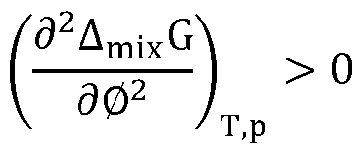 wherein AmixG is the Gibbs energy of mixing per unit volume, and <I> the composition, where <I> is usually taken as the volume fraction of one of the component substances. The system is unstable if the above second derivative is negative. The borderline (spinodal) between (meta)stable and unstable states is defined by the above second derivative equaling zero. Further discussion of miscibility can be found in J.M.G. Cowie, ‘Miscibility’, Encyclopedia of Polymer Science and Engineering, 2nd Ed., J.I. Kroschwitz, ed., Wiley Interscience, New York, 1985, Supplement, p. 455-480, and Work, W. J., Horie, K., Hess, M., & UK, R. S. (2004), Definitions of Terms Related to Polymer Blends, Composites and Multiphase Polymeric Materials, Pure and Applied Chemistry ? 6/11, the substance of which is fully incorporated herein by reference.
[0025] “Multilayer film,” as used herein, means a coextruded structure comprising at least a barrier layer, a structural layer, and a tie layer.
[0026] “Nonpolar comonomer,” as used herein, means a monomer unit containing only carbon and hydrogen.
[0027] “Nonpolar polymer,” as used herein, means a polymer or copolymer consisting of units derived from a nonpolar monomers.
[0028] “Olefin,” as used herein, and alternatively referred to as “alkene,” is a linear, branched, or cyclic compound of carbon and hydrogen having at least one double bond.
[0029] “Polar monomer,” as used herein, means monomers containing highly electronegative atoms, such as chlorine, fluorine, oxygen, nitrogen, or sulfur, that give rise to polymers that contain permanent electric dipoles.
[0030] “Polar polymer,” as used herein, means a polymer or copolymer comprising units derived from a polar monomer. The term "polar polymer," as used herein, refers to polymer formed from at least one monomer that comprises at least one heteroatom. Some examples of heteroatoms include O, N, P and S.
[0031] “Polymer recy elate,” as used herein, means post-consumer recycled (“PCR”) polymer and/or post-industrial recycled (“PIR”) polymer. Polymer recy elate is derived from an end product that has completed its life cycle as a consumer item and would otherwise be disposed of as waste (e.g., a polyethylene water bottle) or from plastic scrap that is generated as waste from an industrial process. Polymer recy elates herein are a mixture of a first low polarity polymer component and a high polarity polymer component comprising at least one polar monomer, such as produced by melting and mixing a barrier film having at least one layer of a first low polarity polymer component and at least on layer of a high polarity polymer component comprising at least one polar monomer.
[0032] “Polyolefin,” as used herein, in some embodiments is a type of polymer with the general formula (CH2CHR)n where R is an alkyl group, including, but not limited to LDPE, LLDPE, MDPE, HDPE, and PP. Polyolefins are nonpolar polymers.
[0033] “Functionalized polymer-based adhesive composition,” as used herein, means any composition comprising a functionalized polymer, alone or in combination with other polymers, where, in the context of coextruded layers of polymers, a layer of the functionalized polymer- based adhesive composition (or “tie layer”) will adhere better to both a first polymer layer and a second polymer layer than the first polymer layer and the second polymer layer would adhere to each other. Tie layers can also improve adhesion as described above where one or both polymer layers are replaced by a nonpolymeric layer.
[0034] “Primary antioxidants,” as used herein, means compounds which function essentially as free radical terminators or scavengers. Primary antioxidants react rapidly with peroxy and alkoxy radicals. The majority of primary antioxidants for polymers are sterically hindered phenols. [0035] “Processability,” as used herein, refers to how well a polymer composition can be formed into a cast of blown film of commercial quality or molded by injection or compression molding into a molded article of commercial quality at commercially acceptable rates using the equipment and conditions.
[0036] “Secondary antioxidants,” as used herein, means compounds which are preventive antioxidants that function by retarding chain initiation. Secondary' antioxidants react with
hydroperoxides to yield non-radical products and are, therefore, frequently called hydroperoxide decomposers.
[0037] “Structural layer,” as used herein, means a layer used in a multilayer film to impart desired mechanical properties and/or resistance to moisture to the multilayer structure.
[0038] In the present description, the terms “monomer” and “comonomer” are used interchangeably. The terms mean any compound with a polymerizable moiety that is added to a reactor in order to produce a polymer. In those instances in which a polymer is described as comprising one or more monomers, e.g., a polymer comprising propylene and ethylene, the polymer, of course, comprises units derived from the monomers, e.g., — CH2 — CH2 — , and not the monomer itself, e.g., CH2=CH2. For example, when a copolymer is described as having an “ethylene” content of 35 wt.% to 55 wt.%, it is understood that the mer unit in the copolymer is derived from ethylene in the polymerization reaction and the derived units are present at 35 wt.% to 55 wt.%, based upon the weight of the copolymer.
[0039] In the present description, “multilayer film” is of particular concern and discussed throughout this description. When referring to a multilayer structure, the description can use a slash to indicate that components to the left and right of the slash are in different layers and the relative position of components in layers can be so indicated by use of the slash to indicate layer boundaries.
[0040] The following abbreviations are used herein:
ABBREVIATION TERM
EAA Copolymer of ethylene with acrylic acid
EAO Copolymers of ethylene with at least one alpha-olefin
EMAA Copolymer of ethylene with methacrylic acid
EVA Copolymer of ethylene with vinyl acetate
EVOH Saponified or hydrolyzed copolymer of ethylene and vinyl acetate
HDPE High density polyethylene
Ionomer Copolymers of ethylene and unsaturated carboxylic acid comonomers, such as but not limited to, EAA and EMAA LDPE Low density polyehtylene
LLDPE Linear low density polyethylene
MDPE Medium density polyethylene
PA Polyamides, such as nylon
PC Polycarbonate
PCTFE Polychlorotrifluoroethylene
PE Polyethylene (an ethylene homopolymer or copolymer of a major portion of ethylene with one or more alpha-olefms and/or one or more polar comonomers)
PET Polyethylene terephthalate
PETG Glycol-modified polyethylene terephthalate
PP Polypropylene homopolymer or copolymer
PS Polystyrene
PVDC Polyvinylidene chloride (also includes copolymers of vinylidene chloride, such as with vinyl chloride or methyl acrylate (MA)). wt% weight percent
[0041] It is noted that in this disclosure and particularly in the claims and/or paragraphs, terms such as “comprises”, “comprised”, “comprising” and the like can have the meaning attributed to it in U.S. patent law; e.g., they can mean “includes”, “included”, “including”, and the like; and that terms such as “consisting essentially of’ and “consists essentially of’ have the meaning ascribed to them in U. S. patent law, e.g., they allow for elements not explicitly recited, but exclude elements that are found in the prior art or that affect a basic or novel characteristic of the disclosure. Multilayer Barrier Film
[0042] Wraps for meat and cheese, snack foods, baking mixes, and large bulk packaging for perishables, such as dog food, require multilayer structures to provide both structural integrity of packaging and resistance to transmission of oxygen and/or moisture.
[0043] Multilayer barrier films comprise at least one barrier layer. Such barrier layer or layers comprises a high polarity polymer, such as, but not limited to, EV OH, PA, PVDC, PCTFE, or a combination thereof. Such barrier layers have high clarity with excellent flex-crack resistance, and also some of the best barrier properties to gases such as oxygen, nitrogen, and carbon dioxide making it especially suited for packaging of food, drugs, cosmetics, and other perishable or delicate products to extend shelf life. In comparison with many other common films, high polarity polymers such as EVOH, PA, PVDC, and PCTFE have superior barrier properties. However, the good gas barrier properties of many high polarity polymers, such as EVOH and nylon, deteriorate when exposed to moisture.
[0044] Multilayer barrier films comprise at least one structural layer. Such structural layer or layers can comprise one or more polyolefins, one or more low polarity polymers, including polyolefins. Polyolefins, such as polyethylene and polypropylene, have superior moisture resistance properties and also provide essential mechanical properties such as, but not limited to, one or more of structural integrity, puncture resistance, heat resistance, heat sealability, and/or abrasion resistance. Nonpolar polyolefins include, but are not limited to, HDPE, LDPE, LLDPE, MDPE, and PP, which have superior moisture barrier properties, are frequently used in combination in multilayer, co-extruded films in order to achieve a desired balance of properties. [0045] Low polarity polymers also provide one or more of structural integrity, moisture barrier, puncture resistance, heat resistance, heat sealability, and/or abrasion resistance. Such low polarity polymers include copolymers of units derived from ethylene and units derived from one or more of alpha mono-olefins comprising polar groups. Such low polarity polymers include, but are not limited to, EVA, ionomers (such as, but not limited to, EAA and EMAA), PET, PC, and/or PS, which provide one or more of moisture resistance, structural integrity, puncture resistance, heat resistance, heat sealability, and/or abrasion resistance. Low polarity polymers are frequently
used in combination in multilayer, co-extruded films in order to achieve a desired balance of properties.
[0046] In some embodiments, one or more polyolefins and/or one or low polarity polymers are used individually in separate layers of a multilayer structure.
[0047] In some embodiments, one or more polyolefins and/or one or low polarity polymers are blended, and such blends are used in one or more layers of a multilayer structure.
[0048] One of ordinary skill in the art is familiar with the particular properties of barrier layers and structural layers and can select a combination of layers that will provide a balance of properties in the multilayer film for a desired application. However, layers having different mechanical properties often have chemical compositions that differ and result in such dissimilar layers not adhering well to one another.
[0049] In some embodiments, a multilayer barrier film comprises a structural layer and a barrier layer that do not adhere well to one another. In some embodiments, a multilayer barrier film comprises a high polarity polymer barrier layer and a structural layer comprising one or more low polarity polymers (including polyolefins), such that the barrier layer and the structural layer that do not adhere well to one another. In some embodiments, a tie layer comprises a compatibilized polymer recyclate. The compatibilized polymer recyclate comprises a mixture of a polymer recyclate and a compatibilizer. The polymer recyclate comprises a second low polarity polymer and a second high polarity polymer, the second high polarity polymer comprising a second polar monomer. The compatibilizer comprises a third low polarity polymer grafted with one or more functional groups. The mixture is subjected to compounding conditions sufficient to form the compatibilized polymer recyclate having a dispersed phase of domains of the second high polarity polymer in a matrix phase of the second low polarity polymer.
[0050] In some embodiments, the multilayer structure comprises:
(A) a first layer comprising a low polarity polymer;
(B) a second layer comprising a high polarity polymer layer; and
(C) at least one tie layer between the first layer and the second layer comprising a compatibilized polymer recyclate.
[0051] The general process for forming the multilayer structure includes co-extruding the layers to form a multilayer structure. The multilayer structures can be in the form of films or sheets, which may be further thermoformed or oriented, and can be produced using conventional methods and extrusion equipment well known to those skilled in the art, where layers of polymer melts are combined by introducing multiple polymer melt streams into a combining block/manifold or die which then directs the melt streams to flow together (while still in the
block/manifold or die), then exiting the die together as a single flow stream. Alternately, multiple polymer melt streams can be introduced into a die and then combined just after exiting the die. Structural Layer
[0052] In some embodiments, each of one or more structural layers comprise one or more polyolefins. In some embodiments, structural layers can be coextruded adjacent to another structural layer and/or one or more tie layers. In some embodiments, a structural layer is a blend of two or more polyolefins such as, but not limited to, a blend of low density polyethylene (LDPE), linear low density polyethylene (LLDPE), medium density polyethylene, high density polyethylene (HDPE), and/or polypropylene (PP).
[0053] In some embodiments, each of one or more structural layers comprise one or more low polarity polymers. In some embodiments, structural layers can be coextruded adjacent to another structural layer and/or one or more tie layers. In some embodiments, a structural layer is a blend of two or more low polarity polymers such as, but not limited to, a blend of EVA, ionomers (such as, but not limited to, EAA and EMAA), PET, PC, and/or PS.
[0054] In some embodiments, each of one or more structural layers comprise one or more polyolefins and one or more other structural layers comprise one or more low polarity polymers. In some embodiments, structural layers can be coextruded adjacent to another structural layer and/or one or more tie layers. In some embodiments, a structural layer is a blend of two or more of low density polyethylene (LDPE), linear low density polyethylene (LLDPE), medium density polyethylene, high density polyethylene (HDPE), polypropylene (PP), EVA, ionomers (such as, but not limited to, EAA and EMAA), PET, PC, and/or PS.
[0055] Suitable polyethylenes for structural layers include ethylene homopolymers and copolymers of units derived from ethylene and units derived from one or more of C3-C20 alphaolefins or mixtures thereof. In some embodiments, the units derived from the one or more Cs-Cs alpha-olefin comonomers are present in amounts up to 15 wt. %, based upon the total weight of the copolymer of ethylene. The ethylene homopolymers and copolymers can be produced using either Ziegler Natta catalyst, chromium-based catalyst, or single-site catalyst, e.g., metallocene catalyst. The ethylene homopolymers and copolymers can be produced using a gas phase process, high pressure process, slurry process, or solution process. Ethylene homopolymers and ethylene- Cs-Cs alpha-olefin copolymers include very low density polyethylene (VLDPE), low density polyethylene (LDPE), linear low density polyethylene (LLDPE), medium density polyethylene (MDPE) and high density polyethylene (HDPE). VLDPE is defined as having a density of 0.860 to 0.910 g/cm3, as measured by ASTM D-l 505 “Column Method.” LDPE and LLDPE are defined as having densities in the range of from 0.910 to 0.930 g/cm3. MDPE is defined as having a density of 0.930 to 0.945 g/cm3. HDPE is defined as having a density of at least 0.945 g/cm3, preferably
from 0.945 to 0.969 g/cm3. The ethylene homopolymers and copolymers preferably have melt indexes (Mis), as measured by ASTM D 1238, condition 190° C./2.16 kg, from 0.01 to 400 dg/min., preferably, from 0.1 to 200 dg/min., more preferably from 1 to 100 dg/min.
[0056] In some embodiments, LDPE is derived from ethylene homopolymers, copolymers of units derived from ethylene and units derived from one or more of C3-C12 alpha-olefins, copolymers of units derived from ethylene and units derived from one or more of alpha monoolefins comprising polar groups, or mixtures thereof.
[0057] In some embodiments, LDPE homopolymers can be produced in a high pressure, free- radical polymerization process, such as in one or more tubular reactors, one or more autoclave reactors, or a combination thereof. Operating conditions for the high-pressure process can include, but are not limited to, a pressure in the range of from 70 MPa to 700 MPa and a temperature in the range of from 150°C to 500°C. Such homopolymers have a high degree of long-chain branching and a density in the range of from 0.910 g/cm3 to 0.940 g/cm3.
[0058] In some embodiments, LDPE copolymers of ethylene and C3-C12 alpha-olefins can be produced in a high pressure, free-radical polymerization process, such as in one or more tubular reactors, one or more autoclave reactors, or a combination thereof. Such C3-C12 alpha-olefins include, but are not limited to, substituted or unsubstituted C3 to C12 alpha olefins such as propylene, butene, pentene, hexene, heptene, octene, nonene, decene, undecene, dodecane, and isomers thereof. When present, comonomers can be present in amounts up to 15 wt%, 10 wt%, or 5 wt%. Operating conditions for the high-pressure process can include, but are not limited to, a pressure in the range of from 70 MPa to 700 MPa and a temperature in the range of from 150°C to 500°C. Such homopolymers have a high degree of long-chain branching and a density in the range of from 0.910 g/cm3 to 0.940 g/cm3.
[0059] In some embodiments, LDPE copolymers of ethylene and one or more of alpha monoolefins comprising polar groups can be produced in a high pressure, free-radical polymerization process, such as in one or more tubular reactors, one or more autoclave reactors, or a combination thereof. Such alpha mono-olefins comprising polar groups include, but are not limited to, methacrylic acids, esters (e.g., acetate esters, such as vinyl acetate), nitriles, and amides, such as acrylic acid, methacrylic acid, cyclohexyl methacrylate, methyl acrylate, acrylonitrile, acrylamide, or mixtures thereof. When present, comonomers can be present in amounts up to 15 wt%, 10 wt%, or 5 wt%. Operating conditions for the high-pressure process can include, but are not limited to, a pressure in the range of from 70 MPa to 700 MPa and a temperature in the range of from 150°C to 500°C. Such homopolymers have a high degree of long-chain branching and a density in the range of from 0.910 g/cm3 to 0.940 g/cm3.
[0060] LDPE as described above, can be characterized by having: i) a density in the range of from 0.910 g/cm3 to 0.940 g/cm3 or from 0.915 g/cm3 to 0.935 g/cm3; ii) a melt index (2.16 kg, 190°C) less than or equal to 5.0 g/10 min., less than or equal to 1.0 g/10 min., less than or equal to 0.5 g/10 min., less than or equal to 0.2 g/10 min., or less than or equal to 0.1 g/10 min.; iii) a molecular weight distribution (Mw/Mn) greater than 4.0, greater than 8.0, or greater than 15, and/or less than 35, less than 30, or less than 25; iv) a weight average molecular weight (Mw) greater than or equal to 100,000 daltons, greater than or equal to 150,000 daltons, greater than or equal to 200,000 daltons, or greater than or equal to 250,000 daltons, and/or less than or equal to 600,000 daltons, less than or equal to 500,000 daltons, less than or equal to 400,000 daltons, or less than or equal to 300,000 daltons; and v) a melt elasticity (“ER”) greater than or equal to 1.0, greater than or equal to 1.4, or greater than or equal to 2.0.
[0061] Suitable polypropylenes for structural layers include propylene homopolymers and copolymers, including plastomers, having of units derived from propylene and units derived one or more of ethylene and C4-C20 alpha-olefins or mixtures thereof. Preferably, the units derived from one or more of ethylene and C4-C10 alpha-olefin comonomers are present in amounts up to 35 wt. %, based upon the total weight of the copolymer of propylene. The propylene homopolymers and copolymers can be produced using either Ziegler Natta or single-site catalysts, e.g., metallocene catalysts. The propylene homopolymers and copolymers can be produced using a gas phase process, slurry process, or solution process. In some embodiments, when the propylene polymer is a copolymer, it preferably contains 2 to 6 wt. %, based upon the total weight of the copolymer, of ethylene derived units as a comonomer.
[0062] In some embodiments, a first low polarity polymer component comprises a copolymer of ethylene and one or more polar comonomer, a copolymer of propylene and one or more polar comonomers, or a combination thereof, wherein the low first polarity polymer component has an oxygen vapor transmission rate (OVTR), as measured by ASTM D3895, of greater than or equal to 800 cc’pm/m2’dayatm, greater than or equal to 900 cc’pm/m2’day atm, or greater than or equal to 1,000 cc’pm/m2*day»atm.
[0063] A structural layer can also be formed from a blend of two or more polyethylenes, two or more polypropylenes, or one or more polyethylenes and one or more polypropylenes. In some embodiments, a structural layer can also be formed from a blend of two or more polyolefins, two or more low polarity polymers (other than polyolefins), or one or more polyolefins and one or more low polarity polymers (other than polyolefins).
Barrier Layer
[0064] In some embodiments, the multilayer structure includes at least one barrier layer, comprising a polymer having an oxygen vapor transmission rate (OVTR), as measured by ASTM
D3895, of less or equal to 200 cc*pm/m2*dayatm. less than or equal to 150 cc»pm/m2»day,atm, less than or equal to 100 cc’pm/m2«day»atm, or less than or equal to 50 cc»pm/m2»day*atm. A barrier layer can include EV OH, PA (e.g., nylons, such as nylon 6, nylon 6,6, nylon 12, nylon 6,12, nylon 6,66, and blends thereof, as well as co-extruded structures of EV OH and nylons, such as EVOH/nylon and nylon/EVOH/nylon. Barrier layers can also include poly vinylidene chloride (PVDC) and/or polychlorotrifluoroethylene (PCTFE). In some embodiments, the barrier layers are selected from EV OH, nylons or co-extruded structures thereof. In some embodiments, the barrier layer is EV OH.
Tie Laver
[0065] In some embodiments, the tie layer comprises a compatibihzed polymer recyclate to improve the adherence between a low polarity polymer structural layer and a high polarity polymer barrier layer, wherein the polymer recyclate comprises a mixture of a high polarity polymer and a low polarity polymer.
[0066] In some embodiments, the compatibilized polymer recyclate is formed by melt blending the polymer recyclate with a compatibilizer, wherein the compatibilizer comprises a low polarity polymer grafted with one or more functional groups. In one or more embodiments, the polymer recyclate contacts the functionalized polymer prior to pelletization. In one or more other embodiments, the functionalized polymer contacts the polymer recyclate prior to pelletization.
[0067] In other embodiments, regardless of the blending of the polymer recyclate and the functionalized polymer, the process of combining the two components further includes melt blending the polymer recyclate and the functionalized polymer in the presence of adhesion promoting additive.
[0068] In some embodiments, the functionalized polymer is formed by addition of one or more pendant functional group to a polymer backbone comprising a second low polarity polymer. The low polarity polymer can be a polyolefin, such as an ethylene homopolymer or copolymer of ethylene and one or more alpha olefins. The low polarity polymer can be a copolymer of ethylene and one or more alpha mono-olefins comprising polar groups or a copolymer of propylene and one or more alpha mono-olefins comprising polar groups.
[0069] In some embodiments, the compatibilized polymer recyclate composition includes the functionalized polymer in a range of from 0.5 wt.% to 30 wt.%, or 1 wt.% to 20 wt.%, or 2 wt.% to 15 wt.%, or 5 wt. % to 15 wt. %, or 6 wt. % to 11 wt. %, or 12 wt. % to 17 wt. %, based on the total weight of the compatibilized polymer recyclate composition.
[0070] In some embodiments, a compatibilized polymer recyclate composition comprises a blend of LLDPE having a density in the range of from 0.910 to 0.930 g/cm3 with a HDPE having a density of at least 0.945 g/cm3, preferably from 0.945 to 0.969 g/cm3, the HDPE having been
functionalized with maleic anhydride (HDPE-g-MAH). In some embodiments, the HDPE-g-MAH is present in the blend of LLDPE and HDPE-g-MAH in a range of from 0.5 wt.% to 30 wt.%, or
1 wt.% to 20 wt.%, or 2 wt.% to 15 wt.%, or 5 wt. % to 15 wt. %, or 6 wt.% to 11 wt. %, based on the total weight of the functionalized polymer-based adhesive composition.
[0071] In other embodiments, a compatibilized polymer recy elate composition comprises a blend of LLDPE having a density in the range of from 0.910 to 0.930 g/cm3 with another LLDPE having a density of 0.910 to 0.930 g/cm3, the LLDPE having been functionalized with maleic anhydride (LLDPE-g-MAH). In some embodiments, the LLDPE-g-MAH is present in the blend of LLDPE and LLDPE-g-MAH in a range of from 0.5 wt.% to 30 wt.%, or 1 wt.% to 20 wt.%, or
2 wt.% to 15 wt.%, or 5 wt. % to 15 wt. %, or 6 wt.% to 11 wt. %, based on the total weight of the functionalized polymer-based adhesive composition.
[0072] Examples of compatibilizers comprising a low polarity polymer grafted with one or more functional groups are disclosed in U.S. Patent Publication Nos. 2017/0198103 and 2017/0335149, and U.S. Patent Nos. 7,687,575, 7,871,709, 8,598,264, 8,673,451, 8,685,539, 9,499,723, 9,650,548, 9,662,864, 9,676,971 , 9,803,074, 10,053,574, 10,150,894, 10,240,072, and 10,266,727, all of which, the contents are incorporated by reference herein in their entirety.
[0073] The functional groups included in the compatibilizer composition are selected for having miscibility and/or compatibility with the high polarity polymer portion of the polymer recyclate. The low polarity polymer portion of the compatibilizer composition is selected for having miscibility and/or compatibility with the low polarity polymer portion of the polymer recyclate.
[0074] Tie layer compositions intentionally contain one or more component polymers that are miscible and/or compatible with the layers that are adjacent to each side of the tie layer, wherein such adjacent layers are not miscible and/or compatible with one another. Polymer recyclates as disclosed herein provide a high polarity polymer portion and a low polarity polymer portion. However, the high polarity and low polarity portions of the polymer recyclate are not miscible and/or compatible with one another resulting in a dispersed phase of gels and/or domains of the high polarity polymer having a large particle size in a matrix phase of the low polarity polymer portion of the polymer recyclate. Such gels and/or domains of the high polarity polymer having a large particle size in a matrix phase of the low polarity polymer portion of the polymer recyclate result in the neat polymer recyclate having poor processibility, producing poor mechanical and/or optical properties for a tie layer so formed. Addition of the compatibilizer to the polymer recyclate and subjecting the mixture to compounding conditions sufficient to produce a dispersed phase, wherein the average particle size of domains of the high polarity polymer is greatly reduced, and
the particles are more dispersed in the matrix phase of the low polarity portion of the polymer recy elate.
Polymer Recyclate
[0075] Polymer recy elates herein comprise a mixture of at least one high polarity polymer and at least one low polarity polymer. In some embodiments, polymer recyclate herein comprises a mixture of a low polarity polymer component and a high polarity polymer component, such as produced by melting and mixing a multilayer barrier film having at least one layer of a low polarity polymer component and at least one layer of a high polarity polymer component.
[0076] In some embodiments, polymer recyclate herein comprises a mixture of a polyolefin component, and a high polarity polymer component, such as produced by melting and mixing a multilayer barrier film having at least one layer of a polyolefin, and at least one layer of a high polarity polymer component, or alternatively, having at least one layer comprising a blend of at least one polyolefin and at least one low polarity polymer (other than a polyolefin) and at least one layer of a high polarity polymer component.
[0077] Polymer recyclate includes post-consumer recycled (“PCR”) polymer and/or postindustrial recycled (“PIR”) polymer. Polymer recyclate is derived from an end product that has completed its life cycle as a consumer item and would otherwise be disposed of as waste (e g., a polyethylene water bottle) or from plastic scrap that is generated as waste from an industrial process. Polymer recyclates herein are a mixture of a first low polarity polymer component and a high polarity polymer component comprising at least one polar monomer, such as produced by melting and mixing a barrier film having at least one layer of a first low polarity polymer component and at least on layer of a high polarity polymer component comprising at least one polar monomer. In some embodiments, polymer recyclate is produced by subjecting any of the multilayer barrier films as described above to compounding conditions sufficient to form a polymer product having a dispersed phase of domains of the high polarity polymer component in a matrix phase comprising the first low polarity polymer.
[0078] In some embodiments, compounding conditions are implemented in the compounding zone of an extruder or mixer and are tailored for mixtures of specific low polarity polymers, and optionally additives. Temperature, pressure, and shear force conditions are implemented in the extruder or mixer sufficient to provide intimate mixing of the at least one barrier layer and the at least one structural layer or the at least one layer of a high polarity polymer and at least one layer of a low polarity polymer to produce a substantially homogeneous polymer blend of the layers of the multilayer barrier film. The compounding conditions will be such that the specific energy from the compounder from shear and/or added heat are sufficient to melt the polymer components and homogenize them. In some embodiments, compounding conditions comprise a temperature in the
compounding zone of less than or equal to 300°C, less than or equal to 250°C or less than or equal to 200°C. In some embodiments, where the polymer recyclate comprises a polyethylene, temperatures in the compounding zone can be in the range of from 125°C to 195°C, from 130°C to 180°C, or from 135°C to 165°C. In some embodiments, where the polymer recyclate comprises a polypropylene, temperatures in the compounding zone can be in the range of from 175°C to 245°C, from 180°C to 230°C, or from 185°C to 215°C. The polymer recyclate can be pelletized for later mixing a compatibilizer as described below or can be blended in the melted state with such compatibilizer.
Compatibilizer
[0079] In some embodiments, a compatibilizer as disclosed herein comprises a modified polymer produced by reacting a polymer with functional groups or monomers, such as acid and/or acid derivative moieties, wherein the polymer has the one or more functional groups or monomers grafted along the polymer chain. In some embodiments the modified polymer is a functionalized polyolefin, functionalized low polarity polymer (including polyolefin), or a combination thereof. [0080] In some embodiments, the second low polarity polymer is a polyolefin such as a polyethylene homopolymer or copolymer. In some embodiments, the polyolefin is a polypropylene homopolymer or copolymer.
[0081] In some embodiments, the polymer is a low polarity polymer (other than polyolefin). In some embodiments, the low polanty polymer is a copolymer of ethylene and one or more polar comonomers. In some embodiments, the low polarity polymer is a copolymer of propylene and one or more polar comonomers.
[0082] In some embodiments, the functionalized polymer is formed by addition of one or more pendant functional groups to a polymer backbone comprising a low polarity polymer (including polyolefin). The polyolefin can be an ethylene homopolymer or copolymer of ethylene and one or more alpha olefins. The low polarity polymer (other than polyolefin) can be a copolymer of ethylene and one or more alpha mono-olefins comprising polar groups or a copolymer of propylene and one or more alpha mono-olefins comprising polar groups.
[0083] In some embodiments, a compatibilizer as disclosed herein comprises a modified low polarity polymer produced by reacting a low polarity polymer with functional groups or monomers, such as acid and/or acid derivative moieties, wherein the low polarity polymer has the one or more functional groups or monomers grafted along the polymer chain.
[0084] Functionalized polymers are generally formed by grafting a functional monomer onto the backbone (i.e., main chain) of a low polarity polymer. The composition of the low polarity polymer can be a polyolefin comprising a single ethylene-based polymer, a single propylene-based polymer, a blend of two or more ethylene-based polymers, a blend of two or more propylene-based
polymers, or a blend of at least one ethylene-based polymer and at least one propylene-based polymer. Suitable ethylene-based polymers and propylene-based polymers are described below. The one or more polymers selected from ethylene-based polymers, propylene-based polymers, and combinations thereof selected for the composition of the olefin-base polymer can be the same as or different from those chosen for the composition of the polyolefin of the one or more structural layers of the multilayer barrier film.
[0085] The functional groups included in the compatibilizer composition are selected for having miscibility and/or compatibility with the barrier layer composition. The low polarity polymer portion of the compatibilizer composition is selected for having miscibility and/or compatibility with the structural layer composition.
[0086] The functional monomer can be grafted onto the polarity polymer via processes known to one skilled in the art. For example, the graft may be formed via reactive extrusion processes. Reactive extrusion processes generally include contacting the low polarity polymer with the functional monomer within an extruder or in a solution process to form the functionalized polymer. [0087] The reactive extrusion processes may include any extrusion process known in the art. For example, raw materials (e.g., low polarity polymer and functional monomer) may be fed into a twin screw extruder in a concentration sufficient to form the functionalized low polarity polymer having a target graft content. The reaction to form the functionalized low polarity polymer may occur in the twin screw extruder under constant mixing and kneading, for example. Thus, the functionalized low polarity polymer generally includes a linear backbone of the polarity polymer with randomly distributed branches of the functional monomer, resulting in side chains that are structurally distinct from the main chain/backbone.
[0088] In one or more embodiments, the low polarity polymer contacts the functional monomer in the presence of an initiator. Initiators can be selected from those known to one skilled in the art, such as, but not limited to, organic peroxides. However, as discussed previously herein, grafting can take place under high temperature and high shear in absence of an initiator.
[0089] In some embodiments, compatibilizers of the invention are conveniently prepared by grafting the low polarity polymer in the substantial absence of solvent. This can be accomplished in a shear-imparting reactor, such as an extruder/reactor. Twin screw extruder/reactors such as those manufactured by Coperion (formerly Wemer-Pfleiderer) under the designations ZSK-53, ZSK-83 and ZSK-92 are commonly used. A free radical generating catalyst, such as an organic peroxide catalyst, can be employed but is not necessary. The grafting reaction is carried out at a temperature selected to minimize or avoid rapid vaporization and consequent losses of the graft monomer and any catalyst that may be employed. The graft monomer concentration in the reactor is typically about 1 to about 5 wt. % based on the total reaction mixture weight. A temperature
profile where the temperature of the low polarity polymer melt increases gradually through the length of the extruder/reactor up to a maximum in the grafting reaction zone and then decreases toward the reactor exit is preferred. The maximum temperature within the reactor should be such that significant vaporization losses and/or premature decomposition of any peroxide catalyst are avoided. For example, if di-t-butyl peroxide and 2,5-dimethyl-2,5-di-(t-butylperoxy) hexane are used, temperatures within the reactor are maintained at or below about 220°C. Examples of useful peroxide catalysts include: l,l-bis(t-butylperoxy)cyclohexane; n-butyl-4,4-bis(t-butylperoxy- valerate); l,l-bis(t-butylperoxy)-3,3,5-trimethylcyclohexane; 2,2-bis(t-butyl-peroxy)butane; dicumylperoxide; t-butylcumylperoxide; alpha, alpha' -bis(t-butylperoxy-preoxy- isopropyl)benzene; di-t-butylperoxide; 2,5-dimethyl-2,5-di(t-butylperoxy) hexane; and the like. The grafting monomer and any catalyst used are preferably added in neat form to the extruder/reactor.
[0090] In a preferred embodiment, the functionalized polymer, i.e., functionalized low polarity polymer, is obtained by grafting an ethylenically unsaturated carboxylic acid or derivative, particularly MAH, onto the polymer backbone. The grafting may be accomplished using known procedures in solution, in a fluidized bed reactor, by melt grafting or by irradiation grafting. As used herein, the term grafting denotes covalent bonding of the grafting monomer to the polymer chain.
[0091] The functionalized polymer may include the functional monomer in a range of from 0.10 wt% to 2.9 wt%, from 0.45 wt% to 2.8 wt%, from 0.70 wt% to 2.7 wt%, from 1.05 wt% to 2.6 wt%, from 1.50 wt% to 2.5 wt%, wherein weight percentages are based on the total weight of the compatibilizer.
[0092] In some embodiments, the compatibilizer has a melt index (h) in the range of from 0.5 dg/min. to 500 dg/min., from 1.0 dg/min. to 12.0 dg/min., from 3.0 dg/min. to 11.5 dg/min., from 5.0 dg/min. to 11.0 dg/min., from 7.0 dg/min. to 10.5 dg/min., or from 9.0 dg/min. to 10.0 dg/min.
[0093] In some embodiments, the compatibilizer has a density in the range of from 0.850 g/cm3 to 0.960 g/cm3, from 0.855 g/cm3 to 0.950 g/cm3, from 0.860 g/cm3 to 0.940 g/cm3, from 0.865 g/cm3 to 0.930 g/cm3, or from 0.870 g/cm3 to 0.920 g/cm3.
[0094] In some embodiments, the compatibilizer has a melt elasticity (ER) in the range of from 0.30 to 3.00, from 0.31 to 2.35, from 0.32 to 1.70, from 0.33 to 1.05, or from 0.34 to 0.40.
[0095] In some embodiments, the compatibilizer has a melting temperature (Tm) less than 180°C, less than 170°C, or in the range of from 51°C to 145°C, from 52°C to 125°C, from 53°C to 105°C, from 54°C to 85°C, or from 55°C to 65°C.
Polymer Component of the Compatibilizer
[0096] In some embodiments, a low polarity polymer comprises a polyolefin suitable for such grafting of one or more functional groups, including ethylene homopolymers and copolymers of units derived from ethylene and units derived from one or more of C3-C20 alpha-olefins or mixtures thereof. In some embodiments, the units derived from the one or more Cs-Cs alpha-olefin comonomers are present in amounts up to 15 wt. %, based upon the total weight of the copolymer of ethylene. The ethylene homopolymers and copolymers can be produced using either Ziegler Natta catalysts, chromium-based catalysts, or single-site catalysts, e.g., metallocene catalysts. The ethylene homopolymers and copolymers can be produced using a gas phase process, high pressure process, slurry process, or solution process. Ethylene homopolymers and ethylene-C.-Cs alphaolefin copolymers include very low density polyethylene (VLDPE), low density polyethylene (LDPE), linear low density polyethylene (LLDPE), medium density polyethylene (MDPE) and high density polyethylene (HDPE). VLDPE is defined as having a density of 0.860 to 0.910 g/cm3, as measured by ASTM D-1505 “Column Method.” LDPE and LLDPE are defined as having densities in the range of from 0.910 to 0.930 g/cm3. MDPE is defined as having a density of 0.930 to 0.945 g/cm3. HDPE is defined as having a density of at least 0.945 g/cm3, preferably from 0.945 to 0.969 g/cm3. The ethylene homopolymers and copoly mers preferably have melt indexes (Mis), as measured by ASTM D 1238, condition 190° C./2.16 kg, from 0.01 to 400 dg/min., preferably, from 0.1 to 200 dg/min., more preferably from 1 to 100 dg/min.
[0097] In some embodiments, a low polarity polymer suitable for such grafting of one or more functional groups include LDPE homopolymers and/or copolymers of units derived from ethylene and units derived from one or more of C3-C12 alpha-olefins. Such C3-C12 alpha-olefins include, but are not limited to, substituted or unsubstituted C3 to C12 alpha olefins such as propylene, butene, pentene, hexene, heptene, octene, nonene, decene, undecene, dodecane, and isomers thereof. When present, comonomers can be present in amounts up to 15 wt%, 10 wt%, or 5 wt%.
[0098] In some embodiments, a low polarity polymer suitable for such grafting of one or more functional groups include LDPE copolymers of units derived from ethylene and units derived from one or more of alpha mono-olefins comprising polar groups, or mixtures thereof. Such alpha mono-olefins comprising polar groups include, but are not limited to, methacrylic acids, esters, nitriles, and amides, such as methacrylic acids, esters (e.g., acetate esters, such as vinyl acetate), nitriles, and amides, such as acrylic acid, methacrylic acid, cyclohexyl methacrylate, methyl acrylate, acrylonitrile, acrylamide, or mixtures thereof. Comonomers can be present in amounts up to 15 wt%, 10 wt%, or 5 wt%.
[0099] Such LDPE homopolymers and copolymers can be produced in a high pressure, free- radical polymerization process, such as in one or more tubular reactors, one or more autoclave
reactors, or a combination thereof. Operating conditions for the high-pressure process can include, but are not limited to, a pressure in the range of from 70 MPa to 700 MPa and a temperature in the range of from 150°C to 500°C. Such homopolymers have a high degree of long-chain branching and a density in the range of from 0.910 g/cm3 to 0.940 g/cm3.
[0100] LDPE as described above, can be characterized by having: i) a density in the range of from 0.910 g/cm3 to 0.940 g/cm3 or from 0.915 g/cm3 to 0.935 g/cm3; ii) a melt index (2.16 kg, 190°C) less than or equal to 5.0 g/10 min., less than or equal to 1.0 g/10 min., less than or equal to 0.5 g/10 min., less than or equal to 0.2 g/10 min., or less than or equal to 0.1 g/10 min.; iii) a molecular weight distribution (Mw/Mn) greater than 4.0, greater than 8.0, or greater than 15, and/or less than 35, less than 30, or less than 25; iv) a weight average molecular weight (Mw) greater than or equal to 100,000 daltons, greater than or equal to 150,000 daltons, greater than or equal to 200,000 daltons, or greater than or equal to 250,000 daltons, and/or less than or equal to 600,000 daltons, less than or equal to 500,000 daltons, less than or equal to 400,000 daltons, or less than or equal to 300,000 daltons; and v) a melt elasticity (“ER”) greater than or equal to 1.0, greater than or equal to 1 .4, or greater than or equal to 2.0.
[0101] In some embodiments, a low polarity polymer comprises a polyolefin suitable for such grafting of one or more functional groups, including polypropylene homopolymers and/or copolymers, including plastomers, having units derived from propylene and units derived one or more of ethylene and C4-C10 alpha-olefins or mixtures thereof. Preferably, the units derived from one or more of ethylene and C4-C10 alpha-olefin comonomers are present in amounts up to 35 wt. %, based upon the total weight of the copolymer of propylene. The propylene homopolymers and copolymers can be produced using either Ziegler Natta or single-site catalysts, e.g., metallocene catalysts. The propylene homopolymers and copolymers can be produced using a gas phase process, slurry process, or solution process. In some embodiments, when the propylene polymer is a copolymer, it contains 2 to 6 wt%, based upon the total weight of the copolymer, of ethylene derived units as a comonomer.
[0102] In some embodiments, a low polarity polymer suitable for such grafting of one or more functional groups include polypropylene homopolymers and/or copolymers, including plastomers, having units derived from propylene and units derived from one or more of alpha mono-olefins comprising polar groups, or mixtures thereof. Such alpha mono-olefins comprising polar groups include, but are not limited to, methacrylic acids, esters, nitriles, and amides, such as methacrylic acids, esters (e.g., acetate esters, such as vinyl acetate), nitriles, and amides, such as acrylic acid, methacrylic acid, cyclohexyl methacrylate, methyl acrylate, acrylonitrile, acrylamide, or mixtures thereof. Comonomers can be present in amounts up to 15 wt%, 10 wt%, or 5 wt%.
Functional Group of the Compatibilizer
[0103] Acid or acid derivative monomers grafted to obtain the modified or functionalized low polarity polymers are ethylenically unsaturated carboxylic acids or acid derivatives, such as acid anhydrides, esters, salts or the like. Useful monomers include but are not limited to: acrylic acid, methacrylic acid, maleic acid, fumaric acid, itaconic acid, citraconic acid, mesaconic acid, maleic anhydride (MAH), 4-methyl cyclohex-4-ene-l,2-di carboxylic acid anhydride, bicyclo(2.2.2)oct- 5-ene-2,3-dicarboxylic acid anhydride, l,2,3,4,5,8,9,10-octahydronaphthalene-2,3-dicarboxylic acid anhydride, bicyclo(2.2.1)hept-5-ene-2,3-dicarboxylic acid anhydride, tetrahydrophthhalic anhydride, norbom-5-ene-2, 3 -dicarboxylic acid anhydride, and x-methylbicyclo(2.2.1)hept-5- ene-2,3-dicarboxyhc acid anhydride (XMNA).
[0104] In some embodiments, functional groups are selected based on miscibility with the high polarity polymer of a barrier layer. Without wishing to be bound by any particular theory, it is believed that the interfacial reaction between the functional groups of the compatibilizer and the polar monomers of the barrier layer high polarity polymer polymer results in a broader distribution of the high polarity polymer in the dispersed phase, wherein the high polarity polymer domains have a smaller particle size; or in one instance, the interfacial reaction between the maleic anhydride groups of the compatibilizer and hydroxyl groups of EV OH of the barrier layer polar polymer results in a broader distribution of the EV OH in the dispersed phase, wherein the EV OH domains have a smaller particle size.
Compounding the Polymer Recyclate and the Compatibilizer
[0105] In some embodiments, the polymer recyclate, the compatibilizer, and optionally one or more antioxidants are mixed and subjected to compounding conditions sufficient to form a polymer product having a dispersed phase of domains of the high polarity polymer component in a matrix phase of the first low polarity polymer component. In some embodiments, compounding conditions are implemented in the compounding zone of an extruder or mixer and are tailored for mixtures of specific low polarity polymers, and optionally additives. Temperature, pressure, and shear force conditions are implemented in the extruder or mixer sufficient to provide intimate mixing of the at least one barrier layer and the at least one structural layer or the at least one layer of a low polarity polymer and at least one layer of a high polarity polymer component comprising at least one polar monomer produce a substantially homogeneous polymer blend of the layers of the multilayer barrier film. In some embodiments, compounding conditions comprise a temperature in the compounding zone of less than or equal to 300°C, less than or equal to 250°C or less than or equal to 200°C. In some embodiments, where the polymer recyclate comprises a polyethylene, temperatures in the compounding zone can be in the range of from 125°C to 195°C, from 130°C to 180°C, or from 135°C to 165°C. In some embodiments, where the polymer recyclate
comprises a polypropylene, temperatures in the compounding zone can be in the range of from 175°C to 245°C, from 180°C to 230°C, or from 185°C to 215°C. The polymer recyclate can be pelletized for later mixing a compatibilizer as described below or can be blended in the melted state with such compatibilizer.
[0106] In some embodiments, the compatibilizer and the high polarity polymer are present in the compatibilized polymer recyclate in a weight ratio in a range of from 0.5: 1.0 to 5.0: 1.0, from 1.0:1.0 to 4.5: 1.0, from 1.5: 1. O to 4.0: 1.0, from 1.7: 1.0 to 3.5: 1.0, or from 1.9: 1.0 to 3.0: 1.0.
[0107] In some embodiments, the domains of the high polarity polymer in the compatibilized polymer recyclate have an average particle size having a cross-sectional area of less than or equal to 0.10 mm2, or less than or equal to 0.90 pm2, or in the range of from 0.0001 pm2 to 0.50 pm2, from 0.0002 pm2 to 0.25 pm2, from 0.0003 pm2 to 0. 125 pm2, from 0.0004 pm2 to 0.0625 pm2, or from 0.0005 pm2 to 0.0313 pm2.
Antioxidants
[0108] In some embodiments, primary and/or secondary antioxidants are added to stabilize the reactions for any exposure to oxygen during compounding.
[0109] Primary antioxidants react rapidly with peroxy and alkoxy radicals. Examples of primary antioxidants, sometimes termed "long-term antioxidants," include phenolic antioxidants and hindered amine antioxidants, such as are disclosed in U.S. Pat. No. 6,392,056, the disclosure of which is incorporated herein in its entirety. Suitable primary antioxidants include, but are not limited to, Irganox™ antioxidants available from BASF, such as Irganox™ 1010, Irganox™ 1076, Irganox™ 1098, Irganox™ 1330, Irganox™ 1425 WL, Irganox™ 3114, Irganox™ 245 and Irganox™ 1135. Examples of suitable antioxidants, including phenolic antioxidants and hindered amine antioxidants, are described in U.S. Pat. No. 7,285,617, the disclosure of which is incorporated herein in its entirety.
[0110] Nonlimiting examples of primary antioxidants include 2,6-di-tert.butyl-4-methyl phenol, pentaerythrityl-tetrakis(3-(3',5'-di-tert.butyl-4-hydroxyphenyl)— propionate, octadecyl 3- (3',5'-di-tert.butyl-4-hydroxyphenyl)propionate, l,3,5-tri-methyl-2,4,6-tris-(3,5-di-tert.butyl-4- hydroxyphenyl)benzene, l,3,5-tris(3',5'-di-tert.butyl-4'-hydroxybenzyl)-isocyanurate, bis-(3,3- bis-(4-'-hydroxy-3'-tert.butylphenyl)butanic acid)-glycolester, N,N'-hexamethylene bis(3,5-di- tert.butyl-4-hydroxy-hydrocinnamamide, 2,5,7,8-Tetramethyl-2(4',8',12'- trimethyltridecyl)chroman-6-ol, 2.2'-ethylidenebis(4.6-di -tert, butyl phenol). l,l,3-tris(2-methyl-4- hydroxy-5-tert. butylphenyl) butane, l,3,5-tns(4-tert.butyl-3-hydroxy-2,6-dimethylbenzyl)-l,3,5- triazine-2,4,- 6-(lH,3H,5H)-trione, 3,9-bis(l,l-dimethyl-2-(P-(3-tert.butyl-4-hydroxy-5- methylphenyl) propionyloxy)ethyl)-2,4,8,10-tetraoxaspiro(5,5) undecane, l,6-hexanediyl-bis(3,5- bis(l,l-dimethylethyl)-4-hydroxybenzene-propanoate- ), 2,6-di-tert.butyl-4-nonylphenol, 4,4'-
butylidenebis(6-tert.buty 1-3 -methylphenol), 2,2'-methylene bis(4-methyl-6-tert.butylphenol), and triethyleneglycol-bis-(3-tert.butyl-4-hydroxy-5 methylphenyl) propionate.
[0111] Secondary antioxidants, sometimes termed "short-term antioxidants," can be added to the mixer/ extruder at any convenient location. Secondary antioxidants are available commercially, such as the Irgafos™ antioxidants available from BASF, such as Irgafos™ 168, Irgafos™ 126, Irganox™ PS 800 and Irganox™ PS 802.
[0112] Examples of secondary antioxidants include, for example, aliphatic thiols and phosphites and phosphonites. Specific examples of secondary antioxidants include distearyl pentaerythritol diphosphite, isodecyl diphenyl phosphite, diisodecyl phenyl phosphite, tris(2,4-di- t-butylphenyl)phosphite, dilauryl-P,P-thiodipropionate, P-naphthyl disulfide, thiol-P-naphthol, 2- mercaptobenzothiazole, benzothiazyl disulfide, phenothiazine, tris(p-nonylphenyl)phosphite, and zinc dimethyldithiocarbamate.
Applications
[0113] In some embodiments, the multilayer film herein, comprising a compatibilized polymer recyclate as a tie layer, can be used as a substitute for multilayer films comprising only virgin polymers in all film layers. The reduced domain size of the high polarity polymer dispersed phase in the low polarity matrix produces mechanical performance of the tie layer and/or a multilayer film containing such tie layer competitive with, equal to, or better than comparable multilayer films comprising only virgin polymers. Such mechanical performance includes tear strength, dart drop, gloss, and haze. In some embodiments, the multilayer films disclosed herein, comprising the compounded mixture of the polymer recyclate and the compatibilizer in a tie layer, have improved processibility as compared to multilayer films having tie layers containing only polymer recyclates prior to addition of the compatibilizer, believed to result from the reduced particle size of the dispersed phase of high polarity polymer in the low polarity polymer matrix.
Certain Embodiments
[0114] In some embodiments, a multilayer film, comprises a first layer, a second layer, and a tie layer, disposed between the first layer and the second layer. The first layer comprises a first low polarity polymer. The second layer comprises a first high polarity polymer, wherein the first high polarity polymer comprises a first polar monomer. The tie layer comprises a compatibilized polymer recyclate. The compatibilized polymer recyclate comprises a mixture of a polymer recyclate and a compatibilizer. The polymer recyclate comprises a second low polarity polymer and a second high polarity polymer, the second high polarity polymer compnsmg a second polar monomer. In some embodiments, the polymer recyclate comprises the first high polarity polymer in an amount in the range of from 0.4 wt% to 20 wt%, from 0.6 wt% to 10 wt%, from 0.8 wt% to 5.0 wt%, from 1.0 wt% to 3.0 wt%. The compatibilizer comprises a third low polarity polymer
grafted with one or more functional groups. The mixture of the polymer recyclate and the compatibilizer is subjected to compounding conditions sufficient to form the compatibilized polymer recyclate having a dispersed phase of domains of the second high polarity polymer in a matrix phase of the second low polarity polymer. In some embodiments, compounding conditions comprise a temperature in the compounding zone of less than or equal to 300°C, less than or equal to 250°C or less than or equal to 200°C. In some embodiments, where the polymer recyclate comprises a polyethylene, temperatures in the compounding zone can be in the range of from 125°C to 195°C, from 130°C to 180°C, or from 135°C to 165°C. In some embodiments, where the polymer recyclate comprises a polypropylene, temperatures in the compounding zone can be in the range of from 175°C to 245°C, from 180°C to 230°C, or from 185°C to 215°C.
[0115] In some embodiments of the multilayer film, in addition to the above limitations, the film is further characterized by one or more of the following: a) the first low polarity polymer, the second low polarity polymer, and the third low polarity polymer each have an oxygen vapor transmission rate (OVTR) greater than or equal to 800 cc»pm/m2»day»atm, greater than or equal to 900 cc*pm/m2«day»atm, or greater than or equal to 1,000 cc»pm/m2»day*atm; b) the first high polarity polymer and the second high polarity polymer each have an OVTR less than or equal to 200 cc»pm/m2»day»atm, less than or equal to 150 cc»pm/m2»day»atm, less than or equal to 100 cc*pm/m2*dayatm. or less than or equal to 50 cc«pm/m2»day»atin; c) the first low polarity polymer, the second low polarity polymer, and the third low polarity polymer each comprises: i) a copolymer of units derived from ethylene and units derived from one or more of C.3 C20 alpha-olefins or mixtures thereof; ii) a copolymer of units derived from ethylene and units derived from one or more of alpha mono-olefins comprising polar groups; iii) propylene and units derived one or more of ethylene and C4-C20 alpha-olefins or mixtures thereof; iv) propylene and units derived one or more of ethylene and units derived from one or more of alpha mono-olefins comprising polar groups; or v) combinations thereof; d) the first high polarity polymer and the second high polarity polymer are each selected from the group consisting of ethylene vinyl alcohol, polyamide, polyvinylidene chloride, or poly chlorotrifluoroethylene; e) the compatibilizer has one or more of:
i) a functional monomer content in a range of from 0.5 wt% to 3.0 wt%, from 1.1 wt% to 2.9 wt%, from 1.2 wt% to 2.8 wt%, from 1.3 wt% to 2.7 wt%, from 1.4 wt% to 2.6 wt%, from 1.5 wt% to 2.5 wt%, wherein weight percentages are based on the total weight of the compatibilizer; ii) a melt index (h) in the range of from 0.5 dg/min. to 500 dg/min. , from 1.0 dg/min. to 12.0 dg/min., from 3.0 dg/min. to 11.5 dg/min., from 5.0 dg/min. to 11.0 dg/min., from 7.0 dg/min. to 10.5 dg/min., or from 9.0 dg/min. to 10.0 dg/min.; iii) a density in the range of from 0.850 g/cm3 to 0.960 g/cm1, from 0.855 g/cm3 to 0.950 g/cm3, from 0.860 g/cm3 to 0.940 g/cm3, from 0.865 g/cm3 to 0.930 g/cm3, or from 0.870 g/cm3 to 0.920 g/cm3; iv) a melt elasticity (ER) in the range of from 0.30 to 3.00, from 0.31 to 2.35, from 0.32 to 1.70, from 0.33 to 1.05, or from 0.34 to 0.40; and v) a melting temperature (Tm) less than 180°C, less than 170°C, or in the range of from 51°C to 145°C, from 52°C to 125°C, from 53°C to 105°C, from 54°C to 85°C, or from 55°C to 65°C;
1) the one or more functional groups comprise a member selected from the group consisting of an anhydride, a carboxylic acid, and combinations thereof; g) the first low polarity polymer is miscible with the second low polarity polymer; h) the third low polarity polymer is miscible with the second low polarity polymer; i) the first polar monomer has interfacial reactivity with the second polar monomer and/or the functional group; j) the second polar monomer has interfacial reactivity with the functional group; or k) the domains of the high polarity polymer have an average particle size having a cross- sectional area of less than or equal to 0.10 mm2, or less than or equal to 0.90 pm2, or in the range of from 0.0001 pm2 to 0.50 pm2, from 0.0002 pm2 to 0.25 pm2, from 0.0003 pm2 to 0.125 pm2, from 0.0004 pm2 to 0.0625 pm2, or from 0.0005 pm2 to 0.0313 pm2; l) the compatibilizer and the second high polarity polymer are present in the tie layer in a weight ratio in a range of from 0.5:1. O to 5.0: 1.0, from 1.0: 1. O to 4.5: 1.0, from 1.5: 1.0 to 4.0:1.0, from 1.7: 1.0 to 3.5: 1.0, or from 1.9:1. O to 3.0: 1.0; m) the first low polarity polymer, the second low polarity polymer, and the third low polarity polymer each comprises one or more polyethylenes, wherein in some instances, the one or more polyethylenes are the same or different; n) the first high polarity polymer and the second high polarity polymer each comprises one or more ethylene vinyl alcohol copolymers; and o) the functional group comprises maleic anhydride.
[0116] In some embodiments, a method for producing a multilayer film comprises providing a polymer recy elate. The polymer recyclate comprises a first low polarity polymer and a first high polarity polymer, the first high polarity polymer comprising a first polar monomer. In some embodiments, the polymer recyclate comprises the first high polarity polymer in an amount in the range of from 0.4 wt% to 20 wt%, from 0.6 wt% to 10 wt%, from 0.8 wt% to 5.0 wt%, from 1.0 wt% to 3.0 wt%. The method further comprises mixing the polymer recyclate and the compatibilizer under compounding conditions sufficient to form a compatibilized polymer recyclate, wherein the compatibilized polymer recyclate has a dispersed phase of domains of the first high polarity polymer in a matrix phase of the first low polarity polymer. In some embodiments, compounding conditions comprise a temperature in the compounding zone of less than or equal to 300°C, less than or equal to 250°C or less than or equal to 200°C. In some embodiments, where the polymer recyclate comprises a polyethylene, temperatures in the compounding zone can be in the range of from 125°C to 195°C, from 130°C to 180°C, or from 135°C to 165°C. In some embodiments, where the polymer recyclate comprises a polypropylene, temperatures in the compounding zone can be in the range of from 175°C to 245°C, from 180°C to 230°C, or from 185°C to 215°C.
[0117] The method further comprises coextruding a third low polarity polymer, a second high polarity polymer, and the compatibilized polymer recyclate to form a multilayer film comprising: a) a first layer, comprising the third low polarity polymer; b) a second layer, comprising the second high polarity polymer; and c) a tie layer, disposed between the first layer and the second layer.
[0118] In some embodiments of the method of producing a multilayer film, in addition to the above limitations, the method is further characterized by one or more of the following: a) the first low polarity polymer, the second low polarity polymer, and the third low polarity polymer each have an oxygen vapor transmission rate (OVTR) greater than or equal to 800 cc’pm/m2’dayatm, greater than or equal to 900 cc«pm/m2«dayatm, or greater than or equal to 1,000 cc*pm/m2*dayalm; b) the first high polarity polymer and the second high polarity polymer each have an OVTR less than or equal to 200 cc»pm/m2»day»atm, less than or equal to 150 cc*pm/m2*dayatm, less than or equal to 100 cc*pm/m2*dayatm, or less than or equal to 50 cc*pm/m2»day»atm; c) the first low polarity polymer, the second low polarity polymer, and the third low polarity polymer each comprises: i) a copolymer of units derived from ethylene and units derived from one or more of Ci C20 alpha-olefins or mixtures thereof;
n) a copolymer of units derived from ethylene and units derived from one or more of alpha mono-olefins comprising polar groups; iii) propylene and units derived one or more of ethylene and C4-C20 alpha-olefins or mixtures thereof; iv) propylene and units derived one or more of ethylene and units derived from one or more of alpha mono-olefins comprising polar groups; or v) combinations thereof; d) the first high polarity polymer and the second high polarity polymer are each selected from the group consisting of ethylene vinyl alcohol, polyamide, polyvinylidene chloride, or poly chlorotrifluoroethylene; e) the compatibilizer has one or more of: i) a functional monomer content in a range of from 0.5 wt% to 3.0 wt%, from 1.1 wt% to 2.9 wt%, from 1.2 wt% to 2.8 wt%, from 1.3 wt% to 2.7 wt%, from 1.4 wt% to 2.6 wt%, from 1.5 \\l% to 2.5 wt%, wherein weight percentages are based on the total weight of the compatibilizer; ii) a melt index (I2) in the range of from 0.5 dg/min. to 500 dg/min. , from 1.0 dg/min. to 12.0 dg/min., from 3.0 dg/min. to 11.5 dg/min., from 5.0 dg/min. to 11.0 dg/min., from 7.0 dg/min. to 10.5 dg/min., or from 9.0 dg/min. to 10.0 dg/min.; iii) a density in the range of from 0.850 g/cm3 to 0.960 g/cm’, from 0.855 g/cm3 to 0.950 g/cm3, from 0.860 g/cm3 to 0.940 g/cm3, from 0.865 g/cm3 to 0.930 g/cm3, or from 0.870 g/cm3 to 0.920 g/cm’; iv) a melt elasticity (ER) in the range of from 0.30 to 3.00, from 0.31 to 2.35, from 0.32 to 1.70, from 0.33 to 1.05, or from 0.34 to 0.40; and v) a melting temperature (Tm) less than 180°C, less than 170°C, or in the range of from 51°C to 145°C, from 52°C to 125°C, from 53°C to 105°C, from 54°C to 85°C, or from 55°C to 65°C;
1) the one or more functional groups comprise a member selected from the group consisting of an anhydride, a carboxylic acid, and combinations thereof; g) the first low polarity polymer is miscible with the second low polarity polymer; h) the third low polarity polymer is miscible with the second low polarity polymer; i) the first polar monomer has interfacial reactivity with the second polar monomer and/or the functional group; j) the second polar monomer has interfacial reactivity with the functional group; k) the domains of the high polarity polymer have an average particle size having a cross- sectional area of less than or equal to 0.10 mm2, or less than or equal to 0.90 pm2, or in
the range of from 0.0001 gm2 to 0.50 gm2, from 0.0002 gm2 to 0.25 gm2, from 0.0003 gm2 to 0.125 gm2, from 0.0004 gm2 to 0.0625 gm2, or from 0.0005 gm2 to 0.0313 gm2; l) the compatibilizer and the second high polarity polymer are present in the tie layer in a weight ratio in a range of from 0.5: 1.0 to 5.0: 1.0, from 1.0: 1.0 to 4.5: 1.0, from 1.5: 1.0 to 4.0:1.0, from 1 7: 1.0 to 3.5: 1.0, or from 1.9:1. O to 3.0: 1.0; m) the first low polarity polymer, the second low polarity polymer, and the third low polarity polymer each comprises one or more polyethylenes, wherein in some instances, the one or more polyethylenes are the same or different; n) the first high polarity polymer and the second high polarity polymer each comprises one or more ethylene vinyl alcohol copolymers, and o) the functional group comprises maleic anhydride.
EXAMPLES
[0119] The following examples are included to demonstrate preferred embodiments of the invention. It should be appreciated by those of skill in the art that the techniques disclosed in the examples which follow represent techniques discovered by the inventor to function well in the practice of the invention, and thus can be considered to constitute preferred modes for its practice. However, those of skill in the art should, in light of the present disclosure, appreciate that many changes can be made in the specific embodiments which are disclosed and still obtain a like or similar result without departing from the spirit and scope of the invention.
Test Methods
[0120] Densities are determined in accordance with ASTM D-7 2 and ASTM D-1505/ISO-1183.
[0121] Shear rheological measurements are performed in accord with ASTM 4440-95a, which characterize dynamic viscoelastic properties (storage modulus, G’, loss modulus, G” and complex viscosity, if, as a function of oscillation frequency, co). A rotational rheometer (TA Instruments) is used for the rheological measurements. A 25 mm parallel-plate fixture was utilized. Samples were compression molded in disks (~ 29 mm diameter and ~ 1.3 mm thickness) using a hot press at 190 °C. An oscillatory frequency sweep experiment (from 398.1 rad/s to 0.0251 rad/s) was applied at 190°C. The applied strain amplitude is - 10% and the operating gap is set at 1 mm. Nitrogen flow was applied in the sample chamber to minimize thermal oxidation during the measurement.
[0122] Dart drop (g): Measurements were made following ASTM DI 709-04 (2016), using a dart drop height of 26 in (F50).
[0123] Elongation at break (%): Elongation at break was measured according to
ASTM D-638.
[0124] Film Elmendorf Tear (g/mil) was made according to ASTMD 1922.
[0125] Gloss (45°) is measured as specified by ASTM D2457.
[0126] Haze (%): Film haze measurements were made following ASTM DI 003.
[0127] Melt elasticity (“ER”) is determined as discussed in R. Shroff and H. Mavridis, “New Measures of Polydispersity from Rheological Data on Polymer Melts '' J. Applied Polymer Science 57 (1995) 1605. See also U.S. Pat. Nos. 7,238,754, 6,171,993 and 5,534,472 (col. 10, lines 20-30), the teachings of which are incorporated herein by reference. Thus, storage modulus (G) and loss modulus (G") are measured. The nine lowest frequency points are used (five points per frequency decade) and a linear equation is fitted by least-squares regression to log G' versus log G". ER is then calculated from:
ER = (1.781 x 10’3) x G' at a value of G"=5,000 dyn/cm2. The same procedure and equation for the ER calculation was used for both linear and long-chain-branched polyolefins.
[0128] Melt index (“I2”) was determined by ASTM D-1238-E (190°C/2. 16 kg).
[0129] Molecular weight distribution (“MWD”) as well as the molecular weight averages (number-average molecular weight, Mn weight-average molecular weight, Mw, and z-average molecular weight, Mz) are determined using a high temperature Polymer Char gel permeation chromatography (“GPC”), also referred to as size exclusion chromatography (“SEC”), equipped with a filter-based infrared detector, IR5, a four-capillary differential bridge viscometer, and a Wyatt 18-angle light scattering detector. Mn, Mw , Mz ,MWD, and short chain branching (SCB) profiles are reported using the IR detector, whereas long chain branch parameter, g', is determined using the combination of viscometer and IR detector at 145°C. Three Agilent PLgel Olexis GPC columns are used at 145°C for the polymer fractionation based on the hydrodynamic size in 1,2,4- trichlorobenzene (TCB) with 300 ppm antioxidant butylated hydroxytoluene (BHT) as the mobile phase. 16 mg polymer is weighted in a 10 mL vial and sealed for the GPC measurement. The dissolution process is obtained automatically (in 8 ml TCB) at 160°C for a period of 1 hour with continuous shaking in an Agilent autosampler. 20 pL Heptane was also injected in the vial during the dissolution process as the flow marker. After the dissolution process, 200 pL solution was injected in the GPC column. The GPC columns are calibrated based on twelve monodispersed polystyrene (PS) standards (provided by PSS) ranging from 578 g/mole to 3,510,000 g/mole. The comonomer compositions (or SCB profiles) are reported based on different calibration profiles obtained using a series of relatively narrow polyethylene (polyethylene with 1-hexene and 1- octene comonomer were provided by Polymer Char, and polyethylene with 1 -butene were synthesized internally) with known values of CH3/IOOO total carbon, determined by an established
solution NMR technique. GPC one software was used to analyze the data. The long chain branch parameter, g', is determined by the equation: g' = [r|]/[r|]iin where, |i] I is the average intrinsic viscosity of the polymer that is derived by summation of the slices over the GPC profiles as follows:
 where ci is the concentration of aparticular slice obtained from TR detector, and [r|] j is the intrinsic viscosity of the slice measured from the viscometer detector, [q] iin is obtained from the IR detector using Mark-Houwink equation ( [q] lin = X KM3lpha ) for a linear high density polyethylene, where Mi is the viscosity-average molecular weight for a reference linear polyethylene, K and a are Mark-Houwink constants for a linear polymer, which are K=0.000374, a=0.7265 for a linear polyethylene and K=0.00041, a=0.6570 for a linear polypropylene.
[0130] Oxygen gas transmission rate (OVTR) can be measured by ASTM D3985.
[0131] Narrow Angle Scatter: Film NAS measurements were made following ASTM D1746 (2015) Standard Test Method for Transparency of Plastic Sheeting.
[0132] Polar polymer domain size (in the examples herein, EVOH) was measured by Scanning Electron Microscopy (SEM) which is described, for example, in an article to F. Mirabella, et al. entitled "Morphological Explanation of the Extraordinary Fracture Toughness of Linear Low Density Polyethylenes", J. Polymer Science: Part B: Polymer Physics, Vol. 26, No. 9, August 1988, pp. 1995-2005. Specifically, the following procedure was employed in the present invention to determine the volume percent polar polymer in the barrier film recyclate resin comprising a mixture of nonpolar polymer and polar polymer. A compression-molded sample of the film recyclate resin was microtomed at a specimen temperature of about -80°C in an LKB Ultratome V with Cryokit. The bulk specimen thus prepared was etched in n-heptane at 60°C for 20 minutes in a sonic bath, mounted onto a scanning electron microscope specimen stub, and sputter coated with approximately 200 A of gold. The specimen was then analyzed in an ISI-40 SEM. This procedure removes any rubbery, amorphous or low-crystallinity, in the resin from the specimen surface and leaves definable cavities where the material was originally located. Photomicrographs were statistically analyzed with a Ziess Videoplan Image Analyzer.
[0133] Tensile stress at break (MPa): Tensile stress at break was measured according to ASTM D-638. This test is dependent on film sample thickness. For the measurements provided here, a thickness of about 46 pm to 55 pm was used.
Materials used in experiments
Starting materials
[0134] Starting materials for Examples 1-14 are shown in TABLE 1 below. Film examples can have a structure of first layer/tie layer/second layer. Nonpolar polymer NP1 could be used as a first layer. Polar polymer (PPI) could be used as a second layer. Blends of NP1 and PPI could be prepared as proxies for polymer recyclates (PR1, PR2, PR3). Control examples could be prepared, wherein the tie layers are neat polymer recy elate. Inventive examples could be prepared, wherein the tie layer are a blend of polymer recyclate and compatibilizer (Cl).
TABLE 1

Polymer recy elate- Examples 1-3
[0135] Blends of NP1 and PPI could be used as a proxies for polymer recyclates as shown in TABLE 1 below. The blends could be compounded at 120°C. Mixing in the extruder could be sufficient to form pellets having an average size in the range of from 20 to 60 pellets per gram, wherein the pellets were compositionally equivalent.
TABLE 2

Compatibilized polymer recyclate - Examples 4-9
[0136] Compatibilized polymer recyclates (CPR1-CPR6) comprising blends of polymer recyclates with compatibilizer (Cl) could be prepared as shown in TABLE 3 below. The blends could be compounded at 120°C. Mixing in the extruder could be sufficient to form pellets having an average size in the range of from 20 to 60 pellets per gram, wherein the pellets were compositionally equivalent.
TABLE 3

[0137] Without wishing to be bound by any particular theory', it is believed that polymer recy elate Examples 1-3 would all exhibit a dispersed phase of gels and/or PPI domains having a large particle size in a matrix phase of NP1. Further, it is believed that Examples 4-9 would all exhibit a dispersed phase of PPI domains in a matrix phase of NP1, wherein the N1 domains are smaller in size as measured by SEM and more finely dispersed than in the polymer recyclate prior to compatibilization (Examples 1-3).
Multilayer films - Examples 10-18
[0138] Multilayer films could be prepared by conventional coextrusion and have a thickness of about 50 pm. Multilayer films comprising three layers could be prepared using the conditions shown in Table 4 below.
TABLE 4
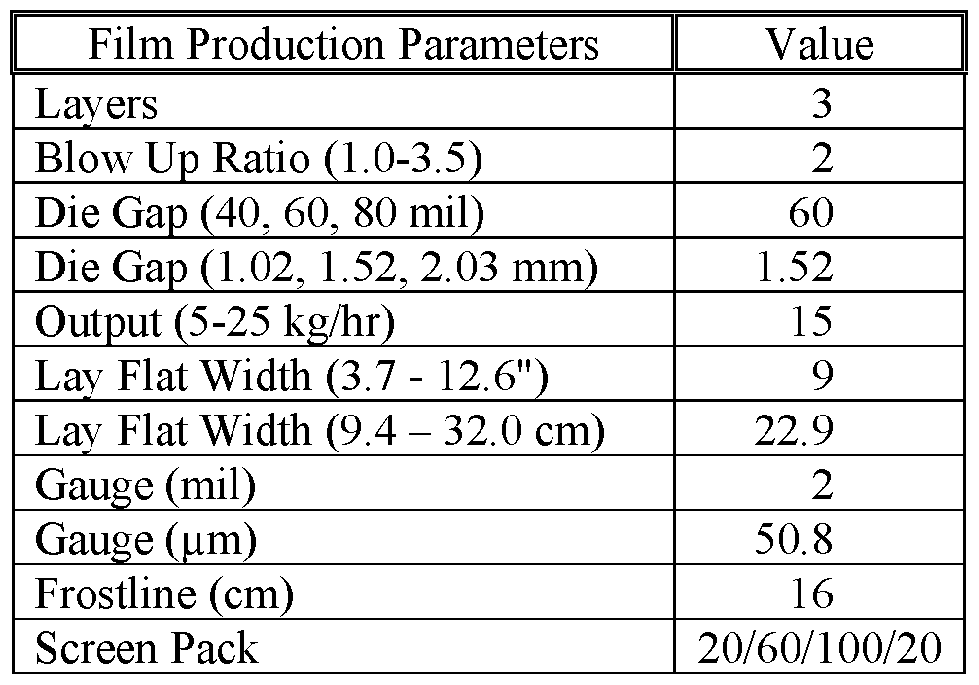
[0139] Multilayer films (MF1-MF9) comprising three layers could have the configurations shown in TABLE 5 below.
TABLE 5

1 % of total film thickness
[0140] Without wishing to be bound by any particular theory, it is believed that tie layers in Examples 10-12 would all exhibit a dispersed phase of gels and/or PPI domains having a large particle size in a matrix phase of NP1. Further, it is believed that the tie layers in Examples 13-18 would all exhibit a dispersed phase of PPI domains in a matrix phase of NP1 , wherein the N1 domains are smaller in size as measured by SEM and more finely dispersed than in the polymer recy elate prior to compatibilization (Examples 10-12).
[0141] It is believed that the reduced domain size of the high polarity polymer dispersed phase in the low polarity matrix in the tie layers of Examples 13-18 would produce mechanical performance of the tie layer and/or a multilayer film containing such tie layer competitive with, equal to, or better than comparable multilayer films comprising only virgin polymers. Such mechanical performance includes tear strength, dart drop, gloss, and haze. In some embodiments, the multilayer films disclosed herein, comprising the compounded mixture of the polymer recyclate and the compatibilizer in a tie layer, have improved processibility as compared to multilayer films having tie layers containing only polymer recyclates prior to addition of the compatibilizer, believed to result from the reduced particle size of the dispersed phase of high polarity polymer in the low polarity polymer matrix.
[0142] For the sake of brevity, only certain ranges are explicitly disclosed herein. However, in addition to recited ranges, any lower limit may be combined with any upper limit to recite a range not explicitly recited, as well as, ranges from any lower limit may be combined with any other lower limit to recite a range not explicitly recited, in the same way, ranges from any upper limit may be combined with any other upper limit to recite a range not explicitly recited. Additionally, within a range includes every point or individual value between its end points even though not explicitly recited. Thus, every point or individual value may serve as its own lower or
upper limit combined with any other point or individual value or any other lower or upper limit, to recite a range not explicitly recited.
[0143] All documents and references cited herein, including testing procedures, publications, patents, journal articles, etc., are herein fully incorporated by reference for all jurisdictions in which such incorporation is permitted and to the extent such disclosure is consistent with the description of the present invention.
[0144] Although the present invention and its advantages have been described in detail, it should be understood that various changes, substitutions and alterations can be made herein without departing from the spirit and scope of the invention as defined by the appended claims. Moreover, the scope of the present application is not intended to be limited to the particular embodiments of the processes, machines, film structures, composition of layers, means, methods, and/or steps described in the specification. As one of the ordinary skill in the art will readily appreciate from the disclosure of the present invention, processes, machines, film structures, composition of layers, means, methods, and/or steps, presently existing or later to be developed that perform substantially the same function or achieve substantially the same result as the corresponding embodiments described herein, may be utilized according to the present invention. Accordingly, the appended claims are intended to include within their scope such processes, machines, film structures, composition of layers, means, methods, and/or steps.
Claims
1. A multilayer film, comprising: a) a first layer, comprising a first low polarity polymer; b) a second layer, comprising a first high polarity polymer, wherein the first high polarity polymer comprises a first polar monomer; and c) a tie layer, disposed between the first layer and the second layer, comprising a compatibilized poly mer recyclate; wherein i) the compatibilized polymer recyclate comprises a mixture of a polymer recyclate and a compatibilizer; iii) the polymer recyclate comprises a second low polarity polymer and a second high polarity polymer, the second high polarity polymer comprising a second polar monomer; ii) the compatibilizer comprises a third low polarity polymer grafted with one or more functional groups; and iii) the mixture is subjected to compounding conditions sufficient to form the compatibilized polymer recyclate having a dispersed phase of domains of the second high polarity polymer in a matrix phase of the second low polarity polymer.
2. The multilayer film of claim 1 , wherein: a) the first low polarity polymer, the second low polarity polymer, and the third low polarity polymer each have an oxygen vapor transmission rate (OVTR) greater than or equal to 800 cc»pm/m2»day»atm; and b) the first high polarity polymer and the second high polarity polymer each have an OVTR less than or equal to 200 cc*pm/m2*day»atm.
3. The multilayer film of claim 1, wherein the first low polarity polymer, the second low polarity polymer, and the third low polarity polymer each comprises: a) a copolymer of units derived from ethylene and units derived from one or more of C3-C20 alpha-olefins or mixtures thereof; b) a copolymer of units derived from ethylene and units derived from one or more of alpha mono-olefins comprising polar groups; c) propylene and units derived one or more of ethylene and C4-C20 alpha-olefins or mixtures thereof;
d) propylene and units derived one or more of ethylene and units derived from one or more of alpha mono-olefins comprising polar groups; or e) combinations thereof.
4. The multilayer film of claim 1, wherein the first high polarity polymer and the second high polarity polymer are each selected from the group consisting of ethylene vinyl alcohol, polyamide, polyvinylidene chloride, or poly chlorotrifluoroethylene.
5. The composition of claim 1, wherein the compatibilizer has one or more of: a) a functional monomer content in a range of from 0.5 wt% to 3.0 wt%, based on the total weight of the compatibilizer; b) a melt index (h) in the range of from 1.0 dg/min. to 12.0 dg/rmn.; c) a density in the range of from 0.850 g/cm3 to 0.960 g/cm3; d) a melt elasticity (ER) in the range of from 0.30 to 3.00; and e) a melting temperature (Tm) in the range of from 51°C to 145°C.
6. The composition of claim 1, wherein the one or more functional groups comprise a member selected from the group consisting of an anhydride, a carboxylic acid, and combinations thereof.
7. The composition of claim 1, wherein: a) the first low polarity polymer is miscible with the second low polarity polymer; b) the third low polarity polymer is miscible with the second low polarity polymer; c) the first polar monomer has interfacial reactivity with the second polar monomer and/or the functional group; d) the second polar monomer has interfacial reactivity with the functional group; or e) a combination thereof.
8. The composition of claim 1, wherein the domains of the high polarity polymer have an average particle size having a cross-sectional area of less than or equal to 0.90 pm2.
9. The composition of claim 1, wherein the compatibilizer and the second high polarity polymer are present in the tie layer in a weight ratio in a range of from 0.5: 1.0 to 5.0:1.0.
10. The composition of claim 1, wherein: a) the first low polarity polymer, the second low polarity polymer, and the third low polarity polymer each comprises one or more polyethylenes; b) the first high polarity polymer and the second high polarity polymer each comprises one or more ethylene vinyl alcohol copolymers, and c) the functional group comprises maleic anhydride.
11. The composition of claim 10, wherein the one or more polyethylenes are the same or different.
12. A method for producing a multilayer film, comprising:
a) providing a polymer recyclate, comprising a first low polarity polymer and a first high polarity polymer, the first high polarity polymer comprising a first polar comonomer; b) providing a compatibilizer, comprising a second low polarity polymer grafted with one or more functional groups; c) mixing the polymer recyclate and the compatibilizer under compounding conditions sufficient to form a compatibilized polymer recyclate, wherein the compatibilized polymer recyclate has a dispersed phase of domains of the first high polarity polymer in a matrix phase of the first low polarity polymer d) coextruding a third low polarity polymer, a second high polarity polymer, and the compatibilized polymer recyclate to form a multilayer film comprising: i) a first layer, comprising the third low polarity polymer; ii) a second layer, comprising the second high polarity polymer; and hi) a tie layer, disposed between the first layer and the second layer.
13. The method of claim 1 1 , wherein: a) the first low polarity polymer, the second low polarity polymer, and the third low polarity polymer each have an oxygen vapor transmission rate (OVTR) greater than or equal to 800 cc»pm/m2»day»atm; and b) the first high polarity polymer and the second high polarity polymer each have an OVTR less than or equal to 200 cc*pm/m2*day»atm.
14. The method of claim 11, wherein the first low polarity polymer, the second low polarity polymer, and the third low polarity polymer each comprises: a) a copolymer of units derived from ethylene and units derived from one or more of C3-C20 alpha-olefins or mixtures thereof; b) a copolymer of units derived from ethylene and units derived from one or more of alpha mono-olefins comprising polar groups; c) propylene and units derived one or more of ethylene and C4-C20 alpha-olefins or mixtures thereof; d) propylene and units derived one or more of ethylene and units derived from one or more of alpha mono-olefins comprising polar groups; or e) combinations thereof.
15. The method of claim 11, wherein the first high polarity polymer and the second high polarity polymer are each selected from the group consisting of ethylene vinyl alcohol, polyamide, polyvinylidene chloride, or poly chlorotrifluoroethylene.
16. The method of claim 11, wherein the compatibilizer has one or more of:
a) a functional monomer content in a range of from 0.5 wt% to 3.0 wt%, based on the total weight of the compatibilizer; b) a melt index (h) in the range of from 1.0 dg/min. to 12.0 dg/min.; c) a density in the range of from 0.850 g/cm3 to 0.960 g/cm3; d) a melt elasticity (ER) in the range of from 0.30 to 3.00; and e) a melting temperature (Tm) in the range of from 51°C to 145°C.
17. The method of claim 11, wherein the one or more functional groups comprise a member selected from the group consisting of an anhydride, a carboxylic acid, and combinations thereof.
18. The method of claim 11, wherein: a) the first low polarity polymer is miscible with the second low polarity polymer; b) the third low polarity polymer is miscible with the second low polarity polymer; c) the first polar monomer has interfacial reactivity with the second polar monomer and/or the functional group; d) the second polar monomer has interfacial reactivity with the functional group; or e) a combination thereof.
19. The method of claim 11, wherein the domains of the high polarity polymer have an average particle size having a cross-sectional area of less than or equal to 0.90 pm2.
20. The method of claim 11, wherein the compatibilizer and the second high polarity polymer are present in the tie layer in a weight ratio in a range of from 0.5: 1.0 to 5.0: 1.0.
Priority Applications (1)
| Application Number | Priority Date | Filing Date | Title |
|---|---|---|---|
| PCT/US2023/024970 WO2024253663A1 (en) | 2023-06-09 | 2023-06-09 | Polymer recyclate film products |
Applications Claiming Priority (1)
| Application Number | Priority Date | Filing Date | Title |
|---|---|---|---|
| PCT/US2023/024970 WO2024253663A1 (en) | 2023-06-09 | 2023-06-09 | Polymer recyclate film products |
Publications (1)
| Publication Number | Publication Date |
|---|---|
| WO2024253663A1 true WO2024253663A1 (en) | 2024-12-12 |
Family
ID=93795920
Family Applications (1)
| Application Number | Title | Priority Date | Filing Date |
|---|---|---|---|
| PCT/US2023/024970 Ceased WO2024253663A1 (en) | 2023-06-09 | 2023-06-09 | Polymer recyclate film products |
Country Status (1)
| Country | Link |
|---|---|
| WO (1) | WO2024253663A1 (en) |
Citations (5)
| Publication number | Priority date | Publication date | Assignee | Title |
|---|---|---|---|---|
| US5128212A (en) * | 1990-05-18 | 1992-07-07 | E. I. Du Pont De Nemours And Company | Multilayer heat shrinkable polymeric film containing recycle polymer |
| US5334450A (en) * | 1992-05-20 | 1994-08-02 | The Dow Chemical Company | Weatherable styrenic film structures with intermediate tie layer and laminates thereof |
| US20070264520A1 (en) * | 2002-12-10 | 2007-11-15 | Wood Willard E | Articles having a polymer grafted cyclodextrin |
| US20120245238A1 (en) * | 2009-10-07 | 2012-09-27 | Arkema Inc. | Melt processable composition from recycled multi-layer articles containing a fluoropolymer layer |
| WO2022187118A1 (en) * | 2021-03-05 | 2022-09-09 | Avery Dennison Corporation | Multilayer polyolefin films and methods for their production |
-
2023
- 2023-06-09 WO PCT/US2023/024970 patent/WO2024253663A1/en not_active Ceased
Patent Citations (5)
| Publication number | Priority date | Publication date | Assignee | Title |
|---|---|---|---|---|
| US5128212A (en) * | 1990-05-18 | 1992-07-07 | E. I. Du Pont De Nemours And Company | Multilayer heat shrinkable polymeric film containing recycle polymer |
| US5334450A (en) * | 1992-05-20 | 1994-08-02 | The Dow Chemical Company | Weatherable styrenic film structures with intermediate tie layer and laminates thereof |
| US20070264520A1 (en) * | 2002-12-10 | 2007-11-15 | Wood Willard E | Articles having a polymer grafted cyclodextrin |
| US20120245238A1 (en) * | 2009-10-07 | 2012-09-27 | Arkema Inc. | Melt processable composition from recycled multi-layer articles containing a fluoropolymer layer |
| WO2022187118A1 (en) * | 2021-03-05 | 2022-09-09 | Avery Dennison Corporation | Multilayer polyolefin films and methods for their production |
Similar Documents
| Publication | Publication Date | Title |
|---|---|---|
| US8889794B2 (en) | Resin compositions for extrusion coating | |
| US9493641B2 (en) | Resin compositions for extrusion coating | |
| EP2504390B1 (en) | Extrusion coating composition | |
| RU2733462C2 (en) | Polyolefin-based compositions, adhesives and obtained multilayer structures | |
| US20240336769A1 (en) | Polymer recyclate blend products | |
| WO2025188309A1 (en) | Compatibilizers to utilize pcr from multilayer bottles with dissimilar polymers | |
| WO2025264221A1 (en) | Tie layer compositions and films containing same | |
| CA2976432C (en) | Polyolefin-based compositions, adhesives, and related multi-layered structures prepared therefrom | |
| US20240043666A1 (en) | Polyethylene recyclate blend products | |
| CN114207010B (en) | Low density polyethylene with enhanced hot tack strength and metal adhesion by addition of ionomers | |
| WO2025095955A1 (en) | Method to modify polymer recyclates and compositions made therefrom | |
| WO2025095954A1 (en) | Method to modify polymer recyclates and compositions made therefrom | |
| JP7821582B2 (en) | Resin composition and film | |
| WO2025101176A1 (en) | Polymer recyclate blends | |
| US20260062533A1 (en) | Polymer recyclate processes and products | |
| WO2025165750A1 (en) | Polyethylene recyclate blend products | |
| WO2024215329A1 (en) | Polymer recyclate blend products | |
| WO2026096092A1 (en) | Recycled polymer formulations | |
| EP4524190A1 (en) | A recycled polymer composition | |
| WO2026024857A1 (en) | Polyethylene blend for caps and closures | |
| JP2025524375A (en) | Multilayer Heat-Sealable Film | |
| WO2025259663A1 (en) | Methods of producing films with improved mechanical properties | |
| WO2025057767A1 (en) | Polypropylene-based resin composition and molded article | |
| IT202300022872A1 (en) | COMPOSITIONS BASED ON RECYCLED POLYOLEFINS WITH IMPROVED MECHANICAL PROPERTIES |
Legal Events
| Date | Code | Title | Description |
|---|---|---|---|
| 121 | Ep: the epo has been informed by wipo that ep was designated in this application |
Ref document number: 23940901 Country of ref document: EP Kind code of ref document: A1 |
|
| NENP | Non-entry into the national phase |
Ref country code: DE |