WO2024252963A1 - 生体認証システム - Google Patents
生体認証システム Download PDFInfo
- Publication number
- WO2024252963A1 WO2024252963A1 PCT/JP2024/019277 JP2024019277W WO2024252963A1 WO 2024252963 A1 WO2024252963 A1 WO 2024252963A1 JP 2024019277 W JP2024019277 W JP 2024019277W WO 2024252963 A1 WO2024252963 A1 WO 2024252963A1
- Authority
- WO
- WIPO (PCT)
- Prior art keywords
- biometric
- hand
- authentication system
- unit
- biometric authentication
- Prior art date
- Legal status (The legal status is an assumption and is not a legal conclusion. Google has not performed a legal analysis and makes no representation as to the accuracy of the status listed.)
- Ceased
Links
Images


Classifications
-
- G—PHYSICS
- G06—COMPUTING OR CALCULATING; COUNTING
- G06V—IMAGE OR VIDEO RECOGNITION OR UNDERSTANDING
- G06V40/00—Recognition of biometric, human-related or animal-related patterns in image or video data
- G06V40/40—Spoof detection, e.g. liveness detection
-
- G—PHYSICS
- G06—COMPUTING OR CALCULATING; COUNTING
- G06T—IMAGE DATA PROCESSING OR GENERATION, IN GENERAL
- G06T7/00—Image analysis
- G06T7/20—Analysis of motion
Definitions
- the present invention relates to a biometric authentication system.
- Biometric authentication which verifies that a user is a person registered in advance based on an individual's physical and behavioral characteristics, is highly convenient as it does not require the user to memorize a password or carry an IC card or other personal item, and is garnering attention as a reliable method of identity verification.
- Biometric authentication extracts features from physical and behavioral characteristics such as fingerprints, faces, irises, veins, and palm prints, and compares these features with those at the time of registration to determine whether or not the person is the actual person.
- biometric authentication One of the vulnerabilities of biometric authentication is the use of artificial objects to spoof someone's identity. For example, if a third party obtains a person's biometric information, such as their fingerprint, face, iris, veins, or palm print, and uses that information to create an artificial object containing that person's biometric information, and presents that to the biometric authentication system, there is a risk that the third party could successfully authenticate the person fraudulently.
- a third party obtains a person's biometric information, such as their fingerprint, face, iris, veins, or palm print, and uses that information to create an artificial object containing that person's biometric information, and presents that to the biometric authentication system, there is a risk that the third party could successfully authenticate the person fraudulently.
- biometric authentication systems that use general-purpose cameras to acquire and authenticate biometric information, it is easy to spoof someone's identity by presenting the system with a paper with a biometric image printed on it, or a tablet with a biometric image displayed on it. For this reason, it is essential that biometric authentication systems also use liveness detection technology that detects that the presented object is a part of a living human body and not an artificial object.
- the first is sensor-based detection.
- This method uses a sensor other than a typical general-purpose camera to sense the electrical characteristics and 3D shape of the target, and then detects that it is a living organism. Although this method is highly reliable, it requires a dedicated sensor, which makes it expensive and difficult to implement on existing devices.
- the second is learning-based detection.
- This method uses machine learning to learn from images of faces, veins, palm prints, etc., and detects by classifying them into living bodies and man-made objects.
- This method prepares large amounts of images of living bodies and images of various patterns of man-made objects as training data, and trains a classifier that can distinguish between them.
- performance decreases when there is a difference between the training data and the data to be classified, so accuracy decreases if the conditions under which the training data was collected (type of man-made object, environmental conditions such as lighting and white balance, sensors such as cameras) differ from the conditions at the time of live body detection.
- the third is the detection of biological reactions.
- This method acquires biological reactions such as blinking, breathing, and pulsation, and uses them to detect live bodies. Because these biological reactions are minute features, in order to capture them reliably, the video frame rate, resolution, camera optical performance, etc. must be sufficiently high; attempting detection under conditions where any of these performance levels are low may result in a false positive detection of a living body as an artificial object. This requires that strict constraints be placed on the camera and the hardware that processes it, making it difficult to make the method usable on any general-purpose camera device.
- the fourth type is challenge-response type detection.
- This method is often used, for example, in eKYC (electronic Know Your Customer), which performs reliable identity verification via a network, and detects specific actions by requesting the user to perform a specific action, such as closing their eyes, turning their head, or winking.
- eKYC electronic Know Your Customer
- many of these actions take time to recognize, perform, and detect, and there are no known methods that can detect actions instantly during authentication.
- Patent Document 1 relates to live body detection that does not rely on dedicated sensors and uses a general-purpose camera, and performs live body detection by determining whether the movement, distortion, shape change, feature information, and three-dimensional state of the living body are each within the range of live body information. This can be considered one of the fourth approaches.
- Patent Document 1 requires the living body to perform complex and random actions such as "clench your hand, and after five seconds, raise your thumb and pinky finger up,” and detects the living body using the finger movement speed and background color information at that time, making it difficult to detect quickly.
- Patent Document 1 is a rule-based method that performs detection by setting thresholds for each of the biological movement, distortion, shape change, feature information, three-dimensional state, etc., and therefore it is considered difficult to sufficiently reduce both the false positive rate and the non-detection rate.
- the present invention aims to provide technology that can quickly detect live bodies.
- one representative biometric authentication system of the present invention includes an image acquisition unit that acquires images in a time series, a posture estimation unit that estimates the posture of the hand from the acquired images, and a liveness detection unit that determines that the hand is live when a specific movement of the hand is detected from the estimated posture.
- the present invention allows for rapid biological detection.
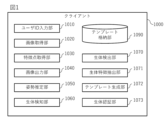
- FIG. 2 is a block diagram showing an example of a configuration of a client according to the present embodiment.
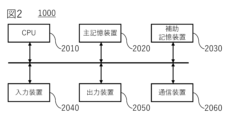
- FIG. 2 is a block diagram showing an example of a hardware configuration of a client according to the present embodiment.
- 11 is a flowchart illustrating an example of a biometric registration process including a biometric detection executed by a client according to the present embodiment.
- 10 is a diagram showing an example of feature points of a hand extracted by a feature point acquisition unit;
- FIG. 11A and 11B are diagrams illustrating an example of a detection situation of a gesture of rotating a palm drawn by an image output unit.
- 11A and 11B are diagrams illustrating an example of a detection situation of a pinching action with fingers depicted by an image output unit.
- 11A and 11B are diagrams illustrating an example of a detection situation of an action of pressing a button with a finger drawn by an image output unit.
- 11 is a flowchart illustrating an example of a biometric authentication process including liveness detection executed by a client according to the present embodiment.
- This embodiment is a biometric authentication system in which a client acquires a camera image, estimates the hand posture from the camera image, detects a specific movement from the hand posture, and performs biometric registration and biometric authentication when the detection is successful.
- FIG. 1 is a block diagram showing an example of the configuration of a client in this embodiment.
- the client 1000 includes a user ID input unit 1010, an image acquisition unit 1020, a feature point acquisition unit 1030, an image output unit 1040, a posture estimation unit 1050, a liveness detection unit 1060, a liveness detection unit 1070, a biometric feature extraction unit 1071, a template generation unit 1072, a biometric authentication unit 1073, and a template storage unit 1090.
- a user ID input unit 1010 an image acquisition unit 1020, a feature point acquisition unit 1030, an image output unit 1040, a posture estimation unit 1050, a liveness detection unit 1060, a liveness detection unit 1070, a biometric feature extraction unit 1071, a template generation unit 1072, a biometric authentication unit 1073, and a template storage unit 1090.
- a user ID input unit 1010 an image acquisition unit 1020, a feature point acquisition unit 1030, an image output unit 1040, a posture estimation unit 1050, a liveness detection unit 1060, a liveness detection unit 1070,
- the user ID input unit 1010 acquires input of an ID given to a user via a keyboard, a card reader, memory on the client 1000, etc.
- the image acquisition unit 1020 acquires camera images from a camera connected to the client 1000.
- the feature point acquisition unit 1030 extracts feature points of the hand from the camera images acquired by the image acquisition unit 1020.
- the posture estimation unit 1050 estimates the posture of the hand based on the coordinates of the feature points of the hand extracted by the feature point acquisition unit 1030.
- the liveness detection unit 1060 performs liveness detection based on the hand posture estimated by the posture estimation unit 1050. When this liveness detection detects a specific movement from the posture of the hand, it determines that the hand in the camera image is a live body.
- the image output unit 1040 draws the results of the live body detection on the camera image and outputs it to an output device such as a display.
- the biometric detection unit 1070 performs biometric detection from the camera image.
- This biometric detection is a process of identifying the position of a biometric body in the camera image; for example, in face authentication, the position of the face area is detected, in finger vein authentication, the position of the finger area is detected, and in palm print authentication, the position of the palm area is detected.
- the biometric feature extraction unit 1071 extracts biometric features from the biometrics detected by the biometric detection unit 1070.
- this biometric feature extraction involves extracting an image of the face and inputting it into a machine learning model to obtain feature quantities.
- finger vein recognition an image of the finger is extracted and a vein pattern with the blood vessel pattern emphasized is obtained.
- palm print recognition an image of the palm is extracted and a palm print pattern is obtained.
- the template generation unit 1072 generates a template for enrollment based on the biometric features extracted by the biometric feature extraction unit 1071.
- the template storage unit 1090 stores the template generated by the template generation unit 1072.
- the biometric authentication unit 1073 performs biometric authentication by comparing the biometric features extracted by the biometric feature extraction unit 1071 with the templates registered in the template generation unit 1072.
- FIG. 2 is a block diagram showing an example of the hardware configuration of the client 1000 in this embodiment.
- the client 1000 includes a CPU (Central Processing Unit) 8010, a main memory device 8020, an auxiliary memory device 8030, an input device 8040, an output device 8050, and a communication device 8060.
- CPU Central Processing Unit
- the CPU 8010 is a central processing unit, and implements necessary functions by executing programs stored in the main memory device 6020.
- the programs include programs that realize the user ID input unit 1010, image acquisition unit 1020, feature point acquisition unit 1030, image output unit 1040, posture estimation unit 1050, liveness detection unit 1060, liveness detection unit 1070, biometric feature extraction unit 1071, template generation unit 1072, and biometric authentication unit 1073 shown in FIG. 1.
- the main memory 6020 is a main memory used by the CPU 8010 when executing processing, and is composed of volatile memory elements such as RAM (Random Access Memory).
- the auxiliary memory 8030 is a memory device such as a HDD (Hard Disk Drive) or SSD (Solid State Drive), and corresponds to the template storage unit 1090. The data stored by each unit is accumulated as data on the auxiliary memory 8030.
- the input device 8040 is used to read information in the user ID input unit 1010 and image acquisition unit 1020, and is composed of a keyboard, biosensor, touch panel, smart device, scanner, camera, or the like.
- the output device 8050 is used to output information in the image output unit 1040, and is composed of a display, or the like.
- the communication device 8060 is used by the client 1000 to communicate with external devices.
- biometric registration and biometric authentication are performed after confirming that the hand is not an artificial object based on the hand movement estimated from the camera image.
- FIG. 3 is a flowchart showing an example of a biometric registration process including biometric detection executed by the client 1000 in this embodiment.
- the user ID input unit 1010 in the client 1000 acquires the user ID entered by the user (step S2010).
- the user ID is typically expressed as a character string of any length.
- the camera is started (step S2020), and camera images including the user's hands are acquired in chronological order using the image acquisition unit 1020 (step S2030).
- the image acquisition unit 1020 is a general-purpose camera mounted on the client 1000, and images are acquired using this camera.
- the acquired camera images are displayed on the output device 8050, such as a display of the client 1000, by the image output unit 1040.
- feature points of the user's hand are extracted from the camera image acquired in step S2030 using the feature point acquisition unit 1030 (step S2040).
- An example of feature points of the hand is shown in Figure 4.
- FIG. 4 shows an example of hand feature points extracted by the feature point acquisition unit 1030.
- a hand tracking process is performed based on the coordinates of the hand feature points obtained in step S2040, and it is determined whether tracking has been successful (step S2050).
- the coordinates of the hand in the previous frame are compared with the coordinates of the hand in the current frame, and if the coordinates are close enough, they are deemed to be the same hand and tracking is successful, but if the coordinates are apart by more than a certain value, they are deemed to be different hands and tracking has failed.
- the coordinates used for this determination can be the coordinates of a rectangular area including the entire hand or the coordinates of each feature point.
- step S2050 If tracking fails in step S2050, the live body detection result is initialized to the initial state of "detecting" and the process returns to step S2030 (step S2061).
- step S2050 the process branches depending on whether the live body detection result is "detecting” or "detection successful” (step S2060).
- step S2060 If the liveness detection result is "detected" in step S2060, the hand posture is estimated based on the coordinates of the hand feature points extracted in step S2040 (step S2070).
- the hand posture to be estimated depends on the specific hand motion to be detected.
- the specific hand motion may be any motion including, but not limited to, rotating the palm, pinching with fingers, or pressing a button with fingers.
- the specific hand motion to be detected may be the same every time, or may be changed randomly each time liveness detection is performed.
- the action of rotating the palm is to rotate it horizontally and turn it over, but since images printed on paper or displayed on a monitor cannot be turned over, this detection cannot be successful.
- the hand posture that needs to be estimated is the rotation angle of the palm relative to the camera.
- this rotation angle can be obtained by determining the angle at which the hand is tilted relative to the line connecting the camera and the hand.
- the action of pinching with fingers involves placing an object to be pinched at a position of your choice on the image captured by the camera, and then pinching the object with your fingers; however, images printed on paper or images shown on a display do not allow for the three-dimensional movement of pinching, and therefore cannot be successfully detected.
- the hand posture that needs to be estimated is the coordinates of the fingertips and the distance between the pinching fingers.
- the action of pressing a button with a finger involves placing the button to be pressed at a position of your choice on the image captured by the camera and then pressing the button, and successful detection is difficult with an image printed on paper or displayed on a monitor.
- successful detection by bringing the artifact closer to the camera, but in that case, the background area other than the hand contained in the artifact will also move in the same way. Therefore, it is possible to analyze the movement between frames of the hand area and the background area and detect that the movement of the background is not linked to the hand.
- the hand posture that needs to be estimated is the depth coordinate of the feature point of the tip of the pressing finger (for example, the index finger) and the angle of the finger with respect to the camera. Note that instead of the finger coordinates and angle, pressing can also be determined by placing a finger on the button coordinates for a certain period of time. These can be obtained from the feature point coordinates of the finger.
- step S2072 If a specific hand movement is detected based on the hand posture estimated in step S2070, the liveness detection result is updated to "detection successful", and if a specific hand movement cannot be detected, the result remains as "detection in progress" (step S2072).
- liveness detection is deemed successful when the palm has been rotated a specified angle, and "detection successful" is substituted for the liveness detection result.
- this method does not simply perform liveness detection, but has the potential to contribute to faster and more accurate biometric authentication thereafter.
- the liveness detection is deemed successful if the distance between the tips of the two fingers on the object to be pinched is less than a certain value, and the liveness detection result is assigned the value "detection successful.”
- the liveness detection is deemed successful if the coordinates of the fingertip or the angle of the finger on the object to be pressed (e.g. a button) reach or exceed a certain level, and the liveness detection result is assigned "detection successful.”
- step S2070 The hand posture estimated in step S2070 and the detection status of the specific hand movement in step S2072 are superimposed and drawn by the image output unit 1040 on the camera image displayed on the output device 8050 such as a display of the client 1000 (step S2090).
- step S2090 The detection situation depicted in step S2090 will now be described with reference to Figures 5 to 7.
- FIG. 5 shows an example of the detection status of the action of rotating the palm drawn by the image output unit 1040.
- the rotation direction of the hand is shown in the camera image by an arrow 5010 divided into multiple parts, and the color of parts of the arrow changes depending on the amount of rotation of the hand. This makes it possible to provide feedback to the user about the rotation direction and current amount of rotation of the hand.
- FIG. 6 shows an example of the detection status of a finger pinching action depicted by the image output unit 1040.
- a toggle switch 6010 that is operated by pinching it with a finger is displayed at a random location on the camera image, and when the user pinches the toggle switch 6010 and live body detection is successful, an image is displayed indicating that the toggle switch 6010 has changed position and is now in the ON state, making it possible to provide feedback to the user that the toggle switch 6010 has been pinched.
- FIG. 7 shows an example of a detection situation for the action of pressing a button with a finger drawn by the image output unit 1040.
- a virtual button 7010 is displayed at a random location on the camera image, and if the user presses the button 7010 with their finger and liveness detection is successful, the button 7010 changes to the pressed version, making it possible to provide feedback to the user that the button 7010 has been pressed.
- step S2092 After drawing the result image in step S2090, it is determined whether a timeout has occurred (step S2092). If a certain amount of time has passed since the start of processing and a timeout has occurred in step S2092, registration is deemed unsuccessful and processing is terminated. If, in step S2092, the elapsed time is still less than the certain amount of time and a timeout has not occurred, processing returns to step S2030 and processing continues.
- liveness detection is performed from the camera image (step S2080).
- This liveness detection is a process for identifying the position of the liveness in the camera image; for example, in face authentication, the position of the face area is detected, in finger vein authentication, the position of the finger area is detected, and in palm print authentication, the position of the palm area is detected.
- biometric feature extraction is performed on the biometrics detected in step S2080 (step S2082).
- this biometric feature extraction involves extracting an image of the face and inputting it into a machine learning model to obtain feature values.
- finger vein recognition an image of the finger is extracted and a vein pattern with the vascular pattern emphasized is obtained.
- palm print recognition an image of the palm is extracted and a palm print pattern is obtained.
- a template for enrollment is generated (step S2084), and it is determined whether all of the processes in steps S2080, S2082, and S2084 have been successful and the template for enrollment has been successfully generated (step S2086).
- step S2086 If it is determined in step S2086 that template generation has failed, the process proceeds to step S2090 and an attempt is made to generate the template again.
- step S2086 determines whether the template generation was successful. If it is determined in step S2086 that the template generation was successful, the generated template is linked to the user ID entered in step S2010 and registered in the template storage unit 1090 (step S2088), and the process is completed with the biometric registration being successful.
- biometric detection is performed to confirm that the object is not an artifact, and then biometric registration is performed and the template is registered in the template storage unit 1090. This completes the initial registration of the biometric authentication system, and biometric authentication can be used thereafter.
- FIG. 8 is a flowchart showing an example of biometric authentication processing including liveness detection executed by the client 1000 of this embodiment.
- the same processes as those in FIG. 3 are denoted by the same reference numerals, and their explanations will be omitted.
- step S3012 the template registered in the template storage unit 1090 is obtained (step S3012). Since the template is linked to the user ID and stored in the template storage unit 1090 in step S2088, the template can be obtained using the user ID as a key. Note that steps S2010 and S3012 are required for 1:1 authentication, in which authentication is performed by specifying a user, but steps S2010 and S3012 are not required for 1:N authentication, in which the user is identified without specifying a user.
- steps S2030, S2040, S2050, S2060, S2061, S2070, S2072, S2090, and S2092 are the same as those in the biometric registration process in Figure 3. However, if live body detection is performed only during registration and not during authentication, it is possible to skip steps S2030 to S2092 and proceed to live body detection step S2080 after camera startup step S2020.
- biometric detection step S2080 and biometric feature extraction step S2082 are the same processes as those for biometric registration.
- biometric authentication is performed by comparing the biometric features extracted in step S2082 with the template associated with the user ID entered in step S2010 and registered in the template generation unit 1072 (step S3084).
- step S2082 it is determined whether the biometric features extracted in step S2082 match the template associated with the user ID entered in step S2010 and registered in the template generation unit 1072, and whether the biometric authentication was successful (step S3086).
- step S3086 If biometric authentication is successful in step S3086, the authentication is deemed successful and the process ends. On the other hand, if biometric authentication is unsuccessful in step S3086, the process proceeds to step S2090 and continues.
- the biometric registration process in Figure 8 detects the presence of a living object and then performs biometric authentication after verifying that it is not an artificial object.
- the hand's feature points are extracted from the camera image
- the hand's posture is estimated from the feature points
- specific hand movements are detected from the hand posture to determine that the hand is a living body, enabling rapid liveness detection.
- a general-purpose camera can be used to acquire camera images, eliminating the need for dedicated sensors or high-performance cameras, reducing costs and allowing this embodiment to be implemented in existing devices.
- the specific hand movements to be detected are large, so liveness detection can be performed stably without being affected by frame rate or resolution.
- this embodiment does not use machine learning for live body detection, so it is less susceptible to changes in environmental conditions or camera changes, and can handle unknown man-made objects.
- liveness detection is performed by detecting only hand movements, so liveness detection can be performed without capturing the face.
- the present invention is not limited to the above-described embodiments, but includes various modified examples.
- the above-described embodiments have been described in detail to clearly explain the present invention, and are not necessarily limited to those having all of the configurations described. It is also possible to replace part of the configuration of one embodiment with the configuration of another embodiment, and it is also possible to add the configuration of another embodiment to the configuration of one embodiment. It is also possible to add, delete, or replace part of the configuration of each embodiment with other configurations.
Landscapes
- Engineering & Computer Science (AREA)
- Physics & Mathematics (AREA)
- General Physics & Mathematics (AREA)
- Multimedia (AREA)
- Theoretical Computer Science (AREA)
- Human Computer Interaction (AREA)
- Computer Vision & Pattern Recognition (AREA)
- Collating Specific Patterns (AREA)
- Measurement Of The Respiration, Hearing Ability, Form, And Blood Characteristics Of Living Organisms (AREA)
- Image Analysis (AREA)
Abstract
Description
Claims (8)
- 予め登録された生体情報を用いて本人認証を行う生体認証システムにおいて、
画像を時系列に取得する画像取得部と、
前記取得した画像から手の姿勢を推定する姿勢推定部と、
前記推定された姿勢から前記手の特定の動作を検出したときは、前記手が生体であると判定する生体検知部とを備える生体認証システム。 - 請求項1に記載の生体認証システムにおいて、
前記特定の動作は、指でボタンを押下する動作である生体認証システム。 - 請求項1に記載の生体認証システムにおいて、
前記特定の動作は、掌を回転させる動作である生体認証システム。 - 請求項1に記載の生体認証システムにおいて、
前記特定の動作は、指で摘まむ動作である生体認証システム。 - 請求項1に記載の生体認証システムにおいて、
前記取得した画像から生体を検出する生体検出部と、
前記検出された生体から生体特徴を抽出する生体特徴抽出部と、
前記生体検知部が前記手が生体であると判定したときは、前記抽出された生体特徴を登録する登録部とを備える生体認証システム。 - 請求項5に記載の生体認証システムにおいて、
前記生体検知部が前記手が生体であると判定したときは、前記生体特徴抽出部が抽出した生体特徴と、前記登録部に登録された生体特徴と、を照合することにより前記本人認証を行う生体認証部を備える生体認証システム。 - 請求項1に記載の生体認証システムにおいて、
前記取得した画像の上に前記特定の動作の検出状況を重ねて表示する画像出力部を備える生体認証システム。 - 請求項1に記載の生体認証システムにおいて、
前記取得した画像から前記手の特徴点を抽出する特徴点抽出部を備え、
前記姿勢推定部は、前記抽出された特徴点から前記手の姿勢を推定する生体認証システム。
Priority Applications (1)
| Application Number | Priority Date | Filing Date | Title |
|---|---|---|---|
| EP24819195.9A EP4726682A1 (en) | 2023-06-08 | 2024-05-24 | Biometric authentication system |
Applications Claiming Priority (2)
| Application Number | Priority Date | Filing Date | Title |
|---|---|---|---|
| JP2023095123A JP2024176539A (ja) | 2023-06-08 | 2023-06-08 | 生体検知システム |
| JP2023-095123 | 2023-06-08 |
Publications (1)
| Publication Number | Publication Date |
|---|---|
| WO2024252963A1 true WO2024252963A1 (ja) | 2024-12-12 |
Family
ID=93795868
Family Applications (1)
| Application Number | Title | Priority Date | Filing Date |
|---|---|---|---|
| PCT/JP2024/019277 Ceased WO2024252963A1 (ja) | 2023-06-08 | 2024-05-24 | 生体認証システム |
Country Status (3)
| Country | Link |
|---|---|
| EP (1) | EP4726682A1 (ja) |
| JP (1) | JP2024176539A (ja) |
| WO (1) | WO2024252963A1 (ja) |
Citations (3)
| Publication number | Priority date | Publication date | Assignee | Title |
|---|---|---|---|---|
| JP2018018481A (ja) * | 2015-11-03 | 2018-02-01 | バンクガード株式会社 | 電子認証用サーバシステム、プログラム、電子認証方法、及び、電子認証システム |
| JP6482816B2 (ja) | 2014-10-21 | 2019-03-13 | Kddi株式会社 | 生体検知装置、システム、方法及びプログラム |
| WO2024069671A1 (ja) * | 2022-09-26 | 2024-04-04 | 富士通株式会社 | 情報処理方法、情報処理プログラム、及び情報処理装置 |
-
2023
- 2023-06-08 JP JP2023095123A patent/JP2024176539A/ja active Pending
-
2024
- 2024-05-24 WO PCT/JP2024/019277 patent/WO2024252963A1/ja not_active Ceased
- 2024-05-24 EP EP24819195.9A patent/EP4726682A1/en active Pending
Patent Citations (3)
| Publication number | Priority date | Publication date | Assignee | Title |
|---|---|---|---|---|
| JP6482816B2 (ja) | 2014-10-21 | 2019-03-13 | Kddi株式会社 | 生体検知装置、システム、方法及びプログラム |
| JP2018018481A (ja) * | 2015-11-03 | 2018-02-01 | バンクガード株式会社 | 電子認証用サーバシステム、プログラム、電子認証方法、及び、電子認証システム |
| WO2024069671A1 (ja) * | 2022-09-26 | 2024-04-04 | 富士通株式会社 | 情報処理方法、情報処理プログラム、及び情報処理装置 |
Also Published As
| Publication number | Publication date |
|---|---|
| JP2024176539A (ja) | 2024-12-19 |
| EP4726682A1 (en) | 2026-04-15 |
Similar Documents
| Publication | Publication Date | Title |
|---|---|---|
| KR102573482B1 (ko) | 생체 보안 시스템 및 방법 | |
| CN107995979B (zh) | 用于对用户进行认证的系统、方法和机器可读介质 | |
| CN110326001B (zh) | 使用利用移动设备捕捉的图像执行基于指纹的用户认证的系统和方法 | |
| EP3254232B1 (en) | Systems and methods for performing fingerprint based user authentication using imagery captured using mobile devices | |
| Ross et al. | A prototype hand geometry-based verification system | |
| CN104584070A (zh) | 认证装置以及认证方法 | |
| JP7665078B2 (ja) | 非接触指紋画像のスラップセグメンテーション | |
| Gaur et al. | Biometric recognition techniques: a review | |
| Fenu et al. | Controlling user access to cloud-connected mobile applications by means of biometrics | |
| JP2022128627A (ja) | 生体認証システム、認証端末、および認証方法 | |
| JP2017211938A (ja) | 生体情報処理装置、生体情報処理方法および生体情報処理プログラム | |
| Samatha et al. | Securesense: enhancing person verification through multimodal biometrics for robust authentication | |
| Zhou et al. | Finger-knuckle assisted slap fingerprint identification system for higher security and convenience | |
| WO2024252963A1 (ja) | 生体認証システム | |
| Sanches et al. | A single sensor hand biometric multimodal system | |
| Sharma et al. | Personal authentication based on vascular pattern using finger vein biometric | |
| Shahin et al. | Multimodal biometric system based on near-infra-red dorsal hand geometry and fingerprints for single and whole hands | |
| Bajpai et al. | Moving towards 3D-biometric | |
| Patil et al. | Iris recognition using fuzzy system | |
| De Marsico et al. | Biopen–Fusing password choice and biometric interaction at presentation level | |
| Bakshi et al. | Biometric Technology: A Look and Survey at Face Recogntion | |
| Methani | Camera based palmprint recognition | |
| CA3071100C (en) | Biometric security systems and methods | |
| Singh et al. | Adapted facial recognition and spoofing detection for management decision making system: a visually impaired people perspective. | |
| Li et al. | A hybrid biometric system using touch-panel-based finger-vein identification and deformable-registration-based face identification |
Legal Events
| Date | Code | Title | Description |
|---|---|---|---|
| 121 | Ep: the epo has been informed by wipo that ep was designated in this application |
Ref document number: 24819195 Country of ref document: EP Kind code of ref document: A1 |
|
| WWE | Wipo information: entry into national phase |
Ref document number: 2024819195 Country of ref document: EP |
|
| NENP | Non-entry into the national phase |
Ref country code: DE |
|
| ENP | Entry into the national phase |
Ref document number: 2024819195 Country of ref document: EP Effective date: 20260108 |
|
| ENP | Entry into the national phase |
Ref document number: 2024819195 Country of ref document: EP Effective date: 20260108 |
|
| ENP | Entry into the national phase |
Ref document number: 2024819195 Country of ref document: EP Effective date: 20260108 |
|
| ENP | Entry into the national phase |
Ref document number: 2024819195 Country of ref document: EP Effective date: 20260108 |
|
| ENP | Entry into the national phase |
Ref document number: 2024819195 Country of ref document: EP Effective date: 20260108 |
|
| WWP | Wipo information: published in national office |
Ref document number: 2024819195 Country of ref document: EP |