WO2024252857A1 - 学習装置およびプログラム - Google Patents
学習装置およびプログラム Download PDFInfo
- Publication number
- WO2024252857A1 WO2024252857A1 PCT/JP2024/017720 JP2024017720W WO2024252857A1 WO 2024252857 A1 WO2024252857 A1 WO 2024252857A1 JP 2024017720 W JP2024017720 W JP 2024017720W WO 2024252857 A1 WO2024252857 A1 WO 2024252857A1
- Authority
- WO
- WIPO (PCT)
- Prior art keywords
- feature
- image
- learning
- explained
- judgment
- Prior art date
- Legal status (The legal status is an assumption and is not a legal conclusion. Google has not performed a legal analysis and makes no representation as to the accuracy of the status listed.)
- Ceased
Links
Images


Classifications
-
- G—PHYSICS
- G06—COMPUTING OR CALCULATING; COUNTING
- G06V—IMAGE OR VIDEO RECOGNITION OR UNDERSTANDING
- G06V10/00—Arrangements for image or video recognition or understanding
- G06V10/40—Extraction of image or video features
-
- G—PHYSICS
- G06—COMPUTING OR CALCULATING; COUNTING
- G06T—IMAGE DATA PROCESSING OR GENERATION, IN GENERAL
- G06T7/00—Image analysis
-
- G—PHYSICS
- G06—COMPUTING OR CALCULATING; COUNTING
- G06V—IMAGE OR VIDEO RECOGNITION OR UNDERSTANDING
- G06V10/00—Arrangements for image or video recognition or understanding
- G06V10/40—Extraction of image or video features
- G06V10/44—Local feature extraction by analysis of parts of the pattern, e.g. by detecting edges, contours, loops, corners, strokes or intersections; Connectivity analysis, e.g. of connected components
- G06V10/443—Local feature extraction by analysis of parts of the pattern, e.g. by detecting edges, contours, loops, corners, strokes or intersections; Connectivity analysis, e.g. of connected components by matching or filtering
- G06V10/449—Biologically inspired filters, e.g. difference of Gaussians [DoG] or Gabor filters
- G06V10/451—Biologically inspired filters, e.g. difference of Gaussians [DoG] or Gabor filters with interaction between the filter responses, e.g. cortical complex cells
- G06V10/454—Integrating the filters into a hierarchical structure, e.g. convolutional neural networks [CNN]
-
- G—PHYSICS
- G06—COMPUTING OR CALCULATING; COUNTING
- G06V—IMAGE OR VIDEO RECOGNITION OR UNDERSTANDING
- G06V10/00—Arrangements for image or video recognition or understanding
- G06V10/70—Arrangements for image or video recognition or understanding using pattern recognition or machine learning
- G06V10/766—Arrangements for image or video recognition or understanding using pattern recognition or machine learning using regression, e.g. by projecting features on hyperplanes
-
- G—PHYSICS
- G06—COMPUTING OR CALCULATING; COUNTING
- G06V—IMAGE OR VIDEO RECOGNITION OR UNDERSTANDING
- G06V10/00—Arrangements for image or video recognition or understanding
- G06V10/70—Arrangements for image or video recognition or understanding using pattern recognition or machine learning
- G06V10/77—Processing image or video features in feature spaces; using data integration or data reduction, e.g. principal component analysis [PCA] or independent component analysis [ICA] or self-organising maps [SOM]; Blind source separation
- G06V10/774—Generating sets of training patterns; Bootstrap methods, e.g. bagging or boosting
-
- G—PHYSICS
- G06—COMPUTING OR CALCULATING; COUNTING
- G06V—IMAGE OR VIDEO RECOGNITION OR UNDERSTANDING
- G06V10/00—Arrangements for image or video recognition or understanding
- G06V10/70—Arrangements for image or video recognition or understanding using pattern recognition or machine learning
- G06V10/82—Arrangements for image or video recognition or understanding using pattern recognition or machine learning using neural networks
-
- G—PHYSICS
- G06—COMPUTING OR CALCULATING; COUNTING
- G06V—IMAGE OR VIDEO RECOGNITION OR UNDERSTANDING
- G06V10/00—Arrangements for image or video recognition or understanding
- G06V10/70—Arrangements for image or video recognition or understanding using pattern recognition or machine learning
- G06V10/764—Arrangements for image or video recognition or understanding using pattern recognition or machine learning using classification, e.g. of video objects
-
- G—PHYSICS
- G06—COMPUTING OR CALCULATING; COUNTING
- G06V—IMAGE OR VIDEO RECOGNITION OR UNDERSTANDING
- G06V20/00—Scenes; Scene-specific elements
- G06V20/60—Type of objects
- G06V20/69—Microscopic objects, e.g. biological cells or cellular parts
- G06V20/698—Matching; Classification
Definitions
- the present invention relates to a learning device and a program.
- Patent Document 1 states that "the basis calculation unit 114 can use algorithms such as Grad-CAM (Gradient-weighted Class Activation Mapping), LIME (LOCAL Interpretable model-agnostic Explanations), SHAP (SHAPley Additive exPlanations), which is an advanced version of LIME, and TCAV (Testing with Concept Activation Vectors) to calculate images that visualize the basis for each diagnosis and differential diagnosis made using the trained machine learning model in the inference unit 112.”
- Grad-CAM Gradient-weighted Class Activation Mapping
- LIME LOCAL Interpretable model-agnostic Explanations
- SHAP SHAPley Additive exPlanations
- TCAV Transmission with Concept Activation Vectors
- Non-Patent Document 1 describes a learning model that classifies skin lesions by inputting skin images and metadata (such as the patient's age and sex).
- Patent Documents [Patent Documents] [Patent Document 1] International Publication No. 2022/176396 “Non-Patent Document 1” Nils Gessert et al. “Skin lesion classification using ensembles of multi-resolution EfficientNets with meta data” Methods X, Volume 7, 2020
- a learning device includes a memory unit that stores a learning model that receives as input a learning image and learning features that are related to the subject of the learning image and that are predetermined interpretable features quantified, and outputs the results of a judgment on the learning image and the learning features; a judgment unit that outputs the results of a judgment using the learning model stored in the memory unit on an image to be explained and a first feature that is related to the subject of the image to be explained and that is predetermined interpretable features quantified; and an explanation output unit that outputs the contribution of the image to be explained and the contribution of the first feature to the judgment results of the learning model on the image to be explained and the first feature.
- the predetermined interpretable features may include parameters that can quantitatively represent the shape or characteristics of the subject.
- the determination unit may use a learning model to extract a second feature from the image to be explained, and the explanation degree output unit may calculate the contribution degree by linearly regressing the vicinity of data consisting of the first feature and the second feature related to the object to be explained in a feature space including the second feature and the first feature.
- the determination unit may use a learning model to extract the second feature from the image to be explained, and the explanation output unit may compress the dimension of the feature vector that is the second feature, and calculate the contribution degree of the second feature as the contribution degree of the image to be explained.
- the explanation output unit may compress the feature vector to one dimension.
- the system may further include a feature calculation unit that calculates at least one of the first feature amounts based on the image to be explained and inputs the calculated feature amount into the learning model.
- the learning model may include a convolutional neural network.
- the explanation output unit may further output an image showing the basis for the judgment within the image to be explained for the result of the judgment by the learning model.
- the explanation output unit may display the contribution of the image to be explained and the contribution of the first feature amount side by side.
- the explanation output unit may display the contribution of the image to be explained, the contribution of the first feature amount, an image showing the basis for the judgment, and the result of the judgment side by side.
- the explanation output unit may display text corresponding to each of the contribution of the image to be explained and the contribution of the first feature amount.
- a program is provided to a computer, which has a memory function for storing in a memory unit a learning model learned using as input a learning image and learning features that relate to the subject of the learning image and that are quantified as predefined interpretable features, and a judgment result for the learning image and the learning features as output; a judgment function for outputting a judgment result using the learning model stored in the memory unit for an image to be explained and a first feature that relates to the subject of the image to be explained and that is quantified as predefined interpretable features; and an explanation output function for outputting the contribution degree of the image to be explained and the contribution degree of the first feature to the judgment result of the learning model for the image to be explained and the first feature.
- a learning device uses a learning model that is trained using as input a learning image and learning features that are related to the subject of the learning image and that are predetermined interpretable features quantified, and outputs the results of judgment on the learning image and the learning features, for an image to be explained and a first feature that is related to the subject of the image to be explained and that is predetermined interpretable features quantified, and includes an explanation output unit that outputs the contribution of the image to be explained and the contribution of the first feature to the judgment result of the learning model on the image to be explained and the first feature.
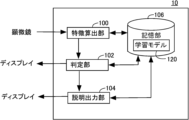
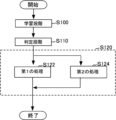
- FIG. 2 shows functional blocks of a learning device 10 according to the present embodiment. 4 shows an operation flow of the learning device 10.
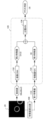
- 1 illustrates a schematic diagram of an example of a learning model 120.
- FIG. 1 is a distribution diagram for explaining an overview of a method for linearly regressing a space of feature quantities.
- FIG. 11 is a distribution diagram illustrating a readable feature space.
- 13 is a distribution diagram illustrating a method for compressing the dimension of the second feature amount into one dimension.
- FIG. 2 shows an example of a display image 200 displayed on a display by the explanation output unit 104. This is a template 230 of the text to be displayed in the text area 220 .
- 13 is a table showing other application examples.
- 22 illustrates an example computer 2200 in which aspects of the present invention may be embodied, in whole or in part.
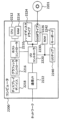
- FIG. 1 shows functional blocks of a learning device 10 according to this embodiment.
- the learning device 10 outputs some kind of judgment result for a target input.
- the judgment may be a decision as to which of predetermined categories the input belongs to, or a calculation of the possibility of belonging to each category as a predicted probability.
- the target input is a cell image and a feature amount (first feature amount) that is a numerical representation of a predetermined interpretable feature related to the cell depicted in the image
- the judgment that is the output is the predicted probability of each of the four states of the cell cycle that the cell depicted in the image and the first feature amount are in.
- the output may also be called a decision, judgment, prediction, inference, estimation, etc.
- the learning device 10 includes a feature calculation unit 100, a judgment unit 102, an explanation output unit 104, and a memory unit 106.
- the memory unit 106 stores a learning model 120.
- the learning device 10 may be an information device such as a personal computer, tablet, or smartphone, and may be realized by installing a program or application on such an information device.
- the learning device 10 may also be a web server for outputting some judgment result for a target input by cloud computing, and may be realized by installing a program or application on it.
- the web server is connected to a microscope, etc., via a network.
- the feature calculation unit 100 acquires an input image from an external device such as a microscope.
- the feature calculation unit 100 may read out an input image that has been stored in advance in the storage unit 160.
- the feature calculation unit 100 calculates a feature amount (first feature amount) that is a numerical representation of a predetermined interpretable feature from the input image, and inputs the feature amount to the learning model 120.
- the determination unit 102 performs a determination on the input image using the learning model 120 stored in the storage unit 106.
- the determination unit 102 outputs the result of the determination to an external device such as a display.
- the explanation output unit 104 outputs in a comparative manner the contribution of the input image (the feature amount (second feature amount described later) extracted from the pixel values of the input image and the contribution of the feature amount (first feature amount) that is related to the subject of the input image and is a numerical representation of a predetermined interpretable feature.
- the output destination is, for example, a display, similar to the judgment unit 102.
- FIG. 2 shows the operation flow of the learning device 10.
- the operation flow starts, for example, when the user starts up the learning device 10.
- the operation flow has a learning stage S100 in which the learning model 120 is trained, a judgment stage S100 in which the learning model 120 is used to judge the explanation subject, and an explanation stage S120 in which the contribution degree, etc. is calculated to explain the result of the judgment.
- FIG. 3 shows an example of the learning model 120 in outline.
- the learning model 120 is set first.
- the learning model 120 is set to use a model that combines machine learning using the input image 20 itself, in other words the pixel values, with machine learning using feature quantities that are related to the subject of the input image 20 and that are predetermined interpretable features that have been quantified.
- This model is sometimes called a multimodal model from the viewpoint of using different types of input.
- the learning model 120 includes an image CNN 132 as a machine learning model using pixel values.
- the image CNN 132 is a CNN (convolutional neural network) that uses an image as input. There is no limit to the number of layers of the CNN or the number of nodes (also called filters, kernels, etc.) in each layer, but in this embodiment, a model up to the fully connected layer in VGG16 (i.e., VGGNet16 layer) is used.
- the image CNN 132 repeats convolution and pooling for an input image 20 having pixel values (96 vertical x 96 horizontal x 3 colors), for example, to calculate 512 nodes and weights for each node. The weights for the 512 nodes are used in the subsequent stage as 512-dimensional second features.
- the learning model 120 includes a feature NN 134 as a machine learning method that uses quantified features.
- the feature NN 134 is a single-layer or multi-layer neural network, and there is no limit to the number of layers or the number of nodes in each layer.
- the feature NN 134 accepts input of a first feature that includes 13 features, and calculates eight nodes and weights for each node. The weights for the eight nodes are used in the subsequent stage as an eight-dimensional third feature.
- the first feature is calculated from the input image 20 by the feature calculation unit 100.
- OpenCV is used as an example of the feature calculation unit 100, but other image processing engines may be used. Note that instead of using the feature calculation unit 100, the user may specify the first feature and input it directly to the feature NN 134.
- the first feature amount is a numerical representation of a predetermined interpretable feature related to the subject of the input image 20.
- the predetermined interpretable feature is a feature that the user can quantitatively and intuitively understand.
- the predetermined interpretable feature includes features related to the shape of the cell in response to determining the cycle of the cell captured in the input image 20. Examples of the features are 13 features: cell area, convex hull, perimeter, maximum fillet system, minimum fillet system, diameter, rectangular length, rectangular width, circularity, convexity, elongation, roughness, and unevenness.
- the first feature amount may be other than the above (for example, cell density), and the number of features is not limited.
- the learning model 120 further includes a classification NN 136.
- the classification NN 136 is a fully connected layer that is the final layer of the image CNN 132 and the final layer of the feature NN 134, and performs four class determinations.
- the classification NN 136 can be said to be a classifier that determines one of four classes from a 520-dimensional input that combines a 512-dimensional second feature and an 8-dimensional third feature.
- the four classes that are determined are "G1: DNA synthesis preparation” (class 1), "S: DNA synthesis and replication” (class 2), "G2: two sets of chromosomes” (class 3), and "M: cell division” (class 4), which are the phases of the cell cycle.
- the learning model 120 before learning is initially set, for example, by input from the user.
- the learning device 10 may store an overview of the model in the memory unit 108, and may receive input from the user regarding the number of layers of the network and the number of nodes, and may initially set the learning model 120 based on these.
- step S100 100,000 pairs of input images 20 as learning images (also called teacher images), first learning features, and correct classes are prepared.
- the learning model 120 is trained by reducing the error between the judgment results when these learning images and first learning features are input and the correct answer. For example, backpropagation is used as a method for reducing the error. Other learning methods may be used, and further, learning methods such as dropout may be used in combination.
- the learning model 120 is trained using the pixel values of the learning input image 20 and the learning first feature as input, and the results of a predetermined judgment (period) for the subject (cell) of the input image 20 as output.
- the trained learning model 120 is stored in the memory unit 106. This completes the operation of step S100. Note that the contents of the 512 nodes of the second feature change as learning progresses, but even if the nodes after learning are visually displayed, the user cannot intuitively understand what they represent.
- the judgment unit 102 reads out the trained learning model 120 from the storage unit 106, inputs the input image 20 to be explained and a feature amount (first feature amount) that is related to the subject (cell) of the input image 20 to be explained and that is a quantification of a predetermined interpretable feature, into the learning model 120, and performs a predetermined judgment of the subject (cell cycle). As a result of the judgment, the judgment unit 102 outputs a predicted probability indicating the possibility of belonging to each class for each of the four classes.
- the first process is a process for calculating the contribution of the image itself and the contribution of a feature amount (first feature amount) that is related to the subject of the image and is a numerical representation of a predetermined interpretable feature when the learning model 120 obtains a judgment result.
- the second process is a process for visualizing the area in the image that contributed to the judgment result (visualizing the judgment basis).
- the first process and the second process are performed by the explanation output unit 104. First, the first process will be described.
- the first process is a process based on the well-known method LIME (LOCAL Interpretable model-agnostic Explanations), and uses a method of estimating an explanation model in the vicinity of the data to be explained in the space of the feature amount.
- LIME LOCAL Interpretable model-agnostic Explanations
- the data to be explained consists of a feature amount (second feature amount) of the input image 20 to be explained, and a feature amount (first feature amount) that is related to the subject (cell) of the input image 20 to be explained and that is a quantification of a predetermined interpretable feature.
- FIG. 4 is a distribution diagram for explaining an outline of a method for linearly regressing a feature space.
- a two-dimensional feature space with feature x0 and feature x1 as spatial axes is depicted.
- the feature of the explanation target is indicated by a cross
- other input images with the highest predicted probability of belonging to the same class as the explanation target data are indicated by black circles
- other input images with the highest predicted probability of belonging to one of the classes different from the explanation target are indicated by white circles.
- the solid line is a discrimination surface (boundary surface) learned by the learning model 120 that determines whether the explanation target belongs to the same class as the explanation target or to a different class.
- the discrimination surface of the learning model 120 is complex. However, if the discrimination surface is linearly regressed (linearly approximated) by focusing on the "neighborhood of the data to be explained," the slope of the line may be considered to correspond to the weights of the feature amount x0 and the feature amount x1 in the neighborhood. In other words, the weights of each feature amount when the learning model is approximated by a linear classifier by focusing on the neighborhood of the data to be explained may be considered to be the contribution of each feature amount in the learning model 120 to the judgment result.
- the learning data consists of features of the learning input image 20 and features (first learning features) that relate to the subject of the learning input image and that are predetermined interpretable features quantified.
- the “readable feature space” is defined as follows: (1) Depending on the density of the explanation target data and the training data (collectively referred to as data), each feature amount is divided into an independent region (one region corresponds to one square in FIG. 5). (2) For a certain feature, assign 1 as a readable feature to training data that belongs to the same level as the data to be explained, and assign 0 if it does not belong to the same level. In other words, project the features of each data into a binary space. This assignment is made for each data and each feature, and a linear regression cost function is set based on it.
- each region contains a predetermined number or range of data.
- the width of the region where the data density is high i.e., the numerical range
- the width of the region where the data density is low becomes wider.
- the region division is used to assign a readable feature z i to each data.
- a readable feature is assigned according to the above. This defines a space in which the z components are set to 1 if the data is close to the data to be explained, and 0 if the data is far away.
- Fig. 5 is a distribution diagram for explaining the readable feature space.
- a two-dimensional readable feature space is depicted with the feature x0 and the feature x1 as the spatial axis.
- the data to be explained are indicated by crosses, and the extracted learning data are indicated by black circles.
- the number of data for each feature i.e., the data density, is shown diagrammatically by a curve.
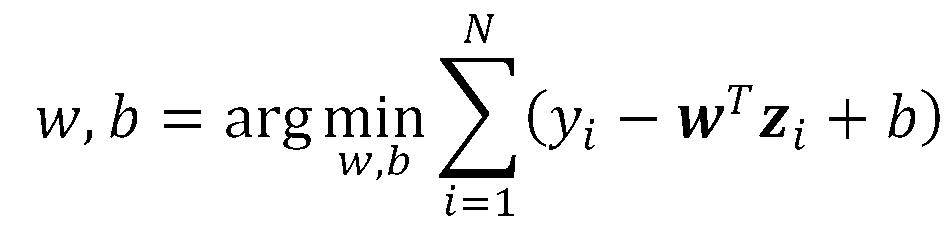
- the i-th data is formulated as follows:
- yi is the predicted probability that the data is in the same class as the data to be explained
- w is a vector having the dimension of the feature amount
- b is a constant term.
- the i-th component w i of the coefficient w obtained by the estimation corresponds to the contribution of the feature x i calculated by linear regression in the readable feature space to the predicted probability. Furthermore, it can be said that the magnitude relationship between the coefficients w i reflects the magnitude relationship of the contribution of the feature x i of the learning model 120.
- the constant b is a model bias, and corresponds to the prediction probability when random data is input.
- the second feature values extracted from the neural network to which the image is input have 512 dimensions in this embodiment, so if these are used as they are as the dimensions (i.e., spatial axes) of the readable feature space, 512 numerical values are obtained as the contributions of the second feature values.
- the characteristics of each of the second feature values themselves cannot be intuitively understood, so the contributions do not improve explainability very much.
- the dimension of the second feature is reduced and the contribution is calculated using the above method.
- the dimension of the second feature is compressed to one dimension so that the contribution after compression can be considered as the contribution of "the image itself.”
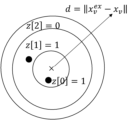
- FIG. 6 is a distribution diagram that explains a method for compressing the dimension of the second feature in the feature space shown in FIG. 4 to one dimension.
- the data to be explained is indicated by crosses, and the training data is indicated by black circles.
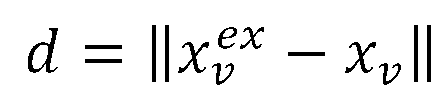
- the distance d is calculated as follows:
- xevv and xv are the v-dimensional values of the 512 dimensions in the input image to be explained and the input image for learning, respectively.
- the compressed feature is also assigned a readable feature of 0 or 1.
- the second feature is made one-dimensional and projected into binary space as a readable feature. This can be said to define a readable feature of the image itself that reflects the second feature.
- a total of 14-dimensional readable feature space is set up with the one-dimensional readable feature of the image itself and the 13-dimensional readable feature of the first feature, and linear regression of the above "Equation 2" is performed.
- the resulting contribution is the contribution of the feature corresponding to the 14 dimensions, so the user can refer to both the contribution of the image itself and the contribution of the first feature in a form that allows comparison. Since the first feature is a numerical representation of a predetermined interpretable feature, the obtained results not only improve interpretability, but also show the contribution of the image itself, allowing the user to evaluate the meaning of the heat map created in the second process described below.
- step S124 a heat map is created in step S124.
- the heat map is a comparative output of the contribution degree of each region of the image as the explanation object when the learning model 120 obtains the result of judgment on the explanation object. Note that it is not limited to a heat map, and any method may be used as long as it visualizes the region that contributed to the judgment result in the image as the explanation object (visualizes the judgment basis). For example, the contributed region (the region that served as the basis) (if there are multiple regions, all regions) may be cut out from the image as the explanation object for each degree of contribution to the judgment result.
- the second process is performed using only the information of the image CNN 132 in the learning model 120.
- CAM Class Activation Map
- Grad-CAM Grad CAM++
- ScoreCAM ScoreCAM, which does not use gradients for weights but instead assigns weights by forward propagation, as well as Guide-BP and IngetrateGrad.
- the gradient of the output from the final layer of the CNN is used to calculate the effect that each pixel value of the input image has on the predicted probability of each class, but instead, the gradient of the output from the intermediate layer, the average of the gradients of the output from each of all layers, etc. may be used.
- a perturbation may be added to the input image to divide it into several superpixels, and then the aforementioned LIME may be applied to visualize the areas in the input image that serve as the basis for judgment. Any of these may be used in this embodiment.
- the explanation output unit 104 outputs the result of the first process (degree of contribution) and the result of the second process (hereinafter referred to as the processing result) to a display or the like.
- the explanation output unit 104 may store the processing result in the storage unit 106.
- the processing result may be output together with the result of the determination by the determination unit 102.
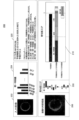
- FIG. 7 shows an example of a display image 200 displayed on the display by the explanation output unit 104.
- an input image that is an input to the learning model 120 is displayed in a target image area 202.
- the names of 13 features and a bar graph showing their size are associated and displayed in a first feature area 204.
- the contribution degree calculated in step S122 is displayed in the display image 200 in a number of ways.
- the name of the feature is displayed in correspondence with a bar graph showing the magnitude of its contribution degree.
- the same 13 features as in the input are displayed as the first feature amount.
- the second feature amount is displayed as one feature corresponding to the one-dimensional compression. Furthermore, these are displayed vertically lined up. This allows the user to easily recognize the contribution degree of the first feature amount and the contribution degree of the second feature amount, improving the explainability of the judgment. Also, since the contribution degree of the second feature amount is one, it can be interpreted as the contribution degree of "the image itself", further improving the explainability.
- bar graphs for prediction probability, features that increase prediction probability, and features that decrease prediction probability are displayed vertically for comparison.
- the bar graphs for features that increase prediction probability are arranged in series from the left in descending order of positive contribution values.
- the bar graphs for features that decrease prediction probability are arranged in series from the left in descending order of negative contribution values.
- the right end of each bar graph is aligned with the right end of the bar graph above it.
- the name of the feature is written above each contribution that is longer than a predetermined length.
- the contribution degree is displayed using text in the text area 220.
- the file name of the explanation object, the predicted probability, the predicted class, and a text report are displayed in the text area 220.
- As the text report text corresponding to the contribution degree of the second feature amount and the contribution degree of the first feature amount may be displayed.
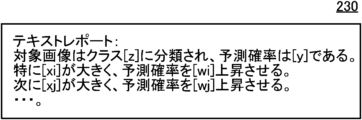
- FIG. 8 shows a template 230 of text to be displayed in the text area 220.
- the template 230 is stored in the storage unit 106.
- the template 230 includes a preset sentence and variables to be inserted into the sentence.
- the variables are indicated by [ ], and values for the symbols written within are assigned by the determination unit 102 and the contribution output unit 104 and displayed in the text area 220.
- the number of features to be displayed in the text area 220 may be determined in advance, or features greater than a threshold of the contribution degree or a threshold of the absolute value of the contribution degree may be displayed. These rules may also be stored in the storage unit 106.
- step S124 (second process) is displayed in the heat map area 206. These displays further improve the ease of explanation.
- the image CNN 132 may be another CNN, including AlexNet, VGGNet, ResNet, ResNeXt, etc. Furthermore, it may be another neural network other than a CNN. Also, although the 512 dimensions of the final layer of the image CNN 132 are used as the second feature, instead of or in addition to this, a feature of an intermediate layer before the final layer may be used.
- the reduction in dimension of the second feature is not limited to reduction to one dimension using distance.
- the second feature may be reduced in dimension using principal component analysis or a related nonlinear dimensionality reduction algorithm.
- the second feature may be reduced to one dimension using statistical processing such as taking a simple average of the second feature or the maximum value among them.
- the above embodiment describes an example in which the learning model 120 is used to determine the cell cycle from a cell image.
- the use of the learning model 120 is not limited to this.
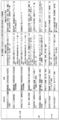
- Other examples of applicable uses are listed in FIG. 9 together with the input image and the first feature amount.
- Some first features can be calculated automatically or manually from the input image, and some cannot be calculated from the input image.
- features that can be calculated are shape features such as radius and length of the subject (object, living organism) in the image, color features, and characteristic features.
- attributes information such as gender, age, and race of the owner of the object (subject) in the input image and the subject of the living organism (subject) in the image (these relate to the subject and correspond to predetermined interpretable features); for example, location information is quantified using coordinates or an index.
- Various embodiments of the present invention may also be described with reference to flow charts and block diagrams, where the blocks may represent (1) stages of a process in which operations are performed or (2) sections of an apparatus responsible for performing the operations. Particular stages and sections may be implemented by dedicated circuitry, programmable circuitry provided with computer readable instructions stored on a computer readable medium, and/or a processor provided with computer readable instructions stored on a computer readable medium.
- Dedicated circuitry may include digital and/or analog hardware circuitry and may include integrated circuits (ICs) and/or discrete circuits.
- Programmable circuitry may include reconfigurable hardware circuitry including logical AND, logical OR, logical XOR, logical NAND, logical NOR, and other logical operations, memory elements such as flip-flops, registers, field programmable gate arrays (FPGAs), programmable logic arrays (PLAs), and the like.
- reconfigurable hardware circuitry including logical AND, logical OR, logical XOR, logical NAND, logical NOR, and other logical operations, memory elements such as flip-flops, registers, field programmable gate arrays (FPGAs), programmable logic arrays (PLAs), and the like.
- a computer readable medium may include any tangible device capable of storing instructions that are executed by a suitable device, such that the computer readable medium having instructions stored thereon comprises an article of manufacture that includes instructions that can be executed to create means for performing the operations specified in the flow chart or block diagram.
- Examples of computer readable media may include electronic storage media, magnetic storage media, optical storage media, electromagnetic storage media, semiconductor storage media, and the like.
- Computer readable media may include floppy disks, diskettes, hard disks, random access memories (RAMs), read-only memories (ROMs), erasable programmable read-only memories (EPROMs or flash memories), electrically erasable programmable read-only memories (EEPROMs), static random access memories (SRAMs), compact disk read-only memories (CD-ROMs), digital versatile disks (DVDs), Blu-ray (RTM) disks, memory sticks, integrated circuit cards, and the like.
- RAMs random access memories
- ROMs read-only memories
- EPROMs or flash memories erasable programmable read-only memories
- EEPROMs electrically erasable programmable read-only memories
- SRAMs static random access memories
- CD-ROMs compact disk read-only memories
- DVDs digital versatile disks
- RTM Blu-ray
- the computer readable instructions may include either assembler instructions, instruction set architecture (ISA) instructions, machine instructions, machine-dependent instructions, microcode, firmware instructions, state setting data, or source or object code written in any combination of one or more programming languages, including object-oriented programming languages such as Smalltalk (registered trademark), JAVA (registered trademark), C++, etc., and conventional procedural programming languages such as the "C" programming language or similar programming languages.
- ISA instruction set architecture
- machine instructions machine-dependent instructions
- microcode firmware instructions
- state setting data or source or object code written in any combination of one or more programming languages, including object-oriented programming languages such as Smalltalk (registered trademark), JAVA (registered trademark), C++, etc., and conventional procedural programming languages such as the "C" programming language or similar programming languages.
- Computer-readable instructions may be provided to a processor or programmable circuitry of a general-purpose computer, special-purpose computer, or other programmable data processing apparatus, either locally or over a wide area network (WAN) such as a local area network (LAN), the Internet, etc., to execute the computer-readable instructions to create means for performing the operations specified in the flowcharts or block diagrams.
- WAN wide area network
- LAN local area network
- Internet etc.
- processors include computer processors, processing units, microprocessors, digital signal processors, controllers, microcontrollers, etc.
- FIG. 10 illustrates an example of a computer 2200 in which aspects of the present invention may be embodied in whole or in part.
- Programs installed on the computer 2200 may cause the computer 2200 to function as or perform operations associated with an apparatus or one or more sections of the apparatus according to an embodiment of the present invention, and/or to perform a process or steps of a process according to an embodiment of the present invention.
- Such programs may be executed by the CPU 2212 to cause the computer 2200 to perform specific operations associated with some or all of the blocks of the flowcharts and block diagrams described herein.
- the computer 2200 includes a CPU 2212, a RAM 2214, a graphics controller 2216, and a display device 2218, which are interconnected by a host controller 2210.
- the computer 2200 also includes input/output units such as a communication interface 2222, a hard disk drive 2224, a DVD-ROM drive 2226, and an IC card drive, which are connected to the host controller 2210 via an input/output controller 2220.
- the computer also includes legacy input/output units such as a ROM 2230 and a keyboard 2242, which are connected to the input/output controller 2220 via an input/output chip 2240.
- the CPU 2212 operates according to the programs stored in the ROM 2230 and the RAM 2214, thereby controlling each unit.
- the graphics controller 2216 retrieves image data generated by the CPU 2212 into a frame buffer or the like provided in the RAM 2214 or into itself, and causes the image data to be displayed on the display device 2218.
- the communication interface 2222 communicates with other electronic devices via a network.
- the hard disk drive 2224 stores programs and data used by the CPU 2212 in the computer 2200.
- the DVD-ROM drive 2226 reads programs or data from the DVD-ROM 2201 and provides the programs or data to the hard disk drive 2224 via the RAM 2214.
- the IC card drive reads programs and data from an IC card and/or writes programs and data to an IC card.
- ROM 2230 stores therein a boot program, etc., which is executed by computer 2200 upon activation, and/or a program that depends on the hardware of computer 2200.
- Input/output chip 2240 may also connect various input/output units to input/output controller 2220 via a parallel port, a serial port, a keyboard port, a mouse port, etc.
- the programs are provided by a computer-readable medium such as a DVD-ROM 2201 or an IC card.
- the programs are read from the computer-readable medium and installed in the hard disk drive 2224, RAM 2214, or ROM 2230, which are also examples of computer-readable media, and executed by the CPU 2212.
- the information processing described in these programs is read by the computer 2200, and brings about cooperation between the programs and the various types of hardware resources described above.
- An apparatus or method may be constructed by realizing the manipulation or processing of information in accordance with the use of the computer 2200.
- CPU 2212 may execute a communication program loaded into RAM 2214 and instruct communication interface 2222 to perform communication processing based on the processing described in the communication program.
- communication interface 2222 reads transmission data stored in a transmission buffer processing area provided in RAM 2214, hard disk drive 2224, DVD-ROM 2201, or a recording medium such as an IC card, and transmits the read transmission data to the network, or writes received data received from the network to a reception buffer processing area or the like provided on the recording medium.
- the CPU 2212 may also cause all or a necessary portion of a file or database stored on an external recording medium such as the hard disk drive 2224, the DVD-ROM drive 2226 (DVD-ROM 2201), an IC card, etc. to be read into the RAM 2214, and perform various types of processing on the data on the RAM 2214. The CPU 2212 then writes back the processed data to the external recording medium.
- an external recording medium such as the hard disk drive 2224, the DVD-ROM drive 2226 (DVD-ROM 2201), an IC card, etc.
- CPU 2212 may perform various types of processing on data read from RAM 2214, including various types of operations, information processing, conditional judgment, conditional branching, unconditional branching, information search/replacement, etc., as described throughout this disclosure and specified by the instruction sequence of the program, and write back the results to RAM 2214.
- CPU 2212 may also search for information in a file, database, etc. in the recording medium.
- CPU 2212 may search for an entry that matches a condition, in which an attribute value of the first attribute is specified, from among the multiple entries, read the attribute value of the second attribute stored in the entry, and thereby obtain the attribute value of the second attribute associated with the first attribute that satisfies a predetermined condition.
- the above-described programs or software modules may be stored on a computer-readable medium on the computer 2200 or in the vicinity of the computer 2200.
- a recording medium such as a hard disk or RAM provided in a server system connected to a dedicated communication network or the Internet can be used as a computer-readable medium, thereby providing the programs to the computer 2200 via the network.
Landscapes
- Engineering & Computer Science (AREA)
- Theoretical Computer Science (AREA)
- General Physics & Mathematics (AREA)
- Physics & Mathematics (AREA)
- Evolutionary Computation (AREA)
- Multimedia (AREA)
- Computer Vision & Pattern Recognition (AREA)
- Health & Medical Sciences (AREA)
- Artificial Intelligence (AREA)
- General Health & Medical Sciences (AREA)
- Computing Systems (AREA)
- Databases & Information Systems (AREA)
- Medical Informatics (AREA)
- Software Systems (AREA)
- Life Sciences & Earth Sciences (AREA)
- Biodiversity & Conservation Biology (AREA)
- Biomedical Technology (AREA)
- Molecular Biology (AREA)
- Image Analysis (AREA)
Abstract
Description
[先行技術文献]
[特許文献]
[特許文献1] 国際公開2022/176396号
「非特許文献1」Nils Gessert他著「Skin lesion classification using ensembles of multi-resolution EfficientNets with meta data」Methods X, Volum 7, 2020
(1)説明対象データ及び学習データ(纏めて、データという)の密度に応じて各特徴量を独立の領域(1領域は、図5の1マスに相当する)に分ける。
(2)ある特徴量について、説明対象データと同じレベルに属している学習データに対して可読特徴量として1を割り振り、属していなければ0を割り振る。言い換えれば、各データの特徴量をバイナリ空間に射影する。各データ及び各特徴量についてこの割り振りを行い、それに基づいて線形回帰のコスト関数を設定する。

(1)第1特徴量を可読特徴量に変換する。
(2)画像の特徴量(第2特徴量)を低次元化して可読特徴量に変換する。
本実施形態において、第2の処理は、学習モデル120内の画像CNN132の情報のみを用いて行う。
Claims (13)
- 学習用画像と、前記学習用画像の被写体に関係し、予め定められた解釈可能な特徴を数値化した学習用特徴量と、を入力とし、前記学習用画像及び前記学習用特徴量に対する判定の結果を出力として学習した学習モデルを記憶する記憶部と、
説明対象用画像と、前記説明対象用画像の被写体に関係し、前記予め定められた解釈可能な特徴を数値化した第1特徴量とに対し、前記記憶部に記憶された前記学習モデルを用いて判定の結果を出力する判定部と、
前記学習モデルによる前記説明対象用画像及び前記第1特徴量の前記判定の結果に対して、前記説明対象用画像の寄与度と前記第1特徴量の寄与度とを出力する説明出力部と
を備える学習装置。 - 前記予め定められた解釈可能な特徴は、前記被写体の形状又は特性を定量的に表せるパラメータを含む請求項1に記載の学習装置。
- 前記判定部は、前記学習モデルを用いて、前記説明対象用画像から第2特徴量を抽出し、
前記説明出力部は、前記第2特徴量と前記第1特徴量とを含む特徴量空間において、前記説明対象用画像に係る前記第1特徴量及び前記第2特徴量からなるデータの近傍を線形回帰することにより、前記寄与度をそれぞれ算出する請求項1または2に記載の学習装置。 - 前記判定部は、前記学習モデルを用いて、前記説明対象用画像から第2特徴量を抽出し、
前記説明出力部は、前記第2特徴量である特徴量ベクトルの次元を圧縮して、前記説明対象用画像の寄与度として、前記第2特徴量の寄与度を算出する請求項1から3のいずれか1項に記載の学習装置。 - 前記説明出力部は、前記特徴量ベクトルを1次元に圧縮する請求項4に記載の学習装置。
- 前記説明対象用画像に基づき、前記第1特徴量のうち、少なくとの一つを算出して前記学習モデルに入力する特徴算出部をさらに備える請求項1から5のいずれか1項に記載の学習装置。
- 前記学習モデルは、畳み込みニューラルネットワークを含む請求項1から6のいずれか1項に記載の学習装置。
- 前記説明出力部は、さらに、前記学習モデルによる前記判定の結果に対する、前記説明対象用画像内の判定根拠を示す画像を出力する請求項1から7のいずれか1項に記載の学習装置。
- 前記説明出力部は、前記説明対象用画像の寄与度と、前記第1特徴量の寄与度とを、並べて表示させる請求項1から8のいずれか1項に記載の学習装置。
- 前記説明出力部は、前記説明対象用画像の寄与度と、前記第1特徴量の寄与度と、前記判定根拠を示す画像と、前記判定の結果とを並べて表示させる請求項8に記載の学習装置。
- 前記説明出力部は、前記説明対象用画像の寄与度と、前記第1特徴量の寄与度と、のそれぞれに対応したテキストを表示させる請求項9または10に記載の学習装置。
- コンピュータに、
学習用画像と、前記学習用画像の被写体に関係し、予め定められた解釈可能な特徴を数値化した学習用特徴量と、を入力とし、前記学習用画像及び前記学習用特徴量に対する判定の結果を出力として学習した学習モデルを記憶部に記憶させる記憶機能と、
説明対象用画像と、前記説明対象用画像の被写体に関係し、前記予め定められた解釈可能な特徴を数値化した第1特徴量とに対し、前記記憶部に記憶された前記学習モデルを用いて判定の結果を出力する判定機能と、
前記学習モデルによる前記説明対象用画像及び前記第1特徴量の前記判定の結果に対して、前記説明対象用画像の寄与度と前記第1特徴量の寄与度とを出力する説明出力機能と
を実現させるプログラム。 - 学習用画像と、前記学習用画像の被写体に関係し、予め定められた解釈可能な特徴を数値化した学習用特徴量と、を入力とし、前記学習用画像及び前記学習用特徴量に対する判定の結果を出力として学習した学習モデルを用いて、説明対象用画像と、前記説明対象用画像の被写体に関係し、前記予め定められた解釈可能な特徴を数値化した第1特徴量とに対し、判定の結果を出力する学習装置であって、
前記学習モデルによる前記説明対象用画像及び前記第1特徴量の前記判定の結果に対して、前記説明対象用画像の寄与度と前記第1特徴量の寄与度とを出力する説明出力部を備える学習装置。
Priority Applications (5)
| Application Number | Priority Date | Filing Date | Title |
|---|---|---|---|
| EP24819094.4A EP4726648A1 (en) | 2023-06-07 | 2024-05-14 | Training device and program |
| JP2025526011A JP7875489B2 (ja) | 2023-06-07 | 2024-05-14 | 学習装置およびプログラム |
| CN202480034043.3A CN121175717A (zh) | 2023-06-07 | 2024-05-14 | 学习装置及程序 |
| US19/409,113 US20260087788A1 (en) | 2023-06-07 | 2025-12-04 | Learning apparatus and non-transitory computer-readable medium |
| JP2026089977A JP2026125001A (ja) | 2023-06-07 | 2026-05-28 | 学習装置およびプログラム |
Applications Claiming Priority (2)
| Application Number | Priority Date | Filing Date | Title |
|---|---|---|---|
| JP2023094360 | 2023-06-07 | ||
| JP2023-094360 | 2023-06-07 |
Related Child Applications (1)
| Application Number | Title | Priority Date | Filing Date |
|---|---|---|---|
| US19/409,113 Continuation US20260087788A1 (en) | 2023-06-07 | 2025-12-04 | Learning apparatus and non-transitory computer-readable medium |
Publications (1)
| Publication Number | Publication Date |
|---|---|
| WO2024252857A1 true WO2024252857A1 (ja) | 2024-12-12 |
Family
ID=93795423
Family Applications (1)
| Application Number | Title | Priority Date | Filing Date |
|---|---|---|---|
| PCT/JP2024/017720 Ceased WO2024252857A1 (ja) | 2023-06-07 | 2024-05-14 | 学習装置およびプログラム |
Country Status (5)
| Country | Link |
|---|---|
| US (1) | US20260087788A1 (ja) |
| EP (1) | EP4726648A1 (ja) |
| JP (2) | JP7875489B2 (ja) |
| CN (1) | CN121175717A (ja) |
| WO (1) | WO2024252857A1 (ja) |
Citations (3)
| Publication number | Priority date | Publication date | Assignee | Title |
|---|---|---|---|---|
| JP2019125240A (ja) * | 2018-01-18 | 2019-07-25 | 株式会社日立製作所 | 分析装置および分析方法 |
| WO2022009652A1 (ja) * | 2020-07-07 | 2022-01-13 | ソニーグループ株式会社 | データ収集システム、センサ装置、データ収集装置、及びデータ収集方法 |
| WO2022176396A1 (ja) | 2021-02-18 | 2022-08-25 | ソニーグループ株式会社 | 情報処理装置及び情報処理方法、コンピュータプログラム、並びに医療診断システム |
-
2024
- 2024-05-14 CN CN202480034043.3A patent/CN121175717A/zh active Pending
- 2024-05-14 WO PCT/JP2024/017720 patent/WO2024252857A1/ja not_active Ceased
- 2024-05-14 EP EP24819094.4A patent/EP4726648A1/en active Pending
- 2024-05-14 JP JP2025526011A patent/JP7875489B2/ja active Active
-
2025
- 2025-12-04 US US19/409,113 patent/US20260087788A1/en active Pending
-
2026
- 2026-05-28 JP JP2026089977A patent/JP2026125001A/ja active Pending
Patent Citations (3)
| Publication number | Priority date | Publication date | Assignee | Title |
|---|---|---|---|---|
| JP2019125240A (ja) * | 2018-01-18 | 2019-07-25 | 株式会社日立製作所 | 分析装置および分析方法 |
| WO2022009652A1 (ja) * | 2020-07-07 | 2022-01-13 | ソニーグループ株式会社 | データ収集システム、センサ装置、データ収集装置、及びデータ収集方法 |
| WO2022176396A1 (ja) | 2021-02-18 | 2022-08-25 | ソニーグループ株式会社 | 情報処理装置及び情報処理方法、コンピュータプログラム、並びに医療診断システム |
Non-Patent Citations (1)
| Title |
|---|
| NILS GESSERT ET AL.: "Skin lesion classification using ensembles of multi-resolution EfficientNets with meta data", METHODS X, vol. 7, 2020 |
Also Published As
| Publication number | Publication date |
|---|---|
| JP2026125001A (ja) | 2026-07-31 |
| JP7875489B2 (ja) | 2026-06-18 |
| EP4726648A1 (en) | 2026-04-15 |
| US20260087788A1 (en) | 2026-03-26 |
| CN121175717A (zh) | 2025-12-19 |
| JPWO2024252857A1 (ja) | 2024-12-12 |
Similar Documents
| Publication | Publication Date | Title |
|---|---|---|
| CN110674866B (zh) | 迁移学习特征金字塔网络对X-ray乳腺病灶图像检测方法 | |
| US12164599B1 (en) | Multi-view image analysis using neural networks | |
| US11334791B2 (en) | Learning to search deep network architectures | |
| CN118656683B (zh) | 一种基于多模态可信渐进融合的分类系统 | |
| CN117911418B (zh) | 基于改进yolo算法的病灶检测方法、系统及存储介质 | |
| US12499654B2 (en) | Simplifying convolutional neural networks using logical representations of images | |
| CN111798424B (zh) | 一种基于医学图像的结节检测方法、装置及电子设备 | |
| US12293555B2 (en) | Method and device of inputting annotation of object boundary information | |
| Tripathy et al. | Brain MRI segmentation techniques based on CNN and its variants | |
| CN118196013B (zh) | 支持多医生协同监督的多任务医学图像分割方法及系统 | |
| CN110568445A (zh) | 一种轻量化卷积神经网络的激光雷达与视觉融合感知方法 | |
| Saraf et al. | Deep learning challenges in medical imaging | |
| Hilbig et al. | Enhancing three-dimensional convolutional neural network-based geometric feature recognition for adaptive additive manufacturing: A signed distance field data approach | |
| CN118470432A (zh) | 基于深度学习网络的甲乳多模态超声图像分类方法及系统 | |
| Ren et al. | An integrated approach of Active Incremental fine-tuning, SegNet, and CRF for cutting tool wearing areas segmentation with small samples | |
| CN115565115A (zh) | 一种舾装件智能识别方法、计算机设备 | |
| CN114998222A (zh) | 汽车差速器壳体表面检测方法、电子设备及介质 | |
| CN117911785A (zh) | 基于缺失模态的异构多模态图像分类方法及装置 | |
| CN115641317B (zh) | 面向病理图像的动态知识回溯多示例学习及图像分类方法 | |
| CN115546089A (zh) | 医学图像分割方法、病理图像处理方法、装置、设备 | |
| CN112507883A (zh) | 人脸活体检测方法、系统、设备及存储介质 | |
| KR102432766B1 (ko) | 알츠하이머 병 분류를 위한 mr 이미지 분석 시스템 및 방법 | |
| CN120495665A (zh) | 基于多模态特征融合及边界增强的病理图像语义分割方法 | |
| CN113850819A (zh) | 一种血管精细化分割方法、装置、终端及存储介质 | |
| US20260087788A1 (en) | Learning apparatus and non-transitory computer-readable medium |
Legal Events
| Date | Code | Title | Description |
|---|---|---|---|
| 121 | Ep: the epo has been informed by wipo that ep was designated in this application |
Ref document number: 24819094 Country of ref document: EP Kind code of ref document: A1 |
|
| ENP | Entry into the national phase |
Ref document number: 2025526011 Country of ref document: JP Kind code of ref document: A |
|
| WWE | Wipo information: entry into national phase |
Ref document number: 2025526011 Country of ref document: JP |
|
| WWE | Wipo information: entry into national phase |
Ref document number: 2024819094 Country of ref document: EP |
|
| NENP | Non-entry into the national phase |
Ref country code: DE |
|
| ENP | Entry into the national phase |
Ref document number: 2024819094 Country of ref document: EP Effective date: 20260107 |
|
| ENP | Entry into the national phase |
Ref document number: 2024819094 Country of ref document: EP Effective date: 20260107 |
|
| ENP | Entry into the national phase |
Ref document number: 2024819094 Country of ref document: EP Effective date: 20260107 |
|
| ENP | Entry into the national phase |
Ref document number: 2024819094 Country of ref document: EP Effective date: 20260107 |
|
| ENP | Entry into the national phase |
Ref document number: 2024819094 Country of ref document: EP Effective date: 20260107 |
|
| WWP | Wipo information: published in national office |
Ref document number: 2024819094 Country of ref document: EP |