WO2024252595A1 - 最適化装置および最適化方法 - Google Patents
最適化装置および最適化方法 Download PDFInfo
- Publication number
- WO2024252595A1 WO2024252595A1 PCT/JP2023/021249 JP2023021249W WO2024252595A1 WO 2024252595 A1 WO2024252595 A1 WO 2024252595A1 JP 2023021249 W JP2023021249 W JP 2023021249W WO 2024252595 A1 WO2024252595 A1 WO 2024252595A1
- Authority
- WO
- WIPO (PCT)
- Prior art keywords
- state
- unit
- thermal relaxation
- quantum
- nonadiabatic
- Prior art date
- Legal status (The legal status is an assumption and is not a legal conclusion. Google has not performed a legal analysis and makes no representation as to the accuracy of the status listed.)
- Ceased
Links
Images


Classifications
-
- G—PHYSICS
- G06—COMPUTING OR CALCULATING; COUNTING
- G06N—COMPUTING ARRANGEMENTS BASED ON SPECIFIC COMPUTATIONAL MODELS
- G06N99/00—Subject matter not provided for in other groups of this subclass
Definitions
- This disclosure relates to an optimization device and an optimization method, and more specifically, to an optimization technique that uses an annealing algorithm.
- Simulated annealing is known as one type of annealing algorithm. Simulated annealing is a method for searching for combination states by modeling the thermal relaxation phenomenon that occurs in magnetic materials, etc. (Non-Patent Document 1). Another known algorithm is quantum annealing (Non-Patent Document 2), which is a method for optimizing combinations by using quantum mechanical tunneling effects, etc.
- Non-Patent Document 3 Quantum annealing has shown performance that exceeds that of simulated annealing. It has also been reported that when thermal relaxation related to simulated annealing is incorporated into quantum annealing, further improvements in performance are observed (Non-Patent Document 4). However, the performance of quantum annealing can be fully demonstrated with a dedicated physical machine that can realize quantum effects.
- the present disclosure has been made in consideration of the above points, and aims to develop a simulated annealing method that simulates thermal relaxation and incorporates the tunneling effect that approximately represents quantum annealing, and to provide an optimization device and an optimization method that can be implemented on a general computer.
- an optimization device that finds an optimal solution by thermal relaxation, and includes a quantum effect simulating unit that simulates a quantum tunneling effect for an energy function, a thermal relaxation simulating unit that simulates thermal relaxation for an energy function incorporating the simulated tunneling effect, and a control unit that alternately executes the simulation of the quantum tunneling effect by the quantum effect simulating unit and the simulation of the thermal relaxation by the thermal relaxation simulating unit.
- An optimization device includes an initial state creation unit that creates an initial state of the spin state based on a random number, a quantum annealing simulation unit that applies a time evolution matrix to the initial state to repeatedly obtain a state in which the spin state changes over time, a thermal relaxation introduction unit that generates an energy expectation value including the state simulated by the quantum annealing simulation unit and the excited state of the state, a nonadiabatic transition determination unit that determines whether a nonadiabatic transition has occurred during the quantum annealing process based on the energy expectation value obtained by the thermal relaxation introduction unit, and a spin state update unit that updates the spin state when the nonadiabatic transition determination unit determines that the nonadiabatic transition has occurred, and the quantum annealing simulation unit, the thermal relaxation introduction unit, the nonadiabatic transition determination unit, and the spin state update unit operate continuously to realize a series of processes, and an optimal solution acquisition unit that obtains an optimal solution from the result of repeating the series of processes for a predetermined time.
- the optimization method includes an initial state creation step of creating an initial state of the spin state based on random numbers, a quantum annealing simulation step of applying a time evolution matrix to the initial state to repeatedly obtain a state in which the spin state changes over time, a thermal relaxation introduction step of generating an energy expectation value including the state simulated in the quantum annealing simulation step and the excited state of the state, a nonadiabatic transition determination step of determining whether or not a nonadiabatic transition has occurred during the quantum annealing process based on the energy expectation value obtained in the thermal relaxation introduction step, and a spin state update step of updating the spin state when it is determined by the nonadiabatic transition determination step that a nonadiabatic transition has occurred, and the quantum annealing simulation step, the thermal relaxation introduction step, the nonadiabatic transition determination step, and the spin state update step continuously realize a series of processes, and include an optimal solution acquisition step of obtaining an optimal solution from the result of repeating the series of processes for a predetermined time.
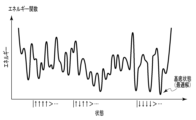
- FIG. 13 is a diagram showing an example of the relationship between a binary spin state and energy.
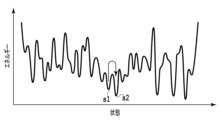
- FIG. 1 is a diagram for explaining thermal relaxation.
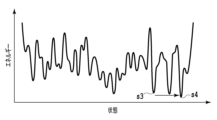
- FIG. 1 is a diagram for explaining a tunnel effect.
- FIG. 1 is a functional block diagram for explaining an optimization device according to an embodiment of the present disclosure.
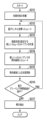
- 5 is a flow chart illustrating the computer-implemented optimization method shown in FIG. 4.
- FIG. 13 is a diagram for explaining a process of searching for an optimal solution taking into account both the tunneling effect and thermal relaxation according to an embodiment of the present disclosure.
- the above-mentioned embodiment makes it possible to provide an optimization device and an optimization method that approximate quantum annealing so that it can be handled by a general computer such as a von Neumann type, and that improves optimization performance by incorporating thermal relaxation phenomena into the tunneling effect.
- 2N states are included. Therefore, considering the energy over all states becomes unrealistic as N increases.
- Simulated annealing effectively searches for a solution in a wide space by considering the thermal excitation and relaxation of this Ising Hamiltonian.
- the energy difference before and after the transition is expressed as shown in the following formula (2).
- simulated annealing overcomes the barrier within the range allowed by thermal excitation.
- the state transitions from state s1 to state s2 by repeatedly going up and down the potential barrier through thermal excitation/relaxation, searching for the desired optimal solution. If the potential barrier is deep enough to exceed the scale of the inverse of the temperature, the above-mentioned allowable (acceptable) state transition due to thermal excitation cannot overcome the potential barrier, and the system is trapped in a local optimum rather than the optimal solution (s2).
- FIG. 3 is a diagram for explaining the tunnel effect. As with FIG. 2, the horizontal axis of FIG. 3 indicates the state, and the vertical axis indicates the energy. In the quantum mechanical tunnel effect, a state transition occurs from state s3 to state s4 through a potential barrier, searching for the optimal solution.
- an optimization device and an optimization method with improved performance for finding an optimal solution are realized by applying the tunneling effect of quantum annealing shown in Fig. 3 to the simulated annealing shown in Fig. 2.
- the present disclosure uses dynamics approximated by mean field approximation for the tunneling effect.
- a computer 100 functions as the optimization device.
- the computer 100 is a von Neumann type computer, and includes a CPU (Central Processor Unit) 101, a memory 102, and an I/O (Input/Output) unit 103.
- the I/O unit 103 is configured to input information on the Ising Hamiltonian that represents the optimization problem, that is, J ij and B i . Note that J ij and b i will be described later.
- the memory 102 is configured to load the input J ij and B i .
- a program for causing the CPU 101 to calculate an algorithm given by a mathematical formula is also loaded into the memory 102. This program prepares an initial state using random numbers, and repeats calculations according to the chart in FIG. 2 to obtain a spin set that is a solution. The obtained spin set is output again from the I/O unit 103.
- the CPU 101 may be replaced with a calculation unit other than a CPU, such as an FPGA or a GPU.
- the algorithm calculated by the computer 100 will be described in detail later.
- the computer 100 of this embodiment is an optimization device that finds an optimal solution by thermal relaxation.
- the CPU 101 functions as a quantum effect simulating unit that simulates the quantum tunneling effect for the energy function, a thermal relaxation simulating unit that simulates thermal relaxation for the energy function incorporating the simulated tunneling effect, and a control unit that alternately executes the simulation of the quantum tunneling effect by the quantum effect simulating unit and the simulation of thermal relaxation by the thermal relaxation simulating unit.
- the CPU 101 includes an initial state creation unit that creates an initial state of the spin state based on a random number, a quantum annealing simulation unit that applies a time evolution matrix to the initial state to repeatedly obtain the state of the spin state that changes over time, a thermal relaxation introduction unit that obtains an energy expectation value including the state simulated by the quantum annealing simulation unit and the excited state of this state, a nonadiabatic transition determination unit that determines whether a nonadiabatic transition has occurred during the quantum annealing process based on the energy expectation value obtained by the thermal relaxation introduction unit, and a spin state update unit that updates the spin state when it is determined by the nonadiabatic transition determination unit that a nonadiabatic transition has occurred.
- the quantum annealing simulation unit, thermal relaxation introduction unit, nonadiabatic transition determination unit, and spin state update unit operate continuously to realize a series of processes, and function as an optimal solution acquisition unit that obtains an optimal solution from the results of repeating this series of processes for a predetermined period of time.
- FIG. 5 is a flowchart showing an optimization method executed by the computer 100.
- an initial state simulating the initial state is prepared for the approximated quantum dynamics of quantum annealing (step S201).
- time evolution is repeated a certain number of times to simulate the tunnel effect of quantum annealing (step S202).
- an Ising Hamiltonian incorporating the above tunnel effect and the excited state of simulated annealing is created (step S203).
- a thermal relaxation simulation is performed by using simulated annealing (step S204).
- step S205 the spin state due to thermal relaxation is updated (step S205).
- the optimization method of this embodiment determines whether or not the processing time has reached the quantum annealing elapsed time (step S206).
- Computer 100 executes the above processes by a program that is loaded into memory 102 and executed by CPU 101.
- the program is executed by software shown in the flowchart in FIG. 5 in cooperation with well-known hardware included in computer 100.
- step S206 If it is determined in step S206 that the processing time has not reached the quantum annealing elapsed time, the processing from step S202 onwards is executed again. In this manner, the CPU 101 executes a series of processes including quantum tunneling effect simulation, calculation of a new Ising Hamiltonian, thermal relaxation simulation, and state update by thermal relaxation. The CPU 101 then repeatedly executes this series of processes until the quantum annealing elapsed time is reached. Furthermore, the CPU extracts an optimal solution from the results of the repeated processes (step S207). The processing of each of the above steps will be explained in detail below.
- the tunneling effect of quantum annealing can be effectively simulated by repeating the time evolution using the time evolution matrix M i a certain number of times until h x becomes 0.
- the decrease rate of h x and the number of repetitions are appropriately set as parameters.
- ⁇ new ⁇ described by the left side of equation (19) newly obtained in quantum dynamics including the tunneling effect can be described as follows.
- b ⁇ i in equation (19) is the pseudospin state given below.
- ⁇ new ⁇ will be considered.
- the excited state is given as follows using 2 N ⁇ 1 Hilbert space.
- ⁇ new > corresponds to the case where s j 1 for all i. Any excited state in other cases is given by the following equation (22).
- -b>i which is included in at least one excited state, is given as follows.
- ⁇ b> i are orthonormal vectors. In other words, We have ⁇ b
- b ⁇ ⁇ -b
- -b ⁇ 1 and ⁇ b
- -b ⁇ ⁇ -b
- b ⁇ 0 (for simplicity, i has been omitted).
- FIG. 6 is a diagram conceptually illustrating the search for an optimal solution in thermal relaxation of simulated annealing that incorporates the tunneling effect of quantum annealing in this embodiment.
- the horizontal axis of FIG. 6 indicates the spin state, and the vertical axis indicates energy.
- steps S202 to S205 shown in FIG. 5 are repeatedly executed, so that thermal relaxation of simulated annealing (S204) and application of the quantum tunneling effect (S202) are performed alternately.
- FIG. 6 shows part of a series of repeated processes, and shows that after thermal relaxation is performed in step k, the tunneling effect is applied in step (k+1).
- a (spin) state search is performed for the energy distribution shown by the curve in the figure.
- the thermal excitation ⁇ a allowed in the thermal relaxation of simulated annealing is smaller than the energy value (height) ⁇ k of the potential barrier
- the state search is trapped at the energy shown as a "local solution" as shown in the figure (black circle in the figure).
- the tunnel effect is applied in the next step (k+1).
- the energy state search can pass through the potential barrier by the tunnel effect and move to another state. By repeating this process, the state search can arrive at the optimal solution.
Landscapes
- Engineering & Computer Science (AREA)
- Theoretical Computer Science (AREA)
- Physics & Mathematics (AREA)
- Computing Systems (AREA)
- General Engineering & Computer Science (AREA)
- General Physics & Mathematics (AREA)
- Mathematical Physics (AREA)
- Software Systems (AREA)
- Hall/Mr Elements (AREA)
Abstract
乱数に基づいてスピン状態の初期状態を作成する初期状態の準備工程(S201)と、初期状態に時間発展行列を作用させ、スピン状態の時間の経過に伴って変化する状態を繰り返し求める量子トンネル効果シミュレート工程(S202)と、量子トンネル効果シミュレート工程において模擬された状態と、この状態の励起状態と、を含むエネルギー期待値を生成する熱的緩和シミュレート工程(S204)と、熱的緩和導入工程において取得されたエネルギー期待値に基づいて、量子アニーリングの過程で非断熱的な遷移が生じていると判断された場合、スピンの状態を更新する状態更新工程(S205)と、を含み、量子トンネル効果シミュレート工程、熱的緩和シミュレート工程、状態更新工程は一連の処理を実現し、一連の処理を所定の時間繰り返した結果から、最適解を求める会の抽出工程(S207)とにより最適化方法を構成する。
Description
本開示は、最適化装置および最適化方法に関し、詳しくは、アニーリングアルゴリズムを用いた最適化技術に関する。
アニーリングアルゴリズムの一つとして、シミュレーテッドアニーリングが知られている。シミュレーテッドアニーリングは、磁性体等で生じる熱的緩和現象をモデルにして、組合せ状態を探索する手法である(非特許文献1)。また、別のアルゴリズムとして、量子アニーリングが知られており(非特許文献2)、この手法は、量子力学的なトンネル効果等を使って組み合わせの最適化を行う手法である。
Kirkpatrick, S.; Gelatt Jr, C. D.; Vecchi, M. P. (1983). "Optimization by Simulated Annealing". Science 220 (4598): 671-680.
T. Kadowaki and H. Nishimori, "Quantum annealing in the transverse Ising model" Phys. Rev. E 58, 5355 (1998)
Elizabeth Crosson, Aram W. Harrow, "Simulated Quantum Annealing Can Be Exponentially Faster than Classical Simulated Annealing". Proc of FOCS 2016, pp. 714-723, Arxiv: 1601.03030New York: Plenum. pp. 85-103.
M. H. S. Amin, Peter J. Love, C. J. S. Truncik, "Thermally assisted adiabatic quantum computation". Phys. Rev. Lett. 100, 060503 (2008), cond-mat 0609332
Richard M. Karp (1972). "Reducibility Among Combinatorial Problems". In R. E. Miller; J. W. Thatcher; J.D. Bohlinger (eds.). Complexity of Computer Computations.
Aditi Misra-Speldenner, Dmitry Bagrets, Frank Wilhelm-Mauch, Peter Schuhmacher, Tim Bode, Tobias Stollenwerk "Semiclassical (mean field) Approximate Optimization Algorithm" Adiabatic quantum computing 2022, [2023年5月27日検索]、インターネットhttp://video.ictp.it/WEB/2022/2022_06_20-smr3718/2022_06_20-11_50-smr3718.mp4
ところで、シミュレーテッドアニーリングは汎用性の高いアルゴリズムであるが、近年では量子アニーリングがシミュレーテッドアニーリングを超える性能を示す場合がある(非特許文献3)。また、量子アニーリングに、シミュレーテッドアニーリングに係る熱的緩和が取り入れられる場合、さらに性能の向上がみられることが、報告されている(非特許文献4)。しかし、量子アニーリングは、量子効果を実現することのできる専用の物理マシンでその性能が十分に発揮される。
本開示は、上記の点に鑑みてなされたものであり、量子アニーリングを近似的に表したトンネル効果を取り込んだ、熱的緩和をシミュレートするシミュレーテッドアニーリングを構築し、一般的なコンピュータで実施可能な最適化装置および最適化方法を提供することを目的とする。
上記目的を達成するために本開示の一態様の最適化装置は、熱的緩和によって最適解を求める最適化装置であって、エネルギー関数について、量子トンネル効果をシミュレートする量子効果シミュレート部と、シミュレートした前記トンネル効果を取り入れたエネルギー関数について、熱的緩和をシミュレートする熱緩和シミュレート部と、前記量子効果シミュレート部による量子トンネル効果のシミュレートと、前記熱緩和シミュレート部による熱的緩和のシミュレートを、交互に実行させる制御部と、を含む。
また、本開示の一態様の最適化装置は、乱数に基づいてスピン状態の初期状態を作成する初期状態作成部と、前記初期状態に時間発展行列を作用させ、スピン状態の時間の経過に伴って変化する状態を繰り返し求める量子アニーリング模擬部と、前記量子アニーリング模擬部によって模擬された状態と、当該状態の励起状態と、を含むエネルギー期待値を生成する熱的緩和導入部と、前記熱的緩和導入部によって取得されたエネルギー期待値に基づいて、量子アニーリングの過程で非断熱的な遷移が生じているか否か判断する非断熱的遷移判断部と、前記非断熱的遷移判断部により前記非断熱的な遷移が生じていると判断された場合、スピンの状態を更新するスピン状態更新部と、を含み、前記量子アニーリング模擬部、前記熱的緩和導入部、前記非断熱的遷移判断部及び前記スピン状態更新部は、連続して動作して一連の処理を実現し、前記一連の処理を所定の時間繰り返した結果から、最適解を求める最適解取得部と、を含む。
本開示の一態様の最適化方法は、乱数に基づいてスピン状態の初期状態を作成する初期状態作成工程と、前記初期状態に時間発展行列を作用させ、スピン状態の時間の経過に伴って変化する状態を繰り返し求める量子アニーリング模擬工程と、前記量子アニーリング模擬工程において模擬された状態と、当該状態の励起状態と、を含むエネルギー期待値を生成する熱的緩和導入工程と、前記熱的緩和導入工程において取得されたエネルギー期待値に基づいて、量子アニーリングの過程で非断熱的な遷移が生じているか否か判断する非断熱的遷移判断工程と、前記非断熱的遷移判断工程により前記非断熱的な遷移が生じていると判断された場合、スピンの状態を更新するスピン状態更新工程と、を含み、前記量子アニーリング模擬工程、前記熱的緩和導入工程、前記非断熱的遷移判断工程及び前記スピン状態更新工程は、連続して一連の処理を実現し、前記一連の処理を所定の時間繰り返した結果から、最適解を求める最適解取得工程と、を含む。
以上の形態によれば、量子アニーリングを近似化してノイマン型等の一般的なコンピュータで扱えるようにし、トンネル効果に熱的緩和現象を取り入れて最適化の性能を高めた最適化装置、最適化方法を提供することができる。
以下、本開示の一実施形態について説明する。先ず、具体的な実施形態に先んじて、基本的な最適化問題の解法について説明する。
[最適化問題]
ほとんどすべての組み合わせ最適化問題は、多項式時間でイジング問題にマッピングできることが知られている(非特許文献5)。ここで、イジング問題とは、以下の式(1)のイジングハミルトニアンを最小化することである。

ほとんどすべての組み合わせ最適化問題は、多項式時間でイジング問題にマッピングできることが知られている(非特許文献5)。ここで、イジング問題とは、以下の式(1)のイジングハミルトニアンを最小化することである。
上記の式(1)において、i,j=1,2,・・・N、Jijはイジング相互作用項、Bjは磁場項である。イジングスピンσziはσzi={-1,1}の2値スピンである。2値スピンの全ての組み合わせを考察すると、2Nの状態が含まれる。そのため、全状態にわたってエネルギーを考察することは、Nの増加とともに現実的でなくなる。シミュレーテッドアニーリングは、このイジングハミルトニアンの熱的励起及び緩和を考察することで有効的に幅広い空間で解探索が実行される。ここで、スピンσziが逆向きのスピン-σziに変更される状態遷移を考えると、遷移前後のエネルギー差は、以下の式(2)のとように表される。

このとき、ΔE<0となってエネルギー緩和が起こる場合は、常に状態遷移を受け入れる。一方、励起を表すΔE>0の状態遷移は、パラメータとして定義する温度T、一様乱数r=[0,1]を用いてexp(-ΔE/T)<rの場合に限って受け入れる。温度Tは、シミュレーションが進むにつれて徐々に下げていく。このように、状態遷移に熱的励起/緩和を模擬し、基本的にはエネルギーが下がる状態をとりつつエネルギーの上昇を伴う熱的励起が一定の確率で生じることを許容することで、エネルギーの局所的な最適解から脱出し、最適解へと向かうことができる。
図1および図2は、は、上述の熱的緩和により最適解へと向かうことを説明するための図であり、それぞれ2値スピンの状態とエネルギーとの関係、すなわち、エネルギー関数の例を示す図である。図1の横軸はスピンの状態を示し、縦軸はエネルギーを示している。図1に示す曲線のうち、エネルギーが最も低くなる点に対応する状態が基底状態(最適解)である。図2は、熱的緩和を説明するための図であって、横軸は図1の状態と同様の状態を示しているが、図示を略している。図2の縦軸はエネルギーを示す。
図2に示すように、シミュレーテッドアニーリングによれば、熱励起で許される範囲の障壁を乗り越える。図2に示す例では、熱的励起/緩和によってポテンシャル障壁を上ったり下りたりを繰り返して状態s1から状態s2へ状態が遷移し、目的とする最適解を探す。ポテンシャル障壁が温度の逆数のスケールを超えるほど深い場合、上述の許容される(受け入れられる)熱励起による状態遷移では、そのポテンシャル障壁を越えることができないため、最適解ではなく局所的最適解にトラップされる(s2)。
一方、量子アニーリングは、以下の式(3)のようなイジンハミルトニアンによって記述される量子力学的時間発展により、イジングハミルトニアンの最低エネルギー状態を探す。
 式(3)の右辺は、横磁場項と呼ばれる項である。

量子アニーリングでは、上記の初期状態から出発し、徐々にhx=0の極限に変化させ、状態|Ψ〉の時間変化|Ψ(t)>=exp(-itH)|Ψ〉を解析する。量子アニーリングにおいては、横磁場項を構成するσxiとイジングハミルトニアンを構成するσziは交換しないσxiσzi≠σziσxiために量子的な揺らぎが生じる。また、x成分のパウリ行列σxiは、スピンを反転させるような効果をもち、これがエネルギー障壁を飛び越えるような量子トンネル遷移を引き起こす。ダイナミクスが断熱的で、非断熱遷移が生じなければ最終状態|Ψ(tL)〉は、Isingハミルトニアンの最低エネルギー状態であることが保証される。しかしながら、現実的には有限の時間tLで実行するため、非断熱遷移が生じ最低エネルギー状態以外の解を得ることもある。そのため、量子アニーリングの過程の途中に、シミュレーテッドアニーリングに係る熱的緩和を含む場合に、効率よく解探索が行われる(非特許文献4)。
図3は、トンネル効果を説明するための図であって、図2と同様に、図3の横軸は状態を示し、縦軸はエネルギーを示す。量子力学的トンネル効果は、ポテンシャル障壁を貫いて状態s3からs4へ状態の遷移が起こり、最適解を探す。


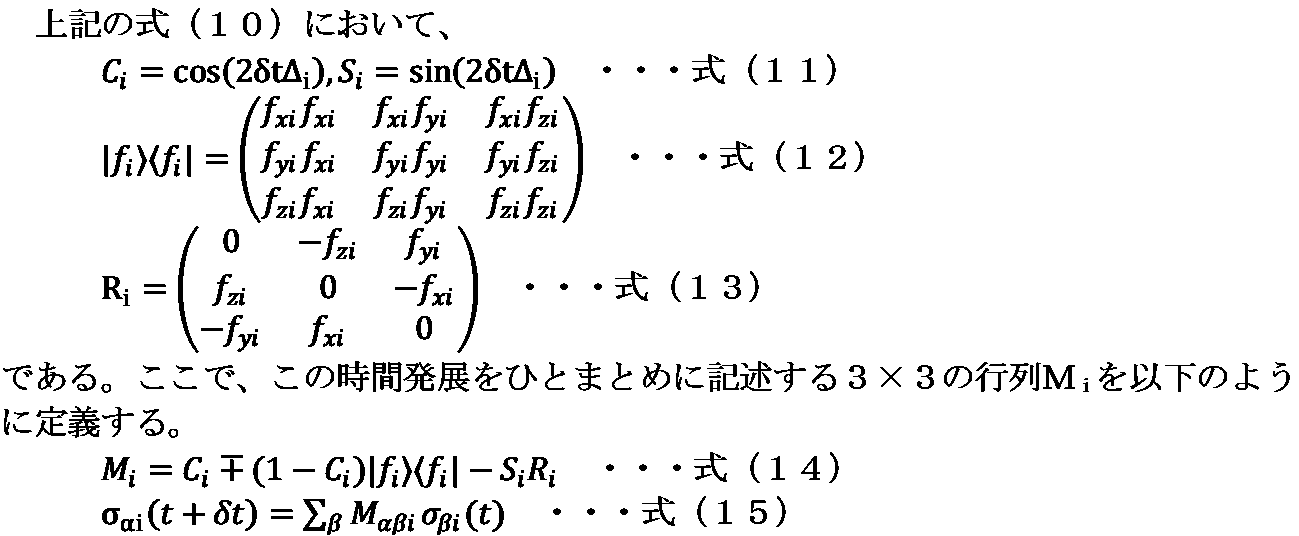
以上のようにすれば量子力学的なトンネル効果を取り込んだ時間発展が近似的に記述できることが、例えば、非特許文献6に記載されている。
[実施形態]
以下、本開示の一実施形態を具体的に説明する。本実施形態は、図2に示したシミュレーテッドアニーリングに、図3に示した量子アニーリングのトンネル効果を適用することにより、最適解を求める性能を高めた最適化装置及び最適化方法を実現する。なお、本開示は、トンネル効果については平均場近似で近似されたダイナミクスを用いる。
以下、本開示の一実施形態を具体的に説明する。本実施形態は、図2に示したシミュレーテッドアニーリングに、図3に示した量子アニーリングのトンネル効果を適用することにより、最適解を求める性能を高めた最適化装置及び最適化方法を実現する。なお、本開示は、トンネル効果については平均場近似で近似されたダイナミクスを用いる。
図4は、本実施形態の最適化装置を説明するための機能ブロック図である。本実施形態では、コンピュータ100が最適化装置として機能する。コンピュータ100は、ノイマン型のコンピュータであって、CPU(Central Processor Unit)101、メモリ102、I/O(Input/Output)部103を含んでいる。I/O部103は、最適化問題を表すイジングハミルトニアンの情報、すなわちJij及びBiを入力する構成である。なお、Jij及びbiについては後述する。
メモリ102は、入力されたJij及びBiをロードする構成である。また、メモリ102には、数式で与えられるアルゴリズムをCPU101において演算するためのプログラムがロードされている。このプログラムは、初期状態を乱数によって準備し、図2のチャートに従って演算を繰り返して解となるスピンセットを得る。得られたスピンセットは、再びI/O部103より出力される。CPU101は、FPGAやGPU等のCPU以外の演算ユニットに置き換えても良い。なお、コンピュータ100で演算されるアルゴリズムについては、後に詳述する。
本実施形態のコンピュータ100は、熱的緩和によって最適解を求める最適化装置である。そして、特に、CPU101は、エネルギー関数について、量子トンネル効果をシミュレートする量子効果シミュレート部、シミュレートした前記トンネル効果を取り入れたエネルギー関数について、熱的緩和をシミュレートする熱緩和シミュレート部、量子効果シミュレート部による量子トンネル効果のシミュレートと、熱緩和シミュレート部による熱的緩和のシミュレートを、交互に実行させる制御部として機能する。
より詳細には、CPU101は、乱数に基づいてスピン状態の初期状態を作成する初期状態作成部、初期状態に時間発展行列を作用させ、スピン状態の時間の経過に伴って変化する状態を繰り返し求める量子アニーリング模擬部、量子アニーリング模擬部によって模擬された状態と、この状態の励起状態と、を含むエネルギー期待値を取得する熱的緩和導入部と、熱的緩和導入部によって取得されたエネルギー期待値に基づいて、量子アニーリングの過程で非断熱的な遷移が生じているか否か判断する非断熱的遷移判断部と、非断熱的遷移判断部により非断熱的な遷移が生じていると判断された場合、スピンの状態を更新するスピン状態更新部と、量子アニーリング模擬部、熱的緩和導入部、非断熱的遷移判断部及びスピン状態更新部が連続して動作することにより一連の処理を実現し、この一連の処理を所定の時間繰り返した結果から、最適解を求める最適解取得部として機能する。
図5は、コンピュータ100で実行される最適化方法を示すフローチャートである。図示したフローチャートは、先ず、量子アニーリングの近似された量子ダイナミックスについて、初期状態を模擬した初期状態を準備する(ステップS201)。そして、初期状態から出発し、時間発展を一定の回数繰り返し、量子アニーリングのトンネル効果をシミュレートする(ステップS202)。次に、上記トンネル効果を取り入れた、シミュレーテッドアニーリングの励起状態を取り入れたIsingハミルトニアンを作成する(ステップS203)。そして、作成されたIsingハミルトニアンに対し、シミュレーテッドアニーリングを用いることによって熱的緩和シミュレートを実行する(ステップS204)。そして、シミュレートの結果、非断熱的な遷移が生じているか否かに応じて、熱的緩和によるスピン状態を更新する(ステップS205)。次に、本実施形態の最適化方法は、処理時間が量子アニーリング経過時間に達したか否かを判断する(ステップS206)。
コンピュータ100は、以上の処理を、メモリ102にロードされ、CPU101によって実行されるプログラムによって実行する。プログラムの実行は、図5に示すフローチャートで示すソフトウェアと、コンピュータ100が備える公知のハードウェアが協働して実現する。
ステップS206の判断の結果、処理時間が量子アニーリング経過時間に達していない場合にはステップS202以降の処理を再び実行する。このように、CPU101は、量子トンネル効果シミュレート、新しいIsingハミルトニアンの計算、熱的緩和シミュレート、熱的緩和による状態更新の一連の処理を実行する。そして、CPU101は、このような一連の処理を、量子アニーリング経過時間に達するまで繰り返し実行する。さらに、CPUは、繰り返し行われた結果から最適解を抽出する(ステップS207)。以下、上述した各ステップの処理を詳細に説明する。
S201:初期状態の準備
図5に示す、初期状態の準備について説明する。この処理は、量子アニーリングの近似された量子ダイナミクスについてシミュレーションすることに相当する。図4に示すコンピュータ100は、先ず、以下のように、式(17)によって表される初期状態を作成する。
図5に示す、初期状態の準備について説明する。この処理は、量子アニーリングの近似された量子ダイナミクスについてシミュレーションすることに相当する。図4に示すコンピュータ100は、先ず、以下のように、式(17)によって表される初期状態を作成する。

S202:量子トンネル効果シミュレーション
量子トンネル効果シミュレーションでは、上記のように設定した初期のスピン状態σαiから出発し、式(14)で与えられる時間発展行列Miを各成分にσαiに作用させる。この演算は、初期状態のスピン状態をある特定の規則に基づいて変化させることを意味している。なお、スピン状態の変化は、近隣のスピンとの相互作用や外部磁場の影響に依存する。時間発展行列Miをσαiに作用させる演算は、以下の式(18)によって表される。

量子トンネル効果シミュレーションでは、上記のように設定した初期のスピン状態σαiから出発し、式(14)で与えられる時間発展行列Miを各成分にσαiに作用させる。この演算は、初期状態のスピン状態をある特定の規則に基づいて変化させることを意味している。なお、スピン状態の変化は、近隣のスピンとの相互作用や外部磁場の影響に依存する。時間発展行列Miをσαiに作用させる演算は、以下の式(18)によって表される。
時間発展行列Miを用いる時間発展を一定の回数、hxが0になるまで繰り返すことで量子アニーリングのトンネル効果を有効的に模擬できる。hxの減少率や繰り返し回数はパラメータとして適当に設定する。ここで、トンネル効果を含む量子ダイナミクスで新たに得られた式(19)の左辺によって記述される状態|Ψnew〉は以下のように記述できる。式(19)の|b〉iは、以下で与えられる擬スピン状態である。

本実施形態は、平均場近似によって記述されたトンネル効果を考慮しているため、非断熱な励起が生じる可能性が高いことを考慮する必要がある。そこで、上記の状態|Ψnew〉に対する励起状態を考察する。励起状態は、2N―1のヒルベルト空間を用いて次のように与えられる。各サイトのブロッホベクトルで指定される方向に容易化軸をとり、
sj={-1,1}i=1,2・・・,Nで状態を表すと、状態|Ψnew〉は全てのiについてsj=1の場合に対応する。それ以外の場合の任意の励起状態は、以下の式(22)で与えられる。

sj={-1,1}i=1,2・・・,Nで状態を表すと、状態|Ψnew〉は全てのiについてsj=1の場合に対応する。それ以外の場合の任意の励起状態は、以下の式(22)で与えられる。
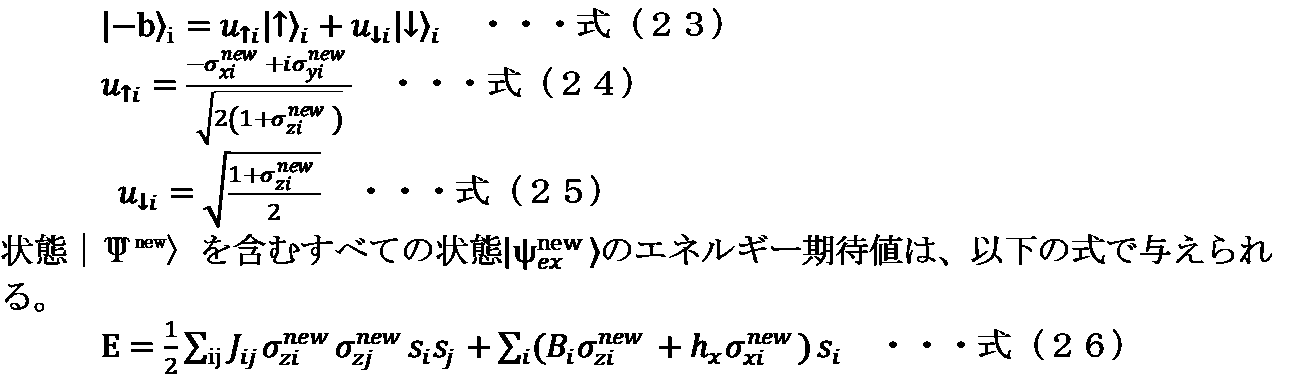
sj={-1,1}の組み合わせによって、最低一つのsj=-1を含む基底以外の残りの2N-1個の状態がすべて記述できる。ここで、励起状態に最低一つは含まれる逆向きのスピン状態|-b〉iは以下のように与えられる。ここで、2つのスピン|±b〉iは正規直交したベクトルである。つまり、
〈b|b〉=〈-b|-b〉=1,〈b|-b〉=〈-b|b〉=0が成立する(簡単のため、iは省略した)。
〈b|b〉=〈-b|-b〉=1,〈b|-b〉=〈-b|b〉=0が成立する(簡単のため、iは省略した)。

S204:熱的緩和シミュレート
以上説明した処理により量子トンネル効果を記述した後、その新しく得られたイジングハミルトニアンに対し、シミュレーテッドアニーリングを適用する。これにより、量子アニーリングのトンネル効果を有する熱的緩和のプロセスをシミュレートすることができる。
以上説明した処理により量子トンネル効果を記述した後、その新しく得られたイジングハミルトニアンに対し、シミュレーテッドアニーリングを適用する。これにより、量子アニーリングのトンネル効果を有する熱的緩和のプロセスをシミュレートすることができる。
S205:熱的緩和による状態更新
量子トンネル効果による非断熱遷移が全く生じなかった場合、新しく得られたイジングハミルトニアンの基底状態は、すべてのiについてsi=1の状態(完全フェロ状態)となり、トンネル効果で記述される状態からの変化が不要であることが分かる。一方、この熱的緩和プロセスで、si=-1を含む状態の方が、すべてsi=1の状態よりもエネルギー期待値が低い状態として得られる場合がある。このような場合は、量子アニーリングの過程でトンネル効果による非断熱的な遷移が生じていることに対応しており、次の量子アニーリングステップ(S202)に移る前に、スピンの状態を以下の式(30)で更新する。
量子トンネル効果による非断熱遷移が全く生じなかった場合、新しく得られたイジングハミルトニアンの基底状態は、すべてのiについてsi=1の状態(完全フェロ状態)となり、トンネル効果で記述される状態からの変化が不要であることが分かる。一方、この熱的緩和プロセスで、si=-1を含む状態の方が、すべてsi=1の状態よりもエネルギー期待値が低い状態として得られる場合がある。このような場合は、量子アニーリングの過程でトンネル効果による非断熱的な遷移が生じていることに対応しており、次の量子アニーリングステップ(S202)に移る前に、スピンの状態を以下の式(30)で更新する。

S207:解の抽出
解の抽出は、量子アニーリングを模した観測による状態生成を行うことによって行われる。この処理は、量子トンネル効果シミュレート(ステップS202)の量子アニーリングステップと、新しいIsingの計算(ステップS203)、熱的緩和シミュレート(ステップS204)、熱的緩和による状態更新(ステップS101)を含む熱的緩和ステップを繰り返して得られた最終的なスピン状態(式31の左辺)と、一様乱数r=[0,1]を用いて求められる。
解の抽出は、量子アニーリングを模した観測による状態生成を行うことによって行われる。この処理は、量子トンネル効果シミュレート(ステップS202)の量子アニーリングステップと、新しいIsingの計算(ステップS203)、熱的緩和シミュレート(ステップS204)、熱的緩和による状態更新(ステップS101)を含む熱的緩和ステップを繰り返して得られた最終的なスピン状態(式31の左辺)と、一様乱数r=[0,1]を用いて求められる。

図6は、本実施形態の量子アニーリングのトンネル効果を取り入れたシミュレーテッドアニーリングの熱的緩和における最適解の探索を概念的に説明する図である。図6の横軸はスピンの状態であり、縦軸はエネルギーを示す。本実施形態は、図5に示したステップS202~S205を繰り返し実行することにより、シミュレーテッドアニーリングの熱的緩和(S204)と量子トンネル効果の適用(S202)が交互に行われる。すなわち、図6は一連の繰り返し処理の一部を示しており、step kで熱的緩和が行われた後、step(k+1)でトンネル効果の適用が行われることを示している。
熱的緩和では、図の曲線で示すエネルギー分布に対して、(スピン)状態の探索が行われる。この探索において、シミュレーテッドアニーリングの熱的緩和で許容される熱励起Δaがポテンシャル障壁のエネルギー値(高さ)Δkより小さい場合、図に示すように「局所解」で示すエネルギーに状態探索が捕らわれる(図の黒丸)。これに対し、本実施形態は、次のstep(k+1)でトンネル効果の適用が行われる。これにより、エネルギーの状態探索は、トンネル効果によってポテンシャル障壁を透過し、他の状態に移ることができる。この処理を繰り返すことにより、状態探索は最適解にたどり着くことができる。
以上説明した本実施形態によれば、量子アニーリングを近似的に表したトンネル効果を取り込んだ、熱的緩和をシミュレートするシミュレーテッドアニーリングを構築し、一般的なコンピュータで実施可能な最適化装置を提供することが可能となる。
コンピュータ 100
CPU 101
メモリ 102
I/O部 103
CPU 101
メモリ 102
I/O部 103
Claims (9)
- 熱的緩和によって最適解を求める最適化装置であって、
エネルギー関数について、量子トンネル効果をシミュレートする量子効果シミュレート部と、
シミュレートした前記トンネル効果を取り入れたエネルギー関数について、熱的緩和をシミュレートする熱緩和シミュレート部と、
前記量子効果シミュレート部による量子トンネル効果のシミュレートと、前記熱緩和シミュレート部による熱的緩和のシミュレートを、交互に実行させる制御部と、
を含む、最適化装置。 - 乱数に基づいてスピン状態の初期状態を作成する初期状態作成部と、
前記初期状態に時間発展行列を作用させ、スピン状態の時間の経過に伴って変化する状態を繰り返し求める量子アニーリング模擬部と、
前記量子アニーリング模擬部によって模擬された状態と、当該状態の励起状態と、を含むエネルギー期待値を生成する熱的緩和導入部と、
前記熱的緩和導入部によって取得されたエネルギー期待値に基づいて、量子アニーリングの過程で非断熱的な遷移が生じているか否か判断する非断熱的遷移判断部と、
前記非断熱的遷移判断部により前記非断熱的な遷移が生じていると判断された場合、スピンの状態を更新するスピン状態更新部と、を含み、
前記量子アニーリング模擬部、前記熱的緩和導入部、前記非断熱的遷移判断部及び前記スピン状態更新部は、連続して動作して一連の処理を実現し、前記一連の処理を所定の時間繰り返した結果から、最適解を求める最適解取得部と、
を含む、最適化装置。 - 前記初期状態作成部は、
の式によって初期状態を作成する、請求項2に記載の最適化装置。
- 前記量子アニーリング模擬部は、前記初期状態作成部から出発し、時間発展行列を前記初期状態の各成分に作用させて模擬的に量子アニーリングを実行する、請求項2に記載の最適化装置。
- 前記時間発展行列は、
である、請求項4に記載の最適化装置。
- 前記熱的緩和導入部は、
の式を使って前記エネルギー期待値を生成する、請求項2に記載の最適化装置。
- 前記非断熱的遷移判断部は、si=-1を含む状態の方が、全てのsi=1の状態よりもエネルギー期待値が低い状態として得られる場合、非断熱的遷移が生じていると判断する、請求項6に記載の最適化装置。
- 前記スピン状態更新部は、
の式を使ってスピン状態を更新する、請求項2に記載の最適化装置。
- 乱数に基づいてスピン状態の初期状態を作成する初期状態作成工程と、
前記初期状態に時間発展行列を作用させ、スピン状態の時間の経過に伴って変化する状態を繰り返し求める量子アニーリング模擬工程と、
前記量子アニーリング模擬工程において模擬された状態と、当該状態の励起状態と、を含むエネルギー期待値を生成する熱的緩和導入工程と、
前記熱的緩和導入工程において取得されたエネルギー期待値に基づいて、量子アニーリングの過程で非断熱的な遷移が生じているか否か判断する非断熱的遷移判断工程と、
前記非断熱的遷移判断工程により前記非断熱的な遷移が生じていると判断された場合、スピンの状態を更新するスピン状態更新工程と、を含み、
前記量子アニーリング模擬工程、前記熱的緩和導入工程、前記非断熱的遷移判断工程及び前記スピン状態更新工程は、連続して一連の処理を実現し、前記一連の処理を所定の時間繰り返した結果から、最適解を求める最適解取得工程と、
を含む、最適化方法。
Priority Applications (2)
| Application Number | Priority Date | Filing Date | Title |
|---|---|---|---|
| JP2025525557A JPWO2024252595A1 (ja) | 2023-06-07 | 2023-06-07 | |
| PCT/JP2023/021249 WO2024252595A1 (ja) | 2023-06-07 | 2023-06-07 | 最適化装置および最適化方法 |
Applications Claiming Priority (1)
| Application Number | Priority Date | Filing Date | Title |
|---|---|---|---|
| PCT/JP2023/021249 WO2024252595A1 (ja) | 2023-06-07 | 2023-06-07 | 最適化装置および最適化方法 |
Publications (1)
| Publication Number | Publication Date |
|---|---|
| WO2024252595A1 true WO2024252595A1 (ja) | 2024-12-12 |
Family
ID=93795628
Family Applications (1)
| Application Number | Title | Priority Date | Filing Date |
|---|---|---|---|
| PCT/JP2023/021249 Ceased WO2024252595A1 (ja) | 2023-06-07 | 2023-06-07 | 最適化装置および最適化方法 |
Country Status (2)
| Country | Link |
|---|---|
| JP (1) | JPWO2024252595A1 (ja) |
| WO (1) | WO2024252595A1 (ja) |
Citations (3)
| Publication number | Priority date | Publication date | Assignee | Title |
|---|---|---|---|---|
| WO2019176647A1 (ja) * | 2018-03-13 | 2019-09-19 | 株式会社デンソー | 連続最適化問題の大域的探索装置及びプログラム |
| JP2022062760A (ja) * | 2020-10-09 | 2022-04-21 | 富士通株式会社 | 最適化装置、最適化プログラム、および最適化方法 |
| US20230019942A1 (en) * | 2021-07-16 | 2023-01-19 | Hewlett Packard Enterprise Development Lp | Quantum-inspired algorithms to solve intractable problems using classical computers |
-
2023
- 2023-06-07 WO PCT/JP2023/021249 patent/WO2024252595A1/ja not_active Ceased
- 2023-06-07 JP JP2025525557A patent/JPWO2024252595A1/ja active Pending
Patent Citations (3)
| Publication number | Priority date | Publication date | Assignee | Title |
|---|---|---|---|---|
| WO2019176647A1 (ja) * | 2018-03-13 | 2019-09-19 | 株式会社デンソー | 連続最適化問題の大域的探索装置及びプログラム |
| JP2022062760A (ja) * | 2020-10-09 | 2022-04-21 | 富士通株式会社 | 最適化装置、最適化プログラム、および最適化方法 |
| US20230019942A1 (en) * | 2021-07-16 | 2023-01-19 | Hewlett Packard Enterprise Development Lp | Quantum-inspired algorithms to solve intractable problems using classical computers |
Non-Patent Citations (2)
| Title |
|---|
| ADITI MISRA-SPIELDENNER; TIM BODE; PETER K. SCHUHMACHER; TOBIAS STOLLENWERK; DMITRY BAGRETS; FRANK K. WILHELM: "Mean-Field Approximate Optimization Algorithm", ARXIV.ORG, CORNELL UNIVERSITY LIBRARY, 201 OLIN LIBRARY CORNELL UNIVERSITY ITHACA, NY 14853, 1 March 2023 (2023-03-01), 201 Olin Library Cornell University Ithaca, NY 14853, XP091455706 * |
| GOTO HAYATO, ENDO KOTARO, SUZUKI MASARU, SAKAI YOSHISATO, KANAO TARO, HAMAKAWA YOHEI, HIDAKA RYO, YAMASAKI MASAYA, TATSUMURA KOSUK: "High-performance combinatorial optimization based on classical mechanics", SCIENCE ADVANCES, vol. 7, no. 6, 3 February 2021 (2021-02-03), XP093057099, DOI: 10.1126/sciadv.abe7953 * |
Also Published As
| Publication number | Publication date |
|---|---|
| JPWO2024252595A1 (ja) | 2024-12-12 |
Similar Documents
| Publication | Publication Date | Title |
|---|---|---|
| US12530613B2 (en) | Systems and methods for performing quantum evolution in quantum computation | |
| US11605015B2 (en) | Hybrid quantum-classical computer system for implementing and optimizing quantum Boltzmann machines | |
| EP4036816B1 (en) | Mitigating errors in algorithms performed using quantum information processors | |
| US20230259673A1 (en) | Quantum computer-implemented solver | |
| US12175329B2 (en) | Apparatus and method for optimization | |
| CN113379058A (zh) | 量子模拟方法及装置、电子设备及存储介质 | |
| EP4495841A1 (en) | Solving computational problems using trainable quantum feature maps | |
| Lloyd et al. | Hamiltonian singular value transformation and inverse block encoding | |
| Brand et al. | Stochastic differential equation approach to understanding the population control bias in full configuration interaction quantum Monte Carlo | |
| Georgopoulos et al. | Quantum computer benchmarking via quantum algorithms | |
| WO2020100698A1 (ja) | シミュレーション装置、コンピュータプログラム及びシミュレーション方法 | |
| Hsu et al. | Quantum annealing with anneal path control: application to 2-SAT problems with known energy landscapes | |
| Puengtambol et al. | Implementation of quantum random walk on a real quantum computer | |
| Dai | A review on the exact Monte Carlo simulation | |
| Apanavicius et al. | Morse potential on a quantum computer for molecules and supersymmetric quantum mechanics | |
| De Prins et al. | How to Incorporate Higher-order Interactions in Analog Ising Machines | |
| Ghazali et al. | An improvement of computing Newton’s direction for finding unconstrained minimizer for large-scale problems with an arrowhead hessian matrix | |
| Patwardhan et al. | Hybrid Quantum-HPC Solutions for Max-Cut: Bridging Classical and Quantum Algorithms | |
| EP4589488B1 (en) | Computer-readable recording medium storing quantum calculation support program, quantum calculation support method, and information processing device | |
| Hancock et al. | Quantum Phase Transition of Non-Hermitian Systems using Variational Quantum Techniques | |
| Viszlai et al. | Training Quantum Boltzmann Machines with Coresets | |
| Isermann | A note on posiform planting | |
| EP4651037A1 (en) | A method and system for simulation of a quantum circuit | |
| Sawerwain et al. | GPGPU based simulations for one and two dimensional quantum walks | |
| Sajja et al. | Evaluating the Suitability of IBM Quantum Hardware for Practical Quantum Search |
Legal Events
| Date | Code | Title | Description |
|---|---|---|---|
| 121 | Ep: the epo has been informed by wipo that ep was designated in this application |
Ref document number: 23940696 Country of ref document: EP Kind code of ref document: A1 |
|
| ENP | Entry into the national phase |
Ref document number: 2025525557 Country of ref document: JP Kind code of ref document: A |
|
| NENP | Non-entry into the national phase |
Ref country code: DE |