WO2024252352A1 - Process and intermediates for preparing ibuzatrelvir - Google Patents
Process and intermediates for preparing ibuzatrelvir Download PDFInfo
- Publication number
- WO2024252352A1 WO2024252352A1 PCT/IB2024/055596 IB2024055596W WO2024252352A1 WO 2024252352 A1 WO2024252352 A1 WO 2024252352A1 IB 2024055596 W IB2024055596 W IB 2024055596W WO 2024252352 A1 WO2024252352 A1 WO 2024252352A1
- Authority
- WO
- WIPO (PCT)
- Prior art keywords
- compound
- trifluoromethyl
- methyl
- pyrrolidine
- oxopyrrolidin
- Prior art date
- Legal status (The legal status is an assumption and is not a legal conclusion. Google has not performed a legal analysis and makes no representation as to the accuracy of the status listed.)
- Ceased
Links
Classifications
-
- C—CHEMISTRY; METALLURGY
- C07—ORGANIC CHEMISTRY
- C07D—HETEROCYCLIC COMPOUNDS
- C07D207/00—Heterocyclic compounds containing five-membered rings not condensed with other rings, with one nitrogen atom as the only ring hetero atom
- C07D207/02—Heterocyclic compounds containing five-membered rings not condensed with other rings, with one nitrogen atom as the only ring hetero atom with only hydrogen or carbon atoms directly attached to the ring nitrogen atom
- C07D207/18—Heterocyclic compounds containing five-membered rings not condensed with other rings, with one nitrogen atom as the only ring hetero atom with only hydrogen or carbon atoms directly attached to the ring nitrogen atom having one double bond between ring members or between a ring member and a non-ring member
- C07D207/22—Heterocyclic compounds containing five-membered rings not condensed with other rings, with one nitrogen atom as the only ring hetero atom with only hydrogen or carbon atoms directly attached to the ring nitrogen atom having one double bond between ring members or between a ring member and a non-ring member with hetero atoms or with carbon atoms having three bonds to hetero atoms with at the most one bond to halogen, e.g. ester or nitrile radicals, directly attached to ring carbon atoms
- C07D207/24—Oxygen or sulfur atoms
-
- A—HUMAN NECESSITIES
- A61—MEDICAL OR VETERINARY SCIENCE; HYGIENE
- A61P—SPECIFIC THERAPEUTIC ACTIVITY OF CHEMICAL COMPOUNDS OR MEDICINAL PREPARATIONS
- A61P31/00—Antiinfectives, i.e. antibiotics, antiseptics, chemotherapeutics
- A61P31/12—Antivirals
- A61P31/14—Antivirals for RNA viruses
-
- C—CHEMISTRY; METALLURGY
- C07—ORGANIC CHEMISTRY
- C07D—HETEROCYCLIC COMPOUNDS
- C07D207/00—Heterocyclic compounds containing five-membered rings not condensed with other rings, with one nitrogen atom as the only ring hetero atom
- C07D207/02—Heterocyclic compounds containing five-membered rings not condensed with other rings, with one nitrogen atom as the only ring hetero atom with only hydrogen or carbon atoms directly attached to the ring nitrogen atom
- C07D207/04—Heterocyclic compounds containing five-membered rings not condensed with other rings, with one nitrogen atom as the only ring hetero atom with only hydrogen or carbon atoms directly attached to the ring nitrogen atom having no double bonds between ring members or between ring members and non-ring members
- C07D207/06—Heterocyclic compounds containing five-membered rings not condensed with other rings, with one nitrogen atom as the only ring hetero atom with only hydrogen or carbon atoms directly attached to the ring nitrogen atom having no double bonds between ring members or between ring members and non-ring members with radicals, containing only hydrogen and carbon atoms, attached to ring carbon atoms
-
- C—CHEMISTRY; METALLURGY
- C07—ORGANIC CHEMISTRY
- C07D—HETEROCYCLIC COMPOUNDS
- C07D403/00—Heterocyclic compounds containing two or more hetero rings, having nitrogen atoms as the only ring hetero atoms, not provided for by group C07D401/00
- C07D403/02—Heterocyclic compounds containing two or more hetero rings, having nitrogen atoms as the only ring hetero atoms, not provided for by group C07D401/00 containing two hetero rings
- C07D403/12—Heterocyclic compounds containing two or more hetero rings, having nitrogen atoms as the only ring hetero atoms, not provided for by group C07D401/00 containing two hetero rings linked by a chain containing hetero atoms as chain links
Definitions
- the present invention is directed to intermediates and an efficient process for preparing Methyl ⁇ (2S)-1 -[(2S,4R)-2-( ⁇ (1 S)-1 -cyano-2-[(3S)-2-oxopyrrolidin-3- yl]ethyl ⁇ carbamoyl)-4-(trifluoromethyl)pyrrolidin-1-yl]-3,3-dimethyl-1-oxobutan-2- yljcarbamate, solvates thereof and intermediates useful in the preparation of those compounds.
- Methyl ⁇ (2S)- 1 -[(2S,4R)-2-( ⁇ (1 S)-1 -cyano-2-[(3S)-2-oxopyrrolidin-3- yl]ethyl ⁇ carbamoyl)-4-(trifluoromethyl)pyrrolidin-1-yl]-3,3-dimethyl-1-oxobutan-2- yljcarbamate (also referred hereafter as “Compound I”) is an antiviral compound with potent inhibitory activity against coronavirus 3CL proteases and is an active ingredient under investigation as a potential therapy for the treatment of SARS-CoV-2 (COVID-19) infections.
- the present invention provides intermediates and synthetic processes for preparing Methyl ⁇ (2S)-1 -[(2S,4R)-2-( ⁇ (1 S)-1 -cyano-2-[(3S)-2-oxopyrrolidin-3- yl]ethyl ⁇ carbamoyl)-4-(trifluoromethyl)pyrrolidin-1-yl]-3,3-dimethyl-1-oxobutan-2- yljcarbamate, solvates thereof and intermediates used in their preparation, which is depicted in Reaction Scheme 1 , and which contains several process modifications compared to previously disclosed processes.
- Compound 6 is a new intermediate that has been prepared by a highly diastereoselective process starting from tert-Butyl (2R,4R)-1- ⁇ (2S)-2-[(methoxycarbonyl) amino]-3,3-dimethylbutanoyl ⁇ -4- (trifluoromethyl)pyrrolidine-2-carboxylate(Compound 4) and proceeding through non-isolated intermediate tert-Butyl (2S,4R)-1- ⁇ (2S)-2- [(methoxycarbonyl)amino]-3,3-dimethylbutanoyl ⁇ -4- (trifluoromethyl) pyrrolidine-2- carboxylate (Compound 5).
- Compound 4 is prepared as described hereinbelow from a coupling reaction of tert-Butyl (2R,4R)-4-(trifluoromethyl)pyrrolidine-2-carboxylate hydrochloride (1 :1) (Compound 3) with commercially available (2S)-2- [(Methoxycarbonyl)amino]-3,3-dimethylbutanoic acid (Compound 2).
- Compound 3 is prepared starting from commercially available Di-tert-butyl (2R)-4-oxopyrrolidine-1 ,2- dicarboxylate (Compound 15) and proceeding through intermediate Compounds 16-18 (Di-tert-butyl (2R)-4-hydroxy-4-(trifluoromethyl)pyrrolidine-1 ,2-dicarboxylate, Di-tert-butyl (2R)-4-(trifluoromethyl)-2,5-dihydro-1 H-pyrrole-1 ,2-dicarboxylate and Di-tert-butyl (2R,4R)-4-(trifluoromethyl)pyrrolidine-1 ,2-dicarboxylate, respectively) as described hereinbelow.
- Compound 6 is then coupled with (2S)-2-Amino-3-[(3S)-2-oxopyrrolidin-3- yl]propanamide hydrochloride (1 :1) (Compound 7) to provide methyl ⁇ (2S)-1-[(2S,4R)-2- ( ⁇ (2S)-1 -amino-1 -oxo-3-[(3S)-2-oxopyrrolidin-3-yl]propan-2- yl ⁇ carbamoyl)-4- (trifluoromethyl)pyrrolidin-1-yl]-3,3-dimethyl-1-oxobutan-2- yljcarbamate (Compound 8).
- Compound 8 is typically not isolated as a solid and a solution of Compound 8 is carried forward and used in the dehydration step.
- Compound 8 is dehydrated to form Compound I which can be isolated as a crystalline solvate such as an ethyl acetate (EtOAc), isopropyl acetate (IPAc) or cyclopentyl methyl ether (CPME) solvate.
- EtOAc ethyl acetate
- IPAc isopropyl acetate
- CPME cyclopentyl methyl ether
- an alternative salt other than the Compound 6 potassium salt such as Compound 6a wherein M + is Na + or Li +
- Compound 6a an alternative salt other than the Compound 6 potassium salt
- the free acid form of Compound 6 which is (2S,4R)-1- ⁇ (2S)- 2-[(methoxycarbonyl)amino]-3,3-dimethylbutanoyl ⁇ -4- (trifluoromethyl)pyrrolidine-2- carboxylic acid
- Compound 6 can be employed in a similar manner.
- the free base form of Compound 7 which is (2S)-2-Amino-3-[(3S)-2-oxopyrrolidin-3- yl]propanamide (Compound 7’) can also be employed in a similar manner.
- the Compound I solvate step conversion of Compound 8 to a Compound I solvate
- Compound I is isolated as a solvate such as Compound I ethyl acetate solvate, Compound I isopropyl acetate solvate or Compound I cyclopentyl methyl ether solvate
- a solvate such as Compound I ethyl acetate solvate, Compound I isopropyl acetate solvate or Compound I cyclopentyl methyl ether solvate
- an active pharmaceutical ingredient (API) and non-active component can be crystallized and/or precipitated in solvent-based processes and combined by various mechanisms such as agglomeration, heteronucleation, surface coating, and dispersion of API.
- API active pharmaceutical ingredient
- non-active component can be crystallized and/or precipitated in solvent-based processes and combined by various mechanisms such as agglomeration, heteronucleation, surface coating, and dispersion of API.
- microcrystalline cellulose-SiO2 MCC-SiC
- MCC-SiC microcrystalline cellulose-SiO2
- other additives such as Di-calcium Phosphate or silicon dioxide (SiC ) provided little or no control over the Compound I Form 1 particle size distribution. Additional solid form characterization data for several starting materials and intermediates used in the process are also provided.
- Reaction Scheme 2 depicts the preparation of Compound 6a starting from Compound 3.
- Reaction Scheme 2 depicts preparation of Compound 6a wherein M + is a monovalent cation such as K + , Na + or Li + .
- M + is a monovalent cation such as K + , Na + or Li + .
- Compound 3 is coupled with Compound 2 under peptide coupling conditions in the presence of a base to provide Compound 4.
- Compound 4 is then treated with a base which results in formation of Compound 5 in situ which then further reacts to provide Compound 6a.
- Figure 1 PXRD Pattern of N-(Methoxycarbonyl)-3-methyl-L-valyl-(4R)-N- ⁇ (1S)-1-cyano- 2-[(3S)-2-oxopyrrolidin-3-yl]ethyl ⁇ -4-(trifluoromethyl)-L-prolinamide, Form 1 .
- Figure 2 PXRD Pattern of N-(Methoxycarbonyl)-3-methyl-L-valyl-(4R)-N- ⁇ (1 S)-1-cyano- 2-[(3S)-2-oxopyrrolidin-3-yl]ethyl ⁇ -4-(trifluoromethyl)-L-prolinamide cyclopentyl methyl ether (CPME) solvate.
- CPME cyclopentyl methyl ether
- Figure 3 PXRD Pattern of N-(Methoxycarbonyl)-3-methyl-L-valyl-(4R)-N- ⁇ (1S)-1-cyano- 2-[(3S)-2-oxopyrrolidin-3-yl]ethyl ⁇ -4-(trifluoromethyl)-L-prolinamide isopropyl acetate (IPAc) solvate.
- Figure 4 PXRD Pattern of N-(Methoxycarbonyl)-3-methyl-L-valyl-(4R)-N- ⁇ (1S)-1-cyano- 2-[(3S)-2-oxopyrrolidin-3-yl]ethyl ⁇ -4-(trifluoromethyl)-L-prolinamide ethyl acetate (EtOAc) solvate.
- Figure 5 PXRD Pattern of N-(Methoxycarbonyl)-3-methyl-L-valyl-(4R)-N- ⁇ (1 S)-1-cyano- 2-[(3S)-2-oxopyrrolidin-3-yl]ethyl ⁇ -4-(trifluoromethyl)-L-prolinamide, Form 1 .
- Figure 6 Particle size and cumulative distribution for Example 3 LOT A (top) and LOT B (bottom).
- Figure 7 Particle size and cumulative distribution for Example 3 LOT C (top) and image of Compound I Form 1 co-processed with microcrystalline cellulose (90/10 w%/w%) (bottom).
- Figure 8 Particle size and cumulative distribution for Example 3 LOT D-Tray 1 (top) and LOT E (bottom).
- Figure 8A PXRD pattern of Compound I Form 1 co-processed with 10 w% microcrystalline cellulose (MCC).
- Figure 8B 13 C solid state NMR spectrum of Compound I Form 1 co-processed with 10 w% MCC.
- Figure 8C 19 F solid state NMR spectrum of Compound I Form 1 co-processed with 10 wt% MCC.
- Figure 9 Images of Compound I Form 1 co-processed with microcrystalline cellulose (90/10 w%/w%) (top and bottom).
- Figure 10 PXRD Pattern of (2S,4R)-4-(Trifluoromethyl)pyrrolidine-2-carboxylic acid, Compound 14 free acid.
- Figure 12 PXRD Pattern of (2S,4R)-4-(Trifluoromethyl)pyrrolidine-2-carboxylic acid hydrochloride (1 :1), Compound 14 HCI Salt - Pattern 2.
- Figure 13 PXRD Pattern of (2S)-2-[(Methoxycarbonyl)amino]-3,3-dimethylbutanoic acid, Compound 2.
- Figure 14 PXRD Pattern of tert-Butyl (2R,4R)-1- ⁇ (2S)-2-[(methoxycarbonyl)amino]-3,3- dimethylbutanoyl ⁇ -4- (trifluoromethyl)pyrrolidine-2-carboxylate, Compound 4.
- Figure 15 PXRD Pattern of (2S,4R)-1- ⁇ (2S)-2-[(methoxycarbonyl)amino]-3,3- dimethylbutanoyl ⁇ -4- (trifluoromethyl)pyrrolidine-2-carboxylic acid, Compound 6’ (free acid form).
- FIG 16 PXRD Pattern of Potassium (2S,4R)-1- ⁇ (2S)-2-[(methoxycarbonyl)amino]- 3,3-dimethylbutanoyl ⁇ -4- (trifluoromethyl)pyrrolidine-2-carboxylate, Compound 6 (potassium salt form).
- Figure 17 PXRD Pattern of (2S)-2-[(Methoxycarbonyl)amino]-3,3-dimethylbutanoic acid, Compound 3 (free form).
- Figure 20 PXRD pattern of Methyl ⁇ (2S)-1-[(2S,4R)-2-( ⁇ (2S)-1-amino-1-oxo-3-[(3S)-2- oxopyrrolidin-3-yl]propan-2- yl ⁇ carbamoyl)-4-(trifluoromethyl)pyrrolidin-1-yl]-3,3- dimethyl-1-oxobutan-2- yljcarbamate tartrate co-crystal
- Figure 21 PXRD pattern of Methyl ⁇ (2S)-1-[(2S,4R)-2-( ⁇ (2S)-1-amino-1-oxo-3-[(3S)-2- oxopyrrolidin-3-yl]propan-2-yl ⁇ carbamoyl)-4-(trifluoromethyl) pyrrolidin-1 -yl]-3,3- dimethyl-1-oxobutan-2- yljcarbamate maleate co-crystal
- Figure 22 PXRD pattern of Methyl ⁇ (2S)-1-[(2S,4R)-2-( ⁇ (2S)-1-amino-1-oxo-3-[(3S)-2- oxopyrrolidin-3-yl]propan-2- yl ⁇ carbamoyl)-4-(trifluoromethyl)pyrrolidin-1-yl]-3,3- dimethyl-1-oxobutan-2- yljcarbamate succinate co-crystal
- Figure 23 PXRD pattern of Methyl ⁇ (2S)-1-[(2S,4R)-2-( ⁇ (2S)-1-amino-1-oxo-3-[(3S)-2- oxopyrrolidin-3-yl]propan-2- yl ⁇ carbamoyl)-4-(trifluoromethyl)pyrrolidin-1-yl]-3,3- dimethyl-1-oxobutan-2- yljcarbamate fumarate co-crystal
- Figure 24 PXRD pattern of amorphous Methyl ⁇ (2S)-1-[(2S,4R)-2-( ⁇ (2S)-1-amino-1- oxo-3-[(3S)-2-oxopyrrolidin-3-yl]propan-2- yl ⁇ carbamoyl)-4-(trifluoromethyl)pyrrolidin-1- y l]-3, 3-di methy 1-1 -oxobut
- the term "about” means within a statistically meaningful range of a value, such as a stated concentration range, time frame, molecular weight, particle size, temperature or pH. As used herein about means within 20%, preferably within 10%, and even more preferably within 5% of the indicated value or range. Sometimes, such a range can be within the experimental error typical of standard methods used for the measurement and/or determination of a given value or range. The allowable variation encompassed by the term “about” will depend upon the particular system under study, and can be readily appreciated by one of ordinary skill in the art. Whenever a range is recited within this application, every whole number integer within the range is also contemplated as an embodiment of the invention.
- solvate refers to a crystal form of a substance which contains solvent.
- Particular solvates of Compound I include the ethyl acetate, isopropyl acetate and cyclopentyl methyl ether solvates of that compound.
- hydrate refers to a solvate wherein the solvent is water.
- seeding means the addition of crystals to a crystallization system, for the purpose of initiating or enhancing nucleation or acting as substrate for further crystallization.
- the terms “API” or “active pharmaceutical ingredient” refer to anhydrous Methyl ⁇ (2S)-1 -[(2S,4R)-2-( ⁇ (1 S)-1 -cyano-2-[(3S)-2-oxopyrrolidin-3- yl]ethyl ⁇ carbamoyl)-4-(trifluoromethyl) pyrrolidine-1 -y l]-3, 3-di methy 1-1 -oxobutan-2- yljcarbamate Form 1 (Compound I Form 1).
- Compound I Form 1 is a non-solvated anhydrous crystalline form.
- Compound I Form 1 Examples of characterizing identifiers for N-(Methoxycarbonyl)-3-methyl-L-valyl-(4R)-N- ⁇ (1 S)-1-cyano-2-[(3S)-2-oxopyrrolidin-3-yl]ethyl ⁇ -4-(trifluoromethyl)-L-prolinamide (Compound I Form 1) are provided below using a single method or a combination of instrument methods.
- Compound I Form 1 is characterized by any one of the following characteristic peaks or combinations of peaks: a 13 C solid state NMR peak at 50.8 ppm ⁇ 0.2 ppm;
- Compound I Form 1 can be characterized by any one of the preceding listed peaks or combinations of peaks.
- peptide coupling agent refers to agents used to couple compounds such as a carboxylic acid or carboxylate with an amine to form an amide bond.
- Peptide coupling agents include but are not limited to those as described in Dunetz, J.R., Magano, J., Weisenburger, G.A. Org. Process Res. Dev. 2016, 20, 140- 177.
- Representative peptide coupling agents used in the instant processes include but are not limited to 2-chloro-1 -methylpyridinium p-toluenesulfonate, a combination of 2- hydroxy pyridine N-oxide and 1-ethyl-3-(3-dimethylaminopropyl)carbodiimide and a combination of 2-hydroxypyridine N-oxide and 1-ethyl-3-(3-dimethylaminopropyl) carbodiimide hydrochloride.
- an agent used to convert a carboxylic acid to an acid chloride such as methanesulfonyl chloride, can be employed as a “peptide coupling agent”.
- the resulting acid chloride reacts with an amine to form an amide bond.
- dehydrating agent refers to agents used to dehydrate a primary amide group to the corresponding nitrile group. Dehydrating agents include but are not limited to those described in Ganesan, M., Nagaraaj, P. Org. Chem. Front. 2020, 7 3792-3814 and Taibi, I. et al ACS Omega 2018, 3, 5078-5082.
- dehydrating agents used in the instant processes include but are not limited to trifluoroacetic anhydride, propane phosphonic acid anhydride, triphenylphosphite, diethyl chlorophosphate, ethyl dichlorophosphate, phosphorus trichloride and tris- (dimethylamino)phosphine.
- base comprising M + refers to an alkali metal alkoxide, alkali metal hydroxide or alkali metal disilazide compound wherein the alkali metal is potassium, sodium or lithium.
- Base comprising M + compounds include but are not limited to sodium tert-butoxide, sodium tert-amylate, potassium methoxide, potassium hydroxide, potassium tert-butoxide, potassium tert-amylate and potassium hexamethyldisilazide.
- the alkali metal is potassium the compound is a “base comprising K+”.
- base as used in certain embodiments herein includes but is not limited to organic amine bases including but not limited to N-methylimidazole, N-methyl morpholine, diethylamine, triethylamine and 1 ,8-diazabicyclo(5.4.0)undec-7-ene.
- primary particles refers to individual API crystals.
- agglomerates refers to tightly bound API crystals that are difficult to disperse into primary particles during processing and particle size analysis.
- the median value is defined as the value where half of the population resides above this point, and half resides below this point.
- the median is called the D[50]
- the D[50] is the size in microns that splits the distribution with half above and half below this diameter.
- the expression Dv50 or D[v,0.5] is sometimes used for the median of a volume distribution.
- D[90] means that 90% of the total particles are smaller than that size.
- D[50] means that 50% of the total particles are smaller than that size.
- D[10] means that 10% of the total particles are smaller than that size.
- D[4, 3] means the mean particle diameter over volume (the DeBroukere mean).
- the volume moment mean is relevant for many samples as it reflects the size of those particles which constitute the bulk of the sample volume. It is most sensitive to the presence of large particulates in the size distribution.
- Aspect Ratio 50 or AR50 means the volume at which of 50% of the particles are larger than and 50% of the particles are smaller than.
- Bulk density is the ratio of the mass per unit volume of a loose powder, typically expressed in g/mL or g/cm 3 .
- Tapped density is the ratio of the mass per unit volume of a powder after it has been tapped for a period of time, typically expressed in g/mL or g/cm 3 .
- the bulk density and tapped density can be determined using methods such as those described in US Pharmacopeia ⁇ 616> BULK DENSITY (USP 1 - May-2024) OF POWDERS.
- Compound I Form 1 has a D[90] value of less than 200 pM, a D[50] value of less than 80 pM and a D[10] value of less than 20 pM. In some such embodiments, the Compound I Form 1 has a D[10] value of from about 10 pm to about 15 pm. In other such embodiments, the Compound I Form 1 has a D[90] value of from about 160 pm to about 190 pm. In other such embodiments, the Compound I Form 1 has a D[50] value of from about 50 pm to about 70 pm. In other embodiments the Compound I Form 1 has a D[4,3] value of from about 80 pm to about 90 pm.
- the Compound I Form 1 has a D[10] value of from about 5 pm to about 20 pm and a D[90] value of from about 150 pm to about 200 pm. In further embodiments, the Compound I Form 1 has a D[10] value of from about 5 m to about 20 pm, a D[90] value of from about 150 pm to about 200 pm, and a D[50] value of from about 40 pm to about 80 pm.
- the invention provides Compound I, Form 1 having a primary particle size distribution having at least one of:
- Each of the foregoing values of embodiments for D[10] can be combined with any value for D[50] and/or D[90] value not inconsistent with it.
- Each of the foregoing values of embodiments for D[50] can be combined with any value for D[10] and/or D[90] value not inconsistent with it.
- Each of the foregoing values of embodiments for D[90] can be combined with any value for D[10] and/or D[50] value not inconsistent with it.
- E1 to E73 are representative embodiments of the present invention which should be construed in a non-limiting manner.
- E1 is a process for preparing a (2S,4R)-1- ⁇ (2S)-2-[(methoxycarbonyl)amino]-3,3- dimethylbutanoyl ⁇ -4- (trifluoromethyl)pyrrolidine-2-carboxylate M + salt
- Compound 6a of formula: comprising the steps of a) combining tert-butyl (2R,4R)-1- ⁇ (2S)-2-[(methoxycarbonyl)amino]-3,3- dimethylbutanoyl ⁇ -4-(trifluoromethyl)pyrrolidine-2-carboxylate (Compound 4) a solvent and water; and b) adding a base comprising M + to the mixture from step a) to generate intermediate tert-Butyl (2S,4R)-1- ⁇ (2S)-2-[(methoxycarbonyl)amino]-3,3-dimethylbutanoyl ⁇ -4- (trifluoromethyl)pyrrolidine-2-carbox
- E2 is the process of E1 wherein the base comprising M + is selected from sodium tert- butoxide, sodium tert-amylate, potassium methoxide, potassium hydroxide, potassium tert-butoxide, potassium tert-amylate and potassium hexamethyldisilazide.
- E3 is the process of E1 or E2 wherein the base comprising M + is potassium tert- butoxide or potassium tert-amylate.
- E4 is the process of any one of E1 to E3 wherein the base comprising M + is potassium tert-butoxide.
- E5 is the process of any one of E1 to E4 wherein the solvent is selected from the group consisting of methyl tert-butyl ether, tetrahydrofuran, isopropyl alcohol, tert-amyl alcohol, acetonitrile, tert-butanol and 2-methyl tetrahydrofuran.
- the solvent is selected from the group consisting of methyl tert-butyl ether, tetrahydrofuran, isopropyl alcohol, tert-amyl alcohol, acetonitrile, tert-butanol and 2-methyl tetrahydrofuran.
- E6 is the process of E1 for preparing potassium (2S,4R)-1- ⁇ (2S)-2- [(methoxycarbonyl)amino]-3,3-dimethylbutanoyl ⁇ -4-(trifluoromethyl)pyrrolidine-2- carboxylate, Compound 6
- E7 is the process of E6 wherein the base comprising K + is selected from the group consisting of potassium tert-butoxide, potassium tert-amylate, potassium methoxide, potassium hydroxide and potassium hexamethyldisilazide.
- E8 is the process of E6 or E7 wherein the base comprising K + is potassium tert- butoxide.
- E9 is the process of any one of E6 to E8 wherein the solvent is selected from the group consisting of methyl tert-butyl ether, tetrahydrofuran, isopropyl alcohol, tert-amyl alcohol, acetonitrile, tert-butanol and 2-methyl tetrahydrofuran.
- the solvent is selected from the group consisting of methyl tert-butyl ether, tetrahydrofuran, isopropyl alcohol, tert-amyl alcohol, acetonitrile, tert-butanol and 2-methyl tetrahydrofuran.
- E10 is the process of any one of E6 to E9 wherein in step a) 1 .0 equivalent of tert-Butyl (2R,4R)-1- ⁇ (2S)-2-[(methoxycarbonyl)amino]-3,3-dimethylbutanoyl ⁇ -4-(trifluoromethyl) pyrrolidine-2-carboxylate, Compound 4 is combined with 1 to 10 volumes of a solvent and 1.2 equivalents of water and in step b) 1.2 equivalents of potassium tert-butoxide is added.
- E11 is the process of any one of E6 to E10 wherein in step a) 1 .0 equivalent of tert- Butyl (2R,4R)-1- ⁇ (2S)-2-[(methoxycarbonyl)amino]-3,3-dimethylbutanoyl ⁇ -4- (trifluoromethyl)pyrrolidine-2-carboxylate, Compound 4 is combined with 2.5 volumes of the solvent methyl tert-butyl ether (MTBE) and 1 .2 equivalents of water at ambient temperature and in step b) 1.2 equivalents of potassium tert-butoxide (20 weight % in THF) is added at ambient temperature.
- MTBE solvent methyl tert-butyl ether
- E12 is the process of E11 further comprising step c) stirring the reaction mixture obtained from step b) at ambient temperature for a period of at least 12 hours.
- E13 is the process of E12 further comprising step d) addition of 0.5 volumes of methanol with stirring after step c) to provide a reaction mixture slurry.
- E14 is the process of E13 further comprising step e) filtering the reaction mixture slurry obtained from step d) to isolate a solid comprising potassium (2S,4R)-1- ⁇ (2S)-2- [(methoxycarbonyl)amino]-3,3-dimethylbutanoyl ⁇ -4-(trifluoromethyl)pyrrolidine-2- carboxylate, Compound 6.
- E15 is the process of E14 further comprising step f) washing the solid comprising potassium (2S,4R)-1- ⁇ (2S)-2-[(methoxycarbonyl)amino]-3,3-dimethylbutanoyl ⁇ -4- (trifluoromethyl)pyrrolidine-2-carboxylate, Compound 6 obtained from step e) with a mixture of MTBE (1.7 volumes) and methanol (0.3 volumes).
- E16 is the process of E15 further comprising step g) drying the solid obtained in step f) comprising potassium (2S,4R)-1 - ⁇ (2S)-2-[(methoxycarbonyl)amino]-3,3- dimethylbutanoyl ⁇ -4-(trifluoromethyl) pyrrolidine-2-carboxylate, Compound 6.
- E17 is the process of any one of E14 to E16 wherein the isolated solid comprises greater than or equal to 90% by weight of crystalline potassium (2S,4R)-1- ⁇ (2S)-2- [(methoxycarbonyl) amino]-3,3-dimethylbutanoyl ⁇ -4-(trifluoromethyl)pyrrolidine-2- carboxylate, Compound 6.
- E18 is the process of E17 wherein the isolated solid comprises less than 10% by weight of potassium (2R,4R)-1- ⁇ (2S)-2-[(methoxycarbonyl)amino]-3,3-dimethyl butanoyl ⁇ -4- (trifluoromethyl)pyrrolidine-2-carboxylate.
- E19 is the process of E17 wherein the isolated solid comprises greater than or equal to 95% by weight of crystalline potassium (2S,4R)-1- ⁇ (2S)-2-[(methoxycarbonyl)amino]- 3,3-dimethylbutanoyl ⁇ -4-(trifluoromethyl)pyrrolidine-2-carboxylate, Compound 6.
- E20 is the process of E19 wherein the isolated solid comprises less than 5% by weight of potassium (2R,4R)-1- ⁇ (2S)-2-[(methoxycarbonyl)amino]-3,3-dimethyl butanoyl ⁇ -4- (trifluoromethyl)pyrrolidine-2-carboxylate.
- E21 is the process of E19 wherein the isolated solid comprises greater than or equal to 98% by weight of crystalline potassium (2S,4R)-1- ⁇ (2S)-2-[(methoxycarbonyl)amino]- 3,3-dimethylbutanoyl ⁇ -4-(trifluoromethyl)pyrrolidine-2-carboxylate, Compound 6.
- E22 is the process of E19 wherein the isolated solid comprises less than 2% by weight of potassium (2R,4R)-1- ⁇ (2S)-2-[(methoxycarbonyl)amino]-3,3-dimethyl butanoyl ⁇ -4- (trifluoromethyl)pyrrolidine-2-carboxylate.
- E23 is a process for preparing a solvate of Methyl ⁇ (2S)-1-[(2S,4R)-2-( ⁇ (1 S)-1-cyano-2- [(3S)-2-oxopyrrolidin-3-yl]ethyl ⁇ carbamoyl)- 4-(trifluoromethyl)pyrrolidine-1 -yl]-3,3- dimethyl-1-oxobutan-2-yl ⁇ carbamate (Compound I) solvate comprising the steps of h) reacting (2S,4R)-1 - ⁇ (2S)-2-[(methoxycarbonyl)amino]-3,3-dimethylbutanoyl ⁇ -4- (trifluoromethyl)pyrrolidine-2-carboxylic acid, Compound 6’, or a pharmaceutically acceptable salt thereof with (2S)-2-Amino-3-[(3S)-2-oxopyrrolidin-3-yl]propanamide, Compound 7’, or a
- E24 is the process of E23 wherein in step h) the peptide coupling reagent is selected from 2-chloro-1 -methylpyridinium p-toluenesulfonate, a combination of 2-hydroxy pyridine N-oxide and 1-ethyl-3-(3-dimethylaminopropyl)carbodiimide and a combination of 2-hydroxypyridine N-oxide and 1-ethyl-3-(3-dimethylaminopropyl) carbodiimide hydrochloride and the base is triethylamine, N-methyl morpholine or N,N- diisopropylethylamine.
- the peptide coupling reagent is selected from 2-chloro-1 -methylpyridinium p-toluenesulfonate, a combination of 2-hydroxy pyridine N-oxide and 1-ethyl-3-(3-dimethylaminopropyl)carbodiimide and a combination of 2-
- E24’ is the process of E23 or E24 wherein Compound 6 is prepared according to any one of E1 to E22.
- E25 is the process of E23 or E24 wherein the solvent in step h) is methyl ethyl ketone or isopropyl acetate.
- E26 is the process of E25 wherein in step i) the dehydrating agent is selected from trifluoroacetic anhydride, propane phosphonic acid anhydride, triphenylphosphite, diethyl chlorophosphate, ethyl dichlorophosphate, phosphorus trichloride and tris- (dimethylamino)phosphine in the presence of a base selected from N-methylimidazole, N-methyl morpholine, diethylamine, triethylamine and 1 ,8-Diazabicyclo(5.4.0)undec-7- ene.
- the dehydrating agent is selected from trifluoroacetic anhydride, propane phosphonic acid anhydride, triphenylphosphite, diethyl chlorophosphate, ethyl dichlorophosphate, phosphorus trichloride and tris- (dimethylamino)phosphine in the presence of a base selected from N-methylimid
- E27 is the process of E26 wherein in step i) the dehydrating agent is trifluoroacetic anhydride or propane phosphonic acid anhydride.
- E28 is the process of any one of E23 to E27 wherein isopropyl acetate is used as the solvent in steps h) and i) and the reaction mixture from step i) is concentrated and to it is added heptane to provide methyl ⁇ (2S)-1-[(2S,4R)-2-( ⁇ (1 S)-1-cyano-2-[(3S)-2- oxopyrrolidin-3-yl]ethyl ⁇ carbamoyl)-4-(trifluoromethyl)pyrrolidine-1-yl]-3,3-dimethyl-1- oxobutan-2-yl ⁇ carbamate isopropyl acetate solvate, Compound I IPAc solvate.
- E29 is the process of any one of E23 to E27 wherein in step h) the solvent is methyl ethyl ketone, the peptide coupling agent is a combination of 2-hydroxypyridine N-oxide and 1-ethyl-3-(3-dimethylaminopropyl)carbodiimide and the base is triethylamine.
- E30 is the process of E29 wherein after the coupling reaction is complete the reaction mixture from step h) the solvent is exchanged to isopropyl acetate by addition of isopropyl acetate and distillation and in step i) the dehydrating agent is trifluoroacetic anhydride and the base is N-methyl morpholine.
- E31 is the process of E30 wherein the reaction mixture from step i) is quenched with aqueous ammonium hydroxide, the layers are separated and the isopropyl acetate layer is solvent exchanged into cyclopentyl methyl ether by addition of cyclopentyl methyl ether and distillation.
- E32 is the process of E31 wherein the cyclopentyl methyl ether mixture from step i) is cooled to 10 °C and stirred at 10 °C for one hour or longer and methyl ⁇ (2S)-1-[(2S,4R)- 2-( ⁇ (1 S)-1-cyano-2-[(3S)-2-oxopyrrolidin-3-yl]ethyl ⁇ carbamoyl)-4-
- E33 is a process for preparing methyl ⁇ (2S)-1-[(2S,4R)-2-( ⁇ (1 S)-1-cyano-2-[(3S)-2- oxopyrrolidin-3-yl]ethyl ⁇ carbamoyl)-4-(trifluoromethyl) pyrrolidine-1 -yl]-3, 3-di methy 1-1 - oxobutan-2-yl ⁇ carbamate, Compound I Form 1 polymorph comprising the step of combining the ethyl acetate solvate, isopropyl acetate solvate or methoxycyclopentane solvate of methyl ⁇ (2S)-1-[(2S,4R)-2-( ⁇ (1 S)-1-cyano-2-[(3S)-2-oxopyrrolidin-3- yl]ethyl ⁇ carbamoyl)-4-(trifluoromethyl) pyrrolidine-1 -yl]-3
- E33’ is the process of E33 wherein the ethyl acetate solvate, isopropyl acetate solvate or methoxycyclopentane solvate of methyl ⁇ (2S)-1-[(2S,4R)-2-( ⁇ (1 S)-1-cyano-2-[(3S)-2- oxopyrrolidin-3-yl]ethyl ⁇ carbamoyl)-4-(trifluoromethyl) pyrrolidine-1 -yl]-3, 3-di methy 1-1 - oxobutan-2-yl ⁇ carbamate are prepared according to the process of E23 to E32.
- E34 is the process of E33 wherein the mixture is stirred at 60 °C to 80 °C for a period of 6 hours to 24 hours.
- E35 is the process of E34 wherein the mixture is stirred at about 70 °C for 6 hours to 12 hours then the mixture is cooled to 20 °C over 4 hours and held at 20 °C for 2 hours then the methyl ⁇ (2S)-1-[(2S,4R)-2-( ⁇ (1 S)-1-cyano-2-[(3S)-2-oxopyrrolidin-3- y l]ethy IJcarbamoy l)-4-(trifl uoromethy I) pyrrolidine-1 -y l]-3, 3-di methy 1-1 -oxobutan-2- yljcarbamate, Compound I Form 1 is isolated.
- E36 is a process for preparing methyl ⁇ (2S)-1-[(2S,4R)-2-( ⁇ (1 S)-1-cyano-2-[(3S)-2- oxopyrrolidin-3-yl]ethyl ⁇ carbamoyl)-4-(trifluoromethyl)pyrrolidine-1-yl]-3,3-dimethyl-1- oxobutan-2-yl ⁇ carbamate ethyl acetate solvate (Compound I, ethyl acetate solvate)
- EtOAc solvate comprising the steps of h’) reacting potassium (2S,4R)-1 - ⁇ (2S)-2-[(methoxycarbonyl)amino]-3,3- dimethylbutanoyl ⁇ -4- (trifluoromethyl)pyrrolidine-2-carboxylate, Compound 6 with (2S)-2-amino-3-[(3S)-2-oxopyrrolidin-3-yl]propanamide hydrochloride (1 :1), Compound 7 in the presence of 2-chloro-1 -methylpyridinium p-toluenesulfonate and a base to provide methyl ⁇ (2S)-1-[(2S,4R)-2-( ⁇ (2S)-1-amino-1-oxo-3-[(3S)-2-oxopyrrolidin-3- yl]propan-2- yl ⁇ carbamoyl)-4-(trifluoromethyl)pyrrolidin-1 -yl]-3
- E37 is the process of E36 wherein step h’) is carried out in methyl ethyl ketone and water.
- E38 is the process of E37 wherein 1.0 equivalent of potassium (2S,4R)-1- ⁇ (2S)-2- [(methoxycarbonyl)amino]-3,3-dimethylbutanoyl ⁇ -4-(trifluoromethyl)pyrrolidine-2- carboxylate, Compound 6 is reacted with 1.15 equivalents of (2S)-2-Amino-3-[(3S)-2- oxopyrrolidin-3-yl]propanamide hydrochloride (1 :1), Compound 7 in the presence of 1.2 equivalents of 2-chloro-1 -methylpyridinium p-toluenesulfonate and the base is 3.0 equivalents of N-methyl morpholine.
- E39 is the process of E38 where the reaction mixture in step h’) is stirred for 4 hours at 20 °C.
- E40 is the process of E39 wherein the crude reaction mixture from step h’) is solvent exchanged into ethyl acetate by vacuum distillation until the water content is less than 0.2% by weight to provide a slurry of Methyl ⁇ (2S)-1-[(2S,4R)-2-( ⁇ (2S)-1-amino-1-oxo-3- [(3S)-2-oxopyrrolidin-3-yl]propan-2- yl ⁇ carbamoyl)-4-(trifluoromethyl)pyrrolidin-1-yl]-3,3- dimethyl-1-oxobutan-2- yljcarbamate, Compound 8 in ethyl acetate.
- E41 is the process of E40 wherein in step i’) the slurry of Methyl ⁇ (2S)-1-[(2S,4R)-2-
- E42 is the process of E41 further comprising step j) quenching the reaction mixture from step i’) with an aqueous mixture of citric acid monohydrate and sodium chloride and the resulting layers are separated and the aqueous layer is back extracted with ethyl acetate.
- E43 is the process of E42 wherein the combined organic ethyl acetate layers are concentrated in vacuo to approximately half the original volume, heptane is added then the methyl ⁇ (2S)-1 -[(2S ,4R)-2-( ⁇ ( 1 S)-1 -cyano-2-[(3S)-2-oxopyrrolidin-3- yl]ethyl ⁇ carbamoyl)- 4-(trifluoromethyl)pyrrolidine-1 -y l]-3, 3-di methy 1-1 -oxobutan-2 - yljcarbamate ethyl acetate solvate is isolated by filtration.
- E44 is the process of E43 further comprising the step of combining the methyl ⁇ (2S)-1 - [(2S,4R)-2-( ⁇ (1 S)-1 -cyano-2-[(3S)-2-oxopyrrolidin-3-yl]ethyl ⁇ carbamoyl)- 4- (trifluoromethyl) pyrrolidine-1 -yl]-3,3-dimethyl-1 -oxobutan-2 -yljcarbamate ethyl acetate solvate with heptane and the mixture is stirred at 60 °C to 80 °C for a period of 6 hours to 24 hours to provide methyl ⁇ (2S)-1-[(2S,4R)-2-( ⁇ (1 S)-1-cyano-2-[(3S)-2-oxopyrrolidin- 3-yl]ethyl ⁇ carbamoyl)- 4-(trifluoromethyl)pyrrolidine-1 -y l]-3,
- E45 is the process of E44 wherein the mixture is stirred at about 70 °C for 6 hours to 12 hours then the mixture is cooled to 20 °C over 4 hours and held at 20 °C for 2 hours then the methyl ⁇ (2S)-1-[(2S,4R)-2-( ⁇ (1 S)-1-cyano-2-[(3S)-2-oxopyrrolidin-3- yl]ethyl ⁇ carbamoyl)-4-(trifluoromethyl) pyrrolidine-1 -yl]-3, 3-di methy 1-1 -oxobutan-2 - yljcarbamate, Compound I Form 1 is isolated.
- E46 is a process for preparing a mixture of methyl ⁇ (2S)-1-[(2S,4R)-2-( ⁇ (1 S)-1-cyano-2- [(3S)-2-oxopyrrolidin-3-yl]ethyl ⁇ carbamoyl)-4-(trifluoromethyl)pyrrolidine-1-yl]-3,3- dimethyl-1-oxobutan-2-yl ⁇ carbamate Form 1 and microcrystalline cellulose (MCC) or microcrystalline cellulose-SiO2 (MCC-SiC ), the process comprising the steps (k) to (q): (k) dissolving methyl ⁇ (2S)-1-[(2S,4R)-2-( ⁇ (1 S)-1-cyano-2-[(3S)-2-oxopyrrolidin-3- yl]ethyl ⁇ carbamoyl)-4-(trifluoromethyl)pyrrolidine-1-yl]-3,3-dimethyl-1-
- step (l) seeding the solution obtained in step (k) with about 10 weight % to about 50 weight % of microcrystalline cellulose or microcrystalline cellulose-SiO2 wherein the weight % is the % weight of the microcrystalline cellulose or microcrystalline cellulose-SiO2 to the combined weight of the microcrystalline cellulose or microcrystalline cellulose-SiO2 and Compound I Form 1 ;
- step (n) removing and replacing the ethyl acetate present in the mixture from step (m) with heptane by a constant volume distillation until the level of ethyl acetate is below 4 weight % of total solvent composition to obtain a slurry;
- step (o) the slurry from step (n) is stirred at 70 °C or more for at least 6 hours and is then cooled to ambient temperature;
- E46’ is the process of E46 wherein the methyl ⁇ (2S)-1-[(2S,4R)-2-( ⁇ (1 S)-1-cyano-2-[(3S)- 2-oxopyrrolidin-3-yl]ethyl ⁇ carbamoyl)-4-(trifluoromethyl)pyrrolidine-1-yl]-3,3-dimethyl-1- oxobutan-2-yl ⁇ carbamate Form 1 is prepared according to any one of E33 to E35 or E44 to E45.
- E47 is the process of E46 wherein:
- Form 1 is dissolved in ethyl acetate (6L/Kg of Form 1) and heptane (2 L/kg of Form 1) at 60 °C; (l) the solution is cooled to 45 °C and seeded with 10 weight % of microcrystalline cellulose;
- step (m) heptane is added to the mixture from step (I) over a period of 4 hours wherein the amount of heptane added is about 7 L heptane/Kg of Form 1 and cooling the mixture to 20 °C in not less than 3 hours;
- step (n) the ethyl acetate in the mixture from step (c) is removed and replaced with heptane, by constant volume distillation (15 L solvent/ Kg of Form 1) until the level of ethyl acetate is below 4 weight % of total solvent composition to obtain a slurry;
- step (o) the slurry from step (n) is stirred at 80 °C for at least 6 hours and then cooled to 20 °C over 5 hours;
- step (q) drying the solid mixture from step (p) at 80 °C for at least 12 hours.
- E48 is the process of E46 or E47 wherein the solid mixture obtained from step (g) comprises methyl ⁇ (2 S)-1 -[(2S,4R)-2-( ⁇ (1 S)-1 -cyano-2-[(3S)-2-oxopyrrolidin-3- yl]ethyl ⁇ carbamoyl)-4-(trifluoromethyl)pyrrolidine-1-yl]-3,3-dimethyl-1-oxobutan-2- yljcarbamate Form 1 with a D[90] value of less than 200 pM, a D[50] value of less than 80 pM and a D[10] value of less than 20 pM.
- E49 is the process of E48 wherein the Methyl ⁇ (2S)-1-[(2S,4R)-2-( ⁇ (1 S)-1 -cyano-2-[(3S)- 2-oxopyrrolidin-3-yl]ethyl ⁇ carbamoyl)-4-(trifluoromethyl)pyrrolidine-1-yl]-3,3-dimethyl-1- oxobutan-2-yl ⁇ carbamate Form 1 has a D[90] value of about 160 pM to about 190 pM.
- E50 is the process of E48 or E49 wherein the methyl ⁇ (2S)-1-[(2S,4R)-2-( ⁇ (1 S)-1-cyano- 2-[(3S)-2-oxopyrrolidin-3-yl]ethyl ⁇ carbamoyl)-4-(trifluoromethyl)pyrrolidine-1-yl]-3,3- dimethyl-1-oxobutan-2-yl ⁇ carbamate Form 1 has a D[50] value of about 50 pM to about 70 pM.
- E51 is the process of any one of E48 to E50 wherein the methyl ⁇ (2S)-1 -[(2S,4R)-2-( ⁇ (1 S)- 1-cyano-2-[(3S)-2-oxopyrrolidin-3-yl]ethyl ⁇ carbamoyl)-4-(trifluoromethyl)pyrrolidine-1-yl]-
- 3,3-dimethyl-1-oxobutan-2-yl ⁇ carbamate Form 1 has a particle size distribution D[10] of about 10 pM to about 15 pM.
- E52 is the process of any one of E48 to E51 wherein the methyl ⁇ (2S)-1 -[(2S,4R)-2-( ⁇ (1 S)- 1-cyano-2-[(3S)-2-oxopyrrolidin-3-yl]ethyl ⁇ carbamoyl)-4-(trifluoromethyl)pyrrolidine-1-yl]-
- 3,3-dimethyl-1-oxobutan-2-yl ⁇ carbamate Form 1 has a D[4,3] value of about 80 pM to about 90 pM.
- E53 is the process of any one of E48 to E52 wherein the methyl ⁇ (2S)-1 -[(2S,4R)-2-( ⁇ (1 S)- 1 -cyano-2-[(3S)-2-oxopyrrolidin-3-yl]ethyl ⁇ carbamoyl)-4-(trifluoromethyl) pyrrolidine-1 -y I]-
- 3,3-dimethyl-1-oxobutan-2-yl ⁇ carbamate Form 1 has an aspect ratio (AR50) of 0.6 to 0.7, a bulk density of 0.35 g/cm 3 to 0.40 g/cm 3 and a tapped density of 0.45 g/cm 3 to 0.55 g/cm 3 .
- E54 is a composition comprising methyl ⁇ (2S)-1-[(2S,4R)-2-( ⁇ (1 S)-1-cyano-2-[(3S)-2- oxopyrrolidin-3-yl]ethyl ⁇ carbamoyl)-4-(trifluoromethyl)pyrrolidine-1-yl]-3,3-dimethyl-1- oxobutan-2-yl ⁇ carbamate Form 1 and microcrystalline cellulose wherein the methyl ⁇ (2S)- 1 -[(2S,4R)-2-( ⁇ (1 S)-1 -cyano-2-[(3S)-2-oxopyrrolidin-3-yl]ethyl ⁇ carbamoyl)-4- (trifluoromethyl)pyrrolidine-1-yl]-3,3-dimethyl-1-oxobutan-2-yl ⁇ carbamate Form 1 has a D[90] value of less than 200 pM, a D[50] value of less
- E55 is the composition of E54 which is 90 weight % methyl ⁇ (2S)-1-[(2S,4R)-2-( ⁇ (1 S)-1- cyano-2-[(3S)-2-oxopyrrolidin-3-yl]ethyl ⁇ carbamoyl)-4-(trifluoromethyl)pyrrolidine-1-yl]-
- E56 is the composition of claim E54 or E55 wherein the methyl ⁇ (2 S)-1 -[(2S,4R)-2-( ⁇ (1 S)- 1-cyano-2-[(3S)-2-oxopyrrolidin-3-yl]ethyl ⁇ carbamoyl)-4-(trifluoromethyl)pyrrolidine-1-yl]-
- E57 is the composition of any one of E54 to E56 wherein the methyl ⁇ (2S)-1-[(2S,4R)-2- ( ⁇ (1 S)-1-cyano-2-[(3S)-2-oxopyrrolidin-3-yl]ethyl ⁇ carbamoyl)-4-(trifluoromethyl) pyrrolidine-1 -yl]-3,3-dimethyl-1-oxobutan-2-yl ⁇ carbamate Form 1 has a D[50] value of about 50 pM to about 70 pM.
- E58 is the composition of any one of E54 to E57 wherein the methyl ⁇ (2S)-1-[(2S,4R)-2- ( ⁇ (1 S)-1-cyano-2-[(3S)-2-oxopyrrolidin-3-yl]ethyl ⁇ carbamoyl)-4-(trifluoromethyl) pyrrolidine-1 -yl]-3,3-dimethyl-1-oxobutan-2-yl ⁇ carbamate Form 1 has a D[10] value of about 10 pM to about 15 pM.
- E59 is the composition of any one of E54 to E58 wherein the methyl ⁇ (2S)-1-[(2S,4R)-2- ( ⁇ (1 S)-1-cyano-2-[(3S)-2-oxopyrrolidin-3-yl]ethyl ⁇ carbamoyl)-4-(trifluoromethyl) pyrrolidine-1 -yl]-3,3-dimethyl-1-oxobutan-2-yl ⁇ carbamate Form 1 has a D[4,3] value of about 80 pM to about 90 pM.
- E60 is the composition of any one of E54 to E59 wherein the Methyl ⁇ (2S)-1-[(2S,4R)-2- ( ⁇ (1 S)-1-cyano-2-[(3S)-2-oxopyrrolidin-3-yl]ethyl ⁇ carbamoyl)-4-(trifluoromethyl) pyrrolidine-1 -yl]-3,3-dimethyl-1-oxobutan-2-yl ⁇ carbamate
- Form 1 has an aspect ratio (AR50) of 0.6 to 0.7, a bulk density of 0.35 g/cm 3 to 0.40 g/cm 3 and a tapped density of 0.45 g/cm 3 to 0.55 g/cm 3 .
- E61 is the compound (2S,4R)-1- ⁇ (2S)-2-[(methoxycarbonyl)amino]-3,3- dimethylbutanoyl ⁇ -4- (trifluoromethyl)pyrrolidine-2-carboxylic acid; or a salt thereof.
- E62 is the compound of E61 wherein the salt is selected from lithium, sodium and potassium.
- E63 is the compound of E62 which is potassium (2S,4R)-1- ⁇ (2S)-2-[(methoxycarbonyl) amino]-3,3-dimethylbutanoyl ⁇ -4- (trifluoromethyl)pyrrolidine-2-carboxylate.
- E64 is a composition comprising 90 wt% methyl ⁇ (2S)-1-[(2S,4R)-2-( ⁇ (1 S)-1-cyano-2- [(3S)-2-oxopyrrolidin-3-yl]ethyl ⁇ carbamoyl)-4-(trifluoromethyl)pyrrolidine-1-yl]-3,3- dimethyl-1-oxobutan-2-yl ⁇ carbamate Form 1 and 10 wt% microcrystalline cellulose wherein the methyl ⁇ (2S)-1 -[(2S,4R)-2-( ⁇ (1 S)-1-cyano-2-[(3S)-2-oxopyrrolidin-3- yl]ethyl ⁇ carbamoyl)-4-(trifluoromethyl)pyrrolidine-1 -yl]-3,3-dimethyl-1 -oxobutan-2- yljcarbamate Form 1 has a D[90] value of 95 pM to 240
- E65 is the composition of E64 wherein the methyl ⁇ (2S)-1-[(2S,4R)-2-( ⁇ (1 S)-1-cyano-2- [(3S)-2-oxopyrrolidin-3-yl]ethyl ⁇ carbamoyl)-4-(trifluoromethyl)pyrrolidine-1-yl]-3,3- dimethyl-1 -oxobutan-2 -yljcarbamate Form 1 has a D[50] value of 30 pM to 85 pM.
- E66 is the composition of E64 or E65 wherein the particle size distribution of the methyl ⁇ (2S)-1 -[(2S,4R)-2-( ⁇ (1 S)-1 -cyano-2-[(3S)-2-oxopyrrolidin-3-yl]ethyl ⁇ carbamoyl)-4- (trifluoromethyl)pyrrolidine-l -yl]-3,3-dimethyl-1 -oxobutan-2 -yljcarbamate Form 1 is monomodal.
- E67 is a co-crystal comprising Methyl ⁇ (2S)-1-[(2S,4R)-2-( ⁇ (2S)-1-amino-1-oxo-3-[(3S)-2- oxopyrrolidin-3-yl]propan-2- yl ⁇ carbamoyl)-4-(trifluoromethyl)pyrrolidin-1-yl]-3,3-dimethyl- 1 -oxobutan-2 -yljcarbamate and an organic carboxylic acid selected from the group consisting of tartaric acid, maleic acid, succinic acid, fumaric acid, 4-hydroxybenzoic acid and 2,5-dihydroxybenzoic acid.
- E68 is the co-crystal of E67 wherein the organic carboxylic acid is tartaric acid.
- E69 is the co-crystal of E67 wherein the organic carboxylic acid is maleic acid.
- E70 is the co-crystal of E67 wherein the organic carboxylic acid is succinic acid.
- E71 is the co-crystal of E67 wherein the organic carboxylic acid is fumaric acid.
- E72 is the co-crystal of E67 wherein the organic carboxylic acid is 4-hydroxybenzoic acid.
- E73 is the co-crystal of E67 wherein the organic carboxylic acid is 2,5-dihydroxybenzoic acid.
- Reaction Schemes I NT-1 , INT-2 and INT-3 depict the preparation of intermediates and compounds used in the processes of the invention.
- Reaction Scheme INT-1 depicts the preparation of intermediates 10-14 and Compound 6’.
- Reaction Scheme INT-1 depicts the preparation of (2S,4R)-1- ⁇ (2S)-2- [(methoxycarbonyl)amino]-3,3-dimethylbutanoyl ⁇ -4- (trifluoromethyl)pyrrolidine-2- carboxylic acid (Compound 6’) starting from 1 -tert-Butyl 2-methyl (2R)-4-oxopyrrolidine- 1 ,2-dicarboxylate (Compound 9).
- step 1-1 Compound 9 is trifluoromethylated using trimethylsilyl trifluoromethane in the presence of tetrabutyl ammonium fluoride to quantitatively provide 1 -tert-Butyl 2-methyl (2R)-4-hydroxy-4-(trifluoromethyl)pyrrolidine- 1 ,2-dicarboxylate (Compound 10).
- step 1-2 Compound 10 is subjected to elimination conditions using bis(2-methoxyethyl)aminosulfur trifluoride (BAST) at a pH of 7-8 to provide 1 -tert-Butyl 2-methyl (2R)-4-(trifluoromethyl)-2,5-dihydro-1 H-pyrrole-1 ,2- dicarboxylate (Compound 11).
- BAST bis(2-methoxyethyl)aminosulfur trifluoride
- step 1-3 Compound 11 is reduced using hydrogenation with palladium on carbon (Pd/C) as a catalyst to provide 1 -tert-Butyl 2- methyl (2R,4R)-4-(trifluoromethyl)pyrrolidine-1 ,2-dicarboxylate (Compound 12).
- Pd/C palladium on carbon
- step 1-4 Compound 12 is subjected to base catalyzed hydrolysis to provide (2S,4R)-1 -(tert- Butoxycarbonyl)-4-(trifluoromethyl)pyrrolidine-2-carboxylic acid (Compound 13) with a diastereomeric ratio of about 75:25 which is then resolved using a chiral salt formation in step 1-5 to provide (2S,4R)-1-(tert-Butoxycarbonyl)-4-(trifluoromethyl) pyrrolidine-2- carboxylic acid (1 R)-N-benzyl-1-phenylethanamine (1 :1) which is neutralized to provide purified Compound 13 with a greater than 98:2 diastereomeric ratio.
- step 1-6 Compound 13 is deprotected under acidic conditions to provide (2S,4R)-4- (Trifluoromethyl)pyrrolidine-2-carboxylic acid hydrochloride (1 :1) (Compound 14 HCI salt) which is then neutralized by treatment with base in step 1-7 to provide (2S,4R)-4- (Trifluoromethyl)pyrrolidine-2-carboxylic acid (Compound 14) in its free base form.
- step 1-8 Compound 14 (free base) is then coupled with commercially available (2S)-2- [(Methoxycarbonyl)amino]-3,3-dimethylbutanoic acid (Compound 2) under peptide coupling conditions to provide (2S,4R)-1- ⁇ (2S)-2-[(methoxycarbonyl)amino]-3,3- dimethylbutanoyl ⁇ -4- (trifluoromethyl)pyrrolidine-2-carboxylic acid (Compound 6’).
- Compound 6’ (free acid) can be coupled with Compound 7 or T in a similar manner as Compound 6 is coupled with compound 7 in Reaction Scheme 1 to provide Compound 8 which can then be dehydrated to provide Compound I or a solvate thereof which can be used to prepare Compound I Form 1 and Compound I Form 1 with MCC.
- Reaction Scheme INT-2 depicts the preparation of tert-Butyl (2R,4R)-4- (trifluoromethyl)pyrrolidine-2-carboxylate hydrochloride (1 :1) (Compound 3) starting from commercially available Di-tert-butyl (2R)-4-oxopyrrolidine-1 ,2-dicarboxylate (Compound 15).
- Compound 15 is reacted with trifluoromethyltrimethylsilane to provide Di-tert-butyl (2R)-4-hydroxy-4-(trifluoromethyl)pyrrolidine-1 ,2-dicarboxylate (Compound 16) which undergoes an elimination reaction using triflic anhydride/pyridine or alternatively BAST or DAST to provide Di-tert-butyl (2R)-4-(trifluoromethyl)-2,5-dihydro- 1 H-pyrrole-1 ,2-dicarboxylate (Compound 17).
- Compound 17 is then reduced by hydrogenation in the presence of a catalyst such as palladium on carbon (Pd/C) or palladium acetate Pd(OAc)2 to provide Di-tert-butyl (2R,4R)-4-(trifluoromethyl)pyrrolidine -1 ,2-dicarboxylate (Compound 18).
- a catalyst such as palladium on carbon (Pd/C) or palladium acetate Pd(OAc)2 to provide Di-tert-butyl (2R,4R)-4-(trifluoromethyl)pyrrolidine -1 ,2-dicarboxylate (Compound 18).
- Compound 18 is then deprotected by treatment under acidic conditions to provide Compound 3.
- Compound 3 can then be used to prepare Compound I Form 1 as described in Reaction Scheme 1 hereinabove.
- ACN is acetonitrile
- AcOH is acetic acid
- aq. is aqueous
- BAST is bis(2- methoxyethyl)aminosulfur trifluoride, °C is degrees Celsius
- cm is centimeter
- CPME is cyclopentyl methyl ether or methoxycyclopentane
- d is doublet
- dd is doublet of doublets
- ddd is doublet of doublet of doublet of doublets
- Da Daltons
- DAST is (diethylamino)sulfur trifluoride, DCM is dischloromethane
- DMSO is dimethyl sulfoxide
- EDCI hydrochloride is 1-(3- dimethylamino propyl)-3-ethyl-carbodiimide hydrochloride
- ESI electrospray ionization
- EtOAc is ethyl acetate
- the powder X-ray diffraction analysis was conducted using a Bruker AXS D4 Endeavor diffractometer equipped with a Cu radiation source.
- the divergence slit was set at 0.6 mm while the secondary optics used variable slits.
- Diffracted radiation was detected by a PSD-Lynx Eye detector.
- the X-ray tube voltage and amperage were set to 40 kV and 40 mA respectively.
- the powder X-ray diffraction analysis was conducted using a Bruker AXS D8 Advance diffractometer equipped with a Cu radiation source. Diffracted radiation was detected by a LYNXEYE_EX detector with motorized slits. Both primary and secondary equipped with 2.5 soller slits. The X-ray tube voltage and amperage were set at 40kV and 40 mA respectively. Data was collected in the Theta-Theta goniometer in a locked couple scan at Cu K-alpha (average) wavelength from 3.0 to 40.0 degrees 2-Theta with an increment of 0.02 degrees, using a scan speed of 0.5 seconds per step. Samples were prepared by placement in a silicon low background sample holder.
- Solid-state NMR (ssNMR) analysis was conducted on a CPMAS probe positioned into a Bruker-BioSpin Avance III 600 MHz ( 1 H frequency) NMR spectrometer. Material was packed into a ZrO2 rotor. A magic angle spinning rate of 15 kHz was used. Spectra were collected at ambient temperature (probe temperature of 25°C.)
- 13 C ssNMR spectra were collected using a proton decoupled cross-polarization magic angle spinning (CPMAS) experiment.
- CPMAS proton decoupled cross-polarization magic angle spinning
- a phase modulated proton decoupling field of 80- 100 kHz was applied during spectral acquisition.
- the cross-polarization contact time was set to 2 ms and the recycle delay to 3.5 seconds for Form 1.
- the number of scans was adjusted to obtain an adequate signal to noise ratio.
- the 13 C chemical shift scale was referenced using a 13 C CPMAS experiment on an external standard of crystalline adamantane, setting its up-field resonance to 29.5 ppm.
- 19 F ssNMR spectra were collected using a proton decoupled magic angle spinning (MAS) experiment.
- a phase modulated proton decoupling field of 80-100 kHz was applied during spectral acquisition.
- Spectra were collected with a recycle delay of 3.5 seconds for Form 1 .
- the number of scans was adjusted to obtain an adequate signal to noise ratio.
- the 19 F chemical shift scale was referenced using a 19 F MAS experiment on an external standard of trifluoroacetic acid (50%/50% v/v in H2O), setting its resonance to -76.54 ppm.
- Particle sizes for the recrystallized materials were assessed using laser diffraction methods.
- Laser diffraction is recognized by standards and guidance agencies including ISO and ASTM and is widely used to determine particle size distributions.
- the sample is passed through a laser beam which results in laser light scattered at a range of angles. Detectors placed at fixed angles measure the intensity of light scattered at that position.
- a mathematical model (Mie or Fraunhoffer Theory) is then applied to generate a particle size distribution.
- the particle size was analyzed using the laser diffraction (or small angle light scattering) technique by dispersing the dry sample powder with compressed air. Specifically, the particle size distribution was analyzed using the Sympatec HELOS RODOS system equipped with a Vibri dry powder feeder. The powder sample was dispersed with a dispersion pressure of 0.5bar. In some instances, an Aspires microdosing device was used, and the powder sample was dispersed with a dispersion pressure of 0.2bar. A suitable lens was selected to cover the particle size range of each sample.
- the surface area of particles can be determined by methods known in the art such as gas absorption methods (BET) initially described by S. Brunauer, P.H. Emmet, E. Teller Adsorption of gases in multimolecular layers J. Am. Chem. Soc., 60 (1938), pp. 309- 319.
- BET gas absorption methods
- tetrabutylammonium fluoride (TBAF 1350 mL, 0.14 eq.) into the reaction vessel and adjust temperature to between -5 to -10 °C. Stir the resulting mixture for 16 h at -5 to -10°C.
- 10% aqueous ammonium chloride (NFUCI, 0.5 L/kg of Compound 9) into the reaction vessel then concentrate at 40 °C/-0.085 MPa to remove THF.
- MTBE (4 L/kg of Compound 9) followed by addition of 2% aqueous citric acid (4 L/kg of Compound 9) into the reaction vessel and stir for 10 min. at 20 ⁇ 30°C. Separate and collect the organic phase and wash the organic phase with water (0.4 L/kg of Compound 9).
- NaHCOs 7% aqueous sodium bicarbonate
- Tetrabutylammonium fluoride, TBAF (9.06 g, 0.26 eq.) was mixed with tetrahydrofuran (40 mL, 1 L/kg Compound 15) and added dropwise over previous reaction mixture (highly exotherm was observed with the first drop ( ⁇ 10-15°C)). Rinse with tetrahydrofuran (40 mL, 1 L/kg Compound 15), and stirred at 25°C for 16 hours. The reaction is sampled for analysis (target complete conversion).
- the reaction is quenched by the addition of aqueous ammonium chloride, NH4CI (360 mL of a 10 wt% brine solution, 9.0 L/kg of Compound 15), added methyl tertbutyl ether (200 mL, 5 L/kg Compound 15) and stirring is maintained for 30 minutes. Stirring is stopped and the layers allowed to settle.
- the organic phase is removed and washed with a second portion of methyl tert-butyl ether (200 mL, 5 L/kg Compound 15).
- the organic phases are combined and then concentrated by vacuum distillation at 0.3 bar (internal temperature of reaction mixture ⁇ 30°C) up to reached ⁇ 5L/kg.
- isopropanol 400 mL, 10 L/kg Compound 15
- isopropanol 400 mL, 8 L/kg Compound 15
- Water 200 mL, 4-5 L/kg Compound 15
- This solution was cooled to 25°C in 2 hours follow by slow cooling to 0°C (0.2K/min ramp) and hold at 0°C for at least 30 minutes.
- the reaction is cooled to 0-5°C and quenched by the addition of purified water (32 mL, 3.0 L/kg of Compound 16) dropwise, stirring is maintained for 30 minutes, and added methyl tert-butyl ether (85 mL, 8.0 L/kg of Compound 16). Mixture is warmed to 25°C and stirring is maintained for 30 minutes. Stirring is stopped and the layers allowed to settle.
- purified water 32 mL, 3.0 L/kg of Compound 16
- methyl tert-butyl ether 85 mL, 8.0 L/kg of Compound 16
- the aqueous phase is removed, and organic phase is washed with an aqueous citric acid (64 mL of a 2 wt% citric acid solution, 6.0 L/kg of Compound 16) follow by another wash with an aqueous sodium bicarbonate (64 mL of a 7 wt% sodium bicarbonate solution, 6.0 L/kg of Compound 16), and two washes with purified water (32 mL, 3.0 L/kg of Compound 16) following the same protocol.
- Organic phase is concentrated by vacuum distillation at 0.3 bar (internal temperature of reaction mixture ⁇ 30-40°C) up to reached ⁇ 2.5L/kg.
- methanol or isopropanol 50 mL, 5 L/kg Compound 16 was added to the mixture and distillation continue to reach ⁇ 2.5L/kg reaction volume.
- a second addition of isopropanol 50 mL, 5 L/kg Compound 16 is added, and the distillation process was repeated following the same protocol, ending the distillation at 2.5 L/kg.
- a sample is analyzed for solvent content with a target of not less than 96% iPrOH vs. ACN, MTBE. If target is not reached repeat distillation cycles until specifications are met.
- the product is isolated as a mixture of positional isomers (Compound 17, Di-tert-butyl (2R)-4-(trifluoromethyl)-2,5-dihydro-1 H-pyrrole-1 ,2- dicarboxylate with 0.5-20% of Di-tert-butyl (2R)-4-(trifluoromethyl)-2,5-dihydro-1 H- pyrrole-1 ,2-dicarboxylate) in a solution of isopropanol (or methanol). Expected molar yield: 75-90% yield. The solution is used in the following step without further processing.
- the product is isolated as a mixture of positional isomers (Di-tert-butyl (2R)-4-(trifluoromethyl)- 2,5-dihydro-1 H-pyrrole-1 ,2-dicarboxylate, Compound 17 with 0.5-20% of Di-tert-butyl (2R)-4-(trifluoromethyl)-2,5-dihydro-1 H-pyrrole-1 ,2-dicarboxylate) in a solution of heptane. Expected molar yield: 75-90% yield. The solution is used in the following step without further processing.
- Raney Nickel (0.4-1 w/w) was added, and system was swapped with nitrogen under 0.4 MPa three times, then swapped to hydrogen under 0.4 MPa three times and adjusted to 0.6-0.9 MPa with hydrogen and the resulting slurry is stirring at 25- 35°C for 16-24 hours.
- Raney-Nickel can be reduced to 25% wet catalyst (60%w/w cat. + 40% water), and pH of catalyst can be adjusted prior to use with acetic acid, so addition of AcOH is not needed).
- the reaction is sampled for analysis (target complete conversion). Reaction mixture is filter and concentrate to dryness.
- Methyl tert-butyl ether (5.0 L/kg of Compound 17+ Di-tert-butyl (2R)-4-(trifluoromethyl)-2,5-dihydro-1 H-pyrrole- 1 ,2-dicarboxylate) is added, solution is stirring at 25°C and washed with an aqueous sodium bicarbonate (7 wt% sodium bicarbonate solution, 3.0 L/kg of Compound 17 + Di- tert-butyl (2R)-4-(trifluoromethyl)-2,5-dihydro-1 H-pyrrole-1 ,2-dicarboxylate). Stirring is maintained for 30 minutes. Stirring is stopped and the layers allowed to settle.
- Crystallization conditions When isopropanol is used as solvent for this reaction, after catalyst filtration, solution is heated at 50°C and water (2.0 L/kg of Compound 17 + Di- tert-butyl (2R)-4-(trifluoromethyl)-2,5-dihydro-1 H-pyrrole-1 ,2-dicarboxylate) is added slowly at 50°C. Mixture is cooled up to 5-10°C to initiate crystallization (seeding at ⁇ 30°C if needed). Compound is isolated by filtration.
- diphenylphosphinic chloride 13.0 mL, 68.0 mmol, 1.25 eq.
- the mixture is agitated overnight.
- Isopropanol (15 mL, 1 volume) is charged in a single portion at 20 °C.
- Water 60 mL, 4 volumes is charged over 1 h at 20 °C.
- the slurry is filtered and the cake washed twice with isopropanol (12 mL, 0.8 volumes) / water (18V, 1.2 volumes).
- a solution of potassium tert-butoxide, KOt-Bu (20 wt% in THF, 7.0 ml_, 12 mmol, 1.2 eq.) is charged to the flask maintaining an internal temperature of 20 °C.
- the mixture is agitated overnight.
- Methanol 2.0 mL, 0.5 volumes
- the mixture is agitated.
- the slurry is filtered and the cake washed with MTBE (6.7 mL, 1.7 volumes) I methanol (1.3 mL, 0.3 volumes).
- the crude reaction mixture from the first step above was solvent exchanged into ethyl acetate (40 m L) by vacuum distillation. Distillation was continued until the water content was ⁇ 0.2 wt%.
- the slurry was cooled to 0 °C and /V-methylimidazole (4 ml_, 50.2 mmol, 5 eq.) was charged.
- Trifluoroacetic anhydride (3.5 ml_, 25 mmol, 2.5 eq.) was added over 30 min and the reaction stirred at 0 °C for 1 h.
- the reaction was quenched with a mixture of citric acid monohydrate (8.42 g, 39.67 mmol, 4 eq.) and sodium chloride (6.22 g, 106.5 mmol, 10.7 eq.) in water (40 ml_).
- the phases were separated and the aqueous layer was back-extracted with ethyl acetate (40 ml_).
- the combined organic layers were washed with a mixture of potassium phosphate dibasic (13.93 g, 80 mmol, 8 eq.) in water (40 ml_) followed by 14% sodium chloride in water (20 ml_).
- the organic layer was distilled under vacuum to 20 m L and held at 45 °C.
- the sample contains a major rotamer (-83.2%, shown in Figure 1) and a minor rotamer (-7.0%) due to E/Z isomerization of the N14-C18 amide bond, and a third minor rotamer (-9.8 %) due to the N24-C25 carbamate amide bond.
- the mixture is then cooled to 45°C, and 2.78 kg of microcrystalline cellulose (MCC) is subsequently charged. The mixture is then stirred at 45°C for 30 minutes. Then 120 kg additional heptane is charged over a period of 4 h, and subsequently mixed at 45°C for 30 min. The mixture is cooled to 20°C and held at this temperature for 12 h. A constant volume vacuum distillation is then performed using 342 kg added heptane to remove EtOAc, maintaining a temperature difference between reactor and mixture of 25°C, and reaching a final internal mixture temperature of 52°C. The mixture is then cooled to 25°C once again and sampled for EtOAc content. The batch is then heated once again to 80 °C and held at this temperature for 6 h.
- MMCC microcrystalline cellulose
- the mixture is sampled to confirm PXRD consistency with desired Form 1+MCC, and subsequently cooled to 20°C.
- the batch is granulated at 20°C for 1 h, and then filtered.
- the vessel is rinsed with 68 kg heptane, and this rinse is then applied to the filter cake to wash it.
- the sample contains two minor rotamers due to the N1-C10 and N16-C17 amide bonds, making up approximately 6% and 10% of the sample, respectively. Where relevant, the less abundant rotamer signals are designated as “minor.”
- Powder X-ray diffraction analysis was conducted using a Bruker AXS D8 Endeavor diffractometer equipped with a Cu radiation source (K-a average).
- the divergence slit was set at 15 mm continuous illumination.
- Diffracted radiation was detected by a PSD- Lynx Eye detector, with the detector PSD opening set at 4.10 degrees.
- the X-ray tube voltage and amperage were set to 40 kV and 40 mA respectively.
- the energy dispersive detector a nickel filter was used to screen out unwanted wavelengths.
- Data was collected in the Theta-Theta goniometer at the Cu wavelength from 3.0 to 40.0 degrees 2-Theta using a step size of 0.01 degrees and a step time of 1.0 second.
- the anti-scatter screen was set to a fixed distance of 3.0 mm. Samples were rotated at 15/min during collection. Samples were prepared by placing them in a silicon low background sample holder and rotated during collection. Data were collected using Bruker DIFFRAC Plus software and analysis was performed by EVA diffract plus software.
- the PXRD data file was not processed prior to peak searching.
- peaks selected with a threshold value of 1 were used to make preliminary peak assignments. To ensure validity, adjustments were manually made; the output of automated assignments was visually checked, and peak positions were adjusted to the peak maximum. Peaks with relative intensity of > 3 % were generally chosen. The peaks which were not resolved or were consistent with noise were not selected. A typical error associated with the peak position from PXRD stated in USP up to +/- 0.2° 2 -Theta (USP-941).
- 13 C ssNMR spectra were collected using a proton decoupled cross-polarization magic angle spinning (CPMAS) experiment.
- CPMAS proton decoupled cross-polarization magic angle spinning
- a phase modulated proton decoupling field of 80- 100 kHz was applied during spectral acquisition.
- the cross-polarization contact time was set to 2 ms and the recycle delay to 3.5 seconds.
- the number of scans was adjusted to obtain an adequate signal to noise ratio.
- the 13 C chemical shift scale was referenced using a 13 C CPMAS experiment on an external standard of crystalline adamantane, setting its up-field resonance to 29.5 ppm.
- 19 F ssNMR spectra were collected using a proton decoupled magic angle spinning (MAS) experiment.
- MAS proton decoupled magic angle spinning
- a phase modulated proton decoupling field of 80-100 kHz was applied during spectral acquisition.
- Spectra were collected with a recycle delay of 3.5 seconds. The number of scans was adjusted to obtain an adequate signal to noise ratio.
- the 19 F chemical shift scale was referenced using a 19 F MAS experiment on an external standard of trifluoroacetic acid (50%/50% v/v in H2O), setting its resonance to -76.54 ppm.
- Powder X-Ray Diffraction (PXRD): The powder X-ray diffraction pattern and the peak list of Compound I Co-processed Form 1 with 10 wt% MCC is shown in Figure 8A and the peaks are listed in the following table.
- This laser diffraction technique disperses the dry sample powder with compressed air.
- the lens is changed to measure the appropriate range of particle sizes.
- the sample mass and sled speed are two parameters that are modified to achieve an optimal optical concentration. Generally, additional sample mass is used in the coprocessed Form 1 measurement, however lens selection and sled speed can vary sample to sample.
- a range of particle sizes have been measured for both API (Compound I Form 1) and coprocessed Compound I Form 1 material.
- the x-axis is a logarithmic scale of the particle size in microns.
- the left y-axis is the distribution density (arbitrary units), which is the most common way to view particle size distributions.
- the right y-axis is the cumulative distribution (percentage units) which directly correspond to the D[v] values referenced here.
- Figures 8D-8E show that the particle size distribution of Compound I, Form 1 in the absence of MCC is uncontrolled.
- the Compound I co-processed Form 1 material (with 10 wt% MCC) particle size is well controlled during its manufacture.
- the particle size has been intentionally and controllably varied.
- the D[v,0.5] ranged from 31 to 81 m and the D[v,0.9] ranged from 97 to 240 pm.
- the distributions are primarily monomodal and controllable which is advantageous in providing appropriate material for a drug product.
- a sample is analyzed for reaction completion by UPLC (not more than 3% Compound 14).
- the reaction mixture is quenched by addition of water (12 mL, 8 mL/g of Compound 14), and the mixture is stirred not less than 10 min, then the layers are allowed to settle.
- the aqueous phase is removed and collected.
- the organic phase is extracted with water (12 mL, 8 mL/g of Compound 14).
- the combined aqueous phases are charged over 4 h to a stirring vessel containing water (23 mL, 15 mL/g of Compound 14), hydrochloric acid (12.2 Mol/L) in water (1.11 mL, 13.5 mmol, 2.0 eq.) and seed of Compound 6 free acid (117 mg, 0.33 mmol, 0.049 eq.) at 25 °C.
- the mixture is stirred for 16 hours at 25 °C. Solids are collected by filtration and rinsed with water (11 mL, 7 mL/g of Compound 14).
- the reaction is quenched by the addition of aqueous NaCI (100 mL of a 14 wt% brine solution, 4.0 L/kg of Compound 6’), and stirring is maintained for 30 min. Stirring is stopped and the layers allowed to settle. The lower aqueous phase is removed, and the organic phase is washed with a second portion of aqueous NaCI (100 mL of a 14 wt% brine solution), following the same protocol. Both aqueous phases are combined and extracted with methyl ethyl ketone (125 mL, 5 L/kg Compound 6’), stirred for 5 min and phases were separated.
- aqueous NaCI 100 mL of a 14 wt% brine solution, 4.0 L/kg of Compound 6’
- the organic phase is combined with previous organic layer and aqueous phase was extracted with a second portion of methyl ethyl ketone (125 ml_, 5 L/kg Compound 6’), following the same protocol. All organic phases are combined and then concentrated by vacuum distillation at 0.3 bar (internal temperature of reaction mixture ⁇ 30°C) up to reached ⁇ 5L/kg. Then isopropyl acetate (200 mL, 8 L/kg Compound 6’) was added to the mixture and distillation continue to reach ⁇ 5L/kg reaction volume. A second addition of isopropyl acetate (200 mL, 8 L/kg Compound 6’) is added, and the distillation process was repeated following the same protocol, ending the distillation at 5 L/kg.
- EXAMPLES 5A to 5F provide different co-crystal solid forms of Methyl ⁇ (2S)-1 -[(2S,4R)-
- the solution is concentrated by vacuum distillation (100-200 mbar and (internal temperature 40°C)) to a volume of ⁇ 50 mL (20 mL, 6 L/kg), 2-butanone (20 mL, 3 L/kg) is added, and the solution is concentrated by vacuum distillation to a volume of 50 mL (20 mL, 6 L/kg).
- a sample is analyzed for water content (Karl-Fisher) with a target of not more than 1 wt% water. Reaction mixture was heated at 45°C, D-(-)-tartaric acid (4.08g, 27.2 mmol, 2 equiv.) was charged and stirred at 75°C to get everything in solution.
- Solids are collected by filtration, rinsed with 2-butanone (20 mL, 3 mL/kg), and dried in a vacuum oven at 50°C for 8 hours providing 7.76 g of Methyl ⁇ (2S)- 1 -[(2S,4R)-2-( ⁇ (2S)-1 -amino-1 -oxo-3-[(3S)-2-oxopyrrolidin-3-yl]propan-2- yljcarbamoyl)- 4-(trifluoromethyl)pyrrolidin-1-yl]-3,3-dimethyl-1-oxobutan-2- yljcarbamate tartrate (cocrystal).
- Solids are collected by filtration, rinsed with a mixture 4:1 2-butanone:n- heptane (20 mL, 2 mL/kg), and dried in a vacuum oven at 50°C for 17 hours providing 1.94 g of Methyl ⁇ (2S)-1-[(2S,4R)-2-( ⁇ (2S)-1 -amino-1 -oxo-3-[(3S)-2-oxopyrrolidin-3- yl]propan-2-yl ⁇ carbamoyl)-4-(trifluoromethyl) py rrolidi n-1 -yl]-3, 3-dimethy 1-1 -oxobutan-2- yljcarbamate maleate co-crystal.
- This co-crystal can also be formed in 2-butanone or isopropyl acetate.
- reaction mixture was heated at 60°C, succinic acid (1.16 g, 9.8 mmol, 1 equiv.) was charged and stirred at 60°C for 1 hour.
- Solution is cooled to 50°C at a rate of 1 °C/min then n-heptane (10L/kg) was added via syringe over 6 hours, held for 1 hour, then cooled down to 5°C at a rate of 0.3°C/min.
- Solids are collected by filtration, rinsed with n-heptane (50 mL, 10 L/kg), and dried in a vacuum oven at 50°C for 17 hours providing 4.26 g of Methyl ⁇ (2S)-1-[(2S,4R)-2-( ⁇ (2S)-1-amino-1-oxo-3-[(3S)-2- oxopyrrolidin-3-yl]propan-2- yl ⁇ carbamoyl)-4-(trifluoromethyl)pyrrolidin-1-yl]-3,3-dimethyl- 1-oxobutan-2- yljcarbamate succinate (co-crystal, partially crystalline).
- Reaction mixture was heated at 60°C, fumaric acid (1.14 g, 9.9 mmol, 1 equiv.) was charged and stirred at 60°C for 16 hour. If it is still a slurry, 4L/kg of water is added at 60°C. Solution is cooled to 5°C over 12 hours. Solution is distilled twice under vacuum at 50°C until concentration is 6 L/kg of Compound 8. Then n-heptane (6L/kg) was added over 12 hours, held for 1 hour at 45-50°C, then cooled down to 5°C at a rate of 0.3°C/min.
- Solids are collected by filtration, rinsed with n-heptane (2 L/kg), and dried in a vacuum oven at 50°C for 16 hours providing 1.35 g of Methyl ⁇ (2S)-1-[(2S,4R)- 2-( ⁇ (2S)-1-amino-1-oxo-3-[(3S)-2-oxopyrrolidin-3-yl]propan-2-yl ⁇ carbamoyl)-4- (trifluoromethyl) pyrrolidin-1-yl]-3,3-dimethyl-1-oxobutan-2-yl ⁇ carbamate fumarate cocrystal.
- Crystallization Charge Compound 8 succinate from above and tetrahydrofuran (0.5 L/kg) was added until solids are nearly dissolved (thick paste). Slurry is allowed to stand at 25°C for 2 weeks until precipitates appeared. Solids are dried at 25°C to maintain crystallinity.
- Co-crystals with 2,5-dihydroxybenzoic acid (gentisic) as conformer can be prepared in a manner analogous to Examples 5A-5D and were obtained using a mixture of 1 :1 isopropyl acetate: heptane as solvent with 2,5-dihydroxybenzoic acid (gentisic).
- reaction If the reaction is not complete, maintain stirring for another 60 min, and charge additional N- methylmorpholine and trifluoroacetic anhydride (maintaining a 2:1 ratio) if needed.
- the reaction is quenched by addition of aq. ammonium hydroxide (28 wt%) (10.7 ml_, 76 mmol, 1 .1 equivalents) in water (in 74.1 mL water, 3.0 L/kg of Compound 6 free acid from previous step) or (84.8 mL of a 3.5%wt% ammonium hydroxide solution, 3.34 L/kg of Compound 6 free acid from previous step), stirring is maintained for 30 min, then stopped and the layers allowed to settle.
- aq. ammonium hydroxide 28 wt%) (10.7 ml_, 76 mmol, 1 .1 equivalents) in water (in 74.1 mL water, 3.0 L/kg of Compound 6 free acid from previous step) or (84.8 mL of a 3.5%wt% am
- the aqueous phase is removed, and the organic phase is sampled (target of not more than 0.1 % methyl ((S)-1-((2S,4R)-2-(((S)-1-cyano-2-((S)- 2-oxopyrrolidin-3-yl)ethyl)carbamoyl)-4-(trifluoromethyl)pyrrolidin-1-yl)-3,3-dimethyl-1- oxobutan-2-yl)(2,2,2-trifluoroacetyl)carbamate). If target is not achieved, a second basic wash is required (1.1 equiv. NH4OH 28 wt% mixed with and 74.1 mL of water (3.0 L/kg), following the same protocol.
- the organic phase is washed with water (74.1 mL, 3.0 L/kg of Compound 6 free acid from previous step).
- the organic phase is then concentrated by vacuum distillation (0.3 bar and (internal temperature ⁇ 30°C)) to a volume of 200 mL (8 L/kg of Compound 6 free acid from previous step).
- Cyclopentyl methyl ether (127 mL, 5.0 L/kg of Compound 6 free acid from previous step) is added, and the solution is concentrated by vacuum distillation to a volume of 200 mL (8 L/kg of Compound 6 free acid from previous step). This cyclopentyl methyl ether addition and distillation process is repeated three more times.
- a sample is analyzed for water content (Karl-Fischer) with a target of not more than 0.2 wt% water and not more than 1 % isopropyl acetate content. If target values were not reached repeat the distillation process following the same protocol.
- the resulting solution/slurry is stirred at 40 °C for 30-60 minutes and cooled to 10 °C at a rate of 0.1 K/min and stirred at 10 °C for at least 1 h.
- Solids are collected by filtration, rinsed with 2.5 L/kg and 1 L/kg of CPME, and dried in a vacuum oven at 70 °C for 12 h providing 21.1 g of Methyl ⁇ (2S)-1-[(2S,4R)-2-( ⁇ (1 S)-1-cyano-2-[(3S)-2- oxopyrrolidin-3-yl]ethyl ⁇ carbamoyl)-4-(trifluoromethyl)pyrrolidine-1-yl]-3,3-dimethyl-1- oxobutan-2-yl ⁇ carbamate methoxycyclopentane (CPME) solvate.
- CPME methoxycyclopentane
- the sample is a CPME solvate with APLCPME molar ratio of approximately 5:2.
- the API contains two minor rotamers due to the N14-C18 and N24-C25 amide bonds, making up approximately 6.7% and 9.2%, respectively. Where relevant, the less abundant rotamer signals are designated as “minor.”
- Trifluoroacetic anhydride (12.2 g, 8.2 mL, 0.06 mol, 2.6 eq.) is charged over 30-60 min, maintaining the reaction temperature at not more than 15 °C. The resulting mixture is stirred for 1 h. A sample is analyzed for reaction completion (not more than 0.5% Compound 8). If the reaction is not complete, maintain stirring for another 60 min, and charge additional N-methylmorpholine and trifluoroacetic anhydride (maintaining a 2:1 ratio) if needed. The reaction is quenched by addition of aq.
- ammonium hydroxide 28 wt% (3.4 mL, 24 mmol, 1.1 eq.) in water (in 23.8 mL water, 3.0 L/kg of Compound 6 free acid from step 3) or (27.3 mL of a 3.5% wt% ammonium hydroxide solution, 3.34 L/kg of Compound 6 free acid from step 3), stirring is maintained for 30 min, then stopped and the layers allowed to settle.
- the aqueous phase is removed, and the organic phase is sampled (target of not more than 0.1 % methyl ((S)-1-((2S,4R)-2-(((S)-1-cyano-2-((S)-2- oxopyrrolidin-3-yl)ethyl)carbamoyl)-4-(trifluoromethyl)pyrrolidin-1-yl)-3,3-dimethyl-1- oxobutan-2-yl)(2,2,2-trifluoroacetyl)carbamate). If target is not achieved, a second basic wash is required (1.1 equiv.
- Isopropyl acetate (63.4 mL, 8 L/kg of Compound 6 free acid from step 3) is added, and the solution is concentrated by vacuum distillation to a volume of 63.4 mL (8 L/kg of Compound 6 free acid from step 3).
- a sample is analyzed for water content (Karl-Fischer) with a target of not more than 0.2 wt% water. If target failed water content then continue with the distillation process following the same protocol until met.
- This solution is stirred at 55 °C (internal temperature) and n-heptane (29.3mL, 3.7 L/kg of Compound 6 free acid from step 3) is added in 30 min.
- n-Heptane (69 mL, 8.7 L/kg of Compound 6 free acid from step 3) at 55 °C (internal temperature) in 8 h.
- This slurry is stirred at 55 °C for at least 30 minutes, cooled to 10 °C in 5 h, and stirred at 10 °C for at least 2 h.
- Solids are collected by filtration, rinsed with a pre-cooled mixture of n-heptane (1.2 L/Kg of Compound 6 free acid from step 3) and isopropyl acetate (0.8 L/Kg of Compound 6 free acid from step 3) at 10 °C twice, and dried in a vacuum oven at 50 °C for 12 hours providing 7.58 g of Methyl ⁇ (2S)-1 -[(2S,4R)-2-( ⁇ (1 S)-1 -cyano-2-[(3S)-2-oxopyrrolidin-3-yl]ethyl ⁇ carbamoyl)- 4-(trifluoromethyl)pyrrolidine-1 -y l]-3, 3-dimethy 1-1 -oxobutan-2-yl ⁇ carbamate, Isopropyl
- the sample contains two minor rotamers due to the N14-C18 and N24-C25 amide bonds, making up approximately 8% and 14% of the sample, respectively.
- Isopropyl acetate (IPAc) is present as a solvate in the ratio of approximately 1.1 :2 with respect to the API.
- the mixture is then cooled to 50 °C and sampled to confirm conversion to the Form 1 polymorph. If the form is not Form 1 , then the mixture is heated back to 70°C for 6 h and the sampling is repeated. If it is Form 1 , then the mixture is cooled to 20°C over a period of 4 h, then held at 20°C for at least 2 h. The slurry is filtered and washed with heptane (400 mL).
- the sample contains two minor rotamers due to the N1-C10 and N16-C17 amide bonds, making up approximately 6% and 10% of the sample, respectively. Where relevant, the less abundant rotamer signals are designated as “minor.”
- PXRD was determined for N-(Methoxycarbonyl)-3-methyl-L-valyl-(4R)-N- ⁇ (1 S)-1-cyano- 2-[(3S)-2-oxopyrrolidin-3-yl]ethyl ⁇ -4-(trifluoromethyl)-L-prolinamide, Form 1 and the PXRD pattern is provided in Figure 1 and peaks are provided in the Table below.
- 13 C solid-state NMR was determined for N-(Methoxycarbonyl)-3-methyl-L-valyl-(4R)-N- ⁇ (1 S)-1 -cyano-2-[(3S)-2-oxopyrrolidin-3-yl]ethyl ⁇ -4-(trifluoromethyl)-L-prolinamide, Form 1.
- 19 F solid-state NMR was determined for N-(Methoxycarbonyl)-3-methyl-L-valyl-(4R)-N- ⁇ (1 S)-1 -cyano-2-[(3S)-2-oxopyrrolidin-3-yl]ethyl ⁇ -4-(trifluoromethyl)-L-prolinamide, Form 1.
Landscapes
- Organic Chemistry (AREA)
- Chemical & Material Sciences (AREA)
- Health & Medical Sciences (AREA)
- Life Sciences & Earth Sciences (AREA)
- Virology (AREA)
- Medicinal Chemistry (AREA)
- General Health & Medical Sciences (AREA)
- Oncology (AREA)
- Chemical Kinetics & Catalysis (AREA)
- General Chemical & Material Sciences (AREA)
- Molecular Biology (AREA)
- Nuclear Medicine, Radiotherapy & Molecular Imaging (AREA)
- Pharmacology & Pharmacy (AREA)
- Animal Behavior & Ethology (AREA)
- Communicable Diseases (AREA)
- Public Health (AREA)
- Veterinary Medicine (AREA)
- Plural Heterocyclic Compounds (AREA)
- Peptides Or Proteins (AREA)
- Organic Low-Molecular-Weight Compounds And Preparation Thereof (AREA)
- Hydrogenated Pyridines (AREA)
- Pyrrole Compounds (AREA)
Abstract
Description


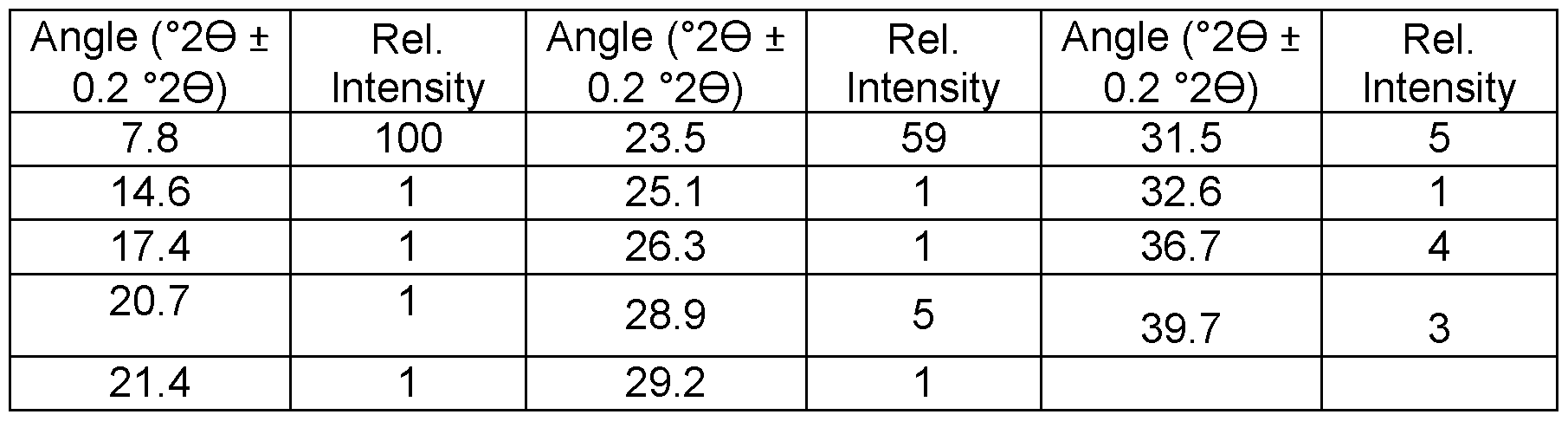
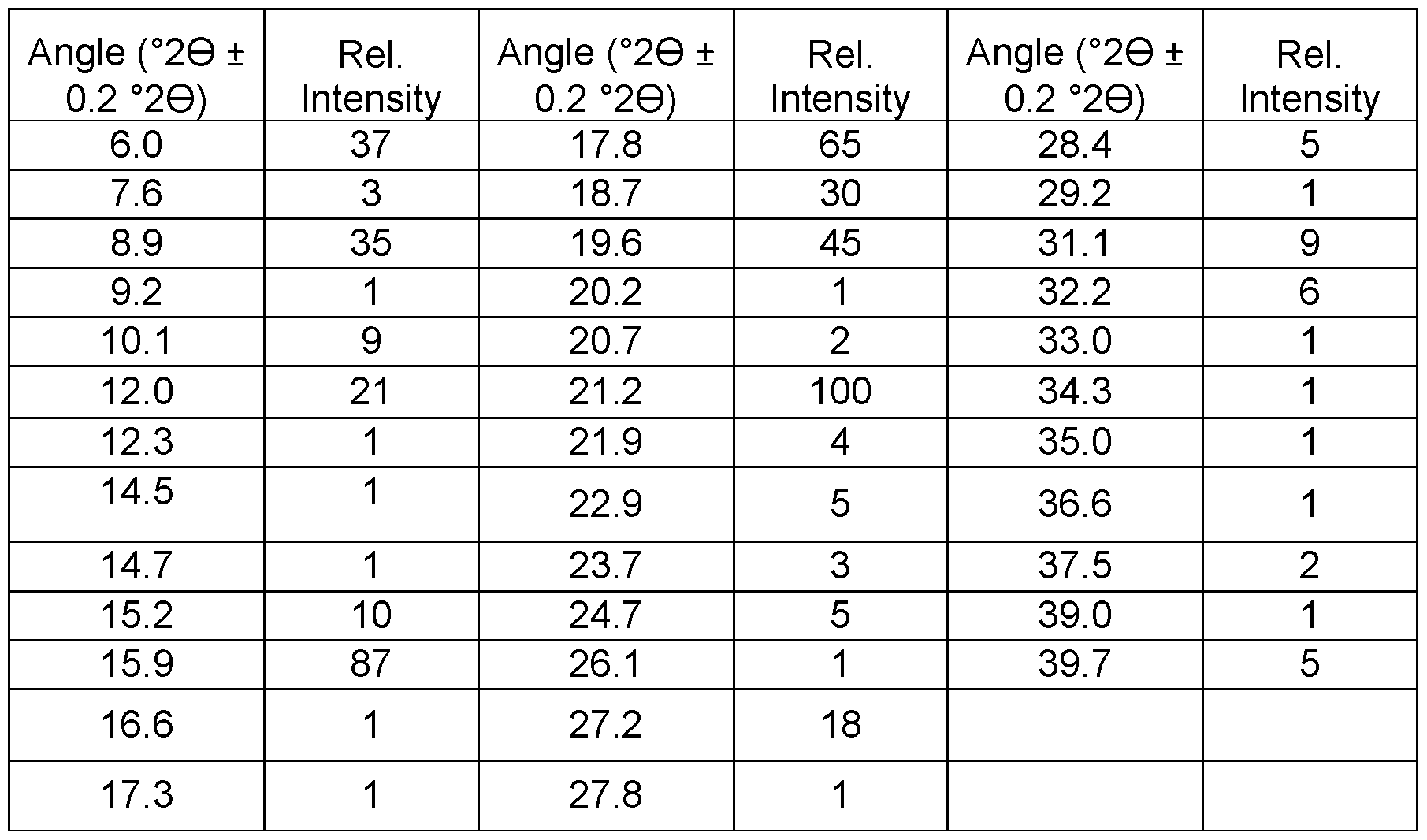


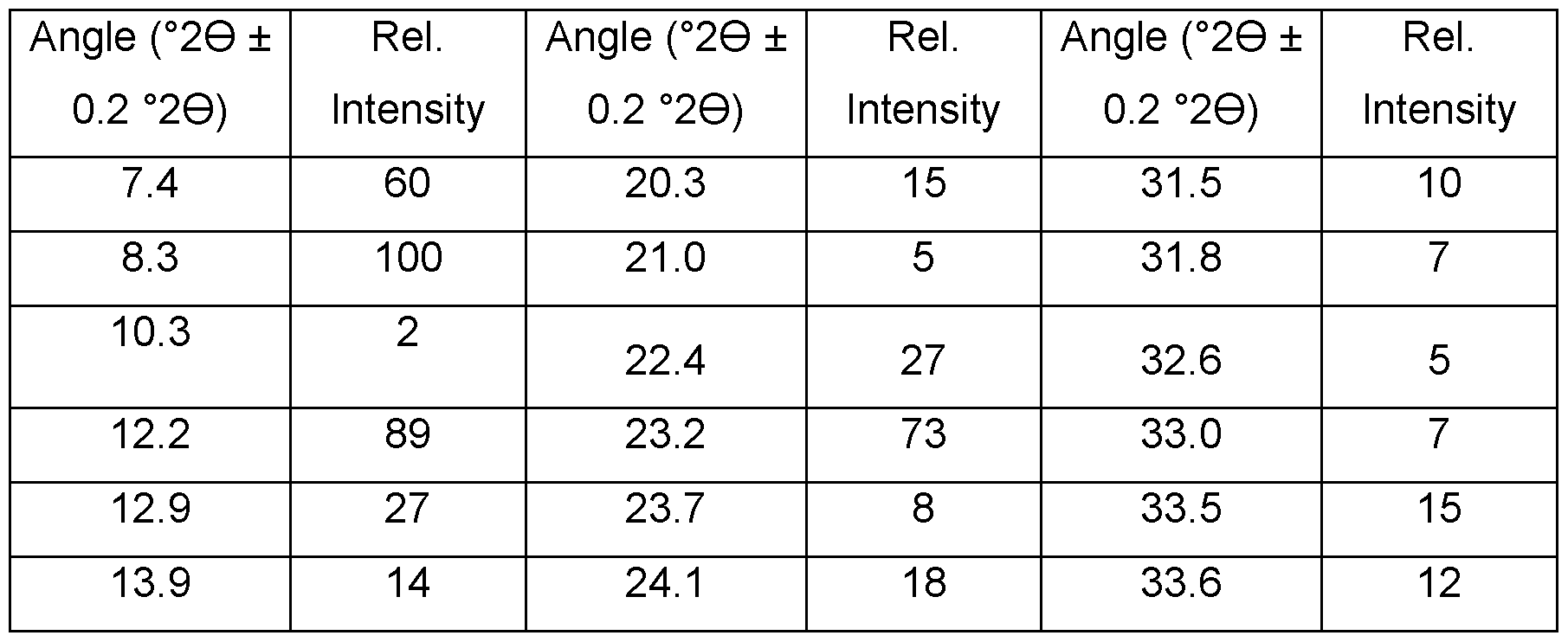


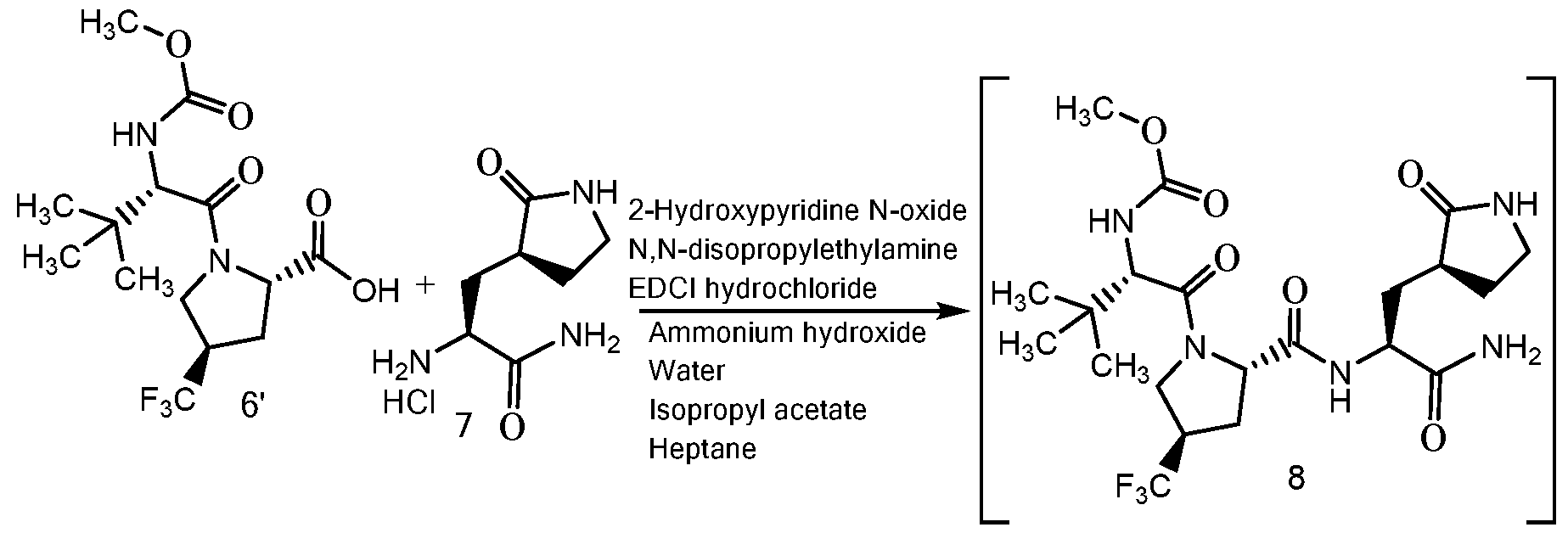


Claims


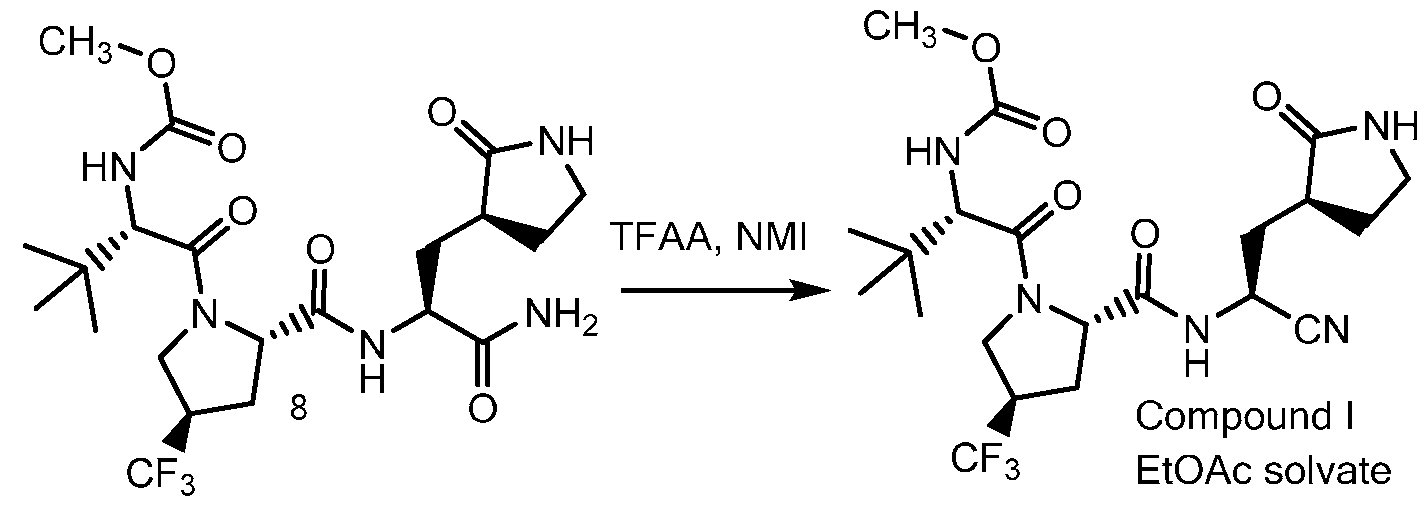
Priority Applications (2)
| Application Number | Priority Date | Filing Date | Title |
|---|---|---|---|
| CN202480038611.7A CN121285545A (en) | 2023-06-09 | 2024-06-07 | Method for preparing ibutilvir (Ibuzatrelvir) and intermediate |
| EP24733332.1A EP4724424A1 (en) | 2023-06-09 | 2024-06-07 | Process and intermediates for preparing ibuzatrelvir |
Applications Claiming Priority (6)
| Application Number | Priority Date | Filing Date | Title |
|---|---|---|---|
| US202363507347P | 2023-06-09 | 2023-06-09 | |
| US63/507,347 | 2023-06-09 | ||
| US202463571500P | 2024-03-29 | 2024-03-29 | |
| US63/571,500 | 2024-03-29 | ||
| US202463646170P | 2024-05-13 | 2024-05-13 | |
| US63/646,170 | 2024-05-13 |
Publications (1)
| Publication Number | Publication Date |
|---|---|
| WO2024252352A1 true WO2024252352A1 (en) | 2024-12-12 |
Family
ID=91580921
Family Applications (1)
| Application Number | Title | Priority Date | Filing Date |
|---|---|---|---|
| PCT/IB2024/055596 Ceased WO2024252352A1 (en) | 2023-06-09 | 2024-06-07 | Process and intermediates for preparing ibuzatrelvir |
Country Status (4)
| Country | Link |
|---|---|
| EP (1) | EP4724424A1 (en) |
| CN (1) | CN121285545A (en) |
| TW (1) | TW202515537A (en) |
| WO (1) | WO2024252352A1 (en) |
Citations (1)
| Publication number | Priority date | Publication date | Assignee | Title |
|---|---|---|---|---|
| WO2021250648A1 (en) | 2020-09-03 | 2021-12-16 | Pfizer Inc. | Nitrile-containing antiviral compounds |
-
2024
- 2024-06-07 TW TW113121372A patent/TW202515537A/en unknown
- 2024-06-07 CN CN202480038611.7A patent/CN121285545A/en active Pending
- 2024-06-07 WO PCT/IB2024/055596 patent/WO2024252352A1/en not_active Ceased
- 2024-06-07 EP EP24733332.1A patent/EP4724424A1/en active Pending
Patent Citations (5)
| Publication number | Priority date | Publication date | Assignee | Title |
|---|---|---|---|---|
| WO2021250648A1 (en) | 2020-09-03 | 2021-12-16 | Pfizer Inc. | Nitrile-containing antiviral compounds |
| US20220062232A1 (en) | 2020-09-03 | 2022-03-03 | Pfizer Inc. | Nitrile-Containing Antiviral Compounds |
| US11351149B2 (en) | 2020-09-03 | 2022-06-07 | Pfizer Inc. | Nitrile-containing antiviral compounds |
| US11452711B2 (en) | 2020-09-03 | 2022-09-27 | Pfizer Inc. | Nitrile-containing antiviral compounds |
| US11541034B2 (en) | 2020-09-03 | 2023-01-03 | Pfizer Inc. | Nitrile-containing antiviral compounds |
Non-Patent Citations (9)
| Title |
|---|
| ALLERTON CHARLOTTE M. ET AL: "A Second-Generation Oral SARS-CoV-2 Main Protease Inhibitor Clinical Candidate for the Treatment of COVID-19", JOURNAL OF MEDICINAL CHEMISTRY, 30 April 2024 (2024-04-30), US, XP093191348, ISSN: 0022-2623, Retrieved from the Internet <URL:https://pubs.acs.org/doi/pdf/10.1021/acs.jmedchem.3c02469> DOI: 10.1021/acs.jmedchem.3c02469 * |
| ANGEW. CHEM. INT. ED., vol. 41, 2002, pages 1600 - 1602 |
| DUNETZ, J.R.MAGANO, J.WEISENBURGER, G.A., ORG. PROCESS RES. DEV., vol. 20, 2016, pages 140 - 177 |
| GANESAN, M.NAGARAAJ, P., ORG. CHEM. FRONT., vol. 7, 2020, pages 3792 - 3814 |
| HILFIKER R (EDITOR) ED - HILFIKER R: "Polymorphism in the Pharmaceutical Industry", 1 January 2006, 20060101, PAGE(S) 1 - 19, ISBN: 978-3-527-31146-0, XP002528052 * |
| J. ORG. CHEM., vol. 68, no. 9, 2003, pages 3614 - 3617 |
| KUMAR BANDARU RAVI ET AL: "Recent Advances in Pharmaceutical Cocrystals: From Bench to Market", FRONTIERS IN PHARMACOLOGY, vol. 12, 11 November 2021 (2021-11-11), CH, XP093194980, ISSN: 1663-9812, DOI: 10.3389/fphar.2021.780582 * |
| S. BRUNAUERP.H. EMMETE. TELLER: "Adsorption of gases in multimolecular layers", J. AM. CHEM. SOC., vol. 60, 1938, pages 309 - 319 |
| TALBI, I. ET AL., ACS OMEGA, vol. 3, 2018, pages 5078 - 5082 |
Also Published As
| Publication number | Publication date |
|---|---|
| EP4724424A1 (en) | 2026-04-15 |
| CN121285545A (en) | 2026-01-06 |
| TW202515537A (en) | 2025-04-16 |
Similar Documents
| Publication | Publication Date | Title |
|---|---|---|
| JP2026069562A (en) | Psilocybin, different polymorphs, intermediates, preparation of formulations and their use | |
| JP4636021B2 (en) | 2-cyanopyrrolidinecarboxamide compound | |
| JP5292390B2 (en) | Pyrrolidin-2-one derivatives as androgen receptor modulators | |
| AU2023202085A1 (en) | Polymorphic forms of RAD1901-2HCL | |
| WO2005009956A1 (en) | (2s,4s)-4-fluoro-1-[4-fluoro-beta-(4-fluorophenyl)-l-phenylalanyl]-2-pyrrolidinecarbonitrile p-toluenesulfonic acid salt and anhydrous crystalline forms thereof | |
| JP2012046523A (en) | Salt form of atorvastatin | |
| US20240383920A1 (en) | Synthesis of ras inhibitors | |
| CA2648604A1 (en) | Hydrochloride salts of 8-[{1-(3,5-bis-(trifluoromethyl)phenyl)-ethoxy}-methyl]-8-phenyl-1,7-diaza-spiro[4.5]decan-2-one and preparation process therefor | |
| EP4724424A1 (en) | Process and intermediates for preparing ibuzatrelvir | |
| CN111954663A (en) | Fluorinated 4-(Substituted Amino)phenyl Carbamate Derivatives | |
| WO2008100651A2 (en) | Preparation of darifenacin and its salts | |
| BG106205A (en) | Polymorphs of crystalline (2-benzhydryl-1-azabicyclo [2,2,2]oct-3-yl)-(5-isopropyl-2-methoxybenzyl)-ammonium chloride as nk-1 receptor antagonists | |
| EP3074397B1 (en) | A process for preparation of (2s, 5r)-7-oxo-n-[(2s)-pyrrolidin-2-yl-methyloxy]-6-(sulfooxy)-1,6-diazabicyclo[3.2.1]octane-2-carboxamide | |
| WO2024237816A1 (en) | Novel azabicyclohexane derivatives | |
| AU2014307850B2 (en) | Form 2 crystalline polymorph of a salt of N-[1-6-(ethynyl-3-oxo-hexahydro-furo[3,2-b]pyrrole-4-carbonyl)-3-methyl-butyl]-4-[5-fluoro-2-(4-methyl-piperazinyl)thiazol-4-yl]-benzamide useful as cysteine protease inhibitor | |
| RU2190597C2 (en) | Method of synthesis of antagonists of nmda (n-methyl-d-aspartate) | |
| ES2370472T3 (en) | PROCEDURE FOR THE PREPARATION OF USEFUL COMPOUNDS AS INTERMEDIATES FOR THE PREPARATION OF MODULATORS OF THE ACTIVITY OF THE CHEMIOCIN RECEIVER. | |
| EA049434B1 (en) | METHOD FOR OBTAINING CFTR MODULATORS | |
| CN115611933A (en) | Process for preparing arginase inhibitors and synthetic intermediates thereof | |
| WO2005068422A2 (en) | Process for crystallization of ramipril and preparation of a hydrated form thereof | |
| HK1218915B (en) | Form 2 crystalline polymorph of a salt of n-[1-6-(ethynyl-3-oxo-hexahydro-furo[3,2-b]pyrrole-4-carbonyl)-3-methyl-butyl]-4-[5-fluoro-2-(4-methyl-piperazinyl)thiazol-4-yl]-benzamide useful as cysteine protease inhibitor |
Legal Events
| Date | Code | Title | Description |
|---|---|---|---|
| 121 | Ep: the epo has been informed by wipo that ep was designated in this application |
Ref document number: 24733332 Country of ref document: EP Kind code of ref document: A1 |
|
| WWE | Wipo information: entry into national phase |
Ref document number: 2024733332 Country of ref document: EP |
|
| NENP | Non-entry into the national phase |
Ref country code: DE |
|
| ENP | Entry into the national phase |
Ref document number: 2024733332 Country of ref document: EP Effective date: 20260109 |
|
| ENP | Entry into the national phase |
Ref document number: 2024733332 Country of ref document: EP Effective date: 20260109 |
|
| ENP | Entry into the national phase |
Ref document number: 2024733332 Country of ref document: EP Effective date: 20260109 |
|
| ENP | Entry into the national phase |
Ref document number: 2024733332 Country of ref document: EP Effective date: 20260109 |
|
| ENP | Entry into the national phase |
Ref document number: 2024733332 Country of ref document: EP Effective date: 20260109 |
|
| WWP | Wipo information: published in national office |
Ref document number: 2024733332 Country of ref document: EP |