WO2024251598A1 - Pre-treatment liquid for inkjet printing - Google Patents
Pre-treatment liquid for inkjet printing Download PDFInfo
- Publication number
- WO2024251598A1 WO2024251598A1 PCT/EP2024/064862 EP2024064862W WO2024251598A1 WO 2024251598 A1 WO2024251598 A1 WO 2024251598A1 EP 2024064862 W EP2024064862 W EP 2024064862W WO 2024251598 A1 WO2024251598 A1 WO 2024251598A1
- Authority
- WO
- WIPO (PCT)
- Prior art keywords
- poly
- treatment liquid
- copolymers
- ink
- polymer
- Prior art date
- Legal status (The legal status is an assumption and is not a legal conclusion. Google has not performed a legal analysis and makes no representation as to the accuracy of the status listed.)
- Ceased
Links
Classifications
-
- C—CHEMISTRY; METALLURGY
- C09—DYES; PAINTS; POLISHES; NATURAL RESINS; ADHESIVES; COMPOSITIONS NOT OTHERWISE PROVIDED FOR; APPLICATIONS OF MATERIALS NOT OTHERWISE PROVIDED FOR
- C09D—COATING COMPOSITIONS, e.g. PAINTS, VARNISHES OR LACQUERS; FILLING PASTES; CHEMICAL PAINT OR INK REMOVERS; INKS; CORRECTING FLUIDS; WOODSTAINS; PASTES OR SOLIDS FOR COLOURING OR PRINTING; USE OF MATERIALS THEREFOR
- C09D11/00—Inks
- C09D11/54—Inks based on two liquids, one liquid being the ink, the other liquid being a reaction solution, a fixer or a treatment solution for the ink
-
- C—CHEMISTRY; METALLURGY
- C09—DYES; PAINTS; POLISHES; NATURAL RESINS; ADHESIVES; COMPOSITIONS NOT OTHERWISE PROVIDED FOR; APPLICATIONS OF MATERIALS NOT OTHERWISE PROVIDED FOR
- C09D—COATING COMPOSITIONS, e.g. PAINTS, VARNISHES OR LACQUERS; FILLING PASTES; CHEMICAL PAINT OR INK REMOVERS; INKS; CORRECTING FLUIDS; WOODSTAINS; PASTES OR SOLIDS FOR COLOURING OR PRINTING; USE OF MATERIALS THEREFOR
- C09D11/00—Inks
- C09D11/02—Printing inks
- C09D11/10—Printing inks based on artificial resins
- C09D11/102—Printing inks based on artificial resins containing macromolecular compounds obtained by reactions other than those only involving unsaturated carbon-to-carbon bonds
-
- C—CHEMISTRY; METALLURGY
- C09—DYES; PAINTS; POLISHES; NATURAL RESINS; ADHESIVES; COMPOSITIONS NOT OTHERWISE PROVIDED FOR; APPLICATIONS OF MATERIALS NOT OTHERWISE PROVIDED FOR
- C09D—COATING COMPOSITIONS, e.g. PAINTS, VARNISHES OR LACQUERS; FILLING PASTES; CHEMICAL PAINT OR INK REMOVERS; INKS; CORRECTING FLUIDS; WOODSTAINS; PASTES OR SOLIDS FOR COLOURING OR PRINTING; USE OF MATERIALS THEREFOR
- C09D11/00—Inks
- C09D11/02—Printing inks
- C09D11/10—Printing inks based on artificial resins
- C09D11/106—Printing inks based on artificial resins containing macromolecular compounds obtained by reactions only involving carbon-to-carbon unsaturated bonds
- C09D11/107—Printing inks based on artificial resins containing macromolecular compounds obtained by reactions only involving carbon-to-carbon unsaturated bonds from unsaturated acids or derivatives thereof
-
- C—CHEMISTRY; METALLURGY
- C09—DYES; PAINTS; POLISHES; NATURAL RESINS; ADHESIVES; COMPOSITIONS NOT OTHERWISE PROVIDED FOR; APPLICATIONS OF MATERIALS NOT OTHERWISE PROVIDED FOR
- C09D—COATING COMPOSITIONS, e.g. PAINTS, VARNISHES OR LACQUERS; FILLING PASTES; CHEMICAL PAINT OR INK REMOVERS; INKS; CORRECTING FLUIDS; WOODSTAINS; PASTES OR SOLIDS FOR COLOURING OR PRINTING; USE OF MATERIALS THEREFOR
- C09D11/00—Inks
- C09D11/30—Inkjet printing inks
- C09D11/32—Inkjet printing inks characterised by colouring agents
- C09D11/322—Pigment inks
-
- C—CHEMISTRY; METALLURGY
- C09—DYES; PAINTS; POLISHES; NATURAL RESINS; ADHESIVES; COMPOSITIONS NOT OTHERWISE PROVIDED FOR; APPLICATIONS OF MATERIALS NOT OTHERWISE PROVIDED FOR
- C09D—COATING COMPOSITIONS, e.g. PAINTS, VARNISHES OR LACQUERS; FILLING PASTES; CHEMICAL PAINT OR INK REMOVERS; INKS; CORRECTING FLUIDS; WOODSTAINS; PASTES OR SOLIDS FOR COLOURING OR PRINTING; USE OF MATERIALS THEREFOR
- C09D11/00—Inks
- C09D11/30—Inkjet printing inks
- C09D11/38—Inkjet printing inks characterised by non-macromolecular additives other than solvents, pigments or dyes
-
- C—CHEMISTRY; METALLURGY
- C09—DYES; PAINTS; POLISHES; NATURAL RESINS; ADHESIVES; COMPOSITIONS NOT OTHERWISE PROVIDED FOR; APPLICATIONS OF MATERIALS NOT OTHERWISE PROVIDED FOR
- C09D—COATING COMPOSITIONS, e.g. PAINTS, VARNISHES OR LACQUERS; FILLING PASTES; CHEMICAL PAINT OR INK REMOVERS; INKS; CORRECTING FLUIDS; WOODSTAINS; PASTES OR SOLIDS FOR COLOURING OR PRINTING; USE OF MATERIALS THEREFOR
- C09D11/00—Inks
- C09D11/30—Inkjet printing inks
- C09D11/40—Ink-sets specially adapted for multi-colour inkjet printing
Definitions
- the invention relates to pre-treatment liquids and ink sets suitable for inkjet recording, more specifically inkjet printing on liners for corrugated packaging, folding boards and corrugated card boards.
- Inkjet printing technology is a growing area of printing of liners for corrugated packaging and for corrugated card boards.
- printing of liners for corrugated card boards usually flexographic printing or offset printing is performed for applying a pre-coat or primer.
- the pre-treatment liquid is capable of receiving ink and holding or fixing colorants in the ink to a greater degree than a substrate not treated with a pre-treatment liquid.
- the pre-treatment liquid is capable of holding or fixing colorants at or near the surface of the substrate so that optical density and colour gamut of the printed image may be improved compared to a porous substrate that is not treated with the pre-treatment liquid.
- WO 2018/017089 describes a sprayable pre-treatment liquid for corrugated linerboard or containerboard packaging as packaging material.
- the pre-treatment liquid composition contains a polyvalent metal salt, a wax, a dispersing agent, a latex and water.
- the latex includes monomers such as styrene, 1 ,3-butadiene, acrylonitrile or combinations thereof.
- WO2019/013785 describes a treatment composition for a packaging liner including a fixing agent, a wax, and a latex.
- the latex is stabilized by means of anionic groups, for example originating from carboxylic groups.
- Image quality of images obtained by aqueous inks jetted onto the treatment composition still suffer from mottling and bad ink spreading of the aqueous inks resulting in an inhomogeneous colour density in the solid areas of the printed images.
- W02023/001650 discloses a jettable pre-treatment composition for corrugated printing including a water-soluble multi-valent metallic salt, a wax, a non-ionic dispersant and a resin particle,
- the wax improves the ink durability during corrugation and has a positive effect on the image quality of the printed image.
- the wax is a particle consisting of hydrophobic material such as polyethylene, petroleum derivatives, paraffin, carnauba and polypropylene. These wax particles tend to clog filters in the liquid supply and filters in throughflow type of inkjet heads. In these heads the ink is circulated continuously through several filters. Due to this clogging recirculation issues can take place after a certain time ( ⁇ 1000 min) of operating with this type of pre-treatment liquid.
- Fig. 1 Pattern used for inkjet printing during the evaluation of the image quality of images obtained with pre-treatment liquids.
- the pattern contains solid areas and negative text with different size ranging from 1 pt to 16 pt.
- Aqueous pre-treatment liquid Aqueous pre-treatment liquid
- the pre-treatment liquid for inkjet printing according to the invention comprises a carboxylic acid containing polymer or salt thereof or a carboxylic acid anhydride containing polymer. It is believed that carboxylic acid anhydrides are at least partially hydrolysed upon dissolving in the aqueous vehicle of the pre-treatment liquid to a carboxylic acid or salt thereof.
- the effect of the use of carboxylic acid containing polymer or salt thereof or a carboxylic acid anhydride containing polymer in the pre-treatment liquid on image quality might be related to the interaction of these polymers with the fixing agent being multi valent metal ions or cationic polymers present in the pre-treatment liquid.
- the function of these fixing agents is to interact with the dispersed colorants from the ink such as dyes or pigments that are negatively charged such as to fix the colorants and avoid image bleed (see ⁇ A.2). Without being bound to a theory, it is believed that the activity of the fixing agent is better controlled when the carboxylic acid functionalized polymers are present and as such an optimum in image sharpness and ink spreading can be obtained.
- the carboxylic acid containing polymer or salt thereof or the carboxylic acid anhydride containing polymer in the pre-treatment liquid is not limited to a specific polymer, but should have an acid value equal to 950 mg KOH / g of polymer or less, more preferably having an acid value equal to 450 mg KOH / g of polymer or more and equal to 950 mg KOH / g of polymer or less, most preferably having an acid value equal to 346 mg KOH/g of polymer or more and equal to 950 mg KOH I g polymer of less, assuming that the carboxylic acid or salt thereof or carboxylic acid anhydride containing polymer is in its acid form. If the acid value is above this range, i.e. for maleic acid and fumaric acid based homopolymers, the degree of polymerisation will be too low and consequently providing less interaction with the used multivalent salts leading to a poor ink spreading.
- the carboxylic acid containing polymer or salt thereof or the carboxylic acid anhydride containing polymer should have some acid groups, and hence have a small acid value, in order to solubilise the polymer in the pre-treatment liquid. If the acid value is below this value, solubility of the polymer in the pre-treatment liquid may be too low to give sufficient image quality.
- the acid number is defined in mg KOH/g polymer corresponding to the amount of carboxylic acid groups or carboxylate groups.
- the acid value can be determined either via titration or via calculation. An example of a titration method is described in ASTM D3644-06.
- the acid value can be calculated.
- the molar composition of the carboxylic acid or salt thereof or carboxylic acid anhydride can be determined via analytical techniques such as NMR. In the calculation of the acid value the polymer end groups are neglected.
- the acid value of the polymer assuming that the carboxylic acid or salt thereof or carboxylic acid anhydride is in its acid value, can be calculated via the wt.% of COOH and transferring this into mg KOH/g polymer.
- the wt.% COOH can be calculated by (45/molar mass of one repeating unit) x 100%.
- the acid value can be calculated from the wt.% COOH via wt.% COOH/15 x 56,11 x 10 to get the acid value in mg KOH/g polymer.
- Preferable carboxylic acid containing polymers are homopolymers such as polyacrylic acid, polyitaconic acid, polycrotonic acid and polymethacrylic acid and, poly( N-(2-hydroxyethyl)maleamic acid), poly(3-(aminocarbonyl)- 3-butenoic acid), poly(4-amino-2-methylene-4-oxobutanoic acid) and poly(maleamic acid) and salts of the corresponding homopolymers.
- carboxylic acid containing polymers are modified anhydride homopolymers which are hydrolysed by water or a base such as KOH, NaOH, or a water soluble organic base such as a water soluble mono-amine such as ethanol amine, ammonia and amine terminated polyethylene glycol, e.g. CAS registry number 65421-52-5, 171863-88-0, 33881-50-4 and 176703-83-6.
- Typical anhydride homopolymers or copolymers which can be used for a hydrolysis or post-modification are based on maleic anhydride and itaconic anhydride.
- the carboxylic acid can be present as a salt.
- carboxylic acid or carboxylic acid anhydride containing polymers are copolymers such as poly(ethylene-co-maleic anhydride), poly(isobutylene-co-maleic anhydride), poly(isobutene-co-anhydride), poly(vinyl methyl ether-co-maleic anhydride), poly(vinyl acetate-co-crotonic acid), poly(styrene-co-maleic anhydride), poly(acrylic acid-co-maleic acid) and maleic acid-methyl vinyl ether copolymer and salts of the corresponding copolymers.
- copolymers such as poly(ethylene-co-maleic anhydride), poly(isobutylene-co-maleic anhydride), poly(isobutene-co-anhydride), poly(vinyl methyl ether-co-maleic anhydride), poly(vinyl acetate-co-crotonic acid), poly(styrene-co-maleic anhydride), poly(
- the carboxylic acid containing polymer or salts thereof or carboxylic acid anhydride containing polymers have an Mw equal to 5000 g/mol or more.
- the molecular weight is determined via GPC using universal calibration using polyethylene glycol standards.
- the amount of the carboxylic acid containing polymer or salt thereof or carboxylic acid anhydride containing polymer is preferably from 0.1 to 5 wt.%, more preferably from 0.2 to 4 wt.%. An amount below this range does show insufficiently an improvement of the image quality. An amount above this range can lead to (i) a decrease in jetting performance as a too high polymer content is present in the liquid, (ii) solubility issues leading to sedimentation, (iii) a decrease in image sharpness and an increase in bleeding and feathering.
- the aqueous pre-treatment liquid according to the invention comprises a fixing agent.
- the fixing agent serves to crash, precipitate or destabilize the ink colorants such as dyes or pigments and hence fix them to the substrate. This leads to an improved image quality (less bleeding, less coalescence).
- the fixing agent is preferably a water-soluble multivalent metal salt or a cationic polymer.
- the multivalent metal salt may be present in the pre-treatment liquid to improve image quality of the inkjet printed image.
- the multivalent metal salt may be any water-soluble multivalent metal salt.
- the multivalent metal salt may include calcium chloride (CaCh), magnesium chloride (MgCh), magnesium sulfate (MgSO4), aluminium chloride (AICH), calcium nitrate (Ca(NO3)2), magnesium nitrate (Mg(NOs)2), magnesium acetate (Mg(CH3COO)2), zinc acetate (Zn(CH3COO)2) calcium propionate (Ca(C2H5COO)2), or a combination thereof.
- the multivalent metal salt may include a metal cation selected from calcium, copper, nickel, magnesium, zinc, barium, iron, aluminium, chromium, or another multivalent metal.
- Polymeric cationic polymers suitable as fixing agent in the pre-treatment liquid contain either guanidinium or fully quaternized ammonium functionalities, such as quaternized polyamine copolymers.
- Mw weight average molecular weight
- Typical Mw are less than 500.000, and in one aspect, less than 50.000.
- Suitable classes of cationic polymers include, but are not limited to, quaternized polyamines, dicyandiamide polycations, diallyldimethyl ammonium chloride copolymers, quaternized dimethylaminoethyl(meth)acrylate polymers, quaternized vinylimidizol polymers, alkyl guanidine polymers, alkoxylated polyethylene imines, and mixtures thereof.
- the aqueous medium of the pre-treatment liquid according to the invention contains water as a vehicle, but may include one or more water-soluble organic solvents.
- the one or more organic solvents may be added for a variety of reasons. For example, it can be advantageous to add a small amount of an organic solvent to improve the dissolution of a compound in the pre-treatment liquid to be prepared, to obtain better penetration in porous substrates or to prevent fast drying of the pre-treatment liquid at the nozzle of the inkjet head.
- Preferable water-soluble organic solvents are polyols (e.g., ethylene glycol, glycerin, 2-ethyl-2-(hydroxymethyl)-1 ,3-propanediol, tetraethylene glycol, triethylene glycol, tripropylene glycol, 1 ,2,4-butanetriol, diethylene glycol, propylene glycol, dipropylene glycol, butyleneglycol, 1 ,6- hexanediol, 1 ,2-hexanediol, 1 ,5-pentanediol, 1 ,2-pentanediol, 2,2- dimethyl-1 ,3-prapanediol, 2-methyl-2,4-pentanediol, 3-methyl-1 ,5- pentanediol, 3-methyl-1 ,3-butanediol, and 2-methyl-1 ,3-propanediol), N- hydroxyethyl-
- the pre-treatment liquid according to the invention may comprise a resin particle which is dispersed in the aqueous medium of liquid.
- the resin particle may improve the mechanical and water resistance of the printed image.
- the resin is preferably selected from the group consisting of poly(urethanes) and copolymers thereof, acrylics and copolymers thereof, poly(esters) and copolymers thereof, poly(styrenes) and copolymers thereof, poly(vinyl amides) and copolymers thereof, poly(vinyl alcohol) derivatives and copolymers thereof, poly(acetals) and copolymers thereof, poly(ethers) and copolymers thereof, poly(vinyl ethers) and copolymers thereof, polyvinyl (esters) and copolymers thereof, poly(imides) and copolymers thereof, poly(imines) and copolymers thereof, polycarbonates and copolymers thereof, poly(vinyl chloride) and copolymers thereof, poly(vinyliden
- the resin particle is preferably cationic or non-ionic and sterically stabilized.
- a non-ionic stabilization can be accomplished by use of polyether diols in the preparation of the poly(urethane) resin.
- the polyether diol preferably used in the present invention is Ymer N180, Ymer N120, Ymer N90 or Tegomer D 3403, i.e. a -[2,2-bis(hydroxymethyl)butyl]-u)-methoxy-Poly(oxy-1 ,2-ethanediyl).
- diols can be prepared from trimethylol propane oxetane (TMPO).
- TMPO trimethylol propane oxetane
- Fock, J.; Mohring, V. Polyether-1 ,2- and -1 ,3-diols as macromonomers for the synthesis of graft copolymers, 1. Synthesis and characterization of the macromonomers. Die Makromolekulare Chemie 1990, 191 (12), 3045-3057. In general, also other polyether 1 ,2- or 1 ,3-diols can be used.
- addition polymerization e.g. preparation of polyacrylates, monomethacrylate or mono-acrylate terminated polyethers can be used for the preparation of graft copolymers with polyether side chains.
- suitable macromers for addition polymerisations are listed [0022-0024] of W02023/001650A.
- a preferred resin particle dispersion incorporated in the pre-treatment liquid according to the invention is based on polyurethane particle dispersions.
- polyurethane synthesis one can implement different polyols for obtaining suitable physical, mechanical or optical properties, such as adhesion towards the substrate used, water resistance, solvent resistance, weather resistance, scratch resistance, gloss or opacity, ect...
- Regularly used polyols are: polyether polyols, polyester polyols, polycarbonate polyols, polyamide polyol, polyacrylate polyols and polyolefine polyols.
- polymeric polyols also low molar mass diols can be used and diols which could have affinity for the aqueous phase such as dimethylol propionic acid.
- diols which could have affinity for the aqueous phase such as dimethylol propionic acid.
- water soluble polyether diols is preferred.
- the amount of the resin particle in the pre-coat composition is between 1 wt.%, and 50 wt.%, preferably between 5 wt.% and 45 wt.%, more preferably between 20 wt.% and 40 wt.% with respect to the total solids content of the pre-coat composition. An amount exceeding these values has a negative effect on the jetting reliability of the pre-coat composition if it is applied via a jetting technique.
- Suitable commercially available Pll dispersions are e.g. Vondic 2220, Vondic 1980NE supplied by Toyobo, Printrite DP375 and Printrite PD379 supplied by Lubrizol, Esacote PLI3511 supplied by Lamberti, Neorez R9340 available from DSM and 2019WTT001-3 available from BASF.
- the pre-treatment liquid of the invention may further include a non-ionic dispersant, preferably a non-ionic polymeric dispersing agent.
- Suitable non-ionic dispersants are polymeric dispersing agents, non-ionic surfactants and segmented polymers, such as graft-, block-, star- branched, comb- or gradient copolymers. These polymeric dispersing agents are preferably amphiphilic structures having at least one segment which is soluble, dispersible or compatible in water-based media.
- the medium is not necessarily only water but can also be a mixture with other solvents.
- other water-soluble solvents can be added such as propylene glycol, glycerol, dipropylene glycol monomethyl ether, 2-hydroxyethyl pyrolidone. At least one segment or part of the polymeric dispersing agent should be compatible with the solvent medium of the ink.
- the pre-treatment liquid according to the invention may also contain humectants.
- Humectants are preferably incorporated in a pre-treatment liquid, especially if this liquid has to be applied by means of a jetting technique such as inkjet or valve jet. Humectants prevent the clogging of nozzles. The prevention is due to its ability to slow down the evaporation rate of the inkjet ink, especially the water in the liquid.
- the humectant is preferably an organic solvent having a higher boiling point than water.
- Suitable humectants include triacetin, N-methyl-2-pyrrolidone, glycerol, urea, thiourea, ethylene urea, alkyl urea, alkyl thiourea, dialkyl urea and dialkyl thiourea, diols, including ethanediols, propanediols, propanetriols, butanediols, pentanediols, and hexanediols; glycols, including propylene glycol, polypropylene glycol, ethylene glycol, polyethylene glycol, diethylene glycol, tetraethylene glycol, and mixtures and derivatives thereof.
- a preferred humectant is glycerol.
- the humectant is preferably added to the pre-treatment liquid formulation in an amount of 0.1 to 40 wt.% based on the total weight of the liquid.
- the pre-treatment liquid may contain a surfactant. Any known surfactant may be used but preferably a non-ionic oxirane, mono(2-propylheptyl) ether is used.
- a biocide may be added to the pre-coat composition to prevent unwanted microbial growth, which may occur over time.
- the biocide may be used either singly or in combination.
- Suitable biocides for the ink-jet ink of the present invention include sodium dehydroacetate, 2-phenoxyethanol, sodium benzoate, sodium pyridinethion-1 -oxide, ethyl p-hydroxybenzoate and 1 ,2-benzisothiazolin-3-one and salts thereof.
- Preferred biocides are ProxelTM GXL and ProxelTM Ultra 5 available from ARCH UK BIOCIDES and BronidoxTM available from COGNIS.
- a biocide is preferably added to the aqueous medium in an amount of 0.001 to 3 wt.%, more preferably 0.01 to 1.0 wt. %, each based on the total weight of the liquid.
- the pre-coat composition may further comprise at least one thickener for viscosity regulation in the liquid.
- suitable thickeners include urea or urea derivatives, hydroxyethylcellulose, carboxymethylcellulose, hydroxypropylcellulose, derived chitin, derived starch, carrageenan, xanthan gum, pullulan, proteins, poly(styrenesulphonic acid), poly(styrene- co-maleic anhydride), poly(alkyl vinyl ether-co-maleic anhydride), polyacrylamid, partially hydrolyzed polyacrylamid, poly(acrylic acid), poly(vinyl alcohol), partially hydrolyzed poly(vinyl acetate), poly(hydroxyethyl acrylate), poly(methyl vinyl ether), polyvinylpyrrolidone, poly(2-vinylpyridine), poly(4-vinylpyridine) and poly(diallyldimethylammonium chloride).
- Particular suitable thickeners are hydrophilically modified Pll thicken
- the thickener is added preferably in an amount of 0.01 to 20 wt.%, more preferably 0.1 to 10 wt.% based on the liquid.
- Liquid ink set comprising a pre-treatment liquid and an aqueous inkjet ink.
- the liquid set according to the invention comprises the pre-treatment liquid as described in ⁇ A. and an aqueous inkjet ink including a water-soluble organic solvent and a colorant.
- the liquid ink set may comprise an aqueous varnish which is applied during or after the jetting of the aqueous inkjet ink.
- the aqueous inkjet ink as part of the liquid set according to the invention comprises colorants such as dyes and pigments.
- the pigments are preferably stabilized by anionic dispersing groups.
- the pigments can also be additionally stabilised by polymeric dispersants, surfactants or a combination thereof to achieve extra colloidal stability.
- the aqueous medium of the ink contains water and one or more water- soluble organic solvents. Suitable water-soluble organic solvents are described in ⁇ A.3.
- the aqueous inkjet ink comprises a resin and/or a wax.
- the aqueous inkjet ink may further comprise a surfactant, a humectant, a biocide, a resin and a thickener as an additive.
- the pigments in the aqueous inkjet ink according to the invention may be black, white, cyan, magenta, yellow, red, orange, violet, blue, green, brown, mixtures thereof, and the like.
- a colour pigment may be chosen from those disclosed by HERBST, Willy, et al. Industrial Organic Pigments, Production, Properties, Applications. 3rd edition. Wiley - VCH, 2004. ISBN 3527305769.
- Suitable pigments are disclosed in paragraphs [0128] to [0138] of WO 2008/074548.
- the pigment particles are dispersed in an aqueous medium using a polymeric dispersant, a surfactant or a combination thereof.
- Self- dispersible pigments can also be used. The latter prevents interaction of the polymeric dispersant with the dispersing groups of binders or capsules which may be included in the inkjet ink (see below).
- a self-dispersible pigment is a pigment having on its surface covalently bonded anionic hydrophilic groups or salt-forming groups, that allow the pigment to be dispersed in an aqueous medium without using a surfactant or a resin.
- EP1220879A discloses pigments having attached a) at least one steric group and b) at least one organic ionic group and at least one amphiphilic counterion, wherein the amphiphilic counterion has a charge opposite to that of the organic ionic group that are suitable for inkjet inks.
- EP906371A discloses suitable surface-modified coloured pigment having attached hydrophilic organic groups containing one or more ionic groups or ionizable groups.
- Suitable commercially available self- dispersible colour pigments are, for example, the CAB-O-JETTM inkjet colorants from CABOT.
- Pigment particles in inkjet inks should be sufficiently small to permit free flow of the ink through the inkjet-printing device, especially at the ejecting nozzles. It is also desirable to use small particles for maximum colour strength and to slow down sedimentation.
- the average pigment particle size is preferably between 0.050 and 1 pm, more preferably between 0.070 and 0.300 pm and particularly preferably between 0.080 and 0.200 pm. Most preferably, the numeric average pigment particle size is no larger than 0.150 pm.
- the average particle size of pigment particles is determined with a Brookhaven Instruments Particle Sizer BI90plus based upon the principle of dynamic light scattering.
- Suitable white pigments are given by Table 2 in [0116] of WO 2008/074548.
- the white pigment is preferably a pigment with a refractive index greater than 1.60.
- the white pigments may be employed singly or in combination.
- titanium dioxide is used as pigment with a refractive index greater than 1.60. Suitable titanium dioxide pigments are those disclosed in [0117] and in [0118] of WO 2008/074548.
- special colorants such as fluorescent pigments for special effects in clothing, and metallic pigments for printing a luxury look of silver and gold colours on textiles.
- Suitable polymeric dispersants are copolymers of two monomers but they may contain three, four, five or even more monomers.
- the properties of polymeric dispersants depend on both the nature of the monomers and their distribution in the polymer.
- Co-polymeric dispersants preferably have the following polymer compositions:
- alternating polymerized monomers e.g. monomers A and B polymerized into ABABABAB
- block copolymers e.g. monomers A and B polymerized into AAAAABBBBBB wherein the block length of each of the blocks (2, 3, 4, 5 or even more) is important for the dispersion capability of the polymeric dispersant;
- graft copolymers consist of a polymeric backbone with polymeric side chains attached to the backbone
- Suitable dispersants are DISPERBYKTM dispersants available from BYK CHEMIE, JONCRYLTM dispersants available from BASF and SOLSPERSETM dispersants available from Lubrizol. Other suitable dispersants are Edaplan 482 from Miinzing. A detailed list of non- polymeric as well as some polymeric dispersants is disclosed by MC CUTCHEON. Functional Materials, North American Edition. Glen Rock, N. J.: Manufacturing Confectioner Publishing Co., 1990. p.110-129.
- the polymeric dispersant has preferably a number average molecular weight Mn between 500 and 30000, more preferably between 1500 and 10000.
- the polymeric dispersant has preferably a weight average molecular weight Mw smaller than 100,000, more preferably smaller than 50,000 and most preferably smaller than 30,000.
- the pigments are preferably present in the range of 0.01 to 15 %, more preferably in the range of 0.05 to 10 % by weight and most preferably in the range of 0.1 to 5 % by weight, each based on the total weight of the inkjet ink.
- the white pigment is preferably present in an amount of 3% to 40% by weight of the inkjet ink, and more preferably 5% to 35%. An amount of less than 0.01 % by weight cannot achieve sufficient covering power.
- the aqueous ink comprises a pigment which is encapsulated by means of a cross-linked polymeric shell.
- Encapsulated pigments provide printed images having improved physical properties such as water resistance and dry rub resistance with respect to pigments dispersed by means of un-cross-linked polymers.
- Suitable encapsulated pigments are provided by Lubrizol as Diamond HSDX-dispersions and by Fujifilm as RxD pigment dispersions such as APD1000 and APD4000 premium dispersions.
- the inkjet ink composition according to the invention may comprise a resin.
- the resin is often added to the inkjet ink formulation to achieve a good adhesion of the pigment to the recording medium.
- the resin is preferably a polymer and suitable resins can be an acrylic based resin, a urethane resin or a wax.
- the polyurethane resin is to be incorporated in the ink formulation as a dispersion and may be selected from the group consisting of aliphatic polyurethane dispersions, aromatic polyurethane dispersions, anionic polyurethane dispersions, non-ionic polyurethane dispersions, aliphatic polyester polyurethane dispersions, aliphatic polycarbonate polyurethane dispersions, aliphatic acrylic modified polyurethane dispersions, aromatic polyester polyurethane dispersions, aromatic polycarbonate polyurethane dispersions, aromatic acrylic modified polyurethane dispersions, for example, or a combination of two or more of the above.
- a preferred urethane resin to be used as dispersion in the ink of the invention is a polyester resin including a structural unit containing a urethane bond.
- a water-soluble or water-dispersible urethane-modified polyester resin is preferred.
- the urethane-modified polyester resin include at least one structural unit derived from a hydroxyl group-containing polyester resin (polyester polyol) and at least one structural unit derived from an organic polyisocyanate.
- the hydroxyl group-containing polyester resin is a resin formed by an esterification reaction or transesterification reaction between at least one polybasic acid component and at least one polyhydric alcohol component.
- a preferred polyurethane resin to be included in the ink of the invention is a polyurethane resin obtainable by reacting a polyester polyol, a polyether diol, a polyol containing an anionic group and a polyisocyanate.
- a particular preferred polyurethane resin is a polyurethane resin obtainable by reacting a polyester polyol, a polyether diol, a polyol containing an anionic group and a polyisocyanate, and wherein the polyester polyol is obtained by reacting an aromatic polycarboxylic acid and a polyol. Examples of suitable polyurethane resins and their preparations are disclosed in the patent application EP3532545A.
- Suitable polyurethane dispersions are NEOREZ R-989, NEOREZ R-2005, and NEOREZ R-4000 (DSM NeoResins); BAYHYDROL UH 2606, BAYHYDROL UH XP 2719, BAYHYDROL UH XP 2648, and BAYHYDROL UA XP 2631 (Covestro); DAOTAN VTW 1262/35WA, DAOTAN VTW 1265/36WA, DAOTAN VTW 1267/36WA, DAOTAN VTW 6421/42WA, DAOTAN VTW 6462/36WA (Allnex); and SANCURE 2715, SANCURE 20041 , SANCURE 2725 (Lubrizol Corporation), for example, or a combination of two or more of the above.
- Acrylic based resins include polymers of acrylic monomers, polymers of methacrylic monomers, and copolymers of the aforementioned monomers with other monomers. These resins are present as a suspension of particles having an average diameter of about 30 nm to about 300 nm.
- the acrylic latex polymer is formed from acrylic monomers or methacrylic monomer residues. Examples of monomers of the acrylic latex polymer include, by way of illustration, acrylic monomers, such as, for example, acrylate esters, acrylamides, and acrylic acids, and methacrylic monomers, such as, for example, methacrylate esters, methacrylamides, and methacrylic acids.
- the acrylic latex polymer may be a homopolymer or copolymer of an acrylic monomer and another monomer such as, for example, a vinyl aromatic monomer including, but not limited to, styrene, styrene butadiene, p-chloromethylstyrene, divinyl benzene, vinyl naphthalene and divinylnaphthalene.
- a vinyl aromatic monomer including, but not limited to, styrene, styrene butadiene, p-chloromethylstyrene, divinyl benzene, vinyl naphthalene and divinylnaphthalene.
- Suitable acrylic latex polymer suspensions are, JONCRYL 537 and JONCRYL 538 (BASF Corporation, Port ArthurTX); CARBOSET GA-2111 , CARBOSET CR-728, CARBOSET CR-785, CARBOSET CR-761 , CARBOSET CR-763, CARBOSET CR-765, CARBOSET CR-715, and CARBOSET GA-4028 (Lubrizol Corporation); NEOCRYL A-1110, NEOCRYL A-1131 , NEOCRYL A-2091 , NEOCRYL A- 1127, NEOCRYL XK-96, and NEOCRYL XK-14 (DSM); and BAYHYDROL AH XP 2754, BAYHYDROL AH XP 2741 , BAYHYDROL A 2427, and BAYHYDROL A2651 (Bayer), for example, or a combination of two or more of the above.
- the concentration of the resin in the inkjet ink according to the invention is at least 1 wt.% and preferably lower than 30 wt.%, more preferably lower than 20 wt.%.
- the aqueous inkjet ink of the invention may also comprise a wax.
- the wax in the ink improves wet rub or wet scratch resistance of the printed layer.
- any suitable wax may be used in the ink and varnish composition.
- the wax may be polyethylene waxes, petroleum waxes, paraffin waxes, carnauba waxes, polypropylene waxes, crystalline and microcrystalline waxes, amide waxes (oleamide, stearamide, erucamide, cyclic amide, etc... ), and combinations thereof.
- the wax may be a high density polyethylene wax.
- the wax may be a polyethylene wax or modified paraffin wax.
- polyethylene wax includes high density polyethylene (HDPE) wax, which has a density ranging from about 0.93 g/mL to 0.97 g/mL.
- HDPE high density polyethylene
- modified paraffin wax particles includes paraffin wax that has been modified to improve dispersibility in water, e.g., via emulsification.
- the modified paraffin wax may be surface modified, chemically modified, etc.
- wax examples include those of the JONCRYL Wax series (such as JONCRYL Wax 22, JONCRYL Wax 26, and JONCRYL Wax 120 available from BASF Corp.), those of the AQUACER series (such as AQUACER 498, AQUACER 501 , AQUACER 505, AQUACER 513, AQUACER 530, AQUACER 531 , AQUACER 535, AQUACER 537, AQUACER 539, and AQUACER 552 available from BYK- Gardner, Columbia, Md. ) and Liquilube 404E from Lubrizol .
- AQUACER series such as AQUACER 498, AQUACER 501 , AQUACER 505, AQUACER 513, AQUACER 530, AQUACER 531 , AQUACER 535, AQUACER 537, AQUACER 539, and AQUACER 552 available from BYK- Gardner, Columbia, Md.
- the wax may have i) a high melting temperature T and/or ii) a small average particle size.
- the wax may have a high melting T such as one that is equal to or greater than 90°C.
- the wax may have an average particle size (in terms of effective diameter assuming that the individual wax particles are not perfectly spherical) ranging from 0.03 pm to 1.5 pm, more preferably from 0.05 pm to 1 pm(D50). If the particle size exceeds these upper limits, jetting reliability problems of the varnish are likely to occur.
- the wax may be present in the ink in an amount ranging from 3 to 30 wt. %, more preferably from 5 to 25 wt. %, relative to the total solids weight of the ink.
- the inkjet ink composition according to the invention may comprise a capsule.
- Capsules more preferably, nanocapsules are often incorporated in inkjet ink formulations to encapsulate colouring agents (US2009227711A, JP2004075759) or to encapsulate reactive ingredients which can cross-link.
- Particularly useful are the nanocapsules disclosed in WO201 5158649 [0037-0110]:
- the nanocapsules have a polymeric shell surrounding a core containing reactive chemistry.
- the shell material includes polyureas, polyurethanes, polyesters, polycarbonates, polyamides, melamine based polymers and mixtures thereof, with polyureas and polyurethanes being especially preferred.
- nanocapsules are selfdispersable and include a dispersing group covalently coupled to the shell polymers.
- the core of the nanocapsules in WO201 5158649 [0037-0110] and WO2016165970 [0051-0138] comprise reactive chemistry which is able to form a reaction product upon application of heat and/or light, allowing a wide variety of substrates to be addressed.
- Other suitable reactive chemistry is the one which is activated upon radiation as described in WO2015158649 [0068-0110],
- the capsules are preferably present in the inkjet ink in an amount of no more than 30 wt.%, preferably between 5 and 25 wt.% based on the total weight of the ink.
- the ink composition may contain a surfactant.
- a surfactant Any known surfactant may be used but preferably a glycol surfactant and/or an acetylene alcohol surfactant and /or a polysiloxane surfactant is used.
- the use of the acetylene glycol surfactant and/or the acetylene alcohol surfactant and/or the polysiloxane surfactant further reduces bleeding to improve printing quality, and also improves the drying property in printing to allow highspeed printing.
- the acetylene glycol surfactant and/or the acetylene alcohol surfactant is preferably one or more selected from 2, 4, 7, 9-tetramethyl-5-decine-4, 7- diol, alkylene oxide adducts of 2,4,7, 9-tetramethyl-5-decine-4, 7-diol, 2,4- dimethyl-5-decin-4-ol, and alkylene oxide adducts of 2,4-dimethyl-5-decin- 4-oL
- These are available, for example, from Air Products (GB) or from Nissin Chemical Industry, e.g Olfine series (registered trademark) such as Olfine E1010 and Surfynol (registered trademark) series, as Surfynol 465, Surfynol 104H and Surfynol 61.
- a biocide may be added to the ink composition to prevent unwanted microbial growth, which may occur over time. Suitable biocides are listed in ⁇ A.6.
- a biocide is preferably added to the aqueous medium in an amount of 0.001 to 3 wt.%, more preferably 0.01 to 1.0 wt. %, each based on the total weight of the ink.
- the one or more optothermal converting agents are preferably present in the range of 0.1 to 10 wt.% based on the total weight of the ink.
- the varnish as part of the liquid ink set according to the invention is used to protect the inkjet printed image against wet & dry rubbing, scratches and solvents.
- the varnish therefor comprises water and resin particles.
- the varnish as comprised in the liquid set according to the invention may comprise a wax.
- the wax may improve the durability of the printed image.
- any suitable wax may be used in the varnish composition. Suitable waxes are described in ⁇ B.1.
- Examples of the resin particles included in the varnish include well-known resins such as a urethane-based resin, an acrylic resin, a fluorene-based resin, a polyolefin-based resin, a rosin modified resin, a terpene-based resin, a poly-ester-based resin, a polyamide-based resin, an epoxy-based resin, and a vinyl chloride-based resin.
- the vinyl chloride-based resin includes a vinyl chloride copolymer such as a vinyl chloride-vinyl acetate copolymer. These resins may be used alone, or two or more thereof may be used in combination.
- the resin included in the varnish is preferably a urethane-based resin, an acrylic resin, a styrene- acrylic resin or a polyolefin-based resin.
- urethane-based resin commercially available products may be used, for example, commercially available products such as SUPER FLEX 460, 460s, 840, E-4000 (trade name, manufactured by DKS Co., Ltd.), RESAMINE D-1060, D-2020, D-4080, D-4200, D-6300, D-6455 (trade name, manufactured by Dainichiseika Color & Chemicals Mfg.Co., Ltd.), TAKELAC WS-6021 , W-512-A-6 (trade name, manufactured by Mitsui Chemicals Polyurethanes INC.,), SUNCURE 2710 (trade name, manufactured by LUBRIZOL Corporation), and PermalinUA-150 (trade name, manufactured by Sanyo Chemical Industries, Ltd.) may be used.
- commercially available products such as SUPER FLEX 460, 460s, 840, E-4000 (trade name, manufactured by DKS Co., Ltd.), RESAMINE D-1060, D-2020, D-4080, D-4200, D-6300
- the acrylic resin is a general name of a polymer obtained by polymerizing at least an acrylic monomer such as (meth)acrylic acid and (meth)acrylate, and the examples thereof include a (meth)acryl resin obtained from the acrylic monomer, and a copolymer of the acrylic monomer and monomers other than the acrylic monomer (for example, a vinyl based monomer such as styrene). Acrylamide and acrylonitrile can be also used as the acrylic monomer.
- the acrylic resin can be non-reactive or self-cross linking.
- a resin emulsion using the acrylic resin as a raw material commercially available products may be used, and the examples thereof include FK-854 (trade name, manufactured by CH I RIKA. Co., ltd.), Mowinyl 952B, 718A (trade name, manufactured by The Nippon Synthetic Chemical Industry Co., Ltd.), Nipol LX852, and LX874 (trade name, manufactured by ZEON Corporation).
- styrene-acrylic resins include poly(styrene-alkyl acrylate), polystyrene-1 , 3-diene), poly(styrene-alkyl methacrylate), polystyrenealkyl acrylate-acrylic acid), poly(styrene-1 , 3-diene-acrylic acid), poly(styrene-alkyl methacrylate-acrylic acid), poly(styrene-alkylacrylate- acrylonitrile-acrylic acid), and poly(styrene-1 , 3-diene-acrylonitrile-acrylic acid).
- Commercial styrene-acrylic resins are Neocryl D2101 (Covestro) and Bonron PS001 and Bonron PS002 (Mitsui).
- the varnish contains the resin in an amount from 1 wt.% to 30 wt.% with respect to the total mass of the liquid. When the content of the resin in the varnish is within the aforementioned range, the effect of improving rub resistance of the image tends to become more excellent. More preferably the varnish contains the resin in an amount from 3 wt.% - 15 wt.% with respect to the wight of the liquid. Most preferably the varnish contains the resin in an amount from 5 wt.% to 12 wt.% with respect to the weight of the liquid.
- the varnish may contain a surfactant. Suitable surfactants are listed in ⁇
- the varnish may further comprise a water soluble polymer selected from the group of linear PPO-PEO copolymers and arylethylphenyl polyglycol ethers as described in unpublished patent application EP23161106.2 A.
- the varnish may further comprise a crosslinking agent.
- a crosslinking agent Any water soluble or water dispersible crosslinking agent can be used, but preferably the crosslinking agent is a carbodiimide such as described in the unpublished patent application EP23164057.4 A.
- the pre-treatment liquid according to the present invention is suitable for treating different substrates, absorbing and non-absorbing ones.
- a substrate is characterized as absorbing, when the amount of absorbed water after a contact time of 60 s is at least 10 g/m 2 .
- Absorbing substrates include paper, card board, white lined chipboard, corrugated board, packaging board, folding board, wood, ceramics, stone, leather and textile.
- Non-absorbing substrates include metal, glass, polypropylene, polyvinylchloride, PET, PMMA, polycarbonate, polyamide, polystyrene or co-polymers thereof.
- the pre-treatment liquid is particularly suited for being coated or jetted onto papers intended for packaging applications, more preferably packaging applications including absorbing substrate such as card board, paper lines, corrugated board, packaging board, folding board and paper.
- the paper can be a single layer of a multilayer paper.
- the paper may be brown Kraft, White Top or bleached board.
- the paper may be manufactured from chemical, wood, or recycled fibre.
- the paper may be a liner intended for printing on page wide web presses and converted into corrugated boxes.
- the liner paper may be used as a double face liner and may be converted directly in a corrugator or laminated onto a double face liner after corrugation.
- the paper may also be boards used for boxes and other packaging applications.
- All well-known conventional methods can be used for coating or impregnating the pre-treatment liquid on a substrate. Examples of the method include air knife coating, blade coating, roll coating, gravure coating and spraying. More preferably the pre-treatment liquid is applied by means of a jetting technique.
- the pre-treatment liquid is then applied using an ink jet head or valve jet head.
- This means of applying the pre-treatment liquid which is preferably according to an image, has the advantage that the amount of required pretreatment liquid is substantially lower than with the other application methods.
- a jetting head it is possible to apply the pretreatment liquid onto areas of the substrate where the image should be printed.
- Suitable inkjet head types for applying the pre-treatment liquid are piezoelectric type, continuous type, thermal print head type, Memjet-type, valve jet type or through-flow heads as described in ⁇ C.2.
- the liquid is preferably at least partially dried before printing the image onto the treated substrate such as to form a pre-coat layer.
- Substrates to which the pre-treatment liquid has been applied may be dried and optionally undergo a heat treatment, before the subsequent ink jetting step with the colorant containing ink onto the formed pre-coat layer.
- a heat treatment include, but are not limited to, heat press, atmospheric steaming, high-pressure steaming, and THERMOFIX. Any heat source can be used for the heating process; for example, an infrared ray lamp is employed.
- the pre-treatment liquid is not substantially dried before the image is printed by means of an aqueous ink jetting step.
- the aqueous inkjet ink as part of the ink set according to the invention is applied to obtain a printed image preferably at least upon the areas where the pre-treatment liquid has been applied.
- the inkjet ink comprises a colorant, more preferably a pigment.
- a preferred method of applying the aqueous inkjet ink is by means of an ink jetting technique.
- a preferred ink jet head for the jetting of the pre-treatment liquid printing system is a piezoelectric inkjet head.
- Piezoelectric inkjet jetting is based on the movement of a piezoelectric ceramic transducer when a voltage is applied thereto. The application of a voltage changes the shape of the piezoelectric ceramic transducer in the print head creating a void, which is then filled with aqueous inkjet ink. When the voltage is again removed, the ceramic expands to its original shape, ejecting a drop of pre-treatment liquid from the inkjet head.
- the jetting of the ink according to the present invention is not restricted to piezoelectric inkjet printing.
- Other inkjet print heads can be used and include various types, such as a continuous type, a thermal print head type, a Memjet-type of head and a valve jet type.
- the printing system may be configured to recirculate the aqueous ink prior to printing.
- a particularly useful inkjet head to print the aqueous inkjet inks of the liquid set of the invention is from the type that includes a recirculation of the ink within the head such as through-flow heads as disclosed in WO 2006/030235 A2 and WO 2006/064036 A1.
- This type of inkjet head is very suitable to be incorporated in a printing system comprising a through-flow print head having one or more nozzles for ejecting drops of a pre-treatment liquid and/or aqueous ink.
- the ink circulation system for feeding and circulating the pre-treatment liquid and/or the ink through the print head comprises an ink tank for containing the pre-treatment liquid and/or ink, a supply buffer tank for receiving the pre-treatment liquid and/or ink from the main tank and supplying the ink to the through-flow print head, a return manifold for receiving the pre-treatment liquid and/or ink from the through-flow print head and returning pre-treatment liquid and/or ink to the main ink tank via a pump.
- the image After having applied the aqueous inkjet ink onto at least a part of the pretreatment liquid or pre-coat layer such that an image is formed, the image is dried.
- the drying step of the image can be performed by applying an airflow and or apply heating.
- the heating step must be performed by using heat sources; examples include equipment for forced-air heating, radiation heating such as IR-radiation, including NIR-, CIR- and SWIR radiation, conduction heating, high-frequency drying, and microwave drying.
- Examples of the heating process include, but are not limited to, heat press, atmospheric steaming, high-pressure steaming, and THERMOFIX. Any heat source can be used for the heating process; for example, an infrared ray lamp is employed.
- the varnish which makes part of the liquid set according to the invention is applied onto at least a part of the image.
- the varnish is applied on nonimage areas, more specifically on non-image areas which contain a pretreatment liquid or a pre-coat layer.
- All well-known conventional methods can be used for coating or printing the varnish onto at least a part of the image.
- Examples of the method include air knife coating, blade coating, roll coating, gravure coating and spraying.
- the advantage of the coating or printing technique is that thick varnish layers in one pass of the recording medium can be obtained to assure sufficient rub resistance of the image.
- the varnish is preferably applied via a jetting technique which allows to apply the varnish selectively onto the image.
- This means of applying the varnish composition which is preferably according to an image, has the advantage that the amount of required varnish material is substantially lower than with the other application methods.
- the jetting heads suitable for jetting the varnish are the same as described in ⁇ C.2.
- the applied varnish is dried according to one of the ways described above for drying the pre-treatment liquid or the aqueous inkjet ink.
- Proxel is a 5 wt. % aqueous solution of 1 ,2-benzisothiazolin-3-one available as ProxelTM K from YDS CHEMICALS NV.
- Surfynol 104PG50 is a 50 wt.% solution of 2,4,7,9-Tetramethyl-5- decyne-4,7-diol in propylene glycol from Evonik
- Printrite DP379 is an aqueous 30 wt.% dispersion of a polyether based polyurethane from Lubrizol
- Aquacer 530 is an aqueous dispersion containing 32 wt.% oxidized HDPE wax from BYK
- Kauropal K933 is a non-ionic oxirane, mono(2-propylheptyl) ether from BASF
- Pluronic PE 10500 is a 100 wt.% of a block copolymer of ethylene oxide and propylene oxide, with 50% EC and a Mw of 6500 from BASF
- Tego Foamex 822 is a polyether siloxane copolymer from Evonik
- PG propylene glycol from Merck
- HC 327 HPMA is hydrolysed poly(maleic acid) having a Mw of 300 g/mole or more and a calculated acid value of 967 mg KOH/g polymer from Changzhou Wujin Honggunang Chemical Co Ltd.
- SMA 3000H is poly(styrene-co-maleic anhydride) having a Mn from 3500 g/mole and Mw 8500 g/mole, a calculated acid value of 346 mg KOH/g from Aurorium
- ZEMAC E10 is poly(ethylene-co-maleic anhydride) having a Mw from 10.000 g/mole, a calculated acid value of 779 mg KOH/g from Aurorium
- ZEMAC E60 is poly(ethylene-co-maleic anhydride) having a Mw from 60.000 g/mole a calculated acid value of 779 mg KOH/g of from Aurorium
- Itaconix DSP5K is a linear polyitaconic acid partially neutralized with sodium salt, a calculated acid value of 863 mg KOH/g from Itaconix
- ITACONIX® DSP 2KTM is a linear polyitaconic acid partially neutralized with sodium salt, an acid value of 863 mg KOH/g from Itaconix
- Sokalan CP12S is a 50% solution of poly(acrylic acid-co-maleic acid) having a Mw of 3000 g/mole, a calculated acid value of 826 mg KOH/g from BASF
- KOH 30PCT is a 30% solution of Potassium hydroxide from VWR
- PAA-1800 is a polyacrylic acid having a Mw of 1800 g/mole from Sigma-Aldrich
- PAA-30000 is a 25 % polyacrylic acid solution under the commercial name of ALCOTAC CB9 having a Mw of 30000 g/mole from BASF
- Ultralube GA1042 is a from Keim additec surface GmbH, obtained via Grolman Benelux BV
- BYK3450 is a polyether siloxane from BYK-Chemie GmbH
- HSD X1 series cyan dispersion is a cyan pigment dispersion from Lubrizol
- HSD X1 series magenta dispersion is a magenta pigment dispersion from Lubrizol • HSD Y1 series yellow dispersion is a yellow pigment dispersion from Lubrizol
- the samples are made by coating a pre-treatment liquid onto a coated Ensocoat liner (coated solid bleached sulphate board by Stora Enzo (https://www.storaenso.com/en/products/paperboard-materials/folding- cartons/ensocoat), using a 4 pm spiral bar.
- the coated liner was dried at 60°C in an oven for 2 minutes.
- a cyan aqueous inkjet ink was jetted onto the coated liner using a Samba G3L print head, at a resolution of 1200 dpi x 1200dpi and a drop size of about 4.5 pL.
- magenta aqueous inkjet ink was jetted onto the coated liner using a Samba G5L print head, at a resolution of 800 dpi x 1200 dpi and a drop size of about 8 pL.
- a solid area of yellow ink was printed onto the coated liner first, followed by printing the image according to Fig. 1 onto the yellow solid with a cyan ink. Both inks were printed by means of a Ricoh Gen 5S inkjet head in single pass mode at a resolution of 1200 dpi x 1200 dpi and a drop size of about 6 pL.
- Ink spreading the ink should completely cover the solids in the printed image. A lack of ink spreading is demonstrated by the appearance of white lines in the solid areas. The evaluation was conducted by visually observing the solid areas and by giving a score from 0 (excellent ink spreading, complete coverage) to 3 (poor ink spreading, more than 20 white lines visible in the solid area).
- Ink fixing the ink should homogenously and intensely cover the solids in the printed image. A lack of ink fixing is demonstrated by the appearance of uneven patterns in the solid areas. The ink fixing was evaluated by visually observing the solid areas and by giving a score from 0 (excellent ink fixing, homogeneous coverage) to 3 (poor ink fixing, strong unevenness observable).
- a recirculation test is carried out to test the suitability of the pre-liquid to be used in a printhead equipped with a recirculating ink system.
- a device constantly drives an amount of 3.5 - 4 L of pre-treatment liquid within a loop and through a filter mesh of 10 pm size at a flow rate of 1.0 - 1.3 L/min. at a temperature of 32 °C.
- the pressures of the pre-treatment liquid before and after the filter mesh are monitored throughout the complete testing period.
- the pressure drop across the filter is calculated according to following equation:
- Pressure drop Pressure (before entering the filter) - Pressure (after exiting the filter)
- a suitable pre-treatment liquid demonstrates less than 15% pressure drop increase after 10,000 minutes of recirculation.
- Comparative and inventive pre-treatment liquids were prepared by mixing the ingredients given in Table 1. The weight percentages are relative to the total weight of the pre-treatment liquid. The raw materials were used as supplied without any further treatments. Table 1 : Composition of comparative and inventive pre-treatment liquids including resin particles.
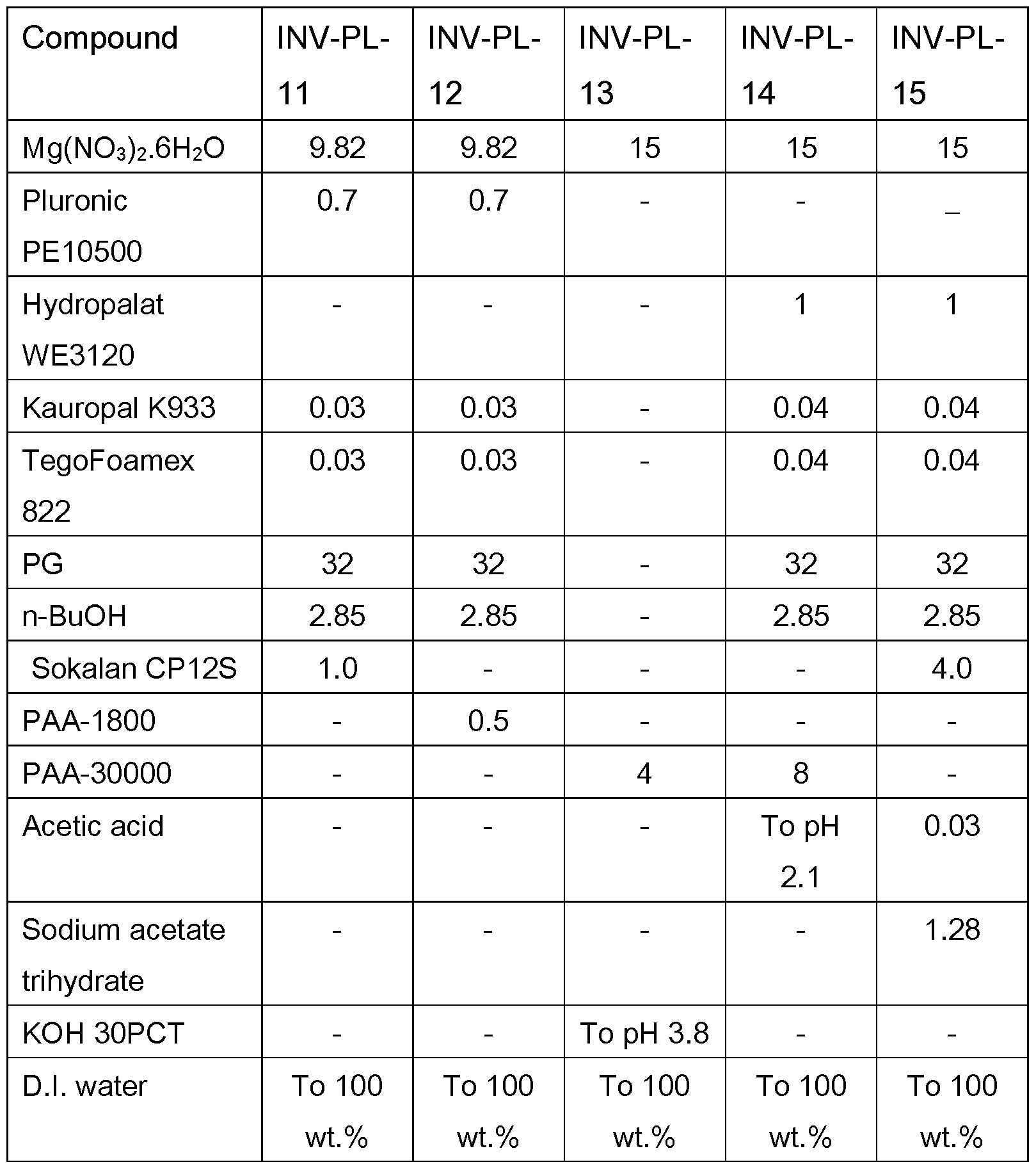
- Comparative and inventive pre-treatment liquids were prepared by mixing the ingredients given in Table 2. The weight percentages are relative to the total weight of the pre-treatment liquid. The raw materials were used as supplied without any further treatments.
- Table 2 Composition of comparative and inventive pre-treatment liquids without resin particles
- Aqueous inks INVINK-1 to INVINK-5 were prepared by adding the ingredients from Table 3 into a recipient. All ingredients according to Table 3 are expressed in wt.% based on the total weight of the ink. Water was added to complete the ink to the desired pigment concentration. [0141] Aqueous inks INVINK-1 to INVINK-3 were prepared by first diluting the wax followed by adding the other ingredients from Table 3.
- Table 3 Composition of aqueous inkjet inks of the inventive liquid set.
- Table 4 Image quality of printed images onto different liner pre-treatments containing resin particles.
- Table 5 Image quality of printed images onto different liner pre-treatments without resin particles.
- INV-PL-3 were tested for recirculation according to ⁇ D.2.3. After 10,000 minutes of recirculation, the wax containing pre-treatment liquid COMP- PL-2 showed a pressure drop increase of more than 15%; the inventive pre-treatment liquid did not show any pressure drop increase throughout the 10,000 minutes of recirculation.
- inventive pre-treatment liquids do show excellent image quality when combined with aqueous inkjet inks and at the same time do not result in filter clogging when used in recirculation type inkjet heads.
Landscapes
- Chemical & Material Sciences (AREA)
- Life Sciences & Earth Sciences (AREA)
- Engineering & Computer Science (AREA)
- Materials Engineering (AREA)
- Wood Science & Technology (AREA)
- Organic Chemistry (AREA)
- Chemical Kinetics & Catalysis (AREA)
- Inks, Pencil-Leads, Or Crayons (AREA)
- Ink Jet Recording Methods And Recording Media Thereof (AREA)
- Ink Jet (AREA)
Abstract
Description




Claims
Priority Applications (3)
| Application Number | Priority Date | Filing Date | Title |
|---|---|---|---|
| EP24731248.1A EP4724538A1 (en) | 2023-06-06 | 2024-05-30 | Pre-treatment liquid for inkjet printing |
| JP2025571187A JP2026522296A (en) | 2023-06-06 | 2024-05-30 | Pre-treatment solution for inkjet printing |
| CN202480037649.2A CN121263490A (en) | 2023-06-06 | 2024-05-30 | Pretreatment liquid for inkjet printing |
Applications Claiming Priority (2)
| Application Number | Priority Date | Filing Date | Title |
|---|---|---|---|
| EP23177474.6 | 2023-06-06 | ||
| EP23177474 | 2023-06-06 |
Publications (1)
| Publication Number | Publication Date |
|---|---|
| WO2024251598A1 true WO2024251598A1 (en) | 2024-12-12 |
Family
ID=86692944
Family Applications (1)
| Application Number | Title | Priority Date | Filing Date |
|---|---|---|---|
| PCT/EP2024/064862 Ceased WO2024251598A1 (en) | 2023-06-06 | 2024-05-30 | Pre-treatment liquid for inkjet printing |
Country Status (4)
| Country | Link |
|---|---|
| EP (1) | EP4724538A1 (en) |
| JP (1) | JP2026522296A (en) |
| CN (1) | CN121263490A (en) |
| WO (1) | WO2024251598A1 (en) |
Cited By (1)
| Publication number | Priority date | Publication date | Assignee | Title |
|---|---|---|---|---|
| EP4763926A1 (en) * | 2024-12-19 | 2026-06-24 | Agfa Nv | Ink composition and image recording method suitable for manufacturing printed corrugated cardboard |
Citations (19)
| Publication number | Priority date | Publication date | Assignee | Title |
|---|---|---|---|---|
| EP0906371A1 (en) | 1996-06-17 | 1999-04-07 | Cabot Corporation | Colored pigment and aqueous compositions containing same |
| EP1220879A1 (en) | 1999-10-01 | 2002-07-10 | Cabot Corporation | Modified pigments having steric and amphiphilic groups |
| JP2004075759A (en) | 2002-08-13 | 2004-03-11 | Fuji Photo Film Co Ltd | Colored fine particle dispersion, ink composition and method for inkjet recording |
| WO2006030235A2 (en) | 2004-09-18 | 2006-03-23 | Xaar Technology Limited | Fluid supply method and apparatus |
| WO2006064036A1 (en) | 2004-12-17 | 2006-06-22 | Agfa Graphics Nv | Ink circulation system for inkjet printing |
| WO2008074548A1 (en) | 2006-12-21 | 2008-06-26 | Agfa Graphics Nv | White inkjet ink improved for dispersion stability |
| US20090227711A1 (en) | 2008-03-07 | 2009-09-10 | Xerox Corporation | Encapsulated nanoscale particles of organic pigments |
| EP2412766A1 (en) * | 2010-07-30 | 2012-02-01 | Fujifilm Corporation | Ink composition, ink set, and image forming method |
| EP2535379A1 (en) | 2011-06-17 | 2012-12-19 | Fujifilm Corporation | Ink set and image forming method |
| WO2015158649A1 (en) | 2014-04-15 | 2015-10-22 | Agfa Graphics Nv | Aqueous resin based inkjet inks |
| WO2016165970A1 (en) | 2015-04-15 | 2016-10-20 | Agfa Graphics Nv | Aqueous resin based inkjet inks |
| JP2017088646A (en) * | 2015-11-02 | 2017-05-25 | サカタインクス株式会社 | Ink jet recording primer ink and ink jet recording ink set |
| WO2018016141A1 (en) * | 2016-07-19 | 2018-01-25 | サカタインクス株式会社 | Primer ink for inkjet recording and ink set for inkjet recording |
| WO2018017089A1 (en) | 2016-07-21 | 2018-01-25 | Hewlett-Packard Development Company, L.P. | Ink fixative solution |
| WO2019013785A1 (en) | 2017-07-12 | 2019-01-17 | Hewlett-Packard Development Company, L.P. | Treatment composition for packaging liner |
| EP3532545A1 (en) | 2016-10-28 | 2019-09-04 | Agfa Nv | Polyurethane resin for ink jet ink |
| US20210187971A1 (en) | 2018-09-28 | 2021-06-24 | Fujifilm Corporation | Pretreatment liquid, ink set, and image recording method |
| US20220315786A1 (en) * | 2021-03-29 | 2022-10-06 | Seiko Epson Corporation | Ink Set And Recording Method |
| WO2023001650A1 (en) | 2021-07-19 | 2023-01-26 | Agfa Nv | Pre-treatment composition for inkjet printing |
-
2024
- 2024-05-30 CN CN202480037649.2A patent/CN121263490A/en active Pending
- 2024-05-30 WO PCT/EP2024/064862 patent/WO2024251598A1/en not_active Ceased
- 2024-05-30 JP JP2025571187A patent/JP2026522296A/en active Pending
- 2024-05-30 EP EP24731248.1A patent/EP4724538A1/en active Pending
Patent Citations (19)
| Publication number | Priority date | Publication date | Assignee | Title |
|---|---|---|---|---|
| EP0906371A1 (en) | 1996-06-17 | 1999-04-07 | Cabot Corporation | Colored pigment and aqueous compositions containing same |
| EP1220879A1 (en) | 1999-10-01 | 2002-07-10 | Cabot Corporation | Modified pigments having steric and amphiphilic groups |
| JP2004075759A (en) | 2002-08-13 | 2004-03-11 | Fuji Photo Film Co Ltd | Colored fine particle dispersion, ink composition and method for inkjet recording |
| WO2006030235A2 (en) | 2004-09-18 | 2006-03-23 | Xaar Technology Limited | Fluid supply method and apparatus |
| WO2006064036A1 (en) | 2004-12-17 | 2006-06-22 | Agfa Graphics Nv | Ink circulation system for inkjet printing |
| WO2008074548A1 (en) | 2006-12-21 | 2008-06-26 | Agfa Graphics Nv | White inkjet ink improved for dispersion stability |
| US20090227711A1 (en) | 2008-03-07 | 2009-09-10 | Xerox Corporation | Encapsulated nanoscale particles of organic pigments |
| EP2412766A1 (en) * | 2010-07-30 | 2012-02-01 | Fujifilm Corporation | Ink composition, ink set, and image forming method |
| EP2535379A1 (en) | 2011-06-17 | 2012-12-19 | Fujifilm Corporation | Ink set and image forming method |
| WO2015158649A1 (en) | 2014-04-15 | 2015-10-22 | Agfa Graphics Nv | Aqueous resin based inkjet inks |
| WO2016165970A1 (en) | 2015-04-15 | 2016-10-20 | Agfa Graphics Nv | Aqueous resin based inkjet inks |
| JP2017088646A (en) * | 2015-11-02 | 2017-05-25 | サカタインクス株式会社 | Ink jet recording primer ink and ink jet recording ink set |
| WO2018016141A1 (en) * | 2016-07-19 | 2018-01-25 | サカタインクス株式会社 | Primer ink for inkjet recording and ink set for inkjet recording |
| WO2018017089A1 (en) | 2016-07-21 | 2018-01-25 | Hewlett-Packard Development Company, L.P. | Ink fixative solution |
| EP3532545A1 (en) | 2016-10-28 | 2019-09-04 | Agfa Nv | Polyurethane resin for ink jet ink |
| WO2019013785A1 (en) | 2017-07-12 | 2019-01-17 | Hewlett-Packard Development Company, L.P. | Treatment composition for packaging liner |
| US20210187971A1 (en) | 2018-09-28 | 2021-06-24 | Fujifilm Corporation | Pretreatment liquid, ink set, and image recording method |
| US20220315786A1 (en) * | 2021-03-29 | 2022-10-06 | Seiko Epson Corporation | Ink Set And Recording Method |
| WO2023001650A1 (en) | 2021-07-19 | 2023-01-26 | Agfa Nv | Pre-treatment composition for inkjet printing |
Non-Patent Citations (3)
| Title |
|---|
| FOCK, J.MOHRING, V.: "Polyether-1,2- and -1,3-diols as macromonomers for the synthesis of graft copolymers, 1. Synthesis and characterization of the macromonomers.", DIE MAKROMOLEKULARE CHEMIE, vol. 191, no. 183558-78-3, 1990, pages 3045 - 3057 |
| HERBST, WILLY ET AL.: "Industrial Organic Pigments, Production, Properties, Applications", 2004, WILEY - VCH |
| MC CUTCHEONGLEN ROCK,N.J.: "Functional Materials", 1990, MANUFACTURING CONFECTIONER PUBLISHING CO., pages: 110 - 129 |
Cited By (2)
| Publication number | Priority date | Publication date | Assignee | Title |
|---|---|---|---|---|
| EP4763926A1 (en) * | 2024-12-19 | 2026-06-24 | Agfa Nv | Ink composition and image recording method suitable for manufacturing printed corrugated cardboard |
| WO2026131254A1 (en) * | 2024-12-19 | 2026-06-25 | Agfa Nv | Ink composition and image recording method suitable for manufacturing printed corrugated cardboard |
Also Published As
| Publication number | Publication date |
|---|---|
| EP4724538A1 (en) | 2026-04-15 |
| CN121263490A (en) | 2026-01-02 |
| JP2026522296A (en) | 2026-07-07 |
Similar Documents
| Publication | Publication Date | Title |
|---|---|---|
| EP4373896B1 (en) | Pre-treatment composition for inkjet printing | |
| US10190008B2 (en) | Method for printing on water-soluble material | |
| US9969895B2 (en) | Printing process | |
| JP5500411B1 (en) | Water-based inkjet recording ink and method for producing laminate | |
| JP5735021B2 (en) | Image forming method | |
| CN107001830A (en) | Ink | |
| WO2008075049A1 (en) | Aqueous inkjet fluid | |
| CN107001832A (en) | Ink | |
| CN105339440A (en) | Inks | |
| EP4677038A1 (en) | Liquid set for inkjet printing comprising an aqueous pre-treatment liquid, an aqueous inkjet ink and a varnish | |
| JP2023507643A (en) | Inkjet ink and primer fluid set | |
| JP2023507767A (en) | Inkjet ink and primer fluid set | |
| EP4724538A1 (en) | Pre-treatment liquid for inkjet printing | |
| WO2021224046A1 (en) | Fluid set for inkjet printing | |
| JP2023524534A (en) | Inkjet inks based on aqueous resins | |
| JP2023507768A (en) | Inkjet ink and primer fluid set | |
| WO2025125121A1 (en) | Inkjet recording method on cardboard liners and apparatus therefor | |
| WO2025125133A1 (en) | Inkjet recording method and apparatus therefor | |
| WO2026046773A1 (en) | Inkjet recording method and apparatus therefor | |
| JP6231890B2 (en) | Post-treatment agent for ink | |
| WO2025247614A1 (en) | Liquid set for inkjet printing comprising an aqueous pre-treatment liquid, an aqueous inkjet ink and a varnish. | |
| EP4146756A1 (en) | Cationic polymer nanoparticles | |
| CN121002131A (en) | Water-based inks for inkjet recording | |
| WO2024153482A1 (en) | Method of ink jet recording |
Legal Events
| Date | Code | Title | Description |
|---|---|---|---|
| 121 | Ep: the epo has been informed by wipo that ep was designated in this application |
Ref document number: 24731248 Country of ref document: EP Kind code of ref document: A1 |
|
| ENP | Entry into the national phase |
Ref document number: 2025571187 Country of ref document: JP Kind code of ref document: A |
|
| WWE | Wipo information: entry into national phase |
Ref document number: 2025571187 Country of ref document: JP |
|
| WWE | Wipo information: entry into national phase |
Ref document number: 2024731248 Country of ref document: EP |
|
| NENP | Non-entry into the national phase |
Ref country code: DE |
|
| ENP | Entry into the national phase |
Ref document number: 2024731248 Country of ref document: EP Effective date: 20260107 |
|
| ENP | Entry into the national phase |
Ref document number: 2024731248 Country of ref document: EP Effective date: 20260107 |
|
| ENP | Entry into the national phase |
Ref document number: 2024731248 Country of ref document: EP Effective date: 20260107 |
|
| ENP | Entry into the national phase |
Ref document number: 2024731248 Country of ref document: EP Effective date: 20260107 |
|
| ENP | Entry into the national phase |
Ref document number: 2024731248 Country of ref document: EP Effective date: 20260107 |
|
| WWP | Wipo information: published in national office |
Ref document number: 2024731248 Country of ref document: EP |