WO2024237308A1 - Carbon dioxide/nitrogen/argon adsorbent and carbon dioxide/nitrogen/argon adsorption apparatus - Google Patents
Carbon dioxide/nitrogen/argon adsorbent and carbon dioxide/nitrogen/argon adsorption apparatus Download PDFInfo
- Publication number
- WO2024237308A1 WO2024237308A1 PCT/JP2024/018126 JP2024018126W WO2024237308A1 WO 2024237308 A1 WO2024237308 A1 WO 2024237308A1 JP 2024018126 W JP2024018126 W JP 2024018126W WO 2024237308 A1 WO2024237308 A1 WO 2024237308A1
- Authority
- WO
- WIPO (PCT)
- Prior art keywords
- nitrogen
- argon
- carbon dioxide
- adsorbent
- adsorbent according
- Prior art date
- Legal status (The legal status is an assumption and is not a legal conclusion. Google has not performed a legal analysis and makes no representation as to the accuracy of the status listed.)
- Ceased
Links
Images




Classifications
-
- B—PERFORMING OPERATIONS; TRANSPORTING
- B01—PHYSICAL OR CHEMICAL PROCESSES OR APPARATUS IN GENERAL
- B01D—SEPARATION
- B01D53/00—Separation of gases or vapours; Recovering vapours of volatile solvents from gases; Chemical or biological purification of waste gases, e.g. engine exhaust gases, smoke, fumes, flue gases, aerosols
- B01D53/02—Separation of gases or vapours; Recovering vapours of volatile solvents from gases; Chemical or biological purification of waste gases, e.g. engine exhaust gases, smoke, fumes, flue gases, aerosols by adsorption, e.g. preparative gas chromatography
-
- B—PERFORMING OPERATIONS; TRANSPORTING
- B01—PHYSICAL OR CHEMICAL PROCESSES OR APPARATUS IN GENERAL
- B01J—CHEMICAL OR PHYSICAL PROCESSES, e.g. CATALYSIS OR COLLOID CHEMISTRY; THEIR RELEVANT APPARATUS
- B01J20/00—Solid sorbent compositions or filter aid compositions; Sorbents for chromatography; Processes for preparing, regenerating or reactivating thereof
- B01J20/02—Solid sorbent compositions or filter aid compositions; Sorbents for chromatography; Processes for preparing, regenerating or reactivating thereof comprising inorganic material
- B01J20/0203—Solid sorbent compositions or filter aid compositions; Sorbents for chromatography; Processes for preparing, regenerating or reactivating thereof comprising inorganic material comprising compounds of metals not provided for in B01J20/04
- B01J20/0207—Compounds of Sc, Y or Lanthanides
-
- B—PERFORMING OPERATIONS; TRANSPORTING
- B01—PHYSICAL OR CHEMICAL PROCESSES OR APPARATUS IN GENERAL
- B01J—CHEMICAL OR PHYSICAL PROCESSES, e.g. CATALYSIS OR COLLOID CHEMISTRY; THEIR RELEVANT APPARATUS
- B01J20/00—Solid sorbent compositions or filter aid compositions; Sorbents for chromatography; Processes for preparing, regenerating or reactivating thereof
- B01J20/02—Solid sorbent compositions or filter aid compositions; Sorbents for chromatography; Processes for preparing, regenerating or reactivating thereof comprising inorganic material
- B01J20/0203—Solid sorbent compositions or filter aid compositions; Sorbents for chromatography; Processes for preparing, regenerating or reactivating thereof comprising inorganic material comprising compounds of metals not provided for in B01J20/04
- B01J20/0211—Compounds of Ti, Zr, Hf
-
- B—PERFORMING OPERATIONS; TRANSPORTING
- B01—PHYSICAL OR CHEMICAL PROCESSES OR APPARATUS IN GENERAL
- B01J—CHEMICAL OR PHYSICAL PROCESSES, e.g. CATALYSIS OR COLLOID CHEMISTRY; THEIR RELEVANT APPARATUS
- B01J20/00—Solid sorbent compositions or filter aid compositions; Sorbents for chromatography; Processes for preparing, regenerating or reactivating thereof
- B01J20/02—Solid sorbent compositions or filter aid compositions; Sorbents for chromatography; Processes for preparing, regenerating or reactivating thereof comprising inorganic material
- B01J20/0203—Solid sorbent compositions or filter aid compositions; Sorbents for chromatography; Processes for preparing, regenerating or reactivating thereof comprising inorganic material comprising compounds of metals not provided for in B01J20/04
- B01J20/0214—Compounds of V, Nb, Ta
-
- B—PERFORMING OPERATIONS; TRANSPORTING
- B01—PHYSICAL OR CHEMICAL PROCESSES OR APPARATUS IN GENERAL
- B01J—CHEMICAL OR PHYSICAL PROCESSES, e.g. CATALYSIS OR COLLOID CHEMISTRY; THEIR RELEVANT APPARATUS
- B01J20/00—Solid sorbent compositions or filter aid compositions; Sorbents for chromatography; Processes for preparing, regenerating or reactivating thereof
- B01J20/02—Solid sorbent compositions or filter aid compositions; Sorbents for chromatography; Processes for preparing, regenerating or reactivating thereof comprising inorganic material
- B01J20/0203—Solid sorbent compositions or filter aid compositions; Sorbents for chromatography; Processes for preparing, regenerating or reactivating thereof comprising inorganic material comprising compounds of metals not provided for in B01J20/04
- B01J20/0218—Compounds of Cr, Mo, W
-
- B—PERFORMING OPERATIONS; TRANSPORTING
- B01—PHYSICAL OR CHEMICAL PROCESSES OR APPARATUS IN GENERAL
- B01J—CHEMICAL OR PHYSICAL PROCESSES, e.g. CATALYSIS OR COLLOID CHEMISTRY; THEIR RELEVANT APPARATUS
- B01J20/00—Solid sorbent compositions or filter aid compositions; Sorbents for chromatography; Processes for preparing, regenerating or reactivating thereof
- B01J20/02—Solid sorbent compositions or filter aid compositions; Sorbents for chromatography; Processes for preparing, regenerating or reactivating thereof comprising inorganic material
- B01J20/0203—Solid sorbent compositions or filter aid compositions; Sorbents for chromatography; Processes for preparing, regenerating or reactivating thereof comprising inorganic material comprising compounds of metals not provided for in B01J20/04
- B01J20/0222—Compounds of Mn, Re
-
- B—PERFORMING OPERATIONS; TRANSPORTING
- B01—PHYSICAL OR CHEMICAL PROCESSES OR APPARATUS IN GENERAL
- B01J—CHEMICAL OR PHYSICAL PROCESSES, e.g. CATALYSIS OR COLLOID CHEMISTRY; THEIR RELEVANT APPARATUS
- B01J20/00—Solid sorbent compositions or filter aid compositions; Sorbents for chromatography; Processes for preparing, regenerating or reactivating thereof
- B01J20/02—Solid sorbent compositions or filter aid compositions; Sorbents for chromatography; Processes for preparing, regenerating or reactivating thereof comprising inorganic material
- B01J20/0203—Solid sorbent compositions or filter aid compositions; Sorbents for chromatography; Processes for preparing, regenerating or reactivating thereof comprising inorganic material comprising compounds of metals not provided for in B01J20/04
- B01J20/0274—Solid sorbent compositions or filter aid compositions; Sorbents for chromatography; Processes for preparing, regenerating or reactivating thereof comprising inorganic material comprising compounds of metals not provided for in B01J20/04 characterised by the type of anion
-
- B—PERFORMING OPERATIONS; TRANSPORTING
- B01—PHYSICAL OR CHEMICAL PROCESSES OR APPARATUS IN GENERAL
- B01J—CHEMICAL OR PHYSICAL PROCESSES, e.g. CATALYSIS OR COLLOID CHEMISTRY; THEIR RELEVANT APPARATUS
- B01J20/00—Solid sorbent compositions or filter aid compositions; Sorbents for chromatography; Processes for preparing, regenerating or reactivating thereof
- B01J20/02—Solid sorbent compositions or filter aid compositions; Sorbents for chromatography; Processes for preparing, regenerating or reactivating thereof comprising inorganic material
- B01J20/0203—Solid sorbent compositions or filter aid compositions; Sorbents for chromatography; Processes for preparing, regenerating or reactivating thereof comprising inorganic material comprising compounds of metals not provided for in B01J20/04
- B01J20/0274—Solid sorbent compositions or filter aid compositions; Sorbents for chromatography; Processes for preparing, regenerating or reactivating thereof comprising inorganic material comprising compounds of metals not provided for in B01J20/04 characterised by the type of anion
- B01J20/0296—Nitrates of compounds other than those provided for in B01J20/04
-
- B—PERFORMING OPERATIONS; TRANSPORTING
- B01—PHYSICAL OR CHEMICAL PROCESSES OR APPARATUS IN GENERAL
- B01J—CHEMICAL OR PHYSICAL PROCESSES, e.g. CATALYSIS OR COLLOID CHEMISTRY; THEIR RELEVANT APPARATUS
- B01J20/00—Solid sorbent compositions or filter aid compositions; Sorbents for chromatography; Processes for preparing, regenerating or reactivating thereof
- B01J20/02—Solid sorbent compositions or filter aid compositions; Sorbents for chromatography; Processes for preparing, regenerating or reactivating thereof comprising inorganic material
- B01J20/06—Solid sorbent compositions or filter aid compositions; Sorbents for chromatography; Processes for preparing, regenerating or reactivating thereof comprising inorganic material comprising oxides or hydroxides of metals not provided for in group B01J20/04
-
- B—PERFORMING OPERATIONS; TRANSPORTING
- B01—PHYSICAL OR CHEMICAL PROCESSES OR APPARATUS IN GENERAL
- B01J—CHEMICAL OR PHYSICAL PROCESSES, e.g. CATALYSIS OR COLLOID CHEMISTRY; THEIR RELEVANT APPARATUS
- B01J20/00—Solid sorbent compositions or filter aid compositions; Sorbents for chromatography; Processes for preparing, regenerating or reactivating thereof
- B01J20/28—Solid sorbent compositions or filter aid compositions; Sorbents for chromatography; Processes for preparing, regenerating or reactivating thereof characterised by their form or physical properties
- B01J20/28002—Solid sorbent compositions or filter aid compositions; Sorbents for chromatography; Processes for preparing, regenerating or reactivating thereof characterised by their form or physical properties characterised by their physical properties
- B01J20/28011—Other properties, e.g. density, crush strength
-
- B—PERFORMING OPERATIONS; TRANSPORTING
- B01—PHYSICAL OR CHEMICAL PROCESSES OR APPARATUS IN GENERAL
- B01J—CHEMICAL OR PHYSICAL PROCESSES, e.g. CATALYSIS OR COLLOID CHEMISTRY; THEIR RELEVANT APPARATUS
- B01J20/00—Solid sorbent compositions or filter aid compositions; Sorbents for chromatography; Processes for preparing, regenerating or reactivating thereof
- B01J20/28—Solid sorbent compositions or filter aid compositions; Sorbents for chromatography; Processes for preparing, regenerating or reactivating thereof characterised by their form or physical properties
- B01J20/28054—Solid sorbent compositions or filter aid compositions; Sorbents for chromatography; Processes for preparing, regenerating or reactivating thereof characterised by their form or physical properties characterised by their surface properties or porosity
- B01J20/28057—Surface area, e.g. B.E.T specific surface area
-
- B—PERFORMING OPERATIONS; TRANSPORTING
- B82—NANOTECHNOLOGY
- B82Y—SPECIFIC USES OR APPLICATIONS OF NANOSTRUCTURES; MEASUREMENT OR ANALYSIS OF NANOSTRUCTURES; MANUFACTURE OR TREATMENT OF NANOSTRUCTURES
- B82Y30/00—Nanotechnology for materials or surface science, e.g. nanocomposites
Definitions
- the present disclosure relates to a carbon dioxide/nitrogen/argon adsorbent and a carbon dioxide/nitrogen/argon adsorption apparatus.
- Non-Patent Document 1 reports physical adsorption of N 2 , O 2 , and CO in TiO 2 (110).
- N 2 adsorption it is shown that at low coverage of N 2 , N 2 molecules are directly bound with the 5-coordinate Ti 4+ ions, this adsorption preferentially occurs at Ti 4+ sites without adjacent adsorbents, and this arrangement minimizes the repulsive interactions between the adsorbed molecules along a Ti 4+ column, with a relatively small shift of a TPD peak with increasing coverage (105 ⁇ 90 K).
- MXene is known as one of two-dimensional substances.
- MXene is composed of a predetermined layered material (typically, the layer body of Ti 3 C 2 has T which is a surface modifier/terminal (T is at least one selected from the group consisting of a hydroxyl group, a fluorine atom, a chlorine atom, an oxygen atom, and a hydrogen atom), and is expressed as Ti 3 C 2 T x or Ti 3 C 2 T s ), and may have the form of nanoflake (or nanosheet) (refer to Non-Patent Documents 2 to 3).
- Non-Patent Document 4 proposes that a composite aerogel composed of nanosheets of MXene and natural vermiculite is used for recovery and storage of carbon dioxide.
- Non-Patent Document 4 In the related art, in known TiO 2 , nitrogen is adsorbed only in a cryogenic temperature range (100 K or less, particularly 50 K or less), and adsorption in other temperature ranges is not shown. Also, the adsorption of argon is not shown. In addition, the composite aerogel disclosed in Non-Patent Document 4 has a complicated preparation process and is poor in mass productivity.
- An object of the present disclosure is to provide a novel (and mass-producible) carbon dioxide/nitrogen/argon adsorbent, and a carbon dioxide/nitrogen/argon adsorption apparatus including the adsorbent.
- a carbon dioxide/nitrogen/argon adsorbent comprising a material containing a nanofiber and/or a two-dimensional substance represented by the following formula: MQ a O b wherein M is at least one element selected from the group consisting of Groups 3, 4, 5, 6, or 7, Q is at least one element (here, O is excluded) selected from the group consisting of Groups 12, 13, 14, 15, or 16, a is 0 or more and 2 or less, and b is more than 0 and 2 or less.
- the carbon dioxide/nitrogen/argon adsorbent is an adsorbent of carbon dioxide and is also a nitrogen and/or argon adsorbent, and thus can also be expressed as a “carbon dioxide/nitrogen and/or argon adsorbent”.
- carbon dioxide/nitrogen/argon adsorbent of the present embodiment is particularly used for a “nitrogen and/or argon adsorbent” (also referred to as a “gas adsorbent for adsorbing one or more gases of nitrogen and argon”)
- the “nitrogen and/or argon adsorbent” may be referred to as a “nitrogen/argon adsorbent”.
- a carbon dioxide/nitrogen/argon adsorption apparatus comprising the carbon dioxide/nitrogen/argon adsorbent.
- the carbon dioxide/nitrogen/argon adsorption apparatus is an adsorption apparatus of carbon dioxide and is also a nitrogen and/or argon adsorption apparatus, and thus can also be referred to as an “carbon dioxide/nitrogen and/or argon adsorption apparatus”.
- the carbon dioxide/nitrogen/argon adsorption apparatus of the present embodiment is particularly used for a “nitrogen and/or argon adsorption apparatus” (also referred to as a “gas adsorption apparatus for adsorbing one or more gases of nitrogen and argon”)
- a “nitrogen and/or argon adsorption apparatus” also referred to as a “gas adsorption apparatus for adsorbing one or more gases of nitrogen and argon”
- the “nitrogen and/or argon adsorption apparatus” may be referred to as a “nitrogen/argon adsorption apparatus”.
- a novel (and mass-producible) carbon dioxide/nitrogen/argon adsorbent and a carbon dioxide/nitrogen/argon adsorption apparatus including the adsorbent.
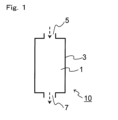
- Fig. 1 is a schematic cross-sectional view of a carbon dioxide/nitrogen/argon adsorption apparatus according to one embodiment of the present disclosure.
- Fig. 2 is a graph obtained by performing hysteresis scan measurement of an adsorption process and a desorption process of carbon dioxide at each temperature using a dry powder of Example 1.
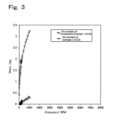
- Fig. 3 is a graph of carbon dioxide adsorption at normal temperature of dry powders of Example 2 and Comparative Example 1.
- Fig. 4 is a view showing an XRD pattern of a material (TiCO) produced in Example 3.
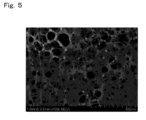
- Fig. 5 is an SEM image of a material (TiCO) produced in Example 3.
- Fig. 6 is another SEM image of the material (TiCO) produced in Example 3.
- TG-DTA thermogravimetric/differential thermal analysis
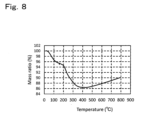
- Fig. 8 is a graph showing results of thermogravimetric/differential thermal analysis (TG-DTA) using a dry powder of Example 4.
- the present embodiment relates to a carbon dioxide/nitrogen/argon adsorbent comprising a material containing a predetermined nanofiber and/or a predetermined two-dimensional substance.
- material means “material containing a predetermined nanofiber and/or a predetermined two-dimensional substance” (in other words, a material containing at least one of a predetermined nanofiber and a predetermined two-dimensional substance).
- the material containing the nanofiber and/or the two-dimensional substance typically means a material that is a solid content and does not contain a binder or the like (for example, a polymer).
- the material containing the nanofiber and/or the two-dimensional substance can mean, in a narrow sense, a material substantially consisting of at least one of the nanofiber and the two-dimensional substance (which may contain other objects, impurities, or the like that may be inevitably mixed).
- the material including the nanofiber and/or the two-dimensional substance is not limited thereto.
- the carbon dioxide/nitrogen/argon adsorbent comprises a material containing a predetermined nanofibers and/or a predetermined two-dimensional material.
- the term "comprise” is used herein to mean that the present embodiment includes an aspect in which the carbon dioxide/nitrogen/argon adsorbent contains other materials such as additives suitable for adsorbent in addition to the material containing the nanofiber and/or the two-dimensional substance, an aspect in which the carbon dioxide/nitrogen/argon adsorbent substantially consists of the material containing the nanofiber and/or the two-dimensional substance (which may contain other objects, impurities, or the like that may be inevitably mixed), and an aspect in which the carbon dioxide/nitrogen/argon adsorbent consists of the material containing the nanofiber and/or the two-dimensional substance.
- the material contained in the carbon dioxide/nitrogen/argon adsorbent of the present embodiment is a nanofiber and/or a two-dimensional substance of a predetermined material (substance).
- the predetermined material that can be used in the present embodiment is represented by the following Formula (1).
- M is at least one element selected from the group consisting of Groups 3, 4, 5, 6, or 7, and may contain a so-called early transition metal, for example, at least one element selected from the group consisting of Sc, Ti, Zr, Hf, V, Nb, Ta, Cr, Mo, and Mn, and preferably at least one element selected from the group consisting of Ti, V, Cr, Mo, and Mn
- Q is at least one element (here, O is excluded) selected from the group consisting of Groups 12, 13, 14, 15, or 16, and may contain, for example, at least one element selected from the group consisting of B, C, N, Si, P, and S, a is 0 or more and 2 or less, and b is more than 0 and 2 or less)
- MQO predetermined material
- MQO predetermined material
- examples of MQO include those represented by formulas such as TiO 2 , TiCO, TiCON, VO 2 , VCO, VCON, CrO 2 , CrCO, CrCON, MoO 2 , MoCO, MoCON, MnO 2 , MnCO, and MnCON.
- the M may be Ti, and the Q may be C.
- the a may not be 0.
- MQO has a crystal structure different from that of a hexagonal system.
- the present embodiment is not bound by any theory, it can be considered that the crystal structure of MQO is an anatase type, a lepidocrocite type, or a mixture thereof at present.
- the crystal structure of MQO may be a lepidocrocite type.
- MQO can be produced using a first raw material and a second raw material, for example, as follows.
- the first raw material contains at least the M
- the second raw material contains at least the Q
- the first raw material and the second raw material can react in a protic solvent to generate MQO.
- a material represented by the following Formula (2) can be used as the first raw material.
- M c A 1 d (2) (wherein M is as described above, A 1 is at least one element selected from the group consisting of Groups 12, 13, 14, 15, or 16, and may contain, for example, at least one element selected from the group consisting of B, C, N, O, Si, P, and S, and c and d are each independently 1 or more and 5 or less)
- the material represented by Formula (2) needs to be different from the MQO of the product.
- the material represented by Formula (2) may not have a peak in a range in which a diffraction angle 2 ⁇ is 2° or more and 12° or less in an X-ray diffraction (XRD) pattern.
- XRD X-ray diffraction
- Examples of the first raw material represented by Formula (2) include TiB 2 , TiB, TiC, TiN, TiO 2 , Ti 5 Si 3 , Ti 2 SbP, VO 2 , V 2 O 4 , NbC, Nb 2 O 5 , MoO 2 , MoO 3 , MoS 2 , MnO 2 , Mn 3 O 4 , and MnCO 3 .
- a material represented by the following Formula (3) (hereinafter, also simply referred to as “MAX phase” or “MAX raw material”) can be used as the first raw material.
- M m A 2 X n (3) (wherein M is as described above, X is at least one element selected from the group consisting of C and N, n is 1 or more and 4 or less, m is more than n and 5 or less, A 2 is at least one element selected from the group consisting of Groups 12, 13, 14, 15, or 16, is usually a Group A element, typically Group IIIA and Group IVA, and more particularly may include at least one selected from the group consisting of Al, Ga, In, Tl, Si, Ge, Sn, Pb, P, As, S, and Cd, and is preferably Al)
- the MAX phase has a crystal structure in which a layer constituted by A 2 atoms is positioned between two layers represented by M m X n (each X may have a crystal lattice positioned in an
- M m X n layer a layer of A 2 atoms
- a 2 atom layer a layer next to the (n + 1)th layer of M atoms.
- the MAX phase is not limited thereto.
- Examples of the first raw material represented by Formula (3) include Ti 3 AlC 2 , Ti 3 GaC 2 , and Ti 3 SiC 2 .
- the material represented by Formula (2) and the material represented by Formula (3) may be used together (for example, as a mixture).
- an ion-binding substance having a carbon-containing group can be used as the second raw material.
- the ion-binding substance having a carbon-containing group contains C.
- Examples of the ion-binding substance include ammonium salts, phosphate salts, and sulfate salts.
- a quaternary ammonium salt can be used as the second raw material.
- the quaternary ammonium salts include tetramethylammonium hydroxide (TMAH), tetraethylammonium hydroxide (TEAH), tetrapropylammonium hydroxide (TPAH), tetrabutylammonium hydroxide (TBAH or TBAOH), benzyltrimethylammonium hydroxide, tetrabutylammonium fluoride (TBAF), tetrabutylammonium chloride (TBACl), tetrabutylammonium bromide (TBAB), tetrabutylammonium iodide (TBAI), benzyltriethylammonium chloride (BTEAC), hexadecyltrimethylammonium bromide, cetyltrimethylammonium bromide (CTAB), benzetonium chloride, benzalkonium chloride,
- the protic solvent may be any solvent that can at least partially dissolve the first raw material and the second raw material, and may be particularly an aqueous solvent.
- aqueous solvent water, an alcohol (for example, ethanol, 1-propanol, and isopropanol), a carboxylic acid (for example, acetic acid and formic acid), or the like is used.
- the aqueous solvent may consist of water and optionally a liquid substance compatible with water (for example, a protic solvent other than water), preferably water.
- the first raw material and the second raw material are reacted in the protic solvent.
- the second raw material can be added to the protic solvent in advance.
- the proportion of the second raw material to the total of the protic solvent and the second raw material may be, for example, 5% by mass or more, particularly 20% by mass or more, and/or may be, for example, 80% by mass or less, particularly 50% by mass or less.
- the first raw material can be further added to and mixed with the protic solvent to which the second raw material has been added. In such a mixture, a reaction for generating MQO proceeds.
- the temperature (reaction temperature) of the mixture (which may include the reaction product) may be, for example, 15°C or higher, in particular 40°C or higher, and/or, for example, 100°C or lower, in particular 80°C or lower.
- the mixing time (reaction time) may, for example, be 1 day or more, in particular 2 days or more, and/or may, for example, 10 days or less, in particular 7 days or less.
- the mixing can be performed, for example, by rotating and stirring with a magnetic stirrer charged into the container while maintaining the reaction temperature by a hot plate stirrer and a hot water bath.
- the treatment operation and conditions (temperature, time, and the like) under which the reaction can proceed are not limited to the above, and may be appropriately selected according to the first raw material, the second raw material, the protic solvent, and the like to be used.
- the obtained nanofiber of the MQO may be in the form of nanoribbons extending at nanoscale widths.
- a plurality of nanofibers (for example, nanoribbons) of MQOs may be bonded and/or integrated with each other to grow into nanoflakes extending two-dimensionally.
- a plurality of MQO nanoflakes may overlap each other (for example, by van der Waals force) to form a laminate.
- the cross-sectional outer dimension of the nanofiber of MQO means the shortest distance passing through the center in the cross section crossing the longitudinal direction of the nanofiber of MQO.
- the shape of the cross section of the nanofiber of MQO is not particularly limited, but can be approximated by, for example, a rectangle (rectangles, squares, and the like) or an ellipse (flat circle, true circle, and the like).
- the shape of the cross section thereof can be approximated by a rectangle, and the cross-sectional outer dimension can correspond to the short side length of the rectangle.
- the shape of the cross section thereof can be approximated by a flat circle, and the cross-sectional outer dimension can correspond to the short diameter length of the flat circle.
- MQO is a solid content.
- MQO can typically be a particle (or powder).
- the mixture after the reaction (also referred to as a reaction mixture) may be appropriately subjected to post-treatment.
- post-treatment include washing, impact application (including shear force application), drying (for example, freeze dry, heat dry), and pulverization.
- Washing may be performed using a protic solvent.
- the same description as above may apply to the protic solvent.
- the reaction mixture may be washed with the protic solvent such as water or alcohol.
- a separation operation centrifugation and/or decantation
- the washing and separation operations may be repeated until the pH of a supernatant after centrifugation is, for example, 8 or less.
- washing may be performed using an aqueous solution of a metal salt instead of or in addition to the above washing.
- the metal salt may be, for example, a halide (fluoride, chloride, bromide, iodide) of an alkali metal (Li, Na, K, and the like), typically LiCl, NaCl, KCl, or the like.
- washing may be performed using a metal salt aqueous solution having a molar concentration of 1 to 10.
- a separation operation centrifugation and/or decantation
- washing and separation operations may be repeated as necessary until the pH of the supernatant after centrifugation is, for example, 8 or less.
- an impact such as vibration and/or ultrasound may be applied.
- MQO particles for example, a nanofiber/a nanoflake, the same applies to the following.
- an aggregate can be crushed.
- the impact can be imparted using, for example, any one or more of a handshake, an automatic shaker, a mechanical shaker, a vortex mixer, a homogenizer, an ultrasonic bath, and the like.
- the separation operation may be performed at any suitable time to remove unwanted liquid components, if present.
- a drying operation typically freeze dry or heat dry
- the freeze dry may be performed, for example, by freezing a mixture containing the MQO particles and a liquid component at any suitable temperature (for example, -40°C), followed by drying under reduced pressure atmosphere.
- the heat dry can be performed, for example, by drying a mixture containing the MQO particles and a liquid component at a temperature of 25°C or higher (for example, 200°C or lower) under a normal pressure or a reduced pressure atmosphere.
- the pulverization is not particularly limited, but can be performed using, for example, a combination of a mortar and a pestle, an IKA mill, or the like. The pulverization may be performed after drying.
- the MQO particles can be obtained as a material containing MQO. According to the present embodiment, as described above, it is possible to easily produce a material containing MQO, and it is possible to mass-produce a material containing the MQO or a carbon dioxide/nitrogen/argon adsorbent containing the material.
- MQO is represented by Formula (1)
- the material containing MQO does not need to be composed of only the constituent elements of Formula (1).
- the material containing MQO may optionally have at least one selected from the group consisting of a hydroxyl group, a chlorine atom, an oxygen atom, a hydrogen atom, and a nitrogen atom as a modifier/terminal T present on the surface thereof.
- the material containing MQO may have two or more layers, and at least one selected from the group consisting of ammonium ions (for example, quaternary ammonium cations) and metal cations (for example, alkali metal ions and alkaline earth metal ions) may exist between these layers.
- ammonium ions for example, quaternary ammonium cations
- metal cations for example, alkali metal ions and alkaline earth metal ions
- the particle size of the MQO particles may be, for example, 0.01 nm or more, in particular 0.1 nm or more, further 1 nm or more, and/or may be, for example, less than 1000 nm, in particular 100 nm or less, further 50 nm or less. Such particles may also be referred to as nanoparticles.
- the form of the MQO particles is nanofibers and/or two-dimensional substances.
- the two-dimensional substance includes one or more of nanoflake and a laminate of nanoflakes.
- the two-dimensional substance is not limited to only the nanoflake and the laminate of nanoflakes.
- the nanofiber may also be referred to as a nanowire.
- the “nanofiber” means a solid material extending in the longitudinal direction, and the external dimensions of a cross section perpendicular to the longitudinal direction (cross-sectional external dimensions) are nano-order (that is, 1 nm or more and less than 1000 nm) or smaller sub-nano order (less than 1 nm, for example, 0.1 nm or more and less than 1 nm).
- the longitudinal length of the nanofiber is not limited to the nano-order (that is, 1 nm or more and less than 1000 nm), and may be in the micron order (1 ⁇ m or more and less than 1000 ⁇ m).
- the cross-sectional outer dimension of the nanofiber may be, for example, 0.1 nm or more, particularly 1 nm or more, and may be, for example, 100 nm or less, particularly 50 nm or less, preferably 15 nm or less.
- a “two-dimensional substance” means a solid material having a two-dimensionally extended surface (also referred to as a plane or a two-dimensional sheet surface) and having a thickness relatively small with respect to a maximum dimension of the surface (which may correspond to an “in-plane dimension” of a particle), and the thickness is nano-order (that is, 1 nm or more and less than 1000 nm) or smaller sub-nano order (less than 1 nm, for example, 0.1 nm or more and less than 1 nm).
- the in-plane dimension is not limited to the nano-order (that is, 1 nm or more and less than 1000 nm), and may be in the micron order (1 ⁇ m or more and less than 1000 ⁇ m).
- the two-dimensional substance includes one or more of nanoflake and a laminate of nanoflake as described above.
- the nanoflake may also be referred to as nanosheets or two-dimensional (nano) sheets.
- the thickness of one layer of nanoflake may be, for example, 0.01 nm or more, in particular 0.8 nm or more and, for example, 20 nm or less, in particular 3 nm or less.
- the in-plane dimension of the nanoflake may be, for example, 0.1 ⁇ m or more, particularly 1 ⁇ m or more, and may be, for example, 200 ⁇ m or less, particularly 40 ⁇ m or less.
- the nanoflakes can be constituted by aggregation of nanofibers.
- the laminate of nanoflakes may also be referred to as a multi-layer MQO.
- the distance (interlayer distance or void dimension) between two adjacent nanoflakes (or MQO of two adjacent layers) is not particularly limited.
- the dimensions described above may be determined as number average dimensions (for example, number average of at least 40) based on photographs of a scanning electron microscope (SEM), a transmission electron microscope (TEM), or an atomic force microscope (AFM) (if necessary, processing is performed by a method such as a focused ion beam (FIB)), or as distances in the real space calculated from the positions on the reciprocal lattice space of the (002) plane measured by an X-ray diffraction (XRD) method.
- SEM scanning electron microscope
- TEM transmission electron microscope
- AFM atomic force microscope
- processing is performed by a method such as a focused ion beam (FIB)
- FIB focused ion beam
- XRD X-ray diffraction
- the MQO is not limited to the above-described form, and may have any suitable form.
- the carbon dioxide/nitrogen/argon adsorbent of the present embodiment is made of a material containing MQO, and thus has an ability to adsorb carbon dioxide/nitrogen/argon. It should be noted that the carbon dioxide/nitrogen/argon adsorbent of the present embodiment may be made of a material containing MQO, and the carbon dioxide/nitrogen/argon adsorbent may have any appropriate form.
- the adsorbent of the present embodiment is used as a nitrogen/argon adsorbent
- the adsorption of nitrogen and/or argon is promoted by using the nitrogen/argon adsorbent at preferably 450°C or higher, more preferably 600°C or higher.
- the material containing MQO may typically have a peak in a diffraction angle 2 ⁇ in a range of 2° or higher and 12° or lower in an X-ray diffraction (XRD) pattern.
- XRD X-ray diffraction
- the peaks in the XRD pattern can be identified visually or using the software used with the XRD analyzer.
- the carbon dioxide/nitrogen/argon adsorbent of the present embodiment in other words, the material containing MQO has a relatively large specific surface area. More particularly, the BET specific surface area of the material containing MQO may be larger than 50 m 2 /g.
- the BET specific surface area is calculated using the BET equation from an isothermal adsorption curve of nitrogen gas or other gases under liquid nitrogen temperature (77 K) by an adsorption method with nitrogen gas or other suitable gases such as krypton (Kr) gas.
- the BET specific surface area can be, for example, 80 m 2 /g or larger, and the upper limit thereof is not particularly limited, but can be, for example, 400 m 2 /g or smaller.
- the freeze dry is preferably performed. That is, a preferred embodiment of the carbon dioxide/nitrogen/argon adsorbent of the present embodiment is a freeze-dried powder.
- a Raman shift may have peaks at positions of at least 275 to 295 cm -1 , 435 to 455 cm -1 , and 665 to 745 cm -1 in the Raman spectrum using a laser with a wavelength of 514 nm.
- a Raman shift may have peaks at positions of 140 to 160 cm -1 , 275 to 295 cm -1 , 435 to 455 cm -1 , and 665 to 745 cm -1 in the Raman spectrum using a laser with a wavelength of 514 nm.
- 140 to 160 cm -1 is an anatase type peak.
- the present embodiment is not limited, for example, the material of the present embodiment (more specifically, MQO) has a crystal structure of an anatase type, a lepidocrocite type, or a mixture thereof. More preferably, it has a lepidocrocite type crystal structure.
- the material of the present embodiment can take an aspect in which a Raman shift has peaks at positions of at least 275 to 295 cm -1 , 435 to 455 cm -1 , and 665 to 745 cm -1 in a Raman spectrum using a laser with a wavelength of 514 nm, and when the intensity of each peak is set as X, Y, and Z, X is the largest.
- the material of the present embodiment can take an aspect in which a Raman shift has peaks at positions of at least 180 to 200 cm -1 , 275 to 295 cm -1 , 375 to 395 cm -1 , 435 to 455 cm -1 , and 665 to 745 cm -1 in a Raman spectrum using a laser with a wavelength of 514 nm, and when the intensity of each peak is set as V, X, Y, Z, and W, X is the largest.
- the Raman spectrum is measured by a Raman spectrometer using a laser beam having a wavelength of 514 nm as an excitation light source (the vertical axis represents intensity, and the horizontal axis represents Raman shift).
- the peaks in the Raman spectrum can be identified visually or using the software used with the Raman spectrometer.
- the material containing MQO may contain unreacted first raw material and/or second raw material as impurities, and may contain a substance derived from the first raw material, the second raw material, and/or the protic solvent.
- N may exist (remain) in any form in the material containing MQO.
- the material containing MQO may contain ammonium ions and tetramethylammonium ions.
- the material containing MQO may contain a relatively small amount of remaining A atoms, for example, 10% by mass or less with respect to the original A atoms.
- the remaining amount of A atoms can be preferably 8% by mass or less, and more preferably 6% by mass or less. However, even if the residual amount of A atoms exceeds 10% by mass, there may be no problem depending on use conditions and the like.
- Such a supernatant can be formed into a slurry containing MQO particles as it is, appropriately diluted with a liquid medium, or mixed with a liquid medium after drying.
- a film may be prepared using such a slurry to be used as the carbon dioxide/nitrogen/argon adsorbent of the present embodiment.
- the present embodiment relates to a carbon dioxide/nitrogen/argon adsorption apparatus (or carbon dioxide/nitrogen/argon adsorption device, the same applies to the following).
- the carbon dioxide/nitrogen/argon adsorption apparatus of the present embodiment includes the carbon dioxide/nitrogen/argon adsorbent described above in the first embodiment.
- the carbon dioxide/nitrogen/argon adsorbent may be described in the same manner as in the first embodiment.
- a carbon dioxide/nitrogen/argon adsorption apparatus 10 may include a main body 3 that defines a space 1 in which the material (not shown) described above in first embodiment is disposed, an inlet 5 through which carbon dioxide/nitrogen/argon-containing gas can flow into the space 1, and an outlet 7 through which the carbon dioxide/nitrogen/argon-containing gas can flow from the space 1.
- the carbon dioxide/nitrogen/argon-containing gas may contain one or more of carbon dioxide, nitrogen, and argon.
- the carbon dioxide/nitrogen/argon-containing gas may contain carbon dioxide or nitrogen and/or argon.
- the gas may be composed of carbon dioxide or nitrogen and/or argon.
- the gas may contain other gases in addition to carbon dioxide, or may contain other gases in addition to nitrogen and/or argon.
- the inlet 5 and the outlet 7 may be provided at any suitable position and may be separate (Fig. 1) or common.
- the adsorption apparatus of the present embodiment is used as a nitrogen/argon adsorption apparatus, the adsorption of nitrogen and/or argon by the nitrogen/argon adsorbent is promoted by setting the operating temperature to preferably 450°C or higher, and more preferably 600°C or higher.
- a carbon dioxide/nitrogen/argon adsorption apparatus may be used to store and/or transport carbon dioxide/nitrogen/argon.
- carbon dioxide/nitrogen/argon in the carbon dioxide/nitrogen/argon adsorption apparatus, carbon dioxide/nitrogen/argon can be adsorbed by using the carbon dioxide/nitrogen/argon adsorbent described above in the first embodiment.
- Example 1 Production of slurry containing TiCO
- a container 100 mL Aiboy
- TiB 2 titanium diboride
- TMAH tetramethylammonium hydroxide
- TMAH tetramethylammonium hydroxide
- Centrifugation was performed using a centrifuge under the condition of 3500 G for 5 minutes to precipitate a solid content.
- the supernatant was discarded,
- 40 mL of ethanol manufactured by Fisher Chemical Co., Ltd.
- dispersion treatment using a Vortex mixer was performed for 5 minutes (reslurry), and
- centrifugation was performed under the same conditions as described above.
- the operations (i) to (iii) were repeated until the pH of the supernatant was 8 or less. When the procedure was repeated three times, the pH of the supernatant became 8 or less.
- the dry powder obtained above was subjected to a heat treatment as a degassing treatment at 60°C for 1 hour, then at 100°C for 1 hour, and then at 150°C for 6 hours under reduced pressure.
- the dry powder obtained after the degassing treatment was subjected to one cycle of hysteresis scan measurement in the adsorption process and the desorption process at temperatures of 0°C, 5°C, 10°C, 15°C, and 20°C, with the saturated vapor pressure (P 0 ) of carbon dioxide (CO 2 ) gas being 1atm and the relative pressure P/P 0 of carbon dioxide (CO 2 ) gas being in the range of about 0 to about 1.
- P 0 saturated vapor pressure
- CO 2 carbon dioxide
- CO 2 relative pressure
- Ads represents an adsorption process
- Des represents a desorption process
- the horizontal axis represents a relative pressure P/P 0 (-) of carbon dioxide (CO 2 gas)
- the vertical axis represents a value obtained by converting an uptake volume of carbon dioxide (CO 2 gas) into a volume in a standard state (0°C, 1 atm).
- Example 2 Production of slurry containing TiCO
- a container 100 mL Aiboy
- 10 g titanium carbide
- TMAH aqueous tetramethylammonium hydroxide
- TMAH aqueous tetramethylammonium hydroxide
- the reaction mixture in the container was transferred to a 50 mL centrifuge tube with a stainless steel spatula (without addition of a liquid medium such as ethanol or water). Centrifugation was performed using a centrifuge under the condition of 3500 G for 5 minutes to precipitate a solid content. (i) After centrifugation, the supernatant was discarded, (ii) 40 mL of ethanol (manufactured by FUJIFILM Wako Pure Chemical Corporation) was added to the remaining precipitate in the centrifuge tube, and the mixture was subjected to handshake for 5 minutes (reslurry), and (iii) centrifugation was performed under the same conditions as described above.
- a liquid medium such as ethanol or water
- Example mass about 0.2 g
- Example 2 The dry powder (sample mass: about 0.2 g) obtained above was subjected to a degassing treatment at 180°C for 2 hours in a vacuum. Thereafter, at normal temperature, the adsorption amount of carbon dioxide (CO 2 ) was measured in a pressure range of atmospheric pressure (101.3 kPa) to about 1 MPa. The results are illustrated in Fig. 3.
- the vertical axis represents the mass (%) of gas adsorption with respect to the mass of dry powder before adsorption, and the horizontal axis represents the pressure (absolute pressure). From Fig. 3, it was found that the adsorption amount of carbon dioxide of the dry powder of Example 2 was about 3.2% by mass.
- this supernatant was centrifuged under the conditions of 4300 G and 2 hours using a centrifuge, and then the supernatant was discarded to obtain a single-layer/few-layer MXene-containing clay as a single-layer/few-layer MXene-containing sample.
- Example mass about 0.2 g
- CO 2 carbon dioxide
- Example 3 Nitrogen adsorption performance evaluation
- the reaction mixture in the container was then transferred to a centrifuge tube. Centrifugation was performed using a centrifuge under the condition of 3500 G for 5 minutes to precipitate a solid content. (i) After centrifugation, the supernatant was discarded, (ii) 40 mL of ethanol (manufactured by Fisher Chemical Co., Ltd.) was added to the remaining precipitate in the centrifuge tube, dispersion treatment using a Vortex mixer was performed for 5 minutes (reslurry), and (iii) centrifugation was performed under the same conditions as described above. The operations (i) to (iii) were repeated until the pH of the supernatant was 8 or less.
- FIG. 5 and 6 show SEM images of different portions of the sample slurry.
- nanofibers having a diameter (width in the SEM image) of about several ⁇ m to 20 ⁇ m were observed.
- SEM image of Fig. 6 as shown in a gray part on the lower left side, nanofibers were bonded to each other, and a two-dimensionally extending nanoflake was observed.
- the dry powder obtained above was subjected to a heat treatment as a degassing treatment at 60°C for 1 hour, then at 100°C for 1 hour, and then at 150°C for 6 hours under reduced pressure. After the degassing treatment, an adsorption isotherm of nitrogen gas of the obtained dry powder was measured at a liquid nitrogen temperature (77 K). As a result, the BET specific surface area (SSA) of the dry powder was 100 m 2 /g.
- thermogravimetric/differential thermal analysis was performed by (1) raising the temperature from room temperature to about 800°C, (2) lowering the temperature from about 800°C to about 100°C, and (3) raising the temperature again from about 100°C to about 800°C in a N 2 atmosphere (1 atm) using a TG-DTA device (manufactured by TA Instruments, product number: Q50).
- TG-DTA device manufactured by TA Instruments, product number: Q50.
- Table 7 In the vertical axis in Fig. 7, the mass of the dry powder to be evaluated is 100%.
- (1) in the raising the temperature from room temperature to about 800°C first, a mass reduction of about 14% was observed from room temperature to about 300°C.
- Example 4 Argon adsorption performance evaluation
- the mixture in the container was stirred with a stirrer chip and maintained for 120 hours, thereby allowing the reaction to proceed.
- the reaction mixture in the container was transferred to a 50 mL centrifuge tube with a stainless steel spatula (without addition of a liquid medium such as ethanol or water). Centrifugation was performed using a centrifuge under the condition of 3500 G for 5 minutes to precipitate a solid content.
- thermogravimetric/differential thermal analysis was performed by raising the temperature from room temperature to about 800°C in an Ar atmosphere (1 atm) using a TG-DTA device (manufactured by TA Instruments, product number: Q50).
- TG-DTA device manufactured by TA Instruments, product number: Q50.
- the results are illustrated in Fig. 8.
- the mass of the dry powder to be evaluated is 100%.
- a mass reduction of about 14% was observed from room temperature to about 400°C. This is considered to be associated with moisture contained in the dry powder and desorption of TMAH used for synthesis.
- Nitrogen and argon have poor reactivity, and are hardly adsorbed by titanium oxide, and as described above, the adsorption state cannot be maintained unless the temperature is extremely low.
- the adsorbent according to the present embodiment can adsorb these gases in a high temperature region of, for example, 450°C or higher.
- a nitrogen and/or argon adsorbent comprising: a material containing a nanofiber and/or a two-dimensional substance represented by the following formula: MQ a O b wherein M is at least one element selected from the group consisting of Groups 3, 4, 5, 6, or 7, Q is at least one element (here, O is excluded) selected from the group consisting of Groups 12, 13, 14, 15, or 16, a is 0 or more and 2 or less, and b is more than 0 and 2 or less.
- ⁇ a2> The nitrogen and/or argon adsorbent according to ⁇ a1>, which has a peak at a diffraction angle 2 ⁇ in a range of 2° or higher and 12° or lower in an X-ray diffraction pattern.
- ⁇ a3> The nitrogen and/or argon adsorbent according to ⁇ a1> or ⁇ a2>, wherein a BET specific surface area is larger than 50 m 2 /g.
- ⁇ a4> The nitrogen and/or argon adsorbent according to any one of ⁇ a1> to ⁇ a3>, wherein in a Raman spectrum using a laser with a wavelength of 514 nm, a Raman shift has peaks at positions of 140 to 160 cm -1 , 275 to 295 cm -1 , 435 to 455 cm -1 , and 665 to 745 cm -1 .
- ⁇ a5> The nitrogen and/or argon adsorbent according to any one of ⁇ a1> to ⁇ a4>, which has a crystal structure of an anatase type, a lepidocrocite type, or a mixture thereof.
- ⁇ a6> The nitrogen and/or argon adsorbent according to any one of ⁇ a1> to ⁇ a4>, which has a lepidocrocite type crystal structure.
- ⁇ a7> The nitrogen and/or argon adsorbent according to any one of ⁇ a1> to ⁇ a6>, wherein in a Raman spectrum using a laser with a wavelength of 514 nm, a Raman shift has peaks at positions of at least 180 to 200 cm -1 , 275 to 295 cm -1 , 375 to 395 cm -1 , 435 to 455 cm -1 , and 665 to 745 cm -1 , and when an intensity of each peak is set as V, X, Y, Z, or W, X is the largest.
- ⁇ a8> The nitrogen and/or argon adsorbent according to any one of ⁇ a1> to ⁇ a7>, wherein the M is Ti, the Q is C, and the a is not 0.
- ⁇ a9> The nitrogen and/or argon adsorbent according to any one of ⁇ a1> to ⁇ a8>, wherein the material contains an ammonium ion.
- ⁇ a10> The nitrogen and/or argon adsorbent according to ⁇ a9>, wherein the ammonium ion is a tetramethylammonium ion.
- ⁇ a11> The nitrogen and/or argon adsorbent according to any one of ⁇ a1> to ⁇ a10>, which is used at 450°C or higher.
- ⁇ a12> The nitrogen and/or argon adsorbent according to any one of ⁇ a1> to ⁇ a11>, which is a freeze-dried powder.
- ⁇ a13> A nitrogen and/or argon adsorption apparatus, comprising the nitrogen and/or argon adsorbent according to any one of ⁇ a1> to ⁇ a12>.
- ⁇ a14> The nitrogen and/or argon adsorption apparatus according to ⁇ a13>, wherein an operating temperature is 450°C or higher.
- a carbon dioxide adsorbent comprising: a material containing a nanofiber and/or a two-dimensional substance represented by the following formula: MQ a O b wherein M is at least one element selected from the group consisting of Groups 3, 4, 5, 6, or 7, Q is at least one element (here, O is excluded) selected from the group consisting of Groups 12, 13, 14, 15, or 16, a is 0 or more and 2 or less, and b is more than 0 and 2 or less.
- MQ a O b M is at least one element selected from the group consisting of Groups 3, 4, 5, 6, or 7, Q is at least one element (here, O is excluded) selected from the group consisting of Groups 12, 13, 14, 15, or 16, a is 0 or more and 2 or less, and b is more than 0 and 2 or less.
- ⁇ b2> The carbon dioxide adsorbent according to ⁇ b1>, which has a peak at a diffraction angle 2 ⁇ in a range of 2° or higher and 12° or
- ⁇ b3> The carbon dioxide adsorbent according to ⁇ b1> or ⁇ b2>, wherein a BET specific surface area is larger than 50 m 2 /g.
- ⁇ b4> The carbon dioxide adsorbent according to any one of ⁇ b1> to ⁇ b3>, wherein in a Raman spectrum using a laser with a wavelength of 514 nm, a Raman shift has peaks at positions of 140 to 160 cm -1 , 275 to 295 cm -1 , 435 to 455 cm -1 , and 665 to 745 cm -1 .
- ⁇ b5> The carbon dioxide adsorbent according to any one of ⁇ b1> to ⁇ b4>, which has a crystal structure of an anatase type, a lepidocrocite type, or a mixture thereof.
- ⁇ b6> The carbon dioxide adsorbent according to any one of ⁇ b1> to ⁇ b4>, which has a lepidocrocite type crystal structure.
- ⁇ b7> The carbon dioxide adsorbent according to any one of ⁇ b1> to ⁇ b6>, wherein in a Raman spectrum using a laser with a wavelength of 514 nm, a Raman shift has peaks at positions of at least 180 to 200 cm -1 , 275 to 295 cm -1 , 375 to 395 cm -1 , 435 to 455 cm -1 , and 665 to 745 cm -1 , and when an intensity of each peak is set as V, X, Y, Z, or W, X is the largest.
- ⁇ b8> The carbon dioxide adsorbent according to any one of ⁇ b1> to ⁇ b7>, wherein the M is Ti, the Q is C, and the a is not 0.
- ⁇ b9> The carbon dioxide adsorbent according to any one of ⁇ b1> to ⁇ b8>, wherein the material contains an ammonium ion.
- ⁇ b10> The carbon dioxide adsorbent according to ⁇ b9>, wherein the ammonium ion is a tetramethylammonium ion.
- ⁇ b11> The carbon dioxide adsorbent according to any one of ⁇ b1> to ⁇ b10>, which is a freeze-dried powder.
- ⁇ b12> A carbon dioxide adsorption apparatus comprising the carbon dioxide adsorbent according to any one of ⁇ b1> to ⁇ b11>.
- the carbon dioxide/nitrogen/argon adsorbent of the present disclosure can adsorb carbon dioxide, and can be used, for example, in a carbon dioxide adsorption apparatus or the like.
- the carbon dioxide/nitrogen/argon adsorbent of the present disclosure can adsorb one or more gases of nitrogen and argon, and can be used, for example, in a gas adsorption apparatus for adsorbing one or more gases of nitrogen and argon.
Landscapes
- Chemical & Material Sciences (AREA)
- Analytical Chemistry (AREA)
- Chemical Kinetics & Catalysis (AREA)
- Organic Chemistry (AREA)
- Inorganic Chemistry (AREA)
- Engineering & Computer Science (AREA)
- General Chemical & Material Sciences (AREA)
- Oil, Petroleum & Natural Gas (AREA)
- Solid-Sorbent Or Filter-Aiding Compositions (AREA)
Abstract
A carbon dioxide/nitrogen/argon adsorbent comprising: a material containing a nanofiber and/or a two-dimensional substance represented by the following formula: MQaOb wherein M is at least one element selected from the group consisting of Groups 3, 4, 5, 6, or 7, Q is at least one element (here, O is excluded) selected from the group consisting of Groups 12, 13, 14, 15, or 16, a is 0 or more and 2 or less, and b is more than 0 and 2 or less.
Description
The present disclosure relates to a carbon dioxide/nitrogen/argon adsorbent and a carbon dioxide/nitrogen/argon adsorption apparatus.
In the related art, for example, TiO2 has been known as an oxide containing metal. Non-Patent Document 1 reports physical adsorption of N2, O2, and CO in TiO2 (110). In particular for N2 adsorption, it is shown that at low coverage of N2, N2 molecules are directly bound with the 5-coordinate Ti4+ ions, this adsorption preferentially occurs at Ti4+ sites without adjacent adsorbents, and this arrangement minimizes the repulsive interactions between the adsorbed molecules along a Ti4+ column, with a relatively small shift of a TPD peak with increasing coverage (105 → 90 K). On the other hand, it is shown that when the N2 coverage is increased, the nearest Ti4+ site is occupied, repulsion is strong because the adsorbents are close to each other, and the TPD peak is greatly shifted (90 → 45 K) as the coverage is increased.
In recent years, layered materials having the form of one or more layers, so-called two-dimensional substances (or two-dimensional materials), have attracted attention. MXene is known as one of two-dimensional substances. MXene is composed of a predetermined layered material (typically, the layer body of Ti3C2 has T which is a surface modifier/terminal (T is at least one selected from the group consisting of a hydroxyl group, a fluorine atom, a chlorine atom, an oxygen atom, and a hydrogen atom), and is expressed as Ti3C2Tx or Ti3C2Ts), and may have the form of nanoflake (or nanosheet) (refer to Non-Patent Documents 2 to 3).
In addition, Non-Patent Document 4 proposes that a composite aerogel composed of nanosheets of MXene and natural vermiculite is used for recovery and storage of carbon dioxide.
Zdenek Dohnalek, et al., "Physisorption of N2, O2, and CO on Fully Oxidized TiO2 (110)", J. Phys. Chem. B 2006, 110, 12, 6229-6235
Mikhail Shekhirev, et al., "Characterization of MXenes at every step, from their precursors to single flakes and assembled films", Progress in Materials Science, Volume 120 (2021) 100757
Asia Sarycheva, et al., "Raman Spectroscopy Analysis of the Structure and Surface Chemistry of Ti3C2Tx MXene", Chemistry of Materials, 2020, Volume 32, Issue 8, pp. 3480-3488
Shuai Wang, et al., "Methionine aqueous solution loaded vermiculite/MXene aerogels for efficient CO2 storage via gas hydrate", Fuel, Volume 334,
In the related art, in known TiO2, nitrogen is adsorbed only in a cryogenic temperature range (100 K or less, particularly 50 K or less), and adsorption in other temperature ranges is not shown. Also, the adsorption of argon is not shown. In addition, the composite aerogel disclosed in Non-Patent Document 4 has a complicated preparation process and is poor in mass productivity.
An object of the present disclosure is to provide a novel (and mass-producible) carbon dioxide/nitrogen/argon adsorbent, and a carbon dioxide/nitrogen/argon adsorption apparatus including the adsorbent.
According to one aspect of the present disclosure, there is provided a carbon dioxide/nitrogen/argon adsorbent comprising a material containing a nanofiber and/or a two-dimensional substance represented by the following formula: MQaOb wherein M is at least one element selected from the group consisting of Groups 3, 4, 5, 6, or 7, Q is at least one element (here, O is excluded) selected from the group consisting of Groups 12, 13, 14, 15, or 16, a is 0 or more and 2 or less, and b is more than 0 and 2 or less. The carbon dioxide/nitrogen/argon adsorbent is an adsorbent of carbon dioxide and is also a nitrogen and/or argon adsorbent, and thus can also be expressed as a “carbon dioxide/nitrogen and/or argon adsorbent”. Hereinafter, when the carbon dioxide/nitrogen/argon adsorbent of the present embodiment is particularly used for a “nitrogen and/or argon adsorbent” (also referred to as a “gas adsorbent for adsorbing one or more gases of nitrogen and argon”), the “nitrogen and/or argon adsorbent” may be referred to as a “nitrogen/argon adsorbent”.
According to another aspect of the present disclosure, there is provided a carbon dioxide/nitrogen/argon adsorption apparatus comprising the carbon dioxide/nitrogen/argon adsorbent. The carbon dioxide/nitrogen/argon adsorption apparatus is an adsorption apparatus of carbon dioxide and is also a nitrogen and/or argon adsorption apparatus, and thus can also be referred to as an “carbon dioxide/nitrogen and/or argon adsorption apparatus”. Hereinafter, when the carbon dioxide/nitrogen/argon adsorption apparatus of the present embodiment is particularly used for a “nitrogen and/or argon adsorption apparatus” (also referred to as a “gas adsorption apparatus for adsorbing one or more gases of nitrogen and argon”), the “nitrogen and/or argon adsorption apparatus” may be referred to as a “nitrogen/argon adsorption apparatus”.
According to the present disclosure, there is provided a novel (and mass-producible) carbon dioxide/nitrogen/argon adsorbent, and a carbon dioxide/nitrogen/argon adsorption apparatus including the adsorbent.
(First Embodiment: Carbon dioxide/nitrogen/argon adsorbent)
The present embodiment relates to a carbon dioxide/nitrogen/argon adsorbent comprising a material containing a predetermined nanofiber and/or a predetermined two-dimensional substance. In the present disclosure, simply referring to “material” means “material containing a predetermined nanofiber and/or a predetermined two-dimensional substance” (in other words, a material containing at least one of a predetermined nanofiber and a predetermined two-dimensional substance). In the present embodiment, the material containing the nanofiber and/or the two-dimensional substance typically means a material that is a solid content and does not contain a binder or the like (for example, a polymer). The material containing the nanofiber and/or the two-dimensional substance can mean, in a narrow sense, a material substantially consisting of at least one of the nanofiber and the two-dimensional substance (which may contain other objects, impurities, or the like that may be inevitably mixed). However, the material including the nanofiber and/or the two-dimensional substance is not limited thereto.
The present embodiment relates to a carbon dioxide/nitrogen/argon adsorbent comprising a material containing a predetermined nanofiber and/or a predetermined two-dimensional substance. In the present disclosure, simply referring to “material” means “material containing a predetermined nanofiber and/or a predetermined two-dimensional substance” (in other words, a material containing at least one of a predetermined nanofiber and a predetermined two-dimensional substance). In the present embodiment, the material containing the nanofiber and/or the two-dimensional substance typically means a material that is a solid content and does not contain a binder or the like (for example, a polymer). The material containing the nanofiber and/or the two-dimensional substance can mean, in a narrow sense, a material substantially consisting of at least one of the nanofiber and the two-dimensional substance (which may contain other objects, impurities, or the like that may be inevitably mixed). However, the material including the nanofiber and/or the two-dimensional substance is not limited thereto.
The carbon dioxide/nitrogen/argon adsorbent comprises a material containing a predetermined nanofibers and/or a predetermined two-dimensional material. The term "comprise" is used herein to mean that the present embodiment includes an aspect in which the carbon dioxide/nitrogen/argon adsorbent contains other materials such as additives suitable for adsorbent in addition to the material containing the nanofiber and/or the two-dimensional substance, an aspect in which the carbon dioxide/nitrogen/argon adsorbent substantially consists of the material containing the nanofiber and/or the two-dimensional substance (which may contain other objects, impurities, or the like that may be inevitably mixed), and an aspect in which the carbon dioxide/nitrogen/argon adsorbent consists of the material containing the nanofiber and/or the two-dimensional substance.
The material contained in the carbon dioxide/nitrogen/argon adsorbent of the present embodiment is a nanofiber and/or a two-dimensional substance of a predetermined material (substance). The predetermined material that can be used in the present embodiment is represented by the following Formula (1).
MQaOb (1)
(wherein M is at least one element selected from the group consisting ofGroups 3, 4, 5, 6, or 7, and may contain a so-called early transition metal, for example, at least one element selected from the group consisting of Sc, Ti, Zr, Hf, V, Nb, Ta, Cr, Mo, and Mn, and preferably at least one element selected from the group consisting of Ti, V, Cr, Mo, and Mn,
Q is at least one element (here, O is excluded) selected from the group consisting of Groups 12, 13, 14, 15, or 16, and may contain, for example, at least one element selected from the group consisting of B, C, N, Si, P, and S,
a is 0 or more and 2 or less, and
b is more than 0 and 2 or less)
The material contained in the carbon dioxide/nitrogen/argon adsorbent of the present embodiment is a nanofiber and/or a two-dimensional substance of a predetermined material (substance). The predetermined material that can be used in the present embodiment is represented by the following Formula (1).
MQaOb (1)
(wherein M is at least one element selected from the group consisting of
Q is at least one element (here, O is excluded) selected from the group consisting of Groups 12, 13, 14, 15, or 16, and may contain, for example, at least one element selected from the group consisting of B, C, N, Si, P, and S,
a is 0 or more and 2 or less, and
b is more than 0 and 2 or less)
Hereinafter, the predetermined material is also simply referred to as “MQO”. Examples of MQO include those represented by formulas such as TiO2, TiCO, TiCON, VO2, VCO, VCON, CrO2, CrCO, CrCON, MoO2, MoCO, MoCON, MnO2, MnCO, and MnCON. For example, in Formula (1), the M may be Ti, and the Q may be C. Further, for example, in Formula (1), the a may not be 0.
MQO has a crystal structure different from that of a hexagonal system. Although the present embodiment is not bound by any theory, it can be considered that the crystal structure of MQO is an anatase type, a lepidocrocite type, or a mixture thereof at present. For example, the crystal structure of MQO may be a lepidocrocite type.
MQO can be produced using a first raw material and a second raw material, for example, as follows. The first raw material contains at least the M, the second raw material contains at least the Q, and the first raw material and the second raw material can react in a protic solvent to generate MQO.
As the first raw material, a material represented by the following Formula (2) can be used.
McA1 d (2)
(wherein M is as described above,
A1 is at least one element selected from the group consisting of Groups 12, 13, 14, 15, or 16, and may contain, for example, at least one element selected from the group consisting of B, C, N, O, Si, P, and S, and
c and d are each independently 1 or more and 5 or less)
However, the material represented by Formula (2) needs to be different from the MQO of the product. Typically, the material represented by Formula (2) may not have a peak in a range in which a diffraction angle 2θ is 2° or more and 12° or less in an X-ray diffraction (XRD) pattern.
McA1 d (2)
(wherein M is as described above,
A1 is at least one element selected from the group consisting of Groups 12, 13, 14, 15, or 16, and may contain, for example, at least one element selected from the group consisting of B, C, N, O, Si, P, and S, and
c and d are each independently 1 or more and 5 or less)
However, the material represented by Formula (2) needs to be different from the MQO of the product. Typically, the material represented by Formula (2) may not have a peak in a range in which a diffraction angle 2θ is 2° or more and 12° or less in an X-ray diffraction (XRD) pattern.
Examples of the first raw material represented by Formula (2) include TiB2, TiB, TiC, TiN, TiO2, Ti5Si3, Ti2SbP, VO2, V2O4, NbC, Nb2O5, MoO2, MoO3, MoS2, MnO2, Mn3O4, and MnCO3. MnO2 that can be used as the first raw material has a peak in the vicinity of 2θ=13° and does not have a peak in the range where 2θ is 2° or more and 12° or less in the XRD pattern.
Alternatively, or in addition to the above, a material represented by the following Formula (3) (hereinafter, also simply referred to as “MAX phase” or “MAX raw material”) can be used as the first raw material.
MmA2Xn (3)
(wherein M is as described above,
X is at least one element selected from the group consisting of C and N,
n is 1 or more and 4 or less,
m is more than n and 5 or less,
A2 is at least one element selected from the group consisting of Groups 12, 13, 14, 15, or 16, is usually a Group A element, typically Group IIIA and Group IVA, and more particularly may include at least one selected from the group consisting of Al, Ga, In, Tl, Si, Ge, Sn, Pb, P, As, S, and Cd, and is preferably Al)
The MAX phase has a crystal structure in which a layer constituted by A2 atoms is positioned between two layers represented by MmXn (each X may have a crystal lattice positioned in an octahedral array of M). When typically m = n + 1, the MAX phase includes repeating units in which each one layer of X atoms is disposed in between adjacent layers of n + 1 layers of M atoms (these are also collectively referred to as an “MmXn layer”), and a layer of A2 atoms (“A2 atom layer”) is disposed as a layer next to the (n + 1)th layer of M atoms. However, the MAX phase is not limited thereto.
MmA2Xn (3)
(wherein M is as described above,
X is at least one element selected from the group consisting of C and N,
n is 1 or more and 4 or less,
m is more than n and 5 or less,
A2 is at least one element selected from the group consisting of Groups 12, 13, 14, 15, or 16, is usually a Group A element, typically Group IIIA and Group IVA, and more particularly may include at least one selected from the group consisting of Al, Ga, In, Tl, Si, Ge, Sn, Pb, P, As, S, and Cd, and is preferably Al)
The MAX phase has a crystal structure in which a layer constituted by A2 atoms is positioned between two layers represented by MmXn (each X may have a crystal lattice positioned in an octahedral array of M). When typically m = n + 1, the MAX phase includes repeating units in which each one layer of X atoms is disposed in between adjacent layers of n + 1 layers of M atoms (these are also collectively referred to as an “MmXn layer”), and a layer of A2 atoms (“A2 atom layer”) is disposed as a layer next to the (n + 1)th layer of M atoms. However, the MAX phase is not limited thereto.
Examples of the first raw material represented by Formula (3) include Ti3AlC2, Ti3GaC2, and Ti3SiC2.
As the first raw material, the material represented by Formula (2) and the material represented by Formula (3) may be used together (for example, as a mixture).
As the second raw material, an ion-binding substance having a carbon-containing group can be used. The ion-binding substance having a carbon-containing group contains C. Examples of the ion-binding substance include ammonium salts, phosphate salts, and sulfate salts.
More specifically, a quaternary ammonium salt can be used as the second raw material. Examples of the quaternary ammonium salts include tetramethylammonium hydroxide (TMAH), tetraethylammonium hydroxide (TEAH), tetrapropylammonium hydroxide (TPAH), tetrabutylammonium hydroxide (TBAH or TBAOH), benzyltrimethylammonium hydroxide, tetrabutylammonium fluoride (TBAF), tetrabutylammonium chloride (TBACl), tetrabutylammonium bromide (TBAB), tetrabutylammonium iodide (TBAI), benzyltriethylammonium chloride (BTEAC), hexadecyltrimethylammonium bromide, cetyltrimethylammonium bromide (CTAB), benzetonium chloride, benzalkonium chloride, and cetylpyridinium chloride (CPC). Among them, TMAH and TBAOH are preferable.
Alternatively, or in addition to the above, other ion-binding substances containing P and/or S or the like may be used as the second raw material.
The protic solvent may be any solvent that can at least partially dissolve the first raw material and the second raw material, and may be particularly an aqueous solvent. As the protic solvent, water, an alcohol (for example, ethanol, 1-propanol, and isopropanol), a carboxylic acid (for example, acetic acid and formic acid), or the like is used. The aqueous solvent may consist of water and optionally a liquid substance compatible with water (for example, a protic solvent other than water), preferably water.
The first raw material and the second raw material are reacted in the protic solvent. The second raw material can be added to the protic solvent in advance. The proportion of the second raw material to the total of the protic solvent and the second raw material may be, for example, 5% by mass or more, particularly 20% by mass or more, and/or may be, for example, 80% by mass or less, particularly 50% by mass or less. The first raw material can be further added to and mixed with the protic solvent to which the second raw material has been added. In such a mixture, a reaction for generating MQO proceeds. The temperature (reaction temperature) of the mixture (which may include the reaction product) may be, for example, 15°C or higher, in particular 40°C or higher, and/or, for example, 100°C or lower, in particular 80°C or lower. The mixing time (reaction time) may, for example, be 1 day or more, in particular 2 days or more, and/or may, for example, 10 days or less, in particular 7 days or less. The mixing can be performed, for example, by rotating and stirring with a magnetic stirrer charged into the container while maintaining the reaction temperature by a hot plate stirrer and a hot water bath. However, the treatment operation and conditions (temperature, time, and the like) under which the reaction can proceed are not limited to the above, and may be appropriately selected according to the first raw material, the second raw material, the protic solvent, and the like to be used.
By the above reaction, MQO is generated, and can eventually grow into a nanofiber of MQO, and further into nanoflake of MQO. Without limiting the present disclosure, the obtained nanofiber of the MQO may be in the form of nanoribbons extending at nanoscale widths. In addition, a plurality of nanofibers (for example, nanoribbons) of MQOs may be bonded and/or integrated with each other to grow into nanoflakes extending two-dimensionally. In addition, a plurality of MQO nanoflakes may overlap each other (for example, by van der Waals force) to form a laminate. Although the present disclosure is not bound by any theory, the generation and growth of such MQO can be considered to be due to a bottom-up type synthesis reaction.
In the present disclosure, the cross-sectional outer dimension of the nanofiber of MQO means the shortest distance passing through the center in the cross section crossing the longitudinal direction of the nanofiber of MQO. The shape of the cross section of the nanofiber of MQO is not particularly limited, but can be approximated by, for example, a rectangle (rectangles, squares, and the like) or an ellipse (flat circle, true circle, and the like). When the nanofiber of MQO is in the form of nanoribbons, the shape of the cross section thereof can be approximated by a rectangle, and the cross-sectional outer dimension can correspond to the short side length of the rectangle. When the nanofiber of MQO is in the form of nanofilaments, the shape of the cross section thereof can be approximated by a flat circle, and the cross-sectional outer dimension can correspond to the short diameter length of the flat circle.
In the present disclosure, MQO is a solid content. MQO can typically be a particle (or powder).
The mixture after the reaction (also referred to as a reaction mixture) may be appropriately subjected to post-treatment. Examples of the post-treatment include washing, impact application (including shear force application), drying (for example, freeze dry, heat dry), and pulverization.
Washing may be performed using a protic solvent. The same description as above may apply to the protic solvent. The reaction mixture may be washed with the protic solvent such as water or alcohol. After washing, a separation operation (centrifugation and/or decantation) may be carried out. The washing and separation operations may be repeated until the pH of a supernatant after centrifugation is, for example, 8 or less.
Optionally, washing may be performed using an aqueous solution of a metal salt instead of or in addition to the above washing. The metal salt may be, for example, a halide (fluoride, chloride, bromide, iodide) of an alkali metal (Li, Na, K, and the like), typically LiCl, NaCl, KCl, or the like. Specifically, for example, washing may be performed using a metal salt aqueous solution having a molar concentration of 1 to 10. After washing, a separation operation (centrifugation and/or decantation) may be carried out. Also in this case, washing and separation operations may be repeated as necessary until the pH of the supernatant after centrifugation is, for example, 8 or less.
During and/or after washing, an impact such as vibration and/or ultrasound may be applied. This makes it possible to promote dispersion or the like of MQO particles (for example, a nanofiber/a nanoflake, the same applies to the following). When the MQO particles are aggregated, an aggregate can be crushed. Such an effect is remarkably obtained when an impact is applied during washing using an aqueous solution of a metal salt (it is considered that metal cations derived from the metal salt can enter gaps of the aggregate and can be crushed). The impact can be imparted using, for example, any one or more of a handshake, an automatic shaker, a mechanical shaker, a vortex mixer, a homogenizer, an ultrasonic bath, and the like.
Since the MQO particles are solid contents, the separation operation may be performed at any suitable time to remove unwanted liquid components, if present. As a final separation operation, for example, a drying operation, typically freeze dry or heat dry, may be performed. The freeze dry may be performed, for example, by freezing a mixture containing the MQO particles and a liquid component at any suitable temperature (for example, -40°C), followed by drying under reduced pressure atmosphere. The heat dry can be performed, for example, by drying a mixture containing the MQO particles and a liquid component at a temperature of 25°C or higher (for example, 200°C or lower) under a normal pressure or a reduced pressure atmosphere. The pulverization is not particularly limited, but can be performed using, for example, a combination of a mortar and a pestle, an IKA mill, or the like. The pulverization may be performed after drying.
As described above, the MQO particles can be obtained as a material containing MQO. According to the present embodiment, as described above, it is possible to easily produce a material containing MQO, and it is possible to mass-produce a material containing the MQO or a carbon dioxide/nitrogen/argon adsorbent containing the material.
Although MQO is represented by Formula (1), the material containing MQO (typically, MQO particles) does not need to be composed of only the constituent elements of Formula (1). Although the present disclosure is not limited, the material containing MQO may optionally have at least one selected from the group consisting of a hydroxyl group, a chlorine atom, an oxygen atom, a hydrogen atom, and a nitrogen atom as a modifier/terminal T present on the surface thereof. In addition, the material containing MQO (typically, MQO particles) may have two or more layers, and at least one selected from the group consisting of ammonium ions (for example, quaternary ammonium cations) and metal cations (for example, alkali metal ions and alkaline earth metal ions) may exist between these layers.
The particle size of the MQO particles may be, for example, 0.01 nm or more, in particular 0.1 nm or more, further 1 nm or more, and/or may be, for example, less than 1000 nm, in particular 100 nm or less, further 50 nm or less. Such particles may also be referred to as nanoparticles.
The form of the MQO particles is nanofibers and/or two-dimensional substances. The two-dimensional substance includes one or more of nanoflake and a laminate of nanoflakes. In the present embodiment, the two-dimensional substance is not limited to only the nanoflake and the laminate of nanoflakes.
The nanofiber may also be referred to as a nanowire. In the present disclosure, the “nanofiber” means a solid material extending in the longitudinal direction, and the external dimensions of a cross section perpendicular to the longitudinal direction (cross-sectional external dimensions) are nano-order (that is, 1 nm or more and less than 1000 nm) or smaller sub-nano order (less than 1 nm, for example, 0.1 nm or more and less than 1 nm). The longitudinal length of the nanofiber is not limited to the nano-order (that is, 1 nm or more and less than 1000 nm), and may be in the micron order (1 μm or more and less than 1000 μm). The cross-sectional outer dimension of the nanofiber may be, for example, 0.1 nm or more, particularly 1 nm or more, and may be, for example, 100 nm or less, particularly 50 nm or less, preferably 15 nm or less.
In the present disclosure, a “two-dimensional substance” means a solid material having a two-dimensionally extended surface (also referred to as a plane or a two-dimensional sheet surface) and having a thickness relatively small with respect to a maximum dimension of the surface (which may correspond to an “in-plane dimension” of a particle), and the thickness is nano-order (that is, 1 nm or more and less than 1000 nm) or smaller sub-nano order (less than 1 nm, for example, 0.1 nm or more and less than 1 nm). The in-plane dimension is not limited to the nano-order (that is, 1 nm or more and less than 1000 nm), and may be in the micron order (1 μm or more and less than 1000 μm). The two-dimensional substance includes one or more of nanoflake and a laminate of nanoflake as described above. The nanoflake may also be referred to as nanosheets or two-dimensional (nano) sheets. The thickness of one layer of nanoflake may be, for example, 0.01 nm or more, in particular 0.8 nm or more and, for example, 20 nm or less, in particular 3 nm or less. The in-plane dimension of the nanoflake may be, for example, 0.1 μm or more, particularly 1 μm or more, and may be, for example, 200 μm or less, particularly 40 μm or less. The nanoflakes can be constituted by aggregation of nanofibers.
The laminate of nanoflakes may also be referred to as a multi-layer MQO. The distance (interlayer distance or void dimension) between two adjacent nanoflakes (or MQO of two adjacent layers) is not particularly limited.
It should be noted that the dimensions described above may be determined as number average dimensions (for example, number average of at least 40) based on photographs of a scanning electron microscope (SEM), a transmission electron microscope (TEM), or an atomic force microscope (AFM) (if necessary, processing is performed by a method such as a focused ion beam (FIB)), or as distances in the real space calculated from the positions on the reciprocal lattice space of the (002) plane measured by an X-ray diffraction (XRD) method.
However, it should be noted that in the present disclosure, the MQO is not limited to the above-described form, and may have any suitable form.
According to the study of the present inventors, it has been found that a material containing MQO (nanofiber and/or two-dimensional substance) can adsorb a large amount of carbon dioxide/nitrogen/argon. The carbon dioxide/nitrogen/argon adsorbent of the present embodiment is made of a material containing MQO, and thus has an ability to adsorb carbon dioxide/nitrogen/argon. It should be noted that the carbon dioxide/nitrogen/argon adsorbent of the present embodiment may be made of a material containing MQO, and the carbon dioxide/nitrogen/argon adsorbent may have any appropriate form. When the adsorbent of the present embodiment is used as a nitrogen/argon adsorbent, the adsorption of nitrogen and/or argon is promoted by using the nitrogen/argon adsorbent at preferably 450°C or higher, more preferably 600°C or higher.
The material containing MQO may typically have a peak in a diffraction angle 2θ in a range of 2° or higher and 12° or lower in an X-ray diffraction (XRD) pattern. Although the present disclosure is not bound by any theory, it is considered that the fact that the material containing MQO has a peak in the range of 2θ=2° or higher and 12° or lower in the XRD pattern means that the MQO has a crystal structure different from that of a well-known metal oxide.
In the present disclosure, an XRD pattern is a pattern (the vertical axis represents intensity, and the horizontal axis represents 2θ) obtained by θ-axis direction scanning with an XRD analyzer using CuKα rays (= about 1.54 angstroms) as characteristic X-rays, and may also be referred to as an “XRD profile”. The peaks in the XRD pattern can be identified visually or using the software used with the XRD analyzer.
The carbon dioxide/nitrogen/argon adsorbent of the present embodiment, in other words, the material containing MQO has a relatively large specific surface area. More particularly, the BET specific surface area of the material containing MQO may be larger than 50 m2/g. The BET specific surface area is calculated using the BET equation from an isothermal adsorption curve of nitrogen gas or other gases under liquid nitrogen temperature (77 K) by an adsorption method with nitrogen gas or other suitable gases such as krypton (Kr) gas. The BET specific surface area can be, for example, 80 m2/g or larger, and the upper limit thereof is not particularly limited, but can be, for example, 400 m2/g or smaller. In order to obtain a larger specific surface area, the freeze dry is preferably performed. That is, a preferred embodiment of the carbon dioxide/nitrogen/argon adsorbent of the present embodiment is a freeze-dried powder.
Although the present embodiment is not limited, for example, in the material of the present embodiment (more specifically, MQO), a Raman shift may have peaks at positions of at least 275 to 295 cm-1, 435 to 455 cm-1, and 665 to 745 cm-1 in the Raman spectrum using a laser with a wavelength of 514 nm.
Although the present embodiment is not limited, for example, in the material of the present embodiment (more specifically, MQO), a Raman shift may have peaks at positions of 140 to 160 cm-1, 275 to 295 cm-1, 435 to 455 cm-1, and 665 to 745 cm-1 in the Raman spectrum using a laser with a wavelength of 514 nm. Incidentally, 140 to 160 cm-1 is an anatase type peak.
Although the present embodiment is not limited, for example, the material of the present embodiment (more specifically, MQO) has a crystal structure of an anatase type, a lepidocrocite type, or a mixture thereof. More preferably, it has a lepidocrocite type crystal structure.
Although the present embodiment is not limited, for example, the material of the present embodiment (more specifically, MQO) can take an aspect in which a Raman shift has peaks at positions of at least 275 to 295 cm-1, 435 to 455 cm-1, and 665 to 745 cm-1 in a Raman spectrum using a laser with a wavelength of 514 nm, and when the intensity of each peak is set as X, Y, and Z, X is the largest.
Although the present embodiment is not limited, more preferably, the material of the present embodiment (more specifically, MQO) can take an aspect in which a Raman shift has peaks at positions of at least 180 to 200 cm-1, 275 to 295 cm-1, 375 to 395 cm-1, 435 to 455 cm-1, and 665 to 745 cm-1 in a Raman spectrum using a laser with a wavelength of 514 nm, and when the intensity of each peak is set as V, X, Y, Z, and W, X is the largest.
In the present disclosure, the Raman spectrum is measured by a Raman spectrometer using a laser beam having a wavelength of 514 nm as an excitation light source (the vertical axis represents intensity, and the horizontal axis represents Raman shift). The peaks in the Raman spectrum can be identified visually or using the software used with the Raman spectrometer.
In addition, the material containing MQO may contain unreacted first raw material and/or second raw material as impurities, and may contain a substance derived from the first raw material, the second raw material, and/or the protic solvent. For example, when a quaternary ammonium salt is used as the second raw material, N may exist (remain) in any form in the material containing MQO. Although the present embodiment is not limited, the material containing MQO may contain ammonium ions and tetramethylammonium ions. For example, when the MAX raw material is used as the first raw material, in the present disclosure, the material containing MQO may contain a relatively small amount of remaining A atoms, for example, 10% by mass or less with respect to the original A atoms. The remaining amount of A atoms can be preferably 8% by mass or less, and more preferably 6% by mass or less. However, even if the residual amount of A atoms exceeds 10% by mass, there may be no problem depending on use conditions and the like.
In order to obtain a material containing MQO with higher purity, it is preferable to repeat washing and centrifugation multiple times, and to recover the supernatant after final centrifugation. Such a supernatant can be formed into a slurry containing MQO particles as it is, appropriately diluted with a liquid medium, or mixed with a liquid medium after drying. A film may be prepared using such a slurry to be used as the carbon dioxide/nitrogen/argon adsorbent of the present embodiment.
(Second Embodiment: Carbon dioxide/nitrogen/argon adsorption apparatus)
The present embodiment relates to a carbon dioxide/nitrogen/argon adsorption apparatus (or carbon dioxide/nitrogen/argon adsorption device, the same applies to the following).
The present embodiment relates to a carbon dioxide/nitrogen/argon adsorption apparatus (or carbon dioxide/nitrogen/argon adsorption device, the same applies to the following).
The carbon dioxide/nitrogen/argon adsorption apparatus of the present embodiment includes the carbon dioxide/nitrogen/argon adsorbent described above in the first embodiment. The carbon dioxide/nitrogen/argon adsorbent may be described in the same manner as in the first embodiment.
Referring to Fig. 1, a carbon dioxide/nitrogen/argon adsorption apparatus 10, may include a main body 3 that defines a space 1 in which the material (not shown) described above in first embodiment is disposed, an inlet 5 through which carbon dioxide/nitrogen/argon-containing gas can flow into the space 1, and an outlet 7 through which the carbon dioxide/nitrogen/argon-containing gas can flow from the space 1. The carbon dioxide/nitrogen/argon-containing gas may contain one or more of carbon dioxide, nitrogen, and argon. The carbon dioxide/nitrogen/argon-containing gas may contain carbon dioxide or nitrogen and/or argon. The gas may be composed of carbon dioxide or nitrogen and/or argon. The gas may contain other gases in addition to carbon dioxide, or may contain other gases in addition to nitrogen and/or argon. The inlet 5 and the outlet 7 may be provided at any suitable position and may be separate (Fig. 1) or common. When the adsorption apparatus of the present embodiment is used as a nitrogen/argon adsorption apparatus, the adsorption of nitrogen and/or argon by the nitrogen/argon adsorbent is promoted by setting the operating temperature to preferably 450°C or higher, and more preferably 600°C or higher.
Without limiting the present embodiment, a carbon dioxide/nitrogen/argon adsorption apparatus may be used to store and/or transport carbon dioxide/nitrogen/argon.
According to the present embodiment, in the carbon dioxide/nitrogen/argon adsorption apparatus, carbon dioxide/nitrogen/argon can be adsorbed by using the carbon dioxide/nitrogen/argon adsorbent described above in the first embodiment.
Although the carbon dioxide/nitrogen/argon adsorbent and the carbon dioxide/nitrogen/argon adsorption apparatus in an embodiment of the present disclosure have been described above in detail, the present disclosure can be modified in various ways. It should be noted that the material of the present disclosure may be produced by a method different from the producing method in the above-described embodiment.
Hereinafter, the present invention will be described more specifically with reference to Examples. The present invention is not limited by the following examples, and can be implemented with appropriate modifications within the scope that can be consistent with the above-described and later-described gist, and any of them is included in the technical scope of the present invention.
(Example 1)
Production of slurry containing TiCO
First, a container (100 mL Aiboy) was charged with 1 g of titanium diboride (TiB2, manufactured by Alfa Aesar) and 10 mL of a 25% by mass of tetramethylammonium hydroxide (TMAH) solution (manufactured by Alfa Aesar). Thereto was placed a stirrer chip having a length substantially equal to the inner diameter of a circular bottom surface of a container (35 mm). While the container was kept at 80°C in an oil bath, the mixture in the container was stirred with a stirrer chip and maintained for 120 hours, thereby allowing the reaction to proceed. The reaction mixture in the container was then transferred to a centrifuge tube. Centrifugation was performed using a centrifuge under the condition of 3500 G for 5 minutes to precipitate a solid content. (i) After centrifugation, the supernatant was discarded, (ii) 40 mL of ethanol (manufactured by Fisher Chemical Co., Ltd.) was added to the remaining precipitate in the centrifuge tube, dispersion treatment using a Vortex mixer was performed for 5 minutes (reslurry), and (iii) centrifugation was performed under the same conditions as described above. The operations (i) to (iii) were repeated until the pH of the supernatant was 8 or less. When the procedure was repeated three times, the pH of the supernatant became 8 or less. Therefore, this supernatant was discarded, and the repeated operation was terminated. 40 mL of pure water was added to the remaining precipitate in the centrifuge tube, and the mixture was shaken and stirred for 5 minutes using a Vortex mixer. Thereafter, centrifugation was performed using a centrifuge under the condition of 3500G for 30 minutes, and the supernatant was recovered as a sample slurry. The obtained sample slurry corresponds to a slurry containing TiCO.
Production of slurry containing TiCO
First, a container (100 mL Aiboy) was charged with 1 g of titanium diboride (TiB2, manufactured by Alfa Aesar) and 10 mL of a 25% by mass of tetramethylammonium hydroxide (TMAH) solution (manufactured by Alfa Aesar). Thereto was placed a stirrer chip having a length substantially equal to the inner diameter of a circular bottom surface of a container (35 mm). While the container was kept at 80°C in an oil bath, the mixture in the container was stirred with a stirrer chip and maintained for 120 hours, thereby allowing the reaction to proceed. The reaction mixture in the container was then transferred to a centrifuge tube. Centrifugation was performed using a centrifuge under the condition of 3500 G for 5 minutes to precipitate a solid content. (i) After centrifugation, the supernatant was discarded, (ii) 40 mL of ethanol (manufactured by Fisher Chemical Co., Ltd.) was added to the remaining precipitate in the centrifuge tube, dispersion treatment using a Vortex mixer was performed for 5 minutes (reslurry), and (iii) centrifugation was performed under the same conditions as described above. The operations (i) to (iii) were repeated until the pH of the supernatant was 8 or less. When the procedure was repeated three times, the pH of the supernatant became 8 or less. Therefore, this supernatant was discarded, and the repeated operation was terminated. 40 mL of pure water was added to the remaining precipitate in the centrifuge tube, and the mixture was shaken and stirred for 5 minutes using a Vortex mixer. Thereafter, centrifugation was performed using a centrifuge under the condition of 3500G for 30 minutes, and the supernatant was recovered as a sample slurry. The obtained sample slurry corresponds to a slurry containing TiCO.
Preparation of dry powder
An ultrasonic probe was immersed in the sample slurry produced above, and an ultrasonic treatment was performed for 15 minutes. The obtained slurry was freeze-dried (freezing with liquid nitrogen followed by vacuum drying) to obtain a dry powder.
An ultrasonic probe was immersed in the sample slurry produced above, and an ultrasonic treatment was performed for 15 minutes. The obtained slurry was freeze-dried (freezing with liquid nitrogen followed by vacuum drying) to obtain a dry powder.
Evaluation of adsorption performance
The dry powder obtained above was subjected to a heat treatment as a degassing treatment at 60°C for 1 hour, then at 100°C for 1 hour, and then at 150°C for 6 hours under reduced pressure. The dry powder obtained after the degassing treatment was subjected to one cycle of hysteresis scan measurement in the adsorption process and the desorption process at temperatures of 0°C, 5°C, 10°C, 15°C, and 20°C, with the saturated vapor pressure (P0) of carbon dioxide (CO2) gas being 1atm and the relative pressure P/P0 of carbon dioxide (CO2) gas being in the range of about 0 to about 1. The results are illustrated in Fig. 2. In Fig. 2, “Ads” represents an adsorption process, “Des” represents a desorption process, the horizontal axis represents a relative pressure P/P0 (-) of carbon dioxide (CO2 gas), and the vertical axis represents a value obtained by converting an uptake volume of carbon dioxide (CO2 gas) into a volume in a standard state (0°C, 1 atm).
The dry powder obtained above was subjected to a heat treatment as a degassing treatment at 60°C for 1 hour, then at 100°C for 1 hour, and then at 150°C for 6 hours under reduced pressure. The dry powder obtained after the degassing treatment was subjected to one cycle of hysteresis scan measurement in the adsorption process and the desorption process at temperatures of 0°C, 5°C, 10°C, 15°C, and 20°C, with the saturated vapor pressure (P0) of carbon dioxide (CO2) gas being 1atm and the relative pressure P/P0 of carbon dioxide (CO2) gas being in the range of about 0 to about 1. The results are illustrated in Fig. 2. In Fig. 2, “Ads” represents an adsorption process, “Des” represents a desorption process, the horizontal axis represents a relative pressure P/P0 (-) of carbon dioxide (CO2 gas), and the vertical axis represents a value obtained by converting an uptake volume of carbon dioxide (CO2 gas) into a volume in a standard state (0°C, 1 atm).
Further, a value obtained by converting the uptake volume of carbon dioxide (CO2 gas) shown in the graph of Fig. 2 into a volume in a standard state (0°C, 1atm) is further converted into a mass in the standard state (0°C, 1atm), and a value obtained by determining a ratio with respect to the mass of the dry powder before measurement is shown in the following Table 1.

From Table 1, the amount of carbon dioxide (CO2) gas adsorbed as the pressure increases was evaluated in the range of 5°C to 20°C. As a result, it was found that carbon dioxide (CO2) gas of about 1.1% by mass at maximum at 5°C and about 0.8% by mass at maximum at 20°C can be adsorbed.
(Example 2)
Production of slurry containing TiCO
First, a container (100 mL Aiboy) was charged with 10 g of titanium carbide (TiC, manufactured by Kojundo Chemical Lab. Co., Ltd.) and 30 mL of a 25% by mass of aqueous tetramethylammonium hydroxide (TMAH) solution (manufactured by Tokyo Chemical Industry Co., Ltd.). Thereto was placed a stirrer chip having a length substantially equal to the inner diameter of a circular bottom surface of a container (35 mm). While the container was kept at 50°C in a water bath, the mixture in the container was stirred with a stirrer chip and maintained for 120 hours, thereby allowing the reaction to proceed. Next, the reaction mixture in the container was transferred to a 50 mL centrifuge tube with a stainless steel spatula (without addition of a liquid medium such as ethanol or water). Centrifugation was performed using a centrifuge under the condition of 3500 G for 5 minutes to precipitate a solid content. (i) After centrifugation, the supernatant was discarded, (ii) 40 mL of ethanol (manufactured by FUJIFILM Wako Pure Chemical Corporation) was added to the remaining precipitate in the centrifuge tube, and the mixture was subjected to handshake for 5 minutes (reslurry), and (iii) centrifugation was performed under the same conditions as described above. The operations (i) to (iii) were repeated until the pH of the supernatant was 8 or less. When the procedure was repeated three times, the pH of the supernatant became 8 or less. Therefore, this supernatant was discarded, and the repeated operation was terminated. 40 mL of pure water was added to the remaining precipitate in the centrifuge tube, and the mixture was shaken and stirred for 15 minutes using an automatic shaker. Thereafter, centrifugation was performed using a centrifuge under the condition of 3500G for 30 minutes, and the supernatant was recovered as a sample slurry.
Production of slurry containing TiCO
First, a container (100 mL Aiboy) was charged with 10 g of titanium carbide (TiC, manufactured by Kojundo Chemical Lab. Co., Ltd.) and 30 mL of a 25% by mass of aqueous tetramethylammonium hydroxide (TMAH) solution (manufactured by Tokyo Chemical Industry Co., Ltd.). Thereto was placed a stirrer chip having a length substantially equal to the inner diameter of a circular bottom surface of a container (35 mm). While the container was kept at 50°C in a water bath, the mixture in the container was stirred with a stirrer chip and maintained for 120 hours, thereby allowing the reaction to proceed. Next, the reaction mixture in the container was transferred to a 50 mL centrifuge tube with a stainless steel spatula (without addition of a liquid medium such as ethanol or water). Centrifugation was performed using a centrifuge under the condition of 3500 G for 5 minutes to precipitate a solid content. (i) After centrifugation, the supernatant was discarded, (ii) 40 mL of ethanol (manufactured by FUJIFILM Wako Pure Chemical Corporation) was added to the remaining precipitate in the centrifuge tube, and the mixture was subjected to handshake for 5 minutes (reslurry), and (iii) centrifugation was performed under the same conditions as described above. The operations (i) to (iii) were repeated until the pH of the supernatant was 8 or less. When the procedure was repeated three times, the pH of the supernatant became 8 or less. Therefore, this supernatant was discarded, and the repeated operation was terminated. 40 mL of pure water was added to the remaining precipitate in the centrifuge tube, and the mixture was shaken and stirred for 15 minutes using an automatic shaker. Thereafter, centrifugation was performed using a centrifuge under the condition of 3500G for 30 minutes, and the supernatant was recovered as a sample slurry.
Preparation of dry powder
The dry powder was prepared in the same manner as in Example 1.
The dry powder was prepared in the same manner as in Example 1.
Evaluation of adsorption performance
The dry powder (sample mass: about 0.2 g) obtained above was subjected to a degassing treatment at 180°C for 2 hours in a vacuum. Thereafter, at normal temperature, the adsorption amount of carbon dioxide (CO2) was measured in a pressure range of atmospheric pressure (101.3 kPa) to about 1 MPa. The results are illustrated in Fig. 3. In Fig. 3, the vertical axis represents the mass (%) of gas adsorption with respect to the mass of dry powder before adsorption, and the horizontal axis represents the pressure (absolute pressure). From Fig. 3, it was found that the adsorption amount of carbon dioxide of the dry powder of Example 2 was about 3.2% by mass.
The dry powder (sample mass: about 0.2 g) obtained above was subjected to a degassing treatment at 180°C for 2 hours in a vacuum. Thereafter, at normal temperature, the adsorption amount of carbon dioxide (CO2) was measured in a pressure range of atmospheric pressure (101.3 kPa) to about 1 MPa. The results are illustrated in Fig. 3. In Fig. 3, the vertical axis represents the mass (%) of gas adsorption with respect to the mass of dry powder before adsorption, and the horizontal axis represents the pressure (absolute pressure). From Fig. 3, it was found that the adsorption amount of carbon dioxide of the dry powder of Example 2 was about 3.2% by mass.
(Comparative Example 1)
Preparing of dry powder
(a) Production of MAX particles (precursor of MXene particles)
TiC powder, Ti powder, and Al powder (all manufactured by Kojundo Chemical Laboratory Co., Ltd.) were placed in a ball mill containing zirconia balls at a molar ratio of 2 : 1 : 1 and mixed for 24 hours. The obtained mixed powder was calcined at 1350°C for 2 hours under an Ar atmosphere. A calcined body (block) thus obtained was pulverized with an end mill to a maximum dimension of not more than 40 μm. In this way, Ti3AlC2 particles were obtained as MAX particles.
Preparing of dry powder
(a) Production of MAX particles (precursor of MXene particles)
TiC powder, Ti powder, and Al powder (all manufactured by Kojundo Chemical Laboratory Co., Ltd.) were placed in a ball mill containing zirconia balls at a molar ratio of 2 : 1 : 1 and mixed for 24 hours. The obtained mixed powder was calcined at 1350°C for 2 hours under an Ar atmosphere. A calcined body (block) thus obtained was pulverized with an end mill to a maximum dimension of not more than 40 μm. In this way, Ti3AlC2 particles were obtained as MAX particles.
(b) Etching of precursor (ACID method)
Using the Ti3AlC2 particles (powder) produced by the above method, etching was performed under the following etching conditions to obtain a solid-liquid mixture (slurry) containing a solid component derived from the Ti3AlC2 powder.
(Etching conditions)
Precursor: Ti3AlC2 (sieving with a mesh size of 45 μm)
Etching solution composition: 49%HF 6 mL, H2O 18 mL and HCl (12 M) 36 mL
Amount of precursor input: 3.0 g
Etching container: 100 mL Aiboy
Etching temperature: 35°C
Etching time: 24 h
Stirrer rotation speed: 400 rpm
Using the Ti3AlC2 particles (powder) produced by the above method, etching was performed under the following etching conditions to obtain a solid-liquid mixture (slurry) containing a solid component derived from the Ti3AlC2 powder.
(Etching conditions)
Precursor: Ti3AlC2 (sieving with a mesh size of 45 μm)
Etching solution composition: 49%HF 6 mL, H2O 18 mL and HCl (12 M) 36 mL
Amount of precursor input: 3.0 g
Etching container: 100 mL Aiboy
Etching temperature: 35°C
Etching time: 24 h
Stirrer rotation speed: 400 rpm
(c) Washing after etching
The slurry was divided into two portions, each of which was inserted into two 50 mL centrifuge tubes, centrifuged under the condition of 3500 G using a centrifuge, and then the supernatant was discarded. An operation of adding 40 mL of pure water to the remaining precipitate in each centrifuge tube, centrifuging again at 3500 G, and separating and removing the supernatant was repeated 11 times. After final centrifugation, the supernatant was discarded to obtain a Ti3C2Tx-moisture medium clay.
The slurry was divided into two portions, each of which was inserted into two 50 mL centrifuge tubes, centrifuged under the condition of 3500 G using a centrifuge, and then the supernatant was discarded. An operation of adding 40 mL of pure water to the remaining precipitate in each centrifuge tube, centrifuging again at 3500 G, and separating and removing the supernatant was repeated 11 times. After final centrifugation, the supernatant was discarded to obtain a Ti3C2Tx-moisture medium clay.
(d) Li intercalation
The Ti3C2Tx-moisture medium clay produced by the above method was stirred at 20°C or higher and 25°C or lower for 12 hours using LiCl as a Li-containing compound according to the following conditions to perform intercalation of Li.
(Conditions of intercalation of Li)
Ti3C2Tx-moisture medium clay (MXene after washing): Solid content 0.75 g
LiCl: 0.75 g
Intercalation container: 100 mL Aiboy
Temperature: 20°C or higher and 25°C or lower (room temperature)
Time: 10 h
Stirrer rotation speed: 800 rpm
The Ti3C2Tx-moisture medium clay produced by the above method was stirred at 20°C or higher and 25°C or lower for 12 hours using LiCl as a Li-containing compound according to the following conditions to perform intercalation of Li.
(Conditions of intercalation of Li)
Ti3C2Tx-moisture medium clay (MXene after washing): Solid content 0.75 g
LiCl: 0.75 g
Intercalation container: 100 mL Aiboy
Temperature: 20°C or higher and 25°C or lower (room temperature)
Time: 10 h
Stirrer rotation speed: 800 rpm
(e) Delamination
Next, (i) 40 mL of pure water was added to the Ti3C2Tx-moisture medium clay, and the mixture was stirred for 15 minutes with a shaker, then (ii) centrifuged at 3500 G, and (iii) the supernatant was recovered as a single-layer MXene-containing liquid. The operations (i) to (iii) were repeated 4 times in total to obtain a single-layer MXene-containing supernatant. Further, this supernatant was centrifuged under the conditions of 4300 G and 2 hours using a centrifuge, and then the supernatant was discarded to obtain a single-layer/few-layer MXene-containing clay as a single-layer/few-layer MXene-containing sample.
Next, (i) 40 mL of pure water was added to the Ti3C2Tx-moisture medium clay, and the mixture was stirred for 15 minutes with a shaker, then (ii) centrifuged at 3500 G, and (iii) the supernatant was recovered as a single-layer MXene-containing liquid. The operations (i) to (iii) were repeated 4 times in total to obtain a single-layer MXene-containing supernatant. Further, this supernatant was centrifuged under the conditions of 4300 G and 2 hours using a centrifuge, and then the supernatant was discarded to obtain a single-layer/few-layer MXene-containing clay as a single-layer/few-layer MXene-containing sample.
(f) Production of slurry containing MXene particles
The MXene-containing clay and pure water were mixed in appropriate amounts to prepare sample slurry having a solid content concentration (MXene particle concentration) of 34 mg/mL. The obtained sample slurry corresponds to a slurry (MXene-water dispersion) containing MXene (Ti3C2Tx) particles.
The MXene-containing clay and pure water were mixed in appropriate amounts to prepare sample slurry having a solid content concentration (MXene particle concentration) of 34 mg/mL. The obtained sample slurry corresponds to a slurry (MXene-water dispersion) containing MXene (Ti3C2Tx) particles.
(g) Preparation of dry powder
An ultrasonic probe was immersed in the sample slurry produced above, and an ultrasonic treatment was performed for 15 minutes. The obtained slurry was freeze-dried (freezing with liquid nitrogen followed by vacuum drying) to obtain a dry powder.
An ultrasonic probe was immersed in the sample slurry produced above, and an ultrasonic treatment was performed for 15 minutes. The obtained slurry was freeze-dried (freezing with liquid nitrogen followed by vacuum drying) to obtain a dry powder.
Evaluation of adsorption performance
The dry powder (sample mass: about 0.2 g) prepared above was degassed in the same manner as in Example 2, and then the adsorption amount of carbon dioxide (CO2) was measured at room temperature in a pressure range of atmospheric pressure (101.3 kPa) to about 1 MPa. The results are also shown in Fig. 3.
The dry powder (sample mass: about 0.2 g) prepared above was degassed in the same manner as in Example 2, and then the adsorption amount of carbon dioxide (CO2) was measured at room temperature in a pressure range of atmospheric pressure (101.3 kPa) to about 1 MPa. The results are also shown in Fig. 3.
In Fig. 3, from the comparison of the results of Example 2 and Comparative Example 1, it was found that the dry powder of Example 2 adsorbed more carbon dioxide than the dry powder of Comparative Example 1 at any pressure, and had a high carbon dioxide adsorption capability. Further, it was found that not only when titanium diboride (TiB2) was used as the precursor as in Example 1, but also when titanium carbide (TiC) was used as the precursor as in Example 2, a dry powder having a high carbon dioxide adsorption capability was obtained.
(Example 3: Nitrogen adsorption performance evaluation)
Production of slurry containing TiCO
First, a container (100 mL Aiboy) was charged with 1 g of titanium diboride (TiB2, manufactured by Alfa Aesar) and 10 mL of a 25% by mass of tetramethylammonium hydroxide (TMAH) solution (manufactured by Alfa Aesar). Thereto was placed a stirrer chip having a length substantially equal to the inner diameter of a circular bottom surface of a container (35 mm). While the container was kept at 80°C in an oil bath, the mixture in the container was stirred with a stirrer chip and maintained for 120 hours, thereby allowing the reaction to proceed. The reaction mixture in the container was then transferred to a centrifuge tube. Centrifugation was performed using a centrifuge under the condition of 3500 G for 5 minutes to precipitate a solid content. (i) After centrifugation, the supernatant was discarded, (ii) 40 mL of ethanol (manufactured by Fisher Chemical Co., Ltd.) was added to the remaining precipitate in the centrifuge tube, dispersion treatment using a Vortex mixer was performed for 5 minutes (reslurry), and (iii) centrifugation was performed under the same conditions as described above. The operations (i) to (iii) were repeated until the pH of the supernatant was 8 or less. When the procedure was repeated three times, the pH of the supernatant became 8 or less. Therefore, this supernatant was discarded, and the repeated operation was terminated. 40 mL of pure water was added to the remaining precipitate in the centrifuge tube, and the mixture was shaken and stirred for 5 minutes using a Vortex mixer. Thereafter, centrifugation was performed using a centrifuge under the condition of 3500G for 30 minutes, and the supernatant was recovered as a sample slurry. The obtained sample slurry corresponds to a slurry containing TiCO (refer to the following analysis results).
Production of slurry containing TiCO
First, a container (100 mL Aiboy) was charged with 1 g of titanium diboride (TiB2, manufactured by Alfa Aesar) and 10 mL of a 25% by mass of tetramethylammonium hydroxide (TMAH) solution (manufactured by Alfa Aesar). Thereto was placed a stirrer chip having a length substantially equal to the inner diameter of a circular bottom surface of a container (35 mm). While the container was kept at 80°C in an oil bath, the mixture in the container was stirred with a stirrer chip and maintained for 120 hours, thereby allowing the reaction to proceed. The reaction mixture in the container was then transferred to a centrifuge tube. Centrifugation was performed using a centrifuge under the condition of 3500 G for 5 minutes to precipitate a solid content. (i) After centrifugation, the supernatant was discarded, (ii) 40 mL of ethanol (manufactured by Fisher Chemical Co., Ltd.) was added to the remaining precipitate in the centrifuge tube, dispersion treatment using a Vortex mixer was performed for 5 minutes (reslurry), and (iii) centrifugation was performed under the same conditions as described above. The operations (i) to (iii) were repeated until the pH of the supernatant was 8 or less. When the procedure was repeated three times, the pH of the supernatant became 8 or less. Therefore, this supernatant was discarded, and the repeated operation was terminated. 40 mL of pure water was added to the remaining precipitate in the centrifuge tube, and the mixture was shaken and stirred for 5 minutes using a Vortex mixer. Thereafter, centrifugation was performed using a centrifuge under the condition of 3500G for 30 minutes, and the supernatant was recovered as a sample slurry. The obtained sample slurry corresponds to a slurry containing TiCO (refer to the following analysis results).
Production of film
1 mL of the sample slurry produced above was collected, mixed with 20 mL of pure water, and then vibrated with an automatic shaker for 5 minutes. The obtained mixture was filtered with suction overnight using Nutsche. As a filter for suction filtration, a membrane filter (Durapore, manufactured by Merck KGaA, pore size 0.22 μm) was used. After suction filtration, a precursor membrane on the filter was dried overnight at 80°C in a vacuum oven, the filter was removed to obtain a film (self-supporting membrane).
1 mL of the sample slurry produced above was collected, mixed with 20 mL of pure water, and then vibrated with an automatic shaker for 5 minutes. The obtained mixture was filtered with suction overnight using Nutsche. As a filter for suction filtration, a membrane filter (Durapore, manufactured by Merck KGaA, pore size 0.22 μm) was used. After suction filtration, a precursor membrane on the filter was dried overnight at 80°C in a vacuum oven, the filter was removed to obtain a film (self-supporting membrane).
Analysis
When a film (free-standing film) obtained in the same manner as described above was analyzed by X-ray photoelectron spectroscopy (XPS), peaks corresponding to Ti 2p, C 1s, O 1s, and N 1s were observed in the obtained XPS spectrum, and thus Ti, C, O, and N were detected. Since N is considered to be the residual content of TMAH of the raw material, the material of the free-standing film is considered to be composed of Ti, C, and O.
When a film (free-standing film) obtained in the same manner as described above was analyzed by X-ray photoelectron spectroscopy (XPS), peaks corresponding to Ti 2p, C 1s, O 1s, and N 1s were observed in the obtained XPS spectrum, and thus Ti, C, O, and N were detected. Since N is considered to be the residual content of TMAH of the raw material, the material of the free-standing film is considered to be composed of Ti, C, and O.
For the film (free-standing film) obtained in the same manner as described above, an XRD profile was measured using an XRD apparatus (MiniFlex manufactured by Rigaku Corporation) (characteristic X-ray: CuKα=1.54 angstroms). The obtained XRD pattern is shown in Fig. 4. As understood from Fig. 4, this material had a peak of the (001) plane at 2θ=7.9° and a peak of the (002) plane at 2θ=15.6°. From this, it is considered that this material has a periodic structure different from a well-known metal oxide. In addition, the sample slurry produced above was dropped onto an appropriate porous substrate, dried, and observed by SEM. The obtained SEM image is shown in Figs. 5 and 6. Figs. 5 and 6 show SEM images of different portions of the sample slurry. In the SEM image of Fig. 5, nanofibers having a diameter (width in the SEM image) of about several μm to 20 μm were observed. In addition, in the SEM image of Fig. 6, as shown in a gray part on the lower left side, nanofibers were bonded to each other, and a two-dimensionally extending nanoflake was observed.
Preparation of dry powder
An ultrasonic probe was immersed in the sample slurry produced above, and an ultrasonic treatment was performed for 15 minutes. The obtained slurry was freeze-dried (freezing with liquid nitrogen followed by vacuum drying) to obtain a dry powder.
An ultrasonic probe was immersed in the sample slurry produced above, and an ultrasonic treatment was performed for 15 minutes. The obtained slurry was freeze-dried (freezing with liquid nitrogen followed by vacuum drying) to obtain a dry powder.
BET specific surface area
The dry powder obtained above was subjected to a heat treatment as a degassing treatment at 60°C for 1 hour, then at 100°C for 1 hour, and then at 150°C for 6 hours under reduced pressure. After the degassing treatment, an adsorption isotherm of nitrogen gas of the obtained dry powder was measured at a liquid nitrogen temperature (77 K). As a result, the BET specific surface area (SSA) of the dry powder was 100 m2/g.
The dry powder obtained above was subjected to a heat treatment as a degassing treatment at 60°C for 1 hour, then at 100°C for 1 hour, and then at 150°C for 6 hours under reduced pressure. After the degassing treatment, an adsorption isotherm of nitrogen gas of the obtained dry powder was measured at a liquid nitrogen temperature (77 K). As a result, the BET specific surface area (SSA) of the dry powder was 100 m2/g.
Evaluation of adsorption performance
Using the dry powder obtained as described above, thermogravimetric/differential thermal analysis (TG-DTA) was performed by (1) raising the temperature from room temperature to about 800°C, (2) lowering the temperature from about 800°C to about 100°C, and (3) raising the temperature again from about 100°C to about 800°C in a N2 atmosphere (1 atm) using a TG-DTA device (manufactured by TA Instruments, product number: Q50). The results are shown in Table 7. In the vertical axis in Fig. 7, the mass of the dry powder to be evaluated is 100%. As shown in Fig. 7, (1) in the raising the temperature from room temperature to about 800°C, first, a mass reduction of about 14% was observed from room temperature to about 300°C. This is considered to be associated with desorption of moisture contained in the dry powder and desorption of TMAH used for synthesis. Thereafter, when the temperature was continuously raised, a mass increase of about 5% was observed from a temperature of about 600°C, and it was found that N2 was adsorbed. That is, it has been found that nitrogen can be adsorbed in a high temperature region by using the adsorbent according to the present embodiment. Next, no significant mass change was observed in (2) lowering the temperature from about 800°C to about 100°C and (3) re-raising the temperature from about 100°C to about 800°C. From these phenomena, it is considered that an irreversible adsorption phenomenon occurs when the adsorbent according to the present embodiment is used.
Using the dry powder obtained as described above, thermogravimetric/differential thermal analysis (TG-DTA) was performed by (1) raising the temperature from room temperature to about 800°C, (2) lowering the temperature from about 800°C to about 100°C, and (3) raising the temperature again from about 100°C to about 800°C in a N2 atmosphere (1 atm) using a TG-DTA device (manufactured by TA Instruments, product number: Q50). The results are shown in Table 7. In the vertical axis in Fig. 7, the mass of the dry powder to be evaluated is 100%. As shown in Fig. 7, (1) in the raising the temperature from room temperature to about 800°C, first, a mass reduction of about 14% was observed from room temperature to about 300°C. This is considered to be associated with desorption of moisture contained in the dry powder and desorption of TMAH used for synthesis. Thereafter, when the temperature was continuously raised, a mass increase of about 5% was observed from a temperature of about 600°C, and it was found that N2 was adsorbed. That is, it has been found that nitrogen can be adsorbed in a high temperature region by using the adsorbent according to the present embodiment. Next, no significant mass change was observed in (2) lowering the temperature from about 800°C to about 100°C and (3) re-raising the temperature from about 100°C to about 800°C. From these phenomena, it is considered that an irreversible adsorption phenomenon occurs when the adsorbent according to the present embodiment is used.
(Example 4: Argon adsorption performance evaluation)
Production of slurry containing TiCO
First, a container (100 mL Aiboy) was charged with 10 g of titanium carbide (TiC, manufactured by Kojundo Chemical Lab. Co., Ltd.) and 30 mL of a 25% by mass of aqueous tetramethylammonium hydroxide (TMAH) solution (manufactured by Tokyo Chemical Industry Co., Ltd.). Thereto was placed a stirrer chip having a length substantially equal to the inner diameter of a circular bottom surface of a container (35 mm). While the container was kept at 80°C in a water bath, the mixture in the container was stirred with a stirrer chip and maintained for 120 hours, thereby allowing the reaction to proceed. Next, the reaction mixture in the container was transferred to a 50 mL centrifuge tube with a stainless steel spatula (without addition of a liquid medium such as ethanol or water). Centrifugation was performed using a centrifuge under the condition of 3500 G for 5 minutes to precipitate a solid content. (i) After centrifugation, the supernatant was discarded, (ii) 40 mL of ethanol (manufactured by FUJIFILM Wako Pure Chemical Corporation) was added to the remaining precipitate in the centrifuge tube, and the mixture was subjected to handshake for 5 minutes (reslurry), and (iii) centrifugation was performed under the same conditions as described above. The operations (i) to (iii) were repeated until the pH of the supernatant was 8 or less. When the procedure was repeated three times, the pH of the supernatant became 8 or less. Therefore, this supernatant was discarded, and the repeated operation was terminated. 40 mL of pure water was added to the remaining precipitate in the centrifuge tube, and the mixture was shaken and stirred for 15 minutes using an automatic shaker. Thereafter, centrifugation was performed using a centrifuge under the condition of 3500G for 30 minutes, and the supernatant was recovered as a sample slurry.
Production of slurry containing TiCO
First, a container (100 mL Aiboy) was charged with 10 g of titanium carbide (TiC, manufactured by Kojundo Chemical Lab. Co., Ltd.) and 30 mL of a 25% by mass of aqueous tetramethylammonium hydroxide (TMAH) solution (manufactured by Tokyo Chemical Industry Co., Ltd.). Thereto was placed a stirrer chip having a length substantially equal to the inner diameter of a circular bottom surface of a container (35 mm). While the container was kept at 80°C in a water bath, the mixture in the container was stirred with a stirrer chip and maintained for 120 hours, thereby allowing the reaction to proceed. Next, the reaction mixture in the container was transferred to a 50 mL centrifuge tube with a stainless steel spatula (without addition of a liquid medium such as ethanol or water). Centrifugation was performed using a centrifuge under the condition of 3500 G for 5 minutes to precipitate a solid content. (i) After centrifugation, the supernatant was discarded, (ii) 40 mL of ethanol (manufactured by FUJIFILM Wako Pure Chemical Corporation) was added to the remaining precipitate in the centrifuge tube, and the mixture was subjected to handshake for 5 minutes (reslurry), and (iii) centrifugation was performed under the same conditions as described above. The operations (i) to (iii) were repeated until the pH of the supernatant was 8 or less. When the procedure was repeated three times, the pH of the supernatant became 8 or less. Therefore, this supernatant was discarded, and the repeated operation was terminated. 40 mL of pure water was added to the remaining precipitate in the centrifuge tube, and the mixture was shaken and stirred for 15 minutes using an automatic shaker. Thereafter, centrifugation was performed using a centrifuge under the condition of 3500G for 30 minutes, and the supernatant was recovered as a sample slurry.
Preparation of dry powder
The dry powder was prepared in the same manner as in Example 1.
The dry powder was prepared in the same manner as in Example 1.
Evaluation of adsorption performance
Using the dry powder obtained as described above, thermogravimetric/differential thermal analysis (TG-DTA) was performed by raising the temperature from room temperature to about 800°C in an Ar atmosphere (1 atm) using a TG-DTA device (manufactured by TA Instruments, product number: Q50). The results are illustrated in Fig. 8. In the vertical axis in Fig. 8, the mass of the dry powder to be evaluated is 100%. As shown in Fig. 8, a mass reduction of about 14% was observed from room temperature to about 400°C. This is considered to be associated with moisture contained in the dry powder and desorption of TMAH used for synthesis. Thereafter, when the temperature was continuously raised, a mass increase of about 4% was observed from a temperature of about 450°C, and it was found that Ar was adsorbed. That is, it has been found that Ar can be adsorbed in a high temperature region by using the adsorbent according to the present embodiment.
Using the dry powder obtained as described above, thermogravimetric/differential thermal analysis (TG-DTA) was performed by raising the temperature from room temperature to about 800°C in an Ar atmosphere (1 atm) using a TG-DTA device (manufactured by TA Instruments, product number: Q50). The results are illustrated in Fig. 8. In the vertical axis in Fig. 8, the mass of the dry powder to be evaluated is 100%. As shown in Fig. 8, a mass reduction of about 14% was observed from room temperature to about 400°C. This is considered to be associated with moisture contained in the dry powder and desorption of TMAH used for synthesis. Thereafter, when the temperature was continuously raised, a mass increase of about 4% was observed from a temperature of about 450°C, and it was found that Ar was adsorbed. That is, it has been found that Ar can be adsorbed in a high temperature region by using the adsorbent according to the present embodiment.
Nitrogen and argon have poor reactivity, and are hardly adsorbed by titanium oxide, and as described above, the adsorption state cannot be maintained unless the temperature is extremely low. However, as shown in Examples 3 and 4, the adsorbent according to the present embodiment can adsorb these gases in a high temperature region of, for example, 450°C or higher.
This application claims priority based on Application No. 63/467373 filed in the United States on May 18, 2023 and priority based on Application No. 63/467375 filed in the United States on May 18, 2023, the entire contents of which are incorporated herein by reference.
The disclosure content of the present specification may include the following aspects.
<a1>
A nitrogen and/or argon adsorbent comprising:
a material containing a nanofiber and/or a two-dimensional substance represented by the following formula:
MQaOb
wherein M is at least one element selected from the group consisting ofGroups 3, 4, 5, 6, or 7,
Q is at least one element (here, O is excluded) selected from the group consisting of Groups 12, 13, 14, 15, or 16,
a is 0 or more and 2 or less, and
b is more than 0 and 2 or less.
<a2>
The nitrogen and/or argon adsorbent according to <a1>, which has a peak at a diffraction angle 2θ in a range of 2° or higher and 12° or lower in an X-ray diffraction pattern.
<a3>
The nitrogen and/or argon adsorbent according to <a1> or <a2>, wherein a BET specific surface area is larger than 50 m2/g.
<a4>
The nitrogen and/or argon adsorbent according to any one of <a1> to <a3>, wherein in a Raman spectrum using a laser with a wavelength of 514 nm, a Raman shift has peaks at positions of 140 to 160 cm-1, 275 to 295 cm-1, 435 to 455 cm-1, and 665 to 745 cm-1.
<a5>
The nitrogen and/or argon adsorbent according to any one of <a1> to <a4>, which has a crystal structure of an anatase type, a lepidocrocite type, or a mixture thereof.
<a6>
The nitrogen and/or argon adsorbent according to any one of <a1> to <a4>, which has a lepidocrocite type crystal structure.
<a7>
The nitrogen and/or argon adsorbent according to any one of <a1> to <a6>, wherein in a Raman spectrum using a laser with a wavelength of 514 nm, a Raman shift has peaks at positions of at least 180 to 200 cm-1, 275 to 295 cm-1, 375 to 395 cm-1, 435 to 455 cm-1, and 665 to 745 cm-1, and when an intensity of each peak is set as V, X, Y, Z, or W, X is the largest.
<a8>
The nitrogen and/or argon adsorbent according to any one of <a1> to <a7>, wherein the M is Ti, the Q is C, and the a is not 0.
<a9>
The nitrogen and/or argon adsorbent according to any one of <a1> to <a8>, wherein the material contains an ammonium ion.
<a10>
The nitrogen and/or argon adsorbent according to <a9>, wherein the ammonium ion is a tetramethylammonium ion.
<a11>
The nitrogen and/or argon adsorbent according to any one of <a1> to <a10>, which is used at 450°C or higher.
<a12>
The nitrogen and/or argon adsorbent according to any one of <a1> to <a11>, which is a freeze-dried powder.
<a13>
A nitrogen and/or argon adsorption apparatus, comprising the nitrogen and/or argon adsorbent according to any one of <a1> to <a12>.
<a14>
The nitrogen and/or argon adsorption apparatus according to <a13>, wherein an operating temperature is 450°C or higher.
<b1>
A carbon dioxide adsorbent comprising:
a material containing a nanofiber and/or a two-dimensional substance represented by the following formula:
MQaOb
wherein M is at least one element selected from the group consisting ofGroups 3, 4, 5, 6, or 7,
Q is at least one element (here, O is excluded) selected from the group consisting of Groups 12, 13, 14, 15, or 16,
a is 0 or more and 2 or less, and
b is more than 0 and 2 or less.
<b2>
The carbon dioxide adsorbent according to <b1>, which has a peak at a diffraction angle 2θ in a range of 2° or higher and 12° or lower in an X-ray diffraction pattern.
<b3>
The carbon dioxide adsorbent according to <b1> or <b2>, wherein a BET specific surface area is larger than 50 m2/g.
<b4>
The carbon dioxide adsorbent according to any one of <b1> to <b3>, wherein in a Raman spectrum using a laser with a wavelength of 514 nm, a Raman shift has peaks at positions of 140 to 160 cm-1, 275 to 295 cm-1, 435 to 455 cm-1, and 665 to 745 cm-1.
<b5>
The carbon dioxide adsorbent according to any one of <b1> to <b4>, which has a crystal structure of an anatase type, a lepidocrocite type, or a mixture thereof.
<b6>
The carbon dioxide adsorbent according to any one of <b1> to <b4>, which has a lepidocrocite type crystal structure.
<b7>
The carbon dioxide adsorbent according to any one of <b1> to <b6>, wherein in a Raman spectrum using a laser with a wavelength of 514 nm, a Raman shift has peaks at positions of at least 180 to 200 cm-1, 275 to 295 cm-1, 375 to 395 cm-1, 435 to 455 cm-1, and 665 to 745 cm-1, and when an intensity of each peak is set as V, X, Y, Z, or W, X is the largest.
<b8>
The carbon dioxide adsorbent according to any one of <b1> to <b7>, wherein the M is Ti, the Q is C, and the a is not 0.
<b9>
The carbon dioxide adsorbent according to any one of <b1> to <b8>, wherein the material contains an ammonium ion.
<b10>
The carbon dioxide adsorbent according to <b9>, wherein the ammonium ion is a tetramethylammonium ion.
<b11>
The carbon dioxide adsorbent according to any one of <b1> to <b10>, which is a freeze-dried powder.
<b12>
A carbon dioxide adsorption apparatus comprising the carbon dioxide adsorbent according to any one of <b1> to <b11>.
<a1>
A nitrogen and/or argon adsorbent comprising:
a material containing a nanofiber and/or a two-dimensional substance represented by the following formula:
MQaOb
wherein M is at least one element selected from the group consisting of
Q is at least one element (here, O is excluded) selected from the group consisting of Groups 12, 13, 14, 15, or 16,
a is 0 or more and 2 or less, and
b is more than 0 and 2 or less.
<a2>
The nitrogen and/or argon adsorbent according to <a1>, which has a peak at a diffraction angle 2θ in a range of 2° or higher and 12° or lower in an X-ray diffraction pattern.
<a3>
The nitrogen and/or argon adsorbent according to <a1> or <a2>, wherein a BET specific surface area is larger than 50 m2/g.
<a4>
The nitrogen and/or argon adsorbent according to any one of <a1> to <a3>, wherein in a Raman spectrum using a laser with a wavelength of 514 nm, a Raman shift has peaks at positions of 140 to 160 cm-1, 275 to 295 cm-1, 435 to 455 cm-1, and 665 to 745 cm-1.
<a5>
The nitrogen and/or argon adsorbent according to any one of <a1> to <a4>, which has a crystal structure of an anatase type, a lepidocrocite type, or a mixture thereof.
<a6>
The nitrogen and/or argon adsorbent according to any one of <a1> to <a4>, which has a lepidocrocite type crystal structure.
<a7>
The nitrogen and/or argon adsorbent according to any one of <a1> to <a6>, wherein in a Raman spectrum using a laser with a wavelength of 514 nm, a Raman shift has peaks at positions of at least 180 to 200 cm-1, 275 to 295 cm-1, 375 to 395 cm-1, 435 to 455 cm-1, and 665 to 745 cm-1, and when an intensity of each peak is set as V, X, Y, Z, or W, X is the largest.
<a8>
The nitrogen and/or argon adsorbent according to any one of <a1> to <a7>, wherein the M is Ti, the Q is C, and the a is not 0.
<a9>
The nitrogen and/or argon adsorbent according to any one of <a1> to <a8>, wherein the material contains an ammonium ion.
<a10>
The nitrogen and/or argon adsorbent according to <a9>, wherein the ammonium ion is a tetramethylammonium ion.
<a11>
The nitrogen and/or argon adsorbent according to any one of <a1> to <a10>, which is used at 450°C or higher.
<a12>
The nitrogen and/or argon adsorbent according to any one of <a1> to <a11>, which is a freeze-dried powder.
<a13>
A nitrogen and/or argon adsorption apparatus, comprising the nitrogen and/or argon adsorbent according to any one of <a1> to <a12>.
<a14>
The nitrogen and/or argon adsorption apparatus according to <a13>, wherein an operating temperature is 450°C or higher.
<b1>
A carbon dioxide adsorbent comprising:
a material containing a nanofiber and/or a two-dimensional substance represented by the following formula:
MQaOb
wherein M is at least one element selected from the group consisting of
Q is at least one element (here, O is excluded) selected from the group consisting of Groups 12, 13, 14, 15, or 16,
a is 0 or more and 2 or less, and
b is more than 0 and 2 or less.
<b2>
The carbon dioxide adsorbent according to <b1>, which has a peak at a diffraction angle 2θ in a range of 2° or higher and 12° or lower in an X-ray diffraction pattern.
<b3>
The carbon dioxide adsorbent according to <b1> or <b2>, wherein a BET specific surface area is larger than 50 m2/g.
<b4>
The carbon dioxide adsorbent according to any one of <b1> to <b3>, wherein in a Raman spectrum using a laser with a wavelength of 514 nm, a Raman shift has peaks at positions of 140 to 160 cm-1, 275 to 295 cm-1, 435 to 455 cm-1, and 665 to 745 cm-1.
<b5>
The carbon dioxide adsorbent according to any one of <b1> to <b4>, which has a crystal structure of an anatase type, a lepidocrocite type, or a mixture thereof.
<b6>
The carbon dioxide adsorbent according to any one of <b1> to <b4>, which has a lepidocrocite type crystal structure.
<b7>
The carbon dioxide adsorbent according to any one of <b1> to <b6>, wherein in a Raman spectrum using a laser with a wavelength of 514 nm, a Raman shift has peaks at positions of at least 180 to 200 cm-1, 275 to 295 cm-1, 375 to 395 cm-1, 435 to 455 cm-1, and 665 to 745 cm-1, and when an intensity of each peak is set as V, X, Y, Z, or W, X is the largest.
<b8>
The carbon dioxide adsorbent according to any one of <b1> to <b7>, wherein the M is Ti, the Q is C, and the a is not 0.
<b9>
The carbon dioxide adsorbent according to any one of <b1> to <b8>, wherein the material contains an ammonium ion.
<b10>
The carbon dioxide adsorbent according to <b9>, wherein the ammonium ion is a tetramethylammonium ion.
<b11>
The carbon dioxide adsorbent according to any one of <b1> to <b10>, which is a freeze-dried powder.
<b12>
A carbon dioxide adsorption apparatus comprising the carbon dioxide adsorbent according to any one of <b1> to <b11>.
The carbon dioxide/nitrogen/argon adsorbent of the present disclosure can adsorb carbon dioxide, and can be used, for example, in a carbon dioxide adsorption apparatus or the like. In addition, the carbon dioxide/nitrogen/argon adsorbent of the present disclosure can adsorb one or more gases of nitrogen and argon, and can be used, for example, in a gas adsorption apparatus for adsorbing one or more gases of nitrogen and argon.
1 Space
3 Main body
5 Inlet
7 Outlet
10 Carbon dioxide/nitrogen/argon adsorption apparatus
3 Main body
5 Inlet
7 Outlet
10 Carbon dioxide/nitrogen/argon adsorption apparatus
Claims (14)
- A carbon dioxide/nitrogen/argon adsorbent comprising:
a material containing a nanofiber and/or a two-dimensional substance represented by the following formula:
MQaOb
wherein M is at least one element selected from the group consisting of Groups 3, 4, 5, 6, or 7,
Q is at least one element (here, O is excluded) selected from the group consisting of Groups 12, 13, 14, 15, or 16,
a is 0 or more and 2 or less, and
b is more than 0 and 2 or less.
- The carbon dioxide/nitrogen/argon adsorbent according to claim 1, which has a peak at a diffraction angle 2θ in a range of 2° or higher and 12° or lower in an X-ray diffraction pattern.
- The carbon dioxide/nitrogen/argon adsorbent according to claim 1 or 2, wherein a BET specific surface area is larger than 50 m2/g.
- The carbon dioxide/nitrogen/argon adsorbent according to any one of claims 1 to 3, wherein in a Raman spectrum using a laser with a wavelength of 514 nm, a Raman shift has peaks at positions of 140 to 160 cm-1, 275 to 295 cm-1, 435 to 455 cm-1, and 665 to 745 cm-1.
- The carbon dioxide/nitrogen/argon adsorbent according to any one of claims 1 to 4, which has a crystal structure of an anatase type, a lepidocrocite type, or a mixture thereof.
- The carbon dioxide/nitrogen/argon adsorbent according to any one of claims 1 to 4, which has a lepidocrocite type crystal structure.
- The carbon dioxide/nitrogen/argon adsorbent according to any one of claims 1 to 6, wherein in a Raman spectrum using a laser with a wavelength of 514 nm, a Raman shift has peaks at positions of at least 180 to 200 cm-1, 275 to 295 cm-1, 375 to 395 cm-1, 435 to 455 cm-1, and 665 to 745 cm-1, and when an intensity of each peak is set as V, X, Y, Z, or W, X is the largest.
- The carbon dioxide/nitrogen/argon adsorbent according to any one of claims 1 to 7, wherein the M is Ti, the Q is C, and the a is not 0.
- The carbon dioxide/nitrogen/argon adsorbent according to any one of claims 1 to 8, wherein the material contains an ammonium ion.
- The carbon dioxide/nitrogen/argon adsorbent according to claim 9, wherein the ammonium ion is a tetramethylammonium ion.
- The carbon dioxide/nitrogen/argon adsorbent according to any one of claims 1 to 10, which is a freeze-dried powder.
- A carbon dioxide/nitrogen/argon adsorption apparatus comprising the carbon dioxide/nitrogen/argon adsorbent according to any one of claims 1 to 11.
- The carbon dioxide/nitrogen/argon adsorbent according to any one of claims 1 to 11, wherein the adsorbent is a nitrogen and/or argon adsorbent, and is used at 450°C or higher.
- The carbon dioxide/nitrogen/argon adsorption apparatus according to claim 12, wherein
the adsorbent is a nitrogen and/or argon adsorbent, and
an operating temperature is 450°C or higher.
Applications Claiming Priority (4)
| Application Number | Priority Date | Filing Date | Title |
|---|---|---|---|
| US202363467375P | 2023-05-18 | 2023-05-18 | |
| US202363467373P | 2023-05-18 | 2023-05-18 | |
| US63/467,373 | 2023-05-18 | ||
| US63/467,375 | 2023-05-18 |
Publications (1)
| Publication Number | Publication Date |
|---|---|
| WO2024237308A1 true WO2024237308A1 (en) | 2024-11-21 |
Family
ID=93519149
Family Applications (1)
| Application Number | Title | Priority Date | Filing Date |
|---|---|---|---|
| PCT/JP2024/018126 Ceased WO2024237308A1 (en) | 2023-05-18 | 2024-05-16 | Carbon dioxide/nitrogen/argon adsorbent and carbon dioxide/nitrogen/argon adsorption apparatus |
Country Status (1)
| Country | Link |
|---|---|
| WO (1) | WO2024237308A1 (en) |
Citations (3)
| Publication number | Priority date | Publication date | Assignee | Title |
|---|---|---|---|---|
| JP2001072985A (en) * | 1999-09-02 | 2001-03-21 | Katsuyoshi Hoshino | Method for fixing atmospheric nitrogen using composite material of titanium oxide and conductive polymer |
| WO2002040601A1 (en) * | 2000-11-15 | 2002-05-23 | Kayoko Sora | Titanium oxide based heat radiating coating material |
| WO2018079645A1 (en) * | 2016-10-28 | 2018-05-03 | 神島化学工業株式会社 | Oxide nanosheet and method for producing same |
-
2024
- 2024-05-16 WO PCT/JP2024/018126 patent/WO2024237308A1/en not_active Ceased
Patent Citations (3)
| Publication number | Priority date | Publication date | Assignee | Title |
|---|---|---|---|---|
| JP2001072985A (en) * | 1999-09-02 | 2001-03-21 | Katsuyoshi Hoshino | Method for fixing atmospheric nitrogen using composite material of titanium oxide and conductive polymer |
| WO2002040601A1 (en) * | 2000-11-15 | 2002-05-23 | Kayoko Sora | Titanium oxide based heat radiating coating material |
| WO2018079645A1 (en) * | 2016-10-28 | 2018-05-03 | 神島化学工業株式会社 | Oxide nanosheet and method for producing same |
Non-Patent Citations (1)
| Title |
|---|
| BADR, HUSSEIN, O. ET AL.: "Bottom-up, scalable synthesis of anatase nanofilament-based two- dimensional titanium carbo-oxide flakes", MATERIALS TODAY, vol. 54, April 2022 (2022-04-01), pages 8 - 17, XP087070597, DOI: 10.1016/j.mattod.2021.10.033 * |
Similar Documents
| Publication | Publication Date | Title |
|---|---|---|
| Liu et al. | A facile molten‐salt route to graphene synthesis | |
| Moghaddam et al. | Preparation, characterization, and rheological properties of graphene–glycerol nanofluids | |
| An et al. | In situ synthesized one-dimensional porous Ni@ C nanorods as catalysts for hydrogen storage properties of MgH 2 | |
| Wang et al. | Fabrication and thermal stability of two-dimensional carbide Ti3C2 nanosheets | |
| Amara et al. | Single-step formation of micron long (OH) 3 Al 2 O 3 Ge (OH) imogolite-like nanotubes | |
| WO2024053514A1 (en) | Material containing nano-flakes of two-dimensional substance and method for producing same | |
| Guivar et al. | Adsorption of arsenite and arsenate on binary and ternary magnetic nanocomposites with high iron oxide content | |
| Francke et al. | Modification of carbon nanostructures by high energy ball-milling under argon and hydrogen atmosphere | |
| Shen et al. | Cellulose generated-microporous carbon nanosheets with nitrogen doping | |
| JP6122113B2 (en) | Porous carbon and method for producing the same | |
| JP5010409B2 (en) | Single crystal fine powder of sulfide and method for producing the same | |
| Torres et al. | Graphene quantum dots from fishbone carbon nanofibers | |
| Liu et al. | A simple method of fabricating large-area α-MnO2 nanowires and nanorods | |
| Gao et al. | Protonic titanate derived from Cs x Ti 2− x/2 Mg x/2 O 4 (x= 0.7) with lepidocrocite-type layered structure | |
| Jia et al. | Electrochemical probing of carbon quantum dots: not suitable for a single electrode material | |
| US20250067521A1 (en) | Wick and heat transport device | |
| Yao et al. | Ultra-hydrophilic nanofiltration membranes fabricated via punching in the HTO nanosheets | |
| WO2024237308A1 (en) | Carbon dioxide/nitrogen/argon adsorbent and carbon dioxide/nitrogen/argon adsorption apparatus | |
| JPWO2020158332A1 (en) | Titanium phosphate powder, white pigment for cosmetics | |
| WO2024135617A1 (en) | Hydrogen adsorbent and hydrogen adsorbing device | |
| Chen et al. | Pre-programed hydroxy double salt templates for room-temperature controlled synthesis of mixed-metal zeolitic imidazolate frameworks | |
| WO2024237307A1 (en) | Methane adsorbing material and methane adsorbing device | |
| US20260097969A1 (en) | Oxide material and method for producing the same | |
| US20230148177A1 (en) | Graphenium dispersions and composites, process for making same, and uses thereof | |
| CN104507859A (en) | Porous carbon and method for manufacturing same |
Legal Events
| Date | Code | Title | Description |
|---|---|---|---|
| 121 | Ep: the epo has been informed by wipo that ep was designated in this application |
Ref document number: 24807258 Country of ref document: EP Kind code of ref document: A1 |
|
| NENP | Non-entry into the national phase |
Ref country code: DE |