WO2024237243A1 - 有機エレクトロルミネッセンス素子、電子機器及び化合物 - Google Patents
有機エレクトロルミネッセンス素子、電子機器及び化合物 Download PDFInfo
- Publication number
- WO2024237243A1 WO2024237243A1 PCT/JP2024/017690 JP2024017690W WO2024237243A1 WO 2024237243 A1 WO2024237243 A1 WO 2024237243A1 JP 2024017690 W JP2024017690 W JP 2024017690W WO 2024237243 A1 WO2024237243 A1 WO 2024237243A1
- Authority
- WO
- WIPO (PCT)
- Prior art keywords
- substituted
- group
- unsubstituted
- carbon atoms
- ring
- Prior art date
- Legal status (The legal status is an assumption and is not a legal conclusion. Google has not performed a legal analysis and makes no representation as to the accuracy of the status listed.)
- Ceased
Links
Images


Classifications
-
- H—ELECTRICITY
- H10—SEMICONDUCTOR DEVICES; ELECTRIC SOLID-STATE DEVICES NOT OTHERWISE PROVIDED FOR
- H10K—ORGANIC ELECTRIC SOLID-STATE DEVICES
- H10K85/00—Organic materials used in the body or electrodes of devices covered by this subclass
- H10K85/60—Organic compounds having low molecular weight
- H10K85/649—Aromatic compounds comprising a hetero atom
- H10K85/657—Polycyclic condensed heteroaromatic hydrocarbons
- H10K85/6574—Polycyclic condensed heteroaromatic hydrocarbons comprising only oxygen in the heteroaromatic polycondensed ring system, e.g. cumarine dyes
-
- C—CHEMISTRY; METALLURGY
- C07—ORGANIC CHEMISTRY
- C07D—HETEROCYCLIC COMPOUNDS
- C07D493/00—Heterocyclic compounds containing oxygen atoms as the only ring hetero atoms in the condensed system
- C07D493/02—Heterocyclic compounds containing oxygen atoms as the only ring hetero atoms in the condensed system in which the condensed system contains two hetero rings
- C07D493/04—Ortho-condensed systems
-
- C—CHEMISTRY; METALLURGY
- C07—ORGANIC CHEMISTRY
- C07D—HETEROCYCLIC COMPOUNDS
- C07D495/00—Heterocyclic compounds containing in the condensed system at least one hetero ring having sulfur atoms as the only ring hetero atoms
- C07D495/02—Heterocyclic compounds containing in the condensed system at least one hetero ring having sulfur atoms as the only ring hetero atoms in which the condensed system contains two hetero rings
- C07D495/04—Ortho-condensed systems
-
- C—CHEMISTRY; METALLURGY
- C07—ORGANIC CHEMISTRY
- C07D—HETEROCYCLIC COMPOUNDS
- C07D519/00—Heterocyclic compounds containing more than one system of two or more relevant hetero rings condensed among themselves or condensed with a common carbocyclic ring system not provided for in groups C07D453/00 or C07D455/00
-
- C—CHEMISTRY; METALLURGY
- C09—DYES; PAINTS; POLISHES; NATURAL RESINS; ADHESIVES; COMPOSITIONS NOT OTHERWISE PROVIDED FOR; APPLICATIONS OF MATERIALS NOT OTHERWISE PROVIDED FOR
- C09K—MATERIALS FOR MISCELLANEOUS APPLICATIONS, NOT PROVIDED FOR ELSEWHERE
- C09K11/00—Luminescent materials, e.g. electroluminescent or chemiluminescent
- C09K11/06—Luminescent materials, e.g. electroluminescent or chemiluminescent containing organic luminescent materials
-
- H—ELECTRICITY
- H10—SEMICONDUCTOR DEVICES; ELECTRIC SOLID-STATE DEVICES NOT OTHERWISE PROVIDED FOR
- H10K—ORGANIC ELECTRIC SOLID-STATE DEVICES
- H10K50/00—Organic light-emitting devices
- H10K50/10—OLEDs or polymer light-emitting diodes [PLED]
- H10K50/11—OLEDs or polymer light-emitting diodes [PLED] characterised by the electroluminescent [EL] layers
-
- H—ELECTRICITY
- H10—SEMICONDUCTOR DEVICES; ELECTRIC SOLID-STATE DEVICES NOT OTHERWISE PROVIDED FOR
- H10K—ORGANIC ELECTRIC SOLID-STATE DEVICES
- H10K50/00—Organic light-emitting devices
- H10K50/10—OLEDs or polymer light-emitting diodes [PLED]
- H10K50/11—OLEDs or polymer light-emitting diodes [PLED] characterised by the electroluminescent [EL] layers
- H10K50/12—OLEDs or polymer light-emitting diodes [PLED] characterised by the electroluminescent [EL] layers comprising dopants
-
- H—ELECTRICITY
- H10—SEMICONDUCTOR DEVICES; ELECTRIC SOLID-STATE DEVICES NOT OTHERWISE PROVIDED FOR
- H10K—ORGANIC ELECTRIC SOLID-STATE DEVICES
- H10K59/00—Integrated devices, or assemblies of multiple devices, comprising at least one organic light-emitting element covered by group H10K50/00
- H10K59/10—OLED displays
-
- H—ELECTRICITY
- H10—SEMICONDUCTOR DEVICES; ELECTRIC SOLID-STATE DEVICES NOT OTHERWISE PROVIDED FOR
- H10K—ORGANIC ELECTRIC SOLID-STATE DEVICES
- H10K85/00—Organic materials used in the body or electrodes of devices covered by this subclass
- H10K85/60—Organic compounds having low molecular weight
-
- H—ELECTRICITY
- H10—SEMICONDUCTOR DEVICES; ELECTRIC SOLID-STATE DEVICES NOT OTHERWISE PROVIDED FOR
- H10K—ORGANIC ELECTRIC SOLID-STATE DEVICES
- H10K85/00—Organic materials used in the body or electrodes of devices covered by this subclass
- H10K85/60—Organic compounds having low molecular weight
- H10K85/649—Aromatic compounds comprising a hetero atom
- H10K85/657—Polycyclic condensed heteroaromatic hydrocarbons
-
- H—ELECTRICITY
- H10—SEMICONDUCTOR DEVICES; ELECTRIC SOLID-STATE DEVICES NOT OTHERWISE PROVIDED FOR
- H10K—ORGANIC ELECTRIC SOLID-STATE DEVICES
- H10K2101/00—Properties of the organic materials covered by group H10K85/00
- H10K2101/20—Delayed fluorescence emission
Definitions
- the present invention relates to an organic electroluminescence element, an electronic device, and a compound.
- organic electroluminescence element When a voltage is applied to an organic electroluminescence element (hereinafter sometimes referred to as an "organic EL element"), holes are injected from the anode into the light-emitting layer, and electrons are injected from the cathode into the light-emitting layer. Then, in the light-emitting layer, the injected holes and electrons recombine to form excitons. At this time, according to the statistical laws of electron spin, singlet excitons are generated at a rate of 25% and triplet excitons are generated at a rate of 75%. Fluorescent organic EL elements that use light emitted from singlet excitons are being applied to full-color displays such as mobile phones and televisions, but their internal quantum efficiency is said to be limited to 25%. Therefore, studies are being conducted to improve the performance of organic EL elements. Examples of the performance of organic EL elements include brightness, emission wavelength, chromaticity, luminous efficiency, driving voltage, and lifespan.
- the organic EL element will emit light more efficiently by utilizing triplet excitons in addition to singlet excitons.
- highly efficient fluorescent organic EL elements using thermally activated delayed fluorescence (hereinafter, sometimes simply referred to as “delayed fluorescence”) have been proposed and studied.
- the TADF (thermally activated delayed fluorescence) mechanism has been studied. This TADF mechanism utilizes the phenomenon that reverse intersystem crossing from triplet excitons to singlet excitons occurs thermally when a material with a small energy difference ( ⁇ ST) between the singlet level and the triplet level is used.
- Thermally activated delayed fluorescence is described, for example, in "Device Properties of Organic Semiconductors” edited by Adachi Chinaya, Kodansha, published on April 1, 2012, pages 261-268.
- patent document 1 and patent document 2 are cited as documents related to organic EL elements and compounds used in organic EL elements.
- the object of the present invention is to provide an organic electroluminescence element that has a low driving voltage and emits light with high efficiency, and to provide an electronic device equipped with the organic electroluminescence element.
- the object of the present invention is to provide a compound that can reduce the driving voltage of an organic electroluminescence element and enable it to emit light with high efficiency.
- an organic EL device comprising an anode, a cathode, and an emitting layer between the anode and the cathode, the emitting layer comprising a compound M3 represented by the following general formula (1) and a delayed fluorescent compound M2, the compound M3 and the compound M2 having different structures
- an organic electroluminescence device in which a singlet energy S 1 (M3) of the compound M3 and a singlet energy S 1 (M2) of the compound M2 satisfy the relationship of the following mathematical formula (Mathematical Formula 1). S 1 (M3)>S 1 (M2) (Math. 1)
- L is, a single bond, or a substituted or unsubstituted arylene group having 6 to 50 ring carbon atoms
- A is a group represented by any one of the following general formulas (11A), (11B), (11C), (11D), (11E) and (11F)
- Z is a group represented by any one of the following general formulas (21A), (21B), (21C), (21D), and (21E).
- X1 is an oxygen atom or a sulfur atom;
- R 11 to R 20 which do not form a substituted or unsubstituted monocycle and do not form a substituted or unsubstituted fused ring each independently represent Hydrogen atoms, Halogen atoms, Cyano group, a substituted or unsubstituted aryl group having 6 to 30 ring carbon atoms, a substituted or unsubstituted heterocyclic group having 5 to 30 ring atoms, a substituted or unsubstituted alkyl group having 1 to 30 carbon atoms, a substituted or unsubstituted
- R 21 to R 30 which do not form a substituted or unsubstituted monocycle and do not form a substituted or unsubstituted fused ring each independently represent Hydrogen atoms, Halogen atoms, Cyano group, a substituted or unsubstituted aryl group having 6 to 30 ring carbon atoms, a substituted or unsubstituted alkyl group having 1 to 30 carbon atoms, a substituted or unsubstituted halogenated alkyl group having 1 to 30 carbon atoms, a substituted or unsubstituted cycloalkyl group having 3 to 30
- L1 is a substituted or unsubstituted arylene group having 6 to 50 ring carbon atoms
- a 1 is a group represented by any one of the following general formulas (100A), (100B), (100C), (100D), (100E) and (100F)
- Z1 is a group represented by any one of the following general formulas (101A), (101B), (101C), (101D), and (101E).
- R 11 to R 20 which do not form a substituted or unsubstituted monocycle and do not form a substituted or unsubstituted fused ring each independently represent Hydrogen atoms, Halogen atoms, Cyano group, a substituted or unsubstituted aryl group having 6 to 30 ring carbon atoms, a substituted or unsubstituted heterocyclic group having 5 to 30 ring atoms, a substituted or unsubstituted alkyl group having 1 to 30 carbon atoms, a substituted or unsubstituted halogenated alkyl group having 1
- R 21 to R 30 which do not form a substituted or unsubstituted monocycle and do not form a substituted or unsubstituted fused ring each independently represent Hydrogen atoms, Halogen atoms, Cyano group, a substituted or unsubstituted aryl group having 6 to 30 ring carbon atoms, a substituted or unsubstituted heterocyclic group having 5 to 30 ring atoms, a substituted or unsubstituted alkyl group having 1 to 30 carbon atoms, a substituted or unsubstituted halogenated alkyl group having 1 to 30 carbon
- L2 is a single bond, or a substituted or unsubstituted arylene group having 6 to 50 ring carbon atoms
- A2 is a group represented by any one of the following general formulas (200A), (200B), (200C), (200D), (200E) and (200F)
- Z2 is a group represented by any one of the following general formulas (201A), (201B), (201C), (201D), and (201E).
- R 11 to R 20 which do not form a substituted or unsubstituted monocycle and do not form a substituted or unsubstituted fused ring each independently represent Hydrogen atoms, Halogen atoms, Cyano group, a substituted or unsubstituted aryl group having 6 to 30 ring carbon atoms, a substituted or unsubstituted heterocyclic group having 5 to 30 ring atoms, a substituted or unsubstituted alkyl group having 1 to 30 carbon atoms, a substituted or unsubstituted halogenated alkyl group having 1
- R 21 to R 30 which do not form a substituted or unsubstituted monocycle and do not form a substituted or unsubstituted fused ring each independently represent Hydrogen atoms, Halogen atoms, Cyano group, a substituted or unsubstituted aryl group having 6 to 30 ring carbon atoms, a substituted or unsubstituted heterocyclic group having 5 to 30 ring atoms, a substituted or unsubstituted alkyl group having 1 to 30 carbon atoms, a substituted or unsubstituted halogenated alkyl group having 1 to 30 carbon
- an organic electroluminescence element that has a low driving voltage and emits light with high efficiency, and to provide an electronic device equipped with the organic electroluminescence element.
- FIG. 1 is a diagram showing a schematic configuration of an example of an organic electroluminescence element according to a first embodiment of the present invention.
- FIG. 1 is a schematic diagram of an apparatus for measuring transient PL.
- FIG. 13 is a diagram showing an example of a decay curve of a transient PL.
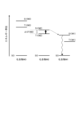
- FIG. 2 is a diagram showing the relationship between the energy levels of compound M3 and compound M2 in the light-emitting layer of an example of the organic electroluminescence device according to the first embodiment of the present invention.
- FIG. 13 is a diagram showing the energy levels and energy transfer relationship of compounds M3, M2, and M1 in an emitting layer of an example of an organic electroluminescence device according to a second embodiment of the present invention.
- hydrogen atoms include isotopes having different numbers of neutrons, namely protium, deuterium, and tritium.
- any possible bonding position that is not explicitly indicated with a symbol such as "R” or "D” representing a deuterium atom is assumed to have a hydrogen atom, i.e., a protium atom, deuterium atom, or tritium atom, bonded to it.
- the number of ring carbon atoms refers to the number of carbon atoms among the atoms constituting the ring itself of a compound having a structure in which atoms are bonded in a ring (for example, a monocyclic compound, a fused ring compound, a bridged compound, a carbocyclic compound, and a heterocyclic compound).
- a compound having a structure in which atoms are bonded in a ring for example, a monocyclic compound, a fused ring compound, a bridged compound, a carbocyclic compound, and a heterocyclic compound.
- the carbon contained in the substituent is not included in the number of ring carbon atoms.
- the "number of ring carbon atoms" described below is the same unless otherwise specified.
- a benzene ring has 6 ring carbon atoms
- a naphthalene ring has 10 ring carbon atoms
- a pyridine ring has 5 ring carbon atoms
- a furan ring has 4 ring carbon atoms.
- a 9,9-diphenylfluorenyl group has 13 ring carbon atoms
- a 9,9'-spirobifluorenyl group has 25 ring carbon atoms.
- the number of carbon atoms of the alkyl group is not included in the number of ring carbon atoms of the benzene ring.
- the number of ring carbon atoms of the benzene ring substituted with an alkyl group is 6.
- the number of carbon atoms of the alkyl group is not included in the number of ring carbon atoms of the naphthalene ring. Therefore, the number of ring carbon atoms of the naphthalene ring substituted with an alkyl group is 10.
- the number of ring atoms refers to the number of atoms constituting the ring itself of a compound (e.g., a monocyclic compound, a fused ring compound, a bridged compound, a carbocyclic compound, and a heterocyclic compound) with a structure in which atoms are bonded in a ring (e.g., a monocyclic ring, a fused ring, and a ring assembly).
- the number of ring atoms does not include atoms that do not constitute a ring (e.g., a hydrogen atom that terminates the bond of an atom constituting a ring) or atoms contained in a substituent when the ring is substituted with a substituent.
- the "number of ring atoms" described below is the same unless otherwise specified.
- the number of ring atoms of a pyridine ring is 6, the number of ring atoms of a quinazoline ring is 10, and the number of ring atoms of a furan ring is 5.
- the number of hydrogen atoms or atoms constituting a substituent bonded to a pyridine ring is not included in the number of pyridine ring atoms. Therefore, the number of ring atoms of a pyridine ring to which a hydrogen atom or a substituent is bonded is 6.
- the number of ring atoms in a quinazoline ring to which a hydrogen atom or a substituent is bonded is 10.
- the "carbon number XX to YY” in the expression “substituted or unsubstituted ZZ group having carbon numbers XX to YY” refers to the number of carbon atoms when the ZZ group is unsubstituted, and does not include the number of carbon atoms of the substituent when the ZZ group is substituted.
- "YY" is larger than “XX”
- "XX” means an integer of 1 or more
- "YY” means an integer of 2 or more.
- the "atomic number XX to YY” in the expression “substituted or unsubstituted ZZ group having atomic number XX to YY” refers to the number of atoms when the ZZ group is unsubstituted, and does not include the number of atoms of the substituents when the ZZ group is substituted.
- "YY" is larger than “XX”
- "XX” means an integer of 1 or more
- “YY” means an integer of 2 or more.
- unsubstituted ZZ group refers to the case where "a substituted or unsubstituted ZZ group” is an "unsubstituted ZZ group”
- substituted ZZ group refers to the case where "a substituted or unsubstituted ZZ group” is a "substituted ZZ group”.
- unsubstituted in the case of "a substituted or unsubstituted ZZ group” means that a hydrogen atom in the ZZ group is not replaced with a substituent.
- the hydrogen atom in the "unsubstituted ZZ group” is a protium atom, a deuterium atom, or a tritium atom.
- substitution in the case of "a substituted or unsubstituted ZZ group” means that one or more hydrogen atoms in the ZZ group are replaced with a substituent.
- substitution in the case of "a BB group substituted with an AA group” means that one or more hydrogen atoms in the BB group are replaced with an AA group.
- the "unsubstituted aryl group” described in this specification has 6 to 50 ring carbon atoms, preferably 6 to 30, and more preferably 6 to 18 ring carbon atoms, unless otherwise specified in this specification.
- the "unsubstituted heterocyclic group” described in this specification has 5 to 50 ring atoms, preferably 5 to 30, and more preferably 5 to 18 ring atoms, unless otherwise specified in this specification.
- the "unsubstituted alkyl group” described in this specification has 1 to 50 carbon atoms, preferably 1 to 20 carbon atoms, and more preferably 1 to 6 carbon atoms, unless otherwise specified in this specification.
- the number of carbon atoms in the "unsubstituted alkenyl group” described in this specification, unless otherwise specified in this specification, is 2 to 50, preferably 2 to 20, and more preferably 2 to 6.
- the number of carbon atoms in the "unsubstituted alkynyl group” described in this specification, unless otherwise specified in this specification, is 2 to 50, preferably 2 to 20, and more preferably 2 to 6.
- the "unsubstituted cycloalkyl group” described in this specification has 3 to 50 ring carbon atoms, preferably 3 to 20, and more preferably 3 to 6 ring carbon atoms, unless otherwise specified in this specification.
- the "unsubstituted arylene group” described in this specification has 6 to 50 ring carbon atoms, preferably 6 to 30, and more preferably 6 to 18 ring carbon atoms, unless otherwise specified in this specification.
- the number of ring atoms in the “unsubstituted divalent heterocyclic group” described in this specification is 5 to 50, preferably 5 to 30, and more preferably 5 to 18, unless otherwise specified in this specification.
- the "unsubstituted alkylene group” described in this specification has 1 to 50 carbon atoms, preferably 1 to 20 carbon atoms, and more preferably 1 to 6 carbon atoms, unless otherwise specified in this specification.
- Specific examples (specific example group G1) of the "substituted or unsubstituted aryl group” described in this specification include the following unsubstituted aryl group (specific example group G1A) and substituted aryl group (specific example group G1B).
- unsubstituted aryl group refers to the case where the "substituted or unsubstituted aryl group” is an "unsubstituted aryl group”
- substituted aryl group refers to the case where the "substituted or unsubstituted aryl group” is a "substituted aryl group”.
- aryl group simply refers to both an "unsubstituted aryl group” and a "substituted aryl group”.
- substituted aryl group refers to a group in which one or more hydrogen atoms of an "unsubstituted aryl group” are replaced with a substituent.
- substituted aryl group include the "unsubstituted aryl group” in the specific example group G1A below in which one or more hydrogen atoms are replaced with a substituent, and the substituted aryl group in the specific example group G1B below.
- the examples of the "unsubstituted aryl group” and the examples of the “substituted aryl group” listed here are merely examples, and the "substituted aryl group” described in this specification also includes a group in which a hydrogen atom bonded to a carbon atom of the aryl group itself in the "substituted aryl group” in the specific example group G1B below is further replaced with a substituent, and a group in which a hydrogen atom of a substituent in the "substituted aryl group” in the specific example group G1B below is further replaced with a substituent.
- Unsubstituted aryl groups (specific example group G1A): Phenyl group, p-biphenyl group, m-biphenyl group, o-biphenyl group, p-terphenyl-4-yl group, p-terphenyl-3-yl group, p-terphenyl-2-yl group, m-terphenyl-4-yl group, m-terphenyl-3-yl group, m-terphenyl-2-yl group, o-terphenyl-4-yl group, o-terphenyl-3-yl group, o-terphenyl-2-yl group, 1-naphthyl group, 2-naphthyl group, anthryl group, Benzanthryl group, A phenanthryl group, Benzophenanthryl group, A phenalenyl group, Pyrenyl group, Chrysenyl group, benzochrysenyl group,
- Substituted aryl groups (specific example group G1B): o-tolyl group, m-tolyl group, p-tolyl group, para-xylyl group, meta-xylyl group, ortho-xylyl group, para-isopropylphenyl group, meta-isopropylphenyl group, ortho-isopropylphenyl group, para-t-butylphenyl group, A meta-t-butylphenyl group, ortho-t-butylphenyl group, 3,4,5-trimethylphenyl group, 9,9-dimethylfluorenyl group, 9,9-diphenylfluorenyl group, 9,9-bis(4-methylphenyl)fluorenyl group, 9,9-bis(4-isopropylphenyl)fluorenyl group, 9,9-bis(4-t-butylphenyl)fluorenyl group, Cyanophenyl group, triphenyls
- heterocyclic group is a cyclic group containing at least one heteroatom as a ring-forming atom.
- the heteroatom include a nitrogen atom, an oxygen atom, a sulfur atom, a silicon atom, a phosphorus atom, and a boron atom.
- the “heterocyclic groups” described herein are either monocyclic or fused ring groups.
- the “heterocyclic group” described herein may be an aromatic heterocyclic group or a non-aromatic heterocyclic group.
- Specific examples (specific example group G2) of the "substituted or unsubstituted heterocyclic group" described in this specification include the following unsubstituted heterocyclic group (specific example group G2A) and substituted heterocyclic group (specific example group G2B).
- heterocyclic group refers to the case where the "substituted or unsubstituted heterocyclic group” is an "unsubstituted heterocyclic group"
- substituted heterocyclic group refers to the case where the "substituted or unsubstituted heterocyclic group” is a "substituted heterocyclic group”.
- heterocyclic group simply includes both an "unsubstituted heterocyclic group” and a "substituted heterocyclic group”.
- substituted heterocyclic group refers to a group in which one or more hydrogen atoms of an "unsubstituted heterocyclic group” are replaced with a substituent.
- Specific examples of the "substituted heterocyclic group” include the groups in which the hydrogen atoms of the "unsubstituted heterocyclic group” in the specific example group G2A below are replaced, and the examples of the substituted heterocyclic group in the specific example group G2B below are exemplified.
- the examples of the "unsubstituted heterocyclic group” and the examples of the “substituted heterocyclic group” listed here are merely examples, and the “substituted heterocyclic group” described in this specification also includes the groups in the "substituted heterocyclic group” in the specific example group G2B in which a hydrogen atom bonded to a ring-forming atom of the heterocyclic group itself is further replaced with a substituent, and the "substituted heterocyclic group” in the specific example group G2B in which a hydrogen atom of a substituent is further replaced with a substituent.
- Specific example group G2A includes, for example, the following unsubstituted heterocyclic groups containing a nitrogen atom (specific example group G2A1), unsubstituted heterocyclic groups containing an oxygen atom (specific example group G2A2), unsubstituted heterocyclic groups containing a sulfur atom (specific example group G2A3), and monovalent heterocyclic groups derived by removing one hydrogen atom from ring structures represented by the following general formulae (TEMP-16) to (TEMP-33) (specific example group G2A4).
- Specific example group G2B includes, for example, the following substituted heterocyclic groups containing a nitrogen atom (specific example group G2B1), substituted heterocyclic groups containing an oxygen atom (specific example group G2B2), substituted heterocyclic groups containing a sulfur atom (specific example group G2B3), and groups in which one or more hydrogen atoms of a monovalent heterocyclic group derived from a ring structure represented by the following general formulae (TEMP-16) to (TEMP-33) are replaced with a substituent (specific example group G2B4).
- Unsubstituted heterocyclic groups containing a nitrogen atom (specific example group G2A1): Pyrrolyl group, imidazolyl group, A pyrazolyl group, A triazolyl group, Tetrazolyl group, oxazolyl group, an isoxazolyl group, oxadiazolyl group, A thiazolyl group, isothiazolyl group, A thiadiazolyl group, Pyridyl group, pyridazinyl group, pyrimidinyl group, A pyrazinyl group, Triazinyl group, Indolyl groups, isoindolyl group, Indolizinyl group, A quinolizinyl group, quinolyl group, isoquinolyl group, Cinnolyl group, phthalazinyl group, A quinazolinyl group, quinoxalinyl group, Benzimidazolyl group, Indazolyl group, A phenanthrolinyl
- Unsubstituted heterocyclic groups containing an oxygen atom (specific example group G2A2): a furyl group, oxazolyl group, an isoxazolyl group, oxadiazolyl group, xanthenyl group, benzofuranyl group, isobenzofuranyl group, Dibenzofuranyl group, naphthobenzofuranyl group, benzoxazolyl group, benzoisoxazolyl group, phenoxazinyl group, morpholino group, Dinaphthofuranyl group, azadibenzofuranyl group, diazadibenzofuranyl group, Azanaphthobenzofuranyl group, and diazanaphthobenzofuranyl group.
- Unsubstituted heterocyclic groups containing a sulfur atom (specific example group G2A3): A thienyl group, A thiazolyl group, isothiazolyl group, A thiadiazolyl group, Benzothiophenyl group (benzothienyl group), isobenzothiophenyl group (isobenzothienyl group), Dibenzothiophenyl group (dibenzothienyl group), Naphthobenzothiophenyl group (naphthobenzothienyl group), benzothiazolyl group, Benzisothiazolyl group, A phenothiazinyl group, Dinaphthothiophenyl group (dinaphthothienyl group), Azadibenzothiophenyl group (azadibenzothienyl group), Diazadibenzothiophenyl group (diazadibenzothienyl group), Azanap
- X A and Y A are each independently an oxygen atom, a sulfur atom, NH, or CH2 , provided that at least one of X A and Y A is an oxygen atom, a sulfur atom, or NH.
- the monovalent heterocyclic group derived from the ring structure represented by the general formulae (TEMP-16) to (TEMP-33) includes a monovalent group obtained by removing one hydrogen atom from the NH or CH2 .
- Substituted heterocyclic groups containing a nitrogen atom (specific example group G2B1): A (9-phenyl)carbazolyl group, A (9-biphenylyl)carbazolyl group, (9-phenyl)phenylcarbazolyl group, (9-naphthyl)carbazolyl group, diphenylcarbazol-9-yl group, A phenylcarbazol-9-yl group, methylbenzimidazolyl group, Ethyl benzimidazolyl group, phenyltriazinyl group, Biphenylyltriazinyl group, diphenyltriazinyl group, a phenylquinazolinyl group, and a biphenylylquinazolinyl group.
- Substituted heterocyclic groups containing an oxygen atom (specific example group G2B2): phenyldibenzofuranyl group, methyldibenzofuranyl group, The t-butyldibenzofuranyl group, and the monovalent radical of spiro[9H-xanthene-9,9'-[9H]fluorene].
- Substituted heterocyclic groups containing a sulfur atom (specific example group G2B3): Phenyldibenzothiophenyl group, methyldibenzothiophenyl group, The t-butyldibenzothiophenyl group, and the monovalent radical of spiro[9H-thioxanthene-9,9'-[9H]fluorene].
- one or more hydrogen atoms of a monovalent heterocyclic group means one or more hydrogen atoms selected from a hydrogen atom bonded to a ring-forming carbon atom of the monovalent heterocyclic group, a hydrogen atom bonded to a nitrogen atom when at least one of XA and YA is NH, and a hydrogen atom of a methylene group when one of XA and YA is CH2 .
- Specific examples (specific example group G3) of the "substituted or unsubstituted alkyl group" described in this specification include the following unsubstituted alkyl groups (specific example group G3A) and substituted alkyl groups (specific example group G3B).
- the unsubstituted alkyl group refers to the case where the "substituted or unsubstituted alkyl group" is an "unsubstituted alkyl group"
- the substituted alkyl group refers to the case where the "substituted or unsubstituted alkyl group” is a "substituted alkyl group”.
- substituted alkyl group refers to a group in which one or more hydrogen atoms in the "unsubstituted alkyl group” are replaced with a substituent.
- specific examples of the "substituted alkyl group” include the following "unsubstituted alkyl group” (specific example group G3A) in which one or more hydrogen atoms are replaced with a substituent, and the examples of the substituted alkyl group (specific example group G3B).
- the alkyl group in the "unsubstituted alkyl group” refers to a chain-like alkyl group.
- the "unsubstituted alkyl group” includes a straight-chain “unsubstituted alkyl group” and a branched “unsubstituted alkyl group”.
- the examples of the "unsubstituted alkyl group” and the examples of the “substituted alkyl group” listed here are merely examples, and the "substituted alkyl group” described in this specification also includes a group in which a hydrogen atom of the alkyl group itself in the "substituted alkyl group” in the specific example group G3B is further replaced with a substituent, and a group in which a hydrogen atom of a substituent in the "substituted alkyl group” in the specific example group G3B is further replaced with a substituent.
- Unsubstituted alkyl groups (specific example group G3A): Methyl group, Ethyl group, n-propyl group, isopropyl group, n-butyl group, isobutyl group, s-Butyl group, and t-butyl group.
- Substituted alkyl groups (specific example group G3B): Heptafluoropropyl group (including isomers), pentafluoroethyl group, A 2,2,2-trifluoroethyl group, and a trifluoromethyl group.
- Specific examples (specific example group G4) of the "substituted or unsubstituted alkenyl group" described in this specification include the following unsubstituted alkenyl group (specific example group G4A) and substituted alkenyl group (specific example group G4B).
- the unsubstituted alkenyl group refers to the case where the "substituted or unsubstituted alkenyl group” is an "unsubstituted alkenyl group", and the "substituted alkenyl group” refers to the case where the "substituted or unsubstituted alkenyl group” is a "substituted alkenyl group”.
- alkenyl group when the term “alkenyl group” is simply used, it includes both an "unsubstituted alkenyl group” and a "substituted alkenyl group”.
- substituted alkenyl group refers to a group in which one or more hydrogen atoms in an "unsubstituted alkenyl group” are replaced with a substituent.
- Specific examples of the "substituted alkenyl group” include the following "unsubstituted alkenyl group” (specific example group G4A) having a substituent, and the examples of substituted alkenyl groups (specific example group G4B).
- the examples of the "unsubstituted alkenyl group” and the examples of the “substituted alkenyl group” listed here are merely examples, and the "substituted alkenyl group” described in this specification also includes a group in which a hydrogen atom of the alkenyl group itself in the "substituted alkenyl group” in specific example group G4B is further replaced with a substituent, and a group in which a hydrogen atom of a substituent in the "substituted alkenyl group” in specific example group G4B is further replaced with a substituent.
- Unsubstituted alkenyl groups (specific example group G4A): Vinyl group, Allyl groups, 1-butenyl group, A 2-butenyl group, and a 3-butenyl group.
- Substituted alkenyl groups (specific example group G4B): 1,3-butadienyl group, 1-methylvinyl group, 1-methylallyl group, 1,1-dimethylallyl group, 2-methylallyl group, and 1,2-dimethylallyl group.
- the unsubstituted alkynyl group refers to the case where the "substituted or unsubstituted alkynyl group” is an "unsubstituted alkynyl group."
- alkynyl group refers to an "unsubstituted alkynyl group” in which one or more hydrogen atoms have been replaced with a substituent.
- Specific examples of the "substituted alkynyl group” include the following "unsubstituted alkynyl group” (specific example group G5A) in which one or more hydrogen atoms have been replaced with a substituent.
- Specific examples (specific example group G6) of the "substituted or unsubstituted cycloalkyl group” described in this specification include the following unsubstituted cycloalkyl group (specific example group G6A) and substituted cycloalkyl group (specific example group G6B).
- unsubstituted cycloalkyl group refers to the case where the "substituted or unsubstituted cycloalkyl group” is an "unsubstituted cycloalkyl group”
- substituted cycloalkyl group refers to the case where the "substituted or unsubstituted cycloalkyl group” is a "substituted cycloalkyl group”.
- substituted cycloalkyl group refers to a group in which one or more hydrogen atoms in the "unsubstituted cycloalkyl group” are replaced with a substituent.
- Specific examples of the "substituted cycloalkyl group” include the following "unsubstituted cycloalkyl group” (specific example group G6A) in which one or more hydrogen atoms are replaced with a substituent, and the examples of the substituted cycloalkyl group (specific example group G6B).
- the examples of the "unsubstituted cycloalkyl group” and the examples of the “substituted cycloalkyl group” listed here are merely examples, and the "substituted cycloalkyl group" described in this specification also includes a group in which one or more hydrogen atoms bonded to a carbon atom of the cycloalkyl group itself in the "substituted cycloalkyl group” in the specific example group G6B are replaced with a substituent, and a group in which a hydrogen atom of a substituent in the "substituted cycloalkyl group” in the specific example group G6B is further replaced with a substituent.
- Unsubstituted cycloalkyl groups (specific example group G6A): A cyclopropyl group, A cyclobutyl group, Cyclopentyl group, cyclohexyl group, 1-adamantyl group, 2-adamantyl group, 1-norbornyl group, and 2-norbornyl group.
- Substituted cycloalkyl groups (specific example group G6B): 4-Methylcyclohexyl group.
- G7 of the group represented by --Si(R 901 )(R 902 )(R 903 ) described in this specification include: -Si(G1)(G1)(G1), -Si(G1)(G2)(G2), -Si (G1) (G1) (G2), -Si(G2)(G2)(G2), -Si(G3)(G3)(G3), and -Si(G6)(G6)(G6)(G6)
- G1 is a "substituted or unsubstituted aryl group” described in specific example group G1.
- G2 is a "substituted or unsubstituted heterocyclic group” described in specific example group G2.
- G3 is a "substituted or unsubstituted alkyl group” described in specific example group G3.
- G6 is a "substituted or unsubstituted cycloalkyl group” described in specific example group G6.
- the multiple G1s in -Si(G1)(G1)(G1) are the same as or different from each other.
- the multiple G2s in -Si(G1)(G2)(G2) are the same as or different from each other.
- the multiple G1s in -Si(G1)(G1)(G2) are the same as or different from each other.
- the multiple G2s in —Si(G2)(G2)(G2) are the same as or different from each other.
- the multiple G3s in —Si(G3)(G3)(G3) are the same as or different from each other.
- the multiple G6s in —Si(G6)(G6)(G6) are the same as or different from each other.
- G8 of the group represented by -O-(R 904 ) described in this specification include: -O(G1), -O (G2), -O(G3) and -O(G6) Examples include: Where: G1 is a "substituted or unsubstituted aryl group” described in specific example group G1. G2 is a “substituted or unsubstituted heterocyclic group” described in specific example group G2. G3 is a "substituted or unsubstituted alkyl group” described in specific example group G3. G6 is a "substituted or unsubstituted cycloalkyl group” described in specific example group G6.
- G9 A group represented by -S-(R 905 )
- Specific examples (specific example group G9) of the group represented by -S-(R 905 ) described in this specification include: -S (G1), -S (G2), -S(G3) and -S(G6) Examples include: Where: G1 is a "substituted or unsubstituted aryl group” described in specific example group G1. G2 is a "substituted or unsubstituted heterocyclic group” described in specific example group G2. G3 is a "substituted or unsubstituted alkyl group” described in specific example group G3. G6 is a "substituted or unsubstituted cycloalkyl group” described in specific example group G6.
- Specific examples (specific example group G10) of the group represented by -N(R 906 )(R 907 ) described in this specification include: -N(G1)(G1), -N(G2)(G2), -N (G1) (G2), -N(G3)(G3), and -N(G6)(G6) Examples include: Where: G1 is a "substituted or unsubstituted aryl group” described in specific example group G1. G2 is a "substituted or unsubstituted heterocyclic group” described in specific example group G2.
- G3 is a "substituted or unsubstituted alkyl group” described in specific example group G3.
- G6 is a "substituted or unsubstituted cycloalkyl group” described in specific example group G6.
- the multiple G1s in -N(G1)(G1) are the same or different from each other.
- the multiple G2s in -N(G2)(G2) are the same or different from each other.
- the multiple G3s in -N(G3)(G3) are the same or different.
- -N(G6)(G6) may be the same or different from each other.
- halogen atoms include a fluorine atom, a chlorine atom, a bromine atom, and an iodine atom.
- substituted or unsubstituted fluoroalkyl groups means a group in which at least one hydrogen atom bonded to a carbon atom constituting the alkyl group in the "substituted or unsubstituted alkyl group” is replaced with a fluorine atom, and also includes a group (perfluoro group) in which all hydrogen atoms bonded to carbon atoms constituting the alkyl group in the "substituted or unsubstituted alkyl group” are replaced with fluorine atoms.
- the number of carbon atoms in the "unsubstituted fluoroalkyl group” is 1 to 50, preferably 1 to 30, and more preferably 1 to 18, unless otherwise specified in the present specification.
- substituted fluoroalkyl group means a group in which one or more hydrogen atoms in the "fluoroalkyl group” are replaced with a substituent.
- substituted fluoroalkyl group as used herein also includes a group in which one or more hydrogen atoms bonded to a carbon atom of the alkyl chain in the "substituted fluoroalkyl group” are further replaced with a substituent, and a group in which one or more hydrogen atoms of the substituent in the "substituted fluoroalkyl group” are further replaced with a substituent.
- substituents include the examples of groups in which one or more hydrogen atoms in the "alkyl group” (specific example group G3) are replaced with fluorine atoms.
- substituted or unsubstituted haloalkyl group means a group in which at least one hydrogen atom bonded to a carbon atom constituting the alkyl group in the "substituted or unsubstituted alkyl group” is replaced with a halogen atom, and also includes a group in which all hydrogen atoms bonded to carbon atoms constituting the alkyl group in the "substituted or unsubstituted alkyl group” are replaced with halogen atoms.
- the number of carbon atoms in the "unsubstituted haloalkyl group” is 1 to 50, preferably 1 to 30, and more preferably 1 to 18, unless otherwise specified in the present specification.
- substituted haloalkyl group means a group in which one or more hydrogen atoms in the "haloalkyl group” are replaced with a substituent.
- substituted haloalkyl group as used herein also includes a group in which one or more hydrogen atoms bonded to a carbon atom in the alkyl chain in the "substituted haloalkyl group” are further replaced with a substituent, and a group in which one or more hydrogen atoms in the substituent in the "substituted haloalkyl group” are further replaced with a substituent.
- substituents in the substituent in the "substituted haloalkyl group” are further replaced with a substituent.
- Specific examples of the "unsubstituted haloalkyl group” include the examples of the group in which one or more hydrogen atoms in the "alkyl group” (specific example group G3) are replaced with a halogen atom.
- Haloalkyl groups are sometimes referred to as halogenated alkyl groups.
- a specific example of the "substituted or unsubstituted alkoxy group” described in this specification is a group represented by -O(G3), where G3 is a "substituted or unsubstituted alkyl group” described in specific example group G3.
- the number of carbon atoms in the "unsubstituted alkoxy group” is 1 to 50, preferably 1 to 30, and more preferably 1 to 18, unless otherwise specified in this specification.
- Substituted or unsubstituted alkylthio group A specific example of the "substituted or unsubstituted alkylthio group” described in this specification is a group represented by -S(G3), where G3 is a "substituted or unsubstituted alkyl group” described in specific example group G3.
- the number of carbon atoms in the "unsubstituted alkylthio group" is 1 to 50, preferably 1 to 30, and more preferably 1 to 18, unless otherwise specified in this specification.
- a specific example of the "substituted or unsubstituted aryloxy group” described in this specification is a group represented by -O(G1), where G1 is a "substituted or unsubstituted aryl group” described in specific example group G1.
- the number of ring carbon atoms of the "unsubstituted aryloxy group” is 6 to 50, preferably 6 to 30, and more preferably 6 to 18, unless otherwise specified in this specification.
- a specific example of the "substituted or unsubstituted arylthio group” described in this specification is a group represented by -S(G1), where G1 is a "substituted or unsubstituted aryl group” described in specific example group G1.
- the number of ring carbon atoms of the "unsubstituted arylthio group” is 6 to 50, preferably 6 to 30, and more preferably 6 to 18, unless otherwise specified in this specification.
- a specific example of the "substituted or unsubstituted trialkylsilyl group” described in this specification is a group represented by -Si(G3)(G3)(G3), where G3 is a "substituted or unsubstituted alkyl group” described in specific example group G3.
- the multiple G3s in -Si(G3)(G3)(G3) are the same as or different from each other.
- the number of carbon atoms in each alkyl group of the "unsubstituted trialkylsilyl group” is 1 to 50, preferably 1 to 20, and more preferably 1 to 6, unless otherwise specified in this specification.
- a specific example of the "substituted or unsubstituted aralkyl group” described in this specification is a group represented by -(G3)-(G1), where G3 is a "substituted or unsubstituted alkyl group” described in the specific example group G3, and G1 is a "substituted or unsubstituted aryl group” described in the specific example group G1.
- an “aralkyl group” is a group in which a hydrogen atom of an "alkyl group” is replaced with an "aryl group” as a substituent, and is one aspect of a “substituted alkyl group”.
- An “unsubstituted aralkyl group” is an "unsubstituted alkyl group” substituted with an "unsubstituted aryl group”, and the number of carbon atoms in the "unsubstituted aralkyl group” is 7 to 50, preferably 7 to 30, and more preferably 7 to 18, unless otherwise specified in this specification.
- substituted or unsubstituted aralkyl group include benzyl group, 1-phenylethyl group, 2-phenylethyl group, 1-phenylisopropyl group, 2-phenylisopropyl group, phenyl-t-butyl group, ⁇ -naphthylmethyl group, 1- ⁇ -naphthylethyl group, 2- ⁇ -naphthylethyl group, 1- ⁇ -naphthylisopropyl group, 2- ⁇ -naphthylisopropyl group, ⁇ -naphthylmethyl group, 1- ⁇ -naphthylethyl group, 2- ⁇ -naphthylethyl group, 1- ⁇ -naphthylisopropyl group, and 2- ⁇ -naphthylisopropyl group.
- the substituted or unsubstituted aryl group described herein is preferably a phenyl group, a p-biphenyl group, a m-biphenyl group, an o-biphenyl group, a p-terphenyl-4-yl group, a p-terphenyl-3-yl group, a p-terphenyl-2-yl group, a m-terphenyl-4-yl group, a m-terphenyl-3-yl group, a m-terphenyl-2-yl group, a o-terphenyl-4-yl group, a o-terphenyl-3-yl group, a o-terphenyl-2-yl group, a 1-naphthyl group, a 2-naphthyl group, an anthryl group, a phenanthryl group, a pyrenyl group, a
- the substituted or unsubstituted heterocyclic group described in the present specification is preferably a pyridyl group, a pyrimidinyl group, a triazinyl group, a quinolyl group, an isoquinolyl group, a quinazolinyl group, a benzimidazolyl group, a phenanthrolinyl group, a carbazolyl group (a 1-carbazolyl group, a 2-carbazolyl group, a 3-carbazolyl group, a 4-carbazolyl group, or a 9-carbazolyl group), a benzocarbazolyl group, an azacarbazolyl group, a diazacarbazolyl group, a dibenzofuranyl group, a naphthobenzofuranyl group, an azadibenzofuranyl group, a diazadibenzofuranyl group, a dibenzothi
- zadibenzothiophenyl group diazadibenzothiophenyl group
- (9-phenyl)carbazolyl group ((9-phenyl)carbazol-1-yl group, (9-phenyl)carbazol-2-yl group, (9-phenyl)carbazol-3-yl group, or (9-phenyl)carbazol-4-yl group)
- (9-biphenylyl)carbazolyl group (9-phenyl)phenylcarbazolyl group, diphenylcarbazol-9-yl group, phenylcarbazol-9-yl group, phenyltriazinyl group, biphenylyltriazinyl group, diphenyltriazinyl group, phenyldibenzofuranyl group, and phenyldibenzothiophenyl group.
- carbazolyl group is specifically any of the following groups:
- the (9-phenyl)carbazolyl group is specifically any of the following groups, unless otherwise specified in this specification.
- dibenzofuranyl group and the dibenzothiophenyl group are specifically any of the following groups.
- substituted or unsubstituted alkyl groups described herein are preferably methyl, ethyl, propyl, isopropyl, n-butyl, isobutyl, t-butyl, and the like.
- the "substituted or unsubstituted arylene group" described in this specification is a divalent group derived by removing one hydrogen atom on the aryl ring from the above-mentioned "substituted or unsubstituted aryl group".
- Specific examples of the "substituted or unsubstituted arylene group” include divalent groups derived by removing one hydrogen atom on the aryl ring from the "substituted or unsubstituted aryl group” described in specific example group G1.
- Substituted or unsubstituted divalent heterocyclic group is, unless otherwise specified, a divalent group derived by removing one hydrogen atom on the heterocycle from the above-mentioned "substituted or unsubstituted heterocyclic group".
- Specific examples of the "substituted or unsubstituted divalent heterocyclic group” include divalent groups derived by removing one hydrogen atom on the heterocycle from the "substituted or unsubstituted heterocyclic group” described in specific example group G2.
- the "substituted or unsubstituted alkylene group" described in this specification is a divalent group derived by removing one hydrogen atom on the alkyl chain from the above-mentioned "substituted or unsubstituted alkyl group".
- Specific examples of the "substituted or unsubstituted alkylene group” include divalent groups derived by removing one hydrogen atom on the alkyl chain from the "substituted or unsubstituted alkyl group” described in specific example group G3.
- the substituted or unsubstituted arylene group described herein is preferably any of the groups represented by the following general formulae (TEMP-42) to (TEMP-68).
- Q 1 to Q 10 each independently represent a hydrogen atom or a substituent.
- * represents a bonding position.
- Q 1 to Q 10 each independently represent a hydrogen atom or a substituent.
- Q 9 and Q 10 may be bonded to each other via a single bond to form a ring.
- * represents a bonding position.
- Q 1 to Q 8 each independently represent a hydrogen atom or a substituent.
- * represents a bonding position.
- the substituted or unsubstituted divalent heterocyclic group described in this specification is preferably any of the groups represented by the following general formulas (TEMP-69) to (TEMP-102), unless otherwise specified in this specification.
- Q 1 to Q 9 each independently represent a hydrogen atom or a substituent.
- * represents a bonding position.
- Q 1 to Q 8 each independently represent a hydrogen atom or a substituent.
- * represents a bonding position.
- the phrase "one or more of a set consisting of two or more adjacent groups bond to each other to form a substituted or unsubstituted monocycle, bond to each other to form a substituted or unsubstituted fused ring, or are not bonded to each other" means the case where "one or more of a set consisting of two or more adjacent groups bond to each other to form a substituted or unsubstituted monocycle", the case where "one or more of a set consisting of two or more adjacent groups bond to each other to form a substituted or unsubstituted fused ring", or the case where "one or more of a set consisting of two or more adjacent groups are not bonded to each other".
- examples of a pair of adjacent two that constitute one group include the pair of R 921 and R 922 , the pair of R 922 and R 923 , the pair of R 923 and R 924 , the pair of R 924 and R 930 , the pair of R 930 and R 925 , the pair of R 925 and R 926 , the pair of R 926 and R 927 , the pair of R 927 and R 928 , the pair of R 928 and R 929 , and the pair of R 929 and R 921 .
- one or more pairs means that two or more pairs of the adjacent two or more pairs may simultaneously form a ring.
- the anthracene compound represented by the general formula (TEMP-103) is represented by the following general formula (TEMP-104).
- a set of two or more adjacent rings forms a ring includes not only the case where a set of "two" adjacent rings is bonded as in the above example, but also the case where a set of "three or more adjacent rings is bonded.
- it means the case where R 921 and R 922 are bonded to each other to form a ring Q A , and R 922 and R 923 are bonded to each other to form a ring Q C , and a set of three adjacent rings (R 921 , R 922 and R 923 ) are bonded to each other to form a ring and are condensed to the anthracene skeleton.
- the anthracene compound represented by the general formula (TEMP-103) is represented by the following general formula (TEMP-105).
- ring Q A and ring Q C share R 922 .
- the "monocyclic ring” or “fused ring” formed may be a saturated ring or an unsaturated ring as the structure of only the ring formed. Even if “one of the pairs of two adjacent rings” forms a “monocyclic ring” or a “fused ring”, the “monocyclic ring” or the “fused ring” can form a saturated ring or an unsaturated ring.
- the ring Q A and the ring Q B formed in the general formula (TEMP-104) are “monocyclic rings” or “fused rings", respectively.
- the ring Q A and the ring Q C formed in the general formula (TEMP-105) are “fused rings”.
- the ring Q A and the ring Q C in the general formula (TEMP-105) are fused rings by the fusion of the ring Q A and the ring Q C. If the ring Q A in the general formula (TMEP-104) is a benzene ring, the ring Q A is a monocyclic ring. When ring Q 1 A in the above general formula (TMEP-104) is a naphthalene ring, ring Q 1 A is a fused ring.
- the "unsaturated ring” is at least one ring selected from the group consisting of an aromatic hydrocarbon ring, an aromatic heterocycle, an aliphatic hydrocarbon ring having an unsaturated bond in its ring structure, and a non-aromatic heterocycle having an unsaturated bond in its ring structure.
- the unsaturated bond in the ring structure of the unsaturated ring is one or both of a double bond and a triple bond.
- Examples of the aliphatic hydrocarbon ring having an unsaturated bond in its ring structure include cyclohexene and cyclohexadiene.
- Examples of the non-aromatic heterocycle having an unsaturated bond in its ring structure include dihydropyran, imidazoline, pyrazoline, quinolizine, indoline, and isoindoline.
- the "saturated ring” is at least any ring selected from an aliphatic hydrocarbon ring having no unsaturated bonds and a non-aromatic heterocycle having no unsaturated bonds.
- the saturated ring has no double bonds or triple bonds in the ring structure.
- Specific examples of the aromatic hydrocarbon ring include structures in which the groups given as specific examples in specific example group G1 are terminated with a hydrogen atom.
- Specific examples of the aromatic heterocycle include structures in which the aromatic heterocyclic groups exemplified as specific examples in the specific example group G2 are terminated with a hydrogen atom.
- Specific examples of the aliphatic hydrocarbon ring include structures in which the groups given as specific examples in the specific example group G6 are terminated with a hydrogen atom.
- Forming a ring means forming a ring only with a plurality of atoms of the mother skeleton, or a plurality of atoms of the mother skeleton and one or more arbitrary atoms.
- the ring QA formed by bonding R 921 and R 922 to each other in the general formula (TEMP-104) means a ring formed by the carbon atom of the anthracene skeleton to which R 921 is bonded, the carbon atom of the anthracene skeleton to which R 922 is bonded, and one or more arbitrary atoms.
- R 921 and R 922 form a ring QA
- the carbon atom of the anthracene skeleton to which R 921 is bonded the carbon atom of the anthracene skeleton to which R 922 is bonded, and four carbon atoms form a monocyclic unsaturated ring
- the ring formed by R 921 and R 922 is a benzene ring.
- the "arbitrary atom” is preferably at least one atom selected from the group consisting of carbon atoms, nitrogen atoms, oxygen atoms, and sulfur atoms.
- the arbitrary atom for example, in the case of a carbon atom or a nitrogen atom
- a bond that does not form a ring may be terminated with a hydrogen atom or the like, or may be substituted with an "arbitrary substituent" described below.
- the ring formed is a heterocycle.
- the "any one or more atoms" constituting the single ring or the condensed ring is preferably 2 or more and 15 or less, more preferably 3 or more and 12 or less, and even more preferably 3 or more and 5 or less.
- the "monocyclic ring” and the “condensed ring” are preferred.
- the "saturated ring” and the “unsaturated ring” are preferred.
- a "monocyclic ring” is preferably a benzene ring.
- the "unsaturated ring” is preferably a benzene ring.
- the "unsaturated ring” is preferably a benzene ring.
- one or more of a set of two or more adjacent rings combine with each other to form a substituted or unsubstituted monocyclic ring” or “combine with each other to form a substituted or unsubstituted fused ring
- one or more of a set of two or more adjacent rings combine with each other to form a substituted or unsubstituted "unsaturated ring” consisting of a plurality of atoms of the parent skeleton and at least one atom selected from the group consisting of 1 to 15 carbon atoms, nitrogen atoms, oxygen atoms, and sulfur atoms.
- the substituent is, for example, the “optional substituent” described later.
- specific examples of the substituent are the substituents described in the above-mentioned section “Substituents described in this specification”.
- the substituent is, for example, the “optional substituent” described below.
- substituents in the case of "substituted or unsubstituted” are, for example, an unsubstituted alkyl group having 1 to 50 carbon atoms; an unsubstituted alkenyl group having 2 to 50 carbon atoms, an unsubstituted alkynyl group having 2 to 50 carbon atoms, an unsubstituted cycloalkyl group having 3 to 50 ring carbon atoms, -Si(R 901 )(R 902 )(R 903 ), -O-(R 904 ), -S- (R 905 ), -N(R 906 )(R 907 ), Halogen atoms, cyano groups, nitro groups, a group selected from the group consisting of an unsubstituted
- the two or more R 901 are the same or different from each other
- the two or more R 902 are present, the two or more R 902 are the same or different from each other
- the two or more R 903 are present, the two or more R 903 are the same or different from each other
- the two or more R 904 are present, the two or more R 904 are the same or different from each other
- the two or more R 905 are present, the two or more R 905 are the same or different from each other
- two or more R 906 are present, the two or more R 906 are the same or different from each other
- the two or more R 907 are present, the two or more R 907 are the same or different.
- the substituent in the above "substituted or unsubstituted” is: an alkyl group having 1 to 50 carbon atoms, The group is selected from the group consisting of an aryl group having 6 to 50 ring carbon atoms and a heterocyclic group having 5 to 50 ring atoms.
- the substituent in the above "substituted or unsubstituted” is: an alkyl group having 1 to 18 carbon atoms, The group is selected from the group consisting of an aryl group having 6 to 18 ring carbon atoms and a heterocyclic group having 5 to 18 ring atoms.
- any adjacent substituents may be combined with each other to form a "saturated ring" or an "unsaturated ring", preferably a substituted or unsubstituted saturated 5-membered ring, a substituted or unsubstituted saturated 6-membered ring, a substituted or unsubstituted unsaturated 5-membered ring, or a substituted or unsubstituted unsaturated 6-membered ring, more preferably a benzene ring.
- the optional substituent may further have a substituent.
- the substituent that the optional substituent further has is the same as the optional substituent described above. When a plurality of optional substituents are present, the plurality of optional substituents may be the same or different.
- a numerical range expressed using "AA-BB” refers to a range that includes the number AA written before “AA-BB” as the lower limit and the number BB written after "AA-BB” as the upper limit.
- the configuration of the organic EL element according to the first embodiment of the present invention will be described.
- the organic EL element includes an organic layer between both electrodes, an anode and a cathode.
- the organic layer includes at least one layer made of an organic compound.
- the organic layer is formed by stacking a plurality of layers made of an organic compound.
- the organic layer may further include an inorganic compound.
- at least one layer of the organic layer is an emitting layer. Therefore, the organic layer may be, for example, made of one emitting layer, or may include a layer that can be used in an organic EL element.
- the layer that can be used in an organic EL element is not particularly limited, and may include at least one layer selected from the group consisting of a hole injection layer, a hole transport layer, an electron injection layer, an electron transport layer, and a barrier layer.
- the organic EL element of this embodiment has a light-emitting layer contained between an anode and a cathode.
- the organic EL element of the present embodiment has an anode, a cathode, and an emitting layer between the anode and the cathode.
- the emitting layer contains a compound M3 represented by the following general formula (1) and a delayed fluorescent compound M2.
- the compound M3 and the compound M2 have different structures, and a singlet energy S 1 (M3) of the compound M3 and a singlet energy S 1 (M2) of the compound M2 satisfy the relationship of the following formula (Mathematical Formula 1). S 1 (M3)>S 1 (M2) (Math. 1)
- the light-emitting layer contains a compound M3 represented by the following general formula (1) and a delayed fluorescent compound M2.
- Compound M3 has a structure in which benzobisbenzofuran and benzofurocarbazole or benzothienocarbazole are bonded via a single bond or a linking group. Benzobisbenzofuran, benzofurocarbazole and benzothienocarbazole all have a highly planar and rigid structure.
- compound M3 has a plurality of such highly planar and rigid structures, which facilitates intermolecular charge transport in the light-emitting layer, thereby realizing an organic EL element with a low driving voltage.
- the compound M3 has a plurality of such highly planar and rigid structures, which suppresses deactivation due to vibration of the excitons of the delayed fluorescent compound M2 contained in the light-emitting layer, thereby realizing a highly efficient organic EL element.
- FIG. 1 shows a schematic configuration of an example of an organic EL element according to this embodiment.
- the organic EL element 1 includes a light-transmitting substrate 2, an anode 3, a cathode 4, and an organic layer 10 disposed between the anode 3 and the cathode 4.
- the organic layer 10 is configured by laminating a hole injection layer 6, a hole transport layer 7, a light-emitting layer 5, an electron transport layer 8, and an electron injection layer 9 in this order from the anode 3 side.
- the light-emitting layer 5 may contain a metal complex. It is preferable that the light-emitting layer 5 does not contain a phosphorescent material (dopant material). It is preferable that the light-emitting layer 5 does not contain a heavy metal complex or a phosphorescent rare earth metal complex. Examples of the heavy metal complex include an iridium complex, an osmium complex, and a platinum complex. It is also preferable that the light-emitting layer 5 does not contain a metal complex. In the organic EL element 1 of the present embodiment, the light-emitting layer 5 contains a compound M3 represented by the following general formula (1) and a delayed fluorescent compound M2.
- compound M2 is preferably a dopant material (also referred to as a guest material, emitter, or light-emitting material), and compound M3 is preferably a host material (also referred to as a matrix material).
- the compound M3 may be a compound having thermally activated delayed fluorescence, or may be a compound not exhibiting thermally activated delayed fluorescence.
- the light-emitting layer in this embodiment contains a compound M3 represented by the following general formula (1).
- the compound M3 in this embodiment is preferably a compound that does not exhibit thermally activated delayed fluorescence.
- L is, a single bond, or a substituted or unsubstituted arylene group having 6 to 50 ring carbon atoms
- A is a group represented by any one of the following general formulas (11A), (11B), (11C), (11D), (11E) and (11F)
- Z is a group represented by any one of the following general formulas (21A), (21B), (21C), (21D), and (21E).
- X1 is an oxygen atom or a sulfur atom;
- R 11 to R 20 which do not form a substituted or unsubstituted monocycle and do not form a substituted or unsubstituted fused ring each independently represent Hydrogen atoms, Halogen atoms, Cyano group, a substituted or unsubstituted aryl group having 6 to 30 ring carbon atoms, a substituted or unsubstituted heterocyclic group having 5 to 30 ring atoms, a substituted or unsubstituted alkyl group having 1 to 30 carbon atoms, a substituted or unsubstituted
- R 21 to R 30 which do not form a substituted or unsubstituted monocycle and do not form a substituted or unsubstituted fused ring each independently represent Hydrogen atom, Halogen atoms, Cyano group, a substituted or unsubstituted aryl group having 6 to 30 ring carbon atoms, a substituted or unsubstituted alkyl group having 1 to 30 carbon atoms, a substituted or unsubstituted halogenated alkyl group having 1 to 30 carbon atoms, a substituted or unsubstituted cycloalkyl group having 3 to 30
- the compound represented by general formula (1) is a compound represented by any one of the following general formulas (1-1) to (1-6).
- L and A each independently have the same meaning as L and A in the general formula (1)
- R 21 to R 30 each independently have the same meaning as R 21 to R 30 in the general formula (21A).
- A is a group represented by general formula (11F).
- R 11 to R 20 are each independently a hydrogen atom, a substituted or unsubstituted aryl group having 6 to 18 ring carbon atoms, a substituted or unsubstituted heterocyclic group having 5 to 18 ring atoms, a substituted or unsubstituted alkyl group having 1 to 12 carbon atoms, or a substituted or unsubstituted cycloalkyl group having 3 to 18 ring carbon atoms.
- R 11 to R 20 are each independently a hydrogen atom, a substituted or unsubstituted aryl group having 6 to 18 ring carbon atoms, or a substituted or unsubstituted heterocyclic group having 5 to 18 ring atoms.
- R 11 to R 20 are each independently a hydrogen atom, a substituted or unsubstituted phenyl group, a substituted or unsubstituted biphenyl group, or a substituted or unsubstituted carbazolyl group.
- R 11 to R 20 are hydrogen atoms.
- one of R 11 to R 20 is a substituent, and the rest are hydrogen atoms.
- at least one of R 11 to R 20 is a deuterium atom.
- Z is a group represented by general formula (21E).
- any pair of adjacent two or more of R 21 to R 30 that are not bonding positions to L are not bonded to each other.
- R to R that are not the bonding position to L are each independently a hydrogen atom, a substituted or unsubstituted aryl group having 6 to 18 ring carbon atoms, a substituted or unsubstituted alkyl group having 1 to 12 carbon atoms, or a substituted or unsubstituted cycloalkyl group having 3 to 18 ring carbon atoms.
- R 21 to R 30 which are not the bonding positions to L are each independently a hydrogen atom, or a substituted or unsubstituted aryl group having 6 to 18 ring carbon atoms.
- R 21 to R 30 which are not the bonding positions to L are hydrogen atoms.
- one of R 21 to R 30 that is not the bonding position to L is a substituent, and the rest are hydrogen atoms.
- at least one of R 21 to R 30 that is not the bonding position to L is a deuterium atom.
- L is a single bond, or a substituted or unsubstituted arylene group having 6 to 18 ring carbon atoms.
- L is a single bond, a substituted or unsubstituted phenylene group, a substituted or unsubstituted biphenylene group, a substituted or unsubstituted naphthylene group, or a substituted or unsubstituted fluorenylene group.
- L is a single bond or a substituted or unsubstituted phenylene group. In one embodiment of compound M3, L is a single bond.
- the substituent when L has a substituent, is each independently a substituted or unsubstituted aryl group having 6 to 30 ring carbon atoms, or a substituted or unsubstituted heterocyclic group having 5 to 30 ring atoms.
- L has at least one deuterium atom.
- the compound represented by general formula (1) is a compound represented by the following general formula (1A), (2A), or (3A).
- a and Z each independently have the same meaning as A and Z in formula (1),
- One or more of the groups of two or more adjacent R 100 are joined together to form a substituted or unsubstituted monocyclic ring, or are bonded together to form a substituted or unsubstituted fused ring, or are not bonded together
- R 100 that does not form a substituted or unsubstituted monocycle and does not form a substituted or unsubstituted fused ring is each independently a hydrogen atom, a substituted or unsubstituted aryl group having 6 to 30 ring carbon atoms, or a substituted or unsubstituted heterocyclic group having 5 to 30 ring atoms, and a plurality of R 100 are the same or different.
- a plurality of R 100 are not bonded to each other, and R 100 are each independently a hydrogen atom, a substituted or unsubstituted aryl group having 6 to 30 ring carbon atoms, or a substituted or unsubstituted heterocyclic group having 5 to 30 ring atoms.
- R 100 in formulae (1A), (2A) and (3A), a plurality of R 100 are not bonded to each other, and R 100 is a hydrogen atom.
- the compound represented by the general formula (1) is a compound represented by the general formula (2A).
- the compound represented by general formula (1) is a compound represented by the following general formula (1B), (2B), (3B) or (4B).
- R 100 in the general formula (4B) has the same meaning as R 100 in the general formula (3A).
- the compound represented by general formula (1) is a compound represented by general formula (2B).
- R 100 is a hydrogen atom, a substituted or unsubstituted aryl group having 6 to 18 ring carbon atoms, or a substituted or unsubstituted heterocyclic group having 5 to 20 ring atoms.
- at least one of R 100 in formulae (1A) to (3A) and (4B) is a deuterium atom.
- a and R 100 including the substituents, are the same group.
- Z and R 100 in the general formula (4B) are the same groups including the substituents.
- X 1 is a sulfur atom.
- X 1 is an oxygen atom.
- the substituent in the term "substituted or unsubstituted" is an unsubstituted group.
- the compound M3 is the only compound having a singlet energy S 1 greater than the singlet energy S 1 (M2) of the delayed fluorescent compound M2.
- Compound M3 of the present embodiment can be produced, for example, by the method described in the Examples below.
- Compound M3 of the present embodiment can be produced by following the reactions described in the Examples below and using known alternative reactions and raw materials suited to the target product.
- compound M3 in this embodiment include the following compounds. However, the present invention is not limited to these specific examples of compounds.
- the light-emitting layer of this embodiment contains a thermally activated delayed fluorescent compound M2.
- the compound according to the present embodiment is a compound having thermally activated delayed fluorescence.
- thermally activated delayed fluorescence may be referred to as delayed fluorescence. Delayed fluorescence is explained on pages 261-268 of "Device Properties of Organic Semiconductors" (edited by Adachi Chihaya, published by Kodansha). In that document, it is explained that if the energy difference ⁇ E 13 between the excited singlet state and the excited triplet state of the fluorescent material can be reduced, the reverse energy transfer from the excited triplet state, which usually has a low transition probability, to the excited singlet state occurs with high efficiency, and thermally activated delayed fluorescence (TADF) is expressed. Furthermore, in FIG. 10.38 in the document, the mechanism of delayed fluorescence generation is explained.
- the compound M2 in this embodiment is preferably a compound that exhibits thermally activated delayed fluorescence generated by such a mechanism.
- delayed fluorescence emission can be confirmed by transient PL (photoluminescence) measurement.
- Transient PL measurement is a method of irradiating a sample with a pulsed laser to excite it, and measuring the decay behavior (transient characteristics) of PL emission after the irradiation is stopped.
- PL emission in TADF materials is classified into emission components from singlet excitons generated by the first PL excitation and emission components from singlet excitons generated via triplet excitons.
- the lifetime of singlet excitons generated by the first PL excitation is on the order of nanoseconds, which is very short. Therefore, the emission from the singlet excitons decays quickly after irradiation with a pulsed laser.
- delayed fluorescence is emitted from singlet excitons generated via triplet excitons, which have a long life span, and therefore decays slowly.
- the emission intensity derived from delayed fluorescence can be obtained.
- Figure 2 shows a schematic diagram of an exemplary device for measuring transient PL. We will explain a method for measuring transient PL using Figure 2 and an example of behavior analysis of delayed fluorescence.
- the transient PL measurement device 100 in FIG. 2 includes a pulsed laser unit 101 capable of irradiating light of a predetermined wavelength, a sample chamber 102 for accommodating a measurement sample, a spectroscope 103 for dispersing the light emitted from the measurement sample, a streak camera 104 for forming a two-dimensional image, and a personal computer 105 for capturing and analyzing the two-dimensional image.
- a pulsed laser unit 101 capable of irradiating light of a predetermined wavelength
- a sample chamber 102 for accommodating a measurement sample
- a spectroscope 103 for dispersing the light emitted from the measurement sample
- a streak camera 104 for forming a two-dimensional image
- personal computer 105 for capturing and analyzing the two-dimensional image. Note that the measurement of transient PL is not limited to the device shown in FIG. 2.
- the sample contained in the sample chamber 102 is obtained by forming a thin film of a matrix material doped with a doping material at a concentration of 12% by mass on a quartz substrate.
- a pulsed laser is irradiated from the pulsed laser unit 101 onto a thin film sample housed in the sample chamber 102 to excite the doping material.
- Emission light is extracted in a direction at 90 degrees to the irradiation direction of the excitation light, and the extracted light is dispersed by the spectroscope 103, and a two-dimensional image is formed in the streak camera 104.
- a two-dimensional image can be obtained in which the vertical axis corresponds to time, the horizontal axis corresponds to wavelength, and bright spots correspond to emission intensity.
- By cutting out this two-dimensional image on a specified time axis it is possible to obtain an emission spectrum in which the vertical axis is emission intensity and the horizontal axis is wavelength.
- a decay curve (transient PL) in which the vertical axis is the logarithm of emission intensity and the horizontal axis is time.
- the following compound HX1 was used as the matrix material, and the following compound DX1 was used as the doping material to prepare thin film sample A as described above, and transient PL measurements were performed.
- Thin film sample B was prepared as described above using the following compound HX2 as the matrix material and the aforementioned compound DX1 as the doping material.
- Figure 3 shows the decay curves obtained from the transient PL measured for thin film sample A and thin film sample B.
- transient PL measurement it is possible to obtain an emission decay curve with emission intensity on the vertical axis and time on the horizontal axis. Based on this emission decay curve, it is possible to estimate the fluorescence intensity ratio between the fluorescence emitted from the singlet excited state generated by photoexcitation and the delayed fluorescence emitted from the singlet excited state generated by reverse energy transfer via the triplet excited state.
- the ratio of the intensity of the delayed fluorescence, which decays slowly, to the intensity of the fluorescence, which decays quickly is relatively large.
- Prompt emission is emission that is observed immediately from the excited state after being excited by pulsed light (light irradiated from a pulsed laser) of a wavelength that the delayed fluorescent material absorbs.
- Delay emission is emission that is not observed immediately after excitation by the pulsed light, but is observed at a later time.
- the amount and ratio of Prompt and Delay luminescence can be calculated by a method similar to that described in "Nature 492, 234-238, 2012" (Reference 1). Note that the device used to calculate the amount of Prompt and Delay luminescence is not limited to the device described in Reference 1 or the device shown in FIG. 2.
- a sample prepared by the following method is used for measuring the delayed fluorescence of compound M2.
- compound M2 is dissolved in toluene to prepare a dilute solution having an absorbance of 0.05 or less at the excitation wavelength in order to eliminate the contribution of self-absorption.
- the sample solution is frozen and degassed, and then sealed in a cell with a lid under an argon atmosphere to obtain an oxygen-free sample solution saturated with argon.
- the fluorescence spectrum of the sample solution is measured using a spectrofluorometer FP-8600 (manufactured by JASCO Corporation), and the fluorescence spectrum of an ethanol solution of 9,10-diphenylanthracene is also measured under the same conditions.
- the total fluorescence quantum yield is calculated using the fluorescence area intensities of both spectra according to formula (1) in Morris et al. J. Phys. Chem. 80 (1976) 969.
- the amount of prompt luminescence (immediate luminescence) of the compound to be measured is XP and the amount of delay luminescence (delayed luminescence) is XD , it is preferable that the value of XD / XP is 0.05 or more.
- the amounts and ratios of prompt luminescence and delay luminescence of compounds other than compound M2 are measured in the same manner as the amounts and ratios of prompt luminescence and delay luminescence of compound M2.
- Compound M2 of the present embodiment can be produced by a known method.
- compound M2 in this embodiment include the following compounds. However, the present invention is not limited to these specific examples of compounds.
- the singlet energy S 1 (M2) of the compound M2 and the singlet energy S 1 (M3) of the compound M3 satisfy the relationship of the following mathematical formula (Mathematical Formula 1).
- the energy gap T 77K (M3) of compound M3 at 77 [K] is preferably larger than the energy gap T 77K (M2) of compound M2 at 77 [K]. That is, it is preferable to satisfy the relationship of the following mathematical formula (Mathematical formula 11). T 77K (M3)>T 77K (M2)...(Math. 11)
- compound M3 does not mainly emit light in the light-emitting layer.
- the energy gap at 77 K is different from the triplet energy that is usually defined.
- the triplet energy is measured as follows. First, a sample is prepared by dissolving a compound to be measured in an appropriate solvent and sealing the solution in a quartz glass tube.
- the thermally activated delayed fluorescent compound is preferably a compound with a small ⁇ ST. If ⁇ ST is small, intersystem crossing and reverse intersystem crossing are likely to occur even at low temperatures (77 [K]), and the excited singlet state and the excited triplet state are mixed.
- the spectrum measured in the same manner as above includes light emission from both the excited singlet state and the excited triplet state, and it is difficult to distinguish which state the light emission is from, but the triplet energy value is basically considered to be dominant. Therefore, in this embodiment, the measurement method is the same as that of the normal triplet energy T, but in order to distinguish that it is different in the strict sense, the value measured as follows is referred to as the energy gap T 77K .
- the phosphorescence spectrum (vertical axis: phosphorescence emission intensity, horizontal axis: wavelength) of this measurement sample is measured at low temperature (77 [K]), a tangent is drawn to the rising edge on the short wavelength side of this phosphorescence spectrum, and the energy amount calculated from the following conversion formula (F1) based on the wavelength value ⁇ edge [nm] of the intersection of the tangent and the horizontal axis is defined as the energy gap T 77K at 77 [K].
- Conversion formula (F1): T 77K [eV] 1239.85/ ⁇ edge
- the tangent to the rising edge of the phosphorescence spectrum on the short wavelength side is drawn as follows.
- the slope of this tangent increases as the curve rises (i.e., as the vertical axis increases).
- the tangent drawn at the point where this slope is at its maximum is the tangent to the rising edge of the phosphorescence spectrum on the short wavelength side.
- a maximum point having a peak intensity of 15% or less of the maximum peak intensity of the spectrum is not included in the maximum value on the shortest wavelength side described above, and a tangent drawn at a point where the slope value is the maximum value that is closest to the maximum value on the shortest wavelength side is regarded as a tangent to the rising edge on the short wavelength side of the phosphorescence spectrum.
- Phosphorescence can be measured using a spectrofluorophotometer body, Model F-4500, manufactured by Hitachi High-Technologies Corp.
- the measuring device is not limited to this, and measurements may be performed by combining a cooling device, a low-temperature container, an excitation light source, and a light receiving device.
- the tangent to the fall on the long wavelength side of the absorption spectrum is drawn as follows.
- the slope of this tangent decreases and then increases repeatedly.
- the tangent drawn at the point where the slope is at its minimum value on the longest wavelength side (excluding cases where the absorbance is 0.1 or less) is taken as the tangent to the fall on the long wavelength side of the absorption spectrum. Note that maximum points with absorbance values of 0.2 or less are not included in the maximum values on the longest wavelength side.
- the difference (S 1 -T 77K ) between the singlet energy S 1 and the energy gap T 77K at 77 [K] is defined as ⁇ ST.
- the difference ⁇ ST(M2) between the singlet energy S 1 (M2) of compound M2 and the energy gap T 77K (M2) of compound M2 at 77 [K] is preferably less than 0.3 eV, more preferably less than 0.2 eV, even more preferably less than 0.1 eV, and even more preferably less than 0.01 eV. That is, it is preferable that ⁇ ST(M2) satisfies any of the relationships of the following formulas (Math 1A) to (Math 1D).
- the thickness of the light-emitting layer in the organic EL element according to this embodiment is preferably 5 nm to 50 nm, more preferably 7 nm to 50 nm, and even more preferably 10 nm to 50 nm. If the thickness is 5 nm or more, the formation of the light-emitting layer and the adjustment of chromaticity are easily facilitated, and if the thickness is 50 nm or less, an increase in the driving voltage is easily suppressed.
- the contents of compound M2 and compound M3 contained in the light-emitting layer are preferably within the following ranges, for example.
- the content of compound M2 is preferably 10% by mass or more and 80% by mass or less, more preferably 10% by mass or more and 60% by mass or less, and even more preferably 20% by mass or more and 60% by mass or less.
- the content of compound M3 is preferably 20% by mass or more and 90% by mass or less, more preferably 40% by mass or more and 90% by mass or less, and even more preferably 40% by mass or more and 80% by mass or less.
- the light-emitting layer may contain materials other than the compound M2 and the compound M3.
- the light-emitting layer may contain only one type of compound M2 or may contain two or more types of compound M3.
- S0 represents the ground state.
- S1 (M2) represents the lowest excited singlet state of compound M2
- T1 (M2) represents the lowest excited triplet state of compound M2.
- S1 (M3) represents the lowest excited singlet state of compound M3, and T1 (M3) represents the lowest excited triplet state of compound M3.
- a material with a small ⁇ ST (M2) is used as compound M2
- the lowest excited triplet state T1 of compound M2 can undergo reverse intersystem crossing to the lowest excited singlet state S1 by thermal energy.
- the organic EL element of the present embodiment contains, in the light-emitting layer, a delayed fluorescent compound M2 and a compound M3 (compound M3 represented by the general formula (1)) having a singlet energy larger than that of the compound M2. According to this embodiment, an organic EL element that requires a low driving voltage and emits light with high efficiency is realized.
- the organic EL element of this embodiment can be used in electronic devices such as display devices and light-emitting devices.
- Second Embodiment [Organic EL element]
- the configuration of the organic EL element of the second embodiment will be described.
- the same components as those of the first embodiment will be omitted or simplified by using the same reference numerals or names.
- the same materials and compounds as those described in the first embodiment can be used.
- the organic EL element of the second embodiment differs from the organic EL element of the first embodiment in that the emitting layer further contains a fluorescent compound M1, but other points are the same as those of the first embodiment.
- the light-emitting layer contains a compound M3 represented by the general formula (1), a delayed fluorescent compound M2, and a fluorescent compound M1.
- compound M1 is preferably a dopant material
- compound M2 is preferably a host material
- compound M3 is preferably a host material.
- One of compound M2 and compound M3 may be referred to as a first host material, and the other may be referred to as a second host material.
- the light-emitting layer of this embodiment contains a fluorescent compound M1.
- the compound M1 of this embodiment is not a phosphorescent metal complex.
- the compound M1 of this embodiment is preferably not a heavy metal complex.
- the compound M1 of this embodiment is preferably not a metal complex.
- the compound M1 of the present embodiment is preferably a compound that does not exhibit thermally activated delayed fluorescence.
- a fluorescent material can be used as the compound M1 of this embodiment.
- the fluorescent material include bisarylaminonaphthalene derivatives, aryl-substituted naphthalene derivatives, bisarylaminoanthracene derivatives, aryl-substituted anthracene derivatives, bisarylaminopyrene derivatives, aryl-substituted pyrene derivatives, bisarylaminochrysene derivatives, aryl-substituted chrysene derivatives, bisarylaminofluoranthene derivatives, aryl-substituted fluoranthene derivatives, indenoperylene derivatives, acenaphthofluoranthene derivatives, compounds containing boron atoms, pyrromethene boron complex compounds, compounds having a pyrromethene skeleton, metal complexes of compounds having a pyrromethene skeleton, diketo
- compound M1 When compound M1 is a fluorescent compound, compound M1 preferably exhibits emission having a maximum peak wavelength of 400 nm or more and 700 nm or less.
- the maximum peak wavelength refers to the peak wavelength of the fluorescence spectrum at which the emission intensity is maximum in the fluorescence spectrum measured for a toluene solution in which the compound to be measured is dissolved at a concentration of 10 ⁇ 6 mol /L or more and 10 ⁇ 5 mol/L or less.
- the measurement device used is a spectrofluorophotometer (F-7000, manufactured by Hitachi High-Tech Science Corporation).
- Compound M1 preferably exhibits red or green emission.
- red light emission refers to light emission whose fluorescence spectrum has a maximum peak wavelength in the range of 600 nm or more and 660 nm or less.
- the maximum peak wavelength of compound M1 is preferably 600 nm or more and 660 nm or less, more preferably 600 nm or more and 640 nm or less, and further preferably 610 nm or more and 630 nm or less.
- green light emission refers to light emission having a maximum peak wavelength in the fluorescence spectrum within the range of 500 nm or more and 560 nm or less.
- the maximum peak wavelength of compound M1 is preferably 500 nm or more and 560 nm or less, more preferably 500 nm or more and 540 nm or less, and further preferably 510 nm or more and 540 nm or less.
- blue light emission refers to light emission having a maximum peak wavelength in the fluorescence spectrum within the range of 430 nm or more and 480 nm or less.
- the maximum peak wavelength of compound M1 is preferably 430 nm or more and 480 nm or less, more preferably 440 nm or more and 480 nm or less.
- the maximum peak wavelength of the light emitted from the organic EL element is measured as follows. A voltage is applied to the organic EL element so that the current density becomes 10 mA/cm 2 , and the spectral radiance spectrum is measured using a spectroradiometer CS-2000 (manufactured by Konica Minolta, Inc.). In the obtained spectral radiance spectrum, the peak wavelength of the emission spectrum where the emission intensity is maximum is measured, and this is defined as the maximum peak wavelength (unit: nm).
- compound M1 is preferably a compound represented by the following general formula (20A):
- Compound M1 is preferably a compound that exhibits emission with a maximum peak wavelength of 500 nm or more and 560 nm or less.
- Ring Za, ring Zb and ring Zc each independently represent a substituted or unsubstituted aromatic hydrocarbon ring having 6 to 50 ring carbon atoms, or a substituted or unsubstituted heterocyclic ring having 5 to 50 ring atoms, Ra bonds with the Za ring or the Zb ring to form a substituted or unsubstituted heterocycle, or does not form a substituted or unsubstituted heterocycle; Rb bonds with the Za ring or the Zc ring to form a substituted or unsubstituted heterocycle, or does not form a substituted or unsubstituted heterocycle;
- the Ra and Rb which do not form a substituted or unsubstituted heterocycle each independently represent a substituted or unsubstituted alkyl group having 1 to 50 carbon atoms, a substituted or unsubstituted alkenyl group having 2 to 50 carbon atoms, a substituted or unsubstit
- the compound M1 is preferably a compound represented by the following formula (D11):
- the compound represented by the general formula (20A) is preferably a compound represented by the following formula (D11):
- Rb has the same meaning as Rb in the general formula (20A), X1 is CR1 or a nitrogen atom; X2 is CR2 or a nitrogen atom; X3 is CR3 or a nitrogen atom; X4 is CR4 or a nitrogen atom; X5 is CR5 or a nitrogen atom; X6 is CR6 or a nitrogen atom; X7 is CR7 , a nitrogen atom, or a carbon atom bonded to X8 via a single bond; X8 is CR8 , a nitrogen atom, or a carbon atom bonded to X7 via a single bond; X9 is CR9 or a nitrogen atom; X 10 is CR 10 or a nitrogen atom; X 11 is CR 11 or a nitrogen atom; X 12 is CR 12 or a nitrogen atom; Q is CRQ or a nitrogen atom; One or more pairs of adjacent two or more of R 1 to
- the compound represented by the general formula (D11) is also preferably represented by the following general formula (D13):
- R 1 to R 3 , R 5 to R 13 and R Q each independently have the same definition as R 1 to R 3 , R 5 to R 13 and R Q in formula (D11);
- One or more pairs of adjacent two or more of R A1 to R A4 are joined together to form a substituted or unsubstituted monocyclic ring, or are bonded together to form a substituted or unsubstituted fused ring, or are not bonded together
- R A1 to R A4 which do not form a substituted or unsubstituted monocycle and do not form a substituted or unsubstituted fused ring each independently represent Hydrogen atoms, a substituted or unsubstituted alkyl group having 1 to 50 carbon atoms, a substituted or unsubstituted alkenyl group having 2 to 50 carbon atoms, a substituted or unsubstituted alkynyl group having 2 to 50 carbon atoms, a substituted or unsub
- the compound represented by the general formula (D11) is also preferably represented by the following general formula (D13A):
- R 1 , R 3 , R 5 to R 13 , R Q , and R A1 to R A4 each independently have the same definition as R 1 , R 3 , R 5 to R 13 , R Q , and R A1 to R A4 in the general formula (D13),
- One or more pairs of adjacent two or more of R A5 to R A9 are joined together to form a substituted or unsubstituted monocyclic ring, or are bonded together to form a substituted or unsubstituted fused ring, or are not bonded together
- R A5 to R A9 which do not form a substituted or unsubstituted monocycle and do not form a substituted or unsubstituted fused ring each independently have the same meaning as R A1 to R A4 which do not form a substituted or unsubstituted monocycle and do not form a substituted or unsubstituted fused ring in formula ( D13 ).
- a pair of R5 and R6 may be bonded to each other to form a substituted or unsubstituted monocycle, or may be bonded to each other to form a substituted or unsubstituted fused ring, or may not be bonded to each other.
- R 1 to R 13 and R Q each independently represent Hydrogen atoms, a substituted or unsubstituted alkyl group having 1 to 50 carbon atoms, Also preferred is a substituted or unsubstituted aryl group having 6 to 50 ring carbon atoms, or a substituted or unsubstituted heteroaryl group having 5 to 50 ring atoms.
- R 1 to R 13 and R Q each independently represent Hydrogen atoms, a substituted or unsubstituted alkyl group having 1 to 25 carbon atoms, Also preferred is a substituted or unsubstituted aryl group having 6 to 25 ring carbon atoms, or a substituted or unsubstituted heteroaryl group having 5 to 25 ring atoms.
- R 1 to R 3 , R 5 to R 13 , R Q and R A1 to R A9 each independently represent Hydrogen atoms, a substituted or unsubstituted alkyl group having 1 to 50 carbon atoms, Also preferred is a substituted or unsubstituted aryl group having 6 to 50 ring carbon atoms, or a substituted or unsubstituted heteroaryl group having 5 to 50 ring atoms.
- R 1 to R 3 , R 5 to R 13 , R Q and R A1 to R A9 each independently represent Hydrogen atoms, a substituted or unsubstituted alkyl group having 1 to 25 carbon atoms, Also preferred is a substituted or unsubstituted aryl group having 6 to 25 ring carbon atoms, or a substituted or unsubstituted heteroaryl group having 5 to 25 ring atoms.
- the compound represented by the general formula (D11) is also preferably represented by the following general formula (D14):
- R 2 , R 6, R 13, R Q and R A2 are each independently Hydrogen atoms, a substituted or unsubstituted alkyl group having 1 to 10 carbon atoms, a substituted or unsubstituted aryl group having 6 to 12 ring carbon atoms, or a substituted or unsubstituted heteroaryl group having 5 to 18 ring atoms.
- R 13 and R Q each independently represent a substituted or unsubstituted alkyl group having 1 to 10 carbon atoms, a substituted or unsubstituted phenyl group; A substituted or unsubstituted naphthyl group, or a substituted or unsubstituted dibenzofuranyl group is preferred.
- R 6 and R A2 are preferably each independently a hydrogen atom, or a substituted or unsubstituted alkyl group having 1 to 10 carbon atoms.
- the compound M1 is preferably a compound represented by the following formula (16):
- the compound represented by the general formula (20A) is preferably a compound represented by the following formula (16):
- R 161 to R 177 which do not form a substituted or unsubstituted monocycle and do not form a substituted or unsubstituted fused ring each independently represent Hydrogen atoms, a substituted or unsubstituted alkyl group having 1 to 50 carbon atoms, a substituted or unsubstituted alkenyl group having 2 to 50 carbon atoms, a substituted or unsubstituted alkynyl group having 2 to 50 carbon atoms, a substituted or unsubstituted cycloalkyl group having 3 to 50 ring carbon atoms, a substituted or unsubstituted aralkyl group having 7
- R 161 to R 177 each independently represent Hydrogen atoms, a substituted or unsubstituted aryl group having 6 to 30 ring carbon atoms, It is preferably a substituted or unsubstituted heterocyclic group having 5 to 30 ring atoms, or a substituted or unsubstituted alkyl group having 1 to 30 carbon atoms.
- At least one of R 168 to R 170 is It is preferably a substituted or unsubstituted aryl group having 6 to 50 ring carbon atoms, or a substituted or unsubstituted heterocyclic group having 5 to 50 ring atoms.
- R 161 to R 177 each independently represent It is preferably a hydrogen atom or a substituted or unsubstituted aryl group having 6 to 30 ring carbon atoms.
- R 161 to R 177 are also preferably hydrogen atoms.
- R X1 to R X4 each independently represent Hydrogen atoms, a substituted or unsubstituted alkyl group having 1 to 50 carbon atoms, a substituted or unsubstituted alkenyl group having 2 to 50 carbon atoms, a substituted or unsubstituted alkynyl group having 2 to 50 carbon atoms, a substituted or unsubstituted cycloalkyl group having 3 to 50 ring carbon atoms, a substituted or unsubstituted aralkyl group having 7 to 50 carbon atoms, A group represented by -Si(R 961 )(R 962 )(R 963 ), A group represented by —O—(R 964 ), A group represented by -S-(R 965 ), a group represented by -N(R 966 )(R 967 ); A group represented by —C( ⁇ O)R 968
- the plurality of R X1s are the same or different from each other
- the plurality of R X2 are present
- the plurality of R X2 are the same or different from each other
- the plurality of R X3 are present
- the plurality of R X3 are the same or different from each other
- the plurality of R X4s are present, the plurality of R X4s are the same or different from each other.
- the compound represented by the general formula (16) is a compound represented by the following general formula (161):
- R 161 to R 164 , R 167 to R 171 , R 174 to R 177 and R X1 to R X4 each independently have the same meaning as R 161 to R 164 , R 167 to R 171 , R 174 to R 177 in the general formula (16) and R X1 to R X4 in the general formula (16A).
- the compound represented by the general formula (16) is a compound represented by the following general formula (162):
- R 161 to R 163 , R 168 to R 170 and R 175 to R 177 each independently have the same definition as R 161 to R 163 , R 168 to R 170 and R 175 to R 177 in the general formula (16).
- the compound represented by the general formula (16) is a compound represented by the following general formula (163):
- R 162 , R 169 and R 176 each independently have the same definition as R 162 , R 169 and R 176 in the general formula (16).
- Compound M1 can be produced by a known method.
- the coordinate bond between the boron atom and the nitrogen atom in the pyrromethene skeleton can be represented in various ways, such as a solid line, a dashed line, an arrow, or omitted. In this specification, it is represented by a solid line, a dashed line, or omitted.
- the singlet energy S 1 (M1) of the compound M1 and the singlet energy S 1 (M2) of the compound M2 satisfy the relationship of the following mathematical formula (Mathematical Formula 2).
- the singlet energy S 1 (M3) of the compound M3 is preferably larger than the singlet energy S 1 (M1) of the compound M1.
- the singlet energy S 1 (M3) of the compound M3, the singlet energy S 1 (M2) of the compound M2, and the singlet energy S 1 (M1) of the compound M1 satisfy the relationship of the following mathematical formula (Mathematical Formula 2A).
- the fluorescent compound M1 mainly emits light in the light-emitting layer.
- the organic EL element of this embodiment preferably emits red or green light.
- the contents of compound M3, compound M2, and compound M1 in the light-emitting layer are preferably within the following ranges, for example.
- the content of compound M3 is preferably 10% by mass or more and 80% by mass or less.
- the content of compound M2 is preferably 10% by mass or more and 80% by mass or less, more preferably 10% by mass or more and 60% by mass or less, and even more preferably 20% by mass or more and 60% by mass or less.
- the content of compound M1 is preferably from 0.01% by mass to 10% by mass, more preferably from 0.01% by mass to 5% by mass, and further preferably from 0.01% by mass to 1% by mass.
- the upper limit of the total content of the compounds M3, M2, and M1 in the light-emitting layer is 100 mass %. Note that this embodiment does not exclude the case where the light-emitting layer contains materials other than the compounds M3, M2, and M1.
- the light-emitting layer may contain only one type of compound M3 or may contain two or more types of compound M2.
- the light-emitting layer may contain only one type of compound M1 or may contain two or more types of compound M1.
- S0 represents the ground state.
- S1(M1) represents the lowest excited singlet state of compound M1
- T1(M1) represents the lowest excited triplet state of compound M1.
- S1(M2) represents the lowest excited singlet state of compound M2, and T1(M2) represents the lowest excited triplet state of compound M2.
- S1(M3) represents the lowest excited singlet state of compound M3, and T1(M3) represents the lowest excited triplet state of compound M3.
- 5 represents the Förster type energy transfer from the lowest excited singlet state of compound M2 to the lowest excited singlet state of compound M1.
- the lowest excited triplet state T1 (M2) can undergo reverse intersystem crossing to the lowest excited singlet state S1 (M2) by thermal energy.
- Förster type energy transfer occurs from the lowest excited singlet state S1 (M2) of compound M2 to compound M1, and the lowest excited singlet state S1 (M1) is generated.
- fluorescence emission from the lowest excited singlet state S1 (M1) of compound M1 can be observed. It is believed that the internal quantum efficiency can be theoretically increased to 100% by utilizing delayed fluorescence due to this TADF mechanism.
- the organic EL element of the second embodiment includes, in an emission layer, a delayed fluorescent compound M2, a compound M3 (compound M3 represented by general formula (1)) having a singlet energy larger than that of the compound M2, and a compound M1 having a singlet energy smaller than that of the delayed fluorescent compound M2.
- the driving voltage is low and the organic EL element emits light with high efficiency.
- the organic EL element of the second embodiment can be used in electronic devices such as display devices and light-emitting devices.
- the configuration of the organic EL element will be further explained. This configuration is common to the organic EL elements of the first and second embodiments.
- the substrate is used as a support for the organic EL element.
- glass, quartz, plastic, etc. can be used as the substrate.
- a flexible substrate may also be used.
- a flexible substrate is a substrate that can be bent (flexible), and examples thereof include a plastic substrate. Examples of materials for forming the plastic substrate include polycarbonate, polyarylate, polyethersulfone, polypropylene, polyester, polyvinyl fluoride, polyvinyl chloride, polyimide, and polyethylene naphthalate.
- An inorganic deposition film may also be used.
- anode For the anode formed on the substrate, it is preferable to use a metal, alloy, electrically conductive compound, or a mixture thereof having a large work function (specifically, 4.0 eV or more). Specific examples include indium oxide-tin oxide (ITO), indium oxide-tin oxide containing silicon or silicon oxide, indium oxide-zinc oxide, tungsten oxide, indium oxide containing zinc oxide, graphene, and the like.
- ITO indium oxide-tin oxide
- ITO indium oxide-tin oxide containing silicon or silicon oxide
- indium oxide-zinc oxide indium oxide-zinc oxide
- tungsten oxide indium oxide containing zinc oxide, graphene, and the like.
- Au gold
- platinum Pt
- Ni nickel
- tungsten W
- Cr chromium
- Mo molybdenum
- Fe iron
- Co cobalt
- Cu copper
- palladium Pd
- titanium Ti
- nitrides of metal materials e.g., titanium nitride
- indium oxide-zinc oxide can be formed by sputtering using a target containing 1% to 10% by mass of zinc oxide added to indium oxide.
- indium oxide containing tungsten oxide and zinc oxide can be formed by sputtering using a target containing 0.5% to 5% by mass of tungsten oxide and 0.1% to 1% by mass of zinc oxide relative to indium oxide.
- it may be formed by vacuum deposition, coating, inkjet, spin coating, etc.
- the hole injection layer formed on the anode which is one of the EL layers formed on the anode, is made of a composite material that allows easy hole injection regardless of the work function of the anode, so any material that can be used as an electrode material (e.g., metals, alloys, electrically conductive compounds, and mixtures of these, including other elements belonging to Groups 1 or 2 of the periodic table) can be used.
- an electrode material e.g., metals, alloys, electrically conductive compounds, and mixtures of these, including other elements belonging to Groups 1 or 2 of the periodic table
- alkali metals such as lithium (Li) and cesium (Cs)
- alkaline earth metals such as magnesium (Mg), calcium (Ca), and strontium (Sr)
- alloys containing these e.g., MgAg, AlLi
- rare earth metals such as europium (Eu) and ytterbium (Yb)
- a vacuum deposition method or a sputtering method can be used.
- a coating method or an inkjet method can be used.
- cathode For the cathode, it is preferable to use a metal, alloy, electrically conductive compound, or mixture thereof having a small work function (specifically, 3.8 eV or less).
- a cathode material include elements belonging to Group 1 or 2 of the periodic table, i.e., alkali metals such as lithium (Li) and cesium (Cs), alkaline earth metals such as magnesium (Mg), calcium (Ca), and strontium (Sr), and alloys containing these (e.g., MgAg, AlLi), rare earth metals such as europium (Eu) and ytterbium (Yb), and alloys containing these.
- alkali metals such as lithium (Li) and cesium (Cs)
- alkaline earth metals such as magnesium (Mg), calcium (Ca), and strontium (Sr)
- alloys containing these e.g., MgAg, AlLi
- rare earth metals such as euro
- a vacuum deposition method or a sputtering method can be used.
- a coating method or an inkjet method can be used.
- the cathode can be formed using various conductive materials, such as Al, Ag, ITO, graphene, and indium oxide-tin oxide containing silicon or silicon oxide, regardless of the magnitude of the work function.
- conductive materials can be deposited using a sputtering method, inkjet method, spin coating method, etc.
- the hole injection layer is a layer containing a substance with high hole injection properties, such as molybdenum oxide, titanium oxide, vanadium oxide, rhenium oxide, ruthenium oxide, chromium oxide, zirconium oxide, hafnium oxide, tantalum oxide, silver oxide, tungsten oxide, manganese oxide, etc.
- substances with high hole injection properties include the low molecular weight organic compounds 4,4',4''-tris(N,N-diphenylamino)triphenylamine (abbreviation: TDATA), 4,4',4''-tris[N-(3-methylphenyl)-N-phenylamino]triphenylamine (abbreviation: MTDATA), 4,4'-bis[N-(4-diphenylaminophenyl)-N-phenylamino]biphenyl (abbreviation: DPAB), 4,4'-bis(N- ⁇ 4-[N'-(3-methylphenyl)-N'-phenylamino]phenyl ⁇ -N-phenylamino)biphenyl (abbreviation: DNTPD), and 1,3,5-tris[N-(4-diphenylaminophenyl)-N-phenylamino]biphenyl (abbreviation: DNTPD).
- TDATA 4,
- aromatic amine compounds include aromatic amine compounds such as [N-(9-phenylcarbazol-3-yl)-N-phenylamino]benzene (abbreviation: DPA3B), 3-[N-(9-phenylcarbazol-3-yl)-N-phenylamino]-9-phenylcarbazole (abbreviation: PCzPCA1), 3,6-bis[N-(9-phenylcarbazol-3-yl)-N-phenylamino]-9-phenylcarbazole (abbreviation: PCzPCA2), and 3-[N-(1-naphthyl)-N-(9-phenylcarbazol-3-yl)amino]-9-phenylcarbazole (abbreviation: PCzPCN1), as well as dipyrazino[2,3-f:20,30-h]quinoxaline-2,3,6,7,10,11-hexacarbonitrile (HAT-
- a polymeric compound oligomer, dendrimer, polymer, etc.
- polymeric compounds such as poly(N-vinylcarbazole) (abbreviation: PVK), poly(4-vinyltriphenylamine) (abbreviation: PVTPA), poly[N-(4- ⁇ N'-[4-(4-diphenylamino)phenyl]phenyl-N'-phenylamino ⁇ phenyl)methacrylamide] (abbreviation: PTPDMA), poly[N,N'-bis(4-butylphenyl)-N,N'-bis(phenyl)benzidine] (abbreviation: Poly-TPD) can be used.
- PVK poly(N-vinylcarbazole)
- PVTPA poly(4-vinyltriphenylamine)
- PTPDMA poly[N-(4- ⁇ N'-[4-(4-diphenylamino)phenyl]phenyl-N'
- polymeric compounds to which an acid has been added such as poly(3,4-ethylenedioxythiophene)/poly(styrenesulfonic acid) (PEDOT/PSS) and polyaniline/poly(styrenesulfonic acid) (PAni/PSS), can also be used.
- PEDOT/PSS poly(3,4-ethylenedioxythiophene)/poly(styrenesulfonic acid)
- PAni/PSS polyaniline/poly(styrenesulfonic acid)
- the hole transport layer is a layer containing a substance with high hole transport properties.
- an aromatic amine compound a carbazole derivative, an anthracene derivative, or the like can be used.
- NPB 4,4'-bis[N-(1-naphthyl)-N-phenylamino]biphenyl
- TPD N,N'-bis(3-methylphenyl)-N,N'-diphenyl-[1,1'-biphenyl]-4,4'-diamine
- TPD N,N'-bis(3-methylphenyl)-N,N'-diphenyl-[1,1'-biphenyl]-4,4'-diamine
- BAFLP 4-phenyl-4'-(9-phenylfluoren-9-yl)triphenylamine
- BAFLP 4,4'-bis[N-(9,9-dimethylfluoren-2-yl)-N-phenylamino]bipheny
- aromatic amine compounds examples include aromatic amine compounds such as 4,4',4''-tris(N,N-diphenylamino)triphenylamine (abbreviation: TDATA), 4,4',4''-tris[N-(3-methylphenyl)-N-phenylamino]triphenylamine (abbreviation: MTDATA), and 4,4'-bis[N-(spiro-9,9'-bifluoren-2-yl)-N-phenylamino]biphenyl (abbreviation: BSPB).
- TDATA 4,4',4''-tris(N,N-diphenylamino)triphenylamine
- MTDATA 4,4',4''-tris[N-(3-methylphenyl)-N-phenylamino]triphenylamine
- BSPB 4,4'-bis[N-(spiro-9,9'-bifluoren-2-yl)-N-phenyla
- the hole transport layer may be made of carbazole derivatives such as CBP, 9-[4-(N-carbazolyl)]phenyl-10-phenylanthracene (CzPA), and 9-phenyl-3-[4-(10-phenyl-9-anthryl)phenyl]-9H-carbazole (PCzPA), or anthracene derivatives such as t-BuDNA, DNA, and DPAnth.
- CBP carbazole derivatives
- CzPA 9-[4-(N-carbazolyl)]phenyl-10-phenylanthracene
- PCzPA 9-phenyl-3-[4-(10-phenyl-9-anthryl)phenyl]-9H-carbazole
- anthracene derivatives such as t-BuDNA, DNA, and DPAnth.
- Polymer compounds such as poly(N-vinylcarbazole) (abbreviated as PVK) and poly(4-vinyltri
- the layer containing the substance having a high hole transporting property may be not only a single layer, but also a stack of two or more layers made of the above substances.
- the material with the larger energy gap closer to the light emitting layer is HT-2, which is used in the examples described later.
- the electron transport layer is a layer containing a substance with high electron transport properties.
- a metal complex such as an aluminum complex, a beryllium complex, or a zinc complex
- a heteroaromatic compound such as an imidazole derivative, a benzimidazole derivative, an azine derivative, a carbazole derivative, or a phenanthroline derivative, or 3) a polymer compound can be used.
- a metal complex such as Alq, tris(4-methyl-8-quinolinolato)aluminum (abbreviation: Almq 3 ), bis(10-hydroxybenzo[h]quinolinato)beryllium (abbreviation: BeBq 2 ), BAlq, Znq, ZnPBO, or ZnBTZ can be used.
- a benzimidazole compound can be preferably used.
- the substances described here are mainly substances having an electron mobility of 10 -6 cm 2 /(V ⁇ s) or more. Note that, as long as the substance has a higher electron transporting property than a hole transporting property, a substance other than the above may be used as the electron transporting layer.
- the electron transporting layer may be formed of a single layer, or may be formed by stacking two or more layers made of the above substances.
- the electron transport layer can also be made of a polymer compound.
- a polymer compound for example, poly[(9,9-dihexylfluorene-2,7-diyl)-co-(pyridine-3,5-diyl)] (abbreviation: PF-Py), poly[(9,9-dioctylfluorene-2,7-diyl)-co-(2,2'-bipyridine-6,6'-diyl)] (abbreviation: PF-BPy), etc. can be used.
- PF-Py poly[(9,9-dihexylfluorene-2,7-diyl)-co-(pyridine-3,5-diyl)]
- PF-BPy poly[(9,9-dioctylfluorene-2,7-diyl)-co-(2,2'-bipyridine-6,6'-diyl)]
- the electron injection layer is a layer containing a substance with high electron injection properties.
- alkali metals, alkaline earth metals, or compounds thereof such as lithium (Li), cesium (Cs), calcium (Ca), lithium fluoride (LiF), cesium fluoride (CsF), calcium fluoride (CaF 2 ), lithium oxide (LiOx), etc.
- a substance having electron transport properties containing an alkali metal, an alkaline earth metal, or a compound thereof, specifically, a substance containing magnesium (Mg) in Alq, etc. may be used. In this case, electron injection from the cathode can be performed more efficiently.
- a composite material obtained by mixing an organic compound and an electron donor (donor) may be used for the electron injection layer.
- a composite material has excellent electron injection and electron transport properties because electrons are generated in the organic compound by the electron donor.
- the organic compound is preferably a material that is excellent in transporting the generated electrons, and specifically, for example, the above-mentioned substances constituting the electron transport layer (metal complexes, heteroaromatic compounds, etc.) can be used.
- the electron donor may be any substance that exhibits electron donating properties to the organic compound. Specifically, alkali metals, alkaline earth metals, and rare earth metals are preferred, and examples of such substances include lithium, cesium, magnesium, calcium, erbium, and ytterbium.
- alkali metal oxides and alkaline earth metal oxides are preferred, and examples of such substances include lithium oxide, calcium oxide, and barium oxide.
- a Lewis base such as magnesium oxide can also be used.
- an organic compound such as tetrathiafulvalene (abbreviation: TTF) can also be used.
- each layer of the organic EL element of the present embodiment is not limited to those specifically mentioned above, but may be any known method, such as a dry film formation method, such as a vacuum deposition method, a sputtering method, a plasma method, or an ion plating method, or a wet film formation method, such as a spin coating method, a dipping method, a flow coating method, or an inkjet method.
- a dry film formation method such as a vacuum deposition method, a sputtering method, a plasma method, or an ion plating method
- a wet film formation method such as a spin coating method, a dipping method, a flow coating method, or an inkjet method.
- the film thickness of each organic layer in the organic EL element of the present embodiment is not limited except as specifically mentioned above. In general, however, if the film thickness is too thin, defects such as pinholes are likely to occur, whereas if the film thickness is too thick, a high applied voltage is required, resulting in poor efficiency. Therefore, the film thickness is usually preferably in the range of several nm to 1 ⁇ m.
- the electronic device according to the present embodiment is equipped with any of the organic EL elements according to the above-mentioned embodiments.
- Examples of the electronic device include display devices and light-emitting devices.
- Examples of the display device include display components (e.g., organic EL panel modules), televisions, mobile phones, tablets, and personal computers.
- Examples of the light-emitting device include lighting and vehicle lamps.
- the compound according to the fourth embodiment is a compound represented by the following general formula (100).
- L1 is a substituted or unsubstituted arylene group having 6 to 50 ring carbon atoms
- a 1 is a group represented by any one of the following general formulas (100A), (100B), (100C), (100D), (100E) and (100F)
- Z1 is a group represented by any one of the following general formulas (101A), (101B), (101C), (101D), and (101E).
- R 11 to R 20 which do not form a substituted or unsubstituted monocycle and do not form a substituted or unsubstituted fused ring each independently represent Hydrogen atoms, Halogen atoms, Cyano group, a substituted or unsubstituted aryl group having 6 to 30 ring carbon atoms, a substituted or unsubstituted heterocyclic group having 5 to 30 ring atoms, a substituted or unsubstituted alkyl group having 1 to 30 carbon atoms, a substituted or unsubstituted halogenated alkyl group having 1
- R 21 to R 30 which do not form a substituted or unsubstituted monocycle and do not form a substituted or unsubstituted fused ring each independently represent Hydrogen atoms, Halogen atoms, Cyano group, a substituted or unsubstituted aryl group having 6 to 30 ring carbon atoms, a substituted or unsubstituted heterocyclic group having 5 to 30 ring atoms, a substituted or unsubstituted alkyl group having 1 to 30 carbon atoms, a substituted or unsubstituted halogenated alkyl group having 1 to 30 carbon
- the compound represented by the general formula (100) is a compound represented by any one of the following general formulas (100-1) to (100-6).
- L 1 and A 1 each independently have the same definition as L 1 and A 1 in formula (100)
- R 21 to R 30 each independently have the same definition as R 21 to R 30 in formula (101A).
- a 1 is a group represented by general formula (100F).
- Z 1 is a group represented by formula (101E).
- L 1 is a substituted or unsubstituted arylene group having 6 to 18 ring carbon atoms. In one aspect of the fourth embodiment, L 1 is a substituted or unsubstituted phenylene group, a substituted or unsubstituted biphenylene group, a substituted or unsubstituted naphthylene group, or a substituted or unsubstituted fluorenylene group. In one aspect of the fourth embodiment, L 1 is a substituted or unsubstituted phenylene group.
- the substituent when L1 has a substituent, is each independently a substituted or unsubstituted aryl group having 6 to 30 ring carbon atoms, or a substituted or unsubstituted heterocyclic group having 5 to 30 ring atoms. In one aspect of the fourth embodiment, L 1 has at least one deuterium atom.
- the compound according to the fifth embodiment is a compound represented by the following general formula (200).
- L2 is a single bond, or a substituted or unsubstituted arylene group having 6 to 50 ring carbon atoms
- A2 is a group represented by any one of the following general formulas (200A), (200B), (200C), (200D), (200E) and (200F)
- Z2 is a group represented by any one of the following general formulas (201A), (201B), (201C), (201D), and (201E).
- R 11 to R 20 which do not form a substituted or unsubstituted monocycle and do not form a substituted or unsubstituted fused ring each independently represent Hydrogen atoms, Halogen atoms, Cyano group, a substituted or unsubstituted aryl group having 6 to 30 ring carbon atoms, a substituted or unsubstituted heterocyclic group having 5 to 30 ring atoms, a substituted or unsubstituted alkyl group having 1 to 30 carbon atoms, a substituted or unsubstituted halogenated alkyl group having 1
- R 21 to R 30 which do not form a substituted or unsubstituted monocycle and do not form a substituted or unsubstituted fused ring each independently represent Hydrogen atoms, Halogen atoms, Cyano group, a substituted or unsubstituted aryl group having 6 to 30 ring carbon atoms, a substituted or unsubstituted heterocyclic group having 5 to 30 ring atoms, a substituted or unsubstituted alkyl group having 1 to 30 carbon atoms, a substituted or unsubstituted halogenated alkyl group having 1 to 30 carbon
- the compound represented by the general formula (200) is a compound represented by any one of the following general formulas (200-1) to (200-6).
- L2 and A2 each independently represent the same as L2 and A2 in the general formula (200), and R21 to R30 each independently represent the same as R21 to R30 in the general formula (201A).
- A2 is a group represented by formula (200F).
- Z2 is a group represented by general formula (201E).
- L 2 is a single bond, or a substituted or unsubstituted arylene group having 6 to 18 ring carbon atoms. In one aspect of the fifth embodiment, L 2 is a single bond, a substituted or unsubstituted phenylene group, a substituted or unsubstituted biphenylene group, a substituted or unsubstituted naphthylene group, or a substituted or unsubstituted fluorenylene group. In one aspect of the fifth embodiment, L2 is a single bond or a substituted or unsubstituted phenylene group. In one aspect of the fifth embodiment, L2 is a single bond.
- the substituent is each independently a substituted or unsubstituted aryl group having 6 to 30 ring carbon atoms, or a substituted or unsubstituted heterocyclic group having 5 to 30 ring atoms.
- L2 has at least one deuterium atom.
- any pair of two or more adjacent groups among R 11 to R 20 are not bonded to each other.
- R 11 to R 20 each independently represent a hydrogen atom, a substituted or unsubstituted aryl group having 6 to 18 ring carbon atoms, a substituted or unsubstituted heterocyclic group having 5 to 18 ring atoms, a substituted or unsubstituted alkyl group having 1 to 12 carbon atoms, or a substituted or unsubstituted cycloalkyl group having 3 to 18 ring carbon atoms.
- R 11 to R 20 each independently represent a hydrogen atom, a substituted or unsubstituted aryl group having 6 to 18 ring carbon atoms, or a substituted or unsubstituted heterocyclic group having 5 to 18 ring atoms.
- R 11 to R 20 are each independently a hydrogen atom, a substituted or unsubstituted phenyl group, a substituted or unsubstituted biphenyl group, or a substituted or unsubstituted carbazolyl group.
- R 11 to R 20 are hydrogen atoms.
- one of R 11 to R 20 is a substituent, and the rest are hydrogen atoms.
- at least one of R 11 to R 20 is a deuterium atom.
- R 21 to R 30 that are not the bonding positions to L 1 and R 21 to R 30 that are not the bonding positions to L 2 are, for example, as follows. In one aspect of the fourth or fifth embodiment, any pair of two or more adjacent groups among R 21 to R 30 are not bonded to each other.
- R 21 to R 30 are each independently a hydrogen atom, a substituted or unsubstituted aryl group having 6 to 18 ring carbon atoms, a substituted or unsubstituted heterocyclic group having 5 to 18 ring atoms, a substituted or unsubstituted alkyl group having 1 to 12 carbon atoms, or a substituted or unsubstituted cycloalkyl group having 3 to 18 ring carbon atoms.
- R 21 to R 30 each independently represent a hydrogen atom, or a substituted or unsubstituted aryl group having 6 to 18 ring carbon atoms.
- R 21 to R 30 are hydrogen atoms. In one aspect of the fourth or fifth embodiment, one of R 21 to R 30 is a substituent, and the rest are hydrogen atoms. In one aspect of the fourth or fifth embodiment, at least one of R 21 to R 30 is a deuterium atom.
- the compound represented by general formula (100) is a compound represented by the following general formula (101C), (102C), or (103C).
- the compound represented by the general formula (200) is a compound represented by the following general formula (101C), (102C), or (103C).
- R 10A which does not form a substituted or unsubstituted monocycle and does not form a substituted or unsubstituted fused ring each independently has the same definition as R 100 in formula (1A), and a plurality of R 10A are the same or different from each other,
- A3 and Z3 each independently have the same meaning as A1 and Z1 in the general formula (100)
- A3 and Z3 each independently have the same meaning as A2 and Z2 in the general formula (200).
- A3 has the same meaning as A1 in the general formula (100), and Z3 has the same meaning as Z1 in the general formula (100).
- A3 has the same meaning as A2 in the general formula (200), and Z3 has the same meaning as Z2 in the general formula (200).
- the compound represented by general formula (100) is a compound represented by the following general formula (101D), (102D), (103D), or (104D).
- the compound represented by the general formula (200) is a compound represented by the following general formula (101D), (102D), (103D), or (104D).
- a plurality of R 10A are not bonded to each other, and R 10A are each independently a hydrogen atom, a substituted or unsubstituted aryl group having 6 to 30 ring carbon atoms, or a substituted or unsubstituted heterocyclic group having 5 to 30 ring atoms.
- R 10A in general formulae (101C), (102C) and (103C), a plurality of R 10A are not bonded to each other, and R 10A is a hydrogen atom.
- the compound represented by the general formula (100) is a compound represented by the general formula (102C).
- A3 and Z3 are each independently defined as A1 and Z1 in the general formula (100), and R10A in the general formula (104D) is defined as R10A in the general formula (103C).
- A3 and Z3 are each independently defined as A2 and Z2 in the general formula (200), and R10A in the general formula (104D) is defined as R10A in the general formula (103C).
- the compound represented by the general formula (100) is a compound represented by the general formula (102D).
- R 10A is a hydrogen atom, a substituted or unsubstituted aryl group having 6 to 18 ring carbon atoms, or a substituted or unsubstituted heterocyclic group having 5 to 20 ring atoms.
- at least one of R 10A is a deuterium atom.
- A3 and R10A including the substituents, are the same group.
- Z 3 and R 10A including the substituents, are the same group.
- the substituent in the "substituted or unsubstituted" case is an unsubstituted group.
- the compounds according to the fourth and fifth embodiments can reduce the driving voltage of an organic EL element and enable it to emit light with high efficiency.
- organic EL element E1 An organic EL element using the compound according to the fourth embodiment (hereinafter also referred to as organic EL element E1) includes an anode, a cathode, and an organic layer disposed between the anode and the cathode, and the organic layer includes the compound represented by general formula (100).
- the organic layer it is preferable that the organic layer has at least one light-emitting layer, and the at least one light-emitting layer contains a compound represented by the general formula (100).
- the compound according to the fourth embodiment is a compound that can reduce the driving voltage of the organic EL element E1 and emit light with high efficiency. Therefore, the organic EL element E1 has a low driving voltage and emits light with high efficiency.
- An organic EL element using the compound according to the fifth embodiment (hereinafter also referred to as organic EL element E2) includes an anode, a cathode, and an organic layer disposed between the anode and the cathode, and the organic layer includes a compound represented by general formula (200).
- the organic layer has at least one light-emitting layer, and the at least one light-emitting layer contains a compound represented by the general formula (200).
- the compound according to the fifth embodiment is a compound that can reduce the driving voltage of the organic EL element E2 and emit light with high efficiency. Therefore, the organic EL element E2 has a low driving voltage and emits light with high efficiency.
- Specific examples of the compound according to the fourth embodiment include, for example, compounds exemplified as compound M3 in the first embodiment that satisfy the conditions of general formula (100).
- Specific examples of the compound according to the fifth embodiment include, for example, compounds exemplified as compound M3 in the first embodiment that satisfy the conditions of general formula (200).
- the present invention is not limited to these specific examples of compounds.
- the material for an organic EL device of the sixth embodiment includes the compound M3 of the first embodiment, the compound of the fourth embodiment, or the compound of the fifth embodiment. According to the material for an organic EL device of the sixth embodiment, it is possible to realize an organic EL device and an electronic device that can reduce the driving voltage and emit light with high efficiency.
- the material for an organic EL device of the sixth embodiment may further contain other compounds. When the material for an organic EL device of the sixth embodiment further contains other compounds, the other compounds may be solid or liquid.
- the light-emitting layer is not limited to one layer, and multiple light-emitting layers may be laminated.
- the organic EL element has multiple light-emitting layers, at least one of the light-emitting layers may satisfy the conditions described in the above embodiment.
- the other light-emitting layers may be fluorescent light-emitting layers or phosphorescent light-emitting layers that utilize light emission due to electronic transition from a triplet excited state directly to a ground state.
- the organic EL element has a plurality of light-emitting layers
- these light-emitting layers may be provided adjacent to each other, or the organic EL element may be a so-called tandem type organic EL element in which a plurality of light-emitting units are stacked via an intermediate layer.
- a blocking layer may be provided adjacent to at least one of the anode side and the cathode side of the light-emitting layer.
- the blocking layer is preferably disposed in contact with the light-emitting layer and blocks at least one of holes, electrons, and excitons.
- the blocking layer transports electrons and prevents holes from reaching a layer (e.g., an electron transport layer) on the cathode side of the blocking layer.
- the organic EL element includes an electron transport layer, it is preferable to include the blocking layer between the light-emitting layer and the electron transport layer.
- the blocking layer transports holes and prevents electrons from reaching a layer (e.g., a hole transport layer) on the anode side of the blocking layer.
- a layer e.g., a hole transport layer
- the organic EL element includes a hole transport layer
- a barrier layer may be provided adjacent to the light-emitting layer to prevent the excitation energy from leaking from the light-emitting layer to the surrounding layers, and prevents excitons generated in the light-emitting layer from migrating to layers on the electrode side of the barrier layer (e.g., the electron transport layer and the hole transport layer, etc.).
- the light emitting layer and the barrier layer are preferably in contact with each other.
- the specific structure and shape in implementing the present invention may be other structures, etc., as long as the object of the present invention can be achieved.
- Example 1-1 A glass substrate (manufactured by Geomatec Co., Ltd.) with an ITO transparent electrode (anode) measuring 25 mm ⁇ 75 mm ⁇ 1.1 mm was ultrasonically cleaned in isopropyl alcohol for 5 minutes, and then UV ozone cleaned for 1 minute. The ITO film thickness was 130 nm.
- the glass substrate with the transparent electrode lines after cleaning was attached to a substrate holder of a vacuum deposition apparatus, and the compound HT-1 and the compound HA were co-deposited on the surface on which the transparent electrode lines were formed so as to cover the transparent electrode, thereby forming a hole injection layer having a thickness of 10 nm.
- the concentration of the compound HT-1 in the hole injection layer was 97% by mass, and the concentration of the compound HA was 3% by mass.
- compound HT-1 was deposited on the hole injection layer to form a hole transport layer having a thickness of 90 nm.
- compound HT-2 was deposited on this hole transport layer to form an electron blocking layer having a thickness of 30 nm.
- a fluorescent compound GD-1 compound M1
- TADF-1 compound M2
- compound M3-1 compound M3
- the concentration of compound GD-1 was 0.6 mass%, the concentration of compound TADF-1 was 25 mass%, and the concentration of compound M3-1 was 74.4 mass%.
- the compound ET-1 was evaporated onto this light-emitting layer to form a hole blocking layer having a thickness of 5 nm.
- the compound ET-2 and the compound Liq were co-deposited on the hole blocking layer to form an electron transport layer having a thickness of 50 nm.
- the concentration of the compound ET-2 in the electron transport layer was 50 mass %, and the concentration of the compound Liq was 50 mass %.
- ytterbium (Yb) was evaporated onto this electron transport layer to form an electron injecting electrode (cathode) having a thickness of 1 nm.
- Example 1-1 The device configuration of the organic EL device of Example 1-1 is shown in schematic form as follows. ITO(130)/HT-1:HA(10,97%:3%)/HT-1(90)/HT-2(30)/M3-1:TADF-1:GD-1(25,74.4%:25%:0.6%)/ET-1(5)/ET-2:Liq(50,50%:50%)/Yb(1)/Al(80)
- the numbers in parentheses indicate the film thickness (unit: nm).
- the figures expressed as percentages (97%:3%) indicate the proportions (mass%) of compound HT-1 and compound HA in the hole injection layer
- the figures expressed as percentages (74.4%:25%:0.6%) indicate the proportions (mass%) of compound M3, compound M2, and compound M1 in the light-emitting layer
- the figures expressed as percentages (50%:50%) indicate the proportions (mass%) of compound ET-2 and compound Liq in the electron transport layer.
- Example 1-2 The organic EL element according to Example 1-2 was produced in the same manner as in Example 1-1, except that the compound M3-1 used in Example 1-1 was changed to a compound shown in Table 1.
- Comparative Example 1 The organic EL element according to Comparative Example 1 was fabricated in the same manner as in Example 1-1, except that the compound M3-1 used in Example 1-1 was changed to a compound shown in Table 1.
- Example 2-1 The organic EL element according to Example 2-1 was prepared in the same manner as in Example 1-1, except that the contents of the compound M3-1 and the compound TADF-1 used in Example 1-1 were changed to the contents shown in Table 1, respectively.
- Example 2-2 The organic EL element according to Example 2-2 was produced in the same manner as in Example 2-1, except that the compound M3-1 used in Example 2-1 was changed to a compound shown in Table 1.
- Comparative Example 2 The organic EL element according to Comparative Example 2 was prepared in the same manner as in Example 2-1, except that the compound M3-1 used in Example 2-1 was changed to a compound shown in Table 1.
- Example 3-1 The organic EL element according to Example 3-1 was prepared in the same manner as in Example 1-1, except that the contents of the compound M3-1 and the compound TADF-1 used in Example 1-1 were changed to the contents shown in Table 1, respectively.
- Example 3-2 The organic EL element according to Example 3-2 was produced in the same manner as in Example 3-1, except that the compound M3-1 used in Example 3-1 was changed to a compound shown in Table 1.
- Comparative Example 3 The organic EL element according to Comparative Example 3 was prepared in the same manner as in Example 3-1, except that the compound M3-1 used in Example 3-1 was changed to a compound shown in Table 1.
- Example 4-1 The organic EL element of Example 4-1 was produced in the same manner as in Example 1-1, except that the contents of the compound M3-1, the compound TADF-1, and the compound GD-1 used in Example 1-1 were changed to the contents shown in Table 1, respectively.
- Example 4-2 The organic EL element of Example 4-2 was prepared in the same manner as in Example 4-1, except that the compound M3-1 used in Example 4-1 was changed to a compound shown in Table 1.
- Comparative Example 4 The organic EL element according to Comparative Example 4 was prepared in the same manner as in Example 4-1, except that the compound M3-1 used in Example 4-1 was changed to a compound shown in Table 1.
- Example 5-1 The organic EL element of Example 5-1 was produced in the same manner as in Example 1-1, except that the thickness of the light-emitting layer in Example 1-1 was changed to the thickness shown in Table 1.
- Example 5-2 The organic EL element of Example 5-2 was produced in the same manner as in Example 5-1, except that the compound M3-1 used in Example 5-1 was changed to a compound shown in Table 1.
- Comparative Example 5 The organic EL element of Comparative Example 5 was prepared in the same manner as in Example 5-1, except that the compound M3-1 used in Example 5-1 was changed to a compound shown in Table 1.
- Example 6-1 The organic EL element of Example 6-1 was produced in the same manner as in Example 2-1, except that the thickness of the light-emitting layer in Example 2-1 was changed to the thickness shown in Table 1.
- Example 6-2 The organic EL element of Example 6-2 was produced in the same manner as in Example 6-1, except that the compound M3-1 used in Example 6-1 was changed to a compound shown in Table 1.
- Comparative Example 6 The organic EL element of Comparative Example 6 was prepared in the same manner as in Example 6-1, except that the compound M3-1 used in Example 6-1 was changed to a compound shown in Table 1.
- EQE (relative value) (EQE of each example / EQE of Comparative Example 6) x 100 ... (6X)
- Maximum peak wavelength ⁇ p The spectral radiance spectrum when a voltage was applied to the element so that the current density was 10 mA/ cm2 was measured using a spectroradiometer CS-2000 (manufactured by Konica Minolta, Inc.) The maximum peak wavelength ⁇ p (unit: nm) was obtained from the obtained spectral radiance spectrum.
- CIE1931 chromaticity The CIE1931 chromaticity coordinates (x, y) when a voltage was applied to the prepared organic EL element so that the current density was 10 mA/ cm2 were measured using a spectroradiometer CS-2000 (manufactured by Konica Minolta, Inc.). .
- Delayed fluorescence of compound TADF-1 Delayed fluorescence was confirmed by measuring transient PL using the apparatus shown in Figure 2.
- the compound TADF-1 was dissolved in toluene to prepare a dilute solution with an absorbance of 0.05 or less at the excitation wavelength in order to eliminate the contribution of self-absorption.
- the sample solution was frozen and degassed, and then sealed in a cell with a lid under an argon atmosphere to prepare an oxygen-free sample solution saturated with argon.
- the fluorescence spectrum of the sample solution was measured using a spectrofluorometer FP-8600 (manufactured by JASCO Corporation), and the fluorescence spectrum of an ethanol solution of 9,10-diphenylanthracene was also measured under the same conditions.
- the total fluorescence quantum yield was calculated using the fluorescence area intensities of both spectra according to formula (1) in Morris et al. J. Phys. Chem. 80 (1976) 969.
- delayed fluorescent luminescence means that the amount of delay luminescence (delayed luminescence) is 5% or more relative to the amount of prompt luminescence (immediate luminescence).
- the value of X D /X P is 0.05 or more.
- the amount of Prompt luminescence and Delay luminescence and the ratio thereof can be obtained by a method similar to that described in "Nature 492, 234-238, 2012" (Reference 1).
- the device used to calculate the amount of Prompt luminescence and Delay luminescence is not limited to the device described in Reference 1 or the device shown in FIG. 2.
- the amount of Delay luminescence was 5% or more relative to the amount of Prompt luminescence.
- the value of X D /X P was 0.05 or more.
- the singlet energy S1 of the compound to be measured was measured by the above-mentioned solution method.
- T 77K The T 77K of the measurement target compound was measured by the method for measuring the energy gap T 77K described above in "Relationship between triplet energy and energy gap at 77 [K]".
- ⁇ ST was confirmed from the measurement results of T 77K and the value of the singlet energy S 1 described above. " ⁇ 0.01" in the table indicates that ⁇ ST is less than 0.01 eV.
- the ⁇ ST of the compound GD-1 was 0.40 eV.
- ⁇ Maximum peak wavelength ⁇ of the compound was measured by the following method. A 5 ⁇ mol/L toluene solution of the compound to be measured was prepared and placed in a quartz cell, and the emission spectrum (vertical axis: emission intensity, horizontal axis: wavelength) of this sample was measured at room temperature (300 K). In this example, the emission spectrum was measured using a spectrophotometer (device name: F-7000) manufactured by Hitachi. Note that the emission spectrum measuring device is not limited to the device used here. In the emission spectrum, the peak wavelength of the emission spectrum at which the emission intensity is maximum was defined as the maximum peak wavelength ⁇ .
- organic EL element 2... substrate, 3... anode, 4... cathode, 5... light-emitting layer, 6... hole injection layer, 7... hole transport layer, 8... electron transport layer, 9... electron injection layer.
Landscapes
- Chemical & Material Sciences (AREA)
- Organic Chemistry (AREA)
- Physics & Mathematics (AREA)
- Engineering & Computer Science (AREA)
- Materials Engineering (AREA)
- Optics & Photonics (AREA)
- Spectroscopy & Molecular Physics (AREA)
- Electroluminescent Light Sources (AREA)
Abstract
Description
一重項励起子からの発光を用いる蛍光型の有機EL素子は、携帯電話及びテレビ等のフルカラーディスプレイへ応用されつつあるが、内部量子効率25%が限界といわれている。そのため、有機EL素子の性能を向上するための検討が行われている。有機EL素子の性能としては、例えば、輝度、発光波長、色度、発光効率、駆動電圧、及び寿命が挙げられる。
例えば、TADF(Thermally Activated Delayed Fluorescence、熱活性化遅延蛍光)機構(メカニズム)が研究されている。このTADFメカニズムは、一重項準位と三重項準位とのエネルギー差(ΔST)の小さな材料を用いた場合に、三重項励起子から一重項励起子への逆項間交差が熱的に生じる現象を利用するメカニズムである。熱活性化遅延蛍光については、例えば、『安達千波矢編、「有機半導体のデバイス物性」、講談社、2012年4月1日発行、261-268ページ』に記載されている。
前記化合物M3の一重項エネルギーS1(M3)と、前記化合物M2の一重項エネルギーS1(M2)とが、下記数式(数1)の関係を満たす、有機エレクトロルミネッセンス素子が提供される。
S1(M3)>S1(M2) (数1)

Lは、
単結合、又は
置換もしくは無置換の環形成炭素数6~50のアリーレン基であり、
Aは、下記一般式(11A)、(11B)、(11C)、(11D)、(11E)及び(11F)のいずれかで表される基であり、
Zは、下記一般式(21A)、(21B)、(21C)、(21D)、及び(21E)のいずれかで表される基である。)
X1は、酸素原子又は硫黄原子であり、
R11~R20のうちの隣接する2つ以上からなる組の1組以上が、
互いに結合して、置換もしくは無置換の単環を形成するか、
互いに結合して、置換もしくは無置換の縮合環を形成するか、又は
互いに結合せず、
前記置換もしくは無置換の単環を形成せず、かつ前記置換もしくは無置換の縮合環を形成しないR11~R20は、それぞれ独立に、
水素原子、
ハロゲン原子、
シアノ基、
置換もしくは無置換の環形成炭素数6~30のアリール基、
置換もしくは無置換の環形成原子数5~30の複素環基、
置換もしくは無置換の炭素数1~30のアルキル基、
置換もしくは無置換の炭素数1~30のハロゲン化アルキル基、
置換もしくは無置換の環形成炭素数3~30のシクロアルキル基、
置換もしくは無置換の炭素数2~30のアルケニル基、
置換もしくは無置換の炭素数2~30のアルキニル基、
置換もしくは無置換の炭素数3~30のアルキルシリル基、
置換もしくは無置換の環形成炭素数6~60のアリールシリル基、
置換もしくは無置換の環形成炭素数6~60のアリールホスホリル基、
ヒドロキシ基、
置換もしくは無置換の炭素数1~30のアルコキシ基、
置換もしくは無置換の環形成炭素数6~30のアリールオキシ基、
-N(Rz)2で表される基、
チオール基、
置換もしくは無置換の炭素数1~30のアルキルチオ基、
置換もしくは無置換の環形成炭素数7~30のアラルキル基、
置換ゲルマニウム基、
置換ホスフィンオキシド基、
ニトロ基、
置換ボリル基、又は
置換もしくは無置換の環形成炭素数6~30のアリールチオ基であり、
Rzは、
置換もしくは無置換の環形成炭素数6~30のアリール基、
置換もしくは無置換の環形成原子数5~30の複素環基、又は
置換もしくは無置換の炭素数1~30のアルキル基であり、
-N(Rz)2における2つのRzは、互いに同一であるか、又は異なり、
前記一般式(11A)、(11B)、(11C)、(11D)、(11E)及び(11F)中、*は、Lとの結合位置を表す。)
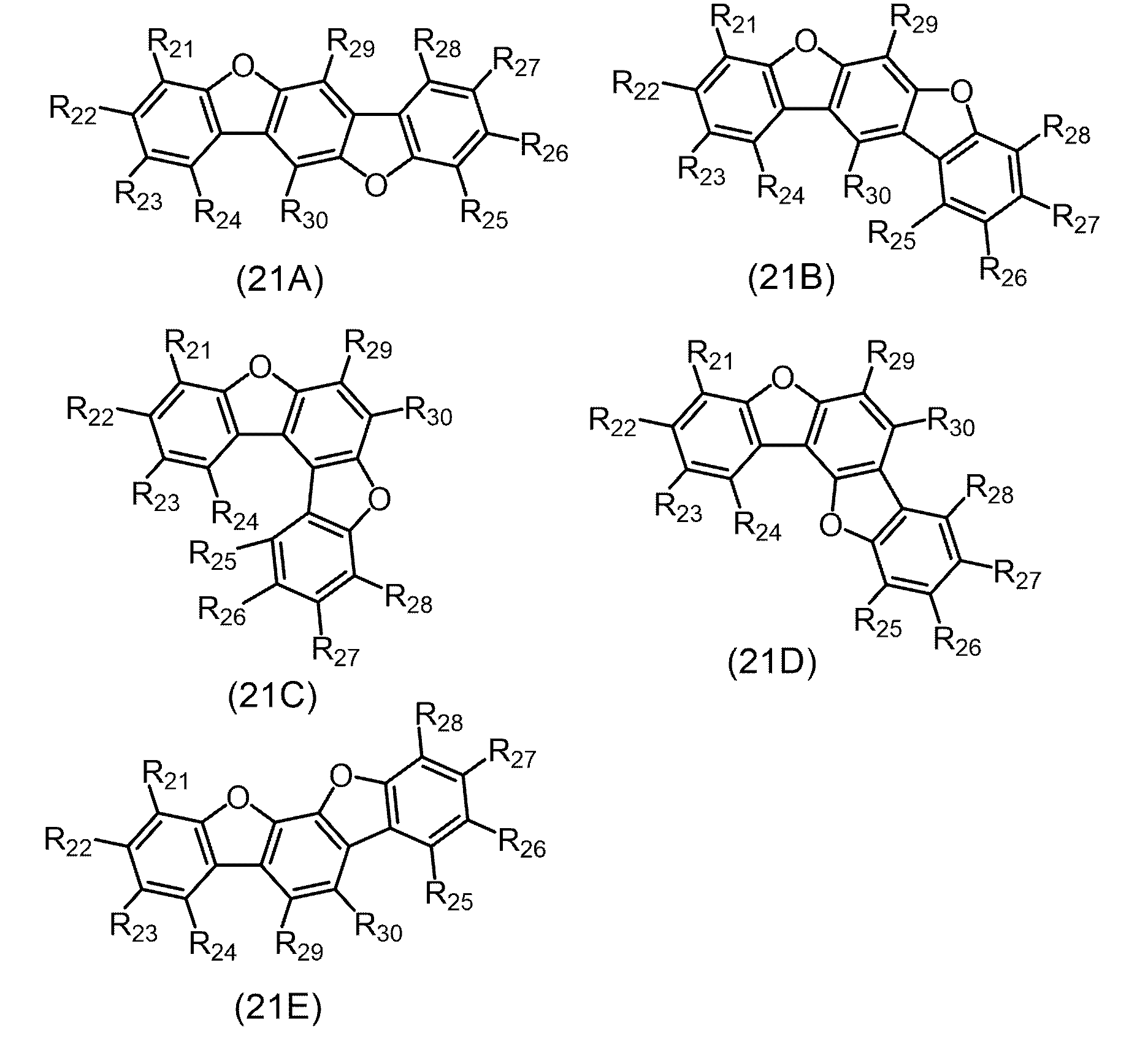
R21~R30のうちの隣接する2つ以上からなる組の1組以上が、
互いに結合して、置換もしくは無置換の単環を形成するか、
互いに結合して、置換もしくは無置換の縮合環を形成するか、又は
互いに結合せず、
前記置換もしくは無置換の単環を形成せず、かつ前記置換もしくは無置換の縮合環を形成しないR21~R30は、それぞれ独立に、
水素原子、
ハロゲン原子、
シアノ基、
置換もしくは無置換の環形成炭素数6~30のアリール基、
置換もしくは無置換の炭素数1~30のアルキル基、
置換もしくは無置換の炭素数1~30のハロゲン化アルキル基、
置換もしくは無置換の環形成炭素数3~30のシクロアルキル基、
置換もしくは無置換の炭素数2~30のアルケニル基、
置換もしくは無置換の炭素数2~30のアルキニル基、
置換もしくは無置換の炭素数3~30のアルキルシリル基、
置換もしくは無置換の環形成炭素数6~60のアリールシリル基、
置換もしくは無置換の環形成炭素数6~60のアリールホスホリル基、
ヒドロキシ基、
置換もしくは無置換の炭素数1~30のアルコキシ基、
置換もしくは無置換の環形成炭素数6~30のアリールオキシ基、
-N(Rz)2で表される基、
チオール基、
置換もしくは無置換の炭素数1~30のアルキルチオ基、
置換もしくは無置換の環形成炭素数7~30のアラルキル基、
置換ゲルマニウム基、
置換ホスフィンオキシド基、
ニトロ基、
置換ボリル基、又は
置換もしくは無置換の環形成炭素数6~30のアリールチオ基であり、
Rzは、
置換もしくは無置換の環形成炭素数6~30のアリール基、
置換もしくは無置換の環形成原子数5~30の複素環基、又は
置換もしくは無置換の炭素数1~30のアルキル基であり、
-N(Rz)2における2つのRzは、互いに同一であるか、又は異なり、
前記一般式(21A)、(21B)、(21C)、(21D)、及び(21E)中、R21~R30のいずれか1つは、Lとの単結合を表す。)

L1は、置換もしくは無置換の環形成炭素数6~50のアリーレン基であり、
A1は、下記一般式(100A)、(100B)、(100C)、(100D)、(100E)及び(100F)のいずれかで表される基であり、
Z1は、下記一般式(101A)、(101B)、(101C)、(101D)、及び(101E)のいずれかで表される基である。)
R11~R20のうちの隣接する2つ以上からなる組の1組以上が、
互いに結合して、置換もしくは無置換の単環を形成するか、
互いに結合して、置換もしくは無置換の縮合環を形成するか、又は
互いに結合せず、
前記置換もしくは無置換の単環を形成せず、かつ前記置換もしくは無置換の縮合環を形成しないR11~R20は、それぞれ独立に、
水素原子、
ハロゲン原子、
シアノ基、
置換もしくは無置換の環形成炭素数6~30のアリール基、
置換もしくは無置換の環形成原子数5~30の複素環基、
置換もしくは無置換の炭素数1~30のアルキル基、
置換もしくは無置換の炭素数1~30のハロゲン化アルキル基、
置換もしくは無置換の環形成炭素数3~30のシクロアルキル基、
置換もしくは無置換の炭素数2~30のアルケニル基、
置換もしくは無置換の炭素数2~30のアルキニル基、
置換もしくは無置換の炭素数3~30のアルキルシリル基、
置換もしくは無置換の環形成炭素数6~60のアリールシリル基、
置換もしくは無置換の環形成炭素数6~60のアリールホスホリル基、
ヒドロキシ基、
置換もしくは無置換の炭素数1~30のアルコキシ基、
置換もしくは無置換の環形成炭素数6~30のアリールオキシ基、
-N(Rz)2で表される基、
チオール基、
置換もしくは無置換の炭素数1~30のアルキルチオ基、
置換もしくは無置換の環形成炭素数7~30のアラルキル基、
置換ゲルマニウム基、
置換ホスフィンオキシド基、
ニトロ基、
置換ボリル基、又は
置換もしくは無置換の環形成炭素数6~30のアリールチオ基であり、
Rzは、
置換もしくは無置換の環形成炭素数6~30のアリール基、
置換もしくは無置換の環形成原子数5~30の複素環基、又は
置換もしくは無置換の炭素数1~30のアルキル基であり、
-N(Rz)2における2つのRzは、互いに同一であるか、又は異なり、
前記一般式(100A)、(100B)、(100C)、(100D)、(100E)及び(100F)中、*は、L1との結合位置を表す。)
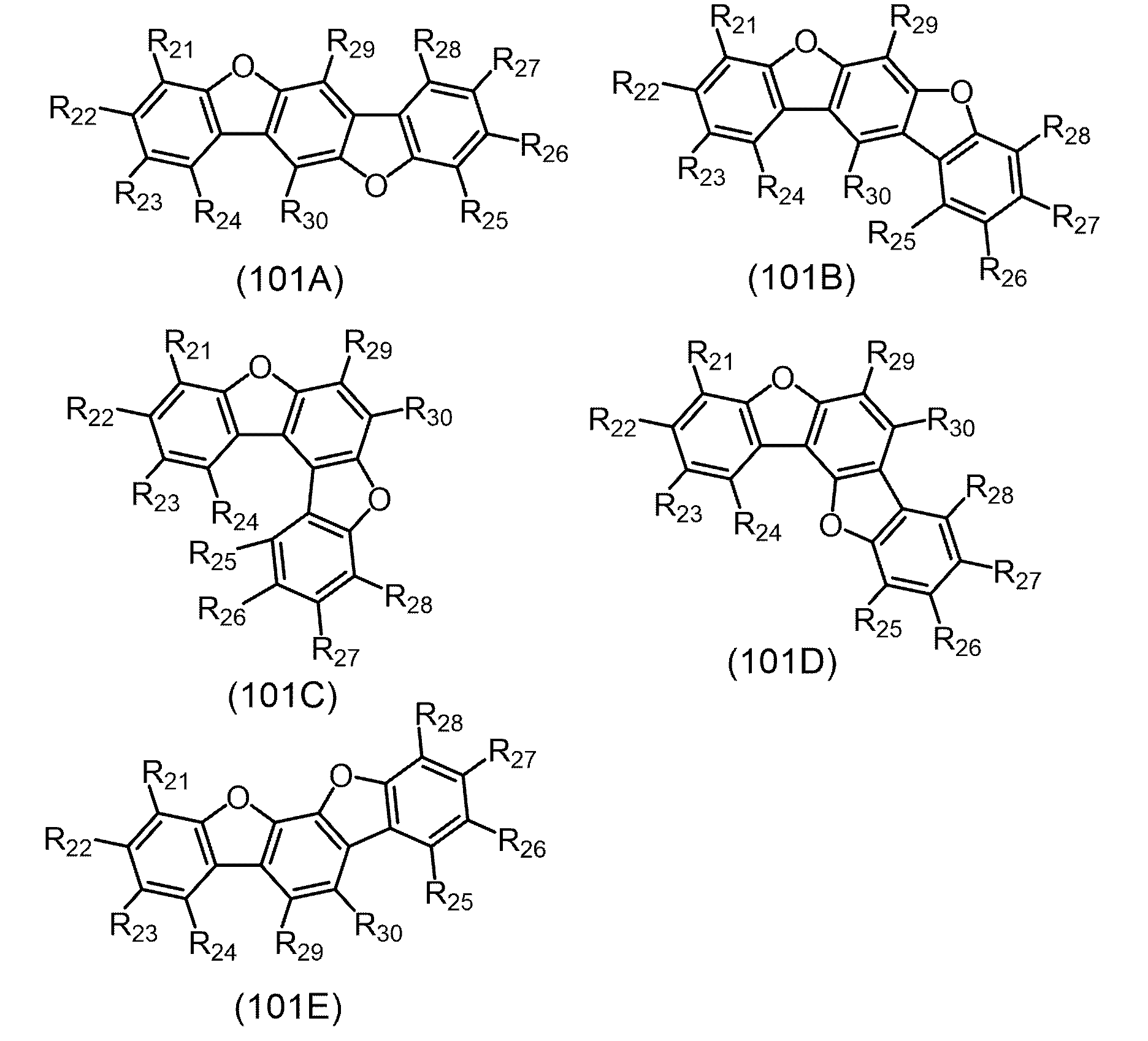
R21~R30のうちの隣接する2つ以上からなる組の1組以上が、
互いに結合して、置換もしくは無置換の単環を形成するか、
互いに結合して、置換もしくは無置換の縮合環を形成するか、又は
互いに結合せず、
前記置換もしくは無置換の単環を形成せず、かつ前記置換もしくは無置換の縮合環を形成しないR21~R30は、それぞれ独立に、
水素原子、
ハロゲン原子、
シアノ基、
置換もしくは無置換の環形成炭素数6~30のアリール基、
置換もしくは無置換の環形成原子数5~30の複素環基、
置換もしくは無置換の炭素数1~30のアルキル基、
置換もしくは無置換の炭素数1~30のハロゲン化アルキル基、
置換もしくは無置換の環形成炭素数3~30のシクロアルキル基、
置換もしくは無置換の炭素数2~30のアルケニル基、
置換もしくは無置換の炭素数2~30のアルキニル基、
置換もしくは無置換の炭素数3~30のアルキルシリル基、
置換もしくは無置換の環形成炭素数6~60のアリールシリル基、
置換もしくは無置換の環形成炭素数6~60のアリールホスホリル基、
ヒドロキシ基、
置換もしくは無置換の炭素数1~30のアルコキシ基、
置換もしくは無置換の環形成炭素数6~30のアリールオキシ基、
-N(Rz)2で表される基、
チオール基、
置換もしくは無置換の炭素数1~30のアルキルチオ基、
置換もしくは無置換の環形成炭素数7~30のアラルキル基、
置換ゲルマニウム基、
置換ホスフィンオキシド基、
ニトロ基、
置換ボリル基、又は
置換もしくは無置換の環形成炭素数6~30のアリールチオ基であり、
Rzは、
置換もしくは無置換の環形成炭素数6~30のアリール基、
置換もしくは無置換の環形成原子数5~30の複素環基、又は
置換もしくは無置換の炭素数1~30のアルキル基であり、
-N(Rz)2における2つのRzは、互いに同一であるか、又は異なり、
但し、Z1が(101A)、(101B)、又は(101D)であるときは、L1は置換もしくは無置換の環形成炭素数10~50のアリーレン基であり、
前記一般式(101A)、(101B)、(101C)、(101D)、及び(101E)中、R21~R30のいずれか1つは、L1との単結合を表す。)

L2は、
単結合、又は
置換もしくは無置換の環形成炭素数6~50のアリーレン基であり、
A2は、下記一般式(200A)、(200B)、(200C)、(200D)、(200E)及び(200F)のいずれかで表される基であり、
Z2は、下記一般式(201A)、(201B)、(201C)、(201D)、及び(201E)のいずれかで表される基である。)
R11~R20のうちの隣接する2つ以上からなる組の1組以上が、
互いに結合して、置換もしくは無置換の単環を形成するか、
互いに結合して、置換もしくは無置換の縮合環を形成するか、又は
互いに結合せず、
前記置換もしくは無置換の単環を形成せず、かつ前記置換もしくは無置換の縮合環を形成しないR11~R20は、それぞれ独立に、
水素原子、
ハロゲン原子、
シアノ基、
置換もしくは無置換の環形成炭素数6~30のアリール基、
置換もしくは無置換の環形成原子数5~30の複素環基、
置換もしくは無置換の炭素数1~30のアルキル基、
置換もしくは無置換の炭素数1~30のハロゲン化アルキル基、
置換もしくは無置換の環形成炭素数3~30のシクロアルキル基、
置換もしくは無置換の炭素数2~30のアルケニル基、
置換もしくは無置換の炭素数2~30のアルキニル基、
置換もしくは無置換の炭素数3~30のアルキルシリル基、
置換もしくは無置換の環形成炭素数6~60のアリールシリル基、
置換もしくは無置換の環形成炭素数6~60のアリールホスホリル基、
ヒドロキシ基、
置換もしくは無置換の炭素数1~30のアルコキシ基、
置換もしくは無置換の環形成炭素数6~30のアリールオキシ基、
-N(Rz)2で表される基、
チオール基、
置換もしくは無置換の炭素数1~30のアルキルチオ基、
置換もしくは無置換の環形成炭素数7~30のアラルキル基、
置換ゲルマニウム基、
置換ホスフィンオキシド基、
ニトロ基、
置換ボリル基、又は
置換もしくは無置換の環形成炭素数6~30のアリールチオ基であり、
Rzは、
置換もしくは無置換の環形成炭素数6~30のアリール基、
置換もしくは無置換の環形成原子数5~30の複素環基、又は
置換もしくは無置換の炭素数1~30のアルキル基であり、
-N(Rz)2における2つのRzは、互いに同一であるか、又は異なり、
前記一般式(200A)、(200B)、(200C)、(200D)、(200E)及び(200F)中、*は、L2との結合位置を表す。)

R21~R30のうちの隣接する2つ以上からなる組の1組以上が、
互いに結合して、置換もしくは無置換の単環を形成するか、
互いに結合して、置換もしくは無置換の縮合環を形成するか、又は
互いに結合せず、
前記置換もしくは無置換の単環を形成せず、かつ前記置換もしくは無置換の縮合環を形成しないR21~R30は、それぞれ独立に、
水素原子、
ハロゲン原子、
シアノ基、
置換もしくは無置換の環形成炭素数6~30のアリール基、
置換もしくは無置換の環形成原子数5~30の複素環基、
置換もしくは無置換の炭素数1~30のアルキル基、
置換もしくは無置換の炭素数1~30のハロゲン化アルキル基、
置換もしくは無置換の環形成炭素数3~30のシクロアルキル基、
置換もしくは無置換の炭素数2~30のアルケニル基、
置換もしくは無置換の炭素数2~30のアルキニル基、
置換もしくは無置換の炭素数3~30のアルキルシリル基、
置換もしくは無置換の環形成炭素数6~60のアリールシリル基、
置換もしくは無置換の環形成炭素数6~60のアリールホスホリル基、
ヒドロキシ基、
置換もしくは無置換の炭素数1~30のアルコキシ基、
置換もしくは無置換の環形成炭素数6~30のアリールオキシ基、
-N(Rz)2で表される基、
チオール基、
置換もしくは無置換の炭素数1~30のアルキルチオ基、
置換もしくは無置換の環形成炭素数7~30のアラルキル基、
置換ゲルマニウム基、
置換ホスフィンオキシド基、
ニトロ基、
置換ボリル基、又は
置換もしくは無置換の環形成炭素数6~30のアリールチオ基であり、
Rzは、
置換もしくは無置換の環形成炭素数6~30のアリール基、
置換もしくは無置換の環形成原子数5~30の複素環基、又は
置換もしくは無置換の炭素数1~30のアルキル基であり、
-N(Rz)2における2つのRzは、互いに同一であるか、又は異なり、
前記一般式(201A)、(201B)、(201C)、(201D)、及び(201E)中、R21~R30のいずれか1つは、L2との単結合を表し、
但し、A2が前記一般式(200D)で表される基であるときは、Z2におけるL2との単結合を表さないR21~R30は水素原子である。)
本明細書において、水素原子とは、中性子数が異なる同位体、即ち、軽水素(protium)、重水素(deuterium)、及び三重水素(tritium)を包含する。
また、ベンゼン環に置換基として、例えば、アルキル基が置換している場合、当該アルキル基の炭素数は、ベンゼン環の環形成炭素数に含めない。そのため、アルキル基が置換しているベンゼン環の環形成炭素数は、6である。また、ナフタレン環に置換基として、例えば、アルキル基が置換している場合、当該アルキル基の炭素数は、ナフタレン環の環形成炭素数に含めない。そのため、アルキル基が置換しているナフタレン環の環形成炭素数は、10である。
本明細書において、「置換もしくは無置換のZZ基」という場合における「無置換」とは、ZZ基における水素原子が置換基と置き換わっていないことを意味する。「無置換のZZ基」における水素原子は、軽水素原子、重水素原子、又は三重水素原子である。
また、本明細書において、「置換もしくは無置換のZZ基」という場合における「置換」とは、ZZ基における1つ以上の水素原子が、置換基と置き換わっていることを意味する。「AA基で置換されたBB基」という場合における「置換」も同様に、BB基における1つ以上の水素原子が、AA基と置き換わっていることを意味する。
以下、本明細書に記載の置換基について説明する。
本明細書に記載の「無置換の複素環基」の環形成原子数は、本明細書に別途記載のない限り、5~50であり、好ましくは5~30、より好ましくは5~18である。
本明細書に記載の「無置換のアルキル基」の炭素数は、本明細書に別途記載のない限り、1~50であり、好ましくは1~20、より好ましくは1~6である。
本明細書に記載の「無置換のアルケニル基」の炭素数は、本明細書に別途記載のない限り、2~50であり、好ましくは2~20、より好ましくは2~6である。
本明細書に記載の「無置換のアルキニル基」の炭素数は、本明細書に別途記載のない限り、2~50であり、好ましくは2~20、より好ましくは2~6である。
本明細書に記載の「無置換のシクロアルキル基」の環形成炭素数は、本明細書に別途記載のない限り、3~50であり、好ましくは3~20、より好ましくは3~6である。
本明細書に記載の「無置換のアリーレン基」の環形成炭素数は、本明細書に別途記載のない限り、6~50であり、好ましくは6~30、より好ましくは6~18である。
本明細書に記載の「無置換の2価の複素環基」の環形成原子数は、本明細書に別途記載のない限り、5~50であり、好ましくは5~30、より好ましくは5~18である。
本明細書に記載の「無置換のアルキレン基」の炭素数は、本明細書に別途記載のない限り、1~50であり、好ましくは1~20、より好ましくは1~6である。
本明細書に記載の「置換もしくは無置換のアリール基」の具体例(具体例群G1)としては、以下の無置換のアリール基(具体例群G1A)及び置換のアリール基(具体例群G1B)等が挙げられる。(ここで、無置換のアリール基とは「置換もしくは無置換のアリール基」が「無置換のアリール基」である場合を指し、置換のアリール基とは「置換もしくは無置換のアリール基」が「置換のアリール基」である場合を指す。)本明細書において、単に「アリール基」という場合は、「無置換のアリール基」と「置換のアリール基」の両方を含む。
「置換のアリール基」は、「無置換のアリール基」の1つ以上の水素原子が置換基と置き換わった基を意味する。「置換のアリール基」としては、例えば、下記具体例群G1Aの「無置換のアリール基」の1つ以上の水素原子が置換基と置き換わった基、及び下記具体例群G1Bの置換のアリール基の例等が挙げられる。尚、ここに列挙した「無置換のアリール基」の例、及び「置換のアリール基」の例は、一例に過ぎず、本明細書に記載の「置換のアリール基」には、下記具体例群G1Bの「置換のアリール基」におけるアリール基自体の炭素原子に結合する水素原子がさらに置換基と置き換わった基、及び下記具体例群G1Bの「置換のアリール基」における置換基の水素原子がさらに置換基と置き換わった基も含まれる。
フェニル基、
p-ビフェニル基、
m-ビフェニル基、
o-ビフェニル基、
p-ターフェニル-4-イル基、
p-ターフェニル-3-イル基、
p-ターフェニル-2-イル基、
m-ターフェニル-4-イル基、
m-ターフェニル-3-イル基、
m-ターフェニル-2-イル基、
o-ターフェニル-4-イル基、
o-ターフェニル-3-イル基、
o-ターフェニル-2-イル基、
1-ナフチル基、
2-ナフチル基、
アントリル基、
ベンゾアントリル基、
フェナントリル基、
ベンゾフェナントリル基、
フェナレニル基、
ピレニル基、
クリセニル基、
ベンゾクリセニル基、
トリフェニレニル基、
ベンゾトリフェニレニル基、
テトラセニル基、
ペンタセニル基、
フルオレニル基、
9,9’-スピロビフルオレニル基、
ベンゾフルオレニル基、
ジベンゾフルオレニル基、
フルオランテニル基、
ベンゾフルオランテニル基、
ペリレニル基、及び
下記一般式(TEMP-1)~(TEMP-15)で表される環構造から1つの水素原子を除くことにより誘導される1価のアリール基。
o-トリル基、
m-トリル基、
p-トリル基、
パラ-キシリル基、
メタ-キシリル基、
オルト-キシリル基、
パラ-イソプロピルフェニル基、
メタ-イソプロピルフェニル基、
オルト-イソプロピルフェニル基、
パラ-t-ブチルフェニル基、
メタ-t-ブチルフェニル基、
オルト-t-ブチルフェニル基、
3,4,5-トリメチルフェニル基、
9,9-ジメチルフルオレニル基、
9,9-ジフェニルフルオレニル基、
9,9-ビス(4-メチルフェニル)フルオレニル基、
9,9-ビス(4-イソプロピルフェニル)フルオレニル基、
9,9-ビス(4-t-ブチルフェニル)フルオレニル基、
シアノフェニル基、
トリフェニルシリルフェニル基、
トリメチルシリルフェニル基、
フェニルナフチル基、
ナフチルフェニル基、及び
前記一般式(TEMP-1)~(TEMP-15)で表される環構造から誘導される1価の基の1つ以上の水素原子が置換基と置き換わった基。
本明細書に記載の「複素環基」は、環形成原子にヘテロ原子を少なくとも1つ含む環状の基である。ヘテロ原子の具体例としては、窒素原子、酸素原子、硫黄原子、ケイ素原子、リン原子、及びホウ素原子が挙げられる。
本明細書に記載の「複素環基」は、単環の基であるか、又は縮合環の基である。
本明細書に記載の「複素環基」は、芳香族複素環基であるか、又は非芳香族複素環基である。
本明細書に記載の「置換もしくは無置換の複素環基」の具体例(具体例群G2)としては、以下の無置換の複素環基(具体例群G2A)、及び置換の複素環基(具体例群G2B)等が挙げられる。(ここで、無置換の複素環基とは「置換もしくは無置換の複素環基」が「無置換の複素環基」である場合を指し、置換の複素環基とは「置換もしくは無置換の複素環基」が「置換の複素環基」である場合を指す。)本明細書において、単に「複素環基」という場合は、「無置換の複素環基」と「置換の複素環基」の両方を含む。
「置換の複素環基」は、「無置換の複素環基」の1つ以上の水素原子が置換基と置き換わった基を意味する。「置換の複素環基」の具体例は、下記具体例群G2Aの「無置換の複素環基」の水素原子が置き換わった基、及び下記具体例群G2Bの置換の複素環基の例等が挙げられる。尚、ここに列挙した「無置換の複素環基」の例や「置換の複素環基」の例は、一例に過ぎず、本明細書に記載の「置換の複素環基」には、具体例群G2Bの「置換の複素環基」における複素環基自体の環形成原子に結合する水素原子がさらに置換基と置き換わった基、及び具体例群G2Bの「置換の複素環基」における置換基の水素原子がさらに置換基と置き換わった基も含まれる。
ピロリル基、
イミダゾリル基、
ピラゾリル基、
トリアゾリル基、
テトラゾリル基、
オキサゾリル基、
イソオキサゾリル基、
オキサジアゾリル基、
チアゾリル基、
イソチアゾリル基、
チアジアゾリル基、
ピリジル基、
ピリダジニル基、
ピリミジニル基、
ピラジニル基、
トリアジニル基、
インドリル基、
イソインドリル基、
インドリジニル基、
キノリジニル基、
キノリル基、
イソキノリル基、
シンノリル基、
フタラジニル基、
キナゾリニル基、
キノキサリニル基、
ベンゾイミダゾリル基、
インダゾリル基、
フェナントロリニル基、
フェナントリジニル基、
アクリジニル基、
フェナジニル基、
カルバゾリル基、
ベンゾカルバゾリル基、
モルホリノ基、
フェノキサジニル基、
フェノチアジニル基、
アザカルバゾリル基、及び
ジアザカルバゾリル基。
オキサゾリル基、
イソオキサゾリル基、
オキサジアゾリル基、
キサンテニル基、
ベンゾフラニル基、
イソベンゾフラニル基、
ジベンゾフラニル基、
ナフトベンゾフラニル基、
ベンゾオキサゾリル基、
ベンゾイソキサゾリル基、
フェノキサジニル基、
モルホリノ基、
ジナフトフラニル基、
アザジベンゾフラニル基、
ジアザジベンゾフラニル基、
アザナフトベンゾフラニル基、及び
ジアザナフトベンゾフラニル基。
チエニル基、
チアゾリル基、
イソチアゾリル基、
チアジアゾリル基、
ベンゾチオフェニル基(ベンゾチエニル基)、
イソベンゾチオフェニル基(イソベンゾチエニル基)、
ジベンゾチオフェニル基(ジベンゾチエニル基)、
ナフトベンゾチオフェニル基(ナフトベンゾチエニル基)、
ベンゾチアゾリル基、
ベンゾイソチアゾリル基、
フェノチアジニル基、
ジナフトチオフェニル基(ジナフトチエニル基)、
アザジベンゾチオフェニル基(アザジベンゾチエニル基)、
ジアザジベンゾチオフェニル基(ジアザジベンゾチエニル基)、
アザナフトベンゾチオフェニル基(アザナフトベンゾチエニル基)、及び
ジアザナフトベンゾチオフェニル基(ジアザナフトベンゾチエニル基)。
前記一般式(TEMP-16)~(TEMP-33)において、XA及びYAの少なくともいずれかがNH、又はCH2である場合、前記一般式(TEMP-16)~(TEMP-33)で表される環構造から誘導される1価の複素環基には、これらNH、又はCH2から1つの水素原子を除いて得られる1価の基が含まれる。
(9-フェニル)カルバゾリル基、
(9-ビフェニリル)カルバゾリル基、
(9-フェニル)フェニルカルバゾリル基、
(9-ナフチル)カルバゾリル基、
ジフェニルカルバゾール-9-イル基、
フェニルカルバゾール-9-イル基、
メチルベンゾイミダゾリル基、
エチルベンゾイミダゾリル基、
フェニルトリアジニル基、
ビフェニリルトリアジニル基、
ジフェニルトリアジニル基、
フェニルキナゾリニル基、及びビフェニリルキナゾリニル基。
フェニルジベンゾフラニル基、
メチルジベンゾフラニル基、
t-ブチルジベンゾフラニル基、及び
スピロ[9H-キサンテン-9,9’-[9H]フルオレン]の1価の残基。
フェニルジベンゾチオフェニル基、
メチルジベンゾチオフェニル基、
t-ブチルジベンゾチオフェニル基、及び
スピロ[9H-チオキサンテン-9,9’-[9H]フルオレン]の1価の残基。
本明細書に記載の「置換もしくは無置換のアルキル基」の具体例(具体例群G3)としては、以下の無置換のアルキル基(具体例群G3A)及び置換のアルキル基(具体例群G3B)が挙げられる。(ここで、無置換のアルキル基とは「置換もしくは無置換のアルキル基」が「無置換のアルキル基」である場合を指し、置換のアルキル基とは「置換もしくは無置換のアルキル基」が「置換のアルキル基」である場合を指す。)以下、単に「アルキル基」という場合は、「無置換のアルキル基」と「置換のアルキル基」の両方を含む。
「置換のアルキル基」は、「無置換のアルキル基」における1つ以上の水素原子が置換基と置き換わった基を意味する。「置換のアルキル基」の具体例としては、下記の「無置換のアルキル基」(具体例群G3A)における1つ以上の水素原子が置換基と置き換わった基、及び置換のアルキル基(具体例群G3B)の例等が挙げられる。本明細書において、「無置換のアルキル基」におけるアルキル基は、鎖状のアルキル基を意味する。そのため、「無置換のアルキル基」は、直鎖である「無置換のアルキル基」、及び分岐状である「無置換のアルキル基」が含まれる。尚、ここに列挙した「無置換のアルキル基」の例や「置換のアルキル基」の例は、一例に過ぎず、本明細書に記載の「置換のアルキル基」には、具体例群G3Bの「置換のアルキル基」におけるアルキル基自体の水素原子がさらに置換基と置き換わった基、及び具体例群G3Bの「置換のアルキル基」における置換基の水素原子がさらに置換基と置き換わった基も含まれる。
メチル基、
エチル基、
n-プロピル基、
イソプロピル基、
n-ブチル基、
イソブチル基、
s-ブチル基、及び
t-ブチル基。
ヘプタフルオロプロピル基(異性体を含む)、
ペンタフルオロエチル基、
2,2,2-トリフルオロエチル基、及び
トリフルオロメチル基。
本明細書に記載の「置換もしくは無置換のアルケニル基」の具体例(具体例群G4)としては、以下の無置換のアルケニル基(具体例群G4A)、及び置換のアルケニル基(具体例群G4B)等が挙げられる。(ここで、無置換のアルケニル基とは「置換もしくは無置換のアルケニル基」が「無置換のアルケニル基」である場合を指し、「置換のアルケニル基」とは「置換もしくは無置換のアルケニル基」が「置換のアルケニル基」である場合を指す。)本明細書において、単に「アルケニル基」という場合は、「無置換のアルケニル基」と「置換のアルケニル基」の両方を含む。
「置換のアルケニル基」は、「無置換のアルケニル基」における1つ以上の水素原子が置換基と置き換わった基を意味する。「置換のアルケニル基」の具体例としては、下記の「無置換のアルケニル基」(具体例群G4A)が置換基を有する基、及び置換のアルケニル基(具体例群G4B)の例等が挙げられる。尚、ここに列挙した「無置換のアルケニル基」の例や「置換のアルケニル基」の例は、一例に過ぎず、本明細書に記載の「置換のアルケニル基」には、具体例群G4Bの「置換のアルケニル基」におけるアルケニル基自体の水素原子がさらに置換基と置き換わった基、及び具体例群G4Bの「置換のアルケニル基」における置換基の水素原子がさらに置換基と置き換わった基も含まれる。
ビニル基、
アリル基、
1-ブテニル基、
2-ブテニル基、及び
3-ブテニル基。
1,3-ブタンジエニル基、
1-メチルビニル基、
1-メチルアリル基、
1,1-ジメチルアリル基、
2-メチルアリル基、及び
1,2-ジメチルアリル基。
本明細書に記載の「置換もしくは無置換のアルキニル基」の具体例(具体例群G5)としては、以下の無置換のアルキニル基(具体例群G5A)等が挙げられる。(ここで、無置換のアルキニル基とは、「置換もしくは無置換のアルキニル基」が「無置換のアルキニル基」である場合を指す。)以下、単に「アルキニル基」という場合は、「無置換のアルキニル基」と「置換のアルキニル基」の両方を含む。
「置換のアルキニル基」は、「無置換のアルキニル基」における1つ以上の水素原子が置換基と置き換わった基を意味する。「置換のアルキニル基」の具体例としては、下記の「無置換のアルキニル基」(具体例群G5A)における1つ以上の水素原子が置換基と置き換わった基等が挙げられる。
本明細書に記載の「置換もしくは無置換のシクロアルキル基」の具体例(具体例群G6)としては、以下の無置換のシクロアルキル基(具体例群G6A)、及び置換のシクロアルキル基(具体例群G6B)等が挙げられる。(ここで、無置換のシクロアルキル基とは「置換もしくは無置換のシクロアルキル基」が「無置換のシクロアルキル基」である場合を指し、置換のシクロアルキル基とは「置換もしくは無置換のシクロアルキル基」が「置換のシクロアルキル基」である場合を指す。)本明細書において、単に「シクロアルキル基」という場合は、「無置換のシクロアルキル基」と「置換のシクロアルキル基」の両方を含む。
「置換のシクロアルキル基」は、「無置換のシクロアルキル基」における1つ以上の水素原子が置換基と置き換わった基を意味する。「置換のシクロアルキル基」の具体例としては、下記の「無置換のシクロアルキル基」(具体例群G6A)における1つ以上の水素原子が置換基と置き換わった基、及び置換のシクロアルキル基(具体例群G6B)の例等が挙げられる。尚、ここに列挙した「無置換のシクロアルキル基」の例や「置換のシクロアルキル基」の例は、一例に過ぎず、本明細書に記載の「置換のシクロアルキル基」には、具体例群G6Bの「置換のシクロアルキル基」におけるシクロアルキル基自体の炭素原子に結合する1つ以上の水素原子が置換基と置き換わった基、及び具体例群G6Bの「置換のシクロアルキル基」における置換基の水素原子がさらに置換基と置き換わった基も含まれる。
シクロプロピル基、
シクロブチル基、
シクロペンチル基、
シクロヘキシル基、
1-アダマンチル基、
2-アダマンチル基、
1-ノルボルニル基、及び
2-ノルボルニル基。
4-メチルシクロヘキシル基。
本明細書に記載の-Si(R901)(R902)(R903)で表される基の具体例(具体例群G7)としては、
-Si(G1)(G1)(G1)、
-Si(G1)(G2)(G2)、
-Si(G1)(G1)(G2)、
-Si(G2)(G2)(G2)、
-Si(G3)(G3)(G3)、及び
-Si(G6)(G6)(G6)
が挙げられる。ここで、
G1は、具体例群G1に記載の「置換もしくは無置換のアリール基」である。
G2は、具体例群G2に記載の「置換もしくは無置換の複素環基」である。
G3は、具体例群G3に記載の「置換もしくは無置換のアルキル基」である。
G6は、具体例群G6に記載の「置換もしくは無置換のシクロアルキル基」である。
-Si(G1)(G1)(G1)における複数のG1は、互いに同一であるか、又は異なる。
-Si(G1)(G2)(G2)における複数のG2は、互いに同一であるか、又は異なる。
-Si(G1)(G1)(G2)における複数のG1は、互いに同一であるか、又は異なる。
-Si(G2)(G2)(G2)における複数のG2は、互いに同一であるか、又は異なる。
-Si(G3)(G3)(G3)における複数のG3は、互いに同一であるか、又は異なる。
-Si(G6)(G6)(G6)における複数のG6は、互いに同一であるか、又は異なる。
本明細書に記載の-O-(R904)で表される基の具体例(具体例群G8)としては、
-O(G1)、
-O(G2)、
-O(G3)、及び
-O(G6)
が挙げられる。
ここで、
G1は、具体例群G1に記載の「置換もしくは無置換のアリール基」である。
G2は、具体例群G2に記載の「置換もしくは無置換の複素環基」である。
G3は、具体例群G3に記載の「置換もしくは無置換のアルキル基」である。
G6は、具体例群G6に記載の「置換もしくは無置換のシクロアルキル基」である。
本明細書に記載の-S-(R905)で表される基の具体例(具体例群G9)としては、
-S(G1)、
-S(G2)、
-S(G3)、及び
-S(G6)
が挙げられる。
ここで、
G1は、具体例群G1に記載の「置換もしくは無置換のアリール基」である。
G2は、具体例群G2に記載の「置換もしくは無置換の複素環基」である。
G3は、具体例群G3に記載の「置換もしくは無置換のアルキル基」である。
G6は、具体例群G6に記載の「置換もしくは無置換のシクロアルキル基」である。
本明細書に記載の-N(R906)(R907)で表される基の具体例(具体例群G10)としては、
-N(G1)(G1)、
-N(G2)(G2)、
-N(G1)(G2)、
-N(G3)(G3)、及び
-N(G6)(G6)
が挙げられる。
ここで、
G1は、具体例群G1に記載の「置換もしくは無置換のアリール基」である。
G2は、具体例群G2に記載の「置換もしくは無置換の複素環基」である。
G3は、具体例群G3に記載の「置換もしくは無置換のアルキル基」である。
G6は、具体例群G6に記載の「置換もしくは無置換のシクロアルキル基」である。
-N(G1)(G1)における複数のG1は、互いに同一であるか、又は異なる。
-N(G2)(G2)における複数のG2は、互いに同一であるか、又は異なる。
-N(G3)(G3)における複数のG3は、互いに同一であるか、又は異なる。
-N(G6)(G6)における複数のG6は、互いに同一であるか、又は異なる
本明細書に記載の「ハロゲン原子」の具体例(具体例群G11)としては、フッ素原子、塩素原子、臭素原子、及びヨウ素原子等が挙げられる。
本明細書に記載の「置換もしくは無置換のフルオロアルキル基」は、「置換もしくは無置換のアルキル基」におけるアルキル基を構成する炭素原子に結合している少なくとも1つの水素原子がフッ素原子と置き換わった基を意味し、「置換もしくは無置換のアルキル基」におけるアルキル基を構成する炭素原子に結合している全ての水素原子がフッ素原子で置き換わった基(パーフルオロ基)も含む。「無置換のフルオロアルキル基」の炭素数は、本明細書に別途記載のない限り、1~50であり、好ましくは1~30であり、より好ましくは1~18である。「置換のフルオロアルキル基」は、「フルオロアルキル基」の1つ以上の水素原子が置換基と置き換わった基を意味する。尚、本明細書に記載の「置換のフルオロアルキル基」には、「置換のフルオロアルキル基」におけるアルキル鎖の炭素原子に結合する1つ以上の水素原子がさらに置換基と置き換わった基、及び「置換のフルオロアルキル基」における置換基の1つ以上の水素原子がさらに置換基と置き換わった基も含まれる。「無置換のフルオロアルキル基」の具体例としては、前記「アルキル基」(具体例群G3)における1つ以上の水素原子がフッ素原子と置き換わった基の例等が挙げられる。
本明細書に記載の「置換もしくは無置換のハロアルキル基」は、「置換もしくは無置換のアルキル基」におけるアルキル基を構成する炭素原子に結合している少なくとも1つの水素原子がハロゲン原子と置き換わった基を意味し、「置換もしくは無置換のアルキル基」におけるアルキル基を構成する炭素原子に結合している全ての水素原子がハロゲン原子で置き換わった基も含む。「無置換のハロアルキル基」の炭素数は、本明細書に別途記載のない限り、1~50であり、好ましくは1~30であり、より好ましくは1~18である。「置換のハロアルキル基」は、「ハロアルキル基」の1つ以上の水素原子が置換基と置き換わった基を意味する。尚、本明細書に記載の「置換のハロアルキル基」には、「置換のハロアルキル基」におけるアルキル鎖の炭素原子に結合する1つ以上の水素原子がさらに置換基と置き換わった基、及び「置換のハロアルキル基」における置換基の1つ以上の水素原子がさらに置換基と置き換わった基も含まれる。「無置換のハロアルキル基」の具体例としては、前記「アルキル基」(具体例群G3)における1つ以上の水素原子がハロゲン原子と置き換わった基の例等が挙げられる。ハロアルキル基をハロゲン化アルキル基と称する場合がある。
本明細書に記載の「置換もしくは無置換のアルコキシ基」の具体例としては、-O(G3)で表される基であり、ここで、G3は、具体例群G3に記載の「置換もしくは無置換のアルキル基」である。「無置換のアルコキシ基」の炭素数は、本明細書に別途記載のない限り、1~50であり、好ましくは1~30であり、より好ましくは1~18である。
本明細書に記載の「置換もしくは無置換のアルキルチオ基」の具体例としては、-S(G3)で表される基であり、ここで、G3は、具体例群G3に記載の「置換もしくは無置換のアルキル基」である。「無置換のアルキルチオ基」の炭素数は、本明細書に別途記載のない限り、1~50であり、好ましくは1~30であり、より好ましくは1~18である。
本明細書に記載の「置換もしくは無置換のアリールオキシ基」の具体例としては、-O(G1)で表される基であり、ここで、G1は、具体例群G1に記載の「置換もしくは無置換のアリール基」である。「無置換のアリールオキシ基」の環形成炭素数は、本明細書に別途記載のない限り、6~50であり、好ましくは6~30であり、より好ましくは6~18である。
本明細書に記載の「置換もしくは無置換のアリールチオ基」の具体例としては、-S(G1)で表される基であり、ここで、G1は、具体例群G1に記載の「置換もしくは無置換のアリール基」である。「無置換のアリールチオ基」の環形成炭素数は、本明細書に別途記載のない限り、6~50であり、好ましくは6~30であり、より好ましくは6~18である。
本明細書に記載の「置換もしくは無置換のトリアルキルシリル基」の具体例としては、-Si(G3)(G3)(G3)で表される基であり、ここで、G3は、具体例群G3に記載の「置換もしくは無置換のアルキル基」である。-Si(G3)(G3)(G3)における複数のG3は、互いに同一であるか、又は異なる。「無置換のトリアルキルシリル基」の各アルキル基の炭素数は、本明細書に別途記載のない限り、1~50であり、好ましくは1~20であり、より好ましくは1~6である。
本明細書に記載の「置換もしくは無置換のアラルキル基」の具体例としては、-(G3)-(G1)で表される基であり、ここで、G3は、具体例群G3に記載の「置換もしくは無置換のアルキル基」であり、G1は、具体例群G1に記載の「置換もしくは無置換のアリール基」である。従って、「アラルキル基」は、「アルキル基」の水素原子が置換基としての「アリール基」と置き換わった基であり、「置換のアルキル基」の一態様である。「無置換のアラルキル基」は、「無置換のアリール基」が置換した「無置換のアルキル基」であり、「無置換のアラルキル基」の炭素数は、本明細書に別途記載のない限り、7~50であり、好ましくは7~30であり、より好ましくは7~18である。
「置換もしくは無置換のアラルキル基」の具体例としては、ベンジル基、1-フェニルエチル基、2-フェニルエチル基、1-フェニルイソプロピル基、2-フェニルイソプロピル基、フェニル-t-ブチル基、α-ナフチルメチル基、1-α-ナフチルエチル基、2-α-ナフチルエチル基、1-α-ナフチルイソプロピル基、2-α-ナフチルイソプロピル基、β-ナフチルメチル基、1-β-ナフチルエチル基、2-β-ナフチルエチル基、1-β-ナフチルイソプロピル基、及び2-β-ナフチルイソプロピル基等が挙げられる。
本明細書に記載の「置換もしくは無置換のアリーレン基」は、別途記載のない限り、上記「置換もしくは無置換のアリール基」からアリール環上の1つの水素原子を除くことにより誘導される2価の基である。「置換もしくは無置換のアリーレン基」の具体例(具体例群G12)としては、具体例群G1に記載の「置換もしくは無置換のアリール基」からアリール環上の1つの水素原子を除くことにより誘導される2価の基等が挙げられる。
本明細書に記載の「置換もしくは無置換の2価の複素環基」は、別途記載のない限り、上記「置換もしくは無置換の複素環基」から複素環上の1つの水素原子を除くことにより誘導される2価の基である。「置換もしくは無置換の2価の複素環基」の具体例(具体例群G13)としては、具体例群G2に記載の「置換もしくは無置換の複素環基」から複素環上の1つの水素原子を除くことにより誘導される2価の基等が挙げられる。
本明細書に記載の「置換もしくは無置換のアルキレン基」は、別途記載のない限り、上記「置換もしくは無置換のアルキル基」からアルキル鎖上の1つの水素原子を除くことにより誘導される2価の基である。「置換もしくは無置換のアルキレン基」の具体例(具体例群G14)としては、具体例群G3に記載の「置換もしくは無置換のアルキル基」からアルキル鎖上の1つの水素原子を除くことにより誘導される2価の基等が挙げられる。
前記一般式(TEMP-42)~(TEMP-52)中、*は、結合位置を表す。
式Q9及びQ10は、単結合を介して互いに結合して環を形成してもよい。
前記一般式(TEMP-53)~(TEMP-62)中、*は、結合位置を表す。
前記一般式(TEMP-63)~(TEMP-68)中、*は、結合位置を表す。
本明細書において、「隣接する2つ以上からなる組の1組以上が、互いに結合して、置換もしくは無置換の単環を形成するか、互いに結合して、置換もしくは無置換の縮合環を形成するか、又は互いに結合せず」という場合は、「隣接する2つ以上からなる組の1組以上が、互いに結合して、置換もしくは無置換の単環を形成する」場合と、「隣接する2つ以上からなる組の1組以上が、互いに結合して、置換もしくは無置換の縮合環を形成する」場合と、「隣接する2つ以上からなる組の1組以上が、互いに結合しない」場合と、を意味する。
本明細書における、「隣接する2つ以上からなる組の1組以上が、互いに結合して、置換もしくは無置換の単環を形成する」場合、及び「隣接する2つ以上からなる組の1組以上が、互いに結合して、置換もしくは無置換の縮合環を形成する」場合(以下、これらの場合をまとめて「結合して環を形成する場合」と称する場合がある。)について、以下、説明する。母骨格がアントラセン環である下記一般式(TEMP-103)で表されるアントラセン化合物の場合を例として説明する。
芳香族炭化水素環の具体例としては、具体例群G1において具体例として挙げられた基が水素原子によって終端された構造が挙げられる。
芳香族複素環の具体例としては、具体例群G2において具体例として挙げられた芳香族複素環基が水素原子によって終端された構造が挙げられる。
脂肪族炭化水素環の具体例としては、具体例群G6において具体例として挙げられた基が水素原子によって終端された構造が挙げられる。
「環を形成する」とは、母骨格の複数の原子のみ、あるいは母骨格の複数の原子とさらに1以上の任意の原子で環を形成することを意味する。例えば、前記一般式(TEMP-104)に示す、R921とR922とが互いに結合して形成された環QAは、R921が結合するアントラセン骨格の炭素原子と、R922が結合するアントラセン骨格の炭素原子と、1以上の任意の原子とで形成する環を意味する。具体例としては、R921とR922とで環QAを形成する場合において、R921が結合するアントラセン骨格の炭素原子と、R922とが結合するアントラセン骨格の炭素原子と、4つの炭素原子とで単環の不飽和の環を形成する場合、R921とR922とで形成する環は、ベンゼン環である。
単環または縮合環を構成する「1以上の任意の原子」は、本明細書に別途記載のない限り、好ましくは2個以上15個以下であり、より好ましくは3個以上12個以下であり、さらに好ましくは3個以上5個以下である。
本明細書に別途記載のない限り、「単環」、及び「縮合環」のうち、好ましくは「単環」である。
本明細書に別途記載のない限り、「飽和の環」、及び「不飽和の環」のうち、好ましくは「不飽和の環」である。
本明細書に別途記載のない限り、「単環」は、好ましくはベンゼン環である。
本明細書に別途記載のない限り、「不飽和の環」は、好ましくはベンゼン環である。
「隣接する2つ以上からなる組の1組以上」が、「互いに結合して、置換もしくは無置換の単環を形成する」場合、又は「互いに結合して、置換もしくは無置換の縮合環を形成する」場合、本明細書に別途記載のない限り、好ましくは、隣接する2つ以上からなる組の1組以上が、互いに結合して、母骨格の複数の原子と、1個以上15個以下の炭素原子、窒素原子、酸素原子、及び硫黄原子からなる群から選択される少なくとも1種の原子とからなる置換もしくは無置換の「不飽和の環」を形成する。
上記の「飽和の環」、又は「不飽和の環」が置換基を有する場合の置換基は、例えば後述する「任意の置換基」である。上記の「飽和の環」、又は「不飽和の環」が置換基を有する場合の置換基の具体例は、上述した「本明細書に記載の置換基」の項で説明した置換基である。
以上が、「隣接する2つ以上からなる組の1組以上が、互いに結合して、置換もしくは無置換の単環を形成する」場合、及び「隣接する2つ以上からなる組の1組以上が、互いに結合して、置換もしくは無置換の縮合環を形成する」場合(「結合して環を形成する場合」)についての説明である。
本明細書における一実施形態においては、前記「置換もしくは無置換の」という場合の置換基(本明細書において、「任意の置換基」と呼ぶことがある。)は、例えば、
無置換の炭素数1~50のアルキル基、
無置換の炭素数2~50のアルケニル基、
無置換の炭素数2~50のアルキニル基、
無置換の環形成炭素数3~50のシクロアルキル基、
-Si(R901)(R902)(R903)、
-O-(R904)、
-S-(R905)、
-N(R906)(R907)、
ハロゲン原子、シアノ基、ニトロ基、
無置換の環形成炭素数6~50のアリール基、及び
無置換の環形成原子数5~50の複素環基からなる群から選択される基等であり、
ここで、R901~R907は、それぞれ独立に、
水素原子、
置換もしくは無置換の炭素数1~50のアルキル基、
置換もしくは無置換の環形成炭素数3~50のシクロアルキル基、
置換もしくは無置換の環形成炭素数6~50のアリール基、又は置換もしくは無置換の環形成原子数5~50の複素環基である。
R901が2個以上存在する場合、2個以上のR901は、互いに同一であるか、又は異なり、
R902が2個以上存在する場合、2個以上のR902は、互いに同一であるか、又は異なり、
R903が2個以上存在する場合、2個以上のR903は、互いに同一であるか、又は異なり、
R904が2個以上存在する場合、2個以上のR904は、互いに同一であるか、又は異なり、
R905が2個以上存在する場合、2個以上のR905は、互いに同一であるか、又は異なり、
R906が2個以上存在する場合、2個以上のR906は、互いに同一であるか、又は異なり、
R907が2個以上存在する場合、2個以上のR907は、互いに同一であるか又は異なる。
炭素数1~50のアルキル基、
環形成炭素数6~50のアリール基、及び
環形成原子数5~50の複素環基からなる群から選択される基である。
炭素数1~18のアルキル基、
環形成炭素数6~18のアリール基、及び
環形成原子数5~18の複素環基からなる群から選択される基である。
本明細書において別途記載のない限り、任意の置換基は、さらに置換基を有してもよい。任意の置換基がさらに有する置換基としては、上記任意の置換基と同様である。
任意の置換基が複数存在する場合、複数の任意の置換基は、互いに同一であるか又は異なる。
[有機EL素子]
本発明の第一実施形態に係る有機EL素子の構成について説明する。
有機EL素子は、陽極および陰極の両電極間に有機層を備える。この有機層は、有機化合物で構成される層を少なくとも一つ含む。あるいは、この有機層は、有機化合物で構成される複数の層が積層されてなる。有機層は、無機化合物をさらに含んでいてもよい。本実施形態の有機EL素子において、有機層のうち少なくとも一層は、発光層である。ゆえに、有機層は、例えば、一つの発光層で構成されていてもよいし、有機EL素子に採用され得る層を含んでいてもよい。有機EL素子に採用され得る層としては、特に限定されないが、例えば、正孔注入層、正孔輸送層、電子注入層、電子輸送層、及び障壁層からなる群から選択される少なくともいずれかの層が挙げられる。
本実施形態の有機EL素子は、陽極と陰極との間に含まれる発光層を有する。
S1(M3)>S1(M2) (数1)
化合物M3は、ベンゾビスベンゾフランと、ベンゾフロカルバゾール若しくはベンゾチエノカルバゾールとが単結合又は連結基を介して結合した構造を有する。
ベンゾビスベンゾフラン、ベンゾフロカルバゾール及びベンゾチエノカルバゾールは、いずれも平面性が高く剛直な構造である。
本実施形態に係る有機EL素子では、化合物M3が、このような平面性が高く剛直な構造を複数有することで、発光層中において、分子間の電荷輸送が促進され易くなり、駆動電圧が低い有機EL素子が実現していると推測される。
また、化合物M3が、このような平面性が高く剛直な構造を複数有することで、発光層に含まれる遅延蛍光性化合物M2の励起子について振動による失活が抑制され、高効率な有機EL素子が実現していると推測される。
有機EL素子1は、透光性の基板2と、陽極3と、陰極4と、陽極3と陰極4との間に配置された有機層10と、を含む。有機層10は、陽極3側から順に、正孔注入層6、正孔輸送層7、発光層5、電子輸送層8、および電子注入層9が、この順番で積層されて構成される。
発光層5は、燐光発光性材料(ドーパント材料)を含まないことが好ましい。
発光層5は、重金属錯体及び燐光発光性の希土類金属錯体を含まないことが好ましい。ここで、重金属錯体としては、例えば、イリジウム錯体、オスミウム錯体、及び白金錯体等が挙げられる。
また、発光層5は、金属錯体を含まないことも好ましい。
本実施形態の有機EL素子1において、発光層5は、下記一般式(1)で表される化合物M3と、遅延蛍光性の化合物M2と、を含む。
この態様の場合、化合物M2は、ドーパント材料(ゲスト材料、エミッター、発光材料と称する場合もある。)であることが好ましく、化合物M3は、ホスト材料(マトリックス材料と称する場合もある。)であることが好ましい。
化合物M3は、熱活性化遅延蛍光性の化合物でもよいし、熱活性化遅延蛍光性を示さない化合物でもよい。
(化合物M3)
本実施形態における発光層は、下記一般式(1)で表される化合物M3を含む。
本実施形態における化合物M3は、熱活性遅延蛍光性を示さない化合物であることが好ましい。

Lは、
単結合、又は
置換もしくは無置換の環形成炭素数6~50のアリーレン基であり、
Aは、下記一般式(11A)、(11B)、(11C)、(11D)、(11E)及び(11F)のいずれかで表される基であり、
Zは、下記一般式(21A)、(21B)、(21C)、(21D)、及び(21E)のいずれかで表される基である。)
X1は、酸素原子又は硫黄原子であり、
R11~R20のうちの隣接する2つ以上からなる組の1組以上が、
互いに結合して、置換もしくは無置換の単環を形成するか、
互いに結合して、置換もしくは無置換の縮合環を形成するか、又は
互いに結合せず、
前記置換もしくは無置換の単環を形成せず、かつ前記置換もしくは無置換の縮合環を形成しないR11~R20は、それぞれ独立に、
水素原子、
ハロゲン原子、
シアノ基、
置換もしくは無置換の環形成炭素数6~30のアリール基、
置換もしくは無置換の環形成原子数5~30の複素環基、
置換もしくは無置換の炭素数1~30のアルキル基、
置換もしくは無置換の炭素数1~30のハロゲン化アルキル基、
置換もしくは無置換の環形成炭素数3~30のシクロアルキル基、
置換もしくは無置換の炭素数2~30のアルケニル基、
置換もしくは無置換の炭素数2~30のアルキニル基、
置換もしくは無置換の炭素数3~30のアルキルシリル基、
置換もしくは無置換の環形成炭素数6~60のアリールシリル基、
置換もしくは無置換の環形成炭素数6~60のアリールホスホリル基、
ヒドロキシ基、
置換もしくは無置換の炭素数1~30のアルコキシ基、
置換もしくは無置換の環形成炭素数6~30のアリールオキシ基、
-N(Rz)2で表される基、
チオール基、
置換もしくは無置換の炭素数1~30のアルキルチオ基、
置換もしくは無置換の環形成炭素数7~30のアラルキル基、
置換ゲルマニウム基、
置換ホスフィンオキシド基、
ニトロ基、
置換ボリル基、又は
置換もしくは無置換の環形成炭素数6~30のアリールチオ基であり、
Rzは、
置換もしくは無置換の環形成炭素数6~30のアリール基、
置換もしくは無置換の環形成原子数5~30の複素環基、又は
置換もしくは無置換の炭素数1~30のアルキル基であり、
-N(Rz)2における2つのRzは、互いに同一であるか、又は異なり、
前記一般式(11A)、(11B)、(11C)、(11D)、(11E)及び(11F)中、*は、Lとの結合位置を表す。)

R21~R30のうちの隣接する2つ以上からなる組の1組以上が、
互いに結合して、置換もしくは無置換の単環を形成するか、
互いに結合して、置換もしくは無置換の縮合環を形成するか、又は
互いに結合せず、
前記置換もしくは無置換の単環を形成せず、かつ前記置換もしくは無置換の縮合環を形成しないR21~R30は、それぞれ独立に、
水素原子、
ハロゲン原子、
シアノ基、
置換もしくは無置換の環形成炭素数6~30のアリール基、
置換もしくは無置換の炭素数1~30のアルキル基、
置換もしくは無置換の炭素数1~30のハロゲン化アルキル基、
置換もしくは無置換の環形成炭素数3~30のシクロアルキル基、
置換もしくは無置換の炭素数2~30のアルケニル基、
置換もしくは無置換の炭素数2~30のアルキニル基、
置換もしくは無置換の炭素数3~30のアルキルシリル基、
置換もしくは無置換の環形成炭素数6~60のアリールシリル基、
置換もしくは無置換の環形成炭素数6~60のアリールホスホリル基、
ヒドロキシ基、
置換もしくは無置換の炭素数1~30のアルコキシ基、
置換もしくは無置換の環形成炭素数6~30のアリールオキシ基、
-N(Rz)2で表される基、
チオール基、
置換もしくは無置換の炭素数1~30のアルキルチオ基、
置換もしくは無置換の環形成炭素数7~30のアラルキル基、
置換ゲルマニウム基、
置換ホスフィンオキシド基、
ニトロ基、
置換ボリル基、又は
置換もしくは無置換の環形成炭素数6~30のアリールチオ基であり、
Rzは、
置換もしくは無置換の環形成炭素数6~30のアリール基、
置換もしくは無置換の環形成原子数5~30の複素環基、又は
置換もしくは無置換の炭素数1~30のアルキル基であり、
-N(Rz)2における2つのRzは、互いに同一であるか、又は異なり、
前記一般式(21A)、(21B)、(21C)、(21D)、及び(21E)中、R21~R30のいずれか1つは、Lとの単結合を表す。)
Lが単結合である場合、前記一般式(21A)、(21B)、(21C)、(21D)、及び(21E)中、R21~R30のいずれか1つは、Aとの単結合を表す。
L及びAは、それぞれ独立に、前記一般式(1)におけるL及びAと同義であり、R21~R30は、それぞれ独立に、前記一般式(21A)におけるR21~R30と同義である。)
一実施形態に係る化合物M3において、R11~R20のうちの隣接する2つ以上からなる組のいずれも、互いに結合しない。
一実施形態に係る化合物M3において、R11~R20は、それぞれ独立に、水素原子、置換もしくは無置換の環形成炭素数6~18のアリール基、置換もしくは無置換の環形成原子数5~18の複素環基、置換もしくは無置換の炭素数1~12のアルキル基、又は置換もしくは無置換の環形成炭素数3~18のシクロアルキル基である。
一実施形態に係る化合物M3において、R11~R20は、それぞれ独立に、水素原子、置換もしくは無置換の環形成炭素数6~18のアリール基、又は置換もしくは無置換の環形成原子数5~18の複素環基である。
一実施形態に係る化合物M3において、R11~R20は、それぞれ独立に、水素原子、置換もしくは無置換のフェニル基、置換もしくは無置換のビフェニル基、又は置換もしくは無置換のカルバゾリル基である。
一実施形態に係る化合物M3において、R11~R20は、水素原子である。
一実施形態に係る化合物M3において、R11~R20のうち、1つが置換基であり、残りが水素原子である。
一実施形態に係る化合物M3において、R11~R20の少なくとも1つは重水素原子である。
一実施形態に係る化合物M3において、Lとの結合位置ではないR21~R30のうちの隣接する2つ以上からなる組のいずれも、互いに結合しない。
一実施形態に係る化合物M3において、Lとの結合位置ではないR21~R30は、それぞれ独立に、水素原子、置換もしくは無置換の環形成炭素数6~18のアリール基、置換もしくは無置換の炭素数1~12のアルキル基、又は置換もしくは無置換の環形成炭素数3~18のシクロアルキル基である。
一実施形態に係る化合物M3において、Lとの結合位置ではないR21~R30は、それぞれ独立に、水素原子、又は置換もしくは無置換の環形成炭素数6~18のアリール基である。
一実施形態に係る化合物M3において、Lとの結合位置ではないR21~R30は、水素原子である。
一実施形態に係る化合物M3において、Lとの結合位置ではないR21~R30のうち、1つが置換基であり、残りが水素原子である。
一実施形態に係る化合物M3において、Lとの結合位置ではないR21~R30の少なくとも1つは重水素原子である。
一実施形態に係る化合物M3において、Lは、単結合、置換もしくは無置換のフェニレン基、置換もしくは無置換のビフェニレン基、置換もしくは無置換のナフチレン基、又は置換もしくは無置換のフルオレニレン基である。
一実施形態に係る化合物M3において、Lは、単結合又は置換もしくは無置換のフェニレン基である。
一実施形態に係る化合物M3において、Lは、単結合である。
一実施形態に係る化合物M3において、Lが置換基を有する場合、当該置換基は、それぞれ独立に、置換もしくは無置換の環形成炭素数6~30のアリール基、又は置換もしくは無置換の環形成原子数5~30の複素環基である。
一実施形態に係る化合物M3において、Lは、少なくとも1つの重水素原子を有する。

A及びZは、それぞれ独立に、前記一般式(1)におけるA及びZと同義であり、
複数のR100のうちの隣接する2つ以上からなる組の1組以上が、
互いに結合して、置換もしくは無置換の単環を形成するか、
互いに結合して、置換もしくは無置換の縮合環を形成するか、又は
互いに結合せず、
前記置換もしくは無置換の単環を形成せず、かつ前記置換もしくは無置換の縮合環を形成しないR100は、それぞれ独立に、水素原子、置換もしくは無置換の環形成炭素数6~30のアリール基、又は置換もしくは無置換の環形成原子数5~30の複素環基であり、複数のR100は、互いに同一であるか、又は異なる。)
一実施形態に係る化合物M3において、前記一般式(1A)、(2A)及び(3A)中、複数のR100が互いに結合せず、R100が水素原子である。
一実施形態に係る化合物M3において、前記一般式(1)で表される化合物は、前記一般式(2A)で表される化合物である。

A及びZは、それぞれ独立に、前記一般式(1)におけるA及びZと同義であり、
前記一般式(4B)中のR100は、前記一般式(3A)におけるR100と同義である。)
一実施形態に係る化合物M3において、前記一般式(1A)~(3A)及び(4B)中、R100の少なくとも1つは重水素原子である。
一実施形態に係る化合物M3において、前記一般式(4B)中、A及びR100は、置換基を含めて、互いに同一の基である。
一実施形態に係る化合物M3において、前記一般式(4B)中、Z及びR100は、置換基を含めて、互いに同一の基である。
一実施形態に係る化合物M3において、前記一般式(11A)、(11B)、(11C)、(11D)、(11E)及び(11F)中、X1は、酸素原子である。
一実施形態において、前記「置換もしくは無置換の」という場合の置換基は、無置換の基である。
本実施形態の化合物M3は、例えば、後述する実施例に記載の方法により製造することができる。本実施形態の化合物M3は、後述する実施例で説明する反応に倣い、目的物に合わせた既知の代替反応や原料を用いることで、製造することができる。
本実施形態の発光層は、熱活性化遅延蛍光性の化合物M2を含む。
本実施形態に係る化合物は、熱活性化遅延蛍光性の化合物である。本明細書において、熱活性化遅延蛍光性を遅延蛍光性と称する場合がある。
遅延蛍光については、「有機半導体のデバイス物性」(安達千波矢編、講談社発行)の261~268ページで解説されている。その文献の中で、蛍光発光材料の励起一重項状態と励起三重項状態のエネルギー差ΔE13を小さくすることができれば、通常は遷移確率が低い励起三重項状態から励起一重項状態への逆エネルギー移動が高効率で生じ、熱活性化遅延蛍光(Thermally Activated Delayed Fluorescence,TADF)が発現すると説明されている。さらに、当該文献中の図10.38で、遅延蛍光の発生メカニズムが説明されている。本実施形態における化合物M2は、このようなメカニズムで発生する熱活性化遅延蛍光を示す化合物であることが好ましい。
一方、遅延蛍光は、寿命の長い三重項励起子を経由して生成する一重項励起子からの発光のため、ゆるやかに減衰する。このように最初のPL励起で生成する一重項励起子からの発光と、三重項励起子を経由して生成する一重項励起子からの発光とでは、時間的に大きな差がある。そのため、遅延蛍光由来の発光強度を求めることができる。
上記試料溶液の蛍光スペクトルを分光蛍光光度計FP-8600(日本分光社製)で測定し、また同条件で9,10-ジフェニルアントラセンのエタノール溶液の蛍光スペクトルを測定する。両スペクトルの蛍光面積強度を用いて、Morris et al. J.Phys.Chem.80(1976)969中の(1)式により全蛍光量子収率を算出する。
本明細書における化合物M2以外の化合物のPrompt発光とDelay発光の量とその比の測定も、化合物M2のPrompt発光とDelay発光の量とその比の測定と同様である。
本実施形態の化合物M2は、公知の方法により製造することができる。
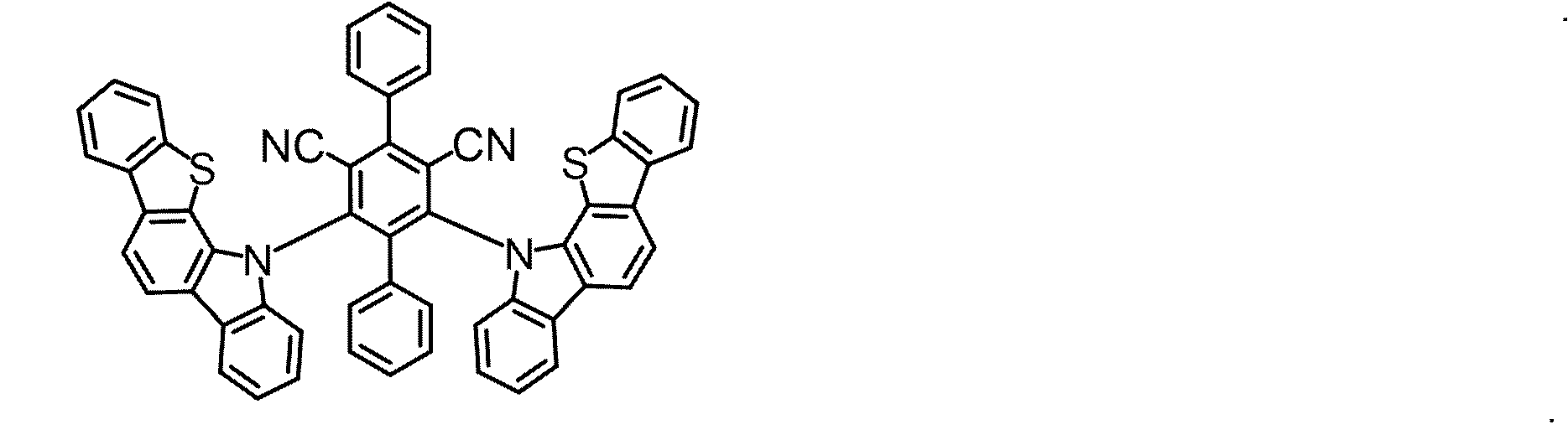
本実施形態の有機EL素子において、化合物M2の一重項エネルギーS1(M2)と、化合物M3の一重項エネルギーS1(M3)とは、下記数式(数1)の関係を満たす。
S1(M3)>S1(M2) (数1)
T77K(M3)>T77K(M2) …(数11)
ここで、三重項エネルギーと77[K]におけるエネルギーギャップとの関係について説明する。本実施形態では、77[K]におけるエネルギーギャップは、通常定義される三重項エネルギーとは異なる点がある。
三重項エネルギーの測定は、次のようにして行われる。まず、測定対象となる化合物を適切な溶媒中に溶解した溶液を石英ガラス管内に封入した試料を作製する。この試料について、低温(77[K])で燐光スペクトル(縦軸:燐光発光強度、横軸:波長とする。)を測定し、この燐光スペクトルの短波長側の立ち上がりに対して接線を引き、その接線と横軸との交点の波長値に基づいて、所定の換算式から三重項エネルギーを算出する。
ここで、本実施形態に係る化合物の内、熱活性遅延蛍光性の化合物は、ΔSTが小さい化合物であることが好ましい。ΔSTが小さいと、低温(77[K])状態でも、項間交差、及び逆項間交差が起こりやすく、励起一重項状態と励起三重項状態とが混在する。その結果、上記と同様にして測定されるスペクトルは、励起一重項状態、及び励起三重項状態の両者からの発光を含んでおり、いずれの状態から発光したのかについて峻別することは困難であるが、基本的には三重項エネルギーの値が支配的と考えられる。
そのため、本実施形態では、通常の三重項エネルギーTと測定手法は同じであるが、その厳密な意味において異なることを区別するため、次のようにして測定される値をエネルギーギャップT77Kと称する。測定対象となる化合物をEPA(ジエチルエーテル:イソペンタン:エタノール=5:5:2(容積比))中に、濃度が10μmol/Lとなるように溶解し、この溶液を石英セル中に入れて測定試料とする。この測定試料について、低温(77[K])で燐光スペクトル(縦軸:燐光発光強度、横軸:波長とする。)を測定し、この燐光スペクトルの短波長側の立ち上がりに対して接線を引き、その接線と横軸との交点の波長値λedge[nm]に基づいて、次の換算式(F1)から算出されるエネルギー量を77[K]におけるエネルギーギャップT77Kとする。
換算式(F1):T77K[eV]=1239.85/λedge
なお、スペクトルの最大ピーク強度の15%以下のピーク強度をもつ極大点は、上述の最も短波長側の極大値には含めず、最も短波長側の極大値に最も近い、傾きの値が極大値をとる点において引いた接線を当該燐光スペクトルの短波長側の立ち上がりに対する接線とする。
燐光の測定には、(株)日立ハイテクノロジー製のF-4500形分光蛍光光度計本体を用いることができる。なお、測定装置はこの限りではなく、冷却装置、及び低温用容器と、励起光源と、受光装置とを組み合わせることにより、測定してもよい。
溶液を用いた一重項エネルギーS1の測定方法(溶液法と称する場合がある。)としては、下記の方法が挙げられる。
測定対象となる化合物の10μmol/Lトルエン溶液を調製して石英セルに入れ、常温(300K)でこの試料の吸収スペクトル(縦軸:吸収強度、横軸:波長とする。)を測定する。この吸収スペクトルの長波長側の立ち下がりに対して接線を引き、その接線と横軸との交点の波長値λedge[nm]を次に示す換算式(F2)に代入して一重項エネルギーを算出する。
換算式(F2):S1[eV]=1239.85/λedge
吸収スペクトル測定装置としては、例えば、日立社製の分光光度計(装置名:U3310)が挙げられるが、これに限定されない。
なお、吸光度の値が0.2以下の極大点は、上記最も長波長側の極大値には含めない。
ΔST(M2)=S1(M2)-T77K(M2)<0.3eV(数1A)
ΔST(M2)=S1(M2)-T77K(M2)<0.2eV(数1B)
ΔST(M2)=S1(M2)-T77K(M2)<0.1eV(数1C)
ΔST(M2)=S1(M2)-T77K(M2)<0.01eV(数1D)
本実施形態に係る有機EL素子における発光層の膜厚は、好ましくは5nm以上50nm以下、より好ましくは7nm以上50nm以下、さらに好ましくは10nm以上50nm以下である。5nm以上であると、発光層形成及び色度の調整が容易になりやすく、50nm以下であると、駆動電圧の上昇が抑制されやすい。
発光層に含まれている化合物M2及び化合物M3の含有率は、例えば、以下の範囲であることが好ましい。
化合物M2の含有率は、10質量%以上80質量%以下であることが好ましく、10質量%以上60質量%以下であることがより好ましく、20質量%以上60質量%以下であることがさらに好ましい。
化合物M3の含有率は、20質量%以上90質量%以下であることが好ましく、40質量%以上90質量%以下であることがより好ましく、40質量%以上80質量%以下であることがさらに好ましい。
なお、本実施形態は、発光層に、化合物M2及び化合物M3以外の材料が含まれることを除外しない。
発光層は、化合物M2を1種のみ含んでもよいし、2種以上含んでもよい。発光層は、化合物M3を1種のみ含んでもよいし、2種以上含んでもよい。
この化合物M2で生じる逆項間交差を利用することで、発光層が、化合物M2の最低励起一重項状態S1(M2)よりも小さい最低励起一重項状態S1の蛍光ドーパントを含まない場合は、化合物M2の最低励起一重項状態S1(M2)からの発光を観測することができる。このTADF機構による遅延蛍光を利用することによっても、理論的に内部量子効率を100%まで高めることができると考えられている。
本実施形態によれば、駆動電圧が低く、高効率で発光する有機EL素子が実現される。
本実施形態の有機EL素子は、表示装置および発光装置等の電子機器に使用できる。
[有機EL素子]
第二実施形態の有機EL素子の構成について説明する。第二実施形態の説明において第一実施形態と同一の構成要素は、同一符号や名称を付す等して説明を省略もしくは簡略化する。また、第二実施形態では、特に言及されない材料や化合物については、第一実施形態で説明した材料や化合物と同様の材料や化合物を用いることができる。
第二実施形態の一態様において、発光層は、前記一般式(1)で表される化合物M3と、遅延蛍光性の化合物M2と、蛍光発光性の化合物M1とを含む。
第二実施形態の一態様において、化合物M1は、ドーパント材料であることが好ましく、化合物M2は、ホスト材料であることが好ましく、化合物M3はホスト材料であることが好ましい。化合物M2及び化合物M3の一方を第一のホスト材料と称し、他方を第二のホスト材料と称する場合もある。
本実施形態の発光層は、蛍光発光性の化合物M1を含む。
本実施形態の化合物M1は、燐光発光性の金属錯体ではない。本実施形態の化合物M1は、重金属錯体ではないことが好ましい。また、本実施形態の化合物M1は、金属錯体ではないことが好ましい。
また、本実施形態の化合物M1は、熱活性化遅延蛍光性を示さない化合物であることが好ましい。
本明細書において、最大ピーク波長とは、測定対象化合物が10-6モル/リットル以上10-5モル/リットル以下の濃度で溶解しているトルエン溶液について、測定した蛍光スペクトルにおける発光強度が最大となる蛍光スペクトルのピーク波長をいう。測定装置は、分光蛍光光度計(日立ハイテクサイエンス社製、F-7000)を用いる。
本明細書において、赤色の発光とは、蛍光スペクトルの最大ピーク波長が600nm以上660nm以下の範囲内である発光をいう。
化合物M1が赤色の蛍光発光性の化合物である場合、化合物M1の最大ピーク波長は、好ましくは600nm以上660nm以下、より好ましくは600nm以上640nm以下、さらに好ましくは610nm以上630nm以下である。
本明細書において、緑色の発光とは、蛍光スペクトルの最大ピーク波長が500nm以上560nm以下の範囲内である発光をいう。
化合物M1が緑色の蛍光発光性の化合物である場合、化合物M1の最大ピーク波長は、好ましくは500nm以上560nm以下、より好ましくは500nm以上540nm以下、さらに好ましくは510nm以上540nm以下である。
本明細書において、青色の発光とは、蛍光スペクトルの最大ピーク波長が430nm以上480nm以下の範囲内である発光をいう。
化合物M1が青色の蛍光発光性の化合物である場合、化合物M1の最大ピーク波長は、好ましくは430nm以上480nm以下、より好ましくは440nm以上480nm以下である。
電流密度が10mA/cm2となるように有機EL素子に電圧を印加した時の分光放射輝度スペクトルを分光放射輝度計CS-2000(コニカミノルタ株式会社製)で計測する。
得られた分光放射輝度スペクトルにおいて、発光強度が最大となる発光スペクトルのピーク波長を測定し、これを最大ピーク波長(単位:nm)とする。
本実施形態において、化合物M1は、下記一般式(20A)で表される化合物であることが好ましい。化合物M1は、最大ピーク波長が500nm以上560nm以下の発光を示す化合物であることが好ましい。
Za環、Zb環及びZc環は、それぞれ独立に、
置換もしくは無置換の環形成炭素数6~50の芳香族炭化水素環、又は
置換もしくは無置換の環形成原子数5~50の複素環であり、
Raは、前記Za環又は前記Zb環と結合して置換もしくは無置換の複素環を形成するか、あるいは置換もしくは無置換の複素環を形成せず、
Rbは、前記Za環又は前記Zc環と結合して置換もしくは無置換の複素環を形成するか、あるいは置換もしくは無置換の複素環を形成せず、
前記置換もしくは無置換の複素環を形成しないRa及びRbは、それぞれ独立に、
置換もしくは無置換の炭素数1~50のアルキル基、
置換もしくは無置換の炭素数2~50のアルケニル基、
置換もしくは無置換の炭素数2~50のアルキニル基、
置換もしくは無置換の環形成炭素数3~50のシクロアルキル基、
置換もしくは無置換の環形成炭素数6~50のアリール基、又は
置換もしくは無置換の環形成原子数5~50の複素環基である。)
本実施形態において、化合物M1は、下記一般式(D11)で表される化合物であることも好ましい。前記一般式(20A)で表される化合物は、下記一般式(D11)で表される化合物であることも好ましい。
X1は、CR1または窒素原子であり、
X2は、CR2または窒素原子であり、
X3は、CR3または窒素原子であり、
X4は、CR4または窒素原子であり、
X5は、CR5または窒素原子であり、
X6は、CR6または窒素原子であり、
X7は、CR7であるか、窒素原子であるか、またはX8と単結合で結合する炭素原子であり、
X8は、CR8であるか、窒素原子であるか、またはX7と単結合で結合する炭素原子であり、
X9は、CR9または窒素原子であり、
X10は、CR10または窒素原子であり、
X11は、CR11または窒素原子であり、
X12は、CR12または窒素原子であり、
Qは、CRQまたは窒素原子であり、
R1~R6並びにR9~R11のうちの隣接する2つ以上からなる組の1組以上が、
互いに結合して、置換もしくは無置換の単環を形成するか、
互いに結合して、置換もしくは無置換の縮合環を形成するか、又は
互いに結合せず、
R3、R4およびRbのうちの隣接する2つ以上からなる組の1組以上が、
互いに結合して、置換もしくは無置換の単環を形成するか、
互いに結合して、置換もしくは無置換の縮合環を形成するか、又は
互いに結合せず、
R3、R4およびRbのうちの隣接する2つ以上からなる組の1組以上が互いに結合して形成された単環又は縮合環における少なくとも一つの水素は、
炭素数1~50のアルキル基、
環形成炭素数6~50のアリール基、
環形成原子数5~50の複素環基、
-O-(R920)で表される基、および
-N(R921)(R922)で表される基からなる群から選択される少なくともいずれかの置換基で置換されていているか、もしくは置換されておらず、
当該置換基における少なくとも一つの水素は、環形成炭素数6~50のアリール基または炭素数1~50のアルキル基で置換されているか、もしくは置換されておらず、
前記置換もしくは無置換の単環を形成せず、かつ、前記置換もしくは無置換の縮合環を形成しないR1~R11、並びにR12~R13、およびRQは、それぞれ独立に、
水素原子、
置換もしくは無置換の炭素数1~50のアルキル基、
置換もしくは無置換の炭素数2~50のアルケニル基、
置換もしくは無置換の炭素数2~50のアルキニル基、
置換もしくは無置換の環形成炭素数3~50のシクロアルキル基、
-Si(R911)(R912)(R913)で表される基、
-O-(R914)で表される基、
-S-(R915)で表される基、
-N(R916)(R917)で表される基、
置換もしくは無置換の炭素数7~50のアラルキル基、
-C(=O)R918で表される基、
-COOR919で表される基、
ハロゲン原子、
シアノ基、
ニトロ基、
置換もしくは無置換の環形成炭素数6~50のアリール基、又は
置換もしくは無置換の環形成原子数5~50の複素環基であり、
前記置換もしくは無置換の単環を形成せず、かつ、前記置換もしくは無置換の縮合環を形成しないRbは、
置換もしくは無置換の炭素数1~50のアルキル基、
置換もしくは無置換の炭素数2~50のアルケニル基、
置換もしくは無置換の炭素数2~50のアルキニル基、
置換もしくは無置換の環形成炭素数3~50のシクロアルキル基、
置換もしくは無置換の環形成炭素数6~50のアリール基、または
置換もしくは無置換の環形成原子数5~50の複素環基であり、
R911~R922は、それぞれ独立に、
水素原子、
置換もしくは無置換の炭素数1~50のアルキル基、
置換もしくは無置換の環形成炭素数3~50のシクロアルキル基、
置換もしくは無置換の環形成炭素数6~50のアリール基、又は
置換もしくは無置換の環形成原子数5~50の複素環基であり、
R911が複数存在する場合、複数のR911は、互いに同一であるか又は異なり、
R912が複数存在する場合、複数のR912は、互いに同一であるか又は異なり、
R913が複数存在する場合、複数のR913は、互いに同一であるか又は異なり、
R914が複数存在する場合、複数のR914は、互いに同一であるか又は異なり、
R915が複数存在する場合、複数のR915は、互いに同一であるか又は異なり、
R916が複数存在する場合、複数のR916は、互いに同一であるか又は異なり、
R917が複数存在する場合、複数のR917は、互いに同一であるか又は異なり、
R918が複数存在する場合、複数のR918は、互いに同一であるか又は異なり、
R919が複数存在する場合、複数のR919は、互いに同一であるか又は異なり、
R920が複数存在する場合、複数のR920は、互いに同一であるか又は異なり、
R921が複数存在する場合、複数のR921は、互いに同一であるか又は異なり、
R922が複数存在する場合、複数のR922は、互いに同一であるか又は異なる。)
R1~R3、R5~R13およびRQは、それぞれ独立に、前記一般式(D11)におけるR1~R3、R5~R13およびRQと同義であり、
RA1~RA4のうちの隣接する2つ以上からなる組の1組以上が、
互いに結合して、置換もしくは無置換の単環を形成するか、
互いに結合して、置換もしくは無置換の縮合環を形成するか、又は
互いに結合せず、
前記置換もしくは無置換の単環を形成せず、かつ、前記置換もしくは無置換の縮合環を形成しないRA1~RA4は、それぞれ独立に、
水素原子、
置換もしくは無置換の炭素数1~50のアルキル基、
置換もしくは無置換の炭素数2~50のアルケニル基、
置換もしくは無置換の炭素数2~50のアルキニル基、
置換もしくは無置換の環形成炭素数3~50のシクロアルキル基、
置換もしくは無置換の炭素数7~50のアラルキル基、
-Si(R931)(R932)(R933)で表される基、
-O-(R934)で表される基、
-S-(R935)で表される基、
-N(R936)(R937)で表される基、
置換もしくは無置換の炭素数7~50のアラルキル基、
-C(=O)R938で表される基、
-COOR939で表される基、
ハロゲン原子、
シアノ基、
ニトロ基、
置換もしくは無置換の環形成炭素数6~50のアリール基、又は
置換もしくは無置換の環形成原子数5~50の複素環基であり、
R931~R939は、それぞれ独立に、
水素原子、
置換もしくは無置換の炭素数1~50のアルキル基、
置換もしくは無置換の環形成炭素数6~50のアリール基、又は
置換もしくは無置換の環形成原子数5~50の複素環基であり、
R931が複数存在する場合、複数のR931は、互いに同一であるか又は異なり、
R932が複数存在する場合、複数のR932は、互いに同一であるか又は異なり、
R933が複数存在する場合、複数のR933は、互いに同一であるか又は異なり、
R934が複数存在する場合、複数のR934は、互いに同一であるか又は異なり、
R935が複数存在する場合、複数のR935は、互いに同一であるか又は異なり、
R936が複数存在する場合、複数のR936は、互いに同一であるか又は異なり、
R937が複数存在する場合、複数のR937は、互いに同一であるか又は異なり、
R938が複数存在する場合、複数のR938は、互いに同一であるか又は異なり、
R939が複数存在する場合、複数のR939は、互いに同一であるか又は異なる。)
RA5~RA9のうちの隣接する2つ以上からなる組の1組以上が、
互いに結合して、置換もしくは無置換の単環を形成するか、
互いに結合して、置換もしくは無置換の縮合環を形成するか、又は
互いに結合せず、
前記置換もしくは無置換の単環を形成せず、かつ前記置換もしくは無置換の縮合環を形成しないRA5~RA9は、それぞれ独立に、前記一般式(D13)中、前記置換もしくは無置換の単環を形成せず、かつ前記置換もしくは無置換の縮合環を形成しないRA1~RA4と同義である。)
水素原子、
置換もしくは無置換の炭素数1~50のアルキル基、
置換もしくは無置換の環形成炭素数6~50のアリール基、または
置換もしくは無置換の環形成原子数5~50のヘテロアリール基であることも好ましい。
水素原子、
置換もしくは無置換の炭素数1~25のアルキル基、
置換もしくは無置換の環形成炭素数6~25のアリール基、または
置換もしくは無置換の環形成原子数5~25のヘテロアリール基であることも好ましい。
水素原子、
置換もしくは無置換の炭素数1~50のアルキル基、
置換もしくは無置換の環形成炭素数6~50のアリール基、または
置換もしくは無置換の環形成原子数5~50のヘテロアリール基であることも好ましい。
水素原子、
置換もしくは無置換の炭素数1~25のアルキル基、
置換もしくは無置換の環形成炭素数6~25のアリール基、または
置換もしくは無置換の環形成原子数5~25のヘテロアリール基であることも好ましい。
水素原子、
置換もしくは無置換の炭素数1~10のアルキル基、
置換もしくは無置換の環形成炭素数6~12のアリール基、または
置換もしくは無置換の環形成原子数5~18のヘテロアリール基である。)
置換もしくは無置換の炭素数1~10のアルキル基、
置換もしくは無置換のフェニル基、
置換もしくは無置換のナフチル基、または
置換もしくは無置換のジベンゾフラニル基であることが好ましい。
本実施形態において、化合物M1は、下記一般式(16)で表される化合物であることも好ましい。前記一般式(20A)で表される化合物は、下記一般式(16)で表される化合物であることも好ましい。
R161~R177のうちの隣接する2つ以上からなる組の1組以上が、
互いに結合して、置換もしくは無置換の単環を形成するか、
互いに結合して、置換もしくは無置換の縮合環を形成するか、又は
互いに結合せず、
前記置換もしくは無置換の単環を形成せず、かつ前記置換もしくは無置換の縮合環を形成しないR161~R177は、それぞれ独立に、
水素原子、
置換もしくは無置換の炭素数1~50のアルキル基、
置換もしくは無置換の炭素数2~50のアルケニル基、
置換もしくは無置換の炭素数2~50のアルキニル基、
置換もしくは無置換の環形成炭素数3~50のシクロアルキル基、
置換もしくは無置換の炭素数7~50のアラルキル基、
-Si(R961)(R962)(R963)で表される基、
-O-(R964)で表される基、
-S-(R965)で表される基、
-N(R966)(R967)で表される基、
-C(=O)R968で表される基、
-COOR969で表される基、
ハロゲン原子、
シアノ基、
ニトロ基、
置換もしくは無置換の環形成炭素数6~50のアリール基、又は
置換もしくは無置換の環形成原子数5~50の複素環基であり、
R961~R969は、それぞれ独立に、
水素原子、
置換もしくは無置換の炭素数1~50のアルキル基、
置換もしくは無置換の環形成炭素数6~50のアリール基、又は
置換もしくは無置換の環形成原子数5~50の複素環基であり、
R961が複数存在する場合、複数のR961は、互いに同一であるか又は異なり、
R962が複数存在する場合、複数のR962は、互いに同一であるか又は異なり、
R963が複数存在する場合、複数のR963は、互いに同一であるか又は異なり、
R964が複数存在する場合、複数のR964は、互いに同一であるか又は異なり、
R965が複数存在する場合、複数のR965は、互いに同一であるか又は異なり、
R966が複数存在する場合、複数のR966は、互いに同一であるか又は異なり、
R967が複数存在する場合、複数のR967は、互いに同一であるか又は異なり、
R968が複数存在する場合、複数のR968は、互いに同一であるか又は異なり、
R969が複数存在する場合、複数のR969は、互いに同一であるか又は異なる。)
水素原子、
置換もしくは無置換の環形成炭素数6~30のアリール基、
置換もしくは無置換の環形成原子数5~30の複素環基、又は
置換もしくは無置換の炭素数1~30のアルキル基であることが好ましい。
置換もしくは無置換の環形成炭素数6~50のアリール基、又は
置換もしくは無置換の環形成原子数5~50の複素環基であることが好ましい。
水素原子、又は
置換もしくは無置換の環形成炭素数6~30のアリール基であることが好ましい。
RX1~RX4は、それぞれ独立に、
水素原子、
置換もしくは無置換の炭素数1~50のアルキル基、
置換もしくは無置換の炭素数2~50のアルケニル基、
置換もしくは無置換の炭素数2~50のアルキニル基、
置換もしくは無置換の環形成炭素数3~50のシクロアルキル基、
置換もしくは無置換の炭素数7~50のアラルキル基、
-Si(R961)(R962)(R963)で表される基、
-O-(R964)で表される基、
-S-(R965)で表される基、
-N(R966)(R967)で表される基、
-C(=O)R968で表される基、
-COOR969で表される基、
ハロゲン原子、
シアノ基、
ニトロ基、
置換もしくは無置換の環形成炭素数6~50のアリール基、又は
置換もしくは無置換の環形成原子数5~50の複素環基である。)
RX2が複数存在する場合、複数のRX2は、互いに同一であるか又は異なり、
RX3が複数存在する場合、複数のRX3は、互いに同一であるか又は異なり、
RX4が複数存在する場合、複数のRX4は、互いに同一であるか又は異なる。
R161およびR162からなる組、
R165およびR166からなる組、
R172およびR173からなる組、並びに
R176およびR177からなる組の少なくとも1つの組が互いに結合して、前記一般式(16A)で表される環を形成することも好ましい。
化合物M1は、公知の方法により製造することができる。
なお、ピロメテン骨格中におけるホウ素原子と窒素原子との配位結合は、実線、破線、矢印、もしくは省略するなど、種々の表記方法がある。本明細書においては、実線で表すか、破線で表すか、又は記載を省略する。
本実施形態の有機EL素子において、化合物M1の一重項エネルギーS1(M1)と、前記化合物M2の一重項エネルギーS1(M2)とは、下記数式(数2)の関係を満たすことが好ましい。
S1(M2)>S1(M1) (数2)
S1(M3)>S1(M2)>S1(M1) …(数2A)
本実施形態の有機EL素子は、赤色発光または緑色発光することが好ましい。
発光層に含まれている化合物M3、化合物M2、及び化合物M1の含有率は、例えば、以下の範囲であることが好ましい。
化合物M3の含有率は、10質量%以上80質量%以下であることが好ましい。
化合物M2の含有率は、10質量%以上80質量%以下であることが好ましく、10質量%以上60質量%以下であることがより好ましく、20質量%以上60質量%以下であることがさらに好ましい。
化合物M1の含有率は、0.01質量%以上10質量%以下であることが好ましく、0.01質量%以上5質量%以下であることがより好ましく、0.01質量%以上1質量%以下であることがさらに好ましい。
発光層における化合物M3、化合物M2、及び化合物M1の合計含有率の上限は、100質量%である。なお、本実施形態は、発光層に、化合物M3、化合物M2、及び化合物M1以外の材料が含まれることを除外しない。
発光層は、化合物M3を1種のみ含んでもよいし、2種以上含んでもよい。発光層は、化合物M2を1種のみ含んでもよいし、2種以上含んでもよい。発光層は、化合物M1を1種のみ含んでもよいし、2種以上含んでもよい。
図5に示すように、化合物M2としてΔST(M2)の小さな化合物を用いると、最低励起三重項状態T1(M2)は、熱エネルギーにより、最低励起一重項状態S1(M2)に逆項間交差が可能である。そして、化合物M2の最低励起一重項状態S1(M2)から化合物M1へのフェルスター型エネルギー移動が生じ、最低励起一重項状態S1(M1)が生成する。この結果、化合物M1の最低励起一重項状態S1(M1)からの蛍光発光を観測することができる。このTADFメカニズムによる遅延蛍光を利用することによっても、理論的に内部量子効率を100%まで高めることができると考えられている。
第二実施形態によれば、駆動電圧が低く、有機EL素子が高効率で発光する。
第二実施形態の有機EL素子は、表示装置および発光装置等の電子機器に使用できる。
基板は、有機EL素子の支持体として用いられる。基板としては、例えば、ガラス、石英、及びプラスチック等を用いることができる。また、可撓性基板を用いてもよい。可撓性基板とは、折り曲げることができる(フレキシブル)基板のことであり、例えば、プラスチック基板等が挙げられる。プラスチック基板を形成する材料としては、例えば、ポリカーボネート、ポリアリレート、ポリエーテルスルフォン、ポリプロピレン、ポリエステル、ポリフッ化ビニル、ポリ塩化ビニル、ポリイミド、及びポリエチレンナフタレート等が挙げられる。また、無機蒸着フィルムを用いることもできる。
基板上に形成される陽極には、仕事関数の大きい(具体的には4.0eV以上)金属、合金、電気伝導性化合物、およびこれらの混合物などを用いることが好ましい。具体的には、例えば、酸化インジウム-酸化スズ(ITO:Indium Tin Oxide)、珪素もしくは酸化珪素を含有した酸化インジウム-酸化スズ、酸化インジウム-酸化亜鉛、酸化タングステン、および酸化亜鉛を含有した酸化インジウム、グラフェン等が挙げられる。この他、金(Au)、白金(Pt)、ニッケル(Ni)、タングステン(W)、クロム(Cr)、モリブデン(Mo)、鉄(Fe)、コバルト(Co)、銅(Cu)、パラジウム(Pd)、チタン(Ti)、または金属材料の窒化物(例えば、窒化チタン)等が挙げられる。
陰極には、仕事関数の小さい(具体的には3.8eV以下)金属、合金、電気伝導性化合物、およびこれらの混合物などを用いることが好ましい。このような陰極材料の具体例としては、元素周期表の第1族または第2族に属する元素、すなわちリチウム(Li)及びセシウム(Cs)等のアルカリ金属、マグネシウム(Mg)、カルシウム(Ca)及びストロンチウム(Sr)等のアルカリ土類金属、並びにこれらを含む合金(例えば、MgAg、AlLi)、ユーロピウム(Eu)及びイッテルビウム(Yb)等の希土類金属並びにこれらを含む合金等が挙げられる。
正孔注入層は、正孔注入性の高い物質を含む層である。正孔注入性の高い物質としては、モリブデン酸化物、チタン酸化物、バナジウム酸化物、レニウム酸化物、ルテニウム酸化物、クロム酸化物、ジルコニウム酸化物、ハフニウム酸化物、タンタル酸化物、銀酸化物、タングステン酸化物、マンガン酸化物等を用いることができる。
正孔輸送層は、正孔輸送性の高い物質を含む層である。正孔輸送層には、芳香族アミン化合物、カルバゾール誘導体、アントラセン誘導体等を使用する事ができる。具体的には、4,4’-ビス[N-(1-ナフチル)-N-フェニルアミノ]ビフェニル(略称:NPB)やN,N’-ビス(3-メチルフェニル)-N,N’-ジフェニル-[1,1’-ビフェニル]-4,4’-ジアミン(略称:TPD)、4-フェニル-4’-(9-フェニルフルオレン-9-イル)トリフェニルアミン(略称:BAFLP)、4,4’-ビス[N-(9,9-ジメチルフルオレン-2-イル)-N-フェニルアミノ]ビフェニル(略称:DFLDPBi)、4,4’,4’’-トリス(N,N-ジフェニルアミノ)トリフェニルアミン(略称:TDATA)、4,4’,4’’-トリス[N-(3-メチルフェニル)-N-フェニルアミノ]トリフェニルアミン(略称:MTDATA)、4,4’-ビス[N-(スピロ-9,9’-ビフルオレン-2-イル)-N―フェニルアミノ]ビフェニル(略称:BSPB)などの芳香族アミン化合物等を用いることができる。ここに述べた物質は、主に10-6cm2/(V・s)以上の正孔移動度を有する物質である。
電子輸送層は、電子輸送性の高い物質を含む層である。電子輸送層には、1)アルミニウム錯体、ベリリウム錯体、亜鉛錯体等の金属錯体、2)イミダゾール誘導体、ベンゾイミダゾール誘導体、アジン誘導体、カルバゾール誘導体、フェナントロリン誘導体等の複素芳香族化合物、3)高分子化合物を使用することができる。具体的には低分子の有機化合物として、Alq、トリス(4-メチル-8-キノリノラト)アルミニウム(略称:Almq3)、ビス(10-ヒドロキシベンゾ[h]キノリナト)ベリリウム(略称:BeBq2)、BAlq、Znq、ZnPBO、ZnBTZなどの金属錯体等を用いることができる。また、金属錯体以外にも、2-(4-ビフェニリル)-5-(4-tert-ブチルフェニル)-1,3,4-オキサジアゾール(略称:PBD)、1,3-ビス[5-(ptert-ブチルフェニル)-1,3,4-オキサジアゾール-2-イル]ベンゼン(略称:OXD-7)、3-(4-tert-ブチルフェニル)-4-フェニル-5-(4-ビフェニリル)-1,2,4-トリアゾール(略称:TAZ)、3-(4-tert-ブチルフェニル)-4-(4-エチルフェニル)-5-(4-ビフェニリル)-1,2,4-トリアゾール(略称:p-EtTAZ)、バソフェナントロリン(略称:BPhen)、バソキュプロイン(略称:BCP)、4,4’-ビス(5-メチルベンゾオキサゾール-2-イル)スチルベン(略称:BzOs)などの複素芳香族化合物も用いることができる。本実施態様においては、ベンゾイミダゾール化合物を好適に用いることができる。ここに述べた物質は、主に10-6cm2/(V・s)以上の電子移動度を有する物質である。なお、正孔輸送性よりも電子輸送性の高い物質であれば、上記以外の物質を電子輸送層として用いてもよい。また、電子輸送層は、単層で構成されていてもよいし、上記物質からなる層が二層以上積層されて構成されていてもよい。
電子注入層は、電子注入性の高い物質を含む層である。電子注入層には、リチウム(Li)、セシウム(Cs)、カルシウム(Ca)、フッ化リチウム(LiF)、フッ化セシウム(CsF)、フッ化カルシウム(CaF2)、リチウム酸化物(LiOx)等のようなアルカリ金属、アルカリ土類金属、またはそれらの化合物を用いることができる。その他、電子輸送性を有する物質にアルカリ金属、アルカリ土類金属、またはそれらの化合物を含有させたもの、具体的にはAlq中にマグネシウム(Mg)を含有させたもの等を用いてもよい。なお、この場合には、陰極からの電子注入をより効率良く行うことができる。
(層形成方法)
本実施形態の有機EL素子の各層の形成方法としては、上記で特に言及した以外には制限されないが、真空蒸着法、スパッタリング法、プラズマ法、イオンプレーティング法などの乾式成膜法や、スピンコーティング法、ディッピング法、フローコーティング法、インクジェット法などの湿式成膜法などの公知の方法を採用することができる。
本実施形態の有機EL素子の各有機層の膜厚は、上記で特に言及した以外には制限されないが、一般に膜厚が薄すぎるとピンホール等の欠陥が生じやすく、逆に厚すぎると高い印加電圧が必要となり効率が悪くなるため、通常は数nmから1μmの範囲が好ましい。
[電子機器]
本実施形態に係る電子機器は、上述の実施形態のいずれかの有機EL素子を搭載している。電子機器としては、例えば、表示装置及び発光装置等が挙げられる。表示装置としては、例えば、表示部品(例えば、有機ELパネルモジュール等)、テレビ、携帯電話、タブレット、及びパーソナルコンピュータ等が挙げられる。発光装置としては、例えば、照明及び車両用灯具等が挙げられる。
[化合物]
第四実施形態に係る化合物は、下記一般式(100)で表される化合物である。

L1は、置換もしくは無置換の環形成炭素数6~50のアリーレン基であり、
A1は、下記一般式(100A)、(100B)、(100C)、(100D)、(100E)及び(100F)のいずれかで表される基であり、
Z1は、下記一般式(101A)、(101B)、(101C)、(101D)、及び(101E)のいずれかで表される基である。)
R11~R20のうちの隣接する2つ以上からなる組の1組以上が、
互いに結合して、置換もしくは無置換の単環を形成するか、
互いに結合して、置換もしくは無置換の縮合環を形成するか、又は
互いに結合せず、
前記置換もしくは無置換の単環を形成せず、かつ前記置換もしくは無置換の縮合環を形成しないR11~R20は、それぞれ独立に、
水素原子、
ハロゲン原子、
シアノ基、
置換もしくは無置換の環形成炭素数6~30のアリール基、
置換もしくは無置換の環形成原子数5~30の複素環基、
置換もしくは無置換の炭素数1~30のアルキル基、
置換もしくは無置換の炭素数1~30のハロゲン化アルキル基、
置換もしくは無置換の環形成炭素数3~30のシクロアルキル基、
置換もしくは無置換の炭素数2~30のアルケニル基、
置換もしくは無置換の炭素数2~30のアルキニル基、
置換もしくは無置換の炭素数3~30のアルキルシリル基、
置換もしくは無置換の環形成炭素数6~60のアリールシリル基、
置換もしくは無置換の環形成炭素数6~60のアリールホスホリル基、
ヒドロキシ基、
置換もしくは無置換の炭素数1~30のアルコキシ基、
置換もしくは無置換の環形成炭素数6~30のアリールオキシ基、
-N(Rz)2で表される基、
チオール基、
置換もしくは無置換の炭素数1~30のアルキルチオ基、
置換もしくは無置換の環形成炭素数7~30のアラルキル基、
置換ゲルマニウム基、
置換ホスフィンオキシド基、
ニトロ基、
置換ボリル基、又は
置換もしくは無置換の環形成炭素数6~30のアリールチオ基であり、
Rzは、
置換もしくは無置換の環形成炭素数6~30のアリール基、
置換もしくは無置換の環形成原子数5~30の複素環基、又は
置換もしくは無置換の炭素数1~30のアルキル基であり、
-N(Rz)2における2つのRzは、互いに同一であるか、又は異なり、
前記一般式(100A)、(100B)、(100C)、(100D)、(100E)及び(100F)中、*は、L1との結合位置を表す。)

R21~R30のうちの隣接する2つ以上からなる組の1組以上が、
互いに結合して、置換もしくは無置換の単環を形成するか、
互いに結合して、置換もしくは無置換の縮合環を形成するか、又は
互いに結合せず、
前記置換もしくは無置換の単環を形成せず、かつ前記置換もしくは無置換の縮合環を形成しないR21~R30は、それぞれ独立に、
水素原子、
ハロゲン原子、
シアノ基、
置換もしくは無置換の環形成炭素数6~30のアリール基、
置換もしくは無置換の環形成原子数5~30の複素環基、
置換もしくは無置換の炭素数1~30のアルキル基、
置換もしくは無置換の炭素数1~30のハロゲン化アルキル基、
置換もしくは無置換の環形成炭素数3~30のシクロアルキル基、
置換もしくは無置換の炭素数2~30のアルケニル基、
置換もしくは無置換の炭素数2~30のアルキニル基、
置換もしくは無置換の炭素数3~30のアルキルシリル基、
置換もしくは無置換の環形成炭素数6~60のアリールシリル基、
置換もしくは無置換の環形成炭素数6~60のアリールホスホリル基、
ヒドロキシ基、
置換もしくは無置換の炭素数1~30のアルコキシ基、
置換もしくは無置換の環形成炭素数6~30のアリールオキシ基、
-N(Rz)2で表される基、
チオール基、
置換もしくは無置換の炭素数1~30のアルキルチオ基、
置換もしくは無置換の環形成炭素数7~30のアラルキル基、
置換ゲルマニウム基、
置換ホスフィンオキシド基、
ニトロ基、
置換ボリル基、又は
置換もしくは無置換の環形成炭素数6~30のアリールチオ基であり、
Rzは、
置換もしくは無置換の環形成炭素数6~30のアリール基、
置換もしくは無置換の環形成原子数5~30の複素環基、又は
置換もしくは無置換の炭素数1~30のアルキル基であり、
-N(Rz)2における2つのRzは、互いに同一であるか、又は異なり、
但し、Z1が(101A)、(101B)、又は(101D)であるときは、L1は置換もしくは無置換の環形成炭素数10~50のアリーレン基であり、
前記一般式(101A)、(101B)、(101C)、(101D)、及び(101E)中、R21~R30のいずれか1つは、L1との単結合を表す。)
L1が単結合である場合、前記一般式(101A)、(101B)、(101C)、(101D)、及び(101E)中、R21~R30のいずれか1つは、A1との単結合を表す。
L1及びA1は、それぞれ独立に、前記一般式(100)におけるL1及びA1と同義であり、R21~R30は、それぞれ独立に、前記一般式(101A)におけるR21~R30と同義である。)
第四実施形態の一態様において、Z1は前記一般式(101E)で表される基である。
第四実施形態の一態様において、L1は、置換もしくは無置換のフェニレン基、置換もしくは無置換のビフェニレン基、置換もしくは無置換のナフチレン基、又は置換もしくは無置換のフルオレニレン基である。
第四実施形態の一態様において、L1は、置換もしくは無置換のフェニレン基である。
第四実施形態の一態様において、L1が置換基を有する場合、当該置換基は、それぞれ独立に、置換もしくは無置換の環形成炭素数6~30のアリール基、又は置換もしくは無置換の環形成原子数5~30の複素環基である。
第四実施形態の一態様において、L1は、少なくとも1つの重水素原子を有する。
[化合物]
第五実施形態に係る化合物は、下記一般式(200)で表される化合物である。

L2は、
単結合、又は
置換もしくは無置換の環形成炭素数6~50のアリーレン基であり、
A2は、下記一般式(200A)、(200B)、(200C)、(200D)、(200E)及び(200F)のいずれかで表される基であり、
Z2は、下記一般式(201A)、(201B)、(201C)、(201D)、及び(201E)のいずれかで表される基である。)
R11~R20のうちの隣接する2つ以上からなる組の1組以上が、
互いに結合して、置換もしくは無置換の単環を形成するか、
互いに結合して、置換もしくは無置換の縮合環を形成するか、又は
互いに結合せず、
前記置換もしくは無置換の単環を形成せず、かつ前記置換もしくは無置換の縮合環を形成しないR11~R20は、それぞれ独立に、
水素原子、
ハロゲン原子、
シアノ基、
置換もしくは無置換の環形成炭素数6~30のアリール基、
置換もしくは無置換の環形成原子数5~30の複素環基、
置換もしくは無置換の炭素数1~30のアルキル基、
置換もしくは無置換の炭素数1~30のハロゲン化アルキル基、
置換もしくは無置換の環形成炭素数3~30のシクロアルキル基、
置換もしくは無置換の炭素数2~30のアルケニル基、
置換もしくは無置換の炭素数2~30のアルキニル基、
置換もしくは無置換の炭素数3~30のアルキルシリル基、
置換もしくは無置換の環形成炭素数6~60のアリールシリル基、
置換もしくは無置換の環形成炭素数6~60のアリールホスホリル基、
ヒドロキシ基、
置換もしくは無置換の炭素数1~30のアルコキシ基、
置換もしくは無置換の環形成炭素数6~30のアリールオキシ基、
-N(Rz)2で表される基、
チオール基、
置換もしくは無置換の炭素数1~30のアルキルチオ基、
置換もしくは無置換の環形成炭素数7~30のアラルキル基、
置換ゲルマニウム基、
置換ホスフィンオキシド基、
ニトロ基、
置換ボリル基、又は
置換もしくは無置換の環形成炭素数6~30のアリールチオ基であり、
Rzは、
置換もしくは無置換の環形成炭素数6~30のアリール基、
置換もしくは無置換の環形成原子数5~30の複素環基、又は
置換もしくは無置換の炭素数1~30のアルキル基であり、
-N(Rz)2における2つのRzは、互いに同一であるか、又は異なり、
前記一般式(200A)、(200B)、(200C)、(200D)、(200E)及び(200F)中、*は、L2との結合位置を表す。)
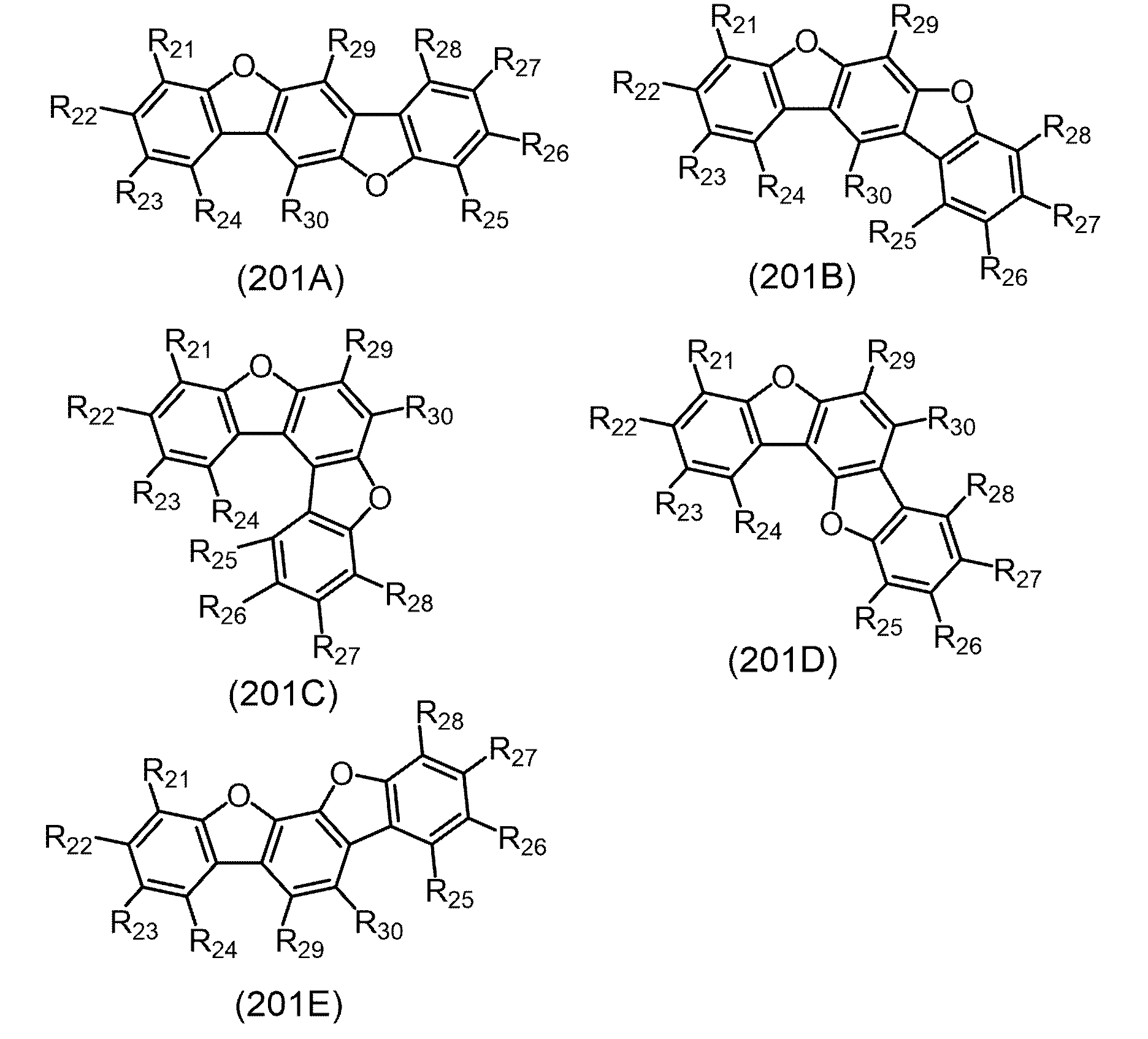
(前記一般式(201A)、(201B)、(201C)、(201D)、及び(201E)において、
R21~R30のうちの隣接する2つ以上からなる組の1組以上が、
互いに結合して、置換もしくは無置換の単環を形成するか、
互いに結合して、置換もしくは無置換の縮合環を形成するか、又は
互いに結合せず、
前記置換もしくは無置換の単環を形成せず、かつ前記置換もしくは無置換の縮合環を形成しないR21~R30は、それぞれ独立に、
水素原子、
ハロゲン原子、
シアノ基、
置換もしくは無置換の環形成炭素数6~30のアリール基、
置換もしくは無置換の環形成原子数5~30の複素環基、
置換もしくは無置換の炭素数1~30のアルキル基、
置換もしくは無置換の炭素数1~30のハロゲン化アルキル基、
置換もしくは無置換の環形成炭素数3~30のシクロアルキル基、
置換もしくは無置換の炭素数2~30のアルケニル基、
置換もしくは無置換の炭素数2~30のアルキニル基、
置換もしくは無置換の炭素数3~30のアルキルシリル基、
置換もしくは無置換の環形成炭素数6~60のアリールシリル基、
置換もしくは無置換の環形成炭素数6~60のアリールホスホリル基、
ヒドロキシ基、
置換もしくは無置換の炭素数1~30のアルコキシ基、
置換もしくは無置換の環形成炭素数6~30のアリールオキシ基、
-N(Rz)2で表される基、
チオール基、
置換もしくは無置換の炭素数1~30のアルキルチオ基、
置換もしくは無置換の環形成炭素数7~30のアラルキル基、
置換ゲルマニウム基、
置換ホスフィンオキシド基、
ニトロ基、
置換ボリル基、又は
置換もしくは無置換の環形成炭素数6~30のアリールチオ基であり、
Rzは、
置換もしくは無置換の環形成炭素数6~30のアリール基、
置換もしくは無置換の環形成原子数5~30の複素環基、又は
置換もしくは無置換の炭素数1~30のアルキル基であり、
-N(Rz)2における2つのRzは、互いに同一であるか、又は異なり、
前記一般式(201A)、(201B)、(201C)、(201D)、及び(201E)中、R21~R30のいずれか1つは、L2との単結合を表し、
但し、A2が前記一般式(200D)で表される基であるときは、Z2におけるL2との単結合を表さないR21~R30は水素原子である。)
L2が単結合である場合、前記一般式(201A)、(201B)、(201C)、(201D)、及び(201E)中、R21~R30のいずれか1つは、A2との単結合を表す。
L2及びA2は、それぞれ独立に、前記一般式(200)におけるL2及びA2と同義であり、R21~R30は、それぞれ独立に、前記一般式(201A)におけるR21~R30と同義である。)
第五実施形態の一態様において、Z2は前記一般式(201E)で表される基である。
第五実施形態の一態様において、L2は、単結合、置換もしくは無置換のフェニレン基、置換もしくは無置換のビフェニレン基、置換もしくは無置換のナフチレン基、又は置換もしくは無置換のフルオレニレン基である。
第五実施形態の一態様において、L2は、単結合、又は置換もしくは無置換のフェニレン基である。
第五実施形態の一態様において、L2は、単結合である。
第五実施形態の一態様において、L2が置換基を有する場合、当該置換基は、それぞれ独立に、置換もしくは無置換の環形成炭素数6~30のアリール基、又は置換もしくは無置換の環形成原子数5~30の複素環基である。
第五実施形態の一態様において、L2は、少なくとも1つの重水素原子を有する。
第四実施形態又は第五実施形態の一態様において、R11~R20のうちの隣接する2つ以上からなる組のいずれも、互いに結合しない。
第四実施形態又は第五実施形態の一態様において、R11~R20は、それぞれ独立に、水素原子、置換もしくは無置換の環形成炭素数6~18のアリール基、置換もしくは無置換の環形成原子数5~18の複素環基、置換もしくは無置換の炭素数1~12のアルキル基、又は置換もしくは無置換の環形成炭素数3~18のシクロアルキル基である。
第四実施形態又は第五実施形態の一態様において、R11~R20は、それぞれ独立に、水素原子、置換もしくは無置換の環形成炭素数6~18のアリール基、又は置換もしくは無置換の環形成原子数5~18の複素環基である。
第四実施形態又は第五実施形態の一態様において、R11~R20は、それぞれ独立に、水素原子、置換もしくは無置換のフェニル基、置換もしくは無置換のビフェニル基、又は置換もしくは無置換のカルバゾリル基である。
第四実施形態又は第五実施形態の一態様において、R11~R20は、水素原子である。
第四実施形態又は第五実施形態の一態様において、R11~R20のうち、1つが置換基であり、残りが水素原子である。
第四実施形態又は第五実施形態の一態様において、R11~R20の少なくとも1つは重水素原子である。
第四実施形態又は第五実施形態の一態様において、R21~R30のうちの隣接する2つ以上からなる組のいずれも、互いに結合しない。
第四実施形態又は第五実施形態の一態様において、R21~R30は、それぞれ独立に、水素原子、置換もしくは無置換の環形成炭素数6~18のアリール基、置換もしくは無置換の環形成原子数5~18の複素環基、置換もしくは無置換の炭素数1~12のアルキル基、又は置換もしくは無置換の環形成炭素数3~18のシクロアルキル基である。
第四実施形態又は第五実施形態の一態様において、R21~R30は、それぞれ独立に、水素原子、又は置換もしくは無置換の環形成炭素数6~18のアリール基である。
第四実施形態又は第五実施形態の一態様において、R21~R30は、水素原子である。
第四実施形態又は第五実施形態の一態様において、R21~R30のうち、1つが置換基であり、残りが水素原子である。
第四実施形態又は第五実施形態の一態様において、R21~R30の少なくとも1つは重水素原子である。
第五実施形態の一態様において、L2が置換もしくは無置換のフェニレン基である場合、前記一般式(200)で表される化合物は、下記一般式(101C)、(102C)、又は(103C)で表される化合物である。
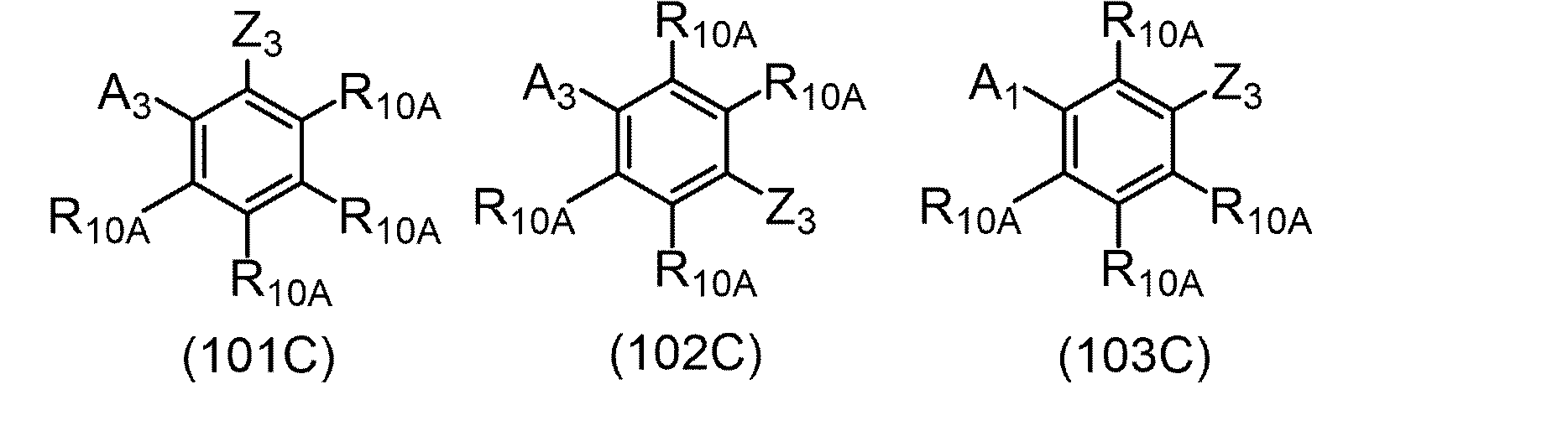
複数のR10Aのうちの隣接する2つ以上からなる組の1組以上が、
互いに結合して、置換もしくは無置換の単環を形成するか、
互いに結合して、置換もしくは無置換の縮合環を形成するか、又は
互いに結合せず、
前記置換もしくは無置換の単環を形成せず、かつ前記置換もしくは無置換の縮合環を形成しないR10Aは、それぞれ独立に、前記一般式(1A)におけるR100と同義であり、複数のR10Aは、互いに同一であるか、又は異なり、
第四実施形態の場合、A3及びZ3は、それぞれ独立に、前記一般式(100)におけるA1及びZ1と同義であり、
第五実施形態の場合、A3及びZ3は、それぞれ独立に、前記一般式(200)におけるA2及びZ2と同義である。)
第四実施形態の場合、A3は、前記一般式(100)におけるA1と同義であり、Z3は、前記一般式(100)におけるZ1と同義である。
第五実施形態の場合、A3は、前記一般式(200)におけるA2と同義であり、Z3は、前記一般式(200)におけるZ2と同義である。
第五実施形態の一態様において、L2が置換もしくは無置換のフェニレン基である場合、前記一般式(200)で表される化合物は、下記一般式(101D)、(102D)、(103D)又は(104D)で表される化合物である。
第四実施形態の一態様において、前記一般式(101C)、(102C)及び(103C)中、複数のR10Aが互いに結合せず、R10Aが水素原子である。
第四実施形態の一態様において、前記一般式(100)で表される化合物は、前記一般式(102C)で表される化合物である。

(第五実施形態の場合、前記一般式(101D)、(102D)、(103D)及び(104D)において、A3及びZ3は、それぞれ独立に、前記一般式(200)におけるA2及びZ2と同義であり、前記一般式(104D)中のR10Aは、前記一般式(103C)におけるR10Aと同義である。)
第四実施形態又は第五実施形態の一態様において、前記一般式(101C)~(103C)及び(104D)中、R10Aの少なくとも1つは重水素原子である。
第四実施形態又は第五実施形態の一態様において、前記一般式(104D)中、A3及びR10Aは、置換基を含めて、互いに同一の基である。
第四実施形態又は第五実施形態の一態様において、前記一般式(104D)中、Z3及びR10Aは、置換基を含めて、互いに同一の基である。
第四実施形態に係る化合物を用いた有機EL素子(以下、有機EL素子E1とも称する)は、陽極と、陰極と、陽極及び陰極の間に配置された有機層と、を含み、前記有機層が、前記一般式(100)で表される化合物を含む。
有機EL素子E1において、前記有機層は、少なくとも1つの発光層を有し、前記少なくとも1つの発光層が、前記一般式(100)で表される化合物を含むことが好ましい。
第四実施形態に係る化合物は、有機EL素子E1の駆動電圧を低下させ、高効率で発光させることができる化合物である。よって、有機EL素子E1は、駆動電圧が低く、高効率で発光する。
有機EL素子E2において、前記有機層は、少なくとも1つの発光層を有し、前記少なくとも1つの発光層が、前記一般式(200)で表される化合物を含むことが好ましい。
第五実施形態に係る化合物は、有機EL素子E2の駆動電圧を低下させ、高効率で発光させることができる化合物である。よって、有機EL素子E2は、駆動電圧が低く、高効率で発光する。
[有機EL素子用材料]
第六実施形態の有機EL素子用材料は、第一実施形態の化合物M3、第四実施形態の化合物、又は第五実施形態の化合物を含む。第六実施形態の有機EL素子用材料によれば、駆動電圧が低下し、高効率で発光する有機EL素子及び電子機器を実現させることができる。
なお、第六実施形態の有機EL素子用材料は、さらにその他の化合物を含有していてもよい。第六実施形態の有機EL素子用材料が、さらにその他の化合物を含んでいる場合、該その他の化合物は、固体であっても液体であってもよい。
なお、本発明は、上述の実施形態に限定されず、本発明の目的を達成できる範囲での変更、改良等は、本発明に含まれる。
また、有機EL素子が複数の発光層を有する場合、これらの発光層が互いに隣接して設けられていてもよいし、中間層を介して複数の発光ユニットが積層された、いわゆるタンデム型の有機EL素子であってもよい。
例えば、発光層の陰極側で接して障壁層が配置された場合、当該障壁層は、電子を輸送し、かつ正孔が当該障壁層よりも陰極側の層(例えば、電子輸送層)に到達することを阻止する。有機EL素子が、電子輸送層を含む場合は、発光層と電子輸送層との間に当該障壁層を含むことが好ましい。
また、発光層の陽極側で接して障壁層が配置された場合、当該障壁層は、正孔を輸送し、かつ電子が当該障壁層よりも陽極側の層(例えば、正孔輸送層)に到達することを阻止する。有機EL素子が、正孔輸送層を含む場合は、発光層と正孔輸送層との間に当該障壁層を含むことが好ましい。
また、励起エネルギーが発光層からその周辺層に漏れ出さないように、障壁層を発光層に隣接させて設けてもよい。発光層で生成した励起子が、当該障壁層よりも電極側の層(例えば、電子輸送層及び正孔輸送層等)に移動することを阻止する。
発光層と障壁層とは接合していることが好ましい。
実施例の有機EL素子の製造に用いた、一般式(1)で表される化合物M3を以下に示す。
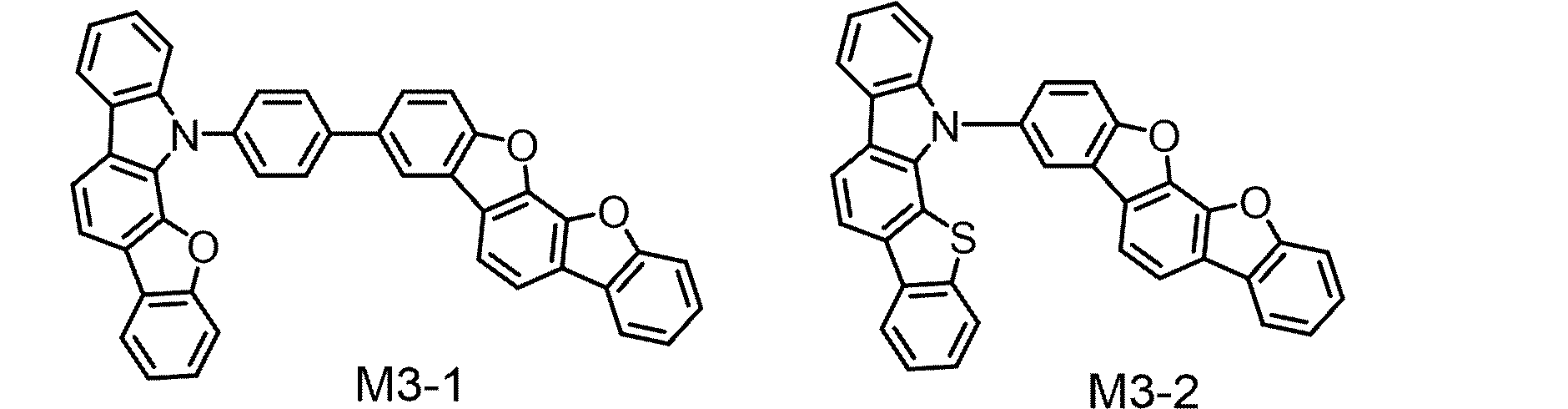
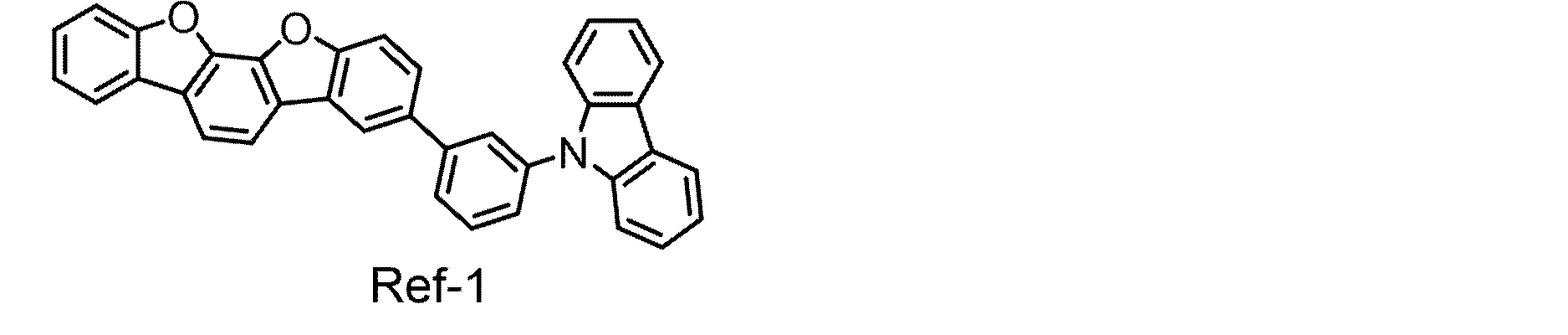

(実施例1-1)
25mm×75mm×1.1mm厚のITO透明電極(陽極)付きガラス基板(ジオマテック株式会社製)を、イソプロピルアルコール中で5分間超音波洗浄を行った後、UVオゾン洗浄を1分間行った。ITOの膜厚は、130nmとした。
洗浄後の透明電極ライン付き前記ガラス基板を真空蒸着装置の基板ホルダーに装着し、まず透明電極ラインが形成されている側の面上に透明電極を覆うようにして化合物HT-1と化合物HAとを共蒸着し、膜厚10nmの正孔注入層を形成した。正孔注入層における化合物HT-1の濃度を97質量%とし、化合物HAの濃度を3質量%とした。
次に、正孔注入層上に、化合物HT-1を蒸着し、膜厚90nmの正孔輸送層を形成した。
次に、この正孔輸送層上に、化合物HT-2を蒸着し、膜厚30nmの電子障壁層を形成した。
次に、この電子障壁層上に、化合物M1である蛍光発光性の化合物GD-1と、化合物M2である遅延蛍光性の化合物TADF-1と、化合物M3である化合物M3-1とを共蒸着し、膜厚25nmの発光層を形成した。発光層における化合物GD-1の濃度を0.6質量%とし、化合物TADF-1の濃度を25質量%とし、化合物M3-1の濃度を74.4質量%とした。
次に、この発光層上に、化合物ET-1を蒸着し、膜厚5nmの正孔障壁層を形成した。
次に、この正孔障壁層上に、化合物ET-2及び化合物Liqを共蒸着し、膜厚50nmの電子輸送層を形成した。電子輸送層における化合物ET-2の濃度を50質量%とし、化合物Liqの濃度を50質量%とした。
次に、この電子輸送層上に、イッテルビウム(Yb)を蒸着し、膜厚1nmの電子注入性電極(陰極)を形成した。
そして、この電子注入性電極上に、金属アルミニウム(Al)を蒸着し、膜厚80nmの金属Al陰極を形成した。
実施例1-1の有機EL素子の素子構成を略式的に示すと、次のとおりである。
ITO(130)/HT-1:HA(10,97%:3%)/HT-1(90)/HT-2(30)/M3-1:TADF-1:GD-1(25,74.4%:25%:0.6%)/ET-1(5)/ET-2:Liq(50,50%:50%)/Yb(1)/Al(80)
なお、括弧内の数字は、膜厚(単位:nm)を示す。
同じく括弧内において、パーセント表示された数字(97%:3%)は、正孔注入層における化合物HT-1及び化合物HAの割合(質量%)を示し、パーセント表示された数字(74.4%:25%:0.6%)は、発光層における化合物M3、化合物M2及び化合物M1の割合(質量%)を示し、パーセント表示された数字(50%:50%)は、電子輸送層における化合物ET-2及び化合物Liqの割合(質量%)を示す。
実施例1-2に係る有機EL素子は、実施例1-1で用いた化合物M3-1を表1に記載の化合物に変更したこと以外、実施例1-1と同様にして作製した。
比較例1に係る有機EL素子は、実施例1-1で用いた化合物M3-1を表1に記載の化合物に変更したこと以外、実施例1-1と同様にして作製した。
実施例2-1に係る有機EL素子は、実施例1-1で用いた化合物M3-1の含有量及び化合物TADF-1の含有量を、それぞれ、表1に記載の含有量に変更したこと以外、実施例1-1と同様にして作製した。
実施例2-2に係る有機EL素子は、実施例2-1で用いた化合物M3-1を表1に記載の化合物に変更したこと以外、実施例2-1と同様にして作製した。
比較例2に係る有機EL素子は、実施例2-1で用いた化合物M3-1を表1に記載の化合物に変更したこと以外、実施例2-1と同様にして作製した。
実施例3-1に係る有機EL素子は、実施例1-1で用いた化合物M3-1の含有量及び化合物TADF-1の含有量を、それぞれ、表1に記載の含有量に変更したこと以外、実施例1-1と同様にして作製した。
実施例3-2に係る有機EL素子は、実施例3-1で用いた化合物M3-1を表1に記載の化合物に変更したこと以外、実施例3-1と同様にして作製した。
比較例3に係る有機EL素子は、実施例3-1で用いた化合物M3-1を表1に記載の化合物に変更したこと以外、実施例3-1と同様にして作製した。
実施例4-1に係る有機EL素子は、実施例1-1で用いた化合物M3-1の含有量、化合物TADF-1の含有量、及び化合物GD-1の含有量を、それぞれ、表1に記載の含有量に変更したこと以外、実施例1-1と同様にして作製した。
実施例4-2に係る有機EL素子は、実施例4-1で用いた化合物M3-1を表1に記載の化合物に変更したこと以外、実施例4-1と同様にして作製した。
比較例4に係る有機EL素子は、実施例4-1で用いた化合物M3-1を表1に記載の化合物に変更したこと以外、実施例4-1と同様にして作製した。
実施例5-1に係る有機EL素子は、実施例1-1の発光層の膜厚を、表1に記載の膜厚に変更したこと以外、実施例1-1と同様にして作製した。
実施例5-2に係る有機EL素子は、実施例5-1で用いた化合物M3-1を表1に記載の化合物に変更したこと以外、実施例5-1と同様にして作製した。
比較例5に係る有機EL素子は、実施例5-1で用いた化合物M3-1を表1に記載の化合物に変更したこと以外、実施例5-1と同様にして作製した。
実施例6-1に係る有機EL素子は、実施例2-1の発光層の膜厚を、表1に記載の膜厚に変更したこと以外、実施例2-1と同様にして作製した。
実施例6-2に係る有機EL素子は、実施例6-1で用いた化合物M3-1を表1に記載の化合物に変更したこと以外、実施例6-1と同様にして作製した。
比較例6に係る有機EL素子は、実施例6-1で用いた化合物M3-1を表1に記載の化合物に変更したこと以外、実施例6-1と同様にして作製した。
作製した有機EL素子について、以下の評価を行った。測定結果を表1に示す。
電流密度が10mA/cm2となるように素子に電圧を印加した時の分光放射輝度スペクトルを分光放射輝度計CS-2000(コニカミノルタ株式会社製)で計測した。得られた分光放射輝度スペクトルから、ランバシアン放射を行ったと仮定し外部量子効率EQE(単位:%)を算出した。表1に「EQE(相対値)」(単位:%)を示す。
EQE(相対値)=(各例のEQE/比較例1のEQE)×100…(数1X)
EQE(相対値)=(各例のEQE/比較例2のEQE)×100…(数2X)
EQE(相対値)=(各例のEQE/比較例3のEQE)×100…(数3X)
EQE(相対値)=(各例のEQE/比較例4のEQE)×100…(数4X)
EQE(相対値)=(各例のEQE/比較例5のEQE)×100…(数5X)
EQE(相対値)=(各例のEQE/比較例6のEQE)×100…(数6X)
作製した有機EL素子の陽極と陰極との間に、電流密度が10mA/cm2となるように通電したときの電圧(単位:V)を計測した。
駆動電圧の差(ΔV)=(比較例1の駆動電圧)-(各例の駆動電圧)…(数1Y)
駆動電圧の差(ΔV)=(比較例2の駆動電圧)-(各例の駆動電圧)…(数2Y)
駆動電圧の差(ΔV)=(比較例3の駆動電圧)-(各例の駆動電圧)…(数3Y)
駆動電圧の差(ΔV)=(比較例4の駆動電圧)-(各例の駆動電圧)…(数4Y)
駆動電圧の差(ΔV)=(比較例5の駆動電圧)-(各例の駆動電圧)…(数5Y)
駆動電圧の差(ΔV)=(比較例6の駆動電圧)-(各例の駆動電圧)…(数6Y)
電流密度が10mA/cm2となるように素子に電圧を印加した時の分光放射輝度スペクトルを分光放射輝度計CS-2000(コニカミノルタ株式会社製)で計測した。得られた分光放射輝度スペクトルから、最大ピーク波長λp(単位:nm)を求めた。
作製した有機EL素子に電流密度が10mA/cm2となるように電圧を印加した時のCIE1931色度座標(x、y)を分光放射輝度計CS-2000(コニカミノルタ株式会社製)で計測した。
実施例2-1~2-2と比較例2との対比、実施例3-1~3-2と比較例3との対比、実施例4-1~4-2と比較例4との対比、実施例5-1~5-2と比較例5との対比、並びに実施例6-1~6-2と比較例6との対比も同様の結果であった。
表1中に記載した化合物の物性値は、以下の方法で測定した。
遅延蛍光性は図2に示す装置を利用して過渡PLを測定することにより確認した。前記化合物TADF-1をトルエンに溶解し、自己吸収の寄与を取り除くため励起波長において吸光度が0.05以下の希薄溶液を調製した。また酸素による消光を防ぐため、試料溶液を凍結脱気した後にアルゴン雰囲気下で蓋付きのセルに封入することで、アルゴンで飽和された酸素フリーの試料溶液とした。
上記試料溶液の蛍光スペクトルを分光蛍光光度計FP-8600(日本分光社製)で測定し、また同条件で9,10-ジフェニルアントラセンのエタノール溶液の蛍光スペクトルを測定した。両スペクトルの蛍光面積強度を用いて、Morris et al. J.Phys.Chem.80(1976)969中の(1)式により全蛍光量子収率を算出した。
前記化合物TADF-1が吸収する波長のパルス光(パルスレーザーから照射される光)で励起された後、当該励起状態から即座に観察されるPrompt発光(即時発光)と、当該励起後、即座には観察されず、その後観察されるDelay発光(遅延発光)とが存在する。本実施例における遅延蛍光発光とは、Delay発光(遅延発光)の量がPrompt発光(即時発光)の量に対して5%以上を意味する。具体的には、Prompt発光(即時発光)の量をXPとし、Delay発光(遅延発光)の量をXDとしたときに、XD/XPの値が0.05以上であることを意味する。
Prompt発光とDelay発光の量とその比は、“Nature 492, 234-238, 2012” (参考文献1)に記載された方法と同様の方法により求めることができる。なお、Prompt発光とDelay発光の量の算出に使用される装置は、前記参考文献1に記載の装置、または図2に記載の装置に限定されない。
化合物TADF-1について、Delay発光(遅延発光)の量がPrompt発光(即時発光)の量に対して5%以上であることが確認された。
具体的には、化合物TADF-1について、XD/XPの値が0.05以上であった。
測定対象化合物の一重項エネルギーS1は、前述の溶液法により測定した。
測定対象化合物のT77Kを、前述の「三重項エネルギーと77[K]におけるエネルギーギャップとの関係」で記載したエネルギーギャップT77Kの測定方法により測定した。また、T77Kの測定結果と上記の一重項エネルギーS1の値からΔSTを確認した。表中の「<0.01」は、ΔSTが0.01eV未満であることを表す。
化合物GD-1のΔSTは、0.40eVであった。
化合物の最大ピーク波長λは、以下の方法により測定した。
測定対象となる化合物の5μmol/Lトルエン溶液を調製して石英セルに入れ、常温(300K)でこの試料の発光スペクトル(縦軸:発光強度、横軸:波長とする。)を測定した。本実施例では、発光スペクトルを日立社製の分光光度計(装置名:F-7000)で測定した。なお、発光スペクトル測定装置は、ここで用いた装置に限定されない。発光スペクトルにおいて、発光強度が最大となる発光スペクトルのピーク波長を最大ピーク波長λとした。
[合成実施例1:化合物M3-1の合成]
(1-1)中間体M-2の合成


(2-1)化合物M3-2の合成

Claims (25)
- 陽極と、
陰極と、
前記陽極と前記陰極との間に含まれる発光層と、を有し、
前記発光層は、下記一般式(1)で表される化合物M3と、遅延蛍光性の化合物M2と、を含み、
前記化合物M3と前記化合物M2とは構造が異なり、
前記化合物M3の一重項エネルギーS1(M3)と、前記化合物M2の一重項エネルギーS1(M2)とが、下記数式(数1)の関係を満たす、
有機エレクトロルミネッセンス素子。
S1(M3)>S1(M2) (数1)

(前記一般式(1)において、
Lは、
単結合、又は
置換もしくは無置換の環形成炭素数6~50のアリーレン基であり、
Aは、下記一般式(11A)、(11B)、(11C)、(11D)、(11E)及び(11F)のいずれかで表される基であり、
Zは、下記一般式(21A)、(21B)、(21C)、(21D)、及び(21E)のいずれかで表される基である。)
(前記一般式(11A)、(11B)、(11C)、(11D)、(11E)及び(11F)において、
X1は、酸素原子又は硫黄原子であり、
R11~R20のうちの隣接する2つ以上からなる組の1組以上が、
互いに結合して、置換もしくは無置換の単環を形成するか、
互いに結合して、置換もしくは無置換の縮合環を形成するか、又は
互いに結合せず、
前記置換もしくは無置換の単環を形成せず、かつ前記置換もしくは無置換の縮合環を形成しないR11~R20は、それぞれ独立に、
水素原子、
ハロゲン原子、
シアノ基、
置換もしくは無置換の環形成炭素数6~30のアリール基、
置換もしくは無置換の環形成原子数5~30の複素環基、
置換もしくは無置換の炭素数1~30のアルキル基、
置換もしくは無置換の炭素数1~30のハロゲン化アルキル基、
置換もしくは無置換の環形成炭素数3~30のシクロアルキル基、
置換もしくは無置換の炭素数2~30のアルケニル基、
置換もしくは無置換の炭素数2~30のアルキニル基、
置換もしくは無置換の炭素数3~30のアルキルシリル基、
置換もしくは無置換の環形成炭素数6~60のアリールシリル基、
置換もしくは無置換の環形成炭素数6~60のアリールホスホリル基、
ヒドロキシ基、
置換もしくは無置換の炭素数1~30のアルコキシ基、
置換もしくは無置換の環形成炭素数6~30のアリールオキシ基、
-N(Rz)2で表される基、
チオール基、
置換もしくは無置換の炭素数1~30のアルキルチオ基、
置換もしくは無置換の環形成炭素数7~30のアラルキル基、
置換ゲルマニウム基、
置換ホスフィンオキシド基、
ニトロ基、
置換ボリル基、又は
置換もしくは無置換の環形成炭素数6~30のアリールチオ基であり、
Rzは、
置換もしくは無置換の環形成炭素数6~30のアリール基、
置換もしくは無置換の環形成原子数5~30の複素環基、又は
置換もしくは無置換の炭素数1~30のアルキル基であり、
-N(Rz)2における2つのRzは、互いに同一であるか、又は異なり、
前記一般式(11A)、(11B)、(11C)、(11D)、(11E)及び(11F)中、*は、Lとの結合位置を表す。)
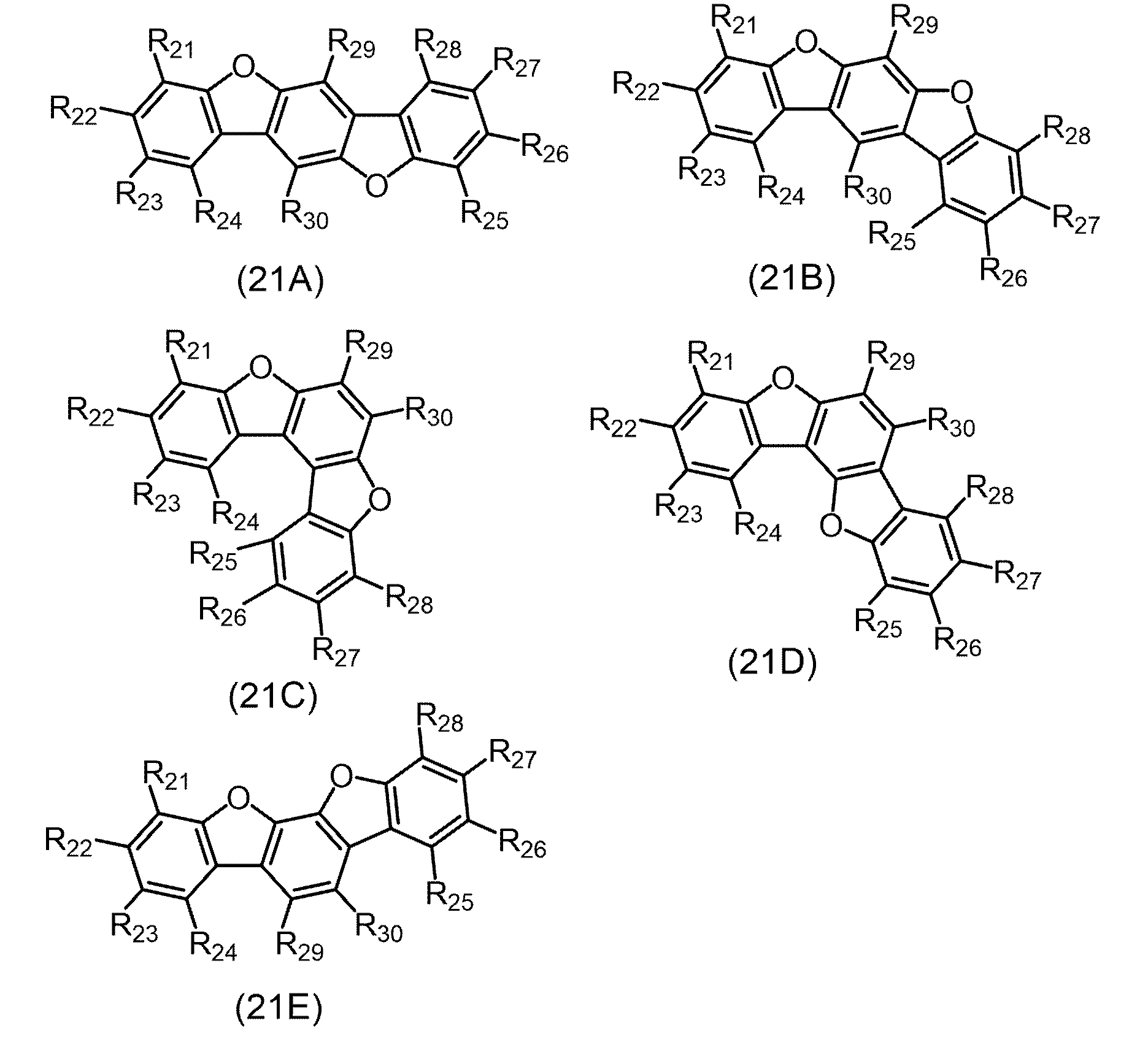
(前記一般式(21A)、(21B)、(21C)、(21D)、及び(21E)において、
R21~R30のうちの隣接する2つ以上からなる組の1組以上が、
互いに結合して、置換もしくは無置換の単環を形成するか、
互いに結合して、置換もしくは無置換の縮合環を形成するか、又は
互いに結合せず、
前記置換もしくは無置換の単環を形成せず、かつ前記置換もしくは無置換の縮合環を形成しないR21~R30は、それぞれ独立に、
水素原子、
ハロゲン原子、
シアノ基、
置換もしくは無置換の環形成炭素数6~30のアリール基、
置換もしくは無置換の炭素数1~30のアルキル基、
置換もしくは無置換の炭素数1~30のハロゲン化アルキル基、
置換もしくは無置換の環形成炭素数3~30のシクロアルキル基、
置換もしくは無置換の炭素数2~30のアルケニル基、
置換もしくは無置換の炭素数2~30のアルキニル基、
置換もしくは無置換の炭素数3~30のアルキルシリル基、
置換もしくは無置換の環形成炭素数6~60のアリールシリル基、
置換もしくは無置換の環形成炭素数6~60のアリールホスホリル基、
ヒドロキシ基、
置換もしくは無置換の炭素数1~30のアルコキシ基、
置換もしくは無置換の環形成炭素数6~30のアリールオキシ基、
-N(Rz)2で表される基、
チオール基、
置換もしくは無置換の炭素数1~30のアルキルチオ基、
置換もしくは無置換の環形成炭素数7~30のアラルキル基、
置換ゲルマニウム基、
置換ホスフィンオキシド基、
ニトロ基、
置換ボリル基、又は
置換もしくは無置換の環形成炭素数6~30のアリールチオ基であり、
Rzは、
置換もしくは無置換の環形成炭素数6~30のアリール基、
置換もしくは無置換の環形成原子数5~30の複素環基、又は
置換もしくは無置換の炭素数1~30のアルキル基であり、
-N(Rz)2における2つのRzは、互いに同一であるか、又は異なり、
前記一般式(21A)、(21B)、(21C)、(21D)、及び(21E)中、R21~R30のいずれか1つは、Lとの単結合を表す。) - 請求項1に記載の有機エレクトロルミネッセンス素子において、
Lが単結合である、
有機エレクトロルミネッセンス素子。 - 請求項1に記載の有機エレクトロルミネッセンス素子において、
前記一般式(1)で表される化合物M3は、下記一般式(1A)、(2A)、又は(3A)で表される化合物である、
有機エレクトロルミネッセンス素子。
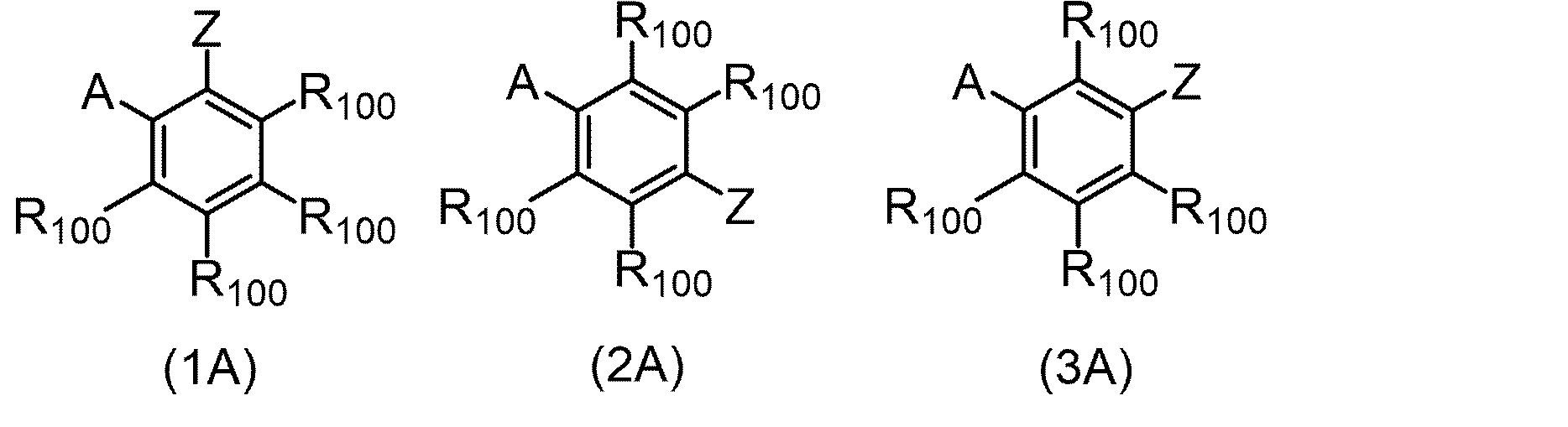
(前記一般式(1A)、(2A)及び(3A)において、
A及びZは、それぞれ独立に、前記一般式(1)におけるA及びZと同義であり、
複数のR100が、互いに結合せず、
R100は、それぞれ独立に、水素原子、置換もしくは無置換の環形成炭素数6~30のアリール基、又は置換もしくは無置換の環形成原子数5~30の複素環基であり、
複数のR100は、互いに同一であるか、又は異なる。) - 請求項3に記載の有機エレクトロルミネッセンス素子において、
前記一般式(1)で表される化合物M3は、前記一般式(2A)で表される化合物である、
有機エレクトロルミネッセンス素子。 - 請求項3または請求項4に記載の有機エレクトロルミネッセンス素子において、
前記一般式(1)で表される化合物M3は、下記一般式(2B)で表される化合物である、
有機エレクトロルミネッセンス素子。
(前記一般式(2B)において、A及びZは、それぞれ独立に、前記一般式(1)におけるA及びZと同義である。) - 請求項1から請求項5のいずれか一項に記載の有機エレクトロルミネッセンス素子において、
Aが前記一般式(11F)で表される基である、
有機エレクトロルミネッセンス素子。 - 請求項1から請求項6のいずれか一項に記載の有機エレクトロルミネッセンス素子において、
Zが前記一般式(21E)で表される基である、
有機エレクトロルミネッセンス素子。 - 請求項1から請求項7のいずれか一項に記載の有機エレクトロルミネッセンス素子において、
R11~R20が水素原子である、
有機エレクトロルミネッセンス素子。 - 請求項1から請求項8のいずれか一項に記載の有機エレクトロルミネッセンス素子において、
Lとの結合位置ではないR21~R30が水素原子である、
有機エレクトロルミネッセンス素子。 - 請求項1から請求項9のいずれか一項に記載の有機エレクトロルミネッセンス素子において、
前記発光層は、金属錯体を含まない、
有機エレクトロルミネッセンス素子。 - 請求項1から請求項10のいずれか一項に記載の有機エレクトロルミネッセンス素子を搭載した、電子機器。
- 下記一般式(100)で表される化合物。

(前記一般式(100)において、
L1は、置換もしくは無置換の環形成炭素数6~50のアリーレン基であり、
A1は、下記一般式(100A)、(100B)、(100C)、(100D)、(100E)及び(100F)のいずれかで表される基であり、
Z1は、下記一般式(101A)、(101B)、(101C)、(101D)、及び(101E)のいずれかで表される基である。)
(前記一般式(100A)、(100B)、(100C)、(100D)、(100E)及び(100F)において、
R11~R20のうちの隣接する2つ以上からなる組の1組以上が、
互いに結合して、置換もしくは無置換の単環を形成するか、
互いに結合して、置換もしくは無置換の縮合環を形成するか、又は
互いに結合せず、
前記置換もしくは無置換の単環を形成せず、かつ前記置換もしくは無置換の縮合環を形成しないR11~R20は、それぞれ独立に、
水素原子、
ハロゲン原子、
シアノ基、
置換もしくは無置換の環形成炭素数6~30のアリール基、
置換もしくは無置換の環形成原子数5~30の複素環基、
置換もしくは無置換の炭素数1~30のアルキル基、
置換もしくは無置換の炭素数1~30のハロゲン化アルキル基、
置換もしくは無置換の環形成炭素数3~30のシクロアルキル基、
置換もしくは無置換の炭素数2~30のアルケニル基、
置換もしくは無置換の炭素数2~30のアルキニル基、
置換もしくは無置換の炭素数3~30のアルキルシリル基、
置換もしくは無置換の環形成炭素数6~60のアリールシリル基、
置換もしくは無置換の環形成炭素数6~60のアリールホスホリル基、
ヒドロキシ基、
置換もしくは無置換の炭素数1~30のアルコキシ基、
置換もしくは無置換の環形成炭素数6~30のアリールオキシ基、
-N(Rz)2で表される基、
チオール基、
置換もしくは無置換の炭素数1~30のアルキルチオ基、
置換もしくは無置換の環形成炭素数7~30のアラルキル基、
置換ゲルマニウム基、
置換ホスフィンオキシド基、
ニトロ基、
置換ボリル基、又は
置換もしくは無置換の環形成炭素数6~30のアリールチオ基であり、
Rzは、
置換もしくは無置換の環形成炭素数6~30のアリール基、
置換もしくは無置換の環形成原子数5~30の複素環基、又は
置換もしくは無置換の炭素数1~30のアルキル基であり、
-N(Rz)2における2つのRzは、互いに同一であるか、又は異なり、
前記一般式(100A)、(100B)、(100C)、(100D)、(100E)及び(100F)中、*は、L1との結合位置を表す。)

(前記一般式(101A)、(101B)、(101C)、(101D)、及び(101E)において、
R21~R30のうちの隣接する2つ以上からなる組の1組以上が、
互いに結合して、置換もしくは無置換の単環を形成するか、
互いに結合して、置換もしくは無置換の縮合環を形成するか、又は
互いに結合せず、
前記置換もしくは無置換の単環を形成せず、かつ前記置換もしくは無置換の縮合環を形成しないR21~R30は、それぞれ独立に、
水素原子、
ハロゲン原子、
シアノ基、
置換もしくは無置換の環形成炭素数6~30のアリール基、
置換もしくは無置換の環形成原子数5~30の複素環基、
置換もしくは無置換の炭素数1~30のアルキル基、
置換もしくは無置換の炭素数1~30のハロゲン化アルキル基、
置換もしくは無置換の環形成炭素数3~30のシクロアルキル基、
置換もしくは無置換の炭素数2~30のアルケニル基、
置換もしくは無置換の炭素数2~30のアルキニル基、
置換もしくは無置換の炭素数3~30のアルキルシリル基、
置換もしくは無置換の環形成炭素数6~60のアリールシリル基、
置換もしくは無置換の環形成炭素数6~60のアリールホスホリル基、
ヒドロキシ基、
置換もしくは無置換の炭素数1~30のアルコキシ基、
置換もしくは無置換の環形成炭素数6~30のアリールオキシ基、
-N(Rz)2で表される基、
チオール基、
置換もしくは無置換の炭素数1~30のアルキルチオ基、
置換もしくは無置換の環形成炭素数7~30のアラルキル基、
置換ゲルマニウム基、
置換ホスフィンオキシド基、
ニトロ基、
置換ボリル基、又は
置換もしくは無置換の環形成炭素数6~30のアリールチオ基であり、
Rzは、
置換もしくは無置換の環形成炭素数6~30のアリール基、
置換もしくは無置換の環形成原子数5~30の複素環基、又は
置換もしくは無置換の炭素数1~30のアルキル基であり、
-N(Rz)2における2つのRzは、互いに同一であるか、又は異なり、
但し、Z1が(101A)、(101B)、又は(101D)であるときは、L1は置換もしくは無置換の環形成炭素数10~50のアリーレン基であり、
前記一般式(101A)、(101B)、(101C)、(101D)、及び(101E)中、R21~R30のいずれか1つは、L1との単結合を表す。) - 請求項12に記載の化合物において、
前記一般式(100)で表される化合物は、下記一般式(101C)、(102C)、又は(103C)で表される、
化合物。
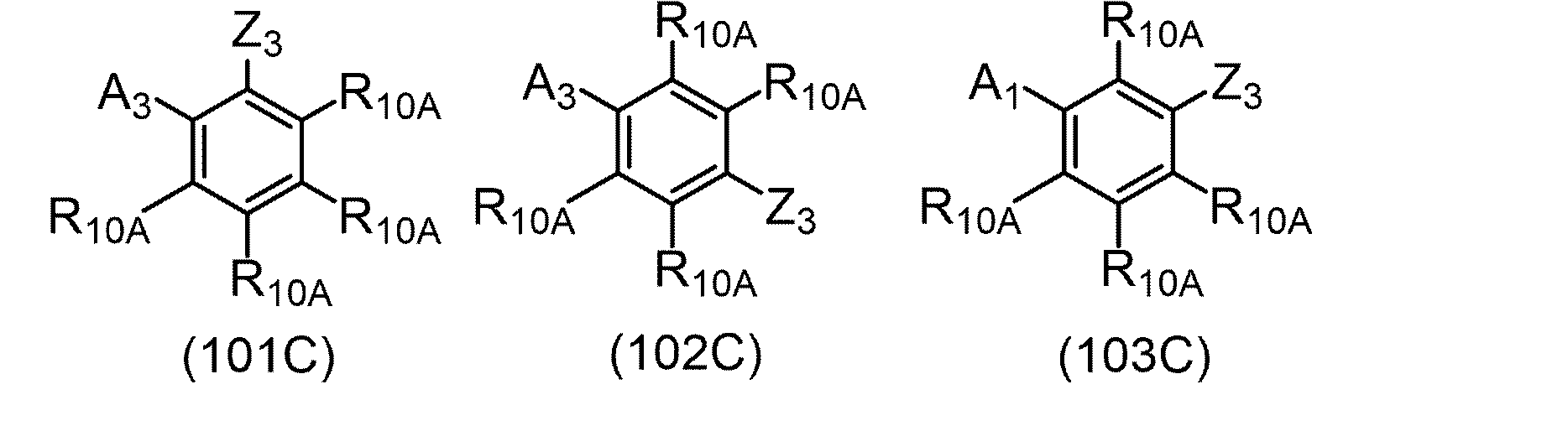
(前記一般式(101C)、(102C)及び(103C)において、
複数のR10Aが、互いに結合せず、
R10Aは、それぞれ独立に、水素原子、置換もしくは無置換の環形成炭素数6~30のアリール基、又は置換もしくは無置換の環形成原子数5~30の複素環基であり、
複数のR10Aは、互いに同一であるか、又は異なり、
A3及びZ3は、それぞれ独立に、前記一般式(100)におけるA1及びZ1と同義である。) - 請求項13に記載の化合物において、
前記一般式(100)で表される化合物は、前記一般式(102C)で表される、
化合物。 - 請求項13または請求項14に記載の化合物において、
前記一般式(100)で表される化合物は、下記一般式(102D)で表される、
化合物。
(前記一般式(102D)において、A3及びZ3は、それぞれ独立に、前記一般式(100)におけるA1及びZ1と同義である。) - 請求項12から請求項15のいずれか一項に記載の化合物において、
A1が前記一般式(100F)で表される基である、
化合物。 - 請求項12から請求項16のいずれか一項に記載の化合物において、
Z1が前記一般式(101E)で表される基である、
化合物。 - 請求項12から請求項17のいずれか一項に記載の化合物において、
R11~R20が水素原子である、
化合物。 - 請求項12から請求項18のいずれか一項に記載の化合物において、
L1との結合位置ではないR21~R30が水素原子である、
化合物。 - 下記一般式(200)で表される化合物。

(前記一般式(200)において、
L2は、
単結合、又は
置換もしくは無置換の環形成炭素数6~50のアリーレン基であり、
A2は、下記一般式(200A)、(200B)、(200C)、(200D)、(200E)及び(200F)のいずれかで表される基であり、
Z2は、下記一般式(201A)、(201B)、(201C)、(201D)、及び(201E)のいずれかで表される基である。)
(前記一般式(200A)、(200B)、(200C)、(200D)、(200E)及び(200F)において、
R11~R20のうちの隣接する2つ以上からなる組の1組以上が、
互いに結合して、置換もしくは無置換の単環を形成するか、
互いに結合して、置換もしくは無置換の縮合環を形成するか、又は
互いに結合せず、
前記置換もしくは無置換の単環を形成せず、かつ前記置換もしくは無置換の縮合環を形成しないR11~R20は、それぞれ独立に、
水素原子、
ハロゲン原子、
シアノ基、
置換もしくは無置換の環形成炭素数6~30のアリール基、
置換もしくは無置換の環形成原子数5~30の複素環基、
置換もしくは無置換の炭素数1~30のアルキル基、
置換もしくは無置換の炭素数1~30のハロゲン化アルキル基、
置換もしくは無置換の環形成炭素数3~30のシクロアルキル基、
置換もしくは無置換の炭素数2~30のアルケニル基、
置換もしくは無置換の炭素数2~30のアルキニル基、
置換もしくは無置換の炭素数3~30のアルキルシリル基、
置換もしくは無置換の環形成炭素数6~60のアリールシリル基、
置換もしくは無置換の環形成炭素数6~60のアリールホスホリル基、
ヒドロキシ基、
置換もしくは無置換の炭素数1~30のアルコキシ基、
置換もしくは無置換の環形成炭素数6~30のアリールオキシ基、
-N(Rz)2で表される基、
チオール基、
置換もしくは無置換の炭素数1~30のアルキルチオ基、
置換もしくは無置換の環形成炭素数7~30のアラルキル基、
置換ゲルマニウム基、
置換ホスフィンオキシド基、
ニトロ基、
置換ボリル基、又は
置換もしくは無置換の環形成炭素数6~30のアリールチオ基であり、
Rzは、
置換もしくは無置換の環形成炭素数6~30のアリール基、
置換もしくは無置換の環形成原子数5~30の複素環基、又は
置換もしくは無置換の炭素数1~30のアルキル基であり、
-N(Rz)2における2つのRzは、互いに同一であるか、又は異なり、
前記一般式(200A)、(200B)、(200C)、(200D)、(200E)及び(200F)中、*は、L2との結合位置を表す。)

(前記一般式(201A)、(201B)、(201C)、(201D)、及び(201E)において、
R21~R30のうちの隣接する2つ以上からなる組の1組以上が、
互いに結合して、置換もしくは無置換の単環を形成するか、
互いに結合して、置換もしくは無置換の縮合環を形成するか、又は
互いに結合せず、
前記置換もしくは無置換の単環を形成せず、かつ前記置換もしくは無置換の縮合環を形成しないR21~R30は、それぞれ独立に、
水素原子、
ハロゲン原子、
シアノ基、
置換もしくは無置換の環形成炭素数6~30のアリール基、
置換もしくは無置換の環形成原子数5~30の複素環基、
置換もしくは無置換の炭素数1~30のアルキル基、
置換もしくは無置換の炭素数1~30のハロゲン化アルキル基、
置換もしくは無置換の環形成炭素数3~30のシクロアルキル基、
置換もしくは無置換の炭素数2~30のアルケニル基、
置換もしくは無置換の炭素数2~30のアルキニル基、
置換もしくは無置換の炭素数3~30のアルキルシリル基、
置換もしくは無置換の環形成炭素数6~60のアリールシリル基、
置換もしくは無置換の環形成炭素数6~60のアリールホスホリル基、
ヒドロキシ基、
置換もしくは無置換の炭素数1~30のアルコキシ基、
置換もしくは無置換の環形成炭素数6~30のアリールオキシ基、
-N(Rz)2で表される基、
チオール基、
置換もしくは無置換の炭素数1~30のアルキルチオ基、
置換もしくは無置換の環形成炭素数7~30のアラルキル基、
置換ゲルマニウム基、
置換ホスフィンオキシド基、
ニトロ基、
置換ボリル基、又は
置換もしくは無置換の環形成炭素数6~30のアリールチオ基であり、
Rzは、
置換もしくは無置換の環形成炭素数6~30のアリール基、
置換もしくは無置換の環形成原子数5~30の複素環基、又は
置換もしくは無置換の炭素数1~30のアルキル基であり、
-N(Rz)2における2つのRzは、互いに同一であるか、又は異なり、
前記一般式(201A)、(201B)、(201C)、(201D)、及び(201E)中、R21~R30のいずれか1つは、L2との単結合を表し、
但し、A2が前記一般式(200D)で表される基であるときは、Z2におけるL2との単結合を表さないR21~R30は水素原子である。) - 請求項20に記載の化合物において、
L2が単結合である、
化合物。 - 請求項20または請求項21に記載の化合物において、
A2が前記一般式(200F)で表される基である、
化合物。 - 請求項20から請求項22のいずれか一項に記載の化合物において、
Z2が前記一般式(201E)で表される基である、
化合物。 - 請求項20から請求項23のいずれか一項に記載の化合物において、
R11~R20が水素原子である、
化合物。 - 請求項20から請求項24のいずれか一項に記載の化合物において、
L2との結合位置ではないR21~R30が水素原子である、
化合物。
Priority Applications (2)
| Application Number | Priority Date | Filing Date | Title |
|---|---|---|---|
| CN202480030945.XA CN121080151A (zh) | 2023-05-17 | 2024-05-13 | 有机电致发光元件、电子设备及化合物 |
| KR1020257041830A KR20260012743A (ko) | 2023-05-17 | 2024-05-13 | 유기 일렉트로루미네센스 소자, 전자 기기 및 화합물 |
Applications Claiming Priority (2)
| Application Number | Priority Date | Filing Date | Title |
|---|---|---|---|
| JP2023081767 | 2023-05-17 | ||
| JP2023-081767 | 2023-05-17 |
Publications (1)
| Publication Number | Publication Date |
|---|---|
| WO2024237243A1 true WO2024237243A1 (ja) | 2024-11-21 |
Family
ID=93519753
Family Applications (1)
| Application Number | Title | Priority Date | Filing Date |
|---|---|---|---|
| PCT/JP2024/017690 Ceased WO2024237243A1 (ja) | 2023-05-17 | 2024-05-13 | 有機エレクトロルミネッセンス素子、電子機器及び化合物 |
Country Status (3)
| Country | Link |
|---|---|
| KR (1) | KR20260012743A (ja) |
| CN (1) | CN121080151A (ja) |
| WO (1) | WO2024237243A1 (ja) |
Citations (6)
| Publication number | Priority date | Publication date | Assignee | Title |
|---|---|---|---|---|
| WO2018180830A1 (ja) * | 2017-03-29 | 2018-10-04 | 出光興産株式会社 | 有機エレクトロルミネッセンス素子、電子機器、及び化合物 |
| WO2018181188A1 (ja) * | 2017-03-31 | 2018-10-04 | 出光興産株式会社 | 有機エレクトロルミネッセンス素子および電子機器 |
| CN110903294A (zh) * | 2018-09-18 | 2020-03-24 | 江苏三月光电科技有限公司 | 一种以苯并[1,2-b:5,4-b’]二苯并呋喃为核心的化合物及其应用 |
| CN110903295A (zh) * | 2018-09-18 | 2020-03-24 | 江苏三月光电科技有限公司 | 一种以苯并呋喃衍生物为核心的有机化合物及其应用 |
| US20210167300A1 (en) * | 2019-12-03 | 2021-06-03 | Lg Display Co., Ltd. | Organic compound, organic light emitting diode and organic light emitting device including the compound |
| WO2022230574A1 (ja) * | 2021-04-26 | 2022-11-03 | 株式会社Kyulux | 電荷輸送材料、組成物および有機発光素子 |
-
2024
- 2024-05-13 CN CN202480030945.XA patent/CN121080151A/zh active Pending
- 2024-05-13 KR KR1020257041830A patent/KR20260012743A/ko active Pending
- 2024-05-13 WO PCT/JP2024/017690 patent/WO2024237243A1/ja not_active Ceased
Patent Citations (6)
| Publication number | Priority date | Publication date | Assignee | Title |
|---|---|---|---|---|
| WO2018180830A1 (ja) * | 2017-03-29 | 2018-10-04 | 出光興産株式会社 | 有機エレクトロルミネッセンス素子、電子機器、及び化合物 |
| WO2018181188A1 (ja) * | 2017-03-31 | 2018-10-04 | 出光興産株式会社 | 有機エレクトロルミネッセンス素子および電子機器 |
| CN110903294A (zh) * | 2018-09-18 | 2020-03-24 | 江苏三月光电科技有限公司 | 一种以苯并[1,2-b:5,4-b’]二苯并呋喃为核心的化合物及其应用 |
| CN110903295A (zh) * | 2018-09-18 | 2020-03-24 | 江苏三月光电科技有限公司 | 一种以苯并呋喃衍生物为核心的有机化合物及其应用 |
| US20210167300A1 (en) * | 2019-12-03 | 2021-06-03 | Lg Display Co., Ltd. | Organic compound, organic light emitting diode and organic light emitting device including the compound |
| WO2022230574A1 (ja) * | 2021-04-26 | 2022-11-03 | 株式会社Kyulux | 電荷輸送材料、組成物および有機発光素子 |
Also Published As
| Publication number | Publication date |
|---|---|
| CN121080151A (zh) | 2025-12-05 |
| KR20260012743A (ko) | 2026-01-27 |
Similar Documents
| Publication | Publication Date | Title |
|---|---|---|
| JP7625532B2 (ja) | 有機エレクトロルミネッセンス素子及び電子機器 | |
| JPWO2018181188A1 (ja) | 有機エレクトロルミネッセンス素子および電子機器 | |
| JP7749005B2 (ja) | 有機エレクトロルミネッセンス素子及び電子機器 | |
| JP2025150737A (ja) | 化合物、有機エレクトロルミネッセンス素子及び電子機器 | |
| JP7702388B2 (ja) | 化合物、有機エレクトロルミネッセンス素子用材料、有機エレクトロルミネッセンス素子及び電子機器 | |
| WO2022260118A1 (ja) | 有機エレクトロルミネッセンス素子、有機エレクトロルミネッセンス表示装置及び電子機器 | |
| WO2022196634A1 (ja) | 有機エレクトロルミネッセンス素子及び電子機器 | |
| JP7547072B2 (ja) | 化合物、有機エレクトロルミネッセンス素子用材料、有機エレクトロルミネッセンス素子及び電子機器 | |
| WO2025009539A1 (ja) | 化合物、有機エレクトロルミネッセンス素子用材料、有機エレクトロルミネッセンス素子、及び電子機器 | |
| WO2024195402A1 (ja) | 化合物、発光素子材料、有機エレクトロルミネッセンス素子及び電子機器 | |
| JP2025117335A (ja) | 有機エレクトロルミネッセンス素子及び電子機器 | |
| JP2023177548A (ja) | 有機エレクトロルミネッセンス素子及び電子機器 | |
| JP2024164328A (ja) | 有機エレクトロルミネッセンス素子、電子機器及び化合物 | |
| JP2025131944A (ja) | 有機エレクトロルミネッセンス素子、化合物、及び電子機器 | |
| WO2025089188A1 (ja) | 化合物、発光素子材料、有機エレクトロルミネッセンス素子及び電子機器 | |
| WO2025005150A1 (ja) | 化合物、発光素子材料、有機エレクトロルミネッセンス素子及び電子機器 | |
| JP2025152815A (ja) | 化合物、発光素子材料、有機エレクトロルミネッセンス素子及び電子機器 | |
| JP2026003520A (ja) | 有機エレクトロルミネッセンス素子、電子機器及び化合物 | |
| KR20260012743A (ko) | 유기 일렉트로루미네센스 소자, 전자 기기 및 화합물 | |
| WO2025205402A1 (ja) | 有機エレクトロルミネッセンス素子及び電子機器 | |
| WO2025094777A1 (ja) | 有機エレクトロルミネッセンス素子及び電子機器 | |
| JP2025132789A (ja) | 化合物、発光素子材料、有機エレクトロルミネッセンス素子及び電子機器 | |
| JP2025087933A (ja) | 化合物、有機エレクトロルミネッセンス素子用材料、有機エレクトロルミネッセンス素子及び電子機器 | |
| JP2024143397A (ja) | 化合物、有機エレクトロルミネッセンス素子用材料、有機エレクトロルミネッセンス素子及び電子機器 | |
| JP2023137921A (ja) | 化合物、有機エレクトロルミネッセンス素子用材料、有機エレクトロルミネッセンス素子及び電子機器 |
Legal Events
| Date | Code | Title | Description |
|---|---|---|---|
| 121 | Ep: the epo has been informed by wipo that ep was designated in this application |
Ref document number: 24807195 Country of ref document: EP Kind code of ref document: A1 |
|
| ENP | Entry into the national phase |
Ref document number: 1020257041830 Country of ref document: KR Free format text: ST27 STATUS EVENT CODE: A-0-1-A10-A15-NAP-PA0105 (AS PROVIDED BY THE NATIONAL OFFICE) |
|
| WWE | Wipo information: entry into national phase |
Ref document number: 1020257041830 Country of ref document: KR |
|
| NENP | Non-entry into the national phase |
Ref country code: DE |
|
| WWP | Wipo information: published in national office |
Ref document number: 1020257041830 Country of ref document: KR |