WO2024236136A1 - Formulations to stabilize virus-based therapeutics - Google Patents
Formulations to stabilize virus-based therapeutics Download PDFInfo
- Publication number
- WO2024236136A1 WO2024236136A1 PCT/EP2024/063576 EP2024063576W WO2024236136A1 WO 2024236136 A1 WO2024236136 A1 WO 2024236136A1 EP 2024063576 W EP2024063576 W EP 2024063576W WO 2024236136 A1 WO2024236136 A1 WO 2024236136A1
- Authority
- WO
- WIPO (PCT)
- Prior art keywords
- pharmaceutical composition
- oxide
- sugar
- block copolymer
- poloxamer
- Prior art date
- Legal status (The legal status is an assumption and is not a legal conclusion. Google has not performed a legal analysis and makes no representation as to the accuracy of the status listed.)
- Ceased
Links
Classifications
-
- A—HUMAN NECESSITIES
- A61—MEDICAL OR VETERINARY SCIENCE; HYGIENE
- A61K—PREPARATIONS FOR MEDICAL, DENTAL OR TOILETRY PURPOSES
- A61K35/00—Medicinal preparations containing materials or reaction products thereof with undetermined constitution
- A61K35/66—Microorganisms or materials therefrom
- A61K35/76—Viruses; Subviral particles; Bacteriophages
- A61K35/766—Rhabdovirus, e.g. vesicular stomatitis virus
-
- A—HUMAN NECESSITIES
- A61—MEDICAL OR VETERINARY SCIENCE; HYGIENE
- A61K—PREPARATIONS FOR MEDICAL, DENTAL OR TOILETRY PURPOSES
- A61K35/00—Medicinal preparations containing materials or reaction products thereof with undetermined constitution
- A61K35/66—Microorganisms or materials therefrom
- A61K35/76—Viruses; Subviral particles; Bacteriophages
-
- A—HUMAN NECESSITIES
- A61—MEDICAL OR VETERINARY SCIENCE; HYGIENE
- A61K—PREPARATIONS FOR MEDICAL, DENTAL OR TOILETRY PURPOSES
- A61K38/00—Medicinal preparations containing peptides
- A61K38/16—Peptides having more than 20 amino acids; Gastrins; Somatostatins; Melanotropins; Derivatives thereof
- A61K38/17—Peptides having more than 20 amino acids; Gastrins; Somatostatins; Melanotropins; Derivatives thereof from animals; from humans
- A61K38/38—Albumins
- A61K38/385—Serum albumin
-
- A—HUMAN NECESSITIES
- A61—MEDICAL OR VETERINARY SCIENCE; HYGIENE
- A61K—PREPARATIONS FOR MEDICAL, DENTAL OR TOILETRY PURPOSES
- A61K39/00—Medicinal preparations containing antigens or antibodies
-
- A—HUMAN NECESSITIES
- A61—MEDICAL OR VETERINARY SCIENCE; HYGIENE
- A61K—PREPARATIONS FOR MEDICAL, DENTAL OR TOILETRY PURPOSES
- A61K39/00—Medicinal preparations containing antigens or antibodies
- A61K39/12—Viral antigens
-
- A—HUMAN NECESSITIES
- A61—MEDICAL OR VETERINARY SCIENCE; HYGIENE
- A61K—PREPARATIONS FOR MEDICAL, DENTAL OR TOILETRY PURPOSES
- A61K47/00—Medicinal preparations characterised by the non-active ingredients used, e.g. carriers or inert additives; Targeting or modifying agents chemically bound to the active ingredient
- A61K47/06—Organic compounds, e.g. natural or synthetic hydrocarbons, polyolefins, mineral oil, petrolatum or ozokerite
- A61K47/08—Organic compounds, e.g. natural or synthetic hydrocarbons, polyolefins, mineral oil, petrolatum or ozokerite containing oxygen, e.g. ethers, acetals, ketones, quinones, aldehydes, peroxides
- A61K47/10—Alcohols; Phenols; Salts thereof, e.g. glycerol; Polyethylene glycols [PEG]; Poloxamers; PEG/POE alkyl ethers
-
- A—HUMAN NECESSITIES
- A61—MEDICAL OR VETERINARY SCIENCE; HYGIENE
- A61K—PREPARATIONS FOR MEDICAL, DENTAL OR TOILETRY PURPOSES
- A61K47/00—Medicinal preparations characterised by the non-active ingredients used, e.g. carriers or inert additives; Targeting or modifying agents chemically bound to the active ingredient
- A61K47/06—Organic compounds, e.g. natural or synthetic hydrocarbons, polyolefins, mineral oil, petrolatum or ozokerite
- A61K47/08—Organic compounds, e.g. natural or synthetic hydrocarbons, polyolefins, mineral oil, petrolatum or ozokerite containing oxygen, e.g. ethers, acetals, ketones, quinones, aldehydes, peroxides
- A61K47/12—Carboxylic acids; Salts or anhydrides thereof
-
- A—HUMAN NECESSITIES
- A61—MEDICAL OR VETERINARY SCIENCE; HYGIENE
- A61K—PREPARATIONS FOR MEDICAL, DENTAL OR TOILETRY PURPOSES
- A61K47/00—Medicinal preparations characterised by the non-active ingredients used, e.g. carriers or inert additives; Targeting or modifying agents chemically bound to the active ingredient
- A61K47/06—Organic compounds, e.g. natural or synthetic hydrocarbons, polyolefins, mineral oil, petrolatum or ozokerite
- A61K47/16—Organic compounds, e.g. natural or synthetic hydrocarbons, polyolefins, mineral oil, petrolatum or ozokerite containing nitrogen, e.g. nitro-, nitroso-, azo-compounds, nitriles, cyanates
- A61K47/18—Amines; Amides; Ureas; Quaternary ammonium compounds; Amino acids; Oligopeptides having up to five amino acids
- A61K47/183—Amino acids, e.g. glycine, EDTA or aspartame
-
- A—HUMAN NECESSITIES
- A61—MEDICAL OR VETERINARY SCIENCE; HYGIENE
- A61K—PREPARATIONS FOR MEDICAL, DENTAL OR TOILETRY PURPOSES
- A61K47/00—Medicinal preparations characterised by the non-active ingredients used, e.g. carriers or inert additives; Targeting or modifying agents chemically bound to the active ingredient
- A61K47/06—Organic compounds, e.g. natural or synthetic hydrocarbons, polyolefins, mineral oil, petrolatum or ozokerite
- A61K47/22—Heterocyclic compounds, e.g. ascorbic acid, tocopherol or pyrrolidones
-
- A—HUMAN NECESSITIES
- A61—MEDICAL OR VETERINARY SCIENCE; HYGIENE
- A61K—PREPARATIONS FOR MEDICAL, DENTAL OR TOILETRY PURPOSES
- A61K47/00—Medicinal preparations characterised by the non-active ingredients used, e.g. carriers or inert additives; Targeting or modifying agents chemically bound to the active ingredient
- A61K47/06—Organic compounds, e.g. natural or synthetic hydrocarbons, polyolefins, mineral oil, petrolatum or ozokerite
- A61K47/26—Carbohydrates, e.g. sugar alcohols, amino sugars, nucleic acids, mono-, di- or oligo-saccharides; Derivatives thereof, e.g. polysorbates, sorbitan fatty acid esters or glycyrrhizin
-
- A—HUMAN NECESSITIES
- A61—MEDICAL OR VETERINARY SCIENCE; HYGIENE
- A61K—PREPARATIONS FOR MEDICAL, DENTAL OR TOILETRY PURPOSES
- A61K47/00—Medicinal preparations characterised by the non-active ingredients used, e.g. carriers or inert additives; Targeting or modifying agents chemically bound to the active ingredient
- A61K47/30—Macromolecular organic or inorganic compounds, e.g. inorganic polyphosphates
- A61K47/34—Macromolecular compounds obtained otherwise than by reactions only involving carbon-to-carbon unsaturated bonds, e.g. polyesters, polyamino acids, polysiloxanes, polyphosphazines, copolymers of polyalkylene glycol or poloxamers
-
- A—HUMAN NECESSITIES
- A61—MEDICAL OR VETERINARY SCIENCE; HYGIENE
- A61K—PREPARATIONS FOR MEDICAL, DENTAL OR TOILETRY PURPOSES
- A61K47/00—Medicinal preparations characterised by the non-active ingredients used, e.g. carriers or inert additives; Targeting or modifying agents chemically bound to the active ingredient
- A61K47/30—Macromolecular organic or inorganic compounds, e.g. inorganic polyphosphates
- A61K47/42—Proteins; Polypeptides; Degradation products thereof; Derivatives thereof, e.g. albumin, gelatin or zein
-
- A—HUMAN NECESSITIES
- A61—MEDICAL OR VETERINARY SCIENCE; HYGIENE
- A61K—PREPARATIONS FOR MEDICAL, DENTAL OR TOILETRY PURPOSES
- A61K9/00—Medicinal preparations characterised by special physical form
- A61K9/0012—Galenical forms characterised by the site of application
- A61K9/0019—Injectable compositions; Intramuscular, intravenous, arterial, subcutaneous administration; Compositions to be administered through the skin in an invasive manner
-
- A—HUMAN NECESSITIES
- A61—MEDICAL OR VETERINARY SCIENCE; HYGIENE
- A61K—PREPARATIONS FOR MEDICAL, DENTAL OR TOILETRY PURPOSES
- A61K9/00—Medicinal preparations characterised by special physical form
- A61K9/08—Solutions
-
- A—HUMAN NECESSITIES
- A61—MEDICAL OR VETERINARY SCIENCE; HYGIENE
- A61K—PREPARATIONS FOR MEDICAL, DENTAL OR TOILETRY PURPOSES
- A61K9/00—Medicinal preparations characterised by special physical form
- A61K9/14—Particulate form, e.g. powders, Processes for size reducing of pure drugs or the resulting products, Pure drug nanoparticles
- A61K9/19—Particulate form, e.g. powders, Processes for size reducing of pure drugs or the resulting products, Pure drug nanoparticles lyophilised, i.e. freeze-dried, solutions or dispersions
-
- C—CHEMISTRY; METALLURGY
- C12—BIOCHEMISTRY; BEER; SPIRITS; WINE; VINEGAR; MICROBIOLOGY; ENZYMOLOGY; MUTATION OR GENETIC ENGINEERING
- C12N—MICROORGANISMS OR ENZYMES; COMPOSITIONS THEREOF; PROPAGATING, PRESERVING, OR MAINTAINING MICROORGANISMS; MUTATION OR GENETIC ENGINEERING; CULTURE MEDIA
- C12N15/00—Mutation or genetic engineering; DNA or RNA concerning genetic engineering, vectors, e.g. plasmids, or their isolation, preparation or purification; Use of hosts therefor
- C12N15/09—Recombinant DNA-technology
- C12N15/63—Introduction of foreign genetic material using vectors; Vectors; Use of hosts therefor; Regulation of expression
- C12N15/79—Vectors or expression systems specially adapted for eukaryotic hosts
- C12N15/85—Vectors or expression systems specially adapted for eukaryotic hosts for animal cells
- C12N15/86—Viral vectors
-
- C—CHEMISTRY; METALLURGY
- C12—BIOCHEMISTRY; BEER; SPIRITS; WINE; VINEGAR; MICROBIOLOGY; ENZYMOLOGY; MUTATION OR GENETIC ENGINEERING
- C12N—MICROORGANISMS OR ENZYMES; COMPOSITIONS THEREOF; PROPAGATING, PRESERVING, OR MAINTAINING MICROORGANISMS; MUTATION OR GENETIC ENGINEERING; CULTURE MEDIA
- C12N7/00—Viruses; Bacteriophages; Compositions thereof; Preparation or purification thereof
-
- A—HUMAN NECESSITIES
- A61—MEDICAL OR VETERINARY SCIENCE; HYGIENE
- A61K—PREPARATIONS FOR MEDICAL, DENTAL OR TOILETRY PURPOSES
- A61K2300/00—Mixtures or combinations of active ingredients, wherein at least one active ingredient is fully defined in groups A61K31/00 - A61K41/00
-
- C—CHEMISTRY; METALLURGY
- C12—BIOCHEMISTRY; BEER; SPIRITS; WINE; VINEGAR; MICROBIOLOGY; ENZYMOLOGY; MUTATION OR GENETIC ENGINEERING
- C12N—MICROORGANISMS OR ENZYMES; COMPOSITIONS THEREOF; PROPAGATING, PRESERVING, OR MAINTAINING MICROORGANISMS; MUTATION OR GENETIC ENGINEERING; CULTURE MEDIA
- C12N2760/00—MICROORGANISMS OR ENZYMES; COMPOSITIONS THEREOF; PROPAGATING, PRESERVING, OR MAINTAINING MICROORGANISMS; MUTATION OR GENETIC ENGINEERING; CULTURE MEDIA ssRNA viruses negative-sense
- C12N2760/00011—Details
- C12N2760/20011—Rhabdoviridae
- C12N2760/20211—Vesiculovirus, e.g. vesicular stomatitis Indiana virus
- C12N2760/20234—Use of virus or viral component as vaccine, e.g. live-attenuated or inactivated virus, VLP, viral protein
Definitions
- the present invention relates to a pharmaceutical formulation for virus-based therapeutics and virus-based cancer vaccines. More specifically, the present invention relates to a pharmaceutical formulation for oncolytic viruses as disclosed herein.
- Oncolytic viruses such as the vesicular stomatitis virus (VSV) containing the glycoprotein (GP) of the lymphocytic chorio-meningitis virus (VSV-GP), are an emerging class of biologicals, which selectively replicate in and kill cancer cells.
- the oncolytic viruses described herein can spread within tumors and efficiently induce tumor cell lysis resulting in cell death.
- additional genes may be cloned into the virus genome and expression of said proteins can stimulate and/or direct the immune system against tumor cells.
- oncolytic viruses expressing cancerspecific antigens can be co-administered together with the antigen and thus enhance and prolong its immune-stimulating effect. Accordingly, oncolytic viruses are beneficial for the treatment and/or the prevention of cancer.
- the number of freezing and thawing events for instance for filling and labelling of vials, as well as the freezing and storage conditions, such as the freezing and thawing rate and the storage temperature impact greatly the infectivity and colloidal stability especially when viruses are not stored as a frozen liquid at temperatures below the glass transition temperature of the maximally freeze-concentrated solution (T g ').
- T g ' maximally freeze-concentrated solution
- the present invention addresses the needs mentioned above by providing stable formulations and in particular stable dry formulations (such as lyophilized formulations) for virus-based therapeutics.
- the invention relates to a pharmaceutical composition
- a pharmaceutical composition comprising an enveloped virus, one or more sugar alcohol, AND a protein agent and/or a poly(ethylene oxide) I polypropylene oxide) block copolymer.
- the poly(ethylene oxide) and polypropylene oxide) block copolymer is a poloxamer. In one embodiment relating to the first aspect, the poly(ethylene oxide) and polypropylene oxide) block copolymer is poloxamer 188.
- the protein agent is albumin or gelatin. In one embodiment relating to the first aspect, the protein agent is human serum albumin or recombinant human albumin.
- the polypthylene oxide) and polypropylene oxide) block copolymer is poloxamer 188
- the protein agent is human serum albumin or recombinant human albumin.
- the pharmaceutical composition comprises poloxamer 188 in a concentration between 0.01 - 50 g/L, 0.1 -50 g/L, 0.2 - 50 g/L, 0.3 - 50 g/L, 0.4 - 50 g/L, 0.5 - 50 g/L, 1 - 50 g/L, 2-50 g/L, 3-50 g/L, 4-50 g/L, 5-50 g/L, 0.01 - 40 g/L, 0.01 - 30 g/L, 0.01 -20 g/L, 0.01 -10 g/L, 0.01 -5 g/L, 0.1 -40 g/L, 0.1 -30 g/L, 0.1 -20 g/L, 0.1 -40 g/L, 0.1 -30 g/L, 0.1
- the pharmaceutical composition comprises human serum albumin or recombinant human albumin in a concentration between 0.05 - 50 g/L, 0.1 -50 g/L, 0.2 - 50 g/L, 0.3 - 50 g/L, 0.4 - 50 g/L, 0.5 - 50 g/L, 1 - 50 g/L, 2-50 g/L, 3-50 g/L, 4-50 g/L, 5-50 g/L, 0.05 - 40 g/L, 0.05 - 30 g/L, 0.05-20 g/L, 0.05 -10 g/L, 0.05 -5 g/L, 0.1 -40 g/L, 0.1 -30 g/L, 0.1 -20 g/L, 0.1 - 10 g/L, 0.1 -5 g/L, 0.2 - 40 g/L, 0.2 - 30 g/L, 0.2 - 20 g/L, 0.2 - 10 g/L,
- the pharmaceutical composition further comprises at least one of an amino acid, a buffer, or a sugar.
- the amino acid is selected from the group consisting of alanine, arginine, phenylalanine, glutamic acid, glycine, methionine, lysine, and glutamine, preferably glutamic acid and/or arginine.
- the buffer is selected from the group consisting of acetate, citrate, histidine, succinate, HEPES, tartrate, phosphate, citrate/phosphate, lactate and Tris, preferably Tris.
- the buffer has a concentration between 1 - 100 mM, 1 - 90 mM, 1-80 mM, 1-70 mM, 1-60 mM, 1-50 mM, 1-40 mM, 1-30 mM, 1- 20 mM, or 1 - 10 mM.
- the sugar is selected from the group consisting of dextrose, fructose, galactose, glucose, raffinose, trehalose, and sucrose, preferably trehalose.
- the sugar has a concentration between 10 - 1000 mM, 10 - 900 mM, 10 - 800 mM, 10 - 700 mM, 10 - 600 mM, 10 - 500 mM, 10 - 400 mM, 10 - 300 mM, 10 - 200 mM, 20 - 1000 mM, 20 - 900 mM, 20 - 800 mM, 20 - 700 mM, 20 - 600 mM, 20 - 500 mM, 20 - 400 mM, 20 -
- the one or more sugar alcohol is selected from the group consisting of: mannitol, sorbitol, xylitol, maltitol, maltitol symp, lactitol, inositol, glycerol erythritol, isomalt, and hydrogenated starch hydroxylate.
- the one or more sugar alcohol is mannitol and/or sorbitol, preferably a combination of mannitol and sorbitol.
- the composition is substantially free of chloride, preferably substantially free of NaCI.
- the pH of the composition is between 5 to 9, or between 6 to 9, or between 6.5 to 8.5, or between 6.5 to 8.0, preferably between 7.0 and 8.0.
- the pH of the composition is adjusted with phosphoric acid, lactic acid, citric acid, succinate acid or sodium phosphate.
- the pharmaceutical composition comprises:
- the pharmaceutical composition comprises:
- a protein agent and/or a polyethylene oxide) I polypropylene oxide) block copolymer wherein the protein agent is selected from human serum albumin or recombinant human albumin and the poly(ethylene oxide) I polypropylene oxide) block copolymer is poloxamer 188.
- the pharmaceutical composition comprises:
- a protein agent and/or a polypthylene oxide) I polypropylene oxide) block copolymer wherein the protein agent is selected from human serum albumin or recombinant human albumin and the polypthylene oxide) I polypropylene oxide) block copolymer is poloxamer 188.
- the pharmaceutical composition comprises:
- a protein agent and/or a polypthylene oxide) I polypropylene oxide) block copolymer wherein the protein agent is selected from human serum albumin or recombinant human albumin and the polypthylene oxide) I polypropylene oxide) block copolymer is poloxamer 188.
- the pharmaceutical composition comprises:
- a protein agent and/or a polypthylene oxide) I polypropylene oxide) block copolymer wherein the protein agent is selected from human serum albumin or recombinant human albumin and the polypthylene oxide) I polypropylene oxide) block copolymer is poloxamer 188.
- the pharmaceutical composition comprises:
- one or more sugar alcohol wherein the one or more sugar alcohol is selected from the group consisting of: mannitol, sorbitol, xylitol, maltitol, maltitol symp, lactitol, inositol, glycerol erythritol, isomalt, and hydrogenated starch hydroxylate, preferably mannitol and/or sorbitol, more preferably a combination of mannitol and sorbitol,
- a protein agent and/or a polyethylene oxide) I polypropylene oxide) block copolymer wherein the protein agent is selected from human serum albumin or recombinant human albumin and the poly(ethylene oxide) I polypropylene oxide) block copolymer is poloxamer 188.
- the pharmaceutical composition comprises:
- a buffer at least one of a buffer, an amino acid or a sugar
- the buffer is selected from the group consisting of acetate, citrate, histidine, succinate, HEPES, tartrate, phosphate, citrate/phosphate, lactate and Tris, preferably Tris,
- a protein agent and/or a polypthylene oxide) I polypropylene oxide) block copolymer wherein the protein agent is selected from human serum albumin or recombinant human albumin and the polypthylene oxide) I polypropylene oxide) block copolymer is poloxamer 188.
- the pharmaceutical composition comprises:
- the buffer is selected from the group consisting of acetate, citrate, histidine, succinate, HEPES, tartrate, phosphate, citrate/phosphate, lactate and Tris, preferably Tris,
- the pharmaceutical composition comprises:
- the buffer is selected from the group consisting of acetate, citrate, histidine, succinate, HEPES, tartrate, phosphate, citrate/phosphate, lactate and Tris, preferably Tris,
- a protein agent and/or a polyethylene oxide) I polypropylene oxide) block copolymer wherein the protein agent is selected from human serum albumin or recombinant human albumin and the poly(ethylene oxide) I polypropylene oxide) block copolymer is poloxamer 188.
- the pharmaceutical composition comprises:
- the buffer is selected from the group consisting of acetate, citrate, histidine, succinate, HEPES, tartrate, phosphate, citrate/phosphate, lactate and Tris, preferably Tris,
- a protein agent and/or a polypthylene oxide) I polypropylene oxide) block copolymer wherein the protein agent is selected from human serum albumin or recombinant human albumin and the polypthylene oxide) I polypropylene oxide) block copolymer is poloxamer 188.
- the pharmaceutical composition comprises:
- a buffer at least one of a buffer, an amino acid or a sugar
- the sugar is selected from the group consisting of dextrose, fructose, galactose, glucose, raffinose, trehalose, and sucrose, preferably trehalose,
- a protein agent and/or a polypthylene oxide) I polypropylene oxide) block copolymer wherein the protein agent is selected from human serum albumin or recombinant human albumin and the polypthylene oxide) I polypropylene oxide) block copolymer is poloxamer 188.
- the pharmaceutical composition comprises:
- amino acid is selected from the group consisting of alanine, arginine, phenylalanine, glutamic acid, glycine, methionine, lysine, and glutamine, preferably glutamic acid and/or arginine,
- a protein agent and/or a polyethylene oxide) I polypropylene oxide) block copolymer wherein the protein agent is selected from human serum albumin or recombinant human albumin and the poly(ethylene oxide) I polypropylene oxide) block copolymer is poloxamer 188.
- the pharmaceutical composition comprises:
- the sugar is selected from the group consisting of dextrose, fructose, galactose, glucose, raffinose, trehalose, and sucrose, preferably trehalose,
- a protein agent and/or a polypthylene oxide) I polypropylene oxide) block copolymer wherein the protein agent is selected from human serum albumin or recombinant human albumin and the polypthylene oxide) I polypropylene oxide) block copolymer is poloxamer 188.
- the pharmaceutical composition comprises:
- the sugar is selected from the group consisting of dextrose, fructose, galactose, glucose, raffinose, trehalose, and sucrose, preferably trehalose,
- a protein agent and/or a polypthylene oxide) I polypropylene oxide) block copolymer wherein the protein agent is selected from human serum albumin or recombinant human albumin and the polypthylene oxide) I polypropylene oxide) block copolymer is poloxamer 188.
- the pharmaceutical composition comprises:
- a buffer and a sugar wherein the sugar is selected from the group consisting of dextrose, fructose, galactose, glucose, raffinose, trehalose, and sucrose, preferably trehalose,
- a protein agent and/or a polyethylene oxide) I polypropylene oxide) block copolymer wherein the protein agent is selected from human serum albumin or recombinant human albumin and the poly(ethylene oxide) I polypropylene oxide) block copolymer is poloxamer 188.
- the pharmaceutical composition comprises:
- a buffer an amino acid or a sugar
- the amino acid is selected from the group consisting of alanine, arginine, phenylalanine, glutamic acid, glycine, methionine, lysine, and glutamine, preferably glutamic acid and/or arginine,
- a protein agent and/or a polypthylene oxide) I polypropylene oxide) block copolymer wherein the protein agent is selected from human serum albumin or recombinant human albumin and the polypthylene oxide) I polypropylene oxide) block copolymer is poloxamer 188.
- the pharmaceutical composition comprises:
- amino acid is selected from the group consisting of alanine, arginine, phenylalanine, glutamic acid, glycine, methionine, lysine, and glutamine, preferably glutamic acid and/or arginine,
- a protein agent and/or a polypthylene oxide) I polypropylene oxide) block copolymer wherein the protein agent is selected from human serum albumin or recombinant human albumin and the polypthylene oxide) I polypropylene oxide) block copolymer is poloxamer 188.
- the pharmaceutical composition comprises:
- amino acid is selected from the group consisting of alanine, arginine, phenylalanine, glutamic acid, glycine, methionine, lysine, and glutamine, preferably glutamic acid and/or arginine,
- a protein agent and/or a polypthylene oxide) I polypropylene oxide) block copolymer wherein the protein agent is selected from human serum albumin or recombinant human albumin and the polypthylene oxide) I polypropylene oxide) block copolymer is poloxamer 188.
- the pharmaceutical composition comprises:
- a buffer selected from the group consisting of acetate, citrate, histidine, succinate, HEPES, tartrate, phosphate, citrate/phosphate, lactate and Tris, preferably Tris;
- the amino acid is selected from the group consisting of alanine, arginine, phenylalanine, glutamic acid, glycine, methionine, lysine, and glutamine, preferably glutamic acid and/or arginine;
- the sugar is selected from the group consisting of dextrose, fructose, galactose, glucose, raffinose, trehalose, and sucrose, preferably trehalose, AND
- a protein agent and/or a polyethylene oxide) I polypropylene oxide) block copolymer wherein the protein agent is selected from human serum albumin or recombinant human albumin and the poly(ethylene oxide) I polypropylene oxide) block copolymer is poloxamer 188.
- the pharmaceutical composition comprises:
- the buffer is selected from the group consisting of acetate, citrate, histidine, succinate, HEPES, tartrate, phosphate, citrate/phosphate, lactate and Tris, preferably Tris;
- the amino acid is selected from the group consisting of alanine, arginine, phenylalanine, glutamic acid, glycine, methionine, lysine, and glutamine, preferably glutamic acid and/or arginine,
- a protein agent and/or a poly(ethylene oxide) I polypropylene oxide) block copolymer wherein the protein agent is selected from human serum albumin or recombinant human albumin and the polypthylene oxide) I polypropylene oxide) block copolymer is poloxamer 188.
- the pharmaceutical composition comprises:
- amino acid is selected from the group consisting of alanine, arginine, phenylalanine, glutamic acid, glycine, methionine, lysine, and glutamine, preferably glutamic acid and/or arginine;
- the sugar is selected from the group consisting of dextrose, fructose, galactose, glucose, raffinose, trehalose, and sucrose, preferably trehalose, io AND
- a protein agent and/or a polyethylene oxide) I polypropylene oxide) block copolymer wherein the protein agent is selected from human serum albumin or recombinant human albumin and the poly(ethylene oxide) I polypropylene oxide) block copolymer is poloxamer 188.
- the pharmaceutical composition comprises:
- the buffer is selected from the group consisting of acetate, citrate, histidine, succinate, HEPES, tartrate, phosphate, citrate/phosphate, lactate and Tris, preferably Tris;
- the amino acid is selected from the group consisting of alanine, arginine, phenylalanine, glutamic acid, glycine, methionine, lysine, and glutamine, preferably glutamic acid and/or arginine;
- the sugar is selected from the group consisting of dextrose, fructose, galactose, glucose, raffinose, trehalose, and sucrose, preferably trehalose,
- a protein agent and/or a poly(ethylene oxide) I polypropylene oxide) block copolymer wherein the protein agent is selected from human serum albumin or recombinant human albumin and the polypthylene oxide) I polypropylene oxide) block copolymer is poloxamer 188.
- the pharmaceutical composition comprises:
- the buffer is selected from the group consisting of acetate, citrate, histidine, succinate, HEPES, tartrate, phosphate, citrate/phosphate, lactate and Tris, preferably Tris;
- the amino acid is selected from the group consisting of alanine, arginine, phenylalanine, glutamic acid, glycine, methionine, lysine, and glutamine, preferably glutamic acid and/or arginine,
- a protein agent and/or a polypthylene oxide) I polypropylene oxide) block copolymer wherein the protein agent is selected from human serum albumin or recombinant human albumin and the polypthylene oxide) I polypropylene oxide) block copolymer is poloxamer 188.
- the pharmaceutical composition comprises:
- one or more sugar alcohol wherein the one or more sugar alcohol is selected from the group consisting of: mannitol, sorbitol, xylitol, maltitol, maltitol symp, lactitol, inositol, glycerol erythritol, isomalt, and hydrogenated starch hydroxylate, preferably mannitol and/or sorbitol, more preferably a combination of mannitol and sorbitol,
- a buffer at least one of a buffer, an amino acid or a sugar
- the sugar is selected from the group consisting of dextrose, fructose, galactose, glucose, raffinose, trehalose, and sucrose, preferably trehalose,
- a protein agent and/or a polyethylene oxide) I polypropylene oxide) block copolymer wherein the protein agent is selected from human serum albumin or recombinant human albumin and the poly(ethylene oxide) I polypropylene oxide) block copolymer is poloxamer 188.
- the pharmaceutical composition comprises:
- one or more sugar alcohol wherein the one or more sugar alcohol is selected from the group consisting of: mannitol, sorbitol, xylitol, maltitol, maltitol symp, lactitol, inositol, glycerol erythritol, isomalt, and hydrogenated starch hydroxylate, preferably mannitol and/or sorbitol, more preferably a combination of mannitol and sorbitol,
- amino acid is selected from the group consisting of alanine, arginine, phenylalanine, glutamic acid, glycine, methionine, lysine, and glutamine, preferably glutamic acid and/or arginine,
- a protein agent and/or a polypthylene oxide) I polypropylene oxide) block copolymer wherein the protein agent is selected from human serum albumin or recombinant human albumin and the polypthylene oxide) I polypropylene oxide) block copolymer is poloxamer 188.
- the pharmaceutical composition comprises:
- one or more sugar alcohol wherein the one or more sugar alcohol is selected from the group consisting of: mannitol, sorbitol, xylitol, maltitol, maltitol symp, lactitol, inositol, glycerol erythritol, isomalt, and hydrogenated starch hydroxylate, preferably mannitol and/or sorbitol, more preferably a combination of mannitol and sorbitol,
- the sugar is selected from the group consisting of dextrose, fructose, galactose, glucose, raffinose, trehalose, and sucrose, preferably trehalose,
- the pharmaceutical composition comprises:
- one or more sugar alcohol wherein the one or more sugar alcohol is selected from the group consisting of: mannitol, sorbitol, xylitol, maltitol, maltitol symp, lactitol, inositol, glycerol erythritol, isomalt, and hydrogenated starch hydroxylate, preferably mannitol and/or sorbitol, more preferably a combination of mannitol and sorbitol,
- the sugar is selected from the group consisting of dextrose, fructose, galactose, glucose, raffinose, trehalose, and sucrose, preferably trehalose,
- a protein agent and/or a polyethylene oxide) I polypropylene oxide) block copolymer wherein the protein agent is selected from human serum albumin or recombinant human albumin and the poly(ethylene oxide) I polypropylene oxide) block copolymer is poloxamer 188.
- the pharmaceutical composition comprises:
- one or more sugar alcohol wherein the one or more sugar alcohol is selected from the group consisting of: mannitol, sorbitol, xylitol, maltitol, maltitol symp, lactitol, inositol, glycerol erythritol, isomalt, and hydrogenated starch hydroxylate, preferably mannitol and/or sorbitol, more preferably a combination of mannitol and sorbitol,
- a buffer and a sugar wherein the sugar is selected from the group consisting of dextrose, fructose, galactose, glucose, raffinose, trehalose, and sucrose, preferably trehalose,
- a protein agent and/or a polypthylene oxide) I polypropylene oxide) block copolymer wherein the protein agent is selected from human serum albumin or recombinant human albumin and the polypthylene oxide) I polypropylene oxide) block copolymer is poloxamer 188.
- the pharmaceutical composition comprises:
- one or more sugar alcohol wherein the one or more sugar alcohol is selected from the group consisting of: mannitol, sorbitol, xylitol, maltitol, maltitol symp, lactitol, inositol, glycerol erythritol, isomalt, and hydrogenated starch hydroxylate, preferably mannitol and/or sorbitol, more preferably a combination of mannitol and sorbitol,
- a buffer an amino acid or a sugar
- the amino acid is selected from the group consisting of alanine, arginine, phenylalanine, glutamic acid, glycine, methionine, lysine, and glutamine, preferably glutamic acid and/or arginine,
- the protein agent is selected from human serum albumin or recombinant human albumin and the polypthylene oxide) I polypropylene oxide) block copolymer is poloxamer 188.
- the pharmaceutical composition comprises:
- one or more sugar alcohol wherein the one or more sugar alcohol is selected from the group consisting of: mannitol, sorbitol, xylitol, maltitol, maltitol symp, lactitol, inositol, glycerol erythritol, isomalt, and hydrogenated starch hydroxylate, preferably mannitol and/or sorbitol, more preferably a combination of mannitol and sorbitol,
- amino acid is selected from the group consisting of alanine, arginine, phenylalanine, glutamic acid, glycine, methionine, lysine, and glutamine, preferably glutamic acid and/or arginine,
- the protein agent is selected from human serum albumin or recombinant human albumin and the poly(ethylene oxide) I polypropylene oxide) block copolymer is poloxamer 188.
- the pharmaceutical composition comprises:
- one or more sugar alcohol wherein the one or more sugar alcohol is selected from the group consisting of: mannitol, sorbitol, xylitol, maltitol, maltitol symp, lactitol, inositol, glycerol erythritol, isomalt, and hydrogenated starch hydroxylate, preferably mannitol and/or sorbitol, more preferably a combination of mannitol and sorbitol,
- amino acid is selected from the group consisting of alanine, arginine, phenylalanine, glutamic acid, glycine, methionine, lysine, and glutamine, preferably glutamic acid and/or arginine,
- the protein agent is selected from human serum albumin or recombinant human albumin and the poly(ethylene oxide) I polypropylene oxide) block copolymer is poloxamer 188.
- the pharmaceutical composition comprises:
- one or more sugar alcohol wherein the one or more sugar alcohol is selected from the group consisting of: mannitol, sorbitol, xylitol, maltitol, maltitol symp, lactitol, inositol, glycerol erythritol, isomalt, and hydrogenated starch hydroxylate, preferably mannitol and/or sorbitol, more preferably a combination of mannitol and sorbitol,
- a buffer selected from the group consisting of acetate, citrate, histidine, succinate, HEPES, tartrate, phosphate, citrate/phosphate, lactate and Tris, preferably Tris;
- the amino acid is selected from the group consisting of alanine, arginine, phenylalanine, glutamic acid, glycine, methionine, lysine, and glutamine, preferably glutamic acid and/or arginine;
- the sugar is selected from the group consisting of dextrose, fructose, galactose, glucose, raffinose, trehalose, and sucrose, preferably trehalose, AND wherein the protein agent is selected from human serum albumin or recombinant human albumin and the poly(ethylene oxide) I polypropylene oxide) block copolymer is poloxamer 188.
- the pharmaceutical composition comprises:
- one or more sugar alcohol wherein the one or more sugar alcohol is selected from the group consisting of: mannitol, sorbitol, xylitol, maltitol, maltitol symp, lactitol, inositol, glycerol erythritol, isomalt, and hydrogenated starch hydroxylate, preferably mannitol and/or sorbitol, more preferably a combination of mannitol and sorbitol,
- the buffer is selected from the group consisting of acetate, citrate, histidine, succinate, HEPES, tartrate, phosphate, citrate/phosphate, lactate and Tris, preferably Tris;
- the amino acid is selected from the group consisting of alanine, arginine, phenylalanine, glutamic acid, glycine, methionine, lysine, and glutamine, preferably glutamic acid and/or arginine,
- the protein agent is selected from human serum albumin or recombinant human albumin and the poly(ethylene oxide) I polypropylene oxide) block copolymer is poloxamer 188.
- the pharmaceutical composition comprises:
- one or more sugar alcohol wherein the one or more sugar alcohol is selected from the group consisting of: mannitol, sorbitol, xylitol, maltitol, maltitol symp, lactitol, inositol, glycerol erythritol, isomalt, and hydrogenated starch hydroxylate, preferably mannitol and/or sorbitol, more preferably a combination of mannitol and sorbitol,
- amino acid is selected from the group consisting of alanine, arginine, phenylalanine, glutamic acid, glycine, methionine, lysine, and glutamine, preferably glutamic acid and/or arginine;
- the sugar is selected from the group consisting of dextrose, fructose, galactose, glucose, raffinose, trehalose, and sucrose, preferably trehalose,
- the protein agent is selected from human serum albumin or recombinant human albumin and the polypthylene oxide) I polypropylene oxide) block copolymer is poloxamer 188.
- the pharmaceutical composition comprises:
- one or more sugar alcohol wherein the one or more sugar alcohol is selected from the group consisting of: mannitol, sorbitol, xylitol, maltitol, maltitol symp, lactitol, inositol, glycerol erythritol, isomalt, and hydrogenated starch hydroxylate, preferably mannitol and/or sorbitol, more preferably a combination of mannitol and sorbitol,
- the buffer is selected from the group consisting of acetate, citrate, histidine, succinate, HEPES, tartrate, phosphate, citrate/phosphate, lactate and Tris, preferably Tris;
- the amino acid is selected from the group consisting of alanine, arginine, phenylalanine, glutamic acid, glycine, methionine, lysine, and glutamine, preferably glutamic acid and/or arginine;
- the sugar is selected from the group consisting of dextrose, fructose, galactose, glucose, raffinose, trehalose, and sucrose, preferably trehalose,
- the protein agent is selected from human serum albumin or recombinant human albumin and the poly(ethylene oxide) I polypropylene oxide) block copolymer is poloxamer 188.
- the pharmaceutical composition comprises:
- one or more sugar alcohol wherein the one or more sugar alcohol is selected from the group consisting of: mannitol, sorbitol, xylitol, maltitol, maltitol symp, lactitol, inositol, glycerol erythritol, isomalt, and hydrogenated starch hydroxylate, preferably mannitol and/or sorbitol, more preferably a combination of mannitol and sorbitol,
- the buffer is selected from the group consisting of acetate, citrate, histidine, succinate, HEPES, tartrate, phosphate, citrate/phosphate, lactate and Tris, preferably Tris;
- the amino acid is selected from the group consisting of alanine, arginine, phenylalanine, glutamic acid, glycine, methionine, lysine, and glutamine, preferably glutamic acid and/or arginine,
- the protein agent is selected from human serum albumin or recombinant human albumin and the poly(ethylene oxide) I polypropylene oxide) block copolymer is poloxamer 188.
- the pharmaceutical composition comprises:
- the protein agent is selected from human serum albumin or recombinant human albumin and the polypthylene oxide) I polypropylene oxide) block copolymer is poloxamer 188.
- the pharmaceutical composition comprises:
- amino acid is arginine or glutamic acid
- the protein agent is selected from human serum albumin or recombinant human albumin and the poly(ethylene oxide) I polypropylene oxide) block copolymer is poloxamer 188.
- the pharmaceutical composition comprises:
- sugar wherein the sugar is trehalose or sucrose
- the protein agent is selected from human serum albumin or recombinant human albumin and the poly(ethylene oxide) I polypropylene oxide) block copolymer is poloxamer 188.
- the pharmaceutical composition comprises:
- amino acid is arginine or glutamic acid
- sugar wherein the sugar is trehalose or sucrose
- the protein agent is selected from human serum albumin or recombinant human albumin and the polypthylene oxide) I polypropylene oxide) block copolymer is poloxamer 188.
- the pharmaceutical composition comprises:
- sugar wherein the sugar is trehalose or sucrose
- the protein agent is selected from human serum albumin or recombinant human albumin and the polypthylene oxide) I polypropylene oxide) block copolymer is poloxamer 188.
- the pharmaceutical composition comprises:
- amino acid is arginine or glutamic acid
- the pharmaceutical composition comprises:
- amino acid is arginine or glutamic acid
- sugar wherein the sugar is trehalose or sucrose
- the protein agent is selected from human serum albumin or recombinant human albumin and the poly(ethylene oxide) I polypropylene oxide) block copolymer is poloxamer 188.
- the buffer has a concentration between 1 -100 mM, 1 - 90 mM, 1-80 mM, 1-70 mM, 1-60 mM, 1-50 mM, 1-40 mM, 1-30 mM, 1-20 mM, or 1 - 10 mM.
- the sugar has a concentration between 10 - 1000 mM, 10 - 900 mM, 10-800mM, 10-700mM, 10-600mM, 10-500mM, 10-400mM, 10- 300 mM, 10 - 200 mM, 20 - 1000 mM, 20 - 900 mM, 20 - 800 mM, 20 - 700 mM, 20 - 600 mM, 20 - 500 mM, 20 - 400 mM, 20 - 300 mM, 20 - 200 mM, 30 - 1000 mM, 30 - 900 mM, 30 - 800 mM, 30 - 700 mM, 30 - 600 mM, 30 - 500 mM, 30 - 400 mM, 30 - 300 mM, 30 - 600 mM, 30 - 500 mM, 30 - 400 mM, 30 - 300 mM, 30 - 600 mM, 30 - 500 mM, 30 - 400
- the pharmaceutical composition comprises poloxamer 188 in a concentration between 0.01 - 50 g/L, 0.1 -50 g/L, 0.2 - 50 g/L, 0.3 - 50 g/L, 0.4 - 50 g/L, 0.5 - 50 g/L, 1 - 50 g/L, 2-50 g/L, 3-50 g/L, 4-50 g/L, 5-50 g/L, 0.01 - 40 g/L, 0.01 - 30 g/L, 0.01 -20 g/L, 0.01 -10 g/L, 0.01 -5 g/L, 0.1-40 g/L, 0.1 -30 g/L, 0.1 -20 g/L, 0.1
- the pharmaceutical composition comprises human serum albumin or recombinant human albumin in a concentration between 0.05 - 50 g/L, 0.1 - 50 g/L, 0.2 - 50 g/L, 0.3 - 50 g/L, 0.4 - 50 g/L, 0.5 - 50 g/L, 1 - 50 g/L, 2-50 g/L, 3-50 g/L, 4-50 g/L, 5 - 50 g/L, 0.05 - 40 g/L, 0.05 - 30 g/L, 0.05 - 20 g/L, 0.05 - 10 g/L, 0.05-5 g/L, 0.1 - 40 g/L, 0.1 - 30 g/L, 0.1 - 20 g/L, 0.1 -10 g/L, 0.1 -5 g/L, 0.2-40 g/L, 0.2 - 30 g/L,
- - 40 g/L 3-30 g/L, 3-20 g/L, 3 - 10 g/L, 4-40 g/L, 4-30 g/L, 4-20 g/L, 4-10 g/L, 5-40 g/L, 5-30 g/L, 5-20 g/L, or 5 - 10 g/L.
- the pharmaceutical composition comprises:
- the pharmaceutical composition comprises:
- the pharmaceutical composition comprises:
- the pharmaceutical composition comprises:
- the pharmaceutical composition comprises:
- the pharmaceutical composition comprises:
- the pharmaceutical composition comprises:
- the pharmaceutical composition comprises:
- the pharmaceutical composition comprises:
- the pH of the composition is adjusted with phosphoric acid or sodium phosphate or lactic acid.
- the enveloped virus is a rhabdoviridae, preferably a vesiculovirus or vesicular stomatitis virus (VSV).
- the enveloped virus is a recombinant vesicular stomatitis virus (VSV), wherein the gene coding for the glycoprotein G of the vesicular stomatitis virus is replaced by the gene coding for the glycoprotein GP of LCMV, and/or the glycoprotein G is replaced by the glycoprotein GP of LCMV.
- VSV vesicular stomatitis virus
- the pharmaceutical composition comprises the enveloped virus, preferably the vesiculovirus or vesicular stomatitis virus (VSV), in a concentration of at least 1x10 5 TCID501 mL, at least 1x10 6 TCID501 mL, at least 1x10 7 TCID501 mL, at least 1x10 8 TCID501 mL, at least 1x10 9 TCID50/ mL, or at least 1x10 9 TCID501 mL.
- VSV vesiculovirus or vesicular stomatitis virus
- the pharmaceutical composition comprises the enveloped virus, preferably the vesiculovirus or vesicular stomatitis virus (VSV), in a concentration range between 1x10 5 TCID50 I mL to 1x10 12 TCID50 I mL, between 1x10 6 TCID50 / mL to 1x1 O 12 TCID 5 O / mL, between 1x10 7 TCID50 / mL to 1x10 12 TCID 5 o / mL, between 1x10 8 TCID50 / mL to 1x10 12 TCID50 / mL, 1x10 5 TCID50 / mL to 1x10 11 TCID 5 o / mL, 1x10 5 TCID50 / mL to 1x10 1 ° TCID50 / mL, or 1x10 5 TCID50 / mL to 1x10 9 TCID501 mL.
- VSV vesiculo
- the pharmaceutical composition is a liquid or frozen liquid pharmaceutical composition.
- a dry pharmaceutical composition is produced by a method comprising removing water from the pharmaceutical composition.
- the pharmaceutical composition is a dry pharmaceutical composition.
- the dry pharmaceutical composition is obtained by freeze- drying/lyophilization, or spray-drying.
- the method comprises placing the pharmaceutical composition in a vacuum under controlled temperatures and pressure to remove the water.
- the method is lyophilization.
- the dry pharmaceutical composition comprises less than about (0.1 % - 10 %) w/w water.
- a pharmaceutical composition comprises water and the dry pharmaceutical composition.
- a further embodiment relates to a pharmaceutical composition comprising water and the product.
- the lyophilized formulation that, when reconstituted in water, results in a reconstituted solution comprising:
- - poloxamer 188 in a concentration between 0.01 g/L to 50 g/L and/or recombinant human albumin in a concentration between 0.1 g/L to 50 g/L.
- FIG. 13 T g values of WP7 placebo formulations.
- FIG. 14 Lyo cakes of WP7 formulations before and after storage for 14 days at a temperature of 5°C or at 25°C.
- FIGS.15A-B A) Onset and midpoint temperatures of a second melting transition (T g ) peak in lyophilized WP7 placebo formulations. B) Onset and midpoint temperatures of a second glass transition (T g ') peak in reconstituted WP7 placebo formulations. Formulations 1 , 2, and 4 did not contain poloxamer 188.
- FIG. 20 Geometric mean values of VSV-GP-Cargo2 infectivity following storage of lyophilized formulations at a temperature of 25°C. The first time point represents the measurement before lyophilization. The second value is the value immediately after lyophilisation and reconstitution. The 6 months and 12 months values of WP09_05 were below the limit of detection. A frozen crude harvest sample serves as a control.
- a formulation of the present invention is useful to stabilize the infectious titer of an enveloped virus.
- the formulation helps to preserve the infectious titer and/or the colloidal stability of an enveloped virus after one or more freeze-thaw cycles.
- the formulation is useful to preserve the infectious titer and/or colloidal stability of an enveloped virus upon storage at elevated temperatures, preferably at a temperature of 2-8°C, at room temperature, or even at temperatures above room temperature.
- the formulation is useful to preserve titer and/or activity of an enveloped virus for storage of the virus at various temperatures for certain periods of time.
- a formulation of the present invention may reduce, and/or slow down the formation of visible and/or subvisible particles (SvPs) in formulations containing the enveloped virus.
- the formulation containing the enveloped virus has a reduced amount of visible and/or SvPs.
- a formulation of the present invention helps to preserve the infectious titer of an enveloped virus.
- the infectious titer is retained or the loss in infectious titer over time is slowed down.
- the loss in infectious titer due to prolonged storage, repeated freeze-thaw cycles, storage at elevated temperatures or mechanical stress is slowed down.
- a formulation of the present invention helps to suppress, slow down, or prevent aggregation of an enveloped virus.
- the formulation is useful to suppress, reduce, or prevent clouding of a formulation containing the enveloped virus.
- a formulation of the present invention helps to suppress, slow down, or prevent the formation of visible and/or SvPs within a formulation containing an enveloped virus.
- the formulation containing the enveloped virus is substantially free of visible and/or SvPs.
- a formulation of the present invention containing an enveloped virus preserves the infectivity of the enveloped virus and/or slows down the loss of infectivity upon storage at a temperature of 25°C. 1
- the formulation is useful to preserve the infectious titer and/or the colloidal stability of an enveloped virus upon storage at a temperature of 2-8°C.
- a formulation of the present invention containing an enveloped virus has visible/sub-visible particle concentrations that are below the compendial limits after reconstitution.
- the formulation containing the enveloped virus is a liquid formulation, a frozen liquid formulation, or a dry formulation such as a lyophilized formulation.
- a dry formulation of the present invention containing an enveloped virus is further stabilized by increasing the T g values of the formulation by removing NaCI and adjusting the pH of the formulation with phosphoric acid or sodium phosphate, such as trisodium phosphate (NasPC ) and/or phosphoric acid (H3PO4) or lactate and/or lactic acid instead of sodium hydroxide (NaOH) and/or hydrochloric acid (HCI).
- phosphoric acid or sodium phosphate such as trisodium phosphate (NasPC ) and/or phosphoric acid (H3PO4) or lactate and/or lactic acid instead of sodium hydroxide (NaOH) and/or hydrochloric acid (HCI).
- a dry formulation of the present invention containing an enveloped virus preserves the infectivity of the enveloped virus and/or slows down loss of infectivity upon storage at a temperature of 25°C for at least 1 , 2, 3, 6, or at least 12 months.
- a dry formulation of the present invention containing an enveloped virus can be stored for at least 1 , 2, 3, 6, or at least 12 months at a temperature of 25°C or 5°C.
- overall TCID50 loss is less than 0.25 - 0.3 log units.
- the visible/sub-visible particle concentrations are below the compendial limits after reconstitution.
- the titer of a particular formulation can be tested by determining the TCID50 according to the method as shown in the Examples.
- the particles can be assessed according to the method as described in the Examples.
- poloxamer and particular poloxamer 188 reduces the formation of aggregates and/or particles in liquid and/or frozen liquid oncolytic virus formulations, in particular following freeze/thaw cycling. Even more surprisingly, poloxamer 188 was able to stabilize infectivity after storage of lyophilized oncolytic virus formulations at various temperatures. This was particularly surprising as poloxamer is known to act as a detergent. However, in contrast to other detergents, such as Tween, poloxamer did not destroy the virus or reduced its infectivity. Moreover, the presence of poloxamer and in particular poloxamer 188 in the formulation was shown to stabilize the infectivity of lyophilized virus upon storage at various temperatures.
- rHA recombinant human albumin
- enveloped virus refers to any of the genera of enveloped viruses capable of infecting humans, such as but not limited to herpesvirus, poxvirus, orthomyxovirus, paramyxoviruses, rhabdovirus, and filoviruses.
- a rhabdovirus can belong to the genus of: almendravirus, curiovirus, cytorhabdovirus, dichorhavirus, ephemerovirus, hapavirus, ledantevirus, lyssavirus, novirhabdovirus, nucleorhabdovirus, perhabdovirus, sigmavirus, sprivivirus, sripuvirus, tibrovirus, tupavirus, varicosavirus, or vesiculovirus.
- the enveloped virus is replication competent.
- oncolytic viruses and replication competent oncolytic viruses are provided.
- the term oncolytic is meant in its regular meaning, which is known in the art and refers to the ability of a virus to infect and lyse (break down) cancer cells but not normal cells (to any significant extend).
- the oncolytic virus is capable of replication within cancer cells.
- Oncolytic activity may be tested in different assay systems known to the skilled artisan (an exemplary in vitro assay is described by Muik et al., Cancer Res., 74(13), 3567-78, 2014). It is understood that an oncolytic virus may infect and lyse only specific types of cancer cells. Also, the oncolytic effect may vary depending on the type of cancer cells. It is understood that an oncolytic virus is a live virus that is able to infect and replicate in cancer cells.
- the enveloped virus of any of the embodiments can be a recombinant or nonrecombinant enveloped virus, preferably a recombinant enveloped virus, preferably a recombinant enveloped virus belonging to the family of rhabdoviridae, more preferably a recombinant vesiculovirus, and even more preferably a recombinant vesicular stomatitis virus.
- recombinant refers to a virus, more particularly an enveloped virus, comprising an exogenous nucleic acid sequence inserted in its genome, which is not naturally present in the parent virus.
- a recombinant virus thus refers to a nucleic acid or virus made by an artificial combination of two or more segments of nucleic acid sequence of synthetic or semisynthetic origin which does not occur in nature or is linked to another nucleic acid in an arrangement not found in nature.
- the artificial combination is most commonly accomplished by artificial manipulation of isolated segments of nucleic acids, using well-established genetic engineering techniques.
- a "recombinant" enveloped virus as described herein refers to enveloped viruses that are produced by standard genetic engineering methods, e.g., enveloped viruses of the present invention are thus genetically engineered or genetically modified enveloped virus.
- the term "recombinant enveloped virus” thus includes enveloped viruses, which have stably integrated recombinant nucleic acid in their genome.
- Characterizing features of members of the family of rhabdoviruses include a negative-sense, single-stranded RNA of 10.8-16.1 kb, which are mostly unsegmented and a genome encoding for at least 5 genes encoding the structural proteins nucleoprotein (N), large protein (L), phosphoprotein (P), matrix protein (M), and glycoprotein (G).
- N nucleoprotein
- L large protein
- P phosphoprotein
- M matrix protein
- G glycoprotein
- Vesiculovirus species have been defined primarily by serological means coupled with phylogenetic analysis of the genomes. Biological characteristics such as host range and mechanisms of transmission are also used to distinguish viral species within the genus. As such, the genus of vesiculovirus form a distinct monophyletic group well-supported by maximum likelihood trees inferred from complete L sequences.
- Viruses assigned to different species within the genus vesiculovirus may have one or more of the following characteristics: A) a minimum amino acid sequence divergence of 20% in L; B) a minimum amino acid sequence divergence of 10% in N; C) a minimum amino acid sequence divergence of 15% in G; D) can be distinguished in serological tests; and E) occupy different ecological niches as evidenced by differences in hosts and or arthropod vectors.
- the vesicular stomatitis virus encodes in its genome at least for a vesicular stomatitis virus nucleoprotein (N), large protein (L), phosphoprotein (P), matrix protein (M), glycoprotein (G).
- N vesicular stomatitis virus nucleoprotein
- L large protein
- P phosphoprotein
- M matrix protein
- G glycoprotein
- the vesicular stomatitis virus encodes in its genome at least for a vesicular stomatitis virus nucleoprotein (N) comprising an amino acid sequence as set forth in SEQ ID NO:1 or a functional variant at least 80%, 81 %, 82%, 83%, 84%, 85%, 86%, 87%, 88%, 89%, 90%, 91 %, 92%, 93%, 94%, 95%, 96%, 97%, 98%, or 99% identical to SEQ ID NO:1 , a phosphoprotein (P) comprising an amino acid sequence as set forth in SEQ ID NO:2 or a functional variant at least 80%, 81 %, 82%, 83%, 84%, 85%, 86%, 87%, 88%, 89%, 90%, 91 %, 92%, 93%, 94%, 95%, 96%, 97%, 98%, or 99% identical to SEQ ID NO:2, a large protein (L) comprising an amino acid sequence as
- vesicular stomatitis virus nucleoprotein N
- large protein L
- phosphoprotein P
- matrix protein M
- glycoprotein G
- functional variants as used herein retain all or part of their basic function or activity.
- the protein L for example is the polymerase and has an essential function during transcription and replication of the virus.
- a functional variant thereof must retain at least part of this ability.
- a good indication for retention of basic functionality or activity is the successful production of viruses, including these functional variants, that are still capable to replicate and infect tumor cells. Production of viruses and testing for infection and replication in tumor cells may be tested in different assay systems known to the skilled artisan (an exemplary in vitro assay is described by Muik et al., Cancer Res., 74(13), 3567-78, 2014).
- the vesicular stomatitis virus encodes in its genome at least for a vesicular stomatitis virus nucleoprotein (N), large protein (L), phosphoprotein (P), matrix protein (M) and glycoprotein (G), wherein the large protein (L) comprises an amino acid sequence having a sequence identity > 80% of SEQ ID NO:3.
- the vesicular stomatitis virus encodes in its genome at least for a vesicular stomatitis virus nucleoprotein (N), large protein (L), phosphoprotein (P), matrix protein (M) and glycoprotein (G), wherein the nucleoprotein (N) comprises an amino acid sequence having a sequence identity > 90% of SEQ ID NO:1.
- the vesicular stomatitis virus encodes in its genome at least for a vesicular stomatitis virus nucleoprotein (N), large protein (L), phosphoprotein (P), matrix protein (M) and glycoprotein (G), wherein the large protein (L) comprises an amino acid sequence having a sequence identity > 80% of SEQ ID NO:3 and the nucleoprotein (N) comprises an amino acid sequence having a sequence identity > 90% of SEQ ID NO:1.
- replacing the glycoprotein refers to (i) replacement of the gene coding for the wild-type glycoprotein G with the gene coding for the glycoprotein GP of another virus, and/or (ii) replacement of the wild-type glycoprotein G with the glycoprotein GP of another virus.
- the enveloped virus is a vesicular stomatitis virus and the VSV glycoprotein G is replaced with the glycoprotein GP of the lymphocytic choriomeningitis virus (LCMV), preferably with the glycoprotein of the strain WE-HPI.
- LCMV lymphocytic choriomeningitis virus
- the enveloped virus is a recombinant vesicular stomatitis virus, wherein the gene coding for the glycoprotein G of the vesicular stomatitis virus is replaced by the gene coding for the glycoprotein GP of LCMV, and/or the glycoprotein G is replaced by the glycoprotein GP of LCMV.
- the gene coding for the glycoprotein GP of the LCMV encodes for a protein with an amino acid sequence as shown in SEQ ID NO:5 or an amino acid sequence having at least 80%, 81 %, 82%, 83%, 84%, 85%, 86%, 87%, 88%, 89%, 90%, 91 %, 92%, 93%, 94%, 95%, 96%, 97%, 98%, or 99% sequence identity to the amino acid sequence of SEQ ID NO:5 while the functional properties of the enveloped virus comprising a glycoprotein GP encoding an amino acid sequence as shown in SEQ ID NO:5 are maintained.
- a recombinant enveloped virus may encode in its genome further cargos, such as tumor antigens, further chemokines, cytokines, or other immunomodulatory elements.
- the RNA genome of the vesicular stomatitis virus comprises or consists of a sequence as shown in SEQ ID NO: 6 or 7 or 8.
- the RNA genome of the vesicular stomatitis virus may also consist of or comprise those sequences, wherein nucleic acids of the RNA genome are exchanged according to the degeneration of the genetic code, without leading to an alteration of respective amino acid sequence.
- the RNA genome of the vesicular stomatitis virus comprises or consists of a coding sequence identical or at least 75%, 76%, 77%, 78%, 79%, 80%, 81 %, 82%, 83%, 84%, 85%, 86%, 87%, 88%, 89%, 90%, 91 %, 92%, 93%, 94%, 95%, 96%, 97%, 98%, or 99% identical to SEQ ID NO: 6 or 7 or 8.
- nucleic acids or polypeptide sequences refer to two or more sequences or subsequences that are the same or have a specified percentage of nucleotides or amino acid residues that are the same, when compared and aligned for maximum correspondence.
- sequences are aligned for optimal comparison purposes (e.g., gaps can be introduced in the sequence of a first amino acid or nucleic acid sequence for optimal alignment with a second amino or nucleic acid sequence). The amino acid residues or nucleotides at corresponding amino acid positions or nucleotide positions are then compared.
- the molecules are identical at that position.
- the two sequences that are compared are the same length after gaps are introduced within the sequences, as appropriate (e.g., excluding additional sequence extending beyond the sequences being compared).
- the determination of percent identity or percent similarity between two sequences can be accomplished using a mathematical algorithm.
- a preferred, nonlimiting example of a mathematical algorithm utilized for the comparison of two sequences is the algorithm of Karlin and Altschul, 1990, Proc. Natl. Acad. Sci. USA 87:2264-2268, modified as in Karlin and Altschul, 1993, Proc. Natl. Acad. Sci. USA 90:5873-5877.
- Such an algorithm is incorporated into the NBLAST and XBLAST programs of Altschul et al., 1990, J. Mol. Biol. 215:403-410.
- Gapped BLAST can be utilized as described in Altschul et al., 1997, Nucleic Acids Res. 25:3389-3402.
- PSI-Blast can be used to perform an iterated search which detects distant relationships between molecules (Id.).
- BLAST Gapped BLAST
- PSI-Blast programs the default parameters of the respective programs (e.g., XBLAST and NBLAST) can be used.
- Another preferred, non-limiting example of a mathematical algorithm utilized for the comparison of sequences is the algorithm of Myers and Miller, CABIOS (1989). Such an algorithm is incorporated into the ALIGN program (version 2.0) which is part of the GCG sequence alignment software package.
- ALIGN program version 2.0
- a PAM 120 weight residue table, a gap length penalty of 12, and a gap penalty of 4 can be used. Additional algorithms for sequence analysis are known in the art and include ADVANCE and ADAM as described in Torellis and Robotti, 1994, Comput. Appl.
- protein sequence alignment may be carried out using the CLUSTAL W algorithm, as described by Higgins et al., 1996, Methods Enzymol. 266:383-402.
- the term “about” shall generally mean an acceptable degree of error or variation for the quantity measured given the nature or precision of the measurements. Typical, exemplary degrees of error or variation are within 5% or within 3% or within 1 % of a given value or range of values.
- the expression of “about 100” includes 105 and 95 or 103 and 97 or 101 and 99, and all values in between (e.g., 95.1 , 95.2, etc. for range of 95-105; or 97.1 , 97.2, etc. for the range of 97-103; 99.1 , 99.2, etc. for the range of 99-101 ).
- Numerical quantities given herein are approximates unless stated otherwise, meaning that the term “about” can be inferred when not expressly stated.
- a "pharmaceutical formulation” or “formulation” refers to the process but also the product of a process in which an active drug or agent is combined with chemical substances to produce a final medicinal or drug product, the final formulation therefore refers to medicinal products such as liquids, frozen liquids, dry preparations or compositions. Therefore, in one embodiment, a pharmaceutical formulation is a pharmaceutical composition.
- a "pharmaceutical composition” refers in this context to a liquid, frozen liquid or dry preparation, which is in such form as to permit the biological activity of the active ingredient(s) to be unequivocally effective, and which contains no additional components, which are significantly toxic to the subjects to which the composition would be administered. Such compositions are sterile.
- formulations described here can be provided as liquids, frozen liquids, and/or dry formulations.
- general term formulation or pharmaceutical formulation or composition or pharmaceutical composition encompasses all of liquids, frozen liquids, and/or dry compositions/formulations.
- a "dry preparation” or a “dry pharmaceutical composition” is prepared by removing the liquid of a preparation containing the enveloped virus that has been formulated in a liquid solution.
- the removal of the liquid can be accomplished by e.g., evaporation, such as by the application of the liquid solution to a solid substrate and evaporation of the liquid and/or by sublimation such as by lyophilization (freeze- drying).
- the dry preparations I dry pharmaceutical compositions of the present invention are stored as dried formulations generally with 0.1 % to 10.0% (w/w) residual moisture content (RMC).
- the dry preparations / dry pharmaceutical compositions can be reconstituted prior to administration, e.g., in an aqueous solutions, such as but not limited to sterile water, saline solutions, buffer solutions, aqueous dextrose or glycerol solutions, and the like.
- an aqueous solutions such as but not limited to sterile water, saline solutions, buffer solutions, aqueous dextrose or glycerol solutions, and the like.
- the dry preparations I dry pharmaceutical compositions of the present invention are stored as dried formulations comprising 0.1 % to 5% (w/w) residual moisture content.
- the dry preparations I dry pharmaceutical compositions of the present invention are stored as dried formulations comprising 0.25% to 2.5% (w/w) residual moisture content.
- a dry pharmaceutical composition according to the invention will be originally prepared as a liquid pharmaceutical composition. Therefore, it will be further understood that if concentration ranges and/or pH ranges are given for a dry pharmaceutical composition, said concentration ranges and/or pH ranges refer to the originally prepared liquid pharmaceutical composition before it is dried and/or to the liquid pharmaceutical composition obtained after reconstitution of the dry pharmaceutical composition with an aqueous solution, e.g., with water.
- a pharmaceutical composition according to the invention is a liquid pharmaceutical composition comprising an aqueous solution, preferably water, and any of the (dry) pharmaceutical compositions as described herein.
- a pharmaceutical composition according to the invention is a liquid pharmaceutical composition obtained by reconstituting a dry pharmaceutical composition according to the invention in an aqueous solution, preferably water.
- water refers to water for injection.
- the “pharmaceutically acceptable” excipients are those, which are suitable for parenteral administration to a subject.
- the pharmaceutical formulation of the present invention is stable.
- Stability refers to chemical stability and physical stability and can be evaluated qualitatively and/or quantitatively using various analytical techniques that are described in the art and are reviewed in for example in: Moving oncolytic viruses into the clinic: clinical-grade production, purification, and characterization of diverse oncolytic viruses. Mol Ther Methods Clin Dev. 2016 Apr 6;3: 16018. doi: 10.1038/mtm.2016.18. PMID: 27088104; PMCID: PMC4822647.
- HP-SEC high- performance size exclusion chromatography
- MFI flow imaging microscopy
- DIA dynamic imaging analysis
- CEX charge heterogeneity
- CEX cation exchange chromatography
- CGE capillary gel electrophoresis
- peptide map for example tryptic or Lys-C digest
- a sample of the formulation of the invention may be tested in a stability study, wherein a sample is exposed for a selected time period to a stress condition followed by quantitative and qualitative analysis of the chemical and physical stability and infectivity using an adequate analytical technique.
- stability can be measured at a selected temperature for a selected time period for instance by storing a sample at different temperatures such as -80°C, -20°, 2-8°C, room temperature (RT), 25°C, or 30°C for up to 12 months and by using for instance HP-SEC, CEX, MFI, LO, CGE, or infectivity for qualitative and quantitative analysis.
- temperatures such as -80°C, -20°, 2-8°C, room temperature (RT), 25°C, or 30°C for up to 12 months and by using for instance HP-SEC, CEX, MFI, LO, CGE, or infectivity for qualitative and quantitative analysis.
- a “stable formulation” is one in which the formulation containing the enveloped virus is physically and chemically stable and/or retains its biological activity upon storage.
- Physical stability refers substantially in context of the invention to an enveloped virus having little or no signs of aggregation, precipitation, and/or loss of infectivity.
- Methods to access the physical stability are for example SEC, LO, MFI, or dynamic imaging analysis (DIA) and visual inspections.
- SEC extensive peak broadening or tailing might be considered as a significantly difference in the context of the invention under the tested conditions depending on the column used, operating pressure, flow rate of the buffer.
- MFI dynamic imaging analysis
- a significant increase in the number of particles, in particular particles larger than 2 pm and/or 10 pm might be considered as a significantly difference especially if particle numbers exceed compendial limits.
- Methods to access the infectivity are the median tissue culture infective dose, i.e. , the quantity of a cytopathogenic agent, which will produce a cytopathic effect in 50% of the seeded cells.
- stress or “stress condition” in context of the invention refers to e.g., mechanical stress, thermal stress, light stress, or stress resulting from freezing and thawing and particularly as shown in the Example section.
- Methods and conditions to simulate mechanical stress, thermal stress, light stress, or stress resulting from freezing and thawing are diverse and known to those skilled in the art.
- Mechanical stress may be for example shaking with 300 rpm at room temperature for up to 48 hours or vigilantly shaking the virus-containing vial by hand.
- Thermal stress refers for example to the storage at decreased or increased temperatures for an amount of time, in one example samples may be stored at a temperature of 5°C, 25°C, or 30°C, wherein for instance 25°C and 30°C refer to an accelerated stress condition.
- Light stress might be for example storing the samples at a light intensity of about 1100 lux for 5 days at various temperatures. Samples might be exposed to stress from freezing and thawing by exposing the samples to several cycles of freezing, e.g., at a temperature of -80°C for 24 h and thawing at RT for 2 h, wherein the temperature cycles are repeated 3-5 times.
- the term “substantially free of chloride” has the meaning that no source of chloride ions has been added to the pharmaceutical composition, preferably no source of chloride ions has been exogenously added to the pharmaceutical composition. More preferably, the pharmaceutical composition is free of chloride ions.
- buffer refers to a buffered solution that resists changes in pH by the action of its acid-base conjugate components.
- pH herein refers to the acidity or basicity of the composition at room temperature. Standard methods to measure the pH of a composition are known to the skilled in the art. Typically, measuring pH consists of calibrating the instrument, placing the electrodes in a well-mixed sample, and then reading the pH directly from the pH meter.
- the pharmaceutical composition may comprise a buffer.
- the exemplary buffers of the present invention include acetate, citrate, histidine, succinate, HEPES, tartrate, phosphate, citrate/phosphate, lactate, and Tris.
- the pharmaceutical composition may comprise a sugar or a combination of several sugars.
- the exemplary sugars of the present invention include dextrose, fructose, galactose, glucose, raffinose, trehalose, or sucrose.
- the pharmaceutical composition may comprise a sugar alcohol or a combination of several sugar alcohols.
- the exemplary sugar alcohols of the present invention include mannitol, sorbitol, xylitol, maltitol, maltitol symp, lactitol, inositol, glycerol erythritol, isomalt, or hydrogenated starch hydroxylate.
- EO-PO block copolymer means a copolymer consisting of blocks of polyethylene oxide) and polypropylene oxide).
- Pluronic means EO-PO block copolymers in the EO x -PO y - EO Z configuration. This configuration is also referred to as “poloxamer”.
- PPO chain contains a unit number ranging from 25 to 30, and each PEO block is composed of 75 to 85 EO units in average (L. Bollenbach, J. Buske, K. Mader, P. Garidel, International Journal of Pharmaceutics, Volume 620, 2022).
- a “protein agent” is albumin, gelatin, serum albumin, recombinant albumin, bovine serum albumin, porcine serum albumin, human serum albumin, recombinant human albumin, preferably human serum albumin (HSA) or recombinant human albumin (rHA).
- the pharmaceutical composition comprises human serum albumin (HSA), preferably, recombinant human albumin (rHA).
- HSA is the most abundant protein found in human blood plasma.
- recombinant in the context of "HA” means that the rHA is a genetically engineered product or made by recombinant production methods.
- a rHA is not derived from (isolated or purified from) a natural product (e.g., human plasma) but may be produced e.g., via genetically engineered cells to produce the rHA, although other methods to obtain rHA may be used equally by the skilled artisan.
- said formulations are provided as dry formulations.
- Dry formulations can be generated from a liquid formulation, wherein said liquid formulation before it is dried will comprise or consist of the mentioned components and has the described concentration ranges. Reconstitution of the dry formulations with an appropriate volume of an aqueous solution, such as water, will then again result in a liquid formulation having the below described components and concentration ranges.
- Table 3 Typical concentration ranges of the components of a formulation, preferably a dry formulation such as a lyophilized formulation
- Table 3a Typical concentration ranges of the components of a formulation, preferably a dry formulation such as a lyophilized formulation
- Table 3b Typical concentration ranges of the components of a formulation, preferably a dry formulation such as a lyophilized formulation
- Table 3c Typical concentration ranges of the components of a formulation, preferably a dry formulation such as a lyophilized formulation
- Table 3d Typical concentration ranges of the components of a formulation, preferably a dry formulation such as a lyophilized formulation
- Table 3e Typical concentration ranges of the components of a formulation, preferably a dry formulation such as a lyophilized formulation
- Table 3f Typical concentration ranges of the components of a formulation, preferably a dry formulation such as a lyophilized formulation
- Table 3g Typical concentration ranges of the components of a formulation, preferably a dry formulation such as a lyophilized formulation
- Table 3h Typical concentration ranges of the components of a formulation, preferably a dry formulation such as a lyophilized formulation
- Table 3i Typical concentration ranges of the components of a formulation, preferably a dry formulation such as a lyophilized formulation
- Table 3j Typical concentration ranges of the components of a formulation, preferably a dry formulation such as a lyophilized formulation
- Table 3k Typical concentration ranges of the components of a formulation, preferably a dry formulation such as a lyophilized formulation
- Table 3I Typical concentration ranges of the components of a formulation, preferably a dry formulation such as a lyophilized formulation
- Table 3m Typical concentration ranges of the components of a formulation, preferably a dry formulation such as a lyophilized formulation
- Table 3n Typical concentration ranges of the components of a formulation, preferably a dry formulation such as a lyophilized formulation
- Table 3o Typical concentration ranges of the components of a formulation, preferably a dry formulation such as a lyophilized formulation
- Table 3p Typical concentration ranges of the components of a formulation, preferably a dry formulation such as a lyophilized formulation
- Table 3q Typical concentration ranges of the components of a formulation, preferably a dry formulation such as a lyophilized formulation
- Table 3r Typical concentration ranges of the components of a formulation, preferably a dry formulation such as a lyophilized formulation
- Table 3s Typical concentration ranges of the components of a formulation, preferably a dry formulation such as a lyophilized formulation
- Table 3t Typical concentration ranges of the components of a formulation, preferably a dry formulation such as a lyophilized formulation
- the formulation preferably the dry formulation comprises an enveloped virus, about 10 - 50 mM Tris, about 100 - 500 mM trehalose, about 0 - 50 mM mannitol, about 50 - 100 mM sorbitol, about 5 - 25 mM glutamic acid, about 3 - 10 g/L rHA, and about 1.5 - 5 g/L poloxamer 188, a pH between 7.0 and 8.0, preferably about pH 7.4.
- the formulation preferably the dry formulation comprises an enveloped virus, about 10 mM Tris, about 200 mM trehalose, about 50 mM sorbitol, about 20 mM glutamic acid, about 5 g/L rHA, and about 1.5 - 5 g/L poloxamer 188, a pH between 7.0 and 8.0, preferably about pH 7.4.
- the formulation preferably the dry formulation comprises an enveloped virus, about 8 - 12 mM Tris, about 180 - 220 mM trehalose, about 40 - 60 mM sorbitol, about 15 - 25 mM glutamic acid, about 4 - 6 g/L rHA, and about 1.5 - 5 g/L poloxamer 188, a pH between 7.0 and 8.0, preferably about pH 7.4.
- the formulation preferably the dry formulation comprises an enveloped virus, about 10 mM Tris, about 200 mM trehalose, about 50 mM sorbitol, about 50 mM mannitol, about 20 mM glutamic acid, about 5 g/L rHA, and about 2 g/L poloxamer 188, a pH between 7.0 and 8.0, preferably about pH 7.4.
- the formulation preferably the dry formulation comprises an enveloped virus, about 8 - 12 mM Tris, about 180 - 220 mM trehalose, 5U about 40 - 60 mM sorbitol, about 40 - 60 mM mannitol, about 15 - 25 mM glutamic acid, about 4 - 6 g/L rHA, and about 1 .5 - 2.5 g/L poloxamer 188, a pH between 7.0 and 8.0, preferably about pH 7.4.
- the formulation preferably the dry formulation comprises an enveloped virus, about 20 mM Tris, about 150 mM sucrose, about 50 mM mannitol, about 50 mM sorbitol, about 20 mM glutamic acid, about 5 g/L rHA, a pH between 7.0 and 8.0, preferably about pH 7.4.
- the formulation preferably the dry formulation comprises an enveloped virus, about 15 - 25 mM Tris, about 140 - 160 mM sucrose, about 40 - 60 mM mannitol, about 40 - 60 mM sorbitol, about 15 - 25 mM glutamic acid, about 4 - 6 g/L rHA, a pH between 7.0 and 8.0, preferably about pH 7.4.
- the formulation preferably the dry formulation comprises an enveloped virus, about 10 mM Tris, about 200 mM trehalose, about 50 mM mannitol, about 50 mM sorbitol, about 20 mM glutamic acid, about 10 g/L rHA, and about 0.05 g/L poloxamer 188, a pH between 7.0 and 8.0, preferably about pH 7.4.
- the formulation preferably the dry formulation comprises an enveloped virus, about 8 - 12 mM Tris, about 180 - 220 mM trehalose, about 40 - 60 mM mannitol, about 40 - 60 mM sorbitol, about 15 - 25 mM glutamic acid, about 8 - 12 g/L rHA, and about 0.05 - 1.5 g/L poloxamer 188, a pH between 7.0 and 8.0, preferably about pH 7.4.
- the formulation preferably the dry formulation comprises an enveloped virus, about 10 mM Tris, about 200 mM trehalose, about 50 mM mannitol, about 50 mM sorbitol, about 20 mM glutamic acid, about 10 g/L rHA, and about 2.5 g/L poloxamer 188, a pH between 7.0 and 8.0, preferably about pH 7.4.
- the formulation preferably the dry formulation comprises an enveloped virus, about 8 - 12 mM Tris, about 180 - 220 mM trehalose, about 40 - 60 mM mannitol, about 40 - 60 mM sorbitol, about 15 - 25 mM glutamic acid, about 8 - 12 g/L rHA, and about 1 .5 - 3.5 g/L poloxamer 188, a pH between 7.0 and 8.0, preferably about pH 7.4.
- the formulation preferably the dry formulation comprises an enveloped virus, about 10 mM Tris, about 200 mM trehalose, about 50 mM mannitol, about 50 mM sorbitol, about 20 mM glutamic acid, about 10 g/L rHA, and about 5 g/L poloxamer 188, a pH between 7.0 and 8.0, preferably about pH 7.4.
- the formulation preferably the dry formulation comprises an enveloped virus, about 8 - 12 mM Tris, about 180 - 220 mM trehalose, about 40 - 60 mM mannitol, about 40 - 60 mM sorbitol, about 15 - 25 mM glutamic acid, about 8 - 12 g/L rHA, and about 2.5 - 6 g/L poloxamer 188, a pH between 7.0 and 8.0, preferably about pH 7.4.
- the formulation preferably the dry formulation comprises an enveloped virus, about 10 mM Tris, about 200 mM trehalose, about 20.7 - 34.6 mM mannitol, about 49 - 49.6 mM sorbitol, about 20 mM glutamic acid, about 3.4 -4.7 g/L rHA, and about 1.4 g/L poloxamer 188, a pH between 7.0 and 8.0, preferably about pH 7.4.
- an enveloped virus about 10 mM Tris, about 200 mM trehalose, about 20.7 - 34.6 mM mannitol, about 49 - 49.6 mM sorbitol, about 20 mM glutamic acid, about 3.4 -4.7 g/L rHA, and about 1.4 g/L poloxamer 188, a pH between 7.0 and 8.0, preferably about pH 7.4.
- the buffer concentration can be in any concentration range between 1 to 100 mM, such as 1 to 90 mM, 1 to 80 mM, 1 to 70 mM, 1 to 60 mM, or 1 to 50 mM.
- the buffer concentration is between 5 mM and 50 mM, 5 mM and 40 mM, 5 mM and 30 mM, or 5 and 20 mM.
- the dry formulation comprises a Tris buffer and more preferably a Tris buffer in a concentration between 5 and 50 mM.
- the sugar concentration can be in any concentration range between 1 to 500 mM, such as 1 to 490 mM, 1 to 480 mM, 1 to 470 mM, 1 to 460 mM, 1 to 450 mM, 1 to 440 mM, 1 to 430 mM, 1 to 420 mM, 1 to 410 mM, 1 to 400 mM, 1 to 390 mM, 1 to 380 mM, 1 to 370 mM, 1 to 360 mM, 1 to 350 mM, 1 to 340 mM, 1 to 330 mM, 1 to 320 mM, 1 to 310 mM, 1 to 300 mM, 1 to 290 mM, 1 to 280 mM, 1 to 270 mM, 1 to 260 mM, 1 to 250 mM, 1 to 240 mM, 1 to 230 mM,
- 1 to 500 mM such as 1 to 490 mM, 1 to 480 m
- the sugar concentration is between 50 mM and 300 mM, 50 mM and 250 mM, or 50 mM and 200 mM.
- the formulation comprises a sugar, such as dextrose, fructose, galactose, glucose, raffinose, trehalose, or sucrose. More preferably the sugar is trehalose and in a concentration between 50 and 250 mM.
- the amino acid concentration can be in any concentration range between 1 to 300 mM such as 1 to 290 mM, 1 to 280 mM, 1 to 270 mM, 1 to 260 mM, 1 to 250 mM, 1 to 240 mM, 1 to 230 mM, 1 to 220 mM, 1 to 210 mM, 1 to 200 mM, 1 to 190 mM, 1 to 180 mM, 1 to 170 mM, 1 to 160 mM, 1 to 150 mM, 1 to 140 mM, 1 to 130 mM, 1 to 120 mM, 1 to 110 mM, 1 to 100 mM, 1 to 90 mM, 1 to 80 mM, 1 to 70 mM, 1 to 60 mM, 1 to 50 mM, 1 to 40 mM, 1 to 30 mM, 1 to 20 mM, or 1 to 10 mM
- the amino acid concentration is between 5 mM and 100 mM, 5 mM and 90 mM, 5 mM or 80 mM, 5 mM and 70 mM, 5 mM and 60 mM, or 5 mM and 50 mM.
- dry formulation comprises an amino acid, such as arginine, alanine, phenylalanine, glycine, glutamine, glutamic acid, methionine, or lysine. More preferably the amino acid is glutamic acid. Most preferred is glutamic acid in a concentration between 5 and 100 mM or 5 and 50 mM, or 5 and 20 mM.
- the sugar alcohol concentration can be in any concentration range between 1 to 200 mM such as 1 to 190 mM, 1 to 180 mM, 1 to 170 mM, 1 to 160 mM, 1 to 150 mM, 1 to 140 mM, 1 to 130 mM, 1 to 120 mM, 1 to 110 mM, or 1 to 100 mM.
- the sugar alcohol concentration is between 5 and 100 mM, 10 and 100 mM, 10 or 80 mM, 10 and 70 mM, 10 and 60 mM, or 10 and 50 mM.
- the dry formulation comprises one or more sugar alcohol such as mannitol, sorbitol, xylitol, maltitol, maltitol symp, lactitol, inositol, glycerol erythritol, isomalt, or hydrogenated starch hydroxylate.
- sugar alcohol such as mannitol, sorbitol, xylitol, maltitol, maltitol symp, lactitol, inositol, glycerol erythritol, isomalt, or hydrogenated starch hydroxylate.
- sugar alcohol is mannitol and/or sorbitol, more preferred a combination of mannitol and sorbitol.
- the poloxamer concentration can be in any concentration range between 0.01 g/L to 50 g/L, such as 0.02 g/L to 50 g/L, 0.03 g/L to 50 g/L, 0.04 g/L to 50 g/L, 0.05 g/L to 50 g/L, 0.05 g/L to 49 g/L, 0.05 g/L to 48 g/L, 0.05 g/L to 47 g/L, 0.05 g/L to 46 g/L, 0.05 g/L to 45 g/L, 0.05 g/L to 44 g/L, 0.05 g/L to 43 g/L, 0.05 g/L to 42 g/L, 0.05 g/L to 41 g/L, 0.05 g/L to 40 g
- the formulation comprises a pharmaceutically acceptable poloxamer. More preferably the poloxamer is poloxamer 188.
- poloxamer 188 in a concentration between 0.05 g/L to 20 g/L, 0.05 g/L to 15 g/L, 0.05 g/L to 10 g/L, 0.5 g/L to 10 g/L, or 1 g/L to 10 g/L.
- the protein agent concentration can be in any concentration range between 0.1 g/L to 50 g/L, such as 1 g/L to 50 g/L, 1.1 g/L to 50 g/L, 1 .2 g/L to 50 g/L, 1 .3 g/L to 50 g/L, 1 .4 g/L to 50 g/L, 1 .5 g/L to 50 g/L, 1 .6 g/L to 50 g/L, 1 .7 g/L to 50 g/L, 1 .8 g/L to 50 g/L, 1 .9 g/L to 50 g/L, 2.0 g/L to 50 g/L, 2.1 g/L to 50 g/L, 2.2 g/L to 50 g/L, 2.3 g/L to 50 g/L, 2.4 g/L to 50 g/L,
- More preferred ranges include 1 g/L to 45 g/L, 1 g/L to 40 g/L, 1 g/L to 35 g/L, 1 g/L to 30 g/L, 1 g/L to 25 g/L, 1 g/L to 20 g/L, 1 g/L to 15 g/L, 1 .5 g/L to 10 g/L, 2.0 g/L to 10 g/L, or 2.5 g/L to 10 g/L.
- the formulation comprises recombinant human albumin.
- recombinant human albumin in a concentration between 1 g/L to 20 g/L, 1 g/L to 15 g/L, 1 .5 g/L to 10 g/L, 2.0 g/L to 10 g/L, or 2.5 g/L to 10 g/L.
- the pH of the above-mentioned formulations preferably dry formulation embodiments is usually kept in a range between 5 to 9, or between 6 to 9, or between 6.5 to 8.5, or between 6.5 to 8.0, preferably between 7.0 and 8.0.
- the person skilled in the art will understand that the pH of the formulation refers to the pH of the formulation when in aqueous form.
- the enveloped virus is preferably a vesiculovirus, more preferably a vesicular stomatitis virus and most preferred a vesicular stomatitis virus having the glycoprotein G replaced with the glycoprotein GP of the lymphocytic choriomeningitis virus (LCMV).
- LCMV lymphocytic choriomeningitis virus
- the virus concentration can be in any concentration range between 1x10 5 TCID50 I mL to 1x10 12 TCID501 mL or in a concentration of at least 1x10 5 TCID501 mL, at least 1x10 6 TCID501 mL, at least 1x10 7 TCID501 mL, at least 1x10 8 TCID501 mL, or at least 1x10 9 TCID50 / mL.
- the formulation comprises or consists of the components in the indicated concentration ranges.
- Optional components may or may not be part of the formulation. If the terms “at least one” or “one or more” are used in conjunction with a single concentration range then said concentration range is to be understood to apply individually for each component, e.g., if two amino acids are present and only one concentration range from 1 to 300 mM is given, then both amino acids individually have a concentration range from 1 to 300 mM. Additionally, if the term “one or more” is used in conjunction with a total concentration range, then said total concentration range is the total concentration of said one ore more components in the formulation.
- Table 3 Typical concentration ranges of the components of a formulation, preferably a dry formulation such as a lyophilized formulation
- Table 3a Typical concentration ranges of the components of a formulation, preferably a dry formulation such as a lyophilized formulation
- Table 3b Typical concentration ranges of the components of a formulation, preferably a dry formulation such as a lyophilized formulation
- Table 3c Typical concentration ranges of the components of a formulation, preferably a dry formulation such as a lyophilized formulation
- Table 3d Typical concentration ranges of the components of a formulation, preferably a dry formulation such as a lyophilized formulation
- Table 3d Typical concentration ranges of the components of a formulation, preferably a dry formulation such as a lyophilized formulation
- Table 3e Typical concentration ranges of the components of a formulation, preferably a dry formulation such as a lyophilized formulation
- Table 3f Typical concentration ranges of the components of a formulation, preferably a dry formulation such as a lyophilized formulation
- Table 3g Typical concentration ranges of the components of a formulation, preferably a dry formulation such as a lyophilized formulation
- Table 3h Typical concentration ranges of the components of a formulation, preferably a dry formulation such as a lyophilized formulation
- Table 3i Typical concentration ranges of the components of a formulation, preferably a dry formulation such as a lyophilized formulation
- Table 3j Typical concentration ranges of the components of a formulation, preferably a dry formulation such as a lyophilized formulation
- Table 3k Typical concentration ranges of the components of a formulation, preferably a dry formulation such as a lyophilized formulation
- Table 3I Typical concentration ranges of the components of a formulation, preferably a dry formulation such as a lyophilized formulation
- Table 3m Typical concentration ranges of the components of a formulation, preferably a dry formulation such as a lyophilized formulation
- the invention in its broadest form relates to a pharmaceutical composition
- a pharmaceutical composition comprising an enveloped virus, one or more sugar alcohols, AND a protein agent and/or a poly(ethylene oxide) I polypropylene oxide) block copolymer.
- the phrase at least one of a buffer, a sugar, or an amino acid means that said formulation must contain at least one of those components but can also contain two or all three of those components.
- a formulation comprising at least one of a buffer, a sugar, or an amino acid may contain a buffer; a sugar; an amino acid; a buffer and a sugar; a buffer and an amino acid; a buffer and a sugar and an amino acid; or, a sugar and an amino acid.
- said formulations may comprise also e.g two or more amino acids, two or more sugars, etc.
- said formulations are provided as dry formulation such as a lyophilized formulation.
- the poloxamer concentration can be in any concentration range between 0.01 - 50 g/L, 0.1 - 50 g/L, 0.2 - 50 g/L, 0.3 - 50 g/L, 0.4 - 50 g/L, 0.5 - 50 g/L, 1 - 50 g/L, 2-50 g/L, 3-50 g/L, 4-50 g/L, 5-50 g/L, 0.01 - 40 g/L, 0.01 - 30 g/L, 0.01 - 20 g/L, 0.01 - 10 g/L, 0.01 - 5 g/L, 0.1 -40 g/L, 0.1 - 30 g/L, 0.1 -20 g/L, 0.1 - 10 g/L, 0.1 -5 g/L, 0.2 - 40 g/L, 0.2 - 30 g/L,
- the protein agent concentration can be in any concentration range between 0.05 - 50 g/L, 0.1 - 50 g/L, 0.2 - 50 g/L, 0.3 - 50 g/L, 0.4 - 50 g/L, 0.5 - 50 g/L, 1 - 50 g/L, 2-50 g/L, 3-50 g/L, 4-50 g/L, 5-50 g/L, 0.05 - 40 g/L, 0.05 - 30 g/L, 0.05 - 20 g/L, 0.05 - 10 g/L, 0.05-5 g/L, 0.1 - 40 g/L, 0.1 - 30 g/L, 0.1 - 20 g/L, 0.1 -10 g/L, 0.1 -5 g/L, 0.2 - 40 g/L, 0.2 - 30 g/L, 0.2 -
- the buffer concentration can be in any concentration range between 1 -100 mM, 1 - 90 mM, 1- 80 mM, 1- 70 mM, 1-60 mM, 1- 50 mM, 1-40 mM, 1-30 mM, 1-20 mM, or 1 - 10 mM.
- the formulation, preferably liquid or frozen liquid formulation comprises a Tris buffer and more preferably a Tris buffer in a concentration between 5 and 50 mM.
- the total concentration of the one or more sugar alcohol can be in a total concentration range between 1 - 1000 mM, 1 - 900 mM, 1-800 mM, 1-700mM, 1-600mM, 1-550mM, 1-500mM, 1-450mM, 1-400 mM, 1 -350mM, 1 - 300 mM, 1 - 250 mM, 1 - 200 mM, 1- 150 mM, 1 - 100 mM, 1- 50 mM, 1 - 20 mM, 10- 1000 mM, 10-900 mM, 10-800mM, 10-700mM, 10-600mM, 10-550 mM, 10-500mM, 10-450mM, 10-400mM, 10-350mM, 10-300mM, 10-250 mM, 10-200 mM, 10 - 150 mM, 10- 100 mM, 10 - 50 mM,
- the total concentration of the one or more sugar alcohol will be at least 10 mM, 20 mM, 30 mM, 40 mM, or at least 50 mM.
- the total concentration or having a total concentration refers to the total amount of one or more sugar alcohols in the formulation, e.g. if 200 mM mannitol is present in the formulation, then the total concentration will be 200 mM. However, if e.g. 200 mM mannitol and 300 mM sorbitol are present in the formulation, then the total concentration of sugar alcohols will be 500 mM.
- the formulation preferably a dry formulation such as a lyophilized formulation, comprises mannitol and/or sorbitol and more preferably a combination of mannitol and sorbitol in a total concentration of at least 10 mM, 20 mM, 30 mM, 40 mM, or at least 50 mM.
- the sugar concentration can be in any concentration range between 10-1000 mM, 10 - 900 mM, 10 - 800 mM, 10 - 700 mM, 10 - 600 mM, 10 - 500 mM, 10 - 400 mM, 10 - 300 mM, 10 - 200 mM, 20 - 1000 mM, 20 - 900 mM, 20 - 800 mM, 20 - 700 mM, 20 - 600 mM, 20 - 500 mM, 20 - 400 mM, 20 - 300 mM, 20 - 200 mM, 30 - 1000 mM, 30 - 900 mM, 30 - 800 mM, 30 - 700 mM, 30 - 600 mM, 30 - 500 mM, 30 - 400 mM, 30 - 300 mM, 30 - 200 mM, 30 - 1000 mM, 30 - 900 mM, 30 - 800 mM, 30
- the sugar concentration is between 50 mM and 300 mM, between 50 mM and 250 mM, between 50 mM or 200 mM.
- the dry formulation such as a lyophilized formulation, comprises a sugar, such as dextrose, fructose, galactose, glucose, raffinose, trehalose, or sucrose. More preferably the sugar is trehalose and in a concentration between 50 and 250 mM.
- the pH of the above-mentioned formulations are usually kept in a range between 5 to 9, or between 6 to 9, or between 6 to 8, or between 6.5 to 8.5, or between 6.5 to 8.0, preferably between 7.0 and 8.0.
- the enveloped virus is preferably a vesiculovirus, more preferably a vesicular stomatitis virus and most preferred a vesicular stomatitis virus having the glycoprotein G replaced with the glycoprotein GP of the lymphocytic choriomeningitis virus (LCMV).
- LCMV lymphocytic choriomeningitis virus
- the virus concentration can be in any concentration range between 1x10 5 TCID50 / mL to 1x10 12 TCID50 / mL or in a concentration of at least 1x10 5 TCID50 1 mL, at least 1x10 6 TCID50 1 mL, at least 1x10 7 TCID50 1 mL, at least 1x10 8 TCID50 1 mL, or at least 1x10 9 TCID50 1 mL.
- Ranges include between 1x10 6 TCID50 1 mL to 1x10 12 TCID50 1 mL, between 1x10 6 TCID 5 o / mL to 1x10 11 TCID 5 o / mL and the like.
- a dry formulation such as a lyophilized formulation, comprises an enveloped virus, about 10 mM Tris, about, 20 mM glutamic acid, about 50 mM mannitol, about 50 mM sorbitol, about 200 mM trehalose, about 1 .275 mg/mL poloxamer 188, about 5 mg/ml rHA, a pH between 7.0 and 8.0, preferably about pH 7.4.
- the pH of the composition is adjusted with phosphoric acid or sodium phosphate.
- a dry formulation such as a lyophilized formulation, comprises an enveloped virus, about 8 - 12 mM Tris, about, 15 - 25 mM glutamic acid, about 40 - 60 mM mannitol, about 40 - 60 mM sorbitol, about 180 - 220 mM trehalose, about 1 - 2 mg/mL poloxamer 188, about 4 - 6 mg/ml rHA, a pH between 7.0 and 8.0, preferably about pH 7.4.
- the pH of the composition is adjusted with phosphoric acid or sodium phosphate.
- a dry formulation such as a lyophilized formulation, comprises an enveloped virus, about 10 mM Tris, about, about 20 mM glutamic acid, about 100 mM arginine, about 100 mM mannitol, about 40 mM sorbitol, about 125 mM trehalose, about 2.5 mg/mL poloxamer 188, about 5 mg/ml rHA, a pH between 7.0 and 8.0, preferably about pH 7.1 .
- the pH of the composition is adjusted with phosphoric acid or sodium phosphate.
- a dry formulation such as a lyophilized formulation, comprises an enveloped virus, about 8 - 12 mM Tris, about, about 15 - 25 mM glutamic acid, about 80 - 120 mM arginine, about 80 - 120 mM mannitol, about 30 - 50 mM sorbitol, about 100 - 150 mM trehalose, about 1.5 - 3.5 mg/mL poloxamer 188, about 4 - 6 mg/ml rHA, a pH between 7.0 and 8.0, preferably about pH 7.1.
- the pH of the composition is adjusted with phosphoric acid or sodium phosphate.
- a dry formulation such as a lyophilized formulation, comprises an enveloped virus, about 10 mM Tris, about, about 20 mM glutamic acid, about 25 mM citrate, about 50 mM mannitol, about 50 mM sorbitol, about 200 mM trehalose, about 2.5 mg/mL poloxamer 188, about 5 mg/ml rHA, a pH between 7.0 and 8.0, preferably about pH 7.4.
- the pH of the composition is adjusted with phosphoric acid or sodium phosphate.
- a dry formulation such as a lyophilized formulation, comprises an enveloped virus, about 8 - 12 mM Tris, about, about 15 - 25 mM glutamic acid, about 20 - 30 mM citrate, about 40 - 60 mM mannitol, about 40 - 60 mM sorbitol, about 180 - 220 mM trehalose, about 2 - 3 mg/mL poloxamer 188, about 4 - 6 mg/ml rHA, a pH between 7.0 and 8.0, preferably about pH 7.4.
- the pH of the composition is adjusted with phosphoric acid or sodium phosphate.
- a dry formulation such as a lyophilized formulation, comprises an enveloped virus, about 10 mM Tris, about, about 20 mM glutamic acid, about 150 mM arginine, about 50 mM mannitol, about 50 mM sorbitol, about 200 mM trehalose, about 1 .275 mg/mL poloxamer 188, about 5 mg/ml rHA, a pH between 7.0 and 8.0, preferably about pH 7.4.
- the pH of the composition is adjusted with lactic acid.
- a dry formulation such as a lyophilized formulation, comprises an enveloped virus, about 8 - 12 mM Tris, about, about 15 - 25 mM glutamic acid, about 120 - 180 mM arginine, about 40 - 60 mM mannitol, about 40 - 60 mM sorbitol, about 180 - 220 mM trehalose, about 1 - 2 mg/mL poloxamer 188, about 4 - 6 mg/ml rHA, a pH between 7.0 and 8.0, preferably about pH 7.4.
- the pH of the composition is adjusted with lactic acid.
- a dry formulation such as a lyophilized formulation, comprises an enveloped virus, about 10 mM Tris, about, about 13 mM glutamic acid, about 100 mM arginine, about 33 mM mannitol, about 33 mM sorbitol, about 133 mM trehalose, about 1.275 mg/mL poloxamer 188, about 5 mg/ml rHA, a pH between 7.0 and 8.0, preferably about pH 7.4.
- the pH of the composition is adjusted with lactic acid.
- a dry formulation such as a lyophilized formulation, comprises an enveloped virus, about 8 - 12 mM Tris, about, about 10 - 15 mM glutamic acid, about 80 - 120 mM arginine, about 25 - 40 mM mannitol, about 25 - 40 mM sorbitol, about 100 - 150 mM trehalose, about 1 - 1.5 mg/mL poloxamer 188, about 4 - 6 mg/ml rHA, a pH between 7.0 and 8.0, preferably about pH 7.4.
- the pH of the composition is adjusted with lactic acid.
- a dry formulation such as a lyophilized formulation, comprises an enveloped virus, about 1 - 50 mM Tris, about 10 - 30 mM glutamic acid, about 100 - 200 mM trehalose, about 20 - 100 mM mannitol, about 20 - 100 mM sorbitol, about 0.5 - 5 mg/ml poloxamer 188, about 2 - 10 mg/ml rHA, and a pH between about 7 to 8.
- a dry formulation such as a lyophilized formulation, comprises an enveloped virus, about 1 - 50 mM Tris, about 20 - 50 mM citrate, about 10 - 30 mM glutamic acid, about 100 - 200 mM trehalose, about 20 - 100 mM mannitol, about 20 - 100 mM sorbitol, about 0.5 - 5 mg/ml poloxamer 188, about 2 - 10 mg/ml rHA, and a pH between about 7 to 8.
- a dry formulation such as a lyophilized formulation, comprises an enveloped virus, about 1 - 50 mM Tris, about 10 - 30 mM glutamic acid, about 50 - 200 mM arginine, about 100 - 200 mM trehalose, about 20 - 100 mM mannitol, about 20 - 100 mM sorbitol, about 0.5 - 5 mg/ml poloxamer 188, about 2 - 10 mg/ml rHA, and a pH between about 7 to 8.
- a dry formulation such as a lyophilized formulation, comprises an enveloped virus, about 20 - 50 mM citrate, about 10 - 30 mM glutamic acid, about 100 - 200 mM trehalose, about 20 - 100 mM mannitol, about 20 - 100 mM sorbitol, about 0.5 - 5 mg/ml poloxamer 188, about 2 - 10 mg/ml rHA, and a pH between about 7 to 8.
- a dry formulation such as a lyophilized formulation, comprises an enveloped virus, about 10 - 30 mM glutamic acid, about 50 - 200 mM arginine, about 100 - 200 mM trehalose, about 20 - 100 mM mannitol, about 20 - 100 mM sorbitol, about 0.5 - 5 mg/ml poloxamer 188, about 2 - 10 mg/ml rHA, and a pH between about 7 to 8.
- a dry formulation such as a lyophilized formulation, comprises an enveloped virus, about 10 - 30 mM glutamic acid, about 100 - 200 mM trehalose, about 20 - 100 mM mannitol, about 20 - 100 mM sorbitol, about 0.5 - 5 mg/ml poloxamer 188, about 2 - 10 mg/ml rHA, and a pH between about 7 to 8.
- the present invention relates to a pharmaceutical composition
- a pharmaceutical composition comprising an enveloped virus, (optionally) a buffer, a sugar, at least one amino acid, one or more sugar alcohols, AND a protein agent and/or a polyethylene oxide) / polypropylene oxide) block copolymer.
- the amino acid is selected from the group consisting of alanine, arginine, phenylalanine, glutamic acid, glycine, methionine, lysine, or glutamine, preferably glutamic acid and/or arginine.
- the composition is substantially free of chloride, preferably substantially free of NaCI.
- the pH of the composition is between 5 to 9, or between 6 to 9, or between 6.5 to 8.5, or between 6.5 to 8.0, preferably between 7.0 and 8.0.
- the pH of the composition is adjusted with phosphoric acid, lactic acid, citric acid, succinate acid or sodium phosphate.
- the buffer is selected from the group consisting of acetate, citrate, histidine, succinate, HEPES, tartrate, phosphate, citrate/phosphate, lactate, and Tris, preferably Tris.
- the sugar is sucrose or trehalose, preferably trehalose.
- the one or more sugar alcohol(s) is/are selected from the group consisting of: mannitol, sorbitol, xylitol, maltitol, maltitol symp, lactitol, inositol, glycerol erythritol, isomalt, or hydrogenated starch hydroxylate.
- the one or more sugar alcohol(s) is/are mannitol and/or sorbitol, preferably a combination of mannitol and sorbitol.
- the poly(ethylene oxide) and polypropylene oxide) block copolymer is a poloxamer, preferably a pharmaceutically acceptable poloxamer, more preferably poloxamer 188.
- the protein agent is albumin, gelatin, preferably human serum albumin or recombinant human albumin.
- the composition comprises both a protein agent and a poly(ethylene oxide) / polypropylene oxide) block copolymer.
- the protein agent is recombinant human albumin and the poly(ethylene oxide) I polypropylene oxide) block copolymer is poloxamer 188.
- the composition comprises an enveloped virus, (optionally) a buffer in a concentration between 1 mM to 100 mM selected from the group consisting of acetate, citrate, histidine, succinate, HEPES, tartrate, phosphate, citrate/phosphate, lactate, and Tris, preferably a Tris buffer; glutamic acid in a concentration between 10 mM to 500 mM; a sugar in a concentration between 10 mM to 1000 mM selected from the group consisting of dextrose, fructose, galactose, glucose, raffinose, trehalose, or sucrose, preferably trehalose; mannitol in a concentration between 1 - 100 mM and/or sorbitol in a concentration between 1 - 100 mM; AND poloxamer 188 in a concentration between 0.01 g/L to 50 g/L and/or recombinant human albumin in
- the invention relates to a pharmaceutical composition
- a pharmaceutical composition comprising an enveloped virus, Tris buffer, glutamic acid, and/or arginine, trehalose, mannitol and/or sorbitol, AND poloxamer 188 and/or recombinant human albumin.
- the pharmaceutical composition comprises an enveloped virus, a Tris buffer, glutamic acid, and/or arginine, trehalose, mannitol and/or sorbitol, AND poloxamer 188 and recombinant human albumin.
- the poloxamer 188 is in a concentration between 0.01 g/L to 50 g/L.
- the recombinant human albumin is in a concentration between 0.1 g/L to 50 g/L.
- the invention relates to a pharmaceutical composition
- a pharmaceutical composition comprising an enveloped virus, (optionally) a buffer in a concentration between 1 mM to 100 mM selected from the group consisting of acetate, citrate, histidine, succinate, HEPES, tartrate, phosphate, citrate/phosphate, lactate, and Tris, preferably a Tris buffer; glutamic acid in a concentration between 10 mM to 500 mM; a sugar in a concentration between 10 mM to 1000 mM selected from the group consisting of dextrose, fructose, galactose, glucose, raffinose, trehalose, or sucrose, preferably trehalose; mannitol in a concentration between 1 - 100 mM and/or sorbitol in a concentration between 1 - 100 mM, AND poloxamer 188 in a concentration between 0.01 g/L to 50 g/L and/or recombin
- the pharmaceutical composition comprises an enveloped virus, a Tris buffer in a concentration between 1 mM to 100 mM, glutamic acid in a concentration between 10 mM to 500 mM, trehalose in a concentration between 10 mM to 1000 mM, mannitol in a concentration between 1 mM to 100 mM and/or sorbitol in a concentration between 1 mM to 100 mM, AND poloxamer 188 in a concentration between 0.01 g/L to 50 g/L and/or recombinant human albumin in a concentration between 0.1 g/L to 50 g/L.
- the enveloped virus is a rhabdoviridae, preferably a vesiculovirus or vesicular stomatitis virus (VSV).
- the enveloped virus is a recombinant vesicular stomatitis virus (VSV), wherein the gene coding for the glycoprotein G of the vesicular stomatitis virus is replaced by the gene coding for the glycoprotein GP of LCMV, and/or the glycoprotein G is replaced by the glycoprotein GP of LCMV.
- the pharmaceutical composition is a liquid or frozen liquid pharmaceutical composition.
- the invention relates to a dry pharmaceutical composition produced by a method comprising removing water from a pharmaceutical composition, said composition comprising an enveloped virus, a Tris buffer in a concentration between 1 mM to 100 mM, glutamic acid in a concentration between 10 mM to 500 mM, trehalose in a concentration between 10 mM to 1000 mM, mannitol in a concentration between 1 mM to 100 mM and/or sorbitol in a concentration between 1 mM to 100 mM, AND poloxamer 188 in a concentration between 0.01 g/L to 50 g/L and/or recombinant human albumin in a concentration between 0.1 g/L to 50 g/L.
- the dry pharmaceutical composition is obtained by freeze-drying/lyophilization, or spray-drying.
- the method comprises placing the pharmaceutical composition in a vacuum under controlled temperatures and pressure to remove the water.
- the method is lyophilization.
- the dry pharmaceutical composition comprises less than about (0.1 % - 10 %) w/w water.
- the invention in a sixth aspect, relates to a pharmaceutical composition comprising water and the dry pharmaceutical composition of the third aspect and any of its embodiments.
- the pharmaceutical composition is a dry pharmaceutical composition.
- the pharmaceutical composition according further comprises arginine, preferably in a concentration between 10 mM to 500 mM.
- the invention relates to a lyophilized formulation that, when reconstituted in water, results in a reconstituted solution comprising an enveloped virus, a Tris buffer in a concentration between 1 mM to 100 mM, glutamic acid in a concentration between 10 mM to 500 mM, trehalose in a concentration between 10 mM to 1000 mM, mannitol in a concentration between 1 mM to 100 mM and/or sorbitol in a concentration between 1 mM to 100 mM, AND poloxamer 188 in a concentration between 0.01 g/L to 50 g/L, and/or recombinant human albumin in a concentration between 0.1 g/L to 50 g/L.
- the tested viruses were vesicular stomatitis viruses having the wild-type glycoprotein G replaced with the glycoprotein GP of the lymphocytic chorio-meningitis virus; such virus is named subsequently VSV-GP.
- the VSV-GP encodes additionally for a cargo and such virus is named subsequently VSV-GP- Cargo1/2/or3.
- the virus material VSV-GP or VSV-GP-cargo1/2/or 3 is used undiluted at a concentration of approx. 5x10 9 TCIDso/ml.
- dialysis cassettes (Slide-a-Lyzer Dialysis Cassette, Thermo, MWCO 10 kDa or 20 kDa, 12 to 30 ml) are used. Samples are dialyzed three times each for 2 h slowly stirred at a temperature of 2-8°C or room temperature. The last step is performed overnight. Sterile filtration is done using 0.22 pm PES filters. For macromolecules that do not pass the dialysis membrane, i.e., recombinant human albumin (rHA), dextran, and poloxamer 188, appropriate volumes of stock solutions are added after dialysis. For placebo samples, the amount of rHA and poloxamer 188 is spiked to 15 ml of the respective sterile filtered formulations.
- BHK-21 cells (#603126 (C13), CLS) are cultured in 5% CO2 at a temperature of 37°C.
- Medium (GMEM #21710082, Thermo) is supplemented with 8.7% FCS and 4.3% tryptose phosphate broth.
- BHK-21 cells are washed with PBS and detached from the cell culture flask by incubation with TrypLETM Select Enzyme at a temperature of 37°C for 6 - 8 min. Cells are taken up in medium, counted using the Flex2 (nova biomedical) and seeded on 96-well plates.
- Visual inspections are performed in accordance with internal standards in a stepwise procedure. The inspection is performed by two trained examiners.
- Step 1 Prior to inspection, the samples are equilibrated to room temperature in the dark.
- Step 2 The vial is placed outside the inspection zone on the workbench without being swirled or inverted. The bottom of the vial as well as the meniscus of the vial is inspected for particles.
- Step 3 The vial is inspected for sediment on the bottom of the vial outside of the inspection zone, directly in front of the light source.
- the vial is inspected in an upright position and handled carefully to avoid swirling up a potential sediment.
- Step 4 The vial is inspected outside of the inspection zone, directly in front of the light source.
- the vial is held upright and swirled. If there is a sediment on the bottom of the vial, it would rise and form a swirlable subvisible particle sediment.
- Step 5 The vial is inspected for the presence or absence of visible particles in compliance to the European Pharmacopoeia (9 th edition; monograph 2.9.20) at 2,000 - 3,750 lux. By avoiding the formation of air bubbles, the solution is homogenized by gentle swirling and the liquid is inspected for 5 sec in front of a white and 5 sec in front of a black background in the inspection area.
- Step 6 As a last step, the vial is inspected outside of the inspection zone, directly in front of the light source. The vial is carefully swirled. The sample is inspected for very small particles, which are only visible if present in high numbers.
- MFI measurements are conducted using a MFI-5200 particle analyzer system equipped with a silane coated high resolution 100-pm flow cell.
- samples are diluted 5-fold in ADB.
- a pre-run volume of 0.25 ml is followed by a sample run of 0.6 ml.
- the flow cell is rinsed with water.
- the background illumination is optimized by using water.
- MFI View System Software (MVSS) version 2-R5.0.0.43 is used to perform the measurements and MFI View Analysis Suite (MVAS) software version 1.3.0.1007 is used to analyze the samples.
- MVSS MFI View System Software
- MVAS MFI View Analysis Suite
- Samples are lyophilized using a LCD-2-6D or LCD-2-10D pilot-scale freeze dryer (Martin Christ Gefriertrocknungsanlagen GmbH, Osterode, Germany) in 2R vials (0.4 ml) with Flurotec® stoppers.
- the vacuum during the freeze-drying process is controlled by a capacitance manometer. Based on the calculated solid contents as well as the estimated glass transition temperature of the maximally freeze- concentrated solution (T g ') a conservative lyophilization process is applied.
- product temperature, shelf temperature, condenser temperature, and chamber pressure are monitored.
- the product temperature is monitored by eight Ptioo sensors (1 sensor per formulation), which are placed in different vials located in the middle of the samples of the third shelf.
- the stoppers of the vials are closed in the freeze-dryer under nitrogen atmosphere at a pressure of 600 mbar.
- the chamber is aerated to atmospheric pressure by using nitrogen, and the samples are removed.
- the samples are crimp-capped after removal from the freeze-dryer, labeled, and stored at the respective storage conditions for further analysis. Lyo formulations are stored at a temperature of 25°C or 30°C in ICH110 Cabinets (Memmert GmbH & Co. KG, Schwabach, Germany).
- T g and T g ' are determined on a DSC 214 Polyma oven (Erich Netzsch GmbH & Co Holding KG, Selb, Germany). Two to ten mg lyophilized product ware weighed in aluminum pans in a glove box with controlled humidity (approx. 8 % rH) and subsequently sealed in aluminum pans. T g values are analyzed with Netzsch Proteus Analysis Software. All measurements are performed as duplicates and the results are calculated as the mean ⁇ standard deviation.
- Samples are frozen by placing samples in a freezer at a temperature of -70°C using a CoolCell LX BioCision LLC (Larkspure, CA). The temperature is recorded by monitored by thermo-loggers. Forfreeze/thaw cycling, samples are removed from the freezer and placed into ICH110 Cabinets (Memmert GmbH & Co. KG, Schwabach, Germany) for at least 2 h at a temperature of 25°C ⁇ 2°C I 60 % ⁇ 5 % rH or at a temperature of 30°C ⁇ 2°C I 65 % ⁇ 5 % rH, respectively. Temperature cycling is repeated 1 -, 3-, or 5-times.
- NTA Nanoparticle-Tracking Analysis
- Particle count is determined by nanoparticle tracking analysis (NTA) with
- NanoSight NS300 (Malvern, Worcestershire, UK). Samples are diluted in appropriate particle free dilution buffer to have approx. 30 to 120 particles per frame. Particles are tracked 5 times for 60 seconds in dynamic mode. For each sample two independent dilutions are prepared. Particle counts are analyzed using NanoSight NTA 3.4 Software (Malvern, Worcestershire, UK) in raw data mode with a detection threshold of approx. 6.
- the objectives of the initial formulation development activities were to characterize different virus formulations (Tables 5 a-c), by examining the influence of storage and freeze/thaw (F/T) cycles on infectivity (TCID50) and the formation of particles in formulations designed to be stored as a liquid, a frozen liquid, or as a dry formulation, i.e., being lyophilized.
- VSV-GP-Cargo1 was tested.
- WP3a formulations refer to the liquid formulations
- WP3b formulations refer to the frozen liquid formulations
- WP3d formulations refer to the lyophilized formulations.
- the general formulation was the same for the initial liquid, frozen liquid, or lyophilized formulations.
- the number of SvPs > 10 pM did not increase by F/T, neither when formulations were cycled from a temperature of -20°C to +25°C (Fig. 9) or from a temperature of -80°C to +25°C (Fig. 10).
- the number of particles increased by more than 2-fold when cycled at a temperature of -20°C as compared to -80°C.
- detergents such as polysorbate damaged the envelope of VSV-GP and caused an unacceptable drop in the infectious titer
- the detergent poloxamer 188 did not have such an effect on the envelope and titer.
- the addition of poloxamer 188 to the formulation was beneficial to both, the infectious titer and the suppression of SvPs formation.
- the composition was 20 mM Tris (titrated with NaOH), 150 mM sucrose, 50 mM mannitol, 50 mM sorbitol, 20 mM glutamic acid, 5 g/L rHA, pH 7.4.
- the objective of WP7 was to identify critical parameters of the formulation and the lyophilization process to stabilize oncolytic viruses after lyophilization and storage, based on previous learnings from WP3. Therefore, selected formulations were stored at a temperature of 5°C or 25°C for two weeks and the infectious titer was determined. To optimize the formulation, the amount of Tris buffer was reduced, sucrose was exchanged for trehalose and its concentration was increased to 200 mM. In addition, poloxamer 188 was added to the formulation. However, in this particular experiment poloxamer 188 and dextran was not spiked to the formulation after dialysis but mistakenly added to the dialysis buffer.
- T g and T g ' curves of lyophilized and respectively reconstituted placebo formulations confirmed the presence of poloxamer 188 in the formulations by a second melting transition (T g ) peak and a second thermal event in all poloxamer- containing formulations (TG curves not shown but onset of and midpoint of temperatures of a second melting transition and second glass transition peak shown in Figs. 15A and 15B).
- T g second melting transition
- a second thermal event in all poloxamer- containing formulations a second thermal event in all poloxamer- containing formulations
- Formulations 1 , 2, and 4 that did not contain poloxamer 188 were lacking these peaks.
- the poloxamer 188 concentration was thus reported at ⁇ 0.05 g/L. Since the concentration of dextran was not determined, the concentration was indicated with a question mark. All formulations with incorrect amounts of excipients were tested again in a later work package in the intended correct amounts.
- Table 8 continued: WP7 formulations [000323] Effects of the sugar species on lyo cake stability and effects of storing formulations at a temperature of 5°C or 25°C on the infectious titer of lyophilized formulations from WP7
- Tg onset values of the sucrose-containing formulation that was titrated with HCI I NaOH were at approx. 25°C.
- the Tg onset values increased just above room temperature at approx. 25°C.
- the Tg onset values increased to approx. 90°C (Fig. 13). Accordingly, the lyo cakes remained stable when stored at a temperature of 25°C (Fig. 14).
- VSV-GP-Cargo1 WP9a
- VSV-GP-Cargo2 WP9b
- poloxamer 188 was added at the originally intended concentration of 5 g/L and not at the mistakenly lower concentration of 0.05 g/L.
- VSV- GP-Cargo2 was also stored in two additional formulations containing poloxamer at 2.5 g/L or 0 g/L and all formulations were stored at a temperature of 5°C or at 25°C for up to 12 months.
- the infectious titer and SvP concentrations after reconstitution were determined in regular time intervals. Furthermore, the benefits of the mixture of sugar alcohols and optimum concentration of rHA was evaluated.
- a rHA concentration of 5 g/L in VSV-GP-Cargo1 formulations was sufficient to maintain the infectious titer after an initial drop following lyophilization and storage for up to 12 months at a temperature of 5°C for VSV-GP-Cargo1 (Fig. 17) and VSV-GP-Cargo2 (Fig. 19) or at a temperature of 25°C for VSV-GP-Cargo1 (Fig. 18) and VSV-GP-Cargo2 (Fig. 20) for up to 12 months.
- VSV-GP-Cargo1 was tested in four formulations (WP09_01 - WP09_04) and VSV-GP-Cargo2 (WP9_01 - WP09_06) was tested in six formulations because of limited amounts of VSV-GP-Cargo1 material. Adding more rHA (10 g/L instead of 5 g/L) or more glutamic acid (30 mM instead of 20 mM) had no further benefit. Formulations without mannitol melted upon storage of formulations containing VSV-GP-Cargo1 at a temperature of 25°C and exhibited the greatest decrease in the infectious titer (Fig. 18) showing the cake-stabilizing effect of mannitol.
- VSV-GP-Cargo2 formulations without poloxamer 188 had the greatest loss of infectivity when stored at a temperature of 5°C (Fig. 19) or at 25°C (Fig. 20) and continued to decrease over time below the limit of detection of the TCID50 assay.
- a poloxamer 188 concentration of 2.5 g/L in VSV-GP-Cargo2 formulations was sufficient to maintain the infectious titer after lyophilization (lower concentrations were not tested).
- VSV-GP stability was determined and several formulations were also subjected to a long-term stability study.
- stability of VSV-GP formulations containing rHA at a reduced concentration of 5 g/L and in two formulations that were titrated with NaOH instead of phosphoric acid were examined.
- a poloxamer 188 concentration at 5 g/L in VSV-GP formulations were slightly more advantageous to maintain the infectious titer after lyophilization than a concentration at 2.5 g/L when stored after lyophilization for up to 12 months at a temperature of 25°C for (Figs. 21A-B).
- the infectious titer after lyophilization could be maintained following an initial drop of approximately one log unit for up to 12 months at a temperature of 25°C. All formulations without poloxamer 188 could not maintain the infectious titer after lyophilization following an initial drop and infectious titers continued to decrease with storage time.
- the presence of dextran or titration with NaOH had no benefit in stabilizing VSV-GP.
- the best performing composition was 10 mM Tris (phosphate), 200 mM trehalose, 50 mM mannitol, 50 mM sorbitol, 20 mM glutamic acid, 10 g/L rHA, and 5 g/L poloxamer 188, pH 7.4.
- the DoE predicted the following optimum formulations within the WP11 design space: 10 mM Tris (phosphate), 200 mM trehalose, 20 - 46 mM mannitol, 20 - 50 mM sorbitol, 20 mM glutamic acid, 3 - 5 g/L rHA, and 1 .4 - 1 .5 g/L poloxamer 188, pH 7.4.
- the DoE predicted the following optimum formulations outside the WP11 design space based on different optimization methods: 10 mM Tris (phosphate), 200 mM trehalose, 20 - 69 mM mannitol, 19 - 76 mM sorbitol, 20 mM glutamic acid, 3.4 - 5.6 g/L rHA, and 1 .4 - 1 .5 g/L poloxamer 188, pH 7.4.
- Table 16 Formulations based on best-performing formulation from DoE (WP11_05) containing various Citrate or L-Arginine concentrations.
Landscapes
- Health & Medical Sciences (AREA)
- Life Sciences & Earth Sciences (AREA)
- Chemical & Material Sciences (AREA)
- General Health & Medical Sciences (AREA)
- Medicinal Chemistry (AREA)
- Public Health (AREA)
- Animal Behavior & Ethology (AREA)
- Epidemiology (AREA)
- Pharmacology & Pharmacy (AREA)
- Veterinary Medicine (AREA)
- Engineering & Computer Science (AREA)
- Chemical Kinetics & Catalysis (AREA)
- General Chemical & Material Sciences (AREA)
- Oil, Petroleum & Natural Gas (AREA)
- Virology (AREA)
- Proteomics, Peptides & Aminoacids (AREA)
- Microbiology (AREA)
- Bioinformatics & Cheminformatics (AREA)
- Mycology (AREA)
- Biochemistry (AREA)
- Genetics & Genomics (AREA)
- Inorganic Chemistry (AREA)
- Molecular Biology (AREA)
- Zoology (AREA)
- Immunology (AREA)
- Organic Chemistry (AREA)
- Wood Science & Technology (AREA)
- Dermatology (AREA)
- Biotechnology (AREA)
- General Engineering & Computer Science (AREA)
- Biomedical Technology (AREA)
- Gastroenterology & Hepatology (AREA)
- Biophysics (AREA)
- Plant Pathology (AREA)
- Physics & Mathematics (AREA)
- Medicinal Preparation (AREA)
- Medicines Containing Material From Animals Or Micro-Organisms (AREA)
- Pharmaceuticals Containing Other Organic And Inorganic Compounds (AREA)
- Acyclic And Carbocyclic Compounds In Medicinal Compositions (AREA)
Abstract
Description


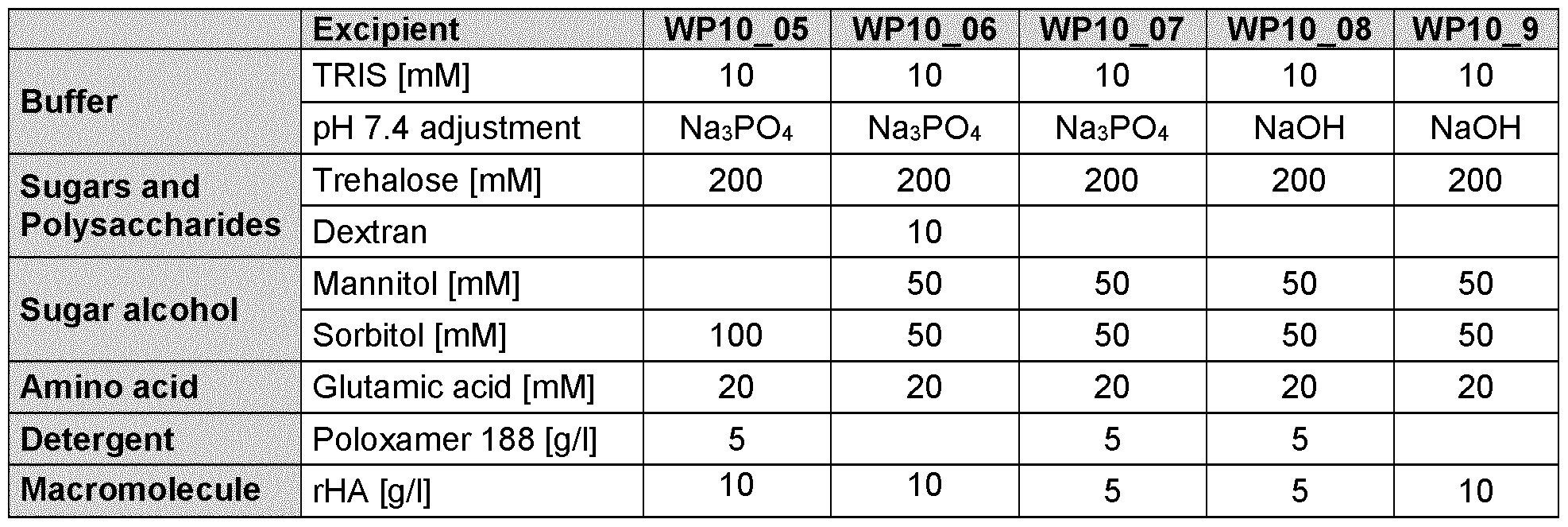

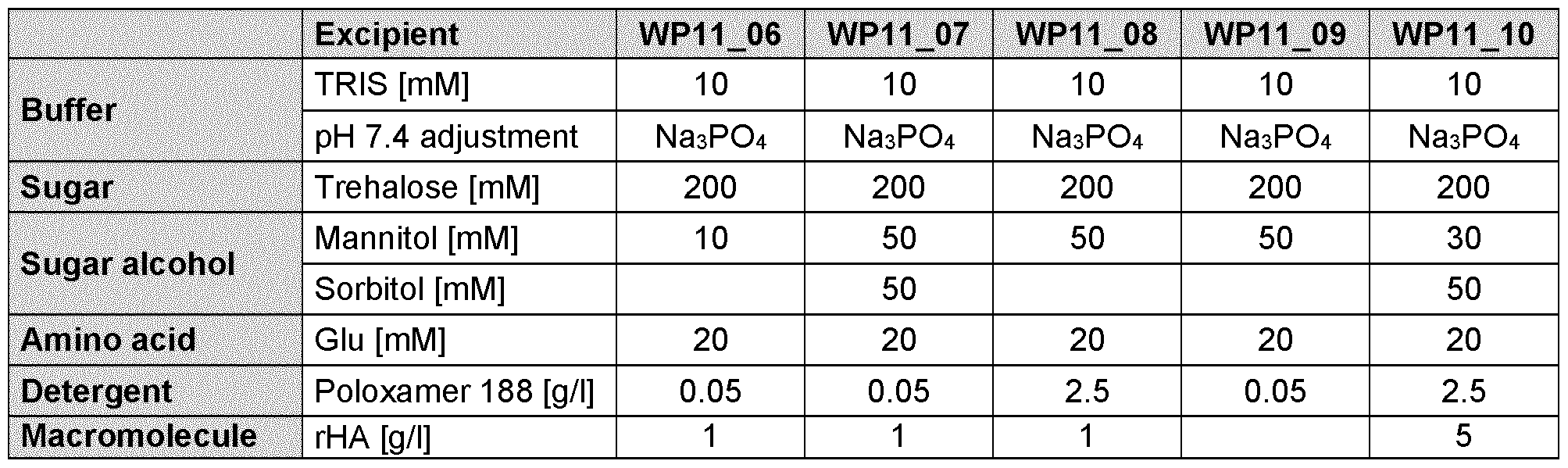


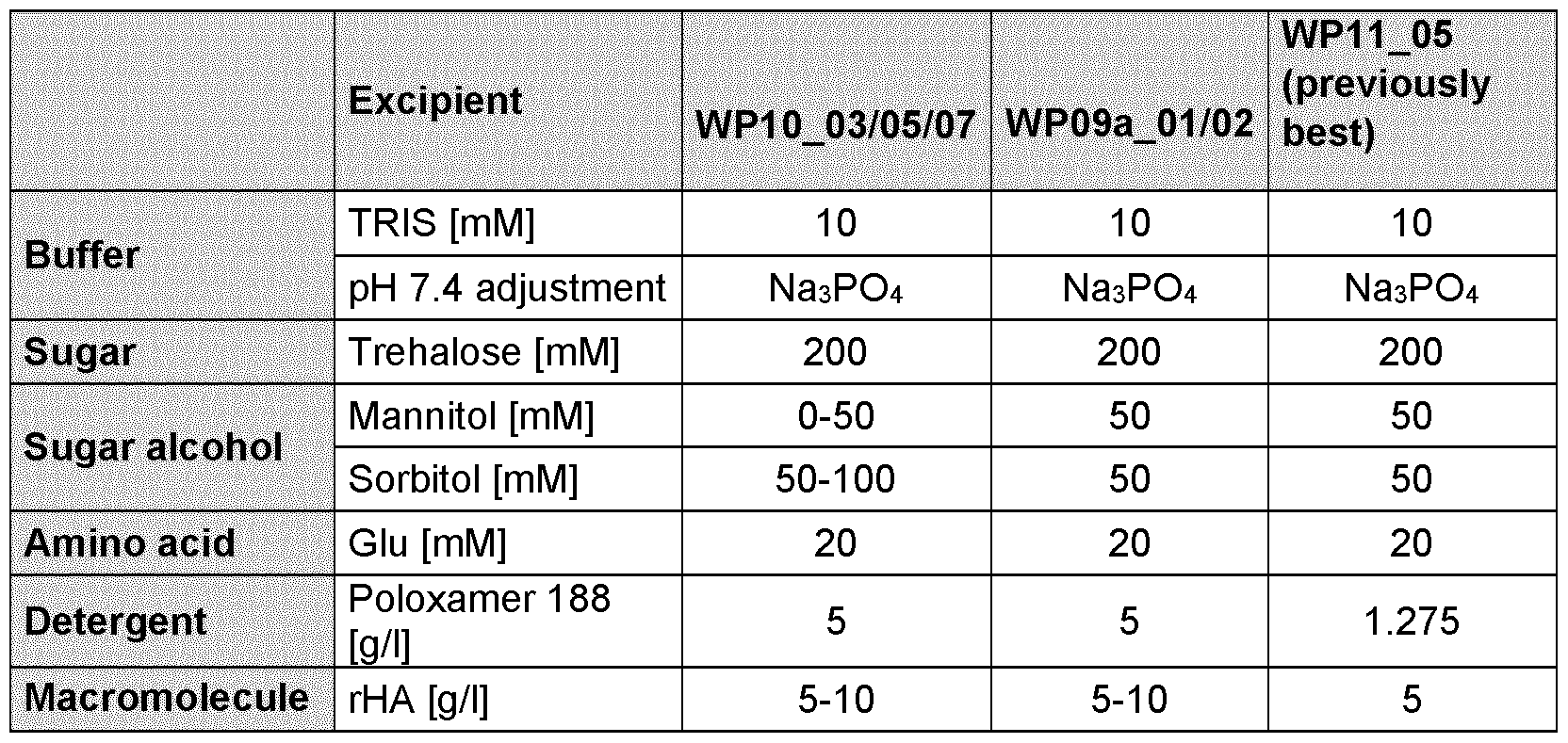

Claims
Priority Applications (6)
| Application Number | Priority Date | Filing Date | Title |
|---|---|---|---|
| KR1020257042056A KR20260012760A (en) | 2023-05-17 | 2024-05-16 | Formulations that stabilize virus-based therapeutics |
| EP24728146.2A EP4712947A1 (en) | 2023-05-17 | 2024-05-16 | Formulations to stabilize virus-based therapeutics |
| IL324514A IL324514A (en) | 2023-05-17 | 2024-05-16 | Formulations to stabilize virus-based therapeutics |
| CN202480032184.1A CN121218977A (en) | 2023-05-17 | 2024-05-16 | Compounds used to stabilize virus-based therapeutic agents |
| AU2024273703A AU2024273703A1 (en) | 2023-05-17 | 2024-05-16 | Formulations to stabilize virus-based therapeutics |
| MX2025013622A MX2025013622A (en) | 2023-05-17 | 2025-11-13 | Formulations to stabilize virus-based therapeutics |
Applications Claiming Priority (2)
| Application Number | Priority Date | Filing Date | Title |
|---|---|---|---|
| EP23173810 | 2023-05-17 | ||
| EP23173810.5 | 2023-05-17 |
Publications (1)
| Publication Number | Publication Date |
|---|---|
| WO2024236136A1 true WO2024236136A1 (en) | 2024-11-21 |
Family
ID=86387146
Family Applications (1)
| Application Number | Title | Priority Date | Filing Date |
|---|---|---|---|
| PCT/EP2024/063576 Ceased WO2024236136A1 (en) | 2023-05-17 | 2024-05-16 | Formulations to stabilize virus-based therapeutics |
Country Status (10)
| Country | Link |
|---|---|
| US (1) | US20240382542A1 (en) |
| EP (1) | EP4712947A1 (en) |
| KR (1) | KR20260012760A (en) |
| CN (1) | CN121218977A (en) |
| AU (1) | AU2024273703A1 (en) |
| CL (1) | CL2025003485A1 (en) |
| IL (1) | IL324514A (en) |
| MX (1) | MX2025013622A (en) |
| TW (1) | TW202508612A (en) |
| WO (1) | WO2024236136A1 (en) |
Citations (7)
| Publication number | Priority date | Publication date | Assignee | Title |
|---|---|---|---|---|
| WO2010040526A1 (en) | 2008-10-08 | 2010-04-15 | Von Laer, Dorothee | Lcmv-gp-vsv-pseudotyped vectors and tumor-infiltrating virus-producing cells for the therapy of tumors |
| US20150150964A1 (en) * | 2012-05-21 | 2015-06-04 | Sanofi Pasteur Limited | Herpesvirus compositions and related methods |
| US20200390877A1 (en) * | 2017-12-07 | 2020-12-17 | Merck Sharp & Dohme Corp. | Formulations of dengue virus vaccine compositions |
| US20210187100A1 (en) * | 2018-09-06 | 2021-06-24 | Bavarian Nordic A/S | Storage Improved Poxvirus Compositions |
| WO2023023371A1 (en) * | 2021-08-20 | 2023-02-23 | Vaccine Stabilization Institute | Formulations containing amino acids for stabilizing lipid enveloped viral and non-viral vectors |
| WO2023020556A1 (en) * | 2021-08-17 | 2023-02-23 | 上海行深生物科技有限公司 | Virus formulation, solution for formulating virus formulation, and use thereof |
| US20230114464A1 (en) * | 2020-03-12 | 2023-04-13 | Bavarian Nordic A/S | Conditions Improving Poxvirus Stability |
-
2024
- 2024-05-16 WO PCT/EP2024/063576 patent/WO2024236136A1/en not_active Ceased
- 2024-05-16 TW TW113118206A patent/TW202508612A/en unknown
- 2024-05-16 IL IL324514A patent/IL324514A/en unknown
- 2024-05-16 KR KR1020257042056A patent/KR20260012760A/en active Pending
- 2024-05-16 EP EP24728146.2A patent/EP4712947A1/en active Pending
- 2024-05-16 AU AU2024273703A patent/AU2024273703A1/en active Pending
- 2024-05-16 CN CN202480032184.1A patent/CN121218977A/en active Pending
- 2024-05-16 US US18/665,671 patent/US20240382542A1/en active Pending
-
2025
- 2025-11-11 CL CL2025003485A patent/CL2025003485A1/en unknown
- 2025-11-13 MX MX2025013622A patent/MX2025013622A/en unknown
Patent Citations (7)
| Publication number | Priority date | Publication date | Assignee | Title |
|---|---|---|---|---|
| WO2010040526A1 (en) | 2008-10-08 | 2010-04-15 | Von Laer, Dorothee | Lcmv-gp-vsv-pseudotyped vectors and tumor-infiltrating virus-producing cells for the therapy of tumors |
| US20150150964A1 (en) * | 2012-05-21 | 2015-06-04 | Sanofi Pasteur Limited | Herpesvirus compositions and related methods |
| US20200390877A1 (en) * | 2017-12-07 | 2020-12-17 | Merck Sharp & Dohme Corp. | Formulations of dengue virus vaccine compositions |
| US20210187100A1 (en) * | 2018-09-06 | 2021-06-24 | Bavarian Nordic A/S | Storage Improved Poxvirus Compositions |
| US20230114464A1 (en) * | 2020-03-12 | 2023-04-13 | Bavarian Nordic A/S | Conditions Improving Poxvirus Stability |
| WO2023020556A1 (en) * | 2021-08-17 | 2023-02-23 | 上海行深生物科技有限公司 | Virus formulation, solution for formulating virus formulation, and use thereof |
| WO2023023371A1 (en) * | 2021-08-20 | 2023-02-23 | Vaccine Stabilization Institute | Formulations containing amino acids for stabilizing lipid enveloped viral and non-viral vectors |
Non-Patent Citations (12)
| Title |
|---|
| "Development of vaccines", vol. 8, 1 January 2011, article SHIREESH P APTE ET AL: "EFFECT OF BUFFERS AND STABILIZERS ON VACCINE STABILITY AND EFFICACY", pages: 399 - 414, XP055236578, DOI: 10.1002/9781118023648.ch15 * |
| ALTSCHUL ET AL., J. MOL. BIOL., vol. 215, 1990, pages 403 - 410 |
| ALTSCHUL ET AL., NUCLEIC ACIDS RES., vol. 25, 1997, pages 3389 - 3402 |
| HIGGINS ET AL., METHODS ENZYMOL., vol. 266, 1996, pages 383 - 402 |
| KARLINALTSCHUL, PROC. NATL. ACAD. SCI. USA, vol. 87, 1990, pages 2264 - 2268 |
| KARLINALTSCHUL, PROC. NATL. ACAD. SCI. USA, vol. 90, 1993, pages 5873 - 5877 |
| L. BOLLENBACHJ. BUSKEK. MADERP. GARIDEL, INTERNATIONAL JOURNAL OF PHARMACEUTICS, vol. 620, 2022 |
| MOL THER METHODS CLIN DEV., vol. 3, 6 April 2016 (2016-04-06), pages 16018 |
| MUIK ET AL., CANCER RES., vol. 74, no. 13, 2014, pages 3567 - 78 |
| ONEIL WIGGAN ET AL: "Novel formulations enhance the thermal stability of live-attenuated flavivirus vaccines", VACCINE, vol. 29, no. 43, 2011, pages 7456 - 7462, XP028306509, ISSN: 0264-410X, [retrieved on 20110720], DOI: 10.1016/J.VACCINE.2011.07.054 * |
| PEARSONLIPMAN, PROC. NATL. ACAD. SCI. USA, vol. 85, 1988, pages 2444 - 8 |
| TORELLISROBOTTI, COMPUT. APPL. BIOSCI., vol. 10, 1994, pages 3 - 5 |
Also Published As
| Publication number | Publication date |
|---|---|
| AU2024273703A1 (en) | 2025-10-30 |
| EP4712947A1 (en) | 2026-03-25 |
| TW202508612A (en) | 2025-03-01 |
| KR20260012760A (en) | 2026-01-27 |
| CN121218977A (en) | 2025-12-26 |
| US20240382542A1 (en) | 2024-11-21 |
| CL2025003485A1 (en) | 2026-01-16 |
| MX2025013622A (en) | 2025-12-01 |
| IL324514A (en) | 2026-01-01 |
Similar Documents
| Publication | Publication Date | Title |
|---|---|---|
| US8313897B2 (en) | Method for preserving viral particles | |
| RU2560675C2 (en) | Stabilising excipient for vaccine with inactivated whole viruses | |
| CA2923010C (en) | Thermally stable vaccine formulations and microneedles | |
| KR100702086B1 (en) | Live vaccines of lyophilized directed hepatitis A and stabilizers | |
| US10335479B2 (en) | Methods and compositions for stabilizing dried biological materials | |
| JP2012214518A (en) | Stable and filterable enveloped virus formulation | |
| WO2023023371A1 (en) | Formulations containing amino acids for stabilizing lipid enveloped viral and non-viral vectors | |
| US20240382542A1 (en) | Formulations to stabilize virus-based therapeutics | |
| US20240382541A1 (en) | Formulations to stabilize virus-based therapeutics | |
| Bird | New Formulation Development Strategies for Inactivated Polio Vaccines to Aid in Worldwide Eradication of Polio | |
| HK1167604A (en) | Stabilising excipient for inactivated whole-virus vaccines | |
| HK1104316B (en) | Stable and filterable enveloped virus formulations | |
| HK1104316A (en) | Stable and filterable enveloped virus formulations | |
| NZ554550A (en) | Stable and filterable enveloped virus formulations |
Legal Events
| Date | Code | Title | Description |
|---|---|---|---|
| 121 | Ep: the epo has been informed by wipo that ep was designated in this application |
Ref document number: 24728146 Country of ref document: EP Kind code of ref document: A1 |
|
| WWE | Wipo information: entry into national phase |
Ref document number: AU2024273703 Country of ref document: AU |
|
| WWE | Wipo information: entry into national phase |
Ref document number: 826338 Country of ref document: NZ |
|
| ENP | Entry into the national phase |
Ref document number: 2024273703 Country of ref document: AU Date of ref document: 20240516 Kind code of ref document: A |
|
| REG | Reference to national code |
Ref country code: BR Ref legal event code: B01A Ref document number: 112025023060 Country of ref document: BR |
|
| WWE | Wipo information: entry into national phase |
Ref document number: 324514 Country of ref document: IL |
|
| WWE | Wipo information: entry into national phase |
Ref document number: CN2024800321841 Country of ref document: CN |
|
| ENP | Entry into the national phase |
Ref document number: 2025566870 Country of ref document: JP Kind code of ref document: A |
|
| WWE | Wipo information: entry into national phase |
Ref document number: MX/A/2025/013622 Country of ref document: MX Ref document number: 2025566870 Country of ref document: JP |
|
| WWE | Wipo information: entry into national phase |
Ref document number: 202547112449 Country of ref document: IN |
|
| WWP | Wipo information: published in national office |
Ref document number: MX/A/2025/013622 Country of ref document: MX |
|
| WWE | Wipo information: entry into national phase |
Ref document number: 202593274 Country of ref document: EA |
|
| WWP | Wipo information: published in national office |
Ref document number: 202547112449 Country of ref document: IN |
|
| ENP | Entry into the national phase |
Ref document number: 1020257042056 Country of ref document: KR Free format text: ST27 STATUS EVENT CODE: A-0-1-A10-A15-NAP-PA0105 (AS PROVIDED BY THE NATIONAL OFFICE) |
|
| WWE | Wipo information: entry into national phase |
Ref document number: 1020257042056 Country of ref document: KR |
|
| WWE | Wipo information: entry into national phase |
Ref document number: 2024728146 Country of ref document: EP |
|
| NENP | Non-entry into the national phase |
Ref country code: DE |
|
| ENP | Entry into the national phase |
Ref document number: 2024728146 Country of ref document: EP Effective date: 20251217 |
|
| ENP | Entry into the national phase |
Ref document number: 2024728146 Country of ref document: EP Effective date: 20251217 |
|
| WWP | Wipo information: published in national office |
Ref document number: 324514 Country of ref document: IL |
|
| ENP | Entry into the national phase |
Ref document number: 2024728146 Country of ref document: EP Effective date: 20251217 |
|
| ENP | Entry into the national phase |
Ref document number: 2024728146 Country of ref document: EP Effective date: 20251217 |
|
| ENP | Entry into the national phase |
Ref document number: 2024728146 Country of ref document: EP Effective date: 20251217 |
|
| ENP | Entry into the national phase |
Ref document number: 2024728146 Country of ref document: EP Effective date: 20251217 |
|
| WWP | Wipo information: published in national office |
Ref document number: 1020257042056 Country of ref document: KR |
|
| ENP | Entry into the national phase |
Ref document number: 2024728146 Country of ref document: EP Effective date: 20251217 |
|
| ENP | Entry into the national phase |
Ref document number: 2024728146 Country of ref document: EP Effective date: 20251217 |
|
| WWP | Wipo information: published in national office |
Ref document number: 2024728146 Country of ref document: EP |