WO2024232016A1 - 特徴抽出装置、特徴抽出方法及びプログラム - Google Patents
特徴抽出装置、特徴抽出方法及びプログラム Download PDFInfo
- Publication number
- WO2024232016A1 WO2024232016A1 PCT/JP2023/017432 JP2023017432W WO2024232016A1 WO 2024232016 A1 WO2024232016 A1 WO 2024232016A1 JP 2023017432 W JP2023017432 W JP 2023017432W WO 2024232016 A1 WO2024232016 A1 WO 2024232016A1
- Authority
- WO
- WIPO (PCT)
- Prior art keywords
- feature extraction
- time
- space
- extraction device
- series data
- Prior art date
- Legal status (The legal status is an assumption and is not a legal conclusion. Google has not performed a legal analysis and makes no representation as to the accuracy of the status listed.)
- Ceased
Links
Images


Classifications
-
- G—PHYSICS
- G06—COMPUTING OR CALCULATING; COUNTING
- G06F—ELECTRIC DIGITAL DATA PROCESSING
- G06F18/00—Pattern recognition
- G06F18/20—Analysing
- G06F18/21—Design or setup of recognition systems or techniques; Extraction of features in feature space; Blind source separation
- G06F18/213—Feature extraction, e.g. by transforming the feature space; Summarisation; Mappings, e.g. subspace methods
Definitions
- the present invention relates to a feature extraction device, a feature extraction method, and a program.
- Non-Patent Document 1 For example, much of the time series data used in anomaly detection technology has periodicity. For example, the body temperature of an organism changes on a daily cycle.
- the Fourier transform has long been used as a method for extracting periodicity from time series data, but recently an operator-theoretic method using the Koopman operator has also been proposed (Non-Patent Document 1).
- the present invention has been made in consideration of the above points, and aims to make it possible to extract characteristics of time-dependent changes in periodicity of time-series data.
- An estimation unit configured to estimate based on
- a search unit configured to search for a set of all c 1 , . . . , c n ⁇ complex numbers that approximately satisfy the formula: and a function ⁇ ⁇ A that represents a phase shift between ⁇ t and ⁇ t+1 .
- FIG. 1 is a diagram illustrating an example of a hardware configuration of a feature extraction device 10 according to an embodiment of the present invention.
- 1 is a diagram illustrating an example of a functional configuration of a feature extraction device 10 according to an embodiment of the present invention.
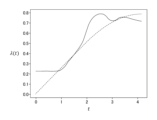
- FIG. 11 is a diagram showing a first estimation result for ⁇ .
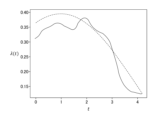
- FIG. 13 is a diagram showing a second estimation result for ⁇ .
- the Hilbert C*-module is used to extend the conventional technology using the Koopman operator, and frequency information is expressed as a function ( ⁇ below). This makes it possible to extract information ( ⁇ below) that indicates the characteristics of time-varying periodicity, which was difficult to do with conventional technology.
- f t : ⁇ is generally a nonlinear mapping and is unknown.
- ⁇ t is an element of ⁇ and is data generated at time t.
- equation (1) indicates that data ⁇ t+1 at time t+1 is determined by data ⁇ t at time t.
- the time series data may be, for example, data used for anomaly detection and output from a target of anomaly detection (e.g., a computer system, etc.).
- H k be a reproducing kernel Hilbert space (Non-Patent Document 2) for a positive definite kernel k on ⁇ .
- M k be a Hilbert C*-module (Non-Patent Document 2) determined by the tensor product of A and H k .
- K a linear operator expressing time series data
- FIG. 1 is a diagram showing an example of the hardware configuration of a feature extraction device 10 in an embodiment of the present invention.
- the feature extraction device 10 in FIG. 1 has a drive device 100, an auxiliary storage device 102, a memory device 103, a processor 104, and an interface device 105, which are all interconnected by a bus B.
- the program that realizes the processing in the feature extraction device 10 is provided by a recording medium 101 such as a CD-ROM.
- a recording medium 101 such as a CD-ROM.
- the program is installed from the recording medium 101 via the drive device 100 into the auxiliary storage device 102.
- the program does not necessarily have to be installed from the recording medium 101, but may be downloaded from another computer via a network.
- the auxiliary storage device 102 stores the installed program as well as necessary files, data, etc.
- the memory device 103 When an instruction to start a program is received, the memory device 103 reads out and stores the program from the auxiliary storage device 102.
- the processor 104 is a CPU or a GPU (Graphics Processing Unit), or a CPU and a GPU, and executes functions related to the feature extraction device 10 in accordance with the program stored in the memory device 103.
- the interface device 105 is used as an interface for connecting to a network.
- FIG. 2 is a diagram showing an example of the functional configuration of the feature extraction device 10 in an embodiment of the present invention.
- the feature extraction device 10 has an estimation unit 11 and a search unit 12. Each of these units is realized by a process in which one or more programs installed in the feature extraction device 10 are executed by the processor 104.
- Estimatiation unit 11 estimates the A-linear operator K. The method of estimating K will be described below.
- k ⁇ (the symbol with ⁇ added above k) is a complex-valued positive definite kernel on ⁇ , and 1 is a constant function.
- ⁇ ( ⁇ ) k( ⁇ ).
- ⁇ [ ⁇ ( ⁇ 1 i ), ..., ⁇ ( ⁇ n i )].
- ⁇ ( ⁇ n i ) is a vector on H k obtained by applying a positive definite kernel k to ⁇ n i
- ⁇ is an operator formed by collecting n of these vectors.
- the estimation unit 11 estimates K in the following manner.
- the estimation unit 11 obtains K ⁇ (the symbol with ⁇ added above K) by projecting K into a space created from data.
- K ⁇ the symbol with ⁇ added above K
- this is premised on the fact that, among the S pieces of time-series data, there are a plurality of i' and j' that satisfy the following for each j, and f t ( ⁇ j i ) can be estimated by regression or the like.
- the estimation unit 11 sets K ⁇ as an estimate of K.
- K ⁇ is an element of A (a function on T).
- the search unit 12 searches for c 1 , . . . , c n ⁇ C (C is a set of all complex numbers) and ⁇ ⁇ A that approximately satisfies the following formula (3).
- the search unit 12 may find eigenvalues of K ⁇ (t) for several t, regress the eigenvalues, and use the regressed function as the initial value of ⁇ . Then, the search unit 12 may find (search for) c 1 , ..., c n ⁇ C and ⁇ ⁇ A that minimize the difference between the right-hand side and the left-hand side of equation (3) by using a gradient method.
Landscapes
- Engineering & Computer Science (AREA)
- Computer Vision & Pattern Recognition (AREA)
- Data Mining & Analysis (AREA)
- Theoretical Computer Science (AREA)
- Bioinformatics & Computational Biology (AREA)
- Bioinformatics & Cheminformatics (AREA)
- Artificial Intelligence (AREA)
- Evolutionary Biology (AREA)
- Evolutionary Computation (AREA)
- Physics & Mathematics (AREA)
- General Engineering & Computer Science (AREA)
- General Physics & Mathematics (AREA)
- Life Sciences & Earth Sciences (AREA)
- Information Retrieval, Db Structures And Fs Structures Therefor (AREA)
Abstract
特徴抽出装置は、状態空間Φ上の時間に依存する非線形な写像ftに基づいてφt+1=ft(φt)によって生成されるS個の時系列データ{φ1
i,…,φn
i}(i=1,…,S)に対して正定値カーネルkを適用することで得られるベクトルから構成される作用素ΨをQR分解して、時間の集合上の連続関数全体の空間Aと、kに関する再生核ヒルベルト空間Hkとのテンソル積により定まるHilbert C*-moduleをMkとについて、式(1)として定められ、任意のv∈Mkと任意のa∈Aに対して、K(av)=a(Kv)を満たす、Mk上の線形作用素Kを、式(2)に基づいて推定するように構成されている推定部と、式(3) という式を近似的に満たすc1,…,cn∈複素数全体の集合と、φtとφt+1の位相のずれを表す関数λ∈Aとを探索するように構成されている探索部と、を有することで、時系列データの周期性の時間変化の特徴を抽出可能とする。
Description
本発明は、特徴抽出装置、特徴抽出方法及びプログラムに関する。
例えば、異常検知技術等に用いられる時系列データの多くは周期性を持つ。例えば、生物の体温は、1日の周期で変化する。時系列データの周期性を抽出する方法として、フーリエ変換は古くから活用されてきたが、最近では、Koopman作用素を用いた作用素論的方法も提案されている(非特許文献1)。
Steven L. Brunton, Eurika Kaiser, and J. Nathan Kutz、"Modern Koopman Theory for Dynamical Systems"、SIAM Review, Vol. 64(2), pp. 229-340, 2022
Yuka Hashimoto, Isao Ishikawa, Masahiro Ikeda, Fuyuta Komura, Takeshi Katsura, and Yoshinobu Kawahara、"Reproducing kernel Hilbert C*-module and kernel mean embeddings"、JMLR, 22, 267:1-56, 2021
Senka Macesic, Nelida Crnjaric-Zic, and Igor Mezic、"Koopman Operator Family Spectrum for Nonautonomous Systems"、SIAM J. applied dynamical systems, Vol. 17(4), pp. 2478-2515, 2018
しかしながら、時系列データが周期性を持つ場合でも、周期が常に一定であるとは限らず、時間と共に周期が変化するケースもある。このような場合、既存のフーリエ変換やKoopman作用素を用いた方法では、周期が時間と共にどのように変化するかという情報を抽出することは難しい。
本発明は、上記の点に鑑みてなされたものであって、時系列データの周期性の時間変化の特徴を抽出可能とすることを目的とする。
そこで上記課題を解決するため、特徴抽出装置は、状態空間Φ上の時間に依存する非線形な写像ftに基づいてφt+1=ft(φt)によって生成されるS個の時系列データ{φ1
i,…,φn
i}(i=1,…,S)に対して正定値カーネルkを適用することで得られるベクトルから構成される作用素ΨをQR分解して、時間の集合上の連続関数全体の空間Aと、kに関する再生核ヒルベルト空間Hkとのテンソル積により定まるHilbert C*-moduleをMkとについて、



時系列データの周期性の時間変化の特徴を抽出可能とすることができる。
本実施の形態では、Hilbert C*-moduleを用いることで、Koopman作用素を用いた従来技術を拡張し、周波数の情報を関数(以下のλ)として表現する。これにより、従来の技術では難しかった周期性の時間変化の特徴を示す情報(以下のλ)を抽出する。
[問題設定]
Φを状態空間とし、周期性を有する時系列データが、Φ上の時間(時刻t)に依存する以下の(1)式によって表現される離散力学系によって生成されたとする。
Φを状態空間とし、周期性を有する時系列データが、Φ上の時間(時刻t)に依存する以下の(1)式によって表現される離散力学系によって生成されたとする。

Hkを、Φ上の正定値カーネルkに関する再生核ヒルベルト空間(非特許文献2)とする。また、Tを時間の集合(実数全体の部分集合。n個の時刻tを含む連続的な区間)とし、A=C(T)(C(T)はT上の連続関数全体の空間)とする。Mkを、AとHkのテンソル積により定まるHilbert C*-module(非特許文献2)とする。Mk上のA-線形作用素K(時系列データを表現する線形作用素)を以下のように定める。

v∈Hkとλ∈A、|λ(t)|=1で、以下を満たすものが存在したとする。

以下、図面に基づいて本発明の実施の形態を説明する。図1は、本発明の実施の形態における特徴抽出装置10のハードウェア構成例を示す図である。図1の特徴抽出装置10は、それぞれバスBで相互に接続されているドライブ装置100、補助記憶装置102、メモリ装置103、プロセッサ104、及びインタフェース装置105等を有する。
特徴抽出装置10での処理を実現するプログラムは、CD-ROM等の記録媒体101によって提供される。プログラムを記憶した記録媒体101がドライブ装置100にセットされると、プログラムが記録媒体101からドライブ装置100を介して補助記憶装置102にインストールされる。但し、プログラムのインストールは必ずしも記録媒体101より行う必要はなく、ネットワークを介して他のコンピュータよりダウンロードするようにしてもよい。補助記憶装置102は、インストールされたプログラムを格納すると共に、必要なファイルやデータ等を格納する。
メモリ装置103は、プログラムの起動指示があった場合に、補助記憶装置102からプログラムを読み出して格納する。プロセッサ104は、CPU若しくはGPU(Graphics Processing Unit)、又はCPU及びGPUであり、メモリ装置103に格納されたプログラムに従って特徴抽出装置10に係る機能を実行する。インタフェース装置105は、ネットワークに接続するためのインタフェースとして用いられる。
図2は、本発明の実施の形態における特徴抽出装置10の機能構成例を示す図である。図2において、特徴抽出装置10は、推定部11及び探索部12を有する。これら各部は、特徴抽出装置10にインストールされた1以上のプログラムが、プロセッサ104に実行させる処理により実現される。
以下、各部について説明する。
[推定部11]
推定部11は、A-線形作用素Kを推定する。Kの推定方法について、以下に説明する。
推定部11は、A-線形作用素Kを推定する。Kの推定方法について、以下に説明する。
正定値カーネルkとして、以下の形のものを考える。




[探索部12]
探索部12は、c1,…,cn∈C(Cは複素数全体の集合)とλ∈Aについて、以下の(3)式を近似的に満たすものを探索する。
探索部12は、c1,…,cn∈C(Cは複素数全体の集合)とλ∈Aについて、以下の(3)式を近似的に満たすものを探索する。


[数値実験]
以下の通りであるとする。
以下の通りであるとする。

上述したように、本実施の形態によれば、時系列データの周期性の時間変化の特徴をλとして抽出可能とすることができる。
以上、本発明の実施の形態について詳述したが、本発明は斯かる特定の実施形態に限定されるものではなく、請求の範囲に記載された本発明の要旨の範囲内において、種々の変形・変更が可能である。
10 特徴抽出装置
11 推定部
12 探索部
100 ドライブ装置
101 記録媒体
102 補助記憶装置
103 メモリ装置
104 プロセッサ
105 インタフェース装置
B バス
11 推定部
12 探索部
100 ドライブ装置
101 記録媒体
102 補助記憶装置
103 メモリ装置
104 プロセッサ
105 インタフェース装置
B バス
Claims (5)
- 状態空間Φ上の時間に依存する非線形な写像ftに基づいてφt+1=ft(φt)によって生成されるS個の時系列データ{φ1 i,…,φn i}(i=1,…,S)に対して正定値カーネルkを適用することで得られるベクトルから構成される作用素ΨをQR分解して、時間の集合上の連続関数全体の空間Aと、kに関する再生核ヒルベルト空間Hkとのテンソル積により定まるHilbert C*-moduleをMkとについて、



を有することを特徴とする特徴抽出装置。 - 前記推定部は、
前記時系列データの中で、各jに対して、

ことを特徴とする請求項1記載の特徴抽出装置。 - 前記探索部は、前記式の右辺-左辺を最小にするようなc1,…,cnとλを求めるように構成されている、
ことを特徴とする請求項1又は2記載の特徴抽出装置。 - 状態空間Φ上の時間に依存する非線形な写像ftに基づいてφt+1=ft(φt)によって生成されるS個の時系列データ{φ1 i,…,φn i}(i=1,…,S)に対して正定値カーネルkを適用することで得られるベクトルから構成される作用素ΨをQR分解して、時間の集合上の連続関数全体の空間Aと、kに関する再生核ヒルベルト空間Hkとのテンソル積により定まるHilbert C*-moduleをMkとについて、



をコンピュータが実行することを特徴とする特徴抽出方法。 - 請求項4記載の特徴抽出方法をコンピュータに実行させることを特徴とするプログラム。
Priority Applications (2)
| Application Number | Priority Date | Filing Date | Title |
|---|---|---|---|
| JP2025519231A JPWO2024232016A1 (ja) | 2023-05-09 | 2023-05-09 | |
| PCT/JP2023/017432 WO2024232016A1 (ja) | 2023-05-09 | 2023-05-09 | 特徴抽出装置、特徴抽出方法及びプログラム |
Applications Claiming Priority (1)
| Application Number | Priority Date | Filing Date | Title |
|---|---|---|---|
| PCT/JP2023/017432 WO2024232016A1 (ja) | 2023-05-09 | 2023-05-09 | 特徴抽出装置、特徴抽出方法及びプログラム |
Publications (1)
| Publication Number | Publication Date |
|---|---|
| WO2024232016A1 true WO2024232016A1 (ja) | 2024-11-14 |
Family
ID=93431432
Family Applications (1)
| Application Number | Title | Priority Date | Filing Date |
|---|---|---|---|
| PCT/JP2023/017432 Ceased WO2024232016A1 (ja) | 2023-05-09 | 2023-05-09 | 特徴抽出装置、特徴抽出方法及びプログラム |
Country Status (2)
| Country | Link |
|---|---|
| JP (1) | JPWO2024232016A1 (ja) |
| WO (1) | WO2024232016A1 (ja) |
Citations (3)
| Publication number | Priority date | Publication date | Assignee | Title |
|---|---|---|---|---|
| JP2018198870A (ja) * | 2017-05-29 | 2018-12-20 | 国立研究開発法人理化学研究所 | 評価装置、評価方法、プログラム、ならびに、情報記録媒体 |
| WO2021039545A1 (ja) * | 2019-08-26 | 2021-03-04 | 日本電信電話株式会社 | 異常検知装置、異常検知方法、及びプログラム |
| WO2023037417A1 (ja) * | 2021-09-07 | 2023-03-16 | 日本電信電話株式会社 | 推定装置、推定方法、及びプログラム |
-
2023
- 2023-05-09 WO PCT/JP2023/017432 patent/WO2024232016A1/ja not_active Ceased
- 2023-05-09 JP JP2025519231A patent/JPWO2024232016A1/ja active Pending
Patent Citations (3)
| Publication number | Priority date | Publication date | Assignee | Title |
|---|---|---|---|---|
| JP2018198870A (ja) * | 2017-05-29 | 2018-12-20 | 国立研究開発法人理化学研究所 | 評価装置、評価方法、プログラム、ならびに、情報記録媒体 |
| WO2021039545A1 (ja) * | 2019-08-26 | 2021-03-04 | 日本電信電話株式会社 | 異常検知装置、異常検知方法、及びプログラム |
| WO2023037417A1 (ja) * | 2021-09-07 | 2023-03-16 | 日本電信電話株式会社 | 推定装置、推定方法、及びプログラム |
Also Published As
| Publication number | Publication date |
|---|---|
| JPWO2024232016A1 (ja) | 2024-11-14 |
Similar Documents
| Publication | Publication Date | Title |
|---|---|---|
| Afonso et al. | An augmented Lagrangian approach to the constrained optimization formulation of imaging inverse problems | |
| Kober | Fast algorithms for the computation of sliding discrete sinusoidal transforms | |
| Ciarleglio et al. | Wavelet-based scalar-on-function finite mixture regression models | |
| Deville et al. | From blind quantum source separation to blind quantum process tomography | |
| Carini et al. | Efficient adaptive identification of linear-in-the-parameters nonlinear filters using periodic input sequences | |
| WO2024232016A1 (ja) | 特徴抽出装置、特徴抽出方法及びプログラム | |
| Li et al. | Extended explicit pseudo two-step RKN methods for oscillatory systems y ″+ M y= f (y) | |
| Amato et al. | Fourier series approximation of separable models | |
| Costache et al. | Combining PCA-based datasets without retraining of the basis vector set | |
| Mhaskar | Local approximation using Hermite functions | |
| Berezansky et al. | Linearized oscillation theory for a nonlinear nonautonomous delay differential equation | |
| Jahangiri et al. | An adaptive wavelet differential neural networks based identifier and its stability analysis | |
| Gensler et al. | Fast feature extraction for time series analysis using least-squares approximations with orthogonal basis functions | |
| Hueso et al. | Third order iterative methods free from second derivative for nonlinear systems | |
| Chang et al. | Atlas-based path synthesis of planar four-bar linkages using elliptical Fourier descriptors | |
| Venkata Divya et al. | Hashing supported iterative mapreduce based scalable sbe reduct computation | |
| Alvarez-Andrade et al. | On the hybrids of k-spacing empirical and partial sum processes | |
| Dyshin et al. | Hybrid kalman filtering algorithm with wavelet packet data processing for linear dynamical systems | |
| Li et al. | A reference-based blind source extraction algorithm | |
| Molteni | An efficient method for the computation of the Feigenbaum constants to high precision | |
| Katz et al. | Sampling and approximation of bandlimited volumetric data | |
| Kudryavtsev et al. | Estimation of the Average Error Probability for Calculating Wavelet Coefficients in the Hybrid Thresholding Method | |
| Fu et al. | A wavelet multiscale iterative regularization method for the parameter estimation problems of partial differential equations | |
| Kudryavtsev et al. | The Generalized SURE Estimate for Threshold Processing when Solving Inverse Statistical Problems | |
| Tudor | Statistical Inference for Stochastic (Partial) Differential Equations with Hermite Noise |
Legal Events
| Date | Code | Title | Description |
|---|---|---|---|
| 121 | Ep: the epo has been informed by wipo that ep was designated in this application |
Ref document number: 23936569 Country of ref document: EP Kind code of ref document: A1 |
|
| ENP | Entry into the national phase |
Ref document number: 2025519231 Country of ref document: JP Kind code of ref document: A |
|
| WWE | Wipo information: entry into national phase |
Ref document number: 2025519231 Country of ref document: JP |
|
| NENP | Non-entry into the national phase |
Ref country code: DE |