WO2024228313A1 - 鞄 - Google Patents
鞄 Download PDFInfo
- Publication number
- WO2024228313A1 WO2024228313A1 PCT/JP2024/013574 JP2024013574W WO2024228313A1 WO 2024228313 A1 WO2024228313 A1 WO 2024228313A1 JP 2024013574 W JP2024013574 W JP 2024013574W WO 2024228313 A1 WO2024228313 A1 WO 2024228313A1
- Authority
- WO
- WIPO (PCT)
- Prior art keywords
- bag
- opening
- storage
- lid
- storage section
- Prior art date
- Legal status (The legal status is an assumption and is not a legal conclusion. Google has not performed a legal analysis and makes no representation as to the accuracy of the status listed.)
- Ceased
Links
Images








Classifications
-
- A—HUMAN NECESSITIES
- A45—HAND OR TRAVELLING ARTICLES
- A45C—PURSES; LUGGAGE; HAND CARRIED BAGS
- A45C11/00—Receptacles for purposes not provided for in groups A45C1/00-A45C9/00
Definitions
- the present invention relates to a bag for storing items.
- tote bags that are open at the top and have handles are known (see, for example, Patent Document 1).
- the interior (storage space) is always directly accessible, so the user can easily take items in and out of the bag.
- the top is always open, making the stored items susceptible to external factors such as getting wet in the rain or getting dirty with dust.
- external factors such as getting wet in the rain or getting dirty with dust.
- the object of the present invention is to provide a bag that protects stored items while reducing the effort required to store and remove items.
- a bag according to one aspect of the present invention comprises a bag body that can be opened at the top and a storage section provided inside the bag body, the storage section comprising a storage section main body having an opening and a lid section that is provided overlapping the storage section main body and can open and close the opening, the lid section comprising a position maintaining section that maintains the opening in a closed position.
- a bag according to another aspect of the present invention comprises a bag body that can be opened at the top and a storage section provided inside the bag body, the storage section comprising a storage section body including a front section, a rear section and an opening, and a lid section that can open and close the opening, and an elastic member is provided on each of the front section and the rear section to keep the opening in a closed position.
- the present invention provides a bag that protects stored items while reducing the effort required to store and remove items.
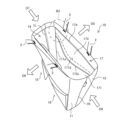
- FIG. 1 is an external perspective view showing the overall configuration of a bag according to a first embodiment of the present invention.
- FIG. 2 is a front view of the bag according to the first embodiment of the present invention.
- FIG. 3 is a rear view of the bag according to the first embodiment of the present invention.
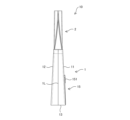
- FIG. 4 is a left side view of the bag according to the first embodiment of the present invention.
- FIG. 5 is a right side view of the bag according to the first embodiment of the present invention.
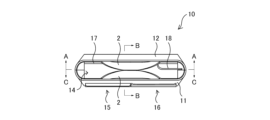
- FIG. 6 is a plan view of the bag according to the first embodiment of the present invention.
- FIG. 7 is a bottom view of the bag according to the first embodiment of the present invention.
- FIG. 8 is a cross-sectional view taken along line AA of FIG. FIG.
- FIG. 9 is a cross-sectional view taken along line BB of FIG.
- FIG. 10 is a cross-sectional view taken along the line CC of FIG.
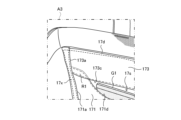
- FIG. 11 is an enlarged view of a portion A1 in FIG.
- FIG. 12 is an enlarged view of a portion A2 in FIG.
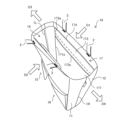
- FIG. 13 is a perspective view showing an example of a state in which the bag according to the first embodiment of the present invention is used.
- FIG. 14 is a perspective view showing an example of a state in which the bag according to the first embodiment of the present invention is used.
- FIG. 15 is an enlarged view of a portion A3 in FIG.
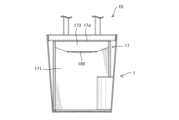
- FIG. 16 is a diagram showing an example of a stored state of the bag according to the first embodiment of the present invention.
- FIG. 17 is a cross-sectional view of the bag according to the second embodiment of the present invention taken along the line AA in FIG.
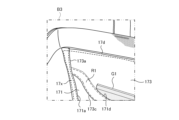
- FIG. 18 is an enlarged view of a portion B1 of FIG.
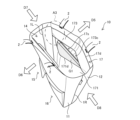
- FIG. 19 is a perspective view showing an example of a state in which the bag according to the second embodiment of the present invention is used.
- FIG. 20 is an enlarged view of part B3 in FIG.
- FIG. 21 is a diagram showing another configuration of the bag according to the second embodiment of the present invention.
- FIG. 22 is a diagram showing another configuration of the bag according to the second embodiment of the present invention.
- the bag 10 according to the present embodiment is an example of the bag of the present invention.
- the bag of the present invention may be any type of bag, such as a tote bag, a handbag (carry-around bag), or a bag without handles.
- a shoulder-type tote bag (able to be worn over the shoulder) having a handle (shoulder strap) will be described as an example.
- Fig. 1 is an external perspective view showing the overall configuration of bag 10 according to embodiment 1.
- Fig. 2 is a front view of bag 10
- Fig. 3 is a rear view of bag 10
- Fig. 4 is a left side view of bag 10
- Fig. 5 is a right side view of bag 10
- Fig. 6 is a plan view of bag 10
- Fig. 7 is a bottom view of bag 10.
- the bag 10 comprises a bag body 1 and a handle 2.
- the bag body 1 comprises a bottom 13, a front portion 11 that rises upward from the bottom 13 on the forward side, and a rear portion 12 that rises upward from the bottom 13 on the rear side, and has an opening 14 (see Figures 1 and 6) formed at the top.
- the bag body 1 is formed into a bag shape, for example, by folding a vertically long piece of fabric in the middle and sewing the side edges together.
- the reference symbol 1L indicates the left-hand sewn part where the front side (corresponding to the front part 11) and the back side (corresponding to the back part 12) of the fabric are sewn together
- the reference symbol 1R indicates the right-hand sewn part where the front side (corresponding to the front part 11) and the back side (corresponding to the back part 12) of the fabric are sewn together.
- the fabric of the bag body 1 can be made of various materials, such as natural fibers, chemical fibers, and synthetic fibers.
- the bottom 13 has a rectangular gusset with a predetermined width in the front-to-rear direction.
- the gusset is formed, for example, by folding back the side edges of the central part of the fabric and sewing them together (see Figure 7).
- the gusset allows the bag 10 to stand on its own.
- the method of manufacturing the bag body 1 is not limited to the above method, and may be, for example, a method of joining multiple pieces of fabric together.
- the bottom 13 has, for example, a width of approximately 300 mm in the left-to-right direction and a width of approximately 100 mm in the front-to-rear direction.
- the size of the bottom 13 is not limited to this, and is determined appropriately depending on the overall size of the bag 10.
- Openings 14 are formed at the upper ends of the front and rear portions 11 and 12, allowing access to the internal storage space of the bag body 1 from above the bag 10 through the openings 14.
- a reinforcing portion 1a (see FIG. 1) is provided around the entire inside of the upper ends of the front and rear portions 11 and 12.
- the reinforcing portion 1a is formed by sewing a separate piece of fabric to the inner peripheral edges of the front and rear portions 11 and 12, separate from the single piece of fabric that constitutes the front and rear portions 11 and 12.
- the reinforcing portion 1a may also be formed by folding back and sewing the upper end of the single piece of fabric that constitutes the front and rear portions 11 and 12.
- Storage pockets 15 and 16 are provided on the front surface (exterior surface) of the front part 11.
- the storage pockets 15 and 16 are fixed (sewn) by sewing them to the exterior surface of the front part 11.
- a lid 151 that can open and close the opening of the storage pocket 15 is provided on the upper part of the storage pocket 15.
- the lid 151 is fixed by sewing only the upper end part to the front part 11.
- the lid 151 is also provided overlapping the upper part of the storage pocket body so that a lower part covers the opening.
- the storage pockets 15 and 16 are also arranged below the bag body 1 so that their respective lower ends are approximately aligned with the position of the lower end part of the bag body 1.
- the storage pockets 15 and 16 have a height that is approximately half the height of the bag body 1, for example.
- the combined width of the storage pockets 15 and 16 is approximately the same as the width of the front part 11 (bottom part 13).
- the above-described configuration of the storage pockets 15, 16 lowers the center of gravity of the bag body 1, makes it easier to maintain balance in the left-right direction, and reinforces the front part 11, stabilizing the self-supporting posture of the bag 10.
- the external dimensions (width and height) of the storage pockets 15, 16 are approximately the same, and for example, the top end of the lid 151 of the storage pocket 15 and the top end of the opening of the storage pocket 16 are approximately the same height (see FIG. 2). For this reason, the top end of the opening of the storage pocket body of the storage pocket 15 is lower than the top end of the opening of the storage pocket 16 (see FIG. 1).
- the width of each of the storage pockets 15, 16 is, for example, approximately 150 mm
- the height of each of the storage pockets is, for example, approximately 210 mm
- the height of the lid 151 is, for example, approximately 75 mm. Note that the sizes of the storage pockets 15, 16 are not limited to these and are determined appropriately depending on the overall size of the bag 10.
- the storage pockets 15, 16 may have different widths.
- the storage pocket 16 may be provided with a lid portion similar to the lid portion 151.
- the lid portion 151 may be omitted from the storage pocket 15.
- the storage pockets 15, 16 may be provided in the rear portion 12, or in both the front portion 11 and the rear portion 12.
- the storage pockets 15, 16 may be capable of storing, for example, small items.
- Handles 2 are provided in both the front and rear directions. Specifically, the front handle 2 is fixed by sewing together both ends of the handle 2 inserted between the top end of the front part 11 and the reinforcement part 1a, and the rear handle 2 is fixed by sewing together both ends of the handle 2 inserted between the top end of the rear part 12 and the reinforcement part 1a.
- the handle 2 has a width of, for example, approximately 25 mm, and a length that allows it to be carried on the shoulder, for example, a length (height) from the top end of the bag body 1 to the top end of the handle 2 of approximately 270 mm.
- the size of the handle 2 is not limited to this.
- the fabric of the handle 2 can be made of various materials such as natural fibers, chemical fibers, and synthetic fibers, just like the bag body 1, and is not particularly limited.
- a storage section 17 is provided inside the bag body 1 (see Figures 1 and 6).
- the storage section 17 is fixed to the bag body 1 and has an opening through which stored items can be put in and taken out.
- the storage section 17 can store, for example, a PC (a notebook computer, a tablet device, etc.), documents, mail, etc.
- the items that can be stored in the storage section 17 are not limited to these. The specific configuration of the storage section 17 will be described later.
- the inside of the bag body 1 is provided with a drink holder 18 capable of storing drink containers such as plastic bottles and water bottles (see Figures 1 and 6).
- the drink holder 18 is an example of a storage section of the present invention.
- the storage section of the present invention is not limited to the drink holder 18, and may be configured to store, for example, a folding umbrella.
- One side end of the drink holder 18 is fixed to the rear portion 12 together with the storage section 17, and the other side end is fixed to the sewn portion 1R, thereby forming a cylindrical storage space (see Figures 1 and 6).
- FIG. 8 is a cross-sectional view taken along line A-A in Fig. 6
- Fig. 9 is a cross-sectional view taken along line B-B in Fig. 6,
- Fig. 10 is a cross-sectional view taken along line C-C in Fig. 6.
- Fig. 11 is an enlarged view of part A1 in Fig. 8, and
- Fig. 12 is an enlarged view of part A2 in Fig. 9.
- the storage section 17 is fixed by sewing it to the inner surface (inner wall surface) of the rear section 12 inside the bag body 1.
- the left end 17a, right end 17b, bottom end 17c, and top end 17d of the storage section 17 are each sewn and fixed to the inner surface of the rear section 12.
- the storage section 17 comprises a storage section main body 170 having an opening 17s (see FIG. 12) and a storage space, and a lid section 173 which overlaps the storage section main body 170 and can open and close the opening 17s.
- the storage section main body 170 comprises a front section 171 and a rear section 172, and a storage space is formed between the front section 171 and the rear section 172.
- the front section 171 of the storage section 17 is composed of a left end section 171a, a right end section 171b, a bottom end section 171c, and an upper end section 171d (see FIG. 12), and the left end section 171a, the right end section 171b, and the bottom end section 171c are fixed to the rear section 12 of the bag main body 1.
- the rear portion 172 of the storage portion 17 is composed of a left end portion (not shown), a right end portion (not shown), a lower end portion (corresponding to the lower end portion 17c of the storage portion 17), and an upper end portion (corresponding to the upper end portion 17d of the storage portion 17), and the left end portion, right end portion, lower end portion, and upper end portion are fixed to the rear portion 12 of the bag body 1.
- the upper end portion 171d of the front portion 171 of the storage portion 17 is not fixed to the rear portion 12 of the bag body 1, etc., and thus an opening portion 17s is formed between the front portion 171 and the rear portion 172 at the upper end portion 171d.
- the lid 173 has a left end 173a, a right end 173b, a bottom end 173c, and a top end (corresponding to the top end 17d of the storage section 17) (see FIG. 8), and the left end 173a, the right end 173b, and the top end are fixed to the rear 12 of the bag body 1.
- the bottom end 173c of the lid 173 is not fixed to the rear 12 of the bag body 1.
- the lid 173 has three sides, the left side, the right side, and the top side, fixed to the bag body 1, and only the bottom side is not fixed to any of them. This makes it possible to access the storage space of the storage section 17 by lifting the bottom end 173c of the lid 173 from bottom to top to expose the opening 17s.
- a cushion C1 is provided on the front portion 171, and a cushion C2 is provided on the rear portion 172.
- the cushions C1 and C2 are provided over substantially the entire surfaces of the front portion 171 and the rear portion 172, respectively.
- the cushions C1 and C2 may be inserted into the front portion 171 and the rear portion 172, respectively, or may be fixed to the inner wall surfaces of the front portion 171 and the rear portion 172 on the storage space side, respectively.
- the cushions C1 and C2 have the function of protecting the stored item G1 stored in the storage portion 17.
- the cushions C1 and C2 are elastic members (shock-absorbing materials) such as urethane, sponge, and rubber, and are examples of the elastic members of the present invention.
- the storage section 17 is formed into a bag shape, for example, by folding a single piece of fabric and sewing the side edges together. Specifically, a single vertically long piece of fabric is folded back in the center (corresponding to the lower end 17c), and a portion of a specific width at the end on one side (corresponding to the rear 172 side) (corresponding to the lid 173) is folded back to the other side (corresponding to the front 171 side). At this time, the end of the folded back portion (corresponding to the lower end 173c of the lid 173) is folded back so as to overlap the end on the other side (corresponding to the front 171 side) (corresponding to the upper end 171d of the front 171).
- the side edges of the fabric folded back in this way are aligned and sewn together with the fixing parts 17x, 17y (reinforcement parts) (see Figure 8) to the rear 12 of the bag body 1, thereby fixing it.
- the central portion of the fabric (corresponding to the lower end 17c) is fixed to the rear portion 12 of the bag body 1 by sewing it together with the fixing portion 17x (reinforcement portion) (see FIG. 8).
- the upper end portion of the fabric (corresponding to the upper end 17d) is fixed to the rear portion 12 of the bag body 1 by sewing it together.
- the left end 171a of the front 171, the left end 173a of the rear 172 (not shown), and the left end 173a of the lid 173 of the storage section 17 are fixed to the rear 12 of the bag body 1 by the fixing parts 17x
- the right end 171b of the front 171, the right end 173b of the rear 172 (not shown), and the right end 173b of the lid 173 of the storage section 17 are fixed to the rear 12 of the bag body 1 by the fixing parts 17y
- the bottom end 171c of the front 171 and the bottom end 172 (not shown) of the rear 172 of the storage section 17 are fixed to the rear 12 of the bag body 1 by the fixing parts 17x (see FIG. 8).
- the lid portion 173 is fixed so that a lower part overlaps a part of the upper part of the front portion 171. Furthermore, the upper end of the lid portion 173 is fixed to the upper end 17d of the storage portion 17, the left end 173a is fixed to the left end 17a of the storage portion 17, the right end 173b is fixed to the right end 17b of the storage portion 17, and the lower end 173c is not fixed to the storage portion 17.
- the front portion 171 has a height L1 (inner dimension) and the lid portion 173 has a height L2
- the lid portion 173 and the front portion 171 overlap in the front-rear direction by a height L3.
- the left end 173a and the right end 173b of the lid portion 173 are fixed by the fixing portions 17x and 17y to the part corresponding to the height L2 of the upper part of the rear portion 172 and the part corresponding to the height L3 of the upper part of the front portion 171.
- the left end 173a and the right end 173b of the lid 173 are positioned and fixed forward of the front portion 171 (toward the storage space of the bag body 1).
- the height L2 is, for example, approximately 45 mm
- the height L3 is, for example, approximately 15 mm.
- the heights L2 and L3 are not limited to this.
- the lid section 173 when the storage section 17 is in its normal state (for example, when the bag 10 is slung over the shoulder or held in the hand), the lid section 173 is positioned forward of the front section 171 and can cover the opening 17s. This prevents the storage space of the storage section 17 from being exposed to the outside air, and prevents the stored item G1 from getting wet in the rain or dirty with dust.
- the left end 173a and the right end 173b of the lid portion 173 are fixed to the bag body 1 together with the front portion 171 in a state where they overlap with each other, so that when the storage portion 17 is in its normal state, the opening 17s can be maintained in a closed position (closed position).
- the lid portion 173 is equipped with a position maintaining portion that maintains the opening 17s in a closed position.
- the left end portion 173a and the right end portion 173b, which partially overlap the front portion 171 correspond to the position maintaining portion.
- the cushions C1 and C2 also have the function of maintaining the independent positions of the front portion 171 and the rear portion 172 by elastic force, which makes it easier to maintain the opening 17s in a closed position.
- the cushions C1 and C2 correspond to the position maintaining portion.
- the cushions C1 and C2 have the function of protecting the stored items and the function of maintaining the opening 17s in a closed position.
- the storage section 17 has, for example, a main body height L0 (inner dimension) of approximately 350 mm, a height L2 of the lid section 173 of approximately 40 mm, a height L1 (inner dimension) of the front section 171 of approximately 325 mm, a height L3 (amount of overlap) of the overlapping portion of the lid section 173 and the front section 171 of approximately 15 mm, and a width of approximately 290 mm.
- the size of the storage section 17 is not limited to this, and is determined appropriately depending on the overall size of the bag 10.
- the storage section 17 has an opening/closing function for opening and closing the opening 17s.
- opening/closing function for opening and closing the opening 17s.
- opening/closing functions 1 to 4 Specific examples of the opening/closing function of the opening 17s (opening/closing functions 1 to 4) are described below.
- Figures 13 and 14 show an example of how the bag 10 is used. Specifically, Figures 13 and 14 show a state in which an item G1 (e.g., a laptop computer) is stored in the storage section 17 of the bag 10. Figure 13 shows a state in which the user is holding the bag 10, and Figure 14 shows a state in which the user has opened the opening 14 of the bag 10. Figure 15 shows an enlarged view of the A3 portion of Figure 14.
- G1 e.g., a laptop computer
- the center portion of the lid 173 bends in the D5 direction, and the portion of the lid 173 that overlaps with the front 171 (overlap portion) comes off the front 171, and the opening 17s becomes exposed (open position). In this way, when the user unfolds the bag 10, the opening 17s of the storage section 17 changes to the open position.
- the storage section 17 contains an item G1
- the storage space is easily maintained by the item G1 so the front portion 171 of the storage section 17 is not pulled in the D5 direction or bent in the D5 direction, and therefore, when the bag body 1 is unfolded as shown in FIG. 14, the opening portion 17s easily changes to an open position.
- the opening 17s changes to a closed position as shown in FIG. 13.
- the opening 17s when the opening 17s is in the open position, only the end of the front part 171 and the end of the lid part 173 overlap, so that forces in opposite directions are applied to the front part 171 and the lid part 173 at the overlap part R1. That is, a force in the D5 direction is applied from the lid part 173 to the overlap part R1 of the front part 171, and a force in the D6 direction is applied from the front part 171 to the overlap part R1 of the lid part 173.
- the storage section 17 changes to a closed position when the user closes the opening 14 of the bag 10 (see FIG. 13), and changes to an open position when the user opens the opening 14 of the bag 10 (see FIG. 14).
- the storage section 17 has a function that enables it to change its position between the open position and the closed position in response to the opening and closing action of the bag 10 by the user. This allows the user to easily put items in and take items out of the storage section 17.
- the storage section 17 is provided with cushions C1, C2 on the front section 171 and the rear section 172.
- the rear section 172 is pulled in the direction D5, but since the front section 171 is not fixed to the rear section 12 of the bag body 1 and the elastic force of the cushion C1 acts on it, the front section 171 tries to maintain a flat state. This makes it easier for the opening 17s to change to an open position.
- the cushions C1 and C2 exert a force that causes them to return to their original state (flat state) due to their own elasticity. Therefore, when the user closes the opening 14 of the bag 10 (see FIG. 13), the elasticity of the cushions C1 and C2 makes it easier for the front portion 171 and rear portion 172 to return to their normal flat state. This makes it easier for the opening 17s to change from an open position to a closed position. Therefore, by providing the cushions C1 and C2, it becomes possible to more easily change the position between the open position and the closed position in response to the opening and closing action of the bag 10 by the user. This makes it easier to put in and take out items.
- the bag 10 has a configuration in which the width W1 (frontage in the left-right direction) of the opening 17s of the storage section 17 is wider than the interval W2 between the attachment positions of the handle 2 on the bag body 1 (W1>W2).
- W1 frontage in the left-right direction
- W2 interval between the attachment positions of the handle 2 on the bag body 1 (W1>W2).
- the width W1 of the opening 17s is narrower than the distance W2 between the attachment positions of the handles 2 (W1 ⁇ W2), the force acts outside the width of the lid 173, and when the user opens the opening 14 of the bag 10, the entire lid 173 is pulled in the direction D5, making it difficult to change to the open position.
- the bag 10 according to the first embodiment has, for example, W1 of approximately 290 mm and W2 of approximately 160 mm. W1 and W2 are not limited to these values and are determined appropriately according to the overall size of the bag 10.
- the bag 10 has a configuration in which the lid portion 173 of the storage section 17 is located above the bag body 1.
- the lid portion 173 is located close to the reinforcing portion 1a provided at the upper end of the bag body 1.
- the upper end of the bag body 1 widens greatly, as shown in FIG. 14, for example. That is, the opening width in the front-rear direction of the bag body 1 increases from the bottom to the top. Therefore, when the lid portion 173 is located above the bag body 1, the force pulling in the D5 direction is greater than when the lid portion 173 is located below the bag body 1.
- the opening 17s is more likely to change to the open position than when the lid portion 173 is located below the bag body 1. Also, when the user closes the opening 14 of the bag 10, the lid portion 173 is similarly pushed by a large force in the D1 direction (see FIG. 13), so the opening 17s is more likely to change to the closed position. Therefore, by adopting the above-described configuration, it becomes possible to more easily change the position of the bag 10 between the open position and the closed position in response to the opening and closing action of the user, making it easier to put in and take out items.
- the storage section 17 has all of the opening and closing functions 1 to 4 of the opening 17s described above, but the bag of the present invention is not limited to this. In the bag of the present invention, the storage section 17 may be configured to have any one or more of the opening and closing functions 1 to 4.
- the bag 10 comprises a bag body 1 (bag body) that can be opened at the top, and a storage section 17 provided inside the bag body 1.
- the storage section 17 also comprises a storage section main body 170 having an opening 17s, and a lid section 173 that is provided overlapping the storage section main body 170 and can open and close the opening 17s.
- the lid section 173 also comprises a position maintaining section that maintains the opening 17s in a closed position.
- the opening 17s of the storage space can be covered with the lid 173, and the opening 17s can be kept closed, making it difficult for the stored items to be affected by external factors such as getting wet from rain or getting dirty from dust.
- the lid 173 is configured to overlap the opening 17s so that it can be opened and closed, and is not configured to fix the opening 17s so as to seal it, so the user does not have to go through the trouble of putting in and taking out the stored items. This makes it possible to realize a bag 10 that can protect the stored items while reducing the effort required to put in and take out the stored items.
- a separate fixing member such as a fastener or zipper
- the storage section main body 170 includes a front section 171 and a rear section 172, and the front section 171 and the rear section 172 each include cushions C1 and C2 (elastic members) (see FIG. 12).
- the above configuration makes it possible to protect stored items by the elasticity of the cushions C1 and C2.
- the elasticity of the cushions C1 and C2 allows the front portion 171 and rear portion 172 to maintain their independent posture, so that the opening 17s can be maintained in a closed posture.
- the elasticity of the cushions C1 and C2 makes it easier for the front portion 171 and rear portion 172 to return to a flat state, so that the posture changes to the closed posture.
- the cushions C1 and C2 have the function of protecting stored items, the function of maintaining the opening 17s in a closed posture, and the function of changing the opening 17s from an open posture to a closed posture.
- the bag 10 may omit the cushions C1 and C2, or may include only one of them.
- the storage section 17 is fixed to the inner side of the side (front section 11 or rear section 12) in the longitudinal direction (left-right direction in FIG. 1) of the bag body 1. This makes it possible to change the position of the opening 17s by the force of the opening and closing operation applied to the side (front section 11 and rear section 12) of the bag 10 (see FIGS. 13 and 14). Furthermore, since the storage section 17 is fixed to the bag body 1, the storage section 17 is stabilized within the bag body 1, so that stored items can be easily put in and taken out. Note that it is preferable that the storage section 17 is fixed to the rear section 12 in order to make it easier to protect the stored items and to make it easier to maintain balance when the bag 10 is slung over the shoulder.
- the left end 173a (first side end) of the lid 173 and the left end 17a (first side end) of the storage body 170 are fixed to each other, and the right end 173b (second side end) of the lid 173 and the right end 17b (second side end) of the storage body 170 are fixed to each other.
- the entire left end 173a and the entire right end 173b, which correspond to the height L2 of the entire lid 173, are fixed to the storage body 170 (front 171 and rear 172) via fixing parts 17x and 17y.
- the upper end of the lid 173 is fixed to the upper end 17d of the storage body 170, and the lid 173 is located forward of the front part 171 of the storage body 170, and the lower end 173c of the lid 173 is not fixed to the storage body 170 and is located below the upper end 171d of the front part 171.
- the upper end 171d of the front part 171 of the storage section 17 overlaps the lid part 173, and both ends of the lid part 173 are fixed, making it easier to maintain the closed position of the opening 17s.
- the left end 173a and the right end 173b that overlap the front part 171 function as the position maintaining part.
- the lid portion 173 may be fixed at a position lower than the upper end portion 17d of the storage body 170.
- the sewing position (fixing position) of the upper portion (upper edge) of the lid portion 173 may be a position lower than the upper end portion 17d of the storage body 170.
- the upper end portion of the lid portion 173 may be located at the upper end portion 17d of the storage body 170, and the sewing position of the upper side of the lid portion 173 may be located between the upper end portion 171d of the front portion 171 and the upper end portion 17d of the storage body 170.
- it is sufficient that the upper portion of the lid portion 173 is fixed (sewn) at least at a position higher than the upper end portion 171d of the front portion 171.
- the lid portion 173 does not have an elastic member (such as a cushion).
- an elastic member such as a cushion
- the lid portion 173 can easily bend outward (in the direction of D5) near the center, so that the opening 17s can easily be changed to an open position.
- the lid portion 173 may be provided with a cushion that is weaker in elasticity (for example thinner) than the cushions C1 and C2.
- the handle 2 is attached to the top of the bag body 1
- the storage section 17 is fixed to the surface of the bag body 1 to which the handle 2 is attached (e.g., the rear section 12), and the width W1 of the opening 17s of the storage section 17 is wider than the distance W2 between the attachment positions of the handle 2 on the bag body 1 (see FIG. 8).
- the lid portion 173 is located above the bag body 1.
- the upper end of the bag body 1 spreads widely, which causes the lid portion 173 to be pulled with a large force in the direction D5 (see FIG. 14), making it easier for the opening 17s to change to the open position.
- the lid portion 173 is pushed with a large force in the direction D1 (see FIG. 13), making it easier for the opening 17s to change to the closed position. This makes it easier for the user to change the position between the open position and the closed position in response to the opening and closing action of the bag 10.
- the lid portion 173 may be located above the bag body 1, and the lower end portion 17c of the storage portion main body 170 may be located below the bag body 1 (near the bottom portion 13). That is, the storage portion 17 may be formed over the entire height direction of one side surface of the bag body 1 (e.g., the rear portion 12) (see FIG. 8, etc.). Furthermore, the left-right width of the storage portion 17 may be approximately the same as the left-right width of the bottom portion 13 of the bag body 1 (see FIG. 8, etc.). This prevents the stored item G1 from becoming unevenly distributed within the bag 10, improving the weight balance.
- the bag 10 according to the first embodiment may also include a storage section (e.g., drink holder 18) capable of storing an object (e.g., a drink container).
- a storage section e.g., drink holder 18
- One side end of the storage section may be fixed to one side end of the storage section main body 170.
- the other side end of the storage section may be fixed to the stitched portion 1R (see FIG. 6) of the bag main body 1.
- This allows a cylindrical storage space to be formed, making it possible to store, for example, a drink container.
- the above fixing method also increases the strength of the drink holder 18. With the bag 10 configured as above, as shown in FIG. 16, a drink container can be stored in the drink holder 18 while a PC is stored in the storage section 17.
- the bag 10 according to the first embodiment may also have a storage pocket 19 inside the bag body 1 in which small items can be stored (see Figs. 9 and 10).
- the storage pocket 19 may be fixed to the front part 11 of the bag body 1, for example, by sewing it thereto.
- a bag 10 in another embodiment, includes a bag body 1 (bag body) that can be opened at the top, and a storage section 17 provided inside the bag body 1.
- the storage section 17 includes a storage section main body 170 having a front section 171, a rear section 172, and an opening 17s, and a lid section 173 that can open and close the opening 17s.
- the front section 171 and the rear section 172 are provided with cushions C1 and C2 (elastic members) to maintain the opening 17s in a closed position. That is, the storage section main body 170 includes cushions (elastic members) on both sides (front section 171 and rear section 172) that form the storage space, which maintain the opening 17s in a closed position.
- the lid section 173 may be omitted, or the lid section 173 may be formed of a hook-and-loop fastener such as Velcro (registered trademark).
- the stored items can be protected by the elasticity of the cushions C1, C2.
- the elasticity of the cushions C1, C2 can maintain the posture of the front part 171 and the rear part 172 in an upright posture, so that even when an item is stored inside, the opening 17s can be maintained in a closed posture without unnecessarily widening.
- the cushions C1, C2 function as the posture maintaining section.
- the cushions C1 and C2 exert a force that causes them to return to their original state (flat state) due to their own elasticity, so when the user closes the opening 14 of the bag 10 (see FIG. 13), the elasticity of the cushions C1 and C2 makes it easier for the front portion 171 and rear portion 172 to return to their normal flat state. In other words, the opening 17s becomes easier to change from an open position to a closed position. This makes it easier for the user to change the position between the open position and the closed position in response to the opening and closing action of the bag 10.
- the bag 10 may include only one of the cushions C1 and C2.
- the bag 10 has a handle 2, but in other embodiments, the bag 10 may omit the handle 2.
- the bag 10 may be composed of the bag body 1 described above alone.
- the bag of the present invention may also be constructed of the storage section 17 alone.
- the bag of the present invention may be a bag constructed of only the storage section 17 according to each of the above-mentioned embodiments.
- the bag of the present invention may also be a bag in which a handle 2 is attached to the storage section 17 according to each of the above-mentioned embodiments.
- the bag 10 and the storage section 17 are each an example of the bag of the present invention.
- the bag of the present invention comprises a storage section main body 170 having an opening 17s, and a lid section 173 that is arranged to overlap the storage section main body 170 and is capable of opening and closing the opening 17s, and the lid section 173 is configured to comprise a posture maintaining section that maintains the opening 17s in a closed posture.
- the bag of the present invention has a storage body 170 including a front portion 171, a rear portion 172, and an opening 17s, and a lid portion 173 that can open and close the opening 17s, and has a configuration in which a cushion (elastic member) is provided on at least one of the front portion 171 and the rear portion 172 to keep the opening 17s in a closed position.
- the rear portion 172 constituting the storage section 17 may be part of the rear portion 12 of the bag body 1. That is, the rear portion 12 of the bag body 1 may also serve as the rear portion of the storage section 17.
- the storage section main body 170 of the storage section 17 may be composed of the front portion 171 and the rear portion 12 of the bag body 1, the front portion 171 may be fixed to the rear portion 12 of the bag body 1 by fixing portions 17x and 17y, and the lid portion 173 may be fixed directly to the rear portion 12 of the bag body 1.
- the upper portion of the lid portion 173 is fixed (sewn) to the rear portion 12 of the bag body 1 at a position above the upper end portion 171d of the front portion 171.
- the storage section 17 may be detachable from the bag body 1.
- the storage section 17 may be detachable from the inner surface (inner wall surface) of the rear section 12 inside the bag body 1 using a hook-and-loop fastener such as Velcro (registered trademark).
- the storage section 17 may have a hook at its upper end, and the storage section 17 may be attached to the bag body 1 by hooking the hook onto the upper end (reinforcement section 1a) of the bag body 1.
- FIG. 17 is a cross-sectional view of the bag 10 according to the second embodiment taken along line A-A in FIG. 6.
- FIG. 18 is an enlarged view of part B1 in FIG. 17.
- the shape of the lid portion 173 is different from that of the lid portion 173 of embodiment 1, but the other configurations are the same as those of the bag 10 of embodiment 1.
- the lid portion 173 has a lower end portion 173c that is curved so that the center portion in the left-right direction protrudes downward.
- the lower end portion 173c is curved downward so that the height La of the lid portion 173 increases as it approaches the center position in the left-right direction from each of the left end portion 173a and the right end portion 173b.
- the left end portion 173a, the right end portion 173b, and the upper end portion of the lid portion 173 are fixed to the rear portion 12 of the bag body 1, and the lower end portion 173c is not fixed to the rear portion 12 of the bag body 1. That is, the lid 173 has three sides, the left side, right side, and top side, which are fixed to the bag body 1, and only the bottom side is not fixed to any of them. This allows access to the storage space of the storage section 17 by lifting the bottom end 173c of the lid 173 from bottom to top to expose the opening 17s (see FIG. 12).
- the lid portion 173 is fixed so that a lower portion thereof overlaps an upper portion of the front portion 171 of the storage portion 17. Specifically, the lid portion 173 is fixed so that the amount of overlap with the front portion 171 increases as the left end portion 173a and the right end portion 173b approach the center position in the left-right direction.
- the upper end portion of the lid portion 173 is fixed to the upper end portion 17d of the storage portion 17, the left end portion 173a is fixed to the left end portion 17a of the storage portion 17, the right end portion 173b is fixed to the right end portion 17b of the storage portion 17, and the lower end portion 173c is not fixed to the storage portion 17. For example, as shown in FIG.
- the lid portion 173 and the front portion 171 overlap each other in the front-rear direction by a height Ld at the center position.
- the lid 173 and the front 171 overlap in the front-rear direction by a height Lc. That is, the amount of overlap between the lid 173 and the front 171 increases as the lid approaches the center position in the left-right direction.
- the left end 173a and the right end 173b of the lid 173 (the whole corresponding to the height L2) are fixed by the fixing parts 17x and 17y to the part corresponding to the height L2 of the upper part of the rear 172 and the part corresponding to the height Lc of the upper part of the front 171.
- the left end 173a and the right end 173b of the lid 173 are fixed forward of the front 171 (towards the storage space of the bag body 1).
- the height L2 of each of the left end 173a and the right end 173b is, for example, approximately 45 mm
- the maximum height Lb is, for example, approximately 75 mm
- the overlap amount Lc of each of the left end 173a and the right end 173b is, for example, approximately 15 mm
- the overlap amount Ld (maximum overlap amount) of the central portion is, for example, approximately 50 mm.
- the height L2, the maximum height Lb, and the overlap amounts Lc and Ld are not limited to these.
- the lid section 173 when the storage section 17 is in a normal state (for example, when the bag 10 is slung over the shoulder or held in the hand), the lid section 173 is positioned forward of the front section 171 and can cover the opening 17s. This prevents the storage space of the storage section 17 from being exposed to the outside air, and prevents the stored item G1 from getting wet in the rain or dirty with dust.
- the left end 173a and the right end 173b of the lid portion 173 are fixed to the bag body 1 together with the front portion 171 in a state where they overlap with each other, so that the opening 17s can be maintained in a closed position (closed position) when the storage portion 17 is in the normal state.
- the lid portion 173 is equipped with a position maintaining portion that maintains the opening 17s in a closed position.
- the left end portion 173a and the right end portion 173b which partially overlap the front portion 171, correspond to the position maintaining portion.
- the center portion of the lid portion 173 in particular in the left-right direction also functions as the position maintaining portion.
- the entire lid portion 173 corresponds to the position maintaining portion.
- FIG. 19 shows an example of the usage state of bag 10 according to embodiment 2. Specifically, Fig. 19 shows a state in which an item G1 (e.g., a laptop computer) is stored in storage section 17 of bag 10. Fig. 19 also shows a state in which a user has opened opening 14 of bag 10. Fig. 20 shows an enlarged view of portion B3 of Fig. 19.
- G1 e.g., a laptop computer
- the front 11 and rear 12 of the bag body 1 approach each other and the opening 14 narrows in the front-to-back direction (D1 and D2 directions) as in the first embodiment (see FIG. 13).
- the sides of the bag body 1 are pushed out in the left-right direction (D3 and D4 directions), and the front 171, rear 172, and lid 173 of the storage section 17 are pulled in the left-right direction.
- the lid 173 is pulled in the left-right direction
- the lower part of the lid 173 comes into close contact with the front 171, so that the opening 17s is closed. In this way, when the user is holding the bag 10, the opening 17s of the storage section 17 is maintained in the closed position.
- the lid portion 173 is pulled in the D5 direction and pushed from the D7 and D8 directions, causing the center portion of the lid portion 173 to bend in the D5 direction, the portion of the lid portion 173 that overlaps with the front portion 171 (overlap portion R1) is unlikely to come off the front portion 171, and the opening 17s is still maintained in the closed position. In this way, even if the user unfolds the bag 10, the opening 17s of the storage portion 17 is likely to be maintained in the closed position (is unlikely to change to the open position).
- the storage section 17 has a function that allows it to maintain a closed position regardless of whether the user opens or closes the bag 10. This ensures that items stored in the storage section 17 are protected.
- the bottom end 173c of the lid section 173 simply overlaps the front section 171 and is not fixed thereto, so the user can easily take items in and out by lifting up the bottom end 173c.
- the bag 10 of embodiment 1 has a structure (see Figures 14 and 15) that makes it easier to change the opening 17s to an open position when the user opens the opening 14 of the bag 10, thereby making it easier to put items in and take them out
- the bag 10 of embodiment 2 has a structure (see Figures 19 and 20) that makes it easier to maintain the opening 17s in a closed position when the user opens the opening 14 of the bag 10, thereby making it easier to protect the items stored in the bag.
- the lid 173 may be made of an elastic material, and a reinforcing material (such as a cushion) may be provided inside the lid 173.
- a slit 180 may be provided in the front part 171 of the storage section 17.
- the slit 180 is formed so that the lower end part 173c of the lid part 173 can be inserted into the slit 180.
- the user can insert the lower end part 173c of the lid part 173 into the slit 180, making it difficult for the lid part 173 to open, and more reliably maintaining the opening 17s in a closed position.
- the lid part 173 may be generally curved downward and have a rectangular protrusion at the part that is inserted into the slit 180.
- the shape of the lid portion 173 in embodiment 2 is not limited to a curved shape, and may be a shape in which only the center portion in the left-right direction protrudes downward.
- the storage body includes a front portion and a rear portion, Each of the front and rear portions includes an elastic member. 2.
- the bag has an elastic member provided at each of the front and rear portions, thereby maintaining the opening in a closed position.
- the storage section is fixed to the inner surface side of the longitudinal side portion of the bag body.
- a bag as described in any one of appendix 1 to 3.
- ⁇ Appendix 6> a first side end of the lid portion and a first side end of the storage portion body are fixed to each other, The second side end of the lid portion and the second side end of the storage body are fixed to each other.
- the lid portion is located forward of the front portion of the storage body, an upper portion of the lid portion is fixed at a position higher than an upper end portion of the front portion of the storage body, The lower end of the lid portion is not fixed to the storage body and is located lower than the upper end of the front portion. 6.
- a handle is attached to the upper part of the bag body,
- the storage section is fixed to a surface of the bag body to which the handle is attached,
- the width of the opening is wider than the distance between the attachment positions of the handles on the bag body.
- ⁇ Appendix 12> Further comprising a storage section capable of storing an item to be stored; One side end of the storage unit is fixed to one side end of the storage unit body. A bag as described in any one of appendix 1 to 11.
Landscapes
- Purses, Travelling Bags, Baskets, Or Suitcases (AREA)
Priority Applications (2)
| Application Number | Priority Date | Filing Date | Title |
|---|---|---|---|
| JP2024555384A JPWO2024228313A1 (https=) | 2023-05-01 | 2024-04-02 | |
| CN202480002260.4A CN119255726A (zh) | 2023-05-01 | 2024-04-02 | 包 |
Applications Claiming Priority (2)
| Application Number | Priority Date | Filing Date | Title |
|---|---|---|---|
| JP2023-075662 | 2023-05-01 | ||
| JP2023075662 | 2023-05-01 |
Publications (1)
| Publication Number | Publication Date |
|---|---|
| WO2024228313A1 true WO2024228313A1 (ja) | 2024-11-07 |
Family
ID=93332981
Family Applications (1)
| Application Number | Title | Priority Date | Filing Date |
|---|---|---|---|
| PCT/JP2024/013574 Ceased WO2024228313A1 (ja) | 2023-05-01 | 2024-04-02 | 鞄 |
Country Status (3)
| Country | Link |
|---|---|
| JP (1) | JPWO2024228313A1 (https=) |
| CN (1) | CN119255726A (https=) |
| WO (1) | WO2024228313A1 (https=) |
Citations (9)
| Publication number | Priority date | Publication date | Assignee | Title |
|---|---|---|---|---|
| JPS447429Y1 (https=) * | 1965-06-15 | 1969-03-20 | ||
| JP2006181177A (ja) * | 2004-12-28 | 2006-07-13 | Ryukichi Adachi | 保冷材カバー |
| WO2006082659A1 (ja) * | 2005-02-07 | 2006-08-10 | Super Planning Co., Ltd. | ノートパソコン用バッグ |
| WO2006082660A1 (ja) * | 2005-02-07 | 2006-08-10 | Super Planning Co., Ltd. | 多目的バッグ |
| US20120305437A1 (en) * | 2011-06-01 | 2012-12-06 | Polyzen, Inc. | Digital appliance cover |
| JP2012253290A (ja) * | 2011-06-06 | 2012-12-20 | Sony Computer Entertainment Inc | 携帯型電子機器のケース |
| JP3222067U (ja) * | 2019-04-25 | 2019-07-04 | 株式会社ヤマト屋 | ポケット部構造 |
| US20200266844A1 (en) * | 2019-02-15 | 2020-08-20 | West Coast Chain Mfg. Co. | Pouch with viewing windows and access openings |
| JP2023030542A (ja) * | 2021-08-23 | 2023-03-08 | コクヨ株式会社 | 収納具 |
Family Cites Families (6)
| Publication number | Priority date | Publication date | Assignee | Title |
|---|---|---|---|---|
| JPS5843871Y2 (ja) * | 1980-07-15 | 1983-10-04 | 株式会社ミヤコ袋物店 | バツグのまち部 |
| JPS6017126U (ja) * | 1983-07-13 | 1985-02-05 | 山林 弘 | 手提げ袋 |
| JPS6137826U (ja) * | 1984-08-11 | 1986-03-08 | 吉村宗株式会社 | バツグ |
| JPH08214927A (ja) * | 1995-02-13 | 1996-08-27 | Beriigu:Kk | 和装具収納カバン |
| JP4343785B2 (ja) * | 2004-07-02 | 2009-10-14 | ビー・ナチュラル株式会社 | 小物収容具 |
| JP2020089638A (ja) * | 2018-12-07 | 2020-06-11 | エース株式会社 | 電子機器収納部付きバッグ |
-
2024
- 2024-04-02 WO PCT/JP2024/013574 patent/WO2024228313A1/ja not_active Ceased
- 2024-04-02 CN CN202480002260.4A patent/CN119255726A/zh active Pending
- 2024-04-02 JP JP2024555384A patent/JPWO2024228313A1/ja active Pending
Patent Citations (9)
| Publication number | Priority date | Publication date | Assignee | Title |
|---|---|---|---|---|
| JPS447429Y1 (https=) * | 1965-06-15 | 1969-03-20 | ||
| JP2006181177A (ja) * | 2004-12-28 | 2006-07-13 | Ryukichi Adachi | 保冷材カバー |
| WO2006082659A1 (ja) * | 2005-02-07 | 2006-08-10 | Super Planning Co., Ltd. | ノートパソコン用バッグ |
| WO2006082660A1 (ja) * | 2005-02-07 | 2006-08-10 | Super Planning Co., Ltd. | 多目的バッグ |
| US20120305437A1 (en) * | 2011-06-01 | 2012-12-06 | Polyzen, Inc. | Digital appliance cover |
| JP2012253290A (ja) * | 2011-06-06 | 2012-12-20 | Sony Computer Entertainment Inc | 携帯型電子機器のケース |
| US20200266844A1 (en) * | 2019-02-15 | 2020-08-20 | West Coast Chain Mfg. Co. | Pouch with viewing windows and access openings |
| JP3222067U (ja) * | 2019-04-25 | 2019-07-04 | 株式会社ヤマト屋 | ポケット部構造 |
| JP2023030542A (ja) * | 2021-08-23 | 2023-03-08 | コクヨ株式会社 | 収納具 |
Also Published As
| Publication number | Publication date |
|---|---|
| CN119255726A (zh) | 2025-01-03 |
| JPWO2024228313A1 (https=) | 2024-11-07 |
Similar Documents
| Publication | Publication Date | Title |
|---|---|---|
| US4210230A (en) | Flat-pack luggage case | |
| JP4750094B2 (ja) | バックパック | |
| CA2418533C (en) | Tool bag | |
| US10413045B2 (en) | Hard shell backpack | |
| US20020153216A1 (en) | Business case with expandable internal compartment for overnight clothing | |
| US20060207697A1 (en) | Configurable travel accessory | |
| US6296138B1 (en) | Container liner and lining system | |
| JP2018520751A (ja) | オーガナイジングシステムを有するストレージデバイス及びそのようなストレージデバイスを有するラゲッジシステム | |
| JP2000014426A (ja) | 鞄 | |
| US6994131B2 (en) | Carry-all bag | |
| JP5126775B2 (ja) | バッグ | |
| WO2024228313A1 (ja) | 鞄 | |
| JP2021062165A (ja) | スーツケース | |
| US20100252154A1 (en) | Compartmental Handbag With Detachable Cosmetic Inserts And Containers For Storing Cosmetics And Toiletries | |
| US20250031833A1 (en) | Single-Bag Pack for Everyday Carry and for Travel | |
| JP6529955B2 (ja) | バックパック | |
| JP3217029U (ja) | スーツケース | |
| HK40115978A (zh) | 包 | |
| JP3020847B2 (ja) | リュックサック | |
| JP7188741B2 (ja) | 愛玩動物運搬用のリュックサック | |
| JP3899120B2 (ja) | 多目的バッグ | |
| JP3082428U (ja) | 旅行用ケース | |
| JP7755902B1 (ja) | トートバッグ | |
| JP3253004U (ja) | インナーケースを備えたペンケース | |
| JP3231163U (ja) | リュックサック |
Legal Events
| Date | Code | Title | Description |
|---|---|---|---|
| WWE | Wipo information: entry into national phase |
Ref document number: 2024555384 Country of ref document: JP |
|
| WWE | Wipo information: entry into national phase |
Ref document number: 202480002260.4 Country of ref document: CN |
|
| 121 | Ep: the epo has been informed by wipo that ep was designated in this application |
Ref document number: 24800044 Country of ref document: EP Kind code of ref document: A1 |
|
| WWP | Wipo information: published in national office |
Ref document number: 202480002260.4 Country of ref document: CN |
|
| NENP | Non-entry into the national phase |
Ref country code: DE |