WO2024218924A1 - 学習プログラム、推論プログラム、学習方法、推論方法および情報処理装置 - Google Patents
学習プログラム、推論プログラム、学習方法、推論方法および情報処理装置 Download PDFInfo
- Publication number
- WO2024218924A1 WO2024218924A1 PCT/JP2023/015686 JP2023015686W WO2024218924A1 WO 2024218924 A1 WO2024218924 A1 WO 2024218924A1 JP 2023015686 W JP2023015686 W JP 2023015686W WO 2024218924 A1 WO2024218924 A1 WO 2024218924A1
- Authority
- WO
- WIPO (PCT)
- Prior art keywords
- target
- machine learning
- ligand
- primary
- receptor
- Prior art date
- Legal status (The legal status is an assumption and is not a legal conclusion. Google has not performed a legal analysis and makes no representation as to the accuracy of the status listed.)
- Ceased
Links
Images




Classifications
-
- G—PHYSICS
- G06—COMPUTING OR CALCULATING; COUNTING
- G06N—COMPUTING ARRANGEMENTS BASED ON SPECIFIC COMPUTATIONAL MODELS
- G06N20/00—Machine learning
-
- G—PHYSICS
- G16—INFORMATION AND COMMUNICATION TECHNOLOGY [ICT] SPECIALLY ADAPTED FOR SPECIFIC APPLICATION FIELDS
- G16B—BIOINFORMATICS, i.e. INFORMATION AND COMMUNICATION TECHNOLOGY [ICT] SPECIALLY ADAPTED FOR GENETIC OR PROTEIN-RELATED DATA PROCESSING IN COMPUTATIONAL MOLECULAR BIOLOGY
- G16B15/00—ICT specially adapted for analysing two-dimensional [2D] or three-dimensional [3D] molecular structures, e.g. structural or functional relations or structure alignment
-
- G—PHYSICS
- G16—INFORMATION AND COMMUNICATION TECHNOLOGY [ICT] SPECIALLY ADAPTED FOR SPECIFIC APPLICATION FIELDS
- G16B—BIOINFORMATICS, i.e. INFORMATION AND COMMUNICATION TECHNOLOGY [ICT] SPECIALLY ADAPTED FOR GENETIC OR PROTEIN-RELATED DATA PROCESSING IN COMPUTATIONAL MOLECULAR BIOLOGY
- G16B40/00—ICT specially adapted for biostatistics; ICT specially adapted for bioinformatics-related machine learning or data mining, e.g. knowledge discovery or pattern finding
Definitions
- the present invention relates to a learning program, etc.
- Receptors are regulatory proteins present in cells that selectively receive various signal molecules. They are mainly embedded in the cell membrane, but are also found in the cytoplasm and on the surface of the nucleus. A signal molecule that combines with a receptor to induce a biological response is called a "ligand.”
- Ligand substances include hormones, some amino acids, neurotransmitters, toxins, and medicines. Ligands are known to selectively or specifically exhibit high affinity for specific sites on receptors. In many cases, different receptors exist for each ligand, and the combinations of ligands and receptors that can combine vary greatly depending on the type of cell.
- Figure 13A shows an example of the relationship between amino acid names, abbreviations, and symbols.
- the abbreviation and symbol for the amino acid “alanine” are “Ala” and "A.”
- the relationship between other amino acid names, abbreviations, and symbols is as shown in Figure 13A.
- An amino acid is an amino group (-NH2) and a carboxy group (-COOH) bonded to carbon (C), and the general structural formula of an amino acid is shown in Figure 13B.
- Figure 13B is a diagram showing an example of the relationship between the general chemical structural formula of an amino acid and its side chain.
- a "side chain (R)” is also bonded to the central carbon (C), and this difference determines the type of amino acid.
- Specific side chains (R) such as “alanine” and "valine” and their chemical structural formulas are shown below.
- FIG. 14 is a diagram (1) for explaining the conventional technology.
- the processing of the learning phase of the conventional technology is explained.
- the device that executes the conventional technology is referred to as the "conventional device.”
- the conventional device executes machine learning of the machine learning model M1 using a pair of input data and correct answer labels.
- the input data includes multiple chemical structural formulas 5 of a receptor and each of its atoms, and a chemical structural formula 6 of a ligand to be combined with the receptor and each of its atoms.
- the chemical structural formula 5 of the receptor includes 5-1, 5-2, and 5-3.
- the correct answer label contains information about whether the receptor and ligand in the input data can be combined.
- the conventional device uses a vector dictionary to calculate vectors vc5-1, vc5-2, and vc5-3 for multiple chemical structural formulas 5-1, 5-2, and 5-3 of the receptor based on the vectors of each atom.
- the conventional device uses a vector dictionary to calculate vector vc6 for chemical structural formula 6 based on the vectors of each atom.
- the conventional device calculates vector vc7 by multiplying vectors vc5-1, vc5-2, and vc5-3 with vector vc6.
- the conventional device inputs vector vc7 into machine learning model M1 to obtain output result 8.
- the conventional device updates the parameters of the machine learning model so that the difference between output result 8 and the correct label becomes smaller.
- the conventional device trains the machine learning model M1 by repeatedly executing the above process for other pairs of input data and correct labels.
- FIG. 15 is a diagram (2) for explaining the conventional technology.
- the conventional device uses a trained machine learning model M1 to infer whether the receptor and ligand of the candidate data can be combined.
- the candidate data includes multiple chemical structural formulas 10 of a receptor, each of its atoms, and a chemical structural formula 11 of a ligand to be combined with the receptor.
- the chemical structural formula 10 of the receptor includes 10-1, 10-2, and 10-3.
- the conventional device uses a vector dictionary to calculate vectors vc10-1, vc10-2, and vc10-3 for chemical formulas 10-1, 10-2, and 10-3 based on the vectors of each atom.
- the conventional device uses a vector dictionary to calculate vector vc11 for chemical formula 11 based on the vectors of each atom.
- the conventional device calculates vector vc12 by multiplying vectors vc10-1, vc10-2, and vc10-3 with vector vc11.
- the conventional device obtains an output result 13 by inputting the vector vc12 into a trained machine learning model M1. If the output result 13 is "OK (combinable)," the conventional device presumes that the combination of the receptor and ligand in the candidate data is appropriate. On the other hand, if the output result 13 is "NG (not combinable),” the conventional device presumes that the combination of the receptor and ligand in the candidate data is inappropriate.
- whether a receptor and a ligand can combine is influenced not only by protein sequence information for chemical property analysis, but also by coordinate information of the atoms that make up the receptor and ligand for three-dimensional structure analysis.
- receptors are composed of higher-order protein structures (multiple primary structures) and ligands are composed of primary protein structures
- the above-mentioned conventional technology focuses on each atom in the chemical structural formula of amino acids, and the granularity and amount of information required for estimation are not optimal, resulting in the problem of being unable to properly estimate whether the target receptor and ligand can combine.
- the present invention aims to provide a learning program, an inference program, a learning method, an inference method, and an information processing device that can appropriately estimate whether a target receptor and a ligand can combine.
- the computer executes the following process.
- the computer acquires training data that associates input data having multiple primary structures included in the higher-order structure of the receptor combined with the ligand, structural information on the multiple primary structures, and labels indicating whether the receptor and ligand can combine.
- the computer executes machine learning of the machine learning model based on the training data.
- FIG. 1 is a diagram showing an example of protein structure data.
- FIG. 2 is a diagram for explaining the processing in the pre-processing phase.
- FIG. 3 is a diagram showing an example of a Postscript program.
- FIG. 4 is a diagram (1) for explaining the learning phase.
- FIG. 5 is a diagram (2) for explaining the learning phase.
- FIG. 6 is a diagram (1) for explaining the processing in the inference phase.
- FIG. 7 is a diagram (2) for explaining the processing in the inference phase.
- FIG. 8 is a functional block diagram showing the configuration of an information processing apparatus according to the present embodiment.
- FIG. 9 is a flowchart showing the processing procedure of the pre-processing phase.
- FIG. 10 is a flowchart showing the processing procedure of the learning phase.
- FIG. 9 is a flowchart showing the processing procedure of the pre-processing phase.
- FIG. 11 is a flowchart showing the processing procedure of the inference phase.
- FIG. 12 is a diagram illustrating an example of a hardware configuration of a computer that realizes the same functions as the information processing apparatus of the embodiment.
- FIG. 13A is a diagram showing an example of the relationship between amino acid names and symbols.
- FIG. 13B is a diagram showing an example of the relationship between the general chemical structural formula of an amino acid and its side chain.
- FIG. 14 is a diagram (1) for explaining the prior art.
- FIG. 15 is a diagram (2) for explaining the prior art.
- Protein structure data can be obtained from the PDB (Protein Data Bank).
- FIG. 1 is a diagram showing an example of protein structure data.
- the protein structure data 30 shown in FIG. 1 includes a header region 30a, a sequence information region 30b, and a coordinate information region 30c as protein structure information.
- the header region 30a contains the molecular name, etc., corresponding to the protein.
- sequence information of the amino acids contained in the protein is set.
- the amino acid sequence information is information in which the abbreviations (three letters) of the amino acids that make up the protein are arranged.
- the sequence of a series of multiple amino acids in the protein structure data corresponds to the primary structure of the protein. There are various patterns of amino acid sequences contained in the primary structure, but in this embodiment, the amino acid sequence contained in each primary structure is predefined. The sequence of multiple consecutive primary structures corresponds to the higher-order structure of the protein.
- the PDB may store data in which the receptor and ligand are combined with the sequence information and coordinate information.
- the protein structure data 30 includes the primary structures of multiple proteins that make up the higher-order structure of the receptor, and the primary structures of proteins that make up the ligand.
- the positions (three-dimensional coordinates) of multiple atoms that make up the amino acids contained in the protein are set.
- the position of each atom that makes up the amino acids contained in the sequence information area 30b is set in the coordinate information area 30c.
- the specific atom is (1) an amino group "N”, (2) an atom located at the tip of the side chain of the central carbon (C) (for example, the amino acid valine "Val" is the atom "C"), and (3) a carboxyl group "O".
- the specific atoms of interest are referred to as the first atom, the second atom, and the third atom. There may be multiple first atoms in one primary structure, and the positions of the first atoms may differ. The same applies to the second atom and the third atom.
- the information processing device according to this embodiment executes processing of the preprocessing phase, processing of the learning phase, and processing of the inference phase in that order.
- the information processing device according to this embodiment will be referred to as "information processing device 100.”
- FIG. 2 is a diagram for explaining the processing of the pre-processing phase.
- the information processing device 100 By executing the processing of the pre-processing phase, the information processing device 100 generates a first vector dictionary 142a and a second vector dictionary 142b.
- the information processing device 100 has a protein structure database PDB141.
- the protein structure database PDB141 stores protein structure data corresponding to multiple proteins (receptors, or receptors combined with ligands). The protein structure data was described in FIG. 1.
- the process by which the information processing device 100 generates the first vector dictionary 142a will be described.
- the information processing device 100 extracts multiple primary structures from each protein structure data in the protein structure database PDB141. As described in FIG. 1, the information on the primary structures is stored in the sequence information area 30b.
- primary structure 41 multiple primary structures (sequence information) are collectively referred to as "primary structure 41."
- the primary structure is information on a character string of an amino acid sequence.
- the information processing device 100 breaks it down into a character string of an amino acid sequence.
- the information processing device 100 breaks down the primary structure 41 into character strings of multiple amino acid sequences (or functional group sequences of organic compounds), and then arranges the character strings of each primary structure in order.
- the information processing device 100 applies algorithms such as CBoW or skip-gram (Word2vec) to each arranged character string, treating each amino acid (or functional group) as a word, and calculates a vector for each character string of the primary structure that corresponds to a sentence.
- the information processing device 100 registers the relationship between the character string of the reference unit of the primary structure 41 and the vector in the first vector dictionary 142a.
- the information processing device 100 may divide the primary structure 41 into predefined reference units.
- the information processing device 100 repeatedly executes the above process for other primary structures, thereby registering the relationship between the character strings of the amino acid sequences contained in the other primary structures and the vectors in the first vector dictionary 142a.
- the information processing device may assign vectors using the amino acid unit as the reference unit.
- the information processing device 100 extracts coordinate information of multiple primary structures from each protein three-dimensional structure data in the protein structure database PDB141.
- the coordinate information of the primary structure is information stored in the coordinate information area 30c, and includes information on the positions of the first atom, second atom, and third atom of each amino acid.
- the coordinate information is an example of "structural information”.
- the information processing device 100 generates a character string of a Postscript program that draws the shape of a three-dimensional line connecting the positions of the first atom, the second atom, and the third atom included in the coordinate information.
- FIG. 3 is a diagram showing an example of a Postscript program.
- the example shown in FIG. 3 shows a three-dimensional line 50 that connects the first atom 50a1, the second atom 50a2, and the third atom 50a3 of the amino acid valine "Val".
- the same atom may exist in multiple positions.
- the information processing device 100 may generate the three-dimensional line 50 by repeatedly connecting the closest atoms among the multiple atoms.
- the information processing device 100 generates a Postscript program 51 that draws a three-dimensional line 50.
- the Postscript program 51 includes a command statement (character string) for drawing the line 50.
- the information processing device 100 may also generate a Postscript program that projects the three-dimensional line from a predetermined direction onto a two-dimensional plane and draws the line projected onto the two-dimensional plane.
- the information processing device 100 performs morphological analysis on the Postscript program to break it down into multiple morphemes (tokens). After breaking down the Postscript program into multiple tokens, the information processing device 100 arranges each token in order. The information processing device 100 applies algorithms such as CBoW or skip-gram to each of the arranged tokens, treats each token as a word, and calculates the vector of each token. The information processing device 100 registers the relationship between the tokens of the Postscript program and the vectors in the second vector dictionary 142b.
- algorithms such as CBoW or skip-gram
- the information processing device 100 repeatedly executes the above process for the coordinate information of other primary structures, thereby registering the relationship between the tokens of the Postscript program obtained from the coordinate information of other primary structures and the vectors in the second vector dictionary 142b.
- the information processing device 100 generates the first vector dictionary 142a and the second vector dictionary 142b by executing the processing of the pre-processing phase.
- the information processing device 100 may obtain in advance from an external device, the first vector dictionary 142a, which defines the relationship between character strings of amino acid sequences and vectors, and the second vector dictionary 142b, which defines the relationship between tokens of Postscript programs and vectors. If the information processing device 100 obtains the first vector dictionary 142a and the second vector dictionary 142b in advance, it may skip the processing of the pre-processing phase.
- hiragana characters such as “te,” “ni,” “wo,” and “wa” are words with meaning.
- the approximately 20 types of amino acids also have chemical properties such as acidic, basic, neutral/hydrophilic, and neutral/hydrophobic.
- words composed of multiple hiragana characters such as “ai (love)” and “ai (indigo)” also have unique meanings. Therefore, by adding amino acid sequences called motifs that form regular three-dimensional structures such as alpha helices and beta sheets in proteins to the vector dictionary, it is possible to improve the accuracy of the vector dictionary.
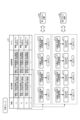
- Figures 4 and 5 are diagrams for explaining the learning phase.
- the information processing device 100 executes the learning phase processing using a teacher data table 143 prepared in advance.
- the teacher data table 143 associates an item number, sequence information, coordinate information, and a label.
- the item number is a number that identifies a record (teacher data) in the teacher data table 143.
- the sequence information is a higher-order structure of the receptor combined with the ligand, and this higher-order structure includes a series of multiple primary structures.
- the item number can identify which primary structures that constitute the higher-order structure of the receptor are adjacent to the front and rear of the primary structure of the ligand in the combined state.
- the coordinate information is information that indicates the positions of the first atom, the second atom, and the third atom of each amino acid of multiple primary structures included in the higher-order structure of the protein.
- the label indicates whether the receptor combined with the ligand is appropriate or not. For example, if the receptor combined with the ligand is appropriate, the label is set to "OK (for example, 1)". On the other hand, if the receptor combined with the ligand is not appropriate, the label is set to "NG (for example, 0)".
- the sequence information of item number (1) includes, in order from the beginning, primary structures c1-1, c1-2, c1-3, and c1-4.
- the primary structure c1-3 is set as the primary structure of the ligand.
- the coordinate information for item number (1) includes, from the top, coordinate information e1-1, e1-2, e1-3, and e1-4.
- coordinate information e1-1 is information on the positions of the first atom, second atom, and third atom contained in primary structure c1-1.
- Coordinate information e1-2 is information on the positions of the first atom, second atom, and third atom contained in primary structure c1-2.
- Coordinate information e1-3 is information on the positions of the first atom, second atom, and third atom contained in primary structure c1-3.
- Coordinate information e1-4 is information on the positions of the first atom, second atom, and third atom contained in primary structure c1-4.
- the information processing device 100 uses the first vector dictionary 142a created in the preparation phase to calculate vectors of each primary structure for chemical property analysis.
- the vectors of the primary structures are referred to as "sequence property vectors.”
- the information processing device 100 calculates the sequence characteristic vector vc1-2 of the primary structure c1-2 in the same manner as for the primary structure c1-1.
- the information processing device 100 calculates the sequence characteristic vector vc1-3 of the primary structure c1-3.
- the information processing device 100 calculates the sequence characteristic vector vc1-4 of the primary structure c1-4.
- the information processing device 100 calculates vectors for each piece of coordinate information using the second vector dictionary 142b created in the preparation phase.
- the vectors for the coordinate information are referred to as "3D coordinate vectors.”
- the following explanation uses the coordinate information e1-1 included in the coordinate information of item (1).
- the information processing device 100 generates a Postscript program character string p1-1 that draws a three-dimensional line shape connecting the positions of the first atom, second atom, and third atom included in the coordinate information e1-1.
- the information processing device 100 performs a morphological analysis on the Postscript program p1-1 to break it down into multiple morphemes (tokens).
- the information processing device 100 identifies the vectors of each token by comparing each token of the Postscript program p1-1 with the second vector dictionary 142b.
- the information processing device 100 calculates the three-dimensional coordinate vector vp1-1 by integrating the vectors of each token of the Postscript program p1-1.
- the information processing device 100 generates a Postscript program p1-2 for the coordinate information e1-2 in the same manner as for the coordinate information e1-1, and calculates a three-dimensional coordinate vector vp1-2 based on the Postscript program p1-2 and the second vector dictionary 142b.
- the information processing device 100 generates a Postscript program p1-3 for the coordinate information e1-3, and calculates a three-dimensional coordinate vector vp1-3 based on the Postscript program p1-3 and the second vector dictionary 142b.
- the information processing device 100 generates a Postscript program p1-4 for the coordinate information e1-4, and calculates a three-dimensional coordinate vector vp1-4 based on the Postscript program p1-4 and the second vector dictionary 142b.
- the information processing device 100 inputs pairs of each sequence characteristic vector of the sequence information of each primary structure of each item number and each three-dimensional coordinate vector of the coordinate information into the machine learning model M1 in order, and trains the machine learning model M1 (updates the parameters) so that the value output from the machine learning model M1 approaches the corresponding label.
- the machine learning model M1 is a neural network (NN) that includes BERT (Pre-training of Deep Bidirectional Transformers for Language Understanding), Next Sentence Prediction, Transformers, etc.
- NN neural network
- This section describes the case where the information processing device 100 updates parameters using the array information, coordinate information, and label corresponding to item number (1) in the teacher data table 143.
- the information processing device 100 executes the process described in FIG. 4 and calculates sequence characteristic vectors vc1-1 to vc1-4 of each primary structure of the sequence information corresponding to item number (1).
- the information processing device 100 also calculates each three-dimensional coordinate vector vp1-1 to vp1-4 of the coordinate information corresponding to item number (1).
- the information processing device 100 inputs pairs of array characteristic vectors of array information and cubic coordinate vectors of coordinate information to the machine learning model M1 in sequence. For example, the information processing device 100 first inputs the array characteristic vector vc1-1 and the cubic coordinate vector vp1-1 to the machine learning model M1. The information processing device 100 secondly inputs the array characteristic vector vc1-2 and the cubic coordinate vector vp1-2 to the machine learning model M1. The information processing device 100 thirdly inputs the array characteristic vector vc1-3 and the cubic coordinate vector vp1-3 to the machine learning model M1. The information processing device 100 fourthly inputs the array characteristic vector vc1-4 and the cubic coordinate vector vp1-4 to the machine learning model M1.
- the information processing device 100 When the information processing device 100 inputs a pair of the sequence characteristic vector of the final primary structure and the three-dimensional coordinate vector of the coordinate information into the machine learning model M1, it updates the parameters of the machine learning model M1 so that the difference between the output result output from the machine learning model M1 and the label of item number (1) becomes small.
- the information processing device 100 updates the parameters of the machine learning model M1 by repeatedly executing the same process as above for the array information, coordinate information, and labels from item number (2) onwards in the teacher data table 143.
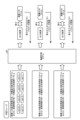
- Figures 6 and 7 are diagrams for explaining the processing of the inference phase.
- the information processing device 100 receives from the user sequence information and coordinate information of a certain receptor that is the subject of inference and that has combined with a certain ligand.
- the sequence information includes primary structures c10-1, c10-2, c10-3, and c10-4 from the beginning.
- the primary structure c10-3 is set as the primary structure of the ligand.
- the coordinate information includes, from the top, coordinate information e10-1, e10-2, e10-3, and e10-4.
- coordinate information e10-1 is information on the positions of the first atom, second atom, and third atom contained in primary structure c10-1.
- Coordinate information e10-2 is information on the positions of the first atom, second atom, and third atom contained in primary structure c10-2.
- Coordinate information e10-3 is information on the positions of the first atom, second atom, and third atom contained in primary structure c10-3.
- Coordinate information e10-4 is information on the positions of the first atom, second atom, and third atom contained in primary structure c10-4.
- the information processing device 100 uses the first vector dictionary 142a to calculate sequence characteristic vectors vc10-1, vc10-2, vc10-3, and vc10-4 of the primary structures c10-1, c10-2, c10-3, and c10-4.
- the process in which the information processing device 100 calculates the sequence characteristic vectors of the primary structures using the first vector dictionary 142a is similar to the process described in the learning phase.
- the information processing device 100 generates Postscript programs p10-1, p10-2, p10-3, and p10-4 based on the coordinate information e10-1, e10-2, e10-3, and e10-4.
- the process in which the information processing device 100 generates Postscript programs based on the coordinate information is similar to the process described in the learning phase.
- the information processing device 100 uses the second vector dictionary 142b to calculate the three-dimensional coordinate vectors vp10-1, vp10-2, vp10-3, and vp10-4 of the Postscript programs p10-1, p10-2, p10-3, and p10-4.
- the process by which the information processing device 100 calculates the three-dimensional coordinate vectors using the second vector dictionary 142b is the same as the process described in the learning phase.
- the information processing device 100 sequentially inputs the pairs of array characteristic vectors vc10-1 to vc10-4 of the array information and the three-dimensional coordinate vectors vp10-1 to vp10-4 of the coordinate information, which were explained in FIG. 6, to the machine learning model M1.
- the information processing device 100 inputs the array characteristic vector vc10-1 and the cubic coordinate vector vp10-1 to the machine learning model M1.
- the information processing device 100 inputs the array characteristic vector vc10-2 and the cubic coordinate vector vp10-2 to the machine learning model M1.
- the information processing device 100 inputs the array characteristic vector vc10-3 and the cubic coordinate vector vp10-3 to the machine learning model M1.
- the information processing device 100 inputs the array characteristic vector vc10-4 and the cubic coordinate vector vp10-4 to the machine learning model M1.
- the information processing device 100 When the information processing device 100 inputs a pair of the sequence characteristic vector of the final primary structure and the three-dimensional coordinate vector of the coordinate information into the machine learning model M1, it obtains the output result output from the machine learning model M1.
- the machine learning model M1 of this embodiment may output a score indicating the likelihood of successful merging.
- the information processing device 100 estimates that the receptor shown in the sequence information in FIG. 6 combined with the ligand is appropriate (the sequence of the receptor's primary structure is also appropriate). On the other hand, if the score of the output result is less than the threshold (combination NG), the information processing device 100 estimates that the receptor shown in the sequence information in FIG. 6 combined with the ligand is not appropriate.
- the information processing device 100 executes machine learning of the machine learning model based on training data in which input data having sequence information of multiple primary structures contained in the higher-order structure of the receptor combined with the ligand and coordinate information of multiple primary structures is associated with a label indicating whether the receptor and ligand can combine. This makes it possible to generate a machine learning model M1 for appropriately estimating whether the target receptor and ligand can combine.
- the information processing device 100 inputs data having sequence information of multiple primary structures contained in the higher-order structure of the receptor combined with the target ligand, and coordinate information of the multiple primary structures, into the trained machine learning model M1.
- the information processing device 100 can estimate whether the receptor combined with the ligand is appropriate by using the output results. In this embodiment, it is also possible to determine whether the arrangement of multiple primary structures of the receptor (including the primary structure of the ligand) is appropriate.
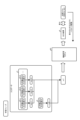
- FIG. 8 is a functional block diagram showing the configuration of an information processing device according to this embodiment.
- the information processing device 100 has a communication unit 110, an input unit 120, a display unit 130, a storage unit 140, and a control unit 150.
- the communication unit 110 is connected to an external device or the like via a wired or wireless connection, and transmits and receives information to and from the external device or the like.
- the communication unit 110 is realized by a NIC (Network Interface Card) or the like.
- the communication unit 110 may be connected to a network (not shown).
- the communication unit 110 may receive information on the protein structure database PDB 141, the first vector dictionary 142a, and the second vector dictionary 142b from the external device, and register the information in the storage unit 140.
- the input unit 120 is an input device that inputs various types of information to the information processing device 100.
- the input unit 120 corresponds to a keyboard, a mouse, a touch panel, etc.
- the user may operate the input unit 120 to input array information and coordinate information to be inferred.
- the display unit 130 is a display device that displays information output from the control unit 150.
- the display unit 130 corresponds to a liquid crystal display, an organic EL (Electro Luminescence) display, a touch panel, etc. For example, it displays the estimation result of the estimation phase by the control unit 150.
- the memory unit 140 has a protein structure database PDB141, a first vector dictionary 142a, a second vector dictionary 142b, a teacher data table 143, and a machine learning model M1.
- the memory unit 140 is realized, for example, by a semiconductor memory element such as a RAM (Random Access Memory) or a flash memory, or a storage device such as a hard disk or an optical disk.
- the first vector dictionary 142a is a dictionary that stores a correspondence between character strings that are basic units of a primary structure and vectors. Other explanations regarding the first vector dictionary 142a are the same as those regarding the first vector dictionary 142a shown in FIG. 2 etc.
- the second vector dictionary 142b is a dictionary that stores tokens of a Postscript program generated from coordinate information in association with vectors. Other explanations regarding the second vector dictionary 142b are the same as those regarding the second vector dictionary 142b shown in FIG. 2 etc.
- the machine learning model M1 is a neural network such as BERT, Next Sentence Prediction, or Transformers, as described in Figure 5.
- the preprocessing unit 151 executes the processing of the preprocessing phase described in FIG. 2 and the like.
- the preprocessing unit 151 acquires protein structure data from the protein structure database PDB141, and acquires multiple primary structures and coordinate information corresponding to each primary structure from the protein structure data.
- the preprocessing unit 151 breaks down the primary structure into character strings of multiple reference units (e.g., amino acid sequences), applies algorithms such as CBoW or skip-gram (Word2vec), and assigns a vector to each character string.
- the preprocessing unit 151 sets the relationship between character strings and vectors in the first vector dictionary 142a.
- the preprocessing unit 151 generates a Postscript program that draws the shape of a three-dimensional line connecting the positions of the first atom, the second atom, and the third atom contained in the coordinate information.
- the preprocessing unit 151 performs morphological analysis on the Postscript program to break it down into multiple morphemes (tokens).
- the preprocessing unit 151 applies algorithms such as CBoW and skip-gram (Word2vec), assigns vectors to each token, and sets the relationship between the tokens and vectors of the Postscript program in the second vector dictionary 142b.
- the explanation of other processes of the preprocessing unit 151 is the same as the explanation of the processes of the preprocessing phase explained in FIG. 2 and FIG. 3. Note that the preprocessing unit 151 may skip the processes of the preprocessing phase if the first vector dictionary 142a and the second vector dictionary 142b have been acquired in advance.
- the learning processing unit 152 executes the learning phase processing described in Figures 4 and 5.
- the learning processing unit 152 acquires teacher data from the teacher data table 143.
- the learning processing unit 152 calculates sequence characteristic vectors of each primary structure of the sequence information based on the first vector dictionary 142a.
- the learning processing unit 152 generates character strings of a Postscript program from multiple pieces of coordinate information included in the coordinate information, and calculates each three-dimensional coordinate vector based on the second vector dictionary 142b.
- the inference processing unit 153 executes the processing of the inference phase described in FIG. 6 and FIG. 7.
- the inference processing unit 153 acquires array information and coordinate information to be inferred from an external device or the input unit 120.
- the inference processing unit 153 uses the first vector dictionary 142a to calculate sequence characteristic vectors for each primary structure of the sequence information.
- the learning processing unit 152 generates a Postscript program from multiple pieces of coordinate information contained in the coordinate information, and calculates each three-dimensional coordinate vector based on the second vector dictionary 142b.
- the inference processing unit 153 determines whether the receptor indicated in the sequence information of the inference target and combined with the ligand is appropriate (the sequence of the receptor's primary structure is also appropriate). On the other hand, if the score of the output result is less than the threshold (combination NG), the inference processing unit 153 infers that the receptor indicated in the sequence information of the inference target and combined with the ligand is not appropriate.
- the inference processing unit 153 outputs the estimation results to the display unit 130 for display.
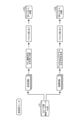
- FIG. 9 is a flowchart showing the processing procedure of the preprocessing phase.
- the preprocessing unit 151 of the information processing device 100 acquires protein structure data from the protein structure database PDB141 (step S101).
- the preprocessing unit 151 acquires a plurality of primary structures and coordinate information corresponding to each primary structure from the protein structure data (step S102).
- the preprocessing unit 151 breaks down the primary structure into multiple reference unit character strings and assigns a vector to each character string (step S103).
- the preprocessing unit 151 sets the relationship between the character strings and the vectors in the first vector dictionary 142a (step S104).
- the preprocessing unit 151 generates a Postscript program that draws the shape of a line connecting the positions of the first atom, the second atom, and the third atom contained in the coordinate information (step S105).
- the preprocessing unit 151 breaks down the character string of the Postscript program into multiple tokens and assigns a vector to each token (step S106).
- the preprocessing unit 151 sets the relationship between tokens and vectors in the second vector dictionary 142b (step S107).
- FIG. 10 is a flowchart showing the processing procedure of the learning phase.
- the learning processing unit 152 of the information processing device 100 acquires teaching data (sequence information and coordinate information) from the teaching data table 143 (step S201).
- the learning processing unit 152 calculates the sequence characteristic vector of each primary structure included in the sequence information based on the first vector dictionary 142a (step S202).
- the learning processing unit 152 generates character strings for multiple Postscript programs from multiple pieces of coordinate information (step S203).
- the learning processing unit 152 calculates a three-dimensional coordinate vector from each Postscript program based on the second vector dictionary 142b (step S204).
- the learning processing unit 152 inputs the pair of the array characteristic vector and the cubic coordinate vector to the machine learning model M1 (step S205).
- the learning processing unit 152 calculates the difference between the output result of the machine learning model M1 and the label (step S206).
- the learning processing unit 152 updates the parameters of the machine learning model M1 so as to reduce the difference (step S207). If the learning processing unit 152 continues the process (step S208, Yes), it proceeds to step S201. On the other hand, if the learning processing unit 152 does not continue the process (step S208, No), it ends the process.
- FIG. 11 is a flowchart showing the processing procedure of the inference phase.
- the inference processing unit 153 of the information processing device 100 acquires sequence information and coordinate information of the receptor and ligand to be inferred from the input unit 120 (step S301).
- the inference processing unit 153 calculates the sequence characteristic vector of each primary structure included in the sequence information based on the first vector dictionary 142a (step S302).
- the inference processing unit 153 generates multiple Postscript programs from the multiple pieces of coordinate information (step S303).
- the inference processing unit 153 calculates a three-dimensional coordinate vector from each Postscript program based on the second vector dictionary 142b (step S304).
- the inference processing unit 153 inputs a pair of the sequence characteristic vector of the primary structure and the three-dimensional coordinate vector to the machine learning model M1 (step S305). Based on the output result of the machine learning model M1, the inference processing unit 153 judges whether the target receptor (receptor combined with the ligand) is appropriate or not (step S306). The inference processing unit 153 displays the judgment result on the display unit 130 (step S307).
- the information processing device 100 trains the machine learning model M1 using teaching data that associates input data having sequence information of multiple primary structures contained in the higher-order structure of the receptor combined with the ligand and coordinate information of the primary structures with correct labels.
- the combined state it is possible to identify which primary structures that constitute the higher-order structure of the receptor are adjacent to the front and rear of the primary structure of the ligand. This makes it possible to generate a machine learning model M1 for appropriately estimating whether the target receptor and ligand can combine.
- the information processing device 100 generates coordinate information based on the positions of specific atoms contained in multiple primary structures. This makes it possible to generate a machine learning model M1 for estimating whether the sequence of the primary structure of a receptor combined with a ligand is appropriate, using both the sequence of the primary structure and the positions of the atoms.
- the information processing device 100 converts a character string of a PostScript program that draws a line segment connecting the positions of specific atoms contained in multiple primary structures into vector information, and generates the information as coordinate information. This makes it possible to handle the positions of specific atoms as vectors, and to efficiently execute machine learning for the machine learning model M1.
- the information processing device 100 generates sequence information by converting the primary structure into a vector based on a dictionary that associates character strings of basic protein units with vectors. This makes it possible to handle the primary structure as a vector, and to efficiently execute machine learning for the machine learning model M1.
- the information processing device 100 inputs input data having sequence information of multiple primary structures contained in the higher-order structure of the target receptor (receptor combined with a ligand) and coordinate information of the primary structures into a trained machine learning model M1. This makes it possible to appropriately estimate whether the target receptor and ligand can combine.
- the information processing device 100 sequentially inputs pairs of primary structures and coordinate information corresponding to the primary structures into a trained machine learning model M1, and obtains an output result from the machine learning model M1. This makes it possible not only to appropriately estimate whether the target receptor and ligand can combine, but also to estimate whether the sequence of the primary structure of the receptor combined with the ligand is appropriate.
- FIG. 12 is a diagram showing an example of the hardware configuration of a computer that realizes the same functions as the information processing device of the embodiment.
- computer 300 has a CPU 301 that executes various types of arithmetic processing, an input device 302 that accepts data input from the user, and a display 303.
- Computer 300 also has a communication device 304 that transmits and receives data to and from external devices, etc., via a wired or wireless network, and an interface device 305.
- Computer 300 also has a RAM 306 that temporarily stores various types of information, and a hard disk device 307. Each of devices 301 to 307 is connected to a bus 308.
- the hard disk device 307 stores a pre-processing program 307a, a learning processing program 307b, and an inference processing program 307c.
- the CPU 301 reads out each of the programs 307a to 307c and loads them into the RAM 306.
- the pre-processing program 307a functions as the pre-processing process 306a.
- the learning processing program 307b functions as the learning processing process 306b.
- the inference processing program 307c functions as the inference processing process 306c.
- the processing of the pre-processing process 306a corresponds to the processing of the pre-processing unit 151.
- the processing of the learning processing process 306b corresponds to the processing of the learning processing unit 152.
- the processing of the inference processing process 306c corresponds to the processing of the inference processing unit 153.
- each of the programs 307a to 307c does not necessarily have to be stored in the hard disk device 307 from the beginning.
- each program may be stored in a "portable physical medium" such as a flexible disk (FD), CD-ROM, DVD, magneto-optical disk, or IC card that is inserted into the computer 300. Then, the computer 300 may read and execute each of the programs 307a to 307c.
- REFERENCE SIGNS LIST 100 Information processing device 110 Communication unit 120 Input unit 130 Display unit 140 Storage unit 141 Protein structure DB 142a First vector dictionary 142b Second vector dictionary 143 Teacher data table 150 Control unit 151 Preprocessing unit 152 Learning processing unit 153 Inference processing unit
Landscapes
- Engineering & Computer Science (AREA)
- Theoretical Computer Science (AREA)
- Physics & Mathematics (AREA)
- Software Systems (AREA)
- Medical Informatics (AREA)
- Life Sciences & Earth Sciences (AREA)
- Artificial Intelligence (AREA)
- Computer Vision & Pattern Recognition (AREA)
- Evolutionary Computation (AREA)
- Data Mining & Analysis (AREA)
- Health & Medical Sciences (AREA)
- Spectroscopy & Molecular Physics (AREA)
- General Engineering & Computer Science (AREA)
- General Physics & Mathematics (AREA)
- Mathematical Physics (AREA)
- Computing Systems (AREA)
- Bioinformatics & Cheminformatics (AREA)
- General Health & Medical Sciences (AREA)
- Evolutionary Biology (AREA)
- Biotechnology (AREA)
- Bioinformatics & Computational Biology (AREA)
- Biophysics (AREA)
- Bioethics (AREA)
- Chemical & Material Sciences (AREA)
- Databases & Information Systems (AREA)
- Epidemiology (AREA)
- Public Health (AREA)
- Crystallography & Structural Chemistry (AREA)
- Information Retrieval, Db Structures And Fs Structures Therefor (AREA)
Abstract
Description
110 通信部
120 入力部
130 表示部
140 記憶部
141 タンパク質構造DB
142a 第1ベクトル辞書
142b 第2ベクトル辞書
143 教師データテーブル
150 制御部
151 前処理部
152 学習処理部
153 推論処理部
Claims (21)
- リガンドと合体した受容体の高次構造に含まれる複数の一次構造、および、前記複数の一次構造の構造情報を有する入力データと、前記受容体と前記リガンドとが合体可能であるか否かを示すラベルとが対応づけられた教師データを取得し、
前記教師データを基にして、機械学習モデルの機械学習を実行する
処理をコンピュータに実行させることを特徴とする学習プログラム。 - 前記入力データの前記高次構造は、前記リガンドの一次構造と、前記リガンドの一次構造以外の複数の一次構造とを含み、
前記機械学習を実行する処理は、前記一次構造と構造情報との組を順番に、前記機械学習モデルに入力し、前記機械学習モデルの出力結果と、前記ラベルとの差が小さくなるように、前記機械学習モデルの機械学習を実行することを特徴とする請求項1に記載の学習プログラム。 - 前記一次構造に含まれる所定の原子の位置を基にして、前記構造情報を生成する処理を更にコンピュータに実行させることを特徴とする請求項1に記載の学習プログラム。
- 前記一次構造に含まれる所定の原子の位置を結んだ線分を描画するPostScriptの文字列を、ベクトルに変換する処理を更にコンピュータに実行させることを特徴とする請求項2に記載の学習プログラム。
- 前記一次構造を、タンパク質のアミノ酸配列や有機化合物の官能基配列の文字列に分割し、各文字や各文字列にベクトルを割り当てることで、前記一次構造をベクトルに変換する処理を更にコンピュータに実行させることを特徴とする請求項1に記載の学習プログラム。
- 推論対象となる対象受容体の対象高次構造であって、対象リガンドと合体した前記対象受容体の前記対象高次構造に含まれる複数の対象一次構造、および、前記複数の対象一次構造に対応する複数の対象構造情報を取得し、
リガンドと合体した受容体の高次構造に含まれる複数の一次構造、および、前記複数の一次構造の構造情報を有する入力データと、前記受容体と前記リガンドとが合体可能であるか否かを示すラベルとが対応づけられた教師データを基にして機械学習が実行された機械学習モデルに対して、前記複数の対象一次構造、前記複数の対象構造情報を入力することで、前記対象受容体が適切であるか否かを推論する
処理をコンピュータに実行させることを特徴とする推論プログラム。 - 前記対象高次構造は、前記対象リガンドの対象一次構造と、前記対象リガンドの対象一次構造以外の複数の対象一次構造とを含み、
前記推論する処理は、前記対象一次構造と前記対象構造情報との組を順番に、前記機械学習モデルに入力し、前記機械学習モデルの出力結果と基にして、前記対象受容体が適切であるか否かを推論することを特徴とする請求項6に記載の推論プログラム。 - リガンドと合体した受容体の高次構造に含まれる複数の一次構造、および、前記複数の一次構造の構造情報を有する入力データと、前記受容体と前記リガンドとが合体可能であるか否かを示すラベルとが対応づけられた教師データを取得し、
前記教師データを基にして、機械学習モデルの機械学習を実行する
処理をコンピュータが実行することを特徴とする学習方法。 - 前記入力データの前記高次構造は、前記リガンドの一次構造と、前記リガンドの一次構造以外の複数の一次構造とを含み、
前記機械学習を実行する処理は、前記一次構造と構造情報との組を順番に、前記機械学習モデルに入力し、前記機械学習モデルの出力結果と、前記ラベルとの差が小さくなるように、前記機械学習モデルの機械学習を実行することを特徴とする請求項8に記載の学習方法。 - 前記一次構造に含まれる所定の原子の位置を基にして、前記構造情報を生成する処理を更にコンピュータが実行することを特徴とする請求項8に記載の学習方法。
- 前記一次構造に含まれる所定の原子の位置を結んだ線分を描画するPostScriptの文字列を、ベクトルに変換する処理を更にコンピュータが実行することを特徴とする請求項9に記載の学習方法。
- 前記一次構造を、タンパク質のアミノ酸配列や有機化合物の官能基配列の文字列に分割し、各文字や各文字列にベクトルを割り当てることで、前記一次構造をベクトルに変換する処理を更にコンピュータが実行することを特徴とする請求項8に記載の学習方法。
- 推論対象となる対象受容体の対象高次構造であって、対象リガンドと合体した前記対象受容体の前記対象高次構造に含まれる複数の対象一次構造、および、前記複数の対象一次構造に対応する複数の対象構造情報を取得し、
リガンドと合体した受容体の高次構造に含まれる複数の一次構造、および、前記複数の一次構造の構造情報を有する入力データと、前記受容体と前記リガンドとが合体可能であるか否かを示すラベルとが対応づけられた教師データを基にして機械学習が実行された機械学習モデルに対して、前記複数の対象一次構造、前記複数の対象構造情報を入力することで、前記対象受容体が適切であるか否かを推論する
処理をコンピュータが実行することを特徴とする推論方法。 - 前記対象高次構造は、前記対象リガンドの対象一次構造と、前記対象リガンドの対象一次構造以外の複数の対象一次構造とを含み、
前記推論する処理は、前記対象一次構造と前記対象構造情報との組を順番に、前記機械学習モデルに入力し、前記機械学習モデルの出力結果と基にして、前記対象受容体が適切であるか否かを推論することを特徴とする請求項13に記載の推論方法。 - リガンドと合体した受容体の高次構造に含まれる複数の一次構造、および、前記複数の一次構造の構造情報を有する入力データと、前記受容体と前記リガンドとが合体可能であるか否かを示すラベルとが対応づけられた教師データを取得し、
前記教師データを基にして、機械学習モデルの機械学習を実行する
処理を実行する制御部を有する情報処理装置。 - 前記入力データの前記高次構造は、前記リガンドの一次構造と、前記リガンドの一次構造以外の複数の一次構造とを含み、
前記制御部は、前記一次構造と構造情報との組を順番に、前記機械学習モデルに入力し、前記機械学習モデルの出力結果と、前記ラベルとの差が小さくなるように、前記機械学習モデルの機械学習を実行することを特徴とする請求項15に記載の情報処理装置。 - 前記制御部は、前記一次構造に含まれる所定の原子の位置を基にして、前記構造情報を生成する処理を更に実行することを特徴とする請求項15に記載の情報処理装置。
- 前記制御部は、前記一次構造に含まれる所定の原子の位置を結んだ線分を描画するPostScriptの文字列を、ベクトルに変換する処理を更に実行することを特徴とする請求項17に記載の情報処理装置。
- 前記制御部は、前記一次構造を、タンパク質のアミノ酸配列や有機化合物の官能基配列の文字列に分割し、各文字列にベクトルを割り当てることで、前記一次構造をベクトルに変換する処理を更に実行することを特徴とする請求項15に記載の情報処理装置。
- 推論対象となる対象受容体の対象高次構造であって、対象リガンドと合体した前記対象受容体の前記対象高次構造に含まれる複数の対象一次構造、および、前記複数の対象一次構造に対応する複数の対象構造情報を取得し、
リガンドと合体した受容体の高次構造に含まれる複数の一次構造、および、前記複数の一次構造の構造情報を有する入力データと、前記受容体と前記リガンドとが合体可能であるか否かを示すラベルとが対応づけられた教師データを基にして機械学習が実行された機械学習モデルに対して、前記複数の対象一次構造、前記複数の対象構造情報を入力することで、前記対象受容体が適切であるか否かを推論する
処理を実行する制御部を有する情報処理装置。 - 前記対象高次構造は、前記対象リガンドの対象一次構造と、前記対象リガンドの対象一次構造以外の複数の対象一次構造とを含み、
前記制御部は、前記対象一次構造と前記対象構造情報との組を順番に、前記機械学習モデルに入力し、前記機械学習モデルの出力結果と基にして、前記対象受容体が適切であるか否かを推論することを特徴とする請求項20に記載の情報処理装置。
Priority Applications (3)
| Application Number | Priority Date | Filing Date | Title |
|---|---|---|---|
| PCT/JP2023/015686 WO2024218924A1 (ja) | 2023-04-19 | 2023-04-19 | 学習プログラム、推論プログラム、学習方法、推論方法および情報処理装置 |
| JP2025514981A JPWO2024218924A1 (ja) | 2023-04-19 | 2023-04-19 | |
| US19/356,244 US20260037876A1 (en) | 2023-04-19 | 2025-10-13 | Non-transitory computer-readable recording medium, learning method, inference method, and information processing apparatus |
Applications Claiming Priority (1)
| Application Number | Priority Date | Filing Date | Title |
|---|---|---|---|
| PCT/JP2023/015686 WO2024218924A1 (ja) | 2023-04-19 | 2023-04-19 | 学習プログラム、推論プログラム、学習方法、推論方法および情報処理装置 |
Related Child Applications (1)
| Application Number | Title | Priority Date | Filing Date |
|---|---|---|---|
| US19/356,244 Continuation US20260037876A1 (en) | 2023-04-19 | 2025-10-13 | Non-transitory computer-readable recording medium, learning method, inference method, and information processing apparatus |
Publications (1)
| Publication Number | Publication Date |
|---|---|
| WO2024218924A1 true WO2024218924A1 (ja) | 2024-10-24 |
Family
ID=93152229
Family Applications (1)
| Application Number | Title | Priority Date | Filing Date |
|---|---|---|---|
| PCT/JP2023/015686 Ceased WO2024218924A1 (ja) | 2023-04-19 | 2023-04-19 | 学習プログラム、推論プログラム、学習方法、推論方法および情報処理装置 |
Country Status (3)
| Country | Link |
|---|---|
| US (1) | US20260037876A1 (ja) |
| JP (1) | JPWO2024218924A1 (ja) |
| WO (1) | WO2024218924A1 (ja) |
-
2023
- 2023-04-19 JP JP2025514981A patent/JPWO2024218924A1/ja active Pending
- 2023-04-19 WO PCT/JP2023/015686 patent/WO2024218924A1/ja not_active Ceased
-
2025
- 2025-10-13 US US19/356,244 patent/US20260037876A1/en active Pending
Non-Patent Citations (3)
| Title |
|---|
| DEREK JONES; HYOJIN KIM; XIAOHUA ZHANG; ADAM ZEMLA; GARRETT STEVENSON; WILLIAM D. BENNETT; DAN KIRSHNER; SERGIO WONG; FELICE LIGHT: "Improved Protein-ligand Binding Affinity Prediction with Structure-Based Deep Fusion Inference", ARXIV.ORG, CORNELL UNIVERSITY LIBRARY, 201 OLIN LIBRARY CORNELL UNIVERSITY ITHACA, NY 14853, 18 May 2020 (2020-05-18), 201 Olin Library Cornell University Ithaca, NY 14853 , XP081674455 * |
| OFER DAN, BRANDES NADAV, LINIAL MICHAL: "The language of proteins: NLP, machine learning & protein sequences", COMPUTATIONAL AND STRUCTURAL BIOTECHNOLOGY JOURNAL, RESEARCH NETWORK OF COMPUTATIONAL AND STRUCTURAL BIOTECHNOLOGY, SWEDEN, vol. 19, 1 January 2021 (2021-01-01), Sweden , pages 1750 - 1758, XP093222546, ISSN: 2001-0370, DOI: 10.1016/j.csbj.2021.03.022 * |
| ÖZCELIK RIZA, VAN TILBORG DEREK, ÉNEZ-LUNA JIM, GRISONI FRANCESCA: "Structure-based drug discovery with deep learning", ARXIV:2212.13295V1, 26 December 2022 (2022-12-26), XP093222547, Retrieved from the Internet <URL:https://arxiv.org/pdf/2212.13295> * |
Also Published As
| Publication number | Publication date |
|---|---|
| US20260037876A1 (en) | 2026-02-05 |
| JPWO2024218924A1 (ja) | 2024-10-24 |
Similar Documents
| Publication | Publication Date | Title |
|---|---|---|
| US12468886B2 (en) | Computing numeric representations of words in a high-dimensional space | |
| EP3732633B1 (en) | Universal transformers | |
| Modi et al. | Facial emotion recognition using convolution neural network | |
| Chen et al. | Combination of deep neural network with attention mechanism enhances the explainability of protein contact prediction | |
| CN113571124A (zh) | 一种配体-蛋白质相互作用的预测方法及装置 | |
| Vidovic et al. | Feature importance measure for non-linear learning algorithms | |
| CN110444199A (zh) | 一种语音关键词识别方法、装置、终端及服务器 | |
| CN108780525A (zh) | 用于生成学习的系统和方法 | |
| CN112632260A (zh) | 智能问答方法、装置、电子设备及计算机可读存储介质 | |
| Paaß et al. | Artificial intelligence: what is behind the technology of the future? | |
| CN109359308A (zh) | 机器翻译方法、装置及可读存储介质 | |
| CN115392237B (zh) | 情感分析模型训练方法、装置、设备及存储介质 | |
| WO2024218924A1 (ja) | 学習プログラム、推論プログラム、学習方法、推論方法および情報処理装置 | |
| JP7204431B2 (ja) | 単語ベクトルリスト生成装置 | |
| KR102617957B1 (ko) | 비공유결합 기반 단백질-리간드 결합 친화도 예측 방법 및 장치 | |
| CN110135583A (zh) | 标注信息的生成方法、标注信息的生成装置和电子设备 | |
| JP7643580B2 (ja) | 処理方法、処理プログラムおよび情報処理装置 | |
| Leeman-Munk et al. | Two modes are better than one: a multimodal assessment framework integrating student writing and drawing | |
| Rosenhouse | On mathematical anti-evolutionism | |
| JP2024108021A (ja) | 情報処理装置、情報処理方法、及び情報処理プログラム | |
| Thenmozhi et al. | Robotic simulation using natural language commands | |
| Nazaruddin et al. | Utilising the YOLOv3 Algorithm for the Student Posture Recognition System in Classroom Settings | |
| Sakshuwong et al. | MolAR: bringing chemical structures to life with augmented reality and machine learning | |
| Sokolova et al. | Contrastive pre-training for sequence based genomics models | |
| Wahab et al. | Interactive Visualization to Enhance Learning Experienced on Machining Process of EDM Wire Cut Through Augmented Reality (AR) |
Legal Events
| Date | Code | Title | Description |
|---|---|---|---|
| 121 | Ep: the epo has been informed by wipo that ep was designated in this application |
Ref document number: 23934069 Country of ref document: EP Kind code of ref document: A1 |
|
| ENP | Entry into the national phase |
Ref document number: 2025514981 Country of ref document: JP Kind code of ref document: A |
|
| WWE | Wipo information: entry into national phase |
Ref document number: 2025514981 Country of ref document: JP |
|
| NENP | Non-entry into the national phase |
Ref country code: DE |
|
| 122 | Ep: pct application non-entry in european phase |
Ref document number: 23934069 Country of ref document: EP Kind code of ref document: A1 |