WO2024206136A1 - Process for preparing bulevirtide - Google Patents
Process for preparing bulevirtide Download PDFInfo
- Publication number
- WO2024206136A1 WO2024206136A1 PCT/US2024/021120 US2024021120W WO2024206136A1 WO 2024206136 A1 WO2024206136 A1 WO 2024206136A1 US 2024021120 W US2024021120 W US 2024021120W WO 2024206136 A1 WO2024206136 A1 WO 2024206136A1
- Authority
- WO
- WIPO (PCT)
- Prior art keywords
- asn
- pro
- asp
- phe
- gly
- Prior art date
- Legal status (The legal status is an assumption and is not a legal conclusion. Google has not performed a legal analysis and makes no representation as to the accuracy of the status listed.)
- Ceased
Links
Classifications
-
- C—CHEMISTRY; METALLURGY
- C07—ORGANIC CHEMISTRY
- C07K—PEPTIDES
- C07K14/00—Peptides having more than 20 amino acids; Gastrins; Somatostatins; Melanotropins; Derivatives thereof
- C07K14/001—Peptides having more than 20 amino acids; Gastrins; Somatostatins; Melanotropins; Derivatives thereof by chemical synthesis
Definitions
- the present application provides a process for preparing an acetic acid salt of bulevirtide, which is useful for the inhibition of hepatitis B virus (HBV) and/or hepatitis D virus (HDV) infection, prevention of primary HBV and/or HDV infection, as well as treatment of (chronic) hepatitis B and/or D.
- HBV hepatitis B virus
- HDV hepatitis D virus
- Hepatitis B virus is the prototype of a family of small, enveloped DNA viruses of mammals and birds (Seeger et al, Microbiol. Mol. Biol. Rev. 64, 51-68 (2000)).
- Hepatitis D virus is a hybrid virus and uses the HBV surface antigen as its envelope protein.
- the HBV envelope encloses three proteins termed L-(large), M-(middle) and S-(small). They share the C- terminal S-domain with four transmembrane regions.
- the M- and L-protein carry additional N- terminal extensions of 55 (preS2) and, genotype-dependent, 107 or 118 aa (preSl).
- the present application is directed to processes for preparing an acetic acid salt of bulevirtide, which is useful for the inhibition, prevention, and/or treatment of HBV and/or HDV infection, and other HBV- and/or HDV-related diseases.
- the instant application contains a Sequence Listing that has been submitted electronically as an XML file named “35648-0289WOl_SL.xml.”
- the XML file, created on March 6, 2024, is 22523 bytes in size.
- the material in the XML file is hereby incorporated by reference in its entirety.
- the present application provides, inter alia, a process of preparing an acetic acid salt of the compound of Formula I:
- FIG. 1 shows the structure of bulevirtide.
- the present application provides a process of preparing an acetic acid salt of bulevirtide.
- Bulevirtide is a hydrophobic modified preS-derived peptide of HBV having the structure of Formula I:
- bulevirtide refers to a coupled myristic acid group (z.e., CisFtnCfO)-).
- bulevirtide may also be referred to as “the compound of Formula I”, “Myr-(SEQ ID NO.: 1)-NH2”, or “Ci3H2?C(O)-(SEQ ID NO.: 1)-NH2”. The structure of bulevirtide is shown in FIG. 1.
- SEQ ID NO.: 1 refers to the following sequence:
- the process of preparing the acetic acid salt of bulevirtide comprises reacting a tetrafluoroboric acid salt of the compound of Formula I with acetic acid.
- the reaction is a salt exchange reaction.
- the process of preparing the acetic acid salt of bulevirtide comprises reacting a trifluoroacetic acid salt of the compound of Formula I with acetic acid.
- the reaction is a salt exchange reaction.
- the reacting is performed in the presence of a solvent comprising water. In some embodiments, the reacting is performed in the presence of a solvent comprising water and acetonitrile. In some embodiments, the reacting is performed in the presence of water. In some embodiments, the reacting is performed in the presence of water and an alcohol. In some embodiments, the reacting is performed in the presence of water and methanol. In some embodiments, the reacting is performed in the presence of water and ethanol.
- the reacting is performed in the presence of a buffer agent. In some embodiments, the reacting is performed in the presence of a buffer agent comprising ammonium acetate, an amine base, and an inorganic acid.
- the reacting comprises mixing the compound of Formula I with an amine base and an inorganic acid to form a first mixture and subsequently mixing the first mixture with ammonium acetate.
- the buffer agent comprises an ammonium salt. In some embodiments, the buffer agent comprises ammonium acetate.
- the buffer agent comprises an amine base. In some embodiments, the buffer agent comprises a tertiary amine base. In some embodiments, the buffer agent comprises a tri(Ci-6 alkyl)amine base.
- Example tri(Ci-6 alkyl)amine bases include, but are not limited to, trimethylamine, triethylamine, triisopropylamine, tributylamine, and the like. In some embodiments, the buffer agent comprises triethylamine.
- the buffer agent comprises a weak inorganic acid.
- the inorganic acid is phosphoric acid.
- amine base is triethylamine and the inorganic acid is phosphoric acid
- the reacting is performed in a liquid chromatography system.
- the process further comprises substantially isolating the acetic acid salt of bulevirtide.
- substantially isolated is meant that the compound or salt (e.g., the acetic acid salt of bulevirtide), is at least partially or substantially separated from the environment in which it was formed or detected. Partial separation can include, for example, a composition enriched in the compound or salt of the invention.
- Substantial separation can include compositions containing from at least about 50% to at least about 99% by weight of the compound or salt, for example, at least about 50%, at least about 60%, at least about 70%, at least about 80%, at least about 90%, at least about 95%, at least about 97%, or at least about 99% by weight of the compound or salt.
- the isolating comprises lyophilization.
- the isolating comprises chromatography (e.g., preparative chromatography).
- the tetrafluoroboric acid salt of bulevirtide (z.e., the tetrafluoroboric acid salt of the compound of Formula I) is prepared by deprotecting a compound of Formula VI:
- Ring A refers to a solid support (e.g., a resin), and PG 1 , PG 2 , PG 3 , PG 4 , PG 5 , PG 6 , PG 7 , PG 8 , and PG 10 are each independently absent or a protecting group.
- the compound of Formula VI may also be referred to as
- SEQ ID NO.: 2 refers to the following sequence:
- the trifluoroacetic acid salt of bulevirtide (ie., the trifluoroacetic acid salt of the compound of Formula I) is prepared by deprotecting a compound of Formula VI:
- Ring A refers to a resin.
- the L ⁇ Resin group is a group that results in C terminal amide groups when cleaved.
- the linking group is a 4-((2,4-dimethoxyphenyl)(Fmoc amino)methyl)phenoxyacetic acid linking group (i.e., a Rink amide linker).
- the resin is selected from a 4- methylbenzhydrylamine HC1 salt resin, a PAL Resin, a Sieber amide resin, and a Ramage resin.
- the resin is a 4-methylbenzhydrylamine HC1 salt resin.
- the compound of Formula VI is a compound of Formula II:
- the tetrafluoroboric acid salt of bulevirtide (z.e., the tetrafluoroboric acid salt of the compound of Formula I) is prepared by deprotecting a compound of Formula II:
- PG 1 , PG 3 , PG 4 , PG 5 , PG 8 , and PG 10 are each an independently selected protecting group
- Ring A refers to a resin.
- the trifluoroacetic acid salt of bulevirtide (ie., the trifluoroacetic acid salt of the compound of Formula I) is prepared by deprotecting a compound of Formula II: Myr-Gly-Thr(PG 1 )-Asn(PG 2 )-Leu-Ser(PG 3 )-Val-Pro-Asn(PG 2 )-Pro-Leu-Gly-
- Trp(PG 7 ) Pro ⁇ in the presence of trifluoroacetic acid wherein: wherein PG 2 , PG 6 , PG 7 are each independently absent or a protecting group; and
- PG 1 , PG 3 , PG 4 , PG 5 , PG 8 , and PG 10 are each an independently selected protecting group
- Ring A refers to a resin.
- the tetrafluoroboric acid salt of bulevirtide (z.e., the tetrafluoroboric acid salt of the compound of Formula I) is prepared by deprotecting a compound of Formula II:
- PG 1 , PG 2 , PG 3 , PG 4 , PG 5 , PG 6 , PG 7 , PG 8 , and PG 10 are each an independently selected protecting group;
- Ring A refers to a resin.
- the trifluoroacetic acid salt of bulevirtide (ie., the trifluoroacetic acid salt of the compound of Formula I) is prepared by deprotecting a compound of Formula II: Myr-Gly-Thr(PG 1 )-Asn(PG 2 )-Leu-Ser(PG 3 )-Val-Pro-Asn(PG 2 )-Pro-Leu-Gly-
- PG 1 , PG 2 , PG 3 , PG 4 , PG 5 , PG 6 , PG 7 , PG 8 , and PG 10 are each an independently selected protecting group;
- Ring A refers to a resin.
- protecting groups refers to a moiety that may be used to prevent unwanted reactions of a group (e.g., an amino group) while performing a desired transformation.
- Protecting groups e.g., amino protecting groups
- the deprotecting of the compound of Formula II is performed in the presence of tetrafluoroboric acid. In some embodiments, the deprotecting of the compound of Formula II is performed in the presence of trifluoroacetic acid. In some embodiments, the deprotecting of the compound of Formula II is performed in the presence of trifluoroacetic acid and water. In some embodiments, the deprotecting of the compound of Formula II is performed in the presence of (CHsO ⁇ SiCl.
- the deprotecting of the compound of Formula II is performed in the presence of one or more additives.
- the one or more additives comprise water, one or more silyl compounds, one or more thiol compounds, and one or more aromatic compounds, or any combination thereof.
- the one or more additives comprise one or more silyl compounds, one or more thiol compounds, and one or more aromatic compounds, or any combination thereof.
- the one or more silyl compounds are each an independently selected tri(Ci-6 alkyl) silane compound. In some embodiments, the one or more silyl compounds are each independently selected from triisopropyl silane (TIPS) and triethylsilane (TES).
- TIPS triisopropyl silane
- TES triethylsilane
- the one or more thiol compounds are each an independently selected dithiol compound. In some embodiments, the one or more thiol compounds are each independently selected from dioxa-l,8-octane-dithiol, dithioethane (DTE), 1,2-ethanedithiol (EDT), and dithiothreitol (DTT). In some embodiments, the thiol compound is di oxa- 1,8 -octanedi thiol.
- the one or more aromatic compounds are each independently selected from phenol and anisole.
- the deprotecting of the compound of Formula II is performed in the presence of 2,2'-(ethylenedioxy)diethanethiol. In some embodiments, the deprotecting of the compound of Formula II is performed in the presence of thioanisole. In some embodiments, the deprotecting of the compound of Formula II is performed in the presence of phenol. In some embodiments, the deprotecting of the compound of Formula II is performed in the presence of 2,2'-(ethylenedioxy)diethanethiol, thioanisole, and phenol.
- the deprotecting of the compound of Formula II is performed at a temperature of from about 10°C to about 35°C. In some embodiments, the deprotecting of the compound of Formula II is performed at a temperature of from about 15°C to about 25°C. In some embodiments, the deprotecting of the compound of Formula II is performed at a temperature of from about 19°Cto about 22°C.
- the deprotecting further comprises substantially isolating the tetrafluoroboric acid salt of bulevirtide (e.g., in the presence of an organic ether). In some embodiments, the deprotecting further comprises substantially isolating the trifluoroacetic acid salt of bulevirtide (e.g., in the presence of an organic ether). In some embodiments, the isolating comprises precipitating the trifluoroacetic acid salt of bulevirtide. In some embodiments, the isolating comprises precipitating the trifluoroacetic acid salt of bulevirtide in the presence of diethyl ether.
- the compound of Formula II is prepared by reacting a compound of Formula Illa:
- the coupling conditions comprise reacting the compound of Formula Illa with myristic acid in the presence of an amino coupling agent and an amino coupling additive.
- the amino coupling agent comprises one or more benzotriazole compounds (see e.g., J. Org. Chem. 2019, 84, 4615-4628), one or more uronium or aminium salts (e.g., l-[bis(dimethylamino)methylene]-lH-l,2,3-triazolo[4,5-b]pyridinium 3-oxide hexafluorophosphate (HATU), 2-(6-chloro-lH-benzotriazole-l-yl)-l,l,3,3-tetramethylaminium hexafluorophosphate (HCTU), 2-(lH-benzotriazole-l-yl)-l, 1,3,3-tetramethylaminium tetrafluorob orate (TBTU), tetramethylfluoroformamidinium hexafluorophosphate (TFFH), N'- tetramethylchloroformamidinium hexafluor
- the amino coupling agent is 2-(lH-benzotriazol-l-yl)-l, 1,3,3- tetramethyluronium hexafluorophosphate.
- the amino coupling additive is selected from 1- hydroxybenzotriazole (HOBt), l-hydroxy-7-azabenzotriazole (HO At), and ethyl cyano(hydroxyimino)acetate (oxyma pure). In some embodiments, the amino coupling additive is 1 -hydroxybenzotriazole.
- the coupling conditions comprise reacting the compound of Formula Illa with myristic acid in the presence of 2-(lH-benzotriazol-l-yl)-l, 1,3,3- tetramethyluronium hexafluorophosphate and 1 -hydroxybenzotriazole.
- the process further comprises mixing the myristic acid, 2-(lH- benzotriazol-l-yl)-l,l,3,3-tetramethyluronium hexafluorophosphate, and 1- hydroxybenzotriazole, prior to reacting with the compound of Formula Illa.
- the reacting of the compound of Formula Illa with myristic acid is performed in the presence of an amine base.
- the amine base is selected from triethylamine, ethyldiisopropylamine, pyrrolidine, l,4-diazabicylo[2.2.2]-octane, 1,8- diazabicyclo[5.4.0]undec-7-ene, and l,5-diazabicyclo-4.3.0]non-5-ene.
- the amine base is N-methylmorpholine.
- the reacting of the compound of Formula Illa and myristic acid is performed a temperature of from about 5°C to about 40°C. In some embodiments, the reacting of the compound of Formula Illa and myristic acid is performed a temperature of from about 15°C to about 30°C. In some embodiments, the reacting of the compound of Formula Illa and myristic acid is performed a temperature of from about 17°C to about 27°C.
- the reacting of the compound of Formula Illa and myristic acid is performed in the presence of a solvent.
- the solvent comprises a polar aprotic solvent (e.g., N,N-dimethylformamide (DMF), N-methyl-2-pyrrolidone (NMP), dimethylacetamide (DMAc), dimethyl sulfoxide (DMSO), pyridine, and the like), an ether (e.g., tetrahydrofuran, 2-methyltetrahydrofuran, dimethoxyethane, and the like), a chlorinated solvent (e.g., di chloromethane, di chloroethane, chloroform, and the like), or any combination thereof.
- the solvent comprises N,N-dimethylformamide.
- the compound of Formula Illa is prepared by deprotecting a compound of Formula III:
- the compound of Formula III may also be referred to as
- SEQ ID NO.: 3 refers to the following sequence:
- the compound of Formula Illa is prepared by deprotecting a compound of Formula III: Gly(PG 9 )-Thr(PG 1 )-Asn(PG 2 )-Leu-Ser(PG 3 )-Val-Pro-Asn(PG 2 )-Pro-Leu-
- the deprotecting comprises reacting the compound of Formula III with an amine base.
- the amine base is a tertiary amine base or a secondary amine base.
- the amine base is selected from piperidine, morpholine, 4-methylpiperidine, piperazine, pyrrolidine, triethylamine, ethyldiisopropylamine, pyrrolidine, l,4-diazabicylo[2.2.2]-octane, l,8-diazabicyclo[5.4.0]undec-7-ene, and 1,5- diazabicyclo-4.3.0]non-5-ene.
- the amine base comprises piperidine.
- the deprotecting is performed in the presence of a solvent.
- the solvent comprises a polar aprotic solvent (e.g., N,N-dimethylformamide (DMF), N-methyl-2-pyrrolidone (NMP), dimethylacetamide (DMAc), dimethyl sulfoxide (DMSO), pyridine, and the like), an ether (e.g., tetrahydrofuran, 2-methyltetrahydrofuran, dimethoxy ethane, and the like), a chlorinated solvent (e.g., dichloromethane, dichloroethane, chloroform, and the like), or any combination thereof.
- the deprotecting is performed in the presence of a solvent comprising N,N-dimethylformamide.
- the deprotecting is performed in the presence of an additive.
- the additive is selected from a reagent that suppresses racemization and aspartimide formation (see e.g, www.peptide.com/resources/solid-phase-peptide- synthesis/amino-acid-derivatives-for-peptide-synthesis/, and all references cited therein; and Chem. Rev. 2009, 109, 6, 2455-2504).
- the additive is selected from an organic acid (e.g, formic acid) and a heterocyclic compound (e.g., 1 -hydroxybenzotriazole (HOBt), 6-chloro-l -hydroxybenzotriazole (Cl-HOBt), and the like).
- organic acid e.g, formic acid
- heterocyclic compound e.g., 1 -hydroxybenzotriazole (HOBt), 6-chloro-l -hydroxybenzotriazole (Cl-HOBt), and the like.
- the deprotecting is performed at a temperature of from about 5°C to about 40°C. In some embodiments, the deprotecting is performed at a temperature of from about 15°C to about 30°C. In some embodiments, the deprotecting is performed at a temperature of from about 17°C to about 27°C. In some embodiments, the deprotecting is performed at a temperature of from about 19°C to about 25°C.
- the compound of Formula III is prepared by sequentially coupling the compound of Formula IV: with one or more protected amino acids selected from PG 9 -Gly-OH, Fmoc-Val-OH, Fmoc-Ala-OH, Fmoc-Pro-OH, Fmoc-Phe-OH, Fmoc-Leu-OH, Fmoc-Th ⁇ PG ⁇ -OH, Fmoc- Asn(PG 2 )-OH, Fmoc-Ser(PG 3 )-OH, Fmoc-Asp(PG 4 )-OH, Fmoc-His(PG 5 )-OH, Fmoc-Gln(PG 6 )- OH, Fmoc-Trp(PG 7 )-OH, Fmoc-Lys(PG 8 )-OH, and Fmoc-Glu(PG 10 )-OH, under coupling conditions, to afford the compound of Formula III, wherein PG 2 , PG 6 , PG 7
- PG 1 , PG 3 , PG 4 , PG 5 , PG 8 , PG 9 , and PG 10 are each an independently selected protecting group.
- the compound of Formula III is prepared by sequentially coupling the compound of Formula IV: with one or more protected amino acids selected from PG 9 -Gly-OH, Fmoc-Val-OH, Fmoc-Ala-OH, Fmoc-Pro-OH, Fmoc-Phe-OH, Fmoc-Leu-OH, Fmoc-Th ⁇ PG ⁇ -OH, Fmoc- Asn(PG 2 )-OH, Fmoc-Ser(PG 3 )-OH, Fmoc-Asp(PG 4 )-OH, Fmoc-His(PG 5 )-OH, Fmoc-Gln(PG 6 )- OH, Fmoc-Trp(PG 7 )-OH, Fmoc-Lys(PG 8 )-OH, and Fmoc-Glu(PG 10 )-OH, under coupling conditions, to afford the compound of Formula III, wherein PG 10 is a protecting group.
- one or more protected amino acids
- the coupling and deprotecting steps are repeated one or more times.
- the amino coupling agent comprises one or more benzotriazole compounds (see e.g., J. Org. Chem. 2019, 84, 4615-4628), one or more uronium or aminium salts (e.g., l-[bis(dimethylamino)methylene]-lH-l,2,3-triazolo[4,5-b]pyridinium 3-oxide hexafluorophosphate (HATU), 2-(6-chloro-lH-benzotriazole-l-yl)-l,l,3,3-tetramethylaminium hexafluorophosphate (HCTU), 2-(lH-benzotriazole-l-yl)-l, 1,3,3-tetramethylaminium tetrafluorob orate (TBTU), tetramethylfluoroformamidinium hexafluorophosphate (TFFH), N'- tetramethylchloroformamidinium hexafluor
- the amino coupling additive is 1 -hydroxybenzotriazole.
- the deprotecting of the Fmoc group is performed in the presence of an amine base, which is a tertiary amine base or a secondary amine base.
- the amine base is selected from piperidine, morpholine, 4-methylpiperidine, piperazine, pyrrolidine, tri ethylamine, ethyldiisopropylamine, pyrrolidine, 1,4- diazabicylo[2.2.2]-octane, l,8-diazabicyclo[5.4.0]undec-7-ene, and l,5-diazabicyclo-4.3.0]non- 5-ene.
- the amine base comprises piperidine.
- the coupling and deprotecting steps are performed in the presence of a solvent.
- the solvent comprises a polar aprotic solvent (e.g., N,N- dimethylformamide (DMF), N-methyl-2-pyrrolidone (NMP), dimethylacetamide (DMAc), dimethyl sulfoxide (DMSO), pyridine, and the like), an ether (e.g., tetrahydrofuran, 2- methyltetrahydrofuran, dimethoxy ethane, and the like), a chlorinated solvent (e.g., dichloromethane, di chloroethane, chloroform, and the like), or any combination thereof.
- the coupling and deprotecting steps are performed in the presence of a solvent comprising N,N-dimethylformamide.
- the coupling and deprotecting steps are performed at a temperature of from about 5°C to about 40°C. In some embodiments, the coupling further comprises as pre-activation step performed at about -10°C to about 10°C. performed at a temperature of from about 5°C to about 40°C. In some embodiments, the coupling and deprotecting steps are performed at a temperature of from about 15°C to about 30°C. In some embodiments, the coupling and deprotecting steps are performed at a temperature of from about 17°C to about 27°C.
- the compound of Formula IV is prepared by deprotecting a compound of Formula IVa: in the presence of an amine base.
- the amine base is a tertiary amine base or a secondary amine base.
- the amine base is selected from piperidine, morpholine, 4- methylpiperidine, piperazine, pyrrolidine, tri ethylamine, ethyldiisopropylamine, pyrrolidine, 1,4- diazabicylo[2.2.2]-octane, l,8-diazabicyclo[5.4.0]undec-7-ene, and l,5-diazabicyclo-4.3.0]non- 5-ene.
- the amine base comprises piperidine.
- the deprotecting is performed in the presence of a solvent.
- the solvent comprises a polar aprotic solvent (e.g., N,N-dimethylformamide (DMF), N-methyl-2-pyrrolidone (NMP), dimethylacetamide (DMAc), dimethyl sulfoxide (DMSO), pyridine, and the like), an ether (e.g., tetrahydrofuran, 2-methyltetrahydrofuran, dimethoxy ethane, and the like), a chlorinated solvent (e.g., dichloromethane, dichloroethane, chloroform, and the like), or any combination thereof.
- the deprotecting is performed in the presence of a solvent comprises N,N-dimethylformamide.
- the deprotecting is performed at a temperature of from about 5°C to about 40°C. In some embodiments, the deprotecting is performed at a temperature of from about 15°C to about 30°C. In some embodiments, the deprotecting is are performed at a temperature of from about 17°C to about 27°C. In some embodiments, the deprotecting is are performed at a temperature of from about 19°C to about 25°C.
- the compound of Formula IVa is prepared by reacting 4- methylbenzhydrylamine resin with a compound of Formula V:
- V in the presence of an amine base and an amino coupling agent.
- the amine base is selected from N-methylmorpholine, N,N- diisopropylethylamine (DIPEA), triethylamine, pyrrolidine, l,4-diazabicylo[2.2.2]-octane, 1,8- diazabicyclo[5.4.0]undec-7-ene, and l,5-diazabicyclo-4.3.0]non-5-ene.
- the amine base comprises N-methylmorpholine.
- the amino coupling agent comprises one or more benzotriazole compounds (see e.g., J. Org. Chem. 2019, 84, 4615-4628), one or more uronium or aminium salts (e.g., l-[bis(dimethylamino)methylene]-lH-l,2,3-triazolo[4,5-b]pyridinium 3-oxide hexafluorophosphate (HATU), 2-(6-chloro-lH-benzotriazole-l-yl)-l,l,3,3-tetramethylaminium hexafluorophosphate (HCTU), 2-(lH-benzotriazole-l-yl)-l, 1,3,3-tetramethylaminium tetrafluorob orate (TBTU), tetramethylfluoroformamidinium hexafluorophosphate (TFFH), N'- tetramethylchloroformamidinium hexafluor
- the reacting of 4-methylbenzhydrylamine resin with the compound of Formula V is performed in the presence of a solvent.
- the solvent comprises a polar aprotic solvent (e.g., N,N-dimethylformamide (DMF), N-methyl-2- pyrrolidone (NMP), dimethylacetamide (DMAc), dimethyl sulfoxide (DMSO), pyridine, and the like), an ether (e.g.
- a polar aprotic solvent e.g., N,N-dimethylformamide (DMF), N-methyl-2- pyrrolidone (NMP), dimethylacetamide (DMAc), dimethyl sulfoxide (DMSO), pyridine, and the like
- an ether e.g.
- tetrahydrofuran 2-m ethyltetrahydrofuran, dimethoxy ethane, and the like
- a chlorinated solvent e.g., di chloromethane, di chloroethane, chloroform, and the like
- the reacting is performed in the presence of a solvent comprising N,N-dimethylformamide.
- the reacting is performed at a temperature of from about 5°C to about 40°C. In some embodiments, the reacting is performed at a temperature of from about 15°C to about 30°C. In some embodiments, the reacting is performed at a temperature of from about 17°C to about 27°C.
- the process further comprises reacting the compound of Formula IVa with an anhydride (e.g., acetic anhydride, propionic anhydride, phenoxyacetic anhydride, benzoic anhydride, and the like) or an acid chloride (e.g., acetyl chloride, propionyl chloride, benzoyl chloride, and the like).
- anhydride e.g., acetic anhydride, propionic anhydride, phenoxyacetic anhydride, benzoic anhydride, and the like
- an acid chloride e.g., acetyl chloride, propionyl chloride, benzoyl chloride, and the like.
- the process further comprises reacting the compound of Formula IVa with an anhydride.
- the process further comprises acetylating the compound of Formula IVa.
- the acetylating comprises reacting the compound of Formula IVa with acetic anhydride.
- the acetylating comprises reacting the compound of Formula IVa with acetic anhydride in the presence of an amine base.
- the amine base is selected from N-methylmorpholine, triethylamine, ethyldiisopropylamine, pyrrolidine, l,4-diazabicylo[2.2.2]-octane, 1,8- diazabicyclo[5.4.0]undec-7-ene, l,5-diazabicyclo-4.3.0]non-5-ene, pyridine, and 2,6-lutidine.
- the amine base is N-methylmorpholine.
- the acetylating is performed in the presence of a solvent.
- the solvent comprises a polar aprotic solvent (e.g., N,N-dimethylformamide (DMF), N-methyl-2-pyrrolidone (NMP), dimethylacetamide (DMAc), dimethyl sulfoxide (DMSO), pyridine, and the like), an ether (e.g., tetrahydrofuran, 2-methyltetrahydrofuran, dimethoxy ethane, and the like), a chlorinated solvent (e.g., dichloromethane, dichloroethane, chloroform, and the like), or any combination thereof.
- the acetylating is performed in the presence of a solvent comprising N,N-dimethylformamide.
- the acetylating is performed at a temperature of from about 5°C to about 40°C. In some embodiments, the acetylating is performed at a temperature of from about 15°C to about 30°C. In some embodiments, the acetylating is performed at a temperature of from about 17°C to about 27°C.
- the process further comprises mixing the 4- methylbenzhydrylamine resin with an amine base and solvent prior to the reacting with the compound of Formula V.
- the amine base is selected from N- methylmorpholine, N,N-diisopropylethylamine (DIPEA), triethylamine, pyrrolidine, 1,4- diazabicylo[2.2.2]-octane, l,8-diazabicyclo[5.4.0]undec-7-ene, and l,5-diazabicyclo-4.3.0]non- 5-ene.
- the amine base is N-methylmorpholine.
- the solvent comprises a polar aprotic solvent e.g., N,N- dimethylformamide (DMF), N-methyl-2-pyrrolidone (NMP), dimethylacetamide (DMAc), dimethyl sulfoxide (DMSO), pyridine, and the like), an ether e.g., methyl tert-butyl ether, tetrahydrofuran, 2-methyltetrahydrofuran, dimethoxyethane, and the like), a chlorinated solvent e.g., di chloromethane, di chloroethane, chloroform, and the like), an aromatic solvent e.g., benzene, toluene, xylenes, and the like), an alcohol e.g., methanol, ethanol, 2-propanol, and the like), an acid e.g., trifluoroacetic acid), and water, or any combination thereof.
- the 4-methylbenzhydrylamine e.g., N
- the reacting is performed at a temperature of from about 0°C to about 50°C. In some embodiments, the reacting is performed at a temperature of from about 10°C to about 30°C.
- each PG 1 is independently selected from tert-butyl and trityl. In some embodiments of the Formulas described herein, each PG 1 is tert-butyl.
- each PG 2 is trityl. In some embodiments of the Formulas described herein, each PG 3 is independently selected from tert-butyl and trityl. In some embodiments of the Formulas described herein, each PG 3 is tert-butyl.
- each PG 4 is independently selected from tert-butoxy, 2-phenylisopropyl ester (O-2-PhiPr), allyl ester (OA11), and P-3- methylpent-3-yl (Mpe). In some embodiments of the Formulas described herein, each PG 4 is tert-butoxy.
- each PG 5 is independently selected from trityl, -monomethoxytrityl (Mmt), and 4-methyltrityl (Mtt). In some embodiments of the Formulas described herein, each PG 5 is trityl.
- each PG 6 is trityl.
- each PG 7 is tert-butoxycarbonyl (Boc).
- PG 8 is independently selected from tert-butoxycarbonyl, 2-chlorobenzyloxy carbonyl (Cl-Z), 4-methyltrityl (Mtt), p- monomethoxytrityl (Mmt), dimethoxytrityl (Dmt), allyloxycarbonyl (Alloc).
- each PG 8 is tert-butoxycarbonyl (Boc).
- PG 9 is 9- fluorenylmethoxycarbonyl (Fmoc).
- each PG 10 is independently selected from tert-butoxycarbonyl (Boc), 2-chlorobenzyloxycarbonyl (Cl-Z), 4-methyltrityl (Mtt), -Monomethoxytrityl (Mmt), dimethoxytrityl (Dmt), allyloxy carbonyl (Alloc.
- each PG 10 is tert-butoxycarbonyl (Boc).
- each PG 1 and PG 3 is tert-butyl; each PG 2 , PG 5 , and PG 6 is trityl; each PG 4 is tert-butoxy; each PG 7 , PG 8 , and PG 10 is tert-butoxycarbonyl (Boc); and each PG 9 is 9-fluorenylmethoxycarbonyl (Fmoc).
- the term “reacting” is used as known in the art and generally refers to the bringing together of chemical reagents in such a manner so as to allow their interaction at the molecular level to achieve a chemical or physical transformation.
- the reacting involves two reagents, wherein one or more equivalents of second reagent are used with respect to the first reagent.
- the reacting steps of the processes described herein can be conducted for a time and under conditions suitable for preparing the identified product.
- Suitable solvents can be substantially nonreactive with the starting materials (reactants), the intermediates, or products at the temperatures at which the reactions are carried out, e.g., temperatures which can range from the solvent's freezing temperature to the solvent's boiling temperature.
- a given reaction can be carried out in one solvent or a mixture of more than one solvent.
- suitable solvents for a particular reaction step can be selected.
- reaction temperatures will depend on, for example, the melting and boiling points of the reagents and solvent, if present; the thermodynamics of the reaction (e.g., vigorously exothermic reactions may need to be carried out at reduced temperatures); and the kinetics of the reaction (e.g., a high activation energy barrier may need elevated temperatures).
- reactions of the processes described herein can be carried out in air or under an inert atmosphere.
- reactions containing reagents or products that are substantially reactive with air can be carried out using air-sensitive synthetic techniques that are well known to the skilled artisan.
- product formation can be monitored by spectroscopic means (e.g., nuclear magnetic resonance spectroscopy (NMR), such as 'H-NMR and/or 13 C-NMR) or by chromatography (e.g., high performance liquid chromatography (HPLC)).
- spectroscopic means e.g., nuclear magnetic resonance spectroscopy (NMR), such as 'H-NMR and/or 13 C-NMR
- chromatography e.g., high performance liquid chromatography (HPLC)
- the present disclosure includes all tautomers of compounds detailed herein, even if only one tautomer is expressly represented (e.g., both tautomeric forms are intended and described by the presentation of one tautomeric form where a pair of two tautomers may exist).
- a compound containing an amide e.g., by structure or chemical name
- the corresponding imidic acid tautomer is included by this disclosure and described the same as if the amide were expressly recited either alone or together with the imidic acid.
- the present disclosure includes all such tautomers even if only a single tautomeric form is depicted by chemical name and/or structure.
- this disclosure also includes any compound disclosed herein (e.g., bulevirtide, a salt thereof, such as an acetic acid salt of bulevirtide as described herein) that may be enriched at any or all atoms above naturally occurring isotopic ratios with one or more isotopes such as, but not limited to, deuterium ( 2 H or D).
- bulevirtide a salt thereof, such as an acetic acid salt of bulevirtide as described herein
- a salt thereof such as an acetic acid salt of bulevirtide as described herein
- the deuterium atom is a non-radioactive isotope of the hydrogen atom.
- Such compounds may increase resistance to metabolism, and thus may be useful for increasing the half-life of the compounds when administered to a mammal. See, e.g., Foster, “Deuterium Isotope Effects in Studies of Drug Metabolism”, Trends Pharmacol. Sci., 5(12):524- 527 (1984).
- Such compounds are synthesized by means well known in the art, for example by employing starting materials in which one or more hydrogen atoms have been replaced by deuterium.
- isotopes that can be incorporated into the disclosed compounds also include isotopes of hydrogen, carbon, nitrogen, oxygen, phosphorous, fluorine, chlorine, and iodine, such as 2 H, 3 H, n C, 13 C, 14 C, 13 N, 15 N, 15 O, 17 O, 18 O, 31 P, 32 P, 35 S, 18 F, 36 C1, 123 I, and 125 I, respectively.
- isotopes such as 2 H, 3 H, n C, 13 C, 14 C, 13 N, 15 N, 15 O, 17 O, 18 O, 31 P, 32 P, 35 S, 18 F, 36 C1, 123 I, and 125 I, respectively.
- Substitution with positron emitting isotopes, such as n C, 18 F, 15 O and 13 N can be useful in Positron Emission Topography (PET) studies for examining substrate receptor occupancy.
- PET Positron Emission Topography
- An isotopically-labeled compound of Formula I can generally be prepared by conventional techniques known to those skilled in the art or by processes analogous to those described in the Examples as set out below using an appropriate isotopically-labeled reagent in place of the non-labeled reagent previously employed.
- isotopically-labeled compounds of Formula I can generally be prepared by conventional techniques known to those skilled in the art or by processes analogous to those described in the Examples as set out below using an appropriate isotopically-labeled reagent in place of the non-labeled reagent previously employed.
- alanine asparagine (Asn), aspartic acid (Asp), glycine (Gly), glutamic acid (Glu), glutamine (Gin), histidine (His), leucine (Leu), myristic acid (Myr), phenylalanine (Phe), proline (Pro), serine (Ser), threonine (Thr), tryptophan (Trp), valine (Vai), 2-chlorobenzyloxycarbonyl (Cl-Z), N,N-dimethylformamide (DMF), tert-butoxycarbonyl (Boc), 9-fluorenylmethoxycarbonyl (Fmoc), tert-butyl (tBu), trityl (Trt), tert-butoxy (OtBu), 2-phenylisopropyl ester (O-2-PhiPr), allyl ester (OA11), p
- the present application further provides a method of inhibiting an HBV and/or HDV infection in a subject in need thereof.
- the method comprises administering to the subject an acetic acid salt of bulevirtide (e.g., a therapeutically effective amount of an acetic acid salt of bulevirtide), as described herein.
- the present application further provides a method of preventing a primary HBV and/or HDV infection in a subject in need thereof, comprising administering to the subject an acetic acid salt of bulevirtide as described herein.
- the present application further provides methods of treating and/or preventing hepatitis B and/or D (e.g., chronic hepatitis B and/or D) in a subject in need thereof, comprising administering to the subject an acetic acid salt of bulevirtide as described herein.
- the acetic acid salt of bulevirtide is prepared according to one or more of the processes described herein.
- the present application further provides methods of treating and/or preventing chronic hepatitis B in a subject in need thereof, comprising administering to the subject an acetic acid salt of bulevirtide as described herein.
- the method provided herein is a method of treating chronic hepatitis B.
- the method provided herein is a method of preventing chronic hepatitis B.
- the present application further provides methods of treating and/or preventing chronic hepatitis D in a subject in need thereof, comprising administering to the subject an acetic acid salt of bulevirtide as described herein.
- the method provided herein is a method of preventing chronic hepatitis B.
- the method provided herein is a method of preventing chronic hepatitis B.
- the present application further provides bulevirtide, or an acetic acid salt of bulevirtide, for use in any of the methods described herein.
- the use further comprises preparing the acetic acid salt of bulevirtide according to one or more of the processes described herein.
- the present application further provides bulevirtide, or an acetic acid salt of bulevirtide, for the preparation of a medicament for use in any of the methods described herein.
- the use further comprises preparing the acetic acid salt of bulevirtide according to one or more of the processes described herein.
- subject refers to humans, domestic animals (e.g., dogs and cats), farm animals (e.g., cattle, horses, sheep, goats and pigs), laboratory animals (e.g., mice, rats, hamsters, guinea pigs, pigs, rabbits, dogs, and monkeys), and the like.
- farm animals e.g., cattle, horses, sheep, goats and pigs
- laboratory animals e.g., mice, rats, hamsters, guinea pigs, pigs, rabbits, dogs, and monkeys
- treatment is an approach for obtaining beneficial or desired results.
- beneficial or desired results include, but are not limited to, alleviation of a symptom and/or diminishment of the extent of a symptom and/or preventing a worsening of a symptom associated with a disease or condition.
- treatment includes one or more of the following: a) inhibiting the disease or condition (e.g., decreasing one or more symptoms resulting from the disease or condition, and/or diminishing the extent of the disease or condition); b) slowing or arresting the development of one or more symptoms associated with the disease or condition (e.g., stabilizing the disease or condition, delaying the worsening or progression of the disease or condition); and/or c) relieving the disease or condition, e.g., causing the regression of clinical symptoms, ameliorating the disease state, delaying the progression of the disease, increasing the quality of life, and/or prolonging survival.
- inhibiting the disease or condition e.g., decreasing one or more symptoms resulting from the disease or condition, and/or diminishing the extent of the disease or condition
- slowing or arresting the development of one or more symptoms associated with the disease or condition e.g., stabilizing the disease or condition, delaying the worsening or progression of the disease or condition
- relieving the disease or condition e.g., causing the
- prevention refers to a regimen that protects against the onset of the disease or disorder such that the clinical symptoms of the disease do not develop.
- prevention relates to administration of a therapy (e.g., administration of a therapeutic substance) to a subject before signs of the disease are detectable in the subject (e.g., administration of a therapeutic substance to a subject in the absence of detectable infectious agent (e.g., virus) in the subject).
- the subject may be an individual at risk of developing the disease or disorder, such as an individual who has one or more risk factors known to be associated with development or onset of the disease or disorder.
- preventing HBV infection and “preventing HDV infection” refer to administering to a subject who does not have a detectable HBV or HDV infection an anti- HBV or HDV therapeutic substance e.g., an acetic acid salt of bulevirtide as described herein).
- an anti- HBV or HDV therapeutic substance e.g., an acetic acid salt of bulevirtide as described herein.
- prevention may not result in complete protection against onset of the disease or disorder. In some instances, prevention includes reducing the risk of developing the disease or disorder. The reduction of the risk may not result in complete elimination of the risk of developing the disease or disorder.
- an “at risk” individual is an individual who is at risk of developing a condition to be treated.
- An individual “at risk” may or may not have detectable disease or condition, and may or may not have displayed detectable disease prior to the treatment of methods described herein.
- “At risk” denotes that an individual has one or more so-called risk factors, which are measurable parameters that correlate with development of a disease or condition and are known in the art. An individual having one or more of these risk factors has a higher probability of developing the disease or condition than an individual without these risk factor(s).
- the term "therapeutically effective amount” or “effective amount” refers to an amount that is effective to elicit the desired biological or medical response, including the amount of a compound that, when administered to a subject for treating a disease, is sufficient to effect such treatment for the disease or to an amount that is effective to protect against the contracting or onset of a disease.
- the effective amount will vary depending on the compound, the disease, and its severity and the age, weight, etc., of the subject to be treated.
- the effective amount can include a range of amounts.
- an effective amount may be in one or more doses, ie., a single dose or multiple doses may be required to achieve the desired treatment outcome.
- An effective amount may be considered in the context of administering one or more therapeutic agents, and a single agent may be considered to be given in an effective amount if, in conjunction with one or more other agents, a desirable or beneficial result may be or is achieved.
- Suitable doses of any co-administered compounds may optionally be lowered due to the combined action (e.g., additive or synergistic effects) of the compounds.
- compositions disclosed herein comprise a compound or salt (e.g., an acetic acid salt of bulevirtide) described herein, together with one or more pharmaceutically acceptable excipients and optionally other therapeutic agents.
- Pharmaceutical compositions containing the active ingredient may be in any form suitable for the intended method of administration.
- the compound or salt is prepared according to one or more of the processes described herein.
- the pharmaceutical compositions disclosed herein comprise bulevirtide or an acetic acid salt of bulevirtide prepared according to one or more of the processes described herein, together with one or more pharmaceutically acceptable excipients and optionally other therapeutic agents.
- Pharmaceutical compositions containing the active ingredient may be in any form suitable for the intended method of administration.
- “Pharmaceutically acceptable” refers to compounds, salts, compositions, dosage forms and other materials which are useful in preparing a pharmaceutical composition that is suitable for veterinary or human pharmaceutical use.
- “Pharmaceutically acceptable excipient” includes without limitation any adjuvant, carrier, excipient, glidant, sweetening agent, diluent, preservative, dye/colorant, flavor enhancer, surfactant, wetting agent, dispersing agent, suspending agent, stabilizer, isotonic agent, solvent, or emulsifier which has been approved by the United States Food and Drug Administration as being acceptable for use in humans or domestic animals.
- compositions provided herein may be prepared with conventional carriers (e.g., inactive ingredient or excipient material) which may be selected in accord with ordinary practice. Tablets may contain excipients including glidants, fillers, binders and the like. Aqueous compositions may be prepared in sterile form, and when intended for delivery by other than oral administration generally may be isotonic. All compositions may optionally contain excipients such as those set forth in the Rowe et al, Handbook of Pharmaceutical Excipients, 5 th edition, American Pharmacists Association, 1986. Excipients can include ascorbic acid and other antioxidants, chelating agents such as EDTA, carbohydrates such as dextrin, hydroxyalkylcellulose, hydroxyalkylmethylcellulose, stearic acid and the like.
- excipients can include ascorbic acid and other antioxidants, chelating agents such as EDTA, carbohydrates such as dextrin, hydroxyalkylcellulose, hydroxyalkylmethylcellulose, stearic acid and the like
- Step la Swelling the MBHA resin
- a reaction vessel was charged with MBHA resin (1 equiv amine functionality, scaling factor based on a known resin substitution between 0.28 to 0.60 mmol/g).
- N,N-Dimethylformamide (DMF, approximately 5-8 mL of per gram of the resin) and N-methylmorpholine (NMM, 10 equiv.) were added.
- the resin was swelled for about 2 hours and the liquid was then drained.
- the resin was washed twice with DMF (about 2-3 times the volume of the resin bed). The resin was then used in the subsequent step.
- Step lb 4-((2,4-Dimethoxyphenyl)(Fmoc amino)methyl)phenoxyacetic acid Coupling and Optional Recoupling
- a reaction vessel was charged with 4-((2,4-dimethoxyphenyl)(Fmoc amino)methyl)phenoxyacetic acid (2 equiv.), 2-(lH-benzotriazole-l-yl)-l, 1,3,3-tetramethyluronium hexafluorophosphate (HBTU) (1.9 equiv), and excess DMF.
- the resulting solution was added to the swollen MBHA resin.
- N-Methyl Morpholine (NMM, 4 equiv.) and optional DMF was added to achieve a thin slurry and the mixture was agitated for about 2 hours at about 22 °C. The liquid was drained from the resin. If the reaction was complete, then the resulting material is used for Step 1c.
- reaction was incomplete, re-coupling may be performed one time according to the following procedures.
- the resin bed was rinsed three times with DMF using 2 times the resin bed volume per rinse.
- the resulting solution was added to the resin bed.
- NMM (4 equiv.) and optional DMF was added to achieve a thin slurry and the mixture was agitated at about 22 °C for about 2 hours.
- the liquid was drained and the resin was used in the acetylation step (as described in step 1c).
- the resin bed was rinsed five times with DMF using approximately 2 times the resin bed volume per rinse.
- a portion of the resulting solution was then added to the resin (approximately 2-3 times the volume of the resin bed).
- the mixture was agitated for about 30 min and the liquid was drained.
- the resin bed was rinsed five times with DMF using approximately 2-3 times the resin bed volume per rinse.
- the resin bed was treated with 20% piperidine in DMF (approximately 2-3 times the volume of the resin bed) and stirred for about 30 min. After draining the liquid, the resin was washed five times with DMF (approximately 2-3 times the resin bed volume per rinse) and drained.
- the resin bed was treated with 20% piperidine in DMF (approximately 2-3 times the volume of the resin bed) for about 10 min. After draining, the resin was then re-treated with 20% piperidine in DMF again (approximately 2-3 times the volume of the resin bed) and stirred for about 10 min. After draining the liquid, the resin was washed five times with DMF (approximately 2-3 times the volume of the resin volume per rinse) and drained.
- the resin bed was rinsed three times with DMF using approximately 2 times the resin bed volume per rinse.
- the amino acid derivative (3 equiv.), 1-hydoxybenzotriazole (HOBt, 3 equiv.), and excess DMF and cooled to about 0 °C.
- To the mixture was added N,N-diisopropylcarbodiimide (DIC, 3 equiv.).
- DIC N,N-diisopropylcarbodiimide
- the mixture was kept in an ice-bath for about 10 min and then added to the resin bed.
- the resulting mixture was stirred for about 2 hours at about 22 °C before the liquid was drained. If the reaction was incomplete, acetylation (step 1c) was performed. If the reaction was complete, the resin was washed three times with DMF (approximately 2-3 times the volume of the resin bed) before proceeding to Fmoc deprotection and subsequent amino acid coupling or myristic acid coupling.
- the resin bed was rinsed three times with DMF using approximately 2 times the resin bed volume per rinse.
- a separate reaction vessel was combine the amino acid derivative (3 equiv.), 1-hydoxybenzotriazole (HOBt, 3 equiv.), and excess DMF.
- To the mixture was added N,N-diisopropylcarbodiimide (DIC, 3 equiv.).
- DIC N,N-diisopropylcarbodiimide
- the mixture was reacted at about 22 °C for about 5 min and then added to the resin bed.
- the resulting mixture was stirred for about 2 hours at about 22 °C before the liquid was drained. If the reaction was incomplete, acetylation (step 1c) is performed. If the reaction was complete, the resin is washed three times with DMF (approximately 2-3 times the volume of the resin bed) before proceeding to Fmoc deprotection and subsequent amino acid coupling or myristic acid coupling.
- the resin bed was treated with 20% piperidine in DMF (approximately 2-3 times the volume of the resin bed) and stirred for about 30 min. After draining the liquid, the resin was washed five times with DMF (approximately 2-3 times the resin bed volume per rinse) and drained.
- Step. li. Myristic Acid Coupling In a separate reaction vessel was combined myristic acid (3 equiv.), HBTU (2.85 equiv) and HOBt (3 equiv) in excess DMF. The mixture was added to the resin bed, followed by NMM (6 equiv) and optional DMF to achieve a thin slurry. The resulting mixture was stirred for about 2 hours at about 22 °C before the liquid was drained. If the reaction was incomplete, the myristic acid re-coupling was performed one time. If the reaction was complete, the resin was rinsed three times with DMF, twice with DCM, and three times with MeOH using approximately 2 times the resin bed volume per rinse.
- the resin bed was rinsed three times with DMF using approximately 2 times the resin bed volume per rinse.
- myristic acid (3 equiv.), HBTU (2.85 equiv) and HOBt (3 equiv) in excess DMF.
- the mixture was added to the resin bed, followed by NMM (6 equiv) and optional DMF to achieve a thin slurry.
- the resulting mixture was stirred for about 2 hours at about 22 °C before the liquid was drained. If the reaction was incomplete, acetylation is performed. If the reaction was complete, rinse the resin three times with DMF, twice with DCM, and three times with MeOH using approximately 2 times the resin bed volume per rinse.
- a reaction vessel In a reaction vessel was charged the peptide resin (1 equiv., scaling factor). In a separate reaction vessel, combine trifluoroacetic acid (TFA), water, 2,2'-(ethylenedioxy)diethanethiol (DODT), thioanisole, and phenol in a ratio of 87.5:5.0:2.5:2.5:2.5 (v:v:v:v:v) (10 to 12 mL per gram of peptide resin). The solution was cooled and then added to the peptide resin and stirred about 3 hours at about 20 °C. The reaction mixture was filtered, and the resin was washed twice with TFA (1.0 mL per gram of resin).
- TFA trifluoroacetic acid
- Salt exchange water, acetonitrile, ammonium acetate, acetic acid, triethylamine, phosphoric acid
- the crude peptide obtained from the process described in Example 4 was dissolved at a concentration of 20 mg/mL in a mixture of Buffer J and acetonitrile (70:30 v/v) and was filtered with a 0.45 pm filter membrane.
- a Luna Cl 8(3) resin (10 pm in particle diameter) or equivalent column was equilibrated with a mixture of Buffer J and Buffer K, loaded with the dissolved crude peptide, equilibrated with a mixture of Buffer J and Buffer K, and eluted with a solvent gradient with the composition and time as described in Table 3.
- the composition of Buffers J and K are provided in Table 2.
- a Luna Cl 8(3) resin (10 pm in particle diameter) or equivalent column was equilibrated with water and was loaded with the fractions obtained by the TFA purification step.
- the solutions used for the salt exchange steps are described in Table 4.
- the column was equilibrated with Buffer L and Buffer M, equilibrated with 77 g/L AA, equilibrated with mobile phase A and mobile phase B, and eluted with a solvent gradient with the composition and time as described in Table 5.
Landscapes
- Chemical & Material Sciences (AREA)
- Health & Medical Sciences (AREA)
- Organic Chemistry (AREA)
- Biochemistry (AREA)
- Gastroenterology & Hepatology (AREA)
- Life Sciences & Earth Sciences (AREA)
- General Chemical & Material Sciences (AREA)
- Biophysics (AREA)
- General Health & Medical Sciences (AREA)
- Genetics & Genomics (AREA)
- Medicinal Chemistry (AREA)
- Molecular Biology (AREA)
- Proteomics, Peptides & Aminoacids (AREA)
- Chemical Kinetics & Catalysis (AREA)
- Organic Low-Molecular-Weight Compounds And Preparation Thereof (AREA)
Abstract
The present application provides process for preparing an acetic acid salt of bulevirtide, which is useful for the inhibition of hepatitis B virus (HBV) and/or hepatitis D virus (HDV) infection, prevention of primary HBV and/or HDV infection, as well as treatment of (chronic) hepatitis B and/or D.
Description
PROCESS FOR PREPARING BULEVIRTIDE
CROSS REFERENCE TO RELATED APPLICATIONS
This application claims the benefit of U.S. Provisional Application No. 63/492,105, filed on March 24, 2023, the entire contents of which is hereby incorporated by reference in its entirety.
TECHNICAL FIELD
The present application provides a process for preparing an acetic acid salt of bulevirtide, which is useful for the inhibition of hepatitis B virus (HBV) and/or hepatitis D virus (HDV) infection, prevention of primary HBV and/or HDV infection, as well as treatment of (chronic) hepatitis B and/or D.
BACKGROUND
Hepatitis B virus (HBV) is the prototype of a family of small, enveloped DNA viruses of mammals and birds (Seeger et al, Microbiol. Mol. Biol. Rev. 64, 51-68 (2000)). Hepatitis D virus (HDV) is a hybrid virus and uses the HBV surface antigen as its envelope protein. The HBV envelope encloses three proteins termed L-(large), M-(middle) and S-(small). They share the C- terminal S-domain with four transmembrane regions. The M- and L-protein carry additional N- terminal extensions of 55 (preS2) and, genotype-dependent, 107 or 118 aa (preSl). In virions the stoichiometric ratio of L, M and S is about 1 : 1 :4, while the more abundantly secreted non- infectious subviral particles (SVPs) contain almost exclusively S- and only traces of L-protein (Nassal, M. Curr. Top. Microbiol. Immunol. 214, 297-337 (1996)). During synthesis, the preSl domain of L is myristoylated and translocated through the ER. This modification is essential for HBV infectivity (Gripon et al, Virology , 213, 292-299; and Le Seyec et al, J. Virol. 73, 2052- 2057 (1999)).
The present application is directed to processes for preparing an acetic acid salt of bulevirtide, which is useful for the inhibition, prevention, and/or treatment of HBV and/or HDV infection, and other HBV- and/or HDV-related diseases.
INCORPORATION BY REFERENCE OF SEQUENCE LISTING
The instant application contains a Sequence Listing that has been submitted electronically as an XML file named “35648-0289WOl_SL.xml.” The XML file, created on
March 6, 2024, is 22523 bytes in size. The material in the XML file is hereby incorporated by reference in its entirety.
SUMMARY
The present application provides, inter alia, a process of preparing an acetic acid salt of the compound of Formula I:
Myr-Gly-Thr-Asn-Leu-Ser-Val-Pro-Asn-Pro-Leu-Gly-Phe-Phe-Pro-Asp-His-Gln-Leu- Asp-Pro-Ala-Phe-Gly-Ala-Asn-Ser-Asn-Asn-Pro-Asp-Trp-Asp-Phe-Asn-Pro-Asn-Lys- Asp-His-Trp-Pro-Glu-Ala-Asn-Lys-Val-Gly-NH2
I comprising reacting, for example, a tetrafluoroboric acid salt of the compound of Formula I with acetic acid.
BRIEF DESCRIPTION OF THE DRAWINGS
FIG. 1 shows the structure of bulevirtide.
DETAILED DESCRIPTION
The description below is made with the understanding that the present disclosure is to be considered as an exemplification of the claimed subject matter, and is not intended to limit the appended claims to the specific embodiments illustrated. The headings used throughout this disclosure are provided for convenience and are not to be construed to limit the claims in any way. Embodiments illustrated under any heading may be combined with embodiments illustrated under any other heading.
The present application provides a process of preparing an acetic acid salt of bulevirtide. Bulevirtide is a hydrophobic modified preS-derived peptide of HBV having the structure of Formula I:
Myr-Gly-Thr-Asn-Leu-Ser-Val-Pro-Asn-Pro-Leu-Gly-Phe-Phe-Pro-Asp-His-Gln-Leu- Asp-Pro-Ala-Phe-Gly-Ala-Asn-Ser-Asn-Asn-Pro-Asp-Trp-Asp-Phe-Asn-Pro-Asn-Lys- Asp-His-Trp-Pro-Glu-Ala-Asn-Lys-Val-Gly-NH2
I
As used herein, “Myr” refers to a coupled myristic acid group (z.e., CisFtnCfO)-). As used herein, bulevirtide may also be referred to as “the compound of Formula I”, “Myr-(SEQ ID NO.: 1)-NH2”, or “Ci3H2?C(O)-(SEQ ID NO.: 1)-NH2”. The structure of bulevirtide is shown in FIG. 1.
As used herein, SEQ ID NO.: 1 refers to the following sequence:
Gly-Thr-Asn-Leu-Ser-Val-Pro-Asn-Pro-Leu-Gly-Phe-Phe-Pro-Asp-His-Gln-Leu-Asp- Pro-Ala-Phe-Gly-Ala-Asn-Ser-Asn-Asn-Pro-Asp-Trp-Asp-Phe-Asn-Pro-Asn-Lys-Asp- His-Trp-Pro-Glu-Ala-Asn-Lys-Val-Gly (SEQ ID NO.: 1).
Additional methods of preparing bulevirtide can be found, for example, in U.S. Patent No.: 9,562,076, the disclosure of which is incorporated herein by reference in its entirety.
In some embodiments, the process of preparing the acetic acid salt of bulevirtide comprises reacting a tetrafluoroboric acid salt of the compound of Formula I with acetic acid. In some embodiments, the reaction is a salt exchange reaction.
In some embodiments, the process of preparing the acetic acid salt of bulevirtide comprises reacting a trifluoroacetic acid salt of the compound of Formula I with acetic acid. In some embodiments, the reaction is a salt exchange reaction.
In some embodiments, the reacting is performed in the presence of a solvent comprising water. In some embodiments, the reacting is performed in the presence of a solvent comprising water and acetonitrile. In some embodiments, the reacting is performed in the presence of water. In some embodiments, the reacting is performed in the presence of water and an alcohol. In some embodiments, the reacting is performed in the presence of water and methanol. In some embodiments, the reacting is performed in the presence of water and ethanol.
In some embodiments, the reacting is performed in the presence of a buffer agent. In some embodiments, the reacting is performed in the presence of a buffer agent comprising ammonium acetate, an amine base, and an inorganic acid.
In some embodiments, the reacting comprises mixing the compound of Formula I with an amine base and an inorganic acid to form a first mixture and subsequently mixing the first mixture with ammonium acetate.
In some embodiments, the buffer agent comprises an ammonium salt. In some embodiments, the buffer agent comprises ammonium acetate.
In some embodiments, the buffer agent comprises an amine base. In some embodiments, the buffer agent comprises a tertiary amine base. In some embodiments, the buffer agent
comprises a tri(Ci-6 alkyl)amine base. Example tri(Ci-6 alkyl)amine bases include, but are not limited to, trimethylamine, triethylamine, triisopropylamine, tributylamine, and the like. In some embodiments, the buffer agent comprises triethylamine.
In some embodiments, the buffer agent comprises a weak inorganic acid. In some embodiments, the inorganic acid is phosphoric acid.
In some embodiments, amine base is triethylamine and the inorganic acid is phosphoric acid
In some embodiments, the reacting is performed in a liquid chromatography system.
In some embodiments, the process further comprises substantially isolating the acetic acid salt of bulevirtide. As used herein, the term “substantially isolated” is meant that the compound or salt (e.g., the acetic acid salt of bulevirtide), is at least partially or substantially separated from the environment in which it was formed or detected. Partial separation can include, for example, a composition enriched in the compound or salt of the invention. Substantial separation can include compositions containing from at least about 50% to at least about 99% by weight of the compound or salt, for example, at least about 50%, at least about 60%, at least about 70%, at least about 80%, at least about 90%, at least about 95%, at least about 97%, or at least about 99% by weight of the compound or salt. In some embodiments, the isolating comprises lyophilization. In some embodiments, the isolating comprises chromatography (e.g., preparative chromatography).
In some embodiments, the tetrafluoroboric acid salt of bulevirtide (z.e., the tetrafluoroboric acid salt of the compound of Formula I) is prepared by deprotecting a compound of Formula VI:
Myr-Gly-Thr(PG1)-Asn(PG2)-Leu-Ser(PG3)-Val-Pro-Asn(PG2)-Pro-Leu-Gly- Phe-Phe-Pro-Asp(PG4)-His(PG5)-Gln(PG6)-Leu-Asp(PG4)-Pro-Ala-Phe- Gly-Ala-Asn(PG2)-Ser(PG3)-Asn(PG2)-Asn(PG2)-Pro-Asp(PG4)-Trp(PG7)- Asp(PG4)-Phe-Asn(PG2)-Pro-Asn(PG2)-Lys(PG8)-Asp(PG4)-His(PG5)- Trp(PG7)-Pro-Glu(PG10)-Ala-Asn(PG2)-Lys(PG8)-Val-Gly-

L1 A
VI
in the presence of tetrafluoroboric acid, wherein L1 is a linking group, Ring A refers to a solid support (e.g., a resin), and PG1, PG2, PG3, PG4, PG5, PG6, PG7, PG8, and PG10 are each independently absent or a protecting group.
As used herein, the compound of Formula VI may also be referred to as
Myr-(SEQ ID NO.: 2)-NH-L1-(A) C13H27C(O)-(SEQ ID NO.: 2)-NH-L1-ffl ,
' or — z , where
L1 and Ring A are as defined herein for compounds of Formula VI.
As used herein, SEQ ID NO.: 2 refers to the following sequence:
Gly-Thr(PG1)-Asn(PG2)-Leu-Ser(PG3)-Val-Pro-Asn(PG2)-Pro-Leu-Gly-Phe- Phe-Pro-Asp(PG4)-His(PG5)-Gln(PG6)-Leu-Asp(PG4)-Pro-Ala-Phe-Gly-Ala- Asn(PG2)-Ser(PG3)-Asn(PG2)-Asn(PG2)-Pro-Asp(PG4)-Trp(PG7)- Asp(PG4)-Phe-Asn(PG2)-Pro-Asn(PG2)-Lys(PG8)-Asp(PG4)-His(PG5)- Trp(PG7)-Pro-Glu(PG10)-Ala-Asn(PG2)-Lys(PG8)-Val-Gly SEQ n) NO ' 2) wherein PG1, PG2, PG3, PG4, PG5, PG6, PG7, PG8, and PG10 are each independently absent or a protecting group.
In some embodiments, the trifluoroacetic acid salt of bulevirtide (ie., the trifluoroacetic acid salt of the compound of Formula I) is prepared by deprotecting a compound of Formula VI:
Myr-Gly-Thr(PG1)-Asn(PG2)-Leu-Ser(PG3)-Val-Pro-Asn(PG2)-Pro-Leu-Gly-
Phe-Phe-Pro-Asp(PG4)-His(PG5)-Gln(PG6)-Leu-Asp(PG4)-Pro-Ala-Phe-
Gly-Ala-Asn(PG2)-Ser(PG3)-Asn(PG2)-Asn(PG2)-Pro-Asp(PG4)-Trp(PG7)-
Asp(PG4)-Phe-Asn(PG2)-Pro-Asn(PG2)-Lys(PG8)-Asp(PG4)-His(PG5)-
Trp(PG7)-Pro-Glu(PG10)-Ala-Asn(PG2)-Lys
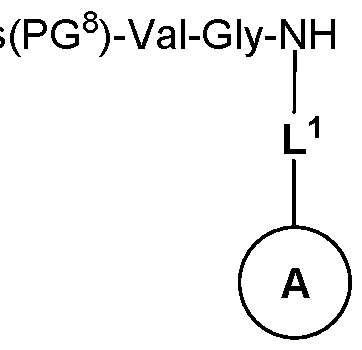
 in the presence of trifluoroacetic acid, wherein L1 is a linking group and Ring A refers to a solid support (e.g., a resin).
In some embodiments, Ring A refers to a resin. In some embodiments, the L^Resin group is a group that results in C terminal amide groups when cleaved. In some embodiments, the linking group is a 4-((2,4-dimethoxyphenyl)(Fmoc amino)methyl)phenoxyacetic acid linking group (i.e., a Rink amide linker). In some embodiments, the resin is selected from a 4- methylbenzhydrylamine HC1 salt resin, a PAL Resin, a Sieber amide resin, and a Ramage resin. In some embodiments, the resin is a 4-methylbenzhydrylamine HC1 salt resin.
In some embodiments, the compound of Formula VI is a compound of Formula II:
Myr-Gly-Thr(PG1)-Asn(PG2)-Leu-Ser(PG3)-Val-Pro-Asn(PG2)-Pro-Leu-Gly-
Phe-Phe-Pro-Asp(PG4)-His(PG5)-Gln(PG6)-Leu-Asp(PG4)-Pro-Ala-Phe-
Gly-Ala-Asn(PG2)-Ser(PG3)-Asn(PG2)-Asn(PG2)-Pro-Asp(PG4)-Trp(PG7)-
Asp(PG4)-Phe-Asn(PG2)-Pro-Asn(PG2)-Lys(PG8)-Asp(PG4)-His(PG5)-
 wherein PG1, PG2, PG3, PG4, PG5, PG6, PG7, PG8, and PG10 are each independently absent or a protecting group.
In some embodiments, the tetrafluoroboric acid salt of bulevirtide (z.e., the tetrafluoroboric acid salt of the compound of Formula I) is prepared by deprotecting a compound of Formula II:
Myr-Gly-Thr(PG1)-Asn(PG2)-Leu-Ser(PG3)-Val-Pro-Asn(PG2)-Pro-Leu-Gly-
Phe-Phe-Pro-Asp(PG4)-His(PG5)-Gln(PG6)-Leu-Asp(PG4)-Pro-Ala-Phe- Gly-Ala-Asn(PG2)-Ser(PG3)-Asn(PG2)-Asn(PG2)-Pro-Asp(PG4)-Trp(PG7)- Asp(PG4)-Phe-Asn(PG2)-Pro-Asn(PG2)-Lys(PG8)-Asp(PG4)-His(PG5)-
 in the presence of tetrafluoroboric acid, wherein: wherein PG2, PG6, PG7 are each independently absent or a protecting group; and
PG1, PG3, PG4, PG5, PG8, and PG10 are each an independently selected protecting group; and
Ring A refers to a resin.
In some embodiments, the trifluoroacetic acid salt of bulevirtide (ie., the trifluoroacetic acid salt of the compound of Formula I) is prepared by deprotecting a compound of Formula II:
Myr-Gly-Thr(PG1)-Asn(PG2)-Leu-Ser(PG3)-Val-Pro-Asn(PG2)-Pro-Leu-Gly-
Phe-Phe-Pro-Asp(PG4)-His(PG5)-Gln(PG6)-Leu-Asp(PG4)-Pro-Ala-Phe-
Gly-Ala-Asn(PG2)-Ser(PG3)-Asn(PG2)-Asn(PG2)-Pro-Asp(PG4)-Trp(PG7)-
Asp(PG4)-Phe-Asn(PG2)-Pro-Asn(PG2)-Lys(PG8)-Asp(PG4)-His(PG5)-
Trp(PG7) Pro ■

 in the presence of trifluoroacetic acid, wherein: wherein PG2, PG6, PG7 are each independently absent or a protecting group; and
PG1, PG3, PG4, PG5, PG8, and PG10 are each an independently selected protecting group; and
Ring A refers to a resin.
In some embodiments, the tetrafluoroboric acid salt of bulevirtide (z.e., the tetrafluoroboric acid salt of the compound of Formula I) is prepared by deprotecting a compound of Formula II:
Myr-Gly-Thr(PG1)-Asn(PG2)-Leu-Ser(PG3)-Val-Pro-Asn(PG2)-Pro-Leu-Gly-
Phe-Phe-Pro-Asp(PG4)-His(PG5)-Gln(PG6)-Leu-Asp(PG4)-Pro-Ala-Phe-
Gly-Ala-Asn(PG2)-Ser(PG3)-Asn(PG2)-Asn(PG2)-Pro-Asp(PG4)-Trp(PG7)-
Asp(PG4)-Phe-Asn(PG2)-Pro-Asn(PG2)-Lys(PG8)-Asp(PG4)-His(PG5)-
Trp(PG7)-Pro-Glu(PG10)-Ala-Asn(PG2)-Lys(PG8)-Val-Gly-NH

 in the presence of tetrafluoroboric acid, wherein:
PG1, PG2, PG3, PG4, PG5, PG6, PG7, PG8, and PG10 are each an independently selected protecting group; and
Ring A refers to a resin.
In some embodiments, the trifluoroacetic acid salt of bulevirtide (ie., the trifluoroacetic acid salt of the compound of Formula I) is prepared by deprotecting a compound of Formula II:
Myr-Gly-Thr(PG1)-Asn(PG2)-Leu-Ser(PG3)-Val-Pro-Asn(PG2)-Pro-Leu-Gly-
Phe-Phe-Pro-Asp(PG4)-His(PG5)-Gln(PG6)-Leu-Asp(PG4)-Pro-Ala-Phe-
Gly-Ala-Asn(PG2)-Ser(PG3)-Asn(PG2)-Asn(PG2)-Pro-Asp(PG4)-Trp(PG7)-
Asp(PG4)-Phe-Asn(PG2)-Pro-Asn(PG2)-Lys(PG8)-Asp(PG4)-His(PG5)-
Trp(PG7)-Pro-Glu(PG10)-

II in the presence of trifluoroacetic acid, wherein:
PG1, PG2, PG3, PG4, PG5, PG6, PG7, PG8, and PG10 are each an independently selected protecting group; and
Ring A refers to a resin.
As used herein, the term “protecting groups” (e.g., amino protecting groups) refers to a moiety that may be used to prevent unwanted reactions of a group (e.g., an amino group) while performing a desired transformation. Protecting groups (e.g., amino protecting groups) allow easy covalent attachment to an atom (e.g., a nitrogen atom) as well as selective cleavage from the atom (e.g, a nitrogen atom). Suitable protecting groups, such as alkoxycarbonyl (such as ethoxycarbonyl, /c/V-butoxycarbonyl (Boc), benzyloxycarbonyl (Cbz), 9- fluorenylmethyloxycarbonyl (Fmoc), and the like), acyl (such as acetyl (Ac), benzoyl (Bz), and the like), sulfonyl (such as methanesulfonyl, trifluoromethanesulfonyl, and the like), arylalkyl (such as benzyl, 4-methoxybenzyl, diphenylmethyl, triphenylmethyl (trityl), and the like), alkenylalkyl (such as allyl, prenyl, and the like), diarylmethyleneyl (such as (C6Hs)2C=, and the like), and silyl (such as /c/V-butyldimethylsilyl, triisopropylsilyl, and the like), would be readily known to a skilled artisan. The chemistry of protecting groups can be found, e.g, in Wuts and Greene, Greene s ’ Protective Groups in Organic Synthesis, 4th Ed., pp 696-926, John Wiley & Sons: New York, 2006, which is incorporated herein by reference in its entirety.
In some embodiments, the deprotecting of the compound of Formula II is performed in the presence of tetrafluoroboric acid. In some embodiments, the deprotecting of the compound of Formula II is performed in the presence of trifluoroacetic acid. In some embodiments, the deprotecting of the compound of Formula II is performed in the presence of trifluoroacetic acid
and water. In some embodiments, the deprotecting of the compound of Formula II is performed in the presence of (CHsO^SiCl.
In some embodiments, the deprotecting of the compound of Formula II is performed in the presence of one or more additives. In some embodiments, the one or more additives comprise water, one or more silyl compounds, one or more thiol compounds, and one or more aromatic compounds, or any combination thereof. In some embodiments, the one or more additives comprise one or more silyl compounds, one or more thiol compounds, and one or more aromatic compounds, or any combination thereof.
In some embodiments, the one or more silyl compounds are each an independently selected tri(Ci-6 alkyl) silane compound. In some embodiments, the one or more silyl compounds are each independently selected from triisopropyl silane (TIPS) and triethylsilane (TES).
In some embodiments, the one or more thiol compounds are each an independently selected dithiol compound. In some embodiments, the one or more thiol compounds are each independently selected from dioxa-l,8-octane-dithiol, dithioethane (DTE), 1,2-ethanedithiol (EDT), and dithiothreitol (DTT). In some embodiments, the thiol compound is di oxa- 1,8 -octanedi thiol.
In some embodiments, the one or more aromatic compounds are each independently selected from phenol and anisole.
In some embodiments, the deprotecting of the compound of Formula II is performed in the presence of 2,2'-(ethylenedioxy)diethanethiol. In some embodiments, the deprotecting of the compound of Formula II is performed in the presence of thioanisole. In some embodiments, the deprotecting of the compound of Formula II is performed in the presence of phenol. In some embodiments, the deprotecting of the compound of Formula II is performed in the presence of 2,2'-(ethylenedioxy)diethanethiol, thioanisole, and phenol.
In some embodiments, the deprotecting of the compound of Formula II is performed at a temperature of from about 10°C to about 35°C. In some embodiments, the deprotecting of the compound of Formula II is performed at a temperature of from about 15°C to about 25°C. In some embodiments, the deprotecting of the compound of Formula II is performed at a temperature of from about 19°Cto about 22°C.
In some embodiments, the deprotecting further comprises substantially isolating the tetrafluoroboric acid salt of bulevirtide (e.g., in the presence of an organic ether). In some
embodiments, the deprotecting further comprises substantially isolating the trifluoroacetic acid salt of bulevirtide (e.g., in the presence of an organic ether). In some embodiments, the isolating comprises precipitating the trifluoroacetic acid salt of bulevirtide. In some embodiments, the isolating comprises precipitating the trifluoroacetic acid salt of bulevirtide in the presence of diethyl ether.
In some embodiments, the compound of Formula II is prepared by reacting a compound of Formula Illa:
Gly-Thr(PG1)-Asn(PG2)-Leu-Ser(PG3)-Val-Pro-Asn(PG2)-Pro-Leu-Gly-Phe- Phe-Pro-Asp(PG4)-His(PG5)-Gln(PG6)-Leu-Asp(PG4)-Pro-Ala-Phe-Gly-Ala- Asn(PG2)-Ser(PG3)-Asn(PG2)-Asn(PG2)-Pro-Asp(PG4)-Trp(PG7)- Asp(PG4)-Phe-Asn(PG2)-Pro-Asn(PG2)-Lys(PG8)-Asp(PG4)-His(PG5)-
 with myristic acid under coupling conditions.
In some embodiments, the coupling conditions comprise reacting the compound of Formula Illa with myristic acid in the presence of an amino coupling agent and an amino coupling additive.
In some embodiments, the amino coupling agent comprises one or more benzotriazole compounds (see e.g., J. Org. Chem. 2019, 84, 4615-4628), one or more uronium or aminium salts (e.g., l-[bis(dimethylamino)methylene]-lH-l,2,3-triazolo[4,5-b]pyridinium 3-oxide hexafluorophosphate (HATU), 2-(6-chloro-lH-benzotriazole-l-yl)-l,l,3,3-tetramethylaminium hexafluorophosphate (HCTU), 2-(lH-benzotriazole-l-yl)-l, 1,3,3-tetramethylaminium tetrafluorob orate (TBTU), tetramethylfluoroformamidinium hexafluorophosphate (TFFH), N'- tetramethylchloroformamidinium hexafluorophosphate (TCFH), and the like), propylphosphonic anhydride, one or more phosphonium salts (e.g., benzotriazol- 1-yloxytripyrrolidinophosphonium hexafluorophosphate (PyBOP), ((7-azabenzotriazol- 1 -yloxy)tripyrrolidinophosphonium hexafluorophosphate) (PyAOP), 6-chloro-benzotriazole- 1 -yloxy-tris-pyrrolidinophosphonium hexafluorophosphate (PyClock), and the like), one or more carbodiimide compounds (e.g., N,N'- diisopropylcarbodiimide (DIC), N-cyclohexyl-N'-(2-morpholinoethyl)carbodiimide-methyl-p-
toluenesulfonate (CMC), l-ethyl-3-(3-dimethylaminopropyl)carbodiimide (EDC), and the like), or any combination thereof.
In some embodiments, the amino coupling agent is 2-(lH-benzotriazol-l-yl)-l, 1,3,3- tetramethyluronium hexafluorophosphate.
In some embodiments, the amino coupling additive is selected from 1- hydroxybenzotriazole (HOBt), l-hydroxy-7-azabenzotriazole (HO At), and ethyl cyano(hydroxyimino)acetate (oxyma pure). In some embodiments, the amino coupling additive is 1 -hydroxybenzotriazole.
In some embodiments, the coupling conditions comprise reacting the compound of Formula Illa with myristic acid in the presence of 2-(lH-benzotriazol-l-yl)-l, 1,3,3- tetramethyluronium hexafluorophosphate and 1 -hydroxybenzotriazole.
In some embodiments, the process further comprises mixing the myristic acid, 2-(lH- benzotriazol-l-yl)-l,l,3,3-tetramethyluronium hexafluorophosphate, and 1- hydroxybenzotriazole, prior to reacting with the compound of Formula Illa.
In some embodiments, the reacting of the compound of Formula Illa with myristic acid is performed in the presence of an amine base. In some embodiments, the amine base is selected from triethylamine, ethyldiisopropylamine, pyrrolidine, l,4-diazabicylo[2.2.2]-octane, 1,8- diazabicyclo[5.4.0]undec-7-ene, and l,5-diazabicyclo-4.3.0]non-5-ene. In some embodiments, the amine base is N-methylmorpholine.
In some embodiments, the reacting of the compound of Formula Illa and myristic acid is performed a temperature of from about 5°C to about 40°C. In some embodiments, the reacting of the compound of Formula Illa and myristic acid is performed a temperature of from about 15°C to about 30°C. In some embodiments, the reacting of the compound of Formula Illa and myristic acid is performed a temperature of from about 17°C to about 27°C.
In some embodiments, the reacting of the compound of Formula Illa and myristic acid is performed in the presence of a solvent. In some embodiments, the solvent comprises a polar aprotic solvent (e.g., N,N-dimethylformamide (DMF), N-methyl-2-pyrrolidone (NMP), dimethylacetamide (DMAc), dimethyl sulfoxide (DMSO), pyridine, and the like), an ether (e.g., tetrahydrofuran, 2-methyltetrahydrofuran, dimethoxyethane, and the like), a chlorinated solvent (e.g., di chloromethane, di chloroethane, chloroform, and the like), or any combination thereof. In some embodiments, the solvent comprises N,N-dimethylformamide.
In some embodiments, the compound of Formula Illa is prepared by deprotecting a compound of Formula III:
Gly(PG9)-Thr(PG1)-Asn(PG2)-Leu-Ser(PG3)-Val-Pro-Asn(PG2)-Pro-Leu-
Gly-Phe-Phe-Pro-Asp(PG4)-His(PG5)-Gln(PG6)-Leu-Asp(PG4)-Pro-Ala-
Phe-Gly-Ala-Asn(PG2)-Ser(PG3)-Asn(PG2)-Asn(PG2)-Pro-Asp(PG4)-
Trp(PG7)-Asp(PG4)-Phe-Asn(PG2)-Pro-Asn(PG2)-Lys(PG8)-Asp(PG4)-
His(PG5)-Trp


As used herein, the compound of Formula III may also be referred to as

As used herein, SEQ ID NO.: 3 refers to the following sequence:
Gly(PG9)-Thr(PG1)-Asn(PG2)-Leu-Ser(PG3)-Val-Pro-Asn(PG2)-Pro-Leu-
Gly-Phe-Phe-Pro-Asp(PG4)-His(PG5)-Gln(PG6)-Leu-Asp(PG4)-Pro-Ala-
Phe-Gly-Ala-Asn(PG2)-Ser(PG3)-Asn(PG2)-Asn(PG2)-Pro-Asp(PG4)-
Trp(PG7)-Asp(PG4)-Phe-Asn(PG2)-Pro-Asn(PG2)-Lys(PG8)-Asp(PG4)-
His(PG5)-Trp(PG7)-Pro-Glu(PG10)-Ala-Asn(PG2)-Lys(PG8)-Val-Gly (SEQ n) NO 3) wherein PG1, PG2, PG3, PG4, PG5, PG6, PG7, PG8, PG9, and PG10 are each independently absent or a protecting group.
In some embodiments, the compound of Formula Illa is prepared by deprotecting a compound of Formula III:
Gly(PG9)-Thr(PG1)-Asn(PG2)-Leu-Ser(PG3)-Val-Pro-Asn(PG2)-Pro-Leu-
Gly-Phe-Phe-Pro-Asp(PG4)-His(PG5)-Gln(PG6)-Leu-Asp(PG4)-Pro-Ala-
Phe-Gly-Ala-Asn(PG2)-Ser(PG3)-Asn(PG2)-Asn(PG2)-Pro-Asp(PG4)-
Trp(PG7)-Asp(PG4)-Phe-Asn(PG2)-Pro-Asn(PG2)-Lys(PG8)-Asp(PG4)-
 wherein PG9 is a protecting group.
In some embodiments, the deprotecting comprises reacting the compound of Formula III with an amine base. In some embodiments, the amine base is a tertiary amine base or a secondary amine base. In some embodiments, the amine base is selected from piperidine, morpholine, 4-methylpiperidine, piperazine, pyrrolidine, triethylamine, ethyldiisopropylamine, pyrrolidine, l,4-diazabicylo[2.2.2]-octane, l,8-diazabicyclo[5.4.0]undec-7-ene, and 1,5- diazabicyclo-4.3.0]non-5-ene. In some embodiments, the amine base comprises piperidine.
In some embodiments, the deprotecting is performed in the presence of a solvent. In some embodiments, the solvent comprises a polar aprotic solvent (e.g., N,N-dimethylformamide (DMF), N-methyl-2-pyrrolidone (NMP), dimethylacetamide (DMAc), dimethyl sulfoxide (DMSO), pyridine, and the like), an ether (e.g., tetrahydrofuran, 2-methyltetrahydrofuran, dimethoxy ethane, and the like), a chlorinated solvent (e.g., dichloromethane, dichloroethane, chloroform, and the like), or any combination thereof. In some embodiments, the deprotecting is performed in the presence of a solvent comprising N,N-dimethylformamide.
In some embodiments, the deprotecting is performed in the presence of an additive. In some embodiments, the additive is selected from a reagent that suppresses racemization and aspartimide formation (see e.g, www.peptide.com/resources/solid-phase-peptide- synthesis/amino-acid-derivatives-for-peptide-synthesis/, and all references cited therein; and Chem. Rev. 2009, 109, 6, 2455-2504). In some embodiments, the additive is selected from an organic acid (e.g, formic acid) and a heterocyclic compound (e.g., 1 -hydroxybenzotriazole (HOBt), 6-chloro-l -hydroxybenzotriazole (Cl-HOBt), and the like).
In some embodiments, the deprotecting is performed at a temperature of from about 5°C to about 40°C. In some embodiments, the deprotecting is performed at a temperature of from
about 15°C to about 30°C. In some embodiments, the deprotecting is performed at a temperature of from about 17°C to about 27°C. In some embodiments, the deprotecting is performed at a temperature of from about 19°C to about 25°C.
In some embodiments, the compound of Formula III is prepared by sequentially coupling the compound of Formula IV:
 with one or more protected amino acids selected from PG9-Gly-OH, Fmoc-Val-OH, Fmoc-Ala-OH, Fmoc-Pro-OH, Fmoc-Phe-OH, Fmoc-Leu-OH, Fmoc-Th^PG^-OH, Fmoc- Asn(PG2)-OH, Fmoc-Ser(PG3)-OH, Fmoc-Asp(PG4)-OH, Fmoc-His(PG5)-OH, Fmoc-Gln(PG6)- OH, Fmoc-Trp(PG7)-OH, Fmoc-Lys(PG8)-OH, and Fmoc-Glu(PG10)-OH, under coupling conditions, to afford the compound of Formula III, wherein PG2, PG6, PG7 are each independently absent or a protecting group; and
PG1, PG3, PG4, PG5, PG8, PG9, and PG10 are each an independently selected protecting group.
In some embodiments, the compound of Formula III is prepared by sequentially coupling the compound of Formula IV:
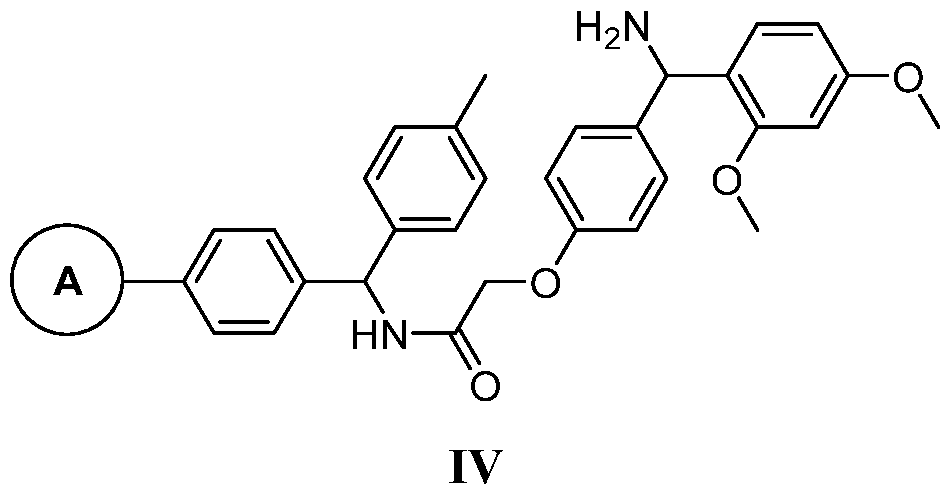 with one or more protected amino acids selected from PG9-Gly-OH, Fmoc-Val-OH, Fmoc-Ala-OH, Fmoc-Pro-OH, Fmoc-Phe-OH, Fmoc-Leu-OH, Fmoc-Th^PG^-OH, Fmoc- Asn(PG2)-OH, Fmoc-Ser(PG3)-OH, Fmoc-Asp(PG4)-OH, Fmoc-His(PG5)-OH, Fmoc-Gln(PG6)- OH, Fmoc-Trp(PG7)-OH, Fmoc-Lys(PG8)-OH, and Fmoc-Glu(PG10)-OH, under coupling conditions, to afford the compound of Formula III, wherein PG10 is a protecting group.
In some embodiments, the coupling conditions comprise reacting the compound of Formula IV with the protected amino acid in the presence of an amino coupling agent and an amino coupling additive, and subsequently deprotecting the Fmoc group in the presence of an amine base.
with one or more protected amino acids selected from PG9-Gly-OH, Fmoc-Val-OH, Fmoc-Ala-OH, Fmoc-Pro-OH, Fmoc-Phe-OH, Fmoc-Leu-OH, Fmoc-Th^PG^-OH, Fmoc- Asn(PG2)-OH, Fmoc-Ser(PG3)-OH, Fmoc-Asp(PG4)-OH, Fmoc-His(PG5)-OH, Fmoc-Gln(PG6)- OH, Fmoc-Trp(PG7)-OH, Fmoc-Lys(PG8)-OH, and Fmoc-Glu(PG10)-OH, under coupling conditions, to afford the compound of Formula III, wherein PG10 is a protecting group.
In some embodiments, the coupling conditions comprise reacting the compound of Formula IV with the protected amino acid in the presence of an amino coupling agent and an amino coupling additive, and subsequently deprotecting the Fmoc group in the presence of an amine base.
In some embodiments, the coupling and deprotecting steps are repeated one or more times.
In some embodiments, the amino coupling agent comprises one or more benzotriazole compounds (see e.g., J. Org. Chem. 2019, 84, 4615-4628), one or more uronium or aminium salts (e.g., l-[bis(dimethylamino)methylene]-lH-l,2,3-triazolo[4,5-b]pyridinium 3-oxide hexafluorophosphate (HATU), 2-(6-chloro-lH-benzotriazole-l-yl)-l,l,3,3-tetramethylaminium hexafluorophosphate (HCTU), 2-(lH-benzotriazole-l-yl)-l, 1,3,3-tetramethylaminium tetrafluorob orate (TBTU), tetramethylfluoroformamidinium hexafluorophosphate (TFFH), N'- tetramethylchloroformamidinium hexafluorophosphate (TCFH), and the like), propylphosphonic anhydride, one or more phosphonium salts (e.g., benzotriazol- 1-yloxytripyrrolidinophosphonium hexafluorophosphate (PyBOP), ((7-azabenzotriazol- 1 -yloxy)tripyrrolidinophosphonium hexafluorophosphate) (PyAOP), 6-chloro-benzotriazole- 1 -yloxy-tris-pyrrolidinophosphonium hexafluorophosphate (PyClock), and the like), one or more carbodiimide compounds (e.g., N,N'- diisopropylcarbodiimide (DIC), N-cyclohexyl-N'-(2-morpholinoethyl)carbodiimide-methyl-p- toluenesulfonate (CMC), l-ethyl-3-(3-dimethylaminopropyl)carbodiimide (EDC), and the like), or any combination thereof. In some embodiments, the amino coupling agent is N,N-diisopropylcarbodiimide.
In some embodiments, the amino coupling additive is 1 -hydroxybenzotriazole.
In some embodiments, the deprotecting of the Fmoc group is performed in the presence of an amine base, which is a tertiary amine base or a secondary amine base. In some embodiments, the amine base is selected from piperidine, morpholine, 4-methylpiperidine, piperazine, pyrrolidine, tri ethylamine, ethyldiisopropylamine, pyrrolidine, 1,4- diazabicylo[2.2.2]-octane, l,8-diazabicyclo[5.4.0]undec-7-ene, and l,5-diazabicyclo-4.3.0]non- 5-ene. In some embodiments, the amine base comprises piperidine.
In some embodiments, the coupling and deprotecting steps are performed in the presence of a solvent. In some embodiments, the solvent comprises a polar aprotic solvent (e.g., N,N- dimethylformamide (DMF), N-methyl-2-pyrrolidone (NMP), dimethylacetamide (DMAc), dimethyl sulfoxide (DMSO), pyridine, and the like), an ether (e.g., tetrahydrofuran, 2-
methyltetrahydrofuran, dimethoxy ethane, and the like), a chlorinated solvent (e.g., dichloromethane, di chloroethane, chloroform, and the like), or any combination thereof. In some embodiments, the coupling and deprotecting steps are performed in the presence of a solvent comprising N,N-dimethylformamide.
In some embodiments, the coupling and deprotecting steps are performed at a temperature of from about 5°C to about 40°C. In some embodiments, the coupling further comprises as pre-activation step performed at about -10°C to about 10°C. performed at a temperature of from about 5°C to about 40°C. In some embodiments, the coupling and deprotecting steps are performed at a temperature of from about 15°C to about 30°C. In some embodiments, the coupling and deprotecting steps are performed at a temperature of from about 17°C to about 27°C.
In some embodiments, the compound of Formula IV is prepared by deprotecting a compound of Formula IVa:
 in the presence of an amine base.
In some embodiments, the amine base is a tertiary amine base or a secondary amine base. In some embodiments, the amine base is selected from piperidine, morpholine, 4- methylpiperidine, piperazine, pyrrolidine, tri ethylamine, ethyldiisopropylamine, pyrrolidine, 1,4- diazabicylo[2.2.2]-octane, l,8-diazabicyclo[5.4.0]undec-7-ene, and l,5-diazabicyclo-4.3.0]non- 5-ene. In some embodiments, the amine base comprises piperidine.
In some embodiments, the deprotecting is performed in the presence of a solvent. In some embodiments, the solvent comprises a polar aprotic solvent (e.g., N,N-dimethylformamide (DMF), N-methyl-2-pyrrolidone (NMP), dimethylacetamide (DMAc), dimethyl sulfoxide (DMSO), pyridine, and the like), an ether (e.g., tetrahydrofuran, 2-methyltetrahydrofuran, dimethoxy ethane, and the like), a chlorinated solvent (e.g., dichloromethane, dichloroethane,
chloroform, and the like), or any combination thereof. In some embodiments, the deprotecting is performed in the presence of a solvent comprises N,N-dimethylformamide.
In some embodiments, the deprotecting is performed at a temperature of from about 5°C to about 40°C. In some embodiments, the deprotecting is performed at a temperature of from about 15°C to about 30°C. In some embodiments, the deprotecting is are performed at a temperature of from about 17°C to about 27°C. In some embodiments, the deprotecting is are performed at a temperature of from about 19°C to about 25°C.
In some embodiments, the compound of Formula IVa is prepared by reacting 4- methylbenzhydrylamine resin with a compound of Formula V:

V in the presence of an amine base and an amino coupling agent.
In some embodiments, the amine base is selected from N-methylmorpholine, N,N- diisopropylethylamine (DIPEA), triethylamine, pyrrolidine, l,4-diazabicylo[2.2.2]-octane, 1,8- diazabicyclo[5.4.0]undec-7-ene, and l,5-diazabicyclo-4.3.0]non-5-ene. In some embodiments, the amine base comprises N-methylmorpholine.
In some embodiments, the amino coupling agent comprises one or more benzotriazole compounds (see e.g., J. Org. Chem. 2019, 84, 4615-4628), one or more uronium or aminium salts (e.g., l-[bis(dimethylamino)methylene]-lH-l,2,3-triazolo[4,5-b]pyridinium 3-oxide hexafluorophosphate (HATU), 2-(6-chloro-lH-benzotriazole-l-yl)-l,l,3,3-tetramethylaminium hexafluorophosphate (HCTU), 2-(lH-benzotriazole-l-yl)-l, 1,3,3-tetramethylaminium tetrafluorob orate (TBTU), tetramethylfluoroformamidinium hexafluorophosphate (TFFH), N'- tetramethylchloroformamidinium hexafluorophosphate (TCFH), and the like), propylphosphonic anhydride, one or more phosphonium salts (e.g., benzotriazol- 1-yloxytripyrrolidinophosphonium hexafluorophosphate (PyBOP), ((7-azabenzotriazol- 1 -yloxy)tripyrrolidinophosphonium hexafluorophosphate) (PyAOP), 6-chloro-benzotriazole- 1 -yloxy-tris-pyrrolidinophosphonium hexafluorophosphate (PyClock), and the like), one or more carbodiimide compounds (e.g., N,N'-
diisopropylcarbodiimide (DIC), N-cyclohexyl-N'-(2-morpholinoethyl)carbodiimide-methyl-p- toluenesulfonate (CMC), l-ethyl-3-(3-dimethylaminopropyl)carbodiimide (EDC), and the like), or any combination thereof. In some embodiments, the amino coupling agent is 2-(lH- benzotriazol- 1 -yl)- 1 , 1 ,3 ,3 -tetramethyluronium hexafluorophosphate.
In some embodiments, the reacting of 4-methylbenzhydrylamine resin with the compound of Formula V is performed in the presence of a solvent. In some embodiments, the solvent comprises a polar aprotic solvent (e.g., N,N-dimethylformamide (DMF), N-methyl-2- pyrrolidone (NMP), dimethylacetamide (DMAc), dimethyl sulfoxide (DMSO), pyridine, and the like), an ether (e.g. , tetrahydrofuran, 2-m ethyltetrahydrofuran, dimethoxy ethane, and the like), a chlorinated solvent (e.g., di chloromethane, di chloroethane, chloroform, and the like), or any combination thereof. In some embodiments, the reacting is performed in the presence of a solvent comprising N,N-dimethylformamide.
In some embodiments, the reacting is performed at a temperature of from about 5°C to about 40°C. In some embodiments, the reacting is performed at a temperature of from about 15°C to about 30°C. In some embodiments, the reacting is performed at a temperature of from about 17°C to about 27°C.
In some embodiments, the process further comprises reacting the compound of Formula IVa with an anhydride (e.g., acetic anhydride, propionic anhydride, phenoxyacetic anhydride, benzoic anhydride, and the like) or an acid chloride (e.g., acetyl chloride, propionyl chloride, benzoyl chloride, and the like). In some embodiments, the process further comprises reacting the compound of Formula IVa with an anhydride.
In some embodiments, the process further comprises acetylating the compound of Formula IVa. In some embodiments, the acetylating comprises reacting the compound of Formula IVa with acetic anhydride. In some embodiments, the acetylating comprises reacting the compound of Formula IVa with acetic anhydride in the presence of an amine base.
In some embodiments, the amine base is selected from N-methylmorpholine, triethylamine, ethyldiisopropylamine, pyrrolidine, l,4-diazabicylo[2.2.2]-octane, 1,8- diazabicyclo[5.4.0]undec-7-ene, l,5-diazabicyclo-4.3.0]non-5-ene, pyridine, and 2,6-lutidine. In some embodiments, the amine base is N-methylmorpholine.
In some embodiments, the acetylating is performed in the presence of a solvent. In some embodiments, the solvent comprises a polar aprotic solvent (e.g., N,N-dimethylformamide (DMF), N-methyl-2-pyrrolidone (NMP), dimethylacetamide (DMAc), dimethyl sulfoxide
(DMSO), pyridine, and the like), an ether (e.g., tetrahydrofuran, 2-methyltetrahydrofuran, dimethoxy ethane, and the like), a chlorinated solvent (e.g., dichloromethane, dichloroethane, chloroform, and the like), or any combination thereof. In some embodiments, the acetylating is performed in the presence of a solvent comprising N,N-dimethylformamide.
In some embodiments, the acetylating is performed at a temperature of from about 5°C to about 40°C. In some embodiments, the acetylating is performed at a temperature of from about 15°C to about 30°C. In some embodiments, the acetylating is performed at a temperature of from about 17°C to about 27°C.
In some embodiments, the process further comprises mixing the 4- methylbenzhydrylamine resin with an amine base and solvent prior to the reacting with the compound of Formula V. In some embodiments, the amine base is selected from N- methylmorpholine, N,N-diisopropylethylamine (DIPEA), triethylamine, pyrrolidine, 1,4- diazabicylo[2.2.2]-octane, l,8-diazabicyclo[5.4.0]undec-7-ene, and l,5-diazabicyclo-4.3.0]non- 5-ene. In some embodiments, the amine base is N-methylmorpholine.
In some embodiments, the solvent comprises a polar aprotic solvent e.g., N,N- dimethylformamide (DMF), N-methyl-2-pyrrolidone (NMP), dimethylacetamide (DMAc), dimethyl sulfoxide (DMSO), pyridine, and the like), an ether e.g., methyl tert-butyl ether, tetrahydrofuran, 2-methyltetrahydrofuran, dimethoxyethane, and the like), a chlorinated solvent e.g., di chloromethane, di chloroethane, chloroform, and the like), an aromatic solvent e.g., benzene, toluene, xylenes, and the like), an alcohol e.g., methanol, ethanol, 2-propanol, and the like), an acid e.g., trifluoroacetic acid), and water, or any combination thereof. In some embodiments, the 4-methylbenzhydrylamine resin is mixed with an amine base, which is N-methylmorpholine and a solvent comprising N,N-dimethylformamide prior to the reacting with the compound of Formula V.
In some embodiments, the reacting is performed at a temperature of from about 0°C to about 50°C. In some embodiments, the reacting is performed at a temperature of from about 10°C to about 30°C.
In some embodiments of the Formulas described herein, each PG1 is independently selected from tert-butyl and trityl. In some embodiments of the Formulas described herein, each PG1 is tert-butyl.
In some embodiments of the Formulas described herein, each PG2 is trityl.
In some embodiments of the Formulas described herein, each PG3 is independently selected from tert-butyl and trityl. In some embodiments of the Formulas described herein, each PG3 is tert-butyl.
In some embodiments of the Formulas described herein, each PG4 is independently selected from tert-butoxy, 2-phenylisopropyl ester (O-2-PhiPr), allyl ester (OA11), and P-3- methylpent-3-yl (Mpe). In some embodiments of the Formulas described herein, each PG4 is tert-butoxy.
In some embodiments of the Formulas described herein, each PG5 is independently selected from trityl, -monomethoxytrityl (Mmt), and 4-methyltrityl (Mtt). In some embodiments of the Formulas described herein, each PG5 is trityl.
In some embodiments of the Formulas described herein, each PG6 is trityl.
In some embodiments of the Formulas described herein, each PG7 is tert-butoxycarbonyl (Boc).
In some embodiments of the Formulas described herein, PG8 is independently selected from tert-butoxycarbonyl, 2-chlorobenzyloxy carbonyl (Cl-Z), 4-methyltrityl (Mtt), p- monomethoxytrityl (Mmt), dimethoxytrityl (Dmt), allyloxycarbonyl (Alloc). In some embodiments of the Formulas described herein, each PG8 is tert-butoxycarbonyl (Boc).
In some embodiments of the Formulas described herein, PG9 is 9- fluorenylmethoxycarbonyl (Fmoc).
In some embodiments of the Formulas described herein, each PG10 is independently selected from tert-butoxycarbonyl (Boc), 2-chlorobenzyloxycarbonyl (Cl-Z), 4-methyltrityl (Mtt), -Monomethoxytrityl (Mmt), dimethoxytrityl (Dmt), allyloxy carbonyl (Alloc. In some embodiments of the Formulas described herein, each PG10 is tert-butoxycarbonyl (Boc).
In some embodiments of the Formulas described herein: each PG1 is independently selected from tert-butyl and trityl; each PG2 is trityl; each PG3 is independently selected from tert-butyl and trityl; each PG4 is independently selected from tert-butoxy, 2-phenylisopropyl ester (0-2- PhiPr), allyl ester (0A11), and P-3-methylpent-3-yl (Mpe); each PG5 is independently selected from trityl, /?-monomethoxytrityl (Mmt), and 4- methyltrityl (Mtt); each PG6 is trityl;
each PG7 is tert-butoxycarbonyl (Boc); each PG8 is independently selected from tert-butoxycarbonyl (Boc), 2- chlorobenzyloxy carbonyl (Cl-Z), 4-methyltrityl (Mtt), p-monomethoxytrityl (Mmt), dimethoxytrityl (Dmt), allyloxycarbonyl (Alloc); each PG9 is 9-fluorenylmethoxycarbonyl (Fmoc); and each PG10 is independently selected from tert-butoxycarbonyl (Boc), 2- chlorobenzyloxy carbonyl (Cl-Z), 4-methyltrityl (Mtt), -Monomethoxytrityl (Mmt), dimethoxytrityl (Dmt), allyloxycarbonyl (Alloc).
In some embodiments of the Formulas described herein: each PG1 and PG3 is tert-butyl; each PG2, PG5, and PG6 is trityl; each PG4 is tert-butoxy; each PG7, PG8, and PG10 is tert-butoxycarbonyl (Boc); and each PG9 is 9-fluorenylmethoxycarbonyl (Fmoc).
As used herein, the term “reacting” is used as known in the art and generally refers to the bringing together of chemical reagents in such a manner so as to allow their interaction at the molecular level to achieve a chemical or physical transformation. In some embodiments, the reacting involves two reagents, wherein one or more equivalents of second reagent are used with respect to the first reagent. The reacting steps of the processes described herein can be conducted for a time and under conditions suitable for preparing the identified product.
The reactions of the processes described herein can be carried out in suitable solvents which can be readily selected by one of skill in the art of organic synthesis. Suitable solvents can be substantially nonreactive with the starting materials (reactants), the intermediates, or products at the temperatures at which the reactions are carried out, e.g., temperatures which can range from the solvent's freezing temperature to the solvent's boiling temperature. A given reaction can be carried out in one solvent or a mixture of more than one solvent. Depending on the particular reaction step, suitable solvents for a particular reaction step can be selected.
The reactions described herein can be carried out at appropriate temperatures which can be readily determined by the skilled artisan. Reaction temperatures will depend on, for example, the melting and boiling points of the reagents and solvent, if present; the thermodynamics of the reaction (e.g., vigorously exothermic reactions may need to be carried out at reduced
temperatures); and the kinetics of the reaction (e.g., a high activation energy barrier may need elevated temperatures).
The reactions of the processes described herein can be carried out in air or under an inert atmosphere. Typically, reactions containing reagents or products that are substantially reactive with air can be carried out using air-sensitive synthetic techniques that are well known to the skilled artisan.
The processes described herein can be monitored according to any suitable method known in the art. For example, product formation can be monitored by spectroscopic means (e.g., nuclear magnetic resonance spectroscopy (NMR), such as 'H-NMR and/or 13C-NMR) or by chromatography (e.g., high performance liquid chromatography (HPLC)).
As used herein, the singular forms "a" and "an", and "the" include plural referents unless the context clearly dictates otherwise. Thus, e.g., reference to "the compound" includes a plurality of such compounds and reference to "the assay" includes reference to one or more assays, and so forth.
Unless defined otherwise, all technical and scientific terms used herein have the same meaning as commonly understood by one of ordinary skill in the art.
Except as expressly defined otherwise, the present disclosure includes all tautomers of compounds detailed herein, even if only one tautomer is expressly represented (e.g., both tautomeric forms are intended and described by the presentation of one tautomeric form where a pair of two tautomers may exist). For example, if reference is made to a compound containing an amide (e.g., by structure or chemical name), it is understood that the corresponding imidic acid tautomer is included by this disclosure and described the same as if the amide were expressly recited either alone or together with the imidic acid. Where more than two tautomers may exist, the present disclosure includes all such tautomers even if only a single tautomeric form is depicted by chemical name and/or structure.
It is understood by one skilled in the art that this disclosure also includes any compound disclosed herein (e.g., bulevirtide, a salt thereof, such as an acetic acid salt of bulevirtide as described herein) that may be enriched at any or all atoms above naturally occurring isotopic ratios with one or more isotopes such as, but not limited to, deuterium (2H or D).
Disclosed are also compounds in which from 1 to n hydrogen atoms attached to a carbon atom may be replaced by a deuterium atom or D, in which n is the number of hydrogen atoms in the molecule. As known in the art, the deuterium atom is a non-radioactive isotope of the
hydrogen atom. Such compounds may increase resistance to metabolism, and thus may be useful for increasing the half-life of the compounds when administered to a mammal. See, e.g., Foster, “Deuterium Isotope Effects in Studies of Drug Metabolism”, Trends Pharmacol. Sci., 5(12):524- 527 (1984). Such compounds are synthesized by means well known in the art, for example by employing starting materials in which one or more hydrogen atoms have been replaced by deuterium.
Examples of isotopes that can be incorporated into the disclosed compounds also include isotopes of hydrogen, carbon, nitrogen, oxygen, phosphorous, fluorine, chlorine, and iodine, such as 2H, 3H, nC, 13C, 14C, 13N, 15N, 15O, 17O, 18O, 31P, 32P, 35S, 18F, 36C1, 123I, and 125I, respectively. Substitution with positron emitting isotopes, such as nC, 18F, 15O and 13N, can be useful in Positron Emission Topography (PET) studies for examining substrate receptor occupancy. An isotopically-labeled compound of Formula I can generally be prepared by conventional techniques known to those skilled in the art or by processes analogous to those described in the Examples as set out below using an appropriate isotopically-labeled reagent in place of the non-labeled reagent previously employed.
Additionally, in some embodiments, isotopically-labeled compounds of Formula I can generally be prepared by conventional techniques known to those skilled in the art or by processes analogous to those described in the Examples as set out below using an appropriate isotopically-labeled reagent in place of the non-labeled reagent previously employed.
Compounds described herein may have chiral centers and/or geometric isomeric centers (E- and Z- isomers), and it is to be understood that all such optical, enantiomeric, diastereoisomeric and geometric isomers are encompassed. Where compounds are represented in their chiral form, it is understood that the embodiment encompasses, but is not limited to, the specific diastereomerically or enantiomerically enriched form. Where chirality is not specified but is present, it is understood that the embodiment is directed to either the specific diastereomerically or enantiomerically enriched form; or a racemic or scalemic mixture of such compound(s). As used herein, “scalemic mixture” is a mixture of stereoisomers at a ratio other than 1 : 1.
The following abbreviations may be used throughout the present application: alanine (Ala), asparagine (Asn), aspartic acid (Asp), glycine (Gly), glutamic acid (Glu), glutamine (Gin), histidine (His), leucine (Leu), myristic acid (Myr), phenylalanine (Phe), proline (Pro), serine (Ser), threonine (Thr), tryptophan (Trp), valine (Vai), 2-chlorobenzyloxycarbonyl (Cl-Z),
N,N-dimethylformamide (DMF), tert-butoxycarbonyl (Boc), 9-fluorenylmethoxycarbonyl (Fmoc), tert-butyl (tBu), trityl (Trt), tert-butoxy (OtBu), 2-phenylisopropyl ester (O-2-PhiPr), allyl ester (OA11), p-Monom ethoxytrityl (Mmt), P-3-methylpent-3-yl (Mpe), 4-m ethyltrityl (Mtt), 2-(lH-benzotriazol-l-yl)-l,l,3,3-tetramethyluronium hexafluorophosphate (HBTU), 1- [bis(dimethylamino)methylene]-lH-l,2,3-triazolo[4,5-b]pyridinium 3-oxide hexafluorophosphate (HATU), 2-(6-chloro-lH-benzotriazole-l-yl)-l,l,3,3-tetramethylaminium hexafluorophosphate (HCTU), 2-(lH-benzotriazole-l-yl)-l, 1,3,3-tetramethylaminium tetrafluoroborate (TBTU), tetramethylfluoroformamidinium hexafluorophosphate (TFFH), N'- tetramethylchloroformamidinium Hexafluorophosphate (TCFH), propylphosphonic anhydride (T3P), benzotriazol- 1-yloxytripyrrolidinophosphonium hexafluorophosphate (PyBOP), ((7- azabenzotriazol-l-yloxy)tripyrrolidinophosphonium hexafluorophosphate) (PyAOP), 6-chloro- benzotriazole-l-yloxy-tris-pyrrolidinophosphonium hexafluorophosphate (PyClock), N,N'- diisopropylcarbodiimide (DIC), N-cyclohexyl-N'-(2-morpholinoethyl)carbodiimide-methyl-p- toluenesulfonate (CMC), l-ethyl-3-(3-dimethylaminopropyl)carbodiimide (EDC), 1- hydroxybenzotriazole (HOBt), 6-chloro-l -hydroxybenzotriazole (Cl-HOBt), l-hydroxy-7- azabenzotri azole (HO At), ethyl cyano(hydroxyimino)acetate (oxyma pure), N-methyl-2- pyrrolidone (NMP), dimethylacetamide (DMAc), and dimethyl sulfoxide (DMSO).
Methods of Use
The present application further provides a method of inhibiting an HBV and/or HDV infection in a subject in need thereof. In some embodiments, the method comprises administering to the subject an acetic acid salt of bulevirtide (e.g., a therapeutically effective amount of an acetic acid salt of bulevirtide), as described herein.
The present application further provides a method of preventing a primary HBV and/or HDV infection in a subject in need thereof, comprising administering to the subject an acetic acid salt of bulevirtide as described herein.
The present application further provides methods of treating and/or preventing hepatitis B and/or D (e.g., chronic hepatitis B and/or D) in a subject in need thereof, comprising administering to the subject an acetic acid salt of bulevirtide as described herein. In some embodiments, the acetic acid salt of bulevirtide is prepared according to one or more of the processes described herein.
The present application further provides methods of treating and/or preventing chronic hepatitis B in a subject in need thereof, comprising administering to the subject an acetic acid salt of bulevirtide as described herein. In some embodiments, the method provided herein is a method of treating chronic hepatitis B. In some embodiments, the method provided herein is a method of preventing chronic hepatitis B.
The present application further provides methods of treating and/or preventing chronic hepatitis D in a subject in need thereof, comprising administering to the subject an acetic acid salt of bulevirtide as described herein. In some embodiments, the method provided herein is a method of preventing chronic hepatitis B. In some embodiments, the method provided herein is a method of preventing chronic hepatitis B.
The present application further provides bulevirtide, or an acetic acid salt of bulevirtide, for use in any of the methods described herein. In some embodiments, the use further comprises preparing the acetic acid salt of bulevirtide according to one or more of the processes described herein.
The present application further provides bulevirtide, or an acetic acid salt of bulevirtide, for the preparation of a medicament for use in any of the methods described herein. In some embodiments, the use further comprises preparing the acetic acid salt of bulevirtide according to one or more of the processes described herein.
The terms “subject” and “subjects” refers to humans, domestic animals (e.g., dogs and cats), farm animals (e.g., cattle, horses, sheep, goats and pigs), laboratory animals (e.g., mice, rats, hamsters, guinea pigs, pigs, rabbits, dogs, and monkeys), and the like.
As used herein, “treatment” or “treating” is an approach for obtaining beneficial or desired results. For purposes of the present disclosure, beneficial or desired results include, but are not limited to, alleviation of a symptom and/or diminishment of the extent of a symptom and/or preventing a worsening of a symptom associated with a disease or condition. In one embodiment, “treatment” or “treating” includes one or more of the following: a) inhibiting the disease or condition (e.g., decreasing one or more symptoms resulting from the disease or condition, and/or diminishing the extent of the disease or condition); b) slowing or arresting the development of one or more symptoms associated with the disease or condition (e.g., stabilizing the disease or condition, delaying the worsening or progression of the disease or condition); and/or c) relieving the disease or condition, e.g., causing the regression of clinical symptoms,
ameliorating the disease state, delaying the progression of the disease, increasing the quality of life, and/or prolonging survival.
As used herein, “prevention” or “preventing” refers to a regimen that protects against the onset of the disease or disorder such that the clinical symptoms of the disease do not develop. Thus, “prevention” relates to administration of a therapy (e.g., administration of a therapeutic substance) to a subject before signs of the disease are detectable in the subject (e.g., administration of a therapeutic substance to a subject in the absence of detectable infectious agent (e.g., virus) in the subject). The subject may be an individual at risk of developing the disease or disorder, such as an individual who has one or more risk factors known to be associated with development or onset of the disease or disorder. Thus, the terms “preventing HBV infection” and “preventing HDV infection” refer to administering to a subject who does not have a detectable HBV or HDV infection an anti- HBV or HDV therapeutic substance e.g., an acetic acid salt of bulevirtide as described herein). It is understood that the subject for preventative bulevirtide therapy may be an individual at risk of contracting the HBV and/or HDV virus. Further, it is understood that prevention may not result in complete protection against onset of the disease or disorder. In some instances, prevention includes reducing the risk of developing the disease or disorder. The reduction of the risk may not result in complete elimination of the risk of developing the disease or disorder.
As used herein, an “at risk” individual is an individual who is at risk of developing a condition to be treated. An individual “at risk” may or may not have detectable disease or condition, and may or may not have displayed detectable disease prior to the treatment of methods described herein. “At risk” denotes that an individual has one or more so-called risk factors, which are measurable parameters that correlate with development of a disease or condition and are known in the art. An individual having one or more of these risk factors has a higher probability of developing the disease or condition than an individual without these risk factor(s).
As used herein, the term "therapeutically effective amount" or “effective amount” refers to an amount that is effective to elicit the desired biological or medical response, including the amount of a compound that, when administered to a subject for treating a disease, is sufficient to effect such treatment for the disease or to an amount that is effective to protect against the contracting or onset of a disease. The effective amount will vary depending on the compound, the disease, and its severity and the age, weight, etc., of the subject to be treated. The effective
amount can include a range of amounts. As is understood in the art, an effective amount may be in one or more doses, ie., a single dose or multiple doses may be required to achieve the desired treatment outcome. An effective amount may be considered in the context of administering one or more therapeutic agents, and a single agent may be considered to be given in an effective amount if, in conjunction with one or more other agents, a desirable or beneficial result may be or is achieved. Suitable doses of any co-administered compounds may optionally be lowered due to the combined action (e.g., additive or synergistic effects) of the compounds.
Pharmaceutical Formulations
Pharmaceutical compositions disclosed herein comprise a compound or salt (e.g., an acetic acid salt of bulevirtide) described herein, together with one or more pharmaceutically acceptable excipients and optionally other therapeutic agents. Pharmaceutical compositions containing the active ingredient may be in any form suitable for the intended method of administration. In some embodiments, the compound or salt is prepared according to one or more of the processes described herein.
In some embodiments, the pharmaceutical compositions disclosed herein comprise bulevirtide or an acetic acid salt of bulevirtide prepared according to one or more of the processes described herein, together with one or more pharmaceutically acceptable excipients and optionally other therapeutic agents. Pharmaceutical compositions containing the active ingredient may be in any form suitable for the intended method of administration.
“Pharmaceutically acceptable” refers to compounds, salts, compositions, dosage forms and other materials which are useful in preparing a pharmaceutical composition that is suitable for veterinary or human pharmaceutical use.
“Pharmaceutically acceptable excipient” includes without limitation any adjuvant, carrier, excipient, glidant, sweetening agent, diluent, preservative, dye/colorant, flavor enhancer, surfactant, wetting agent, dispersing agent, suspending agent, stabilizer, isotonic agent, solvent, or emulsifier which has been approved by the United States Food and Drug Administration as being acceptable for use in humans or domestic animals.
Pharmaceutical compositions provided herein may be prepared with conventional carriers (e.g., inactive ingredient or excipient material) which may be selected in accord with ordinary practice. Tablets may contain excipients including glidants, fillers, binders and the like. Aqueous compositions may be prepared in sterile form, and when intended for delivery by
other than oral administration generally may be isotonic. All compositions may optionally contain excipients such as those set forth in the Rowe et al, Handbook of Pharmaceutical Excipients, 5th edition, American Pharmacists Association, 1986. Excipients can include ascorbic acid and other antioxidants, chelating agents such as EDTA, carbohydrates such as dextrin, hydroxyalkylcellulose, hydroxyalkylmethylcellulose, stearic acid and the like.
EXAMPLES
The invention will be described in greater detail by way of specific examples. The following examples are offered for illustrative purposes, and are not intended to limit the invention in any manner. Those of skill in the art will readily recognize a variety of non-critical parameters which can be changed or modified to yield essentially the same results.
Example 1. Synthesis of Side-Chain Protected Peptide Resin

Step la. Swelling the MBHA resin
A reaction vessel was charged with MBHA resin (1 equiv amine functionality, scaling factor based on a known resin substitution between 0.28 to 0.60 mmol/g). N,N-Dimethylformamide (DMF, approximately 5-8 mL of per gram of the resin) and N-methylmorpholine (NMM, 10 equiv.) were added. The resin was swelled for about 2 hours and the liquid was then drained. The resin was washed twice with DMF (about 2-3 times the volume of the resin bed). The resin was then used in the subsequent step.
Step lb. 4-((2,4-Dimethoxyphenyl)(Fmoc amino)methyl)phenoxyacetic acid Coupling and Optional Recoupling
A reaction vessel was charged with 4-((2,4-dimethoxyphenyl)(Fmoc amino)methyl)phenoxyacetic acid (2 equiv.), 2-(lH-benzotriazole-l-yl)-l, 1,3,3-tetramethyluronium hexafluorophosphate (HBTU) (1.9 equiv), and excess DMF. The resulting solution was added to the swollen MBHA resin. N-Methyl Morpholine (NMM, 4 equiv.) and optional DMF was added to achieve a thin slurry
and the mixture was agitated for about 2 hours at about 22 °C. The liquid was drained from the resin. If the reaction was complete, then the resulting material is used for Step 1c.
If the reaction was incomplete, re-coupling may be performed one time according to the following procedures. In a reaction vessel, the resin bed was rinsed three times with DMF using 2 times the resin bed volume per rinse. In another vessel was combined 4-((2,4- dimethoxyphenyl)(Fmoc amino)methyl)phenoxyacetic acid (2 equiv.), HBTU (1.9 equiv), and excess DMF. The resulting solution was added to the resin bed. NMM (4 equiv.) and optional DMF was added to achieve a thin slurry and the mixture was agitated at about 22 °C for about 2 hours. The liquid was drained and the resin was used in the acetylation step (as described in step 1c).
Step 1c. Acetylation
In a reaction vessel, the resin bed was rinsed five times with DMF using approximately 2 times the resin bed volume per rinse. In another vessel was combined acetic anhydride, NMM, and DMF (10:6:84 v:v:v). A portion of the resulting solution was then added to the resin (approximately 2-3 times the volume of the resin bed). The mixture was agitated for about 30 min and the liquid was drained. The resin bed was rinsed five times with DMF using approximately 2-3 times the resin bed volume per rinse.
Example 2. Synthesis of Protected Bulevirtide

Step Id. Removal ofFmoc Protecting Group
The following procedure was used for removal of Fmoc protecting group of all the amino acids except for the removal of Fmoc-Asp39(OtBu)-peptide, Fmoc-Asp33(OtBu)-peptide, Fmoc-Asp31(OtBu)-peptide, Fmoc-Asp20(OtBu)-peptide, and Fmoc-Asp16(OtBu)-peptide.
In a reaction vessel, the resin bed was treated with 20% piperidine in DMF (approximately 2-3 times the volume of the resin bed) and stirred for about 30 min. After draining the liquid, the resin was washed five times with DMF (approximately 2-3 times the resin bed volume per rinse) and drained.
The following procedure was used for removal of Fmoc group of Fmoc-Asp39(OtBu)-peptide, Fmoc-Asp33(OtBu)-peptide, Fmoc-Asp31(OtBu)-peptide, Fmoc-Asp20(OtBu)-peptide, and Fmoc-Asp16(OtBu)-peptide:
In a reaction vessel, the resin bed was treated with 20% piperidine in DMF (approximately 2-3 times the volume of the resin bed) for about 10 min. After draining, the resin was then re-treated with 20% piperidine in DMF again (approximately 2-3 times the volume of
the resin bed) and stirred for about 10 min. After draining the liquid, the resin was washed five times with DMF (approximately 2-3 times the volume of the resin volume per rinse) and drained.
Steps le-lf Amino Acid Coupling and Optional Recoupling
The following procedure was used for amino coupling of all amino acids except Fmoc- Gly-OH:
In a reaction vessel was combined the amino acid derivative (3 equiv.), 1-hydoxybenzotriazole (HOBt, 3 equiv.), and excess DMF and cooled to about 0 °C. To the mixture was added N,N-diisopropylcarbodiimide (DIC, 3 equiv.). The mixture was kept in an ice-bath for about 10 min and then added to the resin bed. The resulting mixture was stirred for about 2 hours at about 22 °C before the liquid was drained. If the reaction was incomplete, amino acid re-coupling was performed one time. If the reaction was complete, the resin was washed three times with DMF (approximately 2-3 times the volume of the resin bed) before proceeding to Fmoc deprotection and subsequent amino acid coupling or myristic acid coupling.
The following procedure was used for the amino acid coupling of Fmoc-Gly-OH:
In a reaction vessel was combined the amino acid derivative (3 equiv.), 1-hydoxybenzotriazole (HOBt, 3 equiv.), and excess DMF. To the mixture was added N,N-diisopropylcarbodiimide (DIC, 3 equiv.). The mixture was reacted at about 22 °C for about 5 min and then added to the resin bed. The resulting mixture was stirred for about 2 hours at about 22°C before the liquid was drained. If the reaction was incomplete, amino acid recoupling was performed one time. If the reaction was complete, the resin was washed three times with DMF (approximately 2-3 times the volume of the resin bed) before proceeding to Fmoc deprotection and subsequent amino acid coupling or myristic acid coupling.
Optional Re-Coupling Steps
The following procedure was used, if necessary, for re-coupling of all amino acids except Fmoc-Gly-OH:
In a reaction vessel, the resin bed was rinsed three times with DMF using approximately 2 times the resin bed volume per rinse. In a separate reaction vessel was combined the amino acid derivative (3 equiv.), 1-hydoxybenzotriazole (HOBt, 3 equiv.), and excess DMF and cooled to about 0 °C. To the mixture was added N,N-diisopropylcarbodiimide (DIC, 3 equiv.). The
mixture was kept in an ice-bath for about 10 min and then added to the resin bed. The resulting mixture was stirred for about 2 hours at about 22 °C before the liquid was drained. If the reaction was incomplete, acetylation (step 1c) was performed. If the reaction was complete, the resin was washed three times with DMF (approximately 2-3 times the volume of the resin bed) before proceeding to Fmoc deprotection and subsequent amino acid coupling or myristic acid coupling.
The following procedure was used for the amino acid re-coupling of Fmoc-Gly-OH:
In a reaction vessel, the resin bed was rinsed three times with DMF using approximately 2 times the resin bed volume per rinse. In a separate reaction vessel was combine the amino acid derivative (3 equiv.), 1-hydoxybenzotriazole (HOBt, 3 equiv.), and excess DMF. To the mixture was added N,N-diisopropylcarbodiimide (DIC, 3 equiv.). The mixture was reacted at about 22 °C for about 5 min and then added to the resin bed. The resulting mixture was stirred for about 2 hours at about 22 °C before the liquid was drained. If the reaction was incomplete, acetylation (step 1c) is performed. If the reaction was complete, the resin is washed three times with DMF (approximately 2-3 times the volume of the resin bed) before proceeding to Fmoc deprotection and subsequent amino acid coupling or myristic acid coupling.
The above amino acid coupling (and optional re-coupling) steps were performed in the following sequence to afford the protected bulevirtide.
Table 1. Protected Amino Acid Coupling Order


Example 3. Myristic Acid Coupling and Optional Re-Coupling
Fmoc-Gly-Thr(tBu)-Asn(Trt)-Leu-Ser(tBu)-Val-Pro-Asn(Trt)-Pro-
Leu-Gly-Phe-Phe-Pro-Asp(OtBu)-His(Trt)-Gln(Trt)-Leu-
Asp(OtBu)-Pro-Ala-Phe-Gly-Ala-Asn(Trt)-Ser(tBu)-Asn(Trt)-
Asn(Trt)-Pro-Asp(OtBu)-Trp(Boc)-Asp(OtBu)-Phe-Asn(Trt)- Pro-Asn(T rt)-Lys(Boc)-Asp(OtBu)-His(T rt)-T rp(Boc)-Pro-Glu-

Step Ih. Fmoc Deprotection
In a reaction vessel, the resin bed was treated with 20% piperidine in DMF (approximately 2-3 times the volume of the resin bed) and stirred for about 30 min. After draining the liquid, the resin was washed five times with DMF (approximately 2-3 times the resin bed volume per rinse) and drained.
Step. li. Myristic Acid Coupling
In a separate reaction vessel was combined myristic acid (3 equiv.), HBTU (2.85 equiv) and HOBt (3 equiv) in excess DMF. The mixture was added to the resin bed, followed by NMM (6 equiv) and optional DMF to achieve a thin slurry. The resulting mixture was stirred for about 2 hours at about 22 °C before the liquid was drained. If the reaction was incomplete, the myristic acid re-coupling was performed one time. If the reaction was complete, the resin was rinsed three times with DMF, twice with DCM, and three times with MeOH using approximately 2 times the resin bed volume per rinse.
Step Ij. Optional Myristic Acid Re-Coupling
In a reaction vessel, the resin bed was rinsed three times with DMF using approximately 2 times the resin bed volume per rinse. In a separate reaction vessel was combined myristic acid (3 equiv.), HBTU (2.85 equiv) and HOBt (3 equiv) in excess DMF. The mixture was added to the resin bed, followed by NMM (6 equiv) and optional DMF to achieve a thin slurry. The resulting mixture was stirred for about 2 hours at about 22 °C before the liquid was drained. If the reaction was incomplete, acetylation is performed. If the reaction was complete, rinse the resin three times with DMF, twice with DCM, and three times with MeOH using approximately 2 times the resin bed volume per rinse.
Step Ik. Drying Under Vacuum
The resulting peptide resin was dried under vacuum until the protected peptide resin reaches a constant weight to obtain the protected resin: Myristoyl-Gly-Thr(tBu)-Asn(Trt)-Leu- Ser(tBu)- V al -Pro- Asn(T rt)-Pro-Leu-Gly-Phe-Phe-Pro- Asp(OtBu)-Hi s(T rt)-Gln(T rt)-Leu- Asp(OtBu)-Pro-Ala-Phe-Gly-Ala-Asn(Trt)-Ser(tBu)-Asn(Trt)-Asn(Trt)-Pro-Asp(OtBu)- Trp(Boc)- Asp(OtBu)-Phe- Asn(T rt)-Pro- Asn(T rt)-Ly s(B oc)- Asp(OtBu)-Hi s(Trt)-T rp(B oc)-Pro- Glu(OtBu)-Ala-Asn(Trt)-Lys(Boc)-Val-Gly-Rink Amide MB HA Resin.
Example 4. Synthesis of Bulevirtide Trifluoroacetic Acid Salt
Myr-Gly-Thr(tBu)-Asn(T rt)-Leu-Ser(tBu)-Val-Pro-Asn(T rt)-Pro- Leu-Gly-Phe-Phe-Pro-Asp(OtBu)-His(Trt)-Gln(Trt)-Leu- Asp(OtBu)-Pro-Ala-Phe-Gly-Ala-Asn(Trt)-Ser(tBu)-Asn(Trt)- Asn(T rt)-Pro-Asp(OtBu)-T rp(Boc)-Asp(OtBu)-Phe-Asn(T rt)- Pro-Asn(T rt)-Lys(Boc)-Asp(OtBu)-His(T rt)-T rp(Boc)-Pro-Glu-

Myr-Gly-Thr-Asn-Leu-Ser-Val-Pro-Asn-Pro-Leu-Gly-Phe-Phe- Pro-Asp-His-GIn-Leu-Asp-Pro-Ala-Phe-Gly-Ala-Asn-Ser-Asn- Asn-Pro-Asp-T rp-Asp-Phe-Asn-Pro-Asn-Lys-Asp-His-T rp-Pro- Glu-Ala-Asn-Lys-Val-Gly-NH2, TFA salt
Step. 2
In a reaction vessel was charged the peptide resin (1 equiv., scaling factor). In a separate reaction vessel, combine trifluoroacetic acid (TFA), water, 2,2'-(ethylenedioxy)diethanethiol (DODT), thioanisole, and phenol in a ratio of 87.5:5.0:2.5:2.5:2.5 (v:v:v:v:v) (10 to 12 mL per gram of peptide resin). The solution was cooled and then added to the peptide resin and stirred about 3 hours at about 20 °C. The reaction mixture was filtered, and the resin was washed twice with TFA (1.0 mL per gram of resin). The filtrates were combined and treated with pre-chilled ether while stirring, in a ratio of filtrate to ether of 1/(10-12) (v/v). The mixture was held at about 22 °C for about 30 minutes and filtered. The precipitate was rinsed three times with excess pre-chilled ethyl ether and then dried under vacuum until the crude peptide reaches a constant weight.
Example 5. Synthesis of Bulevirtide Acetic Acid Salt
Myr-Gly-Thr-Asn-Leu-Ser-Val-Pro-Asn-Pro-Leu-Gly-Phe- Phe-Pro-Asp-His-GIn-Leu-Asp-Pro-Ala-Phe-Gly-Ala-Asn- Ser-Asn-Asn-Pro-Asp-Trp-Asp-Phe-Asn-Pro-Asn-Lys- Asp-His-Trp-Pro-Glu-Ala-Asn-Lys-Val-Gly-NH2, TFA salt
3a. Purification: water, acetonitrile, TFA
3b. Salt exchange: water, acetonitrile, ammonium acetate, acetic acid, triethylamine, phosphoric acid
4. Lyophilization

Myr-Gly-Thr-Asn-Leu-Ser-Val-Pro-Asn-Pro-Leu-Gly-Phe-Phe- Pro-Asp-His-GIn-Leu-Asp-Pro-Ala-Phe-Gly-Ala-Asn-Ser-Asn- Asn-Pro-Asp-Trp-Asp-Phe-Asn-Pro-Asn-Lys-Asp-His-Trp-Pro- Glu-Ala-Asn-Lys-Val-Gly-NH2, acetate salt
Step 3a. Filtration and Trifluoroacetic Acid Purification
The crude peptide obtained from the process described in Example 4 was dissolved at a concentration of 20 mg/mL in a mixture of Buffer J and acetonitrile (70:30 v/v) and was filtered with a 0.45 pm filter membrane.
A Luna Cl 8(3) resin (10 pm in particle diameter) or equivalent column was equilibrated with a mixture of Buffer J and Buffer K, loaded with the dissolved crude peptide, equilibrated with a mixture of Buffer J and Buffer K, and eluted with a solvent gradient with the composition and time as described in Table 3. The composition of Buffers J and K are provided in Table 2.
Table 2. Solution Composition for TFA Purification

Table 3. Elution Gradient for TFA Purification

Step 3b. Salt Exchange Chromatography
A Luna Cl 8(3) resin (10 pm in particle diameter) or equivalent column was equilibrated with water and was loaded with the fractions obtained by the TFA purification step. The
solutions used for the salt exchange steps are described in Table 4. After loading, the column was equilibrated with Buffer L and Buffer M, equilibrated with 77 g/L AA, equilibrated with mobile phase A and mobile phase B, and eluted with a solvent gradient with the composition and time as described in Table 5.
Table 4. Solution Composition for Salt Exchange

Table 5. Elution Gradient for Salt Exchange

Step 4. Lyophilization of the Bulevirtide Acetic Acid Salt
The fractions obtained from the process described in Step 3b were filtered through a 0.2 pm filter membrane and transfer to lyophilization plates with a plate volume of not more than 2.5 L at a height of approximately 1.5 cm. The filtrates were frozen and freeze-dried according to the parameters described in Table 6. The resulting solids obtained from the lyophilization were then blended to afford the desired bulevirtide acetic acid salt. (C248H355N65O72) 5398.9, Observed: 5399.2
Table 6. Freeze-Drying Parameters


Various modifications of the invention, in addition to those described herein, will be apparent to those skilled in the art from the foregoing description. Such modifications are also intended to fall within the scope of the appended claims. Each reference, including all patent, patent applications, and publications, cited in the present application is incorporated herein by reference in its entirety.
Claims
1. A process of preparing an acetic acid salt of the compound of Formula I:
Myr-Gly-Thr-Asn-Leu-Ser-Val-Pro-Asn-Pro-Leu-Gly-Phe-Phe-Pro-Asp-His-Gln-Leu-
Asp-Pro-Ala-Phe-Gly-Ala-Asn-Ser-Asn-Asn-Pro-Asp-Trp-Asp-Phe-Asn-Pro-Asn-Lys-
Asp-His-Trp-Pro-Glu-Ala-Asn-Lys-Val-Gly-NH2
I comprising reacting a tetrafluoroboric acid salt of the compound of Formula I with acetic acid.
Applications Claiming Priority (2)
| Application Number | Priority Date | Filing Date | Title |
|---|---|---|---|
| US202363492105P | 2023-03-24 | 2023-03-24 | |
| US63/492,105 | 2023-03-24 |
Publications (1)
| Publication Number | Publication Date |
|---|---|
| WO2024206136A1 true WO2024206136A1 (en) | 2024-10-03 |
Family
ID=90829175
Family Applications (1)
| Application Number | Title | Priority Date | Filing Date |
|---|---|---|---|
| PCT/US2024/021120 Ceased WO2024206136A1 (en) | 2023-03-24 | 2024-03-22 | Process for preparing bulevirtide |
Country Status (1)
| Country | Link |
|---|---|
| WO (1) | WO2024206136A1 (en) |
Citations (4)
| Publication number | Priority date | Publication date | Assignee | Title |
|---|---|---|---|---|
| WO2009092396A1 (en) * | 2008-01-25 | 2009-07-30 | Universitätsklinikum Heidelberg | Hydrophobic modified pres-derived peptides of hepatitis b virus (hbv) and their use as hbv and hdv entry inhibitors |
| US8603975B2 (en) * | 2007-05-02 | 2013-12-10 | Astellas Pharma Inc. | Cyclic peptide compounds |
| CN115746102A (en) * | 2021-09-02 | 2023-03-07 | 深圳市健翔生物制药有限公司 | Method for preparing Bulevirtide by combining solid phase with liquid phase |
| CN115746104A (en) * | 2021-09-02 | 2023-03-07 | 深圳市健翔生物制药有限公司 | Preparation method of Bulevirtide |
-
2024
- 2024-03-22 WO PCT/US2024/021120 patent/WO2024206136A1/en not_active Ceased
Patent Citations (5)
| Publication number | Priority date | Publication date | Assignee | Title |
|---|---|---|---|---|
| US8603975B2 (en) * | 2007-05-02 | 2013-12-10 | Astellas Pharma Inc. | Cyclic peptide compounds |
| WO2009092396A1 (en) * | 2008-01-25 | 2009-07-30 | Universitätsklinikum Heidelberg | Hydrophobic modified pres-derived peptides of hepatitis b virus (hbv) and their use as hbv and hdv entry inhibitors |
| US9562076B2 (en) | 2008-01-25 | 2017-02-07 | RUPRECHT-KARLS-UNIVERSITÄT-HEIDELBERG (Rektorat) | Hydrophobic modified pres-derived peptides of hepatitis B virus (HBV) and their use as HBV and HDV entry inhibitors |
| CN115746102A (en) * | 2021-09-02 | 2023-03-07 | 深圳市健翔生物制药有限公司 | Method for preparing Bulevirtide by combining solid phase with liquid phase |
| CN115746104A (en) * | 2021-09-02 | 2023-03-07 | 深圳市健翔生物制药有限公司 | Preparation method of Bulevirtide |
Non-Patent Citations (9)
| Title |
|---|
| CHEM. REV., vol. 109, no. 6, 2009, pages 2455 - 2504 |
| FOSTER: "Deuterium Isotope Effects in Studies of Drug Metabolism", TRENDS PHARMACOL. SCI., vol. 5, no. 12, 1984, pages 524 - 527, XP025943358, DOI: 10.1016/0165-6147(84)90534-0 |
| GRIPON ET AL., VIROLOGY, vol. 213, pages 292 - 299 |
| J. ORG. CHEM., vol. 84, 2019, pages 4615 - 4628 |
| LE SEYEC ET AL., J. VIROL., vol. 73, 1999, pages 2052 - 2057 |
| NASSAL, M, CURR. TOP. MICROBIOL. IMMUNOL., vol. 214, 1996, pages 297 - 337 |
| ROWE ET AL.: "Handbook of Pharmaceutical Excipients", 1986, AMERICAN PHARMACISTS ASSOCIATION |
| SEEGER ET AL., MICROBIOL. MOL. BIOL. REV., vol. 64, 2000, pages 51 - 68 |
| WUTSGREENE: "Greene 's Protective Groups in Organic Synthesis", 2006, JOHN WILEY & SONS, pages: 696 - 926 |
Similar Documents
| Publication | Publication Date | Title |
|---|---|---|
| US11866477B2 (en) | GLP-1 analogues | |
| KR101087859B1 (en) | Insulin-Friendly Peptide Synthesis | |
| CN110003055B (en) | Amino diacids with peptide modifiers | |
| RU2383553C2 (en) | Peptides having agonistic activity on neuropeptide-2 receptor (y2r) | |
| JP6297969B2 (en) | Site-specific monoPEGylated exendin analogs and methods for their preparation | |
| CN102532301B (en) | Novel Exendin-4 analogues and preparation method thereof | |
| KR20100102652A (en) | Insulinotropic peptide synthesis using solid and solution phase combination techniques | |
| EP4482578B1 (en) | Crf2 receptor agonists and their use in therapy | |
| JP2025106397A (en) | Stable peptides with renalase agonist activity - Patents.com | |
| AU2025242236A1 (en) | Glucagon-Like Peptide-1 (GLP-1) Agonist Analog, Process of Preparation and Uses Thereof | |
| WO2022007805A1 (en) | Novel polypeptide and therapeutic use thereof | |
| MC2131A1 (en) | NEW VASOACTIVE INTESTINAL PEPTID DERIVATIVES | |
| US20170313740A1 (en) | Methods of preparing peptides | |
| WO2024206136A1 (en) | Process for preparing bulevirtide | |
| US20230044268A1 (en) | An improved process for preparation of liraglutide | |
| JP2778249B2 (en) | Novel bioactive peptides and calcium metabolism regulator containing the peptides as active ingredients | |
| WO2025043696A1 (en) | Antiviral polypeptide analogue | |
| WO2026067828A1 (en) | Polypeptide compound having glp-1/gip receptor dual agonism, preparation method therefor, and use thereof | |
| HK40095414A (en) | Crf2 receptor agonists and their use in therapy | |
| CN116621943A (en) | A long-acting hepatitis virus entry inhibitor | |
| TW202511281A (en) | Antiviral peptide analogs | |
| HK40100630A (en) | Antiviral polypeptide analogs | |
| CN116621944A (en) | A long-acting hepatitis virus entry inhibitor | |
| CN116693625A (en) | Long-acting hepatitis virus entry inhibitor |
Legal Events
| Date | Code | Title | Description |
|---|---|---|---|
| 121 | Ep: the epo has been informed by wipo that ep was designated in this application |
Ref document number: 24721295 Country of ref document: EP Kind code of ref document: A1 |
|
| NENP | Non-entry into the national phase |
Ref country code: DE |
|
| 122 | Ep: pct application non-entry in european phase |
Ref document number: 24721295 Country of ref document: EP Kind code of ref document: A1 |