WO2024204338A1 - 水硬性組成物スラリーの製造方法 - Google Patents
水硬性組成物スラリーの製造方法 Download PDFInfo
- Publication number
- WO2024204338A1 WO2024204338A1 PCT/JP2024/012240 JP2024012240W WO2024204338A1 WO 2024204338 A1 WO2024204338 A1 WO 2024204338A1 JP 2024012240 W JP2024012240 W JP 2024012240W WO 2024204338 A1 WO2024204338 A1 WO 2024204338A1
- Authority
- WO
- WIPO (PCT)
- Prior art keywords
- mass
- cement clinker
- low
- powder
- cement
- Prior art date
- Legal status (The legal status is an assumption and is not a legal conclusion. Google has not performed a legal analysis and makes no representation as to the accuracy of the status listed.)
- Ceased
Links
Images

Classifications
-
- C—CHEMISTRY; METALLURGY
- C04—CEMENTS; CONCRETE; ARTIFICIAL STONE; CERAMICS; REFRACTORIES
- C04B—LIME, MAGNESIA; SLAG; CEMENTS; COMPOSITIONS THEREOF, e.g. MORTARS, CONCRETE OR LIKE BUILDING MATERIALS; ARTIFICIAL STONE; CERAMICS; REFRACTORIES; TREATMENT OF NATURAL STONE
- C04B7/00—Hydraulic cements
- C04B7/24—Cements from oil shales, residues or waste other than slag
- C04B7/246—Cements from oil shales, residues or waste other than slag from waste building materials, e.g. waste asbestos-cement products, demolition waste
-
- C—CHEMISTRY; METALLURGY
- C04—CEMENTS; CONCRETE; ARTIFICIAL STONE; CERAMICS; REFRACTORIES
- C04B—LIME, MAGNESIA; SLAG; CEMENTS; COMPOSITIONS THEREOF, e.g. MORTARS, CONCRETE OR LIKE BUILDING MATERIALS; ARTIFICIAL STONE; CERAMICS; REFRACTORIES; TREATMENT OF NATURAL STONE
- C04B28/00—Compositions of mortars, concrete or artificial stone, containing inorganic binders or the reaction product of an inorganic and an organic binder, e.g. polycarboxylate cements
- C04B28/02—Compositions of mortars, concrete or artificial stone, containing inorganic binders or the reaction product of an inorganic and an organic binder, e.g. polycarboxylate cements containing hydraulic cements other than calcium sulfates
Definitions
- the present invention relates to a method for producing a hydraulic composition slurry.
- the present invention relates to a method for producing a hydraulic composition slurry containing cement clinker, gypsum, limestone, additives, and water. More specifically, the present invention relates to improving the strength development of the hydraulic composition by adding a specific additive when mixing a mixture of cement clinker, gypsum, and limestone with water.
- the cement industry is a mass production and mass consumption industry, and resource and energy conservation has always been, and is expected to continue to be, a top priority for the industry.
- Portland cement which is the most widely manufactured cement
- raw materials prepared to a specific chemical composition must be fired at high temperatures of 1,450°C to 1,550°C to turn them into cement clinker, and the energy costs of achieving this temperature are enormous.
- the present inventors have already proposed a cement clinker having a total content of 3CaO.Al 2 O 3 (hereinafter, C 3 A) and 4CaO.Al 2 O 3.Fe 2 O 3 (hereinafter, C 4 AF ) of 22% or more, a C 3 S content of 60% or more, and an iron percentage (I.M.) of 1.3 or less (hereinafter, also referred to as low-IM cement clinker) as a cement clinker that has a high content of waste -derived minerals, enables low-temperature firing, and has good physical properties such as strength (Patent Document 1: JP 5665,638B).
- Non-Patent Document 1 In the grinding process of Portland cement production, grinding aids such as diethylene glycol have been used to improve the grinding efficiency of cement clinker, and triethanolamine and triisopropanolamine have also been used in some cases (see, for example, Non-Patent Document 1).
- the objective of this invention is to improve the strength development of hydraulic composition slurries.
- a hydraulic composition slurry is produced by mixing low IM cement clinker powder, in which the total amount of C3A and C4AF calculated by the Bogue formula is 22% by mass or more and 40 % by mass or less, and the iron ratio (IM) representing the mass ratio of Al2O3 to Fe2O3 in the cement clinker is 0.8 to 1.3, with water.
- the low IM cement clinker powder contains at least limestone powder and gypsum powder in addition to the low IM cement clinker, and triisopropanolamine (TIPA) and/or diethanolisopropanolamine (DEIPA) are added when mixing with water.
- DEIPA is added when the low IM cement clinker is crushed, and DEIPA is a crushing aid.
- DEIPA and/or TIPA are added when mixed with water.
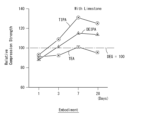
- Table 4 and Figure 2 when DEIPA and/or TIPA are added when mixed with water, not when crushed, and the low IM cement clinker powder contains limestone powder, TIPA and DEIPA also provide high strength development, and TIPA in particular provides extremely high strength development.
- the low IM cement clinker powder does not contain limestone powder
- TIPA does not contribute to strength development
- DEIPA only slightly improves strength development (Table 3 and Figure 1).
- TIPA and DEIPA are added when crushed, and limestone is not mixed, DEIPA only contributes slightly to strength development, and TIPA does not contribute to strength development (Table 2).
- TIPA and/or DEIPA may be added, for example, to the slurry immediately after starting to mix the water with the low IM cement clinker powder. However, adding them to the water before mixing with the low IM cement clinker powder allows them to act uniformly and sufficiently.
- 30 parts by mass or more and 100 parts by mass or less, more preferably 40 parts by mass or more and 65 parts by mass or less of water are mixed with 100 parts by mass of low IM cement clinker powder.
- the water temperature during mixing is, for example, 5°C or more and 35°C or less.
- the mixing time with water, the equipment used for mixing, etc. are determined, for example, according to established methods.
- TIPA and/or DEIPA are added in a total amount of 0.01 to 0.05 parts by mass per 100 parts by mass of the low IM cement clinker powder.
- the strength improving effect of TIPA and DEIPA is manifested by the addition of 0.01 parts by mass or more, and the effect does not increase even if 0.05 parts by mass or more is added.
- TIPA and/or DEIPA are added in a total amount of 0.02 to 0.04 parts by mass per 100 parts by mass of the low IM cement clinker powder.
- TIPA is added in a total amount of 0.01 to 0.05 parts by mass per 100 parts by mass of the low IM cement clinker powder, and most preferably, TIPA is added in a total amount of 0.02 to 0.04 parts by mass per 100 parts by mass of the low IM cement clinker powder.
- Hydraulic compositions often contain aggregates such as sand and gravel, but aggregates have a small specific surface area and low reactivity. TIPA and DEIPA act on low IM cement clinker powder, so the amount added is determined based on low IM cement clinker powder.
- the low IM cement clinker powder contains limestone powder at a concentration of 2% by mass to 10% by mass, more preferably 3% by mass to 8% by mass, and gypsum powder at a concentration of 1.5% by mass to 5% by mass, more preferably 1.8% by mass to 3% by mass, calculated as SO3 .
- the hydraulic composition slurry produced according to the present invention exhibits extremely good strength development (see Table 4 and FIG. 2).
- FIG. 13 is a characteristic diagram showing the results of a strength test in a comparative example.
- FIG. 4 is a characteristic diagram showing the results of a strength test in the examples.
- the Bogue formula is used in conjunction with coefficients and ratios to calculate the approximate composition of major compounds using the values of major chemical components, and is well known to those skilled in the art. Just to be sure, the method for calculating the amount of each mineral in cement clinker using the Bogue formula is described below, with units of mass%.
- the iron percentage (I.M.) is calculated using the major chemical component values, along with the hydraulic percentage (H.M.), silica percentage (S.M.), activity index (A.I.) and lime saturation (LSD). These percentages and coefficients are used as characteristic values for cement clinker production management, as one of the coefficients and ratios, and are well known to those skilled in the art. For the sake of certainty, the calculation method for the iron percentage is described below together with other percentages and coefficients, which are mass ratios.
- HM Hydraulic modulus
- S.M. SiO2 /( Al2O3 + Fe2O3
- cement clinker powder a powder that contains at least limestone and gypsum in addition to cement clinker is called cement clinker powder.
- the amount of water to be mixed is indicated in parts by mass as the amount of water to be mixed with 100 parts by mass of cement clinker powder. This ratio is called the water-cement ratio (W/C). If the cement clinker powder contains blast furnace slag, fly ash, etc. in addition to cement clinker, lime, and gypsum, the mass of these is also included. However, cement clinker powder does not contain the aggregates sand or gravel.
- the total amount of C 3 A and C 4 AF must be 24% or more. If these amounts are less than 24%, it becomes difficult to obtain a cement clinker with good physical properties such as strength development by firing at a temperature of 1300 to 1400°C. As will be described later, in order to obtain high strength development, 63% or more of C 3 S is necessary. Therefore, the total amount of C 3 A and C 4 AF is 24% or more and 37% or less, preferably 24% or more and 35% or less, more preferably 24% or more and 32% or less, and particularly preferably 24% or more and 28% or less.
- C 4 AF is preferably present alone in an amount of 15% or more, since it allows sufficient sintering even at low temperatures and reduces the amount of f-CaO in the cement clinker.
- the C3S content is extremely important for the strength development of a cement composition (hereinafter simply referred to as "cement"). If this content falls below 63%, good strength development cannot be obtained even if the total content of C3A and C4AF and the iron percentage described below are within a predetermined range. Since the total content of C3A and C4AF is at least 24%, the upper limit of the C3S content is 76%. In order to secure a certain amount of time from the start to the end of setting, a content of 63% to 70% is preferable, and a content of 63% to 65% is more preferable.
- the low IM cement clinker used in the present invention may further contain C2S .
- the amount is 15% or less, and preferably 3% or more. From the viewpoint of obtaining long-term strength, the total amount of C2S and C3S is particularly preferably 69% or more and 76% or less.
- the iron content (I.M.) is 0.8 or more and 1.3 or less, preferably 1.14 to 1.27. If the iron content exceeds 1.3, sufficient strength development (more specifically, for example, mortar strength development) cannot be obtained even if the cement clinker satisfies other requirements. Furthermore, if the iron content exceeds 1.3, the time from the start to the end of setting tends to be too long, and for this reason too, the iron content is set to 1.3 or less.
- the iron content is preferably 1.14 to 1.27.
- the hydraulic ratio and silicic acid ratio are not particularly limited, but in order to achieve a good balance of various physical properties, the hydraulic ratio is preferably 1.8 to 2.2, and more preferably 1.9 to 2.1, and the silicic acid ratio is preferably 1.0 to 2.0, and more preferably 1.1 to 1.7.
- the method for preparing and mixing the cement raw materials may also be a known method, as appropriate.
- the compositions of waste materials, by-products, and other raw materials (CaO sources such as limestone, quicklime, and slaked lime, SiO2 sources such as silica stone, Al2O3 sources such as clay, Fe2O3 sources such as iron sources, etc.) may be measured in advance, and the mixing ratios of each raw material may be calculated from the ratios of each component in these raw materials so that the above ranges are satisfied, and the raw materials may be mixed in those ratios.
- the raw materials used in the production of low IM cement clinker are the same as those used in the production of conventional cement clinker, and there are no particular restrictions. It is of course also possible to use waste materials, by-products, etc.
- waste materials and by-products that can be used include blast furnace slag, steelmaking slag, non-ferrous slag, coal ash, sewage sludge, water purification sludge, papermaking sludge, construction waste soil, foundry sand, soot and dust, incineration fly ash, molten fly ash, chlorine bypass dust, wood chips, waste clay, slag, waste tires, shells, urban waste and its incineration ash, etc. Some of these can be used as a cement raw material as well as a thermal energy source.
- Low-IM cement clinker contains a large amount of C3A and C4AF minerals, which contain aluminum as a constituent element, and therefore has the advantage that it can be produced using a larger amount of waste and by-products with a high aluminum content than conventional cement clinker.
- the low IM cement clinker powder contains gypsum and limestone in addition to the low IM cement clinker.
- any known gypsum may be used as a raw material for cement production, such as gypsum dihydrate, gypsum hemihydrate, anhydrous gypsum, etc.
- the amount of gypsum added is preferably such that the amount of SO3 in the low IM cement clinker powder is 1.5 to 5.0 mass%, more preferably 1.8 to 3 mass%.
- the limestone can be any limestone known as a cement admixture.
- natural limestone or synthetic calcium carbonate can be used. By adding limestone, the mixture exhibits better strength development than when it is not added.
- the limestone content in the low IM cement clinker powder is preferably 2-10% by mass. If the limestone content is below 2%, the synergistic effect with the additives is not fully achieved. To better achieve the strength improvement effect, the limestone content is more preferably 3-8% by mass.
- the low-IM cement clinker powder may contain, in addition to the above limestone, fly ash and/or blast furnace slag and/or siliceous admixtures.
- the total concentration of limestone and blast furnace slag and the fly ash and/or siliceous admixtures in the low-IM cement clinker powder is 10 mass% or less.
- the above cement clinker, gypsum, limestone and other admixtures are preferably adjusted so that the fineness thereof is 2800 to 4500 cm 2 /g in terms of Blaine specific surface area.
- the grinding method for preparing the powder to the desired fineness can be any known technique without particular restrictions. Each component can be ground separately and then mixed, or can be mixed and then ground. A ball mill, vertical mill, etc. can be used as the grinding machine.
- the hydraulic composition slurry produced by the present invention can be used as a Portland cement slurry, particularly a slurry using Portland cement that meets JIS standards.
- Portland cement include ordinary Portland cement, high-early-strength Portland cement, and ultra-high-early-strength Portland cement.
- it can also be used as a component of various mixed cements and solidification materials such as soil solidification materials.
- aggregates such as sand and gravel can be added.
- TIPA triisopropanolamine
- DEIPA diethanolisopropanolamine
- the mixing method is not particularly limited, and a known method using a cement mixer, a propeller mixer, or the like can be used. It is preferable that TIPA and/or DEIPA are mixed uniformly with water in advance. However, for example, TIPA and/or DEIPA may be added to the slurry immediately after starting to mix water and low IM cement clinker powder.
- Gypsum was added to 100% by mass of low IM cement clinker so that the SO3 equivalent was 2 ⁇ 0.2% by mass, and limestone was further added, and the mixture was pulverized so that the specific surface area by the Blaine method was 3200 ⁇ 50 cm2 /g to produce each cement (hydraulic composition). The mortar compressive strength of the obtained cement was measured.
- Measurement of the chemical composition of raw materials and cement clinker Measured using X-ray fluorescence analysis in accordance with JIS R5204.
- Measurement of mortar compressive strength Measured using a method conforming to JIS R5201, and compared with the compressive strength of DEG, which has traditionally been used as a grinding aid, set at 100.
- the additives used were diethylene glycol (hereinafter referred to as DEG), triisopropanolamine (hereinafter referred to as TIPA), diethyleneisopropanolamine (hereinafter referred to as DEIPA), and triethanolamine (hereinafter referred to as TEA).
- DEG diethylene glycol
- TIPA triisopropanolamine
- DEIPA diethyleneisopropanolamine
- TEA triethanolamine
- the mixing water used to measure the mortar compressive strength was mixed with 0.03 parts by mass of additive per 100 parts by mass of cement clinker.
- the hydraulic composition slurry was obtained by mixing 0.03 parts by mass of additive per 100 parts by mass of cement clinker with the mixing water used to measure the mortar compressive strength, and the compressive strength was measured in accordance with JIS R5201. The test results are shown in Table 4.
- Comparative Examples 1 to 4 are examples in which various additives were used as grinding aids when grinding cement clinker. Compared to Comparative Example 1, which used the general-purpose additive DEG, Comparative Examples 2, 3, and 4 did not show any significant strength-enhancing effect.
- Comparative examples 5 to 8 are examples in which various additives were mixed into the mixing water during mortar production. Compared to comparative example 4, which used the general-purpose additive DEG, comparative examples 5, 6, and 7 did not show any significant strength-enhancing effect.
- Comparative Examples 9 and 10 and Examples 1 and 2 are examples in which various additives were mixed into the mixing water used to manufacture hydraulic slurry, and limestone was also mixed in. Compared to Comparative Example 9, which used the general-purpose additive DEG, Examples 1 and 2, which used the additive of the present invention, showed good strength at 3 days, and a significant increase in strength was observed at 7 and 28 days.
Landscapes
- Chemical & Material Sciences (AREA)
- Engineering & Computer Science (AREA)
- Ceramic Engineering (AREA)
- Materials Engineering (AREA)
- Structural Engineering (AREA)
- Organic Chemistry (AREA)
- Chemical Kinetics & Catalysis (AREA)
- Inorganic Chemistry (AREA)
- Curing Cements, Concrete, And Artificial Stone (AREA)
Priority Applications (3)
| Application Number | Priority Date | Filing Date | Title |
|---|---|---|---|
| AU2024244800A AU2024244800A1 (en) | 2023-03-31 | 2024-03-27 | Method for producing hydraulic composition slurry |
| EP24780443.8A EP4692020A1 (en) | 2023-03-31 | 2024-03-27 | Method for producing hydraulic composition slurry |
| JP2025511019A JPWO2024204338A1 (https=) | 2023-03-31 | 2024-03-27 |
Applications Claiming Priority (2)
| Application Number | Priority Date | Filing Date | Title |
|---|---|---|---|
| JP2023059618 | 2023-03-31 | ||
| JP2023-059618 | 2023-03-31 |
Publications (1)
| Publication Number | Publication Date |
|---|---|
| WO2024204338A1 true WO2024204338A1 (ja) | 2024-10-03 |
Family
ID=92906674
Family Applications (1)
| Application Number | Title | Priority Date | Filing Date |
|---|---|---|---|
| PCT/JP2024/012240 Ceased WO2024204338A1 (ja) | 2023-03-31 | 2024-03-27 | 水硬性組成物スラリーの製造方法 |
Country Status (4)
| Country | Link |
|---|---|
| EP (1) | EP4692020A1 (https=) |
| JP (1) | JPWO2024204338A1 (https=) |
| AU (1) | AU2024244800A1 (https=) |
| WO (1) | WO2024204338A1 (https=) |
Citations (7)
| Publication number | Priority date | Publication date | Assignee | Title |
|---|---|---|---|---|
| JPH03183647A (ja) * | 1989-10-06 | 1991-08-09 | W R Grace & Co | 強化混合セメント組成物および強化ポルトランドセメント組成物 |
| JPH09142900A (ja) * | 1995-11-20 | 1997-06-03 | Chichibu Onoda Cement Corp | セメント混合材並びに該セメント混合材を添加したセメント及びコンクリート |
| WO2011022217A1 (en) * | 2009-08-20 | 2011-02-24 | W.R. Grace & Co.-Conn. | Robust air-detraining for cement milling |
| JP2012091992A (ja) * | 2010-09-28 | 2012-05-17 | Tokyo Institute Of Technology | 高活性セメントクリンカ、高活性セメント及び早強セメント組成物 |
| JP2012224504A (ja) * | 2011-04-19 | 2012-11-15 | Tokuyama Corp | セメントクリンカー |
| WO2020241078A1 (ja) * | 2019-05-31 | 2020-12-03 | 株式会社トクヤマ | 水硬性組成物の製造方法 |
| JP7180742B1 (ja) * | 2021-12-23 | 2022-11-30 | 住友大阪セメント株式会社 | セメント組成物及びその製造方法 |
-
2024
- 2024-03-27 JP JP2025511019A patent/JPWO2024204338A1/ja active Pending
- 2024-03-27 WO PCT/JP2024/012240 patent/WO2024204338A1/ja not_active Ceased
- 2024-03-27 EP EP24780443.8A patent/EP4692020A1/en active Pending
- 2024-03-27 AU AU2024244800A patent/AU2024244800A1/en active Pending
Patent Citations (9)
| Publication number | Priority date | Publication date | Assignee | Title |
|---|---|---|---|---|
| JPH03183647A (ja) * | 1989-10-06 | 1991-08-09 | W R Grace & Co | 強化混合セメント組成物および強化ポルトランドセメント組成物 |
| JPH09142900A (ja) * | 1995-11-20 | 1997-06-03 | Chichibu Onoda Cement Corp | セメント混合材並びに該セメント混合材を添加したセメント及びコンクリート |
| WO2011022217A1 (en) * | 2009-08-20 | 2011-02-24 | W.R. Grace & Co.-Conn. | Robust air-detraining for cement milling |
| JP2012091992A (ja) * | 2010-09-28 | 2012-05-17 | Tokyo Institute Of Technology | 高活性セメントクリンカ、高活性セメント及び早強セメント組成物 |
| JP2012224504A (ja) * | 2011-04-19 | 2012-11-15 | Tokuyama Corp | セメントクリンカー |
| JP5665638B2 (ja) | 2011-04-19 | 2015-02-04 | 株式会社トクヤマ | セメントクリンカーの製造方法 |
| WO2020241078A1 (ja) * | 2019-05-31 | 2020-12-03 | 株式会社トクヤマ | 水硬性組成物の製造方法 |
| JP6825171B1 (ja) | 2019-05-31 | 2021-02-03 | 株式会社トクヤマ | 水硬性組成物の製造方法 |
| JP7180742B1 (ja) * | 2021-12-23 | 2022-11-30 | 住友大阪セメント株式会社 | セメント組成物及びその製造方法 |
Non-Patent Citations (2)
| Title |
|---|
| "Ceramic Engineering Handbook", 31 March 2002, CERAMIC SOCIETY OF JAPAN, pages: 231 |
| See also references of EP4692020A1 |
Also Published As
| Publication number | Publication date |
|---|---|
| EP4692020A1 (en) | 2026-02-11 |
| JPWO2024204338A1 (https=) | 2024-10-03 |
| AU2024244800A1 (en) | 2025-10-02 |
Similar Documents
| Publication | Publication Date | Title |
|---|---|---|
| JP5818579B2 (ja) | 中性化抑制型早強セメント組成物 | |
| JP5665638B2 (ja) | セメントクリンカーの製造方法 | |
| JP5750011B2 (ja) | 高炉セメント組成物 | |
| JP6947501B2 (ja) | セメント組成物 | |
| JP6282408B2 (ja) | 水硬性組成物 | |
| JP6825171B1 (ja) | 水硬性組成物の製造方法 | |
| JP7542130B2 (ja) | セメント混和材、セメント組成物、及びコンクリート製品の製造方法 | |
| JP7218083B2 (ja) | セメント組成物の製造方法 | |
| JP2011219341A (ja) | 水硬性組成物 | |
| JP2014051433A (ja) | 水硬性組成物 | |
| JP6980552B2 (ja) | セメント組成物 | |
| JP7436249B2 (ja) | セメントクリンカー | |
| JP7450826B2 (ja) | 水硬性組成物及びその製造方法 | |
| JP6516658B2 (ja) | セメントクリンカー | |
| JP6867801B2 (ja) | セメント組成物 | |
| JP4852506B2 (ja) | セメント添加材及びセメント組成物 | |
| WO2024204338A1 (ja) | 水硬性組成物スラリーの製造方法 | |
| JP5350770B2 (ja) | セメント組成物 | |
| JP7198604B2 (ja) | 焼成物、セメント添加材、およびセメント組成物 | |
| JP2013087036A (ja) | 低水和熱セメントクリンカおよび低水和熱セメント組成物 | |
| JP7812182B2 (ja) | 水硬性組成物 | |
| JP7540833B2 (ja) | セメントクリンカー | |
| WO2025142526A1 (ja) | セメント組成物 | |
| WO2024219334A1 (ja) | ポルトランドセメントクリンカーの製造方法 | |
| JP5501705B2 (ja) | セメント添加材及びセメント組成物 |
Legal Events
| Date | Code | Title | Description |
|---|---|---|---|
| 121 | Ep: the epo has been informed by wipo that ep was designated in this application |
Ref document number: 24780443 Country of ref document: EP Kind code of ref document: A1 |
|
| WWE | Wipo information: entry into national phase |
Ref document number: AU2024244800 Country of ref document: AU |
|
| ENP | Entry into the national phase |
Ref document number: 2025511019 Country of ref document: JP Kind code of ref document: A |
|
| WWE | Wipo information: entry into national phase |
Ref document number: 2025511019 Country of ref document: JP |
|
| ENP | Entry into the national phase |
Ref document number: 2024244800 Country of ref document: AU Date of ref document: 20240327 Kind code of ref document: A |
|
| WWE | Wipo information: entry into national phase |
Ref document number: 11202506048Y Country of ref document: SG Ref document number: 2024780443 Country of ref document: EP |
|
| WWP | Wipo information: published in national office |
Ref document number: 11202506048Y Country of ref document: SG |
|
| NENP | Non-entry into the national phase |
Ref country code: DE |
|
| ENP | Entry into the national phase |
Ref document number: 2024780443 Country of ref document: EP Effective date: 20251031 |
|
| ENP | Entry into the national phase |
Ref document number: 2024780443 Country of ref document: EP Effective date: 20251031 |
|
| ENP | Entry into the national phase |
Ref document number: 2024780443 Country of ref document: EP Effective date: 20251031 |
|
| ENP | Entry into the national phase |
Ref document number: 2024780443 Country of ref document: EP Effective date: 20251031 |
|
| ENP | Entry into the national phase |
Ref document number: 2024780443 Country of ref document: EP Effective date: 20251031 |
|
| ENP | Entry into the national phase |
Ref document number: 2024780443 Country of ref document: EP Effective date: 20251031 |
|
| ENP | Entry into the national phase |
Ref document number: 2024780443 Country of ref document: EP Effective date: 20251031 |
|
| ENP | Entry into the national phase |
Ref document number: 2024780443 Country of ref document: EP Effective date: 20251031 |
|
| WWP | Wipo information: published in national office |
Ref document number: 2024780443 Country of ref document: EP |