WO2024201924A1 - イオンプレーティング用ターゲット - Google Patents
イオンプレーティング用ターゲット Download PDFInfo
- Publication number
- WO2024201924A1 WO2024201924A1 PCT/JP2023/013271 JP2023013271W WO2024201924A1 WO 2024201924 A1 WO2024201924 A1 WO 2024201924A1 JP 2023013271 W JP2023013271 W JP 2023013271W WO 2024201924 A1 WO2024201924 A1 WO 2024201924A1
- Authority
- WO
- WIPO (PCT)
- Prior art keywords
- target
- ion plating
- main body
- back surface
- use surface
- Prior art date
- Legal status (The legal status is an assumption and is not a legal conclusion. Google has not performed a legal analysis and makes no representation as to the accuracy of the status listed.)
- Ceased
Links
Images


Classifications
-
- C—CHEMISTRY; METALLURGY
- C23—COATING METALLIC MATERIAL; COATING MATERIAL WITH METALLIC MATERIAL; CHEMICAL SURFACE TREATMENT; DIFFUSION TREATMENT OF METALLIC MATERIAL; COATING BY VACUUM EVAPORATION, BY SPUTTERING, BY ION IMPLANTATION OR BY CHEMICAL VAPOUR DEPOSITION, IN GENERAL; INHIBITING CORROSION OF METALLIC MATERIAL OR INCRUSTATION IN GENERAL
- C23C—COATING METALLIC MATERIAL; COATING MATERIAL WITH METALLIC MATERIAL; SURFACE TREATMENT OF METALLIC MATERIAL BY DIFFUSION INTO THE SURFACE, BY CHEMICAL CONVERSION OR SUBSTITUTION; COATING BY VACUUM EVAPORATION, BY SPUTTERING, BY ION IMPLANTATION OR BY CHEMICAL VAPOUR DEPOSITION, IN GENERAL
- C23C14/00—Coating by vacuum evaporation, by sputtering or by ion implantation of the coating forming material
- C23C14/22—Coating by vacuum evaporation, by sputtering or by ion implantation of the coating forming material characterised by the process of coating
- C23C14/24—Vacuum evaporation
-
- C—CHEMISTRY; METALLURGY
- C23—COATING METALLIC MATERIAL; COATING MATERIAL WITH METALLIC MATERIAL; CHEMICAL SURFACE TREATMENT; DIFFUSION TREATMENT OF METALLIC MATERIAL; COATING BY VACUUM EVAPORATION, BY SPUTTERING, BY ION IMPLANTATION OR BY CHEMICAL VAPOUR DEPOSITION, IN GENERAL; INHIBITING CORROSION OF METALLIC MATERIAL OR INCRUSTATION IN GENERAL
- C23C—COATING METALLIC MATERIAL; COATING MATERIAL WITH METALLIC MATERIAL; SURFACE TREATMENT OF METALLIC MATERIAL BY DIFFUSION INTO THE SURFACE, BY CHEMICAL CONVERSION OR SUBSTITUTION; COATING BY VACUUM EVAPORATION, BY SPUTTERING, BY ION IMPLANTATION OR BY CHEMICAL VAPOUR DEPOSITION, IN GENERAL
- C23C14/00—Coating by vacuum evaporation, by sputtering or by ion implantation of the coating forming material
- C23C14/22—Coating by vacuum evaporation, by sputtering or by ion implantation of the coating forming material characterised by the process of coating
- C23C14/24—Vacuum evaporation
- C23C14/32—Vacuum evaporation by explosion; by evaporation and subsequent ionisation of the vapours, e.g. ion-plating
Definitions
- the disclosed embodiment relates to an ion plating target.
- a functional thin film can be formed on the object by a physical vapor deposition method such as an arc ion plating method (see, for example, Patent Document 1).
- the ion plating target according to one embodiment of the present invention has a disk-shaped main body.
- the main body has a use surface that evaporates during film formation, and a back surface opposite the use surface.
- the area of the back surface is larger than the area of the use surface.
- FIG. 1 is a schematic diagram showing an example of the configuration of a film forming apparatus according to an embodiment.
- FIG. 2 is a perspective view illustrating an example of a configuration of a target according to the embodiment.
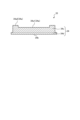
- FIG. 3 is a cross-sectional view illustrating an example of a configuration of a target according to an embodiment.
- FIG. 4 is a cross-sectional view illustrating an example of a target attachment mechanism according to the embodiment.
- FIG. 5 is an enlarged cross-sectional view showing an example of the configuration of a target according to an embodiment.
- FIG. 6 is a cross-sectional view showing an example of a configuration of a target according to another embodiment.
- Fig. 1 is a schematic diagram showing an example of the configuration of the film forming apparatus 1 according to an embodiment.
- the film forming apparatus 1 includes a chamber 10, an exhaust section 20, an evaporation section 30, a workpiece holding section 40, and a gas supply section 50.
- the chamber 10 is a container that contains multiple workpieces W.
- the workpieces W are, for example, cutting tools. Note that the workpieces W of the present disclosure are not limited to cutting tools.
- the exhaust unit 20 evacuates the interior of the chamber 10. The interior of the chamber 10 is maintained in a vacuum state by the exhaust unit 20.
- the evaporation unit 30 evaporates a target 33, which is a film-forming material.
- the evaporation unit 30 has an arc power supply unit 31, an arc cathode 32, and a target 33.
- the arc power supply unit 31 is a power supply circuit that supplies a discharge current to the arc cathode 32.
- the arc cathode 32 holds the target 33 and generates a vacuum arc discharge between the target 32 and the inner wall of the chamber 10 using power supplied from the arc power supply unit 31.
- the arc cathode 32 and the target 33 are located, for example, on the side wall of the chamber 10.
- the usable surface 34a (see FIG. 2) of the target 33 is exposed inside the chamber 10 and is positioned to face the multiple workpieces W.
- two pairs of arc power supply units 31, arc cathodes 32, and targets 33 are located in the film forming apparatus 1, but the present disclosure is not limited to such an example.
- one pair of arc power supply units 31, arc cathodes 32, and targets 33 may be located in the film forming apparatus 1, or three or more pairs of arc power supply units 31, arc cathodes 32, and targets 33 may be located.
- the workpiece holding unit 40 holds multiple workpieces W.
- the workpiece holding unit 40 has a first table 41, multiple second tables 42, multiple columnar portions 43, a drive unit 44, and a bias power supply unit 45.
- the first table 41 is, for example, disk-shaped, and is rotatably supported at the bottom of the chamber 10.
- the second table 42 is, for example, disk-shaped, and is rotatably supported on the upper surface of the first table 41.
- the columnar portion 43 is, for example, column-shaped, and is rotatably supported on the upper surface of the second table 42, and supports multiple workpieces W.
- the drive unit 44 rotates the first table 41 relative to the chamber 10.
- the drive unit 44 also rotates the second table 42 relative to the first table 41.
- the drive unit 44 also rotates the columnar portion 43 relative to the second table 42.
- the bias power supply unit 45 applies a negative potential to the multiple workpieces W via the first table 41, the second table 42, and the columnar portions 43.
- the gas supply unit 50 supplies a process gas for forming a coating inside the chamber 10.
- the gas supply unit 50 has, for example, multiple mass flow controllers 51.
- the film forming apparatus 1 also includes a control device 2.
- the control device 2 is, for example, a computer, and includes a control unit 3 and a memory unit 4.
- the memory unit 4 stores programs that control various processes executed in the film forming apparatus 1.
- the control unit 3 controls the operation of the film forming apparatus 1 by reading and executing the programs stored in the memory unit 4.
- Such a program may be recorded on a computer-readable storage medium and installed from that storage medium into the storage unit 4 of the control device 2.
- Examples of computer-readable storage media include a hard disk (HD), a flexible disk (FD), a compact disk (CD), a magnetic optical disk (MO), and a memory card.
- the film forming apparatus 1 may be provided with a heating section that heats multiple workpieces W to a desired temperature, and may be provided with an etching section that etches and cleans the surfaces of the workpieces W with Ar plasma or the like.
- Fig. 2 is a perspective view showing an example of the configuration of the target 33 according to the embodiment
- Fig. 3 is a cross-sectional view showing an example of the configuration of the target 33 according to the embodiment.
- the target 33 is an example of an ion plating target.
- the target 33 includes a substantially disk-shaped main body 34.
- the main body 34 is made of a conductive material, and contains, for example, various metal elements and carbon (C).
- the main body 34 of the target 33 has a use surface 34a and a back surface 34b.
- the use surface 34a is one of the main surfaces of the main body 34, and is positioned so as to face the multiple workpieces W within the film forming apparatus 1.
- the back surface 34b is the other main surface of the main body 34, and is positioned opposite the use surface 34a.
- the use surface 34a of the main body 34 according to the embodiment is, for example, substantially circular in plan view, and has a diameter L1 as shown in FIG. 3.
- the back surface 34b of the main body 34 according to the embodiment is, for example, substantially circular in plan view, and has a diameter L2.
- the main body 34 has a first portion 34c and a second portion 34d.
- the first portion 34c is located on the side of the use surface 34a and has the same area as the use surface 34a in a planar view.
- the second portion 34d is located on the side of the back surface 34b and has the same area as the back surface 34b in a planar view.
- the area of the back surface 34b may be larger than the area of the use surface 34a.
- the diameter L2 of the back surface 34b may be larger than the diameter L1 of the use surface 34a.
- the second portion 34d is larger than the first portion 34c in a plan view, and the peripheral portion of the second portion 34d protrudes to the side in a brim-like shape. That is, in the embodiment, the second portion 34d is made larger than the first portion 34c in a plan view, so that a protrusion 34d1 is formed in the second portion 34d. This allows the target 33 to be easily attached to the arc cathode 32, as shown in FIG. 4.
- FIG. 4 is a cross-sectional view showing an example of an attachment mechanism for the target 33 according to the embodiment.
- the target 33 can be attached to the arc cathode 32 using an attachment member 35 and a fixing member 36.
- the mounting member 35 is, for example, ring-shaped, and is configured so that the first portion 34c of the main body 34 can be inserted inside, and the protrusion 34d1 of the second portion 34d can be hooked and secured in place.
- the mounting member 35 also has multiple through holes 35a, and multiple fixing members 36 can be inserted into each of the multiple through holes 35a.
- the fixing member 36 is, for example, a bolt, which can be inserted through the through hole 35a and can be fixed (screwed) into the screw hole 32b located on the surface 32a of the arc cathode 32.
- the main body 34 of the target 33 has the protrusion 34d1, which makes it possible to easily attach the target 33 to the arc cathode 32.
- the thickness T2 of the second portion 34d of the main body portion 34 may be 2.1 (mm) to 3.5 (mm).
- the thickness T2 of the second portion 34d 2.1 (mm) or more, the strength of the protrusion 34d1 in the second portion 34d is improved, so that the second portion 34d is less likely to be damaged when the target 33 is fixed using the mounting member 35 (see FIG. 4) and the fixing member 36 (see FIG. 4).
- the target 33 can be attached even more easily.
- the ratio T1/T2 of the thickness T1 of the first portion 34c to the thickness T2 of the second portion 34d in the main body portion 34 may be 6.4 or less.
- the ratio T2/T1 of the thickness T2 to the thickness T1 may be 0.16 or more.
- the second portion 34d is less likely to be damaged when the target 33 is fixed using the mounting member 35 (see FIG. 4) and the fixing member 36 (see FIG. 4).
- FIG. 5 is an enlarged cross-sectional view showing an example of the configuration of the target 33 according to the embodiment.
- the corners 34d2, 34d3 of the second portion 34d in the main body 34 may have a chamfered shape. That is, in the embodiment, the corners 34d2, 34d3 of the second portion 34d may have an R shape.
- both corners 34d2 and 34d3 have a chamfered shape, but the present disclosure is not limited to such an example, and for example, either corner 34d2 or corner 34d3 may have a chamfered shape.
- the back surface 34b of the main body 34 may be cooled during film formation by contacting the front surface 32a of the arc cathode 32. This reduces an excessive rise in temperature of the usable surface 34a of the main body 34, making it possible to form a coating of a stable thickness on multiple workpieces W.
- a flow path may be located inside the arc cathode 32, and a cooling medium such as water may be flowed through this flow path. This can further reduce excessive increases in temperature of the use surface 34a of the main body 34, making it possible to form a coating of a more stable thickness on multiple workpieces W.
- FIG. 6 is a cross-sectional view showing an example of the configuration of a target 33 according to another embodiment. As shown in FIG. 6, in this another embodiment, a central portion 34a1 of a use surface 34a of a main body portion 34 may be recessed with respect to a peripheral portion 34a2 of the use surface 34a.
- the use surface 34a of the main body 34 gradually drops from the position it was in when use began. This is because, as described above, when a coating containing the components of the target 33 is formed on the surface of the workpiece W, the use surface 34a melts and evaporates due to the vacuum arc discharge.
- the surface 34a in use does not necessarily wear down evenly across the entire surface, but rather the central portion 34a1 wears down more than the peripheral portion 34a2. Then, after some time has passed since the target 33 began to be used, when the central portion 34a1 has become recessed, the film formation process may stabilize.
- the central portion 34a1 is recessed from the start of use, so that the film formation process becomes stable from the start of use.
- the technology of the present disclosure is applied to a film forming apparatus 1 that uses an arc ion plating method, but the present disclosure is not limited to such an example.
- the technology of the present disclosure may be applied to film forming apparatuses that use various ion plating methods.
- the target 33 may be approximately trapezoidal in cross section, with the back surface 34b being larger than the usable surface 34a. This also makes it possible to hook the mounting member 35 onto the side of the trapezoid and secure it, making it possible to fix the target 33 to the arc cathode 32 without any problems.
- the present technology can also be configured as follows.
- a disk-shaped main body portion is provided, the main body portion has a use surface that evaporates during film formation and a back surface opposite to the use surface, An ion plating target, wherein the area of the back surface is larger than the area of the usable surface.
- the main body portion has a first portion having the same area as the use surface in a plan view and a second portion having the same area as the back surface in a plan view, The ion plating target according to (1) above, wherein the thickness T2 of the second portion is 2.1 (mm) to 3.5 (mm).
- T1/T2 is 6.4 or less, where T1 is a thickness of the first portion.
- Control device 33 Target (an example of a target for ion plating) 34 Main body portion 34a Use surface 34a1 Central portion 34a2 Peripheral edge portion 34b Back surface 34c First portion 34d Second portion 34d1 Protruding portion 34d2, 34d3 Corner portion L1, L2 Diameter T1, T2 Thickness
Landscapes
- Chemical & Material Sciences (AREA)
- Chemical Kinetics & Catalysis (AREA)
- Engineering & Computer Science (AREA)
- Materials Engineering (AREA)
- Mechanical Engineering (AREA)
- Metallurgy (AREA)
- Organic Chemistry (AREA)
- Physical Vapour Deposition (AREA)
Priority Applications (2)
| Application Number | Priority Date | Filing Date | Title |
|---|---|---|---|
| PCT/JP2023/013271 WO2024201924A1 (ja) | 2023-03-30 | 2023-03-30 | イオンプレーティング用ターゲット |
| JP2025509518A JPWO2024201924A1 (https=) | 2023-03-30 | 2023-03-30 |
Applications Claiming Priority (1)
| Application Number | Priority Date | Filing Date | Title |
|---|---|---|---|
| PCT/JP2023/013271 WO2024201924A1 (ja) | 2023-03-30 | 2023-03-30 | イオンプレーティング用ターゲット |
Publications (1)
| Publication Number | Publication Date |
|---|---|
| WO2024201924A1 true WO2024201924A1 (ja) | 2024-10-03 |
Family
ID=92904433
Family Applications (1)
| Application Number | Title | Priority Date | Filing Date |
|---|---|---|---|
| PCT/JP2023/013271 Ceased WO2024201924A1 (ja) | 2023-03-30 | 2023-03-30 | イオンプレーティング用ターゲット |
Country Status (2)
| Country | Link |
|---|---|
| JP (1) | JPWO2024201924A1 (https=) |
| WO (1) | WO2024201924A1 (https=) |
Citations (4)
| Publication number | Priority date | Publication date | Assignee | Title |
|---|---|---|---|---|
| JPH1060631A (ja) * | 1996-08-13 | 1998-03-03 | Kobe Steel Ltd | 気相コーティング用Ti−Hf系合金ターゲット材料 |
| JP2006161101A (ja) * | 2004-12-07 | 2006-06-22 | Daido Steel Co Ltd | 多元系ターゲット材及びその製造方法 |
| WO2007108313A1 (ja) * | 2006-03-22 | 2007-09-27 | Kabushiki Kaisha Kobe Seiko Sho | アークイオンプレーティング方法及びこれに用いられるターゲット |
| JP2018090886A (ja) * | 2016-12-07 | 2018-06-14 | 株式会社神戸製鋼所 | 成膜装置およびそれを用いた成膜物の製造方法、ならびに冷却パネル |
-
2023
- 2023-03-30 JP JP2025509518A patent/JPWO2024201924A1/ja active Pending
- 2023-03-30 WO PCT/JP2023/013271 patent/WO2024201924A1/ja not_active Ceased
Patent Citations (4)
| Publication number | Priority date | Publication date | Assignee | Title |
|---|---|---|---|---|
| JPH1060631A (ja) * | 1996-08-13 | 1998-03-03 | Kobe Steel Ltd | 気相コーティング用Ti−Hf系合金ターゲット材料 |
| JP2006161101A (ja) * | 2004-12-07 | 2006-06-22 | Daido Steel Co Ltd | 多元系ターゲット材及びその製造方法 |
| WO2007108313A1 (ja) * | 2006-03-22 | 2007-09-27 | Kabushiki Kaisha Kobe Seiko Sho | アークイオンプレーティング方法及びこれに用いられるターゲット |
| JP2018090886A (ja) * | 2016-12-07 | 2018-06-14 | 株式会社神戸製鋼所 | 成膜装置およびそれを用いた成膜物の製造方法、ならびに冷却パネル |
Also Published As
| Publication number | Publication date |
|---|---|
| JPWO2024201924A1 (https=) | 2024-10-03 |
Similar Documents
| Publication | Publication Date | Title |
|---|---|---|
| US8685267B2 (en) | Substrate processing method | |
| JP5893516B2 (ja) | 被処理体の処理装置及び被処理体の載置台 | |
| JP2005056535A (ja) | 磁気記録媒体の製造方法及び製造装置 | |
| JP2009299129A (ja) | 真空蒸着装置及びこの装置の電子ビーム照射方法 | |
| US20080301972A1 (en) | Evacuation method and storage medium | |
| WO2024201924A1 (ja) | イオンプレーティング用ターゲット | |
| US20100155227A1 (en) | Sputtering apparatus and film forming method | |
| WO2025004211A1 (ja) | Dlc成膜用ターゲット | |
| JP2006079952A (ja) | 集束イオンビーム装置、及びそれに用いる絞り | |
| JP3104701B1 (ja) | アーク式蒸発源 | |
| WO2013069424A1 (ja) | プラズマ処理方法及びプラズマ処理装置 | |
| JP4448004B2 (ja) | 物品処理装置 | |
| JP2895506B2 (ja) | スパッタ装置 | |
| TW202248440A (zh) | 在半導體處理期間用於在基板上產生磁場的裝置 | |
| TW202317796A (zh) | 用於在半導體處理期間在基板上產生磁場的設備 | |
| JP7737830B2 (ja) | 成膜装置、処理条件決定方法及び成膜方法 | |
| KR102707659B1 (ko) | 스퍼터링 타겟 접합체 | |
| JP4375649B2 (ja) | 薄膜堆積用マスク及び薄膜堆積装置 | |
| JPH02290971A (ja) | スパッタ装置 | |
| EP1496135A1 (en) | Spattering device, method of forming thin film by spattering, and method of manufacturing disk-like recording medium using the device | |
| JP3305654B2 (ja) | プラズマcvd装置および記録媒体 | |
| JP2001181829A (ja) | アーク式蒸発源 | |
| JPH04116160A (ja) | 皮膜形成装置 | |
| JP5049632B2 (ja) | フィラメント固定機構、発熱機構および蒸着装置 | |
| WO2024209533A1 (ja) | 成膜方法 |
Legal Events
| Date | Code | Title | Description |
|---|---|---|---|
| 121 | Ep: the epo has been informed by wipo that ep was designated in this application |
Ref document number: 23930562 Country of ref document: EP Kind code of ref document: A1 |
|
| ENP | Entry into the national phase |
Ref document number: 2025509518 Country of ref document: JP Kind code of ref document: A |
|
| WWE | Wipo information: entry into national phase |
Ref document number: 2025509518 Country of ref document: JP |
|
| NENP | Non-entry into the national phase |
Ref country code: DE |
|
| 122 | Ep: pct application non-entry in european phase |
Ref document number: 23930562 Country of ref document: EP Kind code of ref document: A1 |