WO2024199668A1 - Dosing regiment of azd5305 - Google Patents
Dosing regiment of azd5305 Download PDFInfo
- Publication number
- WO2024199668A1 WO2024199668A1 PCT/EP2023/058465 EP2023058465W WO2024199668A1 WO 2024199668 A1 WO2024199668 A1 WO 2024199668A1 EP 2023058465 W EP2023058465 W EP 2023058465W WO 2024199668 A1 WO2024199668 A1 WO 2024199668A1
- Authority
- WO
- WIPO (PCT)
- Prior art keywords
- azd5305
- dose
- treatment
- patients
- pharmaceutically acceptable
- Prior art date
- Legal status (The legal status is an assumption and is not a legal conclusion. Google has not performed a legal analysis and makes no representation as to the accuracy of the status listed.)
- Ceased
Links
Classifications
-
- A—HUMAN NECESSITIES
- A61—MEDICAL OR VETERINARY SCIENCE; HYGIENE
- A61K—PREPARATIONS FOR MEDICAL, DENTAL OR TOILETRY PURPOSES
- A61K31/00—Medicinal preparations containing organic active ingredients
- A61K31/33—Heterocyclic compounds
- A61K31/395—Heterocyclic compounds having nitrogen as a ring hetero atom, e.g. guanethidine or rifamycins
- A61K31/495—Heterocyclic compounds having nitrogen as a ring hetero atom, e.g. guanethidine or rifamycins having six-membered rings with two or more nitrogen atoms as the only ring heteroatoms, e.g. piperazine or tetrazines
- A61K31/496—Non-condensed piperazines containing further heterocyclic rings, e.g. rifampin, thiothixene or sparfloxacin
-
- A—HUMAN NECESSITIES
- A61—MEDICAL OR VETERINARY SCIENCE; HYGIENE
- A61P—SPECIFIC THERAPEUTIC ACTIVITY OF CHEMICAL COMPOUNDS OR MEDICINAL PREPARATIONS
- A61P35/00—Antineoplastic agents
Definitions
- the present disclosure relates to methods of treatment or prophylaxis of diseases and conditions in which inhibition of PARP1 or PARP1 function is of therapeutic significance.
- PARP family of enzymes play an important role in a number of cellular processes, such as replication, recombination, chromatin remodeling, and DNA damage repair (O’Connor 2015).
- PARP1 and PARP2 are the most extensively studied PARPs for their role in DNA damage repair.
- PARP1 is activated by DNA damage breaks and functions to catalyse the addition of poly (ADP-ribose) (PAR) chains to target proteins.
- PAR poly (ADP-ribose)
- PARylation mediates the recruitment of additional DNA repair factors to DNA lesions.
- PARP auto-PARylation triggers the release of bound PARP from DNA to allow access to other DNA repair proteins to complete repair.
- binding of PARP to damaged sites, its catalytic activity, and its eventual release from DNA are all important steps for a cancer cell to respond to DNA damage caused by chemotherapeutic agents and radiation therapy (Bai 2015).
- PARP inhibitors having improved selectivity for PARP1 may possess improved efficacy and reduced toxicity compared to other clinical PARP1/2 inhibitors. It is believed also that selective strong inhibition of PARP1 would lead to trapping of PARP1 on DNA, resulting in DNA double-strand breaks (DSBs) through collapse of replication forks in S-phase. It is believed also that PARP1 -DNA trapping is an effective mechanism for selectively killing tumour cells having HRD.
- ASD5305 refers to a compound with the chemical name 5- ⁇ 4-[(7-ethyl-6-oxo-5,6- dihydro- 1 ,5-naphthyridin-3-yl)methyl]piperazin-1 -yl ⁇ -N-methylpyridine-2-carboxamide and structure shown below:
- AZD5305 is a potent and selective PARP1 inhibitor and PARP1 -DNA trapper with excellent in vivo efficacy. AZD5305 is highly selective for PARP1 over other PARP family members, with good secondary pharmacology and physicochemical properties and excellent pharmacokinetics in preclinical species, and with reduced effects on human bone marrow progenitor cells in vitro.
- AZD5305 The synthesis of AZD5305 is described in Johannes 2021 and in WO2021/013735, the contents of which are hereby incorporated by reference in their entirety.
- a method of treatment or prophylaxis of diseases or conditions in which inhibition of PARP1 is beneficial comprising administering to the subject AZD5305 in a daily dose of 10 to 140 mg.
- AZD5305 may be administered as a pharmaceutically acceptable salt thereof, where the daily dosage is that of AZD5305 not in a salt form.
- AZD5305, or a pharmaceutically acceptable salt thereof for use in a method of treatment or prophylaxis of diseases or conditions in which inhibition of PARP1 is beneficial, wherein said AZD5305 is administered in a daily dose of 10 to 140 mg.
- AZD5305, or a pharmaceutically acceptable salt thereof in the manufacture of a medicament for use in a method of treatment or prophylaxis of diseases or conditions in which inhibition of PARP1 is beneficial, wherein said treatment comprises the administration of said medicament comprising AZD5305 in a daily dose of 10 to 140 mg.
- a pharmaceutical product comprising AZD5305 in a dose of 10 to 140 mg, where AZD5305 may be present as a pharmaceutically acceptable salt, and a pharmaceutically acceptable excipient, carrier or diluent.
- said disease or condition in which inhibition of PARP1 is beneficial is cancer.
- the cancer is breast, ovary, pancreas, prostate, hematological, gastrointestinal such as gastric and colorectal, or lung cancer.
- the cancer is breast, ovary, pancreas or prostate cancer.
- the breast cancer is BRCAIm (BRCA1 mutated), BRCA2m (BRCA2 mutated), PALB2m (PALB2 mutated), RAD51Cm (RAD51C mutated), or RAD51Dm (RAD51D mutated) HER2-negative breast cancer.
- the ovarian cancer is BRCAIm (BRCA1 mutated), BRCA2m (BRCA2 mutated), PALB2m (PALB2 mutated), RAD51Cm (RAD51C mutated), or RAD51Dm (RAD51D mutated) ovarian cancer or ovarian cancer with high genomic instability.
- the prostate cancer is BRCA1/2 mutated prostate cancer or HRRm (HRR mutated) non-BRCA1/2 mutated prostate cancer.
- Figure 1 is a flow chart of a clinical trial of AZD5305.
- Figures 2A and 2B show the AZD5305 plasma concentration against the time after a single dose and after a dose during continuous dosing respectively.
- Figure 3 shows residual activity of PARP1 after a single dose of AZD5305.
- Figures 4 to 7 show the response of 46 patients treated with AZD5305 as best percentage change in target lesion size by dose, tumour type, mutation type and dependent on prior PARPi treatment.
- Figure 8 shows the results of ctDNA measurements of 13 patients treated with AZD5305.
- Figure 9 shows the PSA 5 o and ctDNA responses of a patient with prostate cancer treated with AZD5305.
- Figures 10A and 10B are a baseline scan and second scan of the same patient treated with AZD5305 as in Figure 9.
- Figures 11 A to 11 D show the PSA 5 o and ctDNA responses of four patients with prostate cancer treated with AZD5305.
- Figure 12 shows the CA15.3 response of a patient with breast cancer treated with AZD5305.
- Figures 13A to 13C are baseline scans, first scans and second scans respectively of the same patient treated with AZD5305 as in Figure 12.
- Figure 14 shows the CA125 response of a patient with ovarian cancer treated with AZD5305.
- Figures 15A and 15B are baseline scans and third scans of the same patient treated with AZD5305 as in Figure 14.
- a free base AZD5305 is administered to a subject.
- a pharmaceutically acceptable salt of AZD5305 is administered to a subject.
- crystalline AZD5305 or a pharmaceutically acceptable salt of AZD5305 is administered to a subject.
- compositions comprising an active ingredient and a pharmaceutically acceptable excipient, carrier or diluent, wherein the active ingredient is AZD5305 or a pharmaceutically acceptable salt thereof.
- pharmaceutically acceptable excipient, carrier or diluent includes compounds, materials, compositions, and/or dosage forms which are, within the scope of sound medical judgment, suitable for use in contact with the tissues of human beings and animals without excessive toxicity, irritation , allergic response, or other problem or complication, as ascertained by one of skill in the art.
- the pharmaceutical compositions are in solid dosage forms, such as capsules, tablets, granules, powders or sachets.
- the pharmaceutical compositions are in the form of a sterile injectable solution in one or more aqueous or non-aqueous non-toxic parenterally acceptable buffer systems, diluents, solubilizing agents, co-solvents, or carriers.
- a sterile injectable preparation may also be a sterile injectable aqueous or oily suspension or suspension in a non-aqueous diluent, carrier or co-solvent, which may be formulated according to known procedures using one or more of the appropriate dispersing or wetting agents and suspending agents.
- the pharmaceutical compositions could be a solution for iv bolus/infusion injection or a lyophilized system (either alone or with excipients) for reconstitution with a buffer system with or without other excipients.
- the lyophilized freeze-dried material may be prepared from non-aqueous solvents or aqueous solvents.
- the dosage form could also be a concentrate for further dilution for subsequent infusion.
- the language “treat,” “treating” and “treatment” includes the reduction or inhibition of enzyme or protein activity related to PARP-1 in a subject, amelioration of one or more symptoms of diseases or conditions in which inhibition of PARP1 is beneficial in a subject, or the slowing or delaying of progression of diseases or conditions in which inhibition of PARP1 is beneficial in a subject.
- the language “treat,” “treating” and “treatment” also includes the reduction or inhibition of the growth of a tumor or proliferation of cancerous cells in a subject.
- inhibitor includes a decrease in the baseline activity of a biological activity or process.
- subject includes warm-blooded mammals, for example, primates, dogs, cats, rabbits, rats, and mice.
- the subject is a primate, for example, a human.
- the subject is suffering from diseases or conditions in which inhibition of PARP1 is beneficial.
- AZD5305 or a pharmaceutically acceptable salt thereof are administered in a treatment cycle. In some embodiments, AZD5305 or a pharmaceutically acceptable salt thereof is continuously administered in the treatment cycle.
- continuous refers to administration of a therapeutic agent, e.g. AZD5305, at regular intervals without stopping or interruption, i.e. , no void day.
- void day it is meant a day when a therapeutic agent is not administered.
- a “cycle”, “treatment cycle” or “dosing schedule”, as used herein, refers to a period of treatment that is repeated on a regular schedule.
- the treatment can be given for one week, two weeks, or three weeks wherein AZD5305 is administered.
- a treatment cycle is about 1 week to about 3 months.
- a treatment cycle is about 5 days to about 1 month.
- a treatment cycle is about 1 week to about 3 weeks.
- a treatment cycle is about 1 week, about 10 days, about 2 weeks, about 3 weeks, about 4 weeks, about 2 months, or about 3 months.
- AZD5305 or a pharmaceutically acceptable salt thereof is administered to the human subject in one or more treatment cycles, e.g., a treatment course.
- a “treatment course” comprises multiple treatment cycles, which can be repeated on a regular schedule, or adjusted as a tapered schedule as the patient’s disease progression is monitored.
- a patient's treatment cycles can have longer periods of treatment and/or shorter periods of rest at the beginning of a treatment course (e.g., when the patient is first diagnosed), and as the cancer enters remission, the rest period lengthens, thereby increasing the length of one treatment cycle.
- the period of time for treatment and rest in a treatment cycle, the number of treatment cycles, and the length of time for the treatment course can be determined and adjusted throughout the treatment course by the skilled artisan based on the patient’s disease progression, treatment tolerance, and prognosis.
- the method comprises 1 to 10 treatment cycles. In some embodiments, the method comprises 2 to 8 treatment cycles.
- AZD5305 or a pharmaceutically acceptable salt thereof is administered for 28 days in a 28-day treatment cycle.
- AZD5305 or a pharmaceutically acceptable salt thereof is administered orally. In some embodiments, AZD5305 or a pharmaceutically acceptable salt thereof is in tablet dosage form.
- AZD5305 is administered in a dose of 10 to 140 mg per day.
- the daily dose may be up to 20 mg, 30 mg, 40mg, 50 mg, 60 mg, 70 mg, 80 mg, 90 mg, 100 mg, 110 mg, 120 mg, 130 mg or 140 mg.
- the daily dose may be at least 10 mg, 20 mg, 30 mg, 40mg, 50 mg, 60 mg, 70 mg, 80 mg, 90 mg, 100 mg, 110 mg, 120 mg or 130 mg.
- AZD5305 is administered in a daily dose of 10 mg, 20 mg, 30 mg, 40mg, 50 mg, 60 mg, 70 mg, 80 mg, 90 mg, 100 mg, 110 mg, 120 mg, 130 mg or 140 mg.
- AZD5305 is administered once a day (QD). In some embodiments, AZD5305 is administered in a dose of 10 to 140 mg QD.
- the once daily dose may be up to 20 mg, 30 mg, 40mg, 50 mg, 60 mg, 70 mg, 80 mg, 90 mg, 100 mg, 110 mg, 120 mg, 130 mg or 130 mg.
- the once daily dose may be at least 10 mg, 20 mg, 30 mg, 40mg, 50 mg, 60 mg, 70 mg, 80 mg, 90 mg, 100 mg, 110 mg, 120 mg or 130 mg.
- AZD5305 is administered in a once daily dose (QD) of 10 mg, 20 mg, 30 mg, 40mg, 50 mg, 60 mg, 70 mg, 80 mg, 90 mg, 100 mg, 110 mg, 120 mg, 130 mg or 140 mg.
- QD once daily dose
- the cancer treated may be deficient in Homologous Recombination (HR) dependent DNA DSB repair activity.
- HR Homologous Recombination
- the HR dependent DNA DSB repair pathway repairs double-strand breaks (DSBs) in DNA via homologous mechanisms to reform a continuous DNA helix (Khanna and Jackson 2001 ).
- the components of the HR dependent DNA DSB repair pathway include, but are not limited to, ATM (NM 000051 ), RAD51 (NM 002875), RAD51 L1 (NM_002877), RAD51 C (NM_002876), RAD51 L3 (NM_002878), DMC1 (NM 007068), XRCC2 (NM_005431 ), XRCC3 (NM_005432), RAD52 (NM_002879), RAD54L (NM 003579), RAD54B (NM_012415), BRCA1 (NM_007295), BRCA2 (NM 000059), RAD50 (NM_005732), MRE11 A (NM_005590) and NBS1 (NM_002485).
- Other proteins involved in the HR dependent DNA DSB repair pathway include regulatory factors such as EMSY (Hughes-Davies 2003). HR components are also described in Wood 2001.
- a cancer which is deficient in HR dependent DNA DSB repair may comprise or consist of one or more cancer cells which have a reduced or abrogated ability to repair DNA DSBs through that pathway, relative to normal cells i.e. the activity of the HR dependent DNA DSB repair pathway may be reduced or abolished in the one or more cancer cells.
- the activity of one or more components of the HR dependent DNA DSB repair pathway may be abolished in the one or more cancer cells of an individual having a cancer which is deficient in HR dependent DNA DSB repair.
- Components of the HR dependent DNA DSB repair pathway are well characterised in the art (see for example, Wood 2001) and include the components listed above.
- the cancer cells may have a BRCA1 and/or a BRCA2 deficient phenotype i.e. BRCA1 and/or BRCA2 activity is reduced or abolished in the cancer cells.
- Cancer cells with this phenotype may be deficient in BRCA1 and/or BRCA2, i.e. expression and/or activity of BRCA1 and/or BRCA2 may be reduced or abolished in the cancer cells, for example by means of mutation or polymorphism in the encoding nucleic acid, or by means of amplification, mutation or polymorphism in a gene encoding a regulatory factor, for example the EMSY gene which encodes a BRCA2 regulatory factor (Hughes-Davies 2003).
- BRCA1 and BRCA2 are known tumour suppressors whose wild-type alleles are frequently lost in tumours of heterozygous carriers (Jasin 2002; Tutt 2002).
- the association of BRCA1 and/or BRCA2 mutations with breast cancer is well-characterised in the art (Radice 2002).
- Amplification of the EMSY gene, which encodes a BRCA2 binding factor, is also known to be associated with breast and ovarian cancer.
- Carriers of mutations in BRCA1 and/or BRCA2 are also at elevated risk of certain cancers, including breast, ovary, pancreas, prostate, hematological, gastrointestinal and lung cancer.
- the individual is heterozygous for one or more variations, such as mutations and polymorphisms, in BRCA1 and/or BRCA2 or a regulator thereof.
- variations such as mutations and polymorphisms
- the detection of variation in BRCA1 and BRCA2 is well-known in the art and is described, for example in EP 699 754, EP 705 903, Neuhausen and Ostrander 1992; Chumbles and Foulkes 2002; Janatova 2003; Jancarkova 2003). Determination of amplification of the BRCA2 binding factor EMSY is described in Hughes-Davies 2003.
- Mutations and polymorphisms associated with cancer may be detected at the nucleic acid level by detecting the presence of a variant nucleic acid sequence or at the protein level by detecting the presence of a variant (i.e. a mutant or allelic variant) polypeptide.
- AZD5305 is administered as a monotherapy.
- AZD5305 is administered in combination with one or more other agents which can be used in treating diseases and conditions in which inhibition of PARP1 or PARP 1 function is of therapeutic significance.
- AZD5305 was tested in vitro for PARylation inhibition, PARP-DNA trapping, and antiproliferative abilities. In vivo efficacy was determined in mouse xenograft and PDX models. The potential for hematologic toxicity was evaluated in rat models, as monotherapy and combination. It was reported that AZD5305 was a highly potent and selective inhibitor of PARP1 with 500-fold selectivity for PARP1 over PARP2. AZD5305 inhibits growth in cells with deficiencies in DNA repair, with minimal/no effects in other cells. Unlike first-generation PARPi, AZD5305 has minimal effects on hematologic parameters in a rat pre-clinical model at predicted clinically efficacious exposures. Animal models treated with AZD5305 at doses >0.1 mg/kg once daily achieved greater depth of tumor regression compared to olaparib 100 mg/kg once daily, and longer duration of response.
- Part A is a dose-escalation study and will include patients with advanced/relapsed ovarian cancer, HER2 (human epidermal growth factor receptor 2)-negative breast cancer, CRPC (castration-resistant prostate cancer) or pancreatic cancer. All patients should have a loss of function or predicted loss of function mutation in BRCA1, BRCA2, PALB2, RAD51C or RAD51D.
- Part B will have expansion cohorts in specific indications:
- Doses and/or schedules of AZD5305 will be defined by taking the Bayesian adaptive design scheme and PK into consideration. Dose-escalation will stop at the MTD, MFD, or the RP2D.
- Part A dose-escalation cohorts may be expanded to evaluate further the safety, tolerability, PK, PD, and biological activity of AZD5305, provided the dose has already been declared as tolerated. Patients with specific tumour types and prior treatment status (within the current eligibility criteria) may be enrolled in these Part A expansion cohorts based on emerging data. Dose-escalation will continue in parallel. Patients recruited for tumour PD analysis will be required to have paired biopsies.
- expansion cohorts may be initiated to investigate preliminary efficacy and build on safety data in specific patient populations. Expansions may be initiated at more than one dose level depending on emerging data. A sample size of approximately 30 evaluable patients per Part B expansion cohort is sufficient for preliminary detection of an efficacy signal. A mean of 2 cohorts for each of the 4 patient populations in B1 -B4 is estimated plus 1 cohort for B5. Thus, in total, approximately 270 patients are planned.
- Non-sterilized male patients who are sexually active with a female partner of childbearing potential must use a condom with spermicide from screening to approximately 6 months after the last dose of study treatment (Note: Male condoms are not reliable as a sole contraception method. In countries where spermicide is not approved, use of male condoms without spermicide is permitted). It is strongly recommended that female partners of male patients also use at least one highly effective method of contraception throughout this period. In addition, male patients must refrain from fathering a child or donating sperm during the study and for approximately 6 months after the last dose of study treatment.
- ALT alanine transaminase
- AST aspartate transaminase
- INR international normalized ratio
- ULN upper limit normal a In the presence of liver metastases and raised ALT/AST between 2.5-5 x ULN, patients can only be enrolled if total bilirubin level is ⁇ 1 .5 x ULN.
- FFPE formalin-fixed and paraffin embedded
- Radiotherapy with a wide field of radiation within 4 weeks or radiotherapy with a limited field of radiation for palliation within 2 weeks of the first dose of study treatment With the exception of alopecia, any unresolved toxicities from prior therapy greater than Common Terminology Criteria for Adverse Events (CTCAE) Grade 1 at the time of starting study treatment.
- CTCE Common Terminology Criteria for Adverse Events
- QTcF Mean resting corrected QT interval
- ECGs triplicate electrocardiograms
- Any factors that increase the risk of QT prolongation, shortening or risk of arrhythmic events such as hypokalaemia, congenital long or short QT syndrome, family history of long QT syndrome, familial short QT syndrome or unexplained sudden death under 40 years of age or any concomitant medication known to prolong or shorten the QT interval.
- ACS acute coronary syndrome
- AMI acute coronary syndrome
- PCI percutaneous coronary intervention
- CABG coronary artery bypass grafting
- Uncontrolled intercurrent illness within the last 12 months including but not limited to, active interstitial lung disease, serious chronic Gl conditions associated with diarrhoea, or psychiatric illness/social situations that would limit compliance with study requirement, substantially increase risk of incurring AEs or compromise the ability of the patient to give written informed consent.
- Patients may have received up to one prior line of therapy with a PARPi-based regimen (either as a treatment or as maintenance)
- Patients receiving non-Vitamin K antagonist oral anticoagulants may be enrolled with an international normalized ratio (INR) ⁇ 2; patients with other clinical causes of INR increase (such as bleeding disorders, impaired hepatic synthesis) should be excluded.
- INR international normalized ratio
- Part A dose-escalation cohorts may be expanded to evaluate further the safety, PK, PD, and biological efficacy of AZD5305.
- Patients must have at least one lesion, not previously irradiated (or with evidence of disease progression following radiation), that can be accurately measured at baseline as >10 mm in the longest diameter (except lymph nodes which must have short axis >15 mm) with CT or MRI and which is suitable for accurate repeated assessment as per RECIST v1 .1 ; and/or For patients with ovarian cancer; disease that is assessable by GCIG CA125 response criteria (pre-treatment sample must be at least twice the ULN within 2 weeks prior to starting treatment); and/or
- PSA evaluable disease as defined by PSA levels > 1ng/ml.
- Patients receiving non-Vitamin K antagonist oral anticoagulants may be enrolled with an INR ⁇ 2; patients with other clinical causes of INR increase (such as bleeding disorders, impaired hepatic synthesis) should be excluded.
- Part B1 expansion (BRCAIm, BRCA2m, PALB2m, RAD51Cm or RAD51Dm HER2-negative breast cancer):
- Patients must have metastatic or recurrent locally advanced histologically or cytologically confirmed HER2-negative carcinoma of the breast and evidence of a predicted loss of function germline or tumour mutation in either BRCA1, BRCA2, PALB2, RAD51C, or RAD51D.
- Part B2 expansion (BRCAIm, BRCA2m, PALB2m, RAD51Cm, or RAD51Dm ovarian cancer):
- Patients must have histologically or cytologically confirmed relapsed advanced ovarian*, fallopian tube or primary peritoneal cancer and evidence of a predicted loss of function, germline or tumour mutation in either BRCA1, BRCA2, PALB2, RAD51C, or RAD51D
- Subjects must be partially-platinum-sensitive (defined as progression 6 to 12 months after the end of the last platinum-based chemotherapy) or platinum-sensitive (defined as progression >12 months after the end of the last platinum-based chemotherapy);
- Part B3 expansion (ovarian cancer with high genomic instability): 1 . Patients must have histologically or cytolog ically confirmed relapsed advanced ovarian*, fallopian tube or primary peritoneal cancer and evidence of HRD as determined by either: o A Myriad genomic instability score (GIS) score >42 o An FMI global loss of heterozygosity (LoH) score >16%
- Patients must be partially-platinum-sensitive (defined as progression 6 to 12 months after the end of the last platinum-based chemotherapy) or platinum-sensitive (defined as progression >12 months after the end of the last platinum-based chemotherapy).
- Part B4 expansion (BRCA1/2 mutated prostate cancer):
- Patients must have histologically or cytolog ically confirmed metastatic castrateresistant prostate cancer where metastatic status is defined as at least one documented metastatic lesion on either bone scan or CT/MRI scan. Subjects whose disease spread is limited to regional pelvic lymph nodes or local recurrence (e.g., bladder, rectum) are not eligible.
- NHA next-generation hormonal agent
- LHRH hormone-releasing hormone
- the PSA value at the screening visit should be > 1 pg/L (1 ng/ml).
- Patients should not have received prior treatment with DNA-damaging cytotoxic chemotherapy, except if for a non-prostate cancer indication and last dose > 5 years prior to treatment allocation. For example, subjects who have received prior mitoxantrone or platinum-based chemotherapy for prostate cancer are excluded. Prior estramustine therapy and prior use of taxanes are allowed.
- Patients must have histologically or cytolog ically confirmed metastatic castrateresistant prostate cancer where metastatic status is defined as at least one documented metastatic lesion on either bone scan or CT/MRI scan. Subjects whose disease spread is limited to regional pelvic lymph nodes or local recurrence (e.g., bladder, rectum) are not eligible.
- Patients must have a known predicted loss of function germline or somatic mutation in one of the HRRm genes (ATM, BARD1 , BRIP1 , CDK12, CHEK1 , CHEK2, FANCL, PALB2, RAD51 B, RAD51C, RAD51 D and RAD54L [without BRCA1/2m]).
- Subjects must have progressed on prior NHA (e.g., abiraterone acetate and/or enzalutamide) for the treatment of metastatic prostate cancer and/or CRPC. Determination of progression is done per local investigator.
- NHA e.g., abiraterone acetate and/or enzalutamide
- Patients should not have received prior treatment with DNA-damaging cytotoxic chemotherapy, except if for a non-prostate cancer indication and last dose > 5 years prior to treatment allocation. For example, subjects who have received prior mitoxantrone or platinum-based chemotherapy for prostate cancer are excluded. Prior estramustine therapy and prior use of taxanes are allowed.
- AZD5305 was well-tolerated in pre-clinical toxicology experiments. Based on international guidance for starting dose selection for agents in cancer patients (ICH S9), which recommends that the starting dose should be set at a dose of 1/10 of the Severely Toxic Dose in 10% of the animals (STD 10) in rodent toxicity studies, 50 mg/daily is considered a safe starting dose of AZD5305.
- a dose of 10 mg/daily is predicted to give a steady state free Cmax and AUC of 0.080 piM and 0.87 .M.h respectively (equivalent to 350 ng/mL and 3800 ng.h.mL- 1 total).
- Each cycle will be 28 days.
- AZD5305 will be administered as a film-coated tablet with a unit-dose strength of 0.5 to 100 mg.
- the dose-escalation study flow chart is presented in Figure 1 and Table 5 and shows an example dose-escalation scheme.
- a Bayesian logistic regression model will be used to inform subsequent dose selections.
- On the basis of the pre-clinical toxicology data allowing a start dose of up to 50 mg, rapid dose- escalation from 10 mg to 40 mg may be considered, following review of early PK and safety data.
- All potential dose-escalation and de-escalation doses and schedules after the starting dose may be adjusted in light of emerging safety, tolerability, and/or PK data.
- a minimum of 3 patients will be recruited per cohort.
- Part A dose-escalation cohorts may be expanded at to evaluate further the safety, tolerability, PK, PD, and biological activity of AZD5305, provided the dose has already been declared as tolerated.
- Patients with specific tumour types and prior treatment status (within the current eligibility criteria) may be enrolled in these Part A expansion cohorts based on emerging data. Dose-escalation will continue in parallel. Patients recruited for tumour PD analysis will be required to have paired biopsies.
- Sentinel dosing will be applied with a single patient exposed for a minimum of 24 hours before further patients are enrolled at that dose level.
- the patients for the remainder of the cohort may be enrolled, concurrently or sequentially. If significant toxicities are observed during the first 24 hours of observation in the first patient of the cohort, further enrolment into the cohort will be halted until the all the safety and PK data related to that patient (if relevant) and cumulative data from all trial patients has been reviewed to determine the appropriate action.
- MFD maximum feasible dose
- MTD maximum tolerated dose
- Intermediate dose levels, dosing intervals and/or frequency, and/or schedules may be evaluated prior to declaring the RP2D, which will be guided by the evolving safety, preliminary efficacy, PK and PD data.
- DLTs will be evaluated during Cycle 0 and Cycle 1 of treatment. Toxicity will be graded according to the CT CAE National Cancer Institute (NCI) v5.0.
- a DLT is defined as any toxicity that occurs from the first dose of study treatment up to and including the planned end of Cycle 1 (the DLT assessment period) that is assessed as unrelated to the disease or disease-related processes under investigation and which includes:
- Haematological toxicities including: • Grade 4 neutropenia (ANC ⁇ 500 cells/mm 3 ) lasting >4 days; Grade 3 or above neutropenia (ANC ⁇ 1000 cells/mm 3 ) of any duration accompanied with a single temperature of >38.3°C or a sustained temperature of >38.0°C (for more than one hour) and/or systemic infection.
- Cardiac DLTs including:
- Non-haematological toxicities including:
- Any treatment-related event including significant dose reductions, omissions or delays, judged to be a DLT.
- Examples may include confirmed laboratory abnormalities (CTCAE Grade >3 or above), CTCAE Grade 2 toxicities that are clinically significant and/or unacceptable according to the Investigator, toxicities that result in an inability to administer at least 75% of study treatment during Cycle 1 or delay the administration of study treatment in the subsequent cycle by >7 consecutive days.
- DLTs will not include the following: • Transient isolated laboratory abnormalities which are not considered clinically significant and resolve to baseline within 72 hours without any intervention.
- patients should not be prophylactically prescribed growth factor support, blood products, antiemetics, anti-diarrhoeals or antipyretics during Cycle 1 of therapy, unless this is part of the standard supportive medications required for combination agents.
- an evaluable patient is defined as a patient that has received AZD5305 and either:
- the MTD is defined as the highest dose at which the predicted probability of a DLT is less than or equal to 25% (for monotherapy) or 30% (for combinations). At least 6 evaluable patients are required to determine the MTD.
- a dose and schedule will be considered non-feasible and escalation will cease where PK parameters determine that a maximum absorbable dose has been reached, or where the maximum dose permitted based on the Chemistry Manufacturing and Controls (CMC) quality specifications (currently set against a maximum daily dose of 320 mg) has been reached, whichever is the lower dose.
- CMC Chemistry Manufacturing and Controls
- PED predicted effective dose
- AZD5305 dose required to achieve a minimum steady-state plasma drug concentration (Cmin.ss) above 28 ng/mL (total plasma, IC95 DLD-1 BRCA2-/-) in the majority of patients. If Cmin.ss is not available, other PK parameters including area under the curve (AUC) and maximum plasma drug concentration (Cmax) could be used based on emerging clinical data; additionally, alternate dosing schedules that achieve similar target engagement may also be evaluated.
- AUC area under the curve
- Cmax maximum plasma drug concentration
- the RP2D will take into account the MTD (or alternative doses/schedules in the absence of MTD), MFD, PED, PK, and biological/clinical activity (PD data), as well as data beyond Cycle 1 during dose-escalations.
- the RP2D will not exceed the maximum tolerated dose.
- a peripheral blood sample will be collected to provide plasma for ctDNA. Testing may include (but is not limited to):
- CT contrast enhanced computer tomography
- MRI magnetic resonance imaging
- Brain imaging is only required at baseline in patients with known or suspected brain metastases.
- CT or MRI assessments will cover chest, abdomen and pelvis with any other regions imaged at baseline where disease was present. Any other sites at which new disease is suspected should also be appropriately imaged. Radiological examinations performed in the conduct of this study should be retained at site as source data. All treatment decisions will be based on site assessment of scans.
- Baseline radiological assessments should be performed no more than 28 days before the start of study treatment, and ideally should be performed as close as possible to the start of study treatment. Scans obtained as part of standard clinical practice, prior to informed consent, but within the 28-day period are acceptable.
- the radiological confirmatory scans should be performed no less than 4 weeks after the prior assessment of tumour and preferably at the next scheduled visit (in the absence of clinically significant deterioration).
- the methods of assessment used at baseline should be used at each subsequent follow-up assessment through to objective confirmed radiological disease progression, as defined by Investigator assessed RECIST v1 .1 or PCWG3 for patients with prostate cancer.
- Tumour assessments should be performed every 8 weeks from Cycle 1 Day 1 ( ⁇ 1 week) or earlier, if disease progression is suspected.
- a patient discontinues treatment (and/or receives a subsequent cancer therapy) prior to progression then the patient should continue to be followed (unless they withdraw consent) until objective disease progression, as defined by RECIST v1 .1 or PCWG3 for patients with prostate cancer. Scans confirming progression should not be conducted within 1 week after a progression biopsy to allow for reduction in inflammation.
- scans are performed outside of scheduled visit window interval and the patient has not progressed, every attempt should be made to perform the subsequent scans at their scheduled visits whilst the patient remains on study treatment. If the patient interrupts treatment or incurs a treatment delay, scans should continue to occur at the protocol-defined frequency.
- Patients with breast cancer should have a baseline bone scan performed in the screening period (28 days) prior to first dose of study treatment (AZD5305) and as close as possible to study treatment start. At follow-up, additional bone scans may be performed, if clinically indicated and should be performed at disease progression.
- All prostate cancer patients should have a baseline bone scan in the screening period (28 days) prior to first dose.
- CR RECIST v1 .1 criteria of response: CR, PR, and stable disease (SD).
- SD stable disease
- the CR and PR will need to be confirmed.
- Target lesion (TL) progression will be calculated in comparison to when the tumour burden was at a minimum (i.e., smallest sum of diameters previously recorded on study). In the absence of progression, tumour response will be calculated in comparison to the pre-dose tumour measurements obtained before starting treatment.
- PCWG3 Prostate Cancer Working Group 3
- scan findings are suggestive of a flare reaction, or apparent new lesion(s) may represent trauma
- confirmation with other imaging modalities such as MRI (magnetic resonance imaging) or fine-cut CT (computer tomography) is required. The exception to this requirement occurs if multiple new areas of uptake are observed.
- Safety data Data from all cycles of initial treatment will be combined in the presentation of safety data.
- Graphical presentations of safety data may be presented as is deemed appropriate. This may include, but is not restricted to, presentation of parameters against time, concentration or shift plots. Appropriate scatter plots may also be considered to investigate trends in parameters compared to baseline.
- the number and percentage of patients with at least 1 non-protocolled dose interruption and at least 1 dose reduction will be presented.
- AEs will be listed individually by patient and cohort. For patients who have a dose modification, all AEs (due to study treatment or otherwise) will be assigned to the initial dose group.
- the number of patients experiencing each AE will be summarised by the Medical Dictionary for Regulatory Activities (MedDRA) system organ class, MedDRA preferred term and CTCAE Grade.
- MedDRA Medical Dictionary for Regulatory Activities
- the number and percentage of patients with AEs in different categories (e.g., causally related, CTCAE Grade >3 etc.) will be summarised by dose regimen, and events in each category will be further summarised by MedDRA system organ class and preferred term, by dose group. SAEs will be summarised separately.
- Any AE occurring before the first dose of study treatment i.e., before study Day 1
- Treatment-emergent AEs occurring prior to first dose of study treatment i.e., before study Day 1
- Treatment-emergent AEs occurring prior to first dose of study treatment i.e., before study Day 1
- Treatment-emergent AEs occurring prior to first dose of study treatment i.e., before study Day 1
- Treatment-emergent AEs occurring prior to first dose of study treatment i.e., before study Day 1
- Treatment-emergent AEs occurring prior to first dose of study treatment i.e., before study Day 1
- Treatment-emergent AEs occurring prior to first dose of study treatment i.e., before study Day 1
- Any AE occurring within the defined 28-day follow-up period after discontinuation of study treatment will be included in the AE summaries. Any AEs in this period that occur after a patient has received further therapy for cancer (following discontinuation of study treatment) will be flagged in the data listings. AEs occurring after the 28-day follow-up period after discontinuation of study treatment will be listed separately, but not included in the summaries.
- Hematology, clinical chemistry, vital signs, ECG data, ECOG PS, physical examination, demographic data, medical histories and concomitant medications will be listed individually by patient and suitably summarised.
- CTCAE Grade will be calculated. Summary statistics of mean, median, standard deviation, minimum, maximum and number of observations will be used for continuous variables. Categorical variables will be summarised by frequency counts and percentages for each category (n [%]).
- Tumour response data will be summarised for dosed patients with measurable disease at baseline, except for PFS that will be summarised for dosed patients.
- Tumour response includes the following variables:
- tumour response criteria based on tumour markers may be considered for sensitivity analyses.
- tumour response CR, PR, SD
- Percentage change in tumour size will be determined for patients with measurable disease at baseline and is derived at each visit by the percentage change in the sum of the diameters of TLs.
- DoR Duration of Response
- Duration of response is defined as the time from the date of first documented response (which is subsequently confirmed) until date of documented progression or death in the absence of disease progression (PD) (i.e., date of PFS event or censoring - date of first response + 1).
- the end of response should coincide with the date of progression or death from any cause used for the PFS endpoint. If a patient does not progress following a response, then their duration of response will use the PFS censoring time.
- TTR Time to Response
- the time of the initial response will be defined as the latest of the dates contributing towards the first visit that was PR or CR that was subsequently confirmed.
- PFS is defined as the time from Cycle 1 Day 1 until the date of objective disease progression or death (by any cause in the absence of progression) regardless of whether the patient withdraws from study therapy or receives another anti-cancer therapy prior to progression (i.e., date of PFS event or censoring - date of first dose +1 ).
- Patients who have not progressed or died at the time of analysis will be censored at the time of the latest date of assessment from their last evaluable RECIST v1 .1 assessment. However, if the patient progresses or dies after 2 or more missed visits, the patient will be censored at the time of the latest evaluable RECIST v1 .1 assessment prior to the 2 missed visits.
- ORR will be assessed per RECIST v1 .1 .
- ORR is defined as the percentage of patients who have a confirmed visit response of CR or PR prior to any evidence of progression (as defined by RECIST v1 .1 ).
- ORR For the analysis of ORR, the response evaluable set will be derived and will exclude patients who do not have measurable disease at baseline. Note that responses that occur after the start of subsequent anti-cancer therapy must be excluded from the derivation of ORR.
- a visit response of CR is defined when all TLs and NTLs present at baseline have disappeared (with the exception of lymph nodes which must be ⁇ 10 mm to be considered non-pathological) and no new lesions have developed since baseline.
- a visit response of PR is defined when the sum of diameters of the TLs has decreased by 30% or more compared to baseline (with no evidence of progression) and the NTLs are at least stable with no evidence of new lesions.
- measurements should have met the SD criteria at least once after the study start.
- the date of the initial scan should be declared as the date of progression if the repeat scans confirm progression.
- the endpoint CA125 response is defined as at least a 50% reduction in CA125 levels from a pre-treatment sample.
- the response must be confirmed and maintained for at least 28 days.
- Patients can be evaluated according to CA125 only if they have a pre-treatment sample that is at least twice the upper limit of normal and within 2 weeks prior to starting treatment.
- plasma concentrations of AZD5305 and the following PK parameters may be determined (including but not limited to): AUC, Cmax, and T max as data allow.
- PK analysis of plasma concentration data for AZD5305 will be performed using actual elapsed sampling times and standard non compartmental methods.
- Venous blood samples (2.0 mL each) for determination of concentrations of AZD5305 in plasma will be taken at the times presented in Table 7. Time points post-dose are relative to the timing of AZD5305 dose.
- Urine samples (10 mL) for the determination of concentrations of AZD5305 will be taken from the total urine sample provided during each of the collection intervals presented in Table 7. The date and time of collection and the date and time of freezing of each sample will be recorded. Additionally, the total volume/weight of each urine collection will be recorded.
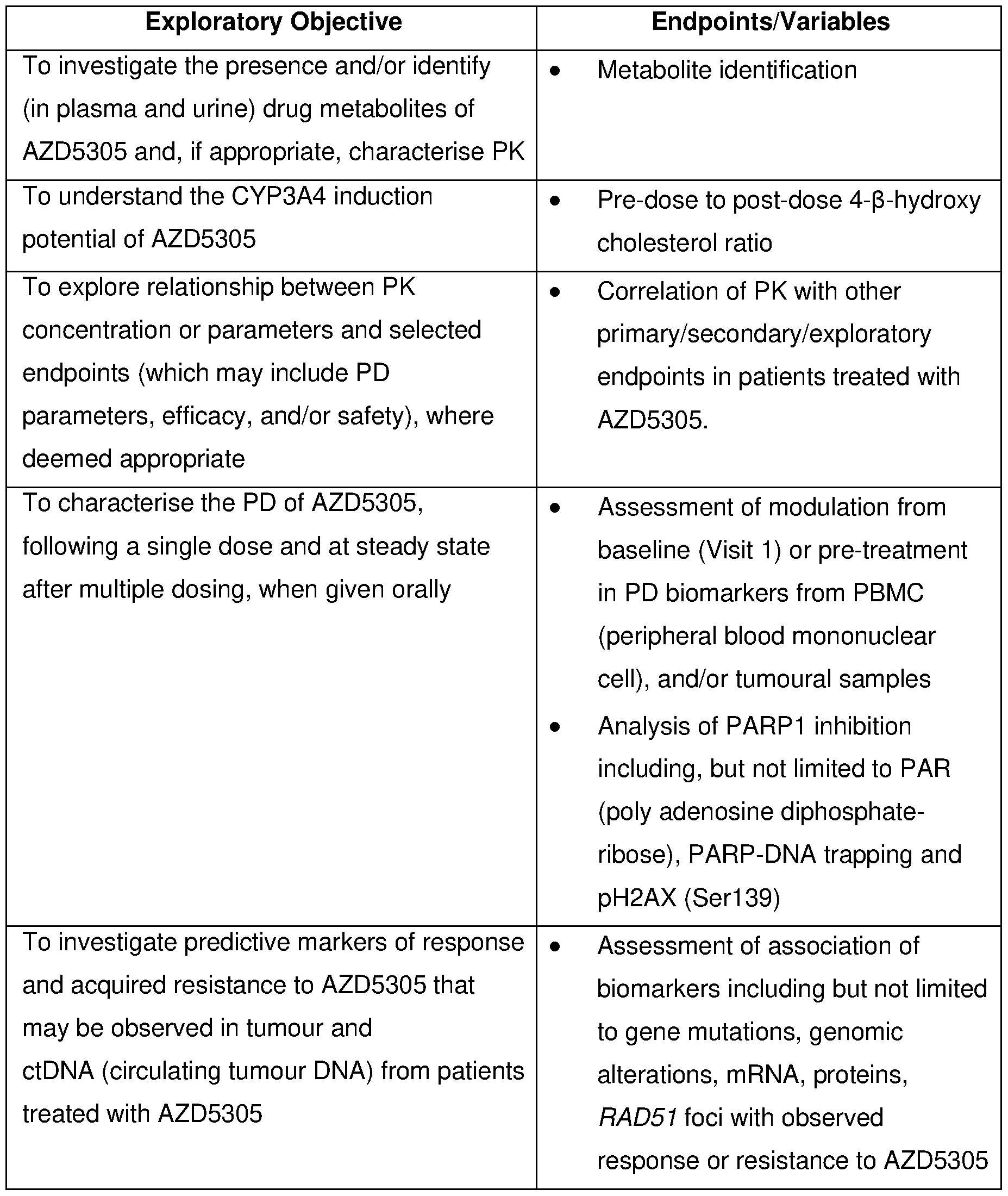
- the change from baseline in PD biomarkers for example poly-ADP-ribosylation (PAR) will be assessed, as well as other PD parameters, as data allow, and will be described on the PD analysis set.
- PAR poly-ADP-ribosylation
- the collection of blood-based PD biomarker samples is mandatory to obtain a preliminary assessment of PARP1 target inhibition in patients.
- Peripheral blood samples will be collected as detailed in Table 8.
- the collection of the PD samples may be adjusted during the study and according to local regulatory approval, dependent on emerging data, in order to ensure appropriate characteristics of the plasma concentration-time profile.
- tumour markers will be collected e.g., CA125, prostate specific antigen (PSA), CA19.9 and CA15.3 from patients with ovarian, prostate, pancreatic and breast cancer, respectively.
- PSA prostate specific antigen
- PBMCs will be assessed for PD changes in biomarkers that may include but are not limited to protein/gene levels and post-translational modifications such as poly (ADP-ribose).
- Peripheral whole blood subpopulations may also be enumerated to determine any PD effects of potential immunological relevance, such as changes in the number of B-lymphocytes or regulatory T-lymphocytes or evaluated for T-cell receptor clonality or gene expression changes.
- the number of samples taken, as well as the volume required for each analysis, may be changed during the study as new data on AZD5305 becomes available.
- a peripheral blood sample will be collected to provide plasma for ctDNA to assess clinical response and to interrogate changes in genetic alterations as potential mechanisms of sensitivity/ resistance to AZD5305 treatment.
- Blood samples for ctDNA are to be collected as detailed in Table 8.
- Other soluble analytes in plasma such as proteins, cytokines may be analysed for downstream effects of PARP1 inhibition.
- Paired fresh tumour biopsies for PD assessment are optional for all patients in Module 1 except for patients recruited to a Part A cohort expansion for PD assessment, in which case they are mandatory. Paired biopsies will be collected within 15 days prior to Cycle 0 Day 1 and during the on-treatment period (any time in Cycle 1 between Days 8 and 15 at 24 hours post dose).
- Accessible lesions are defined as tumour lesions which are amenable to repeat biopsy, unless clinically contraindicated or the patient has withdrawn consent. Failure to obtain sufficient tumour sample after making best efforts to biopsy the tumour will not be considered a protocol deviation.
- Blood samples for PK will also be taken at the time of any on-treatment biopsy sample.
- Biopsy samples will be analysed for the effects of PARP1 inhibition in tumour and may include but is not limited to the assessment of the following biomarkers: poly (ADP-ribose), PARP-DNA trapping, pH2AX (Ser139) and RAD51 foci.
- On-treatment biopsy timing may be refined with emerging PK and/or PD data during the course of the study. Results
- the patients can be characterised as follows: eCRF, electronic case report form; HR, hormone receptor Plasma concentration
- Figure 2A shows the AZD5305 plasma concentration against the time after a single dose.
- FIG. 2B shows the AZD5305 plasma concentration against the time after a dose during continuous dosing (cycle 1 Day 15).
- Dose proportional increase in exposure (Cmax and AUC) was observed with increasing dose (10 - 140 mg QD).
- Cmax and AUC dose
- There was quick onset (T ma x 0.5-3 h) with mean terminal elimination halflife 13.1 - 16.4 hours across the different cohorts.
- Steady state Cmin above target effective concentration (TEC) was achieved in all patients with mean fold Cmin/TEC 7.12 and 55.88 at 10 mg and 140 mg QD, respectively TEC, target effective concentration; TEC: IC95 in DLD-1 BRAC2-/-
- Safety summary AZD5305 was well tolerated across all doses, with only 2 patients (3.3%) having dose reductions (for grade 3 neutropenia and grade 1 thrombocytopenia related to AZD5305). At the data cut-off, there had been no DLTs and no AZD5305-related serious AEs or treatment discontinuations.
- C1 D1 was median 1 day after C0D3 (max 4 days post C0D3)
- Figures 4 to 7 show the response (Best % change in target lesions size by dose) across:
- Figure 8 shows the results of ctDNA measurements on 13 patients.
- PSA PSA decrease 0-49%
- Figure 10A is the baseline scan (28 June 2021) and Figure 10B is the second scan (22 October 2021 ) - the white arrows in Figure 10A indicate three tumours.
- Figures 11 A to 1 1 D show the PSA50 ( ⁇ ) and ctDNA ( ⁇ ) responses of the following 4 prostate cancer patients: • Case #2: 56 y/o; BRCA2m AZD5305 10 mg; 2 prior lines of therapy ADT/abiraterone, and docetaxel
- Figure 12 shows the CA15.3 (U/mL) response
- Figure 13 shows patient scans.
- Figure 13A shows the baseline scans on 11 November 2021
- Figure 13B shows the scans on 18 January 2022
- Figure 13C shows the scans on 15 March 2022.
- the white arrow in Figure 13A indicates a tumour.
- Figure 14 shows the CA125 (U/mL) response and Figure 14 shows patient scans.
- Figure 15A shows the baseline scans on 18 January 2021
- Figure 15B shows the third scan on 29 July 2021 .
- a RECIST v1 .1 partial response (-75.0%) was confirmed at the third scan.
- the white arrows in Figure 15A indicates a tumour.
Landscapes
- Health & Medical Sciences (AREA)
- Life Sciences & Earth Sciences (AREA)
- Chemical & Material Sciences (AREA)
- Veterinary Medicine (AREA)
- Medicinal Chemistry (AREA)
- Animal Behavior & Ethology (AREA)
- General Health & Medical Sciences (AREA)
- Pharmacology & Pharmacy (AREA)
- Public Health (AREA)
- Chemical Kinetics & Catalysis (AREA)
- Organic Chemistry (AREA)
- Nuclear Medicine, Radiotherapy & Molecular Imaging (AREA)
- General Chemical & Material Sciences (AREA)
- Epidemiology (AREA)
- Pharmaceuticals Containing Other Organic And Inorganic Compounds (AREA)
- Nitrogen Condensed Heterocyclic Rings (AREA)
Abstract
Description




Claims
Priority Applications (5)
| Application Number | Priority Date | Filing Date | Title |
|---|---|---|---|
| JP2025557128A JP2026513665A (en) | 2023-03-31 | 2023-03-31 | AZD5305 administration regimen |
| PCT/EP2023/058465 WO2024199668A1 (en) | 2023-03-31 | 2023-03-31 | Dosing regiment of azd5305 |
| KR1020257036665A KR20250165438A (en) | 2023-03-31 | 2023-03-31 | AZD5305 dosing regimen |
| AU2023441454A AU2023441454A1 (en) | 2023-03-31 | 2023-03-31 | Dosing regiment of azd5305 |
| MX2025011488A MX2025011488A (en) | 2023-03-31 | 2025-09-26 | Dosing regiment of azd5305 |
Applications Claiming Priority (1)
| Application Number | Priority Date | Filing Date | Title |
|---|---|---|---|
| PCT/EP2023/058465 WO2024199668A1 (en) | 2023-03-31 | 2023-03-31 | Dosing regiment of azd5305 |
Publications (1)
| Publication Number | Publication Date |
|---|---|
| WO2024199668A1 true WO2024199668A1 (en) | 2024-10-03 |
Family
ID=86053820
Family Applications (1)
| Application Number | Title | Priority Date | Filing Date |
|---|---|---|---|
| PCT/EP2023/058465 Ceased WO2024199668A1 (en) | 2023-03-31 | 2023-03-31 | Dosing regiment of azd5305 |
Country Status (5)
| Country | Link |
|---|---|
| JP (1) | JP2026513665A (en) |
| KR (1) | KR20250165438A (en) |
| AU (1) | AU2023441454A1 (en) |
| MX (1) | MX2025011488A (en) |
| WO (1) | WO2024199668A1 (en) |
Citations (3)
| Publication number | Priority date | Publication date | Assignee | Title |
|---|---|---|---|---|
| EP0705903A1 (en) | 1994-08-12 | 1996-04-10 | Myriad Genetics, Inc. | In vivo mutations and polymorphisms in the 17q-linked breast and ovarian cancer susceptibility gene |
| WO2004080976A1 (en) | 2003-03-12 | 2004-09-23 | Kudos Pharmaceuticals Limited | Phthalazinone derivatives |
| WO2021013735A1 (en) | 2019-07-19 | 2021-01-28 | Astrazeneca Ab | Parp1 inhibitors |
-
2023
- 2023-03-31 JP JP2025557128A patent/JP2026513665A/en active Pending
- 2023-03-31 AU AU2023441454A patent/AU2023441454A1/en active Pending
- 2023-03-31 KR KR1020257036665A patent/KR20250165438A/en active Pending
- 2023-03-31 WO PCT/EP2023/058465 patent/WO2024199668A1/en not_active Ceased
-
2025
- 2025-09-26 MX MX2025011488A patent/MX2025011488A/en unknown
Patent Citations (3)
| Publication number | Priority date | Publication date | Assignee | Title |
|---|---|---|---|---|
| EP0705903A1 (en) | 1994-08-12 | 1996-04-10 | Myriad Genetics, Inc. | In vivo mutations and polymorphisms in the 17q-linked breast and ovarian cancer susceptibility gene |
| WO2004080976A1 (en) | 2003-03-12 | 2004-09-23 | Kudos Pharmaceuticals Limited | Phthalazinone derivatives |
| WO2021013735A1 (en) | 2019-07-19 | 2021-01-28 | Astrazeneca Ab | Parp1 inhibitors |
Non-Patent Citations (4)
| Title |
|---|
| ANONYMOUS: "History of Changes for Study: NCT04644068: Study of AZD5305 as Monotherapy and in Combination With Anti-cancer Agents in Patients With Advanced Solid Malignancies (PETRA)", 10 March 2023 (2023-03-10), XP093089003, Retrieved from the Internet <URL:https://classic.clinicaltrials.gov/ct2/history/NCT04644068?V_24=View#StudyPageTop> [retrieved on 20231005] * |
| DIDOMENICO NATALIE: "AZD5305 More Tolerable than Earlier PARP Agents", CANCER DISCOVERY, vol. 12, no. 7, 6 July 2022 (2022-07-06), US, pages 1602 - 1602, XP093088498, ISSN: 2159-8274, Retrieved from the Internet <URL:https://aacrjournals.org/cancerdiscovery/article-pdf/12/7/1602/3176548/1602.pdf> [retrieved on 20231003], DOI: 10.1158/2159-8290.CD-NB2022-0039 * |
| KILLMURRAY CONOR: "Next-Generation PARP Inhibitor AZD5305 Shows Promising Safety Profile and Clinical Activity in Several Cancer Types", 14 April 2022 (2022-04-14), XP093088496, Retrieved from the Internet <URL:https://web.archive.org/web/20220414140537/https://www.targetedonc.com/view/next-generation-parp-inhibitor-azd5305-shows-promising-safety-profile-and-clinical-activity-in-several-cancer-types> [retrieved on 20231004] * |
| YAP TIMOTHY A. ET AL: "CT007- PETRA: First in class, first in human trial of the next generation PARP1-selective inhibitor AZD5305 in patients (pts) with BRCA1/2, PALB2 or RAD51C/D mutations", 10 April 2022 (2022-04-10), XP093088494, Retrieved from the Internet <URL:https://www.abstractsonline.com/pp8/#!/10517/presentation/20149> [retrieved on 20231004] * |
Also Published As
| Publication number | Publication date |
|---|---|
| MX2025011488A (en) | 2025-11-03 |
| JP2026513665A (en) | 2026-04-30 |
| AU2023441454A1 (en) | 2025-11-13 |
| KR20250165438A (en) | 2025-11-25 |
Similar Documents
| Publication | Publication Date | Title |
|---|---|---|
| US20220387618A1 (en) | Methods of treating her2 positive breast cancer with tucatinib in combination with an anti-her2 antibody-drug conjugate | |
| JP2017529382A (en) | Compounds having therapeutic activity and methods of use thereof | |
| US20230190694A1 (en) | Compositions for and methods of precision cancer treatment | |
| US12364689B2 (en) | Dosage regimen for the treatment of cancer | |
| EP4259662A1 (en) | Combination therapies for treatment of her2 cancer | |
| JP2017088619A (en) | C. for the treatment of solid tumors in humans. novyi | |
| US20250387362A1 (en) | Compositions for and methods of precision cancer treatment | |
| TW202435871A (en) | Methods of treatment of breast cancer | |
| US20250235451A1 (en) | Methods of Delaying Pain Progression And Treating Prostate Cancer | |
| EP4493185A1 (en) | Treatment of breast cancer with amcenestrant | |
| US20240325384A1 (en) | Dosing regimen | |
| US20250352534A1 (en) | Use of Niraparib for the Treatment of Brain Cancer | |
| AU2023441454A1 (en) | Dosing regiment of azd5305 | |
| TW202440115A (en) | Dosing regimen | |
| KR20260070197A (en) | AZD1390 in combination with radiation for use in the treatment of CNS tumors, or a pharmaceutically acceptable salt thereof | |
| WO2025190957A1 (en) | Azd1390, or a pharmaceutically acceptable salt thereof, in combination with radiation for use in a method of treatment of a central nervous system (cns) tumour | |
| HK40078614A (en) | Methods of treating her2 positive breast cancer with tucatinib in combination with an anti-her2 antibody-drug conjugate | |
| HK40092971A (en) | Combination therapies for treatment of her2 cancer | |
| EA048255B1 (en) | DOSAGE REGIMEN FOR CANCER TREATMENT | |
| HK40085111A (en) | Dosage regimen for the treatment of cancer |
Legal Events
| Date | Code | Title | Description |
|---|---|---|---|
| 121 | Ep: the epo has been informed by wipo that ep was designated in this application |
Ref document number: 23717852 Country of ref document: EP Kind code of ref document: A1 |
|
| WWE | Wipo information: entry into national phase |
Ref document number: MX/A/2025/011488 Country of ref document: MX |
|
| ENP | Entry into the national phase |
Ref document number: 2025557128 Country of ref document: JP Kind code of ref document: A |
|
| WWE | Wipo information: entry into national phase |
Ref document number: 2025557128 Country of ref document: JP |
|
| REG | Reference to national code |
Ref country code: BR Ref legal event code: B01A Ref document number: 112025020874 Country of ref document: BR |
|
| WWE | Wipo information: entry into national phase |
Ref document number: AU2023441454 Country of ref document: AU |
|
| ENP | Entry into the national phase |
Ref document number: 1020257036665 Country of ref document: KR Free format text: ST27 STATUS EVENT CODE: A-0-1-A10-A15-NAP-PA0105 (AS PROVIDED BY THE NATIONAL OFFICE) |
|
| WWE | Wipo information: entry into national phase |
Ref document number: 11202506513P Country of ref document: SG Ref document number: KR1020257036665 Country of ref document: KR |
|
| WWP | Wipo information: published in national office |
Ref document number: 11202506513P Country of ref document: SG |
|
| WWP | Wipo information: published in national office |
Ref document number: MX/A/2025/011488 Country of ref document: MX |
|
| NENP | Non-entry into the national phase |
Ref country code: DE |
|
| ENP | Entry into the national phase |
Ref document number: 2023441454 Country of ref document: AU Date of ref document: 20230331 Kind code of ref document: A |
|
| 122 | Ep: pct application non-entry in european phase |
Ref document number: 23717852 Country of ref document: EP Kind code of ref document: A1 |