WO2024196702A1 - Ethylene brassylate-co-dioxanone polymers and uses thereof - Google Patents
Ethylene brassylate-co-dioxanone polymers and uses thereof Download PDFInfo
- Publication number
- WO2024196702A1 WO2024196702A1 PCT/US2024/019927 US2024019927W WO2024196702A1 WO 2024196702 A1 WO2024196702 A1 WO 2024196702A1 US 2024019927 W US2024019927 W US 2024019927W WO 2024196702 A1 WO2024196702 A1 WO 2024196702A1
- Authority
- WO
- WIPO (PCT)
- Prior art keywords
- substituted
- unsubstituted
- kda
- poly
- polymer
- Prior art date
- Legal status (The legal status is an assumption and is not a legal conclusion. Google has not performed a legal analysis and makes no representation as to the accuracy of the status listed.)
- Ceased
Links
Classifications
-
- C—CHEMISTRY; METALLURGY
- C08—ORGANIC MACROMOLECULAR COMPOUNDS; THEIR PREPARATION OR CHEMICAL WORKING-UP; COMPOSITIONS BASED THEREON
- C08G—MACROMOLECULAR COMPOUNDS OBTAINED OTHERWISE THAN BY REACTIONS ONLY INVOLVING UNSATURATED CARBON-TO-CARBON BONDS
- C08G63/00—Macromolecular compounds obtained by reactions forming a carboxylic ester link in the main chain of the macromolecule
- C08G63/02—Polyesters derived from hydroxycarboxylic acids or from polycarboxylic acids and polyhydroxy compounds
Definitions
- the field of the invention is generally related to sustained delivery of diagnostic, prophylactic, and/or therapeutic agents, particularly delivery of these agents to the brain and other organs in vivo.
- Polymeric particles, especially nanoparticles, have great potential for the controlled spatial and temporal delivery of a wide variety of diagnostic, prophylactic, and/or therapeutic agents, to disease-afflicted organs in vivo (Salata, Journal of Nanobiotechnology 2004, 2(1): 3; Lee and Yeo, Chemical Engineering Science 2015, 125, 75-84). Localizing these agents to target sites can circumvent toxicity, unwanted side effects, unnecessarily high systemic doses, and widespread distribution of pay load.
- Another challenge resides in the difficulty in developing agent- loaded particles with effective amounts of payload, suitable size, and surface properties to locally deliver agents. Further, the particles must be versatile for a variety of manufacturing methods and scaleup, possess limited toxicity to healthy cells/tissue, and maintain stability in relevant tissue microenvironments.
- m and n are independently integers from 1 to 1500, with the proviso that m+n is at least 10 (such as from 10 to 3000).
- the polymers have a weight- average molecular weight between about 10 kDa and about 150 kDa, between about 10 kDa and about 130 kDa, or between about 10 kDa and about 125 kDa, as measured using gel permeation chromatography, such as between about 15 kDa and about 25 kDa, between about 45 kDa and about 72 kDa, and between about 50 kDa and about 125 kDa.
- the particles show significantly improved internalization in cancer cells (e.g., glioma cells), compared to particles formed from other types of polymers, such as polyethylene glycol)-poly(lactic acid).
- the polymers preferably show improved biological properties (internalization, transfection, stability) compared to other polymers that lack the ethylene brassylate-co-dioxanone combination. Accordingly, if needed, such specific polymers with less effective biological properties can be excluded from the instant compositions.
- the particles and macroimplants are stable over several days in different media, as determined by their average sizes and polydispersity indices over time, and are retained in brain cells for at least five days postdelivery.
- the particles and macroimplants can include therapeutic agents, diagnostic agents, prophylactic agents, or a combination thereof, to be delivered to desired cells, tissues, and/or organs.
- the drag-loaded particles and macroimplants, or compositions thereof can be used in combination therapy settings, to deliver two or more types of drags that belong to the same or different therapeutic class and display the same or different mechanism of action.
- One type of drug is encapsulated, while a second drug is provided as free or soluble drag, or in a different carrier or dosage form.
- the drug-loaded particles or compositions thereof demonstrate effective killing of glioma cells.
- FIGs. 1A, IB, and 1C are scatter plots showing size distributions (FIG. 1A), zeta potentials (FIG. IB), and polydispersities (FIG. 1C) of different nanoparticle formulations.
- PEG-EB-co-DO represents the polyethylene glycol)-ethylene brassylate-co-dioxanone polymer
- PLA-PEG represents poly(lactide)-poly(ethylene glycol) polymer
- PDI represents Polydispersity Index
- the numbers 175, 297, 333 represent different analogs of ataxia telangiectasia and Rad3-related (ATR) inhibitors
- DMSO represents nanoparticles formulated using dimethylsulfoxide in a nanoprecipitation process.
- FIGs. 2A, 2B, and 2C are scatter plots showing encapsulation efficiencies (FIG. 2A), polymer yields (FIG. 2B), and drug loadings (FIG. 2C) of different nanoparticle formulations.
- PEG-EB-co-DO represents the polyethylene glycol)-ethylene brassylate-co-dioxanone polymer
- PLA-PEG represents poly(lactic acid)-poly(ethylene glycol) polymer
- PDI represents polydispersity index
- the numbers 175, 297, 333 represent different analogs of ataxia telangiectasia and Rad3-related (ATR) inhibitors
- DMSO represents nanoparticles formulated using dimethylsulfoxide in a nanoprecipitation process.
- FIG. 3 is a scatter plot showing a relationship between particle size and polyethylene glycol) -ethylene brassylate-co-dioxanone polymer concentration used.
- FIGs. 4A and 4B are line graphs tracking the stabilities of PEG-EB- co-DO nanoparticles in various media by monitoring the sizes (FIG. 4A) and polydispersity indices (FIG. 4B) of the particles.
- PEG-EB-co-DO represents the poly(ethylene glycol)-ethylene brassylate-co-dioxanone polymer
- ACSF represents nanoparticles incubated in artificial Cerebrospinal Fluid
- H2O represents nanoparticles incubated in water
- PBS represents nanoparticles incubated in phosphate buffered saline
- SFM represents nanoparticles incubated in serum-free media.
- FIG. 5 is a line graph showing the viability of RG2 rat glioma cells in culture.
- PEG-EB-co-DO represents the polyethylene glycol) -ethylene brassylate-co-dioxanone polymer
- LogP is a measure of lipophilicity of the drug substance and MW represents molecular weight; the numbers 175, 297, 333 represent different analogs of ATR inhibitors
- Free represents cells given free, unencapsulated drug
- DMSO represents a DMSO only control.
- LD50 is the half maximal lethal dose of the particular analog used.
- LN229 cells were plated at 1,000 cells per well and treatments administered 24 hours afterward. Cells were allowed to grow for 5 days and Cell Titer Gio was implemented to evaluate cell viability.
- FIG. 6 is a line graph showing drug release profile under different conditions for nanoparticles formed from a given polymer.
- PEG-EB 333 represents nanoparticles formed from polyethylene glycol)-ethylene brassylate-co-dioxanone polymer and containing ATRIN 333
- Beta-CD 0.5%) represents nanoparticles incubated in a 0.5% beta-cyclodextrin solution
- ACSF represents nanoparticles incubated in artificial Cerebrospinal Fluid
- H2O represents nanoparticles incubated in water
- PBS represents nanoparticles incubated in phosphate buffered saline
- SFM represents nanoparticles incubated in serum-free media.
- FIGs. 7A and 7B are scatter plots showing uptake of PEG-EB-co- DO DiD dye loaded particles at various time points compared to PLA-PEG nanoparticles in LN229 cells (FIG. 7A) and RG2 cells (FIG. 7B).
- PEG-EB represents polyethylene glycol) -ethylene brassylate-co-dioxanone polymer
- PLA-PEG represents poly (lactic acid)-poly(ethylene glycol) (such as poly (lactic acid)-5000 Da-poly(ethylene glycol)-10000 Da.
- FIGs. 8A, 8B, and 8C are images showing retention of PEG-EB-co- DO DiD dye loaded particles in rat brains after intracranial delivery (such as intracranial convection enhanced delivery), three hours (FIG. 8A), 24 hours (FIG. 8B), and five days (FIG. 8C) post-delivery.
- PEG-EB-co-DO represents polyethylene glycol) -ethylene brassylate-co-dioxanone polymer.
- FIGs. 9A and 9B are point graphs showing percent conversion of ethylene brassylate (EB) and dioxanone (DO) versus time for the reaction at 80°C (calculated using 1 H NMR) (FIG. 9A), and weight-average molecular weight and PDI versus time for the copolymerization reaction (determine in DCM by GPC against polystyrene standards) (FIG. 9B).
- EB ethylene brassylate
- DO dioxanone
- -11D are line graphs (FIGs. 11A and 11B) and point and 11D) effect on M w with varying DO content (FIG.
- FIGs. 12A, 12B, and 12D-12F line graphs (FIGs. 12A, 12B, and 12D-12F) and chemical structures (FIG. 12C) showing cumulative release of implants with 28% LNG loading (FIG. 12A); cumulative release of implants with 28% DTG loading (FIG. 12B); chemical structures of DEX, LNG, and DTG with corresponding log P values (FIG. 12C); daily release of LNG implants (FIG. 12D); daily release of DTG implants (FIG. 12E); and cumulative release of DEX, DTG, and LNG implants (FIG. 12F).
- FIG. 14 shows scanning electron microscopy (SEM) images of poly(EB-co-DO) unloaded implants with varying DO content at 5k magnification.
- FIG. 15 shows SEM images representing cross-sections of DEX- loaded poly(EB-co-DO) implants.
- the delineated box (last column, second and third rows) emphasizes a particular image taken at different magnification (Month 2: 40% - 10k magnification, Month 4: 40% - 2k magnification).
- FIGs. 16A and 16B are point graphs and an array showing encapsulation thickness for average of 3 mice with implants at two to eight months (FIG. 16A) and GPC characterization of the implant at the specified time (in months) (FIG. 16B).
- FIGs. 17A-17C are a line graph (FIG. 17A) and point graphs (FIGs. 17B and 17C) showing a lot of percentage loss of mass versus change in temperature using thermogravimetric analysis (FIG. 17A); melting temperature as a function of DO content in EB-co-DO (FIG. 17B); and density vs DO content of EB-co-DO polymers (FIG. 17C).
- the data point at about (0, 1.16) refers to a polymer possessing a weightaverage molecular weight of 52 kDA
- the remaining dots refer to polymers with weight- average molecular weights of about 40 kDa.
- FIG. 20 shows SEM images of 20% DO implants with 28%, 35%, and 40% DEX loading over a period of four months at 5k magnification.
- FIG. 21 shows SEM images of 0% DO implants with 28%, 35%, and 40% DEX loading over a period of four months at 5k magnification.
- Hydrophilic refers to the property of having affinity for water.
- hydrophilic polymers or hydrophilic polymer segments
- hydrophilic polymer segments are polymers (or polymer segments) which are primarily soluble in aqueous solutions and/or have a tendency to absorb water.
- hydrophilic a polymer the more hydrophilic a polymer is, the more that polymer tends to dissolve in, mix with, or be wetted by water.
- Hydrophobic refers to the property of lacking affinity for, or even repelling water. For example, the more hydrophobic a polymer (or polymer segment), the more that polymer (or polymer segment) tends to not dissolve in, not mix with, or not be wetted by water.
- lactone and “lactone unit” are used to describe a chemical compound that includes a cyclic ester, or the open chain chemical structure that results from the cleavage of the ester bond in the cyclic ester.
- lactone is used to describe the cyclic ester shown below, and the corresponding lactone-derived open chain structure: n being an integer.
- the open chain structure is formed via methods known in the art, including but not limited to, solvolysis, such as hydrolysis, and enzymatic cleavage.
- Nanoparticles are particles (nanospheres and nanocapsules) with diameters between 1 nm and less than 1 micron.
- a nanoparticle may be spherical or nonspherical and may have a regular or irregular shape. Nanoparticles can have an average diameter from about 50 nm to 150 nm.
- the term "diameter” is used herein to refer to either of the physical diameter or the hydrodynamic diameter.
- the diameter of an essentially spherical particle may refer to the physical or hydrodynamic diameter.
- the diameter of a non-spherical particle may refer preferentially to the hydrodynamic diameter.
- the diameter of a non-spherical particle may refer to the largest linear distance between two points on the surface of the particle. When referring to multiple particles, the diameter of the particles typically refers to the average diameter of the particles.
- Particle diameter can be measured using a variety of techniques in the art including, but not limited to, dynamic light scattering.
- “Substituted,” as used herein, refers to all permissible substituents of the compounds or functional groups described herein.
- the permissible substituents include acyclic and cyclic, branched and unbranched, carbocyclic and heterocyclic, aromatic and nonaromatic substituents of organic compounds.
- Illustrative substituents include, but are not limited to, halogens, hydroxyl groups, or any other organic groupings containing any number of carbon atoms, preferably 1-14 carbon atoms, and optionally include one or more heteroatoms such as oxygen, sulfur, or nitrogen grouping in linear, branched, or cyclic structural formats.
- substituents include a substituted or unsubstituted alkyl, a substituted or unsubstituted alkenyl, a substituted or unsubstituted alkynyl, a substituted or unsubstituted heterocyclyl, a substituted or unsubstituted phenyl, a substituted or unsubstituted aryl, a substituted or unsubstituted heteroaryl, a substituted or unsubstituted polyaryl, a substituted or unsubstituted polyheteroaryl, a substituted or unsubstituted aralkyl, a halogen, a hydroxyl, an alkoxy, a phenoxy, an aroxy, a silyl, a thiol, an alkylthio, a substituted alkylthio, a phenylthio, an arylthio, a cyano, an isocyano, a nitro,
- Heteroatoms such as nitrogen may have hydrogen substituents and/or any permissible substituents of organic compounds described herein which satisfy the valences of the heteroatoms. It is understood that “substitution” or “substituted” includes the implicit proviso that such substitution is in accordance with permitted valence of the substituted atom and the substituent, and that the substitution results in a stable compound, i.e., a compound that does not spontaneously undergo transformation such as by rearrangement, cyclization, elimination, etc.
- Alkyl refers to the radical of saturated aliphatic groups, including straight-chain alkyl groups, branched-chain alkyl, and cycloalkyl (alicyclic). In some forms, a straight chain or branched chain alkyl has 30 or fewer carbon atoms in its backbone (e.g., C1-C30 for straight chains, C3-C30 for branched chains), 20 or fewer, 15 or fewer, or 10 or fewer.
- Alkyl includes methyl, ethyl, n-propyl, isopropyl, n-butyl, isobutyl, /-butyl, pentyl, hexyl, heptyl, octyl, decyl, tetradecyl, hexadecyl, eicosyl, tetracosyl and the like.
- a cycloalkyl is a non-aromatic carbon-based ring composed of at least three carbon atoms, such as a nonaromatic monocyclic or nonaromatic polycyclic ring containing 3-30 carbon atoms, 3-20 carbon atoms, or 3-10 carbon atoms in their ring structure, and have 5, 6 or 7 carbons in the ring structure.
- Cycloalkyls containing a polycyclic ring system can have two or more non-aromatic rings in which two or more carbons are common to two adjoining rings (i.e., “fused cycloalkyl rings”).
- cycloalkyl groups include, but are not limited to, cyclopropyl, cyclobutyl, cyclopentyl, cyclohexyl, cycloheptyl, cyclooctanyl, etc.
- “Substituted alkyl” refers to alkyl moieties having one or more substituents replacing a hydrogen on one or more carbons of the hydrocarbon backbone.
- substituents can be any substituents described above, e.g., halogen (such as fluorine, chlorine, bromine, or iodine), hydroxyl, carbonyl (such as a carboxyl, alkoxycarbonyl, formyl, or an acyl), thiocarbonyl (such as a thioester, a thioacetate, or a thioformate), aryl, alkoxyl, aralkyl, phosphonium, phosphanyl, phosphonyl, phosphoryl, phosphate, phosphonate, a phosphinate, amino, amido, amidine, imine, cyano, nitro, azido, oxo, sulfhydryl, thiol, alkylthio, silyl, sulfinyl, sulfate, sulfonate, sulfamoyl, sulfonamido, sulf
- R and R’ are independently hydrogen, alkyl, or aryl, and wherein the nitrogen atom is optionally quatemized; -SR, wherein R is a phosphonyl, a sulfinyl, a silyl a hydrogen, an alkyl, or an aryl; -CN; -NO2; -C00H; carboxylate; -COR, -C00R, or -C0N(R) 2 , wherein R is hydrogen, alkyl, or aryl; imino, silyl, ether, haloalkyl (such as -CF3, -CH2-CF3, -CCI3); -CN; -NCOCOCH 2 CH 2; -NCOCOCHCH; and -NCS; and combinations thereof.
- -SR wherein R is a phosphonyl, a sulfinyl, a silyl a hydrogen, an alkyl, or an aryl
- -CN
- the moieties substituted on the hydrocarbon chain can themselves be substituted, if appropriate.
- the substituents of a substituted alkyl may include halogen, hydroxy, nitro, thiols, amino, aralkyl, azido, imino, amido, phosphonium, phosphanyl, phosphoryl (including phosphonate and phosphinate), oxo, sulfonyl (including sulfate, sulfonamido, sulfamoyl and sulfonate), and silyl groups, as well as ethers, alkylthios, carbonyls (including ketones, aldehydes, carboxylates, and esters), haloalkyls, -CN and the like. Cycloalkyls can be substituted in the same manner.
- lower alkyl as used herein means an alkyl group, as defined above, but having from one to ten carbons, more preferably from one to six carbon atoms in its backbone structure. Likewise, “lower alkenyl” and “lower alkynyl” have similar chain lengths.
- Heteroalkyl refers to straight or branched chain, or cyclic carbon-containing alkyl radicals, or combinations thereof, containing at least one heteroatom on the carbon backbone. Suitable heteroatoms include, but are not limited to, 0, N, Si, P and S, wherein the nitrogen, phosphorous and sulfur atoms are optionally oxidized, and the nitrogen heteroatom is optionally quaternized.
- heterocycloalkyl group is a cycloalkyl group as defined above where at least one of the carbon atoms of the ring is substituted with a heteroatom such as, but not limited to, nitrogen, oxygen, sulphur, or phosphorus.
- alkenyl as used herein is a hydrocarbon group of from 2 to 24 carbon atoms and structural formula containing at least one carbon-carbon double bond. Alkenyl groups include straight-chain alkenyl groups, branched-chain alkenyl, and cycloalkenyl.
- a cycloalkenyl is a non-aromatic carbon-based ring composed of at least three carbon atoms and at least one carbon-carbon double bond, such as a nonaromatic monocyclic or nonaromatic polycyclic ring containing 3-30 carbon atoms and at least one carbon-carbon double bond, 3-20 carbon atoms and at least one carbon-carbon double bond, or 3-10 carbon atoms and at least one carbon-carbon double bond in their ring structure, and have 5, 6 or 7 carbons and at least one carbon-carbon double bond in the ring structure.
- Cycloalkenyls containing a polycyclic ring system can have two or more non-aromatic rings in which two or more carbons are common to two adjoining rings (i.e., “fused cycloalkenyl rings”) and contain at least one carbon-carbon double bond.
- alkenyl as used throughout the specification, examples, and claims is intended to include both “unsubstituted alkenyls” and “substituted alkenyls,” the latter of which refers to alkenyl moieties having one or more substituents replacing a hydrogen on one or more carbons of the hydrocarbon backbone.
- alkenyl also includes “heteroalkenyl.”
- substituted alkenyl refers to alkenyl moieties having one or more substituents replacing one or more hydrogen atoms on one or more carbons of the hydrocarbon backbone.
- substituents can be any substituents described above, e.g., halogen, azide, alkyl, aralkyl, alkenyl, alkynyl, cycloalkyl, hydroxyl, carbonyl (such as a carboxyl, alkoxycarbonyl, formyl, or an acyl), silyl, ether, ester, thiocarbonyl (such as a thioester, a thioacetate, or a thioformate), alkoxyl, phosphonium, phosphanyl, phosphoryl, phosphate, phosphonate, phosphinate, amino (e.g.
- Heteroalkenyl refers to straight or branched chain, or cyclic carbon-containing alkenyl radicals, or combinations thereof, containing at least one heteroatom. Suitable heteroatoms include, but are not limited to, 0, N, Si, P and S, wherein the nitrogen, phosphorous and sulfur atoms are optionally oxidized, and the nitrogen heteroatom is optionally quatemized.
- heterocycloalkenyl group is a cycloalkenyl group where at least one of the carbon atoms of the ring is substituted with a heteroatom such as, but not limited to, nitrogen, oxygen, sulphur, or phosphorus.
- alkynyl group is a hydrocarbon group of 2 to 24 carbon atoms and a structural formula containing at least one carbon-carbon triple bond.
- Alkynyl groups include straight-chain alkynyl groups, branched-chain alkynyl, and cycloalkynyl.
- a cycloalkynyl is a non-aromatic carbon-based ring composed of at least three carbon atoms and at least one carbon-carbon triple bond, such as a nonaromatic monocyclic or nonaromatic polycyclic ring containing 3-30 carbon atoms and at least one carbon-carbon triple bond, 3-20 carbon atoms and at least one carbon-carbon triple bond, or 3-10 carbon atoms and at least one carbon-carbon triple bond in their ring structure, and have 5, 6 or 7 carbons and at least one carbon-carbon triple bond in the ring structure.
- Cycloalkynyls containing a polycyclic ring system can have two or more non-aromatic rings in which two or more carbons are common to two adjoining rings (i.e., “fused cycloalkynyl rings”) and contain at least one carbon-carbon triple bond.
- alkynyl as used throughout the specification, examples, and claims is intended to include both “unsubstituted alkynyls” and “substituted alkynyls,” the latter of which refers to alkynyl moieties having one or more substituents replacing a hydrogen on one or more carbons of the hydrocarbon backbone.
- alkynyl also includes “heteroalkynyl.”
- substituted alkynyl refers to alkynyl moieties having one or more substituents replacing one or more hydrogen atoms on one or more carbons of the hydrocarbon backbone.
- substituents can be any substituents described above, e.g., halogen, azide, alkyl, aralkyl, alkenyl, alkynyl, cycloalkyl, hydroxyl, carbonyl (such as a carboxyl, alkoxycarbonyl, formyl, or an acyl), silyl, ether, ester, thiocarbonyl (such as a thioester, a thioacetate, or a thioformate), alkoxyl, phosphonium, phosphanyl, phosphoryl, phosphate, phosphonate, phosphinate, amino (e.g.
- Heteroalkynyl refers to straight or branched chain, or cyclic carbon-containing alkynyl radicals, or combinations thereof, containing at least one heteroatom. Suitable heteroatoms include, but are not limited to, 0, N, Si, P and S, wherein the nitrogen, phosphorous and sulfur atoms are optionally oxidized, and the nitrogen heteroatom is optionally quatemized.
- heterocycloalkynyl group is a cycloalkynyl group where at least one of the carbon atoms of the ring is substituted with a heteroatom such as, but not limited to, nitrogen, oxygen, sulphur, or phosphorus.
- Aryl refers to Cs-Cie-membered aromatic or fused aromatic ring systems. Examples of aromatic groups are benzene, naphthalene, anthracene, phenanthrene, chrysene, pyrene, corannulene, coronene, etc.
- substituted aryl refers to an aryl group, wherein one or more hydrogen atoms on one or more aromatic rings are substituted with one or more substituents including, but not limited to, halogen, azide, alkyl, aralkyl, alkenyl, alkynyl, cycloalkyl, hydroxyl, alkoxy, carbonyl (such as a ketone, aldehyde, carboxyl, alkoxycarbonyl, formyl, or an acyl), silyl, ether, ester, thiocarbonyl (such as a thioester, a thioacetate, or a thioformate), alkoxyl, phosphoryl, phosphate, phosphonate, phosphinate, amino (or quarternized amino), amido, amidine, imine, cyano, nitro, azido, sulfhydryl, imino, alkylthio, sulfate,
- Heterocycle and “heterocyclyl” are used interchangeably, and refer to a cyclic radical attached via a ring carbon or nitrogen atom of a non-aromatic monocyclic or polycyclic ring containing 3-30 ring atoms, 3-20 ring atoms, 3-10 ring atoms, or 5-6 ring atoms, where each ring contains carbon and one to four heteroatoms each selected from the group consisting of non-peroxide oxygen, sulfur, and N(Y) wherein Y is absent or is H, 0, C1-C10 alkyl, phenyl or benzyl, and optionally containing 1-3 double bonds and optionally substituted with one or more substituents.
- Heterocyclyl are distinguished from heteroaryl by definition.
- Heterocycles can be a heterocycloalkyl, a heterocycloalkenyl, a heterocycloalkynyl, etc, such as piperazinyl, piperidinyl, piperidonyl, 4-piperidonyl, dihydrofuro[2,3-h]tetrahydrofuran, morpholinyl, piperazinyl, piperidinyl, piperidonyl, 4-piperidonyl, piperonyl, pyranyl, 2H-pyrrolyl, 477-quinolizinyl, quinuclidinyl, tetrahydrofuranyl, 6H- 1,2,5-thiadiazinyl.
- Heterocyclic groups can optionally be substituted with one or more substituents as defined above for alkyl and aryl.
- heteroaryl refers to C5-C 26-membered aromatic or fused aromatic ring systems, in which one or more carbon atoms on one or more aromatic ring structures have been substituted with a heteroatom. Suitable heteroatoms include, but are not limited to, oxygen, sulfur, and nitrogen. Examples of heteroaryl groups pyrrole, furan, thiophene, imidazole, oxazole, thiazole, triazole, tetrazole, pyrazole, pyridine, pyrazine, pyridazine and pyrimidine, and the like.
- heteroaryl rings include, but are not limited to, benzimidazolyl, benzofuranyl, benzothiofuranyl, benzothiophenyl, benzoxazolyl, benzoxazolinyl, benzthiazolyl, benztriazolyl, benztetrazolyl, benzisoxazolyl, benzisothiazolyl, benzimidazolinyl, carbazolyl, 4aH-carbazolyl, carbolinyl, chromanyl, chromenyl, cinnolinyl, decahydroquinolinyl, 2H,6H-l,5,2-dithiazinyl, furanyl, furazanyl, imidazolidinyl, imidazolinyl, imidazolyl, IH-indazolyl, indolenyl, indolinyl, indolizinyl, indolyl, 3H-indolyl,
- substituted heteroaryl refers to a heteroaryl group in which one or more hydrogen atoms on one or more heteroaromatic rings are substituted with one or more substituents including, but not limited to, halogen, azide, alkyl, aralkyl, alkenyl, alkynyl, cycloalkyl, hydroxyl, alkoxy, carbonyl (such as a ketone, aldehyde, carboxyl, alkoxycarbonyl, formyl, or an acyl), silyl, ether, ester, thiocarbonyl (such as a thioester, a thioacetate, or a thioformate), alkoxyl, phosphoryl, phosphate, phosphonate, phosphinate, amino (or quarternized amino), amido, amidine, imine, cyano, nitro, azido, sulfhydryl, imino, alkylthio, sul
- substituents including
- polyaryl refers to a chemical moiety that includes two or more fused aryl groups. When two or more fused heteroaryl groups are involved, the chemical moiety can be referred to as a “polyheteroaryl.”
- substituted polyaryl refers to a poly aryl in which one or more of the aryls are substituted, with one or more substituents including, but not limited to, halogen, azide, alkyl, aralkyl, alkenyl, alkynyl, cycloalkyl, hydroxyl, carbonyl (such as a carboxyl, alkoxycarbonyl, formyl, or an acyl), silyl, ether, ester, thiocarbonyl (such as a thioester, a thioacetate, or a thioformate), alkoxyl, phosphoryl, phosphate, phosphonate, phosphinate, amino (or quarternized amino
- cyclic ring or “cyclic group” refers to a substituted or unsubstituted monocyclic ring or a substituted or unsubstituted polycyclic ring (such as those formed from single or fused ring systems), such as a substituted or unsubstituted cycloalkyl, a substituted or unsubstituted cycloalkenyl, a substituted or unsubstituted cycloalkynyl, or a substituted or unsubstituted heterocyclyl, that have from three to 30 carbon atoms, as geometric constraints permit.
- aralkyl as used herein is an aryl group or a heteroaryl group having an alkyl, alkynyl, or alkenyl group as defined above attached to the aromatic group, such as an aryl, a heteroaryl, a polyaryl, or a polyheteroaryl.
- An example of an aralkyl group is a benzyl group.
- alkoxyl or “alkoxy,” “aroxy” or “aryloxy,” generally describe compounds represented by the formula -OR V , wherein R v includes, but is not limited to, a substituted or unsubstituted alkyl, a substituted or unsubstituted alkenyl, a substituted or unsubstituted alkynyl, a substituted or unsubstituted cycloalkyl, a substituted or unsubstituted heterocyclyl, a substituted or unsubstituted cycloalkenyl, a substituted or unsubstituted heterocycloalkenyl, a substituted or unsubstituted aryl, a substituted or unsubstituted heteroaryl, a substituted or unsubstituted polyaryl, a substituted or unsubstituted polyheteroaryl, a substituted or unsubstituted arylalkyl, a substituted
- alkoxyl groups include methoxy, ethoxy, propyloxy, tert-butoxy and the like.
- a “lower alkoxy” group is an alkoxy group containing from one to six carbon atoms.
- An “ether” is two functional groups covalently linked by an oxygen as defined below.
- the substituent of an alkyl that renders that alkyl an ether is or resembles an alkoxyl, such as can be represented by one of -O-alkyl, -O-alkenyl, -O-alkynyl, -O-arakyl, -O-aryl, -O-heteroaryl, -O-polyaryl, -O-polyheteroaryl, -O-heterocyclyl, etc.
- substituted alkoxy refers to an alkoxy group having one or more substituents replacing one or more hydrogen atoms on one or more carbons of the alkoxy backbone.
- substituents can be any substituents described above, e.g., halogen, azide, alkyl, aralkyl, alkenyl, alkynyl, cycloalkyl, hydroxyl, carbonyl (such as a carboxyl, alkoxycarbonyl, formyl, or an acyl), silyl, ether, ester, thiocarbonyl (such as a thioester, a thioacetate, or a thioformate), alkoxyl, phosphonium, phosphanyl, phosphoryl, phosphate, phosphonate, phosphinate, amino (e.g.
- ether as used herein is represented by the formula A 2 OA' , where A 2 and A 1 can be, independently, a substituted or unsubstituted alkyl, a substituted or unsubstituted alkenyl, a substituted or unsubstituted alkynyl, a substituted or unsubstituted heterocyclyl, a substituted or unsubstituted aryl, a substituted or unsubstituted heteroaryl, a substituted or unsubstituted aralkyl, a substituted or unsubstituted polyaryl, a substituted or unsubstituted polyheteroaryl, a phosphonium, a phosphanyl, a phosphonyl, a sulfinyl, a silyl, a thiol, a substituted or unsubstituted carbonyl, an alkoxy, an amido, or an amino, described above.
- polyether as used herein is represented by the formula: where A 3 , A 2 , and A 1 can be, independently, a substituted or unsubstituted alkyl, a substituted or unsubstituted alkenyl, a substituted or unsubstituted alkynyl, a substituted or unsubstituted heterocyclyl, a substituted or unsubstituted aryl, a substituted or unsubstituted heteroaryl, a substituted or unsubstituted aralkyl, a substituted or unsubstituted polyaryl, a substituted or unsubstituted polyheteroaryl, a phosphonium, a phosphanyl, a substituted or unsubstituted carbonyl, an alkoxy, an amido, or an amino, described above; g can be a positive integer from 1 to 30.
- phenoxy is art recognized and refers to a compound of the formula -OR V wherein R v is Cr.H (i.e., -O-CeH ).
- R v is Cr.H (i.e., -O-CeH ).
- a phenoxy is a species of the aroxy genus.
- substituted phenoxy refers to a phenoxy group, as defined above, having one or more substituents replacing one or more hydrogen atoms on one or more carbons of the phenyl ring.
- substituents include, but are not limited to, halogen, azide, alkyl, aralkyl, alkenyl, alkynyl, cycloalkyl, hydroxyl, carbonyl (such as a carboxyl, alkoxycarbonyl, formyl, or an acyl), silyl, ether, ester, thiocarbonyl (such as a thioester, a thioacetate, or a thioformate), alkoxyl, phosphonium, phosphanyl, phosphanyl, phosphoryl, phosphate, phosphonate, phosphinate, amino (e.g.
- aromatic radicals are represented by -O-aryl or -O-heteroaryl, wherein aryl and heteroaryl are as defined herein.
- substituted aroxy and “substituted aryloxy,” as used interchangeably herein, represent -O-aryl or -O-heteroaryl, having one or more substituents replacing one or more hydrogen atoms on one or more ring atoms of the aryl and he tern ry I, as defined herein.
- substituents can be any substituents described above, e.g., halogen, azide, alkyl, aralkyl, alkenyl, alkynyl, cycloalkyl, hydroxyl, carbonyl (such as a carboxyl, alkoxycarbonyl, formyl, or an acyl), silyl, ether, ester, thiocarbonyl (such as a thioester, a thioacetate, or a thioformate), alkoxyl, phosphonium, phosphanyl, phosphanyl, phosphoryl, phosphate, phosphonate, phosphinate, amino (e.g., halogen, azide, alkyl, aralkyl, alkenyl, alkynyl, cycloalkyl, hydroxyl, carbonyl (such as a carboxyl, alkoxycarbonyl, formyl, or an acyl), silyl, ether
- amino as used herein includes the group
- R X R x (quaternary amino), wherein, E is absent, or E is substituted or unsubstituted alkyl, substituted or unsubstituted alkenyl, substituted or unsubstituted alkynyl, substituted or unsubstituted aralkyl, substituted or unsubstituted aryl, substituted or unsubstituted heteroaryl, a substituted or unsubstituted polyaryl, a substituted or unsubstituted polyheteroaryl, substituted or unsubstituted heterocyclyl, wherein independently of E, R x , R X1 , and R X11 each independently represent a substituted or unsubstituted alkyl, a substituted or unsubstituted alkenyl, a substituted or unsubstituted alkynyl, a substituted or unsubstituted carbonyl, substituted or unsubstituted carboxyl,
- R’ represents a hydroxyl group, a substituted or unsubstituted carbonyl group, a substituted or unsubstituted aryl, a substituted or unsubstituted cycloalkyl, a substituted or unsubstituted carbonyl group, a substituted or unsubstituted aryl, a substituted or unsubstituted cycloalkyl, a substituted or unsubstituted alkylaryl, a substituted or unsubstituted arylalkyl), a substituted or unsubstituted aryl, a substituted or unsubstituted heteroaryl, a substituted or unsubstituted polyaryl, a substituted or unsubstituted polyheteroaryl, a substituted or unsubstituted heterocyclyl, a hydroxyl, an alkoxy, a phosphonium, a phosphanyl, a phosphony
- quaternary amino also includes the groups where the nitrogen, R x , R X1 , and R xu with the N + to which they are attached complete a heterocyclyl or heteroaryl having from 3 to 14 atoms in the ring structure. It is understood by those of ordinary skill in the art, that the E groups listed above are divalent (e.g., methylene, ethane- 1 ,2-diyl, ethene- 1,2-diyl, 1,4-phenylene, cyclohexane- 1,2- diyl).
- amide or “amido” are used interchangeably, refer to both “unsubstituted amido” and “substituted amido” and are represented by the general formula:
- E is absent, or E is a substituted or unsubstituted alkyl, a substituted or unsubstituted alkenyl, a substituted or unsubstituted alkynyl, a substituted or unsubstituted aralkyl, a substituted or unsubstituted aryl, substituted or unsubstituted heteroaryl, a substituted or unsubstituted polyaryl, a substituted or unsubstituted polyheteroaryl, or a substituted or unsubstituted heterocyclyl, wherein independently of E, R and R’ each independently represent a hydrogen, a substituted or unsubstituted alkyl, a substituted or unsubstituted alkenyl, a substituted or unsubstituted alkynyl, a substituted or unsubstituted carbonyl, a substituted or unsubstituted heterocyclyl, a substituted or unsubsti
- R’ represents a hydroxyl group, a substituted or unsubstituted carbonyl group,
- E when E is oxygen, a carbamate is formed. It is understood by those of ordinary skill in the art, that the E groups listed above are divalent (e.g., methylene, ethane- 1,2-diyl, ethene- 1,2-diyl, 1 ,4-phenylene, cyclohexane- 1,2-diyl).
- Carbonyl is art-recognized and includes such moieties as can be represented by the general formula: wherein X is a bond, or represents an oxygen or a sulfur, and R represents a hydrogen, unsubstituted alkyl, unsubstituted alkenyl, unsubstituted alkynyl, unsubstituted heterocyclyl, unsubstituted aralkyl (e.g.
- R represents a hydroxyl group, unsubstituted aryl, unsubstituted cycloalkyl, unsubstituted cycloalkenyl, unsubstituted heterocyclyl, unsubstituted aryl, unsubstituted heteroaryl, unsubstituted polyaryl, unsubstituted polyheteroaryl, an alkoxy, a phosphonium, a phosphanyl, an amido, an amino, or -(CH2) m -R”;
- R represents a hydroxyl group, unsubstituted aryl, unsubstituted cycloalkyl, unsubstituted cycloalkenyl, unsubstituted heterocyclyl, unsubstituted aryl, unsubstituted heteroaryl, unsubstituted polyaryl, unsubstituted polyheteroaryl, an alkoxy, a phosphonium
- E groups listed above are divalent (e.g., methylene, ethane-1,2- diyl, ethene- 1,2-diyl, 1,4-phenylene, cyclohexane- 1,2-diyl).
- X is oxygen and R is defined as above, the moiety is also referred to as a carboxyl group.
- substituted carbonyl refers to a carbonyl, as defined above, wherein one or more hydrogen atoms in R or R’ 0 0
- substituents can be any substituents described above, e.g., halogen, azide, alkyl, aralkyl, alkenyl, alkynyl, cycloalkyl, hydroxyl, carbonyl (such as a carboxyl, alkoxycarbonyl, formyl, or an acyl), silyl, ether, ester, thiocarbonyl (such as a thioester, a thioacetate, or a thioformate), alkoxyl, phosphonium, phosphanyl, phosphoryl, phosphate, phosphonate, phosphinate, amino (e.g., halogen, azide, alkyl, aralkyl, alkenyl, alkynyl, cycloalkyl, hydroxyl, carbonyl (such as a carboxyl, alkoxycarbonyl, formyl, or an acyl), silyl, ether, ester, thio
- E and E groups listed above are divalent (e.g., methylene, ethane- 1,2-diyl, ethene- 1 ,2-diyl, 1,4-phenylene, cyclohexane-1 ,2-diyl).
- phosphanyl is represented by the formula wherein, E is absent, or E is a substituted or unsubstituted alkyl, a substituted or unsubstituted alkenyl, a substituted or unsubstituted alkynyl, a substituted or unsubstituted aralkyl, a substituted or unsubstituted cycloalkyl, a substituted or unsubstituted aryl, a substituted or unsubstituted heteroaryl, a substituted or unsubstituted polyaryl, a substituted or unsubstituted polyheteroaryl, a substituted or unsubstituted heterocyclyl, wherein independently of E, R V1 and R vu each independently represent a hydrogen, a substituted or unsubstituted alkyl, a substituted or unsubstituted alkenyl, a substituted or unsubstituted alkynyl, a
- substituents can be any substituents described above, e.g., halogen, azide, alkyl, aralkyl, alkenyl, alkynyl, cycloalkyl, hydroxyl, carbonyl (such as a carboxyl, alkoxycarbonyl, formyl, or an acyl), silyl, ether, ester, thiocarbonyl (such as a thioester, a thioacetate, or a thioformate), alkoxyl, phosphoryl, phosphate, phosphonate, phosphinate, amino (e.g., halogen, azide, alkyl, aralkyl, alkenyl, alkynyl, cycloalkyl, hydroxyl, carbonyl (such as a carboxyl, alkoxycarbonyl, formyl, or an acyl), silyl, ether, ester, thiocarbonyl (such as a thioest
- E groups listed above are divalent (e.g., methylene, ethane- 1 ,2-diyl, ethene- 1 ,2-diyl, 1 ,4-phenylene, cyclohexane- 1 ,2-diyl).
- E is absent, or E is a substituted or unsubstituted alkyl, a substituted or unsubstituted alkenyl, a substituted or unsubstituted alkynyl, a substituted or unsubstituted aralkyl, a substituted or unsubstituted cycloalkyl, a substituted or unsubstituted aryl, a substituted or unsubstituted heteroaryl, a substituted or unsubstituted polyaryl, a substituted or unsubstituted polyheteroaryl, a substituted or unsubstituted heterocyclyl, wherein independently of E, R V1 , R vu , and R vm each independently represent a hydrogen, a substituted or unsubstituted alkyl, a substituted or unsubstituted alkenyl, a substituted or unsubstituted alky
- R V1 , R vu , and R V1U taken together with the P + atom to which they are attached complete a heterocycle having from 3 to 14 atoms in the ring structure;
- R’ represents a hydroxyl group, a substituted or unsubstituted alkylaryl, a substituted or unsubstituted arylalkyl, etc.), a substituted or unsubstituted aryl, a substituted or unsubstituted heteroaryl, a substituted or unsubstituted polyaryl, a substituted or unsubstituted polyheteroaryl, a substituted or unsubstituted heterocyclyl, a hydroxyl, an alkoxy, a phosphonium, a phosphanyl, a phosphonyl, a sulfinyl, a silyl, a thiol, an amido, an amino, or -(CH2) m -R’”, or R
- substituents can be any substituents described above, e.g., halogen, azide, alkyl, aralkyl, alkenyl, alkynyl, cycloalkyl, hydroxyl, carbonyl (such as a carboxyl, alkoxycarbonyl, formyl, or an acyl), silyl, ether, ester, thiocarbonyl (such as a thioester, a thioacetate, or a thioformate), alkoxyl, phosphoryl, phosphate, phosphonate, phosphinate, amino (e.g., halogen, azide, alkyl, aralkyl, alkenyl, alkynyl, cycloalkyl, hydroxyl, carbonyl (such as a carboxyl, alkoxycarbonyl, formyl, or an acyl), silyl, ether, ester, thiocarbonyl (such as a thioest
- E groups listed above are divalent (e.g., methylene, ethane- 1 ,2-diyl, ethene- 1,2-diyl, 1,4-phenylene, cyclohexane- 1,2- diyl).
- E is absent, or E is unsubstituted alkylene, unsubstituted alkyl, a substituted or unsubstituted alkenyl, a substituted or unsubstituted alkynyl, a substituted or unsubstituted aralkyl (e.g., a substituted or unsubstituted alkylaryl, a substituted or unsubstituted arylalkyl, etc.), a substituted or unsubstituted aryl, a substituted or unsubstituted heteroaryl, a substituted or unsubstituted polyaryl, a substituted or unsubstituted polyheteroaryl, a substituted or unsubstituted heterocyclyl, oxygen, alkoxy, aroxy, or substituted alkoxy or substituted aroxy, wherein, independently of E, R V1 and R vu are independently a hydrogen, a
- R’ represents a hydroxyl group, a substituted or unsubstituted carbonyl
- substituents can be any substituents described above, e.g., halogen, azide, alkyl, aralkyl, alkenyl, alkynyl, cycloalkyl, hydroxyl, carbonyl (such as a carboxyl, alkoxycarbonyl, formyl, or an acyl), silyl, ether, ester, thiocarbonyl (such as a thioester, a thioacetate, or a thioformate), alkoxyl, phosphoryl, phosphate, phosphonate, phosphinate, amino (e.g., halogen, azide, alkyl, aralkyl, alkenyl, alkynyl, cycloalkyl, hydroxyl, carbonyl (such as a carboxyl, alkoxycarbonyl, formyl, or an acyl), silyl, ether, ester, thiocarbonyl (such as a thioest
- E groups listed above are divalent (e.g., methylene, ethane- 1,2-diyl, ethene- 1,2-diyl, 1,4-phenylene, cyclohexane- 1 ,2-diyl).
- phosphoryl defines a phosphonyl in which E is absent, oxygen, alkoxy, aroxy, substituted alkoxy or substituted aroxy, as defined above, and independently of E, R V1 and R vu are independently hydroxyl, alkoxy, aroxy, substituted alkoxy or substituted aroxy, as defined above.
- E oxygen
- the phosphoryl cannot be attached to another chemical species, such as to form an oxygen-oxy en bond, or other unstable bonds, as understood by one of ordinary skill in the art.
- the substituents include, but are not limited to, halogen, azide, alkyl, aralkyl, alkenyl, alkynyl, cycloalkyl, hydroxyl, carbonyl (such as a carboxyl, alkoxycarbonyl, formyl, or an acyl), silyl, ether, ester, thiocarbonyl (such as a thioester, a thioacetate, or a thioformate), alkoxyl, phosphoryl, phosphate, phosphonate, phosphinate, amino (e.g.
- E groups listed above are divalent (e.g., methylene, ethane- 1,2-diyl, ethene- 1,2-diyl, 1 ,4-phenylene, cyclohexane- 1,2-diyl).
- sulfinyl is represented by the formula wherein E is absent, or E is a substituted or unsubstituted alkyl, a substituted or unsubstituted alkenyl, a substituted or unsubstituted alkynyl, a substituted or unsubstituted aralkyl (e.g., a substituted or unsubstituted alkylaryl, a substituted or unsubstituted arylalkyl, etc.), a substituted or unsubstituted aryl, a substituted or unsubstituted heteroaryl, a substituted or unsubstituted heterocyclyl, a substituted or unsubstituted polyaryl, a substituted or unsubstituted polyheteroaryl, wherein independently of E, R represents a hydrogen, a substituted or unsubstituted alkyl, a substituted or unsubstituted alkenyl, a substituted
- R’ represents a hydroxyl group, a substituted or unsubstituted carbonyl group, a substituted or unsubstituted aryl
- substituents can be any substituents described above, e.g., halogen, azide, alkyl, aralkyl, alkenyl, alkynyl, cycloalkyl, hydroxyl, carbonyl (such as a carboxyl, alkoxycarbonyl, formyl, or an acyl), silyl, ether, ester, thiocarbonyl (such as a thioester, a thioacetate, or a thioformate), alkoxyl, phosphoryl, phosphate, phosphonate, phosphinate, amino (e.g., halogen, azide, alkyl, aralkyl, alkenyl, alkynyl, cycloalkyl, hydroxyl, carbonyl (such as a carboxyl, alkoxycarbonyl, formyl, or an acyl), silyl, ether, ester, thiocarbonyl (such as a thioest
- E groups listed above are divalent (e.g., methylene, ethane- 1 ,2-diyl, ethene- 1,2-diyl, 1,4-phenylene, cyclohexane- 1,2- diyl).
- sulfonyl is represented by the formula wherein E is absent, or E is a substituted or unsubstituted alkyl, a substituted or unsubstituted alkenyl, a substituted or unsubstituted alkynyl, a substituted or unsubstituted aralkyl (e.g., a substituted or unsubstituted alkylaryl, a substituted or unsubstituted arylalkyl, etc.), a substituted or unsubstituted aryl, a substituted or unsubstituted heteroaryl, a substituted or unsubstituted heterocyclyl, a substituted or unsubstituted polyaryl, a substituted or unsubstituted polyheteroaryl, wherein independently of E, R represents a hydrogen, a substituted or unsubstituted alkyl, a substituted or unsubstituted alkenyl, a substituted
- R’ represents a hydroxyl group, a substituted or unsubstituted carbonyl group, a substituted or unsubstituted aryl, a substituted or unsubstituted cycloalkyl,
- substituents can be any substituents described above, e.g., halogen, azide, alkyl, aralkyl, alkenyl, alkynyl, cycloalkyl, hydroxyl, carbonyl (such as a carboxyl, alkoxycarbonyl, formyl, or an acyl), silyl, ether, ester, thiocarbonyl (such as a thioester, a thioacetate, or a thioformate), alkoxyl, phosphoryl, phosphate, phosphonate, phosphinate, amino (e.g., halogen, azide, alkyl, aralkyl, alkenyl, alkynyl, cycloalkyl, hydroxyl, carbonyl (such as a carboxyl, alkoxycarbonyl, formyl, or an acyl), silyl, ether, ester, thiocarbonyl (such as a thioest
- E groups listed above are divalent (e.g., methylene, ethane- 1,2-diyl, ethene- 1 ,2-diyl, 1,4-phenylene, cyclohexane- 1 ,2-diyl).
- sulfonic acid refers to a sulfonyl, as defined above, wherein R is hydroxyl, and E is absent, or E is substituted or unsubstituted cycloalkyl, substituted or unsubstituted heterocyclyl, substituted or unsubstituted alkylaryl, substituted or unsubstituted arylalkyl, substituted or unsubstituted aryl, a substituted or unsubstituted polyaryl, a substituted or unsubstituted polyheteroaryl, or substituted or unsubstituted heteroaryl.
- substituents can be any substituents described above, e.g., halogen, azide, alkyl, aralkyl, alkenyl, alkynyl, cycloalkyl, hydroxyl, carbonyl (such as a carboxyl, alkoxycarbonyl, formyl, or an acyl), silyl, ether, ester, thiocarbonyl (such as a thioester, a thioacetate, or a thioformate), alkoxyl, phosphoryl, phosphate, phosphonate, phosphinate, amino (e.g., halogen, azide, alkyl, aralkyl, alkenyl, alkynyl, cycloalkyl, hydroxyl, carbonyl (such as a carboxyl, alkoxycarbonyl, formyl, or an acyl), silyl, ether, ester, thiocarbonyl (such as a thioest
- E groups listed above are divalent (e.g., methylene, ethane- 1,2-diyl, ethene- 1 ,2-diyl, 1,4-phenylene, cyclohexane- 1,2-diyl).
- sulfate refers to a sulfonyl, as defined above, wherein E is absent, oxygen, alkoxy, aroxy, substituted alkoxy or substituted aroxy, as defined above, and R is independently hydroxyl, alkoxy, aroxy, substituted alkoxy or substituted aroxy, as defined above.
- substituents can be any substituents described above, e.g., halogen, azide, alkyl, aralkyl, alkenyl, alkynyl, cycloalkyl, hydroxyl, carbonyl (such as a carboxyl, alkoxycarbonyl, formyl, or an acyl), silyl, ether, ester, thiocarbonyl (such as a thioester, a thioacetate, or a thioformate), alkoxyl, phosphoryl, phosphate, phosphonate, phosphinate, amino (e.g., halogen, azide, alkyl, aralkyl, alkenyl, alkynyl, cycloalkyl, hydroxyl, carbonyl (such as a carboxyl, alkoxycarbonyl, formyl, or an acyl), silyl, ether, ester, thiocarbonyl (such as a thioest
- E groups listed above are divalent (e.g., methylene, ethane- 1,2-diyl, ethene- 1,2-diyl, 1,4-phenylene, cyclohexane- 1,2- diyl).
- sulfonate refers to a sulfonyl, as defined above, wherein E is oxygen, alkoxy, aroxy, substituted alkoxy or substituted aroxy, as defined above, and R is independently hydrogen, substituted or unsubstituted alkyl, substituted or unsubstituted alkenyl, substituted or unsubstituted alkynyl, substituted or unsubstituted amino, substituted or unsubstituted cycloalkyl, substituted or unsubstituted heterocyclyl, substituted or unsubstituted aralkyl, substituted or unsubstituted alkylaryl, substituted or unsubstituted arylalkyl, substituted or unsubstituted aryl, substituted or unsubstituted heteroar l, a substituted or unsubstituted polyaryl, a substituted or unsubstituted polyheteroaryl, -(CH2)m-
- substituents can be any substituents described above, e.g., halogen, azide, alkyl, aralkyl, alkenyl, alkynyl, cycloalkyl, hydroxyl, carbonyl (such as a carboxyl, alkoxycarbonyl, formyl, or an acyl), silyl, ether, ester, thiocarbonyl (such as a thioester, a thioacetate, or a thioformate), alkoxyl, phosphoryl, phosphate, phosphonate, phosphinate, amino (e.g., halogen, azide, alkyl, aralkyl, alkenyl, alkynyl, cycloalkyl, hydroxyl, carbonyl (such as a carboxyl, alkoxycarbonyl, formyl, or an acyl), silyl, ether, ester, thiocarbonyl (such as a thioest
- E groups listed above are divalent (e.g., methylene, ethane- 1 ,2-diyl, ethene- 1,2-diyl, 1,4-phenylene, cyclohexane- 1,2- diyl).
- sulfamoyl refers to a sulfonamide or sulfonamide represented by the formula wherein E is absent, or E is substituted or unsubstituted alkyl, a substituted or unsubstituted alkenyl, a substituted or unsubstituted alkynyl, a substituted or unsubstituted aralkyl (e.g., a substituted or unsubstituted alkylaryl, a substituted or unsubstituted cycloalkyl, etc.), a substituted or unsubstituted aryl, a substituted or unsubstituted heteroaryl, a substituted or unsubstituted polyaryl, a substituted or unsubstituted polyheteroaryl, a substituted or unsubstituted heterocyclyl, wherein independently of E, R and R’ each independently represent a hydrogen, a substituted or unsubstituted alkyl
- R’ represents a hydroxyl group, a substituted or unsubstituted carbonyl group, a substituted or unsubstituted aryl, a substituted or unsubstituted cyclo
- substituents can be any substituents described above, e.g., halogen, azide, alkyl, aralkyl, alkenyl, alkynyl, cycloalkyl, hydroxyl, carbonyl (such as a carboxyl, alkoxycarbonyl, formyl, or an acyl), silyl, ether, ester, thiocarbonyl (such as a thioester, a thioacetate, or a thioformate), alkoxyl, phosphoryl, phosphate, phosphonate, phosphinate, amino (e.g., halogen, azide, alkyl, aralkyl, alkenyl, alkynyl, cycloalkyl, hydroxyl, carbonyl (such as a carboxyl, alkoxycarbonyl, formyl, or an acyl), silyl, ether, ester, thiocarbonyl (such as a thioest
- E groups listed above are divalent (e.g., methylene, ethane- 1 ,2-diyl, ethene- 1 ,2-diyl, 1 ,4-phenylene, cyclohexane- 1 ,2-diyl).
- silica group as used herein is represented by the formula -SiRR’R,” where R, R’, and R” can be, independently, a hydrogen, a substituted or unsubstituted alkyl, a substituted or unsubstituted alkenyl, a substituted or unsubstituted alkynyl, a substituted or unsubstituted heterocyclyl, a substituted or unsubstituted aryl, a substituted or unsubstituted heteroaryl, a substituted or unsubstituted aralkyl (e.g.
- substituents can be any substituents described above, e.g., halogen, azide, alkyl, aralkyl, alkenyl, alkynyl, cycloalkyl, hydroxyl, carbonyl (such as a carboxyl, alkoxycarbonyl, formyl, or an acyl), silyl, ether, ester, thiocarbonyl (such as a thioester, a thioacetate, or a thioformate), alkoxyl, phosphoryl, phosphate, phosphonate, phosphinate, amino (e.g., halogen, azide, alkyl, aralkyl, alkenyl, alkynyl, cycloalkyl, hydroxyl, carbonyl (such as a carboxyl, alkoxycarbonyl, formyl, or an acyl), silyl, ether, ester, thiocarbonyl (such as a thioest
- thiol are used interchangeably and are represented by - SR, where R can be a hydrogen, a substituted or unsubstituted alkyl, a substituted or unsubstituted alkenyl, a substituted or unsubstituted alkynyl, a substituted or unsubstituted heterocyclyl, a substituted or unsubstituted aryl, a substituted or unsubstituted heteroaryl, a substituted or unsubstituted aralkyl (e.g.
- substituents can be any substituents described above, e.g., halogen, azide, alkyl, aralkyl, alkenyl, alkynyl, cycloalkyl, hydroxyl, carbonyl (such as a carboxyl, alkoxycarbonyl, formyl, or an acyl), silyl, ether, ester, thiocarbonyl (such as a thioester, a thioacetate, or a thioformate), alkoxyl, phosphoryl, phosphate, phosphonate, phosphinate, amino (e.g., halogen, azide, alkyl, aralkyl, alkenyl, alkynyl, cycloalkyl, hydroxyl, carbonyl (such as a carboxyl, alkoxycarbonyl, formyl, or an acyl), silyl, ether, ester, thiocarbonyl (such as a thioest
- phenylthio is art recognized, and refers to -S-CeHs, i.e. , a phenyl group attached to a sulfur atom.
- substituted phenylthio refers to a phenylthio group, as defined above, having one or more substituents replacing a hydrogen on one or more carbons of the phenyl ring.
- substituents include, but are not limited to, halogen, azide, alkyl, aralkyl, alkenyl, alkynyl, cycloalkyl, hydroxyl, carbonyl (such as a carboxyl, alkoxycarbonyl, formyl, or an acyl), silyl, ether, ester, thiocarbonyl (such as a thioester, a thioacetate, or a thioformate), alkoxyl, phosphonium, phosphanyl, phosphoryl, phosphate, phosphonate, phosphinate, amino (e.g.
- the disclosed compounds and substituent groups can, independently, possess two or more of the groups listed above.
- the compound or substituent group is a straight chain alkyl group
- one of the hydrogen atoms of the alkyl group can be substituted with a hydroxyl group, an alkoxy group, etc.
- a first group can be incorporated within second group or, alternatively, the first group can be pendant i.e., attached) to the second group.
- the ester group can be incorporated within the backbone of the alkyl group.
- the ester can be attached to the backbone of the alkyl group.
- the nature of the group(s) that is (are) selected will determine if the first group is embedded or attached to the second group.
- Ethylene brassylate-co-dioxanone polymers particles and implants containing these polymers have been developed.
- the polymers contain a hydrophilic polymer such as polyethylene glycol).
- the polymers not only provide improved encapsulation efficiencies in particles containing the polymers, compared to particles containing polyethylene glycol)-poly(lactic acid), the particles are also significantly internalized by cells, such as cancer cells (e.g., glioma cells).
- the particles and implants show remarkable stabilities over several days (such as between 10 and 15 days), as determined by their average sizes and polydispersity indices over these time frames.
- the particles and implants can be utilized to deliver therapeutic, diagnostic, and/or prophylactic agents to the brain and other organs of the body. For instance, brain cells retain the particles for at least five days post-delivery, when the observations ended. Lastly, the particles effectively kill cancer cells in vitro.
- the ethylene brassylate-co-dioxanone polymers have a structure: wherein: m and n are independently integers from 1 to 1500, r, r’, t, t’ are independently integers from 0 to 1500, P and P’ comprise a hydrophilic polymer segment, T and T’ comprise a targeting moiety,
- U and U’ are independently absent, -O-, -S-, NRu, -C(O)-, -C(O)O-, or -C(0)NRu-,
- Ri and Ru are independently hydrogen, substituted alkyl, unsubstituted alkyl, substituted alkenyl, unsubstituted alkenyl, substituted alkynyl, unsubstituted alkynyl, substituted aryl, unsubstituted aryl, substituted heteroaryl, unsubstituted heteroaryl, substituted polyaryl, unsubstituted polyaryl, substituted polyheteroaryl, unsubstituted polyheteroaryl, substituted C3-C20 cycloalkyl, unsubstituted C3-C20 cycloalkyl, substituted Ci-C2oheterocyclyl, unsubstituted C1-C20 heterocyclyl, substituted C3-C20 cycloalkenyl, unsubstituted C3-C20 cycloalkenyl, substituted C3-C20 cycloalkynyl, unsubstituted C3-C20
- V, W, X, and Y are independently substituted alkyl, unsubstituted alkyl, unsubstituted alkylene, substituted alkenyl, unsubstituted alkenyl, substituted alkynyl, unsubstituted alkynyl, substituted aryl, unsubstituted aryl, substituted heteroaryl, unsubstituted heteroaryl, substituted polyaryl, unsubstituted polyaryl, substituted polyheteroaryl, unsubstituted polyheteroaryl, substituted C3-C20 cycloalkyl, unsubstituted C3-C20 cycloalkyl, substituted Ci-C2oheterocyclyl, unsubstituted C1-C20 heterocyclyl, substituted C3-C20 cycloalkenyl, unsubstituted C3-C20 cycloalkenyl, substituted C3-C20 cycloalky
- the polymers are as described above, except that Ru, when present, and Ri are independently hydrogen, substituted alkyl, unsubstituted alkyl, substituted aryl, unsubstituted aryl, substituted heteroaryl, unsubstituted heteroaryl, substituted polyaryl, unsubstituted polyaryl, substituted polyheteroaryl, unsubstituted polyheteroaryl, substituted C3-C20 cycloalkyl, or unsubstituted C3-C20 cycloalkyl.
- the polymers are as described above, except that Ru, when present, and Ri are independently hydrogen, substituted alkyl, unsubstituted alkyl, substituted aryl, unsubstituted aryl, substituted heteroaryl, unsubstituted heteroaryl, substituted polyaryl, unsubstituted polyaryl, substituted polyheteroaryl, or unsubstituted polyheteroaryl.
- the polymers are as described above, except that Ru, when present, and Ri are independently hydrogen, substituted alkyl, or unsubstituted alkyl.
- the polymers are as described above, except that Ru, when present, and Ri are hydrogen.
- the polymers are as described above, except that V, W, X, and Y are independently substituted alkyl, unsubstituted alkyl, unsubstituted alkylene, substituted alkenyl, unsubstituted alkenyl, substituted alkynyl, unsubstituted alkynyl, substituted aryl, unsubstituted aryl, substituted heteroaryl, unsubstituted heteroaryl, substituted C3-C20 cycloalkyl, unsubstituted C3-C20 cycloalkyl, substituted Ci-C2oheterocyclyl, unsubstituted Ci-C2oheterocyclyl, substituted C3-C20 cycloalkenyl, unsubstituted C3-C20 cycloalkenyl, substituted C3-C20 cycloalkynyl, unsubstituted C3-C20 cycloalkynyl, unsub
- the polymers are as described above, except that V, W, X, and Y are independently substituted alkyl, unsubstituted alkyl, unsubstituted alkylene, substituted alkenyl, unsubstituted alkenyl, substituted alkynyl, unsubstituted alkynyl, substituted aryl, unsubstituted aryl, substituted heteroaryl, unsubstituted heteroaryl, or fused combinations thereof, with the proviso that V, W, X, and Y are each at least divalent (such as bonded to at least two non-hydrogen atoms).
- the polymers are as described above, except that V, W, X, and Y are independently substituted alkyl, unsubstituted alkyl, unsubstituted alkylene, substituted alkenyl, unsubstituted alkenyl, substituted alkynyl, unsubstituted alkynyl, with the proviso that V, W, X, and Y are each at least divalent (such as bonded to at least two non-hydrogen atoms).
- the polymers are as described above, except that V, W, X, and Y are independently substituted alkyl, unsubstituted alkyl, unsubstituted alkylene, with the proviso that V, W, X, and Y are each at least divalent (such as bonded to at least two non-hydrogen atoms).
- the polymers are as described above, except that the polymers have a structure: wherein: a, b, c, and d are independently integers from 1 to 20, such as 1, 2, 3, 4, 5, 6, 7, 8, 9, 10, 11, 12, 13, 14, 15, 16, 17, 18, 19, or 20, preferably a is an integer from 1 to 15, 5 to 15, or 10 to 15, such as 11, b is an integer from 1 to 10, or 1 to 5, such as 2, c is an integer from 1 to 10, or 1 to 5, such as 1, and d is an integer from 1 to 10, or 1 to 5, such as 2.
- a, b, c, and d are independently integers from 1 to 20, such as 1, 2, 3, 4, 5, 6, 7, 8, 9, 10, 11, 12, 13, 14, 15, 16, 17, 18, 19, or 20, preferably a is an integer from 1 to 15, 5 to 15, or 10 to 15, such as 11, b is an integer from 1 to 10, or 1 to 5, such as 2, c is an integer from 1 to 10, or 1 to 5, such as 1, and d is an integer from 1 to 10, or 1 to 5, such as 2.
- the polymers contain a hydrophilic polymer segment, denoted P or P’ as described herein.
- Suitable hydrophilic polymers that can be included in the hydrophilic polymer segment include, but are not limited to, polyalkylene glycols and polyalkylene oxides such as polyethylene glycol) (PEG); polysaccharides such as celluloses, alginates, glucosaminoglycans, and dextrans; hydrophilic polypeptides and poly (amino acids) such as poly-L-glutamic acid, gamma-polyglutamic acid, poly-L- aspartic acid, and poly-L-serine; poly(oxyethylated polyol); poly(olefinic alcohol) such as poly(vinyl alcohol) and aminoacetalized poly(vinyl alcohol); poly (N- vinylpyrrolidone); acrylic or acrylate, and alkacrylic or alkacrylate polymers such as poly(acrylic acid), poly(methacrylic acid),
- the hydrophilic polymer segment contains a neutral hydrophilic polymer, such as a neutral uncharged hydrophilic polymer.
- neutral uncharged hydrophilic polymers include, but are not limited to, polyalkylene glycols and polyalkylene oxides such as poly (ethylene glycol); polysaccharides such as celluloses and dextrans; hydrophilic polypeptides and poly(amino acids) such as poly-L-serine; poly (oxy ethylated polyol); poly(olefinic alcohol) such as poly (vinyl alcohol); poly (N- vinylpyrrolidone); poly(hydroxyethyl acrylate); poly (hydroxy alkyl methacrylate), e.g., poly(hydroxy ethyl methacrylate).
- the hydrophilic polymer segment contains a neutral uncharged hydrophilic polymer, such as polyalkylene glycols and polyalkylene oxides such as polyethylene glycol).
- a neutral uncharged hydrophilic polymer such as polyalkylene glycols and polyalkylene oxides such as polyethylene glycol.
- the polymer is as described above for Formulae I and II, except that (i) U’ is absent, (ii) P’ is absent, (iii) T’ is absent, or (iv) U’, P’, and T’ are absent.
- the polymer is as described above for Formulae I and II, except that the polymer has a structure:
- the polymer is as described above for Formulae I, II, and III, except that U is -0-.
- the polymer is as described above for Formulae I, II, and III, except that the polymer has a structure: wherein, m and n are independently integers from 1 to 1500, with the proviso that m+n is at least 10 (such as from 10 to 3000).
- the polymers have a weight- average molecular weight between about 10 kDa and about 150 kDa, between about 10 kDa and about 130 kDa, or between about 10 kDa and about 125 kDa, as measured using gel permeation chromatography, such as between about 15 kDa and about 25 kDa, between about 45 kDa and about 72 kDa, and between about 50 kDa and about 125 kDa.
- Targeting moieties such as between about 15 kDa and about 25 kDa, between about 45 kDa and about 72 kDa, and between about 50 kDa and about 125 kDa.
- one or more targeting moieties can be covalently conjugated, non-covalently conjugated, or both, to the polymers.
- the one or more targeting moieties are covalently conjugated to at least one hydrophilic polymer.
- a targeting moiety binds to or localizes to a specific locale.
- the targeting moiety may be, for example, a protein, glycoprotein, nucleic acid, nucleic acid analog, carbohydrate, or small molecule (molecular weight between 100 Da and 2,500 Da). In general, the targeting moiety can have a molecular weight between 100 Da and 20 kDa.
- the locale may be a tissue, a particular cell type, a subcellular compartment, or extracellular matrix.
- the targeting moiety or a sufficient plurality of targeting moieties may be used to direct the localization of a particle or an active entity.
- the active entity may be useful for therapeutic, prophylactic, or diagnostic purposes.
- the binding or localization to a specific local results in binding of the polymer or a particle containing the polymer to the target cell, tissue, organ, subcellular locale, or extracellular matrix.
- the targeting moieties can be conjugated to one or more polymers prior or after formation of particles containing the polymers. In some forms, the targeting moieties are conjugated to the polymers prior to formation of a particle containing the copolymers. In other forms, the targeting moieties are conjugated to the polymers post-particle formation.
- the targeting moieties can be covalently conjugated to one or more polymers, directly or indirectly via a linker. In some forms, the targeting moiety increases or enhances targeting of the particles to the brain.
- the targeting moieties can be specific to cells of the nervous system which may include astrocytes, microglia, neurons, oligodendrites, and Schwann cells; or brain extracellular matrix material.
- the mole ratio of the ethylene brassylate:dioxanone residues in the polymers is between about 95:5 and about 5:95, or between about 95:5 and about 50:50, as determined using 1 H-NMR.
- the values of m and n, and in the presence of absence of P, P’, T, T’, U, and/or U’ are such that the weight-average molecular weight between about 2 kDa and about 1 Mda, between about 2 kDa and about 750 kDa, between about 2 kDa and about 500 kDa, between about 2 kDa and about 250 kDa, or between about 2 kDa and about 100 kDa, between about 2 kDa and about 60 kDa, between about 5 kDa and about 60 kDa, between about 10 kDa and about 60 kDa, between about 2 kDa and about 25 kDa, between about 5 kDa and about 25 kDa, between about 10 kDa and about 25 kDa, or between about 15 kDa and about 25 kDa, such as about 20 kDa, as measured using gel perme
- the polymers have a weight- average molecular weight between about 10 kDa and about 150 kDa, between about 10 kDa and about 130 kDa, or between about 10 kDa and about 125 kDa, as measured using gel permeation chromatography, such as between about 15 kDa and about 25 kDa, between about 45 kDa and about 72 kDa, and between about 50 kDa and about 125 kDa.
- particles and macroimplants containing, or formed from, the polymers described herein.
- the particles are nanoparticles.
- Macroimplants refer to composition of matter containing the ethylene brassylate-co-dioxanone polymers described herein, which have a dimension between 1 mm and 5 cm.
- particles and macroimplants can contain a blend of an ethylene brassylate-co-dioxanone polymer described herein and a second polymer.
- the second polymer can be a hydrophobic polymer.
- the hydrophobic polymer is biodegradable.
- Suitable biodegradable hydrophobic polymers include, but are not limited to, polyesters, polyanhydrides, poly(p-dioxanone)s, polycarbonates, or a combination thereof. These polymers include poly(a-hydroxy acid)s, poly(lactone)s, or combination thereof, such as poly(lactic acid)s, poly(glycolic acid)s, poly(lactic acid-co-glycolic acid)s, poly(caprolactone)s, poly(pentadecalactone)s, poly(hydroxybutyrate-co-hydroxyvalerate)s, poly(hydroxybutyrate)s, or a combination thereof.
- Therapeutic, diagnostic, and/or prophylactic agents include, but are not limited to, polyesters, polyanhydrides, poly(p-dioxanone)s, polycarbonates, or a combination thereof. These polymers include poly(a-hydroxy acid)s, poly(lactone)s, or combination thereof, such as poly(lactic acid)s, poly(glycolic acid)s
- the particles and macroimplants contain one or more therapeutic, prophylactic, or diagnostic agents (collectively called “agents”).
- agents include small molecule drugs (such as small molecule chemotherapeutic drugs; anti-inflammatories (e.g., dexamethasone), progestins (e.g., levonorgestrel), or integrase inhibitors (e.g., dolutegravir), between 100 Da and 2,500 Da) or macromolecules, such as proteins; nucleic acids, such as mRNAs, siRNAs, miRNAs, ribozymes, triplex forming molecules, sgRNAs, or DNAs; ribonucleoproteins; or a combination thereof.
- small molecule drugs such as small molecule chemotherapeutic drugs; anti-inflammatories (e.g., dexamethasone), progestins (e.g., levonorgestrel), or integrase inhibitors (e.g., dolutegravir), between
- the agents to be incorporated can be non-covalently conjugated and/or covalently conjugated to the polymer.
- at least one of the agents is non-covalently encapsulated within the particles.
- the particles and macroimplants contain a higher proportion of the agents encapsulated within the particles and macroimplants than on the surface of the particles.
- the agents are encapsulated within the particles and macroimplants, and are not on the surface of the particles and macroimplants.
- the agents are small molecule or macromolecule chemotherapeutic agents.
- chemotherapeutic agents are generally classified into the following classes: alkylating agents (e.g., DNA alkylators), DNA damage response inhibitors, antimetabolites, anthracyclines, plant alkaloids, topoisomerase inhibitors, monoclonal antibodies, antitumor antibiotics; biologic response modifiers, histone deacetylase inhibitors, hormonal agents, protein kinase inhibitors, taxanes, or other anti-tumor agents.
- alkylating agents e.g., DNA alkylators, (such as dianhydrogalactitol (VAL-083), temozolomide, lomustine, cisplatin, carboplatin, oxaliplatin, mechlorethamine, cyclophosphamide, chlorambucil, dacarbazine, carmustine, procarbazine, chlorambucil, and ifosfamide); DNA damage response inhibitors (such as ataxia telangiectasia and Rad3 -related (ATR) inhibitors or analogs thereof; PARP inhibitors or analogs thereof; checkpoint kinase inhibitors or analogs thereof); antimetabolites (such as fluorouracil (5-FU), gemcitabine, methotrexate, cytosine arabinoside, fludarabine, and floxuridine); anthracyclines (such as doxorubicin, da), dianhydrogalactitol (VAL-083), tem
- Exemplary diagnostic agents include paramagnetic molecules, fluorescent compounds, magnetic molecules, and radionuclides, x-ray imaging agents, and contrast agents.
- Exemplary diagnostic agents include, but are not limited to, metal oxides, such as iron oxide, metallic particles, such as gold particles, etc. Biomarkers can also be conjugated to the nanoparticles for diagnostic applications.
- radioactive materials such as Technetium99 ( 99m Tc) or magnetic materials such as Fe ⁇ Ch could be used.
- imaging materials include gases or gas emitting compounds, which are radio-opaque.
- the particles and macroimplants constitute from about 0.01% wt/wt to about 60% wt/wt, about 0.01% wt/wt to about 55% wt/wt, about 0.01% wt/wt to about 50% wt/wt, about 0.01% wt/wt to about 45% wt/wt, about 0.01% wt/wt to about 40% wt/wt, about 0.01% wt/wt to about 35% wt/wt, about 0.01% wt/wt to about 30% wt/wt, about 0.01% wt/wt to about 25% wt/wt, about 0.01% wt/wt to about 20% wt/wt, about 0.01% wt/wt to about 10% wt/wt, about 0.01% wt/wt to about 5% wt/wt, about 0.5% wt/wt to about 5% wt/wt/wt
- Agent-containing populations of nanoparticles are typically spherical or about spherical shape with an average diameter from about 50 nm to about 500 nm, about 50 nm to about 400 nm, about 50 nm to about 300 nm, or about 50 nm to about 250 nm, preferably between about 50 nm and about 250 nm.
- the particles have a core-shell structure.
- the core-shell structure contains a hydrophobic core and the hydrophilic polymer is oriented towards the surface of the particles.
- Techniques to observe and measure nanostructures include dynamic light scattering, scanning electron microscopy, transmission electron microscopy, and/or atomic force microscopy.
- These particles generally have a surface charge, e.g., having a zeta potential at a physiological environment between about -50 mV and +10 mV.
- the macroimplants can have shapes such as cylinders or disks.
- Formulations containing the particles and macroimplants can be prepared using a pharmaceutically acceptable “carrier” composed of materials that are considered safe and effective and may be administered to an individual without causing undesirable biological side effects or unwanted interactions.
- the “carrier” includes all components present in the pharmaceutical formulation other than the active ingredient or ingredients. Dosage formulations may be prepared as described in references such as “Pharmaceutical dosage form tablets”, eds. Liberman, et al.
- the block polymers can be synthesized using a variety of methods known to those of skill art including, but not limited to, chemical synthesis, biochemical synthesis, chemoenzymatic synthesis, semisynthesis, or a combination thereof.
- the block polymers are synthesized via catalytic polymerization of reactants, preferably in a process, wherein an enzyme serves as the catalyst.
- the enzyme catalyst is a lipase, such as a solvent- free lipase.
- the lipase is lipase B from Candida antartica (CALB).
- the reactants include a monomer, such as ethylene brassylate and/or dioxanone, that can polymerize to form a segment of the polymer segment.
- the reactants can further include a hydrophilic polymer containing a nucleophilic group to initiate ring-opening of the ethylene brassylate and/or the dioxanone, such as polyalkylene oxide (e.g., poly (ethylene glycol)).
- polyalkylene oxide e.g., poly (ethylene glycol)
- the molar feed ratios of the ethylene brassylate:dioxanone can be between about 95:5 and about 5:95, between about 90:10 and about 10:90, such as 90:10, 80:20, 70:30, 60:40, 50:50, and 40:60.
- Scheme 1 in the Example section, illustrates a non-limiting synthesis of polymers described herein.
- the method of synthesizing the polymers involves incubating the reactants and enzyme catalyst at a temperature from between 60 °C and 95 °C, inclusive, preferably between 75 °C and 85 °C.
- Suitable hydrophilic polymers include those described herein, such as poly alkylene glycols and poly alkylene oxides such as polyethylene glycol); polysaccharides such as celluloses, alginates, glucosaminoglycans, and dextrans; hydrophilic polypeptides and poly(amino acids) such as poly-L- glutamic acid, gamma-polyglutamic acid, poly-L-aspartic acid, and poly-L- serine; poly(oxy ethylated polyol); poly(olefinic alcohol) such as poly(vinyl alcohol) and aminoacetalized poly(vinyl alcohol); poly(N-vinylpyrrolidone); acrylic or acrylate, and alkacrylic or alkacrylate polymers such as poly(acrylic acid), poly(methacrylic acid), poly(hydroxyethyl acrylate); poly(N,N-dimethylaminoethyl methacrylate), poly(hydroxyalkyl methacryl
- the block polymers are processed into particles (such as nanoparticles) to encapsulate or otherwise associate with or deliver one or more agents.
- Techniques for making particles are known in the art and include, but are not limited to, nanoprecipitation, emulsion, solvent evaporation, solvent removal, spray drying, phase inversion, and low temperature casting. Suitable methods of particle formulation are briefly described below.
- the therapeutic, prophylactic, or diagnostic agent and pharmaceutically acceptable excipients including pH modifying agents, disintegrants, preservatives, and antioxidants, can optionally be incorporated into the particles during particle formation. As described above, one or more agents can also be incorporated into the nanoparticle during particle formation.
- a solution containing one or more therapeutic, prophylactic, or diagnostic agents is added dropwise to a solution containing the polymers.
- the therapeutic, prophylactic, or diagnostic agents are complexed by the amphiphilic block polymers e.g., through electrostatic charges), nanoparticles precipitate from solution.
- the resulting particles are isolated from solution, for example by dialysis, filtration or centrifugation, washed, and dried using a lyophilizer.
- the diameter (nm), polydispersity index (PDI) and surface charge (zeta potential, mV) of nanoparticles can be measured by dynamic light scattering on Zetasizer Nano ZS90 (Malvern Instruments, Southborough, MA).
- the morphology of the nanoparticles can be characterized by transmission electron microscopy (TEM) or scanning electron microscopy (SEM).
- Macroimplants can be produced with or without drugs loaded with them, using the ethylene brassylate-co-dioxanone polymers described herein.
- Macroimplants refer to composition of matter containing the ethylene brassylate-co-dioxanone polymers described herein, which have a dimension between 1 mm and 5 cm.
- the ethylene brassylate-co- dioxanone polymers were used to produce unloaded and drug-loaded implants according to an established melt-molding technique (W. Saltzman, E. Quijano, F. Yang, J. Jiang, D. Owen, Biodegradable Contraceptive Implants, 2020).
- This platform technology has a wide range of applications and application locations, for delivery of therapeutic agents, diagnostic agents, and/or prophylactic agents. It can be particularly useful in the controlled release of these agents to cells, tissues, and/or organs of interest.
- the platform includes: drug delivery platforms, transfection platforms, and gene editing platforms.
- the methods of treatment typically include using particles or macroimplants loaded with one or more agents, to deliver the one or more agents into desired cells, tissues, organs, and/or their environment.
- the methods typically include contacting the agent-loaded particles or macroimplants with one more cells. The contacting can occur in vivo or in vitro or ex vivo.
- the nanoparticles, macroimplants, and compositions thereof can be used to treat diseases or disorders in cells, tissues, and/or organs.
- the compositions typically include an effective amount of the agents to be delivered. The precise dosage will vary according to a variety of factors such as subject-dependent variables (e.g., age, immune system health, etc.), the disease, and the treatment being effected. i. Drug delivery platform
- the disease can be cancer.
- Cancers to be treated include, but are not limited to, brain tumor (such as glioma), breast cancer (such as metastatic or locally advanced breast cancer), prostate cancer (such as hormone refractory prostate cancer), renal cell carcinoma, lung cancer (such as small cell lung cancer and non-small cell lung cancer (such as adenocarcinoma, squamous cell carcinoma, bronchoalveolar carcinoma and large cell carcinoma)), pancreatic cancer, gastric cancer (such as gastroesophageal, upper gastric or lower gastric cancer), colorectal cancer, squamous cell cancer of the head and neck, ovarian cancer (such as advanced ovarian cancer, platinum-based agent resistant or relapsed ovarian cancer), lymphoma (such as Burkitt’s, Hodgkin’s or non-Hodgkin’s lymphoma), leukemia (such as acute myeloid leukemia) and gastrointestinal cancer.
- Gene editing platform such as Burkitt’s, Hodgkin
- the therapeutic, diagnostic, and/or prophylactic agents are, or encode, a gene editing technology.
- the disease can be an erythrocyte disorder, such as hereditary spherocytosis, which is amenable to treatment via gene editing.
- Gene editing technologies can be used alone or in combination with a potentiating agent and/or other agents.
- Exemplary gene editing technologies include, but are not limited to, triplex-forming (such as triplex-forming molecules, including triplet-forming oligonucleotides and peptide nucleic acids (PNAs)), pseudo-complementary oligonucleotides, CRISPR/Cas, zinc finger nucleases, TALENs, and small fragment homologous replacement.
- triplex-forming such as triplex-forming molecules, including triplet-forming oligonucleotides and peptide nucleic acids (PNAs)
- pseudo-complementary oligonucleotides CRISPR/Cas
- zinc finger nucleases TALENs
- small fragment homologous replacement WO2018/187493 by Saltzman, el al.
- the gene editing composition can be a pseudo- complementary oligonucleotide or PNA oligomer.
- the particles and macroimplants can be formulated in dosage forms appropriate for each route of administration.
- Routes of administration include, but are not limited to, intracranial (e.g., intracranial convection enhanced delivery), intrathecal, intramuscular, pulmonary, intranasal, oral, intravenous, intraperitoneal, transdermal, subcutaneous, topical, sublingual, rectal, and other suitable means.
- intracranial e.g., intracranial convection enhanced delivery
- intrathecal e.g., intrathecal
- intramuscular pulmonary
- intranasal oral
- intravenous intraperitoneal
- transdermal subcutaneous
- topical sublingual
- rectal rectal
- the administration may be localized (such as to a particular region, physiological system, tissue, organ, or cell type) or systemic, depending on the condition being treated.
- the particles, macroimplants, and formulations thereof can be used to deliver small molecules and macromolecules (such as peptide and protein medicines), such as those for the treatment of tumors (such as brain tumors) via one or more routes of administration described herein.
- small molecules and macromolecules such as peptide and protein medicines
- tumors such as brain tumors
- the particles, macroimplants, and formulations thereof are designed to deliver a drug to the brain across the BBB or within the brain. In another preferred form, the particles, macroimplants, and formulations thereof are designed for drug delivery that penetrates brain tissue.
- the particles in the circulation preferentially accumulate in a diseased site. In some forms, they naturally penetrate to the brain, particularly at brain locations with injuries such as tumors. In some forms, the particles, macroimplants and methods are used to treat cancer, particularly brain cancer.
- the particles, macroimplants, and compositions thereof can be used in combination with standard chemotherapy, radiation therapy, and other anti-cancer treatments.
- “combination” or “combined” refer to either concomitant, simultaneous, or sequential administration of the therapeutics.
- the combination therapies can include administration of the agents together in the same admixture, or in separate admixtures.
- particles and macroimplants containing the polymers described herein may encapsulate two or more agents to be co-administered.
- each agent to be co-administered may be encapsulated in separate particles or macroimplants containing the polymers described herein.
- the formulation can include two or more different types of these particles or macroimplants having the same or different agent(s) associated therewith, such as encapsulated therein.
- some agents are encapsulated in particles or macroimplants containing the polymers described herein, while others are not encapsulated, and can be, for example, free or soluble, or in a different carrier or dosage form.
- such agents can be free or soluble active agent(s), or agent(s) in a different carrier or dosage form but are nonetheless part of the same composition as the particle, macroimplant, or composition thereof.
- the different agents can belong to the same or different therapeutic classes, and/or have the same or different mechanisms of action.
- the agents can be selected from alkylating agents (e.g., DNA alkylators), DNA damage response inhibitors, antimetabolites, anthracy clines, plant alkaloids, topoisomerase inhibitors, monoclonal antibodies, antitumor antibiotics, biologic response modifiers, histone deacetylase inhibitors, hormonal agents, protein kinase inhibitors, taxanes, or combinations thereof, such that the agents belong to the same or different therapeutic classes.
- alkylating agents e.g., DNA alkylators
- DNA damage response inhibitors e.g., DNA damage response inhibitors
- antimetabolites e.g., anthracy clines
- plant alkaloids e.g., topoisomerase inhibitors
- monoclonal antibodies e.g., antitumor antibiotics, biologic response modifiers, histone deacetylase inhibitors, hormonal agents, protein
- Some examples include: DNA damage response inhibitors and DNA alkylators; a pair of DNA damage response inhibitors, etc.
- the combination results in an additive effect on the treatment of the disease or disorder. In some forms, the combinations result in a more than additive effect on the treatment of the disease or disorder.
- the particles, macroimplants, or compositions thereof, and other therapeutic agents are administered separately through the same route of administration. In other forms, the particles, macroimplants, or compositions thereof, and other therapeutic agents are administered separately through different routes of administration.
- the combinations can be administered concomitantly e.g., as an admixture), separately but simultaneously e.g., via separate intravenous lines into the same subject; one agent is given orally while the other agent is administered separately through the same route of administration). In other forms, the particles, macroimplants, or compositions thereof, and other therapeutic agents are administered separately through different routes of administration.
- the combinations can be administered either concomitantly (e.g.
- Example 1 Polyethylene glycolj-ethylene brassylate-co-dioxanone polymer drug delivery particles
- Scheme 1 is a non-limiting example of the synthesis of a polyethylene glycolj-ethylene brassylate-co-dioxanone polymer (PEG-EB- co-DO).
- the nanoparticles were prepared following a nanoprecipitation method. Results
- PEG-EB-co-DO DiD dye loaded particles was compared to uptake of PLA-PEG at the same concentration in LN229 cells.
- PEG-EB- C0-DO represents polyethylene glycol)-ethylene brassy 1 ate-co-dioxanone polymer
- PLA-PEG represents poly (lactic acid) -poly (ethylene glycol). The data showed significantly increased uptake of PEG-EB-co-DO compared to PLA-PEG.
- FIGs. 8A, 8B, and 8C demonstrated retention of PEG-EB-co-DO DiD dye loaded nanoparticles in rat brains after intracranial delivery (such as intracranial convection enhanced delivery), at three hours (FIG. 8A), 24 hours (FIG. 8B), and five days (FIG. 8C) post-delivery.
- the data showed that the PEG-EB-co-DO nanoparticles are retained for at least five days in rat brains post-delivery.
- Drug-loaded PEG-EB-co-DO nanoparticles also demonstrated synergy in killing LN229 human glioma cells as well as in U251 human glioma cells in combination with free drug such as a DNA alkylator, such as temozolomide (TMZ), lomustine, VAL083; or a PARP Inhibitor, such as BGB290. Comparisons were made between (i) the corresponding free drug and a free ATR inhibitor (such as ATRIN 333) on the one hand, and (ii) the corresponding free drug and nanoparticle-encapsulated ATR inhibitor (such as ATRIN 333).
- a free ATR inhibitor such as ATRIN 333
- Example 2 Polyethylene brassylate-co-dioxanone) polymers and fabrication of biodegradable implants
- Ethylene brassylate was purchased from Sigma Aldrich. Benzyl alcohol was distilled from calcium hydride under high vacuum. 7-Methyl-l,5,7-triazabicyclo[4.4.0]dec-5-ene (MTBD), l,8-Diazabicyclo(5.4.0)undec-7-ene (DBU) was purchased from Tokyo Chemical Industry Co. LTD. and 2-tert-butylimino-2-diethylamino-l,3- dimethylperhydro-l,3,2-diazaphosphorine (BEMP) from Acros Organics.
- MTBD 7-Methyl-l,5,7-triazabicyclo[4.4.0]dec-5-ene
- DBU l,8-Diazabicyclo(5.4.0)undec-7-ene
- BEMP 2-tert-butylimino-2-diethylamino-l,3- dimethylperhydro-l,3,2-diazaphosphorine
- Benzene-tfe and chlorol'orm-d were purchased from Cambridge Isotope Laboratories and distilled from calcium hydride. Experiments were conducted using pre-dried glassware in an MBRAUN or INERT stainless- steel glovebox under N2 atmosphere. NMR experiments were conducted on a Bruker Avance III 300 MHz or 400 MHz spectrometer.
- GPC Gel Permeation Chromatography
- the structure of poly (EB -co-DO) catalyzed by Novozyme-435 was determined via 1 H and 13 C NMR spectroscopy. 1 H NMR was used to determine the incorporation ratio of EB and DO in the copolymer. Percentage conversion and incorporation ratio was calculated using the 1 H NMR signal of the R-COO-CH2-CH2-COO-R of PEB at 4.2 ppm and the - CH2-CH2-O-CH2-COO- of PDO at 3.8 ppm (with reference to CDCh).
- DEX-loaded implants different ratios of poly(EB-co-DO) and DEX were dissolved in dichloromethane (DCM) and methanol, respectively. Both solutions were then sonicated and vortexed together to ensure a homogeneous distribution of drug throughout the polymer matrix and poured into a clean round bottom flask.
- DCM dichloromethane
- polymer and drug were both dissolved in DCM only.
- a rotary evaporator was used to evaporate the organic solvents over 1 hour.
- the resulting polymer-drug pellets 110 mg
- Teflon mold were loaded into a custom-machined Teflon mold and baked for 1 hour at 100°C under argon protection and atmospheric pressure.
- the implants were compressed using a stainless-steel plunger immediately after baking and demolded the next day.
- the implants were cut in half to create two one-centimeter implants that were 2.4 mm in diameter and approximately 50 mg in total mass.
- DEX-loaded poly(EB -co-DO) implants were evaluated under an ultra-high-resolution Hitachi scanning electron microscopy (SU7000). Implants were flash frozen in liquid nitrogen, broken in half using tweezers, and cross sectioned using a razor blade to about 1 mm thickness. Samples were placed on a stub using carbon tape, with razor blade edge facing down. Samples were coated with gold to a thickness of 7 nm using a high- resolution sputter coater (Cressington, 208HR) with rotary planetary tilt stage and thickness controller MTM-20. SEM images were taken at 2k to 20k magnification.
- HPLC High-performance liquid chromatography
- Initial solvent B concentration was set at 55% and increased to 60% for the 6-7 ,h minute before being brought back down to 55% for the 7- 10 th minute. All three drugs were detected using a UV detector at a wavelength of 240 nm. Oven temperature was 30°C for DEX and LNG, and 35 °C for DTG. A volume of 45 pl was injected for each sample run.
- Fick Second law of diffusion appropriately models drug transport across polymeric matrixes by proportionally relating the diffusion rate at time, t, to the concentration gradient of drug in the implant, FC/Fr. As shown in the equation below (1), a one-dimensional, radial release from our cylindrical implants was adopted, with a constant drug diffusion coefficient, D.
- In vitro release is determined from the mass of drug in the implant at each time point subtracted from initial mass of drug within the implant (Co*V). Lastly, the diffusion coefficient is determined by fitting the cumulative drug release profile to data from in vitro drug release experiments and minimizing root mean squared error (RMSE).
- RMSE root mean squared error
- the three-point bend test involved placing individual implants horizontally over a metal grip with prongs separated by a length (L) of 5mm.
- a 2 kN load cell moved downwards at a speed of 2mm/min and exerted a force in between the two prongs until the implant fractured or a maximum displacement of 20mm was reached.
- Force (F), displacement (D), flexural stress (of), and flexural strain (&) were recorded by the Instron.
- Thermogravimetric analysis (TGA) experiments were conducted using a Shimadzu instrument. First, 10 mg of polymer was inserted into the sample chamber and the temperature was increased at 10°C/min from 25°C to 600°C. The degradation profile was collected during scanning. For the differential scanning calorimetry (DSC) experiments, a TA instrument DSC (TA instruments - DSC250) was used (precalibrated to 10°C/min). Each experiment required 5 to 8 mg of polymer; two cycles were performed consecutively.
- DSC differential scanning calorimetry
- polymer samples of -200 mg were first massed with a Mettler Toledo XS205 DU balance with a resolution of 0.01 mg. Samples were then placed into a 1 cm 3 chamber within the Micromeritics Accupyc II 1340 pycnometer, with helium as the gas for each fictive temperature characterized. Four measurements were performed for each sample. The standard deviation for the volume measurements by helium pycnometry is 0.001 cm 3 .
- the active site of CALB includes a Ser-His-Asp catalytic triad that is essential in initiation and formation of the enzyme activated monomer (EAM).
- EAM enzyme activated monomer
- a lactone enters the active site and undergoes nucleophilic attack by the terminal alcohol in the Ser residue; this step is widely accepted as the rate determining step and forms the EAM.
- the amount of water in the active site plays a major role in polymer chain lengths and is responsible for hydrolysis and regeneration of the enzyme active site (EAS). Chain termination can occur through multiple pathways such as polycondensation, hydrolysis of the polymer chain end, or self-condensation to form cycles (A.E. Polloni, V. Chiaradia, E.M. Figura, J. De Paoli, D.
- Table 4 Composition, molecular weight, and polydispersity for the lipase- catalyzed copolymerization of EB and DO with varying feed ratios for large- scale polymer synthesis. a Total amount of monomer sums to 2 mmol b Incorporation ratio determined by ’H-NMR. C M W , M n , and PDI determined by GPC in dichloromethane against polystyrene standards.
- TGA thermogravimetric analysis
- polymers with higher DO content degraded faster, with an onset of degradation at 170°C for a copolymer with 40% DO and 290°C for 20% DO.
- the DSC results showed a nonlinear decrease in the melting point T m with increasing percentage of DO in the polymer backbone. Multiple melting peaks are seen in the DSC curves, suggesting that these polymers have a large number of crystalline populations that melt at different temperatures.
- the poly(EB-co-DO) copolymers were used to produce 1-cm unloaded and drug-loaded implants according to an established melt-molding technique (W. Saltzman, et al, Biodegradable Contraceptive Implants, 2020.). Implants loaded with 28%, 35%, and 40% drug possessed a theoretical loading of 14 mg, 18 mg, and 20 mg, respectively.
- DEX-loaded implants were fabricated and characterized for polymer degradation, in vitro drug release, and overall internal morphology. DEX release was dependent on both drug loading and DO content of the polymer. Higher DEX loading led to increased cumulative and daily drug release rates (FIGs. 10A-10C, FIGs. 18A-18C).
- the first five days of the daily release profile also revealed a burst release, likely due to rapid release of DEX near the implant surface.
- the burst release was as much as three times higher than daily release at later times (FIGs. 18A-18C).
- Higher DO content in the polymer also resulted in faster drug release rate and faster polymer degradation (FIG. 10C and FIGs. 11A-11D).
- the faster release in higher DO content materials may be a consequence of increased number of ester linkages, which arise due to the increased number of repeating units of DO at a given Mw. Increasing the number of ester linkages would thus result in faster polymer degradation via hydrolysis.
- DEX-loaded implants were measured in vitro for 226 days; the models indicated that these implants will continue to release at a constant rate for at least another 275 days. Similar modeling of LNG and DTG release suggest that drug release for these drugs are comparable during the first 100 days but will likely deviate as time progresses. The model suggests that by 500 days less than half of the drug theoretically incorporated into each implant (14 mg) will be released. However, these models do not account for polymer degradation and erosion of the implant matrix: the model is only valid so long as the implant is intact and Fickian diffusion persists. By day 226 of in vitro release, it was noticed that 5 of the 36 DEX- loaded implants had started to physically erode, exposing millimeter- sized pores, with no clear trend with respect to drug loading or DO content.
- Literature values for the diffusion coefficient of free DEX in in tissues has been found to be substantially higher (2.0 - 6.8 x 10' 6 cm 2 /sec depending on the experimental conditions) (Y. Moussy, et al., Biotechnol Progr 22(6) (2006) 1715-1719; L. Hersh, Mathematical techniques for the estimation of the diffusion coefficient and elimination constant of agents in subcutaneous tissue, Physics, University of South Florida, 2007, p. 81).
- This encapsulation layer is much less thick than described in comparable experiments with PLGA and PLA implants: Previous studies with PLGA implants in mice showed an encapsulation thickness of greater than 100 pm within 7 to 60 days of implantation. Another study with PLA implants shows an encapsulation thickness of ⁇ 300pm. GPC results indicate that the Mw of the polymer decreased from 37 kg/mol to 10 kg/mol within a period of 4 months and then remained constant from month 4 to month 8 (FIG. 16B). This decrease in Mw (73%) during the first four months is slightly less than observed in vitro degradation, where there was an 84% decrease in Mw after four months of incubation in PBS buffer at 37°C.
Landscapes
- Chemical & Material Sciences (AREA)
- Health & Medical Sciences (AREA)
- Chemical Kinetics & Catalysis (AREA)
- Medicinal Chemistry (AREA)
- Polymers & Plastics (AREA)
- Organic Chemistry (AREA)
- Pharmaceuticals Containing Other Organic And Inorganic Compounds (AREA)
Abstract
Described are poly(ethylene brassylate-co-dioxanone) polymers and polymeric nanoparticles or macroimplants formed therefrom. The nanoparticles show stability in several media, as well as enhanced uptake by brain cancer cells compared to nanoparticles formed from poly(ethylene glycol)-poly(lactic acid). Also described are in vitro and in vivo methods of using the particles, macroimplants, and compositions thereof, in drug delivery platforms and gene editing platforms.
Description
ETHYLENE BRASSYLATE-CO-DIOXANONE POLYMERS AND USES THEREOF
CROSS-REFERENCE TO RELATED APPLICATIONS
This application claims the benefit of and priority to U.S. Provisional Application No. 63/491,328 filed March 21, 2023, which is incorporated herein by reference in its entirety.
STATEMENT REGARDING FEDERALLY SPONSORED RESEARCH
This invention was made with government support under HL139756 and CA149128 awarded by National Institutes of Health. The government has certain rights in the invention.
FIELD OF THE INVENTION
The field of the invention is generally related to sustained delivery of diagnostic, prophylactic, and/or therapeutic agents, particularly delivery of these agents to the brain and other organs in vivo.
BACKGROUND OF THE INVENTION
Polymeric particles, especially nanoparticles, have great potential for the controlled spatial and temporal delivery of a wide variety of diagnostic, prophylactic, and/or therapeutic agents, to disease-afflicted organs in vivo (Salata, Journal of Nanobiotechnology 2004, 2(1): 3; Lee and Yeo, Chemical Engineering Science 2015, 125, 75-84). Localizing these agents to target sites can circumvent toxicity, unwanted side effects, unnecessarily high systemic doses, and widespread distribution of pay load.
Enormous preclinical and clinical effort/resources have been expended to produce polymeric particles capable of site-specific delivery of therapeutic agents, diagnostic agents, and/or prophylactic agents with limited and/or reduced off-target toxicity, and these efforts are still ongoing. This is because achieving successful and tissue-specific delivery is difficult, as these particles can be rapidly cleared from the bloodstream by the mononuclear phagocyte system, renal filtration, and endogenous enzymes (Albanese, et al., Annu. Rev. Biomed. Eng. 2012, 14(1): 1-16; Owens and Peppas,
International Journal of Pharmaceutics 2006, 307(1): 93-102). Another challenge resides in the difficulty in developing agent- loaded particles with effective amounts of payload, suitable size, and surface properties to locally deliver agents. Further, the particles must be versatile for a variety of manufacturing methods and scaleup, possess limited toxicity to healthy cells/tissue, and maintain stability in relevant tissue microenvironments.
To address these limitations, platforms for the efficient production of delivery systems that effectively and selectively deliver therapeutic, diagnostic, and/or prophylactic agents in vivo are needed.
Therefore, it is an object of the invention to provide effective ways of delivering therapeutic, diagnostic, and/or prophylactic agents in vivo.
It is also an object of the invention to provide polymeric particles and nanoparticles, that are suitable for in vivo delivery of therapeutic, diagnostic, and/or prophylactic agents.
It is a further object of the invention to provide polymeric particles and nanoparticles, that are suitable for in vivo delivery of therapeutic, diagnostic, and/or prophylactic agents, and are stable in several media as determined by narrow fluctuations in the particles’ sizes and poly dispersity indices.
SUMMARY OF THE INVENTION
Poly (ethylene brassylate-co-dioxanone) polymers, particles and macroimplants containing these polymers are disclosed. In some forms, the
 wherein, m and n are independently integers from 1 to 1500, with the proviso that m+n is at least 10 (such as from 10 to 3000). In some forms, the polymers have a weight- average molecular weight between about 10 kDa
and about 150 kDa, between about 10 kDa and about 130 kDa, or between about 10 kDa and about 125 kDa, as measured using gel permeation chromatography, such as between about 15 kDa and about 25 kDa, between about 45 kDa and about 72 kDa, and between about 50 kDa and about 125 kDa.
wherein, m and n are independently integers from 1 to 1500, with the proviso that m+n is at least 10 (such as from 10 to 3000). In some forms, the polymers have a weight- average molecular weight between about 10 kDa
and about 150 kDa, between about 10 kDa and about 130 kDa, or between about 10 kDa and about 125 kDa, as measured using gel permeation chromatography, such as between about 15 kDa and about 25 kDa, between about 45 kDa and about 72 kDa, and between about 50 kDa and about 125 kDa.
The particles show significantly improved internalization in cancer cells (e.g., glioma cells), compared to particles formed from other types of polymers, such as polyethylene glycol)-poly(lactic acid). In some forms, the polymers preferably show improved biological properties (internalization, transfection, stability) compared to other polymers that lack the ethylene brassylate-co-dioxanone combination. Accordingly, if needed, such specific polymers with less effective biological properties can be excluded from the instant compositions.
The particles and macroimplants are stable over several days in different media, as determined by their average sizes and polydispersity indices over time, and are retained in brain cells for at least five days postdelivery.
The particles and macroimplants can include therapeutic agents, diagnostic agents, prophylactic agents, or a combination thereof, to be delivered to desired cells, tissues, and/or organs.
Also described are methods of using this platform technology for delivery and/or controlled release of agents to cells, tissues, and/or organs, in drag delivery platforms or gene editing platforms. The drag-loaded particles and macroimplants, or compositions thereof, can be used in combination therapy settings, to deliver two or more types of drags that belong to the same or different therapeutic class and display the same or different mechanism of action. One type of drug is encapsulated, while a second drug is provided as free or soluble drag, or in a different carrier or dosage form. The drug-loaded particles or compositions thereof demonstrate effective killing of glioma cells.
BRIEF DESCRIPTION OF THE DRAWINGS
FIGs. 1A, IB, and 1C are scatter plots showing size distributions (FIG. 1A), zeta potentials (FIG. IB), and polydispersities (FIG. 1C) of different nanoparticle formulations. PEG-EB-co-DO represents the polyethylene glycol)-ethylene brassylate-co-dioxanone polymer, PLA-PEG represents poly(lactide)-poly(ethylene glycol) polymer, PDI represents Polydispersity Index, the numbers 175, 297, 333 represent different analogs of ataxia telangiectasia and Rad3-related (ATR) inhibitors, DMSO represents nanoparticles formulated using dimethylsulfoxide in a nanoprecipitation process.
FIGs. 2A, 2B, and 2C are scatter plots showing encapsulation efficiencies (FIG. 2A), polymer yields (FIG. 2B), and drug loadings (FIG. 2C) of different nanoparticle formulations. PEG-EB-co-DO represents the polyethylene glycol)-ethylene brassylate-co-dioxanone polymer, PLA-PEG represents poly(lactic acid)-poly(ethylene glycol) polymer, PDI represents polydispersity index, the numbers 175, 297, 333 represent different analogs of ataxia telangiectasia and Rad3-related (ATR) inhibitors, DMSO represents nanoparticles formulated using dimethylsulfoxide in a nanoprecipitation process.
FIG. 3 is a scatter plot showing a relationship between particle size and polyethylene glycol) -ethylene brassylate-co-dioxanone polymer concentration used.
FIGs. 4A and 4B are line graphs tracking the stabilities of PEG-EB- co-DO nanoparticles in various media by monitoring the sizes (FIG. 4A) and polydispersity indices (FIG. 4B) of the particles. PEG-EB-co-DO represents the poly(ethylene glycol)-ethylene brassylate-co-dioxanone polymer, ACSF represents nanoparticles incubated in artificial Cerebrospinal Fluid, H2O represents nanoparticles incubated in water, PBS represents nanoparticles incubated in phosphate buffered saline, and SFM represents nanoparticles incubated in serum-free media. The hydrodynamic diameter measured through Dynamic Light Scattering is somewhat higher in ACSF and PBS than water, likely due to the surface interactions between the salts in the buffer with the nanoparticles.
FIG. 5 is a line graph showing the viability of RG2 rat glioma cells in culture. PEG-EB-co-DO represents the polyethylene glycol) -ethylene brassylate-co-dioxanone polymer, LogP is a measure of lipophilicity of the drug substance and MW represents molecular weight; the numbers 175, 297, 333 represent different analogs of ATR inhibitors, Free represents cells given free, unencapsulated drug, DMSO represents a DMSO only control. LD50 is the half maximal lethal dose of the particular analog used. LN229 cells were plated at 1,000 cells per well and treatments administered 24 hours afterward. Cells were allowed to grow for 5 days and Cell Titer Gio was implemented to evaluate cell viability.
FIG. 6 is a line graph showing drug release profile under different conditions for nanoparticles formed from a given polymer. PEG-EB 333 represents nanoparticles formed from polyethylene glycol)-ethylene brassylate-co-dioxanone polymer and containing ATRIN 333, Beta-CD (0.5%) represents nanoparticles incubated in a 0.5% beta-cyclodextrin solution, ACSF represents nanoparticles incubated in artificial Cerebrospinal Fluid, H2O represents nanoparticles incubated in water, PBS represents nanoparticles incubated in phosphate buffered saline, and SFM represents nanoparticles incubated in serum-free media.
FIGs. 7A and 7B are scatter plots showing uptake of PEG-EB-co- DO DiD dye loaded particles at various time points compared to PLA-PEG nanoparticles in LN229 cells (FIG. 7A) and RG2 cells (FIG. 7B). PEG-EB represents polyethylene glycol) -ethylene brassylate-co-dioxanone polymer, PLA-PEG represents poly (lactic acid)-poly(ethylene glycol) (such as poly (lactic acid)-5000 Da-poly(ethylene glycol)-10000 Da.
FIGs. 8A, 8B, and 8C are images showing retention of PEG-EB-co- DO DiD dye loaded particles in rat brains after intracranial delivery (such as intracranial convection enhanced delivery), three hours (FIG. 8A), 24 hours (FIG. 8B), and five days (FIG. 8C) post-delivery. PEG-EB-co-DO represents polyethylene glycol) -ethylene brassylate-co-dioxanone polymer.
FIGs. 9A and 9B are point graphs showing percent conversion of ethylene brassylate (EB) and dioxanone (DO) versus time for the reaction at 80°C (calculated using 1 H NMR) (FIG. 9A), and weight-average molecular
weight and PDI versus time for the copolymerization reaction (determine in DCM by GPC against polystyrene standards) (FIG. 9B).
FIGs. IDA, 10B, and IOC are line graphs showing cumulative in vitro DEX release from 1 cm poly(EB -co-DO) implants of 37k, 20% DO, oading (FIG. 10A); varying drug loading from 28-40% k and 0% DO (FIG. 10B); and varying DO content from 0- f 37-45k and 28% drug loading (FIG. 10C). (n=3 for Day y 120+). -11D are line graphs (FIGs. 11A and 11B) and point and 11D) effect on Mw with varying DO content (FIG. with drug loading at 28% and varying DO content from 0 ); effect on w of DEX loading on 20% EB-co-DO C); and effect on w of DEX loading on EB polymer
 -12F are line graphs (FIGs. 12A, 12B, and 12D-12F) and chemical structures (FIG. 12C) showing cumulative release of implants with 28% LNG loading (FIG. 12A); cumulative release of implants with 28% DTG loading (FIG. 12B); chemical structures of DEX, LNG, and DTG with corresponding log P values (FIG. 12C); daily release of LNG implants (FIG. 12D); daily release of DTG implants (FIG. 12E); and cumulative release of DEX, DTG, and LNG implants (FIG. 12F).
FIGs. 13A-13D are column graphs showing flexural modulus of unloaded implants; ANOVA, F(4,21) = 26.10, P < 0.0001 (FIG. 13A); maximum flexural force before fracture of unloaded implants; ANOVA, F(4,21) = 22.47, P < 0.0001 (FIG. 13B); flexural modulus of 28% DEX implants; ANOVA, F(4,20) = 12.95, P < 0.0001 (FIG. 13C); and maximum flexural force before fracture of 28% DEX implants; ANOVA, F(4,20) = 49.65, P < 0.0001 (FIG. 13D).
FIG. 14 shows scanning electron microscopy (SEM) images of poly(EB-co-DO) unloaded implants with varying DO content at 5k magnification.
FIG. 15 shows SEM images representing cross-sections of DEX- loaded poly(EB-co-DO) implants. SEM images of poly(EB-co-DO) with 28% drug loading and 0%, 7%, 20% and 40% DO over a period of four
months at 5k magnification. The delineated box (last column, second and third rows) emphasizes a particular image taken at different magnification (Month 2: 40% - 10k magnification, Month 4: 40% - 2k magnification).
FIGs. 16A and 16B are point graphs and an array showing encapsulation thickness for average of 3 mice with implants at two to eight months (FIG. 16A) and GPC characterization of the implant at the specified time (in months) (FIG. 16B).
FIGs. 17A-17C are a line graph (FIG. 17A) and point graphs (FIGs. 17B and 17C) showing a lot of percentage loss of mass versus change in temperature using thermogravimetric analysis (FIG. 17A); melting temperature as a function of DO content in EB-co-DO (FIG. 17B); and density vs DO content of EB-co-DO polymers (FIG. 17C). In FIG. 17C, the data point at about (0, 1.16) refers to a polymer possessing a weightaverage molecular weight of 52 kDA, and the remaining dots refer to polymers with weight- average molecular weights of about 40 kDa.
FIGs. 18A-18C are line graphs showing daily in vitro DEX release from 1cm poly(EB-co-DO) implants (n=3 for Day 0-120, n=2 for Day 120+). Varying drug loading from 28%-40% for implants of 37k Mw and 20% DO (FIG. 18A); varying drug loading from 28%-40% for implants of 40k Mw and 0% DO (FIG. 18B); and varying DO content from 0%-40% for implants of 37-45k Mw and 28% drug loading (FIG. 18C).
FIGs. 19A-19D are column graphs showing the compressive modulus of unloaded implants; ANOVA, F(4,20) = 50.89, p < 0.0001 (FIG. 19A); maximum compressive force before fracture of unloaded implants; ANOVA, F(4,20) = 59.00, p < 0.0001 (FIG. 19B); compressive modulus of implants with varying DO contents and 28% DEX, organized by varying DO content; ANOVA, F(4,20) = 18.59, p < 0.0001 (FIG. 19C); maximum compressive force before fracture of implants with varying DO contents and 28% DEX, organized by varying DO content; ANOVA, F(4,20) = 27.56, p < 0.0001 (FIG. 19D).
FIG. 20 shows SEM images of 20% DO implants with 28%, 35%, and 40% DEX loading over a period of four months at 5k magnification. The box delineated column one, last row, emphasizes a particular image taken at 2k magnification.
FIG. 21 shows SEM images of 0% DO implants with 28%, 35%, and 40% DEX loading over a period of four months at 5k magnification.
DETAILED DESCRIPTION OF THE INVENTION
I. Definitions
“Hydrophilic,” as used herein, refers to the property of having affinity for water. For example, hydrophilic polymers (or hydrophilic polymer segments) are polymers (or polymer segments) which are primarily soluble in aqueous solutions and/or have a tendency to absorb water. In general, the more hydrophilic a polymer is, the more that polymer tends to dissolve in, mix with, or be wetted by water.
“Hydrophobic,” as used herein, refers to the property of lacking affinity for, or even repelling water. For example, the more hydrophobic a polymer (or polymer segment), the more that polymer (or polymer segment) tends to not dissolve in, not mix with, or not be wetted by water.
The terms “lactone” and “lactone unit” are used to describe a chemical compound that includes a cyclic ester, or the open chain chemical structure that results from the cleavage of the ester bond in the cyclic ester. For example, lactone is used to describe the cyclic ester shown below, and the corresponding lactone-derived open chain structure:
 n being an integer. The open chain structure is formed via methods known in the art, including but not limited to, solvolysis, such as hydrolysis, and enzymatic cleavage.
Nanoparticles are particles (nanospheres and nanocapsules) with diameters between 1 nm and less than 1 micron. A nanoparticle may be spherical or nonspherical and may have a regular or irregular shape. Nanoparticles can have an average diameter from about 50 nm to 150 nm. The term "diameter" is used herein to refer to either of the physical diameter or the hydrodynamic diameter. The diameter of an essentially spherical particle may refer to the physical or hydrodynamic diameter. The diameter of a non-spherical particle may refer preferentially to the hydrodynamic
diameter. The diameter of a non-spherical particle may refer to the largest linear distance between two points on the surface of the particle. When referring to multiple particles, the diameter of the particles typically refers to the average diameter of the particles. Particle diameter can be measured using a variety of techniques in the art including, but not limited to, dynamic light scattering.
It is to be understood that the disclosed compounds, compositions, and methods are not limited to specific synthetic methods, specific analytical techniques, or to particular reagents unless otherwise specified, and, as such, may vary. It is also to be understood that the terminology used herein is for the purpose of describing particular forms and embodiments only and is not intended to be limiting.
“Substituted,” as used herein, refers to all permissible substituents of the compounds or functional groups described herein. In the broadest sense, the permissible substituents include acyclic and cyclic, branched and unbranched, carbocyclic and heterocyclic, aromatic and nonaromatic substituents of organic compounds. Illustrative substituents include, but are not limited to, halogens, hydroxyl groups, or any other organic groupings containing any number of carbon atoms, preferably 1-14 carbon atoms, and optionally include one or more heteroatoms such as oxygen, sulfur, or nitrogen grouping in linear, branched, or cyclic structural formats. Representative substituents include a substituted or unsubstituted alkyl, a substituted or unsubstituted alkenyl, a substituted or unsubstituted alkynyl, a substituted or unsubstituted heterocyclyl, a substituted or unsubstituted phenyl, a substituted or unsubstituted aryl, a substituted or unsubstituted heteroaryl, a substituted or unsubstituted polyaryl, a substituted or unsubstituted polyheteroaryl, a substituted or unsubstituted aralkyl, a halogen, a hydroxyl, an alkoxy, a phenoxy, an aroxy, a silyl, a thiol, an alkylthio, a substituted alkylthio, a phenylthio, an arylthio, a cyano, an isocyano, a nitro, a substituted or unsubstituted carbonyl, a carboxyl, an amino, an amido, an oxo, a sulfinyl, a sulfonyl, a sulfonic acid, a phosphonium, a phosphanyl, a phosphoryl, a phosphonyl, an amino acid. Such a substituted or unsubstituted alkyl, a substituted or unsubstituted alkenyl, a substituted or unsubstituted alkynyl, a substituted or unsubstituted
heterocyclyl, a substituted or unsubstituted phenyl, a substituted or unsubstituted aryl, a substituted or unsubstituted heteroaryl, a substituted or unsubstituted polyaryl, a substituted or unsubstituted polyheteroaryl, a substituted or unsubstituted aralkyl, a halogen, a hydroxyl, an alkoxy, a phenoxy, an aroxy, a silyl, a thiol, an alkylthio, a substituted alkylthio, a phenylthio, an arylthio, a cyano, an isocyano, a nitro, a substituted or unsubstituted carbonyl, a carboxyl, an amino, an amido, an oxo, a sulfinyl, a sulfonyl, a sulfonic acid, a phosphonium, a phosphanyl, a phosphoryl, a phosphonyl, and an amino acid can be further substituted.
Heteroatoms such as nitrogen may have hydrogen substituents and/or any permissible substituents of organic compounds described herein which satisfy the valences of the heteroatoms. It is understood that “substitution” or “substituted” includes the implicit proviso that such substitution is in accordance with permitted valence of the substituted atom and the substituent, and that the substitution results in a stable compound, i.e., a compound that does not spontaneously undergo transformation such as by rearrangement, cyclization, elimination, etc.
“Alkyl,” as used herein, refers to the radical of saturated aliphatic groups, including straight-chain alkyl groups, branched-chain alkyl, and cycloalkyl (alicyclic). In some forms, a straight chain or branched chain alkyl has 30 or fewer carbon atoms in its backbone (e.g., C1-C30 for straight chains, C3-C30 for branched chains), 20 or fewer, 15 or fewer, or 10 or fewer. Alkyl includes methyl, ethyl, n-propyl, isopropyl, n-butyl, isobutyl, /-butyl, pentyl, hexyl, heptyl, octyl, decyl, tetradecyl, hexadecyl, eicosyl, tetracosyl and the like. Likewise, a cycloalkyl is a non-aromatic carbon-based ring composed of at least three carbon atoms, such as a nonaromatic monocyclic or nonaromatic polycyclic ring containing 3-30 carbon atoms, 3-20 carbon atoms, or 3-10 carbon atoms in their ring structure, and have 5, 6 or 7 carbons in the ring structure. Cycloalkyls containing a polycyclic ring system can have two or more non-aromatic rings in which two or more carbons are common to two adjoining rings (i.e., “fused cycloalkyl rings”). Examples of cycloalkyl groups include, but are not limited to, cyclopropyl, cyclobutyl, cyclopentyl, cyclohexyl, cycloheptyl, cyclooctanyl, etc.
"Substituted alkyl” refers to alkyl moieties having one or more substituents replacing a hydrogen on one or more carbons of the hydrocarbon backbone. Such substituents can be any substituents described above, e.g., halogen (such as fluorine, chlorine, bromine, or iodine), hydroxyl, carbonyl (such as a carboxyl, alkoxycarbonyl, formyl, or an acyl), thiocarbonyl (such as a thioester, a thioacetate, or a thioformate), aryl, alkoxyl, aralkyl, phosphonium, phosphanyl, phosphonyl, phosphoryl, phosphate, phosphonate, a phosphinate, amino, amido, amidine, imine, cyano, nitro, azido, oxo, sulfhydryl, thiol, alkylthio, silyl, sulfinyl, sulfate, sulfonate, sulfamoyl, sulfonamido, sulfonyl, heterocyclyl, an aromatic or heteroaromatic moiety. -NRR’, wherein R and R’ are independently hydrogen, alkyl, or aryl, and wherein the nitrogen atom is optionally quatemized; -SR, wherein R is a phosphonyl, a sulfinyl, a silyl a hydrogen, an alkyl, or an aryl; -CN; -NO2; -C00H; carboxylate; -COR, -C00R, or -C0N(R)2, wherein R is hydrogen, alkyl, or aryl; imino, silyl, ether, haloalkyl (such as -CF3, -CH2-CF3, -CCI3); -CN; -NCOCOCH2CH2; -NCOCOCHCH; and -NCS; and combinations thereof.
It will be understood by those skilled in the art that the moieties substituted on the hydrocarbon chain can themselves be substituted, if appropriate. For instance, the substituents of a substituted alkyl may include halogen, hydroxy, nitro, thiols, amino, aralkyl, azido, imino, amido, phosphonium, phosphanyl, phosphoryl (including phosphonate and phosphinate), oxo, sulfonyl (including sulfate, sulfonamido, sulfamoyl and sulfonate), and silyl groups, as well as ethers, alkylthios, carbonyls (including ketones, aldehydes, carboxylates, and esters), haloalkyls, -CN and the like. Cycloalkyls can be substituted in the same manner.
Unless the number of carbons is otherwise specified, "lower alkyl" as used herein means an alkyl group, as defined above, but having from one to ten carbons, more preferably from one to six carbon atoms in its backbone structure. Likewise, "lower alkenyl" and "lower alkynyl" have similar chain lengths.
“Heteroalkyl,” as used herein, refers to straight or branched chain, or cyclic carbon-containing alkyl radicals, or combinations thereof, containing at least one heteroatom on the carbon backbone. Suitable heteroatoms
include, but are not limited to, 0, N, Si, P and S, wherein the nitrogen, phosphorous and sulfur atoms are optionally oxidized, and the nitrogen heteroatom is optionally quaternized. For example, the term “heterocycloalkyl group” is a cycloalkyl group as defined above where at least one of the carbon atoms of the ring is substituted with a heteroatom such as, but not limited to, nitrogen, oxygen, sulphur, or phosphorus.
The term “alkenyl” as used herein is a hydrocarbon group of from 2 to 24 carbon atoms and structural formula containing at least one carbon-carbon double bond. Alkenyl groups include straight-chain alkenyl groups, branched-chain alkenyl, and cycloalkenyl. A cycloalkenyl is a non-aromatic carbon-based ring composed of at least three carbon atoms and at least one carbon-carbon double bond, such as a nonaromatic monocyclic or nonaromatic polycyclic ring containing 3-30 carbon atoms and at least one carbon-carbon double bond, 3-20 carbon atoms and at least one carbon-carbon double bond, or 3-10 carbon atoms and at least one carbon-carbon double bond in their ring structure, and have 5, 6 or 7 carbons and at least one carbon-carbon double bond in the ring structure. Cycloalkenyls containing a polycyclic ring system can have two or more non-aromatic rings in which two or more carbons are common to two adjoining rings (i.e., “fused cycloalkenyl rings”) and contain at least one carbon-carbon double bond. Asymmetric structures such as (AB)C=C(C’D) are intended to include both the E and Z isomers. This may be presumed in structural formulae herein wherein an asymmetric alkene is present, or it may be explicitly indicated by the bond symbol C. The term "alkenyl" as used throughout the specification, examples, and claims is intended to include both "unsubstituted alkenyls" and "substituted alkenyls,” the latter of which refers to alkenyl moieties having one or more substituents replacing a hydrogen on one or more carbons of the hydrocarbon backbone. The term “alkenyl” also includes “heteroalkenyl.”
The term “substituted alkenyl” refers to alkenyl moieties having one or more substituents replacing one or more hydrogen atoms on one or more carbons of the hydrocarbon backbone. Such substituents can be any substituents described above, e.g., halogen, azide, alkyl, aralkyl, alkenyl, alkynyl, cycloalkyl, hydroxyl, carbonyl (such as a carboxyl, alkoxycarbonyl,
formyl, or an acyl), silyl, ether, ester, thiocarbonyl (such as a thioester, a thioacetate, or a thioformate), alkoxyl, phosphonium, phosphanyl, phosphoryl, phosphate, phosphonate, phosphinate, amino (e.g. quarternized amino), amido, amidine, imine, cyano, nitro, azido, oxo, sulfhydryl, alkylthio, sulfate, sulfonate, sulfamoyl, sulfonamido, sulfonyl, heterocyclyl, alkylaryl, haloalkyl, -CN, aryl, heteroaryl, polyaryl, polyheteroaryl, and combinations thereof.
“Heteroalkenyl,” as used herein, refers to straight or branched chain, or cyclic carbon-containing alkenyl radicals, or combinations thereof, containing at least one heteroatom. Suitable heteroatoms include, but are not limited to, 0, N, Si, P and S, wherein the nitrogen, phosphorous and sulfur atoms are optionally oxidized, and the nitrogen heteroatom is optionally quatemized. For example, the term “heterocycloalkenyl group” is a cycloalkenyl group where at least one of the carbon atoms of the ring is substituted with a heteroatom such as, but not limited to, nitrogen, oxygen, sulphur, or phosphorus.
The term “alkynyl group” as used herein is a hydrocarbon group of 2 to 24 carbon atoms and a structural formula containing at least one carbon-carbon triple bond. Alkynyl groups include straight-chain alkynyl groups, branched-chain alkynyl, and cycloalkynyl. A cycloalkynyl is a non-aromatic carbon-based ring composed of at least three carbon atoms and at least one carbon-carbon triple bond, such as a nonaromatic monocyclic or nonaromatic polycyclic ring containing 3-30 carbon atoms and at least one carbon-carbon triple bond, 3-20 carbon atoms and at least one carbon-carbon triple bond, or 3-10 carbon atoms and at least one carbon-carbon triple bond in their ring structure, and have 5, 6 or 7 carbons and at least one carbon-carbon triple bond in the ring structure. Cycloalkynyls containing a polycyclic ring system can have two or more non-aromatic rings in which two or more carbons are common to two adjoining rings (i.e., “fused cycloalkynyl rings”) and contain at least one carbon-carbon triple bond. Asymmetric structures such as (AB)C=C(C”D) are intended to include both the E and Z isomers. This may be presumed in structural formulae herein wherein an asymmetric alkyne is present, or it may be explicitly indicated by the bond symbol C. The term "alkynyl" as used throughout the
specification, examples, and claims is intended to include both "unsubstituted alkynyls" and "substituted alkynyls,” the latter of which refers to alkynyl moieties having one or more substituents replacing a hydrogen on one or more carbons of the hydrocarbon backbone. The term “alkynyl” also includes “heteroalkynyl.”
The term “substituted alkynyl” refers to alkynyl moieties having one or more substituents replacing one or more hydrogen atoms on one or more carbons of the hydrocarbon backbone. Such substituents can be any substituents described above, e.g., halogen, azide, alkyl, aralkyl, alkenyl, alkynyl, cycloalkyl, hydroxyl, carbonyl (such as a carboxyl, alkoxycarbonyl, formyl, or an acyl), silyl, ether, ester, thiocarbonyl (such as a thioester, a thioacetate, or a thioformate), alkoxyl, phosphonium, phosphanyl, phosphoryl, phosphate, phosphonate, phosphinate, amino (e.g. quarternized amino), amido, amidine, imine, cyano, nitro, azido, sulfhydryl, alkylthio, sulfate, sulfonate, sulfamoyl, sulfonamido, sulfonyl, heterocyclyl, alkylaryl, haloalkyl, -CN, aryl, heteroaryl, polyaryl, polyheteroaryl, and combinations thereof.
“Heteroalkynyl,” as used herein, refers to straight or branched chain, or cyclic carbon-containing alkynyl radicals, or combinations thereof, containing at least one heteroatom. Suitable heteroatoms include, but are not limited to, 0, N, Si, P and S, wherein the nitrogen, phosphorous and sulfur atoms are optionally oxidized, and the nitrogen heteroatom is optionally quatemized. For example, the term “heterocycloalkynyl group” is a cycloalkynyl group where at least one of the carbon atoms of the ring is substituted with a heteroatom such as, but not limited to, nitrogen, oxygen, sulphur, or phosphorus.
“Aryl,” as used herein, refers to Cs-Cie-membered aromatic or fused aromatic ring systems. Examples of aromatic groups are benzene, naphthalene, anthracene, phenanthrene, chrysene, pyrene, corannulene, coronene, etc.
The term “substituted aryl” refers to an aryl group, wherein one or more hydrogen atoms on one or more aromatic rings are substituted with one or more substituents including, but not limited to, halogen, azide, alkyl, aralkyl, alkenyl, alkynyl, cycloalkyl, hydroxyl, alkoxy, carbonyl (such as a
ketone, aldehyde, carboxyl, alkoxycarbonyl, formyl, or an acyl), silyl, ether, ester, thiocarbonyl (such as a thioester, a thioacetate, or a thioformate), alkoxyl, phosphoryl, phosphate, phosphonate, phosphinate, amino (or quarternized amino), amido, amidine, imine, cyano, nitro, azido, sulfhydryl, imino, alkylthio, sulfate, sulfonate, sulfamoyl, sulfoxide, sulfonamide, sulfonyl, heterocyclyl, alkylaryl, haloalkyl (such as CF3, -CH2-CF3, -CCI3), - CN, aryl, heteroaryl, and combinations thereof.
“Heterocycle” and “heterocyclyl” are used interchangeably, and refer to a cyclic radical attached via a ring carbon or nitrogen atom of a non-aromatic monocyclic or polycyclic ring containing 3-30 ring atoms, 3-20 ring atoms, 3-10 ring atoms, or 5-6 ring atoms, where each ring contains carbon and one to four heteroatoms each selected from the group consisting of non-peroxide oxygen, sulfur, and N(Y) wherein Y is absent or is H, 0, C1-C10 alkyl, phenyl or benzyl, and optionally containing 1-3 double bonds and optionally substituted with one or more substituents. Heterocyclyl are distinguished from heteroaryl by definition. Heterocycles can be a heterocycloalkyl, a heterocycloalkenyl, a heterocycloalkynyl, etc, such as piperazinyl, piperidinyl, piperidonyl, 4-piperidonyl, dihydrofuro[2,3-h]tetrahydrofuran, morpholinyl, piperazinyl, piperidinyl, piperidonyl, 4-piperidonyl, piperonyl, pyranyl, 2H-pyrrolyl, 477-quinolizinyl, quinuclidinyl, tetrahydrofuranyl, 6H- 1,2,5-thiadiazinyl. Heterocyclic groups can optionally be substituted with one or more substituents as defined above for alkyl and aryl.
The term “heteroaryl” refers to C5-C 26-membered aromatic or fused aromatic ring systems, in which one or more carbon atoms on one or more aromatic ring structures have been substituted with a heteroatom. Suitable heteroatoms include, but are not limited to, oxygen, sulfur, and nitrogen. Examples of heteroaryl groups pyrrole, furan, thiophene, imidazole, oxazole, thiazole, triazole, tetrazole, pyrazole, pyridine, pyrazine, pyridazine and pyrimidine, and the like. Examples of heteroaryl rings include, but are not limited to, benzimidazolyl, benzofuranyl, benzothiofuranyl, benzothiophenyl, benzoxazolyl, benzoxazolinyl, benzthiazolyl, benztriazolyl, benztetrazolyl, benzisoxazolyl, benzisothiazolyl, benzimidazolinyl, carbazolyl, 4aH-carbazolyl, carbolinyl, chromanyl, chromenyl, cinnolinyl,
decahydroquinolinyl, 2H,6H-l,5,2-dithiazinyl, furanyl, furazanyl, imidazolidinyl, imidazolinyl, imidazolyl, IH-indazolyl, indolenyl, indolinyl, indolizinyl, indolyl, 3H-indolyl, isatinoyl, isobenzofuranyl, isochromanyl, isoindazolyl, isoindolinyl, isoindolyl, isoquinolinyl, isothiazolyl, isoxazolyl, methylenedioxyphenyl, naphthyridinyl, octahydroisoquinolinyl, 1,2,3- oxadiazolyl, 1,2,4-oxadiazolyl, 1,2,5-oxadiazolyl, 1,3,4-oxadiazolyl, oxazolidinyl, oxazolyl, oxindolyl, pyrimidinyl, phenanthridinyl, phenanthrolinyl, phenazinyl, phenothiazinyl, phenoxathinyl, phenoxazinyl, phthalazinyl, pteridinyl, purinyl, pyrazinyl, pyrazolidinyl, pyrazolinyl, pyrazolyl, pyridazinyl, pyridooxazole, pyridoimidazole, pyridothiazole, pyridinyl, pyridyl, pyrimidinyl, pyrrolidinyl, pyrrolinyl, pyrrolyl, quinazolinyl, quinolinyl, quinoxalinyl, tetrahydroisoquinolinyl, tetrahydroquinolinyl, tetrazolyl, 1,2,3-thiadiazolyl, 1,2,4-thiadiazolyl, 1,2,5- thiadiazolyl, 1,3,4-thiadiazolyl, thianthrenyl, thiazolyl, thienyl, thienothiazolyl, thienooxazolyl, thienoimidazolyl, thiophenyl and xanthenyl. One or more of the rings can be substituted as defined below for “substituted heteroaryl.”
The term “substituted heteroaryl” refers to a heteroaryl group in which one or more hydrogen atoms on one or more heteroaromatic rings are substituted with one or more substituents including, but not limited to, halogen, azide, alkyl, aralkyl, alkenyl, alkynyl, cycloalkyl, hydroxyl, alkoxy, carbonyl (such as a ketone, aldehyde, carboxyl, alkoxycarbonyl, formyl, or an acyl), silyl, ether, ester, thiocarbonyl (such as a thioester, a thioacetate, or a thioformate), alkoxyl, phosphoryl, phosphate, phosphonate, phosphinate, amino (or quarternized amino), amido, amidine, imine, cyano, nitro, azido, sulfhydryl, imino, alkylthio, sulfate, sulfonate, sulfamoyl, sulfoxide, sulfonamide, sulfonyl, heterocyclyl, alkylaryl, haloalkyl (such as CF3, -CH2- CF3, -CCI3), -CN, aryl, heteroaryl, and combinations thereof.
The term “polyaryl” refers to a chemical moiety that includes two or more fused aryl groups. When two or more fused heteroaryl groups are involved, the chemical moiety can be referred to as a “polyheteroaryl.” The term “substituted polyaryl” refers to a poly aryl in which one or more of the aryls are substituted, with one or more substituents including, but not limited to, halogen, azide, alkyl, aralkyl, alkenyl, alkynyl, cycloalkyl,
hydroxyl, carbonyl (such as a carboxyl, alkoxycarbonyl, formyl, or an acyl), silyl, ether, ester, thiocarbonyl (such as a thioester, a thioacetate, or a thioformate), alkoxyl, phosphoryl, phosphate, phosphonate, phosphinate, amino (or quarternized amino), amido, amidine, imine, cyano, nitro, azido, sulfhydryl, alkylthio, sulfate, sulfonate, sulfamoyl, sulfoxide, sulfonamido, sulfonyl, heterocyclyl, alkylaryl, haloalkyl, -CN, aryl, heteroaryl, and combinations thereof. When a polyheteroaryl is involved, the chemical moiety can be referred to as a “substituted polyheteroaryl.”
The term “cyclic ring” or “cyclic group” refers to a substituted or unsubstituted monocyclic ring or a substituted or unsubstituted polycyclic ring (such as those formed from single or fused ring systems), such as a substituted or unsubstituted cycloalkyl, a substituted or unsubstituted cycloalkenyl, a substituted or unsubstituted cycloalkynyl, or a substituted or unsubstituted heterocyclyl, that have from three to 30 carbon atoms, as geometric constraints permit. The substituted cycloalkyls, cycloalkenyls, cycloalkynyls, and heterocyclyls are substituted as defined above for the alkyls, alkenyls, alkynyls, and heterocyclyls, respectively.
The term “aralkyl” as used herein is an aryl group or a heteroaryl group having an alkyl, alkynyl, or alkenyl group as defined above attached to the aromatic group, such as an aryl, a heteroaryl, a polyaryl, or a polyheteroaryl. An example of an aralkyl group is a benzyl group.
The terms “alkoxyl” or “alkoxy,” “aroxy” or “aryloxy,” generally describe compounds represented by the formula -ORV, wherein Rv includes, but is not limited to, a substituted or unsubstituted alkyl, a substituted or unsubstituted alkenyl, a substituted or unsubstituted alkynyl, a substituted or unsubstituted cycloalkyl, a substituted or unsubstituted heterocyclyl, a substituted or unsubstituted cycloalkenyl, a substituted or unsubstituted heterocycloalkenyl, a substituted or unsubstituted aryl, a substituted or unsubstituted heteroaryl, a substituted or unsubstituted polyaryl, a substituted or unsubstituted polyheteroaryl, a substituted or unsubstituted arylalkyl, a substituted or unsubstituted heteroalkyl, a substituted or unsubstituted alkylaryl, a substituted or unsubstituted alkylheteroaryl, a substituted or unsubstituted aralkyl, a substituted or unsubstituted carbonyl, a phosphonium, a phosphanyl, a phosphonyl, a sulfinyl, a silyl, a thiol, an
amido, and an amino. Exemplary alkoxyl groups include methoxy, ethoxy, propyloxy, tert-butoxy and the like. A “lower alkoxy” group is an alkoxy group containing from one to six carbon atoms. An “ether” is two functional groups covalently linked by an oxygen as defined below. Accordingly, the substituent of an alkyl that renders that alkyl an ether is or resembles an alkoxyl, such as can be represented by one of -O-alkyl, -O-alkenyl, -O-alkynyl, -O-arakyl, -O-aryl, -O-heteroaryl, -O-polyaryl, -O-polyheteroaryl, -O-heterocyclyl, etc.
The term “substituted alkoxy” refers to an alkoxy group having one or more substituents replacing one or more hydrogen atoms on one or more carbons of the alkoxy backbone. Such substituents can be any substituents described above, e.g., halogen, azide, alkyl, aralkyl, alkenyl, alkynyl, cycloalkyl, hydroxyl, carbonyl (such as a carboxyl, alkoxycarbonyl, formyl, or an acyl), silyl, ether, ester, thiocarbonyl (such as a thioester, a thioacetate, or a thioformate), alkoxyl, phosphonium, phosphanyl, phosphoryl, phosphate, phosphonate, phosphinate, amino (e.g. quartemized amino), amido, amidine, imine, cyano, nitro, azido, sulfhydryl, alkylthio, oxo, sulfate, sulfonate, sulfamoyl, sulfonamido, sulfonyl, heterocyclyl, alkylaryl, haloalkyl, -CN, aryl, heteroaryl, and combinations thereof.
The term “ether” as used herein is represented by the formula A2OA' , where A2 and A1 can be, independently, a substituted or unsubstituted alkyl, a substituted or unsubstituted alkenyl, a substituted or unsubstituted alkynyl, a substituted or unsubstituted heterocyclyl, a substituted or unsubstituted aryl, a substituted or unsubstituted heteroaryl, a substituted or unsubstituted aralkyl, a substituted or unsubstituted polyaryl, a substituted or unsubstituted polyheteroaryl, a phosphonium, a phosphanyl, a phosphonyl, a sulfinyl, a silyl, a thiol, a substituted or unsubstituted carbonyl, an alkoxy, an amido, or an amino, described above.
The term “polyether” as used herein is represented by the formula:
 where A3, A2, and A1 can be, independently, a substituted or unsubstituted alkyl, a substituted or unsubstituted alkenyl, a substituted or unsubstituted alkynyl, a substituted or unsubstituted heterocyclyl, a substituted or
unsubstituted aryl, a substituted or unsubstituted heteroaryl, a substituted or unsubstituted aralkyl, a substituted or unsubstituted polyaryl, a substituted or unsubstituted polyheteroaryl, a phosphonium, a phosphanyl, a substituted or unsubstituted carbonyl, an alkoxy, an amido, or an amino, described above; g can be a positive integer from 1 to 30.
where A3, A2, and A1 can be, independently, a substituted or unsubstituted alkyl, a substituted or unsubstituted alkenyl, a substituted or unsubstituted alkynyl, a substituted or unsubstituted heterocyclyl, a substituted or
unsubstituted aryl, a substituted or unsubstituted heteroaryl, a substituted or unsubstituted aralkyl, a substituted or unsubstituted polyaryl, a substituted or unsubstituted polyheteroaryl, a phosphonium, a phosphanyl, a substituted or unsubstituted carbonyl, an alkoxy, an amido, or an amino, described above; g can be a positive integer from 1 to 30.
The term “phenoxy” is art recognized and refers to a compound of the formula -ORV wherein Rv is Cr.H (i.e., -O-CeH ). One of skill in the art recognizes that a phenoxy is a species of the aroxy genus.
The term “substituted phenoxy” refers to a phenoxy group, as defined above, having one or more substituents replacing one or more hydrogen atoms on one or more carbons of the phenyl ring. Such substituents include, but are not limited to, halogen, azide, alkyl, aralkyl, alkenyl, alkynyl, cycloalkyl, hydroxyl, carbonyl (such as a carboxyl, alkoxycarbonyl, formyl, or an acyl), silyl, ether, ester, thiocarbonyl (such as a thioester, a thioacetate, or a thioformate), alkoxyl, phosphonium, phosphanyl, phosphanyl, phosphoryl, phosphate, phosphonate, phosphinate, amino (e.g. quarternized amino), amido, amidine, imine, cyano, nitro, azido, sulfhydryl, alkylthio, sulfate, sulfonate, sulfamoyl, sulfonamido, sulfonyl, heterocyclyl, alkylaryl, haloalkyl, -CN, aryl, heteroaryl, and combinations thereof.
The terms “aroxy” and “aryloxy,” as used interchangeably herein, are represented by -O-aryl or -O-heteroaryl, wherein aryl and heteroaryl are as defined herein.
The terms “substituted aroxy” and “substituted aryloxy,” as used interchangeably herein, represent -O-aryl or -O-heteroaryl, having one or more substituents replacing one or more hydrogen atoms on one or more ring atoms of the aryl and he tern ry I, as defined herein. Such substituents can be any substituents described above, e.g., halogen, azide, alkyl, aralkyl, alkenyl, alkynyl, cycloalkyl, hydroxyl, carbonyl (such as a carboxyl, alkoxycarbonyl, formyl, or an acyl), silyl, ether, ester, thiocarbonyl (such as a thioester, a thioacetate, or a thioformate), alkoxyl, phosphonium, phosphanyl, phosphanyl, phosphoryl, phosphate, phosphonate, phosphinate, amino (e.g. quarternized amino), amido, amidine, imine, cyano, nitro, azido, sulfhydryl, alkylthio, sulfate, sulfonate, sulfamoyl, sulfonamido, sulfonyl, heterocyclyl,
alkylaryl, haloalkyl, -CN, aryl, heteroaryl, polyaryl, polyheteroaryl, and combinations thereof.
The term "amino" as used herein includes the group
Rx " E- NH2 -E-NH
? (primary ammo), i (secondary ammo),
RX Rx
 (quaternary amino), wherein, E is absent, or E is substituted or unsubstituted alkyl, substituted or unsubstituted alkenyl, substituted or unsubstituted alkynyl, substituted or unsubstituted aralkyl, substituted or unsubstituted aryl, substituted or unsubstituted heteroaryl, a substituted or unsubstituted polyaryl, a substituted or unsubstituted polyheteroaryl, substituted or unsubstituted heterocyclyl, wherein independently of E, Rx, RX1, and RX11 each independently represent a substituted or unsubstituted alkyl, a substituted or unsubstituted alkenyl, a substituted or unsubstituted alkynyl, a substituted or unsubstituted carbonyl, substituted or unsubstituted carboxyl, a substituted or unsubstituted heterocyclyl, a substituted or unsubstituted aralkyl (e.g. a substituted or unsubstituted alkylaryl, a substituted or unsubstituted arylalkyl), a substituted or unsubstituted aryl, a substituted or unsubstituted heteroaryl, a substituted or unsubstituted polyaryl, a substituted or unsubstituted polyheteroaryl, a substituted or unsubstituted heterocyclyl, a hydroxyl, an alkoxy, a phosphonium, a phosphanyl, a phosphonyl, a sulfinyl, a silyl, a thiol, an amido, an amino, or -(CfEhn-R”’; R’” represents a hydroxyl group, a substituted or unsubstituted carbonyl group, a substituted or unsubstituted aryl, a substituted or unsubstituted cycloalkyl, a substituted or unsubstituted cycloalkenyl, a substituted or unsubstituted heterocyclyl, a substituted or unsubstituted aryl, a substituted or unsubstituted heteroaryl, a substituted or unsubstituted polyaryl, a substituted or unsubstituted polyheteroaryl, an alkoxy, a phosphonium, a phosphanyl, an amido, or an amino; and m is zero or an integer ranging from 1 to 8. The term “quaternary amino” also includes the groups where the nitrogen, Rx, RX1, and Rxu with the N+ to which they are attached complete a heterocyclyl or heteroaryl having
from 3 to 14 atoms in the ring structure. It is understood by those of ordinary skill in the art, that the E groups listed above are divalent (e.g., methylene, ethane- 1 ,2-diyl, ethene- 1,2-diyl, 1,4-phenylene, cyclohexane- 1,2- diyl).
(quaternary amino), wherein, E is absent, or E is substituted or unsubstituted alkyl, substituted or unsubstituted alkenyl, substituted or unsubstituted alkynyl, substituted or unsubstituted aralkyl, substituted or unsubstituted aryl, substituted or unsubstituted heteroaryl, a substituted or unsubstituted polyaryl, a substituted or unsubstituted polyheteroaryl, substituted or unsubstituted heterocyclyl, wherein independently of E, Rx, RX1, and RX11 each independently represent a substituted or unsubstituted alkyl, a substituted or unsubstituted alkenyl, a substituted or unsubstituted alkynyl, a substituted or unsubstituted carbonyl, substituted or unsubstituted carboxyl, a substituted or unsubstituted heterocyclyl, a substituted or unsubstituted aralkyl (e.g. a substituted or unsubstituted alkylaryl, a substituted or unsubstituted arylalkyl), a substituted or unsubstituted aryl, a substituted or unsubstituted heteroaryl, a substituted or unsubstituted polyaryl, a substituted or unsubstituted polyheteroaryl, a substituted or unsubstituted heterocyclyl, a hydroxyl, an alkoxy, a phosphonium, a phosphanyl, a phosphonyl, a sulfinyl, a silyl, a thiol, an amido, an amino, or -(CfEhn-R”’; R’” represents a hydroxyl group, a substituted or unsubstituted carbonyl group, a substituted or unsubstituted aryl, a substituted or unsubstituted cycloalkyl, a substituted or unsubstituted cycloalkenyl, a substituted or unsubstituted heterocyclyl, a substituted or unsubstituted aryl, a substituted or unsubstituted heteroaryl, a substituted or unsubstituted polyaryl, a substituted or unsubstituted polyheteroaryl, an alkoxy, a phosphonium, a phosphanyl, an amido, or an amino; and m is zero or an integer ranging from 1 to 8. The term “quaternary amino” also includes the groups where the nitrogen, Rx, RX1, and Rxu with the N+ to which they are attached complete a heterocyclyl or heteroaryl having
from 3 to 14 atoms in the ring structure. It is understood by those of ordinary skill in the art, that the E groups listed above are divalent (e.g., methylene, ethane- 1 ,2-diyl, ethene- 1,2-diyl, 1,4-phenylene, cyclohexane- 1,2- diyl).
The terms “amide” or “amido” are used interchangeably, refer to both “unsubstituted amido” and “substituted amido” and are represented by the general formula:

Wherein, E is absent, or E is a substituted or unsubstituted alkyl, a substituted or unsubstituted alkenyl, a substituted or unsubstituted alkynyl, a substituted or unsubstituted aralkyl, a substituted or unsubstituted aryl, substituted or unsubstituted heteroaryl, a substituted or unsubstituted polyaryl, a substituted or unsubstituted polyheteroaryl, or a substituted or unsubstituted heterocyclyl, wherein independently of E, R and R’ each independently represent a hydrogen, a substituted or unsubstituted alkyl, a substituted or unsubstituted alkenyl, a substituted or unsubstituted alkynyl, a substituted or unsubstituted carbonyl, a substituted or unsubstituted heterocyclyl, a substituted or unsubstituted aralkyl (e.g. a substituted or unsubstituted alkylaryl, a substituted or unsubstituted arylalkyl), a substituted or unsubstituted aryl, a substituted or unsubstituted heteroaryl, a substituted or unsubstituted polyaryl, a substituted or unsubstituted polyheteroaryl, a substituted or unsubstituted heterocyclyl, a hydroxyl, an alkoxy, a phosphonium, a phosphanyl, a phosphonyl, a sulfinyl, a silyl, a thiol, an amido, an amino, or -(CH2)m-R’”, or R and R’ taken together with the N atom to which they are attached complete a heterocycle having from 3 to 14 atoms in the ring structure; R’” represents a hydroxyl group, a substituted or unsubstituted carbonyl group, a substituted or unsubstituted aryl, a substituted or unsubstituted cycloalkyl, a substituted or unsubstituted cycloalkenyl, a substituted or unsubstituted heterocyclyl, a substituted or unsubstituted aryl, a substituted or unsubstituted heteroaryl, a substituted or unsubstituted polyaryl, a substituted or unsubstituted polyheteroaryl, an
alkoxy, a phosphonium, a phosphanyl, an amido, or an amino; and m is zero or an integer ranging from 1 to 8. In some forms, when E is oxygen, a carbamate is formed. It is understood by those of ordinary skill in the art, that the E groups listed above are divalent (e.g., methylene, ethane- 1,2-diyl, ethene- 1,2-diyl, 1 ,4-phenylene, cyclohexane- 1,2-diyl).
“Carbonyl,” as used herein, is art-recognized and includes such moieties as can be represented by the general formula:
 wherein X is a bond, or represents an oxygen or a sulfur, and R represents a hydrogen, unsubstituted alkyl, unsubstituted alkenyl, unsubstituted alkynyl, unsubstituted heterocyclyl, unsubstituted aralkyl (e.g. unsubstituted alkylaryl, unsubstituted arylalkyl), unsubstituted aryl, unsubstituted heteroaryl, unsubstituted polyaryl, unsubstituted polyheteroaryl, unsubstituted heterocyclyl, a hydroxyl, an alkoxy, a phosphonium, a phosphanyl, an amido, an amino, or -(CH2)m-R”, or a pharmaceutical acceptable salt; E” is absent, or E” is unsubstituted alkylene, unsubstituted alkyl, unsubstituted alkenyl, unsubstituted alkynyl, unsubstituted aralkyl, unsubstituted aryl, unsubstituted heteroaryl, unsubstituted poly ary I, unsubstituted polyheteroaryl, unsubstituted heterocyclyl; R’ represents a hydrogen, unsubstituted alkyl, unsubstituted alkenyl, unsubstituted alkynyl, unsubstituted heterocyclyl, unsubstituted aralkyl (e.g. unsubstituted alkylaryl, unsubstituted arylalkyl), unsubstituted aryl, unsubstituted heteroaryl, unsubstituted polyaryl, unsubstituted polyheteroaryl, unsubstituted heterocyclyl, a hydroxyl, an alkoxy, a phosphonium, a phosphanyl, an amido, an amino, or -(CH2)m-R”; R” represents a hydroxyl group, unsubstituted aryl, unsubstituted cycloalkyl, unsubstituted cycloalkenyl, unsubstituted heterocyclyl, unsubstituted aryl, unsubstituted heteroaryl, unsubstituted polyaryl, unsubstituted polyheteroaryl, an alkoxy, a phosphonium, a phosphanyl, an amido, or an amino; and m is zero or an integer ranging from 1 to 8. It is understood by those of ordinary skill in the art, that the E” groups listed above are divalent (e.g., methylene, ethane-1,2- diyl, ethene- 1,2-diyl, 1,4-phenylene, cyclohexane- 1,2-diyl). Where X is oxygen and R is defined as above, the moiety is also referred to as a carboxyl
group. When X is oxygen and R is hydrogen, the formula represents a “carboxylic acid.” Where X is oxygen and R’ is hydrogen, the formula represents a “formate.” Where X is oxygen and R or R’ is not hydrogen, the formula represents an "ester.” In general, where the oxygen atom of the above formula is replaced by a sulfur atom, the formula represents a “thiocarbonyl” group. Where X is sulfur and R or R’ is not hydrogen, the formula represents a “thioester.” Where X is sulfur and R is hydrogen, the formula represents a “thiocarboxylic acid.” Where X is sulfur and R’ is hydrogen, the formula represents a “thioformate.” Where X is a bond and R is not hydrogen, the above formula represents a “ketone.” Where X is a bond and R is hydrogen, the above formula represents an “aldehyde.”
wherein X is a bond, or represents an oxygen or a sulfur, and R represents a hydrogen, unsubstituted alkyl, unsubstituted alkenyl, unsubstituted alkynyl, unsubstituted heterocyclyl, unsubstituted aralkyl (e.g. unsubstituted alkylaryl, unsubstituted arylalkyl), unsubstituted aryl, unsubstituted heteroaryl, unsubstituted polyaryl, unsubstituted polyheteroaryl, unsubstituted heterocyclyl, a hydroxyl, an alkoxy, a phosphonium, a phosphanyl, an amido, an amino, or -(CH2)m-R”, or a pharmaceutical acceptable salt; E” is absent, or E” is unsubstituted alkylene, unsubstituted alkyl, unsubstituted alkenyl, unsubstituted alkynyl, unsubstituted aralkyl, unsubstituted aryl, unsubstituted heteroaryl, unsubstituted poly ary I, unsubstituted polyheteroaryl, unsubstituted heterocyclyl; R’ represents a hydrogen, unsubstituted alkyl, unsubstituted alkenyl, unsubstituted alkynyl, unsubstituted heterocyclyl, unsubstituted aralkyl (e.g. unsubstituted alkylaryl, unsubstituted arylalkyl), unsubstituted aryl, unsubstituted heteroaryl, unsubstituted polyaryl, unsubstituted polyheteroaryl, unsubstituted heterocyclyl, a hydroxyl, an alkoxy, a phosphonium, a phosphanyl, an amido, an amino, or -(CH2)m-R”; R” represents a hydroxyl group, unsubstituted aryl, unsubstituted cycloalkyl, unsubstituted cycloalkenyl, unsubstituted heterocyclyl, unsubstituted aryl, unsubstituted heteroaryl, unsubstituted polyaryl, unsubstituted polyheteroaryl, an alkoxy, a phosphonium, a phosphanyl, an amido, or an amino; and m is zero or an integer ranging from 1 to 8. It is understood by those of ordinary skill in the art, that the E” groups listed above are divalent (e.g., methylene, ethane-1,2- diyl, ethene- 1,2-diyl, 1,4-phenylene, cyclohexane- 1,2-diyl). Where X is oxygen and R is defined as above, the moiety is also referred to as a carboxyl
group. When X is oxygen and R is hydrogen, the formula represents a “carboxylic acid.” Where X is oxygen and R’ is hydrogen, the formula represents a “formate.” Where X is oxygen and R or R’ is not hydrogen, the formula represents an "ester.” In general, where the oxygen atom of the above formula is replaced by a sulfur atom, the formula represents a “thiocarbonyl” group. Where X is sulfur and R or R’ is not hydrogen, the formula represents a “thioester.” Where X is sulfur and R is hydrogen, the formula represents a “thiocarboxylic acid.” Where X is sulfur and R’ is hydrogen, the formula represents a “thioformate.” Where X is a bond and R is not hydrogen, the above formula represents a “ketone.” Where X is a bond and R is hydrogen, the above formula represents an “aldehyde.”
The term “substituted carbonyl” refers to a carbonyl, as defined above, wherein one or more hydrogen atoms in R or R’ 0 0
- — X— R °R PE"-X— LR' are independently substituted. Such substituents can be any substituents described above, e.g., halogen, azide, alkyl, aralkyl, alkenyl, alkynyl, cycloalkyl, hydroxyl, carbonyl (such as a carboxyl, alkoxycarbonyl, formyl, or an acyl), silyl, ether, ester, thiocarbonyl (such as a thioester, a thioacetate, or a thioformate), alkoxyl, phosphonium, phosphanyl, phosphoryl, phosphate, phosphonate, phosphinate, amino (e.g. quartemized amino), amido, amidine, imine, cyano, nitro, azido, sulfhydryl, alkylthio, sulfate, sulfonate, sulfamoyl, sulfonamido, sulfonyl, heterocyclyl, alkylaryl, haloalkyl, -CN, aryl, heteroaryl, and combinations thereof. It is understood by those of ordinary skill in the art, that the E and E” groups listed above are divalent (e.g., methylene, ethane- 1,2-diyl, ethene- 1 ,2-diyl, 1,4-phenylene, cyclohexane-1 ,2-diyl).
The term “phosphanyl” is represented by the formula
 wherein, E is absent, or E is a substituted or unsubstituted alkyl, a substituted or unsubstituted alkenyl, a substituted or unsubstituted alkynyl, a substituted or unsubstituted aralkyl, a substituted or unsubstituted cycloalkyl,
a substituted or unsubstituted aryl, a substituted or unsubstituted heteroaryl, a substituted or unsubstituted polyaryl, a substituted or unsubstituted polyheteroaryl, a substituted or unsubstituted heterocyclyl, wherein independently of E, RV1 and Rvu each independently represent a hydrogen, a substituted or unsubstituted alkyl, a substituted or unsubstituted alkenyl, a substituted or unsubstituted alkynyl, a substituted or unsubstituted carbonyl, a substituted or unsubstituted heterocyclyl, a substituted or unsubstituted aralkyl (e.g., a substituted or unsubstituted alkylaryl, a substituted or unsubstituted arylalkyl, etc.), a substituted or unsubstituted aryl, a substituted or unsubstituted heteroaryl, a substituted or unsubstituted polyaryl, a substituted or unsubstituted polyheteroaryl, a substituted or unsubstituted heterocyclyl, a hydroxyl, an alkoxy, a phosphonium, a phosphanyl, a phosphonyl, a sulfinyl, a silyl, a thiol, an amido, an amino, or -(CH2)m-R’”, or RV1 and RV11 taken together with the P atom to which they are attached complete a heterocycle having from 3 to 14 atoms in the ring structure; R’” represents a hydroxyl group, a substituted or unsubstituted carbonyl group, a substituted or unsubstituted aryl, a substituted or unsubstituted cycloalkyl, a substituted or unsubstituted cycloalkenyl, a substituted or unsubstituted heterocyclyl, a substituted or unsubstituted aryl, a substituted or unsubstituted heteroaryl, a substituted or unsubstituted polyaryl, a substituted or unsubstituted polyheteroaryl, an alkoxy, a phosphonium, a phosphanyl, an amido, or an amino; and m is zero or an integer ranging from 1 to 8. Such substituents can be any substituents described above, e.g., halogen, azide, alkyl, aralkyl, alkenyl, alkynyl, cycloalkyl, hydroxyl, carbonyl (such as a carboxyl, alkoxycarbonyl, formyl, or an acyl), silyl, ether, ester, thiocarbonyl (such as a thioester, a thioacetate, or a thioformate), alkoxyl, phosphoryl, phosphate, phosphonate, phosphinate, amino (e.g. quartemized amino), amido, amidine, imine, cyano, nitro, azido, sulfhydryl, alkylthio, sulfate, sulfonate, sulfamoyl, sulfonamido, sulfonyl, heterocyclyl, alkylaryl, haloalkyl, -CN, aryl, heteroaryl, polyaryl, polyheteroaryl, and combinations thereof. It is understood by those of ordinary skill in the art, that the E groups listed above are divalent (e.g., methylene, ethane- 1 ,2-diyl, ethene- 1 ,2-diyl, 1 ,4-phenylene, cyclohexane- 1 ,2-diyl).
The term “phosphonium” is represented by the formula
wherein, E is absent, or E is a substituted or unsubstituted alkyl, a substituted or unsubstituted alkenyl, a substituted or unsubstituted alkynyl, a substituted or unsubstituted aralkyl, a substituted or unsubstituted cycloalkyl,
a substituted or unsubstituted aryl, a substituted or unsubstituted heteroaryl, a substituted or unsubstituted polyaryl, a substituted or unsubstituted polyheteroaryl, a substituted or unsubstituted heterocyclyl, wherein independently of E, RV1 and Rvu each independently represent a hydrogen, a substituted or unsubstituted alkyl, a substituted or unsubstituted alkenyl, a substituted or unsubstituted alkynyl, a substituted or unsubstituted carbonyl, a substituted or unsubstituted heterocyclyl, a substituted or unsubstituted aralkyl (e.g., a substituted or unsubstituted alkylaryl, a substituted or unsubstituted arylalkyl, etc.), a substituted or unsubstituted aryl, a substituted or unsubstituted heteroaryl, a substituted or unsubstituted polyaryl, a substituted or unsubstituted polyheteroaryl, a substituted or unsubstituted heterocyclyl, a hydroxyl, an alkoxy, a phosphonium, a phosphanyl, a phosphonyl, a sulfinyl, a silyl, a thiol, an amido, an amino, or -(CH2)m-R’”, or RV1 and RV11 taken together with the P atom to which they are attached complete a heterocycle having from 3 to 14 atoms in the ring structure; R’” represents a hydroxyl group, a substituted or unsubstituted carbonyl group, a substituted or unsubstituted aryl, a substituted or unsubstituted cycloalkyl, a substituted or unsubstituted cycloalkenyl, a substituted or unsubstituted heterocyclyl, a substituted or unsubstituted aryl, a substituted or unsubstituted heteroaryl, a substituted or unsubstituted polyaryl, a substituted or unsubstituted polyheteroaryl, an alkoxy, a phosphonium, a phosphanyl, an amido, or an amino; and m is zero or an integer ranging from 1 to 8. Such substituents can be any substituents described above, e.g., halogen, azide, alkyl, aralkyl, alkenyl, alkynyl, cycloalkyl, hydroxyl, carbonyl (such as a carboxyl, alkoxycarbonyl, formyl, or an acyl), silyl, ether, ester, thiocarbonyl (such as a thioester, a thioacetate, or a thioformate), alkoxyl, phosphoryl, phosphate, phosphonate, phosphinate, amino (e.g. quartemized amino), amido, amidine, imine, cyano, nitro, azido, sulfhydryl, alkylthio, sulfate, sulfonate, sulfamoyl, sulfonamido, sulfonyl, heterocyclyl, alkylaryl, haloalkyl, -CN, aryl, heteroaryl, polyaryl, polyheteroaryl, and combinations thereof. It is understood by those of ordinary skill in the art, that the E groups listed above are divalent (e.g., methylene, ethane- 1 ,2-diyl, ethene- 1 ,2-diyl, 1 ,4-phenylene, cyclohexane- 1 ,2-diyl).
The term “phosphonium” is represented by the formula
 wherein, E is absent, or E is a substituted or unsubstituted alkyl, a substituted or unsubstituted alkenyl, a substituted or unsubstituted alkynyl, a substituted or unsubstituted aralkyl, a substituted or unsubstituted cycloalkyl, a substituted or unsubstituted aryl, a substituted or unsubstituted heteroaryl, a substituted or unsubstituted polyaryl, a substituted or unsubstituted polyheteroaryl, a substituted or unsubstituted heterocyclyl, wherein independently of E, RV1, Rvu, and Rvm each independently represent a hydrogen, a substituted or unsubstituted alkyl, a substituted or unsubstituted alkenyl, a substituted or unsubstituted alkynyl, a substituted or unsubstituted carbonyl, a substituted or unsubstituted heterocyclyl, a substituted or unsubstituted aralkyl (e.g. a substituted or unsubstituted alkylaryl, a substituted or unsubstituted arylalkyl, etc.), a substituted or unsubstituted aryl, a substituted or unsubstituted heteroaryl, a substituted or unsubstituted polyaryl, a substituted or unsubstituted polyheteroaryl, a substituted or unsubstituted heterocyclyl, a hydroxyl, an alkoxy, a phosphonium, a phosphanyl, a phosphonyl, a sulfinyl, a silyl, a thiol, an amido, an amino, or -(CH2)m-R’”, or RV1, Rvu, and RV1U taken together with the P+ atom to which they are attached complete a heterocycle having from 3 to 14 atoms in the ring structure; R’” represents a hydroxyl group, a substituted or unsubstituted carbonyl group, a substituted or unsubstituted aryl, a substituted or unsubstituted cycloalkyl, a substituted or unsubstituted cycloalkenyl, a substituted or unsubstituted heterocyclyl, a substituted or unsubstituted aryl, a substituted or unsubstituted heteroaryl, a substituted or unsubstituted polyaryl, a substituted or unsubstituted polyheteroaryl, an alkoxy, a phosphonium, a phosphanyl, an amido, or an amino; and m is zero or an integer ranging from 1 to 8. Such substituents can be any substituents described above, e.g., halogen, azide, alkyl, aralkyl, alkenyl, alkynyl, cycloalkyl, hydroxyl, carbonyl (such as a carboxyl, alkoxycarbonyl, formyl, or an acyl), silyl, ether, ester, thiocarbonyl (such as a thioester, a thioacetate,
or a thioformate), alkoxyl, phosphoryl, phosphate, phosphonate, phosphinate, amino (e.g. quartemized amino), amido, amidine, imine, cyano, nitro, azido, sulfhydryl, alkylthio, sulfate, sulfonate, sulfamoyl, sulfonamido, sulfonyl, heterocyclyl, alkylaryl, haloalkyl, -CN, aryl, heteroaryl, polyaryl, polyheteroaryl, and combinations thereof. It is understood by those of ordinary skill in the art, that the E groups listed above are divalent (e.g., methylene, ethane- 1 ,2-diyl, ethene- 1,2-diyl, 1,4-phenylene, cyclohexane- 1,2- diyl).
wherein, E is absent, or E is a substituted or unsubstituted alkyl, a substituted or unsubstituted alkenyl, a substituted or unsubstituted alkynyl, a substituted or unsubstituted aralkyl, a substituted or unsubstituted cycloalkyl, a substituted or unsubstituted aryl, a substituted or unsubstituted heteroaryl, a substituted or unsubstituted polyaryl, a substituted or unsubstituted polyheteroaryl, a substituted or unsubstituted heterocyclyl, wherein independently of E, RV1, Rvu, and Rvm each independently represent a hydrogen, a substituted or unsubstituted alkyl, a substituted or unsubstituted alkenyl, a substituted or unsubstituted alkynyl, a substituted or unsubstituted carbonyl, a substituted or unsubstituted heterocyclyl, a substituted or unsubstituted aralkyl (e.g. a substituted or unsubstituted alkylaryl, a substituted or unsubstituted arylalkyl, etc.), a substituted or unsubstituted aryl, a substituted or unsubstituted heteroaryl, a substituted or unsubstituted polyaryl, a substituted or unsubstituted polyheteroaryl, a substituted or unsubstituted heterocyclyl, a hydroxyl, an alkoxy, a phosphonium, a phosphanyl, a phosphonyl, a sulfinyl, a silyl, a thiol, an amido, an amino, or -(CH2)m-R’”, or RV1, Rvu, and RV1U taken together with the P+ atom to which they are attached complete a heterocycle having from 3 to 14 atoms in the ring structure; R’” represents a hydroxyl group, a substituted or unsubstituted carbonyl group, a substituted or unsubstituted aryl, a substituted or unsubstituted cycloalkyl, a substituted or unsubstituted cycloalkenyl, a substituted or unsubstituted heterocyclyl, a substituted or unsubstituted aryl, a substituted or unsubstituted heteroaryl, a substituted or unsubstituted polyaryl, a substituted or unsubstituted polyheteroaryl, an alkoxy, a phosphonium, a phosphanyl, an amido, or an amino; and m is zero or an integer ranging from 1 to 8. Such substituents can be any substituents described above, e.g., halogen, azide, alkyl, aralkyl, alkenyl, alkynyl, cycloalkyl, hydroxyl, carbonyl (such as a carboxyl, alkoxycarbonyl, formyl, or an acyl), silyl, ether, ester, thiocarbonyl (such as a thioester, a thioacetate,
or a thioformate), alkoxyl, phosphoryl, phosphate, phosphonate, phosphinate, amino (e.g. quartemized amino), amido, amidine, imine, cyano, nitro, azido, sulfhydryl, alkylthio, sulfate, sulfonate, sulfamoyl, sulfonamido, sulfonyl, heterocyclyl, alkylaryl, haloalkyl, -CN, aryl, heteroaryl, polyaryl, polyheteroaryl, and combinations thereof. It is understood by those of ordinary skill in the art, that the E groups listed above are divalent (e.g., methylene, ethane- 1 ,2-diyl, ethene- 1,2-diyl, 1,4-phenylene, cyclohexane- 1,2- diyl).
The term “phosphonyl” is represented by the formula
 wherein E is absent, or E is unsubstituted alkylene, unsubstituted alkyl, a substituted or unsubstituted alkenyl, a substituted or unsubstituted alkynyl, a substituted or unsubstituted aralkyl (e.g., a substituted or unsubstituted alkylaryl, a substituted or unsubstituted arylalkyl, etc.), a substituted or unsubstituted aryl, a substituted or unsubstituted heteroaryl, a substituted or unsubstituted polyaryl, a substituted or unsubstituted polyheteroaryl, a substituted or unsubstituted heterocyclyl, oxygen, alkoxy, aroxy, or substituted alkoxy or substituted aroxy, wherein, independently of E, RV1 and Rvu are independently a hydrogen, a substituted or unsubstituted alkyl, a substituted or unsubstituted alkenyl, a substituted or unsubstituted alkynyl, a substituted or unsubstituted carbonyl, a substituted or unsubstituted heterocyclyl, a substituted or unsubstituted aralkyl (e.g. a substituted or unsubstituted alkylaryl, a substituted or unsubstituted arylalkyl, etc.), a substituted or unsubstituted aryl, a substituted or unsubstituted heteroaryl, a substituted or unsubstituted polyaryl, a substituted or unsubstituted polyheteroaryl, a substituted or unsubstituted heterocyclyl, a hydroxyl, an alkoxy, a phosphonium, a phosphanyl, a phosphonyl, a sulfinyl, a silyl, a thiol, an amido, an amino, or -(CTDm-R’”, or RV1 and Rvu taken together with the P atom to which they are attached complete a heterocycle having from 3 to 14 atoms in the ring structure; R’” represents a hydroxyl group, a substituted or unsubstituted carbonyl group, a substituted or
unsubstituted aryl, a substituted or unsubstituted cycloalkyl, a substituted or unsubstituted cycloalkenyl, a substituted or unsubstituted heterocyclyl, a substituted or unsubstituted aryl, a substituted or unsubstituted heteroaryl, a substituted or unsubstituted polyaryl, a substituted or unsubstituted polyheteroaryl, an alkoxy, a phosphonium, a phosphanyl, an amido, or an amino; and m is zero or an integer ranging from 1 to 8. Such substituents can be any substituents described above, e.g., halogen, azide, alkyl, aralkyl, alkenyl, alkynyl, cycloalkyl, hydroxyl, carbonyl (such as a carboxyl, alkoxycarbonyl, formyl, or an acyl), silyl, ether, ester, thiocarbonyl (such as a thioester, a thioacetate, or a thioformate), alkoxyl, phosphoryl, phosphate, phosphonate, phosphinate, amino (e.g. quartemized amino), amido, amidine, imine, cyano, nitro, azido, sulfhydryl, alkylthio, sulfate, sulfonate, sulfamoyl, sulfonamido, sulfonyl, heterocyclyl, alkylaryl, haloalkyl, -CN, aryl, heteroaryl, polyaryl, poly heteroaryl, and combinations thereof. It is understood by those of ordinary skill in the art, that the E groups listed above are divalent (e.g., methylene, ethane- 1,2-diyl, ethene- 1,2-diyl, 1,4-phenylene, cyclohexane- 1 ,2-diyl).
wherein E is absent, or E is unsubstituted alkylene, unsubstituted alkyl, a substituted or unsubstituted alkenyl, a substituted or unsubstituted alkynyl, a substituted or unsubstituted aralkyl (e.g., a substituted or unsubstituted alkylaryl, a substituted or unsubstituted arylalkyl, etc.), a substituted or unsubstituted aryl, a substituted or unsubstituted heteroaryl, a substituted or unsubstituted polyaryl, a substituted or unsubstituted polyheteroaryl, a substituted or unsubstituted heterocyclyl, oxygen, alkoxy, aroxy, or substituted alkoxy or substituted aroxy, wherein, independently of E, RV1 and Rvu are independently a hydrogen, a substituted or unsubstituted alkyl, a substituted or unsubstituted alkenyl, a substituted or unsubstituted alkynyl, a substituted or unsubstituted carbonyl, a substituted or unsubstituted heterocyclyl, a substituted or unsubstituted aralkyl (e.g. a substituted or unsubstituted alkylaryl, a substituted or unsubstituted arylalkyl, etc.), a substituted or unsubstituted aryl, a substituted or unsubstituted heteroaryl, a substituted or unsubstituted polyaryl, a substituted or unsubstituted polyheteroaryl, a substituted or unsubstituted heterocyclyl, a hydroxyl, an alkoxy, a phosphonium, a phosphanyl, a phosphonyl, a sulfinyl, a silyl, a thiol, an amido, an amino, or -(CTDm-R’”, or RV1 and Rvu taken together with the P atom to which they are attached complete a heterocycle having from 3 to 14 atoms in the ring structure; R’” represents a hydroxyl group, a substituted or unsubstituted carbonyl group, a substituted or
unsubstituted aryl, a substituted or unsubstituted cycloalkyl, a substituted or unsubstituted cycloalkenyl, a substituted or unsubstituted heterocyclyl, a substituted or unsubstituted aryl, a substituted or unsubstituted heteroaryl, a substituted or unsubstituted polyaryl, a substituted or unsubstituted polyheteroaryl, an alkoxy, a phosphonium, a phosphanyl, an amido, or an amino; and m is zero or an integer ranging from 1 to 8. Such substituents can be any substituents described above, e.g., halogen, azide, alkyl, aralkyl, alkenyl, alkynyl, cycloalkyl, hydroxyl, carbonyl (such as a carboxyl, alkoxycarbonyl, formyl, or an acyl), silyl, ether, ester, thiocarbonyl (such as a thioester, a thioacetate, or a thioformate), alkoxyl, phosphoryl, phosphate, phosphonate, phosphinate, amino (e.g. quartemized amino), amido, amidine, imine, cyano, nitro, azido, sulfhydryl, alkylthio, sulfate, sulfonate, sulfamoyl, sulfonamido, sulfonyl, heterocyclyl, alkylaryl, haloalkyl, -CN, aryl, heteroaryl, polyaryl, poly heteroaryl, and combinations thereof. It is understood by those of ordinary skill in the art, that the E groups listed above are divalent (e.g., methylene, ethane- 1,2-diyl, ethene- 1,2-diyl, 1,4-phenylene, cyclohexane- 1 ,2-diyl).
The term “phosphoryl” defines a phosphonyl in which E is absent, oxygen, alkoxy, aroxy, substituted alkoxy or substituted aroxy, as defined above, and independently of E, RV1 and Rvu are independently hydroxyl, alkoxy, aroxy, substituted alkoxy or substituted aroxy, as defined above. When E is oxygen, the phosphoryl cannot be attached to another chemical species, such as to form an oxygen-oxy en bond, or other unstable bonds, as understood by one of ordinary skill in the art. When E, RV1 and R™ are substituted, the substituents include, but are not limited to, halogen, azide, alkyl, aralkyl, alkenyl, alkynyl, cycloalkyl, hydroxyl, carbonyl (such as a carboxyl, alkoxycarbonyl, formyl, or an acyl), silyl, ether, ester, thiocarbonyl (such as a thioester, a thioacetate, or a thioformate), alkoxyl, phosphoryl, phosphate, phosphonate, phosphinate, amino (e.g. quartemized amino), amido, amidine, imine, cyano, nitro, azido, sulfhydryl, alkylthio, sulfate, sulfonate, sulfamoyl, sulfonamido, sulfonyl, heterocyclyl, alkylaryl, haloalkyl, -CN, aryl, heteroaryl, polyaryl, polyheteroaryl, and combinations thereof. It is understood by those of ordinary skill in the art, that the E
groups listed above are divalent (e.g., methylene, ethane- 1,2-diyl, ethene- 1,2-diyl, 1 ,4-phenylene, cyclohexane- 1,2-diyl).
The term “sulfinyl” is represented by the formula
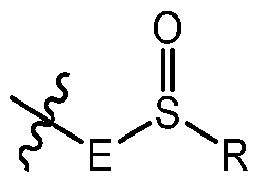 wherein E is absent, or E is a substituted or unsubstituted alkyl, a substituted or unsubstituted alkenyl, a substituted or unsubstituted alkynyl, a substituted or unsubstituted aralkyl (e.g., a substituted or unsubstituted alkylaryl, a substituted or unsubstituted arylalkyl, etc.), a substituted or unsubstituted aryl, a substituted or unsubstituted heteroaryl, a substituted or unsubstituted heterocyclyl, a substituted or unsubstituted polyaryl, a substituted or unsubstituted polyheteroaryl, wherein independently of E, R represents a hydrogen, a substituted or unsubstituted alkyl, a substituted or unsubstituted alkenyl, a substituted or unsubstituted alkynyl, a substituted or unsubstituted carbonyl, a substituted or unsubstituted heterocyclyl, a substituted or unsubstituted aralkyl (e.g. a substituted or unsubstituted alkylaryl, a substituted or unsubstituted arylalkyl), a substituted or unsubstituted aryl, a substituted or unsubstituted heteroaryl, a substituted or unsubstituted polyaryl, a substituted or unsubstituted polyheteroaryl, a substituted or unsubstituted heterocyclyl, a hydroxyl, an alkoxy, a phosphonium, a phosphanyl, a phosphonyl, a silyl, a thiol, an amido, an amino, or -(CH2)m-R ”, or E and R taken together with the S atom to which they are attached complete a heterocycle having from 3 to 14 atoms in the ring structure; R’” represents a hydroxyl group, a substituted or unsubstituted carbonyl group, a substituted or unsubstituted aryl, a substituted or unsubstituted cycloalkyl, a substituted or unsubstituted cycloalkenyl, a substituted or unsubstituted heterocyclyl, a substituted or unsubstituted aryl, a substituted or unsubstituted heteroaryl, a substituted or unsubstituted polyaryl, a substituted or unsubstituted polyheteroaryl, an alkoxy, a phosphonium, a phosphanyl, an amido, or an amino; and m is zero or an integer ranging from 1 to 8. Such substituents can be any substituents described above, e.g., halogen, azide, alkyl, aralkyl, alkenyl, alkynyl, cycloalkyl, hydroxyl, carbonyl (such as a carboxyl, alkoxycarbonyl, formyl,
or an acyl), silyl, ether, ester, thiocarbonyl (such as a thioester, a thioacetate, or a thioformate), alkoxyl, phosphoryl, phosphate, phosphonate, phosphinate, amino (e.g. quartemized amino), amido, amidine, imine, cyano, nitro, azido, sulfhydryl, alkylthio, sulfate, sulfonate, sulfamoyl, sulfonamido, sulfonyl, heterocyclyl, alkylaryl, haloalkyl, -CN, aryl, heteroaryl, polyaryl, polyheteroaryl, and combinations thereof. It is understood by those of ordinary skill in the art, that the E groups listed above are divalent (e.g., methylene, ethane- 1 ,2-diyl, ethene- 1,2-diyl, 1,4-phenylene, cyclohexane- 1,2- diyl).
wherein E is absent, or E is a substituted or unsubstituted alkyl, a substituted or unsubstituted alkenyl, a substituted or unsubstituted alkynyl, a substituted or unsubstituted aralkyl (e.g., a substituted or unsubstituted alkylaryl, a substituted or unsubstituted arylalkyl, etc.), a substituted or unsubstituted aryl, a substituted or unsubstituted heteroaryl, a substituted or unsubstituted heterocyclyl, a substituted or unsubstituted polyaryl, a substituted or unsubstituted polyheteroaryl, wherein independently of E, R represents a hydrogen, a substituted or unsubstituted alkyl, a substituted or unsubstituted alkenyl, a substituted or unsubstituted alkynyl, a substituted or unsubstituted carbonyl, a substituted or unsubstituted heterocyclyl, a substituted or unsubstituted aralkyl (e.g. a substituted or unsubstituted alkylaryl, a substituted or unsubstituted arylalkyl), a substituted or unsubstituted aryl, a substituted or unsubstituted heteroaryl, a substituted or unsubstituted polyaryl, a substituted or unsubstituted polyheteroaryl, a substituted or unsubstituted heterocyclyl, a hydroxyl, an alkoxy, a phosphonium, a phosphanyl, a phosphonyl, a silyl, a thiol, an amido, an amino, or -(CH2)m-R ”, or E and R taken together with the S atom to which they are attached complete a heterocycle having from 3 to 14 atoms in the ring structure; R’” represents a hydroxyl group, a substituted or unsubstituted carbonyl group, a substituted or unsubstituted aryl, a substituted or unsubstituted cycloalkyl, a substituted or unsubstituted cycloalkenyl, a substituted or unsubstituted heterocyclyl, a substituted or unsubstituted aryl, a substituted or unsubstituted heteroaryl, a substituted or unsubstituted polyaryl, a substituted or unsubstituted polyheteroaryl, an alkoxy, a phosphonium, a phosphanyl, an amido, or an amino; and m is zero or an integer ranging from 1 to 8. Such substituents can be any substituents described above, e.g., halogen, azide, alkyl, aralkyl, alkenyl, alkynyl, cycloalkyl, hydroxyl, carbonyl (such as a carboxyl, alkoxycarbonyl, formyl,
or an acyl), silyl, ether, ester, thiocarbonyl (such as a thioester, a thioacetate, or a thioformate), alkoxyl, phosphoryl, phosphate, phosphonate, phosphinate, amino (e.g. quartemized amino), amido, amidine, imine, cyano, nitro, azido, sulfhydryl, alkylthio, sulfate, sulfonate, sulfamoyl, sulfonamido, sulfonyl, heterocyclyl, alkylaryl, haloalkyl, -CN, aryl, heteroaryl, polyaryl, polyheteroaryl, and combinations thereof. It is understood by those of ordinary skill in the art, that the E groups listed above are divalent (e.g., methylene, ethane- 1 ,2-diyl, ethene- 1,2-diyl, 1,4-phenylene, cyclohexane- 1,2- diyl).
The term “sulfonyl” is represented by the formula
 wherein E is absent, or E is a substituted or unsubstituted alkyl, a substituted or unsubstituted alkenyl, a substituted or unsubstituted alkynyl, a substituted or unsubstituted aralkyl (e.g., a substituted or unsubstituted alkylaryl, a substituted or unsubstituted arylalkyl, etc.), a substituted or unsubstituted aryl, a substituted or unsubstituted heteroaryl, a substituted or unsubstituted heterocyclyl, a substituted or unsubstituted polyaryl, a substituted or unsubstituted polyheteroaryl, wherein independently of E, R represents a hydrogen, a substituted or unsubstituted alkyl, a substituted or unsubstituted alkenyl, a substituted or unsubstituted alkynyl, a substituted or unsubstituted carbonyl, a substituted or unsubstituted heterocyclyl, a substituted or unsubstituted aralkyl (e.g. a substituted or unsubstituted alkylaryl, a substituted or unsubstituted arylalkyl), a substituted or unsubstituted aryl, a substituted or unsubstituted heteroaryl, a substituted or unsubstituted polyaryl, a substituted or unsubstituted polyheteroaryl, a substituted or unsubstituted heterocyclyl, a hydroxyl, an alkoxy, a phosphonium, a phosphanyl, an amido, an amino, or -(CH2)m-R”’, or E and R taken together with the S atom to which they are attached complete a heterocycle having from 3 to 14 atoms in the ring structure; R’” represents a hydroxyl group, a substituted or unsubstituted carbonyl group, a substituted or unsubstituted aryl, a substituted or unsubstituted cycloalkyl, a substituted
or unsubstituted cycloalkenyl, a substituted or unsubstituted heterocyclyl, a substituted or unsubstituted aryl, a substituted or unsubstituted heteroaryl, a substituted or unsubstituted polyaryl, a substituted or unsubstituted polyheteroaryl, an alkoxy, a phosphonium, a phosphanyl, an amido, or an amino; and m is zero or an integer ranging from 1 to 8. Such substituents can be any substituents described above, e.g., halogen, azide, alkyl, aralkyl, alkenyl, alkynyl, cycloalkyl, hydroxyl, carbonyl (such as a carboxyl, alkoxycarbonyl, formyl, or an acyl), silyl, ether, ester, thiocarbonyl (such as a thioester, a thioacetate, or a thioformate), alkoxyl, phosphoryl, phosphate, phosphonate, phosphinate, amino (e.g. quartemized amino), amido, amidine, imine, cyano, nitro, azido, sulfhydryl, alkylthio, sulfate, sulfonate, sulfamoyl, sulfonamido, sulfonyl, heterocyclyl, alkylaryl, haloalkyl, -CN, aryl, heteroaryl, polyaryl, poly heteroaryl, and combinations thereof. It is understood by those of ordinary skill in the art, that the E groups listed above are divalent (e.g., methylene, ethane- 1,2-diyl, ethene- 1 ,2-diyl, 1,4-phenylene, cyclohexane- 1 ,2-diyl).
wherein E is absent, or E is a substituted or unsubstituted alkyl, a substituted or unsubstituted alkenyl, a substituted or unsubstituted alkynyl, a substituted or unsubstituted aralkyl (e.g., a substituted or unsubstituted alkylaryl, a substituted or unsubstituted arylalkyl, etc.), a substituted or unsubstituted aryl, a substituted or unsubstituted heteroaryl, a substituted or unsubstituted heterocyclyl, a substituted or unsubstituted polyaryl, a substituted or unsubstituted polyheteroaryl, wherein independently of E, R represents a hydrogen, a substituted or unsubstituted alkyl, a substituted or unsubstituted alkenyl, a substituted or unsubstituted alkynyl, a substituted or unsubstituted carbonyl, a substituted or unsubstituted heterocyclyl, a substituted or unsubstituted aralkyl (e.g. a substituted or unsubstituted alkylaryl, a substituted or unsubstituted arylalkyl), a substituted or unsubstituted aryl, a substituted or unsubstituted heteroaryl, a substituted or unsubstituted polyaryl, a substituted or unsubstituted polyheteroaryl, a substituted or unsubstituted heterocyclyl, a hydroxyl, an alkoxy, a phosphonium, a phosphanyl, an amido, an amino, or -(CH2)m-R”’, or E and R taken together with the S atom to which they are attached complete a heterocycle having from 3 to 14 atoms in the ring structure; R’” represents a hydroxyl group, a substituted or unsubstituted carbonyl group, a substituted or unsubstituted aryl, a substituted or unsubstituted cycloalkyl, a substituted
or unsubstituted cycloalkenyl, a substituted or unsubstituted heterocyclyl, a substituted or unsubstituted aryl, a substituted or unsubstituted heteroaryl, a substituted or unsubstituted polyaryl, a substituted or unsubstituted polyheteroaryl, an alkoxy, a phosphonium, a phosphanyl, an amido, or an amino; and m is zero or an integer ranging from 1 to 8. Such substituents can be any substituents described above, e.g., halogen, azide, alkyl, aralkyl, alkenyl, alkynyl, cycloalkyl, hydroxyl, carbonyl (such as a carboxyl, alkoxycarbonyl, formyl, or an acyl), silyl, ether, ester, thiocarbonyl (such as a thioester, a thioacetate, or a thioformate), alkoxyl, phosphoryl, phosphate, phosphonate, phosphinate, amino (e.g. quartemized amino), amido, amidine, imine, cyano, nitro, azido, sulfhydryl, alkylthio, sulfate, sulfonate, sulfamoyl, sulfonamido, sulfonyl, heterocyclyl, alkylaryl, haloalkyl, -CN, aryl, heteroaryl, polyaryl, poly heteroaryl, and combinations thereof. It is understood by those of ordinary skill in the art, that the E groups listed above are divalent (e.g., methylene, ethane- 1,2-diyl, ethene- 1 ,2-diyl, 1,4-phenylene, cyclohexane- 1 ,2-diyl).
The term “sulfonic acid” refers to a sulfonyl, as defined above, wherein R is hydroxyl, and E is absent, or E is substituted or unsubstituted cycloalkyl, substituted or unsubstituted heterocyclyl, substituted or unsubstituted alkylaryl, substituted or unsubstituted arylalkyl, substituted or unsubstituted aryl, a substituted or unsubstituted polyaryl, a substituted or unsubstituted polyheteroaryl, or substituted or unsubstituted heteroaryl. Such substituents can be any substituents described above, e.g., halogen, azide, alkyl, aralkyl, alkenyl, alkynyl, cycloalkyl, hydroxyl, carbonyl (such as a carboxyl, alkoxycarbonyl, formyl, or an acyl), silyl, ether, ester, thiocarbonyl (such as a thioester, a thioacetate, or a thioformate), alkoxyl, phosphoryl, phosphate, phosphonate, phosphinate, amino (e.g. quartemized amino), amido, amidine, imine, cyano, nitro, azido, sulfhydryl, alkylthio, sulfate, sulfonate, sulfamoyl, sulfonamido, sulfonyl, heterocyclyl, alkylaryl, haloalkyl, -CN, aryl, heteroaryl, polyaryl, polyheteroaryl, and combinations thereof. It is understood by those of ordinary skill in the art, that the E groups listed above are divalent (e.g., methylene, ethane- 1,2-diyl, ethene- 1 ,2-diyl, 1,4-phenylene, cyclohexane- 1,2-diyl).
The term “sulfate” refers to a sulfonyl, as defined above, wherein E is absent, oxygen, alkoxy, aroxy, substituted alkoxy or substituted aroxy, as defined above, and R is independently hydroxyl, alkoxy, aroxy, substituted alkoxy or substituted aroxy, as defined above. When E is oxygen, the sulfate cannot be attached to another chemical species, such as to form an oxygen-oxygen bond, or other unstable bonds, as understood by one of ordinary skill in the art. Such substituents can be any substituents described above, e.g., halogen, azide, alkyl, aralkyl, alkenyl, alkynyl, cycloalkyl, hydroxyl, carbonyl (such as a carboxyl, alkoxycarbonyl, formyl, or an acyl), silyl, ether, ester, thiocarbonyl (such as a thioester, a thioacetate, or a thioformate), alkoxyl, phosphoryl, phosphate, phosphonate, phosphinate, amino (e.g. quartemized amino), amido, amidine, imine, cyano, nitro, azido, sulfhydryl, alkylthio, sulfate, sulfonate, sulfamoyl, sulfonamide, sulfonyl, heterocyclyl, alkylaryl, haloalkyl, -CN, aryl, heteroaryl, polyaryl, polyheteroaryl, and combinations thereof. It is understood by those of ordinary skill in the art, that the E groups listed above are divalent (e.g., methylene, ethane- 1,2-diyl, ethene- 1,2-diyl, 1,4-phenylene, cyclohexane- 1,2- diyl).
The term “sulfonate” refers to a sulfonyl, as defined above, wherein E is oxygen, alkoxy, aroxy, substituted alkoxy or substituted aroxy, as defined above, and R is independently hydrogen, substituted or unsubstituted alkyl, substituted or unsubstituted alkenyl, substituted or unsubstituted alkynyl, substituted or unsubstituted amino, substituted or unsubstituted cycloalkyl, substituted or unsubstituted heterocyclyl, substituted or unsubstituted aralkyl, substituted or unsubstituted alkylaryl, substituted or unsubstituted arylalkyl, substituted or unsubstituted aryl, substituted or unsubstituted heteroar l, a substituted or unsubstituted polyaryl, a substituted or unsubstituted polyheteroaryl, -(CH2)m-R”’, R’” represents a hydroxy group, substituted or unsubstituted carbonyl group, an aryl, a cycloalkyl ring, a cycloalkenyl ring, a heterocycle, an amido, an amino, or a polycycle; and m is zero or an integer ranging from 1 to 8. When E is oxygen, sulfonate cannot be attached to another chemical species, such as to form an oxygen-oxygen bond, or other unstable bonds, as understood by one of ordinary skill in the art. Such substituents can be any substituents described
above, e.g., halogen, azide, alkyl, aralkyl, alkenyl, alkynyl, cycloalkyl, hydroxyl, carbonyl (such as a carboxyl, alkoxycarbonyl, formyl, or an acyl), silyl, ether, ester, thiocarbonyl (such as a thioester, a thioacetate, or a thioformate), alkoxyl, phosphoryl, phosphate, phosphonate, phosphinate, amino (e.g. quartemized amino), amido, amidine, imine, cyano, nitro, azido, sulfhydryl, alkylthio, sulfate, sulfonate, sulfamoyl, sulfonamido, sulfonyl, heterocyclyl, alkylaryl, haloalkyl, -CN, aryl, heteroaryl, polyaryl, polyheteroaryl, and combinations thereof. It is understood by those of ordinary skill in the art, that the E groups listed above are divalent (e.g., methylene, ethane- 1 ,2-diyl, ethene- 1,2-diyl, 1,4-phenylene, cyclohexane- 1,2- diyl).
The term “sulfamoyl” refers to a sulfonamide or sulfonamide represented by the formula
 wherein E is absent, or E is substituted or unsubstituted alkyl, a substituted or unsubstituted alkenyl, a substituted or unsubstituted alkynyl, a substituted or unsubstituted aralkyl (e.g., a substituted or unsubstituted alkylaryl, a substituted or unsubstituted cycloalkyl, etc.), a substituted or unsubstituted aryl, a substituted or unsubstituted heteroaryl, a substituted or unsubstituted polyaryl, a substituted or unsubstituted polyheteroaryl, a substituted or unsubstituted heterocyclyl, wherein independently of E, R and R’ each independently represent a hydrogen, a substituted or unsubstituted alkyl, a substituted or unsubstituted alkenyl, a substituted or unsubstituted alkynyl, a substituted or unsubstituted carbonyl, a substituted or unsubstituted heterocyclyl, a substituted or unsubstituted aralkyl (e.g. a substituted or unsubstituted alkylaryl, a substituted or unsubstituted arylalkyl, etc.), a substituted or unsubstituted aryl, a substituted or unsubstituted heteroaryl, a substituted or unsubstituted polyaryl, a substituted or unsubstituted polyheteroaryl, a substituted or unsubstituted heterocyclyl, a hydroxyl, an alkoxy, a phosphonium, a phosphanyl, an amido, an amino, or -(CH2)m-R’”, or R and R’ taken together with the N atom to which they are attached
complete a heterocycle having from 3 to 14 atoms in the ring structure; R’” represents a hydroxyl group, a substituted or unsubstituted carbonyl group, a substituted or unsubstituted aryl, a substituted or unsubstituted cycloalkyl, a substituted or unsubstituted cycloalkenyl, a substituted or unsubstituted heterocyclyl, a substituted or unsubstituted aryl, a substituted or unsubstituted heteroaryl, a substituted or unsubstituted polyaryl, a substituted or unsubstituted polyheteroaryl, an alkoxy, a phosphonium, a phosphanyl, an amido, or an amino; and m is zero or an integer ranging from 1 to 8. Such substituents can be any substituents described above, e.g., halogen, azide, alkyl, aralkyl, alkenyl, alkynyl, cycloalkyl, hydroxyl, carbonyl (such as a carboxyl, alkoxycarbonyl, formyl, or an acyl), silyl, ether, ester, thiocarbonyl (such as a thioester, a thioacetate, or a thioformate), alkoxyl, phosphoryl, phosphate, phosphonate, phosphinate, amino (e.g. quartemized amino), amido, amidine, imine, cyano, nitro, azido, sulfhydryl, alkylthio, sulfate, sulfonate, sulfamoyl, sulfonamido, sulfonyl, heterocyclyl, alkylaryl, haloalkyl, -CN, aryl, heteroaryl, polyaryl, polyheteroaryl, and combinations thereof. It is understood by those of ordinary skill in the art, that the E groups listed above are divalent (e.g., methylene, ethane- 1 ,2-diyl, ethene- 1 ,2-diyl, 1 ,4-phenylene, cyclohexane- 1 ,2-diyl).
wherein E is absent, or E is substituted or unsubstituted alkyl, a substituted or unsubstituted alkenyl, a substituted or unsubstituted alkynyl, a substituted or unsubstituted aralkyl (e.g., a substituted or unsubstituted alkylaryl, a substituted or unsubstituted cycloalkyl, etc.), a substituted or unsubstituted aryl, a substituted or unsubstituted heteroaryl, a substituted or unsubstituted polyaryl, a substituted or unsubstituted polyheteroaryl, a substituted or unsubstituted heterocyclyl, wherein independently of E, R and R’ each independently represent a hydrogen, a substituted or unsubstituted alkyl, a substituted or unsubstituted alkenyl, a substituted or unsubstituted alkynyl, a substituted or unsubstituted carbonyl, a substituted or unsubstituted heterocyclyl, a substituted or unsubstituted aralkyl (e.g. a substituted or unsubstituted alkylaryl, a substituted or unsubstituted arylalkyl, etc.), a substituted or unsubstituted aryl, a substituted or unsubstituted heteroaryl, a substituted or unsubstituted polyaryl, a substituted or unsubstituted polyheteroaryl, a substituted or unsubstituted heterocyclyl, a hydroxyl, an alkoxy, a phosphonium, a phosphanyl, an amido, an amino, or -(CH2)m-R’”, or R and R’ taken together with the N atom to which they are attached
complete a heterocycle having from 3 to 14 atoms in the ring structure; R’” represents a hydroxyl group, a substituted or unsubstituted carbonyl group, a substituted or unsubstituted aryl, a substituted or unsubstituted cycloalkyl, a substituted or unsubstituted cycloalkenyl, a substituted or unsubstituted heterocyclyl, a substituted or unsubstituted aryl, a substituted or unsubstituted heteroaryl, a substituted or unsubstituted polyaryl, a substituted or unsubstituted polyheteroaryl, an alkoxy, a phosphonium, a phosphanyl, an amido, or an amino; and m is zero or an integer ranging from 1 to 8. Such substituents can be any substituents described above, e.g., halogen, azide, alkyl, aralkyl, alkenyl, alkynyl, cycloalkyl, hydroxyl, carbonyl (such as a carboxyl, alkoxycarbonyl, formyl, or an acyl), silyl, ether, ester, thiocarbonyl (such as a thioester, a thioacetate, or a thioformate), alkoxyl, phosphoryl, phosphate, phosphonate, phosphinate, amino (e.g. quartemized amino), amido, amidine, imine, cyano, nitro, azido, sulfhydryl, alkylthio, sulfate, sulfonate, sulfamoyl, sulfonamido, sulfonyl, heterocyclyl, alkylaryl, haloalkyl, -CN, aryl, heteroaryl, polyaryl, polyheteroaryl, and combinations thereof. It is understood by those of ordinary skill in the art, that the E groups listed above are divalent (e.g., methylene, ethane- 1 ,2-diyl, ethene- 1 ,2-diyl, 1 ,4-phenylene, cyclohexane- 1 ,2-diyl).
The term “silyl group” as used herein is represented by the formula -SiRR’R,” where R, R’, and R” can be, independently, a hydrogen, a substituted or unsubstituted alkyl, a substituted or unsubstituted alkenyl, a substituted or unsubstituted alkynyl, a substituted or unsubstituted heterocyclyl, a substituted or unsubstituted aryl, a substituted or unsubstituted heteroaryl, a substituted or unsubstituted aralkyl (e.g. a substituted or unsubstituted alkylaryl, a substituted or unsubstituted arylalkyl, etc.), a substituted or unsubstituted polyaryl, a substituted or unsubstituted polyheteroaryl, a substituted or unsubstituted carbonyl, a phosphonium, a phosphanyl, a phosphonyl, a sulfinyl, a thiol, an amido, an amino, an alkoxy, or an oxo, described above. Such substituents can be any substituents described above, e.g., halogen, azide, alkyl, aralkyl, alkenyl, alkynyl, cycloalkyl, hydroxyl, carbonyl (such as a carboxyl, alkoxycarbonyl, formyl, or an acyl), silyl, ether, ester, thiocarbonyl (such as a thioester, a thioacetate, or a thioformate), alkoxyl, phosphoryl, phosphate, phosphonate,
phosphinate, amino (e.g. quarternized amino), amido, amidine, imine, cyano, nitro, azido, sulfhydryl, alkylthio, sulfate, sulfonate, sulfamoyl, sulfonamide, sulfonyl, heterocyclyl, alkylaryl, haloalkyl, -CN, ar l, heteroaryl, polyaryl, polyheteroaryl, and combinations thereof.
The terms “thiol” are used interchangeably and are represented by - SR, where R can be a hydrogen, a substituted or unsubstituted alkyl, a substituted or unsubstituted alkenyl, a substituted or unsubstituted alkynyl, a substituted or unsubstituted heterocyclyl, a substituted or unsubstituted aryl, a substituted or unsubstituted heteroaryl, a substituted or unsubstituted aralkyl (e.g. a substituted or unsubstituted alkylaryl, a substituted or unsubstituted arylalkyl, etc.), a substituted or unsubstituted polyaryl, a substituted or unsubstituted polyheteroaryl, a substituted or unsubstituted carbonyl, a phosphonium, a phosphanyl, an amido, an amino, an alkoxy, an oxo, a phosphonyl, a sulfinyl, or a silyl, described above. Such substituents can be any substituents described above, e.g., halogen, azide, alkyl, aralkyl, alkenyl, alkynyl, cycloalkyl, hydroxyl, carbonyl (such as a carboxyl, alkoxycarbonyl, formyl, or an acyl), silyl, ether, ester, thiocarbonyl (such as a thioester, a thioacetate, or a thioformate), alkoxyl, phosphoryl, phosphate, phosphonate, phosphinate, amino (e.g. quarternized amino), amido, amidine, imine, cyano, nitro, azido, sulfhydryl, alkylthio, sulfate, sulfonate, sulfamoyl, sulfonamido, sulfonyl, heterocyclyl, alkylaryl, haloalkyl, -CN, aryl, heteroaryl, polyaryl, poly heteroaryl, and combinations thereof.
The term “phenylthio” is art recognized, and refers to -S-CeHs, i.e. , a phenyl group attached to a sulfur atom.
The term “substituted phenylthio” refers to a phenylthio group, as defined above, having one or more substituents replacing a hydrogen on one or more carbons of the phenyl ring. Such substituents include, but are not limited to, halogen, azide, alkyl, aralkyl, alkenyl, alkynyl, cycloalkyl, hydroxyl, carbonyl (such as a carboxyl, alkoxycarbonyl, formyl, or an acyl), silyl, ether, ester, thiocarbonyl (such as a thioester, a thioacetate, or a thioformate), alkoxyl, phosphonium, phosphanyl, phosphoryl, phosphate, phosphonate, phosphinate, amino (e.g. quarternized amino), amido, amidine, imine, cyano, nitro, azido, sulfhydryl, alkylthio, sulfate, sulfonate, sulfamoyl,
sulfonamido, sulfonyl, heterocyclyl, alkylaryl, haloalkyl, -CN, aryl, heteroaryl, and combinations thereof.
The disclosed compounds and substituent groups, can, independently, possess two or more of the groups listed above. For example, if the compound or substituent group is a straight chain alkyl group, one of the hydrogen atoms of the alkyl group can be substituted with a hydroxyl group, an alkoxy group, etc. Depending upon the groups that are selected, a first group can be incorporated within second group or, alternatively, the first group can be pendant i.e., attached) to the second group. For example, with the phrase “an alkyl group comprising an ester group,” the ester group can be incorporated within the backbone of the alkyl group. Alternatively, the ester can be attached to the backbone of the alkyl group. The nature of the group(s) that is (are) selected will determine if the first group is embedded or attached to the second group.
“oxo” refers to =0.
Use of the term "about" is intended to describe values either above or below the stated value, which the term “about” modifies, to be within a range of approximately +/- 10%. When the term "about" is used before a range of numbers (i.e., about 1-5) or before a series of numbers (i.e., about 1, 2, 3, 4, etc.) it is intended to modify both ends of the range of numbers and/or each of the numbers recited in the entire series, unless specified otherwise.
The compounds and substituents can be substituted with, independently, with the substituents described above in the definition of “substituted.”
IL Compositions
Ethylene brassylate-co-dioxanone polymers, particles and implants containing these polymers have been developed. In some forms, the polymers contain a hydrophilic polymer such as polyethylene glycol). In some forms, the polymers not only provide improved encapsulation efficiencies in particles containing the polymers, compared to particles containing polyethylene glycol)-poly(lactic acid), the particles are also significantly internalized by cells, such as cancer cells (e.g., glioma cells). The particles and implants show remarkable stabilities over several days (such as between 10 and 15 days), as determined by their average sizes and
polydispersity indices over these time frames. The particles and implants can be utilized to deliver therapeutic, diagnostic, and/or prophylactic agents to the brain and other organs of the body. For instance, brain cells retain the particles for at least five days post-delivery, when the observations ended. Lastly, the particles effectively kill cancer cells in vitro.
A. Ethylene brassylate-co-dioxanone polymers
The ethylene brassylate-co-dioxanone polymers have a structure:
 wherein: m and n are independently integers from 1 to 1500, r, r’, t, t’ are independently integers from 0 to 1500, P and P’ comprise a hydrophilic polymer segment, T and T’ comprise a targeting moiety,
U and U’ are independently absent, -O-, -S-, NRu, -C(O)-, -C(O)O-, or -C(0)NRu-,
Ri and Ru are independently hydrogen, substituted alkyl, unsubstituted alkyl, substituted alkenyl, unsubstituted alkenyl, substituted alkynyl, unsubstituted alkynyl, substituted aryl, unsubstituted aryl, substituted heteroaryl, unsubstituted heteroaryl, substituted polyaryl, unsubstituted polyaryl, substituted polyheteroaryl, unsubstituted polyheteroaryl, substituted C3-C20 cycloalkyl, unsubstituted C3-C20 cycloalkyl, substituted Ci-C2oheterocyclyl, unsubstituted C1-C20 heterocyclyl, substituted C3-C20 cycloalkenyl, unsubstituted C3-C20 cycloalkenyl, substituted C3-C20 cycloalkynyl, unsubstituted C3-C20 cycloalkynyl, substituted polyheteroaralkyl, unsubstituted polyheteroaralkyl, substituted polyaralkyl, unsubstituted polyaralkyl, substituted aralkyl, unsubstituted aralkyl, hydroxyl, substituted carbonyl, unsubstituted carbonyl, substituted thiocarbonyl, unsubstituted thiocarbonyl, substituted alkoxy, unsubstituted alkoxy, substituted phosphoryl, unsubstituted phosphoryl,
substituted phosphate, unsubstituted phosphate, substituted phosphonate, unsubstituted phosphonate, substituted phosphinate, unsubstituted phosphinate, substituted amino, unsubstituted amino, substituted amido, unsubstituted amido, substituted amidine, unsubstituted amidine, substituted imine, unsubstituted imine, cyano, nitro, azido, thiol, substituted alkylthio, unsubstituted alkylthio, substituted sulfate, unsubstituted sulfate, substituted sulfonate, unsubstituted sulfonate, substituted sulfamoyl, unsubstituted sulfamoyl, substituted sulfonamide, unsubstituted sulfonamido, substituted sulfonyl, or unsubstituted sulfonyl,
V, W, X, and Y are independently substituted alkyl, unsubstituted alkyl, unsubstituted alkylene, substituted alkenyl, unsubstituted alkenyl, substituted alkynyl, unsubstituted alkynyl, substituted aryl, unsubstituted aryl, substituted heteroaryl, unsubstituted heteroaryl, substituted polyaryl, unsubstituted polyaryl, substituted polyheteroaryl, unsubstituted polyheteroaryl, substituted C3-C20 cycloalkyl, unsubstituted C3-C20 cycloalkyl, substituted Ci-C2oheterocyclyl, unsubstituted C1-C20 heterocyclyl, substituted C3-C20 cycloalkenyl, unsubstituted C3-C20 cycloalkenyl, substituted C3-C20 cycloalkynyl, unsubstituted C3-C20 cycloalkynyl, substituted polyheteroaralkyl, unsubstituted polyheteroaralkyl, substituted polyaralkyl, unsubstituted polyaralkyl, substituted aralkyl, unsubstituted aralkyl, or fused combinations thereof, with the proviso that V, W, X, and Y are each at least divalent (such as bonded to at least two nonhydrogen atoms), and wherein the polymer is not (i) poly(ethylene brassylate-co-D,L- lactide); (ii) polyethylene brassylate-co-hexalactone) or poly(ethylene brassylate-co-5-hexalactone); (iii) polyethylene brassylate-co-8- caprolactone); or (iv) poly (ethylene brassylate-co-squaric acid).
In some forms, the polymers are as described above, except that Ru, when present, and Ri are independently hydrogen, substituted alkyl, unsubstituted alkyl, substituted aryl, unsubstituted aryl, substituted heteroaryl, unsubstituted heteroaryl, substituted polyaryl, unsubstituted polyaryl, substituted polyheteroaryl, unsubstituted polyheteroaryl, substituted C3-C20 cycloalkyl, or unsubstituted C3-C20 cycloalkyl.
In some forms, the polymers are as described above, except that Ru, when present, and Ri are independently hydrogen, substituted alkyl, unsubstituted alkyl, substituted aryl, unsubstituted aryl, substituted heteroaryl, unsubstituted heteroaryl, substituted polyaryl, unsubstituted polyaryl, substituted polyheteroaryl, or unsubstituted polyheteroaryl.
In some forms, the polymers are as described above, except that Ru, when present, and Ri are independently hydrogen, substituted alkyl, or unsubstituted alkyl.
In some forms, the polymers are as described above, except that Ru, when present, and Ri are hydrogen.
In some forms, the polymers are as described above, except that V, W, X, and Y are independently substituted alkyl, unsubstituted alkyl, unsubstituted alkylene, substituted alkenyl, unsubstituted alkenyl, substituted alkynyl, unsubstituted alkynyl, substituted aryl, unsubstituted aryl, substituted heteroaryl, unsubstituted heteroaryl, substituted C3-C20 cycloalkyl, unsubstituted C3-C20 cycloalkyl, substituted Ci-C2oheterocyclyl, unsubstituted Ci-C2oheterocyclyl, substituted C3-C20 cycloalkenyl, unsubstituted C3-C20 cycloalkenyl, substituted C3-C20 cycloalkynyl, unsubstituted C3-C20 cycloalkynyl, or fused combinations thereof, with the proviso that V, W, X, and Y are each at least divalent (such as bonded to at least two non-hydrogen atoms).
In some forms, the polymers are as described above, except that V, W, X, and Y are independently substituted alkyl, unsubstituted alkyl, unsubstituted alkylene, substituted alkenyl, unsubstituted alkenyl, substituted alkynyl, unsubstituted alkynyl, substituted aryl, unsubstituted aryl, substituted heteroaryl, unsubstituted heteroaryl, or fused combinations thereof, with the proviso that V, W, X, and Y are each at least divalent (such as bonded to at least two non-hydrogen atoms).
In some forms, the polymers are as described above, except that V, W, X, and Y are independently substituted alkyl, unsubstituted alkyl, unsubstituted alkylene, substituted alkenyl, unsubstituted alkenyl, substituted alkynyl, unsubstituted alkynyl, with the proviso that V, W, X, and Y are each at least divalent (such as bonded to at least two non-hydrogen atoms).
In some forms, the polymers are as described above, except that V, W, X, and Y are independently substituted alkyl, unsubstituted alkyl, unsubstituted alkylene, with the proviso that V, W, X, and Y are each at least divalent (such as bonded to at least two non-hydrogen atoms).
In some forms, the polymers are as described above, except that the polymers have a structure:
 wherein: a, b, c, and d are independently integers from 1 to 20, such as 1, 2, 3, 4, 5, 6, 7, 8, 9, 10, 11, 12, 13, 14, 15, 16, 17, 18, 19, or 20, preferably a is an integer from 1 to 15, 5 to 15, or 10 to 15, such as 11, b is an integer from 1 to 10, or 1 to 5, such as 2, c is an integer from 1 to 10, or 1 to 5, such as 1, and d is an integer from 1 to 10, or 1 to 5, such as 2. i. Hydrophilic polymers
In some forms, the polymers contain a hydrophilic polymer segment, denoted P or P’ as described herein. Suitable hydrophilic polymers that can be included in the hydrophilic polymer segment include, but are not limited to, polyalkylene glycols and polyalkylene oxides such as polyethylene glycol) (PEG); polysaccharides such as celluloses, alginates, glucosaminoglycans, and dextrans; hydrophilic polypeptides and poly (amino acids) such as poly-L-glutamic acid, gamma-polyglutamic acid, poly-L- aspartic acid, and poly-L-serine; poly(oxyethylated polyol); poly(olefinic alcohol) such as poly(vinyl alcohol) and aminoacetalized poly(vinyl alcohol); poly (N- vinylpyrrolidone); acrylic or acrylate, and alkacrylic or alkacrylate polymers such as poly(acrylic acid), poly(methacrylic acid), poly(hydroxyethyl acrylate); poly(N,N-dimethylaminoethyl methacrylate),
poly (hydroxy alkyl methacrylate) e.g. poly(hydroxy ethyl methacrylate); acrylamide polymers such as poly (acrylamide), poly(hydroxyalkyl methacrylamide) e.g. poly(hydroxyethyl methacrylamide; and poly(4- vinylpyridine); and copolymers thereof.
Preferably, the hydrophilic polymer segment contains a neutral hydrophilic polymer, such as a neutral uncharged hydrophilic polymer. Examples of neutral uncharged hydrophilic polymers include, but are not limited to, polyalkylene glycols and polyalkylene oxides such as poly (ethylene glycol); polysaccharides such as celluloses and dextrans; hydrophilic polypeptides and poly(amino acids) such as poly-L-serine; poly (oxy ethylated polyol); poly(olefinic alcohol) such as poly (vinyl alcohol); poly (N- vinylpyrrolidone); poly(hydroxyethyl acrylate); poly (hydroxy alkyl methacrylate), e.g., poly(hydroxy ethyl methacrylate).
Preferably, the hydrophilic polymer segment contains a neutral uncharged hydrophilic polymer, such as polyalkylene glycols and polyalkylene oxides such as polyethylene glycol).
In some forms, the polymer is as described above for Formulae I and II, except that (i) U’ is absent, (ii) P’ is absent, (iii) T’ is absent, or (iv) U’, P’, and T’ are absent. In some forms, the polymer is as described above for Formulae I and II, except that the polymer has a structure:

Formula III
In some forms, the polymer is as described above for Formulae I, II, and III, except that U is -0-.
In some forms, the polymer is as described above for Formulae I, II, and III, except that the polymer has a structure:

 wherein, m and n are independently integers from 1 to 1500, with the proviso that m+n is at least 10 (such as from 10 to 3000). In some forms, the polymers have a weight- average molecular weight between about 10 kDa and about 150 kDa, between about 10 kDa and about 130 kDa, or between about 10 kDa and about 125 kDa, as measured using gel permeation chromatography, such as between about 15 kDa and about 25 kDa, between about 45 kDa and about 72 kDa, and between about 50 kDa and about 125 kDa. ii. Targeting moieties
In some forms, one or more targeting moieties (also referred to herein as targeting agents and denoted above as T and T’) can be covalently conjugated, non-covalently conjugated, or both, to the polymers. In some forms, the one or more targeting moieties are covalently conjugated to at least one hydrophilic polymer. A targeting moiety binds to or localizes to a specific locale. The targeting moiety may be, for example, a protein, glycoprotein, nucleic acid, nucleic acid analog, carbohydrate, or small molecule (molecular weight between 100 Da and 2,500 Da). In general, the targeting moiety can have a molecular weight between 100 Da and 20 kDa. The locale may be a tissue, a particular cell type, a subcellular compartment, or extracellular matrix. The targeting moiety or a sufficient plurality of targeting moieties may be used to direct the localization of a particle or an active entity. The active entity may be useful for therapeutic, prophylactic, or diagnostic purposes.
The binding or localization to a specific local results in binding of the polymer or a particle containing the polymer to the target cell, tissue, organ, subcellular locale, or extracellular matrix. The targeting moieties can be conjugated to one or more polymers prior or after formation of particles containing the polymers. In some forms, the targeting moieties are conjugated to the polymers prior to formation of a particle containing the
copolymers. In other forms, the targeting moieties are conjugated to the polymers post-particle formation. The targeting moieties can be covalently conjugated to one or more polymers, directly or indirectly via a linker. In some forms, the targeting moiety increases or enhances targeting of the particles to the brain. The targeting moieties can be specific to cells of the nervous system which may include astrocytes, microglia, neurons, oligodendrites, and Schwann cells; or brain extracellular matrix material.
In some forms, the mole ratio of the ethylene brassylate:dioxanone residues in the polymers is between about 95:5 and about 5:95, or between about 95:5 and about 50:50, as determined using 1 H-NMR.
In general, and with respect to the polymers described herein, the values of m and n, and in the presence of absence of P, P’, T, T’, U, and/or U’ are such that the weight-average molecular weight between about 2 kDa and about 1 Mda, between about 2 kDa and about 750 kDa, between about 2 kDa and about 500 kDa, between about 2 kDa and about 250 kDa, or between about 2 kDa and about 100 kDa, between about 2 kDa and about 60 kDa, between about 5 kDa and about 60 kDa, between about 10 kDa and about 60 kDa, between about 2 kDa and about 25 kDa, between about 5 kDa and about 25 kDa, between about 10 kDa and about 25 kDa, or between about 15 kDa and about 25 kDa, such as about 20 kDa, as measured using gel permeation chromatography.
In some forms, the polymers have a weight- average molecular weight between about 10 kDa and about 150 kDa, between about 10 kDa and about 130 kDa, or between about 10 kDa and about 125 kDa, as measured using gel permeation chromatography, such as between about 15 kDa and about 25 kDa, between about 45 kDa and about 72 kDa, and between about 50 kDa and about 125 kDa.
B. Particles and macroimplants containing ethylene brassylate-co-dioxanone polymers
Also described are particles and macroimplants containing, or formed from, the polymers described herein. In some forms, the particles are nanoparticles. Macroimplants refer to composition of matter containing the ethylene brassylate-co-dioxanone polymers described herein, which have a dimension between 1 mm and 5 cm.
In some forms, particles and macroimplants can contain a blend of an ethylene brassylate-co-dioxanone polymer described herein and a second polymer. In some forms, the second polymer can be a hydrophobic polymer. Preferably, the hydrophobic polymer is biodegradable. Suitable biodegradable hydrophobic polymers include, but are not limited to, polyesters, polyanhydrides, poly(p-dioxanone)s, polycarbonates, or a combination thereof. These polymers include poly(a-hydroxy acid)s, poly(lactone)s, or combination thereof, such as poly(lactic acid)s, poly(glycolic acid)s, poly(lactic acid-co-glycolic acid)s, poly(caprolactone)s, poly(pentadecalactone)s, poly(hydroxybutyrate-co-hydroxyvalerate)s, poly(hydroxybutyrate)s, or a combination thereof. i. Therapeutic, diagnostic, and/or prophylactic agents
Preferably, the particles and macroimplants contain one or more therapeutic, prophylactic, or diagnostic agents (collectively called “agents”). In some forms, these agents include small molecule drugs (such as small molecule chemotherapeutic drugs; anti-inflammatories (e.g., dexamethasone), progestins (e.g., levonorgestrel), or integrase inhibitors (e.g., dolutegravir), between 100 Da and 2,500 Da) or macromolecules, such as proteins; nucleic acids, such as mRNAs, siRNAs, miRNAs, ribozymes, triplex forming molecules, sgRNAs, or DNAs; ribonucleoproteins; or a combination thereof. The agents to be incorporated can be non-covalently conjugated and/or covalently conjugated to the polymer. Preferably, at least one of the agents is non-covalently encapsulated within the particles. In some forms, the particles and macroimplants contain a higher proportion of the agents encapsulated within the particles and macroimplants than on the surface of the particles. In some forms, the agents are encapsulated within the particles and macroimplants, and are not on the surface of the particles and macroimplants.
In some forms, the agents are small molecule or macromolecule chemotherapeutic agents. These chemotherapeutic agents are generally classified into the following classes: alkylating agents (e.g., DNA alkylators), DNA damage response inhibitors, antimetabolites, anthracyclines, plant alkaloids, topoisomerase inhibitors, monoclonal antibodies, antitumor antibiotics; biologic response modifiers, histone
deacetylase inhibitors, hormonal agents, protein kinase inhibitors, taxanes, or other anti-tumor agents.
Examples of chemotherapeutic agents that fall within these classes are provided herein: alkylating agents, e.g., DNA alkylators, (such as dianhydrogalactitol (VAL-083), temozolomide, lomustine, cisplatin, carboplatin, oxaliplatin, mechlorethamine, cyclophosphamide, chlorambucil, dacarbazine, carmustine, procarbazine, chlorambucil, and ifosfamide); DNA damage response inhibitors (such as ataxia telangiectasia and Rad3 -related (ATR) inhibitors or analogs thereof; PARP inhibitors or analogs thereof; checkpoint kinase inhibitors or analogs thereof); antimetabolites (such as fluorouracil (5-FU), gemcitabine, methotrexate, cytosine arabinoside, fludarabine, and floxuridine); anthracyclines (such as doxorubicin, daunorubicin, valrubicin, idarubicin, epirubicin, and actinomycins such as actinomycin D); plant alkaloids (such as vinblastine, vincristine, and vinorelbine); topoisomerase inhibitors (such as camptothecin, etoposide, irinotecan, teniposide, and topotecan); monoclonal antibodies (such as alemtuzumab, atezolizumab, avelumab, bevacizumab, blinatumomab, and trastuzumab); antitumor antibiotics (such as mitomycin, plicamycin, and bleomycin); biologic response modifiers (such as aldesleukin (IL-2), denileukin diftitox, interferon gamma); histone deacetylase inhibitors (such as belinostat, panobinostat, romidepsin, and vorinostat); hormonal agents (antiandrogens: abiraterone, apalutamide, bicalutamide, cyproterone, enzalutamide, flutamide, and nilutamide); protein kinase inhibitors (abemaciclib, acalabrutinib, Imatinib, ivosidenib, ixazomib, sorafenib, sunitinib, and talazoparib); taxanes (such as cabazitaxel, docetaxel, and paclitaxel); or other anti-tumor agents (such as asparaginase (pegaspargase), bexarotene, eribulin, everolimus, hydroxyurea, ixabepilone, lenalidomide, mitotane, omacetaxine, pomalidomide, tagraxofusp, telotristat, temsirolimus, thalidomide, and venetoclax). DNA damage response inhibitors are described in Qui, etal., Radiother. Oncol. 2018, 126(3), 450-464, the contents of which are hereby incorporated by reference.
Exemplary diagnostic agents include paramagnetic molecules, fluorescent compounds, magnetic molecules, and radionuclides, x-ray imaging agents, and contrast agents. Exemplary diagnostic agents include,
but are not limited to, metal oxides, such as iron oxide, metallic particles, such as gold particles, etc. Biomarkers can also be conjugated to the nanoparticles for diagnostic applications. For imaging, radioactive materials such as Technetium99 (99mTc) or magnetic materials such as Fe^Ch could be used. Examples of other imaging materials include gases or gas emitting compounds, which are radio-opaque.
In some forms, the particles and macroimplants constitute from about 0.01% wt/wt to about 60% wt/wt, about 0.01% wt/wt to about 55% wt/wt, about 0.01% wt/wt to about 50% wt/wt, about 0.01% wt/wt to about 45% wt/wt, about 0.01% wt/wt to about 40% wt/wt, about 0.01% wt/wt to about 35% wt/wt, about 0.01% wt/wt to about 30% wt/wt, about 0.01% wt/wt to about 25% wt/wt, about 0.01% wt/wt to about 20% wt/wt, about 0.01% wt/wt to about 10% wt/wt, about 0.01% wt/wt to about 5% wt/wt, about 0.5% wt/wt to about 5% wt/wt, the therapeutic, prophylactic, or diagnostic agents. ii. Size and morphology
Agent-containing populations of nanoparticles are typically spherical or about spherical shape with an average diameter from about 50 nm to about 500 nm, about 50 nm to about 400 nm, about 50 nm to about 300 nm, or about 50 nm to about 250 nm, preferably between about 50 nm and about 250 nm. In some forms, the particles have a core-shell structure. Preferably, the core-shell structure contains a hydrophobic core and the hydrophilic polymer is oriented towards the surface of the particles. Techniques to observe and measure nanostructures include dynamic light scattering, scanning electron microscopy, transmission electron microscopy, and/or atomic force microscopy.
These particles generally have a surface charge, e.g., having a zeta potential at a physiological environment between about -50 mV and +10 mV.
The macroimplants can have shapes such as cylinders or disks.
III. Formulations
Formulations containing the particles and macroimplants can be prepared using a pharmaceutically acceptable “carrier” composed of materials that are considered safe and effective and may be administered to an individual without causing undesirable biological side effects or unwanted
interactions. The “carrier” includes all components present in the pharmaceutical formulation other than the active ingredient or ingredients. Dosage formulations may be prepared as described in references such as “Pharmaceutical dosage form tablets”, eds. Liberman, et al. (New York, Marcel Dekker, Inc., 1989), “Remington - The science and practice of pharmacy”, 20th ed., Lippincott Williams & Wilkins, Baltimore, MD, 2000, and “Pharmaceutical dosage forms and drug delivery systems”, 6th Edition, Ansel, et al., (Media, PA: Williams and Wilkins, 1995).
IV. Methods of Making and Reagents therefor
A. Polymers
The block polymers can be synthesized using a variety of methods known to those of skill art including, but not limited to, chemical synthesis, biochemical synthesis, chemoenzymatic synthesis, semisynthesis, or a combination thereof.
Preferably, the block polymers are synthesized via catalytic polymerization of reactants, preferably in a process, wherein an enzyme serves as the catalyst. In some forms, the enzyme catalyst is a lipase, such as a solvent- free lipase. In some forms, the lipase is lipase B from Candida antartica (CALB).
The reactants include a monomer, such as ethylene brassylate and/or dioxanone, that can polymerize to form a segment of the polymer segment. The reactants can further include a hydrophilic polymer containing a nucleophilic group to initiate ring-opening of the ethylene brassylate and/or the dioxanone, such as polyalkylene oxide (e.g., poly (ethylene glycol)). In some forms, the molar feed ratios of the ethylene brassylate:dioxanone can be between about 95:5 and about 5:95, between about 90:10 and about 10:90, such as 90:10, 80:20, 70:30, 60:40, 50:50, and 40:60.
Scheme 1, in the Example section, illustrates a non-limiting synthesis of polymers described herein. In some forms, the method of synthesizing the polymers involves incubating the reactants and enzyme catalyst at a temperature from between 60 °C and 95 °C, inclusive, preferably between 75 °C and 85 °C.
Suitable hydrophilic polymers include those described herein, such as poly alkylene glycols and poly alkylene oxides such as polyethylene glycol);
polysaccharides such as celluloses, alginates, glucosaminoglycans, and dextrans; hydrophilic polypeptides and poly(amino acids) such as poly-L- glutamic acid, gamma-polyglutamic acid, poly-L-aspartic acid, and poly-L- serine; poly(oxy ethylated polyol); poly(olefinic alcohol) such as poly(vinyl alcohol) and aminoacetalized poly(vinyl alcohol); poly(N-vinylpyrrolidone); acrylic or acrylate, and alkacrylic or alkacrylate polymers such as poly(acrylic acid), poly(methacrylic acid), poly(hydroxyethyl acrylate); poly(N,N-dimethylaminoethyl methacrylate), poly(hydroxyalkyl methacrylate), e.g., poly (hydroxyethyl methacrylate); acrylamide polymers such as poly(acrylamide), poly(hydroxy alkyl methacrylamide), e.g., poly (hydroxy ethyl methacrylamide; and poly(4-vinylpyridine); and copolymers thereof.
B. Particles
The block polymers are processed into particles (such as nanoparticles) to encapsulate or otherwise associate with or deliver one or more agents. Techniques for making particles are known in the art and include, but are not limited to, nanoprecipitation, emulsion, solvent evaporation, solvent removal, spray drying, phase inversion, and low temperature casting. Suitable methods of particle formulation are briefly described below. The therapeutic, prophylactic, or diagnostic agent and pharmaceutically acceptable excipients, including pH modifying agents, disintegrants, preservatives, and antioxidants, can optionally be incorporated into the particles during particle formation. As described above, one or more agents can also be incorporated into the nanoparticle during particle formation.
In the nanoprecipitation method, a solution containing one or more therapeutic, prophylactic, or diagnostic agents is added dropwise to a solution containing the polymers. As the therapeutic, prophylactic, or diagnostic agents are complexed by the amphiphilic block polymers e.g., through electrostatic charges), nanoparticles precipitate from solution. The resulting particles are isolated from solution, for example by dialysis, filtration or centrifugation, washed, and dried using a lyophilizer.
The diameter (nm), polydispersity index (PDI) and surface charge (zeta potential, mV) of nanoparticles can be measured by dynamic light
scattering on Zetasizer Nano ZS90 (Malvern Instruments, Southborough, MA). The morphology of the nanoparticles can be characterized by transmission electron microscopy (TEM) or scanning electron microscopy (SEM).
C. Macroimplants
Macroimplants can be produced with or without drugs loaded with them, using the ethylene brassylate-co-dioxanone polymers described herein. Macroimplants refer to composition of matter containing the ethylene brassylate-co-dioxanone polymers described herein, which have a dimension between 1 mm and 5 cm. In some forms, the ethylene brassylate-co- dioxanone polymers were used to produce unloaded and drug-loaded implants according to an established melt-molding technique (W. Saltzman, E. Quijano, F. Yang, J. Jiang, D. Owen, Biodegradable Contraceptive Implants, 2020).
V. Methods of Using
A. Conditions to be treated
This platform technology has a wide range of applications and application locations, for delivery of therapeutic agents, diagnostic agents, and/or prophylactic agents. It can be particularly useful in the controlled release of these agents to cells, tissues, and/or organs of interest. The platform includes: drug delivery platforms, transfection platforms, and gene editing platforms.
The methods of treatment typically include using particles or macroimplants loaded with one or more agents, to deliver the one or more agents into desired cells, tissues, organs, and/or their environment. The methods typically include contacting the agent-loaded particles or macroimplants with one more cells. The contacting can occur in vivo or in vitro or ex vivo.
The nanoparticles, macroimplants, and compositions thereof, can be used to treat diseases or disorders in cells, tissues, and/or organs. The compositions typically include an effective amount of the agents to be delivered. The precise dosage will vary according to a variety of factors such as subject-dependent variables (e.g., age, immune system health, etc.), the disease, and the treatment being effected.
i. Drug delivery platform
In some forms, the disease can be cancer. Cancers to be treated include, but are not limited to, brain tumor (such as glioma), breast cancer (such as metastatic or locally advanced breast cancer), prostate cancer (such as hormone refractory prostate cancer), renal cell carcinoma, lung cancer (such as small cell lung cancer and non-small cell lung cancer (such as adenocarcinoma, squamous cell carcinoma, bronchoalveolar carcinoma and large cell carcinoma)), pancreatic cancer, gastric cancer (such as gastroesophageal, upper gastric or lower gastric cancer), colorectal cancer, squamous cell cancer of the head and neck, ovarian cancer (such as advanced ovarian cancer, platinum-based agent resistant or relapsed ovarian cancer), lymphoma (such as Burkitt’s, Hodgkin’s or non-Hodgkin’s lymphoma), leukemia (such as acute myeloid leukemia) and gastrointestinal cancer. ii. Gene editing platform
In some forms, the therapeutic, diagnostic, and/or prophylactic agents are, or encode, a gene editing technology. In some forms, the disease can be an erythrocyte disorder, such as hereditary spherocytosis, which is amenable to treatment via gene editing.
Gene editing technologies can be used alone or in combination with a potentiating agent and/or other agents. Exemplary gene editing technologies include, but are not limited to, triplex-forming (such as triplex-forming molecules, including triplet-forming oligonucleotides and peptide nucleic acids (PNAs)), pseudo-complementary oligonucleotides, CRISPR/Cas, zinc finger nucleases, TALENs, and small fragment homologous replacement. WO2018/187493 by Saltzman, el al., provides extensive details on gene therapy technologies. The gene editing composition can be a pseudo- complementary oligonucleotide or PNA oligomer.
B. Methods of administration
The particles and macroimplants can be formulated in dosage forms appropriate for each route of administration. Routes of administration include, but are not limited to, intracranial (e.g., intracranial convection enhanced delivery), intrathecal, intramuscular, pulmonary, intranasal, oral, intravenous, intraperitoneal, transdermal, subcutaneous, topical, sublingual,
rectal, and other suitable means. Such administration routes and appropriate formulations are generally known to those of skill in the art.
The administration may be localized (such as to a particular region, physiological system, tissue, organ, or cell type) or systemic, depending on the condition being treated.
The particles, macroimplants, and formulations thereof can be used to deliver small molecules and macromolecules (such as peptide and protein medicines), such as those for the treatment of tumors (such as brain tumors) via one or more routes of administration described herein.
In one preferred form, the particles, macroimplants, and formulations thereof are designed to deliver a drug to the brain across the BBB or within the brain. In another preferred form, the particles, macroimplants, and formulations thereof are designed for drug delivery that penetrates brain tissue.
The particles in the circulation preferentially accumulate in a diseased site. In some forms, they naturally penetrate to the brain, particularly at brain locations with injuries such as tumors. In some forms, the particles, macroimplants and methods are used to treat cancer, particularly brain cancer.
Combination Therapy
The particles, macroimplants, and compositions thereof can be used in combination with standard chemotherapy, radiation therapy, and other anti-cancer treatments. As used herein, “combination” or “combined” refer to either concomitant, simultaneous, or sequential administration of the therapeutics.
The combination therapies can include administration of the agents together in the same admixture, or in separate admixtures.
In some forms, particles and macroimplants containing the polymers described herein, may encapsulate two or more agents to be co-administered.
In other forms, each agent to be co-administered may be encapsulated in separate particles or macroimplants containing the polymers described herein. In these forms, the formulation can include two or more different types of these particles or macroimplants having the same or different agent(s) associated therewith, such as encapsulated therein.
In other forms, some agents are encapsulated in particles or macroimplants containing the polymers described herein, while others are not encapsulated, and can be, for example, free or soluble, or in a different carrier or dosage form. For example, such agents can be free or soluble active agent(s), or agent(s) in a different carrier or dosage form but are nonetheless part of the same composition as the particle, macroimplant, or composition thereof.
In the non-limiting example of chemotherapeutics, the different agents can belong to the same or different therapeutic classes, and/or have the same or different mechanisms of action. For instance, the agents can be selected from alkylating agents (e.g., DNA alkylators), DNA damage response inhibitors, antimetabolites, anthracy clines, plant alkaloids, topoisomerase inhibitors, monoclonal antibodies, antitumor antibiotics, biologic response modifiers, histone deacetylase inhibitors, hormonal agents, protein kinase inhibitors, taxanes, or combinations thereof, such that the agents belong to the same or different therapeutic classes. The different combinations of selections, such that the agents are from the same or different chemotherapeutic classes, are considered contemplated and expressly disclosed. Some examples include: DNA damage response inhibitors and DNA alkylators; a pair of DNA damage response inhibitors, etc. In some forms, the combination results in an additive effect on the treatment of the disease or disorder. In some forms, the combinations result in a more than additive effect on the treatment of the disease or disorder.
In some forms, the particles, macroimplants, or compositions thereof, and other therapeutic agents are administered separately through the same route of administration. In other forms, the particles, macroimplants, or compositions thereof, and other therapeutic agents are administered separately through different routes of administration. The combinations can be administered concomitantly e.g., as an admixture), separately but simultaneously e.g., via separate intravenous lines into the same subject; one agent is given orally while the other agent is administered separately through the same route of administration). In other forms, the particles, macroimplants, or compositions thereof, and other therapeutic agents are administered separately through different routes of administration. The
combinations can be administered either concomitantly (e.g. , as an admixture), separately but simultaneously (e.g., via separate intravenous lines into the same subject; one agent is given orally while the other agent is given by infusion or injection, etc.), or sequentially (e.g. , one agent is given first followed by the second). Exemplary non-limiting combination therapies are discussed in more detail below.
The methods, compounds, and compositions herein described are further illustrated in the following examples, which are provided by way of illustration and are not intended to be limiting. It will be appreciated that variations in proportions and alternatives in elements of the components shown will be apparent to those skilled in the art and are within the scope of disclosed forms. Theoretical aspects are presented with the understanding that Applicants do not seek to be bound by the theory presented. All parts or amounts, unless otherwise specified, are by %weight/weight.
Examples
Example 1: Polyethylene glycolj-ethylene brassylate-co-dioxanone polymer drug delivery particles
Materials and methods
( i ) Synthesis of polymers
Scheme 1 is a non-limiting example of the synthesis of a polyethylene glycolj-ethylene brassylate-co-dioxanone polymer (PEG-EB- co-DO).
Scheme 1
 where p, m, and n can be independently integers from 1 to 1500.
(ii) Fabrication of nanoparticles with or without drug
where p, m, and n can be independently integers from 1 to 1500.
(ii) Fabrication of nanoparticles with or without drug
The nanoparticles were prepared following a nanoprecipitation method. Results
Table 1. Nanoparticles fabricated from PEG-EP-co-DO polymer by nanoprecipitation
 a polymer yield b encapsulation efficiency c drug loading
Uptake of PEG-EB -co-DO DiD dye loaded particles was compared to uptake of PLA-PEG at the same concentration in LN229 cells. PEG-EB- C0-DO represents polyethylene glycol)-ethylene brassy 1 ate-co-dioxanone polymer, PLA-PEG represents poly (lactic acid) -poly (ethylene glycol). The data showed significantly increased uptake of PEG-EB-co-DO compared to PLA-PEG.
FIGs. 8A, 8B, and 8C demonstrated retention of PEG-EB-co-DO DiD dye loaded nanoparticles in rat brains after intracranial delivery (such as intracranial convection enhanced delivery), at three hours (FIG. 8A), 24 hours (FIG. 8B), and five days (FIG. 8C) post-delivery. The data showed that the PEG-EB-co-DO nanoparticles are retained for at least five days in rat brains post-delivery.
Drug-loaded PEG-EB-co-DO nanoparticles also demonstrated synergy in killing LN229 human glioma cells as well as in U251 human glioma cells in combination with free drug such as a DNA alkylator, such as temozolomide (TMZ), lomustine, VAL083; or a PARP Inhibitor, such as BGB290. Comparisons were made between (i) the corresponding free drug and a free ATR inhibitor (such as ATRIN 333) on the one hand, and (ii) the corresponding free drug and nanoparticle-encapsulated ATR inhibitor (such as ATRIN 333).
Example 2: Polyethylene brassylate-co-dioxanone) polymers and fabrication of biodegradable implants
Materials and methods
All chemicals were purchased from Fisher Scientific and used as received unless stated otherwise. Ethylene brassylate (EB) was purchased from Sigma Aldrich. Benzyl alcohol was distilled from calcium hydride under high vacuum. 7-Methyl-l,5,7-triazabicyclo[4.4.0]dec-5-ene (MTBD), l,8-Diazabicyclo(5.4.0)undec-7-ene (DBU) was purchased from Tokyo Chemical Industry Co. LTD. and 2-tert-butylimino-2-diethylamino-l,3- dimethylperhydro-l,3,2-diazaphosphorine (BEMP) from Acros Organics. Benzene-tfe and chlorol'orm-d were purchased from Cambridge Isotope Laboratories and distilled from calcium hydride. Experiments were conducted using pre-dried glassware in an MBRAUN or INERT stainless- steel glovebox under N2 atmosphere. NMR experiments were conducted on a Bruker Avance III 300 MHz or 400 MHz spectrometer. Gel Permeation Chromatography (GPC) was performed at 40 °C using HPLC grade dichloromethane eluent on an Agilent Infinity GPC system equipped with three Agilent PLGel columns 7.5 mm x 300 mm (5 pm, pore sizes: 103, 104, and Afw/Afn were determined versus polystyrene standards (500 g/mol-3150 kg/mol, Polymer Laboratories). Differential Scanning Calorimetry (DSC) experiments were conducted using a Shimadzu DSC-60A instrument, calibrated with an indium standard using aluminum pans under inert conditions.
(i) Poly(EB-co-DO) copolymerization reactions
Small-scale solvent-free copolymerization using Novozyme 435. A 1 mL vial was charged with EB (270.4 mg, 1.0 mmol), DO (102.1 mg, 1.0
mmol), and a stir bar. The contents of the vial were preheated to 80°C for 15 minutes; then Novozyme 435 (33.4 mg) was added in one portion and the vial returned to heating. Reaction progress was monitored by removing aliquots of the reaction mixture and dissolving in 600 pL of CDCh. The catalyst was removed from the dissolved aliquot via syringe filtration. Conversion was determined by 1 H NMR. The polymer was isolated by dissolving the reaction mixture in DCM, removing the catalyst via filtration, then precipitating the polymer with methanol.
Large scale solvent-free copolymerization using Novozyme 435. A 100 mL round bottom flask was charged with EB (7.64 g, 0.028 mol), DO (6.4 g, 0.028 mmol), and an overhead mechanical stirrer was carefully loaded into the reaction. The contents of the round bottom flask were preheated to 80°C for 15 minutes; then Novozyme 435 (0.2 g) was added. The polymer was isolated by dissolving the reaction mixture in DCM, removing the catalyst via filtration, then precipitating the polymer with methanol. The polymer was then characterized using H NMR and GPC.
(ii) Characterization ofpoly(EB-co-DO) copolymers
The structure of poly (EB -co-DO) catalyzed by Novozyme-435 was determined via 1 H and 13C NMR spectroscopy. 1 H NMR was used to determine the incorporation ratio of EB and DO in the copolymer. Percentage conversion and incorporation ratio was calculated using the 1 H NMR signal of the R-COO-CH2-CH2-COO-R of PEB at 4.2 ppm and the - CH2-CH2-O-CH2-COO- of PDO at 3.8 ppm (with reference to CDCh).
( Hi ) Implant fabrication
For DEX-loaded implants, different ratios of poly(EB-co-DO) and DEX were dissolved in dichloromethane (DCM) and methanol, respectively. Both solutions were then sonicated and vortexed together to ensure a homogeneous distribution of drug throughout the polymer matrix and poured into a clean round bottom flask. For LNG-loaded or DTG-loaded implants, polymer and drug were both dissolved in DCM only. A rotary evaporator was used to evaporate the organic solvents over 1 hour. To form two- centimeter implants, the resulting polymer-drug pellets (110 mg) were loaded into a custom-machined Teflon mold and baked for 1 hour at 100°C under argon protection and atmospheric pressure. The implants were
compressed using a stainless-steel plunger immediately after baking and demolded the next day. For in vitro release and mechanical testing, the implants were cut in half to create two one-centimeter implants that were 2.4 mm in diameter and approximately 50 mg in total mass.
( iv ) Implant characterization via SEM
DEX-loaded poly(EB -co-DO) implants were evaluated under an ultra-high-resolution Hitachi scanning electron microscopy (SU7000). Implants were flash frozen in liquid nitrogen, broken in half using tweezers, and cross sectioned using a razor blade to about 1 mm thickness. Samples were placed on a stub using carbon tape, with razor blade edge facing down. Samples were coated with gold to a thickness of 7 nm using a high- resolution sputter coater (Cressington, 208HR) with rotary planetary tilt stage and thickness controller MTM-20. SEM images were taken at 2k to 20k magnification.
(v) In vitro drug release
Drug-loaded poly(EB -co-DO) implants (1 cm long, 2.4 mm diameter, 50 mg) were individually incubated in 1 mL of PBS solution (pH=7.4) containing 3% methyl-beta-cyclodextrin (M-P-CD) at 37°C. At selected time points, the buffer solution was completely replaced with fresh solution of the same composition. The collected buffer solutions, in which the implant had been continuously and completely bathed for a period of time, were flash frozen and lyophilized. High-performance liquid chromatography (HPLC) was then used to determine the representative drug loading of implants in each group.
To determine drug concentrations, one mL of acetonitrile (ACN) was added to DEX and LNG samples to dissolve the agent or one mL of 1:1 water:ACN was added to DTG samples. The samples were then centrifuged at 3000 rpm for 5 min to draw out any salts and M- -CD. The supernatant was passed through 0.22 um syringe filters before being analyzed by HPLC for drug content.
An Agilent column (883995-906, ZORBAX StableBond 300 C8, 4.6 x 150 mm, 5 um) and Shimadzu HPLC system (LC-2030C) with a UV-Vis detector was used for drug quantitation. For both DEX and LNG, Solvent A was 0.1% TFA in HPLC grade water, and solvent B was 0.1% TFA in HPLC
grade ACN. Initial solvent B concentration was set at 5% and allowed to increase to 100% by the 5th minute. Flow was maintained for 5 min at this level before dropping to 5% after 12 min, which was maintained until the end of the run at 13 minutes. For analysis of DTG drug release, Solvent A was 0.1% TFA in HPLC grade water, and solvent B was 100% methanol. Initial solvent B concentration was set at 55% and increased to 60% for the 6-7,h minute before being brought back down to 55% for the 7- 10th minute. All three drugs were detected using a UV detector at a wavelength of 240 nm. Oven temperature was 30°C for DEX and LNG, and 35 °C for DTG. A volume of 45 pl was injected for each sample run.
( vi ) Mathematical diffusion model for prediction of drug release
Fick’s second law of diffusion appropriately models drug transport across polymeric matrixes by proportionally relating the diffusion rate at time, t, to the concentration gradient of drug in the implant, FC/Fr. As shown in the equation below (1), a one-dimensional, radial release from our cylindrical implants was adopted, with a constant drug diffusion coefficient, D.

The solution for the above partial differential equation requires specification of a set of initial conditions and boundary conditions. For the initial condition (t=0), a homogenous and uniform concentration of drug throughout the implant was adopted, C=Co. A symmetry boundary condition is further applied at the center of the implant (r=0) as flux across the plane of symmetry is zero, dC/dr=0. Lastly, a perfect-sink boundary condition is applied at the surface of implant (r= R), C=0. Solving Equation 1 via numerical integration in MATLAB reveals predicted drug concentration in the implant, C, as a function of time, t, and radius, r. The predicted drug concentration is then integrated across the radius of the implant to determine the mass of drug remaining within the implant at each time step. In vitro release, then, is determined from the mass of drug in the implant at each time point subtracted from initial mass of drug within the implant (Co*V). Lastly, the diffusion coefficient is determined by fitting the cumulative drug release
profile to data from in vitro drug release experiments and minimizing root mean squared error (RMSE).
(vii) Mechanical testing
The mechanical properties of the DEX loaded poly (EB -co-DO) implants were assessed via three-point bend tests and compression tests using an Instron 5960 Mechanical Testing Machine.
The three-point bend test. The three-point bend test involved placing individual implants horizontally over a metal grip with prongs separated by a length (L) of 5mm. A 2 kN load cell moved downwards at a speed of 2mm/min and exerted a force in between the two prongs until the implant fractured or a maximum displacement of 20mm was reached. Force (F), displacement (D), flexural stress (of), and flexural strain (&) were recorded by the Instron. The flexural modulus is defined as Ef = Of/Ef where stress and strain are defined as Of = FL/nr3 and gf = 6Dd/L2 respectively (P.E. Sirinek, M.M. Lin, Intracameral sustained release bimatoprost implants (Durysta), Semin Ophthalmol 37(3) (2022) 385-390). The length of the implant was 10 mm, the diameter (d) was 2.4 mm, and the radius (r) was 1.2 mm.
The compression test. The compression test was similarly performed using a 2 kN load cell travelling at a speed of 2mm/min. Implants were placed on top of a stainless-steel plate and were compressed in the transverse direction until a maximum displacement of 10mm was reached or when the implant became fractured or irreversibly deformed. Force (F), displacement (D), compression stress (oc), and compression strain (Ec) were recorded to calculate the compressive modulus of elasticity as Ec = oc/Sc. The
 compressive modulus can also be calculated as Ec =
 , which includes the additional parameters: Poisson’s ratio ( ), geometric constant (Z = radius of implant/ half contact width in radial compression), implant diameter (d), and implant length (L) (W.K. Solomon, V.K. Jindal, Comparison of axial and radial compression tests for determining elasticity modulus of potatoes, Int J Food Prop 9(4) (2006) 855-862).
(viii) Thermal characterization of polymers
Thermogravimetric analysis (TGA) experiments were conducted using a Shimadzu instrument. First, 10 mg of polymer was inserted into the
sample chamber and the temperature was increased at 10°C/min from 25°C to 600°C. The degradation profile was collected during scanning. For the differential scanning calorimetry (DSC) experiments, a TA instrument DSC (TA instruments - DSC250) was used (precalibrated to 10°C/min). Each experiment required 5 to 8 mg of polymer; two cycles were performed consecutively.
(ix) Density measurements
To determine density, polymer samples of -200 mg were first massed with a Mettler Toledo XS205 DU balance with a resolution of 0.01 mg. Samples were then placed into a 1 cm3 chamber within the Micromeritics Accupyc II 1340 pycnometer, with helium as the gas for each fictive temperature characterized. Four measurements were performed for each sample. The standard deviation for the volume measurements by helium pycnometry is 0.001 cm3.
Results
(i) Small-scale synthesis
Scheme 2. One-pot copolymerization under solvent-free conditions using Novozyme 435 at 80°C for 2 hours.

 pot copolymerization of EB and DO proceeds under solvent- free conditions catalyzed by N435 (Scheme 2). Conversion versus time data were acquired using a 1:1 feed ratio of EB and DO. At room temperature, DO has poor solubility in EB; thus, heating the monomers prior to addition of the catalyst proved to be important for early incorporation of DO into the polymer. As the polymerization progressed, the reaction mixture became too viscous to stir and solidified around 30 minutes or when EB reached 50-60% conversion; the solidification of the reaction mixture explains the premature plateau in conversion for DO. In addition, the monomer equilibrium concentration ([M]eq) for DO is 2.5 M, which could also explain why DO did not reach full conversion (A. Heise, C. Duxbury, A. Palmans, Enzyme- Mediated Ring-Opening Polymerization, in: P. Dubois, O. Coulembier, J.-M.
Raquez (Eds.), Handbook of Ring -Opening Polymerization2009, pp. 379- 397). The conversion versus time plot indicates the formation of a gradient block copolymer and reveals that after two hours, no further conversion of EB or DO is observed at 80°C.
pot copolymerization of EB and DO proceeds under solvent- free conditions catalyzed by N435 (Scheme 2). Conversion versus time data were acquired using a 1:1 feed ratio of EB and DO. At room temperature, DO has poor solubility in EB; thus, heating the monomers prior to addition of the catalyst proved to be important for early incorporation of DO into the polymer. As the polymerization progressed, the reaction mixture became too viscous to stir and solidified around 30 minutes or when EB reached 50-60% conversion; the solidification of the reaction mixture explains the premature plateau in conversion for DO. In addition, the monomer equilibrium concentration ([M]eq) for DO is 2.5 M, which could also explain why DO did not reach full conversion (A. Heise, C. Duxbury, A. Palmans, Enzyme- Mediated Ring-Opening Polymerization, in: P. Dubois, O. Coulembier, J.-M.
Raquez (Eds.), Handbook of Ring -Opening Polymerization2009, pp. 379- 397). The conversion versus time plot indicates the formation of a gradient block copolymer and reveals that after two hours, no further conversion of EB or DO is observed at 80°C.
Using the established time and temperature parameters, various monomer feed ratios and catalyst loadings were explored (Tables 2 and 3). The resulting polyesters possessed high weight-average molecular weights (Afw) and a broad scope of incorporation ratios. Changing the feed ratio resulted in polymers that had monomer incorporation ratios that suggest an increased catalyst selectivity for EB. A feed ratio of 50:50 EB:DO yields a polymer with the incorporation ratio of 58:42 and a Mw of 71k with a 16.7% catalyst loading (entry 5, Table 2). Broad molecular weight distributions (M lM > 2) were observed, which are characteristic of solvent-free ROP due to the high viscosity of the macrolactone monomer that leads to an increase in undesirable chain transfer reactions. The H and 13C NMR of poly(EB-co- DO) showed an incorporation ratio of 70:30.
Analogous to a degree of polymerization (DP) screen, reactions with various amounts of enzyme were studied under the solvent-free copolymerization conditions for a 50:50 feed ratio of EB:DO at 80°C (Table 3). The 50:50 feed ratio achieved an incorporation ratio of approximately 60:40 with Mw values ranging from 49k to 72k g/mol. Cutting the amount of catalyst in half (Table 3; entries 1 and 2) resulted in the largest change in Mw (49k and 71k, respectively) and smaller differences in AU were observed with 16.7 - 4.2 wt% catalyst loading (Table 3; entries 2-4). The DP or lengths of the polymer chains were not directly controlled by the amount of enzyme present. The active site of CALB includes a Ser-His-Asp catalytic triad that is essential in initiation and formation of the enzyme activated monomer (EAM). A lactone enters the active site and undergoes nucleophilic attack by the terminal alcohol in the Ser residue; this step is widely accepted as the rate determining step and forms the EAM. The amount of water in the active site plays a major role in polymer chain lengths and is responsible for hydrolysis and regeneration of the enzyme active site (EAS). Chain termination can occur through multiple pathways such as polycondensation, hydrolysis of the polymer chain end, or self-condensation to form cycles
(A.E. Polloni, V. Chiaradia, E.M. Figura, J. De Paoli, D. de Oliveira, J.V. de Oliveira, P.H.H. de Araujo, C. Sayer, Polyesters from Macrolactones Using Commercial Lipase NS 88011 and Novozym 435 as Biocatalysts, Appl Biochem Biotech 184(2) (2018) 659-672). The wide variety of termination mechanisms leads to the broad molecular weight distributions observed for this lipase-catalyzed copolymerization.
Table 2. Composition, molecular weight, and polydispersity for the lipase- catalyzed copolymerization of EB and DO with varying feed ratios (reactions were all conducted at 80°C).
 a Total amount of monomer sums to 2 mmol b Incorporation ratio determined by ]H- NMR. c Mw, Mn, and PDI determined by GPC in dichloromethane against polystyrene standards.
Table 3. Composition, molecular weight, and polydispersity for the lipase- catalyzed copolymerizations of EB and DO with varying catalyst loading
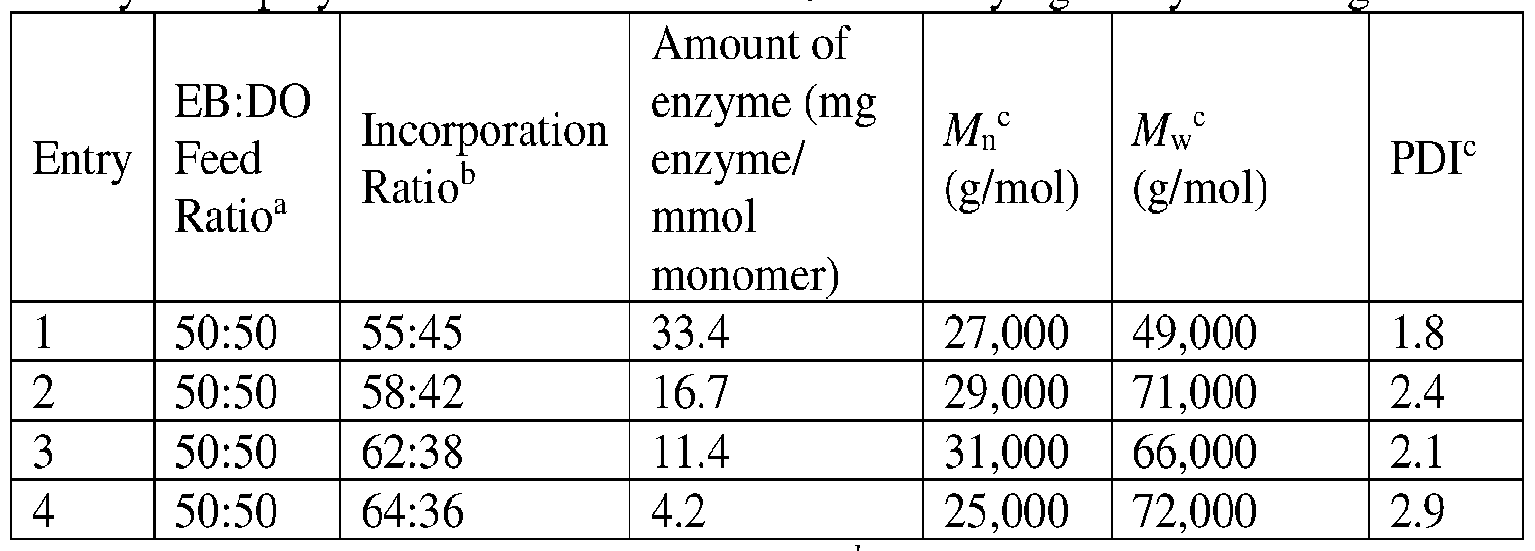 a Total amount of monomer sums to 2 mmol b Incorporation ratio determined by 1 H-N IR. ' A7W, Mn, and PDI determined by GPC in dichloromethane against polystyrene standards.
(ii) Large-scale synthesis reactions
a Total amount of monomer sums to 2 mmol b Incorporation ratio determined by 1 H-N IR. ' A7W, Mn, and PDI determined by GPC in dichloromethane against polystyrene standards.
(ii) Large-scale synthesis reactions
Having established suitable polymerization conditions for a small- scale, copolymerizations were carried out at a 25 -g scale to explore the feasibility of large-scale production. Reactions were conducted in a nitrogen glove box equipped with a mechanical stirrer. One limitation of the large- scale synthesis was the hardening of the material and loss of stirring as the polymerization progressed when using a magnetic stir bar. Stirring with an overhead mechanical stirrer, however, allowed for continuous mixing of the contents of the flask throughout the two-hour polymerization. A conversion versus time plot for the large-scale reaction suggest a more random copolymerization (FIGs. 9A and 9B). The reaction reaches a plateau in conversion at 250 minutes, after which the molecular weight and PDI remains constant. It is also noted that the %conversion looked constant after 100 mins with slight variations. The large-scale reactions resulted in random copolymers with number average molecular weights (Mn) ranging from 30k to 55k and broad molecular weight distributions (Table 4). The material from these large-scale reactions was used for implant fabrication.
Table 4. Composition, molecular weight, and polydispersity for the lipase- catalyzed copolymerization of EB and DO with varying feed ratios for large- scale polymer synthesis.
 a Total amount of monomer sums to 2 mmol b Incorporation ratio determined by ’H-NMR. C MW, Mn, and PDI determined by GPC in dichloromethane against polystyrene standards.
( Hi ) Implant fabrication, in vitro release, and polymer degradability
A series of poly (EB -co-DO) copolymers — with varying DO contents and number average molecular weights (Mn) ranging from 30k to 55k — were
characterized and used for the fabrication of blank or drug-loaded implants (FIGs. 17A, 17B, and 17C). When characterized by thermogravimetric analysis (TGA), polymers with higher DO content degraded faster, with an onset of degradation at 170°C for a copolymer with 40% DO and 290°C for 20% DO. The DSC results showed a nonlinear decrease in the melting point Tm with increasing percentage of DO in the polymer backbone. Multiple melting peaks are seen in the DSC curves, suggesting that these polymers have a large number of crystalline populations that melt at different temperatures. Polymers of EB with Mv < 90 kg/mol have been shown to be more heterogeneous (J. Fernandez, et al. J Meeh Behav Biomed Mater 64 (2016) 209-219). Furthermore, pycnometry revealed an increase in polymer density with increasing percentage of DO (FIG. 17C).
The poly(EB-co-DO) copolymers were used to produce 1-cm unloaded and drug-loaded implants according to an established melt-molding technique (W. Saltzman, et al, Biodegradable Contraceptive Implants, 2020.). Implants loaded with 28%, 35%, and 40% drug possessed a theoretical loading of 14 mg, 18 mg, and 20 mg, respectively. DEX-loaded implants were fabricated and characterized for polymer degradation, in vitro drug release, and overall internal morphology. DEX release was dependent on both drug loading and DO content of the polymer. Higher DEX loading led to increased cumulative and daily drug release rates (FIGs. 10A-10C, FIGs. 18A-18C). The first five days of the daily release profile also revealed a burst release, likely due to rapid release of DEX near the implant surface. In the higher loading implants, the burst release was as much as three times higher than daily release at later times (FIGs. 18A-18C). Higher DO content in the polymer also resulted in faster drug release rate and faster polymer degradation (FIG. 10C and FIGs. 11A-11D). The faster release in higher DO content materials may be a consequence of increased number of ester linkages, which arise due to the increased number of repeating units of DO at a given Mw. Increasing the number of ester linkages would thus result in faster polymer degradation via hydrolysis. Increased DO content in the polymer also results in increased hydrophilicity, which could also enhance the adsorption of water, therefore increasing the rate of hydrolysis (FIG.
11A). The loading of DEX in the implants did not significantly influence the rate of polymer degradation (FIGs. 11B and 11D).
Implants were produced with two alternate agents incorporated: LNG and DTG. Twenty-eight percent LNG-loaded or DTG-loaded implants were fabricated with P4 (37k Afw, 20% DO). In vitro release profiles reveal a slower cumulative release for both LNG and DTG compared to DEX from comparable implants as well as a three- fold reduction in burst release rates, despite the same theoretical drug loading (FIGs. 12A-12F). These differences in release are likely a consequence of the greater hydrophilicity of DEX relative to LNG and DTG as reflected in their log P values: DEX (log P = 1.6- 1.9) > DTG (log P = 2.2) > LNG (log P = 3.3) (FIGs. 12C- 12F).
A mathematical model was used to better understand drug release profiles, to predict the in vitro release kinetics of DEX from poly(EB-co-DO) implants over time periods beyond our experimental measurements, and to reveal the mechanism of controlled release in these implants. SEM images — as well as our experience of the handling implants after in vitro and in vivo exposure to release media — suggest that the implants remain mechanically strong throughout months of DEX release. Therefore, a stable continuous polymer phase and a homogeneous distribution of drug dissolved in the polymer matrix was adopted; thus DEX release was modeled assuming Fickian diffusion with an effective diffusion coefficient representing DEX diffusion through the polymer matrix (Saltzman WM, Drug Delivery: Engineering principles for drug therapy, Oxford University Press (2001)). Drug release from DEX-loaded implants were measured in vitro for 226 days; the models indicated that these implants will continue to release at a constant rate for at least another 275 days. Similar modeling of LNG and DTG release suggest that drug release for these drugs are comparable during the first 100 days but will likely deviate as time progresses. The model suggests that by 500 days less than half of the drug theoretically incorporated into each implant (14 mg) will be released. However, these models do not account for polymer degradation and erosion of the implant matrix: the model is only valid so long as the implant is intact and Fickian diffusion persists. By day 226 of in vitro release, it was noticed that 5 of the 36 DEX-
loaded implants had started to physically erode, exposing millimeter- sized pores, with no clear trend with respect to drug loading or DO content.
The effective diffusion coefficients describing DEX release from poly(EB-co-DO) implants with varying drug loadings and DO content ranged from 1.1 x 10’8 to 9.0 x 10’9 cm2/sec (Table 5).
Table 5. Parameters resulting from mathematical diffusion model for in vitro release of DEX.

The diffusion coefficients for DTG and LNG in these implants are similar in order of magnitude (Table 6).
Table 6. Parameters resulting from mathematical diffusion model for in vitro release of DEX, DTG, and LNG.

Literature values for the diffusion coefficient of free DEX in in tissues has been found to be substantially higher (2.0 - 6.8 x 10'6 cm2/sec depending on the experimental conditions) (Y. Moussy, et al., Biotechnol Progr 22(6) (2006) 1715-1719; L. Hersh, Mathematical techniques for the estimation of the diffusion coefficient and elimination constant of agents in subcutaneous tissue, Physics, University of South Florida, 2007, p. 81). In water at 37°C, radiolabeled DEX in saline was found to have a diffusion
coefficient of 5.2 x 10’6 cm2/sec, whereas in porous ethylene-vinyl acetate copolymer (EV Ac) implants with 35% DEX loading, the diffusion coefficient was four orders of magnitudes lower at 2.0 x IO'10 cm2/sec (W.M. Saltzman, et al, Chem Eng Sci 46(10) (1991) 2429-2444). Results also indicate that the diffusion coefficient of DEX increases with increasing DO content, following an exponential relationship over the measured range of DO content.
(iv) Mechanical testing
Mechanical testing of DEX-loaded implants was performed to evaluate their suitability as an implanted medical device. Results from three- point bend tests and compression tests revealed variation in mechanical properties with implant drug loading and polymer composition (FIGs. 13A- 13D) For both tests, the modulus and maximum force to fracture were not statistically different between unloaded and DEX-loaded implants (FIGs. 13A-13D and FIGs. 19A-19D). For each drug loading, implants with a greater percentage of DO monomer were mechanically weaker, with reduced flexural and compressive modulus and reduced flexural and compressive maximum force before fracture (FIGs. 13A-13D and FIGs. 19A-19D). This trend was also observed qualitatively in the polymers prior to implant fabrication, as the 40% DO polymer was noticeably softer and gummier compared to the 0% DO polymer during routine handling.
During compressive testing on 0% and 20% DO implants, higher drug loading increased the compressive modulus but had no statistically significant effect on the compressive maximum force before failure. For three-point testing on 20% DO implants, increasing drug loading had no statistically significant effect on flexural modulus or flexural maximum force before failure. On the other hand, for 0% DO implants, increasing drug loading decreased both the flexural modulus and flexural maximum force before failure. The addition of drug to these implants effects mechanical strength in ways that are not yet predictable.
To examine mechanical strength after a period of degradation, implants from each group were sacrificed at Day 56 and Day 112 of in vitro release to determine flexural modulus and maximum force before facture. As expected, the flexural strength generally decreased over time, a feature likely
attributed to increased porosity in implant microstructure as the polymer degrades and drug is released.
The mechanical strength of these implants is relevant as, in a clinical application, the implants must withstand mechanical forces from within the user’s tissue on a continual basis. Although the main advantage of biodegradable contraceptive implants compared to commercial implants is the convenience of not needing an excision procedure, implants must remain structurally intact throughout use and they must be mechanically strong enough to survive a removal procedure, if needed during the use period. In clinical trials, the tensile integrity of implants is assessed by comparing implant breaking rates to that of other contraceptive implants. For instance, researchers noted a significantly higher breakage rate of LNG-releasing Sino-implants (II) compared to Jadelie® implants (16.3% vs 3.1%) during removal procedures (M.J. Steiner, et al., Randomized trial to evaluate contraceptive efficacy, safety and acceptability of a two-rod contraceptive implant over 4 years in the Dominican Republic, Contracept X 1 (2019) 100006). Determining the ease of implant removal from mice models is an obvious next step to assess implant tensile strength in vivo.
(v) SEM imaging
To better understand the effect on drug loading and DO content on internal microstructure of the implant during various stages of drug release, SEM images of cross sections of unloaded and DEX-loaded implants were examined. Among unloaded poly(EB-co-DO) implants, cross-sections of implants with 0, 7 or 20% DO appeared brittle and firm, as illustrated by the sharp ridges of the image. On the other hand, cross sections of the 40% DO implant appears softer in texture, as noted by the rounded edges (FIG. 14). These images corroborate the mechanical testing results that revealed greater compressive and flexural strength among implants with lower DO content. Cross-sections of DEX-loaded poly(EB-co-DO) implants reveal crystalline drug structures, identified by their distinct, cuboid-shaped protrusions. Compared to month 0, SEM images of cross-sections at months 2 and 4 reveal greater porosity in implants with 0-40% DO, irrespective of drug loading (FIG. 15, FIG. 20, and FIG. 21).
(vi) Biocompatibility study
To examine tissue responses and in vivo degradation of these implants, unloaded 20% DO implants (P4) were used and examined histological sections and polymer properties over a period of 8 months after subcutaneous implantation. Implants of ~ 10 to 15 mg were implanted in the subdermal layer of 16 mice. Three implants were extracted every two months; half of the implants were used for histological examination while the other half were used to characterize the polymer using GPC and NMR (FIGs. 16A and 16B). Histology results demonstrate an increase in encapsulation thickness to ~75 um during the first four months, after which the encapsulation thickness remained constant (FIG. 16A). This encapsulation layer is much less thick than described in comparable experiments with PLGA and PLA implants: Previous studies with PLGA implants in mice showed an encapsulation thickness of greater than 100 pm within 7 to 60 days of implantation. Another study with PLA implants shows an encapsulation thickness of ~300pm. GPC results indicate that the Mw of the polymer decreased from 37 kg/mol to 10 kg/mol within a period of 4 months and then remained constant from month 4 to month 8 (FIG. 16B). This decrease in Mw (73%) during the first four months is slightly less than observed in vitro degradation, where there was an 84% decrease in Mw after four months of incubation in PBS buffer at 37°C. However, these results may not be comparable given that the starting Mw of the in vitro degradation study was slightly lower, at 29 kg/mol. This trend can likely be attributed to the highly degradable PDO polymeric segments of the copolymer. In terms of structural integrity of the implants , the implants appeared intact at 8 months and were firm enough to be picked up by tweezers without damage to the implant.
In sum, copolymerization reactions were conducted with EB and DO, resulting in reproducible production of poly(EB-co-DO) by enzyme- catalyzed ROP. These reactions were scaled up to produce an array of polymers with varying DO contents. These copolymers were used for the fabrication of rod-shaped biodegradable implants, which were successfully loaded with either DEX, LNG, and DTG. Drug release rates and implant mechanical properties depended on monomer content, polymer molecular
weight, and drug loading, demonstrating that these implants can be tuned for desired properties of release and degradation. The poly(EB -co-DO) implants are well tolerated after subcutaneous implantation in mice, demonstrating their suitability for safe use for long-term drug release. Those skilled in the art will recognize, or be able to ascertain using no more than routine experimentation, many equivalents to the specific embodiments of the invention described herein. Such equivalents are intended to be encompassed by the following claims.
Claims
1. A polymer having a structure:

Formula I wherein: m and n are independently integers from 1 to 1500, r, r’, t, t’ are independently integers from 0 to 1500, P and P’ comprise a hydrophilic polymer segment, T and T’ comprise a targeting moiety,
U and U’ are independently absent, -O-, -S-, NRu, -C(O)-, -C(O)O-, or -C(O)NRu-,
Ri and Ru are independently hydrogen, substituted alkyl, unsubstituted alkyl, substituted alkenyl, unsubstituted alkenyl, substituted alkynyl, unsubstituted alkynyl, substituted aryl, unsubstituted aryl, substituted heteroaryl, unsubstituted heteroaryl, substituted polyaryl, unsubstituted polyaryl, substituted poly heteroaryl, unsubstituted polyheteroaryl, substituted C3-C20 cycloalkyl, unsubstituted C3-C20 cycloalkyl, substituted Ci-C2oheterocyclyl, unsubstituted C1-C20 heterocyclyl, substituted C3-C20 cycloalkenyl, unsubstituted C3-C20 cycloalkenyl, substituted C3-C20 cycloalkynyl, unsubstituted C3-C20 cycloalkynyl, substituted polyheteroaralkyl, unsubstituted polyheteroaralkyl, substituted polyaralkyl, unsubstituted polyaralkyl, substituted aralkyl, unsubstituted aralkyl, hydroxyl, substituted carbonyl, unsubstituted carbonyl, substituted thiocarbonyl, unsubstituted thiocarbonyl, substituted alkoxy, unsubstituted alkoxy, substituted phosphoryl, unsubstituted phosphoryl, substituted phosphate, unsubstituted phosphate, substituted phosphonate, unsubstituted phosphonate, substituted phosphinate, unsubstituted phosphinate, substituted amino, unsubstituted amino, substituted amido, unsubstituted amido, substituted amidine, unsubstituted amidine, substituted imine, unsubstituted imine, cyano, nitro, azido, thiol, substituted alkylthio, unsubstituted alkylthio, substituted sulfate, unsubstituted sulfate, substituted
sulfonate, unsubstituted sulfonate, substituted sulfamoyl, unsubstituted sulfamoyl, substituted sulfonamido, unsubstituted sulfonamido, substituted sulfonyl, or unsubstituted sulfonyl,
V, W, X, and Y are independently substituted alkyl, unsubstituted alkyl, unsubstituted alkylene, substituted alkenyl, unsubstituted alkenyl, substituted alkynyl, unsubstituted alkynyl, substituted aryl, unsubstituted aryl, substituted heteroaryl, unsubstituted heteroaryl, substituted polyaryl, unsubstituted polyaryl, substituted poly heteroaryl, unsubstituted polyheteroaryl, substituted C3-C20 cycloalkyl, unsubstituted C3-C20 cycloalkyl, substituted Ci-C2oheterocyclyl, unsubstituted C1-C20 heterocyclyl, substituted C3-C20 cycloalkenyl, unsubstituted C3-C20 cycloalkenyl, substituted C3-C20 cycloalkynyl, unsubstituted C3-C20 cycloalkynyl, substituted polyheteroaralkyl, unsubstituted polyheteroaralkyl, substituted polyaralkyl, unsubstituted polyaralkyl, substituted aralkyl, unsubstituted aralkyl, or fused combinations thereof, with the proviso that V, W, X, and Y are each at least divalent (such as bonded to at least two nonhydrogen atoms), and wherein the polymer is not (i) polyethylene brassylate-w-D,L- lactide); (ii) polyethylene brassylate-cc>-hexalactone) or poly(ethylene bras sy late- co- 3-hexalac tone); (iii) poly(ethylene brassylate-co-s- caprolactone); or (iv) poly(ethylene brassylate-co-squaric acid).
2. The polymer of claim 1, wherein Ru, when present, and Ri are independently hydrogen, substituted alkyl, unsubstituted alkyl, substituted aryl, unsubstituted aryl, substituted heteroaryl, unsubstituted heteroaryl, substituted polyaryl, unsubstituted polyaryl, substituted polyheteroaryl, unsubstituted polyheteroaryl, substituted C3-C20 cycloalkyl, or unsubstituted C3-C20 cycloalkyl.
3. The polymer of claim 1 or 2, wherein Ru, when present, and Ri are independently hydrogen, substituted alkyl, unsubstituted alkyl, substituted aryl, unsubstituted aryl, substituted heteroaryl, unsubstituted heteroaryl, substituted polyaryl, unsubstituted polyaryl, substituted polyheteroaryl, or unsubstituted polyheteroaryl.
4. The polymer of any one of claims 1 to 3, wherein Ru, when present, and Ri are independently hydrogen, substituted alkyl, or unsubstituted alkyl.
5. The polymer of any one of claims 1 to 4, wherein Ru, when present, and Ri are hydrogen.
6. The polymer of any one of claims 1 to 5, wherein V, W, X, and Y are independently substituted alkyl, unsubstituted alkyl, unsubstituted alkylene, substituted alkenyl, unsubstituted alkenyl, substituted alkynyl, unsubstituted alkynyl, substituted aryl, unsubstituted aryl, substituted heteroaryl, unsubstituted heteroaryl, substituted C3-C20 cycloalkyl, unsubstituted C3-C20 cycloalkyl, substituted Ci-C2oheterocyclyl, unsubstituted C1-C20 heterocyclyl, substituted C3-C20 cycloalkenyl, unsubstituted C3-C20 cycloalkenyl, substituted C3-C20 cycloalkynyl, unsubstituted C3-C20 cycloalkynyl, or fused combinations thereof, with the proviso that V, W, X, and Y are each at least divalent (such as bonded to at least two non-hydrogen atoms).
7. The polymer of any one of claims 1 to 6, wherein V, W, X, and Y are independently substituted alkyl, unsubstituted alkyl, unsubstituted alkylene, substituted alkenyl, unsubstituted alkenyl, substituted alkynyl, unsubstituted alkynyl, substituted aryl, unsubstituted aryl, substituted heteroaryl, unsubstituted heteroaryl, or fused combinations thereof, with the proviso that V, W, X, and Y are each at least divalent (such as bonded to at least two nonhydrogen atoms).
8. The polymer of any one of claims 1 to 7, wherein V, W, X, and Y are independently substituted alkyl, unsubstituted alkyl, unsubstituted alkylene, substituted alkenyl, unsubstituted alkenyl, substituted alkynyl, unsubstituted alkynyl, with the proviso that V, W, X, and Y are each at least divalent (such as bonded to at least two non-hydrogen atoms).
9. The polymer of any one of claims 1 to 8, wherein V, W, X, and Y are independently substituted alkyl, unsubstituted alkyl, unsubstituted alkylene, with the proviso that V, W, X, and Y are each at least divalent (such as bonded to at least two non-hydrogen atoms).

Formula II’ wherein: a, b, c, and d are independently integers from 1 to 20, such as 1, 2, 3, 4, 5, 6, 7, 8, 9, 10, 11, 12, 13, 14, 15, 16, 17, 18, 19, or 20, preferably a is an integer from 1 to 15, 5 to 15, or 10 to 15, such as 11, b is an integer from 1 to
10. or 1 to 5, such as 2, c is an integer from 1 to 10, or 1 to 5, such as 1, and d is an integer from 1 to 10, or 1 to 5, such as 2.
11. The polymer of any one of claims 1 to 10, wherein P and P’ when present, independently comprise comprises polyalkylene glycols and polyalkylene oxides such as poly (ethylene glycol); polysaccharides such as celluloses, alginates, glucosaminoglycans, and dextrans; hydrophilic polypeptides and poly(amino acids) such as poly-L-glutamic acid, gammapolyglutamic acid, poly-L-aspartic acid, and poly-L-serine; poly(oxy ethylated polyol); poly(olefinic alcohol) such as poly(vinyl alcohol) and aminoacetalized poly(vinyl alcohol); poly(N-vinylpyrrolidone); acrylic or acrylate, and alkacrylic or alkacrylate polymers such as poly(acrylic acid), poly(methacrylic acid), poly(hydroxyethyl acrylate); poly(N,N- dimethylaminoethyl methacrylate), poly(hydroxyalkyl methacrylate) e.g. poly(hydroxy ethyl methacrylate); acrylamide polymers such as poly(acrylamide), poly(hydroxy alkyl methacrylamide), e.g., poly(hydroxy ethyl methacrylamide; and poly(4-vinylpyridine); and copolymers thereof.
12. The polymer of any one of claims 1 to 11, wherein P and P’ when present, independently comprise polyalkylene glycols and polyalkylene oxides such as PEG.
13. The polymer of any one of claims 1 to 12, wherein T and T’ when present are independently a protein, peptide, glycoprotein, aptamer, carbohydrate, or small molecule.
14. The polymer of any one of claims 1 to 13, wherein:
(i) U’ is absent,
(ii) P’ is absent,
(iii) T’ is absent, or
(iv) U’, P’, and T’ are absent.
15. The polymer of any one of claims 1 to 14, having a structure:

Formula III
16. The polymer of any one of claims 1 to 15, wherein U is -0-.
17. The polymer of claim 16, having a structure:

18. The polymer of any one of claims 1 to 17, having a weight- average molecular weight between about 2 kDa and about 1 Mda, between about 2 kDa and about 750 kDa, between about 2 kDa and about 500 kDa, between about 2 kDa and about 250 kDa, or between about 2 kDa and about 100 kDa, between about 2 kDa and about 60 kDa, between about 5 kDa and about 60 kDa, between about 10 kDa and about 60 kDa, between about 2 kDa and about 25 kDa, between about 5 kDa and about 25 kDa, between about 10 kDa and about 25 kDa, or between about 15 kDa and about 25 kDa, such as about 20 kDa, as measured using gel permeation chromatography.
19. The polymer of any one of claims 1 to 17, having a weight- average molecular weight between about 10 kDa and about 150 kDa, between about 10 kDa and about 130 kDa, or between about 10 kDa and about 125 kDa, as measured using gel permeation chromatography, such as between about 15
kDa and about 25 kDa, between about 45 kDa and about 72 kDa, and between about 50 kDa and about 125 kDa.
20. The polymer of any one of claims 1 to 18, having a mole ratio of ethylene brassylate:dioxanone residues between about 95:5 and about 5:95, or between about 95:5 and about 50:50, as determined using ' H-NMR.
21. Particles or macroimplants comprising the polymers of any one of claims 1 to 20 and one or more therapeutic, prophylactic, or diagnostic agents.
22. The particles or macroimplants of claim 21, wherein:
(i) the particles are nanoparticles, or
(ii) the macroimplants have a dimension between 1 mm and 5 cm.
23. The particles or macroimplants of claim 21 or 22, wherein:
(i) the particles have an average diameter from about 50 nm to about 500 nm, about 50 nm to about 400 nm, about 50 nm to about 300 nm, or about 50 nm to about 250 nm, preferably between about 50 nm and about 250 nm as measured using dynamic light scattering or scanning electron microscopy, or
(ii) the macroimplants have a length between 0.5 cm and 2 cm, and a diameter between 1 mm and 2.5 mm.
24. The particles or macroimplants of any one of claims 21 to 23, wherein the one or more therapeutic, prophylactic, or diagnostic agents comprise small molecule drugs (such as small molecule chemotherapeutic drugs; anti-inflammatories (e.g., dexamethasone), progestins (e.g., levonorgestrel), or integrase inhibitors (e.g., dolutegravir), between 100 Da and 2,500 Da); proteins; nucleic acids, such as mRNAs, siRNAs, miRNAs, ribozymes, triplex forming molecules, sgRNAs, or DNAs; ribonucleoproteins; or a combination thereof.
25. The particles or macroimplants of any one of claims 21 to 24, wherein the therapeutic agents comprise chemotherapeutic agents.
26. The particles or macroimplants of claim 25, wherein the chemotherapeutic agents comprise alkylating agents e.g., DNA alkylators), DNA damage response inhibitors, antimetabolites, anthracy clines, plant alkaloids, topoisomerase inhibitors, monoclonal antibodies, antitumor
antibiotics, biologic response modifiers, histone deacetylase inhibitors, hormonal agents, protein kinase inhibitors, taxanes, or combinations thereof.
27. The particles or macroimplants of claim 25 or 26, wherein the chemotherapeutic agent comprises alkylating agents (e.g., DNA alkylators); DNA damage response inhibitors (such as PARP inhibitors or analogs thereof, ATR inhibitors or analogs thereof); or combinations thereof.
28. The particles or macroimplants of any one of claims 21 to 27, constituting from about 0.01% wt/wt to about 60% wt/wt, about 0.01% wt/wt to about 55% wt/wt, about 0.01% wt/wt to about 50% wt/wt, about 0.01% wt/wt to about 45% wt/wt, about 0.01% wt/wt to about 40% wt/wt, about 0.01% wt/wt to about 35% wt/wt, about 0.01% wt/wt to about 30% wt/wt, about 0.01% wt/wt to about 25% wt/wt, about 0.01% wt/wt to about 20% wt/wt, about 0.01% wt/wt to about 10% wt/wt, about 0.01% wt/wt to about 5% wt/wt, about 0.5% wt/wt to about 5% wt/wt, the therapeutic, prophylactic, or diagnostic agents.
29. The particles of any one of claims 21 to 28, having a zeta potential between about -50 mV and +10 mV.
30. A pharmaceutical composition comprising the particles or macroimplants of any one of claims 21 to 29 and a pharmaceutically acceptable carrier.
31. A method of administering one or more therapeutic, prophylactic, or diagnostic agents to a subject in need thereof, the method comprising administering the particles or macroimplants of any of claims 21 to 29, or the composition of claim 30 to the subject.
32. The method of claim 31, wherein the particles, macroimplants, or composition are administered parenterally (such as intracranially such as intracranial convection enhanced delivery of the particles) or enterally.
33. The method of claim 31 or 32, wherein the particles, macroimplants, or composition are co-administered with a second therapeutic agent, prophylactic agent, diagnostic agent, or a combination thereof.
34. The method of claim 33, wherein co-administration is concurrently, sequentially, or a combination thereof.
35. The method of claim 33 or 34, wherein the second therapeutic agent, prophylactic agent, diagnostic agent, or a combination thereof, is not encapsulated, encapsulated, or a combination thereof.
36. The method of any one of claims 33 to 35, wherein the second therapeutic agent comprises chemotherapeutic agents comprising alkylating agents, DNA damage response inhibitors, antimetabolites, anthracyclines, plant alkaloids, topoisomerase inhibitors, monoclonal antibodies, antitumor antibiotics, biologic response modifiers, histone deacetylase inhibitors, hormonal agents, protein kinase inhibitors, taxanes, or combinations thereof.
Applications Claiming Priority (2)
| Application Number | Priority Date | Filing Date | Title |
|---|---|---|---|
| US202363491328P | 2023-03-21 | 2023-03-21 | |
| US63/491,328 | 2023-03-21 |
Publications (1)
| Publication Number | Publication Date |
|---|---|
| WO2024196702A1 true WO2024196702A1 (en) | 2024-09-26 |
Family
ID=90789343
Family Applications (1)
| Application Number | Title | Priority Date | Filing Date |
|---|---|---|---|
| PCT/US2024/019927 Ceased WO2024196702A1 (en) | 2023-03-21 | 2024-03-14 | Ethylene brassylate-co-dioxanone polymers and uses thereof |
Country Status (1)
| Country | Link |
|---|---|
| WO (1) | WO2024196702A1 (en) |
Citations (2)
| Publication number | Priority date | Publication date | Assignee | Title |
|---|---|---|---|---|
| US20040019178A1 (en) * | 2002-07-19 | 2004-01-29 | Gross Richard A. | Enzyme-catalyzed polycondensations |
| WO2018187493A1 (en) | 2017-04-04 | 2018-10-11 | Yale University | Compositions and methods for in utero delivery |
-
2024
- 2024-03-14 WO PCT/US2024/019927 patent/WO2024196702A1/en not_active Ceased
Patent Citations (2)
| Publication number | Priority date | Publication date | Assignee | Title |
|---|---|---|---|---|
| US20040019178A1 (en) * | 2002-07-19 | 2004-01-29 | Gross Richard A. | Enzyme-catalyzed polycondensations |
| WO2018187493A1 (en) | 2017-04-04 | 2018-10-11 | Yale University | Compositions and methods for in utero delivery |
Non-Patent Citations (19)
| Title |
|---|
| "Pharmaceutical dosage form tablets", 1989, MARCEL DEKKER, INC. |
| "Remington - The science and practice of pharmacy", 2000, LIPPINCOTT WILLIAMS & WILKINS |
| A. HEISEC. DUXBURYA. PALMANS: "Handbook of Ring-Opening Polymerization", 2009, article "Enzyme-Mediated Ring-Opening Polymerization", pages: 379 - 397 |
| A.E. POLLONIV. CHIARADIAE.M. FIGURAJ. DE PAOLID. DE OLIVEIRAJ.V. DE OLIVEIRAP.H.H. DE ARAUJOC. SAYER: "Polyesters from Macrolactones Using Commercial Lipase NS 88011 and Novozym 435 as Biocatalysts", APPL BIOCHEM BIOTECH, vol. 184, no. 2, 2018, pages 659 - 672, XP036410418, DOI: 10.1007/s12010-017-2583-4 |
| ALBANESE ET AL., ANNU. REV. BIOMED. ENG., vol. 14, no. 1, 2012, pages 1 - 16 |
| ANSEL ET AL.: "Pharmaceutical dosage forms and drug delivery systems", 1995, WILLIAMS AND WILKINS |
| J. FERNANDEZ ET AL., J MECH BEHAV BIOMED MATER, vol. 64, 2016, pages 209 - 219 |
| L. HERSH: "Physics", 2007, UNIVERSITY OF SOUTH FLORIDA, article "Mathematical techniques for the estimation of the diffusion coefficient and elimination constant of agents in subcutaneous tissue", pages: 81 |
| LEEYEO, CHEMICAL ENGINEERING SCIENCE, vol. 125, 2015, pages 75 - 84 |
| M.J. STEINER ET AL.: "Randomized trial to evaluate contraceptive efficacy, safety and acceptability of a two-rod contraceptive implant over 4 years in the Dominican Republic", CONTRACEPT X, vol. 1, 2019, pages 100006 |
| OWENSPEPPAS, INTERNATIONAL JOURNAL OF PHARMACEUTICS, vol. 307, no. 1, 2006, pages 93 - 102 |
| P.E. SIRINEKM.M. LIN: "Intracameral sustained release bimatoprost implants (Durysta", SEMIN OPHTHALMOL, vol. 37, no. 3, 2022, pages 385 - 390 |
| QUI ET AL., RADIOTHER. ONCOL., vol. 126, no. 3, 2018, pages 450 - 464 |
| SALATA, JOURNAL OF NANOBIOTECHNOLOGY, vol. 2, no. 1, 2004, pages 3 |
| SALTZMAN WM: "Drug Delivery: Engineering principles for drug therapy", 2001, OXFORD UNIVERSITY PRESS |
| W. SALTZMANE. QUIJANOF. YANGJ. JIANGD. OWEN, BIODEGRADABLE CONTRACEPTIVE IMPLANTS, 2020 |
| W.K. SOLOMONV.K. JINDAL: "Comparison of axial and radial compression tests for determining elasticity modulus of potatoes", INT J FOOD PROP, vol. 9, no. 4, 2006, pages 855 - 862 |
| W.M. SALTZMAN ET AL., CHEM ENG SCI, vol. 46, no. 10, 1991, pages 2429 - 2444 |
| Y. MOUSSY ET AL., BIOTECHNOL PROGR, vol. 22, no. 6, 2006, pages 1715 - 1719 |
Similar Documents
| Publication | Publication Date | Title |
|---|---|---|
| Song et al. | Linolenic acid-modified PEG-PCL micelles for curcumin delivery | |
| Zhang et al. | Recent advances in stimuli-responsive degradable block copolymer micelles: synthesis and controlled drug delivery applications | |
| EP2515946B1 (en) | Nanoconjugates and nanoconjugate formulations | |
| Praphakar et al. | Targeted delivery of rifampicin to tuberculosis-infected macrophages: design, in-vitro, and in-vivo performance of rifampicin-loaded poly (ester amide) s nanocarriers | |
| Yang et al. | Structure-directing star-shaped block copolymers: supramolecular vesicles for the delivery of anticancer drugs | |
| Wang et al. | Folate mediated self-assembled phytosterol-alginate nanoparticles for targeted intracellular anticancer drug delivery | |
| Zhang et al. | Synthesis and characterization of a new multifunctional polymeric prodrug paclitaxel–polyphosphoester–folic acid for targeted drug delivery | |
| Wang et al. | Tailor-made gemcitabine prodrug nanoparticles from well-defined drug–polymer amphiphiles prepared by controlled living radical polymerization for cancer chemotherapy | |
| Li et al. | Micelles based on methoxy poly (ethylene glycol) cholesterol conjugate for controlled and targeted drug delivery of a poorly water soluble drug | |
| Liu et al. | Drug carrier system self-assembled from biomimetic polyphosphorycholine and biodegradable polypeptide based diblock copolymers | |
| WO2014169007A2 (en) | Combination therapeutic nanoparticles | |
| Arno et al. | Exploiting topology-directed nanoparticle disassembly for triggered drug delivery | |
| Li et al. | Biocompatible supramolecular pseudorotaxane hydrogels for controllable release of doxorubicin in ovarian cancer SKOV-3 cells | |
| Chai et al. | Based on sodium alginate coatings and dendritic copolymeric modification of curcumin delivery system: pH-sensitive nanospheres and strong tumor cytotoxicity | |
| CN106177979A (en) | One has multiple medicines synergistic antitumor polymer bond drug and preparation method thereof | |
| WO2008130180A1 (en) | Preparation of drug delivery systems using ph-sensitive block copolymer and their application | |
| Lopez et al. | Self-assembled coumarin-and 5-fluorouracil-PEG micelles as multifunctional drug delivery systems | |
| Kaptan et al. | Enzymatic PCL-grafting to NH2-end grouped silica and development of microspheres for pH-stimulated release of a hydrophobic model drug | |
| CN101205302B (en) | Polyphosphate ester-polycaprolactone tri-block copolymer and uses thereof | |
| Guo et al. | Well-defined podophyllotoxin polyprodrug brushes: preparation via RAFT polymerization and evaluation as drug carriers | |
| Li et al. | Facile optimization and evaluation of PEG–PCL block copolymeric nanoparticles for anticancer drug delivery using copolymer hybrids and histoculture drug response assays | |
| Feng et al. | Y-shaped folic acid-conjugated PEG-PCL copolymeric micelles for delivery of curcumin | |
| Rodríguez-Acosta et al. | Nanomedical applications of amphiphilic dendrimeric micelles | |
| KR101334420B1 (en) | Core cross-linked polymeric micelle for drug delivery and method of manufacturing the same | |
| CN114099705B (en) | Nanometer medicine based on hydralazine for improving tumor microenvironment and preparation and application thereof |
Legal Events
| Date | Code | Title | Description |
|---|---|---|---|
| 121 | Ep: the epo has been informed by wipo that ep was designated in this application |
Ref document number: 24719910 Country of ref document: EP Kind code of ref document: A1 |
|
| NENP | Non-entry into the national phase |
Ref country code: DE |
|
| 122 | Ep: pct application non-entry in european phase |
Ref document number: 24719910 Country of ref document: EP Kind code of ref document: A1 |