WO2024195374A1 - 下地基板 - Google Patents
下地基板 Download PDFInfo
- Publication number
- WO2024195374A1 WO2024195374A1 PCT/JP2024/005221 JP2024005221W WO2024195374A1 WO 2024195374 A1 WO2024195374 A1 WO 2024195374A1 JP 2024005221 W JP2024005221 W JP 2024005221W WO 2024195374 A1 WO2024195374 A1 WO 2024195374A1
- Authority
- WO
- WIPO (PCT)
- Prior art keywords
- layer
- base substrate
- orientation
- microcrystals
- orientation layer
- Prior art date
- Legal status (The legal status is an assumption and is not a legal conclusion. Google has not performed a legal analysis and makes no representation as to the accuracy of the status listed.)
- Ceased
Links
Images
Classifications
-
- H—ELECTRICITY
- H10—SEMICONDUCTOR DEVICES; ELECTRIC SOLID-STATE DEVICES NOT OTHERWISE PROVIDED FOR
- H10P—GENERIC PROCESSES OR APPARATUS FOR THE MANUFACTURE OR TREATMENT OF DEVICES COVERED BY CLASS H10
- H10P14/00—Formation of materials, e.g. in the shape of layers or pillars
- H10P14/20—Formation of materials, e.g. in the shape of layers or pillars of semiconductor materials
- H10P14/29—Formation of materials, e.g. in the shape of layers or pillars of semiconductor materials characterised by the substrates
- H10P14/2926—Crystal orientations
-
- C—CHEMISTRY; METALLURGY
- C04—CEMENTS; CONCRETE; ARTIFICIAL STONE; CERAMICS; REFRACTORIES
- C04B—LIME, MAGNESIA; SLAG; CEMENTS; COMPOSITIONS THEREOF, e.g. MORTARS, CONCRETE OR LIKE BUILDING MATERIALS; ARTIFICIAL STONE; CERAMICS; REFRACTORIES; TREATMENT OF NATURAL STONE
- C04B41/00—After-treatment of mortars, concrete, artificial stone or ceramics; Treatment of natural stone
- C04B41/80—After-treatment of mortars, concrete, artificial stone or ceramics; Treatment of natural stone of only ceramics
- C04B41/81—Coating or impregnation
- C04B41/85—Coating or impregnation with inorganic materials
- C04B41/87—Ceramics
-
- C—CHEMISTRY; METALLURGY
- C30—CRYSTAL GROWTH
- C30B—SINGLE-CRYSTAL GROWTH; UNIDIRECTIONAL SOLIDIFICATION OF EUTECTIC MATERIAL OR UNIDIRECTIONAL DEMIXING OF EUTECTOID MATERIAL; REFINING BY ZONE-MELTING OF MATERIAL; PRODUCTION OF A HOMOGENEOUS POLYCRYSTALLINE MATERIAL WITH DEFINED STRUCTURE; SINGLE CRYSTALS OR HOMOGENEOUS POLYCRYSTALLINE MATERIAL WITH DEFINED STRUCTURE; AFTER-TREATMENT OF SINGLE CRYSTALS OR A HOMOGENEOUS POLYCRYSTALLINE MATERIAL WITH DEFINED STRUCTURE; APPARATUS THEREFOR
- C30B25/00—Single-crystal growth by chemical reaction of reactive gases, e.g. chemical vapour-deposition growth
- C30B25/02—Epitaxial-layer growth
- C30B25/18—Epitaxial-layer growth characterised by the substrate
-
- C—CHEMISTRY; METALLURGY
- C30—CRYSTAL GROWTH
- C30B—SINGLE-CRYSTAL GROWTH; UNIDIRECTIONAL SOLIDIFICATION OF EUTECTIC MATERIAL OR UNIDIRECTIONAL DEMIXING OF EUTECTOID MATERIAL; REFINING BY ZONE-MELTING OF MATERIAL; PRODUCTION OF A HOMOGENEOUS POLYCRYSTALLINE MATERIAL WITH DEFINED STRUCTURE; SINGLE CRYSTALS OR HOMOGENEOUS POLYCRYSTALLINE MATERIAL WITH DEFINED STRUCTURE; AFTER-TREATMENT OF SINGLE CRYSTALS OR A HOMOGENEOUS POLYCRYSTALLINE MATERIAL WITH DEFINED STRUCTURE; APPARATUS THEREFOR
- C30B29/00—Single crystals or homogeneous polycrystalline material with defined structure characterised by the material or by their shape
- C30B29/10—Inorganic compounds or compositions
- C30B29/16—Oxides
-
- H—ELECTRICITY
- H10—SEMICONDUCTOR DEVICES; ELECTRIC SOLID-STATE DEVICES NOT OTHERWISE PROVIDED FOR
- H10P—GENERIC PROCESSES OR APPARATUS FOR THE MANUFACTURE OR TREATMENT OF DEVICES COVERED BY CLASS H10
- H10P14/00—Formation of materials, e.g. in the shape of layers or pillars
- H10P14/20—Formation of materials, e.g. in the shape of layers or pillars of semiconductor materials
- H10P14/29—Formation of materials, e.g. in the shape of layers or pillars of semiconductor materials characterised by the substrates
- H10P14/2901—Materials
- H10P14/2921—Materials being crystalline insulating materials
Definitions
- the present invention relates to a base substrate used for the crystal growth of ⁇ -gallium oxide.
- GaN gallium nitride
- MQW multiple quantum well layer
- Patent Document 1 JP 2014-72533 A discloses an example of a semiconductor device formed from a base substrate having a corundum crystal structure, a semiconductor layer having a corundum crystal structure, and an insulating film having a corundum crystal structure, in which ⁇ -Ga 2 O 3 is formed as a semiconductor layer on a sapphire substrate.
- Patent Document 2 JP 2016-25256 A discloses a semiconductor device including an n-type semiconductor layer containing as a main component a crystalline oxide semiconductor having a corundum structure, a p-type semiconductor layer containing as a main component an inorganic compound having a hexagonal crystal structure, and electrodes, and discloses in an example that a diode is fabricated by forming, on a c-plane sapphire substrate, an ⁇ -Ga 2 O 3 film having a corundum structure, which is a metastable phase, as an n-type semiconductor layer, and an ⁇ -Rh 2 O 3 film having a hexagonal crystal structure as a p-type semiconductor layer.
- the dielectric breakdown field characteristics depend on the number of crystal defects, so it is desirable to significantly reduce the crystal defects.
- the crystal defects referred to here refer to threading edge dislocations, threading screw dislocations, threading mixed dislocations, and basal plane dislocations, and the crystal defect density is the sum of the respective dislocation densities.
- ⁇ -Ga 2 O 3 is a metastable phase, single crystal substrates with few crystal defects have not been put to practical use, and they are generally formed by heteroepitaxial growth on sapphire substrates, etc.
- Patent Document 3 JP Patent No.
- a base substrate having an orientation layer used for crystal growth of a nitride or oxide of a group 13 element, in which the surface of the orientation layer used for crystal growth is made of a material having a corundum type crystal structure with a longer a-axis length and/or c-axis length than sapphire, and the orientation layer contains a solid solution containing two or more kinds selected from the group consisting of ⁇ -Al 2 O 3 , ⁇ -Cr 2 O 3 , ⁇ -Fe 2 O 3 , ⁇ -Ti 2 O 3 , ⁇ -V 2 O 3 , and ⁇ -Rh 2 O 3 .
- a base substrate having an alignment layer such as that disclosed in Patent Document 3
- the surface of the alignment layer is flattened and mirror-finished by grinding and polishing the alignment layer.
- chipping defects such as chips and cracks
- a problem of reduced yield is likely to occur at the edge of the alignment layer, resulting in a problem of reduced yield.
- a base substrate having an orientation layer used for crystal growth of ⁇ -gallium oxide contains specific microcrystals within the orientation layer, which matches the lattice constant with ⁇ -Ga 2 O 3 and is less susceptible to chipping due to grinding and polishing.
- an object of the present invention is to provide a base substrate which matches the lattice constant of ⁇ -Ga 2 O 3 and is less susceptible to chipping due to grinding and polishing.
- the orientation layer is made of a material having a corundum type crystal structure having an a-axis length and/or a c-axis length larger than those of sapphire,
- the base substrate has a plurality of microcrystals, which are defined as crystal grains having a major axis length of 1 nm to 2 ⁇ m, present within the alignment layer.
- Aspect 7 The base substrate according to any one of Aspects 1 to 6, wherein the microcrystals are needle-like crystals.
- the support substrate is a sapphire substrate.
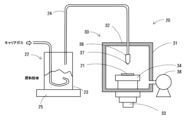
- FIG. 1 is a schematic cross-sectional view showing the configuration of an aerosol deposition (AD) device.
- A aerosol deposition
- FIG. 2 is an example of a transmission electron microscope (TEM) image obtained by observing the alignment layer in Example 1 with a TEM.
- TEM transmission electron microscope
- the base substrate according to the present invention has an orientation layer used for the crystal growth of a semiconductor film composed of ⁇ -Ga 2 O 3 or an ⁇ -Ga 2 O 3 solid solution.
- the orientation layer is composed of a material having a corundum type crystal structure with an a-axis length and/or a c-axis length longer than that of sapphire. Inside the orientation layer, there are a plurality of microcrystals defined as crystal grains with a long axis length of 1 nm to 2 ⁇ m.
- the base substrate having an orientation layer used for the crystal growth of ⁇ -gallium oxide contains specific microcrystals inside the orientation layer, and thus the base substrate has a lattice constant that matches that of ⁇ -Ga 2 O 3 and is less likely to chip due to grinding and polishing. That is, as described above, when the surface of the base substrate is flattened and mirror-finished by grinding and polishing, chipping (defects such as chips and cracks) is likely to occur at the edge of the conventional base substrate, resulting in a problem of reduced yield. In this respect, the base substrate of the present invention can advantageously solve the above problem.
- the average long axis length of the microcrystals is preferably 1 ⁇ m or less, more preferably 500 nm or less, and even more preferably 100 nm or less.
- the average long axis length of the microcrystals is 1 nm or more, and more preferably 10 nm or more. Therefore, it is preferable that the microcrystals have an average long axis length of 1 nm to 1 ⁇ m, more preferably 10 nm to 1 ⁇ m, even more preferably 10 nm to 500 nm, and particularly preferably 10 nm to 100 nm.
- the size of the microcrystals can be measured using a scanning electron microscope (SEM), a transmission electron microscope (TEM), an optical microscope (OM), electron backscatter diffraction (EBSD), etc.
- the microcrystals in the orientation layer are preferably needle-shaped crystals.
- the number density of microcrystals per unit area in the orientation layer is preferably 1.00 ⁇ 10 5 pieces/cm 2 or more, more preferably 1.0 ⁇ 10 7 pieces/cm 2 or more, even more preferably 1.0 ⁇ 10 9 pieces/cm 2 or more, and particularly preferably 1.00 ⁇ 10 10 pieces/cm 2 or more.
- the number density of microcrystals is preferably 1.00 ⁇ 10 12 pieces/cm 2 or less.
- the number density of the microcrystals per unit area in the alignment layer is preferably 1.00 ⁇ 10 5 to 1.00 ⁇ 10 12 pieces/cm 2 , more preferably 1.0 ⁇ 10 7 to 1.00 ⁇ 10 12 pieces/cm 2 , further preferably 1.0 ⁇ 10 9 to 1.00 ⁇ 10 12 pieces/cm 2 , and particularly preferably 1.00 ⁇ 10 10 to 1.00 ⁇ 10 12 pieces/cm 2.
- the number density of the microcrystals can also be calculated using a scanning electron microscope (SEM), a transmission electron microscope (TEM), an optical microscope (OM), electron backscatter diffraction (EBSD), or the like.
- the microcrystals in the orientation layer preferably contain one or more elements selected from the group consisting of Ti, Zr, Hf, Ge, Si and Ce, and more preferably contain Ti.
- the elements contained in the microcrystals can be identified using known methods, such as energy dispersive X-ray spectroscopy (SEM-EDX), electron beam microanalyzer (EPMA), scanning transmission electron microscope (STEM-EDX), and time-of-flight secondary ion mass spectrometry (TOF-SIMS).
- SEM-EDX energy dispersive X-ray spectroscopy
- EPMA electron beam microanalyzer
- STEM-EDX scanning transmission electron microscope
- TOF-SIMS time-of-flight secondary ion mass spectrometry
- the content of the above elements is preferably 0.1 at% or more with respect to the content of all elements in the microcrystals.
- the components in the microcrystals in addition to the elements Ti, Zr, Hf, Ge, Si and Ce, it is preferable that the components constituting the orientation layer (for example, Cr and O components when the material having a corundum type crystal structure constituting the orientation layer contains ⁇ -Cr 2 O 3 ) are included.
- the orientation layer typically has a structure in which the crystal orientation is roughly aligned in the direction of the normal.
- This structure makes it possible to form a semiconductor layer with excellent quality, particularly excellent orientation, on top of it. That is, when a semiconductor layer is formed on the orientation layer, the crystal orientation of the semiconductor layer roughly follows the crystal orientation of the orientation layer. Therefore, by configuring the base substrate with an orientation layer, it is possible to make the semiconductor film into an oriented film.
- the orientation layer may be polycrystalline or mosaic crystalline (a collection of crystals with slightly misaligned crystal orientations), or it may be single crystalline. When the orientation layer is polycrystalline, it is preferable that it is a biaxially oriented layer in which the twist direction (i.e., the direction of rotation around the substrate normal oriented roughly perpendicular to the substrate surface) is also roughly aligned.
- the surface of the orientation layer used for crystal growth (hereinafter, sometimes simply referred to as “surface” or “orientation layer surface”) is made of a material having a corundum type crystal structure with a longer a-axis length and/or c-axis length than sapphire ( ⁇ -Al 2 O 3 ).
- surface or “orientation layer surface”
- the lattice constant of the orientation layer is controlled in this way, it is possible to significantly reduce crystal defects in the semiconductor layer to be formed thereon. That is, the lattice constant of ⁇ -Ga 2 O 3 constituting the semiconductor layer is larger than that of sapphire ( ⁇ -Al 2 O 3 ).
- the lattice constant (a-axis length and c-axis length) of ⁇ -Ga 2 O 3 which is an oxide of a group 13 element, is larger than that of ⁇ -Al 2 O 3. Therefore, by controlling the lattice constant of the orientation layer to be larger than that of ⁇ -Al 2 O 3 , when a semiconductor layer is formed on this orientation layer, the mismatch of the lattice constant between the semiconductor layer and the orientation layer is suppressed, and as a result, the crystal defects in the semiconductor layer are reduced.
- the lattice length (a-axis length) in the in-plane direction of ⁇ -Ga 2 O 3 is larger than that of sapphire, and there is a mismatch of about 4.8%. Therefore, by controlling the a-axis length of the orientation layer to be larger than that of ⁇ -Al 2 O 3 , crystal defects in the layer of ⁇ -Ga 2 O 3 are reduced.
- the lattice length (c-axis length and a-axis length) in the in-plane direction of ⁇ -Ga 2 O 3 is larger than that of sapphire, and there is a mismatch of about 3.4% in the c-axis length and about 4.8% in the a-axis length. Therefore, by controlling the c-axis length and a-axis length of the orientation layer to be larger than that of ⁇ -Al 2 O 3 , crystal defects in the layer of ⁇ -Ga 2 O 3 are reduced. In contrast, if a semiconductor layer is formed directly on a sapphire substrate, stress is generated in the semiconductor layer due to a mismatch in lattice constant, which may cause a large number of crystal defects in the semiconductor layer.
- the entire orientation layer is made of a material having a corundum type crystal structure. This makes it possible to reduce crystal defects in the orientation layer and the semiconductor layer. It is preferable that the orientation layer is formed on the surface of the sapphire substrate.
- the ⁇ -Al 2 O 3 constituting the sapphire substrate has a corundum type crystal structure, and by forming the orientation layer from a material having a corundum type crystal structure, the crystal structure can be made the same as that of the sapphire substrate, and as a result, the occurrence of crystal defects in the orientation layer due to the mismatch of the crystal structures is suppressed.
- the crystal defects in the orientation layer are reduced, because the crystal defects in the semiconductor layer formed thereon are also reduced. This is because if a large amount of crystal defects exist in the orientation layer, the crystal defects are inherited in the semiconductor layer formed thereon, and as a result, crystal defects are also generated in the semiconductor layer.
- the material having a corundum type crystal structure constituting the orientation layer preferably contains ⁇ -Cr 2 O 3 or an ⁇ -Cr 2 O 3 -based solid solution. As shown in Table 1 above, these materials have a lattice constant (a-axis length and/or c-axis length) larger than ⁇ -Al 2 O 3 , and have a lattice constant relatively close to or identical to that of ⁇ -Ga 2 O 3 , so that it is possible to effectively suppress crystal defects in the semiconductor layer.
- Such a solid solution may be either a substitutional solid solution or an interstitial solid solution, but a substitutional solid solution is preferable.
- the orientation layer is composed of a material having a corundum type crystal structure, it does not exclude the inclusion of other minor components, such as microcrystals.
- the a-axis length of the material having a corundum type crystal structure on the surface of the orientation layer used for crystal growth is more than 4.754 ⁇ and not more than 5.157 ⁇ , more preferably 4.850 to 5.000 ⁇ , and even more preferably 4.900 to 5.000 ⁇ .
- the c-axis length of the material having a corundum type crystal structure on the surface of the orientation layer used for crystal growth is more than 12.990 ⁇ and not more than 13.998 ⁇ , more preferably 13.000 to 13.800 ⁇ , and even more preferably 13.400 to 13.600 ⁇ .
- a-axis length and/or c-axis length of the orientation layer surface By controlling the a-axis length and/or c-axis length of the orientation layer surface within such a range, it becomes possible to approach the lattice constant (a-axis length and/or c-axis length) of ⁇ -Ga 2 O 3 .
- the thickness of the orientation layer is preferably 10 ⁇ m or more, more preferably 40 ⁇ m or more.
- the upper limit of the thickness is not particularly limited, but is typically 1000 ⁇ m or less.
- the orientation layer may be thicker from the viewpoint of handling, for example, 1 mm or more, but from the viewpoint of cost, for example, 2 mm or less. In this way, by making the orientation layer thicker, it is possible to reduce the crystal defects on the surface of the orientation layer.
- the lattice constants of the sapphire substrate and the orientation layer are slightly different, and as a result, crystal defects are likely to occur at the interface between them, that is, at the bottom of the orientation layer.
- the influence of such crystal defects occurring at the bottom of the orientation layer can be reduced on the surface of the orientation layer. The reason for this is unclear, but it is believed that the crystal defects occurring at the bottom of the orientation layer do not reach the surface of the thick orientation layer and disappear.
- the orientation layer thicker it is expected that after forming a semiconductor layer on the orientation layer, the semiconductor layer can be peeled off and the base substrate can be reused.
- the crystal defect density on the surface of the orientation layer is preferably 1.0 ⁇ 10 8 /cm 2 or less, more preferably 1.0 ⁇ 10 6 /cm 2 or less, and even more preferably 4.0 ⁇ 10 3 /cm 2 or less, with no particular lower limit.
- the crystal defect refers to threading edge dislocations, threading screw dislocations, threading mixed dislocations, and basal plane dislocations
- the crystal defect density refers to the sum of the respective dislocation densities.
- the crystal defect density is 1.3 ⁇ 10 9 /cm 2.
- Basal plane dislocations are problematic when the underlying substrate including the orientation layer has an off-angle, and are not problematic when there is no off-angle because they are not exposed to the surface of the orientation layer.
- the material constituting the alignment layer is not particularly limited as long as it has an orientation relative to the surface of the base substrate, and may be, for example, a c-axis orientation, a-axis orientation, or m-axis orientation.
- the semiconductor film can be a c-axis oriented film, an a-axis oriented film, or an m-axis oriented film.
- the orientation layer is preferably a heteroepitaxially grown layer.
- the orientation layer is grown on a sapphire substrate, since both the sapphire substrate and the orientation layer have a corundum-type crystal structure, if their lattice constants are close to each other, epitaxial growth may occur during heat treatment in which the crystal planes of the orientation layer are aligned to follow the crystal orientation of the sapphire substrate.
- epitaxial growth may occur during heat treatment in which the crystal planes of the orientation layer are aligned to follow the crystal orientation of the sapphire substrate.
- the arithmetic mean roughness Ra of the surface of the alignment layer is preferably 1 nm or less, more preferably 0.5 nm or less, and even more preferably 0.2 nm or less. In this way, it is believed that smoothing the surface of the alignment layer will further improve the crystallinity of the semiconductor layer formed thereon.
- the base substrate has an area of preferably 20 cm2 or more, more preferably 70 cm2 or more, and even more preferably 170 cm2 or more on one side.
- the upper limit of the size of the base substrate is not particularly limited, but is typically 700 cm2 or less on one side.
- the base substrate of the present invention preferably further comprises a support substrate on the side opposite to the side used for crystal growth of the orientation layer (i.e., the back side). That is, the base substrate of the present invention can be a base substrate comprising a support substrate and an orientation layer provided on the support substrate.
- the support substrate is preferably a corundum single crystal such as a sapphire substrate or Cr2O3 , and is particularly preferably a sapphire substrate.
- the corundum single crystal has characteristics such as excellent mechanical properties, thermal properties, and chemical stability.
- sapphire has a high thermal conductivity of 42 W/m ⁇ K at room temperature and has excellent thermal conductivity. Therefore, by making the base substrate comprised of a sapphire substrate, it becomes possible to make the thermal conductivity of the entire substrate excellent. As a result, when a semiconductor layer is formed on the base substrate, it is expected that the temperature distribution within the substrate surface will be suppressed from becoming uneven, making it possible to obtain a semiconductor layer with a uniform thickness.
- sapphire substrates with large areas are easily available, which has the effect of reducing the overall cost and enabling the formation of a large-area semiconductor layer.
- the sapphire substrate used as the support substrate may have any oriented plane. That is, it may have, for example, the a-plane, c-plane, r-plane, or m-plane, and may have a specified off-angle relative to these planes. It may also be sapphire to which a dopant has been added in order to adjust the electrical properties. Publicly known dopants can be used as such dopants.
- the semiconductor layer can be formed by any known method, but any of various CVD methods, HVPE method, sublimation method, MBE method, PLD method, sputtering method, and other gas phase film formation methods, hydrothermal method, Na flux method, and other liquid phase film formation methods are preferred.
- CVD methods include thermal CVD method, plasma CVD method, mist CVD method, MO (metal organic) CVD method, and the like.
- mist CVD method, hydrothermal method, or HVPE method is particularly preferred for forming a semiconductor layer composed of ⁇ -Ga 2 O 3 .
- the base substrate of the present invention may be in the form of a free-standing substrate of the alignment layer alone, or in the form of a base substrate accompanied by a support substrate such as a sapphire substrate. Therefore, if necessary, the alignment layer may finally be separated from the support substrate such as a sapphire substrate.
- the separation of the support substrate may be performed by a known method, and is not particularly limited.
- a method of separating the alignment layer by applying mechanical shock a method of separating the alignment layer by applying heat and using thermal stress, a method of separating the alignment layer by applying vibration such as ultrasonic waves, a method of separating the alignment layer by etching unnecessary parts, a method of separating the alignment layer by laser lift-off, a method of separating the alignment layer by mechanical processing such as cutting and polishing, etc. may be mentioned.
- the alignment layer may be placed on another support substrate after separating the sapphire substrate.
- the material of the other support substrate is not particularly limited, but a suitable one may be selected from the viewpoint of the material properties. For example, from the viewpoint of thermal conductivity, metal substrates or substrates such as Cu, ceramic substrates such as SiC and AlN, etc. may be mentioned.
- the base substrate of the present invention can be preferably manufactured by (a) preparing a sapphire substrate, (b) preparing an orientation precursor layer containing elements constituting microcrystals, (c) heat-treating the orientation precursor layer on the sapphire substrate to convert at least the portion near the sapphire substrate into an orientation layer, and (d) smoothing the surface of the orientation layer by grinding, polishing, or other processing.
- This orientation precursor layer becomes an orientation layer by heat treatment, and includes a material having a corundum type crystal structure in which the a-axis length and/or c-axis length are greater than that of sapphire, or a material that becomes a corundum type crystal structure in which the a-axis length and/or c-axis length are greater than that of sapphire by heat treatment described later.
- the growth of the orientation layer can be promoted using the sapphire substrate as a seed crystal. That is, the high crystallinity and crystal orientation peculiar to the single crystal of the sapphire substrate are inherited by the orientation layer.
- a sapphire substrate is prepared.
- the sapphire substrate used may have any oriented surface. That is, it may have, for example, an a-plane, a c-plane, an r-plane, or an m-plane, and may have a predetermined off-angle with respect to these planes.
- a dopant a known one can be used.
- An oriented precursor layer is prepared containing a material having a corundum type crystal structure with a-axis length and/or c-axis length greater than that of sapphire, or a material that becomes a corundum type crystal structure with a-axis length and/or c-axis length greater than that of sapphire by heat treatment.
- this oriented precursor layer preferably contains one or more elements selected from the group consisting of Ti, Zr, Hf, Ge, Si and Ce as a material constituting the microcrystals, and these elements are preferably contained in the oriented precursor layer in the form of a metal element or a compound other than an oxide (e.g., a nitride).
- the method of forming the oriented precursor layer is not particularly limited, and known methods can be adopted.
- Examples of the method of forming the oriented precursor layer include the AD (aerosol deposition) method, hydrothermal method, sputtering method, vapor deposition method, various CVD (chemical vapor deposition) methods, HVPE method, PLD method, CVT (chemical vapor transport) method, sublimation method, etc.
- Examples of the CVD method include thermal CVD, plasma CVD, mist CVD, and MO (metal organic) CVD.
- a method may be used in which a molded body of an orientation precursor is prepared in advance and the molded body is placed on a sapphire substrate.
- Such a molded body can be prepared by forming the material of the orientation precursor by a method such as tape molding or press molding.
- a method may be used in which a polycrystalline body prepared in advance by various CVD methods or sintering is used as the orientation precursor layer and placed on a sapphire substrate.
- the AD method various CVD methods, or the sputtering method are preferred. By using these methods, it is possible to form a dense oriented precursor layer in a relatively short time, and it is easy to cause heteroepitaxial growth using the sapphire substrate as a seed crystal.
- the AD method does not require a high vacuum process and has a relatively fast film formation speed, so it is also preferred in terms of manufacturing costs.
- the sputtering method it is possible to form the film using a target of the same material as the oriented precursor layer, but a reactive sputtering method in which a metal target is used and the film is formed under an oxygen atmosphere can also be used.
- a method in which a pre-prepared molded body is placed on sapphire is also preferred as a simple method, but since the oriented precursor layer is not dense, a process to make it dense in the heat treatment process described below is required.
- two steps are required: a step of preparing the polycrystalline body and a step of heat treatment on the sapphire substrate.
- it is also necessary to take measures such as making the surface of the polycrystalline body sufficiently smooth. Both methods can use known conditions, but the following describes the method of directly forming an orientation precursor layer using the AD method and the method of placing a prefabricated molded body on a sapphire substrate.
- the AD method is a technology in which fine particles or fine particle raw material are mixed with a gas to form an aerosol, and this aerosol is then sprayed at high speed from a nozzle to collide with a substrate to form a coating.
- the AD method has the advantage of being able to form a dense coating at room temperature.
- An example of a film formation device (aerosol deposition (AD) device) used in such an AD method is shown in Figure 1.
- the film formation device 20 shown in Figure 1 is configured as a device used in the AD method, in which raw material powder is sprayed onto a substrate under an atmosphere with a lower pressure than atmospheric pressure.
- This film formation device 20 includes an aerosol generation section 22 that generates an aerosol of raw material powder containing raw material components, and a film formation section 30 that sprays the raw material powder onto a sapphire substrate 21 to form a film containing the raw material components.
- the aerosol generating section 22 includes an aerosol generating chamber 23 that contains raw material powder and generates aerosol by receiving a carrier gas from a gas cylinder (not shown), a raw material supply pipe 24 that supplies the generated aerosol to the film forming section 30, and a vibrator 25 that applies vibrations at a frequency of 10 to 100 Hz to the aerosol generating chamber 23 and the aerosol therein.
- the film forming section 30 includes a film forming chamber 32 that sprays the aerosol onto the sapphire substrate 21, a substrate holder 34 that is disposed inside the film forming chamber 32 and fixes the sapphire substrate 21, and an XY stage 33 that moves the substrate holder 34 in the X-axis and Y-axis directions.
- the film forming section 30 also includes an injection nozzle 36 with a slit 37 formed at the tip that sprays the aerosol onto the sapphire substrate 21, and a vacuum pump 38 that reduces the pressure in the film forming chamber 32.
- the AD method can control the film thickness and quality by adjusting the film formation conditions.
- the morphology of an AD film is easily affected by the collision speed of the raw material powder with the substrate, the particle size of the raw material powder, the agglomeration state of the raw material powder in the aerosol, the amount sprayed per unit time, etc.
- the collision speed of the raw material powder with the substrate is affected by the pressure difference between the film formation chamber 32 and the spray nozzle 36, the opening area of the spray nozzle, etc. If appropriate conditions are not used, the coating may become a compact or pores may occur, so it is desirable to appropriately control these factors.
- the raw material powder of the orientation precursor can be molded to prepare a molded body.
- the orientation precursor layer is a press molded body.
- the press molded body can be prepared by press molding the raw material powder of the orientation precursor based on a known method, for example, by putting the raw material powder into a mold and pressing it at a pressure of preferably 100 to 400 kgf/cm 2 , more preferably 150 to 300 kgf/cm 2.
- the molding method is not particularly limited, and in addition to press molding, tape molding, casting molding, extrusion molding, doctor blade method, and any combination thereof can be used.
- additives such as binders, plasticizers, dispersants, and dispersion media are appropriately added to the raw material powder to make a slurry, and the slurry is preferably discharged and molded into a sheet by passing it through a thin slit-shaped discharge port.
- the thickness of the molded body molded into a sheet there is no limitation on the thickness of the molded body molded into a sheet, but from the viewpoint of handling, it is preferable that it is 5 to 500 ⁇ m.
- a number of such sheet molded bodies may be stacked together to obtain a layer of the desired thickness.
- molded bodies are then heat-treated on the sapphire substrate, with the portion close to the sapphire substrate becoming an oriented layer.
- this method requires that the molded body be sintered and densified in the heat treatment step described below.
- the molded body may contain trace components such as sintering aids in addition to the material that has or gives rise to a corundum-type crystal structure.
- the crystal axes of the sapphire substrate and the orientation layer can be aligned.
- a c-plane sapphire substrate it is possible to make the sapphire substrate and the orientation layer both c-axis oriented with respect to the surface of the base substrate.
- the oriented precursor layer is not oriented when it is produced, i.e. it is amorphous or unoriented polycrystalline, and it is preferable to use sapphire as a seed crystal to cause crystal rearrangement during this heat treatment process. This effectively reduces crystal defects that reach the surface of the oriented layer. The reason for this is unclear, but it is thought to be because crystal defects that occur in the lower part of the oriented layer tend to annihilate each other.
- the heat treatment method is not particularly limited as long as a corundum type crystal structure is obtained and heteroepitaxial growth occurs using the sapphire substrate as a seed, and can be performed in a known heat treatment furnace such as a tubular furnace or a hot plate.
- a known heat treatment furnace such as a tubular furnace or a hot plate.
- pressurized heat treatments such as hot pressing and HIP, and combinations of normal pressure heat treatment and pressurized heat treatment can also be used.
- the heat treatment conditions can be appropriately selected depending on the material used for the orientation layer.
- the atmosphere for the heat treatment can be selected from air, vacuum, nitrogen, and inert gas atmospheres.
- the preferred heat treatment temperature also varies depending on the material used for the orientation layer, but for example, 1000 to 2000 ° C.
- the heat treatment temperature and holding time are related to the thickness of the orientation layer generated by heteroepitaxial growth, and can be appropriately adjusted depending on the type of material, the desired thickness of the orientation layer, and the like.
- the surface pressure is preferably 50 kgf/cm 2 or more, more preferably 100 kgf/cm 2 or more, particularly preferably 200 kgf/cm 2 or more, and the upper limit is not particularly limited.
- the firing temperature is not particularly limited as long as sintering, densification, and heteroepitaxial growth occur, but is preferably 1000 ° C or more, more preferably 1200 ° C or more, even more preferably 1400 ° C or more, and particularly preferably 1600 ° C or more.
- the firing atmosphere can also be selected from air, vacuum, nitrogen, and inert gas atmospheres. Graphite or alumina firing jigs such as molds can be used.
- an orientation precursor layer or a surface layer with poor orientation or no orientation may exist or remain.
- the method of removing the orientation precursor layer or the surface layer is not particularly limited, but examples thereof include a grinding and polishing method and an ion beam milling method.
- the surface of the orientation layer is preferably polished by lapping using abrasive grains or chemical mechanical polishing (CMP).
- Specific methods for grinding and polishing the orientation layer include, for example, the following methods. That is, three base substrates of the same size are fixed at three places on a ceramic surface plate, and the surface of the base substrate on which the film is to be formed is ground by grinding using abrasives with grit sizes ranging from #320 to #2000 until the orientation layer is exposed. The surface of the orientation layer is then further smoothed by lapping using diamond abrasive grains. At this time, the flatness of the surface is improved by lapping while gradually reducing the size of the diamond abrasive grains. The surface of the orientation layer is then mirror-finished by chemical mechanical polishing (CMP) using colloidal silica to obtain a composite base substrate with an orientation layer on a sapphire substrate.
- CMP chemical mechanical polishing
- the surface of the orientation layer after processing until the arithmetic mean roughness Ra of the surface of the orientation layer is 0.2 nm or less.
- the arithmetic mean roughness Ra of the surface of the orientation layer can be confirmed using a commercially available surface roughness meter.
- Example 1 ( 1) Preparation of composite base substrate (1a) Preparation of oriented precursor layer
- commercially available Cr2O3 powder volume average particle size 3 ⁇ m
- commercially available TiN powder volume average particle size 0.8 ⁇ m
- 100 parts by weight of Cr2O3 powder and 1.5 parts by weight of TiN powder were mixed in a pot mill for 48 hours, and a sapphire substrate (diameter 50.8 mm (2 inches), thickness 0.43 mm, c-plane, off angle 0.3 °) was used to form an AD film (oriented precursor layer) mainly composed of Cr2O3 on a seed substrate (sapphire substrate) by an aerosol deposition (AD) device 20 shown in FIG. 1.
- the configuration of the aerosol deposition (AD) device 20 is as described above.
- the AD deposition conditions were as follows. That is, the carrier gas was Ar, and a ceramic nozzle with a slit of 5 mm long side x 0.3 mm short side was used.
- the nozzle scanning conditions were a scanning speed of 0.5 mm/s, and the nozzle was moved 55 mm in the forward direction perpendicular to the long side of the slit, moved 5 mm in the long side direction of the slit, moved 55 mm in the return direction perpendicular to the long side of the slit, and moved 5 mm in the long side direction of the slit opposite the initial position.
- the nozzle When the nozzle had moved 55 mm from the initial position in the long side direction of the slit, the nozzle was scanned in the opposite direction to the previous direction and returned to the initial position. This cycle was repeated 500 times. In one cycle of deposition at room temperature, the set pressure of the carrier gas was adjusted to 0.07 MPa, the flow rate to 8 L/min, and the chamber pressure to 100 Pa or less.
- the AD film (orientation precursor layer) formed in this way had a thickness of 120 ⁇ m.
- the arithmetic mean roughness Ra of the orientation layer surface after processing was 0.1 nm, the amount of grinding and polishing was 70 ⁇ m, and the thickness of the composite base substrate after polishing was 0.48 mm.
- the surface on which the AD film was formed is referred to as the "surface”.
- 101 composite base substrates were produced by repeating the above steps (1a) to (1c).
- the surface of the oriented layer with Cr oxide as the main phase has a biaxially oriented corundum type crystal structure with the c-axis oriented in the normal direction of the substrate and also oriented in the in-plane direction. This shows that the substrate surface has an oriented layer with ⁇ -Cr 2 O 3 as the main phase.
- Planar TEM and STEM-EDX of the alignment layer Planar TEM observation was performed to evaluate the microstructure of the orientation layer.
- Five samples for TEM observation were cut out from five locations in a region about 10 ⁇ m deep from the surface of the orientation layer by processing using a focused ion beam (FIB) so that the sample thickness around the measurement field of view was about 400 nm.
- FIB focused ion beam
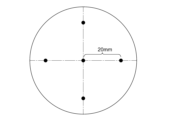
- the sampling locations were the center point of the substrate and four outer periphery points on the line about 20 mm away from the center point when two straight lines intersecting at right angles from the center point were drawn on the substrate.
- the obtained slices were observed by TEM observation at an accelerating voltage of 300 kV using a transmission electron microscope (Hitachi H-9000UHR-II).
- TEM images with measurement fields of view of about 10 ⁇ m ⁇ 10 ⁇ m to 161 nm ⁇ 161 nm were observed in two fields of view for each slice, for a total of 10 fields of view.
- needle-shaped microcrystals were observed in the TEM images obtained in the field of view of 161 nm ⁇ 161 nm, and the number of observed microcrystals was 20 to 30 in each field of view.
- the number of microcrystals was determined by counting crystal particles with a long axis length of 1 nm to 2 ⁇ m.
- FIG. 3 An example of the obtained TEM image is shown in FIG. 3.
- the long axis length of the microcrystals observed under TEM was measured to calculate the average long axis length of the 10 fields of view.
- the total number of microcrystals observed under TEM in the 10 fields of view was divided by the area of the total observation field of view to calculate the number density of microcrystals per unit area (pieces/cm 2 ).
- the results are shown in Table 2.
- EDX measurement was performed on each slice using a scanning transmission electron microscope (JEM-ARM200F Dual-X manufactured by JEOL, EDX: JED-2300 manufactured by JEOL) at an acceleration voltage of 200 kV.
- JEM-ARM200F Dual-X manufactured by JEOL EDX: JED-2300 manufactured by JEOL
- Example 5 A composite base substrate was prepared in the same manner as in Example 1, except that the volume average particle size of the TiN powder in (1a) above and the heat treatment temperature of the orientation precursor layer in (1b) above were as shown in Table 2, and the orientation layer and the composite base substrate were evaluated. The results are shown in Table 2.
- EDX measurement and EBSD measurement revealed that the orientation layer has ⁇ -Cr 2 O 3 as the main phase, and that the surface has a biaxially oriented corundum-type crystal structure in which the c-axis is oriented in the normal direction of the substrate and is also oriented in the in-plane direction.
- STEM-EDX measurement revealed that the orientation layer contains Ti-containing microcrystals.
- Example 9 A composite base substrate was prepared in the same manner as in Example 1, except that the volume average particle size of the TiN powder and the mixing time of the raw material powder in (1a) above, and the heat treatment temperature of the textured precursor layer in (1b) above were as shown in Table 2, and the textured layer and the composite base substrate were evaluated. The results are shown in Table 2.
- EDX measurement and EBSD measurement revealed that the textured layer had ⁇ -Cr 2 O 3 as the main phase, and that the surface had a biaxially oriented corundum-type crystal structure with the c-axis oriented in the normal direction to the substrate and also oriented in the in-plane direction. STEM-EDX measurement also revealed that the textured layer contained Ti-containing microcrystals.
- Examples 10 to 12 A composite base substrate was prepared in the same manner as in Example 1, except that the amount of TiN powder added, the volume average particle size, and the mixing time of the raw material powder in (1a) above, and the heat treatment temperature of the textured precursor layer in (1b) above were as shown in Table 2, and the textured layer and the composite base substrate were evaluated. The results are shown in Table 2.
- EDX measurement and EBSD measurement revealed that the textured layer had ⁇ -Cr 2 O 3 as the main phase, and that the surface had a biaxially oriented corundum-type crystal structure with the c-axis oriented in the normal direction to the substrate and also oriented in the in-plane direction. STEM-EDX measurement also revealed that the textured layer contained Ti-containing microcrystals.
- Example 13 A composite base substrate was prepared in the same manner as in Example 1, except that in the above (1a), TiC 0.5 N 0.5 powder was added instead of TiN powder, and the volume average particle size, the mixing time of the raw material powder, and the heat treatment temperature of the orientation precursor layer in the above (1b) were as shown in Table 2.
- the orientation layer and the composite base substrate were evaluated. The results are shown in Table 2. It was found by EDX measurement and EBSD measurement that the orientation layer has ⁇ -Cr 2 O 3 as the main phase, and that the surface has a biaxially oriented corundum type crystal structure in which the c-axis is oriented in the normal direction of the substrate and is also oriented in the in-plane direction. It was also found by STEM-EDX measurement that the orientation layer contains Ti-containing microcrystals.
- Examples 14 to 16 A composite base substrate was prepared in the same manner as in Example 1, except that in the above (1a), TiC 0.5 N 0.5 powder was added instead of TiN powder, and the input amount, volume average particle size, and mixing time of the raw material powder, as well as the heat treatment temperature of the orientation precursor layer in the above (1b) were as shown in Table 2, and the orientation layer and the composite base substrate were evaluated. The results are shown in Table 2.
- EDX measurement and EBSD measurement revealed that the orientation layer has ⁇ -Cr 2 O 3 as the main phase, and the surface has a biaxially oriented corundum type crystal structure in which the c-axis is oriented in the normal direction of the substrate and is also oriented in the in-plane direction.
- STEM-EDX measurement revealed that the orientation layer contains Ti-containing microcrystals.
- Example 17 (Comparative) A composite base substrate was prepared in the same manner as in Example 1, except that in (1a) above, TiN powder or TiC0.5N0.5 powder was not added, and commercially available Cr2O3 powder was used as the raw material powder, and the orientation layer and the composite base substrate were evaluated. The results are shown in Table 2. In addition, no microcrystals were observed when the orientation layer was observed by TEM.
Landscapes
- Chemical & Material Sciences (AREA)
- Engineering & Computer Science (AREA)
- Materials Engineering (AREA)
- Organic Chemistry (AREA)
- Crystallography & Structural Chemistry (AREA)
- Inorganic Chemistry (AREA)
- Ceramic Engineering (AREA)
- Metallurgy (AREA)
- Structural Engineering (AREA)
- Chemical Kinetics & Catalysis (AREA)
- General Chemical & Material Sciences (AREA)
- Crystals, And After-Treatments Of Crystals (AREA)
Priority Applications (3)
| Application Number | Priority Date | Filing Date | Title |
|---|---|---|---|
| CN202480015425.1A CN120882918A (zh) | 2023-03-23 | 2024-02-15 | 基底基板 |
| JP2025508224A JPWO2024195374A1 (https=) | 2023-03-23 | 2024-02-15 | |
| US19/307,142 US20250391657A1 (en) | 2023-03-23 | 2025-08-22 | Base substrate |
Applications Claiming Priority (2)
| Application Number | Priority Date | Filing Date | Title |
|---|---|---|---|
| JP2023046186 | 2023-03-23 | ||
| JP2023-046186 | 2023-03-23 |
Related Child Applications (1)
| Application Number | Title | Priority Date | Filing Date |
|---|---|---|---|
| US19/307,142 Continuation US20250391657A1 (en) | 2023-03-23 | 2025-08-22 | Base substrate |
Publications (1)
| Publication Number | Publication Date |
|---|---|
| WO2024195374A1 true WO2024195374A1 (ja) | 2024-09-26 |
Family
ID=92841307
Family Applications (1)
| Application Number | Title | Priority Date | Filing Date |
|---|---|---|---|
| PCT/JP2024/005221 Ceased WO2024195374A1 (ja) | 2023-03-23 | 2024-02-15 | 下地基板 |
Country Status (4)
| Country | Link |
|---|---|
| US (1) | US20250391657A1 (https=) |
| JP (1) | JPWO2024195374A1 (https=) |
| CN (1) | CN120882918A (https=) |
| WO (1) | WO2024195374A1 (https=) |
Citations (4)
| Publication number | Priority date | Publication date | Assignee | Title |
|---|---|---|---|---|
| WO2020194803A1 (ja) * | 2019-03-28 | 2020-10-01 | 日本碍子株式会社 | 下地基板及びその製造方法 |
| WO2020195355A1 (ja) * | 2019-03-28 | 2020-10-01 | 日本碍子株式会社 | 下地基板 |
| WO2021048950A1 (ja) * | 2019-09-11 | 2021-03-18 | 日本碍子株式会社 | 半導体膜 |
| WO2021064817A1 (ja) * | 2019-09-30 | 2021-04-08 | 日本碍子株式会社 | 下地基板及びその製造方法 |
-
2024
- 2024-02-15 JP JP2025508224A patent/JPWO2024195374A1/ja active Pending
- 2024-02-15 CN CN202480015425.1A patent/CN120882918A/zh active Pending
- 2024-02-15 WO PCT/JP2024/005221 patent/WO2024195374A1/ja not_active Ceased
-
2025
- 2025-08-22 US US19/307,142 patent/US20250391657A1/en active Pending
Patent Citations (4)
| Publication number | Priority date | Publication date | Assignee | Title |
|---|---|---|---|---|
| WO2020194803A1 (ja) * | 2019-03-28 | 2020-10-01 | 日本碍子株式会社 | 下地基板及びその製造方法 |
| WO2020195355A1 (ja) * | 2019-03-28 | 2020-10-01 | 日本碍子株式会社 | 下地基板 |
| WO2021048950A1 (ja) * | 2019-09-11 | 2021-03-18 | 日本碍子株式会社 | 半導体膜 |
| WO2021064817A1 (ja) * | 2019-09-30 | 2021-04-08 | 日本碍子株式会社 | 下地基板及びその製造方法 |
Also Published As
| Publication number | Publication date |
|---|---|
| US20250391657A1 (en) | 2025-12-25 |
| CN120882918A (zh) | 2025-10-31 |
| JPWO2024195374A1 (https=) | 2024-09-26 |
Similar Documents
| Publication | Publication Date | Title |
|---|---|---|
| US12351941B2 (en) | Ground substrate and method for producing same | |
| JP7461851B2 (ja) | 半導体膜 | |
| JP7628968B2 (ja) | 二軸配向SiC複合基板及び半導体デバイス用複合基板 | |
| JP7410009B2 (ja) | 半導体膜 | |
| JP7538900B2 (ja) | 希土類含有SiC基板及びそれを用いたSiC複合基板 | |
| CN113614293B (zh) | 基底基板 | |
| WO2022201986A1 (ja) | AlN単結晶基板 | |
| JP7439117B2 (ja) | 下地基板及びその製造方法 | |
| JP7265624B2 (ja) | 半導体膜 | |
| JP7320070B2 (ja) | 下地基板及びその製造方法 | |
| WO2024195374A1 (ja) | 下地基板 | |
| JP7686016B2 (ja) | SiC基板及びSiC複合基板 | |
| US20260022494A1 (en) | SiC SUBSTRATE AND SiC COMPOSITE SUBSTRATE | |
| WO2025203572A1 (ja) | 下地基板 | |
| US20260043171A1 (en) | SiC SUBSTRATE AND SiC COMPOSITE SUBSTRATE |
Legal Events
| Date | Code | Title | Description |
|---|---|---|---|
| 121 | Ep: the epo has been informed by wipo that ep was designated in this application |
Ref document number: 24774519 Country of ref document: EP Kind code of ref document: A1 |
|
| ENP | Entry into the national phase |
Ref document number: 2025508224 Country of ref document: JP Kind code of ref document: A |
|
| WWE | Wipo information: entry into national phase |
Ref document number: 2025508224 Country of ref document: JP |
|
| WWE | Wipo information: entry into national phase |
Ref document number: 202480015425.1 Country of ref document: CN |
|
| NENP | Non-entry into the national phase |
Ref country code: DE |
|
| WWP | Wipo information: published in national office |
Ref document number: 202480015425.1 Country of ref document: CN |
|
| 122 | Ep: pct application non-entry in european phase |
Ref document number: 24774519 Country of ref document: EP Kind code of ref document: A1 |