WO2024181565A1 - コークスの製造方法 - Google Patents
コークスの製造方法 Download PDFInfo
- Publication number
- WO2024181565A1 WO2024181565A1 PCT/JP2024/007807 JP2024007807W WO2024181565A1 WO 2024181565 A1 WO2024181565 A1 WO 2024181565A1 JP 2024007807 W JP2024007807 W JP 2024007807W WO 2024181565 A1 WO2024181565 A1 WO 2024181565A1
- Authority
- WO
- WIPO (PCT)
- Prior art keywords
- mass
- semi
- particle size
- woody biomass
- less
- Prior art date
- Legal status (The legal status is an assumption and is not a legal conclusion. Google has not performed a legal analysis and makes no representation as to the accuracy of the status listed.)
- Ceased
Links
Images




Classifications
-
- C—CHEMISTRY; METALLURGY
- C10—PETROLEUM, GAS OR COKE INDUSTRIES; TECHNICAL GASES CONTAINING CARBON MONOXIDE; FUELS; LUBRICANTS; PEAT
- C10B—DESTRUCTIVE DISTILLATION OF CARBONACEOUS MATERIALS FOR PRODUCTION OF GAS, COKE, TAR, OR SIMILAR MATERIALS
- C10B57/00—Other carbonising or coking processes; Features of destructive distillation processes in general
- C10B57/04—Other carbonising or coking processes; Features of destructive distillation processes in general using charges of special composition
-
- C—CHEMISTRY; METALLURGY
- C10—PETROLEUM, GAS OR COKE INDUSTRIES; TECHNICAL GASES CONTAINING CARBON MONOXIDE; FUELS; LUBRICANTS; PEAT
- C10B—DESTRUCTIVE DISTILLATION OF CARBONACEOUS MATERIALS FOR PRODUCTION OF GAS, COKE, TAR, OR SIMILAR MATERIALS
- C10B57/00—Other carbonising or coking processes; Features of destructive distillation processes in general
- C10B57/02—Multi-step carbonising or coking processes
-
- C—CHEMISTRY; METALLURGY
- C10—PETROLEUM, GAS OR COKE INDUSTRIES; TECHNICAL GASES CONTAINING CARBON MONOXIDE; FUELS; LUBRICANTS; PEAT
- C10B—DESTRUCTIVE DISTILLATION OF CARBONACEOUS MATERIALS FOR PRODUCTION OF GAS, COKE, TAR, OR SIMILAR MATERIALS
- C10B53/00—Destructive distillation, specially adapted for particular solid raw materials or solid raw materials in special form
- C10B53/02—Destructive distillation, specially adapted for particular solid raw materials or solid raw materials in special form of cellulose-containing material
-
- C—CHEMISTRY; METALLURGY
- C10—PETROLEUM, GAS OR COKE INDUSTRIES; TECHNICAL GASES CONTAINING CARBON MONOXIDE; FUELS; LUBRICANTS; PEAT
- C10B—DESTRUCTIVE DISTILLATION OF CARBONACEOUS MATERIALS FOR PRODUCTION OF GAS, COKE, TAR, OR SIMILAR MATERIALS
- C10B57/00—Other carbonising or coking processes; Features of destructive distillation processes in general
- C10B57/14—Features of low-temperature carbonising processes
-
- Y—GENERAL TAGGING OF NEW TECHNOLOGICAL DEVELOPMENTS; GENERAL TAGGING OF CROSS-SECTIONAL TECHNOLOGIES SPANNING OVER SEVERAL SECTIONS OF THE IPC; TECHNICAL SUBJECTS COVERED BY FORMER USPC CROSS-REFERENCE ART COLLECTIONS [XRACs] AND DIGESTS
- Y02—TECHNOLOGIES OR APPLICATIONS FOR MITIGATION OR ADAPTATION AGAINST CLIMATE CHANGE
- Y02E—REDUCTION OF GREENHOUSE GAS [GHG] EMISSIONS, RELATED TO ENERGY GENERATION, TRANSMISSION OR DISTRIBUTION
- Y02E50/00—Technologies for the production of fuel of non-fossil origin
- Y02E50/10—Biofuels, e.g. bio-diesel
Definitions
- the present invention relates to a method for producing coke using blended coal containing semi-carbonized woody biomass.
- Patent Document 1 describes a method for producing coke by heating and carbonizing raw coal, characterized in that wood waste that has been heat-treated in advance is charged into a coke oven together with the raw coal.
- Patent Document 1 aims to provide a method for producing coke that can process a large amount of woody waste at once without causing deterioration in the quality of the coke by using raw coal and woody waste that has been semi-carbonized in advance by heat treatment.
- Patent Document 1 describes that semi-carbonization is a process that reduces the amount of volatile matter in the woody waste to a certain extent, rather than completely carbonizing the woody waste.
- Patent Document 1 also exemplifies the amount of volatile matter contained in the woody waste after heat treatment as 45 to 65 mass % in relation to the properties of the woody waste used.
- Patent Document 1 does not focus on means for reducing such inconveniences during coking.
- One aspect of the present invention aims to solve the above problems and provide a coke manufacturing method that can incorporate biomass into the blended coal, which is the raw material for coke, while suppressing the decrease in coke strength caused by the use of the biomass in a simple procedure.
- the gist of the present invention is as follows.
- a method for producing coke comprising the steps of: A step of preparing a coal blend containing coal and semi-carbonized woody biomass; and a step of coking the coal blend.
- the semi-carbonized wood biomass is (1) A volatile content of 25% by mass or less, and a particle size in which the mass ratio of particles on a 0.10 mm sieve and under a 0.60 mm sieve is 60% by mass or more when sieved in accordance with the particle size test method specified in JIS M8801:2008, or (2) A method for producing coke having a volatile matter content of more than 25 mass% and not more than 40 mass%, and a particle size in which the mass ratio of particles sieved over 0.10 mm sieve and sieve under 0.30 mm sieve is 60 mass% or more in the sieving.
- a method for producing coke comprising the steps of: A step of preparing a coal blend containing coal and semi-carbonized woody biomass; and a step of coking the coal blend.
- the semi-carbonized wood biomass is (1) A volatile content of 25% by mass or less, and a particle size of 0.10 mm or more and 0.60 mm or less when sieved in accordance with the particle size test method specified in JIS M8801:2008, or (2) A method for producing coke having a volatile matter content of more than 25 mass% and not more than 40 mass%, and a particle size in the sieving that is above the 0.10 mm sieve and below the 0.30 mm sieve.
- the volatile content of 25% by mass or less is 15.9% by mass or more and 23.7% by mass or less, 3.
- a method for producing coke comprising the steps of: A step of preparing a coal blend containing coal and semi-carbonized woody biomass; and a step of coking the coal blend.
- the semi-carbonized woody biomass has a volatile content of 40% by mass or less, and a particle size in which the mass ratio of particles sieved over 0.10 mm sieve and sieved under 0.60 mm sieve is 60% by mass or more when sieved in accordance with the particle size test method specified in JIS M8801:2008,
- the particle size of the semi-carbonized woody biomass is adjusted according to the amount of volatile matter of the semi-carbonized woody biomass based on a relational equation created in advance between a variable x that is the amount of volatile matter of the semi-carbonized woody biomass and a variable y that is the particle size of the semi-carbonized woody biomass;
- the relational expression is an expression in which the slope ( ⁇ y/ ⁇ x), which is the ratio of the increment ⁇ y of the variable y to the increment ⁇ x of the variable x, is negative.
- Coke manufacturing method [5] 5. The method for producing coke according to any one of items 1 to 4, wherein the semi-carbonized woody biomass is
- a method for producing coke can be provided that can incorporate biomass into the blended coal, which is the raw material for coke, while suppressing the decrease in coke strength caused by the use of the biomass in a simple procedure.
- FIG. 1 is a diagram showing the relationship between the particle size of semi-carbonized woody biomass and the I-beam strength of the coke.
- FIG. 2 is a diagram showing the relationship between the volatile matter content (VM) of semi-carbonized woody biomass and the I-type strength of the coke for the particle size category (a) of more than 0.10 mm and 0.30 mm or less according to Examples 1 to 6.
- FIG. 3 is a diagram showing the relationship between the volatile matter content (VM) of semi-carbonized woody biomass and the I-type strength of the coke for the particle size category (b) of more than 0.30 mm and 0.60 mm or less according to Examples 7 to 9 and Comparative Examples 1 to 3.
- FIG. 1 is a diagram showing the relationship between the particle size of semi-carbonized woody biomass and the I-beam strength of the coke.
- FIG. 2 is a diagram showing the relationship between the volatile matter content (VM) of semi-carbonized woody biomass and the I-type strength of the coke for the particle size category (a
- FIG. 4 is a diagram showing the relationship between the volatile matter content (VM) of semi-carbonized woody biomass and the I-type strength of the coke for the particle size category (c) of more than 0.60 mm and not more than 1.00 mm according to Comparative Examples 4 to 9.
- FIG. 5 is a diagram showing the relationship between the volatile matter content (VM) of semi-carbonized woody biomass and the I-type strength of the coke for the particle size category (d) of more than 1.00 mm and 3.00 mm or less according to Comparative Examples 10 to 15.
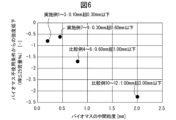
- FIG. 6 is a graph showing the degree of decrease in I-type strength of coke caused by the use of semi-carbonized woody biomass, expressed as an average value when the volatile matter content (VM) is 25 mass% or less.
- FIG. 7 is a graph showing the degree of decrease in I-type strength of coke due to the use of semi-carbonized woody biomass, expressed as an average value when the volatile matter content (VM) exceeds 25 mass%.
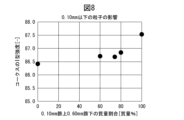
- FIG. 8 is a graph showing the relationship between particle size distribution and I-type strength in Examples 10 to 13 and Comparative Example 16.
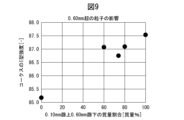
- FIG. 9 is a graph showing the relationship between particle size distribution and I-type strength in Examples 14 to 17 and Comparative Example 17.
- FIG. 10 is a diagram in which the plot shown in FIG. 1 is replotted with the x-axis representing the amount of volatile matter and the y-axis representing the medium particle size.
- This embodiment provides a method for producing coke that includes a step of preparing a coal blend containing coal and semi-carbonized woody biomass, and a step of converting the coal blend into coke.
- Using biomass in addition to coal as a raw material for coke is advantageous from the viewpoint of reducing the consumption of fossil resources through the effective use of renewable resources.
- biomass means a renewable, organic resource derived from a living organism, excluding fossil resources.
- Biomass generally originates from agriculture, forestry, livestock, fisheries, waste, and the like.
- Woody biomass is biomass having lignified tissue. Woody biomass may originate from broadleaf trees, coniferous trees, ginkgo trees, bamboo, and the like. Woody biomass may have various origins and forms, such as logs, thinned wood, scraps, waste wood, sawdust, bark, branches, and leaves. Woody biomass may be chips, powder, pellets, and the like. Examples of woody biomass pellets include wood pellets (white pellets), bark pellets, and whole tree pellets.
- Semi-carbonized woody biomass can typically be obtained by heat treatment of woody biomass, more specifically, dry distillation (i.e., heating in an air-free state).
- Woody biomass is easy to obtain in large quantities and has a relatively uniform quality. Furthermore, woody biomass tends to have a lower content of non-carbon inorganic matter such as ash compared to non-woody biomass, which can be advantageous in terms of energy efficiency and resistance to corrosion of equipment. From the above perspectives, woody biomass is particularly suitable as a coke raw material.
- Semi-carbonized biomass is biomass in which the organic components in the biomass are decomposed by heat treatment, increasing the carbon ratio, but the biomass is not completely carbonized and still contains organic components.
- Carbonizing biomass has the following advantages: increased energy efficiency due to an increase in the amount of combustion per unit mass, improved ease of crushing, improved transportability due to reduced porosity, and improved handling due to hydrophobicity (for example, it can be stored in existing outdoor facilities like coal).
- semi-carbonized biomass is useful as a coke raw material due to its high energy efficiency, moderate shrinkage when heated similar to coal, ease of crushing, and hydrophobicity.
- completely carbonized biomass is generally not suitable as a coke raw material due to its low energy efficiency.
- torrefied biomass is distinguished from fully carbonized biomass by the lower temperature of heating (more specifically, up to 500° C.) required to carbonize the biomass. In one aspect, torrefied biomass is distinguished from fully carbonized biomass by having a high volatile content (more specifically, 1% by weight or greater).
- the thermal shrinkage rate of uncarbonized biomass tends to be significantly higher than that of general coal, but in semi-carbonized biomass, the volatile matter and easily pyrolyzable components are reduced, and therefore the thermal shrinkage rate is reduced compared to before carbonization.
- Biomass which is a semi-carbonized material, can have a similar thermal contraction behavior to coal during coking, making it less likely to produce peeling defects between the coal-derived coke portion and the biomass-derived coke portion during coking, and can produce high-strength coke.
- the fixed carbon ratio of semi-carbonized woody biomass is preferably 50% by mass or more, or 60% by mass or more, or 70% by mass or more, in terms of low thermal shrinkage and excellent energy efficiency, and is preferably 90% by mass or less, or 80% by mass or less, in terms of no excessive carbonization, excellent energy efficiency, and similar coking behavior to coal.
- the fixed carbon ratio is a value measured by industrial analysis, which will be described in more detail in the [Examples] section.
- the ash ratio of the semi-carbonized woody biomass is preferably 10% by mass or less, or 5% by mass or less, or 4% by mass or less.
- a smaller ash ratio is preferable, but from the viewpoint of the ease of availability of semi-carbonized woody biomass, in one embodiment, the ash ratio may be 0.5% by mass or more, or 1.0% by mass or more, or 2.0% by mass or more.
- the ash ratio is a value measured by industrial analysis, which will be described in more detail in the [Examples] section.
- the carbon element ratio of semi-carbonized woody biomass is preferably 50% by mass or more, or 60% by mass or more, or 70% by mass or more in terms of small thermal shrinkage rate and excellent energy efficiency, and is preferably 90% by mass or less, or 80% by mass or less in terms of no excessive carbonization, excellent energy efficiency, and a shrinkage behavior during coking similar to that of coal.
- the hydrogen element ratio of the semi-carbonized woody biomass may be 1 mass % or more and 5 mass % or less.
- the nitrogen element ratio of the semi-carbonized woody biomass may be 0.1 mass % or more and 2.0 mass % or less.
- the oxygen element ratio of the semi-carbonized woody biomass may be 1 mass % or more and 20 mass % or less.
- the total sulfur element ratio of the semi-carbonized woody biomass may be 0.01 mass% or more and 1.50 mass% or less.
- the above elemental ratios are values measured by elemental analysis, which will be described in more detail in the section [Examples].
- the moisture content of woody biomass before semi-carbonization may vary depending on the origin of the biomass.
- woody biomass may be dried to adjust the moisture content to about 5% to 15% by mass.
- the moisture content of semi-carbonized woody biomass may be 1% to 5% by mass, or 1% to 3% by mass.
- the moisture content is a value measured according to JIS M8820-2000.
- the bulk density of the semi-carbonized woody biomass can be about 300 kg/m 3 to 1000 kg/m 3 in one embodiment.
- the bulk density is a value measured in accordance with ISO 17828:2015.
- the calorific value of the semi-carbonized woody biomass may be 4,000 kcal/kg to 6,000 kcal/kg.
- the calorific value is a value measured in accordance with ISO 18125:2017.
- Semi-carbonization may be carried out by heating woody biomass in any shape (e.g., chips, powder, pellets, etc.), more specifically by dry distillation, i.e., heating in an air-free state.
- Heating devices include batch heaters such as electric furnaces, and continuous heaters such as kilns. Heating may be carried out at normal pressure, but is not limited to this.
- the heating temperature is preferably 200° C. or higher, or 210° C. or higher, or 220° C. or higher, or 230° C. or higher, or 240° C. or higher, or 250° C. or higher, or 260° C. or higher, or 270° C. or higher, or 280° C.
- the volatile content of the semi-carbonized woody biomass is preferably 500° C. or lower, or 400° C. or lower, or 390° C. or lower, or 380° C. or lower, or 370° C. or lower, or 360° C. or lower, or 350° C. or lower, or 340° C. or lower, or 330° C. or lower, or 320° C. or lower, or 310° C. or lower, or 300° C. or lower.
- the heating time may be appropriately selected depending on the properties of the biomass used, the desired volatile content, and the like, and may be, for example, 10 minutes to 30 minutes.
- Semi-carbonization may be carried out in superheated steam.
- the chemical composition of the semi-carbonized material may be adjusted by adjusting the heating rate during heating.
- the resulting product (more specifically, the dry distillate), or the product (more specifically, the dry distillate) to which a binder such as starch is added and then kneaded, can be formed into a desired shape and recovered as semi-carbonized woody biomass.
- the semi-carbonized woody biomass may be in the form of powder, pellets, etc.
- pellets of woody biomass before semi-carbonization or semi-carbonized woody biomass include cylindrical pellets with a diameter of 5 mm to 10 mm and a length of 5 mm to 50 mm.
- Semi-carbonization can remove components such as moisture, various gases, and wood vinegar from wood biomass.
- Wood tar may be removed or may remain substantially unremoved.
- the removed components may include useful chemicals such as acids, alcohols, and phenols, and these substances may be used as industrial materials for various applications.
- the inclusion of wood tar in the semi-carbonized material can be advantageous in terms of energy efficiency.
- the semi-carbonized woody biomass contains particles that are 0.10 mm oversieve (i.e., greater than 0.10 mm) and 0.60 mm undersieve (i.e., 0.60 mm or less) in a mass ratio of at least 60 mass% when sieved in accordance with the particle size test method specified in JIS M8801:2008.
- the mass ratio is preferably 70 mass% or more, 80 mass% or more, 90 mass% or more, or 100 mass%. In particular, when the mass ratio is 80 mass% or more, there is a tendency for the coke strength to improve significantly as the mass ratio increases.
- the semi-carbonized woody biomass contains particles that are 0.10 mm oversieve (i.e., greater than 0.10 mm) and 0.30 mm undersieve (i.e., 0.30 mm or less) in the above sieving at a mass ratio of at least 60 mass%, preferably 70 mass% or more, 80 mass% or more, 90 mass% or more, or 100 mass%.
- the particle size of the particles that account for 60% or more by mass of the entire semi-carbonized woody biomass is, in one embodiment, from the viewpoint of availability, 0.10 mm sieve size (i.e., greater than 0.10 mm), or 0.15 mm sieve size (i.e., greater than 0.15 mm), or 0.18 mm sieve size (i.e., greater than 0.18 mm), or 0.212 mm sieve size (i.e., greater than 0.212 mm). If the particle size of the semi-carbonized woody biomass is large, once peeling defects occur during coking, they tend to grow into large-sized defects.
- the particle size of the particles that account for 60% or more by mass of the entire semi-carbonized woody biomass is, in one embodiment, 0.60 mm or less (i.e., 0.60 mm or less), preferably 0.50 mm or less (i.e., 0.50 mm or less), or 0.425 mm or less (i.e., 0.425 mm or less), or 0.355 mm or less (i.e., 0.355 mm or less), or 0.30 mm or less (i.e., 0.30 mm or less).
- the particle size is evaluated in accordance with "5. Particle Size Test Method" of JIS M8801:2008, using a sieve that complies with JIS Z8801:2019.
- the particle size of the particles that account for 70% or more by mass, or 80% or more by mass, or 90% or more by mass, or 100% by mass of the entire semi-carbonized woody biomass is within the above range.
- the mass ratio of particles that are 0.60 mm or larger is 40% or less by mass. Since a smaller number of coarse particles is advantageous in terms of coke strength, this mass ratio of particles that are 0.60 mm or larger is preferably 30% or less by mass, or 20% or less by mass, or 10% or less by mass, or 0% by mass.
- the mass ratio of particles that are 0.30 mm or larger is 40% or less by mass. Since a small number of coarse particles can be advantageous in terms of coke strength, this mass ratio of particles that are 0.30 mm or larger is preferably 30% or less by mass, or 20% or less by mass, or 10% or less by mass, or 0% by mass.
- the semi-carbonized woody biomass contains at least 60% by mass of particles over the 0.10 mm sieve and under the 0.60 mm sieve, the mass proportion over the 0.038 mm sieve is 1% by mass or less, the mass proportion over the 2.80 mm sieve is 1% by mass or less, and the average diameter of the particles over the 0.038 mm sieve and under the 2.80 mm sieve is 0.212 mm or more and 0.505 mm or less.
- semi-carbonized woody biomass containing at least 60% by mass of particles over the 0.10 mm sieve and under the 0.30 mm sieve has a mass ratio of particles over the 0.038 mm sieve of 1% by mass or less, a mass ratio of particles over the 2.80 mm sieve of 1% by mass or less, and an average diameter of particles over the 0.038 mm sieve and under the 2.80 mm sieve of 0.147 mm or more and 0.299 mm or less.
- the above average diameter is preferably equal to or larger than the lower limit in terms of availability, and is preferably equal to or smaller than the upper limit in terms of obtaining good coke strength.
- the "average diameter of particles over 0.038 mm sieve and under 2.80 mm sieve" of the present disclosure is determined in accordance with "5. Particle size test method" of JIS M8801:2008, using a sieve conforming to JIS Z8801:2019, by the following procedure.
- Particles on the 0.038 mm sieve and under the 0.10 mm sieve are regarded as particles of intermediate particle size (i.e., the intermediate value between 0.038 mm and 0.10 mm, the same applies below) of 0.069 mm
- Particles on the 0.10 mm sieve and under the 0.15 mm sieve are considered to be particles with a median particle size of 0.125 mm
- Particles on the 0.15 mm sieve and below the 0.30 mm sieve are considered to be particles with a median particle size of 0.225 mm
- Particles on the 0.30 mm sieve and below the 0.60 mm sieve are considered to be particles with a median particle size of 0.450 mm
- Particles on a 0.60 mm sieve and below a 1.00 mm sieve are considered to be particles with a median particle size of 0.80 mm
- Particles on the 1.00 mm sieve and under the 1.40 mm sieve are considered to be particles with particles with 0.069 mm
- Average diameter (mm) 0.069 x [mass proportion of particles with a medium particle size of 0.069 mm] + 0.125 x [mass proportion of particles with a medium particle size of 0.125 mm] + 0.225 x [mass proportion of particles with a medium particle size of 0.225 mm] + 0.450 x [mass proportion of particles with a medium particle size of 0.450 mm] + 0.80 x [mass proportion of particles with a medium particle size of 0.80 mm] + 1.20 x [mass proportion of particles with a medium particle size of 1.20 mm] + 1.70 x [mass proportion of particles with a medium particle size of 1.70 mm] + 2.40 x [mass proportion of particles with a medium particle size of 2.40 mm]
- the semi-carbonized woody biomass has a particle size of 0.10 mm sieve size (i.e., greater than 0.10 mm) and 0.60 mm sieve size (i.e., 0.60 mm or less) when sieved in accordance with the particle size test method specified in JIS M8801:2008.
- the particle size of all particles of the semi-carbonized woody biomass is in the range of greater than 0.10 mm and less than 0.60 mm.
- the particle size of the semi-carbonized woody biomass is 0.10 mm sieve size (i.e., greater than 0.10 mm), or 0.15 mm sieve size (i.e., greater than 0.15 mm), or 0.18 mm sieve size (i.e., greater than 0.18 mm), or 0.212 mm sieve size (i.e., greater than 0.212 mm) (or 0.20 mm sieve size (i.e., greater than 0.20 mm)).
- 0.10 mm sieve size i.e., greater than 0.10 mm
- 0.15 mm sieve size i.e., greater than 0.15 mm
- 0.18 mm sieve size i.e., greater than 0.18 mm
- 0.212 mm sieve size i.e., greater than 0.212 mm
- 0.20 mm sieve size i.e., greater than 0.20 mm
- the particle size is, in one embodiment, 0.60 mm or less (i.e., 0.60 mm or less), preferably 0.55 mm or less (i.e., 0.55 mm or less), or 0.50 mm or less (i.e., 0.50 mm or less), or 0.425 mm or less (i.e., 0.425 mm or less) (or 0.40 mm or less (i.e., 0.40 mm or less)), or 0.355 mm or less (i.e., 0.355 mm or less (or 0.35 mm or less (i.e., 0.35 mm or less), or 0.30 mm or less (i.e., 0.30 mm or less).
- the particle size is evaluated in accordance with "5. Particle Size Test Method" of JIS M8801:2008 using a sieve conforming
- the particle size may be adjusted to the desired range by crushing the semi-carbonized woody biomass (e.g., pellets) under controlled conditions. Crushing may be performed using, for example, a compression type, shear type, cutting type, impact type, and/or friction type crusher. Examples of crushers include a hammer mill, a cutter mill, and a ball mill. Crushing may be dry or wet, but is preferably dry. In a preferred embodiment, for example, semi-carbonized woody biomass with a particle size of more than 0.10 mm and not more than 0.60 mm can be prepared by crushing pellets of semi-carbonized woody biomass using a hammer mill under conditions set according to the desired particle size. In one embodiment, the crushed product may be further classified using a sieve.
- the crushed product may be classified using a 0.10 mm sieve and a 0.60 mm sieve conforming to JIS Z8801:2019 to recover particles that are on the 0.10 mm sieve and below the 0.60 mm sieve, thereby obtaining semi-carbonized woody biomass having particle sizes above the 0.10 mm sieve (greater than 0.10 mm) and below the 0.60 mm sieve (0.60 mm or less).
- the particles that are on the 0.60 mm sieve that are removed by the above classification may be subjected again to the above crushing.
- the relatively small particle size of semi-carbonized woody biomass is advantageous in terms of coke strength.
- the inventors of the present invention have focused on the fact that even if the particle size of semi-carbonized woody biomass is the same, the shrinkage behavior during coke formation differs if the volatile content of the semi-carbonized woody biomass is different, and have investigated a method for easily obtaining semi-carbonized woody biomass that is less likely to reduce coke strength. As a result, they have found that by adjusting the particle size of semi-carbonized woody biomass to a predetermined range depending on the volatile content, peeling defects between the coal-derived coke part and the biomass-derived coke part during coke formation can be effectively suppressed. Since the particle size can be easily controlled by adjusting the crushing conditions, etc., using semi-carbonized woody biomass whose particle size has been selected by such a method is advantageous in terms of easily producing coke having good coke strength while using semi-carbonized woody biomass.
- the thermal shrinkage rate during coking is high, so a smaller particle size is advantageous.
- the thermal shrinkage rate during coking is low and peeling defects are unlikely to occur, so even if the particle size is relatively large, the coke strength is unlikely to decrease.
- the target particle size of the semi-carbonized woody biomass is made different when the volatile content is more than 25% by mass and when it is 25% by mass or less, and the grinding conditions are appropriately designed to obtain this target particle size.
- Semi-carbonized woody biomass is (1) A volatile content of 25% by mass or less, and a particle size in which the mass ratio of particles on a 0.10 mm sieve and under a 0.60 mm sieve is 60% by mass or more when sieved in accordance with the particle size test method specified in JIS M8801:2008, or (2)
- the volatile content is more than 25% by mass and not more than 40% by mass, and the particle size is such that the mass ratio of particles passing through a 0.10 mm sieve and a 0.30 mm sieve is 60% by mass or more in the above sieving.
- Semi-carbonized woody biomass satisfying the above condition (1) and semi-carbonized woody biomass satisfying the above condition (2) may be used in combination.
- Semi-carbonized woody biomass is (1) A volatile matter content of 25% by mass or less and a particle size of 0.10 mm sieve (greater than 0.10 mm) and 0.60 mm sieve (0.60 mm or less), or (2) The volatile content is more than 25% by mass and not more than 40% by mass, and the particle size is 0.10 mm sieve size (more than 0.10 mm) and 0.30 mm sieve size (not more than 0.30 mm).
- Semi-carbonized woody biomass satisfying the above condition (1) and semi-carbonized woody biomass satisfying the above condition (2) may be used in combination.
- the thermal shrinkage rate of the semi-carbonized woody biomass can become close to that of coal to an extent that is useful for reducing peeling defects.
- the volatile content of the semi-carbonized woody biomass is preferably 40% by mass or less, 38.2% by mass or less, 35% by mass or less, 30% by mass or less, 25% by mass or less, 23.7% by mass or less, or 20% by mass or less, from the viewpoint of reducing shrinkage during coking and obtaining high coke strength.
- the volatile content of the semi-carbonized woody biomass is preferably 1% by mass or more, 3% by mass or more, 5% by mass or more, 10% by mass or more, 15% by mass or more, or 15.9% by mass or more, from the viewpoint of facilitating the design of carbonization conditions such that the carbonization of the woody biomass remains at semi-carbonization.
- the volatile content of the semi-carbonized woody biomass may be more than 23.7% by mass and 38.2% by mass or less.
- the volatile content of the semi-carbonized woody biomass when the volatile content of the semi-carbonized woody biomass is 25% by mass or less, the volatile content may be 15.9% by mass or more and 23.7% by mass or less. In one aspect, when the volatile content of the semi-carbonized woody biomass is more than 25% by mass and not more than 40% by mass, the volatile content may be 28.9% by mass or more and 38.2% by mass or less.
- the amount of volatile matter can be controlled by adjusting the heating conditions mentioned above during semi-carbonization.
- the moisture content Z is a value measured in accordance with JIS M8820-2000.
- the coal blend of this embodiment contains semi-carbonized woody biomass and coal.
- the coal blend contains components other than semi-carbonized woody biomass and coal is not excluded as long as it does not impair the effects of the present invention, in a typical embodiment, the coal blend is composed only of semi-carbonized woody biomass and coal.
- the coal contained in the coal blend may be one or more types of coal, or may be pulverized coal.
- Powdered coal refers to pulverized coal, and includes coal whose particle size has been further adjusted after pulverization, and agglomerated coal when agglomerated coal is mixed.
- agglomerated coal refers to coal with a spherical equivalent radius of less than 6 mm obtained by adding a caking filler to powdered coal (in one embodiment, powdered coal that falls below a 0.3 mm sieve) and pressurizing it to form the powdered coal.
- the moisture content of the coal and the coal blend may be 5% by mass to 10% by mass.
- the moisture content of the coal and the coal blend may be reduced, for example, by a conventionally known coal dryer.
- the ratio of semi-carbonized woody biomass can be a relatively large amount, such as up to 5.0 mass% relative to 100 mass% of blended coal. From the viewpoint of effectively obtaining the advantages of utilizing biomass, this ratio is preferably 1.0 mass% or more, or 1.5 mass% or more, or 2.0 mass% or more, and from the viewpoint of maintaining good coke strength, it is preferably 5.0 mass% or less, or 4.0 mass% or less, or 3.0 mass% or less.
- the method for producing coke includes a step of preparing a coal blend containing coal and semi-carbonized woody biomass.
- the coal blend may be prepared by mixing coal and semi-carbonized woody biomass to produce a coal blend, or may be prepared by obtaining a coal blend containing coal and semi-carbonized woody biomass in advance.
- the semi-carbonized woody biomass is a product of heat treatment of woody biomass at 200° C. or more and 500° C. or less.
- the heat treatment may be carbonization (i.e., heating in an air-free state).
- the heat treatment may be performed in superheated steam.
- the method for producing coke may include a step of producing semi-carbonized woody biomass.
- the method for producing coke may include a step of heat treating woody biomass at 200° C. or more and 500° C. or less to produce semi-carbonized woody biomass.
- the method for producing coke of this embodiment includes a step of coking the above-mentioned blended coal.
- the coke oven may be any conventionally known coke oven. Since the shrinkage behavior of semi-carbonized woody biomass during coking is similar to that of coal, coke with good coke strength can be obtained by carbonizing the blended coal of this embodiment using an existing coke oven under existing coking conditions.
- the semi-carbonized woody biomass and coal may be mixed in advance and then charged into the coke oven.
- the carbonization conditions (temperature, time, etc.) for coking may be the same as those when producing coke using only coal. In one embodiment, the carbonization temperature may be about 700°C to 1400°C.
- the reduction in peeling defects can be achieved by reducing the particle size to a certain extent, but in one embodiment, the particle size may be reduced even further.
- the particle size may be reduced even further. That is, in one embodiment, instead of making the target particle size of the semi-carbonized woody biomass different between when the volatile content exceeds 25% by mass and when it is 25% by mass or less, the target particle size of the semi-carbonized woody biomass may be made different between when the volatile content exceeds a volatile content slightly less than 25% by mass and when it is equal to or less than the volatile content.
- the semi-carbonized woody biomass is (1) A volatile content of 15.9% by mass or more and 23.7% by mass or less, and a particle size in which the mass ratio of particles on a 0.10 mm sieve and under a 0.60 mm sieve is 60% by mass or more in a sieve according to the particle size test method specified in JIS M8801:2008, or (2)
- the volatile content is more than 23.7% by mass and not more than 38.2% by mass, and the mass ratio of the particles on the 0.10 mm sieve and the particles on the 0.30 mm sieve is 60% by mass or more in the above sieving. It is possible.
- Semi-carbonized woody biomass satisfying the above condition (1) and semi-carbonized woody biomass satisfying the above condition (2) may be used in combination.
- the semi-carbonized woody biomass is (1) A volatile content of 15.9% by mass or more and 23.7% by mass or less, and a particle size of 0.10 mm or more and 0.60 mm or less when sieved in accordance with the particle size test method specified in JIS M8801:2008, or (2) A volatile content of more than 23.7% by mass and not more than 38.2% by mass, and a particle size of 0.10 mm or more and 0.30 mm or less when sieved in accordance with the particle size test method specified in JIS M8801:2008; It is possible.
- Semi-carbonized woody biomass satisfying the above condition (1) and semi-carbonized woody biomass satisfying the above condition (2) may be used in combination.
- the particle size of the semi-carbonized woody biomass may be adjusted according to the amount of volatile matter in the semi-carbonized woody biomass.
- the particle size of the semi-carbonized woody biomass may be adjusted according to the amount of volatile matter based on a relational equation created in advance between a variable x, which is the amount of volatile matter in the semi-carbonized woody biomass, and a variable y, which is the particle size of the semi-carbonized woody biomass.
- the relational equation may be an equation in which the slope ( ⁇ y/ ⁇ x), which is the ratio of the increment ⁇ y of the variable y to the increment ⁇ x of the variable x, is negative.
- the slope may be an exponential function, a linear function, or another slope.
- the particle size as the variable y may be the "average diameter of particles on a 0.038 mm sieve and under a 2.80 mm sieve" of the present disclosure.
- the mass ratio under the 0.038 mm sieve is 1 mass% or less
- the mass ratio over the 2.80 mm sieve is 1 mass% or less.
- the relational expression may be obtained by (1) setting a desired target coke strength as a threshold value, (2) examining whether the coke strength is equal to or greater than the threshold value while changing the combination of volatile matter amount and particle size for an arbitrarily selected type of semi-carbonized woody biomass, and (3) deriving the relational expression based on the combination of volatile matter amount and particle size that gives a coke strength equal to or greater than the threshold value.
- the semi-carbonized woody biomass has a volatile content of 40% by mass or less, and a particle size in which the mass ratio of the particles on a 0.10 mm sieve and under a 0.60 mm sieve is 60% by mass or more when sieved in accordance with the particle size test method specified in JIS M8801:2008, and the particle size of the semi-carbonized woody biomass is adjusted according to the volatile content of the semi-carbonized woody biomass based on a relationship equation created in advance between a variable x that is the volatile content of the semi-carbonized woody biomass and a variable y that is the particle size of the semi-carbonized woody biomass,
- the relational expression may be an expression in which the slope ( ⁇ y/ ⁇ x), which is the ratio of an increment ⁇ y of the variable y to an increment ⁇ x of the variable x, is negative.
- thermocouples were placed in the center and outermost parts of the charcoal in the furnace width direction of the double-sided furnace dry distillation vessel.
- the heating temperature was set to five levels: 265°C, 285°C, 300°C, 320°C, and 380°C.
- a program was set to raise the temperature at 2°C/min to a temperature 30°C higher than the heating temperature.
- the heating was stopped and held at the point when the average temperature of both the center and outermost temperature measuring points at a furnace height of 30 mm (i.e., the middle position at a height of 60 mm) reached each of the five levels, and then the temperature was cooled.
- the above holding period was carried out for one hour. After cooling, the samples were stored in a ziplock bag.
- the heating temperatures shown in Table 1 were determined by determining the relationship between the heating temperature and mass loss of semi-carbonized woody biomass 1 using a thermobalance in advance, and based on this relationship, semi-carbonized woody biomass 2 to 6 with the desired volatile content were obtained.
- coal The coal used was caking coal with a volatile matter content (VM) of 27.5% by mass and a 3 mm undersize fraction of 100% by mass.
- VM volatile matter content
- the powder part was removed from the sample after dry distillation, and only the lump part was collected, and the lump part was placed in an I-type drum (cylinder size: diameter 132 mm x length 700 mm), and after 30 minutes at a rotation speed of 20 rpm, i.e., 600 rotations, the mass ratio on the 9.8 mm sieve was measured. This value was taken as I-type strength.
- Examples 7 to 9 Coke was produced and evaluated in the same manner as in Example 1, except that semi-carbonized woody biomass 1 to 6 having a particle size category (b) of more than 0.30 mm and not more than 0.60 mm was used.
- Coke was produced and evaluated in the same manner as in Example 1, except that semi-carbonized woody biomass 1 to 6 having a particle size category (c) of more than 0.60 mm and not more than 1.00 mm was used.
- Coke was produced and evaluated in the same manner as in Example 1, except that semi-carbonized woody biomass 1 to 6 having a particle size class (d) of more than 1.00 mm and not more than 3.00 mm was used.
- Figure 1 shows the relationship between the particle size of semi-carbonized woody biomass and the I-type strength of the coke.
- each particle size category is plotted at the intermediate particle size, which is the intermediate value. That is, the particle size categories (a) over 0.10 mm and up to 0.30 mm, (b) over 0.30 mm and up to 0.60 mm, (c) over 0.60 mm and up to 1.00 mm, and (d) over 1.00 mm and up to 3.00 mm are plotted at 0.20 mm, 0.45 mm, 0.80 mm, and 2.00 mm, respectively.
- Figures 2 to 5 show the relationship between the volatile matter content (VM) of semi-carbonized woody biomass and the I-type strength of the coke for particle size category (a) over 0.10 mm and under 0.30 mm for Examples 1 to 6 ( Figure 2), particle size category (b) over 0.30 mm and under 0.60 mm for Examples 7 to 9 and Comparative Examples 1 to 3 ( Figure 3), particle size category (c) over 0.60 mm and under 1.00 mm for Comparative Examples 4 to 9 ( Figure 4), and particle size category (d) over 1.00 mm and under 3.00 mm for Comparative Examples 10 to 15 ( Figure 5).
- VM volatile matter content
- Figures 6 and 7 show the degree of decrease in I-type strength of coke due to the use of semi-carbonized woody biomass, as the average value for the decrease in strength compared to when no biomass is used, when the volatile matter content (VM) is 25% by mass or less ( Figure 6), and when the volatile matter content (VM) is over 25% by mass (Figure 7), respectively.
- the I-type strength of Reference Example 1, in which only coal was carbonized was 87.44 (dotted line in Figures 1 to 5), and a decrease in I-type strength due to the use of semi-carbonized woody biomass was observed in all blended coals, but the decrease in I-type strength was small in particle size category (a) greater than 0.10 mm and less than 0.30 mm (Examples 1 to 6) and particle size category (b) greater than 0.30 mm and less than 0.60 mm (Examples 7 to 9 and Comparative Examples 1 to 3).
- the above results show that when the particle size of semi-carbonized woody biomass exceeds 0.60 mm, the I-type strength of the coke decreases significantly, so it is advantageous for the particle size of semi-carbonized woody biomass to be greater than 0.10 mm and less than 0.60 mm.
- the volatile content when the volatile content exceeds 25 mass%, the volatile content has a significant effect on the I-type strength, but when the volatile content is 25 mass% or less, the effect of the volatile content on the I-type strength is small.
- the I-type strength was good for both particle sizes greater than 0.10 mm and less than 0.30 mm and particle sizes greater than 0.30 mm and less than 0.60 mm, which means that good I-type strength can be obtained with a particle size of greater than 0.10 mm and less than 0.60 mm.
- Examples 10 to 13, Comparative Example 16 The I-type strength of the coke was measured in the same manner as in Example 1, except that semi-carbonized woody biomass particles having a volatile content of 23.7% by mass and a particle size distribution shown in Table 4 were used as the semi-carbonized woody biomass.
- the semi-carbonized woody biomass particles having the particle size distribution shown in Table 4 were produced by the following method. Semi-carbonized woody biomass was pulverized with a hammer mill and sieved using a sieve conforming to JIS Z8801:2019 in accordance with "8. Particle size determination method" of JIS M8100:1992.
- samples were obtained in four particle size categories (for Comparative Example 16 and Example 10) of more than 0.038 mm and less than 0.10 mm, more than 0.15 mm and less than 0.15 mm, more than 0.30 mm and less than 0.30 mm, and less than 0.60 mm, conforming to "5. Particle size test method" of JIS M8801:2008, or two particle size categories (for Examples 11 to 13) of more than 0.038 mm and less than 0.10 mm and less than 0.10 mm.
- the I-type strength of the coke was the best when the mass ratio of particles greater than 0.10 mm and equal to or less than 0.60 mm was 100 mass%. Even when particles smaller than 0.10 mm were present, the I-type strength of the coke was good when the mass ratio of such particles was 40 mass% or less.
- Examples 14 to 17, Comparative Example 17 The I-type strength of the coke was measured in the same manner as in Example 10, except that the semi-carbonized woody biomass used had a volatile content of 23.7% by mass and a particle size distribution as shown in Table 5.
- the particle size categories were four: more than 0.10 mm and not more than 0.15 mm, more than 0.15 mm and not more than 0.30 mm, more than 0.30 mm and not more than 0.60 mm, and more than 0.60 mm and not more than 1.00 mm (for Comparative Example 17 and Example 14), or two: more than 0.10 mm and not more than 0.60 mm, and more than 0.60 mm and not more than 1.00 mm (for Examples 15 to 17).
- the I-type strength of the coke was the best when the mass ratio of particles greater than 0.10 mm and less than 0.60 mm was 100 mass%. Even when particles greater than 0.60 mm were present, the I-type strength of the coke was good when the mass ratio of such particles was 40 mass% or less.
- Example 18 to 20 The I-type strength of the coke was measured in the same manner as in Example 10, except that the semi-carbonized woody biomass particles used had a volatile content of 34.4% by mass and a particle size distribution shown in Table 6.
- the particle size categories were four (for Examples 18 and 19): more than 0.038 mm and 0.10 mm or less, more than 0.10 mm and 0.15 mm or less, more than 0.15 mm and 0.30 mm or less, and more than 0.30 mm and 0.60 mm or less, or three (for Example 20): more than 0.038 mm and 0.10 mm or less, more than 0.10 mm and 0.30 mm or less, and more than 0.30 mm and 0.60 mm or less.
- Example 20 when the volatile content exceeds 25 mass%, the I-type strength of the coke is particularly good in Example 20, where the mass ratio of particles greater than 0.10 mm and less than 0.30 mm is 100 mass%, and the I-type strength of the coke is also good when particles less than 0.10 mm are present but the mass ratio of these particles is 40 mass% or less (Example 18) and when particles greater than 0.30 mm are present but the mass ratio of these particles is 40 mass% or less (Example 19).
- FIG. 10 is a diagram in which the plot shown in FIG. 1 is replotted with the x-axis representing the amount of volatile matter and the y-axis representing the median particle size.
- the I-type strength of 86.2 when the amount of volatile matter is 38.2 mass% and the median particle size is 0.2 mm was set as the threshold value, and the samples were classified as OK samples (I-type strength of 86.2 or more) and NG samples (I-type strength of less than 86.2).
- OK samples the samples with the largest median particle size for each volatile matter amount were selected. Furthermore, among those with the same median particle size, the samples with the largest amount of volatile matter were selected.
Landscapes
- Chemical & Material Sciences (AREA)
- Engineering & Computer Science (AREA)
- Oil, Petroleum & Natural Gas (AREA)
- Materials Engineering (AREA)
- Organic Chemistry (AREA)
- Solid Fuels And Fuel-Associated Substances (AREA)
- Coke Industry (AREA)
Priority Applications (4)
| Application Number | Priority Date | Filing Date | Title |
|---|---|---|---|
| CN202480015680.6A CN120787253A (zh) | 2023-03-01 | 2024-03-01 | 焦炭的制造方法 |
| KR1020257028730A KR20250140596A (ko) | 2023-03-01 | 2024-03-01 | 코크스의 제조 방법 |
| JP2024552792A JP7744613B2 (ja) | 2023-03-01 | 2024-03-01 | コークスの製造方法 |
| EP24764042.8A EP4674929A1 (en) | 2023-03-01 | 2024-03-01 | Coke production method |
Applications Claiming Priority (2)
| Application Number | Priority Date | Filing Date | Title |
|---|---|---|---|
| JP2023031338 | 2023-03-01 | ||
| JP2023-031338 | 2023-03-01 |
Publications (1)
| Publication Number | Publication Date |
|---|---|
| WO2024181565A1 true WO2024181565A1 (ja) | 2024-09-06 |
Family
ID=92590669
Family Applications (1)
| Application Number | Title | Priority Date | Filing Date |
|---|---|---|---|
| PCT/JP2024/007807 Ceased WO2024181565A1 (ja) | 2023-03-01 | 2024-03-01 | コークスの製造方法 |
Country Status (6)
| Country | Link |
|---|---|
| EP (1) | EP4674929A1 (https=) |
| JP (1) | JP7744613B2 (https=) |
| KR (1) | KR20250140596A (https=) |
| CN (1) | CN120787253A (https=) |
| TW (1) | TWI892487B (https=) |
| WO (1) | WO2024181565A1 (https=) |
Cited By (1)
| Publication number | Priority date | Publication date | Assignee | Title |
|---|---|---|---|---|
| WO2026062950A1 (ja) * | 2024-09-19 | 2026-03-26 | Jfeスチール株式会社 | コークスの製造方法 |
Citations (5)
| Publication number | Priority date | Publication date | Assignee | Title |
|---|---|---|---|---|
| JP2004307683A (ja) | 2003-04-08 | 2004-11-04 | Kansai Coke & Chem Co Ltd | コークスの製造方法 |
| CN101948708A (zh) * | 2010-10-12 | 2011-01-19 | 张家港华汇特种玻璃有限公司 | 固体燃料组合物及其在玻璃熔制中的应用 |
| JP2011093980A (ja) * | 2009-10-28 | 2011-05-12 | Jfe Steel Corp | 成型炭の製造方法 |
| WO2020067384A1 (ja) * | 2018-09-27 | 2020-04-02 | 日鉄エンジニアリング株式会社 | 成形燃料及びその製造方法 |
| JP2021176938A (ja) * | 2020-05-08 | 2021-11-11 | 出光興産株式会社 | 複合固形燃料及び複合固形燃料の製造方法 |
Family Cites Families (6)
| Publication number | Priority date | Publication date | Assignee | Title |
|---|---|---|---|---|
| CN102245738B (zh) * | 2008-12-10 | 2014-09-17 | 新日铁住金株式会社 | 高炉用焦炭的制造方法 |
| JP2012212054A (ja) | 2011-03-31 | 2012-11-01 | Toyo Ink Sc Holdings Co Ltd | カラーフィルタ用着色組成物およびカラーフィルタ本発明は、カラー液晶表示装置、及びカラー撮像管素子等に用いられるカラーフィルタの製造に使用されるカラーフィルタ用着色組成物、並びにこれを用いて形成されるフィルタセグメントおよび/またはブラックマトリクスを具備するカラーフィルタに関するものである。 |
| JP5673302B2 (ja) | 2010-06-08 | 2015-02-18 | 東洋インキScホールディングス株式会社 | 黒色樹脂組成物及びブラックマトリクス |
| JP6079412B2 (ja) | 2013-04-26 | 2017-02-15 | 新日鐵住金株式会社 | 高炉用高強度コークスの製造方法 |
| JP2020197567A (ja) | 2019-05-31 | 2020-12-10 | 東洋インキScホールディングス株式会社 | カラーフィルタ用着色組成物およびカラーフィルタ |
| CN113174272A (zh) | 2021-04-07 | 2021-07-27 | 徐州工业职业技术学院 | 作为焦炭制备瘦化剂的竹炭粉制备方法及焦炭瘦化工艺 |
-
2024
- 2024-03-01 KR KR1020257028730A patent/KR20250140596A/ko active Pending
- 2024-03-01 WO PCT/JP2024/007807 patent/WO2024181565A1/ja not_active Ceased
- 2024-03-01 CN CN202480015680.6A patent/CN120787253A/zh active Pending
- 2024-03-01 JP JP2024552792A patent/JP7744613B2/ja active Active
- 2024-03-01 EP EP24764042.8A patent/EP4674929A1/en active Pending
- 2024-03-01 TW TW113107580A patent/TWI892487B/zh active
Patent Citations (5)
| Publication number | Priority date | Publication date | Assignee | Title |
|---|---|---|---|---|
| JP2004307683A (ja) | 2003-04-08 | 2004-11-04 | Kansai Coke & Chem Co Ltd | コークスの製造方法 |
| JP2011093980A (ja) * | 2009-10-28 | 2011-05-12 | Jfe Steel Corp | 成型炭の製造方法 |
| CN101948708A (zh) * | 2010-10-12 | 2011-01-19 | 张家港华汇特种玻璃有限公司 | 固体燃料组合物及其在玻璃熔制中的应用 |
| WO2020067384A1 (ja) * | 2018-09-27 | 2020-04-02 | 日鉄エンジニアリング株式会社 | 成形燃料及びその製造方法 |
| JP2021176938A (ja) * | 2020-05-08 | 2021-11-11 | 出光興産株式会社 | 複合固形燃料及び複合固形燃料の製造方法 |
Non-Patent Citations (2)
| Title |
|---|
| See also references of EP4674929A1 |
| WIBAWA ADITYA, ASHIK U P M, KUDO SHINJI, ASANO SHUSAKU, GAO XIANGPENG, HAYASHI JUN-ICHIRO: "High-Strength Formed Coke from Torrefied Biomass and Its Blend with Noncaking Coal", ENERGY & FUELS, vol. 36, no. 16, 18 August 2022 (2022-08-18), pages 9121 - 9132, XP093205898, DOI: 10.1021/acs.energyfuels.2c01722 * |
Cited By (1)
| Publication number | Priority date | Publication date | Assignee | Title |
|---|---|---|---|---|
| WO2026062950A1 (ja) * | 2024-09-19 | 2026-03-26 | Jfeスチール株式会社 | コークスの製造方法 |
Also Published As
| Publication number | Publication date |
|---|---|
| JP7744613B2 (ja) | 2025-09-26 |
| CN120787253A (zh) | 2025-10-14 |
| TWI892487B (zh) | 2025-08-01 |
| TW202436602A (zh) | 2024-09-16 |
| KR20250140596A (ko) | 2025-09-25 |
| EP4674929A1 (en) | 2026-01-07 |
| JPWO2024181565A1 (https=) | 2024-09-06 |
Similar Documents
| Publication | Publication Date | Title |
|---|---|---|
| Phanphanich et al. | Impact of torrefaction on the grindability and fuel characteristics of forest biomass | |
| Zubairu et al. | Production and characterization of briquette charcoal by carbonization of agro-waste | |
| WO2012023479A1 (ja) | 固体燃料、およびその製造方法、製造装置 | |
| JP6339938B2 (ja) | 固体燃料の製造方法及び固体燃料 | |
| JP5625320B2 (ja) | 成型炭の製造方法 | |
| Amaya et al. | Preparation of charcoal pellets from Eucalyptus wood with different binders | |
| Kimutai et al. | Investigation of physical and combustion properties of briquettes from cashew nut shell and cassava binder | |
| JP5983278B2 (ja) | 高炉用高反応性コークスの製造方法 | |
| Law et al. | Experimental study on the mechanical properties of biomass briquettes from different agricultural residues combination | |
| Mamuad et al. | Charcoal briquette production from peanut (Arachis hypogaea L.) shells using cornick industry wastewater as binder through a torrefaction process | |
| JP7744613B2 (ja) | コークスの製造方法 | |
| JP6185699B2 (ja) | 固体燃料の製造方法及び固体燃料 | |
| JP6328901B2 (ja) | 固体燃料の製造方法及び固体燃料 | |
| Rambli et al. | Evaluation of biochar from sago (metroxylon spp.) as a potential solid fuel | |
| Elsisi et al. | Production the briquettes from mixture of agricultural residues and evaluation its physical, mechanical and combustion properties | |
| JP6639075B2 (ja) | 固体燃料の製造方法及び固体燃料 | |
| Hakim et al. | Charcoal Briquette Manufactured from Indonesian Sugar Palm Bunches (Arenga longipes Mogea) as Biomass-Based New Renewable Energy. | |
| Azman et al. | Production of smokeless biofuel briquettes from palm kernel shell assisted with slow pyrolysis treatment | |
| Salim et al. | Physical characteristics of developed hybrid briquettes from palm kernel shells/wood sawdust/coffee grounds blends as an alternative energy source | |
| JP5965693B2 (ja) | 固体燃料の製造方法及び固体燃料 | |
| JP6169323B2 (ja) | 固体燃料の製造方法及び固体燃料 | |
| Lunguleasa et al. | Using four pelletizing machines with flat die and different capacities for obtaining the best pellets from corn cobs waste | |
| Ngernyen et al. | Characterisation and quality improvement of binder free bio-pellets from the sugar industry residues and grass jelly food wastes for energy purposes | |
| Gratitude et al. | Proof of concept for using banana waste based binders in sawdust briquetting: Comparative studies between raw and carbonized sawdust | |
| Prapakarn et al. | EFFECTS OF TORREFACTION TEMPERATURE AND RESIDENCE TIME ON AGRICULTURAL RESIDUE AFTER PELLETIZATION PROCESS: CORNCOBS/CORNHUSKS, RICE STRAW, AND SUGARCANE TRASH. |
Legal Events
| Date | Code | Title | Description |
|---|---|---|---|
| WWE | Wipo information: entry into national phase |
Ref document number: 2024552792 Country of ref document: JP |
|
| 121 | Ep: the epo has been informed by wipo that ep was designated in this application |
Ref document number: 24764042 Country of ref document: EP Kind code of ref document: A1 |
|
| ENP | Entry into the national phase |
Ref document number: 1020257028730 Country of ref document: KR Free format text: ST27 STATUS EVENT CODE: A-0-1-A10-A15-NAP-PA0105 (AS PROVIDED BY THE NATIONAL OFFICE) |
|
| WWE | Wipo information: entry into national phase |
Ref document number: 202517082183 Country of ref document: IN Ref document number: 202480015680.6 Country of ref document: CN |
|
| REG | Reference to national code |
Ref country code: BR Ref legal event code: B01A Ref document number: 112025018403 Country of ref document: BR |
|
| WWP | Wipo information: published in national office |
Ref document number: 202517082183 Country of ref document: IN |
|
| WWE | Wipo information: entry into national phase |
Ref document number: 2024764042 Country of ref document: EP |
|
| NENP | Non-entry into the national phase |
Ref country code: DE |
|
| WWP | Wipo information: published in national office |
Ref document number: 202480015680.6 Country of ref document: CN |
|
| ENP | Entry into the national phase |
Ref document number: 2024764042 Country of ref document: EP Effective date: 20251001 |
|
| ENP | Entry into the national phase |
Ref document number: 2024764042 Country of ref document: EP Effective date: 20251001 |
|
| ENP | Entry into the national phase |
Ref document number: 2024764042 Country of ref document: EP Effective date: 20251001 |
|
| WWP | Wipo information: published in national office |
Ref document number: 2024764042 Country of ref document: EP |