WO2024173291A1 - Compounds and compositions as stat3 degraders and uses thereof - Google Patents
Compounds and compositions as stat3 degraders and uses thereof Download PDFInfo
- Publication number
- WO2024173291A1 WO2024173291A1 PCT/US2024/015462 US2024015462W WO2024173291A1 WO 2024173291 A1 WO2024173291 A1 WO 2024173291A1 US 2024015462 W US2024015462 W US 2024015462W WO 2024173291 A1 WO2024173291 A1 WO 2024173291A1
- Authority
- WO
- WIPO (PCT)
- Prior art keywords
- membered
- alkyl
- carbocyclyl
- compound
- heterocyclyl
- Prior art date
- Legal status (The legal status is an assumption and is not a legal conclusion. Google has not performed a legal analysis and makes no representation as to the accuracy of the status listed.)
- Ceased
Links
Classifications
-
- C—CHEMISTRY; METALLURGY
- C07—ORGANIC CHEMISTRY
- C07D—HETEROCYCLIC COMPOUNDS
- C07D519/00—Heterocyclic compounds containing more than one system of two or more relevant hetero rings condensed among themselves or condensed with a common carbocyclic ring system not provided for in groups C07D453/00 or C07D455/00
-
- A—HUMAN NECESSITIES
- A61—MEDICAL OR VETERINARY SCIENCE; HYGIENE
- A61P—SPECIFIC THERAPEUTIC ACTIVITY OF CHEMICAL COMPOUNDS OR MEDICINAL PREPARATIONS
- A61P29/00—Non-central analgesic, antipyretic or antiinflammatory agents, e.g. antirheumatic agents; Non-steroidal antiinflammatory drugs [NSAID]
-
- A—HUMAN NECESSITIES
- A61—MEDICAL OR VETERINARY SCIENCE; HYGIENE
- A61P—SPECIFIC THERAPEUTIC ACTIVITY OF CHEMICAL COMPOUNDS OR MEDICINAL PREPARATIONS
- A61P35/00—Antineoplastic agents
-
- C—CHEMISTRY; METALLURGY
- C07—ORGANIC CHEMISTRY
- C07F—ACYCLIC, CARBOCYCLIC OR HETEROCYCLIC COMPOUNDS CONTAINING ELEMENTS OTHER THAN CARBON, HYDROGEN, HALOGEN, OXYGEN, NITROGEN, SULFUR, SELENIUM OR TELLURIUM
- C07F9/00—Compounds containing elements of Groups 5 or 15 of the Periodic Table
- C07F9/02—Phosphorus compounds
- C07F9/547—Heterocyclic compounds, e.g. containing phosphorus as a ring hetero atom
- C07F9/6561—Heterocyclic compounds, e.g. containing phosphorus as a ring hetero atom containing systems of two or more relevant hetero rings condensed among themselves or condensed with a common carbocyclic ring or ring system, with or without other non-condensed hetero rings
Definitions
- the STAT protein family is composed of seven members: STAT1, STAT2, STAT3, STAT4, STAT5A, STAT5B, and STAT6. Structurally, they share five domains: an amino- terminal domain, a coiled-coil domain, a DNA-binding domain, an SH2 domain, and a carboxy-terminal transactivation domain.
- the transactivation domain contains one or two amino acid residues that are crucial for the activity of the STAT protein.
- STAT proteins promote fundamental cellular processes, including cell growth and differentiation, development, apoptosis, immune responses, and inflammation.
- STAT3 function may be abnormal in the context of cancer, and this abnormality represents an underlying mechanism of STAT3 for promoting malignant transformation and progression.
- Constitutively active STAT3 is detected in numerous malignancies, including breast, melanoma, prostate, head and neck squamous cell carcinoma (HNSCC), multiple myeloma, pancreatic, ovarian, and brain tumors.
- HNSCC head and neck squamous cell carcinoma
- STAT3 signaling promotes tumorigenesis and tumor progression partly through dysregulating the expression of critical genes that control cell growth and survival, angiogenesis, migration, invasion, or metastasis. These genes include those that encode p21 WAF1/CIP2 , cyclin D1, MYC, BCL-X, BCL-2, vascular endothelial growth factor (VEGF), matrix metalloproteinase 1 (MMP1), MMP7 and MMP9, and survivin. STAT3 may also play a role in the suppression of tumor immune surveillance. Consequently, the Attorney Docket No.
- STAT3 inhibitors and STAT3 degraders having physical and pharmacological properties that allow them to be used in therapeutic applications for treating disease.
- the present disclosure provides compounds of Formula I: T-L-V (I), and pharmaceutically acceptable salts, solvates, or stereoisomers thereof, wherein: V is of Formula I-1’ , L is of Formula I-2 T is of Formula I-3 , wherein each of the embodied, and exemplified herein.
- the present disclosure provides pharmaceutical compositions comprising a compound disclosed herein, and a pharmaceutically acceptable excipient.
- the present disclosure provides methods of degrading a protein (e.g., STAT3) in a subject or biological sample comprising administering a compound disclosed herein to the subject or contacting the biological sample with the compound disclosed herein.
- a protein e.g., STAT3
- the present disclosure provides uses of a compound disclosed herein in the manufacture of a medicament for degrading a protein (e.g., STAT3) in a subject or biological sample.
- the present disclosure provides compounds disclosed herein for use in degrading a protein (e.g., STAT3) in a subject or biological sample.
- a disease or disorder e.g., a STAT3-mediated disease or disorder
- the present disclosure provides methods of treating or preventing a disease or disorder (e.g., a STAT3-mediated disease or disorder) in a subject in need thereof, comprising administering to the subject a compound disclosed herein (e.g., in a therapeutically effective amount).
- the present disclosure provides methods of treating a disease or disorder (e.g., a STAT3-mediated disease or disorder) in a subject in need thereof, comprising administering to the subject a compound disclosed herein (e.g., in a therapeutically effective amount).
- the present disclosure provides uses of a compound disclosed herein in the manufacture of a medicament for treating or preventing a disease or disorder (e.g., a STAT3-mediated disease or disorder) in a subject in need thereof.
- a disease or disorder e.g., a STAT3-mediated disease or disorder
- the present disclosure provides uses of a compound disclosed herein in the manufacture of a medicament for treating a disease or disorder (e.g., a STAT3-mediated disease or disorder) in a subject in need thereof.
- the present disclosure provides compounds disclosed herein for use in treating or preventing a disease or disorder (e.g., a STAT3-mediated disease or disorder) in a subject in need thereof.
- the present disclosure provides compounds disclosed herein for use in treating a disease or disorder (e.g., a STAT3-mediated disease or disorder) in a subject in need thereof.
- a disease or disorder e.g., a STAT3-mediated disease or disorder
- DETAILED DESCRIPTION [0017]
- the present disclosure relates to compounds and compositions that are useful as degraders for certain proteins (e.g., STAT3).
- the present disclosure also relates to methods of degrading certain proteins (e.g., STAT3) comprising contacting the STAT3 protein with a compound disclosed herein.
- the invention also relates to methods of treating a STAT3- mediated disease or condition in a subject in need thereof by administering (e.g., in a therapeutically effective amount) a compound disclosed herein.
- the invention further relates to methods of treating a STAT3-mediated disease or condition in a subject in need thereof, Attorney Docket No. PRSC-080/001WO 343170-2282 comprising administering (e.g., in a therapeutically effective amount) a pharmaceutical composition comprising an amount of a compound disclosed herein.
- the present disclosure provides compounds of Formula I: T-L-V (I), or a pharmaceutically acceptable salt, solvate, or stereoisomer thereof, wherein: V is of Formula I-1’ , wherein: Ring A is 5- to 7-membered heterocycle; each R A is independently oxo, halogen, -CN, -NO2, -OH, -NH2, C1-6 alkyl, C1-6 alkoxy, C1-6 alkylamino, C 2-6 alkenyl, C 2-6 alkynyl, C 3-12 carbocyclyl, 3- to 12-membered heterocyclyl, C6-10 aryl, or 5- to 10-membered heteroaryl, wherein the alkyl, alkoxy, alkylamino, alkenyl, alkynyl, carbocyclyl, heterocyclyl, aryl, or heteroaryl is optionally substituted with one or more R u ; a is an integer selected from 0 to
- PRSC-080/001WO 343170-2282 or W is or wherein: * denotes attachment to L; Q is absent; or Q is -C(R Q )2-, -O-, and -N(R Q’ )-; each R Q is independently hydrogen, halogen, -CN, -NO 2 , -OH, -NH 2 , C 1-6 alkyl, C 1-6 alkoxy, C1-6 alkylamino, C3-6 carbocyclyl, or 3- to 6-membered heterocyclyl, wherein the alkyl, alkoxy, alkylamino, carbocyclyl, or heterocyclyl is optionally substituted with one or more R u ; or two R Q , together with the carbon atom to which they are attached, form C 3-6 carbocyclyl or 3- to 6-membered heterocyclyl, wherein the carbocyclyl or heterocyclyl is optionally substituted with one or more R u ; R Q’ is hydrogen, C 1-6 alky
- PRSC-080/001WO 343170-2282 alkenyl, alkynyl, carbocyclyl, heterocyclyl, aryl, or heteroaryl is optionally substituted with one or more R u ;
- R 6 is C6-10 aryl or 5- to 10-membered heteroaryl, wherein the aryl or heteroaryl is optionally substituted with one or more R 6a ;
- R 7 is C6-10 aryl or 5- to 10-membered heteroaryl, wherein the aryl or heteroaryl is optionally substituted with one or more R 7a ; or R 7 is hydrogen or C1-6 alkyl optionally substituted with one or more R 7b ;
- each R 6a and each R 7a are independently halogen, -CN, -NO 2 , -OH, -NH 2 , C 1-6 alkyl, C 1-6 alkoxy, C1-6 alkylamino, C2-6 alkenyl, C2-6 alkynyl, C3-12 carbo
- the compound is not (2-(((5S,8S,10aR)-3-acetyl-8-(((S)-5-amino-1-(2-chloro-3-(3-((5-((R)-1-((2S,4R)-2- (((S)-1-(4-ethynylphenyl)ethyl)carbamoyl)-4-hydroxypyrrolidin-1-yl)-3-methyl-1-oxobutan- 2-yl)isoxazol-3-yl)oxy)propyl)phenoxy)-5-oxopentan-2-yl)carbamoyl)-6- oxodecahydropyrrolo[1,2-a][1,5]diazocin-5-yl)carbamoyl)-1H-indole-5-carbonyl)phosphonic acid, (2-(((5S,8S,10aR)-3-acetyl-8-(((S)-5-amin
- PRSC-080/001WO 343170-2282 (2-(((5S,8S,10aR)-3-acetyl-8-(((S)-5-amino-1-(2-chloro-3-(3-((5-((R)-1-((2S,4R)-4- hydroxy-2-(((S)-1-(4-(4-methylthiazol-5-yl)phenyl)ethyl)carbamoyl)pyrrolidin-1-yl)-3- methyl-1-oxobutan-2-yl)isoxazol-3-yl)oxy)propyl)phenoxy)-5-oxopentan-2-yl)carbamoyl)-6- oxodecahydropyrrolo[1,2-a][1,5]diazocin-5-yl)carbamoyl)-1H-indole-5-carbonyl)phosphonic acid, diethyl (2-(((5S,8S,
- the present disclosure provides compounds of Formula I: T-L-V (I), and pharmaceutically acceptable salts, solvates, or stereoisomers thereof, wherein: V is of Formula I-1 , wherein: Ring A is 5- to 7- each R A is independently oxo, halogen, -CN, -NO 2 , -OH, -NH 2 , C 1-6 alkyl, C 1-6 alkoxy, C 1-6 alkylamino, C2-6 alkenyl, C2-6 alkynyl, C3-12 carbocyclyl, 3- to 12-membered heterocyclyl, C 6-10 aryl, or 5- to 10-membered heteroaryl, wherein the alkyl, alkoxy, alkylamino, alkenyl, Attorney Docket No.
- PRSC-080/001WO 343170-2282 alkynyl, carbocyclyl, heterocyclyl, aryl, or heteroaryl is optionally substituted with one or more R u ; a is an integer selected from 0 to 10, as valency permits; Ring C is C 6 aryl or 5- to 6-membered heteroaryl; each R C is independently , halogen, -CN, -NO 2 , -OH, -NH 2 , C 1-6 alkyl, C 1-6 alkoxy, C 1-6 alkylamino, C2-6 alkenyl, C2-6 alkynyl, C3-12 carbocyclyl, 3- to 12-membered heterocyclyl, C6-10 aryl, or 5- to 10-membered heteroaryl, wherein the alkyl, alkoxy, alkylamino, alkenyl, alkynyl, carbocyclyl, heterocyclyl, aryl, or heteroaryl is optionally substituted with one or more R
- Ring A is 5- to 7- each R A is C1-6 alkyl, C1-6 alkoxy, C1-6 alkylamino, C 2-6 12-membered heterocyclyl, C6-10 aryl, or 5- to 10- alkylamino, alkenyl, alkynyl, carbocyclyl, heterocyclyl, aryl, or heteroaryl is optionally substituted with one or more R u ; a is an integer selected from 0 to 10, as valency permits; Ring D’ is C6 aryl or 5- to 6-membered heteroaryl; each R D is independently halogen, -CN, -NO2, -OH, -NH2, C1-6 alkyl, C1-6 alkoxy, C1-6 alkylamino, C 2-6 alkenyl, C 2-6 alkynyl, C 3-12 carbocyclyl, 3- to 12-membered heterocyclyl, C6-10 ary
- each R C is independently , halogen, -CN, -NO 2 , -OH, -NH 2 , C 1-6 alkyl, C 1-6 alkoxy, C 1-6 alkylamino, C2-6 alkenyl, C2-6 alkynyl, C3-12 carbocyclyl, 3- to 12-membered heterocyclyl, C6-10 aryl, or 5- to 10-membered heteroaryl, wherein the alkyl, alkoxy, alkylamino, alkenyl, alkynyl, carbocyclyl, aryl, or heteroaryl is optionally substituted with one or more R u ; ** denotes attachment to L; c is an integer selected from 0 to 5, as
- R V1 is .
- V is of Formula I-1 Attorney Docket No. PRSC-080/001WO 343170-2282 , wherein: Ring A is 5- to 7- each R A is 6 alkyl, C1-6 alkoxy, C1-6 alkylamino, C2-6 6 12 heterocyclyl, C6- 10 aryl, or 5- to 10-membered heteroaryl, wherein the alkyl, alkoxy, alkylamino, alkenyl, alkynyl, carbocyclyl, heterocyclyl, aryl, or heteroaryl is optionally substituted with one or more R u ; a is an integer selected from 0 to 10, as valency permits; Ring C is C6 aryl or 5- to 6-membered heteroaryl; each R C is independently , halogen, -CN, -NO 2 , -OH, -NH 2 , C 1-6 alkyl, C 1-6 alkoxy,
- R V4 is hydrogen, C 1-6 alkyl, C 1-8 heteroalkyl, wherein the alkyl or heteroalkyl is optionally - - - - 6 6 C 1-6 alkylamino, C 2- 6 alkenyl, C2-6 alkynyl, C3-12 carbocyclyl, 3- to 12-membered heterocyclyl, C6-10
- V is of Formula I-1-i i). [0027] In certain 1-ii) [0028] In certain heterocycle. In certain embodiments, Ring A Ring A is 6- membered heterocycle. heterocycle. [0029] In certain (e.g., -F, -Cl, -Br, or - I), -CN, -NO2, -OH, - , , propyl (C3), i-propyl (C3), n-butyl (C4), i-butyl (C4), s-butyl (C4), t-butyl (C4), pentyl (C5), or hexyl (C6)), C1-6 alkoxy (e.g., methoxy (C1), ethoxy (C2), propoxy (C3), i-propoxy (C3), n-butoxy (C4), i-butoxy (C4), s- butoxy (C4), t-but
- PRSC-080/001WO 343170-2282 butylamino, ethyl-i-butylamino, ethyl-t-butylamino, ethylpentylamino, ethylhexylamino, propyl-n-butylamino, propyl-i-butylamino, propyl-s-butylamino, propyl-t-butylamino, propylpentylylamino, propylhexylamino, n-butylpentylamino, i-butylpentylamino, s- butylpentylamino, t-butylpentylamino, n-butylhexylamino, i-butylhexylamino, s- butylhexylamino, t-butylhexylamino, or pentylhexylamin
- each R A is independently oxo, halogen, -CN, -NO2, -OH, - NH2, C1-6 alkyl, C1-6 alkoxy, C1-6 alkylamino, C2-6 alkenyl, C2-6 alkynyl, C3-6 carbocyclyl, 3- to 6-membered heterocyclyl, C6 aryl, or 5- to 6-membered heteroaryl, wherein the alkyl, alkoxy, alkylamino, alkenyl, alkynyl, carbocyclyl, heterocyclyl, aryl, or heteroaryl is optionally substituted with one or more R u .
- each R A is independently oxo, halogen, -CN, -NO 2 , -OH, - NH2, C1-6 alkyl, C1-6 alkoxy, C1-6 alkylamino, C2-6 alkenyl, C2-6 alkynyl, C3-6 carbocyclyl, or 3- to 6-membered heterocyclyl, wherein the alkyl, alkoxy, alkylamino, alkenyl, alkynyl, carbocyclyl, or heterocyclyl is optionally substituted with one or more R u .
- each R A is independently oxo, halogen, -CN, -NO 2 , -OH, - NH2, C1-6 alkyl, C1-6 alkoxy, C1-6 alkylamino, C3-6 carbocyclyl, or 3- to 6-membered heterocyclyl, wherein the alkyl, alkoxy, alkylamino, carbocyclyl, or heterocyclyl is optionally substituted with one or more R u .
- at least one R A is -OH.
- a is 0. In certain embodiments, a is 1.
- a is 2. In certain embodiments, a is 3. In certain embodiments, a is 4, as valency permits. In certain embodiments, a is 5, as valency permits. In certain embodiments, a is 6, as valency permits. In certain embodiments, a is 7, as valency permits. In certain embodiments, a is 8, as valency permits. In certain embodiments, a is 9, as valency permits. In certain embodiments, a is 10, as valency permits. [0035] In certain embodiments, a is 1 or 2, and at least one of R A is -OH. [0036] In certain embodiments, is . [0001] In certain embodiments, or .
- aryl i.e., phenyl
- 5- to 6-membered heteroaryl e.g., heteroaryl comprising one 1-4 heteroatoms selected from N, O, and S.
- Ring C is 5-membered Ring C is 6-membered heteroaryl.
- Ring C is 5-membered heteroaryl comprising three nitrogen atoms.
- Ring C is 5-membered heteroaryl comprising four nitrogen atoms.
- Ring C is 5-membered heteroaryl comprising at least one nitrogen atom. In certain embodiments, Ring C is 5-membered heteroaryl comprising at least two nitrogen atoms. In certain embodiments, Ring C is 5-membered heteroaryl comprising at least three nitrogen atoms. In certain embodiments, Ring C is 5-membered heteroaryl comprising at least four nitrogen atoms. [0042] In certain embodiments, Ring C is 6-membered heteroaryl comprising one nitrogen atom. In certain embodiments, Ring C is 6-membered heteroaryl comprising two nitrogen atoms. In certain embodiments, Ring C is 6-membered heteroaryl comprising three nitrogen atoms.
- Ring C is 6-membered heteroaryl comprising four nitrogen atoms.
- Ring C is 6-membered heteroaryl comprising at least one nitrogen atom.
- Ring C is 6-membered heteroaryl comprising at least two nitrogen atoms.
- Ring C is 6-membered heteroaryl comprising at least three nitrogen atoms.
- Ring C is 6-membered heteroaryl comprising at least four nitrogen atoms.
- all heteroatoms in Ring C must be nitrogen.
- Ring C is isoxazolyl. In certain embodiments, Ring C is triazolyl.
- Ring C is 1,2,3-triazolyl. In certain embodiments, Ring C is . [0046] In certain embodiments, each R C is independently halogen (e.g., -F, -Cl, -Br, or -I), - CN, -NO2, -OH, -NH2, C1-6 alkyl (e.g., , ethyl (C2), n-propyl (C3), i-propyl (C3), n- butyl (C 4 ), i-butyl (C 4 ), s-butyl (C 4 ), t- , pentyl (C 5 ), or hexyl (C 6 )), C 1-6 alkoxy (e.g., methoxy (C1), ethoxy (C2), propoxy (C3), n-butoxy (C4), i-butoxy (C4), s- butoxy (C 4), t-butoxy (C 4), t-
- PRSC-080/001WO 343170-2282 methylhexylamino, ethyl-n-propylamino, ethyl-i-propylamino, ethyl-n-butylamino, ethyl-s- butylamino, ethyl-i-butylamino, ethyl-t-butylamino, ethylpentylamino, ethylhexylamino, propyl-n-butylamino, propyl-i-butylamino, propyl-s-butylamino, propyl-t-butylamino, propylpentylylamino, propylhexylamino, n-butylpentylamino, i-butylpentylamino, s- butylpentylamino, t-butylpentylamino, n-
- each R C is independently halogen, -CN, -NO2, -OH, -NH2, C1- 6 alkyl, C1-6 alkoxy, C1-6 alkylamino, C2-6 alkenyl, C2-6 alkynyl, C3-6 carbocyclyl, 3- to 6- membered heterocyclyl, C 6 aryl, or 5- to 6-membered heteroaryl, wherein the alkyl, alkoxy, alkylamino, alkenyl, alkynyl, carbocyclyl, heterocyclyl, aryl, or heteroaryl is optionally substituted with one or more R u .
- each R C is independently halogen, -CN, -NO2, -OH, -NH2, C1- 6 alkyl, C 1-6 alkoxy, C 1-6 alkylamino, C 2-6 alkenyl, C 2-6 alkynyl, C 3-6 carbocyclyl, or 3- to 6- membered heterocyclyl, wherein the alkyl, alkoxy, alkylamino, alkenyl, alkynyl, carbocyclyl, or heterocyclyl is optionally substituted with one or more R u .
- each R C is independently halogen, -CN, -NO2, -OH, -NH2, C1- 6 alkyl, C 1-6 alkoxy, C 1-6 alkylamino, C 3-6 carbocyclyl, or 3- to 6-membered heterocyclyl, wherein the alkyl, alkoxy, alkylamino, carbocyclyl, or heterocyclyl is optionally substituted with one or more R u .
- c is 0. In certain embodiments, c is 1. In certain embodiments, c is 2. In certain embodiments, c is 3.
- Ring D is C6 aryl (i.e., phenyl) or 5- to 6-membered heteroaryl (e.g., heteroaryl comprising one 5- or 6-membered ring and 1-4 heteroatoms selected from N, O, and S).
- Ring D is C6 aryl (i.e., phenyl).
- Ring D is 5-membered heteroaryl.
- Ring D is 6-membered heteroaryl.
- Ring D is phenyl.
- halogen e.g., -F, -Cl, -Br, or -I
- - CN, -NO 2 , -OH, -NH 2 C 1-6 alkyl (e.g., methyl (C 1 ), ethyl (C 2 ), n-propyl (C 3 ), i-propyl (C 3 ), n- butyl (C4), i-butyl (C4), s-butyl (C4), t-butyl (C4), pentyl (C5), or hexyl (C6)), C1-6 alkoxy (e.g., methoxy (C 1 ), ethoxy (C 2 ), propoxy (C 3 ), i-propoxy (C 3 ), n-butoxy (C 4 ), i-butoxy (C 4 ), s- butoxy (C4), t-butoxy
- C1-6 alkoxy e.g., methoxy (C
- PRSC-080/001WO 343170-2282 cyclopentenyl (C 5 ), cyclohexyl (C 6 ), cyclohexenyl (C 6 ), cyclohexadienyl (C 6 ), cycloheptyl (C 7 ), cycloheptenyl (C 7 ), cycloheptadienyl (C 7 ), cycloheptatrienyl (C 7 ), cyclooctyl (C 8 ), cyclooctenyl (C8), bicyclo[2.2.1]heptanyl (C7), bicyclo[2.2.2]octanyl (C8), cyclononyl (C9), cyclononenyl (C 9 ), cyclodecyl (C 10 ), cyclodecenyl (C 10 ), octahydro-1H-indenyl (C 9 ), decahydronaphthalenyl (C10), or
- each R D is independently halogen, -CN, -NO2, -OH, -NH2, C1- 6 alkyl, C 1-6 alkoxy, C 1-6 alkylamino, C 2-6 alkenyl, C 2-6 alkynyl, C 3-6 carbocyclyl, 3- to 6- membered heterocyclyl, C6 aryl, or 5- to 6-membered heteroaryl, wherein the alkyl, alkoxy, alkylamino, alkenyl, alkynyl, carbocyclyl, heterocyclyl, aryl, or heteroaryl is optionally substituted with one or more R u .
- each R D is independently halogen, -CN, -NO2, -OH, -NH2, C1- 6 alkyl, C1-6 alkoxy, C1-6 alkylamino, C2-6 alkenyl, C2-6 alkynyl, C3-6 carbocyclyl, or 3- to 6- membered heterocyclyl, wherein the alkyl, alkoxy, alkylamino, alkenyl, alkynyl, carbocyclyl, or heterocyclyl is optionally substituted with one or more R u .
- each R D is independently halogen, -CN, -NO2, -OH, -NH2, C1- 6 alkyl, C1-6 alkoxy, C1-6 alkylamino, C3-6 carbocyclyl, 3- to 6-membered heterocyclyl, wherein the alkyl, alkoxy, alkylamino, carbocyclyl, or heterocyclyl is optionally substituted with one or more R u .
- d is 0. In certain embodiments, d is 1. In certain embodiments, d is 2. In certain embodiments, d is 3. In certain embodiments, d is 4.
- R V2 is hydrogen or C1-6 alkyl (e.g., methyl (C1), ethyl (C2), n- propyl (C 3 ), i-propyl (C 3 ), n-butyl (C 4 ), i-butyl (C 4 ), s-butyl (C 4 ), t-butyl (C 4 ), pentyl (C 5 ), or hexyl (C6)) optionally substituted with one or more R u .
- R V2 is hydrogen.
- R V2 is C 1-6 alkyl optionally substituted with one or more R u .
- R V2 is 2-propyl or t-butyl.
- R V2 is C 3-12 carbocyclyl (e.g., cyclopropyl (C 3 ), cyclopropenyl (C3), cyclobutyl (C4), cyclobutenyl (C4), cyclopentyl (C5), cyclopentenyl (C5), cyclohexyl (C6), cyclohexenyl (C 6 ), cyclohexadienyl (C 6 ), cycloheptyl (C 7 ), cycloheptenyl (C 7 ), cycloheptadienyl (C7), cycloheptatrienyl (C7), cyclooctyl (C8), cyclooctenyl (C8), Attorney Docket No.
- PRSC-080/001WO 343170-2282 bicyclo[2.2.1]heptanyl (C 7 ), bicyclo[2.2.2]octanyl (C 8 ), cyclononyl (C 9 ), cyclononenyl (C 9 ), cyclodecyl (C 10 ), cyclodecenyl (C 10 ), octahydro-1H-indenyl (C 9 ), decahydronaphthalenyl (C10), or spiro[4.5]decanyl (C10)) or 3- to 12-membered heterocyclyl (e.g., heterocyclyl comprising one or two 3- to 8-membered rings and 1-5 heteroatoms selected from N, O, and S), wherein the carbocyclyl or heterocyclyl is attached to L and optionally substituted with one or more R u .
- heterocyclyl comprising one or two 3- to 8-membered rings and 1-5 heteroatoms selected from N, O, and
- one R C and R V2 together with the intervening atoms, form 12 carbocyclyl (e.g., cyclopropyl (C 3 ), cyclopropenyl (C 3 ), cyclobutyl (C 4 ), cyclobutenyl (C 4 ), cyclopentyl (C5), cyclopentenyl (C5), cyclohexyl (C6), cyclohexenyl (C6), cyclohexadienyl (C 6 ), cycloheptyl (C 7 ), cycloheptenyl (C 7 ), cycloheptadienyl (C 7 ), cycloheptatrienyl (C 7 ), cyclooctyl (C8), cyclooctenyl (C8), bicyclo[2.2.1]heptanyl (C7), bicyclo[2.2.2]octanyl (C8), cycl
- R V3 is hydrogen, C1-6 alkyl (e.g., methyl (C1), ethyl (C2), n- propyl (C3), i-propyl (C3), n-butyl (C4), i-butyl (C4), s-butyl (C4), t-butyl (C4), pentyl (C5), or hexyl (C6)), C3-6 carbocyclyl (e.g., cyclopropyl (C3), cyclopropenyl (C3), cyclobutyl (C4), cyclobutenyl (C4), cyclopentyl (C5), cyclopentenyl (C5), cyclohexyl (C6), cyclohexenyl (C6), or cyclohexadienyl (C6)), 3- to 6-membered heterocyclyl (e.g., heterocyclyl comprising one
- R V3 is hydrogen or C 1-6 alkyl. In certain embodiments, R V3 is hydrogen. In certain embodiments, R V3 is C1-6 alkyl. [0066] In certain embodiments, R V4 is hydrogen, C 1-6 alkyl (e.g., methyl (C 1 ), ethyl (C 2 ), n- propyl (C3), i-propyl (C3), n-butyl (C4), i-butyl (C4), s-butyl (C4), t-butyl (C4), pentyl (C5), or hexyl (C 6 )), C 1-8 heteroalkyl (e.g., C 1-8 heteroalkylene comprising 1-7 heteroatoms selected from N, O, and S), wherein the alkyl or heteroalkyl is optionally substituted with one or more R u .
- C 1-8 heteroalkyl e.g., C 1-8 heteroalkylene comprising 1-7 heteroatoms selected
- R V4 is hydrogen. In certain embodiments, R V4 is C 1-6 alkyl optionally substituted with one or more R u . In certain embodiments, R V4 is methyl. In certain embodiments, R V4 is C 1-6 heteroalkyl optionally substituted with one or more R u . In certain embodiments, R V4 is MeO(CH2O)CH2-. Attorney Docket No.
- R V5 is hydrogen, halogen (e.g., -F, -Cl, -Br, or -I), -CN, -NO 2 , -OH, -NH 2 , C 1-6 alkyl (e.g., methyl (C 1 ), ethyl (C 2 ), n-propyl (C 3 ), i-propyl (C 3 ), n-butyl (C 4 ), i-butyl (C4), s-butyl (C4), t-butyl (C4), pentyl (C5), or hexyl (C6)), C1-6 alkoxy (e.g., methoxy (C 1 ), ethoxy (C 2 ), propoxy (C 3 ), i-propoxy (C 3 ), n-butoxy (C 4 ), i-butoxy (C 4 ), s-but
- R V5 is hydrogen, halogen, -CN, -NO2, -OH, -NH2, C1-6 alkyl, C 1-6 alkoxy, C 1-6 alkylamino, C 2-6 alkenyl, C 2-6 alkynyl, C 3-6 carbocyclyl, 3- to 6-membered heterocyclyl, C6 aryl, or 5- to 6-membered heteroaryl, wherein the alkyl, alkoxy, alkylamino, alkenyl, alkynyl, carbocyclyl, heterocyclyl, aryl, or heteroaryl is optionally substituted with one or more R u .
- R V5 is hydrogen, halogen, -CN, -NO 2 , -OH, -NH 2 , C 1-6 alkyl, C 1-6 alkoxy, C 1-6 alkylamino, C 2-6 alkenyl, C 2-6 alkynyl, C 3-6 carbocyclyl, or 3- to 6-membered heterocyclyl, wherein the alkyl, alkoxy, alkylamino, alkenyl, alkynyl, carbocyclyl, or heterocyclyl is optionally substituted with one or more R u .
- R V5 is hydrogen, halogen, -CN, -NO2, -OH, -NH2, C1-6 alkyl, C 1-6 alkoxy, C 1-6 alkylamino, C 3-6 carbocyclyl, or 3- to 6-membered heterocyclyl, wherein the alkyl, alkoxy, alkylamino, carbocyclyl, or heterocyclyl is optionally substituted with one or more R u .
- R V5 is halogen or 5- to 6-membered heteroaryl (e.g., heteroaryl comprising one 5- or 6-membered ring and 1-3 heteroatoms selected from N, O, and S) optionally substituted with one or more R u .
- R V5 is 5-membered heteroaryl optionally substituted with one or more R u .
- R V5 is thiazolyl optionally substituted with one or more R u .
- R V5 is 6-membered heteroaryl optionally substituted with one or more R u .
- each L ’ is independently C 1-6 alkylene (e.g., methylene (-CH 2 - ), ethylene (-CH2CH2-), propylene (-CH2CH2CH2-), butylene (-CH2CH2CH2CH2-), pentylene (-CH 2 CH 2 CH 2 CH 2 CH 2 -), and hexylene (-CH 2 CH 2 CH 2 CH 2 CH 2 -)), C 1-6 heteroalkylene Attorney Docket No.
- PRSC-080/001WO 343170-2282 e.g., C 1-6 heteroalkylene comprising 1-7 heteroatoms selected from N, O, and S
- C 2-6 alkenylene e.g., ethenylene (C 2 ), 1-propenylene (C 3 ), 2-propenylene (C 3 ), 1-butenylene (C 4 ), 2-butenylene (C4), butadienylene (C4), pentenylene (C5), pentadienylene (C5), or hexenylene (C 6 )
- C 2-6 alkynylene e.g., ethynylene (C 2 ), 1-propynylene (C 3 ), 2-propynylene (C 3 ), 1- butynylene (C4), 2-butynylene (C4), pentynylene (C5), or hexynylene (C6)
- C3-12 carbocyclylene e.g.,
- C1-6 heteroalkylene e.g., C1-6 heteroalkylene comprising 1-7 heteroatoms selected from N, O, and S
- C3-12 carbocyclylene 3- to 12-membered heterocyclylene
- each occurrence of R L’ is independently hydrogen, C1-6 alkyl (e.g., methyl (C 1 ), ethyl (C 2 ), n-propyl (C 3 ), i-propyl (C 3 ), n-butyl (C 4 ), i-butyl (C 4 ), s-butyl (C4), t-butyl (C4), pentyl (C5), or hexyl (C6)), C2-6 alkenyl (e.g., ethenyl (C2), 1-propenyl (C3), 2-propenyl (C 3 ), 1-butenyl (C 4 ), 2-butenyl (C 4 ), butadienyl (C 4 ), pentenyl (C 5 ), pentadienyl (C5), or hexenyl (C6)), C2-6 alkynyl (e.g., ethynyl
- l is 0. In certain embodiments, l is 1. In certain embodiments, l is 2.
- T is of Formula I-3 , wherein: R 1a and R 1b are with one or more R u ; R 2a and R 2b are R 2a and R 2b together R 2a and R 2b , together with the carbon atom to which they are attached, form C 3-6 carbocycle or 3- to 6-membered heterocycle, wherein the carbocycle or heterocycle is optionally substituted with one or more R u ; Ring A’ is C6-10 aryl or 5- to 10-membered heteroaryl; each R A’ is independently halogen, -CN, -NO 2 , -OH, -NH 2 , C 1-6 alkyl, C 1-6 alkoxy, C 1-6 alkylamino, C2-6 alkenyl, C2-6 alkynyl, C3-12 carbocyclyl, 3- to 12-membere
- PRSC-080/001WO 343170-2282 * denotes attachment to L; Q is absent; or Q is -C(R Q )2-, -O-, and -N(R Q’ )-; each R Q is independently hydrogen, halogen, -CN, -NO 2 , -OH, -NH 2 , C 1-6 alkyl, C 1-6 alkoxy, C1-6 alkylamino, C3-6 carbocyclyl, or 3- to 6-membered heterocyclyl, wherein the alkyl, alkoxy, alkylamino, carbocyclyl, or heterocyclyl is optionally substituted with one or more R u ; or two R Q , together with the carbon atom to which they are attached, form C 3-6 carbocyclyl or 3- to 6-membered heterocyclyl, wherein the carbocyclyl or heterocyclyl is optionally substituted with one or more R u ; R Q’ is hydrogen, C1-6 alkyl, C3-6 carbocycly
- R 6 is C 6-10 aryl or 5- to 10-membered heteroaryl, wherein the aryl or heteroaryl is optionally substituted with one or more R 6a ;
- R 7 is C6-10 aryl or 5- to 10-membered heteroaryl, wherein the aryl or heteroaryl is optionally substituted with one or more R 7a ; or
- R 7 is hydrogen or C1-6 alkyl optionally substituted with one or more R 7b ;
- R 10 is hydrogen, halogen, -CN, -NO2, -OH, -NH2, C1-6 alkyl, C1-6 alkoxy, C2-6 alkenyl, C2-6 alkynyl, C 1-6 alkylamino, C 3-12 carbocyclyl, 3- to 12-membered heterocyclyl, C 6-10 aryl, or 5- to 10-membered heteroaryl, wherein the alkyl, alkenyl, alkynyl, alkoxy, alkylamino, carbocyclyl, heterocyclyl, aryl, or heteroaryl is optionally substituted with one or more R u ; R 11 is hydrogen or C
- T is of Formula I-3-i-a or I-3-i-b Attorney Docket No. PRSC-080/001WO 343170-2282 i- . [0080] In certain embodiments, T is of Formula I-3-ii-a or I-3-ii-b 3-ii-b).
- R 1a and R 1b are independently hydrogen or C 1-6 alkyl (e.g., methyl (C1), ethyl (C2), n-propyl (C3), i-propyl (C3), n-butyl (C4), i-butyl (C4), s-butyl (C4), t- butyl (C 4 ), pentyl (C 5 ), or hexyl (C 6 )) optionally substituted with one or more R u .
- R 2a and R 2b are independently hydrogen or halogen (e.g., -F, - Cl, -Br, or -I).
- R 2a and R 2b are independently halogen. In certain embodiments, at least one of R 2a and R 2b is halogen. In certain embodiments, R 2a and R 2b are both -F. In certain embodiments, R 2a and R 2b are both -Cl. [0083] In certain embodiments, R 2a and R 2b together an oxo.
- R 2a and R 2b together with the carbon atom to which they are attached, form C3-6 carbocyclyl (e.g., cyclopropyl (C3), cyclopropenyl (C3), cyclobutyl (C4), cyclobutenyl (C 4 ), cyclopentyl (C 5 ), cyclopentenyl (C 5 ), cyclohexyl (C 6 ), cyclohexenyl (C 6 ), or cyclohexadienyl (C6)) or 3- to 6-membered heterocyclyl (e.g., heterocyclyl comprising one 3- to 6-membered ring and 1-3 heteroatoms selected from N, O, and S).
- C3-6 carbocyclyl e.g., cyclopropyl (C3), cyclopropenyl (C3), cyclobutyl (C4), cyclobutenyl (C 4 ), cyclopentyl (C 5 ),
- Ring A’ is C6-10 aryl (e.g., phenyl or naphthyl) or 5- to 10- membered heteroaryl (e.g., heteroaryl comprising one or two 5- or 6-membered rings and 1-5 heteroatoms selected from N, O, and S). [0086] In certain embodiments, Ring A’ is . Attorney Docket No.
- each R A’ is independently halogen (e.g., -F, -Cl, -Br, or -I), - CN, -NO 2 , -OH, -NH 2 , C 1-6 alkyl (e.g., methyl (C 1 ), ethyl (C 2 ), n-propyl (C 3 ), i-propyl (C 3 ), n- butyl (C4), i-butyl (C4), s-butyl (C4), t-butyl (C4), pentyl (C5), or hexyl (C6)), C1-6 alkoxy (e.g., methoxy (C 1 ), ethoxy (C 2 ), propoxy (C 3 ), i-propoxy (C 3 ), n-butoxy (C 4 ), i-butoxy (C 4 ), s- butoxy (C 4 ), s- butoxy (C 4 ), s- butoxy
- each R A’ is independently halogen, -CN, -NO 2 , -OH, -NH 2 , C 1- 6 alkyl, C 1-6 alkoxy, C 1-6 alkylamino, C 2-6 alkenyl, C 2-6 alkynyl, C 3-12 carbocyclyl, 3- to 12- membered heterocyclyl, C6-10 aryl, or 5- to 10-membered heteroaryl, wherein the alkyl, alkoxy, alkylamino, alkenyl, alkynyl, carbocyclyl, heterocyclyl, aryl, or heteroaryl is optionally substituted with one or more R u .
- each R A’ is independently halogen, -CN, -NO 2 , -OH, -NH 2 , C 1- 6 alkyl, C1-6 alkoxy, C1-6 alkylamino, C2-6 alkenyl, C2-6 alkynyl, C3-6 carbocyclyl, 3- to 6- membered heterocyclyl, C 6 aryl, or 5- to 6-membered heteroaryl, wherein the alkyl, alkoxy, alkylamino, alkenyl, alkynyl, carbocyclyl, heterocyclyl, aryl, or heteroaryl is optionally substituted with one or more R u .
- each R A’ is independently halogen, -CN, -NO2, -OH, -NH2, C1- 6 alkyl, C 1-6 alkoxy, C 1-6 alkylamino, C 2-6 alkenyl, C 2-6 alkynyl, C 3-6 carbocyclyl, or 3- to 6- membered heterocyclyl, wherein the alkyl, alkoxy, alkylamino, alkenyl, alkynyl, carbocyclyl, or heterocyclyl is optionally substituted with one or more R u .
- each R A’ is independently halogen, -CN, -NO2, -OH, -NH2, C1- 6 alkyl, C1-6 alkoxy, C1-6 alkylamino, C3-6 carbocyclyl, or 3- to 6-membered heterocyclyl, wherein the alkyl, alkoxy, alkylamino, carbocyclyl, or heterocyclyl is optionally substituted with one or more R u .
- a’ is 0. In certain embodiments, a’ is 1. In certain embodiments, a’ is 2. In certain embodiments, a’ is 3, as valency permits. In certain embodiments, a’ is 4, as valency permits.
- a’ is 5, as valency permits. In certain embodiments, a’ is 6, as valency permits.
- R 3 is hydrogen, C 1-6 alkyl (e.g., methyl (C 1 ), ethyl (C 2 ), n- propyl (C3), i-propyl (C3), n-butyl (C4), i-butyl (C4), s-butyl (C4), t-butyl (C4), pentyl (C5), or hexyl (C 6 )), C 2-6 alkenyl (e.g., ethenyl (C 2 ), 1-propenyl (C 3 ), 2-propenyl (C 3 ), 1-butenyl (C 4 ), 2-butenyl (C4), butadienyl (C4), pentenyl (C5), pentadienyl (C5), or hexenyl (
- C 6-10 aryl e.g., phenyl or naphthyl
- R 3 is hydrogen.
- Ring B’ is 3- to 12-membered heterocycle (e.g., heterocyclyl comprising one or two 3- to 8-membered rings and 1-5 heteroatoms selected from N, O, and S).
- B’ 1 is -NHCH2-, -CH2NH-, or Attorney Docket No. PRSC-080/001WO 343170-2282 [0100] In certain is .
- each R B’ is independently , oxo, halogen (e.g., -F, -Cl, -Br, or -I), -CN, -NO2, -OH, -NH2, C1-6 alkyl (e.g., methyl (C1), ethyl (C2), n-propyl (C3), i-propyl (C 3 ), n-butyl (C 4 ), i-butyl (C 4 ), s-butyl (C 4 ), t-butyl (C 4 ), pentyl (C 5 ), or hexyl (C 6 )), C 1-12 heteroalkyl (C1-12 alkyl comprising 1-10 heteroatoms selected from N, O, and S), C1-6 alkoxy (e.g., methoxy (C 1 ), ethoxy (C 2 ), propoxy (C 3 ), i-propoxy (C 3 ), n
- each R B’ is independently , halogen, -CN, -NO 2 , -OH, - NH2, C1-6 alkyl, C1-12 heteroalkyl, C1-6 alkoxy, C1-6 alkylamino, C2-6 alkenyl, C2-6 alkynyl, C3-12 carbocyclyl, 3- to 12-membered heterocyclyl, C 6-10 aryl, or 5- to 10-membered heteroaryl, wherein the alkyl, alkoxy, alkylamino, alkenyl, alkynyl, carbocyclyl, heterocyclyl, aryl, or heteroaryl is optionally substituted with one or more R u .
- each R B’ is independently , halogen, -CN, -NO2, -OH, - NH2, C1-6 alkyl, C1-12 heteroalkyl, C1-6 alkoxy, C1-6 alkylamino, C2-6 alkenyl, C2-6 alkynyl, C3-6 carbocyclyl, 3- to 6-membered heterocyclyl, C 6 aryl, or 5- to 6-membered heteroaryl, wherein the alkyl, alkoxy, alkylamino, alkenyl, alkynyl, carbocyclyl, heterocyclyl, aryl, or heteroaryl is optionally substituted with one or more R u .
- each R B’ is independently , halogen, -CN, -NO2, -OH, - NH2, C1-6 alkyl, C1-12 heteroalkyl, C1-6 alkoxy, C1-6 alkylamino, C2-6 alkenyl, C2-6 alkynyl, C3-6 carbocyclyl, or 3- to 6-membered heterocyclyl, wherein the alkyl, alkoxy, alkylamino, alkenyl, alkynyl, carbocyclyl, or heterocyclyl is optionally substituted with one or more R u .
- each R B’ is independently , halogen, -CN, -NO 2 , -OH, - NH2, C1-6 alkyl, C1-12 heteroalkyl, C1-6 alkoxy, C1-6 C3-6 carbocyclyl, or 3- to 6- membered heterocyclyl, wherein the alkyl, alkoxy, carbocyclyl, or heterocyclyl is optionally substituted with one or more R u .
- b’ is 0. In certain embodiments, b’ is 1. In certain embodiments, b’ is 2. In certain embodiments, b’ is 3, as valency permits. In certain embodiments, b’ is 4, as valency permits.
- Ring C’ is 3- to 8-membered heterocycle (e.g., heterocyclyl comprising one or two 3- to 8-membered rings and 1-3 heteroatoms selected from N, O, and S).
- each R C’ is independently , halogen (e.g., -F, -Cl, -Br, or -I), -CN, -NO 2 , -OH, -NH 2 , C 1-6 alkyl (e.g., methyl (C 1 ), ethyl (C 2 ), n-propyl (C 3 ), i-propyl (C 3 ), n-butyl (C4), i-butyl (C4), s-butyl (C4), t-butyl (C4), pentyl (C5), or hexyl (C6)), C1-6 alkoxy (e.g., methoxy (C 1 ), e
- each R C’ is , halogen, -CN, -NO 2 , -OH, - NH2, C1-6 alkyl, C1-6 alkoxy, C1-6 alkylamino, C2-6 6 alkynyl, C3-12 carbocyclyl, 3- to 12-membered heterocyclyl, C 6-10 aryl, or 5- to 10-membered heteroaryl, wherein the alkyl, alkoxy, alkylamino, alkenyl, alkynyl, carbocyclyl, heterocyclyl, aryl, or heteroaryl is optionally substituted with one or more R u .
- each R C’ is independently , halogen, -CN, -NO2, -OH, - NH 2 , C 1-6 alkyl, C 1-6 alkoxy, C 1-6 alkylamino, C 2-6 6 alkynyl, C 3-6 carbocyclyl, 3- to 6-membered heterocyclyl, C6 aryl, or 5- to 6-membered heteroaryl, wherein the alkyl, alkoxy, alkylamino, alkenyl, alkynyl, carbocyclyl, heterocyclyl, aryl, or heteroaryl is optionally substituted with one or more R u .
- each R C’ is independently , halogen, -CN, -NO 2 , -OH, - NH2, C1-6 alkyl, C1-6 alkoxy, C1-6 alkylamino, C2-6 alkenyl, C2-6 alkynyl, C3-6 carbocyclyl, or 3- to 6-membered heterocyclyl, wherein the alkyl, alkoxy, alkylamino, alkenyl, alkynyl, carbocyclyl, or heterocyclyl is optionally substituted with one or more R u .
- each R C’ is independently , halogen, -CN, -NO 2 , -OH, - NH2, C1-6 alkyl, C1-6 alkoxy, C1-6 alkylamino, C3-6 carbocyclyl, or 3- to 6-membered heterocyclyl, wherein the alkyl, alkoxy, alkylamino, carbocyclyl, or heterocyclyl is optionally substituted with one or more R u .
- c’ is 0. In certain embodiments, c’ is 1. In certain embodiments, c’ is 2. In certain embodiments, c’ is 3, as valency permits. In certain embodiments, c’ is 4, as valency permits.
- c’ is 5, as valency permits. In certain embodiments, c’ is 6, as valency permits. [0116] In certain embodiments, W is Attorney Docket No. PRSC-080/001WO 343170-2282 [0117] In certain embodiments, Q is absent. In certain embodiments, Q is -C(R Q )2-, -O-, and - N(R Q’ )-.
- each R Q is independently hydrogen, halogen (e.g., -F, -Cl, -Br, or -I), -CN, -NO2, -OH, -NH2, C1-6 alkyl (e.g., methyl (C1), ethyl (C2), n-propyl (C3), i-propyl (C 3 ), n-butyl (C 4 ), i-butyl (C 4 ), s-butyl (C 4 ), t-butyl (C 4 ), pentyl (C 5 ), or hexyl (C 6 )), C 1-6 alkoxy (e.g., methoxy (C1), ethoxy (C2), propoxy (C3), i-propoxy (C3), n-butoxy (C4), i-butoxy (C4), s-butoxy (C 4 ), t-butoxy (C 4 ), pentoxy
- C1-6 alkoxy
- PRSC-080/001WO 343170-2282 selected from N, O, and S), wherein the alkyl, alkoxy, alkylamino, carbocyclyl, or heterocyclyl is optionally substituted with one or more R u .
- two R Q together with the carbon atom to which they are connected, form C 3-6 carbocyclyl (e.g., cyclopropyl (C 3 ), cyclopropenyl (C 3 ), cyclobutyl (C 4 ), cyclobutenyl (C4), cyclopentyl (C5), cyclopentenyl (C5), cyclohexyl (C6), cyclohexenyl (C6), or cyclohexadienyl (C 6 )) or 3- to 6-membered heterocyclyl (e.g., heterocyclyl comprising one 3- to 6-membered ring and 1-3 heteroatoms selected from N, O, and S), wherein the carbocyclyl or heterocyclyl is optionally substituted with one or more R u .
- C 3 cyclopropyl
- C 3 cyclopropenyl
- C 4 cyclobutyl
- C4 cyclobutenyl
- R Q’ is hydrogen, C1-6 alkyl (e.g., methyl (C1), ethyl (C2), n- propyl (C 3 ), i-propyl (C 3 ), n-butyl (C 4 ), i-butyl (C 4 ), s-butyl (C 4 ), t-butyl (C 4 ), pentyl (C 5 ), or hexyl (C6)), C3-6 carbocyclyl (e.g., cyclopropyl (C3), cyclopropenyl (C3), cyclobutyl (C4), cyclobutenyl (C 4 ), cyclopentyl (C 5 ), cyclopentenyl (C 5 ), cyclohexyl (C 6 ), cyclohexenyl (C 6 ), or cyclohexadienyl (C6)), 3- to 6-membered heterocyclyl (C6)), 3- to 6-membere
- R 4 and R 5 are independently hydrogen, C1-6 alkyl (e.g., methyl (C1), ethyl (C2), n-propyl (C3), i-propyl (C3), n-butyl (C4), i-butyl (C4), s-butyl (C4), t-butyl (C4), pentyl (C5), or hexyl (C6)), C2-6 alkenyl (e.g., ethenyl (C2), 1-propenyl (C3), 2-propenyl (C3), 1-butenyl (C4), 2-butenyl (C4), butadienyl (C4), pentenyl (C5), pentadienyl
- C1-6 alkyl e.g., methyl (C1), ethyl (C2), n-propyl (C3), i-propyl (C3), n-butyl (C4)
- R 4 and R 5 are both hydrogen.
- R 6 and R 7 are independently C6-10 aryl (e.g., phenyl or naphthyl), or 5- to 10-membered heteroaryl (e.g., heteroaryl comprising one or two 5- or 6- membered rings and 1-5 heteroatoms selected from N, O, and S), wherein the aryl or heteroaryl is optionally substituted with one or more R 6a or R 7b , respectively.
- R 6 is unsubstituted.
- R 6 is substituted with one R 6a .
- R 6 is substituted with two R 6a .
- R 6 is substituted with three R 6a .
- R 6 is substituted with four R 6a . In certain embodiments, R 6 is substituted with five R 6a .
- R 7 is unsubstituted. In certain embodiments, R 7 is substituted with one R 7a . In certain embodiments, R 7 is substituted with two R 7a . In certain embodiments, R 7 is substituted with three R 7a . In certain embodiments, R 7 is substituted with four R 7a . In certain embodiments, R 7 is substituted with five R 7a .
- each R 6a and each R 7a are independently halogen (e.g., -F, -Cl, -Br, or -I), -CN, -NO2, -OH, -NH2, C1-6 alkyl (e.g., methyl (C1), ethyl (C2), n-propyl (C3), i- propyl (C 3 ), n-butyl (C 4 ), i-butyl (C 4 ), s-butyl (C 4 ), t-butyl (C 4 ), pentyl (C 5 ), or hexyl (C 6 )), C 1- 6 alkoxy (e.g., methoxy (C1), ethoxy (C2), propoxy (C3), i-propoxy (C3), n-butoxy (C4), i-butoxy (C 4 ), s-butoxy (C 4 ), t-butoxy (C 4 ), t-butoxy (
- PRSC-080/001WO 343170-2282 butylamino, ethyl-i-butylamino, ethyl-t-butylamino, ethylpentylamino, ethylhexylamino, propyl-n-butylamino, propyl-i-butylamino, propyl-s-butylamino, propyl-t-butylamino, propylpentylylamino, propylhexylamino, n-butylpentylamino, i-butylpentylamino, s- butylpentylamino, t-butylpentylamino, n-butylhexylamino, i-butylhexylamino, s- butylhexylamino, t-butylhexylamino, or pentylhexylamin
- each R 6a and each R 7a are independently halogen, -CN, -NO2, -OH, -NH 2 , C 1-6 alkyl, C 1-6 alkoxy, C 1-6 alkylamino, C 2-6 alkenyl, C 2-6 alkynyl, C 3-12 carbocyclyl, 3- to 12-membered heterocyclyl, C6-10 aryl, or 5- to 10-membered heteroaryl, wherein the alkyl, alkoxy, alkylamino, alkenyl, alkynyl, carbocyclyl, heterocyclyl, aryl, or heteroaryl is optionally substituted with one or more R u .
- each R 6a and each R 7a are independently halogen, -CN, -NO 2 , -OH, -NH2, C1-6 alkyl, C1-6 alkoxy, C1-6 alkylamino, C2-6 alkenyl, C2-6 alkynyl, C3-6 carbocyclyl, 3- to 6-membered heterocyclyl, C 6 aryl, or 5- to 6-membered heteroaryl, wherein the alkyl, alkoxy, alkylamino, alkenyl, alkynyl, carbocyclyl, heterocyclyl, aryl, or heteroaryl is optionally substituted with one or more R u .
- each R 6a and each R 7a are independently halogen, -CN, -NO 2 , -OH, -NH 2 , C 1-6 alkyl, C 1-6 alkoxy, C 1-6 alkylamino, C 2-6 alkenyl, C 2-6 alkynyl, C 3-6 carbocyclyl, or 3- to 6-membered heterocyclyl, wherein the alkyl, alkoxy, alkylamino, alkenyl, alkynyl, carbocyclyl, or heterocyclyl is optionally substituted with one or more R u .
- each R 6a and each R 7a are independently halogen, -CN, -NO2, -OH, -NH 2 , C 1-6 alkyl, C 1-6 alkoxy, C 1-6 alkylamino, C 3-6 carbocyclyl, or 3- to 6-membered heterocyclyl, wherein the alkyl, alkoxy, alkylamino, carbocyclyl, or heterocyclyl is optionally substituted with one or more R u .
- at least one R 6a is halogen.
- at least one R 6a is C1-6 alkyl, wherein the alkyl is optionally substituted with one or more R u .
- at least one R 6a is C 1-6 alkylamino, wherein the alkylamino is optionally substituted with one or more R u .
- at least one R 7a is halogen.
- at least one R 7a is C1-6 alkyl, wherein the alkyl is optionally substituted with one or more R u .
- at least one R 7a is C1-6 alkylamino, wherein the alkylamino is optionally substituted with one or more R u .
- R 7 is hydrogen or C1-6 alkyl (e.g., methyl (C1), ethyl (C2), n- propyl (C3), i-propyl (C3), n-butyl (C4), i-butyl (C4), s-butyl (C4), t-butyl (C4), pentyl (C5), or hexyl (C6)) optionally substituted with one or more R 7b .
- C1-6 alkyl e.g., methyl (C1), ethyl (C2), n- propyl (C3), i-propyl (C3), n-butyl (C4), i-butyl (C4), s-butyl (C4), t-butyl (C4), pentyl (C5), or hexyl (C6)
- each R 7b is independently halogen (e.g., -F, -Cl, -Br, or -I), - CN, -NO2, -OH, -NH2, C1-6 alkyl (e.g., methyl (C1), ethyl (C2), n-propyl (C3), i-propyl (C3), n- butyl (C 4 ), i-butyl (C 4 ), s-butyl (C 4 ), t-butyl (C 4 ), pentyl (C 5 ), or hexyl (C 6 )), C 1-6 alkoxy (e.g., methoxy (C1), ethoxy (C2), propoxy (C3), i-propoxy (C3), n-butoxy (C4), i-butoxy (C4), s- butoxy (C 4 ), t-butoxy (C 4 ), pentoxy (
- PRSC-080/001WO 343170-2282 propylpentylylamino, propylhexylamino, n-butylpentylamino, i-butylpentylamino, s- butylpentylamino, t-butylpentylamino, n-butylhexylamino, i-butylhexylamino, s- butylhexylamino, t-butylhexylamino, or pentylhexylamino), C2-6 alkenyl (e.g., ethenyl (C2), 1- propenyl (C 3 ), 2-propenyl (C 3 ), 1-butenyl (C 4 ), 2-butenyl (C 4 ), butadienyl (C 4 ), pentenyl (C 5 ), pentadienyl (C5), or hexenyl (C6)
- each R 7b is independently halogen, -CN, -NO2, -OH, -NH2, C1- 6 alkyl, C1-6 alkoxy, C1-6 alkylamino, C2-6 alkenyl, C2-6 alkynyl, C3-6 carbocyclyl, 3- to 6- membered heterocyclyl, C6 aryl, or 5- to 6-membered heteroaryl, wherein the alkyl, alkoxy, alkylamino, alkenyl, alkynyl, carbocyclyl, heterocyclyl, aryl, or heteroaryl is optionally substituted with one or more R u .
- each R 7b is independently halogen, -CN, -NO 2 , -OH, -NH 2 , C 1- 6 alkyl, C1-6 alkoxy, C1-6 alkylamino, C2-6 alkenyl, C2-6 alkynyl, C3-6 carbocyclyl, or 3- to 6- membered heterocyclyl, wherein the alkyl, alkoxy, alkylamino, alkenyl, alkynyl, carbocyclyl, or heterocyclyl is optionally substituted with one or more R u .
- each R 7b is independently halogen, -CN, -NO 2 , -OH, -NH 2 , C 1- 6 alkyl, C1-6 alkoxy, C1-6 alkylamino, C3-6 carbocyclyl, or 3- to 6-membered heterocyclyl, wherein the alkyl, alkoxy, alkylamino, carbocyclyl, or heterocyclyl is optionally substituted with one or more R u .
- R 6 and R 7 together with the carbon atom to which they are attached, form C3-12 carbocyclyl (e.g., cyclopropyl (C3), cyclopropenyl (C3), cyclobutyl (C4), cyclobutenyl (C 4 ), cyclopentyl (C 5 ), cyclopentenyl (C 5 ), cyclohexyl (C 6 ), cyclohexenyl (C 6 ), cyclohexadienyl (C6), cycloheptyl (C7), cycloheptenyl (C7), cycloheptadienyl (C7), Attorney Docket No.
- C3-12 carbocyclyl e.g., cyclopropyl (C3), cyclopropenyl (C3), cyclobutyl (C4), cyclobutenyl (C 4 ), cyclopentyl (C 5 ), cyclopenteny
- PRSC-080/001WO 343170-2282 cycloheptatrienyl (C 7 ), cyclooctyl (C 8 ), cyclooctenyl (C 8 ), bicyclo[2.2.1]heptanyl (C 7 ), bicyclo[2.2.2]octanyl (C 8 ), cyclononyl (C 9 ), cyclononenyl (C 9 ), cyclodecyl (C 10 ), cyclodecenyl (C10), octahydro-1H-indenyl (C9), decahydronaphthalenyl (C10), or spiro[4.5]decanyl (C10)), 3- to 12-membered heterocyclyl (e.g., heterocyclyl comprising one or two 3- to 8-membered rings and 1-5 heteroatoms selected from N, O, and S), C6-10 aryl (e.g., phenyl or naphthyl), or 5- to
- R 8a and R 8b are independently hydrogen, halogen (e.g., -F, -Cl, -Br, or -I), -CN, -NO 2 , -OH, -NH 2 , C 1-6 alkyl (e.g., methyl (C 1 ), ethyl (C 2 ), n-propyl (C 3 ), i- propyl (C3), n-butyl (C4), i-butyl (C4), s-butyl (C4), t-butyl (C4), pentyl (C5), or hexyl (C6)), C1- 6 alkoxy (e.g., methoxy (C 1 ), ethoxy (C 2 ), propoxy (C 3 ), i-propoxy (C 3 ), n-butoxy (C 4 ), i-butoxy (C4), s-butoxy (C4), t-butoxy (C4), t-
- PRSC-080/001WO 343170-2282 heteroaryl comprising one or two 5- or 6-membered rings and 1-5 heteroatoms selected from N, O, and S), wherein the alkyl, alkoxy, alkylamino, carbocyclyl, heterocyclyl, aryl, or heteroaryl is optionally substituted with one or more R u .
- R 8a and R 8b are independently hydrogen, halogen, -CN, -NO 2 , -OH, -NH2, C1-6 alkyl, C1-6 alkoxy, C1-6 alkylamino, C2-6 alkenyl, C2-6 alkynyl, C3-6 carbocyclyl, 3- to 6-membered heterocyclyl, C 6 aryl, or 5- to 6-membered heteroaryl, wherein the alkyl, alkoxy, alkylamino, alkenyl, alkynyl, carbocyclyl, heterocyclyl, aryl, or heteroaryl is optionally substituted with one or more R u .
- R 8a and R 8b are independently hydrogen, halogen, -CN, -NO2, -OH, -NH 2 , C 1-6 alkyl, C 1-6 alkoxy, C 1-6 alkylamino, C 2-6 alkenyl, C 2-6 alkynyl, C 3-6 carbocyclyl, or 3- to 6-membered heterocyclyl, wherein the alkyl, alkoxy, alkylamino, alkenyl, alkynyl, carbocyclyl, or heterocyclyl is optionally substituted with one or more R u .
- R 8a and R 8b are independently hydrogen, halogen, -CN, -NO2, -OH, -NH 2 , C 1-6 alkyl, C 1-6 alkoxy, C 1-6 alkylamino, C 3-6 carbocyclyl, or 3- to 6-membered heterocyclyl, wherein the alkyl, alkoxy, alkylamino, carbocyclyl, or heterocyclyl is optionally substituted with one or more R u .
- R 8a and R 8b are both hydrogen.
- R 9 is C6-10 aryl (e.g., phenyl or naphthyl) or 5- to 10-membered heteroaryl (e.g., heteroaryl comprising one or two 5- or 6-membered rings and 1-5 heteroatoms selected from N, O, and S), wherein the aryl or heteroaryl is optionally substituted with one or more R 7b .
- R 9 is unsubstituted.
- R 9 is substituted with one R 9a .
- R 9 is substituted with two R 9a .
- R 9 is substituted with three R 9a .
- R 9 is substituted with four R 9a .
- R 9 is substituted with five R 9a .
- each R 9a is independently halogen (e.g., -F, -Cl, -Br, or -I), - CN, -NO 2 , -OH, -NH 2 , C 1-6 alkyl (e.g., methyl (C 1 ), ethyl (C 2 ), n-propyl (C 3 ), i-propyl (C 3 ), n- butyl (C4), i-butyl (C4), s-butyl (C4), t-butyl (C4), pentyl (C5), or hexyl (C6)), C1-6 alkoxy (e.g., methoxy (C 1 ), ethoxy (C 2 ), propoxy (C 3 ), i-propoxy (C 3 ), n-butoxy (C 4 ), i-butoxy (C 4 ),
- PRSC-080/001WO 343170-2282 methylhexylamino, ethyl-n-propylamino, ethyl-i-propylamino, ethyl-n-butylamino, ethyl-s- butylamino, ethyl-i-butylamino, ethyl-t-butylamino, ethylpentylamino, ethylhexylamino, propyl-n-butylamino, propyl-i-butylamino, propyl-s-butylamino, propyl-t-butylamino, propylpentylylamino, propylhexylamino, n-butylpentylamino, i-butylpentylamino, s- butylpentylamino, t-butylpentylamino, n-
- each R 9a is independently halogen, -CN, -NO 2 , -OH, -NH 2 , C 1- 6 alkyl, C1-6 alkoxy, C1-6 alkylamino, C2-6 alkenyl, C2-6 alkynyl, C3-12 carbocyclyl, 3- to 12- membered heterocyclyl, C 6-10 aryl, or 5- to 10-membered heteroaryl, wherein the alkyl, alkoxy, alkylamino, alkenyl, alkynyl, carbocyclyl, heterocyclyl, aryl, or heteroaryl is optionally substituted with one or more R u .
- each R 9a is independently halogen, -CN, -NO 2 , -OH, -NH 2 , C 1- 6 alkyl, C 1-6 alkoxy, C 1-6 alkylamino, C 2-6 alkenyl, C 2-6 alkynyl, C 3-6 carbocyclyl, or 3- to 6- membered heterocyclyl, wherein the alkyl, alkoxy, alkylamino, alkenyl, alkynyl, carbocyclyl, or heterocyclyl is optionally substituted with one or more R u .
- each R 9a is independently halogen, -CN, -NO2, -OH, -NH2, C1- 6 alkyl, C 1-6 alkoxy, C 1-6 alkylamino, C 3-6 carbocyclyl, or 3- to 6-membered heterocyclyl, wherein the alkyl, alkoxy, alkylamino, carbocyclyl, or heterocyclyl is optionally substituted with one or more R u .
- at least one R 9a is independently halogen.
- R 10 is hydrogen, halogen (e.g., -F, -Cl, -Br, or -I), -CN, -NO 2 , -OH, -NH2, C1-6 alkyl (e.g., methyl (C1), ethyl (C2), n-propyl (C3), i-propyl (C3), n-butyl (C4), i-butyl (C 4 ), s-butyl (C 4 ), t-butyl (C 4 ), pentyl (C 5 ), or hexyl (C 6 )), C 1-6 alkoxy (e.g., methoxy (C1), ethoxy (C2), propoxy (C3), i-propoxy (C3), n-butoxy (C4), i-butoxy (C4)
- PRSC-080/001WO 343170-2282 C 10
- spiro[4.5]decanyl C 10
- 3- to 12-membered heterocyclyl e.g., heterocyclyl comprising one or two 3- to 8-membered rings and 1-5 heteroatoms selected from N, O, and S
- C6-10 aryl e.g., phenyl or naphthyl
- 5- to 10-membered heteroaryl e.g., heteroaryl comprising one or two 5- or 6-membered rings and 1-5 heteroatoms selected from N, O, and S
- the alkyl, alkoxy, alkylamino, carbocyclyl, or heterocyclyl is optionally substituted with one or more R u .
- R 10 is hyhdrogen, halogen, -CN, -NO2, -OH, -NH2, C1-6 alkyl, C 1-6 alkoxy, C 1-6 alkylamino, C 2-6 alkenyl, C 2-6 alkynyl, C 3-6 carbocyclyl, 3- to 6-membered heterocyclyl, C6 aryl, or 5- to 6-membered heteroaryl, wherein the alkyl, alkoxy, alkylamino, alkenyl, alkynyl, carbocyclyl, heterocyclyl, aryl, or heteroaryl is optionally substituted with one or more R u .
- R 10 is hydrogen, halogen, -CN, -NO 2 , -OH, -NH 2 , C 1-6 alkyl, C1-6 alkoxy, C1-6 alkylamino, C2-6 alkenyl, C2-6 alkynyl, C3-6 carbocyclyl, or 3- to 6-membered heterocyclyl, wherein the alkyl, alkoxy, alkylamino, alkenyl, alkynyl, carbocyclyl, or heterocyclyl is optionally substituted with one or more R u .
- R 10 is hydrogen, halogen, -CN, -NO2, -OH, -NH2, C1-6 alkyl, C1-6 alkoxy, C1-6 alkylamino, C3-6 carbocyclyl, or 3- to 6-membered heterocyclyl, wherein the alkyl, alkoxy, alkylamino, carbocyclyl, or heterocyclyl is optionally substituted with one or more R u .
- R 11 is hydrogen or C1-6 alkyl (e.g., methyl (C1), ethyl (C2), n- propyl (C3), i-propyl (C3), n-butyl (C4), i-butyl (C4), s-butyl (C4), t-butyl (C4), pentyl (C5), or hexyl (C6)) optionally substituted with one or more R u .
- R 11 is hydrogen.
- R 12 is hydrogen, C1-6 alkyl (e.g., methyl (C1), ethyl (C2), n- propyl (C 3 ), i-propyl (C 3 ), n-butyl (C 4 ), i-butyl (C 4 ), s-butyl (C 4 ), t-butyl (C 4 ), pentyl (C 5 ), or hexyl (C6)), C3-12 carbocyclyl (e.g., cyclopropyl (C3), cyclopropenyl (C3), cyclobutyl (C4), cyclobutenyl (C 4 ), cyclopentyl (C 5 ), cyclopentenyl (C 5 ), cyclohexyl (C 6 ), cyclohexenyl (C 6 ), cyclohexadienyl (C6), cycloheptyl (C7),
- C1-6 alkyl e
- R 12 is -(C1-6 alkylene)-(C6-10 aryl) or -(C1-6 alkylene)-(5- to 10- membered heteroaryl), wherein the alkylene is optionally substituted with one or more R u , and aryl or heteroaryl is optionally substituted with one or more R 12a .
- R 12 is unsubstituted.
- R 12 is substituted with one R 12a .
- R 12 is substituted with two R 12a .
- R 12 is substituted with three R 12a .
- R 12 is substituted with four R 12a .
- R 12 is substituted with five R 12a .
- each R 12a is independently oxo, halogen (e.g., -F, -Cl, -Br, or -I), -CN, -NO2, -OH, -NH2, C1-6 alkyl (e.g., methyl (C1), ethyl (C2), n-propyl (C3), i-propyl (C3), n-butyl (C 4 ), i-butyl (C 4 ), s-butyl (C 4 ), t-butyl (C 4 ), pentyl (C 5 ), or hexyl (C 6 )), C 1-6 alkoxy (e.g., methoxy (C1), ethoxy (C2), propoxy (C3), i-propoxy (C3), n-butoxy (C4), i-butoxy (C4), s-
- 3- to 12-membered heterocyclyl e.g., heterocyclyl comprising one or two 3- to 8-membered rings and 1-5 heteroatoms selected from
- each R 12a is independently oxo, halogen, -CN, -NO2, -OH, - NH 2 , C 1-6 alkyl, C 1-6 alkoxy, C 1-6 alkylamino, C 2-6 alkenyl, C 2-6 alkynyl, C 3-6 carbocyclyl, 3- to 6-membered heterocyclyl, C6 aryl, or 5- to 6-membered heteroaryl, wherein the alkyl, alkoxy, alkylamino, alkenyl, alkynyl, carbocyclyl, heterocyclyl, aryl, or heteroaryl is optionally substituted with one or more R u .
- each R 12a is independently oxo, halogen, -CN, -NO 2 , -OH, - NH2, C1-6 alkyl, C1-6 alkoxy, C1-6 alkylamino, C2-6 alkenyl, C2-6 alkynyl, C3-6 carbocyclyl, or 3- to 6-membered heterocyclyl, wherein the alkyl, alkoxy, alkylamino, alkenyl, alkynyl, carbocyclyl, or heterocyclyl is optionally substituted with one or more R u .
- each R 12a is independently oxo, halogen, -CN, -NO2, -OH, - NH2, C1-6 alkyl, C1-6 alkoxy, C1-6 alkylamino, C3-6 carbocyclyl, or 3- to 6-membered heterocyclyl, wherein the alkyl, alkoxy, alkylamino, carbocyclyl, or heterocyclyl is optionally substituted with one or more R u .
- at least one R 12a is halogen.
- at least one R 12a is C 1-6 alkyl, wherein the alkyl is optionally substituted with one or more R u .
- at least one R 12a is C1-6 alkylamino, wherein the alkylamino is optionally substituted with one or more R u .
- R 11 and R 12 together with the carbon atom to which they are attached, form C 3-6 carbocyclyl (e.g., cyclopropyl (C 3 ), or cyclopropenyl (C 3 )) or 3- to 6- membered heterocyclyl (e.g., heterocyclyl comprising one 3- to 6-membered ring and 1-3 heteroatoms selected from N, O, and S), wherein carbocyclyl or heterocyclyl is optionally substituted with one or more R u .
- 4- to 8-membered heterocyclyl e.g., heterocyclyl comprising one or two 4- to 8-membered rings and 1-5 heteroatoms selected from N, O, and S
- R u 4- to 8-membered heterocyclyl
- R 13 is hydrogen, halogen (e.g., -F, -Cl, -Br, or -I), -CN, -NO 2 , -OH, -NH 2 , C 1-6 alkyl (e.g., methyl (C 1 ), ethyl (C 2 ), n-propyl (C 3 ), i-propyl (C 3 ), n-butyl (C 4 ), i-butyl (C4), s-butyl (C4), t-butyl (C4), pentyl (C5), or hexyl (C6)), C1-6 alkoxy (e.g., methoxy (C 1 ), ethoxy (C 2 ), propoxy (C 3 ), i-propoxy (C 3 ), n-butoxy (C 4 ), i-butoxy (C 4 ), s-butoxy (e.g., methoxy (C 1 ), ethoxy (C 2
- R 13 is hydrogen, halogen, -CN, -NO2, -OH, -NH2, C1-6 alkyl, C 1-6 alkoxy, C 1-6 alkylamino, C 2-6 alkenyl, C 2-6 alkynyl, C 3-6 carbocyclyl, 3- to 6-membered heterocyclyl, C6 aryl, or 5- to 6-membered heteroaryl, wherein the alkyl, alkoxy, alkylamino, alkenyl, alkynyl, carbocyclyl, heterocyclyl, aryl, or heteroaryl is optionally substituted with one or more R u .
- R 13 is hydrogen, halogen, -CN, -NO 2 , -OH, -NH 2 , C 1-6 alkyl, C 1-6 alkoxy, C 1-6 alkylamino, C 2-6 alkenyl, C 2-6 alkynyl, C 3-6 carbocyclyl, or 3- to 6-membered heterocyclyl, wherein the alkyl, alkoxy, alkylamino, alkenyl, alkynyl, carbocyclyl, or heterocyclyl is optionally substituted with one or more R u .
- R 13 is hydrogen, halogen, -CN, -NO2, -OH, -NH2, C1-6 alkyl, C 1-6 alkoxy, C 1-6 alkylamino, C 3-6 carbocyclyl, or 3- to 6-membered heterocyclyl, wherein the alkyl, alkoxy, alkylamino, carbocyclyl, or heterocyclyl is optionally substituted with one or more R u .
- the compound is a compound of Formula II A .
- the compound is a compound of Formula II (R A 1a A' ) a , [0177] In the compound is a compound of Formula II (R A 1a A' ) a R O O (R ) a' O V , Attorney Docket No. PRSC-080/001WO 343170-2282 , [0179] In certain embodiments, the compound is a compound of Formula II A , [0180] In certain embodiments, the compound is a compound of Formula II (R A 1a A' ) a , 6 , ethyl (C2), n-propyl (C3), i-propyl (C3), n-butyl (C4), i-butyl (C4), s-butyl (C4), t-butyl (C4), pentyl (C 5 ), or hexyl (C 6 )), C 2-6 alkenyl (e.g., ethenyl (C 2 ), 1-propen
- PRSC-080/001WO 343170-2282 C 10
- spiro[4.5]decanyl C 10
- 3- to 12-membered heterocyclyl e.g., heterocyclyl comprising one or two 3- to 8-membered rings and 1-5 heteroatoms selected from N, O, and S
- C6-10 aryl e.g., phenyl or naphthyl
- 5- to 10-membered heteroaryl e.g., heteroaryl comprising one or two 5- or 6-membered rings and 1-5 heteroatoms selected from N, O, and S
- the alkyl, alkenyl, alkynyl, carbocyclyl, heterocyclyl, aryl, or heteroaryl is optionally substituted with one or more R u .
- each R a is independently C1-6 alkyl, C2-6 alkenyl, C2-6 alkynyl, C 3-6 carbocyclyl, 3- to 6-membered heterocyclyl, C 6 aryl, or 5- to 6-membered heteroaryl.
- each R a is independently C1-6 alkyl, C2-6 alkenyl, C2-6 alkynyl, C 3-6 carbocyclyl, or 3- to 6-membered heterocyclyl.
- each R a is independently C1-6 alkyl, C3-6 carbocyclyl, or 3- to 6-membered heterocyclyl, wherein the alkyl, carbocyclyl, or heterocyclyl is optionally substituted with one or more R u .
- each R b is independently hydrogen, C 1-6 alkyl (e.g., methyl (C1), ethyl (C2), n-propyl (C3), i-propyl (C3), n-butyl (C4), i-butyl (C4), s-butyl (C4), t-butyl (C4), pentyl (C5), or hexyl (C6)), C2-6 alkenyl (e.g., ethenyl (C2), 1-propenyl (C3), 2-propenyl (C3), 1-butenyl (C4), 2-butenyl (C4), butadienyl (C4), pentenyl (C5), pentadienyl (C5), or hexenyl (C6), C2-6 alkynyl (e.g., ethynyl (C2), 1-propynyl (C3), i-propyl (
- each R b is independently hydrogen, C 1-6 alkyl, C 2-6 alkenyl, C 2- 6 alkynyl, C3-6 carbocyclyl, 3- to 6-membered heterocyclyl, C6 aryl, or 5- to 6-membered heteroaryl.
- Attorney Docket No. PRSC-080/001WO 343170-2282 [0187]
- each R b is independently hydrogen, C 1-6 alkyl, C 2-6 alkenyl, C 2- 6 alkynyl, C 3-6 carbocyclyl, or 3- to 6-membered heterocyclyl.
- each R b is independently hydrogen, C1-6 alkyl, C3-6 carbocyclyl, or 3- to 6-membered heterocyclyl, or C 2-6 alkynyl, wherein the alkyl, carbocyclyl, or heterocyclyl is optionally substituted with one or more R u .
- each R c and each R d is independently hydrogen, C 1-6 alkyl (e.g., methyl (C1), ethyl (C2), n-propyl (C3), i-propyl (C3), n-butyl (C4), i-butyl (C4), s-butyl (C4), t- butyl (C 4 ), pentyl (C 5 ), or hexyl (C 6 )), C 2-6 alkenyl (e.g., ethenyl (C 2 ), 1-propenyl (C 3 ), 2- propenyl (C3), 1-butenyl (C4), 2-butenyl (C4), butadienyl (C4), pentenyl (C5), pentadienyl (C5), or hexenyl (C 6 ), C 2-6 alkynyl (e.g., ethynyl (C2), n-propy
- each R c and each R d is independently hydrogen, C 1-6 alkyl, C 3- 6 carbocyclyl, or 3- to 6-membered heterocyclyl, wherein the alkyl, carbocyclyl, or heterocyclylis optionally substituted with one or more R u .
- R c and R d together with the nitrogen atom to which they are attached, form 3- to 12-membered heterocyclyl (e.g., heterocyclyl comprising one or two 3- to 8-membered rings and 1-5 heteroatoms selected from N, O, and S), wherein the heterocyclyl is optionally substituted with one or more R u .
- R a , R b , R c , and R d is independently and optionally substituted with one or more R z .
- R z is independently oxo, halogen, -CN, -NO2, -OH, -NH2, C1- 6 alkyl, C 1-6 alkoxy, C 1-6 alkylamino, C 2-6 alkenyl, C 2-6 alkynyl, C 3-6 carbocyclyl, or 3- to 6- membered heterocyclyl.
- each R u is independently oxo, halogen, -CN, -NO 2 , -OH, -NH 2 , C 1-6 alkyl (e.g., methyl (C 1 ), ethyl (C 2 ), n-propyl (C 3 ), i-propyl (C 3 ), n-butyl (C 4 ), i-butyl (C 4 ), s-butyl (C4), t-butyl (C4), pentyl (C5), or hexyl (C6)), C1-6 alkoxy (e.g., methoxy (C1), ethoxy (C 2 ), propoxy (C 3 ), i-propoxy (C 3 ), n-butoxy (C 4 ), i-butoxy (C 4 ), s-butoxy (C 4 ), t-butoxy (C 4 ), pentoxy
- each R u is independently oxo, halogen, -CN, -NO 2 , -OH, -NH 2 , C 1-6 alkyl, C 1-6 alkoxy, C 1-6 alkylamino, C 2-6 alkenyl, C 2-6 alkynyl, C 3-12 carbocyclyl, 3- to 12- membered heterocyclyl, C6-10 aryl, or 5- to 10-membered heteroaryl, wherein the alkyl, alkoxy, alkylamino, alkenyl, alkynyl, carbocyclyl, heterocyclyl, aryl, or heteroaryl is optionally substituted with one or more substituents selected from oxo, halogen, -CN, -NO2, -OH, -NH2, C 1-6 alkyl, C 1-6 alkoxy, C 1-6 alkylamino, C 2-6 alken
- each R u is independently oxo, halogen, -CN, -NO 2 , -OH, -NH 2 , C1-6 alkyl, C1-6 alkoxy, C1-6 alkylamino, C2-6 alkenyl, C2-6 alkynyl, C3-6 carbocyclyl, 3- to 6- membered heterocyclyl, C 6 aryl, or 5- to 6-membered heteroaryl, wherein the alkyl, alkoxy, alkylamino, alkenyl, alkynyl, carbocyclyl, heterocyclyl, aryl, or heteroaryl is optionally substituted with one or more substituents selected from oxo, halogen, -CN, -NO 2 , -OH, -NH 2 , C1-6 alkyl, C1-6 alkoxy, C1-6 alkylamino, C2-6 alkenyl, C2-6 alkynyl, C3-6 carbocyclyl, and 3- to
- each R u is independently oxo, halogen, -CN, -NO2, -OH, -NH2, C1-6 alkyl, C1-6 alkoxy, C1-6 alkylamino, C2-6 alkenyl, C2-6 alkynyl, C3-6 carbocyclyl, or 3- to 6- membered heterocyclyl, wherein the alkyl, alkoxy, alkylamino, alkenyl, alkynyl, carbocyclyl or heterocyclyl is optionally substituted with one or more substituents selected from oxo, halogen, -CN, -NO2, -OH, -NH2, C1-6 alkyl, C1-6 alkoxy, C1-6 alkylamino, C2-6 alkenyl, C2-6 alkynyl, C3-6 carbocyclyl, and 3- to 6-membered heterocyclyl.
- each R u is independently oxo, halogen, -CN, -NO2, -OH, -NH2, C1-6 alkyl, C1-6 alkoxy, C1-6 alkylamino, C3-6 carbocyclyl, or 3- to 6-membered heterocyclyl, wherein the alkyl, alkoxy, alkylamino, carbocyclyl or heterocyclyl is optionally substituted with one or more substituents selected from oxo, halogen, -CN, -NO2, -OH, -NH2, C1-6 alkyl, C 1-6 alkoxy, C 1-6 alkylamino, C 2-6 alkenyl, C 2-6 alkynyl, C 3-6 carbocyclyl, and 3- to 6-membered heterocyclyl.
- two R u together with the carbon atom(s) to which they are attached, form C3-6 carbocyclyl (e.g., cyclopropyl (C3), cyclopropenyl (C3), cyclobutyl (C4), cyclobutenyl (C 4 ), cyclopentyl (C 5 ), cyclopentenyl (C 5 ), cyclohexyl (C 6 ), cyclohexenyl (C 6 ), or cyclohexadienyl (C6)) or 3- to 6-membered heterocyclyl (e.g., heterocyclyl comprising one 3- to 6-membered ring and 1-3 heteroatoms selected from N, O, and S).
- C3-6 carbocyclyl e.g., cyclopropyl (C3), cyclopropenyl (C3), cyclobutyl (C4), cyclobutenyl (C 4 ), cyclopentyl (C 5 ),
- two geminal R u together with the carbon atom to which they are attached, form C 3-6 carbocyclyl (e.g., cyclopropyl (C 3 ), cyclopropenyl (C 3 ), cyclobutyl (C 4 ), cyclobutenyl (C4), cyclopentyl (C5), cyclopentenyl (C5), cyclohexyl (C6), cyclohexenyl (C6), Attorney Docket No.
- any moieties described for any of the variables, as applicable, with any moieties described for any of the remaining variables, is also contemplated.
- [0202] Without wishing to be limited by this statement, while various options for variables are described herein, it is understood that the present disclosure intends to encompass operable embodiments having combinations of the options. The disclosure may be interpreted as excluding the non-operable embodiments caused by certain combinations of the options. [0203] When a range of values is listed, each discrete value and sub-range within the range are also contemplated.
- C1-6 alkyl is intended to encompass, C1, C2, C3, C4, C5, C6, C 1-6 , C 1-5 , C 1-4 , C 1-3 , C 1-2 , C 2-6 , C 2-5 , C 2-4 , C 2-3 , C 3-6 , C 3-5 , C 3-4 , C 4-6 , C 4-5 , and C 5-6 alkyl.
- the compound is selected from the compounds in Table 1 and pharmaceutically acceptable salts thereof.
- the compound is selected from the compounds in Table 1.
- PRSC-080/001WO 343170-2282 16 15 14 y y y a] d m l) [ c (e d y l) (e d y l) (e 1 y i , 5 l m o ( ar th a] i m l ) p c ar th a] i m l ) p c ar th ) r p h ( (Rb y l ( 2 [1 y l) h b y l ( 2 [1 y l h b y l ( 2 ] p e t d e i a n h o a t y l l m s i ) - u - , 5 h e l ( ( t ( ] d e p h e y n a y m s i ) - u -
- PRSC-080/001WO 343170-2282 19 18 17 1 y H l ) ( 2 p 3 - y l m y a - h - (( ) y ( l ( ] 1 [1 y , 5 l , 2 e n ( 3 (5 c ) y -( 1 S arb o d y x i m l ) p l h )c e a th y a d o ) ( 2 ] [1 y i m r p c a e th h (( ( rb y ( 2 ] d c a , 3 i r -t l , 8 a b r )e t -( ( S a , m o h d e o e e e n yd rb a l m s u -( ( ,
- PRSC-080/001WO 343170-2282 24 23 22 y (te y y m ( 2 t 1 1 3 - y o l) - ( 2 r l ) a p l) ( h h c ar e th a , ] 2 - y e th -( (( ( l)c xo 5 2 -( ( y , 3 l) y 3 5 S ar o a m e t - y -( ( (5 y e n b y ( 2 [1 l - -2 l t h -( 1 , 8 b xo i n h y l ) 2 S Sd r y o l a ) m ls o u - , 5 )c l a tr i f ( ( ( ] d r a - o z x i
- PRSC-080/001WO 343170-2282 33 32 31 y y l) l 1 ) - y m ( 2 y y l 1 - 1 y m ( 2 y y - y m ( 2 c p a l e t r h -( ( l) ) c p l e th -( ( l)c l ) p l e th -( ( b o r o ) p -3 y (5 arb o r o ) p -3 y (5 ar ) y r o -3 y (5 ar ) y r o -3 y (5 a x m , 3 l ( ( S x , 3 l ( S b , l ( S o y t d ( 4 l ) - d h i S ) , 8 o y t h ( S
- PRSC-080/001WO 343170-2282 61 60 1 - y m ( b 1 - m ( b l e t e n y e t e n a ) ] - [ 3 h y ( 9 l 1 y , 3 l t -( z 1 h y a ) ] - [ 3 h y ( 8 1 y , 3 l t -( z 1 h y , 5 l ) ] n - d h - d d o r ( , 5 l ) - d h - d r ( i a n i m ia z ( ( o S y 2 ) ] o i ia z ( (S y 2 z - la m -( d ct a mo ) la m -( o a n e c
- the compounds of the present disclosure possess advantageous characteristics, as compared to known compounds, such as known STAT3 degraders.
- the compounds of the present disclosure display more potent degradation activity against certain proteins, e.g., STAT3, more favorable pharmacokinetic properties (e.g., as measured by Cmax, T max , and/or AUC), and/or less interaction with other cellular targets (e.g., hepatic cellular transporter such as OATP1B1) and accordingly improved safety (e.g., drug-drug interaction).
- beneficial properties of the compounds of the present disclosure can be measured according to methods commonly available in the art, such as methods exemplified herein.
- a compound of the present disclosure (e.g., a compound of any of the formulae or any individual compounds disclosed herein) is a pharmaceutically acceptable salt.
- a compound of the present disclosure (e.g., a compound of any of the formulae or any individual compounds disclosed herein) is a solvate.
- a compound of the present disclosure is a hydrate.
- Pharmaceutically acceptable salts [0209]
- the compounds disclosed herein exist as their pharmaceutically acceptable salts.
- the methods disclosed herein include methods of treating diseases by administering such pharmaceutically acceptable salts.
- the methods disclosed herein include methods of treating diseases by administering such pharmaceutically acceptable salts as pharmaceutical compositions.
- the compounds described herein possess acidic or basic groups and therefor react with any of a number of inorganic or organic bases, and inorganic and organic acids, to form a pharmaceutically acceptable salt.
- these salts are prepared in situ during the final isolation and purification of the compounds disclosed herein, or by separately reacting a purified compound in its free form with a suitable acid or base, and isolating the salt thus formed.
- suitable acid or base examples include those salts prepared by reaction of the compounds described herein with a mineral, organic acid, or inorganic base, such salts Attorney Docket No.
- PRSC-080/001WO 343170-2282 including acetate, acrylate, adipate, alginate, aspartate, benzoate, benzenesulfonate, bisulfate, bisulfite, bromide, butyrate, butyn-1,4-dioate, camphorate, camphorsulfonate, caproate, caprylate, chlorobenzoate, chloride, citrate, cyclopentanepropionate, decanoate, digluconate, dihydrogenphosphate, dinitrobenzoate, dodecylsulfate, ethanesulfonate, formate, fumarate, glucoheptanoate, glycerophosphate, glycolate, hemisulfate, heptanoate, hexanoate, hexyne- *&.'BGK?OC& FTBMKST@CJUK?OC& X'FTBMKST@POTM?OC& FT
- the compounds described herein can be prepared as pharmaceutically acceptable salts formed by reacting the free base form of the compound with a pharmaceutically acceptable inorganic or organic acid, including, but not limited to, inorganic acids such as hydrochloric acid, hydrobromic acid, sulfuric acid, nitric acid, phosphoric acid metaphosphoric acid, and the like; and organic acids such as acetic acid, propionic acid, hexanoic acid, cyclopentanepropionic acid, glycolic acid, pyruvic acid, lactic acid, malonic acid, succinic acid, malic acid, maleic acid, fumaric acid, p-toluenesulfonic acid, tartaric acid, trifluoroacetic acid, citric acid, benzoic acid, 3-(4-hydroxybenzoyl)benzoic acid, cinnamic acid, mandelic acid, arylsulfonic acid, methanesulfonic acid, ethanesulfonic acid, 1,2-
- those compounds described herein which comprise a free acid group react with a suitable base, such as the hydroxide, carbonate, bicarbonate, or sulfate of a pharmaceutically acceptable metal cation, with ammonia, or with a pharmaceutically acceptable organic primary, secondary, tertiary, or quaternary amine.
- a suitable base such as the hydroxide, carbonate, bicarbonate, or sulfate of a pharmaceutically acceptable metal cation, with ammonia, or with a pharmaceutically acceptable organic primary, secondary, tertiary, or quaternary amine.
- Representative salts include the alkali or alkaline earth salts, like lithium, sodium, potassium, calcium, and magnesium, and aluminum salts and the like.
- bases include sodium Attorney Docket No. PRSC-080/001WO 343170-2282 hydroxide, potassium hydroxide, choline hydroxide, sodium carbonate, N + (C 1-4 alkyl) 4 , and the like.
- Representative organic amines useful for the formation of base addition salts include ethylamine, diethylamine, ethylenediamine, ethanolamine, diethanolamine, piperazine, and the like. It should be understood that the compounds described herein also include the quaternization of any basic nitrogen-containing groups they contain. In certain embodiments, water or oil-soluble or dispersible products are obtained by such quaternization.
- Solvates refers to forms of the compound that are associated with a solvent or water (also referred to as “hydrate”), usually by a solvolysis reaction. This physical association includes hydrogen bonding. Conventional solvents include water, ethanol, acetic acid and the like.
- the compounds of the disclosure may be prepared e.g., in crystalline form and may be solvated or hydrated.
- Suitable solvates include pharmaceutically acceptable solvates, such as hydrates, and further include both stoichiometric solvates and non-stoichiometric solvates.
- the solvate will be capable of isolation, for example when one or more solvent molecules are incorporated in the crystal lattice of the crystalline solid.
- “Solvate” encompasses both solution-phase and isolable solvates.
- Representative solvates include hydrates, ethanolates and methanolates.
- Solvates contain either stoichiometric or non-stoichiometric amounts of a solvent, such as water, ethanol, and the like. Hydrates are formed when the solvent is water, or alcoholates are formed when the solvent is alcohol. Solvates of the compounds described herein can be conveniently prepared or formed during the processes described herein.
- the Attorney Docket No. PRSC-080/001WO 343170-2282 compounds provided herein can exist in unsolvated as well as solvated forms.
- solvated forms are considered equivalent to the unsolvated forms for the purposes of the compounds and methods provided herein.
- Isomers stereoisomers, geometric isomer, tautomer, etc.
- isomers compounds that have the same molecular formula but differ in the nature or sequence of bonding of their atoms or the arrangement of their atoms in space.
- isomers compounds that differ in the arrangement of their atoms in space.
- stereoisomers that are not mirror images of one another are termed “diastereomers” and those that are non-superimposable mirror images of each other are termed “enantiomers.”
- enantiomers Stereoisomers that are not mirror images of one another are termed “diastereomers” and those that are non-superimposable mirror images of each other are termed “enantiomers.” When a compound has an asymmetric center, for example, it is bonded to four different groups, a pair of enantiomers is possible.
- An enantiomer can be characterized by the absolute configuration of its asymmetric center and is described by the R - and S - sequencing rules of Cahn and Prelog, or by the manner in which the molecule rotates the plane of polarized light and designated as dextrorotatory or levorotatory (i.e., as (+)- or (-)- isomers respectively).
- a chiral compound can exist as either individual enantiomer or as a mixture thereof.
- a mixture containing equal proportions of the enantiomers is termed a “racemic mixture”.
- a pure enantiomeric compound is substantially free from other enantiomers or stereoisomers of the compound (i.e., in enantiomeric excess).
- an “S” form of the compound is substantially free from the “R” form of the compound and is, thus, in enantiomeric excess of the “R” form.
- enantiomerically pure or “pure enantiomer” denotes that the compound comprises more than 95% by weight, more than 96% by weight, more than 97% by weight, more than 98% by weight, more than 98.5% by weight, more than 99% by weight, more than 99.2% by weight, more than 99.5% by weight, more than 99.6% by weight, more than 99.7% by weight, more than 99.8% by weight or more than 99.9% by weight, of the enantiomer.
- the weights are based upon total weight of all enantiomers or stereoisomers of the compound.
- the term “enantiomerically pure (R)- compound” refers to at least about 95% by weight (R)-compound and at most about 5% by weight (S)-compound, at least about 99% by weight (R)-compound and at most about 1% by weight (S)-compound, or at least about 99.9 % by weight (R)-compound and at most about 0.1% by weight (S)-compound.
- the weights are based upon total weight of compound. Attorney Docket No.
- the term “enantiomerically pure (S)- compound” refers to at least about 95% by weight (S)-compound and at most about 5% by weight (R)-compound, at least about 99% by weight (S)-compound and at most about 1% by weight (R)-compound or at least about 99.9% by weight (S)-compound and at most about 0.1% by weight (R)-compound. In certain embodiments, the weights are based upon total weight of compound.
- an enantiomerically pure compound or a pharmaceutically acceptable salt, solvate, hydrate or prodrug thereof can be present with other active or inactive ingredients.
- a pharmaceutical composition comprising enantiomerically pure (R)-compound can comprise, for example, about 90% excipient and about 10% enantiomerically pure (R)-compound.
- the enantiomerically pure (R)-compound in such compositions can, for example, comprise, at least about 95% by weight (R)-compound and at most about 5% by weight (S)-compound, by total weight of the compound.
- a pharmaceutical composition comprising enantiomerically pure (S)- compound can comprise, for example, about 90% excipient and about 10% enantiomerically pure (S)-compound.
- the enantiomerically pure (S)-compound in such compositions can, for example, comprise, at least about 95% by weight (S)-compound and at most about 5% by weight (R)-compound, by total weight of the compound.
- the active ingredient can be formulated with little or no excipient or carrier.
- the compounds described herein exist as geometric isomers. In certain embodiments, the compounds described herein possess one or more double bonds. The compounds disclosed herein include all cis, trans, syn, anti,
- E
- Z
- All geometric forms of the compounds disclosed herein are contemplated and are within the scope of the disclosure.
- the compounds disclosed herein possess one or more chiral centers and each center exists in the R configuration or S configuration. The compounds disclosed herein include all diastereomeric, enantiomeric, and epimeric forms as well as the corresponding mixtures thereof.
- dissociable complexes are preferred.
- the diastereomers have distinct physical properties (e.g., melting points, boiling points, solubilities, reactivity, etc.) and are separated by taking advantage of these dissimilarities.
- the diastereomers are separated by chiral chromatography, or preferably, by separation/resolution techniques based upon differences in solubility.
- the optically pure enantiomer is then recovered, along with the resolving agent.
- Tautomers are compounds that are interconvertible by migration of a hydrogen atom, accompanied by a switch of a single bond and an adjacent double bond. In bonding arrangements where tautomerization is possible, a chemical equilibrium of the tautomers will exist. For example, enols and ketones are tautomers because they are rapidly interconverted by treatment with either acid or base. Another example of tautomerism is the aci- and nitro-forms of phenylnitromethane, that are likewise formed by treatment with acid or base. Tautomeric forms may be relevant to the attainment of the optimal chemical reactivity and biological activity of a compound of interest. All tautomeric forms of the compounds disclosed herein are contemplated and are within the scope of the disclosure.
- compositions [0232]
- the compound described herein is administered as a pure chemical.
- the compound described herein is combined with a pharmaceutically suitable or acceptable carrier (also referred to herein as a pharmaceutically suitable (or acceptable) excipient, physiologically suitable (or acceptable) excipient, or physiologically suitable (or acceptable) carrier) selected on the basis of a chosen route of Attorney Docket No. PRSC-080/001WO 343170-2282 administration and standard pharmaceutical practice as described, for example, in Remington: The Science and Practice of Pharmacy (Gennaro, 21 st Ed. Mack Pub. Co., Easton, PA (2005)).
- compositions comprising a compound described herein, or a pharmaceutically acceptable salt, solvate, or stereoisomer thereof, and a pharmaceutically acceptable excipient.
- the compound provided herein is substantially pure, in that it contains less than about 5%, less than about 1%, or less than about 0.1% of other organic small molecules, such as unreacted intermediates or synthesis by-products that are created, for example, in one or more of the steps of a synthesis method.
- Pharmaceutical compositions are administered in a manner appropriate to the disease to be treated (or prevented).
- an appropriate dose and a suitable duration and frequency of administration will be determined by such factors as the condition of the patient, the type and severity of the patient's disease, the particular form of the active ingredient, and the method of administration.
- an appropriate dose and treatment regimen provides the composition(s) in an amount sufficient to provide therapeutic and/or prophylactic benefit (e.g., an improved clinical outcome, such as more frequent complete or partial remissions, or longer disease-free and/or overall survival, or a lessening of symptom severity.
- Optimal doses are generally determined using experimental models and/or clinical trials. The optimal dose depends upon the body mass, weight, or blood volume of the patient.
- the pharmaceutical composition is formulated for oral, topical (including buccal and sublingual), rectal, vaginal, transdermal, parenteral, intrapulmonary, intradermal, intrathecal and epidural and intranasal administration.
- Parenteral administration includes intramuscular, intravenous, intraarterial, intraperitoneal, or subcutaneous administration.
- the pharmaceutical composition is formulated for intravenous injection, oral administration, inhalation, nasal administration, topical administration, or ophthalmic administration.
- the pharmaceutical composition is formulated for oral administration.
- the pharmaceutical composition is formulated for intravenous injection.
- the pharmaceutical composition is formulated as a tablet, a pill, a capsule, a liquid, an inhalant, a nasal spray solution, a suppository, a suspension, a gel, a colloid, a dispersion, a suspension, a solution, an emulsion, an ointment, a lotion, an eye drop, or an ear drop.
- the pharmaceutical composition is formulated as a tablet.
- the compounds of the present disclosure can be synthesized using the methods described below, together with synthetic methods known in the art of synthetic organic chemistry, or variations thereon as appreciated by those skilled in the art.
- the compounds of the present disclosure i.e., a compound of the present application (e.g., a compound of any of the formulae or any individual compounds disclosed herein)
- General Synthetic Scheme [0238] Those skilled in the art will recognize if a stereocenter exists in the compounds of the present dislosure (e.g., a compound of any of the formulae or any individual compounds disclosed herein).
- the present disclosure includes both possible stereoisomers (unless specified in the synthesis) and includes not only racemic compound but the individual enantiomers and/or diastereomers as well.
- a compound When a compound is desired as a single enantiomer or diastereomer, it may be obtained by stereospecific synthesis or by resolution of the final product or any convenient intermediate. Resolution of the final product, an intermediate, or a starting material may be affected by any suitable method known in the art. See, for example, "Stereochemistry of Organic Compounds" by E. L. Eliel, S. H. Wilen, and L. N. Mander (Wiley-lnterscience, 1994).
- Chemicals that are known but not commercially available in catalogs are optionally prepared by custom chemical synthesis houses, where many of the standard chemical supply houses (e.g., those listed above) provide custom synthesis services.
- a reference for the preparation and selection of pharmaceutical salts of the compounds described herein is P. H. Stahl & C. G. Wermuth “Handbook of Pharmaceutical Salts”, Verlag Helvetica Chimica Acta, Zurich, 2002.
- Biological Assays [0242] The biological activities of the compounds of the present disclosure can be assessed with methods and assays known in the art. [0243] For example, cell viability may be determined by CellTiter-Glo 2.0 Cell Viability Assay.
- STAT3-HiBiT KI HeLa cell line which is a clone created by using CRISPR-Cas9 to fuse HiBiT to the 3’ end of STAT3 in HeLa cells, may be used for this assay.
- cells seeded at certain amounts of cells (e.g., 20000 cells) per well are incubated with serially diluted compounds for certain period of time (e.g., 24 hours) under certain conditions (e.g., at 37° C with 5% CO 2 ).
- Nano-Glo HiBiT Lytic Detection reagents is added to the wells and luminescence is acquired on TECAN SPARK plate reader. Untreated cells are used as control.
- the present disclosure provides methods of degrading a protein in a subject or biological sample comprising administering the compound disclosed herein to the subject or contacting the biological sample with the compound disclosed herein. [0246] In certain aspects, the present disclosure provides uses of the compound disclosed herein in the manufacture of a medicament for degrading a protein in a subject or biological sample.
- the present disclosure provides compounds disclosed herein for use in degrading a protein in a subject or biological sample.
- the protein is STAT3.
- the present disclosure provides methods of treating or preventing a disease or disorder (e.g., a STAT3-mediated disease or disorder) in a subject in need thereof, comprising administering to the subject a compound disclosed herein (e.g., in a therapeutically effective amount).
- the present disclosure provides methods of treating a disease or disorder (e.g., a STAT3-mediated disease or disorder) in a subject in need thereof, comprising administering to the subject a compound disclosed herein (e.g., in a therapeutically effective amount).
- a disease or disorder e.g., a STAT3-mediated disease or disorder
- the present disclosure provides uses of a compound disclosed herein in the manufacture of a medicament for treating or preventing a disease or disorder (e.g., a STAT3-mediated disease or disorder) in a subject in need thereof.
- the present disclosure provides uses of a compound disclosed herein in the manufacture of a medicament for treating a disease or disorder (e.g., a STAT3-mediated disease or disorder) in a subject in need thereof.
- a disease or disorder e.g., a STAT3-mediated disease or disorder
- the present disclosure provides compounds disclosed herein for use in treating or preventing a disease or disorder (e.g., a STAT3-mediated disease or disorder) in a subject in need thereof.
- the present disclosure provides compounds disclosed herein for use in treating a disease or disorder (e.g., a STAT3-mediated disease or disorder) in a subject in need thereof.
- cancer an autoimmune disease, an inflammatory disorder, a neurodegenerative disease, a viral disease, a hereditary disorder, a hormone-related disease, a metabolic disorder, a condition associated with organ transplantation, an immunodeficiency disorder, a destructive bone disorder, a proliferative disorder, an infectious disease, a condition Attorney Docket No. PRSC-080/001WO 343170-2282 associated with cell death, thrombin-induced platelet aggregation, liver disease, a pathologic immune condition involving T cell activation, a cardiovascular disorder, and a CNS disorder.
- the subject is a mammal.
- the subject is a human.
- the compounds described herein can be in the form of an individual enantiomer, diastereomer or geometric isomer, or can be in the form of a mixture of stereoisomers, including racemic mixtures and mixtures enriched in one or more stereoisomer.
- Isomers can be isolated from mixtures by methods known to those skilled in the art, including chiral high pressure liquid chromatography (HPFC) and the formation and crystallization of chiral salts; or preferred isomers can be prepared by asymmetric syntheses.
- PRSC-080/001WO 343170-2282 When a range of values is listed, it is intended to encompass each value and sub-range within the range.
- C 1-6 alkyl is intended to encompass, C 1 , C 2 , C 3 , C 4 , C 5 , C 6 , C1-6, C1-5, C1-4, C1-3, C1-2, C2-6, C2-5, C2-4, C2-3, C3-6, C3-5, C3-4, C4-6, C4-5, and C5-6 alkyl.
- the following terms are intended to have the meanings presented therewith below and are useful in understanding the description and intended scope of the present disclosure.
- alkyl refers to a radical of a straight-chain or branched saturated hydrocarbon group having from 1 to 20 carbon atoms (“C1-20 alkyl”). In certain embodiments, an alkyl group has 1 to 12 carbon atoms (“C1-12 alkyl”). In certain embodiments, an alkyl group has 1 to 10 carbon atoms (“C1-10 alkyl”).
- an alkyl group has 1 to 9 carbon atoms (“C1-9 alkyl”). In certain embodiments, an alkyl group has 1 to 8 carbon atoms (“C1-8 alkyl”). In certain embodiments, an alkyl group has 1 to 7 carbon atoms (“C1-7 alkyl”). In certain embodiments, an alkyl group has 1 to 6 carbon atoms (“C 1-6 alkyl”, which is also referred to herein as “lower alkyl”). In certain embodiments, an alkyl group has 1 to 5 carbon atoms (“C 1-5 alkyl”). In certain embodiments, an alkyl group has 1 to 4 carbon atoms (“C 1-4 alkyl”).
- an alkyl group has 1 to 3 carbon atoms (“C1-3 alkyl”). In certain embodiments, an alkyl group has 1 to 2 carbon atoms (“C 1-2 alkyl”). In certain embodiments, an alkyl group has 1 carbon atom (“C1 alkyl”).
- C1-6 alkyl groups include methyl (C 1 ), ethyl (C 2 ), n-propyl (C 3 ), isopropyl (C 3 ), n-butyl (C 4 ), tert-butyl (C 4 ), sec-butyl (C 4 ), isobutyl (C4), n-pentyl (C5), 3-pentanyl (C5), amyl (C5), neopentyl (C5), 3-methyl-2-butanyl (C 5 ), tertiary amyl (C 5 ), and n-hexyl (C 6 ).
- alkyl groups include n-heptyl (C7), n-octyl (C8) and the like.
- each instance of an alkyl group is independently optionally substituted, i.e., unsubstituted (an “unsubstituted alkyl”) or substituted (a “substituted alkyl”) with one or more substituents; e.g., for instance from 1 to 5 Attorney Docket No. PRSC-080/001WO 343170-2282 substituents, 1 to 3 substituents, or 1 substituent.
- the alkyl group is unsubstituted C 1-10 alkyl (e.g., -CH 3 ).
- the alkyl group is substituted C 1- 10 alkyl.
- Common alkyl abbreviations include Me (-CH3), Et (-CH2CH3), i-Pr (-CH(CH3)2), n- Pr (-CH 2 CH 2 CH 3 ), n-Bu (-CH 2 CH 2 CH 2 CH 3 ), or i-Bu (-CH 2 CH(CH 3 ) 2 ).
- Alkylene refers to an alkyl group wherein two hydrogens are removed to provide a divalent radical. When a range or number of carbons is provided for a particular “alkylene” group, it is understood that the range or number refers to the range or number of carbons in the linear carbon divalent chain.
- alkelene may be substituted or unsubstituted with one or more substituents as described herein.
- exemplary unsubstituted divalent alkylene groups include, but are not limited to, methylene (-CH 2 -), ethylene (- CH2CH2-), propylene (-CH2CH2CH2-), butylene (-CH2CH2CH2CH2-), pentylene (- CH 2 CH 2 CH 2 CH 2 -), hexylene (-CH 2 CH 2 CH 2 CH 2 CH 2 CH 2 -), and the like.
- Exemplary substituted divalent alkylene groups include but are not limited to, substituted methylene (-CH(CH 3 )-, (-C(CH 3 ) 2 -), substituted ethylene (-CH(CH3)CH2-,-CH2CH(CH3)-, -C(CH3)2CH2-,-CH2C(CH3)2-), substituted propylene (-CH(CH3)CH2CH2-, -CH2CH(CH3)CH2-, -CH2CH2CH(CH3)-, -C(CH3)2CH2CH2-, -CH2C(CH3)2CH2-, -CH2CH2C(CH3)2-), and the like.
- alkenyl refers to a radical of a straight-chain or branched hydrocarbon group having from 2 to 20 carbon atoms, one or more carbon-carbon double bonds (e.g., 1, 2, 3, or 4 carbon-carbon double bonds), and optionally one or more carbon-carbon triple bonds (e.g., 1, 2, 3, or 4 carbon-carbon triple bonds) (“C2-20 alkenyl”). In certain embodiments, alkenyl does not contain any triple bonds. In certain embodiments, an alkenyl group has 2 to 10 carbon atoms (“C 2-10 alkenyl”). In certain embodiments, an alkenyl group has 2 to 9 carbon atoms (“C 2- 9 alkenyl”).
- an alkenyl group has 2 to 8 carbon atoms (“C2-8 alkenyl”). In certain embodiments, an alkenyl group has 2 to 7 carbon atoms (“C 2-7 alkenyl”). In certain embodiments, an alkenyl group has 2 to 6 carbon atoms (“C2-6 alkenyl”). In certain embodiments, an alkenyl group has 2 to 5 carbon atoms (“C 2-5 alkenyl”). In certain embodiments, an alkenyl group has 2 to 4 carbon atoms (“C2-4 alkenyl”). In certain embodiments, an alkenyl group has 2 to 3 carbon atoms (“C 2-3 alkenyl”). In certain embodiments, an alkenyl group has 2 carbon atoms (“C2 alkenyl”).
- the one or more carbon- carbon double bonds can be internal (such as in 2-butenyl) or terminal (such as in 1-butenyl).
- Examples of C2-4 alkenyl groups include ethenyl (C2), 1-propenyl (C3), 2-propenyl (C3), 1- butenyl (C 4 ), 2-butenyl (C 4 ), butadienyl (C 4 ), and the like.
- Examples of C 2-6 alkenyl groups include the aforementioned C2-4 alkenyl groups as well as pentenyl (C5), pentadienyl (C5), Attorney Docket No. PRSC-080/001WO 343170-2282 hexenyl (C 6 ), and the like.
- alkenyl examples include heptenyl (C 7 ), octenyl (C 8 ), octatrienyl (C 8 ), and the like.
- each instance of an alkenyl group is independently optionally substituted, i.e., unsubstituted (an “unsubstituted alkenyl”) or substituted (a “substituted alkenyl”) with one or more substituents e.g., for instance from 1 to 5 substituents, 1 to 3 substituents, or 1 substituent.
- the alkenyl group is unsubstituted C 2-10 alkenyl.
- the alkenyl group is substituted C 2-10 alkenyl.
- Alkenylene refers to an alkenyl group wherein two hydrogens are removed to provide a divalent radical. When a range or number of carbons is provided for a particular “alkenylene” group, it is understood that the range or number refers to the range or number of carbons in the linear carbon divalent chain.
- An “alkenylene” group may be substituted or unsubstituted with one or more substituents as described herein.
- Alkynyl refers to a radical of a straight-chain or branched hydrocarbon group having from 2 to 20 carbon atoms, one or more carbon-carbon triple bonds (e.g., 1, 2, 3, or 4 carbon-carbon triple bonds), and optionally one or more carbon-carbon double bonds (e.g., 1, 2, 3, or 4 carbon-carbon double bonds) (“C2-20 alkynyl”). In certain embodiments, alkynyl does not contain any double bonds. In certain embodiments, an alkynyl group has 2 to 10 carbon atoms (“C2-10 alkynyl”). In certain embodiments, an alkynyl group has 2 to 9 carbon atoms (“C 2-9 alkynyl”).
- an alkynyl group has 2 to 8 carbon atoms (“C 2- 8 alkynyl”). In certain embodiments, an alkynyl group has 2 to 7 carbon atoms (“C2-7 alkynyl”). In certain embodiments, an alkynyl group has 2 to 6 carbon atoms (“C 2-6 alkynyl”). In certain embodiments, an alkynyl group has 2 to 5 carbon atoms (“C2-5 alkynyl”). In certain embodiments, an alkynyl group has 2 to 4 carbon atoms (“C 2-4 alkynyl”). In certain embodiments, an alkynyl group has 2 to 3 carbon atoms (“C2-3 alkynyl”).
- an alkynyl group has 2 carbon atoms (“C 2 alkynyl”).
- the one or more carbon- carbon triple bonds can be internal (such as in 2-butynyl) or terminal (such as in 1-butynyl).
- Examples of C 2-4 alkynyl groups include, without limitation, ethynyl (C 2 ), 1-propynyl (C 3 ), 2- propynyl (C3), 1-butynyl (C4), 2-butynyl (C4), and the like.
- Examples of C2-6 alkenyl groups Attorney Docket No.
- PRSC-080/001WO 343170-2282 include the aforementioned C 2-4 alkynyl groups as well as pentynyl (C 5 ), hexynyl (C 6 ), and the like. Additional examples of alkynyl include heptynyl (C 7 ), octynyl (C 8 ), and the like.
- each instance of an alkynyl group is independently optionally substituted, i.e., unsubstituted (an “unsubstituted alkynyl”) or substituted (a “substituted alkynyl”) with one or more substituents; e.g., for instance from 1 to 5 substituents, 1 to 3 substituents, or 1 substituent.
- the alkynyl group is unsubstituted C 2-10 alkynyl.
- the alkynyl group is substituted C2-10 alkynyl.
- Alkynylene refers to a linear alkynyl group wherein two hydrogens are removed to provide a divalent radical.
- alkynylene refers to the range or number of carbons in the linear carbon divalent chain.
- An “alkynylene” group may be substituted or unsubstituted with one or more substituents as described herein.
- Exemplary divalent alkynylene groups include, but are not limited to, substituted or unsubstituted ethynylene, substituted or unsubstituted propynylene, and the like.
- heteroalkyl refers to an alkyl group, as defined herein, which further comprises 1 or more (e.g., 1, 2, 3, or 4) heteroatoms (e.g., oxygen, sulfur, nitrogen, boron, silicon, phosphorus) within the parent chain, wherein the one or more heteroatoms is inserted between adjacent carbon atoms within the parent carbon chain and/or one or more heteroatoms is inserted between a carbon atom and the parent molecule, i.e., between the point of attachment.
- a heteroalkyl group refers to a saturated group having from 1 to 10 carbon atoms and 1, 2, 3, or 4 heteroatoms (“C1-10 heteroalkyl”).
- a heteroalkyl group is a saturated group having 1 to 9 carbon atoms and 1, 2, 3, or 4 heteroatoms (“C 1-9 heteroalkyl”). In certain embodiments, a heteroalkyl group is a saturated group having 1 to 8 carbon atoms and 1, 2, 3, or 4 heteroatoms (“C 1-8 heteroalkyl”). In certain embodiments, a heteroalkyl group is a saturated group having 1 to 7 carbon atoms and 1, 2, 3, or 4 heteroatoms (“C1-7 heteroalkyl”). In certain embodiments, a heteroalkyl group is a group having 1 to 6 carbon atoms and 1, 2, or 3 heteroatoms (“C 1-6 heteroalkyl”).
- a heteroalkyl group is a saturated group having 1 to 5 carbon atoms and 1 or 2 heteroatoms (“C 1-5 heteroalkyl”). In certain embodiments, a heteroalkyl group is a saturated group having 1 to 4 carbon atoms and/or 2 heteroatoms (“C1-4 heteroalkyl”). In certain embodiments, a heteroalkyl group is a saturated group having 1 to 3 carbon atoms and 1 heteroatom (“C1-3 heteroalkyl”). In certain embodiments, a heteroalkyl group is a saturated group having 1 to 2 carbon atoms and 1 heteroatom (“C 1-2 heteroalkyl”). In certain embodiments, a heteroalkyl group is a saturated group having 1 carbon atom and 1 Attorney Docket No.
- a heteroalkyl group is a saturated group having 2 to 6 carbon atoms and 1 or 2 heteroatoms (“C 2-6 heteroalkyl”). Unless otherwise specified, each instance of a heteroalkyl group is independently unsubstituted (an “unsubstituted heteroalkyl”) or substituted (a “substituted heteroalkyl”) with one or more substituents. In certain embodiments, the heteroalkyl group is an unsubstituted C1-10 heteroalkyl. In certain embodiments, the heteroalkyl group is a substituted C 1-10 heteroalkyl.
- heteroalkenyl refers to an alkenyl group, as defined herein, which further comprises one or more (e.g., 1, 2, 3, or 4) heteroatoms (e.g., oxygen, sulfur, nitrogen, boron, silicon, phosphorus) wherein the one or more heteroatoms is inserted between adjacent carbon atoms within the parent carbon chain and/or one or more heteroatoms is inserted between a carbon atom and the parent molecule, i.e., between the point of attachment.
- a heteroalkenyl group refers to a group having from 2 to 10 carbon atoms, at least one double bond, and 1, 2, 3, or 4 heteroatoms (“C2-10 heteroalkenyl”).
- a heteroalkenyl group has 2 to 9 carbon atoms at least one double bond, and 1, 2, 3, or 4 heteroatoms (“C2-9 heteroalkenyl”). In certain embodiments, a heteroalkenyl group has 2 to 8 carbon atoms, at least one double bond, and 1, 2, 3, or 4 heteroatoms (“C2-8 heteroalkenyl”). In certain embodiments, a heteroalkenyl group has 2 to 7 carbon atoms, at least one double bond, and 1, 2, 3, or 4 heteroatoms (“C2-7 heteroalkenyl”). In certain embodiments, a heteroalkenyl group has 2 to 6 carbon atoms, at least one double bond, and 1, 2, or 3 heteroatoms (“C2-6 heteroalkenyl”).
- a heteroalkenyl group has 2 to 5 carbon atoms, at least one double bond, and 1 or 2 heteroatoms (“C2-5 heteroalkenyl”). In certain embodiments, a heteroalkenyl group has 2 to 4 carbon atoms, at least one double bond, and l or 2 heteroatoms (“C 2-4 heteroalkenyl”). In certain embodiments, a heteroalkenyl group has 2 to 3 carbon atoms, at least one double bond, and 1 heteroatom (“C2-3 heteroalkenyl”). In certain embodiments, a heteroalkenyl group has 2 to 6 carbon atoms, at least one double bond, and 1 or 2 heteroatoms (“C2-6 heteroalkenyl”).
- each instance of a heteroalkenyl group is independently unsubstituted (an “unsubstituted heteroalkenyl”) or substituted (a “substituted heteroalkenyl”) with one or more substituents.
- the heteroalkenyl group is an unsubstituted C 2-10 heteroalkenyl.
- the heteroalkenyl group is a substituted C2-10 heteroalkenyl.
- heteroalkynyl refers to an alkynyl group, as defined herein, which further comprises one or more (e.g., 1, 2, 3, or 4) heteroatoms (e.g., oxygen, sulfur, nitrogen, boron, silicon, phosphorus) wherein the one or more heteroatoms is inserted between Attorney Docket No. PRSC-080/001WO 343170-2282 adjacent carbon atoms within the parent carbon chain and/or one or more heteroatoms are inserted between a carbon atom and the parent molecule, i.e., between the point of attachment.
- heteroatoms e.g., oxygen, sulfur, nitrogen, boron, silicon, phosphorus
- a heteroalkynyl group refers to a group having from 2 to 10 carbon atoms, at least one triple bond, and 1, 2, 3, or 4 heteroatoms (“C 2-10 heteroalkynyl”). In certain embodiments, a heteroalkynyl group has 2 to 9 carbon atoms, at least one triple bond, and 1, 2, 3, or 4 heteroatoms (“C 2-9 heteroalkynyl”). In certain embodiments, a heteroalkynyl group has 2 to 8 carbon atoms, at least one triple bond, and 1, 2, 3, or 4 heteroatoms (“C2-8 heteroalkynyl”).
- a heteroalkynyl group has 2 to 7 carbon atoms, at least one triple bond, and 1, 2, 3, or 4 heteroatoms (“C2-7 heteroalkynyl”). In certain embodiments, a heteroalkynyl group has 2 to 6 carbon atoms, at least one triple bond, and 1, 2, or 3 heteroatoms (“C 2-6 heteroalkynyl”). In certain embodiments, a heteroalkynyl group has 2 to 5 carbon atoms, at least one triple bond, and 1 or 2 heteroatoms (“C 2-5 heteroalkynyl”). In certain embodiments, a heteroalkynyl group has 2 to 4 carbon atoms, at least one triple bond, and lor 2 heteroatoms (“C 2-4 heteroalkynyl”).
- a heteroalkynyl group has 2 to 3 carbon atoms, at least one triple bond, and 1 heteroatom (“C2-3 heteroalkynyl”). In certain embodiments, a heteroalkynyl group has 2 to 6 carbon atoms, at least one triple bond, and 1 or 2 heteroatoms (“C2-6 heteroalkynyl”). Unless otherwise specified, each instance of a heteroalkynyl group is independently unsubstituted (an “unsubstituted heteroalkynyl”) or substituted (a “substituted heteroalkynyl”) with one or more substituents. In certain embodiments, the heteroalkynyl group is an unsubstituted C2-10 heteroalkynyl.
- the heteroalkynyl group is a substituted C2-10 heteroalkynyl.
- heteroalkylene refers to a divalent radical of heteroalkyl, heteroalkenyl, and heteroalkynyl group respectively.
- a range or number of carbons is provided for a particular “heteroalkylene,” “heteroalkenylene,” or “heteroalkynylene,” group, it is understood that the range or number refers to the range or number of carbons in the linear divalent chain.
- Heteroalkylene, “heteroalkenylene,” and “heteroalkynylene” groups may be substituted or unsubstituted with one or more substituents as described herein.
- “Aryl” refers to a radical of a monocyclic or polycyclic (e.g., bicyclic or tricyclic) 4n+2 ?MKI?OGA MGJE NTNOCI #C(E(& F?QGJE .& *)& KM *- Y CHCAOMKJN NF?MCB GJ ? ATAHGA ?MM?T$ F?QGJE .' 14 ring carbon atoms and zero heteroatoms provided in the aromatic ring system (“C6-14 aryl”).
- an aryl group has six ring carbon atoms (“C 6 aryl”; e.g., phenyl). In some embodiments, an aryl group has ten ring carbon atoms (“C10 aryl”; e.g., naphthyl such as Attorney Docket No. PRSC-080/001WO 343170-2282 1-naphthyl and 2-naphthyl). In some embodiments, an aryl group has fourteen ring carbon atoms (“C 14 aryl”; e.g., anthracyl).
- Typical aryl groups include, but are not limited to, groups derived from aceanthrylene, acenaphthylene, acephenanthrylene, anthracene, azulene, benzene, chrysene, coronene, fluoranthene, fluorene, hexacene, hexaphene, hexalene, as- indacene, s-indacene, indane, indene, naphthalene, octacene, octaphene, octalene, ovalene, penta-2,4-diene, pentacene, pentalene, pentaphene, perylene, phenalene, phenanthrene, picene, pleiadene, pyrene, pyranthrene, rubicene, triphenylene, and trinaphthalene.
- aryl groups include phenyl, naphthyl, indenyl, and tetrahydronaphthyl.
- each instance of an aryl group is independently optionally substituted, i.e., unsubstituted (an “unsubstituted aryl”) or substituted (a “substituted aryl”) with one or more substituents.
- the aryl group is unsubstituted C6-14 aryl.
- the aryl group is substituted C 6-14 aryl.
- Heteroaryl refers to a radical of a 5- to 14-membered monocyclic or polycyclic 4n+2 aromatic ring system (e.g., F?QGJE .& *)& KM *- Y CHCAOMKJN NF?MCB GJ ? ATAHGA ?MM?T$ F?QGJE MGJE carbon atoms and 1-8 ring heteroatoms provided in the aromatic ring system, wherein each heteroatom is independently selected from nitrogen, oxygen and sulfur (“5- to 14-membered heteroaryl”).
- the point of attachment can be a carbon or nitrogen atom, as valency permits.
- Heteroaryl bicyclic ring systems can include one or more heteroatoms in one or both rings.
- “Heteroaryl” also includes ring systems wherein the heteroaryl group, as defined above, is fused with one or more aryl groups wherein the point of attachment is either on the heteroaryl or the one or more aryl groups, and in such instances, the number of ring members designates the total number of ring members in the fused (aryl/heteroaryl) ring system. When substitution is indicated in such instances, unless otherwise specified, substitution can occur on either the heteroaryl or the one or more aryl groups.
- Bicyclic heteroaryl groups wherein one ring does not contain a heteroatom e.g., indolyl, quinolinyl, carbazolyl, and the like
- the point of attachment can be on either ring, i.e., either the ring bearing a heteroatom (e.g., 2-indolyl) or the ring that does not contain a heteroatom (e.g., 5-indolyl).
- a heteroaryl is a 5- to 10-membered aromatic ring system having ring carbon atoms and 1-4 ring heteroatoms provided in the aromatic ring system, wherein each heteroatom is independently selected from nitrogen, oxygen, and sulfur (“5- to 10-membered heteroaryl”).
- a heteroaryl is a 5- to 9-membered aromatic ring system having ring carbon atoms and 1-4 ring heteroatoms provided in the aromatic ring system, wherein each heteroatom is independently selected from nitrogen, Attorney Docket No. PRSC-080/001WO 343170-2282 oxygen, and sulfur (“5- to 9-membered heteroaryl”).
- a heteroaryl is a 5- to 8-membered aromatic ring system having ring carbon atoms and 1-4 ring heteroatoms provided in the aromatic ring system, wherein each heteroatom is independently selected from nitrogen, oxygen, and sulfur (“5- to 8-membered heteroaryl”).
- a heteroaryl group is a 5- to 6-membered aromatic ring system having ring carbon atoms and 1- 4 ring heteroatoms provided in the aromatic ring system, wherein each heteroatom is independently selected from nitrogen, oxygen, and sulfur (“5- to 6-membered heteroaryl”).
- the 5- to 6-membered heteroaryl has 1-3 ring heteroatoms independently selected from nitrogen, oxygen, and sulfur.
- the 5- to 6-membered heteroaryl has 1-2 ring heteroatoms independently selected from nitrogen, oxygen, and sulfur.
- the 5- to 6-membered heteroaryl has 1 ring heteroatom selected from nitrogen, oxygen, and sulfur.
- each instance of a heteroaryl group is independently optionally substituted, i.e., unsubstituted (an “unsubstituted heteroaryl”) or substituted (a “substituted heteroaryl”) with one or more substituents.
- the heteroaryl group is unsubstituted 5- to 14-membered heteroaryl.
- the heteroaryl group is substituted 5- to 14-membered heteroaryl.
- 5-membered heteroaryl containing one heteroatom includes, without limitation, pyrrolyl, furanyl and thiophenyl.
- Exemplary 5-membered heteroaryl containing two heteroatoms include, without limitation, imidazolyl, pyrazolyl, oxazolyl, isoxazolyl, thiazolyl, and isothiazolyl.
- Exemplary 5-membered heteroaryl containing three heteroatoms include, without limitation, triazolyl, oxadiazolyl, and thiadiazolyl.
- Exemplary 5-membered heteroaryl containing four heteroatoms include, without limitation, tetrazolyl.
- Exemplary 6-membered heteroaryl containing one heteroatom include, without limitation, pyridinyl.
- Exemplary 6- membered heteroaryl containing two heteroatoms include, without limitation, pyridazinyl, pyrimidinyl, and pyrazinyl.
- Exemplary 6-membered heteroaryl containing three or four heteroatoms include, without limitation, triazinyl and tetrazinyl, respectively.
- Exemplary 7- membered heteroaryl containing one heteroatom include, without limitation, azepinyl, oxepinyl, and thiepinyl.
- Exemplary 5,6-bicyclic heteroaryl include, without limitation, indolyl, isoindolyl, indazolyl, benzotriazolyl, benzothiophenyl, isobenzothiophenyl, benzofuranyl, benzoisofuranyl, benzimidazolyl, benzoxazolyl, benzisoxazolyl, benzoxadiazolyl, benzthiazolyl, benzisothiazolyl, benzthiadiazolyl, indolizinyl, and purinyl.
- Exemplary 6,6- bicyclic heteroaryl include, without limitation, naphthyridinyl, pteridinyl, quinolinyl, isoquinolinyl, cinnolinyl, quinoxalinyl, phthalazinyl, and quinazolinyl.
- Carbocyclyl refers to a radical of a non-aromatic cyclic hydrocarbon group having from 3 to 12 ring carbon atoms (“C 3-12 carbocyclyl”) and zero heteroatoms in the nonaromatic ring system.
- a carbocyclyl group has 3 to 10 ring carbon atoms (“C3- 10 carbocyclyl”). In certain embodiments, a carbocyclyl group has 3 to 8 ring carbon atoms (“C3-8 carbocyclyl”). In certain embodiments, a carbocyclyl group has 3 to 6 ring carbon atoms (“C 3-6 carbocyclyl”). In certain embodiments, a carbocyclyl group has 5 to 12 ring carbon atoms (“C5-12 carbocyclyl”). In certain embodiments, a carbocyclyl group has 5 to 10 ring carbon atoms (“C 5-10 carbocyclyl”).
- a carbocyclyl group has 5 to 8 ring carbon atoms (“C5-8 carbocyclyl”). In certain embodiments, a carbocyclyl group has 5 or 6 ring carbon atoms (“C 5-6 carbocyclyl”).
- Exemplary C 3-6 carbocyclyl include, without limitation, cyclopropyl (C3), cyclopropenyl (C3), cyclobutyl (C4), cyclobutenyl (C4), cyclopentyl (C5), cyclopentenyl (C 5 ), cyclohexyl (C 6 ), cyclohexenyl (C 6 ), cyclohexadienyl (C 6 ), and the like.
- Exemplary C3-8 carbocyclyl include, without limitation, the aforementioned C3-6 carbocyclyl groups as well as cycloheptyl (C 7 ), cycloheptenyl (C 7 ), cycloheptadienyl (C 7 ), cycloheptatrienyl (C7), cyclooctyl (C8), cyclooctenyl (C8), bicyclo[2.2.1]heptanyl (C7), bicyclo[2.2.2]octanyl (C8), and the like.
- Exemplary C3-10 carbocyclyl include, without limitation, the aforementioned C3-8 carbocyclyl groups as well as cyclononyl (C9), cyclononenyl (C9), cyclodecyl (C10), cyclodecenyl (C10), octahydro-1H-indenyl (C9), decahydronaphthalenyl (C10), spiro[4.5]decanyl (C10), and the like.
- “carbocyclyl” is a monocyclic, saturated carbocyclyl group having from 3 to 12 ring carbon atoms (“C3-12 carbocyclyl”).
- “carbocyclyl” is a monocyclic, saturated carbocyclyl group having from 3 to 10 ring carbon atoms (“C 3-10 carbocyclyl”). In certain embodiments, “carbocyclyl” is a monocyclic, saturated carbocyclyl group having from 3 to 8 ring carbon atoms (“C3-8 carbocyclyl”). In certain embodiments, “carbocyclyl” is a monocyclic, saturated carbocyclyl group having from 3 to 6 ring carbon atoms (“C3-6 carbocyclyl”). In certain embodiments, “carbocyclyl” is a monocyclic, saturated carbocyclyl group having from 5 to 12 ring carbon atoms (“C 5-12 carbocyclyl”).
- a carbocyclyl group has 5 to 10 ring carbon atoms (“C5-10 carbocyclyl”). In certain embodiments, a carbocyclyl group has 5 to 8 ring carbon atoms (“C 5-8 carbocyclyl”). In certain embodiments, “carbocyclyl” is a monocyclic, saturated carbocyclyl group having 5 or 6 ring carbon atoms (“C 5-6 carbocyclyl”). Examples of C 5-6 carbocyclyl include cyclopentyl (C5) and cyclohexyl (C5).
- C3-6 carbocyclyl examples include the aforementioned C5-6 carbocyclyl groups as well as cyclopropyl (C 3 ) and cyclobutyl (C 4 ).
- Examples of C 3-8 carbocyclyl include the aforementioned C3-6 carbocyclyl groups as well as cycloheptyl (C7) and Attorney Docket No. PRSC-080/001WO 343170-2282 cyclooctyl (C 8 ).
- each instance of a carbocyclyl group is independently unsubstituted (an “unsubstituted carbocyclyl”) or substituted (a “substituted carbocyclyl”) with one or more substituents.
- the carbocyclyl group is unsubstituted C 3-12 carbocyclyl. In certain embodiments, the carbocyclyl group is substituted C3-12 carbocyclyl. [0281] In certain embodiments, the carbocyclyl group is either monocyclic (“monocyclic carbocyclyl”) or polycyclic (“polycyclic carbocyclyl”) that contains a fused, bridged or spiro ring system and can be saturated or can be partially unsaturated.
- each instance of a carbocyclyl group is independently optionally substituted, i.e., unsubstituted (an “unsubstituted carbocyclyl”) or substituted (a “substituted carbocyclyl”) with one or more substituents.
- the carbocyclyl group is unsubstituted C3-12 carbocyclyl.
- the carbocyclyl group is a substituted C 3-12 carbocyclyl.
- “Fused carbocyclyl” or “fused carbocycle” refers to ring systems wherein the carbocyclyl group, as defined above, is fused with, i.e., share one common bond with, one or more carbocyclyl groups, as defined above, wherein the point of attachment is on any of the fused rings.
- the number of carbons designates the total number of carbons in the fused carbocyclyl ring system.
- “Spiro carbocyclyl” or or “spiro carbocycle” refers to ring systems wherein the carbocyclyl group, as defined above, form spiro structure with, i.e., share one common atom with, one or more carbocyclyl groups, as defined above, wherein the point of attachment is on any of the carbocyclyl rings in which the spiro structure is embeded.
- the number of carbons designates the total number of carbons of the carbocyclyl rings in which the spiro structure is embeded.
- Bridged carbocyclyl or or “bridged carbocycle” refers to ring systems wherein the carbocyclyl group, as defined above, form bridged structure with, i.e., share more than one atoms (as such, share more than one bonds) with, one or more carbocyclyl groups, as defined above, wherein the point of attachment is on any of the carbocyclyl rings in which the bridged structure is embeded.
- the number of carbons designates the total number of carbons of the bridged rings.
- Heterocyclyl refers to a radical of a 3- to 12-membered non-aromatic ring system having ring carbon atoms and 1 to 4 ring heteroatoms, wherein each heteroatom is independently selected from nitrogen, oxygen, sulfur, boron, phosphorus, and silicon (“3- to 12-membered heterocyclyl”).
- the point of attachment can be a carbon or nitrogen atom, as valency permits.
- Exemplary 3- membered heterocyclyl groups containing one heteroatom include, without limitation, azirdinyl, oxiranyl, thiorenyl.
- Exemplary 4-membered heterocyclyl groups containing one heteroatom include, without limitation, azetidinyl, oxetanyl and thietanyl.
- Exemplary 5membered heterocyclyl groups containing one heteroatom include, without limitation, tetrahydrofuranyl, dihydrofuranyl, tetrahydrothiophenyl, dihydrothiophenyl, pyrrolidinyl, dihydropyrrolyl and pyrrolyl-2,5-dione.
- Exemplary 5-membered heterocyclyl groups containing two heteroatoms include, without limitation, dioxolanyl, oxasulfuranyl, disulfuranyl, and oxazolidin-2-one.
- Exemplary 5-membered heterocyclyl groups containing three heteroatoms include, without limitation, triazolinyl, oxadiazolinyl, and thiadiazolinyl.
- Exemplary 6-membered heterocyclyl groups containing one heteroatom include, without limitation, piperidinyl, tetrahydropyranyl, dihydropyridinyl, and thianyl.
- Exemplary 6- membered heterocyclyl groups containing two heteroatoms include, without limitation, piperazinyl, morpholinyl, dithianyl, dioxanyl.
- Exemplary 6-membered heterocyclyl groups containing two heteroatoms include, without limitation, triazinanyl.
- Exemplary 7-membered heterocyclyl groups containing one heteroatom include, without limitation, azepanyl, oxepanyl and thiepanyl.
- Exemplary 8-membered heterocyclyl groups containing one heteroatom include, without limitation, azocanyl, oxecanyl and thiocanyl.
- Exemplary 5-membered heterocyclyl groups fused to a C 6 aryl ring include, without limitation, indolinyl, isoindolinyl, dihydrobenzofuranyl, dihydrobenzothienyl, benzoxazolinonyl, and the like.
- Exemplary 6-membered heterocyclyl groups fused to an aryl ring include, without limitation, tetrahydroquinolinyl, tetrahydroisoquinolinyl, and the like.
- a heterocyclyl group is a 5- to 12-membered non-aromatic ring system having ring carbon atoms and 1-4 ring heteroatoms, wherein each heteroatom is independently selected from nitrogen, oxygen, sulfur, boron, phosphorus, and silicon (“5- to 12-membered heterocyclyl”).
- a heterocyclyl group is a 5- to 10- membered non-aromatic ring system having ring carbon atoms and 1-4 ring heteroatoms, wherein each heteroatom is independently selected from nitrogen, oxygen, sulfur, boron, phosphorus, and silicon (“5- to 10-membered heterocyclyl”).
- a Attorney Docket No. PRSC-080/001WO 343170-2282 heterocyclyl group is a 5- to 8-membered non-aromatic ring system having ring carbon atoms and 1-4 ring heteroatoms, wherein each heteroatom is independently selected from nitrogen, oxygen, and sulfur (“5- to 8-membered heterocyclyl”).
- a heterocyclyl group is a 5- to 6-membered non-aromatic ring system having ring carbon atoms and 1-4 ring heteroatoms, wherein each heteroatom is independently selected from nitrogen, oxygen, and sulfur (“5- to 6-membered heterocyclyl”).
- the 5- to 6-membered heterocyclyl has 1-3 ring heteroatoms selected from nitrogen, oxygen, and sulfur.
- the 5- to 6-membered heterocyclyl has 1-2 ring heteroatoms selected from nitrogen, oxygen, and sulfur.
- the 5- to 6-membered heterocyclyl has one ring heteroatom selected from nitrogen, oxygen, and sulfur.
- a heterocyclyl group can either be monocyclic (“monocyclic heterocyclyl”) or polycyclic (“polycyclic heterocyclyl”) that contains a fused, bridged or spiro ring system, and can be saturated or can be partially unsaturated.
- Heterocyclyl polycyclic ring systems can include one or more heteroatoms in one or both rings. “Heterocyclyl” also includes ring systems wherein the heterocyclyl group, as defined above, is fused with one or more carbocyclyl groups wherein the point of attachment is either on the carbocyclyl or heterocyclyl ring, and in such instances, the number of ring members designates the total number of ring members in the entire ring system.
- substitution can occur on either the heterocyclyl or the one or more carbocyclyl groups.
- each instance of heterocyclyl is independently optionally substituted, i.e., unsubstituted (an “unsubstituted heterocyclyl”) or substituted (a “substituted heterocyclyl”) with one or more substituents.
- the heterocyclyl group is unsubstituted 3- to 12-membered heterocyclyl.
- the heterocyclyl group is substituted 3- to 12-membered heterocyclyl.
- “Fused heterocyclyl” or “fused heterocycle” refers to ring systems wherein the heterocyclyl group, as defined above, is fused with, i.e., share one common bond with, one or more heterocyclyl or carbocyclyl groups, as defined above, wherein the point of attachment is on any of the fused rings.
- the number of carbons designates the total number of ring members in the fused ring system.
- “Spiro heterocyclyl” or “spiro heterocycle” refers to ring systems wherein the heterocyclyl group, as defined above, form spiro structure with, i.e., share one common atom with, one or more heterocyclyl or carbocyclyl groups, as defined above, wherein the point of attachment is on the heterocyclyl or carbocyclyl rings in which the spiro structure is embeded.
- Attorney Docket No. PRSC-080/001WO 343170-2282 In such instances, the number of ring members designates the total number of ring members of the heterocyclyl or carbocyclyl rings in which the spiro structure is embeded.
- “Bridged heterocyclyl” or “bridged heterocycle” refers to ring systems wherein the heterocyclyl group, as defined above, form bridged structure with, i.e., share more than one atoms (as such, share more than one bonds) with, one or more heterocyclyl or carbocyclyl groups, as defined above, wherein the point of attachment is on the heterocyclyl or carbocyclyl rings in which the bridged structure is embeded.
- the number of ring members designates the total number of ring members of the heterocyclyl or carbocyclyl rings in which the bridged structure is embeded.
- substitution can occur on any of the bridged rings.
- “Hetero” when used to describe a compound or a group present on a compound means that one or more carbon atoms in the compound or group have been replaced by a nitrogen, oxygen, sulfur, boron, phosphorus, or silicon heteroatom, as valency permits. Hetero may be applied to any of the hydrocarbyl groups described above having from 1 to 5, and particularly from 1 to 3 heteroatoms.
- Alkoxy refers to the group -OR, wherein R is alkyl as defined herein.
- C1-6 alkoxy refers to the group -OR, wherein each R is C1-6 alkyl, as defined herein.
- Exemplary C1-6 alkyl is set forth above.
- Alkylamino refers to the group -NHR or -NR2, wherein each R is independently alkyl, as defined herein.
- C1-6 alkylamino refers to the group -NHR or -NR2, wherein each R is independently C 1-6 alkyl, as defined herein.
- Exemplary C 1-6 alkyl is set forth above.
- Halo or “halogen” refers to fluoro (F), chloro (Cl), bromo (Br), and iodo (I). In certain embodiments, the halo group is either fluoro or chloro.
- Protecting group refers to a chemical moiety introduced into a molecule by chemical modification of a functional group (e.g., hydroxyl, Attorney Docket No. PRSC-080/001WO 343170-2282 amino, thio, and carboxylic acid) to obtain chemoselectivity in a subsequent chemical reaction, during which the unmodified functional group may not survive or may interfere with the chemical reaction.
- a functional group e.g., hydroxyl, Attorney Docket No. PRSC-080/001WO 343170-2282 amino, thio, and carboxylic acid
- Common functional groups that need to be protected include but not limited to hydroxyl, amino, thiol, and carboxylic acid.
- hydroxyl-protecting groups include but not limited to ethers (e.g., ICOFKSTICOFTH #676$& W'6COFKSTCOFKSTICOFTH #636$& OCOM?FTBMKLTM?JTH #;48$& p- methoxyphenyl (PMP), t-butyl, triphenylmethyl (Trityl), allyl, and benzyl ether (Bn)), silyl ethers (e.g., t-butyldiphenylsilyl (TBDPS), trimethylsilyl (TMS), triisopropylsilyl (TIPS), tri- iso-propylsilyloxymethyl (TOM), and t-butyldimethylsilyl (TBDMS)),
- ethers e.g., ICOFKSTICOFTH #676$& W'6COFKSTCOFKSTICOFTH #636$& OCOM?FTBMKL
- amino-protecting groups include but not limited to carbamates (e.g., t-butyloxycarbonyl (Boc), 9-fluorenylmethyloxycarbonyl (Fmoc), p-methoxybenzyl carbonyl (Moz or MeOZ), 2,2,2-trichloroehtoxycarbonyl (Troc), and benzyl carbamate (Cbz)), esters (e.g., acetyl (Ac); benzoyl (Bz), trifluoroacetyl, and phthalimide), amines (e.g, benzyl (Bn), p- methoxybenzyl (PMB), p-methoxyphenyl (PMP), and triphenylmethyl (trityl)), and sulfonamides (e.g., tosyl (Ts), N-alkyl nitrobenzenesulfonamides (Nosyl), and 2- nitro
- Common types of thiol-protecting groups include but not limited to sulfide (e.g., p- methylbenzyl (Meb), t-butyl, acetamidomethyl (Acm), and triphenylmethyl (Trityl)).
- Common types of carboxylic acid-protecting groups include but not limited to esters (e.g., methyl ester, triphenylmethyl (Trityl), t-butyl ester, benzyl ester (Bn), S-t-butyl ester, silyl esters, and orthoesters) and oxazoline.
- “Pharmaceutically acceptable” means approved or approvable by a regulatory agency of the Federal or a state government or the corresponding agency in countries other than the United States, or that is listed in the U.S. Pharmacopoeia or other generally recognized pharmacopoeia for use in animals, and more particularly, in humans.
- “Pharmaceutically acceptable salt” refers to a salt of a compound of the disclosure that is pharmaceutically acceptable and that possesses the desired pharmacological activity of the Attorney Docket No.
- such salts are non-toxic may be inorganic or organic acid addition salts and base addition salts.
- such salts include: (1) acid addition salts, formed with inorganic acids such as hydrochloric acid, hydrobromic acid, sulfuric acid, nitric acid, phosphoric acid, and the like; or formed with organic acids such as acetic acid, propionic acid, hexanoic acid, cyclopentanepropionic acid, glycolic acid, pyruvic acid, lactic acid, malonic acid, succinic acid, malic acid, maleic acid, fumaric acid, tartaric acid, citric acid, benzoic acid, 3-(4-hydroxybenzoyl)benzoic acid, cinnamic acid, mandelic acid, methanesulfonic acid, ethanesulfonic acid, 1,2-ethane-disulfonic acid, 2- hydroxyethanesulfonic acid, benz
- Salts further include, by way of example only, sodium potassium, calcium, magnesium, ammonium, tetraalkylammonium, and the like; and when the compound contains a basic functionality, salts of nontoxic organic or inorganic acids, such as hydrochloride, hydrobromide, tartrate, mesylate, acetate, maleate, oxalate and the like.
- nontoxic organic or inorganic acids such as hydrochloride, hydrobromide, tartrate, mesylate, acetate, maleate, oxalate and the like.
- a “subject” to which administration is contemplated includes, but is not limited to, humans (i.e., a male or female of any age group, e.g., a pediatric subject (e.g, infant, child, adolescent) or an adult subject (e.g., young adult, middle aged adult or senior adult) and/or a non-human animal, e.g., a mammal such as primates (e.g., cynomolgus monkeys, rhesus monkeys), cattle, pigs, horses, sheep, goats, rodents, cats, and/or dogs.
- the subject is a human.
- the subject is a non-human animal.
- an “effective amount” means the amount of a compound that, when administered to a subject for treating or preventing a disease, is sufficient to affect such treatment or prevention.
- the “effective amount” can vary depending on the compound, the disease and its severity, and the age, weight, etc., of the subject to be treated.
- a “therapeutically effective amount” refers to the effective amount for therapeutic treatment.
- a “prophylatically effective amount” refers to the effective amount for prophylactic treatment.
- “Preventing”, “prevention” or “prophylactic treatment” refers to a reduction in risk of acquiring or developing a disease or disorder (i.e., causing at least one of the clinical symptoms Attorney Docket No.
- the term “prophylaxis” is related to “prevention,” and refers to a measure or procedure the purpose of which is to prevent, rather than to treat or cure a disease.
- Non limiting examples of prophylactic measures may include the administration of vaccines; the administration of low molecular weight heparin to hospital patients at risk for thrombosis due, for example, to immobilization, and the administration of an anti-malarial agent such as chloroquine, in advance of a visit to a geographical region where malaria is endemic or the risk of contracting malaria is high.
- “Treating” or “treatment” or “therapeutic treatment” of any disease or disorder refers, in one embodiment, to ameliorating the disease or disorder (i.e., arresting the disease or reducing the manifestation, extent or severity of at least one of the clinical symptoms thereof).
- treating refers to ameliorating at least one physical parameter, which may not be discernible by the subject.
- treating or “treatment” refers to modulating the disease or disorder, either physically, (e.g., stabilization of a discernible symptom), physiologically, (e.g., stabilization of a physical parameter), or both.
- treating or “treatment” relates to slowing the progression of the disease.
- the term “about” when referring to a number or a numerical range means that the number or numerical range referred to is an approximation within experimental variability or within statistical experimental error, and thus the number or numerical range, in some instances, will vary between 1% and 15% of the stated number or numerical range. In certain embodiments, the number or numerical range vary by 1%, 2%, 3%, 4%, 5%, 6%, 7%, 8%, 9%, 10%, 11%, 12%, 13%, 14%, or 15% of the stated number or numerical range. In certain embodiments, the number or numerical range vary by 1%, 2%, 3%, 4%, or 5% of the stated number or numerical range.
- the number or numerical range vary by 1%, 2%, or 3% of the stated number or numerical range.
- the term “comprising” (and related terms such as “comprise” or “comprises” or “having” or “including”) is not intended to exclude that in other certain embodiments, for example, an embodiment of any composition of matter, composition, method, or process, or the like, described herein, “consist of” or “consist essentially of” the described features.
- a reference to “A and/or B”, when used in conjunction with open-ended language such as “comprising” may refer, in one embodiment, to A only (optionally including elements other than B); in another embodiment, to B only (optionally including elements other than A); in yet another embodiment, to both A and B (optionally including other elements); etc.
- “or” should be understood to have the same meaning as “and/or” as defined above.
- the term “or” as used herein shall only be interpreted as indicating exclusive alternatives (i.e., “one or the other but not both”) when preceded by terms of exclusivity, such as “either,” “one of,” “only one of,” or “exactly one of.” “Consisting essentially of,” when used in the claims, shall have its ordinary meaning as used in the field of patent law. [0313] As used herein in the specification and in the claims, the phrase “at least one,” in reference to a list of one or more elements, should be understood to mean at least one element selected from any one or more of the elements in the list of elements, but not necessarily including at least one of each and every element specifically listed within the list of elements and not excluding any combinations of elements in the list of elements.
- At least one of A and B may refer, in one embodiment, to at least one, optionally including more than one, A, with no B present (and optionally including elements other than B); in another embodiment, to at least one, optionally including more than one, B, with no A present (and optionally including elements other than A); in yet another embodiment, to at least one, optionally including more than one, A, and at least one, optionally including more than one, B (and optionally including other elements); etc.
- Compound 1.8 [0324] To a stirred solution of compound 1.7 (1 eq), Ohira-Bestmann (1.5 eq) in methanol at room temperature K2CO3 was added, and the mixture was stirred for overnight.
- SU-DHL-1 and SUP-M2 cell viability was determined by CellTiter-Glo 2.0 Cell Viability Assay (Promega).
- SU-DHL-1 cell line was purchased from ATCC (Manassas, VA) and SUP-M2 (ACC-509) was purchased from DSMZ (Germany).
- RPMI 1640 medium and fetal bovine serum (FBS) were purchased from Gibco/Thermo Fisher Scientific. In a typical procedure, cells seeded at 1000 cells per well in 384-well white plates (Corning) were incubated with serially diluted compounds for 4 days at 37° C with 5% CO2.
- a compound of Formula I C 1-6 alkenyl, one or C 1-6 alkenyl, one or 2R a , - alkyl, Attorney Docket No. PRSC-080/001WO 343170-2282 each R C is independently , halogen, -CN, -NO 2 , -OH, -NH 2 , C 1-6 alkyl, C 1-6 alkoxy, C 1-6 alkylamino, C2-6 alkenyl, C2-6 alkynyl, C3-12 carbocyclyl, 3- to 12-membered heterocyclyl, C 6-10 aryl, or 5- to 10-membered heteroaryl, wherein the alkyl, alkoxy, alkylamino, alkenyl, alkynyl, carbocyclyl, heterocyclyl, aryl, or heteroaryl is optionally substituted with one or more R u ; ** denotes attachment to L; or - Ru C2- or 5- R u , is Attorney Docket No.
- R 8a and R 8b are independently hydrogen, halogen, -CN, -NO2, -OH, -NH2, C1-6 alkyl, C1-6 alkoxy, C 2-6 alkenyl, C 2-6 alkynyl, C 1-6 alkylamino, C 3-12 carbocyclyl, 3- to 12-membered heterocyclyl, C6-10 aryl, or 5- to 10-membered heteroaryl, wherein the alkyl, alkoxy, alkylamino, carb
- R 10 C2-6 aryl, or alkynyl, R u ;
- R 11 R 12 5- to to 12- to 10- aryl, or C1-6 2OR b , - - - or - R 11 and R 12 , together with the carbon atom to which they are attached, form C3-6 carbocyclyl or 3- to 6-membered heterocyclyl, wherein carbocyclyl or heterocyclyl is optionally substituted with one or more R u ; or R 11 and R 5 , together with the intervening atoms, form 4- to 8-membered heterocyclyl optionally substituted with one or more R u ; and
- R 13 is hydrogen, halogen, -CN, -NO2, -OH, -NH2, C1-6 alkyl, C1-6 alkoxy, C1-6 alkylamino, C2-6 alkenyl, C 2-6 alkynyl, C 3-12 carbocyclyl, 3- to 12-membered heterocyclyl
- R V1 is Attorney Docket No. PRSC-080/001WO 343170-2282 .
- Ring C is not isoxazolyl.
- R V2 is 2-propyl or t-butyl. 18.
- R V2 is 3- to 12-membered heterocyclyl attached to L and optionally substituted with one or more R u .
- R C and R V2 together with the intervening atoms, form 3- to 12-membered heterocyclyl optionally substituted with one or more R u .
- R V3 is hydrogen.
- R V4 is hydrogen or methyl.
- each R A’ is independently halogen, -CN, -NO2, -OH, -NH2, C1-6 alkyl, C1-6 alkoxy, C1-6 alkylamino, C2-6 alkenyl, C2-6 alkynyl, C3- 12 carbocyclyl, 3- to 12-membered heterocyclyl, C6-10 aryl, or 5- to 10-membered heteroaryl, wherein the alkyl, alkoxy, alkylamino, alkenyl, alkynyl, carbocyclyl, heterocyclyl, aryl, or heteroaryl is optionally substituted with one or more R u . 44.
- each R B’ is independently , oxo, halogen, -CN, -NO 2 , -OH, -NH 2 , C 1-6 alkyl, C 1-12 heteroalkyl, C 1-6 alkoxy, C 1-6 alkylamino, C 2- 6 alkenyl, C2-6 alkynyl, C3-12 carbocyclyl, 3- to 12-membered heterocyclyl, C6-10 aryl, 5- to 10- Attorney Docket No.
- PRSC-080/001WO 343170-2282 membered heteroaryl, or -C( O)R a , wherein the alkyl, heteroalkyl, alkoxy, alkylamino, alkenyl, alkynyl, carbocyclyl, heterocyclyl, aryl, or heteroaryl is optionally substituted with one or more R u .
- 48. The compound of any one of claims 1-47, wherein b’ is 0 or 1. 49.
- each R C’ is independently oxo, halogen, -CN, -NO 2 , -OH, -NH 2 , C 1-6 alkyl, C 1-6 alkoxy, C 1-6 alkylamino, C 2-6 alkenyl, C 2-6 alkynyl, C3-12 carbocyclyl, 3- to 12-membered heterocyclyl, C6-10 aryl, or 5- to 10-membered heteroaryl, wherein the alkyl, alkoxy, alkylamino, alkenyl, alkynyl, carbocyclyl, heterocyclyl, aryl, or heteroaryl is optionally substituted with one or more R u . 50.
Landscapes
- Chemical & Material Sciences (AREA)
- Organic Chemistry (AREA)
- Health & Medical Sciences (AREA)
- Life Sciences & Earth Sciences (AREA)
- General Health & Medical Sciences (AREA)
- Nuclear Medicine, Radiotherapy & Molecular Imaging (AREA)
- Public Health (AREA)
- Veterinary Medicine (AREA)
- Animal Behavior & Ethology (AREA)
- Chemical Kinetics & Catalysis (AREA)
- General Chemical & Material Sciences (AREA)
- Medicinal Chemistry (AREA)
- Pharmacology & Pharmacy (AREA)
- Biochemistry (AREA)
- Rheumatology (AREA)
- Molecular Biology (AREA)
- Pain & Pain Management (AREA)
- Pharmaceuticals Containing Other Organic And Inorganic Compounds (AREA)
- Plural Heterocyclic Compounds (AREA)
Abstract
Described herein are compounds of Formula I and their pharmaceutically acceptable salts, solvates, or stereoisomers, as well as their uses (e.g., for degrading certain proteins such as STAT3).
Description
Attorney Docket No. PRSC-080/001WO 343170-2282 COMPOUNDS AND COMPOSITIONS AS STAT3 DEGRADERS AND USES THEREOF RELATED APPLICATIONS [0001] This application claims the benefit of and priority to U.S. Provisional Application No. 63/598,413, filed November 13, 2023; and U.S. Provisional Application No.63/484,640, filed February 13, 2023, the contents of each of which are incorporated herein by reference in their entireties. BACKGROUND [0002] The signal transducer and activator of transcription (STAT) proteins play important roles in biological processes. For example, the abnormal activation of STAT signaling pathways is implicated in cancer, autoimmune diseases, rheumatoid arthritis, asthma, diabetes, and other human diseases. See, e.g., Miklossy et al., Nat Rev Drug Discov 12:611-629 (2013). [0003] The STAT protein family is composed of seven members: STAT1, STAT2, STAT3, STAT4, STAT5A, STAT5B, and STAT6. Structurally, they share five domains: an amino- terminal domain, a coiled-coil domain, a DNA-binding domain, an SH2 domain, and a carboxy-terminal transactivation domain. The transactivation domain contains one or two amino acid residues that are crucial for the activity of the STAT protein. In particular, phosphorylation of a particular tyrosine residue promotes dimerization, whereas phosphorylation of a particular serine residue enhances transcriptional activation. [0004] STAT proteins promote fundamental cellular processes, including cell growth and differentiation, development, apoptosis, immune responses, and inflammation. In particular, STAT3 function may be abnormal in the context of cancer, and this abnormality represents an underlying mechanism of STAT3 for promoting malignant transformation and progression. Constitutively active STAT3 is detected in numerous malignancies, including breast, melanoma, prostate, head and neck squamous cell carcinoma (HNSCC), multiple myeloma, pancreatic, ovarian, and brain tumors. Aberrant STAT3 signaling promotes tumorigenesis and tumor progression partly through dysregulating the expression of critical genes that control cell growth and survival, angiogenesis, migration, invasion, or metastasis. These genes include those that encode p21WAF1/CIP2, cyclin D1, MYC, BCL-X, BCL-2, vascular endothelial growth factor (VEGF), matrix metalloproteinase 1 (MMP1), MMP7 and MMP9, and survivin. STAT3 may also play a role in the suppression of tumor immune surveillance. Consequently, the
Attorney Docket No. PRSC-080/001WO 343170-2282 genetic and pharmacological modulation of persistently active STAT3 was shown to control the tumor phenotype and to lead to tumor regression in vivo. [0005] There exists a need in the art for STAT3 inhibitors and STAT3 degraders having physical and pharmacological properties that allow them to be used in therapeutic applications for treating disease. SUMMARY [0006] In certain aspects, the present disclosure provides compounds of Formula I: T-L-V (I), and pharmaceutically acceptable salts, solvates, or stereoisomers thereof, wherein: V is of Formula I-1’ ,
 L is of Formula I-2
 T is of Formula I-3 , wherein each of the embodied, and exemplified herein.
 [0007] In certain aspects, the present disclosure provides pharmaceutical compositions comprising a compound disclosed herein, and a pharmaceutically acceptable excipient. [0008] In certain aspects, the present disclosure provides methods of degrading a protein (e.g., STAT3) in a subject or biological sample comprising administering a compound disclosed herein to the subject or contacting the biological sample with the compound disclosed herein.
Attorney Docket No. PRSC-080/001WO 343170-2282 [0009] In certain aspects, the present disclosure provides uses of a compound disclosed herein in the manufacture of a medicament for degrading a protein (e.g., STAT3) in a subject or biological sample. [0010] In certain aspects, the present disclosure provides compounds disclosed herein for use in degrading a protein (e.g., STAT3) in a subject or biological sample. [0011] In certain aspects, the present disclosure provides methods of treating or preventing a disease or disorder (e.g., a STAT3-mediated disease or disorder) in a subject in need thereof, comprising administering to the subject a compound disclosed herein (e.g., in a therapeutically effective amount). [0012] In certain aspects, the present disclosure provides methods of treating a disease or disorder (e.g., a STAT3-mediated disease or disorder) in a subject in need thereof, comprising administering to the subject a compound disclosed herein (e.g., in a therapeutically effective amount). [0013] In certain aspects, the present disclosure provides uses of a compound disclosed herein in the manufacture of a medicament for treating or preventing a disease or disorder (e.g., a STAT3-mediated disease or disorder) in a subject in need thereof. [0014] In certain aspects, the present disclosure provides uses of a compound disclosed herein in the manufacture of a medicament for treating a disease or disorder (e.g., a STAT3-mediated disease or disorder) in a subject in need thereof. [0015] In certain aspects, the present disclosure provides compounds disclosed herein for use in treating or preventing a disease or disorder (e.g., a STAT3-mediated disease or disorder) in a subject in need thereof. [0016] In certain aspects, the present disclosure provides compounds disclosed herein for use in treating a disease or disorder (e.g., a STAT3-mediated disease or disorder) in a subject in need thereof. DETAILED DESCRIPTION [0017] The present disclosure relates to compounds and compositions that are useful as degraders for certain proteins (e.g., STAT3). The present disclosure also relates to methods of degrading certain proteins (e.g., STAT3) comprising contacting the STAT3 protein with a compound disclosed herein. The invention also relates to methods of treating a STAT3- mediated disease or condition in a subject in need thereof by administering (e.g., in a therapeutically effective amount) a compound disclosed herein. The invention further relates to methods of treating a STAT3-mediated disease or condition in a subject in need thereof,
Attorney Docket No. PRSC-080/001WO 343170-2282 comprising administering (e.g., in a therapeutically effective amount) a pharmaceutical composition comprising an amount of a compound disclosed herein. Compounds of the Present Disclosure [0018] In certain aspects, the present disclosure provides compounds of Formula I: T-L-V (I), or a pharmaceutically acceptable salt, solvate, or stereoisomer thereof, wherein: V is of Formula I-1’ , wherein:
[0007] In certain aspects, the present disclosure provides pharmaceutical compositions comprising a compound disclosed herein, and a pharmaceutically acceptable excipient. [0008] In certain aspects, the present disclosure provides methods of degrading a protein (e.g., STAT3) in a subject or biological sample comprising administering a compound disclosed herein to the subject or contacting the biological sample with the compound disclosed herein.
Attorney Docket No. PRSC-080/001WO 343170-2282 [0009] In certain aspects, the present disclosure provides uses of a compound disclosed herein in the manufacture of a medicament for degrading a protein (e.g., STAT3) in a subject or biological sample. [0010] In certain aspects, the present disclosure provides compounds disclosed herein for use in degrading a protein (e.g., STAT3) in a subject or biological sample. [0011] In certain aspects, the present disclosure provides methods of treating or preventing a disease or disorder (e.g., a STAT3-mediated disease or disorder) in a subject in need thereof, comprising administering to the subject a compound disclosed herein (e.g., in a therapeutically effective amount). [0012] In certain aspects, the present disclosure provides methods of treating a disease or disorder (e.g., a STAT3-mediated disease or disorder) in a subject in need thereof, comprising administering to the subject a compound disclosed herein (e.g., in a therapeutically effective amount). [0013] In certain aspects, the present disclosure provides uses of a compound disclosed herein in the manufacture of a medicament for treating or preventing a disease or disorder (e.g., a STAT3-mediated disease or disorder) in a subject in need thereof. [0014] In certain aspects, the present disclosure provides uses of a compound disclosed herein in the manufacture of a medicament for treating a disease or disorder (e.g., a STAT3-mediated disease or disorder) in a subject in need thereof. [0015] In certain aspects, the present disclosure provides compounds disclosed herein for use in treating or preventing a disease or disorder (e.g., a STAT3-mediated disease or disorder) in a subject in need thereof. [0016] In certain aspects, the present disclosure provides compounds disclosed herein for use in treating a disease or disorder (e.g., a STAT3-mediated disease or disorder) in a subject in need thereof. DETAILED DESCRIPTION [0017] The present disclosure relates to compounds and compositions that are useful as degraders for certain proteins (e.g., STAT3). The present disclosure also relates to methods of degrading certain proteins (e.g., STAT3) comprising contacting the STAT3 protein with a compound disclosed herein. The invention also relates to methods of treating a STAT3- mediated disease or condition in a subject in need thereof by administering (e.g., in a therapeutically effective amount) a compound disclosed herein. The invention further relates to methods of treating a STAT3-mediated disease or condition in a subject in need thereof,
Attorney Docket No. PRSC-080/001WO 343170-2282 comprising administering (e.g., in a therapeutically effective amount) a pharmaceutical composition comprising an amount of a compound disclosed herein. Compounds of the Present Disclosure [0018] In certain aspects, the present disclosure provides compounds of Formula I: T-L-V (I), or a pharmaceutically acceptable salt, solvate, or stereoisomer thereof, wherein: V is of Formula I-1’ , wherein:
 Ring A is 5- to 7-membered heterocycle; each RA is independently oxo, halogen, -CN, -NO2, -OH, -NH2, C1-6 alkyl, C1-6 alkoxy, C1-6 alkylamino, C2-6 alkenyl, C2-6 alkynyl, C3-12 carbocyclyl, 3- to 12-membered heterocyclyl, C6-10 aryl, or 5- to 10-membered heteroaryl, wherein the alkyl, alkoxy, alkylamino, alkenyl, alkynyl, carbocyclyl, heterocyclyl, aryl, or heteroaryl is optionally substituted with one or more Ru; a is an integer selected from 0 to 10, as valency permits; Ring D’ is C6 aryl or 5- to 6-membered heteroaryl; each RD is independently halogen, -CN, -NO2, -OH, -NH2, C1-6 alkyl, C1-6 alkoxy, C1-6 alkylamino, C2-6 alkenyl, C2-6 alkynyl, C3-12 carbocyclyl, 3- to 12-membered heterocyclyl, C6-10 aryl, or 5- to 10-membered heteroaryl, wherein the alkyl, alkoxy, alkylamino, alkenyl, alkynyl, carbocyclyl, heterocyclyl, aryl, or heteroaryl is optionally substituted with one or more Ru; d is an integer selected from 0 to 4; RV1 is , , or ;
 Attorney Docket No. PRSC-080/001WO 343170-2282 RV1’ is hydrogen, C1-6 alkyl, C3-6 carbocyclyl, 3- to 6-membered heterocyclyl, -S(=O)2Ra, - S(=O)2ORb, -S(=O)2NRcRd, -C(=O)Ra, -C(=O)ORb, or -C(=O)NRcRd; wherein the alkyl, carbocyclyl, or heterocyclyl is optionally substituted with one or more Ru; Ring C is C6 aryl or 5- to 6-membered heteroaryl; each RC is independently , halogen, -CN, -NO2, -OH, -NH2, C1-6 alkyl, C1-6 alkoxy, C1-6 alkylamino, C2-6 alkenyl, C2-6 alkynyl, C3-12 carbocyclyl, 3- to 12-membered heterocyclyl, C6-10 aryl, or 5- to 10-membered heteroaryl, wherein the alkyl, alkoxy, alkylamino, alkenyl, alkynyl, carbocyclyl, heterocyclyl, aryl, or heteroaryl is optionally substituted with one or more Ru; ** denotes attachment to L; c is an integer selected from 0 to 5, as valency permits; RV2 is hydrogen, C1-6 alkyl, C3-6 carbocyclyl, or 3- to 6-membered heterocyclyl, wherein the alkyl, carbocyclyl, or heterocyclyl is optionally substituted with one or more Ru; or RV2 is C3-12 carbocyclyl or 3- to 12-membered heterocyclyl, wherein the carbocyclyl or heterocyclyl is attached to L and optionally substituted with one or more Ru; RV3 is hydrogen, C1-6 alkyl, C3-6 carbocyclyl, 3- to 6-membered heterocyclyl, -S(=O)2Ra, - S(=O)2ORb, -S(=O)2NRcRd, -C(=O)Ra, -C(=O)ORb, or -C(=O)NRcRd; wherein the alkyl, Ru;
 RV4 is -(C alkylene)-**; wherein the alkylene is optionall u 1-3 y substituted with one or more R and ** denotes attachment to L; or RV4 is hydrogen, C1-6 alkyl, C1-8 heteroalkyl, wherein the alkyl or heteroalkyl is optionally substituted with one or more Ru; and RV5 is hydrogen, halogen, -CN, -NO2, -OH, -NH2, C1-6 alkyl, C1-6 alkoxy, C1-6 alkylamino, C2- 6 alkenyl, C2-6 alkynyl, C3-12 carbocyclyl, 3- to 12-membered heterocyclyl, C6-10 aryl, or 5- to 10-membered heteroaryl, wherein the alkyl, alkoxy, alkylamino, alkenyl, alkynyl, carbocyclyl, heterocyclyl, aryl, or heteroaryl is optionally substituted with one or more Ru, L is of Formula I-2 (I-2), wherein: * denotes attachment to T and **
 V;
Attorney Docket No. PRSC-080/001WO 343170-2282 each L’ is independently C1-6 alkylene, C1-6 heteroalkylene, C2-6 alkenylene, C2-6 alkynylene, C3-12 carbocyclylene, 3- to 12-membered heterocyclylene, C6-10 arylene, 5- to 10-membered heteroarylene, -C(=O)-, -C(=O)N(RL’)-, -C(=O)O-, -N(RL’)-, -O-, -S-, or -S(=O)2-, wherein the alkylene, alkenylene, carbocyclylene, heterocyclylene, arylene, or heteroarylene is optionally substituted with one or more Ru; each occurrence of RL’ is independently hydrogen, C1-6 alkyl, C2-6 alkenyl, C2-6 alkynyl, C3-12 carbocyclyl, 3- to 12-membered heterocyclyl, C6-10 aryl, 5- to 10-membered heteroaryl, - S(=O)2Ra, -S(=O)2ORb, -S(=O)2NRcRd, -C(=O)Ra, -C(=O)ORb, or -C(=O)NRcRd, wherein the alkyl, alkenyl, alkynyl, carbocyclyl, heterocyclyl, aryl, or heteroaryl is optionally substituted with one or more Ru; and l is an integer selected from 0 to 6, T is of Formula I-3 3), wherein:
V;
Attorney Docket No. PRSC-080/001WO 343170-2282 each L’ is independently C1-6 alkylene, C1-6 heteroalkylene, C2-6 alkenylene, C2-6 alkynylene, C3-12 carbocyclylene, 3- to 12-membered heterocyclylene, C6-10 arylene, 5- to 10-membered heteroarylene, -C(=O)-, -C(=O)N(RL’)-, -C(=O)O-, -N(RL’)-, -O-, -S-, or -S(=O)2-, wherein the alkylene, alkenylene, carbocyclylene, heterocyclylene, arylene, or heteroarylene is optionally substituted with one or more Ru; each occurrence of RL’ is independently hydrogen, C1-6 alkyl, C2-6 alkenyl, C2-6 alkynyl, C3-12 carbocyclyl, 3- to 12-membered heterocyclyl, C6-10 aryl, 5- to 10-membered heteroaryl, - S(=O)2Ra, -S(=O)2ORb, -S(=O)2NRcRd, -C(=O)Ra, -C(=O)ORb, or -C(=O)NRcRd, wherein the alkyl, alkenyl, alkynyl, carbocyclyl, heterocyclyl, aryl, or heteroaryl is optionally substituted with one or more Ru; and l is an integer selected from 0 to 6, T is of Formula I-3 3), wherein:
 R1a and R1b are independently hydrogen or C1-6 alkyl optionally substituted with one or more Ru; R2a and R2b are independently hydrogen or halogen; R2a and R2b together form an oxo; or R2a and R2b, together with the carbon atom to which they are attached, form C3-6 carbocycle or 3- to 6-membered heterocycle, wherein the carbocycle or heterocycle is optionally substituted with one or more Ru; Ring A’ is C6-10 aryl or 5- to 10-membered heteroaryl; each RA’ is independently halogen, -CN, -NO2, -OH, -NH2, C1-6 alkyl, C1-6 alkoxy, C1-6 alkylamino, C2-6 alkenyl, C2-6 alkynyl, C3-12 carbocyclyl, 3- to 12-membered heterocyclyl, C6-10 aryl, 5- to 10-membered heteroaryl, -SRb, -S(=O)Ra, -S(=O)2Ra, -S(=O)2ORb, - S(=O)2NRcRd, -NRcS(=O)2Ra, -NRcS(=O)Ra, -NRcS(=O)2ORb, -NRcS(=O)2NRcRd, - NRbC(=O)NRcRd, -NRbC(=O)Ra, -NRbC(=O)ORb, -OS - OS(=O)2NRcRd, -OC(=O)Ra, -OC(=O)ORb, -OC(=O)NRcRd, -C -
Attorney Docket No. PRSC-080/001WO 343170-2282 C(=O)NRcRd, wherein the alkyl, alkoxy, alkylamino, alkenyl, alkynyl, carbocyclyl, heterocyclyl, aryl, or heteroaryl is optionally substituted with one or more Ru; a’ is an integer selected from 0 to 6, as valency permits; R3 is hydrogen, C1-6 alkyl, C2-6 alkenyl, C2-6 alkynyl, C3-12 carbocyclyl, 3- to 12-membered heterocyclyl, C6-10 aryl, 5- to 10-membered heteroaryl, -S(=O)2Ra, -S(=O)2ORb, - S(=O)2NRcRd, -C(=O)Ra, -C(=O)ORb, or -C(=O)NRcRd, wherein the alkyl, alkenyl, alkynyl, carbocyclyl, heterocyclyl, aryl, or heteroaryl is optionally substituted with one or more Ru; Ring B’ is 3- to 12-membered heterocycle; each RB’ is independently , oxo, halogen, -CN, -NO2, -OH, -NH2, C1-6 alkyl, C1-12 heteroalkyl, C1-6 alkoxy, C1-6 alkylamino, C2-6 alkenyl, C2-6 alkynyl, C3-12 carbocyclyl, 3- to 12-membered heterocyclyl, C6-10 aryl, 5- to 10-membered heteroaryl, -SRb, -S(=O)Ra, - S(=O)2Ra, -S(=O)2ORb, -S(=O)2NRcRd, -NRcS(=O)2Ra, -NRcS(=O)Ra, -NRcS(=O)2ORb, - NRcS(=O)2NRcRd, -NRbC(=O)NRcRd, -NRbC(=O)Ra, -NRbC(=O)ORb, -OS(=O)2Ra, - OS(=O)2ORb, -OS(=O)2NRcRd, -OC(=O)Ra, -OC(=O)ORb, -OC(=O)NRcRd, -C(=O)Ra, - C(=O)ORb, or -C(=O)NRcRd, wherein the alkyl, alkoxy, alkylamino, alkenyl, alkynyl, carbocyclyl, heterocyclyl, aryl, or heteroaryl is optionally substituted with one or more Ru; * denotes attachment to L; b’ is an integer selected from 0 to 6, as valency permits; Ring C’ is 3- to 8-membered heterocycle; each RC’ is independently oxo, halogen, -CN, -NO2, -OH, -NH2, C1-6 alkyl, C1-6 alkoxy, C1-6 alkylamino, C2-6 alkenyl, C2-6 alkynyl, C3-12 carbocyclyl, 3- to 12-membered heterocyclyl, C6-10 aryl, 5- to 10-membered heteroaryl, -SRb, -S(=O)Ra, -S(=O)2Ra, -S(=O)2ORb, - S(=O)2NRcRd, -NRcS(=O)2Ra, -NRcS(=O)Ra, -NRcS(=O)2ORb, -NRcS(=O)2NRcRd, - NRbC(=O)NRcRd, -NRbC(=O)Ra, -NRbC(=O)ORb, -OS(=O)2Ra, -OS(=O)2ORb, - OS(=O)2NRcRd, -OC(=O)Ra, -OC(=O)ORb, -OC(=O)NRcRd, -C(=O)Ra, -C(=O)ORb, or - C(=O)NRcRd, wherein the alkyl, alkoxy, alkylamino, alkenyl, alkynyl, carbocyclyl, heterocyclyl, aryl, or heteroaryl is optionally substituted with one or more Ru; c’ is an integer selected from 0 to 6, as valency permits; W is
Attorney Docket No. PRSC-080/001WO 343170-2282 or
R1a and R1b are independently hydrogen or C1-6 alkyl optionally substituted with one or more Ru; R2a and R2b are independently hydrogen or halogen; R2a and R2b together form an oxo; or R2a and R2b, together with the carbon atom to which they are attached, form C3-6 carbocycle or 3- to 6-membered heterocycle, wherein the carbocycle or heterocycle is optionally substituted with one or more Ru; Ring A’ is C6-10 aryl or 5- to 10-membered heteroaryl; each RA’ is independently halogen, -CN, -NO2, -OH, -NH2, C1-6 alkyl, C1-6 alkoxy, C1-6 alkylamino, C2-6 alkenyl, C2-6 alkynyl, C3-12 carbocyclyl, 3- to 12-membered heterocyclyl, C6-10 aryl, 5- to 10-membered heteroaryl, -SRb, -S(=O)Ra, -S(=O)2Ra, -S(=O)2ORb, - S(=O)2NRcRd, -NRcS(=O)2Ra, -NRcS(=O)Ra, -NRcS(=O)2ORb, -NRcS(=O)2NRcRd, - NRbC(=O)NRcRd, -NRbC(=O)Ra, -NRbC(=O)ORb, -OS - OS(=O)2NRcRd, -OC(=O)Ra, -OC(=O)ORb, -OC(=O)NRcRd, -C -
Attorney Docket No. PRSC-080/001WO 343170-2282 C(=O)NRcRd, wherein the alkyl, alkoxy, alkylamino, alkenyl, alkynyl, carbocyclyl, heterocyclyl, aryl, or heteroaryl is optionally substituted with one or more Ru; a’ is an integer selected from 0 to 6, as valency permits; R3 is hydrogen, C1-6 alkyl, C2-6 alkenyl, C2-6 alkynyl, C3-12 carbocyclyl, 3- to 12-membered heterocyclyl, C6-10 aryl, 5- to 10-membered heteroaryl, -S(=O)2Ra, -S(=O)2ORb, - S(=O)2NRcRd, -C(=O)Ra, -C(=O)ORb, or -C(=O)NRcRd, wherein the alkyl, alkenyl, alkynyl, carbocyclyl, heterocyclyl, aryl, or heteroaryl is optionally substituted with one or more Ru; Ring B’ is 3- to 12-membered heterocycle; each RB’ is independently , oxo, halogen, -CN, -NO2, -OH, -NH2, C1-6 alkyl, C1-12 heteroalkyl, C1-6 alkoxy, C1-6 alkylamino, C2-6 alkenyl, C2-6 alkynyl, C3-12 carbocyclyl, 3- to 12-membered heterocyclyl, C6-10 aryl, 5- to 10-membered heteroaryl, -SRb, -S(=O)Ra, - S(=O)2Ra, -S(=O)2ORb, -S(=O)2NRcRd, -NRcS(=O)2Ra, -NRcS(=O)Ra, -NRcS(=O)2ORb, - NRcS(=O)2NRcRd, -NRbC(=O)NRcRd, -NRbC(=O)Ra, -NRbC(=O)ORb, -OS(=O)2Ra, - OS(=O)2ORb, -OS(=O)2NRcRd, -OC(=O)Ra, -OC(=O)ORb, -OC(=O)NRcRd, -C(=O)Ra, - C(=O)ORb, or -C(=O)NRcRd, wherein the alkyl, alkoxy, alkylamino, alkenyl, alkynyl, carbocyclyl, heterocyclyl, aryl, or heteroaryl is optionally substituted with one or more Ru; * denotes attachment to L; b’ is an integer selected from 0 to 6, as valency permits; Ring C’ is 3- to 8-membered heterocycle; each RC’ is independently oxo, halogen, -CN, -NO2, -OH, -NH2, C1-6 alkyl, C1-6 alkoxy, C1-6 alkylamino, C2-6 alkenyl, C2-6 alkynyl, C3-12 carbocyclyl, 3- to 12-membered heterocyclyl, C6-10 aryl, 5- to 10-membered heteroaryl, -SRb, -S(=O)Ra, -S(=O)2Ra, -S(=O)2ORb, - S(=O)2NRcRd, -NRcS(=O)2Ra, -NRcS(=O)Ra, -NRcS(=O)2ORb, -NRcS(=O)2NRcRd, - NRbC(=O)NRcRd, -NRbC(=O)Ra, -NRbC(=O)ORb, -OS(=O)2Ra, -OS(=O)2ORb, - OS(=O)2NRcRd, -OC(=O)Ra, -OC(=O)ORb, -OC(=O)NRcRd, -C(=O)Ra, -C(=O)ORb, or - C(=O)NRcRd, wherein the alkyl, alkoxy, alkylamino, alkenyl, alkynyl, carbocyclyl, heterocyclyl, aryl, or heteroaryl is optionally substituted with one or more Ru; c’ is an integer selected from 0 to 6, as valency permits; W is
Attorney Docket No. PRSC-080/001WO 343170-2282 or
 W is or wherein:
 * denotes attachment to L; Q is absent; or Q is -C(RQ)2-, -O-, and -N(RQ’)-; each RQ is independently hydrogen, halogen, -CN, -NO2, -OH, -NH2, C1-6 alkyl, C1-6 alkoxy, C1-6 alkylamino, C3-6 carbocyclyl, or 3- to 6-membered heterocyclyl, wherein the alkyl, alkoxy, alkylamino, carbocyclyl, or heterocyclyl is optionally substituted with one or more Ru; or two RQ, together with the carbon atom to which they are attached, form C3-6 carbocyclyl or 3- to 6-membered heterocyclyl, wherein the carbocyclyl or heterocyclyl is optionally substituted with one or more Ru; RQ’ is hydrogen, C1-6 alkyl, C3-6 carbocyclyl, 3- to 6-membered heterocyclyl, -S(=O)2Ra, - S(=O)2ORb, -S(=O)2NRcRd, -C(=O)Ra, -C(=O)ORb, or -C(=O)NRcRd, wherein the alkyl, carbocyclyl or heterocyclyl is optionally substituted with one or more Ru; s is an integer selected from 0 to 4; R4 and R5 are independently hydrogen, C1-6 alkyl, C2-6 alkenyl, C2-6 alkynyl, C3-12 carbocyclyl, 3- to 12-membered heterocyclyl, C6-10 aryl, 5- to 10-membered heteroaryl, -S(=O)2Ra, - S(=O)2ORb, -S(=O)2NRcRd, -C(=O)Ra, -C(=O)ORb, or -C(=O)NRcRd, wherein the alkyl,
Attorney Docket No. PRSC-080/001WO 343170-2282 alkenyl, alkynyl, carbocyclyl, heterocyclyl, aryl, or heteroaryl is optionally substituted with one or more Ru; R6 is C6-10 aryl or 5- to 10-membered heteroaryl, wherein the aryl or heteroaryl is optionally substituted with one or more R6a; R7 is C6-10 aryl or 5- to 10-membered heteroaryl, wherein the aryl or heteroaryl is optionally substituted with one or more R7a; or R7 is hydrogen or C1-6 alkyl optionally substituted with one or more R7b; each R6a and each R7a are independently halogen, -CN, -NO2, -OH, -NH2, C1-6 alkyl, C1-6 alkoxy, C1-6 alkylamino, C2-6 alkenyl, C2-6 alkynyl, C3-12 carbocyclyl, 3- to 12-membered heterocyclyl, C6-10 aryl, 5- to 10-membered heteroaryl, -SRb, -S(=O)Ra, -S(=O)2Ra, - S(=O)2ORb, -S(=O)2NRcRd, -NRcS(=O)2Ra, -NRcS(=O)Ra, -NRcS(=O)2ORb, - NRcS(=O)2NRcRd, -NRbC(=O)NRcRd, -NRbC(=O)Ra, -NRbC(=O)ORb, -OS(=O)2Ra, - OS(=O)2ORb, -OS(=O)2NRcRd, -OC(=O)Ra, -OC(=O)ORb, -OC(=O)NRcRd, -C(=O)Ra, - C(=O)ORb, or -C(=O)NRcRd, wherein the alkyl, alkoxy, alkylamino, alkenyl, alkynyl, carbocyclyl, heterocyclyl, aryl, or heteroaryl is optionally substituted with one or more Ru; each R7b is independently halogen, -CN, -NO2, -OH, -NH2, C1-6 alkyl, C1-6 alkoxy, C1-6 alkylamino, C2-6 alkenyl, C2-6 alkynyl, C3-12 carbocyclyl, 3- to 12-membered heterocyclyl, C6-10 aryl, or 5- to 10-membered heteroaryl, wherein the alkyl, alkoxy, alkylamino, alkenyl, alkynyl, carbocyclyl, heterocyclyl, aryl, or heteroaryl is optionally substituted with one or more Ru; or R6 and R7, together with the carbon atom to which they are attached, form C3-12 carbocyclyl, 3- to 12-membered heterocyclyl, C6-10 aryl, or 5- to 10-membered heteroaryl, wherein the carbocyclyl, heterocyclyl, aryl, or heteroaryl is optionally substituted with one or more Ru; R8a and R8b are independently hydrogen, halogen, -CN, -NO2, -OH, -NH2, C1-6 alkyl, C1-6 alkoxy, C2-6 alkenyl, C2-6 alkynyl, C1-6 alkylamino, C3-12 carbocyclyl, 3- to 12-membered heterocyclyl, C6-10 aryl, or 5- to 10-membered heteroaryl, wherein the alkyl, alkoxy, alkylamino, carbocyclyl, or heterocyclyl is optionally substituted with one or more Ru; R9 is C6-10 aryl or 5- to 10-membered heteroaryl, wherein the aryl or heteroaryl is optionally substituted with one or more R9a; each R9a is independently halogen, -CN, -NO2, -OH, -NH2, C1-6 alkyl, C1-6 alkoxy, C1-6 alkylamino, C2-6 alkenyl, C2-6 alkynyl, C3-12 carbocyclyl, 3- to 12-membered heterocyclyl, C6-10 aryl, 5- to 10-membered heteroaryl, -SRb, -S(=O)Ra, -S(=O)2Ra, -S(=O)2ORb, - S(=O)2NRcRd, -NRcS(=O)2Ra, -NRcS(=O)Ra, -NRcS(=O)2ORb, -NRcS(=O)2NRcRd, -
Attorney Docket No. PRSC-080/001WO 343170-2282 NRbC(=O)NRcRd, -NRbC(=O)Ra, -NRbC(=O)ORb, -OS(=O)2Ra, -OS(=O)2ORb, - OS(=O)2NRcRd, -OC(=O)Ra, -OC(=O)ORb, -OC(=O)NRcRd, -C(=O)Ra, -C(=O)ORb, or - C(=O)NRcRd, wherein the alkyl, alkoxy, alkylamino, alkenyl, alkynyl, carbocyclyl, heterocyclyl, aryl, or heteroaryl is optionally substituted with one or more Ru; R10 is hydrogen, halogen, -CN, -NO2, -OH, -NH2, C1-6 alkyl, C1-6 alkoxy, C2-6 alkenyl, C2-6 alkynyl, C1-6 alkylamino, C3-12 carbocyclyl, 3- to 12-membered heterocyclyl, C6-10 aryl, or 5- to 10-membered heteroaryl, wherein the alkyl, alkoxy, alkylamino, alkenyl, alkynyl, carbocyclyl, heterocyclyl, aryl, or heteroaryl is optionally substituted with one or more Ru; R11 is hydrogen or C1-6 alkyl optionally substituted with one or more Ru; R12 is hydrogen, C1-6 alkyl, C3-12 carbocyclyl, 3- to 12-membered heterocyclyl, C6-10 aryl, 5- to 10-membered heteroaryl, -(C1-6 alkylene)-(C3-12 carbocyclyl), -(C1-6 alkylene)-(3- to 12- membered heterocyclyl), -(C1-6 alkylene)-(C6-10 aryl), or -(C1-6 alkylene)-(5- to 10- membered heteroaryl), wherein the alkyl, alkylene, carbocyclyl, heterocyclyl, aryl, or heteroaryl is optionally substituted with one or more R12a; each R12a is independently oxo, halogen, -CN, -NO2, -OH, -NH2, C1-6 alkyl, C1-6 alkoxy, C1-6 alkylamino, C2-6 alkenyl, C2-6 alkynyl, C3-12 carbocyclyl, 3- to 12-membered heterocyclyl, C6-10 aryl, 5- to 10-membered heteroaryl, -SRb, -S(=O)Ra, -S(=O)2Ra, -S(=O)2ORb, - S(=O)2NRcRd, -NRcS(=O)2Ra, -NRcS(=O)Ra, -NRcS(=O) - NRbC(=O)NRcRd, -NRbC(=O)Ra, -NRbC(=O)ORb, -OS - OS(=O)2NRcRd, -OC(=O)Ra, -OC(=O)ORb, -OC(=O)NRcRd, -C - C(=O)NRcRd, wherein the alkyl, alkoxy, alkylamino,
* denotes attachment to L; Q is absent; or Q is -C(RQ)2-, -O-, and -N(RQ’)-; each RQ is independently hydrogen, halogen, -CN, -NO2, -OH, -NH2, C1-6 alkyl, C1-6 alkoxy, C1-6 alkylamino, C3-6 carbocyclyl, or 3- to 6-membered heterocyclyl, wherein the alkyl, alkoxy, alkylamino, carbocyclyl, or heterocyclyl is optionally substituted with one or more Ru; or two RQ, together with the carbon atom to which they are attached, form C3-6 carbocyclyl or 3- to 6-membered heterocyclyl, wherein the carbocyclyl or heterocyclyl is optionally substituted with one or more Ru; RQ’ is hydrogen, C1-6 alkyl, C3-6 carbocyclyl, 3- to 6-membered heterocyclyl, -S(=O)2Ra, - S(=O)2ORb, -S(=O)2NRcRd, -C(=O)Ra, -C(=O)ORb, or -C(=O)NRcRd, wherein the alkyl, carbocyclyl or heterocyclyl is optionally substituted with one or more Ru; s is an integer selected from 0 to 4; R4 and R5 are independently hydrogen, C1-6 alkyl, C2-6 alkenyl, C2-6 alkynyl, C3-12 carbocyclyl, 3- to 12-membered heterocyclyl, C6-10 aryl, 5- to 10-membered heteroaryl, -S(=O)2Ra, - S(=O)2ORb, -S(=O)2NRcRd, -C(=O)Ra, -C(=O)ORb, or -C(=O)NRcRd, wherein the alkyl,
Attorney Docket No. PRSC-080/001WO 343170-2282 alkenyl, alkynyl, carbocyclyl, heterocyclyl, aryl, or heteroaryl is optionally substituted with one or more Ru; R6 is C6-10 aryl or 5- to 10-membered heteroaryl, wherein the aryl or heteroaryl is optionally substituted with one or more R6a; R7 is C6-10 aryl or 5- to 10-membered heteroaryl, wherein the aryl or heteroaryl is optionally substituted with one or more R7a; or R7 is hydrogen or C1-6 alkyl optionally substituted with one or more R7b; each R6a and each R7a are independently halogen, -CN, -NO2, -OH, -NH2, C1-6 alkyl, C1-6 alkoxy, C1-6 alkylamino, C2-6 alkenyl, C2-6 alkynyl, C3-12 carbocyclyl, 3- to 12-membered heterocyclyl, C6-10 aryl, 5- to 10-membered heteroaryl, -SRb, -S(=O)Ra, -S(=O)2Ra, - S(=O)2ORb, -S(=O)2NRcRd, -NRcS(=O)2Ra, -NRcS(=O)Ra, -NRcS(=O)2ORb, - NRcS(=O)2NRcRd, -NRbC(=O)NRcRd, -NRbC(=O)Ra, -NRbC(=O)ORb, -OS(=O)2Ra, - OS(=O)2ORb, -OS(=O)2NRcRd, -OC(=O)Ra, -OC(=O)ORb, -OC(=O)NRcRd, -C(=O)Ra, - C(=O)ORb, or -C(=O)NRcRd, wherein the alkyl, alkoxy, alkylamino, alkenyl, alkynyl, carbocyclyl, heterocyclyl, aryl, or heteroaryl is optionally substituted with one or more Ru; each R7b is independently halogen, -CN, -NO2, -OH, -NH2, C1-6 alkyl, C1-6 alkoxy, C1-6 alkylamino, C2-6 alkenyl, C2-6 alkynyl, C3-12 carbocyclyl, 3- to 12-membered heterocyclyl, C6-10 aryl, or 5- to 10-membered heteroaryl, wherein the alkyl, alkoxy, alkylamino, alkenyl, alkynyl, carbocyclyl, heterocyclyl, aryl, or heteroaryl is optionally substituted with one or more Ru; or R6 and R7, together with the carbon atom to which they are attached, form C3-12 carbocyclyl, 3- to 12-membered heterocyclyl, C6-10 aryl, or 5- to 10-membered heteroaryl, wherein the carbocyclyl, heterocyclyl, aryl, or heteroaryl is optionally substituted with one or more Ru; R8a and R8b are independently hydrogen, halogen, -CN, -NO2, -OH, -NH2, C1-6 alkyl, C1-6 alkoxy, C2-6 alkenyl, C2-6 alkynyl, C1-6 alkylamino, C3-12 carbocyclyl, 3- to 12-membered heterocyclyl, C6-10 aryl, or 5- to 10-membered heteroaryl, wherein the alkyl, alkoxy, alkylamino, carbocyclyl, or heterocyclyl is optionally substituted with one or more Ru; R9 is C6-10 aryl or 5- to 10-membered heteroaryl, wherein the aryl or heteroaryl is optionally substituted with one or more R9a; each R9a is independently halogen, -CN, -NO2, -OH, -NH2, C1-6 alkyl, C1-6 alkoxy, C1-6 alkylamino, C2-6 alkenyl, C2-6 alkynyl, C3-12 carbocyclyl, 3- to 12-membered heterocyclyl, C6-10 aryl, 5- to 10-membered heteroaryl, -SRb, -S(=O)Ra, -S(=O)2Ra, -S(=O)2ORb, - S(=O)2NRcRd, -NRcS(=O)2Ra, -NRcS(=O)Ra, -NRcS(=O)2ORb, -NRcS(=O)2NRcRd, -
Attorney Docket No. PRSC-080/001WO 343170-2282 NRbC(=O)NRcRd, -NRbC(=O)Ra, -NRbC(=O)ORb, -OS(=O)2Ra, -OS(=O)2ORb, - OS(=O)2NRcRd, -OC(=O)Ra, -OC(=O)ORb, -OC(=O)NRcRd, -C(=O)Ra, -C(=O)ORb, or - C(=O)NRcRd, wherein the alkyl, alkoxy, alkylamino, alkenyl, alkynyl, carbocyclyl, heterocyclyl, aryl, or heteroaryl is optionally substituted with one or more Ru; R10 is hydrogen, halogen, -CN, -NO2, -OH, -NH2, C1-6 alkyl, C1-6 alkoxy, C2-6 alkenyl, C2-6 alkynyl, C1-6 alkylamino, C3-12 carbocyclyl, 3- to 12-membered heterocyclyl, C6-10 aryl, or 5- to 10-membered heteroaryl, wherein the alkyl, alkoxy, alkylamino, alkenyl, alkynyl, carbocyclyl, heterocyclyl, aryl, or heteroaryl is optionally substituted with one or more Ru; R11 is hydrogen or C1-6 alkyl optionally substituted with one or more Ru; R12 is hydrogen, C1-6 alkyl, C3-12 carbocyclyl, 3- to 12-membered heterocyclyl, C6-10 aryl, 5- to 10-membered heteroaryl, -(C1-6 alkylene)-(C3-12 carbocyclyl), -(C1-6 alkylene)-(3- to 12- membered heterocyclyl), -(C1-6 alkylene)-(C6-10 aryl), or -(C1-6 alkylene)-(5- to 10- membered heteroaryl), wherein the alkyl, alkylene, carbocyclyl, heterocyclyl, aryl, or heteroaryl is optionally substituted with one or more R12a; each R12a is independently oxo, halogen, -CN, -NO2, -OH, -NH2, C1-6 alkyl, C1-6 alkoxy, C1-6 alkylamino, C2-6 alkenyl, C2-6 alkynyl, C3-12 carbocyclyl, 3- to 12-membered heterocyclyl, C6-10 aryl, 5- to 10-membered heteroaryl, -SRb, -S(=O)Ra, -S(=O)2Ra, -S(=O)2ORb, - S(=O)2NRcRd, -NRcS(=O)2Ra, -NRcS(=O)Ra, -NRcS(=O) - NRbC(=O)NRcRd, -NRbC(=O)Ra, -NRbC(=O)ORb, -OS - OS(=O)2NRcRd, -OC(=O)Ra, -OC(=O)ORb, -OC(=O)NRcRd, -C - C(=O)NRcRd, wherein the alkyl, alkoxy, alkylamino,
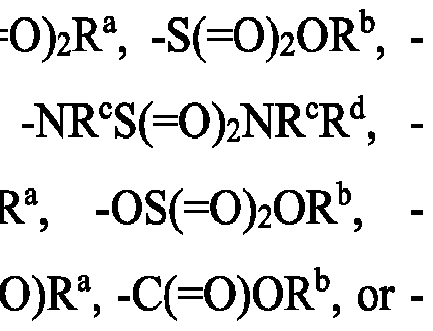 heterocyclyl, aryl, or heteroaryl is optionally substituted with one or more R11 and R12, together with the carbon atom to which they are attached, form C3-6 carbocyclyl or 3- to 6-membered heterocyclyl, wherein carbocyclyl or heterocyclyl is optionally substituted with one or more Ru; or R11 and R5, together with the intervening atoms, form 4- to 8-membered heterocyclyl optionally substituted with one or more Ru; and R13 is hydrogen, halogen, -CN, -NO2, -OH, -NH2, C1-6 alkyl, C1-6 alkoxy, C1-6 alkylamino, C2-6 alkenyl, C2-6 alkynyl, C3-12 carbocyclyl, 3- to 12-membered heterocyclyl, C6-10 aryl, or 5- to 10-membered heteroaryl, wherein the alkyl, alkoxy, alkylamino, alkenyl, alkynyl, carbocyclyl, heterocyclyl, aryl, or heteroaryl is optionally substituted with one or more Ru, wherein:
Attorney Docket No. PRSC-080/001WO 343170-2282 each Ru is independently oxo, halogen, -CN, -NO2, -OH, -NH2, C1-6 alkyl, C1-6 alkoxy, C1-6 alkylamino, C2-6 alkenyl, C2-6 alkynyl, C3-12 carbocyclyl, 3- to 12-membered heterocyclyl, C6-10 aryl, 5- to 10-membered heteroaryl, -SRb, -S(=O)Ra, - - S(=O)2NRcRd, -NRcS(=O)2Ra, -NRcS(=O)Ra, -NRcS(=O) - NRbC(=O)NRcRd, -NRbC(=O)Ra, -NRbC(=O)ORb, -OS - OS(=O)2NRcRd, -OC(=O)Ra, -OC(=O)ORb, -OC(=O)NRcRd, -C - C(=O)NRcRd; wherein the alkyl, alkoxy, alkylamino,
heterocyclyl, aryl, or heteroaryl is optionally substituted with one or more R11 and R12, together with the carbon atom to which they are attached, form C3-6 carbocyclyl or 3- to 6-membered heterocyclyl, wherein carbocyclyl or heterocyclyl is optionally substituted with one or more Ru; or R11 and R5, together with the intervening atoms, form 4- to 8-membered heterocyclyl optionally substituted with one or more Ru; and R13 is hydrogen, halogen, -CN, -NO2, -OH, -NH2, C1-6 alkyl, C1-6 alkoxy, C1-6 alkylamino, C2-6 alkenyl, C2-6 alkynyl, C3-12 carbocyclyl, 3- to 12-membered heterocyclyl, C6-10 aryl, or 5- to 10-membered heteroaryl, wherein the alkyl, alkoxy, alkylamino, alkenyl, alkynyl, carbocyclyl, heterocyclyl, aryl, or heteroaryl is optionally substituted with one or more Ru, wherein:
Attorney Docket No. PRSC-080/001WO 343170-2282 each Ru is independently oxo, halogen, -CN, -NO2, -OH, -NH2, C1-6 alkyl, C1-6 alkoxy, C1-6 alkylamino, C2-6 alkenyl, C2-6 alkynyl, C3-12 carbocyclyl, 3- to 12-membered heterocyclyl, C6-10 aryl, 5- to 10-membered heteroaryl, -SRb, -S(=O)Ra, - - S(=O)2NRcRd, -NRcS(=O)2Ra, -NRcS(=O)Ra, -NRcS(=O) - NRbC(=O)NRcRd, -NRbC(=O)Ra, -NRbC(=O)ORb, -OS - OS(=O)2NRcRd, -OC(=O)Ra, -OC(=O)ORb, -OC(=O)NRcRd, -C - C(=O)NRcRd; wherein the alkyl, alkoxy, alkylamino,
 heterocyclyl, aryl, or heteroaryl is optionally substituted with one or more substituents selected from oxo, halogen, -CN, -NO2, -OH, -NH2, C1-6 alkyl, C1-6 alkoxy, C1-6 alkylamino, C2-6 alkenyl, C2-6 alkynyl, C3-6 carbocyclyl, and 3- to 6-membered heterocyclyl; each Ra is independently C1-6 alkyl, C2-6 alkenyl, C2-6 alkynyl, C3-12 carbocyclyl, 3- to 12- membered heterocyclyl, C6-10 aryl, or 5- to 10-membered heteroaryl; each Rb is independently hydrogen, C1-6 alkyl, C2-6 alkenyl, C2-6 alkynyl, C3-12 carbocyclyl, 3- to 12-membered heterocyclyl, C6-10 aryl, or 5- to 10-membered heteroaryl; and each Rc and Rd is independently hydrogen, C1-6 alkyl, C2-6 alkenyl, C2-6 alkynyl, C3-12 carbocyclyl, 3- to 12-membered heterocyclyl, C6-10 aryl, or 5- to 10-membered heteroaryl; or Rc and Rd, together with the nitrogen atom to which they are attached, form 3- to 12-membered heterocyclyl, wherein each occurrence of Ra, Rb, Rc, and Rd is independently and optionally substituted with one or more Rz; and each Rz is independently oxo, halogen, -CN, -NO2, -OH, -NH2, C1-6 alkyl, C1-6 alkoxy, C1-6 alkylamino, C2-6 alkenyl, C2-6 alkynyl, C3-6 carbocyclyl, or 3- to 6-membered heterocyclyl. [0019] In certain embodiment, the compound is not (2-(((5S,8S,10aR)-3-acetyl-8-(((S)-5-amino-1-(2-chloro-3-(3-((5-((R)-1-((2S,4R)-2- (((S)-1-(4-ethynylphenyl)ethyl)carbamoyl)-4-hydroxypyrrolidin-1-yl)-3-methyl-1-oxobutan- 2-yl)isoxazol-3-yl)oxy)propyl)phenoxy)-5-oxopentan-2-yl)carbamoyl)-6- oxodecahydropyrrolo[1,2-a][1,5]diazocin-5-yl)carbamoyl)-1H-indole-5-carbonyl)phosphonic acid, (2-(((5S,8S,10aR)-3-acetyl-8-(((S)-5-amino-1-(2-chloro-3-(3-((5-((S)-1-((2S,4R)-4- hydroxy-2-(((S)-1-(4-(4-methylthiazol-5-yl)phenyl)ethyl)carbamoyl)pyrrolidin-1-yl)-3- methyl-1-oxobutan-2-yl)isoxazol-3-yl)oxy)propyl)phenoxy)-5-oxopentan-2-yl)carbamoyl)-6- oxodecahydropyrrolo[1,2-a][1,5]diazocin-5-yl)carbamoyl)-1H-indole-5-carbonyl)phosphonic acid,
Attorney Docket No. PRSC-080/001WO 343170-2282 (2-(((5S,8S,10aR)-3-acetyl-8-(((S)-5-amino-1-(2-chloro-3-(3-((5-((R)-1-((2S,4R)-2- ((4-ethynylbenzyl)carbamoyl)-4-hydroxypyrrolidin-1-yl)-3-methyl-1-oxobutan-2-yl)isoxazol- 3-yl)oxy)propyl)phenoxy)-5-oxopentan-2-yl)carbamoyl)-6-oxodecahydropyrrolo[1,2- a][1,5]diazocin-5-yl)carbamoyl)-1H-indole-5-carbonyl)phosphonic acid, (2-(((5S,8S,10aR)-3-acetyl-8-(((S)-5-amino-1-(3-(3-((5-((R)-1-((2S,4R)-2-(((S)-1-(4- ethynylphenyl)ethyl)carbamoyl)-4-hydroxypyrrolidin-1-yl)-3-methyl-1-oxobutan-2- yl)isoxazol-3-yl)oxy)propyl)-2-fluorophenoxy)-5-oxopentan-2-yl)carbamoyl)-6- oxodecahydropyrrolo[1,2-a][1,5]diazocin-5-yl)carbamoyl)-1H-indole-5-carbonyl)phosphonic acid, (2-(((5S,8S,10aR)-3-acetyl-8-(((S)-5-amino-1-(3-(3-((5-((R)-1-((2S,4R)-2-((4- ethynylbenzyl)carbamoyl)-4-hydroxypyrrolidin-1-yl)-3-methyl-1-oxobutan-2-yl)isoxazol-3- yl)oxy)propyl)-2-fluorophenoxy)-5-oxopentan-2-yl)carbamoyl)-6-oxodecahydropyrrolo[1,2- a][1,5]diazocin-5-yl)carbamoyl)-1H-indole-5-carbonyl)phosphonic acid, (2-(((5S,8S,10aR)-3-acetyl-8-(((S)-5-amino-1-(3-(3-((5-((R)-1-((2S,4R)-2-(((S)-1-(4- ethynylphenyl)ethyl)carbamoyl)-4-hydroxypyrrolidin-1-yl)-3-methyl-1-oxobutan-2- yl)isoxazol-3-yl)oxy)propyl)-2-methylphenoxy)-5-oxopentan-2-yl)carbamoyl)-6- oxodecahydropyrrolo[1,2-a][1,5]diazocin-5-yl)carbamoyl)-1H-indole-5-carbonyl)phosphonic acid, (2-(((5S,8S,10aR)-3-acetyl-8-(((S)-5-amino-1-(3-(3-((5-((S)-1-((2S,4R)-2-(((S)-1-(4- ethynylphenyl)ethyl)carbamoyl)-4-hydroxypyrrolidin-1-yl)-3-methyl-1-oxobutan-2- yl)isoxazol-3-yl)oxy)propyl)-2-methylphenoxy)-5-oxopentan-2-yl)carbamoyl)-6- oxodecahydropyrrolo[1,2-a][1,5]diazocin-5-yl)carbamoyl)-1H-indole-5-carbonyl)phosphonic acid, (2-(((5S,8S,10aR)-3-acetyl-8-(((S)-5-amino-1-(3-(3-((5-((R)-1-((2S,4R)-2-((4- ethynylbenzyl)carbamoyl)-4-hydroxypyrrolidin-1-yl)-3-methyl-1-oxobutan-2-yl)isoxazol-3- yl)oxy)propyl)-2-methylphenoxy)-5-oxopentan-2-yl)carbamoyl)-6-oxodecahydropyrrolo[1,2- a][1,5]diazocin-5-yl)carbamoyl)-1H-indole-5-carbonyl)phosphonic acid, (2-(((5S,8S,10aR)-3-acetyl-8-(((S)-5-amino-1-(2-fluoro-3-(3-((5-((R)-1-((2S,4R)-4- hydroxy-2-(((S)-1-(4-(4-methylthiazol-5-yl)phenyl)ethyl)carbamoyl)pyrrolidin-1-yl)-3- methyl-1-oxobutan-2-yl)isoxazol-3-yl)oxy)propyl)phenoxy)-5-oxopentan-2-yl)carbamoyl)-6- oxodecahydropyrrolo[1,2-a][1,5]diazocin-5-yl)carbamoyl)-1H-indole-5-carbonyl)phosphonic acid, (2-(((5S,8S,10aR)-3-acetyl-8-(((S)-5-amino-1-(2-fluoro-3-(3-((5-((S)-1-((2S,4R)-4- hydroxy-2-(((S)-1-(4-(4-methylthiazol-5-yl)phenyl)ethyl)carbamoyl)pyrrolidin-1-yl)-3-
Attorney Docket No. PRSC-080/001WO 343170-2282 methyl-1-oxobutan-2-yl)isoxazol-3-yl)oxy)propyl)phenoxy)-5-oxopentan-2-yl)carbamoyl)-6- oxodecahydropyrrolo[1,2-a][1,5]diazocin-5-yl)carbamoyl)-1H-indole-5-carbonyl)phosphonic acid, (2-(((5S,8S,10aR)-3-acetyl-8-(((S)-5-amino-1-(2-fluoro-3-(3-((5-((R)-1-((2S,4R)-4- hydroxy-2-((4-(4-methylthiazol-5-yl)benzyl)carbamoyl)pyrrolidin-1-yl)-3-methyl-1- oxobutan-2-yl)isoxazol-3-yl)oxy)propyl)phenoxy)-5-oxopentan-2-yl)carbamoyl)-6- oxodecahydropyrrolo[1,2-a][1,5]diazocin-5-yl)carbamoyl)-1H-indole-5-carbonyl)phosphonic acid, (2-(((5S,8S,10aR)-3-acetyl-8-(((S)-5-amino-1-(2-fluoro-3-(3-((5-((S)-1-((2S,4R)-4- hydroxy-2-((4-(4-methylthiazol-5-yl)benzyl)carbamoyl)pyrrolidin-1-yl)-3-methyl-1- oxobutan-2-yl)isoxazol-3-yl)oxy)propyl)phenoxy)-5-oxopentan-2-yl)carbamoyl)-6- oxodecahydropyrrolo[1,2-a][1,5]diazocin-5-yl)carbamoyl)-1H-indole-5-carbonyl)phosphonic acid, (2-(((5S,8S,10aR)-3-acetyl-8-(((S)-5-amino-1-(3-(3-((5-((R)-1-((2S,4R)-4-hydroxy-2- (((S)-1-(4-(4-methylthiazol-5-yl)phenyl)ethyl)carbamoyl)pyrrolidin-1-yl)-3-methyl-1- oxobutan-2-yl)isoxazol-3-yl)oxy)propyl)-2-methylphenoxy)-5-oxopentan-2-yl)carbamoyl)-6- oxodecahydropyrrolo[1,2-a][1,5]diazocin-5-yl)carbamoyl)-1H-indole-5-carbonyl)phosphonic acid, (2-(((5S,8S,10aR)-3-acetyl-8-(((S)-5-amino-1-(3-(3-((5-((S)-1-((2S,4R)-4-hydroxy-2- (((S)-1-(4-(4-methylthiazol-5-yl)phenyl)ethyl)carbamoyl)pyrrolidin-1-yl)-3-methyl-1- oxobutan-2-yl)isoxazol-3-yl)oxy)propyl)-2-methylphenoxy)-5-oxopentan-2-yl)carbamoyl)-6- oxodecahydropyrrolo[1,2-a][1,5]diazocin-5-yl)carbamoyl)-1H-indole-5-carbonyl)phosphonic acid, (2-(((5S,8S,10aR)-3-acetyl-8-(((S)-5-amino-1-(3-(3-((5-((R)-1-((2S,4R)-4-hydroxy-2- ((4-(4-methylthiazol-5-yl)benzyl)carbamoyl)pyrrolidin-1-yl)-3-methyl-1-oxobutan-2- yl)isoxazol-3-yl)oxy)propyl)-2-methylphenoxy)-5-oxopentan-2-yl)carbamoyl)-6- oxodecahydropyrrolo[1,2-a][1,5]diazocin-5-yl)carbamoyl)-1H-indole-5-carbonyl)phosphonic acid, (2-(((5S,8S,10aR)-3-acetyl-8-(((S)-5-amino-1-(3-(3-((5-((S)-1-((2S,4R)-4-hydroxy-2- ((4-(4-methylthiazol-5-yl)benzyl)carbamoyl)pyrrolidin-1-yl)-3-methyl-1-oxobutan-2- yl)isoxazol-3-yl)oxy)propyl)-2-methylphenoxy)-5-oxopentan-2-yl)carbamoyl)-6- oxodecahydropyrrolo[1,2-a][1,5]diazocin-5-yl)carbamoyl)-1H-indole-5-carbonyl)phosphonic acid,
Attorney Docket No. PRSC-080/001WO 343170-2282 (2-(((5S,8S,10aR)-3-acetyl-8-(((S)-5-amino-1-(2-chloro-3-(3-((5-((R)-1-((2S,4R)-4- hydroxy-2-(((S)-1-(4-(4-methylthiazol-5-yl)phenyl)ethyl)carbamoyl)pyrrolidin-1-yl)-3- methyl-1-oxobutan-2-yl)isoxazol-3-yl)oxy)propyl)phenoxy)-5-oxopentan-2-yl)carbamoyl)-6- oxodecahydropyrrolo[1,2-a][1,5]diazocin-5-yl)carbamoyl)-1H-indole-5-carbonyl)phosphonic acid, diethyl (2-(((5S,8S,10aR)-3-acetyl-8-(((S)-5-amino-1-(2-chloro-3-(3-((5-((R)-1- ((2S,4R)-4-hydroxy-2-(((S)-1-(4-(4-methylthiazol-5-yl)phenyl)ethyl)carbamoyl)pyrrolidin-1- yl)-3-methyl-1-oxobutan-2-yl)isoxazol-3-yl)oxy)propyl)phenoxy)-5-oxopentan-2- yl)carbamoyl)-6-oxodecahydropyrrolo[1,2-a][1,5]diazocin-5-yl)carbamoyl)-1H-indole-6- carbonyl)phosphonate, diethyl (2-(((5S,8R,10aS)-3-acetyl-8-(((S)-5-amino-1-(2-chloro-3-(3-((5-((R)-1- ((2S,4R)-4-hydroxy-2-((4-(4-methylthiazol-5-yl)benzyl)carbamoyl)pyrrolidin-1-yl)-3- methyl-1-oxobutan-2-yl)isoxazol-3-yl)oxy)propyl)phenoxy)-5-oxopentan-2-yl)carbamoyl)-6- oxodecahydropyrrolo[1,2-a][1,5]diazocin-5-yl)carbamoyl)-1H-indole-6- carbonyl)phosphonate, or diethyl (2-(((4S,7R)-2-acetyl-7-(((S)-5-amino-1-(2-chloro-3-(3-((5-((R)-1-((2S,4R)-4- hydroxy-2-((4-(4-methylthiazol-5-yl)benzyl)carbamoyl)pyrrolidin-1-yl)-3-methyl-1- oxobutan-2-yl)isoxazol-3-yl)oxy)propyl)phenoxy)-5-oxopentan-2-yl)carbamoyl)-5-oxo- 2,3,4,5,7,8-hexahydro-1H-[1,5]diazocino[3,2,1-hi]indol-4-yl)carbamoyl)-1H-indole-6- carbonyl)phosphonate. [0020] In certain embbodiments, the present disclosure provides compounds of Formula I: T-L-V (I), and pharmaceutically acceptable salts, solvates, or stereoisomers thereof, wherein: V is of Formula I-1 , wherein: Ring A is 5- to 7-
heterocyclyl, aryl, or heteroaryl is optionally substituted with one or more substituents selected from oxo, halogen, -CN, -NO2, -OH, -NH2, C1-6 alkyl, C1-6 alkoxy, C1-6 alkylamino, C2-6 alkenyl, C2-6 alkynyl, C3-6 carbocyclyl, and 3- to 6-membered heterocyclyl; each Ra is independently C1-6 alkyl, C2-6 alkenyl, C2-6 alkynyl, C3-12 carbocyclyl, 3- to 12- membered heterocyclyl, C6-10 aryl, or 5- to 10-membered heteroaryl; each Rb is independently hydrogen, C1-6 alkyl, C2-6 alkenyl, C2-6 alkynyl, C3-12 carbocyclyl, 3- to 12-membered heterocyclyl, C6-10 aryl, or 5- to 10-membered heteroaryl; and each Rc and Rd is independently hydrogen, C1-6 alkyl, C2-6 alkenyl, C2-6 alkynyl, C3-12 carbocyclyl, 3- to 12-membered heterocyclyl, C6-10 aryl, or 5- to 10-membered heteroaryl; or Rc and Rd, together with the nitrogen atom to which they are attached, form 3- to 12-membered heterocyclyl, wherein each occurrence of Ra, Rb, Rc, and Rd is independently and optionally substituted with one or more Rz; and each Rz is independently oxo, halogen, -CN, -NO2, -OH, -NH2, C1-6 alkyl, C1-6 alkoxy, C1-6 alkylamino, C2-6 alkenyl, C2-6 alkynyl, C3-6 carbocyclyl, or 3- to 6-membered heterocyclyl. [0019] In certain embodiment, the compound is not (2-(((5S,8S,10aR)-3-acetyl-8-(((S)-5-amino-1-(2-chloro-3-(3-((5-((R)-1-((2S,4R)-2- (((S)-1-(4-ethynylphenyl)ethyl)carbamoyl)-4-hydroxypyrrolidin-1-yl)-3-methyl-1-oxobutan- 2-yl)isoxazol-3-yl)oxy)propyl)phenoxy)-5-oxopentan-2-yl)carbamoyl)-6- oxodecahydropyrrolo[1,2-a][1,5]diazocin-5-yl)carbamoyl)-1H-indole-5-carbonyl)phosphonic acid, (2-(((5S,8S,10aR)-3-acetyl-8-(((S)-5-amino-1-(2-chloro-3-(3-((5-((S)-1-((2S,4R)-4- hydroxy-2-(((S)-1-(4-(4-methylthiazol-5-yl)phenyl)ethyl)carbamoyl)pyrrolidin-1-yl)-3- methyl-1-oxobutan-2-yl)isoxazol-3-yl)oxy)propyl)phenoxy)-5-oxopentan-2-yl)carbamoyl)-6- oxodecahydropyrrolo[1,2-a][1,5]diazocin-5-yl)carbamoyl)-1H-indole-5-carbonyl)phosphonic acid,
Attorney Docket No. PRSC-080/001WO 343170-2282 (2-(((5S,8S,10aR)-3-acetyl-8-(((S)-5-amino-1-(2-chloro-3-(3-((5-((R)-1-((2S,4R)-2- ((4-ethynylbenzyl)carbamoyl)-4-hydroxypyrrolidin-1-yl)-3-methyl-1-oxobutan-2-yl)isoxazol- 3-yl)oxy)propyl)phenoxy)-5-oxopentan-2-yl)carbamoyl)-6-oxodecahydropyrrolo[1,2- a][1,5]diazocin-5-yl)carbamoyl)-1H-indole-5-carbonyl)phosphonic acid, (2-(((5S,8S,10aR)-3-acetyl-8-(((S)-5-amino-1-(3-(3-((5-((R)-1-((2S,4R)-2-(((S)-1-(4- ethynylphenyl)ethyl)carbamoyl)-4-hydroxypyrrolidin-1-yl)-3-methyl-1-oxobutan-2- yl)isoxazol-3-yl)oxy)propyl)-2-fluorophenoxy)-5-oxopentan-2-yl)carbamoyl)-6- oxodecahydropyrrolo[1,2-a][1,5]diazocin-5-yl)carbamoyl)-1H-indole-5-carbonyl)phosphonic acid, (2-(((5S,8S,10aR)-3-acetyl-8-(((S)-5-amino-1-(3-(3-((5-((R)-1-((2S,4R)-2-((4- ethynylbenzyl)carbamoyl)-4-hydroxypyrrolidin-1-yl)-3-methyl-1-oxobutan-2-yl)isoxazol-3- yl)oxy)propyl)-2-fluorophenoxy)-5-oxopentan-2-yl)carbamoyl)-6-oxodecahydropyrrolo[1,2- a][1,5]diazocin-5-yl)carbamoyl)-1H-indole-5-carbonyl)phosphonic acid, (2-(((5S,8S,10aR)-3-acetyl-8-(((S)-5-amino-1-(3-(3-((5-((R)-1-((2S,4R)-2-(((S)-1-(4- ethynylphenyl)ethyl)carbamoyl)-4-hydroxypyrrolidin-1-yl)-3-methyl-1-oxobutan-2- yl)isoxazol-3-yl)oxy)propyl)-2-methylphenoxy)-5-oxopentan-2-yl)carbamoyl)-6- oxodecahydropyrrolo[1,2-a][1,5]diazocin-5-yl)carbamoyl)-1H-indole-5-carbonyl)phosphonic acid, (2-(((5S,8S,10aR)-3-acetyl-8-(((S)-5-amino-1-(3-(3-((5-((S)-1-((2S,4R)-2-(((S)-1-(4- ethynylphenyl)ethyl)carbamoyl)-4-hydroxypyrrolidin-1-yl)-3-methyl-1-oxobutan-2- yl)isoxazol-3-yl)oxy)propyl)-2-methylphenoxy)-5-oxopentan-2-yl)carbamoyl)-6- oxodecahydropyrrolo[1,2-a][1,5]diazocin-5-yl)carbamoyl)-1H-indole-5-carbonyl)phosphonic acid, (2-(((5S,8S,10aR)-3-acetyl-8-(((S)-5-amino-1-(3-(3-((5-((R)-1-((2S,4R)-2-((4- ethynylbenzyl)carbamoyl)-4-hydroxypyrrolidin-1-yl)-3-methyl-1-oxobutan-2-yl)isoxazol-3- yl)oxy)propyl)-2-methylphenoxy)-5-oxopentan-2-yl)carbamoyl)-6-oxodecahydropyrrolo[1,2- a][1,5]diazocin-5-yl)carbamoyl)-1H-indole-5-carbonyl)phosphonic acid, (2-(((5S,8S,10aR)-3-acetyl-8-(((S)-5-amino-1-(2-fluoro-3-(3-((5-((R)-1-((2S,4R)-4- hydroxy-2-(((S)-1-(4-(4-methylthiazol-5-yl)phenyl)ethyl)carbamoyl)pyrrolidin-1-yl)-3- methyl-1-oxobutan-2-yl)isoxazol-3-yl)oxy)propyl)phenoxy)-5-oxopentan-2-yl)carbamoyl)-6- oxodecahydropyrrolo[1,2-a][1,5]diazocin-5-yl)carbamoyl)-1H-indole-5-carbonyl)phosphonic acid, (2-(((5S,8S,10aR)-3-acetyl-8-(((S)-5-amino-1-(2-fluoro-3-(3-((5-((S)-1-((2S,4R)-4- hydroxy-2-(((S)-1-(4-(4-methylthiazol-5-yl)phenyl)ethyl)carbamoyl)pyrrolidin-1-yl)-3-
Attorney Docket No. PRSC-080/001WO 343170-2282 methyl-1-oxobutan-2-yl)isoxazol-3-yl)oxy)propyl)phenoxy)-5-oxopentan-2-yl)carbamoyl)-6- oxodecahydropyrrolo[1,2-a][1,5]diazocin-5-yl)carbamoyl)-1H-indole-5-carbonyl)phosphonic acid, (2-(((5S,8S,10aR)-3-acetyl-8-(((S)-5-amino-1-(2-fluoro-3-(3-((5-((R)-1-((2S,4R)-4- hydroxy-2-((4-(4-methylthiazol-5-yl)benzyl)carbamoyl)pyrrolidin-1-yl)-3-methyl-1- oxobutan-2-yl)isoxazol-3-yl)oxy)propyl)phenoxy)-5-oxopentan-2-yl)carbamoyl)-6- oxodecahydropyrrolo[1,2-a][1,5]diazocin-5-yl)carbamoyl)-1H-indole-5-carbonyl)phosphonic acid, (2-(((5S,8S,10aR)-3-acetyl-8-(((S)-5-amino-1-(2-fluoro-3-(3-((5-((S)-1-((2S,4R)-4- hydroxy-2-((4-(4-methylthiazol-5-yl)benzyl)carbamoyl)pyrrolidin-1-yl)-3-methyl-1- oxobutan-2-yl)isoxazol-3-yl)oxy)propyl)phenoxy)-5-oxopentan-2-yl)carbamoyl)-6- oxodecahydropyrrolo[1,2-a][1,5]diazocin-5-yl)carbamoyl)-1H-indole-5-carbonyl)phosphonic acid, (2-(((5S,8S,10aR)-3-acetyl-8-(((S)-5-amino-1-(3-(3-((5-((R)-1-((2S,4R)-4-hydroxy-2- (((S)-1-(4-(4-methylthiazol-5-yl)phenyl)ethyl)carbamoyl)pyrrolidin-1-yl)-3-methyl-1- oxobutan-2-yl)isoxazol-3-yl)oxy)propyl)-2-methylphenoxy)-5-oxopentan-2-yl)carbamoyl)-6- oxodecahydropyrrolo[1,2-a][1,5]diazocin-5-yl)carbamoyl)-1H-indole-5-carbonyl)phosphonic acid, (2-(((5S,8S,10aR)-3-acetyl-8-(((S)-5-amino-1-(3-(3-((5-((S)-1-((2S,4R)-4-hydroxy-2- (((S)-1-(4-(4-methylthiazol-5-yl)phenyl)ethyl)carbamoyl)pyrrolidin-1-yl)-3-methyl-1- oxobutan-2-yl)isoxazol-3-yl)oxy)propyl)-2-methylphenoxy)-5-oxopentan-2-yl)carbamoyl)-6- oxodecahydropyrrolo[1,2-a][1,5]diazocin-5-yl)carbamoyl)-1H-indole-5-carbonyl)phosphonic acid, (2-(((5S,8S,10aR)-3-acetyl-8-(((S)-5-amino-1-(3-(3-((5-((R)-1-((2S,4R)-4-hydroxy-2- ((4-(4-methylthiazol-5-yl)benzyl)carbamoyl)pyrrolidin-1-yl)-3-methyl-1-oxobutan-2- yl)isoxazol-3-yl)oxy)propyl)-2-methylphenoxy)-5-oxopentan-2-yl)carbamoyl)-6- oxodecahydropyrrolo[1,2-a][1,5]diazocin-5-yl)carbamoyl)-1H-indole-5-carbonyl)phosphonic acid, (2-(((5S,8S,10aR)-3-acetyl-8-(((S)-5-amino-1-(3-(3-((5-((S)-1-((2S,4R)-4-hydroxy-2- ((4-(4-methylthiazol-5-yl)benzyl)carbamoyl)pyrrolidin-1-yl)-3-methyl-1-oxobutan-2- yl)isoxazol-3-yl)oxy)propyl)-2-methylphenoxy)-5-oxopentan-2-yl)carbamoyl)-6- oxodecahydropyrrolo[1,2-a][1,5]diazocin-5-yl)carbamoyl)-1H-indole-5-carbonyl)phosphonic acid,
Attorney Docket No. PRSC-080/001WO 343170-2282 (2-(((5S,8S,10aR)-3-acetyl-8-(((S)-5-amino-1-(2-chloro-3-(3-((5-((R)-1-((2S,4R)-4- hydroxy-2-(((S)-1-(4-(4-methylthiazol-5-yl)phenyl)ethyl)carbamoyl)pyrrolidin-1-yl)-3- methyl-1-oxobutan-2-yl)isoxazol-3-yl)oxy)propyl)phenoxy)-5-oxopentan-2-yl)carbamoyl)-6- oxodecahydropyrrolo[1,2-a][1,5]diazocin-5-yl)carbamoyl)-1H-indole-5-carbonyl)phosphonic acid, diethyl (2-(((5S,8S,10aR)-3-acetyl-8-(((S)-5-amino-1-(2-chloro-3-(3-((5-((R)-1- ((2S,4R)-4-hydroxy-2-(((S)-1-(4-(4-methylthiazol-5-yl)phenyl)ethyl)carbamoyl)pyrrolidin-1- yl)-3-methyl-1-oxobutan-2-yl)isoxazol-3-yl)oxy)propyl)phenoxy)-5-oxopentan-2- yl)carbamoyl)-6-oxodecahydropyrrolo[1,2-a][1,5]diazocin-5-yl)carbamoyl)-1H-indole-6- carbonyl)phosphonate, diethyl (2-(((5S,8R,10aS)-3-acetyl-8-(((S)-5-amino-1-(2-chloro-3-(3-((5-((R)-1- ((2S,4R)-4-hydroxy-2-((4-(4-methylthiazol-5-yl)benzyl)carbamoyl)pyrrolidin-1-yl)-3- methyl-1-oxobutan-2-yl)isoxazol-3-yl)oxy)propyl)phenoxy)-5-oxopentan-2-yl)carbamoyl)-6- oxodecahydropyrrolo[1,2-a][1,5]diazocin-5-yl)carbamoyl)-1H-indole-6- carbonyl)phosphonate, or diethyl (2-(((4S,7R)-2-acetyl-7-(((S)-5-amino-1-(2-chloro-3-(3-((5-((R)-1-((2S,4R)-4- hydroxy-2-((4-(4-methylthiazol-5-yl)benzyl)carbamoyl)pyrrolidin-1-yl)-3-methyl-1- oxobutan-2-yl)isoxazol-3-yl)oxy)propyl)phenoxy)-5-oxopentan-2-yl)carbamoyl)-5-oxo- 2,3,4,5,7,8-hexahydro-1H-[1,5]diazocino[3,2,1-hi]indol-4-yl)carbamoyl)-1H-indole-6- carbonyl)phosphonate. [0020] In certain embbodiments, the present disclosure provides compounds of Formula I: T-L-V (I), and pharmaceutically acceptable salts, solvates, or stereoisomers thereof, wherein: V is of Formula I-1 , wherein: Ring A is 5- to 7-
 each RA is independently oxo, halogen, -CN, -NO2, -OH, -NH2, C1-6 alkyl, C1-6 alkoxy, C1-6 alkylamino, C2-6 alkenyl, C2-6 alkynyl, C3-12 carbocyclyl, 3- to 12-membered heterocyclyl, C6-10 aryl, or 5- to 10-membered heteroaryl, wherein the alkyl, alkoxy, alkylamino, alkenyl,
Attorney Docket No. PRSC-080/001WO 343170-2282 alkynyl, carbocyclyl, heterocyclyl, aryl, or heteroaryl is optionally substituted with one or more Ru; a is an integer selected from 0 to 10, as valency permits; Ring C is C6 aryl or 5- to 6-membered heteroaryl; each RC is independently , halogen, -CN, -NO2, -OH, -NH2, C1-6 alkyl, C1-6 alkoxy, C1-6 alkylamino, C2-6 alkenyl, C2-6 alkynyl, C3-12 carbocyclyl, 3- to 12-membered heterocyclyl, C6-10 aryl, or 5- to 10-membered heteroaryl, wherein the alkyl, alkoxy, alkylamino, alkenyl, alkynyl, carbocyclyl, heterocyclyl, aryl, or heteroaryl is optionally substituted with one or more Ru; ** denotes attachment to L; c is an integer selected from 0 to 5, as valency permits; Ring D’ is C6 aryl or 5- to 6-membered heteroaryl; each RD is independently halogen, -CN, -NO2, -OH, -NH2, C1-6 alkyl, C1-6 alkoxy, C1-6 alkylamino, C2-6 alkenyl, C2-6 alkynyl, C3-12 carbocyclyl, 3- to 12-membered heterocyclyl, C6-10 aryl, or 5- to 10-membered heteroaryl, wherein the alkyl, alkoxy, alkylamino, alkenyl, alkynyl, carbocyclyl, heterocyclyl, aryl, or heteroaryl is optionally substituted with one or more Ru; d is an integer selected from 0 to 4; RV2 is hydrogen or C1-6 alkyl optionally substituted with one or more Ru; RV2 is C3-12 carbocyclyl or 3- to 12-membered heterocyclyl, wherein the carbocyclyl or heterocyclyl is attached to L and optionally substituted with one or more Ru; or one RC and RV2, together with the intervening atoms, form C3-12 carbocyclyl or 3- to 12- membered heterocyclyl, wherein the carbocyclyl or heterocyclyl is optionally substituted with one or more Ru; RV3 is hydrogen, C1-6 alkyl, C3-6 carbocyclyl, 3- to 6-membered heterocyclyl, -S(=O)2Ra, - S(=O)2ORb, -S(=O)2NRcRd, -C(=O)Ra, -C(=O)ORb, or -C(=O)NRcRd; wherein the alkyl, carbocyclyl, or heterocyclyl is optionally substituted with one or more Ru; RV4 is hydrogen, C1-6 alkyl, C1-8 heteroalkyl, wherein the alkyl or heteroalkyl is optionally substituted with one or more Ru; and RV5 is hydrogen, halogen, -CN, -NO2, -OH, -NH2, C1-6 alkyl, C1-6 alkoxy, C1-6 alkylamino, C2- 6 alkenyl, C2-6 alkynyl, C3-12 carbocyclyl, 3- to 12-membered heterocyclyl, C6-10 aryl, or 5- to 10-membered heteroaryl, wherein the alkyl, alkoxy, alkylamino, alkenyl, alkynyl, carbocyclyl, heterocyclyl, aryl, or heteroaryl is optionally substituted with one or more Ru,
Attorney Docket No. PRSC-080/001WO 343170-2282 L is of Formula I-2 ,
each RA is independently oxo, halogen, -CN, -NO2, -OH, -NH2, C1-6 alkyl, C1-6 alkoxy, C1-6 alkylamino, C2-6 alkenyl, C2-6 alkynyl, C3-12 carbocyclyl, 3- to 12-membered heterocyclyl, C6-10 aryl, or 5- to 10-membered heteroaryl, wherein the alkyl, alkoxy, alkylamino, alkenyl,
Attorney Docket No. PRSC-080/001WO 343170-2282 alkynyl, carbocyclyl, heterocyclyl, aryl, or heteroaryl is optionally substituted with one or more Ru; a is an integer selected from 0 to 10, as valency permits; Ring C is C6 aryl or 5- to 6-membered heteroaryl; each RC is independently , halogen, -CN, -NO2, -OH, -NH2, C1-6 alkyl, C1-6 alkoxy, C1-6 alkylamino, C2-6 alkenyl, C2-6 alkynyl, C3-12 carbocyclyl, 3- to 12-membered heterocyclyl, C6-10 aryl, or 5- to 10-membered heteroaryl, wherein the alkyl, alkoxy, alkylamino, alkenyl, alkynyl, carbocyclyl, heterocyclyl, aryl, or heteroaryl is optionally substituted with one or more Ru; ** denotes attachment to L; c is an integer selected from 0 to 5, as valency permits; Ring D’ is C6 aryl or 5- to 6-membered heteroaryl; each RD is independently halogen, -CN, -NO2, -OH, -NH2, C1-6 alkyl, C1-6 alkoxy, C1-6 alkylamino, C2-6 alkenyl, C2-6 alkynyl, C3-12 carbocyclyl, 3- to 12-membered heterocyclyl, C6-10 aryl, or 5- to 10-membered heteroaryl, wherein the alkyl, alkoxy, alkylamino, alkenyl, alkynyl, carbocyclyl, heterocyclyl, aryl, or heteroaryl is optionally substituted with one or more Ru; d is an integer selected from 0 to 4; RV2 is hydrogen or C1-6 alkyl optionally substituted with one or more Ru; RV2 is C3-12 carbocyclyl or 3- to 12-membered heterocyclyl, wherein the carbocyclyl or heterocyclyl is attached to L and optionally substituted with one or more Ru; or one RC and RV2, together with the intervening atoms, form C3-12 carbocyclyl or 3- to 12- membered heterocyclyl, wherein the carbocyclyl or heterocyclyl is optionally substituted with one or more Ru; RV3 is hydrogen, C1-6 alkyl, C3-6 carbocyclyl, 3- to 6-membered heterocyclyl, -S(=O)2Ra, - S(=O)2ORb, -S(=O)2NRcRd, -C(=O)Ra, -C(=O)ORb, or -C(=O)NRcRd; wherein the alkyl, carbocyclyl, or heterocyclyl is optionally substituted with one or more Ru; RV4 is hydrogen, C1-6 alkyl, C1-8 heteroalkyl, wherein the alkyl or heteroalkyl is optionally substituted with one or more Ru; and RV5 is hydrogen, halogen, -CN, -NO2, -OH, -NH2, C1-6 alkyl, C1-6 alkoxy, C1-6 alkylamino, C2- 6 alkenyl, C2-6 alkynyl, C3-12 carbocyclyl, 3- to 12-membered heterocyclyl, C6-10 aryl, or 5- to 10-membered heteroaryl, wherein the alkyl, alkoxy, alkylamino, alkenyl, alkynyl, carbocyclyl, heterocyclyl, aryl, or heteroaryl is optionally substituted with one or more Ru,
Attorney Docket No. PRSC-080/001WO 343170-2282 L is of Formula I-2 ,
 wherein: * denotes attachment to T and ** denotes attachment to V; each L’ is independently C1-6 alkylene, C1-6 heteroalkylene, C2-6 alkenylene, C2-6 alkynylene, C3-12 carbocyclylene, 3- to 12-membered heterocyclylene, C6-10 arylene, 5- to 10-membered heteroarylene, -C(=O)-, -C(=O)N(RL’)-, -C(=O)O-, -N(RL’)-, -O-, -S-, or -S(=O)2-, wherein the alkylene, alkenylene, carbocyclylene, heterocyclylene, arylene, or heteroarylene is optionally substituted with one or more Ru; each occurrence of RL’ is independently hydrogen, C1-6 alkyl, C2-6 alkenyl, C2-6 alkynyl, C3-12 carbocyclyl, 3- to 12-membered heterocyclyl, C6-10 aryl, 5- to 10-membered heteroaryl, - S(=O)2Ra, -S(=O)2ORb, -S(=O)2NRcRd, -C(=O)Ra, -C(=O)ORb, or -C(=O)NRcRd, wherein the alkyl, alkenyl, alkynyl, carbocyclyl, heterocyclyl, aryl, or heteroaryl is optionally substituted with one or more Ru; and l is an integer selected from 0 to 6, T is of Formula I-3 3), wherein: R1a and R1b are
 with one or more Ru; R2a and R2b are independently hydrogen or halogen; R2a and R2b together an oxo; or R2a and R2b, together with the carbon atom to which they are attached, form a C3-6 carbocycle or 3- to 6-membered heterocycle, wherein the carbocycle or heterocycle is optionally substituted with one or more Ru; Ring A’ is C6-10 aryl or 5- to 10-membered heteroaryl;
Attorney Docket No. PRSC-080/001WO 343170-2282 each RA’ is independently halogen, -CN, -NO2, -OH, -NH2, C1-6 alkyl, C1-6 alkoxy, C1-6 alkylamino, C2-6 alkenyl, C2-6 alkynyl, C3-12 carbocyclyl, 3- to 12-membered heterocyclyl, C6-10 aryl, 5- to 10-membered heteroaryl, -SRb, -S(=O)Ra, - - S(=O)2NRcRd, -NRcS(=O)2Ra, -NRcS(=O)Ra, -NRcS(=O) - NRbC(=O)NRcRd, -NRbC(=O)Ra, -NRbC(=O)ORb, -OS - OS(=O)2NRcRd, -OC(=O)Ra, -OC(=O)ORb, -OC(=O)NRcRd, -C - C(=O)NRcRd, wherein the alkyl, alkoxy, alkylamino,
with one or more Ru; R2a and R2b are independently hydrogen or halogen; R2a and R2b together an oxo; or R2a and R2b, together with the carbon atom to which they are attached, form a C3-6 carbocycle or 3- to 6-membered heterocycle, wherein the carbocycle or heterocycle is optionally substituted with one or more Ru; Ring A’ is C6-10 aryl or 5- to 10-membered heteroaryl;
Attorney Docket No. PRSC-080/001WO 343170-2282 each RA’ is independently halogen, -CN, -NO2, -OH, -NH2, C1-6 alkyl, C1-6 alkoxy, C1-6 alkylamino, C2-6 alkenyl, C2-6 alkynyl, C3-12 carbocyclyl, 3- to 12-membered heterocyclyl, C6-10 aryl, 5- to 10-membered heteroaryl, -SRb, -S(=O)Ra, - - S(=O)2NRcRd, -NRcS(=O)2Ra, -NRcS(=O)Ra, -NRcS(=O) - NRbC(=O)NRcRd, -NRbC(=O)Ra, -NRbC(=O)ORb, -OS - OS(=O)2NRcRd, -OC(=O)Ra, -OC(=O)ORb, -OC(=O)NRcRd, -C - C(=O)NRcRd, wherein the alkyl, alkoxy, alkylamino,
 heterocyclyl, aryl, or heteroaryl is optionally substituted with one or more Ru; a’ is an integer selected from 0 to 6, as valency permits; R3 is hydrogen, C1-6 alkyl, C2-6 alkenyl, C2-6 alkynyl, C3-12 carbocyclyl, 3- to 12-membered heterocyclyl, C6-10 aryl, 5- to 10-membered heteroaryl, -S(=O)2Ra, -S(=O)2ORb, - S(=O)2NRcRd, -C(=O)Ra, -C(=O)ORb, or -C(=O)NRcRd, wherein the alkyl, alkenyl, alkynyl, carbocyclyl, heterocyclyl, aryl, or heteroaryl is optionally substituted with one or more Ru; Ring B’ is 3- to 12-membered heterocycle; each RB’ is independently , oxo, halogen, -CN, -NO2, -OH, -NH2, C1-6 alkyl, C1-12 heteroalkyl, C1-6
 6 alkylamino, C2-6 alkenyl, C2-6 alkynyl, C3-12 carbocyclyl, 3- to 12-membered heterocyclyl, C6-10 aryl, 5- to 10-membered heteroaryl, -SRb, -S(=O)Ra, - S(=O)2Ra, -S(=O)2ORb, -S(=O)2NRcRd, -NRcS(=O)2Ra, -NRcS(=O)Ra, -NRcS(=O)2ORb, - NRcS(=O)2NRcRd, -NRbC(=O)NRcRd, -NRbC(=O)Ra, -NRbC(=O)ORb, -OS(=O)2Ra, - OS(=O)2ORb, -OS(=O)2NRcRd, -OC(=O)Ra, -OC(=O)ORb, -OC(=O)NRcRd, -C(=O)Ra, - C(=O)ORb, or -C(=O)NRcRd, wherein the alkyl, alkoxy, alkylamino, alkenyl, alkynyl, carbocyclyl, heterocyclyl, aryl, or heteroaryl is optionally substituted with one or more Ru; * denotes attachment to L; b’ is an integer selected from 0 to 6, as valency permits; Ring C’ is 3- to 8-membered heterocycle; each RC’ is independently oxo, halogen, -CN, -NO2, -OH, -NH2, C1-6 alkyl, C1-6 alkoxy, C1-6 alkylamino, C2-6 alkenyl, C2-6 alkynyl, C3-12 carbocyclyl, 3- to 12-membered heterocyclyl, C6-10 aryl, 5- to 10-membered heteroaryl, -SRb, -S(=O)Ra, -S(=O)2Ra, -S(=O)2ORb, - S(=O)2NRcRd, -NRcS(=O)2Ra, -NRcS(=O)Ra, -NRcS(=O)2ORb, -NRcS(=O)2NRcRd, - NRbC(=O)NRcRd, -NRbC(=O)Ra, -NRbC(=O)ORb, -OS - OS(=O)2NRcRd, -OC(=O)Ra, -OC(=O)ORb, -OC(=O)NRcRd, -C -
Attorney Docket No. PRSC-080/001WO 343170-2282 C(=O)NRcRd, wherein the alkyl, alkoxy, alkylamino, alkenyl, alkynyl, carbocyclyl, heterocyclyl, aryl, or heteroaryl is optionally substituted with one or more Ru; c’ is an integer selected from 0 to 6, as valency permits;
6 alkylamino, C2-6 alkenyl, C2-6 alkynyl, C3-12 carbocyclyl, 3- to 12-membered heterocyclyl, C6-10 aryl, 5- to 10-membered heteroaryl, -SRb, -S(=O)Ra, - S(=O)2Ra, -S(=O)2ORb, -S(=O)2NRcRd, -NRcS(=O)2Ra, -NRcS(=O)Ra, -NRcS(=O)2ORb, - NRcS(=O)2NRcRd, -NRbC(=O)NRcRd, -NRbC(=O)Ra, -NRbC(=O)ORb, -OS(=O)2Ra, - OS(=O)2ORb, -OS(=O)2NRcRd, -OC(=O)Ra, -OC(=O)ORb, -OC(=O)NRcRd, -C(=O)Ra, - C(=O)ORb, or -C(=O)NRcRd, wherein the alkyl, alkoxy, alkylamino, alkenyl, alkynyl, carbocyclyl, heterocyclyl, aryl, or heteroaryl is optionally substituted with one or more Ru; * denotes attachment to L; b’ is an integer selected from 0 to 6, as valency permits; Ring C’ is 3- to 8-membered heterocycle; each RC’ is independently oxo, halogen, -CN, -NO2, -OH, -NH2, C1-6 alkyl, C1-6 alkoxy, C1-6 alkylamino, C2-6 alkenyl, C2-6 alkynyl, C3-12 carbocyclyl, 3- to 12-membered heterocyclyl, C6-10 aryl, 5- to 10-membered heteroaryl, -SRb, -S(=O)Ra, -S(=O)2Ra, -S(=O)2ORb, - S(=O)2NRcRd, -NRcS(=O)2Ra, -NRcS(=O)Ra, -NRcS(=O)2ORb, -NRcS(=O)2NRcRd, - NRbC(=O)NRcRd, -NRbC(=O)Ra, -NRbC(=O)ORb, -OS - OS(=O)2NRcRd, -OC(=O)Ra, -OC(=O)ORb, -OC(=O)NRcRd, -C -
Attorney Docket No. PRSC-080/001WO 343170-2282 C(=O)NRcRd, wherein the alkyl, alkoxy, alkylamino, alkenyl, alkynyl, carbocyclyl, heterocyclyl, aryl, or heteroaryl is optionally substituted with one or more Ru; c’ is an integer selected from 0 to 6, as valency permits;
 wherein: * denotes attachment to L; Q is absent; or Q is -C(RQ)2-, -O-, and -N(RQ’)-; each RQ is independently hydrogen, halogen, -CN, -NO2, -OH, -NH2, C1-6 alkyl, C1-6 alkoxy, C1-6 alkylamino, C3-6 carbocyclyl, or 3- to 6-membered heterocyclyl, wherein the alkyl, alkoxy, alkylamino, carbocyclyl, or heterocyclyl is optionally substituted with one or more Ru; or two RQ, together with the carbon atom to which they are attached, form C3-6 carbocyclyl or 3- to 6-membered heterocyclyl, wherein the carbocyclyl or heterocyclyl is optionally substituted with one or more Ru; RQ’ is hydrogen, C1-6 alkyl, C3-6 carbocyclyl, 3- to 6-membered heterocyclyl, -S(=O)2Ra, - S(=O)2ORb, -S(=O)2NRcRd, -C(=O)Ra, -C(=O)ORb, or -C(=O)NRcRd, wherein the alkyl, carbocyclyl or heterocyclyl is optionally substituted with one or more Ru; s is an integer selected from 0 to 4; R4 and R5 are independently hydrogen, C1-6 alkyl, C2-6 alkenyl, C2-6 alkynyl, C3-12 carbocyclyl, 3- to 12-membered heterocyclyl, C6-10 aryl, 5- to 10-membered heteroaryl, -S(=O)2Ra, -
Attorney Docket No. PRSC-080/001WO 343170-2282 S(=O)2ORb, -S(=O)2NRcRd, -C(=O)Ra, -C(=O)ORb, or -C(=O)NRcRd, wherein the alkyl, alkenyl, alkynyl, carbocyclyl, heterocyclyl, aryl, or heteroaryl is optionally substituted with one or more Ru; R6 is C6-10 aryl or 5- to 10-membered heteroaryl, wherein the aryl or heteroaryl is optionally substituted with one or more R6a; R7 is C6-10 aryl or 5- to 10-membered heteroaryl, wherein the aryl or heteroaryl is optionally substituted with one or more R7a; or R7 is hydrogen or C1-6 alkyl optionally substituted with one or more R7b;each R6a and each R7a are independently halogen, -CN, -NO2, -OH, -NH2, C1-6 alkyl, C1-6 alkoxy, C1-6 alkylamino, C2-6 alkenyl, C2-6 alkynyl, C3-12 carbocyclyl, 3- to 12-membered heterocyclyl, C6-10 aryl, 5- to 10-membered heteroaryl, -SRb, -S(=O)Ra, -S(=O)2Ra, -S(=O)2ORb, -S(=O)2NRcRd, - NRcS(=O)2Ra, -NRcS(=O)Ra, -NRcS(=O)2ORb, -NRcS(=O)2NRcRd, -NRbC(=O)NRcRd, - NRbC(=O)Ra, -NRbC(=O)ORb, -OS(=O)2Ra, -OS(=O)2ORb, -OS(=O)2NRcRd, -OC(=O)Ra, -OC(=O)ORb, -OC(=O)NRcRd, -C(=O)Ra, -C(=O)ORb, or -C(=O)NRcRd, wherein the alkyl, alkoxy, alkylamino, alkenyl, alkynyl, carbocyclyl, heterocyclyl, aryl, or heteroaryl is optionally substituted with one or more Ru; each R7b is independently halogen, -CN, -NO2, -OH, -NH2, C1-6 alkyl, C1-6 alkoxy, C1-6 alkylamino, C2-6 alkenyl, C2-6 alkynyl, C3-12 carbocyclyl, 3- to 12-membered heterocyclyl, C6-10 aryl, or 5- to 10-membered heteroaryl, wherein the alkyl, alkoxy, alkylamino, alkenyl, alkynyl, carbocyclyl, heterocyclyl, aryl, or heteroaryl is optionally substituted with one or more Ru; or R6 and R7, together with the carbon atom to which they are attached, form C3-12 carbocyclyl, 3- to 12-membered heterocyclyl, C6-10 aryl, or 5- to 10-membered heteroaryl, wherein the carbocyclyl, heterocyclyl, aryl, or heteroaryl is optionally substituted with one or more Ru; R8a and R8b are independently hydrogen, halogen, -CN, -NO2, -OH, -NH2, C1-6 alkyl, C1-6 alkoxy, C2-6 alkenyl, C2-6 alkynyl, C1-6 alkylamino, C3-12 carbocyclyl, 3- to 12-membered heterocyclyl, C6-10 aryl, or 5- to 10-membered heteroaryl, wherein the alkyl, alkoxy, alkylamino, carbocyclyl, or heterocyclyl is optionally substituted with one or more Ru; R9 is C6-10 aryl or 5- to 10-membered heteroaryl, wherein the aryl or heteroaryl is optionally substituted with one or more R9a; each R9a is independently halogen, -CN, -NO2, -OH, -NH2, C1-6 alkyl, C1-6 alkoxy, C1-6 alkylamino, C2-6 alkenyl, C2-6 alkynyl, C3-12 carbocyclyl, 3- to 12-membered heterocyclyl, C6-10 aryl, 5- to 10-membered heteroaryl, -SRb, -S(=O)Ra, -S(=O)2Ra, -S(=O)2ORb, -
Attorney Docket No. PRSC-080/001WO 343170-2282 S(=O)2NRcRd, -NRcS(=O)2Ra, -NRcS(=O)Ra, -NRcS(=O)2ORb, -NRcS(=O)2NRcRd, - NRbC(=O)NRcRd, -NRbC(=O)Ra, -NRbC(=O)ORb, -OS(=O)2Ra, -OS(=O)2ORb, - OS(=O)2NRcRd, -OC(=O)Ra, -OC(=O)ORb, -OC(=O)NRcRd, -C(=O)Ra, -C(=O)ORb, or - C(=O)NRcRd, wherein the alkyl, alkoxy, alkylamino, alkenyl, alkynyl, carbocyclyl, heterocyclyl, aryl, or heteroaryl is optionally substituted with one or more Ru; R10 is hydrogen, halogen, -CN, -NO2, -OH, -NH2, C1-6 alkyl, C1-6 alkoxy, C2-6 alkenyl, C2-6 alkynyl, C1-6 alkylamino, C3-12 carbocyclyl, 3- to 12-membered heterocyclyl, C6-10 aryl, or 5- to 10-membered heteroaryl, wherein the alkyl, alkenyl, alkynyl, alkoxy, alkylamino, carbocyclyl, heterocyclyl, aryl, or heteroaryl is optionally substituted with one or more Ru; R11 is hydrogen or C1-6 alkyl optionally substituted with one or more Ru; R12 is hydrogen, C1-6 alkyl, C3-12 carbocyclyl, 3- to 12-membered heterocyclyl, C6-10 aryl, 5- to 10-membered heteroaryl, -(C1-6 alkylene)-(C3-12 carbocyclyl), -(C1-6 alkylene)-(3- to 12- membered heterocyclyl), -(C1-6 alkylene)-(C6-10 aryl), or -(C1-6 alkylene)-(5- to 10- membered heteroaryl), wherein the alkyl, alkylene, carbocyclyl, heterocyclyl, aryl, or heteroaryl is optionally substituted with one or more R12a; each R12a is independently oxo, halogen, -CN, -NO2, -OH, -NH2, C1-6 alkyl, C1-6 alkoxy, C1-6 alkylamino, C2-6 alkenyl, C2-6 alkynyl, C3-12 carbocyclyl, 3- to 12-membered heterocyclyl, C6-10 aryl, 5- to 10-membered heteroaryl, -SRb, -S(=O)Ra, -S(=O)2Ra, -S(=O)2ORb, - S(=O)2NRcRd, -NRcS(=O)2Ra, -NRcS(=O)Ra, -NRcS(=O)2ORb, -NRcS(=O)2NRcRd, - NRbC(=O)NRcRd, -NRbC(=O)Ra, -NRbC(=O)ORb, -OS(=O)2Ra, -OS(=O)2ORb, - OS(=O)2NRcRd, -OC(=O)Ra, -OC(=O)ORb, -OC(=O)NRcRd, -C(=O)Ra, -C(=O)ORb, or - C(=O)NRcRd, wherein the alkyl, alkoxy, alkylamino, alkenyl, alkynyl, carbocyclyl, heterocyclyl, aryl, or heteroaryl is optionally substituted with one or more Ru; R11 and R12, together with the carbon atom to which they are attached, form C3-6 carbocyclyl or 3- to 6-membered heterocyclyl, wherein carbocyclyl or heterocyclyl is optionally substituted with one or more Ru; or R11 and R5, together with the intervening atoms, form 4- to 8-membered heterocyclyl optionally substituted with one or more Ru; and R13 is hydrogen, halogen, -CN, -NO2, -OH, -NH2, C1-6 alkyl, C1-6 alkoxy, C1-6 alkylamino, C2-6 alkenyl, C2-6 alkynyl, C3-12 carbocyclyl, 3- to 12-membered heterocyclyl, C6-10 aryl, or 5- to 10-membered heteroaryl, wherein the alkyl, alkoxy, alkylamino, alkenyl, alkynyl, carbocyclyl, heterocyclyl, aryl, or heteroaryl is optionally substituted with one or more Ru, wherein:
Attorney Docket No. PRSC-080/001WO 343170-2282 each Ru is independently oxo, halogen, -CN, -NO2, -OH, -NH2, C1-6 alkyl, C1-6 alkoxy, C1-6 alkylamino, C2-6 alkenyl, C2-6 alkynyl, C3-12 carbocyclyl, 3- to 12-membered heterocyclyl, C6-10 aryl, 5- to 10-membered heteroaryl, -SRb, -S(=O)Ra, - - S(=O)2NRcRd, -NRcS(=O)2Ra, -NRcS(=O)Ra, -NRcS(=O) - NRbC(=O)NRcRd, -NRbC(=O)Ra, -NRbC(=O)ORb, -OS - OS(=O)2NRcRd, -OC(=O)Ra, -OC(=O)ORb, -OC(=O)NRcRd, -C - C(=O)NRcRd; wherein the alkyl, alkoxy, alkylamino,
wherein: * denotes attachment to L; Q is absent; or Q is -C(RQ)2-, -O-, and -N(RQ’)-; each RQ is independently hydrogen, halogen, -CN, -NO2, -OH, -NH2, C1-6 alkyl, C1-6 alkoxy, C1-6 alkylamino, C3-6 carbocyclyl, or 3- to 6-membered heterocyclyl, wherein the alkyl, alkoxy, alkylamino, carbocyclyl, or heterocyclyl is optionally substituted with one or more Ru; or two RQ, together with the carbon atom to which they are attached, form C3-6 carbocyclyl or 3- to 6-membered heterocyclyl, wherein the carbocyclyl or heterocyclyl is optionally substituted with one or more Ru; RQ’ is hydrogen, C1-6 alkyl, C3-6 carbocyclyl, 3- to 6-membered heterocyclyl, -S(=O)2Ra, - S(=O)2ORb, -S(=O)2NRcRd, -C(=O)Ra, -C(=O)ORb, or -C(=O)NRcRd, wherein the alkyl, carbocyclyl or heterocyclyl is optionally substituted with one or more Ru; s is an integer selected from 0 to 4; R4 and R5 are independently hydrogen, C1-6 alkyl, C2-6 alkenyl, C2-6 alkynyl, C3-12 carbocyclyl, 3- to 12-membered heterocyclyl, C6-10 aryl, 5- to 10-membered heteroaryl, -S(=O)2Ra, -
Attorney Docket No. PRSC-080/001WO 343170-2282 S(=O)2ORb, -S(=O)2NRcRd, -C(=O)Ra, -C(=O)ORb, or -C(=O)NRcRd, wherein the alkyl, alkenyl, alkynyl, carbocyclyl, heterocyclyl, aryl, or heteroaryl is optionally substituted with one or more Ru; R6 is C6-10 aryl or 5- to 10-membered heteroaryl, wherein the aryl or heteroaryl is optionally substituted with one or more R6a; R7 is C6-10 aryl or 5- to 10-membered heteroaryl, wherein the aryl or heteroaryl is optionally substituted with one or more R7a; or R7 is hydrogen or C1-6 alkyl optionally substituted with one or more R7b;each R6a and each R7a are independently halogen, -CN, -NO2, -OH, -NH2, C1-6 alkyl, C1-6 alkoxy, C1-6 alkylamino, C2-6 alkenyl, C2-6 alkynyl, C3-12 carbocyclyl, 3- to 12-membered heterocyclyl, C6-10 aryl, 5- to 10-membered heteroaryl, -SRb, -S(=O)Ra, -S(=O)2Ra, -S(=O)2ORb, -S(=O)2NRcRd, - NRcS(=O)2Ra, -NRcS(=O)Ra, -NRcS(=O)2ORb, -NRcS(=O)2NRcRd, -NRbC(=O)NRcRd, - NRbC(=O)Ra, -NRbC(=O)ORb, -OS(=O)2Ra, -OS(=O)2ORb, -OS(=O)2NRcRd, -OC(=O)Ra, -OC(=O)ORb, -OC(=O)NRcRd, -C(=O)Ra, -C(=O)ORb, or -C(=O)NRcRd, wherein the alkyl, alkoxy, alkylamino, alkenyl, alkynyl, carbocyclyl, heterocyclyl, aryl, or heteroaryl is optionally substituted with one or more Ru; each R7b is independently halogen, -CN, -NO2, -OH, -NH2, C1-6 alkyl, C1-6 alkoxy, C1-6 alkylamino, C2-6 alkenyl, C2-6 alkynyl, C3-12 carbocyclyl, 3- to 12-membered heterocyclyl, C6-10 aryl, or 5- to 10-membered heteroaryl, wherein the alkyl, alkoxy, alkylamino, alkenyl, alkynyl, carbocyclyl, heterocyclyl, aryl, or heteroaryl is optionally substituted with one or more Ru; or R6 and R7, together with the carbon atom to which they are attached, form C3-12 carbocyclyl, 3- to 12-membered heterocyclyl, C6-10 aryl, or 5- to 10-membered heteroaryl, wherein the carbocyclyl, heterocyclyl, aryl, or heteroaryl is optionally substituted with one or more Ru; R8a and R8b are independently hydrogen, halogen, -CN, -NO2, -OH, -NH2, C1-6 alkyl, C1-6 alkoxy, C2-6 alkenyl, C2-6 alkynyl, C1-6 alkylamino, C3-12 carbocyclyl, 3- to 12-membered heterocyclyl, C6-10 aryl, or 5- to 10-membered heteroaryl, wherein the alkyl, alkoxy, alkylamino, carbocyclyl, or heterocyclyl is optionally substituted with one or more Ru; R9 is C6-10 aryl or 5- to 10-membered heteroaryl, wherein the aryl or heteroaryl is optionally substituted with one or more R9a; each R9a is independently halogen, -CN, -NO2, -OH, -NH2, C1-6 alkyl, C1-6 alkoxy, C1-6 alkylamino, C2-6 alkenyl, C2-6 alkynyl, C3-12 carbocyclyl, 3- to 12-membered heterocyclyl, C6-10 aryl, 5- to 10-membered heteroaryl, -SRb, -S(=O)Ra, -S(=O)2Ra, -S(=O)2ORb, -
Attorney Docket No. PRSC-080/001WO 343170-2282 S(=O)2NRcRd, -NRcS(=O)2Ra, -NRcS(=O)Ra, -NRcS(=O)2ORb, -NRcS(=O)2NRcRd, - NRbC(=O)NRcRd, -NRbC(=O)Ra, -NRbC(=O)ORb, -OS(=O)2Ra, -OS(=O)2ORb, - OS(=O)2NRcRd, -OC(=O)Ra, -OC(=O)ORb, -OC(=O)NRcRd, -C(=O)Ra, -C(=O)ORb, or - C(=O)NRcRd, wherein the alkyl, alkoxy, alkylamino, alkenyl, alkynyl, carbocyclyl, heterocyclyl, aryl, or heteroaryl is optionally substituted with one or more Ru; R10 is hydrogen, halogen, -CN, -NO2, -OH, -NH2, C1-6 alkyl, C1-6 alkoxy, C2-6 alkenyl, C2-6 alkynyl, C1-6 alkylamino, C3-12 carbocyclyl, 3- to 12-membered heterocyclyl, C6-10 aryl, or 5- to 10-membered heteroaryl, wherein the alkyl, alkenyl, alkynyl, alkoxy, alkylamino, carbocyclyl, heterocyclyl, aryl, or heteroaryl is optionally substituted with one or more Ru; R11 is hydrogen or C1-6 alkyl optionally substituted with one or more Ru; R12 is hydrogen, C1-6 alkyl, C3-12 carbocyclyl, 3- to 12-membered heterocyclyl, C6-10 aryl, 5- to 10-membered heteroaryl, -(C1-6 alkylene)-(C3-12 carbocyclyl), -(C1-6 alkylene)-(3- to 12- membered heterocyclyl), -(C1-6 alkylene)-(C6-10 aryl), or -(C1-6 alkylene)-(5- to 10- membered heteroaryl), wherein the alkyl, alkylene, carbocyclyl, heterocyclyl, aryl, or heteroaryl is optionally substituted with one or more R12a; each R12a is independently oxo, halogen, -CN, -NO2, -OH, -NH2, C1-6 alkyl, C1-6 alkoxy, C1-6 alkylamino, C2-6 alkenyl, C2-6 alkynyl, C3-12 carbocyclyl, 3- to 12-membered heterocyclyl, C6-10 aryl, 5- to 10-membered heteroaryl, -SRb, -S(=O)Ra, -S(=O)2Ra, -S(=O)2ORb, - S(=O)2NRcRd, -NRcS(=O)2Ra, -NRcS(=O)Ra, -NRcS(=O)2ORb, -NRcS(=O)2NRcRd, - NRbC(=O)NRcRd, -NRbC(=O)Ra, -NRbC(=O)ORb, -OS(=O)2Ra, -OS(=O)2ORb, - OS(=O)2NRcRd, -OC(=O)Ra, -OC(=O)ORb, -OC(=O)NRcRd, -C(=O)Ra, -C(=O)ORb, or - C(=O)NRcRd, wherein the alkyl, alkoxy, alkylamino, alkenyl, alkynyl, carbocyclyl, heterocyclyl, aryl, or heteroaryl is optionally substituted with one or more Ru; R11 and R12, together with the carbon atom to which they are attached, form C3-6 carbocyclyl or 3- to 6-membered heterocyclyl, wherein carbocyclyl or heterocyclyl is optionally substituted with one or more Ru; or R11 and R5, together with the intervening atoms, form 4- to 8-membered heterocyclyl optionally substituted with one or more Ru; and R13 is hydrogen, halogen, -CN, -NO2, -OH, -NH2, C1-6 alkyl, C1-6 alkoxy, C1-6 alkylamino, C2-6 alkenyl, C2-6 alkynyl, C3-12 carbocyclyl, 3- to 12-membered heterocyclyl, C6-10 aryl, or 5- to 10-membered heteroaryl, wherein the alkyl, alkoxy, alkylamino, alkenyl, alkynyl, carbocyclyl, heterocyclyl, aryl, or heteroaryl is optionally substituted with one or more Ru, wherein:
Attorney Docket No. PRSC-080/001WO 343170-2282 each Ru is independently oxo, halogen, -CN, -NO2, -OH, -NH2, C1-6 alkyl, C1-6 alkoxy, C1-6 alkylamino, C2-6 alkenyl, C2-6 alkynyl, C3-12 carbocyclyl, 3- to 12-membered heterocyclyl, C6-10 aryl, 5- to 10-membered heteroaryl, -SRb, -S(=O)Ra, - - S(=O)2NRcRd, -NRcS(=O)2Ra, -NRcS(=O)Ra, -NRcS(=O) - NRbC(=O)NRcRd, -NRbC(=O)Ra, -NRbC(=O)ORb, -OS - OS(=O)2NRcRd, -OC(=O)Ra, -OC(=O)ORb, -OC(=O)NRcRd, -C - C(=O)NRcRd; wherein the alkyl, alkoxy, alkylamino,
 heterocyclyl, aryl, or heteroaryl is optionally substituted with one or more substituents selected from oxo, halogen, -CN, -NO2, -OH, -NH2, C1-6 alkyl, C1-6 alkoxy, C1-6 alkylamino, C2-6 alkenyl, C2-6 alkynyl, C3-6 carbocyclyl, and 3- to 6-membered heterocyclyl; or two Ru, together with the one or more intervening atoms, form C3-12 carbocyclyl, 3- to 12- membered heterocyclyl, C6-10 aryl, or 5- to 10-membered heteroaryl; each Ra is independently C1-6 alkyl, C2-6 alkenyl, C2-6 alkynyl, C3-12 carbocyclyl, 3- to 12- membered heterocyclyl, C6-10 aryl, or 5- to 10-membered heteroaryl; each Rb is independently hydrogen, C1-6 alkyl, C2-6 alkenyl, C2-6 alkynyl, C3-12 carbocyclyl, 3- to 12-membered heterocyclyl, C6-10 aryl, or 5- to 10-membered heteroaryl; and each Rc and Rd is independently hydrogen, C1-6 alkyl, C2-6 alkenyl, C2-6 alkynyl, C3-12 carbocyclyl, 3- to 12-membered heterocyclyl, C6-10 aryl, or 5- to 10-membered heteroaryl; or Rc and Rd, together with the nitrogen atom to which they are attached, form 3- to 12-membered heterocyclyl, wherein each occurrence of Ra, Rb, Rc, and Rd is independently and optionally substituted with one or more Rz; and each Rz is independently oxo, halogen, -CN, -NO2, -OH, -NH2, C1-6 alkyl, C1-6 alkoxy, C1-6 alkylamino, C2-6 alkenyl, C2-6 alkynyl, C3-6 carbocyclyl, or 3- to 6-membered heterocyclyl. [0021] In certain embodiments, the compound is not
Attorney Docket No. PRSC-080/001WO 343170-2282 V is of
 , wherein: Ring A is 5- to 7- each RA is C1-6 alkyl, C1-6 alkoxy, C1-6 alkylamino, C2-6 12-membered heterocyclyl, C6-10 aryl, or 5- to 10-
 alkylamino, alkenyl, alkynyl, carbocyclyl, heterocyclyl, aryl, or heteroaryl is optionally substituted with one or more Ru; a is an integer selected from 0 to 10, as valency permits; Ring D’ is C6 aryl or 5- to 6-membered heteroaryl; each RD is independently halogen, -CN, -NO2, -OH, -NH2, C1-6 alkyl, C1-6 alkoxy, C1-6 alkylamino, C2-6 alkenyl, C2-6 alkynyl, C3-12 carbocyclyl, 3- to 12-membered heterocyclyl, C6-10 aryl, or 5- to 10-membered heteroaryl, wherein the alkyl, alkoxy, alkylamino, alkenyl, alkynyl, carbocyclyl, heterocyclyl, aryl, or heteroaryl is optionally substituted with one or more Ru; d is an integer selected from 0 to 4; RV1 is , , or ;
Attorney Docket No. PRSC-080/001WO 343170-2282 6-membered heterocyclyl, -S(=O)2Ra, - or -C(=O)NRcRd; wherein the alkyl, with one or more Ru;
alkylamino, alkenyl, alkynyl, carbocyclyl, heterocyclyl, aryl, or heteroaryl is optionally substituted with one or more Ru; a is an integer selected from 0 to 10, as valency permits; Ring D’ is C6 aryl or 5- to 6-membered heteroaryl; each RD is independently halogen, -CN, -NO2, -OH, -NH2, C1-6 alkyl, C1-6 alkoxy, C1-6 alkylamino, C2-6 alkenyl, C2-6 alkynyl, C3-12 carbocyclyl, 3- to 12-membered heterocyclyl, C6-10 aryl, or 5- to 10-membered heteroaryl, wherein the alkyl, alkoxy, alkylamino, alkenyl, alkynyl, carbocyclyl, heterocyclyl, aryl, or heteroaryl is optionally substituted with one or more Ru; d is an integer selected from 0 to 4; RV1 is , , or ;
Attorney Docket No. PRSC-080/001WO 343170-2282 6-membered heterocyclyl, -S(=O)2Ra, - or -C(=O)NRcRd; wherein the alkyl, with one or more Ru;
 each RC is independently , halogen, -CN, -NO2, -OH, -NH2, C1-6 alkyl, C1-6 alkoxy, C1-6 alkylamino, C2-6 alkenyl, C2-6 alkynyl, C3-12 carbocyclyl, 3- to 12-membered heterocyclyl, C6-10 aryl, or 5- to 10-membered heteroaryl, wherein the alkyl, alkoxy, alkylamino, alkenyl, alkynyl, carbocyclyl, aryl, or heteroaryl is optionally substituted with one or
 more Ru; ** denotes attachment to L; c is an integer selected from 0 to 5, as valency permits; RV2 is hydrogen, C1-6 alkyl, C3-6 carbocyclyl, or 3- to 6-membered heterocyclyl, wherein the alkyl, carbocyclyl, or heterocyclyl is optionally substituted with one or more Ru; or RV2 is C3-12 carbocyclyl or 3- to 12-membered heterocyclyl, wherein the carbocyclyl or heterocyclyl is attached to L and optionally substituted with one or more Ru; RV3 is hydrogen, C1-6 alkyl, C3-6 carbocyclyl, 3- to 6-membered heterocyclyl, -S(=O)2Ra, - S(=O)2ORb, -S(=O)2NRcRd, -C(=O)Ra, -C(=O)ORb, or -C(=O)NRcRd; wherein the alkyl, carbocyclyl, or heterocyclyl is optionally substituted with one or more Ru; RV4 is -(C alkylene)-**; u 1-3 wherein the alkylene is optionally substituted with one or more R and ** denotes attachment to L; or RV4 is hydrogen, C1-6 alkyl, C1-8 heteroalkyl, wherein the alkyl or heteroalkyl is optionally substituted with one or more Ru; and RV5 is hydrogen, halogen, -CN, -NO2, -OH, -NH2, C1-6 alkyl, C1-6 alkoxy, C1-6 alkylamino, C2- 6 alkenyl, C2-6 alkynyl, C3-12 carbocyclyl, 3- to 12-membered heterocyclyl, C6-10 aryl, or 5- to 10-membered heteroaryl, wherein the alkyl, alkoxy, alkylamino, alkenyl, alkynyl, carbocyclyl, heterocyclyl, aryl, or heteroaryl is optionally substituted with one or more Ru, [0023] In certain embodiments, RV1 is . [0024] In certain embodiments, RV1 is . [0025] In certain embodiments, V is of Formula I-1
Attorney Docket No. PRSC-080/001WO 343170-2282
more Ru; ** denotes attachment to L; c is an integer selected from 0 to 5, as valency permits; RV2 is hydrogen, C1-6 alkyl, C3-6 carbocyclyl, or 3- to 6-membered heterocyclyl, wherein the alkyl, carbocyclyl, or heterocyclyl is optionally substituted with one or more Ru; or RV2 is C3-12 carbocyclyl or 3- to 12-membered heterocyclyl, wherein the carbocyclyl or heterocyclyl is attached to L and optionally substituted with one or more Ru; RV3 is hydrogen, C1-6 alkyl, C3-6 carbocyclyl, 3- to 6-membered heterocyclyl, -S(=O)2Ra, - S(=O)2ORb, -S(=O)2NRcRd, -C(=O)Ra, -C(=O)ORb, or -C(=O)NRcRd; wherein the alkyl, carbocyclyl, or heterocyclyl is optionally substituted with one or more Ru; RV4 is -(C alkylene)-**; u 1-3 wherein the alkylene is optionally substituted with one or more R and ** denotes attachment to L; or RV4 is hydrogen, C1-6 alkyl, C1-8 heteroalkyl, wherein the alkyl or heteroalkyl is optionally substituted with one or more Ru; and RV5 is hydrogen, halogen, -CN, -NO2, -OH, -NH2, C1-6 alkyl, C1-6 alkoxy, C1-6 alkylamino, C2- 6 alkenyl, C2-6 alkynyl, C3-12 carbocyclyl, 3- to 12-membered heterocyclyl, C6-10 aryl, or 5- to 10-membered heteroaryl, wherein the alkyl, alkoxy, alkylamino, alkenyl, alkynyl, carbocyclyl, heterocyclyl, aryl, or heteroaryl is optionally substituted with one or more Ru, [0023] In certain embodiments, RV1 is . [0024] In certain embodiments, RV1 is . [0025] In certain embodiments, V is of Formula I-1
Attorney Docket No. PRSC-080/001WO 343170-2282
 , wherein: Ring A is 5- to 7- each RA is 6 alkyl, C1-6 alkoxy, C1-6
 alkylamino, C2-6 6 12 heterocyclyl, C6- 10 aryl, or 5- to 10-membered heteroaryl, wherein the alkyl, alkoxy, alkylamino, alkenyl, alkynyl, carbocyclyl, heterocyclyl, aryl, or heteroaryl is optionally substituted with one or more Ru; a is an integer selected from 0 to 10, as valency permits; Ring C is C6 aryl or 5- to 6-membered heteroaryl; each RC is independently , halogen, -CN, -NO2, -OH, -NH2, C1-6 alkyl, C1-6 alkoxy, C1-6 alkylamino, C2-6 alkenyl, C2-6 alkynyl, C3-12 carbocyclyl, 3- to 12-membered heterocyclyl, C6- 10 aryl, or 5- to 10-membered heteroaryl, wherein the alkyl, alkoxy, alkylamino, alkenyl, alkynyl, carbocyclyl, heterocyclyl, aryl, or heteroaryl is optionally substituted with one or more
 Ru; ** denotes attachment to L; c is an integer selected from 0 to 5, as valency permits; Ring D’ is C6 aryl or 5- to 6-membered heteroaryl; each RD is independently halogen, -CN, -NO2, -OH, -NH2, C1-6 alkyl, C1-6 alkoxy, C1-6 alkylamino, C2-6 alkenyl, C2-6 alkynyl, C3-12 carbocyclyl, 3- to 12-membered heterocyclyl, C6- 10 aryl, or 5- to 10-membered heteroaryl, wherein the alkyl, alkoxy, alkylamino, alkenyl, alkynyl, carbocyclyl, heterocyclyl, aryl, or heteroaryl is optionally substituted with one or more Ru; d is an integer selected from 0 to 4; RV2 is hydrogen or C1-6 alkyl optionally substituted with one or more Ru; RV2 is C3-12 carbocyclyl or 3- to 12-membered heterocyclyl, wherein the carbocyclyl or heterocyclyl is attached to L and optionally substituted with one or more Ru; or one RC and RV2, together with the intervening atoms, form C3-12 carbocyclyl or 3- to 12- membered heterocyclyl, wherein the carbocyclyl or heterocyclyl is optionally substituted with one or more Ru;
Attorney Docket No. PRSC-080/001WO 343170-2282 RV3 is hydrogen, C1-6 alkyl, C3-6 carbocyclyl, 3- to 6-membered heterocyclyl, -S(=O)2Ra, - S(=O)2ORb, -S(=O)2NRcRd, -C(=O)Ra, -C(=O)ORb, or -C(=O)NRcRd; wherein the alkyl, carbocyclyl, or heterocyclyl is optionally substituted with one or more Ru; RV4 is hydrogen, C1-6 alkyl, C1-8 heteroalkyl, wherein the alkyl or heteroalkyl is optionally
Ru; ** denotes attachment to L; c is an integer selected from 0 to 5, as valency permits; Ring D’ is C6 aryl or 5- to 6-membered heteroaryl; each RD is independently halogen, -CN, -NO2, -OH, -NH2, C1-6 alkyl, C1-6 alkoxy, C1-6 alkylamino, C2-6 alkenyl, C2-6 alkynyl, C3-12 carbocyclyl, 3- to 12-membered heterocyclyl, C6- 10 aryl, or 5- to 10-membered heteroaryl, wherein the alkyl, alkoxy, alkylamino, alkenyl, alkynyl, carbocyclyl, heterocyclyl, aryl, or heteroaryl is optionally substituted with one or more Ru; d is an integer selected from 0 to 4; RV2 is hydrogen or C1-6 alkyl optionally substituted with one or more Ru; RV2 is C3-12 carbocyclyl or 3- to 12-membered heterocyclyl, wherein the carbocyclyl or heterocyclyl is attached to L and optionally substituted with one or more Ru; or one RC and RV2, together with the intervening atoms, form C3-12 carbocyclyl or 3- to 12- membered heterocyclyl, wherein the carbocyclyl or heterocyclyl is optionally substituted with one or more Ru;
Attorney Docket No. PRSC-080/001WO 343170-2282 RV3 is hydrogen, C1-6 alkyl, C3-6 carbocyclyl, 3- to 6-membered heterocyclyl, -S(=O)2Ra, - S(=O)2ORb, -S(=O)2NRcRd, -C(=O)Ra, -C(=O)ORb, or -C(=O)NRcRd; wherein the alkyl, carbocyclyl, or heterocyclyl is optionally substituted with one or more Ru; RV4 is hydrogen, C1-6 alkyl, C1-8 heteroalkyl, wherein the alkyl or heteroalkyl is optionally
 - - - - 6 6 C1-6 alkylamino, C2- 6 alkenyl, C2-6 alkynyl, C3-12 carbocyclyl, 3- to 12-membered heterocyclyl, C6-10 aryl, or 5- to 10-membered heteroaryl, wherein the alkyl, alkoxy, alkylamino, alkenyl, alkynyl, carbocyclyl, heterocyclyl, aryl, or heteroaryl is optionally substituted with one or more Ru. [0026] In certain embodiments, V is of Formula I-1-i i). [0027] In certain
 1-ii) [0028] In certain heterocycle. In certain embodiments, Ring A Ring A is 6- membered heterocycle. heterocycle. [0029] In certain (e.g., -F, -Cl, -Br, or - I), -CN, -NO2, -OH, -
 , , propyl (C3), i-propyl (C3), n-butyl (C4), i-butyl (C4), s-butyl (C4), t-butyl (C4), pentyl (C5), or hexyl (C6)), C1-6 alkoxy (e.g., methoxy (C1), ethoxy (C2), propoxy (C3), i-propoxy (C3), n-butoxy (C4), i-butoxy (C4), s- butoxy (C4), t-butoxy (C4), pentoxy (C5), or hexoxy (C6)), C1-6 alkylamino (e.g., dimethylamino, diethylamino, di-n-propylamino, di-i-propylamino, di-n-butylamino, di-i- butylamino, di-s-butylamino, di-t-butylamino, dipentylamino, dihexylamino, methylethylamino, methyl-n-propylamino, methyl-i-propylamino, methyl-n-butylamino, methyl-i-butylamino, methyl-s-butylamino, methyl-t-butylamino, methylpentylamino, methylhexylamino, ethyl-n-propylamino, ethyl-i-propylamino, ethyl-n-butylamino, ethyl-s-
Attorney Docket No. PRSC-080/001WO 343170-2282 butylamino, ethyl-i-butylamino, ethyl-t-butylamino, ethylpentylamino, ethylhexylamino, propyl-n-butylamino, propyl-i-butylamino, propyl-s-butylamino, propyl-t-butylamino, propylpentylylamino, propylhexylamino, n-butylpentylamino, i-butylpentylamino, s- butylpentylamino, t-butylpentylamino, n-butylhexylamino, i-butylhexylamino, s- butylhexylamino, t-butylhexylamino, or pentylhexylamino), C2-6 alkenyl (e.g., ethenyl (C2), 1- propenyl (C3), 2-propenyl (C3), 1-butenyl (C4), 2-butenyl (C4), butadienyl (C4), pentenyl (C5), pentadienyl (C5), or hexenyl (C6)), C2-6 alkynyl (e.g., ethynyl (C2), 1-propynyl (C3), 2-propynyl (C3), 1-butynyl (C4), 2-butynyl (C4), pentynyl (C5), or hexynyl (C6)), C3-12 carbocyclyl (e.g., cyclopropyl (C3), cyclopropenyl (C3), cyclobutyl (C4), cyclobutenyl (C4), cyclopentyl (C5), cyclopentenyl (C5), cyclohexyl (C6), cyclohexenyl (C6), cyclohexadienyl (C6), cycloheptyl (C7), cycloheptenyl (C7), cycloheptadienyl (C7), cycloheptatrienyl (C7), cyclooctyl (C8), cyclooctenyl (C8), bicyclo[2.2.1]heptanyl (C7), bicyclo[2.2.2]octanyl (C8), cyclononyl (C9), cyclononenyl (C9), cyclodecyl (C10), cyclodecenyl (C10), octahydro-1H-indenyl (C9), decahydronaphthalenyl (C10), or spiro[4.5]decanyl (C10)), 3- to 12-membered heterocyclyl (e.g., heterocyclyl comprising one or two 3- to 8-membered rings and 1-5 heteroatoms selected from N, O, and S), C6-10 aryl (e.g., phenyl or naphthyl), or 5- to 10-membered heteroaryl (e.g., heteroaryl comprising one or two 5- or 6-membered rings and 1-5 heteroatoms selected from N, O, and S), wherein the alkyl, alkoxy, alkylamino, alkenyl, alkynyl, carbocyclyl, heterocyclyl, aryl, or heteroaryl is optionally substituted with one or more Ru. [0030] In certain embodiments, each RA is independently oxo, halogen, -CN, -NO2, -OH, - NH2, C1-6 alkyl, C1-6 alkoxy, C1-6 alkylamino, C2-6 alkenyl, C2-6 alkynyl, C3-6 carbocyclyl, 3- to 6-membered heterocyclyl, C6 aryl, or 5- to 6-membered heteroaryl, wherein the alkyl, alkoxy, alkylamino, alkenyl, alkynyl, carbocyclyl, heterocyclyl, aryl, or heteroaryl is optionally substituted with one or more Ru. [0031] In certain embodiments, each RA is independently oxo, halogen, -CN, -NO2, -OH, - NH2, C1-6 alkyl, C1-6 alkoxy, C1-6 alkylamino, C2-6 alkenyl, C2-6 alkynyl, C3-6 carbocyclyl, or 3- to 6-membered heterocyclyl, wherein the alkyl, alkoxy, alkylamino, alkenyl, alkynyl, carbocyclyl, or heterocyclyl is optionally substituted with one or more Ru. [0032] In certain embodiments, each RA is independently oxo, halogen, -CN, -NO2, -OH, - NH2, C1-6 alkyl, C1-6 alkoxy, C1-6 alkylamino, C3-6 carbocyclyl, or 3- to 6-membered heterocyclyl, wherein the alkyl, alkoxy, alkylamino, carbocyclyl, or heterocyclyl is optionally substituted with one or more Ru. [0033] In certain embodiments, at least one RA is -OH.
Attorney Docket No. PRSC-080/001WO 343170-2282 [0034] In certain embodiments, a is 0. In certain embodiments, a is 1. In certain embodiments, a is 2. In certain embodiments, a is 3. In certain embodiments, a is 4, as valency permits. In certain embodiments, a is 5, as valency permits. In certain embodiments, a is 6, as valency permits. In certain embodiments, a is 7, as valency permits. In certain embodiments, a is 8, as valency permits. In certain embodiments, a is 9, as valency permits. In certain embodiments, a is 10, as valency permits. [0035] In certain embodiments, a is 1 or 2, and at least one of RA is -OH. [0036] In certain embodiments, is
, , propyl (C3), i-propyl (C3), n-butyl (C4), i-butyl (C4), s-butyl (C4), t-butyl (C4), pentyl (C5), or hexyl (C6)), C1-6 alkoxy (e.g., methoxy (C1), ethoxy (C2), propoxy (C3), i-propoxy (C3), n-butoxy (C4), i-butoxy (C4), s- butoxy (C4), t-butoxy (C4), pentoxy (C5), or hexoxy (C6)), C1-6 alkylamino (e.g., dimethylamino, diethylamino, di-n-propylamino, di-i-propylamino, di-n-butylamino, di-i- butylamino, di-s-butylamino, di-t-butylamino, dipentylamino, dihexylamino, methylethylamino, methyl-n-propylamino, methyl-i-propylamino, methyl-n-butylamino, methyl-i-butylamino, methyl-s-butylamino, methyl-t-butylamino, methylpentylamino, methylhexylamino, ethyl-n-propylamino, ethyl-i-propylamino, ethyl-n-butylamino, ethyl-s-
Attorney Docket No. PRSC-080/001WO 343170-2282 butylamino, ethyl-i-butylamino, ethyl-t-butylamino, ethylpentylamino, ethylhexylamino, propyl-n-butylamino, propyl-i-butylamino, propyl-s-butylamino, propyl-t-butylamino, propylpentylylamino, propylhexylamino, n-butylpentylamino, i-butylpentylamino, s- butylpentylamino, t-butylpentylamino, n-butylhexylamino, i-butylhexylamino, s- butylhexylamino, t-butylhexylamino, or pentylhexylamino), C2-6 alkenyl (e.g., ethenyl (C2), 1- propenyl (C3), 2-propenyl (C3), 1-butenyl (C4), 2-butenyl (C4), butadienyl (C4), pentenyl (C5), pentadienyl (C5), or hexenyl (C6)), C2-6 alkynyl (e.g., ethynyl (C2), 1-propynyl (C3), 2-propynyl (C3), 1-butynyl (C4), 2-butynyl (C4), pentynyl (C5), or hexynyl (C6)), C3-12 carbocyclyl (e.g., cyclopropyl (C3), cyclopropenyl (C3), cyclobutyl (C4), cyclobutenyl (C4), cyclopentyl (C5), cyclopentenyl (C5), cyclohexyl (C6), cyclohexenyl (C6), cyclohexadienyl (C6), cycloheptyl (C7), cycloheptenyl (C7), cycloheptadienyl (C7), cycloheptatrienyl (C7), cyclooctyl (C8), cyclooctenyl (C8), bicyclo[2.2.1]heptanyl (C7), bicyclo[2.2.2]octanyl (C8), cyclononyl (C9), cyclononenyl (C9), cyclodecyl (C10), cyclodecenyl (C10), octahydro-1H-indenyl (C9), decahydronaphthalenyl (C10), or spiro[4.5]decanyl (C10)), 3- to 12-membered heterocyclyl (e.g., heterocyclyl comprising one or two 3- to 8-membered rings and 1-5 heteroatoms selected from N, O, and S), C6-10 aryl (e.g., phenyl or naphthyl), or 5- to 10-membered heteroaryl (e.g., heteroaryl comprising one or two 5- or 6-membered rings and 1-5 heteroatoms selected from N, O, and S), wherein the alkyl, alkoxy, alkylamino, alkenyl, alkynyl, carbocyclyl, heterocyclyl, aryl, or heteroaryl is optionally substituted with one or more Ru. [0030] In certain embodiments, each RA is independently oxo, halogen, -CN, -NO2, -OH, - NH2, C1-6 alkyl, C1-6 alkoxy, C1-6 alkylamino, C2-6 alkenyl, C2-6 alkynyl, C3-6 carbocyclyl, 3- to 6-membered heterocyclyl, C6 aryl, or 5- to 6-membered heteroaryl, wherein the alkyl, alkoxy, alkylamino, alkenyl, alkynyl, carbocyclyl, heterocyclyl, aryl, or heteroaryl is optionally substituted with one or more Ru. [0031] In certain embodiments, each RA is independently oxo, halogen, -CN, -NO2, -OH, - NH2, C1-6 alkyl, C1-6 alkoxy, C1-6 alkylamino, C2-6 alkenyl, C2-6 alkynyl, C3-6 carbocyclyl, or 3- to 6-membered heterocyclyl, wherein the alkyl, alkoxy, alkylamino, alkenyl, alkynyl, carbocyclyl, or heterocyclyl is optionally substituted with one or more Ru. [0032] In certain embodiments, each RA is independently oxo, halogen, -CN, -NO2, -OH, - NH2, C1-6 alkyl, C1-6 alkoxy, C1-6 alkylamino, C3-6 carbocyclyl, or 3- to 6-membered heterocyclyl, wherein the alkyl, alkoxy, alkylamino, carbocyclyl, or heterocyclyl is optionally substituted with one or more Ru. [0033] In certain embodiments, at least one RA is -OH.
Attorney Docket No. PRSC-080/001WO 343170-2282 [0034] In certain embodiments, a is 0. In certain embodiments, a is 1. In certain embodiments, a is 2. In certain embodiments, a is 3. In certain embodiments, a is 4, as valency permits. In certain embodiments, a is 5, as valency permits. In certain embodiments, a is 6, as valency permits. In certain embodiments, a is 7, as valency permits. In certain embodiments, a is 8, as valency permits. In certain embodiments, a is 9, as valency permits. In certain embodiments, a is 10, as valency permits. [0035] In certain embodiments, a is 1 or 2, and at least one of RA is -OH. [0036] In certain embodiments, is
 . [0001] In certain embodiments,
 or . [0037] In certain
 aryl (i.e., phenyl) or 5- to 6-membered heteroaryl (e.g., heteroaryl comprising one 1-4 heteroatoms selected from N, O, and S). In certain phenyl). In certain embodiments, Ring C is 5-membered Ring C is 6-membered heteroaryl.
 [0038] In certain embodiments, is not . heteroaryl comprising one nitrogen heteroaryl comprising two nitrogen
Attorney Docket No. PRSC-080/001WO 343170-2282 atoms. In certain embodiments, Ring C is 5-membered heteroaryl comprising three nitrogen atoms. In certain embodiments, Ring C is 5-membered heteroaryl comprising four nitrogen atoms. [0041] In certain embodiments, Ring C is 5-membered heteroaryl comprising at least one nitrogen atom. In certain embodiments, Ring C is 5-membered heteroaryl comprising at least two nitrogen atoms. In certain embodiments, Ring C is 5-membered heteroaryl comprising at least three nitrogen atoms. In certain embodiments, Ring C is 5-membered heteroaryl comprising at least four nitrogen atoms. [0042] In certain embodiments, Ring C is 6-membered heteroaryl comprising one nitrogen atom. In certain embodiments, Ring C is 6-membered heteroaryl comprising two nitrogen atoms. In certain embodiments, Ring C is 6-membered heteroaryl comprising three nitrogen atoms. In certain embodiments, Ring C is 6-membered heteroaryl comprising four nitrogen atoms. [0043] In certain embodiments, Ring C is 6-membered heteroaryl comprising at least one nitrogen atom. In certain embodiments, Ring C is 6-membered heteroaryl comprising at least two nitrogen atoms. In certain embodiments, Ring C is 6-membered heteroaryl comprising at least three nitrogen atoms. In certain embodiments, Ring C is 6-membered heteroaryl comprising at least four nitrogen atoms. [0044] In certain embodiments, all heteroatoms in Ring C must be nitrogen. [0045] In certain embodiments, Ring C is isoxazolyl. In certain embodiments, Ring C is triazolyl. In certain embodiments, Ring C is 1,2,3-triazolyl. In certain embodiments, Ring C is . [0046] In certain embodiments, each RC is independently halogen (e.g., -F, -Cl, -Br, or -I), - CN, -NO2, -OH, -NH2, C1-6 alkyl (e.g., , ethyl (C2), n-propyl (C3), i-propyl (C3), n- butyl (C4), i-butyl (C4), s-butyl (C4), t- , pentyl (C5), or hexyl (C6)), C1-6 alkoxy (e.g., methoxy (C1), ethoxy (C2), propoxy (C3), n-butoxy (C4), i-butoxy (C4), s- butoxy (C
[0038] In certain embodiments, is not . heteroaryl comprising one nitrogen heteroaryl comprising two nitrogen
Attorney Docket No. PRSC-080/001WO 343170-2282 atoms. In certain embodiments, Ring C is 5-membered heteroaryl comprising three nitrogen atoms. In certain embodiments, Ring C is 5-membered heteroaryl comprising four nitrogen atoms. [0041] In certain embodiments, Ring C is 5-membered heteroaryl comprising at least one nitrogen atom. In certain embodiments, Ring C is 5-membered heteroaryl comprising at least two nitrogen atoms. In certain embodiments, Ring C is 5-membered heteroaryl comprising at least three nitrogen atoms. In certain embodiments, Ring C is 5-membered heteroaryl comprising at least four nitrogen atoms. [0042] In certain embodiments, Ring C is 6-membered heteroaryl comprising one nitrogen atom. In certain embodiments, Ring C is 6-membered heteroaryl comprising two nitrogen atoms. In certain embodiments, Ring C is 6-membered heteroaryl comprising three nitrogen atoms. In certain embodiments, Ring C is 6-membered heteroaryl comprising four nitrogen atoms. [0043] In certain embodiments, Ring C is 6-membered heteroaryl comprising at least one nitrogen atom. In certain embodiments, Ring C is 6-membered heteroaryl comprising at least two nitrogen atoms. In certain embodiments, Ring C is 6-membered heteroaryl comprising at least three nitrogen atoms. In certain embodiments, Ring C is 6-membered heteroaryl comprising at least four nitrogen atoms. [0044] In certain embodiments, all heteroatoms in Ring C must be nitrogen. [0045] In certain embodiments, Ring C is isoxazolyl. In certain embodiments, Ring C is triazolyl. In certain embodiments, Ring C is 1,2,3-triazolyl. In certain embodiments, Ring C is . [0046] In certain embodiments, each RC is independently halogen (e.g., -F, -Cl, -Br, or -I), - CN, -NO2, -OH, -NH2, C1-6 alkyl (e.g., , ethyl (C2), n-propyl (C3), i-propyl (C3), n- butyl (C4), i-butyl (C4), s-butyl (C4), t- , pentyl (C5), or hexyl (C6)), C1-6 alkoxy (e.g., methoxy (C1), ethoxy (C2), propoxy (C3), n-butoxy (C4), i-butoxy (C4), s- butoxy (C
 4), t-butoxy (C4), pentoxy , or hexoxy (C6)), C1-6 alkylamino (e.g., dimethylamino, diethylamino, di-n-propylamino, di-i-propylamino, di-n-butylamino, di-i- butylamino, di-s-butylamino, di-t-butylamino, dipentylamino, dihexylamino, methylethylamino, methyl-n-propylamino, methyl-i-propylamino, methyl-n-butylamino, methyl-i-butylamino, methyl-s-butylamino, methyl-t-butylamino, methylpentylamino,
Attorney Docket No. PRSC-080/001WO 343170-2282 methylhexylamino, ethyl-n-propylamino, ethyl-i-propylamino, ethyl-n-butylamino, ethyl-s- butylamino, ethyl-i-butylamino, ethyl-t-butylamino, ethylpentylamino, ethylhexylamino, propyl-n-butylamino, propyl-i-butylamino, propyl-s-butylamino, propyl-t-butylamino, propylpentylylamino, propylhexylamino, n-butylpentylamino, i-butylpentylamino, s- butylpentylamino, t-butylpentylamino, n-butylhexylamino, i-butylhexylamino, s- butylhexylamino, t-butylhexylamino, or pentylhexylamino), C2-6 alkenyl (e.g., ethenyl (C2), 1- propenyl (C3), 2-propenyl (C3), 1-butenyl (C4), 2-butenyl (C4), butadienyl (C4), pentenyl (C5), pentadienyl (C5), or hexenyl (C6)), C2-6 alkynyl (e.g., ethynyl (C2), 1-propynyl (C3), 2-propynyl (C3), 1-butynyl (C4), 2-butynyl (C4), pentynyl (C5), or hexynyl (C6)), C3-12 carbocyclyl (e.g., cyclopropyl (C3), cyclopropenyl (C3), cyclobutyl (C4), cyclobutenyl (C4), cyclopentyl (C5), cyclopentenyl (C5), cyclohexyl (C6), cyclohexenyl (C6), cyclohexadienyl (C6), cycloheptyl (C7), cycloheptenyl (C7), cycloheptadienyl (C7), cycloheptatrienyl (C7), cyclooctyl (C8), cyclooctenyl (C8), bicyclo[2.2.1]heptanyl (C7), bicyclo[2.2.2]octanyl (C8), cyclononyl (C9), cyclononenyl (C9), cyclodecyl (C10), cyclodecenyl (C10), octahydro-1H-indenyl (C9), decahydronaphthalenyl (C10), or spiro[4.5]decanyl (C10)), 3- to 12-membered heterocyclyl (e.g., heterocyclyl comprising one or two 3- to 8-membered rings and 1-5 heteroatoms selected from N, O, and S), C6-10 aryl (e.g., phenyl or naphthyl), or 5- to 10-membered heteroaryl (e.g., heteroaryl comprising one or two 5- or 6-membered rings and 1-5 heteroatoms selected from N, O, and S), wherein the alkyl, alkoxy, alkylamino, alkenyl, alkynyl, carbocyclyl, heterocyclyl, aryl, or heteroaryl is optionally substituted with one or more Ru. [0047] In certain embodiments, each RC is independently halogen, -CN, -NO2, -OH, -NH2, C1- 6 alkyl, C1-6 alkoxy, C1-6 alkylamino, C2-6 alkenyl, C2-6 alkynyl, C3-6 carbocyclyl, 3- to 6- membered heterocyclyl, C6 aryl, or 5- to 6-membered heteroaryl, wherein the alkyl, alkoxy, alkylamino, alkenyl, alkynyl, carbocyclyl, heterocyclyl, aryl, or heteroaryl is optionally substituted with one or more Ru. [0048] In certain embodiments, each RC is independently halogen, -CN, -NO2, -OH, -NH2, C1- 6 alkyl, C1-6 alkoxy, C1-6 alkylamino, C2-6 alkenyl, C2-6 alkynyl, C3-6 carbocyclyl, or 3- to 6- membered heterocyclyl, wherein the alkyl, alkoxy, alkylamino, alkenyl, alkynyl, carbocyclyl, or heterocyclyl is optionally substituted with one or more Ru. [0049] In certain embodiments, each RC is independently halogen, -CN, -NO2, -OH, -NH2, C1- 6 alkyl, C1-6 alkoxy, C1-6 alkylamino, C3-6 carbocyclyl, or 3- to 6-membered heterocyclyl, wherein the alkyl, alkoxy, alkylamino, carbocyclyl, or heterocyclyl is optionally substituted with one or more Ru.
Attorney Docket No. PRSC-080/001WO 343170-2282 [0050] In certain embodiments, c is 0. In certain embodiments, c is 1. In certain embodiments, c is 2. In certain embodiments, c is 3. In certain embodiments, c is 4, as valency permits. In certain embodiments, c is 5, as valency permits. [0051] In certain embodiments, c is 0. [0052] In certain embodiments, Ring D is C6 aryl (i.e., phenyl) or 5- to 6-membered heteroaryl (e.g., heteroaryl comprising one 5- or 6-membered ring and 1-4 heteroatoms selected from N, O, and S). In certain embodiments, Ring D is C6 aryl (i.e., phenyl). In certain embodiments, Ring D is 5-membered heteroaryl. In certain embodiments, Ring D is 6-membered heteroaryl. [0053] In certain embodiments, Ring D is phenyl. [0054] In certain embodiments, is .
4), t-butoxy (C4), pentoxy , or hexoxy (C6)), C1-6 alkylamino (e.g., dimethylamino, diethylamino, di-n-propylamino, di-i-propylamino, di-n-butylamino, di-i- butylamino, di-s-butylamino, di-t-butylamino, dipentylamino, dihexylamino, methylethylamino, methyl-n-propylamino, methyl-i-propylamino, methyl-n-butylamino, methyl-i-butylamino, methyl-s-butylamino, methyl-t-butylamino, methylpentylamino,
Attorney Docket No. PRSC-080/001WO 343170-2282 methylhexylamino, ethyl-n-propylamino, ethyl-i-propylamino, ethyl-n-butylamino, ethyl-s- butylamino, ethyl-i-butylamino, ethyl-t-butylamino, ethylpentylamino, ethylhexylamino, propyl-n-butylamino, propyl-i-butylamino, propyl-s-butylamino, propyl-t-butylamino, propylpentylylamino, propylhexylamino, n-butylpentylamino, i-butylpentylamino, s- butylpentylamino, t-butylpentylamino, n-butylhexylamino, i-butylhexylamino, s- butylhexylamino, t-butylhexylamino, or pentylhexylamino), C2-6 alkenyl (e.g., ethenyl (C2), 1- propenyl (C3), 2-propenyl (C3), 1-butenyl (C4), 2-butenyl (C4), butadienyl (C4), pentenyl (C5), pentadienyl (C5), or hexenyl (C6)), C2-6 alkynyl (e.g., ethynyl (C2), 1-propynyl (C3), 2-propynyl (C3), 1-butynyl (C4), 2-butynyl (C4), pentynyl (C5), or hexynyl (C6)), C3-12 carbocyclyl (e.g., cyclopropyl (C3), cyclopropenyl (C3), cyclobutyl (C4), cyclobutenyl (C4), cyclopentyl (C5), cyclopentenyl (C5), cyclohexyl (C6), cyclohexenyl (C6), cyclohexadienyl (C6), cycloheptyl (C7), cycloheptenyl (C7), cycloheptadienyl (C7), cycloheptatrienyl (C7), cyclooctyl (C8), cyclooctenyl (C8), bicyclo[2.2.1]heptanyl (C7), bicyclo[2.2.2]octanyl (C8), cyclononyl (C9), cyclononenyl (C9), cyclodecyl (C10), cyclodecenyl (C10), octahydro-1H-indenyl (C9), decahydronaphthalenyl (C10), or spiro[4.5]decanyl (C10)), 3- to 12-membered heterocyclyl (e.g., heterocyclyl comprising one or two 3- to 8-membered rings and 1-5 heteroatoms selected from N, O, and S), C6-10 aryl (e.g., phenyl or naphthyl), or 5- to 10-membered heteroaryl (e.g., heteroaryl comprising one or two 5- or 6-membered rings and 1-5 heteroatoms selected from N, O, and S), wherein the alkyl, alkoxy, alkylamino, alkenyl, alkynyl, carbocyclyl, heterocyclyl, aryl, or heteroaryl is optionally substituted with one or more Ru. [0047] In certain embodiments, each RC is independently halogen, -CN, -NO2, -OH, -NH2, C1- 6 alkyl, C1-6 alkoxy, C1-6 alkylamino, C2-6 alkenyl, C2-6 alkynyl, C3-6 carbocyclyl, 3- to 6- membered heterocyclyl, C6 aryl, or 5- to 6-membered heteroaryl, wherein the alkyl, alkoxy, alkylamino, alkenyl, alkynyl, carbocyclyl, heterocyclyl, aryl, or heteroaryl is optionally substituted with one or more Ru. [0048] In certain embodiments, each RC is independently halogen, -CN, -NO2, -OH, -NH2, C1- 6 alkyl, C1-6 alkoxy, C1-6 alkylamino, C2-6 alkenyl, C2-6 alkynyl, C3-6 carbocyclyl, or 3- to 6- membered heterocyclyl, wherein the alkyl, alkoxy, alkylamino, alkenyl, alkynyl, carbocyclyl, or heterocyclyl is optionally substituted with one or more Ru. [0049] In certain embodiments, each RC is independently halogen, -CN, -NO2, -OH, -NH2, C1- 6 alkyl, C1-6 alkoxy, C1-6 alkylamino, C3-6 carbocyclyl, or 3- to 6-membered heterocyclyl, wherein the alkyl, alkoxy, alkylamino, carbocyclyl, or heterocyclyl is optionally substituted with one or more Ru.
Attorney Docket No. PRSC-080/001WO 343170-2282 [0050] In certain embodiments, c is 0. In certain embodiments, c is 1. In certain embodiments, c is 2. In certain embodiments, c is 3. In certain embodiments, c is 4, as valency permits. In certain embodiments, c is 5, as valency permits. [0051] In certain embodiments, c is 0. [0052] In certain embodiments, Ring D is C6 aryl (i.e., phenyl) or 5- to 6-membered heteroaryl (e.g., heteroaryl comprising one 5- or 6-membered ring and 1-4 heteroatoms selected from N, O, and S). In certain embodiments, Ring D is C6 aryl (i.e., phenyl). In certain embodiments, Ring D is 5-membered heteroaryl. In certain embodiments, Ring D is 6-membered heteroaryl. [0053] In certain embodiments, Ring D is phenyl. [0054] In certain embodiments, is .
 [0055] In certain halogen (e.g., -F, -Cl, -Br, or -I), - CN, -NO2, -OH, -NH2, C1-6 alkyl (e.g., methyl (C1), ethyl (C2), n-propyl (C3), i-propyl (C3), n- butyl (C4), i-butyl (C4), s-butyl (C4), t-butyl (C4), pentyl (C5), or hexyl (C6)), C1-6 alkoxy (e.g., methoxy (C1), ethoxy (C2), propoxy (C3), i-propoxy (C3), n-butoxy (C4), i-butoxy (C4), s- butoxy (C4), t-butoxy (C4), pentoxy (C5), or hexoxy (C6)), C1-6 alkylamino (e.g., dimethylamino, diethylamino, di-n-propylamino, di-i-propylamino, di-n-butylamino, di-i- butylamino, di-s-butylamino, di-t-butylamino, dipentylamino, dihexylamino, methylethylamino, methyl-n-propylamino, methyl-i-propylamino, methyl-n-butylamino, methyl-i-butylamino, methyl-s-butylamino, methyl-t-butylamino, methylpentylamino, methylhexylamino, ethyl-n-propylamino, ethyl-i-propylamino, ethyl-n-butylamino, ethyl-s- butylamino, ethyl-i-butylamino, ethyl-t-butylamino, ethylpentylamino, ethylhexylamino, propyl-n-butylamino, propyl-i-butylamino, propyl-s-butylamino, propyl-t-butylamino, propylpentylylamino, propylhexylamino, n-butylpentylamino, i-butylpentylamino, s- butylpentylamino, t-butylpentylamino, n-butylhexylamino, i-butylhexylamino, s- butylhexylamino, t-butylhexylamino, or pentylhexylamino), C2-6 alkenyl (e.g., ethenyl (C2), 1- propenyl (C3), 2-propenyl (C3), 1-butenyl (C4), 2-butenyl (C4), butadienyl (C4), pentenyl (C5), pentadienyl (C5), or hexenyl (C6)), C2-6 alkynyl (e.g., ethynyl (C2), 1-propynyl (C3), 2-propynyl (C3), 1-butynyl (C4), 2-butynyl (C4), pentynyl (C5), or hexynyl (C6)), C3-12 carbocyclyl (e.g., cyclopropyl (C3), cyclopropenyl (C3), cyclobutyl (C4), cyclobutenyl (C4), cyclopentyl (C5),
Attorney Docket No. PRSC-080/001WO 343170-2282 cyclopentenyl (C5), cyclohexyl (C6), cyclohexenyl (C6), cyclohexadienyl (C6), cycloheptyl (C7), cycloheptenyl (C7), cycloheptadienyl (C7), cycloheptatrienyl (C7), cyclooctyl (C8), cyclooctenyl (C8), bicyclo[2.2.1]heptanyl (C7), bicyclo[2.2.2]octanyl (C8), cyclononyl (C9), cyclononenyl (C9), cyclodecyl (C10), cyclodecenyl (C10), octahydro-1H-indenyl (C9), decahydronaphthalenyl (C10), or spiro[4.5]decanyl (C10)), 3- to 12-membered heterocyclyl (e.g., heterocyclyl comprising one or two 3- to 8-membered rings and 1-5 heteroatoms selected from N, O, and S), C6-10 aryl (e.g., phenyl or naphthyl), or 5- to 10-membered heteroaryl (e.g., heteroaryl comprising one or two 5- or 6-membered rings and 1-5 heteroatoms selected from N, O, and S), wherein the alkyl, alkoxy, alkylamino, alkenyl, alkynyl, carbocyclyl, heterocyclyl, aryl, or heteroaryl is optionally substituted with one or more Ru. [0056] In certain embodiments, each RD is independently halogen, -CN, -NO2, -OH, -NH2, C1- 6 alkyl, C1-6 alkoxy, C1-6 alkylamino, C2-6 alkenyl, C2-6 alkynyl, C3-6 carbocyclyl, 3- to 6- membered heterocyclyl, C6 aryl, or 5- to 6-membered heteroaryl, wherein the alkyl, alkoxy, alkylamino, alkenyl, alkynyl, carbocyclyl, heterocyclyl, aryl, or heteroaryl is optionally substituted with one or more Ru. [0057] In certain embodiments, each RD is independently halogen, -CN, -NO2, -OH, -NH2, C1- 6 alkyl, C1-6 alkoxy, C1-6 alkylamino, C2-6 alkenyl, C2-6 alkynyl, C3-6 carbocyclyl, or 3- to 6- membered heterocyclyl, wherein the alkyl, alkoxy, alkylamino, alkenyl, alkynyl, carbocyclyl, or heterocyclyl is optionally substituted with one or more Ru. [0058] In certain embodiments, each RD is independently halogen, -CN, -NO2, -OH, -NH2, C1- 6 alkyl, C1-6 alkoxy, C1-6 alkylamino, C3-6 carbocyclyl, 3- to 6-membered heterocyclyl, wherein the alkyl, alkoxy, alkylamino, carbocyclyl, or heterocyclyl is optionally substituted with one or more Ru. [0059] In certain embodiments, d is 0. In certain embodiments, d is 1. In certain embodiments, d is 2. In certain embodiments, d is 3. In certain embodiments, d is 4. [0060] In certain embodiments, RV2 is hydrogen or C1-6 alkyl (e.g., methyl (C1), ethyl (C2), n- propyl (C3), i-propyl (C3), n-butyl (C4), i-butyl (C4), s-butyl (C4), t-butyl (C4), pentyl (C5), or hexyl (C6)) optionally substituted with one or more Ru. In certain embodiments, RV2 is hydrogen. In certain embodiments, RV2 is C1-6 alkyl optionally substituted with one or more Ru. [0061] In certain embodiments, RV2 is 2-propyl or t-butyl. [0062] In certain embodiments, RV2 is C3-12 carbocyclyl (e.g., cyclopropyl (C3), cyclopropenyl (C3), cyclobutyl (C4), cyclobutenyl (C4), cyclopentyl (C5), cyclopentenyl (C5), cyclohexyl (C6), cyclohexenyl (C6), cyclohexadienyl (C6), cycloheptyl (C7), cycloheptenyl (C7), cycloheptadienyl (C7), cycloheptatrienyl (C7), cyclooctyl (C8), cyclooctenyl (C8),
Attorney Docket No. PRSC-080/001WO 343170-2282 bicyclo[2.2.1]heptanyl (C7), bicyclo[2.2.2]octanyl (C8), cyclononyl (C9), cyclononenyl (C9), cyclodecyl (C10), cyclodecenyl (C10), octahydro-1H-indenyl (C9), decahydronaphthalenyl (C10), or spiro[4.5]decanyl (C10)) or 3- to 12-membered heterocyclyl (e.g., heterocyclyl comprising one or two 3- to 8-membered rings and 1-5 heteroatoms selected from N, O, and S), wherein the carbocyclyl or heterocyclyl is attached to L and optionally substituted with one or more Ru. [0063] In certain embodiments, one RC and RV2, together with the intervening atoms, form 12 carbocyclyl (e.g., cyclopropyl (C3), cyclopropenyl (C3), cyclobutyl (C4), cyclobutenyl (C4), cyclopentyl (C5), cyclopentenyl (C5), cyclohexyl (C6), cyclohexenyl (C6), cyclohexadienyl (C6), cycloheptyl (C7), cycloheptenyl (C7), cycloheptadienyl (C7), cycloheptatrienyl (C7), cyclooctyl (C8), cyclooctenyl (C8), bicyclo[2.2.1]heptanyl (C7), bicyclo[2.2.2]octanyl (C8), cyclononyl (C9), cyclononenyl (C9), cyclodecyl (C10), cyclodecenyl (C10), octahydro-1H- indenyl (C9), decahydronaphthalenyl (C10), or spiro[4.5]decanyl (C10)) or 3- to 12-membered heterocyclyl (e.g., heterocyclyl comprising one or two 3- to 8-membered rings and 1-5 heteroatoms selected from N, O, and S), wherein the carbocyclyl or heterocyclyl is optionally substituted with one or more Ru. [0064] In certain embodiments, RV3 is hydrogen, C1-6 alkyl (e.g., methyl (C1), ethyl (C2), n- propyl (C3), i-propyl (C3), n-butyl (C4), i-butyl (C4), s-butyl (C4), t-butyl (C4), pentyl (C5), or hexyl (C6)), C3-6 carbocyclyl (e.g., cyclopropyl (C3), cyclopropenyl (C3), cyclobutyl (C4), cyclobutenyl (C4), cyclopentyl (C5), cyclopentenyl (C5), cyclohexyl (C6), cyclohexenyl (C6), or cyclohexadienyl (C6)), 3- to 6-membered heterocyclyl (e.g., heterocyclyl comprising one 3- to 6-membered ring and 1-3 heteroatoms selected from N, O, and S), -S(=O)2Ra, -S(=O)2ORb, -S(=O)2NRcRd, -C(=O)Ra, -C(=O)ORb, or -C(=O)NRcRd; wherein the alkyl, carbocyclyl, or heterocyclyl is optionally substituted with one or more Ru. [0065] In certain embodiments, RV3 is hydrogen or C1-6 alkyl. In certain embodiments, RV3 is hydrogen. In certain embodiments, RV3 is C1-6 alkyl. [0066] In certain embodiments, RV4 is hydrogen, C1-6 alkyl (e.g., methyl (C1), ethyl (C2), n- propyl (C3), i-propyl (C3), n-butyl (C4), i-butyl (C4), s-butyl (C4), t-butyl (C4), pentyl (C5), or hexyl (C6)), C1-8 heteroalkyl (e.g., C1-8 heteroalkylene comprising 1-7 heteroatoms selected from N, O, and S), wherein the alkyl or heteroalkyl is optionally substituted with one or more Ru. In certain embodiments, RV4 is hydrogen. In certain embodiments, RV4 is C1-6 alkyl optionally substituted with one or more Ru. In certain embodiments, RV4 is methyl. In certain embodiments, RV4 is C1-6 heteroalkyl optionally substituted with one or more Ru. In certain embodiments, RV4 is MeO(CH2O)CH2-.
Attorney Docket No. PRSC-080/001WO 343170-2282 [0067] In certain embodiments, RV5 is hydrogen, halogen (e.g., -F, -Cl, -Br, or -I), -CN, -NO2, -OH, -NH2, C1-6 alkyl (e.g., methyl (C1), ethyl (C2), n-propyl (C3), i-propyl (C3), n-butyl (C4), i-butyl (C4), s-butyl (C4), t-butyl (C4), pentyl (C5), or hexyl (C6)), C1-6 alkoxy (e.g., methoxy (C1), ethoxy (C2), propoxy (C3), i-propoxy (C3), n-butoxy (C4), i-butoxy (C4), s-butoxy (C4), t- butoxy (C4), pentoxy (C5), or hexoxy (C6)), C1-6 alkylamino (e.g., dimethylamino, diethylamino, di-n-propylamino, di-i-propylamino, di-n-butylamino, di-i-butylamino, di-s- butylamino, di-t-butylamino, dipentylamino, dihexylamino, methylethylamino, methyl-n- propylamino, methyl-i-propylamino, methyl-n-butylamino, methyl-i-butylamino, methyl-s- butylamino, methyl-t-butylamino, methylpentylamino, methylhexylamino, ethyl-n- propylamino, ethyl-i-propylamino, ethyl-n-butylamino, ethyl-s-butylamino, ethyl-i- butylamino, ethyl-t-butylamino, ethylpentylamino, ethylhexylamino, propyl-n-butylamino, propyl-i-butylamino, propyl-s-butylamino, propyl-t-butylamino, propylpentylylamino, propylhexylamino, n-butylpentylamino, i-butylpentylamino, s-butylpentylamino, t- butylpentylamino, n-butylhexylamino, i-butylhexylamino, s-butylhexylamino, t- butylhexylamino, or pentylhexylamino), C2-6 alkenyl (e.g., ethenyl (C2), 1-propenyl (C3), 2- propenyl (C3), 1-butenyl (C4), 2-butenyl (C4), butadienyl (C4), pentenyl (C5), pentadienyl (C5), or hexenyl (C6)), C2-6 alkynyl (e.g., ethynyl (C2), 1-propynyl (C3), 2-propynyl (C3), 1-butynyl (C4), 2-butynyl (C4), pentynyl (C5), or hexynyl (C6)), C3-12 carbocyclyl (e.g., cyclopropyl (C3), cyclopropenyl (C3), cyclobutyl (C4), cyclobutenyl (C4), cyclopentyl (C5), cyclopentenyl (C5), cyclohexyl (C6), cyclohexenyl (C6), cyclohexadienyl (C6), cycloheptyl (C7), cycloheptenyl (C7), cycloheptadienyl (C7), cycloheptatrienyl (C7), cyclooctyl (C8), cyclooctenyl (C8), bicyclo[2.2.1]heptanyl (C7), bicyclo[2.2.2]octanyl (C8), cyclononyl (C9), cyclononenyl (C9), cyclodecyl (C10), cyclodecenyl (C10), octahydro-1H-indenyl (C9), decahydronaphthalenyl (C10), or spiro[4.5]decanyl (C10)), 3- to 12-membered heterocyclyl (e.g., heterocyclyl comprising one or two 3- to 8-membered rings and 1-5 heteroatoms selected from N, O, and S), C6-10 aryl (e.g., phenyl or naphthyl), or 5- to 10-membered heteroaryl (e.g., heteroaryl comprising one or two 5- or 6-membered rings and 1-5 heteroatoms selected from N, O, and S), wherein the alkyl, alkoxy, alkylamino, alkenyl, alkynyl, carbocyclyl, heterocyclyl, aryl, or heteroaryl is optionally substituted with one or more Ru. [0068] In certain embodiments, RV5 is hydrogen, halogen, -CN, -NO2, -OH, -NH2, C1-6 alkyl, C1-6 alkoxy, C1-6 alkylamino, C2-6 alkenyl, C2-6 alkynyl, C3-6 carbocyclyl, 3- to 6-membered heterocyclyl, C6 aryl, or 5- to 6-membered heteroaryl, wherein the alkyl, alkoxy, alkylamino, alkenyl, alkynyl, carbocyclyl, heterocyclyl, aryl, or heteroaryl is optionally substituted with one or more Ru.
Attorney Docket No. PRSC-080/001WO 343170-2282 [0069] In certain embodiments, RV5 is hydrogen, halogen, -CN, -NO2, -OH, -NH2, C1-6 alkyl, C1-6 alkoxy, C1-6 alkylamino, C2-6 alkenyl, C2-6 alkynyl, C3-6 carbocyclyl, or 3- to 6-membered heterocyclyl, wherein the alkyl, alkoxy, alkylamino, alkenyl, alkynyl, carbocyclyl, or heterocyclyl is optionally substituted with one or more Ru. [0070] In certain embodiments, RV5 is hydrogen, halogen, -CN, -NO2, -OH, -NH2, C1-6 alkyl, C1-6 alkoxy, C1-6 alkylamino, C3-6 carbocyclyl, or 3- to 6-membered heterocyclyl, wherein the alkyl, alkoxy, alkylamino, carbocyclyl, or heterocyclyl is optionally substituted with one or more Ru. [0071] In certain embodiments, RV5 is halogen or 5- to 6-membered heteroaryl (e.g., heteroaryl comprising one 5- or 6-membered ring and 1-3 heteroatoms selected from N, O, and S) optionally substituted with one or more Ru. In certain embodiments, RV5 is 5-membered heteroaryl optionally substituted with one or more Ru. In certain embodiments, RV5 is thiazolyl optionally substituted with one or more Ru. In certain embodiments, RV5 is 6-membered heteroaryl optionally substituted with one or more Ru. [0072] In certain embodiments, L is of Formula I-2 (I-2), wherein: * denotes attachment to T and ** V; each L’ is independently C1-6 C2-6 alkenylene, C2-6 alkynylene,
[0055] In certain halogen (e.g., -F, -Cl, -Br, or -I), - CN, -NO2, -OH, -NH2, C1-6 alkyl (e.g., methyl (C1), ethyl (C2), n-propyl (C3), i-propyl (C3), n- butyl (C4), i-butyl (C4), s-butyl (C4), t-butyl (C4), pentyl (C5), or hexyl (C6)), C1-6 alkoxy (e.g., methoxy (C1), ethoxy (C2), propoxy (C3), i-propoxy (C3), n-butoxy (C4), i-butoxy (C4), s- butoxy (C4), t-butoxy (C4), pentoxy (C5), or hexoxy (C6)), C1-6 alkylamino (e.g., dimethylamino, diethylamino, di-n-propylamino, di-i-propylamino, di-n-butylamino, di-i- butylamino, di-s-butylamino, di-t-butylamino, dipentylamino, dihexylamino, methylethylamino, methyl-n-propylamino, methyl-i-propylamino, methyl-n-butylamino, methyl-i-butylamino, methyl-s-butylamino, methyl-t-butylamino, methylpentylamino, methylhexylamino, ethyl-n-propylamino, ethyl-i-propylamino, ethyl-n-butylamino, ethyl-s- butylamino, ethyl-i-butylamino, ethyl-t-butylamino, ethylpentylamino, ethylhexylamino, propyl-n-butylamino, propyl-i-butylamino, propyl-s-butylamino, propyl-t-butylamino, propylpentylylamino, propylhexylamino, n-butylpentylamino, i-butylpentylamino, s- butylpentylamino, t-butylpentylamino, n-butylhexylamino, i-butylhexylamino, s- butylhexylamino, t-butylhexylamino, or pentylhexylamino), C2-6 alkenyl (e.g., ethenyl (C2), 1- propenyl (C3), 2-propenyl (C3), 1-butenyl (C4), 2-butenyl (C4), butadienyl (C4), pentenyl (C5), pentadienyl (C5), or hexenyl (C6)), C2-6 alkynyl (e.g., ethynyl (C2), 1-propynyl (C3), 2-propynyl (C3), 1-butynyl (C4), 2-butynyl (C4), pentynyl (C5), or hexynyl (C6)), C3-12 carbocyclyl (e.g., cyclopropyl (C3), cyclopropenyl (C3), cyclobutyl (C4), cyclobutenyl (C4), cyclopentyl (C5),
Attorney Docket No. PRSC-080/001WO 343170-2282 cyclopentenyl (C5), cyclohexyl (C6), cyclohexenyl (C6), cyclohexadienyl (C6), cycloheptyl (C7), cycloheptenyl (C7), cycloheptadienyl (C7), cycloheptatrienyl (C7), cyclooctyl (C8), cyclooctenyl (C8), bicyclo[2.2.1]heptanyl (C7), bicyclo[2.2.2]octanyl (C8), cyclononyl (C9), cyclononenyl (C9), cyclodecyl (C10), cyclodecenyl (C10), octahydro-1H-indenyl (C9), decahydronaphthalenyl (C10), or spiro[4.5]decanyl (C10)), 3- to 12-membered heterocyclyl (e.g., heterocyclyl comprising one or two 3- to 8-membered rings and 1-5 heteroatoms selected from N, O, and S), C6-10 aryl (e.g., phenyl or naphthyl), or 5- to 10-membered heteroaryl (e.g., heteroaryl comprising one or two 5- or 6-membered rings and 1-5 heteroatoms selected from N, O, and S), wherein the alkyl, alkoxy, alkylamino, alkenyl, alkynyl, carbocyclyl, heterocyclyl, aryl, or heteroaryl is optionally substituted with one or more Ru. [0056] In certain embodiments, each RD is independently halogen, -CN, -NO2, -OH, -NH2, C1- 6 alkyl, C1-6 alkoxy, C1-6 alkylamino, C2-6 alkenyl, C2-6 alkynyl, C3-6 carbocyclyl, 3- to 6- membered heterocyclyl, C6 aryl, or 5- to 6-membered heteroaryl, wherein the alkyl, alkoxy, alkylamino, alkenyl, alkynyl, carbocyclyl, heterocyclyl, aryl, or heteroaryl is optionally substituted with one or more Ru. [0057] In certain embodiments, each RD is independently halogen, -CN, -NO2, -OH, -NH2, C1- 6 alkyl, C1-6 alkoxy, C1-6 alkylamino, C2-6 alkenyl, C2-6 alkynyl, C3-6 carbocyclyl, or 3- to 6- membered heterocyclyl, wherein the alkyl, alkoxy, alkylamino, alkenyl, alkynyl, carbocyclyl, or heterocyclyl is optionally substituted with one or more Ru. [0058] In certain embodiments, each RD is independently halogen, -CN, -NO2, -OH, -NH2, C1- 6 alkyl, C1-6 alkoxy, C1-6 alkylamino, C3-6 carbocyclyl, 3- to 6-membered heterocyclyl, wherein the alkyl, alkoxy, alkylamino, carbocyclyl, or heterocyclyl is optionally substituted with one or more Ru. [0059] In certain embodiments, d is 0. In certain embodiments, d is 1. In certain embodiments, d is 2. In certain embodiments, d is 3. In certain embodiments, d is 4. [0060] In certain embodiments, RV2 is hydrogen or C1-6 alkyl (e.g., methyl (C1), ethyl (C2), n- propyl (C3), i-propyl (C3), n-butyl (C4), i-butyl (C4), s-butyl (C4), t-butyl (C4), pentyl (C5), or hexyl (C6)) optionally substituted with one or more Ru. In certain embodiments, RV2 is hydrogen. In certain embodiments, RV2 is C1-6 alkyl optionally substituted with one or more Ru. [0061] In certain embodiments, RV2 is 2-propyl or t-butyl. [0062] In certain embodiments, RV2 is C3-12 carbocyclyl (e.g., cyclopropyl (C3), cyclopropenyl (C3), cyclobutyl (C4), cyclobutenyl (C4), cyclopentyl (C5), cyclopentenyl (C5), cyclohexyl (C6), cyclohexenyl (C6), cyclohexadienyl (C6), cycloheptyl (C7), cycloheptenyl (C7), cycloheptadienyl (C7), cycloheptatrienyl (C7), cyclooctyl (C8), cyclooctenyl (C8),
Attorney Docket No. PRSC-080/001WO 343170-2282 bicyclo[2.2.1]heptanyl (C7), bicyclo[2.2.2]octanyl (C8), cyclononyl (C9), cyclononenyl (C9), cyclodecyl (C10), cyclodecenyl (C10), octahydro-1H-indenyl (C9), decahydronaphthalenyl (C10), or spiro[4.5]decanyl (C10)) or 3- to 12-membered heterocyclyl (e.g., heterocyclyl comprising one or two 3- to 8-membered rings and 1-5 heteroatoms selected from N, O, and S), wherein the carbocyclyl or heterocyclyl is attached to L and optionally substituted with one or more Ru. [0063] In certain embodiments, one RC and RV2, together with the intervening atoms, form 12 carbocyclyl (e.g., cyclopropyl (C3), cyclopropenyl (C3), cyclobutyl (C4), cyclobutenyl (C4), cyclopentyl (C5), cyclopentenyl (C5), cyclohexyl (C6), cyclohexenyl (C6), cyclohexadienyl (C6), cycloheptyl (C7), cycloheptenyl (C7), cycloheptadienyl (C7), cycloheptatrienyl (C7), cyclooctyl (C8), cyclooctenyl (C8), bicyclo[2.2.1]heptanyl (C7), bicyclo[2.2.2]octanyl (C8), cyclononyl (C9), cyclononenyl (C9), cyclodecyl (C10), cyclodecenyl (C10), octahydro-1H- indenyl (C9), decahydronaphthalenyl (C10), or spiro[4.5]decanyl (C10)) or 3- to 12-membered heterocyclyl (e.g., heterocyclyl comprising one or two 3- to 8-membered rings and 1-5 heteroatoms selected from N, O, and S), wherein the carbocyclyl or heterocyclyl is optionally substituted with one or more Ru. [0064] In certain embodiments, RV3 is hydrogen, C1-6 alkyl (e.g., methyl (C1), ethyl (C2), n- propyl (C3), i-propyl (C3), n-butyl (C4), i-butyl (C4), s-butyl (C4), t-butyl (C4), pentyl (C5), or hexyl (C6)), C3-6 carbocyclyl (e.g., cyclopropyl (C3), cyclopropenyl (C3), cyclobutyl (C4), cyclobutenyl (C4), cyclopentyl (C5), cyclopentenyl (C5), cyclohexyl (C6), cyclohexenyl (C6), or cyclohexadienyl (C6)), 3- to 6-membered heterocyclyl (e.g., heterocyclyl comprising one 3- to 6-membered ring and 1-3 heteroatoms selected from N, O, and S), -S(=O)2Ra, -S(=O)2ORb, -S(=O)2NRcRd, -C(=O)Ra, -C(=O)ORb, or -C(=O)NRcRd; wherein the alkyl, carbocyclyl, or heterocyclyl is optionally substituted with one or more Ru. [0065] In certain embodiments, RV3 is hydrogen or C1-6 alkyl. In certain embodiments, RV3 is hydrogen. In certain embodiments, RV3 is C1-6 alkyl. [0066] In certain embodiments, RV4 is hydrogen, C1-6 alkyl (e.g., methyl (C1), ethyl (C2), n- propyl (C3), i-propyl (C3), n-butyl (C4), i-butyl (C4), s-butyl (C4), t-butyl (C4), pentyl (C5), or hexyl (C6)), C1-8 heteroalkyl (e.g., C1-8 heteroalkylene comprising 1-7 heteroatoms selected from N, O, and S), wherein the alkyl or heteroalkyl is optionally substituted with one or more Ru. In certain embodiments, RV4 is hydrogen. In certain embodiments, RV4 is C1-6 alkyl optionally substituted with one or more Ru. In certain embodiments, RV4 is methyl. In certain embodiments, RV4 is C1-6 heteroalkyl optionally substituted with one or more Ru. In certain embodiments, RV4 is MeO(CH2O)CH2-.
Attorney Docket No. PRSC-080/001WO 343170-2282 [0067] In certain embodiments, RV5 is hydrogen, halogen (e.g., -F, -Cl, -Br, or -I), -CN, -NO2, -OH, -NH2, C1-6 alkyl (e.g., methyl (C1), ethyl (C2), n-propyl (C3), i-propyl (C3), n-butyl (C4), i-butyl (C4), s-butyl (C4), t-butyl (C4), pentyl (C5), or hexyl (C6)), C1-6 alkoxy (e.g., methoxy (C1), ethoxy (C2), propoxy (C3), i-propoxy (C3), n-butoxy (C4), i-butoxy (C4), s-butoxy (C4), t- butoxy (C4), pentoxy (C5), or hexoxy (C6)), C1-6 alkylamino (e.g., dimethylamino, diethylamino, di-n-propylamino, di-i-propylamino, di-n-butylamino, di-i-butylamino, di-s- butylamino, di-t-butylamino, dipentylamino, dihexylamino, methylethylamino, methyl-n- propylamino, methyl-i-propylamino, methyl-n-butylamino, methyl-i-butylamino, methyl-s- butylamino, methyl-t-butylamino, methylpentylamino, methylhexylamino, ethyl-n- propylamino, ethyl-i-propylamino, ethyl-n-butylamino, ethyl-s-butylamino, ethyl-i- butylamino, ethyl-t-butylamino, ethylpentylamino, ethylhexylamino, propyl-n-butylamino, propyl-i-butylamino, propyl-s-butylamino, propyl-t-butylamino, propylpentylylamino, propylhexylamino, n-butylpentylamino, i-butylpentylamino, s-butylpentylamino, t- butylpentylamino, n-butylhexylamino, i-butylhexylamino, s-butylhexylamino, t- butylhexylamino, or pentylhexylamino), C2-6 alkenyl (e.g., ethenyl (C2), 1-propenyl (C3), 2- propenyl (C3), 1-butenyl (C4), 2-butenyl (C4), butadienyl (C4), pentenyl (C5), pentadienyl (C5), or hexenyl (C6)), C2-6 alkynyl (e.g., ethynyl (C2), 1-propynyl (C3), 2-propynyl (C3), 1-butynyl (C4), 2-butynyl (C4), pentynyl (C5), or hexynyl (C6)), C3-12 carbocyclyl (e.g., cyclopropyl (C3), cyclopropenyl (C3), cyclobutyl (C4), cyclobutenyl (C4), cyclopentyl (C5), cyclopentenyl (C5), cyclohexyl (C6), cyclohexenyl (C6), cyclohexadienyl (C6), cycloheptyl (C7), cycloheptenyl (C7), cycloheptadienyl (C7), cycloheptatrienyl (C7), cyclooctyl (C8), cyclooctenyl (C8), bicyclo[2.2.1]heptanyl (C7), bicyclo[2.2.2]octanyl (C8), cyclononyl (C9), cyclononenyl (C9), cyclodecyl (C10), cyclodecenyl (C10), octahydro-1H-indenyl (C9), decahydronaphthalenyl (C10), or spiro[4.5]decanyl (C10)), 3- to 12-membered heterocyclyl (e.g., heterocyclyl comprising one or two 3- to 8-membered rings and 1-5 heteroatoms selected from N, O, and S), C6-10 aryl (e.g., phenyl or naphthyl), or 5- to 10-membered heteroaryl (e.g., heteroaryl comprising one or two 5- or 6-membered rings and 1-5 heteroatoms selected from N, O, and S), wherein the alkyl, alkoxy, alkylamino, alkenyl, alkynyl, carbocyclyl, heterocyclyl, aryl, or heteroaryl is optionally substituted with one or more Ru. [0068] In certain embodiments, RV5 is hydrogen, halogen, -CN, -NO2, -OH, -NH2, C1-6 alkyl, C1-6 alkoxy, C1-6 alkylamino, C2-6 alkenyl, C2-6 alkynyl, C3-6 carbocyclyl, 3- to 6-membered heterocyclyl, C6 aryl, or 5- to 6-membered heteroaryl, wherein the alkyl, alkoxy, alkylamino, alkenyl, alkynyl, carbocyclyl, heterocyclyl, aryl, or heteroaryl is optionally substituted with one or more Ru.
Attorney Docket No. PRSC-080/001WO 343170-2282 [0069] In certain embodiments, RV5 is hydrogen, halogen, -CN, -NO2, -OH, -NH2, C1-6 alkyl, C1-6 alkoxy, C1-6 alkylamino, C2-6 alkenyl, C2-6 alkynyl, C3-6 carbocyclyl, or 3- to 6-membered heterocyclyl, wherein the alkyl, alkoxy, alkylamino, alkenyl, alkynyl, carbocyclyl, or heterocyclyl is optionally substituted with one or more Ru. [0070] In certain embodiments, RV5 is hydrogen, halogen, -CN, -NO2, -OH, -NH2, C1-6 alkyl, C1-6 alkoxy, C1-6 alkylamino, C3-6 carbocyclyl, or 3- to 6-membered heterocyclyl, wherein the alkyl, alkoxy, alkylamino, carbocyclyl, or heterocyclyl is optionally substituted with one or more Ru. [0071] In certain embodiments, RV5 is halogen or 5- to 6-membered heteroaryl (e.g., heteroaryl comprising one 5- or 6-membered ring and 1-3 heteroatoms selected from N, O, and S) optionally substituted with one or more Ru. In certain embodiments, RV5 is 5-membered heteroaryl optionally substituted with one or more Ru. In certain embodiments, RV5 is thiazolyl optionally substituted with one or more Ru. In certain embodiments, RV5 is 6-membered heteroaryl optionally substituted with one or more Ru. [0072] In certain embodiments, L is of Formula I-2 (I-2), wherein: * denotes attachment to T and ** V; each L’ is independently C1-6 C2-6 alkenylene, C2-6 alkynylene,
 C3-12 carbocyclylene, 3- to 12-membered heterocyclylene, C6-10 arylene, 5- to 10-membered heteroarylene, -C(=O)-, -C(=O)N(RL’)-, -C(=O)O-, -N(RL’)-, -O-, -S-, or -S(=O)2-, wherein the alkylene, alkenylene, carbocyclylene, heterocyclylene, arylene, or heteroarylene is optionally substituted with one or more Ru; each occurrence of RL’ is independently hydrogen, C1-6 alkyl, C2-6 alkenyl, C2-6 alkynyl, C3-12 carbocyclyl, 3- to 12-membered heterocyclyl, C6-10 aryl, 5- to 10-membered heteroaryl, - S(=O)2Ra, -S(=O)2ORb, -S(=O)2NRcRd, -C(=O)Ra, -C(=O)ORb, or -C(=O)NRcRd, wherein the alkyl, alkenyl, alkynyl, carbocyclyl, heterocyclyl, aryl, or heteroaryl is optionally substituted with one or more Ru; and l is an integer selected from 0 to 6. [0073] In certain embodiments, each L’ is independently C1-6 alkylene (e.g., methylene (-CH2- ), ethylene (-CH2CH2-), propylene (-CH2CH2CH2-), butylene (-CH2CH2CH2CH2-), pentylene (-CH2CH2CH2CH2CH2-), and hexylene (-CH2CH2CH2CH2CH2CH2-)), C1-6 heteroalkylene
Attorney Docket No. PRSC-080/001WO 343170-2282 (e.g., C1-6 heteroalkylene comprising 1-7 heteroatoms selected from N, O, and S), C2-6 alkenylene (e.g., ethenylene (C2), 1-propenylene (C3), 2-propenylene (C3), 1-butenylene (C4), 2-butenylene (C4), butadienylene (C4), pentenylene (C5), pentadienylene (C5), or hexenylene (C6)), C2-6 alkynylene (e.g., ethynylene (C2), 1-propynylene (C3), 2-propynylene (C3), 1- butynylene (C4), 2-butynylene (C4), pentynylene (C5), or hexynylene (C6)), C3-12 carbocyclylene (e.g., cyclopropylene (C3), cyclopropenylene (C3), cyclobutylene (C4), cyclobutenylene (C4), cyclopentylene (C5), cyclopentenylene (C5), cyclohexylene (C6), cyclohexenylene (C6), cyclohexadienylene (C6), cycloheptylene (C7), cycloheptenylene (C7), cycloheptadienylene (C7), cycloheptatrienylene (C7), cyclooctylene (C8), cyclooctenylene (C8), bicyclo[2.2.1]heptanylene (C7), bicyclo[2.2.2]octanylene (C8), cyclononylene (C9), cyclononenylene (C9), cyclodecylene (C10), cyclodecenylene (C10), octahydro-1H-indenylene (C9), decahydronaphthalenylene (C10), or spiro[4.5]decanylene (C10)), 3- to 12-membered heterocyclylene (e.g., heterocyclylene comprising one or two 3- to 8-membered rings and 1-5 heteroatoms selected from N, O, and S), C6-10 arylene (e.g., phenylene or naphthylene), 5- to 10-membered heteroarylene (e.g., heteroarylene comprising one or two 5- or 6-membered rings and 1-5 heteroatoms selected from N, O, and S), -C(=O)-, -C(=O)N(RL2)-, -C(=O)O-, -N(RL2)- , -O-, -S-, or -S(=O)2-, wherein the alkylene, alkenylene, carbocyclylene, heterocyclylene, arylene, or heteroarylene is optionally substituted with one or more Ru. [0074] In certain embodiments, each L’ is independently C1-6 alkylene, C1-6 heteroalkylene (e.g., C1-6 heteroalkylene comprising 1-7 heteroatoms selected from N, O, and S), C3-12 carbocyclylene, 3- to 12-membered heterocyclylene, -C(=O)-, -C(=O)N(RL’)-, -C(=O)O-, - N(RL’)-, -O-, -S-, or -S(=O)2-, wherein the alkylene, alkenylene, carbocyclylene, heterocyclylene, arylene, or heteroarylene is optionally substituted with one or more Ru. [0075] In certain embodiments, each occurrence of RL’ is independently hydrogen, C1-6 alkyl (e.g., methyl (C1), ethyl (C2), n-propyl (C3), i-propyl (C3), n-butyl (C4), i-butyl (C4), s-butyl (C4), t-butyl (C4), pentyl (C5), or hexyl (C6)), C2-6 alkenyl (e.g., ethenyl (C2), 1-propenyl (C3), 2-propenyl (C3), 1-butenyl (C4), 2-butenyl (C4), butadienyl (C4), pentenyl (C5), pentadienyl (C5), or hexenyl (C6)), C2-6 alkynyl (e.g., ethynyl (C2), 1-propynyl (C3), 2-propynyl (C3), 1- butynyl (C4), 2-butynyl (C4), pentynyl (C5), or hexynyl (C6)), C3-12 carbocyclyl (e.g., cyclopropyl (C3), cyclopropenyl (C3), cyclobutyl (C4), cyclobutenyl (C4), cyclopentyl (C5), cyclopentenyl (C5), cyclohexyl (C6), cyclohexenyl (C6), cyclohexadienyl (C6), cycloheptyl (C7), cycloheptenyl (C7), cycloheptadienyl (C7), cycloheptatrienyl (C7), cyclooctyl (C8), cyclooctenyl (C8), bicyclo[2.2.1]heptanyl (C7), bicyclo[2.2.2]octanyl (C8), cyclononyl (C9), cyclononenyl (C9), cyclodecyl (C10), cyclodecenyl (C10), octahydro-1H-indenyl (C9),
Attorney Docket No. PRSC-080/001WO 343170-2282 decahydronaphthalenyl (C10), or spiro[4.5]decanyl (C10)), 3- to 12-membered heterocyclyl (e.g., heterocyclyl comprising one or two 3- to 8-membered rings and 1-5 heteroatoms selected from N, O, and S), C6-10 aryl (e.g., phenyl or naphthyl), 5- to 10-membered heteroaryl (e.g., heteroaryl comprising one or two 5- or 6-membered rings and 1-5 heteroatoms selected from N, O, and S), -S(=O)2Ra, -S(=O)2ORb, -S(=O)2NRcRd, -C(=O)Ra, -C(=O)ORb, or - C(=O)NRcRd, wherein the alkyl, alkenyl, alkynyl, carbocyclyl, heterocyclyl, aryl, or heteroaryl is optionally substituted with one or more Ru. [0076] In certain embodiments, each occurrence of RL’ is independently hydrogen, C1-6 alkyl, C3-6 carbocyclyl, 3- to 6-membered heterocyclyl, -S(=O)2Ra, -S(=O)2ORb, -S(=O)2NRcRd, - C(=O)Ra, -C(=O)ORb, or -C(=O)NRcRd, wherein the alkyl, carbocyclyl, or heterocyclyl is optionally substituted with one or more Ru. [0077] In certain embodiments, l is 0. In certain embodiments, l is 1. In certain embodiments, l is 2. In certain embodiments, l is 3. In certain embodiments, l is 4. In certain embodiments, l is 5. In certain embodiments, l is 6. [0078] In certain embodiments, T is of Formula I-3 , wherein: R1a and R1b are with one or more Ru; R2a and R2b are R2a and R2b together
C3-12 carbocyclylene, 3- to 12-membered heterocyclylene, C6-10 arylene, 5- to 10-membered heteroarylene, -C(=O)-, -C(=O)N(RL’)-, -C(=O)O-, -N(RL’)-, -O-, -S-, or -S(=O)2-, wherein the alkylene, alkenylene, carbocyclylene, heterocyclylene, arylene, or heteroarylene is optionally substituted with one or more Ru; each occurrence of RL’ is independently hydrogen, C1-6 alkyl, C2-6 alkenyl, C2-6 alkynyl, C3-12 carbocyclyl, 3- to 12-membered heterocyclyl, C6-10 aryl, 5- to 10-membered heteroaryl, - S(=O)2Ra, -S(=O)2ORb, -S(=O)2NRcRd, -C(=O)Ra, -C(=O)ORb, or -C(=O)NRcRd, wherein the alkyl, alkenyl, alkynyl, carbocyclyl, heterocyclyl, aryl, or heteroaryl is optionally substituted with one or more Ru; and l is an integer selected from 0 to 6. [0073] In certain embodiments, each L’ is independently C1-6 alkylene (e.g., methylene (-CH2- ), ethylene (-CH2CH2-), propylene (-CH2CH2CH2-), butylene (-CH2CH2CH2CH2-), pentylene (-CH2CH2CH2CH2CH2-), and hexylene (-CH2CH2CH2CH2CH2CH2-)), C1-6 heteroalkylene
Attorney Docket No. PRSC-080/001WO 343170-2282 (e.g., C1-6 heteroalkylene comprising 1-7 heteroatoms selected from N, O, and S), C2-6 alkenylene (e.g., ethenylene (C2), 1-propenylene (C3), 2-propenylene (C3), 1-butenylene (C4), 2-butenylene (C4), butadienylene (C4), pentenylene (C5), pentadienylene (C5), or hexenylene (C6)), C2-6 alkynylene (e.g., ethynylene (C2), 1-propynylene (C3), 2-propynylene (C3), 1- butynylene (C4), 2-butynylene (C4), pentynylene (C5), or hexynylene (C6)), C3-12 carbocyclylene (e.g., cyclopropylene (C3), cyclopropenylene (C3), cyclobutylene (C4), cyclobutenylene (C4), cyclopentylene (C5), cyclopentenylene (C5), cyclohexylene (C6), cyclohexenylene (C6), cyclohexadienylene (C6), cycloheptylene (C7), cycloheptenylene (C7), cycloheptadienylene (C7), cycloheptatrienylene (C7), cyclooctylene (C8), cyclooctenylene (C8), bicyclo[2.2.1]heptanylene (C7), bicyclo[2.2.2]octanylene (C8), cyclononylene (C9), cyclononenylene (C9), cyclodecylene (C10), cyclodecenylene (C10), octahydro-1H-indenylene (C9), decahydronaphthalenylene (C10), or spiro[4.5]decanylene (C10)), 3- to 12-membered heterocyclylene (e.g., heterocyclylene comprising one or two 3- to 8-membered rings and 1-5 heteroatoms selected from N, O, and S), C6-10 arylene (e.g., phenylene or naphthylene), 5- to 10-membered heteroarylene (e.g., heteroarylene comprising one or two 5- or 6-membered rings and 1-5 heteroatoms selected from N, O, and S), -C(=O)-, -C(=O)N(RL2)-, -C(=O)O-, -N(RL2)- , -O-, -S-, or -S(=O)2-, wherein the alkylene, alkenylene, carbocyclylene, heterocyclylene, arylene, or heteroarylene is optionally substituted with one or more Ru. [0074] In certain embodiments, each L’ is independently C1-6 alkylene, C1-6 heteroalkylene (e.g., C1-6 heteroalkylene comprising 1-7 heteroatoms selected from N, O, and S), C3-12 carbocyclylene, 3- to 12-membered heterocyclylene, -C(=O)-, -C(=O)N(RL’)-, -C(=O)O-, - N(RL’)-, -O-, -S-, or -S(=O)2-, wherein the alkylene, alkenylene, carbocyclylene, heterocyclylene, arylene, or heteroarylene is optionally substituted with one or more Ru. [0075] In certain embodiments, each occurrence of RL’ is independently hydrogen, C1-6 alkyl (e.g., methyl (C1), ethyl (C2), n-propyl (C3), i-propyl (C3), n-butyl (C4), i-butyl (C4), s-butyl (C4), t-butyl (C4), pentyl (C5), or hexyl (C6)), C2-6 alkenyl (e.g., ethenyl (C2), 1-propenyl (C3), 2-propenyl (C3), 1-butenyl (C4), 2-butenyl (C4), butadienyl (C4), pentenyl (C5), pentadienyl (C5), or hexenyl (C6)), C2-6 alkynyl (e.g., ethynyl (C2), 1-propynyl (C3), 2-propynyl (C3), 1- butynyl (C4), 2-butynyl (C4), pentynyl (C5), or hexynyl (C6)), C3-12 carbocyclyl (e.g., cyclopropyl (C3), cyclopropenyl (C3), cyclobutyl (C4), cyclobutenyl (C4), cyclopentyl (C5), cyclopentenyl (C5), cyclohexyl (C6), cyclohexenyl (C6), cyclohexadienyl (C6), cycloheptyl (C7), cycloheptenyl (C7), cycloheptadienyl (C7), cycloheptatrienyl (C7), cyclooctyl (C8), cyclooctenyl (C8), bicyclo[2.2.1]heptanyl (C7), bicyclo[2.2.2]octanyl (C8), cyclononyl (C9), cyclononenyl (C9), cyclodecyl (C10), cyclodecenyl (C10), octahydro-1H-indenyl (C9),
Attorney Docket No. PRSC-080/001WO 343170-2282 decahydronaphthalenyl (C10), or spiro[4.5]decanyl (C10)), 3- to 12-membered heterocyclyl (e.g., heterocyclyl comprising one or two 3- to 8-membered rings and 1-5 heteroatoms selected from N, O, and S), C6-10 aryl (e.g., phenyl or naphthyl), 5- to 10-membered heteroaryl (e.g., heteroaryl comprising one or two 5- or 6-membered rings and 1-5 heteroatoms selected from N, O, and S), -S(=O)2Ra, -S(=O)2ORb, -S(=O)2NRcRd, -C(=O)Ra, -C(=O)ORb, or - C(=O)NRcRd, wherein the alkyl, alkenyl, alkynyl, carbocyclyl, heterocyclyl, aryl, or heteroaryl is optionally substituted with one or more Ru. [0076] In certain embodiments, each occurrence of RL’ is independently hydrogen, C1-6 alkyl, C3-6 carbocyclyl, 3- to 6-membered heterocyclyl, -S(=O)2Ra, -S(=O)2ORb, -S(=O)2NRcRd, - C(=O)Ra, -C(=O)ORb, or -C(=O)NRcRd, wherein the alkyl, carbocyclyl, or heterocyclyl is optionally substituted with one or more Ru. [0077] In certain embodiments, l is 0. In certain embodiments, l is 1. In certain embodiments, l is 2. In certain embodiments, l is 3. In certain embodiments, l is 4. In certain embodiments, l is 5. In certain embodiments, l is 6. [0078] In certain embodiments, T is of Formula I-3 , wherein: R1a and R1b are with one or more Ru; R2a and R2b are R2a and R2b together
 R2a and R2b, together with the carbon atom to which they are attached, form C3-6 carbocycle or 3- to 6-membered heterocycle, wherein the carbocycle or heterocycle is optionally substituted with one or more Ru; Ring A’ is C6-10 aryl or 5- to 10-membered heteroaryl; each RA’ is independently halogen, -CN, -NO2, -OH, -NH2, C1-6 alkyl, C1-6 alkoxy, C1-6 alkylamino, C2-6 alkenyl, C2-6 alkynyl, C3-12 carbocyclyl, 3- to 12-membered heterocyclyl, C6-10 aryl, 5- to 10-membered heteroaryl, -SRb, -S(=O)Ra, -S(=O)2Ra, -S(=O)2ORb, - S(=O)2NRcRd, -NRcS(=O)2Ra, -NRcS(=O)Ra, -NRcS(=O)2ORb, -NRcS(=O)2NRcRd, - NRbC(=O)NRcRd, -NRbC(=O)Ra, -NRbC(=O)ORb, -OS(=O)2Ra, -OS(=O)2ORb, -
Attorney Docket No. PRSC-080/001WO 343170-2282 OS(=O)2NRcRd, -OC(=O)Ra, -OC(=O)ORb, -OC(=O)NRcRd, -C(=O)Ra, -C(=O)ORb, or - C(=O)NRcRd, wherein the alkyl, alkoxy, alkylamino, alkenyl, alkynyl, carbocyclyl, heterocyclyl, aryl, or heteroaryl is optionally substituted with one or more Ru; a’ is an integer selected from 0 to 6, as valency permits; R3 is hydrogen, C1-6 alkyl, C2-6 alkenyl, C2-6 alkynyl, C3-12 carbocyclyl, 3- to 12-membered heterocyclyl, C6-10 aryl, 5- to 10-membered heteroaryl, -S(=O)2Ra, -S(=O)2ORb, - S(=O)2NRcRd, -C(=O)Ra, -C(=O)ORb, or -C(=O)NRcRd, wherein the alkyl, alkenyl, alkynyl, carbocyclyl, heterocyclyl, aryl, or heteroaryl is optionally substituted with one or more Ru; Ring B’ is 3- to 12-membered heterocycle; each RB’ is independently , oxo, halogen, -CN, -NO2, -OH, -NH2, C1-6 alkyl, C1-12 heteroalkyl, C1-6 alkoxy, C1-6 alkylamino, C2-6 alkenyl, C2-6 alkynyl, C3-12 carbocyclyl, 3- to 12-membered heterocyclyl, C6-10 aryl, 5- to 10-membered heteroaryl, -SRb, -S(=O)Ra, - S(=O)2Ra, -S(=O) -S 2NRcRd, -NRcS(=O)2Ra, -NRcS(=O)Ra, -NRcS(=O)2ORb, - NRcS(=O)2NRcRd, -
R2a and R2b, together with the carbon atom to which they are attached, form C3-6 carbocycle or 3- to 6-membered heterocycle, wherein the carbocycle or heterocycle is optionally substituted with one or more Ru; Ring A’ is C6-10 aryl or 5- to 10-membered heteroaryl; each RA’ is independently halogen, -CN, -NO2, -OH, -NH2, C1-6 alkyl, C1-6 alkoxy, C1-6 alkylamino, C2-6 alkenyl, C2-6 alkynyl, C3-12 carbocyclyl, 3- to 12-membered heterocyclyl, C6-10 aryl, 5- to 10-membered heteroaryl, -SRb, -S(=O)Ra, -S(=O)2Ra, -S(=O)2ORb, - S(=O)2NRcRd, -NRcS(=O)2Ra, -NRcS(=O)Ra, -NRcS(=O)2ORb, -NRcS(=O)2NRcRd, - NRbC(=O)NRcRd, -NRbC(=O)Ra, -NRbC(=O)ORb, -OS(=O)2Ra, -OS(=O)2ORb, -
Attorney Docket No. PRSC-080/001WO 343170-2282 OS(=O)2NRcRd, -OC(=O)Ra, -OC(=O)ORb, -OC(=O)NRcRd, -C(=O)Ra, -C(=O)ORb, or - C(=O)NRcRd, wherein the alkyl, alkoxy, alkylamino, alkenyl, alkynyl, carbocyclyl, heterocyclyl, aryl, or heteroaryl is optionally substituted with one or more Ru; a’ is an integer selected from 0 to 6, as valency permits; R3 is hydrogen, C1-6 alkyl, C2-6 alkenyl, C2-6 alkynyl, C3-12 carbocyclyl, 3- to 12-membered heterocyclyl, C6-10 aryl, 5- to 10-membered heteroaryl, -S(=O)2Ra, -S(=O)2ORb, - S(=O)2NRcRd, -C(=O)Ra, -C(=O)ORb, or -C(=O)NRcRd, wherein the alkyl, alkenyl, alkynyl, carbocyclyl, heterocyclyl, aryl, or heteroaryl is optionally substituted with one or more Ru; Ring B’ is 3- to 12-membered heterocycle; each RB’ is independently , oxo, halogen, -CN, -NO2, -OH, -NH2, C1-6 alkyl, C1-12 heteroalkyl, C1-6 alkoxy, C1-6 alkylamino, C2-6 alkenyl, C2-6 alkynyl, C3-12 carbocyclyl, 3- to 12-membered heterocyclyl, C6-10 aryl, 5- to 10-membered heteroaryl, -SRb, -S(=O)Ra, - S(=O)2Ra, -S(=O) -S 2NRcRd, -NRcS(=O)2Ra, -NRcS(=O)Ra, -NRcS(=O)2ORb, - NRcS(=O)2NRcRd, -
 NRcRd, -NRbC(=O)Ra, -NRbC(=O)ORb, -OS(=O)2Ra, - OS(=O)2ORb, -OS(=O)2NRcRd, -OC(=O)Ra, -OC(=O)ORb, -OC(=O)NRcRd, -C(=O)Ra, - C(=O)ORb, or -C(=O)NRcRd, wherein the alkyl, alkoxy, alkylamino, alkenyl, alkynyl, Ru; * b’
 to each RC’ is independently oxo, halogen, -CN, -NO2, -OH, -NH2, C1-6 alkyl, C1-6 alkoxy, C1-6 alkylamino, C2-6 alkenyl, C2-6 alkynyl, C6-10 aryl, 5- to 10-membered heteroaryl, C3-12 carbocyclyl, 3- to 12-membered heterocyclyl, -SRb, -S(=O)Ra, -S(=O)2Ra, -S(=O)2ORb, - S(=O)2NRcRd, -NRcS(=O)2Ra, -NRcS(=O)Ra, -NRcS(=O)2ORb, -NRcS(=O)2NRcRd, - NRbC(=O)NRcRd, -NRbC(=O)Ra, -NRbC(=O)ORb, -OS(=O)2Ra, -OS(=O)2ORb, - OS(=O)2NRcRd, -OC(=O)Ra, -OC(=O)ORb, -OC(=O)NRcRd, -C(=O)Ra, -C(=O)ORb, or - C(=O)NRcRd, wherein the alkyl, alkoxy, alkylamino, alkenyl, alkynyl, carbocyclyl, heterocyclyl, aryl, or heteroaryl is optionally substituted with one or more Ru; c’ W
 Attorney Docket No. PRSC-080/001WO 343170-2282
 * denotes attachment to L; Q is absent; or Q is -C(RQ)2-, -O-, and -N(RQ’)-; each RQ is independently hydrogen, halogen, -CN, -NO2, -OH, -NH2, C1-6 alkyl, C1-6 alkoxy, C1-6 alkylamino, C3-6 carbocyclyl, or 3- to 6-membered heterocyclyl, wherein the alkyl, alkoxy, alkylamino, carbocyclyl, or heterocyclyl is optionally substituted with one or more Ru; or two RQ, together with the carbon atom to which they are attached, form C3-6 carbocyclyl or 3- to 6-membered heterocyclyl, wherein the carbocyclyl or heterocyclyl is optionally substituted with one or more Ru; RQ’ is hydrogen, C1-6 alkyl, C3-6 carbocyclyl, 3- to 6-membered heterocyclyl, -S(=O)2Ra, - S(=O)2ORb, -S(=O)2NRcRd, -C(=O)Ra, -C(=O)ORb, or -C(=O)NRcRd, wherein the alkyl, carbocyclyl or heterocyclyl is optionally substituted with one or more Ru; s is an integer selected from 0 to 4; R4
 C3-12 carbocyclyl, 3- to 12-membered heterocyclyl, C6-10 aryl, 5- to 10-membered heteroaryl, -S(=O)2Ra, - S(=O)2ORb, -S(=O)2NRcRd, -C(=O)Ra, -C(=O)ORb, or -C(=O)NRcRd, wherein the alkyl, alkenyl, alkynyl, carbocyclyl, heterocyclyl, aryl, or heteroaryl is optionally substituted with one or more Ru;
Attorney Docket No. PRSC-080/001WO 343170-2282 R6 is C6-10 aryl or 5- to 10-membered heteroaryl, wherein the aryl or heteroaryl is optionally substituted with one or more R6a; R7 is C6-10 aryl or 5- to 10-membered heteroaryl, wherein the aryl or heteroaryl is optionally substituted with one or more R7a; or R7 is hydrogen or C1-6 alkyl optionally substituted with one or more R7b; each R6a and each R7a are independently halogen, -CN, -NO2, -OH, -NH2, C1-6 alkyl, C1-6 alkoxy, C1-6 alkylamino, C2-6 alkenyl, C2-6 alkynyl, C3-12 carbocyclyl, 3- to 12-membered heterocyclyl, C6-10 aryl, 5- to 10-membered heteroaryl, -SRb, -S(=O)Ra, -S(=O)2Ra, - S(=O)2ORb, -S(=O)2NRcRd, -NRcS(=O)2Ra, -NRcS(=O)Ra, -NRcS(=O)2ORb, - - -
C3-12 carbocyclyl, 3- to 12-membered heterocyclyl, C6-10 aryl, 5- to 10-membered heteroaryl, -S(=O)2Ra, - S(=O)2ORb, -S(=O)2NRcRd, -C(=O)Ra, -C(=O)ORb, or -C(=O)NRcRd, wherein the alkyl, alkenyl, alkynyl, carbocyclyl, heterocyclyl, aryl, or heteroaryl is optionally substituted with one or more Ru;
Attorney Docket No. PRSC-080/001WO 343170-2282 R6 is C6-10 aryl or 5- to 10-membered heteroaryl, wherein the aryl or heteroaryl is optionally substituted with one or more R6a; R7 is C6-10 aryl or 5- to 10-membered heteroaryl, wherein the aryl or heteroaryl is optionally substituted with one or more R7a; or R7 is hydrogen or C1-6 alkyl optionally substituted with one or more R7b; each R6a and each R7a are independently halogen, -CN, -NO2, -OH, -NH2, C1-6 alkyl, C1-6 alkoxy, C1-6 alkylamino, C2-6 alkenyl, C2-6 alkynyl, C3-12 carbocyclyl, 3- to 12-membered heterocyclyl, C6-10 aryl, 5- to 10-membered heteroaryl, -SRb, -S(=O)Ra, -S(=O)2Ra, - S(=O)2ORb, -S(=O)2NRcRd, -NRcS(=O)2Ra, -NRcS(=O)Ra, -NRcS(=O)2ORb, - - -
 carbocyclyl, heterocyclyl, aryl, or heteroaryl is optionally substituted with one or more Ru; each R7b is independently halogen, -CN, -NO2, -OH, -NH2, C1-6 alkyl, C1-6 alkoxy, C1-6 alkylamino, C2-6 alkenyl, C2-6 alkynyl, C3-12 carbocyclyl, 3- to 12-membered heterocyclyl, C6-10 aryl, or 5- to 10-membered heteroaryl, wherein the alkyl, alkoxy, alkylamino, alkenyl, alkynyl, carbocyclyl, heterocyclyl, aryl, or heteroaryl is optionally substituted with one or more Ru; or R6 and R7, together with the carbon atom to which they are attached, form C3-12 carbocyclyl, 3- to 12-membered heterocyclyl, C6-10 aryl, or 5- to 10-membered heteroaryl, wherein the carbocyclyl, heterocyclyl, aryl, or heteroaryl is optionally substituted with one or more Ru; R8a and R8b are independently hydrogen, halogen, -CN, -NO2, -OH, -NH2, C1-6 alkyl, C1-6 alkoxy, C2-6 alkenyl, C2-6 alkynyl, C1-6 alkylamino, C3-12 carbocyclyl, 3- to 12-membered heterocyclyl, C6-10 aryl, or 5- to 10-membered heteroaryl, wherein the alkyl, alkoxy, alkylamino, carbocyclyl, or heterocyclyl is optionally substituted with one or more Ru; R9 is C6-10 aryl or 5- to 10-membered heteroaryl, wherein the aryl or heteroaryl is optionally substituted with one or more R9a; each R9a is independently halogen, -CN, -NO2, -OH, -NH2, C1-6 alkyl, C1-6 alkoxy, C1-6 alkylamino, C2-6 alkenyl, C2-6 alkynyl, C3-12 carbocyclyl, 3- to 12-membered heterocyclyl, C6-10 aryl, 5- to 10-membered heteroaryl, -SRb, -S(=O)Ra, -S(=O)2Ra, -S(=O)2ORb, - S(=O)2NRcRd, -NRcS(=O)2Ra, -NRcS(=O)Ra, -NRcS(=O)2ORb, -NRcS(=O)2NRcRd, - NRbC(=O)NRcRd, -NRbC(=O)Ra, -NRbC(=O)ORb, -OS(=O)2Ra, -OS(=O)2ORb, - -
Attorney Docket No. PRSC-080/001WO 343170-2282 C(=O)NRcRd, wherein the alkyl, alkoxy, alkylamino, alkenyl, alkynyl, carbocyclyl, heterocyclyl, aryl, or heteroaryl is optionally substituted with one or more Ru; R10 is hydrogen, halogen, -CN, -NO2, -OH, -NH2, C1-6 alkyl, C1-6 alkoxy, C2-6 alkenyl, C2-6 alkynyl, C1-6 alkylamino, C3-12 carbocyclyl, 3- to 12-membered heterocyclyl, C6-10 aryl, or 5- to 10-membered heteroaryl, wherein the alkyl, alkenyl, alkynyl, alkoxy, alkylamino, carbocyclyl, heterocyclyl, aryl, or heteroaryl is optionally substituted with one or more Ru; R11 is hydrogen or C1-6 alkyl optionally substituted with one or more Ru; R12 is hydrogen, C1-6 alkyl, C3-12 carbocyclyl, 3- to 12-membered heterocyclyl, C6-10 aryl, 5- to 10-membered heteroaryl, -(C1-6 alkylene)-(C3-12 carbocyclyl), -(C1-6 alkylene)-(3- to 12- membered heterocyclyl), -(C1-6 alkylene)-(C6-10 aryl), or -(C1-6 alkylene)-(5- to 10- membered heteroaryl), wherein the alkyl, alkylene, carbocyclyl, heterocyclyl, aryl, or heteroaryl is optionally substituted with one or more R12a; each R12a is independently oxo, halogen, -CN, -NO2, -OH, -NH2, C1-6 alkyl, C1-6 alkoxy, C1-6 alkylamino, C2-6 alkenyl, C2-6 alkynyl, C3-12 carbocyclyl, 3- to 12-membered heterocyclyl, C6-10 aryl, 5- to 10-membered heteroaryl, -SRb, -S(=O)Ra, -S(=O)2Ra, -S(=O)2ORb, - S(=O)2NRcRd, -NRcS(=O)2Ra, -NRcS(=O)Ra, -NRcS(=O) - NRbC(=O)NRcRd, -NRbC(=O)Ra, -NRbC(=O)ORb, -OS - OS(=O)2NRcRd, -OC(=O)Ra, -OC(=O)ORb, -OC(=O)NRcRd, -C - C(=O)NRcRd, wherein the alkyl, alkoxy, alkylamino,
carbocyclyl, heterocyclyl, aryl, or heteroaryl is optionally substituted with one or more Ru; each R7b is independently halogen, -CN, -NO2, -OH, -NH2, C1-6 alkyl, C1-6 alkoxy, C1-6 alkylamino, C2-6 alkenyl, C2-6 alkynyl, C3-12 carbocyclyl, 3- to 12-membered heterocyclyl, C6-10 aryl, or 5- to 10-membered heteroaryl, wherein the alkyl, alkoxy, alkylamino, alkenyl, alkynyl, carbocyclyl, heterocyclyl, aryl, or heteroaryl is optionally substituted with one or more Ru; or R6 and R7, together with the carbon atom to which they are attached, form C3-12 carbocyclyl, 3- to 12-membered heterocyclyl, C6-10 aryl, or 5- to 10-membered heteroaryl, wherein the carbocyclyl, heterocyclyl, aryl, or heteroaryl is optionally substituted with one or more Ru; R8a and R8b are independently hydrogen, halogen, -CN, -NO2, -OH, -NH2, C1-6 alkyl, C1-6 alkoxy, C2-6 alkenyl, C2-6 alkynyl, C1-6 alkylamino, C3-12 carbocyclyl, 3- to 12-membered heterocyclyl, C6-10 aryl, or 5- to 10-membered heteroaryl, wherein the alkyl, alkoxy, alkylamino, carbocyclyl, or heterocyclyl is optionally substituted with one or more Ru; R9 is C6-10 aryl or 5- to 10-membered heteroaryl, wherein the aryl or heteroaryl is optionally substituted with one or more R9a; each R9a is independently halogen, -CN, -NO2, -OH, -NH2, C1-6 alkyl, C1-6 alkoxy, C1-6 alkylamino, C2-6 alkenyl, C2-6 alkynyl, C3-12 carbocyclyl, 3- to 12-membered heterocyclyl, C6-10 aryl, 5- to 10-membered heteroaryl, -SRb, -S(=O)Ra, -S(=O)2Ra, -S(=O)2ORb, - S(=O)2NRcRd, -NRcS(=O)2Ra, -NRcS(=O)Ra, -NRcS(=O)2ORb, -NRcS(=O)2NRcRd, - NRbC(=O)NRcRd, -NRbC(=O)Ra, -NRbC(=O)ORb, -OS(=O)2Ra, -OS(=O)2ORb, - -
Attorney Docket No. PRSC-080/001WO 343170-2282 C(=O)NRcRd, wherein the alkyl, alkoxy, alkylamino, alkenyl, alkynyl, carbocyclyl, heterocyclyl, aryl, or heteroaryl is optionally substituted with one or more Ru; R10 is hydrogen, halogen, -CN, -NO2, -OH, -NH2, C1-6 alkyl, C1-6 alkoxy, C2-6 alkenyl, C2-6 alkynyl, C1-6 alkylamino, C3-12 carbocyclyl, 3- to 12-membered heterocyclyl, C6-10 aryl, or 5- to 10-membered heteroaryl, wherein the alkyl, alkenyl, alkynyl, alkoxy, alkylamino, carbocyclyl, heterocyclyl, aryl, or heteroaryl is optionally substituted with one or more Ru; R11 is hydrogen or C1-6 alkyl optionally substituted with one or more Ru; R12 is hydrogen, C1-6 alkyl, C3-12 carbocyclyl, 3- to 12-membered heterocyclyl, C6-10 aryl, 5- to 10-membered heteroaryl, -(C1-6 alkylene)-(C3-12 carbocyclyl), -(C1-6 alkylene)-(3- to 12- membered heterocyclyl), -(C1-6 alkylene)-(C6-10 aryl), or -(C1-6 alkylene)-(5- to 10- membered heteroaryl), wherein the alkyl, alkylene, carbocyclyl, heterocyclyl, aryl, or heteroaryl is optionally substituted with one or more R12a; each R12a is independently oxo, halogen, -CN, -NO2, -OH, -NH2, C1-6 alkyl, C1-6 alkoxy, C1-6 alkylamino, C2-6 alkenyl, C2-6 alkynyl, C3-12 carbocyclyl, 3- to 12-membered heterocyclyl, C6-10 aryl, 5- to 10-membered heteroaryl, -SRb, -S(=O)Ra, -S(=O)2Ra, -S(=O)2ORb, - S(=O)2NRcRd, -NRcS(=O)2Ra, -NRcS(=O)Ra, -NRcS(=O) - NRbC(=O)NRcRd, -NRbC(=O)Ra, -NRbC(=O)ORb, -OS - OS(=O)2NRcRd, -OC(=O)Ra, -OC(=O)ORb, -OC(=O)NRcRd, -C - C(=O)NRcRd, wherein the alkyl, alkoxy, alkylamino,
 heterocyclyl, aryl, or heteroaryl is optionally substituted with one or more Ru; R11 and R12, together with the carbon atom to which they are attached, form C3-6 carbocyclyl or 3- to 6-membered heterocyclyl, wherein carbocyclyl or heterocyclyl is optionally substituted with one or more Ru; or R11 and R5, together with the intervening atoms, form 4- to 8-membered heterocyclyl optionally substituted with one or more Ru; and R13 is hydrogen, halogen, -CN, -NO2, -OH, -NH2, C1-6 alkyl, C1-6 alkoxy, C1-6 alkylamino, C2-6 alkenyl, C2-6 alkynyl, C3-12 carbocyclyl, 3- to 12-membered heterocyclyl, C6-10 aryl, or 5- to 10-membered heteroaryl, wherein the alkyl, alkoxy, alkylamino, alkenyl, alkynyl, carbocyclyl, heterocyclyl, aryl, or heteroaryl is optionally substituted with one or more Ru. [0079] In certain embodiments, T is of Formula I-3-i-a or I-3-i-b
Attorney Docket No. PRSC-080/001WO 343170-2282 i-
heterocyclyl, aryl, or heteroaryl is optionally substituted with one or more Ru; R11 and R12, together with the carbon atom to which they are attached, form C3-6 carbocyclyl or 3- to 6-membered heterocyclyl, wherein carbocyclyl or heterocyclyl is optionally substituted with one or more Ru; or R11 and R5, together with the intervening atoms, form 4- to 8-membered heterocyclyl optionally substituted with one or more Ru; and R13 is hydrogen, halogen, -CN, -NO2, -OH, -NH2, C1-6 alkyl, C1-6 alkoxy, C1-6 alkylamino, C2-6 alkenyl, C2-6 alkynyl, C3-12 carbocyclyl, 3- to 12-membered heterocyclyl, C6-10 aryl, or 5- to 10-membered heteroaryl, wherein the alkyl, alkoxy, alkylamino, alkenyl, alkynyl, carbocyclyl, heterocyclyl, aryl, or heteroaryl is optionally substituted with one or more Ru. [0079] In certain embodiments, T is of Formula I-3-i-a or I-3-i-b
Attorney Docket No. PRSC-080/001WO 343170-2282 i-
 . [0080] In certain embodiments, T is of Formula I-3-ii-a or I-3-ii-b
 3-ii-b). [0081] In certain embodiments, R1a and R1b are independently hydrogen or C1-6 alkyl (e.g., methyl (C1), ethyl (C2), n-propyl (C3), i-propyl (C3), n-butyl (C4), i-butyl (C4), s-butyl (C4), t- butyl (C4), pentyl (C5), or hexyl (C6)) optionally substituted with one or more Ru. [0082] In certain embodiments, R2a and R2b are independently hydrogen or halogen (e.g., -F, - Cl, -Br, or -I). In certain embodiments, R2a and R2b are independently halogen. In certain embodiments, at least one of R2a and R2b is halogen. In certain embodiments, R2a and R2b are both -F. In certain embodiments, R2a and R2b are both -Cl. [0083] In certain embodiments, R2a and R2b together an oxo. [0084] In certain embodiments, R2a and R2b, together with the carbon atom to which they are attached, form C3-6 carbocyclyl (e.g., cyclopropyl (C3), cyclopropenyl (C3), cyclobutyl (C4), cyclobutenyl (C4), cyclopentyl (C5), cyclopentenyl (C5), cyclohexyl (C6), cyclohexenyl (C6), or cyclohexadienyl (C6)) or 3- to 6-membered heterocyclyl (e.g., heterocyclyl comprising one 3- to 6-membered ring and 1-3 heteroatoms selected from N, O, and S). [0085] In certain embodiments, Ring A’ is C6-10 aryl (e.g., phenyl or naphthyl) or 5- to 10- membered heteroaryl (e.g., heteroaryl comprising one or two 5- or 6-membered rings and 1-5 heteroatoms selected from N, O, and S). [0086] In certain embodiments, Ring A’ is .
Attorney Docket No. PRSC-080/001WO 343170-2282 [0087] In certain embodiments, each RA’ is independently halogen (e.g., -F, -Cl, -Br, or -I), - CN, -NO2, -OH, -NH2, C1-6 alkyl (e.g., methyl (C1), ethyl (C2), n-propyl (C3), i-propyl (C3), n- butyl (C4), i-butyl (C4), s-butyl (C4), t-butyl (C4), pentyl (C5), or hexyl (C6)), C1-6 alkoxy (e.g., methoxy (C1), ethoxy (C2), propoxy (C3), i-propoxy (C3), n-butoxy (C4), i-butoxy (C4), s- butoxy (C4), t-butoxy (C4), pentoxy (C5), or hexoxy (C6)), C1-6 alkylamino (e.g., dimethylamino, diethylamino, di-n-propylamino, di-i-propylamino, di-n-butylamino, di-i- butylamino, di-s-butylamino, di-t-butylamino, dipentylamino, dihexylamino, methylethylamino, methyl-n-propylamino, methyl-i-propylamino, methyl-n-butylamino, methyl-i-butylamino, methyl-s-butylamino, methyl-t-butylamino, methylpentylamino, methylhexylamino, ethyl-n-propylamino, ethyl-i-propylamino, ethyl-n-butylamino, ethyl-s- butylamino, ethyl-i-butylamino, ethyl-t-butylamino, ethylpentylamino, ethylhexylamino, propyl-n-butylamino, propyl-i-butylamino, propyl-s-butylamino, propyl-t-butylamino, propylpentylylamino, propylhexylamino, n-butylpentylamino, i-butylpentylamino, s- butylpentylamino, t-butylpentylamino, n-butylhexylamino, i-butylhexylamino, s- butylhexylamino, t-butylhexylamino, or pentylhexylamino), C2-6 alkenyl (e.g., ethenyl (C2), 1- propenyl (C3), 2-propenyl (C3), 1-butenyl (C4), 2-butenyl (C4), butadienyl (C4), pentenyl (C5), pentadienyl (C5), or hexenyl (C6)), C2-6 alkynyl (e.g., ethynyl (C2), 1-propynyl (C3), 2-propynyl (C3), 1-butynyl (C4), 2-butynyl (C4), pentynyl (C5), or hexynyl (C6)), C3-12 carbocyclyl (e.g., cyclopropyl (C3), cyclopropenyl (C3), cyclobutyl (C4), cyclobutenyl (C4), cyclopentyl (C5), cyclopentenyl (C5), cyclohexyl (C6), cyclohexenyl (C6), cyclohexadienyl (C6), cycloheptyl (C7), cycloheptenyl (C7), cycloheptadienyl (C7), cycloheptatrienyl (C7), cyclooctyl (C8), cyclooctenyl (C8), bicyclo[2.2.1]heptanyl (C7), bicyclo[2.2.2]octanyl (C8), cyclononyl (C9), cyclononenyl (C9), cyclodecyl (C10), cyclodecenyl (C10), octahydro-1H-indenyl (C9), decahydronaphthalenyl (C10), or spiro[4.5]decanyl (C10)), 3- to 12-membered heterocyclyl (e.g., heterocyclyl comprising one or two 3- to 8-membered rings and 1-5 heteroatoms selected from N, O, and S), C6-10 aryl (e.g., phenyl or naphthyl), 5- to 10-membered heteroaryl (e.g., heteroaryl comprising one or two 5- or 6-membered rings and 1-5 heteroatoms selected from N, O, and S), -SRb, -S(=O)Ra, -S(=O)2Ra, -S(=O)2ORb, -S(=O)2NRcRd, -NRcS(=O)2Ra, - NRcS(=O)Ra, -NRcS(=O)2ORb, -NRcS(=O)2NRcRd, -NRbC(=O)NRcRd, -NRbC(=O)Ra, - NRbC(=O)ORb, -OS(=O)2Ra, -OS(=O)2ORb, -OS(=O)2NRcRd, -OC(=O)Ra, -OC(=O)ORb, - OC(=O)NRcRd, -C(=O)Ra, -C(=O)ORb, or -C(=O)NRcRd, wherein the alkyl, alkoxy, alkylamino, alkenyl, alkynyl, carbocyclyl, heterocyclyl, aryl, or heteroaryl is optionally substituted with one or more Ru.
Attorney Docket No. PRSC-080/001WO 343170-2282 [0088] In certain embodiments, each RA’ is independently halogen, -CN, -NO2, -OH, -NH2, C1- 6 alkyl, C1-6 alkoxy, C1-6 alkylamino, C2-6 alkenyl, C2-6 alkynyl, C3-12 carbocyclyl, 3- to 12- membered heterocyclyl, C6-10 aryl, or 5- to 10-membered heteroaryl, wherein the alkyl, alkoxy, alkylamino, alkenyl, alkynyl, carbocyclyl, heterocyclyl, aryl, or heteroaryl is optionally substituted with one or more Ru. [0089] In certain embodiments, each RA’ is independently halogen, -CN, -NO2, -OH, -NH2, C1- 6 alkyl, C1-6 alkoxy, C1-6 alkylamino, C2-6 alkenyl, C2-6 alkynyl, C3-6 carbocyclyl, 3- to 6- membered heterocyclyl, C6 aryl, or 5- to 6-membered heteroaryl, wherein the alkyl, alkoxy, alkylamino, alkenyl, alkynyl, carbocyclyl, heterocyclyl, aryl, or heteroaryl is optionally substituted with one or more Ru. [0090] In certain embodiments, each RA’ is independently halogen, -CN, -NO2, -OH, -NH2, C1- 6 alkyl, C1-6 alkoxy, C1-6 alkylamino, C2-6 alkenyl, C2-6 alkynyl, C3-6 carbocyclyl, or 3- to 6- membered heterocyclyl, wherein the alkyl, alkoxy, alkylamino, alkenyl, alkynyl, carbocyclyl, or heterocyclyl is optionally substituted with one or more Ru. [0091] In certain embodiments, each RA’ is independently halogen, -CN, -NO2, -OH, -NH2, C1- 6 alkyl, C1-6 alkoxy, C1-6 alkylamino, C3-6 carbocyclyl, or 3- to 6-membered heterocyclyl, wherein the alkyl, alkoxy, alkylamino, carbocyclyl, or heterocyclyl is optionally substituted with one or more Ru. [0092] In certain embodiments, a’ is 0. In certain embodiments, a’ is 1. In certain embodiments, a’ is 2. In certain embodiments, a’ is 3, as valency permits. In certain embodiments, a’ is 4, as valency permits. In certain embodiments, a’ is 5, as valency permits. In certain embodiments, a’ is 6, as valency permits. [0093] In certain embodiments, R3 is hydrogen, C1-6 alkyl (e.g., methyl (C1), ethyl (C2), n- propyl (C3), i-propyl (C3), n-butyl (C4), i-butyl (C4), s-butyl (C4), t-butyl (C4), pentyl (C5), or hexyl (C6)), C2-6 alkenyl (e.g., ethenyl (C2), 1-propenyl (C3), 2-propenyl (C3), 1-butenyl (C4), 2-butenyl (C4), butadienyl (C4), pentenyl (C5), pentadienyl (C5), or hexenyl (C6)), C2-6 alkynyl (e.g., ethynyl (C2), 1-propynyl (C3), 2-propynyl (C3), 1-butynyl (C4), 2-butynyl (C4), pentynyl (C5), or hexynyl (C6)), C3-12 carbocyclyl (e.g., cyclopropyl (C3), cyclopropenyl (C3), cyclobutyl (C4), cyclobutenyl (C4), cyclopentyl (C5), cyclopentenyl (C5), cyclohexyl (C6), cyclohexenyl (C6), cyclohexadienyl (C6), cycloheptyl (C7), cycloheptenyl (C7), cycloheptadienyl (C7), cycloheptatrienyl (C7), cyclooctyl (C8), cyclooctenyl (C8), bicyclo[2.2.1]heptanyl (C7), bicyclo[2.2.2]octanyl (C8), cyclononyl (C9), cyclononenyl (C9), cyclodecyl (C10), cyclodecenyl (C10), octahydro-1H-indenyl (C9), decahydronaphthalenyl (C10), or spiro[4.5]decanyl (C10)), 3- to 12-membered heterocyclyl (e.g., heterocyclyl comprising one or two 3- to 8-membered rings
Attorney Docket No. PRSC-080/001WO 343170-2282 and 1-5 heteroatoms selected from N, O, and S), C6-10 aryl (e.g., phenyl or naphthyl), 5- to 10- membered heteroaryl (e.g., heteroaryl comprising one or two 5- or 6-membered rings and 1-5 heteroatoms selected from N, O, and S), -S(=O)2Ra, -S(=O)2ORb, -S(=O)2NRcRd, -C(=O)Ra, - C(=O)ORb, or -C(=O)NRcRd, wherein the alkyl, alkenyl, alkynyl, carbocyclyl, heterocyclyl, aryl, or heteroaryl is optionally substituted with one or more Ru. [0094] In certain embodiments, R3 is hydrogen, C1-6 alkyl, C2-6 alkenyl, C2-6 alkynyl, C3-6 carbocyclyl, 3- to 6-membered heterocyclyl, C6 aryl, 5- to 6-membered heteroaryl, -S(=O)2Ra, -S(=O)2ORb, -S(=O)2NRcRd, -C(=O)Ra, -C(=O)ORb, or -C(=O)NRcRd, wherein the alkyl, alkenyl, alkynyl, carbocyclyl, heterocyclyl, aryl, or heteroaryl is optionally substituted with one or more Ru. [0095] In certain embodiments, R3 is hydrogen, C1-6 alkyl, C2-6 alkenyl, C2-6 alkynyl, C3-6 carbocyclyl, 3- to 6-membered heterocyclyl, -S(=O)2Ra, -S(=O)2ORb, -S(=O)2NRcRd, - C(=O)Ra, -C(=O)ORb, or -C(=O)NRcRd, wherein the alkyl, alkenyl, alkynyl, carbocyclyl, or heterocyclyl is optionally substituted with one or more Ru. [0096] In certain embodiments, R3 is hydrogen, C1-6 alkyl, C3-6 carbocyclyl, 3- to 6-membered heterocyclyl, -S(=O)2Ra, -S(=O)2ORb, -S(=O)2NRcRd, -C(=O)Ra, -C(=O)ORb, or - C(=O)NRcRd, wherein the alkyl, carbocyclyl, or heterocyclyl is optionally substituted with one or more Ru. [0097] In certain embodiments, R3 is hydrogen. [0098] In certain embodiments, Ring B’ is 3- to 12-membered heterocycle (e.g., heterocyclyl comprising one or two 3- to 8-membered rings and 1-5 heteroatoms selected from N, O, and S). [0099] In certain is
3-ii-b). [0081] In certain embodiments, R1a and R1b are independently hydrogen or C1-6 alkyl (e.g., methyl (C1), ethyl (C2), n-propyl (C3), i-propyl (C3), n-butyl (C4), i-butyl (C4), s-butyl (C4), t- butyl (C4), pentyl (C5), or hexyl (C6)) optionally substituted with one or more Ru. [0082] In certain embodiments, R2a and R2b are independently hydrogen or halogen (e.g., -F, - Cl, -Br, or -I). In certain embodiments, R2a and R2b are independently halogen. In certain embodiments, at least one of R2a and R2b is halogen. In certain embodiments, R2a and R2b are both -F. In certain embodiments, R2a and R2b are both -Cl. [0083] In certain embodiments, R2a and R2b together an oxo. [0084] In certain embodiments, R2a and R2b, together with the carbon atom to which they are attached, form C3-6 carbocyclyl (e.g., cyclopropyl (C3), cyclopropenyl (C3), cyclobutyl (C4), cyclobutenyl (C4), cyclopentyl (C5), cyclopentenyl (C5), cyclohexyl (C6), cyclohexenyl (C6), or cyclohexadienyl (C6)) or 3- to 6-membered heterocyclyl (e.g., heterocyclyl comprising one 3- to 6-membered ring and 1-3 heteroatoms selected from N, O, and S). [0085] In certain embodiments, Ring A’ is C6-10 aryl (e.g., phenyl or naphthyl) or 5- to 10- membered heteroaryl (e.g., heteroaryl comprising one or two 5- or 6-membered rings and 1-5 heteroatoms selected from N, O, and S). [0086] In certain embodiments, Ring A’ is .
Attorney Docket No. PRSC-080/001WO 343170-2282 [0087] In certain embodiments, each RA’ is independently halogen (e.g., -F, -Cl, -Br, or -I), - CN, -NO2, -OH, -NH2, C1-6 alkyl (e.g., methyl (C1), ethyl (C2), n-propyl (C3), i-propyl (C3), n- butyl (C4), i-butyl (C4), s-butyl (C4), t-butyl (C4), pentyl (C5), or hexyl (C6)), C1-6 alkoxy (e.g., methoxy (C1), ethoxy (C2), propoxy (C3), i-propoxy (C3), n-butoxy (C4), i-butoxy (C4), s- butoxy (C4), t-butoxy (C4), pentoxy (C5), or hexoxy (C6)), C1-6 alkylamino (e.g., dimethylamino, diethylamino, di-n-propylamino, di-i-propylamino, di-n-butylamino, di-i- butylamino, di-s-butylamino, di-t-butylamino, dipentylamino, dihexylamino, methylethylamino, methyl-n-propylamino, methyl-i-propylamino, methyl-n-butylamino, methyl-i-butylamino, methyl-s-butylamino, methyl-t-butylamino, methylpentylamino, methylhexylamino, ethyl-n-propylamino, ethyl-i-propylamino, ethyl-n-butylamino, ethyl-s- butylamino, ethyl-i-butylamino, ethyl-t-butylamino, ethylpentylamino, ethylhexylamino, propyl-n-butylamino, propyl-i-butylamino, propyl-s-butylamino, propyl-t-butylamino, propylpentylylamino, propylhexylamino, n-butylpentylamino, i-butylpentylamino, s- butylpentylamino, t-butylpentylamino, n-butylhexylamino, i-butylhexylamino, s- butylhexylamino, t-butylhexylamino, or pentylhexylamino), C2-6 alkenyl (e.g., ethenyl (C2), 1- propenyl (C3), 2-propenyl (C3), 1-butenyl (C4), 2-butenyl (C4), butadienyl (C4), pentenyl (C5), pentadienyl (C5), or hexenyl (C6)), C2-6 alkynyl (e.g., ethynyl (C2), 1-propynyl (C3), 2-propynyl (C3), 1-butynyl (C4), 2-butynyl (C4), pentynyl (C5), or hexynyl (C6)), C3-12 carbocyclyl (e.g., cyclopropyl (C3), cyclopropenyl (C3), cyclobutyl (C4), cyclobutenyl (C4), cyclopentyl (C5), cyclopentenyl (C5), cyclohexyl (C6), cyclohexenyl (C6), cyclohexadienyl (C6), cycloheptyl (C7), cycloheptenyl (C7), cycloheptadienyl (C7), cycloheptatrienyl (C7), cyclooctyl (C8), cyclooctenyl (C8), bicyclo[2.2.1]heptanyl (C7), bicyclo[2.2.2]octanyl (C8), cyclononyl (C9), cyclononenyl (C9), cyclodecyl (C10), cyclodecenyl (C10), octahydro-1H-indenyl (C9), decahydronaphthalenyl (C10), or spiro[4.5]decanyl (C10)), 3- to 12-membered heterocyclyl (e.g., heterocyclyl comprising one or two 3- to 8-membered rings and 1-5 heteroatoms selected from N, O, and S), C6-10 aryl (e.g., phenyl or naphthyl), 5- to 10-membered heteroaryl (e.g., heteroaryl comprising one or two 5- or 6-membered rings and 1-5 heteroatoms selected from N, O, and S), -SRb, -S(=O)Ra, -S(=O)2Ra, -S(=O)2ORb, -S(=O)2NRcRd, -NRcS(=O)2Ra, - NRcS(=O)Ra, -NRcS(=O)2ORb, -NRcS(=O)2NRcRd, -NRbC(=O)NRcRd, -NRbC(=O)Ra, - NRbC(=O)ORb, -OS(=O)2Ra, -OS(=O)2ORb, -OS(=O)2NRcRd, -OC(=O)Ra, -OC(=O)ORb, - OC(=O)NRcRd, -C(=O)Ra, -C(=O)ORb, or -C(=O)NRcRd, wherein the alkyl, alkoxy, alkylamino, alkenyl, alkynyl, carbocyclyl, heterocyclyl, aryl, or heteroaryl is optionally substituted with one or more Ru.
Attorney Docket No. PRSC-080/001WO 343170-2282 [0088] In certain embodiments, each RA’ is independently halogen, -CN, -NO2, -OH, -NH2, C1- 6 alkyl, C1-6 alkoxy, C1-6 alkylamino, C2-6 alkenyl, C2-6 alkynyl, C3-12 carbocyclyl, 3- to 12- membered heterocyclyl, C6-10 aryl, or 5- to 10-membered heteroaryl, wherein the alkyl, alkoxy, alkylamino, alkenyl, alkynyl, carbocyclyl, heterocyclyl, aryl, or heteroaryl is optionally substituted with one or more Ru. [0089] In certain embodiments, each RA’ is independently halogen, -CN, -NO2, -OH, -NH2, C1- 6 alkyl, C1-6 alkoxy, C1-6 alkylamino, C2-6 alkenyl, C2-6 alkynyl, C3-6 carbocyclyl, 3- to 6- membered heterocyclyl, C6 aryl, or 5- to 6-membered heteroaryl, wherein the alkyl, alkoxy, alkylamino, alkenyl, alkynyl, carbocyclyl, heterocyclyl, aryl, or heteroaryl is optionally substituted with one or more Ru. [0090] In certain embodiments, each RA’ is independently halogen, -CN, -NO2, -OH, -NH2, C1- 6 alkyl, C1-6 alkoxy, C1-6 alkylamino, C2-6 alkenyl, C2-6 alkynyl, C3-6 carbocyclyl, or 3- to 6- membered heterocyclyl, wherein the alkyl, alkoxy, alkylamino, alkenyl, alkynyl, carbocyclyl, or heterocyclyl is optionally substituted with one or more Ru. [0091] In certain embodiments, each RA’ is independently halogen, -CN, -NO2, -OH, -NH2, C1- 6 alkyl, C1-6 alkoxy, C1-6 alkylamino, C3-6 carbocyclyl, or 3- to 6-membered heterocyclyl, wherein the alkyl, alkoxy, alkylamino, carbocyclyl, or heterocyclyl is optionally substituted with one or more Ru. [0092] In certain embodiments, a’ is 0. In certain embodiments, a’ is 1. In certain embodiments, a’ is 2. In certain embodiments, a’ is 3, as valency permits. In certain embodiments, a’ is 4, as valency permits. In certain embodiments, a’ is 5, as valency permits. In certain embodiments, a’ is 6, as valency permits. [0093] In certain embodiments, R3 is hydrogen, C1-6 alkyl (e.g., methyl (C1), ethyl (C2), n- propyl (C3), i-propyl (C3), n-butyl (C4), i-butyl (C4), s-butyl (C4), t-butyl (C4), pentyl (C5), or hexyl (C6)), C2-6 alkenyl (e.g., ethenyl (C2), 1-propenyl (C3), 2-propenyl (C3), 1-butenyl (C4), 2-butenyl (C4), butadienyl (C4), pentenyl (C5), pentadienyl (C5), or hexenyl (C6)), C2-6 alkynyl (e.g., ethynyl (C2), 1-propynyl (C3), 2-propynyl (C3), 1-butynyl (C4), 2-butynyl (C4), pentynyl (C5), or hexynyl (C6)), C3-12 carbocyclyl (e.g., cyclopropyl (C3), cyclopropenyl (C3), cyclobutyl (C4), cyclobutenyl (C4), cyclopentyl (C5), cyclopentenyl (C5), cyclohexyl (C6), cyclohexenyl (C6), cyclohexadienyl (C6), cycloheptyl (C7), cycloheptenyl (C7), cycloheptadienyl (C7), cycloheptatrienyl (C7), cyclooctyl (C8), cyclooctenyl (C8), bicyclo[2.2.1]heptanyl (C7), bicyclo[2.2.2]octanyl (C8), cyclononyl (C9), cyclononenyl (C9), cyclodecyl (C10), cyclodecenyl (C10), octahydro-1H-indenyl (C9), decahydronaphthalenyl (C10), or spiro[4.5]decanyl (C10)), 3- to 12-membered heterocyclyl (e.g., heterocyclyl comprising one or two 3- to 8-membered rings
Attorney Docket No. PRSC-080/001WO 343170-2282 and 1-5 heteroatoms selected from N, O, and S), C6-10 aryl (e.g., phenyl or naphthyl), 5- to 10- membered heteroaryl (e.g., heteroaryl comprising one or two 5- or 6-membered rings and 1-5 heteroatoms selected from N, O, and S), -S(=O)2Ra, -S(=O)2ORb, -S(=O)2NRcRd, -C(=O)Ra, - C(=O)ORb, or -C(=O)NRcRd, wherein the alkyl, alkenyl, alkynyl, carbocyclyl, heterocyclyl, aryl, or heteroaryl is optionally substituted with one or more Ru. [0094] In certain embodiments, R3 is hydrogen, C1-6 alkyl, C2-6 alkenyl, C2-6 alkynyl, C3-6 carbocyclyl, 3- to 6-membered heterocyclyl, C6 aryl, 5- to 6-membered heteroaryl, -S(=O)2Ra, -S(=O)2ORb, -S(=O)2NRcRd, -C(=O)Ra, -C(=O)ORb, or -C(=O)NRcRd, wherein the alkyl, alkenyl, alkynyl, carbocyclyl, heterocyclyl, aryl, or heteroaryl is optionally substituted with one or more Ru. [0095] In certain embodiments, R3 is hydrogen, C1-6 alkyl, C2-6 alkenyl, C2-6 alkynyl, C3-6 carbocyclyl, 3- to 6-membered heterocyclyl, -S(=O)2Ra, -S(=O)2ORb, -S(=O)2NRcRd, - C(=O)Ra, -C(=O)ORb, or -C(=O)NRcRd, wherein the alkyl, alkenyl, alkynyl, carbocyclyl, or heterocyclyl is optionally substituted with one or more Ru. [0096] In certain embodiments, R3 is hydrogen, C1-6 alkyl, C3-6 carbocyclyl, 3- to 6-membered heterocyclyl, -S(=O)2Ra, -S(=O)2ORb, -S(=O)2NRcRd, -C(=O)Ra, -C(=O)ORb, or - C(=O)NRcRd, wherein the alkyl, carbocyclyl, or heterocyclyl is optionally substituted with one or more Ru. [0097] In certain embodiments, R3 is hydrogen. [0098] In certain embodiments, Ring B’ is 3- to 12-membered heterocycle (e.g., heterocyclyl comprising one or two 3- to 8-membered rings and 1-5 heteroatoms selected from N, O, and S). [0099] In certain is
 , wherein B’1 is -NHCH2-, -CH2NH-, or
 Attorney Docket No. PRSC-080/001WO 343170-2282 [0100] In certain is
 .
.
 [0101] In certain embodiments, each RB’ is independently , oxo, halogen (e.g., -F, -Cl, -Br, or -I), -CN, -NO2, -OH, -NH2, C1-6 alkyl (e.g., methyl (C1), ethyl (C2), n-propyl (C3), i-propyl (C3), n-butyl (C4), i-butyl (C4), s-butyl (C4), t-butyl (C4), pentyl (C5), or hexyl (C6)), C1-12 heteroalkyl (C1-12 alkyl comprising 1-10 heteroatoms selected from N, O, and S), C1-6 alkoxy (e.g., methoxy (C1), ethoxy (C2), propoxy (C3), i-propoxy (C3), n-butoxy (C4), i-butoxy (C4), s-butoxy (C4), t-butoxy (C4), pentoxy (C5), or hexoxy (C6)), C1-6 alkylamino (e.g., dimethylamino, diethylamino, di-n-propylamino, di-i-propylamino, di-n-butylamino, di-i- butylamino, di-s-butylamino, di-t-butylamino, dipentylamino, dihexylamino, methylethylamino, methyl-n-propylamino, methyl-i-propylamino, methyl-n-butylamino, methyl-i-butylamino, methyl-s-butylamino, methyl-t-butylamino, methylpentylamino, methylhexylamino, ethyl-n-propylamino, ethyl-i-propylamino, ethyl-n-butylamino, ethyl-s- butylamino, ethyl-i-butylamino, ethyl-t-butylamino, ethylpentylamino, ethylhexylamino, propyl-n-butylamino, propyl-i-butylamino, propyl-s-butylamino, propyl-t-butylamino, propylpentylylamino, propylhexylamino, n-butylpentylamino, i-butylpentylamino, s- butylpentylamino, t-butylpentylamino, n-butylhexylamino, i-butylhexylamino, s- butylhexylamino, t-butylhexylamino, or pentylhexylamino), C2-6 alkenyl (e.g., ethenyl (C2), 1- propenyl (C3), 2-propenyl (C3), 1-butenyl (C4), 2-butenyl (C4), butadienyl (C4), pentenyl (C5), pentadienyl (C5), or hexenyl (C6)), C2-6 alkynyl (e.g., ethynyl (C2), 1-propynyl (C3), 2-propynyl (C3), 1-butynyl (C4), 2-butynyl (C4), pentynyl (C5), or hexynyl (C6)), C3-12 carbocyclyl (e.g., cyclopropyl (C3), cyclopropenyl (C3), cyclobutyl (C4), cyclobutenyl (C4), cyclopentyl (C5), cyclopentenyl (C5), cyclohexyl (C6), cyclohexenyl (C6), cyclohexadienyl (C6), cycloheptyl (C7), cycloheptenyl (C7), cycloheptadienyl (C7), cycloheptatrienyl (C7), cyclooctyl (C8), cyclooctenyl (C8), bicyclo[2.2.1]heptanyl (C7), bicyclo[2.2.2]octanyl (C8), cyclononyl (C9), cyclononenyl (C9), cyclodecyl (C10), cyclodecenyl (C10), octahydro-1H-indenyl (C9), decahydronaphthalenyl (C10), or spiro[4.5]decanyl (C10)), 3- to 12-membered heterocyclyl
Attorney Docket No. PRSC-080/001WO 343170-2282 (e.g., heterocyclyl comprising one or two 3- to 8-membered rings and 1-5 heteroatoms selected from N, O, and S), C6-10 aryl (e.g., phenyl or naphthyl), 5- to 10-membered heteroaryl (e.g., heteroaryl comprising one or two 5- or 6-membered rings and 1-5 heteroatoms selected from N, O, and S), -SRb, -S(=O)Ra, -S(=O)2Ra, -S(=O)2ORb, -S(=O)2NRcRd, -NRcS(=O)2Ra, - NRcS(=O)Ra, -NRcS(=O)2ORb, -NRcS(=O)2NRcRd, -NRbC(=O)NRcRd, -NRbC(=O)Ra, - NRbC(=O)ORb, -OS(=O)2Ra, -OS(=O)2ORb, -OS(=O)2NRcRd, -OC(=O)Ra, -OC(=O)ORb, - OC(=O)NRcRd, -C(=O)Ra, -C(=O)ORb, or -C(=O)NRcRd, wherein the alkyl, alkoxy, alkylamino, alkenyl, alkynyl, carbocyclyl, heterocyclyl, aryl, or heteroaryl is optionally substituted with one or more Ru. [0102] In certain embodiments, each RB’ is independently , halogen, -CN, -NO2, -OH, - NH2, C1-6 alkyl, C1-12 heteroalkyl, C1-6 alkoxy, C1-6 alkylamino, C2-6 alkenyl, C2-6 alkynyl, C3-12 carbocyclyl, 3- to 12-membered heterocyclyl, C6-10 aryl, or 5- to 10-membered heteroaryl, wherein the alkyl, alkoxy, alkylamino, alkenyl, alkynyl, carbocyclyl, heterocyclyl, aryl, or heteroaryl is optionally substituted with one or more Ru. [0103] In certain embodiments, each RB’ is independently , halogen, -CN, -NO2, -OH, - NH2, C1-6 alkyl, C1-12 heteroalkyl, C1-6 alkoxy, C1-6 alkylamino, C2-6 alkenyl, C2-6 alkynyl, C3-6 carbocyclyl, 3- to 6-membered heterocyclyl, C6 aryl, or 5- to 6-membered heteroaryl, wherein the alkyl, alkoxy, alkylamino, alkenyl, alkynyl, carbocyclyl, heterocyclyl, aryl, or heteroaryl is optionally substituted with one or more Ru. [0104] In certain embodiments, each RB’ is independently , halogen, -CN, -NO2, -OH, - NH2, C1-6 alkyl, C1-12 heteroalkyl, C1-6 alkoxy, C1-6 alkylamino, C2-6 alkenyl, C2-6 alkynyl, C3-6 carbocyclyl, or 3- to 6-membered heterocyclyl, wherein the alkyl, alkoxy, alkylamino, alkenyl, alkynyl, carbocyclyl, or heterocyclyl is optionally substituted with one or more Ru. [0105] In certain embodiments, each RB’ is independently , halogen, -CN, -NO2, -OH, - NH2, C1-6 alkyl, C1-12 heteroalkyl, C1-6 alkoxy, C1-6 C3-6 carbocyclyl, or 3- to 6- membered heterocyclyl, wherein the alkyl, alkoxy,
[0101] In certain embodiments, each RB’ is independently , oxo, halogen (e.g., -F, -Cl, -Br, or -I), -CN, -NO2, -OH, -NH2, C1-6 alkyl (e.g., methyl (C1), ethyl (C2), n-propyl (C3), i-propyl (C3), n-butyl (C4), i-butyl (C4), s-butyl (C4), t-butyl (C4), pentyl (C5), or hexyl (C6)), C1-12 heteroalkyl (C1-12 alkyl comprising 1-10 heteroatoms selected from N, O, and S), C1-6 alkoxy (e.g., methoxy (C1), ethoxy (C2), propoxy (C3), i-propoxy (C3), n-butoxy (C4), i-butoxy (C4), s-butoxy (C4), t-butoxy (C4), pentoxy (C5), or hexoxy (C6)), C1-6 alkylamino (e.g., dimethylamino, diethylamino, di-n-propylamino, di-i-propylamino, di-n-butylamino, di-i- butylamino, di-s-butylamino, di-t-butylamino, dipentylamino, dihexylamino, methylethylamino, methyl-n-propylamino, methyl-i-propylamino, methyl-n-butylamino, methyl-i-butylamino, methyl-s-butylamino, methyl-t-butylamino, methylpentylamino, methylhexylamino, ethyl-n-propylamino, ethyl-i-propylamino, ethyl-n-butylamino, ethyl-s- butylamino, ethyl-i-butylamino, ethyl-t-butylamino, ethylpentylamino, ethylhexylamino, propyl-n-butylamino, propyl-i-butylamino, propyl-s-butylamino, propyl-t-butylamino, propylpentylylamino, propylhexylamino, n-butylpentylamino, i-butylpentylamino, s- butylpentylamino, t-butylpentylamino, n-butylhexylamino, i-butylhexylamino, s- butylhexylamino, t-butylhexylamino, or pentylhexylamino), C2-6 alkenyl (e.g., ethenyl (C2), 1- propenyl (C3), 2-propenyl (C3), 1-butenyl (C4), 2-butenyl (C4), butadienyl (C4), pentenyl (C5), pentadienyl (C5), or hexenyl (C6)), C2-6 alkynyl (e.g., ethynyl (C2), 1-propynyl (C3), 2-propynyl (C3), 1-butynyl (C4), 2-butynyl (C4), pentynyl (C5), or hexynyl (C6)), C3-12 carbocyclyl (e.g., cyclopropyl (C3), cyclopropenyl (C3), cyclobutyl (C4), cyclobutenyl (C4), cyclopentyl (C5), cyclopentenyl (C5), cyclohexyl (C6), cyclohexenyl (C6), cyclohexadienyl (C6), cycloheptyl (C7), cycloheptenyl (C7), cycloheptadienyl (C7), cycloheptatrienyl (C7), cyclooctyl (C8), cyclooctenyl (C8), bicyclo[2.2.1]heptanyl (C7), bicyclo[2.2.2]octanyl (C8), cyclononyl (C9), cyclononenyl (C9), cyclodecyl (C10), cyclodecenyl (C10), octahydro-1H-indenyl (C9), decahydronaphthalenyl (C10), or spiro[4.5]decanyl (C10)), 3- to 12-membered heterocyclyl
Attorney Docket No. PRSC-080/001WO 343170-2282 (e.g., heterocyclyl comprising one or two 3- to 8-membered rings and 1-5 heteroatoms selected from N, O, and S), C6-10 aryl (e.g., phenyl or naphthyl), 5- to 10-membered heteroaryl (e.g., heteroaryl comprising one or two 5- or 6-membered rings and 1-5 heteroatoms selected from N, O, and S), -SRb, -S(=O)Ra, -S(=O)2Ra, -S(=O)2ORb, -S(=O)2NRcRd, -NRcS(=O)2Ra, - NRcS(=O)Ra, -NRcS(=O)2ORb, -NRcS(=O)2NRcRd, -NRbC(=O)NRcRd, -NRbC(=O)Ra, - NRbC(=O)ORb, -OS(=O)2Ra, -OS(=O)2ORb, -OS(=O)2NRcRd, -OC(=O)Ra, -OC(=O)ORb, - OC(=O)NRcRd, -C(=O)Ra, -C(=O)ORb, or -C(=O)NRcRd, wherein the alkyl, alkoxy, alkylamino, alkenyl, alkynyl, carbocyclyl, heterocyclyl, aryl, or heteroaryl is optionally substituted with one or more Ru. [0102] In certain embodiments, each RB’ is independently , halogen, -CN, -NO2, -OH, - NH2, C1-6 alkyl, C1-12 heteroalkyl, C1-6 alkoxy, C1-6 alkylamino, C2-6 alkenyl, C2-6 alkynyl, C3-12 carbocyclyl, 3- to 12-membered heterocyclyl, C6-10 aryl, or 5- to 10-membered heteroaryl, wherein the alkyl, alkoxy, alkylamino, alkenyl, alkynyl, carbocyclyl, heterocyclyl, aryl, or heteroaryl is optionally substituted with one or more Ru. [0103] In certain embodiments, each RB’ is independently , halogen, -CN, -NO2, -OH, - NH2, C1-6 alkyl, C1-12 heteroalkyl, C1-6 alkoxy, C1-6 alkylamino, C2-6 alkenyl, C2-6 alkynyl, C3-6 carbocyclyl, 3- to 6-membered heterocyclyl, C6 aryl, or 5- to 6-membered heteroaryl, wherein the alkyl, alkoxy, alkylamino, alkenyl, alkynyl, carbocyclyl, heterocyclyl, aryl, or heteroaryl is optionally substituted with one or more Ru. [0104] In certain embodiments, each RB’ is independently , halogen, -CN, -NO2, -OH, - NH2, C1-6 alkyl, C1-12 heteroalkyl, C1-6 alkoxy, C1-6 alkylamino, C2-6 alkenyl, C2-6 alkynyl, C3-6 carbocyclyl, or 3- to 6-membered heterocyclyl, wherein the alkyl, alkoxy, alkylamino, alkenyl, alkynyl, carbocyclyl, or heterocyclyl is optionally substituted with one or more Ru. [0105] In certain embodiments, each RB’ is independently , halogen, -CN, -NO2, -OH, - NH2, C1-6 alkyl, C1-12 heteroalkyl, C1-6 alkoxy, C1-6 C3-6 carbocyclyl, or 3- to 6- membered heterocyclyl, wherein the alkyl, alkoxy,
 carbocyclyl, or heterocyclyl is optionally substituted with one or more Ru. [0106] In certain embodiments, b’ is 0. In certain embodiments, b’ is 1. In certain embodiments, b’ is 2. In certain embodiments, b’ is 3, as valency permits. In certain embodiments, b’ is 4, as valency permits. In certain embodiments, b’ is 5, as valency permits. In certain embodiments, b’ is 6, as valency permits.
Attorney Docket No. PRSC-080/001WO 343170-2282 [0107] In certain embodiments, each RB’ is independently , -C(=O)Ra, or -C(=O)ORb. [0108] In certain embodiments, at least one RB’ . In certain embodiments, at least one RB’ is -C(=O)Ra. In certain embodiments, at least one RB’ is -C(=O)ORb. [0109] In certain embodiments, Ring C’ is 3- to 8-membered heterocycle (e.g., heterocyclyl comprising one or two 3- to 8-membered rings and 1-3 heteroatoms selected from N, O, and S). [0110] In certain embodiments, each RC’ is independently , halogen (e.g., -F, -Cl, -Br, or -I), -CN, -NO2, -OH, -NH2, C1-6 alkyl (e.g., methyl (C1), ethyl (C2), n-propyl (C3), i-propyl (C3), n-butyl (C4), i-butyl (C4), s-butyl (C4), t-butyl (C4), pentyl (C5), or hexyl (C6)), C1-6 alkoxy (e.g., methoxy (C1), ethoxy (C2), propoxy (C3), i-propoxy (C3), n-butoxy (C4), i-butoxy (C4), s- butoxy (C4), t-butoxy (C4), pentoxy (C5), or hexoxy (C6)), C1-6 alkylamino (e.g., dimethylamino, diethylamino, di-n-propylamino, di-i-propylamino, di-n-butylamino, di-i- butylamino, di-s-butylamino, di-t-butylamino, dipentylamino, dihexylamino, methylethylamino, methyl-n-propylamino, methyl-i-propylamino, methyl-n-butylamino, methyl-i-butylamino, methyl-s-butylamino, methyl-t-butylamino, methylpentylamino, methylhexylamino, ethyl-n-propylamino, ethyl-i-propylamino, ethyl-n-butylamino, ethyl-s- butylamino, ethyl-i-butylamino, ethyl-t-butylamino, ethylpentylamino, ethylhexylamino, propyl-n-butylamino, propyl-i-butylamino, propyl-s-butylamino, propyl-t-butylamino, propylpentylylamino, propylhexylamino, n-butylpentylamino, i-butylpentylamino, s- butylpentylamino, t-butylpentylamino, n-butylhexylamino, i-butylhexylamino, s- butylhexylamino, t-butylhexylamino, or pentylhexylamino), C2-6 alkenyl (e.g., ethenyl (C2), 1- propenyl (C3), 2-propenyl (C3), 1-butenyl (C4), 2-butenyl (C4), butadienyl (C4), pentenyl (C5), pentadienyl (C5), or hexenyl (C6)), C2-6 alkynyl (e.g., ethynyl (C2), 1-propynyl (C3), 2-propynyl (C3), 1-butynyl (C4), 2-butynyl (C4), pentynyl (C5), or hexynyl (C6)), C3-12 carbocyclyl (e.g., cyclopropyl (C3), cyclopropenyl (C3), cyclobutyl (C4), cyclobutenyl (C4), cyclopentyl (C5), cyclopentenyl (C5), cyclohexyl (C6), cyclohexenyl (C6), cyclohexadienyl (C6), cycloheptyl (C7), cycloheptenyl (C7), cycloheptadienyl (C7), cycloheptatrienyl (C7), cyclooctyl (C8), cyclooctenyl (C8), bicyclo[2.2.1]heptanyl (C7), bicyclo[2.2.2]octanyl (C8), cyclononyl (C9), cyclononenyl (C9), cyclodecyl (C10), cyclodecenyl (C10), octahydro-1H-indenyl (C9), decahydronaphthalenyl (C10), or spiro[4.5]decanyl (C10)), 3- to 12-membered heterocyclyl (e.g., heterocyclyl comprising one or two 3- to 8-membered rings and 1-5 heteroatoms selected from N, O, and S), C6-10 aryl (e.g., phenyl or naphthyl), 5- to 10-membered heteroaryl (e.g.,
Attorney Docket No. PRSC-080/001WO 343170-2282 heteroaryl comprising one or two 5- or 6-membered rings and 1-5 heteroatoms selected from N, O, and S), -SRb, -S(=O)Ra, -S(=O)2Ra, -S(=O)2ORb, -S(=O)2NRcRd, -NRcS(=O)2Ra, - NRcS(=O)Ra, -NRcS(=O)2ORb, -NRcS(=O)2NRcRd, -NRbC(=O)NRcRd, -NRbC(=O)Ra, - NRbC(=O)ORb, -OS(=O)2Ra, -OS(=O)2ORb, -OS(=O)2NRcRd, -OC(=O)Ra, -OC(=O)ORb, - OC(=O)NRcRd, -C(=O)Ra, -C(=O)ORb, or -C(=O)NRcRd, wherein the alkyl, alkoxy, alkylamino, alkenyl, alkynyl, carbocyclyl, heterocyclyl, aryl, or heteroaryl is optionally substituted with one or more Ru. [0111] In certain embodiments, each RC’ is , halogen, -CN, -NO2, -OH, -
carbocyclyl, or heterocyclyl is optionally substituted with one or more Ru. [0106] In certain embodiments, b’ is 0. In certain embodiments, b’ is 1. In certain embodiments, b’ is 2. In certain embodiments, b’ is 3, as valency permits. In certain embodiments, b’ is 4, as valency permits. In certain embodiments, b’ is 5, as valency permits. In certain embodiments, b’ is 6, as valency permits.
Attorney Docket No. PRSC-080/001WO 343170-2282 [0107] In certain embodiments, each RB’ is independently , -C(=O)Ra, or -C(=O)ORb. [0108] In certain embodiments, at least one RB’ . In certain embodiments, at least one RB’ is -C(=O)Ra. In certain embodiments, at least one RB’ is -C(=O)ORb. [0109] In certain embodiments, Ring C’ is 3- to 8-membered heterocycle (e.g., heterocyclyl comprising one or two 3- to 8-membered rings and 1-3 heteroatoms selected from N, O, and S). [0110] In certain embodiments, each RC’ is independently , halogen (e.g., -F, -Cl, -Br, or -I), -CN, -NO2, -OH, -NH2, C1-6 alkyl (e.g., methyl (C1), ethyl (C2), n-propyl (C3), i-propyl (C3), n-butyl (C4), i-butyl (C4), s-butyl (C4), t-butyl (C4), pentyl (C5), or hexyl (C6)), C1-6 alkoxy (e.g., methoxy (C1), ethoxy (C2), propoxy (C3), i-propoxy (C3), n-butoxy (C4), i-butoxy (C4), s- butoxy (C4), t-butoxy (C4), pentoxy (C5), or hexoxy (C6)), C1-6 alkylamino (e.g., dimethylamino, diethylamino, di-n-propylamino, di-i-propylamino, di-n-butylamino, di-i- butylamino, di-s-butylamino, di-t-butylamino, dipentylamino, dihexylamino, methylethylamino, methyl-n-propylamino, methyl-i-propylamino, methyl-n-butylamino, methyl-i-butylamino, methyl-s-butylamino, methyl-t-butylamino, methylpentylamino, methylhexylamino, ethyl-n-propylamino, ethyl-i-propylamino, ethyl-n-butylamino, ethyl-s- butylamino, ethyl-i-butylamino, ethyl-t-butylamino, ethylpentylamino, ethylhexylamino, propyl-n-butylamino, propyl-i-butylamino, propyl-s-butylamino, propyl-t-butylamino, propylpentylylamino, propylhexylamino, n-butylpentylamino, i-butylpentylamino, s- butylpentylamino, t-butylpentylamino, n-butylhexylamino, i-butylhexylamino, s- butylhexylamino, t-butylhexylamino, or pentylhexylamino), C2-6 alkenyl (e.g., ethenyl (C2), 1- propenyl (C3), 2-propenyl (C3), 1-butenyl (C4), 2-butenyl (C4), butadienyl (C4), pentenyl (C5), pentadienyl (C5), or hexenyl (C6)), C2-6 alkynyl (e.g., ethynyl (C2), 1-propynyl (C3), 2-propynyl (C3), 1-butynyl (C4), 2-butynyl (C4), pentynyl (C5), or hexynyl (C6)), C3-12 carbocyclyl (e.g., cyclopropyl (C3), cyclopropenyl (C3), cyclobutyl (C4), cyclobutenyl (C4), cyclopentyl (C5), cyclopentenyl (C5), cyclohexyl (C6), cyclohexenyl (C6), cyclohexadienyl (C6), cycloheptyl (C7), cycloheptenyl (C7), cycloheptadienyl (C7), cycloheptatrienyl (C7), cyclooctyl (C8), cyclooctenyl (C8), bicyclo[2.2.1]heptanyl (C7), bicyclo[2.2.2]octanyl (C8), cyclononyl (C9), cyclononenyl (C9), cyclodecyl (C10), cyclodecenyl (C10), octahydro-1H-indenyl (C9), decahydronaphthalenyl (C10), or spiro[4.5]decanyl (C10)), 3- to 12-membered heterocyclyl (e.g., heterocyclyl comprising one or two 3- to 8-membered rings and 1-5 heteroatoms selected from N, O, and S), C6-10 aryl (e.g., phenyl or naphthyl), 5- to 10-membered heteroaryl (e.g.,
Attorney Docket No. PRSC-080/001WO 343170-2282 heteroaryl comprising one or two 5- or 6-membered rings and 1-5 heteroatoms selected from N, O, and S), -SRb, -S(=O)Ra, -S(=O)2Ra, -S(=O)2ORb, -S(=O)2NRcRd, -NRcS(=O)2Ra, - NRcS(=O)Ra, -NRcS(=O)2ORb, -NRcS(=O)2NRcRd, -NRbC(=O)NRcRd, -NRbC(=O)Ra, - NRbC(=O)ORb, -OS(=O)2Ra, -OS(=O)2ORb, -OS(=O)2NRcRd, -OC(=O)Ra, -OC(=O)ORb, - OC(=O)NRcRd, -C(=O)Ra, -C(=O)ORb, or -C(=O)NRcRd, wherein the alkyl, alkoxy, alkylamino, alkenyl, alkynyl, carbocyclyl, heterocyclyl, aryl, or heteroaryl is optionally substituted with one or more Ru. [0111] In certain embodiments, each RC’ is , halogen, -CN, -NO2, -OH, -
 NH2, C1-6 alkyl, C1-6 alkoxy, C1-6 alkylamino, C2-6 6 alkynyl, C3-12 carbocyclyl, 3- to 12-membered heterocyclyl, C6-10 aryl, or 5- to 10-membered heteroaryl, wherein the alkyl, alkoxy, alkylamino, alkenyl, alkynyl, carbocyclyl, heterocyclyl, aryl, or heteroaryl is optionally substituted with one or more Ru. [0112] In certain embodiments, each RC’ is independently , halogen, -CN, -NO2, -OH, - NH2, C1-6 alkyl, C1-6 alkoxy, C1-6 alkylamino, C2-6
 6 alkynyl, C3-6 carbocyclyl, 3- to 6-membered heterocyclyl, C6 aryl, or 5- to 6-membered heteroaryl, wherein the alkyl, alkoxy, alkylamino, alkenyl, alkynyl, carbocyclyl, heterocyclyl, aryl, or heteroaryl is optionally substituted with one or more Ru. [0113] In certain embodiments, each RC’ is independently , halogen, -CN, -NO2, -OH, - NH2, C1-6 alkyl, C1-6 alkoxy, C1-6 alkylamino, C2-6 alkenyl, C2-6 alkynyl, C3-6 carbocyclyl, or 3- to 6-membered heterocyclyl, wherein the alkyl, alkoxy, alkylamino, alkenyl, alkynyl, carbocyclyl, or heterocyclyl is optionally substituted with one or more Ru. [0114] In certain embodiments, each RC’ is independently , halogen, -CN, -NO2, -OH, - NH2, C1-6 alkyl, C1-6 alkoxy, C1-6 alkylamino, C3-6 carbocyclyl, or 3- to 6-membered heterocyclyl, wherein the alkyl, alkoxy, alkylamino, carbocyclyl, or heterocyclyl is optionally substituted with one or more Ru. [0115] In certain embodiments, c’ is 0. In certain embodiments, c’ is 1. In certain embodiments, c’ is 2. In certain embodiments, c’ is 3, as valency permits. In certain embodiments, c’ is 4, as valency permits. In certain embodiments, c’ is 5, as valency permits. In certain embodiments, c’ is 6, as valency permits. [0116] In certain embodiments, W is
Attorney Docket No. PRSC-080/001WO 343170-2282
6 alkynyl, C3-6 carbocyclyl, 3- to 6-membered heterocyclyl, C6 aryl, or 5- to 6-membered heteroaryl, wherein the alkyl, alkoxy, alkylamino, alkenyl, alkynyl, carbocyclyl, heterocyclyl, aryl, or heteroaryl is optionally substituted with one or more Ru. [0113] In certain embodiments, each RC’ is independently , halogen, -CN, -NO2, -OH, - NH2, C1-6 alkyl, C1-6 alkoxy, C1-6 alkylamino, C2-6 alkenyl, C2-6 alkynyl, C3-6 carbocyclyl, or 3- to 6-membered heterocyclyl, wherein the alkyl, alkoxy, alkylamino, alkenyl, alkynyl, carbocyclyl, or heterocyclyl is optionally substituted with one or more Ru. [0114] In certain embodiments, each RC’ is independently , halogen, -CN, -NO2, -OH, - NH2, C1-6 alkyl, C1-6 alkoxy, C1-6 alkylamino, C3-6 carbocyclyl, or 3- to 6-membered heterocyclyl, wherein the alkyl, alkoxy, alkylamino, carbocyclyl, or heterocyclyl is optionally substituted with one or more Ru. [0115] In certain embodiments, c’ is 0. In certain embodiments, c’ is 1. In certain embodiments, c’ is 2. In certain embodiments, c’ is 3, as valency permits. In certain embodiments, c’ is 4, as valency permits. In certain embodiments, c’ is 5, as valency permits. In certain embodiments, c’ is 6, as valency permits. [0116] In certain embodiments, W is
Attorney Docket No. PRSC-080/001WO 343170-2282
 [0117] In certain embodiments, Q is absent. In certain embodiments, Q is -C(RQ)2-, -O-, and - N(RQ’)-. [0118] In certain embodiments, each RQ is independently hydrogen, halogen (e.g., -F, -Cl, -Br, or -I), -CN, -NO2, -OH, -NH2, C1-6 alkyl (e.g., methyl (C1), ethyl (C2), n-propyl (C3), i-propyl (C3), n-butyl (C4), i-butyl (C4), s-butyl (C4), t-butyl (C4), pentyl (C5), or hexyl (C6)), C1-6 alkoxy (e.g., methoxy (C1), ethoxy (C2), propoxy (C3), i-propoxy (C3), n-butoxy (C4), i-butoxy (C4), s-butoxy (C4), t-butoxy (C4), pentoxy (C5), or hexoxy (C6)), C1-6 alkylamino (e.g., dimethylamino, diethylamino, di-n-propylamino, di-i-propylamino, di-n-butylamino, di-i- butylamino, di-s-butylamino, di-t-butylamino, dipentylamino, dihexylamino, methylethylamino, methyl-n-propylamino, methyl-i-propylamino, methyl-n-butylamino, methyl-i-butylamino, methyl-s-butylamino, methyl-t-butylamino, methylpentylamino, methylhexylamino, ethyl-n-propylamino, ethyl-i-propylamino, ethyl-n-butylamino, ethyl-s- butylamino, ethyl-i-butylamino, ethyl-t-butylamino, ethylpentylamino, ethylhexylamino, propyl-n-butylamino, propyl-i-butylamino, propyl-s-butylamino, propyl-t-butylamino, propylpentylylamino, propylhexylamino, n-butylpentylamino, i-butylpentylamino, s- butylpentylamino, t-butylpentylamino, n-butylhexylamino, i-butylhexylamino, s- butylhexylamino, t-butylhexylamino, or pentylhexylamino), C3-6 carbocyclyl (e.g., cyclopropyl (C3), cyclopropenyl (C3), cyclobutyl (C4), cyclobutenyl (C4), cyclopentyl (C5), cyclopentenyl (C5), cyclohexyl (C6), cyclohexenyl (C6), or cyclohexadienyl (C6)), or 3- to 6-membered heterocyclyl (e.g., heterocyclyl comprising one 3- to 6-membered ring and 1-3 heteroatoms
Attorney Docket No. PRSC-080/001WO 343170-2282 selected from N, O, and S), wherein the alkyl, alkoxy, alkylamino, carbocyclyl, or heterocyclyl is optionally substituted with one or more Ru. [0119] In certain embodiments, two RQ, together with the carbon atom to which they are connected, form C3-6 carbocyclyl (e.g., cyclopropyl (C3), cyclopropenyl (C3), cyclobutyl (C4), cyclobutenyl (C4), cyclopentyl (C5), cyclopentenyl (C5), cyclohexyl (C6), cyclohexenyl (C6), or cyclohexadienyl (C6)) or 3- to 6-membered heterocyclyl (e.g., heterocyclyl comprising one 3- to 6-membered ring and 1-3 heteroatoms selected from N, O, and S), wherein the carbocyclyl or heterocyclyl is optionally substituted with one or more Ru. [0120] In certain embodiments, RQ’ is hydrogen, C1-6 alkyl (e.g., methyl (C1), ethyl (C2), n- propyl (C3), i-propyl (C3), n-butyl (C4), i-butyl (C4), s-butyl (C4), t-butyl (C4), pentyl (C5), or hexyl (C6)), C3-6 carbocyclyl (e.g., cyclopropyl (C3), cyclopropenyl (C3), cyclobutyl (C4), cyclobutenyl (C4), cyclopentyl (C5), cyclopentenyl (C5), cyclohexyl (C6), cyclohexenyl (C6), or cyclohexadienyl (C6)), 3- to 6-membered heterocyclyl (e.g., heterocyclyl comprising one 3- to 6-membered ring and 1-3 heteroatoms selected from N, O, and S), -S(=O)2Ra, -S(=O)2ORb, -S(=O)2NRcRd, -C(=O)Ra, -C(=O)ORb, or -C(=O)NRcRd, wherein the alkyl, carbocyclyl or heterocyclyl is optionally substituted with one or more Ru. [0121] In certain embodiments, s is 0. In certain embodiments, s is 1. In certain embodiments, s is 2. In certain embodiments, s is 3. In certain embodiments, s is 4. [0122] In certain embodiments, R4 and R5 are independently hydrogen, C1-6 alkyl (e.g., methyl (C1), ethyl (C2), n-propyl (C3), i-propyl (C3), n-butyl (C4), i-butyl (C4), s-butyl (C4), t-butyl (C4), pentyl (C5), or hexyl (C6)), C2-6 alkenyl (e.g., ethenyl (C2), 1-propenyl (C3), 2-propenyl (C3), 1-butenyl (C4), 2-butenyl (C4), butadienyl (C4), pentenyl (C5), pentadienyl (C5), or hexenyl (C6)), C2-6 alkynyl (e.g., ethynyl (C2), 1-propynyl (C3), 2-propynyl (C3), 1-butynyl (C4), 2-butynyl (C4), pentynyl (C5), or hexynyl (C6)), C3-12 carbocyclyl (e.g., cyclopropyl (C3), cyclopropenyl (C3), cyclobutyl (C4), cyclobutenyl (C4), cyclopentyl (C5), cyclopentenyl (C5), cyclohexyl (C6), cyclohexenyl (C6), cyclohexadienyl (C6), cycloheptyl (C7), cycloheptenyl (C7), cycloheptadienyl (C7), cycloheptatrienyl (C7), cyclooctyl (C8), cyclooctenyl (C8), bicyclo[2.2.1]heptanyl (C7), bicyclo[2.2.2]octanyl (C8), cyclononyl (C9), cyclononenyl (C9), cyclodecyl (C10), cyclodecenyl (C10), octahydro-1H-indenyl (C9), decahydronaphthalenyl (C10), or spiro[4.5]decanyl (C10)), 3- to 12-membered heterocyclyl (e.g., heterocyclyl comprising one or two 3- to 8-membered rings and 1-5 heteroatoms selected from N, O, and S), C6-10 aryl (e.g., phenyl or naphthyl), 5- to 10-membered heteroaryl (e.g., heteroaryl comprising one or two 5- or 6-membered rings and 1-5 heteroatoms selected from N, O, and S), -S(=O)2Ra, -S(=O)2ORb, -S(=O)2NRcRd, -C(=O)Ra, -C(=O)ORb, or -C(=O)NRcRd, wherein
Attorney Docket No. PRSC-080/001WO 343170-2282 the alkyl, alkenyl, alkynyl, carbocyclyl, heterocyclyl, aryl, or heteroaryl is optionally substituted with one or more Ru. [0123] In certain embodiments, R4 and R5 are independently hydrogen, C1-6 alkyl, C2-6 alkenyl, C2-6 alkynyl, C3-6 carbocyclyl, 3- to 6-membered heterocyclyl, C6 aryl, 5- to 6-membered heteroaryl, -S(=O)2Ra, -S(=O)2ORb, -S(=O)2NRcRd, -C(=O)Ra, -C(=O)ORb, or -C(=O)NRcRd, wherein the alkyl, alkenyl, alkynyl, carbocyclyl, heterocyclyl, aryl, or heteroaryl is optionally substituted with one or more Ru. [0124] In certain embodiments, R4 and R5 are independently hydrogen, C1-6 alkyl, C3-6 carbocyclyl, 3- to 6-membered heterocyclyl, -S(=O)2Ra, -S(=O)2ORb, -S(=O)2NRcRd, - C(=O)Ra, -C(=O)ORb, or -C(=O)NRcRd, wherein the alkyl, carbocyclyl, or heterocyclyl is optionally substituted with one or more Ru. [0125] In certain embodiments, R4 and R5 are both hydrogen. [0126] In certain embodiments, R6 and R7 are independently C6-10 aryl (e.g., phenyl or naphthyl), or 5- to 10-membered heteroaryl (e.g., heteroaryl comprising one or two 5- or 6- membered rings and 1-5 heteroatoms selected from N, O, and S), wherein the aryl or heteroaryl is optionally substituted with one or more R6a or R7b, respectively. [0127] In certain embodiments, R6 is unsubstituted. In certain embodiments, R6 is substituted with one R6a. In certain embodiments, R6 is substituted with two R6a. In certain embodiments, R6 is substituted with three R6a. In certain embodiments, R6 is substituted with four R6a. In certain embodiments, R6 is substituted with five R6a. [0128] In certain embodiments, R7 is unsubstituted. In certain embodiments, R7 is substituted with one R7a. In certain embodiments, R7 is substituted with two R7a. In certain embodiments, R7 is substituted with three R7a. In certain embodiments, R7 is substituted with four R7a. In certain embodiments, R7 is substituted with five R7a. [0129] In certain embodiments, each R6a and each R7a are independently halogen (e.g., -F, -Cl, -Br, or -I), -CN, -NO2, -OH, -NH2, C1-6 alkyl (e.g., methyl (C1), ethyl (C2), n-propyl (C3), i- propyl (C3), n-butyl (C4), i-butyl (C4), s-butyl (C4), t-butyl (C4), pentyl (C5), or hexyl (C6)), C1- 6 alkoxy (e.g., methoxy (C1), ethoxy (C2), propoxy (C3), i-propoxy (C3), n-butoxy (C4), i-butoxy (C4), s-butoxy (C4), t-butoxy (C4), pentoxy (C5), or hexoxy (C6)), C1-6 alkylamino (e.g., dimethylamino, diethylamino, di-n-propylamino, di-i-propylamino, di-n-butylamino, di-i- butylamino, di-s-butylamino, di-t-butylamino, dipentylamino, dihexylamino, methylethylamino, methyl-n-propylamino, methyl-i-propylamino, methyl-n-butylamino, methyl-i-butylamino, methyl-s-butylamino, methyl-t-butylamino, methylpentylamino, methylhexylamino, ethyl-n-propylamino, ethyl-i-propylamino, ethyl-n-butylamino, ethyl-s-
Attorney Docket No. PRSC-080/001WO 343170-2282 butylamino, ethyl-i-butylamino, ethyl-t-butylamino, ethylpentylamino, ethylhexylamino, propyl-n-butylamino, propyl-i-butylamino, propyl-s-butylamino, propyl-t-butylamino, propylpentylylamino, propylhexylamino, n-butylpentylamino, i-butylpentylamino, s- butylpentylamino, t-butylpentylamino, n-butylhexylamino, i-butylhexylamino, s- butylhexylamino, t-butylhexylamino, or pentylhexylamino), C2-6 alkenyl (e.g., ethenyl (C2), 1- propenyl (C3), 2-propenyl (C3), 1-butenyl (C4), 2-butenyl (C4), butadienyl (C4), pentenyl (C5), pentadienyl (C5), or hexenyl (C6)), C2-6 alkynyl (e.g., ethynyl (C2), 1-propynyl (C3), 2-propynyl (C3), 1-butynyl (C4), 2-butynyl (C4), pentynyl (C5), or hexynyl (C6)), C3-12 carbocyclyl (e.g., cyclopropyl (C3), cyclopropenyl (C3), cyclobutyl (C4), cyclobutenyl (C4), cyclopentyl (C5), cyclopentenyl (C5), cyclohexyl (C6), cyclohexenyl (C6), cyclohexadienyl (C6), cycloheptyl (C7), cycloheptenyl (C7), cycloheptadienyl (C7), cycloheptatrienyl (C7), cyclooctyl (C8), cyclooctenyl (C8), bicyclo[2.2.1]heptanyl (C7), bicyclo[2.2.2]octanyl (C8), cyclononyl (C9), cyclononenyl (C9), cyclodecyl (C10), cyclodecenyl (C10), octahydro-1H-indenyl (C9), decahydronaphthalenyl (C10), or spiro[4.5]decanyl (C10)), 3- to 12-membered heterocyclyl (e.g., heterocyclyl comprising one or two 3- to 8-membered rings and 1-5 heteroatoms selected from N, O, and S), C6-10 aryl (e.g., phenyl or naphthyl), 5- to 10-membered heteroaryl (e.g., heteroaryl comprising one or two 5- or 6-membered rings and 1-5 heteroatoms selected from N, O, and S), -SRb, -S(=O)Ra, -S(=O)2Ra, -S(=O)2ORb, -S(=O)2NRcRd, -NRcS(=O)2Ra, - - -
[0117] In certain embodiments, Q is absent. In certain embodiments, Q is -C(RQ)2-, -O-, and - N(RQ’)-. [0118] In certain embodiments, each RQ is independently hydrogen, halogen (e.g., -F, -Cl, -Br, or -I), -CN, -NO2, -OH, -NH2, C1-6 alkyl (e.g., methyl (C1), ethyl (C2), n-propyl (C3), i-propyl (C3), n-butyl (C4), i-butyl (C4), s-butyl (C4), t-butyl (C4), pentyl (C5), or hexyl (C6)), C1-6 alkoxy (e.g., methoxy (C1), ethoxy (C2), propoxy (C3), i-propoxy (C3), n-butoxy (C4), i-butoxy (C4), s-butoxy (C4), t-butoxy (C4), pentoxy (C5), or hexoxy (C6)), C1-6 alkylamino (e.g., dimethylamino, diethylamino, di-n-propylamino, di-i-propylamino, di-n-butylamino, di-i- butylamino, di-s-butylamino, di-t-butylamino, dipentylamino, dihexylamino, methylethylamino, methyl-n-propylamino, methyl-i-propylamino, methyl-n-butylamino, methyl-i-butylamino, methyl-s-butylamino, methyl-t-butylamino, methylpentylamino, methylhexylamino, ethyl-n-propylamino, ethyl-i-propylamino, ethyl-n-butylamino, ethyl-s- butylamino, ethyl-i-butylamino, ethyl-t-butylamino, ethylpentylamino, ethylhexylamino, propyl-n-butylamino, propyl-i-butylamino, propyl-s-butylamino, propyl-t-butylamino, propylpentylylamino, propylhexylamino, n-butylpentylamino, i-butylpentylamino, s- butylpentylamino, t-butylpentylamino, n-butylhexylamino, i-butylhexylamino, s- butylhexylamino, t-butylhexylamino, or pentylhexylamino), C3-6 carbocyclyl (e.g., cyclopropyl (C3), cyclopropenyl (C3), cyclobutyl (C4), cyclobutenyl (C4), cyclopentyl (C5), cyclopentenyl (C5), cyclohexyl (C6), cyclohexenyl (C6), or cyclohexadienyl (C6)), or 3- to 6-membered heterocyclyl (e.g., heterocyclyl comprising one 3- to 6-membered ring and 1-3 heteroatoms
Attorney Docket No. PRSC-080/001WO 343170-2282 selected from N, O, and S), wherein the alkyl, alkoxy, alkylamino, carbocyclyl, or heterocyclyl is optionally substituted with one or more Ru. [0119] In certain embodiments, two RQ, together with the carbon atom to which they are connected, form C3-6 carbocyclyl (e.g., cyclopropyl (C3), cyclopropenyl (C3), cyclobutyl (C4), cyclobutenyl (C4), cyclopentyl (C5), cyclopentenyl (C5), cyclohexyl (C6), cyclohexenyl (C6), or cyclohexadienyl (C6)) or 3- to 6-membered heterocyclyl (e.g., heterocyclyl comprising one 3- to 6-membered ring and 1-3 heteroatoms selected from N, O, and S), wherein the carbocyclyl or heterocyclyl is optionally substituted with one or more Ru. [0120] In certain embodiments, RQ’ is hydrogen, C1-6 alkyl (e.g., methyl (C1), ethyl (C2), n- propyl (C3), i-propyl (C3), n-butyl (C4), i-butyl (C4), s-butyl (C4), t-butyl (C4), pentyl (C5), or hexyl (C6)), C3-6 carbocyclyl (e.g., cyclopropyl (C3), cyclopropenyl (C3), cyclobutyl (C4), cyclobutenyl (C4), cyclopentyl (C5), cyclopentenyl (C5), cyclohexyl (C6), cyclohexenyl (C6), or cyclohexadienyl (C6)), 3- to 6-membered heterocyclyl (e.g., heterocyclyl comprising one 3- to 6-membered ring and 1-3 heteroatoms selected from N, O, and S), -S(=O)2Ra, -S(=O)2ORb, -S(=O)2NRcRd, -C(=O)Ra, -C(=O)ORb, or -C(=O)NRcRd, wherein the alkyl, carbocyclyl or heterocyclyl is optionally substituted with one or more Ru. [0121] In certain embodiments, s is 0. In certain embodiments, s is 1. In certain embodiments, s is 2. In certain embodiments, s is 3. In certain embodiments, s is 4. [0122] In certain embodiments, R4 and R5 are independently hydrogen, C1-6 alkyl (e.g., methyl (C1), ethyl (C2), n-propyl (C3), i-propyl (C3), n-butyl (C4), i-butyl (C4), s-butyl (C4), t-butyl (C4), pentyl (C5), or hexyl (C6)), C2-6 alkenyl (e.g., ethenyl (C2), 1-propenyl (C3), 2-propenyl (C3), 1-butenyl (C4), 2-butenyl (C4), butadienyl (C4), pentenyl (C5), pentadienyl (C5), or hexenyl (C6)), C2-6 alkynyl (e.g., ethynyl (C2), 1-propynyl (C3), 2-propynyl (C3), 1-butynyl (C4), 2-butynyl (C4), pentynyl (C5), or hexynyl (C6)), C3-12 carbocyclyl (e.g., cyclopropyl (C3), cyclopropenyl (C3), cyclobutyl (C4), cyclobutenyl (C4), cyclopentyl (C5), cyclopentenyl (C5), cyclohexyl (C6), cyclohexenyl (C6), cyclohexadienyl (C6), cycloheptyl (C7), cycloheptenyl (C7), cycloheptadienyl (C7), cycloheptatrienyl (C7), cyclooctyl (C8), cyclooctenyl (C8), bicyclo[2.2.1]heptanyl (C7), bicyclo[2.2.2]octanyl (C8), cyclononyl (C9), cyclononenyl (C9), cyclodecyl (C10), cyclodecenyl (C10), octahydro-1H-indenyl (C9), decahydronaphthalenyl (C10), or spiro[4.5]decanyl (C10)), 3- to 12-membered heterocyclyl (e.g., heterocyclyl comprising one or two 3- to 8-membered rings and 1-5 heteroatoms selected from N, O, and S), C6-10 aryl (e.g., phenyl or naphthyl), 5- to 10-membered heteroaryl (e.g., heteroaryl comprising one or two 5- or 6-membered rings and 1-5 heteroatoms selected from N, O, and S), -S(=O)2Ra, -S(=O)2ORb, -S(=O)2NRcRd, -C(=O)Ra, -C(=O)ORb, or -C(=O)NRcRd, wherein
Attorney Docket No. PRSC-080/001WO 343170-2282 the alkyl, alkenyl, alkynyl, carbocyclyl, heterocyclyl, aryl, or heteroaryl is optionally substituted with one or more Ru. [0123] In certain embodiments, R4 and R5 are independently hydrogen, C1-6 alkyl, C2-6 alkenyl, C2-6 alkynyl, C3-6 carbocyclyl, 3- to 6-membered heterocyclyl, C6 aryl, 5- to 6-membered heteroaryl, -S(=O)2Ra, -S(=O)2ORb, -S(=O)2NRcRd, -C(=O)Ra, -C(=O)ORb, or -C(=O)NRcRd, wherein the alkyl, alkenyl, alkynyl, carbocyclyl, heterocyclyl, aryl, or heteroaryl is optionally substituted with one or more Ru. [0124] In certain embodiments, R4 and R5 are independently hydrogen, C1-6 alkyl, C3-6 carbocyclyl, 3- to 6-membered heterocyclyl, -S(=O)2Ra, -S(=O)2ORb, -S(=O)2NRcRd, - C(=O)Ra, -C(=O)ORb, or -C(=O)NRcRd, wherein the alkyl, carbocyclyl, or heterocyclyl is optionally substituted with one or more Ru. [0125] In certain embodiments, R4 and R5 are both hydrogen. [0126] In certain embodiments, R6 and R7 are independently C6-10 aryl (e.g., phenyl or naphthyl), or 5- to 10-membered heteroaryl (e.g., heteroaryl comprising one or two 5- or 6- membered rings and 1-5 heteroatoms selected from N, O, and S), wherein the aryl or heteroaryl is optionally substituted with one or more R6a or R7b, respectively. [0127] In certain embodiments, R6 is unsubstituted. In certain embodiments, R6 is substituted with one R6a. In certain embodiments, R6 is substituted with two R6a. In certain embodiments, R6 is substituted with three R6a. In certain embodiments, R6 is substituted with four R6a. In certain embodiments, R6 is substituted with five R6a. [0128] In certain embodiments, R7 is unsubstituted. In certain embodiments, R7 is substituted with one R7a. In certain embodiments, R7 is substituted with two R7a. In certain embodiments, R7 is substituted with three R7a. In certain embodiments, R7 is substituted with four R7a. In certain embodiments, R7 is substituted with five R7a. [0129] In certain embodiments, each R6a and each R7a are independently halogen (e.g., -F, -Cl, -Br, or -I), -CN, -NO2, -OH, -NH2, C1-6 alkyl (e.g., methyl (C1), ethyl (C2), n-propyl (C3), i- propyl (C3), n-butyl (C4), i-butyl (C4), s-butyl (C4), t-butyl (C4), pentyl (C5), or hexyl (C6)), C1- 6 alkoxy (e.g., methoxy (C1), ethoxy (C2), propoxy (C3), i-propoxy (C3), n-butoxy (C4), i-butoxy (C4), s-butoxy (C4), t-butoxy (C4), pentoxy (C5), or hexoxy (C6)), C1-6 alkylamino (e.g., dimethylamino, diethylamino, di-n-propylamino, di-i-propylamino, di-n-butylamino, di-i- butylamino, di-s-butylamino, di-t-butylamino, dipentylamino, dihexylamino, methylethylamino, methyl-n-propylamino, methyl-i-propylamino, methyl-n-butylamino, methyl-i-butylamino, methyl-s-butylamino, methyl-t-butylamino, methylpentylamino, methylhexylamino, ethyl-n-propylamino, ethyl-i-propylamino, ethyl-n-butylamino, ethyl-s-
Attorney Docket No. PRSC-080/001WO 343170-2282 butylamino, ethyl-i-butylamino, ethyl-t-butylamino, ethylpentylamino, ethylhexylamino, propyl-n-butylamino, propyl-i-butylamino, propyl-s-butylamino, propyl-t-butylamino, propylpentylylamino, propylhexylamino, n-butylpentylamino, i-butylpentylamino, s- butylpentylamino, t-butylpentylamino, n-butylhexylamino, i-butylhexylamino, s- butylhexylamino, t-butylhexylamino, or pentylhexylamino), C2-6 alkenyl (e.g., ethenyl (C2), 1- propenyl (C3), 2-propenyl (C3), 1-butenyl (C4), 2-butenyl (C4), butadienyl (C4), pentenyl (C5), pentadienyl (C5), or hexenyl (C6)), C2-6 alkynyl (e.g., ethynyl (C2), 1-propynyl (C3), 2-propynyl (C3), 1-butynyl (C4), 2-butynyl (C4), pentynyl (C5), or hexynyl (C6)), C3-12 carbocyclyl (e.g., cyclopropyl (C3), cyclopropenyl (C3), cyclobutyl (C4), cyclobutenyl (C4), cyclopentyl (C5), cyclopentenyl (C5), cyclohexyl (C6), cyclohexenyl (C6), cyclohexadienyl (C6), cycloheptyl (C7), cycloheptenyl (C7), cycloheptadienyl (C7), cycloheptatrienyl (C7), cyclooctyl (C8), cyclooctenyl (C8), bicyclo[2.2.1]heptanyl (C7), bicyclo[2.2.2]octanyl (C8), cyclononyl (C9), cyclononenyl (C9), cyclodecyl (C10), cyclodecenyl (C10), octahydro-1H-indenyl (C9), decahydronaphthalenyl (C10), or spiro[4.5]decanyl (C10)), 3- to 12-membered heterocyclyl (e.g., heterocyclyl comprising one or two 3- to 8-membered rings and 1-5 heteroatoms selected from N, O, and S), C6-10 aryl (e.g., phenyl or naphthyl), 5- to 10-membered heteroaryl (e.g., heteroaryl comprising one or two 5- or 6-membered rings and 1-5 heteroatoms selected from N, O, and S), -SRb, -S(=O)Ra, -S(=O)2Ra, -S(=O)2ORb, -S(=O)2NRcRd, -NRcS(=O)2Ra, - - -
 or substituted with one or more Ru. [0130] In certain embodiments, each R6a and each R7a are independently halogen, -CN, -NO2, -OH, -NH2, C1-6 alkyl, C1-6 alkoxy, C1-6 alkylamino, C2-6 alkenyl, C2-6 alkynyl, C3-12 carbocyclyl, 3- to 12-membered heterocyclyl, C6-10 aryl, or 5- to 10-membered heteroaryl, wherein the alkyl, alkoxy, alkylamino, alkenyl, alkynyl, carbocyclyl, heterocyclyl, aryl, or heteroaryl is optionally substituted with one or more Ru. [0131] In certain embodiments, each R6a and each R7a are independently halogen, -CN, -NO2, -OH, -NH2, C1-6 alkyl, C1-6 alkoxy, C1-6 alkylamino, C2-6 alkenyl, C2-6 alkynyl, C3-6 carbocyclyl, 3- to 6-membered heterocyclyl, C6 aryl, or 5- to 6-membered heteroaryl, wherein the alkyl, alkoxy, alkylamino, alkenyl, alkynyl, carbocyclyl, heterocyclyl, aryl, or heteroaryl is optionally substituted with one or more Ru.
Attorney Docket No. PRSC-080/001WO 343170-2282 [0132] In certain embodiments, each R6a and each R7a are independently halogen, -CN, -NO2, -OH, -NH2, C1-6 alkyl, C1-6 alkoxy, C1-6 alkylamino, C2-6 alkenyl, C2-6 alkynyl, C3-6 carbocyclyl, or 3- to 6-membered heterocyclyl, wherein the alkyl, alkoxy, alkylamino, alkenyl, alkynyl, carbocyclyl, or heterocyclyl is optionally substituted with one or more Ru. [0133] In certain embodiments, each R6a and each R7a are independently halogen, -CN, -NO2, -OH, -NH2, C1-6 alkyl, C1-6 alkoxy, C1-6 alkylamino, C3-6 carbocyclyl, or 3- to 6-membered heterocyclyl, wherein the alkyl, alkoxy, alkylamino, carbocyclyl, or heterocyclyl is optionally substituted with one or more Ru. [0134] In certain embodiments, each R6a and each R7a are independently halogen, C1-6 alkyl, C1-6 alkylamino, or -S(=O)2Ra, wherein the alkyl or alkylamino is optionally substituted with one or more Ru. [0135] In certain embodiments, at least one R6a is halogen. In certain embodiments, at least one R6a is C1-6 alkyl, wherein the alkyl is optionally substituted with one or more Ru. In certain embodiments, at least one R6a is C1-6 alkylamino, wherein the alkylamino is optionally substituted with one or more Ru. In certain embodiments, at least one R6a is -S(=O)2Ra. [0136] In certain embodiments, at least one R7a is halogen. In certain embodiments, at least one R7a is C1-6 alkyl, wherein the alkyl is optionally substituted with one or more Ru. In certain embodiments, at least one R7a is C1-6 alkylamino, wherein the alkylamino is optionally substituted with one or more Ru. In certain embodiments, at least one R7a is -S(=O)2Ra. [0137] In certain embodiments, R7 is hydrogen or C1-6 alkyl (e.g., methyl (C1), ethyl (C2), n- propyl (C3), i-propyl (C3), n-butyl (C4), i-butyl (C4), s-butyl (C4), t-butyl (C4), pentyl (C5), or hexyl (C6)) optionally substituted with one or more R7b. [0138] In certain embodiments, each R7b is independently halogen (e.g., -F, -Cl, -Br, or -I), - CN, -NO2, -OH, -NH2, C1-6 alkyl (e.g., methyl (C1), ethyl (C2), n-propyl (C3), i-propyl (C3), n- butyl (C4), i-butyl (C4), s-butyl (C4), t-butyl (C4), pentyl (C5), or hexyl (C6)), C1-6 alkoxy (e.g., methoxy (C1), ethoxy (C2), propoxy (C3), i-propoxy (C3), n-butoxy (C4), i-butoxy (C4), s- butoxy (C4), t-butoxy (C4), pentoxy (C5), or hexoxy (C6)), C1-6 alkylamino (e.g., dimethylamino, diethylamino, di-n-propylamino, di-i-propylamino, di-n-butylamino, di-i- butylamino, di-s-butylamino, di-t-butylamino, dipentylamino, dihexylamino, methylethylamino, methyl-n-propylamino, methyl-i-propylamino, methyl-n-butylamino, methyl-i-butylamino, methyl-s-butylamino, methyl-t-butylamino, methylpentylamino, methylhexylamino, ethyl-n-propylamino, ethyl-i-propylamino, ethyl-n-butylamino, ethyl-s- butylamino, ethyl-i-butylamino, ethyl-t-butylamino, ethylpentylamino, ethylhexylamino, propyl-n-butylamino, propyl-i-butylamino, propyl-s-butylamino, propyl-t-butylamino,
Attorney Docket No. PRSC-080/001WO 343170-2282 propylpentylylamino, propylhexylamino, n-butylpentylamino, i-butylpentylamino, s- butylpentylamino, t-butylpentylamino, n-butylhexylamino, i-butylhexylamino, s- butylhexylamino, t-butylhexylamino, or pentylhexylamino), C2-6 alkenyl (e.g., ethenyl (C2), 1- propenyl (C3), 2-propenyl (C3), 1-butenyl (C4), 2-butenyl (C4), butadienyl (C4), pentenyl (C5), pentadienyl (C5), or hexenyl (C6)), C2-6 alkynyl (e.g., ethynyl (C2), 1-propynyl (C3), 2-propynyl (C3), 1-butynyl (C4), 2-butynyl (C4), pentynyl (C5), or hexynyl (C6)), C3-12 carbocyclyl (e.g., cyclopropyl (C3), cyclopropenyl (C3), cyclobutyl (C4), cyclobutenyl (C4), cyclopentyl (C5), cyclopentenyl (C5), cyclohexyl (C6), cyclohexenyl (C6), cyclohexadienyl (C6), cycloheptyl (C7), cycloheptenyl (C7), cycloheptadienyl (C7), cycloheptatrienyl (C7), cyclooctyl (C8), cyclooctenyl (C8), bicyclo[2.2.1]heptanyl (C7), bicyclo[2.2.2]octanyl (C8), cyclononyl (C9), cyclononenyl (C9), cyclodecyl (C10), cyclodecenyl (C10), octahydro-1H-indenyl (C9), decahydronaphthalenyl (C10), or spiro[4.5]decanyl (C10)), 3- to 12-membered heterocyclyl (e.g., heterocyclyl comprising one or two 3- to 8-membered rings and 1-5 heteroatoms selected from N, O, and S), C6-10 aryl (e.g., phenyl or naphthyl), or 5- to 10-membered heteroaryl (e.g., heteroaryl comprising one or two 5- or 6-membered rings and 1-5 heteroatoms selected from N, O, and S), wherein the alkyl, alkoxy, alkylamino, alkenyl, alkynyl, carbocyclyl, heterocyclyl, aryl, or heteroaryl is optionally substituted with one or more Ru. [0139] In certain embodiments, each R7b is independently halogen, -CN, -NO2, -OH, -NH2, C1- 6 alkyl, C1-6 alkoxy, C1-6 alkylamino, C2-6 alkenyl, C2-6 alkynyl, C3-6 carbocyclyl, 3- to 6- membered heterocyclyl, C6 aryl, or 5- to 6-membered heteroaryl, wherein the alkyl, alkoxy, alkylamino, alkenyl, alkynyl, carbocyclyl, heterocyclyl, aryl, or heteroaryl is optionally substituted with one or more Ru. [0140] In certain embodiments, each R7b is independently halogen, -CN, -NO2, -OH, -NH2, C1- 6 alkyl, C1-6 alkoxy, C1-6 alkylamino, C2-6 alkenyl, C2-6 alkynyl, C3-6 carbocyclyl, or 3- to 6- membered heterocyclyl, wherein the alkyl, alkoxy, alkylamino, alkenyl, alkynyl, carbocyclyl, or heterocyclyl is optionally substituted with one or more Ru. [0141] In certain embodiments, each R7b is independently halogen, -CN, -NO2, -OH, -NH2, C1- 6 alkyl, C1-6 alkoxy, C1-6 alkylamino, C3-6 carbocyclyl, or 3- to 6-membered heterocyclyl, wherein the alkyl, alkoxy, alkylamino, carbocyclyl, or heterocyclyl is optionally substituted with one or more Ru. [0142] In certain embodiments, R6 and R7, together with the carbon atom to which they are attached, form C3-12 carbocyclyl (e.g., cyclopropyl (C3), cyclopropenyl (C3), cyclobutyl (C4), cyclobutenyl (C4), cyclopentyl (C5), cyclopentenyl (C5), cyclohexyl (C6), cyclohexenyl (C6), cyclohexadienyl (C6), cycloheptyl (C7), cycloheptenyl (C7), cycloheptadienyl (C7),
Attorney Docket No. PRSC-080/001WO 343170-2282 cycloheptatrienyl (C7), cyclooctyl (C8), cyclooctenyl (C8), bicyclo[2.2.1]heptanyl (C7), bicyclo[2.2.2]octanyl (C8), cyclononyl (C9), cyclononenyl (C9), cyclodecyl (C10), cyclodecenyl (C10), octahydro-1H-indenyl (C9), decahydronaphthalenyl (C10), or spiro[4.5]decanyl (C10)), 3- to 12-membered heterocyclyl (e.g., heterocyclyl comprising one or two 3- to 8-membered rings and 1-5 heteroatoms selected from N, O, and S), C6-10 aryl (e.g., phenyl or naphthyl), or 5- to 10-membered heteroaryl (e.g., heteroaryl comprising one or two 5- or 6-membered rings and 1-5 heteroatoms selected from N, O, and S), wherein the carbocyclyl, heterocyclyl, aryl, or heteroaryl is optionally substituted with one or more Ru. [0143] In certain embodiments, R8a and R8b are independently hydrogen, halogen (e.g., -F, -Cl, -Br, or -I), -CN, -NO2, -OH, -NH2, C1-6 alkyl (e.g., methyl (C1), ethyl (C2), n-propyl (C3), i- propyl (C3), n-butyl (C4), i-butyl (C4), s-butyl (C4), t-butyl (C4), pentyl (C5), or hexyl (C6)), C1- 6 alkoxy (e.g., methoxy (C1), ethoxy (C2), propoxy (C3), i-propoxy (C3), n-butoxy (C4), i-butoxy (C4), s-butoxy (C4), t-butoxy (C4), pentoxy (C5), or hexoxy (C6)), C1-6 alkylamino (e.g., dimethylamino, diethylamino, di-n-propylamino, di-i-propylamino, di-n-butylamino, di-i- butylamino, di-s-butylamino, di-t-butylamino, dipentylamino, dihexylamino, methylethylamino, methyl-n-propylamino, methyl-i-propylamino, methyl-n-butylamino, methyl-i-butylamino, methyl-s-butylamino, methyl-t-butylamino, methylpentylamino, methylhexylamino, ethyl-n-propylamino, ethyl-i-propylamino, ethyl-n-butylamino, ethyl-s- butylamino, ethyl-i-butylamino, ethyl-t-butylamino, ethylpentylamino, ethylhexylamino, propyl-n-butylamino, propyl-i-butylamino, propyl-s-butylamino, propyl-t-butylamino, propylpentylylamino, propylhexylamino, n-butylpentylamino, i-butylpentylamino, s- butylpentylamino, t-butylpentylamino, n-butylhexylamino, i-butylhexylamino, s- butylhexylamino, t-butylhexylamino, or pentylhexylamino), C2-6 alkenyl (e.g., ethenyl (C2), 1- propenyl (C3), 2-propenyl (C3), 1-butenyl (C4), 2-butenyl (C4), butadienyl (C4), pentenyl (C5), pentadienyl (C5), or hexenyl (C6)), C2-6 alkynyl (e.g., ethynyl (C2), 1-propynyl (C3), 2-propynyl (C3), 1-butynyl (C4), 2-butynyl (C4), pentynyl (C5), or hexynyl (C6)), C3-12 carbocyclyl (e.g., cyclopropyl (C3), cyclopropenyl (C3), cyclobutyl (C4), cyclobutenyl (C4), cyclopentyl (C5), cyclopentenyl (C5), cyclohexyl (C6), cyclohexenyl (C6), cyclohexadienyl (C6), cycloheptyl (C7), cycloheptenyl (C7), cycloheptadienyl (C7), cycloheptatrienyl (C7), cyclooctyl (C8), cyclooctenyl (C8), bicyclo[2.2.1]heptanyl (C7), bicyclo[2.2.2]octanyl (C8), cyclononyl (C9), cyclononenyl (C9), cyclodecyl (C10), cyclodecenyl (C10), octahydro-1H-indenyl (C9), decahydronaphthalenyl (C10), or spiro[4.5]decanyl (C10)), 3- to 12-membered heterocyclyl (e.g., heterocyclyl comprising one or two 3- to 8-membered rings and 1-5 heteroatoms selected from N, O, and S), C6-10 aryl (e.g., phenyl or naphthyl), or 5- to 10-membered heteroaryl (e.g.,
Attorney Docket No. PRSC-080/001WO 343170-2282 heteroaryl comprising one or two 5- or 6-membered rings and 1-5 heteroatoms selected from N, O, and S), wherein the alkyl, alkoxy, alkylamino, carbocyclyl, heterocyclyl, aryl, or heteroaryl is optionally substituted with one or more Ru. [0144] In certain embodiments, R8a and R8b are independently hydrogen, halogen, -CN, -NO2, -OH, -NH2, C1-6 alkyl, C1-6 alkoxy, C1-6 alkylamino, C2-6 alkenyl, C2-6 alkynyl, C3-6 carbocyclyl, 3- to 6-membered heterocyclyl, C6 aryl, or 5- to 6-membered heteroaryl, wherein the alkyl, alkoxy, alkylamino, alkenyl, alkynyl, carbocyclyl, heterocyclyl, aryl, or heteroaryl is optionally substituted with one or more Ru. [0145] In certain embodiments, R8a and R8b are independently hydrogen, halogen, -CN, -NO2, -OH, -NH2, C1-6 alkyl, C1-6 alkoxy, C1-6 alkylamino, C2-6 alkenyl, C2-6 alkynyl, C3-6 carbocyclyl, or 3- to 6-membered heterocyclyl, wherein the alkyl, alkoxy, alkylamino, alkenyl, alkynyl, carbocyclyl, or heterocyclyl is optionally substituted with one or more Ru. [0146] In certain embodiments, R8a and R8b are independently hydrogen, halogen, -CN, -NO2, -OH, -NH2, C1-6 alkyl, C1-6 alkoxy, C1-6 alkylamino, C3-6 carbocyclyl, or 3- to 6-membered heterocyclyl, wherein the alkyl, alkoxy, alkylamino, carbocyclyl, or heterocyclyl is optionally substituted with one or more Ru. [0147] In certain embodiments, R8a and R8b are both hydrogen. [0148] In certain embodiments, R9 is C6-10 aryl (e.g., phenyl or naphthyl) or 5- to 10-membered heteroaryl (e.g., heteroaryl comprising one or two 5- or 6-membered rings and 1-5 heteroatoms selected from N, O, and S), wherein the aryl or heteroaryl is optionally substituted with one or more R7b. [0149] In certain embodiments, R9 is unsubstituted. In certain embodiments, R9 is substituted with one R9a. In certain embodiments, R9 is substituted with two R9a. In certain embodiments, R9 is substituted with three R9a. In certain embodiments, R9 is substituted with four R9a. In certain embodiments, R9 is substituted with five R9a. [0150] In certain embodiments, each R9a is independently halogen (e.g., -F, -Cl, -Br, or -I), - CN, -NO2, -OH, -NH2, C1-6 alkyl (e.g., methyl (C1), ethyl (C2), n-propyl (C3), i-propyl (C3), n- butyl (C4), i-butyl (C4), s-butyl (C4), t-butyl (C4), pentyl (C5), or hexyl (C6)), C1-6 alkoxy (e.g., methoxy (C1), ethoxy (C2), propoxy (C3), i-propoxy (C3), n-butoxy (C4), i-butoxy (C4), s- butoxy (C4), t-butoxy (C4), pentoxy (C5), or hexoxy (C6)), C1-6 alkylamino (e.g., dimethylamino, diethylamino, di-n-propylamino, di-i-propylamino, di-n-butylamino, di-i- butylamino, di-s-butylamino, di-t-butylamino, dipentylamino, dihexylamino, methylethylamino, methyl-n-propylamino, methyl-i-propylamino, methyl-n-butylamino, methyl-i-butylamino, methyl-s-butylamino, methyl-t-butylamino, methylpentylamino,
Attorney Docket No. PRSC-080/001WO 343170-2282 methylhexylamino, ethyl-n-propylamino, ethyl-i-propylamino, ethyl-n-butylamino, ethyl-s- butylamino, ethyl-i-butylamino, ethyl-t-butylamino, ethylpentylamino, ethylhexylamino, propyl-n-butylamino, propyl-i-butylamino, propyl-s-butylamino, propyl-t-butylamino, propylpentylylamino, propylhexylamino, n-butylpentylamino, i-butylpentylamino, s- butylpentylamino, t-butylpentylamino, n-butylhexylamino, i-butylhexylamino, s- butylhexylamino, t-butylhexylamino, or pentylhexylamino), C2-6 alkenyl (e.g., ethenyl (C2), 1- propenyl (C3), 2-propenyl (C3), 1-butenyl (C4), 2-butenyl (C4), butadienyl (C4), pentenyl (C5), pentadienyl (C5), or hexenyl (C6)), C2-6 alkynyl (e.g., ethynyl (C2), 1-propynyl (C3), 2-propynyl (C3), 1-butynyl (C4), 2-butynyl (C4), pentynyl (C5), or hexynyl (C6)), C3-12 carbocyclyl (e.g., cyclopropyl (C3), cyclopropenyl (C3), cyclobutyl (C4), cyclobutenyl (C4), cyclopentyl (C5), cyclopentenyl (C5), cyclohexyl (C6), cyclohexenyl (C6), cyclohexadienyl (C6), cycloheptyl (C7), cycloheptenyl (C7), cycloheptadienyl (C7), cycloheptatrienyl (C7), cyclooctyl (C8), cyclooctenyl (C8), bicyclo[2.2.1]heptanyl (C7), bicyclo[2.2.2]octanyl (C8), cyclononyl (C9), cyclononenyl (C9), cyclodecyl (C10), cyclodecenyl (C10), octahydro-1H-indenyl (C9), decahydronaphthalenyl (C10), or spiro[4.5]decanyl (C10)), 3- to 12-membered heterocyclyl (e.g., heterocyclyl comprising one or two 3- to 8-membered rings and 1-5 heteroatoms selected from N, O, and S), C6-10 aryl (e.g., phenyl or naphthyl), 5- to 10-membered heteroaryl (e.g., heteroaryl comprising one or two 5- or 6-membered rings and 1-5 heteroatoms selected from N, O, and S), -SRb, -S(=O)Ra, -S(=O)2Ra, -S(=O)2ORb, -S(=O)2NRcRd, -NRcS(=O)2Ra, - NRcS(=O)Ra, -NRcS(=O)2ORb, -NRcS(=O)2NRcRd, -NRbC(=O)NRcRd, -NRbC(=O)Ra, - NRbC(=O)ORb, -OS(=O)2Ra, -OS(=O)2ORb, -OS(=O)2NRcRd, -OC(=O)Ra, -OC(=O)ORb, - OC(=O)NRcRd, -C(=O)Ra, -C(=O)ORb, or -C(=O)NRcRd, wherein the alkyl, alkoxy, alkylamino, alkenyl, alkynyl, carbocyclyl, heterocyclyl, aryl, or heteroaryl is optionally substituted with one or more Ru. [0151] In certain embodiments, each R9a is independently halogen, -CN, -NO2, -OH, -NH2, C1- 6 alkyl, C1-6 alkoxy, C1-6 alkylamino, C2-6 alkenyl, C2-6 alkynyl, C3-12 carbocyclyl, 3- to 12- membered heterocyclyl, C6-10 aryl, or 5- to 10-membered heteroaryl, wherein the alkyl, alkoxy, alkylamino, alkenyl, alkynyl, carbocyclyl, heterocyclyl, aryl, or heteroaryl is optionally substituted with one or more Ru. [0152] In certain embodiments, each R9a is independently halogen, -CN, -NO2, -OH, -NH2, C1- 6 alkyl, C1-6 alkoxy, C1-6 alkylamino, C2-6 alkenyl, C2-6 alkynyl, C3-6 carbocyclyl, 3- to 6- membered heterocyclyl, C6 aryl, or 5- to 6-membered heteroaryl, wherein the alkyl, alkoxy, alkylamino, alkenyl, alkynyl, carbocyclyl, heterocyclyl, aryl, or heteroaryl is optionally substituted with one or more Ru.
Attorney Docket No. PRSC-080/001WO 343170-2282 [0153] In certain embodiments, each R9a is independently halogen, -CN, -NO2, -OH, -NH2, C1- 6 alkyl, C1-6 alkoxy, C1-6 alkylamino, C2-6 alkenyl, C2-6 alkynyl, C3-6 carbocyclyl, or 3- to 6- membered heterocyclyl, wherein the alkyl, alkoxy, alkylamino, alkenyl, alkynyl, carbocyclyl, or heterocyclyl is optionally substituted with one or more Ru. [0154] In certain embodiments, each R9a is independently halogen, -CN, -NO2, -OH, -NH2, C1- 6 alkyl, C1-6 alkoxy, C1-6 alkylamino, C3-6 carbocyclyl, or 3- to 6-membered heterocyclyl, wherein the alkyl, alkoxy, alkylamino, carbocyclyl, or heterocyclyl is optionally substituted with one or more Ru. [0155] In certain embodiments, each R9a is independently halogen or -S(=O)2Ra. In certain embodiments, at least one R9a is independently halogen. In certain embodiments, at least one R9a is independently -S(=O)2Ra. [0156] In certain embodiments, R10 is hydrogen, halogen (e.g., -F, -Cl, -Br, or -I), -CN, -NO2, -OH, -NH2, C1-6 alkyl (e.g., methyl (C1), ethyl (C2), n-propyl (C3), i-propyl (C3), n-butyl (C4), i-butyl (C4), s-butyl (C4), t-butyl (C4), pentyl (C5), or hexyl (C6)), C1-6 alkoxy (e.g., methoxy (C1), ethoxy (C2), propoxy (C3), i-propoxy (C3), n-butoxy (C4), i-butoxy (C4), s-butoxy (C4), t- butoxy (C4), pentoxy (C5), or hexoxy (C6)), C1-6 alkylamino (e.g., dimethylamino, diethylamino, di-n-propylamino, di-i-propylamino, di-n-butylamino, di-i-butylamino, di-s- butylamino, di-t-butylamino, dipentylamino, dihexylamino, methylethylamino, methyl-n- propylamino, methyl-i-propylamino, methyl-n-butylamino, methyl-i-butylamino, methyl-s- butylamino, methyl-t-butylamino, methylpentylamino, methylhexylamino, ethyl-n- propylamino, ethyl-i-propylamino, ethyl-n-butylamino, ethyl-s-butylamino, ethyl-i- butylamino, ethyl-t-butylamino, ethylpentylamino, ethylhexylamino, propyl-n-butylamino, propyl-i-butylamino, propyl-s-butylamino, propyl-t-butylamino, propylpentylylamino, propylhexylamino, n-butylpentylamino, i-butylpentylamino, s-butylpentylamino, t- butylpentylamino, n-butylhexylamino, i-butylhexylamino, s-butylhexylamino, t- butylhexylamino, or pentylhexylamino), C2-6 alkenyl (e.g., ethenyl (C2), 1-propenyl (C3), 2- propenyl (C3), 1-butenyl (C4), 2-butenyl (C4), butadienyl (C4), pentenyl (C5), pentadienyl (C5), or hexenyl (C6)), C2-6 alkynyl (e.g., ethynyl (C2), 1-propynyl (C3), 2-propynyl (C3), 1-butynyl (C4), 2-butynyl (C4), pentynyl (C5), or hexynyl (C6)), C3-12 carbocyclyl (e.g., cyclopropyl (C3), cyclopropenyl (C3), cyclobutyl (C4), cyclobutenyl (C4), cyclopentyl (C5), cyclopentenyl (C5), cyclohexyl (C6), cyclohexenyl (C6), cyclohexadienyl (C6), cycloheptyl (C7), cycloheptenyl (C7), cycloheptadienyl (C7), cycloheptatrienyl (C7), cyclooctyl (C8), cyclooctenyl (C8), bicyclo[2.2.1]heptanyl (C7), bicyclo[2.2.2]octanyl (C8), cyclononyl (C9), cyclononenyl (C9), cyclodecyl (C10), cyclodecenyl (C10), octahydro-1H-indenyl (C9), decahydronaphthalenyl
Attorney Docket No. PRSC-080/001WO 343170-2282 (C10), or spiro[4.5]decanyl (C10)), 3- to 12-membered heterocyclyl (e.g., heterocyclyl comprising one or two 3- to 8-membered rings and 1-5 heteroatoms selected from N, O, and S), C6-10 aryl (e.g., phenyl or naphthyl), or 5- to 10-membered heteroaryl (e.g., heteroaryl comprising one or two 5- or 6-membered rings and 1-5 heteroatoms selected from N, O, and S), wherein the alkyl, alkoxy, alkylamino, carbocyclyl, or heterocyclyl is optionally substituted with one or more Ru. [0157] In certain embodiments, R10 is hyhdrogen, halogen, -CN, -NO2, -OH, -NH2, C1-6 alkyl, C1-6 alkoxy, C1-6 alkylamino, C2-6 alkenyl, C2-6 alkynyl, C3-6 carbocyclyl, 3- to 6-membered heterocyclyl, C6 aryl, or 5- to 6-membered heteroaryl, wherein the alkyl, alkoxy, alkylamino, alkenyl, alkynyl, carbocyclyl, heterocyclyl, aryl, or heteroaryl is optionally substituted with one or more Ru. [0158] In certain embodiments, R10 is hydrogen, halogen, -CN, -NO2, -OH, -NH2, C1-6 alkyl, C1-6 alkoxy, C1-6 alkylamino, C2-6 alkenyl, C2-6 alkynyl, C3-6 carbocyclyl, or 3- to 6-membered heterocyclyl, wherein the alkyl, alkoxy, alkylamino, alkenyl, alkynyl, carbocyclyl, or heterocyclyl is optionally substituted with one or more Ru. [0159] In certain embodiments, R10 is hydrogen, halogen, -CN, -NO2, -OH, -NH2, C1-6 alkyl, C1-6 alkoxy, C1-6 alkylamino, C3-6 carbocyclyl, or 3- to 6-membered heterocyclyl, wherein the alkyl, alkoxy, alkylamino, carbocyclyl, or heterocyclyl is optionally substituted with one or more Ru. [0160] In certain embodiments, R11 is hydrogen or C1-6 alkyl (e.g., methyl (C1), ethyl (C2), n- propyl (C3), i-propyl (C3), n-butyl (C4), i-butyl (C4), s-butyl (C4), t-butyl (C4), pentyl (C5), or hexyl (C6)) optionally substituted with one or more Ru. In certain embodiments, R11 is hydrogen. [0161] In certain embodiments, R12 is hydrogen, C1-6 alkyl (e.g., methyl (C1), ethyl (C2), n- propyl (C3), i-propyl (C3), n-butyl (C4), i-butyl (C4), s-butyl (C4), t-butyl (C4), pentyl (C5), or hexyl (C6)), C3-12 carbocyclyl (e.g., cyclopropyl (C3), cyclopropenyl (C3), cyclobutyl (C4), cyclobutenyl (C4), cyclopentyl (C5), cyclopentenyl (C5), cyclohexyl (C6), cyclohexenyl (C6), cyclohexadienyl (C6), cycloheptyl (C7), cycloheptenyl (C7), cycloheptadienyl (C7), cycloheptatrienyl (C7), cyclooctyl (C8), cyclooctenyl (C8), bicyclo[2.2.1]heptanyl (C7), bicyclo[2.2.2]octanyl (C8), cyclononyl (C9), cyclononenyl (C9), cyclodecyl (C10), cyclodecenyl (C10), octahydro-1H-indenyl (C9), decahydronaphthalenyl (C10), or spiro[4.5]decanyl (C10)), 3- to 12-membered heterocyclyl (e.g., heterocyclyl comprising one or two 3- to 8-membered rings and 1-5 heteroatoms selected from N, O, and S), C6-10 aryl (e.g., phenyl or naphthyl), 5- to 10- membered heteroaryl (e.g., heteroaryl comprising one or two 5- or 6-membered rings and 1-5
Attorney Docket No. PRSC-080/001WO 343170-2282 heteroatoms selected from N, O, and S), -(C1-6 alkylene)-(C3-12 carbocyclyl), -(C1-6 alkylene)- (3- to 12-membered heterocyclyl), -(C1-6 alkylene)-(C6-10 aryl), or -(C1-6 alkylene)-(5- to 10- membered heteroaryl), wherein the alkyl, alkylene, carbocyclyl, heterocyclyl, aryl, or heteroaryl is optionally substituted with one or more R12a. [0162] In certain embodiments, R12 is -(C1-6 alkylene)-(C6-10 aryl) or -(C1-6 alkylene)-(5- to 10- membered heteroaryl), wherein the alkylene is optionally substituted with one or more Ru, and aryl or heteroaryl is optionally substituted with one or more R12a. [0163] In certain embodiments, R12 is unsubstituted. In certain embodiments, R12 is substituted with one R12a. In certain embodiments, R12 is substituted with two R12a. In certain embodiments, R12 is substituted with three R12a. In certain embodiments, R12 is substituted with four R12a. In certain embodiments, R12 is substituted with five R12a. [0164] In certain embodiments, each R12a is independently oxo, halogen (e.g., -F, -Cl, -Br, or -I), -CN, -NO2, -OH, -NH2, C1-6 alkyl (e.g., methyl (C1), ethyl (C2), n-propyl (C3), i-propyl (C3), n-butyl (C4), i-butyl (C4), s-butyl (C4), t-butyl (C4), pentyl (C5), or hexyl (C6)), C1-6 alkoxy (e.g., methoxy (C1), ethoxy (C2), propoxy (C3), i-propoxy (C3), n-butoxy (C4), i-butoxy (C4), s- butoxy (C4), t-butoxy (C4), pentoxy (C5), or hexoxy (C6)), C1-6 alkylamino (e.g., dimethylamino, diethylamino, di-n-propylamino, di-i-propylamino, di-n-butylamino, di-i- butylamino, di-s-butylamino, di-t-butylamino, dipentylamino, dihexylamino, methylethylamino, methyl-n-propylamino, methyl-i-propylamino, methyl-n-butylamino, methyl-i-butylamino, methyl-s-butylamino, methyl-t-butylamino, methylpentylamino, methylhexylamino, ethyl-n-propylamino, ethyl-i-propylamino, ethyl-n-butylamino, ethyl-s- butylamino, ethyl-i-butylamino, ethyl-t-butylamino, ethylpentylamino, ethylhexylamino, propyl-n-butylamino, propyl-i-butylamino, propyl-s-butylamino, propyl-t-butylamino, propylpentylylamino, propylhexylamino, n-butylpentylamino, i-butylpentylamino, s- butylpentylamino, t-butylpentylamino, n-butylhexylamino, i-butylhexylamino, s- butylhexylamino, t-butylhexylamino, or pentylhexylamino), C2-6 alkenyl (e.g., ethenyl (C2), 1- propenyl (C3), 2-propenyl (C3), 1-butenyl (C4), 2-butenyl (C4), butadienyl (C4), pentenyl (C5), pentadienyl (C5), or hexenyl (C6)), C2-6 alkynyl (e.g., ethynyl (C2), 1-propynyl (C3), 2-propynyl (C3), 1-butynyl (C4), 2-butynyl (C4), pentynyl (C5), or hexynyl (C6)), C3-12 carbocyclyl (e.g., cyclopropyl (C3), cyclopropenyl (C3), cyclobutyl (C4), cyclobutenyl (C4), cyclopentyl (C5), cyclopentenyl (C5), cyclohexyl (C6), cyclohexenyl (C6), cyclohexadienyl (C6), cycloheptyl (C7), cycloheptenyl (C7), cycloheptadienyl (C7), cycloheptatrienyl (C7), cyclooctyl (C8), cyclooctenyl (C8), bicyclo[2.2.1]heptanyl (C7), bicyclo[2.2.2]octanyl (C8), cyclononyl (C9), cyclononenyl (C9), cyclodecyl (C10), cyclodecenyl (C10), octahydro-1H-indenyl (C9),
Attorney Docket No. PRSC-080/001WO 343170-2282 decahydronaphthalenyl (C10), or spiro[4.5]decanyl (C10)), 3- to 12-membered heterocyclyl (e.g., heterocyclyl comprising one or two 3- to 8-membered rings and 1-5 heteroatoms selected from N, O, and S), C6-10 aryl (e.g., phenyl or naphthyl), or 5- to 10-membered heteroaryl (e.g., heteroaryl comprising one or two 5- or 6-membered rings and 1-5 heteroatoms selected from N, O, and S), wherein the alkyl, alkoxy, alkylamino, carbocyclyl, heterocyclyl, aryl, or heteroaryl is optionally substituted with one or more Ru. [0165] In certain embodiments, each R12a is independently oxo, halogen, -CN, -NO2, -OH, - NH2, C1-6 alkyl, C1-6 alkoxy, C1-6 alkylamino, C2-6 alkenyl, C2-6 alkynyl, C3-6 carbocyclyl, 3- to 6-membered heterocyclyl, C6 aryl, or 5- to 6-membered heteroaryl, wherein the alkyl, alkoxy, alkylamino, alkenyl, alkynyl, carbocyclyl, heterocyclyl, aryl, or heteroaryl is optionally substituted with one or more Ru. [0166] In certain embodiments, each R12a is independently oxo, halogen, -CN, -NO2, -OH, - NH2, C1-6 alkyl, C1-6 alkoxy, C1-6 alkylamino, C2-6 alkenyl, C2-6 alkynyl, C3-6 carbocyclyl, or 3- to 6-membered heterocyclyl, wherein the alkyl, alkoxy, alkylamino, alkenyl, alkynyl, carbocyclyl, or heterocyclyl is optionally substituted with one or more Ru. [0167] In certain embodiments, each R12a is independently oxo, halogen, -CN, -NO2, -OH, - NH2, C1-6 alkyl, C1-6 alkoxy, C1-6 alkylamino, C3-6 carbocyclyl, or 3- to 6-membered heterocyclyl, wherein the alkyl, alkoxy, alkylamino, carbocyclyl, or heterocyclyl is optionally substituted with one or more Ru. [0168] In certain embodiments, each R12a is independently halogen, C1-6 alkyl, C1-6 alkylamino, or -S(=O)2Ra, wherein the alkyl or alkylamino is optionally substituted with one or more Ru. In certain embodiments, at least one R12a is halogen. In certain embodiments, at least one R12a is C1-6 alkyl, wherein the alkyl is optionally substituted with one or more Ru. In certain embodiments, at least one R12a is C1-6 alkylamino, wherein the alkylamino is optionally substituted with one or more Ru. In certain embodiments, at least one R12a is -S(=O)2Ra. [0169] In certain embodiments, R11 and R12, together with the carbon atom to which they are attached, form C3-6 carbocyclyl (e.g., cyclopropyl (C3), or cyclopropenyl (C3)) or 3- to 6- membered heterocyclyl (e.g., heterocyclyl comprising one 3- to 6-membered ring and 1-3 heteroatoms selected from N, O, and S), wherein carbocyclyl or heterocyclyl is optionally substituted with one or more Ru. [0170] In certain embodiments, R11 and R5 taken together form 4- to 8-membered heterocyclyl (e.g., heterocyclyl comprising one or two 4- to 8-membered rings and 1-5 heteroatoms selected from N, O, and S) optionally substituted with one or more Ru.
Attorney Docket No. PRSC-080/001WO 343170-2282 [0171] In certain embodiments, R13 is hydrogen, halogen (e.g., -F, -Cl, -Br, or -I), -CN, -NO2, -OH, -NH2, C1-6 alkyl (e.g., methyl (C1), ethyl (C2), n-propyl (C3), i-propyl (C3), n-butyl (C4), i-butyl (C4), s-butyl (C4), t-butyl (C4), pentyl (C5), or hexyl (C6)), C1-6 alkoxy (e.g., methoxy (C1), ethoxy (C2), propoxy (C3), i-propoxy (C3), n-butoxy (C4), i-butoxy (C4), s-butoxy (C4), t- butoxy (C4), pentoxy (C5), or hexoxy (C6)), C1-6 alkylamino (e.g., dimethylamino, diethylamino, di-n-propylamino, di-i-propylamino, di-n-butylamino, di-i-butylamino, di-s- butylamino, di-t-butylamino, dipentylamino, dihexylamino, methylethylamino, methyl-n- propylamino, methyl-i-propylamino, methyl-n-butylamino, methyl-i-butylamino, methyl-s- butylamino, methyl-t-butylamino, methylpentylamino, methylhexylamino, ethyl-n- propylamino, ethyl-i-propylamino, ethyl-n-butylamino, ethyl-s-butylamino, ethyl-i- butylamino, ethyl-t-butylamino, ethylpentylamino, ethylhexylamino, propyl-n-butylamino, propyl-i-butylamino, propyl-s-butylamino, propyl-t-butylamino, propylpentylylamino, propylhexylamino, n-butylpentylamino, i-butylpentylamino, s-butylpentylamino, t- butylpentylamino, n-butylhexylamino, i-butylhexylamino, s-butylhexylamino, t- butylhexylamino, or pentylhexylamino), C2-6 alkenyl (e.g., ethenyl (C2), 1-propenyl (C3), 2- propenyl (C3), 1-butenyl (C4), 2-butenyl (C4), butadienyl (C4), pentenyl (C5), pentadienyl (C5), or hexenyl (C6)), C2-6 alkynyl (e.g., ethynyl (C2), 1-propynyl (C3), 2-propynyl (C3), 1-butynyl (C4), 2-butynyl (C4), pentynyl (C5), or hexynyl (C6)), C3-12 carbocyclyl (e.g., cyclopropyl (C3), cyclopropenyl (C3), cyclobutyl (C4), cyclobutenyl (C4), cyclopentyl (C5), cyclopentenyl (C5), cyclohexyl (C6), cyclohexenyl (C6), cyclohexadienyl (C6), cycloheptyl (C7), cycloheptenyl (C7), cycloheptadienyl (C7), cycloheptatrienyl (C7), cyclooctyl (C8), cyclooctenyl (C8), bicyclo[2.2.1]heptanyl (C7), bicyclo[2.2.2]octanyl (C8), cyclononyl (C9), cyclononenyl (C9), cyclodecyl (C10), cyclodecenyl (C10), octahydro-1H-indenyl (C9), decahydronaphthalenyl (C10), or spiro[4.5]decanyl (C10)), 3- to 12-membered heterocyclyl (e.g., heterocyclyl comprising one or two 3- to 8-membered rings and 1-5 heteroatoms selected from N, O, and S), C6-10 aryl (e.g., phenyl or naphthyl), or 5- to 10-membered heteroaryl (e.g., heteroaryl comprising one or two 5- or 6-membered rings and 1-5 heteroatoms selected from N, O, and S), wherein the alkyl, alkoxy, alkylamino, alkenyl, alkynyl, carbocyclyl, heterocyclyl, aryl, or heteroaryl is optionally substituted with one or more Ru. [0172] In certain embodiments, R13 is hydrogen, halogen, -CN, -NO2, -OH, -NH2, C1-6 alkyl, C1-6 alkoxy, C1-6 alkylamino, C2-6 alkenyl, C2-6 alkynyl, C3-6 carbocyclyl, 3- to 6-membered heterocyclyl, C6 aryl, or 5- to 6-membered heteroaryl, wherein the alkyl, alkoxy, alkylamino, alkenyl, alkynyl, carbocyclyl, heterocyclyl, aryl, or heteroaryl is optionally substituted with one or more Ru.
Attorney Docket No. PRSC-080/001WO 343170-2282 [0173] In certain embodiments, R13 is hydrogen, halogen, -CN, -NO2, -OH, -NH2, C1-6 alkyl, C1-6 alkoxy, C1-6 alkylamino, C2-6 alkenyl, C2-6 alkynyl, C3-6 carbocyclyl, or 3- to 6-membered heterocyclyl, wherein the alkyl, alkoxy, alkylamino, alkenyl, alkynyl, carbocyclyl, or heterocyclyl is optionally substituted with one or more Ru. [0174] In certain embodiments, R13 is hydrogen, halogen, -CN, -NO2, -OH, -NH2, C1-6 alkyl, C1-6 alkoxy, C1-6 alkylamino, C3-6 carbocyclyl, or 3- to 6-membered heterocyclyl, wherein the alkyl, alkoxy, alkylamino, carbocyclyl, or heterocyclyl is optionally substituted with one or more Ru. [0175] In certain embodiments, the compound is a compound of Formula II A .
or substituted with one or more Ru. [0130] In certain embodiments, each R6a and each R7a are independently halogen, -CN, -NO2, -OH, -NH2, C1-6 alkyl, C1-6 alkoxy, C1-6 alkylamino, C2-6 alkenyl, C2-6 alkynyl, C3-12 carbocyclyl, 3- to 12-membered heterocyclyl, C6-10 aryl, or 5- to 10-membered heteroaryl, wherein the alkyl, alkoxy, alkylamino, alkenyl, alkynyl, carbocyclyl, heterocyclyl, aryl, or heteroaryl is optionally substituted with one or more Ru. [0131] In certain embodiments, each R6a and each R7a are independently halogen, -CN, -NO2, -OH, -NH2, C1-6 alkyl, C1-6 alkoxy, C1-6 alkylamino, C2-6 alkenyl, C2-6 alkynyl, C3-6 carbocyclyl, 3- to 6-membered heterocyclyl, C6 aryl, or 5- to 6-membered heteroaryl, wherein the alkyl, alkoxy, alkylamino, alkenyl, alkynyl, carbocyclyl, heterocyclyl, aryl, or heteroaryl is optionally substituted with one or more Ru.
Attorney Docket No. PRSC-080/001WO 343170-2282 [0132] In certain embodiments, each R6a and each R7a are independently halogen, -CN, -NO2, -OH, -NH2, C1-6 alkyl, C1-6 alkoxy, C1-6 alkylamino, C2-6 alkenyl, C2-6 alkynyl, C3-6 carbocyclyl, or 3- to 6-membered heterocyclyl, wherein the alkyl, alkoxy, alkylamino, alkenyl, alkynyl, carbocyclyl, or heterocyclyl is optionally substituted with one or more Ru. [0133] In certain embodiments, each R6a and each R7a are independently halogen, -CN, -NO2, -OH, -NH2, C1-6 alkyl, C1-6 alkoxy, C1-6 alkylamino, C3-6 carbocyclyl, or 3- to 6-membered heterocyclyl, wherein the alkyl, alkoxy, alkylamino, carbocyclyl, or heterocyclyl is optionally substituted with one or more Ru. [0134] In certain embodiments, each R6a and each R7a are independently halogen, C1-6 alkyl, C1-6 alkylamino, or -S(=O)2Ra, wherein the alkyl or alkylamino is optionally substituted with one or more Ru. [0135] In certain embodiments, at least one R6a is halogen. In certain embodiments, at least one R6a is C1-6 alkyl, wherein the alkyl is optionally substituted with one or more Ru. In certain embodiments, at least one R6a is C1-6 alkylamino, wherein the alkylamino is optionally substituted with one or more Ru. In certain embodiments, at least one R6a is -S(=O)2Ra. [0136] In certain embodiments, at least one R7a is halogen. In certain embodiments, at least one R7a is C1-6 alkyl, wherein the alkyl is optionally substituted with one or more Ru. In certain embodiments, at least one R7a is C1-6 alkylamino, wherein the alkylamino is optionally substituted with one or more Ru. In certain embodiments, at least one R7a is -S(=O)2Ra. [0137] In certain embodiments, R7 is hydrogen or C1-6 alkyl (e.g., methyl (C1), ethyl (C2), n- propyl (C3), i-propyl (C3), n-butyl (C4), i-butyl (C4), s-butyl (C4), t-butyl (C4), pentyl (C5), or hexyl (C6)) optionally substituted with one or more R7b. [0138] In certain embodiments, each R7b is independently halogen (e.g., -F, -Cl, -Br, or -I), - CN, -NO2, -OH, -NH2, C1-6 alkyl (e.g., methyl (C1), ethyl (C2), n-propyl (C3), i-propyl (C3), n- butyl (C4), i-butyl (C4), s-butyl (C4), t-butyl (C4), pentyl (C5), or hexyl (C6)), C1-6 alkoxy (e.g., methoxy (C1), ethoxy (C2), propoxy (C3), i-propoxy (C3), n-butoxy (C4), i-butoxy (C4), s- butoxy (C4), t-butoxy (C4), pentoxy (C5), or hexoxy (C6)), C1-6 alkylamino (e.g., dimethylamino, diethylamino, di-n-propylamino, di-i-propylamino, di-n-butylamino, di-i- butylamino, di-s-butylamino, di-t-butylamino, dipentylamino, dihexylamino, methylethylamino, methyl-n-propylamino, methyl-i-propylamino, methyl-n-butylamino, methyl-i-butylamino, methyl-s-butylamino, methyl-t-butylamino, methylpentylamino, methylhexylamino, ethyl-n-propylamino, ethyl-i-propylamino, ethyl-n-butylamino, ethyl-s- butylamino, ethyl-i-butylamino, ethyl-t-butylamino, ethylpentylamino, ethylhexylamino, propyl-n-butylamino, propyl-i-butylamino, propyl-s-butylamino, propyl-t-butylamino,
Attorney Docket No. PRSC-080/001WO 343170-2282 propylpentylylamino, propylhexylamino, n-butylpentylamino, i-butylpentylamino, s- butylpentylamino, t-butylpentylamino, n-butylhexylamino, i-butylhexylamino, s- butylhexylamino, t-butylhexylamino, or pentylhexylamino), C2-6 alkenyl (e.g., ethenyl (C2), 1- propenyl (C3), 2-propenyl (C3), 1-butenyl (C4), 2-butenyl (C4), butadienyl (C4), pentenyl (C5), pentadienyl (C5), or hexenyl (C6)), C2-6 alkynyl (e.g., ethynyl (C2), 1-propynyl (C3), 2-propynyl (C3), 1-butynyl (C4), 2-butynyl (C4), pentynyl (C5), or hexynyl (C6)), C3-12 carbocyclyl (e.g., cyclopropyl (C3), cyclopropenyl (C3), cyclobutyl (C4), cyclobutenyl (C4), cyclopentyl (C5), cyclopentenyl (C5), cyclohexyl (C6), cyclohexenyl (C6), cyclohexadienyl (C6), cycloheptyl (C7), cycloheptenyl (C7), cycloheptadienyl (C7), cycloheptatrienyl (C7), cyclooctyl (C8), cyclooctenyl (C8), bicyclo[2.2.1]heptanyl (C7), bicyclo[2.2.2]octanyl (C8), cyclononyl (C9), cyclononenyl (C9), cyclodecyl (C10), cyclodecenyl (C10), octahydro-1H-indenyl (C9), decahydronaphthalenyl (C10), or spiro[4.5]decanyl (C10)), 3- to 12-membered heterocyclyl (e.g., heterocyclyl comprising one or two 3- to 8-membered rings and 1-5 heteroatoms selected from N, O, and S), C6-10 aryl (e.g., phenyl or naphthyl), or 5- to 10-membered heteroaryl (e.g., heteroaryl comprising one or two 5- or 6-membered rings and 1-5 heteroatoms selected from N, O, and S), wherein the alkyl, alkoxy, alkylamino, alkenyl, alkynyl, carbocyclyl, heterocyclyl, aryl, or heteroaryl is optionally substituted with one or more Ru. [0139] In certain embodiments, each R7b is independently halogen, -CN, -NO2, -OH, -NH2, C1- 6 alkyl, C1-6 alkoxy, C1-6 alkylamino, C2-6 alkenyl, C2-6 alkynyl, C3-6 carbocyclyl, 3- to 6- membered heterocyclyl, C6 aryl, or 5- to 6-membered heteroaryl, wherein the alkyl, alkoxy, alkylamino, alkenyl, alkynyl, carbocyclyl, heterocyclyl, aryl, or heteroaryl is optionally substituted with one or more Ru. [0140] In certain embodiments, each R7b is independently halogen, -CN, -NO2, -OH, -NH2, C1- 6 alkyl, C1-6 alkoxy, C1-6 alkylamino, C2-6 alkenyl, C2-6 alkynyl, C3-6 carbocyclyl, or 3- to 6- membered heterocyclyl, wherein the alkyl, alkoxy, alkylamino, alkenyl, alkynyl, carbocyclyl, or heterocyclyl is optionally substituted with one or more Ru. [0141] In certain embodiments, each R7b is independently halogen, -CN, -NO2, -OH, -NH2, C1- 6 alkyl, C1-6 alkoxy, C1-6 alkylamino, C3-6 carbocyclyl, or 3- to 6-membered heterocyclyl, wherein the alkyl, alkoxy, alkylamino, carbocyclyl, or heterocyclyl is optionally substituted with one or more Ru. [0142] In certain embodiments, R6 and R7, together with the carbon atom to which they are attached, form C3-12 carbocyclyl (e.g., cyclopropyl (C3), cyclopropenyl (C3), cyclobutyl (C4), cyclobutenyl (C4), cyclopentyl (C5), cyclopentenyl (C5), cyclohexyl (C6), cyclohexenyl (C6), cyclohexadienyl (C6), cycloheptyl (C7), cycloheptenyl (C7), cycloheptadienyl (C7),
Attorney Docket No. PRSC-080/001WO 343170-2282 cycloheptatrienyl (C7), cyclooctyl (C8), cyclooctenyl (C8), bicyclo[2.2.1]heptanyl (C7), bicyclo[2.2.2]octanyl (C8), cyclononyl (C9), cyclononenyl (C9), cyclodecyl (C10), cyclodecenyl (C10), octahydro-1H-indenyl (C9), decahydronaphthalenyl (C10), or spiro[4.5]decanyl (C10)), 3- to 12-membered heterocyclyl (e.g., heterocyclyl comprising one or two 3- to 8-membered rings and 1-5 heteroatoms selected from N, O, and S), C6-10 aryl (e.g., phenyl or naphthyl), or 5- to 10-membered heteroaryl (e.g., heteroaryl comprising one or two 5- or 6-membered rings and 1-5 heteroatoms selected from N, O, and S), wherein the carbocyclyl, heterocyclyl, aryl, or heteroaryl is optionally substituted with one or more Ru. [0143] In certain embodiments, R8a and R8b are independently hydrogen, halogen (e.g., -F, -Cl, -Br, or -I), -CN, -NO2, -OH, -NH2, C1-6 alkyl (e.g., methyl (C1), ethyl (C2), n-propyl (C3), i- propyl (C3), n-butyl (C4), i-butyl (C4), s-butyl (C4), t-butyl (C4), pentyl (C5), or hexyl (C6)), C1- 6 alkoxy (e.g., methoxy (C1), ethoxy (C2), propoxy (C3), i-propoxy (C3), n-butoxy (C4), i-butoxy (C4), s-butoxy (C4), t-butoxy (C4), pentoxy (C5), or hexoxy (C6)), C1-6 alkylamino (e.g., dimethylamino, diethylamino, di-n-propylamino, di-i-propylamino, di-n-butylamino, di-i- butylamino, di-s-butylamino, di-t-butylamino, dipentylamino, dihexylamino, methylethylamino, methyl-n-propylamino, methyl-i-propylamino, methyl-n-butylamino, methyl-i-butylamino, methyl-s-butylamino, methyl-t-butylamino, methylpentylamino, methylhexylamino, ethyl-n-propylamino, ethyl-i-propylamino, ethyl-n-butylamino, ethyl-s- butylamino, ethyl-i-butylamino, ethyl-t-butylamino, ethylpentylamino, ethylhexylamino, propyl-n-butylamino, propyl-i-butylamino, propyl-s-butylamino, propyl-t-butylamino, propylpentylylamino, propylhexylamino, n-butylpentylamino, i-butylpentylamino, s- butylpentylamino, t-butylpentylamino, n-butylhexylamino, i-butylhexylamino, s- butylhexylamino, t-butylhexylamino, or pentylhexylamino), C2-6 alkenyl (e.g., ethenyl (C2), 1- propenyl (C3), 2-propenyl (C3), 1-butenyl (C4), 2-butenyl (C4), butadienyl (C4), pentenyl (C5), pentadienyl (C5), or hexenyl (C6)), C2-6 alkynyl (e.g., ethynyl (C2), 1-propynyl (C3), 2-propynyl (C3), 1-butynyl (C4), 2-butynyl (C4), pentynyl (C5), or hexynyl (C6)), C3-12 carbocyclyl (e.g., cyclopropyl (C3), cyclopropenyl (C3), cyclobutyl (C4), cyclobutenyl (C4), cyclopentyl (C5), cyclopentenyl (C5), cyclohexyl (C6), cyclohexenyl (C6), cyclohexadienyl (C6), cycloheptyl (C7), cycloheptenyl (C7), cycloheptadienyl (C7), cycloheptatrienyl (C7), cyclooctyl (C8), cyclooctenyl (C8), bicyclo[2.2.1]heptanyl (C7), bicyclo[2.2.2]octanyl (C8), cyclononyl (C9), cyclononenyl (C9), cyclodecyl (C10), cyclodecenyl (C10), octahydro-1H-indenyl (C9), decahydronaphthalenyl (C10), or spiro[4.5]decanyl (C10)), 3- to 12-membered heterocyclyl (e.g., heterocyclyl comprising one or two 3- to 8-membered rings and 1-5 heteroatoms selected from N, O, and S), C6-10 aryl (e.g., phenyl or naphthyl), or 5- to 10-membered heteroaryl (e.g.,
Attorney Docket No. PRSC-080/001WO 343170-2282 heteroaryl comprising one or two 5- or 6-membered rings and 1-5 heteroatoms selected from N, O, and S), wherein the alkyl, alkoxy, alkylamino, carbocyclyl, heterocyclyl, aryl, or heteroaryl is optionally substituted with one or more Ru. [0144] In certain embodiments, R8a and R8b are independently hydrogen, halogen, -CN, -NO2, -OH, -NH2, C1-6 alkyl, C1-6 alkoxy, C1-6 alkylamino, C2-6 alkenyl, C2-6 alkynyl, C3-6 carbocyclyl, 3- to 6-membered heterocyclyl, C6 aryl, or 5- to 6-membered heteroaryl, wherein the alkyl, alkoxy, alkylamino, alkenyl, alkynyl, carbocyclyl, heterocyclyl, aryl, or heteroaryl is optionally substituted with one or more Ru. [0145] In certain embodiments, R8a and R8b are independently hydrogen, halogen, -CN, -NO2, -OH, -NH2, C1-6 alkyl, C1-6 alkoxy, C1-6 alkylamino, C2-6 alkenyl, C2-6 alkynyl, C3-6 carbocyclyl, or 3- to 6-membered heterocyclyl, wherein the alkyl, alkoxy, alkylamino, alkenyl, alkynyl, carbocyclyl, or heterocyclyl is optionally substituted with one or more Ru. [0146] In certain embodiments, R8a and R8b are independently hydrogen, halogen, -CN, -NO2, -OH, -NH2, C1-6 alkyl, C1-6 alkoxy, C1-6 alkylamino, C3-6 carbocyclyl, or 3- to 6-membered heterocyclyl, wherein the alkyl, alkoxy, alkylamino, carbocyclyl, or heterocyclyl is optionally substituted with one or more Ru. [0147] In certain embodiments, R8a and R8b are both hydrogen. [0148] In certain embodiments, R9 is C6-10 aryl (e.g., phenyl or naphthyl) or 5- to 10-membered heteroaryl (e.g., heteroaryl comprising one or two 5- or 6-membered rings and 1-5 heteroatoms selected from N, O, and S), wherein the aryl or heteroaryl is optionally substituted with one or more R7b. [0149] In certain embodiments, R9 is unsubstituted. In certain embodiments, R9 is substituted with one R9a. In certain embodiments, R9 is substituted with two R9a. In certain embodiments, R9 is substituted with three R9a. In certain embodiments, R9 is substituted with four R9a. In certain embodiments, R9 is substituted with five R9a. [0150] In certain embodiments, each R9a is independently halogen (e.g., -F, -Cl, -Br, or -I), - CN, -NO2, -OH, -NH2, C1-6 alkyl (e.g., methyl (C1), ethyl (C2), n-propyl (C3), i-propyl (C3), n- butyl (C4), i-butyl (C4), s-butyl (C4), t-butyl (C4), pentyl (C5), or hexyl (C6)), C1-6 alkoxy (e.g., methoxy (C1), ethoxy (C2), propoxy (C3), i-propoxy (C3), n-butoxy (C4), i-butoxy (C4), s- butoxy (C4), t-butoxy (C4), pentoxy (C5), or hexoxy (C6)), C1-6 alkylamino (e.g., dimethylamino, diethylamino, di-n-propylamino, di-i-propylamino, di-n-butylamino, di-i- butylamino, di-s-butylamino, di-t-butylamino, dipentylamino, dihexylamino, methylethylamino, methyl-n-propylamino, methyl-i-propylamino, methyl-n-butylamino, methyl-i-butylamino, methyl-s-butylamino, methyl-t-butylamino, methylpentylamino,
Attorney Docket No. PRSC-080/001WO 343170-2282 methylhexylamino, ethyl-n-propylamino, ethyl-i-propylamino, ethyl-n-butylamino, ethyl-s- butylamino, ethyl-i-butylamino, ethyl-t-butylamino, ethylpentylamino, ethylhexylamino, propyl-n-butylamino, propyl-i-butylamino, propyl-s-butylamino, propyl-t-butylamino, propylpentylylamino, propylhexylamino, n-butylpentylamino, i-butylpentylamino, s- butylpentylamino, t-butylpentylamino, n-butylhexylamino, i-butylhexylamino, s- butylhexylamino, t-butylhexylamino, or pentylhexylamino), C2-6 alkenyl (e.g., ethenyl (C2), 1- propenyl (C3), 2-propenyl (C3), 1-butenyl (C4), 2-butenyl (C4), butadienyl (C4), pentenyl (C5), pentadienyl (C5), or hexenyl (C6)), C2-6 alkynyl (e.g., ethynyl (C2), 1-propynyl (C3), 2-propynyl (C3), 1-butynyl (C4), 2-butynyl (C4), pentynyl (C5), or hexynyl (C6)), C3-12 carbocyclyl (e.g., cyclopropyl (C3), cyclopropenyl (C3), cyclobutyl (C4), cyclobutenyl (C4), cyclopentyl (C5), cyclopentenyl (C5), cyclohexyl (C6), cyclohexenyl (C6), cyclohexadienyl (C6), cycloheptyl (C7), cycloheptenyl (C7), cycloheptadienyl (C7), cycloheptatrienyl (C7), cyclooctyl (C8), cyclooctenyl (C8), bicyclo[2.2.1]heptanyl (C7), bicyclo[2.2.2]octanyl (C8), cyclononyl (C9), cyclononenyl (C9), cyclodecyl (C10), cyclodecenyl (C10), octahydro-1H-indenyl (C9), decahydronaphthalenyl (C10), or spiro[4.5]decanyl (C10)), 3- to 12-membered heterocyclyl (e.g., heterocyclyl comprising one or two 3- to 8-membered rings and 1-5 heteroatoms selected from N, O, and S), C6-10 aryl (e.g., phenyl or naphthyl), 5- to 10-membered heteroaryl (e.g., heteroaryl comprising one or two 5- or 6-membered rings and 1-5 heteroatoms selected from N, O, and S), -SRb, -S(=O)Ra, -S(=O)2Ra, -S(=O)2ORb, -S(=O)2NRcRd, -NRcS(=O)2Ra, - NRcS(=O)Ra, -NRcS(=O)2ORb, -NRcS(=O)2NRcRd, -NRbC(=O)NRcRd, -NRbC(=O)Ra, - NRbC(=O)ORb, -OS(=O)2Ra, -OS(=O)2ORb, -OS(=O)2NRcRd, -OC(=O)Ra, -OC(=O)ORb, - OC(=O)NRcRd, -C(=O)Ra, -C(=O)ORb, or -C(=O)NRcRd, wherein the alkyl, alkoxy, alkylamino, alkenyl, alkynyl, carbocyclyl, heterocyclyl, aryl, or heteroaryl is optionally substituted with one or more Ru. [0151] In certain embodiments, each R9a is independently halogen, -CN, -NO2, -OH, -NH2, C1- 6 alkyl, C1-6 alkoxy, C1-6 alkylamino, C2-6 alkenyl, C2-6 alkynyl, C3-12 carbocyclyl, 3- to 12- membered heterocyclyl, C6-10 aryl, or 5- to 10-membered heteroaryl, wherein the alkyl, alkoxy, alkylamino, alkenyl, alkynyl, carbocyclyl, heterocyclyl, aryl, or heteroaryl is optionally substituted with one or more Ru. [0152] In certain embodiments, each R9a is independently halogen, -CN, -NO2, -OH, -NH2, C1- 6 alkyl, C1-6 alkoxy, C1-6 alkylamino, C2-6 alkenyl, C2-6 alkynyl, C3-6 carbocyclyl, 3- to 6- membered heterocyclyl, C6 aryl, or 5- to 6-membered heteroaryl, wherein the alkyl, alkoxy, alkylamino, alkenyl, alkynyl, carbocyclyl, heterocyclyl, aryl, or heteroaryl is optionally substituted with one or more Ru.
Attorney Docket No. PRSC-080/001WO 343170-2282 [0153] In certain embodiments, each R9a is independently halogen, -CN, -NO2, -OH, -NH2, C1- 6 alkyl, C1-6 alkoxy, C1-6 alkylamino, C2-6 alkenyl, C2-6 alkynyl, C3-6 carbocyclyl, or 3- to 6- membered heterocyclyl, wherein the alkyl, alkoxy, alkylamino, alkenyl, alkynyl, carbocyclyl, or heterocyclyl is optionally substituted with one or more Ru. [0154] In certain embodiments, each R9a is independently halogen, -CN, -NO2, -OH, -NH2, C1- 6 alkyl, C1-6 alkoxy, C1-6 alkylamino, C3-6 carbocyclyl, or 3- to 6-membered heterocyclyl, wherein the alkyl, alkoxy, alkylamino, carbocyclyl, or heterocyclyl is optionally substituted with one or more Ru. [0155] In certain embodiments, each R9a is independently halogen or -S(=O)2Ra. In certain embodiments, at least one R9a is independently halogen. In certain embodiments, at least one R9a is independently -S(=O)2Ra. [0156] In certain embodiments, R10 is hydrogen, halogen (e.g., -F, -Cl, -Br, or -I), -CN, -NO2, -OH, -NH2, C1-6 alkyl (e.g., methyl (C1), ethyl (C2), n-propyl (C3), i-propyl (C3), n-butyl (C4), i-butyl (C4), s-butyl (C4), t-butyl (C4), pentyl (C5), or hexyl (C6)), C1-6 alkoxy (e.g., methoxy (C1), ethoxy (C2), propoxy (C3), i-propoxy (C3), n-butoxy (C4), i-butoxy (C4), s-butoxy (C4), t- butoxy (C4), pentoxy (C5), or hexoxy (C6)), C1-6 alkylamino (e.g., dimethylamino, diethylamino, di-n-propylamino, di-i-propylamino, di-n-butylamino, di-i-butylamino, di-s- butylamino, di-t-butylamino, dipentylamino, dihexylamino, methylethylamino, methyl-n- propylamino, methyl-i-propylamino, methyl-n-butylamino, methyl-i-butylamino, methyl-s- butylamino, methyl-t-butylamino, methylpentylamino, methylhexylamino, ethyl-n- propylamino, ethyl-i-propylamino, ethyl-n-butylamino, ethyl-s-butylamino, ethyl-i- butylamino, ethyl-t-butylamino, ethylpentylamino, ethylhexylamino, propyl-n-butylamino, propyl-i-butylamino, propyl-s-butylamino, propyl-t-butylamino, propylpentylylamino, propylhexylamino, n-butylpentylamino, i-butylpentylamino, s-butylpentylamino, t- butylpentylamino, n-butylhexylamino, i-butylhexylamino, s-butylhexylamino, t- butylhexylamino, or pentylhexylamino), C2-6 alkenyl (e.g., ethenyl (C2), 1-propenyl (C3), 2- propenyl (C3), 1-butenyl (C4), 2-butenyl (C4), butadienyl (C4), pentenyl (C5), pentadienyl (C5), or hexenyl (C6)), C2-6 alkynyl (e.g., ethynyl (C2), 1-propynyl (C3), 2-propynyl (C3), 1-butynyl (C4), 2-butynyl (C4), pentynyl (C5), or hexynyl (C6)), C3-12 carbocyclyl (e.g., cyclopropyl (C3), cyclopropenyl (C3), cyclobutyl (C4), cyclobutenyl (C4), cyclopentyl (C5), cyclopentenyl (C5), cyclohexyl (C6), cyclohexenyl (C6), cyclohexadienyl (C6), cycloheptyl (C7), cycloheptenyl (C7), cycloheptadienyl (C7), cycloheptatrienyl (C7), cyclooctyl (C8), cyclooctenyl (C8), bicyclo[2.2.1]heptanyl (C7), bicyclo[2.2.2]octanyl (C8), cyclononyl (C9), cyclononenyl (C9), cyclodecyl (C10), cyclodecenyl (C10), octahydro-1H-indenyl (C9), decahydronaphthalenyl
Attorney Docket No. PRSC-080/001WO 343170-2282 (C10), or spiro[4.5]decanyl (C10)), 3- to 12-membered heterocyclyl (e.g., heterocyclyl comprising one or two 3- to 8-membered rings and 1-5 heteroatoms selected from N, O, and S), C6-10 aryl (e.g., phenyl or naphthyl), or 5- to 10-membered heteroaryl (e.g., heteroaryl comprising one or two 5- or 6-membered rings and 1-5 heteroatoms selected from N, O, and S), wherein the alkyl, alkoxy, alkylamino, carbocyclyl, or heterocyclyl is optionally substituted with one or more Ru. [0157] In certain embodiments, R10 is hyhdrogen, halogen, -CN, -NO2, -OH, -NH2, C1-6 alkyl, C1-6 alkoxy, C1-6 alkylamino, C2-6 alkenyl, C2-6 alkynyl, C3-6 carbocyclyl, 3- to 6-membered heterocyclyl, C6 aryl, or 5- to 6-membered heteroaryl, wherein the alkyl, alkoxy, alkylamino, alkenyl, alkynyl, carbocyclyl, heterocyclyl, aryl, or heteroaryl is optionally substituted with one or more Ru. [0158] In certain embodiments, R10 is hydrogen, halogen, -CN, -NO2, -OH, -NH2, C1-6 alkyl, C1-6 alkoxy, C1-6 alkylamino, C2-6 alkenyl, C2-6 alkynyl, C3-6 carbocyclyl, or 3- to 6-membered heterocyclyl, wherein the alkyl, alkoxy, alkylamino, alkenyl, alkynyl, carbocyclyl, or heterocyclyl is optionally substituted with one or more Ru. [0159] In certain embodiments, R10 is hydrogen, halogen, -CN, -NO2, -OH, -NH2, C1-6 alkyl, C1-6 alkoxy, C1-6 alkylamino, C3-6 carbocyclyl, or 3- to 6-membered heterocyclyl, wherein the alkyl, alkoxy, alkylamino, carbocyclyl, or heterocyclyl is optionally substituted with one or more Ru. [0160] In certain embodiments, R11 is hydrogen or C1-6 alkyl (e.g., methyl (C1), ethyl (C2), n- propyl (C3), i-propyl (C3), n-butyl (C4), i-butyl (C4), s-butyl (C4), t-butyl (C4), pentyl (C5), or hexyl (C6)) optionally substituted with one or more Ru. In certain embodiments, R11 is hydrogen. [0161] In certain embodiments, R12 is hydrogen, C1-6 alkyl (e.g., methyl (C1), ethyl (C2), n- propyl (C3), i-propyl (C3), n-butyl (C4), i-butyl (C4), s-butyl (C4), t-butyl (C4), pentyl (C5), or hexyl (C6)), C3-12 carbocyclyl (e.g., cyclopropyl (C3), cyclopropenyl (C3), cyclobutyl (C4), cyclobutenyl (C4), cyclopentyl (C5), cyclopentenyl (C5), cyclohexyl (C6), cyclohexenyl (C6), cyclohexadienyl (C6), cycloheptyl (C7), cycloheptenyl (C7), cycloheptadienyl (C7), cycloheptatrienyl (C7), cyclooctyl (C8), cyclooctenyl (C8), bicyclo[2.2.1]heptanyl (C7), bicyclo[2.2.2]octanyl (C8), cyclononyl (C9), cyclononenyl (C9), cyclodecyl (C10), cyclodecenyl (C10), octahydro-1H-indenyl (C9), decahydronaphthalenyl (C10), or spiro[4.5]decanyl (C10)), 3- to 12-membered heterocyclyl (e.g., heterocyclyl comprising one or two 3- to 8-membered rings and 1-5 heteroatoms selected from N, O, and S), C6-10 aryl (e.g., phenyl or naphthyl), 5- to 10- membered heteroaryl (e.g., heteroaryl comprising one or two 5- or 6-membered rings and 1-5
Attorney Docket No. PRSC-080/001WO 343170-2282 heteroatoms selected from N, O, and S), -(C1-6 alkylene)-(C3-12 carbocyclyl), -(C1-6 alkylene)- (3- to 12-membered heterocyclyl), -(C1-6 alkylene)-(C6-10 aryl), or -(C1-6 alkylene)-(5- to 10- membered heteroaryl), wherein the alkyl, alkylene, carbocyclyl, heterocyclyl, aryl, or heteroaryl is optionally substituted with one or more R12a. [0162] In certain embodiments, R12 is -(C1-6 alkylene)-(C6-10 aryl) or -(C1-6 alkylene)-(5- to 10- membered heteroaryl), wherein the alkylene is optionally substituted with one or more Ru, and aryl or heteroaryl is optionally substituted with one or more R12a. [0163] In certain embodiments, R12 is unsubstituted. In certain embodiments, R12 is substituted with one R12a. In certain embodiments, R12 is substituted with two R12a. In certain embodiments, R12 is substituted with three R12a. In certain embodiments, R12 is substituted with four R12a. In certain embodiments, R12 is substituted with five R12a. [0164] In certain embodiments, each R12a is independently oxo, halogen (e.g., -F, -Cl, -Br, or -I), -CN, -NO2, -OH, -NH2, C1-6 alkyl (e.g., methyl (C1), ethyl (C2), n-propyl (C3), i-propyl (C3), n-butyl (C4), i-butyl (C4), s-butyl (C4), t-butyl (C4), pentyl (C5), or hexyl (C6)), C1-6 alkoxy (e.g., methoxy (C1), ethoxy (C2), propoxy (C3), i-propoxy (C3), n-butoxy (C4), i-butoxy (C4), s- butoxy (C4), t-butoxy (C4), pentoxy (C5), or hexoxy (C6)), C1-6 alkylamino (e.g., dimethylamino, diethylamino, di-n-propylamino, di-i-propylamino, di-n-butylamino, di-i- butylamino, di-s-butylamino, di-t-butylamino, dipentylamino, dihexylamino, methylethylamino, methyl-n-propylamino, methyl-i-propylamino, methyl-n-butylamino, methyl-i-butylamino, methyl-s-butylamino, methyl-t-butylamino, methylpentylamino, methylhexylamino, ethyl-n-propylamino, ethyl-i-propylamino, ethyl-n-butylamino, ethyl-s- butylamino, ethyl-i-butylamino, ethyl-t-butylamino, ethylpentylamino, ethylhexylamino, propyl-n-butylamino, propyl-i-butylamino, propyl-s-butylamino, propyl-t-butylamino, propylpentylylamino, propylhexylamino, n-butylpentylamino, i-butylpentylamino, s- butylpentylamino, t-butylpentylamino, n-butylhexylamino, i-butylhexylamino, s- butylhexylamino, t-butylhexylamino, or pentylhexylamino), C2-6 alkenyl (e.g., ethenyl (C2), 1- propenyl (C3), 2-propenyl (C3), 1-butenyl (C4), 2-butenyl (C4), butadienyl (C4), pentenyl (C5), pentadienyl (C5), or hexenyl (C6)), C2-6 alkynyl (e.g., ethynyl (C2), 1-propynyl (C3), 2-propynyl (C3), 1-butynyl (C4), 2-butynyl (C4), pentynyl (C5), or hexynyl (C6)), C3-12 carbocyclyl (e.g., cyclopropyl (C3), cyclopropenyl (C3), cyclobutyl (C4), cyclobutenyl (C4), cyclopentyl (C5), cyclopentenyl (C5), cyclohexyl (C6), cyclohexenyl (C6), cyclohexadienyl (C6), cycloheptyl (C7), cycloheptenyl (C7), cycloheptadienyl (C7), cycloheptatrienyl (C7), cyclooctyl (C8), cyclooctenyl (C8), bicyclo[2.2.1]heptanyl (C7), bicyclo[2.2.2]octanyl (C8), cyclononyl (C9), cyclononenyl (C9), cyclodecyl (C10), cyclodecenyl (C10), octahydro-1H-indenyl (C9),
Attorney Docket No. PRSC-080/001WO 343170-2282 decahydronaphthalenyl (C10), or spiro[4.5]decanyl (C10)), 3- to 12-membered heterocyclyl (e.g., heterocyclyl comprising one or two 3- to 8-membered rings and 1-5 heteroatoms selected from N, O, and S), C6-10 aryl (e.g., phenyl or naphthyl), or 5- to 10-membered heteroaryl (e.g., heteroaryl comprising one or two 5- or 6-membered rings and 1-5 heteroatoms selected from N, O, and S), wherein the alkyl, alkoxy, alkylamino, carbocyclyl, heterocyclyl, aryl, or heteroaryl is optionally substituted with one or more Ru. [0165] In certain embodiments, each R12a is independently oxo, halogen, -CN, -NO2, -OH, - NH2, C1-6 alkyl, C1-6 alkoxy, C1-6 alkylamino, C2-6 alkenyl, C2-6 alkynyl, C3-6 carbocyclyl, 3- to 6-membered heterocyclyl, C6 aryl, or 5- to 6-membered heteroaryl, wherein the alkyl, alkoxy, alkylamino, alkenyl, alkynyl, carbocyclyl, heterocyclyl, aryl, or heteroaryl is optionally substituted with one or more Ru. [0166] In certain embodiments, each R12a is independently oxo, halogen, -CN, -NO2, -OH, - NH2, C1-6 alkyl, C1-6 alkoxy, C1-6 alkylamino, C2-6 alkenyl, C2-6 alkynyl, C3-6 carbocyclyl, or 3- to 6-membered heterocyclyl, wherein the alkyl, alkoxy, alkylamino, alkenyl, alkynyl, carbocyclyl, or heterocyclyl is optionally substituted with one or more Ru. [0167] In certain embodiments, each R12a is independently oxo, halogen, -CN, -NO2, -OH, - NH2, C1-6 alkyl, C1-6 alkoxy, C1-6 alkylamino, C3-6 carbocyclyl, or 3- to 6-membered heterocyclyl, wherein the alkyl, alkoxy, alkylamino, carbocyclyl, or heterocyclyl is optionally substituted with one or more Ru. [0168] In certain embodiments, each R12a is independently halogen, C1-6 alkyl, C1-6 alkylamino, or -S(=O)2Ra, wherein the alkyl or alkylamino is optionally substituted with one or more Ru. In certain embodiments, at least one R12a is halogen. In certain embodiments, at least one R12a is C1-6 alkyl, wherein the alkyl is optionally substituted with one or more Ru. In certain embodiments, at least one R12a is C1-6 alkylamino, wherein the alkylamino is optionally substituted with one or more Ru. In certain embodiments, at least one R12a is -S(=O)2Ra. [0169] In certain embodiments, R11 and R12, together with the carbon atom to which they are attached, form C3-6 carbocyclyl (e.g., cyclopropyl (C3), or cyclopropenyl (C3)) or 3- to 6- membered heterocyclyl (e.g., heterocyclyl comprising one 3- to 6-membered ring and 1-3 heteroatoms selected from N, O, and S), wherein carbocyclyl or heterocyclyl is optionally substituted with one or more Ru. [0170] In certain embodiments, R11 and R5 taken together form 4- to 8-membered heterocyclyl (e.g., heterocyclyl comprising one or two 4- to 8-membered rings and 1-5 heteroatoms selected from N, O, and S) optionally substituted with one or more Ru.
Attorney Docket No. PRSC-080/001WO 343170-2282 [0171] In certain embodiments, R13 is hydrogen, halogen (e.g., -F, -Cl, -Br, or -I), -CN, -NO2, -OH, -NH2, C1-6 alkyl (e.g., methyl (C1), ethyl (C2), n-propyl (C3), i-propyl (C3), n-butyl (C4), i-butyl (C4), s-butyl (C4), t-butyl (C4), pentyl (C5), or hexyl (C6)), C1-6 alkoxy (e.g., methoxy (C1), ethoxy (C2), propoxy (C3), i-propoxy (C3), n-butoxy (C4), i-butoxy (C4), s-butoxy (C4), t- butoxy (C4), pentoxy (C5), or hexoxy (C6)), C1-6 alkylamino (e.g., dimethylamino, diethylamino, di-n-propylamino, di-i-propylamino, di-n-butylamino, di-i-butylamino, di-s- butylamino, di-t-butylamino, dipentylamino, dihexylamino, methylethylamino, methyl-n- propylamino, methyl-i-propylamino, methyl-n-butylamino, methyl-i-butylamino, methyl-s- butylamino, methyl-t-butylamino, methylpentylamino, methylhexylamino, ethyl-n- propylamino, ethyl-i-propylamino, ethyl-n-butylamino, ethyl-s-butylamino, ethyl-i- butylamino, ethyl-t-butylamino, ethylpentylamino, ethylhexylamino, propyl-n-butylamino, propyl-i-butylamino, propyl-s-butylamino, propyl-t-butylamino, propylpentylylamino, propylhexylamino, n-butylpentylamino, i-butylpentylamino, s-butylpentylamino, t- butylpentylamino, n-butylhexylamino, i-butylhexylamino, s-butylhexylamino, t- butylhexylamino, or pentylhexylamino), C2-6 alkenyl (e.g., ethenyl (C2), 1-propenyl (C3), 2- propenyl (C3), 1-butenyl (C4), 2-butenyl (C4), butadienyl (C4), pentenyl (C5), pentadienyl (C5), or hexenyl (C6)), C2-6 alkynyl (e.g., ethynyl (C2), 1-propynyl (C3), 2-propynyl (C3), 1-butynyl (C4), 2-butynyl (C4), pentynyl (C5), or hexynyl (C6)), C3-12 carbocyclyl (e.g., cyclopropyl (C3), cyclopropenyl (C3), cyclobutyl (C4), cyclobutenyl (C4), cyclopentyl (C5), cyclopentenyl (C5), cyclohexyl (C6), cyclohexenyl (C6), cyclohexadienyl (C6), cycloheptyl (C7), cycloheptenyl (C7), cycloheptadienyl (C7), cycloheptatrienyl (C7), cyclooctyl (C8), cyclooctenyl (C8), bicyclo[2.2.1]heptanyl (C7), bicyclo[2.2.2]octanyl (C8), cyclononyl (C9), cyclononenyl (C9), cyclodecyl (C10), cyclodecenyl (C10), octahydro-1H-indenyl (C9), decahydronaphthalenyl (C10), or spiro[4.5]decanyl (C10)), 3- to 12-membered heterocyclyl (e.g., heterocyclyl comprising one or two 3- to 8-membered rings and 1-5 heteroatoms selected from N, O, and S), C6-10 aryl (e.g., phenyl or naphthyl), or 5- to 10-membered heteroaryl (e.g., heteroaryl comprising one or two 5- or 6-membered rings and 1-5 heteroatoms selected from N, O, and S), wherein the alkyl, alkoxy, alkylamino, alkenyl, alkynyl, carbocyclyl, heterocyclyl, aryl, or heteroaryl is optionally substituted with one or more Ru. [0172] In certain embodiments, R13 is hydrogen, halogen, -CN, -NO2, -OH, -NH2, C1-6 alkyl, C1-6 alkoxy, C1-6 alkylamino, C2-6 alkenyl, C2-6 alkynyl, C3-6 carbocyclyl, 3- to 6-membered heterocyclyl, C6 aryl, or 5- to 6-membered heteroaryl, wherein the alkyl, alkoxy, alkylamino, alkenyl, alkynyl, carbocyclyl, heterocyclyl, aryl, or heteroaryl is optionally substituted with one or more Ru.
Attorney Docket No. PRSC-080/001WO 343170-2282 [0173] In certain embodiments, R13 is hydrogen, halogen, -CN, -NO2, -OH, -NH2, C1-6 alkyl, C1-6 alkoxy, C1-6 alkylamino, C2-6 alkenyl, C2-6 alkynyl, C3-6 carbocyclyl, or 3- to 6-membered heterocyclyl, wherein the alkyl, alkoxy, alkylamino, alkenyl, alkynyl, carbocyclyl, or heterocyclyl is optionally substituted with one or more Ru. [0174] In certain embodiments, R13 is hydrogen, halogen, -CN, -NO2, -OH, -NH2, C1-6 alkyl, C1-6 alkoxy, C1-6 alkylamino, C3-6 carbocyclyl, or 3- to 6-membered heterocyclyl, wherein the alkyl, alkoxy, alkylamino, carbocyclyl, or heterocyclyl is optionally substituted with one or more Ru. [0175] In certain embodiments, the compound is a compound of Formula II A .
 a A' (RA 1 )a ,
 [0177] In the compound is a compound of Formula II
 (RA 1a A' )a R O O (R )a' O V ,
 Attorney Docket No. PRSC-080/001WO 343170-2282 ,
 [0179] In certain embodiments, the compound is a compound of Formula II A ,
 [0180] In certain embodiments, the compound is a compound of Formula II (RA 1a A' )a ,
 6 , ethyl (C2), n-propyl (C3), i-propyl (C3), n-butyl (C4), i-butyl (C4), s-butyl (C4), t-butyl (C4), pentyl (C5), or hexyl (C6)), C2-6 alkenyl (e.g., ethenyl (C2), 1-propenyl (C3), 2-propenyl (C3), 1-butenyl (C4), 2-butenyl (C4), butadienyl (C4), pentenyl (C5), pentadienyl (C5), or hexenyl (C6), C2-6 alkynyl (e.g., ethynyl (C2), 1-propynyl (C3), 2-propynyl (C3), 1-butynyl (C4), 2-butynyl (C4), pentynyl (C5), or hexynyl (C6)), C3-12 carbocyclyl (e.g., cyclopropyl (C3), cyclopropenyl (C3), cyclobutyl (C4), cyclobutenyl (C4), cyclopentyl (C5), cyclopentenyl (C5), cyclohexyl (C6), cyclohexenyl (C6), cyclohexadienyl (C6), cycloheptyl (C7), cycloheptenyl (C7), cycloheptadienyl (C7), cycloheptatrienyl (C7), cyclooctyl (C8), cyclooctenyl (C8), bicyclo[2.2.1]heptanyl (C7), bicyclo[2.2.2]octanyl (C8), cyclononyl (C9), cyclononenyl (C9), cyclodecyl (C10), cyclodecenyl (C10), octahydro-1H-indenyl (C9), decahydronaphthalenyl
Attorney Docket No. PRSC-080/001WO 343170-2282 (C10), or spiro[4.5]decanyl (C10)), 3- to 12-membered heterocyclyl (e.g., heterocyclyl comprising one or two 3- to 8-membered rings and 1-5 heteroatoms selected from N, O, and S), C6-10 aryl (e.g., phenyl or naphthyl), or 5- to 10-membered heteroaryl (e.g., heteroaryl comprising one or two 5- or 6-membered rings and 1-5 heteroatoms selected from N, O, and S), wherein the alkyl, alkenyl, alkynyl, carbocyclyl, heterocyclyl, aryl, or heteroaryl is optionally substituted with one or more Ru. [0182] In certain embodiments, each Ra is independently C1-6 alkyl, C2-6 alkenyl, C2-6 alkynyl, C3-6 carbocyclyl, 3- to 6-membered heterocyclyl, C6 aryl, or 5- to 6-membered heteroaryl. [0183] In certain embodiments, each Ra is independently C1-6 alkyl, C2-6 alkenyl, C2-6 alkynyl, C3-6 carbocyclyl, or 3- to 6-membered heterocyclyl. [0184] In certain embodiments, each Ra is independently C1-6 alkyl, C3-6 carbocyclyl, or 3- to 6-membered heterocyclyl, wherein the alkyl, carbocyclyl, or heterocyclyl is optionally substituted with one or more Ru. [0185] In certain embodiments, each Rb is independently hydrogen, C1-6 alkyl (e.g., methyl (C1), ethyl (C2), n-propyl (C3), i-propyl (C3), n-butyl (C4), i-butyl (C4), s-butyl (C4), t-butyl (C4), pentyl (C5), or hexyl (C6)), C2-6 alkenyl (e.g., ethenyl (C2), 1-propenyl (C3), 2-propenyl (C3), 1-butenyl (C4), 2-butenyl (C4), butadienyl (C4), pentenyl (C5), pentadienyl (C5), or hexenyl (C6), C2-6 alkynyl (e.g., ethynyl (C2), 1-propynyl (C3), 2-propynyl (C3), 1-butynyl (C4), 2-butynyl (C4), pentynyl (C5), or hexynyl (C6)), C3-12 carbocyclyl (e.g., cyclopropyl (C3), cyclopropenyl (C3), cyclobutyl (C4), cyclobutenyl (C4), cyclopentyl (C5), cyclopentenyl (C5), cyclohexyl (C6), cyclohexenyl (C6), cyclohexadienyl (C6), cycloheptyl (C7), cycloheptenyl (C7), cycloheptadienyl (C7), cycloheptatrienyl (C7), cyclooctyl (C8), cyclooctenyl (C8), bicyclo[2.2.1]heptanyl (C7), bicyclo[2.2.2]octanyl (C8), cyclononyl (C9), cyclononenyl (C9), cyclodecyl (C10), cyclodecenyl (C10), octahydro-1H-indenyl (C9), decahydronaphthalenyl (C10), or spiro[4.5]decanyl (C10)), 3- to 12-membered heterocyclyl (e.g., heterocyclyl comprising one or two 3- to 8-membered rings and 1-5 heteroatoms selected from N, O, and S), C6-10 aryl (e.g., phenyl or naphthyl), or 5- to 10-membered heteroaryl (e.g., heteroaryl comprising one or two 5- or 6-membered rings and 1-5 heteroatoms selected from N, O, and S), wherein the alkyl, alkenyl, alkynyl, carbocyclyl, heterocyclyl, aryl, or heteroaryl is optionally substituted with one or more Ru. [0186] In certain embodiments, each Rb is independently hydrogen, C1-6 alkyl, C2-6 alkenyl, C2- 6 alkynyl, C3-6 carbocyclyl, 3- to 6-membered heterocyclyl, C6 aryl, or 5- to 6-membered heteroaryl.
Attorney Docket No. PRSC-080/001WO 343170-2282 [0187] In certain embodiments, each Rb is independently hydrogen, C1-6 alkyl, C2-6 alkenyl, C2- 6 alkynyl, C3-6 carbocyclyl, or 3- to 6-membered heterocyclyl. [0188] In certain embodiments, each Rb is independently hydrogen, C1-6 alkyl, C3-6 carbocyclyl, or 3- to 6-membered heterocyclyl, or C2-6 alkynyl, wherein the alkyl, carbocyclyl, or heterocyclyl is optionally substituted with one or more Ru. [0189] In certain embodiments, each Rc and each Rd is independently hydrogen, C1-6 alkyl (e.g., methyl (C1), ethyl (C2), n-propyl (C3), i-propyl (C3), n-butyl (C4), i-butyl (C4), s-butyl (C4), t- butyl (C4), pentyl (C5), or hexyl (C6)), C2-6 alkenyl (e.g., ethenyl (C2), 1-propenyl (C3), 2- propenyl (C3), 1-butenyl (C4), 2-butenyl (C4), butadienyl (C4), pentenyl (C5), pentadienyl (C5), or hexenyl (C6), C2-6 alkynyl (e.g., ethynyl (C2), 1-propynyl (C3), 2-propynyl (C3), 1-butynyl (C4), 2-butynyl (C4), pentynyl (C5), or hexynyl (C6)), C3-12 carbocyclyl (e.g., cyclopropyl (C3), cyclopropenyl (C3), cyclobutyl (C4), cyclobutenyl (C4), cyclopentyl (C5), cyclopentenyl (C5), cyclohexyl (C6), cyclohexenyl (C6), cyclohexadienyl (C6), cycloheptyl (C7), cycloheptenyl (C7), cycloheptadienyl (C7), cycloheptatrienyl (C7), cyclooctyl (C8), cyclooctenyl (C8), bicyclo[2.2.1]heptanyl (C7), bicyclo[2.2.2]octanyl (C8), cyclononyl (C9), cyclononenyl (C9), cyclodecyl (C10), cyclodecenyl (C10), octahydro-1H-indenyl (C9), decahydronaphthalenyl (C10), or spiro[4.5]decanyl (C10)), 3- to 12-membered heterocyclyl (e.g., heterocyclyl comprising one or two 3- to 8-membered rings and 1-5 heteroatoms selected from N, O, and S), C6-10 aryl (e.g., phenyl or naphthyl), or 5- to 10-membered heteroaryl (e.g., heteroaryl comprising one or two 5- or 6-membered rings and 1-5 heteroatoms selected from N, O, and S), wherein the alkyl, alkenyl, alkynyl, carbocyclyl, heterocyclyl, aryl, or heteroaryl is optionally substituted with one or more Ru. [0190] In certain embodiments, each Rc and each Rd is independently hydrogen, C1-6 alkyl, C3- 6 carbocyclyl, or 3- to 6-membered heterocyclyl, wherein the alkyl, carbocyclyl, or heterocyclylis optionally substituted with one or more Ru. [0191] In certain embodiments, Rc and Rd, together with the nitrogen atom to which they are attached, form 3- to 12-membered heterocyclyl (e.g., heterocyclyl comprising one or two 3- to 8-membered rings and 1-5 heteroatoms selected from N, O, and S), wherein the heterocyclyl is optionally substituted with one or more Ru. [0192] In certain embodiments, Ra, Rb, Rc, and Rd is independently and optionally substituted with one or more Rz. [0193] In certain embodiments, Rz is independently oxo, halogen, -CN, -NO2, -OH, -NH2, C1- 6 alkyl, C1-6 alkoxy, C1-6 alkylamino, C2-6 alkenyl, C2-6 alkynyl, C3-6 carbocyclyl, or 3- to 6- membered heterocyclyl.
Attorney Docket No. PRSC-080/001WO 343170-2282 [0194] In certain embodiments, each Ru is independently oxo, halogen, -CN, -NO2, -OH, -NH2, C1-6 alkyl (e.g., methyl (C1), ethyl (C2), n-propyl (C3), i-propyl (C3), n-butyl (C4), i-butyl (C4), s-butyl (C4), t-butyl (C4), pentyl (C5), or hexyl (C6)), C1-6 alkoxy (e.g., methoxy (C1), ethoxy (C2), propoxy (C3), i-propoxy (C3), n-butoxy (C4), i-butoxy (C4), s-butoxy (C4), t-butoxy (C4), pentoxy (C5), or hexoxy (C6)), C1-6 alkylamino (e.g., dimethylamino, diethylamino, di-n- propylamino, di-i-propylamino, di-n-butylamino, di-i-butylamino, di-s-butylamino, di-t- butylamino, dipentylamino, dihexylamino, methylethylamino, methyl-n-propylamino, methyl- i-propylamino, methyl-n-butylamino, methyl-i-butylamino, methyl-s-butylamino, methyl-t- butylamino, methylpentylamino, methylhexylamino, ethyl-n-propylamino, ethyl-i- propylamino, ethyl-n-butylamino, ethyl-s-butylamino, ethyl-i-butylamino, ethyl-t-butylamino, ethylpentylamino, ethylhexylamino, propyl-n-butylamino, propyl-i-butylamino, propyl-s- butylamino, propyl-t-butylamino, propylpentylylamino, propylhexylamino, n- butylpentylamino, i-butylpentylamino, s-butylpentylamino, t-butylpentylamino, n- butylhexylamino, i-butylhexylamino, s-butylhexylamino, t-butylhexylamino, or pentylhexylamino), C2-6 alkenyl (e.g., ethenyl (C2), 1-propenyl (C3), 2-propenyl (C3), 1-butenyl (C4), 2-butenyl (C4), butadienyl (C4), pentenyl (C5), pentadienyl (C5), or hexenyl (C6)), C2-6 alkynyl (e.g., ethynyl (C2), 1-propynyl (C3), 2-propynyl (C3), 1-butynyl (C4), 2-butynyl (C4), pentynyl (C5), or hexynyl (C6)), C3-12 carbocyclyl (e.g., cyclopropyl (C3), cyclopropenyl (C3), cyclobutyl (C4), cyclobutenyl (C4), cyclopentyl (C5), cyclopentenyl (C5), cyclohexyl (C6), cyclohexenyl (C6), cyclohexadienyl (C6), cycloheptyl (C7), cycloheptenyl (C7), cycloheptadienyl (C7), cycloheptatrienyl (C7), cyclooctyl (C8), cyclooctenyl (C8), bicyclo[2.2.1]heptanyl (C7), bicyclo[2.2.2]octanyl (C8), cyclononyl (C9), cyclononenyl (C9), cyclodecyl (C10), cyclodecenyl (C10), octahydro-1H-indenyl (C9), decahydronaphthalenyl (C10), or spiro[4.5]decanyl (C10)), 3- to 12-membered heterocyclyl (e.g., heterocyclyl comprising one or two 3- to 8-membered rings and 1-5 heteroatoms selected from N, O, and S), C6-10 aryl (e.g., phenyl or naphthyl), 5- to 10-membered heteroaryl (e.g., heteroaryl comprising one or two 5- or 6-membered rings and 1-5 heteroatoms selected from N, O, and S), -SRb, -S(=O)Ra, -S(=O)2Ra, -S(=O)2ORb, -S(=O)2NRcRd, -NRcS(=O)2Ra, -NRcS(=O)Ra, - NRcS(=O)2ORb, -NRcS(=O)2NRcRd, -NRbC(=O)NRcRd, -NRbC(=O)Ra, -NRbC(=O)ORb, - -
6 , ethyl (C2), n-propyl (C3), i-propyl (C3), n-butyl (C4), i-butyl (C4), s-butyl (C4), t-butyl (C4), pentyl (C5), or hexyl (C6)), C2-6 alkenyl (e.g., ethenyl (C2), 1-propenyl (C3), 2-propenyl (C3), 1-butenyl (C4), 2-butenyl (C4), butadienyl (C4), pentenyl (C5), pentadienyl (C5), or hexenyl (C6), C2-6 alkynyl (e.g., ethynyl (C2), 1-propynyl (C3), 2-propynyl (C3), 1-butynyl (C4), 2-butynyl (C4), pentynyl (C5), or hexynyl (C6)), C3-12 carbocyclyl (e.g., cyclopropyl (C3), cyclopropenyl (C3), cyclobutyl (C4), cyclobutenyl (C4), cyclopentyl (C5), cyclopentenyl (C5), cyclohexyl (C6), cyclohexenyl (C6), cyclohexadienyl (C6), cycloheptyl (C7), cycloheptenyl (C7), cycloheptadienyl (C7), cycloheptatrienyl (C7), cyclooctyl (C8), cyclooctenyl (C8), bicyclo[2.2.1]heptanyl (C7), bicyclo[2.2.2]octanyl (C8), cyclononyl (C9), cyclononenyl (C9), cyclodecyl (C10), cyclodecenyl (C10), octahydro-1H-indenyl (C9), decahydronaphthalenyl
Attorney Docket No. PRSC-080/001WO 343170-2282 (C10), or spiro[4.5]decanyl (C10)), 3- to 12-membered heterocyclyl (e.g., heterocyclyl comprising one or two 3- to 8-membered rings and 1-5 heteroatoms selected from N, O, and S), C6-10 aryl (e.g., phenyl or naphthyl), or 5- to 10-membered heteroaryl (e.g., heteroaryl comprising one or two 5- or 6-membered rings and 1-5 heteroatoms selected from N, O, and S), wherein the alkyl, alkenyl, alkynyl, carbocyclyl, heterocyclyl, aryl, or heteroaryl is optionally substituted with one or more Ru. [0182] In certain embodiments, each Ra is independently C1-6 alkyl, C2-6 alkenyl, C2-6 alkynyl, C3-6 carbocyclyl, 3- to 6-membered heterocyclyl, C6 aryl, or 5- to 6-membered heteroaryl. [0183] In certain embodiments, each Ra is independently C1-6 alkyl, C2-6 alkenyl, C2-6 alkynyl, C3-6 carbocyclyl, or 3- to 6-membered heterocyclyl. [0184] In certain embodiments, each Ra is independently C1-6 alkyl, C3-6 carbocyclyl, or 3- to 6-membered heterocyclyl, wherein the alkyl, carbocyclyl, or heterocyclyl is optionally substituted with one or more Ru. [0185] In certain embodiments, each Rb is independently hydrogen, C1-6 alkyl (e.g., methyl (C1), ethyl (C2), n-propyl (C3), i-propyl (C3), n-butyl (C4), i-butyl (C4), s-butyl (C4), t-butyl (C4), pentyl (C5), or hexyl (C6)), C2-6 alkenyl (e.g., ethenyl (C2), 1-propenyl (C3), 2-propenyl (C3), 1-butenyl (C4), 2-butenyl (C4), butadienyl (C4), pentenyl (C5), pentadienyl (C5), or hexenyl (C6), C2-6 alkynyl (e.g., ethynyl (C2), 1-propynyl (C3), 2-propynyl (C3), 1-butynyl (C4), 2-butynyl (C4), pentynyl (C5), or hexynyl (C6)), C3-12 carbocyclyl (e.g., cyclopropyl (C3), cyclopropenyl (C3), cyclobutyl (C4), cyclobutenyl (C4), cyclopentyl (C5), cyclopentenyl (C5), cyclohexyl (C6), cyclohexenyl (C6), cyclohexadienyl (C6), cycloheptyl (C7), cycloheptenyl (C7), cycloheptadienyl (C7), cycloheptatrienyl (C7), cyclooctyl (C8), cyclooctenyl (C8), bicyclo[2.2.1]heptanyl (C7), bicyclo[2.2.2]octanyl (C8), cyclononyl (C9), cyclononenyl (C9), cyclodecyl (C10), cyclodecenyl (C10), octahydro-1H-indenyl (C9), decahydronaphthalenyl (C10), or spiro[4.5]decanyl (C10)), 3- to 12-membered heterocyclyl (e.g., heterocyclyl comprising one or two 3- to 8-membered rings and 1-5 heteroatoms selected from N, O, and S), C6-10 aryl (e.g., phenyl or naphthyl), or 5- to 10-membered heteroaryl (e.g., heteroaryl comprising one or two 5- or 6-membered rings and 1-5 heteroatoms selected from N, O, and S), wherein the alkyl, alkenyl, alkynyl, carbocyclyl, heterocyclyl, aryl, or heteroaryl is optionally substituted with one or more Ru. [0186] In certain embodiments, each Rb is independently hydrogen, C1-6 alkyl, C2-6 alkenyl, C2- 6 alkynyl, C3-6 carbocyclyl, 3- to 6-membered heterocyclyl, C6 aryl, or 5- to 6-membered heteroaryl.
Attorney Docket No. PRSC-080/001WO 343170-2282 [0187] In certain embodiments, each Rb is independently hydrogen, C1-6 alkyl, C2-6 alkenyl, C2- 6 alkynyl, C3-6 carbocyclyl, or 3- to 6-membered heterocyclyl. [0188] In certain embodiments, each Rb is independently hydrogen, C1-6 alkyl, C3-6 carbocyclyl, or 3- to 6-membered heterocyclyl, or C2-6 alkynyl, wherein the alkyl, carbocyclyl, or heterocyclyl is optionally substituted with one or more Ru. [0189] In certain embodiments, each Rc and each Rd is independently hydrogen, C1-6 alkyl (e.g., methyl (C1), ethyl (C2), n-propyl (C3), i-propyl (C3), n-butyl (C4), i-butyl (C4), s-butyl (C4), t- butyl (C4), pentyl (C5), or hexyl (C6)), C2-6 alkenyl (e.g., ethenyl (C2), 1-propenyl (C3), 2- propenyl (C3), 1-butenyl (C4), 2-butenyl (C4), butadienyl (C4), pentenyl (C5), pentadienyl (C5), or hexenyl (C6), C2-6 alkynyl (e.g., ethynyl (C2), 1-propynyl (C3), 2-propynyl (C3), 1-butynyl (C4), 2-butynyl (C4), pentynyl (C5), or hexynyl (C6)), C3-12 carbocyclyl (e.g., cyclopropyl (C3), cyclopropenyl (C3), cyclobutyl (C4), cyclobutenyl (C4), cyclopentyl (C5), cyclopentenyl (C5), cyclohexyl (C6), cyclohexenyl (C6), cyclohexadienyl (C6), cycloheptyl (C7), cycloheptenyl (C7), cycloheptadienyl (C7), cycloheptatrienyl (C7), cyclooctyl (C8), cyclooctenyl (C8), bicyclo[2.2.1]heptanyl (C7), bicyclo[2.2.2]octanyl (C8), cyclononyl (C9), cyclononenyl (C9), cyclodecyl (C10), cyclodecenyl (C10), octahydro-1H-indenyl (C9), decahydronaphthalenyl (C10), or spiro[4.5]decanyl (C10)), 3- to 12-membered heterocyclyl (e.g., heterocyclyl comprising one or two 3- to 8-membered rings and 1-5 heteroatoms selected from N, O, and S), C6-10 aryl (e.g., phenyl or naphthyl), or 5- to 10-membered heteroaryl (e.g., heteroaryl comprising one or two 5- or 6-membered rings and 1-5 heteroatoms selected from N, O, and S), wherein the alkyl, alkenyl, alkynyl, carbocyclyl, heterocyclyl, aryl, or heteroaryl is optionally substituted with one or more Ru. [0190] In certain embodiments, each Rc and each Rd is independently hydrogen, C1-6 alkyl, C3- 6 carbocyclyl, or 3- to 6-membered heterocyclyl, wherein the alkyl, carbocyclyl, or heterocyclylis optionally substituted with one or more Ru. [0191] In certain embodiments, Rc and Rd, together with the nitrogen atom to which they are attached, form 3- to 12-membered heterocyclyl (e.g., heterocyclyl comprising one or two 3- to 8-membered rings and 1-5 heteroatoms selected from N, O, and S), wherein the heterocyclyl is optionally substituted with one or more Ru. [0192] In certain embodiments, Ra, Rb, Rc, and Rd is independently and optionally substituted with one or more Rz. [0193] In certain embodiments, Rz is independently oxo, halogen, -CN, -NO2, -OH, -NH2, C1- 6 alkyl, C1-6 alkoxy, C1-6 alkylamino, C2-6 alkenyl, C2-6 alkynyl, C3-6 carbocyclyl, or 3- to 6- membered heterocyclyl.
Attorney Docket No. PRSC-080/001WO 343170-2282 [0194] In certain embodiments, each Ru is independently oxo, halogen, -CN, -NO2, -OH, -NH2, C1-6 alkyl (e.g., methyl (C1), ethyl (C2), n-propyl (C3), i-propyl (C3), n-butyl (C4), i-butyl (C4), s-butyl (C4), t-butyl (C4), pentyl (C5), or hexyl (C6)), C1-6 alkoxy (e.g., methoxy (C1), ethoxy (C2), propoxy (C3), i-propoxy (C3), n-butoxy (C4), i-butoxy (C4), s-butoxy (C4), t-butoxy (C4), pentoxy (C5), or hexoxy (C6)), C1-6 alkylamino (e.g., dimethylamino, diethylamino, di-n- propylamino, di-i-propylamino, di-n-butylamino, di-i-butylamino, di-s-butylamino, di-t- butylamino, dipentylamino, dihexylamino, methylethylamino, methyl-n-propylamino, methyl- i-propylamino, methyl-n-butylamino, methyl-i-butylamino, methyl-s-butylamino, methyl-t- butylamino, methylpentylamino, methylhexylamino, ethyl-n-propylamino, ethyl-i- propylamino, ethyl-n-butylamino, ethyl-s-butylamino, ethyl-i-butylamino, ethyl-t-butylamino, ethylpentylamino, ethylhexylamino, propyl-n-butylamino, propyl-i-butylamino, propyl-s- butylamino, propyl-t-butylamino, propylpentylylamino, propylhexylamino, n- butylpentylamino, i-butylpentylamino, s-butylpentylamino, t-butylpentylamino, n- butylhexylamino, i-butylhexylamino, s-butylhexylamino, t-butylhexylamino, or pentylhexylamino), C2-6 alkenyl (e.g., ethenyl (C2), 1-propenyl (C3), 2-propenyl (C3), 1-butenyl (C4), 2-butenyl (C4), butadienyl (C4), pentenyl (C5), pentadienyl (C5), or hexenyl (C6)), C2-6 alkynyl (e.g., ethynyl (C2), 1-propynyl (C3), 2-propynyl (C3), 1-butynyl (C4), 2-butynyl (C4), pentynyl (C5), or hexynyl (C6)), C3-12 carbocyclyl (e.g., cyclopropyl (C3), cyclopropenyl (C3), cyclobutyl (C4), cyclobutenyl (C4), cyclopentyl (C5), cyclopentenyl (C5), cyclohexyl (C6), cyclohexenyl (C6), cyclohexadienyl (C6), cycloheptyl (C7), cycloheptenyl (C7), cycloheptadienyl (C7), cycloheptatrienyl (C7), cyclooctyl (C8), cyclooctenyl (C8), bicyclo[2.2.1]heptanyl (C7), bicyclo[2.2.2]octanyl (C8), cyclononyl (C9), cyclononenyl (C9), cyclodecyl (C10), cyclodecenyl (C10), octahydro-1H-indenyl (C9), decahydronaphthalenyl (C10), or spiro[4.5]decanyl (C10)), 3- to 12-membered heterocyclyl (e.g., heterocyclyl comprising one or two 3- to 8-membered rings and 1-5 heteroatoms selected from N, O, and S), C6-10 aryl (e.g., phenyl or naphthyl), 5- to 10-membered heteroaryl (e.g., heteroaryl comprising one or two 5- or 6-membered rings and 1-5 heteroatoms selected from N, O, and S), -SRb, -S(=O)Ra, -S(=O)2Ra, -S(=O)2ORb, -S(=O)2NRcRd, -NRcS(=O)2Ra, -NRcS(=O)Ra, - NRcS(=O)2ORb, -NRcS(=O)2NRcRd, -NRbC(=O)NRcRd, -NRbC(=O)Ra, -NRbC(=O)ORb, - -
 substituents selected from oxo, halogen, -CN, -NO2, -OH, -NH2, C1-6 alkyl, C1-6 alkoxy, C1-6 alkylamino, C2-6 alkenyl, C2-6 alkynyl, C3-6 carbocyclyl, and 3- to 6-membered heterocyclyl.
Attorney Docket No. PRSC-080/001WO 343170-2282 [0195] In certain embodiments, each Ru is independently oxo, halogen, -CN, -NO2, -OH, -NH2, C1-6 alkyl, C1-6 alkoxy, C1-6 alkylamino, C2-6 alkenyl, C2-6 alkynyl, C3-12 carbocyclyl, 3- to 12- membered heterocyclyl, C6-10 aryl, or 5- to 10-membered heteroaryl, wherein the alkyl, alkoxy, alkylamino, alkenyl, alkynyl, carbocyclyl, heterocyclyl, aryl, or heteroaryl is optionally substituted with one or more substituents selected from oxo, halogen, -CN, -NO2, -OH, -NH2, C1-6 alkyl, C1-6 alkoxy, C1-6 alkylamino, C2-6 alkenyl, C2-6 alkynyl, C3-6 carbocyclyl, and 3- to 6- membered heterocyclyl. [0196] In certain embodiments, each Ru is independently oxo, halogen, -CN, -NO2, -OH, -NH2, C1-6 alkyl, C1-6 alkoxy, C1-6 alkylamino, C2-6 alkenyl, C2-6 alkynyl, C3-6 carbocyclyl, 3- to 6- membered heterocyclyl, C6 aryl, or 5- to 6-membered heteroaryl, wherein the alkyl, alkoxy, alkylamino, alkenyl, alkynyl, carbocyclyl, heterocyclyl, aryl, or heteroaryl is optionally substituted with one or more substituents selected from oxo, halogen, -CN, -NO2, -OH, -NH2, C1-6 alkyl, C1-6 alkoxy, C1-6 alkylamino, C2-6 alkenyl, C2-6 alkynyl, C3-6 carbocyclyl, and 3- to 6- membered heterocyclyl. [0197] In certain embodiments, each Ru is independently oxo, halogen, -CN, -NO2, -OH, -NH2, C1-6 alkyl, C1-6 alkoxy, C1-6 alkylamino, C2-6 alkenyl, C2-6 alkynyl, C3-6 carbocyclyl, or 3- to 6- membered heterocyclyl, wherein the alkyl, alkoxy, alkylamino, alkenyl, alkynyl, carbocyclyl or heterocyclyl is optionally substituted with one or more substituents selected from oxo, halogen, -CN, -NO2, -OH, -NH2, C1-6 alkyl, C1-6 alkoxy, C1-6 alkylamino, C2-6 alkenyl, C2-6 alkynyl, C3-6 carbocyclyl, and 3- to 6-membered heterocyclyl. [0198] In certain embodiments, each Ru is independently oxo, halogen, -CN, -NO2, -OH, -NH2, C1-6 alkyl, C1-6 alkoxy, C1-6 alkylamino, C3-6 carbocyclyl, or 3- to 6-membered heterocyclyl, wherein the alkyl, alkoxy, alkylamino, carbocyclyl or heterocyclyl is optionally substituted with one or more substituents selected from oxo, halogen, -CN, -NO2, -OH, -NH2, C1-6 alkyl, C1-6 alkoxy, C1-6 alkylamino, C2-6 alkenyl, C2-6 alkynyl, C3-6 carbocyclyl, and 3- to 6-membered heterocyclyl. [0199] In certain embodiments, two Ru, together with the carbon atom(s) to which they are attached, form C3-6 carbocyclyl (e.g., cyclopropyl (C3), cyclopropenyl (C3), cyclobutyl (C4), cyclobutenyl (C4), cyclopentyl (C5), cyclopentenyl (C5), cyclohexyl (C6), cyclohexenyl (C6), or cyclohexadienyl (C6)) or 3- to 6-membered heterocyclyl (e.g., heterocyclyl comprising one 3- to 6-membered ring and 1-3 heteroatoms selected from N, O, and S). [0200] In certain embodiments, two geminal Ru, together with the carbon atom to which they are attached, form C3-6 carbocyclyl (e.g., cyclopropyl (C3), cyclopropenyl (C3), cyclobutyl (C4), cyclobutenyl (C4), cyclopentyl (C5), cyclopentenyl (C5), cyclohexyl (C6), cyclohexenyl (C6),
Attorney Docket No. PRSC-080/001WO 343170-2282 or cyclohexadienyl (C6)) or 3- to 6-membered heterocyclyl (e.g., heterocyclyl comprising one 3- to 6-membered ring and 1-3 heteroatoms selected from N, O, and S). [0201] Embodiments of the variables in any of the Formulae described herein, e.g., Formulae I-1, I-1-i, I-1-ii, I-2, I-3-i, I-3-ii, I-3-iii, I-3-iv, and I-3-v, as applicable, are described below. Any of the variables can be any moiety as described in the embodiments below. In addition, the combination of any moieties described for any of the variables, as applicable, with any moieties described for any of the remaining variables, is also contemplated. [0202] Without wishing to be limited by this statement, while various options for variables are described herein, it is understood that the present disclosure intends to encompass operable embodiments having combinations of the options. The disclosure may be interpreted as excluding the non-operable embodiments caused by certain combinations of the options. [0203] When a range of values is listed, each discrete value and sub-range within the range are also contemplated. For example, “C1-6 alkyl” is intended to encompass, C1, C2, C3, C4, C5, C6, C1-6, C1-5, C1-4, C1-3, C1-2, C2-6, C2-5, C2-4, C2-3, C3-6, C3-5, C3-4, C4-6, C4-5, and C5-6 alkyl. [0204] In certain embodiments, the compound is selected from the compounds in Table 1 and pharmaceutically acceptable salts thereof. [0205] In certain embodiments, the compound is selected from the compounds in Table 1.
substituents selected from oxo, halogen, -CN, -NO2, -OH, -NH2, C1-6 alkyl, C1-6 alkoxy, C1-6 alkylamino, C2-6 alkenyl, C2-6 alkynyl, C3-6 carbocyclyl, and 3- to 6-membered heterocyclyl.
Attorney Docket No. PRSC-080/001WO 343170-2282 [0195] In certain embodiments, each Ru is independently oxo, halogen, -CN, -NO2, -OH, -NH2, C1-6 alkyl, C1-6 alkoxy, C1-6 alkylamino, C2-6 alkenyl, C2-6 alkynyl, C3-12 carbocyclyl, 3- to 12- membered heterocyclyl, C6-10 aryl, or 5- to 10-membered heteroaryl, wherein the alkyl, alkoxy, alkylamino, alkenyl, alkynyl, carbocyclyl, heterocyclyl, aryl, or heteroaryl is optionally substituted with one or more substituents selected from oxo, halogen, -CN, -NO2, -OH, -NH2, C1-6 alkyl, C1-6 alkoxy, C1-6 alkylamino, C2-6 alkenyl, C2-6 alkynyl, C3-6 carbocyclyl, and 3- to 6- membered heterocyclyl. [0196] In certain embodiments, each Ru is independently oxo, halogen, -CN, -NO2, -OH, -NH2, C1-6 alkyl, C1-6 alkoxy, C1-6 alkylamino, C2-6 alkenyl, C2-6 alkynyl, C3-6 carbocyclyl, 3- to 6- membered heterocyclyl, C6 aryl, or 5- to 6-membered heteroaryl, wherein the alkyl, alkoxy, alkylamino, alkenyl, alkynyl, carbocyclyl, heterocyclyl, aryl, or heteroaryl is optionally substituted with one or more substituents selected from oxo, halogen, -CN, -NO2, -OH, -NH2, C1-6 alkyl, C1-6 alkoxy, C1-6 alkylamino, C2-6 alkenyl, C2-6 alkynyl, C3-6 carbocyclyl, and 3- to 6- membered heterocyclyl. [0197] In certain embodiments, each Ru is independently oxo, halogen, -CN, -NO2, -OH, -NH2, C1-6 alkyl, C1-6 alkoxy, C1-6 alkylamino, C2-6 alkenyl, C2-6 alkynyl, C3-6 carbocyclyl, or 3- to 6- membered heterocyclyl, wherein the alkyl, alkoxy, alkylamino, alkenyl, alkynyl, carbocyclyl or heterocyclyl is optionally substituted with one or more substituents selected from oxo, halogen, -CN, -NO2, -OH, -NH2, C1-6 alkyl, C1-6 alkoxy, C1-6 alkylamino, C2-6 alkenyl, C2-6 alkynyl, C3-6 carbocyclyl, and 3- to 6-membered heterocyclyl. [0198] In certain embodiments, each Ru is independently oxo, halogen, -CN, -NO2, -OH, -NH2, C1-6 alkyl, C1-6 alkoxy, C1-6 alkylamino, C3-6 carbocyclyl, or 3- to 6-membered heterocyclyl, wherein the alkyl, alkoxy, alkylamino, carbocyclyl or heterocyclyl is optionally substituted with one or more substituents selected from oxo, halogen, -CN, -NO2, -OH, -NH2, C1-6 alkyl, C1-6 alkoxy, C1-6 alkylamino, C2-6 alkenyl, C2-6 alkynyl, C3-6 carbocyclyl, and 3- to 6-membered heterocyclyl. [0199] In certain embodiments, two Ru, together with the carbon atom(s) to which they are attached, form C3-6 carbocyclyl (e.g., cyclopropyl (C3), cyclopropenyl (C3), cyclobutyl (C4), cyclobutenyl (C4), cyclopentyl (C5), cyclopentenyl (C5), cyclohexyl (C6), cyclohexenyl (C6), or cyclohexadienyl (C6)) or 3- to 6-membered heterocyclyl (e.g., heterocyclyl comprising one 3- to 6-membered ring and 1-3 heteroatoms selected from N, O, and S). [0200] In certain embodiments, two geminal Ru, together with the carbon atom to which they are attached, form C3-6 carbocyclyl (e.g., cyclopropyl (C3), cyclopropenyl (C3), cyclobutyl (C4), cyclobutenyl (C4), cyclopentyl (C5), cyclopentenyl (C5), cyclohexyl (C6), cyclohexenyl (C6),
Attorney Docket No. PRSC-080/001WO 343170-2282 or cyclohexadienyl (C6)) or 3- to 6-membered heterocyclyl (e.g., heterocyclyl comprising one 3- to 6-membered ring and 1-3 heteroatoms selected from N, O, and S). [0201] Embodiments of the variables in any of the Formulae described herein, e.g., Formulae I-1, I-1-i, I-1-ii, I-2, I-3-i, I-3-ii, I-3-iii, I-3-iv, and I-3-v, as applicable, are described below. Any of the variables can be any moiety as described in the embodiments below. In addition, the combination of any moieties described for any of the variables, as applicable, with any moieties described for any of the remaining variables, is also contemplated. [0202] Without wishing to be limited by this statement, while various options for variables are described herein, it is understood that the present disclosure intends to encompass operable embodiments having combinations of the options. The disclosure may be interpreted as excluding the non-operable embodiments caused by certain combinations of the options. [0203] When a range of values is listed, each discrete value and sub-range within the range are also contemplated. For example, “C1-6 alkyl” is intended to encompass, C1, C2, C3, C4, C5, C6, C1-6, C1-5, C1-4, C1-3, C1-2, C2-6, C2-5, C2-4, C2-3, C3-6, C3-5, C3-4, C4-6, C4-5, and C5-6 alkyl. [0204] In certain embodiments, the compound is selected from the compounds in Table 1 and pharmaceutically acceptable salts thereof. [0205] In certain embodiments, the compound is selected from the compounds in Table 1.
Attorney Docket No. PRSC-080/001WO 343170-2282 C T o a m b 3 2 1 N o p le . o 1 u . nd S tru ctu re 5 -y is 1 l o m ) b y -c a u l y ( 2 5 - ) l e e t y is 1 o y -y m ( 2 y 1 y -y m ( 2 h -( ( l b l) t ) -3 y (5 )c a u p l e t r ) -3 h -( y (( l 5 ) - c a l) l e t r o p r ) -3 h 3 y -( ( 3 ( (5 rb t y h , 3 lt (( S rb t y op , 3 lt (( S b x op , 3 lt -( S a m r y y l-6 l)p -d h i i S , a 8 z )-1 S a m r y l y -6 l) -d h i i S , a 8 a mo z )-1 S d y - o e l) d h i i 1 , 8 az -( ( S o h mo , 1 o p mo , 1 p mo S , 1 y -l o -( 0 y -o h -( 0 y c a h 0 )- x e n e t 1 o o h l-5 (2 a x e e th l-5 (2 a l) h e e t l-5 )-1 a Hd - e x y y l- -y S R l)- l , 4 )- 1 o no y 8 Hd - e x l- y S R -1 yd no hy - R l , 4 )- Hr o x l- y - l ( (2 )-3 in c ah )- 1 5 - ) o p R- - c a y x h )- ((( in h ) 1 -5 - ) o p R8 - -in p y x h )- (( d y ) 1 -5 - ) o p S - C x h , 4 ac hdo y l d -o o e n 4 S d e -5 r o y -o o e n 4 (S o rro -o o e n Ret e m o xo b y - p p u l hy ) d - l r o x b y -hy )- l e l o x b y )- y l-c y e n ta n )e th d 5 e r - o -a 5 p o y p u t l a n )e th d 5 - r 5 o -a -c [ 1 op u t l a n )e 4 - t 8 i h -h c - a la rr t - 2 y x m -ca rr e n -2 y x m a , 2 e n -2 y y ((( N rb o a n - l) y i n rb o ta n - l) y i n r b -a ] ta l) d r S ao l o -2 y c a -2 o o l o - y c a -2 o on [1 n - - y c a ox )- mny [ 1 -l y l) - rb -( - 1 n [ 1 2 l) - rb - - 1 y 2 l) - rb y 5 e)p , 2 h -a l) 1 c Ha (( -( y , 2 -y 1 a ((( -( l) , 5 -y 1 a - 2 -am o ][ a mS r -1 o ) 2 -1 - l) c p -a l) HmS ) 2 - ph ] d H i l) m -s 1 b p , 2 y l - h ho ][ c a -1 o -1 c h o a z c a -1 o ((( i n ( l o 1 rb , 2 y l -( l o s p o rb , 2 y l S o -h , 5 a m , 3 )p 4 o ] n d o -t y r s p , 5 a m , 3 )p 4 r h c i a m , 3 )p )-1 1 r -(4 o ho ] d y o -t -(4 o on n y o -t - -(2 i i c a z y i a o l) - a rr c z o l - -3 n i i -(2 ic a zo y r l ia rr z o l - -3 i - 5 y ri rro (4 - i -(3 c - l a z li -( c h i c d i 3 n - o l- d - ) ( a c ci -3 o l d -( a ci ) -6 o l d 4- l o - 4 i n - - 1- id n- - -4 i n - - 1- d - -4 i n - - r o-
Attorney Docket No. PRSC-080/001WO 343170-2282 7 6 5 4 y l 3 )p - ( 2 ( y h 4 -( l y l m 3 ( 2 y - -( l y ( 2 y l 3 -( l y ( 2 l m 3 -( e n h - ( (5 )c a )p et y y ( (S S rb ox r o h (3 ( ( y h 5 )c a )p d m -( y 1 -( S rb o 3 ( (5 )c a )p d o -( x r o i mo r - S rb ox r o i m r p 3 ( ( - 5Sl) d p r o tr ) i a -3 , 8S a mo p d y lt d , 2 1 l - , 8 a ) h i r o , 3 ( (RS mo p d y l e ph (1 , 8 a ) th o -( ( S mo p d y l e h ( o 1 , 8 ) th li -( Sr o xy z -( , 1 oy ec p a z x -t , 1 oy ec p y l in S , 1 oy ec p y n (S , 1p p o (20 l ah h o yp ri a )-20 l ah h l-1 o m)- 0 l ah h l-1 op m)- 0a n y l- S a R ) -1 y e n l- y z a R ) -1 y e n e e t 1 a R ) -1 y e n r e t 1 a R a m rr 1 o -y , 4R)-3 Hd o 5 rr o -( ( ) d - r o xy -y o l-1 2 - Hd o -o th h -( )- Hd o -o op h - S 3 - r o xy xo y y (2 3 - r o xy xo y y ( (2 )-3 i mli o e d l)- )- - in p ) l) lid - - in p ) b l) lth S - in p ) b l lth S -) b th i n 3 , 1 a 3 - c e d y -5 p t o rr - h i n y l , ) 4 a - Rc e d y -5 u c a t o rr - tu y e a rb ia z , 4 a Rc e d y -5 u ) t o rr - ta c ar ia z , 4 a Rc et t y l - t 2 -d ( (S y l- l e o o -5 l o x e n e- 3 o y 2 , 3 )-1 y l- l e o o -5 l o x n o -2 a mo l- )- y 4 l- l e o o - l o x n b o o -2 a l- )- y 4 l-l h -)p ia ca i m )-h z e o rb e 2 8 - -( -c [ 1 p l , 2 e )e t -car -d -( ( 8 S - [ ( -c 1 p ,2 e - y o 5 y -y -h 8 5 [ 1 p y -( -c , 2 e - y m o 5 -y -h 8 -( n l- o th ( y 4 ( - (S a r n b -a h b i m ] ta n y o e ) ( -2 (S a r n b - l a ] ta n ) -1 l)p l)p d ( r (S a r n b - l a ] ta )- y 1 l)p l y )p d ( r (So 5 x l b cy )- on [ l)- x th - )- on [ Hy h ox )- on [ n Hy h o )-x - a mu c 5 y 1 -2 1 a my (4 5 y 1 -2 -1 rro e n y 5 y 1 -2 -1 rr e n xy 5y t lo -a l) , 5 -y H l b -c -a l) , 5 -y , y -2 -a l) , 5 -y , o y -2 -a)- i d 5 o a no p mp ] d l) - 1 i do u y m p ] d l 2 lid l) - m p ] d l 2 lid l) - m-o )-3 y r op i n h o o ia z c ar , 2 )-2 ta n c lo i n h o o ia z )c a , 3 r -t i n - - 2 ( - ((R i n h o o ia z )c a , 3 - r -t i n 3- (((S i noxo -( p 4 l) -4 y l-e -( - 1 -1 s p H - h o b , 3 (2 o c i n n a m -t - o (4 y p ro -1 s p o b ri - o ria -( l) -4 p - h (2 o c i a n n ma 1 z -y )- - 1 -1 s p o b ri o o l)- - - h (2 o c i a n n maz -1 - - o o y )- l 1 -1 -( -(2n t 4 a - -1 -n c ic 5- y zo 4 - y l -c ic 5- y l-4 3 (4 -c ic 5- y l-4 ) -3 4 -c , 2 h a c l)- l - - - 1Hh a c l)- - , 3 -(4 h a c l)- - , 3 -(4 h -2 , 3 l o r id 6- 4- - l o r id 6 - - - l o id 6- - - l o- - o- o- r o- r o-
Attorney Docket No. PRSC-080/001WO 343170-2282 10 9 8 1 -y m c 1 m c 1 c l) e th 3 h - l o -y l) e th 3 h - l o -y m l e th 3 h - l o a] - ( [1 y 3 , 5 r o , 3 y l a - (4 r o )- (3 r o t - b ] [ y 3 5 l) , 3 y lt - b a] [ y 3 ,3 y lt - b a] [ ] p -d h ( d e i 1 e a -( n ( 2 1 zy -( , 5 l)b -d h ( i 1 e a -( n ( 2 1 l z ) y -( , 5 p - h (1 e n ( 2 1 r d ia -( z -( , 5 i a n i z o t mz an e o ( l S ( ) l) ( ] d u i mz a 5S i a ta e o ( l S ( ) l) ( ] d o i mz ( a 5 S y (( ] d S i a p e o l ) l) a 5S i a c o th -5 -1 m in y y - -5 l y - i , 8S ca r z o no t y h - y 5 - - 1 m y - i , 8S ca r z o a n t o h - y 5 - - 1 m y - i , 8S ca r z o )- l-1 l)p ( (2 n b c i S o , 10 o n l) -6 l-1 l)p ( (2 n b c i S o , 10 o n y l)- l-1 l)p ( (2 n b c i S o , 1 o n- 6 y -l o -ox h e ) n , 4 )- R1 a n R y -5 -y -o -ox h ) e - n , 4R1 a n R y -5 - 6 y - - o ox h ) e - n , 4 1 0 a n R y -5 -y c x o a o b y , 5 u r d l )- -d )- l) 8 ph l) x c o o d b y , 5 u l )- -d )- l) 8 ph l)c x o o b y R , 5 u )- -d )- l) 8 ph l)c b e a c ta m a n )e 4 th -h i ox -( o sp arb e h c ta )e 4 th -h i ox -( o sp arb d e t l a )e 4 th -h i ox -( o sp arb y -2 y y o ( (S h a ah n - y y o ( (S h a c a n - y y o ( (S h a - l) d r p )- o my 2 - l) d r p )- o mhy 2 l) d r p )- o m oy d l)- r y o l c 1 p ) - a o e 1 rb x n 5 n o y ta n -am ic y d r a l) - o y p l c ) - a o e 1 rb x n 5 n o y ta n -am ic y d -y c a l)- r o l p ) - a o e 1 rb x n 5 n o y ta n -am ic y a l)-Hy r Ha m-2 - r - 2 1 o -( - y i n ci 1Hy Ha m-2 -2 ci 1 y Ha m-2 -2 ci 1 o d rro -1 o -( - i n d Hrr - o -( - i n d H -in o d l o , 2 y ((S - -in l y ((S y o - -in o 1 y ((S y o - -ino l [ e 1 , 3 l)p ) l -1 )c 1 a d o r -( ( o [ 1 , 2 ,3 l)p ) l -1 )c 1 a -( ( d l o o , 2 [1 , 3 l)p ) l -1 )c 1 a -( ( do-5 , 2 - - t y ri rr - a z o -(4 ba 3- le- , 2 - 5 - t y ri rro -( r 4 ba 3- le -5 , 2 - - t y ri rro -( r 4 ba 3- le -5 o lid -( m 4 o - a zo lid -( m 4 o - a zo li -( m 4 o - l-4 i n - y l- i n - y l- d i - y - - l)- 4- - l)- 4 n - - l)-
Attorney Docket No. PRSC-080/001WO 343170-2282 13 12 11 1 -y m ( b 1 et e n -y m c e t h l y a l) ] -[ 3 hy ( 5 z h 1 y , , 3 l a l) -3 h o y r o a d y l t -(1 y ] [ 5 l)p -d h - d 1 y , 3 lt (( p ] [1 y i m l) ) p c a ( r e t b hy ( d r , 5 l)p -d h S h ( 2 , 5 l)p e h a ls 2 ] e i ia z ( (S y ( 2 e i ia z )-1 e n -( e th e n mu -((i a n z o t m an e o th l-5 )- l 1 a m -( ] ( d n m ( i a ta e o l- -( o ( ( x ( y 5 ] d ia n t y y o a l-1 l) (( y lfo ( n 5Sc o in y y -5 l l- y -( l ( i n 5 2 o S ca ) , 8 r z o n th 5 2 b c o in y y - l l- y S ) S - l , 4 5 , 8 ca - S r z o n b c o e t (S l in y -o h l x y o ) )- -1 3 y -( l) , 8 b S - ) - 1 )p S -1 S o - ) - 1 )p Ro , 1 o )- b l) - 5 e n , 10- 6 y -l o -ox h , e 4 ) n R , 5 , 1 n - 0 y 5 - 6 y -o -ox h e )- x 4 o 0 n p a R y -5 - 6 y -o u c t ar ( b 4 - -(1 z y a R c x o a o b y ) u r d l -4 d io a R l)ph l)c x o n o b y - u l hy e n ) l) - ph l)c xo a n - a ( m4 -m -( (S l) a )-8 b e c ta n )e th -h x )- y o 8 o sp ar d b e c ta n )e th d t r an 8 - o ( s p ar d 2 b e c -y oy e ) m -1 i n -( a m a h o y -2 y d p - l r o e n (((S ho a m a hy -2 y o l xy -2 ( - ( y S ho a m a h l l) th y ) -1 p y -( ( o ( ( ) S - )y d -l)- r y ) o l c ar xy ta n ) n o -5 ic y d - r y ) l c ar -2 1 p )- - l ) ) - c 5 n i o c y d Hy lt r - rro h 2 1 - i S , 5 5 - y 1 b - Ha 2 -2 -a a c l) - o 1 p )- y 1 b ( Ha (( a -a l S rb m a c ) - o 1 p 1 a y , 2 lid z , 4 a o R-d mH -i r m - r n o -1 o ((( -y m i S l) d H c i n -i r m ro -1 o ) -1 a m i n i o d H -i rro , 3 - i n l-5 )-4 i ox i nod l o , 2 y o [ , 3 l)p )-1 ar o n b -1 d l o , 2 y o [ , 3 l)p -(4 oy -1 n l - d o t [ ria -1 - - y -h o y p - e 1 -le 1 -5 , 2 - - t y ri rr -(4 a m- le 1 - , 2 -t y ri rr -(4 l)- ( 3 3 o - le 1 - , 2 zo l l- )- d n ( ( 3 r o ta 4- a z o n - o li -(4 oy 5 - - a z o l - -(5 5 - - 4 x - , 3 y -2 l- d - 4 i n l) o i - l- d in -( - 1 -2 - - - - 3- 4- - -
Attorney Docket No. PRSC-080/001WO 343170-2282 16 15 14 y y y a] d m l) [ c (e d y l) (e d y l) (e 1 y i , 5 l mo ( ar th a] i m l)p c ar th a] i m l)p c ar th ) r ph ( (Rb y l ( 2 [1 y l) h b y l ( 2 [1 y l h b y l ( 2 ] p e t d e i a n h o a o t y l l m s i )- u - , 5 h e l (( t ( ] d e p h e y n a y m s u - , 5 ) l (( h e t ( ] d e h e a y ny m s u - l ((( - n 1 - oy fo 5 i a t l l ( oy fo 5 i a x l l ( oy fo 5 z a n 1 o (4 l n S z a n -1 )e c o t ( (S l n S z a n -1 )e ( ( l n Sin y -o e x th -(4 ) -3 y l) , 8 c o b S a r c oy -ox h ) y ) - y , 8 c o o - 3 l) S a r c y -o t x h S ) y ) - y , 8 - 3 l) S -5 l)- o y - b l) - m(5 e n , 1 b 0 o in n - l)- ob l)c 1 - -(7 b en , 1 b 0 o in l - )-- 6 6 ob l)c 1 - -(6 b en , 10y -l o u c ) t c x a o a a n rb e th -(1 z y a Ry 5 6 u a l - y -o t r ( b 4 - -( ( 1 z y a n R y 5 l - y -o u t ar ( b 4 - -( ( 1 z y a R - a my -( (S l) a )- ) 8 ph l)c xo a n - a m4 -r d m -( (S l) a )- ) 8 ph l)c xo a n - a m4 - -( (S l) a )-8 b e 2 c -y o lth i ) m -1 i n -( o sp ar d 2 b e c -y oy e t ) m -1 i n -( o sp a d rb e 2 c -y o m y e t ) m -1 i n -( a m a h l) y - a 1 l)p zo -( ( o ( ( ) S ) ho a m a h l) -1 l)p hy -( ( o ( ( ) S ho a m a h l y ) -1 l)p hy -( ( o ( ( ) S o y y d Hy l 2 -l)- r o r - 1 -5 n o y Hy lt 2 -1 )-5 n o d Hy lt 2 -1 )- r 5 S , 5 - ic y d r rr h S , 5 - ic y r o rr h S , 5 5 -1 p -1 ,2 o - l y , 4 a R-d m a c l) - o 1 p -1 , o 2 l i i a z , 4 a R-d m a c l) -1 p -1 o i y , 2 li a z , 4 a R-d mHy -i rr , 3 id l) n o - i n ph )-4 i ox i n i o d Hy rr , 3 d i o n l-5 )-4 i ox i n i o d Hr d o ro , 3 i n l-5 )-4 i ox i nod l o tria -1 e ny -h o y p -1 -in o - d l o tria -1 - - y -h o y p -1 -ind l o -tria -1 - - y -h o y p -1o l [ e 1 -5 , 2 zo -y - l- l 4 )- l 3 )- d e 2- r n - ox t ( a (4 o n - l [ e 1 -5 , 2 zo l - l- )- d e 4 3 r n - ox t ( a (4 o [ n - l 1 e-5 , 2 z - o l l- )- d e 4 3 r n - ox t ( a (4 n -- - , 3 y - -2 -2 - - - , 3- y - - 2 - , 3 y - - - - - 2- - 2- 2-
Attorney Docket No. PRSC-080/001WO 343170-2282 19 18 17 1 y Hl) ( 2 p 3 - y l m y a - h - (( ) y ( l ( ] 1 [1 y , 5 l , 2 e n (3 (5 c ) y -(1 S arb o d y x i m l)p l h )c e a thy a d o ) ( 2 ] [1 y i m r p c a e th h (( ( rb y ( 2 ] d c a , 3 i r -t l , 8 a b r )e t -( ( S a , mo h d e o e th e n yd rb a l ms u -(( , 5 l) ] p e e th o l S i )- a m ls u -((z o a ia h mz y o l ( S 1 ) ( ( )- 0 y c a l ah y y y r o l l-1 l) x lf y oy o ( n 5 d n y n S i a ta l-1 o 1 o p -( y lfo ( n 5Sc i o l- S 1 R )-n y 4 c ar ) -c ) 1 y ) c Hd y -o e thy -2 l)- y l) , 8S ca r z o n c oy -o r o 4 - l ( ) -3 y l) , 8S -5 l) - - -y b -1 - y - c 3 l r - -i o c n p lo xob l) -(( 3 b ( - e n , 1 b i 0 o n l x )- o p b y 4 - l - m(5 b en , 10y 6 l -) o l)p a m(4 o a o -( h c e d y h u c a S ( ( o rr e x t rb )- 1S z y a n Ry -5 6 u ) c x r l - y -o t c a e th -(1 z y a R a o op y l 4 e x ty ) -r my l l e o lo a n a n -2 a m1 -( , 4 l S ) a )- ) 8 ph l)c xo a n r - b 2 a y - l l ( (S ) a )-8 b d a e y l) p m c a p y e t l- - 2 8 - - 5 - o h h rr h - (( c [ 1 e , -1 -y o 4 y -( ) m -4 i n -( o a ( s p r d b e c -y mt o h ia ) m -1 i n -((y y e o y ( (2 (S a r 2 b - - l a ca ) -1 l)p 4 -m -(1 o ( ) S ) ho a m a h l y )- y 1 l) zo -( ( o ( ) S )l d no l id lth S )- o ][ rb Hy )- x 1 r op y i n ia , 4 5 n 1 o - rro e th - - (( 1 - ,5 5 n o - ic y d Hp l- 2 - r 1 - - y 5 S , 5 5 - y ) - 1 zo R-a y m l)p , 5 n 1 ]d y , 2 lid y S l )- -d am a c l) - o 1 p 1 rr y , 2 o -y , 4 l l) R-d amH - - 5 -in rro -o y l )- h l l -5 4 i n o ia z ) -6 , 3 - i n th 1 i i - o i ( x n i o d H - rro , 3 i - d p in h )-4 i ox i nod l o x ) -2 - -h o y -1 s p o - tri -1 a - zo (2 op -1 ind l o tri -1 e n -h op -1o o d h c i a y S e - o [ a y y e - l [ e 1 p -o -5 , 2 e n x r o -(2 on n z -5 o l l- l ) -3 5 , - 4 n ( Rta (4 1 z - le- , 2 o -y l l l) )- d n 3 r o t ( a (4-- - t o x an et y -c h ic - -4 n - , 3 )- - 5 - - - 4 -3 - xy n - - h 2 y -2- l o a ci - 4- 2- - , 3- -2 2- - l)- r o d - -
Attorney Docket No. PRSC-080/001WO 343170-2282 21 20 H O O N N H O N N N N S N HO O O P OH O O N N H O N O O N H N H SO O N H E 2 t m y y e y y l) y l l) p l) a t ] h [ l) )c a (e t 1 y y h c a h c r o e ar (e th ,5 l) l p ph rb y ( 2 b x ny h b amy ( 2 ] p d e i n i p e e n a y m ls o u - a mod l) yd ls l ((( o e 1He th r o oy u - l ((( c a ar z o ta n r id l) ( y fo 5 o i n e th ( ( y R l)- n 3 y S y l c ) a l , 8 - h 1 y -1 y d , 2 l x ) y l f ) c - o 5 a -2 3 n - y S l , 8 b c i y -4 l )-1 - )b S Hr o , 3 r - (5 )b S o n ny -5 l) -6 -y ) ( l c a -( 5 l 4 -( e n , 10 -in py -t b ( r ( i a m(R-(1 e n , 10 )p -y - h l o ) ) x -2 rb a -( 1 4 z -( y a l R d ) o le rro azo oy )-1 -( ( z y a R R l o c sp a o -o m - (R ) a -8 l o l l -( ) a )-8 r d b e xo oy m ) m - - 5 [ 1 -4 )p 4 )-1 m- ho a c m a e th l)p e th -2 i - n ( o ( (S -ca , 2 -y y - l rr (4 -cy i n ( o ( (S n h i o y y y y ( ( )- ) c y d l rr lth 2 1 -5 r bo -a ] )p o [ - e m n lid c lo )-1 )-5 ac l i )- r o )- p 1 o Hl i i S az , 4 , 5 -d -a n m y 1 ,5 ta n i n e th h , 5 y - e - d am d 1Hy d -i r o R r -1 i n l- )- n o , 2 -1 5 4 i ox i n l)p ] d o -1 lt xy o h i y -y h l i ox i no d l o o , 3 -y - -h o - o a z l) y p 1 - s p o -6 l) -2 ia z -2 o o - - ( p 1 - l [ e 1 -5 , 2 -t - r ia l)- z 1 d e r n o t ( a (4 ho c in - -o l- (2 e n ( ( n - n i - 5 xo 5- S ,4 ta 4 n - - o -( l- 1 xy - c - e R - 4 - -2 2- a c th 2- - - id y ) l - )- 4-
Attorney Docket No. PRSC-080/001WO 343170-2282 24 23 22 y (te y y m ( 2 t 1 1 3 - y o l)- ( 2 r l) a p l) ( h h c ar e th a , ] 2 -y e th -( (( ( l)c xo 52 -(( y , 3 l) y 3 5S ar o a m e t -y -( ( (5y e n b y ( 2 [1 l - -2 lth -(1 , 8 b xo i n hy l) 2S Sd r y o l a ) m ls o u - , 5 )c l a tri f ((( ] d r a -o z x ia z -( ( S a md o S , 1 o e l ph , d -1 ) -1 e 4 , 8 RS -2 e Hthy (( ( y o 5 R l i ) n a b y S z a mo o l- - o 1 l-5 )- 0 y c a 2 a R l) - h i o - Hn x ( (4 - y l )-4 , 10 -p l) -3 l , 8S ca r o o 4 -( - y - 1 yd o - 1 )e - h a Ry c ) ra a -n r 1 -( ) b - 5 b e , 1 b c o in y - l y t ) l) e tr l)p ( (2 )- S 3 H -i r o p ( p e n e t , 2 t h , 3 hy yd )-3 -4 a ( m4 - - ( n ( 1 z 0 n y a R y -5 - - y 6 p a - r o h h -a n y y e , 4 c e do r ta n y - l tr l i )c a r ox -(5 -y o 4 - y -m ( (R l) a )- l) 8 ph l) o c x p d n o y r o y R ) t - y l l e ro lo -2 su a lf zo rb y -2 -(1 l)e t l) m h p e t )-2 i n -( o a ( s p rb d l e )ph -2 l)e 4 - t 8 -5 h -h - -c [ 1 -y l o l ) n -4 a m -( - ( ( (Ry y l r h ) r y -( ( o ( - o ) S h a - ) o m c ah e n Hy y (( o -p l d (S a , r 2 b - c a a y rb l)b -y o l y (R ) l ) )-1 1Hl i lt d h 2 1 - i S a , 5 5 n o y - d x y )c a ic y r y ra a r o r x )- o ][ e p )p -1 y 5 n 1 a mn e n y - -(1 - z , 4 1 i n o R-d m a l) i - o )- n b o ci 1 py 5 -4 a m-2 -a y m l)p , 5 ]d o z y y l ta r n ro (4 - - ( ac , 2 -1 , 3 -y l-5 )- x i n d Hr - o - - 4 o o -i ro x y l o - y (((S i n h o o ia z l)- ) a 6 mo li y d 4 e in -mty -t l r )- -h p -1 n ia 2 y d l o op ) d e n -( ( o [ 1 e e th l)p )-1 -1 s p o - i n l) - h c i o -8 -1 e t l p h i p zo -ox r ox ta 4 n - le -5 , 2 n y y - ta l n l)- rro -( ( 4 2 o - n n )- i - 5 1 - , ( ( -y ( l y )- lt er id- o y 4 -2 - -2 1Hlid -(4 c h c a - 5- S ) 2 h - i i n- -1- -2 - - - - i n - l o ci -5 a z - - r o d - o 4 - l- -
Attorney Docket No. PRSC-080/001WO 343170-2282 27 26 25 y ) y ( 2 1 -y m o 1 y x -y m ( 2 l c 3 -a l) ( e o y e 3 -r p d y m-( ( ( b o r o i m l)p e t 5 l) - th l) h 3 S a] [ 3 y (( ( c a ( r e t p h a l ] [ e n ) l e t ) - t 2 hy -( ( 3 ( (5Sa x mo p h d y e t o -(1 h e n x - , 8 1 y , 3 lt S , 5 l)h -d h Rb y ( i )- 2 1 ta hy -o lth -(1 , 8 2 a m ls u - , 5 n l xo i - S oy e l c l) ) a ph y - h l y y ( ( - l e t S , 1 ] d e i m a z h l ((1 y e ) 0 i a x a e o l -(2 oy fo (5 ] d -2 )- ia -y 1H-1 a z ( ( , 1 - o l S 0Hd n 1 ) o -o e th o - x 1 a - R ca r z o no th -5 y y -y -(2 l)- n S 3 y l , 8 ca z o l) ( ca -1 1 - - 5 )- - 2 a R y - -in r o x x y y ( ( p y o l) ) d y )-5 bu c a e 2 )- th S 3 , - b c a o in l n -5 )- l- 6 1 l - ) o p -m-( ) h e 6 b S r t - e , 1 b c o in rb , 2 ,3 (te t l)p ( (2 )- S 3 ( n 0 n -5 a m- ra h -ao l e rro -o ta rb o 4Rc e y -y -o x e n h 1 z y a R y -y o tri h e , 4 c e-5 l o x n o -- 2 a mxy ) t - y l)p 4 l h l)c xo o y ox - l d bu l y ( (S ) a )- l) 8 ph l)c y a l z y o d n r y Rt l )- y lc [ 1 p a r , 2 e n -y o ) y -1 -8 o a bo - l - - h - s p rb e c ta n )e th e th ) m -1 i n -( o a ( ( s p rb ) -6 - l- o 4 -2 )e 4 - t 8 h -h - a ta ) -1 l)p (4 yd (( y -n ][ n Hr (4 r ( o S ho a m a hy -2 y l o - o S h a x )- n oy d -y ) x ca y ( ( ) 2 )- S 1 )-5 o mox - n o o y Hy y (( y d l ( )p -p l y ) d ca r o S x )-y 1 -2 -1 ro -my 5 ic l r o l) - r e t , , 5 -a ic l e r o r r y 5 l)p , 5 h ] d -y l , 2 lid e t -2 -a a o i )c , 3 i n h - m ci )- p 1 b h 4R-d m a d 1Hy Ha mox i o i n ci )- c a p an b d 1Hh y -4 a m-2 -a - m s p a z h o arb -tri -1 y (( i l (R n rr o -in o - l 1 o y )- , 4 x 2 y ) o yd l) - - o -1 -in r ph -y oy (((S i noo c i n n a mazo -y th l ia )-2 -1 d o -( o [ 1 , 3 l)p 1 hy p y -(4 d e n -( ( d o o py e n l) o p l) ip py )-1 -1 -(ic - 5 o )- a - y l-4 3 z c l)- - , o -( 2 le , 2 -tr 3- l r - r o ta 4- le rr x e r -( 2 - 2 5 -c -5 - ia ro (4 x n -5 o - -(2 h l - z o lid - y - - 2 - l o y )-5 r i r d o 4 -c i lid -(4 h id 6- - o ro l- i n 2 - [ 1 - n i n - l o - 4- - - , 2- -4- - r o-
Attorney Docket No. PRSC-080/001WO 343170-2282 30 29 28 y 1 m ( l) y -y c a l) e 2 y y - (t y y y l l)p l) r p l) - th ( (( e tr l)p l) b o c (e a y r o 3 m l) , t )c a h c ar (e t 3 y l ( 5 a ( S ] [ y ah h e arb hy rb ox e n b hy o d o p x y - th S , 8 1 y e o l) d i ia z )-1 S , 5 l)h yd n r y l a m ls ( 2 u - a ( mo y l hy a m l ( 2 ( d 1 )e t d o s u -((l c ) a -1 h -3 ph m y -( e n e o , 1 ] d e x o ) th l e o lf -5 -( (20 a i a a - 2 th (( y o ( n 5 o S y e l c a Hh r o y lf ( h - y x l) - on 5SHd 2 o y -y S R ca r z o no Hy ( y - S l p l) ) ) -3 y l) , 8 )- y 1 l S 1Hd , 2 ) y ca -2 3 - y ( l) , 8S -in r o , 5 x l- p , 8 y 1 l)p , 4R)-8 b c o in l) -6 y c - r a r 1 - - (6 b en , 1 r o , 3 r 0 -in p - b -(( 6 b ( -( e n , 1d y , 1 )-5 -o h )- -(( ny -5 an b (4 -( d y tr i a mS 1 0o l e rro 1 x - - o o e n 4 (S l - y -o - a m -( 1 z y a R o rr a o )- - z y a R-5 l o te x b y - u l h ) y )- p - 5 h l)c xo 4 d -y o 4 - y -m ( (R l) a )-8 l e o l z o o y 1 ( ( l l) -( R l) a )-8ca [ 1 tra o o p e ta n )e th d ro - o a s p arb e c l)e l)p e t ) m -2 i n - - ( 5 ( -c [ 1 -4 - p 4 )-r y y -( 1 m in -(( b , 2 o - x n a a ta - 2 y l x m h an ] ) y i n o m a h th y h y y rr y -( ( o ( ) S a , 2 - )- r b -a l)h rro 4 -m -cy o ( ) S - )-y [1 te t n -y l r -2 l c ar -2 o n o d l - - 1 ic y r o ) - o 1 l l t i h 2 1 i R , 5 5 o ] - n [1 e x lid c i e t l h o 1 5 h , 5 -)p , 5 a ]d d -y )- l 1 b ( Ha m((S -(2 a c l i ) -1 py Hd a - i n zo , 4S -d am y l)p , 5 a ] d n n o -1 y l e x -d amho i e a z c an )c a -1 oy )-1 -c d H h - rr 1 -1 l- )- i o i n h i o , 2 -y 5 4 xo o o ia y z l - y th y i o i n l i l-2 xo os ph o o c n i -1 rb , 2 n 4- a m , 3 l) - p -( y 4 l o nd l o , 3 - -h p -1 s p o ) -6 )- a z p -1 - o [ ( r o l 1 - l) , - y e n -( h c i - 2 o -( ( e - ic - 5 o 2 tri 2 d y tri rro 4- -3 e -5 - az -o r o ta (4 o n - n n -o i - 5 x l-5 2 o - Rn t ( a (4 n - a -c l i ) a - z o lid -(3 - o x l- o xy -2 c a - eth , 4S -2 d 6- l-4 i n -( 4- -1 -2 - - ci y )- - - - 1- - d l)- 4-
Attorney Docket No. PRSC-080/001WO 343170-2282 33 32 31 y y l) l 1 ) -y m ( 2 y y l 1 - 1 y m ( 2 y y -y m ( 2 c p a l e t r h -( ( l) ) c p l e th -( ( l)c l)p l e th -( ( b o r o ) p -3 y (5 arb o r o ) p -3 y (5 ar ) y r o -3 y (5 a x m , 3 l (( S x , 3 l ( S b , l ( S o y t d ( 4 l) -d h i S ) , 8 o y th (S l) p 3 th (S S a md l) -d i ) , 8S a md o y -d i ) , 8 o e - mph i m a z -1 , o e mph i m a z -1 o e x l)p i m a z -1 Sy l c ) a - h 1 y e t e n e o t -( 10 y c a e n e o -( , 10 y c ah o - h e o -( , 10Hd hy ox h l- y 5 ( - 2 y S a R l) - h 1 y e t t l- d h o 5 (2 y x hy - S a R l) -1 y 3 d -( e n t l- o hy 5 ( - 2S a R -in r op l p y l d y i - , 4 )- H p )-5 1 l - ) o p R8 h -i r op l p y l- y , 4 )- Hr o 2 x l- y , 4 )- i )- 1 l)p R8 -i p , 5 y 1 l)p R8o l e rro era - o x z x e 5 o ob n )-4 -(( n ( d y p 5 -o h o r y -h S l e ro e i ) -( r d -ox xo e b n -4 ( n ( d y , 8 )- o rr , 1 5 -ox h e y -h S l e o 1 -o ob n )-4 -((( y -h S - l o i - n p u l y )-5 - l o i n op u l y )-5 - l o -t xo u l y )-5c [ 1 a , r 2 -1 e n ta n )e th d ro -a 5 m -c [ 1 b , e-4 e n ta n )e th d ro -a 5 [ 1 e t m -c , 2 ra p e ta n )e th d ro -amo - - a y ta ] l)p n - - 2 y x a 2 -y l) y i n r bo -a ] -c ta a n - - 2 y x a - l) y i n r b -a o ] x n ta n -2 y x - l) y i nn [1 r 2 l c a -2 o n [1 rb 2 y c a -2 o on [1 at r - y c a -2 oy l o -y ) ) - rb - - 1 y o -y l) - rb - - 1 y , 5 id 2 l) - rb - - 1 p , 5 p l 1 h ] d a n )c a Ha m (((S -(2 l)p , 5 n l 1 ((( -( l) ] e - y 1 ((( -( h ] d y )c a Ha mS 2 ph d c a l) Ha mS 2o i s p a z o r -1 o )- - o y b , 2 y 1 c h o i l) s r -1 o )- - p a zo -6 b , 2 y 1 c h o ia s z n c a -1 o )- - p o -1 rb , 2 y 1 c hh l o c i n n ) -6 a m o , 3 l) - p -( y 4 l o - a - r o h m o c in o , 3 l) -( - py 4 l o c - r o h 3 o in - a m , 3 l) -( - py 4 l o - r o ic - 5 - y tr a - l r c ) r (4 -3 n -5 y tr rr (4 -3 n -5 o tr rr (4 -3 - ia o 3 z l - -( ic - l) - ia o l - -( ic - y l ia o - -(id - o (3 l i - d 3 i - a c 3 z i - o i l d 3 - a ci ) -6 z o lid 3 - - 4 n ( - - 1- d (1 - i - 4 n ( - - 1- d - l-4 i n ( - - 1-
Attorney Docket No. PRSC-080/001WO 343170-2282 36 35 34 H O O P O O H N H O H N N O O O N H N O O N H 2 C l N H O N S N H O O N O N H N N y l ( 1 ) 2 p - y ox m 3 ( 2 -y m (e t a h 3 (( ( ][ 5 l)c a ob 13 e th -( - 3 (( ( l)- e th 3 -( hy 1 y e , 5 l n h ) y yd c y -( S r c 4 b o u x t - y y -( 5S a] [ y 3 y 5 ls - , 8 a o a n l) lth 1 , 8 1 l) , 3 l - th -(1 u l ( 2 ]d c a i r l) a b p r r o lo ( ( S md o x p S , 1 o e - c 52 c - arb i - a z ( (S S , , 5 p d 1 ] d e n i m ia zo -( f ( o S n -((( zo a mp y a p r o )- n y py 30 y - a R l) a - h - y o y x l)- a mo l- )- 5 1 0 aR i c a zo ta n e th l-5 ) y -1 l) 5 p S ci o n y rr -5 l a ) m o l-1 ( (2 )- 1Hd op 1H o - S 3 r o e y y -( ( ) a r c oy y -y - l 2 - S 3 bo in l l-1 l) ( ( h , 8 2 e n S , - - y 6 i d ml i o e d H - -in p n -1 l)p )p - n l - t i n -1 , 4 - Rac d y ta , 2 y h , 4 ac y 5 )- - 6 -o p S o 10 x h , 4 xy a ) o c x ) b h a o u y e-2 , 2 ) e - t o rr 1 y l e o n , l - 2 3 r - ro e n Re y )- t l) y -o o e n R 4 y p l)c xo b y ) )- R 5 )- rb d e t y lth - , c 3 - l- t -( ( 8 -5 o - - [ 1 y t l ri a lid l)- l- 2 -h 8 ho d u l s arb e ta ) - e 4 t -h -o 8 x - a m c a l) h p ia h z a o rb ria S - z ) (( c , 2 ) - (S a r - c a zo i n - y - 1 , 5 d ((( p c n h S h y o (( o a m a h -2 y d p (S oy y l d e n l- o 5 x o 2 b )- a l- -c )-5 o a n ] r [1 b l- a 4 m -y -y , 8 r o n o y - l , 1 xy )-5 i y d y l) r l c a ox e n ) t -5 1 r o o p x - m1 y y i d -y c l -a y ml)p , 5 ] o l)p ) -31 -t - 2 -a c m a c l)- r o 1 p )- y 1 rb y an -a Ha - 2 -2 m Hy -in rro )-5 o l )- )a o c h e i n h d o i y az l)- r o , 3 e p -d tr - a (( i ( d H Ri n -i r m ro -1 o - y ((( -y i no do l o -o 3 e l [ xo -( e 1 4 t x o y y l - 1 s ph o 6 ci - y l) i mo o p e x a )-1 -1 nd l o , 2 o [ 1 , 3 l) S p l )- ) - 1 1 c a -( -5 , 2 p - en -(4 l)- - 4 2 - - ( ( 2 o - n n h t i - 5 e h tr n y id 3 - - ( ( 2 l - e -5 , 2 - - t y ri rro - r ( b 4 4 a m- - ta - - 4 n - c h c a - ox l-1 e c 4 -( c h - a zo lid -(4 o -2 l o ci y - a n 4- l o l- i - r o d n - y - ) - - r o- 4- - l)-
Attorney Docket No. PRSC-080/001WO 343170-2282 39 38 37 y 3 l) y -( ( 2 o ( o ( - x ( 3 - 2 - x ( 32 -c a l) rb o p 3 r a x o d y - (( ( o e (2 ( i l) (1 5 S 4 (( ( op o ( x 2 -( S 4 (( ( S a y th y , 4 -(4 5S a e n o y , 4 -(4 5Smo p mph - d y e t e ( (S , 8 ] [1 S , 5 l) y l) c p R a l)p h ) -( (S , 8 ] [1 t S , 5 a n e th l)p R - , 8 y h ) ( (S S oy e l c l) ) a p hy ny )- , 1 ] d r i p e n -4 - h h l- l ) , 1 ] d -2 l e n -4 , 1 1 y e ) 1 - 0 i a b a e y -h -1 0 i a -y )p y -h )-1 0Hd n 1 o -o e th ( ( (2 a R z m r i ) ca r o o d l) y - i e th d (4 a R z l i p l) y -( a ) ca R r o )c a e e th d 4 ) -in r o x x y 4 S - p y o 3 b c i y n y r o -c -3 b c i r r i b l) -( d y )-5 u c a 4 , 4R-a o n n l y -5 ) -6 -1 -y l) x c y y - cl -a o n b d y r o -c - ny -5 a m i n l) x c y y 3 - cl -ao l e rro -o ta rb -m )- c e l - y -o l) ar 2 o c e -y o -1 ar 2 o c e-5 l o x n -- 2 a m e t 4 t h -h y ) l ph l)c xo bu b - a m ( p ( t ( r o y l) l ph l)c y l - y b - l a m ( p ( t ( r o y lc [ 1 op a r , 2 e n -y oy y y - l 8 o a t d - s p rb d e t y S p - l) o y 8 o ar ) -6 ) - S p - y 8 y )-1 b l - s p b - 4 oy )-o - l 1 l - a ta ) -1 l)p h r o (( y ia x (S ho a m c ah p -1 ((( h a mox -o -1 ((( y h l)p -(4 HS o o x l)p -(4 HSn ][ n Hr zo y )- n oy d e n y - - 1 )- n oy d ob y - - 1 )-y 1 -2 -1 ro l- -2 5 ic l r o o rr (4 , 5 ic l e u rr (4 , 5 l)p , 5 h ] d -y l , 2 lid 5- -((( -am a ci ) -1 p xy o Hy lid -m2 ,3 -am a ci ) -1 c a t y o Hh l lid -m2 ,3 -amo i )c , 3 i n R i s p a zo arb -tri -1 )- n d 2 o - - in rro )-5 lo -o i n e - t 1 h -t y r i i n d y az o -in d )p ro h i e n e - t 1 h -t y r i i n a oho c i n n a mazo -y l - h 1 d x l - 1 d p n l z -1 y -( o [ 1 op -y th o -( o y ox -y th o -(ic - 5 o )- a - y l-4 3 d 2 le c l , r o -c -5 , 2- e n l) -2 ia z l- o 1 2 le - y -c -5 rro y l )- ) -2 ia z l- o 1 2 -y -c i )- - 3- x h d 6- y l - o - ta n - l- l h 1 - l o - l o [ 5- - l- l h lo - r o- 2 5 - - ) -2 1 5 - r o - ) -2 - , 2- - r o-
Attorney Docket No. PRSC-080/001WO 343170-2282 42 41 40 y y y ( 2 1 ml l ) )p l) y l) y l 3 -( - y e yc a h c rb o a x e n ar ( b e th c a )p d y m-(3 ( (5 y rb ox r o i m l)p e th mo y - S a l) ] - t [ 3 hy y ( l)c (e , l ( ( t Rar hy d o 1 l h ) y a e d m o ls ( 2 u - a ( mo py e h o (1 , 8 1y ec Hth r o y lf ( d ( o l) th e n xy - y ec p y y ( ( S , 5 l) 3 h - t d h b S , 1 ] d e i x i m a z )- o 2 a m ls ( 2 u - - o lf ((( l) a - h 1 y -1 y l x l) on 5S l ah h l- l) e th ) 0 i a a e l (2 y on 5SHd , 2 ) y c - a -2 3 - y l , 8 )- y e n 1 e t o -1 a R S 1Hd o -o h x - ) ca r z o no th -5 y y -y -(2 l) -3 y l , 8S -in r o , p 3 - rb -( ( ( 6 )b ( - r ( e n , 1 o x x y y ( (2 -3 b c i 0 -i p y ob l) )e S - o n l)- l-1 l)p -m-( ) 6 b en , 1d y tr i a mS 1 nd y )-5 u c a th , 4 ac ny -5 6 -o h et -( 0o l e rro az o )- - z y a R o rr t rb o Re l - y -o x e n ho 1 z y a R-5 l o o y 1 ( ( l l) -( R l) a - m )-8 l e o -o a - l o x n o -2 a mxy ) t - y )p 4 l l) x o - h c od b y x - u l y ( (S l) a )-8c [ 1 -4 p 4 )-a , - r 2 y y -(4 1 - 5 [ bo - - i n (( ( -c 1 p , e - y o ) y -1 - - h 8 o - s p arb e c ta n )e th e th ) m -1 i n -(( ( a l)h rro -mcy o ) S a - )- r 2 n b - l a ta ) -1 l)p (4 yd (( y -n ][ r (S ho a m a hy -2 y l o - o S ) xy ( (2 )- )-y 1 e x l id l i n e t c l h o 1 5 o ] h , 5 - [ n H a ny 1 -2 - r ( ro 4 o - x )- n o y 5 ic y d - r y o l c ) ar )e t S 1 ,5 5 -a)p , 5 a h ] d no -1 y lt e x -d m y i o i o i l)p , 5 ]d -y 1 l , 2 li m d e t -2 -am a c l i ) -1 p -1 b h , 4R-d m Hy Ha mox i s p a y z l - ) y h - l ia l-2 x n o o h i )c , 3 i n h -( - o a z ar -t - 1 y ((R i n d rr o -in o -1 o y )- y ) 4 ox i no - o -h o o c 6 )- i - 2 z n n - o o l -( ( p e 1 s p o b r n -( h c i a miaz -y lth i )-2 -1 d l o , 2 o [ 1 , 3 l)p 1 - - h p 1 ( yd e n -( ic - 5 x -5 2 o - Rta (4 o n - n n o l) i - 5 oy l- -3 a zo - -( (2 2 l , - e - 2 - 5 - t y r 4 ia rro -( a - 4 r ox ta (4 n -c et i h , 4S -2 c a - l) 4- , 3- l-5 -( c h - z o li - y -2 d y ) l - - c ) i -6 - 2- l o d -2 - - 4- d - r o l- i n - - 4- -
Attorney Docket No. PRSC-080/001WO 343170-2282 45 44 43 tet r (( y l y c l h y y ) l o ( (te l) l a] d a [ o (R )c a (e t 1 y i mx )- h o p , 5 l)h e t atr 1 r 3 b y a ls ( 2 x r o d y ( l r o 2 a tra ph )c a (e th o p i m)p -3 -( ( ] [1 y h e d y e t h e - (5 , 5 l) yd n rb y y a ls ( 2 ] d e h id -( mu -(( y y e l)p h n (3 S ] d h e r o l mu -((i a x y z o a n l-1 ec 4 o a -( y lfo ( n 5S l)d l)c a c ah h y y -( , 8 x e l-1 l) 1 S i a a n -2 )e th ( o (( y lf l o ( n 5Sc o in y -o n 5 l x - 4 l 1 -m ) -3 y l) , 8 i S f lu rb yd no -o e th - y ( (S , 10 ca r z o c o Hy y - S p l) )- y c ) 3 l) , 8S - )-- 6 o 3 - b - e t (6 b en , 1 o a 0 r o m r o x p y xob l) ( c 4 )-1 a R bo in l y -1 -( b n - ) -6 r a r -( 6 e n , 10y -l o u y h ) t c xo a n l) y -( ca lt 1 z y a R m o h - e y y )- l rr 5 u a - ta r -m b e -( ( )- y 5 an b 4 -( 2 3 l - y -o -4 a m -( 1 z y a R a d -r 2 r i ( (S l) a )-8 th ) y b o o b e e l o x n -2 a mth - y S a ) c ph l)c xo -y o 4 - y -m ( (R l) a )-8 a c - b y a m a zo ) m -m a h l 1 i n -(( l) n p z o [ 1 op e - y oy lth , 4Re ty o sp a d rb e c l)e l)p e t ) m -2 i n -(( o y ) -1 oy l-5 -( ( o ( ) S h , 2 n l - ) o [ b -a ta ) -1 l)p ia z )-4 l-8 ho a m a h th y h o ( y y r S r y -( ( ) )y d l)- r o Hl)p -y 2 l S 1 - ,5 5 s - ph ]th ][1 n -2 Hy r o r l- -h - y ((( n i o d l o lt 2 - c y r 1 - o ) -1 li h R , 5 5 -1 p -1 y ) y , 2 r p , 4 a r h R-d m on i op , 5 ]d -y -1 , o 5 2 lid - d r S o ) l - a c ) -1 py Hd i i n a zo , 4 a S -d mH -i rr n o , 3 o e - l id ny )-4 i ox i no ic h l) , a e n ia c a 3 - i n x 5 i y -a d H - rro -1 ,2 -1 - l-5 )-4 i ox i nod l o t o [ ria i n l)-l 1 2 -h o y p - e 1 c - id -5 z - o r c b tria -1 -y -2 m i - i n n d l o [ , 3 y - - - l) - h o - y p e 1 -e -5 , 2 z - o -1 l- -y , 5 d r n o t ( a (4 in a mz - -5 o o l (( l ) -3 (S o o 1 -1 le- , 2 tr 2 d n ( ( - ia -o r o ta 4-- 4 - , 8 x n - l) 3 , 1 y - - y - l 4 , 3 )- -( 5 z - o xo xy n - , 31 -2 2- ) -6 - - 1 -( 2- l-4 -1 -2 2- - - - - 4- - - -
Attorney Docket No. PRSC-080/001WO 343170-2282 47 46 H O O N O O P O N S H H O O N N H O O N O H N H N H O N O O H N H N N H O m ( b m ( e b e n e e a th th n ] 1 [1 o ,5 x -y y ( l 4 z h a t o l) h -( yd ] [1 o 1 y ( 3 z h x -y lth -( yd ] - d b i ((S r ( , 5 op l)- i (( r ( i u 3 a z ) y l 2 - ] d r o 3 a z S y l 2 - c a a r z t , o a 3 o - n - o d l- 1 a m ( 5 - ( (5 i a p , 3 o )- z a 1 a m ( n -d l-5 - ( (5 b c o in y i m- l y ( (2 i n S c ) e t l)p S o a o i m ( ( )-1 , 8 r S b c o i o n y -y 2 i n S l e t l)p S o )-1 , 8S ny -5 -6 h h , 4R , 1 n -5 ) - h h , 4R , 1 l)p -y -o y x l-1 e n , ) 5 - 0 y 4 -d a l)p -y 6 - y o l-1 e n , ) 5 - 0 4 -d a h l)c o -o y i o R h l)c xo -o y i o Ro s p ar d b e x l o )e t -h x )- h yd o 8 o sp arb d e x l o )e t -h x )- h y o 8ho a m cah b y r p -(( h a c a b y d r p -(( n o y u d ta n l) o ca x e n ( y ta S o mh u l o ) n o y ta n )c a x e n ( y ta S ic y a r o c l i )- p -2 rb -2 n -d 1Hy - - - 2 5 i - c y d a l)- r o -2 rb -2 n )- - - 2 5 - - i r y a r l n o ) m ( - am c am o ( ( y S y ) l i ) d 1Hpy -y a c i n -i rro l) m ( - am am o ( ( y S y ) l)c i n d l o o l) - l [ 1 i n p 1 ar o - nd l o l) -1 ar o - e y -( b 1- o [ 1 i n py -( b 1- -5 , 2 o - )-4 rr 4 o - a ( m le- , 2 o ) r 4 a m l 5 - ro -( - - i 4 o d - y - - 3- 4 oy in l li - ) d l) - -3 i n - - - 3-
Attorney Docket No. PRSC-080/001WO 343170-2282 50 49 48 m ( b m ( b m ( e e n e e b e e a th th n th n ] [1 o 1 y ( 7 z h a 1 y ( 6 z h a x -y lt -( y ] [1 o o 1 y ( 5 z h x -y lt -( y ] [1 x -y lt -( y , 5 o l) - h (( d r ( , 5 o l) - h (( d r , 5 o l) h (( d] d h 3 ia z S y 2 ] d h 3 ia z S y ( 2 ] p -3 ia z S r y ( 2 i a e p z o t , 3 o )- la - an -d l- 1 m ( 5 - ( ( i ( n 5 i c a e x , 3 zo a n - o )- l d l a - - 1 m ( 5 - ( d ( i ( n 5 i c a e n z t , 3 an - o ) d l - - 1 la m -( 5 - ( ( i ( n 5 c o i m-y (2 o S a r o i m-y (2 o S a r o o i m-y (2 o Sin y -5 l) e th l)p S ,4 )-1 , 8S b c o in y l)- e th l)p S ,4 )-1 , 8S b c o in y l e th l)p S ,4 )-1 , 8S- -y 6 - y l h R - e n , 5 , 1 n -5 6 y h R - 0 y -y -o l- e n , 5 , 1 n -5 )- - 0 y -y 6 - y l h R , 1 - e n , 50l) o c x 1 )- o -o y 4 d a - i o R l)ph l)c xo 1 )- -o y 4 d a - i o R l)p o 1 )- h l)c xo -o y 4 -d a - i o R arb d e x l o )e h t x )- h yd o 8 o sp arb d e x l o )e h t x )- h y o 8 o sp arb d e x l o )e h t x )- h y o 8 a mc a o h bu y l r o p -(( h a c a b y d x e n (S o mh u l r o p -(( h a c b y d x e n (S o m a h u l r o p en -(((Sy y l d ta n )c a ) - r y t - a n ) n o y -5 ic y d ta 1 r o r n )c ar y t n o y t - a n )-5 ic y d a n )c a x r y t - a n )-5 p -2 - b 2 y a m -( - 2 l - -a a c ) - o 1 p -2 - b 2 y a -( - 2 -a a c l) -1 r op -2 - b 2 y a -( - 2 -aHy i l ( (S y m id Hyn r l m ( (S -y m id Hy l m ( ( -y m - rro ) a o l)c i n - ro ) a o l) i n - rr ) a o S l) i ndo l o my )- i l [ n l)p 1 ar o in b -1 d l o my )- in l)p 1 c ar o in o my )- b -1 d l o i l)p 1 c ar o b -1 e 1 -5 , 2 o - ) y -(4 -7 rro - a - o [ 1 o y -(4 a - o [ 1 no y -(4 a - ( m le- , 2 )- rr - m le- , 2 )- rr - m i 4 5 - 6 o (4 5 - 5 o (- - l o d - y - - l oy - - l 4 oy in l i ) - - d - 3 i n l i - )- d in l)- - - 3- - 3-
Attorney Docket No. PRSC-080/001WO 343170-2282 52 51 m ( b ( e a t e m b n e e n ] 1 h [1 o -y y ( 9 z t h h z y a] 1 [ -y y ( 8 hy , 5 xo l l ) t ] - h -d n i ((( d 1 o S r y ( 2 , 5 xo l l ) t - h - i ((( d S r ( i o 3 a n , 3 a zo )-z 1 la m -( ] ( d o 3 a z i ct , 3 o ) y -1 l 2 am -(( o a n -d l-c i o i m5 -( ( ( i n 5 a a S c z o n - o d l i - m5 -( ( ( i n 5Sn y - -5 l)- e y 2 th l)p S o ,4 )-1 , 8 a r S b c o in y - l y 2 o , ) e t l) S )- 8S- 6 y , l - o y l h - e R , 5 1 n 0 y -5 - - 6 h p , 4 1 -o y h , e R , 5 10)c xo 1 ny )-4 -d io a R l)p y l l- )c xo 1 ny )-4 -d io a R arb d -o l e xo )e t -hy xo )- h 8 o ar d -o l b e x )e t -hy xo )-8 a mca b h h u y d p - o y ta l r ) o e c x n ( s ( p t (S ho a m c a o h b h d p u y r o e n o y n -((( d ta l)c x t Sy d l n a ) - r y - a n )- i y r n ar y a n )-1 r op -2 - b 2 y a - - 2 5 - c a a c l) - o 1 p -2 b -2 y -y a - - 2 5 -aHy -in rro l) m ( a o ( (S -y l m i ) i n d Hrr m ( o l) a o ( (S -y l m ) i nd l o o my )- c o -i i l) n l [ p 1 arb -1 d l o my )- c o i l)p 1 arb -1 e 1 n - , 2 o ) y -(4 - rr - a m- o [ l 1 n e- , 2 o ) y -(4 - rr - a m-5 - 9 o ( i 4 5 - 8 o ( - - l o d - y - - l 4 oy in l i - ) - - d 3 i n l)- - - 3-
Attorney Docket No. PRSC-080/001WO 343170-2282 55 54 53 1 -y m ( b y y 1 m ( b m ( b l)- e t 3 h , 3 y ( 3 e n l l ) )a - c y l e t l - z h c ar et h ( e n e th e n y ) -3 y 2 - z h a 1 -y y ( 10 z h- t d h (1 y i m ia z -( d b (S r y ( a m l)- , 3 l - t (1 y l 2 - o 6 d h im ia z -( d ] [ (S r y ( 1 o 2 , 5 xo l)- lt ]d d 3 h -( y ( , ia z ( d S r y ( 2 e o th l- )- a m (( y -o o )- la m -(( ec 3 o )- la m -((y 5 1 - ( ( i n 5S l)- x 1 o e d th l- 1 (5 i a a y 5 -( i n S c z o n -d l- 1 ( o i m5 -( 5 ( i n Sl- -y ( 1 l - ) 2 o S )- , 8 H S e o p - c a l- -y ( 1 l) 2 o S )- , 8 a r S b c o in y - l e t y 2 o h l) S )- , 8Sx h , o e 4 1 R , 5 , 1 in h 0 d y - p , 4 1 , 1 n -5 ) -6 y p , 4 1 , 1 d ox h e R , 50 y -y - l h - e R , 50b ny ) - d a u l -4 i o R o le r o n ) - d a - op b y u l -4 i o R l)ph l o )c x 1 n o -o y )- -d a l 4 i o R ta n )e th -h x )- y op 8 5 - y ) c r ta n e th -h x )- y op 8 o sp arb d e xo ) b e t -h x )- h y op 8 -2 y d -y l) r o e n -((( a ro S r b l o -2 y d l) r o e n -(((S ho a m c ah u y d y ta l) r o e n -(((S l c ) - a 1 r x b y ta - n )- o 5 n [ y 1 -y c , l) ar xy ta n ) n o -5 ic y d n c l r o -2 a x r y ta - n )-5Ha - m2 - - 2 -1 o ((( -y a l m l) 2 - p -a 1 b - Ha m2 - - 2 -y -am a ci ) -1 p - Hy y b a 2 m - - ( 2 -y -am ) h ][1 -1 o ((( l) d rr l) a o ((S l , 2 y S c i n o , 3 l) - p )- o s , 5 , 2 y S c i no -in o my )c i not y 1 ar ri - b -1 p l) )- - ho ] d , 3 py 1 ar - b -1 d l o i - o [ 1 n l) )- o p 1 ar y - - ( b 1-a rr ( z o 4 a o li - m n ia ( z -tr r (4 a m le , 2 )- r 4 a m 4 o ic o ia ro -( - 4 o 5 - 1 r - 0 o -(4 ol- d - y 4 i n l)- a ci c in z o lid - y l) - lid - y l)- - 3- d -5 l- i n - i n - - 4- - 3- - 3-
Attorney Docket No. PRSC-080/001WO 343170-2282 57 56 1 -y m ( b 1 - m ( b l e t e n y e t e n a ) ] -[ 3 hy ( 5 l 1 y , 3 lt -( z 1 hy a ) ] - [ 3 hy ( 4 1 y , 3 lt -( z 1 hy , 5 l) ] p -d h - d d e i a n i m ia z ( ( r ( , 5 l) -d h - d r ( o S y 2 ) ] b i ia z ( (S y 2 z - la m -(( d u t mo )- la m -( o ta n e c o th l- 1 (5 i a a n e t l- 1 ( ( i y 5 - i n S c z o o hy 5 - i n 5Sn y - l l- y ( ( 1 l) 2 o S )- , 8 a r S b c in y l l- -y ( ( 1 l) 2 o )- , 8 -5 )-- 6 y - - p , 1 , on -5 ) -6 - p S 1 S ox h 4R , 5 10 y -o ox h , 4R , 5 , 10l o )c x o e n o b y )-4 -d io a R l)p -y l) xo o e b ny )-4 -d io a R ar d u l b e c ta )e t -h x )- ho c y o 8 s a d rb e u l) c ta e t -h xo )-8 a m a n h h -2 y d p - o yd -y l)c r o e x n (( p t ( ho a mah n h y y -2 y d p - l r a S n o d -y )c o e x n (( t ( a Sy l)- r o l ar y n )-5 ic y r o l ar y n )-5 1 p )- y 1 b - Ha m2 - - 2 l - -am a c ) -1 p ) y -1 b - Ha m2 - - 2 - -aHrr - o ((( y l id Hrro - ((( y m -in o 1 y S )c i n -in 1 oy S l)c i nd l o , 2 l) )- a o d l o , 2 l) )- a oo l [ e 1 , 3 py 1 rb -1 o [ 1 , 3 p 1 rb -1 -5 , 2 - - tri -( a rro 4 a - m- le- , 2 - 5 - t y ri -( a a rro 4 - m-- z o lid (4 o - y l - z o lid (4 o - y l-4 i n )- l- i l)- - - 3- 4 n - - 3-
Attorney Docket No. PRSC-080/001WO 343170-2282 59 58 1 -y m ( b 1 - m ( b l e t e n y e t e n a ) ] -[ 3 hy ( 7 l 1 y , 3 lt -( z 1 hy a ) ] - [ 3 hy ( 6 1 y , 3 lt -( z 1 hy , 5 l) ] h -d h - d d e i a p i m ia z ( ( r ( , 5 l) -d h - d r ( o S y 2 ) ] h i ia z ( (S y 2 z - la m -(( d e x mo )- la m -( o ta n e c o th l- 1 (5 i a a n e t l- 1 ( ( i y 5 - i n S c z o o hy 5 - i n 5Sn y - l l- y ( ( 1 l) 2 o S )- , 8 a r S b c in y - l l- y ( ( 1 l) 2 o )- , 8 -5 )-- 6 y - - p , 1 , on -5 ) -6 - p S 1 S ox h 4R , 5 10 y -l o o ox h , 4R , 5 , 10)c x o e n o b y )-4 -d io a R l)p -y l) xo o e b ny )-4 -d io a R ar d u l b e c ta )e t -h x )- ho c y o 8 s a d u r l b e c ta )e t -h xo )-8 a m a n h h -2 y d p - o yd -y l)c r o e x n (( p t ( ho a m a h n h y y d p - a S n o y -2 d -y l)c r o e x n (( t ( a Sy l)- r o l ar y n )-5 ic y r o l ar y n )-5 1 p )- y 1 b - Ha m2 - - 2 l - -am a c ) -1 p )- y 1 b - Ha m2 - - 2 - -aHrr - o ((( y l id Hrr - o ((( y m -in o 1 y S )c i n -in o 1 y S l)c i nd l o , 2 l) )- a o d l o , 2 l) )- a oo l [ e 1 , 3 py 1 rb -1 o [ 1 , 3 p 1 rb -1 -5 , 2 - - tri -( a rro 4 a - m- le -5 , 2- -t y ri -( a a rro 4 - m-- z o lid (4 o - y l - z o lid (4 o - y l-4 i n )- l- i l)- - - 3- 4 n - - 3-
Attorney Docket No. PRSC-080/001WO 343170-2282 61 60 1 -y m ( b 1 - m ( b l e t e n y e t e n a ) ] -[ 3 hy ( 9 l 1 y , 3 lt -( z 1 hy a ) ] - [ 3 hy ( 8 1 y , 3 lt -( z 1 hy , 5 l) ] n -d h - d d o r ( , 5 l) -d h - d r ( i a n i m ia z ( ( o S y 2 ) ] o i ia z ( (S y 2 z - la m -( d ct a mo ) la m -( o a n e c o th l- 1 ( (5 i a n e t l- -1 ( ( i y 5 - i n S c z o o hy 5 - i n 5Sn y - l l- y ( ( 1 l) 2 o S )- , 8 a r S b c i y n l - ) l- y ( ( 1 l 2 o )- , 8 -5 )-- 6 y - p , 1 , on -5 -6 - )p S 1 S - ox h 4R , 5 10 y -o o h , 4R , 5 , 10l o )c xo o e b ny )-4 -d io a R l)p -y l) x x o o e b ny )-4 -d io a R a d u r l b e ta )e t -h x )- ho c y o 8 s a d u r l b ec ta )e t -h x )- y o 8 a m c ah n - h 2 y d p - o yd -y l)c r o e x n (( p t ( ho a mah n h y -2 y d p - l r a S n o d -y )c o e x n (( t ( a Sy l)- r o l ar y n )-5 ic y r o l ar y n )-5 1 p )- y 1 b - Ha m2 - - 2 l - -am a c ) -1 p ) y -1 b - Ha m2 - - 2 - -aHrr - o ((( y l id Hrro - ((( y m -in o 1 y S )c i n -i l 1 oy S l)c i nd l o , 2 l) )- a o nd o , 2 l) )- a oo [ l 1 , 3 p e y 1 rb -1 o [ 1 , 3 p 1 rb -1 -5 , 2- -tri -( a rro 4 a - m- le- , 2 - 5 - t y ri -( a a rro 4 - m-- z o lid (4 o - y l - z o lid (4 o - y l-4 i n )- l- i l)- - - 3- 4 n - - 3-
Attorney Docket No. PRSC-080/001WO 343170-2282 [0206] The compounds of the present disclosure possess advantageous characteristics, as compared to known compounds, such as known STAT3 degraders. For example, the compounds of the present disclosure display more potent degradation activity against certain proteins, e.g., STAT3, more favorable pharmacokinetic properties (e.g., as measured by Cmax, Tmax, and/or AUC), and/or less interaction with other cellular targets (e.g., hepatic cellular transporter such as OATP1B1) and accordingly improved safety (e.g., drug-drug interaction). These beneficial properties of the compounds of the present disclosure can be measured according to methods commonly available in the art, such as methods exemplified herein. [0207] Due to the existence of double bonds, the compounds of the present disclosure may be in cis or trans, or Z or E, configuration. It is understood that although one configuration may be depicted in the structure of the compounds or formulae of the present disclosure, the present disclosure also encompasses the other configuration. For example, the compounds or formulae of the present disclosure may be depicted in cis or trans, or Z or E, configuration. [0208] In one embodiment, a compound of the present disclosure (e.g., a compound of any of the formulae or any individual compounds disclosed herein) is a pharmaceutically acceptable salt. In another embodiment, a compound of the present disclosure (e.g., a compound of any of the formulae or any individual compounds disclosed herein) is a solvate. In another embodiment, a compound of the present disclosure (e.g., a compound of any of the formulae or any individual compounds disclosed herein) is a hydrate. Pharmaceutically acceptable salts [0209] In certain embodiments, the compounds disclosed herein exist as their pharmaceutically acceptable salts. In certain embodiments, the methods disclosed herein include methods of treating diseases by administering such pharmaceutically acceptable salts. In certain embodiments, the methods disclosed herein include methods of treating diseases by administering such pharmaceutically acceptable salts as pharmaceutical compositions. [0210] In certain embodiments, the compounds described herein possess acidic or basic groups and therefor react with any of a number of inorganic or organic bases, and inorganic and organic acids, to form a pharmaceutically acceptable salt. In certain embodiments, these salts are prepared in situ during the final isolation and purification of the compounds disclosed herein, or by separately reacting a purified compound in its free form with a suitable acid or base, and isolating the salt thus formed. [0211] Examples of pharmaceutically acceptable salts include those salts prepared by reaction of the compounds described herein with a mineral, organic acid, or inorganic base, such salts
Attorney Docket No. PRSC-080/001WO 343170-2282 including acetate, acrylate, adipate, alginate, aspartate, benzoate, benzenesulfonate, bisulfate, bisulfite, bromide, butyrate, butyn-1,4-dioate, camphorate, camphorsulfonate, caproate, caprylate, chlorobenzoate, chloride, citrate, cyclopentanepropionate, decanoate, digluconate, dihydrogenphosphate, dinitrobenzoate, dodecylsulfate, ethanesulfonate, formate, fumarate, glucoheptanoate, glycerophosphate, glycolate, hemisulfate, heptanoate, hexanoate, hexyne- *&.'BGK?OC& FTBMKST@CJUK?OC& X'FTBMKST@POTM?OC& FTBMKAFHKMGBC& FTBMK@MKIGBC& FTBMKGKBGBC& 2-hydroxyethanesulfonate, iodide, isobutyrate, lactate, maleate, malonate, methanesulfonate, mandelate metaphosphate, methanesulfonate, methoxybenzoate, methylbenzoate, monohydrogenphosphate, 1-napthalenesulfonate, 2-napthalenesulfonate, nicotinate, nitrate, palmoate, pectinate, persulfate, 3-phenylpropionate, phosphate, picrate, pivalate, propionate, pyrosulfate, pyrophosphate, propiolate, phthalate, phenylacetate, phenylbutyrate, propanesulfonate, salicylate, succinate, sulfate, sulfite, succinate, suberate, sebacate, sulfonate, tartrate, thiocyanate, tosylateundeconate, and xylenesulfonate. [0212] Further, the compounds described herein can be prepared as pharmaceutically acceptable salts formed by reacting the free base form of the compound with a pharmaceutically acceptable inorganic or organic acid, including, but not limited to, inorganic acids such as hydrochloric acid, hydrobromic acid, sulfuric acid, nitric acid, phosphoric acid metaphosphoric acid, and the like; and organic acids such as acetic acid, propionic acid, hexanoic acid, cyclopentanepropionic acid, glycolic acid, pyruvic acid, lactic acid, malonic acid, succinic acid, malic acid, maleic acid, fumaric acid, p-toluenesulfonic acid, tartaric acid, trifluoroacetic acid, citric acid, benzoic acid, 3-(4-hydroxybenzoyl)benzoic acid, cinnamic acid, mandelic acid, arylsulfonic acid, methanesulfonic acid, ethanesulfonic acid, 1,2-ethanedisulfonic acid, 2- hydroxyethanesulfonic acid, benzenesulfonic acid, 2-naphthalenesulfonic acid, 4- methylbicyclo-[2.2.2]oct-2-ene-1-carboxylic acid, glucoheptonic acid, 4,4’-methylenebis-(3- hydroxy-2-ene-1-carboxylic acid), 3-phenylpropionic acid, trimethylacetic acid, tertiary butylacetic acid, lauryl sulfuric acid, gluconic acid, glutamic acid, hydroxynaphthoic acid, salicylic acid, stearic acid, and muconic acid. [0213] In certain embodiments, those compounds described herein which comprise a free acid group react with a suitable base, such as the hydroxide, carbonate, bicarbonate, or sulfate of a pharmaceutically acceptable metal cation, with ammonia, or with a pharmaceutically acceptable organic primary, secondary, tertiary, or quaternary amine. Representative salts include the alkali or alkaline earth salts, like lithium, sodium, potassium, calcium, and magnesium, and aluminum salts and the like. Illustrative examples of bases include sodium
Attorney Docket No. PRSC-080/001WO 343170-2282 hydroxide, potassium hydroxide, choline hydroxide, sodium carbonate, N+(C1-4 alkyl)4, and the like. [0214] Representative organic amines useful for the formation of base addition salts include ethylamine, diethylamine, ethylenediamine, ethanolamine, diethanolamine, piperazine, and the like. It should be understood that the compounds described herein also include the quaternization of any basic nitrogen-containing groups they contain. In certain embodiments, water or oil-soluble or dispersible products are obtained by such quaternization. Solvates [0215] “Solvate” refers to forms of the compound that are associated with a solvent or water (also referred to as “hydrate”), usually by a solvolysis reaction. This physical association includes hydrogen bonding. Conventional solvents include water, ethanol, acetic acid and the like. The compounds of the disclosure may be prepared e.g., in crystalline form and may be solvated or hydrated. Suitable solvates include pharmaceutically acceptable solvates, such as hydrates, and further include both stoichiometric solvates and non-stoichiometric solvates. In certain instances, the solvate will be capable of isolation, for example when one or more solvent molecules are incorporated in the crystal lattice of the crystalline solid. “Solvate” encompasses both solution-phase and isolable solvates. Representative solvates include hydrates, ethanolates and methanolates. [0216] Those skilled in the art of organic chemistry will appreciate that many organic compounds can form complexes with solvents in which they are reacted or from which they are precipitated or crystallized. These complexes are known as “solvates”. For example, a complex with water is known as a “hydrate”. Solvates are within the scope of the disclosure. [0217] It will also be appreciated by those skilled in organic chemistry that many organic compounds can exist in more than one crystalline form. For example, crystalline form may vary from solvate to solvate. Thus, all crystalline forms or the pharmaceutically acceptable solvates thereof are contemplated and are within the scope of the present disclosure. [0218] In certain embodiments, the compounds described herein exist as solvates. The present disclosure provides for methods of treating diseases by administering such solvates. The present disclosure further provides for methods of treating diseases by administering such solvates as pharmaceutical compositions. [0219] Solvates contain either stoichiometric or non-stoichiometric amounts of a solvent, such as water, ethanol, and the like. Hydrates are formed when the solvent is water, or alcoholates are formed when the solvent is alcohol. Solvates of the compounds described herein can be conveniently prepared or formed during the processes described herein. In addition, the
Attorney Docket No. PRSC-080/001WO 343170-2282 compounds provided herein can exist in unsolvated as well as solvated forms. In general, the solvated forms are considered equivalent to the unsolvated forms for the purposes of the compounds and methods provided herein. Isomers (stereoisomers, geometric isomer, tautomer, etc.) [0220] It is also to be understood that compounds that have the same molecular formula but differ in the nature or sequence of bonding of their atoms or the arrangement of their atoms in space are termed “isomers.” Isomers that differ in the arrangement of their atoms in space are termed “stereoisomers.” [0221] Stereoisomers that are not mirror images of one another are termed “diastereomers” and those that are non-superimposable mirror images of each other are termed “enantiomers.” When a compound has an asymmetric center, for example, it is bonded to four different groups, a pair of enantiomers is possible. An enantiomer can be characterized by the absolute configuration of its asymmetric center and is described by the R - and S - sequencing rules of Cahn and Prelog, or by the manner in which the molecule rotates the plane of polarized light and designated as dextrorotatory or levorotatory (i.e., as (+)- or (-)- isomers respectively). A chiral compound can exist as either individual enantiomer or as a mixture thereof. A mixture containing equal proportions of the enantiomers is termed a “racemic mixture”. [0222] As used herein a pure enantiomeric compound is substantially free from other enantiomers or stereoisomers of the compound (i.e., in enantiomeric excess). In other words, an “S” form of the compound is substantially free from the “R” form of the compound and is, thus, in enantiomeric excess of the “R” form. The term “enantiomerically pure” or “pure enantiomer” denotes that the compound comprises more than 95% by weight, more than 96% by weight, more than 97% by weight, more than 98% by weight, more than 98.5% by weight, more than 99% by weight, more than 99.2% by weight, more than 99.5% by weight, more than 99.6% by weight, more than 99.7% by weight, more than 99.8% by weight or more than 99.9% by weight, of the enantiomer. In certain embodiments, the weights are based upon total weight of all enantiomers or stereoisomers of the compound. [0223] As used herein and unless otherwise indicated, the term “enantiomerically pure (R)- compound” refers to at least about 95% by weight (R)-compound and at most about 5% by weight (S)-compound, at least about 99% by weight (R)-compound and at most about 1% by weight (S)-compound, or at least about 99.9 % by weight (R)-compound and at most about 0.1% by weight (S)-compound. In certain embodiments, the weights are based upon total weight of compound.
Attorney Docket No. PRSC-080/001WO 343170-2282 [0224] As used herein and unless otherwise indicated, the term “enantiomerically pure (S)- compound” refers to at least about 95% by weight (S)-compound and at most about 5% by weight (R)-compound, at least about 99% by weight (S)-compound and at most about 1% by weight (R)-compound or at least about 99.9% by weight (S)-compound and at most about 0.1% by weight (R)-compound. In certain embodiments, the weights are based upon total weight of compound. [0225] In the compositions provided herein, an enantiomerically pure compound or a pharmaceutically acceptable salt, solvate, hydrate or prodrug thereof can be present with other active or inactive ingredients. For example, a pharmaceutical composition comprising enantiomerically pure (R)-compound can comprise, for example, about 90% excipient and about 10% enantiomerically pure (R)-compound. In certain embodiments, the enantiomerically pure (R)-compound in such compositions can, for example, comprise, at least about 95% by weight (R)-compound and at most about 5% by weight (S)-compound, by total weight of the compound. For example, a pharmaceutical composition comprising enantiomerically pure (S)- compound can comprise, for example, about 90% excipient and about 10% enantiomerically pure (S)-compound. In certain embodiments, the enantiomerically pure (S)-compound in such compositions can, for example, comprise, at least about 95% by weight (S)-compound and at most about 5% by weight (R)-compound, by total weight of the compound. In certain embodiments, the active ingredient can be formulated with little or no excipient or carrier. [0226] Unless indicated otherwise, the description or naming of a particular compound in the specification and claims is intended to include both individual enantiomers and mixtures, racemic or otherwise, thereof. The methods for the determination of stereochemistry and the separation of stereoisomers are well-known in the art. [0227] In certain embodiments, the compounds described herein exist as geometric isomers. In certain embodiments, the compounds described herein possess one or more double bonds. The compounds disclosed herein include all cis, trans, syn, anti, entgegen (E), and zusammen (Z) isomers as well as the corresponding mixtures thereof. All geometric forms of the compounds disclosed herein are contemplated and are within the scope of the disclosure. [0228] In certain embodiments, the compounds disclosed herein possess one or more chiral centers and each center exists in the R configuration or S configuration. The compounds disclosed herein include all diastereomeric, enantiomeric, and epimeric forms as well as the corresponding mixtures thereof. All diastereomeric, enantiomeric, and epimeric forms of the compounds disclosed herein are contemplated and are within the scope of the disclosure.
Attorney Docket No. PRSC-080/001WO 343170-2282 [0229] In additional embodiments of the compounds and methods provided herein, mixtures of enantiomers and/or diastereoisomers, resulting from a single preparative step, combination, or interconversion are useful for the applications described herein. In certain embodiments, the compounds described herein are prepared as their individual stereoisomers by reacting a racemic mixture of the compound with an optically active resolving agent to form a pair of diastereoisomeric compounds, separating the diastereomers, and recovering the optically pure enantiomers. In certain embodiments, dissociable complexes are preferred. In certain embodiments, the diastereomers have distinct physical properties (e.g., melting points, boiling points, solubilities, reactivity, etc.) and are separated by taking advantage of these dissimilarities. In certain embodiments, the diastereomers are separated by chiral chromatography, or preferably, by separation/resolution techniques based upon differences in solubility. In certain embodiments, the optically pure enantiomer is then recovered, along with the resolving agent. Tautomers [0230] In certain embodiments, compounds described herein exist as tautomers. The compounds described herein include all possible tautomers within the formulas described herein. [0231] Tautomers are compounds that are interconvertible by migration of a hydrogen atom, accompanied by a switch of a single bond and an adjacent double bond. In bonding arrangements where tautomerization is possible, a chemical equilibrium of the tautomers will exist. For example, enols and ketones are tautomers because they are rapidly interconverted by treatment with either acid or base. Another example of tautomerism is the aci- and nitro-forms of phenylnitromethane, that are likewise formed by treatment with acid or base. Tautomeric forms may be relevant to the attainment of the optimal chemical reactivity and biological activity of a compound of interest. All tautomeric forms of the compounds disclosed herein are contemplated and are within the scope of the disclosure. The exact ratio of the tautomers depends on several factors, including temperature, solvent, and pH. Pharmaceutical Compositions [0232] In certain embodiments, the compound described herein is administered as a pure chemical. In certain embodiments, the compound described herein is combined with a pharmaceutically suitable or acceptable carrier (also referred to herein as a pharmaceutically suitable (or acceptable) excipient, physiologically suitable (or acceptable) excipient, or physiologically suitable (or acceptable) carrier) selected on the basis of a chosen route of
Attorney Docket No. PRSC-080/001WO 343170-2282 administration and standard pharmaceutical practice as described, for example, in Remington: The Science and Practice of Pharmacy (Gennaro, 21st Ed. Mack Pub. Co., Easton, PA (2005)). [0233] Accordingly, the present disclosure provides pharmaceutical compositions comprising a compound described herein, or a pharmaceutically acceptable salt, solvate, or stereoisomer thereof, and a pharmaceutically acceptable excipient. [0234] In certain embodiments, the compound provided herein is substantially pure, in that it contains less than about 5%, less than about 1%, or less than about 0.1% of other organic small molecules, such as unreacted intermediates or synthesis by-products that are created, for example, in one or more of the steps of a synthesis method. [0235] Pharmaceutical compositions are administered in a manner appropriate to the disease to be treated (or prevented). An appropriate dose and a suitable duration and frequency of administration will be determined by such factors as the condition of the patient, the type and severity of the patient's disease, the particular form of the active ingredient, and the method of administration. In general, an appropriate dose and treatment regimen provides the composition(s) in an amount sufficient to provide therapeutic and/or prophylactic benefit (e.g., an improved clinical outcome, such as more frequent complete or partial remissions, or longer disease-free and/or overall survival, or a lessening of symptom severity. Optimal doses are generally determined using experimental models and/or clinical trials. The optimal dose depends upon the body mass, weight, or blood volume of the patient. [0236] In certain embodiments, the pharmaceutical composition is formulated for oral, topical (including buccal and sublingual), rectal, vaginal, transdermal, parenteral, intrapulmonary, intradermal, intrathecal and epidural and intranasal administration. Parenteral administration includes intramuscular, intravenous, intraarterial, intraperitoneal, or subcutaneous administration. In certain embodiments, the pharmaceutical composition is formulated for intravenous injection, oral administration, inhalation, nasal administration, topical administration, or ophthalmic administration. In certain embodiments, the pharmaceutical composition is formulated for oral administration. In certain embodiments, the pharmaceutical composition is formulated for intravenous injection. In certain embodiments, the pharmaceutical composition is formulated as a tablet, a pill, a capsule, a liquid, an inhalant, a nasal spray solution, a suppository, a suspension, a gel, a colloid, a dispersion, a suspension, a solution, an emulsion, an ointment, a lotion, an eye drop, or an ear drop. In certain embodiments, the pharmaceutical composition is formulated as a tablet. Preparation and Characterization of the Compounds
Attorney Docket No. PRSC-080/001WO 343170-2282 [0237] The compounds of the present disclosure can be prepared in a number of ways well known to those skilled in the art of organic synthesis. By way of example, the compounds of the present disclosure can be synthesized using the methods described below, together with synthetic methods known in the art of synthetic organic chemistry, or variations thereon as appreciated by those skilled in the art. The compounds of the present disclosure (i.e., a compound of the present application (e.g., a compound of any of the formulae or any individual compounds disclosed herein)) can be synthesized by following the general synthetic scheme below as well as the steps outlined in the examples, schemes, procedures, and/or synthesis described herein (e.g., Examples). General Synthetic Scheme [0238] Those skilled in the art will recognize if a stereocenter exists in the compounds of the present dislosure (e.g., a compound of any of the formulae or any individual compounds disclosed herein). Accordingly, the present disclosure includes both possible stereoisomers (unless specified in the synthesis) and includes not only racemic compound but the individual enantiomers and/or diastereomers as well. When a compound is desired as a single enantiomer or diastereomer, it may be obtained by stereospecific synthesis or by resolution of the final product or any convenient intermediate. Resolution of the final product, an intermediate, or a starting material may be affected by any suitable method known in the art. See, for example, "Stereochemistry of Organic Compounds" by E. L. Eliel, S. H. Wilen, and L. N. Mander (Wiley-lnterscience, 1994). [0239] The compounds used in the reactions described herein are made according to organic synthesis techniques known to those skilled in this art, starting from commercially available chemicals and/or from compounds described in the chemical literature. “Commercially available chemicals” are obtained from standard commercial sources including Acros Organics (Pittsburgh, PA), Aldrich Chemical (Milwaukee, WI, including Sigma Chemical and Fluka) (Pittsburgh, PA). [0240] Suitable reference books and treatises that detail the synthesis of reactants useful in the preparation of compounds described herein, or provide references to articles that describe the preparation, include for example, “Synthetic Organic Chemistry”, John Wiley & Sons, Inc., New York; S. R. Sandler et al., “Organic Functional Group Preparations,” 2nd Ed., Academic Press, New York, 1983; H. O. House,“Advanced Organic Chemistry: Reactions, Mechanisms and Structure”, 4th Ed., Wiley-Interscience, New York, 1992;and “Chemistry of Functional Groups” John Wiley & Sons, in 73 volumes.
Attorney Docket No. PRSC-080/001WO 343170-2282 [0241] Specific and analogous reactants are optionally identified through the indices of known chemicals prepared by the Chemical Abstract Service of the American Chemical Society, which are available in most public and university libraries, as well as through on-line. Chemicals that are known but not commercially available in catalogs are optionally prepared by custom chemical synthesis houses, where many of the standard chemical supply houses (e.g., those listed above) provide custom synthesis services. A reference for the preparation and selection of pharmaceutical salts of the compounds described herein is P. H. Stahl & C. G. Wermuth “Handbook of Pharmaceutical Salts”, Verlag Helvetica Chimica Acta, Zurich, 2002. Biological Assays [0242] The biological activities of the compounds of the present disclosure can be assessed with methods and assays known in the art. [0243] For example, cell viability may be determined by CellTiter-Glo 2.0 Cell Viability Assay. In a typical procedure, cells seeded at certain amounts of cells (e.g., 1000 cells) per well are incubated with serially diluted compounds for certain period (e.g., 4 days) under certain conditions (e.g., at 37° C with 5% CO2). At the end of treatment, CellTiter-Glo 2.0 is added to the wells and luminescence is acquired on TECAN SPARK plate reader. Untreated cells are used as control. Data points are fit with an equation (e.g., a four-parameter equation) to generate a concentration-response curve. IC50 values are calculated using a nonlinear regression analysis of the mean ± SD from triplicate. [0244] STAT3 degradation may be determined by HiBiT assay. STAT3-HiBiT KI HeLa cell line, which is a clone created by using CRISPR-Cas9 to fuse HiBiT to the 3’ end of STAT3 in HeLa cells, may be used for this assay. In a typical procedure, cells seeded at certain amounts of cells (e.g., 20000 cells) per well are incubated with serially diluted compounds for certain period of time (e.g., 24 hours) under certain conditions (e.g., at 37° C with 5% CO2). At the end of treatment, Nano-Glo HiBiT Lytic Detection reagents is added to the wells and luminescence is acquired on TECAN SPARK plate reader. Untreated cells are used as control. Data points are fit with a four-parameter equation to generate a concentration-response curve. IC50 values are calculated using a nonlinear regression analysis of the mean ± SD from triplicate. Methods of Use
Attorney Docket No. PRSC-080/001WO 343170-2282 [0245] In certain aspects, the present disclosure provides methods of degrading a protein in a subject or biological sample comprising administering the compound disclosed herein to the subject or contacting the biological sample with the compound disclosed herein. [0246] In certain aspects, the present disclosure provides uses of the compound disclosed herein in the manufacture of a medicament for degrading a protein in a subject or biological sample. [0247] In certain aspects, the present disclosure provides compounds disclosed herein for use in degrading a protein in a subject or biological sample. [0248] In certain embodiments, the protein is STAT3. [0249] In certain aspects, the present disclosure provides methods of treating or preventing a disease or disorder (e.g., a STAT3-mediated disease or disorder) in a subject in need thereof, comprising administering to the subject a compound disclosed herein (e.g., in a therapeutically effective amount). [0250] In certain aspects, the present disclosure provides methods of treating a disease or disorder (e.g., a STAT3-mediated disease or disorder) in a subject in need thereof, comprising administering to the subject a compound disclosed herein (e.g., in a therapeutically effective amount). [0251] In certain aspects, the present disclosure provides uses of a compound disclosed herein in the manufacture of a medicament for treating or preventing a disease or disorder (e.g., a STAT3-mediated disease or disorder) in a subject in need thereof. [0252] In certain aspects, the present disclosure provides uses of a compound disclosed herein in the manufacture of a medicament for treating a disease or disorder (e.g., a STAT3-mediated disease or disorder) in a subject in need thereof. [0253] In certain aspects, the present disclosure provides compounds disclosed herein for use in treating or preventing a disease or disorder (e.g., a STAT3-mediated disease or disorder) in a subject in need thereof. [0254] In certain aspects, the present disclosure provides compounds disclosed herein for use in treating a disease or disorder (e.g., a STAT3-mediated disease or disorder) in a subject in need thereof. [0255] In certain embodiments, cancer, an autoimmune disease, an inflammatory disorder, a neurodegenerative disease, a viral disease, a hereditary disorder, a hormone-related disease, a metabolic disorder, a condition associated with organ transplantation, an immunodeficiency disorder, a destructive bone disorder, a proliferative disorder, an infectious disease, a condition
Attorney Docket No. PRSC-080/001WO 343170-2282 associated with cell death, thrombin-induced platelet aggregation, liver disease, a pathologic immune condition involving T cell activation, a cardiovascular disorder, and a CNS disorder. [0256] In certain embodiments, the subject is a mammal. [0257] In certain embodiments, the subject is a human. Definitions [0258] As used in the specification and appended claims, unless specified to the contrary, the following terms have the meaning indicated below. Chemical Definitions [0259] Definitions of specific functional groups and chemical terms are described in more detail below. The chemical elements are identified in accordance with the Periodic Table of the Elements, CAS version, Handbook of Chemistry and Physics, 75th Ed., inside cover, and specific functional groups are generally defined as described therein. Additionally, general principles of organic chemistry, as well as specific functional moieties and reactivity, are described in Thomas Sorrell, Organic Chemistry, University Science Books, Sausalito, 1999; Smith and March, March’s Advanced Organic Chemistry, 5th Edition, John Wiley & Sons, Inc., New York, 2001; Larock, Comprehensive Organic Transformations, VCH Publishers, Inc., New York, 1989; and Carruthers, Some Modern Methods of Organic Synthesis, 3rd Edition, Cambridge University Press, Cambridge, 1987. [0260] Compounds described herein can comprise one or more asymmetric centers, and thus can exist in various isomeric forms, e.g., enantiomers and/or diastereomers. For example, the compounds described herein can be in the form of an individual enantiomer, diastereomer or geometric isomer, or can be in the form of a mixture of stereoisomers, including racemic mixtures and mixtures enriched in one or more stereoisomer. Isomers can be isolated from mixtures by methods known to those skilled in the art, including chiral high pressure liquid chromatography (HPFC) and the formation and crystallization of chiral salts; or preferred isomers can be prepared by asymmetric syntheses. See, for example, Jacques et al., Enantiomers, Racemates and Resolutions (Wiley Interscience, New York, 1981); Wilen et al., Tetrahedron 33:2725 (1977); Eliel, Stereochemistry of Carbon Compounds (McGraw-Hill, NY, 1962); and Wilen, Tables of Resolving Agents and Optical Resolutions p.268 (E.F. Eliel, Ed., Univ. of Notre Dame Press, Notre Dame, IN 1972). [0261] The disclosure additionally encompasses compounds described herein as individual isomers substantially free of other isomers, and alternatively, as mixtures of various isomers.
Attorney Docket No. PRSC-080/001WO 343170-2282 [0262] When a range of values is listed, it is intended to encompass each value and sub-range within the range. For example, “C1-6 alkyl” is intended to encompass, C1, C2, C3, C4, C5, C6, C1-6, C1-5, C1-4, C1-3, C1-2, C2-6, C2-5, C2-4, C2-3, C3-6, C3-5, C3-4, C4-6, C4-5, and C5-6 alkyl. [0263] The following terms are intended to have the meanings presented therewith below and are useful in understanding the description and intended scope of the present disclosure. When describing the disclosure, which may include compounds, pharmaceutical compositions containing such compounds and methods of using such compounds and compositions, the following terms, if present, have the following meanings unless otherwise indicated. It should also be understood that when described herein any of the moieties defined forth below may be substituted with a variety of substituents, and that the respective definitions are intended to include such substituted moieties within their scope as set out below. Unless otherwise stated, the term “substituted” is to be defined as set out below. It should be further understood that the terms “groups” and “radicals” can be considered interchangeable when used herein. The articles “a” and “an” may be used herein to refer to one or more than one (i.e., at least one) of the grammatical objects of the article. By way of example “an analogue” means one analogue or more than one analogue. [0264] “Alkyl” as used herein, refers to a radical of a straight-chain or branched saturated hydrocarbon group having from 1 to 20 carbon atoms (“C1-20 alkyl”). In certain embodiments, an alkyl group has 1 to 12 carbon atoms (“C1-12 alkyl”). In certain embodiments, an alkyl group has 1 to 10 carbon atoms (“C1-10 alkyl”). In certain embodiments, an alkyl group has 1 to 9 carbon atoms (“C1-9 alkyl”). In certain embodiments, an alkyl group has 1 to 8 carbon atoms (“C1-8 alkyl”). In certain embodiments, an alkyl group has 1 to 7 carbon atoms (“C1-7 alkyl”). In certain embodiments, an alkyl group has 1 to 6 carbon atoms (“C1-6 alkyl”, which is also referred to herein as “lower alkyl”). In certain embodiments, an alkyl group has 1 to 5 carbon atoms (“C1-5 alkyl”). In certain embodiments, an alkyl group has 1 to 4 carbon atoms (“C1-4 alkyl”). In certain embodiments, an alkyl group has 1 to 3 carbon atoms (“C1-3 alkyl”). In certain embodiments, an alkyl group has 1 to 2 carbon atoms (“C1-2 alkyl”). In certain embodiments, an alkyl group has 1 carbon atom (“C1 alkyl”). Examples of C1-6 alkyl groups include methyl (C1), ethyl (C2), n-propyl (C3), isopropyl (C3), n-butyl (C4), tert-butyl (C4), sec-butyl (C4), isobutyl (C4), n-pentyl (C5), 3-pentanyl (C5), amyl (C5), neopentyl (C5), 3-methyl-2-butanyl (C5), tertiary amyl (C5), and n-hexyl (C6). Additional examples of alkyl groups include n-heptyl (C7), n-octyl (C8) and the like. Unless otherwise specified, each instance of an alkyl group is independently optionally substituted, i.e., unsubstituted (an “unsubstituted alkyl”) or substituted (a “substituted alkyl”) with one or more substituents; e.g., for instance from 1 to 5
Attorney Docket No. PRSC-080/001WO 343170-2282 substituents, 1 to 3 substituents, or 1 substituent. In certain embodiments, the alkyl group is unsubstituted C1-10 alkyl (e.g., -CH3). In certain embodiments, the alkyl group is substituted C1- 10 alkyl. Common alkyl abbreviations include Me (-CH3), Et (-CH2CH3), i-Pr (-CH(CH3)2), n- Pr (-CH2CH2CH3), n-Bu (-CH2CH2CH2CH3), or i-Bu (-CH2CH(CH3)2). [0265] “Alkylene” as used herein, refers to an alkyl group wherein two hydrogens are removed to provide a divalent radical. When a range or number of carbons is provided for a particular “alkylene” group, it is understood that the range or number refers to the range or number of carbons in the linear carbon divalent chain. An “alkelene” group may be substituted or unsubstituted with one or more substituents as described herein. Exemplary unsubstituted divalent alkylene groups include, but are not limited to, methylene (-CH2-), ethylene (- CH2CH2-), propylene (-CH2CH2CH2-), butylene (-CH2CH2CH2CH2-), pentylene (- CH2CH2CH2CH2CH2-), hexylene (-CH2CH2CH2CH2CH2CH2-), and the like. Exemplary substituted divalent alkylene groups, e.g., substituted with one or more alkyl (methyl) groups, include but are not limited to, substituted methylene (-CH(CH3)-, (-C(CH3)2-), substituted ethylene (-CH(CH3)CH2-,-CH2CH(CH3)-, -C(CH3)2CH2-,-CH2C(CH3)2-), substituted propylene (-CH(CH3)CH2CH2-, -CH2CH(CH3)CH2-, -CH2CH2CH(CH3)-, -C(CH3)2CH2CH2-, -CH2C(CH3)2CH2-, -CH2CH2C(CH3)2-), and the like. [0266] “Alkenyl” as used herein, refers to a radical of a straight-chain or branched hydrocarbon group having from 2 to 20 carbon atoms, one or more carbon-carbon double bonds (e.g., 1, 2, 3, or 4 carbon-carbon double bonds), and optionally one or more carbon-carbon triple bonds (e.g., 1, 2, 3, or 4 carbon-carbon triple bonds) (“C2-20 alkenyl”). In certain embodiments, alkenyl does not contain any triple bonds. In certain embodiments, an alkenyl group has 2 to 10 carbon atoms (“C2-10 alkenyl”). In certain embodiments, an alkenyl group has 2 to 9 carbon atoms (“C2- 9 alkenyl”). In certain embodiments, an alkenyl group has 2 to 8 carbon atoms (“C2-8 alkenyl”). In certain embodiments, an alkenyl group has 2 to 7 carbon atoms (“C2-7 alkenyl”). In certain embodiments, an alkenyl group has 2 to 6 carbon atoms (“C2-6 alkenyl”). In certain embodiments, an alkenyl group has 2 to 5 carbon atoms (“C2-5 alkenyl”). In certain embodiments, an alkenyl group has 2 to 4 carbon atoms (“C2-4 alkenyl”). In certain embodiments, an alkenyl group has 2 to 3 carbon atoms (“C2-3 alkenyl”). In certain embodiments, an alkenyl group has 2 carbon atoms (“C2 alkenyl”). The one or more carbon- carbon double bonds can be internal (such as in 2-butenyl) or terminal (such as in 1-butenyl). Examples of C2-4 alkenyl groups include ethenyl (C2), 1-propenyl (C3), 2-propenyl (C3), 1- butenyl (C4), 2-butenyl (C4), butadienyl (C4), and the like. Examples of C2-6 alkenyl groups include the aforementioned C2-4 alkenyl groups as well as pentenyl (C5), pentadienyl (C5),
Attorney Docket No. PRSC-080/001WO 343170-2282 hexenyl (C6), and the like. Additional examples of alkenyl include heptenyl (C7), octenyl (C8), octatrienyl (C8), and the like. Unless otherwise specified, each instance of an alkenyl group is independently optionally substituted, i.e., unsubstituted (an “unsubstituted alkenyl”) or substituted (a “substituted alkenyl”) with one or more substituents e.g., for instance from 1 to 5 substituents, 1 to 3 substituents, or 1 substituent. In certain embodiments, the alkenyl group is unsubstituted C2-10 alkenyl. In certain embodiments, the alkenyl group is substituted C2-10 alkenyl. [0267] “Alkenylene” as used herein, refers to an alkenyl group wherein two hydrogens are removed to provide a divalent radical. When a range or number of carbons is provided for a particular “alkenylene” group, it is understood that the range or number refers to the range or number of carbons in the linear carbon divalent chain. An “alkenylene” group may be substituted or unsubstituted with one or more substituents as described herein. Exemplary unsubstituted divalent alkenylene groups include, but are not limited to, ethenylene (-CH=CH- ) and propenylene (e.g., -CH=CHCH2-, -CH2-CH=CH-). Exemplary substituted divalent alkenylene groups, e.g., substituted with one or more alkyl (methyl) groups, include but are not limited to, substituted ethylene (-C(CH3)=CH-, -CH=C(CH3)-), substituted propylene (e.g., - C(CH3)=CHCH2-, -CH=C(CH3)CH2-, -CH=CHCH(CH3)-, -CH=CHC(CH3)2-, -CH(CH3)- CH=CH-,-C(CH3)2-CH=CH-, -CH2-C(CH3)=CH-, -CH2-CH=C(CH3)-), and the like. [0268] “Alkynyl” as used herein, refers to a radical of a straight-chain or branched hydrocarbon group having from 2 to 20 carbon atoms, one or more carbon-carbon triple bonds (e.g., 1, 2, 3, or 4 carbon-carbon triple bonds), and optionally one or more carbon-carbon double bonds (e.g., 1, 2, 3, or 4 carbon-carbon double bonds) (“C2-20 alkynyl”). In certain embodiments, alkynyl does not contain any double bonds. In certain embodiments, an alkynyl group has 2 to 10 carbon atoms (“C2-10 alkynyl”). In certain embodiments, an alkynyl group has 2 to 9 carbon atoms (“C2-9 alkynyl”). In certain embodiments, an alkynyl group has 2 to 8 carbon atoms (“C2- 8 alkynyl”). In certain embodiments, an alkynyl group has 2 to 7 carbon atoms (“C2-7 alkynyl”). In certain embodiments, an alkynyl group has 2 to 6 carbon atoms (“C2-6 alkynyl”). In certain embodiments, an alkynyl group has 2 to 5 carbon atoms (“C2-5 alkynyl”). In certain embodiments, an alkynyl group has 2 to 4 carbon atoms (“C2-4 alkynyl”). In certain embodiments, an alkynyl group has 2 to 3 carbon atoms (“C2-3 alkynyl”). In certain embodiments, an alkynyl group has 2 carbon atoms (“C2 alkynyl”). The one or more carbon- carbon triple bonds can be internal (such as in 2-butynyl) or terminal (such as in 1-butynyl). Examples of C2-4 alkynyl groups include, without limitation, ethynyl (C2), 1-propynyl (C3), 2- propynyl (C3), 1-butynyl (C4), 2-butynyl (C4), and the like. Examples of C2-6 alkenyl groups
Attorney Docket No. PRSC-080/001WO 343170-2282 include the aforementioned C2-4 alkynyl groups as well as pentynyl (C5), hexynyl (C6), and the like. Additional examples of alkynyl include heptynyl (C7), octynyl (C8), and the like. Unless otherwise specified, each instance of an alkynyl group is independently optionally substituted, i.e., unsubstituted (an “unsubstituted alkynyl”) or substituted (a “substituted alkynyl”) with one or more substituents; e.g., for instance from 1 to 5 substituents, 1 to 3 substituents, or 1 substituent. In certain embodiments, the alkynyl group is unsubstituted C2-10 alkynyl. In certain embodiments, the alkynyl group is substituted C2-10 alkynyl. [0269] “Alkynylene” as used herein, refers to a linear alkynyl group wherein two hydrogens are removed to provide a divalent radical. When a range or number of carbons is provided for a particular “alkynylene” group, it is understood that the range or number refers to the range or number of carbons in the linear carbon divalent chain. An “alkynylene” group may be substituted or unsubstituted with one or more substituents as described herein. Exemplary divalent alkynylene groups include, but are not limited to, substituted or unsubstituted ethynylene, substituted or unsubstituted propynylene, and the like. [0270] The term “heteroalkyl,” as used herein, refers to an alkyl group, as defined herein, which further comprises 1 or more (e.g., 1, 2, 3, or 4) heteroatoms (e.g., oxygen, sulfur, nitrogen, boron, silicon, phosphorus) within the parent chain, wherein the one or more heteroatoms is inserted between adjacent carbon atoms within the parent carbon chain and/or one or more heteroatoms is inserted between a carbon atom and the parent molecule, i.e., between the point of attachment. In certain embodiments, a heteroalkyl group refers to a saturated group having from 1 to 10 carbon atoms and 1, 2, 3, or 4 heteroatoms (“C1-10 heteroalkyl”). In certain embodiments, a heteroalkyl group is a saturated group having 1 to 9 carbon atoms and 1, 2, 3, or 4 heteroatoms (“C1-9 heteroalkyl”). In certain embodiments, a heteroalkyl group is a saturated group having 1 to 8 carbon atoms and 1, 2, 3, or 4 heteroatoms (“C1-8 heteroalkyl”). In certain embodiments, a heteroalkyl group is a saturated group having 1 to 7 carbon atoms and 1, 2, 3, or 4 heteroatoms (“C1-7 heteroalkyl”). In certain embodiments, a heteroalkyl group is a group having 1 to 6 carbon atoms and 1, 2, or 3 heteroatoms (“C1-6 heteroalkyl”). In certain embodiments, a heteroalkyl group is a saturated group having 1 to 5 carbon atoms and 1 or 2 heteroatoms (“C1-5 heteroalkyl”). In certain embodiments, a heteroalkyl group is a saturated group having 1 to 4 carbon atoms and/or 2 heteroatoms (“C1-4 heteroalkyl”). In certain embodiments, a heteroalkyl group is a saturated group having 1 to 3 carbon atoms and 1 heteroatom (“C1-3 heteroalkyl”). In certain embodiments, a heteroalkyl group is a saturated group having 1 to 2 carbon atoms and 1 heteroatom (“C1-2 heteroalkyl”). In certain embodiments, a heteroalkyl group is a saturated group having 1 carbon atom and 1
Attorney Docket No. PRSC-080/001WO 343170-2282 heteroatom (“C1 heteroalkyl”). In certain embodiments, a heteroalkyl group is a saturated group having 2 to 6 carbon atoms and 1 or 2 heteroatoms (“C2-6 heteroalkyl”). Unless otherwise specified, each instance of a heteroalkyl group is independently unsubstituted (an “unsubstituted heteroalkyl”) or substituted (a “substituted heteroalkyl”) with one or more substituents. In certain embodiments, the heteroalkyl group is an unsubstituted C1-10 heteroalkyl. In certain embodiments, the heteroalkyl group is a substituted C1-10 heteroalkyl. [0271] The term “heteroalkenyl,” as used herein, refers to an alkenyl group, as defined herein, which further comprises one or more (e.g., 1, 2, 3, or 4) heteroatoms (e.g., oxygen, sulfur, nitrogen, boron, silicon, phosphorus) wherein the one or more heteroatoms is inserted between adjacent carbon atoms within the parent carbon chain and/or one or more heteroatoms is inserted between a carbon atom and the parent molecule, i.e., between the point of attachment. In certain embodiments, a heteroalkenyl group refers to a group having from 2 to 10 carbon atoms, at least one double bond, and 1, 2, 3, or 4 heteroatoms (“C2-10 heteroalkenyl”). In certain embodiments, a heteroalkenyl group has 2 to 9 carbon atoms at least one double bond, and 1, 2, 3, or 4 heteroatoms (“C2-9 heteroalkenyl”). In certain embodiments, a heteroalkenyl group has 2 to 8 carbon atoms, at least one double bond, and 1, 2, 3, or 4 heteroatoms (“C2-8 heteroalkenyl”). In certain embodiments, a heteroalkenyl group has 2 to 7 carbon atoms, at least one double bond, and 1, 2, 3, or 4 heteroatoms (“C2-7 heteroalkenyl”). In certain embodiments, a heteroalkenyl group has 2 to 6 carbon atoms, at least one double bond, and 1, 2, or 3 heteroatoms (“C2-6 heteroalkenyl”). In certain embodiments, a heteroalkenyl group has 2 to 5 carbon atoms, at least one double bond, and 1 or 2 heteroatoms (“C2-5 heteroalkenyl”). In certain embodiments, a heteroalkenyl group has 2 to 4 carbon atoms, at least one double bond, and l or 2 heteroatoms (“C2-4 heteroalkenyl”). In certain embodiments, a heteroalkenyl group has 2 to 3 carbon atoms, at least one double bond, and 1 heteroatom (“C2-3 heteroalkenyl”). In certain embodiments, a heteroalkenyl group has 2 to 6 carbon atoms, at least one double bond, and 1 or 2 heteroatoms (“C2-6 heteroalkenyl”). Unless otherwise specified, each instance of a heteroalkenyl group is independently unsubstituted (an “unsubstituted heteroalkenyl”) or substituted (a “substituted heteroalkenyl”) with one or more substituents. In certain embodiments, the heteroalkenyl group is an unsubstituted C2-10 heteroalkenyl. In certain embodiments, the heteroalkenyl group is a substituted C2-10 heteroalkenyl. [0272] The term “heteroalkynyl,” as used herein, refers to an alkynyl group, as defined herein, which further comprises one or more (e.g., 1, 2, 3, or 4) heteroatoms (e.g., oxygen, sulfur, nitrogen, boron, silicon, phosphorus) wherein the one or more heteroatoms is inserted between
Attorney Docket No. PRSC-080/001WO 343170-2282 adjacent carbon atoms within the parent carbon chain and/or one or more heteroatoms are inserted between a carbon atom and the parent molecule, i.e., between the point of attachment. In certain embodiments, a heteroalkynyl group refers to a group having from 2 to 10 carbon atoms, at least one triple bond, and 1, 2, 3, or 4 heteroatoms (“C2-10 heteroalkynyl”). In certain embodiments, a heteroalkynyl group has 2 to 9 carbon atoms, at least one triple bond, and 1, 2, 3, or 4 heteroatoms (“C2-9 heteroalkynyl”). In certain embodiments, a heteroalkynyl group has 2 to 8 carbon atoms, at least one triple bond, and 1, 2, 3, or 4 heteroatoms (“C2-8 heteroalkynyl”). In certain embodiments, a heteroalkynyl group has 2 to 7 carbon atoms, at least one triple bond, and 1, 2, 3, or 4 heteroatoms (“C2-7 heteroalkynyl”). In certain embodiments, a heteroalkynyl group has 2 to 6 carbon atoms, at least one triple bond, and 1, 2, or 3 heteroatoms (“C2-6 heteroalkynyl”). In certain embodiments, a heteroalkynyl group has 2 to 5 carbon atoms, at least one triple bond, and 1 or 2 heteroatoms (“C2-5 heteroalkynyl”). In certain embodiments, a heteroalkynyl group has 2 to 4 carbon atoms, at least one triple bond, and lor 2 heteroatoms (“C2-4 heteroalkynyl”). In certain embodiments, a heteroalkynyl group has 2 to 3 carbon atoms, at least one triple bond, and 1 heteroatom (“C2-3 heteroalkynyl”). In certain embodiments, a heteroalkynyl group has 2 to 6 carbon atoms, at least one triple bond, and 1 or 2 heteroatoms (“C2-6 heteroalkynyl”). Unless otherwise specified, each instance of a heteroalkynyl group is independently unsubstituted (an “unsubstituted heteroalkynyl”) or substituted (a “substituted heteroalkynyl”) with one or more substituents. In certain embodiments, the heteroalkynyl group is an unsubstituted C2-10 heteroalkynyl. In certain embodiments, the heteroalkynyl group is a substituted C2-10 heteroalkynyl. [0273] Analogous to “alkylene,” “alkenylene,” and “alkynylene” as defined above, “heteroalkylene,” “heteroalkenylene,” and “heteroalkynylene,” as used herein, refer to a divalent radical of heteroalkyl, heteroalkenyl, and heteroalkynyl group respectively. When a range or number of carbons is provided for a particular “heteroalkylene,” “heteroalkenylene,” or “heteroalkynylene,” group, it is understood that the range or number refers to the range or number of carbons in the linear divalent chain. “Heteroalkylene,” “heteroalkenylene,” and “heteroalkynylene” groups may be substituted or unsubstituted with one or more substituents as described herein. [0274] “Aryl” refers to a radical of a monocyclic or polycyclic (e.g., bicyclic or tricyclic) 4n+2 ?MKI?OGA MGJE NTNOCI #C(E(& F?QGJE .& *)& KM *- Y CHCAOMKJN NF?MCB GJ ? ATAHGA ?MM?T$ F?QGJE .' 14 ring carbon atoms and zero heteroatoms provided in the aromatic ring system (“C6-14 aryl”). In some embodiments, an aryl group has six ring carbon atoms (“C6 aryl”; e.g., phenyl). In some embodiments, an aryl group has ten ring carbon atoms (“C10 aryl”; e.g., naphthyl such as
Attorney Docket No. PRSC-080/001WO 343170-2282 1-naphthyl and 2-naphthyl). In some embodiments, an aryl group has fourteen ring carbon atoms (“C14 aryl”; e.g., anthracyl). Typical aryl groups include, but are not limited to, groups derived from aceanthrylene, acenaphthylene, acephenanthrylene, anthracene, azulene, benzene, chrysene, coronene, fluoranthene, fluorene, hexacene, hexaphene, hexalene, as- indacene, s-indacene, indane, indene, naphthalene, octacene, octaphene, octalene, ovalene, penta-2,4-diene, pentacene, pentalene, pentaphene, perylene, phenalene, phenanthrene, picene, pleiadene, pyrene, pyranthrene, rubicene, triphenylene, and trinaphthalene. Particular aryl groups include phenyl, naphthyl, indenyl, and tetrahydronaphthyl. Unless otherwise specified, each instance of an aryl group is independently optionally substituted, i.e., unsubstituted (an “unsubstituted aryl”) or substituted (a “substituted aryl”) with one or more substituents. In certain embodiments, the aryl group is unsubstituted C6-14 aryl. In certain embodiments, the aryl group is substituted C6-14 aryl. [0275] “Heteroaryl” refers to a radical of a 5- to 14-membered monocyclic or polycyclic 4n+2 aromatic ring system (e.g., F?QGJE .& *)& KM *- Y CHCAOMKJN NF?MCB GJ ? ATAHGA ?MM?T$ F?QGJE MGJE carbon atoms and 1-8 ring heteroatoms provided in the aromatic ring system, wherein each heteroatom is independently selected from nitrogen, oxygen and sulfur (“5- to 14-membered heteroaryl”). In heteroaryl groups that contain one or more nitrogen atoms, the point of attachment can be a carbon or nitrogen atom, as valency permits. Heteroaryl bicyclic ring systems can include one or more heteroatoms in one or both rings. [0276] “Heteroaryl” also includes ring systems wherein the heteroaryl group, as defined above, is fused with one or more aryl groups wherein the point of attachment is either on the heteroaryl or the one or more aryl groups, and in such instances, the number of ring members designates the total number of ring members in the fused (aryl/heteroaryl) ring system. When substitution is indicated in such instances, unless otherwise specified, substitution can occur on either the heteroaryl or the one or more aryl groups. Bicyclic heteroaryl groups wherein one ring does not contain a heteroatom (e.g., indolyl, quinolinyl, carbazolyl, and the like) the point of attachment can be on either ring, i.e., either the ring bearing a heteroatom (e.g., 2-indolyl) or the ring that does not contain a heteroatom (e.g., 5-indolyl). [0277] In certain embodiments, a heteroaryl is a 5- to 10-membered aromatic ring system having ring carbon atoms and 1-4 ring heteroatoms provided in the aromatic ring system, wherein each heteroatom is independently selected from nitrogen, oxygen, and sulfur (“5- to 10-membered heteroaryl”). In certain embodiments, a heteroaryl is a 5- to 9-membered aromatic ring system having ring carbon atoms and 1-4 ring heteroatoms provided in the aromatic ring system, wherein each heteroatom is independently selected from nitrogen,
Attorney Docket No. PRSC-080/001WO 343170-2282 oxygen, and sulfur (“5- to 9-membered heteroaryl”). In certain embodiments, a heteroaryl is a 5- to 8-membered aromatic ring system having ring carbon atoms and 1-4 ring heteroatoms provided in the aromatic ring system, wherein each heteroatom is independently selected from nitrogen, oxygen, and sulfur (“5- to 8-membered heteroaryl”). In certain embodiments, a heteroaryl group is a 5- to 6-membered aromatic ring system having ring carbon atoms and 1- 4 ring heteroatoms provided in the aromatic ring system, wherein each heteroatom is independently selected from nitrogen, oxygen, and sulfur (“5- to 6-membered heteroaryl”). In certain embodiments, the 5- to 6-membered heteroaryl has 1-3 ring heteroatoms independently selected from nitrogen, oxygen, and sulfur. In certain embodiments, the 5- to 6-membered heteroaryl has 1-2 ring heteroatoms independently selected from nitrogen, oxygen, and sulfur. In certain embodiments, the 5- to 6-membered heteroaryl has 1 ring heteroatom selected from nitrogen, oxygen, and sulfur. Unless otherwise specified, each instance of a heteroaryl group is independently optionally substituted, i.e., unsubstituted (an “unsubstituted heteroaryl”) or substituted (a “substituted heteroaryl”) with one or more substituents. In certain embodiments, the heteroaryl group is unsubstituted 5- to 14-membered heteroaryl. In certain embodiments, the heteroaryl group is substituted 5- to 14-membered heteroaryl. [0278] 5-membered heteroaryl containing one heteroatom includes, without limitation, pyrrolyl, furanyl and thiophenyl. Exemplary 5-membered heteroaryl containing two heteroatoms include, without limitation, imidazolyl, pyrazolyl, oxazolyl, isoxazolyl, thiazolyl, and isothiazolyl. Exemplary 5-membered heteroaryl containing three heteroatoms include, without limitation, triazolyl, oxadiazolyl, and thiadiazolyl. Exemplary 5-membered heteroaryl containing four heteroatoms include, without limitation, tetrazolyl. Exemplary 6-membered heteroaryl containing one heteroatom include, without limitation, pyridinyl. Exemplary 6- membered heteroaryl containing two heteroatoms include, without limitation, pyridazinyl, pyrimidinyl, and pyrazinyl. Exemplary 6-membered heteroaryl containing three or four heteroatoms include, without limitation, triazinyl and tetrazinyl, respectively. Exemplary 7- membered heteroaryl containing one heteroatom include, without limitation, azepinyl, oxepinyl, and thiepinyl. Exemplary 5,6-bicyclic heteroaryl include, without limitation, indolyl, isoindolyl, indazolyl, benzotriazolyl, benzothiophenyl, isobenzothiophenyl, benzofuranyl, benzoisofuranyl, benzimidazolyl, benzoxazolyl, benzisoxazolyl, benzoxadiazolyl, benzthiazolyl, benzisothiazolyl, benzthiadiazolyl, indolizinyl, and purinyl. Exemplary 6,6- bicyclic heteroaryl include, without limitation, naphthyridinyl, pteridinyl, quinolinyl, isoquinolinyl, cinnolinyl, quinoxalinyl, phthalazinyl, and quinazolinyl.
Attorney Docket No. PRSC-080/001WO 343170-2282 [0279] “Carbocyclyl” refers to a radical of a non-aromatic cyclic hydrocarbon group having from 3 to 12 ring carbon atoms (“C3-12 carbocyclyl”) and zero heteroatoms in the nonaromatic ring system. In certain embodiments, a carbocyclyl group has 3 to 10 ring carbon atoms (“C3- 10 carbocyclyl”). In certain embodiments, a carbocyclyl group has 3 to 8 ring carbon atoms (“C3-8 carbocyclyl”). In certain embodiments, a carbocyclyl group has 3 to 6 ring carbon atoms (“C3-6 carbocyclyl”). In certain embodiments, a carbocyclyl group has 5 to 12 ring carbon atoms (“C5-12 carbocyclyl”). In certain embodiments, a carbocyclyl group has 5 to 10 ring carbon atoms (“C5-10 carbocyclyl”). In certain embodiments, a carbocyclyl group has 5 to 8 ring carbon atoms (“C5-8 carbocyclyl”). In certain embodiments, a carbocyclyl group has 5 or 6 ring carbon atoms (“C5-6 carbocyclyl”). Exemplary C3-6 carbocyclyl include, without limitation, cyclopropyl (C3), cyclopropenyl (C3), cyclobutyl (C4), cyclobutenyl (C4), cyclopentyl (C5), cyclopentenyl (C5), cyclohexyl (C6), cyclohexenyl (C6), cyclohexadienyl (C6), and the like. Exemplary C3-8 carbocyclyl include, without limitation, the aforementioned C3-6 carbocyclyl groups as well as cycloheptyl (C7), cycloheptenyl (C7), cycloheptadienyl (C7), cycloheptatrienyl (C7), cyclooctyl (C8), cyclooctenyl (C8), bicyclo[2.2.1]heptanyl (C7), bicyclo[2.2.2]octanyl (C8), and the like. Exemplary C3-10 carbocyclyl include, without limitation, the aforementioned C3-8 carbocyclyl groups as well as cyclononyl (C9), cyclononenyl (C9), cyclodecyl (C10), cyclodecenyl (C10), octahydro-1H-indenyl (C9), decahydronaphthalenyl (C10), spiro[4.5]decanyl (C10), and the like. [0280] In certain embodiments, “carbocyclyl” is a monocyclic, saturated carbocyclyl group having from 3 to 12 ring carbon atoms (“C3-12 carbocyclyl”). In certain embodiments, “carbocyclyl” is a monocyclic, saturated carbocyclyl group having from 3 to 10 ring carbon atoms (“C3-10 carbocyclyl”). In certain embodiments, “carbocyclyl” is a monocyclic, saturated carbocyclyl group having from 3 to 8 ring carbon atoms (“C3-8 carbocyclyl”). In certain embodiments, “carbocyclyl” is a monocyclic, saturated carbocyclyl group having from 3 to 6 ring carbon atoms (“C3-6 carbocyclyl”). In certain embodiments, “carbocyclyl” is a monocyclic, saturated carbocyclyl group having from 5 to 12 ring carbon atoms (“C5-12 carbocyclyl”). In certain embodiments, a carbocyclyl group has 5 to 10 ring carbon atoms (“C5-10 carbocyclyl”). In certain embodiments, a carbocyclyl group has 5 to 8 ring carbon atoms (“C5-8 carbocyclyl”). In certain embodiments, “carbocyclyl” is a monocyclic, saturated carbocyclyl group having 5 or 6 ring carbon atoms (“C5-6 carbocyclyl”). Examples of C5-6 carbocyclyl include cyclopentyl (C5) and cyclohexyl (C5). Examples of C3-6 carbocyclyl include the aforementioned C5-6 carbocyclyl groups as well as cyclopropyl (C3) and cyclobutyl (C4). Examples of C3-8 carbocyclyl include the aforementioned C3-6 carbocyclyl groups as well as cycloheptyl (C7) and
Attorney Docket No. PRSC-080/001WO 343170-2282 cyclooctyl (C8). Unless otherwise specified, each instance of a carbocyclyl group is independently unsubstituted (an “unsubstituted carbocyclyl”) or substituted (a “substituted carbocyclyl”) with one or more substituents. In certain embodiments, the carbocyclyl group is unsubstituted C3-12 carbocyclyl. In certain embodiments, the carbocyclyl group is substituted C3-12 carbocyclyl. [0281] In certain embodiments, the carbocyclyl group is either monocyclic (“monocyclic carbocyclyl”) or polycyclic (“polycyclic carbocyclyl”) that contains a fused, bridged or spiro ring system and can be saturated or can be partially unsaturated. Unless otherwise specified, each instance of a carbocyclyl group is independently optionally substituted, i.e., unsubstituted (an “unsubstituted carbocyclyl”) or substituted (a “substituted carbocyclyl”) with one or more substituents. In certain embodiments, the carbocyclyl group is unsubstituted C3-12 carbocyclyl. In certain embodiments, the carbocyclyl group is a substituted C3-12 carbocyclyl. [0282] “Fused carbocyclyl” or “fused carbocycle” refers to ring systems wherein the carbocyclyl group, as defined above, is fused with, i.e., share one common bond with, one or more carbocyclyl groups, as defined above, wherein the point of attachment is on any of the fused rings. In such instances, the number of carbons designates the total number of carbons in the fused carbocyclyl ring system. When substitution is indicated, unless otherwise specified, substitution can occur on any of the fused rings. [0283] “Spiro carbocyclyl” or or “spiro carbocycle” refers to ring systems wherein the carbocyclyl group, as defined above, form spiro structure with, i.e., share one common atom with, one or more carbocyclyl groups, as defined above, wherein the point of attachment is on any of the carbocyclyl rings in which the spiro structure is embeded. In such instances, the number of carbons designates the total number of carbons of the carbocyclyl rings in which the spiro structure is embeded. When substitution is indicated, unless otherwise specified, substitution can occur on any of the carbocyclyl rings in which the spiro structure is embeded. [0284] “Bridged carbocyclyl” or or “bridged carbocycle” refers to ring systems wherein the carbocyclyl group, as defined above, form bridged structure with, i.e., share more than one atoms (as such, share more than one bonds) with, one or more carbocyclyl groups, as defined above, wherein the point of attachment is on any of the carbocyclyl rings in which the bridged structure is embeded. In such instances, the number of carbons designates the total number of carbons of the bridged rings. When substitution is indicated, unless otherwise specified, substitution can occur on any of the carbocyclyl rings in which the bridged structure is embeded.
Attorney Docket No. PRSC-080/001WO 343170-2282 [0285] “Heterocyclyl” refers to a radical of a 3- to 12-membered non-aromatic ring system having ring carbon atoms and 1 to 4 ring heteroatoms, wherein each heteroatom is independently selected from nitrogen, oxygen, sulfur, boron, phosphorus, and silicon (“3- to 12-membered heterocyclyl”). In heterocyclyl groups that contain one or more nitrogen atoms, the point of attachment can be a carbon or nitrogen atom, as valency permits. Exemplary 3- membered heterocyclyl groups containing one heteroatom include, without limitation, azirdinyl, oxiranyl, thiorenyl. Exemplary 4-membered heterocyclyl groups containing one heteroatom include, without limitation, azetidinyl, oxetanyl and thietanyl. Exemplary 5membered heterocyclyl groups containing one heteroatom include, without limitation, tetrahydrofuranyl, dihydrofuranyl, tetrahydrothiophenyl, dihydrothiophenyl, pyrrolidinyl, dihydropyrrolyl and pyrrolyl-2,5-dione. Exemplary 5-membered heterocyclyl groups containing two heteroatoms include, without limitation, dioxolanyl, oxasulfuranyl, disulfuranyl, and oxazolidin-2-one. Exemplary 5-membered heterocyclyl groups containing three heteroatoms include, without limitation, triazolinyl, oxadiazolinyl, and thiadiazolinyl. Exemplary 6-membered heterocyclyl groups containing one heteroatom include, without limitation, piperidinyl, tetrahydropyranyl, dihydropyridinyl, and thianyl. Exemplary 6- membered heterocyclyl groups containing two heteroatoms include, without limitation, piperazinyl, morpholinyl, dithianyl, dioxanyl. Exemplary 6-membered heterocyclyl groups containing two heteroatoms include, without limitation, triazinanyl. Exemplary 7-membered heterocyclyl groups containing one heteroatom include, without limitation, azepanyl, oxepanyl and thiepanyl. Exemplary 8-membered heterocyclyl groups containing one heteroatom include, without limitation, azocanyl, oxecanyl and thiocanyl. Exemplary 5-membered heterocyclyl groups fused to a C6 aryl ring (also referred to herein as a 5,6-bicyclic heterocyclic ring) include, without limitation, indolinyl, isoindolinyl, dihydrobenzofuranyl, dihydrobenzothienyl, benzoxazolinonyl, and the like. Exemplary 6-membered heterocyclyl groups fused to an aryl ring (also referred to herein as a 6,6-bicyclic heterocyclic ring) include, without limitation, tetrahydroquinolinyl, tetrahydroisoquinolinyl, and the like. [0286] In certain embodiments, a heterocyclyl group is a 5- to 12-membered non-aromatic ring system having ring carbon atoms and 1-4 ring heteroatoms, wherein each heteroatom is independently selected from nitrogen, oxygen, sulfur, boron, phosphorus, and silicon (“5- to 12-membered heterocyclyl”). In certain embodiments, a heterocyclyl group is a 5- to 10- membered non-aromatic ring system having ring carbon atoms and 1-4 ring heteroatoms, wherein each heteroatom is independently selected from nitrogen, oxygen, sulfur, boron, phosphorus, and silicon (“5- to 10-membered heterocyclyl”). In certain embodiments, a
Attorney Docket No. PRSC-080/001WO 343170-2282 heterocyclyl group is a 5- to 8-membered non-aromatic ring system having ring carbon atoms and 1-4 ring heteroatoms, wherein each heteroatom is independently selected from nitrogen, oxygen, and sulfur (“5- to 8-membered heterocyclyl”). In certain embodiments, a heterocyclyl group is a 5- to 6-membered non-aromatic ring system having ring carbon atoms and 1-4 ring heteroatoms, wherein each heteroatom is independently selected from nitrogen, oxygen, and sulfur (“5- to 6-membered heterocyclyl”). In certain embodiments, the 5- to 6-membered heterocyclyl has 1-3 ring heteroatoms selected from nitrogen, oxygen, and sulfur. In certain embodiments, the 5- to 6-membered heterocyclyl has 1-2 ring heteroatoms selected from nitrogen, oxygen, and sulfur. In certain embodiments, the 5- to 6-membered heterocyclyl has one ring heteroatom selected from nitrogen, oxygen, and sulfur. [0287] In certain embodiments, a heterocyclyl group can either be monocyclic (“monocyclic heterocyclyl”) or polycyclic (“polycyclic heterocyclyl”) that contains a fused, bridged or spiro ring system, and can be saturated or can be partially unsaturated. Heterocyclyl polycyclic ring systems can include one or more heteroatoms in one or both rings. “Heterocyclyl” also includes ring systems wherein the heterocyclyl group, as defined above, is fused with one or more carbocyclyl groups wherein the point of attachment is either on the carbocyclyl or heterocyclyl ring, and in such instances, the number of ring members designates the total number of ring members in the entire ring system. When substitution is indicated in such instances, unless otherwise specified, substitution can occur on either the heterocyclyl or the one or more carbocyclyl groups. Unless otherwise specified, each instance of heterocyclyl is independently optionally substituted, i.e., unsubstituted (an “unsubstituted heterocyclyl”) or substituted (a “substituted heterocyclyl”) with one or more substituents. In certain embodiments, the heterocyclyl group is unsubstituted 3- to 12-membered heterocyclyl. In certain embodiments, the heterocyclyl group is substituted 3- to 12-membered heterocyclyl. [0288] “Fused heterocyclyl” or “fused heterocycle” refers to ring systems wherein the heterocyclyl group, as defined above, is fused with, i.e., share one common bond with, one or more heterocyclyl or carbocyclyl groups, as defined above, wherein the point of attachment is on any of the fused rings. In such instances, the number of carbons designates the total number of ring members in the fused ring system. When substitution is indicated, unless otherwise specified, substitution can occur on any of the fused rings. [0289] “Spiro heterocyclyl” or “spiro heterocycle” refers to ring systems wherein the heterocyclyl group, as defined above, form spiro structure with, i.e., share one common atom with, one or more heterocyclyl or carbocyclyl groups, as defined above, wherein the point of attachment is on the heterocyclyl or carbocyclyl rings in which the spiro structure is embeded.
Attorney Docket No. PRSC-080/001WO 343170-2282 In such instances, the number of ring members designates the total number of ring members of the heterocyclyl or carbocyclyl rings in which the spiro structure is embeded. When substitution is indicated, unless otherwise specified, substitution can occur on any of the heterocyclyl or carbocyclyl rings in which the spiro structure is embeded. [0290] “Bridged heterocyclyl” or “bridged heterocycle” refers to ring systems wherein the heterocyclyl group, as defined above, form bridged structure with, i.e., share more than one atoms (as such, share more than one bonds) with, one or more heterocyclyl or carbocyclyl groups, as defined above, wherein the point of attachment is on the heterocyclyl or carbocyclyl rings in which the bridged structure is embeded. In such instances, the number of ring members designates the total number of ring members of the heterocyclyl or carbocyclyl rings in which the bridged structure is embeded. When substitution is indicated, unless otherwise specified, substitution can occur on any of the bridged rings. [0291] “Hetero” when used to describe a compound or a group present on a compound means that one or more carbon atoms in the compound or group have been replaced by a nitrogen, oxygen, sulfur, boron, phosphorus, or silicon heteroatom, as valency permits. Hetero may be applied to any of the hydrocarbyl groups described above having from 1 to 5, and particularly from 1 to 3 heteroatoms. [0292] “Alkoxy” as used herein, refers to the group -OR, wherein R is alkyl as defined herein. C1-6 alkoxy refers to the group -OR, wherein each R is C1-6 alkyl, as defined herein. Exemplary C1-6 alkyl is set forth above. [0293] “Alkylamino” as used herein, refers to the group -NHR or -NR2, wherein each R is independently alkyl, as defined herein. C1-6 alkylamino refers to the group -NHR or -NR2, wherein each R is independently C1-6 alkyl, as defined herein. Exemplary C1-6 alkyl is set forth above. [0294] “Oxo” refers to =O. When a group other than aryl and heteroaryl or an atom is substituted with an oxo, it is meant to indicate that two geminal radicals on that group or atom form a double bond with an oxygen radical. When a heteroaryl is substituted with an oxo, it is meant to indicate that a resonance structure/tautomer involving a heteroatom provides a carbon atom that is able to form two geminal radicals, which form a double bond with an oxygen radical. [0295] “Halo” or “halogen” refers to fluoro (F), chloro (Cl), bromo (Br), and iodo (I). In certain embodiments, the halo group is either fluoro or chloro. [0296] “Protecting group” as used herein is art-recognized and refers to a chemical moiety introduced into a molecule by chemical modification of a functional group (e.g., hydroxyl,
Attorney Docket No. PRSC-080/001WO 343170-2282 amino, thio, and carboxylic acid) to obtain chemoselectivity in a subsequent chemical reaction, during which the unmodified functional group may not survive or may interfere with the chemical reaction. Common functional groups that need to be protected include but not limited to hydroxyl, amino, thiol, and carboxylic acid. Accordingly, the protecting groups are termed hydroxyl-protecting groups, amino-protecting groups, thiol-protecting groups, and carboxylic acid-protecting groups, respectively. [0297] Common types of hydroxyl-protecting groups include but not limited to ethers (e.g., ICOFKSTICOFTH #676$& W'6COFKSTCOFKSTICOFTH #636$& OCOM?FTBMKLTM?JTH #;48$& p- methoxyphenyl (PMP), t-butyl, triphenylmethyl (Trityl), allyl, and benzyl ether (Bn)), silyl ethers (e.g., t-butyldiphenylsilyl (TBDPS), trimethylsilyl (TMS), triisopropylsilyl (TIPS), tri- iso-propylsilyloxymethyl (TOM), and t-butyldimethylsilyl (TBDMS)), and esters (e.g., pivalic acid ester (Piv) and benzoic acid ester (benzoate; Bz)). [0298] Common types of amino-protecting groups include but not limited to carbamates (e.g., t-butyloxycarbonyl (Boc), 9-fluorenylmethyloxycarbonyl (Fmoc), p-methoxybenzyl carbonyl (Moz or MeOZ), 2,2,2-trichloroehtoxycarbonyl (Troc), and benzyl carbamate (Cbz)), esters (e.g., acetyl (Ac); benzoyl (Bz), trifluoroacetyl, and phthalimide), amines (e.g, benzyl (Bn), p- methoxybenzyl (PMB), p-methoxyphenyl (PMP), and triphenylmethyl (trityl)), and sulfonamides (e.g., tosyl (Ts), N-alkyl nitrobenzenesulfonamides (Nosyl), and 2- nitrophenylsulfenyl (Nps)). [0299] Common types of thiol-protecting groups include but not limited to sulfide (e.g., p- methylbenzyl (Meb), t-butyl, acetamidomethyl (Acm), and triphenylmethyl (Trityl)). [0300] Common types of carboxylic acid-protecting groups include but not limited to esters (e.g., methyl ester, triphenylmethyl (Trityl), t-butyl ester, benzyl ester (Bn), S-t-butyl ester, silyl esters, and orthoesters) and oxazoline. [0301] These and other exemplary substituents are described in more detail in the Detailed Description, Examples, and claims. The disclosure is not intended to be limited in any manner by the above exemplary listing of substituents. Other Definitions [0302] “Pharmaceutically acceptable” means approved or approvable by a regulatory agency of the Federal or a state government or the corresponding agency in countries other than the United States, or that is listed in the U.S. Pharmacopoeia or other generally recognized pharmacopoeia for use in animals, and more particularly, in humans. [0303] “Pharmaceutically acceptable salt” refers to a salt of a compound of the disclosure that is pharmaceutically acceptable and that possesses the desired pharmacological activity of the
Attorney Docket No. PRSC-080/001WO 343170-2282 parent compound. In particular, such salts are non-toxic may be inorganic or organic acid addition salts and base addition salts. Specifically, such salts include: (1) acid addition salts, formed with inorganic acids such as hydrochloric acid, hydrobromic acid, sulfuric acid, nitric acid, phosphoric acid, and the like; or formed with organic acids such as acetic acid, propionic acid, hexanoic acid, cyclopentanepropionic acid, glycolic acid, pyruvic acid, lactic acid, malonic acid, succinic acid, malic acid, maleic acid, fumaric acid, tartaric acid, citric acid, benzoic acid, 3-(4-hydroxybenzoyl)benzoic acid, cinnamic acid, mandelic acid, methanesulfonic acid, ethanesulfonic acid, 1,2-ethane-disulfonic acid, 2- hydroxyethanesulfonic acid, benzenesulfonic acid, chlorobenzenesulfonic acid, 2- naphthalenesulfonic acid, 4-toluenesulfonic acid, camphorsulfonic acid, 4-methylbicyclo [2.2.2]-oct-2-ene-1-carboxylic acid, glucoheptonic acid , 3-phenylpropionic acid, trimethylacetic acid, tertiary butylacetic acid, lauryl sulfuric acid , gluconic acid, glutamic acid, hydroxynaphthoic acid, salicylic acid, stearic acid, muconic acid, and the like; or (2) salts formed when an acidic proton present in the parent compound either is replaced by a metal ion, e.g., an alkali metal ion , an alkaline earth ion , or an aluminum ion; or coordinates with an organic base such as ethanolamine, diethanolamine, triethanolamine, N-methylglucamine and the like. Salts further include, by way of example only, sodium potassium, calcium, magnesium, ammonium, tetraalkylammonium, and the like; and when the compound contains a basic functionality, salts of nontoxic organic or inorganic acids, such as hydrochloride, hydrobromide, tartrate, mesylate, acetate, maleate, oxalate and the like. [0304] A “subject” to which administration is contemplated includes, but is not limited to, humans (i.e., a male or female of any age group, e.g., a pediatric subject (e.g, infant, child, adolescent) or an adult subject (e.g., young adult, middle aged adult or senior adult) and/or a non-human animal, e.g., a mammal such as primates (e.g., cynomolgus monkeys, rhesus monkeys), cattle, pigs, horses, sheep, goats, rodents, cats, and/or dogs. In certain embodiments, the subject is a human. In certain embodiments, the subject is a non-human animal. [0305] An “effective amount” means the amount of a compound that, when administered to a subject for treating or preventing a disease, is sufficient to affect such treatment or prevention. The “effective amount” can vary depending on the compound, the disease and its severity, and the age, weight, etc., of the subject to be treated. A “therapeutically effective amount” refers to the effective amount for therapeutic treatment. A “prophylatically effective amount” refers to the effective amount for prophylactic treatment. [0306] “Preventing”, “prevention” or “prophylactic treatment” refers to a reduction in risk of acquiring or developing a disease or disorder (i.e., causing at least one of the clinical symptoms
Attorney Docket No. PRSC-080/001WO 343170-2282 of the disease not to develop in a subject not yet exposed to a disease-causing agent, or in a subject who is predisposed to the disease in advance of disease onset). [0307] The term “prophylaxis” is related to “prevention,” and refers to a measure or procedure the purpose of which is to prevent, rather than to treat or cure a disease. Non limiting examples of prophylactic measures may include the administration of vaccines; the administration of low molecular weight heparin to hospital patients at risk for thrombosis due, for example, to immobilization, and the administration of an anti-malarial agent such as chloroquine, in advance of a visit to a geographical region where malaria is endemic or the risk of contracting malaria is high. [0308] “Treating” or “treatment” or “therapeutic treatment” of any disease or disorder refers, in one embodiment, to ameliorating the disease or disorder (i.e., arresting the disease or reducing the manifestation, extent or severity of at least one of the clinical symptoms thereof). In another embodiment, “treating” or “treatment” refers to ameliorating at least one physical parameter, which may not be discernible by the subject. In yet another embodiment, “treating” or “treatment” refers to modulating the disease or disorder, either physically, (e.g., stabilization of a discernible symptom), physiologically, (e.g., stabilization of a physical parameter), or both. In a further embodiment, “treating” or “treatment” relates to slowing the progression of the disease. [0309] The term “about” when referring to a number or a numerical range means that the number or numerical range referred to is an approximation within experimental variability or within statistical experimental error, and thus the number or numerical range, in some instances, will vary between 1% and 15% of the stated number or numerical range. In certain embodiments, the number or numerical range vary by 1%, 2%, 3%, 4%, 5%, 6%, 7%, 8%, 9%, 10%, 11%, 12%, 13%, 14%, or 15% of the stated number or numerical range. In certain embodiments, the number or numerical range vary by 1%, 2%, 3%, 4%, or 5% of the stated number or numerical range. In certain embodiments, the number or numerical range vary by 1%, 2%, or 3% of the stated number or numerical range. [0310] The term “comprising” (and related terms such as “comprise” or “comprises” or “having” or “including”) is not intended to exclude that in other certain embodiments, for example, an embodiment of any composition of matter, composition, method, or process, or the like, described herein, “consist of” or “consist essentially of” the described features. [0311] The phrase “and/or,” as used herein in the specification and in the claims, should be understood to mean “either or both” of the elements so conjoined, i.e., elements that are conjunctively present in some cases and disjunctively present in other cases. Multiple elements
Attorney Docket No. PRSC-080/001WO 343170-2282 listed with “and/or” should be construed in the same fashion, i.e., “one or more” of the elements so conjoined. Other elements may optionally be present other than the elements specifically identified by the “and/or” clause, whether related or unrelated to those elements specifically identified. Thus, as a non-limiting example, a reference to “A and/or B”, when used in conjunction with open-ended language such as “comprising” may refer, in one embodiment, to A only (optionally including elements other than B); in another embodiment, to B only (optionally including elements other than A); in yet another embodiment, to both A and B (optionally including other elements); etc. [0312] As used herein in the specification and in the claims, “or” should be understood to have the same meaning as “and/or” as defined above. For example, when separating items in a list, “or” or “and/or” shall be interpreted as being inclusive, i.e., the inclusion of at least one, but also including more than one, of a number or list of elements, and, optionally, additional unlisted items. Only terms clearly indicated to the contrary, such as “only one of” or “exactly one of,” or, when used in the claims, “consisting of,” will refer to the inclusion of exactly one element of a number or list of elements. In general, the term “or” as used herein shall only be interpreted as indicating exclusive alternatives (i.e., “one or the other but not both”) when preceded by terms of exclusivity, such as “either,” “one of,” “only one of,” or “exactly one of.” “Consisting essentially of,” when used in the claims, shall have its ordinary meaning as used in the field of patent law. [0313] As used herein in the specification and in the claims, the phrase “at least one,” in reference to a list of one or more elements, should be understood to mean at least one element selected from any one or more of the elements in the list of elements, but not necessarily including at least one of each and every element specifically listed within the list of elements and not excluding any combinations of elements in the list of elements. This definition also allows that elements may optionally be present other than the elements specifically identified within the list of elements to which the phrase “at least one” refers, whether related or unrelated to those elements specifically identified. Thus, as a non-limiting example, “at least one of A and B” (or, equivalently, “at least one of A or B,” or, equivalently “at least one of A and/or B”) may refer, in one embodiment, to at least one, optionally including more than one, A, with no B present (and optionally including elements other than B); in another embodiment, to at least one, optionally including more than one, B, with no A present (and optionally including elements other than A); in yet another embodiment, to at least one, optionally including more than one, A, and at least one, optionally including more than one, B (and optionally including other elements); etc.
Attorney Docket No. PRSC-080/001WO 343170-2282 [0314] While the present teachings have been described in conjunction with various embodiments and examples, it is not intended that the present teachings be limited to such embodiments or examples. On the contrary, the present teachings encompass various alternatives, modifications, and equivalents, as will be appreciated by those of skill in the art. [0315] While various inventive embodiments have been described and illustrated herein, those of ordinary skill in the art will readily envision a variety of other means and/or structures for performing the function and/or obtaining the results and/or one or more of the advantages described herein, and each of such variations and/or modifications is deemed to be within the scope of the inventive embodiments described herein. More generally, those skilled in the art will readily appreciate that all parameters, dimensions, materials, and configurations described herein are meant to be exemplary and that the actual parameters, dimensions, materials, and/or configurations will depend upon the specific application or applications for which the inventive teachings is/are used. Those skilled in the art will recognize many equivalents to the specific inventive embodiments described herein. It is, therefore, to be understood that the foregoing embodiments are presented by way of example only and that, within the scope of the appended claims and equivalents thereto, inventive embodiments may be practiced otherwise than as specifically described and claimed. Inventive embodiments of the present disclosure are directed to each individual feature, system, article, material, kit, and/or method described herein. In addition, any combination of two or more such features, systems, articles, materials, kits, and/or methods, if such features, systems, articles, materials, kits, and/or methods are not mutually inconsistent, is included within the inventive scope of the present disclosure. [0316] The claims should not be read as limited to the described order or elements unless stated to that effect. It should be understood that various changes in form and detail may be made by one of ordinary skill in the art without departing from the spirit and scope of the appended claims. All embodiments that come within the spirit and scope of the following claims and equivalents thereto are claimed. EXAMPLES [0317] In order that the invention described herein may be more fully understood, the following examples are set forth. The examples described in this application are offered to illustrate the compounds, pharmaceutical compositions, and methods provided herein and are not to be construed in any way as limiting their scope. I. Synthesis and Characterization
Attorney Docket No. PRSC-080/001WO 343170-2282 Compound 1. (2-(((5S,8S,10aR)-3-acetyl-8-(((S)-5-amino-1-(2-chloro-3-(3-(1-((S)-1- ((2S,4R)-4-hydroxy-2-(((S)-1-(4-(4-methylthiazol-5- yl)phenyl)ethyl)carbamoyl)pyrrolidin-1-yl)-3,3-dimethyl-1-oxobutan-2-yl)-1H-1,2,3- triazol-4-yl)propyl)phenoxy)-5-oxopentan-2-yl)carbamoyl)-6-oxodecahydropyrrolo[1,2- a][1,5]diazocin-5-yl)carbamoyl)-1H-indole-5-carbonyl)phosphonic acid
 Compound 1.2: [0318] To a stirred solution of compound 1.1 (1eq) in toluene and methanol (10:1) at room temperature, TMS-diazomethane (1.1 eq) was added dropwise. The mixture was then stirred
Attorney Docket No. PRSC-080/001WO 343170-2282 for another 2 hours at room temperature. After completion of the reaction, solvent was evaporated under reduced pressure and the crude product was purified using flash column AFMKI?OKEM?LFT( <851V6: A?HAPH?OCB =6 % 4>+: 261.1, found: 287.3. Compound 1.3: [0319] To a stirred solution of compound 1.2 (1 eq) in methanol at 0 °C, NaBH4 (1.5 eq) was added portion wise. The reaction mixture was then allowed to warm at room temperature and stirred for overnight. After completion of the reaction, it was quenched with saturated solution of ammonium chloride. Organic solvent was removed under reduced pressure and the crude was extracted with ethyl acetate (thrice). Organic solvent was dried over Na2SO4 and evaporated under reduced pressure. The crude material was purified using column AFMKI?OKEM?LFT( <851V6: A?HAPH?OCB =6 % 4>+: 233.1, found: 233.2. Compound 1.4: [0320] To a stirred solution of compound 1.3 (1 eq), compound 22 (1.2 eq), and TPP (1.5 eq) in DMF at 0 °C, DIAD (1.5 eq) is added. The reaction was the allowed to warm at room temperature and stirred overnight. After completion of the reaction, the mixture was extracted with ethyl acetate and water. The product was the purified using flash column chromatography. <851V6: A?HAPH?OCB =6 % 4>+: 421.0, found: 421.1. Compound 1.5: [0321] A mixture of compound 1.4 (1 eq), homopropargyl alcohol (2 eq), and triethyl amine (5 eq) in DMF was degassed for 10 mins and parged with nitrogen. Pd(PPh3)4 (0.05 eq) and CuI (0.03 eq) were added to the reaction mixture sequentially and the mixture was heated at 100 °C for overnight. The mixture was extracted with ethyl acetate and water to remove DMF ?JB OFC LMKBPAO R?N LPMGDGCB PNGJE DH?NF AKHPIJ AFMKI?OKEM?LFT( <851V6: A?HAPH?OCB =6 % H]+: 411.1, found: 411.5. Compound 1.6: [0322] To a degassed solution of compound 1.5 (1 eq) in methanol, PtO2 (0.1 eq) was added under nitrogen atmosphere and the mixture was purged with hydrogen gas using hydrogen balloon. The mixture was stirred for another 8h under hydrogen atmosphere. After completion, solvent was evaporated under reduced pressure and product was purified using column AFMKI?OKEM?LFT( <851V6: A?HAPH?OCB =6 % 4>+: 415.1, found: 415.2. Compound 1.7: [0323] To a stirred solution of compound 1.6 (1 eq) in DCM at rt, PCC (1.5 eq) was added under nitrogen atmosphere and the mixture was stirred at rt for another 1h. Solvent was
Attorney Docket No. PRSC-080/001WO 343170-2282 evaporated under reduced pressure and the product was purified using column AFMKI?OKEM?LFT( <851V6: A?HAPH?OCB =6 % 4>+: 413.1, found: 413.4. Compound 1.8: [0324] To a stirred solution of compound 1.7 (1 eq), Ohira-Bestmann (1.5 eq) in methanol at room temperature K2CO3 was added, and the mixture was stirred for overnight. After completion of the reaction, organic solvent was evaporated under reduced pressure and the AMPBC R?N LPMGDGCB PNGJE AKHPIJ AFMKI?OKEM?LFT #6C740216& *)"$( <851V6: A?HAPH?OCB [M + H]+: 409.1, found: 409.0. Compound 1.11: [0325] To a stirred solution of compound 1.8 (1 eq), compound 12 (1 eq), and L-ascorbate in tert-butanol: water (1:1) at room temperature, CuSO4 was added, and the mixture was stirred for another 4 hr. After completion of the reaction, compound was purified using reverse phase chromatography (Acetonitrile:H27$( <851V6: A?HAPH?OCB =6 % 4>+: 879.3, found: 879.4. Compound 1.12: [0326] Compound 1.11 was dissolved in DCM and 4 (N) HCl in dioxane was added to it at room temperature. The mixture was stirred for another 1 hr. After completion of the reaction NKHQCJO R?N CQ?LKM?OCB ?JB OFC AMPBC LMKBPAO R?N PNCB DKM OFC JCSO NOCL( <851V6: A?HAPH?OCB [M + H]+: 779.4, found: 779.5. Compound 1.14: [0327] To a stirred solution of compound 1.12 (1 eq), compound 1.13 (1 eq), and HATU (1 eq) in DMF at room temperature, DIPEA (1.5 eq) was added and the mixture was stirred for 10 min. The product was then purified using preparative HPLC (ACN;H27$( <851V6: calculated [M + H]+: 1130.5, found: 1130.5. Compound 1.15: [0328] The compound 1.14 was dissolved in DCM and 4 (N) HCl in dioxane was added to it and stirred for an hour. After the completion of the reaction, organic solvent was evaporated PJBCM MCBPACB LMCNNPMC ?JB OFC LMKBPAO R?N PNCB DKM OFC JCSO NOCL( <851V6: A?HAPH?OCB =6 + H]+: 1030.4, found: 1030.5. Compound 1: [0329] To a stirred solution of compound 1.15 (1 eq), compound 1.16 (1.1 eq), and HOBt (1 eq) in DMF at rt, DIPEA (1.5 eq) was added, and the mixture was stirred at rt for an hour. After AKILHCOGKJ KD OFC MC?AOGKJ LMKBPAO R?N LPMGDGCB PNGJE LMCL?M?OGQC 4851( <851V6: calculated [M + 2H]2+/2: 641.2, found: 641.7
Attorney Docket No. PRSC-080/001WO 343170-2282 Compound 5. (2-(((5S,8S,10aR)-3-acetyl-8-(((S)-5-amino-1-(2-chloro-3-(3-(1-((S)-1- ((2S,4R)-4-hydroxy-2-(((R)-1-(4-(4-methylthiazol-5-yl)phenyl)-2- morpholinoethyl)carbamoyl)pyrrolidin-1-yl)-3,3-dimethyl-1-oxobutan-2-yl)-1H-1,2,3- triazol-4-yl)propyl)phenoxy)-5-oxopentan-2-yl)carbamoyl)-6-oxodecahydropyrrolo[1,2- a][1,5]diazocin-5-yl)carbamoyl)-1H-indole-5-carbonyl)phosphonic acid
Compound 1.2: [0318] To a stirred solution of compound 1.1 (1eq) in toluene and methanol (10:1) at room temperature, TMS-diazomethane (1.1 eq) was added dropwise. The mixture was then stirred
Attorney Docket No. PRSC-080/001WO 343170-2282 for another 2 hours at room temperature. After completion of the reaction, solvent was evaporated under reduced pressure and the crude product was purified using flash column AFMKI?OKEM?LFT( <851V6: A?HAPH?OCB =6 % 4>+: 261.1, found: 287.3. Compound 1.3: [0319] To a stirred solution of compound 1.2 (1 eq) in methanol at 0 °C, NaBH4 (1.5 eq) was added portion wise. The reaction mixture was then allowed to warm at room temperature and stirred for overnight. After completion of the reaction, it was quenched with saturated solution of ammonium chloride. Organic solvent was removed under reduced pressure and the crude was extracted with ethyl acetate (thrice). Organic solvent was dried over Na2SO4 and evaporated under reduced pressure. The crude material was purified using column AFMKI?OKEM?LFT( <851V6: A?HAPH?OCB =6 % 4>+: 233.1, found: 233.2. Compound 1.4: [0320] To a stirred solution of compound 1.3 (1 eq), compound 22 (1.2 eq), and TPP (1.5 eq) in DMF at 0 °C, DIAD (1.5 eq) is added. The reaction was the allowed to warm at room temperature and stirred overnight. After completion of the reaction, the mixture was extracted with ethyl acetate and water. The product was the purified using flash column chromatography. <851V6: A?HAPH?OCB =6 % 4>+: 421.0, found: 421.1. Compound 1.5: [0321] A mixture of compound 1.4 (1 eq), homopropargyl alcohol (2 eq), and triethyl amine (5 eq) in DMF was degassed for 10 mins and parged with nitrogen. Pd(PPh3)4 (0.05 eq) and CuI (0.03 eq) were added to the reaction mixture sequentially and the mixture was heated at 100 °C for overnight. The mixture was extracted with ethyl acetate and water to remove DMF ?JB OFC LMKBPAO R?N LPMGDGCB PNGJE DH?NF AKHPIJ AFMKI?OKEM?LFT( <851V6: A?HAPH?OCB =6 % H]+: 411.1, found: 411.5. Compound 1.6: [0322] To a degassed solution of compound 1.5 (1 eq) in methanol, PtO2 (0.1 eq) was added under nitrogen atmosphere and the mixture was purged with hydrogen gas using hydrogen balloon. The mixture was stirred for another 8h under hydrogen atmosphere. After completion, solvent was evaporated under reduced pressure and product was purified using column AFMKI?OKEM?LFT( <851V6: A?HAPH?OCB =6 % 4>+: 415.1, found: 415.2. Compound 1.7: [0323] To a stirred solution of compound 1.6 (1 eq) in DCM at rt, PCC (1.5 eq) was added under nitrogen atmosphere and the mixture was stirred at rt for another 1h. Solvent was
Attorney Docket No. PRSC-080/001WO 343170-2282 evaporated under reduced pressure and the product was purified using column AFMKI?OKEM?LFT( <851V6: A?HAPH?OCB =6 % 4>+: 413.1, found: 413.4. Compound 1.8: [0324] To a stirred solution of compound 1.7 (1 eq), Ohira-Bestmann (1.5 eq) in methanol at room temperature K2CO3 was added, and the mixture was stirred for overnight. After completion of the reaction, organic solvent was evaporated under reduced pressure and the AMPBC R?N LPMGDGCB PNGJE AKHPIJ AFMKI?OKEM?LFT #6C740216& *)"$( <851V6: A?HAPH?OCB [M + H]+: 409.1, found: 409.0. Compound 1.11: [0325] To a stirred solution of compound 1.8 (1 eq), compound 12 (1 eq), and L-ascorbate in tert-butanol: water (1:1) at room temperature, CuSO4 was added, and the mixture was stirred for another 4 hr. After completion of the reaction, compound was purified using reverse phase chromatography (Acetonitrile:H27$( <851V6: A?HAPH?OCB =6 % 4>+: 879.3, found: 879.4. Compound 1.12: [0326] Compound 1.11 was dissolved in DCM and 4 (N) HCl in dioxane was added to it at room temperature. The mixture was stirred for another 1 hr. After completion of the reaction NKHQCJO R?N CQ?LKM?OCB ?JB OFC AMPBC LMKBPAO R?N PNCB DKM OFC JCSO NOCL( <851V6: A?HAPH?OCB [M + H]+: 779.4, found: 779.5. Compound 1.14: [0327] To a stirred solution of compound 1.12 (1 eq), compound 1.13 (1 eq), and HATU (1 eq) in DMF at room temperature, DIPEA (1.5 eq) was added and the mixture was stirred for 10 min. The product was then purified using preparative HPLC (ACN;H27$( <851V6: calculated [M + H]+: 1130.5, found: 1130.5. Compound 1.15: [0328] The compound 1.14 was dissolved in DCM and 4 (N) HCl in dioxane was added to it and stirred for an hour. After the completion of the reaction, organic solvent was evaporated PJBCM MCBPACB LMCNNPMC ?JB OFC LMKBPAO R?N PNCB DKM OFC JCSO NOCL( <851V6: A?HAPH?OCB =6 + H]+: 1030.4, found: 1030.5. Compound 1: [0329] To a stirred solution of compound 1.15 (1 eq), compound 1.16 (1.1 eq), and HOBt (1 eq) in DMF at rt, DIPEA (1.5 eq) was added, and the mixture was stirred at rt for an hour. After AKILHCOGKJ KD OFC MC?AOGKJ LMKBPAO R?N LPMGDGCB PNGJE LMCL?M?OGQC 4851( <851V6: calculated [M + 2H]2+/2: 641.2, found: 641.7
Attorney Docket No. PRSC-080/001WO 343170-2282 Compound 5. (2-(((5S,8S,10aR)-3-acetyl-8-(((S)-5-amino-1-(2-chloro-3-(3-(1-((S)-1- ((2S,4R)-4-hydroxy-2-(((R)-1-(4-(4-methylthiazol-5-yl)phenyl)-2- morpholinoethyl)carbamoyl)pyrrolidin-1-yl)-3,3-dimethyl-1-oxobutan-2-yl)-1H-1,2,3- triazol-4-yl)propyl)phenoxy)-5-oxopentan-2-yl)carbamoyl)-6-oxodecahydropyrrolo[1,2- a][1,5]diazocin-5-yl)carbamoyl)-1H-indole-5-carbonyl)phosphonic acid
Attorney Docket No. PRSC-080/001WO 343170-2282 General procedure to make VHL ligand 2.9: Compound 2.2: [0330] To a stirred degassed solution of compound 2.1 (1 eq), 4-methylthiazole (2 eq), and KOAc (3 eq) in DMA at room temperature, Pd(OAc)2 (0.05 eq) was added. The mixture was then heated to 100 °C using heating oil bath and stirred for overnight. After complete conversion of starting material (monitored by UPLC mass spectrography), the reaction was colled to room temperature and diluted with water. The mixture was the extracted with ethyl acetate and organic layer was washes with NaHCO3 and brine and dried over Na2SO4. Solvent R?N CQ?LKM?OCB ?JB OFC LMKBPAO R?N LPMGDGCB PNGJE DH?NF AKHPIJ AFMKI?OKEM?LFT( <851V6: calculated [M + H]+: 335.1, found: 335.2. Compound 2.3: [0331] To a stirred solution of compound 2.2 (1 eq) in DCM, triethyl amine (1.5 eq) and TsCl (1.2 eq), DMAP (0.1 eq) were added sequentially and the mixture was stirred for 8 h. After completion of the reaction, the mixture was extracted with DCM and water. Organic layer was washed with brine and dried over Na2SO4. The product was then purified using flash column AFMKI?OKEM?LFT( <851V6: A?HAPH?OCB =6 % 4>+: 489.1, found: 489.1. Compound 2.4: [0332] A mixture of compound 2.3 (1 eq), morpholine (5 eq), DIPEA (1.5 eq) in DMF was heated to 90 °C for 8 h. After complete conversion of starting material 2.3, the reaction mixture was cooled to room temperature and diluted with water and extracted with ethyl acetate. The LMKBPAO R?N OFC LPMGDGCB PNGJE DH?NF AKHPIJ AFMKI?OKEM?LFT( <851V6: A?HAPH?OCB =6 % 4>+: 404.1, found: 404.3. Compound 2.5: [0333] Compound 2.4 was dissolved in DCM and HCl in dioxane was added to it. The mixture was stirred in room temperature for 1 h. After completion of the reaction, solvent was evaporated under reduced pressure and the crude product was used for the next step. <851V6: A?HAPH?OCB =6 % 4>+: 304.1, found: 304.3. Compound 2.6: [0334] To a stirred solution of (s)-2-Amino-3,3-dimethylbutanoic acid (1 eq), 1H-Imidazole- 1-sulfonyl azide (1 eq), and CuSO4 (0.1 eq) in methanol at 0 °C, K2CO3 (2 eq) was added portion wise. The mixture was the warmed at room temperature and stirred for overnight. After the reaction was stirred for 16 h, it was diluted with water and acidified with 2 (N) HCl up to pH 5. Organic solvent was evaporated under reduced pressure and the mixture was extracted
Attorney Docket No. PRSC-080/001WO 343170-2282 for the 5. the % -1-
 triazol-4-yl)propyl)phenoxy)-5-oxopentan-2-yl)carbamoyl)-6-oxodecahydropyrrolo[1,2- a][1,5]diazocin-5-yl)carbamoyl)-1H-indole-5-carbonyl)phosphonic acid
Attorney Docket No. PRSC-080/001WO 343170-2282 -1-
 Compound 6. (2-(((5S,8S,10aR)-3-acetyl-8-(((S)-5-amino-1-(2-chloro-3-(3-(1-((R)-2- ((2S,4R)-1-((S)-2-(4-cyclopropyl-1H-1,2,3-triazol-1-yl)-3,3-dimethylbutanoyl)-4- hydroxypyrrolidine-2-carboxamido)-2-(4-(4-methylthiazol-5-yl)phenyl)ethyl)-1H-1,2,3- triazol-4-yl)propyl)phenoxy)-5-oxopentan-2-yl)carbamoyl)-6-oxodecahydropyrrolo[1,2- a][1,5]diazocin-5-yl)carbamoyl)-1H-indole-5-carbonyl)phosphonic acid
Attorney Docket No. PRSC-080/001WO 343170-2282 Compound 7. (2-(((5S,8S,10aR)-3-acetyl-8-(((S)-5-amino-1-(2-chloro-3-(4-((S)-3- ((2S,4R)-1-((S)-2-(4-cyclopropyl-1H-1,2,3-triazol-1-yl)-3,3-dimethylbutanoyl)-4- hydroxypyrrolidine-2-carboxamido)-3-(4-(4-methylthiazol-5- yl)phenyl)propanamido)butyl)phenoxy)-5-oxopentan-2-yl)carbamoyl)-6- oxodecahydropyrrolo[1,2-a][1,5]diazocin-5-yl)carbamoyl)-1H-indole-5- carbonyl)phosphonic acid
Compound 6. (2-(((5S,8S,10aR)-3-acetyl-8-(((S)-5-amino-1-(2-chloro-3-(3-(1-((R)-2- ((2S,4R)-1-((S)-2-(4-cyclopropyl-1H-1,2,3-triazol-1-yl)-3,3-dimethylbutanoyl)-4- hydroxypyrrolidine-2-carboxamido)-2-(4-(4-methylthiazol-5-yl)phenyl)ethyl)-1H-1,2,3- triazol-4-yl)propyl)phenoxy)-5-oxopentan-2-yl)carbamoyl)-6-oxodecahydropyrrolo[1,2- a][1,5]diazocin-5-yl)carbamoyl)-1H-indole-5-carbonyl)phosphonic acid
Attorney Docket No. PRSC-080/001WO 343170-2282 Compound 7. (2-(((5S,8S,10aR)-3-acetyl-8-(((S)-5-amino-1-(2-chloro-3-(4-((S)-3- ((2S,4R)-1-((S)-2-(4-cyclopropyl-1H-1,2,3-triazol-1-yl)-3,3-dimethylbutanoyl)-4- hydroxypyrrolidine-2-carboxamido)-3-(4-(4-methylthiazol-5- yl)phenyl)propanamido)butyl)phenoxy)-5-oxopentan-2-yl)carbamoyl)-6- oxodecahydropyrrolo[1,2-a][1,5]diazocin-5-yl)carbamoyl)-1H-indole-5- carbonyl)phosphonic acid
Attorney Docket No. PRSC-080/001WO 343170-2282 Compound 11. (2-(((5S,8S,10aR)-8-(((S)-5-amino-1-((4-(ethylsulfonyl)benzyl)amino)-1,5- dioxopentan-2-yl)carbamoyl)-3-(5-(1-((S)-1-((2S,4R)-4-hydroxy-2-(((S)-1-(4-(4- methylthiazol-5-yl)phenyl)ethyl)carbamoyl)pyrrolidin-1-yl)-3,3-dimethyl-1-oxobutan-2- yl)-1H-1,2,3-triazol-4-yl)pentanoyl)-6-oxodecahydropyrrolo[1,2-a][1,5]diazocin-5- yl)carbamoyl)-1H-indole-5-carbonyl)phosphonic acid Compound 7.2: [0338] A stirred solution of compound 7.1 (1 eq), 7-octynoic acid, (1 eq), and HATU (1 eq) in DMF, DIPEA was added. The mixture was stirred at rt for another 10 min. After completion of the reaction the product was purified using reverse phase column chromatography. <851V6: A?HAPH?OCB =6 % 4>+: 450.2, found: 450.3. Compound 7.3: [0339] To a stirred solution of 7.2 (1 eq) in methanol:water (1:1) at room temperature, LiOH (2 eq) was added and the mixture was stirred at the same temperature for another two hours. After completion of the reaction, the mixture was acidified with 2 (N) HCl up to pH 5. Organic solvent was evaporated, and the crude was extracted with ethyl acetate. Crude product was LPMGDGCB PNGJE DH?NF AKHPIJ AFMKI?OKEM?LFT( <851V6: A?HAPH?OCB =6 % 4>+: 436.2, found: 436.3. Compound 7.5: [0340] To a stirred solution of compound 7.3 (1 eq), compound 7.4 (1eq), and HATU (1 eq) in DMF, DIPEA was added, and the mixture was stirred at room temperature for another 10 min.
Attorney Docket No. PRSC-080/001WO 343170-2282 (2 it =6 eq) of
 Attorney Docket No. PRSC-080/001WO 343170-2282 at After at stir for were MeOH with
 [0347] Compound 7: DIAD (1.5 mmol) was added dropwise at 0 oC to the mixture of 5 (1 mmol), 6 (1 mmol) and PPh3P (1.5 mmol) in THF (10 mL), and the mixture was stirred for 3 h at rt. The reaction mixture was concentrated and purified by reverse phase preparative HPLC. The obtained product was dissolved in DCM (20 mL), then trifluoroacetic acid (2 mL) was added slowly. After stirring for 5h at rt, the reaction mixture was evaporated to give the 11 RGOFKPO DPMOFCM LPMGDGA?OGKJ( <851V6: A?HAPH?OCB =6 % 4>+: 287.1, found: 287.6. O NH2 O NH2 OH Cl BocHN Cl HO 5 O BocHN 4 intermediate-1
Attorney Docket No. PRSC-080/001WO 343170-2282 [0348] DIAD (1.5 mmol) was added dropwise at 0 oC to the mixture of 4 (1 mmol), 5 (1 mmol) and PPh3P (1.5 mmol) in THF (10 mL), and the mixture was stirred for 3 h at rt. The reaction IGSOPMC R?N AKJACJOM?OCB ?JB LPMGDGCB @T MCQCMNC LF?NC LMCL?M?OGQC 4851( <851V6: calculated [M + H]+: 409.2, found: 409.4. Compound 19. (2-(((5S,8S,10aR)-3-acetyl-8-(((S)-5-amino-1-(2-chloro-3-(3-(1-((S)-1- cyclohexyl-2-((2S,4R)-4-hydroxy-2-(((S)-1-(4-(4-methylthiazol-5- yl)phenyl)ethyl)carbamoyl)pyrrolidin-1-yl)-2-oxoethyl)-1H-1,2,3-triazol-4- yl)propyl)phenoxy)-5-oxopentan-2-yl)carbamoyl)-6-oxodecahydropyrrolo[1,2- a][1,5]diazocin-5-yl)carbamoyl)-1H-indole-5-carbonyl)phosphonic acid:
[0347] Compound 7: DIAD (1.5 mmol) was added dropwise at 0 oC to the mixture of 5 (1 mmol), 6 (1 mmol) and PPh3P (1.5 mmol) in THF (10 mL), and the mixture was stirred for 3 h at rt. The reaction mixture was concentrated and purified by reverse phase preparative HPLC. The obtained product was dissolved in DCM (20 mL), then trifluoroacetic acid (2 mL) was added slowly. After stirring for 5h at rt, the reaction mixture was evaporated to give the 11 RGOFKPO DPMOFCM LPMGDGA?OGKJ( <851V6: A?HAPH?OCB =6 % 4>+: 287.1, found: 287.6. O NH2 O NH2 OH Cl BocHN Cl HO 5 O BocHN 4 intermediate-1
Attorney Docket No. PRSC-080/001WO 343170-2282 [0348] DIAD (1.5 mmol) was added dropwise at 0 oC to the mixture of 4 (1 mmol), 5 (1 mmol) and PPh3P (1.5 mmol) in THF (10 mL), and the mixture was stirred for 3 h at rt. The reaction IGSOPMC R?N AKJACJOM?OCB ?JB LPMGDGCB @T MCQCMNC LF?NC LMCL?M?OGQC 4851( <851V6: calculated [M + H]+: 409.2, found: 409.4. Compound 19. (2-(((5S,8S,10aR)-3-acetyl-8-(((S)-5-amino-1-(2-chloro-3-(3-(1-((S)-1- cyclohexyl-2-((2S,4R)-4-hydroxy-2-(((S)-1-(4-(4-methylthiazol-5- yl)phenyl)ethyl)carbamoyl)pyrrolidin-1-yl)-2-oxoethyl)-1H-1,2,3-triazol-4- yl)propyl)phenoxy)-5-oxopentan-2-yl)carbamoyl)-6-oxodecahydropyrrolo[1,2- a][1,5]diazocin-5-yl)carbamoyl)-1H-indole-5-carbonyl)phosphonic acid:
Attorney Docket No. PRSC-080/001WO 343170-2282 [0349] 1H-imidazole-1-sulfonyl azide (5 mmol) was adde to a mixture of (S)-2-amino-2- cyclohexylacetic acid (5.0 mmol), potassium carbonate (12.5 mmol) and cupric sulfate (1 mmol) in methanol (10 mL) at 25 °C. The reaction mixture was stirred at 25 °C for 10 h. After removing the solvent, 10% potassium bisulfate in water (10 mL) was added and extracted with ethyl acetate (100 mL). The organic layer was washed with brine, and dried over sodium sulfate. The organic layer was concentrated to give crude (S)-2-azido-2-cyclohexylacetic acid which was used without further purification. [0350] HATU (4.4 mmol, 1.1 equiv.) was added to a solution of the (S)-2-azido-2- cyclohexylacetic acid (4 mmol, 1 equiv.), (2S,4R)-4-hydroxy-N-((S)-1-(4-(4-methylthiazol-5- 2- 1 DIEA in with and by
 [0351] 14-1 (0.3 mmol), Copper sulfate (0.36 mmol) and Intermediate 1 (0.3 mmol) was added to a solution sodium L-ascorbate (0.9 mmol) in water (4 mL) and tert-Butyl alcohol (8 mL). The reaction was stirred at room temperature for 5 h and extracted with ethyl acetate. The combined organic layers were concentrated under reduced pressure and the residue was LPMGDGCB @T 98'4851 OK TGCHB *-'+( <851V6: A?HAPH?OCB =6 % 4>+: 905.4, found: 905.8. [0352] TFA (1 mL) was added slowly to a solution of the obtained 14-2 in DCM (5 mL) and the resulting reaction solution was stirred at rt for 2 h and then evaporated. The residue was
Attorney Docket No. PRSC-080/001WO 343170-2282 % , was 6 1.2 .
[0351] 14-1 (0.3 mmol), Copper sulfate (0.36 mmol) and Intermediate 1 (0.3 mmol) was added to a solution sodium L-ascorbate (0.9 mmol) in water (4 mL) and tert-Butyl alcohol (8 mL). The reaction was stirred at room temperature for 5 h and extracted with ethyl acetate. The combined organic layers were concentrated under reduced pressure and the residue was LPMGDGCB @T 98'4851 OK TGCHB *-'+( <851V6: A?HAPH?OCB =6 % 4>+: 905.4, found: 905.8. [0352] TFA (1 mL) was added slowly to a solution of the obtained 14-2 in DCM (5 mL) and the resulting reaction solution was stirred at rt for 2 h and then evaporated. The residue was
Attorney Docket No. PRSC-080/001WO 343170-2282 % , was 6 1.2 .
 654.8. Compound 20. (2-(((5S,8S,10aR)-8-(((S)-5-amino-1-((4-(ethylsulfonyl)benzyl)amino)-1,5- dioxopentan-2-yl)carbamoyl)-3-(5-(1-((R)-1-cyclohexyl-2-((2S,4R)-4-hydroxy-2-(((R)-1- (4-(4-methylthiazol-5-yl)phenyl)ethyl)carbamoyl)pyrrolidin-1-yl)-2-oxoethyl)-1H-1,2,3- triazol-4-yl)pentanoyl)-6-oxodecahydropyrrolo[1,2-a][1,5]diazocin-5-yl)carbamoyl)-1H- indole-5-carbonyl)phosphonic acid:
Attorney Docket No. PRSC-080/001WO 343170-2282
654.8. Compound 20. (2-(((5S,8S,10aR)-8-(((S)-5-amino-1-((4-(ethylsulfonyl)benzyl)amino)-1,5- dioxopentan-2-yl)carbamoyl)-3-(5-(1-((R)-1-cyclohexyl-2-((2S,4R)-4-hydroxy-2-(((R)-1- (4-(4-methylthiazol-5-yl)phenyl)ethyl)carbamoyl)pyrrolidin-1-yl)-2-oxoethyl)-1H-1,2,3- triazol-4-yl)pentanoyl)-6-oxodecahydropyrrolo[1,2-a][1,5]diazocin-5-yl)carbamoyl)-1H- indole-5-carbonyl)phosphonic acid:
Attorney Docket No. PRSC-080/001WO 343170-2282
 bicarbonate aqueous solution and brine, and dried over sodium sulfate. After removal of the solvent in vacuo, the residue was purified by flash chromatography on silica gel to afford 984- *( <851V6: A?HAPH?OCB =6 % 4>+: 428.2, found: 428.7. [0356] 984-2: TFA (5 mL) was added slowly to a solution of 984-1 (3 g) in DCM (50 mL) and the resulting reaction solution was stirred at rt for 6 h and then evaporated. The residue was PNCB BGMCAOHT GJ OFC JCSO NOCL RGOFKPO DPMOFCM LPMGDGA?OGKJ( <851V6: A?HAPH?OCB =6 % 4>+: 328.1, found: 328.5. [0357] 984-3: HATU (0.55 mmol, 1.1 equiv.) was added to a solution of the 984-2 (0.5 mmol, 1 equiv.), 4 (0.5 mmol, 1 equiv.) and DIEA (1.5 mmol, 3 equiv.) in DMF (60 mL) and the resulting mixture was stirred at rt for 1 h. The solution was diluted with EtOAc and washed with H2O, saturated sodium bicarbonate aqueous solution and brine, and dried over sodium
Attorney Docket No. PRSC-080/001WO 343170-2282 and for was (8 The was , was 8
bicarbonate aqueous solution and brine, and dried over sodium sulfate. After removal of the solvent in vacuo, the residue was purified by flash chromatography on silica gel to afford 984- *( <851V6: A?HAPH?OCB =6 % 4>+: 428.2, found: 428.7. [0356] 984-2: TFA (5 mL) was added slowly to a solution of 984-1 (3 g) in DCM (50 mL) and the resulting reaction solution was stirred at rt for 6 h and then evaporated. The residue was PNCB BGMCAOHT GJ OFC JCSO NOCL RGOFKPO DPMOFCM LPMGDGA?OGKJ( <851V6: A?HAPH?OCB =6 % 4>+: 328.1, found: 328.5. [0357] 984-3: HATU (0.55 mmol, 1.1 equiv.) was added to a solution of the 984-2 (0.5 mmol, 1 equiv.), 4 (0.5 mmol, 1 equiv.) and DIEA (1.5 mmol, 3 equiv.) in DMF (60 mL) and the resulting mixture was stirred at rt for 1 h. The solution was diluted with EtOAc and washed with H2O, saturated sodium bicarbonate aqueous solution and brine, and dried over sodium
Attorney Docket No. PRSC-080/001WO 343170-2282 and for was (8 The was , was 8
 Attorney Docket No. PRSC-080/001WO 343170-2282 1.2 . -1,5- yl)-

Attorney Docket No. PRSC-080/001WO 343170-2282 20 -4- 2-

Attorney Docket No. PRSC-080/001WO 343170-2282 [0362] Compound 22 was synthesized by employing the similar procedures as Compound 20 as shown above. Compound 23. (2-(((5S,8S,10aR)-3-acetyl-8-(((S)-5-amino-1-(2-chloro-3-(3-(1-((S)-2- ((2S,4R)-4-hydroxy-2-(((S)-1-(4-(4-methylthiazol-5- yl)phenyl)ethyl)carbamoyl)pyrrolidin-1-yl)-2-oxo-1-(tetrahydro-2H-pyran-4-yl)ethyl)- 1H-1,2,3-triazol-4-yl)propyl)phenoxy)-5-oxopentan-2-yl)carbamoyl)-6- oxodecahydropyrrolo[1,2-a][1,5]diazocin-5-yl)carbamoyl)-1H-indole-5- carbonyl)phosphonic acid
Attorney Docket No. PRSC-080/001WO 343170-2282
 [0363] Compound 23 was synthesized by employing the similar procedures as Compound 20 as shown above. Compound 24. (2-(( benzyl)amino)-1,5- dioxopentan-2-yl) 2-(((R)-1-(4-(4- methylthiazol-5-yl) 1-(tetrahydro-2H- pyran-4-yl)ethyl)- [1,2- a][1,5]diazocin-5-yl)
 - acid
 Attorney Docket No. PRSC-080/001WO 343170-2282 [0364]
 as Compound 20 as shown above. Compound 28. (2-(((5S,8S,10aR)-8-(((S)-5-amino-1-((4-(ethylsulfonyl)benzyl)amino)-1,5- dioxopentan-2-yl)carbamoyl)-3-(6-(1-((R)-1-cyclohexyl-2-((2R,4S)-4-hydroxy-2-(((S)-1- (4-(4-methylthiazol-5-yl)phenyl)ethyl)carbamoyl)pyrrolidin-1-yl)-2-oxoethyl)-1H-1,2,3- triazol-4-yl)hexanoyl)-6-oxodecahydropyrrolo[1,2-a][1,5]diazocin-5-yl)carbamoyl)-1H- indole-5-carbonyl)phosphonic acid [0365] Compound 28 was synthesized by employing the similar procedures as Compound 20 as shown above.
Attorney Docket No. PRSC-080/001WO 343170-2282 1,5- 20 -3-
as Compound 20 as shown above. Compound 28. (2-(((5S,8S,10aR)-8-(((S)-5-amino-1-((4-(ethylsulfonyl)benzyl)amino)-1,5- dioxopentan-2-yl)carbamoyl)-3-(6-(1-((R)-1-cyclohexyl-2-((2R,4S)-4-hydroxy-2-(((S)-1- (4-(4-methylthiazol-5-yl)phenyl)ethyl)carbamoyl)pyrrolidin-1-yl)-2-oxoethyl)-1H-1,2,3- triazol-4-yl)hexanoyl)-6-oxodecahydropyrrolo[1,2-a][1,5]diazocin-5-yl)carbamoyl)-1H- indole-5-carbonyl)phosphonic acid [0365] Compound 28 was synthesized by employing the similar procedures as Compound 20 as shown above.
Attorney Docket No. PRSC-080/001WO 343170-2282 1,5- 20 -3-
 Attorney Docket No. PRSC-080/001WO 343170-2282
 [0367] Compound 36 was synthesized by employing the similar procedures as Compound 20 as shown above. Compound 37. (2-(((5S,8S,10aR)-3-acetyl-8-(((S)-5-amino-1-(2-chloro-3-(4-(4-((S)-1-(4- cyclopropyl-1H-1,2,3-triazol-1-yl)-2-((2S,4R)-4-hydroxy-2-(((S)-1-(4-(4-methylthiazol-5- yl)phenyl)ethyl)carbamoyl)pyrrolidin-1-yl)-2-oxoethyl)piperidin-1-yl)-4- oxobutyl)phenoxy)-5-oxopentan-2-yl)carbamoyl)-6-oxodecahydropyrrolo[1,2- a][1,5]diazocin-5-yl)carbamoyl)-1H-indole-5-carbonyl)phosphonic acid [0368] 20 as
 Attorney Docket No. PRSC-080/001WO 343170-2282 Compound 38. (2-(((5S,8S,10aR)-3-acetyl-8-(((S)-5-amino-1-(2-chloro-3-(4-(4-((S)-1-(4- cyclopropyl-1H-1,2,3-triazol-1-yl)-2-((2S,4R)-4-hydroxy-2-(((S)-1-(4-(4-methylthiazol-5- yl)phenyl)ethyl)carbamoyl)pyrrolidin-1-yl)-2-oxoethyl)piperidin-1-yl)butyl)phenoxy)-5- oxopentan-2-yl)carbamoyl)-6-oxodecahydropyrrolo[1,2-a][1,5]diazocin-5- yl)carbamoyl)-1H-indole-5-carbonyl)phosphonic acid 20
 3 648.2 648.7 4 690.7 691.2 5 683.7 684.4 6 694.7 694.9 7 689.7 689.9 8 640.7 640.9 9 647.7 648.1 10 654.7 654.9 11 683.7 684.0
Attorney Docket No. PRSC-080/001WO 343170-2282
3 648.2 648.7 4 690.7 691.2 5 683.7 684.4 6 694.7 694.9 7 689.7 689.9 8 640.7 640.9 9 647.7 648.1 10 654.7 654.9 11 683.7 684.0
Attorney Docket No. PRSC-080/001WO 343170-2282
 718.3 718.7 655.2 655.6 697.8 697.9 749.7 750.0 700.2 700.8 703.8 703.6 704.8 704.9 729.25 729.42 715.28 715.33 682.77 683.08 697.28 697.46 670.25 670.41 722.27 722.59 702.8 702.8 688.8 688.9 681.8 681.7 649.25 649.51 749.7 750.0 700.2 700.8
Attorney Docket No. PRSC-080/001WO 343170-2282
718.3 718.7 655.2 655.6 697.8 697.9 749.7 750.0 700.2 700.8 703.8 703.6 704.8 704.9 729.25 729.42 715.28 715.33 682.77 683.08 697.28 697.46 670.25 670.41 722.27 722.59 702.8 702.8 688.8 688.9 681.8 681.7 649.25 649.51 749.7 750.0 700.2 700.8
Attorney Docket No. PRSC-080/001WO 343170-2282
 Cell Viability Assay [0370] SU-DHL-1 and SUP-M2 cell viability was determined by CellTiter-Glo 2.0 Cell Viability Assay (Promega). SU-DHL-1 cell line was purchased from ATCC (Manassas, VA) and SUP-M2 (ACC-509) was purchased from DSMZ (Germany). RPMI 1640 medium and fetal bovine serum (FBS) were purchased from Gibco/Thermo Fisher Scientific. In a typical procedure, cells seeded at 1000 cells per well in 384-well white plates (Corning) were incubated with serially diluted compounds for 4 days at 37° C with 5% CO2. At the end of treatment, CellTiter-Glo 2.0 was added to the wells and luminescence was acquired on TECAN
Attorney Docket No. PRSC-080/001WO 343170-2282 a four- calculated using a HiBiT [0371] is a clone created DMEM was Lytic well white plates C with 5% to the
Cell Viability Assay [0370] SU-DHL-1 and SUP-M2 cell viability was determined by CellTiter-Glo 2.0 Cell Viability Assay (Promega). SU-DHL-1 cell line was purchased from ATCC (Manassas, VA) and SUP-M2 (ACC-509) was purchased from DSMZ (Germany). RPMI 1640 medium and fetal bovine serum (FBS) were purchased from Gibco/Thermo Fisher Scientific. In a typical procedure, cells seeded at 1000 cells per well in 384-well white plates (Corning) were incubated with serially diluted compounds for 4 days at 37° C with 5% CO2. At the end of treatment, CellTiter-Glo 2.0 was added to the wells and luminescence was acquired on TECAN
Attorney Docket No. PRSC-080/001WO 343170-2282 a four- calculated using a HiBiT [0371] is a clone created DMEM was Lytic well white plates C with 5% to the
 wells was on cells were used as control. Data points were fit with a four-parameter equation to generate a concentration- response curve. IC50 values were calculated using a nonlinear regression analysis of the mean ± SD from triplicate. Table E2. STAT3 Degradation ( Cell Viability HeLa 24h HiBit) IC50 (nM) Compound No. DC50 (nM) Dmax (@1µM) SU-DHL-1 (nM) SUP-M2 (nM) 1 A A A A 2 A A A A 3 B A B B 4 B A B B 5 B A B B 6 A A B B 7 A A B A 8 C A C B 9 B A B B 10 B A B B 11 A A B A 12 B A C B 13 B A C B
Attorney Docket No. PRSC-080/001WO 343170-2282 (nM)
wells was on cells were used as control. Data points were fit with a four-parameter equation to generate a concentration- response curve. IC50 values were calculated using a nonlinear regression analysis of the mean ± SD from triplicate. Table E2. STAT3 Degradation ( Cell Viability HeLa 24h HiBit) IC50 (nM) Compound No. DC50 (nM) Dmax (@1µM) SU-DHL-1 (nM) SUP-M2 (nM) 1 A A A A 2 A A A A 3 B A B B 4 B A B B 5 B A B B 6 A A B B 7 A A B A 8 C A C B 9 B A B B 10 B A B B 11 A A B A 12 B A C B 13 B A C B
Attorney Docket No. PRSC-080/001WO 343170-2282 (nM)
 20 A A A A 21 A A A 22 A A A 23 A A A A
 33 B A B C 34 B B 35 B A B 36 A A A A 37 C B D B 38 C B D B 39 A A A A 40 B A B
Attorney Docket No. PRSC-080/001WO 343170-2282
33 B A B C 34 B B 35 B A B 36 A A A A 37 C B D B 38 C B D B 39 A A A A 40 B A B
Attorney Docket No. PRSC-080/001WO 343170-2282
 47 C C C 48 B B B 49 B B B 50 C B B 51 C C C 52 C C C 53 C C C 54 D D D 55 D D D 56 D C C 57 C C C 58 D D C 59 D D D 60 D D D 61 D D D DC50: (% ' $# /,& )% 0$# /, -/. '$## /,& *% 0$## /, -/. ' $### /, & +% 0$### /," Dmax: A(>=80%), B(>=60% and <80%), C (>=40% and <60%), and D(<40%); IC50 for SU-DHL-1 and SUP-M2: (% ' $# /,& )% 0$# /, -/. '$## /,& *% 0$## /, -/. ' $### /, & +% 0$### /,"
Attorney Docket No. PRSC-080/001WO 343170-2282 in
47 C C C 48 B B B 49 B B B 50 C B B 51 C C C 52 C C C 53 C C C 54 D D D 55 D D D 56 D C C 57 C C C 58 D D C 59 D D D 60 D D D 61 D D D DC50: (% ' $# /,& )% 0$# /, -/. '$## /,& *% 0$## /, -/. ' $### /, & +% 0$### /," Dmax: A(>=80%), B(>=60% and <80%), C (>=40% and <60%), and D(<40%); IC50 for SU-DHL-1 and SUP-M2: (% ' $# /,& )% 0$# /, -/. '$## /,& *% 0$## /, -/. ' $### /, & +% 0$### /,"
Attorney Docket No. PRSC-080/001WO 343170-2282 in
 Attorney Docket No. PRSC-080/001WO 343170-2282 CLAIMS WHAT IS CLAIMED IS: 1. A compound of Formula I: C1-6 alkenyl, one or C1-6 alkenyl, one or 2Ra, - alkyl,
 Attorney Docket No. PRSC-080/001WO 343170-2282 each RC is independently , halogen, -CN, -NO2, -OH, -NH2, C1-6 alkyl, C1-6 alkoxy, C1-6 alkylamino, C2-6 alkenyl, C2-6 alkynyl, C3-12 carbocyclyl, 3- to 12-membered heterocyclyl, C6-10 aryl, or 5- to 10-membered heteroaryl, wherein the alkyl, alkoxy, alkylamino, alkenyl, alkynyl, carbocyclyl, heterocyclyl, aryl, or heteroaryl is optionally substituted with one or more Ru; ** denotes attachment to L; or - Ru C2- or 5- Ru, is
Attorney Docket No. PRSC-080/001WO 343170-2282 each occurrence of RL’ is independently hydrogen, C1-6 alkyl, C2-6 alkenyl, C2-6 alkynyl, C3-12 carbocyclyl, 3- to 12-membered heterocyclyl, C6-10 aryl, 5- to 10-membered heteroaryl, - S(=O)2Ra, -S(=O)2ORb, -S(=O)2NRcRd, -C(=O)Ra, -C(=O)ORb, or -C(=O)NRcRd, wherein the alkyl, alkenyl, alkynyl, carbocyclyl, heterocyclyl, aryl, or heteroaryl is optionally substituted with one or more Ru; and l is an integer selected from 0 to 6, T is of Formula I-3 or C1-6 - - - or -
Attorney Docket No. PRSC-080/001WO 343170-2282 each RC is independently , halogen, -CN, -NO2, -OH, -NH2, C1-6 alkyl, C1-6 alkoxy, C1-6 alkylamino, C2-6 alkenyl, C2-6 alkynyl, C3-12 carbocyclyl, 3- to 12-membered heterocyclyl, C6-10 aryl, or 5- to 10-membered heteroaryl, wherein the alkyl, alkoxy, alkylamino, alkenyl, alkynyl, carbocyclyl, heterocyclyl, aryl, or heteroaryl is optionally substituted with one or more Ru; ** denotes attachment to L; or - Ru C2- or 5- Ru, is
Attorney Docket No. PRSC-080/001WO 343170-2282 each occurrence of RL’ is independently hydrogen, C1-6 alkyl, C2-6 alkenyl, C2-6 alkynyl, C3-12 carbocyclyl, 3- to 12-membered heterocyclyl, C6-10 aryl, 5- to 10-membered heteroaryl, - S(=O)2Ra, -S(=O)2ORb, -S(=O)2NRcRd, -C(=O)Ra, -C(=O)ORb, or -C(=O)NRcRd, wherein the alkyl, alkenyl, alkynyl, carbocyclyl, heterocyclyl, aryl, or heteroaryl is optionally substituted with one or more Ru; and l is an integer selected from 0 to 6, T is of Formula I-3 or C1-6 - - - or -
 - S(=O)2NRcRd, -C(=O)Ra, -C(=O)ORb, or -C(=O)NRcRd, wherein the alkyl, alkenyl,
Attorney Docket No. PRSC-080/001WO 343170-2282 alkynyl, carbocyclyl, heterocyclyl, aryl, or heteroaryl is optionally substituted with one or more Ru; Ring B’ is 3- to 12-membered heterocycle; each RB’ is independently , oxo, halogen, -CN, -NO2, -OH, -NH2, C1-6 alkyl, C1-12 heteroalkyl, C1-6 alkoxy, C1-6 alkylamino, C2-6 alkenyl, C2-6 alkynyl, C3-12 carbocyclyl, 3- to 12- SRb, -S(=O)Ra, - S(=O)2Ra, NRcS(=O)2ORb, - NRcS(=O) -OS(=O)2Ra, - OS(=O) -C(=O)Ra, - C(=O) alkenyl, alkynyl, one or more Ru; * denotes b’ is an Ring C’ is 3- each RC’ is C1-6 alkoxy, C1-6 heterocyclyl, C6-10 aryl, -S(=O)2ORb, - S(=O) (=O)2NRcRd, - NRbC -OS(=O)2ORb, - OS(=O) -C(=O)ORb, or - C(=O) carbocyclyl, Ru; c’ is an W is
- S(=O)2NRcRd, -C(=O)Ra, -C(=O)ORb, or -C(=O)NRcRd, wherein the alkyl, alkenyl,
Attorney Docket No. PRSC-080/001WO 343170-2282 alkynyl, carbocyclyl, heterocyclyl, aryl, or heteroaryl is optionally substituted with one or more Ru; Ring B’ is 3- to 12-membered heterocycle; each RB’ is independently , oxo, halogen, -CN, -NO2, -OH, -NH2, C1-6 alkyl, C1-12 heteroalkyl, C1-6 alkoxy, C1-6 alkylamino, C2-6 alkenyl, C2-6 alkynyl, C3-12 carbocyclyl, 3- to 12- SRb, -S(=O)Ra, - S(=O)2Ra, NRcS(=O)2ORb, - NRcS(=O) -OS(=O)2Ra, - OS(=O) -C(=O)Ra, - C(=O) alkenyl, alkynyl, one or more Ru; * denotes b’ is an Ring C’ is 3- each RC’ is C1-6 alkoxy, C1-6 heterocyclyl, C6-10 aryl, -S(=O)2ORb, - S(=O) (=O)2NRcRd, - NRbC -OS(=O)2ORb, - OS(=O) -C(=O)ORb, or - C(=O) carbocyclyl, Ru; c’ is an W is
 (W-1), (W-2), or (W-3), or W is
Attorney Docket No. PRSC-080/001WO 343170-2282 6), or wherein: * denotes Q is Q is -C each RQ is C1-6 alkoxy, C1-6 the alkyl, alkoxy, one or more Ru; or two RQ, or 3- to 6- is optionally RQ’ is -S(=O)2Ra, - S(=O) the alkyl,
(W-1), (W-2), or (W-3), or W is
Attorney Docket No. PRSC-080/001WO 343170-2282 6), or wherein: * denotes Q is Q is -C each RQ is C1-6 alkoxy, C1-6 the alkyl, alkoxy, one or more Ru; or two RQ, or 3- to 6- is optionally RQ’ is -S(=O)2Ra, - S(=O) the alkyl,
 s is an integer selected from 0 to 4; R4 and R5 are independently hydrogen, C1-6 alkyl, C2-6 alkenyl, C2-6 alkynyl, C3-12 carbocyclyl, 3- to 12-membered heterocyclyl, C6-10 aryl, 5- to 10-membered heteroaryl, -S(=O)2Ra, - S(=O)2ORb, -S(=O)2NRcRd, -C(=O)Ra, -C(=O)ORb, or -C(=O)NRcRd, wherein the alkyl, alkenyl, alkynyl, carbocyclyl, heterocyclyl, aryl, or heteroaryl is optionally substituted with one or more Ru; R6 is C6-10 aryl or 5- to 10-membered heteroaryl, wherein the aryl or heteroaryl is optionally substituted with one or more R6a;
Attorney Docket No. PRSC-080/001WO 343170-2282 6 - - - - Ru; 6 or
s is an integer selected from 0 to 4; R4 and R5 are independently hydrogen, C1-6 alkyl, C2-6 alkenyl, C2-6 alkynyl, C3-12 carbocyclyl, 3- to 12-membered heterocyclyl, C6-10 aryl, 5- to 10-membered heteroaryl, -S(=O)2Ra, - S(=O)2ORb, -S(=O)2NRcRd, -C(=O)Ra, -C(=O)ORb, or -C(=O)NRcRd, wherein the alkyl, alkenyl, alkynyl, carbocyclyl, heterocyclyl, aryl, or heteroaryl is optionally substituted with one or more Ru; R6 is C6-10 aryl or 5- to 10-membered heteroaryl, wherein the aryl or heteroaryl is optionally substituted with one or more R6a;
Attorney Docket No. PRSC-080/001WO 343170-2282 6 - - - - Ru; 6 or
 more Ru; or R6 and R7, together with the carbon atom to which they are attached, form C3-12 carbocyclyl, 3- to 12-membered heterocyclyl, C6-10 aryl, or 5- to 10-membered heteroaryl, wherein the carbocyclyl, heterocyclyl, aryl, or heteroaryl is optionally substituted with one or more Ru; R8a and R8b are independently hydrogen, halogen, -CN, -NO2, -OH, -NH2, C1-6 alkyl, C1-6 alkoxy, C2-6 alkenyl, C2-6 alkynyl, C1-6 alkylamino, C3-12 carbocyclyl, 3- to 12-membered heterocyclyl, C6-10 aryl, or 5- to 10-membered heteroaryl, wherein the alkyl, alkoxy, alkylamino, carbocyclyl, or heterocyclyl is optionally substituted with one or more Ru; R9 is C6-10 aryl or 5- to 10-membered heteroaryl, wherein the aryl or heteroaryl is optionally substituted with one or more R9a; each R9a is independently halogen, -CN, -NO2, -OH, -NH2, C1-6 alkyl, C1-6 alkoxy, C1-6 alkylamino, C2-6 alkenyl, C2-6 alkynyl, C3-12 carbocyclyl, 3- to 12-membered heterocyclyl, C6-10 aryl, 5- to 10-membered heteroaryl, -SRb, -S(=O)Ra, -S(=O)2Ra, -S(=O)2ORb, - S(=O)2NRcRd, -NRcS(=O)2Ra, -NRcS(=O)Ra, -NRcS(=O)2ORb, -NRcS(=O)2NRcRd, - NRbC(=O)NRcRd, -NRbC(=O)Ra, -NRbC(=O)ORb, -OS(=O)2Ra, -OS(=O)2ORb, - OS(=O)2NRcRd, -OC(=O)Ra, -OC(=O)ORb, -OC(=O)NRcRd, -C(=O)Ra, -C(=O)ORb, or -
Attorney Docket No. PRSC-080/001WO 343170-2282 R10 C2-6 aryl, or alkynyl, Ru; R11 R12 5- to to 12- to 10- aryl, or C1-6 2ORb, - - - or -
more Ru; or R6 and R7, together with the carbon atom to which they are attached, form C3-12 carbocyclyl, 3- to 12-membered heterocyclyl, C6-10 aryl, or 5- to 10-membered heteroaryl, wherein the carbocyclyl, heterocyclyl, aryl, or heteroaryl is optionally substituted with one or more Ru; R8a and R8b are independently hydrogen, halogen, -CN, -NO2, -OH, -NH2, C1-6 alkyl, C1-6 alkoxy, C2-6 alkenyl, C2-6 alkynyl, C1-6 alkylamino, C3-12 carbocyclyl, 3- to 12-membered heterocyclyl, C6-10 aryl, or 5- to 10-membered heteroaryl, wherein the alkyl, alkoxy, alkylamino, carbocyclyl, or heterocyclyl is optionally substituted with one or more Ru; R9 is C6-10 aryl or 5- to 10-membered heteroaryl, wherein the aryl or heteroaryl is optionally substituted with one or more R9a; each R9a is independently halogen, -CN, -NO2, -OH, -NH2, C1-6 alkyl, C1-6 alkoxy, C1-6 alkylamino, C2-6 alkenyl, C2-6 alkynyl, C3-12 carbocyclyl, 3- to 12-membered heterocyclyl, C6-10 aryl, 5- to 10-membered heteroaryl, -SRb, -S(=O)Ra, -S(=O)2Ra, -S(=O)2ORb, - S(=O)2NRcRd, -NRcS(=O)2Ra, -NRcS(=O)Ra, -NRcS(=O)2ORb, -NRcS(=O)2NRcRd, - NRbC(=O)NRcRd, -NRbC(=O)Ra, -NRbC(=O)ORb, -OS(=O)2Ra, -OS(=O)2ORb, - OS(=O)2NRcRd, -OC(=O)Ra, -OC(=O)ORb, -OC(=O)NRcRd, -C(=O)Ra, -C(=O)ORb, or -
Attorney Docket No. PRSC-080/001WO 343170-2282 R10 C2-6 aryl, or alkynyl, Ru; R11 R12 5- to to 12- to 10- aryl, or C1-6 2ORb, - - - or -
 R11 and R12, together with the carbon atom to which they are attached, form C3-6 carbocyclyl or 3- to 6-membered heterocyclyl, wherein carbocyclyl or heterocyclyl is optionally substituted with one or more Ru; or R11 and R5, together with the intervening atoms, form 4- to 8-membered heterocyclyl optionally substituted with one or more Ru; and R13 is hydrogen, halogen, -CN, -NO2, -OH, -NH2, C1-6 alkyl, C1-6 alkoxy, C1-6 alkylamino, C2-6 alkenyl, C2-6 alkynyl, C3-12 carbocyclyl, 3- to 12-membered heterocyclyl, C6-10 aryl, or 5- to 10-membered heteroaryl, wherein the alkyl, alkoxy, alkylamino, alkenyl, alkynyl, carbocyclyl, heterocyclyl, aryl, or heteroaryl is optionally substituted with one or more Ru, wherein: each Ru is independently oxo, halogen, -CN, -NO2, -OH, -NH2, C1-6 alkyl, C1-6 alkoxy, C1-6 alkylamino, C2-6 alkenyl, C2-6 alkynyl, C3-12 carbocyclyl, 3- to 12-membered heterocyclyl, C6-10 aryl, 5- to 10-membered heteroaryl, -SRb, -S(=O)Ra, -S(=O)2Ra, -S(=O)2ORb, -
Attorney Docket No. PRSC-080/001WO 343170-2282 - - or - each to 12- each 3- each C3-12 Rc with each C1-6
R11 and R12, together with the carbon atom to which they are attached, form C3-6 carbocyclyl or 3- to 6-membered heterocyclyl, wherein carbocyclyl or heterocyclyl is optionally substituted with one or more Ru; or R11 and R5, together with the intervening atoms, form 4- to 8-membered heterocyclyl optionally substituted with one or more Ru; and R13 is hydrogen, halogen, -CN, -NO2, -OH, -NH2, C1-6 alkyl, C1-6 alkoxy, C1-6 alkylamino, C2-6 alkenyl, C2-6 alkynyl, C3-12 carbocyclyl, 3- to 12-membered heterocyclyl, C6-10 aryl, or 5- to 10-membered heteroaryl, wherein the alkyl, alkoxy, alkylamino, alkenyl, alkynyl, carbocyclyl, heterocyclyl, aryl, or heteroaryl is optionally substituted with one or more Ru, wherein: each Ru is independently oxo, halogen, -CN, -NO2, -OH, -NH2, C1-6 alkyl, C1-6 alkoxy, C1-6 alkylamino, C2-6 alkenyl, C2-6 alkynyl, C3-12 carbocyclyl, 3- to 12-membered heterocyclyl, C6-10 aryl, 5- to 10-membered heteroaryl, -SRb, -S(=O)Ra, -S(=O)2Ra, -S(=O)2ORb, -
Attorney Docket No. PRSC-080/001WO 343170-2282 - - or - each to 12- each 3- each C3-12 Rc with each C1-6
 2. The compound of claim 1, wherein the compound is not . 3. The compound of claim 1, wherein RV1 is . 4. The compound of claim 1 or 2, wherein RV1 is
Attorney Docket No. PRSC-080/001WO 343170-2282 . 5. The compound of claim 4, wherein is not . 6. The compound of claim 4, wherein Ring C is not isoxazolyl. 7. The compound of any one of claims 1-6, wherein Ring C is 5- to 6-membered heteroaryl comprising at least two nitrogen atoms. 8. The compound of claim 7, wherein Ring C is triazolyl. 9. The compound of claim 8, wherein Ring C is 1,2,3-triazolyl. 10. The compound of any one of claims 1-9, wherein c is 0. 11. The compound of any one of claims 1-10, wherein is . 12. The compound of any one of claims 1-11, wherein a is 1 or 2, and at least one of RA is -OH.
Attorney Docket No. PRSC-080/001WO 343170-2282 13. The compound any one of claims 1-12, wherein is or . 14. The compound of any one of claims 1-13, wherein Ring D is phenyl. 15. The compound of claim 14, wherein is . 16. The compound of any one of claims 1-15, wherein d is 0 or 1. 17. The compound of any one of claims 1-16, wherein RV2 is 2-propyl or t-butyl. 18. The compound of any one of claims 1-16, wherein RV2 is 3- to 12-membered heterocyclyl attached to L and optionally substituted with one or more Ru. 19. The compound of any one of claims 1-16, wherein one RC and RV2, together with the intervening atoms, form 3- to 12-membered heterocyclyl optionally substituted with one or more Ru. 20. The compound of any one of claims 1-19, wherein RV3 is hydrogen. 21. The compound of any one of claims 1-20, wherein RV4 is hydrogen or methyl.
Attorney Docket No. PRSC-080/001WO 343170-2282 22. The compound of any one of claims 1-21, wherein RV5 is halogen or 5- to 6-membered heteroaryl optionally substituted with one or more Ru. 23. The compound of claim 22, wherein RV5 is thiazolyl. 24. The compound of any one of claims 1-23, wherein each L’ is independently C1-6 alkylene, C1-6 heteroalkylene, C3-12 carbocyclylene, 3- to 12-membered heterocyclylene, - C(=O)-, -C(=O)N(RL’)-, -C(=O)O-, -N(RL’)-, -O-, or -S(=O)2-, wherein the alkylene, heteroalkylene, carbocyclylene, or heterocyclylene is optionally substituted with one or more Ru, l is an integer selected from 1 to 4. 25. The compound of any one of claims 1-23, wherein L is C1-6 alkylene, C3-12 carbocyclylene, 3- to 12-membered heterocyclylene, -C(=O)-, -N(RL’)-, or -O-, wherein the alkylene, carbocyclylene, or heterocyclylene is optionally substituted with one or more Ru. 26. The compound of any one of claims 1-23, wherein L is C1-6 alkylene, *-(C1-6 alkylene)- N(RL’)-C(=O)-, *-C(=O)-(3- to 12-membered carbocyclylene)-, -O-(C1-6 alkylene)-, -(C1-6 alkylene)-O-, -N(RL’)-(C1-6 alkylene)-, -(C1-6 alkylene)-N(RL’)-, -C(=O)-(C1-6 alkylene)-, -(C1-6 alkylene)-C(=O)-, -C(=O)-(3- to 12-membered heterocyclylene)-, -(3- to 12-membered heterocyclylene)-C(=O)-, -(3- to 12-membered heterocyclylene)-(C1-6 alkylene)-, -(C1-6 alkylene)-(3- to 12-membered heterocyclylene)-, -(C1-6 alkylene)-(3- to 12-membered carbocyclylene)-, or -(3- to 12-membered carbocyclylene)-(C1-6 alkylene)-, wherein the alkylene, carbocyclylene, or heterocyclylene is optionally substituted with one or more Ru. 27. The compound of any one of claims 1-23, wherein L is C1-6 alkylene, *-(C1-6 alkylene)- N(RL’)-C(=O)-, *-C(=O)-(3- to 12-membered carbocyclylene)-, -(3- to 12-membered heterocyclylene)-(C1-6 alkylene)-(3- to 12-membered heterocyclylene)-, -(3- to 12-membered carbocyclylene)-(C1-6 alkylene)-(3- to 12-membered carbocyclylene)-, -(3- to 12-membered heterocyclylene)-(C1-6 alkylene)-(3- to 12-membered carbocyclylene)-, -(3- to 12-membered carbocyclylene)-(C1-6 alkylene)-(3- to 12-membered heterocyclylene)-, -(C1-6 alkylene)-(3- to 12-membered heterocyclylene)-(C1-6 alkylene)-, -(C1-6 alkylene)-(3- to 12-membered carbocyclylene)-(C1-6 alkylene)-, -(C1-6 alkylene)-(3- to 12-membered heterocyclylene)- (C(=O))-, -(C(=O))-(3- to 12-membered heterocyclylene)-(C1-6 alkylene)-, -(C1-6 alkylene)-(3- to 12-membered carbocyclylene)-(C(=O))-, -(C(=O))-(3- to 12-membered carbocyclylene)-
Attorney Docket No. PRSC-080/001WO 343170-2282 (C1-6 alkylene)-, -(3- to 12-membered heterocyclylene)-(C1-6 alkylene)-(C(=O))-, -(C(=O))-(C1- 6 alkylene)-(3- to 12-membered heterocyclylene)-, -(3- to 12-membered carbocyclylene)-(C1-6 alkylene)-(C(=O))-, -(C(=O))-(C1-6 alkylene)-(3- to 12-membered carbocyclylene)-, -(C1-6 alkylene)-(C(=O))-(3- to 12-membered heterocyclylene)-, -(3- to 12-membered heterocyclylene)-(C(=O))-(C1-6 alkylene)-, -(C1-6 alkylene)-(C(=O))-(3- to 12-membered carbocyclylene)-, -(3- to 12-membered carbocyclylene)-(C(=O))-(C1-6 alkylene)-, -(3- to 12- membered heterocyclylene)-(C1-6 alkylene)-(3- to 12-membered carbocyclylene), -(3- to 12- membered heterocyclylene)-C(=O)-(3- to 12-membered carbocyclylene), -(3- to 12-membered heterocyclylene)-O-(3- to 12-membered carbocyclylene), -(3- to 12-membered heterocyclylene)-N(RL’)-(3- to 12-membered carbocyclylene), -(3- to 12-membered carbocyclylene)-(C1-6 alkylene)-(3- to 12-membered heterocyclylene), -(3- to 12-membered carbocyclylene)-C(=O)-(3- to 12-membered heterocyclylene), -(3- to 12-membered carbocyclylene)-O-(3- to 12-membered heterocyclylene), -(3- to 12-membered carbocyclylene)-N(RL’)-(3- to 12-membered heterocyclylene), or -(C(=O))-(C1-6 alkylene)- (C(=O))-, wherein the alkylene, carbocyclylene, or heterocyclylene is optionally substituted with one or more Ru. 28. The compound of any one of claims 1-23, wherein L is C1-6 alkylene, *-(C1-6 alkylene)- N(RL’)-C(=O)-, *-C(=O)-(3- to 12-membered carbocyclylene)-, *-(3- to 12-membered heterocyclylene)-(C1-6 alkylene)-, *-(3- to 12-membered heterocyclylene)-C(=O)-, *-(3- to 12- membered heterocyclylene)-(C1-6 alkylene)-(C(=O))-, *-C(=O)-(C1-6 alkylene)-, *-(C(=O))- (C1-6 alkylene)-(C(=O))-, *-(C1-6 alkylene)-C(=O)-, C1-6 alkylene, *-N(RL’)-(C1-6 alkylene)- (C(=O))-, or *-C(=O)-(3- to 12-membered carbocyclylene)-C(=O)-, wherein the alkylene, heterocyclylene, or carbocyclylene is optionally substituted with one or more Ru, and *denotes attachment to T. 29. The compound of any one of claims 1-28, wherein each RL’ is hydrogen. 30. The compound of any one of claims 1-29, wherein Ring A’ is 5- to 10-membered heteroaryl. 31. The compound of claim 30, wherein Ring A’ is indolyl or benzo[b]thiophenyl. 32. The compound of claim 31, wherein Ring A’ is
Attorney Docket No. PRSC-080/001WO 343170-2282 or . 33. The compound of claim 1, wherein T is of Formula I-3-i-a or I-3-i-b (I-3-i-a) or (I-3-i-b). 34. The compound of any one of claims 1-33, wherein Ring B’ is 7- to 9-membered heterocycle. 35. The compound of any one of claims 1-34, wherein is , wherein B’1 is -NHCH2-, -CH2NH-, or -CH2CH2-. 36. The compound of claim 35, wherein is .
Attorney Docket No. PRSC-080/001WO 343170-2282 37. The compound of any one of claims 1-36, wherein Ring C’ is 4- to 7-membered heterocycle. 38. The compound of claim 1, wherein T is of Formula I-3-ii-a or I-3-ii-b (I-3-ii-a) or (I-3-ii-b). 39. The compound of any one of claims 1-38, wherein R1a and R1b are both hydrogen. 40. The compound of any one of claims 1-39, wherein R2a and R2b are independently halogen. 41. The compound of claim 40, wherein R2a and R2b are both -F. 42. The compound of any one of claims 1-39, wherein R2a and R2b together form an oxo. 43. The compound of any one of claims 1-42, wherein each RA’ is independently halogen, -CN, -NO2, -OH, -NH2, C1-6 alkyl, C1-6 alkoxy, C1-6 alkylamino, C2-6 alkenyl, C2-6 alkynyl, C3- 12 carbocyclyl, 3- to 12-membered heterocyclyl, C6-10 aryl, or 5- to 10-membered heteroaryl, wherein the alkyl, alkoxy, alkylamino, alkenyl, alkynyl, carbocyclyl, heterocyclyl, aryl, or heteroaryl is optionally substituted with one or more Ru. 44. The compound of any one of claims 1-43, wherein a’ is 0. 45. The compound of any one of claims 1-44, wherein R3 is hydrogen or C1-6 alkyl. 46. The compound of any one of claims 1-45, wherein each RB’ is independently , oxo, halogen, -CN, -NO2, -OH, -NH2, C1-6 alkyl, C1-12 heteroalkyl, C1-6 alkoxy, C1-6 alkylamino, C2- 6 alkenyl, C2-6 alkynyl, C3-12 carbocyclyl, 3- to 12-membered heterocyclyl, C6-10 aryl, 5- to 10-
Attorney Docket No. PRSC-080/001WO 343170-2282 membered heteroaryl, or -C(=O)Ra, wherein the alkyl, heteroalkyl, alkoxy, alkylamino, alkenyl, alkynyl, carbocyclyl, heterocyclyl, aryl, or heteroaryl is optionally substituted with one or more Ru. 47. The compound of any one of claims 1-45, wherein each RB’ is independently , C1- 12 heteroalkyl, or -C(=O)Ra, wherein the heteroalkyl is optionally substituted with one or more Ru. 48. The compound of any one of claims 1-47, wherein b’ is 0 or 1. 49. The compound of any one of claims 1-48, wherein each RC’ is independently oxo, halogen, -CN, -NO2, -OH, -NH2, C1-6 alkyl, C1-6 alkoxy, C1-6 alkylamino, C2-6 alkenyl, C2-6 alkynyl, C3-12 carbocyclyl, 3- to 12-membered heterocyclyl, C6-10 aryl, or 5- to 10-membered heteroaryl, wherein the alkyl, alkoxy, alkylamino, alkenyl, alkynyl, carbocyclyl, heterocyclyl, aryl, or heteroaryl is optionally substituted with one or more Ru. 50. The compound of any one of claims 1-49, wherein c’ is 0. 51. The compound of any one of claims 1-50, wherein W is (W-1). 52. The compound of claim 51, wherein R6 is C6 aryl or 5- to 6-membered heteroaryl, wherein the aryl or heteroaryl is optionally substituted with one or more R6a, and R7 is C6 aryl or 5- to 6-membered heteroaryl, wherein the aryl or heteroaryl is optionally substituted with one or more R7a; or R6 is C6 aryl or 5- to 6-membered heteroaryl, wherein the aryl or heteroaryl is optionally substituted with one or more R6a, and R7 is hydrogen or C1-6 alkyl optionally substituted with one or more R7b.
2. The compound of claim 1, wherein the compound is not . 3. The compound of claim 1, wherein RV1 is . 4. The compound of claim 1 or 2, wherein RV1 is
Attorney Docket No. PRSC-080/001WO 343170-2282 . 5. The compound of claim 4, wherein is not . 6. The compound of claim 4, wherein Ring C is not isoxazolyl. 7. The compound of any one of claims 1-6, wherein Ring C is 5- to 6-membered heteroaryl comprising at least two nitrogen atoms. 8. The compound of claim 7, wherein Ring C is triazolyl. 9. The compound of claim 8, wherein Ring C is 1,2,3-triazolyl. 10. The compound of any one of claims 1-9, wherein c is 0. 11. The compound of any one of claims 1-10, wherein is . 12. The compound of any one of claims 1-11, wherein a is 1 or 2, and at least one of RA is -OH.
Attorney Docket No. PRSC-080/001WO 343170-2282 13. The compound any one of claims 1-12, wherein is or . 14. The compound of any one of claims 1-13, wherein Ring D is phenyl. 15. The compound of claim 14, wherein is . 16. The compound of any one of claims 1-15, wherein d is 0 or 1. 17. The compound of any one of claims 1-16, wherein RV2 is 2-propyl or t-butyl. 18. The compound of any one of claims 1-16, wherein RV2 is 3- to 12-membered heterocyclyl attached to L and optionally substituted with one or more Ru. 19. The compound of any one of claims 1-16, wherein one RC and RV2, together with the intervening atoms, form 3- to 12-membered heterocyclyl optionally substituted with one or more Ru. 20. The compound of any one of claims 1-19, wherein RV3 is hydrogen. 21. The compound of any one of claims 1-20, wherein RV4 is hydrogen or methyl.
Attorney Docket No. PRSC-080/001WO 343170-2282 22. The compound of any one of claims 1-21, wherein RV5 is halogen or 5- to 6-membered heteroaryl optionally substituted with one or more Ru. 23. The compound of claim 22, wherein RV5 is thiazolyl. 24. The compound of any one of claims 1-23, wherein each L’ is independently C1-6 alkylene, C1-6 heteroalkylene, C3-12 carbocyclylene, 3- to 12-membered heterocyclylene, - C(=O)-, -C(=O)N(RL’)-, -C(=O)O-, -N(RL’)-, -O-, or -S(=O)2-, wherein the alkylene, heteroalkylene, carbocyclylene, or heterocyclylene is optionally substituted with one or more Ru, l is an integer selected from 1 to 4. 25. The compound of any one of claims 1-23, wherein L is C1-6 alkylene, C3-12 carbocyclylene, 3- to 12-membered heterocyclylene, -C(=O)-, -N(RL’)-, or -O-, wherein the alkylene, carbocyclylene, or heterocyclylene is optionally substituted with one or more Ru. 26. The compound of any one of claims 1-23, wherein L is C1-6 alkylene, *-(C1-6 alkylene)- N(RL’)-C(=O)-, *-C(=O)-(3- to 12-membered carbocyclylene)-, -O-(C1-6 alkylene)-, -(C1-6 alkylene)-O-, -N(RL’)-(C1-6 alkylene)-, -(C1-6 alkylene)-N(RL’)-, -C(=O)-(C1-6 alkylene)-, -(C1-6 alkylene)-C(=O)-, -C(=O)-(3- to 12-membered heterocyclylene)-, -(3- to 12-membered heterocyclylene)-C(=O)-, -(3- to 12-membered heterocyclylene)-(C1-6 alkylene)-, -(C1-6 alkylene)-(3- to 12-membered heterocyclylene)-, -(C1-6 alkylene)-(3- to 12-membered carbocyclylene)-, or -(3- to 12-membered carbocyclylene)-(C1-6 alkylene)-, wherein the alkylene, carbocyclylene, or heterocyclylene is optionally substituted with one or more Ru. 27. The compound of any one of claims 1-23, wherein L is C1-6 alkylene, *-(C1-6 alkylene)- N(RL’)-C(=O)-, *-C(=O)-(3- to 12-membered carbocyclylene)-, -(3- to 12-membered heterocyclylene)-(C1-6 alkylene)-(3- to 12-membered heterocyclylene)-, -(3- to 12-membered carbocyclylene)-(C1-6 alkylene)-(3- to 12-membered carbocyclylene)-, -(3- to 12-membered heterocyclylene)-(C1-6 alkylene)-(3- to 12-membered carbocyclylene)-, -(3- to 12-membered carbocyclylene)-(C1-6 alkylene)-(3- to 12-membered heterocyclylene)-, -(C1-6 alkylene)-(3- to 12-membered heterocyclylene)-(C1-6 alkylene)-, -(C1-6 alkylene)-(3- to 12-membered carbocyclylene)-(C1-6 alkylene)-, -(C1-6 alkylene)-(3- to 12-membered heterocyclylene)- (C(=O))-, -(C(=O))-(3- to 12-membered heterocyclylene)-(C1-6 alkylene)-, -(C1-6 alkylene)-(3- to 12-membered carbocyclylene)-(C(=O))-, -(C(=O))-(3- to 12-membered carbocyclylene)-
Attorney Docket No. PRSC-080/001WO 343170-2282 (C1-6 alkylene)-, -(3- to 12-membered heterocyclylene)-(C1-6 alkylene)-(C(=O))-, -(C(=O))-(C1- 6 alkylene)-(3- to 12-membered heterocyclylene)-, -(3- to 12-membered carbocyclylene)-(C1-6 alkylene)-(C(=O))-, -(C(=O))-(C1-6 alkylene)-(3- to 12-membered carbocyclylene)-, -(C1-6 alkylene)-(C(=O))-(3- to 12-membered heterocyclylene)-, -(3- to 12-membered heterocyclylene)-(C(=O))-(C1-6 alkylene)-, -(C1-6 alkylene)-(C(=O))-(3- to 12-membered carbocyclylene)-, -(3- to 12-membered carbocyclylene)-(C(=O))-(C1-6 alkylene)-, -(3- to 12- membered heterocyclylene)-(C1-6 alkylene)-(3- to 12-membered carbocyclylene), -(3- to 12- membered heterocyclylene)-C(=O)-(3- to 12-membered carbocyclylene), -(3- to 12-membered heterocyclylene)-O-(3- to 12-membered carbocyclylene), -(3- to 12-membered heterocyclylene)-N(RL’)-(3- to 12-membered carbocyclylene), -(3- to 12-membered carbocyclylene)-(C1-6 alkylene)-(3- to 12-membered heterocyclylene), -(3- to 12-membered carbocyclylene)-C(=O)-(3- to 12-membered heterocyclylene), -(3- to 12-membered carbocyclylene)-O-(3- to 12-membered heterocyclylene), -(3- to 12-membered carbocyclylene)-N(RL’)-(3- to 12-membered heterocyclylene), or -(C(=O))-(C1-6 alkylene)- (C(=O))-, wherein the alkylene, carbocyclylene, or heterocyclylene is optionally substituted with one or more Ru. 28. The compound of any one of claims 1-23, wherein L is C1-6 alkylene, *-(C1-6 alkylene)- N(RL’)-C(=O)-, *-C(=O)-(3- to 12-membered carbocyclylene)-, *-(3- to 12-membered heterocyclylene)-(C1-6 alkylene)-, *-(3- to 12-membered heterocyclylene)-C(=O)-, *-(3- to 12- membered heterocyclylene)-(C1-6 alkylene)-(C(=O))-, *-C(=O)-(C1-6 alkylene)-, *-(C(=O))- (C1-6 alkylene)-(C(=O))-, *-(C1-6 alkylene)-C(=O)-, C1-6 alkylene, *-N(RL’)-(C1-6 alkylene)- (C(=O))-, or *-C(=O)-(3- to 12-membered carbocyclylene)-C(=O)-, wherein the alkylene, heterocyclylene, or carbocyclylene is optionally substituted with one or more Ru, and *denotes attachment to T. 29. The compound of any one of claims 1-28, wherein each RL’ is hydrogen. 30. The compound of any one of claims 1-29, wherein Ring A’ is 5- to 10-membered heteroaryl. 31. The compound of claim 30, wherein Ring A’ is indolyl or benzo[b]thiophenyl. 32. The compound of claim 31, wherein Ring A’ is
Attorney Docket No. PRSC-080/001WO 343170-2282 or . 33. The compound of claim 1, wherein T is of Formula I-3-i-a or I-3-i-b (I-3-i-a) or (I-3-i-b). 34. The compound of any one of claims 1-33, wherein Ring B’ is 7- to 9-membered heterocycle. 35. The compound of any one of claims 1-34, wherein is , wherein B’1 is -NHCH2-, -CH2NH-, or -CH2CH2-. 36. The compound of claim 35, wherein is .
Attorney Docket No. PRSC-080/001WO 343170-2282 37. The compound of any one of claims 1-36, wherein Ring C’ is 4- to 7-membered heterocycle. 38. The compound of claim 1, wherein T is of Formula I-3-ii-a or I-3-ii-b (I-3-ii-a) or (I-3-ii-b). 39. The compound of any one of claims 1-38, wherein R1a and R1b are both hydrogen. 40. The compound of any one of claims 1-39, wherein R2a and R2b are independently halogen. 41. The compound of claim 40, wherein R2a and R2b are both -F. 42. The compound of any one of claims 1-39, wherein R2a and R2b together form an oxo. 43. The compound of any one of claims 1-42, wherein each RA’ is independently halogen, -CN, -NO2, -OH, -NH2, C1-6 alkyl, C1-6 alkoxy, C1-6 alkylamino, C2-6 alkenyl, C2-6 alkynyl, C3- 12 carbocyclyl, 3- to 12-membered heterocyclyl, C6-10 aryl, or 5- to 10-membered heteroaryl, wherein the alkyl, alkoxy, alkylamino, alkenyl, alkynyl, carbocyclyl, heterocyclyl, aryl, or heteroaryl is optionally substituted with one or more Ru. 44. The compound of any one of claims 1-43, wherein a’ is 0. 45. The compound of any one of claims 1-44, wherein R3 is hydrogen or C1-6 alkyl. 46. The compound of any one of claims 1-45, wherein each RB’ is independently , oxo, halogen, -CN, -NO2, -OH, -NH2, C1-6 alkyl, C1-12 heteroalkyl, C1-6 alkoxy, C1-6 alkylamino, C2- 6 alkenyl, C2-6 alkynyl, C3-12 carbocyclyl, 3- to 12-membered heterocyclyl, C6-10 aryl, 5- to 10-
Attorney Docket No. PRSC-080/001WO 343170-2282 membered heteroaryl, or -C(=O)Ra, wherein the alkyl, heteroalkyl, alkoxy, alkylamino, alkenyl, alkynyl, carbocyclyl, heterocyclyl, aryl, or heteroaryl is optionally substituted with one or more Ru. 47. The compound of any one of claims 1-45, wherein each RB’ is independently , C1- 12 heteroalkyl, or -C(=O)Ra, wherein the heteroalkyl is optionally substituted with one or more Ru. 48. The compound of any one of claims 1-47, wherein b’ is 0 or 1. 49. The compound of any one of claims 1-48, wherein each RC’ is independently oxo, halogen, -CN, -NO2, -OH, -NH2, C1-6 alkyl, C1-6 alkoxy, C1-6 alkylamino, C2-6 alkenyl, C2-6 alkynyl, C3-12 carbocyclyl, 3- to 12-membered heterocyclyl, C6-10 aryl, or 5- to 10-membered heteroaryl, wherein the alkyl, alkoxy, alkylamino, alkenyl, alkynyl, carbocyclyl, heterocyclyl, aryl, or heteroaryl is optionally substituted with one or more Ru. 50. The compound of any one of claims 1-49, wherein c’ is 0. 51. The compound of any one of claims 1-50, wherein W is (W-1). 52. The compound of claim 51, wherein R6 is C6 aryl or 5- to 6-membered heteroaryl, wherein the aryl or heteroaryl is optionally substituted with one or more R6a, and R7 is C6 aryl or 5- to 6-membered heteroaryl, wherein the aryl or heteroaryl is optionally substituted with one or more R7a; or R6 is C6 aryl or 5- to 6-membered heteroaryl, wherein the aryl or heteroaryl is optionally substituted with one or more R6a, and R7 is hydrogen or C1-6 alkyl optionally substituted with one or more R7b.
Claims
Attorney Docket No. PRSC-080/001WO 343170-2282 53. The compound of claim 52, wherein each R6a and each R7a are independently halogen, -CN, -NO2, -OH, -NH2, C1-6 alkyl, C1-6 alkoxy, C1-6 alkylamino, C2-6 alkenyl, C2-6 alkynyl, C3- 12 carbocyclyl, 3- to 12-membered heterocyclyl, C6-10 aryl, 5- to 10-membered heteroaryl, or - S(=O)2Ra, wherein the alkyl, alkoxy, alkylamino, alkenyl, alkynyl, carbocyclyl, heterocyclyl, aryl, or heteroaryl is optionally substituted with one or more Ru; or each R7b is independently halogen, -CN, -NO2, -OH, -NH2, C1-6 alkyl, C1-6 alkoxy, C1-6 alkylamino, C3-6 carbocyclyl, or 3- to 6-membered heterocyclyl, wherein the alkyl, alkoxy, alkylamino, carbocyclyl, or heterocyclyl is optionally substituted with one or more Ru. 54. The compound are independently halogen, C1-6 alkyl, C1-6 alkylamino is optionally substituted with one or or 3- to 6-membered
 heterocyclyl, wherein the carbocyclyl or heterocyclyl is optionally substituted with one or more Ru. 55. The compound of any one of claims 1-50, wherein W is (W-4). 56. The compound of claim 55, wherein R12 is -(C1-6 alkylene)-(C6-10 aryl) or -(C1-6 alkylene)-(5- to 10-membered heteroaryl), wherein the alkylene is optionally substituted with one or more Ru, and the aryl or heteroaryl is optionally substituted with one or more R12a. 57. The compound of claim 56, wherein each R12a is independently oxo, halogen, -CN, - C2-6 alkenyl, C2-6 alkynyl, C3-12 aryl, 5- to 10-membered heteroaryl, or -
 alkynyl, carbocyclyl, heterocyclyl, aryl, or heteroaryl is optionally substituted with one or more Ru.
Attorney Docket No. PRSC-080/001WO 343170-2282 58. The compound of claim 56, wherein each R12a is independently oxo, halogen, -CN, - NO2, -OH, -NH2, C1-6 alkyl, C1-6 alkoxy, C1-6 alkylamino, C2-6 alkenyl, C2-6 alkynyl, C6-10 aryl, 5- to 10-membered heteroaryl, C3-12 carbocyclyl, 3- to 12-membered heterocyclyl, -SRb, - S(=O)Ra, -S(=O)2Ra, -S(=O)2ORb, -S(=O)2NRcRd, -NRcS(=O)2Ra, -NRcS(=O)Ra, - NRcS(=O)2ORb, -NRcS(=O)2NRcRd, -NRbC(=O)NRcRd, -NRbC(=O)Ra, -NRbC(=O)ORb, - OS(=O)2Ra, -OS(=O)2ORb, -OS(=O)2NRcRd, -OC(=O)Ra, -OC(=O)ORb, -OC(=O)NRcRd, - C(=O)Ra, -C(=O)ORb, or -C(=O)NRcRd, wherein the alkyl, alkoxy, alkylamino, alkenyl, alkynyl, carbocyclyl, heterocyclyl, aryl, or heteroaryl is optionally substituted with one or more Ru. 59. The compound of any one of claims 55-58, wherein R5 is hydrogen, C1-6 alkyl, C3-6 carbocyclyl, 3- to 6-membered heterocyclyl, -S(=O)2Ra, -S(=O)2ORb, -S(=O)2NRcRd, - C(=O)Ra, -C(=O)ORb, or -C(=O)NRcRd, wherein the alkyl, carbocyclyl, or heterocyclyl is optionally substituted with one or more Ru. 60. The compound of claim 59, wherein R5 is hydrogen. 61. The compound of any one of claims 1-50, wherein W is (W-2). 62. The compound of any one of claims 1-50, wherein W is
alkynyl, carbocyclyl, heterocyclyl, aryl, or heteroaryl is optionally substituted with one or more Ru.
Attorney Docket No. PRSC-080/001WO 343170-2282 58. The compound of claim 56, wherein each R12a is independently oxo, halogen, -CN, - NO2, -OH, -NH2, C1-6 alkyl, C1-6 alkoxy, C1-6 alkylamino, C2-6 alkenyl, C2-6 alkynyl, C6-10 aryl, 5- to 10-membered heteroaryl, C3-12 carbocyclyl, 3- to 12-membered heterocyclyl, -SRb, - S(=O)Ra, -S(=O)2Ra, -S(=O)2ORb, -S(=O)2NRcRd, -NRcS(=O)2Ra, -NRcS(=O)Ra, - NRcS(=O)2ORb, -NRcS(=O)2NRcRd, -NRbC(=O)NRcRd, -NRbC(=O)Ra, -NRbC(=O)ORb, - OS(=O)2Ra, -OS(=O)2ORb, -OS(=O)2NRcRd, -OC(=O)Ra, -OC(=O)ORb, -OC(=O)NRcRd, - C(=O)Ra, -C(=O)ORb, or -C(=O)NRcRd, wherein the alkyl, alkoxy, alkylamino, alkenyl, alkynyl, carbocyclyl, heterocyclyl, aryl, or heteroaryl is optionally substituted with one or more Ru. 59. The compound of any one of claims 55-58, wherein R5 is hydrogen, C1-6 alkyl, C3-6 carbocyclyl, 3- to 6-membered heterocyclyl, -S(=O)2Ra, -S(=O)2ORb, -S(=O)2NRcRd, - C(=O)Ra, -C(=O)ORb, or -C(=O)NRcRd, wherein the alkyl, carbocyclyl, or heterocyclyl is optionally substituted with one or more Ru. 60. The compound of claim 59, wherein R5 is hydrogen. 61. The compound of any one of claims 1-50, wherein W is (W-2). 62. The compound of any one of claims 1-50, wherein W is
 (W-7). 63. The compound of claim 62, wherein R8a and R8b are independently hydrogen, halogen, -CN, -NO2, -OH, -NH2, C1-6 alkyl, C1-6 alkoxy, C1-6 alkylamino, C3-6 carbocyclyl, or 3- to 6-
Attorney Docket No. PRSC-080/001WO 343170-2282 membered heterocyclyl, wherein the alkyl, alkoxy, alkylamino, carbocyclyl, or heterocyclyl is optionally substituted with one or more Ru. 64. The compound of claim 63, wherein R8a and R8b are both hydrogen. 65. The compound of any one of claims 62-64, wherein R9 is C6 aryl or 5- to 6-membered heteroaryl, wherein the aryl or heteroaryl is optionally substituted with one or more R9a. 66. The compound of claim 65, wherein each R9a is independently halogen, -CN, -NO2, - OH, -NH2, C1-6 alkyl, C1-6 C1-6 C2-6 C2-6 C3-12 carbocyclyl, 3- to 12-membered or -S(=O)2Ra, wherein the alkyl, heterocyclyl, aryl, or heteroaryl is
(W-7). 63. The compound of claim 62, wherein R8a and R8b are independently hydrogen, halogen, -CN, -NO2, -OH, -NH2, C1-6 alkyl, C1-6 alkoxy, C1-6 alkylamino, C3-6 carbocyclyl, or 3- to 6-
Attorney Docket No. PRSC-080/001WO 343170-2282 membered heterocyclyl, wherein the alkyl, alkoxy, alkylamino, carbocyclyl, or heterocyclyl is optionally substituted with one or more Ru. 64. The compound of claim 63, wherein R8a and R8b are both hydrogen. 65. The compound of any one of claims 62-64, wherein R9 is C6 aryl or 5- to 6-membered heteroaryl, wherein the aryl or heteroaryl is optionally substituted with one or more R9a. 66. The compound of claim 65, wherein each R9a is independently halogen, -CN, -NO2, - OH, -NH2, C1-6 alkyl, C1-6 C1-6 C2-6 C2-6 C3-12 carbocyclyl, 3- to 12-membered or -S(=O)2Ra, wherein the alkyl, heterocyclyl, aryl, or heteroaryl is
 67. The compound of claim 65, wherein each R9a is independently halogen, -CN, -NO2, - OH, -NH2, C1-6 alkyl, C1-6 alkoxy, C1-6 alkylamino, C2-6 alkenyl, C2-6 alkynyl, C3-12 carbocyclyl, 3- to 12-membered heterocyclyl, C6-10 aryl, 5- to 10-membered heteroaryl, -SRb, -S(=O)Ra, - S(=O)2Ra, -S(=O)2ORb, -S(=O)2NRcRd, -NRcS(=O)2Ra, -NRcS(=O)Ra, -NRcS(=O)2ORb, - NRcS(=O)2NRcRd, -NRbC(=O)NRcRd, -NRbC(=O)Ra, -NRbC(=O)ORb, -OS(=O)2Ra, - OS(=O)2ORb, -OS(=O)2NRcRd, -OC(=O)Ra, -OC(=O)ORb, -OC(=O)NRcRd, -C(=O)Ra, - C(=O)ORb, or -C(=O)NRcRd, wherein the alkyl, alkoxy, alkylamino, alkenyl, alkynyl, carbocyclyl, heterocyclyl, aryl, or heteroaryl is optionally substituted with one or more Ru. 68. The compound of any one of claims 50-67, wherein R4 is hydrogen, C1-6 alkyl, C3-6 carbocyclyl, 3- to 6-membered heterocyclyl, -S(=O)2Ra, -S(=O)2ORb, -S(=O)2NRcRd, - C is
 70. The compound of any one of claims 50-69, wherein Q is absent. 71. The compound of any one of claims 50-70, wherein s is 1.
Attorney Docket No. PRSC-080/001WO 343170-2282 72. A compound selected from compounds described in Table 1 and pharmaceutically acceptable salts thereof. 73. A pharmaceutical composition comprising the compound of any one of claims 1-72, and a pharmaceutically acceptable excipient. 74. A method of degrading STAT3 protein in a patient or biological sample comprising contacting said patient or biological sample with a compound of any one of claims 1-72. for
70. The compound of any one of claims 50-69, wherein Q is absent. 71. The compound of any one of claims 50-70, wherein s is 1.
Attorney Docket No. PRSC-080/001WO 343170-2282 72. A compound selected from compounds described in Table 1 and pharmaceutically acceptable salts thereof. 73. A pharmaceutical composition comprising the compound of any one of claims 1-72, and a pharmaceutically acceptable excipient. 74. A method of degrading STAT3 protein in a patient or biological sample comprising contacting said patient or biological sample with a compound of any one of claims 1-72. for
 76. A compound of any one of claims 1-72 for use in degrading STAT3 protein in a patient or biological sample. 77. A method of treating a STAT3-mediated disease or disorder comprising administering to a patient in need thereof a compound of any one of claims 1-72. 78. Use of a compound of any one of claims 1-72 in the for treating a STAT3-mediated disease or disorder. 79. A compound of any one of claims 1-72 for use in treating a
 or disorder. 80. The method, use, or compound for use of any one of claims 77-79, wherein the STAT3- mediated disorder is cancer, an autoimmune disease, an disorder, a disease, a metabolic disorder, a condition associated a pathologic
 immune condition involving T cell activation, a cardiovascular disorder, and a CNS disorder.
Attorney Docket No. PRSC-080/001WO 343170-2282 ABSTRACT Described herein are compounds of Formula I and their pharmaceutically acceptable salts, such as STAT3).
immune condition involving T cell activation, a cardiovascular disorder, and a CNS disorder.
Attorney Docket No. PRSC-080/001WO 343170-2282 ABSTRACT Described herein are compounds of Formula I and their pharmaceutically acceptable salts, such as STAT3).

R7 is Cd-io aryl or 5- to 10-membered heteroaryl, wherein the aryl or heteroaryl is optionally substituted with one or more R7a; or
R7 is hydrogen or Ci -6 alkyl optionally substituted with one or more R7b; each R6a and each R7a are independently halogen, -CN, -NO2, -OH, -NH2, C1-6 alkyl, C1-6 alkoxy, C1-6 alkylamino, C2-6 alkenyl, C2-6 alkynyl, C3-12 carbocyclyl, 3- to 12-mcmbcrcd
 C(=O)ORb, or -C(=O)NRcRd, wherein the alkyl, alkoxy, alkylamino, alkenyl, alkynyl, carbocyclyl, heterocyclyl, aryl, or heteroaryl is optionally substituted with one or more Ru; each R7b is independently halogen, -CN, -NO2, -OH, -NH2, C1-6 alkyl, C1-6 alkoxy, C1-6 alkylamino, C2-6 alkenyl, C2-e alkynyl, C3-12 carbocyclyl, 3- to 12-mcmbcrcd heterocyclyl, C6-10 aryl, or 5- to 10-membered heteroaryl, wherein the alkyl, alkoxy, alkylamino, alkenyl, alkynyl, carbocyclyl, heterocyclyl, aryl, or heteroaryl is optionally substituted with one or more Ru; or
R6 and R7, together with the carbon atom to which they are attached, form C3-12 carbocyclyl, 3- to 12-membered heterocyclyl, Ce-io aryl, or 5- to 10-membered heteroaryl, wherein the carbocyclyl, heterocyclyl, aryl, or heteroaryl is optionally substituted with one or more Ru;
R8a and R8b are independently hydrogen, halogen, -CN, -NO2, -OH, -NH2, C1-6 alkyl, C1-6 alkoxy, C2-6 alkenyl, C2-6 alkynyl, C1-6 alkylamino, C3-12 carbocyclyl, 3- to 12-membered heterocyclyl, Ce-io aryl, or 5- to 10-membered heteroaryl, wherein the alkyl, alkoxy, alkylamino, carbocyclyl, or heterocyclyl is optionally substituted with one or more Ru;
R9 is Ce-io aryl or 5- to 10-membered heteroaryl, wherein the aryl or heteroaryl is optionally substituted with one or more R9a; each R9a is independently halogen, -CN, -NO2, -OH, -NH2, Ci-6 alkyl, Ci-6 alkoxy, Ci-6 alkylamino, C2-6 alkenyl, C2-6 alkynyl, C3-12 carbocyclyl, 3- to 12-membered heterocyclyl, Ce-io aryl, 5- to 10-membered heteroaryl, -SRb, -S(=O)Ra, -S(=O)2Ra, -S(=O)2ORb, -
 C(=O)NRcRd, wherein the alkyl, alkoxy, alkylamino, alkenyl, alkynyl, carbocyclyl, heterocyclyl, aryl, or heteroaryl is optionally substituted with one or more Ru;
R10 is hydrogen, halogen, -CN, -NO2, -OH, -NH2, Ci -6 alkyl, Ci -6 alkoxy, C2-6 alkenyl, C2-6 alkynyl, C1-6 alkylamino, C3-12 carbocyclyl, 3- to 12-membered heterocyclyl, Ce-io aryl, or 5- to 10-mcmbcrcd hctcroaryl, wherein the alkyl, alkoxy, alkylamino, alkenyl, alkynyl, carbocyclyl, heterocyclyl, aryl, or heteroaryl is optionally substituted with one or more Ru;
R11 is hydrogen or C1-6 alkyl optionally substituted with one or more Ru;
R12 is hydrogen, C1-6 alkyl, C3-12 carbocyclyl, 3- to 12-membered heterocyclyl, Ce-ioaryl, 5- to 10-membered heteroaryl, -(C1-6 alkylene)-(C3-i2 carbocyclyl), -(C1-6 alkylene)-(3- to 12- membered heterocyclyl), -(Ci-6 alkylene)-(C6 io aryl), or -(Ci-6 alkylene)-(5- to 10- membered heteroaryl), wherein the alkyl, alkylene, carbocyclyl, heterocyclyl, aryl, or heteroaryl is optionally substituted with one or more R12a; each R12a is independently oxo, halogen, -CN, -NO2, -OH, -NH2, C1-6 alkyl, C1-6 alkoxy, C1-6 alkylamino, C2-6 alkenyl, C2-6 alkynyl, C3-12 carbocyclyl, 3- to 12-mcmbcrcd heterocyclyl,
 C(=O)NRcRd, wherein the alkyl, alkoxy, alkylamino, alkenyl, alkynyl, carbocyclyl, heterocyclyl, aryl, or heteroaryl is optionally substituted with one or more Ru;
R11 and R12, together with the carbon atom to which they are attached, form C3-6 carbocyclyl or 3- to 6-membered heterocyclyl, wherein carbocyclyl or heterocyclyl is optionally substituted with one or more Ru; or
R11 and R5, together with the intervening atoms, form 4- to 8-membered heterocyclyl optionally substituted with one or more Ru; and
R13 is hydrogen, halogen, -CN, -NO2, -OH, -NH2, C1-6 alkyl, C1-6 alkoxy, C1-6 alkylamino, C2-6 alkenyl, C2-6 alkynyl, C3-12 carbocyclyl, 3- to 12-membered heterocyclyl, Ce-io aryl, or 5- to 10-membered heteroaryl, wherein the alkyl, alkoxy, alkylamino, alkenyl, alkynyl, carbocyclyl, heterocyclyl, aryl, or heteroaryl is optionally substituted with one or more Ru, wherein: each Ru is independently oxo, halogen, -CN, -NO2, -OH, -NH2, Ci-6 alkyl, Ci-6 alkoxy, Ci-6 alkylamino, C2-6 alkenyl, C2-6 alkynyl, C3-12 carbocyclyl, 3- to 12-membered heterocyclyl, Ce-io aryl, 5- to 10-membered heteroaryl, -SRb, -S(=O)Ra, -S(=O)2Ra, -S(=O)2ORb, -
 C(=O)NRcRd; wherein the alkyl, alkoxy, alkylamino, alkenyl, alkynyl, carbocyclyl, hctcrocyclyl, aryl, or hctcroaiyl is optionally substituted with one or more substituents selected from oxo, halogen, -CN, -NO2, -OH, -NH2, Ci-6 alkyl, Ci-6 alkoxy, Ci-6 alkylamino, C2-6 alkenyl, C2-6 alkynyl, C3-6 carbocyclyl, and 3- to 6-membered heterocyclyl; each Ra is independently Cue alkyl, C -6 alkenyl, C2-6 alkynyl, C3-12 carbocyclyl, 3- to 12- membered heterocyclyl, CT- 10 aryl, or 5- to 10-membered heteroaryl; each Rb is independently hydrogen, Ci-6 alkyl, C2-6 alkenyl, C2-6 alkynyl, C3-12 carbocyclyl, 3- to 12-membered heterocyclyl, Ce-ioaryl, or 5- to 10-membered heteroaryl; and each Rc and Rd is independently hydrogen, Cue alkyl, C2.6 alkenyl, C2-6 alkynyl, €3-12 carbocyclyl, 3- to 12-membered heterocyclyl, Ce-io aryl, or 5- to 10-membered heteroaryl; or
Rc and Rd, together with the nitrogen atom to which they are attached, form 3- to 12-membered heterocyclyl, wherein each occurrence of Ra, Rb, Rc, and Rd is independently and optionally substituted with one or more Rz; and each Rz is independently oxo, halogen, -CN, -NO2, -OH, -NH2, Ci-6 alkyl, Ci-6 alkoxy, Ci-6 alkylamino, C2-6 alkenyl, C2-6 alkynyl, C3-6 carbocyclyl, or 3- to 6-membered heterocyclyl.
2. The compound of claim 1, wherein the compound is not

3. The compound of claim 1, wherein RV1 is

4. The compound of claim 1 or 2, wherein RV1 is

5. The compound of claim 4, wherein
 is not

6. The compound of claim 4, wherein Ring C is not isoxazolyl.
7. The compound of any one of claims 1-6, wherein Ring C is 5- to 6-membered heteroaryl comprising at least two nitrogen atoms.
8. The compound of claim 7, wherein Ring C is triazolyl.
9. The compound of claim 8, wherein Ring C is 1,2, 3 -triazolyl.
10. The compound of any one of claims 1-9, wherein c is 0.
11. The compound of any one of claims 1-10, wherein


12. The compound of any one of claims 1-11 , wherein a is 1 or 2, and at least one of RA is
-OH.
13. The compound any one of claims 1-12, wherein


14. The compound of any one of claims 1-13, wherein Ring D is phenyl.
15. The compound of claim 14, wherein
 is
is

16. The compound of any one of claims 1-15, wherein d is 0 or 1.
17. The compound of any one of claims 1-16, wherein RV2 is 2-propyl or /-butyl.
18. The compound of any one of claims 1-16, wherein RV2 is 3- to 12-membered heterocyclyl attached to L and optionally substituted with one or more Ru.
19. The compound of any one of claims 1-16, wherein one Rc and RV2, together with the intervening atoms, form 3- to 12-membered heterocyclyl optionally substituted with one or more Ru.
20. The compound of any one of claims 1-19, wherein RV3 is hydrogen.
21. The compound of any one of claims 1-20, wherein RV4 is hydrogen or methyl.
22. The compound of any one of claims 1-21, wherein RV5 is halogen or 5- to 6-membered heteroaryl optionally substituted with one or more Ru.
23. The compound of claim 22, wherein RV5 is thiazolyl.
24. The compound of any one of claims 1-23, wherein each L’ is independently Ci-6 alkylene, Ci-6 heteroalkylene, C3-12 carbocyclylene, 3- to 12-membered heterocyclylene, - C(=O)-, -C(=O)N(RL )-, -C(=O)O-, -N(RL )-, -O-, or -S(=O)2-, wherein the alkylene, heteroalkylene, carbocyclylene, or heterocyclylene is optionally substituted with one or more Ru, 1 is an integer selected from 1 to 4.
25. The compound of any one of claims 1-23, wherein L is Cue alkylene, C3-12 carbocyclylene, 3- to 12-membered heterocyclylene, -C(=O)-, -N(RL )-, or -O-, wherein the alkylene, carbocyclylene, or heterocyclylene is optionally substituted with one or more Ru.
26. The compound of any one of claims 1-23, wherein L is C1-6 alkylene, *-(Ci-6 alkylene)- N(RL )-C(=O)-, *-C(=O)-(3- to 12-membered carbocyclylene)-, -O-(Ci-6 alkylene)-, -(Ci-6 alkylene)-O-, -N(RL )-(CI-6 alkylene)-, -(C1-6 alkylene)-N(RL )-, -C(=O)-(C 1-6 alkylene)-, -(C1-6 alkyl ene)-C(=O)-, -C(=O)-(3- to 12-membered heterocyclylene)-, -(3- to 12-membered heterocyclylene)-C(=O)-, -(3- to 12-membered heterocyclylene)-(Ci-6 alkylene)-, -(C1-6 alkylene)-(3- to 12-membered heterocyclylene)-, -(C1-6 alkylene)-(3- to 12-membered carbocyclylene)-, or -(3- to 12-membered carbocyclylene)-(Ci-6 alkylene)-, wherein the alkylene, carbocyclylene, or heterocyclylene is optionally substituted with one or more Ru.
27. The compound of any one of claims 1-23, wherein L is C1-6 alkylene, *-(Ci-6 alkylene)- N(RL )-C(=O)-, *-C(=O)-(3- to 12-membered carbocyclylene)-, -(3- to 12-membered heterocyclylene)-(C 1-6 alkyl ene)-(3- to 12-membered heterocyclylene)-, -(3- to 12-membered carbocyclylene)-(Ci-6 alkylene)-(3- to 12-membered carbocyclylene)-, -(3- to 12-membered heterocyclylene)-(Ci-6 alkylene)-(3- to 12-membered carbocyclylene)-, -(3- to 12-membered carbocyclylene)-(Ci-6 alkylene)-(3- to 12-membered heterocyclylene)-, -(C1-6 alkylene)-(3- to 12-membered heterocyclylene)-(Ci-6 alkylene)-, -(C1-6 alkylene)-(3- to 12-membered carbocyclylene)-(Ci-6 alkylene)-, -(Ci-6 alkylene)-(3- to 12-membered heterocyclylene)- (C(=O))-, -(C(=O))-(3- to 12-membered heterocyclylene)-(C 1-6 alkylene)-, -(C1-6 alkylene)-(3- to 12-membered carbocyclylene)-(C(=O))-, -(C(=O))-(3- to 12-membered carbocyclylene)-
(Ci-6 alkylene)-, -(3- to 12-membered heterocyclylene)-(Ci-6 alkylene)-(C(=O))-, -(C(=O))-(Ci- 6 alkylene)-(3- to 12-membered heterocyclylene)-, -(3- to 12-membered carbocyclylene)-(Ci-6 alkylene)-(C(=O))-, -(C(=0))-(Ci-6 alkylene)-(3- to 12-membered carbocyclylene)-, -(Ci-6 alkylene)-(C(=0))-(3- to 12-membered heterocyclylene)-, -(3- to 12-membered hctcrocyclylcnc)-(C(=O))-(Ci-6 alkylene)-, -(Ci-6 alkylcnc)-(C(=0))-(3- to 12-mcmbcrcd carbocyclylene)-, -(3- to 12-membered carbocyclylene)-(C(=O))-(Ci-6 alkylene)-, -(3- to 12- membered heterocyclylene)-(Ci-6 alkylene)-(3- to 12-membered carbocyclylene), -(3- to 12- membered heterocyclylene)-C(=O)-(3- to 12-membered carbocyclylene), -(3- to 12-membered heterocyclylene)-O-(3- to 12-membered carbocyclylene), -(3- to 12-membered heterocyclylene)-N(RL )-(3- to 12-membered carbocyclylene), -(3- to 12-membered carbocyclylene)-(Ci-6 alkylene)-(3- to 12-membered heterocyclylene), -(3- to 12-membered carbocyclylene )-C(=O)-(3- to 12-membered heterocyclylene), -(3- to 12-membered carbocyclylene)-O-(3- to 12-membered heterocyclylene), -(3- to 12-membered carbocyclylcnc)-N(RL )-(3- to 12-mcmbcrcd heterocyclylene), or -(C(=0))-(Ci-6 alkylcnc)- (C(=O))-, wherein the alkylene, carbocyclylene, or heterocyclylene is optionally substituted with one or more Ru.
28. The compound of any one of claims 1-23, wherein L is Ci-6 alkylene, *-(Ci-6 alkylene)- N(RL )-C(=O)-, *-C(=O)-(3- to 12-membered carbocyclylene)-, *-(3- to 12-membered heterocyclylene)-(C i-6 alkylene)-, *-(3- to 12-membered heterocyclylene)-C(=O)-, *-(3- to 12- membered heterocyclylene)-(Ci-6 alkyl ene)-(C(=O))-, *-C(=O)-(Ci-6 alkylene)-, *-(C(=O))- (Ci-6 alkylene)-(C(=O))-, *-(Ci-6 alkylene)-C(=O)-, Ci-6 alkylene, *-N(RL’)-(CI-6 alkylene)- (C(=O))-, or *-C(=O)-(3- to 12-membered carbocyclylene)-C(=O)-, wherein the alkylene, heterocyclylene, or carbocyclylene is optionally substituted with one or more Ru, and * denotes attachment to T.
29. The compound of any one of claims 1-28, wherein each RL is hydrogen.
30. The compound of any one of claims 1-29, wherein Ring A’ is 5- to 10-membered heteroaryl.
31. The compound of claim 30, wherein Ring A’ is indolyl or benzo [b]thiophenyl.
32. The compound of claim 31, wherein Ring A’ is

33. The compound of claim 1, wherein T is of Formula I-3-i-a or I-3-i-b

34. The compound of any one of claims 1-33, wherein Ring B’ is 7- to 9-membered heterocycle.
The compound of any one of claims 1-34, wherein

 wherein B’1 is -NHCH2-, -CH2NH-, or -CH2CH2-.
36. The compound of claim 35, wherein


37. The compound of any one of claims 1-36, wherein Ring C’ is 4- to 7-membered heterocycle.
38. The compound of claim 1, wherein T is of Formula I-3-ii-a or I-3-ii-b

39. The compound of any one of claims 1-38, wherein Rla and Rlb are both hydrogen.
40. The compound of any one of claims 1-39, wherein R2a and R2b are independently halogen.
41. The compound of claim 40, wherein R2a and R2b are both -F.
42. The compound of any one of claims 1 -39, wherein R2a and R2b together form an oxo.
43. The compound of any one of claims 1-42, wherein each RA is independently halogen,
-CN, -NO2, -OH, -NH2, C1-6 alkyl, Ci-6 alkoxy, C1-6 alkylamino, C2-6 alkenyl, C2-6 alkynyl, C3-
12 carbocyclyl, 3- to 12-membered heterocyclyl, Ce-io aryl, or 5- to 10-membered heteroaryl, wherein the alkyl, alkoxy, alkylamino, alkenyl, alkynyl, carbocyclyl, heterocyclyl, aryl, or heteroaryl is optionally substituted with one or more Ru.
44. The compound of any one of claims 1-43, wherein a’ is 0.
45. The compound of any one of claims 1-44, wherein R3 is hydrogen or C1-6 alkyl.
_&*
46. The compound of any one of claims 1-45, wherein each RB is independently 5 , 0x0, halogen, -CN, -NO2, -OH, -NH2, C1-6 alkyl, C 1-12 heteroalkyl, C1-6 alkoxy, C1-6 alkylamino, C2- 6 alkenyl, C2-6 alkynyl, C3-12 carbocyclyl, 3- to 12-membered heterocyclyl, Ce-io aryl, 5- to 10-
membered heteroaryl, or -C(=O)Ra, wherein the alkyl, heteroalkyl, alkoxy, alkylamino, alkenyl, alkynyl, carbocyclyl, heterocyclyl, aryl, or heteroaryl is optionally substituted with one or more Ru.

47. The compound of any one of claims 1-45, wherein each RB is independently , Ci- 12 heteroalkyl, or -C(=O)Ra, wherein the heteroalkyl is optionally substituted with one or more Ru.
48. The compound of any one of claims 1-47, wherein b’ is 0 or 1.
49. The compound of any one of claims 1-48, wherein each Rc is independently oxo, halogen, -CN, -NO2, -OH, -NH2, C1-6 alkyl, C1-6 alkoxy, C1-6 alkylamino, C2-6 alkenyl, C2-6 alkynyl, C3-12 carbocyclyl, 3- to 12-membered heterocyclyl, Ce-io aryl, or 5- to 10-membered heteroaryl, wherein the alkyl, alkoxy, alkylamino, alkenyl, alkynyl, carbocyclyl, heterocyclyl, aryl, or heteroaryl is optionally substituted with one or more Ru.
50. The compound of any one of claims 1-49, wherein c’ is 0.
51. The compound of any one of claims 1-50, wherein W is

52. The compound of claim 51 , wherein R6 is Ce aryl or 5- to 6-membered heteroaryl, wherein the aryl or heteroaryl is optionally substituted with one or more R6a, and R7 is Ce aryl or 5- to 6-membered heteroaryl, wherein the aiyl or heteroaryl is optionally substituted with one or more R7a; or R6 is C6 aryl or 5- to 6-membered heteroaryl, wherein the aryl or heteroaryl is optionally substituted with one or more R6a, and R7 is hydrogen or C1-6 alkyl optionally substituted with one or more R7b.
53. The compound of claim 52, wherein each R6a and each R7a are independently halogen, -CN, -NO2, -OH, -NH?, C1-6 alkyl, Ci-6 alkoxy, C1-6 alkylamino, C2-6 alkenyl, C2-6 alkynyl, C3- 12 carbocyclyl, 3- to 12-membered heterocyclyl, Cs-io aryl, 5- to 10-membered heteroaryl, or - S(=O)2Ra, wherein the alkyl, alkoxy, alkylamino, alkenyl, alkynyl, carbocyclyl, heterocyclyl, aryl, or hctcroaryl is optionally substituted with one or more Ru; or each R7b is independently halogen, -CN, -NO2, -OH, -NH2, Ci-6 alkyl, Ci-6 alkoxy, Ci-6 alkylamino, C3-6 carbocyclyl, or 3- to 6-membered heterocyclyl, wherein the alkyl, alkoxy, alkylamino, carbocyclyl, or heterocyclyl is optionally substituted with one or more Ru.
54. The compound of claim 52, wherein each R6a and each R7a are independently halogen, C1-6 alkyl, C1-6 alkylamino, or -S(=O)2Ra, wherein the alkyl or alkylamino is optionally substituted with one or more Ru; or each R7b is C3-6 carbocyclyl or 3- to 6-membered heterocyclyl, wherein the carbocyclyl or heterocyclyl is optionally substituted with one or more Ru.
55. The compound of any one of claims 1-50, wherein W is

56. The compound of claim 55, wherein R12 is -(C1-6 alkylene)-(C6-io aryl) or -(C1-6 alkylene)-(5- to 10-membered heteroaryl), wherein the alkylene is optionally substituted with one or more Ru, and the aryl or heteroaryl is optionally substituted with one or more R12a.
57. The compound of claim 56, wherein each R12a is independently oxo, halogen, -CN, - NO2, -OH, -NH2, C1-6 alkyl, C1-6 alkoxy, C1-6 alkylamino, C2-6 alkenyl, C2-6 alkynyl, C3-12 carbocyclyl, 3- to 12-membered heterocyclyl, Ce-io aryl, 5- to 10-membered heteroaryl, or - S(=O)2Ra, wherein the alkyl, alkoxy, alkylamino, alkenyl, alkynyl, carbocyclyl, heterocyclyl, aryl, or heteroaryl is optionally substituted with one or more Ru.
58. The compound of claim 56, wherein each R12a is independently oxo, halogen, -CN, - NO2, -OH, -NH2, C1-6 alkyl, C1-6 alkoxy, C1-6 alkylamino, C2-6 alkenyl, C2-6 alkynyl, Ce-io aryl, 5- to 10-membered heteroaryl, C3-12 carbocyclyl, 3- to 12-membered heterocyclyl, -SRb, - S(=O)Ra, -S(=O)2Ra, -S(=O)2ORb, -S(=O)2NRcRd, -NRcS(=O)2Ra, -NRcS(=O)Ra, - NRcS(=O)2ORb, -NRcS(=O)2NRcRd, -NRbC(=O)NRcRd, -NRbC(=O)Ra, -NRbC(=O)ORb, - OS(=O)2Ra, -OS(=O)2ORb, -OS(=O)2NRcRd, -OC(=O)Ra, -OC(=O)ORb, -OC(=O)NRcRd, - C(=O)Ra, -C(=O)ORb, or -C(=O)NRcRd, wherein the alkyl, alkoxy, alkylamino, alkenyl, alkynyl, carbocyclyl, heterocyclyl, aryl, or heteroaryl is optionally substituted with one or more Ru.
59. The compound of any one of claims 55-58, wherein R5 is hydrogen, C1-6 alkyl, C3-6 carbocyclyl, 3- to 6-membered heterocyclyl, -S(=O)2Ra, -S(=O)2ORb, -S(=O)2NRcRd, - C(=O)Ra, -C(=O)ORb, or -C(=O)NRcRd, wherein the alkyl, carbocyclyl, or heterocyclyl is optionally substituted with one or more Ru.
60. The compound of claim 59, wherein R5 is hydrogen.
61. The compound of any one of claims 1-50, wherein W is

The compound of any one of claims 1-50, wherein W is

63. The compound of claim 62, wherein R8a and R8b are independently hydrogen, halogen, -CN, -NO2, -OH, -NH2, C1-6 alkyl, C1-6 alkoxy, C1-6 alkylamino, C3-6 carbocyclyl, or 3- to 6-
membered heterocyclyl, wherein the alkyl, alkoxy, alkylamino, carbocyclyl, or heterocyclyl is optionally substituted with one or more Ru.
64. The compound of claim 63, wherein R8a and R8b are both hydrogen.
65. The compound of any one of claims 62-64, wherein R9 is Ce aryl or 5- to 6-membered heteroaryl, wherein the aryl or heteroaryl is optionally substituted with one or more R9a.
66. The compound of claim 65, wherein each R9a is independently halogen, -CN, -NO2, - OH, -NH2, C1-6 alkyl, Ci-6 alkoxy, Ci-6 alkylamino, C2-6 alkenyl, C2-6 alkynyl, C3-12 carbocyclyl, 3- to 12-membered heterocyclyl, Ce-io aryl, 5- to 10-membered heteroaryl, or -S(=O)2Ra, wherein the alkyl, alkoxy, alkylamino, alkenyl, alkynyl, carbocyclyl, heterocyclyl, aryl, or heteroaryl is optionally substituted with one or more Ru;
67. The compound of claim 65, wherein each R9a is independently halogen, -CN, -NO2, - OH, -NH2, C1-6 alkyl, C1-6 alkoxy, C1-6 alkylamino, C2-6 alkenyl, C2-6 alkynyl, C3-12 carbocyclyl, 3- to 12-membered heterocyclyl, C6 10 aryl, 5- to 10-membered heteroaryl, -SRb, -S(=O)Ra, -
 C(=O)ORb, or -C(=O)NRcRd, wherein the alkyl, alkoxy, alkylamino, alkenyl, alkynyl, carbocyclyl, heterocyclyl, aryl, or heteroaiyl is optionally substituted with one or more Ru.
68. The compound of any one of claims 50-67, wherein R4 is hydrogen, C1-6 alkyl, C3-6 carbocyclyl, 3- to 6-membered heterocyclyl, -S(=O)2Ra, -S(=O)2ORb, -S(=O)2NRcRd, - C(=O)Ra, -C(=O)ORb, or -C(=O)NRcRd, wherein the alkyl, carbocyclyl, or heterocyclyl is optionally substituted with one or more Ru.
69. The compound of claim 68, wherein R4 is hydrogen.
70. The compound of any one of claims 50-69, wherein Q is absent.
71. The compound of any one of claims 50-70, wherein s is 1.
72. A compound selected from compounds described in Table 1 and pharmaceutically acceptable salts thereof.
73. A pharmaceutical composition comprising the compound of any one of claims 1-72, and a pharmaceutically acceptable excipient.
74. A method of degrading STAT3 protein in a patient or biological sample comprising contacting said patient or biological sample with a compound of any one of claims 1-72.
75. Use of a compound of any one of claims 1-72 in the manufacture of a medicament for degrading STAT3 protein in a patient or biological sample.
76. A compound of any one of claims 1-72 for use in degrading STAT3 protein in a patient or biological sample.
77. A method of treating a STAT3-mediated disease or disorder comprising administering to a patient in need thereof a compound of any one of claims 1-72.
78. Use of a compound of any one of claims 1-72 in the manufacture of a medicament for treating a STAT3 -mediated disease or disorder.
79. A compound of any one of claims 1-72 for use in treating a ST AT3 -mediated disease or disorder.
80. The method, use, or compound for use of any one of claims 77-79, wherein the STAT3- mediated disorder is cancer, an autoimmune disease, an inflammatory disorder, a neurodegenerative disease, a viral disease, a hereditary disorder, a hormone-related disease, a metabolic disorder, a condition associated with organ transplantation, an immunodeficiency disorder, a destructive bone disorder, a proliferative disorder, an infectious disease, a condition associated with cell death, thrombin-induced platelet aggregation, liver disease, a pathologic immune condition involving T cell activation, a cardiovascular disorder, and a CNS disorder.
Applications Claiming Priority (4)
| Application Number | Priority Date | Filing Date | Title |
|---|---|---|---|
| US202363484640P | 2023-02-13 | 2023-02-13 | |
| US63/484,640 | 2023-02-13 | ||
| US202363598413P | 2023-11-13 | 2023-11-13 | |
| US63/598,413 | 2023-11-13 |
Publications (1)
| Publication Number | Publication Date |
|---|---|
| WO2024173291A1 true WO2024173291A1 (en) | 2024-08-22 |
Family
ID=90368424
Family Applications (1)
| Application Number | Title | Priority Date | Filing Date |
|---|---|---|---|
| PCT/US2024/015462 Ceased WO2024173291A1 (en) | 2023-02-13 | 2024-02-13 | Compounds and compositions as stat3 degraders and uses thereof |
Country Status (1)
| Country | Link |
|---|---|
| WO (1) | WO2024173291A1 (en) |
Cited By (1)
| Publication number | Priority date | Publication date | Assignee | Title |
|---|---|---|---|---|
| US12570679B2 (en) | 2019-03-29 | 2026-03-10 | Regents Of The University Of Michigan | STAT3 protein degraders |
Citations (4)
| Publication number | Priority date | Publication date | Assignee | Title |
|---|---|---|---|---|
| WO2020198435A1 (en) * | 2019-03-26 | 2020-10-01 | The Regents Of The University Of Michigan | Small molecule degraders of stat3 |
| WO2020205467A1 (en) * | 2019-03-29 | 2020-10-08 | The Regents Of The University Of Michigan | Stat3 protein degraders |
| WO2021188696A1 (en) * | 2020-03-17 | 2021-09-23 | Kymera Therapeutics, Inc. | Stat degraders and uses thereof |
| WO2021195481A1 (en) * | 2020-03-26 | 2021-09-30 | The Regents Of The University Of Michigan | Small molecule stat protein degraders |
-
2024
- 2024-02-13 WO PCT/US2024/015462 patent/WO2024173291A1/en not_active Ceased
Patent Citations (4)
| Publication number | Priority date | Publication date | Assignee | Title |
|---|---|---|---|---|
| WO2020198435A1 (en) * | 2019-03-26 | 2020-10-01 | The Regents Of The University Of Michigan | Small molecule degraders of stat3 |
| WO2020205467A1 (en) * | 2019-03-29 | 2020-10-08 | The Regents Of The University Of Michigan | Stat3 protein degraders |
| WO2021188696A1 (en) * | 2020-03-17 | 2021-09-23 | Kymera Therapeutics, Inc. | Stat degraders and uses thereof |
| WO2021195481A1 (en) * | 2020-03-26 | 2021-09-30 | The Regents Of The University Of Michigan | Small molecule stat protein degraders |
Non-Patent Citations (15)
| Title |
|---|
| "Handbook of Chemistry and Physics", article "Periodic Table of the Elements" |
| "Remington: The Science and Practice of Pharmacy", 2005, MACK PUB. CO. |
| CARRUTHERS: "Some Modern Methods of Organic Synthesis", 1987, CAMBRIDGE UNIVERSITY PRESS |
| E. L. ELIELS. H. WILENL. N. MANDER: "Stereochemistry of Organic Compounds", 1994, WILEY-LNTERSCIENCE |
| ELIEL: "Stereochemistry of Carbon Compounds", 1962, MCGRAW-HILL |
| H. O. HOUSE: "Advanced Organic Chemistry: Reactions, Mechanisms and Structure", 1992, WILEY-INTERSCIENCE |
| JACQUES ET AL.: "Enantiomers, Racemates and Resolutions", 1981, WILEY INTERSCIENCE |
| LAROCK: "Comprehensive Organic Transformations", 1989, VCH PUBLISHERS, INC. |
| MIKLOSSY ET AL., NATREV DRUG DISCOV, vol. 12, 2013, pages 611 - 629 |
| P. H. STAHLC. G. WERMUTH: "Handbook of Pharmaceutical Salts", vol. 73, 2002, VERLAG HELVETICA CHIMICA ACTA |
| S. R. SANDLER ET AL.: "Organic Functional Group Preparations", 1983, JOHN WILEY & SONS, INC. |
| SMITHMARCH: "March's Advanced Organic Chemistry", 2001, JOHN WILEY & SONS, INC. |
| THOMAS SORRELL: "Organic Chemistry", 1999, UNIVERSITY SCIENCE BOOKS |
| WILEN ET AL., TETRAHEDRON, vol. 33, 1977, pages 2725 |
| WILEN: "Tables of Resolving Agents and Optical Resolutions", 1972, UNIV. OF NOTRE DAME PRESS, pages: 268 |
Cited By (1)
| Publication number | Priority date | Publication date | Assignee | Title |
|---|---|---|---|---|
| US12570679B2 (en) | 2019-03-29 | 2026-03-10 | Regents Of The University Of Michigan | STAT3 protein degraders |
Similar Documents
| Publication | Publication Date | Title |
|---|---|---|
| TWI804003B (en) | Tlr7/8 antagonists and uses thereof | |
| JP5789260B2 (en) | Method for preparing protease inhibitor of hepatitis C virus | |
| RU2701156C2 (en) | Nitrogen-containing heterocyclic derivatives and use thereof in pharmaceutical preparations | |
| CN117222631A (en) | Phenyl-[1,3]dioxolo[4,5-C]pyridyl-phenyl-, phenyl-[1,3]dioxolo[4,5-C ]pyridyl-heteroaryl-or phenyl-[1,3]dioxolo[4,5-C]pyridyl-piperidyl-methyl-oxetanylmethyl- 1H-benzo[D]imidazole-carboxylic acid derivatives and methods of use thereof | |
| AU2018391675A1 (en) | Sulphonyl urea derivatives as NLRP3 inflammasome modulators | |
| KR20190005838A (en) | As dual LSD1 / HDAC inhibitors cyclopropyl-amide compounds | |
| EP4110317B1 (en) | Kcnt1 inhibitors and methods of use | |
| JP7711073B2 (en) | Macrocyclic PAD4 inhibitors useful as immunosuppressants | |
| EP4423068B1 (en) | Rxfp1 agonists | |
| JP6692759B2 (en) | Novel quinoline derivatives and their use in neurodegenerative diseases | |
| CA3179333A1 (en) | Modulators of alpha-1 antitrypsin | |
| JP2022534704A (en) | Imidazolo derivatives, compositions and methods as orexin antagonists | |
| TWI820266B (en) | Macrocyclic compound and use thereof | |
| RS61192B1 (en) | Crystalline form of a mdm2 inhibitor | |
| TW202415653A (en) | Bcl-xl degrading compounds | |
| US20230295197A1 (en) | STAT5 and STAT6 Degraders and Uses Thereof | |
| WO2024173298A1 (en) | Compounds and compositions as stat3 degraders and uses thereof | |
| EP3233841A1 (en) | Indole and azaindoles derivatives and their use in neurodegenerative diseases | |
| WO2024137742A1 (en) | Compounds and compositions as fgfr3 degraders and uses thereof | |
| US20230295200A1 (en) | STAT5 and STAT6 Inhibitors and Uses Thereof | |
| JP2023527792A (en) | TLR2 modulator compounds, pharmaceutical compositions and uses thereof | |
| US20260108613A1 (en) | Compounds and Compositions as VHL Ligands and STAT3 Degraders Uses Thereof | |
| WO2024187066A1 (en) | Compounds and compositions as cbp/p300 degraders and uses thereof | |
| WO2024064328A1 (en) | Compounds and compositions as smarca2/4 degraders and uses thereof | |
| WO2026002203A1 (en) | Cathepsin c inhibitor compound and use thereof |
Legal Events
| Date | Code | Title | Description |
|---|---|---|---|
| 121 | Ep: the epo has been informed by wipo that ep was designated in this application |
Ref document number: 24713162 Country of ref document: EP Kind code of ref document: A1 |
|
| NENP | Non-entry into the national phase |
Ref country code: DE |
|
| 122 | Ep: pct application non-entry in european phase |
Ref document number: 24713162 Country of ref document: EP Kind code of ref document: A1 |