WO2024167028A2 - 物品収納箱 - Google Patents
物品収納箱 Download PDFInfo
- Publication number
- WO2024167028A2 WO2024167028A2 PCT/JP2024/022418 JP2024022418W WO2024167028A2 WO 2024167028 A2 WO2024167028 A2 WO 2024167028A2 JP 2024022418 W JP2024022418 W JP 2024022418W WO 2024167028 A2 WO2024167028 A2 WO 2024167028A2
- Authority
- WO
- WIPO (PCT)
- Prior art keywords
- storage box
- item storage
- box according
- cut
- main body
- Prior art date
- Legal status (The legal status is an assumption and is not a legal conclusion. Google has not performed a legal analysis and makes no representation as to the accuracy of the status listed.)
- Pending
Links
Images






























Classifications
-
- B—PERFORMING OPERATIONS; TRANSPORTING
- B65—CONVEYING; PACKING; STORING; HANDLING THIN OR FILAMENTARY MATERIAL
- B65D—CONTAINERS FOR STORAGE OR TRANSPORT OF ARTICLES OR MATERIALS, e.g. BAGS, BARRELS, BOTTLES, BOXES, CANS, CARTONS, CRATES, DRUMS, JARS, TANKS, HOPPERS, FORWARDING CONTAINERS; ACCESSORIES, CLOSURES, OR FITTINGS THEREFOR; PACKAGING ELEMENTS; PACKAGES
- B65D83/00—Containers or packages with special means for dispensing contents
- B65D83/08—Containers or packages with special means for dispensing contents for dispensing thin flat articles in succession
Definitions
- the present invention relates to an item storage box for storing items.
- Patent Document 1 An example of a conventional item storage box is described in Patent Document 1.
- the item storage box described in this document has a box-shaped main body consisting of a bottom portion, side portions, and a top portion, and stores a plurality of items (tissue paper) in a stacked state.
- the top portion is provided with an outlet forming portion through which an outlet for the items is formed.
- the outlet forming portion has wavy perforations formed along a center line that divides the top portion in half in the short direction.
- the parts on either side of the cut can be folded diagonally upwards to form a gap between the folded pieces that serves as an access port.
- the folded pieces naturally try to return to their original state (unfolded state).
- the folding angle of the folded pieces gradually decreases over time, which narrows the gap between the folded pieces (access port). If the access port is too narrow, it becomes difficult to smoothly remove items from the main body.
- the present invention was made in consideration of the above problems, and aims to provide an item storage box that makes it easy to smoothly remove items from the main body.
- the item storage box is an item storage box for storing items, and is equipped with a box-shaped main body having a main surface provided with a horizontally long outlet forming section through which an outlet for the item is formed, and the outlet forming section includes first and second folded pieces that are folded diagonally upward on the main surface along first and second fold lines that extend horizontally of the outlet forming section so that their inner surfaces face each other, the first folded piece has a first convex portion that protrudes toward the second folded piece, the second folded piece has a second convex portion that protrudes toward the first folded piece, and the first and second convex portions are located on the same straight line parallel to the vertical direction of the outlet forming section so that the first and second convex portions are in contact with each other when the first and second folded pieces are folded.
- first and second folded pieces are provided that are folded diagonally upward along fold lines (first and second fold lines) that extend laterally of the removal opening forming section.
- the first and second folded pieces have first and second convex portions, respectively, and the first and second convex portions are located on the same straight line parallel to the vertical direction of the removal opening forming section so that the first and second convex portions are in contact with each other when the first and second folded pieces are folded. Therefore, even if the folded first and second folded pieces try to return to their original state, the first and second convex portions can be made to interfere with each other along the way. This makes it possible to prevent the first and second folded pieces from returning to their original state naturally.
- the present invention provides an item storage box that allows items to be easily removed from the main body.
- FIG. 1 is a perspective view showing a first embodiment of an item storage box according to the present invention
- 1 is a plan view showing a first embodiment of an item storage box according to the present invention
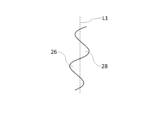
- FIG. FIG. 13 is a diagram for explaining the positional relationship between a protrusion 26 and a protrusion 28.
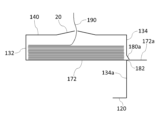
- FIG. 2 is a perspective view showing the item storage box 1 when in use.
- 8 is a diagram for explaining the structure of the end face taken along line VIII-VIII in FIG. 7.
- FIG. 4 is a plan view showing a second embodiment of an item storage box according to the present invention.
- FIG. 10 is a plan view showing the crease 32 in FIG. 9 .
- FIG. 12 is a diagram for explaining the structure of the end face taken along line AA in FIG. 11.
- 10 is a plan view for explaining a modified example of the fold lines 32 and 34 in FIG. 9 .
- FIG. 11 is a plan view showing a third embodiment of an item storage box according to the present invention.
- 2 is a perspective view showing the item storage box 3 when in use.
- FIG. 16 is a diagram for explaining the structure of the end face taken along line BB in FIG. 15.
- 13 is a plan view for explaining the effect of the item storage box 3.
- FIG. 10 is a perspective view showing a fourth embodiment of an item storage box according to the present invention.
- FIG. 10 is a perspective view showing a fourth embodiment of an item storage box according to the present invention.
- FIG. 10 is a side view showing a fourth embodiment of an item storage box according to the present invention.
- FIG. 11 is a perspective view showing the main body 110 after deformation.
- FIG. 11 is a plan view showing the main body 110 after deformation.
- FIG. 11 is a side view showing the main body 110 after deformation.
- 23 is a diagram for explaining the structure of the end face taken along line CC in FIG. 22.
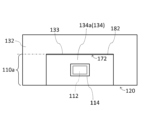
- 11 is a side view for explaining an example in which a fragrance section 112 is provided in a main body 110.
- FIG. 13 is a plan view for explaining a modified example of the tongue piece 172.
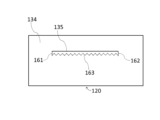
- FIG. FIG. 13 is a side view illustrating a modified example of the cut line 160.
- FIG. 11 is a perspective view showing a fourth embodiment of an item storage box according to the present invention.
- FIG. 11 is a perspective view showing the main body 110 after deformation.
- FIG. 13 is a side view illustrating a modified example of the slit portion 180.
- 11 is a side view illustrating a modified example of a fold line 133.
- FIG. 13 is a side view for explaining another modified example of the cut line 160.
- FIG. 13 is a side view for explaining another modified example of the cut line 160.
- FIG. 13 is a side view for explaining another modified example of the cut line 160.
- FIG. 13 is a perspective view showing a fifth embodiment of an item storage box according to the present invention.
- FIG. 13 is a perspective view showing a fifth embodiment of an item storage box according to the present invention.
- FIG. 13 is a bottom view showing a fifth embodiment of an item storage box according to the present invention.
- FIG. 13 is a side view showing a fifth embodiment of an item storage box according to the present invention.
- FIG. 13 is a side view showing a fifth embodiment of an item storage box according to the present invention.
- FIG. 11 is a perspective view showing the main body 210 after deformation.
- FIG. 11 is a perspective view showing the main body 210 after deformation.
- FIG. 11 is a plan view showing the main body 210 after deformation.
- FIG. 13 is a bottom view showing the main body 210 after deformation.
- FIG. 41 is a diagram for explaining the structure of the end face taken along line DD in FIG. 40. 2 is a diagram for explaining an example in which a fragrance section 212 is provided in a main body 210.
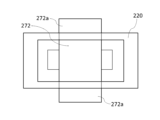
- FIG. FIG. 13 is a plan view illustrating a modified example of a segment 272.
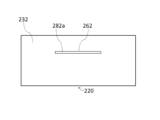
- FIG. 13 is a side view illustrating a modified example of the cut line 262.
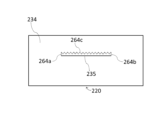
- FIG. 13 is a side view illustrating a modified example of the cut line 264.
- FIG. 13 is a side view illustrating a modified example of a slit portion 282.
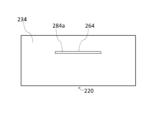
- FIG. 13 is a side view illustrating a modified example of a slit portion 284.
- 13 is a side view illustrating another modified example of the cut line 262.
- FIG. 13 is a side view illustrating another modified example of the cut line 264.
- FIG. 13 is a side view illustrating another modified example of the cut line 262.
- FIG. 13 is a side view illustrating another modified example of the cut line 264.
- FIG. 13 is a side view illustrating another modified example of the cut line 262.
- FIG. 13 is a side view illustrating another modified example of the cut line 262.
- FIG. 13 is a side view illustrating another modified example of the cut line 262.
- FIG. 13 is a side view illustrating another modified
- FIG. 13 is a side view illustrating another modified example of the cut line 264.
- FIG. FIG. 13 is a perspective view illustrating a modified example of the cut line 250.
- FIG. 13 is a perspective view for explaining another modified example of the cut line 250.
- FIG. 13 is a perspective view for explaining another modified example of the cut line 250.
- FIG. 13 is a perspective view showing a sixth embodiment of an item storage box according to the present invention.
- FIG. 59 is a plan view showing the item storage box of FIG. 58.
- FIG. 59 is a rear view of the item storage box of FIG. 58.
- FIG. 59 is a side view of the item storage box of FIG. 58.
- FIG. 59 is a side view of the item storage box of FIG. 58.
- FIG. 11 is a diagram for explaining an example of how to use the item storage box 6.
- FIG. 11 is a diagram for explaining an example of how to use the item storage box 6.
- FIG. 11 is a diagram for explaining an example of how to use the item storage box 6.
- FIG. 11A to 11C are diagrams for explaining an example of a manufacturing method for the item storage box 6.
- 11A to 11C are diagrams for explaining an example of a manufacturing method for the item storage box 6.
- 13 is a side view for explaining a modified example of the cutting blade 62.
- FIG. FIG. 59 is a plan view for explaining a modified example of the main body 10 in FIG. 58.
- FIG. 70 is a diagram for explaining the structure of the end face taken along line FF in FIG. 69.
- FIG. 13 is a plan view for explaining a modified example of the outlet forming portion 20.
- FIG. 13 is a plan view for explaining another modified example of the outlet forming portion 20.
- FIG. 13 is a plan view for explaining another modified example of the outlet forming portion 20.
- FIG. 13 is a plan view for explaining another modified example of the outlet forming portion 20.
- FIG. 13 is a plan view for explaining another modified example of the outlet forming portion 20.
- FIG. 13 is a plan view for explaining another modified example of the outlet forming portion 20.
- FIG. 13 is a plan view for explaining a modified example of a portion 42a of the cut line 42.
- FIG. 13 is a plan view for explaining another modified example of the portion 42a of the cut line 42.
- FIG. FIG. 2 is a perspective view for explaining a modified example of the main body 10 of FIG. 1 .
- FIG. 2 is a perspective view for explaining a modified example of the main body 10 of FIG. 1 .
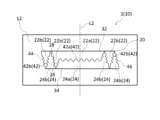
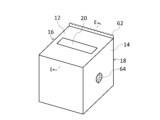
- FIGS. 1 and 2 are respectively an oblique view and a plan view showing a first embodiment of an item storage box according to the present invention.
- Item storage box 1 is an item storage box for storing items, and includes a main body 10. Examples of items include sanitary paper (tissue paper, toilet paper, paper towels, kitchen paper, etc.), gloves, and masks. In this embodiment, multiple items are stored in a stacked state in item storage box 1 (main body 10).
- the main body 10 is box-shaped. Specifically, the main body 10 is rectangular.
- the main body 10 has a main surface 12.
- the main surface 12 is rectangular in plan view. In this embodiment, the main surface 12 is equal to the top surface of the main body 10.
- the item storage box 1 may be used with the main surface 12 facing upwards, or with the main surface 12 facing sideways.
- the main surface 12 is provided with an outlet forming section 20 where an outlet for an item is formed.
- the outlet forming section 20 has a horizontally long shape. In other words, the length of the outlet forming section 20 in the horizontal direction (left-right direction in FIG. 2) is greater than the length of the outlet forming section 20 in the vertical direction (up-down direction in FIG. 2).
- the horizontal and vertical directions of the outlet forming section 20 are equal to the long side and short side directions of the main surface 12, respectively.
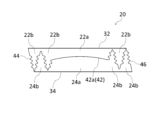
- the outlet forming section 20 includes a folding piece 22 (first folding piece), a folding piece 24 (second folding piece), a fold 32 (first fold line), a fold 34 (second fold line), a cut line 42 (boundary cut line), a cut line 44, and a cut line 46.
- the folding pieces 22 and 24 are folded diagonally upward from the main surface 12 so that their inner surfaces face each other. In other words, the folding pieces 22 and 24 have a double door structure.
- Figures 1 and 2 show the folding pieces 22 and 24 in an unfolded state.
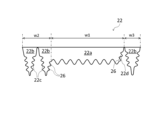
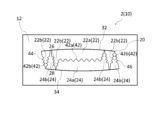
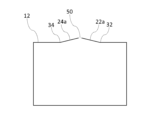
- FIG. 3 and 4 are plan views showing the folded pieces 22 and 24, respectively.
- the folded piece 22 has a convex portion 26 (first convex portion) that protrudes toward the folded piece 24.
- the folded piece 24 has a convex portion 28 (second convex portion) that protrudes toward the folded piece 22.
- the convex portions 26 and 28 are located on the same straight line (e.g., line L1) that is parallel to the vertical direction of the outlet forming portion 20.
- line L1 straight line
- the convex portion 26 being located on line L1 means that the convex portion 26 and line L1 share two or more points. The same is true for the convex portion 28.
- the convex portions 26 and 28 are in a positional relationship such that there is a straight line that passes through both the convex portions 26 and 28 and is parallel to the vertical direction of the outlet forming portion 20.
- the convex portions 26 and 28 are in contact with each other when the folded pieces 22 and 24 are folded.
- the convex portion 26 and the convex portion 28 are located on the straight line L1 so that the convex portion 26 and the convex portion 28 are in contact with each other when the folded piece 22 and the folded piece 24 are folded.
- the folded piece 22 has a holding portion 22a (first holding portion) and a regulating portion 22b (first regulating portion) (see FIG. 3).
- the folded piece 22 has one holding portion 22a and multiple regulating portions 22b.
- the folded piece 24 has a holding portion 24a (second holding portion) and regulating portion 24b (second regulating portion) (see FIG. 4).
- the folded piece 24 has one holding portion 24a and multiple regulating portions 24b.
- the holding portion 22a and the holding portion 24a sandwich and hold an item pulled out from the outlet.
- the holding portion 22a and the holding portion 24a are located on a center line L2 that bisects the main surface 12 in the long side direction.
- the width w1 of each holding portion 22a, 24a is, for example, 7 cm or more and 15 cm or less.
- the width w2 between each of the holding parts 22a, 24a and one end of the outlet forming part 20 is, for example, 2 cm or more and 5 cm or less.
- the width w3 between each of the holding parts 22a, 24a and the other end of the outlet forming part 20 is, for example, 2 cm or more and 5 cm or less.
- the width w2 and the width w3 may be equal to each other or may be different from each other.
- the restricting portions 22b and 24b are provided on both sides of the holding portion 22a and the holding portion 24a, respectively.
- two restricting portions 22b are provided on one side of the holding portion 22a, and one restricting portion 22b is provided on the other side.
- two restricting portions 24b are provided on one side of the holding portion 24a, and one restricting portion 24b is provided on the other side.
- the restricting portion 22b protrudes closer to the fold line 34 than the retaining portion 22a. That is, the distance from the restricting portion 22b to the fold line 34 is smaller than the distance from the retaining portion 22a to the fold line 34. Also, the restricting portion 24b protrudes closer to the fold line 32 than the retaining portion 24a. That is, the distance from the restricting portion 24b to the fold line 32 is smaller than the distance from the retaining portion 24a to the fold line 32. In this embodiment, the restricting portion 22b and the restricting portion 24b reach the fold line 34 and the fold line 32, respectively. Therefore, the distance from the restricting portion 22b to the fold line 34 and the distance from the restricting portion 24b to the fold line 32 are both zero in this embodiment.
- the regulating portion 22b and the regulating portion 24b are provided with a protrusion 26 and a protrusion 28, respectively.
- the protrusion 26 is formed on the side end 22c (first side end) of the regulating portion 22b.
- a plurality of protrusions 26 are formed on one side end 22c.
- Each side end 22c has a wavy shape.
- the protrusion 28 is formed on the side end 24c (second side end) of the regulating portion 24b.
- a plurality of protrusions 28 are formed on one side end 24c.
- Each side end 24c has a wavy shape.
- the protrusion 26 is formed on both the side end 22c and the side end 22d (third side end) of the holding portion 22a.
- the protrusion 28 is formed on both the side end 24c and the side end 24d (fourth side end) of the holding portion 24a.
- each protrusion 26 and at least one protrusion 28 need only be located on the same straight line parallel to the vertical direction of the outlet forming section 20.
- each protrusion 28 and at least one protrusion 26 need only be located on the above straight line.
- the restricting portion 22b and the restricting portion 24b may have a shape that imitates a real object.
- An example of such a real object is a tree.
- the restricting portion 22b and the restricting portion 24b may be painted with a color or pattern that matches the real object.
- the color, etc. may be changed according to the sales season of the item storage box 1. For example, the color of a tree with green leaves may be painted in spring or summer, the color of a tree with red leaves in autumn, and the color of a Christmas tree in winter.
- the folding pieces 22 and 24 have a congruent shape and are arranged point symmetrically.
- the fold line 32 is a fold line for folding the folding piece 22.
- the folding piece 22 is folded along the fold line 32.
- the fold line 32 coincides with the rear end of the folding piece 22 (the portion of the periphery of the folding piece 22 that is not separated from the main surface 12 even after the folding piece 22 is folded).
- the fold line 32 extends in the lateral direction of the outlet forming portion 20.
- the fold line 32 is in a straight line.
- the fold line 34 is a fold line for folding the folding piece 24.
- the folding piece 24 is folded along the fold line 34.
- the fold line 34 coincides with the rear end of the folding piece 24 (the portion of the periphery of the folding piece 24 that is not separated from the main surface 12 even after the folding piece 24 is folded).
- the fold line 34 extends in the lateral direction of the outlet forming section 20.
- the fold line 34 is in a straight line.
- the distance between the fold line 32 and the fold line 34 is, for example, 3 cm or more and 6 cm or less.
- the cut line 42 is located at the boundary between the folded piece 22 and the folded piece 24.
- the cut line 42 is a perforation.
- the portion 42a (first portion) of the cut line 42 is wavy and extends laterally of the outlet forming portion 20.
- the portion 42a is located at the boundary between the holding portion 22a and the holding portion 24a.
- the portion 42a is formed along a single continuous wavy line.
- the portion 42a has a shape without corners.
- the portion 42a is made up of only curves. In this embodiment, the portion 42a describes a sine curve.
- the cut line 44 connects one end of the fold line 32 to one end of the fold line 34.
- the cut line 44 is a perforation.
- the cut line 46 connects the other end of the fold line 32 to the other end of the fold line 34.
- the cut line 46 is a perforation.
- the above-mentioned side end 22c and side end 24c coincide with portion 42b (second portion) of the cut line 42.
- Portion 42b is a portion other than portion 42a.
- FIG. 6 is a plan view showing a portion of portion 42a of cut line 42.
- the half wavelength d1 of portion 42a is preferably 3 mm or more and 10 mm or less, and more preferably 3 mm or more and 5 mm or less.
- the half wavelength d1 is half the wavelength of portion 42a.
- the total amplitude d2 of portion 42a is preferably 3 mm or more and 10 mm or less, and more preferably 3 mm or more and 5 mm or less.
- the total amplitude d2 is twice the amplitude (single amplitude) of portion 42a.
- the main body 10 is preferably configured so that items can be refilled. Such a configuration can be achieved, for example, by making the main surface 12 or other surfaces openable and closable.
- the main body 10 is flexible.
- the main body 10 can be made of, for example, paper such as cardboard.
- the item storage box 1 is preferably made only of paper.
- FIG. 7 is a perspective view showing the item storage box 1 when in use.
- FIG. 8 is a view for explaining the structure of the end face along the line VIII-VIII in FIG. 7. Items are not shown in FIG. 7.
- the item 90 can be removed from the main body 10 by pulling the item 90 that has passed through the outlet 50. Note that unlike a typical tissue paper storage box, the outlet 50 in the item storage box 1 does not have a plastic film.
- the item storage box 1 is provided with folding pieces 22 and 24 that are folded diagonally upward along fold lines (fold lines 32 and 34) that extend horizontally of the outlet forming section 20.
- the folding pieces 22 and 24 have convex parts 26 and 28, respectively, and the convex parts 26 and 28 are located on the same straight line parallel to the vertical direction of the outlet forming section 20 so that the convex parts 26 and 28 are in contact with each other when the folding pieces 22 and 24 are folded. Therefore, even if the folded folding pieces 22 and 24 try to return to their original state, the convex parts 26 and 28 can be made to interfere with each other along the way. This makes it possible to prevent the folding pieces 22 and 24 from naturally returning to their original state. Therefore, an item storage box 1 that makes it easy to smoothly remove items 90 from the main body 10 is realized.
- the folded piece 22 has a retaining portion 22a and a restricting portion 22b.
- Holding portion 22a and holding portion 24a are located on center line L2, which bisects main surface 12 in the long side direction. This allows removal opening 50 to be formed in the center of main surface 12. This also contributes to smooth removal of item 90 from main body 10.
- the restricting portion 22b and the restricting portion 24b are provided on both sides of the holding portion 22a and the holding portion 24a, respectively.
- the folding pieces 22 and the folding pieces 24 can be more reliably prevented from returning to their original state, compared to when the restricting portion 22b and the restricting portion 24b are provided only on one side of the holding portion 22a and the holding portion 24a, respectively.
- the restricting portion 22b protrudes more toward the fold 34 than the retaining portion 22a. Also, the restricting portion 24b protrudes more toward the fold 32 than the retaining portion 24a. In this case, the restricting portion 22b and the restricting portion 24b can be adjacent to each other over a wide range in the vertical direction of the outlet forming portion 20. This makes it easier for the convex portion 26 and the convex portion 28 to interfere with each other.
- the protrusion 26 is formed on the side end 22c of the restricting portion 22b.
- the protrusion 28 is formed on the side end 24c of the restricting portion 24b. This makes it easier to arrange the protrusions 26 and 28 on the same straight line parallel to the vertical direction of the outlet forming portion 20.
- protrusions 26 are formed on one side end 22c. In this case, which protrusion 26 interferes with protrusion 28 depends on the bending angles of folding pieces 22 and 24. This makes it possible to adjust the bending angles of folding pieces 22 and 24 in stages.
- protrusions 28 are formed on one side end 24c. In this case, which protrusion 28 interferes with the protrusion 26 depends on the bending angles of the folding pieces 22 and 24. This makes it possible to adjust the bending angles of the folding pieces 22 and 24 in stages.
- the protrusions 26 are formed on both the side end 22c of the regulating portion 22b and the side end 22d of the retaining portion 22a.
- the protrusions 28 are formed on both the side end 24c of the regulating portion 24b and the side end 24d of the retaining portion 24a. In this case, the folded pieces 22 and 24 can be more reliably prevented from returning to their original state compared to when the protrusions 26 and 28 are only formed on the side end 22c and the side end 24c, respectively.
- the restricting portion 22b and the restricting portion 24b have a shape that imitates the real thing, the aesthetic appearance of the outlet forming portion 20 and thus the item storage box 1 can be improved.
- the object is a tree, it is easy to design the restricting portion 22b with a convex portion 26 at the side end 22c, and it is also easy to design the restricting portion 24b with a convex portion 28 at the side end 24c. This has the advantage that it is easy to achieve both functionality and design for the restricting portions 22b and 24b.
- the folding piece 22 has a plurality of restricting portions 22b.
- the folding piece 24 has a plurality of restricting portions 24b. In this case, the folding pieces 22 and 24 can be more reliably prevented from returning to their original state, compared to when the folding pieces 22 and 24 each have only one restricting portion 22b and one restricting portion 24b.
- the portion 42a of the cut line 42 is wavy. In this case, unevenness is created at the tip of the holding portion 22a and the holding portion 24a. This can strengthen the holding force of the holding portion 22a and the holding portion 24a on the item 90.
- the portion 42a of the cut line 42 has a shape without any corners. This makes it difficult for the item 90 to get caught on the tips of the holding portion 22a and the holding portion 24a when removing the item, making it easier to remove the item 90 smoothly.
- the portion 42a of the cut line 42 forms a sine curve. This contributes to improving the aesthetics of the outlet forming portion 20 and therefore the item storage box 1.
- half-wavelength d1 of portion 42a of cut line 42 results in finer irregularities at the tips of retaining portion 22a and retaining portion 24a, which is advantageous in strengthening the holding force of retaining portion 22a and retaining portion 24a on item 90.
- half-wavelength d1 is preferably 10 mm or less, and more preferably 5 mm or less.
- half-wavelength d1 is preferably 3 mm or more.
- total amplitude d2 of portion 42a of cut line 42 increases the unevenness difference at the tip of retaining portion 22a and retaining portion 24a, which is advantageous in strengthening the holding force of retaining portion 22a and retaining portion 24a on item 90. From this perspective, it is preferable that total amplitude d2 is 3 mm or more. On the other hand, if total amplitude d2 is too large, item 90 will penetrate too deeply into the recess, preventing smooth removal of item 90. From this perspective, total amplitude d2 is preferably 10 mm or less, and more preferably 5 mm or less.
- the outer surface of the main body 10 can be used as a canvas for drawing. Also, if a line drawing is printed on the outer surface of the main body 10 in advance, the user can enjoy coloring in it. In other words, a line drawing for coloring may be printed on the outer surface of the main body 10. For this reason, the item storage box 1 is also suitable as a toy for children.
- the main body 10 is configured to be refilled with the items 90, the main body 10 can be reused by refilling it with new items 90 even after the items 90 have been used up, which is economical. This also leads to a reduction in waste (unnecessary main bodies 10), thereby contributing to a reduction in the burden on the environment.
- FIG. 9 is a plan view showing a second embodiment of an item storage box according to the present invention.
- the item storage box 2 is an item storage box for storing items, and includes a main body 10.
- the configuration of the fold lines 32 and 34 differs from that of the first embodiment.
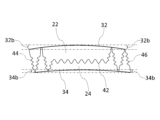
- the fold lines 32 are curved and bulge outward from the folding piece 22. It is preferable that the fold lines 32 describe a circular or elliptical arc.
- FIG. 10 is a plan view showing the crease 32.
- the curve ratio of the crease 32 is preferably 1.9% to 9.7%, and more preferably 1.9% to 4.8%.
- the curve ratio is a numerical value reflecting the magnitude of the curve, and is defined as the value obtained by dividing the length d3 by the length d4.
- the length d3 is equal to the length of the short side of the smallest rectangle R1 that can contain the entire crease 32.
- the length d3 is, for example, 2 mm to 20 mm.
- the length d4 is equal to the length of the long side of the rectangle R1.
- the short side and long side of the rectangle R1 are parallel to the short side and long side of the main surface 12, respectively.
- the length d4 is, for example, 120 mm to 200 mm.
- the fold line 34 has a curved shape that bulges outward from the folded piece 24. It is preferable that the fold line 34 describes a circular arc or an elliptical arc. In this embodiment, the fold line 34 has a shape that is congruent with the fold line 32.
- the curve rate of the fold line 34 is preferably 1.9% or more and 9.7% or less, and more preferably 1.9% or more and 4.8% or less.
- the definition of the curve rate of the fold line 34 is the same as the definition of the curve rate of the fold line 32.
- the fold line 32 is curved as in this embodiment, as long as the rectangle R1 has a horizontal shape, the fold line 32 falls into the category of "extending in the horizontal direction of the outlet forming section 20.” The same applies to the fold line 34.
- the rest of the configuration of the main body 10 is as described in the first embodiment.
- FIG. 11 is a perspective view showing the item storage box 2 when in use.
- FIG. 12 is a view for explaining the structure of the end face along line A-A in FIG. 11. Items are not shown in FIGS. 11 and 12.
- To use the item storage box 2 first, cuts are made in the outlet forming portion 20 along the cut lines 42, 44, and 46. Next, the folded pieces 22 and 24 are folded diagonally upward along the creases 32 and 34, respectively. This forms an outlet 50 between the holding portion 22a of the folded piece 22 and the holding portion 24a of the folded piece 24. The item can be removed from the main body 10 by pulling the item that has passed through the outlet 50.
- the fold 32 is curved and bulges outward from the folding piece 22.
- a force returns force
- This makes it possible to prevent the folding angle of the folding piece 22 from becoming too large. This has the advantage of making it more difficult for dust to enter the main body 10 through the removal opening 50.
- the fold line 34 also has a curved shape that bulges outward from the folding piece 24.
- a restoring force also acts on the folding piece 24 that is folded along the fold line 34. This makes it possible to prevent the folding angle of the folding piece 24 from becoming too large.
- the removal opening 50 is likely to become excessively narrow.
- the protrusions 26 and 28 interfere with each other, thereby preventing the removal opening 50 from becoming too narrow.
- the return force acting on the folding pieces 22 and 24 can be regulated by the protrusions 26 and 28. This is advantageous in maintaining the width of the removal opening 50 at an appropriate level.
- the mechanism by which the curved fold line 32 restricts the bending angle of the folding piece 22 will now be explained in detail. If the main body 10 is rigid (not flexible), the folding piece 22 cannot be bent along a curve. In contrast, in the item storage box 2, the main body 10 is flexible, so even if the fold line 32 is curved, the bending of the main body 10 makes it possible to bend the folding piece 22 to a certain degree of angle. At this time, a return force acts on the folding piece 22 due to the restoring force of the main body 10. This restricts the bending angle of the folding piece 22. The same applies to the mechanism by which the curved fold line 34 restricts the bending angle of the folding piece 24.
- the fold line 32 forms a circular or elliptical arc, it contributes to improving the aesthetic appearance of the outlet forming section 20 and therefore the item storage box 2.
- the fold line 34 forms a circular or elliptical arc, it contributes to improving the aesthetic appearance of the outlet forming section 20 and therefore the item storage box 2.
- Increasing the curve rate of the fold line 32 is advantageous in strengthening the return force acting on the folding piece 22. From this perspective, it is preferable that the curve rate of the fold line 32 is 1.9% or more. On the other hand, if the curve rate of the fold line 32 is too large, the return force will be excessively strong, which may make it difficult to remove the item from the removal opening 50. From this perspective, it is preferable that the curve rate of the fold line 32 is 9.7% or less, and more preferably 4.8% or less.
- Increasing the curve rate of the fold line 34 is advantageous in strengthening the return force acting on the folding piece 24. From this perspective, it is preferable that the curve rate of the fold line 34 is 1.9% or more. On the other hand, if the curve rate of the fold line 34 is too large, the return force will be excessively strong, which may make it difficult to remove the item from the removal opening 50. From this perspective, it is preferable that the curve rate of the fold line 34 is 9.7% or less, and more preferably 4.8% or less. Other effects of the item storage box 2 are the same as those of the item storage box 1.
- FIG. 14 is a plan view showing a third embodiment of an item storage box according to the present invention.
- the item storage box 3 is an item storage box for storing items, and includes a main body 10.
- the configuration of the fold line 34 differs from that of the second embodiment.
- the fold line 34 is curved and bulges inward from the folding piece 24. It is preferable that the fold line 34 describes a circular arc or an elliptical arc.
- the curve rate of the fold line 34 is smaller than the curve rate of the fold line 32. It is preferable that the curve rate of the fold line 34 is 1/4 or more and 3/4 or less of the curve rate of the fold line 32.
- the other configuration of the main body 10 is as described in the second embodiment.
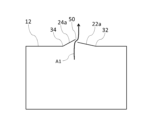
- Figure 15 is a perspective view showing the item storage box 3 when in use.
- Figure 16 is a diagram for explaining the structure of the end face along line B-B in Figure 15. Items are not shown in Figures 15 and 16.
- the item can be removed from the main body 10 by pulling the item that has passed through the outlet 50.
- the fold line 32 is curved and bulges outward from the folding piece 22, while the fold line 34 is curved and bulges inward from the folding piece 24.
- there are no cut lines 44, 46 on both sides 32b of the fold line 32 (the part that overlaps with the fold line 32 when viewed from the long side direction of the main surface 12)
- there are cut lines 44, 46 on both sides 34b of the fold line 34 (the part that overlaps with the fold line 34 when viewed from the long side direction of the main surface 12).
- the folding piece 24 that is bent along the fold line 34 is easier to bend than the folding piece 22 that is bent along the fold line 32.
- the bending angle of the folding piece 24 is more likely to be larger than the bending angle of the folding piece 22 (see FIG. 16).
- the gap (removal opening 50) between holding portion 22a and holding portion 24a widens in the height direction of the main body 10, so that when an item is removed, it passes through removal opening 50 in a zigzag manner, as shown by arrow A1 in FIG. 16. This makes it even more difficult for an item pulled out from removal opening 50 to fall back into the main body 10.
- the curve of the crease 34 is smaller than that of the crease 32. Making the curve of the crease 34 smaller in this way is also advantageous for making the folding piece 24 easier to fold. This makes it easier to ensure a wide gap between the holding portion 22a and the holding portion 24a in the height direction of the main body 10. From this perspective, it is preferable that the curve of the crease 34 is 3/4 or less of the curve of the crease 32. On the other hand, if the curve of the crease 34 is too small, the bending angle of the folding piece 24 may become excessive. From this perspective, it is preferable that the curve of the crease 34 is 1/4 or more of the curve of the crease 32. Other effects of the item storage box 3 are the same as those of the item storage box 2.
- the curve rate of the fold line 34 is smaller than the curve rate of the fold line 32.
- the curve rate of the fold line 34 may be equal to the curve rate of the fold line 32 or may be larger than the curve rate of the fold line 32.
- the fold line 32 is curved and bulges outward from the folding piece 22, while the fold line 34 is curved and bulges inward from the folding piece 24.
- the fold line 32 and the fold line 34 may be curved and bulge inward from the folding piece 22 and the folding piece 24, respectively.
- FIG. 18 and 19 are perspective views showing a fourth embodiment of an item storage box according to the present invention.
- FIG. 20 is a side view showing a fourth embodiment of an item storage box according to the present invention.
- the item storage box 4 is an item storage box for storing items, and has a main body 110.
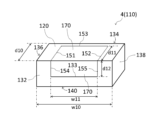
- the main body 110 is box-shaped and consists of a bottom surface portion 120, a side surface portion 132 (first side surface portion), a side surface portion 134 (second side surface portion), a side surface portion 136 (third side surface portion), a side surface portion 138 (fourth side surface portion), and a top surface portion 140.
- the main body 110 is rectangular parallelepiped-shaped.
- Figures 18 and 19 are oblique views seen from the top surface portion 140 side and the bottom surface portion 120 side, respectively.
- Figure 20 is a side view seen from the side surface portion 134 side.
- the side surface portion 132 and the side surface portion 134 face each other.
- the side surface portion 136 and the side surface portion 138 also face each other.
- the width of the side surface portion 132 and the side surface portion 134 is greater than the width of the side surface portion 136 and the side surface portion 138.
- the top surface portion 140 is equal to the main surface 12, and the top surface portion 140 is provided with an outlet forming portion 20.
- the configuration of the outlet forming section 20 is as described in the first, second or third embodiment. However, in this embodiment, detailed illustration of the outlet forming section 20 is omitted.
- the main body 110 is configured so that it can be deformed into a bottom-up state.
- the main body 110 can be made of, for example, cardboard or other paper.
- the main body 110 has a cut line 150 (first cut line), a cut line 160 (second cut line), a tongue portion 170, and a slit portion 180.
- the cut line 150 is formed from the bottom portion 120 to the side portion 132.
- the cut line 150 is formed along a single continuous line.
- the cut line 150 is a perforation.
- the cut line 150 consists of a bottom cut portion 151 (first bottom cut portion), a bottom cut portion 152 (second bottom cut portion), a bottom cut portion 153 (third bottom cut portion), a side cut portion 154 (first side cut portion), and a side cut portion 155 (second side cut portion).
- the bottom cut portions 151 to 153 are formed in the bottom portion 120.
- Bottom cutout portion 154 and side cutout portion 155 are formed on side portion 132. Bottom cutout portion 151 and bottom cutout portion 152, and side cutout portion 154 and side cutout portion 155 are all in a straight line. In this embodiment, bottom cutout portion 153 is also in a straight line.
- Bottom cut-out portion 151 and bottom cut-out portion 152 extend from side portion 132 towards side portion 134. Bottom cut-out portion 151 and bottom cut-out portion 152 extend perpendicular to side portion 132. Bottom cut-out portion 153 connects bottom cut-out portion 151 and bottom cut-out portion 152. Specifically, bottom cut-out portion 153 connects one end of bottom cut-out portion 151 and one end of bottom cut-out portion 152. One end of bottom cut-out portion 151 and one end of bottom cut-out portion 152 are located in the middle of bottom portion 120. Here, the middle of bottom portion 120 refers to the parts of bottom portion 120 other than the edges (the boundaries with each side portion 132, 134, 136, 138). The bottom cutout portion 153 extends parallel to the side portion 132.
- the side cutout portion 154 and the side cutout portion 155 are continuous with the bottom cutout portion 151 and the bottom cutout portion 152, respectively. That is, one end of the side cutout portion 154 and one end of the side cutout portion 155 are connected to the other end of the bottom cutout portion 151 and the other end of the bottom cutout portion 152, respectively.
- the side cutout portion 154 and the side cutout portion 155 extend in the height direction of the main body 110 (the up-down direction in Figures 18 and 19).
- the other ends of the side cutout portion 154 and the side cutout portion 155 are located in the middle part of the side portion 132.
- the middle part of the side portion 132 refers to the part of the side portion 132 other than the edge (the boundary with the bottom portion 120, the boundaries with each side portion 136, 138, and the boundary with the top portion 140).
- the cut line 160 is formed on the side portion 134.
- the cut line 160 is formed along a single continuous line.
- the cut line 160 is a perforation.
- the cut line 160 includes a vertical cut portion 161 (first vertical cut portion), a vertical cut portion 162 (second vertical cut portion), and a horizontal cut portion 163.
- the cut line 160 consists only of the vertical cut portion 161, the vertical cut portion 162, and the horizontal cut portion 163.
- the vertical cut portion 161 and the vertical cut portion 162, and the horizontal cut portion 163 are all straight.
- the vertical cut portion 161 and the vertical cut portion 162 extend in the height direction of the main body 110.
- the horizontal cut portion 163 connects one end of the vertical cut portion 161 and one end of the vertical cut portion 162.
- One end of vertical cut portion 161 and one end of vertical cut portion 162 are located in the middle of side portion 134.
- the other end of vertical cut portion 161 and the other end of vertical cut portion 162 are also located in the middle of side portion 134.
- the middle of side portion 134 refers to the part other than the edge of side portion 134 (the boundary with bottom portion 120, the boundaries with each side portion 136, 138, and the boundary with top portion 140).
- Horizontal cut portion 163 extends parallel to bottom portion 120.
- Figures 21, 22, and 23 are respectively an oblique view, a plan view, and a side view showing the main body 110 after deformation.
- Figure 21 is an oblique view seen from the bottom surface portion 120 side.
- Figure 23 is a side view seen from the side surface portion 132 side.
- Figure 24 is a diagram for explaining the structure of the end surface along line C-C in Figure 22.
- the tongue portion 170 is a portion that becomes the tongue portion 172 connected to the middle portion of the side portion 132 when a cut is made in the main body 110 (bottom portion 120 and side portion 132) along the cut line 150.
- the tongue portion 172 is formed of a single plate consisting of a part of the bottom portion 120 and a part of the side portion 132. In this embodiment, the shape of the tongue portion 172 is rectangular.
- the side portion 132 is provided with a fold line 133 (third fold line) for folding the tongue portion 172 toward the side portion 134.
- the fold line 133 is provided in a position that overlaps with the slit portion 180 described later in a side view.
- the fold line 133 connects the other end of the side cut portion 154 and the other end of the side cut portion 155.
- the fold line 133 is parallel to the bottom portion 120. It is preferable that the fold line 133 has a crease formed in advance so that the tongue piece 172 can be easily folded along the fold line 133.
- the fold line 133 may consist only of a line printed on the side portion 132 to inform the user of the fold position.
- the length of the tongue 172 is preferably 1.1 times or more, more preferably 1.2 times or more, of the distance d10 (see FIG. 19) from the side portion 132 to the side portion 134.
- the length of the tongue 172 is preferably 1 cm or more greater than the distance d10, more preferably 2 cm or more greater.
- the length of the tongue 172 is the maximum dimension of the tongue 172 in a direction perpendicular to the side portion 132 when the tongue 172 is spread on a plane parallel to the bottom portion 120.
- the length of the tongue 172 is equal to the sum of the length d11 of each bottom cut portion 151, 152 and the length d12 of each side cut portion 154, 155.
- the width w11 of the tongue 172 is preferably 1/2 or more, more preferably 3/4 or more, of the width w10 of the side portion 132.
- width w11 is the maximum dimension of tongue piece 172 in a direction perpendicular to side portion 136 and side portion 138.
- the slit portion 180 is a portion that is located in the middle of the side portion 134 and that becomes a slit 182 into which the tongue piece 172 can be inserted when a cut is made in the main body 110 (side portion 134) along the cut line 160.
- the slit 182 is a horizontally long opening that extends parallel to the bottom portion 120.
- the tongue piece 172 is configured to be parallel to the bottom portion 120 when inserted into the slit 182.
- the side portion 134 is provided with a fold line 135 for folding the portion 180a surrounded by the cut line 160 (vertical cut portion 161, vertical cut portion 162, and horizontal cut portion 163) to the outside of the main body 110.
- the fold line 135 connects the other end of the vertical cut portion 161 to the other end of the vertical cut portion 162.
- the fold line 135 is parallel to the bottom portion 120. It is preferable that the fold line 135 has a crease formed in advance so that the portion 180a can be easily folded along the fold line 135. However, the fold line 135 may be simply a line printed on the side portion 134 to inform the user of the fold position.
- the distance h11 (see FIG. 20) from the bottom surface portion 120 to the slit portion 180 is equal to or greater than 1/2 of the height h10 of the main body 110.
- the distance from the bottom surface portion 120 to the fold line 133 is equal to or greater than 1/2 of the height h10.
- a cut is made in the main body 110 along the cut line 160.
- the portion 180a surrounded by the cut line 160 is folded outward along the fold line 135 to turn the slit portion 180 into a slit 182.
- a cut is made in the main body 110 along the cut line 150 to turn the tongue portion 170 into a tongue 172.
- the tongue 172 is inserted into the slit 182 while being folded toward the side portion 134 along the fold line 133. This allows the main body 110 to be deformed so that the tongue 172 is inserted into the slit 182 (see Figures 21 to 24).
- the item 190 is placed on the tongue 172 as shown in Figure 24.
- the distance from the tongue piece 172 to the top surface 140 is 3 cm or more and 6 cm or less. Note that the items 190 are not shown in Figures 22 and 23.
- the protruding portion 172a of the tongue 172 is printed with letters or a design.
- the protruding portion 172a is the portion that protrudes from the slit 182 to the outside of the main body 110.
- the letters or design are printed on the top surface of the protruding portion 172a (the surface on the top surface portion 140 side).
- the character string "ABC” is printed on the top surface of the protruding portion 172a. This top surface corresponds to a part of the inner surface of the bottom surface portion 120 of the main body 110 before deformation.
- the protruding portion 172a may be printed with a promotional message or advertising slogan for the company.
- the content of the company promotional message could be, for example, an introduction to the company's efforts in addressing environmental issues.
- the specific portion 134a is a portion that overlaps with the tongue portion 170 (the portion of the tongue portion 170 that is present on the side portion 132) in a side view.
- the character string "XYZ" is printed on the specific portion 134a.
- the character string is not shown.
- An advertising slogan may be printed on the specific portion 134a.
- the scented section 112 may be provided in the lower part 110a of the inner surface of the main body 110, as shown in FIG. 25, for example.
- the lower part 110a is a part that exists below the tongue piece 172 when inserted into the slit 182.
- the lower part 110a is composed of a part of the inner surface of the bottom part 120 and a part of the inner surface of each side part 132, 134, 136, 138.
- the scented section 112 is provided in a specific part 134a that is a part of the lower part 110a.
- a fragrance is attached to the scented section 112.
- the scented section 112 can be realized, for example, by printing a fragrance on the lower part 110a.
- a peelable sticker 114 is attached to the scented section 112.
- peelable means that the sticker 114 can be easily peeled off from the scented section 112 without damaging the lower part 110a and the scented section 112.
- the seal 114 prevents the fragrance in the scent section 112 from escaping.
- a tongue portion 170 and a slit portion 180 are provided on the main body 110.
- the tongue portion 170 provides a tongue 172 connected to the middle portion of the side portion 132.
- the slit portion 180 provides a slit 182 that is located in the middle portion of the side portion 134 and into which the tongue 172 can be inserted. By inserting the tongue 172 into the slit 182, the tongue 172 can be hung from the middle portion of the side portion 132 to the middle portion of the side portion 134.
- the tongue 172 can be inserted into the slit 182 so that the item is placed on the tongue 172, and the bottom of the item storage box 4 can be raised while the tongue 172 is in surface contact with the item. Therefore, an item storage box 4 that can stably support items when the bottom is raised is realized without providing a bottom-raising member separate from the main body 110.
- an item storage box In an item storage box, storing as many items as possible is advantageous in terms of keeping the price per item down.
- the height of the main body In order to increase the number of items that can be stored in one item storage box, the height of the main body must be increased. Normally, when the height of the main body is increased, there is a problem that it becomes difficult to remove items when there are only a few items left. In this regard, with item storage box 4, which can be raised at the bottom, items can be easily removed even when there are only a few items left, so the above problem caused by increasing the height of main body 110 can be solved. Also, by increasing the height of main body 110, a large space can be secured for printing letters or patterns. Furthermore, used main body 110 becomes waste, so storing a large number of items in one main body 110 also leads to a reduction in waste.
- the tongue 172 is connected to the side portion 132 without being separated from the main body 110. In this case, a part of the tongue 172 is fixed to the side portion 132, which makes it difficult for the tongue 172 to accidentally come out of the slit 182.
- the tongue piece 172 is configured to be parallel to the bottom surface portion 120 when inserted into the slit 182. This also contributes to stable support of items in the item storage box 4 after the bottom has been raised.
- Increasing the distance h11 from the bottom surface portion 120 to the slit portion 180 in the height direction of the main body 110 is advantageous in terms of increasing the bottom-raising effect of the item storage box 4. From this perspective, it is preferable that the distance h11 is equal to or greater than 1/2 of the height h10 of the main body 110. On the other hand, if the distance h11 is too large, the amount of items that can be stored in the item storage box 4 after deformation will be extremely small. From this perspective, it is preferable that the distance h11 is equal to or less than 4/5 of the height h10.
- the side portion 132 has a fold line 133. This makes it easier to fold the tongue piece 172 neatly at the specified position.
- the fold line 133 is positioned so that it overlaps the slit portion 180 in a side view. This makes it easier to position the tongue piece 172 inserted into the slit 182 parallel to the bottom portion 120.
- the length of the tongue 172 is preferably 1.1 times or more, and more preferably 1.2 times or more, the distance d10 from the side portion 132 to the side portion 134. From the same perspective, the length of the tongue 172 is preferably 1 cm or more longer than the distance d10, and more preferably 2 cm or more longer. On the other hand, if the length of the tongue 172 is too large, it may be difficult to secure the tongue portion 170 in the main body 110 before deformation. From this perspective, the length of the tongue 172 is preferably 1.5 times or less than the distance d10. From the same perspective, the difference between the length of the tongue 172 and the distance d10 is preferably 5 cm or less.
- the cut line 150 is made up of bottom cut portions 151 to 153, as well as side cut portions 154 and 155. This allows the cut line 150 for forming the tongue piece 172 to be realized with a simple configuration.
- the bottom cut portions 151 and 152, and the side cut portions 154 and 155 are all in a straight line. This makes it easy to make cuts along the bottom cut portions 151, 152 and the side cut portions 154, 155.
- the bottom cutout portion 151 and the bottom cutout portion 152 extend perpendicular to the side portion 132. In this case, the length of each bottom cutout portion 151, 152 can be minimized. This also makes it easier to make cuts along each bottom cutout portion 151, 152.
- the side cut portions 154 and 155 extend in the height direction of the main body 110. In this case, the length of each side cut portion 154, 155 can be minimized. This also makes it easier to make cuts along each side cut portion 154, 155.
- the bottom cut portion 153 is in a straight line. This makes it easier to make cuts along the bottom cut portion 153.
- the bottom cutout portion 153 extends parallel to the side portion 132. This allows the dimensions of the tongue piece 172 in the direction perpendicular to the side portion 132 to be constant.
- the width w11 of the tongue 172 is advantageous for stably supporting the item in the item storage box 4 after the bottom has been raised, since the tongue 172 will come into contact with a wider area of the item.
- the width w11 is preferably 1/2 or more of the width w10 of the side portion 132, and more preferably 3/4 or more.
- the width w11 is preferably 9/10 or less of the width w10.
- the width of side portion 132 and side portion 134 is greater than the width of side portion 136 and side portion 138.
- the cut line 160 includes vertical cut portions 161 and 162, as well as horizontal cut portions 163. This allows the cut line 160 for forming the slit 182 to be realized with a simple configuration.
- the vertical cut portions 161 and 162, and the horizontal cut portion 163 are all in a straight line. This makes it easy to make cuts along the vertical cut portions 161 and 162, and the horizontal cut portion 163.
- the cut line 160 consists only of the vertical cut portion 161, the vertical cut portion 162, and the horizontal cut portion 163.
- the portion 180a surrounded by the cut line 160 is not cut off from the main body 110, so it is possible to abut the portion 180a against the protruding portion 172a of the tongue piece 172. This makes it even more difficult for the tongue piece 172 to accidentally come out of the slit 182.
- Letter or a design is printed on the protruding portion 172a of the tongue piece 172.
- the aesthetic appearance of the body 110 after deformation can be improved.
- the letters or designs are printed on the top surface of the protruding portion 172a. By printing on the top surface, where they are easily visible, the letters or designs can be made to stand out.
- the outlet portion 172a can be used as advertising space. By recruiting advertisers, it is possible to earn advertising revenue. If this revenue is used to cover the manufacturing costs of the item storage box 4, the product price of the item storage box 4 can be kept low.
- Letter or a design is printed on the specific portion 134a on the inner surface of the side portion 134.
- the specific portion 134a can be used as advertising space. By recruiting advertisers, it is possible to earn advertising revenue. If this revenue is used to cover the manufacturing costs of the item storage box 4, the product price of the item storage box 4 can be kept low.
- the scent section 112 is provided on the lower portion 110a of the inner surface of the main body 110, it is possible to disperse a fragrance around the main body 110 after it has been deformed. In other words, by peeling off the seal 114 after the main body 110 has been deformed, the fragrance in the scent section 112 can be dispersed around the main body 110. In addition, because the seal 114 is affixed to the scent section 112, the user can choose whether or not to disperse a fragrance around the main body 110 by whether or not to peel off the seal 114.
- the specific section 134a is an easily accessible part of the lower section 110a, making it easy to peel off the seal 114.
- Other effects of the item storage box 4 are the same as those of the item storage boxes 1 to 3.
- the tongue 172 has a rectangular shape.
- the tongue 172 may have a tapered shape, for example, as shown in FIG. 26. In this case, it becomes easier to insert the tongue 172 into the slit 182.
- the horizontal cut portion 163 of the cut line 160 is shown as a straight line.
- the horizontal cut portion 163 may be wavy, for example, as shown in FIG. 27.
- the tongue piece 172 inserted into the slit 182 can be pinched from above and below by the convex portions, making it even more difficult for the tongue piece 172 to accidentally slip out of the slit 182.
- the main body 110 may have a plurality of slit portions 180, for example, as shown in FIG. 28.
- the plurality of slit portions 180 are provided at different positions in the height direction of the main body 110.
- a plurality of fold lines 133 are provided on the side portion 132, as shown in FIG. 29.
- the plurality of fold lines 133 are provided at different positions in the height direction of the main body 110.
- Each fold line 133 is provided at a position overlapping each slit portion 180 in a side view.
- the fold line 133 provided on the upper side of the side portion 132 overlaps the slit portion 180 provided on the upper side of the side portion 134
- the fold line 133 provided on the lower side of the side portion 132 overlaps the slit portion 180 provided on the lower side of the side portion 134.
- the height of the tongue 172 (the distance from the bottom surface 120) can be adjusted by selecting which slit 182 the tongue 172 is inserted into. This makes it possible to select the degree of bottom raising depending on the remaining amount of items. Also, by providing multiple fold lines 133, the tongue 172 can be more easily positioned parallel to the bottom surface 120 regardless of which slit 182 the tongue 172 is inserted into.
- the cut line 160 is located below the fold line 135.
- the cut line 160 may be located above the fold line 135, as shown in FIG. 30.
- the cut line 160 is formed along a single non-circular line.
- the cut line 160 may be formed along a single circular line, for example, as shown in FIG. 31. In that case, the portion 180a surrounded by the cut line 160 is cut off from the side portion 134, and a slit 182 having the same shape and size as the portion 180a is obtained.
- the cut line 160 is formed along multiple line segments.
- the cut line 160 may be formed along a single line segment, for example, as shown in FIG. 32. In the figure, the cut line 160 is entirely in a straight line.
- the cut lines 150 and 160 are perforations. That is, the cut lines 150 and 160 are configured such that the cuts are made along the cut lines 150 and 160 only when force is applied to both sides of the cut lines 150 and 160. However, the cut lines 150 and 160 may be made in advance. Fifth Embodiment
- FIGS. 33 and 34 are perspective views showing a fifth embodiment of an item storage box according to the present invention.
- FIG. 35 is a bottom view showing the fifth embodiment of an item storage box according to the present invention.
- FIGS. 36 and 37 are side views showing the fifth embodiment of an item storage box according to the present invention.
- the item storage box 5 is an item storage box for storing items, and is provided with a main body 210.
- the main body 210 is box-shaped and consists of a bottom surface portion 220, a side surface portion 232 (first side surface portion), a side surface portion 234 (second side surface portion), a side surface portion 236 (third side surface portion), a side surface portion 238 (fourth side surface portion), and a top surface portion 240.
- the main body 210 is rectangular parallelepiped-shaped.
- Figures 33 and 34 are oblique views seen from the top surface portion 240 side and the bottom surface portion 220 side, respectively.
- Figures 36 and 37 are side views seen from the side surface portion 232 side and the side surface portion 234 side, respectively.
- the side surface portion 232 and the side surface portion 234 face each other.
- the side surface portion 236 and the side surface portion 238 also face each other.
- the widths of the side surface portions 232 and 234 are greater than the widths of the side surface portions 236 and 238.
- the top surface 240 is equal to the main surface 12, and is provided with an outlet forming section 20.
- the configuration of the outlet forming section 20 is as described in the first, second, or third embodiment. However, in this embodiment, detailed illustration of the outlet forming section 20 is omitted.
- the main body 210 is configured so that it can be deformed into a bottom-up state.
- the main body 210 can be made of, for example, paper such as cardboard.
- the main body 210 has a cut line 250 (first cut line), a cut line 262 (second cut line), a cut line 264 (third cut line), a cut piece portion 270, a slit portion 282 (first slit portion), and a slit portion 284 (second slit portion).
- the cut line 250 is formed on at least one of the bottom surface portion 220, the side surface portion 232, and the side surface portion 234. In this embodiment, the cut line 250 is formed only on the bottom surface portion 220.
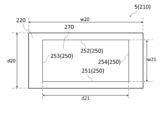
- the cut line 250 is formed along a single circular line as shown in FIG. 35.
- the cut line 250 is a perforation.
- the cut line 250 consists of a cut portion 251 (first cut portion), a cut portion 252 (second cut portion), a cut portion 253 (third cut portion), and a cut portion 254 (fourth cut portion). Cutout portion 251 and cutout portion 252 are in a straight line. In this embodiment, cutout portion 253 and cutout portion 254 are also in a straight line.
- the cutout portions 251 and 252 extend parallel to the side surface portion 232.
- the cutout portion 253 connects one end of the cutout portion 251 to one end of the cutout portion 252.
- One end of the cutout portion 251 and one end of the cutout portion 252 are located in the middle of the bottom surface portion 220.
- the middle of the bottom surface portion 220 refers to the portion of the bottom surface portion 220 other than the edge (the boundary with each of the side surface portions 232, 234, 236, and 238).
- the cutout portion 254 connects the other end of the cutout portion 251 to the other end of the cutout portion 252.
- the other end of the cutout portion 251 and the other end of the cutout portion 252 are located in the middle of the bottom surface portion 220.
- the cutout portions 253 and 254 extend perpendicular to the side surface portion 232.
- the cut line 262 is formed on the side portion 232. As shown in FIG. 36, the cut line 262 is formed along a single continuous line.
- the cut line 262 is a perforation.
- the cut line 262 includes a vertical cut portion 262a (first vertical cut portion), a vertical cut portion 262b (second vertical cut portion), and a horizontal cut portion 262c.
- the cut line 262 consists only of the vertical cut portion 262a, the vertical cut portion 262b, and the horizontal cut portion 262c.
- the vertical cut portion 262a, the vertical cut portion 262b, and the horizontal cut portion 262c are all straight.
- the vertical cut portion 262a and the vertical cut portion 262b extend in the height direction of the main body 210.
- the horizontal cut portion 262c connects one end of the vertical cut portion 262a and one end of the vertical cut portion 262b.
- One end of the vertical cut portion 262a and one end of the vertical cut portion 262b are located in the middle of the side portion 232.
- the other end of the vertical cut portion 262a and the other end of the vertical cut portion 262b are also located in the middle of the side portion 232.
- the middle portion of the side portion 232 refers to the part other than the edge of the side portion 232 (the boundary with the bottom portion 220, the boundaries with the side portions 236 and 238, and the boundary with the top portion 240).
- the horizontal cut portion 262c extends parallel to the bottom portion 220.
- the cut line 264 is formed on the side portion 234. As shown in FIG. 37, the cut line 264 is formed along a single continuous line.
- the cut line 264 is a perforation.
- the cut line 264 includes a vertical cut portion 264a (first vertical cut portion), a vertical cut portion 264b (second vertical cut portion), and a horizontal cut portion 264c.
- the cut line 264 consists only of the vertical cut portion 264a, the vertical cut portion 264b, and the horizontal cut portion 264c.
- the vertical cut portion 264a, the vertical cut portion 264b, and the horizontal cut portion 264c are all straight.
- the vertical cut portion 264a and the vertical cut portion 264b extend in the height direction of the main body 210.
- the horizontal cut portion 264c connects one end of the vertical cut portion 264a and one end of the vertical cut portion 264b.
- One end of the vertical cut portion 264a and one end of the vertical cut portion 264b are located in the middle of the side portion 234.
- the other end of the vertical cut portion 264a and the other end of the vertical cut portion 264b are also located in the middle of the side portion 234.
- the middle of the side portion 234 refers to the part other than the edge of the side portion 234 (the boundary with the bottom portion 220, the boundaries with each of the side portions 236 and 238, and the boundary with the top portion 240).
- the horizontal cut portion 264c extends parallel to the bottom portion 220.
- FIGS. 38 and 39 are perspective views showing the main body 210 after deformation.
- FIGS. 38 and 39 are perspective views seen from the side portion 232 side and the side portion 234 side, respectively.
- FIGS. 40 and 41 are plan and bottom views, respectively, showing the main body 210 after deformation.
- FIG. 42 is a diagram for explaining the structure of the end face along line D-D in FIG. 40.
- the cut piece 270 is a portion that becomes the cut piece 272 when cut is made in the main body 210 (bottom surface portion 220) along the cut line 250.
- the cut piece 272 is made of a single plate that is a part of the bottom surface portion 220. In this embodiment, the shape of the cut piece 272 is rectangular.
- the length d21 of the segment 272 is preferably 1.2 times or more, more preferably 1.4 times or more, of the distance d20 from the side portion 232 to the side portion 234.
- the length d21 is preferably 2 cm or more larger than the distance d20, more preferably 4 cm or more larger.
- the length d21 is, for example, 14 cm or more and 20 cm or less.
- the length d21 is the maximum dimension of the segment 272 in the insertion direction of the segment 272 into the slit portion 282 and the slit portion 284 described later.
- the length d21 is equal to the length of each of the cut portions 251, 252.
- the width w21 of the segment 272 is preferably 1/4 or more, more preferably 1/2 or more, of the width w20 of the side portion 232.
- the width w21 is, for example, 6 cm or more and 10 cm or less.
- the width w21 is the maximum dimension of the segment 272 in the direction perpendicular to the insertion direction. In this embodiment, width w21 is equal to the length of each cutout portion 253, 254.
- the slit portion 282 is a portion that becomes a slit 283 (first slit) located in the middle of the side portion 232 and into which the piece 272 can be inserted when the main body 210 (side portion 232) is cut along the cut line 262.
- the slit 283 is a horizontally long opening that extends parallel to the bottom portion 220.
- the side portion 232 is provided with a fold line 233 for folding the portion 282a surrounded by the cut line 262 (vertical cut portion 262a, vertical cut portion 262b, and horizontal cut portion 262c) to the outside of the main body 210.
- the fold line 233 connects the other end of the vertical cut portion 262a to the other end of the vertical cut portion 262b.
- the fold line 233 is parallel to the bottom portion 220. It is preferable that the fold line 233 has a fold line formed in advance so that the portion 282a can be easily folded along the fold line 233. However, the fold line 233 may simply consist of a line printed on the side portion 232 to inform the user of the location of the fold.
- the slit portion 284 is a portion that becomes a slit 285 (second slit) located in the middle of the side portion 234 and into which the segment 272 can be inserted when the main body 210 (side portion 234) is cut along the cut line 264.
- the slit 285 is a horizontally long opening that extends parallel to the bottom portion 220.
- the segment 272 is configured to be parallel to the bottom portion 220 when inserted into the slit 283 and the slit 285.
- the side portion 234 is provided with a fold line 235 for folding the portion 284a surrounded by the cut line 264 (vertical cut portion 264a, vertical cut portion 264b, and horizontal cut portion 264c) to the outside of the main body 210.
- the fold line 235 connects the other end of the vertical cut portion 264a to the other end of the vertical cut portion 264b.
- the fold line 235 is parallel to the bottom portion 220. It is preferable that the fold line 235 has a crease formed in advance so that the portion 284a can be easily folded along the fold line 235. However, the fold line 235 may be simply a line printed on the side portion 234 to inform the user of the fold position.
- the distance h21 (see FIG. 36) from the bottom surface portion 220 to the slit portion 282 is equal to or greater than 1/2 of the height h20 of the main body 210.
- the distance h22 (see FIG. 37) from the bottom surface portion 220 to the slit portion 284 is equal to or greater than 1/2 of the height h20.
- the slit portion 282 and the slit portion 284 are formed at positions that overlap each other in a side view.
- a cut is made in the main body 210 along the cut line 262. Then, the portion 282a surrounded by the cut line 262 is folded outward along the fold line 233 to turn the slit portion 282 into a slit 283. Also, a cut is made in the main body 210 along the cut line 264. Then, the portion 284a surrounded by the cut line 264 is folded outward along the fold line 235 to turn the slit portion 284 into a slit 285. Next, a cut is made in the main body 210 along the cut line 250 to separate the cut portion 270 from the main body 210, turning the cut portion 270 into a cut portion 272.
- the cut portion 272 is inserted into the slit 283 and the slit 285 so that its short side is parallel to the side portion 232.
- the item 290 is placed on the cut piece 272, as shown in FIG. 42.
- the item storage box 5 main body 210
- the item 290 can be smoothly removed from the removal opening even when the remaining amount of the item 290 is low.
- the distance from the cut piece 272 to the top surface 240 is 3 cm or more and 6 cm or less. Note that the item 290 is not shown in FIGS. 38 to 41.
- the protruding portion 272a of the segment 272 is printed with letters or a design.
- the protruding portion 272a is a portion that protrudes from each slit 283, 285 to the outside of the main body 210.
- the letters or design are printed on the upper surface (the surface on the upper surface portion 240 side) of the protruding portion 272a.
- the character string "ABC" is printed on the upper surface of the protruding portion 272a.
- the upper surface corresponds to a part of the inner surface of the bottom surface portion 220 of the main body 210 before deformation.
- the protruding portion 272a may be printed with a promotional message or a promotional slogan such as a company PR message or an advertisement.
- the content of the company PR message may be, for example, an introduction to the company's efforts in addressing environmental issues.
- the lower portion 210a is the portion that exists below the piece 272 when it is inserted into the slits 283 and 285.
- the lower portion 210a consists of a part of the inner surface of the bottom portion 220 and a part of the inner surface of each of the side portions 232, 234, 236, and 238.
- An advertising slogan may be printed on the lower portion 210a.
- the lower portion 210a may be provided with a scented section 212, as shown in FIG. 43, for example.
- the scented section 212 is provided on the inner surface of the side portion 234.
- a fragrance is attached to the scented section 212.
- the scented section 212 can be realized, for example, by printing the fragrance on the lower portion 210a.
- a peelable sticker 214 is attached to the scented section 212.
- peelable means that the sticker 214 can be easily peeled off from the scented section 212 without damaging the lower portion 210a and the scented section 212.
- the sticker 214 prevents the fragrance in the scented section 212 from dissipating.
- the section 270, slit section 282, and slit section 284 are provided on the main body 210. From the section 270, the section 272 separated from the main body 210 is obtained. From the slit section 282 and the slit section 284, slits 283 and 285 are obtained, which are located in the middle of the side section 232 and the side section 234, respectively, and into which the section 272 can be inserted. By inserting the section 272 into the slit 283 and the slit 285, the section 272 can be stretched from the middle of the side section 232 to the middle of the side section 234.
- an item storage box 5 is realized that can stably support items when the bottom is raised, without the need for a bottom-raising member separate from the main body 210.
- an item storage box In an item storage box, storing as many items as possible is advantageous in terms of keeping the price per item down.
- the height of the main body In order to increase the number of items that can be stored in one item storage box, the height of the main body must be increased. Normally, when the height of the main body is increased, there is a problem that it becomes difficult to remove items when there are only a few items left. In this regard, with item storage box 5, which can be raised at the bottom, items can be easily removed even when there are only a few items left, so the above problem caused by increasing the height of main body 210 can be solved. Also, by increasing the height of main body 210, a large space can be secured for printing letters or patterns. Furthermore, used main body 210 becomes waste, so storing a large number of items in one main body 210 also leads to a reduction in waste.
- the segment 272 is in a state where it is separated from the main body 210. In this case, the segment 272 can be freely displaced relative to the main body 210, making it easier to insert the segment 272 into the slits 283 and 285.
- the segment 272 is configured to be parallel to the bottom surface 220 when inserted into the slits 283 and 285. This also contributes to stable support of items in the item storage box 5 after the bottom is raised.
- Increasing the distance h21 from the bottom surface portion 220 to the slit portion 282 in the height direction of the main body 210 is advantageous in increasing the bottom-raising effect of the item storage box 5. From this perspective, it is preferable that the distance h21 is equal to or greater than 1/2 of the height h20 of the main body 210. On the other hand, if the distance h21 is too large, the amount of items that can be stored in the item storage box 5 after deformation will be extremely small. From this perspective, it is preferable that the distance h21 is equal to or less than 4/5 of the height h20.
- Increasing the distance h22 from the bottom surface portion 220 to the slit portion 284 in the height direction of the main body 210 is advantageous in terms of enhancing the bottom-raising effect of the item storage box 5. From this perspective, it is preferable that the distance h22 is equal to or greater than 1/2 of the height h20 of the main body 210. On the other hand, if the distance h22 is too large, the amount of items that can be stored in the item storage box 5 after deformation will be extremely small. From this perspective, it is preferable that the distance h22 is equal to or less than 4/5 of the height h20.
- Slit portion 282 and slit portion 284 are formed in a position where they overlap each other in a side view. This makes it easier to position piece 272 inserted into slits 283 and 285 parallel to bottom portion 220.
- the cut lines 250 are formed only on the bottom surface 220. In this case, the cut lines 250 do not pass through the boundaries between the bottom surface 220 and each of the side surfaces 232, 234, 236, and 238, making it easier to make cuts along the cut lines 250.
- the cut line 250 is made up of cut portions 251 and 252, as well as cut portions 253 and 254. This allows the cut line 250 for forming the segment 272 to be realized with a simple configuration.
- the cut portions 251 and 252 are in a straight line. This makes it easier to make cuts along the cut portions 251 and 252.
- the cut portions 253 and 254 are in a straight line. This makes it easier to make cuts along the cut portions 253 and 254.
- the cutout portions 253 and 254 extend perpendicular to the side surface portion 232. In this case, the length of each cutout portion 253, 254 can be minimized. This also makes it easier to make cuts along each cutout portion 253, 254.
- the length of segment 272 is preferably 1.2 times or more, and more preferably 1.4 times or more, the distance d20 from side portion 232 to side portion 234. From the same perspective, the length of segment 272 is preferably 2 cm or more longer than distance d20, and more preferably 4 cm or more longer. On the other hand, if the length of segment 272 is too large, it may be difficult to secure segment portion 270 in main body 210 before deformation. From this perspective, the length of segment 272 is preferably 1.8 times or less than distance d20. From the same perspective, the difference between the length of segment 272 and distance d20 is preferably 8 cm or less.
- the width w21 of the segment 272 is advantageous for stably supporting the item in the item storage box 5 after the bottom has been raised, since the segment 272 will come into contact with a wider area of the item.
- debris from the item e.g., paper dust from tissue paper
- the width w21 is preferably 1/4 or more of the width w20 of the side portion 232, and more preferably 1/2 or more.
- the width w21 is preferably 3/4 or less of the width w20.
- the width of side portion 232 and side portion 234 is greater than the width of side portion 236 and side portion 238.
- the cut line 262 includes vertical cut portions 262a and 262b, as well as horizontal cut portions 262c. This allows the cut line 262 for forming the slit 283 to be realized with a simple configuration.
- the vertical cut portions 262a and 262b, and the horizontal cut portion 262c are all in a straight line. This makes it easy to make cuts along the vertical cut portions 262a and 262b, and the horizontal cut portion 262c.
- the cut line 262 consists only of the vertical cut portion 262a, the vertical cut portion 262b, and the horizontal cut portion 262c.
- the portion 282a surrounded by the cut line 262 is not cut off from the main body 210, so it is possible to abut the portion 282a against the protruding portion 272a of the piece 272. This makes it even more difficult for the piece 272 to accidentally slip out of the slit 283.
- the cut line 264 includes vertical cut portions 264a and 264b, as well as horizontal cut portions 264c. This allows the cut line 264 for forming the slit 285 to be realized with a simple configuration.
- the vertical cut portions 264a and 264b, and the horizontal cut portion 264c are all in a straight line. This makes it easy to make cuts along the vertical cut portions 264a and 264b, and the horizontal cut portion 264c.
- the cut line 264 consists only of the vertical cut portion 264a, the vertical cut portion 264b, and the horizontal cut portion 264c.
- the portion 284a surrounded by the cut line 264 is not cut off from the main body 210, so it is possible to abut the portion 284a against the protruding portion 272a of the piece 272. This makes it even more difficult for the piece 272 to accidentally slip out of the slit 285.
- Letter or a design is printed on the protruding portion 272a of the segment 272.
- the aesthetic appearance of the body 210 after deformation can be improved.
- the letters or designs are printed on the top surface of the protruding portion 272a. By printing on the top surface, where they are easily visible, the letters or designs can be made to stand out.
- the outlet portion 272a can be used as advertising space. By recruiting advertisers, it is possible to earn advertising revenue. If this revenue is used to cover the manufacturing costs of the item storage box 5, the product price of the item storage box 5 can be reduced.
- Letter or a design is printed on the lower portion 210a of the inner surface of the main body 210.
- the lower portion 210a can be used as advertising space. By recruiting advertisers, it is possible to earn advertising revenue. If this revenue is used to cover the manufacturing costs of the item storage box 5, the product price of the item storage box 5 can be reduced.
- the scented section 212 is provided in the lower portion 210a, it is possible to disperse a fragrance around the main body 210 after it has been deformed. That is, by peeling off the sticker 214 after the main body 210 has been deformed, the fragrance in the scented section 212 can be dispersed around the main body 210. In addition, because the sticker 214 is affixed to the scented section 212, the user can choose whether or not to disperse a fragrance around the main body 210 by whether or not to peel off the sticker 214. Other effects of item storage box 5 are the same as those of item storage boxes 1 to 3.
- the shape of the segment 272 is rectangular.
- the segment 272 may have a tapered shape, for example, as shown in FIG. 44.
- the task of inserting the segment 272 can be facilitated by inserting the segment 272 into the slits 283, 285 from the tapered portion.
- the horizontal cut portion 262c of the cut line 262 is shown as a straight line.
- the horizontal cut portion 262c may be wavy, for example, as shown in FIG. 45.
- the piece 272 inserted into the slit 283 can be sandwiched from above and below by the convex portions, making it even more difficult for the piece 272 to accidentally slip out of the slit 283.
- the horizontal cut portion 264c of the cut line 264 is shown as a straight line.
- the horizontal cut portion 264c may be wavy, for example, as shown in FIG. 46.
- the piece 272 inserted into the slit 285 can be sandwiched from above and below by the convex portions, making it even more difficult for the piece 272 to accidentally slip out of the slit 285.
- the main body 210 may have a plurality of slit portions 282 and a plurality of slit portions 284, as shown in, for example, FIG. 47 and FIG. 48.
- the plurality of slit portions 282 are provided at different positions in the height direction of the main body 210.
- the plurality of slit portions 284 are provided at different positions in the height direction of the main body 210.
- the slit portions 282 and the slit portions 284 are provided at positions overlapping each other in a side view.
- the slit portion 282 provided on the upper side of the side portion 232 overlaps the slit portion 284 provided on the upper side of the side portion 234, and the slit portion 282 provided on the lower side of the side portion 232 overlaps the slit portion 284 provided on the lower side of the side portion 234.
- the segment 272 is inserted into the pair of slits 283, 285 on the upper side, or the pair of slits 283, 285 on the lower side.
- the height of the segment 272 (the distance from the bottom surface 220) can be adjusted by inserting the segment 272 into whichever pair of slits 283, 285. This makes it possible to select the degree of bottom raising depending on the remaining amount of items. Also, by arranging each slit 282 and each slit 284 in a position where they overlap each other in a side view, it becomes easier to position the segment 272 parallel to the bottom surface 220 regardless of which pair of slits 283, 285 the segment 272 is inserted into.
- the cut line 262 is located above the fold line 233.
- the cut line 262 may be located below the fold line 233, for example, as shown in FIG. 49.
- the cut line 264 is located above the fold line 235.
- the cut line 264 may be located below the fold line 235, for example, as shown in FIG. 50.
- the cut line 262 is formed along a single non-circular line.
- the cut line 262 may be formed along a single circular line, for example, as shown in FIG. 51.
- the portion 282a surrounded by the cut line 262 is cut off from the side portion 232, and a slit 283 having the same shape and size as the portion 282a is obtained.
- the cut line 264 is formed along a single non-circular line.
- the cut line 264 may be formed along a single circular line, for example, as shown in FIG. 52.
- the portion 284a surrounded by the cut line 264 is cut off from the side portion 234, and a slit 285 having the same shape and size as the portion 284a is obtained.
- the cut line 262 is formed along multiple line segments.
- the cut line 262 may be formed along a single line segment, for example, as shown in FIG. 53. In the figure, the cut line 262 is entirely in a straight line.
- the cut line 264 is formed along multiple line segments.
- the cut line 264 may be formed along a single line segment, for example, as shown in FIG. 54. In the figure, the cut line 264 is entirely in a straight line.
- the cut line 250 is formed only on the bottom portion 220.
- the cut line 250 may be formed from the bottom portion 220 to the side portion 232, for example, as shown in Figures 55 to 57.
- the cut line 250 is formed only on the bottom portion 220 and the side portion 232.
- the cut piece 272 is formed from a single plate consisting of a part of the bottom portion 220 and a part of the side portion 232.
- the cut line 250 is formed from the bottom portion 220 to both the side portion 232 and the side portion 234.
- Figure 57 is an oblique view of the main body 210 in Figure 56 as seen from the opposite side (the side portion 234 side).
- the cut piece 272 is formed from a single plate consisting of a part of the bottom portion 220, a part of the side portion 232, and a part of the side portion 234. Forming the cut line 250 from the bottom surface portion 220 to the side surface portion 232 in this manner is advantageous for increasing the width of the segment 272. Forming the cut line 250 from the bottom surface portion 220 to both the side surface portion 232 and the side surface portion 234 is particularly advantageous for increasing the width of the segment 272. Note that the cut line 250 may be formed only on the side surface portion 232 or only on the side surface portion 234.
- the cut lines 250, 262, and 264 are perforations. That is, the cut lines 250, 262, and 264 are configured such that cuts are made along the cut lines 250, 262, and 264 only when force is applied to both sides of the cut lines 250, 262, and 264. However, the cut lines 250, 262, and 264 may be made in advance.
- FIGS. 59 and 60 are a plan view and a rear view, respectively, showing the item storage box of FIG. 58.
- FIGS. 61 and 62 are side views showing the item storage box of FIG. 58.
- the item storage box 6 is an item storage box for storing items, and includes a main body 10.
- the item is a roll of sanitary paper 92.
- sanitary paper 92 include tissue paper, toilet paper, paper towels, and kitchen paper.
- the roll of sanitary paper 92 refers to a strip of sanitary paper 92 wound around an axis parallel to the short side direction.
- a cylindrical core may be provided in the center of the sanitary paper 92, or such a core may not be provided.
- the main body 10 has a main surface 12, a side surface 14, and a side surface 16.
- the main surface 12 is provided with an outlet forming section 20.
- the configuration of the outlet forming section 20 is as described in the first, second, or third embodiment. However, in this embodiment, detailed illustration of the outlet forming section 20 is omitted.
- the side surface 14 and the side surface 16 are a pair of side surfaces perpendicular to the central axis of the sanitary paper 92.
- the central axis of the sanitary paper 92 refers to an imaginary axis that corresponds to the central axis of a cylinder or column when the rolled sanitary paper 92 is viewed as a cylinder or column.
- the main body 10 further has a cutting blade 62, as well as an insertion portion 64 and an insertion portion 66.
- the cutting blade 62 is a portion for cutting the sanitary paper 92 pulled out from the outlet.
- the cutting blade 62 is provided at a position spaced apart from the outlet forming portion 20.
- the cutting blade 62 is provided on the periphery of the main surface 12.
- the cutting blade 62 is formed integrally with the side surface 18 of the main body 10 (see Figure 60).
- the side surface 18 is a side surface that is perpendicular to the side surfaces 14 and 16.
- the cutting blade 62 protrudes above the main surface 12 (see Figures 61 and 62).
- the insertion portion 64 is a portion that is inserted into the gap in the center of the sanitary paper 92. As shown in FIG. 61, the insertion portion 64 is provided on the side surface 14 of the main body 10.
- the insertion portion 64 has a cut line 64a.
- the cut line 64a consists of multiple line segments connecting the center of the insertion portion 64 and each vertex.
- the cut line 64a is a perforation.
- the tongue piece (the triangular part with each side as the base) can be folded inwardly along the periphery (each side of the polygon) of the insertion portion 64 to insert the insertion portion 64 (multiple tongue pieces) into the center of the sanitary paper 92.
- the insertion portion 64 is made up of a part of the side surface 14.
- the insertion portion 66 is a portion that is inserted into the gap in the center of the sanitary paper 92.
- the insertion portion 66 is provided on the side surface 16 of the main body 10 as shown in FIG. 62.
- the outer shape of the insertion portion 66 is a polygon. It is preferable that the outer shape of the insertion portion 66 is a regular n-gon, similar to the outer shape of the insertion portion 64.
- the insertion portion 66 has a cut line 66a.
- the cut line 66a is made up of multiple line segments connecting the center of the insertion portion 66 and each vertex.
- the cut line 66a is a perforation.
- the tongue piece After making a cut in the side surface 16 along the cut line 66a, the tongue piece can be folded inward along the periphery of the insertion portion 66 toward the inside of the main body 10, so that the insertion portion 66 can be inserted into the center of the sanitary paper 92. In this way, the insertion portion 66 is made up of a part of the side surface 16.
- the insertion portions 64 and 66 are disposed in positions that completely overlap each other when viewed from a direction perpendicular to the side surfaces 14 and 16.
- the entire main body 10, including the cutting blade 62, the insertion portions 64 and 66, is made of the same material. The rest of the configuration of the main body 10 is as described in the first embodiment.
- Figure 63 is a perspective view showing the item storage box 6 when in use.
- Figure 64 is a view for explaining the structure of the end face along line E-E in Figure 63.
- the sanitary paper 92 is omitted.
- the outlet 50 is formed in the outlet forming section 20 as described in the first embodiment.
- a cut is made in the side surface 14 along the cut line 64a of the insertion part 64, and a cut is made in the side surface 16 along the cut line 66a of the insertion part 66.
- the insertion part 64 and the insertion part 66 are folded inward of the main body 10 and inserted into the center of the sanitary paper 92.
- one end of the sanitary paper 92 is pulled to pull it out from the main body 10. Then, as shown in FIG. 65, the pulled out sanitary paper 92 is pressed against the tip of the cutting blade 62 and cut. This makes it possible to obtain a cut piece of sanitary paper 92 of the desired length.
- a sheet 70 of sufficient size is prepared, and the sheet 70 is cut into the shape shown in FIG. 66.
- the sheet 70 is made of a single piece of cardboard.
- the cut sheet 70 includes a portion 12p that will become the main surface 12, a portion 13p that will become the bottom surface (the surface opposite the main surface 12) of the main body 10, a portion 14p that will become the side surface 14, a portion 16p that will become the side surface 16, a portion 18p that will become the side surface 18, and a portion 19p that will become the remaining side surface (side surfaces other than the sides 14, 16, and 18) of the main body 10.
- An outlet forming portion 20 is formed in the portion 12p.
- An insertion portion 72 is connected to three sides of the portion 12p.
- An insertion portion 64 is formed in the portion 14p.
- a gluing portion 74 is connected to two sides of the portion 14p.
- An insertion portion 66 is formed in the portion 16p.
- a margin 76 is connected to two sides of portion 16p.
- a cutting blade 62 is connected to portion 18p. Note that FIG. 66 shows the inner surfaces (inner surfaces of main body 10) of each of portions 12p, 13p, 14p, 16p, 18p, and 19p.
- Fold F1 is located at the boundary between portion 12p and portion 16p.
- Fold F2 is located at the boundary between portion 12p and each of the insertion portions 72.
- Fold F3 is located at the boundary between portion 13p and portion 14p.
- Fold F4 is located at the boundary between portion 14p and each of the glue tabs 74.
- Fold F5 is located at the boundary between portion 13p and portion 16p.
- Fold F6 is located at the boundary between portion 16p and each of the glue tabs 76.
- Fold F7 is located at the boundary between portion 13p and portion 18p.
- Fold F8 is located at the boundary between portion 13p and portion 19p.
- the adhesive portion 74 is glued to the inner surface of the portion 18p and the portion 19p
- the adhesive portion 76 is glued to the inner surface of the portion 18p and the portion 19p.
- insert portion 72 may or may not be glued to the inner surface of each portion 14p, 18p, and 19p. In the former case, it is necessary to place sanitary paper 92 in the above space prior to gluing. In the latter case, the main body 10 having the main surface 12 that can be opened and closed is obtained.
- the main body 10 of the item storage box 6 has a cutting blade 62. This makes it easier to cut the sanitary paper 92 neatly compared to cutting the sanitary paper 92 pulled out of the main body 10 by hand.
- the cutting blade 62 is located at a position separated from the outlet forming section 20. In this case, after cutting, the sanitary paper 92 pulled out from the main body 10 remains between the outlet forming section 20 and the cutting blade 62. This has the advantage that the sanitary paper 92 can be easily picked up the next time it is pulled out.
- the cutting blade 62 is provided on the periphery of the main surface 12. In this case, by connecting the cutting blade 62 to the side of the main body 10, the main body 10 having the cutting blade 62 can be realized with a simple configuration. In fact, in the item storage box 6, the cutting blade 62 is connected to the upper end of the side surface 18.
- the main body 10 has insertion sections 64, 66. This makes it difficult for the central axis of the sanitary paper 92 to wobble. This is advantageous for stably pulling out the sanitary paper 92 from the main body 10.
- the insertion portion 64 is made of a part of the side surface 14 of the main body 10. This allows the main body 10 having the insertion portion 64 to be realized with a simple configuration.
- the insertion portion 66 is made of a part of the side surface 16 of the main body 10. This allows the main body 10 having the insertion portion 66 to be realized with a simple configuration.
- each insertion portion 64, 66 is a regular n-sided polygon (n is an integer of 5 or more), the outer shape is close to a circle. This makes it easier to smoothly rotate the sanitary paper 92 with the insertion portion 64, 66 inserted in the center.
- the entire body 10, including the cutting blade 62, the insertion portion 64, and the insertion portion 66, are made of the same material. This contributes to reducing the manufacturing costs of the item storage box 6.
- Other effects of the item storage box 6 are the same as those of the item storage boxes 1 to 3.
- each insertion portion 64, 66 is an n-sided polygon (n is an integer of 5 or more).
- the outer shape of each insertion portion 64, 66 may be a triangle or a rectangle. In that case, while it becomes more difficult for the sanitary paper 92 to rotate smoothly, it becomes more difficult for the sanitary paper 92 to rotate in the reverse direction. This has the advantage that the sanitary paper 92 pulled out of the main body 10 is less likely to go back in.
- the cut lines 64a and 66a are perforations.
- the cut lines 64a and 66a are configured so that cuts are made along the cut lines 64a and 66a only when force is applied to both sides of the cut lines 64a and 66a.
- the cut lines 64a and 66a may be pre-cut.
- the main body 10 may be provided with only either the insertion portion 64 or the insertion portion 66. Alternatively, the main body 10 may not be provided with either the insertion portion 64 or the insertion portion 66.
- the cutting blade 62 protrudes above the main surface 12.
- the cutting blade 62 may protrude to the side of the main surface 12, as shown in FIG. 68, for example. In that case, the cutting blade 62 can be formed integrally with the main surface 12.
- the cutting blade 62 is provided on the main body 10
- the main body 10 does not have to be provided with a cutting blade 62.
- the sanitary paper 92 pulled out from the main body 10 may be cut by hand or by the tip of the holding portion 22a or the tip of the holding portion 24a.
- FIG. 70 is a diagram for explaining the structure of the end face along line F-F in Figure 69.
- FIG 70 is a diagram for explaining the structure of the end face along line F-F in Figure 69.
- two sanitary paper 92 are stored in the main body 10.
- a partition 10a is provided inside the main body 10 to separate the two sanitary paper 92.
- the main surface 12 has multiple outlet forming sections 20 to correspond to the multiple sanitary paper 92.
- one outlet forming section 20 has an outlet formed for one sanitary paper 92
- the other outlet forming section 20 has an outlet formed for the other sanitary paper 92.
- sanitary papers 92 are stored in the main body 10 in this way, convenience for the user is improved. For example, if multiple different types of sanitary papers 92 are stored in the main body 10, the user can selectively remove the appropriate sanitary paper 92 from the main body 10 depending on the application. Also, by providing multiple removal opening forming sections 20 to correspond to multiple sanitary papers 92, the multiple sanitary papers 92 can be removed from separate removal openings. This prevents interference between the multiple sanitary papers 92 and allows each sanitary paper 92 to be removed smoothly.
- the present invention is not limited to the above embodiment, and various modifications are possible.
- the entire main body 10 is made of a single material.
- the main body 10 may be made of a plurality of materials.
- plastic or metal as the material for the cutting blade 62
- cardboard as the material for the remainder of the main body 10 (parts other than the cutting blade 62).
- cardboard as the material for the main surface 12, while using another material as the material for the remainder of the main body 10 (parts other than the main surface 12).
- other materials include cardboard, CNF (cellulose nanofiber), wood, plastic, or metal.
- the regulating portion 22b and the regulating portion 24b reach the fold line 34 and the fold line 32, respectively.
- the regulating portion 22b and the regulating portion 24b do not have to reach the fold line 34 and the fold line 32, respectively, as shown in FIG. 71, for example.
- one regulating portion 22b (the leftmost regulating portion 22b) reaches the fold line 34, while the remaining two regulating portions 22b do not reach the fold line 34.
- one regulating portion 24b (the rightmost regulating portion 24b) reaches the fold line 32, while the remaining two regulating portions 24b do not reach the fold line 32.
- the protrusion 26 is formed not only on the side end 22c of the regulating portion 22b but also on the side end 22d of the holding portion 22a.
- the protrusion 28 is formed not only on the side end 24c of the regulating portion 24b but also on the side end 24d of the holding portion 24a.
- the protrusions 26 and 28 may be formed only on the side end 22c and side end 24c, respectively, as shown in FIG. 72, for example. In that case, the holding portion 22a and the holding portion 24a have a higher degree of freedom of deformation, making it easier to smoothly remove items.
- the folding pieces 22 and 24 have the same shape. However, the folding pieces 22 and 24 do not have to have the same shape, as shown in FIG. 74, for example.
- the folding piece 22 is divided into a holding portion 22a and a restricting portion 22b.
- an example was given of a case where the folding piece 24 is divided into a holding portion 24a and a restricting portion 24b.
- the folding piece 22 does not have to be divided into a holding portion and a restricting portion, as shown in FIG. 75, for example.
- the folding piece 24 is also not divided into a holding portion and a restricting portion. In this case, the entire folding piece 22, 24 has the functions of both a holding portion and a restricting portion.
- the restricting portion 22b and the restricting portion 24b are provided on both sides of the holding portion 22a and the holding portion 24a, respectively.
- the restricting portion 22b and the restricting portion 24b may be provided on only one side of the holding portion 22a and the holding portion 24a, respectively, as shown in FIG. 76, for example.
- the portion 42a of the cut line 42 is wavy.
- the portion 42a may be curved and bulged toward the holding portion 22a or the holding portion 24a, as shown in FIG. 77.
- the portion 42a is curved and bulged toward the holding portion 22a.
- the tip of the holding portion 22a is concave and the tip of the holding portion 24a is convex. If the tip of the holding portion 22a is concave in this way, the article is more likely to wrinkle when passing near the tip. In this case, the article spreads in the vertical direction of the outlet forming portion 20, making it easier to maintain the state in which the article is sandwiched between the holding portion 22a and the holding portion 24a. This makes it less likely that the article pulled out from the outlet will fall into the main body 10. Furthermore, if the tip of the holding portion 24a is convex, the tip will more likely come into contact with the article. This makes it even more unlikely that the article pulled out from the outlet will fall into the main body 10.
- the portion 42a of the cut line 42 may be a straight line, as shown in FIG. 78, for example. In that case, it becomes easier to make the cut along the portion 42a.
- the side of the main body 10 may be made openable and closable, for example, as shown in Figures 79 and 80.
- Figures 79 and 80 respectively show the side 15 of the main body 10 in an open and closed state.
- the side 15 includes an upper plate 15a and a lower plate 15b.
- the upper plate 15a and the lower plate 15b are connected to the main surface 12 and the bottom surface, respectively.
- the upper plate 15a and the lower plate 15b are configured so that their tips overlap each other.
- the sum of the length of the upper plate 15a and the length of the lower plate 15b is greater than the height of the main body 10.
- the tip of the upper plate 15a and the tip of the lower plate 15b have cuts 17a and 17b, respectively.
- the side 15 can be closed by engaging the cuts 17a and 17b with each other (see Figure 80). Conversely, the side surface 15 can be opened by disengaging the slits 17a and 17b (see FIG. 79). This allows items to be refilled through the side surface 15 of the main body 10.
- first and second fold lines are creases 32 and 34, respectively.
- first and second fold lines may consist only of lines printed on the main surface 12 to inform the user of the fold positions.
- the cut lines 42, 44, and 46 are perforations.
- the cut lines 42, 44, and 46 are configured so that cuts are made along the cut lines 42, 44, and 46 only when force is applied to both sides of the cut lines 42, 44, and 46.
- the cut lines 42, 44, and 46 may be pre-cut.
Landscapes
- Engineering & Computer Science (AREA)
- Mechanical Engineering (AREA)
- Cartons (AREA)
Priority Applications (2)
| Application Number | Priority Date | Filing Date | Title |
|---|---|---|---|
| JP2024538268A JP7766892B2 (ja) | 2024-06-20 | 2024-06-20 | 物品収納箱 |
| PCT/JP2024/022418 WO2024167028A2 (ja) | 2024-06-20 | 2024-06-20 | 物品収納箱 |
Applications Claiming Priority (1)
| Application Number | Priority Date | Filing Date | Title |
|---|---|---|---|
| PCT/JP2024/022418 WO2024167028A2 (ja) | 2024-06-20 | 2024-06-20 | 物品収納箱 |
Publications (2)
| Publication Number | Publication Date |
|---|---|
| WO2024167028A2 true WO2024167028A2 (ja) | 2024-08-15 |
| WO2024167028A3 WO2024167028A3 (ja) | 2024-11-07 |
Family
ID=92262978
Family Applications (1)
| Application Number | Title | Priority Date | Filing Date |
|---|---|---|---|
| PCT/JP2024/022418 Pending WO2024167028A2 (ja) | 2024-06-20 | 2024-06-20 | 物品収納箱 |
Country Status (2)
| Country | Link |
|---|---|
| JP (1) | JP7766892B2 (https=) |
| WO (1) | WO2024167028A2 (https=) |
Family Cites Families (3)
| Publication number | Priority date | Publication date | Assignee | Title |
|---|---|---|---|---|
| EP1308401A1 (en) * | 2001-10-03 | 2003-05-07 | SCA Hygiene Products GmbH | A container for a stack of interfolded tissue sheets |
| JP2005170414A (ja) * | 2003-12-09 | 2005-06-30 | Crecia Corp | ティシュペーパー収納箱 |
| JP6615274B2 (ja) * | 2018-06-18 | 2019-12-04 | 株式会社無有 | 衛生用紙収納箱 |
-
2024
- 2024-06-20 WO PCT/JP2024/022418 patent/WO2024167028A2/ja active Pending
- 2024-06-20 JP JP2024538268A patent/JP7766892B2/ja active Active
Also Published As
| Publication number | Publication date |
|---|---|
| JP7766892B2 (ja) | 2025-11-11 |
| JPWO2024167028A1 (https=) | 2024-08-15 |
| WO2024167028A3 (ja) | 2024-11-07 |
Similar Documents
| Publication | Publication Date | Title |
|---|---|---|
| RU2494945C2 (ru) | Выдачное устройство для выдачи бумаги тиссью и способ изготовления выдачного устройства | |
| US20030111521A1 (en) | Gift packaging and method of manufacture thereof | |
| US5868373A (en) | Book easel | |
| US7134572B2 (en) | Container for a stack of interfolded tissue sheets | |
| JP7714203B2 (ja) | 物品収納箱 | |
| US6971511B2 (en) | Packaging container for candles and informational literature | |
| JP7766892B2 (ja) | 物品収納箱 | |
| US4111299A (en) | Deformable container | |
| JP5534462B2 (ja) | スタンド付ティッシュペーパーボックス | |
| JP4515152B2 (ja) | 表示機能を有する衛生用紙入りカートン | |
| JP7592352B2 (ja) | 物品収納箱 | |
| WO2024117271A2 (ja) | 物品収納箱 | |
| US7090096B2 (en) | Easel sheet dispenser | |
| US20060060641A1 (en) | Presentation folder | |
| EP1140520B1 (en) | Diorama/stand-up picture card | |
| WO2024172169A1 (ja) | 物品収納箱 | |
| WO2024150835A2 (ja) | 衛生用紙収納箱 | |
| WO2024150836A2 (ja) | 衛生用紙収納箱 | |
| JP2024159950A (ja) | 物品収納箱 | |
| WO2024090588A2 (ja) | 物品収納箱 | |
| US20240327100A1 (en) | Dispensers, blanks, and methods of forming the same | |
| JP7296286B2 (ja) | 包装箱 | |
| US2220536A (en) | Booklet | |
| JP3120491U (ja) | 配布用手提げ | |
| AU2016101772A4 (en) | The present invention generally relates to a packaging item for containing objects. In one particular, but non limiting form, the packaging item may be a box for containing tissues or other gifts. |
Legal Events
| Date | Code | Title | Description |
|---|---|---|---|
| ENP | Entry into the national phase |
Ref document number: 2024538268 Country of ref document: JP Kind code of ref document: A |
|
| 121 | Ep: the epo has been informed by wipo that ep was designated in this application |
Ref document number: 24753471 Country of ref document: EP Kind code of ref document: A2 |