WO2024162289A1 - 電力変換装置 - Google Patents
電力変換装置 Download PDFInfo
- Publication number
- WO2024162289A1 WO2024162289A1 PCT/JP2024/002730 JP2024002730W WO2024162289A1 WO 2024162289 A1 WO2024162289 A1 WO 2024162289A1 JP 2024002730 W JP2024002730 W JP 2024002730W WO 2024162289 A1 WO2024162289 A1 WO 2024162289A1
- Authority
- WO
- WIPO (PCT)
- Prior art keywords
- switch
- current
- period
- control signal
- resonant
- Prior art date
- Legal status (The legal status is an assumption and is not a legal conclusion. Google has not performed a legal analysis and makes no representation as to the accuracy of the status listed.)
- Ceased
Links
Images














Classifications
-
- H—ELECTRICITY
- H02—GENERATION; CONVERSION OR DISTRIBUTION OF ELECTRIC POWER
- H02M—APPARATUS FOR CONVERSION BETWEEN AC AND AC, BETWEEN AC AND DC, OR BETWEEN DC AND DC, AND FOR USE WITH MAINS OR SIMILAR POWER SUPPLY SYSTEMS; CONVERSION OF DC OR AC INPUT POWER INTO SURGE OUTPUT POWER; CONTROL OR REGULATION THEREOF
- H02M7/00—Conversion of AC power input into DC power output; Conversion of DC power input into AC power output
- H02M7/42—Conversion of DC power input into AC power output without possibility of reversal
- H02M7/44—Conversion of DC power input into AC power output without possibility of reversal by static converters
- H02M7/48—Conversion of DC power input into AC power output without possibility of reversal by static converters using discharge tubes with control electrode or semiconductor devices with control electrode
-
- Y—GENERAL TAGGING OF NEW TECHNOLOGICAL DEVELOPMENTS; GENERAL TAGGING OF CROSS-SECTIONAL TECHNOLOGIES SPANNING OVER SEVERAL SECTIONS OF THE IPC; TECHNICAL SUBJECTS COVERED BY FORMER USPC CROSS-REFERENCE ART COLLECTIONS [XRACs] AND DIGESTS
- Y02—TECHNOLOGIES OR APPLICATIONS FOR MITIGATION OR ADAPTATION AGAINST CLIMATE CHANGE
- Y02B—CLIMATE CHANGE MITIGATION TECHNOLOGIES RELATED TO BUILDINGS, e.g. HOUSING, HOUSE APPLIANCES OR RELATED END-USER APPLICATIONS
- Y02B70/00—Technologies for an efficient end-user side electric power management and consumption
- Y02B70/10—Technologies improving the efficiency by using switched-mode power supplies [SMPS], i.e. efficient power electronics conversion e.g. power factor correction or reduction of losses in power supplies or efficient standby modes
Definitions
- This disclosure relates to a power conversion device, and more specifically, to a power conversion device capable of converting DC power to AC power.
- Patent Document 1 discloses a power conversion device that converts direct current into multi-phase alternating current.
- the power conversion device disclosed in Patent Document 1 includes a main switching means (power conversion circuit), two capacitors, one coil (resonant inductor), multiple auxiliary switch elements, and control means.
- the main switching means is composed of a pair of main switch elements connected in series between both terminals of a DC power source, and a main switching circuit with the interconnection point of the pair of main switch elements as the output point of each phase is provided for each phase of the multi-phase AC.
- the two capacitors divide the voltage of the DC power source.
- One end of the coil is connected to the voltage division point of the two capacitors.
- the multiple auxiliary switch elements connect between the other end of the coil and the output points of each phase.
- control means determines that multiple phase currents flow through the coil, it controls multiple auxiliary switch elements so that the current flowing through at least one phase is smaller than a preset value, and therefore soft switching of the main switch corresponding to the at least one phase is not performed.
- the objective of this disclosure is to provide a power conversion device that can perform soft switching more reliably.
- a power conversion device includes a first DC terminal and a second DC terminal, a power conversion circuit, a plurality of AC terminals, a plurality of switches, a plurality of resonant capacitors, a resonant inductor, a regenerative capacitor, and a control device.
- the power conversion circuit has a plurality of first switching elements and a plurality of second switching elements.
- a plurality of switching circuits in which the plurality of first switching elements and the plurality of second switching elements are connected in series in a one-to-one relationship are connected in parallel to each other.
- the plurality of first switching elements are connected to the first DC terminal, and the plurality of second switching elements are connected to the second DC terminal.
- the plurality of AC terminals correspond one-to-one to the plurality of switching circuits.
- Each of the plurality of AC terminals is connected to a connection point of the first switching element and the second switching element in the corresponding switching circuit.
- the plurality of switches correspond one-to-one to the plurality of switching circuits.
- Each of the plurality of switches has a first end connected to the connection point between the first switching element and the second switching element in the corresponding switching circuit, and a second end commonly connected to a common connection point.
- the resonance capacitors correspond one-to-one to the plurality of switches.
- Each of the plurality of resonance capacitors is connected between the first end and the second DC terminal of the corresponding switch.
- the resonance inductor has a first end and a second end. The first end of the resonance inductor is connected to the common connection point.
- the regeneration capacitor has a third end and a fourth end. The third end of the regeneration capacitor is connected to the first DC terminal or the second DC terminal.
- the control device provides a control signal whose potential changes between a high level and a low level to each of the plurality of first switching elements, the plurality of second switching elements, and the plurality of switches.
- the control device sets a dead time period between a high level period of a control signal to the first switching element and a high level period of a control signal to the second switching element for each of the multiple switching circuits, and sets the high level period of the control signal to each of the multiple switches based on the dead time period for a corresponding switching circuit among the multiple switching circuits.
- a load current flows through each of the multiple AC terminals through the first switching element or the second switching element of the corresponding switching circuit.
- the control device determines that a resonant current flows simultaneously through two or more switches among the multiple switches, the control device performs a first operation and further performs a second operation when one of two switches among the two or more switches that correspond one-to-one to two AC terminals having the same polarity of the load current among the multiple AC terminals is set as a first switch and the remaining one is set as a second switch.
- the first operation is an operation for shortening the high-level period of the control signal to the first switch by a shortening period from a period including a resonance half cycle determined by the capacitance of the resonance capacitor corresponding to the first switch among the multiple resonance capacitors and the inductance of the resonance inductor, and an additional time determined by the voltage of the regenerative capacitor, the inductance of the resonance inductor, and the load current value.
- the second operation is an operation for shifting the high-level period of the control signal to at least one of the first switch and the second switch so that the high-level period of the control signal to the first switch starts after a waiting period from a time point when the current value of the resonance current passing through the second switch becomes an extreme value and coincides with the current value of the load current flowing through the AC terminal corresponding to the second switch among the two or more AC terminals.
- the power conversion device disclosed herein has the advantage of being able to perform soft switching more reliably.
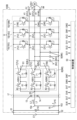
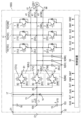
- FIG. 1 is a circuit diagram of a system including a power conversion device according to a first embodiment.
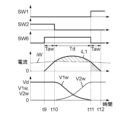
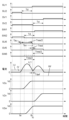
- FIG. 2 is an explanatory diagram of an operation when the control device in the power conversion device performs a basic operation in the case where the load current is greater than 0 and the resonance capacitor is being charged.
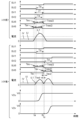
- FIG. 3 is another operation explanatory diagram when the control device in the power conversion device performs a basic operation when the load current is greater than 0 and the resonance capacitor is being charged.
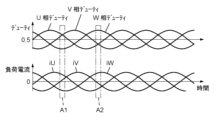
- FIG. 4 is a diagram showing a time change in duty and a time change in load current corresponding to voltage commands for each of three phases in an AC load connected to a plurality of AC terminals of the power conversion device according to the above embodiment.
- FIG. 1 is a circuit diagram of a system including a power conversion device according to a first embodiment.
- FIG. 2 is an explanatory diagram of an operation when the control device in the power conversion device performs a basic operation in the case where the load current is greater than 0 and the resonance capacitor is being charged.
- FIG. 5 is an explanatory diagram of a first current threshold value and a second current threshold value used by a control device in the power conversion device according to the above embodiment.
- FIG. 6 is an explanatory diagram of an operation when the control device in the power conversion device performs a basic operation when the load current is greater than 0 and the resonant capacitor is discharging.
- FIG. 7 is an explanatory diagram of an operation when the control device in the power conversion device performs a basic operation when the load current is less than 0 and the resonant capacitor is discharging.
- FIG. 8 is an explanatory diagram of an operation when the control device in the power conversion device performs a basic operation when the load current is less than 0 and the resonance capacitor is being charged.
- FIG. 6 is an explanatory diagram of an operation when the control device in the power conversion device performs a basic operation when the load current is greater than 0 and the resonant capacitor is discharging.
- FIG. 7 is an explanatory diagram of an operation when the control device
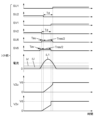
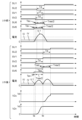
- FIG. 9 is a timing chart for explaining an operation when the control device performs the first operation and the second operation in the power conversion device.
- FIG. 10 is a timing chart for explaining an operation when the control device performs the first operation and the second operation in the power conversion device.
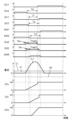
- FIG. 11 is a timing chart for explaining an operation when the control device performs the first operation and the second operation in the power conversion device.
- FIG. 12 is a timing chart for explaining an operation when the control device performs the first operation and the second operation in the power conversion device.
- FIG. 13 is a timing chart for explaining the operation of the control device in the power conversion device according to the first modification of the first embodiment.
- FIG. 14 is a timing chart for explaining the operation of the control device in the power conversion device according to the second modification of the first embodiment.
- FIG. 15 is a timing chart for explaining the operation of the control device in the power conversion device.
- FIG. 16 is a timing chart for explaining the operation when the control device in the power conversion device according to the second embodiment performs the first operation and the second operation.
- FIG. 17 is a timing chart for explaining the operation when the control device in the power conversion device according to the second embodiment performs the first operation and the second operation.
- FIG. 18 is a timing chart for explaining the operation when the control device in the power conversion device according to the third embodiment performs the first operation and the second operation.
- FIG. 19 is a timing chart for explaining the operation when the control device in the power conversion device according to the fourth embodiment performs the first operation and the second operation.
- FIG. 20 is a timing chart for explaining the operation when the control device in the power conversion device according to the fifth embodiment performs the first operation and the second operation.
- FIG. 21 is a timing chart for explaining the operation when the control device in the power conversion device according to the sixth embodiment performs the first operation and the second operation.
- FIG. 22 is a timing chart for explaining the operation when the control device in the power conversion device according to the seventh embodiment performs the first operation and the second operation.
- FIG. 23 is a timing chart for explaining the operation when the control device in the power conversion device according to the eighth embodiment performs the first operation and the second operation.
- FIG. 24 is a timing chart for explaining the operation when the control device in the power conversion device according to the ninth embodiment performs the first operation and the second operation.
- FIG. 25 is a timing chart for explaining the operation when the control device in the tenth embodiment performs the first operation and the second operation.
- FIG. 26 is a circuit diagram of a system including a power conversion device according to the eleventh embodiment.
- FIG. 27 is a circuit diagram of a system including a power conversion device according to the twelfth embodiment.
- FIG. 28 is a circuit diagram of a system including a power conversion device according to the thirteenth embodiment.
- FIG. 29 is a circuit diagram of a system including a power conversion device according to the fourteenth embodiment.
- FIG. 30 is a circuit diagram of a system including a power conversion device according to the fifteenth embodiment.
- FIG. 31 is a circuit diagram of a system including a power conversion device according to the sixteenth embodiment.
- FIG. 32 is a circuit diagram of a system including a power conversion device according to the seventeenth embodiment.
- FIG. 33 is a circuit diagram of a system including a power conversion device according to an eighteenth embodiment.
- the power conversion device 100 includes a first DC terminal 31, a second DC terminal 32, and a plurality of (e.g., three) AC terminals 41.
- a DC power source E1 is connected between the first DC terminal 31 and the second DC terminal 32, and an AC load RA1 is connected to the plurality of AC terminals 41.
- the AC load RA1 is, for example, a three-phase motor.
- the power conversion device 100 converts the DC output from the DC power source E1 into AC power and outputs it to the AC load RA1.
- the DC power source E1 includes, for example, a solar cell or a fuel cell.
- the DC power source E1 may include a DC-DC converter.
- the AC power is, for example, three-phase AC power having a U phase, a V phase, and a W phase.
- the power conversion device 100 includes a power conversion circuit 11, a plurality of (e.g., three) switches 8, a plurality of (e.g., three) resonant capacitors 9, a regenerative capacitor 15, a resonant inductor L1, and a control device 50.
- the power conversion device 100 further includes a protection circuit 17 and a capacitor C10.
- Each of the plurality of switches 8 is, for example, a bidirectional switch.
- the power conversion circuit 11 has a plurality of (e.g., three) first switching elements 1 and a plurality of (e.g., three) second switching elements 2.
- a plurality of (e.g., three) switching circuits 10 in which a plurality of first switching elements 1 and a plurality of second switching elements 2 are connected in series in a one-to-one relationship are connected in parallel to each other.
- a plurality of first switching elements 1 are connected to a first DC terminal 31, and a plurality of second switching elements 2 are connected to a second DC terminal 32.
- a plurality of AC terminals 41 correspond one-to-one to the plurality of switching circuits 10.
- Each of the plurality of AC terminals 41 is connected to a connection point 3 of the first switching element 1 and the second switching element 2 in the corresponding switching circuit 10.
- a plurality of switches 8 correspond one-to-one to the plurality of switching circuits 10.
- a first end 81 of each of the plurality of switches 8 is connected to a connection point 3 of the first switching element 1 and the second switching element 2 in the corresponding switching circuit 10.
- a plurality of resonance capacitors 9 correspond one-to-one to the plurality of switches 8.
- Each of the multiple resonant capacitors 9 is connected between the first end 81 of the corresponding switch 8 and the second DC terminal 32.
- the resonant inductor L1 has a first end and a second end, and the first end is connected to the common connection point 25.
- the regenerative capacitor 15 has a third end 153 and a fourth end 154.
- the third end 153 is connected to the second DC terminal 32
- the fourth end 154 is connected to the common connection point 25 via the resonant inductor L1.
- the control device 50 controls the multiple first switching elements 1, the multiple second switching elements 2, and the multiple switches 8.
- the switching circuits 10 corresponding to the U-phase, V-phase, and W-phase of the multiple switching circuits 10 may be referred to as a switching circuit 10U, a switching circuit 10V, and a switching circuit 10W, respectively.
- the first switching element 1 and the second switching element 2 of the switching circuit 10U may be referred to as a first switching element 1U and a second switching element 2U.
- the first switching element 1 and the second switching element 2 of the switching circuit 10V may be referred to as a first switching element 1V and a second switching element 2V.
- the first switching element 1 and the second switching element 2 of the switching circuit 10W may be referred to as a first switching element 1W and a second switching element 2W.
- the connection point 3 between the first switching element 1U and the second switching element 2U may be referred to as the connection point 3U
- the connection point 3 between the first switching element 1V and the second switching element 2V may be referred to as the connection point 3V
- the connection point 3 between the first switching element 1W and the second switching element 2W may be referred to as the connection point 3W.
- the AC terminal 41 connected to the connection point 3U may be referred to as the AC terminal 41U
- the AC terminal 41 connected to the connection point 3V may be referred to as the AC terminal 41V
- the AC terminal 41 connected to the connection point 3W may be referred to as the AC terminal 41W.
- the resonant capacitor 9 connected in parallel to the second switching element 2U may be referred to as the resonant capacitor 9U
- the resonant capacitor 9 connected in parallel to the second switching element 2V may be referred to as the resonant capacitor 9V
- the resonant capacitor 9 connected in parallel to the second switching element 2W may be referred to as the resonant capacitor 9W.
- switch 8U the switch 8 connected to connection point 3U
- switch 8V the switch 8 connected to connection point 3V
- switch 8W the switch 8 connected to connection point 3W
- the high-potential output terminal (positive electrode) of the DC power supply E1 is connected to the first DC terminal 31, and the low-potential output terminal (negative electrode) of the DC power supply E1 is connected to the second DC terminal 32.
- the U-phase terminal, V-phase terminal, and W-phase terminal of the AC load RA1 are connected to the three AC terminals 41U, 41V, and 41W, respectively.
- each of the multiple (e.g., three) first switching elements 1 and the multiple (e.g., three) second switching elements 2 has a control terminal, a first main terminal, and a second main terminal.
- the control terminals of the multiple first switching elements 1 and the multiple second switching elements 2 are connected to the control device 50.
- the first main terminal of the first switching element 1 is connected to the first DC terminal 31
- the second main terminal of the first switching element 1 is connected to the first main terminal of the second switching element 2
- the second main terminal of the second switching element 2 is connected to the second DC terminal 32.
- the first switching element 1 is a high-side switching element (P-side switching element), and the second switching element 2 is a low-side switching element (N-side switching element).
- Each of the multiple first switching elements 1 and the multiple second switching elements 2 is, for example, an IGBT (Insulated Gate Bipolar Transistor). Therefore, the control terminal, the first main terminal, and the second main terminal of each of the multiple first switching elements 1 and the multiple second switching elements 2 are the gate terminal, the collector terminal, and the emitter terminal, respectively.
- the power conversion circuit 11 further includes a plurality (three) of first diodes 4 connected in anti-parallel to a plurality (three) of first switching elements 1 in a one-to-one relationship, and a plurality (three) of second diodes 5 connected in anti-parallel to a plurality (three) of second switching elements 2 in a one-to-one relationship.
- the anode of the first diode 4 is connected to the second main terminal (emitter terminal) of the first switching element 1 corresponding to the first diode 4
- the cathode of the first diode 4 is connected to the first main terminal (collector terminal) of the first switching element 1 corresponding to the first diode 4.
- the anode of the second diode 5 is connected to the second main terminal (emitter terminal) of the second switching element 2 corresponding to the second diode 5, and the cathode of the second diode 5 is connected to the first main terminal (collector terminal) of the second switching element 2 corresponding to the second diode 5.
- connection point 3U between the first switching element 1U and the second switching element 2U is connected to, for example, the U-phase terminal of the AC load RA1 via the AC terminal 41U.
- connection point 3V between the first switching element 1V and the second switching element 2V is connected to, for example, the V-phase of the AC load RA1 via the AC terminal 41V.
- connection point 3W between the first switching element 1W and the second switching element 2W is connected to, for example, the W-phase of the AC load RA1 via the AC terminal 41W.
- the multiple resonant capacitors 9 correspond one-to-one to the multiple switches 8. Each of the multiple resonant capacitors 9 is connected between a first end of the corresponding switch 8 and the second DC terminal 32.
- the power conversion device 100 has multiple resonant circuits.
- the multiple resonant circuits include a resonant circuit having a resonant capacitor 9U and a resonant inductor L1, a resonant circuit having a resonant capacitor 9V and a resonant inductor L1, and a resonant circuit having a resonant capacitor 9W and a resonant inductor L1.
- the multiple resonant circuits share the resonant inductor L1 in common.
- Each of the multiple switches 8 has, for example, two first IGBTs 6 and second IGBTs 7 connected in inverse parallel.
- the collector terminal of the first IGBT 6 is connected to the emitter terminal of the second IGBT 7, and the emitter terminal of the first IGBT 6 is connected to the collector terminal of the second IGBT 7.
- the emitter terminal of the first IGBT 6 is connected to the connection point 3 of the switching circuit 10 corresponding to the switch 8 having the first IGBT 6.
- the collector terminal of the second IGBT 7 is connected to the connection point 3 of the switching circuit 10 corresponding to the switch 8 having the second IGBT 7.
- the switch 8U is connected to the connection point 3U of the first switching element 1U and the second switching element 2U.
- the switch 8V is connected to the connection point 3V of the first switching element 1V and the second switching element 2V.
- the switch 8W is connected to a connection point 3W between the first switching element 1W and the second switching element 2W.
- the first IGBT 6 and the second IGBT 7 of the switch 8U are referred to as the first IGBT 6U and the second IGBT 7U, respectively
- the first IGBT 6 and the second IGBT 7 of the switch 8V are referred to as the first IGBT 6V and the second IGBT 7V, respectively
- the first IGBT 6 and the second IGBT 7 of the switch 8W are referred to as the first IGBT 6W and the second IGBT 7W, respectively.
- the multiple switches 8 are controlled by the control device 50.
- the first IGBT 6U, the second IGBT 7U, the first IGBT 6V, the second IGBT 7V, the first IGBT 6W, and the second IGBT 7W are controlled by the control device 50.
- the resonant inductor L1 has a first end and a second end. In the resonant inductor L1, the first end of the resonant inductor L1 is connected to the common connection point 25. The second end of the resonant inductor L1 is connected to the fourth end 154 of the regenerative capacitor 15.
- the regenerative capacitor 15 is connected between the second end of the resonant inductor L1 and the second DC terminal 32.
- the regenerative capacitor 15 is, for example, a film capacitor.
- the protection circuit 17 includes a third diode 13 and a fourth diode 14.
- the third diode 13 is connected between the common connection point 25 and the first DC terminal 31.
- the anode of the third diode 13 is connected to the common connection point 25.
- the cathode of the third diode 13 is connected to the first DC terminal 31.
- the fourth diode 14 is connected between the common connection point 25 and the second DC terminal 32.
- the anode of the fourth diode 14 is connected to the second DC terminal 32.
- the cathode of the fourth diode 14 is connected to the common connection point 25. Therefore, the fourth diode 14 is connected in series with the third diode 13.
- Capacitor C10 is connected between the first DC terminal 31 and the second DC terminal 32, and is connected in parallel to the power conversion circuit 11.
- Capacitor C10 is, for example, an electrolytic capacitor.
- the control device 50 controls a plurality of first switching elements 1, a plurality of second switching elements 2, and a plurality of switches 8.
- the execution subject of the control device 50 includes a computer system.
- the computer system has one or more computers.
- the computer system is mainly composed of a processor and a memory as hardware.
- the processor executes a program recorded in the memory of the computer system, thereby realizing the function of the control device 50 as the execution subject in this disclosure.
- the program may be pre-recorded in the memory of the computer system, or may be provided through an electric communication line, or may be recorded and provided on a non-transitory recording medium such as a memory card, an optical disk, or a hard disk drive (magnetic disk) that can be read by the computer system.
- the processor of the computer system is composed of one or more electronic circuits including a semiconductor integrated circuit (IC) or a large-scale integrated circuit (LSI).
- the multiple electronic circuits may be integrated in one chip or distributed across multiple chips.
- the multiple chips may be integrated in one device or distributed across multiple devices.
- the control device 50 outputs control signals SU1, SV1, SW1 that control the on/off of each of the multiple first switching elements 1U, 1V, 1W.
- Each of the control signals SU1, SV1, SW1 is, for example, a PWM (Pulse Width Modulation) signal whose potential level changes between a first potential level (hereinafter also referred to as a low level) and a second potential level (hereinafter also referred to as a high level) that is higher than the first potential level.
- the first switching elements 1U, 1V, 1W are in an on state when the control signals SU1, SV1, SW1 are at a high level, and in an off state when the control signals SU1, SV1, SW1 are at a low level.
- the control device 50 also outputs control signals SU2, SV2, SW2 that control the on/off of each of the multiple second switching elements 2U, 2V, 2W.
- Each of the control signals SU2, SV2, and SW2 is, for example, a PWM signal whose potential level changes between a first potential level (hereinafter also referred to as a low level) and a second potential level (hereinafter also referred to as a high level) that is higher than the first potential level.
- the second switching elements 2U, 2V, and 2W are turned on when the control signals SU2, SV2, and SW2 are at a high level, and turned off when they are at a low level.
- the control device 50 uses a sawtooth carrier signal (see FIG. 2) to generate control signals SU1, SV1, SW1 corresponding to each of the first switching elements 1U, 1V, 1W, and control signals SU2, SV2, SW2 corresponding to each of the second switching elements 2U, 2V, 2W. More specifically, the control device 50 generates control signals SU1, SU2 to be provided to the first switching element 1U and the second switching element 2U, respectively, based on at least the carrier signal and a voltage command for the U phase. The control device 50 also generates control signals SV1, SV2 to be provided to the first switching element 1V and the second switching element 2V, respectively, based on at least the carrier signal and a voltage command for the V phase.
- a sawtooth carrier signal see FIG. 2
- the control device 50 also generates control signals SW1, SW2 to be provided to the first switching element 1W and the second switching element 2W, respectively, based on at least the carrier signal and a voltage command for the W phase.
- the U-phase voltage command, V-phase voltage command, and W-phase voltage command are, for example, sinusoidal signals with phases differing from each other by 120°, and the amplitude (voltage command value) of each changes over time.
- the waveform of the carrier signal is not limited to a sawtooth waveform, and may be, for example, a triangular wave or a sawtooth wave obtained by inverting the sawtooth wave in FIG. 2.
- the length of one cycle of the U-phase voltage command, V-phase voltage command, and W-phase voltage command is the same.
- the length of one cycle of the U-phase voltage command, V-phase voltage command, and W-phase voltage command is longer than the length of one cycle of the carrier signal.
- the duty of the control signal SU1 is shown as the U-phase duty.
- the control device 50 compares the U-phase voltage command with the carrier signal to generate the control signal SU1 to be provided to the first switching element 1U.
- the control device 50 also inverts the control signal SU1 to be provided to the first switching element 1U to generate the control signal SU2 to be provided to the second switching element 2U.
- the control device 50 also sets a dead time period Td (see FIG. 2) between the high-level period of the control signal SU1 and the high-level period of the control signal SU2 so that the on periods of the first switching element 1U and the second switching element 2U do not overlap.
- the duty of the control signal SV1 is shown as the V-phase duty.
- the control device 50 compares the V-phase voltage command with the carrier signal to generate the control signal SV1 to be provided to the first switching element 1V.
- the control device 50 also inverts the control signal SV1 to be provided to the first switching element 1V to generate the control signal SV2 to be provided to the second switching element 2V.
- the control device 50 also sets a dead time period Td (see FIG. 2) between the high-level period of the control signal SV1 and the high-level period of the control signal SV2 so that the on periods of the first switching element 1V and the second switching element 2V do not overlap.
- the duty of the control signal SW1 is shown as the W phase duty.
- the control device 50 compares the voltage command of the W phase with the carrier signal to generate the control signal SW1 to be provided to the first switching element 1W.
- the control device 50 also inverts the control signal SW1 to be provided to the first switching element 1W to generate the control signal SW2 to be provided to the second switching element 2W.
- the control device 50 also sets a dead time period Td (see FIG. 3) between the high level period of the control signal SW1 and the high level period of the control signal SW2 so that the on periods of the first switching element 1W and the second switching element 2W do not overlap.
- the U-phase voltage command, V-phase voltage command, and W-phase voltage command are, for example, sinusoidal signals whose phases differ by 120°, and whose amplitudes change over time. Therefore, the duty of the control signal SU1 (U-phase duty), the duty of the control signal SV1 (V-phase duty), and the duty of the control signal SW1 (W-phase duty) change into sinusoidal waves whose phases differ by 120°, for example, as shown in FIG. 4. Similarly, the duty of the control signal SU2, the duty of the control signal SV2, and the duty of the control signal SW2 change into sinusoidal waves whose phases differ by 120°.
- the control device 50 generates the control signals SU1, SU2, SV1, SV2, SW1, and SW2 based on the carrier signal, the voltage commands, and information about the state of the AC load RA1.
- the information about the state of the AC load RA1 includes, for example, detection values from a plurality of current sensors that detect output currents (hereinafter also referred to as load currents) iU, iV, and iW that flow through the U-phase, V-phase, and W-phase of the AC load RA1, respectively.
- the multiple switches 8, the resonant inductor L1, the multiple resonant capacitors 9, and the regenerative capacitor 15 are provided to perform zero-voltage soft switching of the multiple first switching elements 1 and the multiple second switching elements 2.
- control device 50 controls a plurality of switches 8 in addition to a plurality of first switching elements 1 and second switching elements 2 of the power conversion circuit 11.
- the control device 50 generates control signals SU6, SU7, SV6, SV7, SW6, SW7 that control the on/off of the first IGBT6U, the second IGBT7U, the first IGBT6V, the second IGBT7V, the first IGBT6W, and the second IGBT7W, and outputs them to the gate terminals of the first IGBT6U, the second IGBT7U, the first IGBT6V, the second IGBT7V, the first IGBT6W, and the second IGBT7W.
- the switch 8U can pass a charging current that flows through the path of the regenerative capacitor 15 - resonant inductor L1 - switch 8U - resonant capacitor 9U.
- the charging current is a current that charges the resonant capacitor 9U.
- the switch 8U can pass a discharging current that flows through the path of the resonant capacitor 9U - switch 8U - resonant inductor L1 - regenerative capacitor 15.
- the discharging current is a current that discharges the charge in the resonant capacitor 9U.
- the switch 8V can pass a charging current that flows through the path of the regenerative capacitor 15 - resonant inductor L1 - switch 8V - resonant capacitor 9V.
- the charging current is a current that charges the resonant capacitor 9V.
- the switch 8V can pass a discharging current that flows through the path of the resonant capacitor 9V - switch 8V - resonant inductor L1 - regenerative capacitor 15.
- the discharging current is a current that discharges the charge of the resonant capacitor 9V.
- the switch 8W can pass a charging current that flows through the path of the regenerative capacitor 15 - resonant inductor L1 - switch 8W - resonant capacitor 9W.
- the charging current is a current that charges the resonant capacitor 9W.
- the switch 8W can pass a discharging current that flows through the path of the resonant capacitor 9W - switch 8W - resonant inductor L1 - regenerative capacitor 15.
- the discharging current is a current that discharges the charge of the resonant capacitor 9W.
- the polarity of the current iL1 flowing through the resonant inductor L1 is defined as positive when it flows in the direction of the arrow in Fig. 1, and the polarity of the current flowing in the opposite direction to the direction of the arrow in Fig. 1 is defined as negative.
- the polarity of the load currents iU, iV, and iW flowing through the U-phase, V-phase, and W-phase of the AC load RA1 is defined as positive when it flows in the direction of the arrow in Fig.
- the first IGBT 6U of the switch 8U may change from an ON state in which the current iL1 flows through the resonant inductor L1 with positive polarity to an OFF state.
- the current iL1 flowing through the resonant inductor L1 is regenerated to the power conversion circuit 11 via the third diode 13 until the energy of the resonant inductor L1 is consumed and the current iL1 becomes zero.
- the second IGBT 7U of the switch 8U may change from an ON state in which the current iL1 flows through the resonant inductor L1 with negative polarity to an OFF state.
- the current iL1 flowing through the resonant inductor L1 flows through the path of the fourth diode 14-resonant inductor L1-regenerative capacitor 15 until the energy of the resonant inductor L1 is consumed and the current iL1 becomes zero.
- the first IGBT 6V of the switch 8V may change from an ON state in which the current iL1 flows through the resonant inductor L1 with positive polarity to an OFF state in which the first IGBT 6V of the switch 8V.
- the current iL1 flowing through the resonant inductor L1 is regenerated to the power conversion circuit 11 via the third diode 13 until the energy of the resonant inductor L1 is consumed and the current iL1 becomes zero.
- the second IGBT 7V of the switch 8V may change from an ON state in which the current iL1 flows through the resonant inductor L1 with negative polarity to an OFF state in which the second IGBT 7V of the switch 8V.
- the current iL1 flowing through the resonant inductor L1 may flow through the path of the fourth diode 14-resonant inductor L1-regenerative capacitor 15 until the energy of the resonant inductor L1 is consumed and the current iL1 becomes zero.
- the first IGBT 6W of the switch 8W may be turned off from a state in which the first IGBT 6W of the switch 8W is on and the current iL1 flows through the resonant inductor L1 with positive polarity.
- the current iL1 flowing through the resonant inductor L1 is regenerated to the power conversion circuit 11 via the third diode 13 until the energy of the resonant inductor L1 is consumed and the current iL1 becomes zero.
- the second IGBT 7W of the switch 8W may be turned off from a state in which the second IGBT 7W of the switch 8W is on and the current iL1 flows through the resonant inductor L1 with negative polarity.
- the current iL1 flowing through the resonant inductor L1 flows through the path of the fourth diode 14 - resonant inductor L1 - regenerative capacitor 15 until the energy of the resonant inductor L1 is consumed and the current iL1 becomes zero.
- the control device 50 sets a dead time period Td between the high level period of the control signal SU1, SV1, SW1 to the first switching element 1U, 1V, 1W and the high level period of the control signal SU2, SV2, SW2 to the second switching element 2U, 2V, 2W for each of the multiple switching circuits 10.
- the control device 50 also sets the high level period of the control signal to each of the multiple switches 8 based on the dead time period Td for the corresponding switching circuit 10 among the multiple switching circuits 10.
- the length of the high level period of the control signal to each of the multiple switches 8 is set as, for example, the sum of the length of the first period and the length of the second period.
- FIG. 2 is an example in which the capacitance of the resonant capacitor 9 and the inductance of the resonant inductor L1 are selected so that Tres/2 coincides with the length of the dead time period Td.
- the length of the second period is an additional time Tau determined by the voltage of the regenerative capacitor 15, the inductance of the resonant inductor L, and the load current value.
- the length of the first period described above is an ideal design example, and may be 90% to 110% of the length of N ⁇ (Tres/2).
- the length of the second period described above is an ideal design example, and may be 90% or more and 110% or less of the additional time (additional time Tau in the example of FIG. 2) determined by the voltage of the regenerative capacitor 15, the inductance of the resonant inductor L, and the load current value.
- the basic operation is an operation when no resonant current flows through two or more of the multiple switches 8 simultaneously in the resonant inductor L1. After explaining the basic operation, we will explain the operation when the control device 50 determines that a resonant current flows through two or more of the multiple switches 8 simultaneously.
- the basic operation of the control device 50 differs depending on the polarity (positive/negative) of the load current flowing through the AC terminal 41 connected to the target switching element and the operation (charging operation/discharging operation) of the resonant capacitor 9 connected in series or parallel to the target switching element.
- the load current has positive polarity when it flows from the AC terminal 41 to the AC load RA1, and has negative polarity when it flows from the AC load RA1 to the AC terminal 41.
- the resonant capacitor 9 is charging, the voltage across the resonant capacitor 9 increases.
- the resonant capacitor 9 is discharging, the voltage across the resonant capacitor 9 decreases.
- the voltage across each of the multiple second switching elements 2 is the same as the voltage across the resonant capacitor 9 connected in parallel to the second switching element 2.
- the control device 50 turns on the first IGBT 6 corresponding to the target first switching element 1.
- the control device 50 causes the resonant inductor L1 and the resonant capacitor 9 connected to the target first switching element 1 to resonate, charging the resonant capacitor 9 from the regenerative capacitor 15, and setting the voltage across the target first switching element 1 to zero.
- the power conversion device 100 can realize zero-voltage soft switching of the target first switching element 1.
- FIG. 2 illustrates the control signals SU1 and SU2 given from the control device 50 to the first switching element 1U and the second switching element 2U of the switching circuit 10U when the target first switching element is the first switching element 1U of the switching circuit 10U.
- FIG. 2 illustrates the control signal SU6 given from the control device 50 to the first IGBT 6U of the switch 8U, the load current iU flowing in the U-phase of the AC load RA1, the current iL1 flowing in the resonant inductor L1, the voltage V1u across the first switching element 1U, and the voltage V2u across the second switching element 2U.
- FIG. 1 illustrates the control signals SU1 and SU2 given from the control device 50 to the first switching element 1U and the second switching element 2U of the switching circuit 10U when the target first switching element is the first switching element 1U of the switching circuit 10U.
- FIG. 2 illustrates the control signal SU6 given from the control device 50 to the first IGBT 6U of the switch 8U,
- FIG. 2 illustrates the control signals SV1 and SV2 given from the control device 50 to the first switching element 1V and the second switching element 2V of the switching circuit 10V when the target first switching element is the first switching element 1V of the switching circuit 10V.
- 2 also shows the control signal SV6 given from the control device 50 to the first IGBT 6V of the switch 8V, the load current iV flowing through the V phase of the AC load RA1, the current iL1 flowing through the resonant inductor L1, the voltage V1v across the first switching element 1V, and the voltage V2v across the second switching element 2V.
- the voltage value of the DC power source E1 is shown as Vd.
- FIG. 2 also shows the dead time period Td set in the control device 50 to prevent the first switching element 1 and the second switching element 2, which are in phase, from being turned on at the same time.
- FIG. 2 also shows the additional time Tau set in the control device 50 for the control signal SU6 of the first IGBT 6U of the switch 8U, and the additional time Tav set in the control device 50 for the control signal SV6 of the first IGBT 6V of the switch 8V.
- the additional time Tau and the additional time Tav will be described later.
- FIG. 3 illustrates control signals SW1 and SW2 provided from the control device 50 to the first switching element 1W and the second switching element 2W of the switching circuit 10W, respectively, when the target first switching element is the first switching element 1W of the switching circuit 10W.
- FIG. 3 also illustrates the control signal SW6 provided from the control device 50 to the first IGBT 6W of the switch 8W, and the load current iW flowing through the W phase of the AC load RA1.
- FIG. 3 also illustrates the current iL1 flowing through the resonant inductor L1.
- FIG. 3 also illustrates the voltage V1w across the first switching element 1W and the voltage V2w across the second switching element 2W.
- the voltage value of the DC power source E1 is illustrated as Vd.
- FIG. 3 also illustrates the dead time period Td that is set in the control device 50 to prevent the first switching element 1W and the second switching element 2W from being turned on at the same time.
- FIG. 3 also illustrates the additional time Taw that is set in the control device 50 for the control signal SW6 of the first IGBT 6W of the switch 8W. The additional time Taw will be described later.
- the above-mentioned additional time Tau is a time set to make the high-level period of the control signal SU6 longer than the dead-time period Td by bringing the start time t1 of the high-level period of the control signal SU6 earlier than the start time t2 of the dead-time period Td, as shown in FIG. 2.
- the length of the additional time Tau is set based on the value of the load current iU. In order to start LC resonance from the start time t2 of the dead-time period Td, it is desirable that the value of the current iL1 matches the value of the load current iU at the start time t2 of the dead-time period Td.
- the end time of the high-level period of the control signal SU6 may be the same as or later than the end time t3 of the dead-time period Td.
- FIG. 2 shows an example in which the end time of the high-level period of the control signal SU6 is set to the same as the end time t3 of the dead-time period Td.
- the control device 50 sets the high level period of the control signal SU6 to Tau+Td, for example.
- the voltage V2u across the second switching element 2U becomes Vd at time t3 when the dead time period Td ends, and the voltage V1u across the first switching element 1U becomes zero at time t3 when the dead time period Td ends.
- the current iL1 flowing through the resonance inductor L1 starts to flow at time t1 when the high level period of the control signal SU6 starts, and becomes zero at time t4 when the additional time Tau has elapsed from time t3 when the dead time period Td ends.
- the current iL1 As iL1 ⁇ iU occurs from time t2 when the dead time period Td starts, the current iL1 in the shaded area of the current waveform in the fifth row from the top in FIG. 2 flows into the resonant capacitor 9U, causing LC resonance. After time t3 when the dead time period Td ends, the current iL1 is regenerated to the power conversion circuit 11 via the third diode 13 that is directly connected to the resonant inductor L1.
- a detection value at the carrier period to which the additional time Tau is added, or at the timing closest to the carrier period is used.
- the estimated value of the load current iU at this time is, for example, an estimated value of the load current iU in the carrier period to which the additional time Tau is added.
- the resonance half period in the case of basic operation is half the resonance period which is the reciprocal of the resonance frequency of the resonance circuit including the resonance inductor L1 and one resonance capacitor 9. Therefore, if the inductance of the resonance inductor L1 is L and the capacitance of the resonance capacitor 9 is C, the resonance half period is ⁇ (L ⁇ C) 1/2 .
- the resonance half period in the basic operation is set to be the same as the length of the dead time period Td, for example.
- the above-mentioned additional time Tav is a time set to make the high level period of the control signal SV6 longer than the dead time period Td by bringing the start time t5 of the high level period of the control signal SV6 earlier than the start time t6 of the dead time period Td, as shown in FIG. 2.
- the length of the additional time Tav is set based on the value of the load current iV. In order to start LC resonance from the start time t6 of the dead time period Td, it is desirable that the value of the current iL1 matches the value of the load current iV at the start time t6 of the dead time period Td.
- the end time of the high level period of the control signal SV6 may be the same as or later than the end time t7 of the dead time period Td.
- FIG. 2 shows an example in which the end time of the high level period of the control signal SV6 is set to the same as the end time t7 of the dead time period Td.
- the control device 50 sets the high-level period of the control signal SV6 to Tav+Td.
- the voltage V1v across the first switching element 1V becomes zero at time t7 when the dead-time period Td ends.
- the current iL1 flowing through the resonant inductor L1 starts to flow at time t5 when the high-level period of the control signal SV6 starts, and becomes zero at time t8 when the additional time Tav has elapsed from time t7 when the dead-time period Td ends.
- the current iL1 in the shaded area of the current waveform in the 10th row from the top in FIG. 2 flows into the resonant capacitor 9V, and LC resonance occurs.
- the current iL1 is regenerated to the power conversion circuit 11 via the third diode 13 directly connected to the resonant inductor L1.
- the detection value at the carrier period to which the additional time Tav is added, or at the timing closest to that carrier period, etc. is used.
- the estimated value of the load current iV at this time an estimated value of the load current iV at the carrier period to which the additional time Tav is added, etc. is used.
- the above-mentioned additional time Taw is a time set to make the high level period of the control signal SW6 longer than the dead time period Td by bringing the start time t9 of the high level period of the control signal SW6 earlier than the start time t10 of the dead time period Td, as shown in FIG. 3.
- the length of the additional time Taw is set based on the value of the load current iW. In order to start LC resonance from the start time t10 of the dead time period Td, it is desirable that the value of the current iL1 matches the value of the load current iW at the start time t10 of the dead time period Td.
- the end time of the high level period of the control signal SW6 may be the same as or later than the end time t11 of the dead time period Td.
- FIG. 3 shows an example in which the end time of the high level period of the control signal SW6 is set to the same as the end time t11 of the dead time period Td.
- the control device 50 sets the high-level period of the control signal SW6 to Taw+Td.
- the voltage V1w across the first switching element 1W becomes zero at time t11 when the dead-time period Td ends.
- FIG. 3 shows an example in which the end time of the high level period of the control signal SW6 is set to the same as the end time t11 of the dead time period Td.
- the current iL1 flowing through the resonant inductor L1 starts flowing at time t9 when the high-level period of the control signal SW6 starts, and becomes zero at time t12 when the additional time Taw has elapsed from time t11 when the dead-time period Td ends.
- the current iL1 in the shaded area of the current waveform in the fourth row from the top in FIG. 3 flows into the resonant capacitor 9W, and LC resonance occurs.
- the current iL1 is regenerated to the power conversion circuit 11 via the third diode 13 directly connected to the resonant inductor L1.
- the control device 50 when the current value of the load current is greater than the first current threshold I1, the control device 50 does not turn on the switch 8, and when the current value of the load current is smaller than the first current threshold I1, the control device 50 turns on the switch 8 during the dead time period Td.
- the resonant half cycle is set to be the same as the length of the dead time period Td, for example.
- the control device 50 when the current value of the load current is greater than the first current threshold I1, the control device 50 can cause the resonant capacitor 9U connected in parallel to the target second switching element 2 to discharge with the load current iU without turning on the switch 8 corresponding to the target second switching element 2. This allows the power conversion device 100 to realize zero-voltage soft switching of the target second switching element 2.
- the target second switching element 2 is the second switching element 2U of the switching circuit 10U, and the control signals SU1, SU2, and SU7, the load current iU, the current i9U flowing from the resonant capacitor 9U, and the voltage V2u across the second switching element 2U are shown for the case where the current value of the load current is greater than the first current threshold I1. Also shown in Fig. 6 is the dead time period Td and the additional time Tau set in the control device 50 for the control signal SU7 of the second IGBT 7U of the switch 8U.
- the control device 50 When the current value of the load current iU is greater than the first current threshold I1, the control device 50 does not set a high level period for the control signal SU7.
- the current i9U starts to flow from the resonant capacitor 9U at time t22 when the dead time period Td starts, and the current i9U drops to zero before time t23 when the dead time period Td ends, and the voltage V2u across the second switching element 2U becomes zero before time t23 when the dead time period Td ends.
- the second switching element 2U when the control signal SU2 changes from low level to high level at time t23 when the dead time period Td ends, the second switching element 2U is zero voltage soft switched.
- the control device 50 When the current value of the load current iU is smaller than the first current threshold I1, the control device 50 provides a high-level period for the control signal SU7, for example, as shown by the two-dot chain line in FIG. 6.
- the start time of the high-level period of the control signal SU7 at this time is, for example, the same as the start time t22 of the dead time period Td.
- the end time of the high-level period of the control signal SU7 is the same as the end time t23 of the dead time period Td.
- the second switching element 2U when the control signal SU2 changes from a low level to a high level at the end time t23 of the dead time period Td, the second switching element 2U is zero-voltage soft-switched.
- the start time of the high-level period of the control signal SU7 may be time t21, which is earlier than the start time of the dead time period Td by an additional time Tau.
- the end time of the high level period of the control signal SU7 may be time t24, which is later than time t23 at which the dead time period Td ends by the additional time Tau.
- the time before and after the period in the high level period that overlaps with the dead time period Td is not limited to the additional time Tau, and may be another set time.
- the control device 50 may set the high level period of the control signal to the switch 8 so that the switch 8 is turned on, for example, during the dead time period, even if the current value of the load current is larger than the first current threshold I1.
- the control device 50 may not turn on the switch 8 during the dead time period Td even if the current value of the load current is smaller than the first current threshold I1.
- the control device 50 may set the high level period of the control signal to the switch 8 so that the switch 8 is always turned on, for example, during the dead time period Td, regardless of the first current threshold I1.
- the control device 50 may also keep the switch 8 in an off state at all times regardless of the first current threshold I1.
- the control device 50 may also appropriately combine the operations described in (3.1.2).
- the control device 50 may also not match the high-level period of the control signal to the switch 8 with the dead-time period Td as described above.
- the high-level period of the control signal to the switch 8 may be designed to have a length other than the dead-time period Td depending on the design time of the resonance half cycle.
- control signals SU1, SU2, and SU7 the load current iU, the current iL1 flowing through the resonant inductor L1, and the voltage V2u across the second switching element 2U are shown for the case where the target second switching element 2 is the second switching element 2U of the switching circuit 10U.
- FIG. 7 also illustrates the dead time period Td set in the control device 50 to prevent the first switching element 1 and the second switching element 2 of the same phase from being turned on at the same time.
- FIG. 7 also illustrates the additional time Tau set in the control device 50 for the control signal SU7 of the second IGBT 7U of the switch 8U.
- the end point of the high level period of the control signal SU7 may be the same as the end point t33 of the dead time period Td or later.
- FIG. 7 illustrates an example in which the end point of the high level period of the control signal SU7 is set to the same as the end point t33 of the dead time period Td.
- the control device 50 sets the high level period of the control signal SU7 to Tau+Td.
- the voltage V2u across the second switching element 2U becomes zero at the end point t33 of the dead time period Td.
- the current iL1 flowing through the resonant inductor L1 starts at time t31 when the high-level period of the control signal SU7 starts, and becomes zero at time t34 when the additional time Tau has elapsed from time t33 when the dead-time period Td ends.
- the detection value at the carrier cycle to which the additional time Tau is added, or at the timing closest to the carrier cycle is used.
- the estimated value of the load current iU at this time is, for example, an estimated value of the load current iU in the carrier period to which the additional time Tau is added.
- the resonance half period in the case of basic operation is half the resonance period which is the reciprocal of the resonance frequency of the resonance circuit including the resonance inductor L1 and one resonance capacitor 9. Therefore, if the inductance of the resonance inductor L1 is L and the capacitance of the resonance capacitor 9 is C, the resonance half period is ⁇ (L ⁇ C) 1/2 .
- the resonance half period in the basic operation is set to be the same as the length of the dead time period Td, for example.
- the resonant half period is set to be the same as the length of the dead time period Td, for example.
- the power conversion device 100 can charge the resonant capacitor 9U connected in series to the target first switching element 1 with the load current without the control device 50 turning on the switch 8 corresponding to the target first switching element 1. This allows the power conversion device 100 to realize zero-voltage soft switching of the target first switching element 1.
- FIG. 8 the control signals SU1, SU2, and SU6, the load current iU, the current i9U flowing from the resonant capacitor 9U, and the voltage V2u across the second switching element 2U are shown for the case where the target first switching element 1 is the first switching element 1U of the switching circuit 10U, and the current value of the load current is greater than the second current threshold I2 (in other words, the absolute value of the current value of the load current is less than the absolute value of the second current threshold I2).
- FIG. 8 also shows the dead time period Td.
- the control device 50 does not provide a high-level period for the control signal SU6.
- the current i9U starts to flow through the resonant capacitor 9U at time t41 when the dead time period Td starts.
- the resonant capacitor 9U is charged and the voltage V2u across the second switching element 2U increases, the current i9U becomes zero before time t42 when the dead time period Td ends, and the voltage V1u across the first switching element 1U becomes zero before time t42 when the dead time period Td ends.
- the first switching element 1U is zero-voltage soft-switched.
- the control device 50 When the current value of the load current is greater than the second current threshold I2 (in other words, when the absolute value of the load current is less than the absolute value of the second current threshold), the control device 50 provides a high level period for the control signal SU6, for example as shown by the two-dot chain line in FIG. 8.
- the point at which the high level period of the control signal SU6 starts is the same as the point at which the dead time period Td starts, t41.
- the point at which the high level period of the control signal SU6 ends is the same as the point at which the dead time period Td ends, t42.
- the voltage V1u across the first switching element 1U becomes zero before the point at which the dead time period Td ends, t42.
- the control device 50 may set the high-level period of the control signal to the switch 8 so that the switch 8 is turned on, for example, during the dead time period, even if the current value of the load current is smaller than the second current threshold I2.
- the control device 50 may not turn on the switch 8 during the dead time period Td, even if the current value of the load current is larger than the second current threshold I2.
- the control device 50 may set the high-level period of the control signal to the switch 8 so that the switch 8 is always turned on, for example, during the dead time period Td, regardless of the second current threshold I2.
- the control device 50 may always keep the switch 8 in an off state, regardless of the second current threshold I2.
- the control device 50 may appropriately combine the operations described in (3.1.3).
- the control device 50 may not make the high-level period of the control signal to the switch 8 coincide with the dead time period Td as described above. For example, depending on the design time of the resonance half cycle, the high-level period of the control signal to the switch 8 may be designed to be other than the length of the dead time period Td.
- the high-level period of the control signal to the first switch is shortened by a shortening period Tred (see FIG. 10) from a period including a resonance half period determined by the capacitance C of the resonance capacitor 9 corresponding to the first switch among the multiple resonance capacitors 9 and the inductance L of the resonance inductor L1, and an additional time determined by the voltage V15 of the regenerative capacitor 15, the inductance L of the resonance inductor L1, and the load current value.
- Tres the resonance period of the resonance circuit of the inductance L of the resonance inductor L1 and the capacitance C of the resonance capacitor 9 corresponding to the first switch
- Tres 1/ ⁇ 2 ⁇ (L ⁇ C) 1/2 ⁇ and the resonance half period is Tres/2.
- Tad L ⁇ i/V15.
- the load current i when the first switch is switch 8U, it is the load current iU
- the first switch is switch 8V when the first switch is switch 8V, it is the load current iV
- the first switch is switch 8W it is the load current iW.
- the additional time Tad when the first switch is switch 8U, it is the above-mentioned additional time Tau
- the first switch is switch 8V it is the above-mentioned additional time Tav
- the first switch is switch 8W it is the above-mentioned additional time Taw.
- the high-level period of the control signal to one of the first switch and the second switch is shifted so that the high-level period of the control signal to the first switch starts a standby period after the current value of the resonant current passing through the second switch becomes equal to the current value of the load current flowing through the AC terminal 41 corresponding to the second switch among the two or more AC terminals 41.
- the polarity of the resonant current is the same as the polarity of the current iL1, and in area A1, the polarity of the resonant current is positive, and in area A2, the polarity of the resonant current is negative.
- region A1 for example, during one cycle of the carrier signal, the time difference between time t1 (see FIG. 2) at which the high-level period of the control signal SU6 provided to the first IGBT 6U starts and time t5 (see FIG.
- each of the multiple resonant capacitors 9U, 9V, and 9W is C
- the resonant frequency of the resonant circuit including the resonant inductor L1 will change compared to when a single-phase current flows through the resonant inductor L1, and zero-voltage soft switching may not be achieved.
- Fig. 2 is a diagram showing an example of a boundary condition between a case where the U-phase resonance current and the V-phase resonance current do not overlap (do not flow simultaneously) and a case where they overlap (flow simultaneously). The boundary condition will be described with reference to Fig. 2.
- the resonant current of the U phase and the resonant current of the V phase do not overlap, and if the time difference ⁇ Tuv is less than (Tau+Tav+Td), the resonant current of the U phase and the resonant current of the V phase overlap.
- the control device 50 sets a threshold value for the time difference ⁇ Tuv to, for example, (Tau+Tav+Td), and if the time difference ⁇ Tuv is less than the threshold value, it estimates that resonant currents corresponding to two phases, switching circuit 10U and switching circuit 10V, of the multiple switching circuits 10, will flow simultaneously through the resonant inductor L1.
- the above threshold value settings are merely examples, and other value settings are also possible.
- the threshold value may be set to a value larger than (Tau+Tav+Td) in consideration of an error in the additional time Tau and an error in the additional time Tav.
- the threshold value may also be set to Td.
- the control device 50 determines that the LC resonant current of the U phase (current in the shaded area for the resonant inductor current waveform iL1 corresponding to the U phase in FIG. 2) and the LC resonant current of the V phase (current in the shaded area for the resonant inductor current waveform iL1 corresponding to the V phase in FIG. 2) do not overlap in the resonant inductor L1, and if the time difference ⁇ Tuv is less than Td, the LC resonant current of the U phase and the LC resonant current of the V phase overlap in the resonant inductor L1.
- the threshold value may be set to a value larger than Td in consideration of an error.
- the method of calculating the time difference ⁇ Tuv used to determine whether the two-phase resonant currents flow simultaneously is not limited to the above example, and other calculation methods may be used as long as they can calculate a time difference equivalent to the time difference.
- the time difference ⁇ Tuv used to determine whether the two-phase resonant currents flow simultaneously may be the time difference between the time t2 at which the high-level period of the control signal SU2 ends and the time t6 at which the high-level period of the control signal SV2 ends.
- the power conversion device 100 if the time difference between the time t3 at which the high-level period of the control signal SU1 starts and the time t11 at which the high-level period of the control signal SW1 starts is (Tau+Taw+Td) or more, the resonant current of the U phase and the resonant current of the W phase do not overlap, and if the time difference is less than (Tau+Taw+Td), the resonant current of the U phase and the resonant current of the W phase overlap.
- the control device 50 sets a threshold value for the time difference to, for example, (Tau+Taw+Td), and if the time difference is less than the threshold value, it estimates that the resonant currents corresponding to two phases, the switching circuit 10U and the switching circuit 10W, among the multiple switching circuits 10, flow simultaneously through the resonant inductor L1.
- the above threshold value setting is an example, and other value settings are also possible. For example, it is possible to set the threshold value to a value even greater than (Tau+Taw+Td) in consideration of the error in the additional time Tau and the error in the additional time Taw.
- the threshold value may be set to Td.
- the control device 50 determines that the LC resonant current of the U phase and the LC resonant current of the W phase do not overlap in the resonant inductor L1, and if the time difference is less than Td, the control device 50 determines that the LC resonant current of the U phase and the LC resonant current of the W phase overlap in the resonant inductor L1.
- the threshold value may be set to, for example, a value larger than Td in consideration of an error.
- the calculation method of the time difference used to determine whether the two-phase resonant currents flow simultaneously is not limited to the above example, and other calculation methods may be used as long as they can calculate a time difference equivalent to the time difference.
- the time difference used to determine whether the two-phase resonant currents flow simultaneously may be the time difference between the time t2 at which the high-level period of the control signal SU2 ends and the time t10 at which the high-level period of the control signal SW2 ends.
- the V-phase resonant current and the W-phase resonant current do not overlap, and if the time difference is less than (Tav+Taw+Td), the V-phase resonant current and the W-phase resonant current overlap.
- the control device 50 sets a threshold value for the time difference to, for example, (Tav+Taw+Td), and if the time difference is less than the threshold value, it estimates that resonant currents corresponding to two phases, the switching circuit 10V and the switching circuit 10W, among the multiple switching circuits 10, flow simultaneously through the resonant inductor L1.
- the above threshold value setting is an example, and other value settings are also possible.
- the threshold value may be set to a value larger than (Tav+Taw+Td) in consideration of the error of the additional time Tav or the additional time Taw.
- the threshold value may be set to Td.
- the control device 50 determines that the LC resonant current of the V phase and the LC resonant current of the W phase do not overlap in the resonant inductor L1, and if the time difference is less than Td, the control device 50 determines that the LC resonant current of the U phase and the LC resonant current of the W phase overlap in the resonant inductor L1.
- the threshold value may be set to a value larger than Td in consideration of the error.
- the calculation method of the time difference used to determine whether the resonant currents of the two phases flow simultaneously is not limited to the above example, and other calculation methods may be used as long as they can calculate a time difference equivalent to the time difference.
- the time difference used to determine whether the resonant currents of the two phases flow simultaneously may be the time difference between the time t6 at which the high level period of the control signal SV2 ends and the time t10 at which the high level period of the control signal SW2 ends.
- the resonance half cycle during basic operation is set to be the same as the length of the dead time period Td, for example, so in the above threshold setting examples (Tau+Tav+Td, Tau+Taw+Td, Tav+Taw+Td, or Td), Td means the resonance half cycle. If the length of the dead time period Td is not set to be the same as the resonance half cycle, Td is replaced with the length of the resonance half cycle set in the above threshold setting example. The same applies to the discharge operation of the resonance capacitor described in the next section.
- control device 50 can determine whether two-phase resonant currents flow simultaneously using the same time difference and threshold value as in the case of charging operation of the resonant capacitor 9.
- the control device 50 estimates that the U-phase resonant current and the V-phase resonant current overlap. Also, if the time difference between the start of the high level period of the control signal SU2 and the start of the high level period of the control signal SV2 is less than a threshold value (e.g., Td), the control device 50 estimates that the U-phase LC resonant current and the V-phase LC resonant current overlap.
- a threshold value e.g., Tau+Tav+Td
- the control device 50 also estimates that the U-phase resonant current and the W-phase resonant current overlap if the time difference between the start of the high-level period of the control signal SU2 and the start of the high-level period of the control signal SW2 is less than a threshold value (e.g., Tau+Taw+Td).
- a threshold value e.g., Tau+Taw+Td.
- the control device 50 also estimates that the U-phase LC resonant current and the W-phase LC resonant current overlap if the time difference between the start of the high-level period of the control signal SU2 and the start of the high-level period of the control signal SW2 is less than a threshold value (e.g., Td).
- the control device 50 estimates that the V-phase resonant current and the W-phase resonant current will overlap.Furthermore, if the time difference between the start of the high level period of the control signal SV2 and the start of the high level period of the control signal SW2 is less than a threshold value (e.g., Td), the control device 50 estimates that the V-phase LC resonant current and the W-phase LC resonant current will overlap.
- a threshold value e.g., Tav+Taw+Td
- the control device 50 When performing the first and second operations, the control device 50 performs the first and second operations so that the length of the dead time period Td between the high level period of the control signal provided to the first switching element 1 and the high level period of the control signal provided to the second switching element 2 of the two switching circuits 10 corresponding to the two switches 8 does not change. Also, for example, in the second operation, when the control device 50 shifts the high level period of the control signal SU6 or the high level period of SU7 provided to the switch 8U, it shifts the high level periods of the control signal SU1 and the control signal SU2, but does not change the duties of the control signal SU1 and the control signal SU2 in one period of the carrier signal.
- control device 50 shifts the high level period of the control signal SV6 or the high level period of the control signal SV7 provided to the switch 8V, it shifts the high level periods of the control signal SV1 and the control signal SV2, but does not change the duties of the control signal SV1 and the control signal SV2 in one period of the carrier signal.
- control device 50 shifts the high level period of the control signal SW6 or the high level period of the control signal SW7 to the switch 8W, it shifts the high level periods of the control signals SW1 and SW2, but does not change the duties of the control signals SW1 and SW2 in one period of the carrier signal.
- the shift time of the high level period of the control signal SU6 or SU7 to the switch 8U when the high level period of the control signal SU6 or SU7 is shifted is set to Tsu.
- the shift time of the high level period of the control signal SV6 or SV7 to the switch 8V when the high level period of the control signal SV6 or SV7 to the switch 8V is shifted is set to Tsv.
- the shift time of the high level period of the control signal SW6 or SW7 to the switch 8W when the high level period of the control signal SW6 or SW7 to the switch 8W is shifted is set to Tws.
- FIG. 9 shows timing charts of the control signals SU1, SU2, SV1, SV2, control signals SU6, SV6, load currents iU, iV, current iL1, and voltages V2u, V2v across the second switching elements 2U, 2V before performing both the first and second operations (hereinafter also referred to as before shift) in the case where the control device 50 has determined in advance that two-phase resonant currents of the U phase and the V phase flow simultaneously in the period corresponding to the region A1 in Figure 4.
- the upper part of Figure 10 shows a timing chart in the case where the control device 50 has determined in advance that two-phase resonant currents of the U phase and the V phase flow simultaneously in the period corresponding to the region A1 in Figure 4.
- the upper part of Figure 10 shows timing charts of the control signals SU1, SU2, SV1, SV2, control signals SU6, SV6, load currents iU, iV, and current iL1 before shifting.
- a timing chart is shown in the case where the control device 50 performs both the first operation and the second operation in the period corresponding to the region A1 in Fig. 4 (hereinafter, also referred to as after shift).
- the lower part of Fig. 10 shows a timing chart in the case where the control device 50 performs both the first operation and the second operation in the period corresponding to the region A1 in Fig. 4 (hereinafter, also referred to as after shift).
- a timing chart of the control signals SU1, SU2, SV1, SV2, the control signals SU6, SV6, the load currents iU, iV, the current iL1, and the voltages V2u, V2v across the second switching elements 2U, 2V after the shift is shown.
- the polarity of the load currents iU, iV flowing through the two AC terminals 41U, 41V connected to the two switches 8U, 8V is positive, and the absolute value of the load current iV is greater than the absolute value of the load current iU.
- Figs. 9 and 10 show timing charts in a part of one period of the carrier signal.
- the control device 50 when the control device 50 performs the first operation, it compares the absolute value of the load current iU with the absolute value of the load current iV, and shortens the high-level period of the control signal SU6 sent to the switch 8U having the smaller absolute value of the load current of the two AC terminals 41U, 41V by the shortening period Tred.
- the control device 50 shifts the high-level period of the control signal SU6 by the shift time Tsu in the direction of delaying.
- the control device 50 sets the time point at which the high-level period of the control signal SV6 to the switch 8V starts as time point ta, and shifts each of the high-level period of the control signal SU6 to the switch 8U, the high-level period of the control signal SU1 to the first switching element 1U, and the high-level period of the control signal SU2 to the second switching element 2U by the shift time Tsu in the direction of delaying so that the high-level period of the control signal SU6 to the switch 8U starts at time point tc, which is a standby period Tdef after time point tb at which the current value of the resonant current (current iL1) passing through the switch 8V becomes an extreme value (maximum value in the example of FIG.
- ⁇ T is the time difference between the start of the high-level period of the control signal SV1 to the first switching element 1V corresponding to the switch 8V and the end of the high-level period of the control signal SU2 to the second switching element 2U corresponding to the switch 8U.
- the current value of the resonant current (current iL1) at the end of the standby period Tdef becomes equal to the absolute value of the load current iU. Therefore, in the power conversion device 100, even if the high-level period of the control signal SU6 to the switch 8U does not include the additional time Tau, as long as it is the same as the resonant half period (Tres/2), zero-voltage soft switching of the first switching element 1U is possible.
- control device 50 determines in advance that two-phase resonant currents, U-phase and V-phase, will flow simultaneously, the control device 50 performs the first and second operations to shorten the overlap period between the U-phase resonant current and the V-phase resonant current.
- the control device 50 determines in advance that two-phase resonant currents, U-phase and W-phase, will flow simultaneously, the control device 50 performs the first and second operations to shorten the overlap period between the U-phase resonant current and the W-phase resonant current.
- control device 50 determines in advance that two-phase resonant currents, V-phase and W-phase, will flow simultaneously, the control device 50 performs the first and second operations to shorten the overlap period between the V-phase resonant current and the W-phase resonant current.
- the control device 50 when the control device 50 does not execute the first and second operations, as shown in FIG. 9, the voltages V2u and V2v across the second switching elements 2U and 2V do not rise to Vd at the time when the control signals SU1 and SV1 change from a low level period to a high level period (the end of the dead time period Td corresponding to the U phase and the V phase, respectively).
- the control device 50 when the control device 50 does not execute the first and second operations, the charging of the resonance capacitors 9U and 9V does not end at the end of the dead time period Td corresponding to the U phase and the V phase, respectively.
- the voltages across the first switching elements 1U and 1V do not decrease to zero at the end of the dead time period Td corresponding to the U phase and the V phase, respectively.
- the switching of the first switching elements 1U and 1V becomes hard switching.
- the control device 50 executes the first and second operations, as shown in the lower part of FIG. 10, the voltages V2u and V2v across the second switching elements 2U and 2V rise to Vd at the point when the control signals SU1 and SV1 change from a low level period to a high level period (the end of the dead time period Td corresponding to the U phase and V phase, respectively).
- the control device 50 executes the first and second operations, the charging of the resonant capacitors 9U and 9V ends at the end of the dead time period Td corresponding to the U phase and V phase, respectively.
- the switching of the first switching elements 1U and 1V becomes zero voltage soft switching.
- FIG. 10 shows an example in which the control device 50 executes the first operation and the second operation when it has determined in advance that the U-phase resonant current and the V-phase resonant current will flow simultaneously through the resonant inductor L1, but this is not limiting.
- the control device 50 determines in advance that the V-phase resonant current and the W-phase resonant current will flow simultaneously through the resonant inductor L1
- the control device 50 executes the first operation and the second operation even when it has determined in advance that the W-phase resonant current and the U-phase resonant current will flow simultaneously through the resonant inductor L1, thereby enabling zero-voltage soft switching.
- the first and second operations of the control device 50 during charging operation can be generalized as follows:
- the control device 50 When performing the first operation, the control device 50 shortens the high-level period of the control signal to the first switch, which has a larger absolute value of the corresponding load current, by the shortening period Tred.
- the control device 50 shifts the high-level period of the control signal to the first switch by the shift time in the direction of delaying the high-level period of the control signal to the first switch.
- the control device 50 shifts the high-level period of the control signal to the first switch so that the high-level period of the control signal to the first switch starts at time ta, which is the time point when the high-level period of the control signal to the second switch starts at time tc, which is the standby period Tdef after time tb when the current value of the resonant current (current iL1) passing through the second switch becomes an extreme value and coincides with the current value of the load current flowing through the AC terminal 41 corresponding to the second switch.
- the absolute value of the resonant current (current iL1) at time tb is greater than the absolute value of the load current flowing through the AC terminal 41 corresponding to the first switch.
- the current value of the resonant current (current iL1) at time tc will be equal to the absolute value of the load current flowing through the AC terminal 41 corresponding to the first switch.
- FIG. 11 shows timing charts of the control signals SU1, SU2, SV1, SV2, control signals SU7, SV7, load currents iU, iV, current iL1, and voltages V2u, V2v across the second switching elements 2U, 2V before performing both the first and second operations (hereinafter also referred to as before shift) in the case where the control device 50 has determined in advance that two-phase resonant currents of the U phase and the V phase flow simultaneously in the period corresponding to the region A2 in Figure 4.
- the upper part of Figure 12 shows a timing chart in the case where the control device 50 has determined in advance that two-phase resonant currents of the U phase and the V phase flow simultaneously in the period corresponding to the region A2 in Figure 4.
- the upper part of Figure 12 shows timing charts of the control signals SU1, SU2, SV1, SV2, control signals SU7, SV7, load currents iU, iV, and current iL1 before shifting.
- the lower part of Fig. 12 shows a timing chart in the case where the control device 50 performs both the first operation and the second operation in the period corresponding to the region A2 in Fig. 4 (hereinafter, also referred to as "after shift").
- FIG. 12 shows a timing chart of the control signals SU1, SU2, SV1, SV2, the control signals SU7, SV7, the load currents iU, iV, the current iL1, and the voltages V2u, V2v across the second switching elements 2U, 2V after the shift.
- the polarities of the load currents iU, iV flowing through the two AC terminals 41U, 41V connected to the two switches 8U, 8V are negative, and the absolute value of the load current iV is greater than the absolute value of the load current iU.
- the control device 50 when the control device 50 performs the first operation, it compares the absolute value of the load current iU with the absolute value of the load current iV, and shortens the high-level period of the control signal SU7 sent to the switch 8U having the larger absolute value of the load current of the two AC terminals 41U, 41V by the shortening period Tred.
- the control device 50 shifts the high-level period of the control signal SU7 by the shift time Tsu in the direction of delaying.
- the control device 50 sets the time point at which the high-level period of the control signal SV7 to the switch 8V starts as time point ta, and shifts each of the high-level period of the control signal SU7 to the switch 8U, the high-level period of the control signal SU1 to the first switching element 1U, and the high-level period of the control signal SU2 to the second switching element 2U by the shift time Tsu in the direction of delaying so that the high-level period of the control signal SU7 to the switch 8U starts at time point tc, which is a standby period Tdef after time point tb at which the current value of the resonant current (current iL1) passing through the switch 8V becomes an extreme value (minimum value in the example of FIG.
- ⁇ T is the time difference between the start of the high-level period of the control signal SV2 to the second switching element 2V corresponding to the switch 8V and the end of the high-level period of the control signal SU1 to the first switching element 1U corresponding to the switch 8U.
- the current value of the resonant current (current iL1) at the end of the standby period Tdef becomes equal to the absolute value of the load current iU. Therefore, in the power conversion device 100, even if the high-level period of the control signal SU7 to the switch 8U does not include the additional time Tau, as long as it is the same as the resonant half period (Tres/2), the zero-voltage soft switching of the second switching element 2U is possible.
- control device 50 determines in advance that two-phase resonant currents, U-phase and V-phase, will flow simultaneously, the control device 50 performs the first and second operations to shorten the overlap period between the U-phase resonant current and the V-phase resonant current.
- the control device 50 determines in advance that two-phase resonant currents, U-phase and W-phase, will flow simultaneously, the control device 50 performs the first and second operations to shorten the overlap period between the U-phase resonant current and the W-phase resonant current.
- control device 50 determines in advance that two-phase resonant currents, V-phase and W-phase, will flow simultaneously, the control device 50 performs the first and second operations to shorten the overlap period between the V-phase resonant current and the W-phase resonant current.
- the voltages V2u and V2v across the second switching elements 2U and 2V do not decrease to zero at the time when the control signals SU2 and SV2 change from a low level period to a high level period (the end of the dead time period Td corresponding to the U phase and the V phase, respectively).
- the discharge of the resonance capacitors 9U and 9V does not end at the end of the dead time period Td corresponding to the U phase and the V phase, respectively.
- the voltages across the second switching elements 2U and 2V do not decrease to zero at the end of the dead time period Td corresponding to the U phase and the V phase, respectively.
- the switching of the second switching elements 2U and 2V becomes hard switching.
- the voltages V2u and V2v across the second switching elements 2U and 2V decrease to zero at the point when the control signals SU2 and SV2 change from a low level period to a high level period (the end of the dead time period Td corresponding to the U phase and V phase, respectively).
- the control device 50 executes the first and second operations, the discharge of the resonant capacitors 9U and 9V ends at the end of the dead time period Td corresponding to the U phase and V phase, respectively.
- the switching of the second switching elements 2U and 2V becomes zero voltage soft switching.
- FIG. 12 shows an example in which the control device 50 executes the first operation and the second operation when it has determined in advance that the U-phase resonant current and the V-phase resonant current will flow simultaneously through the resonant inductor L1, but this is not limiting.
- the control device 50 determines in advance that the V-phase resonant current and the W-phase resonant current will flow simultaneously through the resonant inductor L1
- the control device 50 executes the first operation and the second operation even when it has determined in advance that the W-phase resonant current and the U-phase resonant current will flow simultaneously through the resonant inductor L1, thereby enabling zero-voltage soft switching.
- the first and second operations of the control device 50 during discharge operation can be generalized as follows:
- the control device 50 When performing the first operation, the control device 50 shortens the high-level period of the control signal to the first switch, which has a larger absolute value of the corresponding load current, by the shortening period Tred.
- the control device 50 shifts the high-level period of the control signal to the first switch by the shift time in the direction of delaying the high-level period of the control signal to the first switch.
- the control device 50 shifts the high-level period of the control signal to the first switch so that the high-level period of the control signal to the first switch starts at time ta, which is the time point when the high-level period of the control signal to the second switch starts at time tc, which is the standby period Tdef after time tb when the current value of the resonant current (current iL1) passing through the second switch becomes an extreme value and coincides with the current value of the load current flowing through the AC terminal 41 corresponding to the second switch.
- the absolute value of the resonant current (current iL1) at time tb is greater than the absolute value of the load current flowing through the AC terminal 41 corresponding to the first switch.
- the current value of the resonant current (current iL1) at time tc will be equal to the absolute value of the load current flowing through the AC terminal 41 corresponding to the first switch.
- control device 50 performs a first operation and then a second operation when it determines that a resonant current flows through each of two of the multiple switches 8 simultaneously through the resonant inductor L1.
- the high-level period of the control signal to the first switch is shortened by a shortened period Tred from a period including a resonant half period (Tres/2) determined by the capacitance C of the resonant capacitor 9 corresponding to the first switch among the multiple resonant capacitors 9 and the inductance L of the resonant inductor L1, and an additional time Tad determined by the voltage V15 of the regenerative capacitor 15, the inductance L of the resonant inductor L1, and the load current value.
- Tres/2 a resonant half period
- the high-level period of the control signal to the first switch is shifted so that the high-level period of the control signal to the first switch starts after the standby period Tdef from the time point when the current value of the resonant current passing through the second switch becomes an extreme value and coincides with the current value of the load current flowing through the AC terminal 41 corresponding to the second switch.
- the length of the shortened period Tred only needs to be equal to or less than the length of the additional time Tad. This allows the power conversion device 100 to perform soft switching even if the length of the shortened period Tred varies.
- the control device 50 when performing the second operation, shifts either the high-level period of the control signal to the first switch or the high-level period of the control signal to the second switch. This makes it possible to suppress changes in the line voltage.
- the control device 50 may be configured to shift the high-level period of the control signal to the first switch and the high-level period of the control signal to the second switch alternately or at any ratio. This makes it possible for the power conversion device 100 to reduce bias in the fluctuation of the ripple in the line voltage.
- the circuit configuration of the power conversion device 100 according to the first modification of the first embodiment is the same as that of the power conversion device 100 according to the first embodiment (see FIG. 1), and therefore will not be illustrated or described.
- the control device 50 when the control device 50 performs the first operation, it compares the absolute value of the load current iU with the absolute value of the load current iV, and shortens the high-level period of the control signal SU6 sent to the switch 8U having the smaller absolute value of the load current of the two AC terminals 41U, 41V by the shortening period Tred.
- the control device 50 shifts the high level period of the control signal SU6 and the high level period of the control signal SU7 in opposite directions. More specifically, the control device 50 shifts the high level period of the control signal SU6 by a shift time Tsu in a direction to delay the high level period, and shifts the high level period of the control signal SV6 by a shift time Tsv in a direction to advance the high level period.
- the control device 50 sets the time point ta at which the high-level period of the control signal SV6 to the switch 8V starts, and shifts each of the high-level periods of the control signals SU6, SU1, and SU2 in a slower direction by a shift time Tsu, and shifts each of the high-level periods of the control signals SV6, SV1, and SV2 in an earlier direction by a shift time Tsv, so that the high-level period of the control signal SU6 to the switch 8U starts at a time point tc that is a standby period Tdef after a time point tb at which the current value of the resonant current (current iL1) passing through the switch 8V becomes equal to the current value of the load current iV flowing through the AC terminal 41V corresponding to the switch 8V after the current value of the resonant current (current iL1) becomes an extreme value (maximum value in the example of FIG.
- the absolute value of the resonant current (current iL1) at the time point tb is greater than the absolute value of the load current iU flowing through the AC terminal 41U corresponding to the switch 8U.
- the ratio between the shift time Tsu and the shift time Tsv is not limited to 1:1 and may be any ratio.
- ⁇ T is the time difference between the start of the high-level period of the control signal SV1 to the first switching element 1V corresponding to the switch 8V and the end of the high-level period of the control signal SU2 to the second switching element 2U corresponding to the switch 8U.
- the current value of the resonant current (current iL1) at the end of the standby period Tdef at time tc becomes equal to the absolute value of the load current iU.
- the power conversion device 100 even if the high-level period of the control signal SU6 to the switch 8U does not include the additional time Tau, as long as it is the same as the resonant half period (Tres/2), zero-voltage soft switching of the first switching element 1U is possible.
- the first operation and the second operation are performed to shorten the overlap period of the U-phase resonant current and the V-phase resonant current.
- the first operation and the second operation are performed to shorten the overlap period of the U-phase resonant current and the W-phase resonant current.
- the first operation and the second operation are performed to shorten the overlap period of the V-phase resonant current and the W-phase resonant current.
- the voltages V2u and V2v across the second switching elements 2U and 2V do not rise to Vd when the control signals SU1 and SV1 change from a low level period to a high level period (when the dead time periods Td corresponding to the U phase and V phase, respectively, end), as in the first embodiment.
- the charging of the resonance capacitors 9U and 9V does not end when the dead time periods Td corresponding to the U phase and V phase, respectively, end.
- the voltages across the first switching elements 1U and 1V do not decrease to zero when the dead time periods Td corresponding to the U phase and V phase, respectively, end.
- the switching of the first switching elements 1U and 1V becomes hard switching.
- the control device 50 executes the first and second operations, as shown in the lower part of FIG. 13, the voltages V2u and V2v across the second switching elements 2U and 2V rise to Vd at the point when the control signals SU1 and SV1 change from a low level period to a high level period (the end of the dead time period Td corresponding to the U phase and V phase, respectively).
- the control device 50 executes the first and second operations, the charging of the resonant capacitors 9U and 9V ends at the end of the dead time period Td corresponding to the U phase and V phase, respectively.
- the switching of the first switching elements 1U and 1V becomes zero voltage soft switching.
- FIG. 13 shows an example in which the control device 50 executes the first operation and the second operation when it has determined in advance that a U-phase resonant current and a V-phase resonant current will flow simultaneously through the resonant inductor L1, but this is not limiting.
- the control device 50 determines in advance that a V-phase resonant current and a W-phase resonant current will flow simultaneously through the resonant inductor L1
- the control device 50 executes the first operation and the second operation even when it has determined in advance that a W-phase resonant current and a U-phase resonant current will flow simultaneously through the resonant inductor L1, thereby enabling zero-voltage soft switching of the first switching element 1.
- the control device 50 executes the first and second operations, thereby enabling zero voltage switching. In this case as well, the control device 50 performs the first and second operations when one of the two switches 8 that correspond one-to-one to the two AC terminals 41 that have the same polarity of the load current is the first switch and the remaining one is the second switch.
- the first and second operations of the control device 50 can be generalized as follows:
- the control device 50 When performing the first operation, the control device 50 shortens the high-level period of the control signal to the first switch, which has a larger absolute value of the corresponding load current, by the shortening period Tred.
- the control device 50 shifts the high-level period of the control signal to the first switch in a delayed direction and shifts the high-level period of the control signal to the second switch in an advanced direction.
- the control device 50 shifts the high-level period of the control signal to the second switch and the high-level period of the control signal to the first switch in opposite directions so that the high-level period of the control signal to the first switch starts at time tc, which is a standby period Tdef after time tb, when the current value of the resonant current (current iL1) passing through the second switch becomes an extreme value and coincides with the current value of the load current flowing through the AC terminal 41 corresponding to the second switch.
- the absolute value of the resonant current (current iL1) at time tb is greater than the absolute value of the load current flowing through the AC terminal 41 corresponding to the first switch.
- the current value of the resonant current (current iL1) at time tc will be equal to the absolute value of the load current flowing through the AC terminal 41 corresponding to the first switch. This allows the power conversion device 100 to more reliably achieve soft switching.
- the control device 50 when the control device 50 performs the first and second operations, it shortens the high-level period of one of the control signals to the two switches 8, and shifts the high-level periods of the control signals to the two switches 8 in different directions. This enables the power conversion device 100 according to the first modification to achieve a higher frequency and to accommodate a shorter carrier period.
- the control device 50 delays the end point of the high level period of the control signal SU6 by the clamp period (the length of the clamp period is the length of the additional time Tau) from the end point t3 of the dead time period Td. Therefore, the high level period of the control signal SU6 is longer than in the case of FIG. 2. Also, in variant 2, as shown in FIG. 15, the control device 50 delays the end point of the high level period of the control signal SU7 by the clamp period (the length of the clamp period is the length of the additional time Tau) from the end point t33 of the dead time period Td. Therefore, the high level period of the control signal SU6 is longer than in the case of FIG. 7.
- the current iL1 flowing through the resonant inductor L1 starts from time t1, when the high-level period of the control signal SU6 begins, and becomes zero at time t4, when the clamp period (additional time Tau) has elapsed from time t3, when the dead-time period Td ends.
- the current iL1 as iL1 ⁇ iU from time t2, when the dead-time period Td begins, the current iL1 in the shaded area of the current waveform in the fourth row from the top in FIG. 14 flows into the resonant capacitor 9U, causing LC resonance.
- the current iL1 flowing through the resonant inductor L1 starts from time t31, when the high-level period of the control signal SU7 begins, and becomes zero at time t34, when the additional time Tau has elapsed from time t33, when the dead-time period Td ends.
- the current iL1 from time t32, when the dead-time period Td begins, iL1 ⁇ iU occurs, and LC resonance occurs, causing a resonant current (the discharge current of the resonant capacitor 9U) to flow from the resonant capacitor 9U toward the resonant inductor L1.
- control device 50 also sets a clamp period (the length of the clamp period is the length of the additional time Tav) for the high level periods of the control signals SV6 and SV7, and also sets a clamp period (the length of the clamp period is the length of the additional time Taw) for the high level periods of the control signals SW6 and SW7.
- control device 50 of the second modification example differs from that of the control device 50 of the first embodiment only in that the above-mentioned clamp periods are set.
- the control device 50 determines that resonant currents passing through two of the multiple switches 8 simultaneously flow through the resonant inductor L1, it performs a first operation and then a second operation.
- the high-level period of the control signal to the first switch is shortened by a shortened period Tred from a period including a resonant half period (Tres/2) determined by the resonant capacitor 9 corresponding to the first switch among the multiple resonant capacitors 9 and the resonant inductor L1, and an additional time Tad determined by the voltage V15 of the regenerative capacitor 15 and the inductance L of the resonant inductor L1.
- the high-level period of the control signal to the first switch is shifted so that the high-level period of the control signal to the first switch starts after the standby period Tdef from the point in time when the current value of the resonant current passing through the second switch becomes an extreme value and coincides with the current value of the load current flowing through the AC terminal 41 corresponding to the second switch.
- the power conversion device 100 according to the second embodiment differs from the power conversion device 100 according to the first embodiment in that, for both the operation for soft switching the first switching element 1 and the operation for soft switching the second switching element 2, the control device 50 executes the first operation and the second operation when it determines that the three-phase resonant currents overlap.
- control device 50 determines that a resonant current flows simultaneously through three of the multiple switches 8 in the resonant inductor L1, it executes a first operation and a second operation for at least one of the first switch and the second switch, and further stops the operation of the switch 8 corresponding to one phase of the AC terminal 41 having a different polarity of the load current (the high level period of the control signal within one carrier period is set to zero). "When it is determined that a resonant current flows simultaneously through three of the multiple switches 8" means that it has been estimated in advance that a resonant current flows simultaneously through the resonant inductor L1 through each of the three switches 8.
- the control device 50 determines that three-phase resonant currents flow simultaneously when, for example, the time difference between the start of the high level period of the control signal SU6 corresponding to the U phase and the start of the high level period of the control signal SV6 corresponding to the V phase, the time difference between the start of the high level period of the control signal SV6 corresponding to the V phase and the start of the high level period of the control signal SW6 corresponding to the W phase, and the time difference between the start of the high level period of the control signal SW6 corresponding to the W phase and the start of the high level period of the control signal SU6 corresponding to the U phase are all less than a threshold value.
- each of the multiple resonant capacitors 9U, 9V, and 9W is C
- the resonant frequency of the resonant circuit including the resonant inductor L1 will change compared to when a single-phase current flows through the resonant inductor L1, and zero-voltage soft switching may not be achieved.
- Figure 16 shows a timing chart before both the first and second operations are performed (before shifting) when the control device 50 has determined in advance that three-phase resonant currents of the U, V, and W phases will flow simultaneously.
- Figure 16 shows timing charts of the control signals SU1, SU2, SV1, SV2, SW1, SW2, SU6, SV6, SW6, load currents iU, iV, iW, current iL1, and voltages V2u, V2v, and V2w across the second switching elements 2U, 2V, and 2W, respectively.
- Figure 17 shows a timing chart of the first and second operations are performed (after shifting) when the control device 50 has determined in advance that three-phase resonant currents of the U, V, and W phases will flow simultaneously.
- FIG. 17 shows a timing chart of the control signals SU1, SU2, SV1, SV2, SW1, SW2, SU6, SV6, SW6, the load currents iU, iV, iW, the current iL1, and the voltages V2u, V2v, and V2w across the second switching elements 2U, 2V, and 2W, respectively.
- the high-level period of the control signal SW6 before the high-level period of the control signal SW6 is set to zero is shown by a dashed line.
- the polarities of the load currents iU and iV are positive, the polarity of the load current iW is negative, and the absolute value of the load current iU is greater than the absolute value of the load current iV.
- the control device 50 compares the absolute values of the load current iU and the load current iV for the load currents iU and iV having the same polarity, and shortens the high-level period of the control signal SV6 to the switch 8V corresponding to the AC terminal 41V having the smaller absolute value of the load current by the shortening period Tred (see FIG. 17).
- FIG. 17 the example of FIG.
- the control device 50 shifts the high-level period of the control signal SV6 by the shift time Tsv in the direction of delaying.
- the control device 50 sets the time point at which the high-level period of the control signal SU6 to the switch 8U starts as time point ta, and shifts each of the high-level period of the control signal SV6 to the switch 8V, the high-level period of the control signal SV1 to the first switching element 1V, and the high-level period of the control signal SV2 to the second switching element 2V by the shift time Tsv in the direction of delaying so that the high-level period of the control signal SV6 to the switch 8V starts at time point tc, which is a standby period Tdef after time point tb at which the current value of the resonant current (current iL1) passing through the switch 8U becomes an extreme value (maximum value in the example of FIG.
- ⁇ T is the time difference between the end point of the high-level period of the control signal SV2 to the second switching element 2V corresponding to the switch 8V and the start point of the high-level period of the control signal SU1 to the first switching element 1U corresponding to the switch 8U.
- the current value of the resonant current (current iL1) at the end point tc of the standby period Tdef becomes equal to the absolute value of the load current iV.
- the power conversion device 100 even if the high-level period of the control signal SV6 to the switch 8V does not include the additional time Tav, as long as it is the same as the resonant half period (Tres/2), zero-voltage soft switching of the first switching element 1V is possible.
- the control device 50 determines in advance that three-phase resonant currents of U-phase, V-phase, and W-phase will flow simultaneously, the control device 50 performs the first and second operations to shorten the overlap period of the U-phase resonant current and the V-phase resonant current.
- the control device 50 when the control device 50 does not execute the first and second operations, as shown in FIG. 16, the voltages V2u and V2v across the second switching elements 2U and 2V do not rise to Vd at the time when the control signals SU1 and SV1 change from a low level period to a high level period (the end of the dead time period Td corresponding to the U phase and the V phase, respectively).
- the control device 50 when the control device 50 does not execute the first and second operations, the charging of the resonance capacitors 9U and 9V does not end at the end of the dead time period Td corresponding to the U phase and the V phase, respectively.
- the voltages across the first switching elements 1U and 1V do not decrease to zero at the end of the dead time period Td corresponding to the U phase and the V phase, respectively.
- the switching of the first switching elements 1U and 1V becomes hard switching.
- the control device 50 executes the first and second operations, as shown in FIG. 17, the voltages V2u and V2v across the second switching elements 2U and 2V rise to Vd at the point when the control signals SU1 and SV1 change from a low level period to a high level period (the end of the dead time period Td corresponding to the U phase and V phase, respectively).
- the control device 50 executes the first and second operations, the charging of the resonant capacitors 9U and 9V ends at the end of the dead time period Td corresponding to the U phase and V phase, respectively.
- the switching of the first switching elements 1U and 1V becomes zero voltage soft switching.
- FIG. 17 shows an example of the first and second operations being performed when the load currents iU, iV, and iW have the same polarity and the load current iW has a different polarity, but this is not limited to the above.
- the control device 50 can perform the first and second operations to enable zero-voltage soft switching.
- control device 50 can perform the first and second operations to enable zero-voltage soft switching of the first switching elements 1U, 1V, and 1W.
- the control device 50 executes the first and second operations, thereby enabling zero voltage switching.
- the control device 50 performs the first and second operations and stops the operation of the other switch 8 having the different polarity of the load current (the length of the high level period is set to zero).
- the control device 50 determines that resonant currents flowing through three of the multiple switches 8 simultaneously through the resonant inductor L1, it performs a first operation and then a second operation.
- the first operation when one of the two switches 8 that correspond one-to-one to two AC terminals 41 that have the same polarity of the load current among the three AC terminals 41 is set as a first switch and the remaining one is set as a second switch, the high-level period of the control signal to the first switch is shortened by a shortened period Tred from a period including a resonant half period (Tres/2) determined by the capacitance C of the resonant capacitor 9 that corresponds to the first switch among the multiple resonant capacitors 9 and the inductance of the resonant inductor L1, and an additional time Tad determined by the voltage V15 of the regenerative capacitor 15 and the inductance L of the resonant inductor L1.
- the high-level period of the control signal to the first switch is shifted so that the high-level period of the control signal to the first switch starts after the standby period Tdef from the point in time when the current value of the resonant current passing through the second switch becomes an extreme value and coincides with the current value of the load current flowing through the AC terminal 41 corresponding to the second switch.
- the control device 50 when the control device 50 performs the first operation, it compares the absolute value of the load current iU with the absolute value of the load current iV, and shortens the high-level period of the control signal SU6 sent to the switch 8U corresponding to the AC terminal 41U having the smaller absolute value of the load current of the two AC terminals 41U, 41V by the shortening period Tred.
- the control device 50 shifts the high-level period of the control signal SU6 by the shift time Tsu in the direction of delaying the high-level period of the control signal SU6 to the switch 8V.
- the control device 50 sets the time point ta at which the high-level period of the control signal SV6 to the switch 8V starts, and shifts each of the high-level period of the control signal SU6 to the switch 8U, the high-level period of the control signal SU1 to the first switching element 1U, and the high-level period of the control signal SU2 to the second switching element 2U by the shift time Tsu in the direction of delaying the high-level period of the control signal SU6 to the switch 8U so that the high-level period of the control signal SU6 to the switch 8U starts at time point tc after the standby period Tdef (see FIG.
- the control device 50 sets the length of the shift time Tsu to the length of ⁇ T. In the example of FIG.
- ⁇ T is the time difference between the start of the high-level period of the control signal SV1 to the first switching element 1V corresponding to the switch 8V and the end of the high-level period of the control signal SU2 to the second switching element 2U corresponding to the switch 8U.
- the high-level period of the control signal SU6 to the switch 8U does not include the additional time Tau, as long as it is the same as the resonant half period (Tres/2), zero-voltage soft switching of the first switching element 1U is possible.
- the control device 50 determines in advance that two-phase resonant currents, U-phase and V-phase, will flow simultaneously, the control device 50 performs the first and second operations to shorten the overlap period of the U-phase resonant current and the V-phase resonant current.
- the control device 50 executes the first and second operations, and as shown in FIG. 18, the switching of the first switching elements 1U and 1V is zero-voltage soft switching.
- the control device 50 determines in advance that two-phase resonant currents, the U phase and the W phase, will flow simultaneously, the first and second operations are performed to shorten the overlap period between the U phase resonant current and the W phase resonant current, and the switching of the first switching elements 1U and 1W becomes zero-voltage soft switching. Furthermore, in the power conversion device 100, if the control device 50 determines in advance that two-phase resonant currents, the V phase and the W phase, will flow simultaneously, the first and second operations are performed to shorten the overlap period between the V phase resonant current and the W phase resonant current, and the switching of the first switching elements 1V and 1W becomes zero-voltage soft switching.
- the control device 50 executes the first operation and the second operation, thereby enabling zero voltage switching.
- the control device 50 also performs the first operation and the second operation when one of the two switches 8 that correspond one-to-one to the two AC terminals 41 that have the same polarity of the load current is the first switch and the remaining one is the second switch.
- the operation for soft switching the first switching element 1 will be described with reference to FIG. 19.
- the way to view FIG. 19 is the same as that of FIG. 10, so the description will be omitted.
- the control device 50 when the control device 50 performs the first operation, it compares the absolute value of the load current iU with the absolute value of the load current iV, and shortens the high-level period of the control signal SV6 sent to the switch 8V corresponding to the AC terminal 41V having the larger absolute value of the load current out of the two AC terminals 41U, 41V, by the shortening period Tred.
- Tav2 is the additional period remaining by shortening the control signal SV6 by the shortening period Tred.
- the control device 50 shifts the high-level period of the control signal SV6 by the shift time Tsv in the direction of delaying.
- the control device 50 sets the time point at which the high-level period of the control signal SV6 to the switch 8V starts as time point ta, and shifts each of the high-level period of the control signal SV6 to the switch 8V, the high-level period of the control signal SV1 to the first switching element 1V, and the high-level period of the control signal SV2 to the second switching element 2V by the shift time Tsv in the direction of delaying so that the resonant half cycle included in the high-level period of the control signal SV6 to the switch 8V starts at time point tc, which is a new additional time Tav2 from time point tb at which the current value of the resonant current (current iL1) passing through the switch 8V becomes an extreme value (maximum value in the example of FIG.
- the new additional time Tav2 is the time remaining by shortening the additional time Tad of the original control signal SV6 by the shortening period Tred.
- the absolute value of the resonant current (current iL1) at time tb is the same as the absolute value of the load current iU and is smaller than the absolute value of the load current iV.
- ⁇ T is the time difference between the start of the high-level period of the control signal SU1 to the first switching element 1U corresponding to the switch 8U and the end of the high-level period of the control signal SV2 to the second switching element 2V corresponding to the switch 8V.
- the control device 50 determines in advance that two-phase resonant currents, U-phase and V-phase, will flow simultaneously, the control device 50 performs the first and second operations to shorten the overlap period of the U-phase resonant current and the V-phase resonant current.
- the control device 50 executes the first and second operations, and as shown in FIG. 19, the switching of the first switching elements 1U and 1V is zero-voltage soft switching.
- the control device 50 determines in advance that two-phase resonant currents, the U phase and the W phase, will flow simultaneously, the first and second operations are performed to shorten the overlap period between the U phase resonant current and the W phase resonant current, and the switching of the first switching elements 1U and 1W becomes zero-voltage soft switching. Furthermore, in the power conversion device 100, if the control device 50 determines in advance that two-phase resonant currents, the V phase and the W phase, will flow simultaneously, the first and second operations are performed to shorten the overlap period between the V phase resonant current and the W phase resonant current, and the switching of the first switching elements 1V and 1W becomes zero-voltage soft switching.
- the control device 50 executes the first operation and the second operation, thereby enabling zero voltage switching.
- the control device 50 also performs the first operation and the second operation when one of the two switches 8 that correspond one-to-one to the two AC terminals 41 that have the same polarity of the load current is the first switch and the remaining one is the second switch.
- the operation for soft switching the first switching element 1 will be described with reference to FIG. 20.
- the way to view FIG. 20 is the same as that of FIG. 19, so the description will be omitted.
- the control device 50 shifts the high-level period of the control signal SV6 by the shift time Tsv in the direction of delaying the high-level period of the control signal SV6.
- the control device 50 sets the start time of the high-level period of the control signal SU6 to the switch 8U as time ta, and shifts each of the high-level period of the control signal SV6 to the switch 8V, the high-level period of the control signal SV1 to the first switching element 1V, and the high-level period of the control signal SV2 to the second switching element 2V by the shift time Tsv in the direction of delaying the high-level period of the control signal SV6 to the switch 8V so that the resonant half cycle included in the high-level period of the control signal SV6 to the switch 8V starts at time tc, which is the standby period Tdef after time tb when the current value of the resonant current (current iL1) passing through the switch 8U becomes an extreme value
- the control device 50 sets the additional time Tav2 (see FIG. 19) after shortening the additional time Tav of the control signal SV6 by the shortening period Tred to zero.
- ⁇ T is the time difference between the start of the high-level period of the control signal SU1 to the first switching element 1U corresponding to the switch 8U and the end of the high-level period of the control signal SV2 to the second switching element 2V corresponding to the switch 8V.
- the control device 50 determines in advance that two-phase resonant currents, U-phase and V-phase, will flow simultaneously, the control device 50 performs the first and second operations to shorten the overlap period of the U-phase resonant current and the V-phase resonant current.
- the first and second operations are performed to shorten the overlap period between the U phase resonant current and the W phase resonant current. Also, in the power conversion device 100, if the control device 50 determines in advance that two-phase resonant currents, the V phase and the W phase, will flow simultaneously, the first and second operations are performed to shorten the overlap period between the V phase resonant current and the W phase resonant current.
- the control device 50 also executes the first and second operations in the case of an operation for soft-switching the second switching element 2. In this case, the control device 50 also executes the first and second operations when one of the two switches 8 that correspond one-to-one to the two AC terminals 41 that have the same polarity of the load current is designated as the first switch and the remaining one is designated as the second switch.
- the control device 50 shifts the high-level period of the control signal SV6 by the shift time Tsv in the direction of delaying.
- the control device 50 sets the time point at which the high-level period of the control signal SV6 to the switch 8V starts as time point ta, and shifts each of the high-level period of the control signal SV6 to the switch 8V, the high-level period of the control signal SV1 to the first switching element 1V, and the high-level period of the control signal SV2 to the second switching element 2V by the shift time Tsv in the direction of delaying so that the resonant half cycle included in the high-level period of the control signal SV6 to the switch 8V starts at time point tc, which is a waiting period Tdef after time point tb at which the current value of the resonant current (current iL1) passing through the switch 8V becomes an extreme value (maximum value in the example of FIG.
- ⁇ T is the time difference between the start of the high-level period of the control signal SU1 to the first switching element 1U corresponding to the switch 8U and the end of the high-level period of the control signal SV2 to the second switching element 2V corresponding to the switch 8V. Therefore, in the power conversion device 100, when the control device 50 determines in advance that the U-phase resonant current and the V-phase resonant current flow through the resonant inductor L1, the first operation and the second operation are performed, thereby enabling zero-voltage soft switching of the first switching elements 1U and 1V.
- the control device 50 determines in advance that two-phase resonant currents of U phase and W phase will flow simultaneously, the first operation and the second operation are performed, thereby enabling zero-voltage soft switching of the first switching elements 1U, 1W. Also, in the power conversion device 100, if the control device 50 determines in advance that two-phase resonant currents of V phase and W phase will flow simultaneously, the first operation and the second operation are performed, thereby enabling zero-voltage soft switching of the first switching elements 1V, 1W.
- the control device 50 also executes the first and second operations in the case of an operation for soft switching the second switching element 2. In this case, the control device 50 also executes the first and second operations when one of the two switches 8 that correspond one-to-one to the two AC terminals 41 that have the same polarity of the load current is the first switch and the remaining one is the second switch. This enables the power conversion device 100 to perform zero-voltage soft switching of the second switching element 2.
- the operation for soft switching the first switching element 1 will be described with reference to FIG. 22. Since the way to view FIG. 22 is the same as that of FIG. 21, the description will be omitted.
- the power conversion device 100 according to the seventh embodiment differs from the power conversion device 100 according to the sixth embodiment in that the control device 50 sets the standby period Tdef (see FIG. 21) to zero.
- the control device 50 shifts the high-level period of the control signal SV6 by the shift time Tsv in the direction of delaying the high-level period of the control signal SV6.
- the control device 50 sets the start time of the high-level period of the control signal SU6 to the switch 8U as time ta, and shifts each of the high-level period of the control signal SV6 to the switch 8V, the high-level period of the control signal SV1 to the first switching element 1V, and the high-level period of the control signal SV2 to the second switching element 2V by the shift time Tsv in the direction of delaying the high-level period of the control signal SV6 to the switch 8V so that the resonant half cycle included in the high-level period of the control signal SV6 to the switch 8V starts at time tc, which is the standby period Tdef after time tb when the current value of the resonant current (current iL1) passing through the switch 8U becomes an extreme value
- the control device 50 sets the standby period Tdef to zero.
- ⁇ T is the time difference between the start of the high-level period of the control signal SU1 to the first switching element 1U corresponding to the switch 8U and the end of the high-level period of the control signal SV2 to the second switching element 2V corresponding to the switch 8V.
- the control device 50 determines in advance that the U-phase resonant current and the V-phase resonant current flow through the resonant inductor L1, the first operation and the second operation are performed, thereby enabling zero-voltage soft switching of the first switching elements 1U and 1V.
- the control device 50 determines in advance that two-phase resonant currents of U phase and W phase will flow simultaneously, the first operation and the second operation are performed, thereby enabling zero-voltage soft switching of the first switching elements 1U, 1W. Also, in the power conversion device 100, if the control device 50 determines in advance that two-phase resonant currents of V phase and W phase will flow simultaneously, the first operation and the second operation are performed, thereby enabling zero-voltage soft switching of the first switching elements 1V, 1W.
- the control device 50 also executes the first and second operations in the case of an operation for soft switching the second switching element 2. In this case, the control device 50 also executes the first and second operations when one of the two switches 8 that correspond one-to-one to the two AC terminals 41 that have the same polarity of the load current is the first switch and the remaining one is the second switch. This enables the power conversion device 100 to perform zero-voltage soft switching of the second switching element 2.
- the operation for soft switching the first switching element 1 will be described with reference to FIG. 23. Since the way to view FIG. 23 is the same as that of FIG. 10, the description will be omitted.
- the control device 50 shifts the high-level period of the control signal SU6 by the shift time Tsu in the direction of delaying the high-level period of the control signal SU6.
- the control device 50 sets the start time of the high-level period of the control signal SV6 to the switch 8V as time ta, and shifts each of the high-level period of the control signal SU6 to the switch 8U, the high-level period of the control signal SU1 to the first switching element 1U, and the high-level period of the control signal SU2 to the second switching element 2U by the shift time Tsu in the direction of delaying the high-level period of the control signal SU6 to the switch 8U so that the resonant half cycle included in the high-level period of the control signal SU6 to the switch 8U starts at time tc, which is a new additional time Tau2 after time tb when the current value of the resonant current (current iL1) passing through the switch 8V becomes an extreme value
- ⁇ T is the time difference between the start of the high-level period of the control signal SV1 to the first switching element 1V corresponding to the switch 8V and the end of the high-level period of the control signal SU2 to the second switching element 2U corresponding to the switch 8U. Therefore, the current value of the resonant current (current iL1) at time tc when the new additional time Tau2 ends is equal to the absolute value of the load current iU.
- the first and second operations are performed to enable zero-voltage soft switching of the first switching elements 1V and 1U.
- the control device 50 determines in advance that two-phase resonant currents, the U phase and the W phase, will flow simultaneously, the first and second operations are performed to shorten the overlap period between the U phase resonant current and the W phase resonant current, and the switching of the first switching elements 1U and 1W becomes zero-voltage soft switching. Furthermore, in the power conversion device 100, if the control device 50 determines in advance that two-phase resonant currents, the V phase and the W phase, will flow simultaneously, the first and second operations are performed to shorten the overlap period between the V phase resonant current and the W phase resonant current, and the switching of the first switching elements 1V and 1W becomes zero-voltage soft switching.
- the control device 50 executes the first operation and the second operation, thereby enabling zero voltage switching.
- the control device 50 also performs the first operation and the second operation when one of the two switches 8 that correspond one-to-one to the two AC terminals 41 that have the same polarity of the load current is the first switch and the remaining one is the second switch.
- the power conversion device 100 according to the ninth embodiment differs from the power conversion device 100 according to the eighth embodiment in that the control device 50 sets the additional time Tau2 (see FIG. 23) after shortening the additional time Tau of the control signal SU6 by the shortening period Tred to zero.
- the control device 50 when the control device 50 performs the first operation, it compares the absolute value of the load current iU with the absolute value of the load current iV, and shortens the high-level period of the control signal SU6 sent to the switch 8U corresponding to the AC terminal 41U having the larger absolute value of the load current of the two AC terminals 41U, 41V by the shortening period Tred. In the example of FIG. 24, the control device 50 sets the shortening period Tred to Tau.
- the control device 50 shifts the high-level period of the control signal SU6 by the shift time Tsu in a slower direction.
- the control device 50 sets the start time of the high-level period of the control signal SV6 to the switch 8V as time ta, and shifts each of the high-level period of the control signal SU6 to the switch 8U, the high-level period of the control signal SU1 to the first switching element 1U, and the high-level period of the control signal SU2 to the second switching element 2U by the shift time Tsu in a slower direction so that the resonant half cycle included in the high-level period of the control signal SU6 to the switch 8U starts at time tc, which is a new additional time Tau2 after time tb when the current value of the resonant current (current iL1) passing through the switch 8V becomes an extreme value (maximum value in the example of FIG.
- the control device 50 sets the additional time Tau2 (see FIG. 23) after shortening the additional time Tau of the control signal SU6 by the shortening period Tred to zero.
- ⁇ T is the time difference between the start of the high-level period of the control signal SV1 to the first switching element 1V corresponding to the switch 8V and the end of the high-level period of the control signal SU2 to the second switching element 2U corresponding to the switch 8U.
- the control device 50 determines in advance that the U-phase resonant current and the V-phase resonant current flow through the resonant inductor L1, the first operation and the second operation are performed, thereby enabling zero-voltage soft switching of the first switching elements 1U and 1V.
- the control device 50 determines in advance that two-phase resonant currents of U phase and W phase will flow simultaneously, the first operation and the second operation are performed, thereby enabling zero-voltage soft switching of the first switching elements 1U, 1W. Also, in the power conversion device 100, if the control device 50 determines in advance that two-phase resonant currents of V phase and W phase will flow simultaneously, the first operation and the second operation are performed, thereby enabling zero-voltage soft switching of the first switching elements 1V, 1W.
- the control device 50 also executes the first and second operations in the case of an operation for soft switching the second switching element 2. In this case, the control device 50 also executes the first and second operations when one of the two switches 8 that correspond one-to-one to the two AC terminals 41 that have the same polarity of the load current is the first switch and the remaining one is the second switch. This enables the power conversion device 100 to perform zero-voltage soft switching of the second switching element 2.
- the operation for soft switching the first switching element 1 when it is determined in advance that a resonant current flows simultaneously through each of three of the multiple switches 8 in the resonant inductor L1 will be described with reference to FIG. 25.
- the way to view FIG. 25 is the same as that of FIG. 17 described in the second embodiment, and therefore the description will be omitted.
- control device 50 determines that resonant currents passing through three of the multiple switches 8 simultaneously flow through the resonant inductor L1, it executes the first and second operations on at least one of the first and second switches, and further shortens the high-level period of the control signal for the switch 8 corresponding to the AC terminal 41 of one phase having a different polarity of the load current by the shortening time, and shifts it in the slower or faster direction by the shift time.
- the length of the shortening time is arbitrary.
- the shift time is also arbitrary.
- Figure 16 explained in embodiment 2 shows a timing chart before performing both the first and second operations (before shifting) when the control device 50 has determined in advance that three-phase resonant currents of the U, V, and W phases will flow simultaneously.
- Figure 16 shows timing charts of the control signals SU1, SU2, SV1, SV2, SW1, SW2, SU6, SV6, SW6, load currents iU, iV, iW, current iL1, and voltages V2u, V2v, and V2w across the second switching elements 2U, 2V, and 2W, respectively.
- FIG. 25 shows a timing chart in which, when the control device 50 determines in advance that three-phase resonant currents of the U, V, and W phases flow simultaneously, the control device 50 performs both the first and second operations on the control signal SV6 for the switch 8V of the two switches 8U and 8V, shortening the high-level period of the control signal SW6 for the switch 8W by the shortening time Tred2 and shifting it in the slower direction by the shift time Tsw.
- the length of the shortening time Tred2 is arbitrary.
- the length of the shift time Tsw of the control signal SW6 is also arbitrary.
- the high-level period of the control signal SW6 shown in FIG. 16 is shown by a dashed line.
- the polarities of the load currents iU and iV are positive, the polarity of the load current iW is negative, and the absolute value of the load current iU is greater than the absolute value of the load current iV.
- the control device 50 compares the absolute values of the load current iU and the load current iV for the load currents iU and iV having the same polarity, and shortens the high-level period of the control signal SV6 to the switch 8V corresponding to the AC terminal 41V having the smaller absolute value of the load current by the shortening period Tred (see FIG. 25).
- FIG. 25 the example of FIG.
- the control device 50 shifts the high-level period of the control signal SV6 by the shift time Tsv in the direction of delaying.
- the control device 50 sets the time point at which the high-level period of the control signal SU6 to the switch 8U starts as time point ta, and shifts each of the high-level period of the control signal SV6 to the switch 8V, the high-level period of the control signal SV1 to the first switching element 1V, and the high-level period of the control signal SV2 to the second switching element 2V by the shift time Tsv in the direction of delaying so that the high-level period of the control signal SV6 to the switch 8V starts at time point tc, which is a standby period Tdef after time point tb at which the current value of the resonant current (current iL1) passing through the switch 8U becomes an extreme value (maximum value in the example of FIG.
- ⁇ T is the time difference between the end point of the high-level period of the control signal SV2 to the second switching element 2V corresponding to the switch 8V and the start point of the high-level period of the control signal SU1 to the first switching element 1U corresponding to the switch 8U.
- the current value of the resonant current (current iL1) at the end point tc of the standby period Tdef becomes equal to the absolute value of the load current iV.
- the power conversion device 100 even if the high-level period of the control signal SV6 to the switch 8V does not include the additional time Tav, as long as it is the same as the resonant half period (Tres/2), zero-voltage soft switching of the first switching element 1V is possible.
- the control device 50 when the control device 50 determines in advance that three-phase resonant currents of U-phase, V-phase, and W-phase will flow simultaneously, it can shorten the overlap period of the U-phase resonant current and the V-phase resonant current by performing the first and second operations.
- control device 50 shortens the high-level period of the control signal SW6 for the switch 8W by the shortening time Tred2 and shifts it in the slower direction by the shift time Tsw, so that the W-phase resonant current does not overlap with the U-phase resonant current and the V-phase resonant current.
- FIG. 25 shows an example of the first and second operations being performed when the load currents iU, iV, and iW have the same polarity and the load current iW has a different polarity, but this is not limited to the above.
- the control device 50 can perform the first and second operations to enable zero-voltage soft switching.
- the control device 50 can perform the first and second operations to enable zero-voltage soft switching of the first switching elements 1U, 1V, and 1W.
- the control device 50 executes the first and second operations, thereby enabling zero voltage switching.
- the control device 50 executes the first and second operations, shortens the high level period of the control signal to the switch 8 corresponding to the AC terminal 41 through which the load current of the opposite polarity flows by the shortening time, and shifts it in the slowing or speeding up direction by the shift time.
- the control signal to the switch 8 corresponding to the AC terminal 41 through which the load current of opposite polarity flows may be shortened by the shortening time, or may be shifted by the shift time in the direction of delaying or advancing the high level period.
- FIG. 11 A power conversion device 100A according to an eleventh embodiment will be described with reference to Fig. 26.
- components similar to those of the power conversion device 100 according to the first embodiment will be denoted by the same reference numerals and description thereof will be omitted.
- the first IGBT 6 and the second IGBT 7 are connected in anti-series in each of the multiple switches 8.
- the collector terminal of the first IGBT 6 and the collector terminal of the second IGBT 7 are connected in each of the multiple switches 8, the emitter terminal of the first IGBT 6 is connected to the connection point 3 of a corresponding one of the multiple switching circuits 10, and the emitter terminal of the second IGBT 7 is connected to the common connection point 25.
- Each of the multiple switches 8 further includes a diode 61 connected in anti-parallel to the first IGBT 6 and a diode 71 connected in anti-parallel to the second IGBT 7.
- each of the first IGBT 6 and the second IGBT 7 may be replaced with a MOSFET or a bipolar transistor.
- the diodes 61 and 71 in FIG. 22 may be replaced with a parasitic diode of the replaced element, or an element built into the chip of the replaced element.
- the diodes 61 and 71 are not limited to being externally attached to the first IGBT 6 and the second IGBT 7, but may also be elements built into the chip.
- control device 50 is, for example, the same as the operation of the control device 50 in embodiment 1, but is not limited thereto, and may be the same as the operation of the control device 50 in variant 1 of embodiment 1, variant 2 of embodiment 1, or any of embodiments 2 to 10, or may be an appropriate combination of these operations.
- a power conversion device 100B according to the twelfth embodiment will be described with reference to Fig. 27.
- components similar to those of the power conversion device 100 according to the first embodiment are denoted by the same reference numerals and descriptions thereof will be omitted.
- the first IGBT 6 and the second IGBT 7 are connected in anti-series in each of the multiple switches 8.
- the emitter terminal of the first IGBT 6 and the emitter terminal of the second IGBT 7 are connected in each of the multiple switches 8, the collector terminal of the second IGBT 7 is connected to the connection point 3 of a corresponding one of the multiple switching circuits 10, and the collector terminal of the first IGBT 6 is connected to the common connection point 25.
- Each of the multiple switches 8 further includes a diode 61 connected in anti-parallel to the first IGBT 6 and a diode 71 connected in anti-parallel to the second IGBT 7.
- each of the first IGBT 6 and the second IGBT 7 may be replaced with a MOSFET or a bipolar transistor.
- the diodes 61 and 71 in FIG. 27 may be replaced with a parasitic diode of the replaced element, or an element built into the chip of the replaced element.
- the diodes 61 and 71 are not limited to being externally attached to the first IGBT 6 and the second IGBT 7, but may also be elements built into the chip.
- control device 50 is, for example, the same as the operation of the control device 50 in embodiment 1, but is not limited thereto, and may be the same as the operation of the control device 50 in variant 1 of embodiment 1, variant 2 of embodiment 1, or any of embodiments 2 to 10, or may be an appropriate combination of these operations.
- the first MOSFET 6A and the second MOSFET 7A are connected in anti-series in each of the multiple switches 8.
- the drain terminal of the first MOSFET 6A and the drain terminal of the second MOSFET 7A are connected in anti-parallel in each of the multiple switches 8.
- Each of the multiple switches 8 further includes a diode 61 connected in anti-parallel to the first MOSFET 6A and a diode 71 connected in anti-parallel to the second MOSFET 7A.
- the source terminal of the second MOSFET 7A is connected to the common connection point 25.
- the source terminal of the first MOSFET 6A is connected to the connection point 3 of the switching circuit 10 corresponding to the switch 8 having the first MOSFET 6A.
- the first MOSFET 6A and the second MOSFET 7A of the switch 8U are provided with control signals SU6 and SU7 from the control device 50.
- the first MOSFET 6A and the second MOSFET 7A of the switch 8V are provided with control signals SV6 and SV7 from the control device 50.
- the first MOSFET 6A and the second MOSFET 7A of the switch 8W are provided with control signals SW6 and SW7 from the control device 50.
- control device 50 is, for example, similar to the operation of the control device 50 of embodiment 1, but is not limited thereto, and may be similar to the operation of the control device 50 of variant 1 of embodiment 1, variant 2 of embodiment 1, or any of embodiments 2 to 10, or may be an appropriate combination of these operations.
- FIG. 29 A power conversion device 100D according to the fourteenth embodiment will be described with reference to Fig. 29.
- components similar to those of the power conversion device 100 according to the first embodiment are denoted by the same reference numerals and descriptions thereof will be omitted.
- a diode 63 is connected in series to the first MOSFET 6A, and a diode 73 is connected in series to the second MOSFET 7A.
- the series circuit of the first MOSFET 6A and the diode 63 and the series circuit of the second MOSFET 7A and the diode 73 are connected in anti-parallel.
- control device 50 is, for example, similar to the operation of the control device 50 of embodiment 1, but is not limited thereto, and may be similar to the operation of the control device 50 of variant 1 of embodiment 1, variant 2 of embodiment 1, or any of embodiments 2 to 10, or may be an appropriate combination of these operations.
- FIG. 15 A power conversion device 100E according to the fifteenth embodiment will be described with reference to Fig. 30.
- components similar to those of the power conversion device 100 according to the first embodiment will be denoted by the same reference numerals and description thereof will be omitted.
- connection point between the diode 84 and the diode 85 in the switch 8 (the first end of the switch 8) is connected to the connection point 3 of the corresponding switching circuit 10 among the multiple switching circuits 10, and the connection point between the diode 86 and the diode 87 (the second end of the switch 8) is connected to the common connection point 25.
- the switch 8 when the MOSFET 80 is in the on state, the switch 8 is in the on state, and when the MOSFET 80 is in the off state, the switch 8 is in the off state.
- a discharging current including the resonant current flows through the path of the resonant capacitor 9 - diode 84 - MOSFET 80 - diode 87 - resonant inductor L1 - regenerative capacitor 15.
- each of the multiple MOSFETs 80 may be replaced with an IGBT.
- each of the multiple switches 8 may have, for example, a bipolar transistor or a GaN-based GIT (Gate Injection Transistor) instead of the MOSFET 80.
- FIG. 16 A power conversion device 100F according to the sixteenth embodiment will be described with reference to Fig. 31.
- components similar to those of the power conversion device 100 according to the first embodiment will be denoted by the same reference numerals and description thereof will be omitted.
- each of the multiple switches 8 is a dual-gate type GaN-based GIT having a first source terminal, a first gate terminal, a second gate terminal, and a second source terminal.
- a control signal SU6 is applied between the first gate terminal and the first source terminal of the dual-gate type GaN-based GIT constituting the switch 8U, and a control signal SU7 is applied between the second gate terminal and the second source terminal.
- a control signal SV6 is applied between the first gate terminal and the first source terminal of the dual-gate type GaN-based GIT constituting the switch 8V, and a control signal SV7 is applied between the second gate terminal and the second source terminal.
- a control signal SW6 is applied between the first gate terminal and the first source terminal of the dual-gate type GaN-based GIT constituting the switch 8W, and a control signal SW7 is applied between the second gate terminal and the second source terminal.
- control device 50 is, for example, similar to the operation of the control device 50 of embodiment 1, but is not limited thereto, and may be similar to the operation of the control device 50 of variant 1 of embodiment 1, variant 2 of embodiment 1, or any of embodiments 2 to 10, or may be an appropriate combination of these operations.
- a power conversion device 100G according to the seventeenth embodiment will be described below with reference to Fig. 32.
- the power conversion device 100G according to the seventeenth embodiment differs from the power conversion device 100 according to the first embodiment in that the power conversion device 100G according to the seventeenth embodiment further includes a capacitor 16 connected between the second end of the resonance inductor L1 and the first DC terminal 31.
- the power conversion device 100G according to the seventeenth embodiment components similar to those of the power conversion device 100 according to the first embodiment are denoted by the same reference numerals and will not be described.
- the power conversion device 100G does not include the capacitor C10 in the power conversion device 100 according to the first embodiment.
- the capacitor 16 is connected in series to the regenerative capacitor 15. Therefore, in the power conversion device 100G, the series circuit of the capacitor 16 and the regenerative capacitor 15 is connected between the first DC terminal 31 and the second DC terminal 32.
- the capacitance of the capacitor 16 is the same as the capacitance of the regenerative capacitor 15.
- the capacitance of the capacitor 16 is the same as the capacitance of the regenerative capacitor 15” does not necessarily mean that the capacitance of the capacitor 16 is completely the same as the capacitance of the regenerative capacitor 15, but may mean that the capacitance of the capacitor 16 is within a range of 95% to 105% of the capacitance of the regenerative capacitor 15.
- the potential V15 at the fourth end 154 of the regenerative capacitor 15 is equal to the voltage value Vd of the DC power source E1 divided by the capacitor 16 and the regenerative capacitor 15. Therefore, the potential V15 at the fourth end 154 of the regenerative capacitor 15 is approximately Vd/2.
- the control device 50 may store the value of the potential V15 at the fourth end 154 of the regenerative capacitor 15 in advance.
- the control device 50 of the power conversion device 100G according to embodiment 17 performs a first operation and a second operation, similar to the control device 50 of the power conversion device 100 according to embodiment 1. Therefore, the power conversion device 100G according to embodiment 17 can realize zero-voltage soft switching of each of the multiple first switching elements 1 and the multiple second switching elements 2, similar to the power conversion device 100 according to embodiment 1.
- control device 50 is, for example, similar to the operation of the control device 50 of embodiment 1, but is not limited thereto, and may be similar to the operation of the control device 50 of variant 1 of embodiment 1, variant 2 of embodiment 1, or any of embodiments 2 to 10, or may be an appropriate combination of these operations.
- a power conversion device 100H according to the eighteenth embodiment will be described below with reference to Fig. 33.
- the power conversion device 100H according to the eighteenth embodiment differs from the power conversion device 100 according to the first embodiment in that a regenerative capacitor 15 is connected between the second end of the resonance inductor L1 and the first DC terminal 31.
- a regenerative capacitor 15 is connected between the second end of the resonance inductor L1 and the first DC terminal 31.
- components similar to those of the power conversion device 100 according to the first embodiment are denoted by the same reference numerals and will not be described.
- the control device 50 of the power conversion device 100H according to embodiment 18 performs the first and second operations, similar to the control device 50 of the power conversion device 100 according to embodiment 1. Therefore, the power conversion device 100H according to embodiment 18 can perform soft switching more reliably, similar to the power conversion device 100 according to embodiment 1.
- the above-mentioned embodiments 1 to 18 are merely examples of the present disclosure.
- the above-mentioned embodiments 1 to 18 can be modified in various ways depending on the design, etc., as long as the object of the present disclosure can be achieved.
- the operation of "determining that multiple resonant currents are flowing simultaneously” is not limited to the operation of “determining that multiple resonant currents are flowing simultaneously” when the time difference is less than the threshold value described in embodiment 1.
- control device 50 may determine that two-phase resonant currents flow simultaneously when any one of the current difference between the U-phase load current iU and the V-phase load current iV, the current difference between the V-phase load current iV and the W-phase load current iW, and the current difference between the W-phase load current iW and the U-phase load current iU is less than a current difference threshold.
- the control device 50 may also determine that three-phase resonant currents flow simultaneously when the current difference between the U-phase load current iU and the V-phase load current iV, the current difference between the V-phase load current iV and the W-phase load current iW, and the current difference between the W-phase load current iW and the U-phase load current iU are all less than the current difference threshold.
- the control device 50 may also determine that "two-phase resonant currents flow simultaneously" when the electrical angle calculated from sensor information output from a sensor device (e.g., an encoder or resolver) for detecting the rotation speed of the motor, or the estimated electrical angle, is within a first rotation angle range (e.g., 55 degrees or more and 65 degrees or less), a second rotation angle range (e.g., 115 degrees or more and 125 degrees or less), a third rotation angle range (e.g., 175 degrees or more and 185 degrees or less), a fourth rotation angle range (e.g., 235 degrees or more and 245 degrees or less), a fifth rotation angle range (295 degrees or more and 305 degrees or less), or a sixth rotation angle range (e.g., 355 degrees or more and 365 degrees or less).
- a sensor device e.g., an encoder or resolver
- each of the multiple first switching elements 1 and the multiple second switching elements 2 is not limited to an IGBT, but may be a MOSFET.
- each of the multiple first diodes 4 may be substituted with a parasitic diode of a MOSFET constituting the corresponding first switching element 1.
- each of the multiple second diodes 5 may be substituted with a parasitic diode of a MOSFET constituting the corresponding second switching element 2.
- the MOSFET is, for example, a Si-based MOSFET or a SiC-based MOSFET.
- Each of the multiple first switching elements 1 and the multiple second switching elements 2 may be, for example, a bipolar transistor or a GaN-based GIT.
- the parasitic capacitance between both ends of the multiple second switching elements 2 may also serve as the multiple resonant capacitors 9.
- the length of the dead time period Td does not necessarily have to be set to be the same as the resonance half cycle, but may be set to a length different from the resonance half cycle.
- the dead time period Td may be set by a dead time generation circuit such as a gate driver IC (Integrated Circuit) provided separately from the control device 50.
- a dead time generation circuit such as a gate driver IC (Integrated Circuit) provided separately from the control device 50.
- the control device 50 may include a gate driver IC, and the dead time generation circuit of the gate driver IC may set the dead time period Td.
- the control device 50 may set the clamp period described in the second modification of the first embodiment.
- the length of the clamp period of the control signal SU6 to the U-phase switch 8U does not have to match the additional time Tau.
- the length of the clamp period may be 0, or may be set to a value between 0 and Tau, or may exceed the additional time Tau by an arbitrary period ⁇ Tclp.
- the arbitrary period ⁇ Tclp may be set to any value as long as the end point of the period Tau+ ⁇ Tclp falls within one carrier cycle.
- the length of the shortened period Tred only needs to be equal to or less than the length of the additional time Tad.
- soft switching can be performed even if the length of the shortened period Tred varies.
- /V15 when it is determined that two-phase resonant currents, for example U-phase and V-phase, flow simultaneously, and in the second embodiment, Tdef 0, but it may be set between 0 and (L x
- the standby period Tdef may be set in the same manner in the other embodiments 3 to 18.
- the new added time may be set in the same way in the other embodiments.
- the power conversion devices 100, 100A to 100H are not limited to a configuration that outputs three-phase AC, but may be configured to output three or more phases of polyphase AC.
- the formula for determining the additional times Tau, Tav, and Taw described in the section "(3.1) Basic Example" of the first embodiment is an ideal design example, and is not limited to an example in which calculations are always performed using such a formula. In some cases, there is no problem in setting the additional times Tau, Tav, and Taw to 0 or another fixed time. Also, as long as the purpose of the additional times Tau, Tav, and Taw can be achieved, values obtained by calculation using another formula may be used.
- the calculation of Tau iU x (L/V15) is performed, but this is not limited to the above, and Tau may be set to 0, may be set between 0 and iU x (L/V15), may be always set to a constant additional time, may be calculated using another formula, or may be set in combination.
- the power conversion device (100; 100A; 100B; 100C; 100D; 100E; 100F; 100G; 100H) includes a first DC terminal (31) and a second DC terminal (32), a power conversion circuit (11), a plurality of AC terminals (41), a plurality of switches (8), a plurality of resonant capacitors (9), a resonant inductor (L1), a regenerative capacitor (15), and a control device (50).
- the power conversion circuit (11) has a plurality of first switching elements (1) and a plurality of second switching elements (2).
- a plurality of switching circuits (10) in which a plurality of first switching elements (1) and a plurality of second switching elements (2) are connected in series in a one-to-one relationship are connected in parallel with each other.
- a plurality of first switching elements (1) are connected to a first DC terminal (31), and a plurality of second switching elements (2) are connected to a second DC terminal (32).
- the plurality of AC terminals (41) correspond one-to-one to the plurality of switching circuits (10).
- Each of the plurality of AC terminals (41) is connected to a connection point (3) of the first switching element (1) and the second switching element (2) in the corresponding switching circuit (10).
- the plurality of switches (8) correspond one-to-one to the plurality of switching circuits (10).
- Each of the plurality of switches (8) has a first end (81) connected to a connection point (3) of the first switching element (1) and the second switching element (2) in the corresponding switching circuit (10), and a second end (82) commonly connected to a common connection point (25).
- the resonance capacitor (9) corresponds one-to-one to the plurality of switches (8).
- Each of the plurality of resonant capacitors (9) is connected between a first end (81) of a corresponding switch (8) and a second DC terminal (32).
- the resonant inductor (L1) has a first end and a second end.
- the first end of the resonant inductor (L1) is connected to the common connection point (25).
- the regenerative capacitor (15) has a third end (153) and a fourth end (154). In the regenerative capacitor (15), the third end (153) is connected to the first DC terminal (31) or the second DC terminal (32).
- the control device (50) provides a control signal whose potential changes between a high level and a low level to each of the plurality of first switching elements (1), the plurality of second switching elements (2), and the plurality of switches (8).
- the control device (50) sets a dead time period (Td) between a high level period of a control signal to a first switching element (1) and a high level period of a control signal to a second switching element (2) for each of the multiple switching circuits (10), and sets the high level period of the control signal to each of the multiple switches (8) based on the dead time period (Td) for the corresponding switching circuit (10) among the multiple switching circuits (10).
- a load current flows through each of the multiple AC terminals (41) through the first switching element (1) or the second switching element (2) of the corresponding switching circuit (10).
- the control device (50) determines that a resonant current flows simultaneously through two or more switches (8) among the multiple switches (8) in the resonant inductor (L1), the control device (50) performs a first operation and further performs a second operation when one of two switches (8) corresponding one-to-one to two AC terminals (41) having the same polarity of the load current among the multiple AC terminals (41) is set as a first switch and the remaining one is set as a second switch.
- the first operation is an operation for shortening the high-level period of the control signal to the first switch by a shortening period (Tred) from a period including a resonant half cycle determined by the capacitance of the resonant capacitor (9) corresponding to the first switch among the multiple resonant capacitors (9) and the inductance of the resonant inductor (L1), and an additional time (Tad) determined by the voltage (V15) of the regenerative capacitor (15), the inductance of the resonant inductor (L1), and the load current value.
- Tred shortening period
- the second operation is an operation for shifting the high-level period of the control signal to at least one of the first switch and the second switch so that the high-level period of the control signal to the first switch starts after a waiting period (Tdef) from a point in time when the current value of the resonant current passing through the second switch becomes an extreme value and coincides with the current value of the load current flowing through the AC terminal (41) corresponding to the second switch among the two or more AC terminals (41).
- Tdef waiting period
- This aspect makes it possible to perform soft switching more reliably.
- the length of the shortened period (Tred) is equal to or less than the length of the added time (Tad).
- This aspect makes it possible to perform soft switching even if the shortening period varies in length.
- the control device (50) shifts the high-level period of the control signal to the first switch and the high-level period of the control signal to the second switch in different directions when performing the second operation.
- This aspect makes it possible to achieve higher frequencies.
- the control device (50) shifts either the high-level period of the control signal to the first switch or the high-level period of the control signal to the second switch when performing the second operation.
- This aspect makes it possible to suppress changes in line voltage.
- the power conversion device disclosed herein can perform soft switching more reliably, thereby improving the reliability of the power conversion device. In this way, the power conversion device disclosed herein is industrially useful.
Landscapes
- Engineering & Computer Science (AREA)
- Power Engineering (AREA)
- Inverter Devices (AREA)
Priority Applications (2)
| Application Number | Priority Date | Filing Date | Title |
|---|---|---|---|
| JP2024574904A JPWO2024162289A1 (https=) | 2023-02-02 | 2024-01-30 | |
| CN202480009079.6A CN120642201A (zh) | 2023-02-02 | 2024-01-30 | 电力转换器 |
Applications Claiming Priority (2)
| Application Number | Priority Date | Filing Date | Title |
|---|---|---|---|
| JP2023-014912 | 2023-02-02 | ||
| JP2023014912 | 2023-02-02 |
Publications (1)
| Publication Number | Publication Date |
|---|---|
| WO2024162289A1 true WO2024162289A1 (ja) | 2024-08-08 |
Family
ID=92146909
Family Applications (1)
| Application Number | Title | Priority Date | Filing Date |
|---|---|---|---|
| PCT/JP2024/002730 Ceased WO2024162289A1 (ja) | 2023-02-02 | 2024-01-30 | 電力変換装置 |
Country Status (3)
| Country | Link |
|---|---|
| JP (1) | JPWO2024162289A1 (https=) |
| CN (1) | CN120642201A (https=) |
| WO (1) | WO2024162289A1 (https=) |
Cited By (4)
| Publication number | Priority date | Publication date | Assignee | Title |
|---|---|---|---|---|
| WO2025070036A1 (ja) * | 2023-09-29 | 2025-04-03 | パナソニックIpマネジメント株式会社 | 電力変換装置 |
| WO2025070009A1 (ja) * | 2023-09-29 | 2025-04-03 | パナソニックIpマネジメント株式会社 | 電力変換装置 |
| WO2026058478A1 (ja) * | 2024-09-12 | 2026-03-19 | パナソニックIpマネジメント株式会社 | 電力変換装置 |
| WO2026078952A1 (ja) * | 2024-10-09 | 2026-04-16 | パナソニックIpマネジメント株式会社 | 電力変換装置 |
Citations (6)
| Publication number | Priority date | Publication date | Assignee | Title |
|---|---|---|---|---|
| JPH08289561A (ja) * | 1995-02-14 | 1996-11-01 | Toshiba Corp | 電力変換装置 |
| JP2003250277A (ja) * | 2002-02-22 | 2003-09-05 | Sanken Electric Co Ltd | 3相電力変換装置 |
| JP2005130611A (ja) * | 2003-10-23 | 2005-05-19 | Ube Machinery Corporation Ltd | 補助共振pwm電力変換装置 |
| JP2005130612A (ja) * | 2003-10-23 | 2005-05-19 | Ube Machinery Corporation Ltd | 補助共振pwm電力変換装置 |
| JP2011078204A (ja) * | 2009-09-30 | 2011-04-14 | Fuji Electric Systems Co Ltd | 電力変換装置及びその制御方法 |
| JP2020205699A (ja) * | 2019-06-18 | 2020-12-24 | 株式会社日立産機システム | 電力変換装置 |
-
2024
- 2024-01-30 JP JP2024574904A patent/JPWO2024162289A1/ja active Pending
- 2024-01-30 WO PCT/JP2024/002730 patent/WO2024162289A1/ja not_active Ceased
- 2024-01-30 CN CN202480009079.6A patent/CN120642201A/zh active Pending
Patent Citations (6)
| Publication number | Priority date | Publication date | Assignee | Title |
|---|---|---|---|---|
| JPH08289561A (ja) * | 1995-02-14 | 1996-11-01 | Toshiba Corp | 電力変換装置 |
| JP2003250277A (ja) * | 2002-02-22 | 2003-09-05 | Sanken Electric Co Ltd | 3相電力変換装置 |
| JP2005130611A (ja) * | 2003-10-23 | 2005-05-19 | Ube Machinery Corporation Ltd | 補助共振pwm電力変換装置 |
| JP2005130612A (ja) * | 2003-10-23 | 2005-05-19 | Ube Machinery Corporation Ltd | 補助共振pwm電力変換装置 |
| JP2011078204A (ja) * | 2009-09-30 | 2011-04-14 | Fuji Electric Systems Co Ltd | 電力変換装置及びその制御方法 |
| JP2020205699A (ja) * | 2019-06-18 | 2020-12-24 | 株式会社日立産機システム | 電力変換装置 |
Cited By (4)
| Publication number | Priority date | Publication date | Assignee | Title |
|---|---|---|---|---|
| WO2025070036A1 (ja) * | 2023-09-29 | 2025-04-03 | パナソニックIpマネジメント株式会社 | 電力変換装置 |
| WO2025070009A1 (ja) * | 2023-09-29 | 2025-04-03 | パナソニックIpマネジメント株式会社 | 電力変換装置 |
| WO2026058478A1 (ja) * | 2024-09-12 | 2026-03-19 | パナソニックIpマネジメント株式会社 | 電力変換装置 |
| WO2026078952A1 (ja) * | 2024-10-09 | 2026-04-16 | パナソニックIpマネジメント株式会社 | 電力変換装置 |
Also Published As
| Publication number | Publication date |
|---|---|
| JPWO2024162289A1 (https=) | 2024-08-08 |
| CN120642201A (zh) | 2025-09-12 |
Similar Documents
| Publication | Publication Date | Title |
|---|---|---|
| WO2023074636A1 (ja) | 電力変換装置及び制御方法 | |
| WO2024162289A1 (ja) | 電力変換装置 | |
| WO2024162204A1 (ja) | 電力変換装置 | |
| EP4554075A1 (en) | Power conversion device | |
| JP2015119625A (ja) | 駆動装置、電力変換装置 | |
| WO2024043125A1 (ja) | 電力変換装置 | |
| JP6984727B2 (ja) | 電力変換装置および電動機システム | |
| EP4580028A1 (en) | Power conversion device | |
| US20200112268A1 (en) | Power conversion device and electric motor drive device using same | |
| WO2023149193A1 (ja) | 電力変換装置 | |
| WO2025023007A1 (ja) | 電力変換装置 | |
| WO2024090345A1 (ja) | 電力変換装置 | |
| WO2024106284A1 (ja) | 電力変換装置 | |
| EP4704321A1 (en) | Electric power conversion apparatus | |
| WO2025158857A1 (ja) | 電力変換装置 | |
| EP4723465A1 (en) | Power conversion device | |
| WO2025041615A1 (ja) | 電力変換装置 | |
| WO2025158856A1 (ja) | 電力変換装置 | |
| WO2024106290A1 (ja) | 電力変換装置 | |
| WO2025070153A1 (ja) | 電力変換装置 | |
| WO2024247827A1 (ja) | 電力変換装置 | |
| WO2026078952A1 (ja) | 電力変換装置 | |
| WO2025070009A1 (ja) | 電力変換装置 | |
| WO2026058478A1 (ja) | 電力変換装置 | |
| WO2025150521A1 (ja) | 電力変換装置 |
Legal Events
| Date | Code | Title | Description |
|---|---|---|---|
| 121 | Ep: the epo has been informed by wipo that ep was designated in this application |
Ref document number: 24750238 Country of ref document: EP Kind code of ref document: A1 |
|
| ENP | Entry into the national phase |
Ref document number: 2024574904 Country of ref document: JP Kind code of ref document: A |
|
| WWE | Wipo information: entry into national phase |
Ref document number: 2024574904 Country of ref document: JP |
|
| WWE | Wipo information: entry into national phase |
Ref document number: 202480009079.6 Country of ref document: CN |
|
| NENP | Non-entry into the national phase |
Ref country code: DE |
|
| WWP | Wipo information: published in national office |
Ref document number: 202480009079.6 Country of ref document: CN |
|
| 122 | Ep: pct application non-entry in european phase |
Ref document number: 24750238 Country of ref document: EP Kind code of ref document: A1 |